


Abstract
We compute the number of symmetric r-colorings and the number of equivalence classes of symmetric r-colorings of the quaternion group.
Classification:
MSC Primary 05A15, 20D60; Secondary 11A25, 20F05
The symmetry of a group G with respect to an element is the mapping
This is an old notion, which can be found in the book [1]. And it is a very natural one, since
where
are the left translation, the right translation, and the inversion, respectively. Indeed, it follows from that , so . Consequently, . Similarly, . Then
Various aspects of symmetries on groups had been studied in [2].
Now let G be a finite group and let . An r-coloring of G is any mapping . A coloring of G is symmetric if there is such that for all . That is, a coloring is symmetric if it is invariant under some symmetry. Define the equivalence relation ∼ on the set of all r-colorings of G by
That is, colorings are equivalent if one of them can be obtain from the other by a right translation.
Note that in the case of a finite cyclic group these notions have a very simple geometric illustration. Identifying with the vertices of a regular n-gon we obtain that a coloring is symmetric if it is invariant with respect to some mirror symmetry with an axis crossing the center of the polygon and one of its vertices.
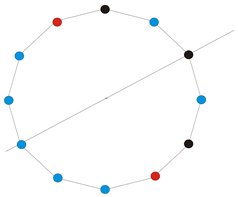
Colorings are equivalent if one of them can be obtained from the other by rotating about the center of the polygon.
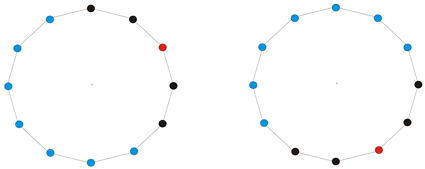
Obviously, the number of all r-colorings of G is . Applying Burnside’s Lemma [3, I, §3] shows that the number of equivalence classes of r-colorings of G is equal to
where is the subgroup generated by g. However, counting symmetric r-colorings and equivalence classes of symmetric r-colorings of G turned out to be quite a difficult question.
Let denote the set of symmetric r-colorings of G. In [4] it was shown that if G is Abelian, then
Here, X runs over subgroups of G, Y over subgroups of X, is the Möbius function of the lattice of subgroups of G, and .
Given a finite partially ordered set, the Möbius function is defined as follows:
See [3, IV] for more information about the Möbius function.
If n is odd then
If , where and m is odd, then
As usual, p denotes a prime number.
Recently, an approach for computing and in the case of an arbitrary finite group G has been found [5]. The approach is based on constructing the partially ordered set of so called optimal partitions of G.
Given a partition of G, the stabilizer and the center of are defined by
is a subgroup of G and is a union of left cosets of G modulo . Furthermore, if , then is also a union of right cosets of G modulo and for every , . We say that a partition of G is optimal if and for every partition of G with and , one has . The latter means that every cell of is contained in some cell of , or equivalently, the equivalence corresponding to is contained in that of . The partially ordered set of optimal partitions of G can be naturally identified with the partially ordered set of pairs of subsets of G such that and for some partition of G with . For every partition , we write to denote the number of cells of .
In [5] it was shown that for every finite group G and ,
where P is the partially ordered set of optimal partitions of G.
The partially ordered set of optimal partitions of G together with parameters , and can be constructed by starting with the finest optimal partition and using the following fact:
Let be an optimal partition of G and let . Let be the finest partition of G such that and , and let be the finest partition of G such that and . Then the partitions and are also optimal.
In this note we compute explicitly the numbers and where is the quaternion group.
First, we list all optimal partitions of Q together with parameters , and .
The finest partition
- : , , , , .
- , .
- , , .
Then one partition
- : , , , .
- , .
- , , .
Three partitions of the form
- : , .
- , .
- , , .
And the coarsest partition
- : .
- , , .
Next, we draw the partially ordered set P of optimal partitions together with parameters , , . The picture below shows also the values of the Möbius function of the form .
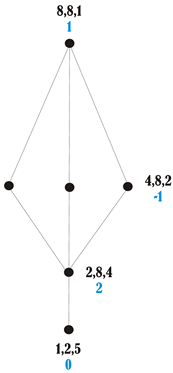 Finally, by formulas 3, 4, we obtain that
Finally, by formulas 3, 4, we obtain that
Thus, we have showed that
Proposition.
For every , and .
In particular, and , while the number all 2-colorings of Q is and the number of equivalence classes of all 2-colorings of Q is
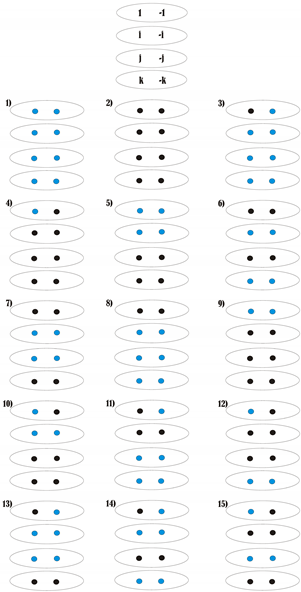
We conclude this note with the list of all symmetric 2-colorings of Q, up to equivalence.
References
- Loos, O. Symmetric Spaces; Benjamin: New York, NY, USA, 1969. [Google Scholar]
- Gryshko, Y. Symmetric Subsets and Colorings of Groups; C. Sc. Dissertation, Kyiv Taras Shevchenko University: Kyiv, Ukraine, 2002; p. 118. [Google Scholar]
- Aigner, M. Combinatorial Theory; Springer-Verlag: Berlin-Heidelberg-New York, NY, USA, 1979. [Google Scholar]
- Gryshko, Y. Symmetric colorings of regular polygons. Ars. Combinatoria 2006, 78, 277–281. [Google Scholar]
- Zelenyuk, Y. Symmetric colorings of finite groups. Proceedings of Groups St Andrews 2009, Bath, UK, 1–15 August 2009. accepted. [Google Scholar]
© 2010 by the author; licensee Molecular Diversity Preservation International, Basel, Switzerland. This article is an open-access article distributed under the terms and conditions of the Creative Commons Attribution license http://creativecommons.org/licenses/by/3.0/.