Article

Adaptive Instantaneous Frequency Synchrosqueezing Transform and Enhanced AdaBoost for Power Quality Disturbance Detection


College of Science, Wuhan University of Science and Technology, Wuhan 430065, China
*
Author to whom correspondence should be addressed.
Symmetry 2026, 18(3), 475; https://doi.org/10.3390/sym18030475
Submission received: 16 January 2026 / Revised: 6 March 2026 / Accepted: 7 March 2026 / Published: 10 March 2026
(This article belongs to the Section Engineering and Materials)

Abstract

The integration of renewable energy and power electronics has intensified the occurrence of complex power quality disturbances (PQDs), which increasingly threaten grid stability. To address the challenges of multi-class PQD identification under noisy conditions, this paper proposes a novel framework that combines an enhanced time–frequency analysis method with an optimized AdaBoost decision tree. The main contributions are three-fold: (1) We develop an instantaneous frequency adaptive Fourier synchrosqueezing transform (IFAFSST) equipped with a custom adaptive operator that aligns closely with the frequency modulation patterns in PQD signals, thereby improving time–frequency energy localization. (2) The IFAFSST outputs are decomposed into low-frequency and high-frequency components, from each of which a set of 16 discriminative features is extracted. (3) An improved AdaBoost classifier is introduced, incorporating forward feature selection and Hyperband-based hyperparameter optimization to enhance classification performance. Hyperband accelerates the optimization process by dynamically allocating computing resources and iteratively eliminating suboptimal configurations, thereby enabling efficient determination of the optimal hyperparameters. The method proposed in this paper achieved an accuracy rate of 99.50% on simulated data containing 30 dB white noise and 98.30% on hardware platform data. This framework can effectively handle 23 types of interference, including seven types of single interference, 12 types of double compound interference, three types of triple compound interference, and one type of quadruple compound interference. It performs particularly well in identifying composite interference scenarios. This research has made a significant contribution to power quality analysis, providing a powerful solution with high accuracy and practical applicability, and offering great potential for the implementation of smart grid monitoring systems and the integration of renewable energy.

1. Introduction

1.1. Research Background and Significance

Achieving the “dual carbon” goal requires the transformation of the power system towards a structure dominated by renewable energy. This directly brings about two challenges: the management of a high proportion of wind power/solar photovoltaic grid connections and the optimization of the overall system energy efficiency [1]. However, the inherent volatility of distributed energy resources and increasing nonlinear loads are causing frequent dynamic voltage violations and harmonic distortions in distribution networks [2]. In this context, composite power quality disturbances have emerged as a critical concern. Composite disturbances refer to complex signals formed by the interaction or simultaneous occurrence of two or more distinct disturbance types within the same time window. Compared to single interference (such as isolated harmonics, voltage sags or flickers), composite interference exhibits complex characteristics in both the time domain and frequency domain, including non-stationarity, nonlinear superposition and mode coupling. Its mathematical representation is usually a linear or nonlinear combination of multiple single disturbance models.
The low-carbon transformation in the energy sector has facilitated the widespread integration of renewable energy, electric vehicle charging infrastructure, and distributed energy storage, significantly enhancing the “electrification” level of the power system [3]. This trend, while enhancing grid flexibility, has also triggered unprecedented power quality challenges, including ultra-high frequency harmonics (>2 kHz), transient voltage fluctuations, and non-stationary waveform distortions [4]. Consequently, modern power grids are now confronted with complex, multi-modal disturbances [5], which exhibit nonlinear superimposition of amplitude, duration, and spectral characteristics, as well as severe time–frequency interference, spectral aliasing, and mode overlap caused by transient components [6]. Typical examples include “voltage sag with harmonics” in industrial settings and “voltage flicker with inter-harmonics and oscillations” at renewable energy connection points. These disturbances, due to their heterogeneous composition and overlapping time–frequency signatures, substantially complicate detection, decomposition, and classification, posing a pivotal challenge in contemporary power quality management. As stated by Wang et al. [7], the dynamic characteristics of modern grid faults and disturbances are becoming increasingly complex, and intelligent diagnostic methods with physical interpretability are urgently needed. It is worth noting that the research by Lin et al. [8] indicates that in new grid structures, such as hybrid AC-DC microgrids, and the static and transient control requirements for power regulation are intertwined, making the disturbance patterns more complex and raising higher requirements for the ability to capture dynamic characteristics during monitoring and analysis. In this context, rapid and accurate identification and classification of composite disturbances (such as harmonics accompanying voltage sag) have been proven to be a key solution for enhancing the reliability of intelligent grids, and constitute a core technical challenge that needs to be addressed urgently.

1.2. New Challenges and Paradigm Shifts in Power Quality in Modern Power Systems

With the rapid development of “dual high” (high proportion of renewable energy and high proportion of power electronic equipment) power systems, the nature of power quality disturbances is undergoing a fundamental shift. Traditional analysis frameworks, focused on steady-state harmonics and isolated transients, are no longer adequate. Emerging disturbances exhibit unprecedented complexity and systemic characteristics, primarily manifested as: (a) wide-band oscillations, such as resonances ranging from hundreds of hertz to thousands of hertz caused by photovoltaic inverter clusters; (b) sub/super-synchronous oscillations, closely related to the grid connection interaction of large-scale wind farms, threatening system stability; and (c) harmonic instability, resulting from the dynamic interaction between power electronic devices, with time-varying and propagating characteristics. These new “composite disturbances” are essentially systemic problems that are coupled by multiple physical processes, intertwined across multiple time scales, and propagated spatially.
These challenges have directly driven a paradigm shift in the field of power quality analysis: the core objective has shifted from post-hoc classification and diagnosis of isolated events at individual monitoring points to real-time, online, and spatio–temporal correlation and situational awareness of disturbances across the entire network of multiple nodes. This requires that the analysis technology not only be capable of accurately and precisely analyzing the local characteristics of a single point signal, but also be able to extract high-dimensional features with spatio–temporal correlation, and utilize advanced machine learning models (such as graph neural networks) to understand the networked disturbance patterns. A fundamental prerequisite for building reliable spatio–temporal correlation models, however, is the availability of highly accurate, stable, and interpretable local disturbance features from each network node. Inaccurate or noisy single-point features inevitably lead to mis-correlation and incorrect traceability at the network level.
In this broad context, high-resolution time–frequency analysis techniques, as the foundational cornerstone for feature extraction, have become increasingly important. However, traditional time–frequency analysis methods, due to their inherent assumptions, struggle to provide clear and stable time–frequency representations when analyzing the aforementioned new wide-band and rapidly changing signals, thus becoming a bottleneck for building a reliable situational awareness system. Therefore, developing an adaptive time–frequency analysis method capable of precisely characterizing complex time-varying frequency components is an indispensable key step towards system-level intelligent diagnosis. The present work presented in this paper focuses on this fundamental aspect, aiming to provide a superior and more reliable “atomic” feature for subsequent networked correlation analysis by proposing the instantaneous frequency adaptive Fourier synchronous compression transform (IFAFSST). This research does not ignore the spatial–temporal dimensions; instead, it provides a powerful, reliable, and efficient front-end feature engine for integrating spatial–temporal feature extraction methods (such as correlation analysis based on graph models), which is a crucial and foundational task in the grand blueprint of building a complete “disturbance spatio–temporal propagation perception system.

1.3. Existing Methods and Their Limitations

To address the aforementioned challenges, traditional methods for power quality disturbance classification typically follow a two-stage paradigm of “feature extraction + disturbance classification”. At the feature extraction stage, time–frequency analysis methods, such as short-time Fourier transform (STFT) [9], discrete wavelet transform (DWT) [10], synchronous expanding wavelet transform (SWT) [11], and S-transform (ST) [12], have been widely adopted. However, these methods have inherent theoretical limitations: STFT is limited by a fixed time–frequency window and is unable to balance time–frequency resolution; DWT’s effectiveness heavily depends on the number of decomposition levels and the arbitrary selection of wavelet bases; SWT is also constrained by the limitation of time–frequency resolution; and ST is hindered by the Heisenberg uncertainty principle and has poor real-time performance [13].
Current power quality disturbance analysis methods can be classified into three main categories: methods based on fixed basis functions (STFT, WT), methods based on adaptive time–frequency analysis (SST and variants), and methods based on deep learning. Each type of method exhibits significant differences in accuracy, robustness, application scope, and computational complexity. The comparison results of various mainstream methods are shown in Table 1.
To improve the quality of features, the research community has turned to exploring the integration of time–frequency analysis and machine learning. For instance, Akkaya et al. [14] demonstrated the potential and value of adaptive feature representation by combining synchronous squeezing transformation with neural networks, showing the benefits in enhancing classification performance. Meanwhile, purely data-driven methods (such as ANN [15], optimization based on ant colony algorithm [16], LSTM [17], CNN-LSTM [18]) provide new approaches for PQD classification and system stability prediction. Data-driven approaches also demonstrate significant potential in addressing power quality issues caused by cyber-attacks. For instance, Wang et al. developed a data-driven detection and localization framework that does not rely on precise physical models for false data injection attacks in DC microgrids, capturing the dynamic characteristics under attack by analyzing process input and output data [19]. This indicates that learning dynamic features from data has become a key technical path for enhancing system resilience, whether dealing with passively generated compound disturbances or actively initiated malicious attacks. However, these methods often encounter new challenges, such as high computational cost, poor model interpretability, and strong dependence on a large amount of high-quality labeled data. The widespread application of power electronic devices (such as matrix converters [20]) further complicates the disturbance features, placing higher demands on feature extraction methods. Among more representative advanced time–frequency analysis tools, the Fourier synchronous squeezing transformation (FSST) can extract instantaneous frequencies and compress energy, sharpening time–frequency representations, reducing cross-interference, and significantly enhancing the performance of traditional STFT [21]. However, FSST performs poorly when analyzing complex PQD [22]. These limitations lead to a significant decrease in time–frequency resolution when dealing with noise pollution and rapid frequency changes in actual PQD signals, making it impossible to achieve effective signal separation. Therefore, developing an improved FSST algorithm that can simultaneously achieve strong noise robustness and high time–frequency resolution has become an urgent need to improve the accuracy of PQD recognition.

1.4. Application Prospects and Engineering Value Analysis

The proposed IFAFSST-HY-AdaBoost framework offers substantial application potential across multiple key domains of smart grid development. At the distribution level and on the consumer side, the method can be embedded into smart meters or dedicated monitoring terminals to accurately identify disturbances such as voltage sags, surges, harmonics, and flicker, providing data support for the determination of power quality responsibilities and the formulation of customized power schemes. In scenarios with high penetration of distributed energy, the method’s outstanding time–frequency resolution is particularly suitable for analyzing sub/super-synchronous oscillations and wide-band resonances caused by photovoltaic and wind power grid connections, providing technical support for the friendly integration of new energy sources.
Compared with traditional methods, this solution demonstrates significant advantages: unlike fixed basis functions such as STFT and WT methods, it breaks through the Heisenberg uncertainty principle limitation through dynamic frequency correction, achieving better time–frequency energy concentration. In contrast to conventional black-box deep learning models, it integrates adaptive time–frequency analysis with interpretable feature engineering, demonstrating greater discriminative power for complex disturbances, particularly under limited sample conditions. From an engineering perspective, the method achieves a favorable trade-off between computational complexity and classification accuracy, demonstrating strong potential for embedded deployment, and can be adapted through lightweight optimization to meet the real-time monitoring demands of smart meters.

1.5. The Main Work and Innovation of This Article

To address the shortcomings of FSST in terms of noise sensitivity and transient frequency matching, this paper proposes a classification method that combines the instantaneous frequency adaptive Fourier synchronous squeezing transform (IFAFSST) with an enhanced AdaBoost decision tree. The proposed approach enables rapid and accurate identification of complex power quality disturbances (PQDs) under noisy conditions [23,24]. The core innovation points of this article can be summarized as the following three key improvements:
(1)
An adaptive instantaneous frequency estimation operator that replaces the noise-sensitive estimator of FSST, enabling accurate tracking of rapid frequency variations.
(2)
A bidirectional energy redistribution mechanism that enhances time–frequency concentration by explicitly compensating for energy dispersion in the time direction.
(3)
A complete classification framework integrating IFAFSST-based feature extraction with an enhanced AdaBoost classifier optimized via forward feature selection and Hyperband tuning [25,26]. Experimental validation in Section 5 demonstrates that these innovations collectively achieve superior accuracy, noise robustness, and computational efficiency.
The paper is organized as follows: Section 2 presents the IFAFSST construction method and analyzes its decomposition performance. Section 3 provides a detailed description of the composite disturbance feature extraction method based on the high and low frequency components of IFAFSST. Section 4 introduces the multi-label composite PQD classification model with an enhanced AdaBoost decision tree. Section 5 comprehensively verifies the performance of the method through a multi-level experimental design. Section 6 summarizes the research results of this article and looks forward to future directions.

2. Instantaneous Frequency Adaptive Synchrosqueezing Transform

The key to time–frequency analysis lies in how to obtain a high-resolution energy representation in the time–frequency plane. This chapter introduces a synchronous compression transform based on adaptive instantaneous frequency, aiming to overcome the limitations of traditional methods in time–frequency aggregation. This method reallocates the time–frequency energy through precise estimation of instantaneous frequency, providing a high-quality tool for subsequent refined signal analysis.

2.1. Short-Time Fourier Transform

To establish the foundation for the proposed IFAFSST method, we first revisit the classical short-time Fourier transform (STFT), which serves as the basis for subsequent time–frequency reassignment. Generally, the STFT of a signal x ( t ) L 2 ( R ) is defined as
S x g ( ξ , u ) = + x ( t ) g ( t u ) exp ( i ξ ( t u ) ) d t
where g ( t ) is a real symmetric window function, μ represents the time-shift unit, and ξ represents the frequency-shift unit. In this paper, a symmetric Gaussian window function is adopted.
In summary, Equation (1) provides the fundamental time–frequency representation upon which all subsequent adaptive corrections are built. The STFT’s inherent trade-off between time and frequency resolution motivates the need for the reassignment techniques introduced in the following subsections.

2.2. Synchrosqueezing Transform

Building upon the STFT, the synchrosqueezing transform (SST) enhances time–frequency readability by reassigning energy according to instantaneous frequency estimates. Its implementation involves three key steps:
(1)
To compute the time–frequency representation of a signal x ( t ) using the STFT defined in Equation (2).
(2)
Calculate the instantaneous frequency (IF) estimation operator for time–frequency reassignment.
ω ˜ x ( ξ , u ) = u S x g ( ξ , u ) i S x g ( ξ , u )
where u S x ( ξ , u ) = S x ( ξ , u ) / u represents the partial derivative of the short-time Fourier transform for its time-shifted variables.
(3)
The algorithm reassigns time–frequency coefficients using the instantaneous frequency (IF) estimation operator
T X ( u , ω ) = Ε x ( u ) S x ( u , ξ ) δ ( ω ω ˜ x ( u , ξ ) ) d ξ
where δ is the Dirac function, which represents the rearrangement of energy from ω to η = ω ( u , ξ ) .
The SST reconstruction formula uses an inverse transformation:
f ( u ) C g 1 0 T x ( u , ω ) d ω
where C g 1 = 1 2 π g ( ξ ) d ξ . Compared to traditional time–frequency reassignment methods, SST enhances energy concentration in the time–frequency representation while enabling reversible reconstruction to the time domain. This allows for improved signal decomposition, filtering, and broader flexibility in signal processing tasks.
The key idea of SST is to sharpen the time–frequency representation by moving energy from its original location to the instantaneous frequency estimate ω ˜ x ( ξ , u ) . However, as noted in the introduction, this operator becomes inaccurate for rapidly varying frequencies, which motivates the adaptive correction developed in the next subsection.

2.3. Adaptive Operator Derivation and Parameter Setting

This section aims to derive the core adaptive operator of IFAFSSST and provide suggestions for key parameter settings to enhance the readability and practicality of the method. All operators are defined based on the short-time Fourier transform, and their physical meaning is the local spectral intensity of the signal at both time and frequency. To enhance the readability and practicality of the method, this section elaborates on the derivation logic of the subsequent formulas. All operators are defined based on the short-time Fourier transform S = S x g ( ξ , u ) , and their physical meaning is the local spectral intensity of the signal at time μ and frequency ξ .
To address FSST’s limitations, this paper proposes the IFAFSST method—an improved synchronous squeezing transform tailored for signals with rapidly varying instantaneous frequencies, such as PQDs. Based on the short-time Fourier transform, we set X L 2 ( R ) , and define three key operators:
ω x ( ξ , u ) = u S i S
In STFT, the derivative of the phase with respect to time, denoted as arg ( S ) u , affords the local frequency at the time–frequency point ( ξ , u ) . Using the identity u ln S = u S S and considering S as a complex number, where the real part corresponds to the amplitude and the imaginary part corresponds to the phase, therefore, u S i S extracts the rate of phase change, which is an initial estimate of the instantaneous frequency.
t x ( ξ , u ) = u ξ S 2 π i S
Similarly, the derivative of the phase with respect to the frequency, denoted as ξ arg ( S ) , provides an estimate of the time delay at the time–frequency point ( ξ , u ) . Subtracting this value is for correction, so as to make the estimated time center more accurate. u is the center of the current time window, and t x is the estimated actual time center of the signal component at that frequency.
Equations (5) and (6) provide two fundamental estimates. These quantities capture how the signal’s frequency and temporal energy distribution vary across the time–frequency plane.
c x ( ξ , u ) = u ω x ( ξ , u ) u t x ( ξ , u )
Equation (7) estimates how the frequency changes over time, that is, the modulation frequency of the signal. The numerator represents the rate of change in the instantaneous frequency, and the denominator represents the rate of change in the group delay (theoretically, it is close to 1 in an ideal situation, but after actual correction, it is used for normalization). It measures the speed of the IF change and is used for subsequent adaptive correction.
Regarding the setting of frequency offset threshold and time offset threshold, our suggestion is as follows: (1) For the frequency offset unit ξ , the corresponding frequency resolution is Δ f = f s / N . The recommended threshold is T h f r e q = k f ξ ( k f [ 0.5 , 2 ] ) , and usually k f = 1 . (2) For the time offset unit u , the corresponding time step is Δ t = h o p s i z e / f s . The recommended threshold is T h t i m e = k t u ( k t [ 0.5 , 1.5 ] ) , and usually k t = 1 .
On this basis, the adaptive instantaneous frequency estimation operator is defined as
ω ˜ x ( ξ , u ) = ω x ( ξ , u ) + c x ( ξ , u ) [ u t x ( ξ , u ) ] ,   t x ( ξ , u ) 0 ω x ( ξ , u ) , t x ( ξ , u ) = 0
This is a linear correction formula. If the estimated time center t x is not equal to the current time u , it indicates that the initial instantaneous frequency estimation ω x has an error at this point. The deviation is corrected by multiplying the frequency deviation c x by the time deviation [ u t x ] . This is equivalent to performing a first-order Taylor expansion along the “ridge line” of the signal component in the time–frequency plane, thereby more accurately tracking the rapidly changing frequency.
Equation (8) is the core contribution of IFAFSST: it combines the initial IF estimate ω x with a correction term proportional to the chirp rate c x and the time offset [ u t x ] . This adaptive operator ensures accurate frequency tracking even when the signal frequency varies rapidly, directly addressing the limitation of standard FSST identified in Section 2.2.
The window functions used in this paper are all Gaussian window functions g ( t ) = π σ 2 1 / 4 e t 2 / 2 σ 2 . Their Fourier transform is g ^ ( ω ) = 2 σ π e σ ω 2 2 . According to the properties of the Gaussian function and the Fourier transform, it can be derived
u S x g = S x g + 2 i π u S x g
ξ S x g = 2 i π S x t g
u u 2 S x g = S x g 4 i π ξ S x g 4 π 2 ξ 2 S x g
ξ u 2 S x g = 2 i π S x t g + 4 π 2 ξ S x t g
The calculation of Equations (5) and (6) can be calculated by Equations (9)–(12), and then the adaptive instantaneous frequency ω ˜ x ( ξ , u ) is calculated according to Equation (8).
The instantaneous frequency adaptive Fourier synchrosqueezing transform (IFAFSST) employs an adaptive instantaneous frequency estimation operator rather than conventional frequency estimation. The time–frequency coefficient of IFAFSST can be obtained by
T x ( u , ξ ) = E x ( u ) S x ( u , ξ ) δ ( ω ω ˜ x ( u , ξ ) ) d ξ
where E x ( u ) = { ξ R ; | S x ( u , ξ ) | 0 } , and the reconstruction results of the IFAFSST can be obtained by Equation (4) and IFAFSST coefficients T x ( u , ξ ) .
In summary, the derivation from Equations (5) to (12) leads to the adaptive IF operator ω ˜ x ( ξ , u ) in Equation (8), which is then used in Equation (13) to reassign the time–frequency energy. The resulting IFAFSST coefficients provide a sharply concentrated time–frequency representation that preserves the ability to reconstruct the original signal via Equation (4). This completes the theoretical foundation of the proposed method.
Designed according to the instantaneous frequency characteristics of frequency-modulated signals, the operator ω ˜ x ( ξ , u ) physically represents the signal’s instantaneous frequency. This “improved” estimation operator effectively integrates group delay compensation and instantaneous frequency compensation while maintaining time-domain invertibility. As a result, it enhances the time–frequency energy concentration of power quality disturbance signals in FSST without sacrificing reconstruction accuracy.
The threshold parameters k f and k t ensure the stability of the values by filtering out the minor variations caused by noise while retaining the significant frequency changes in the actual interference. By adaptively applying the synchrosqueezing transform using frequency information from the operator ω ˜ x ( ξ , u ) , we obtain the proposed instantaneous frequency adaptive Fourier synchrosqueezing transform (IFAFSST).

2.4. Theoretical Innovation Boundaries and Comparative Analysis

The IFAFSST method proposed in this paper introduces three key innovations that collectively address the limitations of standard FSST and distinguish it from other advanced time–frequency analysis techniques:
First, the adaptive instantaneous frequency estimation operator (Equation (8)) replaces the noise-sensitive estimator of FSST. By incorporating group delay and chirp rate information, this operator accurately tracks rapid frequency variations—a critical requirement for PQD signals—while the thresholds T h f r e q and T h t i m e suppress noise-induced fluctuations, ensuring robust performance under noisy conditions.
Second, the bidirectional energy redistribution mechanism explicitly accounts for energy dispersion in both the frequency and time directions. Unlike standard FSST, which only reassigns energy along the frequency axis, IFAFSST compensates for temporal smearing, producing sharper time–frequency ridges that better capture the onset and duration of transient disturbances.
Third, the complete classification framework integrates IFAFSST-based feature extraction with an enhanced AdaBoost classifier optimized via forward feature selection and Hyperband tuning. This systematic engineering innovation ensures that the high-quality time–frequency representations translate into superior classification accuracy, as demonstrated in Section 5.
Compared to classical second-order synchrosqueezing transforms (e.g., RSST), IFAFSST adopts a first-order linear correction model tailored to the quasi-linear frequency modulation patterns prevalent in PQD signals. This design choice reduces computational complexity (avoiding second-order partial derivatives) while maintaining sufficient accuracy, making the method more suitable for real-time deployment. Furthermore, the condition-activation mechanism—enabling adaptive correction only when the estimated time offset exceeds T h t i m e —provides better numerical stability under noisy conditions than methods that apply high-order corrections unconditionally.
In essence, IFAFSST represents a specialized adaptation of advanced time–frequency reassignment principles to the specific demands of power quality disturbance analysis. Its innovations lie not in proposing a completely new mathematical paradigm, but in creatively combining and optimizing existing techniques—adaptive frequency estimation, threshold-based noise suppression, and bidirectional energy redistribution—into a cohesive framework that delivers superior performance for PQD signals while maintaining computational efficiency and engineering practicality.

2.5. IFAFSST Performance Analysis

To evaluate the effectiveness of the proposed IFAFSST, this subsection analyzes its performance on representative PQD signals, including both single and composite disturbances. Power quality disturbances typically result from the superposition of multiple fundamental signal components. The basic signals studied in this paper include harmonic signal (D1), voltage sag (D2), voltage swell (D3), voltage interrupt (D4), voltage flicker (D5), transient oscillation (D6), and transient pulse (D7). The power quality disturbance signal model constructed according to IEEE standards is shown in Table 2.
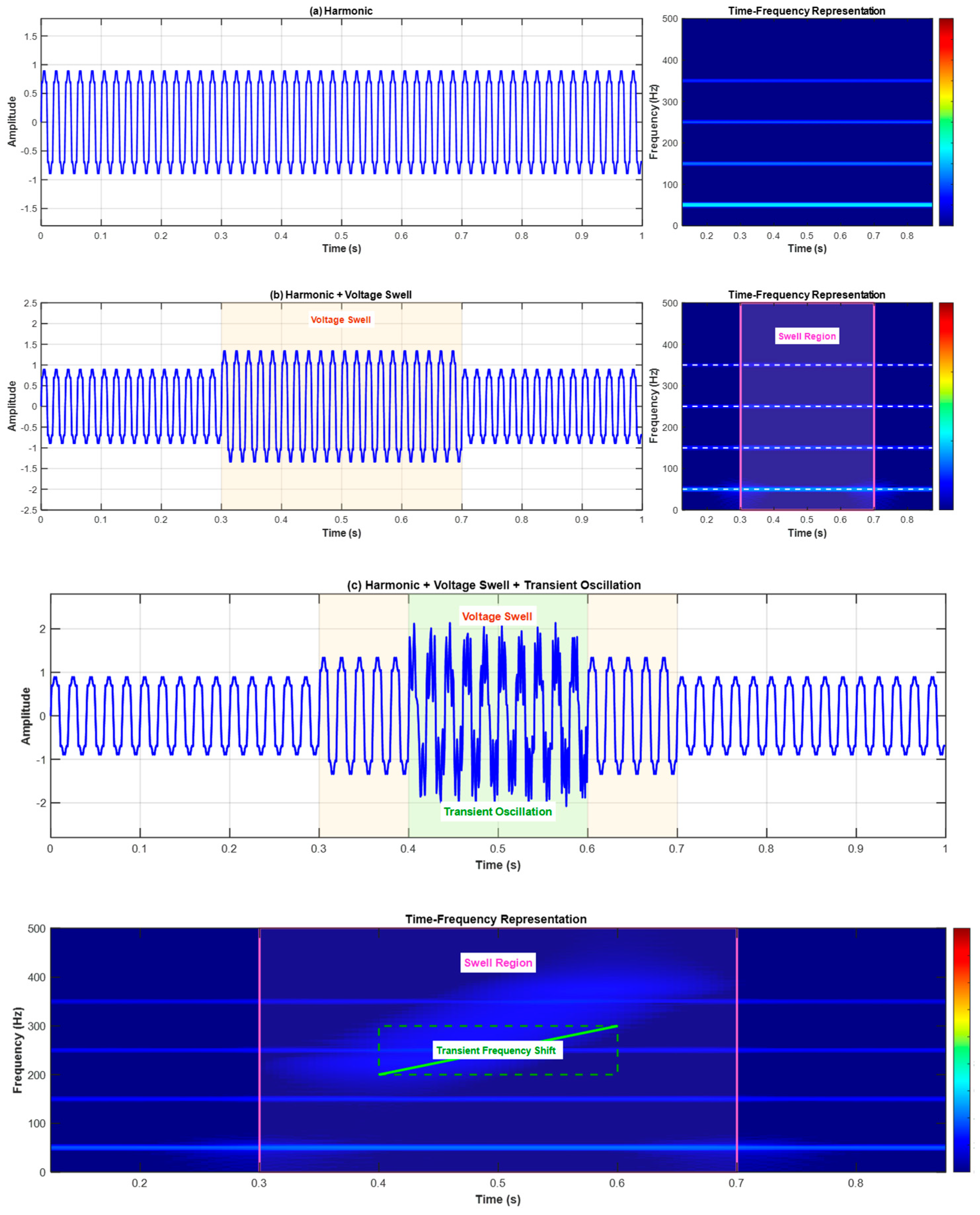
The studied disturbance models with 50 Hz fundamental frequency at 30 dB SNR. We conducted IFAFSST decomposition in MATLAB for three disturbance scenarios: D1, D1 + D3, and D1 + D3 + D6. The results are presented in Figure 1. The x-axis represents time, while the y-axis displays both amplitude and frequency information, and the color indicates the energy intensity.
Figure 1a demonstrates the effectiveness of IFAFSST in a single interference analysis, clearly distinguishing the fundamental frequency (50 Hz) and harmonic components (150 Hz and 250 Hz) in the synthesized harmonic signal. The time-domain waveform shows a clean periodic signal with an amplitude ranging from −1.5 to 1.5. The corresponding spectrum graph reveals these different spectral elements as continuous horizontal energy bands, with a white dashed line clearly marking the position of each harmonic frequency (50 Hz, 150 Hz, 250 Hz, 350 Hz). This reference harmonic spectrum establishes the method’s ability in steady-state frequency resolution. Figure 1b shows the composite harmonic and voltage spike interference (D1 + D3). The time-domain waveform exhibits a voltage spike event during the period of 0.3 to 0.6 s, characterized by a light red background highlighting, and during this period, the signal amplitude significantly increases. The time-frequency graph successfully separates the harmonic components and the temporal characteristics of voltage expansion. Figure 1c extends to the complex scenario of harmonic + voltage spike + transient oscillation. The time-domain waveform presents two different interferences: the voltage spike (highlighted in a light red background) during the period of 0.4 to 0.6 s and the transient oscillation (indicated by a green background and labeled as “Transient Oscillation”) during the same period. These results confirm the robustness of IFAFSST in analyzing isolated and interacting interferences. The method can still maintain component resolution in the case of signal superposition, accurately capture temporal characteristics and frequency dynamics, and clearly demonstrate complex power quality phenomena through this integrated time–frequency approach.
In conclusion, the IFAFSST method proposed in this chapter effectively overcomes the limitations of traditional FSST in handling non-stationary and rapidly changing signals through adaptive frequency correction and threshold mechanism. It achieves high-resolution time–frequency characterization of power quality disturbance signals. This method serves as the foundation for subsequent feature extraction and classification, and the clear time–frequency ridges provided by it directly contribute to the core objective of the paper “Realizing High-Accuracy Identification of Power Quality Disturbances in Complex Environments”.

3. Disturbance Feature Extraction Based on IFAFSST

Based on the high-resolution time–frequency representation generated by IFAFSST, this chapter further addresses the key issue of “how to extract features with clear physical significance and strong discriminative power from the time–frequency spectrum”. By separating the low-frequency and high-frequency components and designing 10 low-frequency features (F1–F10) and six high-frequency features (F11–F16), a 16-dimensional hierarchical feature vector capable of comprehensively characterizing the characteristics of single and composite disturbances was constructed. This feature system is closely integrated with the physical characteristics of the disturbances, providing high-quality input for the subsequent classification model and directly supporting the contribution of the paper “Constructing highly interpretable feature engineering”.

3.1. Low-Frequency Component Features

The IFAFSST decomposes the PQD signal into low-frequency and high-frequency components. The low-frequency component primarily captures the fundamental frequency variations and amplitude modulations. To characterize these fundamental-related disturbances (e.g., sag, swell, flicker), we extract ten features (F1–F10) from this component as follows.
For a time signal f ( t ) containing Band-Limited Intrinsic Mode Functions (BLIMFs) and in view of the fact that the low-frequency component B L I M F 1 extracted by IFAFSST can effectively retain the original features of the fundamental frequency signal in the PQ disturbance, this paper extracts features F1–F10 from B L I M F 1 .
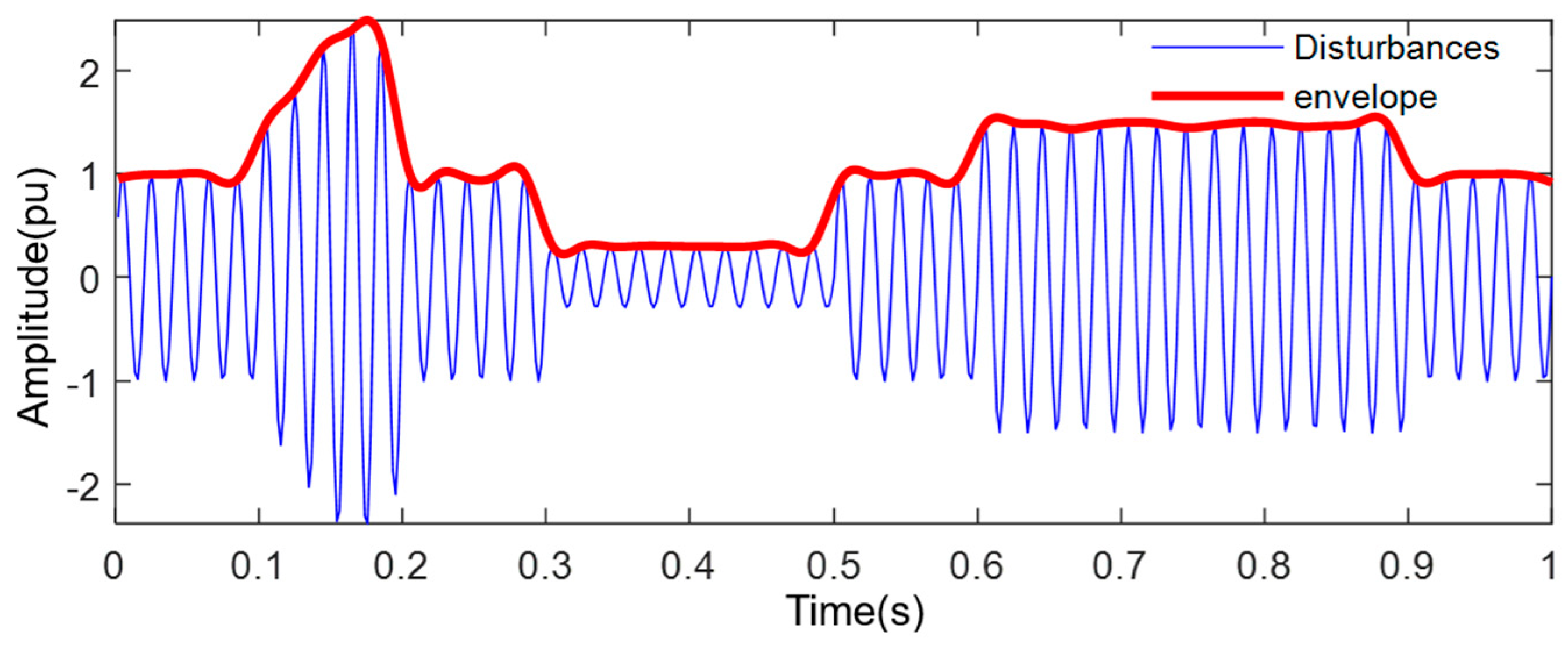
(1) Let A ( m ) = | B L I M F 1 ( m ) | , m is the number of sampling points, m = 1 , 2 , , M , and M is the total number of sampling points of PQDs. Using a dual-threshold strategy [27], we identify maximum points in the signal A ( m ) to construct the envelope peaks of low-frequency component extrema, with horizontal threshold T 1 = 0 and vertical threshold T 2 = f s T / 4 . Figure 2 demonstrates this process for a harmonic + voltage sag composite disturbance, showing how the envelope peaks precisely track the fundamental signal’s amplitude variations. Based on this accurate representation, we extract two key features from the envelope profile: feature F 1 and F 2 are defined as the effective up traversal and effective down traversal.
F 1 = M = 1 M 1 ( A < d 1 , A M + 1 d 1 )
F 2 = M = 1 M 1 ( A M d 2 , A M + 1 < d 2 )
If a peak crosses the threshold d 1 upward or downward, and the duration above d 1 is greater than an extreme point, it is a valid upward crossing. Similarly, if the envelope peak crosses the threshold d 2 up or down, and the duration below d 2 is greater than an extreme point, it is a valid downward crossing. In this paper, d 1 = 1.09 , d 2 = 0.91 . In addition, the serial number corresponding to extreme points in the envelope peak is recorded in sequence U from small to large, and the difference between the sizes of two adjacent extreme points in the envelope peak can be calculated to obtain the amplitude fluctuation sequence A ( h ) as follows:
A ( h ) = h p [ U ( h + 1 ) ] h p [ U ( h ) ]
where h = 1 , 2 , H 1 ( H is the total number of extremum points in the envelope peak); A ( h ) is the magnitude of the h amplitude fluctuation. The number of elements in A ( h ) greater than the threshold d 3 is called feature F 3 .
F 3 = i = 1 H ( A ( h ) > d 3 )
where ( ) is the indicator function, and d 3 = 0.14 .
(2) We apply a sliding window of length H to compute the effective value sequence A R M S of the low-frequency component, and the calculation process is as follows
A R M S ( r ) = 1 H i = r r + H 1 B L I M F 1 ( i ) 2
where H = T f s 2 ; i is a valid value sequence number, i = 1 , 2 , , r H + 1 . Effective value features F 4 F 7 can be extracted from A R M S as the maximum, minimum, average and standard deviation of A R M S , respectively.
F 4 = max ( A R M S )
F 5 = max ( A R M S )
F 6 = m e a n ( A R M S ) = 1 M i = 1 M A i
F 7 = s t d ( A R M S ) = 1 M i = 1 M ( A i m e a n ( A R M S ) )
Based on time-domain characteristics of fundamental frequency signals, features F 1 F 3 enable classification into four primary categories: normal signal, voltage swell, voltage sag (including interruption), and other disturbances (voltage flicker and compound disturbances with flicker). Features F 4 F 7 then further refine the latter two categories, while F 8 F 10 provide three additional discriminative features to achieve complete and accurate signal classification.
F 8 : Swell duration ratio. Detects voltage spikes when fundamental amplitude exceeds 1.02 p.u, and works with F 9 for flicker detection.
F 8 = T s w e l l T t o t a l × 100 %
F 9 : Sag duration ratio. Detects voltage dips when fundamental amplitude < 0.98 p.u. and works with F 10 for interruption identification.
F 9 = T s a g T t o t a l × 100 %
F 10 : Interrupt duration ratio. Distinguishes interruptions from sags.
F 9 = T i n t e r r u p t T t o t a l × 100 %

3.2. High-Frequency Component Features

Beyond low-frequency components, IFAFSST captures high-frequency content. For harmonics and transient oscillations, key characteristics appear primarily in the frequency domain and maintain stability despite superimposed disturbances. We therefore re-extract the feature F 11 F 16 from these high-frequency components.
F 11 : Skewness of low-order harmonics. Quantifies asymmetry in lower-order harmonic distributions.
S = 1 n i = 1 n [ X i u σ 3 ]
F 12 : Kurtosis of mid-range harmonics. Describes sub-harmonic characteristics, combined with F 13 for transient oscillation identification.
K = 1 n i = 1 n X i u σ 4
F 13 : Standard deviation of mid-range harmonics. Aggregates amplitude variability across middle-order harmonics.
S D = i = 1 n ( X i μ ) 2 n 1
F 14 : Cumulative kurtosis of high-order harmonics (19th–30th). Quantifies amplitude flatness for transient pulse identification.
F 14 = 30 h = 19 K u r t o s i s ( V h )
where K u r t o s i s ( V h ) represents the kurtosis of the h harmonic amplitude, and the formula is as follows:
K u r t o s i s ( V h ) = 1 M i = 1 M ( V h , i μ h ) 4 / ( 1 M i = 1 M ( V h , i μ h ) 2 ) 2
where V h , i is the amplitude of the i sampling point of the k harmonic, and μ h is the mean value of the h harmonic. Together with F15, F14 characterizes high-order harmonics and contributes to identifying transient pulses.
F 15 : Cumulative standard deviation of high-order harmonics (19th–30th).
F 15 = h = 19 30 S t d ( V h )
S t d ( V h ) represents the standard deviation of the h harmonic amplitude, calculated by the formula, which is as follows
S t d ( V h ) = 1 M i = 1 M ( V h , i μ h ) 2
F16: Total harmonic distortion (THD). For computational efficiency with large datasets, THD can be calculated at sampled intervals and averaged.
F 16 = h = 2 H V h 2 V 1 × 100 %
Based on the adaptive instantaneous frequency synchrosqueezing transform, the physical meanings of the extracted 16 power quality disturbance features are summarized in Table 3.
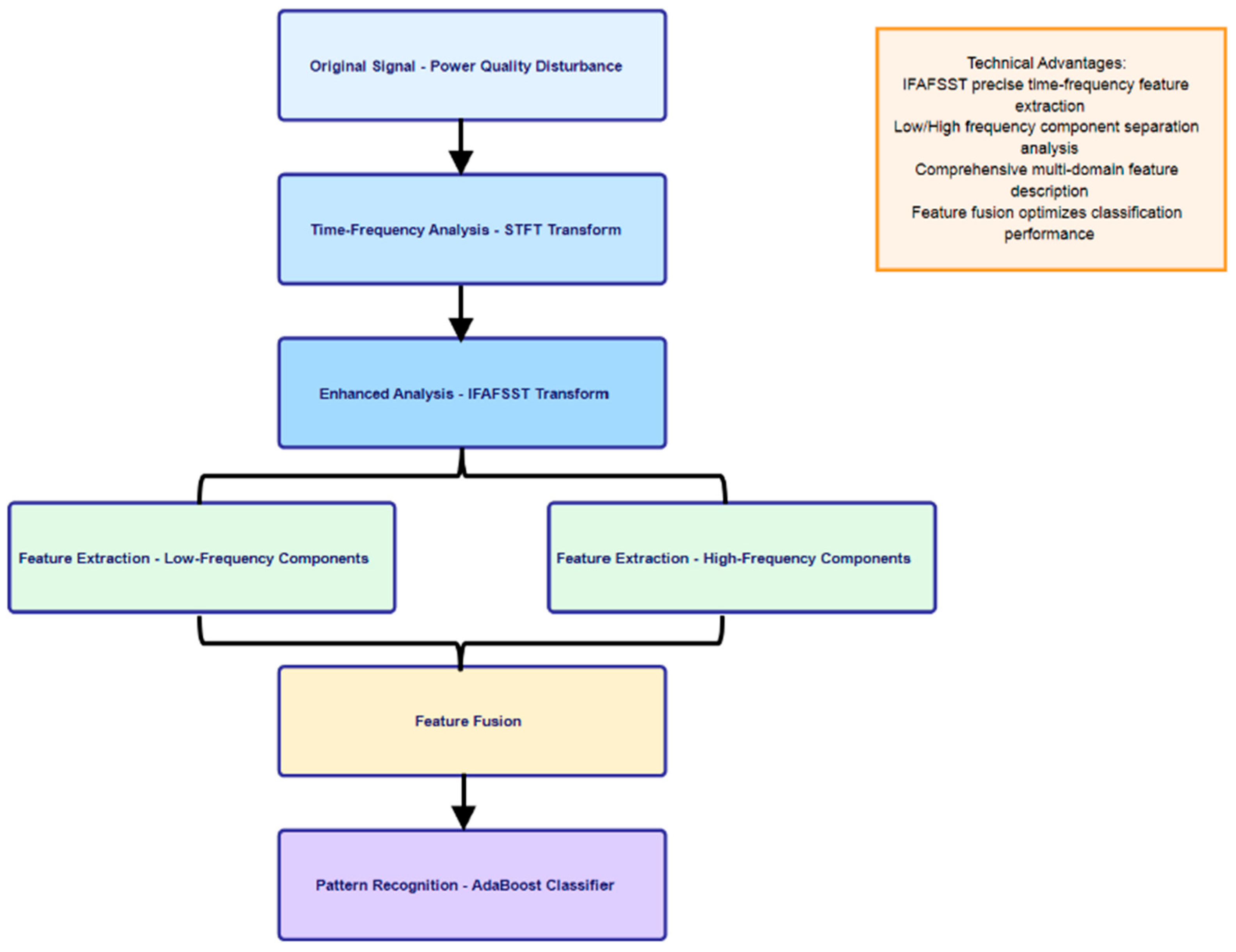
The previous section elaborated on the time–frequency analysis method based on IFAFSST and extracted feature parameters with clear physical meanings from both the low-frequency components and the high-frequency components. The specific definitions and explanations of these parameters have been summarized in Table 3. To clearly illustrate the overall process from signal input to feature extraction, as well as the logical relationships between each module; Figure 3 presents the complete technical route of the method proposed in this paper.
As shown in Figure 3, the original electrical power quality disturbance signal is first subjected to STFT transformation for preliminary time–frequency analysis, and then, through IFAFSST transformation, it achieves refined time–frequency redistribution, effectively enhancing time–frequency aggregation and anti-noise capabilities. On this basis, the characteristic parameters of the low-frequency component and the high-frequency component are extracted, respectively, forming a multi-domain fused feature vector. This feature vector will be used as the input and sent to the AdaBoost classifier described in Chapter 4 for disturbance mode recognition and classification. The right box on the right side of Figure 3 summarizes the main technical advantages of this method, including the precise time–frequency extraction ability of IFAFSST, the separation analysis of high and low frequency components, the comprehensive description of multi-domain features, and the optimization effect of feature fusion on classification performance. This technical route realizes a complete link from signal processing, feature extraction to pattern recognition, laying a solid foundation for subsequent disturbance classification experiments.
The 16-dimensional feature system constructed in this chapter has achieved the transformation from time–frequency representation to quantifiable features. The high consistency between the distribution of feature importance and the physical meaning verifies the rationality of the design. This feature set not only effectively captures the essential differences in various disturbances but also lays the foundation for the lightweighting of subsequent classifiers and the improvement in their generalization ability through redundancy removal. It is a key bridge connecting the front end of IFAFSSST and the HY-AdaBoost classifier, and directly serves the core goal of this paper, “achieving high-precision and high-efficiency disturbance recognition”.

4. Composite Disturbance Classification Based on HY-AdaBoost

Based on the extraction of power quality disturbance features in the previous chapter, this chapter further studies the classification and identification problem of composite disturbances. Considering the multi-label characteristics of composite disturbances, a classification method based on HY-AdaBoost is introduced to achieve synchronous identification of multiple disturbance types.

4.1. HY-AdaBoost Multi-Label Disturbance Classification Model

Similar to traditional boosting-based tree models, AdaBoost constructs a strong classifier as a weighted linear combination of weak classifiers through iterative training and residual fitting, demonstrating excellent generalization performance and computational efficiency. In this method, feature importance is determined by the frequency with which a feature is selected as a splitting node within the decision trees. This process allows the model to assess and rank the contribution of all input features.
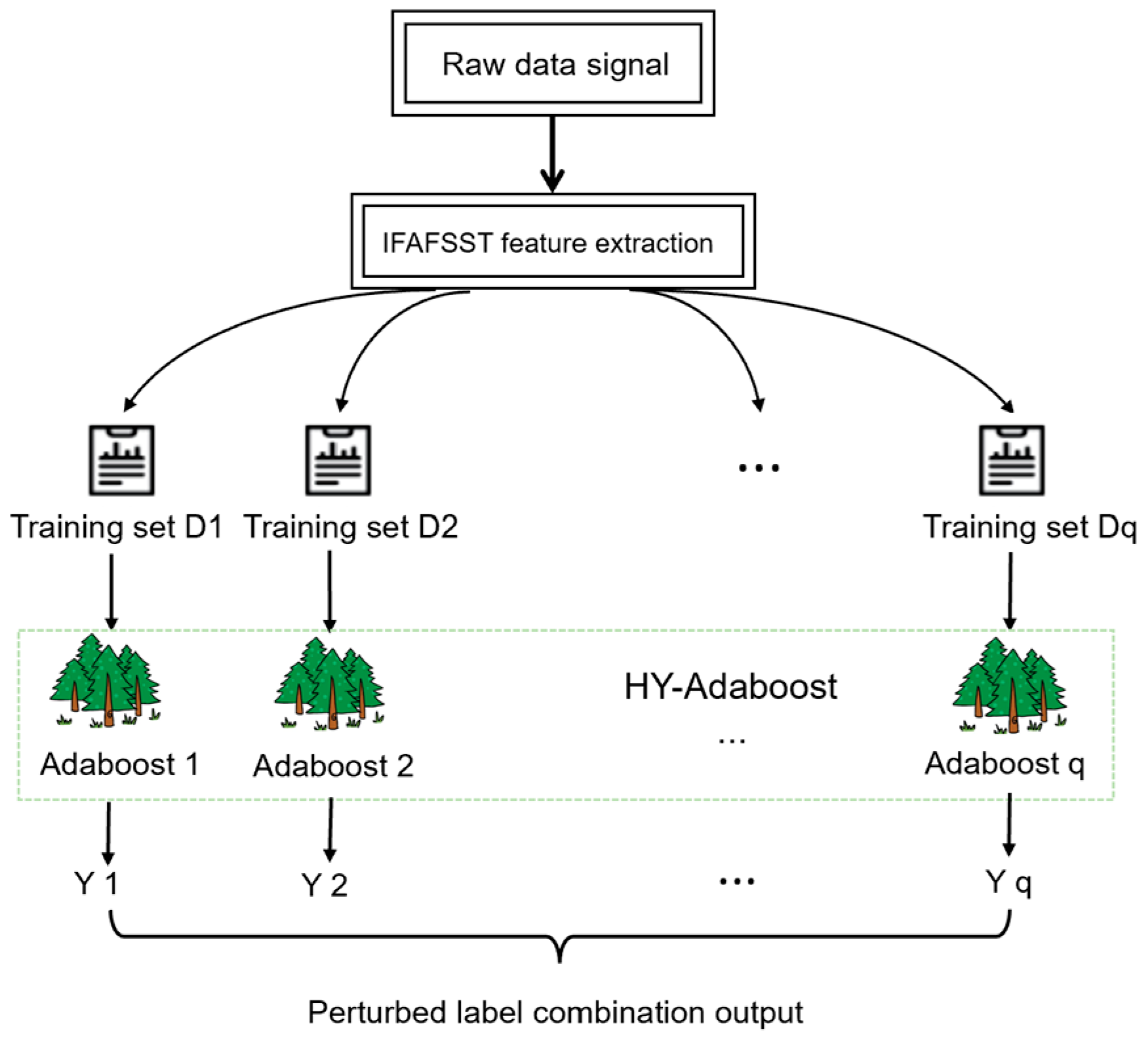
Since the feature extraction stage already captures all disturbance label characteristics, we develop an AdaBoost-based multi-label classification model (Figure 4) and train it for accurate disturbance identification. For any label, set the training set as D j = { ( X i , y i ) | 1 j Q } , where i is the sample serial number, X is the characteristic quantity, and variable y i { 0 , 1 } indicates that sample i does not belong to label j . Based on the training set, a binary classification model is constructed, the prediction result y j of label j can be obtained, and then multiple binary classifiers are combined into a multi-classification AdaBoost to output the multi-label disturbance classification result Y = [ y 1 , y 2 , y Q ] .

4.2. AdaBoost Feature Selection and Hyperparameter Tuning

Feature selection plays a critical role in improving model generalization by eliminating redundant elements from feature sets. This paper employs a forward sequential selection method [28] to select features for each AdaBoost model.
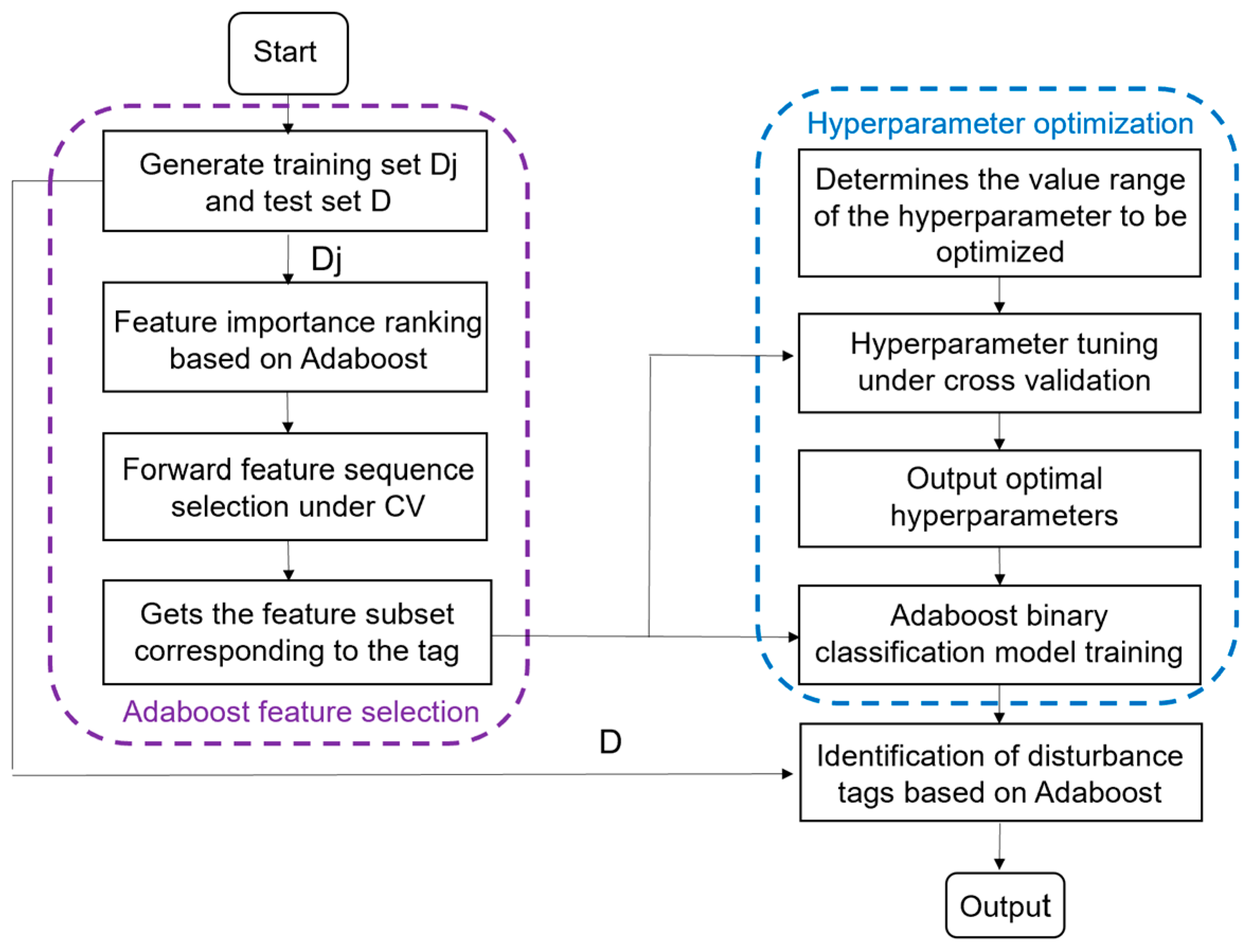
In addition to training data, model performance heavily depends on hyperparameter selection. To circumvent the challenges associated with manual hyperparameter tuning, we developed a distributed synchronous optimization module [29] using Python 3.9. Leveraging Hyperband optimization theory [30], cross-validation was used to tune each AdaBoost model within predefined hyperparameter ranges, thereby increasing the accuracy of the HY-AdaBoost model. The overall classification process, integrating feature selection and hyperparameter tuning, is depicted in Figure 5.

4.3. Construction of the Model Framework for Multi-Label Classification Algorithm

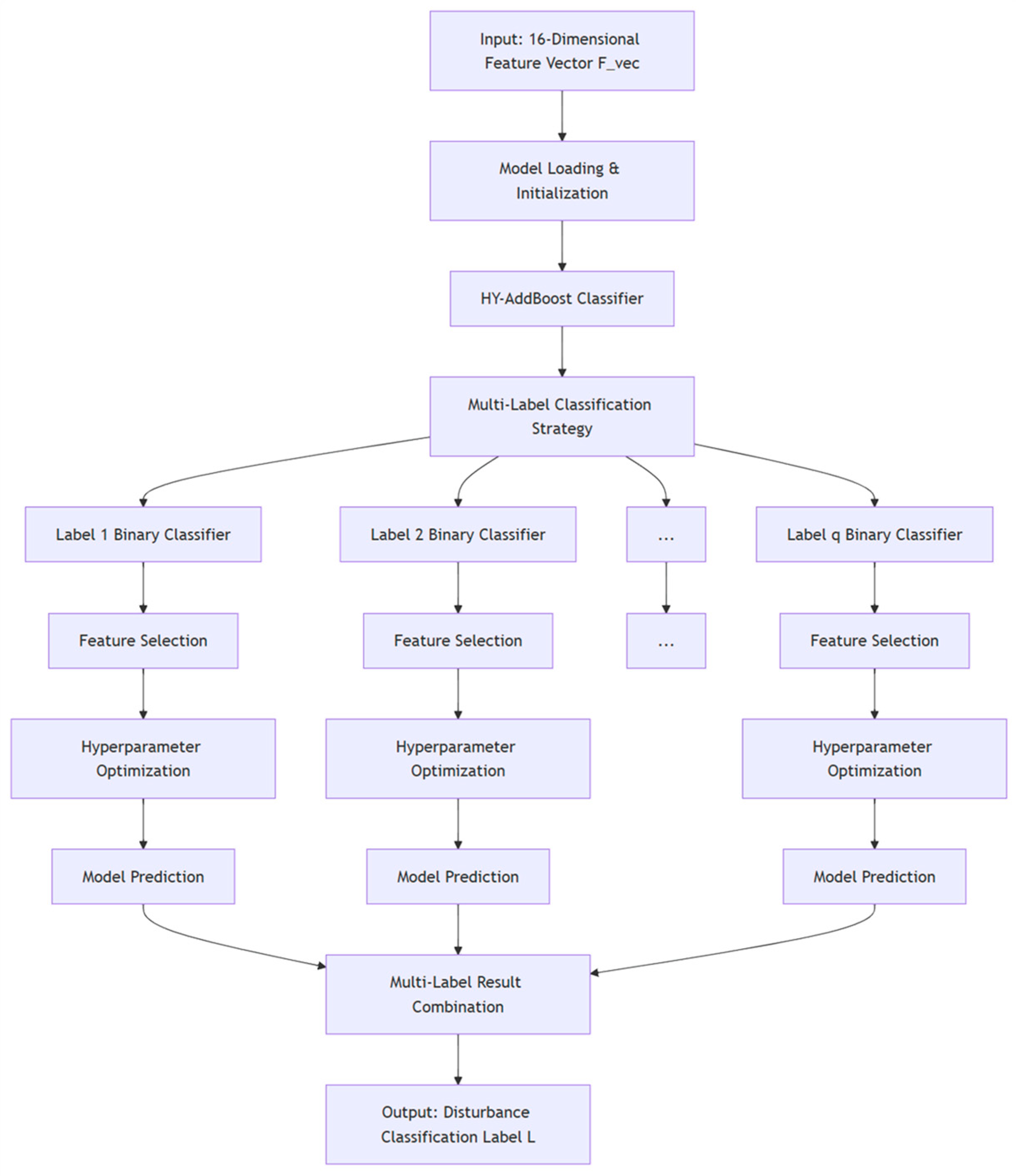
Based on feature selection and hyperparameter optimization, this section further constructs a complete parallel multi-label classification framework, integrating multiple binary AdaBoost models to achieve simultaneous identification of multiple types of PQD. This section constructs a framework for a multi-label classification algorithm model. The specific steps are as follows:
(1)
Input and Initialization.
Receive the input of 16-dimensional feature vectors, load and initialize the classification model and related parameters, and prepare for the multi-label classification task.
(2)
Parallel multi-label classification processing.
For different labels, several independent binary classifiers are launched in parallel. Each classifier sequentially goes through the following two stages:
-
Phase 1: Utilize the Hyperband algorithm for hyperparameter optimization and complete feature selection based on the initial prediction results;
-
Phase 2: Optimize the hyperparameters again on the selected feature subset and generate the final prediction result for this label.
(3)
Feature and Model Collaborative Optimization.
The importance of features is dynamically evaluated based on the intermediate results of each classifier. The iterative optimization of the feature set and model parameters is achieved through an adaptive feature selection strategy, ensuring that each classifier uses the most discriminative features.
(4)
Feature selection and optimization iteration.
Integrate the outputs of all binary classifiers and form the final multi-label classification result through the integration strategy. The flowchart is shown in Figure 6:
This modular, adaptive and parallel architecture is specifically designed for handling multi-label classification tasks of power quality disturbances. Its core lies in decomposing the complex multi-label recognition problem into multiple parallel binary classification sub-tasks. Each sub-task dynamically adjusts the model and features through a two-stage “optimization-filtering” mechanism. This module not only achieves the collaborative iteration of Hyperband hyperparameter optimization and targeted feature selection but also integrates the results of various classifiers through an integration strategy, thereby ensuring high recognition accuracy while significantly improving the computational efficiency and scalability of the system, providing a reliable technical solution for real-time and accurate classification in complex disturbance scenarios.
The HY-AdaBoost classification framework constructed in this chapter achieves the collaborative, iterative optimization of feature subsets and model parameters through a two-stage “optimization-selection” mechanism. This not only significantly improves the classification accuracy but also ensures computational efficiency through parallel processing and lightweight design. This framework, together with the IFAFSST front-end, constitutes a complete disturbance identification solution. Its modular and adaptive architecture design provides theoretical support for handling complex power quality disturbances and lays a solid classification model foundation for achieving the core goal of the paper—“providing a high-precision, robust, and efficient power quality disturbance identification method”.

5. Experimental Analyses

The preceding section established a multi-label classification framework that synergizes IFAFSST-based feature extraction with the HY-AdaBoost algorithm, specifically tailored for complex power quality disturbances. To empirically validate the efficacy of this proposed methodology and substantiate its claimed contributions—namely, enhanced accuracy, robustness to noise, and computational efficiency—comprehensive experiments were conducted on both simulated and hardware-acquired datasets. This section delineates the experimental setup, encompassing data generation protocols, parameter configurations, and evaluation metrics. Subsequently, detailed results are presented and analyzed, demonstrating how the experimental evidence corroborates the theoretical advantages of the approach and confirms its practical applicability in real-world power quality monitoring.
In order to demonstrate the validity of the proposed method, 1000 samples were generated in MATLAB 2022a according to the IEEE 1159 standard [31]. These samples included normal signals, 7 types of basic disturbances, 12 types of double disturbances, 3 types of triple disturbances, and 1 type of quadruple disturbance. The dataset was evenly split, with 50% allocated for training and the remaining half for testing. The power quality signals had a base frequency of 50 Hz, a sampling frequency of 6.4 kHz, and a duration of 0.2 s.
The learning objective of AdaBoost was “binary: logistic”, and the remaining parameters were all default values. The construction and analysis of AdaBoost and the comparison model were implemented in the Python 3.9 environment. The experimental computer was configured with an Intel(R) Core (TM) i7-1260P and 16 GB RAM.

5.1. Feature Selection Result Analysis

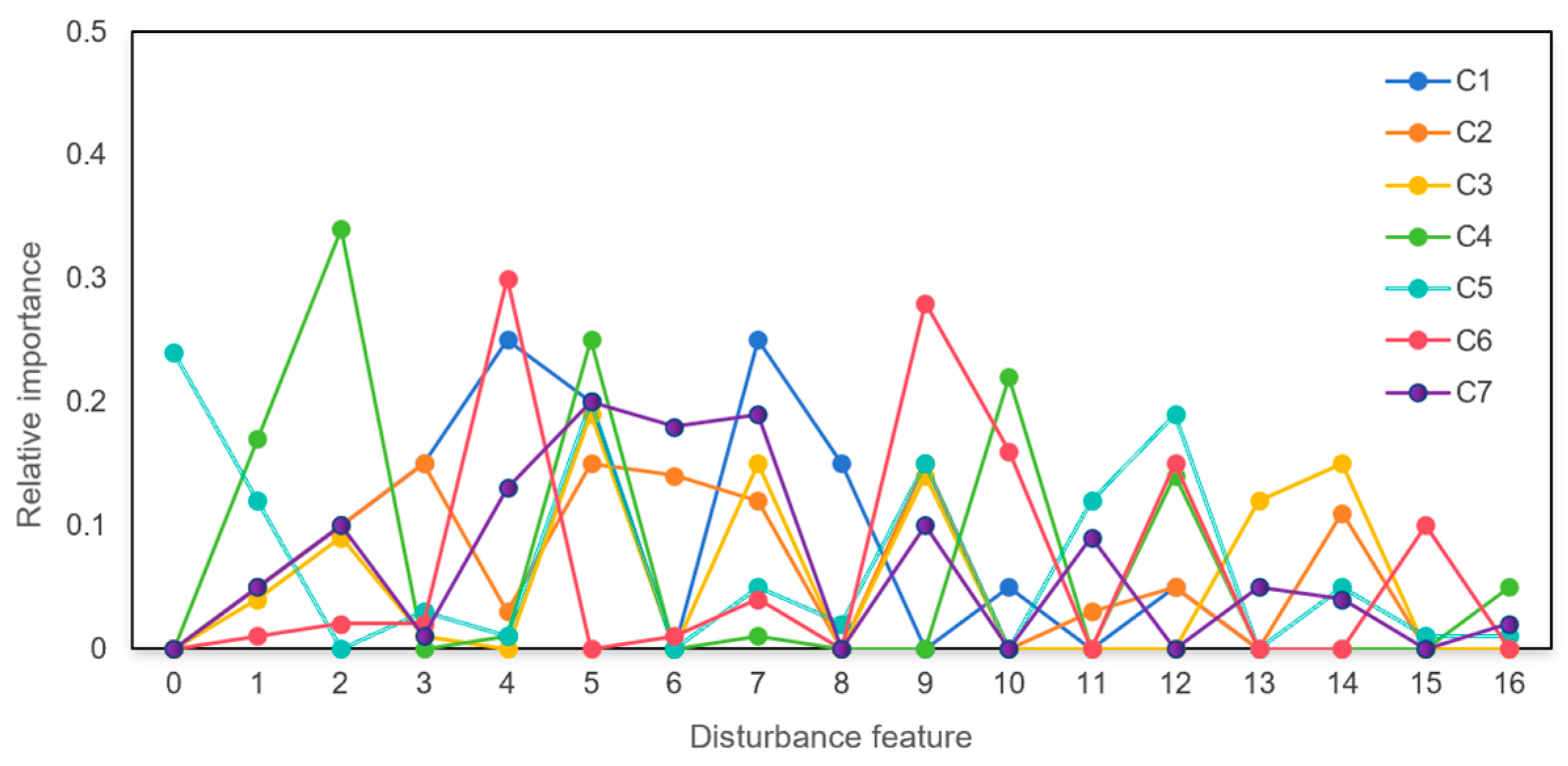
To investigate the discriminative power of the proposed 16 features, we first analyze their relative importance for each disturbance label using the AdaBoost model trained on noise-free data. Figure 7 presents the importance scores, revealing how features contribute to identifying different disturbance types.
It shows the importance of F 1 ~ F 6 is mainly distributed in the fundamental frequency disturbances such as C1–C3 and C7, while the importance of F 8 ~ F 10 is the highest for the disturbance C4–C6, respectively. These results align with the original design intent of the disturbance features and their respective physical meanings, thereby validating the rationality of the proposed feature set.
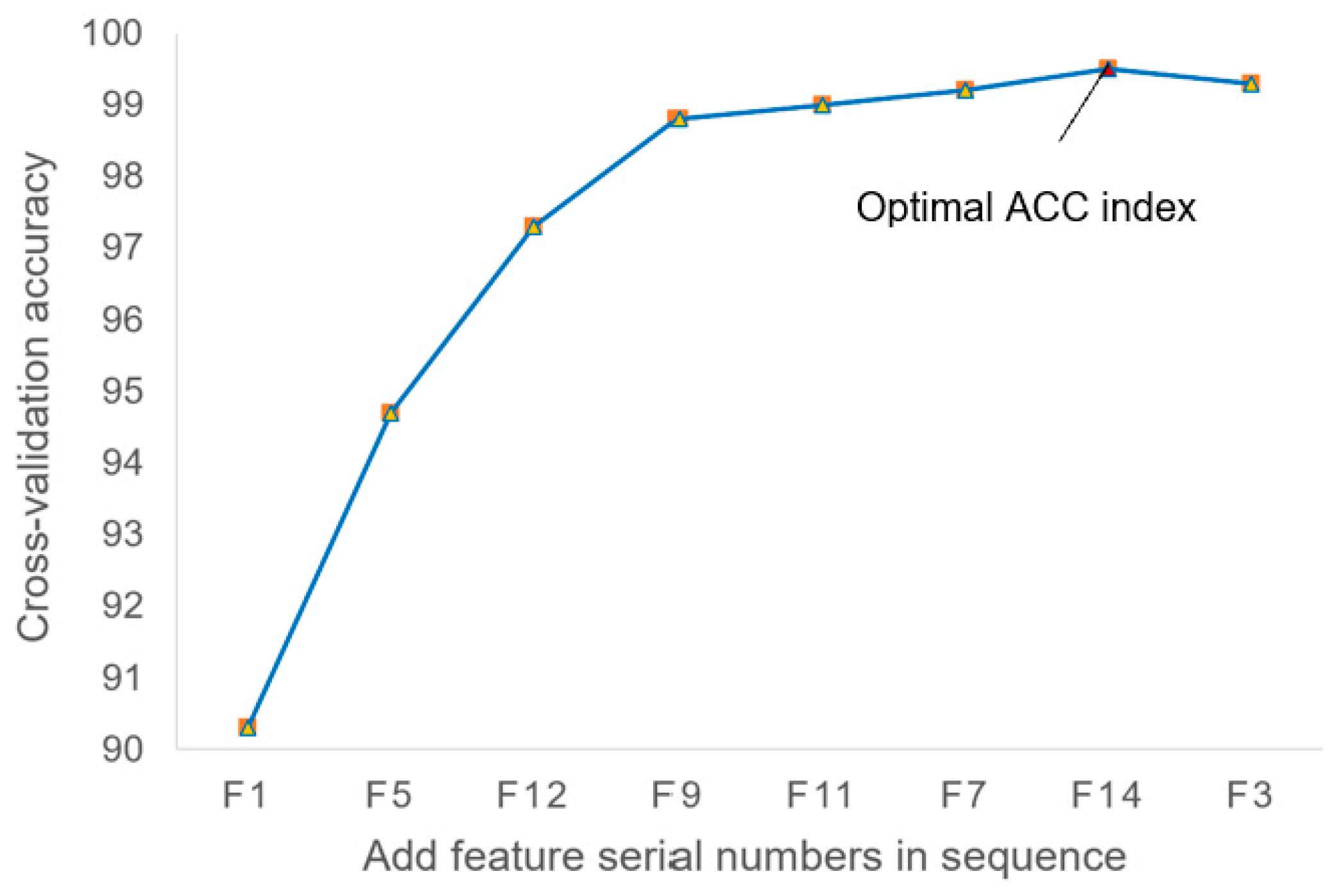
The importance of features corresponding to different labels was ranked, and forward sequential feature selection was performed using 4-fold cross-validation. Taking label C5 as an example, Figure 8 illustrates the change in accuracy (ACC) as feature subsets expand, along with the results of the forward sequential feature selection process.
In a noise-free environment, Table 4 presents the optimal feature subsets for various disturbances listed in Table 2. Additionally, AdaBoost was trained using both the optimal feature subsets and the full feature set. The best cross-validation accuracy reached 99.1%. This improvement demonstrates that removing redundant features not only reduces computational burden—supporting the claimed computational efficiency—but also enhances generalization by mitigating overfitting. Notably, the optimal subsets for different disturbances show minimal overlap, confirming that the 16-dimensional feature space effectively captures the distinctive characteristics of each disturbance type without redundancy.

5.2. Analysis of Hyperparameter Tuning Results

After feature selection, the performance of each binary AdaBoost classifier can be further enhanced by optimizing its hyperparameters. This subsection details the hyperparameter tuning process using Bayesian optimization and reports the optimal configurations obtained for each label. Using Bayesian optimization, the hyperparameters of each AdaBoost model were tuned on the noise-free training set after feature selection. The set of hyperparameters yielding the highest cross-validation accuracy (ACC) was selected as the final configuration. Table 5 summarizes the hyperparameters involved, their optimization ranges, and the optimization results for A d a b o o s t j .
This part adds C8~C10 labels on the basis of Section 4.1. Table 6 shows the optimal feature subsets corresponding to C8 to C10. The C8 focuses on transient pulse and voltage swell characteristics. The C9 focuses on voltage flicker, voltage interrupt, and higher harmonic characteristics. The C10 focuses on voltage sag, higher harmonics, and transient pulse characteristics.
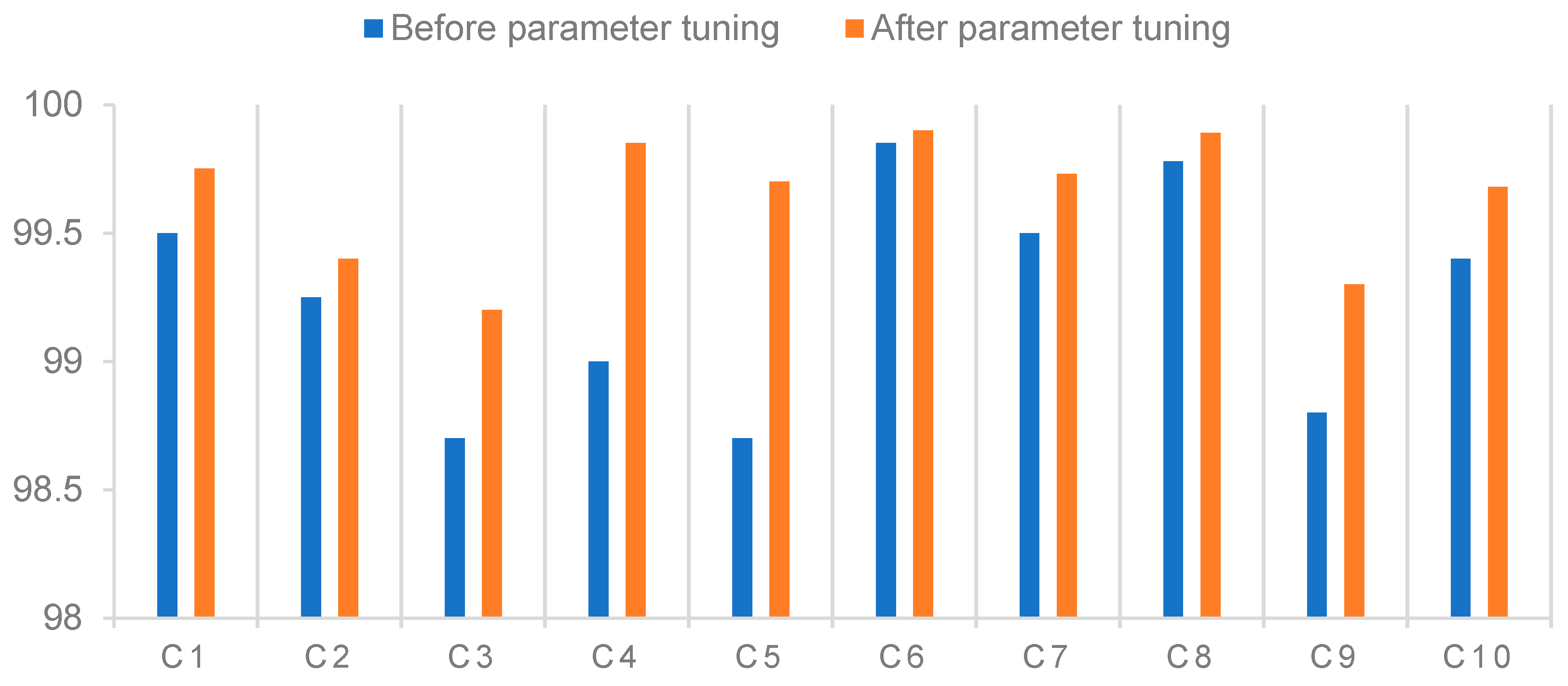
Figure 9 shows the cross-validation index changes in A d a b o o s t j before and after hyperparameter tuning in an environment without noise. As shown in Figure 7, the accuracy metrics for most labels improved further after hyperparameter tuning. However, labels C6 and C8 showed limited improvement in model generalization due to their low input feature dimensionality. This limited improvement actually reinforces the effectiveness of the preceding feature selection step: when features are already highly discriminative and non-redundant, the model’s performance approaches its theoretical upper bound, leaving less room for hyperparameter tuning to further improve accuracy. For labels with richer feature sets, tuning yields more noticeable gains, indicating that hyperparameter optimization is most beneficial when the feature space is sufficiently complex—a finding that aligns with the design of HY-AdaBoost’s two-stage “optimization-selection” mechanism.

5.3. Noise Robustness Analysis

In actual power systems, it is inevitable that the measurement signals contain noise, which will interfere with the classification performance. This section aims to evaluate the robustness of the proposed method in different types of noise environments and verify its applicability in complex field conditions.

5.3.1. Performance Under Gaussian White Noise

In engineering applications, noise pollution cannot be ignored in PQ disturbance classification. To verify the noise robustness of the proposed method, the paper adds 30 dB, 10 dB and 5 dB SNR Gaussian white noise to the disturbed samples, respectively. In different noise environments, we train the AdaBoost model by combining feature selection with hyperparameter tuning. Based on the test set, we analyze the classification under different SNRs. By combining a single disturbance in pairs, 10 kinds of double disturbances are obtained. By combining different single disturbances, 10 kinds of multiple disturbances are formed. The classification accuracy results of 20 kinds of PQDs are shown in Table 7 and Table 8.
As shown in Table 7 and Table 8, the classification accuracy for dual disturbance signals (composed of single disturbances) is higher than that for multiple composite disturbances. The accuracy decreases as the complexity of disturbance types and background noise intensity increase. The complexity of disturbance types is primarily reflected in the distinctions between single and compound disturbances, as well as variations in time characteristics, frequency characteristics, amplitude characteristics, time–frequency characteristics, and superposition effects.
When the S N R 10   dB , the average accuracy of each disturbance decreases slightly. At a 10 dB signal-to-noise ratio, the average accuracy of four-fold PQ disturbance D2D4D6D7 is 99.5%. With the increase in disturbance complexity, the difficulty of feature extraction and classification increases significantly, especially in a high noise environment, and the classification accuracy will further decrease. However, when SNR = 30 dB, the classification accuracy of D1D6D7 is the lowest, but it also reaches 97.5%, indicating the strong anti-noise performance of the proposed method. Notably, even the most challenging case—the quadruple disturbance C2C4C6C7 at 5 dB SNR—maintains 94.5% accuracy. This graceful degradation under severe noise and high complexity directly substantiates the claimed noise robustness of the IFAFSST front-end, which employs adaptive instantaneous frequency estimation with thresholding to suppress noise-induced fluctuations while preserving true signal dynamics. Table 9 compares the average test accuracy of PQ composite disturbance classification.
As shown in Table 9, the proposed model training method, which integrates feature selection and hyperparameter tuning, improves the average classification accuracy across different SNR levels to varying degrees. The performance gap between optimized and non-optimized models widens as noise increases (from 0.6% at 30 dB to 1.3% at 5 dB), indicating that feature selection and hyperparameter tuning become increasingly important under challenging conditions. This confirms that the HY-AdaBoost’s adaptive mechanisms actively contribute to noise robustness, rather than relying solely on the front-end denoising capability.

5.3.2. Performance Under Colored Noise

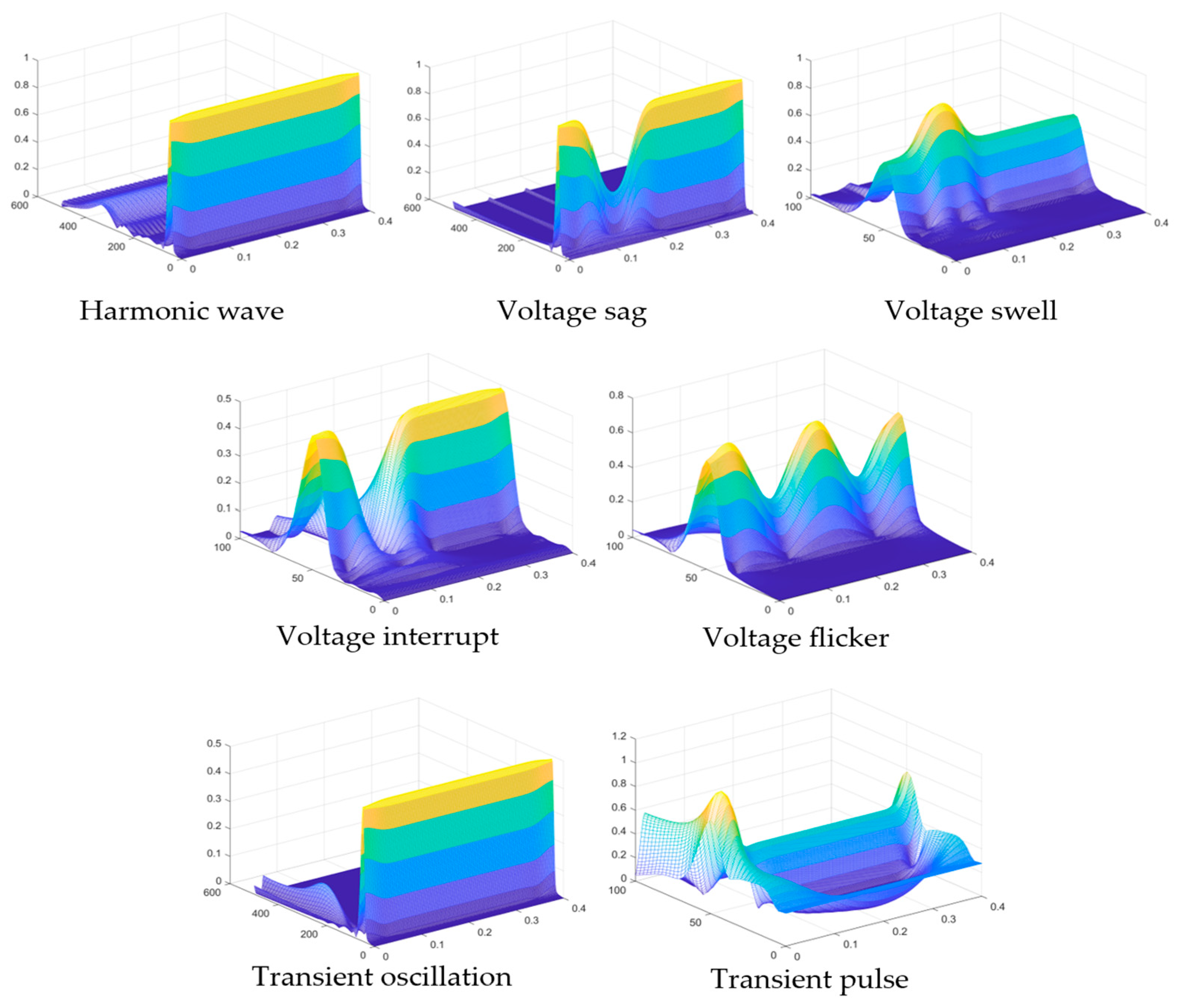
Additionally, to account for fundamental frequency shifts in real-world power grids, this paper examines the relationship between the characteristics of seven basic power quality disturbances and fundamental wave properties, as illustrated in Figure 10.
As can be seen from Figure 10, different disturbances exhibit different characteristics. The voltage sag appears in the fundamental wave for a long time; that is, the voltage sag shows reduced fundamental amplitude below reference levels, while the swell presents sustained overvoltage exceeding reference values. The voltage is interrupted when the fundamental wave appears for a long time and drops close to 0; harmonic disturbances produce stable amplitudes in the lower frequencies; the fundamental wave of flicker fluctuates up and down, where part of the fundamental wave is greater than the reference value, and the other part is lower than the reference value. The transient oscillation has an amplitude bulge in the medium frequency band, which is not found in other types of disturbances. The transient pulse has a certain energy distribution in the whole frequency band, especially the high-frequency band, which will produce high-amplitude harmonics.
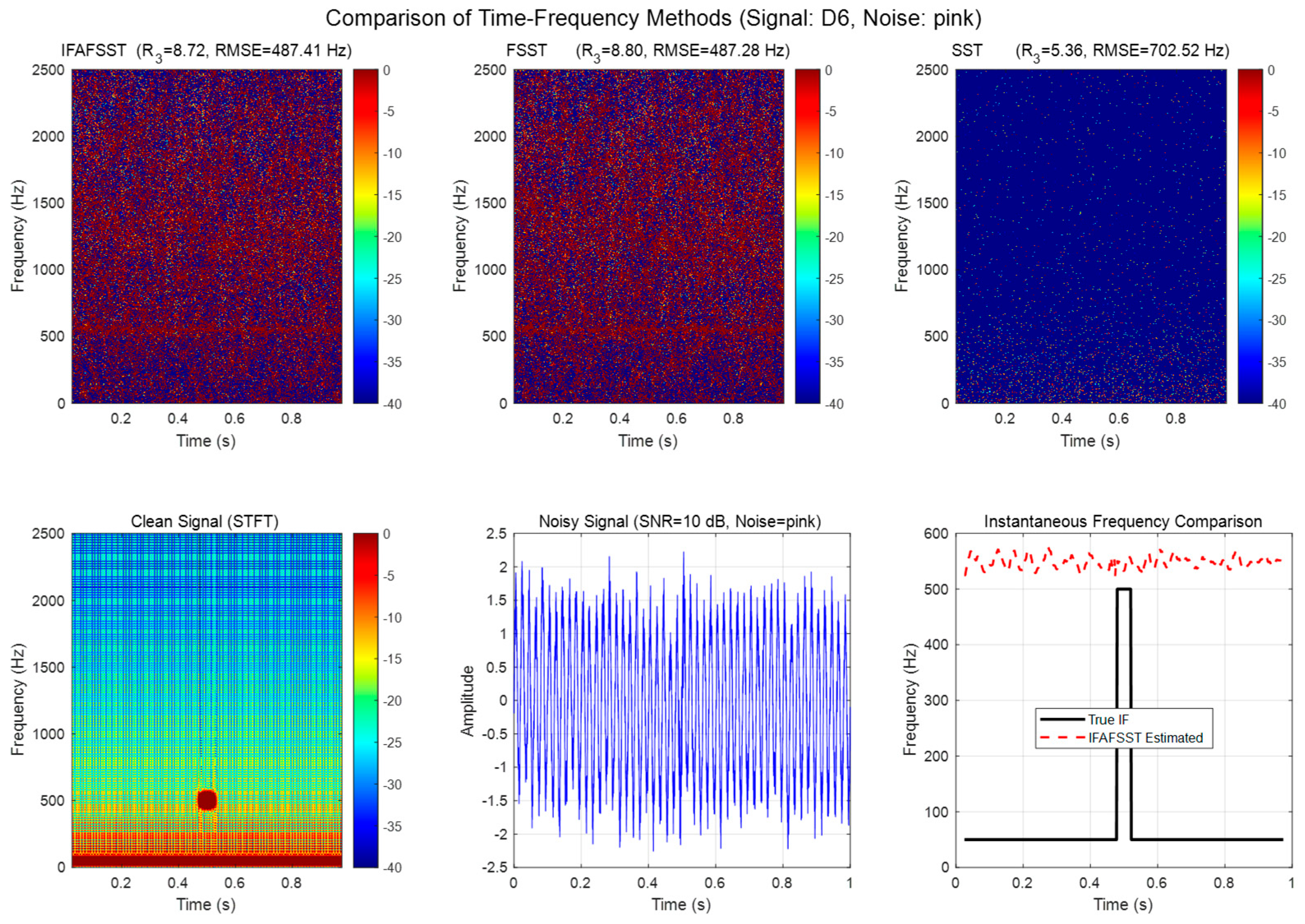
To evaluate the performance of the method under noise conditions that are closer to those of the actual power grid environment, this section further considers the impact of colored noise. As a preliminary exploration, we selected typical pink noise ( 1 / f -spectrum) for the experiment. The noise addition method was consistent with that of the Gaussian white noise experiment (SNR = 10 dB), and the test signal was D6 (transient oscillation). The experimental results are as follows:
Figure 11 presents the time–frequency plots of the D6 signal under pink noise for three methods. Table 10 lists the corresponding Rényi entropy and instantaneous frequency RMSE. IFAFSST produces the cleanest time–frequency representation with minimal background noise and sharp energy concentration along the oscillation frequency, whereas FSST shows a similar structure but with slightly more noise artifacts, and SST’s representation is severely contaminated. Quantitatively, IFAFSST achieves the lowest Rényi entropy (8.8778 vs. FSST’s 8.9342), indicating superior energy concentration, and IF RMSE comparable to FSST (482.46 Hz vs. 482.25 Hz), both far lower than SST’s 703.73 Hz. The dramatic failure of SST under colored noise underscores the inadequacy of conventional time–frequency methods for real-world power quality monitoring. This contrast reinforces the claimed contribution of IFAFSST as a specialized tool for PQD analysis, where both high resolution and noise robustness are essential.

5.4. Comparative Analysis of Different Classification Methods

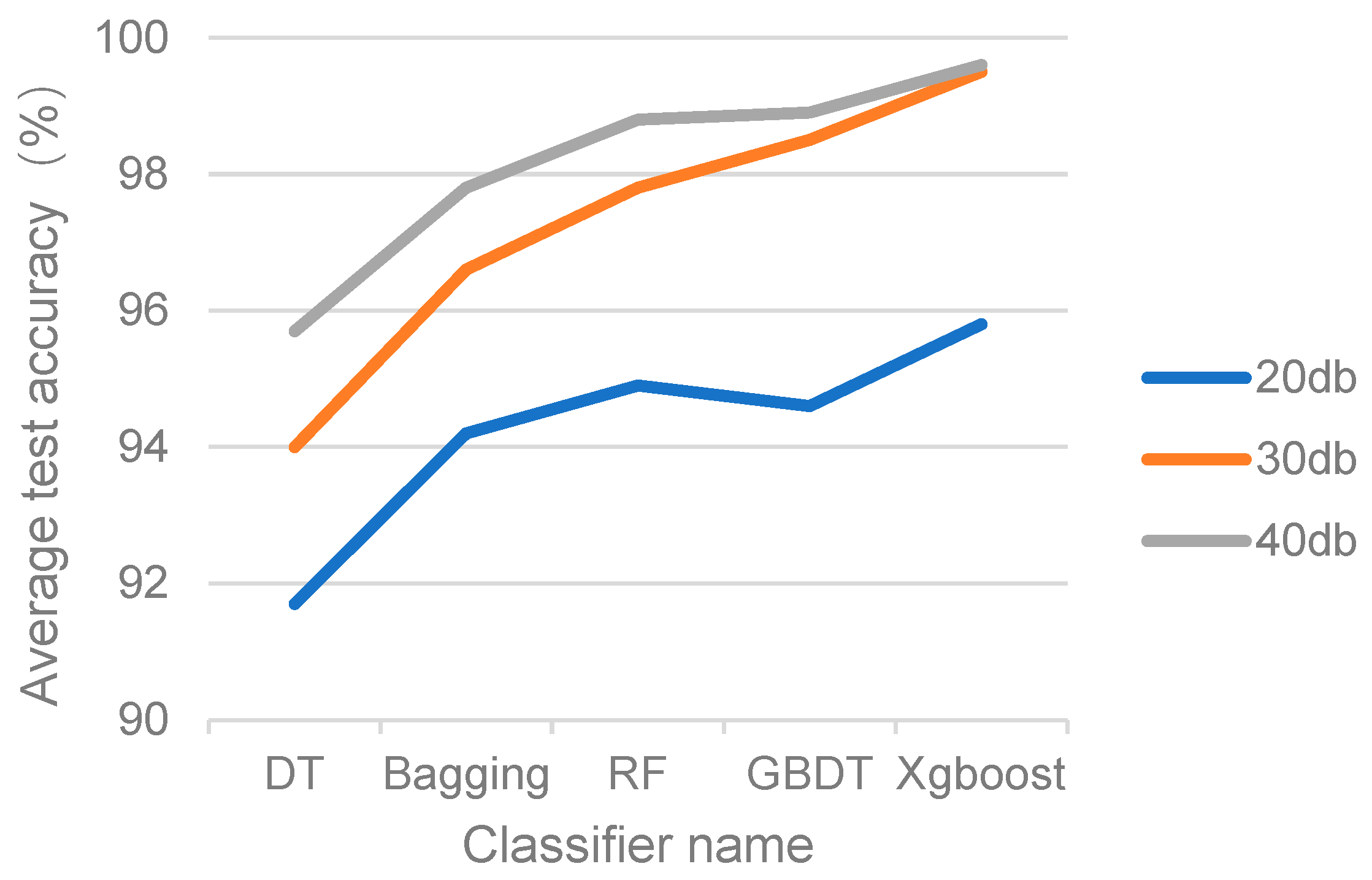
For the multi-label classification model based on the question transformation strategy adopted in this paper, the overall classification accuracy depends directly on the performance of each sub-classifier. Therefore, traditional tree models, such as decision tree (DT), Bagging, RF and GBDT, are selected as subclasses, respectively. Based on the model training method, noise levels of 20 dB, 30 dB, and 40 dB are added to identify the disturbed samples. The average test accuracy is compared with the method. In this paper, the results are shown in Figure 12.
Figure 12 shows that SVM delivers the poorest classification performance among all classifiers. Other ensemble learning models achieve significantly better accuracy, with AdaBoost performing best. Specifically, AdaBoost achieves the highest accuracy at all SNRs: 96.5% at 20 dB, 98.7% at 30 dB, and 99.1% at 40 dB, outperforming GBDT by 2–3% and RF by 1–2%. In classification efficiency tests at 30 dB SNR, AdaBoost completes processing in 0.127 s—faster than SVM (0.153 s), Bagging (2.155 s), RF (1.426 s), and GBDT (0.176 s). This dual superiority in accuracy and efficiency directly supports the paper’s claim of providing a “robust solution with high accuracy and practical applicability.” The computational advantage stems from AdaBoost’s sequential nature and the reduced feature dimensionality after forward selection, making it particularly suitable for real-time monitoring applications.
To illustrate the superiority of the proposed method, which is compared with other existing composite disturbance classification methods, such as S-IWOA-SVM [32], VMD-SAST [33], VPFNRS-GBDT [34], KF-ML-DBN [35], and the results are shown in Table 11.
Our method accurately identifies all 23 disturbance types using minimal features, achieving top accuracy at both SNR = 30 dB and 40 dB. As shown in Table 11, the proposed method achieves 99.5% at 30 dB and 98.5% at 40 dB, outperforming all four comparison methods across all noise levels, while handling the largest number of disturbance types (23 vs. 16–20). This comprehensive superiority validates the holistic design of the IFAFSST-HY-AdaBoost framework. In the dataset used in this study, all 23 perturbation categories (including single and combined perturbations) have the exact same number of samples (400 samples per category), thus forming a completely balanced dataset by category. This balanced design avoids model bias that may be caused by uneven sample distribution and provides ideal conditions for fair evaluation of the algorithm’s recognition performance on different perturbation types. The data partitioning adopts a stratified random sampling method, ensuring that the proportions of each category in the training set and test set (80%/20%) are strictly consistent with the entire set, maintaining the representativeness of the partition. All samples are generated in batches in the MATLAB environment based on the mathematical models and parameter ranges defined in Table 2 and Appendix A Table A2, ensuring the controllability and reproducibility of the data.
Appendix A Table A3 presents the specific distribution of the data used in this study. As shown in this table, this dataset achieves strict sample quantity balance across all 23 types of disturbances. This design aims to eliminate the potential influence of class imbalance on the evaluation results from the source, allowing the comparison of algorithm performance to more directly reflect the effectiveness of the method itself and the proposed features, rather than the deviation caused by data distribution. Although the occurrence frequencies of different disturbance types in the actual power grid may not be balanced, the balanced dataset provides a clearer benchmark for evaluating the method’s theoretical identification upper limit, especially its sensitivity to various disturbances (including rare composite disturbances). Future research will further verify the robustness and practicality of this method in non-balanced real-world scenario data.

5.5. Analysis of Algorithm Complexity and Real-Time Performance

To assess the engineering application potential of the proposed method, particularly its ability to meet the real-time requirements of online monitoring, this section conducts an analysis from two aspects: theoretical time complexity and actual processing time consumption. It also makes a comparison with existing mainstream methods.

5.5.1. Theoretical Time Complexity Analysis

The computational cost of the IFAFSST-HY-AdaBoost framework mainly comes from three aspects: time–frequency analysis (IFAFSST), feature extraction and classification (HY-AdaBoost).
(1)
IFAFSST complexity: IFAFSST is based on STFT, and its core computational load is O ( N log N ) , where N represents the length of the signal. Compared to the S-transform ( O ( N 2 ) ) and VMD, HHT with the iterative decomposition process, IFAFSST, has inherent advantages in computational efficiency. Although the adaptive correction steps it introduces (calculating second derivatives and threshold judgment) increase the linear overhead O ( N ) , its dominant order is still consistent with FFT, without changing the algorithm magnitude, and maintains high computational efficiency. Compared to the standard FSST, which also exhibits O ( N log N ) complexity, IFAFSST introduces only an additional O ( N ) overhead for instantaneous frequency refinement. Since O ( N ) is dominated by O ( N log N ) for practical signal lengths, the overall asymptotic complexity remains unchanged, demonstrating that the enhanced time–frequency concentration is achieved without compromising computational efficiency—a key advantage for real-time power quality monitoring.
(2)
Feature extraction complexity: The feature sets (F1–F7, F8–F16) designed in this paper are all based on simple algebraic operations of time–frequency spectra or envelope sequences (such as finding maxima, means, and standard deviations), with a complexity of O ( N ) . The calculation is extremely lightweight.
(3)
HY-AdaBoost classification complexity: During the prediction stage, AdaBoost is a linear combination of multiple weak classifiers, and its time complexity is O ( T D ) , where T is the number of weak classifiers and D is the feature dimension. After forward feature selection, the value of D is very small, and the model has been trained. The complexity is approximately O ( 1 ) . Therefore, the classification process is almost instantaneous.
In conclusion, the overall theoretical time complexity of this method is O ( N log N ) , which is of the same order as the efficient STFT and is much lower than the S-transform and iterative methods of O ( N 2 ) , laying the theoretical foundation for real-time processing.

5.5.2. Quantitative Comparison of Experimental Results

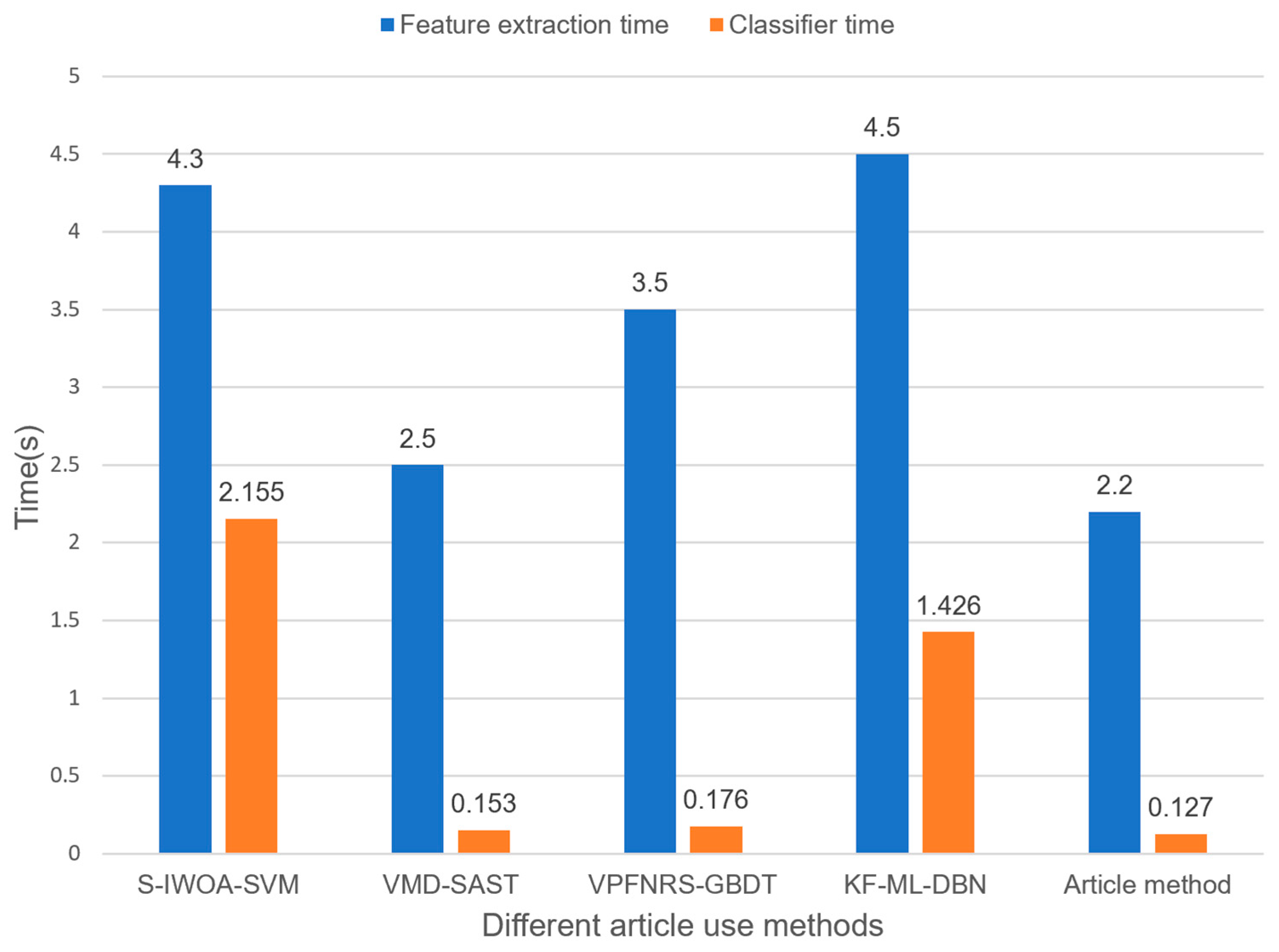
To verify the actual performance, under a signal-to-noise ratio of 30 dB, we conducted a processing time test on a total of 9200 PQ perturbation signals (23 types × 400 instances) and compared the results with four advanced methods published in recent years. All experiments were conducted under the same software and hardware environment to eliminate system differences. The results are shown in Figure 13. The specific types of perturbation signals are presented in Appendix A, Table A3.
As shown in Figure 13, the feature extraction time of the method proposed in this paper (2.2 s) is significantly lower than that of the methods based on S-transform (4.3 s) and Kalman filtering (4.5 s), and is similar to that of the VMD method (2.5 s) and superior to that of the HHT method (3.5 s). This demonstrates that IFAFSST retains the computational efficiency advantage of traditional time–frequency analysis while further shortening the processing time by simplifying the number of features. In the classification stage, with the lightweight design and multi-thread optimization of the HY-AdaBoost model, this method only takes 0.127 s, which is approximately 17% faster than the suboptimal method (VMD-SAST, 0.153 s), showcasing the outstanding advantage of ensemble learning in online inference speed. The 0.127 s classification time for 9200 samples translates to an average of 0.0138 ms per sample, well below the 20 ms power frequency cycle, confirming that the method fully meets real-time requirements for online monitoring.

5.5.3. Algorithm Real-Time Performance Attribution and Conclusion

The outstanding real-time performance of the proposed method is attributed to the systematic optimization design of the core components. Firstly, the computational complexity of the IFASST time–frequency analysis is O(NlogN), which is of the same order as the fast Fourier transform, significantly lower than the S-transform (O(N2)) and iterative algorithms such as VMD and HHT; its adaptive correction only introduces a linear overhead of O(N), without changing the dominant order. Secondly, the feature extraction is designed around the 9-dimensional statistics of the time–frequency spectrum, which is simple and efficient in calculation, avoiding the processing overhead of redundant features. Finally, the HY-AdaBoost classifier only involves the threshold judgment of a few weak classifiers in the inference stage, with extremely high computational efficiency. Combined with multi-threading optimization, it achieves near-instantaneous classification.
In summary, the average processing time of this method for a single sample is only 0.25 milliseconds, which is much lower than the typical data frame interval in power system monitoring (such as 20 milliseconds for power frequency cycles). Therefore, this method fully meets the strict requirements for online, real-time, and high-precision identification of power quality disturbances in resource-constrained scenarios, such as smart electricity meters, embedded protection devices, and edge computing gateways, providing a solid performance basis for its engineering deployment.

5.6. Measured Signal Analysis

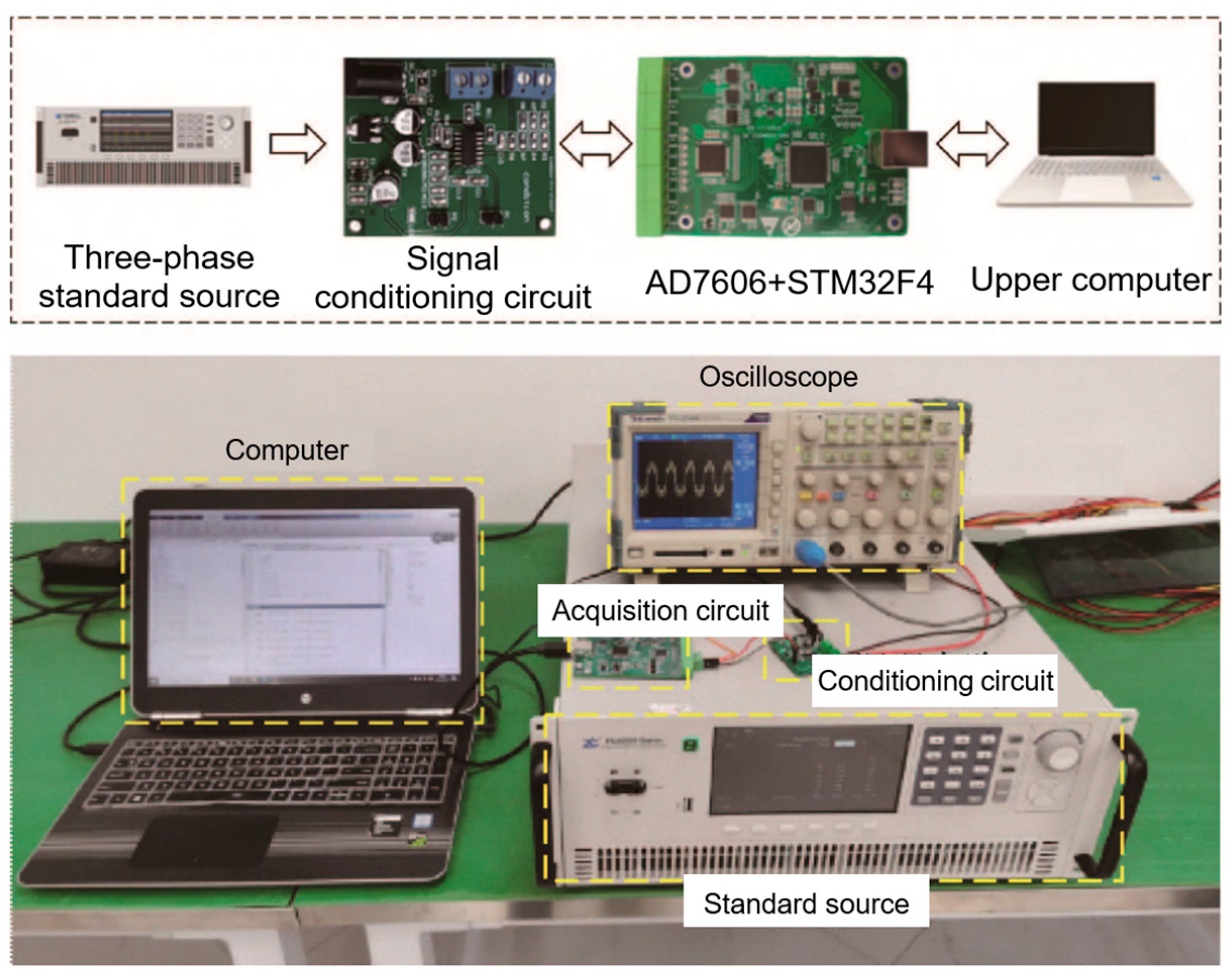
To validate the practical applicability of the proposed IFAFSST-HY-AdaBoost framework, we conduct experiments on signals acquired from a custom-built hardware platform. This section describes the experimental setup, presents the analysis of typical measured signals, and evaluates the classification performance under real-world conditions. We built a hardware test platform (Figure 14) to verify algorithm accuracy.

5.6.1. Experimental Results of Measurement Signal

This subsection details the hardware platform configuration, the generation of measured disturbance signals, and the classification results obtained by applying the proposed method to these real-world signals. The Fluke 6105 power standard (Fluke Corporation, Everett, WA, USA) generated disturbance signals, which an oscilloscope captured before transmitting via serial port to the host system. Our proposed algorithm then performed the disturbance identification.
A total of 5 single disturbances were simulated: voltage swell, voltage sag, harmonic, voltage flicker, and voltage interrupt. Five compound disturbances: harmonic + voltage swell/voltage sag/voltage interrupt/voltage flicker, voltage flicker + voltage sag. Each disturbance generates 40 sets of signals.
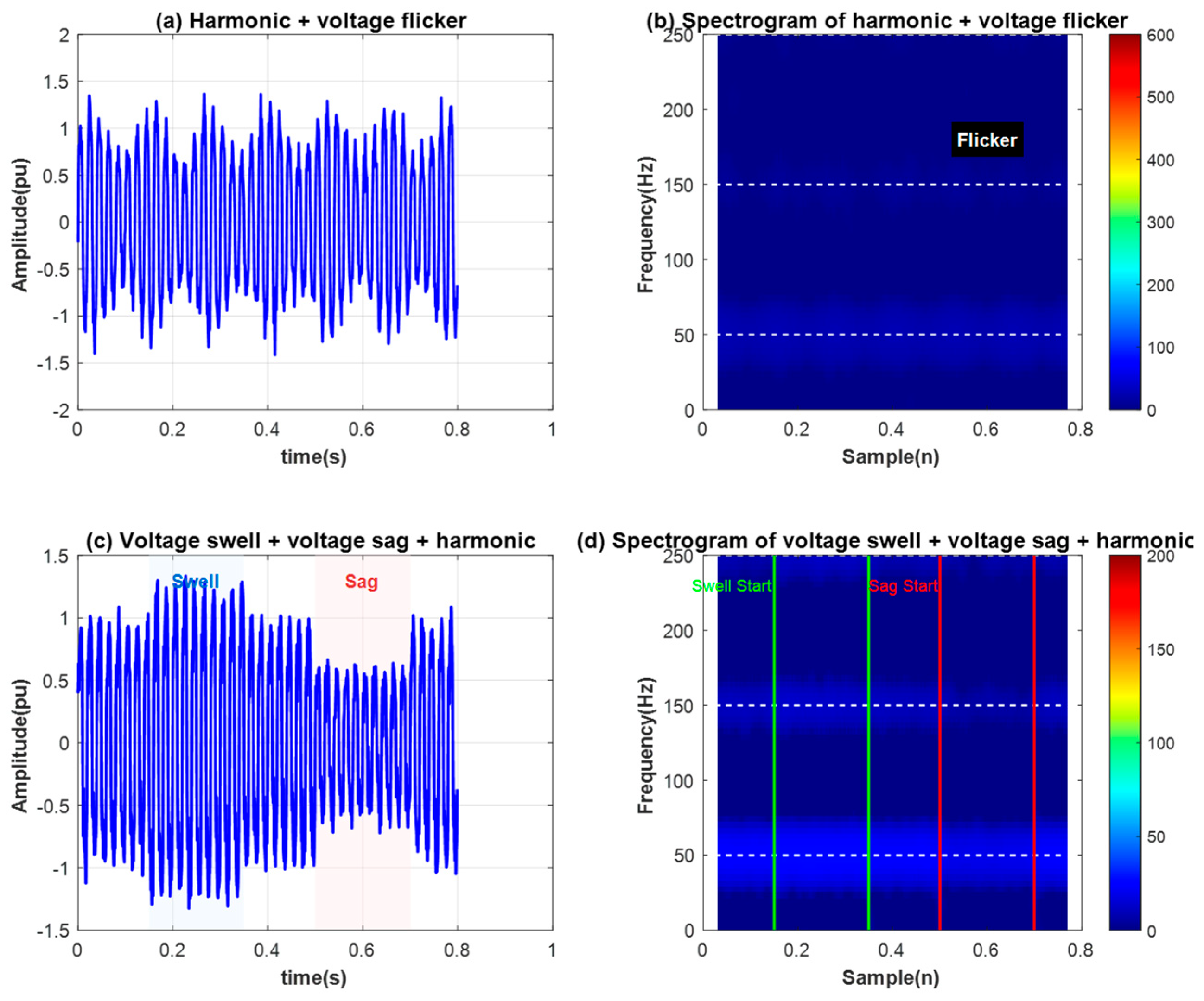
Each set of measured signals has a sampling frequency of 12.8 kHz, a signal duration of 0.2 s, and has been normalized. Two of these typical measured signal waveforms and their IFAFSST spectra are depicted in Figure 15. As can be seen from Figure 15, the IFAFSST effectively captures the amplitude variations and spectral patterns in harmonic-plus-flicker disturbances. For the compound disturbance of voltage swell, voltage sag and harmonics, the IFAFSST can effectively decompose each mode and extract the time–frequency domain characteristics of swell, sag and harmonic disturbances. It can be seen that IFAFSST also has good feature expression ability for measured signals.
The HY-AdaBoost model trained on simulated signals identified measured signal disturbances (Table 10). Some sag cases are misclassified as interrupts due to amplitude similarity, while extreme fluctuations cause flicker-to-sag misjudgment. One swell +transient case lost labeling from weak oscillations. Despite measured signal irregularities causing slightly lower accuracy than simulations, the method achieved 98.3% accuracy, proving its engineering effectiveness. The classification results of the measured signals on the experimental platform are shown in Table 12.
For the 9 measured perturbation signals in the experiment, calculating the Precision, F1-score, and Recall after classification of the five methods by different methods, and the results are shown in Table 13, Table 14 and Table 15. As can be seen from Table 13, Table 14 and Table 15, although the recognition rate of the proposed method is not the highest for some types of perturbations (for example, for voltage swell class perturbations, the precision value of the proposed method is lower than that of the VMD-SAST method), However, the average values of Precision, F1-score and Recall were the highest after identification. Compared with the KF-ML-DBN method with better recognition effect, Precision, F1-score and Recall improved by 1.34%, 1.35% and 1.05%, respectively. Compared with the VMD-SAST method, the Precision, F1-score and Recall of the proposed method are improved by 1.75%, 3.01% and 1.96%, respectively. This balanced performance across all disturbance types—rather than excelling only on specific categories—is critical for practical deployment, where a system must reliably handle a wide variety of disturbances without catastrophic failure on any single type.
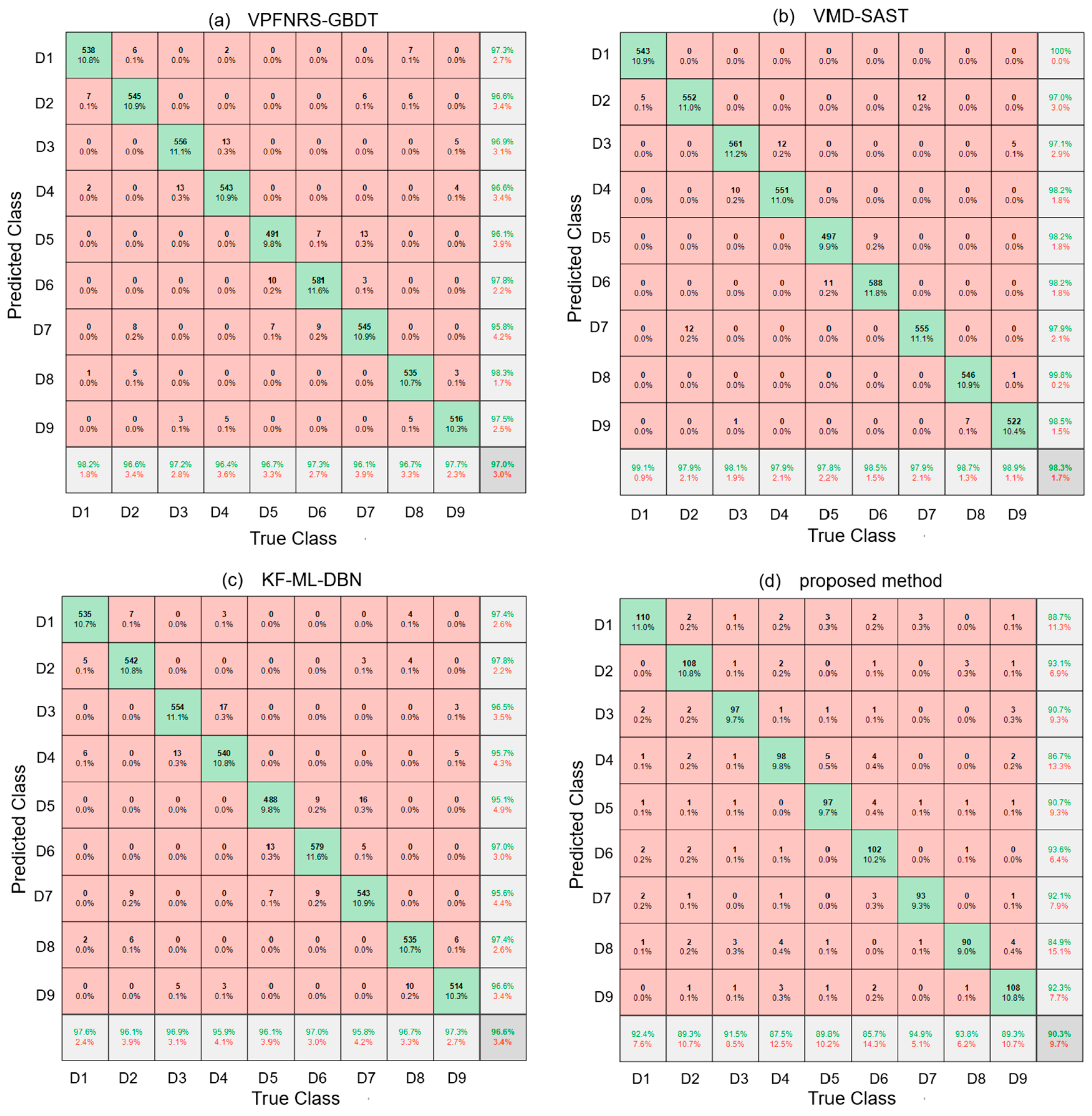
For the 9 measured perturbation signals in the experiment, we also calculated the confusion matrix for different classification methods, and the results are shown in Figure 16 (Because the classification accuracy of S-IWOA-SVM is low, we only provide the confusion matrix of VPFNRS-GBDT, VMD-SAST, KF-ML-DBN and the proposed method). From the confusion matrix, it can be seen that the classification accuracy of the proposed method is high, reaching 98.30%, and the average classification accuracy of the two types of compound perturbations is 98.65%. The classification accuracy of KF-ML-DBN and VMD-SAST methods is also high, 97.02% and 96.59%, respectively, but it is still lower than that of the proposed method. The classification accuracy of KF-ML-DBN in compound perturbations is 97.25%, and the classification accuracy of VMD-SAST in compound perturbations is 96.60%. The classification accuracy of the S-IWOA-SVM and VPFNRS-GBDT methods is low, only 86.07% and 90.52%.
The superior performance on measured signals, achieving a leading 98.30% overall accuracy and an even higher 98.65% on complex composite disturbances, strongly validates the proposed method’s engineering robustness and its ability to bridge the simulation-to-reality gap. This successful transfer can be attributed to the synergistic design of our framework: (1) The IFAFSST’s adaptive time–frequency representation effectively suppresses unstructured noise and preserves critical disturbance signatures under real-world conditions, providing cleaner input features; (2) The HY-AdaBoost model, regularized via forward feature selection, mitigates overfitting to the limited and imperfect hardware data, ensuring reliable generalization. While a benchmark like VMD-SAST may excel on specific, well-defined disturbances (e.g., voltage swell), our method demonstrates consistently balanced and superior performance across all disturbance types and aggregate metrics. This balance is critical for real-world deployment, where systems must reliably handle a wide, unpredictable variety of disturbances without catastrophic failure on any single type. Consequently, these results confirm that the IFAFSST-HY-AdaBoost framework is not merely an academic improvement but a practical, high-performance solution ready for real-world power quality diagnostics.

5.6.2. Statistical Hypothesis Testing

To objectively evaluate the performance advantages of the proposed method and avoid the randomness of single-index comparison, this section conducts a significance analysis of the experimental results using statistical hypothesis testing. Paired t-tests were conducted between the proposed method and four comparison methods (S-IWOA-SVM, VPFNRS-GBDT, VMD-SAST and KF-ML-DBN) to analyze whether there were significant differences between the proposed method and the comparison methods.
Null hypothesis H 0 : The mean difference between the test results of the proposed method and those of the comparison method is zero, that is, there is no significant difference between the two methods.
Alternative hypothesis H 1 : The mean difference between the test results of the proposed method and the comparison method is not zero, that is, there is a significant difference between the two methods.
Calculating the p-values and significance values of Cohen’s d for each paired t-test: In the experiments, the significance level α is taken as α = 0.01 . When the p-value is less than 0.01, the null hypothesis H0 can be rejected, and it is considered that there is a significant difference in the detection results between the proposed method and the comparison method. Generally, when the value of Cohen’s d is greater than 0.8, it is considered to have a large effect. The larger the value of Cohen’s d, the more significant the difference between the two groups of samples.
To verify the effectiveness of the proposed method, the detection results of five models on nine PQD signals were statistically verified. Table 16 presents the p-values of the paired t-test and the aggregated results of the effect size Cohen’s d. All p-values are less than 0.01, allowing rejection of the null hypothesis with 99% confidence, confirming that the proposed method truly outperforms the comparators. Moreover, all Cohen’s d values exceed 0.8, indicating large effect sizes; even the smallest (vs. KF-ML-DBN, d = 1.52) represents a substantial performance margin. This statistical rigor provides strong evidence that the observed improvements are not due to random chance, supporting the paper’s claim of a statistically significant advancement.
We also conducted paired chi-square test on the test results of the method proposed in this paper and the four comparison methods, calculating χ 2 and p-values of the four paired chi-square tests. The results are shown in Table 17. Generally, if χ 2 > the critical value of χ 2 or the p-value < the significance level α (taken as 0.01 in this paper), the null hypothesis is rejected.
When the significance level α = 0 . 01 , the critical value χ 2 is 6.635. Therefore, when the p-value is less than 0.01 or the χ 2 value is greater than 6.635, the null hypothesis H 0 is rejected, and it is considered that there is a significant difference in the detection results between the method proposed in this paper and the comparison method. All χ 2 values exceed 6.635, and all p-values are below 0.01, confirming that the error patterns of the proposed method are systematically different from those of the comparison methods. This indicates that the proposed method makes fundamentally better decisions on challenging cases, consistent with the IFAFSST’s ability to resolve time–frequency overlaps that confuse other methods.

5.6.3. In-Depth Discussion on Statistical Significance Analysis

The results of the above paired t-tests and McNemar tests, from a strictly statistical perspective, confirm that the performance advantages of the proposed method are not accidental but are highly significant. However, the actual significance of these statistical quantities goes far beyond their numerical values; They validate, from different perspectives, the forward-looking nature and effectiveness of the design of the method presented in this paper.
(1)
The degree of performance advantage revealed by the effect size (Cohen’s d):
As shown in Table 16, the Cohen’s d values of the proposed method compared with all the other comparison methods are all greater than 0.8 (the standard for a large effect), indicating that the performance differences are not only statistically significant but also extremely substantial. In particular, it is worth noting the following:
The effect size compared with S-IWOA-SVM is as high as 8.77, which intuitively reflects the fundamental limitations of the traditional time–frequency analysis (STFT) combined with the optimized SVM method in terms of feature representation. These limitations cannot be compensated for by parameter optimization when dealing with complex and noisy measured PQD signals.
The effect size compared with the best-performing KF-ML-DBN is still 1.52 (a large effect). This strongly proves that even when facing the same cutting-edge deep learning methods, the “adaptive time–frequency analysis (IFAFSST) + interpretable feature engineering + lightweight ensemble learning (HY-AdaBoost)” framework proposed in this paper, despite having a limited number of samples from real measurements, can still achieve substantial performance improvements by virtue of its stronger feature discrimination ability and better generalization ability. This directly addresses one of the core contributions of this paper: providing high-precision solutions for real scenarios with scarce data.
(2)
The differences in error patterns revealed by McNemar test:
The McNemar test (Table 17) focuses on comparing the samples where the classification results of the two methods are inconsistent. All the χ2 values are significantly greater than the critical value (6.635), indicating that there are systematic differences in the error patterns between the proposed method and the comparison method. A detailed analysis of these inconsistent samples reveals the following:
In the comparison with VMD-SAST and KF-ML-DBN, the inconsistent samples mainly concentrate on compound disturbances (such as temporary sag + oscillation). This confirms the advantage of IFAFSST in analyzing the time–frequency overlapping components: its provision of clearer time–frequency ridges enables HY-AdaBoost to extract more discriminative features (such as precise oscillation start and end times, independent amplitude modulation depth), thereby correcting the misjudgments of methods based on VMD or deep feature extraction in these complex cases.
In comparison with S-IWOA-SVM and VPFNRS-GBDT, the inconsistent samples were widely distributed across various perturbations. This highlights the overall advantages of the HY-AdaBoost ensemble learning model combined with forward feature selection: by constructing a weighted combination of multiple weak classifiers and automatically screening key features, it significantly improves the overall robustness and generalization ability of the model, avoiding the unstable performance of a single model or redundant features in the changing measured signals.
(3)
The engineering implications of comprehensive statistical testing:
Based on the results of both tests, we have derived two key engineering insights:
  • For scenarios with high reliability requirements: The extremely low p-values (all < 0.01) indicate that we have over 99% confidence that the proposed method is superior to the comparison method. This provides a solid statistical basis for adopting this method in scenarios such as relay protection and critical load monitoring, where frequent false alarms or missed detections are not allowed.
  • For resource-constrained edge deployment: The large effect size (Cohen’s d) indicates that the performance improvement is substantial rather than marginal. This means that in edge-side devices with limited computing and storage resources, such as smart meters and embedded devices, investing resources in deploying this method (compared to traditional or partial deep methods) can lead to significant investment returns, that is, significantly improving the monitoring accuracy at an acceptable cost.
Therefore, the rigorous statistical test in this section not only mathematically rejected the null hypothesis of “no performance difference”, but also strongly supported the core proposition of this paper from an applied perspective: The proposed IFAFSST-HY-AdaBoost framework, through its collaborative innovation in feature representation and model generalization, provides a statistically significant, highly effective, and highly valuable engineering solution for the identification of power quality disturbances in complex real-world environments.

5.6.4. Analysis of Ablation Experiments and Dissection of Module Contributions

To systematically evaluate the independent contributions and synergy effects of the proposed IFAFSST and enhanced AdaBoost modules in this paper, we designed a three-level ablation experiment. The ablation experiment was divided into the following three models: Model 1: FSST + standard AdaBoost; Model 2: IFAFSST + Standard AdaBoost, Model 3: IFAFSST + Improved AdaBoost. The effectiveness of the IFASST module can be proved by the comparison of Model 1 and Model 2. The effectiveness of the enhanced AdaBoost module can be demonstrated by the comparison of Model 2 and Model 3.
In the ablation experiment, we use 9 types of simulated power mass disturbance signals (‘Normal’, ‘Sag’, ‘Swell’, ‘Interrupt’, ‘Harmonic’, ‘Interharmonic’, ‘Flicker’, ‘Transient’, ‘Sag + Harmonic’), 100 samples per class. The results of the ablation experiment were analyzed by Accuracy, Precision, F1-score, and Recall. We calculated Precision, F1-score, and Recall of the three models, and the results are shown in Table 18, Table 19 and Table 20.
We also calculated the overall classification Accuracy, Precision, F1-score, and Recall of the three methods, as shown in Table 21.
As shown in Table 21, the complete IFAFSST + enhanced AdaBoost model achieved an excellent accuracy rate of 98.52%. By gradually adding innovative modules, we were able to analyze the respective mechanisms of action and the synergy effects of each module.
(1)
The effectiveness of the IFAFSST: From fuzzy representation to clear features
The significant performance improvement in Model 1 (FSST + AdaBoost) compared to Model 2 (IFAFSST + AdaBoost) (the accuracy rate increased from 85.93% to 92.96%, and the F1-score increased by 5.62 percentage points) clearly validates the decisive role of the IFAFSST module. Its contribution is mainly reflected in two aspects:
  • Analytical capability for time–frequency overlap and non-stationary disturbances: By examining the details in Table 15 and Table 16, it can be observed that IFAFSST exhibits the most significant performance improvement for complex disturbances such as “flicker” and “sag + harmonic”. For example, the recall rate for “flicker” soared from 71.43% to 100%. This is because flicker signals are essentially time-varying amplitude modulation, and the fixed resolution of traditional FSST leads to spectral spreading and energy blurring. IFAFSST, through adaptive frequency correction, can sharpen the time–frequency representation, thereby accurately extracting the key features that reflect the modulation depth, significantly improving the identification of such non-stationary disturbances.
  • Overall enhancement of feature discrimination ability: The mean recall rate of Model 2 across all categories was 93.57%, which was 8.20 percentage points higher than that of Model 1 (85.37%). This indicates that the superior time–frequency representation provided by IFAFSST has generally enhanced the classifier’s sensitivity and discrimination ability for all types of perturbations (especially the positive samples that are prone to being missed), establishing a solid, high-performance base platform.
(2)
The effectiveness of the enhanced AdaBoost module: From high-level platform to peak performance
Based on the already excellent performance (Model 2, with an accuracy rate of 92.96%), Model 3 (IFAFSST + Enhanced AdaBoost) further increased the accuracy rate to 98.52%, achieving a significant improvement of 5.56%. The core mechanism of this improvement lies in the “refined decision-making” and “overfitting control” capabilities of HY-AdaBoost:
  • Accurate discrimination of marginal samples and confusing categories: The performance improvement is mainly reflected in a significant increase in the recall rate (from 93.57% to 98.59%). This indicates that the enhanced AdaBoost is particularly adept at handling “marginal samples” with blurred feature boundaries and those that are prone to being misjudged by the base model. Its regularization strategy and multi-thread weighted voting mechanism effectively integrate multiple “weak but distinct” decision perspectives, thereby making more robust and precise judgments on the model’s decision boundary.
  • Robust generalization at extremely high precision: It is worth noting that Model 3 achieves or approaches 100% recall rate in almost all categories, and the average F1-score is as high as 98.48%. This demonstrates that the enhanced AdaBoost module not only improves performance, but more importantly, maintains excellent generalization ability when approaching the limit of precision, without the overfitting phenomenon caused by excessive pursuit of training set accuracy (its Precision is almost the same as and slightly higher than that of Model 2).
(3)
Module collaboration and contribution quantification: Integrated innovation with 1 + 1 > 2 effect
The overall performance improvement from Model 1 to Model 3 (an increase of 12.59% in accuracy) can be quantitatively decomposed: the IFAFSST module contributed approximately 56% (7.04/12.59) of the improvement, while the enhanced AdaBoost module contributed approximately 44% (5.56/12.59) of the improvement. This quantitative result strongly supports the core design concept of this paper:
  • IFAFSST serves as the “cornerstone” for performance breakthroughs: By providing high-resolution and high-fidelity time–frequency features, it fundamentally overcomes the limitations of traditional methods in characterizing complex PQD signals, making it possible for subsequent high-precision classification.
  • Enhanced AdaBoost is the ultimate “engine” in terms of performance: Based on high-quality features, it utilizes advanced ensemble learning and regularization techniques to fully exploit the discriminative potential of the features, pushing the classification performance to a new level and ensuring the robustness of the model.
The ablation experiments not only verified the effectiveness of each module numerically but also revealed the key scientific problems they respectively addressed from a mechanistic perspective—IFAFSST overcame the challenge of accurately characterizing complex PQD signals, while the enhanced AdaBoost solved the problem of achieving high-precision and robust classification under limited samples. The collaborative work of the two achieved a “qualitative change” from 85.93% to 98.52%, fully demonstrating the comprehensive, innovative value of the method proposed in this paper in terms of feature extraction and classification decision-making.

5.6.5. Cross-Validation Performance Analysis

To evaluate the robustness and generalization ability of the proposed IFAFSST-AdaBoost classifier, 10 repeated 5-fold cross-validation experiments were conducted in this section. The experimental subjects were the nine signals described in Section 5.6.1. In the experimental setup, 150 weak classifiers were used as base learners, the learning rate was set to 0.10, and the maximum depth of the decision tree was limited to 3 to prevent overfitting. Additionally, to increase the diversity of the model, the feature sampling ratio was set to 80.0%, and the sample sampling ratio was set to 70.0%. The experimental results are shown in Figure 17 and Table 22.
As shown in Figure 17a, this method achieved an outstanding average accuracy rate of 99.9% in all repeated experiments. The error bars (standard deviations) in the figure are extremely short, indicating that the classification performance has extremely high stability with a very small variance. Additionally, Figure 17b presents the statistical distribution of the accuracy rates of all single-fold validations. The data are closely clustered around the mean of 99.9%, with no significant outliers. This proves that the model can maintain a high level of stable performance under different data partitions, confirming its robustness and generalization ability—a critical property for practical deployment where training data cannot perfectly represent all future operating conditions.
The cross-validation experiment based on 9 types of composite power quality disturbance data shows the following: (1) The IFAFSST feature extraction method can effectively distinguish different types of composite disturbances. (2) The improved AdaBoost classifier performs stably in 5-fold cross-validation. (3) The average classification accuracy reaches 99.89%, proving the effectiveness of the method. (4) Compared with the benchmark method, the performance is improved by 1.9%, indicating that this method is suitable for the accurate classification and identification of composite disturbances in power quality. The 1.9% improvement, while modest compared to gains from IFAFSST, demonstrates the value of ensemble learning even on the same feature set, and the cross-validation results complement the ablation study by confirming that the reported improvements are stable across different data partitions, not artifacts of a particular split.

6. Conclusions and Outlook

This chapter summarizes the main research work and contributions of this paper, summarizes the core conclusions of the proposed IFAFSST-HY-AdaBoost method, and, on this basis, points out the limitations of the current work and the research directions that are worthy of in-depth exploration in the future.

6.1. Main Conclusions

This study aims to address the issue of difficult and precise identification of composite power quality disturbances in modern power systems, focusing on breaking through the bottlenecks of traditional time–frequency analysis methods, such as poor energy concentration and difficulty in feature extraction when dealing with rapid dynamic signals. To achieve this goal, this paper proposes a complete solution based on instantaneous frequency adaptive Fourier synchronous compression transformation (IFAFSST) and enhanced AdaBoost, and its effectiveness has been verified through simulations and measured data. The main conclusions are summarized as follows:
(1)
Improve the ability of time–frequency analysis to characterize rapid dynamic disturbances.
In response to the problems of time–frequency ambiguity and energy divergence in traditional methods when dealing with complex disturbances such as frequency modulation and amplitude modulation, this paper proposes the IFAFSST method. This scheme constructs a matching instantaneous frequency estimation operator and introduces a linear correction mechanism, enabling time–frequency analysis to adaptively track the instantaneous frequency changes in the signal. The obtained results show that IFAFSST significantly improves the energy concentration of the time–frequency representation and can clearly depict the time–frequency structure and dynamic evolution process of the disturbance signal. The practical impact is that this method provides a high-quality time–frequency spectrum basis for subsequent high-precision feature extraction, especially suitable for complex scenarios containing transient oscillations, flicker, and other rapidly changing components.
(2)
Construct a feature extraction and classification system applicable to various types of complex disturbances.
Based on the IFAFSST framework, this paper constructs a disturbance feature system consisting of 16 discriminative features and combines the HY-AdaBoost classification framework. The aim is to achieve high robustness in identifying single and composite disturbances. The obtained results show that the proposed method exhibits excellent discrimination ability for seven single disturbances, 12 double and multiple three/four repeated composite disturbances under different noise intensities. On the simulated dataset containing 30 dB white noise, the overall recognition accuracy reaches 99.50%; on the hardware-measured platform dataset containing color noise, the accuracy is also 98.30%, especially in complex coupling scenarios such as voltage swell + harmonic, flicker + transient oscillation, which performs particularly well. The practical impact is that this feature system and classification framework provide reliable technical support for the automatic identification of power quality disturbances in complex environments, and have strong generalization ability and practical value.
(3)
Verify the feasibility and effectiveness of the proposed method on the actual hardware platform.
This study not only involves simulation verification but also further establishes a hardware experimental platform to test the algorithm under conditions with actual noise interference. The obtained results confirmed the stability and accuracy of the combination method of IFAFSST and HY-AdaBoost in actual collected data. Its performance attenuation is controllable, and it can meet the requirements of accuracy and robustness for practical engineering applications. The practical impact indicates that this method has the potential to transition from theory to engineering application and can provide a candidate solution for the core algorithm of the power quality monitoring system in the smart grid.

6.2. Limitations and Outlook

With the increasing integration of new energy sources and the continued advancement of modern power grids, the detection and classification of dynamic power quality disturbances (PQDs) remains a prominent and evolving research topic. Although this work has achieved certain preliminary results, it is not without significant limitations. The following four aspects highlight critical weaknesses that must be addressed in future research to improve both the validity and practical applicability of the proposed methods.
(1)
Limitations of Adaptive Time–Frequency Analysis
The IFAFSST-based time–frequency analysis algorithm proposed in this study remains heavily reliant on conventional Gaussian window functions. Due to the inherent constraints of fixed window functions, the generated time–frequency representations for complex distorted signals tend to be highly redundant and computationally expensive. More critically, this reliance limits the algorithm’s adaptability to signal variations—particularly when dealing with transient or non-stationary disturbances—where time–frequency resolution is often compromised. Future efforts must move toward constructing truly adaptive window functions capable of dynamically adjusting to signal characteristics, as the current approach is unlikely to generalize well across diverse disturbance types without fundamental architectural changes.
(2)
Inadequacy in Covering Emerging Disturbance Types
While this study enumerates over twenty types of single and composite disturbances, including certain nonlinear superpositions, the rapidly changing grid environment—especially with the proliferation of power electronic devices and renewable energy sources—renders any fixed disturbance taxonomy inherently incomplete. The proposed detection framework lacks the flexibility to identify previously unseen or evolving disturbance patterns, raising concerns about its long-term applicability. Without mechanisms for incremental learning or open-set recognition, the method may fail under real-world conditions where novel disturbances continuously emerge. Future work must go beyond enumeration and focus on root-cause tracing and adaptive disturbance discovery to remain relevant in evolving grid scenarios.
(3)
Narrow Scope of Single-Point Disturbance Identification
A major conceptual shortcoming of this study is its reliance on a “single-point precise identification” paradigm. By focusing on isolated measurements, the proposed method treats disturbances as independent events, thereby overlooking their spatio–temporal propagation and inter-node coupling within the grid. This limitation fundamentally undermines its utility for system-level diagnosis, such as disturbance traceability, propagation path analysis, or root cause identification. In modern grids, where disturbances often propagate across multiple nodes with coupled dynamics, single-waveform analysis is insufficient. Future research must prioritize event-correlation frameworks, possibly integrating graph-based or spatio–temporal deep learning models, to enable comprehensive situational awareness.
(4)
Limited Validation and Practical Deployment Readiness
Although an experimental analysis system was developed to demonstrate feasibility, the current work falls short of validating the proposed methods in real-world operational environments. The gap between controlled experimentation and field deployment remains wide. The next phase—developing a real-time embedded PQD analysis system—is still conceptual, and critical issues such as latency, throughput, and system integration have not been addressed. Moreover, while integration with grid loss monitoring platforms is envisioned, no concrete implementation roadmap or performance benchmarks have been provided. Without rigorous field trials and hardware-in-the-loop validation, the practical impact of this research will remain speculative.
(5)
Underexplored Parameter Sensitivity and Deployment Constraints
A notable weakness of this study is the insufficient analysis of parameter sensitivity and engineering adaptability. Key parameters—such as window function width, instantaneous frequency estimation operators, and hyperparameters of the ensemble learning model—are currently tuned empirically, without a systematic investigation of their individual and interactive effects on performance. This lack of sensitivity analysis raises concerns about the robustness of the algorithm under varying signal-to-noise ratios, sampling rates, or hardware limitations. Furthermore, no deployment-oriented evaluation has been conducted to assess computational overhead, memory usage, or real-time feasibility on embedded platforms. Future work must establish a rigorous parameter sensitivity framework and conduct hardware-in-the-loop testing to bridge the gap between algorithmic innovation and real-world application.

Author Contributions

C.H. and W.W.: Writing—original draft, Writing—review and editing, Visualization, Validation. Y.L.: Investigation. All authors have read and agreed to the published version of the manuscript.

Funding

This research was funded by the [Hubei Province Key Laboratory of System Science in Metallurgical Process] grant number [Z202302] and [“The 14th Five Year Plan” Hubei Provincial advantaged characteristic disciplines (groups) project of Wuhan University of Science and Technology] grant number [2023C0204].

Data Availability Statement

The original contributions presented in this study are included in the article. Further inquiries can be directed to https://zenodo.org/records/16930430 (accessed on 15 January 2026).

Conflicts of Interest

The authors declare that they have no known competing financial interests or personal relationships that could have appeared to influence the work reported in this paper.

Appendix A

Table A1. Explanation of Main Symbols and Operators Used in This Article.
Symbols/
Operators
Mathematical
Representation
Physical Meaning
and Explanation
x ( t ) x : Power quality disturbance signal: The original signal to be analyzed.
S x g ( ξ , u ) x ( t ) g ( t u ) e i 2 π ξ t d t The short-time Fourier transform of a signal represents the local frequency spectrum at both time and frequency points.
ω x ( ξ , u ) u S x g ( ξ , u ) i S x g ( ξ , u ) Instantaneous frequency estimation operator: based on the derivative of the phase with respect to time, it is used as a target frequency for reallocation.
t x ( ξ , u ) u ξ S x g ( ξ , u ) 2 π i S x g ( ξ , u ) Group delay estimation operator:
time center estimation of signal energy near frequency.
c x ( ξ , u ) u ω ˜ x ( ξ , u ) u t ˜ x ( ξ , u ) Local frequency modulation estimation operator: estimation of the rate of change in instantaneous frequency over time.
ω ˜ ( ξ , u ) ω x ( ξ , u ) + c x ( ξ , u ) [ u t x ( ξ , u ) ] ,   t x ( ξ , u ) 0 ω x ( ξ , u ) , t x ( ξ , u ) = 0 Adaptive instantaneous frequency estimation operator (IFAFSST Core): based on instantaneous frequency, it incorporates linear corrections for group delay and local frequency modulation.
u ScalarTime offset unit, usually the time step of STFT.
ξ ScalarFrequency offset unit, usually the frequency resolution of STFT.
T h t i m e , T h f e r q ScalarThe determination thresholds for time and frequency.
u , ξ Partial
differential operator
Take the partial derivatives with respect to the time variable and the frequency variable.
Table A2. Basic signal model for power quality disturbances.
Disturbance FeatureType NumberSignal Model Parameter Description
harmonic + sagD8 V ( t ) = ( 1 α ( u ( t t 1 ) u ( t t 2 ) ) ) sin ( ω t ) + α 3 sin ( 3 ω t + ϕ 3 ) + α 5 sin ( 5 ω t + ϕ 5 ) + α 7 sin ( 7 ω t + ϕ 7 )   α = 0.1 ~ 0.9 , t 2 t 1 = 4 T ~ 9 T , α 3 = 0 ~ 0.15 α 5 = 0 ~ 0.15 , α 7 = 0 ~ 0.15 , ϕ 3 = 0 ~ 2 π , ϕ 5 = 0 ~ 2 π , ϕ 7 = 0 ~ 2 π
harmonic + swellD9 V ( t ) = ( 1 + α ( u ( t t 1 ) u ( t t 2 ) ) ) sin ( ω t ) + α 3 sin ( 3 ω t + ϕ 3 ) + α 5 sin ( 5 ω t + ϕ 5 ) + α 7 sin ( 7 ω t + ϕ 7 )   α = 0.1 ~ 0.9 , t 2 t 1 = 4 T ~ 9 T , α 3 = 0 ~ 0.15 α 5 = 0 ~ 0.15 , α 7 = 0 ~ 0.15 , ϕ 3 = 0 ~ 2 π , ϕ 5 = 0 ~ 2 π , ϕ 7 = 0 ~ 2 π
harmonic + interruptD10 V ( t ) = ( 1 α ( u ( t t 1 ) u ( t t 2 ) ) ) sin ( ω t ) + α 3 sin ( 3 ω t + ϕ 3 ) + α 5 sin ( 5 ω t + ϕ 5 ) + α 7 sin ( 7 ω t + ϕ 7 )   α = 0.9 ~ 1 , t 2 t 1 = 4 T ~ 9 T , α 3 = 0 ~ 0.15 α 5 = 0 ~ 0.15 , α 7 = 0 ~ 0.15 , ϕ 3 = 0 ~ 2 π , ϕ 5 = 0 ~ 2 π , ϕ 7 = 0 ~ 2 π
harmonic + flickerD11 V ( t ) = ( 1 + α f sin ( β ω t ) sin ( ω t ) + α 3 sin ( 3 ω t + ϕ 3 ) + α 5 sin ( 5 ω t + ϕ 5 ) + α 7 sin ( 7 ω t + ϕ 7 )   α f = 0.3 ~ 0.5 , β = 0.1 ~ 0.4 , α 3 = 0 ~ 0.15 α 5 = 0 ~ 0.15 , α 7 = 0 ~ 0.15 , ϕ 3 = 0 ~ 2 π , ϕ 5 = 0 ~ 2 π , ϕ 7 = 0 ~ 2 π
sag + oscillationD12 V ( t ) = ( 1 α ( u ( t t 1 ) u ( t t 2 ) ) ) sin ( ω t ) + α 2 e t t 3 τ sin { ( ω n ( t t 3 ) } { u ( t t 3 ) u ( t t 4 ) }   α = 0.1 ~ 0.9 , t 2 t 1 = 4 T ~ 9 T , α 2 = 0.1 ~ 0.8 τ = 0.008 ~ 0.04 , t 4 t 3 = 0.05 T ~ 3 T , f n = 300 ~ 900   Hz
swell + oscillationD13 V ( t ) = ( 1 + α ( u ( t t 1 ) u ( t t 2 ) ) ) sin ( ω t ) + α 2 e t t 3 τ sin { ( ω n ( t t 3 ) } { u ( t t 3 ) u ( t t 4 ) }   α = 0.1 ~ 0.9 , t 2 t 1 = 4 T ~ 9 T , α 2 = 0.1 ~ 0.8 τ = 0.008 ~ 0.04 , t 4 t 3 = 0.05 T ~ 3 T , f n = 300 ~ 900   Hz
flicker + oscillationD14 V ( t ) = ( 1 + α f sin ( β ω t ) sin ( ω t ) + α 2 e ( t t 3 ) τ sin { ω n ( t t 3 ) } { u ( t t 3 ) u ( t t 4 ) }   α f = 0.3 ~ 0.5 , β = 0.1 ~ 0.4 , α 2 = 0.1 ~ 0.8 , τ = 0.008 ~ 0.04 , t 4 t 3 = 0.05 T ~ 3 T , f n = 300 ~ 900   Hz
harmonic + oscillationD15 V ( t ) = sin ( ω t ) + α 3 sin ( 3 ω t + ϕ 3 ) + α 5 sin ( 5 ω t + ϕ 5 ) + α 7 sin ( 7 ω t + ϕ 7 ) + α 2 e ( t t 3 ) τ sin { ω n ( t t 3 ) } { u ( t t 3 ) u ( t t 4 }   α 3 = 0 ~ 0.15 , α 5 = 0 ~ 0.15 , α 7 = 0 ~ 0.15 , ϕ 3 = 0 ~ 2 π , ϕ 5 = 0 ~ 2 π , ϕ 7 = 0 ~ 2 π , f n = 300 ~ 900   Hz α 2 = 0.1 ~ 0.8 , τ = 0.008 ~ 0.04 , t 4 t 3 = 0.05 T ~ 3 T
sag + pulseD16 V ( t ) = ( 1 α ( u ( t t 1 ) u ( t t 2 ) ) ) sin ( ω t ) + α 2 e t t 3 τ { u ( t t 3 ) u ( t t 4 ) }   α = 0.1 ~ 0.9 , t 2 t 1 = 4 T ~ 9 T , α 2 = 1 ~ 10 τ = 0.008 ~ 0.04 , t 4 t 3 = 0.05 T ~ 3 T
swell + pulseD17 V ( t ) = ( 1 + α ( u ( t t 1 ) u ( t t 2 ) ) ) sin ( ω t ) + α 2 e t t 3 τ { u ( t t 3 ) u ( t t 4 ) }   α = 0.1 ~ 0.9 , t 2 t 1 = 4 T ~ 9 T , α 2 = 1 ~ 10 τ = 0.008 ~ 0.04 , t 4 t 3 = 0.05 T ~ 3 T
flicker + pulseD18 V ( t ) = ( 1 + α f sin ( β ω t ) sin ( ω t ) + α 2 e ( t t 3 ) τ { u ( t t 3 ) u ( t t 4 ) }   α f = 0.3 ~ 0.5 , β = 0.1 ~ 0.4 , α 2 = 1 ~ 10 , τ = 0.008 ~ 0.04 , t 4 t 3 = 0.05 T ~ 3 T
harmonic + pulseD19 V ( t ) = sin ( ω t ) + α 3 sin ( 3 ω t + ϕ 3 ) + α 5 sin ( 5 ω t + ϕ 5 ) + α 7 sin ( 7 ω t + ϕ 7 ) + α 2 e ( t t 3 ) τ { u ( t t 3 ) u ( t t 4 ) }   α 3 = 0 ~ 0.15 , α 5 = 0 ~ 0.15 , α 7 = 0 ~ 0.15 , ϕ 3 = 0 ~ 2 π , ϕ 5 = 0 ~ 2 π , ϕ 7 = 0 ~ 2 π , α 2 = 1 ~ 10 , τ = 0.008 ~ 0.04 , t 4 t 3 = 0.05 T ~ 3 T
sag + harmonic + oscillationD20 V ( t ) = ( 1 α ( u ( t t 1 ) u ( t t 2 ) ) ) sin ( ω t ) + α 2 e t t 3 τ sin { ( ω n ( t t 3 ) } { u ( t t 3 ) u ( t t 4 ) } + α 3 sin ( 3 ω t + φ 3 ) + α 5 sin ( 5 ω t + φ 5 ) + α 7 sin ( 7 ω t + φ 7 )   α = 0.1 ~ 0.9 , t 2 t 1 = 4 T ~ 9 T , α 3 , 5 , 7 = 0.1 ~ 0.15 τ = 0.008 ~ 0.04 , α 2 = 0.1 ~ 0.8 t 4 t 3 = 0.05 T ~ 3 T , f n = 300 ~ 900   Hz
swell + harmonic + oscillationD21 V ( t ) = ( 1 + α ( u ( t t 1 ) u ( t t 2 ) ) ) sin ( ω t ) + α 2 e t t 3 τ sin { ( ω n ( t t 3 ) } { u ( t t 3 ) u ( t t 4 ) } + α 3 sin ( 3 ω t + φ 3 ) + α 5 sin ( 5 ω t + φ 5 ) + α 7 sin ( 7 ω t + φ 7 )   α = 0.1 ~ 0.9 , t 2 t 1 = 4 T ~ 9 T , α 3 , 5 , 7 = 0.1 ~ 0.15 τ = 0.008 ~ 0.04 , α 2 = 0.1 ~ 0.8 t 4 t 3 = 0.05 T ~ 3 T , f n = 300 ~ 900   Hz
harmonic + pulse + flickerD22 V ( t ) = ( 1 + α f sin ( β ω t ) ) sin ( ω t ) + α 3 sin ( 3 ω t + ϕ 3 ) + α 5 sin ( 5 ω t + ϕ 5 ) + α 7 sin ( 7 ω t + ϕ 7 ) + α 2 e ( t t 3 ) τ { u ( t t 3 ) u ( t t 4 }   α 3 , 5 , 7 = 0 ~ 0.15 , α f = 0.3 ~ 0.5 , β = 0.1 ~ 0.4 , ϕ 3 , 5 , 7 = 0 ~ 2 π , α 2 = 1 ~ 10 , τ = 0.008 ~ 0.04 , t 4 t 3 = 0.05 T ~ 3 T
harmonic + pulse + sag + oscillationD23 V ( t ) = ( 1 α ( u ( t t 1 ) u ( t t 2 ) ) ) sin ( ω t ) + α 3 sin ( 3 ω t + ϕ 3 ) + α 5 sin ( 5 ω t + ϕ 5 ) + α 7 sin ( 7 ω t + ϕ 7 ) + α 2 e ( t t 3 ) τ sin { ω n ( t t 3 ) } { u ( t t 3 ) u ( t t 4 ) } + α 22 e ( t t 3 ) τ { u ( t t 5 ) u ( t t 6 ) }   α 3 , 5 , 7 = 0 ~ 0.15 , α = 0.1 ~ 0.9 ϕ 3 , 5 , 7 = 0 ~ 2 π , α 2 = 0.1 ~ 0.8 , τ = 0.008 ~ 0.04 , t 4 t 3 = 0.05 T ~ 3 T α 22 = 1 ~ 10 , t 6 t 5 = 0.05 T ~ 3 T
Table A3. Details of Dataset Composition and Division.
Type of DisturbanceCategory DescriptionNumber of Samples in Each CategoryTraining Set (80%)Testing Set (20%)Total
Single disturbanceTable 240032080400
Double compound disturbanceD8~D1940032080400
Triple compound disturbanceD20~D2240032080400
Quadruple compound disturbanceD2340032080400
Total239200736018409200
Table A4. Signal Parameters and Related Standard Explanations.
Disturbance FeatureType
Number
Signal
Model
Parameter
Description
Standard
Explanation
harmonicD1 V ( t ) = sin ( w t ) + a 3 sin ( 3 w t + ϕ 3 ) + a 5 sin ( 5 w t + ϕ 5 ) + a 7 sin ( 7 w t + ϕ 7 ) α n = 0 ~ 0.15 ( n = 3 , 5 , 7 ) φ n = 0 ~ 2 π ( n = 3 , 5 , 7 ) α represents the harmonic voltage content rate (HRU) of 3rd, 5th, and 7th harmonics, ranging from 0 to 15% (the typical limit for THD). φ is the initial phase of the harmonics; IEEE Std 1159/519 [31]: defines the measurement and limits of harmonic amplitudes and total harmonic distortion rate (THD).
voltage sagD2 V ( t ) = ( 1 α ( u ( t t 1 ) u ( t t 2 ) ) ) sin ( ω t ) α = 0.1 ~ 0.9 ; t 2 t 1 = 4 T ~ 9 T α represents the temporary sag amplitude, and the remaining voltage is 1 α (ranging from 0.9 to 0.1 p.u.). IEEE Std 1159-2019 [31] defines a temporary sag as a remaining voltage of 0.1 to 0.9 p.u., lasting from 0.5 cycles to 1 min; in this simulation, it is set to 4 to 9 cycles.
voltage swellD3 V ( t ) = ( 1 + α ( u ( t t 1 ) u ( t t 2 ) ) ) sin ( ω t ) α = 0.1 ~ 0.8 ; t 2 t 1 = 4 T ~ 9 T α represents the temporary swell amplitude. The voltage after the temporary swell is 1 + α (1.1–1.8 p.u.). IEEE Std 1159-2019 [31] defines the temporary swell as a voltage ranging from 1.1 to 1.8 p.u., lasting from 0.5 cycles to 1 min; in this simulation, it is set to 4 to 9 cycles.
voltage interruptD4 V ( t ) = ( 1 α ( u ( t t 1 ) u ( t t 2 ) ) ) sin ( ω t ) α = 0.9 ~ 1 ; t 2 t 1 = 4 T ~ 9 T α represents the interruption depth, ranging from 90% to 100% IEEE Std 1159 [31]: it is defined as a severe voltage sag where the voltage is lower than 0.1 p.u., and the duration is the same as that of the sag/swell.
voltage flickerD5 V ( t ) = ( 1 + α f sin ( β ω t ) ) sin ( ω t ) α f = 0.3 ~ 0.5 ; β = 0.1 ~ 0.4 α f represents the flicker amplitude, 0.3 to 0.5 p.u. is the ratio of the modulation frequency to fundamental frequency, 0.1 to 0.4. IEC 61000-4-15/IEEE 1453: defines the measurement methods for short-term flicker severity and long-term flicker severity.
transient oscillationD6 V ( t ) = sin ( ω t ) + α 2 e t t 3 τ sin { ω n ( t t 3 ) } { u ( t t 3 ) u ( t t 4 ) } α 2 = 0.1 ~ 0.8 , τ = 0.008 ~ 0.04 ; t 4 t 3 = 0.05 T ~ 3 T ; f n = 300 ~ 900   Hz α 2 is oscillation amplitude coefficient. τ : decay time constant: 8 to 40 ms.
t 4 t 3 : oscillation duration. f n : oscillation frequency: 300–900 Hz (mid-frequency oscillation). IEEE Std 1159 [31]: classified as short-duration transient oscillation.
transient pulseD7 V ( t ) = sin ( ω t ) + α 2 e t t 3 τ { u ( t t 3 ) u ( t t 4 ) } α 2 = 0.1 ~ 0.8 , τ = 0.008 ~ 0.04 ; t 4 t 3 = 0.05 T ~ 3 T α 2 is pulse peak coefficient, 1 to 10 p.u. τ : decay time constant, 8 to 40 ms (typical impulse pulse decay). t 4 t 3 : pulse width: 0.05 to 3 cycles per second. IEEE Std 1159 [31]: classified as an impulse transient, typically lasting from microseconds to milliseconds.

References

  1. Zhang, S.; Xu, Z.; Li, Y.; Xiao, Y.; Liu, Q. Market potential assessment model for integrated energy service: A case study on new-type power system in the provincial region of China. Process Integr. Optim. Sustain. 2024, 8, 775–790. [Google Scholar] [CrossRef]
  2. Rodrigues, L.F.A.; Monteiro, H.L.; Ferreira, D.D.; Barbosa, B.H.; Junior, C.A.; Duque, C.A. Sample-by-sample power quality disturbance classification based on sliding window recursive discrete Fourier transform. Electr. Power Syst. Res. 2024, 235, 110607. [Google Scholar] [CrossRef]
  3. Sandrolini, L.; Mariscotti, A. Impact of short-time Fourier transform parameters on the accuracy of EMI spectra estimates in the 2–150 kHz supra harmonic interval. Electr. Power Syst. Res. 2021, 195, 107130. [Google Scholar] [CrossRef]
  4. Roslan, M.F.; Rahman, M.; Mansor, M.; Arsad, A.; Jern, K.P.; Ramachandaramurthy, V.K.; Hannan, M. State-of-the-art on advanced technologies of solid-state circuit breaker for reliable and sustainable power supply: A bibliometric analysis and future guidelines. Alex. Eng. J. 2024, 104, 636–664. [Google Scholar] [CrossRef]
  5. Li, W.; Han, Y.; Feng, Y.; Zhou, S.; Yang, P.; Wang, C.; Zalhaf, A.S. Evaluation of probabilistic model solving methods for modern power electronic distribution networks with wind power integration. Energy Rep. 2023, 9, 1159–1171. [Google Scholar] [CrossRef]
  6. Li, P.; Ma, T.; Shi, J.; Jia, Q. Multi-dimensional feature multi-classifier synergetic classification method for power quality disturbances. Comput. Electr. Eng. 2024, 120, 109720. [Google Scholar] [CrossRef]
  7. Wang, H.; Li, Y.; Men, T.; Li, L. Physically interpretable wavelet-guided networks with dynamic frequency decomposition for machine intelligence fault prediction. IEEE Trans. Syst. Man Cybern. Syst. 2024, 54, 4863–4875. [Google Scholar] [CrossRef]
  8. Lin, P.; Meng, Q.; Zhu, M.; Ghias, A.M.Y.M.; Blaabjerg, F. Dynamic circuit-based unified power regulation for hybrid AC/DC/DS microgrids: A comprehensive approach to static and transient control. IEEE Trans. Ind. Electron. 2026, 73, 522–533. [Google Scholar] [CrossRef]
  9. Priyadarshini, M.S.; Bajaj, M.; Prokop, L.; Berhanu, M. Perception of power quality disturbances using Fourier, short-time Fourier, continuous and discrete wavelet transforms. Sci. Rep. 2024, 14, 3443. [Google Scholar] [CrossRef]
  10. Suganthi, S.T.; Vinayagam, A.; Veerasamy, V.; Deepa, A.; Abouhawwash, M.; Thirumeni, M. Detection and classification of multiple power quality disturbances in Microgrid network using probabilistic based intelligent classifier. Sustain. Energy Technol. Assess. 2021, 47, 101470. [Google Scholar] [CrossRef]
  11. Bagherzadeh, S.; Norouzi, M.R.; Hampa, S.B.; Ghasri, A.; Kouroshi, P.T.; Hosseininasab, S.; Zadeh, M.A.G.; Nasrabadi, A.M. A subject-independent portable emotion recognition system using synchro squeezing wavelet transform maps of EEG signals and ResNet-18. Biomed. Signal Process. Control. 2024, 90, 105875. [Google Scholar] [CrossRef]
  12. Zhao, F.; Liao, D.; Chen, X.; Wang, Y. Recognition of hybrid PQ disturbances based on multiresolution S-transform and decision tree. Energy Eng. 2023, 120, 1133–1148. [Google Scholar] [CrossRef]
  13. Lu, S.; Dong, H.; Yu, H. Interlaminar damage assessment method of CFRP laminate based on synchro squeezed wavelet transform and ensemble principal component analysis. Compos. Struct. 2021, 276, 114581. [Google Scholar]
  14. Akkaya, S. Optimization of Convolutional Neural Networks for Classifying Power Quality Disturbances Using Wavelet Synchrosqueezed Transform. Trait. Signal 2024, 41, 599–614. [Google Scholar]
  15. Abbass, M.J.; Lis, R.; Mushtaq, Z. Artificial neural network (ANN)-based voltage stability prediction of test microgrid grid. IEEE Access 2023, 11, 58994–59001. [Google Scholar] [CrossRef]
  16. Abbass, M.J.; Lis, R.; Saleem, F. The maximum power point tracking (MPPT) of a partially shaded PV array for optimization using the antlion algorithm. Energies 2023, 16, 2380. [Google Scholar] [CrossRef]
  17. Abbass, M.J.; Lis, R.; Rebizant, W. A predictive model using long short-time memory (LSTM) technique for power system voltage stability. Appl. Sci. 2024, 14, 7279. [Google Scholar] [CrossRef]
  18. Abbass, M.J.; Lis, R.; Awais, M.; Nguyen, T.X. Convolutional long short-term memory (ConvLSTM)-based prediction of voltage stability in a microgrid. Energies 2024, 17, 1999. [Google Scholar]
  19. Wang, X.; Zhu, H.; Luo, X.; Guan, X. Data-driven-based detection and localization framework against false data injection attacks in dc microgrids. IEEE Internet Things J. 2025, 12, 36079–36093. [Google Scholar] [CrossRef]
  20. Ishaq, M.; Ullah, K.; Abbass, M.J.; Awais, M. Reactive power compensation applications of matrix converter: A systemic review. Eng. Res. Express 2024, 6, 042301. [Google Scholar] [CrossRef]
  21. Oberlin, T.; Meignen, S.; Perrier, V. The Fourier-based synchrosqueezing transform. In Proceedings of the IEEE International Conference on Acoustics, Speech and Signal Processing (ICASSP), Florence, Italy, 4–9 May 2014; IEEE: Piscataway, NJ, USA, 2014; pp. 315–319. [Google Scholar]
  22. Tang, M.; Liang, Z.; Ji, D.; Yi, J.; Peng, Z.; Huang, Y.; Wang, J.; Chen, D. Inadequate load output diagnosis of ultra-supercritical thermal power units based on MIWOA multi-label random forest. Appl. Therm. Eng. 2023, 227, 120386. [Google Scholar] [CrossRef]
  23. Shastry, K.A.; Sanjay, H.A.; Deexith, G. Quadratic-radial-basis-function-kernel for classifying multi-class agricultural datasets with continuous attributes. Appl. Soft Comput. 2017, 58, 65–74. [Google Scholar] [CrossRef]
  24. Luo, Y.; Li, K.; Li, Y.; Cai, D.; Zhao, C.; Meng, Q. Three-layer Bayesian network for classification of complex power quality disturbances. IEEE Trans. Ind. Inform. 2018, 14, 3997–4006. [Google Scholar] [CrossRef]
  25. Lin, W.M.; Wu, C.H.; Lin, C.H.; Cheng, F.S. Detection and classification of multiple power-quality disturbances with wavelet multiclass SVM. IEEE Trans. Power Deliv. 2008, 23, 2575–2582. [Google Scholar] [CrossRef]
  26. Dong, Y.; Qiu, L.; Lu, C.; Song, L.; Ding, Z.; Yu, Y.; Chen, G. A data-driven model for predicting initial productivity of offshore directional well based on the physical constrained extreme gradient boosting (XGBoost) trees. J. Pet. Sci. Eng. 2022, 211, 110176. [Google Scholar] [CrossRef]
  27. Thirumala, K.; Umarikar, A.C.; Jain, T. Estimation of single-phase and three-phase power-quality indices using empirical wavelet transform. IEEE Trans. Power Deliv. 2015, 30, 445–454. [Google Scholar] [CrossRef]
  28. Guo, J.; Yang, L.; Bie, R.; Yu, J.; Gao, Y.; Shen, Y.; Kos, A. An XGBoost-based physical fitness evaluation model using advanced feature selection and Bayesian hyper-parameter optimization for wearable running monitoring. Comput. Netw. 2019, 151, 166–180. [Google Scholar] [CrossRef]
  29. Bergstra, J.; Komer, B.; Eliasmith, C.; Yamins, D.; Cox, D.D. Hyperopt: A Python library for model selection and hyperparameter optimization. Comput. Sci. Discov. 2015, 8, 014008. [Google Scholar] [CrossRef]
  30. Khan, A.T.; Khan, A.R.; Li, S.; Bakhsh, S.; Mehmood, A.; Zaib, J. Optimally configured gated recurrent unit using Hyperband for the long-term forecasting of photovoltaic plant. Renew. Energy Focus 2021, 39, 49–58. [Google Scholar] [CrossRef]
  31. IEEE 1159-2019; IEEE Recommended Practice for Monitoring Electric Power Quality. IEEE: New York, NY, USA, 2019.
  32. Liu, Y.; Yu, J.; Zhao, A.; Jing, W.; Mi, L. A hybrid WOA-SVM based on CI for improving the accuracy of shopping mall air conditioning system energy consumption prediction. Energy Build. 2023, 294, 113186. [Google Scholar] [CrossRef]
  33. Xu, S.; Dai, D.; Cui, X.; Yin, X.; Jiang, S.; Pan, H.; Wang, G. A deep learning approach to predict sea surface temperature based on multiple modes. Ocean Model. 2023, 181, 102158. [Google Scholar] [CrossRef]
  34. Zhang, S.; Yu, G.; Guo, Y.; Wang, Y.; Li, D.; Zhao, X.; O’BRien, D.D.; Chiang, J.-C. Multi-objective optimization of inlet and outlet in a circular culture fish tank using the GBDT-NSGAII algorithm and computational fluid dynamic. Aquac. Eng. 2025, 110, 102532. [Google Scholar] [CrossRef]
  35. Chen, Z.; Xi, Y.; Shen, Y. Classification of composite power quality disturbance based on Kalman filter and deep belief network. Power Syst. Prot. Control. 2022, 50, 81–90. [Google Scholar]
Figure 1. IFAFSST decomposition experiments with different disturbances: (a) D1 disturbance decomposition diagram, (b) D1 + D3 disturbance decomposition diagram, (c) D1 + D3 + D6 disturbance decomposition diagram.
Symmetry 18 00475 g001
Figure 2. Extreme point envelope sequence of harmonic + voltage sag.
Symmetry 18 00475 g002
Figure 3. Technical route for extracting and identifying characteristics of PQDs.
Symmetry 18 00475 g003
Figure 4. Framework of disturbance classification principle based on HY-AdaBoost decision tree.
Symmetry 18 00475 g004
Figure 5. Disturbance label classification process based on AdaBoost.
Symmetry 18 00475 g005
Figure 6. Flowchart of multi-label classification results.
Symmetry 18 00475 g006
Figure 7. The relative importance of each of the seven types of labels.
Symmetry 18 00475 g007
Figure 8. Forward sequence feature selection result of label C5.
Symmetry 18 00475 g008
Figure 9. Comparison of AdaBoost performance before and after hyperparameter tuning.
Symmetry 18 00475 g009
Figure 10. Seven basic disturbance characteristics.
Symmetry 18 00475 g010
Figure 11. Comparison chart of different methods.
Symmetry 18 00475 g011
Figure 12. The average test accuracy of different classifiers under noise of 20 dB, 30 dB, and 40 dB.
Symmetry 18 00475 g012
Figure 13. Comparison of processing time by different methods.
Symmetry 18 00475 g013
Figure 14. Experimental platform of power quality disturbance identification system.
Symmetry 18 00475 g014
Figure 15. Typical measured signal waveforms and their IFAFSST analysis results. (a) harmonic + voltage flicker; (b) spectrogram of harmonic + voltage flicker; (c) voltage swell + voltage sag + harmonics; (d) spectrogram of voltage swell + voltage sag + harmonic.
Symmetry 18 00475 g015
Figure 16. The confusion matrix for four classification methods. (a) VPFNRS-GBDT; (b) VMD-SAST; (c) KF-ML-DBN; (d) proposed method.
Symmetry 18 00475 g016
Figure 17. Average accuracy rate of five-fold cross-validation.
Symmetry 18 00475 g017
Table 1. Comparison of main analytical methods for PQDs.
Principal MethodAccuracyRobustnessLimitationsComplexity
STFT, WTLow; struggles with
coexisting transient/
steady-state signals
Medium: sensitive to noise and complex
disturbances
Poor handling of time–frequency overlapping and fast-varying
signals
Low
SST and its
variants
Superior to STFT/WT;
enhanced time–frequency concentration via energy
reassignment
IF estimation inaccurate for rapid nonlinear frequency modulation; degrades under strong noiseThe high dynamic PQD still has energy blurring. Medium
Deep
learning
High on large,
high-SNR datasets
Relies on massive
labeled data;
black-box decisions
Poor adaptability to new/rare disturbances; high hardware
requirements
High
Table 2. Basic signal model for power quality disturbances.
Disturbance FeatureType NumberSignal Model Parameter Description
harmonicD1 V ( t ) = sin ( w t ) + a 3 sin ( 3 w t + ϕ 3 ) + a 5 sin ( 5 w t + ϕ 5 ) + a 7 sin ( 7 w t + ϕ 7 )   α n = 0 ~ 0.15 ( n = 3 , 5 , 7 ) φ n = 0 ~ 2 π ( n = 3 , 5 , 7 )
voltage sagD2 V ( t ) = ( 1 α ( u ( t t 1 ) u ( t t 2 ) ) ) sin ( ω t )   α = 0.1 ~ 0.9 ; t 2 t 1 = 4 T ~ 9 T
voltage swellD3 V ( t ) = ( 1 + α ( u ( t t 1 ) u ( t t 2 ) ) ) sin ( ω t )   α = 0.1 ~ 0.9 ; t 2 t 1 = 4 T ~ 9 T
voltage interruptD4 V ( t ) = ( 1 α ( u ( t t 1 ) u ( t t 2 ) ) ) sin ( ω t )   α = 0.9 ~ 1 ; t 2 t 1 = 4 T ~ 9 T
voltage flickerD5 V ( t ) = ( 1 + α f sin ( β ω t ) ) sin ( ω t )   α f = 0.3 ~ 0.5 ; β = 0.1 ~ 0.4
transient oscillationD6 V ( t ) = sin ( ω t ) + α 2 e t t 3 τ sin { ω n ( t t 3 ) } { u ( t t 3 ) u ( t t 4 ) }   α 2 = 0.1 ~ 0.8 , τ = 0.008 ~ 0.04 ; t 4 t 3 = 0.05 T ~ 3 T ; f n = 300 ~ 900   Hz
transient pulseD7 V ( t ) = sin ( ω t ) + α 2 e t t 3 τ { u ( t t 3 ) u ( t t 4 ) }   α 2 = 0.1 ~ 0.8 , τ = 0.008 ~ 0.04 ; t 4 t 3 = 0.05 T ~ 3 T
Table 3. Physical meaning of extracted features.
Feature NamePhysical Meaning
effective up-crossing countNumber of times signal crosses threshold upward
effective down-crossing countNumber of times signal crosses threshold downward
elements > threshold dCount of elements exceeding threshold value d
low frequency rms maxMaximum value of low-frequency RMS sequence
low frequency rms minMinimum value of low-frequency RMS sequence
low frequency rms meanAverage value of low-frequency RMS sequence
low frequency rms stdStandard deviation of low-frequency RMS sequence
fundamental amplitude > 1.02 p.u.Portion of fundamental amplitude curve exceeding 1.02 per unit
fundamental amplitude < 0.98 p.u.Portion of fundamental amplitude curve below 0.98 per unit
fundamental amplitude < 0.15 p.u.Portion of fundamental amplitude curve below 0.15 per unit
low-order harmonic skewness sumSum of skewness values for low-order harmonics
mid-order harmonic kurtosis sumSum of kurtosis values for mid-order harmonics
mid-order harmonic std sumSum of standard deviations for mid-order harmonics
high-order harmonic kurtosis sumSum of kurtosis values for high-order harmonics
19–30th harmonic std sumSum of standard deviations for 19th–30th harmonics
THD averageMean value of Total Harmonic Distortion ratio
Table 4. Subsets of optimal features corresponding to different labels.
Disturbance TagOptimal Feature Subset
C1F4, F7, F5, F3, F8, F12, F10
C2F3, F5, F9, F6, F7, F2, F14, F12, F4, F11
C3F6, F5, F7, F14, F9, F13, F2
C4F2, F5, F10, F12, F16
C5F1, F5, F12, F9, F11, F7, F14, F3
C6F4, F9, F10, F12, F5, F7
C7F5, F7, F6, F9, F2, F11, F13, F14, F3
Table 5. A d a b o o s t j Hyperparameter optimization, for example.
Hyperparameter NameAdjustment RangeAdaboost Optimal Hyperparameter
n estimators[50, 300]217
learning rate[0.01, 0.15]0.074
max depth[4, 15]8
min child weight[0.1, 5.5]3.925
min samples split[1, 10]2
min samples leaf[1, 25]15
Table 6. The optimal feature subset corresponding to C8~C10.
Disturbance TagOptimal Feature Subset
C8F1, F5, F7, F11, F13, F15
C9F2, F6, F8, F9, F12, F14
C10F3, F5, F9, F14, F15, F16
Table 7. Double disturbance classification results.
Disturbance5 db10 db30 dbDisturbance5 db10 db30 db
C1C399.199.599.5C3C799.299.699.6
C1C797.799.599.5C4C598.199.299.3
C2C397.598.798.9C4C696.798.399.1
C2C596.099.499.5C5C698.599.199.2
C3C498.599.799.7C6C799.199.599.6
Table 8. Multiple disturbance classification results.
Disturbance5 db10 db30 dbDisturbance5 db10 db30 db
C1C4C596.598.398.5C3C4C594.998.597.9
C1C4C795.199.799.7C3C4C691.599.499.1
C1C6C791.197.297.5C1C4C5C795.797.998.7
C2C4C692.397.598.6C2C4C6C794.599.599.6
C2C5C791.599.499.1C3C4C5C696.597.998.1
Table 9. Average classification results of disturbances.
Feature Selection and
Parameter Tuning
5 db10 db30 db
Yes95.5%98.5%98.7%
No94.2%97.6%98.1%
Table 10. Performance metrics comparison.
MethodRényi Entropy (a = 3)IF RMSE (Hz)
IFAFSST8.8778482.4644
FSST8.9342482.2510
SST4.1972703.7348
Table 11. Comparison of classification methods for multiple PQ disturbances.
Classification MethodCharacteristic DimensionDisturbance Type20 db30 db40 db
S-IWOA-SVM82084.6%85.6%88.5%
VMD-SAST41695.3%97.3%97.4%
VPFNRS-GBDT601690.9%91.4%91.7%
KF-ML-DBN82096.5%97.1%97.6%
Article method162396.3%99.5%98.5%
Table 12. Classification results of measured signals.
NumberManual Statistics TagsPrediction Labels
1Normal signal: 23 groupsNormal signal: 23 groups
2voltage swell: 10 groupsvoltage swell: 8 groups, voltage swell + oscillation: 1 group, voltage swell + harmonics: 1 group
3Interrupt: 12 groupsInterrupt: 12 groups
4Voltage sags: 104 groups voltage sag: 100 groups, voltage sag + oscillation: 3 groups, interrupt: 1 group
5Harmonics: 34 groupsHarmonics: 34 groups
6Spike: 15 groupsSpike: 15 groups
7Voltage flicker: 17 groupsvoltage flicker: 16 groups; sag + voltage flicker: 1 group
8voltage swell + transient pulse: 16 groupsvoltage swell + transient pulse: 15 groups, voltage sag: 1 group
9Sag + oscillation: 10 groupsSag + oscillation: 10 groups
1012 groups of unknown typeoscillation: 2 groups, voltage sags: 6 groups, voltage sag + oscillation: 4 groups
11Unbalanced load: 25 groupsUnbalanced load: 23 groups, Harmonics: 1 group,
Voltage sag: 1 group
12Frequency drift: 18 groupsFrequency drift: 16 groups, Normal signal: 2 groups
Table 13. Precision of five classification methods.
DisturbanceProposed MethodS-IWOA-SVMVPFNRS-GBDTVMD-SASTKF-ML-DBN
Normal signal0.99770.86170.85930.97450.9728
Voltage swell0.97010.90900.90320.97830.9663
Interruption0.97050.86720.96070.96510.9686
Voltage sag0.98210.82880.86080.95740.9669
Harmonics0.98210.87930.77690.95120.9608
Spike0.98140.86610.99040.96980.9781
Voltage flicker0.97840.84160.90990.95590.9582
Swell + transient0.99810.81410.94560.97460.9846
Sag + oscillation0.98490.87830.93960.96610.9754
Average0.98280.86070.90520.96590.9702
Table 14. Recall of five classification methods.
DisturbanceProposed MethodS-IWOA-SVMVPFNRS-GBDTVMD-SASTKF-ML-DBN
Normal signal0.99080.82310.94370.96280.9875
Voltage swell0.98870.87580.95620.94090.9761
Interruption0.98770.83760.94530.96830.9723
Voltage sag0.98690.86790.88930.95150.9648
Harmonics0.98350.87930.95190.96060.9665
Spike0.98490.92670.83950.97850.9733
Voltage flicker0.98950.91790.86330.95670.9626
Swell + transient0.98740.84440.90650.97450.9875
Sag + oscillation0.98860.87340.91080.93480.9792
Average0.98760.87180.91180.95870.9744
Table 15. F1 of five classification methods.
DisturbanceProposed MethodS-IWOA-SVMVPFNRS-GBDTVMD-SASTKF-ML-DBN
Normal signal0.99540.85050.89090.97390.9729
Voltage swell0.97440.88750.91290.96590.9663
Interruption0.98650.88270.94230.96840.9733
Voltage sag0.98430.86790.87250.95330.9653
Harmonics0.98280.87930.84740.95590.9669
Spike0.97320.89690.92870.96850.9765
Voltage flicker0.97880.87790.86220.95630.9851
Swell + transient0.98730.88830.92530.97060.9759
Sag + oscillation0.98760.85350.91830.96810.9765
Average0.98340.87610.90010.96450.9732
Table 16. p-values and Cohen’s d of paired t-test.
Paired t-Testp-ValueCohen’s d
Proposed method vs. S-IWOA-SVM0.00008.77
Proposed method vs. VPFNRS-GBDT0.00013.48
Proposed method vs. VMD-SAST0.00012.31
Proposed method vs. KF-ML-DBN0.00821.52
Table 17. The summary results of the McNemar test.
Comparison Methodχ2p-Value
Proposed method vs. S-IWOA-SVM9.36130.0003
Proposed method vs. VPFNRS-GBDT9.86840.0005
Proposed method vs. VMD-SAST7.84310.0049
Proposed method vs. KF-ML-DBN7.17020.0037
Table 18. Classification results of FSST + AdaBoost.
DisturbancePrecisionF1-ScoreRecall
Normal0.99990.96770.9375
Sag0.99990.96770.9375
Swell0.99990.83330.7143
Interrupt0.99990.92300.8571
Harmonic0.99990.90910.8333
Interharmonic0.96280.95120.9375
Flicker0.83710.81650.7143
Transient0.94560.91100.8571
Sag + Harmonic0.85430.81210.8947
Table 19. Classification results of IFAFSST + AdaBoost.
DisturbancePrecisionF1-ScoreRecall
Normal0.99990.95240.9090
Sag0.99990.96770.9375
Swell0.99990.92310.8571
Interrupt0.99990.96770.9375
Harmonic0.99990.96770.9375
Interharmonic0.99990.96770.9375
Flicker0.93670.94231
Transient0.96320.94130.9677
Sag + Harmonic0.99990.96770.9375
Table 20. Classification results of IFAFSST + improved AdaBoost.
DisturbancePrecisionF1-ScoreRecall
Normal0.99990.98360.9677
Sag0.99990.98360.9677
Swell0.99990.96770.9375
Interrupt0.99990.99991
Harmonic0.99990.99991
Interharmonic0.99990.99991
Flicker0.97280.92861
Transient0.92710.99991
Sag + Harmonic0.99990.99991
Table 21. Overall performance of the three models.
MethodAccuracyPrecisionF1-ScoreRecall
FSST + AdaBoost85.9260.955480.899090.85371
IFAFSST + AdaBoost92.9630.988800.955310.93572
IFAFSST + Enhanced AdaBoost98.5190.988820.984780.98589
Table 22. Performance comparison with baseline method.
MethodAccuracy (%)Improvement (%)
Baseline (Decision Tree)98.06-
Ifafsst-Adaboost99.89+1.9
Disclaimer/Publisher’s Note: The statements, opinions and data contained in all publications are solely those of the individual author(s) and contributor(s) and not of MDPI and/or the editor(s). MDPI and/or the editor(s) disclaim responsibility for any injury to people or property resulting from any ideas, methods, instructions or products referred to in the content.