1. Introduction
In this section, we briefly discuss the use of advanced filtration techniques for reusing greywater and outline their exploitation and applications. Additionally, a literature review of fuzzification, intuitionistic, and circular versions is provided. Furthermore, we extensively discuss Sugeno–Weber t-norm (SWTN) and Sugeno–Weber t-conorm (SWTCN) to interpret aggregation operators.
1.1. Advanced Filtration Techniques for Reusing Greywater
Advanced filtration systems are valuable and efficient for purifying greywater and making it suitable for reuse. For instance, it has non-potable applications, such as toilet flushing, landscape watering, irrigation, and industrial uses. Greywater is relatively clean wastewater generated by households, factories, industries, and organizations. Water that comes from toilets and water that contains harmful chemicals are not designated greywater; they are known as blackwater. Greywater is not used for drinking, but is useful for toilet flushing, cooling systems, car washing, and garden irrigation. This helps conserve freshwater and reduce strain on sewage systems, as well as supports sustainable water use. The reuse of greywater is important because it helps reduce wastewater generation, enhances sustainability, and conserves freshwater in both rural and urban settings. Advanced filtration techniques for greywater reuse have been developed by numerous researchers. These include membrane filtration (microfiltration, ultrafiltration, nanofiltration, and reverse osmosis), activated carbon filters (removing organic pollutants, odors, and chlorine), sand and multimedia filtration, ceramic filtration, electrocoagulation, and constructed wetlands with filtration. The main benefits of these techniques are to improve the quality of water to safe levels, reduce the requirement for freshwater, and support circular and sustainable water use.
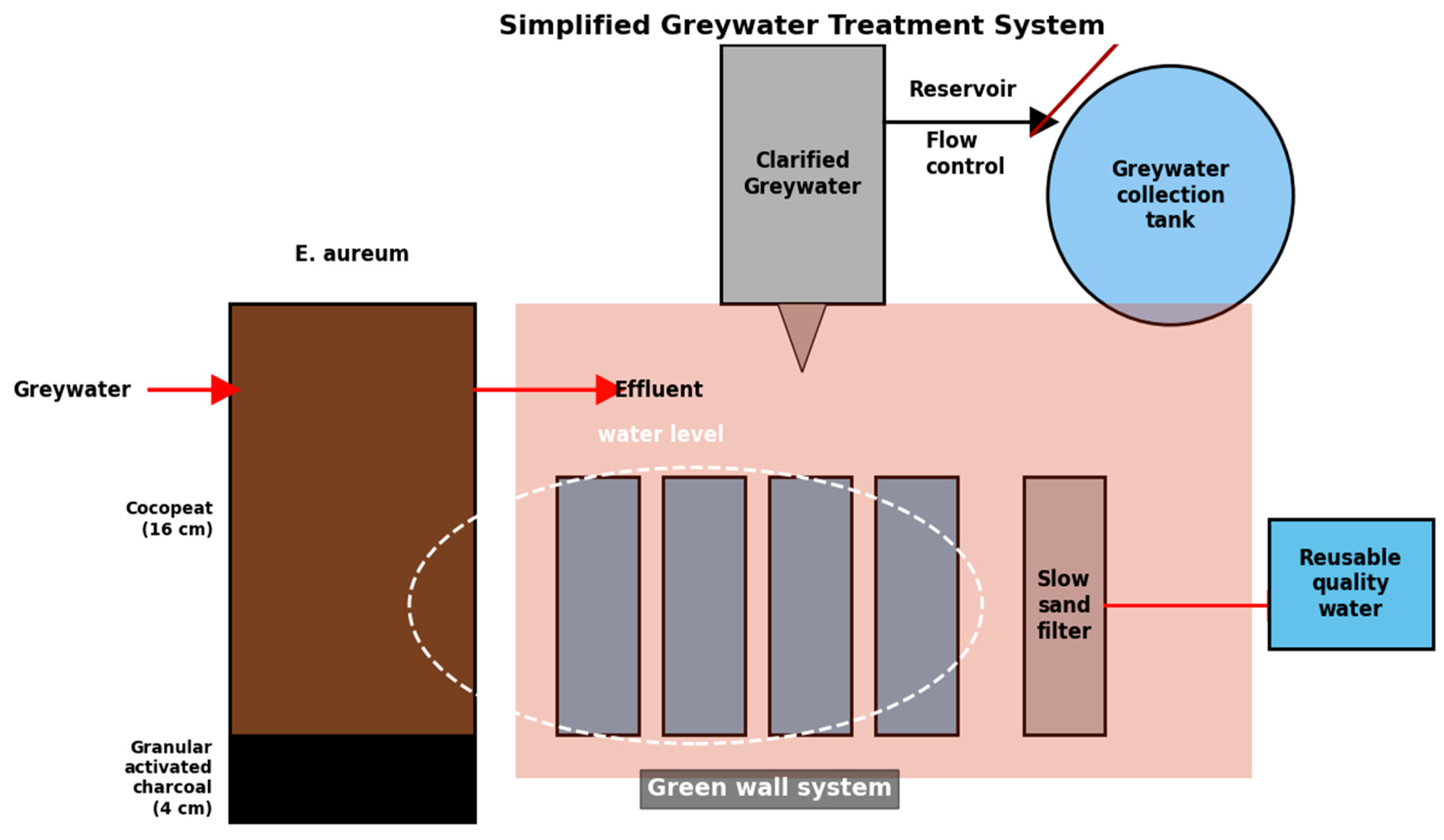
The procedure shown in
Figure 1 clearly describes the treatment of water from grey to reuse, with filtration used before and after cleaning. The reuse of greywater is very beneficial and valuable, but there are also some challenges; for instance, it requires accurate monitoring, consumes energy, incurs high costs for membrane techniques, and membranes must be maintained and cleaned. Advanced filtration systems provide a reliable method for safely reusing greywater in both industrial and residential settings. Many scholars have studied this, and some applications have been described. For instance, Kant and Jaber [
1] developed a modeling technique from a water-reuse perspective based on advanced filtration in greywater treatment. Islam [
2] designed a technique for addressing future water scarcity based on resource recovery and reuse through modified wastewater treatment models. Ameer et al. [
3] systematically reviewed the prospects, challenges, and current insights into the potential of ablution greywater reuse. Abbas et al. [
4] presented green nanocomposite materials for effective greywater purification, with optimization and applications. He et al. [
5] conducted an extensive literature review of pollution removal mechanisms, treatment technologies, and their characteristics to provide new insights into greywater treatment. Tagar and Qambrani [
6] examined sustainable water resource management through the reuse of ablution greywater for treatment techniques. Sulaiman et al. [
7] paid special attention to the vegetated wall agro-system for agricultural irrigation and to the utilization of greywater. Mitra and Banerji [
8] described the growing planned urban habitat of a new town based on affordable resourcing and reusing greywater. Arastou et al. [
9] examined industrial wastewater treatment systems and evaluated their performance using an integrated solution and the greywater footprint. Ferri and Bolelli [
10] reported recent outcomes from pilot and full-scale wastewater remediation tests aimed at water reuse.
1.2. Fuzzy Sets and Their Applications
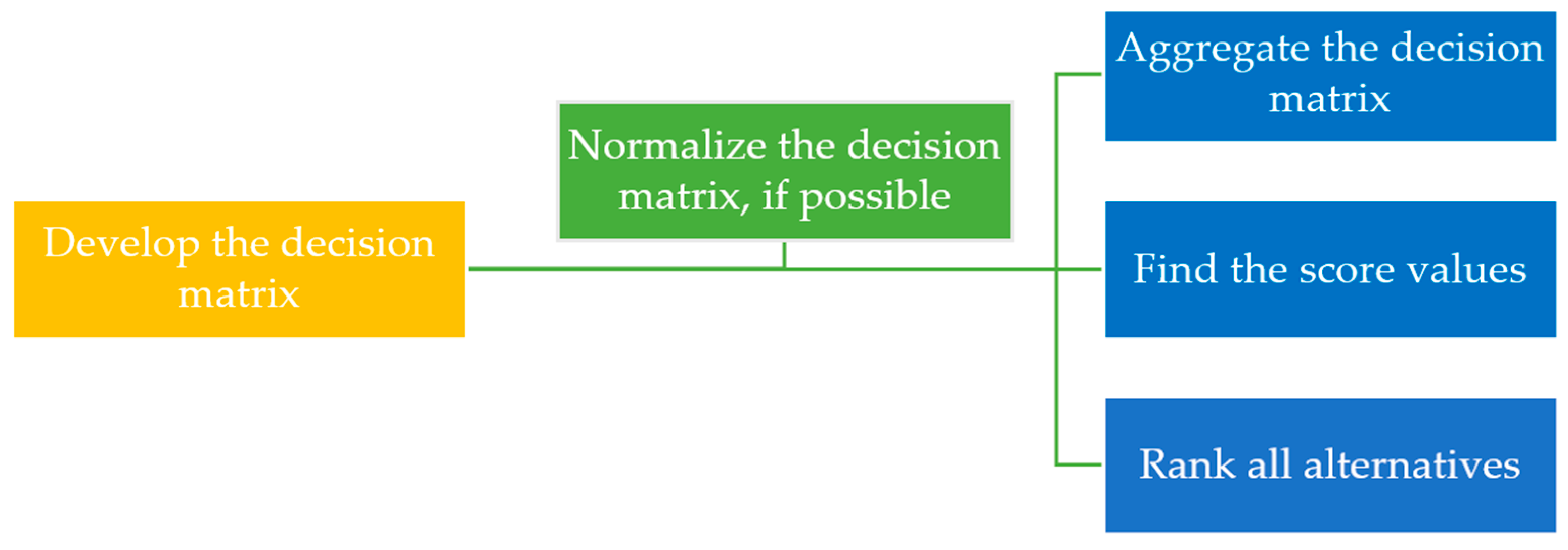
This decision-making framework plays a fundamental role in making the most efficient choice. Decision-making models include many valuable steps, which include the construction of a decision matrix, normalization of the matrix, aggregation of data, and the evaluation of scores for the interpretation of ranking values. Numerous scholars have developed and used various decision-making models to value their problems. The structure of the decision-making model is illustrated in
Figure 2.
The decision-making tool is very effective, but in many cases, it does not provide the optimal solution due to ambiguity and complexity. The main problem is that experts have used a limited variability, providing only two values: zero and one; however, to improve reliability and efficiency, they need a wider range of data to make more feasible and effective decisions. Current decision-making models cannot provide more than the correct optimal solution, and sometimes they create problems and complications. To address this, Zadeh [
11] invented fuzzy sets (FSs) in 1965. Fuzzy set information is more realistic and genuine than classical information. FSs are defined with a function or truth-valued function, which ranges over the unit interval, but the domain of the truth function is any universe of discourse. Fuzzy set functions provide a wide range of information to help decision-makers make more precise and effective decisions. FS construction is very effective and well-organized because of its range, application, and recent extensions. For instance, Chang et al. [
12] applied FSs to regression models. Spiliotis et al. [
13] discovered that water resources and water scarcity systems are based on a fuzzy complex decision-making framework. Hussian and Yang [
14] considered FSs’ entropy based on the Hausdorff metric. Ravikar et al. [
15] developed a fuzzy analytical hierarchical procedure for water conservation strategies in drought-prone areas. Kallas et al. [
16] designed biological wastewater treatment in Lebanon based on land suitability within the river basin with a fuzzy analytical hierarchy procedure. Mahmood and Ali [
17] integrated fuzzy logic with superior Mandelbrot sets, thereby introducing fuzzy superior Mandelbrot sets.
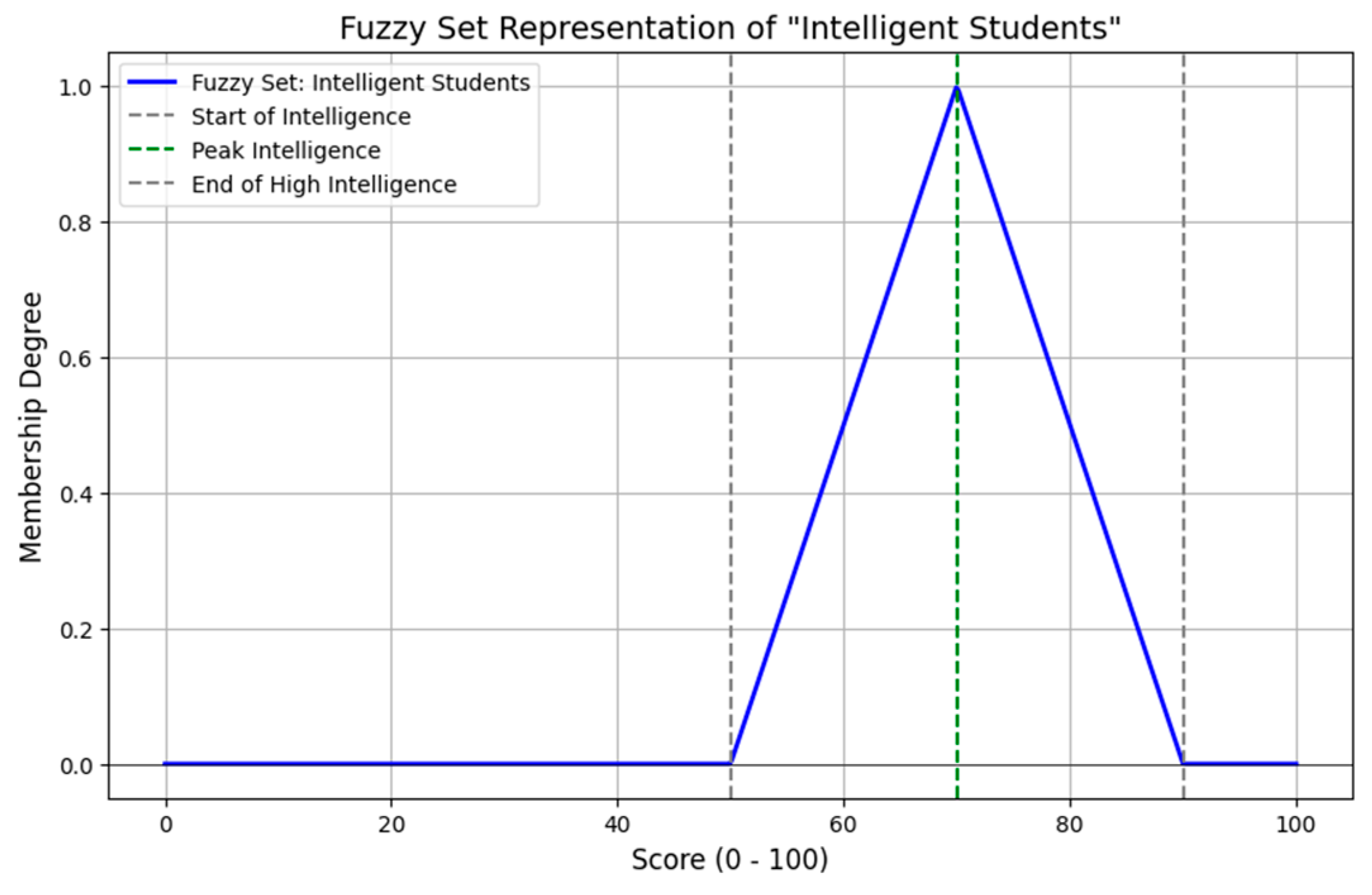
Figure 3 presents the membership degree of fuzzy sets as blue lines, where the values from 0 to 100 on the
X-axis represent the intelligence scale, with the values on the
Y-axis denoting the behavior of the truth function, where values below 40 mean not intelligent, about 80 means highly intelligent, and between 40 and 80 means moderately intelligent.
1.3. Intuitionistic FSs and Their Applications
In daily life, positive information or truth functions play a vital role, particularly when ambiguity and complications are involved. To address numerous problems, experts have used a fuzzy information system with a truth function, which accurately describes human opinions or feelings. Truth functions are very efficient, but not complete or reliable for all problems. During the assessment of any problem, experts face two kinds of data. Scholars provide positive or negative opinions in the form of a yes or a no, where yes denotes the truth function and no denotes the falsity function. This means that without a falsity function, our information or our research is incomplete. In daily life, this information is processed together; if an expert uses the truth function, falsity is automatically included, because it is a part of the real-life framework. To address this, Atanassov [
18] designed a system of intuitionistic FSs (IFSs). IFSs are more meaningful than FSs due to their features and characteristics. The truth and falsity degrees are the major parts of the IFSs, where the sum of these functions must be less than or equal to one. IFSs have attracted considerable attention from scholars; several notable and effective applications have been described. For instance, Tokede [
19] developed a social life-cycle impact assessment using IFSs. Anjum et al. [
20] developed a sustainable energy management system for smart industries based on decision-making using IFSs. Khan et al. [
21] developed aggregation operators based on Dombi norms for IFSs.
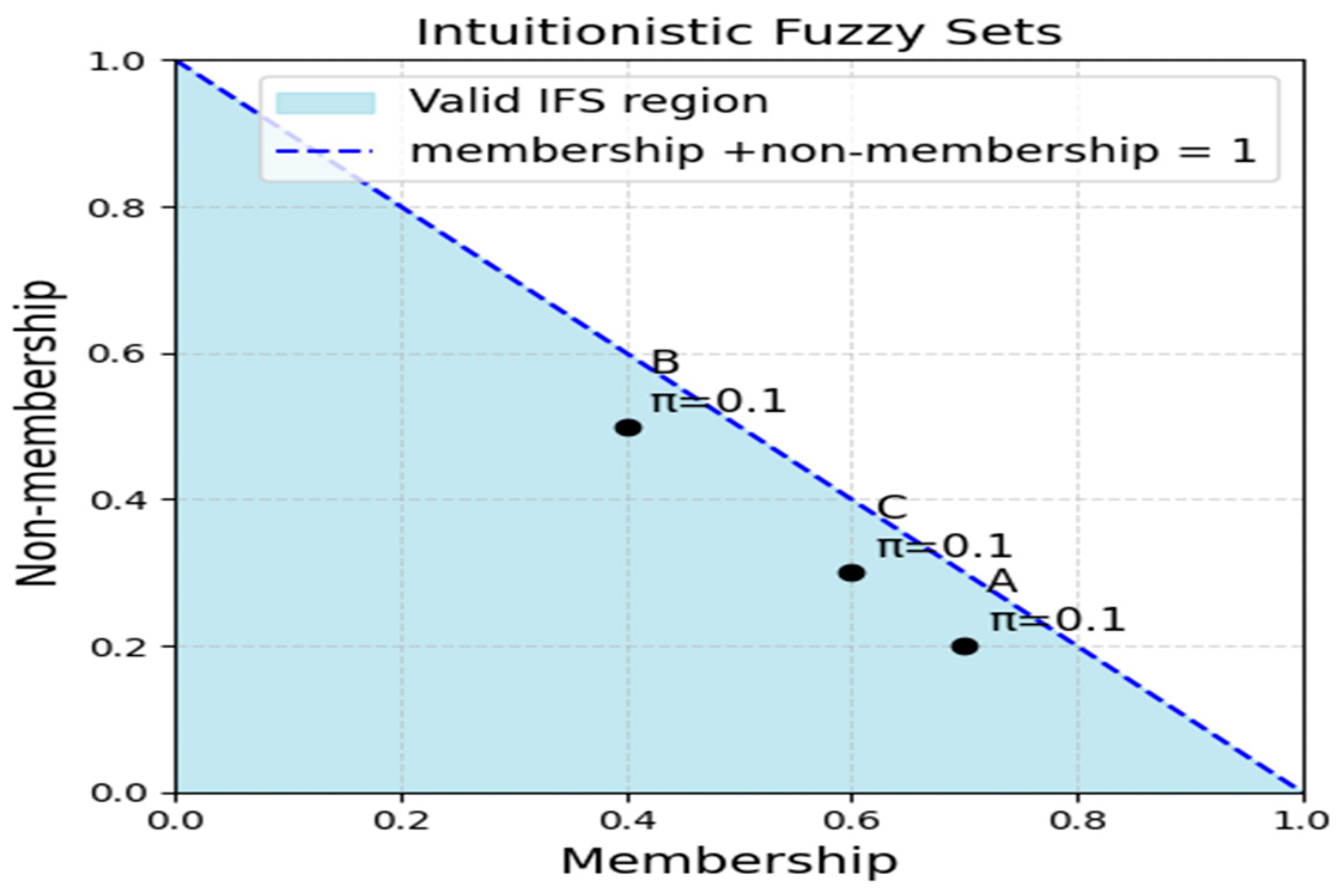
Figure 4 provides a comprehensive explanation of the behavior of the truth and falsity functions with hesitation degree, under a condition. The truth function is drawn on the
X-axis, and the falsity or non-membership function is drawn on the
Y-axis to describe the characteristics of the IFSs.
1.4. Circular IFSs and Their Applications
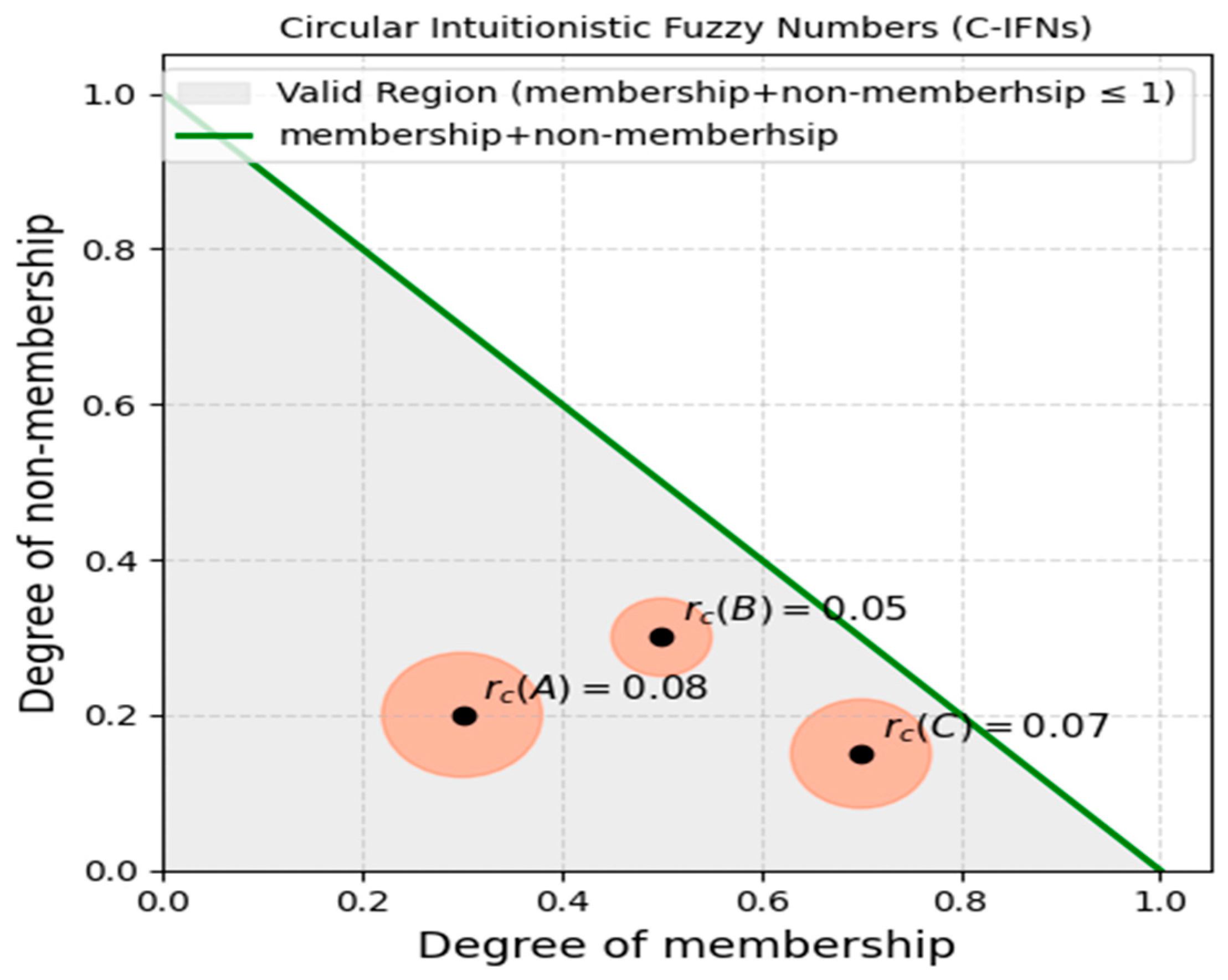
The truth function is a fundamental concept of fuzzy data, and intuitionistic fuzzy data include the truth and falsity degrees, which describe the feelings of human beings in a dominant and precise manner. These theories describe the truth and falsity functions, and do not avoid the radius degree around their positions in two-dimensional space. To address this, Atanassov [
22] developed circular IFSs (Cr-IFSs). Cr-IFSs are effective and resourceful because of the truth, falsity, and radius functions, which are independent. The conditions of Cr-IFSs and IFSs are the same, but the structure of each theory is different because of the radius function. A graphical interpretation of the Cr-IFSs is presented in
Figure 5.
Figure 5 represents the geometrical interpretation of the circular intuitionistic fuzzy values
,
, and
. The condition of the Cr-IFSs and the location of all values with the radius function are described in
Figure 5. The construction of the Cr-IFS is highly effective and well organized, due to its range and applicability, and recent extensions and their utilization have been described. For instance, Chen [
23] proposed the median ranking models and a novel score mechanism based on Cr-IFSs. Garg et al. [
24] described the EDAS technique and decision-making model for Cr-IFSs. Traneva et al. [
25] discussed the confidence-level models with optimal master selection based on Cr-IFSs. Ali and Yang [
26] applied Cr-IFSs to the analysis of renewable energy.
1.5. Literature Review with the Main Theme of This Manuscript (Why?)
In 2020, Zolfani et al. [
27] developed the multi-attributive ideal real comparative assessment (MAIRCA) technique, based on classical data, for interpreting the most powerful and valuable decision among data collection methods. Following the investigation and implementation of MAIRCA, a group of scholars has examined the assessment; for instance, Ecer [
28] defined the problem of selecting coronavirus vaccines based on the MAIRCA technique for IFSs. Hezam et al. [
29] derived the biofuel industry sustainability factors for IFSs using attribute symmetry points. Hussain et al. [
30] developed aggregation operators based on SWTN and SWTCN for IFSs, with applications to sustainable digital security analysis. Fahmi et al. [
31] established the operators based on Hamacher information for Cr-IFSs. Khan et al. [
32] identified entropy measures for Cr-IFSs and derived various methods based on them. Gitinavard and Shirazi [
33] invented the intuitionistic fuzzy complex proportional assessment (IF-COPRAS). Mishra et al. [
34] designed the intuitionistic fuzzy weighted aggregated sum product assessment (IF-WASPAS). Roszkowska et al. [
35] developed the intuitionistic fuzzy Technique of Order for Preference Selection of Ideal Solution (IF-TOPSIS) method. Tripathi et al. [
36] invented the intuitionistic fuzzy Combined Compromise Solution (IF-COCOSO) model. Liu et al. [
37] developed medical insurance based on reasoning approaches. Jiang et al. [
38] proposed a rough set model integrated with multi-granularity linguistic circumstances. The overall analysis suggests that the Cr-IFSs technique is a very valuable and dominant technique for depicting vague data. During the decision-making process, decision-makers and experts encountered the following problems.
- (1)
Why do we analyze the technique of Cr-IF-Rank-Sum-Based MAIRCA Model?
Evaluating the best decision among a group of alternatives is very complex, especially when the same attributes apply to all alternatives. Numerous scholars have developed various techniques for problem evaluation, but these models have failed in decision-making contexts when ambiguity and complexity are present. The main theme of this investigation is to combine the different types of techniques and develop the Cr-IF-Rank-Sum-Based MAIRCA Model, which provides the best result compared to existing techniques and also achieves the results of all existing techniques, especially the circular intuitionistic fuzzy Symmetry Point of Criterion (Cr-IF-SPS) technique, the MAIRCA technique, the circular intuitionistic fuzzy rank sum (Cr-IF-RS), and the MADM technique.
- (2)
Why do we design the Sugeno–Weber operations and operators for Cr-IFSs?
Without data aggregation, it is very complex to analyze or implement any decision-making procedure, because aggregation operators are used to combine information into singleton sets to support better decisions. Aggregation operators are used in the construction of the Cr-IF-Rank-Sum-Based MAIRCA Model; therefore, we have many types of norms for the construction of the aggregation, but we considered the model of SWTN, which was established by Weber [
39] in the 1980s, and the dual t-conorm was constructed by Sugeno [
40] in the 1970s based on a parameter “
”, such as
where
and
represents the drastic and product t-norms. The general interpretation of the SWTN for parameter “
” is designed and stated as:
Except for the construction of the aggregation operators, we will use the simple form of the SWTN and SWTCN. Based on the parameter “
”, we have
Further, if we consider the value of
, then the function of SWTN will be reduced to the Lukasiewicz t-norm, for example:
Due to its advantages, we considered the SWTN technique for the construction of the aggregation operators.
- (3)
Why do we discuss advanced filtration techniques for reusing greywater?
Advanced filtration techniques for reusing greywater with Cr-IF-Rank-Sum-Based MAIRCA Models usually tie into how our developed model helps handle imprecision and problems, especially in the following situations:
- (i)
Vagueness and uncertainty regarding water quality parameters.
- (ii)
Decision-making under vagueness and uncertainty.
- (iii)
Modeling complex non-linear techniques.
- (iv)
Adoption control and optimizations.
Therefore, we use the Cr-IF-Rank-Sum-Based MAIRCA Models for advanced greywater filtration because they provide a robust model to cope with the variability, uncertainty, and imprecision of filtration system performance and water quality.
Motivated by the above discussion, we concentrated on the valuation of the advanced filtration techniques for reusing greywater with Cr-IF-Rank-Sum-Based MAIRCA Models. The main contributions of the invented technique are described:
- (a)
To initiate the novel model of circular intuitionistic fuzzy Symmetry Point of Criterion (Cr-IF-SPC) technique.
- (b)
To derive the model of circular intuitionistic fuzzy Rank Sum (Cr-IF-RS) technique.
- (c)
To design the technique of Circular Intuitionistic Fuzzy Rank-Sum-Based MAIRCA (Cr-IF-Rank-Sum-Based MAIRCA) Models
- (d)
To evaluate the problem of using advanced filtration techniques for reusing greywater based on Cr-IF-Rank-Sum-Based MAIRCA Models.
- (e)
To compare the invented model with the ranking values of existing approaches.
- (f)
Provide some concluding remarks.
This manuscript is arranged as follows. In
Section 2, we discuss the existing Cr-IFSs model and related information. Furthermore, the SWTN and SWTCN techniques are discussed because they can help us in the construction of the aggregation operators, which will be used in the proposed models. In
Section 3, we derive the Cr-IF-Rank-Sum-Based MAIRCA Models. In
Section 4, we assess and value advanced filtration techniques for reusing greywater using Cr-IF-Rank-Sum-Based MAIRCA Models. In
Section 5, we discuss the comparison between the proposed ranking framework and the existing ranking framework for the interpretation of the supremacy and validity of the invented models. Concluding remarks are presented in
Section 6.
3. Symmetry Point of Criterion and Cr-IF-Rank-Sum-Based MAIRCA Model
Determination of the optimal decision is highly unreliable due to ambiguity and other problems. Numerous scholars have used different techniques and models to investigate the problems, such as the decision-making and the MADM techniques, among other models. Our main aim is to develop a system for the Cr-IF-SPC-RS-MAIRCA technique by considering using the Cr-IF-rank-sum model for the valuation and investigation of the best decision. We aim to determine the objective weight vector using Cr-IF-SPC, and the subjective weight vector will be derived from Cr-IF-RS. Finally, the most favorable and valuable decision will be obtained using the Cr-IF-SPC-RS-MAIRCA technique. The constructed and developed steps of the Cr-IF-SPC-RS-MAIRCA technique are described and discussed:
To constuct the decision matrix, we arranged a team of decision-making experts: . These experts provided the family of alternatives with attributes . The experts provided their assessment information for each attribute of every alternative in the form of “linguistic scales or variables”. Assume that , represents the decision matrix designed by decision-makers incorporating information about their “linguistic ratings”.
The assessment values of the experts are formulated as linguistic ratings and converted into Cr-IFNs. Assume that
is a group of Cr-IFNs. The weight vector of the normalized Cr-IF-
score of each expert is deliberated by:
where
and
. For the valuation of the weight vector, we have used a mathematical procedure that provides a valuable and efficient way to determine the optimal weights without iterative optimization. The procedure is very simple, like linear regression, where the relationship between outputs and inputs can be represented analytically. Many decision-makers have used known weight vectors, whereas we used unknown weight vectors to mitigate bias in the results.
The Cr-IFSWA and Cr-IFSWG operators are implemented to derive the A-Cr-IFDM
. For this, we assume the group of Cr-IFNs
, then, for
,
Operational laws are used in the analysis of aggregation operators, which can help us to aggregate the collected information into a singleton set. Therefore, we considered any group of a finite number of Cr-IFNs
, the Cr-IF Sugeno–Weber averaging (Cr-IFSWA) operator is signified and well-defined by:
where
signified the weight vector with a condition
. Furthermore, we considered any group of a finite number of Cr-IFNs
, the Cr-IF Sugeno–Weber geometric (Cr-IFSWG) operator is signified and well-defined by:
where
signified the weight vector with a condition
.
Using the information in the decision matrix, evaluate the NA-Cr-IFDM:
where the
and
represent cost and benefit information. Notice that in the case of benefit-type data, we do not require standardization.
Assume that signified the weight vector with a condition . Thus, the following procedures are used to evaluate the weight vectors for the attributes.
Step 5-1: Design the Cr-IF score values of the NA-Cr-IFDM based on the normalized score function:
Assume that
represents the value of the Cr-IF score for the
indicator. The minimum and maximum values of the data sets are represented by
and
. Thus, the technique of the symmetry point
is deliberated and invented by:
The mathematical interpretation of the absolute distance matrix is derived with the help of the following function:
Consider that
represents the values of the absolute distance in the column of the decision matrix. Thus, the decision matrix of the symmetry with moduli is represented and invented by:
The mean or middle value of the decision matrix is determined, which is denoted by
, where
represents the modulus of the symmetry of the jth indicator, such as
The weight vector for each objective attribute is derived from the vector of symmetry with moduli. The mathematical interpretation of the technique of the objective weight vector of the indicator is described and invented by:
Derive the scale or rating of each indicator with the help of the linguistic rating functions given by experts or decision-makers from the Cr-IFSWA operator and Cr-IFSWG operator, such as
where
signifies the weight vector with the condition
. The above aggregation operators may satisfy the properties of idempotency, monotonicity, and boundedness. However, these theoretical properties are not the primary concern of this paper.
Design the Cr-IFSM using the aggregated values. The Cr-IFSM formula is defined as:
Note that the preference of each indicator is interpreted by
. The system of the standardized weight for the indicator was defined by:
The term “” signifies the overall attribute.
To resolve or initiate the integrated weight of the attribute, we integrated the objective and subjective weight vectors. The system of the investigation and the integrated weight of the attribute are defined by:
where the value of the parameter is defined as
.
At the start of the procedure, we treat Cr-IFN as Cr-IF-PIS and Cr-IF-NIS, assigning the values
and
. To derive the distance values, the standardized Cr-IF-Euclidean distance function is employed. The mathematical interpretation of the Cr-IF-PIS and Cr-IF-NIS based on the data in the decision matrix is defined by:
where
and
.
Step 7: Further, we describe the closeness relative decision matrix (CR-DM) using the above obtained measures, such as
Using the linear max–min standardization technique for each assessment indicator, the standardized CR-DM is defined by:
where
and
represent benefit and cost data in the decision matrix.
At the start, the preference for each possible decision is defined as:
Thus, scaling for the decision evaluation is multiplied by indicator weights. The final version of the Cr-IFTDM is defiend by:
To diagnose the genuine assessment matrix, the scaling of the standardized CR-DM is multiplied by the rating of the Cr-IFTDM, such as
The Cr-IF discrimination matrix is obtained by subtracting the real Cr-IF assessment decision matrix from the Cr-IFTDM, such as
The information obtained from the Cr-IF discrimination matrix is used to compute the DU:
Based on the utility rankings, we identified the best and worst decisions among the considered alternatives to enhance the rationality and superiority of the designed models.
4. Advanced Filtration Techniques for Reusing Greywater
Reusing greywater, especially wastewater from baths, sinks, washing machines, and showers (but not toilets), plays a significant role in water conservation. To guarantee that reused greywater is suitable and safe for industrial processes, irrigation, and toilet flushing, advanced filtration systems are essential. Greywater is relatively clean wastewater that may originate from households, factories, industries, and organizations, including toilet waste, kitchen sinks, washing machines, bathroom sinks, showers, and bathtubs. In general, water that contains harmful chemicals is not included in greywater, but it is included in blackwater. Reusing greywater is also highly beneficial but presents several challenges, including the need for skilled monitoring, energy consumption, high costs associated with membrane techniques, and membrane maintenance and fouling. Greywater reuse helps conserve fresh water and reduce strain on sewage systems, and supports sustainable water use. Advanced filtration systems provide a reliable method for safely reusing greywater in both industrial and residential settings. The reuse of greywater is very important because it helps to reduce wastewater generation, enhance sustainability, and conserve freshwater in rural and urban settings. The application based on the recommendation of the filtration techniques for greywater reuse is described in
Table 1.
Greywater is very important for reuse and to conserve resources. Greywater depends on its composition and source. The main sources of greywater are as follows:
- (1)
Bathroom Greywater: Bathroom greywater comes from the bathroom, especially shower water, bathtub water, and bathroom sink water, but not toilet water.
- (2)
Laundry Greywater: Laundry greywater comes from a washing machine, such as bleach water, fabric softener water, and detergent water, but not chemical water.
- (3)
Kitchen Greywater: Kitchen greywater originates from kitchen sinks and dishwashers, excluding grease clogs and biochemical water.
- (4)
Mixed Greywater: Integration of all household greywater sources, like soap, hair, and food particles, but not mixed with chemicals.
Based on the above analysis, we concluded that greywater is highly beneficial for reuse, particularly in washrooms, industry, fields, and car washers. The comparative analysis of the greywater is presented in
Table 2.
Our main aim is to evaluate the best advanced filtration techniques for reusing greywater among the five considered alternatives for their reliability, ability, and effectiveness at meeting different needs. The five main advanced filtration techniques for greywater reuse are described:
- (1)
Membrane Filtration: Membrane filtration is an advanced water treatment technique that considers semi-permeable membranes to separate impurities from water based on molecular weight, size, and charge. It is a well-established method for greywater treatment, drinking water purification, and greywater recycling because of its high removal efficiency and ability to yield clean and reusable water. The membrane filtration pushes water through a thin membrane with tiny pores.
- (2)
Activated Carbon Filtration: Activated carbon filtration is a technique for water treatment that uses activated carbon to adsorb impurities from greywater; for instance, discoloration, odors, and organic chemicals. Activated carbon filtration is a well-known and valuable way to clean greywater before reuse or after basic filtration. The activated carbon is a carbon-rich material that has been heat-treated to generate millions of tiny pores. The carbon traps some heavy metals and pharmaceuticals, odors and bad tastes, chlorine and chloramines, and organic chemicals.
- (3)
Advanced Oxidation Processes: Advanced oxidation processes are a family of water treatment techniques that apply powerful oxidants to harmful organic pollutants and break down complex compounds in water, including greywater. The radicals used in the advanced oxidation processes generate hydroxyl radicals in water, which then destroy and oxidize, for instance, pathogens, detergents, surfactants, colored or odorous compounds, and endocrine-disrupting compounds.
- (4)
Constructed Wetlands: Constructed wetlands are a valuable engineering technique developed to simulate the natural water decontamination functions of real wetlands. They use microbial life, gravel, soil, and plants to treat greywater in an environmentally friendly, low-maintenance manner. Greywater can travel vertically or horizontally through a bed of sand or gravel planted with wetland vegetation, such as bulrushes, cattails, and reeds. Plants give oxygen to the roots and take nutrients. Microorganisms living on plant roots. Gravel and soil trap solids and filter particles.
- (5)
Ultraviolet Disinfection: Ultraviolet disinfection is a valuable physical water treatment technique that uses ultraviolet light, particularly ultraviolet C-light, to inactivate or kill microorganisms in water, including protozoa, bacteria, and viruses. The greywater is passed through an ultraviolet disinfection chamber.
To analyze the five advanced filtration techniques for greywater reuse, we must establish a hierarchy of attributes. The following five attributes were selected for this assessment:
- (1)
Effectiveness: How do we remove contaminants, such as pathogens, odors, chemicals, and solids? Also used to investigate water safety and sustainability for reuse.
- (2)
Cost: Includes the main installation cost and continuing conservation, like chemical and energy use. This helps us to assess affordability and sustainability.
- (3)
Maintenance Requirements: How often does the technique require cleaning, technical oversight, and part replacement?
- (4)
Space Requirements: Physical footprint required for operation and installation.
- (5)
Environmental Impact: waste management, energy use, and environmental compatibility. A summary of the above information is presented in
Table 3.
Finally, we will use the Cr-IF-SPC-RS-MAIRCA technique for decision-making and evaluating the invented problems. The steps of the Cr-IF-SPC-RS-MAIRCA technique are described below:
For the construction of the decision matrix, we recruited a team of decision-making experts:
. These experts will provide the family of alternatives
with attributes
. The experts provide their assessment of each attribute in every alternative in the form of “linguistic scales or variables”. Assume that
, representing the decision matrix designed by decision-makers with information of “linguistic rating”. The linguistic variables are described in
Table 4.
The data in
Table 4 provide the truth, falsity, and radius values for each linguistic term to construct the decision matrix. The technique for converting linguistic values to Cr-IFN involves mapping qualitative linguistic values; for instance, mapping averaging, good, bad, absolutely good, and absolutely bad to numerical representations within the Cr-IFN frameworks. References to these techniques can often be found in works on fuzzy systems; for instance, Hezam et al. [
29] derived biofuel industry sustainability factors for IFSs with symmetry points of attributes. Thus, using the data in
Table 4, we constructed
Table 5 for the evaluation of the normalized decision matrix.
The experts’ assessment values are expressed as linguistic ratings and converted into Cr-IFNs. Assume that
is a group of Cr-IFNs. The weight vector of the normalized Cr-IF-score
grade of each expert is presented in
Table 6, where,
and
.
The Cr-IFSWA and Cr-IFSWG operators are implemented to derive the A-Cr-IFDM
. The final values of the aggregation matrix are presented in
Table 7.
Using the information in the decision matrix, evaluate the NA-Cr-IFDM using the normalization technique; the normalization matrix is described in
Table 8.
Assume that signifies the weight vector with condition . Thus, the following procedure is used to evaluate the weight vectors for the attributes.
Step 5-1: Design the Cr-IF score values of the NA-Cr-IFDM based on the normalized score function, as described in
Table 9.
Table 9.
Interpretation of the summary values and min–max values.
Table 9.
Interpretation of the summary values and min–max values.
| | | | | | | | | |
|---|
| 0.737081 | 0.697224 | 0.697224 | 0.697224 | 0.738081 | 0.697224 | 0.738081 | 0.717653 |
| 0.604594 | 0.697224 | 0.595494 | 0.741249 | 0.604594 | 0.595494 | 0.741249 | 0.668371 |
| 0.654118 | 0.604594 | 0.697224 | 0.648748 | 0.751193 | 0.604594 | 0.751193 | 0.677894 |
| 0.707126 | 0.751193 | 0.741249 | 0.707126 | 0.604594 | 0.604594 | 0.751193 | 0.677894 |
| 0.648748 | 0.604594 | 0.648748 | 0.648748 | 0.648748 | 0.604594 | 0.648748 | 0.626671 |
Assume that
represents the value of the Cr-IF score for the
indicator. The minimum and maximum values of the data sets are represented by:
and
. Thus, the technique of the symmetry point
is presented in
Table 9.
The mathematical interpretation of the absolute distance matrix is presented in
Table 10.
Consider that
represents the values of the absolute distance in the column of the decision matrix. Thus, the symmetry matrix with moduli is presented in
Table 11.
The mean or middle value of the decision matrix is determined, which is denoted by
, where
represents the modulus of the symmetry of the jth indicator, which is represented in
Table 11.
The weight vector for each objective attribute is determined using the vector of symmetry with moduli. The mathematical interpretation of the technique for the objective weight vector of the indicator is presented in
Table 11.
Derive the scale or rating of each indicator using the linguistic rating functions given by experts or decision-makers from the Cr-IFSWA and Cr-IFSWG operators, as described in
Table 12.
Design the Cr-IFSM using the aggregated values. The Cr-IFSM formula is presented in
Table 12.
Note that the preference of each indicator is interpreted by
. The system of the standardized weight for the indicator is presentedin
Table 12.
To resolve or initiate the integrated weight of the attribute, we integrated the objective and subjective weight vectors. The system of the investigation and the integrated weight of the attribute are presented in
Table 13.
Step 6. Investigate the distance values of the Cr-IF positive ideal solution (Cr-IF-PIS) and Cr-IF negative ideal solution (Cr-IF-NIS) for each indicator. At the start of the procedure, we treat Cr-IFN as Cr-IF-PIS and Cr-IF-NIS, using the values
and
. To expose the distance values, the standardized Cr-IF-Euclidean distance function is employed. The mathematical interpretation of the Cr-IF-PIS and Cr-IF-NIS based on the data in the decision matrix is presented and deliberated in
Table 14 and
Table 15.
Step 7. Further, we discuss the technique of closeness relative decision matrix (CR-DM), using the above-obtained measures, as described in
Table 16.
Using the linear min–max standardization technique for each assessment indicator, the standardized CR-DM is determined and presented in
Table 17.
At the start, the preference for each possible decision is defined as:
Thus, scaling for the evaluation of the decision is multiplied by indicator weights. The final version of the Cr-IFTDM is presented in
Table 18.
To determine the genuine assessment matrix, the scaling of the standardized CR-DM is multiplied by the rating of the Cr-IFTDM, as described in
Table 19.
The Cr-IF discrimination matrix is obtained by subtracting the real Cr-IF assessment decision matrix from the Cr-IFTDM, as described in
Table 20.
Using the information obtained from the Cr-IF discrimination matrix to compute the DU:
According to the ranking values of the utility degree, we determined the best and worst decisions among the family of considered alternatives to enhance the rationality and supremacy of the designed models:
The most preferable decision is . Furthermore, we performed a comparative analysis of the invented models using the existing ranking techniques to establish the validity and supremacy of the designed techniques.
5. Comparative Analysis
In this section, we compare invented operators with existing techniques to assess the rationality of the designed models. The comparative technique is an essential part of the interpretation of the supremacy and validity of proposed and existing approaches. After evaluating the proposed models, each expert seeks to demonstrate the superiority and validity of their information through comparative analysis. Using the same procedure with some modifications, we performed a comparative analysis. To this end, we drew on existing information to substantiate the sovereignty and rationality of the proposed theory. The existing techniques are as follows: Hussain et al. [
30] designed the aggregation operators based on SWTN and SWTCN for IFSs for application to sustainable digital security analysis. Fahmi et al. [
31] established the operators based on Hamacher information for Cr-IFSs. Khan et al. [
32] identified the entropy measures for Cr-IFSs and derived different methods based on them. Gitinavard and Shirazi [
33] developed the IF-COPRAS. Mishra et al. [
34] designed the IF-WASPAS. Roszkowska et al. [
35] developed the IF-TOPSIS technique. Tripathi et al. [
36] invented the IF-COCOSO model. Hezam et al. [
29] developed the MAIRCA technique for IFSs. Rukhsar et al. [
41] derived the power aggregation techniques based on Cr-IFSs. Rahim et al. [
42] presented the Dombi operators for Cr-IFSs. Thus, based on the data presented in
Table 4 and
Table 5, the comparison values are presented in
Table 21.
The most preferable decision is
, according to the performance of the proposed approaches. The three existing techniques evaluated the ranking values of the proposed data; for instance, the technique of Rukhsar et al. [
41] provided the best decision
are based on power averaging and geometric operators. Similarly, the system proposed by Fahmi et al. [
31] provided the best decision
based on Hamacher averaging and geometric operators. Additionally, the proposed theory of Rahim et al. [
42] also indicates that the best decision is
, which is the same as the ranking values of the proposed theory. These existing techniques employ aggregation operators but lack models such as MARICA, AHP, and TOPSSI to provide ranking values. The remaining existing techniques cannot evaluate the data presented in
Table 4 and
Table 5 because of the radius degree. We also have a solution to this problem. If we remove the radius degree from the invented models and also consider the data from Hezam et al. [
29], then the ranking values are as presented in
Table 22.
We note that the existing techniques also provided the same ranking values or results for the data in Ref. [
29]. This means that the proposed model can handle the data used by existing models, but existing techniques cannot evaluate the information we consider due to ambiguity and other issues. The existing techniques have produced ranking values for the proposed data set. The main benefit of considering Sugeno–Weber operators is that existing techniques are special cases of the proposed models. The qualitative assessment of the proposed work and existing techniques is presented in
Table 23.
The representation of “yes” is denoted by: ”, and “no” is denoted by: . Therefore, the derived model for circular intuitionistic fuzzy sets is very efficient and can cope with vague and complex data.
6. Conclusions
The circular intuitionistic fuzzy model is effective in coping with vague and complex data. The advanced filtration technique for reusing greywater is an essential procedure for addressing water scarcity and the rising demand for clean water in densely populated and urban areas. Greywater or wastewater from washing machines, sinks, and baths can be safely reused for non-potable purposes suhc as toilet flushing or irrigation when properly treated. The major problems are related ton the variable quality of greywater, which may contain pathogens, organic matter, oil, and detergents, making treatment difficult. Overall, this paper has covered the following: (1) We developed a novel model of the Cr-IF-SPC technique. (2) We derived the model of the Cr-IF-RS technique. (3) We designed the Cr-IF-Rank-Sum-Based MAIRCA Models. (4) We evaluated the problem of the advanced filtration techniques for reusing greywater based on the Cr-IF-Rank-Sum-Based MAIRCA Models. (5) We compared the invented model with the ranking values of existing approaches. (6) We also performed a comparative analysis of our method and the methods developed by Hussain et al. [
30], Fahmi et al. [
31], Khan et al. [
32], Gitinavard and Shirazi [
33], Mishra et al. [
34], Roszkowska et al. [
35], Tripathi et al. [
36], and Hezam et al. [
29].
The proposed technique is very efficient, especially the SWTN and SWTCN models, because many existing techniques are special cases of the derived theory. But the main problem is Cr-IFSs, which is a very effective and reliable technique for coping with vague data, but it does not work properly in many situations. For instance, when a decision-maker provides information, and the sum of the information exceeds the unit interval, then the Cr-IFSs will fail. Therefore, the Cr-IFSs are not very efficient and valuable compared to circular (p, q)-rung orthopair fuzzy sets, which will be proposed in the future as a reliable technique, as they can easily capture awkward and complex data with the help of parameters “p” and “q”.
In the future, we will work on circular bipolar fuzzy sets, circular hesitant fuzzy sets, and circular bipolar hesitant fuzzy sets for the evaluation of different types of problems. Further, we will also evaluate different types of models, such as TOPSIS, COPRAS, MAIRCA, and COCOSO models. Finally, we will discuss their application to decision-making, green supply chains, greenhouses, and green hydrogen energy to improve the performance of the proposed methods.