

Instability Mechanism of Shield Tunnel Face Induced by Seepage and Soil Softening in Water-Rich Silty Sand: Case Study of Jingu-Haihe Tunnel
Abstract
1. Introduction
2. Methods
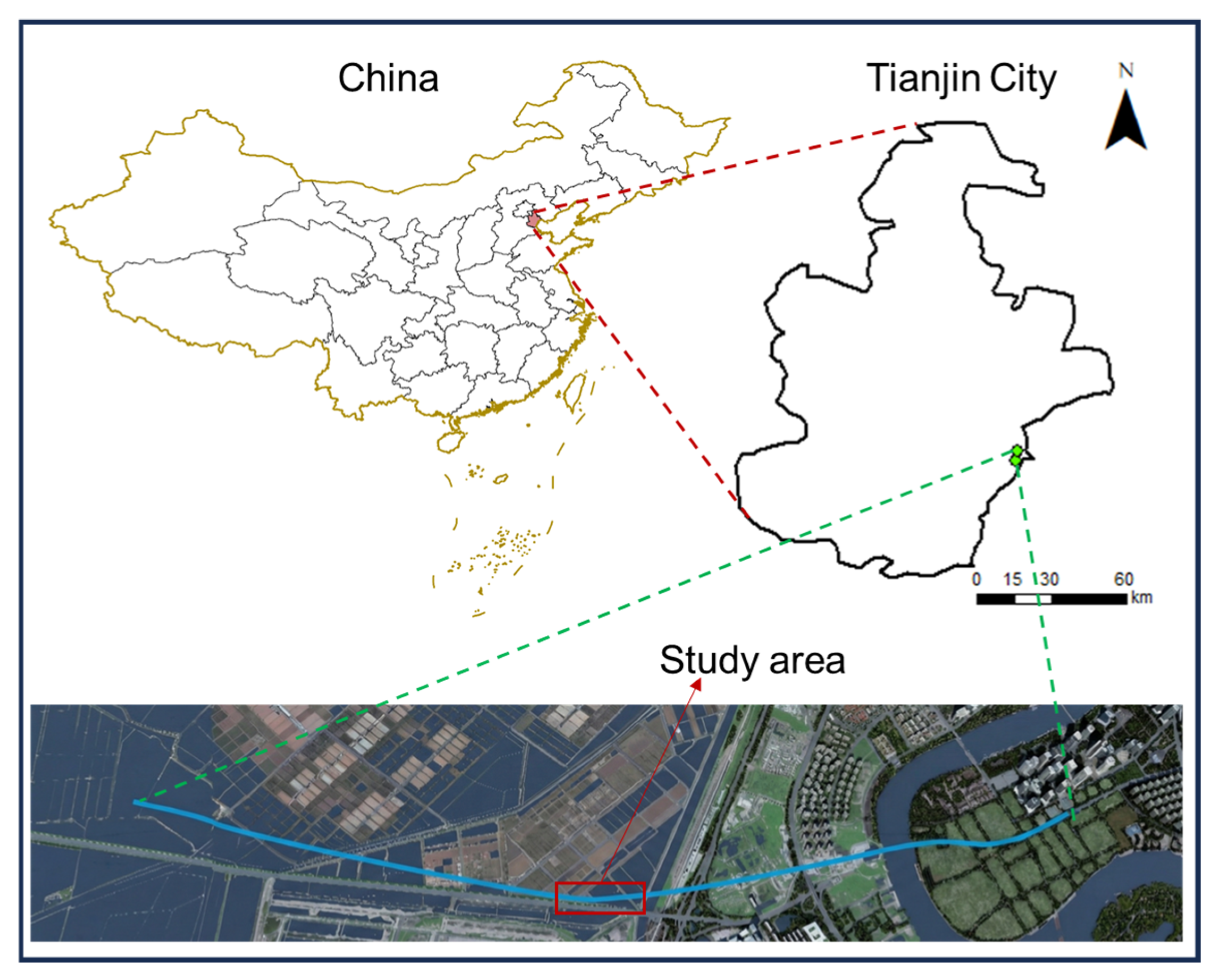
2.1. Engineering Background
2.2. Governing Equations for Fluid–Solid Coupling
2.3. Soil Constitutive Model and Yield Criterion
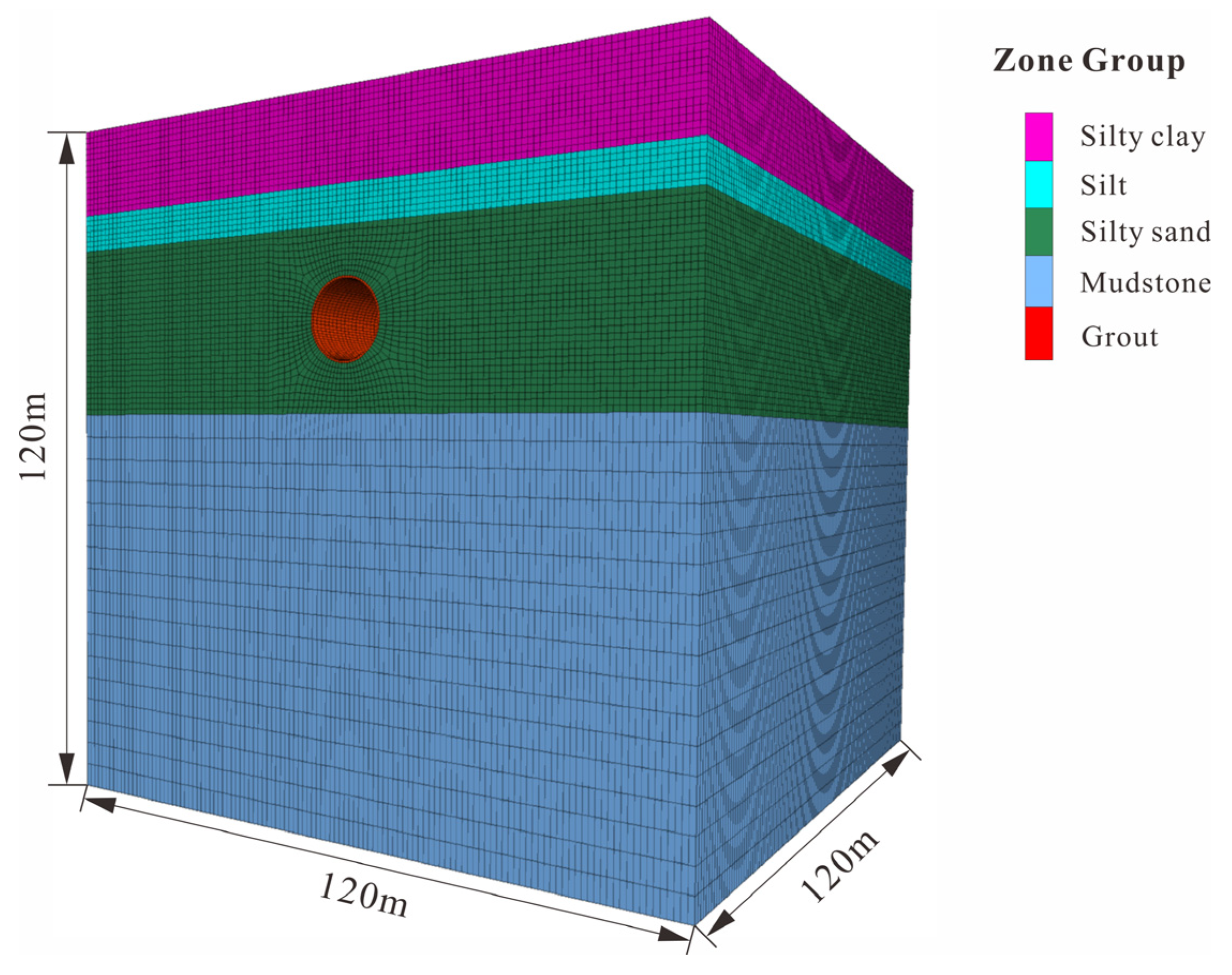
2.4. Numerical Model Establishment and Boundary Conditions
2.5. Configuration of the Softening Scenarios
3. Results
3.1. Comparison of Limit Support Pressure Under Dry and Saturated Scenarios
3.2. Support Pressure-Displacement Response Induced by Softening Effects
3.3. Shear Parameter Sensitivity Under Dry and Saturated Mechanical States
4. Discussion
4.1. Comparison of Fluid–Solid Coupling Effects
4.2. Transition of Failure Modes Under Excessive Support Pressure
5. Conclusions
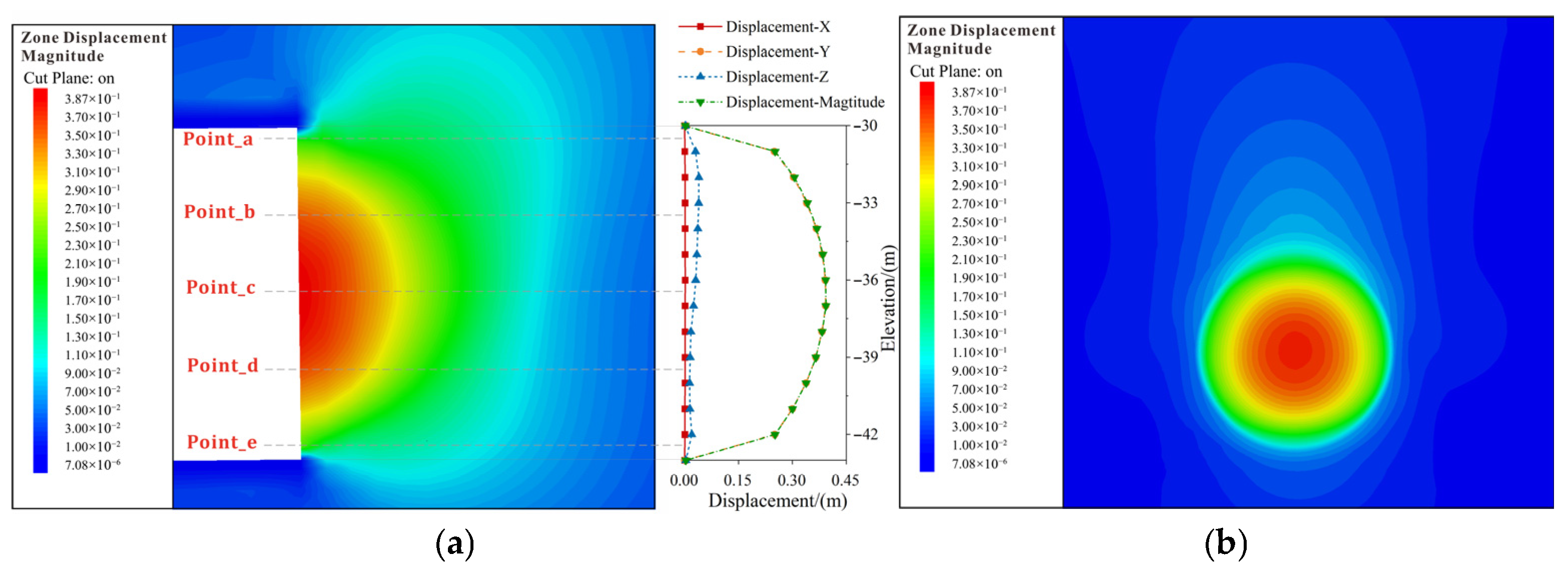
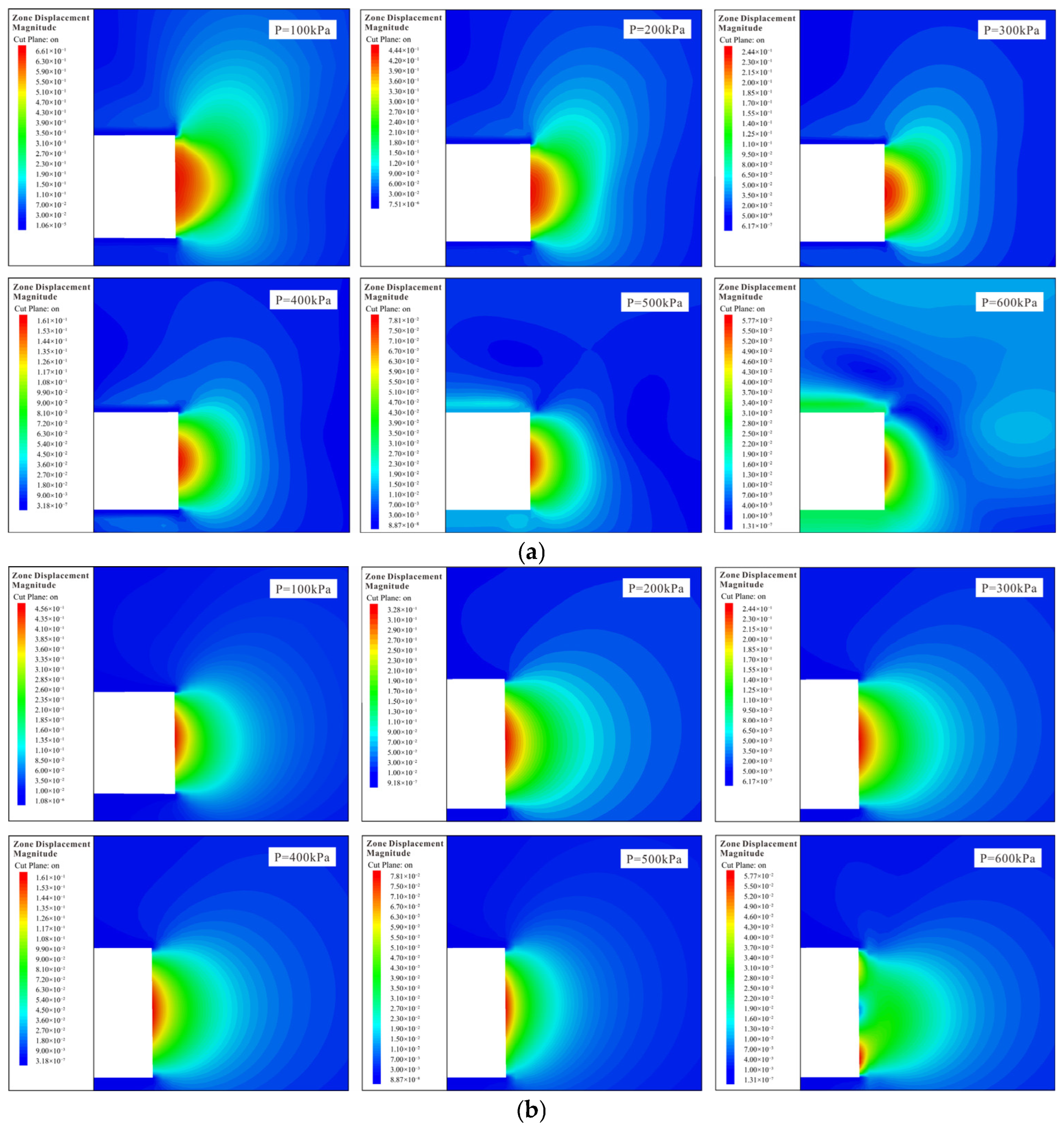
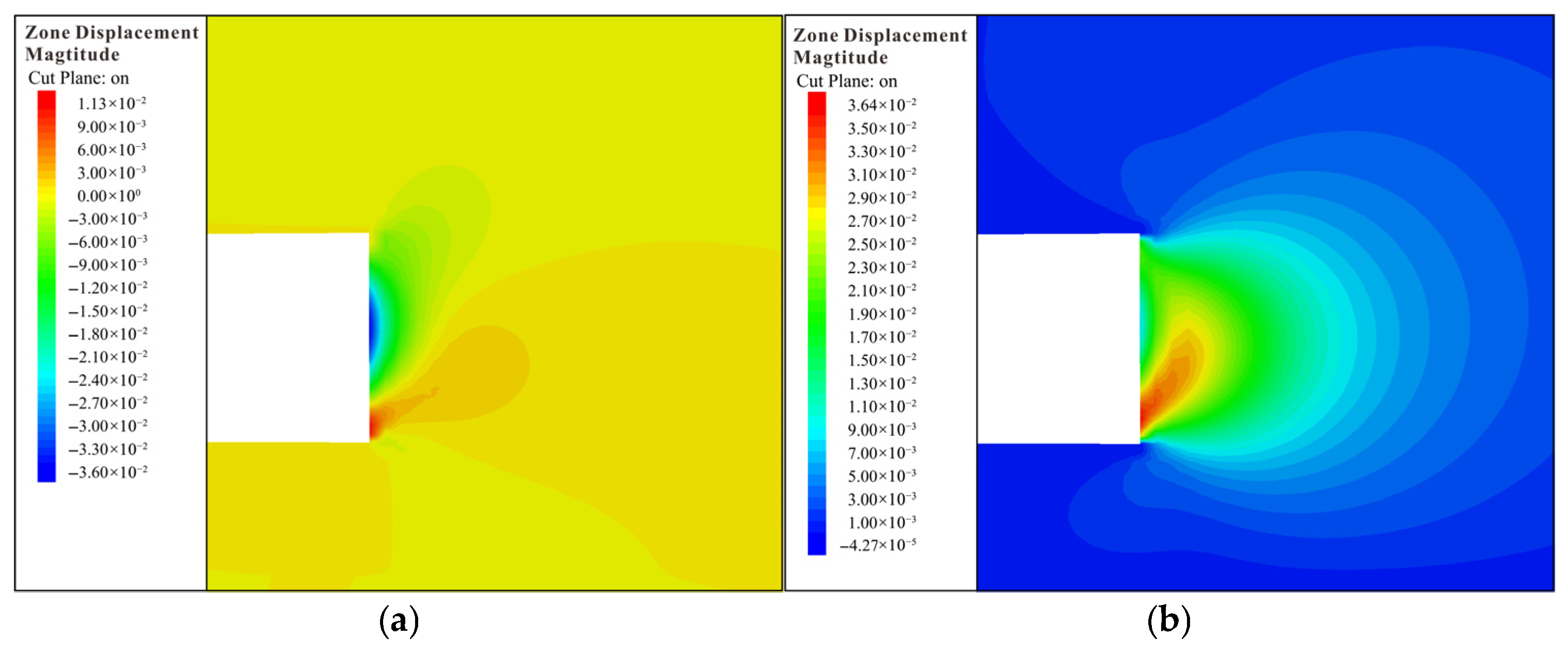
- Seepage flow significantly elevates the limit support pressure required to maintain face stability. The limit support pressure increases from 140 kPa in the dry mechanical state to 231 kPa under fluid–solid coupling conditions. In the dry state, the range of displacement contours presents “horn-like”, reflecting the formation of localized shear bands, and a global “bulb-like” deformation pattern is exhibited under saturated seepage field scenarios. The seepage forces transform the failure mode from friction-controlled brittle shearing to visco-plastic rheological diffusion.
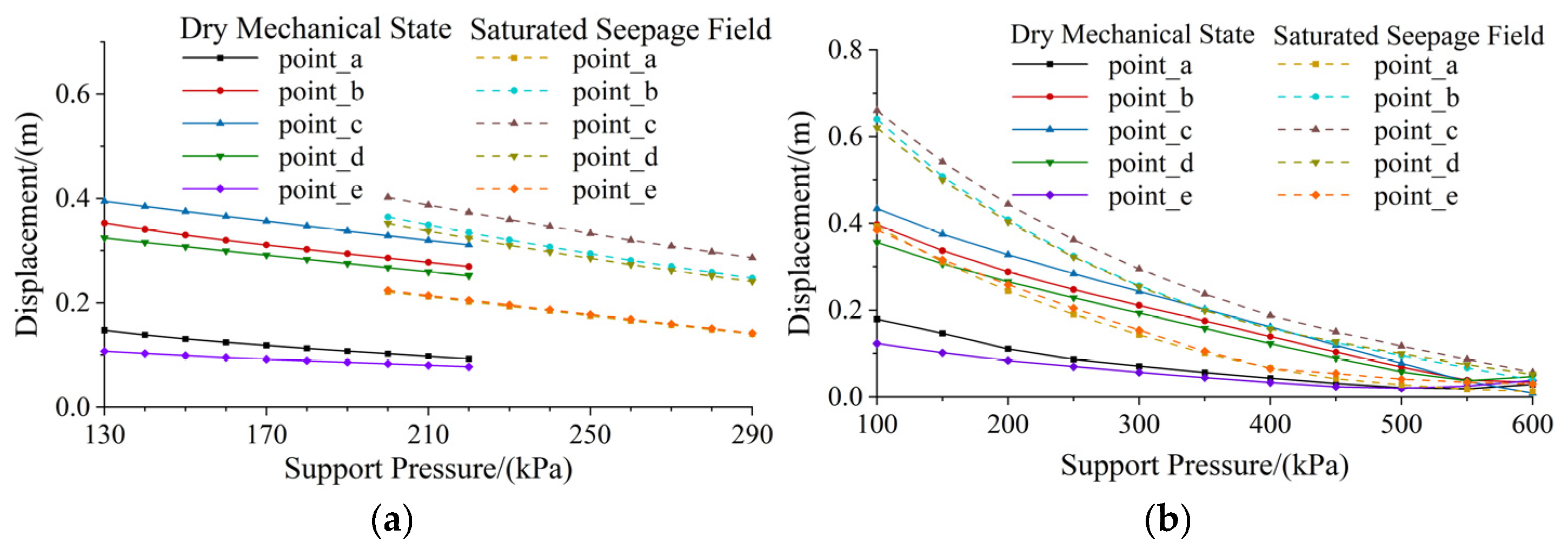
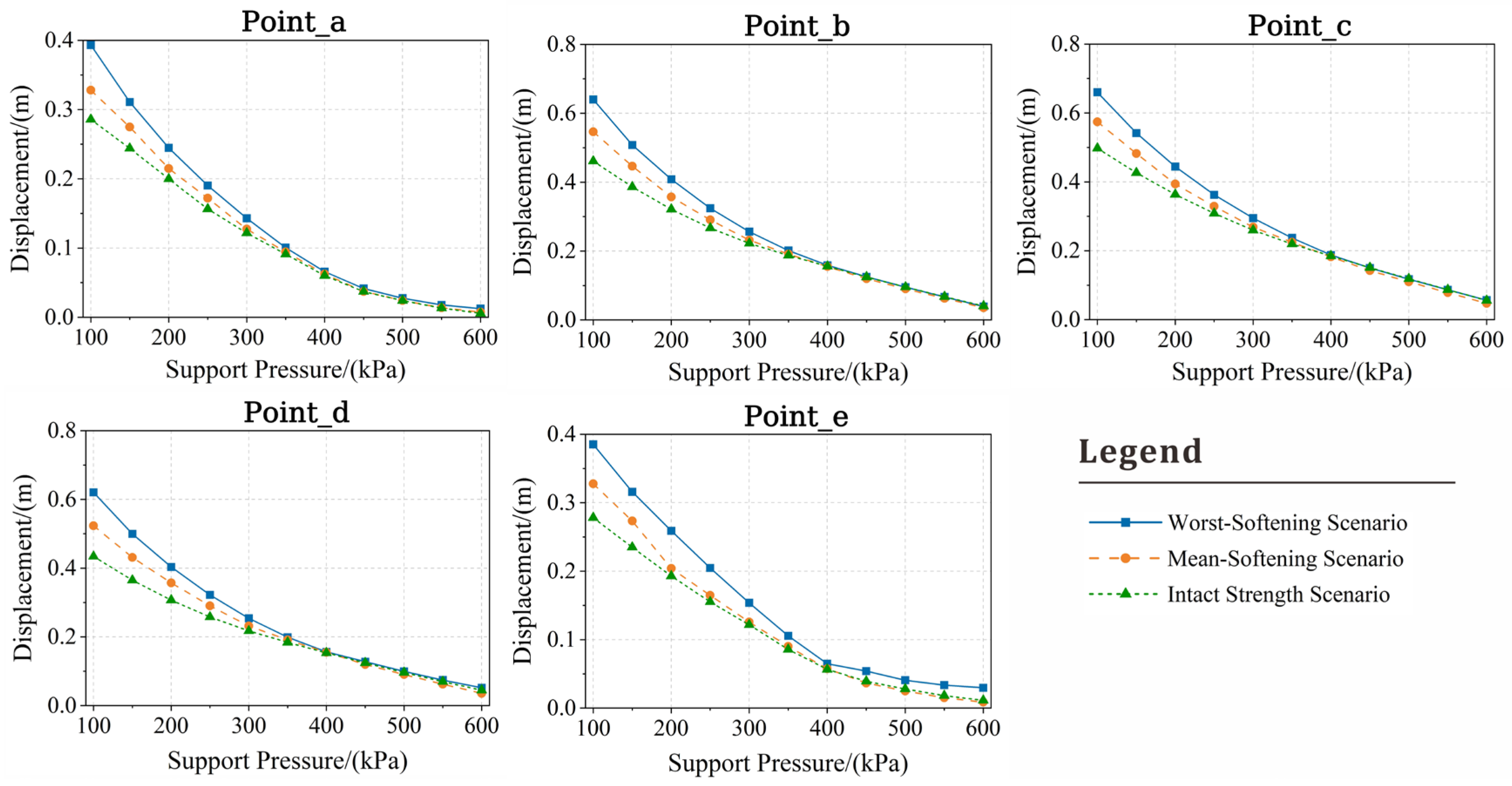
- The impact of soil softening exhibits a strong dependency on the support pressure. During the high support pressure stage, the effects of softening are inhibited by high effective confining pressure. However, the deformation rate in the worst-softening scenario increases by 53.8% compared to the intact strength scenario within the low support pressure stage. This indicates that saturated sand exhibits extremely high sensitivity to the softening effect at low stress levels.
- The water-rich environment alters the spatial distribution of deformation. During the unloading process in saturated state, the displacement growth multiplier at the crown reaches 32.8, far exceeding the 11.8 observed at the center. Driven by the superposition of maximum hydraulic head and gravitational stress, the ultimate displacement at the tunnel invert exceeds that of the crown.
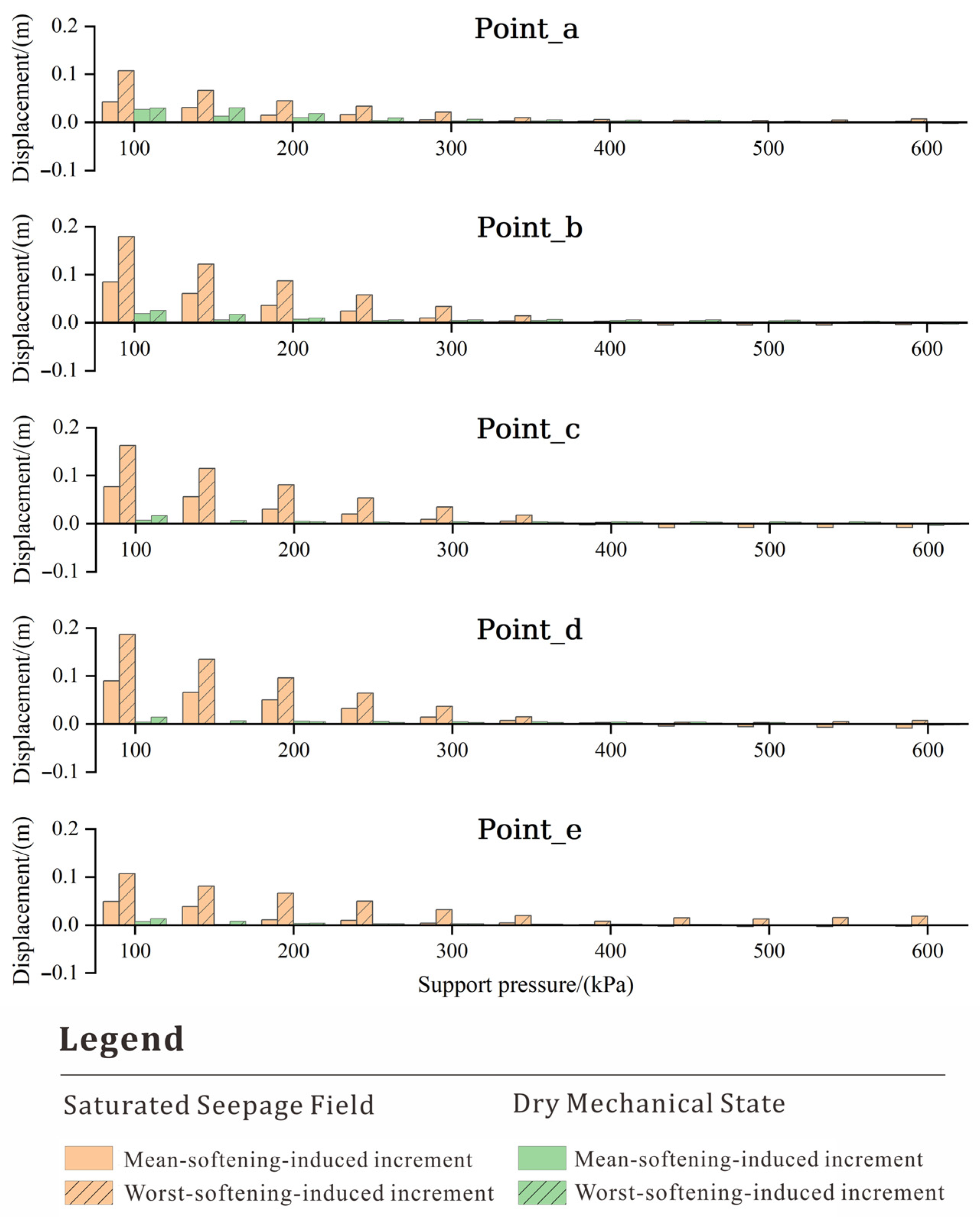
- Fluid–solid coupling induces a non-linear amplification of parameter sensitivity. The fluid–solid coupling environment amplifies the stratum’s sensitivity to shear parameter variations by up to 26 times compared to dry mechanical state. This implies that in water-rich silty sand strata, minor errors in geological parameters can be hydraulically amplified into catastrophic mud inrushes.
Author Contributions
Funding
Data Availability Statement
Conflicts of Interest
References
- Ovenden, M. Underground Cities: Mapping the Tunnels, Transits and Networks Underneath Our Feet; Frances Lincoln: London, UK, 2020. [Google Scholar]
- Yan, J.; Celestino, T.; Thewes, M.; Eberhardt, E. Tunnelling for a Better Life; CRC Press: Boca Raton, FL, USA, 2024. [Google Scholar]
- Luo, W.; Zhu, H.; Yuan, D.; Jin, D.; Shen, X. Scaling and design of slurry fracturing on shield tunnel face using centrifugal modeling. Tunn. Undergr. Space Technol. 2025, 155, 106215. [Google Scholar] [CrossRef]
- Bai, Y.; Wang, X.; Meng, Z.; Hu, Y.; Han, D. Study on Slurry Penetration and Stability of Slurry Shield Tunnel Face Based on Interaction of “Cutter-Soil”. KSCE J. Civ. Eng. 2025, 100439. [Google Scholar] [CrossRef]
- Yue, J.; Liang, Q.; Zhang, T.; Fan, C. Research on mechanical response and time-space distribution of supporting structure of deep-buried tunnel in naturally water-rich loess. Tunn. Undergr. Space Technol. 2024, 147, 105688. [Google Scholar] [CrossRef]
- Zhang, Q.; Zhou, X. Modeling the Dynamics of Water and Mud Inrush in Fault Fracture Zones: The Role of Seepage–Erosion Interactions. Appl. Sci. 2024, 14, 5115. [Google Scholar] [CrossRef]
- Li, S.; Liu, R.; Zhang, Q.; Zhang, X. Protection against water or mud inrush in tunnels by grouting: A review. J. Rock Mech. Geotech. Eng. 2016, 8, 753–766. [Google Scholar] [CrossRef]
- Qarmout, M.; König, D.; Wichtmann, T. A review of seven tunnel face stability models. CivilEng 2022, 3, 116–134. [Google Scholar] [CrossRef]
- Peila, D. A theoretical study of reinforcement influence on the stability of a tunnel face. Geotech. Geol. Eng. 1994, 12, 145–168. [Google Scholar] [CrossRef]
- Zhang, Z.; Shi, X.; Wang, B.; Li, H. Stability of NATM tunnel faces in soft surrounding rocks. Comput. Geotech. 2018, 96, 90–102. [Google Scholar] [CrossRef]
- Chen, R.-p.; Li, J.; Kong, L.-g.; Tang, L.-j. Experimental study on face instability of shield tunnel in sand. Tunn. Undergr. Space Technol. 2013, 33, 12–21. [Google Scholar] [CrossRef]
- Horn, N. Horizontaler erddruck auf senkrechte abschlussflächen von tunnelröhren. Landeskonferenz Der Ung. Tiefbauindustrie 1961, 7–16. [Google Scholar]
- Leca, E.; Dormieux, L. Upper and lower bound solutions for the face stability of shallow circular tunnels in frictional material. Géotechnique 1990, 40, 581–606. [Google Scholar] [CrossRef]
- Mollon, G.; Dias, D.; Soubra, A.H. Rotational failure mechanisms for the face stability analysis of tunnels driven by a pressurized shield. Int. J. Numer. Anal. Methods Geomech. 2011, 35, 1363–1388. [Google Scholar] [CrossRef]
- Hou, C.; Pan, Q.; Xu, T.; Huang, F.; Yang, X. Three-dimensional tunnel face stability considering slurry pressure transfer mechanisms. Tunn. Undergr. Space Technol. 2022, 125, 104524. [Google Scholar] [CrossRef]
- Wu, Y.; Wang, H.; Zhu, G.; Wang, W.; Wang, K.; Zhang, J. Fluid–solid coupling simulation of excavation-induced response in fault-crossing tunnels: A case study from North Sumatera, Indonesia. Phys. Fluids 2025, 37, 086653. [Google Scholar] [CrossRef]
- Zhang, Y.; Cao, Z.; Liu, C.; Huang, H. Fluid-solid coupling numerical simulation of micro-disturbance grouting treatment for excessive deformation of shield tunnel. Undergr. Space 2024, 19, 87–100. [Google Scholar] [CrossRef]
- Tu, S.; Li, W.; Zhang, C.; Wang, L.; Wang, S.; Zhao, Y.; Wu, J. Face stability analysis of tunnels in saturated soil considering soil-fluid coupling effect via material point method. Comput. Geotech. 2023, 161, 105592. [Google Scholar] [CrossRef]
- Li, W.; Zhang, C.; Tan, Z.; Ma, M. Effect of the seepage flow on the face stability of a shield tunnel. Tunn. Undergr. Space Technol. 2021, 112, 103900. [Google Scholar] [CrossRef]
- Yuan, X.; Li, X.; Li, X.; Su, T.; Du, H.; Zhu, D. Multi-Factor Analysis and Graded Remediation Strategy for Goaf Stability in Underground Metal Mines: Fluid–Solid Coupling Simulation and Genetic Algorithm-Based Optimization Approach. Symmetry 2025, 17, 1024. [Google Scholar] [CrossRef]
- Yang, L.; Fan, C.; Wen, H.; Luo, M.; Sun, H.; Jia, C. An improved gas–liquid–solid coupling model with plastic failure for hydraulic flushing in gassy coal seam and application in borehole arrangement. Phys. Fluids 2023, 35, 036603. [Google Scholar] [CrossRef]
- Liu, W.; Ding, L. Global sensitivity analysis of influential parameters for excavation stability of metro tunnel. Autom. Constr. 2020, 113, 103080. [Google Scholar] [CrossRef]
- Fellin, W.; King, J.; Kirsch, A.; Oberguggenberger, M. Uncertainty modelling and sensitivity analysis of tunnel face stability. Struct. Saf. 2010, 32, 402–410. [Google Scholar] [CrossRef]
- Zhao, B.; Wang, X.; Zhang, C.; Li, W.; Abbassi, R.; Chen, K. Structural integrity assessment of shield tunnel crossing of a railway bridge using orthogonal experimental design. Eng. Fail. Anal. 2020, 114, 104594. [Google Scholar] [CrossRef]
- Ma, S.; Zhou, Z.; Duan, Z.; Huang, Z.; He, B.; An, P.; Li, J. Study on the Influence Characteristics of Excavation Face Instability of New Tunnels Orthogonally Crossing Existing Tunnels. Appl. Sci. 2024, 14, 10521. [Google Scholar] [CrossRef]
- Li, T.; Yang, X. Reliability analysis of tunnel face in broken soft rocks using improved response surface method. Int. J. Geomech. 2018, 18, 04018021. [Google Scholar] [CrossRef]
- Miro, S.; Hartmann, D.; Schanz, T. Global sensitivity analysis for subsoil parameter estimation in mechanized tunneling. Comput. Geotech. 2014, 56, 80–88. [Google Scholar] [CrossRef]
- Pandit, B.; Babu, G.S. Global sensitivity analysis for a tunnel-support system in weak rock mass for both—Uncorrelated and correlated input parameters. Rock Mech. Rock Eng. 2022, 55, 2787–2804. [Google Scholar] [CrossRef]
- Tang, Z.C.; Jiao, Y.Y.; Wong, L.N.Y.; Wang, X.C. Choosing appropriate parameters for developing empirical shear strength criterion of rock joint: Review and new insights. Rock Mech. Rock Eng. 2016, 49, 4479–4490. [Google Scholar] [CrossRef]
- Shahani, N.M.; Ullah, B.; Shah, K.S.; Hassan, F.U.; Ali, R.; Elkotb, M.A.; Ghoneim, M.E.; Tag-Eldin, E.M. Predicting angle of internal friction and cohesion of rocks based on machine learning algorithms. Mathematics 2022, 10, 3875. [Google Scholar] [CrossRef]
- Roy, N.; Sarkar, R. A review of seismic damage of mountain tunnels and probable failure mechanisms. Geotech. Geol. Eng. 2017, 35, 1–28. [Google Scholar] [CrossRef]
- Zhang, W.; Tang, X.; Yang, W.; Jiang, J.; Zhang, H.; Li, P. Review of tunnels and tunnelling under unfavourable geological conditions. Geol. J. 2024, 59, 2668–2689. [Google Scholar] [CrossRef]
- Niu, H.; Weng, X.; Hu, J.; Hou, L. Centrifugal test and instability model analysis of excavation surface stability of a shield tunnel in a clay layer. Front. Earth Sci. 2022, 10, 850505. [Google Scholar] [CrossRef]
- Di, Q.; Li, P.; Zhang, M.; Cui, X. Experimental investigation of face instability for tunnels in sandy cobble strata. Undergr. Space 2023, 10, 199–216. [Google Scholar] [CrossRef]
- Erguler, Z.; Ulusay, R. Water-induced variations in mechanical properties of clay-bearing rocks. Int. J. Rock Mech. Min. Sci. 2009, 46, 355–370. [Google Scholar] [CrossRef]
- Vasarhelyi, B.; Ván, P. Influence of water content on the strength of rock. Eng. Geol. 2006, 84, 70–74. [Google Scholar] [CrossRef]
- Zuo, L.; Xu, L.; Baudet, B.A.; Gao, C.; Huang, C. The structure degradation of a silty loess induced by long-term water seepage. Eng. Geol. 2020, 272, 105634. [Google Scholar] [CrossRef]
- Zhao, S.; Shi, Z.; Peng, M.; Bao, Y. Stability analysis of expansive soil slope considering seepage softening and moistening expansion deformation. Water 2020, 12, 1678. [Google Scholar] [CrossRef]
- Anagnostou, G.; Kovári, K. Face stability conditions with earth-pressure-balanced shields. Tunn. Undergr. Space Technol. 1996, 11, 165–173. [Google Scholar] [CrossRef]
- Zou, J.-f.; Qian, Z.-h. Face-stability analysis of tunnels excavated below groundwater considering coupled flow deformation. Int. J. Geomech. 2018, 18, 04018089. [Google Scholar] [CrossRef]
- Li, Y.; Wu, G.; Chen, W.; Yuan, J.; Chen, P.; Huo, M. 3D coupled material point method investigation of water-soil inrush at a tunnel face in saturated stratified ground. Tunn. Undergr. Space Technol. 2026, 169, 107296. [Google Scholar] [CrossRef]
- Höfle, R.; Fillibeck, J.; Vogt, N. Time dependent deformations during tunnelling and stability of tunnel faces in fine-grained soils under groundwater. Acta Geotech. 2008, 3, 309–316. [Google Scholar] [CrossRef]
- Frenelus, W.; Peng, H.; Zhang, J. Long-term degradation, damage and fracture in deep rock tunnels: A review on the effect of excavation methods. Fract. Struct. Integr. 2021, 15, 128–150. [Google Scholar] [CrossRef]
- Li, P.; Zou, H.; Wang, F.; Xiong, H. An analytical mechanism of limit support pressure on cutting face for deep tunnels in the sand. Comput. Geotech. 2020, 119, 103372. [Google Scholar] [CrossRef]
- Mollon, G.; Dias, D.; Soubra, A.-H. Face stability analysis of circular tunnels driven by a pressurized shield. J. Geotech. Geoenvironmental Eng. 2010, 136, 215–229. [Google Scholar] [CrossRef]



| Soil Type | /() | /(−) | /(−) | E/(MPa) | c/(kPa) | /(°) |
|---|---|---|---|---|---|---|
| Silty clay | 20.3 | 0.39 | 0.65 | 2.53 | 22.9 | 10.8 |
| Silt | 20.3 | 0.35 | 0.55 | 4.73 | 15.4 | 27.1 |
| Silty sand | 19.8 | 0.31 | 0.45 | 8.63 | 5.1 | 27.2 |
| Weak mudstone | 20 | 0.3 | 0.42 | 50 | 40 | 35 |
| Grout | 21 | \ | \ | 3000 | 1000 | 36 |
| Various Scenarios | Dry Mechanical State | Saturated Seepage Field | ||||
|---|---|---|---|---|---|---|
| Intact Strength | Mean-Softening | Worst-Softening | Intact Strength | Mean-Softening | Worst-Softening | |
| Limit support pressure/(kPa) | 129 | 135 | 140 | 178 | 202 | 231 |
| Softening Scenario | Soil Type | c/(kPa) | /(°) |
|---|---|---|---|
| Mean-softening scenario | Silty clay | 24.3 | 11 |
| Silt | 16.9 | 27.7 | |
| Silty sand | 6.9 | 29.8 | |
| Weak mudstone | 41.8 | 30.5 | |
| Intact strength scenario | Silty clay | 25.7 | 11.3 |
| Silt | 22.8 | 30.5 | |
| Silty sand | 11.6 | 34 | |
| Weak mudstone | 47.4 | 31.7 |
Disclaimer/Publisher’s Note: The statements, opinions and data contained in all publications are solely those of the individual author(s) and contributor(s) and not of MDPI and/or the editor(s). MDPI and/or the editor(s) disclaim responsibility for any injury to people or property resulting from any ideas, methods, instructions or products referred to in the content. |
© 2026 by the authors. Licensee MDPI, Basel, Switzerland. This article is an open access article distributed under the terms and conditions of the Creative Commons Attribution (CC BY) license.
Share and Cite
Du, Y.; Liang, L.; Fei, K.; Yang, Y.; Cai, H.; Zhang, Z.; Li, Q.; Ma, H. Instability Mechanism of Shield Tunnel Face Induced by Seepage and Soil Softening in Water-Rich Silty Sand: Case Study of Jingu-Haihe Tunnel. Symmetry 2026, 18, 326. https://doi.org/10.3390/sym18020326
Du Y, Liang L, Fei K, Yang Y, Cai H, Zhang Z, Li Q, Ma H. Instability Mechanism of Shield Tunnel Face Induced by Seepage and Soil Softening in Water-Rich Silty Sand: Case Study of Jingu-Haihe Tunnel. Symmetry. 2026; 18(2):326. https://doi.org/10.3390/sym18020326
Chicago/Turabian StyleDu, Yifu, Linde Liang, Kai Fei, Yuyou Yang, Hao Cai, Zhiwei Zhang, Quancai Li, and Haohao Ma. 2026. "Instability Mechanism of Shield Tunnel Face Induced by Seepage and Soil Softening in Water-Rich Silty Sand: Case Study of Jingu-Haihe Tunnel" Symmetry 18, no. 2: 326. https://doi.org/10.3390/sym18020326
APA StyleDu, Y., Liang, L., Fei, K., Yang, Y., Cai, H., Zhang, Z., Li, Q., & Ma, H. (2026). Instability Mechanism of Shield Tunnel Face Induced by Seepage and Soil Softening in Water-Rich Silty Sand: Case Study of Jingu-Haihe Tunnel. Symmetry, 18(2), 326. https://doi.org/10.3390/sym18020326