Article

Symmetric Contour Integration for Pole Analysis of 2D Correlation Functions: Application to Gaussian-Charge Plasma


Laboratory of Statistical Physics, Kochi University of Technology, Tosa-Yamada, Kochi 782-8502, Japan
Symmetry 2026, 18(2), 287; https://doi.org/10.3390/sym18020287
Submission received: 11 January 2026 / Revised: 31 January 2026 / Accepted: 2 February 2026 / Published: 4 February 2026
(This article belongs to the Section Physics)

Abstract

Two-dimensional (2D) correlation functions are central to understanding structural crossovers in soft-core fluids; however, their asymptotic analysis is hindered by the Hankel-transform kernel, whose asymptotic representation introduces a term that breaks the natural conjugate symmetry of the poles. To address this, we present a symmetric contour integration scheme that restores symmetry at the level of the integration path. By employing quarter-circle contours in the first and fourth quadrants, the method captures conjugate pole pairs simultaneously and evaluates the sine term from the Bessel-function asymptotic without variable transformation or real-part extraction, yielding closed-form analytic expressions for the long-range decay of the density–density correlation function. The approach is demonstrated for a 2D Gaussian-charge one-component plasma under the random phase approximation at intermediate coupling, where the pole analysis provides direct access to the oscillation wavelength and decay length. In the high-density regime, the pole equations simplify to a form amenable to a Lambert W-function approximation, revealing a logarithmic scaling of correlation lengths even at moderate coupling. These findings establish symmetric contour integration as a transparent and versatile framework for pole-resolved asymptotics in 2D liquids.

1. Introduction

The structural properties of soft matter systems, such as polymer coils, star polymers, and dendrimers, are often governed by effective interactions that remain finite even at zero separation [1]. Unlike simple atomic liquids characterized by harshly repulsive hard cores, these soft particles can interpenetrate, leading to unique thermodynamic and structural phenomena [1]. A paradigmatic example is the Gaussian core model, which exhibits a “mean-field fluid” behavior at high densities where multi-particle overlaps suppress local correlations [2,3,4,5,6,7,8,9]. Similarly, the ultrasoft restricted primitive model, representing polyelectrolytes through Gaussian charge distributions, provides a stable framework for exploring Coulomb criticality and screening without the necessity of hard cores [10,11,12,13,14,15,16,17,18,19,20,21,22,23,24,25,26,27,28,29,30,31,32]. In these systems, the competition between entropic effects and energetic repulsions determines the crossover from monotonic to damped oscillatory decay of correlations, often referred to as the Kirkwood crossover [29,30,31,32,33,34,35,36,37,38,39].
Important insight into the characteristic length scales of these fluids is obtained through pole analysis of the total correlation function (TCF) h ( r ) [29,30,31,32,33,34,35,36,37,38,39,40,41]. For three-dimensional (3D) systems, the asymptotic decay as r is rigorously determined by the leading poles of the Fourier-transformed TCF h ( k ) in the complex plane [29,30,31,32,33,34,35,36,37,38,39,40]. This framework has been successfully employed to establish Kirkwood-crossover line and to analyze the emergence of ordering [29,30,31,32,33,34,35,36]. Furthermore, in recent years, 3D pole analysis has been central to discussions of anomalous underscreening in concentrated electrolytes and ionic liquids, where charge correlations decay over unexpectedly long distances exceeding the Debye-Hückel length [36,37,38,39]. This illustrates the predictive power of pole analysis for clarifying collective ionic behavior, including the onset of charge density waves and the formation of ordered structures in dense electrolytes [29,30,31,32,33,34,35,36,37,38,39].
Extending this analysis to two-dimensional (2D) systems introduces additional complexity because the Hankel-transform kernel appears with a k factor in its asymptotic form, which breaks the natural conjugate symmetry of poles and complicates direct residue evaluation [41]. To address this, a previous study on 2D fluids with competing length scales developed a specialized strategy to adapt pole analysis for identifying structural crossovers and precursors of quasicrystalline ordering [41]. A key step in this approach was a variable transformation (typically k = s 2 ) that reshaped the Hankel integral into a form resembling the 3D Fourier case, together with adjustments to the Bessel-function asymptotic. While successful in producing asymptotic forms, this procedure has two principal drawbacks: first, after the mapping the conjugate poles are no longer arranged symmetrically within a semicircular contour, so the semicircle becomes a formal device rather than a contour that reflects the analytic structure; second, the sum of residues of a conjugate pair does not directly yield the desired correlation function, and an explicit real-part extraction is still required [41]. These features make the derivation of closed-form expressions less straightforward.
In this paper, we propose an alternative route that elevates symmetry to an organizing principle. By employing symmetric quarter-circle contours in the first and fourth quadrants of the complex k-plane, our scheme restores conjugate symmetry at the level of the integration path and captures conjugate pole pairs simultaneously, eliminating the need for variable transformation or real-part extraction. This construction yields closed-form analytic expressions for the long-range decay of h ( r ) and allows the oscillation wavelength and decay length to be read off directly from pole locations and residues. Furthermore, in the high-density regime of a 2D Gaussian-charge plasma, the pole equations simplify to a form amenable to a Lambert W-function approximation, providing a compact description of correlation-length scaling.
The remainder of this paper is organized as follows. Section 2 presents the symmetric contour integration scheme, starting from the Hankel-transform representation and its asymptotic form and then introducing the symmetric quarter-circle contours used for pole evaluation. Section 3 applies the scheme to a 2D Gaussian-charge one-component plasma (OCP) within the random phase approximation (RPA): after describing the model and numerical setup, the accuracy of the RPA is assessed by comparison with numerical results in the hypernetted-chain (HNC) approximation [42], and the subsequent pole analysis is carried out to obtain the asymptotic form of h ( r ) . We then develop a high-density asymptotic analysis, including a Lambert W-function-based approximation [43], and quantify its accuracy. Finally, Section 4 summarizes the main results and outlines broader implications and possible extensions.

2. Method: Symmetric Contour Integration Scheme

2.1. Hankel Transform and Asymptotic Representation

In the analysis of 2D correlation functions, the real-space TCF h ( r ) is related to its Fourier-space counterpart h ( k ) via the zeroth-order Hankel transform:
h ( r ) = 1 2 π 0 d k k J 0 ( k r ) h ( k ) .
The TCF h ( k ) on the right-hand side of Equation (1) is determined by the direct correlation function (DCF) c ( k ) via the Ornstein–Zernike (OZ) equation [42]:
h ( k ) = c ( k ) 1 σ c ( k ) ,
where σ denotes the 2D number density of particles. To evaluate the long-range behavior of h ( r ) , it is convenient to employ the asymptotic expansion of the Bessel function at large distances [44,45]:
J 0 ( k r ) = 2 π k r sin k r + π 4 + O r 3 / 2 .
Substituting the leading-order term of Equation (3) into Equation (1), we have
h ( r ) = 1 2 π 2 π r 0 d k k sin k r + π 4 h ( k ) .
Using the complex exponential representation of the sine function, sin ( x ) = ( e i x e i x ) / 2 i , the integral in Equation (4) is decomposed into
π r 2 h ( r ) = 1 4 π i 0 d k f + ( k ) f ( k ) ,
where the functions f + ( k ) and f ( k ) are defined respectively as
f + ( k ) = e i k r + i π 4 k h ( k ) ,
f ( k ) = e i k r i π 4 k h ( k ) .
This expression (5) provides a convenient starting point for direct pole analysis via contour integration in the complex k-plane.

2.2. Symmetric Quarter-Circle Contours for Pole Evaluation

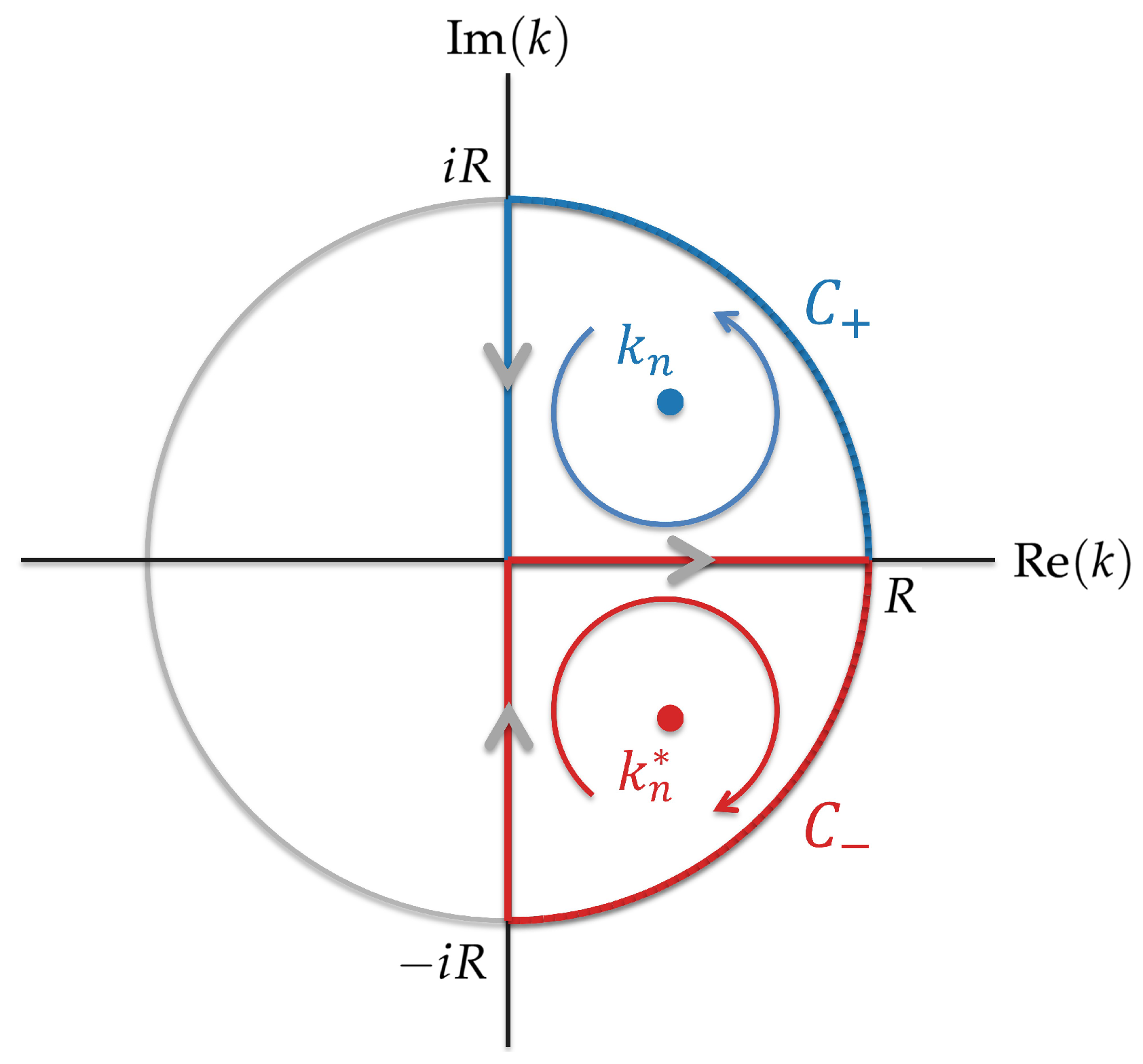
Figure 1 schematically illustrates the symmetric contour configuration adopted in our integration scheme. Each contour, C + in the first quadrant and C in the fourth, consists of a quarter-circle arc of radius R together with segments along the real and imaginary axes. This dual-quadrant arrangement exploits the conjugate symmetry of the exponential kernels e i k r and e i k r , ensuring that conjugate poles are enclosed naturally and that the imaginary-axis contributions cancel exactly between C + and C as proved below. Consequently, the contour integrals reduce to the residue sums of the enclosed poles.
To evaluate the integrals in Equation (5), we adopt this symmetric contour integration in the complex k-plane. As illustrated in Figure 1, we define two quarter-circle contours, C + and C , which effectively enclose the isolated singularities (poles) of the correlation function. By virtue of the Residue Theorem, these contour integrals are analytically replaced by the sum of residues from the enclosed poles. In the limit R , each contour integral decomposes into the target contribution along the real axis and an additional term along the imaginary axis as follows:
C + d k f + ( k ) = 0 d α f + ( α ) + 0 d b f + ( i b ) ,
C d k f ( k ) = 0 d α f ( α ) + 0 d b f ( i b ) .
Note that the left-hand sides of Equations (8) and (9) are evaluated analytically as residue sums, respectively, whereas the first terms on the right-hand sides represent the real-axis integral to be determined. Here, we restrict our analysis to the TCF h ( k ) for which the arc contributions vanish as R .
Along the imaginary axis, the integrands read
f + ( i b ) = e b r + i π 4 b e i π 2 h ( i b ) = i e b r b h ( i b ) ,
f ( i b ) = e b r i π 4 b e i π 2 h ( i b ) = i e b r b h ( i b ) .
Because the TCF satisfies the symmetry h ( i b ) = h ( i b ) on the imaginary axis, Equations (10) and (11) imply the antisymmetric relation:
f + ( i b ) = f ( i b ) .
This symmetry relates the imaginary-axis contributions from the two contours:
0 d b f ( i b ) = 0 d b f ( i b ) = 0 d b f + ( i b ) .
It follows from Equation (13) that the imaginary-axis integrals cancel exactly, yielding
π r 2 h ( r ) = 1 4 π i C + d k f + ( k ) C d k f ( k ) :
the integrals in Equation (5) are replaced by contour integrals over C + and C .
The nth poles of f + ( k ) and f ( k ) located at k n and k n * are determined by the zeros of the denominator in the OZ relation (2):
1 σ c ( k n ) = 1 σ c ( k n * ) = 0 ,
with the pole and its complex conjugate given by
k n = a n + i b n = c n e i θ n ,
k n * = a n i b n = c n e i θ n .
Applying the residue theorem to Equation (14), the real-space TCF becomes a sum over contributions from complex conjugate pole pairs:
π r 2 h ( r ) = 1 2 n e i k n r + i π 4 R n + + e i k n * r i π 4 R n ,
where R n + and R n represent the residues at k n and k n * , respectively:
R n + = k n σ 2 c ( k n ) = A n e i ϕ n ,
R n = k n * σ 2 c ( k n * ) = A n e i ϕ n ,
with c ( k n ) denoting the derivative of the DCF evaluated at the pole. Note that the positive sign preceding e i k n * r i π 4 R n on the right-hand side of Equation (18) reflects the clockwise orientation of the contour C in Equation (14).
Substituting Equations (19) and (20) into Equation (18), the symmetric pole analysis directly yields
π r 2 h ( r ) = n A n e b n r cos a n r + π 4 + ϕ n ,
which, in general, applies to 2D systems. A key advantage of the present symmetric scheme is that the imaginary-axis contributions cancel automatically through Equation (12), eliminating any explicit evaluation of those terms. Moreover, the real-valued result in Equation (21) arises naturally from complex conjugate pole pairing, making ad hoc post-processing unnecessary and, in turn, clarifying the physical interpretation of the decay length and oscillation wavelength.

3. Application to Gaussian OCP

3.1. Model and Approximations

We consider a 2D OCP in which identical particles carry Gaussian-smeared charges and are embedded in a uniform neutralizing background of density z σ , with each particle having valence z [27,28]. The adoption of a Gaussian charge profile is physically motivated by soft-matter systems, where distributed charges provide coarse-grained representations of macromolecular assemblies such as polymer brushes, star polymers, and dendrimers [1,10,11,12,13,14,15,16,17,18,19,20,21,22,23,24,25,26,27,28,29,30,31,32]. This model, hereafter referred to as the Gaussian-charge OCP, essentially defines a system of interpenetrating soft particles; the Gaussian width represents the spatial extent of the charge cloud, and its overlap mimics the effective interactions between macromolecular centers in concentrated solutions.
Let r WS be the Wigner–Seitz radius that sets the characteristic length scale via π r WS 2 σ = 1 [45]. In what follows, lengths are expressed in units of r WS , so that the dimensionless number density becomes
σ ˜ r WS 2 σ = 1 / π .
The single-particle charge distribution is given by
q ( r ) = z e 2 π ξ 2 exp r 2 2 ξ 2 ,
where ξ characterizes the Gaussian width.
The corresponding real-space Coulomb interaction between two such Gaussian charges takes the form
β v ( r ) = Γ ln r + 1 2 E 1 r 2 4 ξ 2 ,
with Fourier transform
β v ( k ) = 2 π Γ e k 2 ξ 2 k 2 .
Here, Γ = z 2 e 2 / ( 2 π ϵ k B T ) denotes the dimensionless Coulomb coupling constant, and E 1 ( t ) = t d x e x / x is the exponential integral. A salient feature of this interaction is its finite value at the origin, β v ( r = 0 ) = 0.5 Γ γ E , where γ E 0.5772 is the Euler-Mascheroni constant [45]. To facilitate comparison with the asymptotic analysis presented later, we focus on the high-density regime investigated in soft-core systems [2,3,4,5,6,7,8,9]. Specifically, we fix the Coulomb coupling at Γ = 10 and vary the density over
1 σ ˜ ξ 2 3 .
Combining Equations (22) and (26), this range translates into bounds on the Gaussian width,
π ξ 3 π .
Note that ξ is measured in units of r WS , implying that at the upper bound the charge cloud extends slightly beyond three times r WS ; particles show significant overlap in their broadened charge clouds.
To validate our contour integration scheme, we assess the RPA against numerical results obtained from the HNC closure [42]. Conceptually, the RPA serves as a linearized mean-field approximation that neglects short-range correlations, while the HNC closure provides a more rigorous, self-consistent description of the liquid structure by accounting for these effects. The distinction between the two treatments lies in the short-range component c S ( r ) of the DCF, introduced via
c ( r ) = β v ( r ) + c S ( r ) .
Within the RPA one sets c S ( r ) 0 , whereas the HNC closure determines c S ( r ) self-consistently through
c S ( r ) = h ( r ) ln { 1 + h ( r ) } .
The coupled OZ equation and HNC closure are solved numerically by an iterative procedure employing Anderson mixing with memory parameter 4 [45,46]. Numerical calculations are carried out on a uniform radial grid with N = 1024 points spanning a maximum radius of 16, corresponding to a spatial resolution of 1 / 64 .
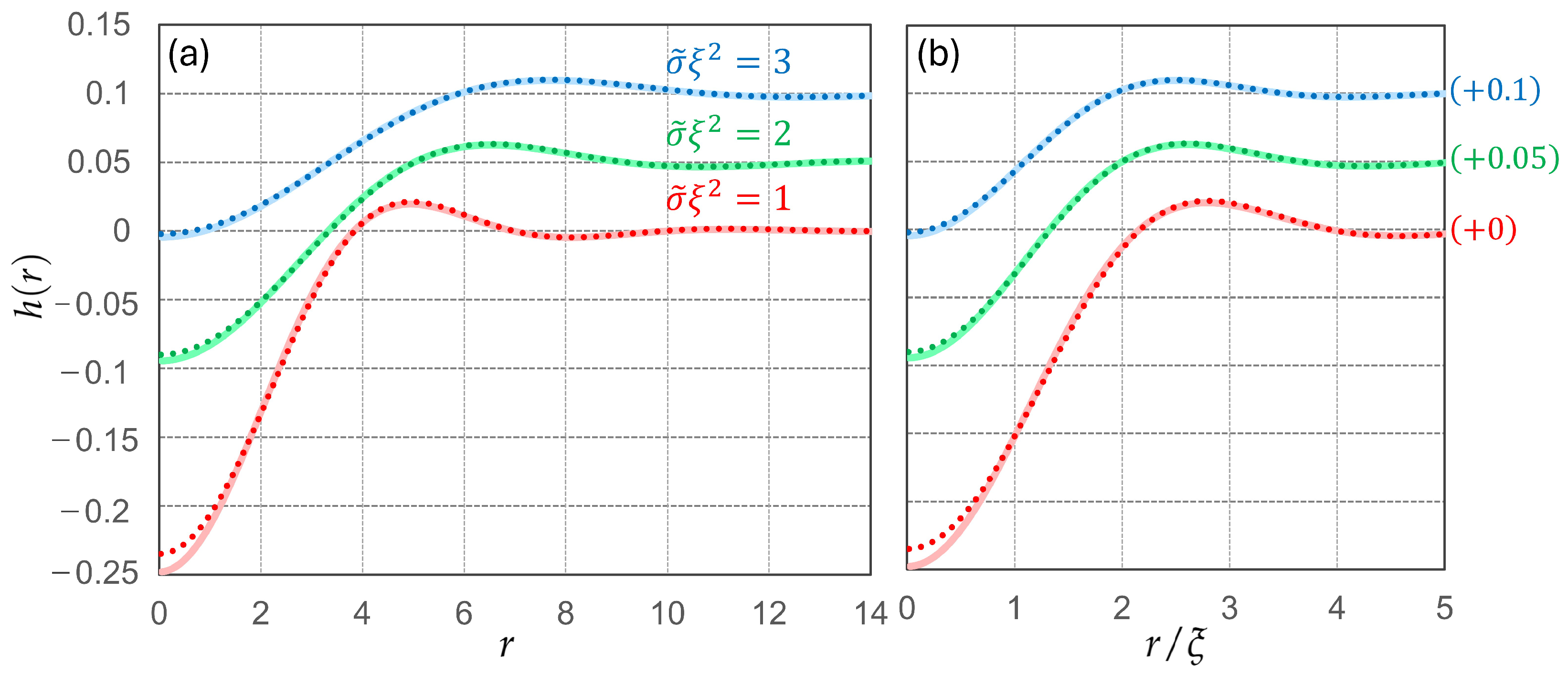
Figure 2 compares the TCF h ( r ) obtained from the RPA with numerical HNC results at three densities to assess the accuracy of RPA under moderately strong coupling ( Γ = 10 ). Although Γ = 10 lies outside the weak-coupling regime, the RPA reproduces the HNC results remarkably well across almost the entire range of r, with only a minor deviation near contact ( r 0 ) at the lowest density σ ˜ ξ 2 = 1 . This agreement confirms the applicability of the RPA under the high-density conditions explored here, consistent with known behavior in Gaussian-core systems where increased density suppresses correlations and drives the system toward mean-field dominance [2,3,4,5,6,7,8,9]. As the density increases from σ ˜ ξ 2 = 1 to 3, two characteristic trends emerge. First, the contact value h ( 0 ) rises toward zero and remains well above the hard-sphere limit h ( 0 ) = 1 , reflecting substantial particle overlap, a hallmark of soft-core systems [1,2,3,4,5,6,7,8,9]. Second, the amplitude of the oscillatory decay diminishes, signaling suppressed density fluctuations and further confirming the approach to a mean-field regime [2,3,4,5,6,7,8,9]. Figure 2a,b reveal complementary aspects of the structural evolution. In Figure 2a, the primary peak position shifts to larger actual separations r as the Gaussian width ξ increases with density. However, when rescaled by ξ in Figure 2b, the peak position in r / ξ systematically shifts to smaller values with increasing σ ˜ ξ 2 . This opposite trend upon normalization reveals an effective compression of the correlation structure on the scale of the particle size, highlighting enhanced overlap and tighter packing at higher densities, consistent with the mean-field tendency discussed above [2,3,4,5,6,7,8,9].
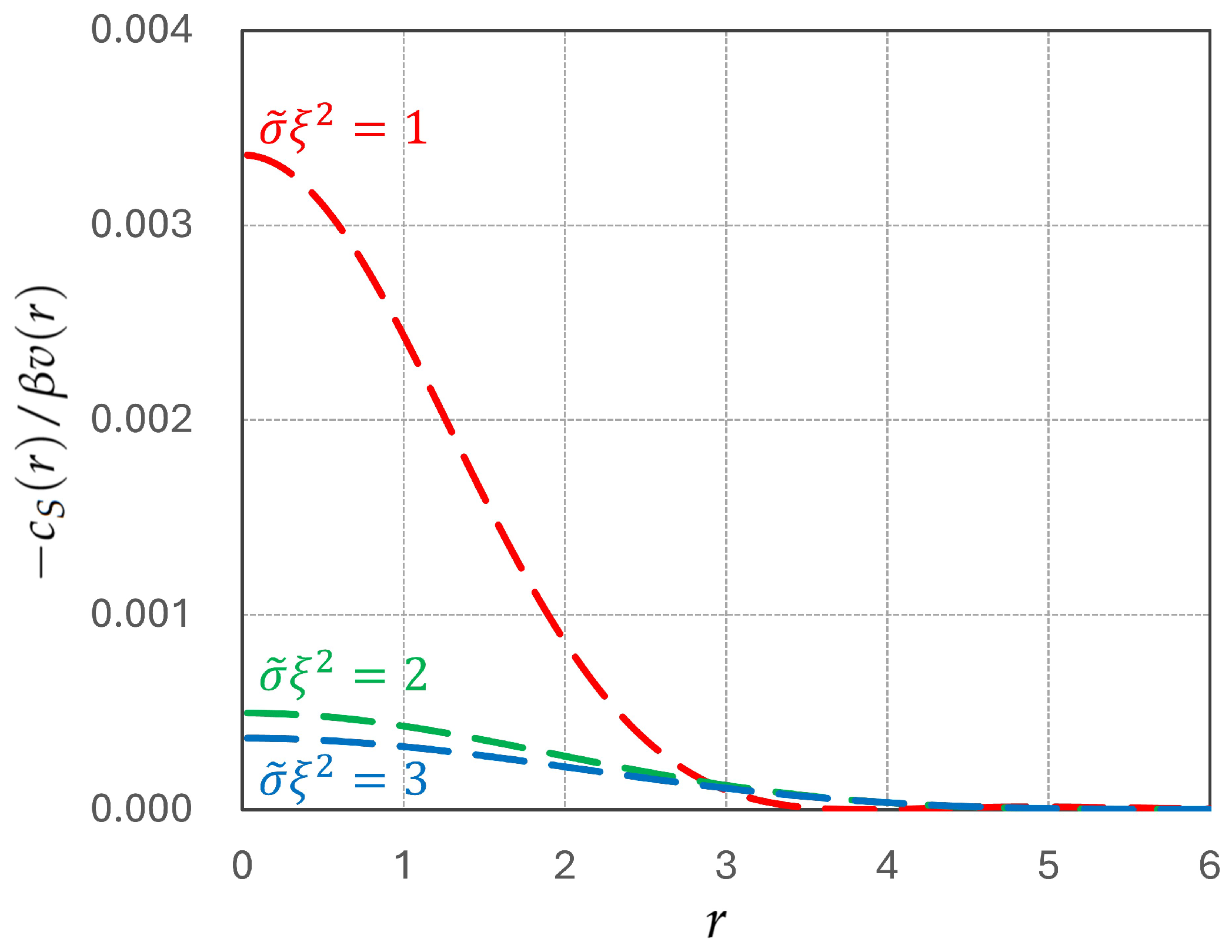
The remarkable accuracy of the RPA in this system can be formally understood by examining the structure of the short-range DCF c S ( r ) . It follows from Equation (29) that c S ( r ) can be expanded as c S ( r ) = h ( r ) ln [ 1 + h ( r ) ] h ( r ) 2 / 2 in the limit where | h ( r ) | 1 . This mathematical relation suggests that c S ( r ) becomes of second order in the TCF, thereby diminishing its influence at large separations. To globally assess the validity of neglecting c S ( r ) , we directly compare its magnitude with the interaction potential β v ( r ) . Figure 3 displays the ratio c S ( r ) / β v ( r ) , demonstrating that this ratio remains exceptionally small, staying below 0.004 (0.4%) across the entire range of r for all densities considered. As seen from Equation (28), the empirical evidence confirms that the contribution of the short-range DCF c S ( r ) is negligible compared to the interaction potential contribution β v ( r ) . Thus, the high precision of the RPA results is not merely a consequence of the mathematical limit | h ( r ) | 1 , but is robustly supported by the dominant role of the Gaussian-charge interaction under the present conditions. Yet, further examination reveals that the contribution of the short-range DCF begins to emerge only at separations r 4 . This region corresponds to the distance where h ( r ) crosses zero (see Figure 2), marking the transition to the main peak of h ( r ) . While the ratio remains small, the increase of c S ( r ) in this regime reflects the onset of the exclusion effect between particles. Quantitatively, the mutual exclusion driven by particle overlap cannot be described solely by the interaction potential β v ( r ) ; a relatively small but finite correction from c S ( r ) is necessary to capture the subtle resistance to overlapping at short distances. This confirms that while the RPA provides an excellent global approximation, the self-consistent treatment of the short-range DCF is essential for a precise description of the structural details near contact.

3.2. Pole Analysis

Within the RPA, the TCF h ( k ) follows directly from the OZ relation (2) combined with the Fourier-transformed interaction potential in Equation (25), giving
h ( k ) = κ 2 σ ˜ G ( k ) ,
G ( k ) = k 2 e k 2 ξ 2 + κ 2 .
Here, G ( k ) is linked to the DCF through G ( k ) = k 2 e k 2 ξ 2 { 1 σ ˜ c ( k ) } . Using the normalization condition in Equation (22), the Debye–Hückel screening parameter (in units of r WS ) is introduced as [45]
κ 2 = 2 π Γ σ ˜ = 2 Γ .
The poles k n and k n * , appearing as complex conjugate pairs, satisfy the general condition given in Equation (15). For the Gaussian-charge OCP under the RPA, this condition can be equivalently expressed in terms of the function G ( k ) defined in Equation (31):
G ( k n ) = G ( k n * ) = 0 ,
where a positive integer n indexes distinct pole pairs. To enable analytical treatment, we substitute the polar forms from Equations (16) and (17) into Equation (33), obtaining
c n 2 e 2 i θ n exp c n 2 ξ 2 e 2 i θ n = κ 2 e i ( 2 n 1 ) π ,
since κ 2 = κ 2 e i ( 2 n 1 ) π . Separating real and imaginary parts yields the coupled conditions
c n 2 e c n 2 ξ 2 cos ( 2 θ n ) = κ 2 ,
2 θ n + c n 2 ξ 2 sin ( 2 θ n ) = ( 2 n 1 ) π .
These equations govern the oscillatory decay and correlation length of h ( r ) through a n = c n cos θ n and b n = c n sin θ n , as will be clarified in the next subsection.
For the Gaussian-charge OCP, the residues in Equations (19) and (20) take the following forms:
R n + = κ 2 k n σ ˜ G ( k n ) = π k n 3 2 ( 1 + k n 2 ξ 2 ) ,
R n = κ 2 k n * σ ˜ G ( k n * ) = π k n * 3 2 ( 1 + k n * 2 ξ 2 ) ,
because of
σ ˜ 2 c ( k n ) = σ ˜ G ( k n ) k 2 e k n 2 ξ 2 = σ ˜ G ( k n ) κ 2
and
G ( k n ) d G ( k ) d k k = k n = 2 k n e k n 2 ξ 2 ( 1 + k n 2 ξ 2 ) = 2 κ 2 k n ( 1 + k n 2 ξ 2 ) ,
at k = k n . Together with the asymptotic representation given by Equations (19)–(21), these results provide a complete analytical description of the long-range correlation structure under the RPA, forming the basis for the asymptotic analysis in the next subsection.
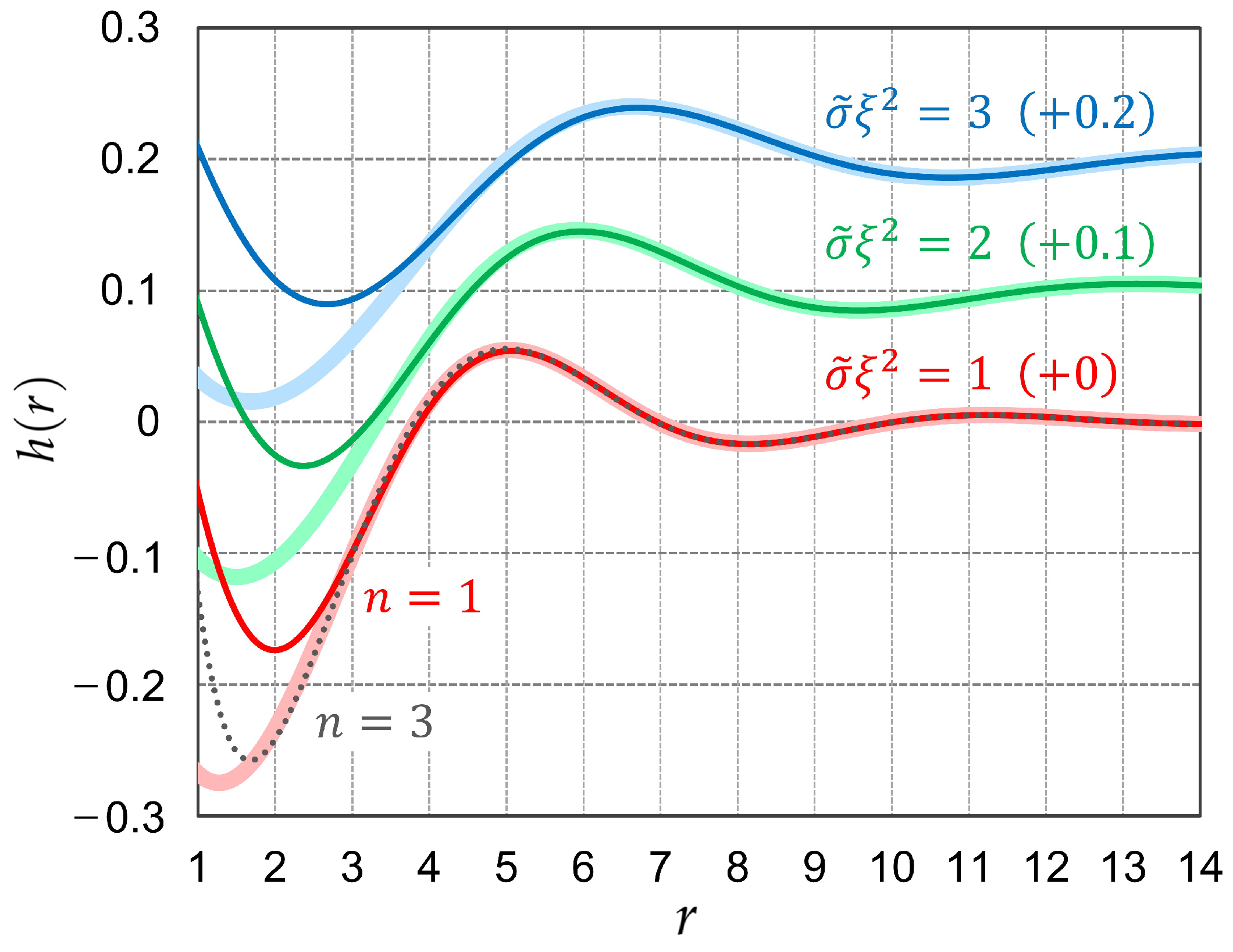
To assess the accuracy of the pole analysis developed in Section 3.2 and the present section, Figure 4 compares the TCF from the numerical RPA with the pole analysis at three densities. The vertical axis is rescaled as 0.5 π r h ( r ) so as to match the expression (21) and thereby highlight the oscillatory decay governed by the pole contributions. For σ ˜ ξ 2 = 1 , the pole analysis based on the first pole alone ( n = 1 ) already reproduces the RPA behavior well for r 3 , i.e., up to slightly before the primary peak located around r 5 . When the second and third poles ( n = 2 and 3) are included, the agreement improves further, most noticeably in the shorter-range region r < 3 . This indicates that the long-range tail is dominated by the first pole, while higher-order poles are needed to capture finer structural features at smaller separations. For σ ˜ ξ 2 = 2 and 3, Figure 4 shows only the n = 1 pole contribution, which nevertheless tracks the oscillatory decaying behavior of the RPA over a broad range. In particular, the first-pole approximation remains accurate for separations exceeding roughly 60 % of the primary peak position. Overall, these comparisons demonstrate that the symmetric contour integration scheme leading to Equation (21) provides an accurate and efficient description of the oscillatory decay of the TCF in the high-density regime considered here.

3.3. Asymptotic Behavior in the High-Density Limit

To capture the asymptotic behavior of the correlation function at high densities, we focus on the dominant poles k 1 and k 1 * and introduce the dimensionless variable
χ c 1 2 ξ 2 ,
where k 1 = c 1 e i ω and ω = 2 θ 1 as defined by Equations (16) and (17). The pole equations, Equations (36) and (37) with n = 1 , then reduce to
χ e χ cos ω = 2 Γ ξ 2 ,
χ sin ω = π ω .
When oscillatory decay prevails, it is natural to impose cos ω 0 , namely a 1 2 b 1 2 0 . Imposing this bound in Equation (43) yields a lower estimate χ min :
χ min e χ min = 2 Γ ξ 2 ,
which, together with Equation (44), implies
sin ω π ω = 1 χ 1 χ min .
Meanwhile, Equation (27) gives the parameter range,
20 π 2 Γ ξ 2 60 π ,
in the high-density regime of Equation (26) at Γ = 10 . Since the principal branch of the Lambert W-function satisfies W 0 ( y ) f ( y ) with f ( y ) = ln ( y ) ln { ln ( y ) } for y 1 [43], Equation (45) is estimated as
χ min = W 0 ( 2 Γ ξ 2 ) L ,
where L = f ( 2 Γ ξ 2 ) . Thus,
2.7 < χ min < 3.6
holds over the range in Equation (47).
The relations (46) and (49) justify the small-angle expansions: sin ω ω ω 3 / 6 and cos ω 1 ω 2 / 2 . Accordingly, Equation (44) gives
ω = ω 0 ( χ ) + χ 6 ( 1 + χ ) ω 0 3 ( χ ) ,
ω 0 ( χ ) = π 1 + χ ,
and Equation (43) becomes
χ e χ = 2 Γ ξ 2 e χ 2 ω 2 ,
which is approximated via the Lambert W-function [43] as
χ = W 0 2 Γ ξ 2 e χ 2 ω 2 L + χ 2 ω 2
to leading order. Combining Equations (50) and (53) provides a self-consistent relation for χ .
Finally, for the asymptotic behavior, we express the real and imaginary parts as
a 1 = c 1 cos ( θ 1 ) χ ξ 1 ω 2 8 ,
b 1 = c 1 sin ( θ 1 ) χ 2 ξ ω 1 ω 2 24 ,
noting that c 1 = χ / ξ and θ 1 = ω / 2 by definition. Equations (50) and (53)–(55) lead to the approximate forms
a 1 L ξ ,
b 1 L 2 ξ ω 0 ( L ) .
Thus, the oscillation wavelength λ and the decay length ξ obey the following asymptotic scalings for L 1 :
λ ξ = 2 π a 1 ξ L 1 2 ,
ξ = 1 b 1 ξ L 1 2 .
These relations show that, when expressed in units of the Gaussian width ξ rather than the Wigner–Seitz radius r WS , the normalized wavelength λ / ξ decreases whereas the normalized decay length / ξ increases as L increases.
Table 1 quantifies the accuracy of the asymptotic formulas by comparing numerical solutions of the first pole equations, Equations (36) and (37), with the approximations provided by Equations (56) and (57) for Γ = 10 over the density range specified in Equation (26). The normalized wavelength λ / ξ and decay length / ξ exhibit excellent agreement between the exact and approximate values, with relative errors consistently below 10% across all five densities. Notably, as the Lambert parameter L increases from 2.72 to 3.58 with rising density, the approximation quality systematically improves: the error in λ / ξ decreases from approximately 10% at σ ˜ ξ 2 = 1.0 to roughly 7% at σ ˜ ξ 2 = 3.0 , while the error in / ξ stabilizes near 4%. This trend confirms that the asymptotic expansion becomes increasingly reliable at higher densities. Thus, this simple analytical framework not only provides closed-form insight but also serves as a reliable tool for interpreting the emergent mean-field behavior of high-density Gaussian-charge systems.

4. Conclusions

We have introduced a symmetric contour integration scheme for the pole analysis of 2D correlation functions, motivated by the limitations of a conventional approach that relies on variable transformations to address the asymptotic form of the Hankel-transform kernel, where the k factor complicates residue evaluation [41]. By employing quarter-circle contours in the first and fourth quadrants, the present method restores conjugate symmetry at the level of the integration path, eliminating the need for variable transformations or real-part extraction that the previous approach requires [41]. This construction not only yields closed-form analytic expressions for the asymptotic decay of h ( r ) but also provides a transparent framework in which pole positions and residues map directly onto physical observables, thereby enhancing interpretability and enabling systematic extensions to more complex 2D systems.
The advantages of this symmetric scheme are twofold. First, mathematical consistency is built in: conjugate poles are captured simultaneously, ensuring that residue contributions combine naturally into a real-valued correlation function without invoking real-part extraction or manual phase adjustments. The paired contours also guarantee automatic cancellation of imaginary-axis contributions, a defining feature of the symmetric construction. Second, physical transparency is enhanced: pole positions and residues map directly onto the oscillation wavelength and decay length, allowing asymptotic behavior to be read off from the analytic residue form and providing a clear route for systematic extensions to more complex 2D systems.
The effectiveness and broader significance of these features are demonstrated through their application to a 2D Gaussian-charge OCP at intermediate coupling ( Γ = 10 ), where the RPA remains accurate in the high-density regime, as confirmed by comparison with numerical results in Figure 2. The pole analysis enabled by the symmetric scheme captures the oscillatory decay with striking efficiency: the leading pole alone accounts for most of the long-range structure, while higher-order poles refine short-range features (Figure 4). Beyond descriptive accuracy, the closed-form pole equations provide a powerful analytical tool for systematic asymptotic analysis. As summarized in Table 1, a Lambert W-function-based approximation [43] reproduces the numerical solutions for normalized wavelength and decay length with relative errors below 10%, and the agreement improves as the system approaches the mean-field-like, high-density regime, thereby underscoring the robustness and scalability of the approach and its potential for broader applications in complex 2D and nonequilibrium systems.
More broadly, these findings establish symmetry in the integration path as a key organizing concept for tackling otherwise challenging 2D problems. By preserving the native k-space structure and exploiting conjugate symmetry from the outset, the present approach provides a transparent and scalable route to pole-resolved asymptotics. This framework not only clarifies the link between analytic structure and physical observables but also opens the way to systematic extensions, including multi-component plasmas, nonequilibrium 2D liquids, active matter, and other soft-matter systems where oscillatory correlations and competing length scales dominate structural behavior [31,32].

Funding

This research received no external funding.

Data Availability Statement

The data presented in this study are available on request from the corresponding author.

Acknowledgments

The author would like to thank the reviewers for their constructive comments, which helped improve the manuscript.

Conflicts of Interest

The author declares no conflict of interest.

Abbreviations

The following abbreviations are used in this manuscript:
TCFtotal correlation function
DCFdirect correlation function
OZOrnstein–Zernike
3Dthree-dimensional
2Dtwo-dimensional
OCPone-component plasma
RPArandom phase approximation
HNChypernetted-chain

References

  1. Likos, C.N. Effective interactions in soft condensed matter physics. Phys. Rep. 2001, 348, 267–439. [Google Scholar] [CrossRef]
  2. Louis, A.A.; Bolhuis, P.G.; Hansen, J.P. Mean-field fluid behavior of the Gaussian core model. Phys. Rev. E 2000, 62, 7961–7972. [Google Scholar] [CrossRef] [PubMed]
  3. Likos, C.N.; Mladek, B.M.; Gottwald, D.; Kahl, G. Why do ultrasoft repulsive particles cluster and crystallize? Analytical results from density-functional theory. J. Chem. Phys. 2007, 126, 224502. [Google Scholar] [CrossRef]
  4. Ikeda, A.; Miyazaki, K. Thermodynamic and structural properties of the high density Gaussian core model. J. Chem. Phys. 2011, 135, 024901. [Google Scholar] [CrossRef] [PubMed]
  5. Ikeda, A.; Miyazaki, K. Glass Transition of the Monodisperse Gaussian Core Model. Phys. Rev. Lett. 2011, 106, 015701. [Google Scholar] [CrossRef]
  6. Ikeda, A.; Miyazaki, K. Slow dynamics of the high density Gaussian core model. J. Chem. Phys. 2011, 135, 054901. [Google Scholar] [CrossRef]
  7. Coslovich, D.; Ikeda, A. Cluster and reentrant anomalies of nearly Gaussian core particles. Soft Matter 2013, 9, 6786. [Google Scholar] [CrossRef]
  8. Archer, A.J.; Rucklidge, A.M.; Knobloch, E. Quasicrystalline Order and a Crystal-Liquid State in a Soft-Core Fluid. Phys. Rev. Lett. 2013, 111, 165501. [Google Scholar] [CrossRef]
  9. Coslovich, D.; Ikeda, A.; Miyazaki, K. Mean-field dynamic criticality and geometric transition in the Gaussian core model. Phys. Rev. E 2016, 93, 042602. [Google Scholar] [CrossRef]
  10. Hakem, F.; Johner, A.; Joanny, J.F. Polymeric Salts: Statica nd Dynamic Debye-Hückel Theory. Macromolecules 1998, 31, 8305–8311. [Google Scholar] [CrossRef]
  11. Chen, Y.G.; Weeks, J.D. Local molecular field theory for effective attractions between like charged objects in systems with strong Coulomb interactions. Proc. Natl. Acad. Sci. USA 2006, 103, 7560–7565. [Google Scholar] [CrossRef]
  12. Coslovich, D.; Hansen, J.P.; Kahl, G. Ultrasoft primitive model of polyionic solutions: Structure, aggregation, and dynamics. J. Chem. Phys. 2011, 134, 244902. [Google Scholar] [CrossRef]
  13. Nikoubashman, A.; Hansen, J.P.; Kahl, G. Mean-field theory of the phase diagram of ultrasoft, oppositely charged polyions in solution. J. Chem. Phys. 2012, 137, 064902. [Google Scholar] [CrossRef] [PubMed]
  14. Warren, P.B.; Vlasov, A.; Anton, L.; Masters, A.J. Screening properties of Gaussian electrolyte models, with application to dissipative particle dynamics. J. Chem. Phys. 2013, 138, 204907. [Google Scholar] [CrossRef]
  15. Warren, P.B.; Masters, A.J. Phase behaviour and the random phase approximation for ultrasoft restricted primitive models. J. Chem. Phys. 2013, 138, 204908. [Google Scholar] [CrossRef] [PubMed]
  16. Warren, P.B.; Vlasov, A. Screening properties of four mesoscale smoothed charge models, with application to dissipative particle dynamics. J. Chem. Phys. 2014, 140, 084901. [Google Scholar] [CrossRef]
  17. Rotenberg, B.; Bernard, O.; Hansen, J.P. Salt-induced effective interactions and phase separation of an ultrasoft model of polyelectrolytes. Mol. Phys. 2014, 112, 1313–1319. [Google Scholar] [CrossRef]
  18. Caillol, J.M.; Levesque, D. Liquid-vapor transition and critical behavior of the ultrasoft restricted primitive model of polyelectrolytes: A Monte Carlo study. J. Chem. Phys. 2014, 140, 144902. [Google Scholar] [CrossRef] [PubMed]
  19. Patsahan, O. Gas-liquid critical point of the ultrasoft restricted primitive model from analytic theory. Condens. Matter Phys. 2015, 18, 24601. [Google Scholar] [CrossRef][Green Version]
  20. Mao, R.; Lee, M.T.; Vishnyakov, A.; Neimark, A.V. Modeling Aggregation of Ionic Surfactants Using a Smeared Charge Approximation in Dissipative Particle Dynamics Simulations. J. Phys. Chem. B 2015, 119, 11673–11683. [Google Scholar] [CrossRef]
  21. Frydel, D. The double-layer structure of overscreened surfaces by smeared-out ions. J. Chem. Phys. 2016, 145, 144703. [Google Scholar] [CrossRef]
  22. Frydel, D. Mean Field Electrostatics Beyond the Point Charge Description. Annu. Rev. Phys. Chem. 2016, 67, 123–145. [Google Scholar] [CrossRef]
  23. Remsing, R.C.; Weeks, J.D. Role of Local Response in Ion Solvation: Born Theory and Beyond. J. Phys. Chem. B 2016, 120, 6238–6249. [Google Scholar] [CrossRef]
  24. Eslami, H.; Khani, M.; Müller-Plathe, F. Gaussian Charge Distributions for Incorporation of Electrostatic Interactions in Dissipative Particle Dynamics: Application to Self-Assembly of Surfactants. J. Chem. Theory Comput. 2019, 15, 4197–4207. [Google Scholar] [CrossRef] [PubMed]
  25. Ye, B.B.; Chen, S.; Wang, Z.G. GCMe: Efficient Implementation of the Gaussian Core Model with Smeared Electrostatic Interactions for Molecular Dynamics Simulations of Soft Matter Systems. J. Chem. Theory Comput. 2024, 20, 6870–6880. [Google Scholar] [CrossRef]
  26. Abraham, G.R.; Li, T.; Nguyen, A.; Jacobs, W.M.; Saleh, O.A. Cooperation and Competition of Base Pairing and Electrostatic Interactions in Mixtures of DNA Nanostars and Polylysine. J. Am. Chem. Soc. 2025, 147, 12345–12356. [Google Scholar] [CrossRef]
  27. Heyes, D.M.; Rickayzen, G. Continuous distributions of charges: Extensions of the one component plasma. J. Chem. Phys. 2014, 140, 114502. [Google Scholar] [CrossRef]
  28. Heyes, D.M.; Rickayzen, G. Clustering of continuous distributions of charge. Mol. Phys. 2014, 112, 1398–1404. [Google Scholar] [CrossRef]
  29. Frusawa, H. Electrostatic contribution to colloidal solvation in terms of the self-energy-modified Boltzmann distribution. Phys. Rev. E 2020, 101, 012121. [Google Scholar] [CrossRef] [PubMed]
  30. Frusawa, H. On the equivalence of self-consistent equations for nonuniform liquids: A unified description of the various modifications. J. Stat. Mech. 2021, 2021, 013213. [Google Scholar] [CrossRef]
  31. Frusawa, H. Stochastic Density Functional Theory on Lane Formation in Electric-Field-Driven Ionic Mixtures: Flow-Kernel-Based Formulation. Entropy 2022, 24, 500. [Google Scholar] [CrossRef]
  32. Frusawa, H. Electric-field-induced oscillations in ionic fluids: A unified formulation of modified Poisson-Nernst-Planck models and its relevance to correlation function analysis. Soft Matter 2022, 18, 4280–4304. [Google Scholar] [CrossRef]
  33. Leote de Carvalho, R.J.F.; Evans, R.; Rosenfeld, Y. Decay of correlations in fluids: The one-component plasma from Debye-Hückel to the asymptotic-high-density limit. Phys. Rev. E 1999, 59, 1435–1451. [Google Scholar] [CrossRef]
  34. Dijkstra, M.; Evans, R. A simulation study of the decay of the pair correlation function in simple fluids. J. Chem. Phys. 2000, 112, 1449–1456. [Google Scholar] [CrossRef]
  35. Hopkins, P.; Archer, A.J.; Evans, R. Asymptotic decay of pair correlations in a Yukawa fluid. Phys. Rev. E 2005, 71, 027401. [Google Scholar] [CrossRef] [PubMed][Green Version]
  36. Cats, P.; Evans, R.; Härtel, A.; van Roij, R. Primitive model electrolytes in the near and far field: Decay lengths from DFT and simulations. J. Chem. Phys. 2021, 154, 144101. [Google Scholar] [CrossRef]
  37. Krucker-Velasquez, E.; Swan, J.W. Underscreening and hidden ion structures in large scale simulations of concentrated electrolytes. J. Chem. Phys. 2021, 155, 174503. [Google Scholar] [CrossRef]
  38. Härtel, A.; Bültmann, M.; Coupette, F. Anomalous Underscreening in the Restricted Primitive Model. Phys. Rev. Lett. 2023, 130, 108202. [Google Scholar] [CrossRef]
  39. Ciach, A.; Patsahan, O. Mesoscopic theory for a double layer capacitance in concentrated ionic systems. Phys. Chem. Chem. Phys. 2025, 27, 9143–9151. [Google Scholar] [CrossRef]
  40. Evans, R.; Leote de Carvalho, R.J.F.; Henderson, J.R.; Hoyle, D.C. Asymptotic decay of correlations in liquids and their mixtures. J. Chem. Phys. 1994, 100, 591–603. [Google Scholar] [CrossRef]
  41. Walters, M.C.; Subramanian, P.; Archer, A.J.; Evans, R. Structural crossover in a model fluid exhibiting two length scales: Repercussions for quasicrystal formation. Phys. Rev. E 2018, 98, 012606. [Google Scholar] [CrossRef]
  42. Hansen, J.P.; McDonald, I.R. Theory of Simple Liquids, 4th ed.; Academic Press: Amsterdam, The Netherlands, 2013. [Google Scholar] [CrossRef]
  43. Corless, R.M.; Gonnet, G.H.; Hare, D.E.G.; Jeffrey, D.J.; Knuth, D.E. On the Lambert W function. Adv. Comput. Math. 1996, 5, 329–359. [Google Scholar] [CrossRef]
  44. Maass, F.; Martin, P.; Olivares, J. Analytic approximation to Bessel function J0(x). Comput. Appl. Math. 2020, 39, 176. [Google Scholar] [CrossRef]
  45. Frusawa, H. Bridging 3D Confinement and 2D Correlations in Counterion Layers at Charged Interfaces: An Extended Percus Relation from First Principles. Symmetry 2025, 17, 1783. [Google Scholar] [CrossRef]
  46. Anderson, D.G. Iterative Procedures for Nonlinear Integral Equations. J. ACM 1965, 12, 547–560. [Google Scholar] [CrossRef]
Figure 1. Schematic representation of the symmetric contour integration scheme in the complex k-plane. The contours C + (blue, first quadrant) and C (red, fourth quadrant) each comprise a quarter-circle arc ( R ) and straight segments along the real and imaginary axes. Conjugate symmetry between C + and C ensures that imaginary-axis contributions cancel exactly as proved by Equations (10)–(13). A pole k n (blue dot) and its conjugate k n * (red dot) are captured by the residue theorem applied to the respective contours.
Symmetry 18 00287 g001
Figure 2. The TCF h ( r ) of the 2D Gaussian-charge OCP at fixed coupling Γ = 10 , shown for three densities: σ ˜ ξ 2 = 1 (red), 2 (green), and 3 (blue). (a) h ( r ) versus particle separation r ( 0 r 14 ). (b) h ( r ) versus normalized separation r / ξ ( 0 r / ξ 5 ). Solid curves denote the RPA, and dotted curves denote numerical HNC solutions. For visual clarity, curves are vertically shifted by adding constants to h ( r ) : red, + 0 ; green, + 0.05 ; blue, + 0.1 .
Symmetry 18 00287 g002
Figure 3. Numerical validation of the RPA accuracy. The ratio c S ( r ) / β v ( r ) plotted against the particle separation r for the Gaussian-charge OCP at the three densities ( σ ˜ ξ 2 = 1 , 2 , 3 ) corresponding to Figure 2. The numerical results demonstrate that the ratio remains exceptionally small, specifically below 0.004 (0.4%), across the entire range of r. This negligible contribution of the short-range DCF c S ( r ) relative to the interaction potential β v ( r ) provides a robust empirical justification for the high accuracy of the RPA under the present conditions.
Symmetry 18 00287 g003
Figure 4. Comparison between the numerical RPA results and the pole analysis for the TCF at three densities σ ˜ ξ 2 = 1 (red), 2 (green), and 3 (blue); the color coding is the same as in Figure 2a. The vertical axis shows the scaled quantity 0.5 π r h ( r ) , plotted against the particle separation r over 1 r 14 . Thick light-colored curves denote the numerical RPA results, whereas dark solid curves show the pole analysis obtained by retaining only the first pole ( n = 1 ) in Equation (21). For σ ˜ ξ 2 = 1 , the dotted curve additionally includes the contribution from the second and third poles ( n = 2 and 3) in Equation (21). For visual clarity, the curves are vertically shifted by adding constants to 0.5 π r h ( r ) : + 0 for σ ˜ ξ 2 = 1 , + 0.1 for 2, and + 0.2 for 3.
Symmetry 18 00287 g004
Table 1. Validation of asymptotic approximations for correlation structure parameters at Γ = 10 . All values are rounded to two decimal places. The normalized wavelength λ / ξ and decay length / ξ are compared between numerical solutions (“Num.”) of the pole equations Equations (36) and (37) at n = 1 and the asymptotic approximations (“Approx.”) given by Equations (56) and (57). Five densities spanning 1.0 σ ˜ ξ 2 3.0 are examined, with the corresponding Lambert W-function parameter L = f ( 2 Γ ξ 2 ) [43] listed for reference. Despite the simplicity of the asymptotic expansion, relative errors remain below 10% across the entire density range, confirming the robustness of the approximation scheme in the high-density regime.
σ ˜ ξ 2 L λ / ξ / ξ
Num.Approx.Num.Approx.
1.02.723.473.811.491.44
1.53.033.323.611.531.47
2.03.263.223.481.561.50
2.53.443.153.391.581.52
3.03.583.093.321.601.54
Disclaimer/Publisher’s Note: The statements, opinions and data contained in all publications are solely those of the individual author(s) and contributor(s) and not of MDPI and/or the editor(s). MDPI and/or the editor(s) disclaim responsibility for any injury to people or property resulting from any ideas, methods, instructions or products referred to in the content.