Article

Principal Component Analysis of Gait Continuous Relative Phase (CRP): Uncovering Lower Limb Coordination Biomarkers for Functional Disability in Older Adults


1
CIR, E2S, Polytechnic of Porto, Rua Dr. António Bernardino de Almeida nº 400, 4200-072 Porto, Portugal
2
E2S, Polytechnic of Porto, Rua Dr. António Bernardino de Almeida nº 400, 4200-072 Porto, Portugal
*
Author to whom correspondence should be addressed.
Symmetry 2026, 18(2), 228; https://doi.org/10.3390/sym18020228
Submission received: 21 November 2025 / Revised: 6 January 2026 / Accepted: 26 January 2026 / Published: 27 January 2026
(This article belongs to the Section Life Sciences)

Abstract

Symmetry in gait coordination reflects the balanced timing and movement between lower limb joints, which are essential for efficient locomotion and functional independence in older adults. Although gait coordination is recognized as a key indicator of aging-related adaptations and functional decline, most studies rely on isolated measures without fully addressing symmetry in intra- and interlimb coordination. This study aimed to identify principal components of gait coordination symmetry and their association with functional disability in older adults. A cross-sectional study assessed 60 community-dwelling older adults (60+), stratified by functional disability (35 non-disabled; 25 disabled). The three-dimensional range of motion of lower limb joints was assessed during the gait cycle using an optoelectronic system. Intra- and intersegmental coordination was assessed by the continuous relative phase (CRP), a nonlinear measure that captures both timing and movement relationships between joint angles. Principal component analysis was applied to CRP means and coefficients-of-variation (CV) to identify key coordination principal components (PC). Of eight PC explaining 78.86% of variance, only the PC1 distinguished disability status (p = 0.007, d = 0.66). This component included sagittal-plane intrasegmental CRP mean and CV for the knee–ankle and hip–ankle. This study is novel in combining CRP-derived measures of intra- and interlimb symmetry with principal component analysis to distinguish functional disability in older adults. The findings indicate that sagittal-plane intrasegmental CRP symmetry may serve a relevant biomarker of gait impairment. By linking kinematic coordination features to functional disability, this approach complements clinical assessments and supports early identification of mobility decline in older adults.

1. Introduction

In the European Union, 49.7% of adults over 65 years reported moderate-to-severe difficulties in at least one personal care or household activity in 2019, underscoring the substantial burden of functional disability [1]. Aging is accompanied by progressive declines in muscle strength and cognitive function, which contribute to a slower, more variable, and less coordinated gait in community-dwelling older adults [2]. Instrumented gait analysis provides a sensitive approach for detecting emerging disability. For instance, reduced gait speed independently predicts subsequent decline in attention or psychomotor speed, whereas gait speed and step-width variability are associated with an increased risk of falls [3,4,5]. Therefore, characterizing gait alterations enables early identification and targeted intervention to reduce the impact of late-life disability [6,7].
Growing attention has been devoted to gait coordination as a qualitative index reflecting the symmetry and harmony of lower-limb movements [2,8,9,10]. Coordination is defined as the ability of the neuromusculoskeletal system to organize its many degrees of freedom into stable and adaptable movement solutions. During gait, this ability manifests as the intra- and intersegmental coordination of the lower limbs, enabling symmetric, step-to-step progression and whole-body stability while adjusting to individual, task, and environmental constraints [8,10]. With advancing age, lower-limb coordination symmetry tends to deteriorate, reflecting a less adaptable motor system that directly affects balance [2,10]. Recent evidence further indicates that age-related changes in gait coordination are especially pronounced during the step-to-step transition, highlighting their relevance for functional mobility decline in older adults [11]. For instance, reduced coordination variability may reflect a more rigid motor system and overly symmetric patterns, while excessive variability reveals an imprecise ability [10]. Studies in healthy older adults have shown that impaired gait coordination, as measured by phase coordination index or other symmetry indices, is significantly associated with poorer mobility and higher risk of functional disability in performance-based tasks (e.g., SPPB, chair rise, gait speed) even after accounting for other gait variables [12,13].
Several analytical methods have been used to quantify the lower-limb coordination during gait. Among the most used is the continuous relative phase (CRP), which characterizes the relationship between two segments or joints across the gait cycle. Conceptually, CRP expresses whether paired segments are moving in-phase (±0°, moving together) or anti-phase (±180°, moving oppositely) and how this relationship evolves. Patterns and variability of CRP across strides are then interpreted as markers of coordination strategy and stability (i.e., the system’s resilience to perturbation), a perspective based on dynamical systems theory and widely applied to locomotion [8,14,15]. Because neuromuscular control depends on both joint position and velocity, CRP is particularly suitable for detecting age-related changes in inter-joint timing [8,15]. Unlike joint coupling angles or muscle synergy analyses, CRP integrates both temporal and spatial characteristics of joint motion within a nonlinear dynamical framework, allowing detection of subtle changes in inter-joint timing, stability, and coordination variability across the gait cycle [16]. This makes CRP particularly sensitive to age-related adaptations in inter-joint control strategies that may not be captured by purely geometric or muscle-level coordination metrics [17].
Gait is inherently multicomponent, and single-metric analyses are susceptible to redundancy and ambiguous interpretation. By extension, treating any single CRP variable as a stand-alone indicator may conceal the main sources of variation. Additionally, analyzing multiple CRP variables risks Type I error. Accordingly, applying principal component analysis (PCA) reduces correlated CRP variables into independent components that explain maximum variance, enabling the identification of key biomarkers [18]. Compared to alternative dimensionality-reduction or classification methods such as cluster analysis or discriminant analysis, PCA offers a robust and interpretable approach for modest sample sizes, reducing redundancy while preserving the physiological meaning of coordination patterns [19,20]. Consequently, the present study aimed to identify independent coordination components that better distinguish coordination alterations in late-life functional disability during gait. Specifically, PCA was applied to inter- and intersegmental CRP metrics for hip–knee, knee–ankle, and hip–ankle pairings in older adults aged 60 years and above with and without functional disability.

2. Materials and Methods

2.1. Study Design and Ethical Approval

This cross-sectional observational study followed the STROBE guidelines [21]. Ethical approval was granted by the Institutional Ethics Committee of E2S|P.PORTO (CE0064C), and the study was prospectively registered on ClinicalTrials.gov (NCT05611723). All participants provided written informed consent following the Declaration of Helsinki.

2.2. Participants

Community-dwelling adults aged 60 years and older were recruited through outreach events and community centers. Inclusion criteria required participants to perform basic functional tasks independently. Exclusion criteria encompassed any condition potentially impairing gait safety or data reliability, including clinically significant cardiorespiratory, musculoskeletal, or neurological disorders; uncorrectable visual impairments; vestibular dysfunction; or diagnosed dementia.

2.3. Clinical and Functional Characterization

A structured questionnaire was used to collect anthropometric, demographic, clinical, cognitive and functional data, including medication intake and history of falls in the preceding 12 months. Cognitive function was assessed using the Mini-Mental State Examination (MMSE), and physical activity levels were evaluated using the short form of the International Physical Activity Questionnaire (IPAQ) [22,23]. Functional independence was examined using the Barthel Index (BI) for Activities of Daily Living [24,25], the Lawton–Brody Instrumental Activities of Daily Living Scale (Lawton IADL) [26,27], and a single-item self-reported health (SRH) question. SRH responses were dichotomized into Good (Good/Very Good) and Poor (Fair/Bad/Very Bad) categories [28]. Physical function was further characterized as the best performance from three trials of handgrip strength and static balance tests. Handgrip strength was measured with a Jamar® Plus+ Digital dynamometer (Performance Health Supply, Cedarburg, WI, USA), following the standardized protocol: seated, shoulder adducted, unsupported elbow at 90°, forearm neutral, and wrist ~30° extension [29]. Static balance was assessed with a one-legged stance test on the preferred leg with eyes open; timing stopped at loss of balance, with a 60 s ceiling.
Participants were classified as having functional disability if meeting ≥2 of the following indicators: poor SRH, handgrip strength < 27 kg (men) or <16 kg (women), one-legged stance test < 10 s, BI < 20 or Lawton IADL < 23. The selection of these indicators and corresponding cut-off values was based on the systematic review by Moreira et al. (2022), which synthesized validated disability measures for community-dwelling older adults and established clinically meaningful thresholds for functional decline [30].

2.4. Gait Data Acquisition

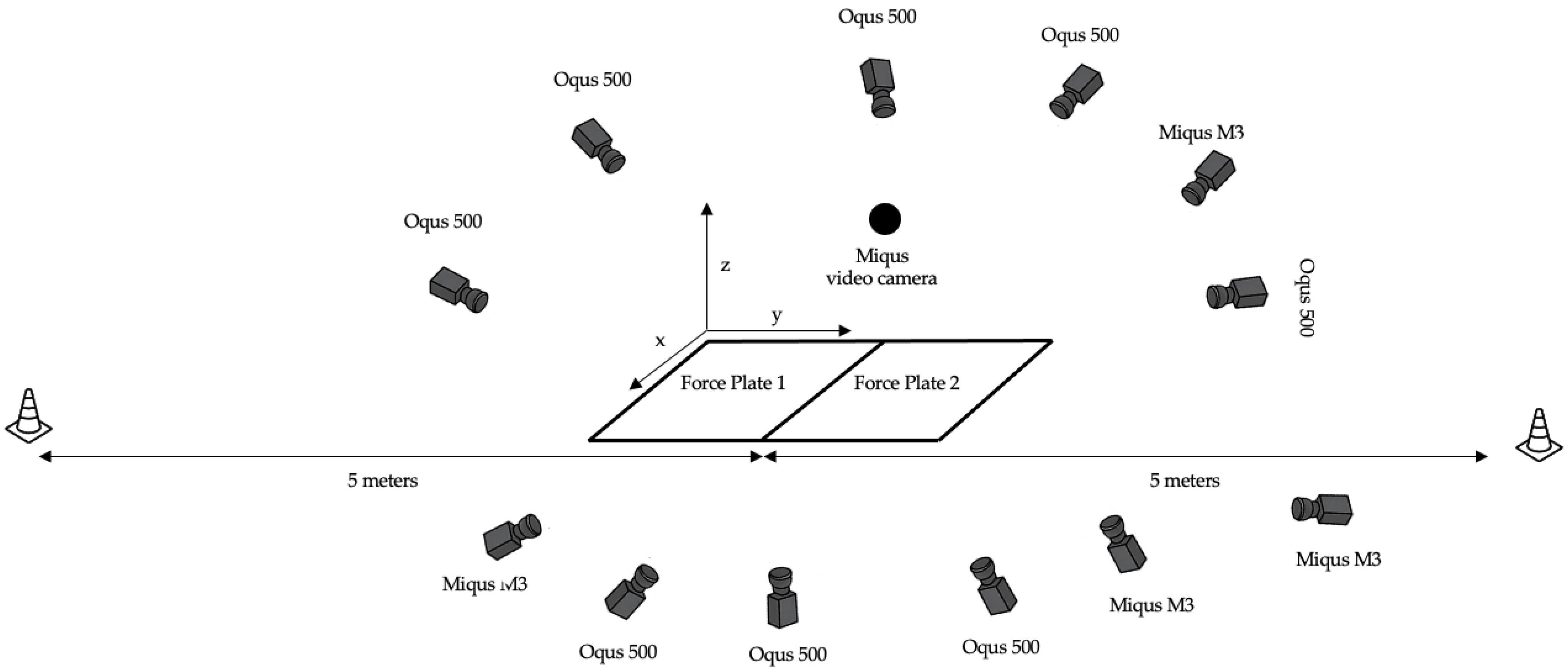
Three-dimensional kinematic and kinetic gait data were collected synchronously using the Qualisys Track Manager® system v 2020.3 (Qualisys AB, Gothenburg, Sweden). The system consisted of twelve optoelectronic cameras (eight Oqus 500 and four Miqus M3), one Miqus video camera (Qualisys AB®, Gothenburg, Sweden), and two embedded force plates (FP4060-08/10, Bertec®, Columbus, OH, USA), all sampled at 100 Hz. Figure 1 illustrates the experimental layout used for gait data collection. A full-body marker set based on the Rizzoli model [31], with additions for the head and upper limbs, was used [32], and the marker position is described in Table 1. The placement of markers followed guidelines for reproducible manual and virtual palpations [33], ensuring consistency across participants.
Prior to each data collection session, the camera system was calibrated within a measurement volume that was sufficiently large to accommodate the gait performance while ensuring a successful calibration. This calibration process considered the following factors: (1) the distance (in mm) between the origin of the coordinate system of the motion capture to the optical center of the camera; (2) the number of points used in the calculation of this distance, which should be maximized while maintaining minimal variation between cameras (≤500 mm); and (3) the average residual (in mm) for the selected points, which should be as small and consistent as possible, ideally ranging between 0.5 and 1.5 mm [34].
A static trial was conducted with the participant in the anatomical position prior to task performance data collection. This trial served as the foundation for constructing the model of body segments, landmarks, and muscles [34].
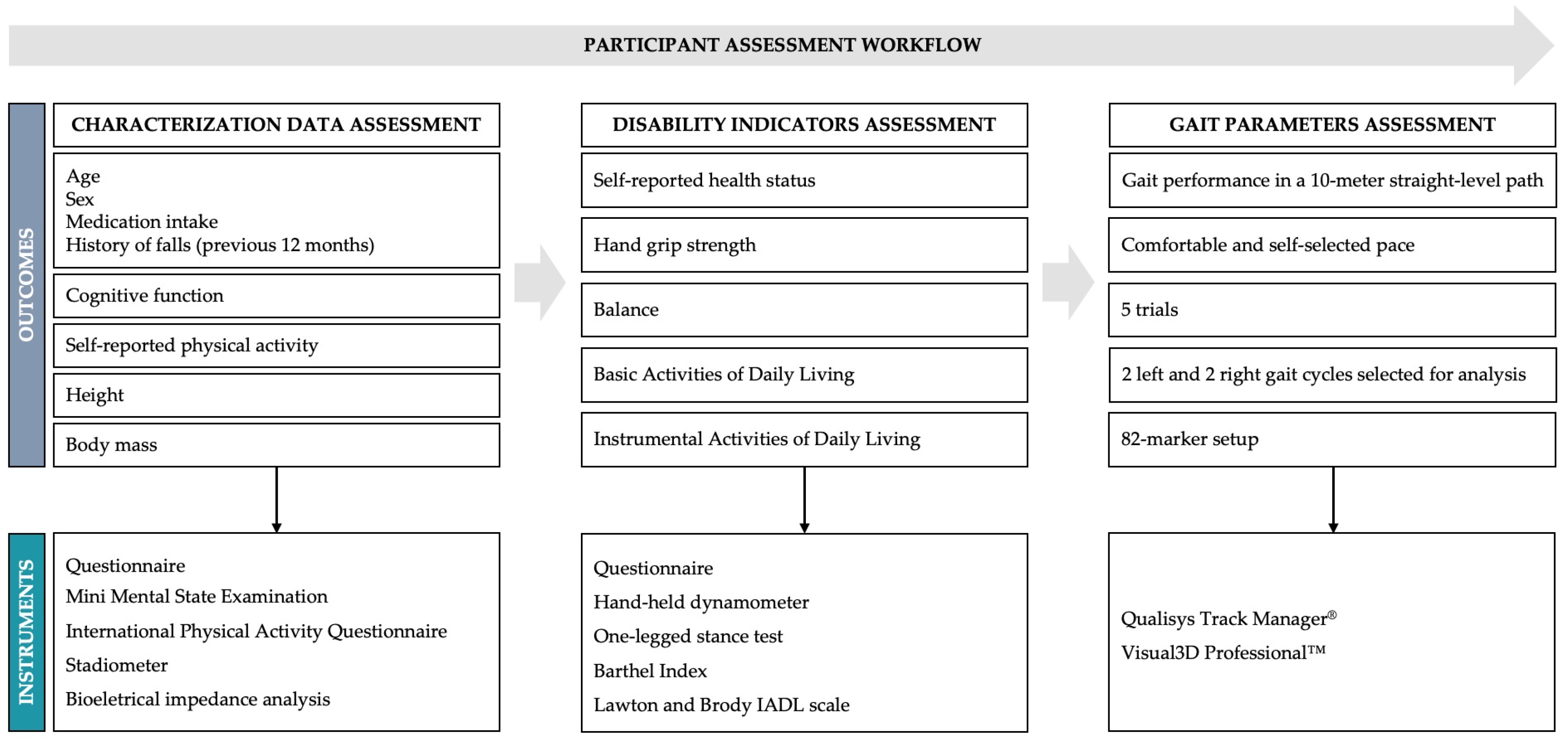
The experimental procedures followed a protocol established in a prior study by Moreira et al. [32]. To ensure a natural gait pattern, participants were allowed sufficient practice walks before data collection. Participants walked a straight, 10 m level walkway at a self-selected pace while wearing usual footwear. After familiarization, five valid trials were collected per participant. A trial was considered valid if the participant made full-foot contact with the force plate without stepping outside its boundaries [35]. Data collection was conducted in the middle section of the walkway, where force plates were installed in series to capture mid-gait cycles, thereby excluding gait initiation and termination phases [36,37]. A workflow from the participant assessment is described in Figure 2.

2.5. Data Processing and Coordination Metrics

Raw data were processed using Qualisys Track Manager® v 2020.3 and Visual3D Professional™ v6x64 (Has-Motion Inc., Kingston, ON, Canada). A fourth-order, zero-lag Butterworth low-pass filter with a 6 Hz cut-off was applied to marker trajectories to minimize soft tissue artifacts. Heel strike and toe-off events were identified using a 20 N vertical ground reaction force threshold. Gait cycles were defined as the interval between successive heel strike events of the same foot. Accordingly, outcomes from two left and two right gait cycles were computed for each trial.
Segmental joint angles (hip, knee, ankle) were calculated using a Cardan X-Y-Z rotation sequence reported in degrees, following data processing protocol of previous work, and time-normalized to 101 data points per gait cycle [32]. Inter- and intrasegmental coordination were quantified using the CRP method for the joint pairings (hip–knee, knee–ankle, and hip–ankle) to capture both intrasegmental (hip–knee) and intersegmental (knee–ankle and hip–ankle) coordination within the same lower limb. Coordination was quantified using CRP in the sagittal, frontal, and transverse planes, focusing on ipsilateral joint interactions rather than bilateral or cross-limb coordination. The mean absolute relative phase and the coefficient of variation (CV) were extracted per pair and plane through the mean of the five trials, according to Castro et al. [38]. The mean CRP represented the participant-specific average coordination pattern, whereas the coefficient of variation (CV) quantified within-subject, cycle-to-cycle variability, allowing both inter-individual differences and intra-individual coordination variability to be captured.

2.6. Statistical Analysis

For sample characterization, continuous variables are reported as mean ± SD and categorical variables as frequencies (percentages). Between-group comparisons were performed using independent-samples t-tests or Mann–Whitney U tests, as appropriate, while categorical variables were compared using Chi-Square tests. Effect sizes were calculated as Cohen’s d for continuous variables and Cohen’s h for dichotomous variables, following established guidelines.
PCA was performed on the correlation matrix of the z-standardized CRP metrics, intrasegmental mean, intrasegmental CV, and intersegmental mean and CV, resulting in three distinct principal component models (PCMs). PCA was selected for its ability to uncover latent associations within multidimensional data derived from advanced motion analysis systems and is well-suited for biomechanical coordination data where inter-variable correlations are expected and meaningful [19]. Prior to PCA, assumptions were verified, including linearity of relationships and absence of multicollinearity among CRP variables, ensuring data suitability for dimensionality reduction. Sampling adequacy was assessed using the Kaiser–Meyer–Olkin (KMO) measure and Bartlett’s test of sphericity. Principal component retention was determined based on eigenvalues higher than 1. Components were orthogonally rotated (Varimax), and variables with absolute loadings equal to or higher than 0.80 were considered salient [39]. This conservative threshold was adopted to ensure that only variables with strong associations contributed to the interpretation of each component, thereby enhancing the clarity and robustness of the findings. A CRP-based gait model was constructed by aggregating variables with high loadings. Component scores were calculated for each participant using the regression method. Group differences in component scores were assessed with t-tests or Mann–Whitney U tests. Potential outliers were analyzed before PCA and none required exclusion. All analyses were conducted using IBM SPSS Statistics (Version 29.0.2.0, IBM Corp., Armonk, NY, USA). Statistical significance was set at α = 0.05 (two-tailed).

3. Results

A total of 60 older adults participated in this study. Demographic and clinical data revealed that disabled participants took a higher number of prescribed medications than non-disabled participants (p = 0.001), and significant differences were observed between groups in gait speed (p < 0.001), both with large effect size. Descriptive statistics summarizing their demographic and clinical characteristics are provided in Table 2.
Tables S1–S3 in the Supplementary Material report the outcomes of preliminary PCMs applied to three-dimensional CRP measures, including intrasegmental mean, intrasegmental CV, and intersegmental mean and CV. The PCMs yielded KMO values ranging from 0.499 to 0.541, indicating marginal adequacy of the sample for dimensionality reduction. Bartlett’s Test of Sphericity was significant in all cases (p < 0.001), further supporting the suitability of the data for factor analysis.
Collectively, the three preliminary PCMs explained between 71.94% and 75.62% of the total variance, with the PCM of intrasegmental mean CRP accounting for the largest proportion. Across these three PCMs, 23 variables exhibited factor loadings greater than the absolute value of 0.80. These high-loading variables were subsequently included in the development of the CRP-based gait model (Table 2), explaining 78.86% of total variance. The suitability of this final model was confirmed by a KMO value of 0.586 and a significant Bartlett’s Test of Sphericity (p < 0.001). The CRP-based gait model divided variables into eight principal components (Table 3).
Although eight PCs were extracted, only PC1 showed significant difference between older adults with and without functional disability (p < 0.05), corresponding to moderate effect size (Table 3). This component, defined by sagittal-plane intrasegmental coordination between the knee–ankle and hip–ankle, emerged as the primary discriminator of functional status in this cohort.
However, given the significant difference in gait speed between groups (ND: 1.39 ± 0.17 m/s vs. D: 1.23 ± 0.18 m/s, p < 0.001), an ANCOVA was performed with gait speed as a covariate. This analysis showed that, after controlling for gait speed, the group effect on PC1 was no longer statistically significant (F = 0.220, p = 0.641, partial η2 = 0.004), indicating that gait velocity accounts for a substantial portion of the observed group differences.
Importantly, PC1 captures coordinated intra- and intersegmental patterns across the lower limb joints. Thus, even though the group effect is attenuated when adjusting for gait speed, the component remains a meaningful representation of biomechanical coordination strategies during gait.
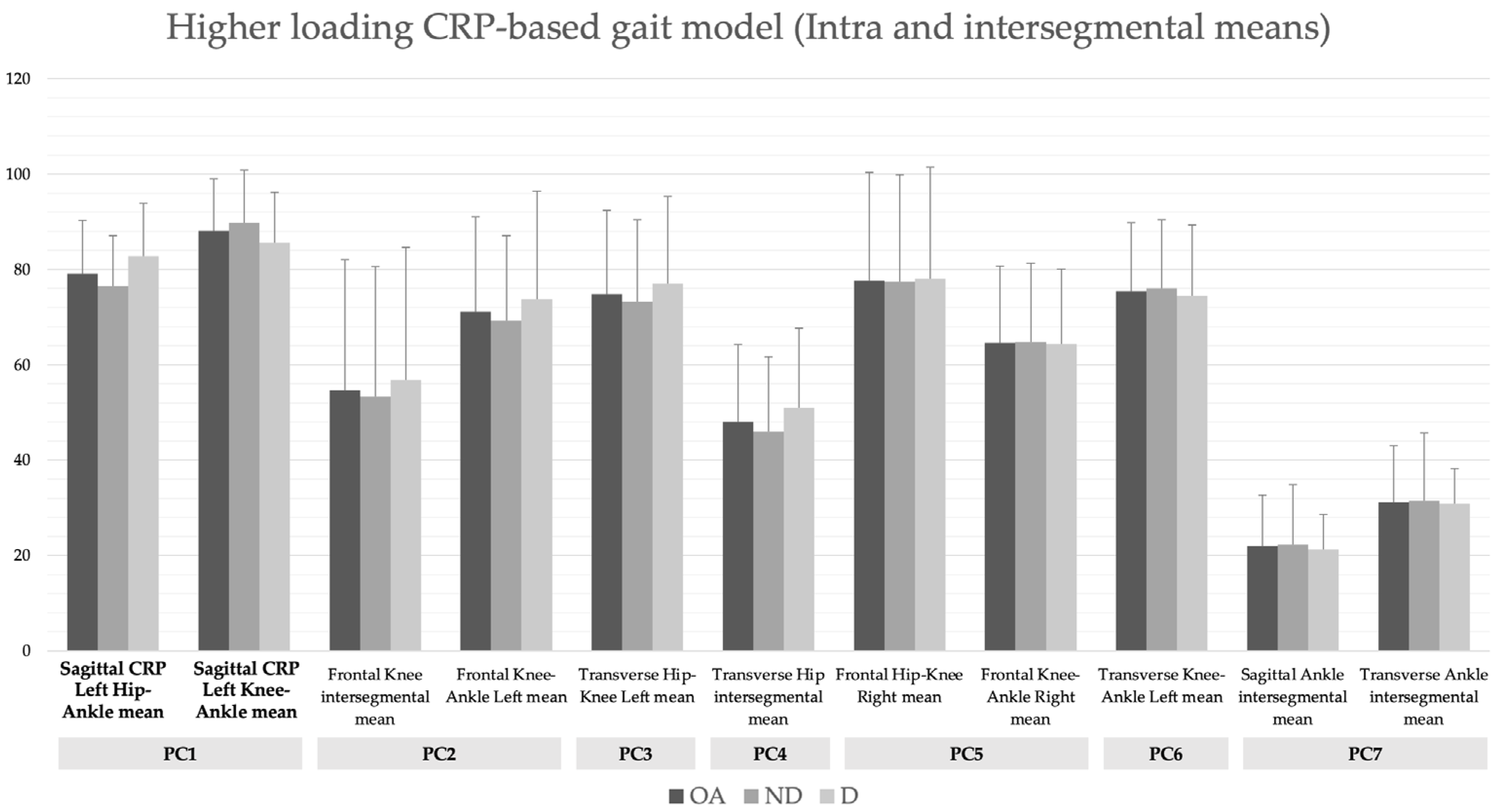
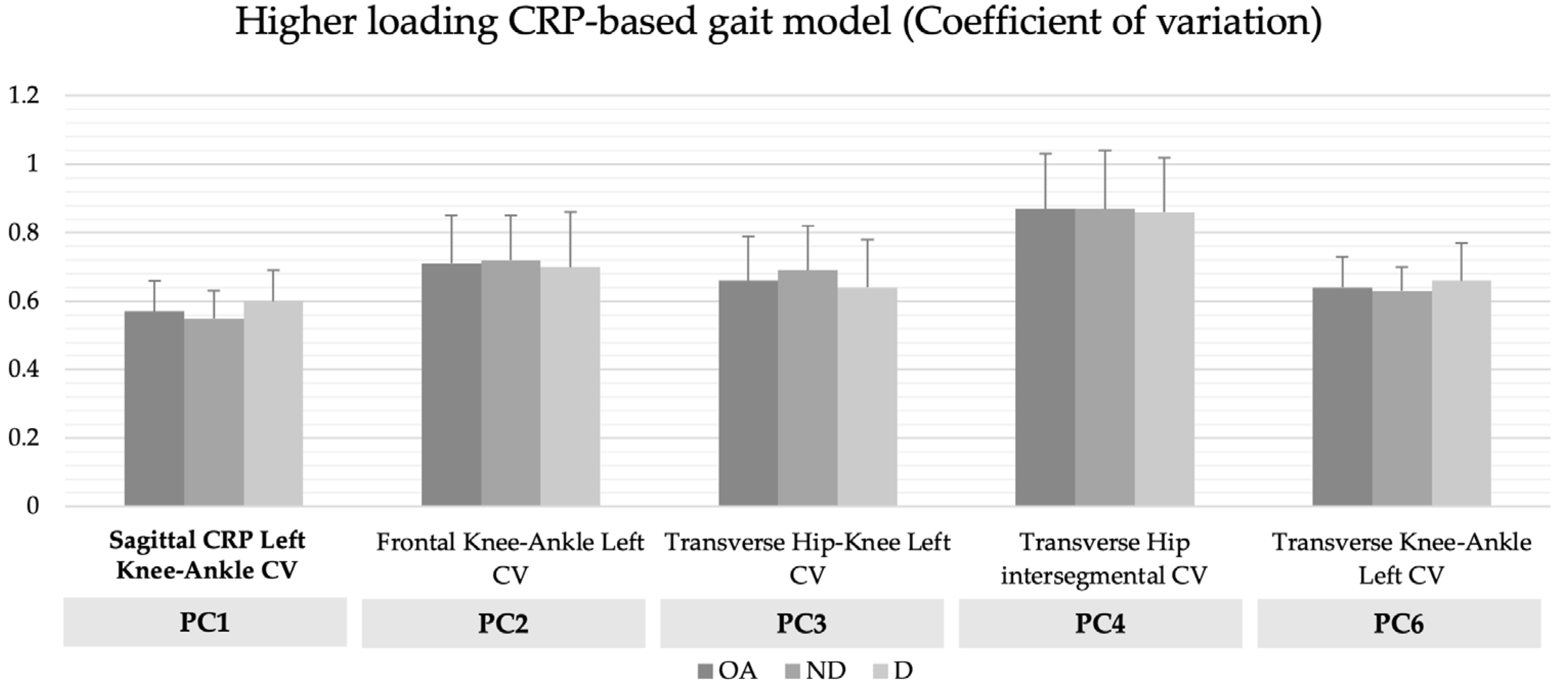
The PC1 parameters, particularly intrasegmental knee–ankle CRP mean and CV, as well as hip–ankle CRP mean, exhibited a predominantly anti-phase pattern across the entire older adult sample (Figure 3 and Figure 4). Older adults with functional disability demonstrated a more pronounced anti-phase relationship between the hip and ankle, alongside a more in-phase knee–ankle coupling, compared with their counterparts without functional disability.
For the remaining 13 CRP parameters within the PCs that did not differ significantly between groups, a more marked anti-phase coordination pattern was observed, with the exception of those in the last component, which comprised sagittal- and transverse-plane intersegmental ankle CRP mean values.

4. Discussion

The present study investigated potential gait biomarkers derived from CRP measures of intra- and intersegmental coordination of the lower limbs during gait to differentiate older adults with and without functional disability. The findings indicate that intrasegmental coordination, particularly reflected by the CRP mean and CV across most components, plays a more dominant role in gait performance among older adults. Notably, sagittal-plane intrasegmental coordination emerged as the most discriminative feature, distinguishing individuals with functional disability from those without. These results highlight the importance of evaluating segmental timing and coupling consistency, as alterations in sagittal-plane control may represent early indicators of functional mobility decline.
The interpretation of the extracted principal components was guided by their biomechanical coherence and established principles of inter-joint coordination during gait, rather than by statistical structure alone. The first principal component, which accounted for the largest proportion of variance, was primarily composed of sagittal plane intrasegmental CRP parameters, particularly those describing knee–ankle and hip–ankle interactions. Notably, it was the only principal component that revealed statistically significant differences between older adults with and without functional disability. These findings align with previous reports linking alterations in knee–ankle (Chiu and Chou [40]) and hip–knee intrasegmental coordination with increased fall risk as well as changes in hip–ankle intrasegmental coordination with the fear of falling [38]. However, CRP measures are influenced by gait speed, which may be reflected in the observed PC1 results [40]. The results of the present study also demonstrate that these coordination components seem to be altered in individuals with functional disability, even without differences in terms of history of falls, potentially reflecting the adoption of conservative gait strategies, characterized by increased segmental decoupling aimed at enhancing stability [10,41]. While PC1 distinguished non-disabled and disabled participants in the primary analysis, ANCOVA controlling for gait speed revealed that a substantial portion of this difference is attributable to walking velocity. Nevertheless, the component captures meaningful intra- and intersegmental coordination patterns, underscoring its potential biomechanical relevance. Future work with larger samples should aim to disentangle the effects of gait speed from functional disability by adopting speed-stratified analyses or mediation approaches. Stratifying participants across clinically relevant walking speed ranges would help determine whether coordination-based principal components consistently discriminate functional status independent of velocity, while mediation models could quantify the extent to which gait speed mediates the relationship between coordination patterns and functional disability, thereby providing deeper insight into the interaction between gait coordination, walking speed, and mobility decline. The observed alterations in knee–ankle and hip–ankle intrasegmental coordination can be interpreted through contemporary motor control theories. According to the Uncontrolled Manifold hypothesis, the central nervous system stabilizes task-relevant variables while allowing flexibility in others, and the increased segmental decoupling in functionally disabled older adults may reflect a compensatory strategy to preserve stability [42]. Similarly, under the framework of optimal feedback control, these coordination changes may represent adaptive central nervous system responses to sensory or motor limitations, optimizing functional performance under altered conditions [43]. Moreover, joint-level couplings like knee–ankle and hip–ankle play vital roles in shock absorption, propulsion, and phase timing during gait. Disruptions in these couplings can impair energy transfer efficiency and reduce dynamic stability [44]. Although many recent studies focus on intersegmental coordination or joint moments [45,46], the few that examine joint-specific sagittal kinematics show that older adults exhibit reduced peak knee flexion and hip extension, and diminished plantar flexion during push-off—modifications consistent with compromised knee–ankle and hip–ankle coupling [44,47]. These joint-level adaptations may represent compensatory strategies: for example, altering ankle push-off or delaying knee flexion to maintain stability when neuromuscular control or strength declines. In this way, the knee–ankle and hip–ankle intrasegmental CRP parameters may serve as sensitive markers of early functional decline even before overt falls or disability occur.
The second and fifth principal components emphasized frontal-plane coordination, particularly capturing intrasegmental CRP between the knee and ankle. Recent evidence from network-based analyses of joint kinematics supports the notion that age-related coordination declines are largely driven by reduced synchronization at the knee [48]. The knee appears more susceptible to degeneration than the hip or ankle due to its central role in force transmission, coordination, and mechanical loading, while the hip and ankle retain greater functional adaptability and often compensate for knee impairments [48,49,50,51]. The results of the present study highlight the relevance of controlling the relation between knee valgus/varus and ankle pronation/supination dynamics in older adults, but there seems to be no association with functional disability.
The third and fourth principal components retained variables related to transverse-plane intrasegmental CRP between the hip and knee and hip intersegmental CRP, respectively. Although gait analyses in older adults typically emphasize sagittal-plane parameters due to their clinical relevance and ease of measurement [52,53], emerging evidence highlights the importance of transverse-plane coordination. Recent studies examining inter-joint and intersegmental coordination in women with varying levels of hip muscle performance found that individuals with weaker hip strength demonstrated reduced in-phase coordination between the hip and knee during walking in the transverse plane [54]. Although the third principal component did not show statistically significant differences between groups, older adults with functional disabilities exhibited a more anti-phase coordination pattern between the hip and knee. These findings further underscore the importance of analyzing coordination in the transverse plane, particularly given that older adults commonly experience hip abductor weakness, a factor known to distinguish fallers from non-fallers [52,55].
The sixth and seventh principal components comprised transverse-plane CRP knee–ankle and ankle intersegmental coordination. As previously discussed, although less commonly emphasized in gait analyses, coordination in the transverse plane is crucial for controlling rotational stability during walking. Age-related neuromuscular decline, particularly in muscles responsible for transverse-plane control, such as the hip external rotators and stabilizers, can impair distal segment coordination [56,57]. The results of the present study demonstrate no association between changes in these components and functional disability.
The principal novelty of this work is the combined use of CRP-derived measures that capture both timing and angular displacement relationships and a multivariate PCA framework that simultaneously considers intra- and interlimb CRP means and variability. While prior studies have described age-related changes in isolated kinematic or spatiotemporal variables, and some have applied CRP to specific joint pairs [10,40], few investigations have integrated CRP means and variability across multiple joint–joint relations and reduced this multivariate information into coordination components that directly relate to functional status. By demonstrating that a single coordination component (PC1), dominated by sagittal-plane knee–ankle and hip–ankle intrasegmental symmetry, discriminates disability status, this study advances the conceptualization of gait symmetry from isolated metrics toward holistic coordination biomarkers. The predominance of knee–ankle and hip–ankle intrasegmental CRP in PC1 suggests that sagittal-plane coordination at the distal joints is particularly sensitive to functional decline. Altered knee–ankle phase relationships may reflect the impaired timing of dorsiflexion–plantar flexion and diminished ankle push-off, while changes in hip–ankle coordination can indicate compensatory proximal strategies to maintain forward progression when distal control is reduced. The increased CV of CRP further implies greater cycle-to-cycle inconsistency in coordination, consistent with reduced neuromotor control or sensorimotor noise. Together, these alterations can degrade gait efficiency and stability, increasing the mechanical and metabolic cost of walking and possibly contributing to mobility limitations. Additionally, the link between reduced gait symmetry and fall risk has been demonstrated longitudinally [58]. The findings of this study suggest that a CRP-derived coordination component that discriminates functional disability has potential for early screening and intervention planning. By translating a multivariate coordination biomarker into a clinically interpretable index, this approach may facilitate rehabilitation targeting and the monitoring of mobility decline, as has been done for the risk of falling [38].
Despite the innovative and clinical contributions of this study, being, to our knowledge, the first to apply PCA to analyze CRP variables in older adults with and without functional disability, its findings should be interpreted carefully. Future studies should match the speed between subjects to fully comprehend the discriminative value of PC1 [9,40]. While the sample size is relatively large, it is limited by the application of PCA, producing a KMO value of 0.586, which is indicative of marginal adequacy for dimensionality reduction [39]. This limitation suggests caution when generalizing the present findings, as the extracted components may be sample-specific. Future research should aim to recruit larger and more balanced samples or compare with independent cohorts to improve sampling adequacy and component stability, and apply alternative dimensionality reduction techniques further to confirm our findings. Increasing sample size would enhance the robustness of the extracted principal components and improve generalizability across heterogeneous community-dwelling older adult populations, mitigating well-recognized limitations of multivariate gait biomechanics analyses. In addition, methodological strategies such as split-sample validation, bootstrapping, or cross-validation could be employed to test the robustness of PCA solutions and strengthen confidence in the reproducibility of intrasegmental CRP components as biomarkers of functional disability. Additionally, future studies should explore direct associations between PCA-derived coordination features and established clinical measures of mobility and function to further validate the clinical relevance of CRP-based coordination metrics. Polypharmacy in the disabled group may confound gait findings, as a significant difference was observed in the number of prescribed medications between groups. Older adults with functional disability exhibited a mean number of prescribed medications approaching the threshold for polypharmacy, commonly defined as the concurrent use of five or more medications [59]. Polypharmacy has been consistently linked to adverse health outcomes, including frailty [60]. However, beyond the total number of medications, the appropriateness of prescribing, encompassing both potentially inappropriate medications and potential prescribing omissions, appears to have a stronger association with functional disability in older adults at risk of further decline [61]. Additionally, given the near-polypharmacy observed in the disabled group, future studies should refine covariate selection beyond medication counts to include pharmacological drug classes and validated measures of prescribing quality, such as the Medication Appropriateness Index. Such approaches may better capture clinically meaningful associations with functional disability and reduce residual confounding from medications known to affect neuromuscular control and gait coordination. Therefore, the impact of inappropriate prescribing on functional disability, as well as its potential influence on gait coordination in older adults, warrants further investigation.
Beyond gait speed or medication, future studies should also consider refining sample design to account for additional clinical confounders, such as comorbidity burden and sensory–motor impairments, which may influence neuromuscular control and gait coordination in older adults. Incorporating stratified or covariate-adjusted designs based on these factors would not only strengthen causal interpretation but also enhance the clinical relevance and translational potential of CRP-based coordination biomarkers across diverse healthcare and community settings.
Moreover, integrating coordination measures such as CRP, and more specifically PC1, with other gait-related indicators of functional disability, such as pace, variability, propulsion, and hip and knee joint control [32], may enhance the identification of older adults with or at risk of functional decline, and may improve disability prediction accuracy beyond single measures. As stated previously, these measures could be integrated into routine gait assessments using wearable sensors or motion capture to detect subtle declines in coordination before overt mobility loss occurs, thus supporting early identification of older adults at risk of disability. This integrated approach may inform the development of more effective, targeted intervention programs to preserve mobility and independence in aging populations through the inclusion of coordination exercises [62]. Although CRP–PCA provides detailed and sensitive measures of gait coordination, its current implementation relies on laboratory-based 3D motion capture systems, which may limit routine clinical or community use. Nevertheless, recent advances in wearable Micro–Electro-Mechanical Systems (MEMS), particularly inertial measurement units (IMUs), offer a promising avenue for translating CRP-based coordination biomarkers into applied settings. MEMS sensors enable accurate capture of segmental kinematics relevant to sagittal-plane knee–ankle and hip–ankle CRP measures and may support scalable, non-invasive monitoring of gait coordination in daily life contexts. Future work should include validation studies comparing IMU-derived kinematics with laboratory-based CRP measures, for example, through small-scale pilot investigations, to establish measurement equivalence and support the scalable application of CRP-based coordination biomarkers in real-world monitoring contexts. Beyond increasing feasibility, MEMS-based IMU systems have the potential to accelerate the technical translation of CRP-derived coordination metrics by enabling continuous, context-aware assessment outside laboratory environments. Such approaches may facilitate the multidimensional integration of coordination biomarkers with clinical measures, functional performance, and daily life mobility patterns, thereby supporting early screening, longitudinal monitoring, and personalized intervention strategies in aging populations. To translate these findings into clinical practice, longitudinal validation and targeted intervention research are required. Future longitudinal studies should evaluate the prognostic value and temporal stability of CRP–PCA biomarkers (especially PC1) for predicting mobility decline, falls, and loss of independence. Building on such observational evidence, randomized controlled trials (RCTs) could test targeted interventions—for example, progressive strength and power training of the ankle plantar flexors, knee extensors, and hip extensors, as well as task-specific gait retraining [63] to determine whether modifying intrasegmental coupling improves coordination metrics, gait performance, and functional outcomes. These trials should include clinically meaningful endpoints (e.g., TUG, gait speed, fall incidence), mechanistic outcomes (changes in CRP mean/CV and PC scores), and longer-term follow-up to assess durability. Integration with wearable IMU monitoring would allow ecologically valid assessment of intervention effects in daily life and support personalized, dose–response optimization of training protocols. By translating CRP-based biomarkers into clinical practice, they may serve both as early diagnostic tools and as sensitive outcome measures for evaluating the effectiveness of rehabilitation programs.

5. Conclusions

This study identified intrasegmental gait coordination in the sagittal plane, particularly knee–ankle and hip–ankle couplings, as possible biomarkers distinguishing older adults with functional disability. These findings highlight the potential of sagittal-plane intrasegmental CRP measures as sensitive indicators for the early identification of mobility impairment, supporting their integration into screening and rehabilitation programs. Future research should validate these biomarkers in larger cohorts and explore their application in wearable technologies to enable routine monitoring and personalized interventions in healthcare settings. In addition, combining CRP-based coordination metrics with broader gait indicators such as variability, propulsion, and joint control could enhance their clinical utility and provide a more comprehensive framework for assessing mobility decline.

Supplementary Materials

The following supporting information can be downloaded at https://www.mdpi.com/article/10.3390/sym18020228/s1, Table S1: Principal component of CRP-intrasegmental mean gait model. Loadings above 0.8 are in bold; Table S2: Principal component of CRP-intrasegmental Coeficient of variation (CV) gait model. Loadings above 0.8 are in bold; Table S3: Principal component of CRP-intersegmental mean and Coeficient of variation (CV) gait model. Loadings above 0.8 are in bold.

Author Contributions

Conceptualization, J.M., R.S. and A.S.P.S.; data curation, J.M., L.A.T.A., R.O.-S., M.C. and A.S.P.S.; formal analysis, J.M., L.A.T.A., R.O.-S., R.S. and A.S.P.S.; funding acquisition, J.M., R.S. and A.S.P.S.; investigation, J.M. and A.S.P.S.; methodology, J.M., R.O.-S. and A.S.P.S.; project administration, J.M., R.S. and A.S.P.S.; resources, J.M., R.S. and A.S.P.S.; software, J.M., M.C. and A.S.P.S.; supervision, J.M., R.S. and A.S.P.S.; validation, J.M., M.C. and A.S.P.S.; visualization, J.M., L.A.T.A., R.O.-S. and A.S.P.S.; writing—original draft, J.M., L.A.T.A., R.O.-S. and A.S.P.S.; writing—review and editing, J.M., L.A.T.A., R.O.-S., M.C., R.S. and A.S.P.S. All authors have read and agreed to the published version of the manuscript.

Funding

This research was funded by the Fundação para a Ciência e Tecnologia (FCT), Portuguese Ministry of Education, Science and Innovation, NORTE 2020, and European Social Fund of the European Union, grant number 2020.05356.BD (https://doi.org/10.54499/2020.05356.BD, accessed on 21 November 2025) and through R&D Units funding (UID/5210/2025) (https://doi.org/10.54499/UID/05210/2025, accessed on 21 November 2025).

Institutional Review Board Statement

The study was conducted in accordance with the Declaration of Helsinki and approved by the Institutional Ethics Committee of E2S|P.PORTO (protocol code CE0064C and date of approval 25 May 2022).

Data Availability Statement

The data presented in this study are available on request from the corresponding authors due to privacy.

Acknowledgments

The authors would like to thank all included study participants for their invaluable cooperation and commitment, which made this research possible.

Conflicts of Interest

The authors declare no conflicts of interest. The funders had no role in the design of the study; in the collection, analyses, or interpretation of data; in the writing of the manuscript; or in the decision to publish the results.

Abbreviations

The following abbreviations are used in this manuscript:
BIBarthel Index
BMIBody mass index
CRPContinuous relative phase
CVCoefficient-of-variation
IPAQInternational Physical Activity Questionnaire
KMOKaiser–Meyer–Olkin
Lawton IADLLawton–Brody Instrumental Activities of Daily Living Scale
MMSEMini-Mental State Examination
OAOlder adults
PCPrincipal components
PCAPrincipal component analysis
PCMsPrincipal component models
SRHSelf-reported health

References

  1. Eurostat. Difficulties in Personal Care Activities or Household Activities by Sex, Age and Educational Attainment Level. 2021. Available online: https://ec.europa.eu/eurostat/databrowser/product/page/HLTH_EHIS_TAE (accessed on 30 July 2025).
  2. Hafer, J.F.; Boyer, K.A. Age related differences in segment coordination and its variability during gait. Gait Posture 2018, 62, 92–98. [Google Scholar] [CrossRef]
  3. Adam, C.E.; Fitzpatrick, A.L.; Leary, C.S.; Hajat, A.; Ilango, S.D.; Park, C.; Phelan, E.A.; Semmens, E.O. Change in gait speed and fall risk among community-dwelling older adults with and without mild cognitive impairment: A retrospective cohort analysis. BMC Geriatr. 2023, 23, 328. [Google Scholar] [CrossRef]
  4. Sui, S.X.; Holloway-Kew, K.L.; Hyde, N.K.; Williams, L.J.; Leach, S.; Pasco, J.A. Muscle strength and gait speed rather than lean mass are better indicators for poor cognitive function in older men. Sci. Rep. 2020, 10, 10367. [Google Scholar] [CrossRef]
  5. Kim, U.; Lim, J.; Park, Y.; Bae, Y. Predicting fall risk through step width variability at increased gait speed in community dwelling older adults. Sci. Rep. 2025, 15, 16915. [Google Scholar] [CrossRef] [PubMed]
  6. Herssens, N.; Verbecque, E.; Hallemans, A.; Vereeck, L.; Van Rompaey, V.; Saeys, W. Do spatiotemporal parameters and gait variability differ across the lifespan of healthy adults? A systematic review. Gait Posture 2018, 64, 181–190. [Google Scholar] [CrossRef] [PubMed]
  7. Hyeon, G.; Kim, C.; Shin, S. The reciprocal relationship between gait and handgrip strength across different age groups. Front. Public Health 2025, 13, 1557834. [Google Scholar] [CrossRef] [PubMed]
  8. Chiu, S.L.; Chou, L.S. Effect of walking speed on inter-joint coordination differs between young and elderly adults. J. Biomech. 2012, 45, 275–280. [Google Scholar] [CrossRef]
  9. Dewolf, A.H.; Meurisse, G.M.; Schepens, B.; Willems, P.A. Effect of walking speed on the intersegmental coordination of lower-limb segments in elderly adults. Gait Posture 2019, 70, 156–161. [Google Scholar] [CrossRef]
  10. Ippersiel, P.; Robbins, S.M.; Dixon, P.C. Lower-limb coordination and variability during gait: The effects of age and walking surface. Gait Posture 2021, 85, 251–257. [Google Scholar] [CrossRef]
  11. Alijanpour, E.; Russell, D.M. Age-related changes in gait coordination are focused on the step-to-step transition. J. Biomech. 2025, 189, 112830. [Google Scholar] [CrossRef]
  12. James, E.G.; Leveille, S.G.; You, T.; Hausdorff, J.M.; Travison, T.; Manor, B.; McLean, R.; Bean, J.F. Gait coordination impairment is associated with mobility in older adults. Exp. Gerontol. 2016, 80, 12–16. [Google Scholar] [CrossRef] [PubMed]
  13. Guadagnin, E.C.; Barbieri, F.A.; Simieli, L.; Carpes, F.P. Is muscular and functional performance related to gait symmetry in older adults? A systematic review. Arch. Gerontol. Geriatr. 2019, 84, 103899. [Google Scholar] [CrossRef] [PubMed]
  14. Lukšys, D.; Jatužis, D.; Jonaitis, G.; Griškevičius, J. Application of continuous relative phase analysis for differentiation of gait in neurodegenerative disease. Biomed. Signal Process. Control. 2021, 67, 102558. [Google Scholar] [CrossRef]
  15. Lamb, P.F.; Stockl, M. On the use of continuous relative phase: Review of current approaches and outline for a new standard. Clin. Biomech. 2014, 29, 484–493. [Google Scholar] [CrossRef]
  16. Haddad, J.M.; van Emmerik, R.E.; Wheat, J.S.; Hamill, J.; Snapp-Childs, W. Relative phase coordination analysis in the assessment of dynamic gait symmetry. J. Appl. Biomech. 2010, 26, 109–113. [Google Scholar] [CrossRef]
  17. van Emmerik, R.E.A.; Ducharme, S.W.; Amado, A.C.; Hamill, J. Comparing dynamical systems concepts and techniques for biomechanical analysis. J. Sport Health Sci. 2016, 5, 3–13. [Google Scholar] [CrossRef]
  18. Lord, S.; Galna, B.; Verghese, J.; Coleman, S.; Burn, D.; Rochester, L. Independent domains of gait in older adults and associated motor and nonmotor attributes: Validation of a factor analysis approach. J. Gerontol. Ser. A 2013, 68, 820–827. [Google Scholar] [CrossRef]
  19. Phinyomark, A.; Petri, G.; Ibáñez-Marcelo, E.; Osis, S.; Ferber, R. Analysis of Big Data in Gait Biomechanics: Current Trends and Future Directions. J. Med. Biol. Eng. 2018, 38, 244–260. [Google Scholar] [CrossRef]
  20. Moreira, J.; Silva, B.; Faria, H.; Santos, R.; Sousa, A.S.P. Systematic Review on the Applicability of Principal Component Analysis for the Study of Movement in the Older Adult Population. Sensors 2023, 23, 205. [Google Scholar] [CrossRef]
  21. von Elm, E.; Altman, D.; Egger, M.; Pocock, S.; Gøtzsche, P.; Vandenbroucke, J. The Strengthening the Reporting of Observational Studies in Epidemiology (STROBE) Statement: Guidelines for Reporting Observational Studies. J. Clin. Epidemiol. 2008, 61, 344–349. [Google Scholar] [CrossRef]
  22. Folstein, M.F.; Folstein, S.E.; McHugh, P.R. “Mini-mental state”: A practical method for grading the cognitive state of patients for the clinician. J. Psychiatr. Res. 1975, 12, 189–198. [Google Scholar] [CrossRef] [PubMed]
  23. Craig, C.L.; Marshall, A.L.; Sjöström, M.; Bauman, A.E.; Booth, M.L.; Ainsworth, B.E.; Pratt, M.; Ekelund, U.; Yngve, A.; Sallis, J.F.; et al. International physical activity questionnaire: 12-country reliability and validity. Med. Sci. Sports Exerc. 2003, 35, 1381–1395. [Google Scholar] [CrossRef] [PubMed]
  24. Mahoney, F.; Barthel, D.W. Functional Evaluation: The Barthel Index. Md. State Med. J. 1965, 14, 61–65. [Google Scholar] [PubMed]
  25. Araújo, F.; Ribeiro, J.; Oliveira, A.; Pinto, C. Validação do índice de Barthel numa amostra de idosos não institucionalizados. Rev. Port. Saúde Pública 2007, 25, 59–66. [Google Scholar]
  26. Lawton, M.P.; Brody, E.M. Assessment of older people: Self-maintaining and instrumental activities of daily living. Gerontologist 1969, 9, 179–186. [Google Scholar] [CrossRef]
  27. Araújo, F.; Ribeiro, J.P.; Oliveira, A.; Pinto, C.; Martins, T. Validação da escala de Lawton e Brody numa amostra de idosos não institucionalizados. In Proceedings of the Actas Do 7º Congresso Nacional de Psicologia Da Saúde, Lisbon, Portugal, 31 January–2 February 2008; pp. 217–220. [Google Scholar]
  28. Crimmins, E.M. Trends in the health of the elderly. Annu. Rev. Public Health 2004, 25, 79–98. [Google Scholar] [CrossRef]
  29. Jansen, C.W.S.; Niebuhr, B.R.; Coussirat, D.J.; Hawthorne, D.; Moreno, L.; Phillip, M. Hand Force of Men and Women Over 65 Years of Age as Measured by Maximum Pinch and Grip Force. J. Aging Phys. Act. 2008, 16, 24–41. [Google Scholar] [CrossRef]
  30. Moreira, J.S.; Melo, A.; Santos, R.; Sousa, A.S.P. Indicators and Instruments to Assess Components of Disability in Community-Dwelling Older Adults: A Systematic Review. Sensors 2022, 22, 8270. [Google Scholar] [CrossRef]
  31. Leardini, A.; Biagi, F.; Merlo, A.; Belvedere, C.; Benedetti, M. Multi-segment trunk kinematics during locomotion and elementary exercises. Clin. Biomech. 2011, 26, 562–571. [Google Scholar] [CrossRef]
  32. Moreira, J.; Cunha, B.; Félix, J.; Santos, R.; Sousa, A.S.P. Kinematic and Kinetic Gait Principal Component Domains in Older Adults With and Without Functional Disability: A Cross-Sectional Study. J. Funct. Morphol. Kinesiol. 2025, 10, 140. [Google Scholar] [CrossRef]
  33. van Sint Jan, S. Color Atlas of Skeletal Landmark Definitions—Guidelines for Reproducible Manual and Virtual Palpations, 1st ed.; Churchill Livingstone: London, UK, 2007. [Google Scholar]
  34. Qualisys, A. Qualisys Track Maneger—User Manual; Qualisys AB: Gothenburg, Sweden, 2011. [Google Scholar]
  35. van Kooten, D.; Hettinga, F.; Duffy, K.; Jackson, J.; Taylor, M.J.D. Are there associations with age and sex in walking stability in healthy older adults? Gait Posture 2018, 60, 65–70. [Google Scholar] [CrossRef] [PubMed]
  36. Fuchioka, S.; Iwata, A.; Higuchi, Y.; Miyake, M.; Kanda, S.; Nishiyama, T. The Forward Velocity of the Center of Pressure in the Midfoot is a Major Predictor of Gait Speed in Older Adults. Int. J. Gerontol. 2015, 9, 119–122. [Google Scholar] [CrossRef]
  37. Svoboda, Z.; Bizovska, L.; Janura, M.; Kubonova, E.; Janurova, K.; Vuillerme, N. Variability of spatial temporal gait parameters and center of pressure displacements during gait in elderly fallers and nonfallers: A 6-month prospective study. PLoS ONE 2017, 12, e0171997. [Google Scholar] [CrossRef] [PubMed]
  38. Castro, M.; Moreira, J.; Sousa, A.S.P. Association Between Gait Lower Limb Intra and Interlimb Coordination and Fear of Falling and Falling History in Older Adults. Symmetry 2025, 17, 818. [Google Scholar] [CrossRef]
  39. Hair, J.; Tatham, R.; Anderson, R.; Black, W. Multivariate Data Analysis, 5th ed.; Prentice-Hall: London, UK, 1998. [Google Scholar]
  40. Chiu, S.-L.; Chou, L.-S. Variability in inter-joint coordination during walking of elderly adults and its association with clinical balance measures. Clin. Biomech. 2013, 28, 454–458. [Google Scholar] [CrossRef]
  41. Sadeghi, H.; Shojaedin, S.S.; Abbasi, A.; Alijanpour, E.; Vieira, M.F.; Svoboda, Z.; Nazarpour, K. Lower-Extremity Intra-Joint Coordination and Its Variability between Fallers and Non-Fallers during Gait. Appl. Sci. 2021, 11, 2840. [Google Scholar] [CrossRef]
  42. Latash, M.L.; Levin, M.F.; Scholz, J.P.; Schöner, G. Motor control theories and their applications. Medicina 2010, 46, 382–392. [Google Scholar] [CrossRef]
  43. Todorov, E.; Jordan, M.I. Optimal feedback control as a theory of motor coordination. Nat. Neurosci. 2002, 5, 1226–1235. [Google Scholar] [CrossRef]
  44. Letournel, A.; Marques, M.; Vigário, R.; Quintão, C.; Quaresma, C. Biomechanical Characterisation of Gait in Older Adults: A Cross-Sectional Study Using Inertial Sensor-Based Motion Capture. Bioengineering 2025, 12, 889. [Google Scholar] [CrossRef]
  45. Robbins, S.M.; Teoli, A.; Huk, O.L.; Zukor, D.J.; Antoniou, J. Inter-segment coordination amplitude and variability during gait in patients with knee osteoarthritis and asymptomatic adults. Gait Posture 2024, 107, 324–329. [Google Scholar] [CrossRef]
  46. Ogaya, S.; Iwata, A.; Higuchi, Y.; Fuchioka, S. The association between intersegmental coordination in the lower limb and gait speed in elderly females. Gait Posture 2016, 48, 1–5. [Google Scholar] [CrossRef]
  47. Pol, F.; Baharlouei, H.; Taheri, A.; Menz, H.B.; Forghany, S. Foot and ankle biomechanics during walking in older adults: A systematic review and meta-analysis of observational studies. Gait Posture 2021, 89, 14–24. [Google Scholar] [CrossRef] [PubMed]
  48. De Luca, M.; Minino, R.; Polverino, A.; Gallo, E.; Mandolesi, L.; Sorrentino, P.; Sorrentino, G.; Lopez, E.T. The Effects of Aging and Cognition on Gait Coordination Analyzed Through a Network Analysis Approach. Biomechanics 2025, 5, 43. [Google Scholar] [CrossRef]
  49. Mian, O.S.; Thom, J.M.; Ardigò, L.P.; Narici, M.V.; Minetti, A.E. Metabolic cost, mechanical work, and efficiency during walking in young and older men. Acta Physiol. 2006, 186, 127–139. [Google Scholar] [CrossRef] [PubMed]
  50. Neptune, R.R.; Zajac, F.E.; Kautz, S.A. Muscle force redistributes segmental power for body progression during walking. Gait Posture 2004, 19, 194–205. [Google Scholar] [CrossRef]
  51. Muehleman, C.; Margulis, A.; Bae, W.C.; Masuda, K. Relationship between knee and ankle degeneration in a population of organ donors. BMC Med. 2010, 8, 48. [Google Scholar] [CrossRef]
  52. Gordon, D.; Robertson, E.; Caldwell, G.E.; Hamill, J.; Kamen, G.; Whittlesey, S.N. Research Methods in Biomechanics, 2nd ed.; Human Kinetics: Champaign, IL, USA, 2014. [Google Scholar]
  53. Stenum, J.; Hsu, M.M.; Pantelyat, A.Y.; Roemmich, R.T. Clinical gait analysis using video-based pose estimation: Multiple perspectives, clinical populations, and measuring change. PLoS Digit. Health 2024, 3, e0000467. [Google Scholar] [CrossRef]
  54. Smith, J.A.; Popovich, J.M., Jr.; Kulig, K. The influence of hip strength on lower-limb, pelvis, and trunk kinematics and coordination patterns during walking and hopping in healthy women. J. Orthop. Sports Phys. Ther. 2014, 44, 525–531. [Google Scholar] [CrossRef]
  55. Gafner, S.C.; Bastiaenen, C.H.G.; Ferrari, S.; Gold, G.; Trombetti, A.; Terrier, P.; Hilfiker, R.; Allet, L. The Role of Hip Abductor Strength in Identifying Older Persons at Risk of Falls: A Diagnostic Accuracy Study. Clin. Interv. Aging 2020, 15, 645–654. [Google Scholar] [CrossRef]
  56. Pijnappels, M.; van der Burg, J.C.E.; Reeves, N.D.; van Dieën, J.H. Identification of elderly fallers by muscle strength measures. Eur. J. Appl. Physiol. 2008, 102, 585–592. [Google Scholar] [CrossRef]
  57. Neptune, R.R.; Clark, D.J.; Kautz, S.A. Modular control of human walking: A simulation study. J. Biomech. 2009, 42, 1282–1287. [Google Scholar] [CrossRef]
  58. Gillain, S.; Boutaayamou, M.; Schwartz, C.; Dardenne, N.; Bruyère, O.; Brüls, O.; Croisier, J.L.; Salmon, E.; Reginster, J.Y.; Garraux, G.; et al. Gait symmetry in the dual task condition as a predictor of future falls among independent older adults: A 2-year longitudinal study. Aging Clin. Exp. Res. 2019, 31, 1057–1067. [Google Scholar] [CrossRef]
  59. Khezrian, M.; McNeil, C.J.; Murray, A.D.; Myint, P.K. An overview of prevalence, determinants and health outcomes of polypharmacy. Ther. Adv. Drug Saf. 2020, 11, 2042098620933741. [Google Scholar] [CrossRef]
  60. Veronese, N.; Stubbs, B.; Noale, M.; Solmi, M.; Pilotto, A.; Vaona, A.; Demurtas, J.; Mueller, C.; Huntley, J.; Crepaldi, G.; et al. Polypharmacy Is Associated With Higher Frailty Risk in Older People: An 8-Year Longitudinal Cohort Study. J. Am. Med. Dir. Assoc. 2017, 18, 624–628. [Google Scholar] [CrossRef]
  61. Salm, C.; Sauer, J.; Binder, N.; Pfefferle, A.; Sofroniou, M.; Metzner, G.; Farin-Glattacker, E.; Voigt-Radloff, S.; Maun, A. Over- and under-prescribing, and their association with functional disability in older patients at risk of further decline in Germany—A cross-sectional survey conducted as part of a randomised comparative effectiveness trial. BMC Geriatr. 2022, 22, 564. [Google Scholar] [CrossRef]
  62. Zhao, J.; Han, W.; Tang, H. Lower limbs inter-joint coordination and variability during typical Tai Chi movement in older female adults. Front. Physiol. 2023, 14, 1164923. [Google Scholar] [CrossRef]
  63. Abe, D.; Motoyama, K.; Tashiro, T.; Saito, A.; Horiuchi, M. Effects of exercise habituation and aging on the intersegmental coordination of lower limbs during walking with sinusoidal speed change. J. Physiol. Anthropol. 2022, 41, 24. [Google Scholar] [CrossRef] [PubMed]
Figure 1. Experimental gait analysis layout with Qualisys Track Manager® system and force plates.
Symmetry 18 00228 g001
Figure 2. Workflow from the participant assessment and instruments used.
Symmetry 18 00228 g002
Figure 3. CRP variables included in the CRP-based gait model with loadings higher than 0.8, and identification of respective principal component (PC), for the total older adult sample (OA), the group of older adults with (D) and the group without functional disability (ND) represented by the mean. The variables included in PC1 are represented in bold, indicating significant differences between groups.
Symmetry 18 00228 g003
Figure 4. CRP variables included in the CRP-based gait model with loadings higher than 0.8, and identification of respective principal component (PC), for the total older adult sample (OA), the group of older adults with (D) and the group without functional disability (ND) represented by the coefficient of variation (CV). The variables included in PC1 are represented in bold, indicating significant differences between groups.
Symmetry 18 00228 g004
Table 1. Anterior and posterior list of markers used in assessment protocol.
Anterior View
MarkerDescription
L/RALHLeft/Right anterior head
L/RCAJLeft/Right acromion
SJNDeepest point of incisura jugularis
SXSXiphoid process, the most caudal point of the sternum
L/RA 1, 2, 3Left/Right Cluster arm 1, 2, 3
L/RFA 1, 2, 3Left/Right Cluster forearm
L/RRADLeft/Right Radio-Styloid process
L/RULNLeft/Right Ulna-Styloid process
L/RIASLeft/Right anterior superior iliac spine
L/RFTCMost lateral prominence of the greater trochanter
L/RTH 1, 2, 3, 4Left/Right Cluster thigh 1, 2, 3, 4
L/RFLEMost lateral prominence of the lateral femoral epicondyle
L/RFMEMost medial prominence of the medial femoral epicondyle
L/RFAXProximal tip of the head of the fibula
L/RTTCMost anterior border of the tibial tuberosity
L/RSK 1, 2, 3, 4Left/Right Cluster shank 1, 2, 3, 4
L/RFALLateral prominence of the lateral malleolus
L/RTAMMost medial prominence of the medial malleolus
L/RFM5Dorsal margin of the fifth metatarsal head
L/RFM2Dorsal aspect of the second metatarsal head
L/RFM1Dorsal margin of the first metatarsal head
L/RDRLeft/Right distal radius
L/RDULeft/Right distal ulna
Posterior view
L/RPHLeft/Right posterior head
CV7Spinous process of the seventh cervical vertebrae
TV2Second thoracic vertebrae
TV7Midpoint between the inferior angles of the two scapulae
LV1First lumbar vertebrae
LV3Third lumbar vertebrae
LV5Fifth lumbar vertebrae
L/RIPSLeft/Right posterior superior iliac spine
L/RFCCAspect of the Achilles tendon insertion on the calcaneus
L/RLELBLeft/Right Lateral Epicondyle of Humerous
L/RMELBLeft/Right Medial Epicondyle of Humerous
L/RMHLeft/Right Medial Head of 5th metacarpal
L/RLHLeft/Right Lateral Head of 5th metacarpal
Table 2. Demographic and clinical characterization of the sample. Data represented by the mean ± SD for ordinal variables, and frequencies for nominal variables. The p-value reflects the comparison between older adults without disability (ND) and older adults with disability (D) by 1 Mann–Whitney U test, 2 Chi-square test, and 3 independent samples t-test. Cohen’s d is presented for continuous variables and Cohen’s h for dichotomous variables. (BMI—Body mass index; IPAQ—International Physical Activity Questionnaire; MMSE—Mini-Mental State Examination; OA—Older adults). Statistical significant differences are represented by *.
OA
(n = 60)
ND
(n = 35)
D
(n = 25)
p-Value
(Test Value)
Effect Size
(Cohen’s d/h)
Demographic and clinical data
Age
(years)
67.86 ± 6.4666.34 ± 5.6068.60 ± 6.770.147
(534) 1
−0.37
Sex
(n female, %)
38 (63.3)19 (54.29)19 (76)0.085
(2.961) 2
−0.46
BMI
(kg/m2)
25.39 ± 2.9625.22 ± 3.0826.02 ± 2.660.298
(−1.049) 3
−0.27
History of fall
(n fallers, %)
22 (36.7)11 (31.4)11 (44)0.469
(0.525) 2
−0.26
Medication
(n)
3.05 ± 2.382.20 ± 1.614.24 ± 2.790.001 *
(−3.290) 3
−0.94
MMSE
(score)
28.74 ± 1.3828.94 ± 1.3128.68 ± 1.490.495
(394) 1
0.19
IPAQ
(MET-min/week)
3193.70 ± 2829.863186.46 ± 2964.913519.66 ± 2822.110.509 (393.5) 1−0.11
Gait speed
(m/s)
1.32 ± 0.191.39 ± 0.171.23 ± 0.16<0.001 *3
(3.815)
0.96
Table 3. Principal component of CRP-based gait model. Loadings above 0.8 are in bold, principal component score differences between older adults with and without functional disability were assessed with Mann–Whitney U test, and statistical significant differences represented by *.
Principal Component12345678
Explained Variance (%) 17.66 15.67 10.47 8.47 8.17 7.45 6.41 4.57
Sagittal CRP Left Knee–Ankle CV 0.892 0.079 0.07 0.167 −0.045 −0.03 −0.093 0.184
Sagittal CRP Left Hip–Ankle mean 0.808 0.046 −0.093 −0.082 −0.181 0.16 −0.046 −0.108
Sagittal CRP Left Knee–Ankle mean −0.889 0.003 0.029 −0.013 0.123 −0.116 0.087 −0.109
Sagittal CRP Right Knee–Ankle CV 0.799 0.084 0.116 0.04 0.138 0.032 −0.018 0.068
Sagittal CRP Right Hip–Ankle mean 0.787 −0.048 −0.004 −0.081 0.068 0.004 0.261 −0.159
Frontal CRP Left Knee–Ankle CV 0.055 0.812 0.026 0.036 0.094 0.103 0.107 0.315
Frontal CRP Knee intersegmental mean 0.045 −0.824 0.152 0.016 0.051 0.003 0.203 0.24
Frontal CRP Left Knee–Ankle mean −0.057 −0.855 −0.044 −0.028 −0.099 −0.119 −0.012 −0.204
Frontal CRP Left Hip–Knee mean 0.115 0.79 −0.019 −0.015 0.177 0.022 −0.142 0.06
Frontal CRP Knee intersegmental CV −0.036 0.763 −0.175 −0.01 −0.037 −0.072 −0.233 −0.289
Transverse CRP Left Hip–Knee mean 0.009 −0.119 0.965 0.007 −0.039 −0.023 0.054 0.008
Transverse CRP Left Hip–Knee CV −0.036 0.057 −0.944 −0.004 0.098 0.134 −0.027 −0.058
Transverse CRP Hip intersegmental CV 0.088 −0.018 −0.008 0.928 0.049 0.004 −0.072 0.03
Transverse CRP Hip intersegmental mean 0.041 −0.038 −0.007 −0.923 0.053 0.121 −0.042 0.003
Frontal CRP Right Hip–Knee mean 0.037 0.138 0.003 0.058 0.863 −0.021 0.047 −0.09
Frontal CRP Right Knee–Ankle mean 0.109 −0.146 0.141 0.015 −0.847 0.051 −0.082 0.112
Transverse CRP Right Hip–Ankle mean −0.118 −0.3 −0.096 −0.232 0.448 0.169 −0.425 0.296
Transverse CRP Left Knee–Ankle mean 0.09 0.141 −0.055 −0.028 −0.014 0.897 0.045 −0.191
Transverse CRP Left Knee–Ankle CV −0.148 −0.013 0.105 0.077 0.043 −0.893 −0.044 −0.129
Sagittal CRP Ankle intersegmental mean −0.007 −0.157 0.043 −0.072 0.015 −0.025 0.848 0.024
Transverse CRP Ankle intersegmental mean −0.039 −0.184 0.029 0.017 0.101 0.14 0.834 0.114
Transverse CRP Knee intersegmental CV −0.089 −0.098 0.196 0.421 0.17 0.339 −0.061 −0.588
Frontal CRP Ankle intersegmental mean 0.063 0.095 0.322 0.255 −0.225 0.045 0.123 0.556
p-value (test value)0.007 *
(257)
0.994
(437)
0.304
(369)
0.380
(379)
0.970
(435)
0.284
(366)
0.637
(406)
0.467
(389)
Effect size (Cohen’s d)−0.660.06−0.250.21−0.010.320.110.26
Disclaimer/Publisher’s Note: The statements, opinions and data contained in all publications are solely those of the individual author(s) and contributor(s) and not of MDPI and/or the editor(s). MDPI and/or the editor(s) disclaim responsibility for any injury to people or property resulting from any ideas, methods, instructions or products referred to in the content.