


Abstract
During preliminary reconnaissance at a hydropower station site in Southwestern China, a unique phenomenon of deep-seated fractures was identified within the slopes, which were symmetrically developed on both banks. These features occur within unloading zones and manifest as tensile fractures with deep-seated fractures exhibiting unloading characteristics. This study systematically analyzes the spatial distribution, developed patterns, and structural attributes of these deep fractures. Through numerical model of stress field dynamics during valley evolution, we investigate the relationship between stress states and deep fracture formation. Research demonstrates that these fractures result from energy release through unloading at stress-concentration zones in slope interiors, driven by rapid valley incision under high in situ stress conditions. This process is further conditioned by specific slope geometries, rock mass structures, and geomorphic settings. Crucially, river incision rate governs fracture depth, while the number of incision cycles significantly controls fracture aperture. These findings provide a theory for understanding deep-seated slope failure mechanisms and engineering mitigation in analogous geological environments.
1. Introduction
Geological conditions are paramount in the selection and construction sites for hydropower stations [1,2]. Areas with poor rock mass quality are generally unsuitable for large-scale hydropower projects. This is particularly critical for arch dams, which demand exceptionally high geological standards. Foundation Bearing Capacity: the rock at the dam foundation must possess sufficient bearing capacity to provide stable support for the massive structure [3]. Abutment Slope Stability: the rock masses in the slopes on both abutments require high resistance against sliding to effectively resist the hydraulic thrust exerted by the impounded water [4]. Furthermore, the rock mass throughout the dam site area needs adequate impermeability (or seepage resistance) to ensure effective water retention for storage and power generation [5]. During preliminary investigations for hydropower projects, exploratory adits, borehole drilling, and geophysical methods are employed to thoroughly investigate the geological conditions at the dam site area.
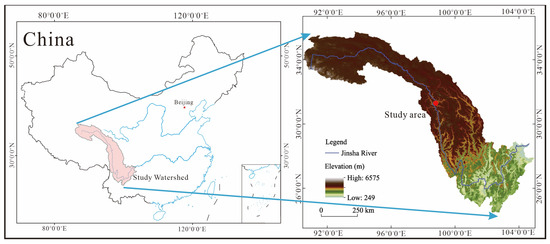
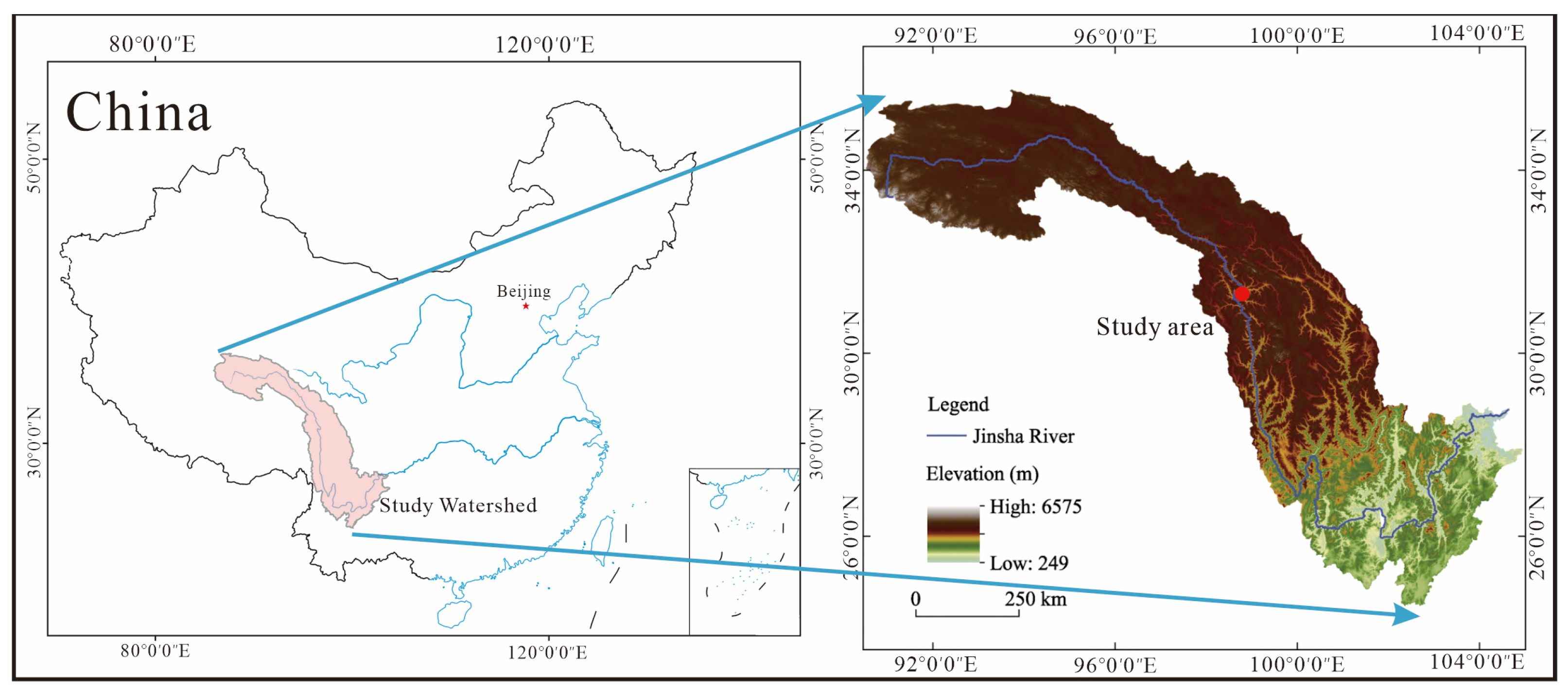
The proposed hydropower station is located on the main stem of the upper Jinsha River, which forms the border between Sichuan Province and Tibet Autonomous Region, China (shown in Figure 1). Its left bank lies within Dêgê County, Sichuan Province, while the right bank is situated in Jomda County, Tibet Autonomous Region. This project serves as the pivotal regulating reservoir for the planned cascade along the upper Jinsha River. The designed dam type is a roller-compacted concrete (RCC) gravity-arch dam, with a tentatively proposed height of 235 m.
Figure 1.
Geographical location of hydropower station.
During preliminary field investigations, deep-seated fracture zones were identified within the intact rock mass behind the unloading zones on both abutment slopes of the dam site, and were found to be symmetrically developed on both banks. These deep-seated fractures exert adverse effects on the rock mass quality of the high abutment slopes, modify the groundwater flow regime, and pose stability concerns for the slopes. The occurrence of deep-seated fracturing has been documented in previous hydropower projects, prompting considerable research efforts by numerous scholars.
Qi S.W. et al. [6] primarily from an engineering geology perspective, attributes the deep-seated fractures in the left bank of the Jinping-I Hydropower station to the combined effects of intense regional crustal activity, the tectonic stress field, specific rock mass structures, and lithological combinations. Rong G. et al. [7], employing numerical simulation of valley evolution, proposes that deep-seated fractures result from stress concentrations exceeding the rock mass strength, leading to rock mass yielding. Huang R.Q. et al. [8] contends that deep-seated fractures are products of deep unloading in counter-tilt slopes under high in situ stress conditions, accompanying rapid valley incision. Following an analysis of the development patterns of deep-seated fractures in the right bank of the Pubugou site, Chen H. et al. [9] concludes they are manifestations of superficial epigenetic modification under conditions of rapid slope unloading. Through rock mechanics experiments, Cai J.F. et al. [10] explaining the mechanical genesis of deep-level crack development and their characteristic tensile nature. Building upon field investigations and previous research [11,12,13,14,15,16], this study analyzes the engineering geological conditions of the dam site area. Based on slope morphology and rock mass characteristics, and explores the formation mechanisms and the influencing factors of deep-seated fractures in the slope at a hydropower station dam site in Southwest China. Concurrently, numerical simulation is employed to simulate the dynamic stress adjustment process within the slope during valley evolution.
2. Engineering Geological Conditions
The hydropower project is located within a high-mountain plateau geomorphic setting where intense fluvial downcutting along the Jinsha River since the Himalayan orogeny has formed a high-relief alpine terrain featuring multi-stage planation surfaces. At the dam site, the channel displays a pronounced zigzag bend with a 1 km straight reach oriented N70°E, flanked by broadly symmetrical valley slopes (generally 45–60°; locally 70–80°) and a 140–260 m wide floor. Bedrock exposures dominate both abutments with sparse Quaternary deposits consisting primarily of alluvial, colluvial, and slope-wash accumulations. Steeply dipping metasedimentary rocks (70–85° dip) of the Upper Triassic Ziqugusi Formation (T3q2; thin-medium-bedded crystalline limestone intercalated with schist) and Tumugou Formation (T3t1; schist-dominated with minor diabase dikes) strike N20–40°W—subperpendicular to the valley axis. The area is transected by NW-NNW-trending compressional faults, while disk-shaped core recovery from riverbore drilling indicates significant in situ stress. Polyphase tectonic deformation has superimposed composite folds across the Jinsha River corridor, with regional faults and fold structures collectively controlling major ridgeline orientations. Two secondary thrust faults (F5, F6; strike N30°W, dip 70–85° NE/SW, subparallel to bedding) exhibit 2–10 m wide brittle-ductile shear zones featuring lensoids and well-developed cleavage, extending over 3 km trace lengths.
3. Characteristics of Deep-Seated Fracturing
3.1. Spatial Distribution Characteristics
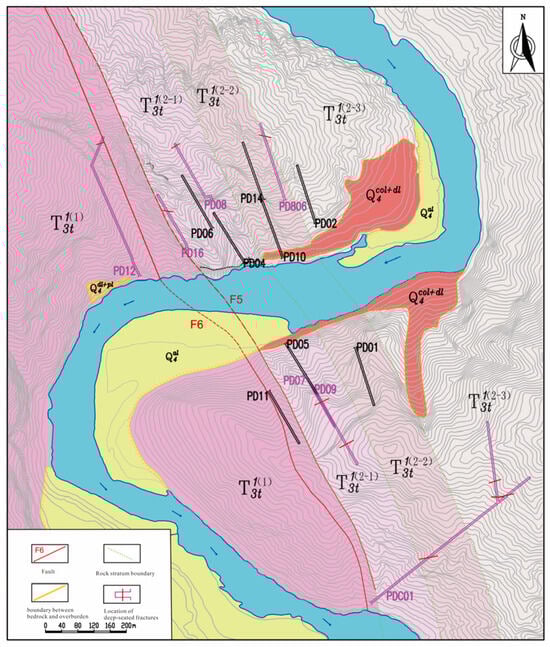
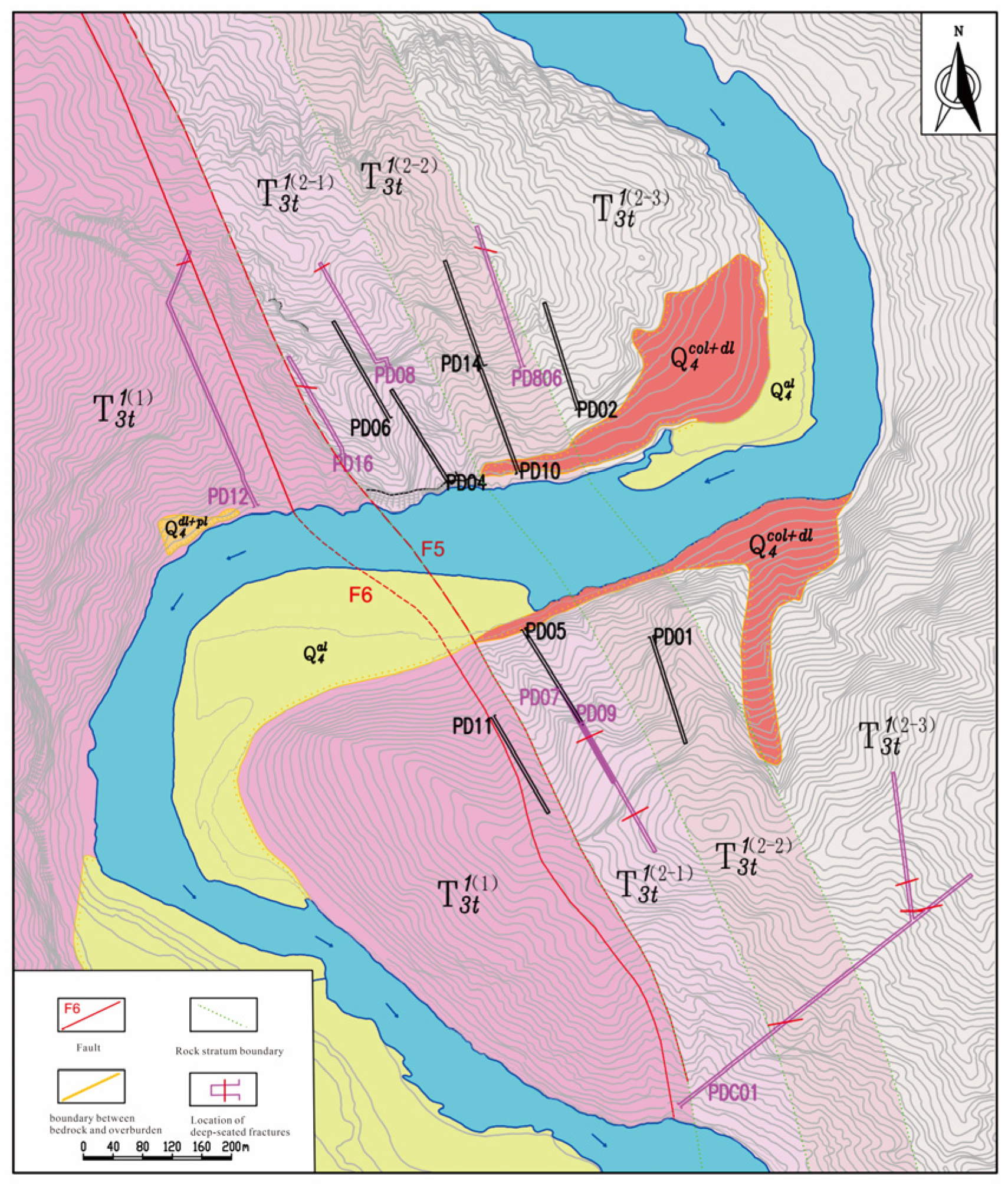
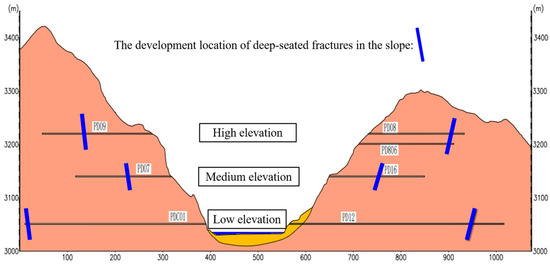
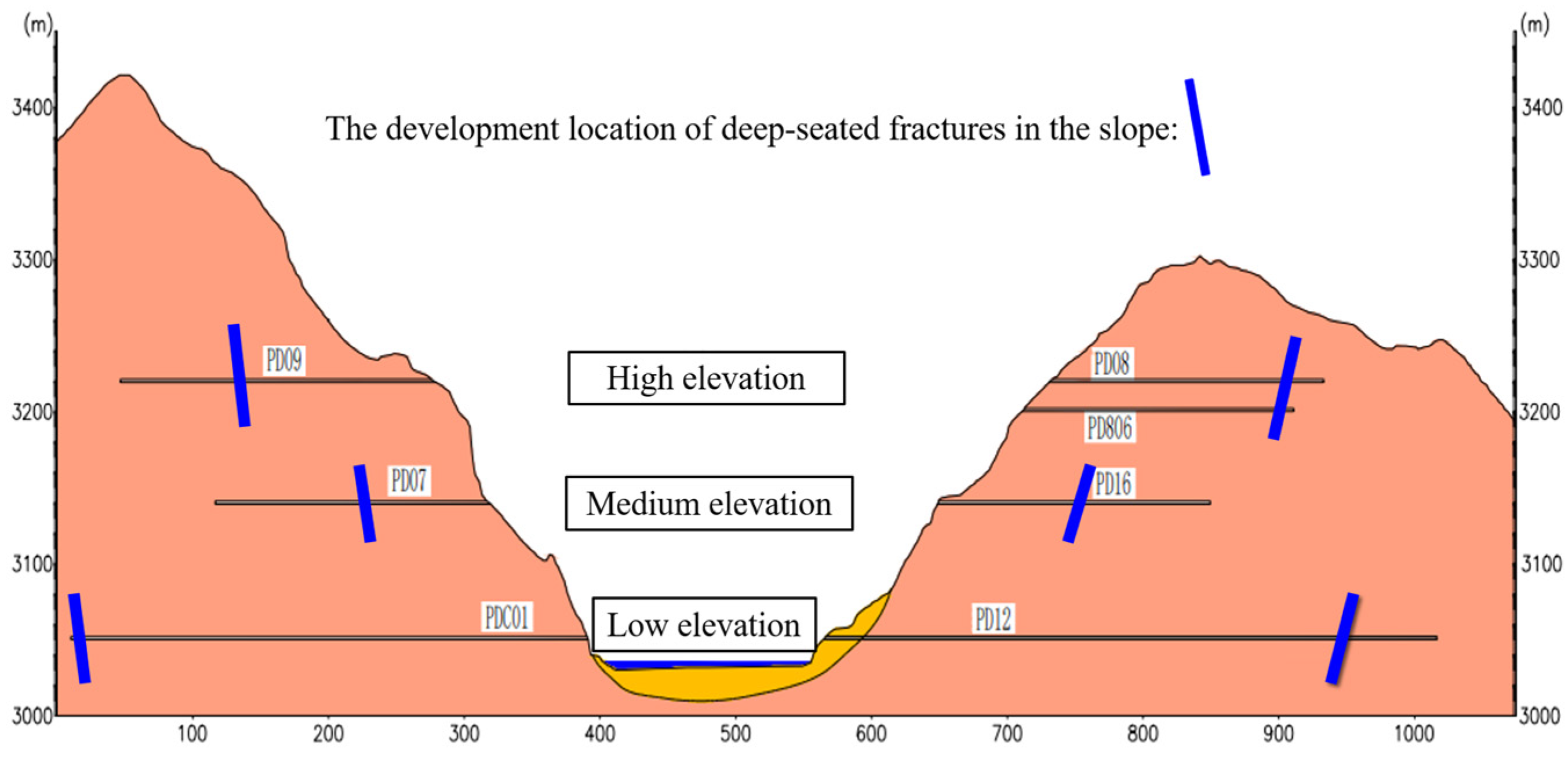
Survey findings indicate that deep-seated fractures within the dam site area of the hydropower station develop in the slightly weathered to fresh rock mass located within the unloading zone. These fractures exhibit distinct spatial distribution characteristics and are observed in adits across high, medium, and low elevations (3050–3231 m), as shown in Figure 1. Specifically, on the left bank, fractures are present in the low-elevation adit PDC01 (3050 m), the medium-elevation adit PD07 (3130 m), and the high-elevation adit PD09 (3221 m). On the right bank, fractures are found in the low-elevation adit PD12 (3050 m), the medium-elevation adit PD16 (3141 m), and the high-elevation adits PD806 (3203 m) and PD08 (3231 m) (Figure 2).
Figure 2.
Distribution map of adit locations for deep-seated crack development.
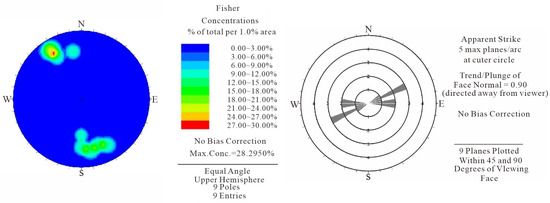
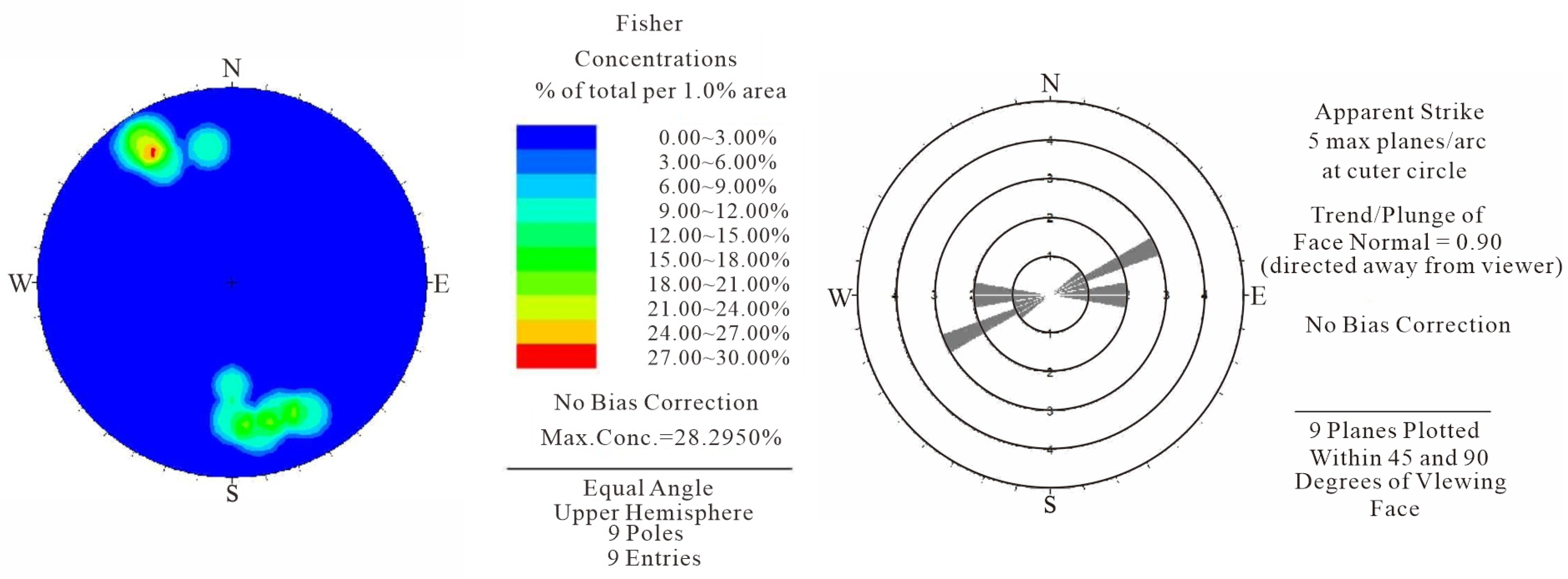
Survey findings reveal that the deep-seated fractures predominantly develop within the slope interior at depths exceeding 100 m, well beyond the typical range of the slope unloading zone. Medium- and high-elevation adits show these fractures concentrated within a horizontal depth range of 100–200 m. However, in the low-elevation adit PDC01 on the left bank, the deep-seated fractures occur at two widely separated horizontal depths: 180 m and 400 m. Similarly, the deep-seated fracture observed in the right bank’s low-elevation adit PD12 is located at a horizontal depth of 380 m, indicating development deep within the slope. Projecting the locations of these fractures from all elevations along the river direction onto a single profile demonstrates that the horizontal depths of the deep-seated fractures in the low-elevation areas significantly exceed those found in the medium and high-elevation areas (Figure 3). Both the left and right banks exhibit steeply dipping deep-seated fractures, with predominant orientations of N60°E/NW∠80° and EW/S∠75° (Figure 4). Across all sections, the attitudes of these deep-seated fractures are subparallel to the direction of the river channel.
Figure 3.
Horizontal overburden depth of deep-seated cracks at different elevations.
Figure 4.
Density contour map and rose diagram of deep-seated cracks.
3.2. Morphological and Material Characteristics
Previous studies of deep-seated deformation fractures in hydropower station slopes across southwestern China have identified the following characteristic morphological and material properties: (1) these fractures typically manifest as single cracks or tension bands, exhibiting pronounced extensional features. Rock masses surrounding banded fractures are notably relaxed, with apertures ranging widely from less than 1 cm to over 10 cm, with maximum openings reaching several tens of centimeters. Void spaces occasionally occur at tunnel crowns and walls, with wider-aperture fractures demonstrating greater penetration depths [17,18]. (2) Fracture surfaces appear smooth with low roughness and lack distinct striations. Unlike shallow tension cracks, most deep-seated fractures show relatively fresh surfaces with minimal infilling, indicating more recent formation [19,20]. (3) These fractures predominantly develop along pre-existing structural discontinuities, often featuring minor calcite coatings or thin calcium films localized on one wall. Larger fractures filled with rock fragments and debris exhibit fresh rupture surfaces, with unloading depths progressively increasing at higher elevations—characteristic of unloading-induced fracturing [21]. (4) Deep-seated fractures exhibited asymmetrical development, being confined to one bank of the river with an absence of such features on the contralateral bank.
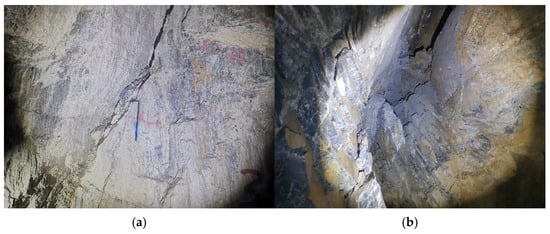
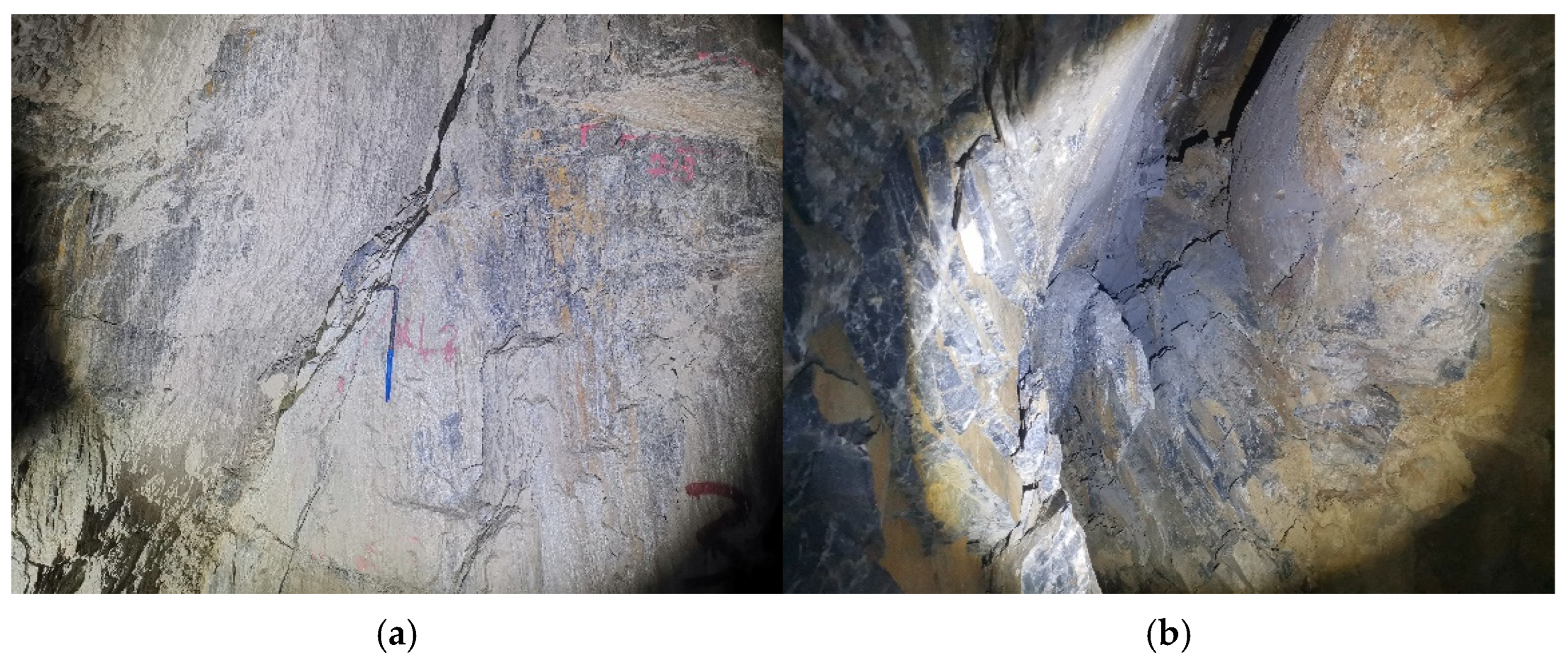
However, the deep-seated deformation fractures at the current dam site exhibit distinct differences in the latter three aspects (Table 1). The limestone strata in this area feature well-developed dissolution features, resulting in fractures with universally rough surfaces, significant weathering-induced iron oxide staining, prominent void spaces, and infillings of rock blocks, angular gravel, and yellowish-brown secondary clay (Figure 5). Additionally, low-elevation adits at this dam site reveal fractures penetrating deeper than those at high elevations. Furthermore, fracture apertures increase with rising elevation: typically 1–2 cm at low elevations, 3–5 cm at medium elevations, and 10–20 cm at high elevations. The bilateral slopes exhibited symmetrically developed deep-seated fractures with corresponding elevations and penetration depths.
Table 1.
Deep-seated fractures exposed in the dam area.
Figure 5.
Phenomenon of deep-seated fractures in adits. (a) PD08. (b) PD16.
4. Valley Evolution Numerical Modeling
Deep-seated fractures form under unique rock mass mechanical conditions within slopes. By employing the finite element method to conduct an intuitive 3D simulation of valley evolution at the dam site, this approach effectively demonstrates the stress redistribution patterns in slopes during valley incision and their relationship with the formation of deep-seated fractures [22,23,24,25].
4.1. Valley Incision Evolution
Based on the topographic features and tectonic setting of the dam site area [26,27], the region underwent a denudation period of planation surfaces prior to valley evolution. This process formed three distinct planation levels: the first at elevations of 4800–5000 m, the second at 4200–4400 m, and the third at 3500–3600 m. Since the Early Pleistocene, regional geomorphology transitioned from planation surface denudation to a broad valley phase, progressively evolving into gorge formation through valley incision. Analysis of regional terrace elevations and incision rates reveals three distinct evolutionary stages (Table 2). Concurrent with valley incision, significant regional uplift occurred. In our numerical modeling, this tectonic uplift is uniformly generalized as an equivalent incision rate—a treatment justified by the dominantly vertical crustal uplift characteristic of regional neotectonics [28,29].
Table 2.
Table of terrace heights and chronological characteristics in the regional river section.
4.2. Establish a Numerical Model
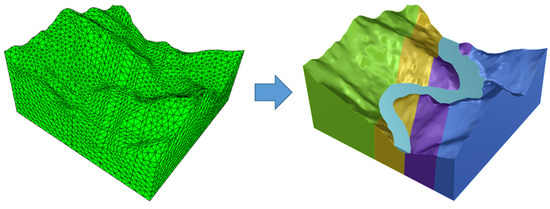
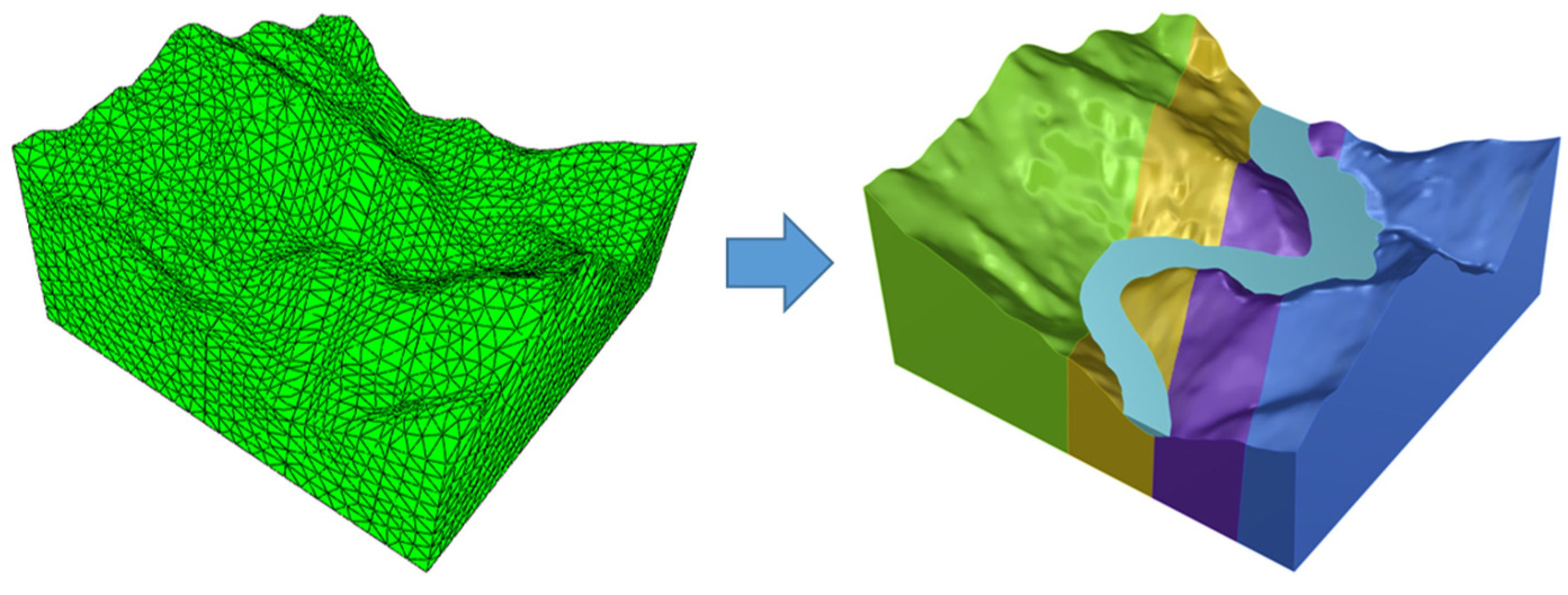
The dam site model centers on the river section within a 2450 m × 2330 m domain, with the X-axis aligned parallel to the river flow and the Y-axis perpendicular. Elevations span 2590–3865 m. A tetrahedral mesh comprising 96,373 elements was generated to simulate steeply dipping limestone bedding planes at the dam site, subdivided into four sublayers based on diagenetic age and physico-mechanical properties, all dipping steeply upstream (Figure 6).
Figure 6.
Model of the dam site area.
Two boundary conditions were implemented to represent distinct simulation phases. The first condition modeled the initial state under gravitational loading alone, with no tectonic stress applied. In this configuration, vertical displacement was constrained at the model base. The lateral boundaries were fixed in their normal directions: the cross-valley oriented surfaces were restrained in the Y-direction, and the along-valley oriented surfaces were restrained in the X-direction. The second condition simulated the river incision process, incorporating both gravitational and tectonic stresses. Here, the model base was fully fixed, with displacement constraints applied in the X (along-valley), Y (cross-valley), and Z (vertical) directions. To simulate the regional tectonic stress field, constant pressures of 8 MPa in the X-direction and 6 MPa in the Y-direction were applied to the lateral boundaries within the elevation range of the incised valley, from 2590 to 3865 m. This tectonic stress, which acts uniformly throughout the entire model volume and across all depths, reflects the dominant NWW-oriented stress field influencing the dam site area, as determined by in situ measurements using the stress relief method.
The numerical simulations were performed using the finite element software Abaqus (Version 2022) [30,31,32]. The constitutive model for the rock mass employed the Mohr-Coulomb failure criterion, a standard model in geotechnical engineering. The corresponding strength parameters are provided in Table 3.
Table 3.
Rock mass strength parameters.
4.3. Analysis of Simulation Results
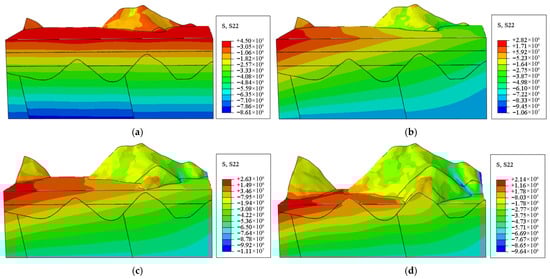
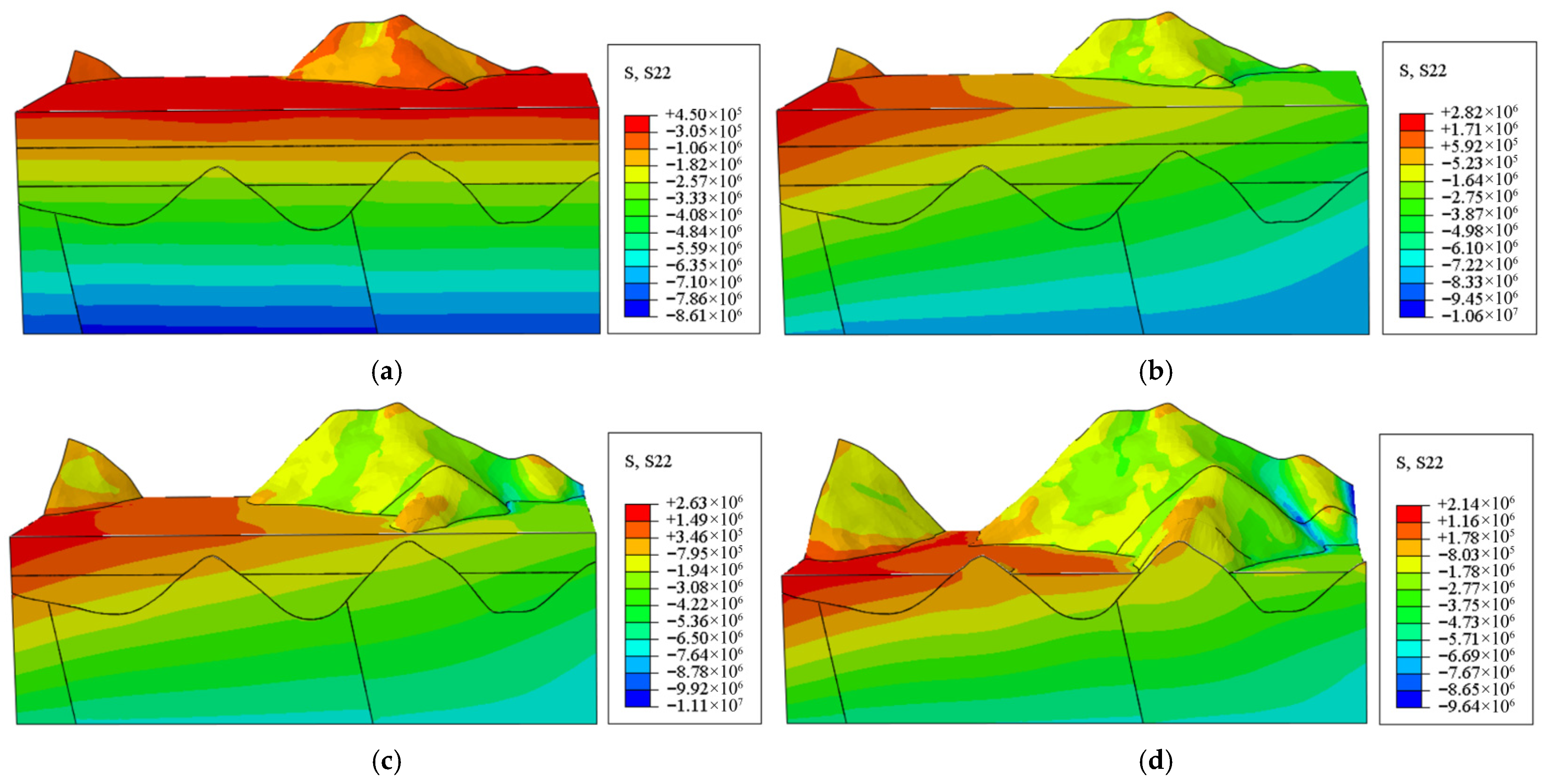
At the dam site, the limestone exhibits an attitude of N20–40°W/NE (SW) ∠70–85°, while the tectonic stress orientation is N85°W. The bedding planes intersect the tectonic stress at high angles. The maximum principal stress (σ1) acting on the limestone can be resolved into components parallel and perpendicular to the bedding planes. For layered rock masses, compressive strength and deformation resistance are relatively high perpendicular to bedding, but tensile resistance is weak parallel to bedding. Consequently, transverse (cross-valley) tensile stresses readily induce tensile fractures perpendicular to the limestone bedding [33,34]. The deep-seated fractures all align parallel or subparallel to the river channel, with their development influenced by transverse stresses. During simulation, we focused on stress variations in the cross-valley direction (S22 in stress contour plots), as illustrated in Figure 7 (downstream view). In the stress analysis, positive values denote tensile stresses while negative values indicate compressive stresses.
Figure 7.
Stress cloud diagram in the transverse direction during valley evolution. (a) Gravity balance; (b) apply tectonic stress; (c) first downcutting; (d) second downcutting.
After balancing gravitational and tectonic stresses, transverse stress distribution became relatively uniform. Influenced by tectonic stress, the left bank riverbed during the broad-valley phase exhibited a tensile stress concentration zone, while compressive stress dominated elsewhere. Following the first incision phase, the region entered a transitional period from broad-valley to gorge evolution. Near-surface rock mass unloading intensified, converting formerly compressive areas at the riverbed and slope surfaces to tensile environments. Concurrently, compressive stresses at depth beneath the riverbed diminished compared to the previous stage. During the second incision phase, intense tectonic uplift accompanied the process, initiating formation of the present river profile. As both banks were uplifted above the Jinsha River water level, Figure 7d reveals that rock masses near the bank crests—previously under compression—gradually transitioned to tensile-dominated stress regimes.
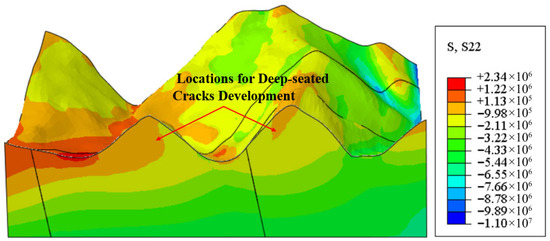
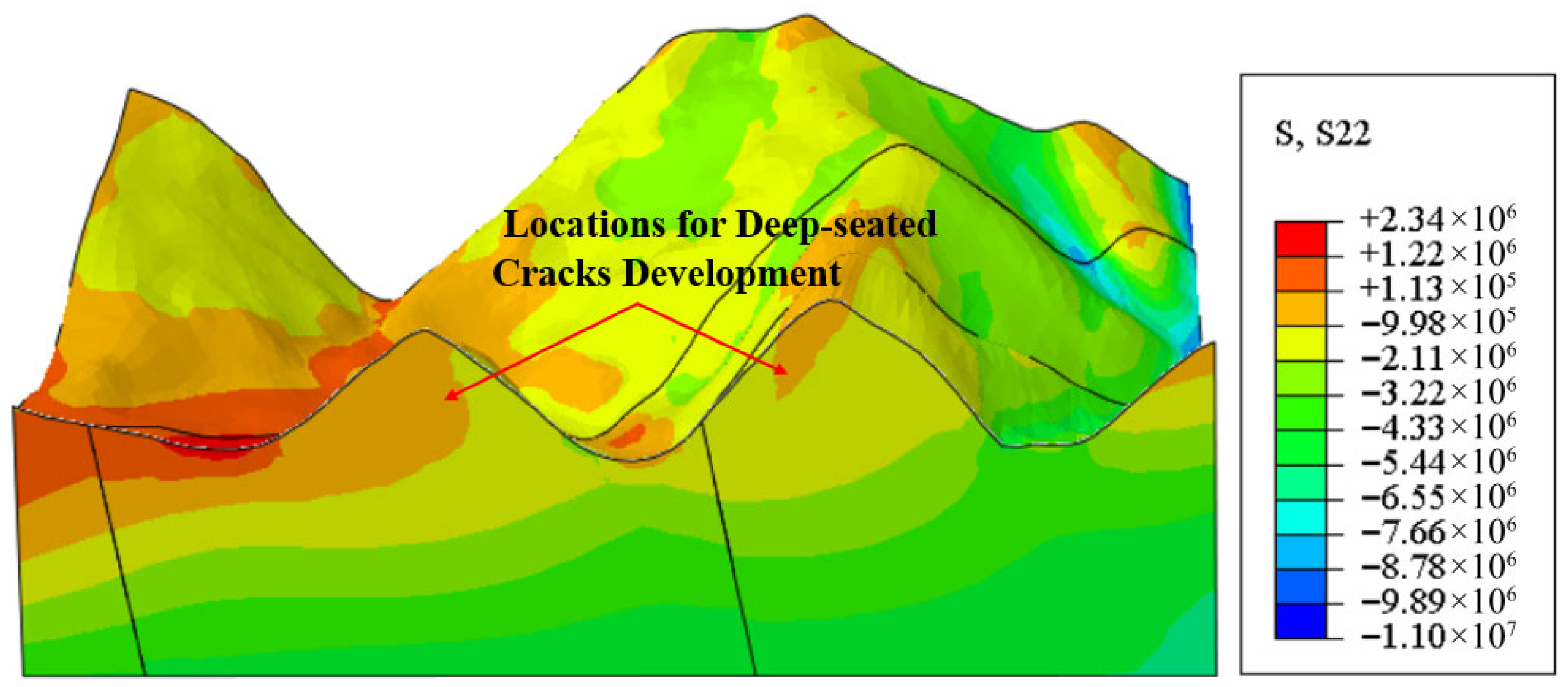
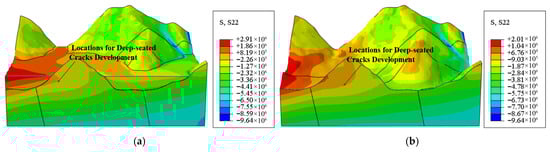
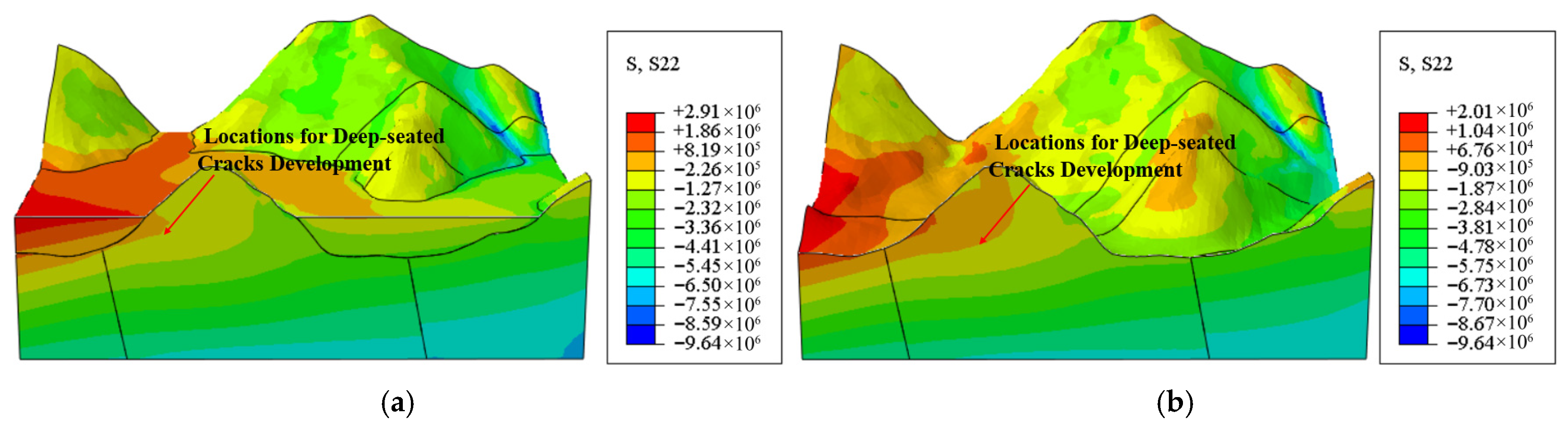
Following the third incision phase, the valley at the dam site evolved into its present configuration. As river incision progressed, transverse stresses continued to readjust from the previous stage. Figure 8 demonstrates that after the riverbed descended from 3196 m to 3020 m, tensile stress zones developed at certain depths within both left and right banks, while compressive stresses dominated from these tensile zones outward to the slope surfaces. The deep-seated fractures documented in adits at the dam site precisely originate within these tensile stress zones. Correspondingly, the compressive stress regions between the fractures and slope surfaces consist of intact rock masses—consistent with field observations. At the high-elevation adit location (approximately 3200 m), the deep-seated fractures on both banks have developed within the areas indicated by the arrows in Figure 8. At these locations, the rock mass remained under compressive stress during the previous stage. Following the third incision phase, the stress state shifted to predominantly tensile, whereas the zone extending from this location to the slope surface continues to be under compressive stress. Consequently, the deep-seated fractures have formed precisely where the stress transition is most pronounced. In the model, this position was measured to be about 170 m inside the slope, which is consistent with field observations.
Figure 8.
The third downcutting.
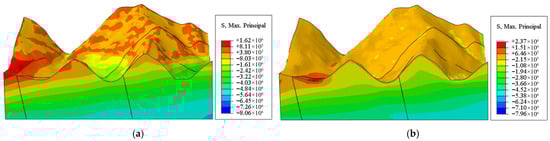
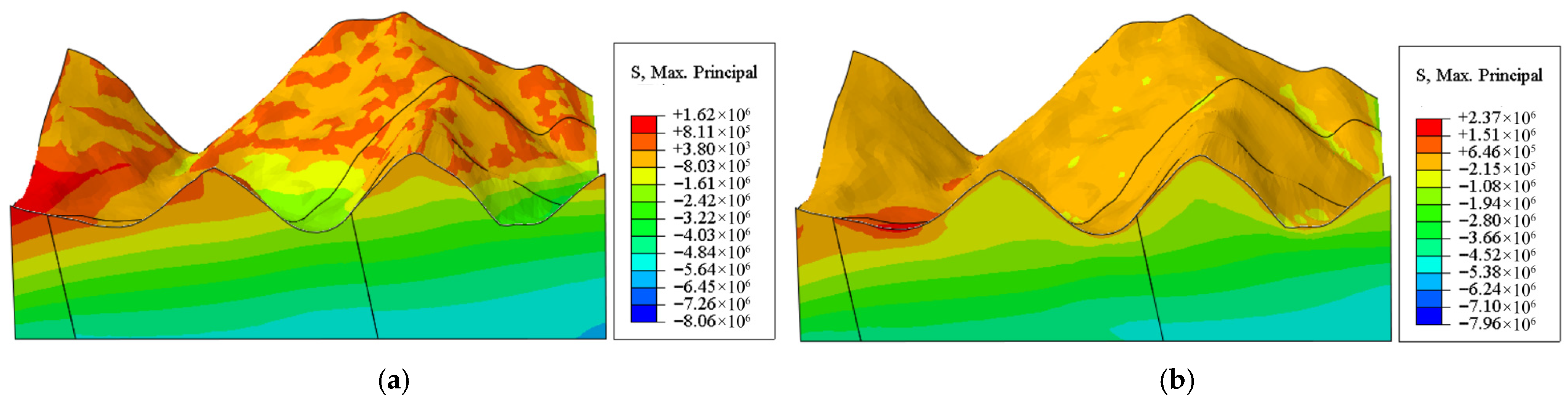
After river incision completion, Figure 9 indicates that the maximum principal stress (σ1) in both bank slopes above the riverbed is predominantly tensile. During this phase, slope rock masses may develop secondary tension cracks. Following stress equilibration, tensile stress zones persist only near slope surfaces and the riverbed, corresponding to observed unloading zones in situ, while deep-seated fracture locations revert to compressive stress environments.
Figure 9.
Maximum principal stress cloud diagram during valley evolution. (a) Completion of the third downcutting; (b) after stress balance.
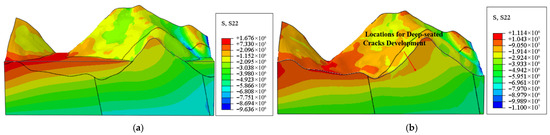
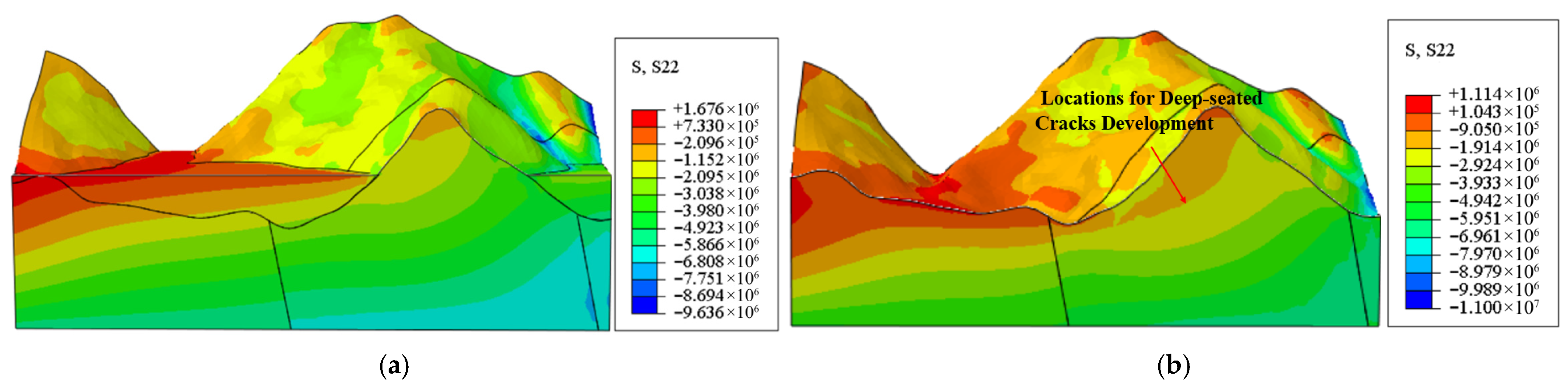
The deep-seated fractures exposed in low-elevation adits at the dam site exhibit significant spatial heterogeneity and greater developmental depths. Numerical simulations of representative cross-sections reveal distinct evolutionary patterns: On the left bank, Adit PDC01 shows a continuous tensile stress zone from shallow to deep depths after the second incision phase (Figure 10a), corresponding to initial fracture development at 180 m. By the third incision phase (Figure 10b), this tensile zone expanded deeper to 400 m, aligning precisely with field-observed fracture positions. Conversely, the right bank’s Adit PD12 (Figure 11a,b) developed localized tensile stress only at 380 m depth after the third incision, while the outer slope remained under compression.
Figure 10.
Transverse stress cloud diagram of the low-elevation adit PDC01. (a) Second downcutting; (b) third downcutting.
Figure 11.
Transverse stress cloud diagram of the low-elevation adit PD12. (a) Second downcutting; (b) third downcutting.
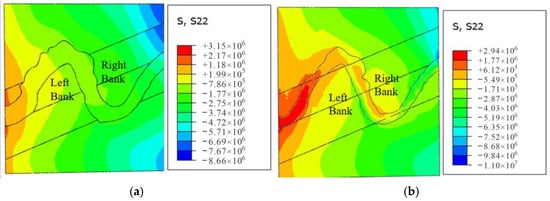
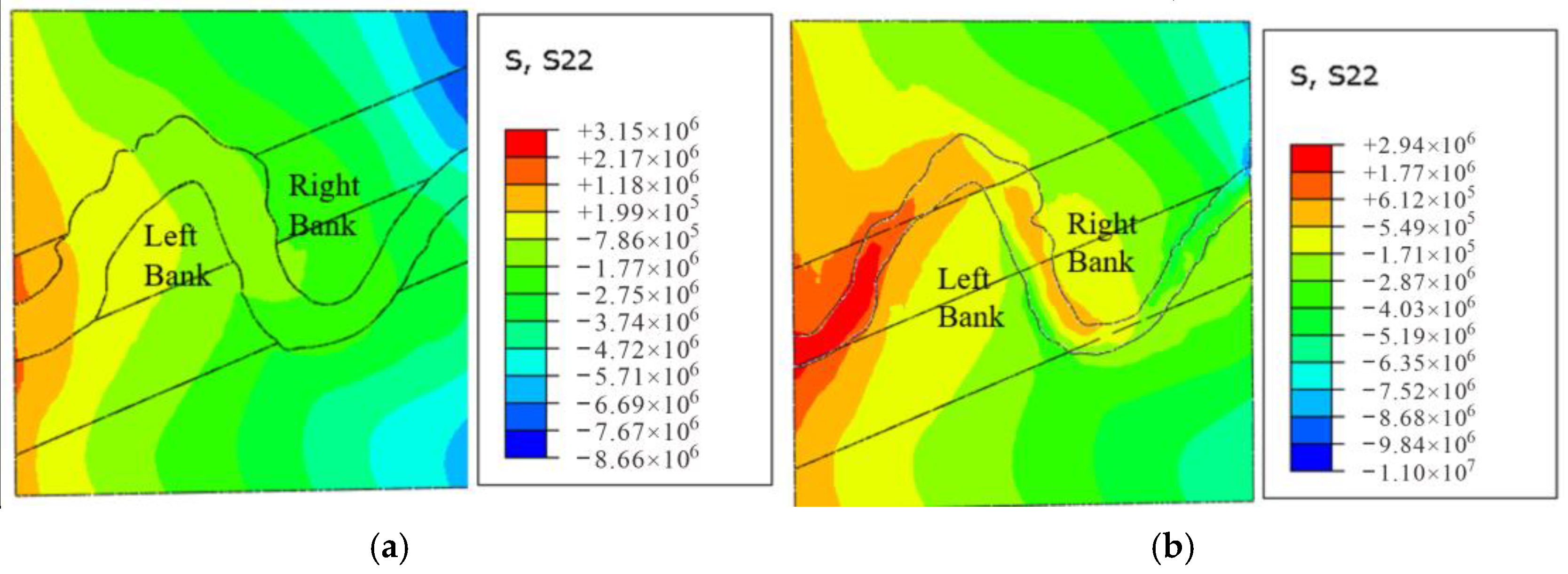
From a vertical perspective at 3050 m elevation, the transverse stress variation across the entire region during incision can be effectively observed (Figure 12). During the second incision phase, both the left and right bank slopes were dominated by compressive stress. By the third incision phase, compressive stress decreased and progressively transitioned into a tensile stress environment. Deep-seated fractures develop precisely at locations where compressive stress transforms into tensile stress. River incision alters the internal stress field within slopes, thereby creating the stress conditions necessary for the formation of deep fractures.
Figure 12.
Transverse stress cloud diagram of the perpendicular view at 3050 m elevation. (a) Second downcutting; (b) third downcutting.
Both banks feature three-dimensional free faces geomorphologically. From a geomechanical evolution perspective, staged river incision triggers stress field reorganization by progressively modifying slope confinement conditions: (1) initially, toe rock experiences triaxial confinement due to topographic constraints and gravitational stresses [35,36,37]; (2) new free faces formed by incision induce stress release and rebound, causing transverse stress reduction that evolves into tensile concentration [38,39]; (3) multi-stage incision superimposes stress release effects at varying depths, explaining PDC01’s dual fracture planes at 180 m (second incision influence zone) and 400 m (third incision influence zone); and (4) the third incision’s maximum rate induced the most intense stress release, producing fractures at greatest depths. Progressive stress release also explains why fracture apertures increase with elevation.
A key mechanistic pattern emerges: river incision rate governs fracture depth, while the number of incision cycles controls fracture aperture width. Collectively, during fluvial incision, slope stresses continuously adjust through unloading. Rock masses under compression in prior stages transform into tensile concentration zones during subsequent incision. The release of accumulated elastic strain energy generates secondary tensile fractures [40,41,42]. As tensile stresses intensify, these fractures progressively widen, ultimately forming deep-seated discontinuities.
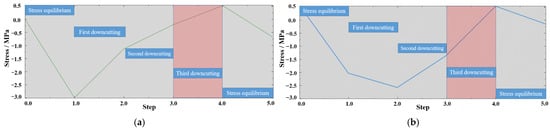
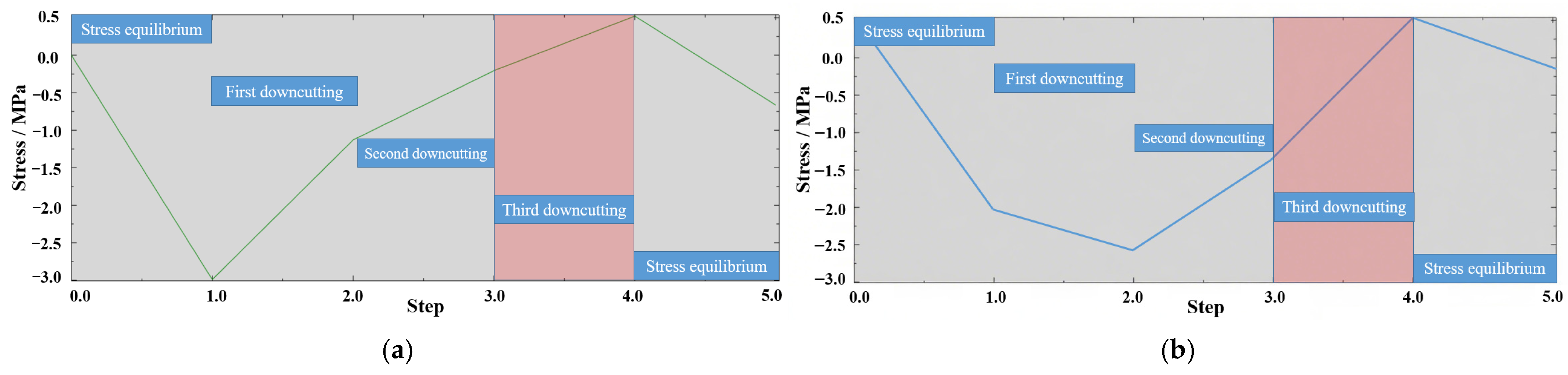
During the numerical simulation, monitoring points were deployed at the locations of deep-seated fractures within Adits PDC01 and PD12 to track transverse (S22-direction) stress variations during simulated river incision (Figure 13). The stress evolution curve comprises five sequential phases: stress equilibrium → first incision → second incision → third incision → stress re-equilibration. Critical analysis reveals that during the third incision phase, transverse stress transitions from negative to positive values, indicating a shift from compressive to tensile stress conditions within the rock mass. This stress reversal triggered tensile fracturing at the monitored locations.
Figure 13.
S22-Direction Stress Variation Curves at Deep Fracture Locations. (a) PDC01; (b) PD12.
5. Discussion
Deep-seated deformation fractures at the proposed hydropower dam site in southwestern China all exhibit steep dips with strikes parallel or subparallel to the river valley. Distributed on both banks with differing orientations, these fractures demonstrate distinct unloading characteristics. Integrated stress field analysis of valley evolution indicates they result from prolonged stress release under specific slope rock mass conditions, collectively influenced by topography, slope geometry, rock structure, regional in situ stress, and fluvial incision.
(1) High in situ stress constitutes the prerequisite geological condition. Disk-shaped cores from riverbed boreholes confirm significant regional stress. Against this background, rapid fluvial incision concentrated stresses within slopes while simultaneously deepening valleys and increasing slope heights, extending stress concentration zones deeper. Subsequent stress adjustments triggered deformation fracturing in deep rock masses. Numerical simulations show strong correspondence between fracture locations and tensile stress zones. The Jinsha River’s multi-phase rapid incision drove cyclic stress concentration and release within slopes: each incision stage accumulated then released stresses, forming fractures before re-accumulating energy. This mechanism explains varying fracture depths/apertures at different elevations and the two widely spaced fracture sets in Adit PDC01, demonstrating the cyclic stress accumulation–release process.
(2) Steep bilateral slopes and river orientation create essential geomorphic controls. Mechanistically, steeper slopes expand tensile zones and increase unloading depth compared to gentle slopes. For slopes of equivalent gradient, greater heights deepen unloading zones. The Z-shaped river creates three-dimensional free faces on both banks, enhancing unloading. With NW-NNW regional principal stress orthogonally intersecting the NE-trending river, deep slope stresses release preferentially toward the valley, forming valley-parallel fractures.
(3) The steeply dipping metasedimentary sequence governs structural responses. Fractures exclusively develop in slightly weathered to fresh crystalline limestone—characterized by high integrity and strength—providing the material basis for high strain energy storage. Crucially, near-vertical bedding planes (approximately perpendicular to the valley) prevent stress release along bedding, forcing valley-parallel unloading fracture development. The bedding attitudes on both banks of this area are symmetric, being near-vertical and perpendicular to the river channel while also parallel to the tectonic stress orientation. This configuration prevents both the enhanced unloading effect induced by river incision and the tectonic stress from being released along the bedding planes. As a result, stress can only be released through the development of deep-seated fractures that extend far beyond the normal unloading depth. Well-developed dissolution enlarges fracture zones through groundwater interaction, resulting in rough fracture surfaces with common calcite coatings and quartz druses, filled with calcareous–argillaceous cemented materials.
6. Conclusions
In summary, the deep-seated deformation fractures at the proposed hydropower dam site in southwestern China result from intense unloading-driven release of high geostatic stresses in slope interiors. This process occurs under specific slope geometries, rock mass structures, and topographical conditions, with high in situ stress serving as the primary intrinsic factor and rapid valley incision acting as the key external driver. The combined internal and external influences generate deep open fractures and tension zones.
Adit investigations reveal that fracture development zones at this dam site are relatively concentrated but exhibit poor connectivity. However, after reservoir impoundment, increased water pressure on both banks may utilize larger unloading fractures as preferential seepage pathways, potentially forming leakage channels across the abutments. Furthermore, given the region’s intense karst dissolution, these deep fractures could act as conduits for groundwater circulation. Enhanced hydroactivity may widen fractures or fill them with weak infill materials (e.g., clay infill), consequently compromising overall slope stability. Therefore, the engineering implications of these deep fractures require thorough investigation.
Author Contributions
Methodology, data curation, writing—original draft preparation, X.W.; software, H.M.; writing—review and project administration, Z.W.; editing, D.Z. All authors have read and agreed to the published version of the manuscript.
Funding
This research received no external funding.
Data Availability Statement
The data presented in this study are available on request from the corresponding authors.
Conflicts of Interest
Authors Xingyu Wei, Hong Ma, and Zhanglei Wu were employed by the company PowerChina Chengdu Engineering Corporation Limited. The remaining authors declare that the research was conducted in the absence of any commercial or financial relationships that could be construed as a potential conflict of interest.
References
- Sissakian, V.K.; Adamo, N.; Al-Ansari, N. The Role of Geological Investigations for Dam Siting: Mosul Dam a Case Study. Geotech. Geol. Eng. 2020, 38, 2085–2096. [Google Scholar] [CrossRef] [Scilit]
- Połomski, M.; Wiatkowski, M.; Ługowska, G. Comparative Analysis of Studies of Geological Conditions at the Planning and Construction Stage of Dam Reservoirs: A Case Study of New Facilities in South-Western Poland. Appl. Sci. 2025, 15, 7811. [Google Scholar] [CrossRef] [Scilit]
- Pan, J.X.; Xu, Y.J.; Jin, F.; Wang, J.T. Seismic stability assessment of an arch dam-foundation system. Earthq. Eng. Eng. Vib. 2015, 14, 517–526. [Google Scholar] [CrossRef] [Scilit]
- Belete, D.; Chala, E.T.; Jilo, N.Z.; Garo, T. Engineering Geological Investigation of the Katar Dam Foundation and Abutment Slope Stability Analysis, Southeast Ethiopia. Indian Geotech. J. 2025, 55, 1563–1593. [Google Scholar] [CrossRef] [Scilit]
- Asfaw, L.; Meten, M.; Garo, T. Leakage and abutment slope stability analysis of Arjo Didesa dam site, western Ethiopia. Arab. J. Geosci. 2022, 15, 1540. [Google Scholar] [CrossRef] [Scilit]
- Qi, S.W.; Wu, F.Q.; Lan, H.X. Study on the mechanism of the deep fractures of the left abutment slope at the Jinping First Stage Hydropower Station. Chin. J. Geotech. Eng. 2002, 24, 596–599. [Google Scholar] [CrossRef] [Scilit]
- Rong, G.; Zhu, H.C.; Wang, S.J. Primary research on mechanism of deep fractures formation in left bank of Jinping First Stage Hydropower Station. Chin. J. Rock Mech. Eng. 2008, 27, 2855–2863. Available online: https://rockmech.whrsm.ac.cn/CN/abstract/abstract24314.shtml (accessed on 17 December 2025).
- Huang, R.Q.; Lin, F.; Chen, D.J.; Wang, J.H. Study on the formation of rocky high slope unloading zone and its engineering properties. J. Eng. Geol. 2001, 3, 227–232. [Google Scholar] [CrossRef]
- Chen, H.; Zhao, Q.H.; Chen, W.D. Analysis on the genetic mechanism of deep cracks in the right bank of the reservoir head area at Pubugou Hydropower Station. J. Eng. Geol. 2005, 3, 289–293. [Google Scholar] [CrossRef]
- Cai, J.F.; Qi, S.W.; Teng, K.Y.; Long, X. Spectial characteristics of deep fractures in high and steep slopes in southwestern of China. J. Eng. Geol. 2007, 6, 730–738. Available online: http://www.gcdz.org/article/id/8836 (accessed on 17 December 2025).
- Dagdelenler, G. Impact of Rock Mass Strength Anisotropy with Depth on Slope Stability Under Excavation Disturbance. Appl. Sci. 2025, 15, 164. [Google Scholar] [CrossRef] [Scilit]
- Zangerl, C.; Koppensteiner, M.; Strauhal, T. Semiautomated Statistical Discontinuity Analyses from Scanline Data of Fractured Rock Masses. Appl. Sci. 2022, 12, 9622. [Google Scholar] [CrossRef] [Scilit]
- Crosta, G.B.; Frattini, P.; Agliardi, F. Deep seated gravitational slope deformations in the European Alps. Tectonophysics 2013, 605, 13–33. [Google Scholar] [CrossRef] [Scilit]
- Hradecký, J.; Pánek, T. Deep-seated gravitational slope deformations and their influence on consequence mass movements (case studies from the highest part of the Czech Carpathians). Nat. Hazards 2008, 45, 235–253. [Google Scholar] [CrossRef] [Scilit]
- Wang, H.Y.; Dyskin, A.; Dight, P.; Pasternak, E.; Hsieh, A. Review of unloading tests of dynamic rock failure in compression. Eng. Fract. Mech. 2020, 225, 106289. [Google Scholar] [CrossRef] [Scilit]
- Han, G.; Zhao, Q.H.; Peng, S.Q. In-situ stress field evolution of deep fracture rock mass at dam area of Baihetan hydropower station. Rock Soil Mech. 2011, 32, 583–589. [Google Scholar] [CrossRef]
- Wang, X.Q.; Wang, L.S.; Shen, J.H.; Xu, J. Disquisition on distributing law of bank slope deep fracture of an electricity station dam site section at southwest. J. Chongqing Univ. (Nat. Sci. Ed.) 2003, 26, 14–17. [Google Scholar] [CrossRef] [Scilit]
- Qi, S.W.; Wu, F.Q.; Yan, F.Z.; Lan, H.X. Mechanism of deep cracks in the left bank slope of Jinping first stage hydropower station. Eng. Geol. 2004, 73, 129–144. [Google Scholar] [CrossRef] [Scilit]
- Song, S.W.; Feng, X.M.; Xiang, B.Y.; Xing, W.B.; Zeng, Y. Research on key technologies for high and steep rock slopes of hydropower engineering in Southwest China. Chin. J. Rock Mech. Eng. 2011, 30, 1–22. [Google Scholar] [CrossRef] [Scilit]
- Chen, H. A Study on the Formation Mechanism and Engineering Effects of Deep Crack in Typical Slopes of Middle and Lower Research of the Dadu River. Master’s Thesis, Chengdu University of Technology, Chengdu, China, 2005. [Google Scholar]
- Jiang, J.F.; Zhao, Q.H.; Deng, Y.H.; Wang, Y.; Wu, H.Q. Development characteristics of deep fracture rock mass of Yebatan high arch dam and its stability influence analysis. Yangtze River 2024, 55, 157–167. [Google Scholar] [CrossRef]
- Tu, G.X.; Deng, H. Unloading depth of rock masses and its relations with river downcutting in deep valleys in Southwest China. Eng. Geol. 2021, 288, 106161. [Google Scholar] [CrossRef] [Scilit]
- Bao, H.; Zhang, K.K.; Yan, C.G.; Lan, H.X.; Wu, F.Q.; Zheng, H. Excavation damaged zone division and time-dependency deformation prediction: A case study of excavated rock mass at Xiaowan Hydropower Station. Eng. Geol. 2020, 272, 105668. [Google Scholar] [CrossRef] [Scilit]
- Zangeneh, N.; Eberhardt, E.; Bustin, R.M. Investigation of the influence of natural fractures and in situ stress on hydraulic fracture propagation using a distinct-element approach. Can. Geotech. J. 2015, 52, 926–946. [Google Scholar] [CrossRef] [Scilit]
- Pine, R.; Coggan, J.; Flynn, Z.; Elmo, D. The Development of a new Numerical Modelling Approach for Naturally Fractured Rock Masses. Rock Mech. Rock Engng. 2006, 39, 395–419. [Google Scholar] [CrossRef] [Scilit]
- Huang, D.; Yang, D.Y.; Li, L.P.; Shi, A.C.; Lu, F.; Ge, Z.S.; Xu, Q.M. Preliminary study on the downcut rate of the Baihetan section of the Jinsha River. Quat. Sci. 2010, 30, 872–876. [Google Scholar] [CrossRef]
- Chen, X.C.; Guo, X.J.; Chen, H. Analysis on geomorphological characteristics of catchments and its influencing factors in Dege-Baiyu section of the upper Jinsha River. Quat. Sci. 2023, 45, 1269–1281. [Google Scholar] [CrossRef]
- Rong, G.; Wang, S.J.; Wang, E.Z.; Liu, S.G. Study of evolutional simulation of Baihetan river valley and evaluation of engineering quality of jointed basalt P2β3. Rock Soil Mech. 2009, 30, 3013–3019. [Google Scholar] [CrossRef]
- Wei, C.Y.; Zhuang, W.Y.; Wang, T.; Gao, Z.F.; Liu, Y.R.; Yang, Q. Formation mechanism of deep fractures in near-dam slope of Jinping I Hydropower Station and their influence on long-term slope deformation. J. Tsinghua Univ. (Sci. Technol.) 2024, 64, 1944–1954. [Google Scholar] [CrossRef]
- Cao, V.H.; Go, G.H. A novel approach to stability analysis of random soil-rock mixture slopes using finite element method in ABAQUS. Nat. Hazards 2024, 120, 14381–14407. [Google Scholar] [CrossRef] [Scilit]
- Karthik, A.V.R.; Manideep, R.; Chavda, J.T. Sensitivity analysis of slope stability using finite element method. Innov. Infrastruct. Solut. 2022, 7, 184. [Google Scholar] [CrossRef] [Scilit]
- Arvin, M.R.; Zakeri, A.; Bahmani Shoorijeh, M. Using Finite Element Strength Reduction Method for Stability Analysis of Geocell-Reinforced Slopes. Geotech. Geol. Eng. 2019, 37, 1453–1467. [Google Scholar] [CrossRef] [Scilit]
- Zheng, Y.; Zhang, T.; Yang, H.; Wang, W.; Niu, Q.; Wei, H. An Experimental Investigation on Mechanical Properties and Failure Characteristics of Layered Rock Mass. Appl. Sci. 2023, 13, 7537. [Google Scholar] [CrossRef] [Scilit]
- Wei, W.; Zhu, L.; Liu, H. Anisotropy of deformation parameters of stratified rock mass. Arab. J. Geosci. 2021, 14, 1675. [Google Scholar] [CrossRef] [Scilit]
- Qu, M.; Dang, F. Numerical Analysis of Instability Mechanism of a High Slope under Excavation Unloading and Rainfall. Appl. Sci. 2022, 12, 7990. [Google Scholar] [CrossRef] [Scilit]
- Shen, J.H.; Wang, L.S.; Wang, Q.H.; Xu, J.; Jiang, Y.S.; Sun, B.J. Deformation and fracture features of unloading rock mass. Chin. J. Rock Mech. Eng. 2003, 22, 2028–2031. [Google Scholar] [CrossRef]
- Qin, H.; Yin, X.T.; Tang, H.; Cheng, X.; Yuan, H. Method of Stress Field and Stability Analysis of Bedding Rock Slope Considering Excavation Unloading. KSCE J. Civ. Eng. 2023, 27, 4205–4214. [Google Scholar] [CrossRef] [Scilit]
- Cheng, X.; Tang, H.; Qin, H.; Wu, Z.J.; Xie, Y.C. Stress field and stability calculation method for unloading slope considering the influence of terrain. Bull. Eng. Geol. Environ. 2024, 83, 60. [Google Scholar] [CrossRef] [Scilit]
- Wang, C.; Leng, X.L.; Zhang, Z.R.; Yang, C.; Chen, J. Numerical study on failure path of rock slope induced by multi-stage excavation unloading based on crack propagation. Rock Soil Mech. 2023, 44, 7. [Google Scholar] [CrossRef]
- Zhong, D.; Liu, Y.; Cheng, L.; Yang, Q.; Chen, Y.L. Study of Unloading Relaxation for Excavation Based on Unbalanced Force and Its Application in Baihetan Arch Dam. Rock Mech. Rock Eng. 2019, 52, 1819–1833. [Google Scholar] [CrossRef] [Scilit]
- Song, D.; Chen, J.; Cai, J. Deformation monitoring of rock slope with weak bedding structural plane subject to tunnel excavation. Arab. J. Geosci. 2018, 11, 251. [Google Scholar] [CrossRef] [Scilit]
- Wang, J.M.; Zhou, Z.H.; Dou, W.; Chen, Z.H. Theoretical unloading fracture mechanism and stability analysis of the slope rock masses in open-pit mines. Geomat. Nat. Hazards Risk 2023, 14, 2274810. [Google Scholar] [CrossRef] [Scilit]

Disclaimer/Publisher’s Note: The statements, opinions and data contained in all publications are solely those of the individual author(s) and contributor(s) and not of MDPI and/or the editor(s). MDPI and/or the editor(s) disclaim responsibility for any injury to people or property resulting from any ideas, methods, instructions or products referred to in the content. |
© 2025 by the authors. Licensee MDPI, Basel, Switzerland. This article is an open access article distributed under the terms and conditions of the Creative Commons Attribution (CC BY) license.