1. Introduction
One of the frontier research areas in high-energy nuclear physics is to explore the Quantum Chromodynamics (QCD) phase diagram and locate the critical point [
1,
2,
3,
4,
5,
6]. The phase structure of matter is fundamentally governed by underlying symmetries and their breaking patterns, which can be systematically represented in a phase diagram. For example, water, governed by electromagnetic interactions, has its phase structure depicted by a two-dimensional diagram of pressure (
P) versus temperature (
T). Similarly, the phase diagram of strongly interacting matter (QCD phase diagram) is typically represented by a two-dimensional plot of the temperature versus baryon chemical potential (
) [
1,
5,
7].
The first-principles lattice QCD calculations show that at low baryon chemical potential and high temperature, the transition from the quark–gluon plasma (QGP) phase to the hadronic matter phase is a smooth crossover [
8]. In this regime, the relevant QCD symmetries, such as chiral symmetry, are approximately restored without a true phase transition. Meanwhile, model predictions based on QCD theory indicate that at higher baryon chemical potential and low temperature, the transition from the QGP phase to the hadronic phase is a first-order phase transition [
9], with an end point on the first-order phase transition boundary known as the QCD critical point [
9,
10,
11]. Determining the structure of the phase diagram of strongly interacting matter is a significant challenge in heavy-ion physics. Experimentally, this requires observables that are sensitive to the symmetry-breaking patterns and critical fluctuations expected near the critical point. To this end, several major experimental facilities are actively searching for signatures of the QCD critical point, including the RHIC-STAR experiment at BNL [
1,
12], the SPS-NA61/SHINE experiment at CERN [
13,
14], the HIRFL-CSR external-target experiment [
15], the Compressed Baryonic Matter (CBM) experiment [
16] and Nuclotron-based Ion Collider fAcility (NICA) experiment [
17].
Upon approaching a critical point, as a remnant of the restoration of chiral symmetry, the critical dynamics of the heavy-ion collision system are expected to develop significant density fluctuations [
18,
19,
20,
21]. These fluctuations manifest as distinct intermittent behavior, characterized by strong variations in number in the density distribution over small phase space cells. Experimentally, such intermittency can be quantified using scaled factorial moments (SFMs) of particle distributions in transverse momentum space [
18,
22,
23,
24]. Recently, the STAR experiment has reported measurements of intermittency for identified charged hadrons in Au+Au collisions at the center-of-mass energies
= 7.7–200
, based on data from Phase I of the Beam Energy Scan program at RHIC [
24,
25]. A clear power-law scaling of the higher-order SFMs with respect to the second-order SFM was observed at all energies after background subtraction. Moreover, in the most central (0–5%) collisions, a scaling index
exhibits a non-monotonic energy dependence, reaching a minimum around
= 27
. Concurrently, measurements by the NA61/SHINE experiment present a different picture: no significant intermittency signal (i.e., no rise in the second-order SFM) was found for protons in Ar+Sc collisions at
= 5.1, 6.1, 7.6, 8.8, 11.9, and 16.8
[
21], while an increasing trend in the second-order correlator SFM was observed for negatively charged hadrons in central Xe+La collisions at
= 16.8
[
26]. These findings thus underscore two critical open questions: how do non-critical backgrounds specifically affect the intermittency measurements, particularly the non-critical baseline, and what is the possible fraction of critical signal in current experimental data?
In this paper, we address these open questions by employing the ultrarelativistic quantum molecular dynamics (UrQMD) model to systematically evaluate the non-critical background contributions to intermittency observables—specifically, the scaled factorial moments and the associated scaling index. The UrQMD model [
27,
28,
29,
30,
31] incorporates essential non-critical dynamics of heavy-ion collisions, including energy–momentum and charge conservation, resonance decay, hadronic rescattering, collective flow and so on, while it does not incorporate any critical density fluctuations driven by the QCD phase transition. It therefore serves as an ideal tool for quantifying background effects. To establish a clean reference that removes all inherent correlations in the UrQMD data, we also analyze stochastic Gaussian samples whose transverse momenta of the particles in an event are Gaussian random variables. Furthermore, to estimate the precise fraction of critical signal present in the experimental data, we implement a hybrid UrQMD+CMC framework, in which density fluctuations with fractal criticality—generated via the critical Monte Carlo (CMC) model—are embedded into the transverse momentum spectra of particles from UrQMD events. Unlike previous analyses [
32,
33], which investigated on the scaling index whose physical interpretation remains debated, we perform a direct, quantitative comparison between the SFMs obtained from the UrQMD+CMC model and those reported by the STAR experiment. This comprehensive approach allows us to disentangle critical and non-critical contributions, thereby offering clearer insight into the nature of the observed intermittency.
The paper is structured as follows. In
Section 2, we introduce the framework of intermittency analysis using scaled factorial moments.
Section 3 describes the cascade UrQMD model and presents the directly calculated SFMs for charged hadrons including protons (
p), antiprotons (
), kaons (
), and pions (
) together, in Au+Au collisions at
. Following this,
Section 4 details the use of a Gaussian distribution to simulate the background and shows the corresponding SFM results. The highlight of this study is presented in
Section 5, where we describe the hybrid UrQMD+CMC model and employ it to extract the precise critical signal from the STAR data. Finally, a summary and outlook are provided in
Section 6.
2. Intermittency Analysis Method
Intermittency in the heavy-ion collision system can be measured through the scaled factorial moments (SFMs), namely
, of particle multiplicity distributions in phase space. The factorial moment is defined as [
18,
20,
22,
34,
35,
36]
where
q is the order of the factorial moment,
D is the dimension of the phase space, and each dimension of phase space is divided into
M equal bins, so that the total number of cells is
. Here,
denotes the particle multiplicity in the
i-th cell, and
represents the average over all events.
If the collision system exhibits intermittency,
are expected to follow a power-law (scaling) relation with
, known as the
scaling [
18,
19,
22,
23,
37]:
where
is the intermittency index. A larger value of
indicates stronger intermittency. According to 3D Ising-QCD theory, if a system freezes out close to the critical point, the critical intermittency index is predicted to be
for protons (
p) [
18] and
for pions (
) [
20,
37].
Furthermore, if intermittency is present, the factorial moments also exhibit another scaling behavior: a power-law relation between the higher-order moment
and the second-order moment
, known as the
scaling [
34,
38,
39,
40,
41,
42]:
where
is the scaling coefficient. As described by Ginzburg-Landau theory for phase transitions [
34,
38], the
scaling behavior (Equation (
2)) can be weakened or even washed out during the evolution of the system, because
depends on specific critical parameters that are unknown and vary with the temperature of the evolving system. In contrast,
is independent of these specific critical parameters. Consequently, the
scaling (Equation (
3)) is expected to survive the dynamical evolution and can be measured experimentally.
Importantly, the scaling exponent
, which characterizes the
scaling across different orders, quantifies the strength of intermittency [
34,
38,
39,
42,
43]:
Ginzburg-Landau theory predicts a critical value of
for a system near the QCD critical point [
34], while the two-dimensional Ising model predicts a value of 1.0 [
38,
44]. It should be noted that these predictions refer to the full phase space, whereas experimental measurements are limited to finite acceptances. Since both the intermittency index (
) and the scaling exponent (
) reflect the strength of intermittency in heavy-ion collisions, their dependence on collision energy may be used to locate the QCD critical point.
Collision systems typically have significant background effects—such as conservation laws, Coulomb repulsion, resonance decay, and finite detector acceptance—which can easily overwhelm the weak critical intermittency signal remaining in the final state of heavy-ion collisions. To remove these background contributions at the level of SFMs, a correlator moment
is introduced, defined as the difference between the SFMs computed from the original data and those from corresponding mixed events [
22,
23,
24,
45]:
Here, the mixed-event sample is strictly constructed by randomly selecting particles from the original dataset, with each particle in a given mixed event drawn from a different original event, while ensuring that the mixed events have the same multiplicity and momentum distributions as the original events.
3. Intermittency of Charged Hadrons from the Cascade UrQMD Model
The UrQMD model [
27,
28,
29,
30,
31,
46] is a well-established transport approach widely employed to simulate dynamical evolution of high-energy collisions—including
,
, and
systems—across energies ranging from a few GeV up to the TeV scale attained at the CERN-LHC. In this model, all hadrons are propagated according to Hamilton’s equations of motion and interact via stochastic binary scatterings, the excitation and fragmentation of color strings, and decay of hadronic resonances [
27,
46]. As it incorporates essential non-critical dynamics of heavy-ion collisions and does not include the physical regime of the QCD phase transition, UrQMD provides a suitable baseline for estimating non-critical contributions. In this work, the cascade mode of UrQMD (version 3.4) is employed to generate event samples for Au+Au collisions at RHIC energies. The generated event statistics are
,
,
,
,
,
, and
at
,
,
, 27, 39,
, and
, respectively.
The analysis framework adopted in this study follows that used in the STAR experiment, encompassing centrality definition, kinematic selections, analysis acceptance, fitting procedures, and related methodologies [
24,
25]. Charged hadrons—specifically protons (
p), antiprotons (
), kaons (
), and pions (
)—are selected within the pseudorapidity interval
. The applied transverse momentum (
) ranges are
for
and
, and
for
p and
. To avoid autocorrelation effects, the collision centrality is determined using uncorrected charged-particle multiplicities in the pseudorapidity region
, which lies outside the analysis window
. The two-dimensional transverse-momentum space,
, is subdivided into
equal-area cells, with
varied from 1 to
, for the calculation of
.
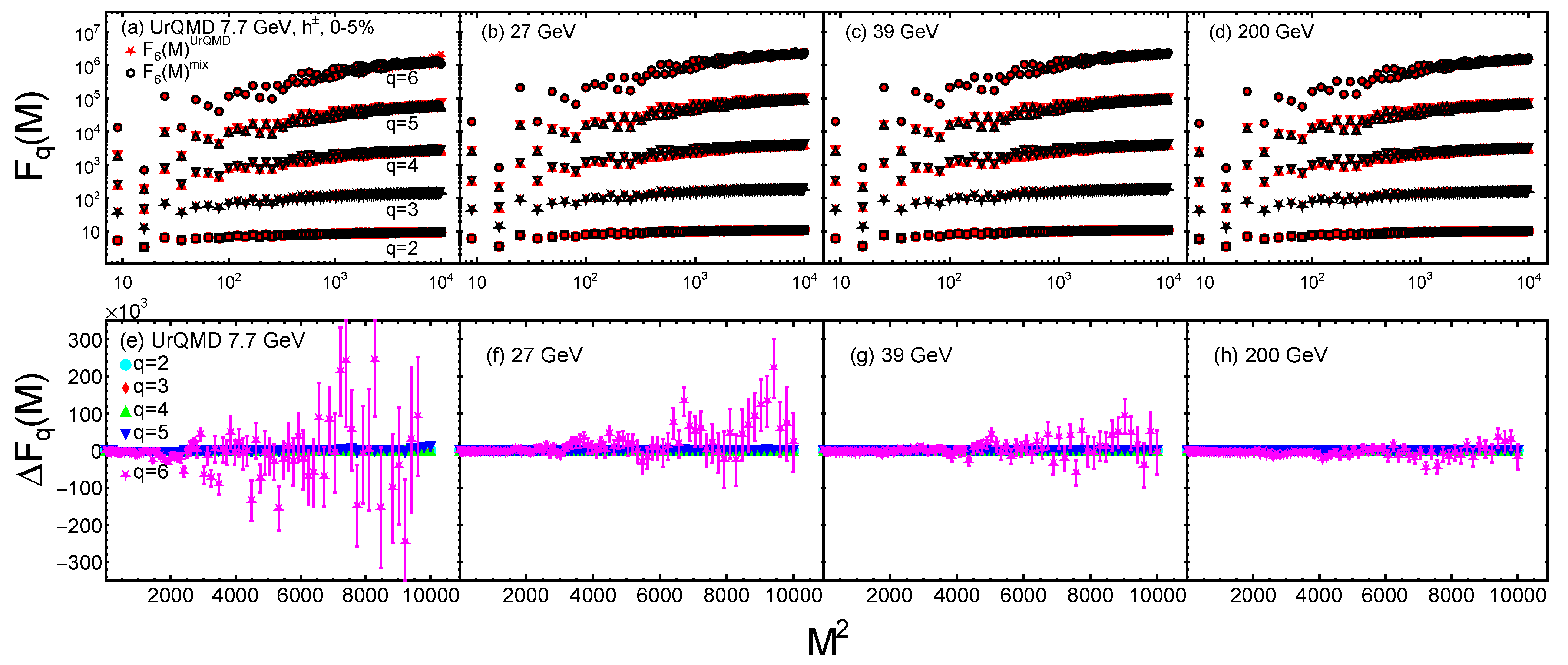
In the upper panels of
Figure 1, we present the factorial moments
for charged hadrons from UrQMD simulations (red solid symbols) and the corresponding mixed events (black open symbols) as a function of
in the most central (0–5%) Au+Au collisions at
= 7.7, 27, 39, and 200
. The UrQMD results show a gradual increase in
with
, saturating for
. Furthermore, all measured orders (
) of
are overlapped with
across all collision energies, indicating that the magnitude of
in UrQMD simulations arises from non-critical dynamical processes inherent to the cascade model.
By using the mixed events to remove the background contribution, the corrected moment
, calculated via Equation (
5), are displayed in the lower panels of
Figure 1. The values of
are found to be consistent with zero within statistical uncertainties. This observation aligns with the absence of any rise in the SFMs, which is expected because the UrQMD model does not incorporate density fluctuations associated with the QCD phase transition. These results also confirm the suitability of the mixed-event method for background removal in such analyses.
In the STAR experiment, a strict power-law dependence of
(
–6) on
—referred to as
scaling—has been observed in the most central (0–5%) Au+Au collisions [
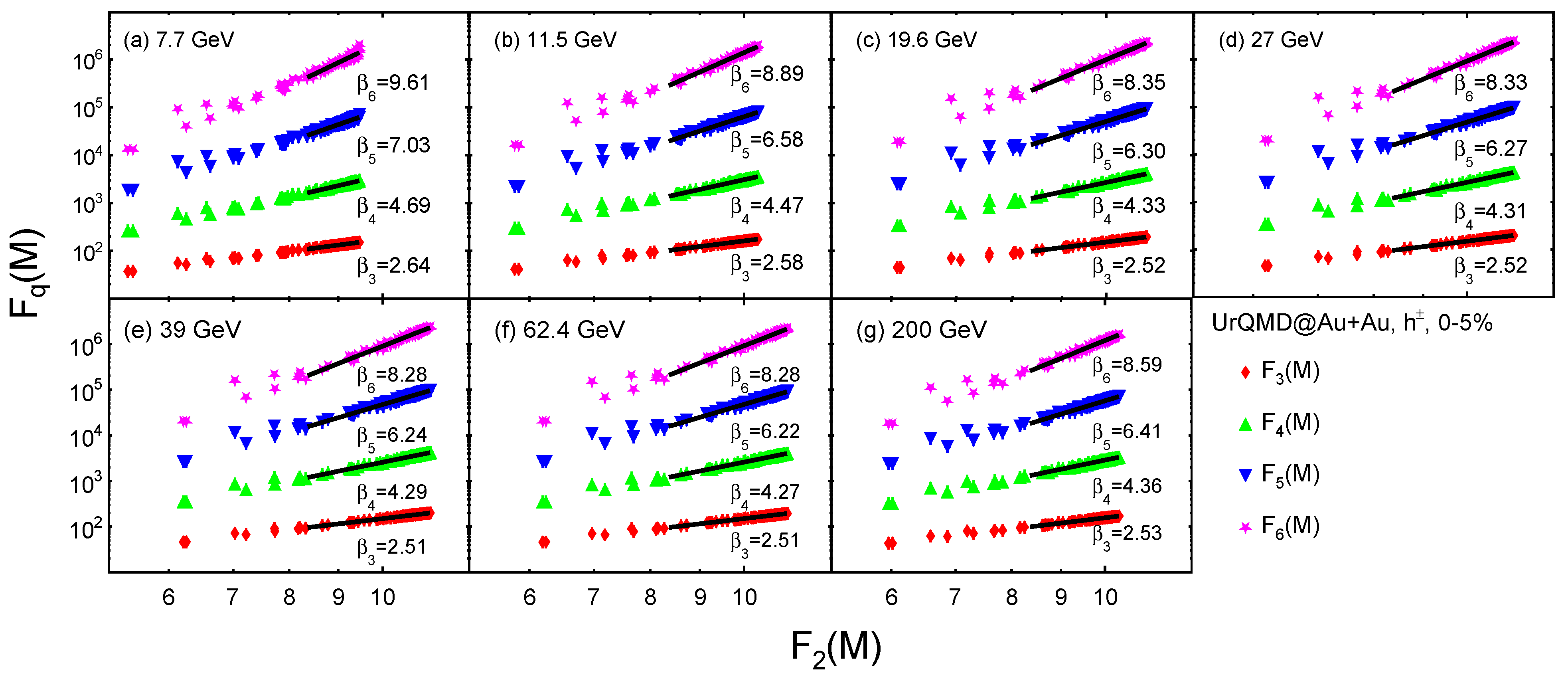
24]. In this study, we examine the corresponding behavior for
from the UrQMD model without background subtraction.
Figure 2 shows
(
–6) as a function of
. A power-law scaling of
is also evident in the UrQMD results, demonstrating that non-critical dynamics alone can produce such a scaling pattern among the factorial moments. It is noteworthy that this scaling disappears when the background contributions, estimated via the mixed-event method, are subtracted from the UrQMD data. The values of the exponent
, extracted by fitting
with Equation (
3), are displayed adjacent to the corresponding fit lines in
Figure 2.
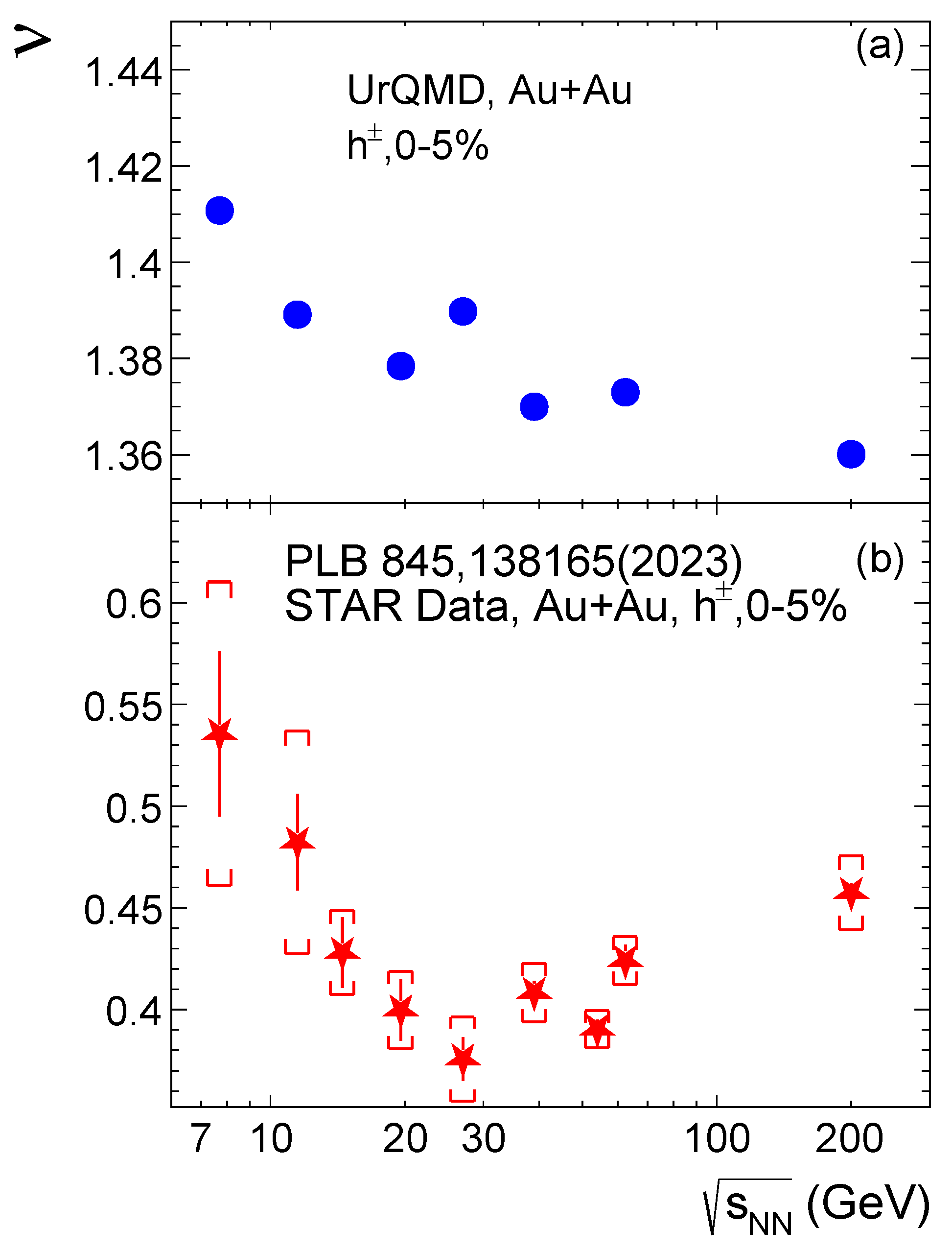
The scaling exponent
is extracted by fitting
via Equation (
4) for charged hadrons in the most central (0–
) Au+Au collisions at
–
from the UrQMD calculations without background subtraction, as shown in the upper panel of
Figure 3. On the other hand, the lower panel displays the corresponding result from the STAR experiment, in which background contributions have been subtracted. It is important to note that the values of
obtained from the UrQMD model are directly calculated from the scaling of
, without applying background subtraction via Equation (
5). Therefore, the magnitude of
in UrQMD reflects purely non-critical dynamical contributions, serving as a baseline for hadronic transport. In contrast, the
values extracted from STAR data are obtained from the scaling of
, where
represents the factorial moment after subtracting the mixed-event background. It is found that the range of
values from the UrQMD calculations is much larger than that from the STAR data, indicating that non-critical dynamics alone can yield a large
.
The
values from UrQMD are smaller than those reported from models such as AMPT (
) [
42] and HIJING (
) [
43]. The differences in
obtained from various models arise from their distinct dynamical descriptions of the collision evolution. Additionally, variations in kinematic acceptance (e.g.,
and
) and in the selection of analyzed particle species contribute to the observed discrepancies. Since none of these models include the critical fluctuations of the QCD phase transition, a larger
value does not necessarily imply stronger fluctuations, as noted in earlier literature [
38].
Regarding the collision energy dependence of , a distinct difference is observed. The UrQMD results show a monotonically decreasing trend of with increasing . In contrast, the STAR data exhibit a non-monotonic trend in energy dependence with a minimum around . This marked discrepancy suggests the presence of genuine dynamical density fluctuations in the heavy-ion collision system beyond those accounted by non-critical models. A full understanding of the experimental observations will therefore require dynamical models that incorporate the critical point. Finally, we note that in the UrQMD model, effectively vanishes when mixed-event method is used to subtract the background, because is consistent with zero and accordingly the power-law scaling of is absent.
4. SFMs from the Gaussian Sample
As shown in the previous section, non-critical dynamical fluctuations can contribute to the observed and values. Therefore, a clean baseline that removes all inherent correlations present in the UrQMD data is required. For this purpose, we generate a synthetic data set by sampling particle momenta from a Gaussian distribution. A total of 1 million events are produced. The charged-particle multiplicity per event is sampled from a Poisson distribution with a mean value of , chosen to be close to the measured value of 151 at in the STAR experiment. Within each event, the transverse momenta () of particles are generated as Gaussian random variables with a mean of zero and a variance of . An additional cut of is applied to this Gaussian data set.
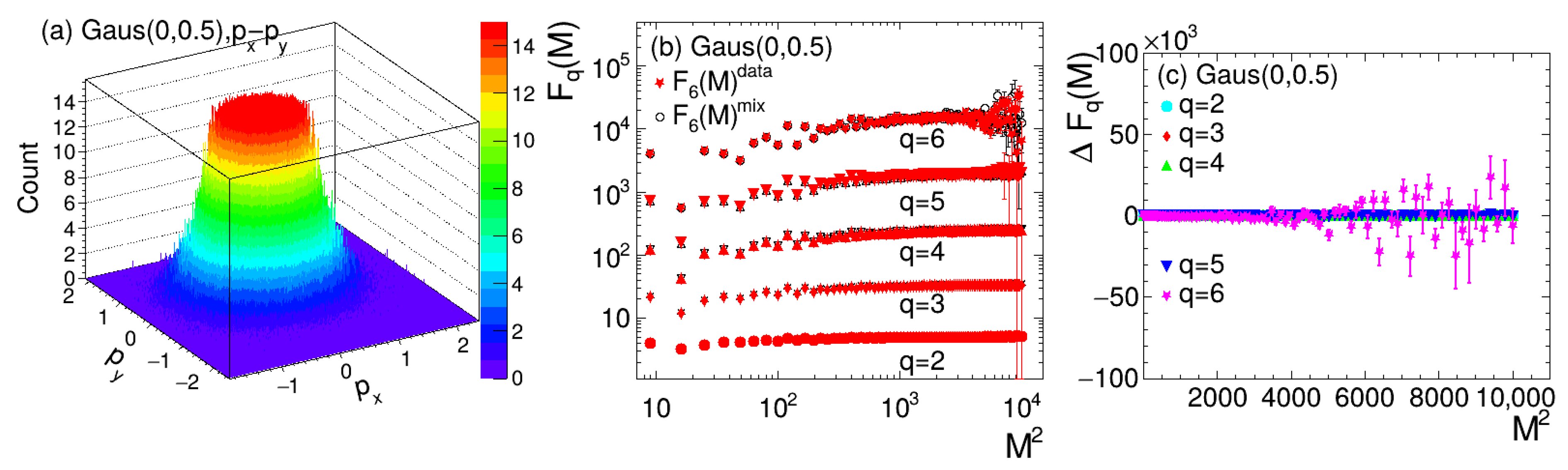
The same analysis procedure is applied to the Gaussian data set, with the results presented in
Figure 4.
Figure 4a displays the
-
distribution of particles in the Gaussian sample.
Figure 4b shows
and
as functions of
, while
Figure 4c presents the corresponding
versus
. Similar to the findings from the UrQMD model,
is overlapped with
across all moments, and the values of
are compatible with zero within statistical uncertainties. This result, however, differs from that reported in Ref. [
47], where
was found to be significantly positive and followed the
scaling. The discrepancy can be attributed primarily to the much larger mean multiplicity (
) and a different implementation of the mixed-event method used in the referenced study [
47].
5. Quantifying the Critical Signal in STAR Data with Hybrid UrQMD+CMC Model
Current UrQMD calculations show no indication of intermittency signal in Au+Au collisions at RHIC energies. To date, a model capable of simulating critical intermittency driven by local density fluctuations near the QCD critical point is the critical Monte Carlo (CMC) model [
18,
20,
32,
33,
48]. This model generates particle momenta via Lévy random walks, thereby creating localized, critical density fluctuations in momentum space. It should be noted that the CMC is essentially a toy model, designed as a static momentum space generator rather than a dynamical simulation. It only supplies momentum space distributions for final-state particles and does not include any dynamical evolution of the collision system, unlike transport models such as UrQMD which simulate the full heavy-ion collision process including nonequilibrium transport description and hadronic evolution.
To reproduce the intermittency signal observed by the STAR experiment—specifically, the rise of with and the distinct scaling—we combine the UrQMD and CMC models into a hybrid UrQMD+CMC framework. The combination method robustly introduces CMC particles, whose momentum profiles contain critical fluctuations, into the final-state particles yield from UrQMD events, which provide the dynamical background.
A key parameter is the critical particle fraction, defined by the replacement ratio . Here, is the number of selected CMC particles added to a pure UrQMD event, and is the number of charged hadrons in that background UrQMD event. A larger corresponds to a greater number of CMC particles carrying the critical signal, which leads to a stronger critical signature superimposed on the non-critical UrQMD background. Physically, represents the fraction of critical particles whose primordial critical information remains detectable and is not obscured by substantial background effects and dynamical noise throughout the evolution of a heavy-ion collision.
The procedure for generating UrQMD+CMC events is as follows:
- 1.
Generate a sample of UrQMD events with the desired collision parameters, recording the charged-particle multiplicity and momenta for each event.
- 2.
Configure the CMC model with the Lévy parameter
and
, corresponding to a critical system in the 3D Ising universality class with a fractal dimension
[
18,
48]. This choice ensures the resulting intermittency indices from CMC calculations are consistent with theoretical predictions. Then, a particle with
from the UrQMD event is randomly selected to serve as the seed for a Lévy random walk. This walk generates a sequence of particle momenta, constituting a CMC event. The CMC event is required to have the same
and a similar transverse momentum spectrum as the associated UrQMD event.
- 3.
Perform particle replacement: Randomly select one particle from the UrQMD event and one from the matched CMC event. Replace the UrQMD particle with the CMC particle if the condition is satisfied. If this condition is not met, the random selection is repeated until a suitable pair is found. Once a replacement is made, the used CMC particle is removed from the CMC dataset. The -matching criterion preserves the global spectrum of the original UrQMD events in the final hybrid sample.
- 4.
Repeat step 3 until the number of replaced particles reaches the target value defined by . The remaining UrQMD particles and the newly coming CMC particles together constitute a single UrQMD+CMC event.
- 5.
Apply steps 2–4 to all UrQMD events in the sample to produce the complete hybrid dataset.
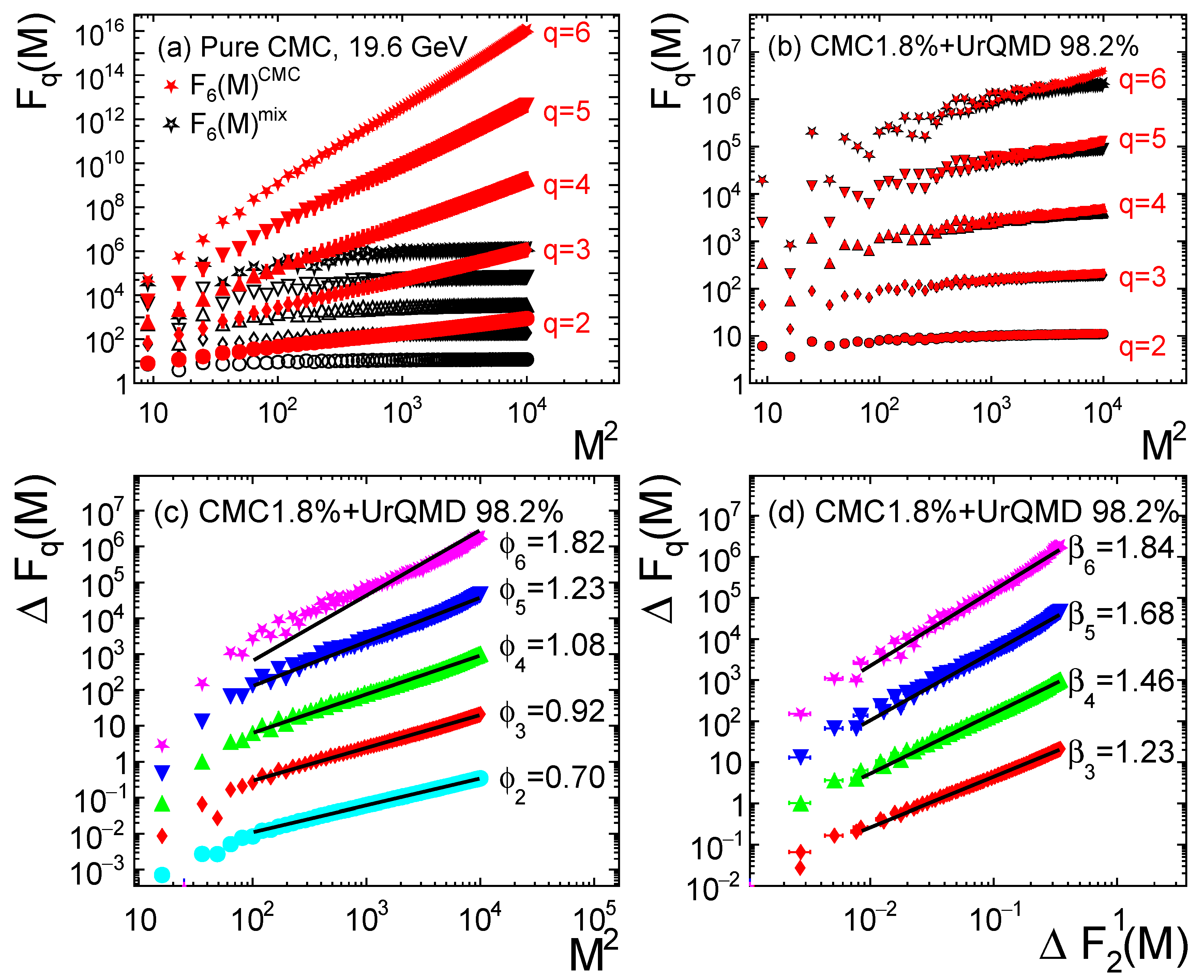
Figure 5 presents results from the hybrid UrQMD+CMC model.
Figure 5a shows the pattern of critical intermittency from the pure CMC model (i.e., 100% critical signal). A clear power-law dependence of
on
is observed, with
significantly exceeding
, particularly for higher-order moments (
–6).
Figure 5b displays
and
(
–6) versus
for the UrQMD+CMC model with a small critical particle fraction,
. Here,
is slightly larger than
, indicating a weak critical signal superimposed on the UrQMD background. This behavior closely resembles the trend observed in the STAR experimental data. The corresponding
are shown in
Figure 5c. While
broadly follows a power-law increase with
, distortions become apparent at higher orders (
–6). Despite the small critical fraction, the second-order moment
remains largely unaffected, yielding an extracted intermittency index
. This value is close to the critical prediction of 0.67, suggesting that
can be used as a particularly suitable observable to extract weak signals of critical intermittency by comparing UrQMD+CMC simulations with STAR data. Finally,
Figure 5d shows the scaling of
with
. The
scaling relation holds reasonably well across the measured orders, although a deviation is visible for
. Notably, this deviation is smaller than that observed in the
scaling in
Figure 5b, indicating the relative stability of the
scaling approach.
In previous studies [
32,
33], the
calculated from the UrQMD+CMC model was compared with corresponding measurements from the STAR experiment. It was found that the model calculation of
agrees with the experimental data when an intermittency signal of about 1–2% is introduced into the UrQMD sample. However, the physical interpretation of
remains debated. In particular, its expected critical value—accounting for a realistic reduced transverse-momentum phase space and detector acceptance—has not yet been established. More importantly, as noted in the preceding paragraph, higher-order moments
become distorted at small
. Since
is derived from these higher-order moments, its extracted value can be significantly affected by such distortions, making a direct comparison between model and experiment less conclusive.
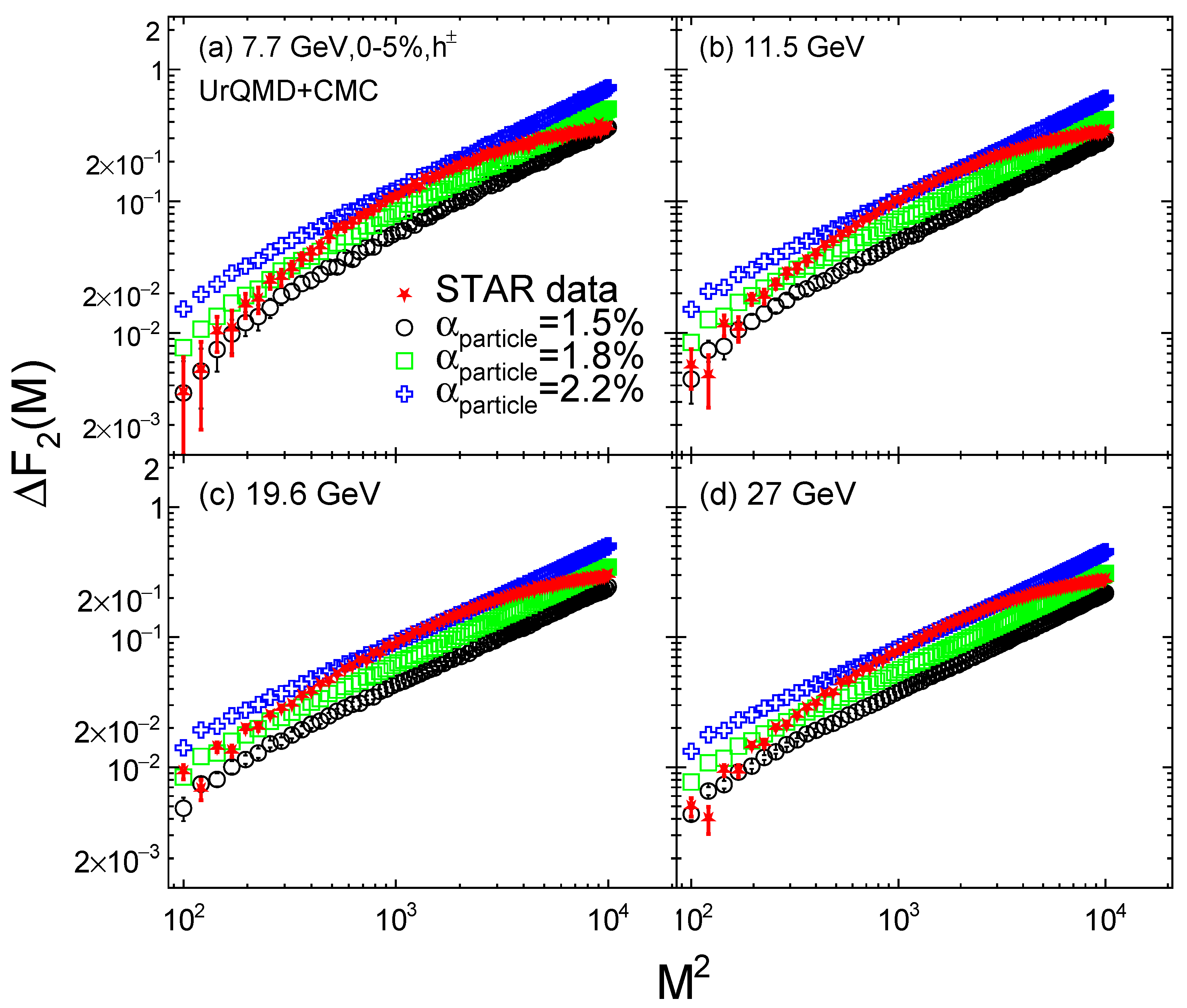
To circumvent this difficulty, we perform a direct, quantitative comparison using the second-order moment
. This observable remains largely unaffected even for small values of
and its physical interpretation is well established. In
Figure 6, we compare
between UrQMD+CMC simulations and STAR data at
= 7.7, 11.5, 19.6, and 27
. The experimental data (red stars) lie systematically between the model calculations for
and
, and are nearly consistent with the simulation using
. This close agreement allows us to draw a well-supported conclusion: a critical intermittency signal on the order of approximately
could be present in the most central Au+Au collisions reported by the STAR experiment.
The
obtained from the hybrid model exhibits a linear dependence on
across the entire
range. In contrast, the corresponding experimental data from STAR show an upward curvature, eventually saturating at larger
. This discrepancy may arise from the effect of dimensional reduction present in the experimental data, which is not accounted for in the current CMC simulation. As noted in earlier studies [
49,
50], critical local fluctuations are expected to be self-affine rather than strictly self-similar. Consequently, while a clear power-law scaling of
exists in the full three-dimensional momentum space, its projection onto the two-dimensional
-
plane—analyzed under the assumption of self-similarity—can yield a curved rather than a purely linear dependence. We therefore emphasize that the extracted critical fraction of approximately 1.8% is inherently model-dependent. An improved CMC model that includes a self-affine structure for the critical component may better describe the observed curvature in
and thus lead to a revised estimate. Future studies need to incorporate self-affine scaling into such analyses in order to achieve a more precise and well-founded quantification of the critical signal fraction.
6. Summary and Outlook
In summary, we have performed a systematic model study to investigate the intermittency signal in Au+Au collisions at RHIC energies, with the aim of assessing non-critical background contributions and quantifying the fraction of critical signal present in experimental data. Using the UrQMD cascade model, which incorporates essential non-critical dynamics but no density fluctuations of the QCD phase transition, we first established that non-critical processes alone can produce sizable and yield a large . Notably, without background subtraction, UrQMD shows a monotonically decreasing trend of with increasing , in clear contrast to the non-monotonic energy dependence with a minimum near observed in the background-subtracted STAR data. Crucially, these background-induced signals vanish when the mixed-event subtraction is applied, yielding consistent with zero. This confirms both the necessity and the effectiveness of background subtraction in intermittency analyses and highlights the risk of misinterpreting non-critical correlations as critical phenomena if such subtraction is omitted.
To probe the critical signal in the experimental data, we developed a hybrid UrQMD+CMC framework, in which critical density fluctuations generated by the CMC model are embedded into the UrQMD hadronic background. Moving beyond previous comparisons that relied on the exponent —which carries theoretical uncertainties and is sensitive to distortions in higher-order moments at small critical fraction—we advocated for a more particularly suitable observable: the second-order moment . This quantity remains stable even for weak critical signals and has a clearer physical interpretation. Our central quantitative result is that the measured by STAR in the most central Au+Au collisions at –27 systematically lies between the calculations of the UrQMD+CMC model with critical particle fractions and , showing excellent agreement with the model curve for . This allows us to estimate that a critical intermittency signal on the order of approximately could be present in the experimental data.
Looking forward, several refinements and extensions can deepen this analysis. A primary limitation is the model dependence of the extracted critical fraction. This may arise from the fact that the current CMC implementation assumes self-similar critical fluctuations, whereas theory and earlier studies indicate they should be self-affine in three-dimensional momentum space. The observed discrepancy in the shape of versus —linear in the model but curved in the data—likely originates from this simplification. Future implementations should incorporate self-affine scaling to better model the projection from the full momentum space onto the analyzed two-dimensional transverse-momentum plane. Second, beyond the particle-level replacement (parameterized by ) studied here, an event-level admixture scheme should be explored. This would correspond to a physical scenario in which only a subset of heavy-ion collisions traverse the critical region of the QCD phase diagram, providing a more realistic mapping between the critical fraction and collision dynamics. Third, our hybrid approach introduces critical signals statically into the final state of the UrQMD simulation. A more complete treatment requires dynamically coupling the evolution of critical modes with the hadronic transport, which would provide a more realistic description of the space-time development of fluctuations.
In conclusion, this study underscores the significant role of non-critical backgrounds in intermittency observables and demonstrates a practical methodology to disentangle them from potential critical signal. The estimated critical signal fraction of approximately provides a quantitative benchmark for interpreting current STAR results and offers valuable guidance for ongoing and future experiments in the search for the QCD critical point.