Article

Lattice Boltzmann Modeling of Conjugate Heat Transfer for Power-Law Fluids: Symmetry Breaking Effects of Magnetic Fields and Heat Generation in Inclined Enclosures

by
Mohammad Nemati
1,
Mohammad Saleh Barghi Jahromi
2,
Manasik M. Nour
3,
Amir Safari
4,*,
Mohsen Saffari Pour
5,
Taher Armaghani
6 and
Meisam Babanezhad
6,7
1
Faculty of Mechanical Engineering, Yazd University, Yazd 8915818411, Iran
2
Department of Mechanical Engineering, University of Jiroft, Jiroft 7867155311, Iran
3
Department of Mathematics, College of Science and Humanities in Al-Kharj, Prince Sattam bin Abdulaziz University, Al-Kharj 11942, Saudi Arabia
4
Department of Science and Industry Systems, University of Southeastern Norway (USN), 3616 Kongsberg, Norway
5
Department of Mechanical Engineering, Faculty of Engineering, Shahid Bahonar University of Kerman, Kerman 76169-13439, Iran
6
Department of Mechanical Engineering, WT.C., Islamic Azad University, Tehran 1477893855, Iran
7
Department of Mechanical Engineering, National University of Skills (NUS), Tehran 16417-11111, Iran
*
Author to whom correspondence should be addressed.
Symmetry 2026, 18(1), 137; https://doi.org/10.3390/sym18010137
Submission received: 21 October 2025 / Revised: 2 January 2026 / Accepted: 6 January 2026 / Published: 9 January 2026
(This article belongs to the Section Engineering and Materials)

Abstract

Conjugate heat transfer in non-Newtonian fluids is a fundamental phenomenon in thermal management systems. This study investigates the combined effects of magnetic field topology, heat absorption/generation, the thermal conductivity ratio, enclosure inclination, and power-law rheology using the lattice Boltzmann method. The parametric analysis shows that increasing the heat generation coefficient from −5 to +5 reduces the average Nusselt number by up to 97% for the pseudo-plastic fluids and up to 29% for the Newtonian fluids, while entropy generation increases by 44–86% depending on the thermal conductivity ratio. Increasing the inclination angle from 0° to 90° weakens convection and reduces heat transfer by nearly 77%. Magnetic field strengthening (Ha = 0–45) decreases the Nusselt number by 20–55% depending on the barrier temperature. Among all tested conditions, the highest thermal performance (maximum heat transfer and minimum entropy generation) occurs when using a pseudo-plastic fluid (n = 0.75), exhibiting high wall conductivity (TCR = 50) and heat absorption (HAPC = −5), a cold obstacle ( θ b = 0 ), and zero inclination (λ = 0°), as well as in the absence of the magnetic field effects. These quantitative insights highlight the controllability of the conjugate heat transfer and irreversibility in the power-law fluids under coupled magnetothermal conditions.

1. Introduction

Considering the high importance of convection processes in many branches of engineering and natural processes, such as the design of cooling equipment that is used in industries such as transportation, electronics, and power generation, it is very important to investigate how this phenomenon works in different conditions [1,2,3,4,5]. With the advancement of technology, fast and high-volume operations occur at high speeds; it is vital to use systems with high heat and power [6]. Therefore, it is indispensable to use advanced and optimal cooling equipment. In this situation, the miniaturization and design of this equipment in different forms to achieve higher efficiency become significant [7]. The dominant process that occurs in these devices is free convection [8]. It is a process that does not require any external force [9]. The only cause of this process is the existence of a temperature difference such that the working fluid trapped in the chamber moves [10,11]. Most of the used fluids exhibit non-Newtonian behavior [12]. In terms of the connecting factor of stress tensors, the strain rate is not a constant value, unlike Newtonian fluids [13]. Butter, jam, chewing gum, soaps, blood, and cosmetics are among the famous examples of non-Newtonian fluids that are widely used in daily life [14,15,16,17]. Various models have been proposed to consider non-Newtonian fluid behavior, and one of the most famous and widely model is the power-law (PL) model. Using this model, the fluid exhibited different behaviors for different strain rates. n is an index used to determine the type of fluid (n < 1: pseudo-plastic or shear-thinning fluid, n = 1: Newtonian fluid, and n > 1: dilatant or shear-thickening fluid) [18,19,20,21,22]. Among the effective methods for changing the type of current created is the use of external fields such as the electric field and the magnetic field (MF) [23]. Sometimes these external factors are voluntarily employed to achieve a specific goal, while they are sometimes unwanted and are imposed on the fluid flow (FF) [24]. Among these efforts, the studies of Zeeshan et al. [25], Ishtiaq et al. [26], Ellahi et al. [27], and Sait et al. [28] can be mentioned. A study by Kefayati [29] on the mixed convection of the non-Newtonian nanofluid via the LBM under the uniform MF exhibited that with the decline of the PL index, the decrement of the Hartmann number (Ha), and the increase in the Rayleigh number (Ra), the rate of heat transfer (HT) is reduced. This study, which was conducted within a square chamber with adiabatic horizontal walls and non-isothermal vertical walls, proved that the addition of nanoparticles helps improve the HT.
In recent years, investigating the convection-induced behavior of such fluids inside closed chambers has been of great interest. The findings of these studies depicted that temperature and flow fields are affected by the type of fluid behavior and the strength of buoyancy forces [30,31,32,33,34]. Kim et al. [35] selected a vertical chamber containing a PL fluid to investigate natural convection. The simultaneous change in the temperature of the vertical walls led to the creation of FF while the horizontal wall was assumed to be adiabatic. The findings revealed that for a constant Ra value, the convection power and the HT rate change noticeably with the change in the PL index.
According to Acharya et al. [36], the findings from the simulation of the PL nanofluid-free convection HT within a square chamber with undulated walls under the effect of the MF depicted that by changing the fluid PL index value, the effective percentage of adding nanoparticles changes. For all of the Ha and Ra values, the addition of nanoparticles always leads to an increase in the HT for a dilatant fluid, but this effect for a pseudo-plastic fluid can be exhibited for certain values of the Ha. Additionally, it was reported that Ha enhancement is more effective in reducing the Nusselt number (Nu) for n < 1 than for n > 1. Also, although the mean Nu for the non-smooth wall is less than that for the smooth wall, this analysis is not valid for the local Nu.
One of the most common phenomena in the discussion of the HT is the combination of thermal conductivity and convection [37]. This phenomenon, which occurs in various industries and applications, including combustion chambers, is called the conjugate HT [38]. In this process, heat is transferred from a solid to a fluid. For example, in the design and analysis of the HT flow inside the pipe, the heat conducted through the walls of the pipe containing the fluid cannot be ignored [38]. Applied research in this field includes studies by Ferhi et al. [39], Karani et al. [40], Pareschi et al. [41], Chen et al. [42], Nee [43], and Bouchair et al. [44]. Selimefendigil and Öztop [45] analyzed the nanofluid flow under the effect of MF inside a cylindrical chamber, and Geridonmez and Öztop [46] performed a numerical evaluation of the effect of periodic MF on the induced current caused by the nanofluid conjugated with HT.
Among the other parameters affecting the change in the behavior of the FF, the placement of obstacles in the flow path and the presence of heat absorption/production (HAP) are important [47]. It is very important to analyze these cases that either forcefully or voluntarily (to achieve a specific goal) change the characteristics of the flow under different conditions [48]. Abdulkadhim et al. [49] investigated the HAP effect in the presence of an MF under free convection, where the enclosure containing the nanofluid had wavy walls. Lawal et al. [50] exanimated the combined effect of unsteady flow and the HAP under an MF on free convection flow near a vertical wall. Nemati et al. [51] pursued the development of the LBM by modeling a periodic MF in the presence of the HAP inside an enclosure containing a nanofluid using the multiple-relaxation-time approach. The effect of non-uniform boundary conditions on free convection flow inside a semi-open square cavity in the presence of the HAP and MF was investigated by Mahmoudi et al. [52]. Investigating the effects of linear wall temperature variation, the HAP, and the MF on natural convection of nanofluid is another study in this field conducted by Mliki et al. [53].
Entropy analysis is one of the most efficient tools to check the efficiency of thermal systems. The basis of this analysis is the second law of thermodynamics, based on which it is determined which parts of a system have the greatest amount of irreversibility [18]. A higher amount of entropy generation (EG) in a part of the system leads to a decrease in productivity. By knowing this issue, an optimal design with high efficiency is possible [19,20,21,22].
Khodadadi et al. [54] investigated the natural convection of the HT of the PL fluid by embedding a triangular barrier inside the triangular chamber. The increase in the HT rate due to the conduction and reduction in convection effects is the result of the enhancement in the size of the embedded barrier. Therefore, in the case where convection dominates over conduction, the percentage increase in the mean Nu with the increase in the length of the heat source is lower. Khodamoradi et al. [55] numerically investigated the effect of heated barrier placement on non-Newtonian fluid flow and heat transfer within a square chamber. Their findings showed that the highest heat transfer rate occurred at higher Rayleigh numbers and lower power-law indexes. Altering the position of the hot barriers significantly changed the flow characteristics, with this effect being more pronounced for dilatant fluids compared to pseudo-plastic fluids. Bai et al. [56] showed that augmentation of the coefficient of heat absorption/production (HAPC) increases the amount of EG in addition to reducing the mean Nu value. This study, which contained an obstacle for non-Newtonian conjugate natural convection inside the quarter-circle chamber, showed that the effect of the MF and HAPC in reducing the mean Nu decreases as the PL index increases. Similar outcomes were acquired by Sun et al. [57], who investigated the conjugate HT within a 2D chamber containing a cold wall with a variable shape. According to their study, which was performed using the PL fluid, the change in the MF share in EG was taken into account for the change in the PL index and HAPC.
Despite the extensive literature on natural convection of power-law fluids, several important aspects remain insufficiently explored. Most existing studies have considered magnetic fields, heat generation/absorption, or conjugate heat transfer individually. At the same time, the combined effects of these parameters, particularly in the presence of an internal heated barrier, have not been investigated comprehensively. Furthermore, the influence of magnetic field topology, the thermal conductivity ratio, and obstacle heating on entropy generation mechanisms in conjugate systems has not been addressed in prior research.
The main contributions of this work can be summarized as follows:
  • Introducing a detailed coupled magnetothermal model for conjugate heat transfer of power-law fluids under various magnetic field configurations.
  • Demonstrating how magnetic field topology, heat absorption/production, and the power-law index jointly shape vortex structures, isotherm distributions, and entropy generation patterns.
  • Identifying the conditions under which heat generation amplifies or weakens magnetic-field-induced flow suppression.
  • Providing engineering insights for optimizing thermal systems involving non-Newtonian fluids subjected to magnetic control.
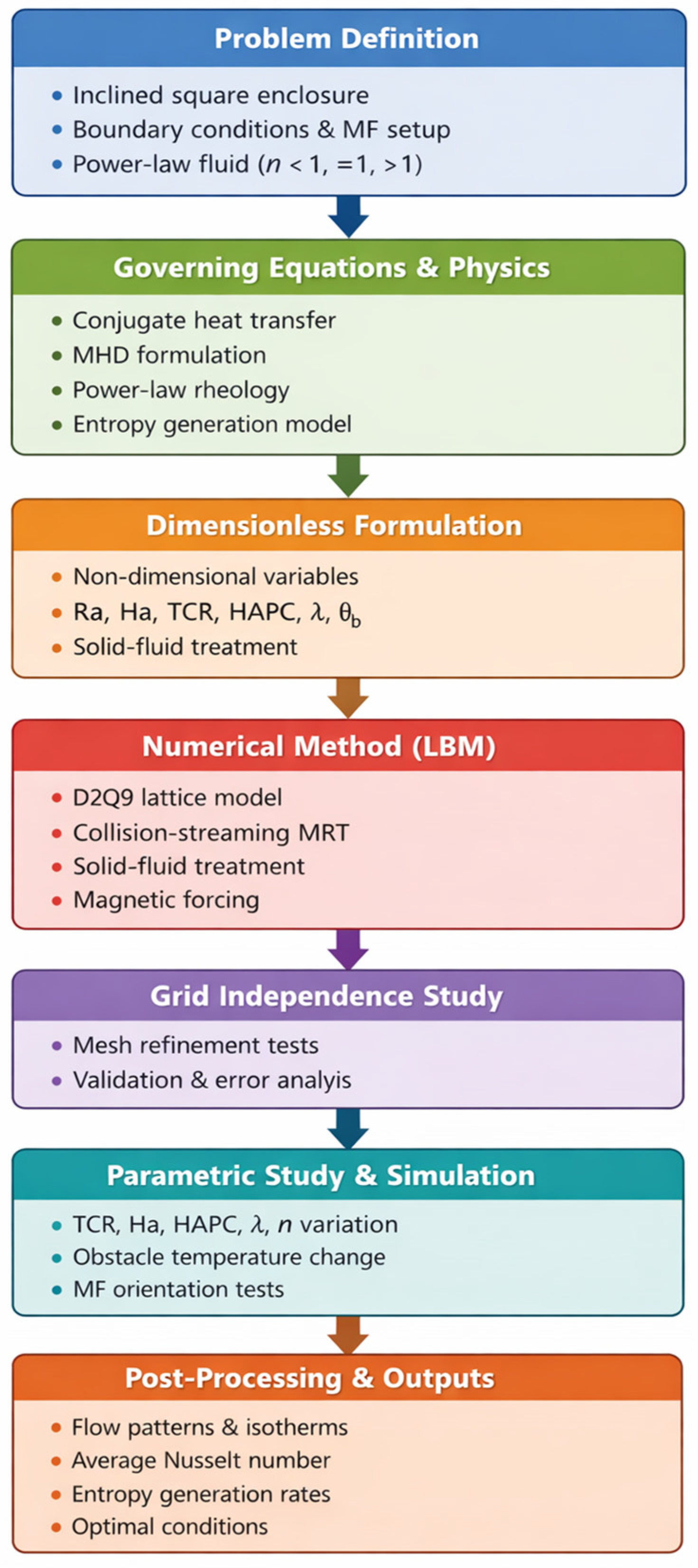
The remainder of this paper is organized as follows: Section 2 presents the mathematical formulation and numerical methodology. Section 3 provides mesh-independence verification. Section 4 discusses the results and physical interpretations. Section 5 concludes this study and highlights its engineering implications. The methodological steps of this research are presented in Figure 1.

2. Materials and Methods

2.1. Explanation of the Available Problem

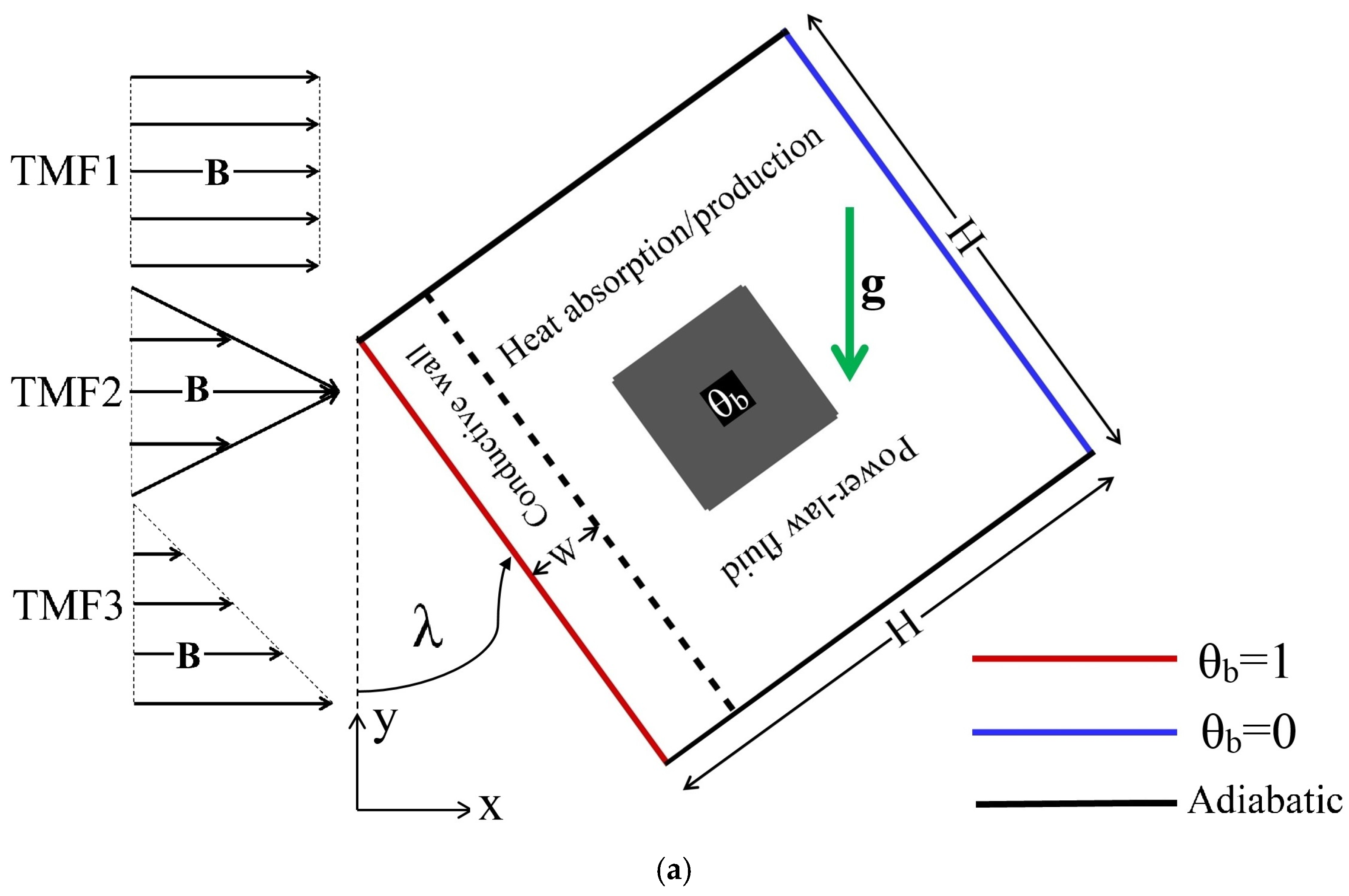
The simulation of the conjugate natural convection of the HT by the PL liquid model occurs in a square chamber with dimensions of H × H. The chamber is placed at a λ angle in different positions to investigate the influence of this parameter. The liquid is assumed to be electrically conductive. A schematic of the geometry under research can be depicted in Figure 2. The adiabatic nature of the horizontal walls, the fixed cold temperature of the right vertical wall, and the fixed hot temperature of the left vertical wall are assumed for the cavity. The main cause of the convection current inside the chamber is the difference in temperature between the walls. Three different shapes are considered to apply the horizontal MF. The purpose of applying the MF in three different forms is to demonstrate how, in a given situation, the convection flow behaves when subjected to the MF effects under various configurations. Although all three forms of the applied MF are horizontal, they have different intensities at various locations within the enclosure. This clarifies the fact that shifting the concentration of the MF to different regions (depending on the gradient of the applied MF) can significantly influence the flow characteristics. The mathematical relation for applying each of these three MF is as follows (assuming λ = 0): TMF1: B = B o   ;   0 y H (uniform throughout the entire enclosure), TMF2: B = B o ( y ( H 2 ) )   ;   0 y H 2 B o ( 1 ( y H 2 ) ( H 2 ) )   ;   H 2 < y H   , and TMF3: B = B o ( 1 y H )   ;   0 y H . Q power is intended for the available uniform HAP in the chamber. The thickness of the conductor wall when heat is transferred from the hot wall to the fluid is considered to be W = 0.1 H. The length of each side of the square barrier that is placed in the path of FF is 0.3 H. A variable barrier temperature is assumed to evaluate its effect on the flow characteristics.

2.2. Basic Equations

In the existing simulation, it is assumed that the convection flow created inside the chamber is laminar, steady state, 2D, and incompressible; therefore, the main equations of the FF and HT can be written according to Equations (1)–(4) [8,9,10]. Since the density changes with temperature and the viscosity of the fluid changes with the strain rate, it is assumed that the rest of the fluid properties are constant. The density changes using the Boussinesq approximation, which does not consider the thermal radiation and viscous dissipation of this numerical solution [58,59,60,61]. The scale used to measure the current strength is defined as the stream function according to Equation (5). Equation (6) represents the kinematic viscosity for the PL fluid. [57]. Equation (7) is the mathematical formula used to simulate the interaction between the fluid and the conductive wall. It is defined according to Equation (8) as dimensionless variables that are used in solving equations, expressions, and analyses. The shear rate in the nodes, which is the factor that creates the kinematic viscosity, is expressed in Equations (8) and (9) [61,62,63].
u x + v y = 0 Continuity
ρ ( u u x + V u y ) = p x + μ ( 2 u 2 x + 2 u 2 y ) + ρ g β ( T T c ) s i n λ Momentum   in   the   x   direction
ρ ( u V x + V V y ) = p y + μ ( 2 V 2 x + 2 V 2 y ) + ρ g β ( T T c ) c o s λ σ B 2 V Momentum   in   the   y   direction
u T x + v T y = α ( 2 T x 2 + 2 T y 2 ) + Q ρ C p ( T T c ) Energy
ψ ( x , y ) = udy + ψ 0 Stream   function
μ = μ 0 2 ( u x ) 2 + ( v y ) 2 + ( v x + u y ) 2 ( n 1 ) 2 D y n a m i c   v i s c o s i t y
( k s T x ) x + ( k s T y ) y = 0 S o l i d f l u i d   i n t e r a c t i o n   e q u a t i o n
γ ij 0.5 ( u i x j + u j x i )   and   γ = 2 γ ij γ ij S t r a i n   t e n s i o n
υ x , t = υ 0 γ ( n 1 ) = Pr Ra ( 2 n ) 2 γ ( n 1 ) K i n e m a t i c   t e n s i o n
The equations that determine the value of EG can be expressed according to Equations (10)–(13) [18,19,20,21,22].
s TOT = s H + s F + s M T o t a l   e n t r o p y
s H = k f T 0 2 [ ( T x ) 2 + ( T y ) 2 ] ;   T 0 = T h + T c 2 E n t r o p y   d u e   t o   H T
s F = μ γ T 0 [ 2 ( ( u x ) 2 + ( V y ) 2 ) + ( u y + v x ) 2 ] E n t r o p y   d u e   t o   f l u i d   f r i c t i o n
s M = σ B 2 T 0 v 2 E n t r o p y   d u e   t o   M F
By presenting the variables in dimensionless form in Equation (14), the dimensionless main equations are stated in Equations (15)–(23).
X = x H ,   Y = y H ,   U = uH α Ra ,   V = vH α Ra ,   υ 0 = μ 0 ρ ,   Pr = υ 0 H 2 n α 2 n ,   θ = T T c T h T c ,   TCR = k s k f   Ha = B H n σ α 1 n μ 0 ,   Ra = β θ gH 2 n + 1 υ 0 α n ,   P = pH 2 ρ Ra α 2 ,   HAPC = QH 2 ρ C p α ,   α = υ 0 Pr ,   S = s T 0 2 H 2 k f ( T h T c ) 2
U X + V Y = 0
U U X + V U Y = P X + Pr θ sin λ + Pr Ra ( 2 n ) 2 [ X ( 2 χ U X ) + Y ( χ U y ) + X ( χ V Y ) ]
U V X + V V Y = P Y + Pr θ cos λ PrHa 2 Ra V + Pr Ra ( 2 n ) 2 [ X ( χ V X ) + Y ( 2 χ V y ) + X ( χ U Y ) ]
U θ X + V θ Y = 1 Ra ( 2 θ X 2 + 2 θ Y 2 + HAPC θ )
χ = 2 ( U X ) 2 + ( V Y ) 2 + ( V X + U Y ) 2 ( n 1 ) 2
S TOT = S T + S F + S F
S T = [ ( θ X ) 2 + ( θ Y ) 2 ]
S F = η 1 χ [ 2 ( ( U X ) 2 + ( V Y ) 2 ) + ( U Y + V X ) 2 ]
S M = η 2 Ha 2 V 2
To solve the equations in this simulation, η 1 and η 2 are assumed to be 10−4 [30,31,32]. It is important to keep in mind that heat generation is determined as Q > 0, and heat absorption is determined as Q < 0.

2.3. Extracted Equations Related to the LBM

The LBM is a potent technique for modeling the FF that solves the discretized Boltzmann equation rather than the Navier–Stokes equations, giving it significant advantages over existing computational fluid dynamics techniques [57,58,59]. The LBM is a relatively new simulation technique for complex geometries. Unlike the traditional and conventional CFD methods that solve the main conservation equations, in the LBM, the fluid consists of imaginary particles and includes two stages of impact and flow [60]. In this numerical work, the LBM features have been used for simulations. This method, which is based on the kinetic theory of gases and is classified at the mesoscopic scale, has received much attention due to its special characteristics. The ability to be parallelized, simplifying the application of boundary conditions and modeling complex geometries; the capability to run in a vast scope of flow regimes; and the possibility of simulating complex phenomena such as combustion are among the advantages of this numerical method compared to other CFD methods [61,62,63,64,65]. In addition to the mentioned cases, the plainness of exerting boundary conditions amongst solid and fluid walls is one of the reasons for choosing this numerical method for simulations [66,67,68,69,70]. The numerous use of this numerical solution method in recent years reveals the great capabilities of this method [71,72,73,74,75].
Three separate distribution functions are considered to model the current (f), energy (g), and magnetic (h) fields, and the related equations are presented in Relations (24)–(27) [57,76,77]. feq, geq, and heq in the equations below represent the equilibrium distribution functions that are presented in Equations (28)–(31).
f i x + c i , t + 1 = f i x , t f i x , t f i eq x , t τ f + c i F i
F i = 3 ω i ρ g β θ 3 ρ ω i H a 2 υ ( x , t ) H 2 v
g i x + c i , t + 1 = g i x , t g i x , t g i eq x , t τ g + Q ( ρ C p ) ( T T c )
h i x + c i , t + 1 = h i x , t h i x , t h i eq x , t τ h
f i eq = ρ ω i 1 + 3 c i . u + 9 2 c i . u 2 3 2 u . u + 3 ω i 2 c i 2 B 2 2 c i . B
g i eq = ω i T 1 + 3 c i . u
h ix eq = λ i B x + 3 c ix ( vB x uB y )
h iy eq = λ i B y + 3 c iy ( uB y vB x )
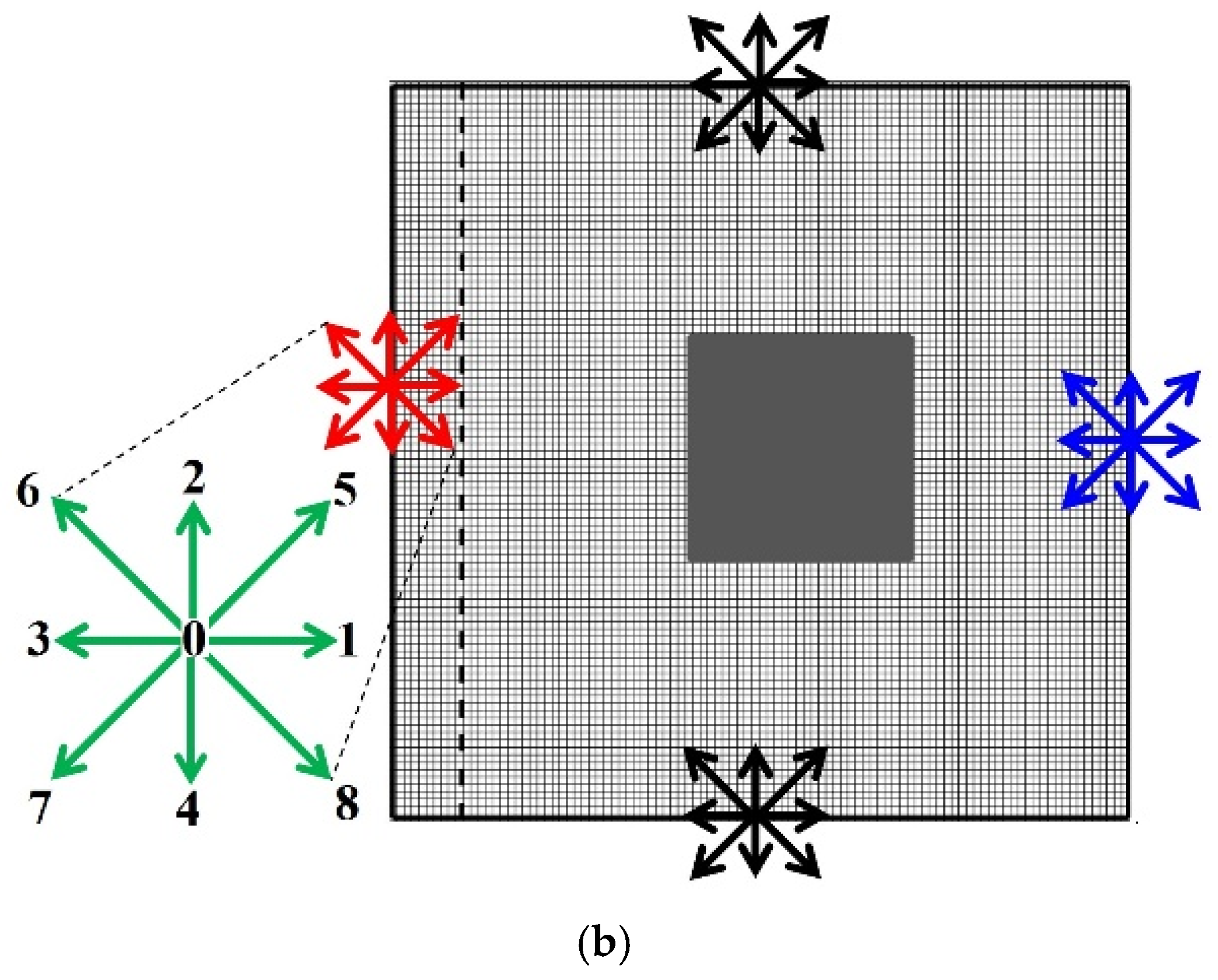
In the D2Q9 grid arrangement, weighting coefficients and discrete speeds are determined according to Equations (32) and (33). λ values related to Equations (30) and (31) are written as shown in Equation (34) [46]. The relevant relaxation times for the numerical solution are written based on Equations (35)–(37). Equation (38) presents the main values macroscopically according to the introduced distribution functions [66]. The D2Q9 network arrangement with nine velocities is used in different directions in this simulation for the temperature field and the FF, as shown in Figure 2b.
ω 0 f = 4 9 ,   ω 1 4 f = 1 9 ,   ω 5 8 f = 1 36
c 0 = 0 c 1 4 = [ cos ( ( i 1 ) π 2 ) , sin ( ( i 1 ) π 2 ) ] c 5 8 = 2 [ ( cos ( ( i 5 ) π 2 + π 4 ) , sin ( ( i 5 ) π 2 + π 4 ) ]
λ 0 = 1 3   and   λ 1 4 = 1 6
τ * = 3 υ + 0 . 5
τ * * * = 3 α + 0.5
τ * * * = 3 η + 0.5
ρ = i = 0 8 f i ,   ρ = f i ,   u = 1 ρ c i f i ,   T = g i ,   B x = h ix   and   B y = h iy

2.4. Boundary Conditions

Since the correct application of boundary conditions is extremely important to achieve an accurate and reliable solution in numerical simulations, special attention should be paid to them [70,71,72,73]. In the streaming step, the distribution functions that are outside the domain are determined, while the unknown functions inside the domain are determined using the bounce-back model [74,75,76].
The electric current’s density satisfies the no-flux condition ( J n = 0 ) at solid walls. In the LBM, this is enforced automatically through the bounce-back scheme of the magnetic distribution function h i , which prevents induced currents from crossing the fluid–solid interface.
For instance, boundary conditions can be expressed using Equations (39)–(42) while taking the left vertical wall, the upper and lower horizontal walls, and the right vertical wall into consideration (Figure 2b). Concerning the bounce-back model, Equations (43) and (44) can be used to determine the frontier condition for the upper and lower adiabatic walls of the chamber. The temperature frontier conditions for the hot wall and cold wall are based on Equations (45) and (46).
f 1 ( 0 , j ) = f 3 ( 0 , j ) ,   f 5 ( 0 , j ) = f 7 ( 0 , j ) ,   f 8 ( 0 , j ) = f 6 ( 0 , j )
f 4 ( i , H ) = f 2 ( i , H ) ,   f 7 ( i , H ) = f 5 ( i , H ) ,   f 8 ( i , H ) = f 6 ( i , H )
f 2 ( i , 0 ) = f 4 ( i , 0 ) ,   f 5 ( i , 0 ) = f 7 ( i , 0 ) ,   f 6 ( i , 0 ) = f 8 ( i , 0 )
f 3 ( H , j ) = f 1 ( H , j ) ,   f 6 ( H , j ) = f 8 ( H , j ) ,   f 7 ( H , j ) = f 5 ( H , j )
g 4 ( i , H ) = g 4 ( i , H 1 ) ,   g 7 ( i , H ) = g 7 ( i , H 1 ) ,   g 8 ( i , H ) = g 8 ( i , H 1 )
g 2 ( i , 0 ) = g 2 ( i , 1 ) ,   g 5 ( i , 0 ) = g 5 ( i , 1 ) ,   g 6 ( i , 0 ) = g 6 ( i , 1 )
g 1 ( 0 , j ) = θ h ω ( 1 ) + ω ( 3 ) g 3 ( 0 , j ) ,   g 5 ( 0 , j ) = θ h ω ( 5 ) + ω ( 7 ) g 7 ( 0 , j ) ,   g 8 ( 0 , j ) = θ h ω ( 6 ) + ω ( 8 ) g 6 ( 0 , j )
g 3 ( H , j ) = g 1 ( H , j ) ,   g 6 ( H , j ) = g 8 ( H , j ) ,   g 7 ( H , j ) = g 5 ( H , j )
The dimensionless boundary conditions in macroscopic form for λ = 0 are set according to Equation (47).
F l u i d s o l i d   i n t e r a c t i o n   b o u n d a r y TCR ( θ X ) f = ( θ X ) s H o r i z o n t a l   w a l l s U = V = Ψ = 0 ,   θ Y = 0 L e f t   v e r t i c a l   w a l l U = V = Ψ = 0 ,   θ = 1 R i g h t   v e r t i c a l   w a l l U = V = Ψ = 0 ,   θ = 0
The total EG and the Bejan number (Be) are distinguished according to Equations (48) and (49), respectively. Be > 0.5 shows that the HT has the largest share in the amount of irreversibility. The criterion that is considered to determine the value of the HT in the existing simulation is the mean Nu, which is declared according to Equation (50). The end of the calculations is determined while considering the criteria affirmed according to Equation (51).
S = S TOT d V ˜ V ˜
Be = S H S
Nu = 1 H 0 1 ( θ X ) X = W dY
Error = i = 1 N j = 1 M Γ b + 1 Γ b i = 1 N j = 1 M Γ b 10 8

3. Mesh-Independence Verification

To choose the appropriate solution lattice for the existing geometry, the size of the mesh was checked. For this goal, the impact of the mesh size on the mean Nu and the maximum value of the stream function were investigated. An example of the investigations carried out is given in Table 1. By observing the change process in this table, it can be seen that there are no noticeable changes for choosing a network with dimensions of more than 100 × 100 in the results. Therefore, to reduce the time and volume of calculations, a grid with dimensions of 100 × 100 was chosen.
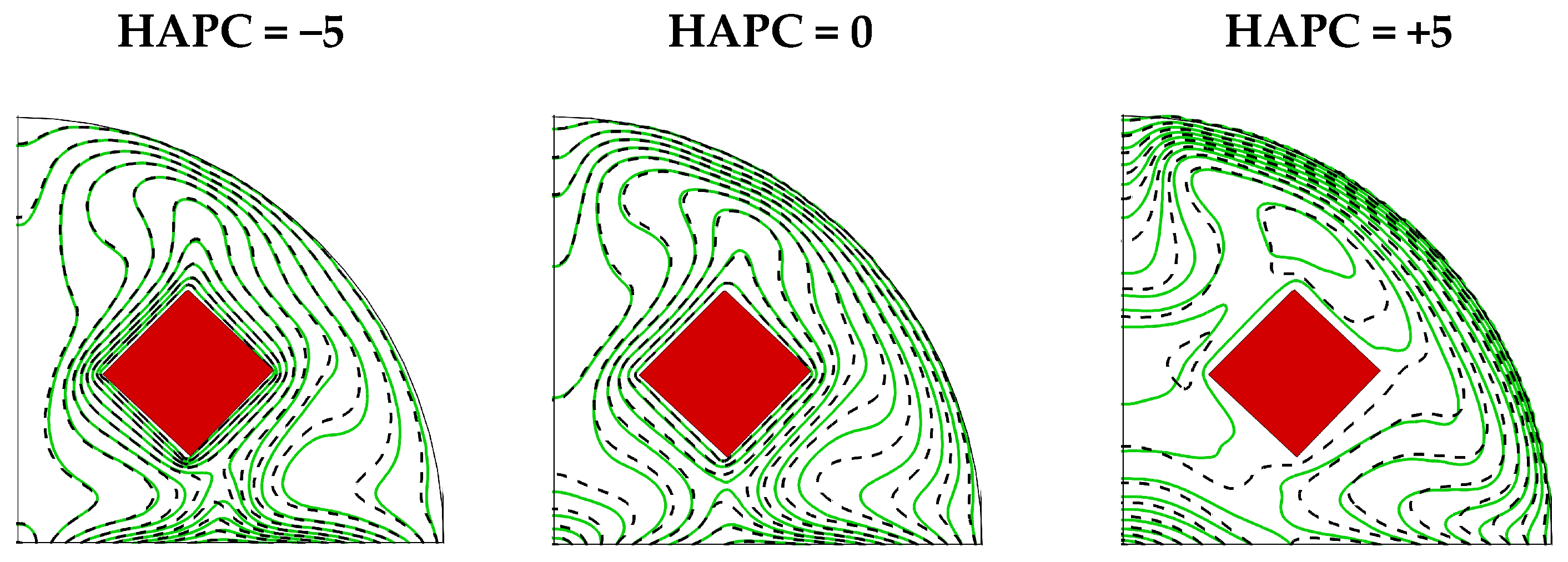
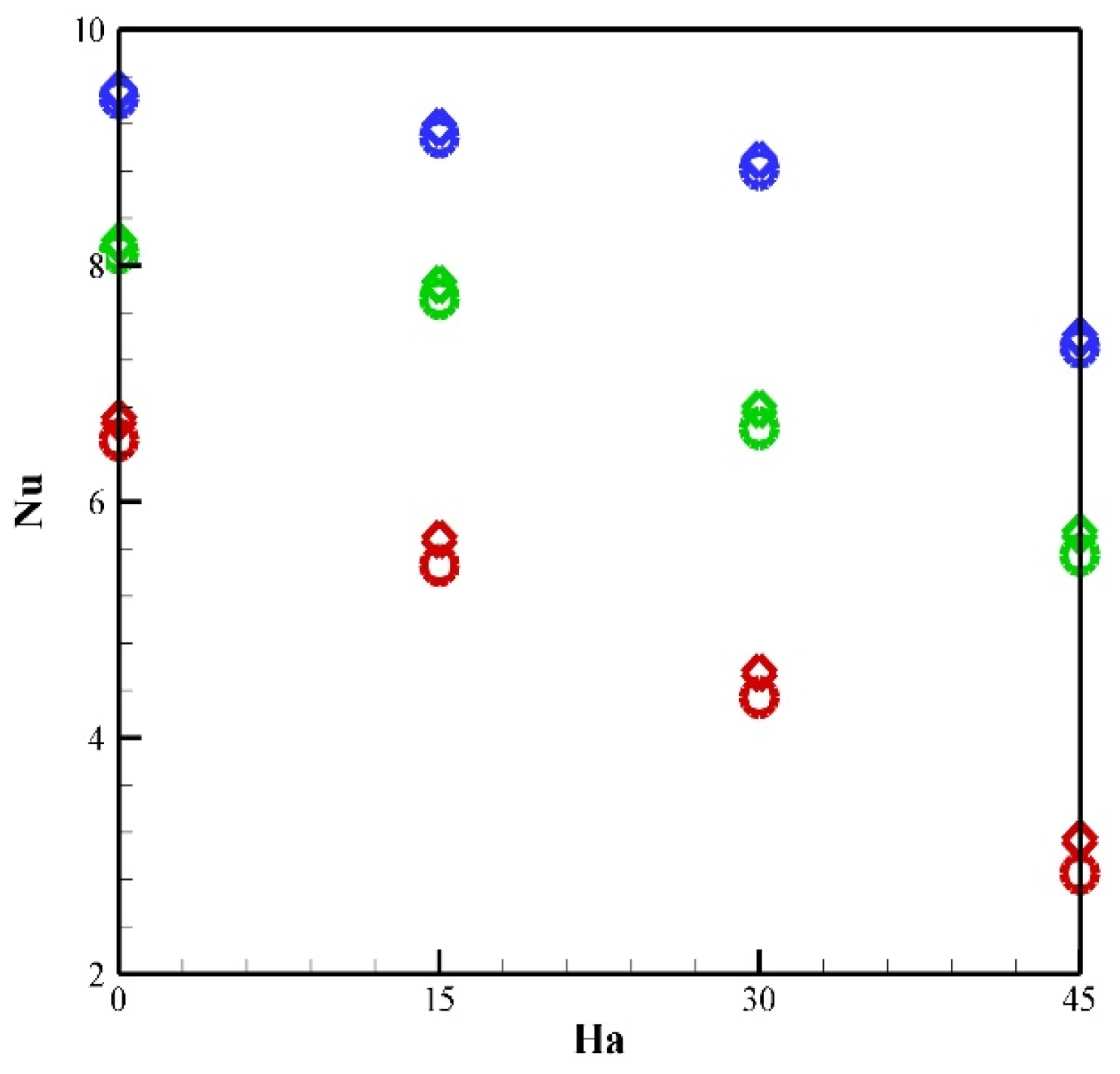
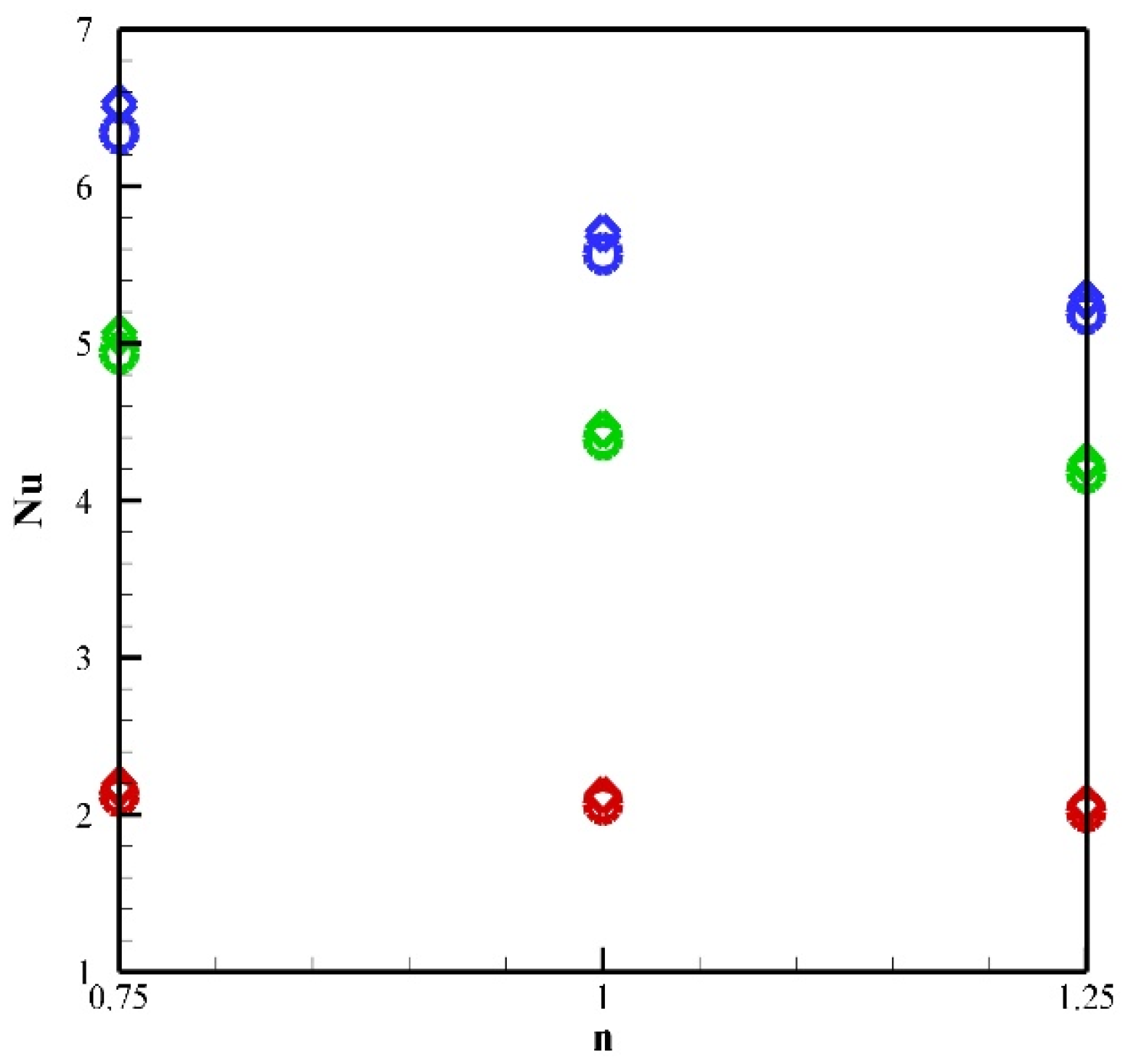
To confirm that the computer code generated in the FORTRAN language is accurate, as shown in Figure 3, the isotherms patterns of the existing work for the HAPC and θb changes for Ra = 105, n = 0.75, and Ha = 15 are compared with reference [56]. As another comparison, the influence of simultaneous Ha and HAPC changes on the mean Nu is exposed in Figure 4 for Ra = 105, θb = 0, and n = 0.75. In this test, non-Newtonian free convection inside a chamber containing an obstacle at different temperatures occurs. To confirm the accuracy of the outcomes in the encounter of non-Newtonian conjugate HT, the present study is compared with reference [57] (Figure 5) in the absence of the MF and HAP for Ra = 105. In this test, the conjugate HT for the PL fluid inside a 2D chamber with diagonal cold walls occurs. By examining the results, it is clear that the deviation of the outcomes due to the present code with the references is very small, and the correctness of the results can be guaranteed.

4. Description of the Obtained Outcomes

Table 2 exhibits the main parameters studied in the available research along with the corresponding values. The constant values for the simulation carried out are Pr = 50 and Ra = 105. The magnitude of the Prandtl number is due to the high value of this parameter in real fluids used in various industries [56].
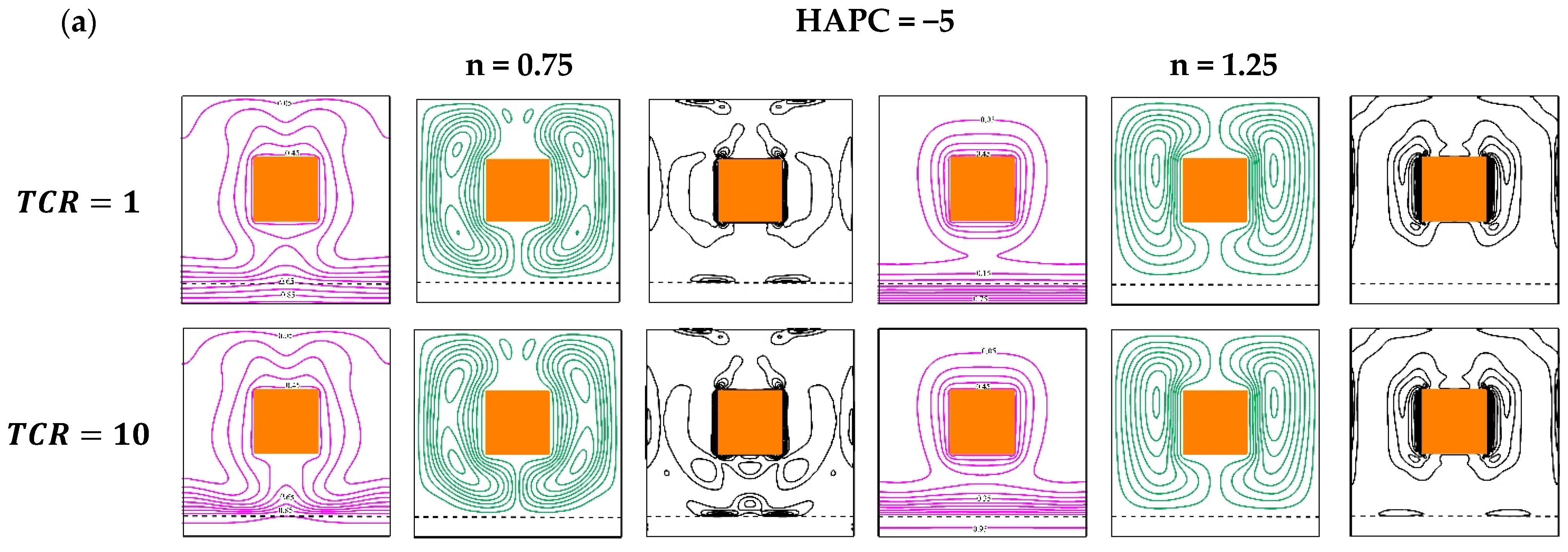
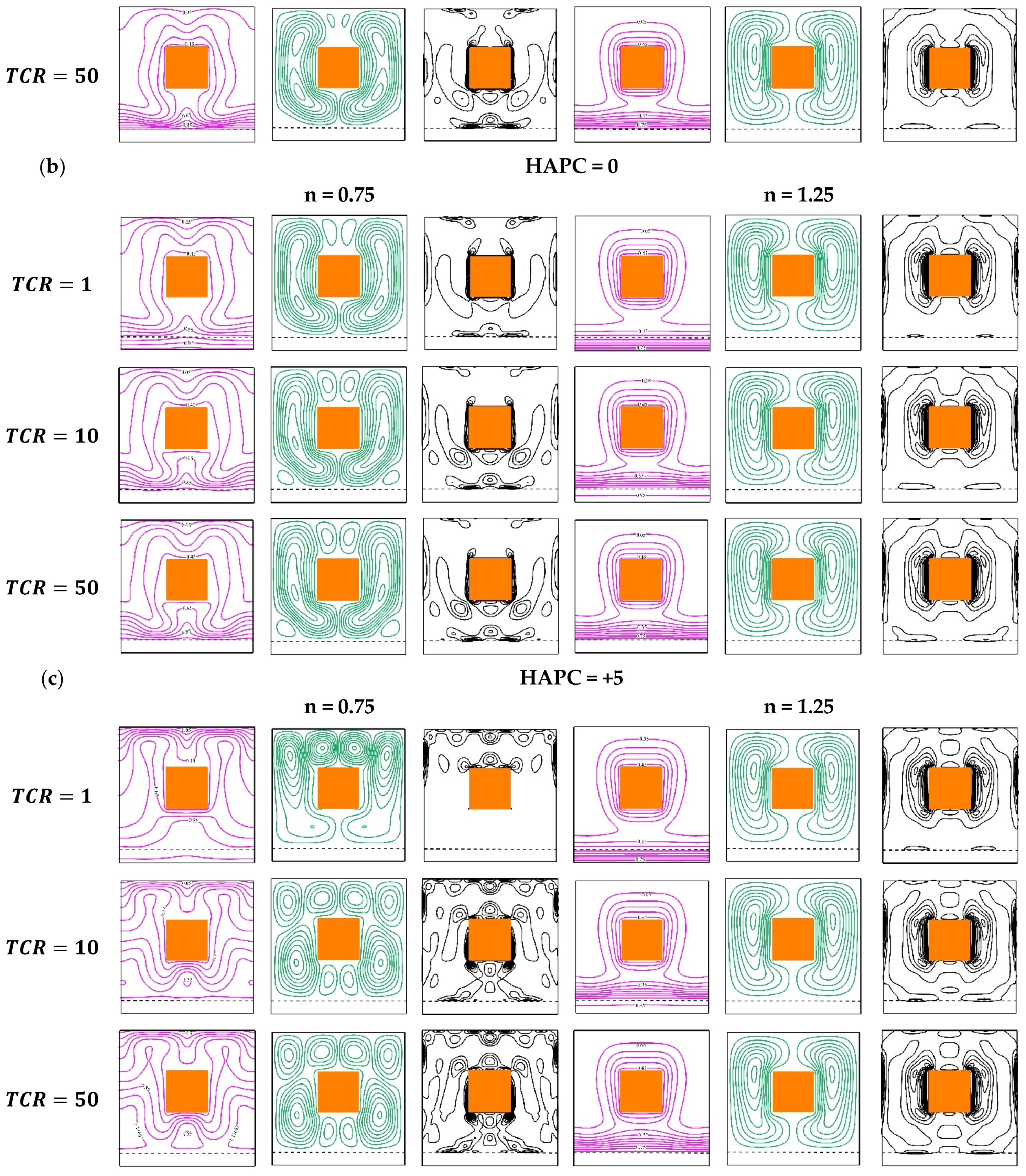
From Figure 6a–c several points can be deduced:
  • In all cases, for a dilatant fluid, two symmetrical vortices are formed on both sides of the chamber in a clockwise and counterclockwise manner, but for a pseudo-plastic fluid, the main vortexes are broken into smaller vortices at the top and bottom of the chamber which is still symmetrical. At HAPC = +5, the secondary vortices formed become larger and more powerful.
  • Due to the isotherms, in all cases for the dilatant fluid, the dominance of thermal conductivity is manifested. This indicates that the isotherms are parallel to the conductor wall and adjacent to the barrier. However, for the pseudo-plastic fluid, the width, curvature, and dispersion of the isotherms indicate the strengthening and dominance of the convection effects.
  • The pattern of isotherms for the dilatant fluid does not change much with increasing HAPC, but for the pseudo-plastic fluid, enhancing the HAPC leads to a decline in temperature gradient near the conductive wall, but the density of lines increases near the wall with a cold temperature. In this scenario, convection has complete control over the HT mechanism. At TCR = 50, the temperature also reaches 1.25, which indicates that not only is the heat not transferred from the wall to the fluid, but there is also reverse HT.
  • According to isotherms, with the increase in the TCR, the temperature decreases significantly throughout the conductor wall. The high thermal resistance of the conductor wall is the result of the low TCR value, which leads to the linearization of the isotherms. The reason for not observing temperature changes in the vertical direction is due to the low value of the TCR. With the increment of the TCR, nonlinear behaviors within the conductive wall are observed.
  • By changing the type of fluid and due to changes in the PL index, the power of the flow created within the enclosure can be controlled such that the flow power for the pseudo-plastic fluid is much higher than that for the dilatant fluid. The reason for this issue can be found in the higher apparent viscosity for the dilatant fluid, which is determined based on the increase in the PL index. An increase in fluid viscosity leads to a decline in the ease of movement of the fluid within the chamber. For the pseudo-plastic fluid, a stronger current can be achieved by enhancing the HAPC, which is more evident when increasing the TCR.
  • Given the lines of entropy due to fluid friction, it is understandable that the pattern of the lines for the dilatant fluid is almost the same in all cases. The highest amount of irreversibility is observed near the barrier and the side walls, where there is the greatest temperature gradient. The density of the lines close to the walls, where the velocity gradient is greatest, rises with the augmentation of the irreversible HAPC, but the pattern of the entropy lines is different for the pseudo-plastic fluid because the fluid’s friction plays an effective part in EG in this scenario, in contrast to the dilatant fluid.
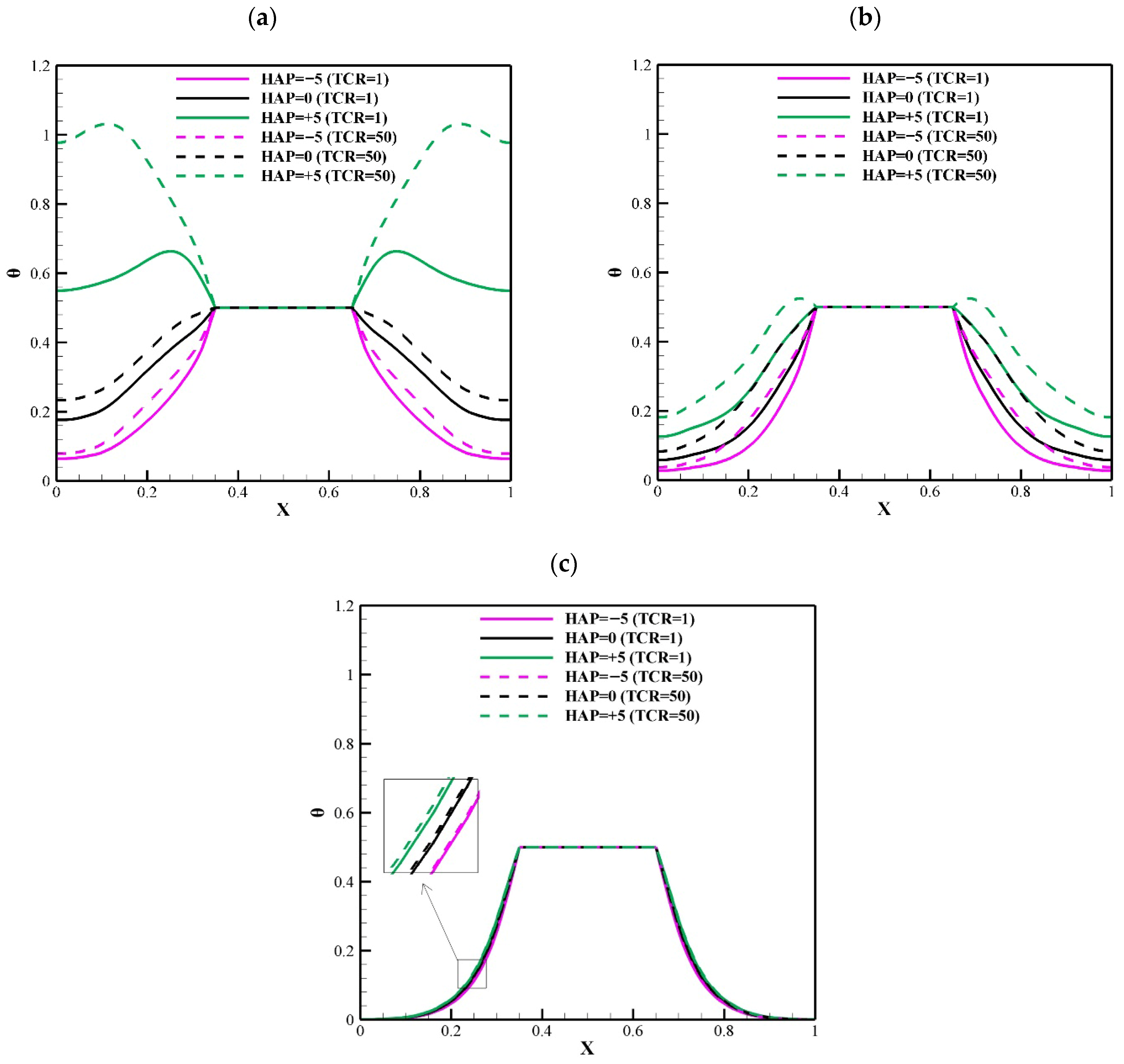
Figure 7a–c show that increasing the HAPC raises the set’s temperature, with the highest temperature being found next to the vertical walls. This occurs because, in this scenario, two factors simultaneously cause the heating of the fluid in those areas (the presence of HAP and the heating of the wall). The higher the TCR, the loftier the temperature of the fluid set and the larger the difference in the graph with increasing HAPC. The reason is due to a higher rate of heat being emitted to the fluid adjacent to the cold wall. The important point is that all of the above is insignificant for the dilatant fluid, and the temperature profiles are almost identical and change slightly.
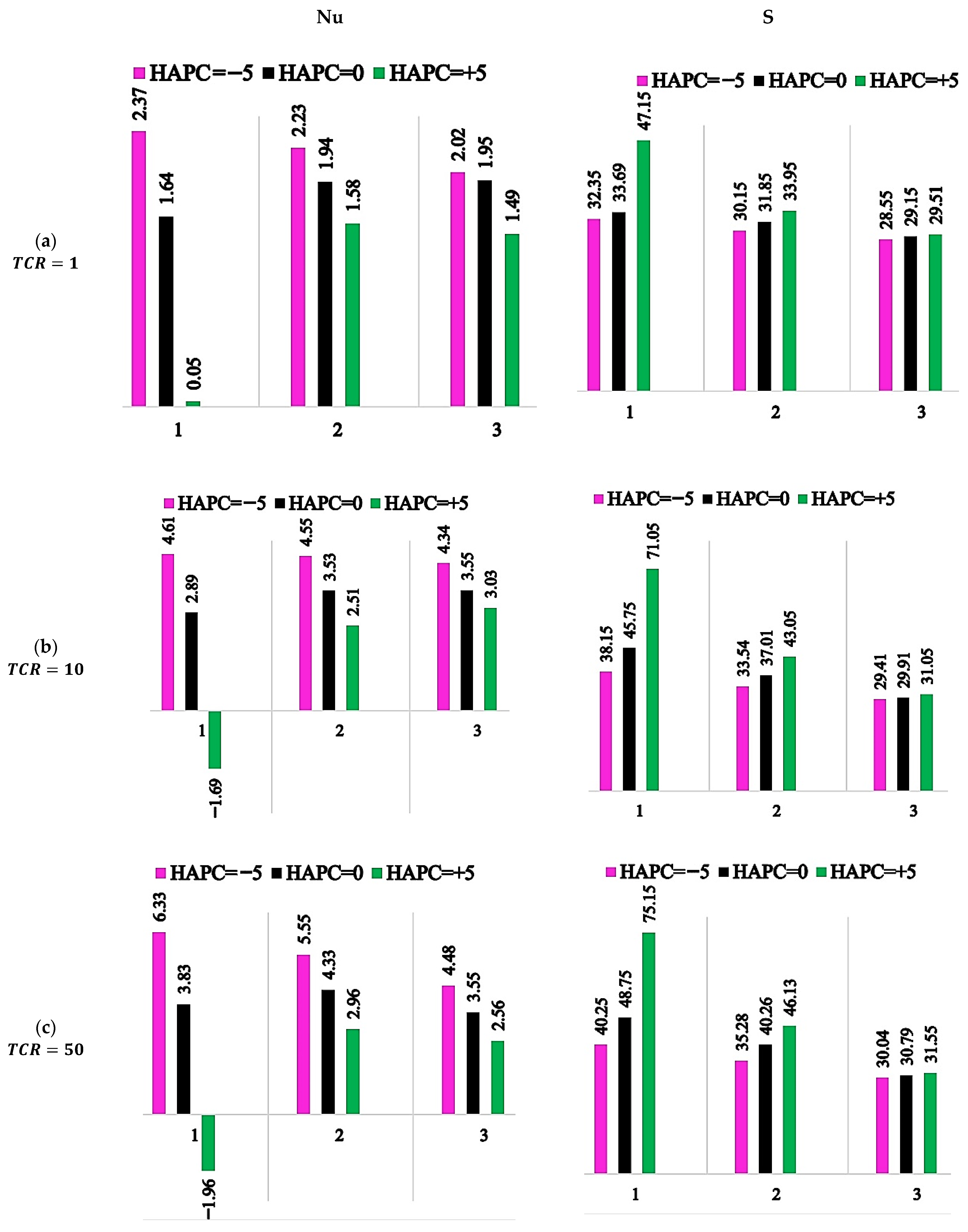
Figure 8a–c present the following key points, which are summarized as follows:
  • According to the definition of the mean Nu in Equation (50), the maximum values of the mean Nu is acquired when the TCR is the highest. The higher rate of heat transferred to the fluid placed in the areas near the conductive wall is the cause of this issue. The negative values of mean Nu when HAPC > 0 demonstrate the inverted HT, HT from the fluid to the wall.
  • Augmentation of the HAPC leads to a decrease in the average Nu (according to the isotherms in Figure 6), which has a different impact with different fluid types and is less for the dilatant fluid than the pseudo-plastic fluid. A decline of 97%, 29%, and 26% for pseudo-plastic, Newtonian, and dilatant fluids, respectively, can be achieved by increasing the HAPC from −5 to +5 for TCR = 1. This influence is about 136%, 45%, and 30% for TCR = 10 and about 135%, 47%, and 42% for TCR = 50.
  • The EG grew up with an increment of the TCR and the HAPC. This increase is due to the increased share of the HT in the EG. The difference between the values of entropy due to the increase in the HAPC declines with the increment of the PL index because, with the increase in the PL index, the tendency of the fluid to flow more smoothly decreases and the HAPC cannot effectively increase this phenomenon. Increasing the difference in the EG values by increasing the HAPC is enough to grow the TCR. For the pseudo-plastic fluid, for example, an increase in the HAPC from −5 to +5 causes increases of 44% and 86% for TCR = 1 and TCR = 50, respectively.
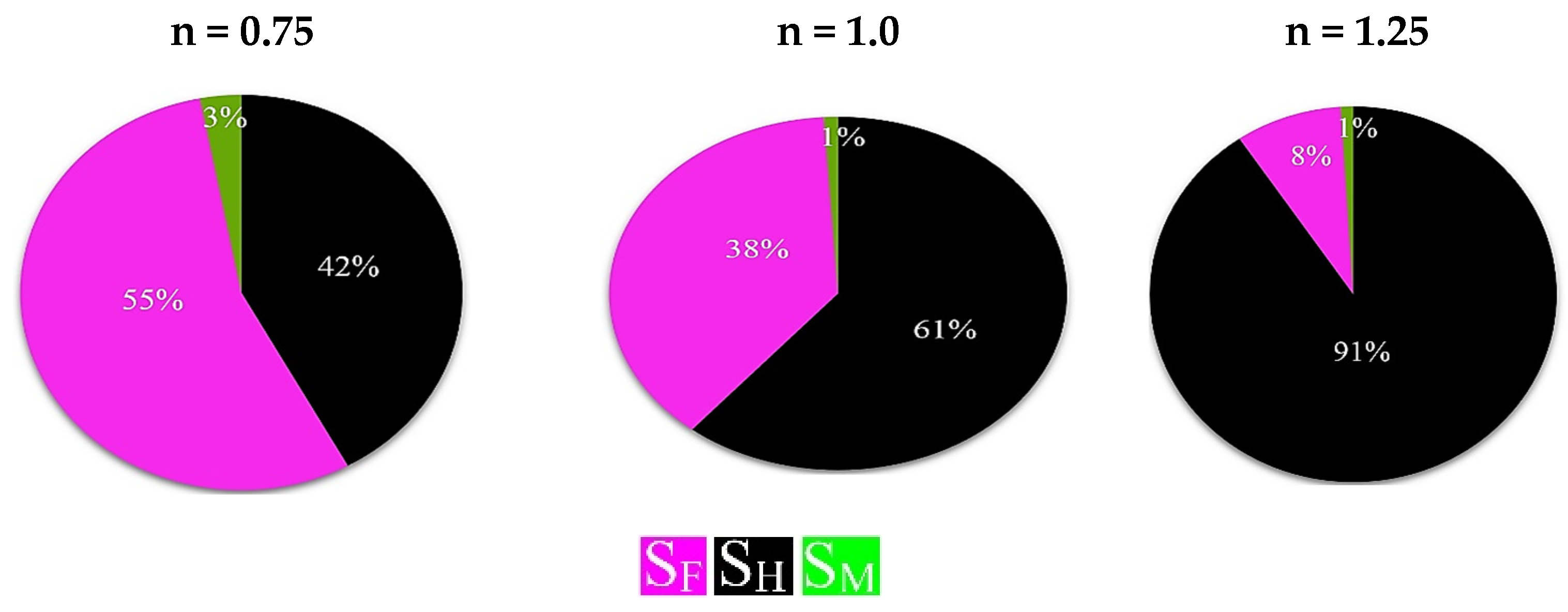
According to Figure 9, increasing the PL index increases Be ( generated   entropy   due   to   H T total   E G ). In addition, by enhancing the PL index, the share of the MF in the EG decreases such that the value of this parameter is about 3% for the pseudo-plastic fluid, while for the dilatant fluid, it is less than 1%. As was said in the previous parts, with the growth of the PL index, conduction becomes the main process of HT. In addition, the contribution of fluid friction to the EG decreases as the PL index increases.
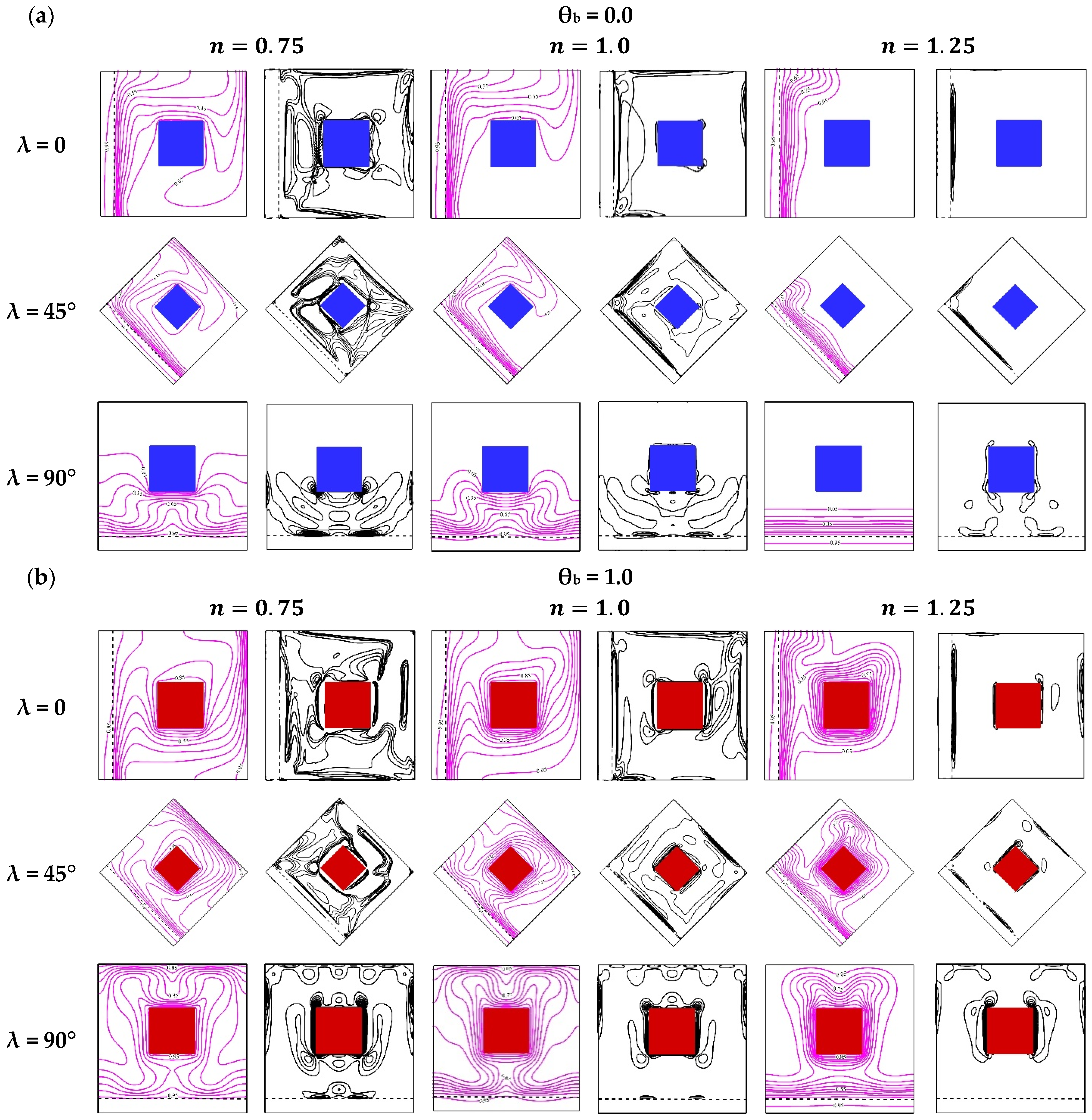
The synchronous influence of the temperature of hindrance and the chamber placement angle for the change in fluid type on the entropy and temperature patterns is depicted in Figure 10. The pattern of the lines varies depending on whether the chamber is heated from the bottom or the side walls. For θ b = 0.0, the shape of the isotherms and the entropy lines for λ = 0 and λ = 45° are similar to each other and are generally different from those for λ = 90°. For λ = 90°, the density of the isotherms is evident in the neighboring region of the conductive wall, especially when the fluid is dilatant; this is due to the predominance of thermal conductivity being quite pronounced (the isotherms are perfectly parallel to the conductive wall). The decrease in the amount of irreversibility due to fluid friction with an increment of the PL index is obvious in all cases. However, given the entropy lines, it is clear that the amount of irreversibility is lower at λ = 90°. For θ b = 1.0, unlike θ b = 0.0, the scattering and expansion of entropy lines and isotherms become more significant. The distribution of entropy lines near the walls and the barrier is limited by an increment of the PL index, where there is the highest velocity gradient.
Some momentous points that can be understood from Figure 11 are shown below.
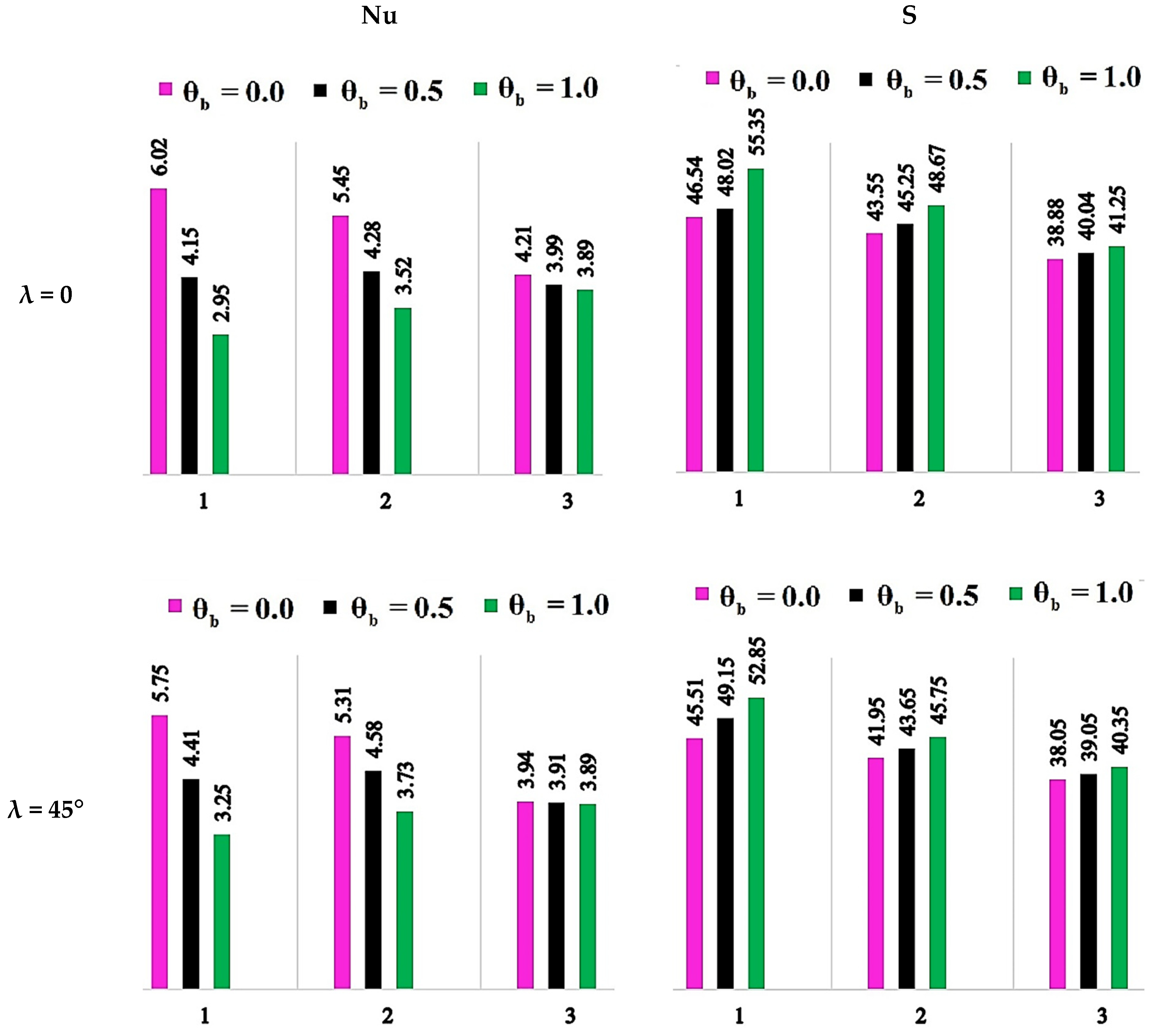
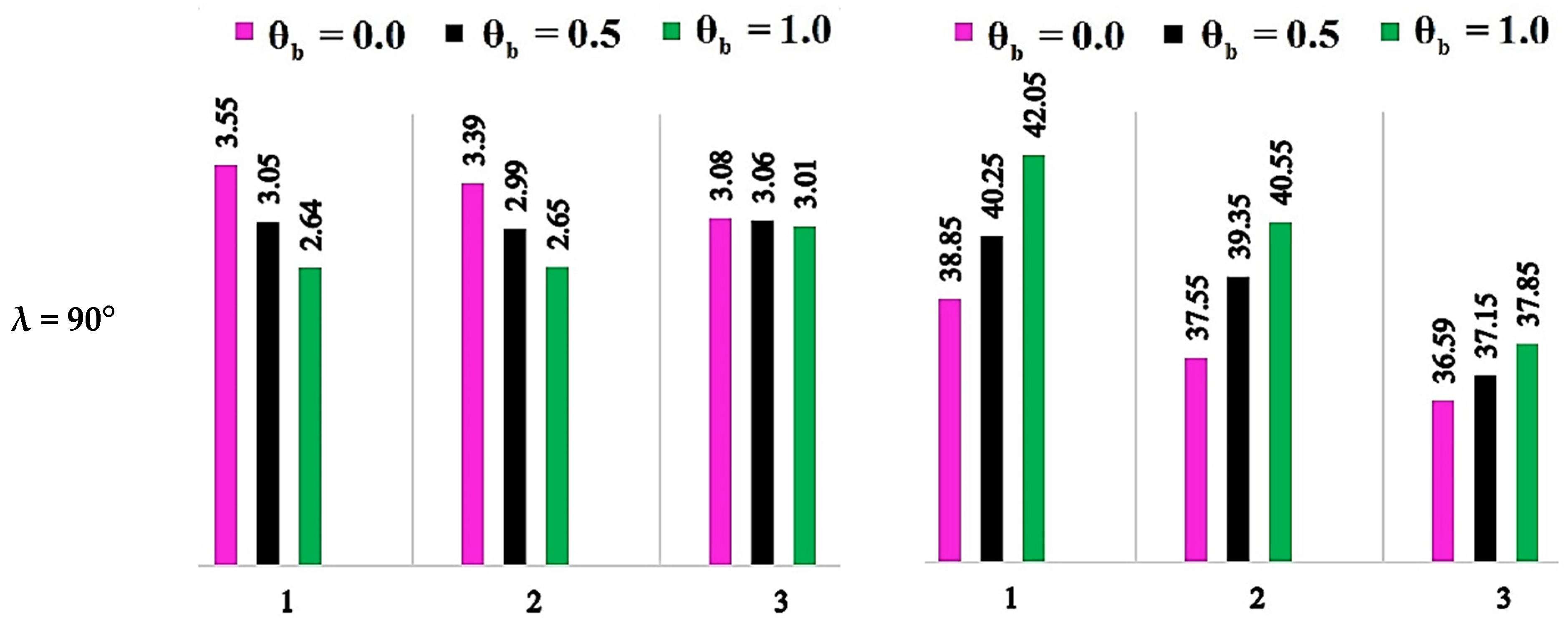
At all values of θ b and λ, the mean Nu belongs to the pseudo-plastic fluid, and with enhancement of the PL index, the amount of HT decreases.
The inclination angle of the chamber can be used as an important variable in controlling the amount of HT. Enhancement of the angle of inclination leads to a decrease in the amount of HT such that enhancement of the angle from zero to 90 degrees leads to a decrease of 77% for the pseudo-plastic fluid and a decrease of 77% for the dilatant fluid. This is because convection is considerably simpler and quicker in those chambers that receive heat from the side surfaces. However, there needs to be a critical value of temperature difference for the convection phenomenon to occur for compartments that are heated from other surfaces. It is also understood that the greatest influence of the MF is at λ = 0.
The smaller the PL index and λ, the more pronounced the impact of changing the boundary conditions of the barrier temperature. Average decreases of about 40% and 7% of the average Nu are observed for the Pseudo-plastic and dilatant fluids, respectively, with an increase in the barrier temperature from 0 to 1.
The entropy value increases by about 17% with increasing barrier temperature because the share of EG due to HT increases. A trend similar to the mean Nu for the entropy value produced can be observed.
These results clearly show that both the inclination angle and the barrier temperature strongly affect the overall heat transfer rate and entropy generation. As the inclination angle increases, convection weakens, leading to a lower Nusselt number and reduced thermal efficiency. In contrast, a higher barrier temperature intensifies thermal gradients, which increases entropy generation, particularly for pseudo-plastic fluids.
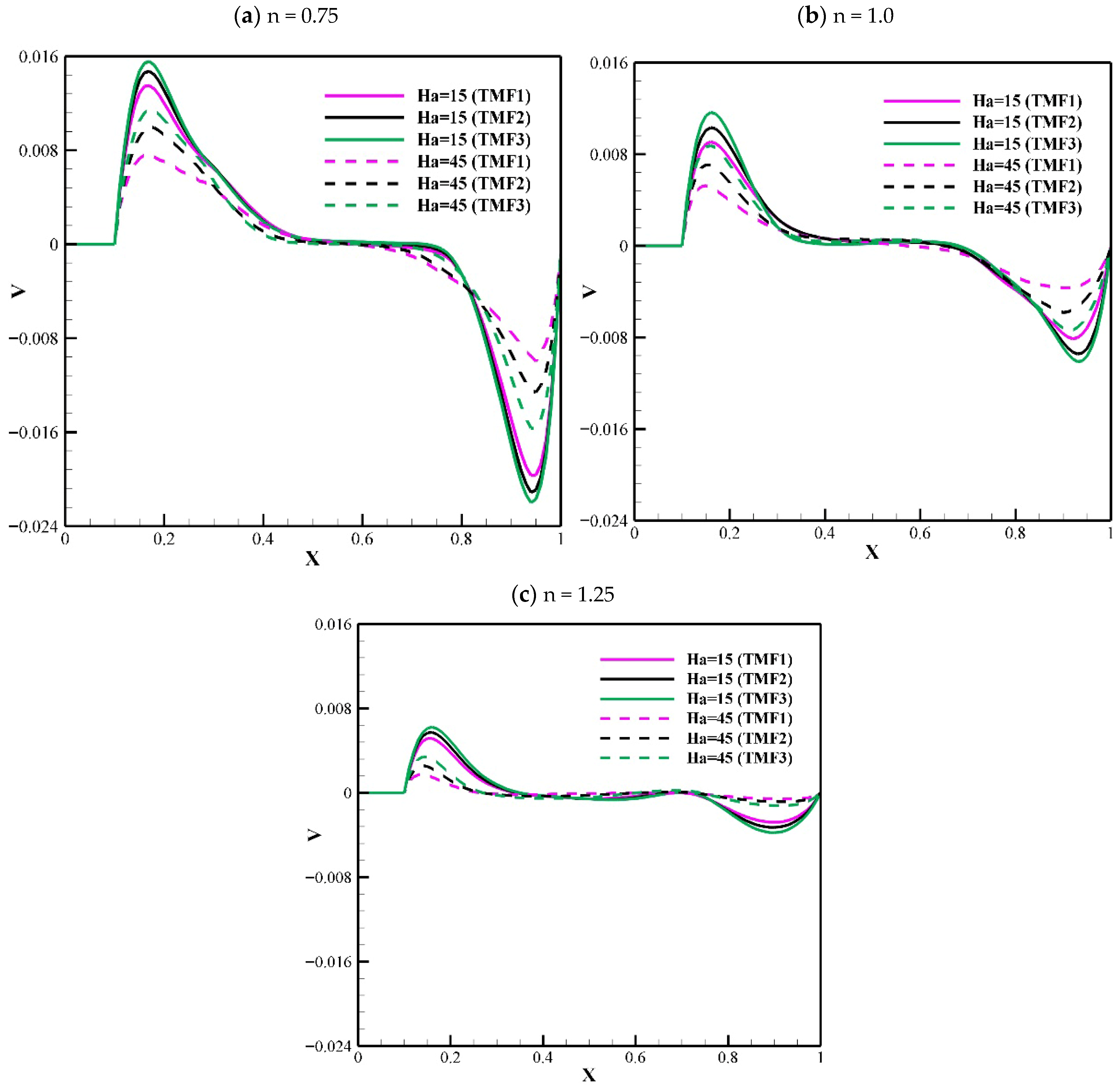
From Figure 12a–c, three cases can be stated:
A faster FF can be achieved by altering the type of MF applied from uniform to non-uniform. This is because fluid experiences a smaller amount of Lorentz resistive force as it moves by applying a non-uniform magnetic field (based on Equation (3)).
Since the fluid experiences more viscosity when enhancing the PL index and the velocity of the fluid decreases, the variation in the type of MF applied for the dilatant fluid versus the pseudo-plastic fluid is negligible.
A noticeable increase in the Ha value indicates the impact of altering the MF’s shape.
It is easier to observe a shift in the type of MF application when the value of Ha is increased.
It can be observed that different magnetic field configurations alter the flow structure and velocity distribution. Non-uniform magnetic fields weaken the Lorentz resistance locally, allowing stronger circulation in some regions. This behavior becomes less pronounced for dilatant fluids due to their higher effective viscosity.
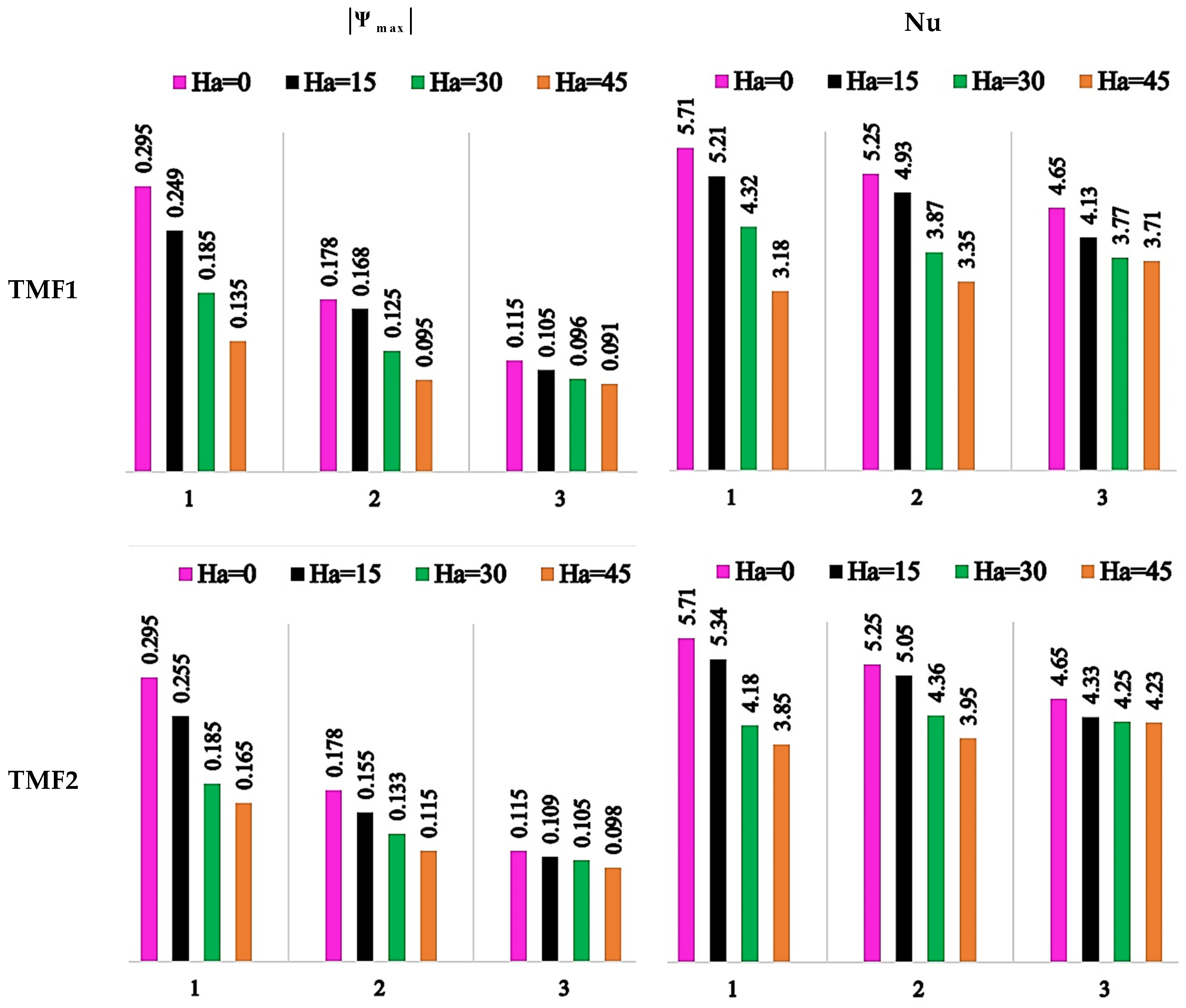
The following can be understood from Figure 13:
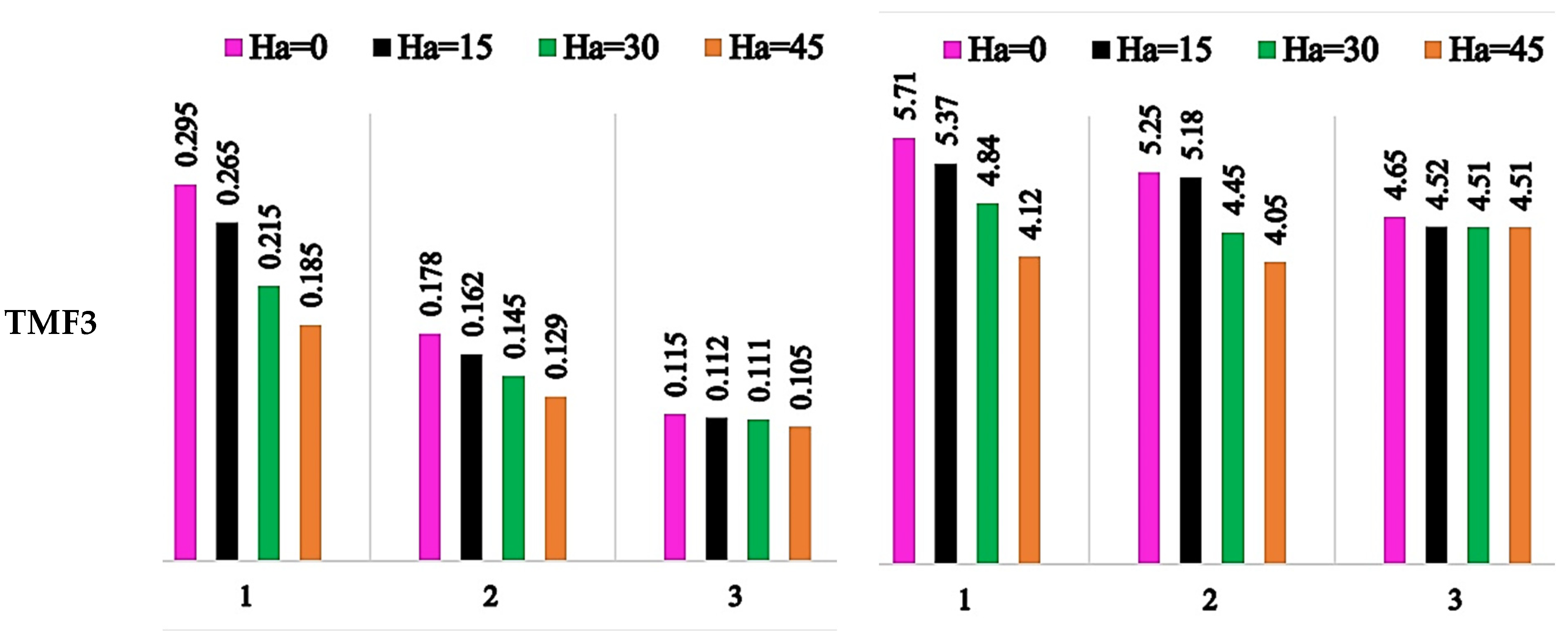
Flow strength is reduced by about 39% by changing the type of MF application from TMF3 to TMF1. The lowest FF strength in all cases belongs to the uniform application of the MF. According to the form of action in Figure 2a, this occurs because the maximum amount of volumetric force results in resistance to the FF (opposite to the direction of gravitational force).
It is almost ineffective to change the type of MF applied to the dilatant liquid after observing the number of flow powers.
The mean Nu decreases with the enhancement of MF strength and the PL index in all types of MF applications. So the greatest influence of the MF belongs to the pseudo-plastic fluid. The amount of HT for the pseudo-plastic, Newtonian, and dilatant fluids decreases by about 45%, 36%, and 20%, respectively, by increasing Ha from 0 to 45 degrees.
Given the values of the mean Nu, the influence of the MF is reduced by changing the type of application; this is especially evident for the dilatant fluid in TMF3, in which case the application of the MF is almost ineffective.
The comparison of the maximum stream function and the average Nusselt number highlights the significant influence of the magnetic field type. The TMF3 configuration yields the strongest flow motion and the highest heat transfer, while TMF1 results in the lowest values due to a more uniform Lorentz force opposing fluid motion.
Figure 14 displays the following:
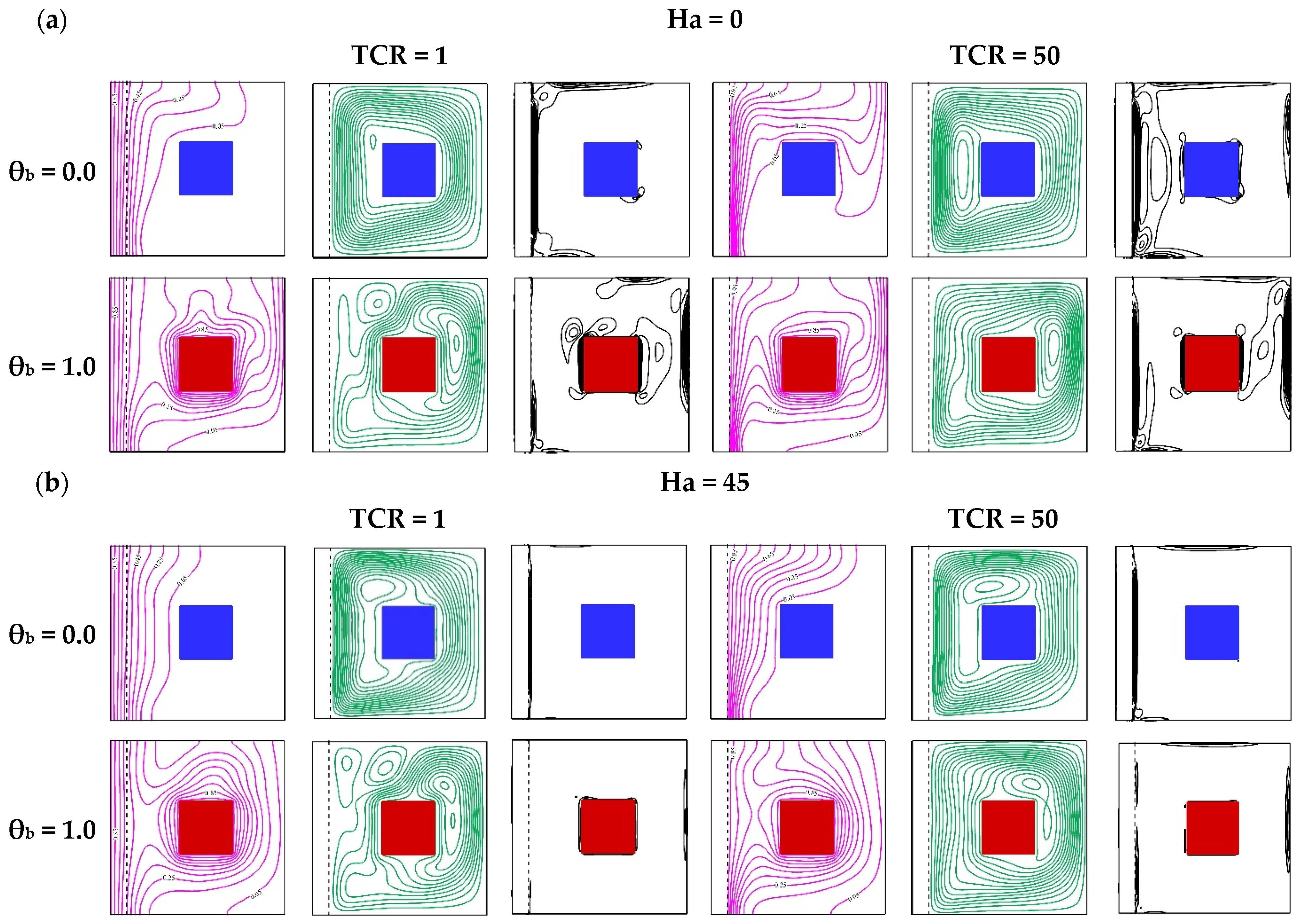
The decrease in the curvature of isotherms with increasing Ha is very obvious, especially at a larger TCR. At a smaller TCR, due to the predominance of thermal conductivity, the magnetic field has less influence.
A very significant decrease in entropy with increasing Ha is evident due to the decrease in convection effects in both TCR values.
The density of entropy lines increases with the increment of the barrier temperature, especially when in the proximity of the barrier and the right vertical wall of the chamber.
The variation in isotherms and entropy lines with different Hartmann numbers demonstrates that stronger magnetic fields suppress convection and decrease entropy generation. Moreover, increasing the barrier temperature enhances local irreversibilities near the obstacle and the adjacent wall due to intensified temperature gradients.
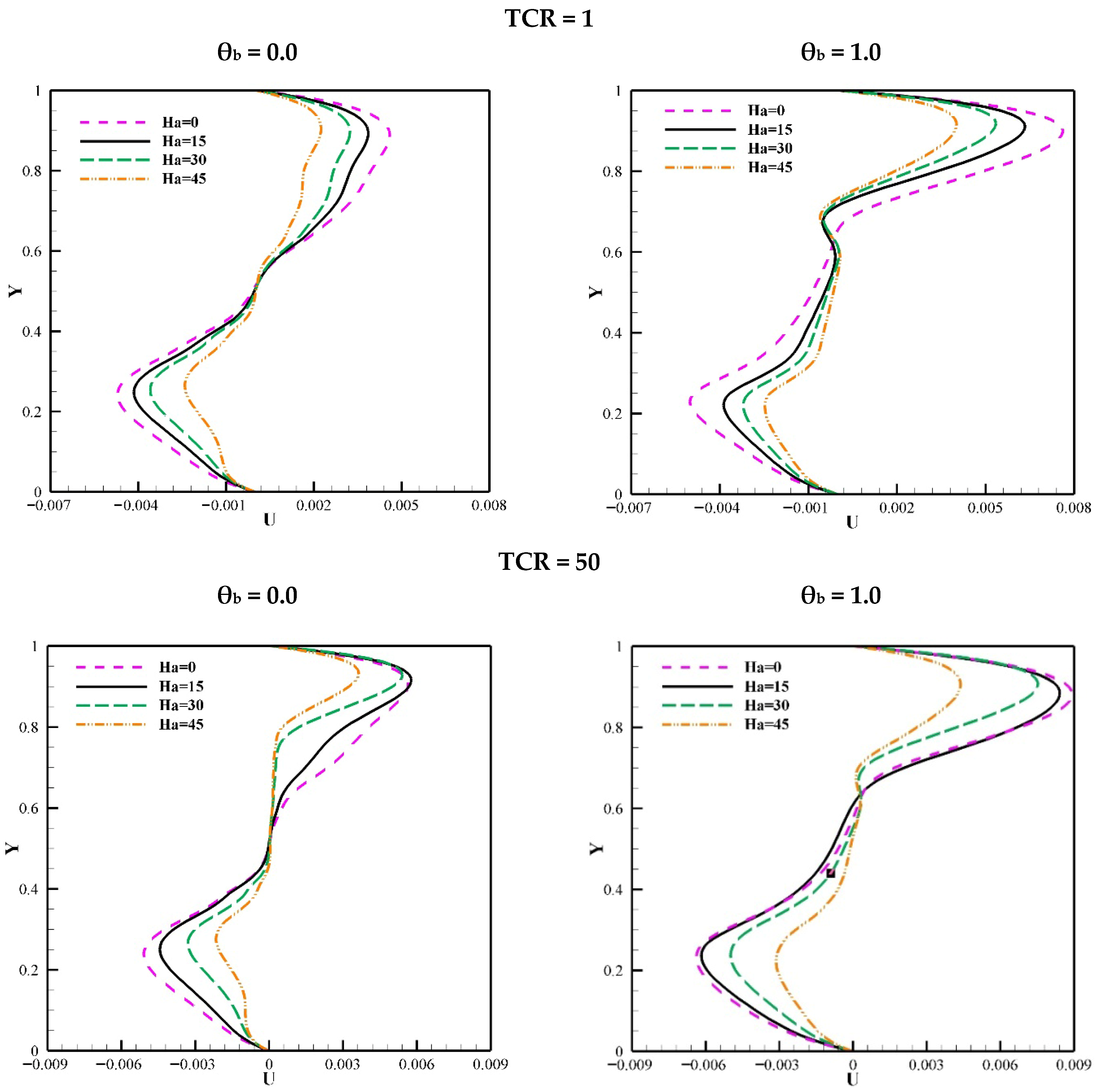
The following can be understood from Figure 15:
Velocity increase is due to increased convection effects caused by the placement of the barrier at a hot temperature.
It can be observed that the enhancement of the TCR increases the speed of the FF.
Further enhancement of the influence of the MF on speed deceleration is achieved by an increment of the TCR and the obstacle temperature.
As shown in Figure 16,
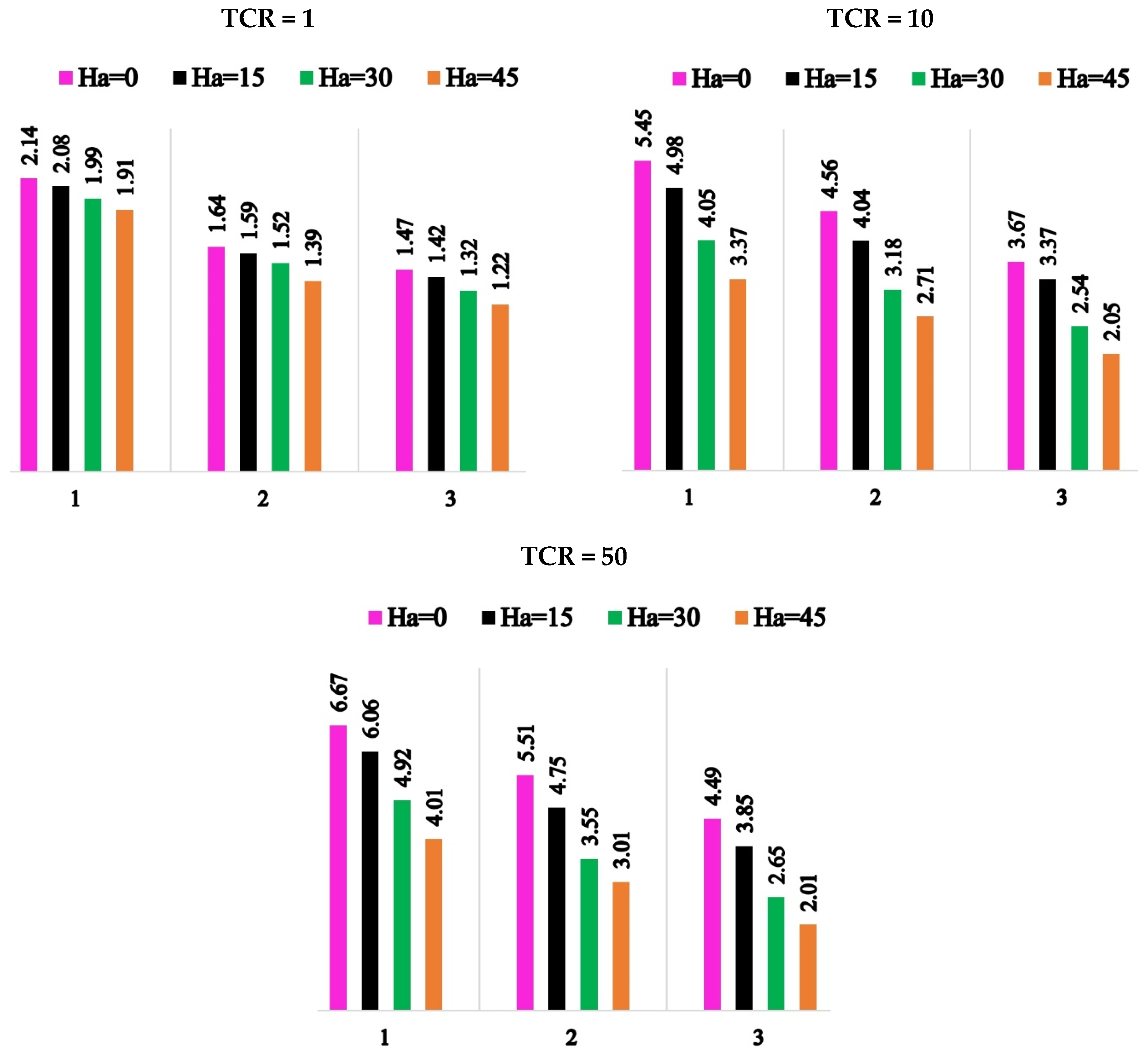
  • Both increasing the TCR and decreasing the barrier temperature enhance the average Nu. Lowering the barrier temperature increases heat transfer, subsequently elevating the average Nu.
  • The decrease in the mean Nu due to the increase in the Ha can be controlled by adjusting the barrier temperature. If the barrier temperature is higher, the influence of the MF is more pronounced. For example, at TCR = 50, an increase in the Ha from 0 to 45 would result in decreases of 38%, 45%, and 55% in the mean Nu for θb = 0.0, 0.5, and 1.0, respectively. This can be attributed to the increase in convection effects (increase in speed according to Figure 15). At a higher TCR, one can expect a further decrease in the mean Nu due to an increment of Ha.
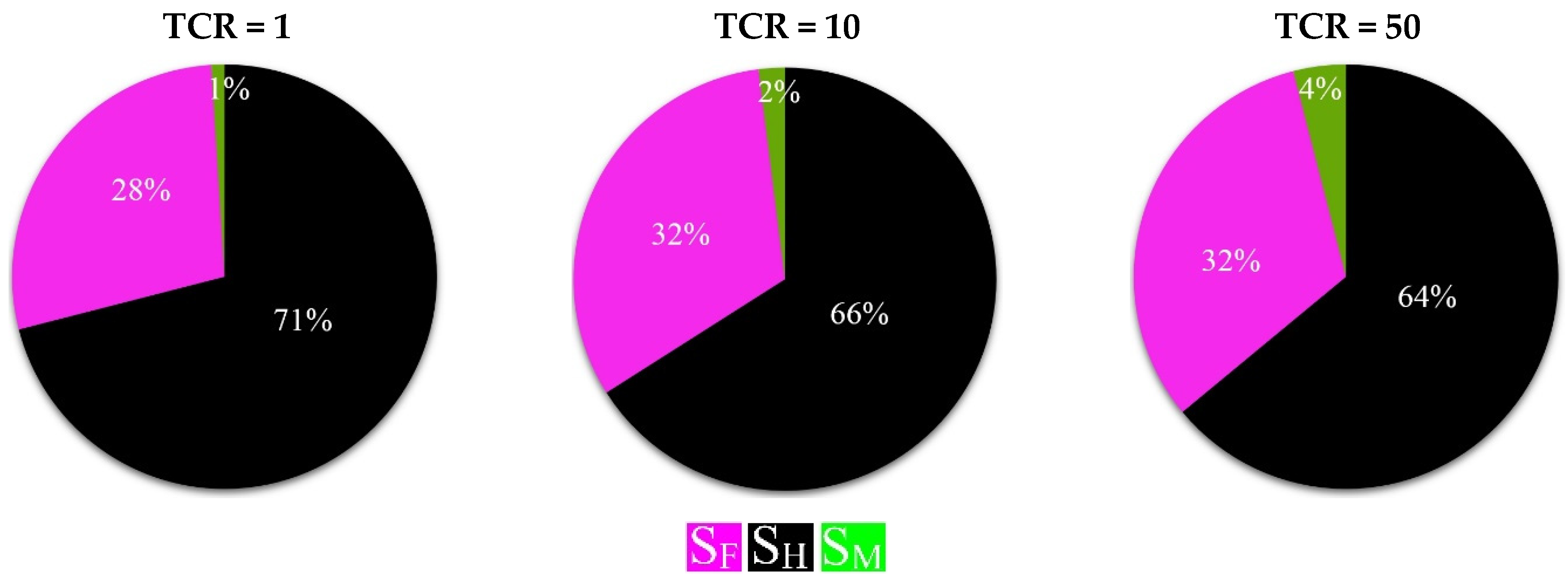
The important point of Figure 17 is that if the TCR increases, the share of the MF to the EG increases. The highest value of Be can be achieved at the lowest value of the TCR. This is because the dominance of thermal conductivity is very evident in this scenario. The amount of movement and displacement of the fluid inside the chamber is very low in this case.
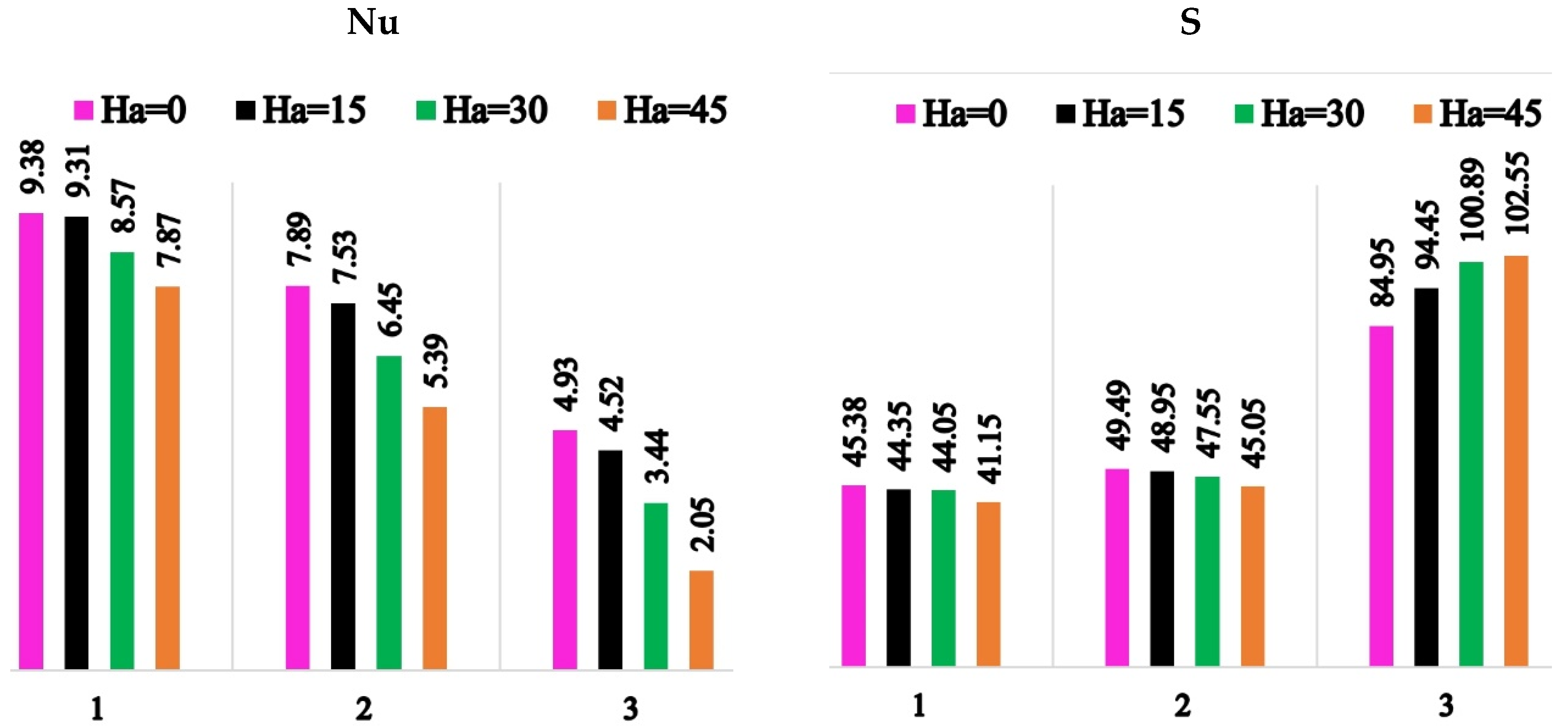
The simultaneous influence of the increment of Ha and HAPC on the amount of HT is shown in Figure 18. Two important points should be stated according to this figure:
  • It should be noted that in addition to decreasing the mean Nu by an increment of the Ha and HAPC, the impact of increasing the MF’s strength increases when increasing the HAPC. Because both the mean Nu reduction factors reinforce each other, about 16%, 31%, and 59% of the Nu amount decreased, respectively, with increases in the Ha for HAPC = −5, HAPC = 0, and HAPC = +5.
  • In the case of EG, it is very important to state that HAPC ≤ 0 decreases, while this parameter increases HAPC > 0.
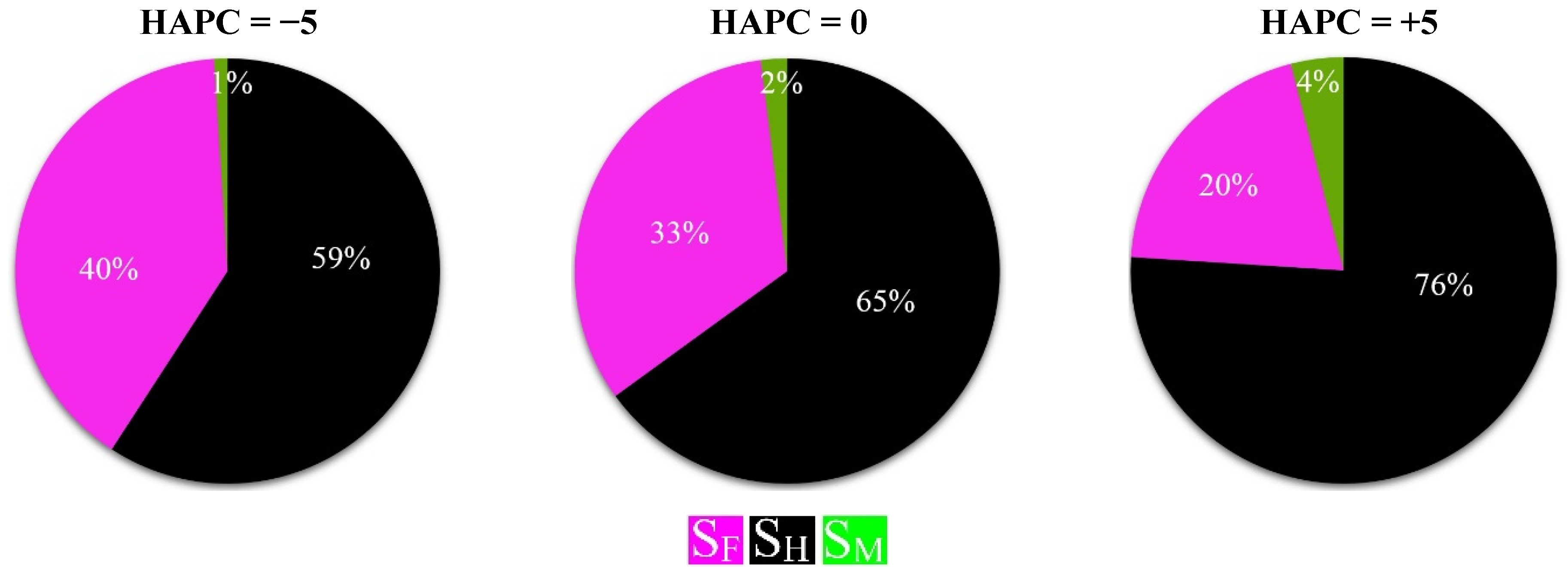
Regarding Figure 19, in the case of HAPC = –5, heat absorption weakens the temperature gradient, reducing thermal entropy generation. However, due to the low fluid velocity, viscous dissipation contributes significantly, while the magnetic field effect remains almost negligible. When HAPC = +5, heat generation intensifies convection and creates strong temperature gradients, making thermal entropy the dominant contributor. In this situation, the stronger fluid motion enhances magnetic entropy, while the flow becomes more organized, and viscous dissipation decreases relatively. At HAPC = 0, the flow pattern becomes stable, and the temperature gradient is moderate; thus thermal entropy increases. Meanwhile, frictional entropy is lower than heat absorption, and the contribution of magnetic entropy stays limited.

5. Conclusions

In the existing research, an attempt was made to analyze the HT and EG of a non-Newtonian fluid with a PL model within an inclined square enclosure containing a square-shaped obstacle at different temperatures. Since factors such as the unwanted application of the MF in different forms, the unwanted presence of heat absorption or heat production, the forced presence of obstacles at different temperatures, or the rotation of the cavity affect the generated currents, this numerical study enables researchers to correctly analyze the flow inside the closed chambers. By considering three distribution functions for the analysis of flow, energy, and magnetic fields, a simulation was performed using the LBM. The results of this study provide useful insights for the design of advanced thermal management systems, such as the cooling of electronic components, magnetohydrodynamic pumps, and heat exchangers, where both rheological behavior and magnetic field control play significant roles. The ability to manipulate entropy generation and heat transfer performance by tuning the PL index, magnetic field configuration, and heat generation/absorption parameters can be utilized to achieve energy-efficient and stable thermal designs.
The influence of the HAPC, the strength and type of MF applied, the TCR, the type of fluid, the temperature barrier, and the enclosure placement angle was investigated. To ensure the authenticity of the FORTRAN code, several comparisons were made with authoritative research, both quantitatively and qualitatively. A slight difference between the outcomes ensured the correctness of the code. A summary of the most key results is as follows:
  • To influence the flow power and the HT rate, it can benefit from the existence of a barrier in exchange for temperature change. Obtaining the lowest mean Nu value for the highest EG value is the result of placing the hindrance at the highest temperature, and the greatest effect of the presence of the MF is seen in this case.
  • The amount of HT can be affected by the angle of the cavity placement angle such that the maximum impact of the obstacle temperature change occurs at the zero angle.
  • To have a higher average Nu, it is sufficient to increase the TCR. For this issue, the effectiveness of the MF becomes more evident, and the increase in buoyancy forces is more visible, although values of EG are more in this scenario.
  • The decrease in the speed gradient and the value of the HT rate is the result of the increase in the strength of the Lorentz force, which is less with the increase in the PL index. It is enough to reduce the Ha and decrease EG.
  • If it is intended to reduce the effectiveness of the FF under the impact of the MF, the TCR, the HAP, the barrier temperature change, and the angle of the chamber placement, it is enough to use a fluid with a higher PL index.
  • The higher flow power and the HT rate are the result of the non-uniform application of the MF, so the flow power and mean Nu are up to 38% and 25% higher in the non-uniform application of the MF. Enhancing the impact of the change in MF depends on the increase in the Ha value.
  • It is very momentous to increase the share of the MF in the EG to enhance the TCR and the barrier temperature, decrease the PL index, and increase the HAPC. Although in most cases, the reduction in EG is achieved by reducing the Ha, due to the presence of heat production, EG increases with the increase in the Ha value.

Limitations and Future Work

Although the present study provides comprehensive insights into conjugate heat transfer and entropy generation in an inclined square enclosure filled with a power-law fluid under different magnetic field configurations, several limitations should be acknowledged. First, the fluid was modeled using the classical power-law rheology, which does not capture yield-stress behavior or time-dependent viscosity effects that may appear in more complex non-Newtonian systems. Second, the geometry was restricted to a single obstacle shape and to a two-dimensional enclosure, whereas industrial systems may involve three-dimensional features and more complex component arrangements. Third, only steady-state conditions were examined; transient thermal responses and unsteady vortex dynamics were not considered.
In terms of numerical constraints, the magnetic field was imposed externally, and the induced magnetic field was assumed to be negligible, consistent with low-magnetic-Reynolds-number conditions. Additionally, thermophysical properties were assumed to be constant, and radiation effects were ignored.
Future studies may extend the present model by incorporating viscoplastic or temperature-dependent non-Newtonian behavior, three-dimensional geometries, transient simulations, or active magnetic field control strategies. Investigating optimization methods or data-driven surrogate models also constitutes a promising direction for further research.

Author Contributions

Conceptualization, coding, simulation with software, and writing—original draft, M.N.; methodology, M.B.; validation, A.S.; formal analysis and investigation, M.M.N.; resources and data curation, M.S.B.J.; writing—review and editing, A.S., M.S.P., and T.A.; supervising the revised form, M.S.P. and T.A.; supervision, A.S. All authors have read and agreed to the published version of the manuscript.

Funding

Prince Sattam bin Abdulaziz University for funding this research work through the project number (PSAU/2023/01/21544).

Data Availability Statement

The data presented in this study are available upon request from the corresponding author.

Acknowledgments

The authors extend their appreciation to Prince Sattam bin Abdulaziz University for funding this research work through the project number (PSAU/2023/01/21544).

Conflicts of Interest

The authors declare that they have no conflicts of interest.

Nomenclature

Nomenclature
BMF strength
B0MF power in uniform mode
BeBejan number
cDiscrete lattice velocity
CpSpecific heat
FExternal force
fThe function of the density distribution
hMF distribution function
gEnergy distribution function
HCavity height and length
HaHartmann number
kThermal conductivity
nPower-law index
pPressure
PrPrandtl number
QVolumetric HAP
STotal entropy
TTemperature
T0, TcReference and cold-wall temperature
WThickness of conductive wall
u (u, v)Macroscopic velocities
x(x,y)Lattice coordinates
Greek Symbols
αThermal diffusivity
βThermal expansion coefficient
τfFlow field relaxation time
τgTemperature field relaxation time
τhMF relaxation time
υKinematic viscosity
θDimensionless temperature
θbBarrier temperature
λEnclosure placement angle
ρDensity
µDynamic viscosity
φSolid volume fraction
ψStream function
ωWeighting factor
ηEffective viscosity multiplier
σElectrical conductivity
Subscripts
cCold
fFluid
hHot
sSolid
Shortened Words
FFFluid flow
EGEntropy generation
HTHeat transfer
HAPHeat absorption/production
HAPCHeat absorption/production coefficient
MFMagnetic field
NuNusselt number
PLPower-law
RaRayleigh number
SFEG arising from fluid friction
SMEG arising from MF
SHEG arising from HT
TCRThermal conductivity ratio
TMFType of applied MF

References

  1. Bittencourt, F.L.; Debenest, G.; Martins, M.F. Free convection development caused by bed shrinkage in a vacuum-induced smoldering reactor. Chem. Eng. J. 2022, 430, 132847. [Google Scholar] [CrossRef]
  2. Liu, X.; Liu, Z.; Mishra, D.D.; Chen, Z.; Zhao, J.; Hu, C. Evaporation rate far beyond the input solar energy limit enabled by introducing convective flow. Chem. Eng. J. 2022, 429, 132335. [Google Scholar] [CrossRef]
  3. Nemati, M.; Sani, H.M.; Chamkha, A.J. Optimal wall natural convection for a non-Newtonian fluid with heat generation/absorption and magnetic field in a quarter-oval inclined cavity. Phys. Scr. 2021, 96, 125234. [Google Scholar] [CrossRef]
  4. Xiao, C.; Zhang, G.; Hu, P.; Yu, Y.; Mo, Y.; Fazilati, M.A.; Toghraie, D. Heat and mass transfer analysis of natural convection in a liquid desiccant closed-loop system: The effect of heat source and heat sink temperature. Energy Rep. 2022, 8, 1816–1828. [Google Scholar] [CrossRef]
  5. Nemati, M.; Armaghani, T.; Nour, M. The possibility of managing system thermal characteristics via active/passive methods: A mathematical modeling for MHD power-law free convection in an inclined chamber. Comput. Appl. Math. 2025, 44, 238. [Google Scholar] [CrossRef]
  6. Rostami, S.; Ellahi, R.; Oztop, H.F.; Goldanlou, A.S. A study on the effect of magnetic field and the sinusoidal boundary condition on free convective heat transfer of non-Newtonian power-law fluid in a square enclosure with two constant-temperature obstacles using lattice Boltzmann method. J. Therm. Anal. Calorim. 2021, 144, 2557–2573. [Google Scholar] [CrossRef]
  7. Kebriti, S.; Moqtaderi, H. Numerical simulation of convective non-Newtonian power-law solid-liquid phase change using the lattice Boltzmann method. Int. J. Therm. Sci. 2021, 159, 106574. [Google Scholar] [CrossRef]
  8. Nemati, M.; Sefid, M. The Application of Multiple Relaxation Time Lattice Boltzmann Method to Simulate the Newtonian and Non-Newtonian MHD Natural Convection in Cavity with Lozenge Barrier. Fluid Mech. Aerodyn. J. 2021, 10, 17–35. [Google Scholar]
  9. Al-Chlaihawi, K.K.; Alaydamee, H.H.; Faisal, A.E.; Al-Farhany, K.; Alomari, M.A. Newtonian and non-Newtonian nanofluids with entropy generation in conjugate natural convection of hybrid nanofluid-porous enclosures: A review. Heat Transf. 2022, 51, 1725–1745. [Google Scholar] [CrossRef]
  10. Alsabery, A.I.; Naganthran, K.; Azizul, F.M.; Hashim, I.; Nazar, R. Numerical study of conjugate natural convection heat transfer of a blood filled horizontal concentric annulus. Int. Commun. Heat Mass Transf. 2020, 114, 104568. [Google Scholar] [CrossRef]
  11. Nemati, M.; Sefid, M.; Jamir, T.; Chamkha, A.J. Temperature Reduction of a Hot Component Enclosed in a Ring Filled with Power-Law Ferrofluid Under the Effect of Magnetic Field and Heat Absorption: Benefit from LBM Ability to Simulate Radiation–Convection Heat Transfer. Iran. J. Sci. Technol. Trans. Mech. Eng. 2024, 48, 1851–1878. [Google Scholar] [CrossRef]
  12. Nemati, M.; Sefid, M. Magnetohydrodynamics combined convection modeling via LBM for shear thinning nanofluids within an inclined enclosure: Appraisement of heat transfer and entropy under the impact of various parameters. Comput. Part. Mech. 2023, 10, 965–989. [Google Scholar] [CrossRef]
  13. Kempannagari, A.K.; Buruju, R.R.; Naramgari, S.; Vangala, S. Effect of Joule heating on MHD non-Newtonian fluid flow past an exponentially stretching curved surface. Heat Transf. 2020, 49, 3575–3592. [Google Scholar] [CrossRef]
  14. Elelamy, A.F.; Elgazery, N.S.; Ellahi, R. Blood flow of MHD non-Newtonian nanofluid with heat transfer and slip effects: Application of bacterial growth in heart valve. Int. J. Numer. Methods Heat Fluid Flow 2020, 30, 4883–4908. [Google Scholar] [CrossRef]
  15. Reddy, M.G.; Vijayakumari, P.; Krishna, L.; Kumar, K.G.; Prasannakumara, B.C. Convective heat transport in a heat generating MHD vertical layer saturated by a non-Newtonian nanofluid: A bidirectional study. Multidiscip. Model. Mater. Struct. 2020, 16, 1669–1689. [Google Scholar] [CrossRef]
  16. Mahabaleshwar, U.S.; Nagaraju, K.R.; Kumar, P.V.; Nadagouda, M.N.; Bennacer, R.; Sheremet, M.A. Effects of Dufour and Soret mechanisms on MHD mixed convective-radiative non-Newtonian liquid flow and heat transfer over a porous sheet. Therm. Sci. Eng. Prog. 2020, 16, 100459. [Google Scholar] [CrossRef]
  17. Tanveer, A.; Khan, M.; Salahuddin, T.; Malik, M.Y.; Khan, F. Theoretical investigation of peristaltic activity in MHD based blood flow of non-Newtonian material. Comput. Methods Programs Biomed. 2020, 187, 105225. [Google Scholar] [CrossRef]
  18. Khan, M.W.; Khan, M.I.; Hayat, T.; Alsaedi, A. Numerical solution of MHD flow of power law fluid subject to convective boundary conditions and entropy generation. Comput. Methods Programs Biomed. 2020, 188, 105262. [Google Scholar] [CrossRef]
  19. Ellahi, R.; Sait, S.M.; Shehzad, N.; Ayaz, Z. A hybrid investigation on numerical and analytical solutions of electro-magnetohydrodynamics flow of nanofluid through porous media with entropy generation. Int. J. Numer. Methods Heat Fluid Flow 2020, 30, 834–854. [Google Scholar] [CrossRef]
  20. Ghaffari, A.; Mustafa, I.; Muhammad, T.; Altaf, Y. Analysis of entropy generation in a power-law nanofluid flow over a stretchable rotatory porous disk. Case Stud. Therm. Eng. 2021, 28, 101370. [Google Scholar] [CrossRef]
  21. Ahmad, S.; Ullah, H.; Hayat, T.; Alhodaly, M.S. Time-dependent power-law nanofluid with entropy generation. Phys. Scr. 2020, 96, 025208. [Google Scholar] [CrossRef]
  22. Deng, S.; Li, M.; Yang, Y.; Xiao, T. Heat transfer and entropy generation in two layered electroosmotic flow of power-law nanofluids through a microtube. Appl. Therm. Eng. 2021, 196, 117314. [Google Scholar] [CrossRef]
  23. Bhatti, M.M.; Zeeshan, A.; Asif, M.A.; Ellahi, R.; Sait, S.M. Non-uniform pumping flow model for the couple stress particle-fluid under magnetic effects. Chem. Eng. Commun. 2022, 209, 1058–1069. [Google Scholar] [CrossRef]
  24. Bhatti, M.M.; Arain, M.B.; Zeeshan, A.; Ellahi, R.; Doranehgard, M.H. Swimming of Gyrotactic Microorganism in MHD Williamson nanofluid flow between rotating circular plates embedded in porous medium: Application of thermal energy storage. J. Energy Storage 2022, 45, 103511. [Google Scholar] [CrossRef]
  25. Zeeshan, A.; Shehzad, N.; Atif, M.; Ellahi, R.; Sait, S.M. Electromagnetic flow of SWCNT/MWCNT suspensions in two immiscible water-and engine-oil-based newtonian fluids through porous media. Symmetry 2022, 14, 406. [Google Scholar] [CrossRef]
  26. Ishtiaq, F.; Ellahi, R.; Bhatti, M.M.; Alamri, S.Z. Insight in thermally radiative cilia-driven flow of electrically conducting non-Newtonian Jeffrey fluid under the influence of induced magnetic field. Mathematics 2022, 10, 2007. [Google Scholar] [CrossRef]
  27. Ellahi, R.; Alamri, S.Z.; Basit, A.; Majeed, A. Effects of MHD and slip on heat transfer boundary layer flow over a moving plate based on specific entropy generation. J. Taibah Univ. Sci. 2018, 12, 476–482. [Google Scholar] [CrossRef]
  28. Sait, S.M.; Ellahi, R.; Shehzad, N.; Mobin, N. Numerical simulation and mathematical modeling of electro-osmotic Couette–Poiseuille flow of MHD power-law nanofluid with entropy generation. Symmetry 2019, 11, 1038. [Google Scholar]
  29. Kefayati, G.H.R. Mesoscopic simulation of mixed convection on non-Newtonian nanofluids in a two sided lid-driven enclosure. Adv. Powder Technol. 2015, 26, 576–588. [Google Scholar] [CrossRef]
  30. Afrand, M.; Pordanjani, A.H.; Aghakhani, S.; Oztop, H.F.; Abu-Hamdeh, N. Free convection and entropy generation of a nanofluid in a tilted triangular cavity exposed to a magnetic field with sinusoidal wall temperature distribution considering radiation effects. Int. Commun. Heat Mass Transf. 2020, 112, 104507. [Google Scholar] [CrossRef]
  31. Abderrahmane, A.; Qasem, N.A.; Younis, O.; Marzouki, R.; Mourad, A.; Shah, N.A.; Chung, J.D. MHD Hybrid Nanofluid Mixed Convection Heat Transfer and Entropy Generation in a 3-D Triangular Porous Cavity with Zigzag Wall and Rotating Cylinder. Mathematics 2022, 10, 769. [Google Scholar] [CrossRef]
  32. Cherif, B.M.; Abderrahmane, A.; Saeed, A.M.; Qasem, N.A.; Younis, O.; Marzouki, R.; Chung, J.D.; Shah, N.A. Hydrothermal and Entropy Investigation of Nanofluid Mixed Convection in Triangular Cavity with Wavy Boundary Heated from below and Rotating Cylinders. Nanomaterials 2022, 12, 1469. [Google Scholar] [CrossRef] [PubMed]
  33. Shahid, H.; Yaqoob, I.; Khan, W.A.; Rafique, A. Mixed convection in an isosceles right triangular lid driven cavity using multi relaxation time lattice Boltzmann method. Int. Commun. Heat Mass Transf. 2021, 128, 105552. [Google Scholar] [CrossRef]
  34. El Abdallaoui, M.; Amahmid, A.; Hasnaoui, M.; Pop, I. Simulation of natural convection around an inclined heating triangular cylinder using lattice Boltzmann method: On the stabilization of the oscillatory regime by using nanoparticles. High Temp. 2020, 58, 852–863. [Google Scholar] [CrossRef]
  35. Kim, G.B.; Hyun, J.M.; Kwak, H.S. Transient buoyant convection of a power-law non-Newtonian fluid in an enclosure. Int. J. Heat Mass Transf. 2003, 46, 3605–3617. [Google Scholar]
  36. Acharya, S.; Dash, S.K. Natural convection in a cavity with undulated walls filled with water-based non-Newtonian power-law CuO–water nanofluid under the influence of the external magnetic field. Numer. Heat Transf. Part A Appl. 2019, 76, 552–575. [Google Scholar] [CrossRef]
  37. Nemati, M.; Sefid, M.; Karimipour, A.; Chamkha, A.J. Lattice Boltzmann method formulation for simulation of thermal radiation effects on non-Newtonian Al2O3 free convection in entropy determination. Appl. Math. Mech. 2024, 45, 1085–1106. [Google Scholar] [CrossRef]
  38. Imani, G. Lattice Boltzmann method for conjugate natural convection with heat generation on non-uniform meshes. Comput. Math. Appl. 2020, 79, 1188–1207. [Google Scholar] [CrossRef]
  39. Ferhi, M.; Djebali, R.; Al-Kouz, W.; Abboudi, S.; Chamkha, A.J. MHD conjugate heat transfer and entropy generation analysis of MWCNT/water nanofluid in a partially heated divided medium. Heat Transf. 2021, 50, 126–144. [Google Scholar] [CrossRef]
  40. Karani, H.; Huber, C. Lattice Boltzmann formulation for conjugate heat transfer in heterogeneous media. Phys. Rev. E 2015, 91, 023304. [Google Scholar] [CrossRef]
  41. Pareschi, G.; Frapolli, N.; Chikatamarla, S.S.; Karlin, I.V. Conjugate heat transfer with the entropic lattice Boltzmann method. Phys. Rev. E 2016, 94, 013305. [Google Scholar] [CrossRef] [PubMed]
  42. Chen, S.; Gong, W.; Yan, Y. Conjugate natural convection heat transfer in an open-ended square cavity partially filled with porous media. Int. J. Heat Mass Transf. 2018, 124, 368–380. [Google Scholar] [CrossRef]
  43. Nee, A. Hybrid meso-macroscopic simulation of three-dimensional natural convection combined with conjugate heat transfer. Therm. Sci. Eng. Prog. 2020, 19, 100584. [Google Scholar] [CrossRef]
  44. Bouchair, R.; Bourouis, A.; Omara, A. Conjugate MHD natural convection in a square cavity with a non-uniform heat source thick solid partition. Int. J. Comput. Methods Eng. Sci. Mech. 2022, 23, 396–411. [Google Scholar] [CrossRef]
  45. Selimefendigil, F.; Öztop, H.F. Conjugate natural convection in a nanofluid filled partitioned horizontal annulus formed by two isothermal cylinder surfaces under magnetic field. Int. J. Heat Mass transfer. 2017, 108, 156–171. [Google Scholar] [CrossRef]
  46. Geridonmez, B.P.; Oztop, H.F. Conjugate natural convection flow of a nanofluid with oxytactic bacteria under the effect of a periodic magnetic field. J. Magn. Magn. Mater. 2022, 170135. [Google Scholar] [CrossRef]
  47. Nemati, M.; Sefid, M.; Toghraie, D. Lattice Boltzmann method’s ability to calculate entropy during MHD non-Newtonian ferrofluid-free convection under volumetric radiation and heat generation/absorption. J. Therm. Anal. Calorim. 2024, 149, 3759–3779. [Google Scholar] [CrossRef]
  48. Nemati, M.; Reddy, N.K.; Sefid, M.; Karimipour, A.; Chamkha, A.J. Power-Law Nanofluid Magnetohydrodynamics Combined Convection in the Presence of Heat Absorption/Generation: A Lattice Boltzmann Analysis to Compute Thermal Performance Index. J. Nanofluids 2023, 12, 2381–2399. [Google Scholar] [CrossRef]
  49. Abdulkadhim, A.; Hamzah, H.K.; Ali, F.H.; Yıldız, Ç.; Abed, A.M.; Abed, E.M.; Arıcı, M. Effect of heat generation and heat absorption on natural convection of Cu-water nanofluid in a wavy enclosure under magnetic field. Int. Commun. Heat Mass Transf. 2021, 120, 105024. [Google Scholar] [CrossRef]
  50. Lawal, K.K.; Jibril, H.M. Unsteady MHD natural convection flow of heat generating/absorbing fluid near a vertical plate with ramped temperature and motion. J. Taibah Univ. Sci. 2019, 13, 433–439. [Google Scholar] [CrossRef]
  51. Nemati, M.; Sani, H.M.; Jahangiri, R.; Sefid, M.; Mohammad Sajadi, S.; Baleanu, D.; Ghaemi, F. Convection heat transfer under the effect of uniform and periodic magnetic fields with uniform internal heat generation: A new comprehensive work to develop the ability of the multi relaxation time lattice Boltzmann method. J. Therm. Anal. Calorim. 2022, 147, 7883–7897. [Google Scholar] [CrossRef]
  52. Mahmoudi, A.; Mejri, I.; Abbassi, M.A.; Omri, A. Analysis of MHD natural convection in a nanofluid-filled open cavity with non uniform boundary condition in the presence of uniform heat generation/absorption. Powder Technol. 2015, 269, 275–289. [Google Scholar] [CrossRef]
  53. Mliki, B.; Abbassi, M.A.; Omri, A.; Zeghmati, B. Augmentation of natural convective heat transfer in linearly heated cavity by utilizing nanofluids in the presence of magnetic field and uniform heat generation/absorption. Powder Technol. 2015, 284, 312–325. [Google Scholar] [CrossRef]
  54. Khodadadi, R.; Raisi, A.; Ghasemi, B. Numerical study of natural convection heat transfer of a Non-Newtonian power-law fluid inside a triangular cavity containing an isothermal heat source. J. Mech. Eng. 2022, 52, 119–128. [Google Scholar]
  55. Khodamoradi, M.; Reisi, A. Investigation of the Effect of Geometric Parameters on the Natural Convection Heat Transfer of a Non-Newtonian Fluid in a Square Enclosure with two constant Temperature Barriers. J. Mech. Eng. 2022, 52, 123–132. [Google Scholar]
  56. Bai, J.; Hu, X.; Tao, Y.H.; Ji, W.H. Investigation of non-Newtonian power-law free convection affected by a magnetic field in an inclined quarter-circle chamber containing the lozenge-shaped obstacle via MRT-LBM of first and second laws of thermodynamics. Eng. Anal. Bound. Elem. 2022, 145, 335–351. [Google Scholar]
  57. Sun, C.; Zhang, Y.; Farahani, S.D.; Hu, C.; Nemati, M.; Sajadi, S.M. Analysis of power-law natural conjugate heat transfer under the effect of magnetic field and heat absorption/production based on the first and second laws of thermodynamics for the entropy via lattice Boltzmann method. Eng. Anal. Bound. Elem. 2022, 144, 165–184. [Google Scholar] [CrossRef]
  58. Rezaie, M.R.; Norouzi, M. Numerical investigation of MHD flow of non-Newtonian fluid over confined circular cylinder: A lattice Boltzmann approach. J. Braz. Soc. Mech. Sci. Eng. 2018, 40, 185. [Google Scholar] [CrossRef]
  59. Shan, F.; Du, H.; Chai, Z.; Shi, B. Lattice Boltzmann modeling of the capillary rise of non-Newtonian power-law fluids. Int. J. Numer. Methods Fluids 2022, 94, 251–271. [Google Scholar] [CrossRef]
  60. Ren, Q. Investigation of pumping mechanism for non-Newtonian blood flow with AC electrothermal forces in a microchannel by hybrid boundary element method and immersed boundary-lattice Boltzmann method. Electrophoresis 2018, 39, 1329–1338. [Google Scholar] [CrossRef]
  61. Kumar, S.; Gangawane, K.M.; Oztop, H.F. Applications of lattice Boltzmann method for double-diffusive convection in the cavity: A review. J. Therm. Anal. Calorim. 2022, 147, 10889–10921. [Google Scholar] [CrossRef]
  62. Selimefendigil, F.; Öztop, H.F. Thermal management for conjugate heat transfer of curved solid conductive panel coupled with different cooling systems using non-Newtonian power law nanofluid applicable to photovoltaic panel systems. Int. J. Therm. Sci. 2022, 173, 107390. [Google Scholar] [CrossRef]
  63. Lemus-Mondaca, R.A.; Moraga, N.O.; Riquelme, J. Unsteady 2D conjugate natural non-Newtonian convection with non-Newtonian liquid sterilization in square cavity. Int. J. Heat Mass Transf. 2013, 61, 73–81. [Google Scholar] [CrossRef]
  64. Kashyap, D.; Dass, A.K.; Oztop, H.F.; Abu-Hamdeh, N. Multiple-relaxation-time lattice Boltzmann analysis of entropy generation in a hot-block-inserted square cavity for different Prandtl numbers. Int. J. Therm. Sci. 2021, 165, 106948. [Google Scholar] [CrossRef]
  65. Jiang, M.; Ma, K.; Li, J.; Liu, Z. Hydrodynamic resolved simulation of a char particle combustion by immersed boundary-lattice Boltzmann method. Int. Commun. Heat Mass Transf. 2022, 132, 105915. [Google Scholar] [CrossRef]
  66. He, X.; Sidi, M.O.; Ahammad, N.A.; Elkotb, M.A.; Elattar, S.; Algelany, A.M. Artificial neural network joined with lattice boltzmann method to study the effects of mhd on the slip velocity of fmwnt/water nanofluid flow inside a microchannel. Eng. Anal. Bound. Elem. 2022, 143, 95–108. [Google Scholar] [CrossRef]
  67. Geier, M.; Kutscher, K.; Krafczyk, M. A Direct Effective Viscosity Approach for Modeling and Simulating Bingham Fluids with the Cumulant Lattice Boltzmann Method. Open J. Fluid Dyn. 2021, 11, 34. [Google Scholar] [CrossRef]
  68. Kefayati, G.; Bassom, A.P. A lattice Boltzmann method for single-and two-phase models of nanofluids: Newtonian and non-Newtonian nanofluids. Phys. Fluids 2021, 33, 102008. [Google Scholar] [CrossRef]
  69. Hill, B.M.; Leonardi, C.R. Lattice Boltzmann simulation of transient blood flow in arterial geometries using a regularised, viscoplastic and shear-thinning fluid. Int. J. Numer. Methods Biomed. Eng. 2021, 37, e3456. [Google Scholar] [CrossRef]
  70. Hosseini, S.A.; Huang, F.; Thévenin, D. Lattice Boltzmann model for simulation of flow in intracranial aneurysms considering non-Newtonian effects. Phys. Fluids 2022, 34, 073105. [Google Scholar] [CrossRef]
  71. Adam, S.; Hajabdollahi, F.; Premnath, K.N. Cascaded lattice Boltzmann modeling and simulations of three-dimensional non-Newtonian fluid flows. Comput. Phys. Commun. 2021, 262, 107858. [Google Scholar] [CrossRef]
  72. Yuki, J.Q.; Sen, I.; Sakib, M.M.; Nag, P.; Molla, M.M. Multiple-relaxation-time lattice Boltzmann simulation of magnetic field effect on natural convection of non-Newtonian nanofluid in rectangular enclosure. Adv. Appl. Math. Mech. 2021, 13, 1142–1168. [Google Scholar] [CrossRef]
  73. Noble, S.; Poirier, M.; Thomas, J. Blending and Cavern Formation within Non-Newtonian Fluids in Stirred Tanks: Application to Nuclear Waste Fluid Processing. Chem. Eng. Sci. 2022, 266, 118184. [Google Scholar] [CrossRef]
  74. Ginzburg, I. Steady-state two-relaxation-time lattice Boltzmann formulation for transport and flow, closed with the compact multi-reflection boundary and interface-conjugate schemes. J. Comput. Sci. 2021, 54, 101215. [Google Scholar] [CrossRef]
  75. Gibanov, N.S.; Sheremet, M.A. Numerical Investigation of Conjugate Natural Convection in a Cavity with a Local Heater by the Lattice Boltzmann Method. Fluids 2021, 6, 316. [Google Scholar] [CrossRef]
  76. Nemati, M.; Farahani, S.D. Using lattice Boltzmann method to control entropy generation during conjugate heat transfer of power-law liquids with magnetic field and heat absorption/production. Comput. Part. Mech. 2022, 10, 331–354. [Google Scholar] [CrossRef]
  77. Nemati, M.; Chamkha, A.J. Examination of effective strategies on changing the amount of heat transfer and entropy during non-Newtonian magneto-nanofluid mixed convection inside a semi-ellipsoidal cavity. J. Magn. Magn. Mater. 2023, 578, 170652. [Google Scholar] [CrossRef]
Figure 1. Workflow of the numerical methodology.
Symmetry 18 00137 g001
Figure 2. (a) A view of the existing simulation geometry. (b) The D2Q9 lattice arrangement on the computational territory.
Symmetry 18 00137 g002aSymmetry 18 00137 g002b
Figure 3. Comparison between the existing code and reference [56] for changes in the HAPC and θb (solid lines: reference [56] and dash lines: existing code).
Symmetry 18 00137 g003
Figure 4. Comparison between the existing code (diamond symbols) and reference [56] (circle symbols) for changes in the HAPC (blue: HAPC = +5, green: HAPC = 0, and red: HAPC = +5) and Ha.
Symmetry 18 00137 g004
Figure 5. Comparison between the existing code (diamond symbols) and reference [57] (circle symbols) for changes in the TCR (red: TCR = 1, green: TCR = 10, and blue: TCR = 50) and the PL index.
Symmetry 18 00137 g005
Figure 6. Isotherm, stream, and entropy lines at λ = 90 ° ,   θ b = 0.5 ,   Ha = 15   and   TMF 3 , (a) System behavior in the HAPC = −5 state and changes in n and TCR under different conditions, (b) System behavior in the HAPC = 0 state and changes in n and TCR under different conditions and (c) System behavior in the HAPC = +5 state and changes in n and TCR under different conditions.
Symmetry 18 00137 g006aSymmetry 18 00137 g006b
Figure 7. Temperature profiles in the dimensionless mode at λ = 90 ° ,   θ b = 0.5 ,   Ha = 15   and   TMF 3 : (a) n = 0.75, (b) n = 1.0, and (c) n = 1.25.
Symmetry 18 00137 g007
Figure 8. The mean Nu and the total EG at λ   =   90 ° ,   θ b =   0.5 ,   Ha   =   15 ,   and   TMF 3   and   at   1 :   n   =   0.75 ,   2 :   n   =   1.0 , and   3 :   n   =   1.25 .
Symmetry 18 00137 g008
Figure 9. The percentage share of each EG factor in exchange for changing the type of fluid at Ha   =   30 ,   λ   =   90 ° ,   TMF 1 ,   TCR   =   50 ,   HAPC   =   0 ,   and   θ b   =   0.5 .
Symmetry 18 00137 g009
Figure 10. Isotherms and entropy lines at Ha   =   15 ,   TMF 3 ,   TCR   =   10 ,   and   HAPC   =   0 , (a) θ b = 0.0 : Isotherms and entropy lines for different values of n = 0.75, 1.0, 1.25 at angles λ = 0, 45°, 90°, (b) θ b = 1.0 : Isotherms and entropy lines for different values of n = 0.75, 1.0, 1.25 at angles λ = 0, 45°, 90°.
Symmetry 18 00137 g010
Figure 11. Variation in the average Nusselt number and the total EG with the inclination angle (λ) and barrier temperature ( θ b ) for different power-law indices (n) at TCR = 10, HAPC = 0, Ha = 15, and TMF2.
Symmetry 18 00137 g011aSymmetry 18 00137 g011b
Figure 12. Vertical velocity at λ   =   0 ,   θ b   =   0.5 , TCR = 50, and HAPC = 0 and at 1: n = 0.75,2: n = 1.0, and 3: n = 1.25.
Symmetry 18 00137 g012
Figure 13. Comparison of the maximum stream function (ψmax Ψ max ) and the average Nusselt number (Nu) for different magnetic field configurations (TMF1–TMF3) and power-law indices (n) at λ = 0, θ b = 0.5 , TCR = 50, and HAPC = 0.
Symmetry 18 00137 g013aSymmetry 18 00137 g013b
Figure 14. Isotherms, streamlines, and entropy lines at HAPC   =   0 ,   λ   =   0 ,   and   n   =   1.0 . (a) H a = 0: Isotherms and entropy lines for different values of TCR = 1, 50 at θ b = 0.0, 1.0 and (b) Ha = 45: Isotherms and entropy lines for different values of TCR = 1, 50 at θ b = 0.0, 1.0.
Symmetry 18 00137 g014
Figure 15. Horizontal velocity at HAPC = 0 ,   λ = 0 ,   and   n = 1.0 .
Symmetry 18 00137 g015
Figure 16. Influence of barrier temperature ( θ b ) and magnetic field strength (Ha) on the average Nusselt number (Nu) at TMF1, HAPC = 0, λ = 0, and n = 1.0 and for different thermal conductivity ratios (TCRs).
Symmetry 18 00137 g016
Figure 17. The percentage share of each EG factor in exchange for changing the TCR at Ha   =   30 ,   n   =   1.0 ,   λ   =   0 ,   TMF 1 ,   HAPC   =   0 ,   and   θ b   =   0.5 .
Symmetry 18 00137 g017
Figure 18. Nu and EG at TMF 1 ,   λ   =   0 ,   θ b   =   0.0 ,   TCR   =   50 ,   and   n   =   0.75 .
Symmetry 18 00137 g018
Figure 19. The percentage share of each EG factor in exchange for changing the HAPC at TMF 1 ,   λ   =   0 ,   θ b   =   0.0 ,   TCR   =   50 ,   Ha   =   45 ,   and   n   =   0.75 .
Symmetry 18 00137 g019
Table 1. The mean Nu for different mesh sizes at TCR = 50 ,   λ = 0 ,   Ha = 30 ,   HAPC = 6 ,   TMF 3   and   θ b = 0.5 .
Mesh Size60 × 6080 × 80100 × 100120 × 120140 × 140
n = 0.75Nu4.014.194.324.374.41
Error %-4.453.011.30.75
Ψ max 0.1780.180.1850.1880.191
n = 1.25Nu3.643.713.773.793.79
Error %-1.91.40.70
Ψ max 0.0930.0940.0960.0970.097
Table 2. Calculated parameters and values considered in this study.
Dimensionless ParametersValues
Ha0, 15, 30, and 45
TMFTMF1, TMF2, and TMF3
HAPC−5, 0, and +5
θb0.0, 0.5, and 1.0
λ0, 45°, and 90°
TCR1, 10, and 50
n0.75, 1.0, and 1.25
Disclaimer/Publisher’s Note: The statements, opinions and data contained in all publications are solely those of the individual author(s) and contributor(s) and not of MDPI and/or the editor(s). MDPI and/or the editor(s) disclaim responsibility for any injury to people or property resulting from any ideas, methods, instructions or products referred to in the content.