Abstract
Let be a Padovan sequence and be a Perrin sequence. Let n, m, b, and k be non-negative integers, where . In this paper, we are devoted to delving into the equations and , where d is the number of digits of or in base b. We show that the sets of solutions are for the first equation and for the second equation. Our approach employs advanced techniques in Diophantine analysis, including linear forms in logarithms, continued fractions, and the properties of Padovan and Perrin sequences in base b. We investigate both the deep structural symmetries and the complex structures that connect recurrence relations and logarithmic forms within Diophantine equations involving special number sequences.
1. Introduction
Concatenations of integer sequences have been an intriguing subject in the study of Diophantine equations. The study of concatenations within integer sequences has attracted significant interest by blending number theory and combinatorial properties. Generally, such equations exhibit certain structural and solution symmetries. The relationship between Diophantine equations and symmetry is manifested both in the structure of the equations and in the distribution of their solutions. In particular, when recursive series are analyzed using modular properties and logarithmic forms, it is seen that the solutions are in a certain order and form symmetric patterns. Today, many computer programs are used to solve Diophantine equations. One of these is PARI/GP. It is a computer program used to quickly perform arithmetic operations, especially number theory, algebraic calculations, and fast arithmetic.
The On-Line Encyclopedia of Integer Sequences (OEIS) [1] is an online encyclopedia with comprehensive, publicly available information on different integer sequences. Two of the integer sequences included here are Padovan and Perrin sequences. Let and denote the Padovan and Perrin sequences defined as follows:
A few terms in these sequences are and , respectively.
Banks and Luca [2] established that under certain conditions, a binary recurrence sequence that can be expressed as concatenations of at least two terms has only a finite amount of solutions. Alan [3] extended this work to the Fibonacci and Lucas numbers, identifying that the Fibonacci numbers formed by concatenations of two Lucas numbers are , while Lucas numbers formed by concatenations of two Fibonacci numbers are . Similarly, Bravo [4] demonstrated that Padovan numbers formed by concatenations of two Perrin numbers are , while Perrin numbers formed by concatenations of two Padovan numbers are . Altassan and Alan [5] further explored the concatenations of the Fibonacci and Lucas numbers in both orders.
Erduvan [6] investigated the concatenations of Padovan and Perrin numbers. He proved that are all Padovan numbers formed by concatenations of two Padovan numbers, and is the unique Perrin number formed by concatenations of two Perrin numbers. Inspired by these results, we extend the analysis to Padovan and Perrin sequences in base . See [7,8,9,10,11,12] for more information.
Next, assume that are nonnegative integers. Let In this work, we consider Perrin numbers, which are the concatenation of a Padovan number and a Perrin number. These are represented by the following equations
where d is the number of digits of or in base b. Our analysis identifies all Perrin numbers that satisfy these equations.
2. Preliminaries
In this section, we present several properties and lemmas essential for reducing the upper bound of n. It is known that
where , , and are the roots of the characteristic polynomial , and t, s, and r are the constants derived from these roots. The minimal polynomial of t over is . Key properties of the roots are as follows:
Using these properties, we derive the following bounds for Padovan and Perrin sequences:
It is known that
and
where and for
Let Then, , and
Let be an algebraic number of degree d with a minimal polynomial, given by the following:
where , the coefficients are relatively prime integers and are the conjugates of . Then, the logarithmic height of is defined as follows:
In the special case where is a rational number, with and , the logarithmic height simplifies to the following:
Below are some properties of the logarithmic height, whose proofs can be found in [13]:
The following lemma is derived from Corollary 2.3 of Matveev [14] (see also Theorem 9.4 in [15]):
Lemma 1.
Let be positive real algebraic numbers in a number field of degree D. Suppose are nonzero integers, and let
Then, we have the bound:
where and for all .
From [4], we provide the following lemma.
Lemma 2.
If the equation has a solution, then
Lemma 3
([16]). Let be real numbers with and . Let be positive integers, and let be a convergent of the continued fraction expansion of the irrational number γ, such that . Let
If , then there are no solutions to the inequality
where
Lemma 4
([17]). Let with and . Then,
and
Lemma 5
([18]). Let N be a nonnegative integer, such that . Let τ be an irrational number with and let be the convergent of its continued fraction expansion. Suppose that are positive integers. Define:
Then, for all pairs with , the following inequality holds:
Lemma 6
([19]). Let . If the equation has a solution, then
Lemma 7
([20]). Let . If the equation has a solution, then
3. Results
Theorem 1.
Let b be an positive integer where . Then, if the equation has a solution, then
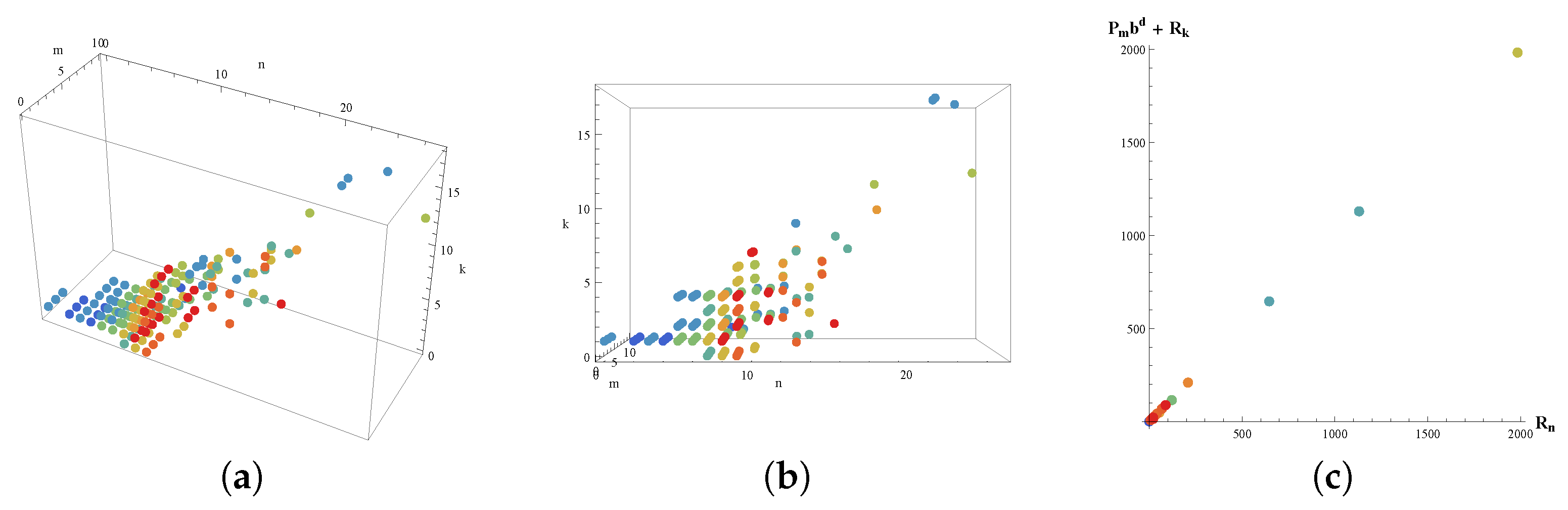
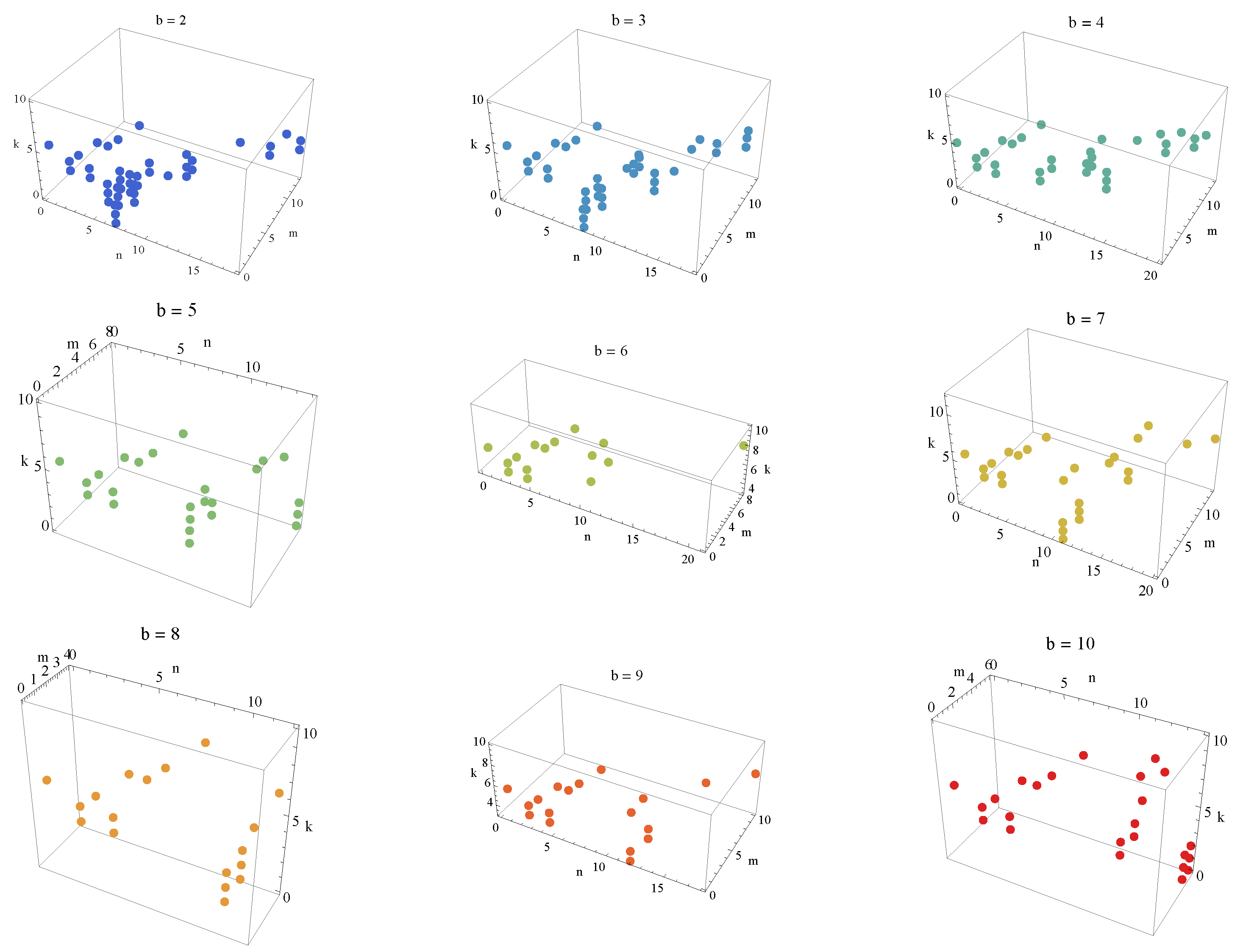
In Figure 1, the dots for each base b, where d is the length of the representation of in base b, visualize the relationship between the values n, m, and k for which the condition is satisfied. The data are plotted for the base values , with unique colors assigned to each base for better differentiation. The graph given in Figure 2a,b are the nine graphs in Figure 1 shown on a single graph and Figure 2c shows the values that satisfy the equality . The axes represent the indices n, m, and k, and the visualization helps identify patterns in the solutions for different bases.
Figure 1.
Visualization of the relationship between , , and in different bases b for (1).
Figure 2.
Three-dimensional solution distribution dased on base b and number sequences for (1).
Theorem 2.
Let be an integer. If the equation has a solution, then
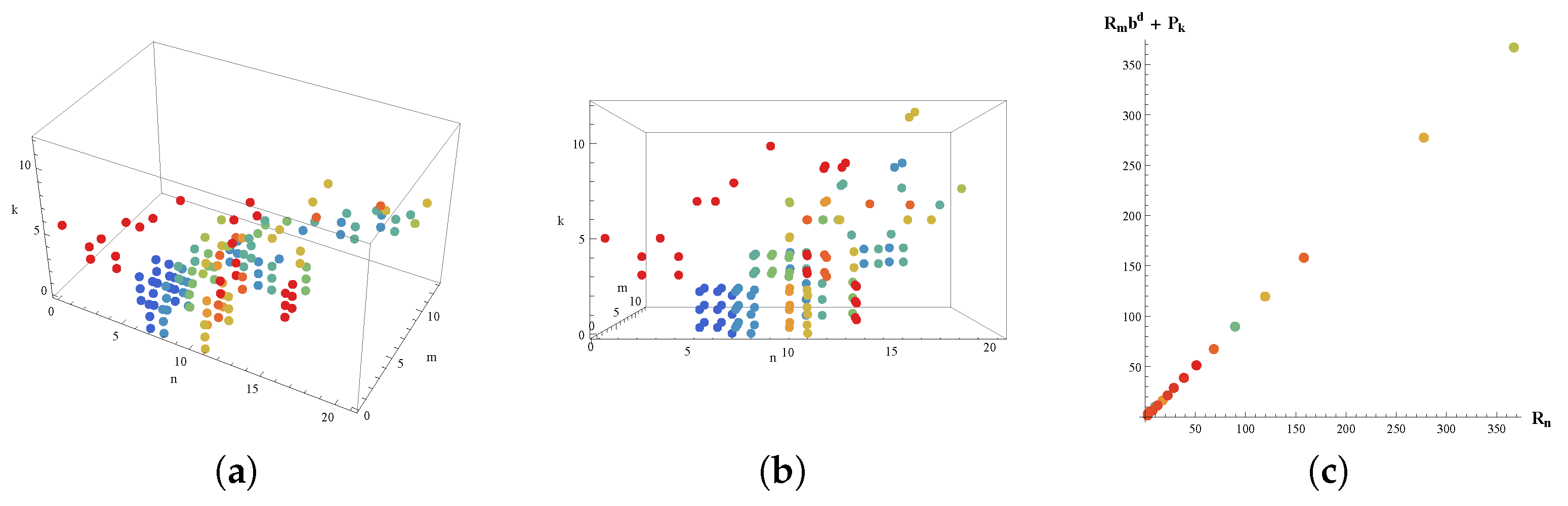
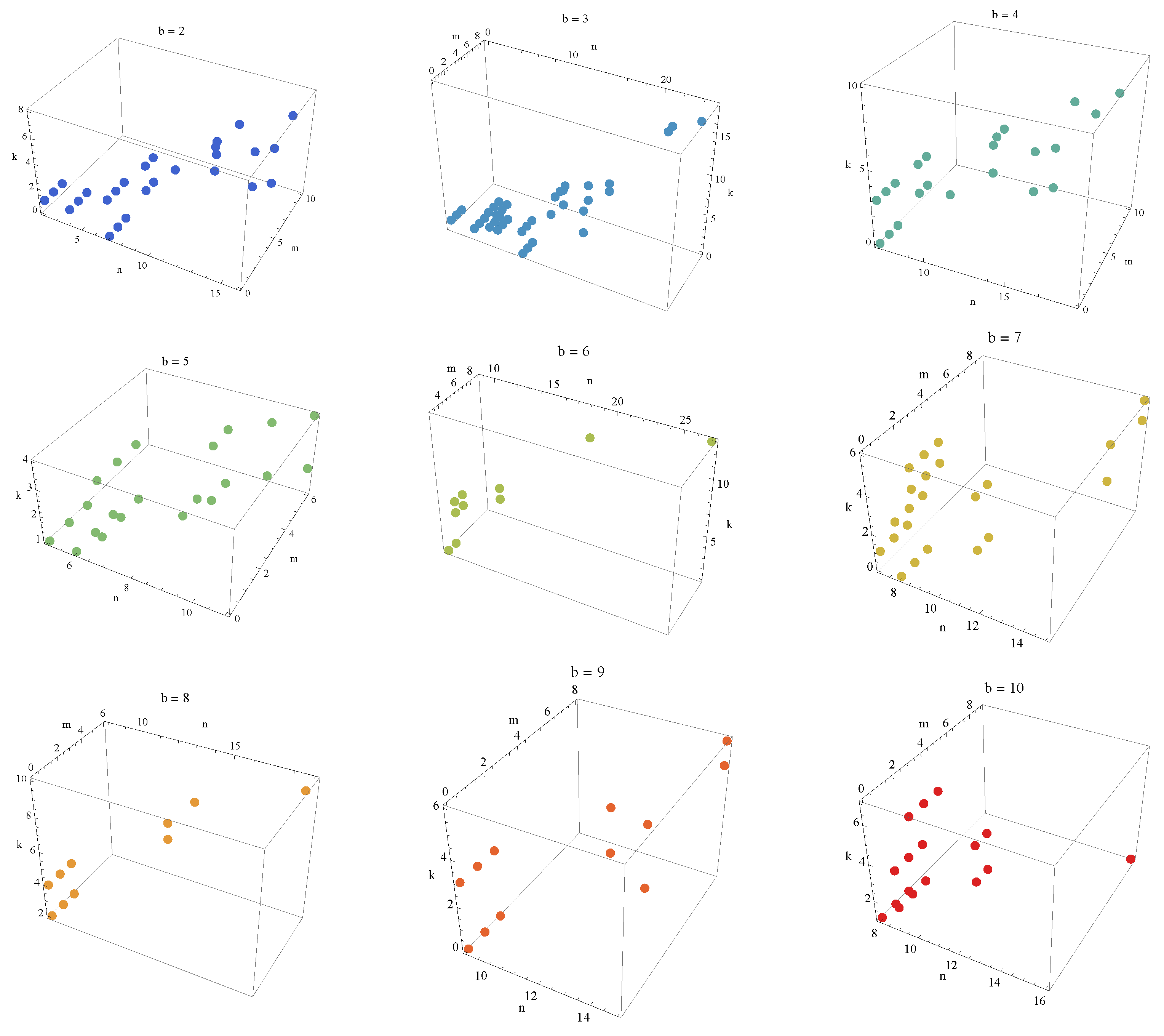
Figure 3 and Figure 4 visualize the relationship between the parameters n, m, and k, based on the Padovan and Perrin derived from the recurrence relations. For each base b, the points represent the indices where the condition is satisfied. Here, d is the length of the representation of in base b. The data are plotted for base values , with unique colors assigned to each base for better differentiation. The graph given in Figure 4a,b are the nine graphs in Figure 3 shown on a single graph and Figure 4c shows the values that satisfy the equality . The axes represent the indices n, m, and k, and the visualization helps to identify patterns in the solutions for different bases.
Figure 3.
Visualization of the relationship between , , and in different bases b for (2).
Figure 4.
Three-dimensional solution distribution based on base b and number sequences for (2).
We determine that the sets of solutions are
for Equation (1) and
for Equation (2). These solutions were obtained using advanced techniques in Diophantine analysis, such as properties of linear forms in logarithms, continued fractions, Baker’s Theorem, and logarithmic height functions.
Lemma 8.
Suppose that is valid where d is the number of digits of in base b. For , and , the inequalities hold below.
- (i)
- and
- (ii)
- (iii)
Proof.
- (i)
- As d is the number of digits of in base b, we have . Then, we findandThis completes the proof.
- (ii)
- Asandwe obtain
- (iii)
- As we get , we get
□
The proof of the following lemma can be performed using a similar proof to that of the previous lemma. Therefore, it will be given without proof.
Lemma 9.
Suppose that is valid, where d is the number of digits of in base b. For , and , the inequalities below hold.
- (i)
- and
- (ii)
- (iii)
4. Proof of Theorem 1
Suppose that Equation (1) is valid. Let By PARI/GP, we find
Suppose that If or , then we find the equations and , respectively. These are impossible by Lemmas 6 and 7. Now, suppose , , and As we can take and By (1), we write
This equation will be expressed in two different forms as follows:
and
Using the Lemma 8, (3), and (4), rearranging these equations leads to the following results:
and
We take
and
to apply Lemma 1. It can be shown that and The logarithmic height for are
Then, we choose
Also, as and we can say
By using Lemma 1, (6), (8), (9), (12), and (14), we provide
i.e.,
and by using (7), (10), (11), (13), (14) and Lemma 1, we obtain
By using (15) and (16), we have Assume . For , we obtain the following inequality:
We choose to apply Lemma 4. This provides
and, consequently,
Next, let , , and . Then, we have exceeding , and we find
Let in Lemma 3. Then, if
there is no solution to the inequality (19). This implies that
By using (16), we conclude that . Now, we will find smaller than the one we found now by using Lemma 3. Let
From (7), we write
for To use Lemma 4, let us choose . Thence, we find the inequality
and
If we determine and it can be found that exceeds Then, it can be shown that the inequality
for each and without By taking and in Lemma 3, we can demonstrate that the inequality (22) does not hold if
Hence, we conclude that This leads to a contradiction, as Now, let It follows immediately that
These are impossible by Lemma 6.
5. Proof of Theorem 2
Suppose that Equation (2) is valid. Suppose that It can be shown that
Suppose and . Then, we have , which is impossible by Lemma 2.
Now, assume and . We can take , , and , as , , , and . By (2), we can express as follows:
Rearranging this equation leads to the following results:
and
After taking the absolute values of these equations, we obtain the following representation
and
by using Lemma 9, (3), and (4). To apply Lemma 1, we take
and
It can be shown that and As
Then, we choose
Also, as and we can choose
By using Lemma 1, (24), (26), (27), (30), and (32), we provide
i.e.,
and by using (25), (28), (29), (31), (32), and Lemma 1, we write
i.e.,
By using (33) and (34), we obtain Assume
Then, we obtain
as We take to use Lemma 4. Then,
and so
Let , and define
It can be shown that . Assume . Then, we have
and the inequality
holds. Based on the well-known properties of continued fractions, the rational number is a convergent of . Let represent the r-th convergent of the continued fraction expansion of , and assume that for some t. From this, we deduce that and Applying Lemma 5, we establish the inequality
From this, we derive the following bounds:
Moreover, for , it follows from (34) that
Now, let
We have
from (25). From Lemma 4, we obtain
and
Let and define where It follows that and
for all integers satisfying
By applying Lemma 3, we deduce that inequality (41) has no solution if the following condition holds:
where and From this, we infer that . However, this conclusion contradicts the fact that .
6. Conclusions
This work provided a comprehensive analysis of Perrin numbers that can be expressed as concatenations of a Padovan number and a Perrin number in a base b. The results extended existing research on combinations in integer sequences and demonstrated the power of modern techniques in Diophantine equations. The arithmetic properties of Padovan and Perrin sequences in different bases were investigated. Using linear forms in logarithms, we derived bounds with small upper values for the variables and used continued fraction expansion to improve these bounds and systematically determine all possible solutions. The obtained results reveal structural relations between different special types of numbers and contributed to the solutions of Diophantine equations involving different sequences. When the graphs of the solutions of Diophantine equations are examined, it is easily seen that the solutions have distributions in certain intervals. In the future, similar methods can be used to solve Diophantine equations with many bases or involving different sequences of numbers. In addition, similar methods can be used to find the solutions of some Diophantine equations that may be encountered in engineering problems. The distribution structure or symmetry properties of the solutions of Diophantine equations can be observed by analyzing them in different intervals.
Funding
This research received no external funding.
Data Availability Statement
Data will be made available on request.
Conflicts of Interest
The author declares no conflicts of interest.
References
- Sloane, N.J.A. The On-Line Encyclopedia of Integer Sequences (OEIS). 2024. Available online: https://oeis.org (accessed on 1 January 2025).
- Banks, W.D.; Luca, F. Concatenations with binary reccurent sequences. J. Integer Seq. 2005, 8, 3. [Google Scholar]
- Alan, M. On Concatenations of Fibonacci and Lucas Numbers. Bull. Iran. Math. Soc. 2022, 48, 2725–2741. [Google Scholar] [CrossRef]
- Bravo, E.F. On concatenations of Padovan and Perrin numbers. Math. Commun. 2023, 28, 105–119. [Google Scholar]
- Altassan, A.; Alan, M. On Mixed Concatenations of Fibonacci and Lucas Numbers Which are Fibonacci Numbers. arXiv 2022, arXiv:2206.13625. [Google Scholar]
- Erduvan, F. On Concatenations of Two Padovan and Perrin Numbers. Bull. Iran. Math. Soc. 2023, 49, 62. [Google Scholar] [CrossRef]
- Chalebgwa, T.P.; Ddamulira, M. Padovan numbers which are palindromic concatenations of two distinct repdigits. Rev. Real Acad. Cienc. Exactas Fis. Nat. Ser. A Mat. 2021, 115, 108. [Google Scholar] [CrossRef] [PubMed]
- Ddamulira, M. Padovan numbers that are concatenations of two distinct repdigits. Math. Slovaca 2021, 71, 275–284. [Google Scholar] [CrossRef]
- Dujella, A.; Pethò, A. A generalization of a theorem of Baker and Davenport. Q. J. Math. Oxf. 1998, 49, 291–306. [Google Scholar] [CrossRef]
- Baker, A.; Davenport, H. The equations 3x2-2=y2 and 8x2-7=z2. Q. J. Math. Oxford Ser. 1969, 20, 129–137. [Google Scholar] [CrossRef]
- Batte, H.; Chalebgwa, T.P.; Ddamulira, M. Perrin numbers that are concatenations of two distinct repdigits. arXiv 2021, arXiv:2105.08515. [Google Scholar]
- Adédji, K.N.; Dossou-yovo, V.; Rihane, S.E.; Togbé, A. Padovan or Perrin numbers that are concatenations of two distinct base b repdigits. Math. Slovaca 2023, 73, 49–64. [Google Scholar] [CrossRef]
- Bugeaud, Y. Linear Forms in Logarithms and Applications; IRMA Lectures in Mathematics and Theoretical Physics; European Mathematical Society: Zurich, Switzerland, 2008; Volume 28. [Google Scholar]
- Matveev, E.-M. An Explicit lower bound for a homogeneous rational linear form in the logarithms of algebraic numbers II. Izv. Nauk. Ser. Math. 2000, 64, 125–180. (In Russian) [Google Scholar] [CrossRef]
- Bugeaud, Y.; Mignotte, M.; Siksek, S. Classical and modular approaches to exponential Diophantine equations I. Fibonacci and Lucas perfect powers. Ann. Math. 2006, 163, 969–1018. [Google Scholar] [CrossRef]
- Bravo, J.J.; Gomez, C.A.; Luca, F. Powers of two as sums of two k-Fibonacci numbers. Miskolc Math. Notes 2016, 17, 85–100. [Google Scholar] [CrossRef]
- De Weger, B.M.M. Algorithms for Diophantine Equations; CWI Tracts 65; Stichting Mathematisch Centrum: Amsterdam, The Netherlands, 1989. [Google Scholar]
- Legendre, A.M. Essai sur la Th’Eorie des Nombres; Duprat: Paris, France, 1798. [Google Scholar]
- Güney Duman, M. On perfect powers that are difference of two Perrin numbers or two Padovan numbers. Proc. Indian Natl. Sci. Acad. 2024, 90, 124–131. [Google Scholar] [CrossRef]
- Güney Duman, M. The equations Rn = d·Pm and Pn = d·Pm in Padovan and Perrin numbers. In Proceedings of the 11th International Vocational Schools Symposium, Düzce, Türkiye, 5–7 October 2023. [Google Scholar]
Disclaimer/Publisher’s Note: The statements, opinions and data contained in all publications are solely those of the individual author(s) and contributor(s) and not of MDPI and/or the editor(s). MDPI and/or the editor(s) disclaim responsibility for any injury to people or property resulting from any ideas, methods, instructions or products referred to in the content. |
© 2025 by the author. Licensee MDPI, Basel, Switzerland. This article is an open access article distributed under the terms and conditions of the Creative Commons Attribution (CC BY) license (https://creativecommons.org/licenses/by/4.0/).