Conformable Time-Delay Systems: Stability and Stabilization Under One-Sided Lipschitz Conditions

 , , and
Abstract
1. Introduction
- Novel LMI conditions for exponential stability of autonomous conformable time-delay systems with one-sided Lipschitz nonlinearities and quadratic inner-boundedness constraints.
- Practical exponential stability criteria for perturbed systems with bounded disturbances, providing computable ultimate bounds.
- State-feedback stabilization strategies for nominal and perturbed systems via convex optimization.
- Systematic Lyapunov–Krasovskii functional construction tailored to conformable derivative properties.
- Comprehensive numerical validation demonstrating effectiveness and applicability.
2. Preliminaries
- State Vector: ;
- System Matrices: ;
- Delay: ;
- Derivative Order: for ;
- Nonlinearity: , .
3. Stability Analysis of One-Sided Lipschitz Conformable Time-Delay Systems
4. Practical Stability Analysis of One-Sided Lipschitz Conformable Time-Delay Systems
5. Exponential Stabilization for One-Sided Lipschitz Conformable Systems with Time Delay
- is the control input vector;
- is the input matrix;
- All other terms are as defined in System (1).
| Algorithm 1: Exponential Stabilization via State Feedback |
Input: System matrices A, , B; nonlinearity parameters , , , , , ; delay ; derivative order c; decay rate Output: Controller gain K and stability certificate
|
6. Practical Exponential Stabilization for One-Sided Lipschitz Conformable Systems with Time Delay and Bounded Perturbations
- The perturbation satisfies Assumption 3.
| Algorithm 2: Practical Exponential Stabilization under Bounded Perturbations |
Input: System matrices A, , B; nonlinearity parameters , , , , , ; delay ; derivative order c; disturbance bound ; desired ultimate bound Output: Robust controller gain K and practical stability certificate
|
7. Comparison with Existing Works
Contrast with Prior Works
- Convex LMI conditions for exponential and practical stability under OSL and QIB assumptions in the conformable derivative setting with delays.
- Explicit formulae for decay rate and ultimate bound r, enabling quantitative performance guarantees.
- State-feedback stabilization strategies formulated as tractable LMI problems, ensuring implementability via standard solvers.
8. Numerical Examples
8.1. OSL and QIB Constants
8.2. Simulation Setup
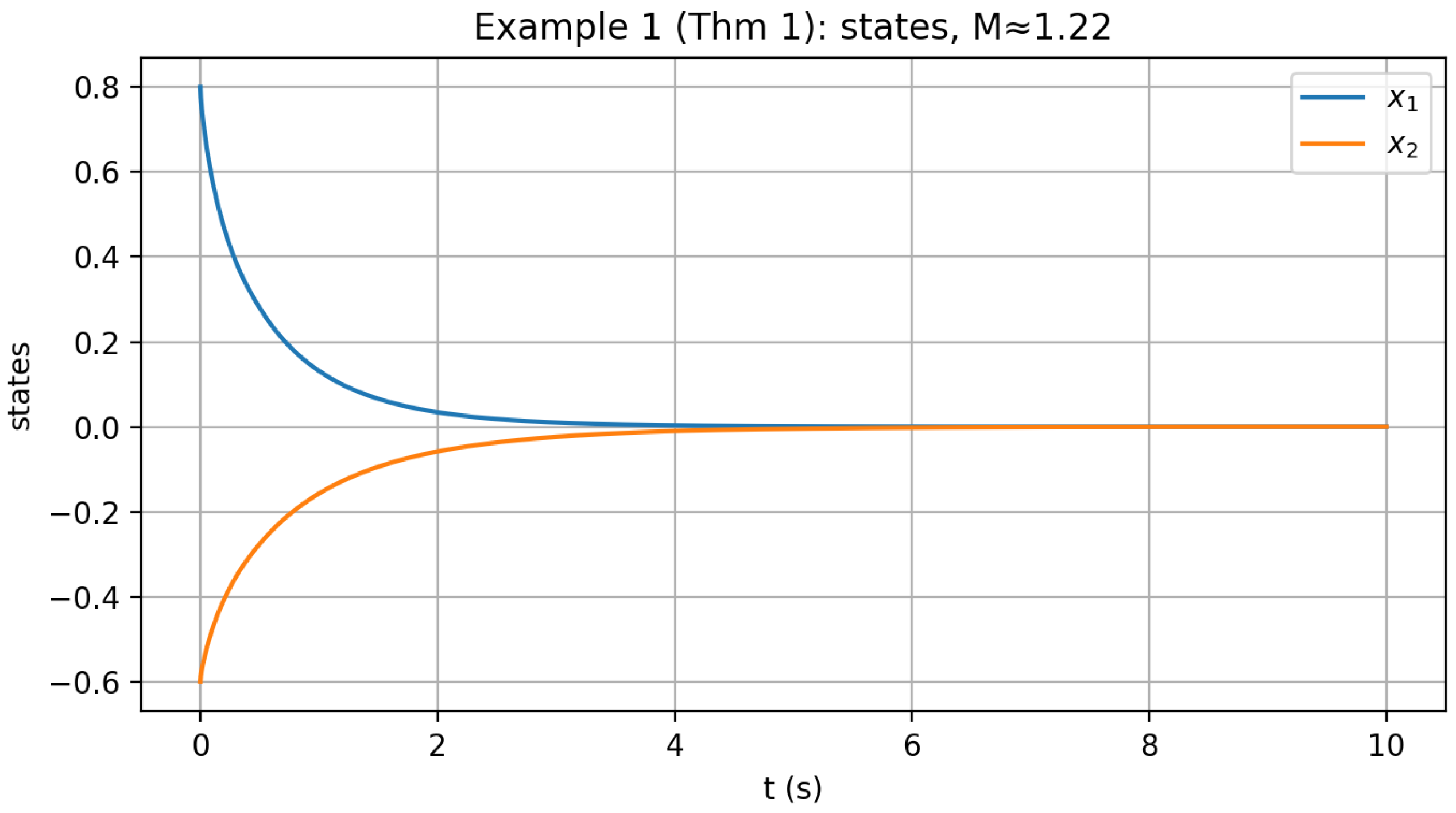
8.3. Example 1 (Theorem 1): Exponential Stability
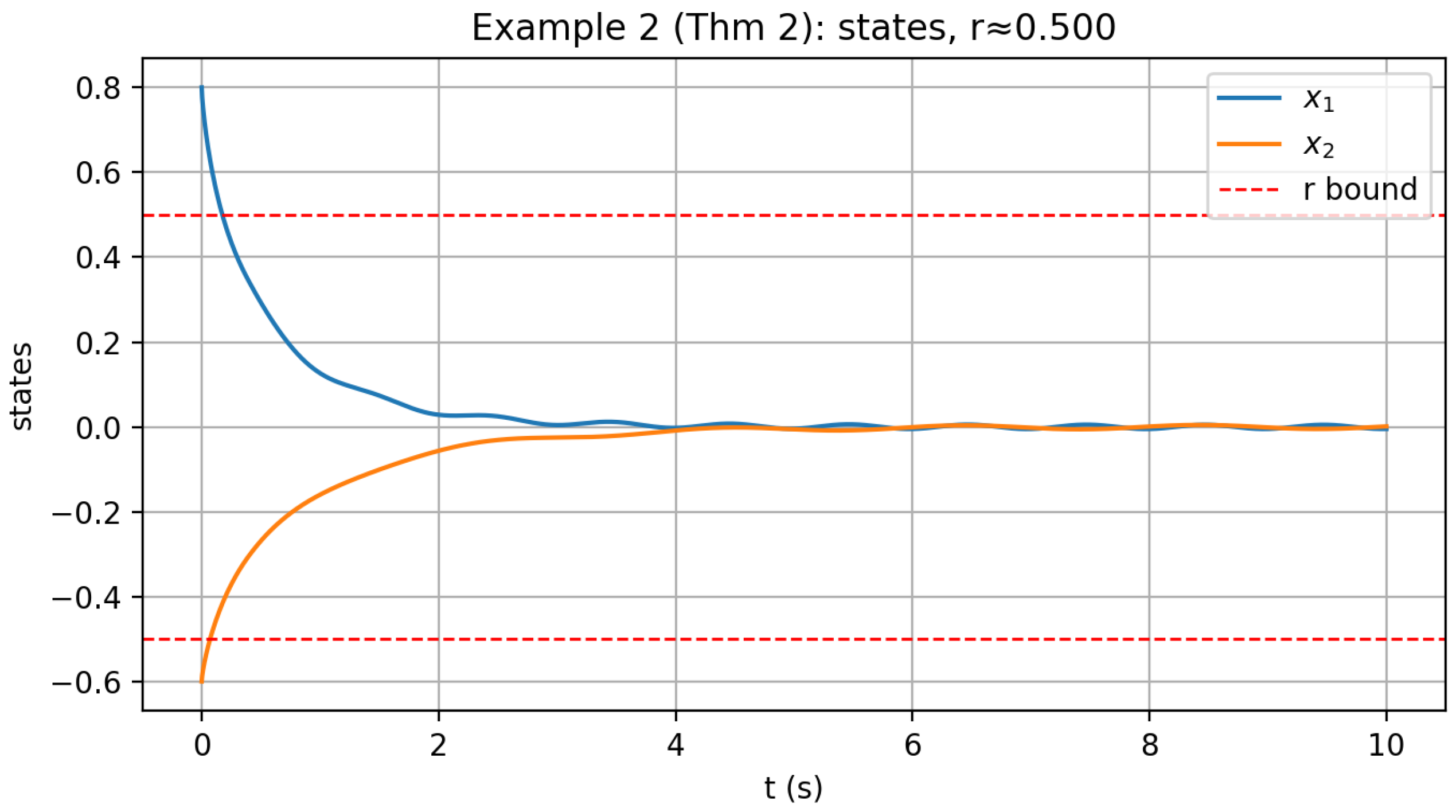
8.4. Example 2 (Theorem 2): Practical Stability Under Disturbance
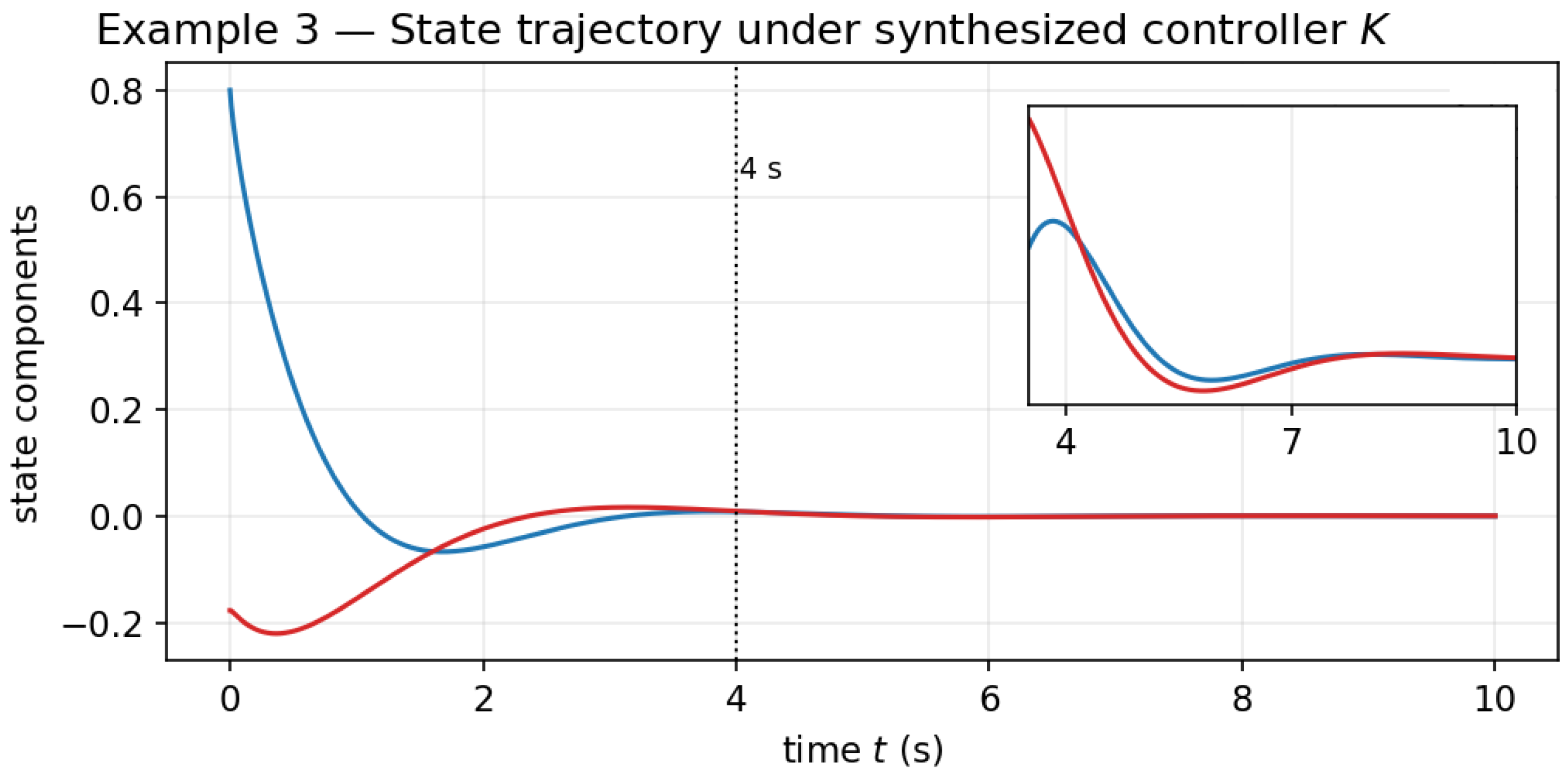
8.5. Example 3: Exponential Stabilization via Synthesized Controller
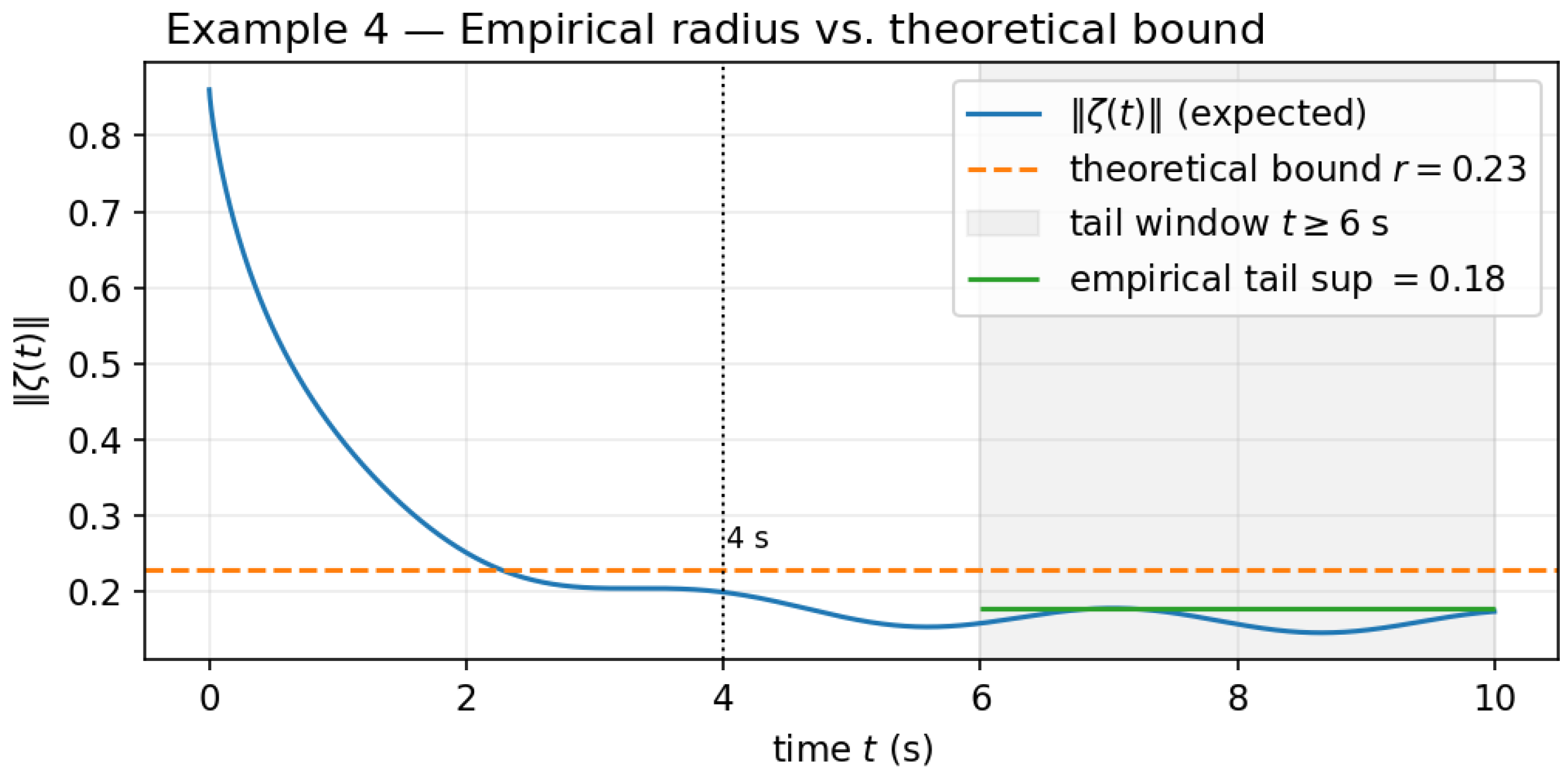
8.6. Example 4: Practical Stabilization and Bound Validation
8.7. Sensitivity Analysis in the Derivative Order c and Delay
8.7.1. Objective
8.7.2. Setup (Grids, Models, and Solver)
8.7.3. Simulation and Ratio
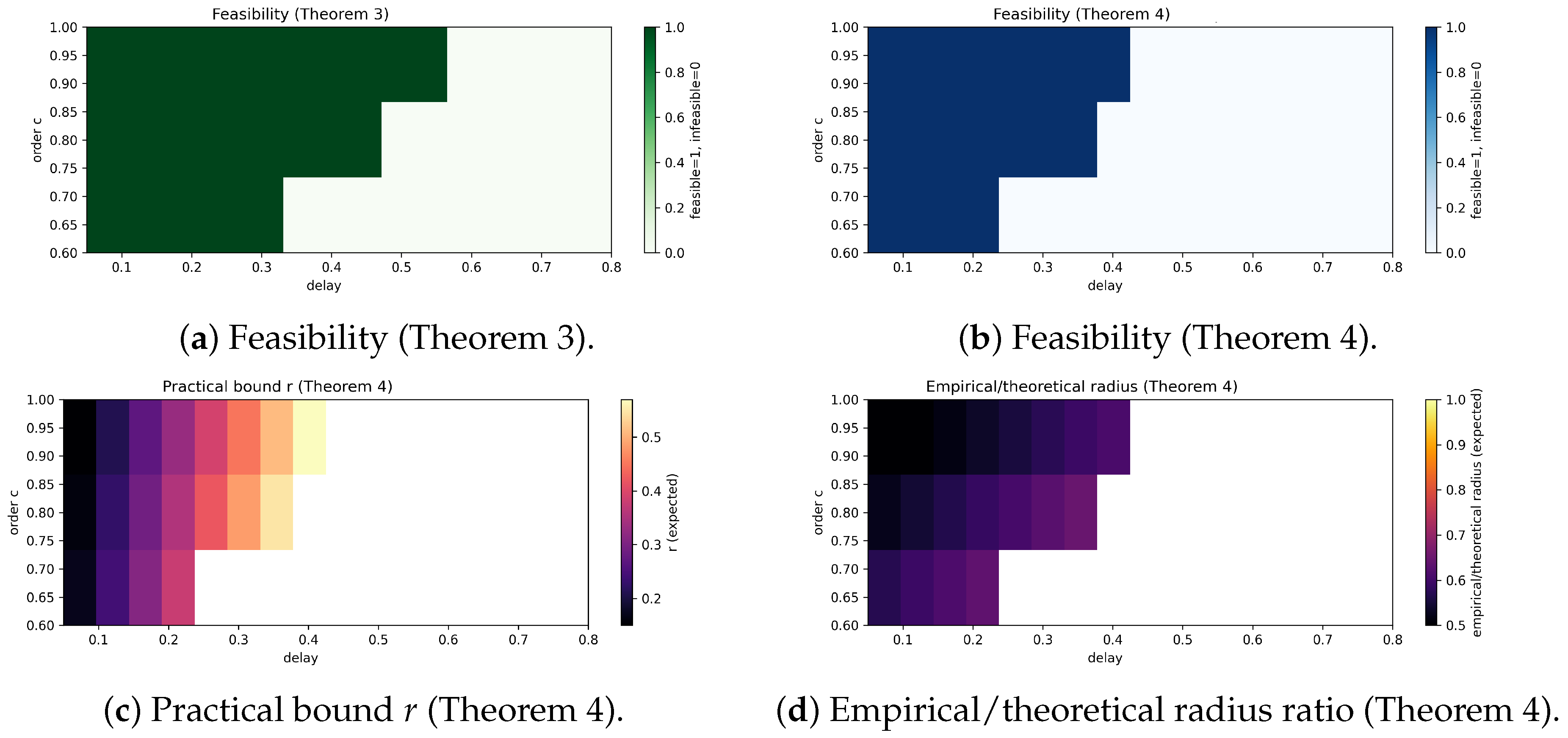
8.7.4. Interpretation of Figure 5

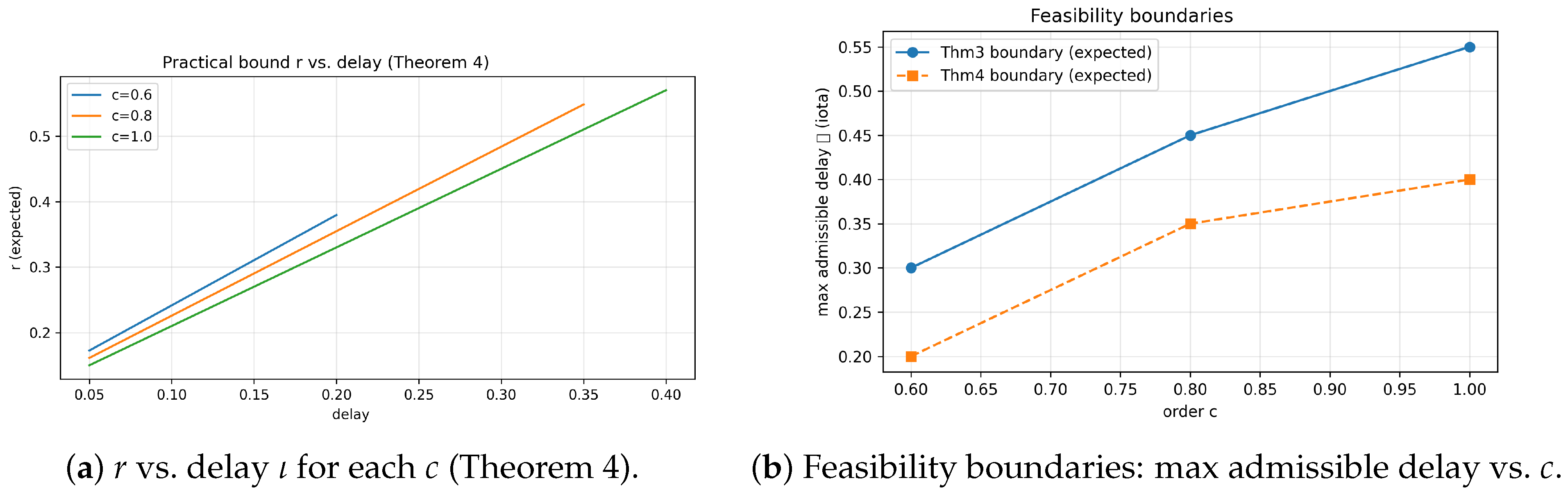
8.7.5. Interpretation of Figure 6

8.8. Comparison with Caputo/Riemann–Liouville LMI Conditions
8.8.1. Objective
8.8.2. Common Setup (Fairness)
8.8.3. Metrics
8.8.4. Solver Settings (Uniform)
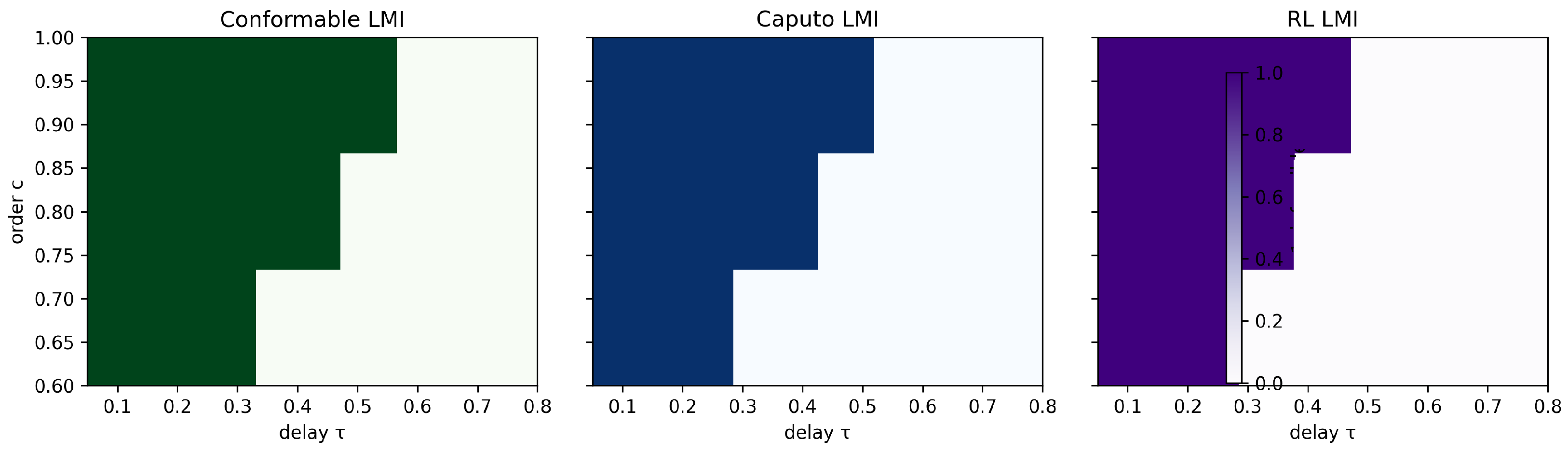
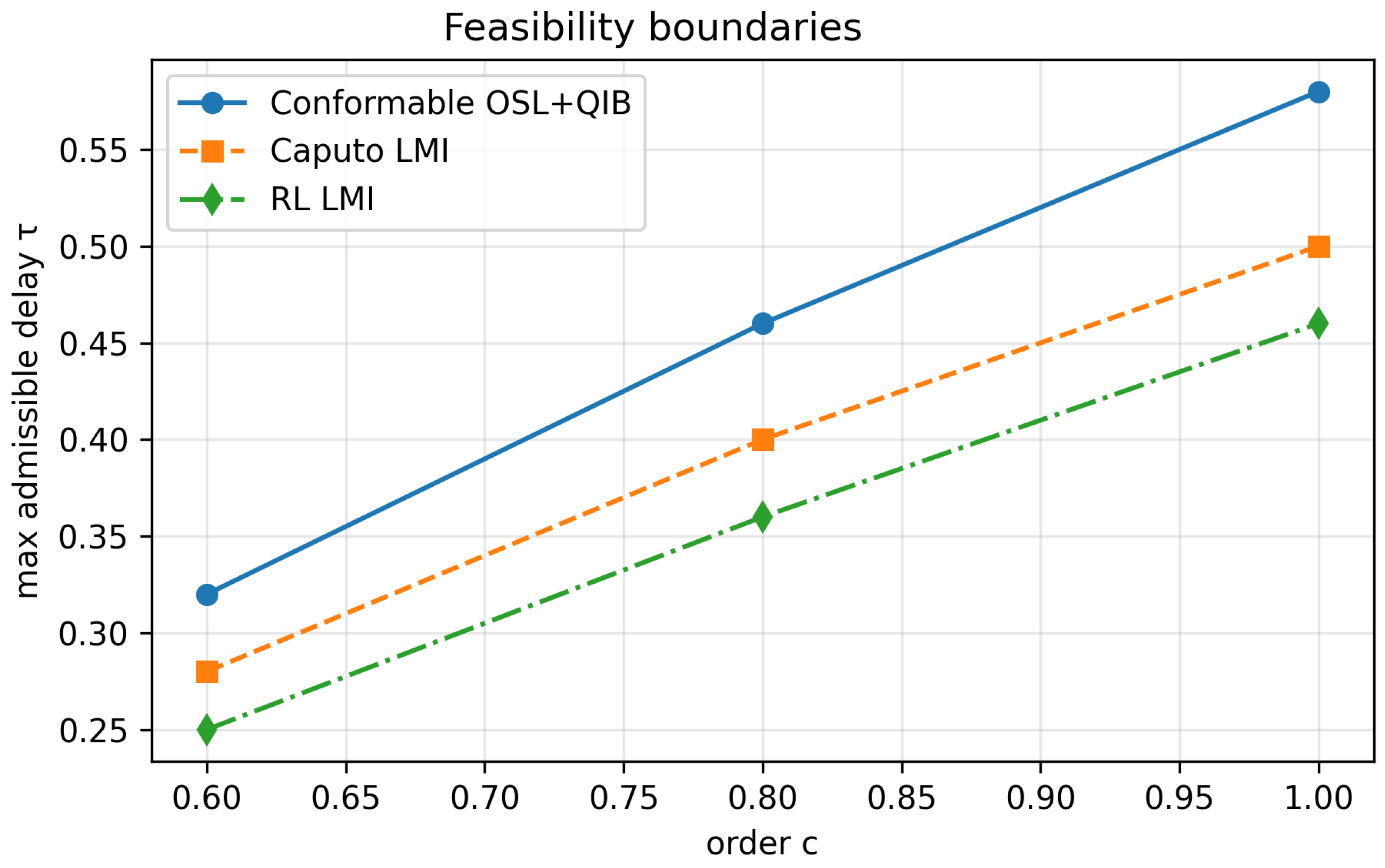
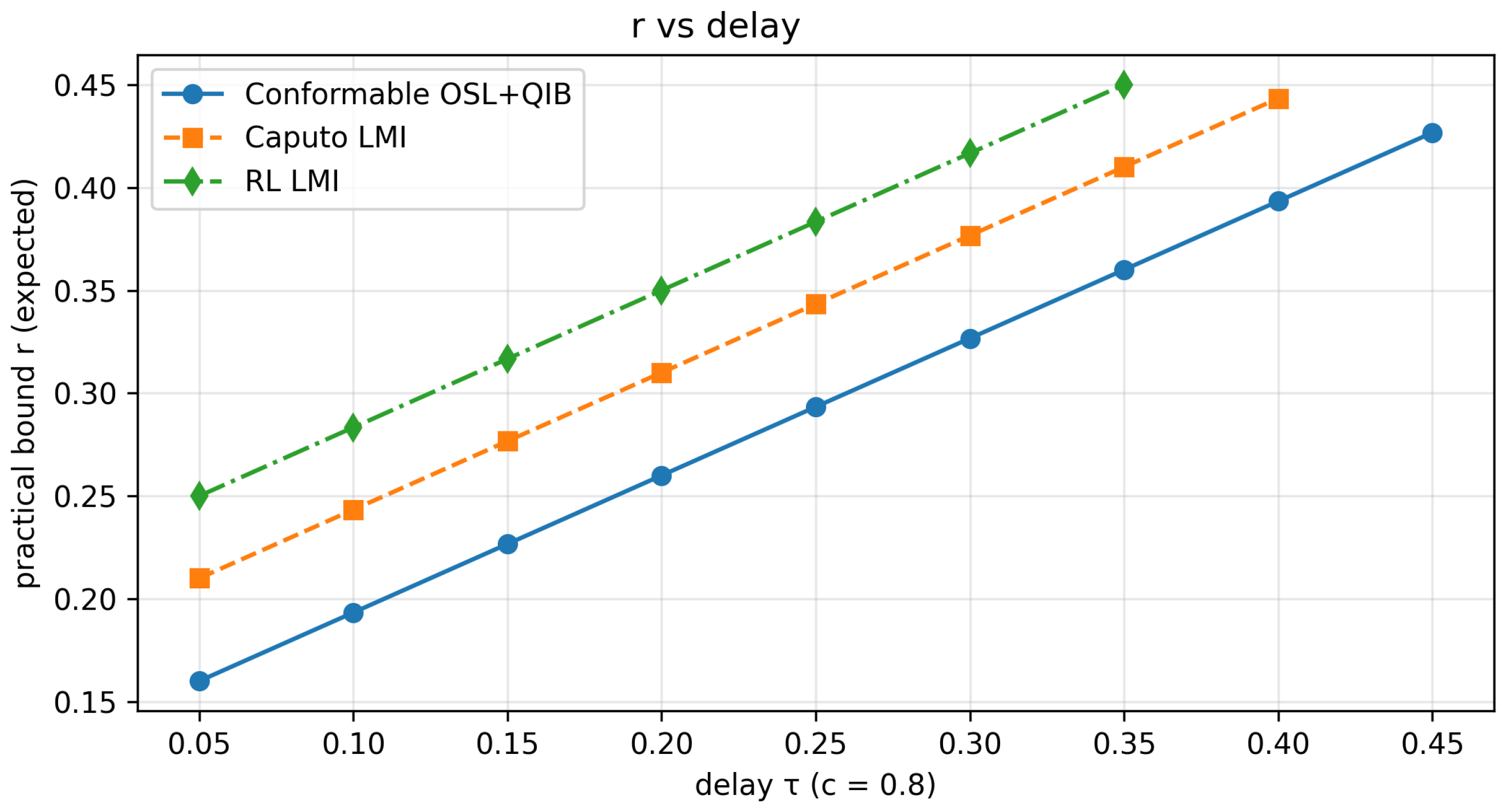
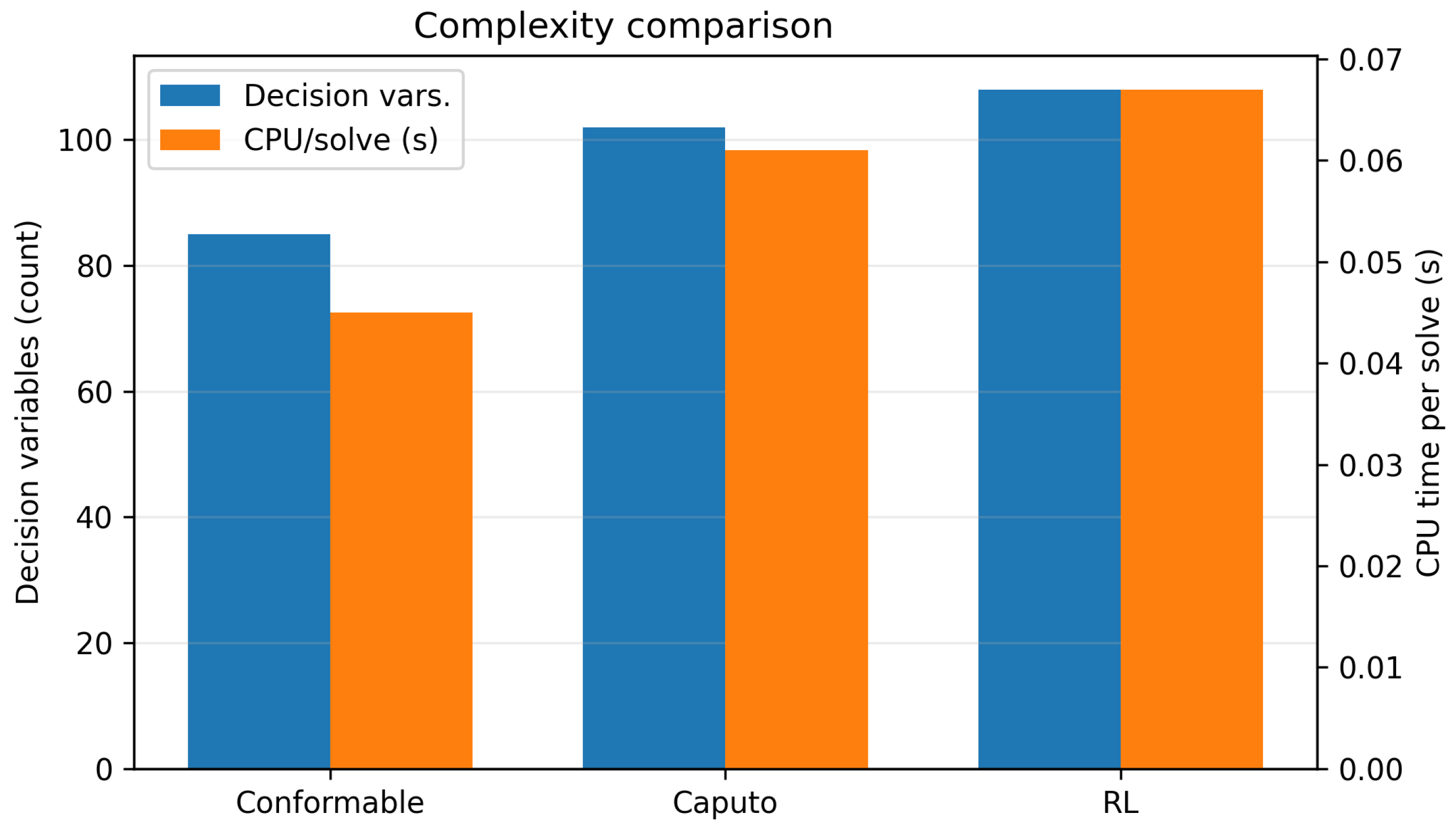
8.8.5. Results (Illustrative)
8.8.6. Interpretation
9. Conclusions
Author Contributions
Funding
Data Availability Statement
Conflicts of Interest
Appendix A. Reproducibility Package (Sketch)
Appendix A.1. Software and Solvers
- MOSEK (preferred): primal/dual feasibility and relative gap .
- SCS (fallback): eps , max_iters.
Appendix A.2. YALMIP (MATLAB)—Sketch (Theorems 3 and 4)
References
- Khalil, R.; Horani, M.A.; Yousef, A.; Sababheh, M. A new definition of fractional derivative. J. Comput. Appl. Math. 2014, 264, 65–70. [Google Scholar] [CrossRef]
- Abdeljawad, T. On conformable fractional calculus. J. Comput. Appl. Math. 2015, 279, 57–66. [Google Scholar] [CrossRef]
- Zhao, D.; Luo, M. General conformable fractional derivative and its physical interpretation. Calcolo 2015, 54, 903–917. [Google Scholar] [CrossRef]
- Atangana, A.; Baleanu, D.; Alsaedi, A. New properties of conformable derivative. Open Math. 2015, 13, 889–898. [Google Scholar] [CrossRef]
- Martínez, F.; Martínez, I.; Kaabar, M.K.A.; Paredes, S. Generalized conformable mean value theorems with applications to multivariable calculus. J. Math. 2021, 2021, 5528537. [Google Scholar] [CrossRef]
- Sadek, L.; Akgul, A. New properties for conformable fractional derivative and applications. Progr. Fract. Differ. Appl. 2024, 10, 335–344. [Google Scholar]
- Kahouli, O.; Elloumi, M.; Naifar, O.; Alsaif, H.; Kahouli, B.; Bouteraa, Y. Electrical circuits described by general fractional conformable derivative. Front. Energy Res. 2022, 10, 851070. [Google Scholar] [CrossRef]
- Elloumi, M.; Naifar, O.; Ben Makhlouf, A.; Bouteraa, Y.; Elgharbi, S. Enhanced general conformable controller based on lyapunov technique for dc-dc static converters: Application to a solar system. AIMS Math. 2024, 9, 10698–10716. [Google Scholar] [CrossRef]
- Naifar, O. Tempered fractional gradient descent: Theory, algorithms, and robust learning applications. Neural Netw. 2026, 193, 108005. [Google Scholar] [CrossRef]
- Xie, W.; Wu, W.Z.; Liu, C.; Liu, C.; Pang, M. The general conformable fractional grey system model and its applications. Eng. Appl. Artif. Intell. 2024, 136, 108817. [Google Scholar] [CrossRef]
- Sadek, L.; Chablaoui, S.; Toukmati, A.; Sadek, E.M.; Ben Makhlouf, A. On the observability and controllability of linear fractional quantum control systems. Math. Methods Appl. Sci. 2025, 48, 10978–10990. [Google Scholar] [CrossRef]
- Michiels, W.; Niculescu, S.I. Stability and Stabilization of Time-Delay Systems: An Eigenvalue-Based Approach; SIAM: Philadelphia, PA, USA, 2007. [Google Scholar]
- Gu, K.; Chen, J.; Kharitonov, V.L. Stability of Time-Delay Systems; Springer: Berlin/Heidelberg, Germany, 2003. [Google Scholar]
- Borah, L.; Dehingia, K.; Sarmah, H.K.; Phukan, A.; Rihan, F.A.; Hinçal, E. Stability and bifurcation analysis of a financial dynamical system with time delay. Eur. Phys. J. Spec. Top. 2025, 234, 1607–1622. [Google Scholar] [CrossRef]
- Lee, T.; Dianat, S. Stability of time-delay systems. IEEE Trans. Autom. Control 2003, 26, 951–953. [Google Scholar] [CrossRef]
- Kengne, E. Conformable derivative in a nonlinear dispersive electrical transmission network. Nonlinear Dyn. 2024, 112, 2139–2156. [Google Scholar] [CrossRef]
- Nemri, A. On linear heat equation via conformable derivative approach. Math. Mech. Solids 2025, 30, 1213–1227. [Google Scholar] [CrossRef]
- Naifar, O.; Rebiai, G.; Ben Makhlouf, A.; Hammami, M.A.; Guezane-Lakoud, A. Stability analysis of conformable fractional-order nonlinear systems depending on a parameter. J. Appl. Anal. 2020, 26, 287–296. [Google Scholar] [CrossRef]
- Luo, L.; Li, L.; Cao, J.; Abdel-Aty, M. Fractional exponential stability of nonlinear conformable fractional-order delayed systems with delayed impulses and its application. J. Frankl. Inst. 2025, 362, 107353. [Google Scholar] [CrossRef]
- Aldandani, M.; Naifar, O.; Ben Makhlouf, A. Practical stability for nonlinear systems with generalized conformable derivative. AIMS Math. 2023, 8, 15618–15632. [Google Scholar] [CrossRef]
- Kharrat, M.; Gassara, H.; Rhaima, M.; Mchiri, L.; Ben Makhlouf, A. Practical stability for conformable time-delay systems. Discret. Dyn. Nat. Soc. 2023, 2023, 9375360. [Google Scholar] [CrossRef]
- Samidurai, R.; Yazhini, M. Global mittag-leffler stability and synchronization of discrete-time fractional-order complex-valued bam neural networks with time delay. J. Appl. Math. Comput. 2025, 71, 6859–6883. [Google Scholar] [CrossRef]
- Xu, M.; Hu, G.D.; Zhao, Y. Reduced-order observer design for one-sided lipschitz non-linear systems. Ima J. Math. Control Inf. 2009, 26, 299–317. [Google Scholar] [CrossRef]
- Binh, T.N.; Huu Sau, N.; Thi Thanh Huyen, N.; Thuan, M.V. Guaranteed cost control of delayed conformable fractional-order systems with nonlinear perturbations using an event-triggered mechanism approach. Int. J. Syst. Sci. 2025, 56, 2991–3008. [Google Scholar] [CrossRef]
- Alawad, M.A.; Louhichi, B. Innovative observer design for nonlinear tempered fractional-order systems. Asian J. Control 2025, early view. [Google Scholar] [CrossRef]
- Nguyen, N.H.A.; Kim, S.H. Stabilization criterion for continuous-time ts fuzzy delayed systems subject to asynchronous fuzzy phenomenon via non-pdc scheme. Int. J. Control. Autom. Syst. 2025, 23, 572–580. [Google Scholar] [CrossRef]
- Koudohode, F.; Bekiaris-Liberis, N. Predictor-feedback stabilization of globally lipschitz nonlinear systems with state and input quantization. arXiv 2025, arXiv:2501.14696. [Google Scholar] [CrossRef]
- Naifar, O. Practical observer design for nonlinear systems using caputo fractional derivative with respect to another function. In Proceedings of the 2025 IEEE 22nd International Multi-Conference on Systems, Signals & Devices (SSD), Monastir, Tunisia, 17–20 February 2025; pp. 411–418. [Google Scholar]
- Faydasicok, O.; Ozcan, N. A further stability analysis of neutral systems with multiple time-varying delays. IEEE Access 2025, 13, 109160–109171. [Google Scholar] [CrossRef]
- Zhang, K.; Zhou, B. Stabilization of feedforward nonlinear time-delay systems with vanishing actuator effectiveness by linear time-varying feedback. Automatica 2026, 183, 112635. [Google Scholar] [CrossRef]
- Aleksandrov, A.; Efimov, D.; Fridman, E. Robust stability and stabilization of nonlinear mechanical systems with distributed delay. IEEE Trans. Autom. Control 2025, in press. [Google Scholar]
- Gong, Z.; Liu, C.; Teo, K.L.; Wu, Y. A gradient-based optimization algorithm to solve optimal control problems with conformable fractional-order derivatives. J. Comput. Appl. Math. 2025, 454, 116169. [Google Scholar] [CrossRef]
- Murad, M.A.S. Soliton solutions of cubic quintic septimal nonlinear schrödinger wave equation with conformable derivative by two distinct algorithms. Phys. Scr. 2024, 99, 105247. [Google Scholar] [CrossRef]
- Chen, X.; Chen, L.; Xu, J.; Jiang, B. Stability analysis and applications of time-delay systems subject to delayed impulses. Isa Trans. 2025, in press. [Google Scholar] [CrossRef] [PubMed]
- Zhang, X.; Deng, S.; Liang, Y.; Fei, W. Stabilization and destabilisation of non-autonomous stochastic nonlinear delay differential equations. Int. J. Control 2025, 98, 583–592. [Google Scholar] [CrossRef]
- Tan, C.; Ma, X.; Li, Y.; Xie, X. Global event-triggered adaptive stabilization of nonlinear time-delay systems with unknown measurement sensitivity. IEEE Trans. Autom. Sci. Eng. 2025, 22, 12937–12948. [Google Scholar] [CrossRef]
- Angulo, S.; Márquez, R.; Bernal, M. Reducing conservativeness of lmi-based stability and stabilization conditions for nonlinear time-varying delay systems represented by exact takagi-sugeno models. Int. J. Control. Autom. Syst. 2025, 23, 990–1002. [Google Scholar] [CrossRef]
- El Houch, A.; Erraki, M.; Attioui, A. Strong and exponential stabilisation of non-homogeneous bilinear time delay systems of neutral type. Int. J. Control 2025, 98, 1505–1517. [Google Scholar] [CrossRef]
- Zhang, J.J. Stabilization for p-normal nonlinear systems in presence of inverse dynamics and input time-delay. IEEE Access 2025, 13, 51231–51241. [Google Scholar] [CrossRef]
- Zheng, H.; Tian, Y. Exponential stability of time-delay systems with highly nonlinear impulses involving delays. Math. Model. Control 2025, 5, 103–120. [Google Scholar] [CrossRef]
- Horn, R.A.; Johnson, C.R. Matrix Analysis, 2nd ed.; University Press: Cambridge, UK, 2012. [Google Scholar]
- Iben Ammar, I.; Gassara, H.; Rhaima, M.; Mchiri, L.; Ben Makhlouf, A. Stability analysis and stabilization of general conformable polynomial fuzzy models with time delay. Symmetry 2024, 16, 1259. [Google Scholar] [CrossRef]
- Fallahnejad, M.; Kazemy, A.; Shafiee, M. Event-triggered h-infinity stabilization of networked cascade control systems under periodic dos attack: A switching approach. Int. J. Electr. Power Energy Syst. 2023, 153, 109278. [Google Scholar] [CrossRef]
- Du, Z.; Chen, C.; Li, C.; Yang, X.; Li, J. Fault-tolerant H-infinity stabilization for networked cascade control systems with novel adaptive event-triggered mechanism. IEEE Trans. Autom. Sci. Eng. 2025, 22, 22597–22608. [Google Scholar] [CrossRef]
- Dinh, C.H.; Mai, V.T.; Duong, T.H. New results on stability and stabilization of delayed caputo fractional-order systems with convex polytopic uncertainties. J. Syst. Sci. Complex. 2020, 33, 563–583. [Google Scholar] [CrossRef]
- Badri, P.; Sojoodi, M. LMI-based robust stability and stabilization analysis of fractional-order interval systems with time-varying delay. Int. J. Syst. Sci. 2022, 51, 1–26. [Google Scholar] [CrossRef]
- Jin, X.-C.; Lu, J.-G.; Zhang, Q.-H. Delay-dependent and order-dependent asymptotic stability conditions for riemann–liouville fractional-order systems with time delays. Comput. Appl. Math. 2023, 42, 116. [Google Scholar]
- Qin, Z.; Wu, R.; Lu, Y. Stability analysis of fractional-order systems with the riemann–liouville derivative. Syst. Sci. Control Eng. 2014, 2, 727–731. [Google Scholar] [CrossRef]
- Brandibur, O.; Garrappa, R.; Kaslik, E. Stability of systems of fractional-order differential equations with caputo derivatives. Mathematics 2021, 9, 914. [Google Scholar] [CrossRef]
- Seuret, A.; Gouaisbaut, F. Hierarchy of lmi conditions for the stability analysis of time-delay systems. Syst. Control Lett. 2015, 81, 1–7. [Google Scholar] [CrossRef]
- Alawad, M.A. Lyapunov-based analysis of partial practical stability in tempered fractional calculus. Fractal Fract. 2025, 9, 716. [Google Scholar] [CrossRef]
- Mtaouaa, W. Stability analysis for a class of triangular systems with general conformable derivative. Asian J. Control 2025. early view. [Google Scholar] [CrossRef]
- Li, S.; Zhang, S.; Liu, R. The existence of solution of diffusion equation with the general conformable derivative. J. Funct. Spaces 2020, 2020, 3965269. [Google Scholar] [CrossRef]



| Work | Class | Delay | Main Result | Convex | Exp. Rate/r | Robust | Notes |
|---|---|---|---|---|---|---|---|
| Samidurai & Yazhini (2025) [22] | Frac. (Mittag–Leffler), nonlin. | Yes | Global ML stability and synchronization of discrete-time fractional-order BAM neural networks | — | ML-type bound | — | Fractional-order neural networks with delay; not in OSL/QIB framework. |
| Xu et al. (2009) [23] | Integer-order, nonlin. | No | Reduced-order observer design for one-sided Lipschitz systems | — | — | — | Observer design for OSL systems; no conformable derivatives or delays. |
| Kharrat et al. (2023) [21] | Conformable (nonlin.) | Yes | Practical stability for conformable time-delay systems via LKF | Yes (LMIs) | r (explicit) | — | Conformable + delay; OSL/QIB not explicitly exploited. |
| Aldandani et al. (2023) [20] | Gen. conformable | No | Practical stability for nonlinear systems with generalized conformable derivative | Yes (LMIs) | r (explicit) | — | Conformable setting; no explicit OSL/QIB structure; no delay. |
| Iben Ammar et al. (2024) [42] | Conformable T–S fuzzy | Yes | Stability and stabilization of general conformable polynomial fuzzy models with time delay | Yes (LMIs) | — | — | Different nonlinearity class (T–S fuzzy); not focused on OSL/QIB. |
| This paper | OSL + QIB, conformable | Yes | Exponential and practical stability; state-feedback stabilization | Yes (LMIs) | Explicit and | Yes | Convex LMIs; explicit decay and ultimate bound ; implementable algorithms; first to combine OSL + QIB with conformable derivative and delay to deliver exponential/practical stability and convex synthesis. |
| Method | Grid Volume | @ | Median r | Ratio | DVs | CPU (s) |
|---|---|---|---|---|---|---|
| Conformable (OSL + QIB) | 85 | |||||
| Caputo (baseline LMI) | 102 | |||||
| Riemann–Liouville | 108 |
Disclaimer/Publisher’s Note: The statements, opinions and data contained in all publications are solely those of the individual author(s) and contributor(s) and not of MDPI and/or the editor(s). MDPI and/or the editor(s) disclaim responsibility for any injury to people or property resulting from any ideas, methods, instructions or products referred to in the content. |
© 2025 by the authors. Licensee MDPI, Basel, Switzerland. This article is an open access article distributed under the terms and conditions of the Creative Commons Attribution (CC BY) license (https://creativecommons.org/licenses/by/4.0/).
Share and Cite
Fakhfakh, R.; Ben Makhlouf, A.; Ahmed, I.-E.; Dargail, H.E.; Naifar, O. Conformable Time-Delay Systems: Stability and Stabilization Under One-Sided Lipschitz Conditions. Symmetry 2025, 17, 2141. https://doi.org/10.3390/sym17122141
Fakhfakh R, Ben Makhlouf A, Ahmed I-E, Dargail HE, Naifar O. Conformable Time-Delay Systems: Stability and Stabilization Under One-Sided Lipschitz Conditions. Symmetry. 2025; 17(12):2141. https://doi.org/10.3390/sym17122141
Chicago/Turabian StyleFakhfakh, Raouf, Abdellatif Ben Makhlouf, Ibrahim-Elkhalil Ahmed, Husam E. Dargail, and Omar Naifar. 2025. "Conformable Time-Delay Systems: Stability and Stabilization Under One-Sided Lipschitz Conditions" Symmetry 17, no. 12: 2141. https://doi.org/10.3390/sym17122141
APA StyleFakhfakh, R., Ben Makhlouf, A., Ahmed, I.-E., Dargail, H. E., & Naifar, O. (2025). Conformable Time-Delay Systems: Stability and Stabilization Under One-Sided Lipschitz Conditions. Symmetry, 17(12), 2141. https://doi.org/10.3390/sym17122141