Article

Theoretical Study on Soil Deformation Induced by Shield Tunneling Through Soil–Rock Composite Strata


1
China Railway Siyuan Survey and Design Group Limited Company, Wuhan 430063, China
2
Research Center of Coastal and Urban Geotechnical Engineering, Zhejiang University, Hangzhou 310058, China
3
Department of Civil Engineering, Hangzhou City University, Hangzhou 310015, China
4
China United Engineering Co., Ltd., Hangzhou 310052, China
*
Author to whom correspondence should be addressed.
Symmetry 2025, 17(12), 2104; https://doi.org/10.3390/sym17122104
Submission received: 23 October 2025 / Revised: 20 November 2025 / Accepted: 29 November 2025 / Published: 8 December 2025
(This article belongs to the Section Engineering and Materials)

Abstract

To investigate the soil displacement rule caused by shield tunneling in soil–rock composite strata, the convergence mode of the shield excavation surface was analyzed. The research accounts for the variations in the slopes of the tunnel and the rock–soil interface along the excavation direction. Based on the stochastic medium theory, the calculation formula of soil displacement under different depths is derived. Surface subsidence was computed and evaluated using three engineering case studies. The results show that the calculated surface subsidence curves exhibit strong symmetry and are similar to the distribution pattern of the measured data. When tunneling through composite strata, the segments are prone to an upward floating motion, leading to a convergence pattern in the cross-section that tends toward a non-equal radial convergence mode with top tangency. Within the same project context, the grouting filling rate (δ) diminishes as the hard rock ratio (B) increases, exhibiting an approximate linear correlation. An increase in the hard rock ratio results in reduced values for lateral and longitudinal subsidence, the width of the lateral subsidence trough, and the main impact zone of the shield tunneling operations.

1. Introduction

Shield tunneling is widely used in China and is moving towards the development of more complex projects such as large-diameter, deep burial depth, and complicated geological conditions. The research on the impact of shield tunneling on the surrounding soil and the safety performance of the pipe segments themselves are two important research directions [1,2]. In recent years, there have been many shield tunneling projects in soil–rock composite strata in areas such as Guangzhou, Zhuhai, Nanjing, Fuzhou, Nanchang, and Shenzhen in China [3] When shield tunneling in such strata, it is prone to cause over-excavation of upper soft soil, leading to significant ground surface settlement [4,5]. Similar risks have occurred in projects such as Shenzhen Metro Line 7, Guangzhou Metro Line 4, and Changsha Metro Line 1 [6]. The research on the soil displacement caused by shield tunneling in such special strata has engineering significance.
Regarding the soil deformation issues induced by shield tunneling in such special strata, common methods currently contain empirical methods, analytical (semi-analytical) methods, numerical simulation, indoor model tests, and neural network methods [7]. For the empirical method, the Gaussian equation predicting the ground deformation in homogeneous strata was first proposed by Peck [8]. Subsequently, Yao et al. [9], Ding et al. [10], and Li and Yao [11] conducted a retro-analysis based on field data, introducing correction factors to modify Peck’s prediction formula. They derived a prediction formula suitable for shield tunnel construction in a specific region. This method is straightforward to calculate but requires a large amount of reliable monitoring data, has regional limitations, and is not conducive to being extended to other areas. For numerical simulation, most of the work involves simulating the excavation process of shield tunnels to obtain the ground settlement law. Among them, Lv et al. [12] analyzed the influence of different hard rock ratios on ground settlement. Wu et al. [13] assessed surface deformation under varying stratum ratios, grouting pressures, and earth bin pressures. Li et al. [14] and Liang et al. [15] then compared the surface settlement value data predicted by numerical simulation methods with actual measured data, verifying the reliability of their proposed methods. However, numerical simulation methods are largely based on modeling level, boundary conditions, and specific working conditions, resulting in significant fluctuations in accuracy. For indoor model tests, due to the high cost and time-consuming nature of the research process, there are few studies currently [16]. Among these, Wang et al. [4] used shield tunneling models to simulate excavation and studied the influence of shield tunneling on surface displacement in soil–rock composite strata.
For analytical (semi-analytical) methods, typical methods include Mindlin’s solution [17,18], the stochastic medium theory [19,20], the mirror method [21,22,23], the complex variable method [24,25], and the stress function method in polar coordinates [26,27]. However, most studies currently focus on homogeneous formations, with limited research on soil–rock composite strata. In existing studies, Li [28] proposed a soil movement model for shield tunneling in soil–rock composite strata, but the calculation model is only applicable to two-dimensional planes and has derived the calculation formula for surface settlement only, without considering the influence of multiple layers of overlying soil on surface settlement. Jia and Gao [29] combined Mindlin’s solution to propose a calculation method for ground heave and settlement caused by shield tunneling, but the soil convergence model used is suitable for double-layer soil strata, not for soil–rock composite strata. Additionally, they did not consider the fluctuation of the interface between soil and rock layers along the tunneling direction, making it unsuitable for real complex conditions. Qi et al. [30] considered the effects of the additional thrust of the cutter head, the friction resistance of the shield shell, the additional grouting force, and soil loss during shield tunneling. Based on Mindlin’s solution and the stochastic medium theory, they derived a calculation formula for soil deformation induced by shield excavation. However, their study did not account for the over-excavation phenomenon caused by shield tunneling eccentricity in soil–rock composite strata, which may lead to underestimation of the calculated results.
Overall, the above research has achieved many valuable results but still has some shortcomings. Compared to other methods, the analytical method uses the equivalent soil loss parameter (g) [31] to describe the magnitude of soil loss, which can be applied to different projects in different regions. It has a wide range of applications, but currently, this method mainly focuses on homogeneous soil layers or soft overlying hard double-layered soil, with limited research on soil–rock composite strata. Therefore, it is necessary to propose a surface settlement prediction method induced by tunneling in soil–rock composite strata to meet practical engineering needs.
This paper primarily investigates the displacement characteristics of soil caused by shield tunneling through soil–rock composite strata. The convergence mode parameter (γ) is introduced to reflect the convergence mode of the shield tunnel excavation face. The influences of the tunnel gradient, rock–soil interface gradient, and upper stratified formations are comprehensively considered. Soil displacement calculation formulas at different soil layers and depths are derived based on the stochastic medium theory. The calculation and analysis of surface settlement are conducted based on three engineering examples to verify the reliability of the approach presented in this paper. The variation patterns of horizontal and vertical surface settlements under different hard rock ratios (B) are studied. The impacts of different calculation ranges (l) on surface settlement calculations are also investigated. Compared with existing methods, this paper proposes a simplified prediction method for soil deformation caused by shield tunneling in soil–rock composite strata. This method can take into account the undulating changes of the interface between soft and hard layers along the excavation direction and the phenomenon of over excavation caused by shield tunneling attitude deviation, which is more in line with the actual situation.

2. Engineering Characteristics and Establishment of Calculation Model

2.1. Engineering Characteristics and Assumptions

At present, there is no unified definition and classification for composite strata. Zhu et al. [32] suggest that composite strata refer to complex strata composed within the excavation influence range of layers with significantly different characteristics in terms of soil mechanics, engineering geology, and hydrogeology. The engineering community considers strata with an unconfined compressive strength ratio (UCS) of less than 1/10 between the upper and lower layers to be composite strata [33]. This paper focuses on composite strata with soft soil above and hard rock below as the subject of study, with the interface termed as the rock–soil interface, denoted as the RSI [33].
Shield tunneling through soil–rock composite strata entails the following characteristics: (1) The RSI undulates continuously along the direction of shield machine advancement, resulting in constantly changing proportions of soil and rock within the excavation face. Many scholars have employed the hard rock ratio (B) [12] (the ratio of the height of the hard rock layer within the excavation face to the diameter of the shield machine) to reflect this variation. (2) Tunnels are often buried deep, with multiple overlying soil layers above the excavation face. (3) The direction of shield machine advancement frequently includes a certain degree of slope, and this inclination may vary.
The main purpose of this paper is to analyze the final stable soil deformation law caused by shield tunneling, so the soil displacement caused by soil loss during shield tunneling is mainly considered. The following assumptions are made: (1) The strata along the y-axis direction are horizontal layered strata, and each layer of soil is uniform. (2) The soil loss caused by shield tunnel excavation is concentrated in the soft soil layer, and no deformation occurs in the lower hard rock layer. The voids formed by excavation in the hard rock layer will be completely filled by grouting. The reasons for assumption (2) are as follows: (1) According to Zhu et al.’s [32] classification of four common composite strata, typical lower hard rocks include sedimentary rocks, slightly weathered rocks (such as granite, diorite, quartzite, and granite gneiss), which have good self-stability and are not prone to deformation. (2) In the statistics of main problems or risks in shield tunneling projects in soil–rock composite strata by Zhang et al. [6], the main problems caused by lower hard rocks include aggravated cutter wear and poor excavation attitude control. There have been no large surface deformation problems caused by collapse of the hard rock section. (3) Ye et al. [34] and Liu et al. [35] simulated the excavation process of shield tunneling in soil–rock composite strata, and studied the deformation characteristics of the strata in front of the excavation face. The simulation results showed that the deformation of the strata caused by shield tunneling was mainly concentrated in the upper soil layer, and the displacement change of the lower rock layer was not significant. Therefore, it is necessary to pay special attention to the deformation of the upper soft soil layer during construction.
In light of the engineering characteristics, assumptions, and inadequacies of existing research studies identified above, the following innovations and improvements are introduced in this paper: (1) A calculation model for stratum loss induced by shield tunneling in soil–rock composite strata is proposed. (2) The formula for calculating the tangent of the principal influence angle ( tan β i ) at any depth within layered strata is derived. (3) The undulating variation of layered strata along the tunneling direction is also taken into consideration. (4) While a large body of research assumes the rock–soil interface (RSI) remains horizontal, this paper considers the slope and burial depth variations of the RSI along the tunneling direction. (5) The changes in tunneling direction and burial depth of the shield machine during the tunneling process are factored in. (6) Assuming that each soil layer is isotropic, the influence of groundwater and some existing underground structures is ignored.

2.2. Calculation Model

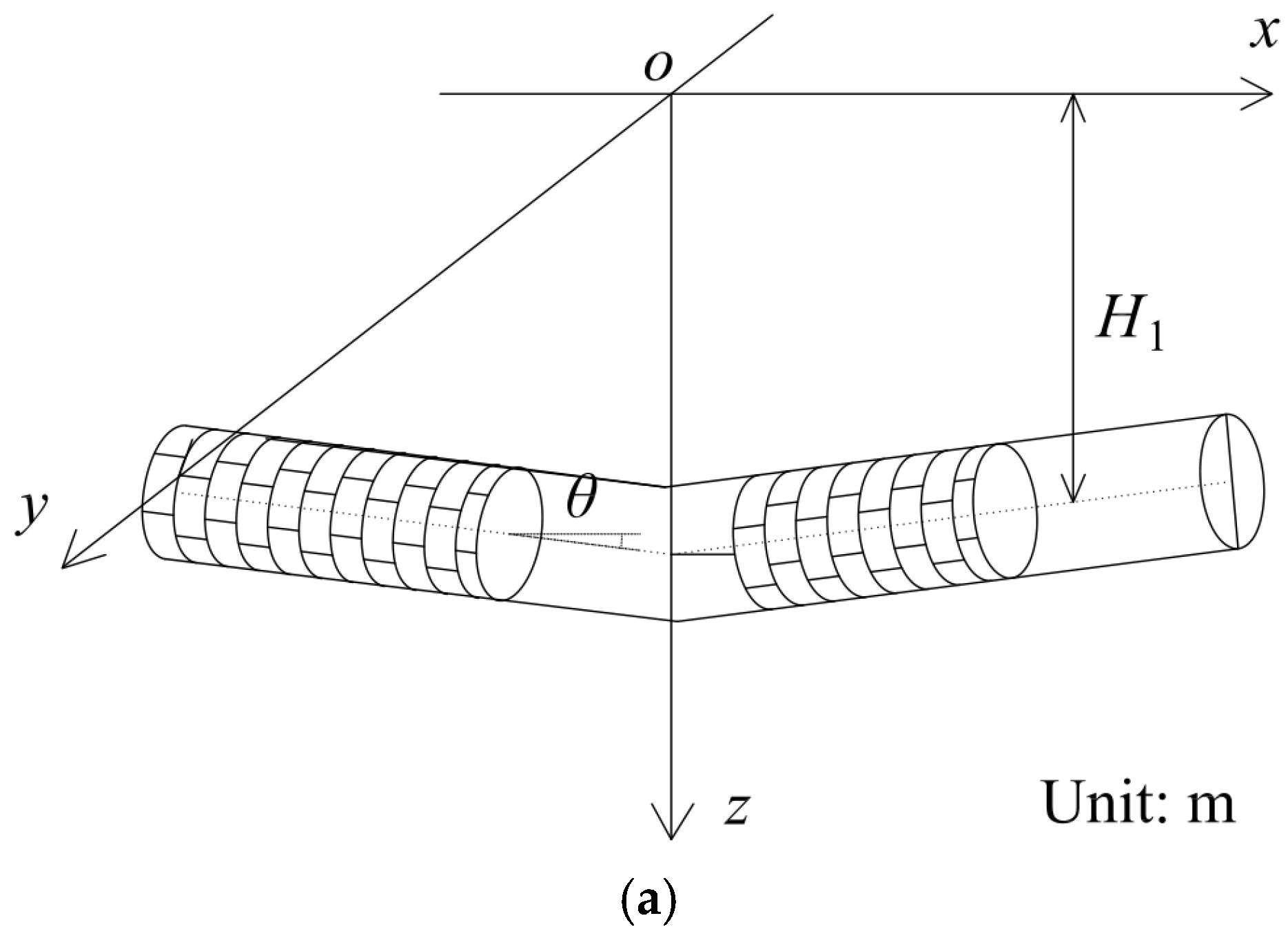
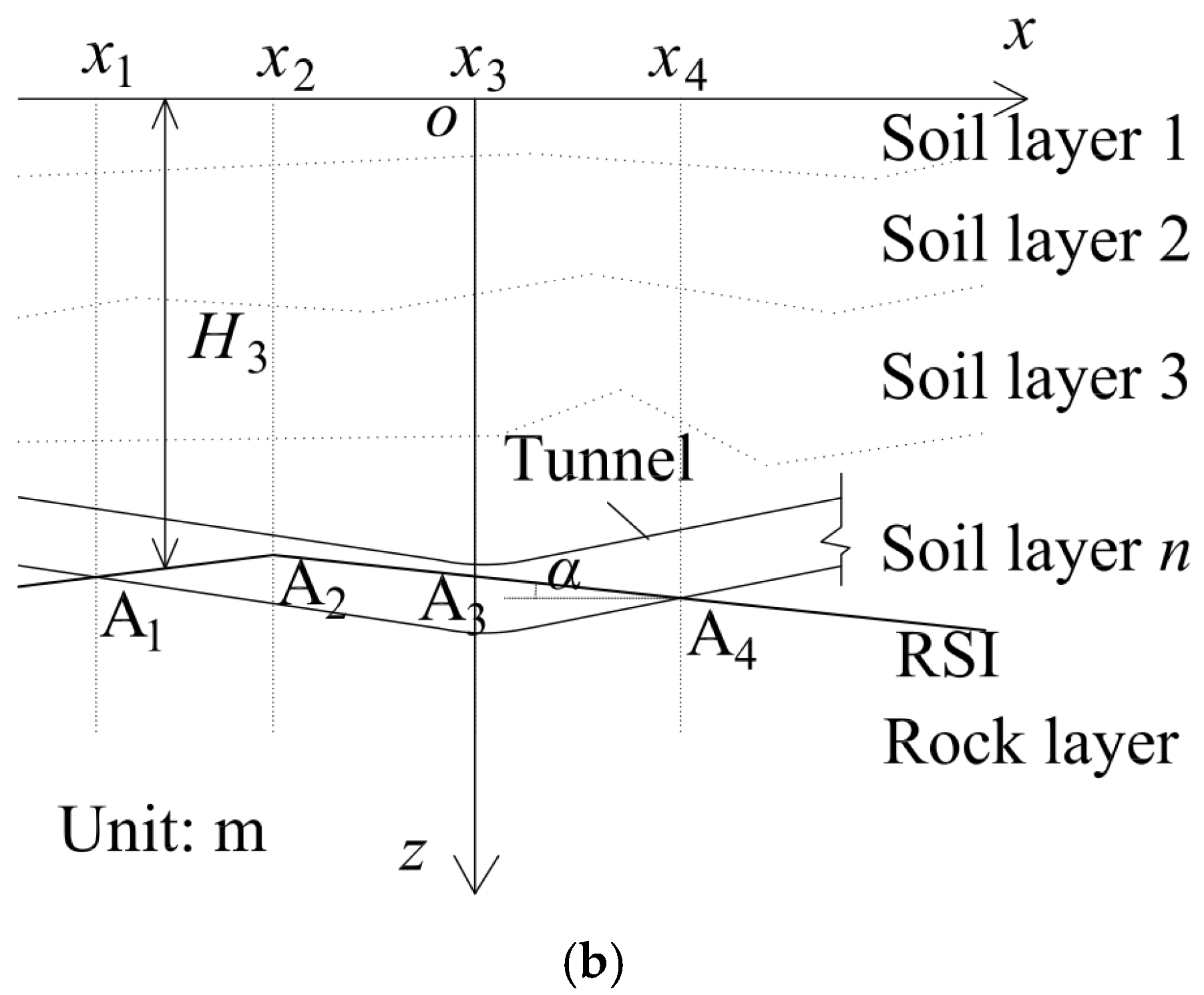
Figure 1 presents the computational model used in this study, while Figure 2 illustrates the convergence schematic of the shield tunneling face. As can be discerned from Figure 1a, the burial depth of the tunnel axis is H1. The tunnel advances in the positive direction of the x-axis, forming an angle θ with the horizontal plane. Figure 1b reveals that the RSI surface has been simplified into a polyline, which forms an angle α with the horizontal plane and has a burial depth of H3. The tunnel passes through a composite strata of soil and rock between x1 and x4. Within this range, the angle α changes at position x2, while the angle θ varies at position x3.
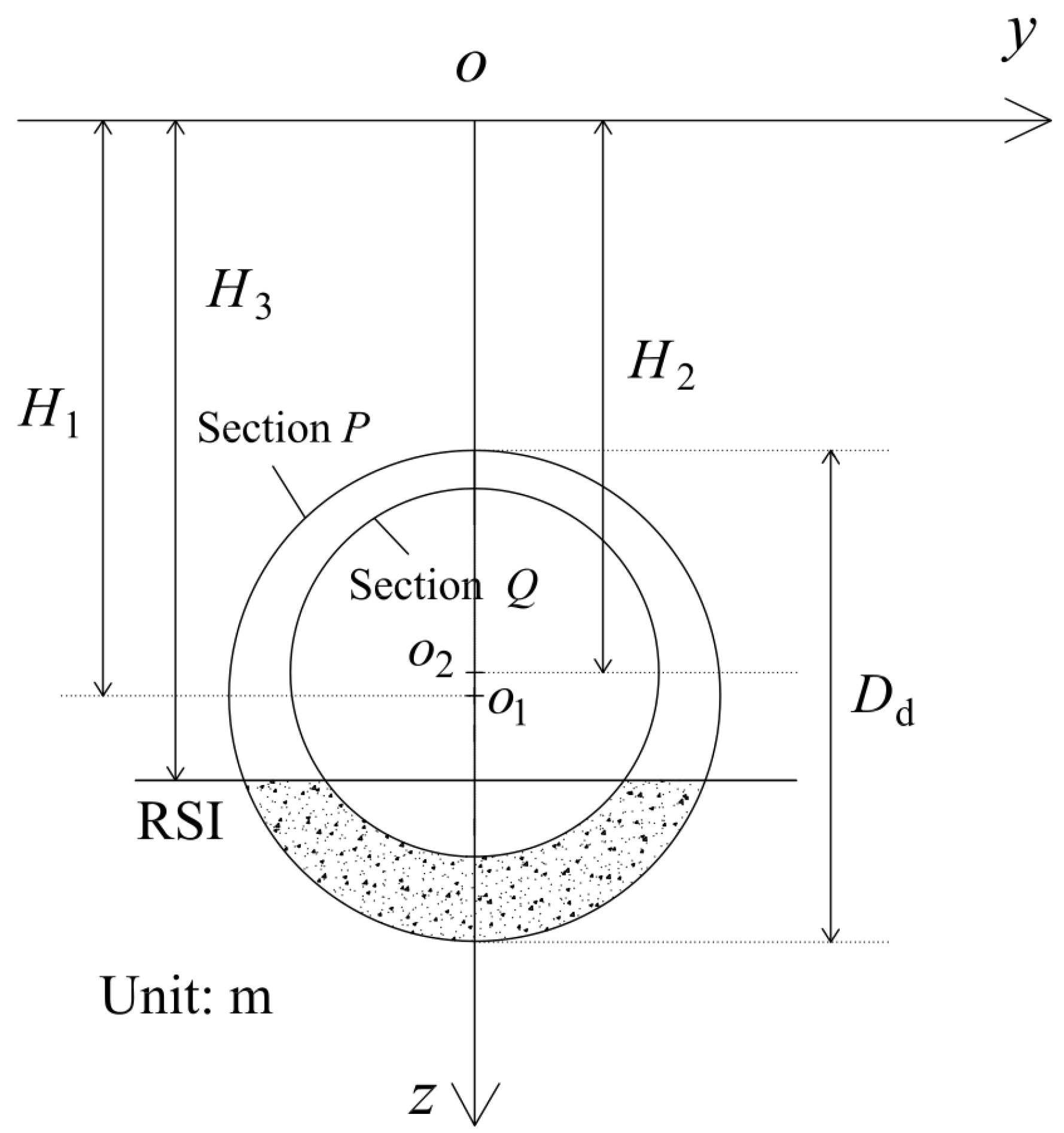
It can be seen from Figure 2 that section P is formed by shield excavation, and section Q is where the segments are located after section P converges. The buried depths of the centers (o1, o2) of the two sections are H1 and H2, respectively. The diameters of section P and section Q are Dd and D, respectively. As the soil quality of each layer along the y axis is uniform, the centers o1 and o2 only shift in the z direction. The excavation face is divided into two layers. The shadow indicates that the voids in the hard rock layer are partially filled with grout.

3. Methodology

3.1. Influence of Excavation Face Convergence Mode

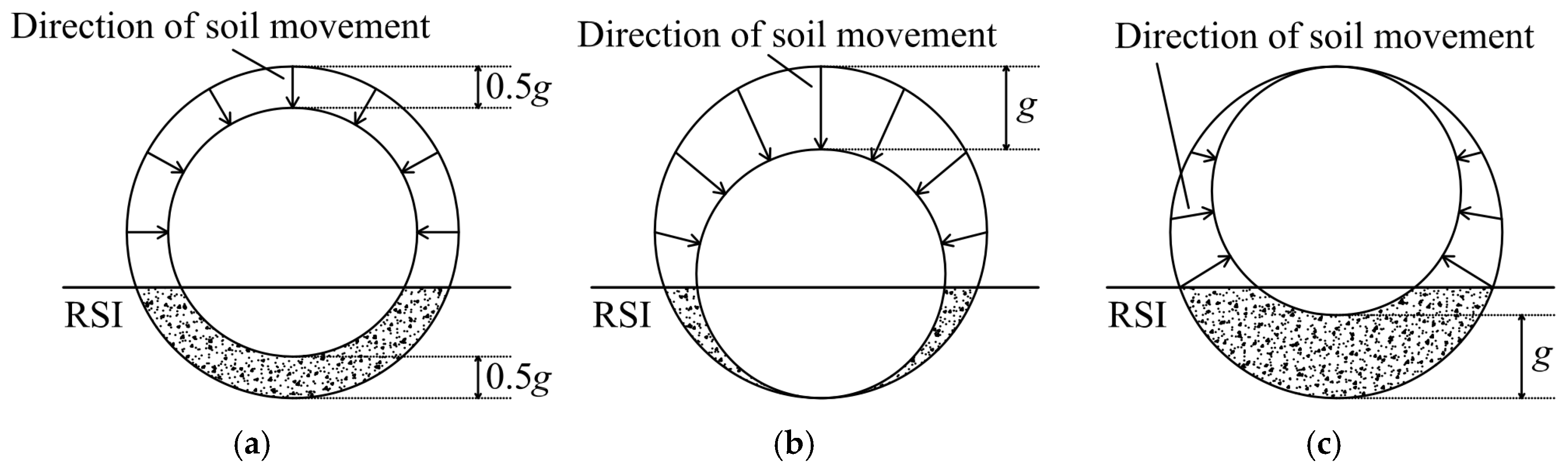
The convergence patterns of the excavation face of shield tunnels include the following three typical modes (Figure 3): (1) Equal convergence mode [25]. (2) Non-equal radial convergence mode with bottom tangency [23]. (3) Non-equal radial convergence mode with top tangency. During the process of shield tunneling in soil–rock composite strata, the shield tunnel tends to shift towards the soft soil layer, making it difficult to control the excavation posture, resulting in an upward deviation [6,36]. Meanwhile, the convergence after the excavation of the lower hard rock is slow, mainly relying on grout filling. The grout remains in a fluid state for a long time, exerting buoyancy on the segments, causing upward displacement of the segments [37]. The ultimate state is the segments floating up to the top of the excavation face. It should be noted that in Figure 3, the direction of the arrow represents the direction of soil movement.
In most working conditions, the convergence mode of tunnel excavation is not limited to the above three types. In order to accurately represent the convergence modes that tunnels may exhibit, this paper introduces the excavation face convergence mode parameter (γ), where the burial depths of shield excavation section P (H1) and converged section Q (H2) satisfy:
H 2 = H 1 + γ · g 2
where the range of γ in the formula is [−1, 1]. When γ = 0, 1, −1, they correspond to the convergence modes of the excavation surface in Figure 3a–c, respectively. When excavating in a full-section soft soil layer, the excavation surface convergence mode is close to the mode shown in Figure 3b [31], with γ = 1. With the increase in B, the converged section shows an upward trend, and the limit state corresponds to the mode shown in Figure 3c, with γ = −1. In actual engineering, the value of γ can be inversely calculated based on the surface settlement data. The equivalent soil loss parameter (g) represents the diameter difference of the shield excavation section before and after convergence (m).

3.2. Calculation of Equivalent Soil Loss Parameter (g)

For the calculation of equivalent soil loss parameter (g) [31], the formula defined by Lee and Rowe [31] is:
g = G p + U * 3 d + ω
where Gp (m) is the geometric gap, i.e., G p = D d D ; U * 3 d is the three-dimensional elastoplastic deformation of the soil, assuming U * 3 d = 0 in this paper; ω is the radial gap considering the radial gaps generated by shield construction correction and over-excavation.
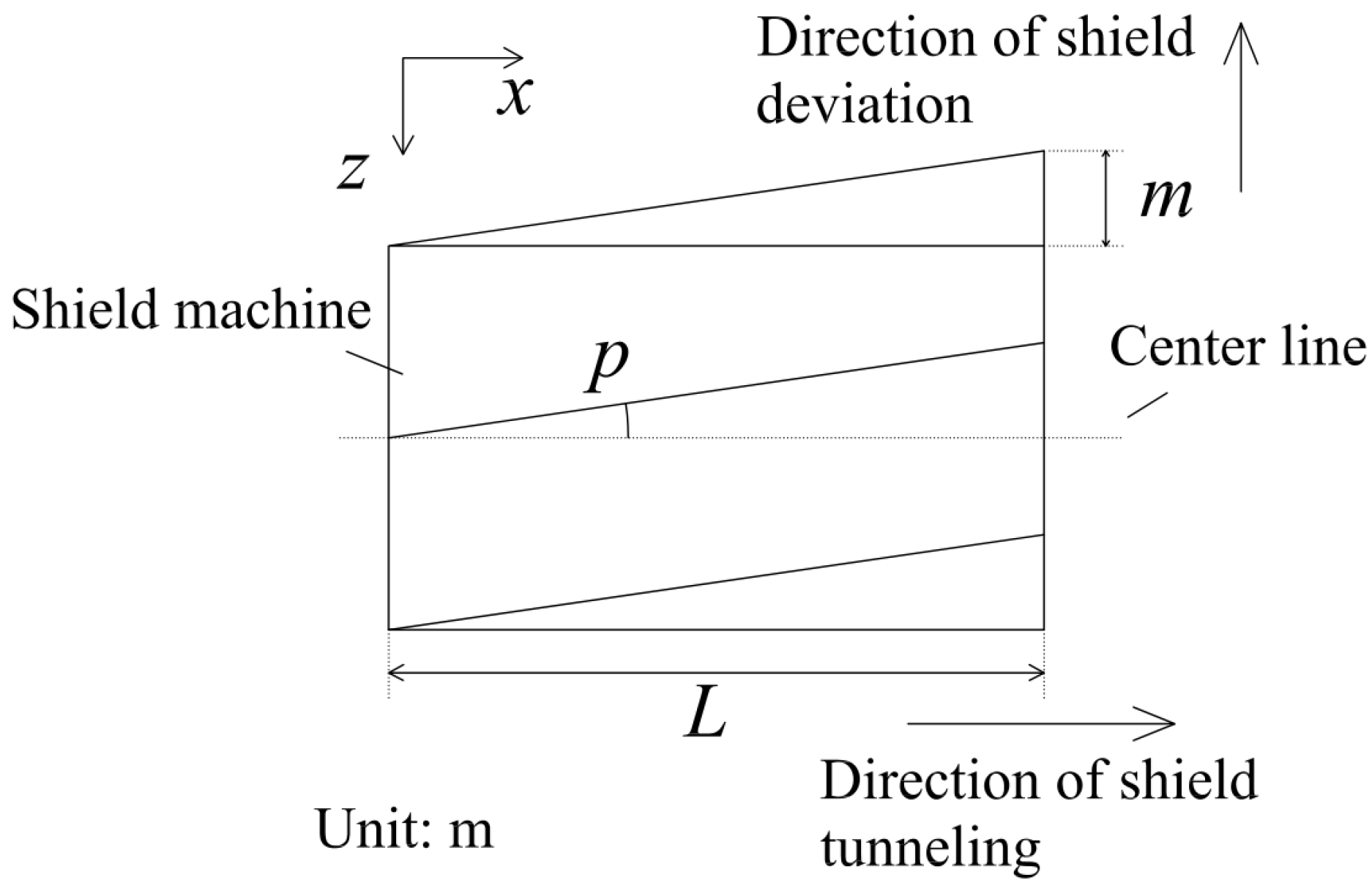
As shown in Figure 4, the eccentric distance of the shield machine is m. There are two measurement methods [38]: (1) Setting up monitoring points around the tunnel excavation face to measure the vertical and horizontal displacements (SH, SV) of each point for calculation. (2) Measuring the eccentricity ratio of the shield machine (κ) through the correction device to calculate the eccentric distance m, satisfying:
m = κ L = L tan p = S H 2 + S V 2
where L is the length of the shield machine, p is the eccentric angle, and κ is the eccentricity ratio, generally taken as 0~4% in actual engineering [38], which in this paper is taken as 2%.
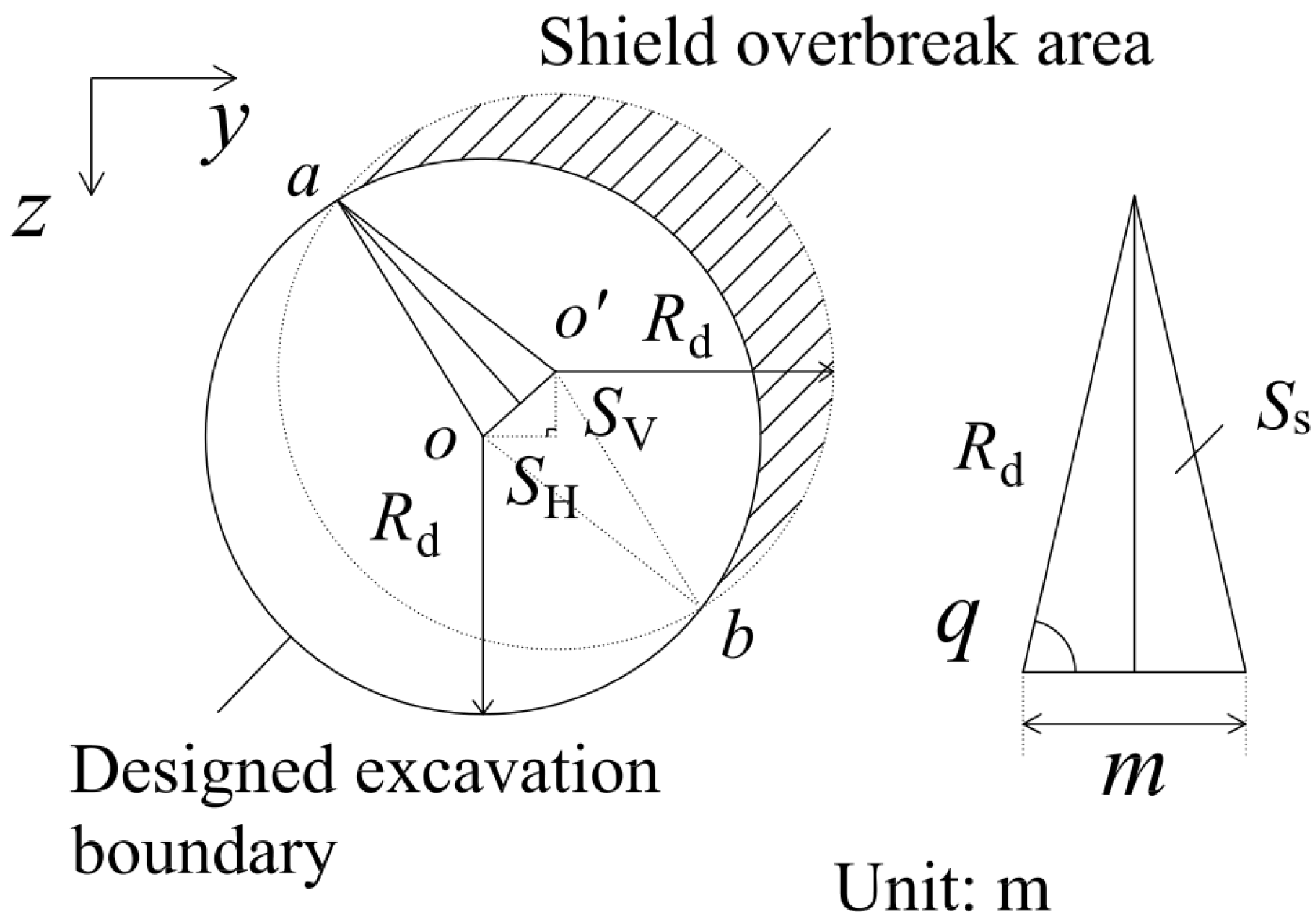
As shown in Figure 5, the shield tunneling deviates from the designed excavation axis and needs to be corrected. During the correction process, due to the use of over-excavation tools, over-excavation will be formed on the outside of the excavation area (shadowed in the figure). Taking the eccentric direction in the figure as an example, the tunneling center deviates from point o to point o’. The area of over-excavation Sp [38] satisfies:
S p = S o S o a b + S o a b 2 S s = π R d 2 2 q R d 2 + m R d sin q
where Rd is the radius of the excavation face, and the angle q satisfies q = arccos m / 2 R d . S o is the area of the circle with point o’ as its center. S o a b is the area of the sector o’ab. S o a b is the area of the sector oab. Ss is the area of the triangle in Figure 5.
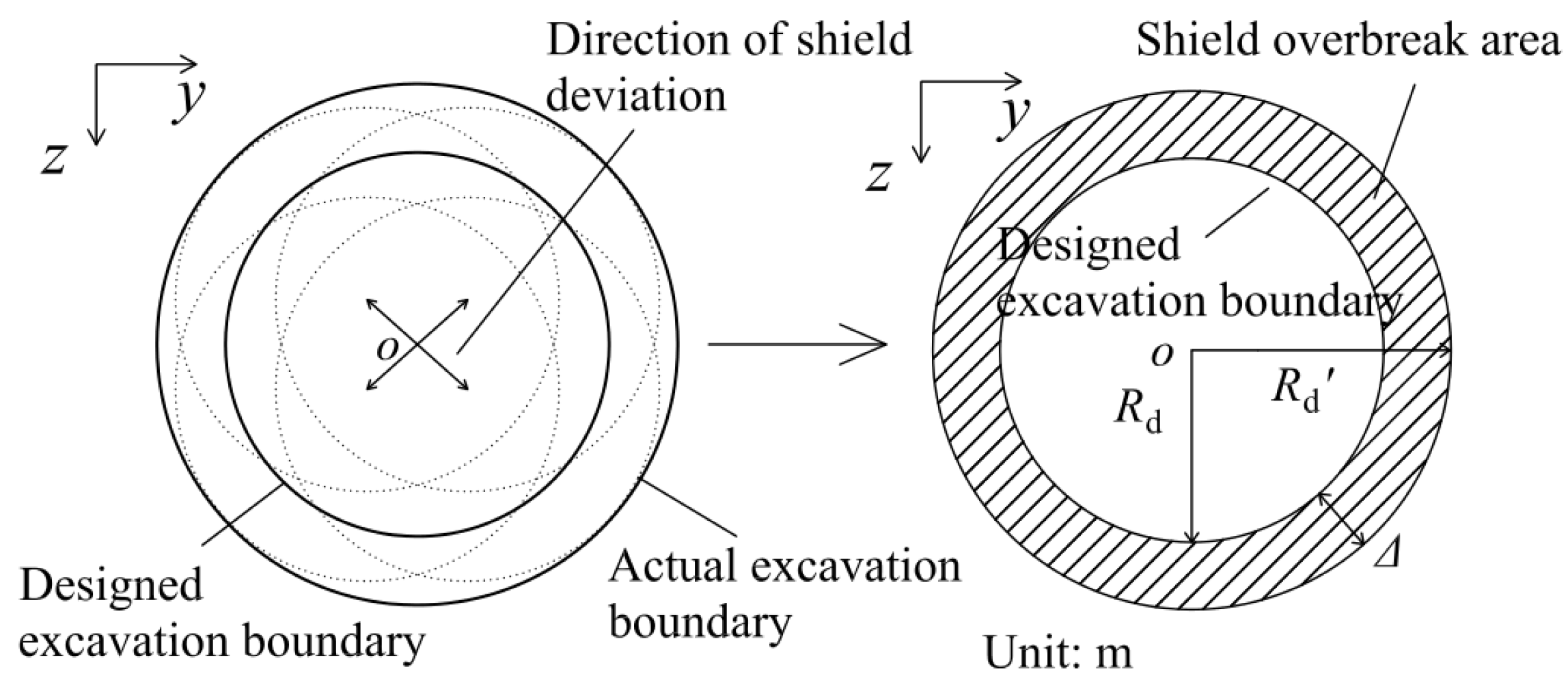
Due to the dynamic changes in the eccentric direction of shield tunneling during excavation, in order to comprehensively represent the thickness of these dynamic clearances, uniform treatment was carried out on the over-excavated portion by Zhu et al. [38]. As shown in Figure 6, assuming the over-excavated portion is uniformly distributed around the shield tunneling shell, the over-excavation area is equivalent to a circular ring-shaped area larger than the shield tunneling shell (shaded area). The outer diameter of this circular ring-shaped area is R d , and the uniform thickness is ∆, which satisfies:
S p = π R d 2 R d 2
Simultaneously taking Equations (4) and (5), we can get:
Δ = R d R d = 2 2 q π R d 2 + m R d sin q π R d
Therefore, ω satisfies:
ω = 2 Δ = 2 2 2 q π R d 2 + κ L R d sin q π R d
Considering the filling effect of grouting behind the wall, Equation (2) can be modified as:
g = 1 δ G p + ω
where δ represents the grouting filling rate, which can be deduced based on surface settlement data in practical engineering.

3.3. Influence of Upper Layered Soil

In the stochastic medium theory, tan β is the main parameter for soil deformation caused by tunnel excavation, where β is the principal influence angle of the stratum, determining the horizontal influence range of tunnel excavation on the surface, mainly influenced by the stratum conditions. According to the definition by Knothe [39], tan β satisfies:
tan β = h L m
where h is the buried depth and Lm is the main influence range of the settlement trough.
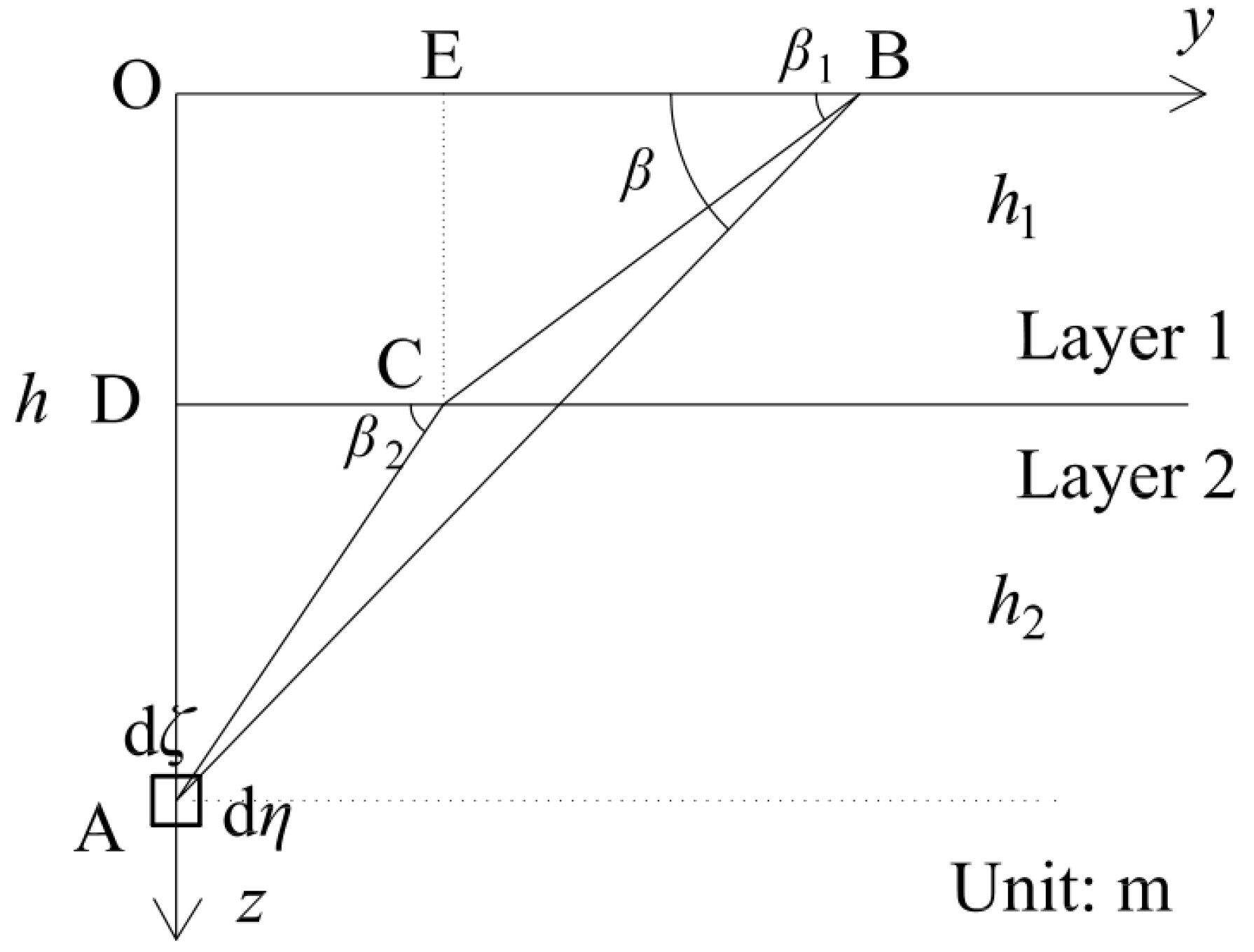
Considering the multiple layers of overlying soil, the deformations caused by shield tunneling will gradually propagate upwards layer-by-layer. According to the uniqueness theorem of the stochastic medium theory, it is known that the settlement curve caused by the excavation of unit d ζ d η in a certain stratum is unique. Therefore, the settlement curves deduced layer-by-layer starting from the tunnel excavation layer upwards will be consistent with the actual settlement curve. Similarly, the principal influence angle (β) of multiple strata can be deduced layer-by-layer upwards [40]. As shown in Figure 7, the thicknesses of layer 1 and layer 2 are h1 and h2, respectively. Assuming that the buried depth is h, the principal influence angle formed by the deformation unit d ζ d η in layer 2 is β2, and the deformation continues to propagate upwards. The principal influence angle formed in layer 1 is β1. Geometrically, this satisfies:
tan β = O A O B = h 1 + h 2 h 1 tan β 1 + h 2 tan β 2
Similarly, the principal influencing angle (β) in the n-layered stratum satisfies:
tan β = h 1 + h 2 + + h n h 1 tan β 1 + h 2 tan β 2 + + h n tan β n
where hi and βi (i = 1, 2⋯n) represent the depth and the principal influence angle of the i-th layer from top to bottom, respectively.
Han and Li [41] proposed that in the theory of random media, the width of the settlement trough is primarily influenced by parameter β, which functions similarly to the width coefficient K in Peck’s formula. Based on this relationship, they derived another expression for tanβ, namely:
tan β = 1 K 2 π
According to the derivation process of Equation (12), this equation is applicable to all types of soft soil strata.
Substituting Equation (12) into Equation (11), we obtain:
tan β = h K 1 h 1 2 π + K 2 h 2 2 π + + K n h n 2 π
where Ki and φi (i = 1, 2⋯n) represent the width coefficients of settlement troughs and the friction angle within the soil mass of the i-th layer from top to bottom, with K = 1 0.02 φ .
The tanβ obtained by Equation (13) is at the ground surface, which can further determine the value of tanβ at any burial depth (z0) of unit d ζ d η . Assuming z0 is located in the i-th stratum (1 ≤ in), the value of tanβ at the burial depth z0 is tan β i , which satisfies:
tan β i = h z 0 2 π · K i h i + j = i + 1 n K j h j
where hi′ represents the height from z0 to the bottom of i-th layer.

3.4. Calculation of Soil Displacement Induced by Shield Tunneling

3.4.1. Introduction to the Stochastic Medium Theory

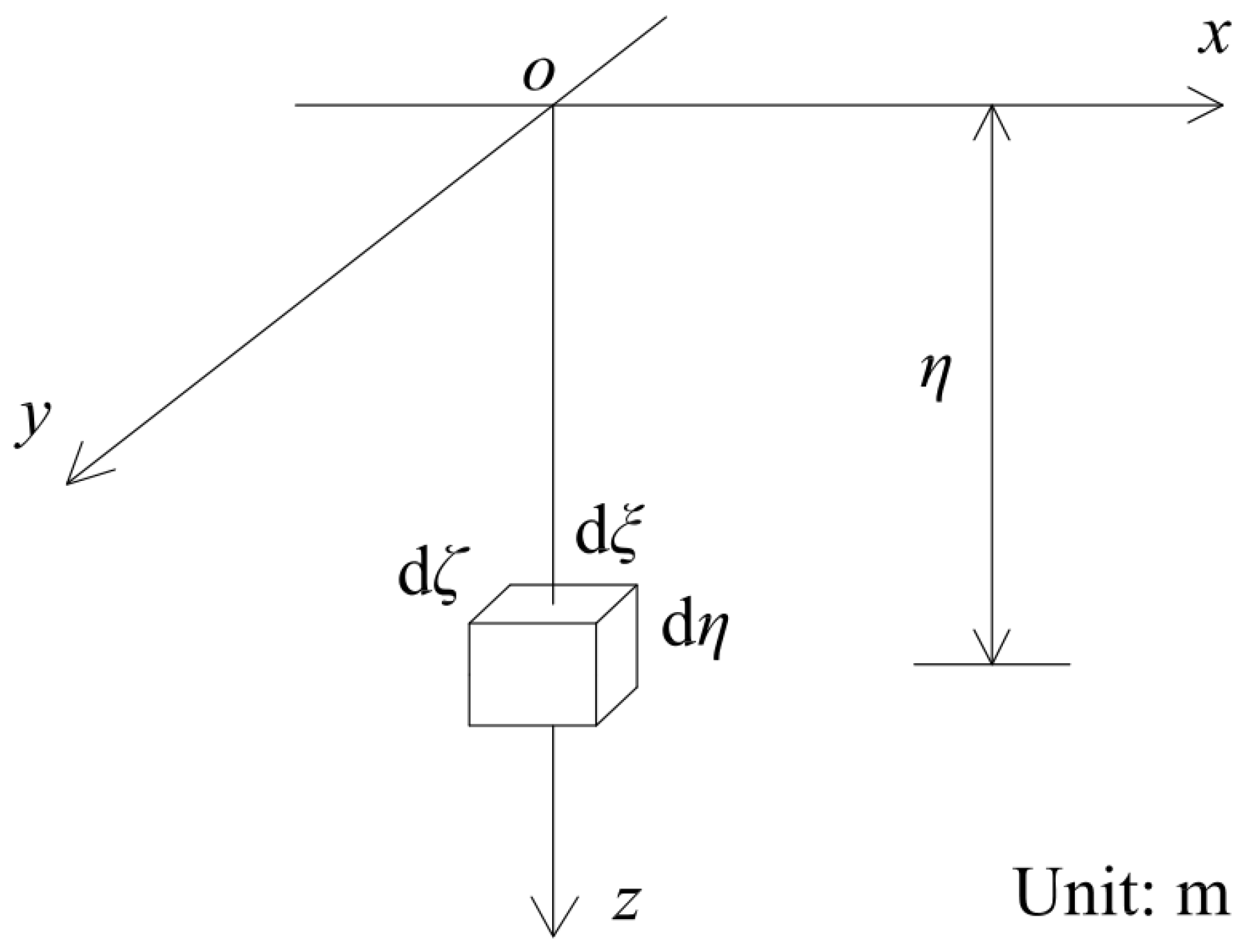
As shown in Figure 8, for a micro-unit with a depth of η and a volume of d ξ d ζ d η , the soil displacements in all directions caused by the complete collapse of the microunit are UeX, UeY, and UeZ [42,43]:
U e X = x r 3 z tan β exp π r 2 z x 2 + y 2 d ξ d ζ d η
U e Y = y r 3 z tan β exp π r 2 z x 2 + y 2 d ξ d ζ d η
U e Z = 1 r 2 z exp π r 2 z x 2 + y 2 d ξ d ζ d η
where r(z) is the influence radius, with r z = η z tan β .

3.4.2. Derivation of Soil Displacement Calculation Formula

Within the convergence volume in the soft soil layer, the total soil displacement caused by tunnel excavation can be obtained by integrating the soil displacement generated by all soil elements. The volume of soil lost (V) satisfies:
V = V P V Q V S
where VP represents the volume of the excavation cross-section, VQ represents the volume of the cross-section after convergence, and VS represents the volume of the grout filling in the hard rock layer.
Let x = x0 be any given cross-section for computation. In order to determine the soil displacement at any depth within this section, it is necessary to calculate the impact of tunnel excavation within the unilateral calculation range (l) centered at x = x0. Within the range (x0l, x0 + l), there may be points of change in θ or α (such as points A3 and A2 in Figure 1) or the intersection points between the RSI surface and the tunnel’s upper and lower boundaries (such as points A1 and A4 in Figure 1). At these points, the section must be divided, segmenting the entire research span (x0l, x0 + l) into N smaller segments. The stochastic medium theory possesses the principle of superposition. Therefore, the soil deformation caused by the excavation of each small segment using the shield method can be superimposed. Since the selection of x0 is arbitrary, the soil displacements Ux, Uy, and Uz, can be determined as follows:
U x = j = 1 N a 1 b 1 c 1 d 1 e j f j ( x ξ ) tan 2 β i ( η z ) 3 · exp { π tan 2 β i ( η z ) 2 [ ( x ξ ) 2 + ( y ζ ) 2 ] } d ξ d ζ d η a 2 b 2 c 2 d 2 e j f j ( x ξ ) tan 2 β i ( η z ) 3 · exp { π tan 2 β i ( η z ) 2 [ ( x ξ ) 2 + ( y ζ ) 2 ] } d ξ d ζ d η
U y = j = 1 N a 1 b 1 c 1 d 1 e j f j ( y ζ ) tan 2 β i ( η z ) 3 · exp { π tan 2 β i ( η z ) 2 [ ( x ξ ) 2 + ( y ζ ) 2 ] } d ξ d ζ d η a 2 b 2 c 2 d 2 e j f j ( y ζ ) tan 2 β i ( η z ) 3 · exp { π tan 2 β i ( η z ) 2 [ ( x ξ ) 2 + ( y ζ ) 2 ] } d ξ d ζ d η
U z = j = 1 N a 1 b 1 c 1 d 1 e j f j tan 2 β i ( η z ) 2 · exp { π tan 2 β i ( η z ) 2 [ ( x ξ ) 2 + ( y ζ ) 2 ] } d ξ d ζ d η a 2 b 2 c 2 d 2 e j f j tan 2 β i ( η z ) 2 · exp { π tan 2 β i ( η z ) 2 [ ( x ξ ) 2 + ( y ζ ) 2 ] } d ξ d ζ d η
where b1, a1 and b2, a2 are respectively the integration limits along the z-axis before and after convergence; d1, c1 and d2, c2 are respectively the integration limits along the y-axis before and after convergence; fj, ej (1 ≤ jN) are respectively the upper and lower limits of each segment. The above satisfy: a 1 = H 3 , b 1 = H 1 R d , a 2 = H 3 , b 2 = H 2 R d 0.5 g , c 1 = R d 2 η H 1 2 , d 1 = R d 2 η H 1 2 , c 2 = R d g / 2 2 η H 2 2 , d 2 = R d g / 2 2 η H 2 2 .
After programming the corresponding program in MATLAB R2017b, the above formula can be used to calculate the soil displacement caused by tunnel construction in soil–rock composite strata.

4. Engineering Case Study

4.1. Project Overview

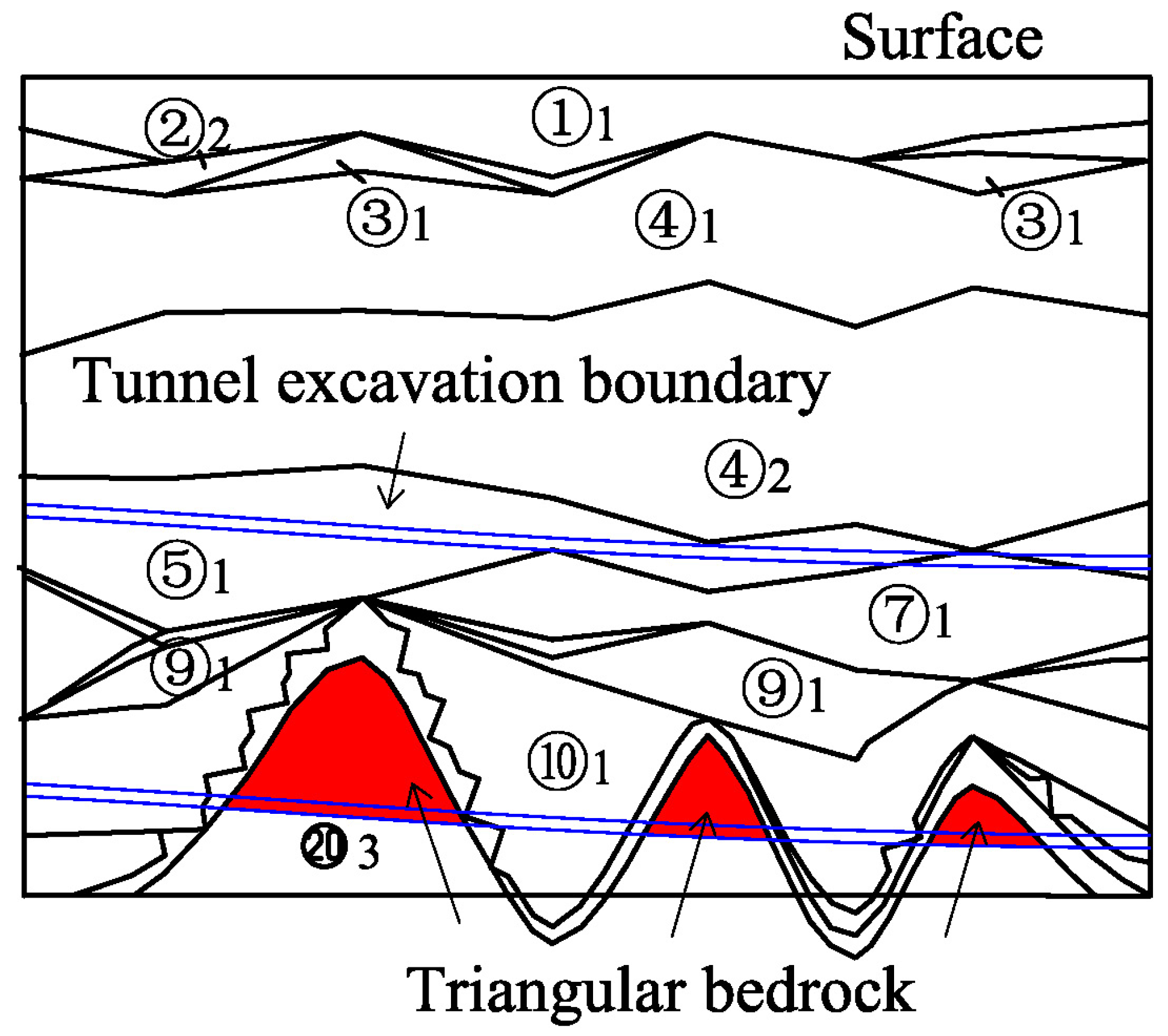
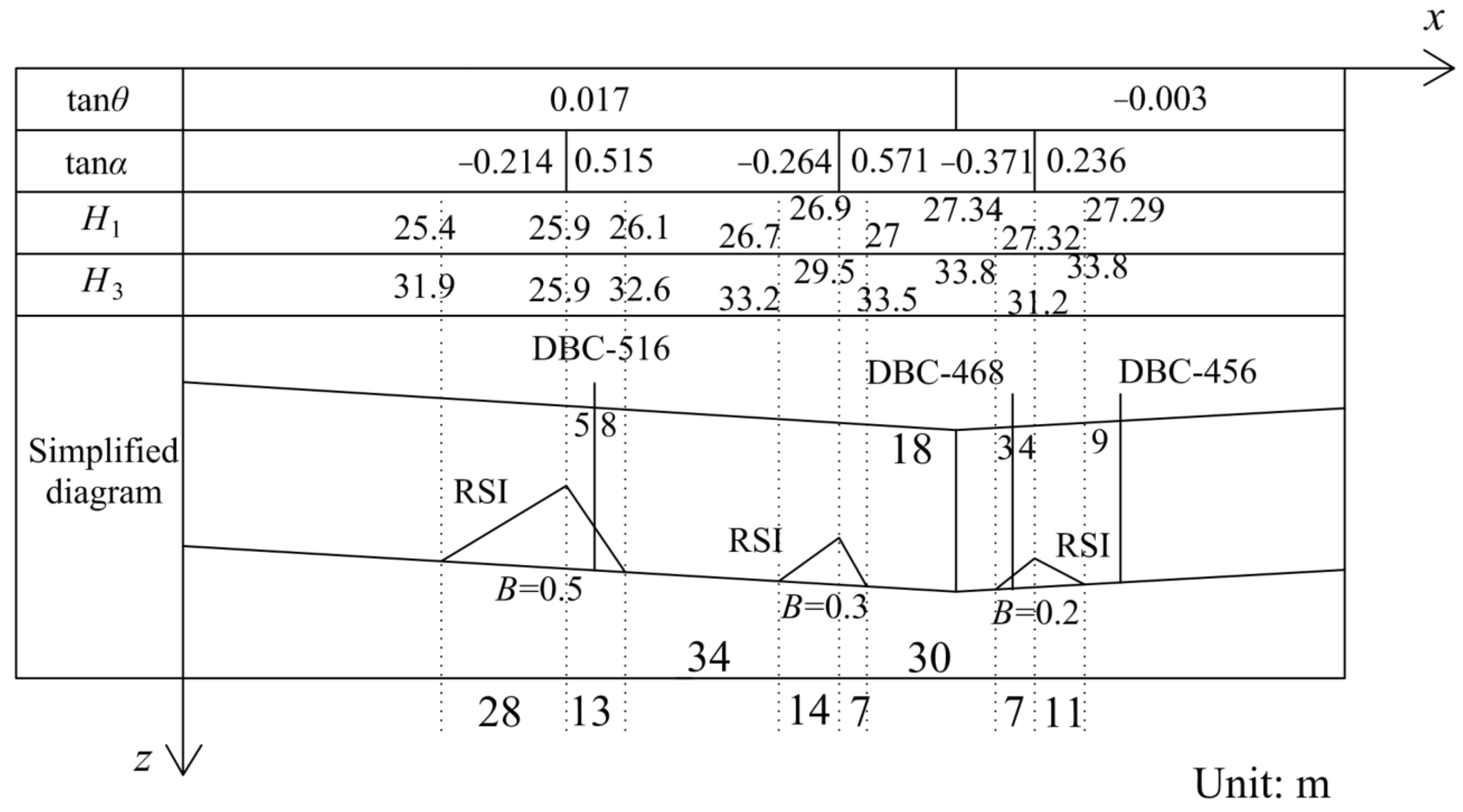
This paper is based on the shield tunneling project of Hangzhou Huan Chengbei Road, Tianmu Mountain Road Section 02. As shown in Figure 9, the north line tunnel of the project crosses a section of soil–rock composite strata at approximately NK3+100 to NK3+250, where the upper part consists of undulating layered strata and the lower part is moderately weathered tuff (indicated in black). Dd is 13.46 m, D is 13 m, and L is 15 m. Monitoring faces DBC528, DBC516, and DBC468 are selected as the research faces, corresponding to the geological conditions shown in Table 1. The φi appearing in Table 1 is the internal friction angle of each soil layer. It is noteworthy that the depths of the corresponding strata sections (h) are measured at the midpoint of the soft soil portion within the excavation face, which are 24.51 m, 24 m, and 26.8 m, respectively. The cross-sectional calculation schematic diagram of the tunnel and other parameters is detailed in Figure 10.
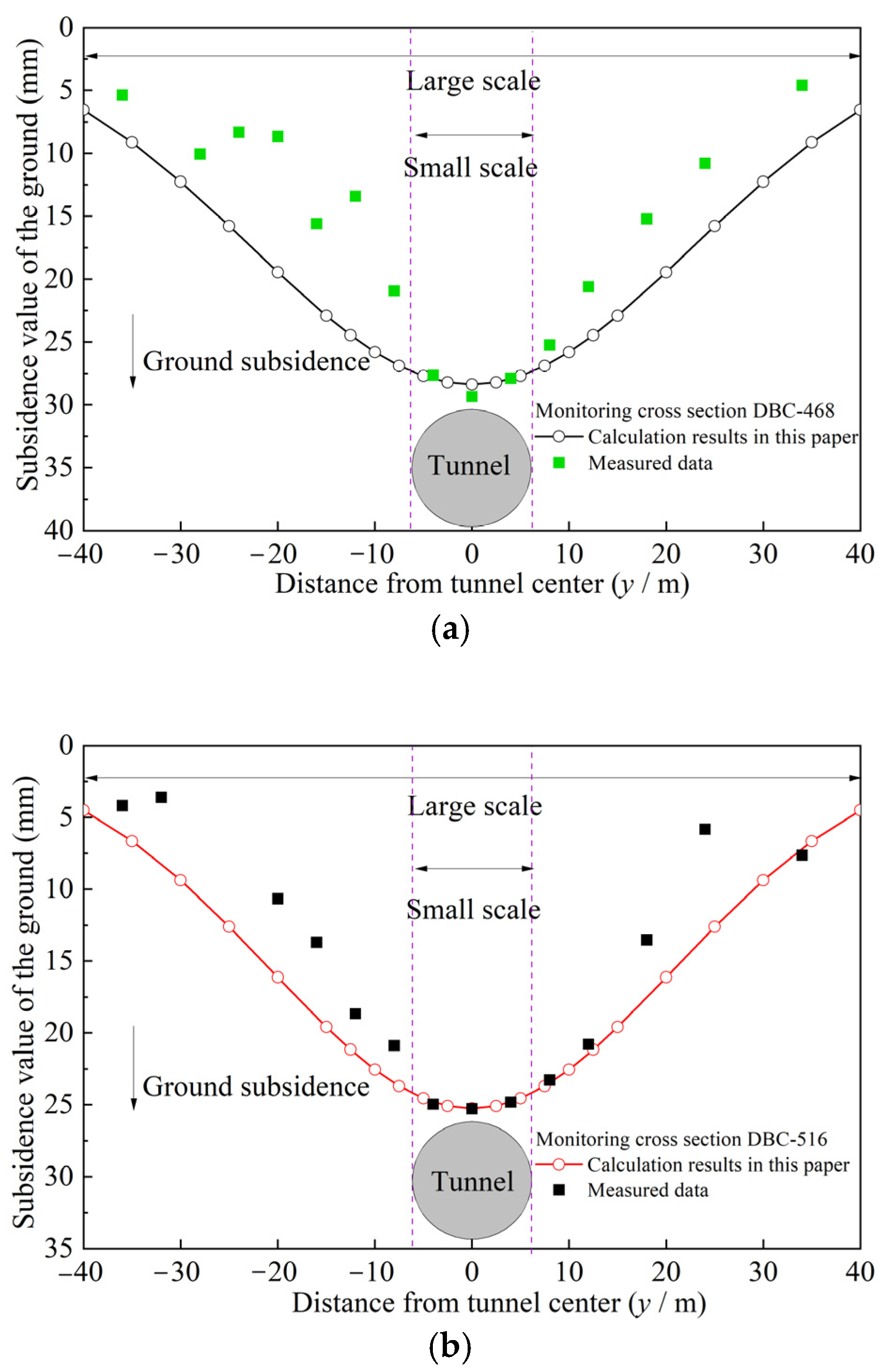
First, take the convergence mode parameters (γ) as −1, 0, and 1, respectively, and substitute them into the method of this paper for calculating the surface settlement values. Compare the calculated surface subsidence curve with the measured data, and select the most suitable γ based on the difference between the subsidence range and the maximum central subsidence value. After comparison, it was found that when γ = −1, the calculated curve fits the overall trend of the measured data with the best smoothness. This indicates that in this project, the non-equal radial convergence mode with top tangency as shown in Figure 3c is the most suitable for the shield tunnel excavation face soil convergence displacement mode, so γ = −1 was chosen for subsequent calculations.
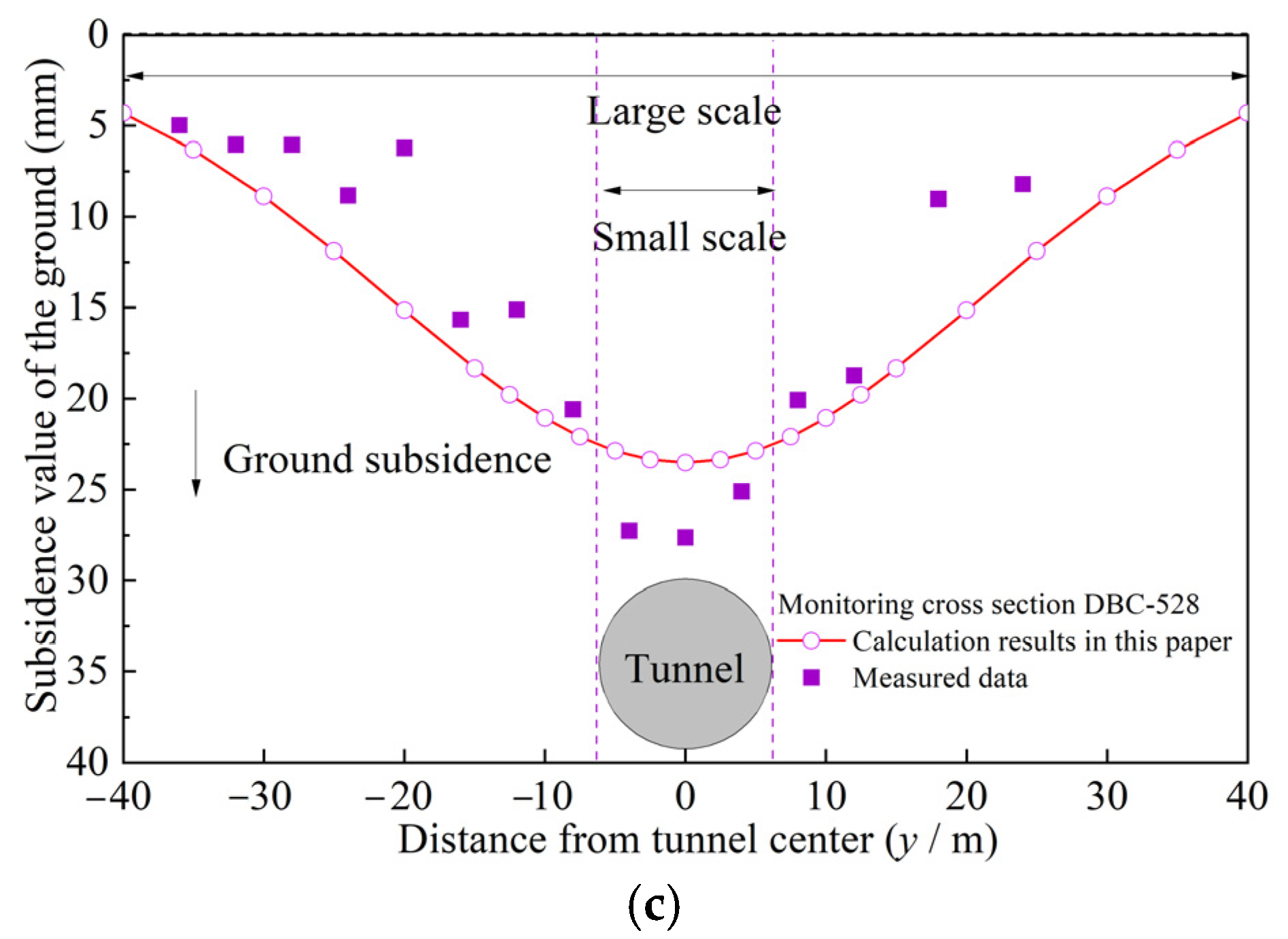
Based on the actual settlement data near the central monitoring point (small scale), a back-analysis was carried out to obtain the grouting filling rate (δ) at each monitoring section, which was then substituted into the method of this paper to calculate the ground settlement values within a 40 m range (large scale) on both sides of the tunnel center. Finally, the calculated settlement curve was compared with all actual measurement data. The δ values determined by back-analysis for DBC528, DBC516, and DBC468 were 84.1%, 83.5%, and 84.5%, respectively. As shown in Figure 11, the calculated ground settlement curve exhibited a normal distribution, and the actual data points also showed the trend of “large in the middle, small at both ends”. Although some data points deviated, the overall trend of change was consistent with the curve pattern.

4.2. Parameter Value Analysis

The grouting fill rates (δ) of the other two projects were analyzed in the same way.
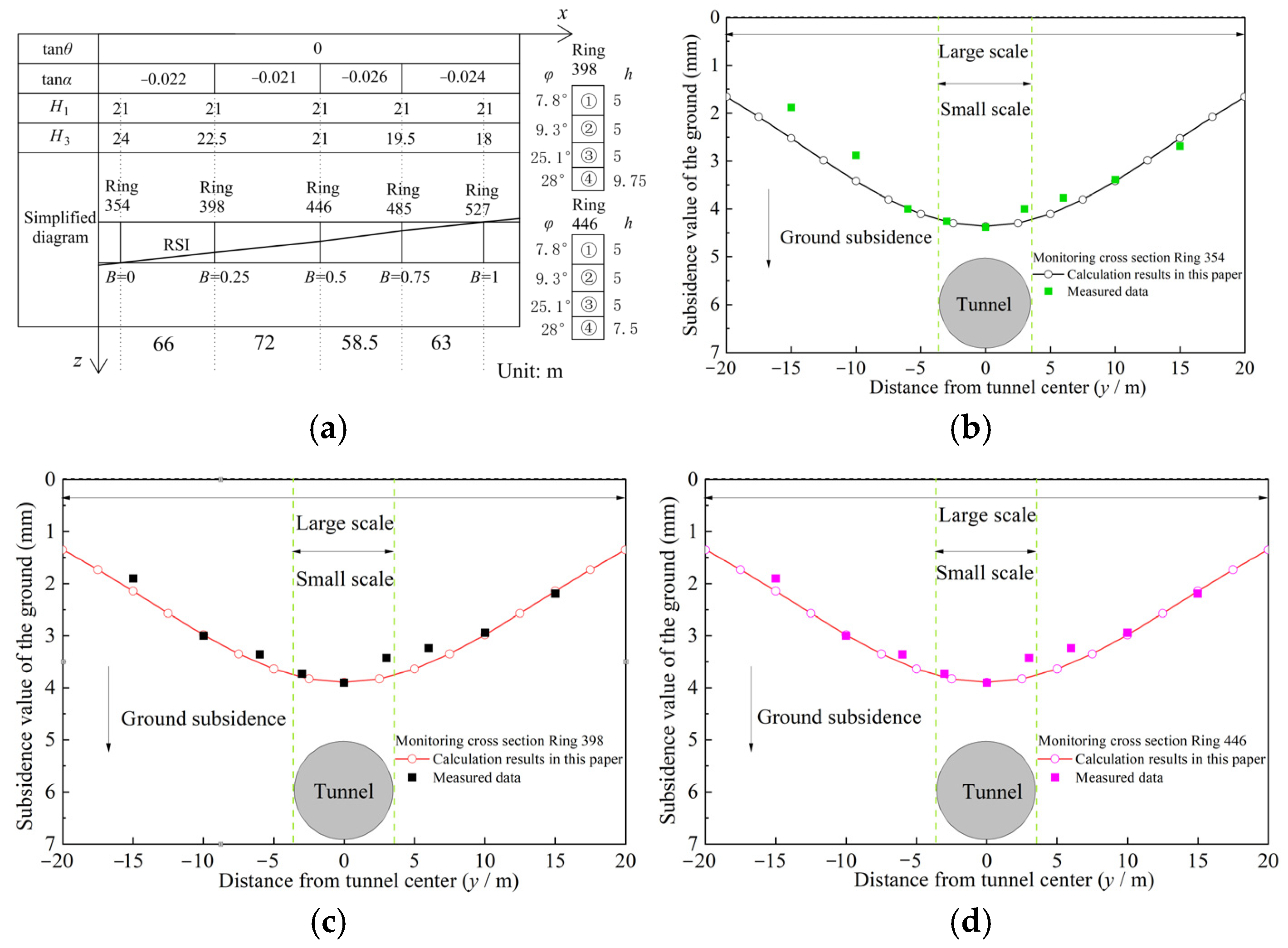
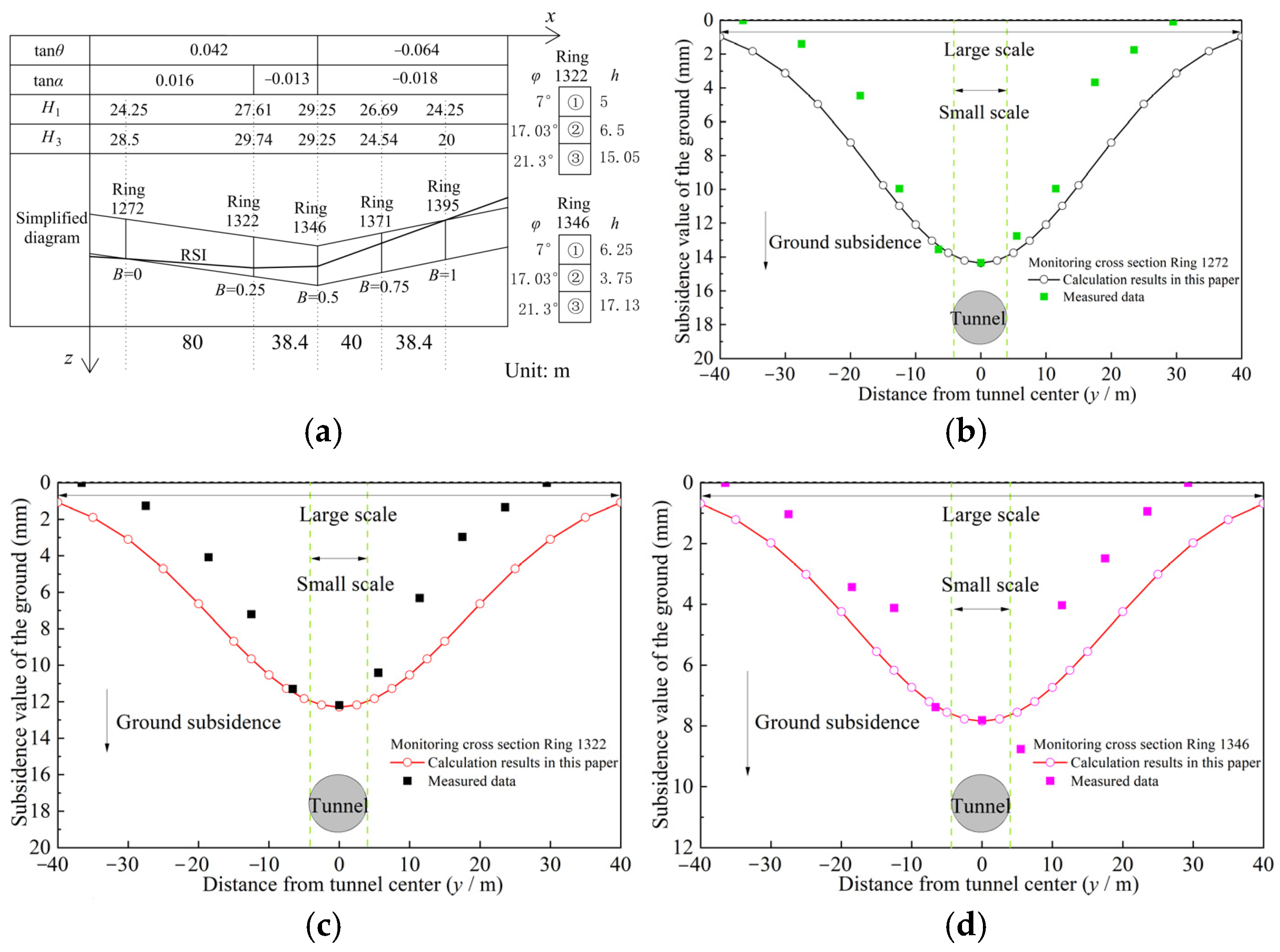
Table 2 shows the relevant parameters for two other engineering cases, where Dd is the diameter of the shield excavation face (Section P), D is the diameter of the converged section (Section Q), L is the length of the shield machine, B is the hard rock ratio, and γ is the excitation face convergence mode parameter.
As shown in Figure 12 and Figure 13, the schematic diagrams and data comparison charts of each engineering calculation are presented. The measured data points are evenly distributed on both sides of the theoretical calculation curve. The distribution of predicted values is similar to that of measured data, validating the reliability of the method. Furthermore, it can be observed that in the above case, when γ is set to −1, the fitting degree of the calculation curve is the highest. Therefore, the author believes that in soil–rock composite strata, due to the slower closure of the hard rock layer after excavation, the buoyancy effect of the flowing slurry on the tunnel segments is more pronounced, resulting in a convergence mode of the excavation face tending towards a non-equal radial movement mode touching the top.
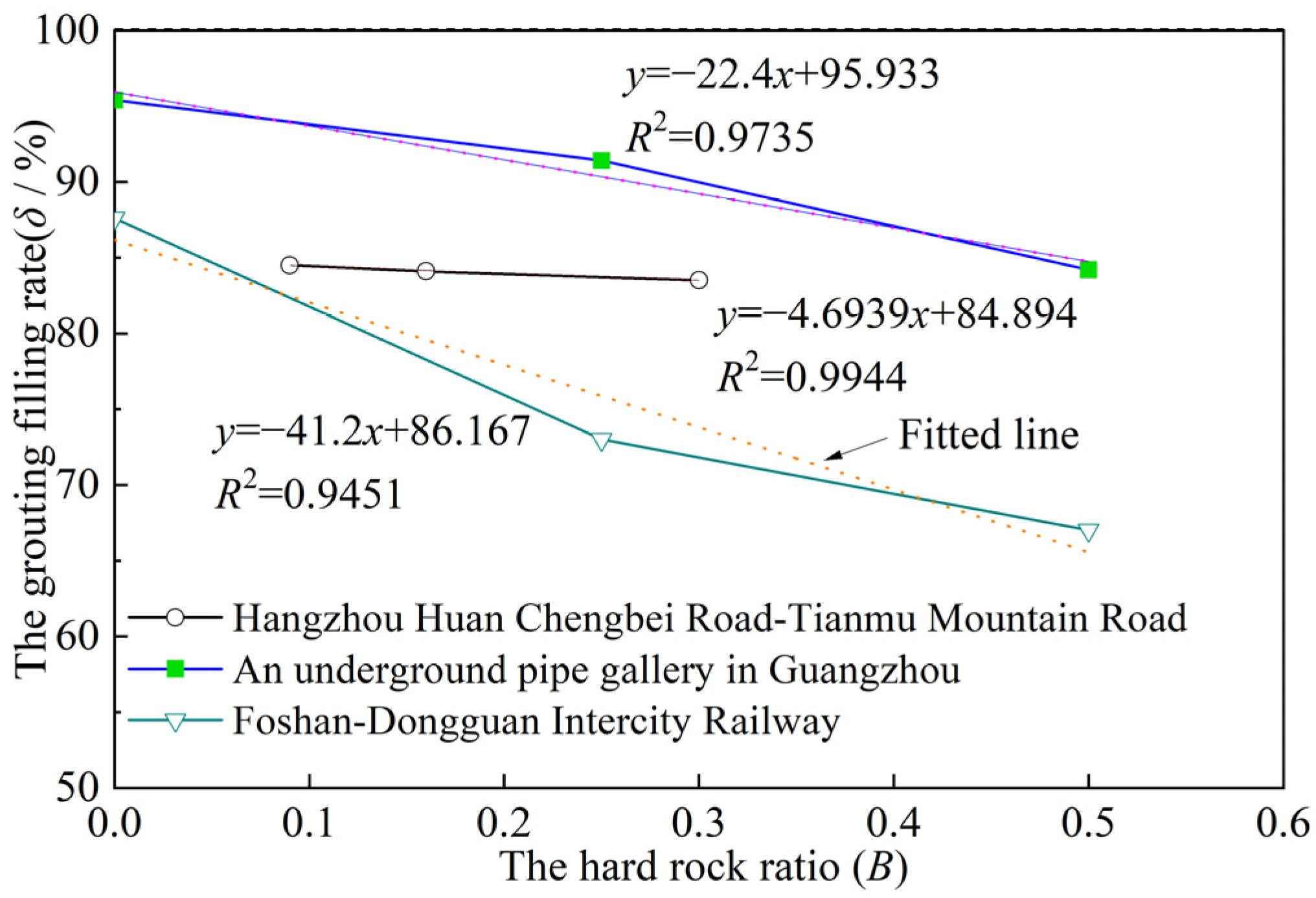
When comparing different sections within the same project, it was found that δ decreases with the increase in B. To further analyze the value relationship between the two, linear fitting was performed on the δ values of different sections of each project, and the results are shown in Figure 14. It can be seen from the graph that the data linear fitting results are good, with the goodness of fit values (R2) being 0.9732, 0.9944, and 0.9451, respectively. For the same project, the geological conditions, construction levels, tunnel depths, and other conditions are roughly the same. Here, δ is roughly linearly related to B. In other words, within the same project, after obtaining the δ values of two sections through back-analysis, the δ values in other sections under different hard rock ratios can be preliminarily estimated through linear relationships. Then, using the calculation method in this paper, the ground settlement of that section can be calculated.
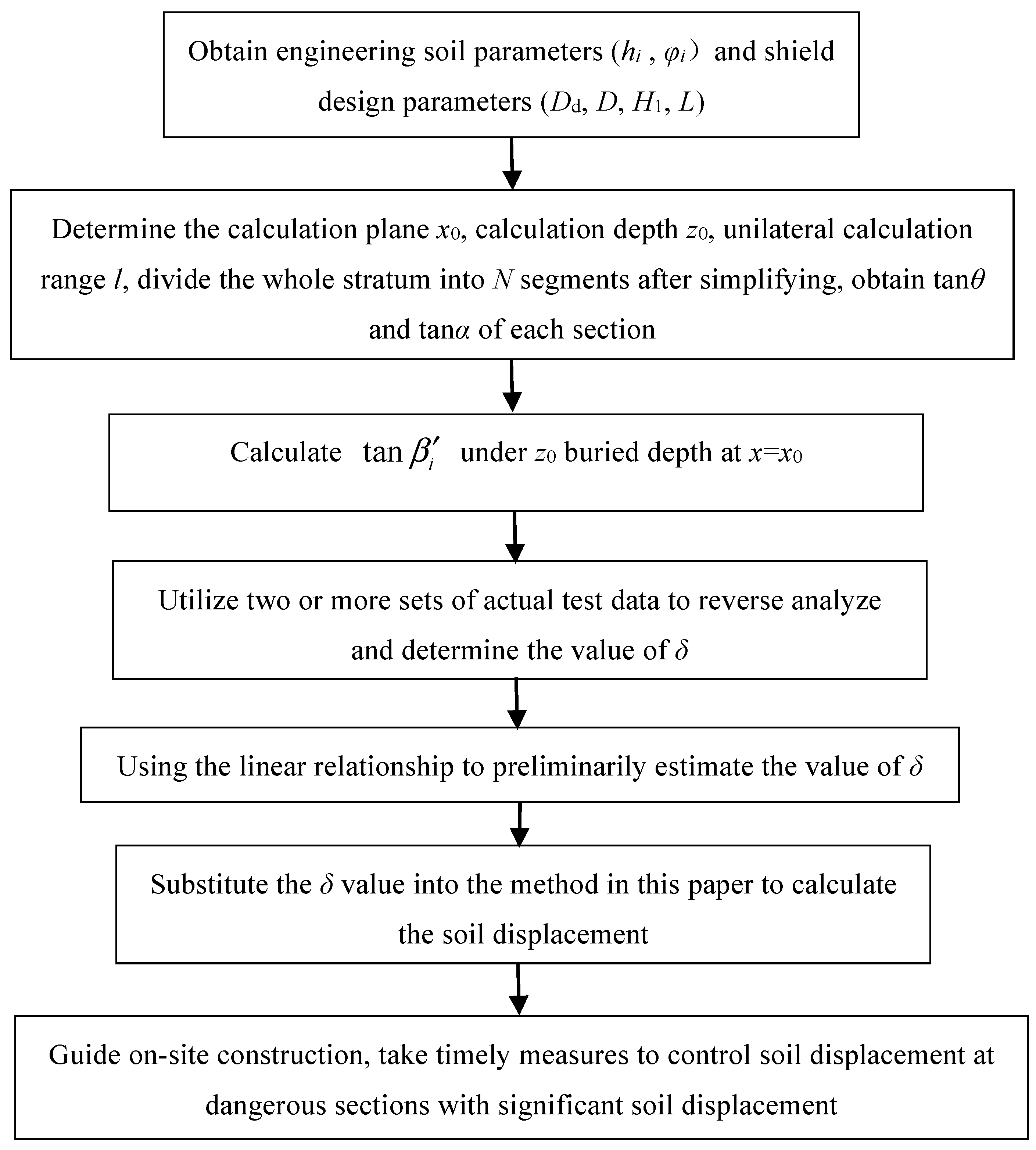
In actual engineering practice, the displacement values of the soil can be predicted using the method described in this paper, thereby guiding on-site construction. The specific application process is shown in Figure 15.

4.3. The Impact of Different Rock Hardness Ratios (B) on Horizontal and Vertical Ground Subsidence Types

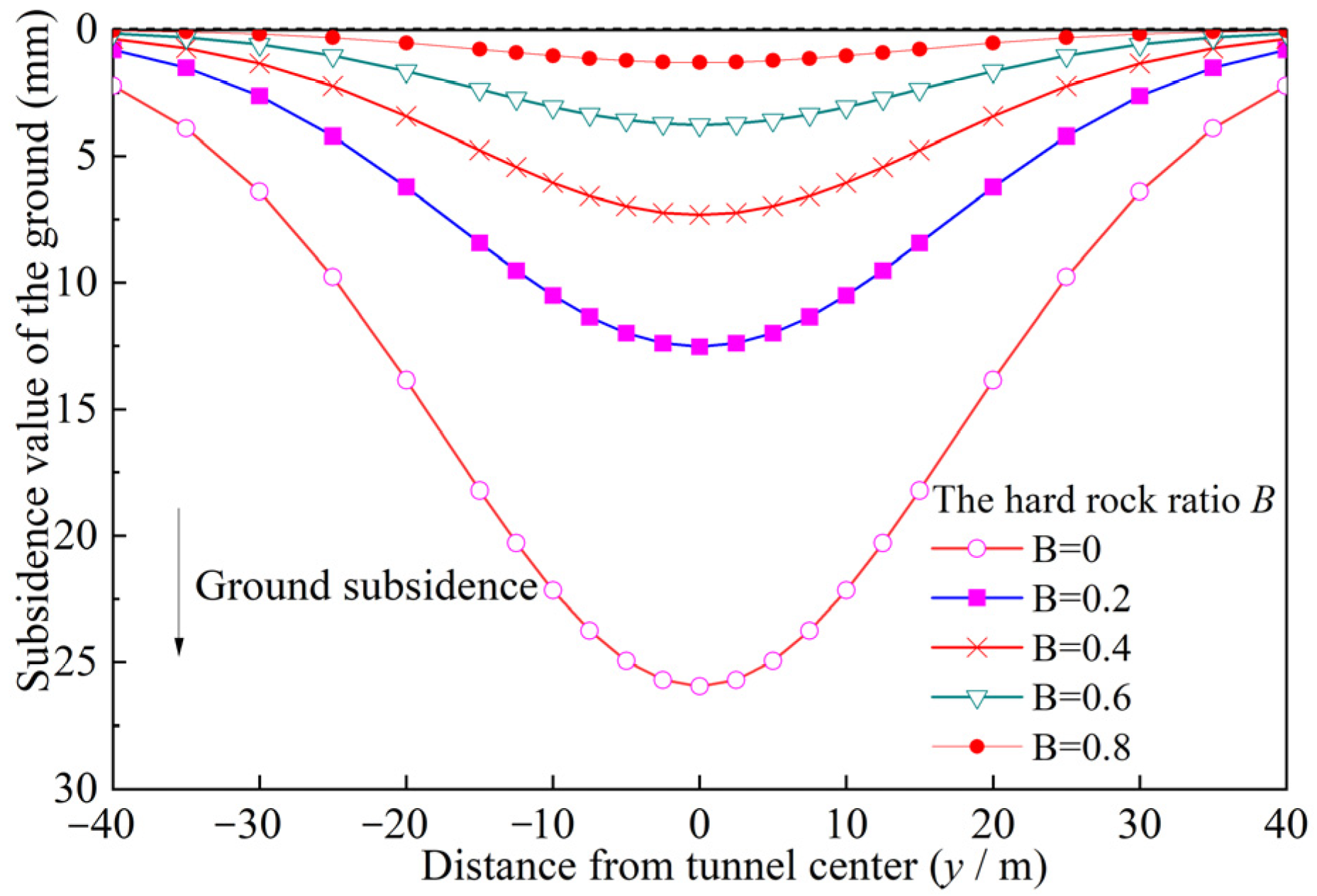
Due to the complexity of the tunnel slope and RSI surface slope variations in the above engineering cases, this section simplifies the analysis process. Under the geological conditions of the Foshan–Dongguan Intercity Railway project [36], it is assumed that the tunnel slope and RSI surface slope do not change along the tunnel direction. Keeping other parameters the same, we take the B values as 0, 0.2, 0.4, 0.6, and 0.8, respectively, and calculate the transverse and longitudinal ground settlement values. As shown in Figure 16, the transverse ground settlement value is significantly affected by the hard rock ratios. With the increase in B, the overall ground settlement value decreases and the settlement trough becomes shallower, but the reduction in settlement value gradually decreases. When the B values are successively taken as 0, 0.2, 0.4, 0.6, and 0.8, the width coefficients of the settlement trough (i) are 16.34 m, 15.83 m, 15.32 m, 14.82 m, and 14.31 m, respectively, indicating that the width of the settlement trough gradually decreases, and the settlement deformation becomes more concentrated.
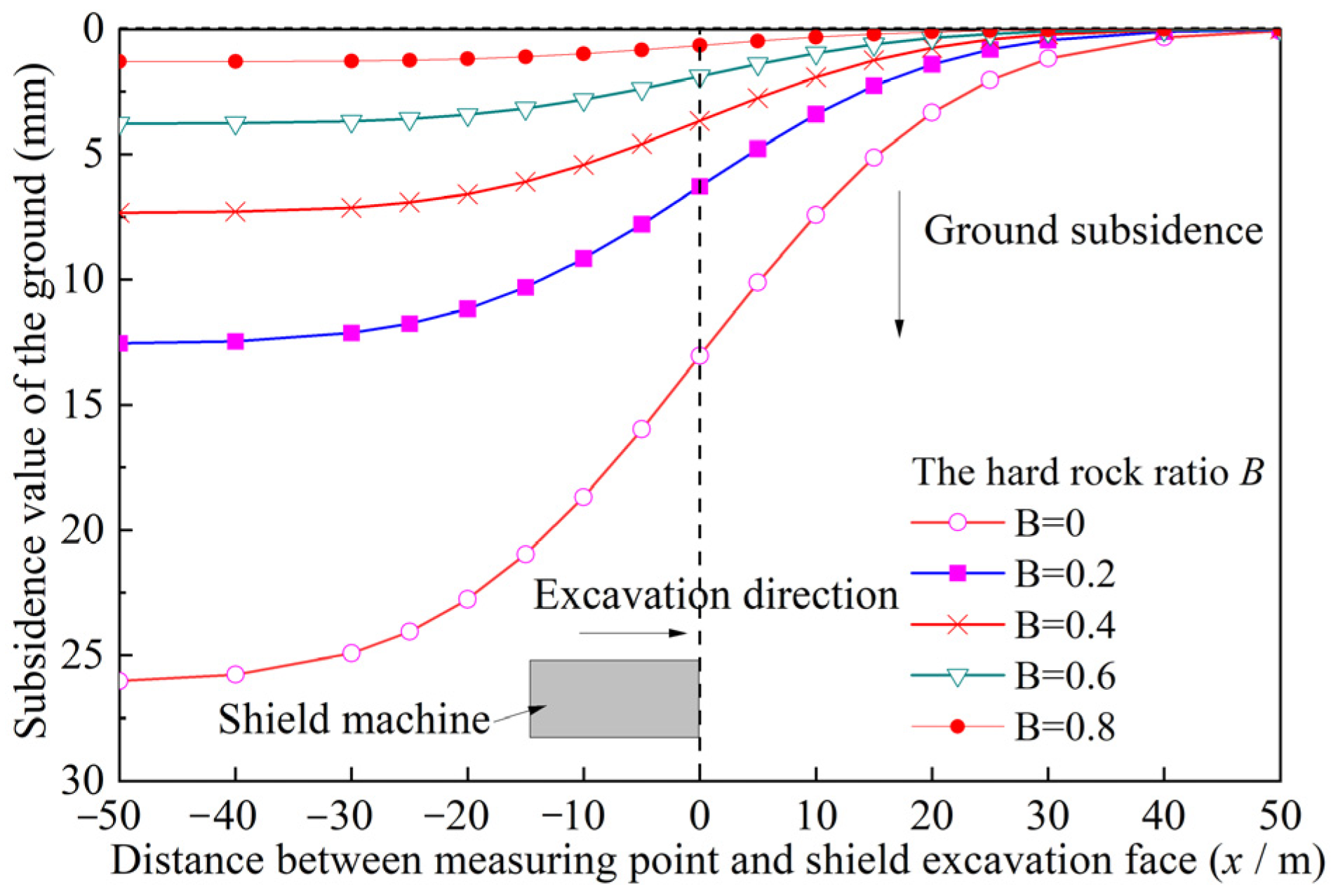
As shown in Figure 17, the longitudinal surface settlement is also significantly influenced by the hard rock ratio (B). The surface settlement decreases with the increase in B, and the reduction rate gradually decreases. The influence of shield tunneling on surface deformation mainly begins about 35 m ahead of the cutterhead (settlement is about 1% of the final settlement value), and extends to approximately 40 m behind the cutterhead to reach stability (settlement is about 99% of the final settlement value). The longitudinal settlement curve of the ground changes drastically within the range of −20~20 m, with settlement variations accounting for about 80% of the final stable value. This indicates that the area where the ground is most affected by shield tunnel excavation is located approximately 20 m ahead and behind the cutterhead. When the B values are successively 0, 0.2, 0.4, 0.6, and 0.8, the proportions of settlement variations within the range of −20~20 m to the final settlement value are 74.6%, 77.7%, 79.7%, 81.6%, and 83.7%, respectively, indicating that with the increase in B, the longitudinal settlement variation range becomes more concentrated and the influence area decreases.

4.4. The Impacts of Different Unilateral Calculation Ranges (l) on Ground Settlement

In principle, the larger the calculation scope, the closer the calculation results are to the true value. However, as the calculation scope increases, the number of calculation segments (N) involved may also increase, making the calculation more complex. To balance both accuracy and efficiency, the minimum reliable calculation scope needs to be determined.
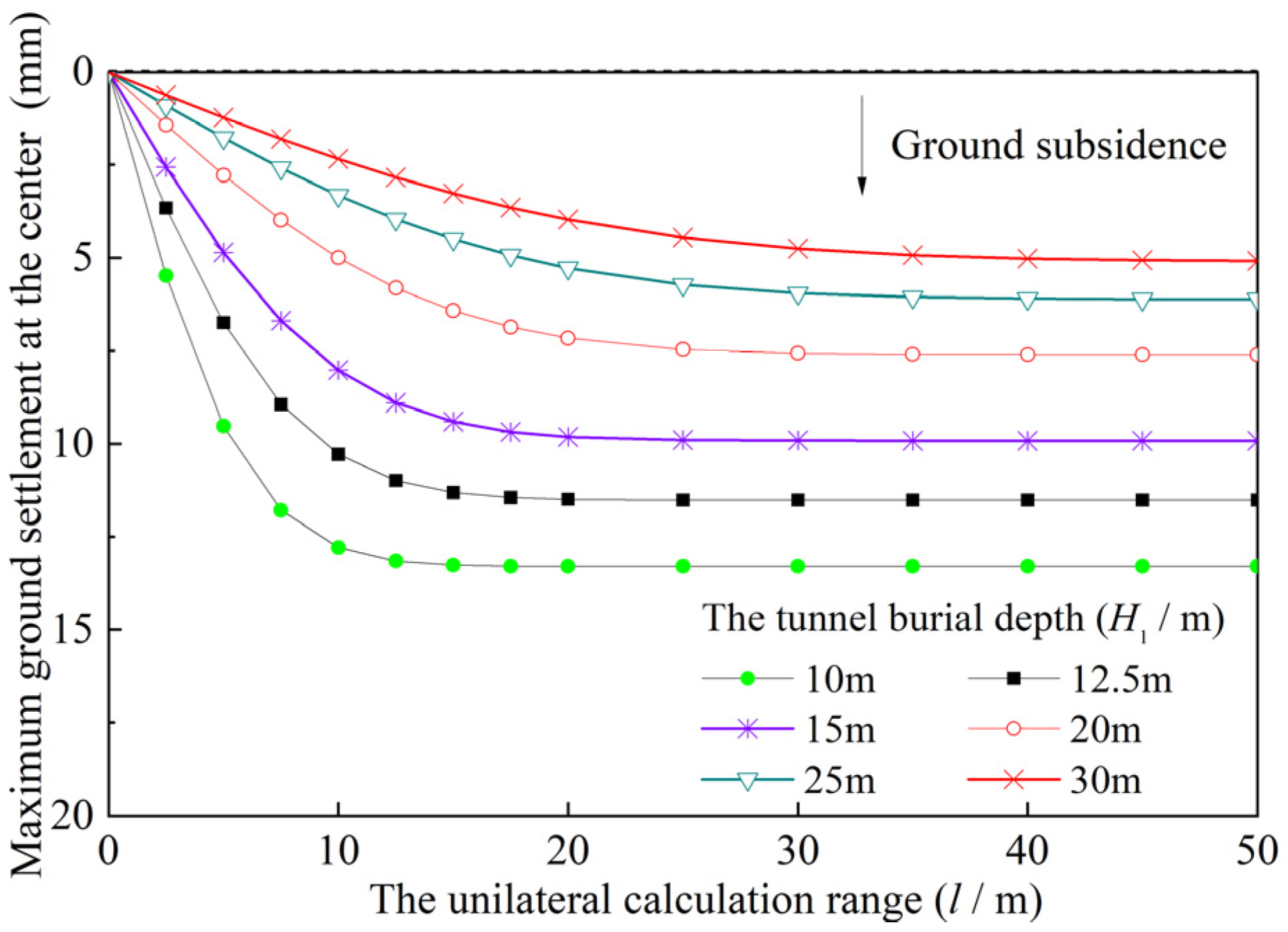
The case described in Section 4.3 is taken as the research object, with B = 0.5, and the maximum ground settlement at the center of x = x0 is calculated successively within different calculation ranges of sizes (x0l, x0 + l). As shown in Figure 18, with the increase in the unilateral calculation range (l), the center’s maximum settlement gradually rises and eventually tends to a stable value. As the tunnel burial depth (H1) increases, the stable value for settlement also gradually increases. If the growth rate within 2% is considered as stable settlement, the minimum unilateral calculation range is approximately 1.5H1 to 2H1, whereby 2H1 can be chosen for shallow tunnels and 1.5H1 can be chosen for deep tunnels.

5. Conclusions

Shield tunneling in soil–rock composite strata is prone to over excavation of soft soil due to poor control of the shield posture, leading to increased soil deformation. This article studies the law of soil deformation caused by shield tunneling through theoretical solutions. The main conclusions are as follows:
(1) Through the study of three engineering cases, the method proposed in this paper yields computational curves that align well with the measured data. It can be utilized to estimate the soil displacement caused by shield tunneling in soil–rock composite strata.
(2) When tunneling through soil–rock composite strata, the tendency for the segments to float upwards can be observed, leading to a convergence pattern that tends toward a non-equal radial convergence mode with top tangency. It is recommended that the convergence mode parameter (γ) be set to −1. In the same project, the grouting filling rate (δ) decreased with an increase in the hard rock ratio (B), exhibiting an approximate linear relationship.
(3) The value of B has a significant impact on the vertical and horizontal surface subsidence. It was observed that as B increases, the values of both vertical and horizontal surface subsidence, the width of the horizontal subsidence trough, and the main influence range of the shield tunneling all tend to decrease.
This paper does not consider the variations in depth along the y-axis of layered formations and RSI surfaces, which is a simplification that may deviate from reality. Additionally, if there are significant undulations in the upper layered formations along the x-axis, the calculation of the formations corresponding to the research section in this paper may lead to errors in the width of the settlement trough, which could introduce inaccuracies. Additionally, this paper assumes that deformation only occurs in soft soil layers, ignoring the deformation of hard rock layers. The method itself is simplified and may cause certain errors, which need to be improved and perfected in the future.

Author Contributions

Conceptualization, Y.Q.; methodology, Y.Q.; software, Y.Q.; validation, Y.Q., J.Z. and F.C.; data curation, Y.Q., J.Y. and H.Z.; writing—original draft preparation, Y.Q.; writing—review and editing, Y.Q., B.C. and X.Z. All authors have read and agreed to the published version of the manuscript.

Funding

This research was supported by the Research Project of China Railway Fourth Survey and Design Institute Group Co., Ltd. (2022K119-W01), and the Key Project of National Natural Science Foundation of China (Grant No. 51338009).

Data Availability Statement

The original contributions presented in this study are included in the article. Further inquiries can be directed to the corresponding author.

Acknowledgments

We are grateful to other members of our research team (Wei, G.) for their technical support.

Conflicts of Interest

Authors Jie Yin and Hangkai Zhu were employed by the company China Railway Siyuan Survey and Design Group Limited Company. Author Chen Feng was employed by China United Engineering Co., Ltd. The authors declare that this study received funding from the Research Project of China Railway Fourth Survey and Design Institute Group Co., Ltd. (2022K119-W01). The funder was not involved in the study design, collection, analyses, interpretation of data, or writing of this article or the decision to submit it for publication.

References

  1. Wei, G.; Feng, F.F.; Huang, S.Y.; Xu, T.B.; Zhu, J.X.; Wang, X.; Zhu, C.W. Full-scale loading test for shield tunnel segments: Load-bearing performance and failure patterns of lining structures. Undergr. Space 2025, 20, 197–217. [Google Scholar] [CrossRef]
  2. Li, Y.J.; Wang, X.; Wei, G.; Lin, Z.Y.; Wei, X.J.; Yan, Z.H.; Yan, J.J.; Shen, X. Numerical study of excavation face active instability in upward shield tunneling. Buildings 2025, 15, 3371. [Google Scholar] [CrossRef]
  3. Xie, X.Y.; Yang, Y.B.; Ji, M. Analysis of ground surface settlement induced by the construction of a large-diameter shield-driven tunnel in Shanghai. China. Tunn. Undergr. Space Technol. 2016, 51, 120–132. [Google Scholar] [CrossRef]
  4. Wang, X.R.; Li, Z.; Wang, H.; Rong, Q.G.; Liang, R.Y. Probabilistic analysis of shield-driven tunnel in multiple strata considering stratigraphic uncertainty. Struct. Saf. 2016, 62, 88–100. [Google Scholar] [CrossRef]
  5. Wang, J.; He, C.; Hu, R.Q.; Dai, G.H.; Wang, S.M. Soil disturbance induced by EPB shield tunnelling in upper-soft and lower-hard ground. Chin. J. Rock Mech. Eng. 2017, 36, 953–963. (In Chinese) [Google Scholar] [CrossRef]
  6. Zhang, Y.Z.; Wen, Z.Y.; You, G.M.; Liu, N. Difficulties and countermeasures in design and construction of shield tunnels in upper-soft and lower-hard stratum. Tunn. Constr. 2019, 39, 669–676. (In Chinese) [Google Scholar]
  7. Wang, Y.; Zhang, Y.J.; Zhu, Z.; Du, M.Q.; Qi, Y. A novel method for analyzing the factors influencing ground settlement during shield tunnel construction in upper-soft and lower-hard fissured rock strata considering the coupled hydromechanical properties. Geofluids 2020, 2020, 6691157. [Google Scholar] [CrossRef]
  8. Peck, R.B. Deep excavations and tunneling in soft ground. In Proceedings of the 7th International Conference on Soil Mechanics and Foundation Engineering, Mexico City, Mexico, 25–29 August 1969; pp. 225–290. [Google Scholar]
  9. Yao, A.J.; Lu, J.; Qiu, Z.W.; Wang, W.S.; Cai, C.X. Improving of Peck’s settlement calculation formula related to metro tunnel construction in soil-rock composite stratum. Railw. Eng. 2016, 6, 83–87. (In Chinese) [Google Scholar]
  10. Ding, J.; Zhang, S.; Zhang, H.; Guo, C.; Liao, Z.; Liu, H. Ground settlement caused by shield tunneling in soil-rock composite strata. J. Perform. Constr. Facil. 2021, 35, 04021057. [Google Scholar] [CrossRef]
  11. Li, L.; Yao, A.J. Investigation on response of site of typical soil–rock composite strata in Changchun induced by shield construction of parallel twin tunnels. Appl. Sci. 2024, 14, 500. [Google Scholar] [CrossRef]
  12. Lv, J.B.; Li, X.L.; Fu, H.L.; Tang, Y.; Li, Z.R.; Zhao, H. Influence of shield tunnel construction on ground surface settlement under the condition of upper-soft and lower-hard composite strata. J. Vibroeng. 2020, 22, 1126–1144. [Google Scholar] [CrossRef]
  13. Wu, X.; Xu, J.B.; Wang, S.W.; Sha, P.; Han, Z.M.; Chen, X.Y.; Shu, S.; Qiao, W.; Zeng, X.L. Ground deformation of shield tunneling through composite strata in coastal areas. Buildings 2024, 14, 1236. [Google Scholar] [CrossRef]
  14. Li, L.Y.; Du, X.L.; Zhou, J. Numerical simulation of site deformation induced by shield tunneling in typical upper-soft-lower-hard soil-rock composite stratum site of changchun. KSCE J. Civ. Eng. 2020, 24, 3156–3168. [Google Scholar] [CrossRef]
  15. Liang, E.B.; Wang, Z.K.; Wang, J.; Zhao, C.X. Study on the law of ground subsidence caused by shield construction in composite stratum. IOP Conf. Ser. Earth Environ. Sci. 2021, 791, 012029. [Google Scholar] [CrossRef]
  16. Yang, S.Q.; Chen, M.; Fang, G.; Wang, Y.C.; Meng, B.; Li, Y.H.; Jing, H.W. Physical experiment and numerical modelling of tunnel excavation in slanted upper-soft and lower-hard strata. Tunn. Undergr. Space Technol. 2018, 82, 248–264. [Google Scholar] [CrossRef]
  17. Mindlin, R.D. Force at a point in the interior of a semi-infinite solid. J. Appl. Phys. 1936, 7, 195–202. [Google Scholar] [CrossRef]
  18. Zhou, Y.C.; Wei, G.; Wang, X.; Tao, B.C.; Huang, Q.C.; Wei, X.J. Analytical solution of soil deformation caused by vertical pipe jacking construction considering grouting pressure. Sci. Rep. 2025, 15, 17476. [Google Scholar] [CrossRef]
  19. Yang, J.S.; Liu, B.C.; Wang, M.C. Modeling of tunneling-induced ground surface movements using stochastic medium theory. Tunn. Undergr. Space Technol. 2004, 19, 113–123. [Google Scholar] [CrossRef]
  20. Yang, X.L.; Wang, J.M. Ground movement prediction for tunnels using simplified procedure. Tunn. Undergr. Space Technol. 2011, 26, 462–471. [Google Scholar] [CrossRef]
  21. Sagaseta, C. Analysis of undrained soil deformation due to ground loss. Geotechnique 1988, 38, 301–320. [Google Scholar] [CrossRef]
  22. Verruijt, A.; Booker, J.R. Surface settlements due to deformation of a tunnel in an elastic half plane. Geotechnique 1996, 46, 753–756. [Google Scholar] [CrossRef]
  23. Loganathan, N.; Poulos, H.G. Analytical prediction for tunneling-induced ground movements in clays. J. Geotech. Geoenviron. Eng. 1998, 124, 846–856. [Google Scholar] [CrossRef]
  24. Verruijt, A. Complex variable solution for a deforming circular tunnel in an elastic half plane. Geotechnique 1997, 21, 77–89. [Google Scholar] [CrossRef]
  25. Verruijt, A. Deformations of an elastic half plane with a circular cavity. Int. J. Solids Struct. 1998, 35, 2795–2804. [Google Scholar] [CrossRef]
  26. Chou, W.I.; Bobet, A. Prediction of ground deformations in shallow tunnels in clay. Tunn. Undergr. Space Technol. 2002, 17, 3–19. [Google Scholar] [CrossRef]
  27. Park, K.H. Analytical solution for tunnelling-induced ground movement in clays. Tunn. Undergr. Space Technol. 2005, 20, 249–261. [Google Scholar] [CrossRef]
  28. Li, K. Limit Support Pressure of Tunnel Face and Ground Settlement Analysis in Rock-Soil Interface Composite Formations. Master’s Thesis, South China University of Technology, Guangzhou, China, 2017. (In Chinese). [Google Scholar]
  29. Jia, B.X.; Gao, Z.X. Investigating surface deformation caused by excavation of curved shield in upper soft and lower hard soil. Front. Earth Sci. 2022, 10, 844969. [Google Scholar] [CrossRef]
  30. Qi, Y.J.; Hu, X.J.; Zhou, S.J.; Zhou, J.; Wei, G.; Zhang, D. Study on the effect of tunneling and secondary grouting on the deformation of existing pipelines in bedrock raised strata. Transp. Geotech. 2024, 45, 101218. [Google Scholar] [CrossRef]
  31. Lee, K.M.; Rowe, R.K.; Lo, K.Y. Subsidence owing to tunnelling, I. estimating the gap parameter. Can. Geotech. J. 1992, 29, 929–940. [Google Scholar] [CrossRef]
  32. Zhu, W.B.; Ju, S.J.; Wang, H. Shield Tunneling Technology in Mixed Face Ground Conditions; China Architecture & Buildig Press: Beijing, China, 2020; pp. 26–27. (In Chinese) [Google Scholar]
  33. Tóth, Á.; Gong, Q.; Zhao, J. Case studies of TBM tunneling performance in rock–soil interface mixed ground. Tunn. Undergr. Space Technol. 2013, 38, 140–150. [Google Scholar] [CrossRef]
  34. Ye, Y.L.; Liu, X.L.; Niu, B.; Zhou, G.Y.; XU, C.Y. Stability analysis of excavation face of shield tunnel in upper soft and lower hard composite strata. J. Shenyang Univ. Technol. 2024, 46, 848–854. (In Chinese) [Google Scholar]
  35. Liu, Q.W.; Shao, X.K.; Huang, C.; Li, S.; Ye, S.J.; Jiang, Y.S.; Yang, Z.Y. Calculation model of shield tunnel face stability in upper-soft and lower-hard strata. China Railw. Sci. 2024, 45, 111–119. (In Chinese) [Google Scholar]
  36. Zhou, L.J.; Zhang, M.X.; Wang, W.; Lv, Y.; Han, J.Y.; Zhang, J. Analysis of the influence of mixed stratum of up soft and down hard on shield tunnel construction in Guangzhou. Railw. Stand. Des. 2018, 62, 113–117. (In Chinese) [Google Scholar]
  37. Ye, F. Analysis and Control for Upward Movement of Shield Tunnel During Construction. Ph.D. Thesis, Tongji University, Shanghai, China, 2007. (In Chinese). [Google Scholar]
  38. Zhu, C.H.; Li, N.; Liu, H.X.; Zhang, Z.Q. Analysis of ground settlement induced by workmanship of shield tunnelling. Rock and Soil Mech. 2011, 32, 158–164. (In Chinese) [Google Scholar]
  39. Knothe, S. Observations of surface movements under influence of mining and their theoretical interpretation. In Proceedings of the European Conference on Ground Movement, Leeds, UK, 9 April 1957. [Google Scholar]
  40. Wang, T.Z. Study on Ground Deformation Caused by Subway Tunnel Construction in Changchun Soft Mudstone Formation. Ph.D. Thesis, Jilin University, Changchun, China, 2016. (In Chinese). [Google Scholar]
  41. Han, X.; Li, N. Comparative analysis of strata prediction models for ground movement induced by tunnel construction. Chin. J. Rock Mech. Eng. 2007, 26, 594–600. (In Chinese) [Google Scholar] [CrossRef]
  42. Litwiniszyn, J. The theories and model research of movements of ground masses. In Proceedings of the European Congress on Ground Movement, Leeds, UK, 9 April 1957. [Google Scholar]
  43. Qi, J.J.; Xu, R.Q.; Wei, G. Research on calculation method of soil 3D displacement due to shield tunnel construction. Rock Soil Mech. 2009, 30, 2442–2446. (In Chinese) [Google Scholar] [CrossRef]
  44. Xiao, G.W.; Wang, D.J. Settlement analysis and prevention and control measures of shield construction for upper soft and hard stratum. Guangdong Arch. Civil Eng. 2019, 26, 43–47. (In Chinese) [Google Scholar] [CrossRef]
Figure 1. Computational model diagram: (a) three dimensional graph (without stratum characteristics); (b) side view.
Symmetry 17 02104 g001aSymmetry 17 02104 g001b
Figure 2. Schematic diagram of shield excavation face before and after convergence.
Symmetry 17 02104 g002
Figure 3. Three typical convergence modes: (a) equal convergence mode; (b) non-equal radial convergence mode with bottom tangency; (c) non-equal radial convergence mode with top tangency.
Symmetry 17 02104 g003
Figure 4. Diagram of shield machine eccentricity.
Symmetry 17 02104 g004
Figure 5. Schematic diagram of overbreak caused by shield eccentricity.
Symmetry 17 02104 g005
Figure 6. Schematic diagram of shield overbreak area.
Symmetry 17 02104 g006
Figure 7. Transmission of β.
Symmetry 17 02104 g007
Figure 8. Diagram of unit excavation.
Symmetry 17 02104 g008
Figure 9. Schematic diagram of tunnel profile.
Symmetry 17 02104 g009
Figure 10. Relevant parameters of engineering case.
Symmetry 17 02104 g010
Figure 11. Comparison diagram of measured data and calculation results in this paper: (a) DBC-468; (b) DBC-516; (c) DBC-528.
Symmetry 17 02104 g011aSymmetry 17 02104 g011b
Figure 12. Comparison of calculated results and measured data in an underground pipe gallery in Guangzhou [44]: (a) relevant parameters of engineering case; (b) ring 354; (c) ring 398; (d) ring 446.
Symmetry 17 02104 g012
Figure 13. Comparison of calculated results and measured data in Foshan–Dongguan Intercity Railway [36]: (a) relevant parameters of engineering case; (b) ring 1272; (c) ring 1322; (d) ring 1346.
Symmetry 17 02104 g013
Figure 14. The relationship between δ and B.
Symmetry 17 02104 g014
Figure 15. Application process of this method in practice.
Symmetry 17 02104 g015
Figure 16. Comparison of lateral ground subsidence values under different hard rock ratios (B).
Symmetry 17 02104 g016
Figure 17. Comparison of longitudinal surface subsidence values under different hard rock ratios (B).
Symmetry 17 02104 g017
Figure 18. Variation trend of maximum settlement in the center under different buried depths of tunnels.
Symmetry 17 02104 g018
Table 1. Table of formation parameters.
Stratum NameLayer Thickness/mφi/(°)
DBC528DBC516DBC468
1 Miscellaneous fill2.72.72.510
2 Silty clay10012.1
1 Silt mixed with muddy soil0.851.62.525.1
1 Mucky clay5.76.259.5
2 Silty clay mixed with silt7.1571211.5
1 Silty clay6.75.5013.8
1 Silty clay004.815.7
1 Sandy silty clay1.30/15.3
2 Moderately weathered tuff/1/20.3
Table 2. Table of relevant parameters of two engineering cases.
NumberTunnel and Segment StudiedStratumDd/mD/mL/mδ/%Bγ
1An underground pipe gallery in Guangzhou, Ring 354①Miscellaneous fill, ②Mucky clay,
③Silty clay, ④Strongly weathered limestone (soft rock), ⑤Moderately weathered limestone (hard rock)
6.368.75 95.40−1
2An underground pipe gallery in Guangzhou, Ring 3986.368.7591.40.25−1
3An underground pipe gallery in Guangzhou, Ring 4466.368.7584.20.5−1
4Foshan-Dongguan Intercity Railway, Ring 1272①Plain fill, ②Plastic silty clay,
③Completely weathered granite (soft rock), ④Strongly weathered monzogranite (hard rock)
8.88.51087.60−1
5Foshan-Dongguan Intercity Railway, Ring 13228.88.510730.25−1
6Foshan-Dongguan Intercity Railway, Ring 13468.88.510670.5−1
Disclaimer/Publisher’s Note: The statements, opinions and data contained in all publications are solely those of the individual author(s) and contributor(s) and not of MDPI and/or the editor(s). MDPI and/or the editor(s) disclaim responsibility for any injury to people or property resulting from any ideas, methods, instructions or products referred to in the content.