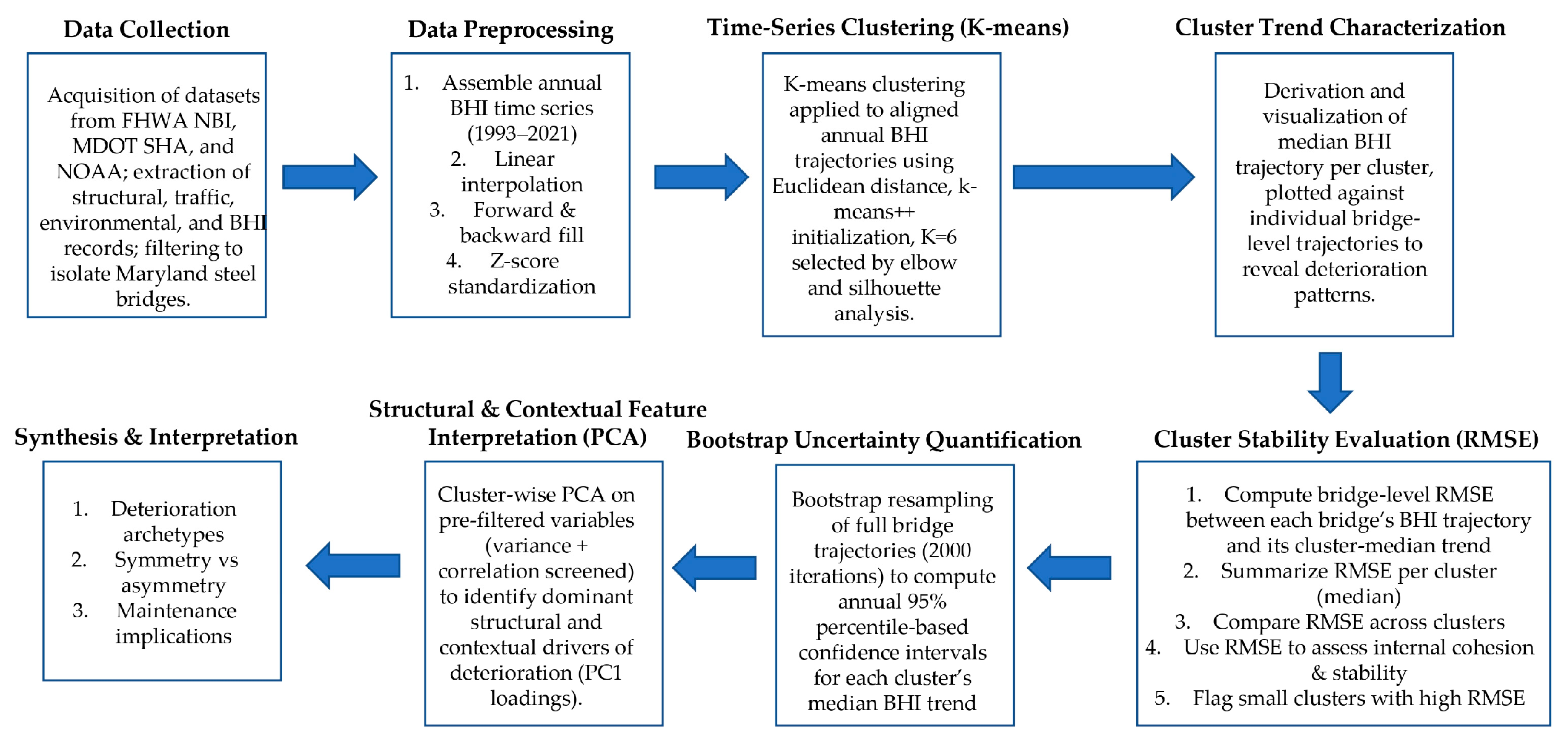
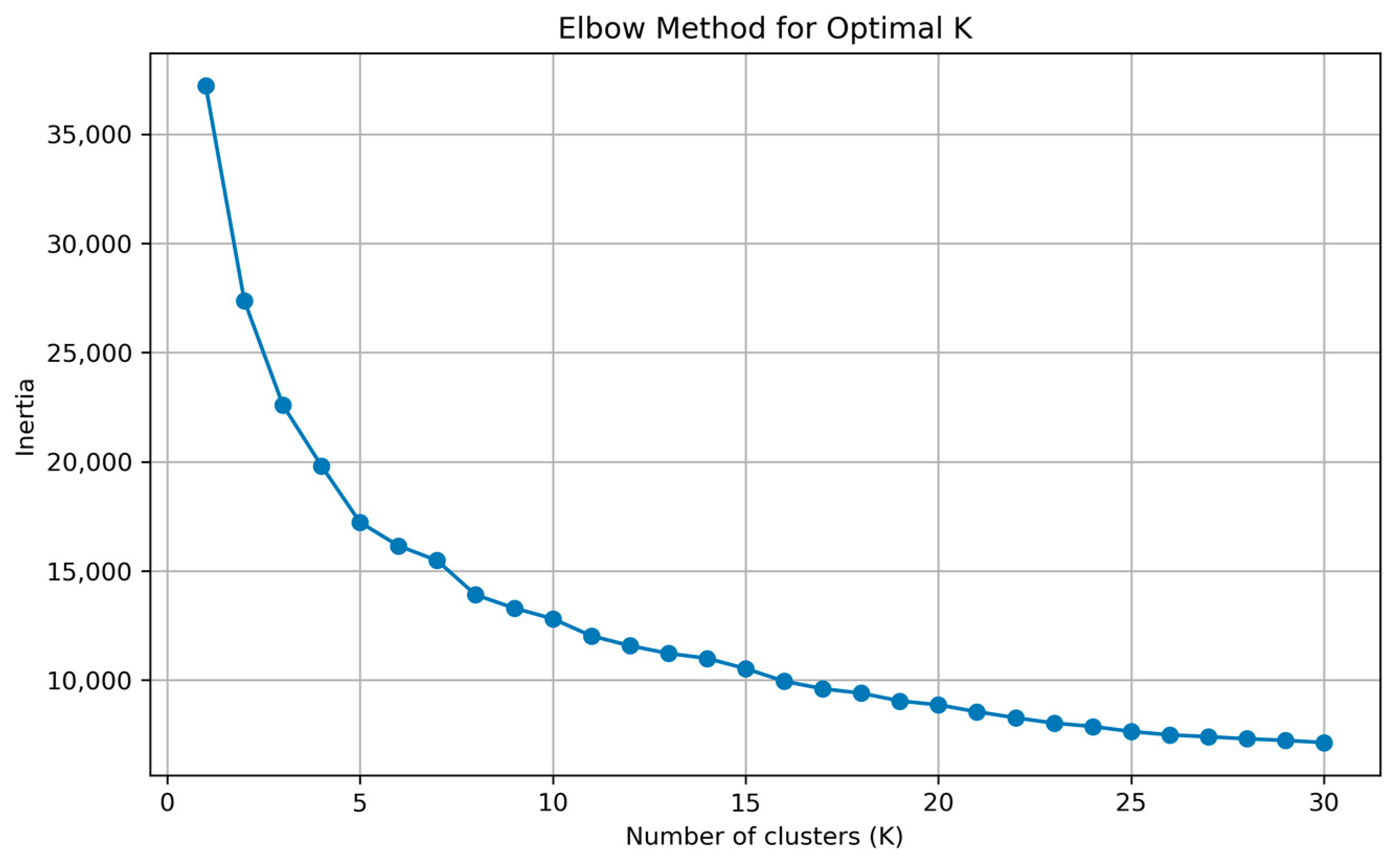
This section presents a detailed examination of Maryland’s steel bridges, categorized into six clusters based on distinct Bridge Health Index (BHI) deterioration patterns. The number of clusters (K = 6) was selected using the elbow method as the optimal balance between simplicity and explanatory power. Principal Component Analysis (PCA) was then applied to identify key features such as span length, deck width, condition ratings, and traffic volume that distinguish the clusters. The following subsections present cluster trajectories, uncertainty ranges, and PCA interpretations, offering insights to guide maintenance prioritization and long-term infrastructure planning.
3.1.1. Cluster Characterization via BHI Trajectories
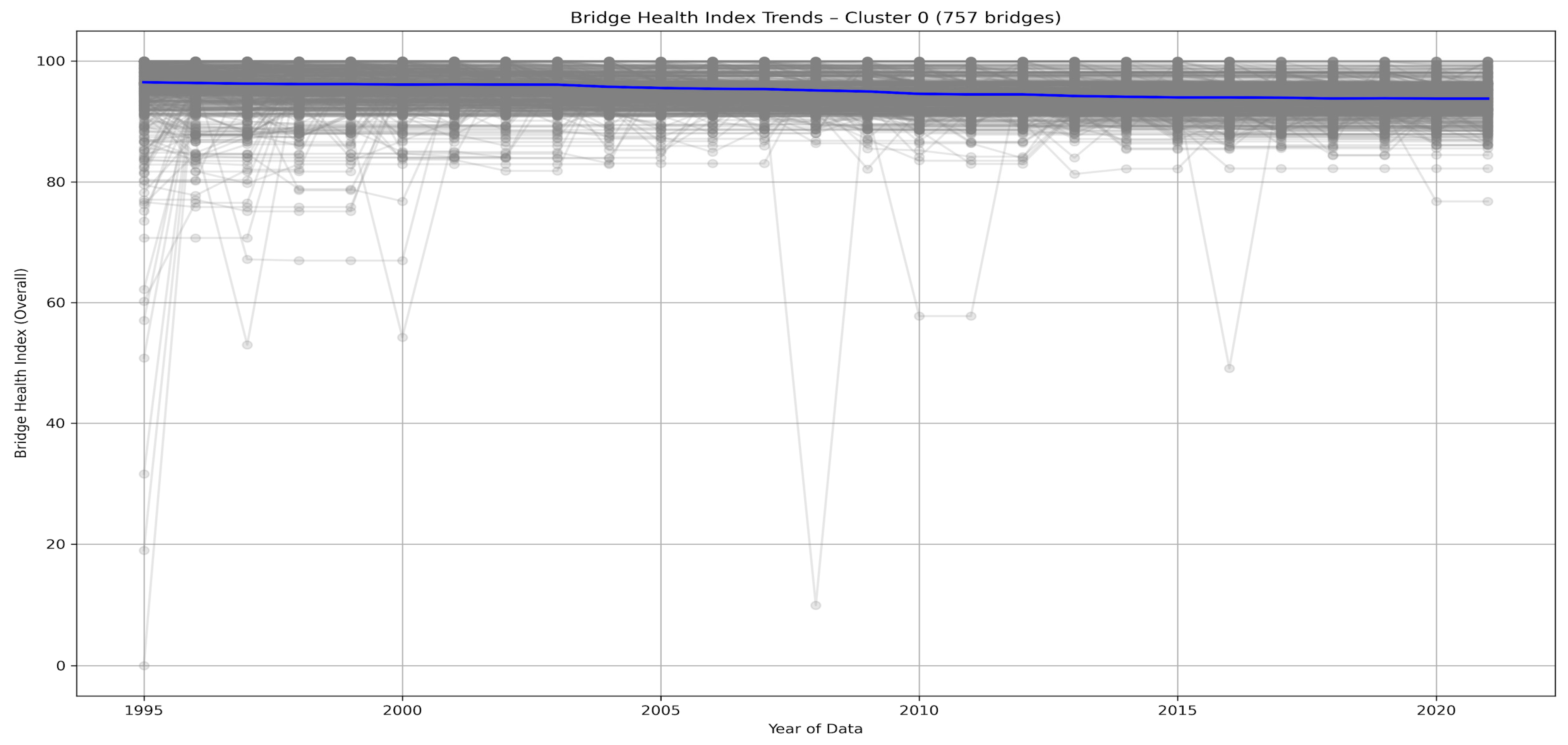
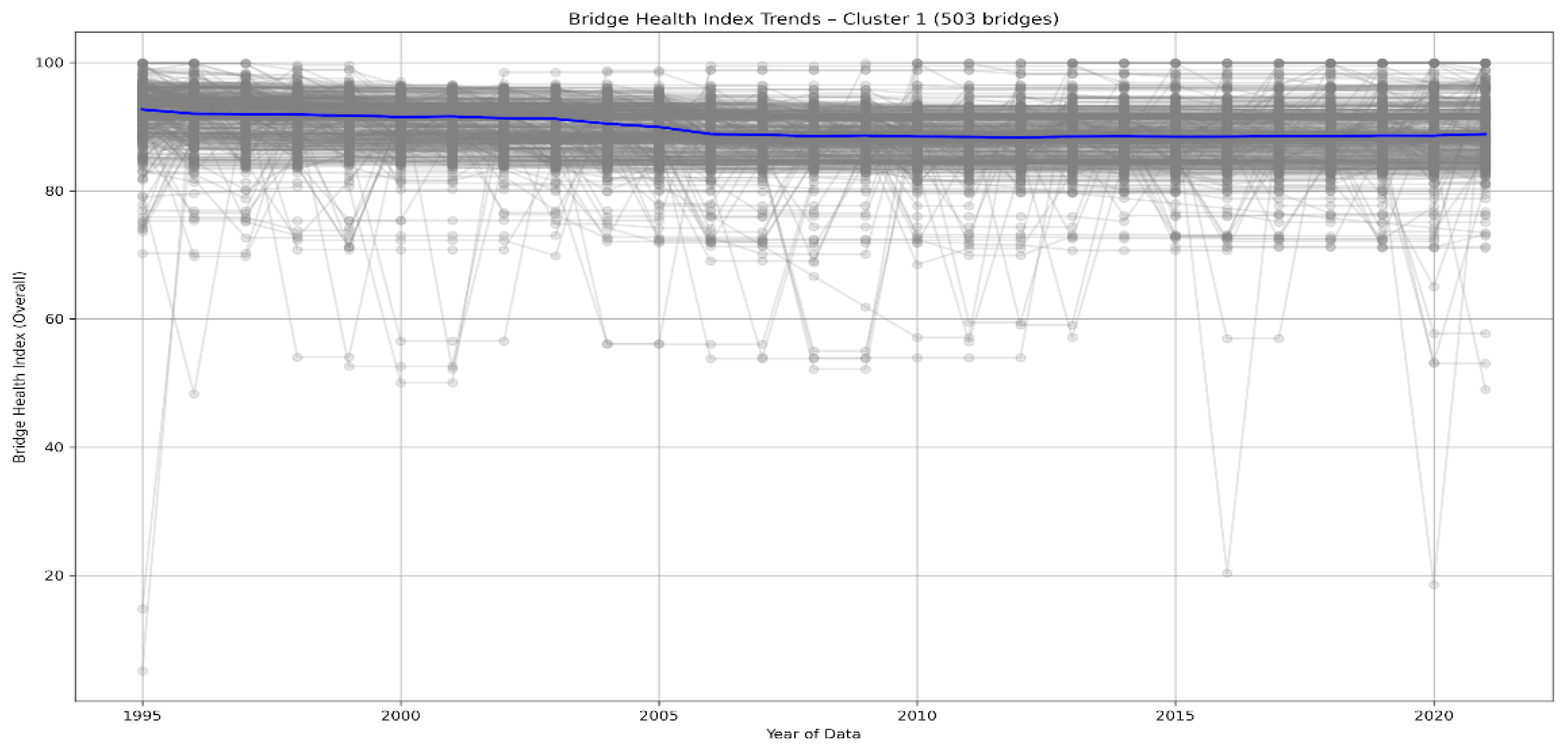
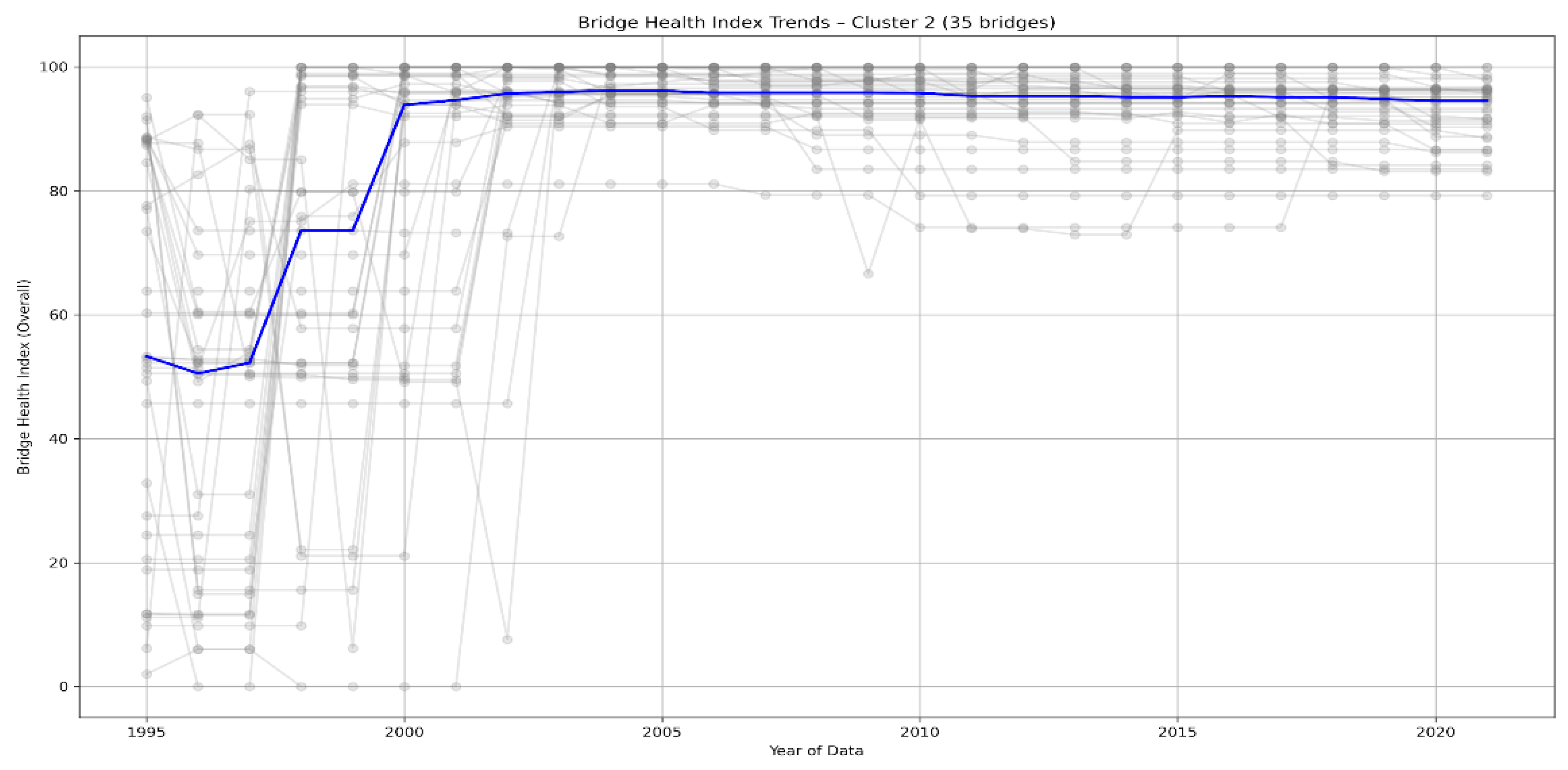
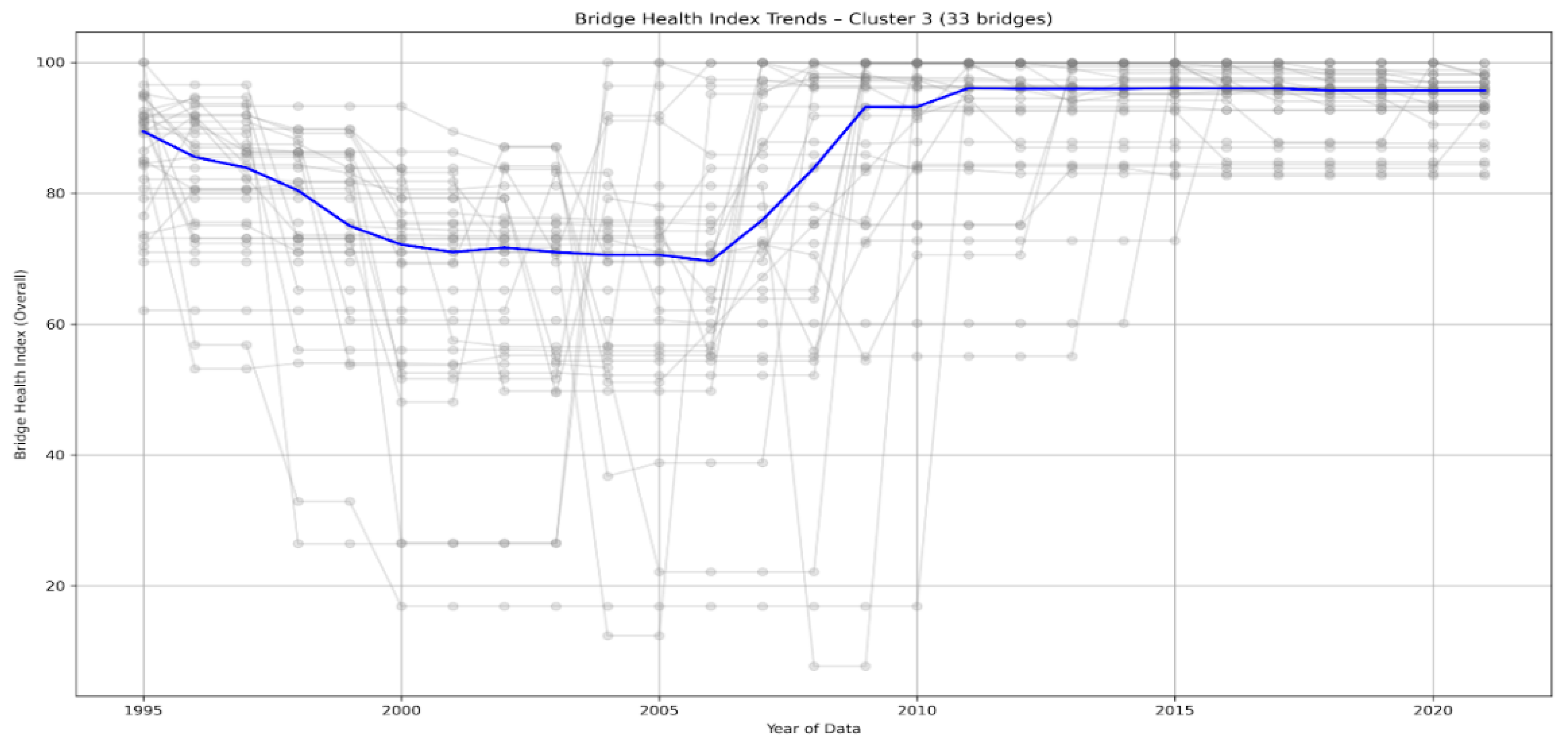
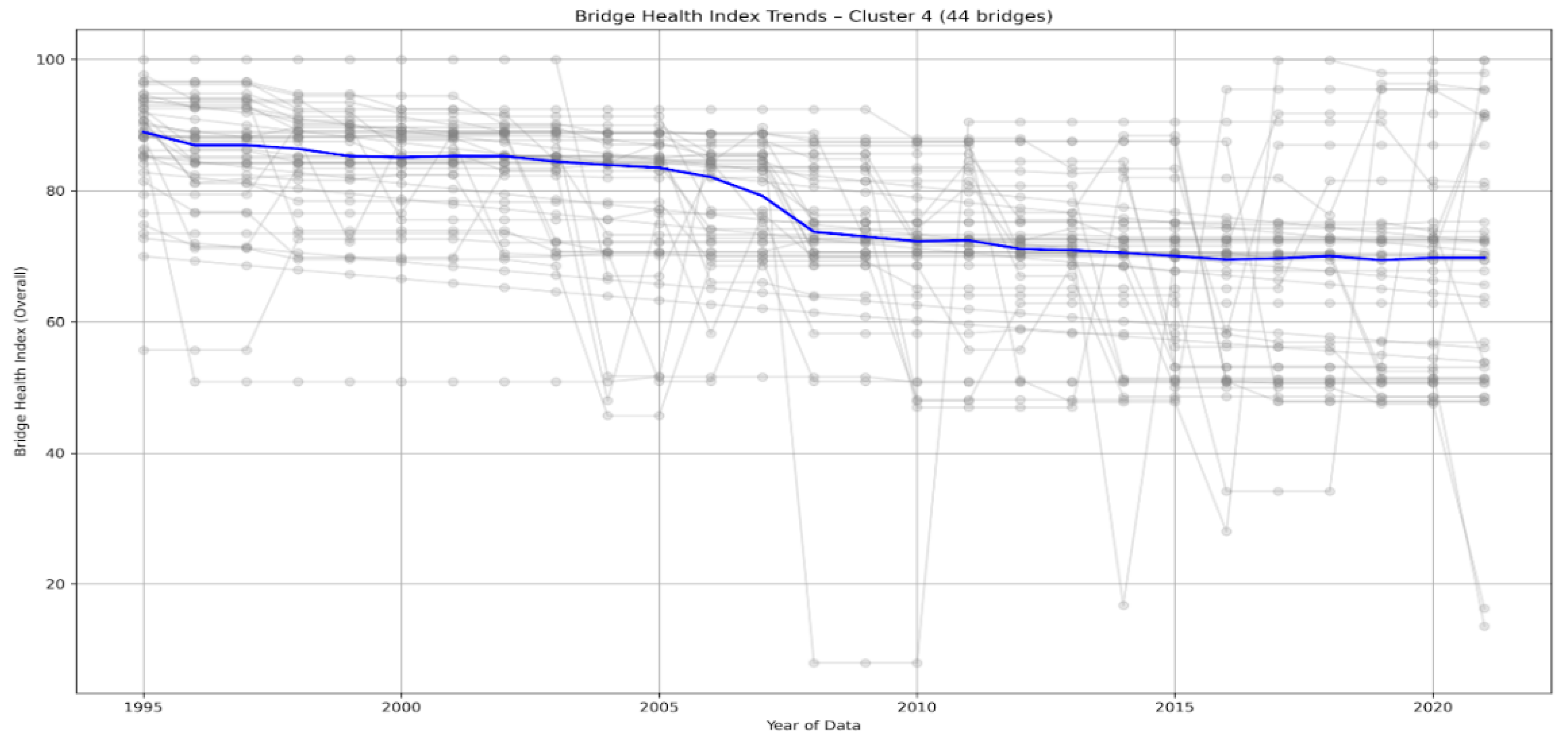
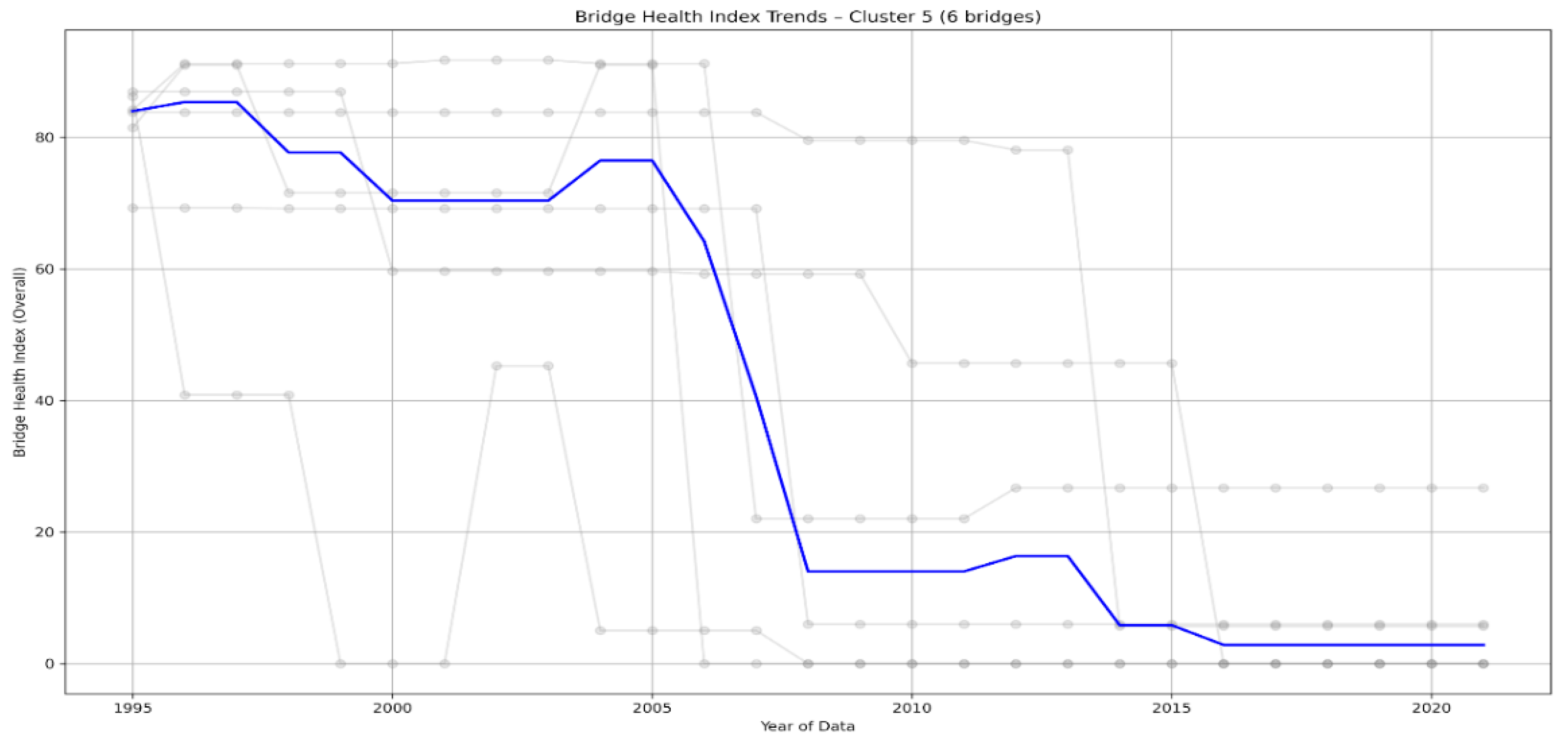
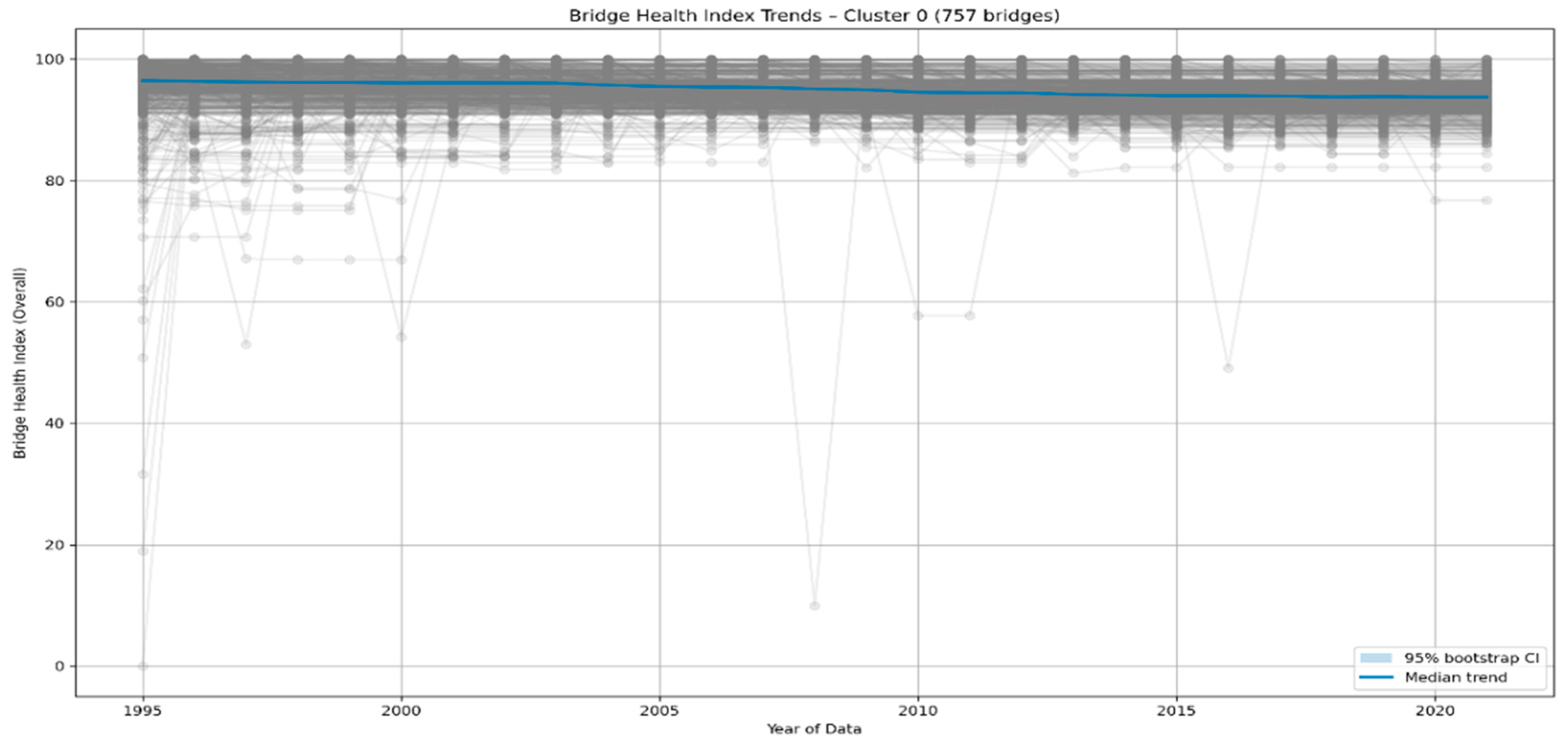
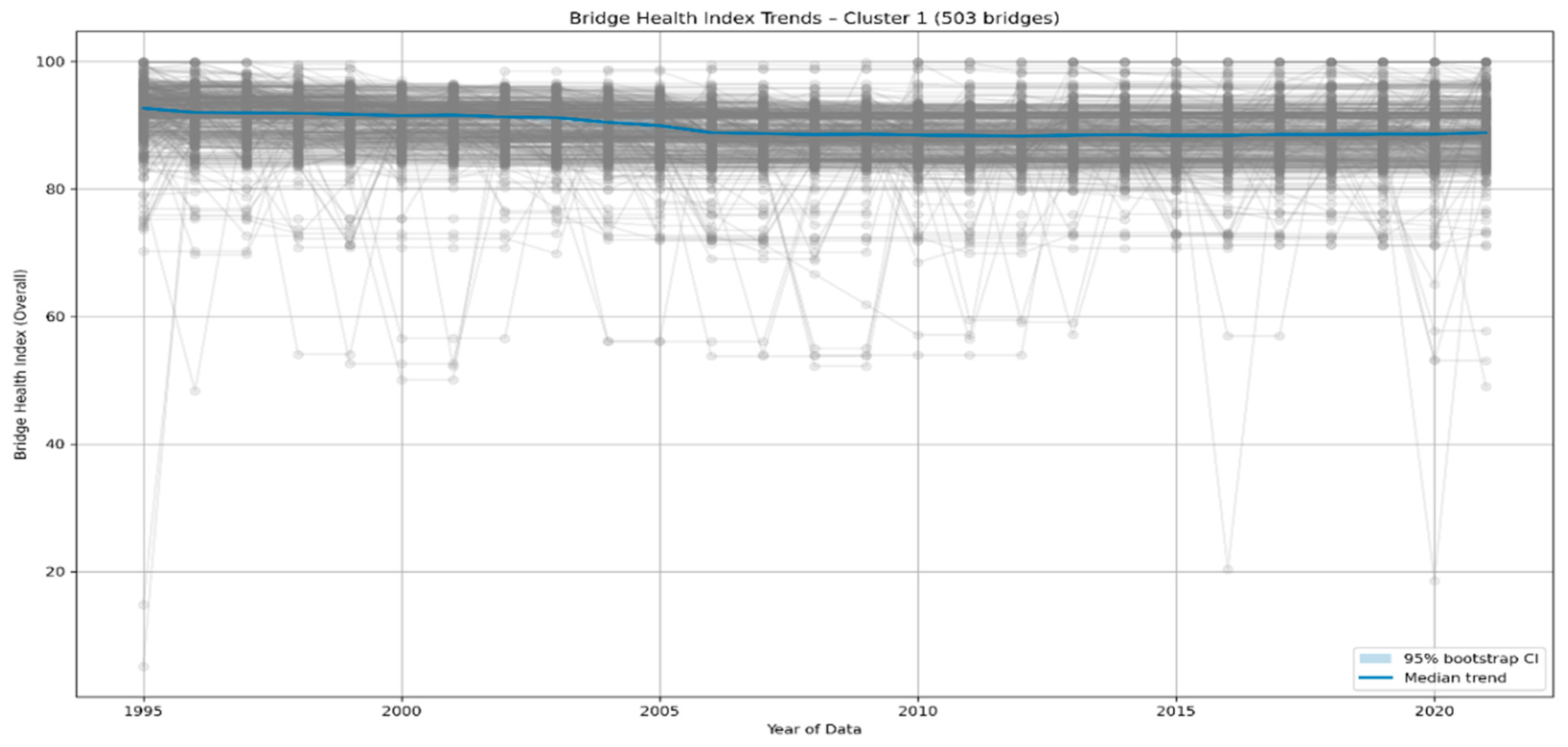
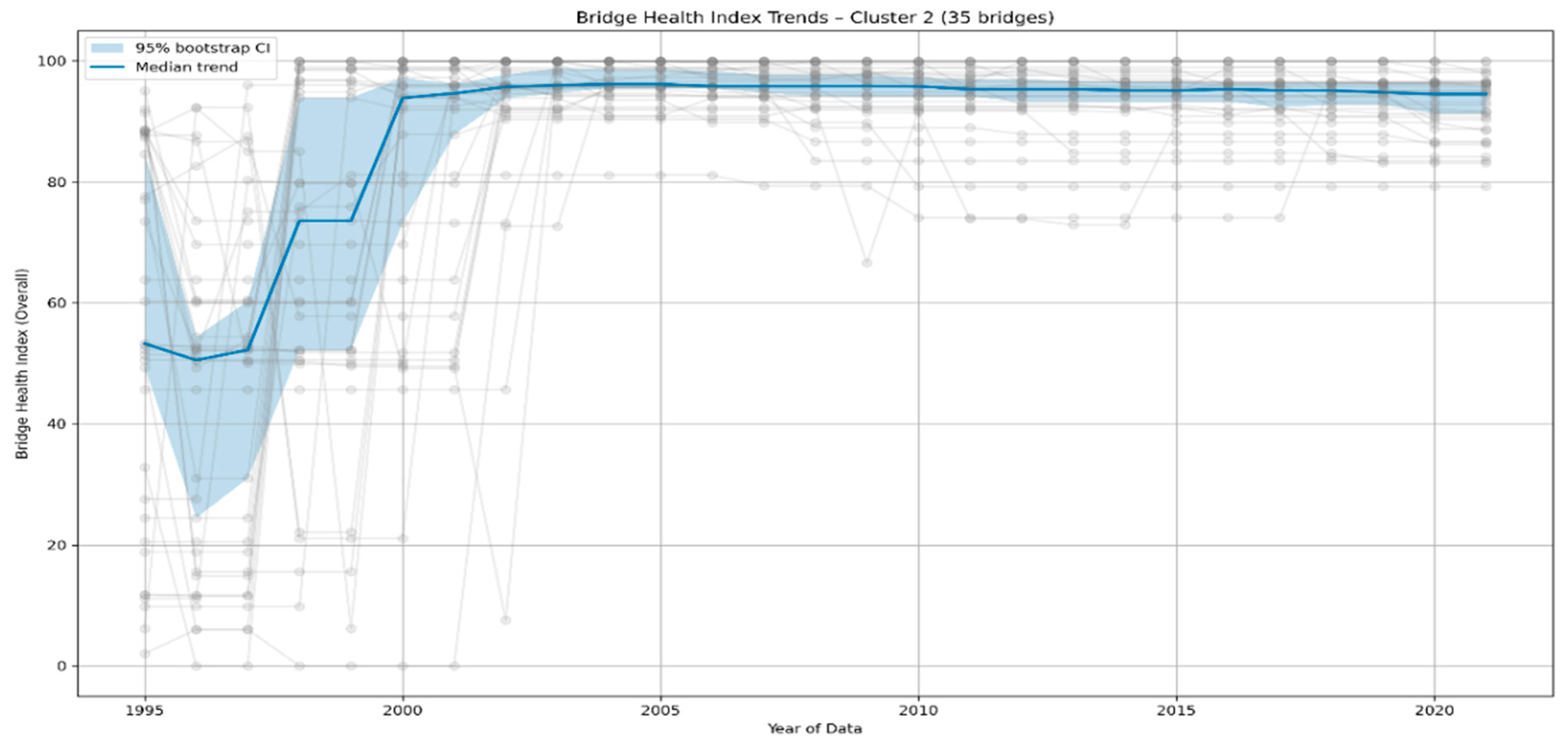
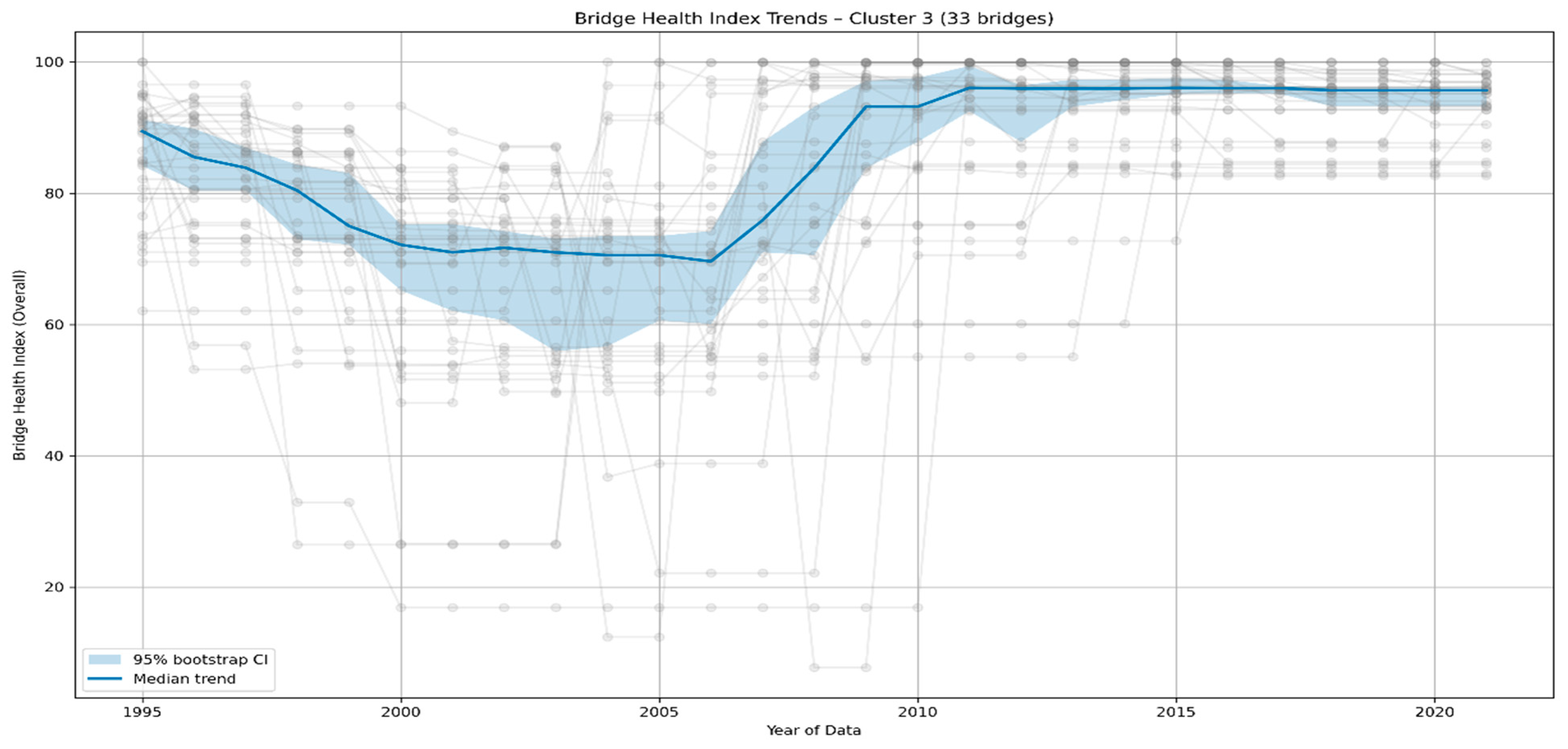
Cluster-wise BHI trends were visualized to interpret temporal degradation patterns. Individual bridge trajectories were shown as low-opacity gray lines, revealing dense regions of overlap while preserving data fidelity and readability. A bold blue line marked the median trend, clearly depicting typical health progression within each cluster. This visualization highlighted clusters of concern with accelerated deterioration as well as high-performing cohorts maintaining strong BHI levels.
As illustrated in
Figure 3, Cluster 0 bridges exhibit consistently high Bridge Health Index (BHI) values (95–97) from 1995 to 2021, with only minor fluctuations after 2010. This pattern indicates stable, well-maintained structures, likely reflecting newer construction or the benefits of effective preventive maintenance.
As illustrated in
Figure 4, Cluster 1 bridges display median BHI values starting near 90 in 1995 and gradually declining to approximately 85 by 2021. This trend reflects progressive deterioration, likely driven by aging, deferred maintenance, or increased loading. The most pronounced drop occurs in the early 2000s, suggesting delays in rehabilitation efforts. While the majority of bridges remain in fair to good condition, the steady downward trajectory highlights the need for proactive maintenance. Experts noted that the overall pattern aligns with expectations, although some year-to-year variation may reflect undocumented preventive interventions by other agencies.
As illustrated in
Figure 5, Cluster 2 bridges exhibit a sharp increase in median BHI from around 50 in 1995 to over 90 by the early 2000s, followed by long-term stability through 2021. This pattern suggests effective rehabilitation interventions coupled with consistent maintenance practices. Experts observed that the trend is consistent with previous findings, although a steeper initial deterioration phase might be expected in larger datasets.
As Illustrated in
Figure 6, Cluster 3 bridges show a U-shaped median BHI trend, beginning around 85 in 1995, declining to approximately 70 by 2006, and then sharply rebounding to the mid-90s by 2010, with stability thereafter. This trajectory suggests initial deterioration followed by effective rehabilitation. Experts noted that the sharp decline between 2005 and 2010 may reflect simultaneous drops in multiple component ratings, while the presence of near-zero BHI values post-2010 raises concerns about potential data inaccuracies.
As illustrated in
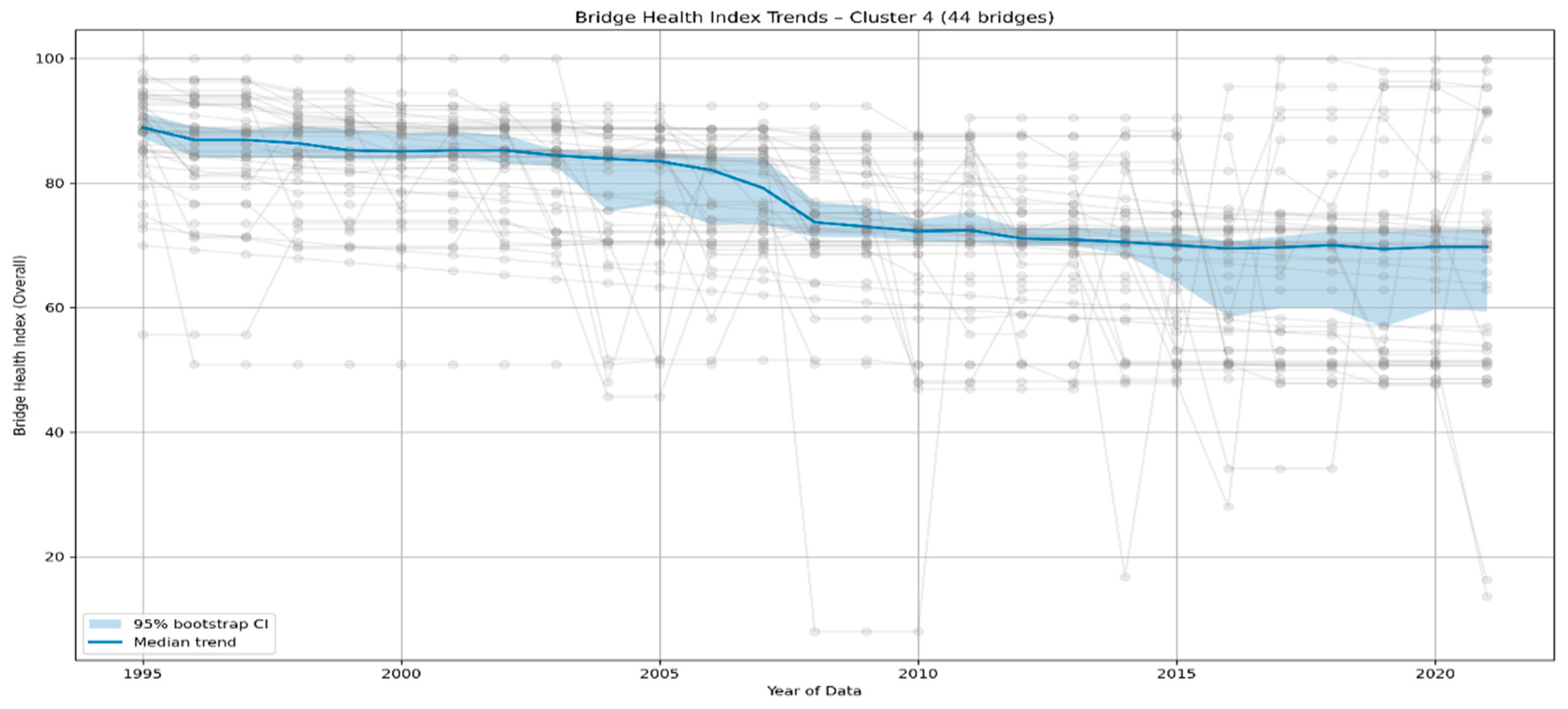
Figure 7, Cluster 4 bridges display a steady median BHI decline from approximately 90 in 1995 to around 70 by the early 2010s, after which the trend stabilizes. This pattern indicates gradual deterioration likely driven by aging or limited maintenance. Although the bridges remain serviceable, the downward trajectory points to the need for strategic rehabilitation. Experts observed that unusually high BHI values in certain years may suggest either more preventive maintenance than anticipated or potential data inaccuracies.
As illustrated in
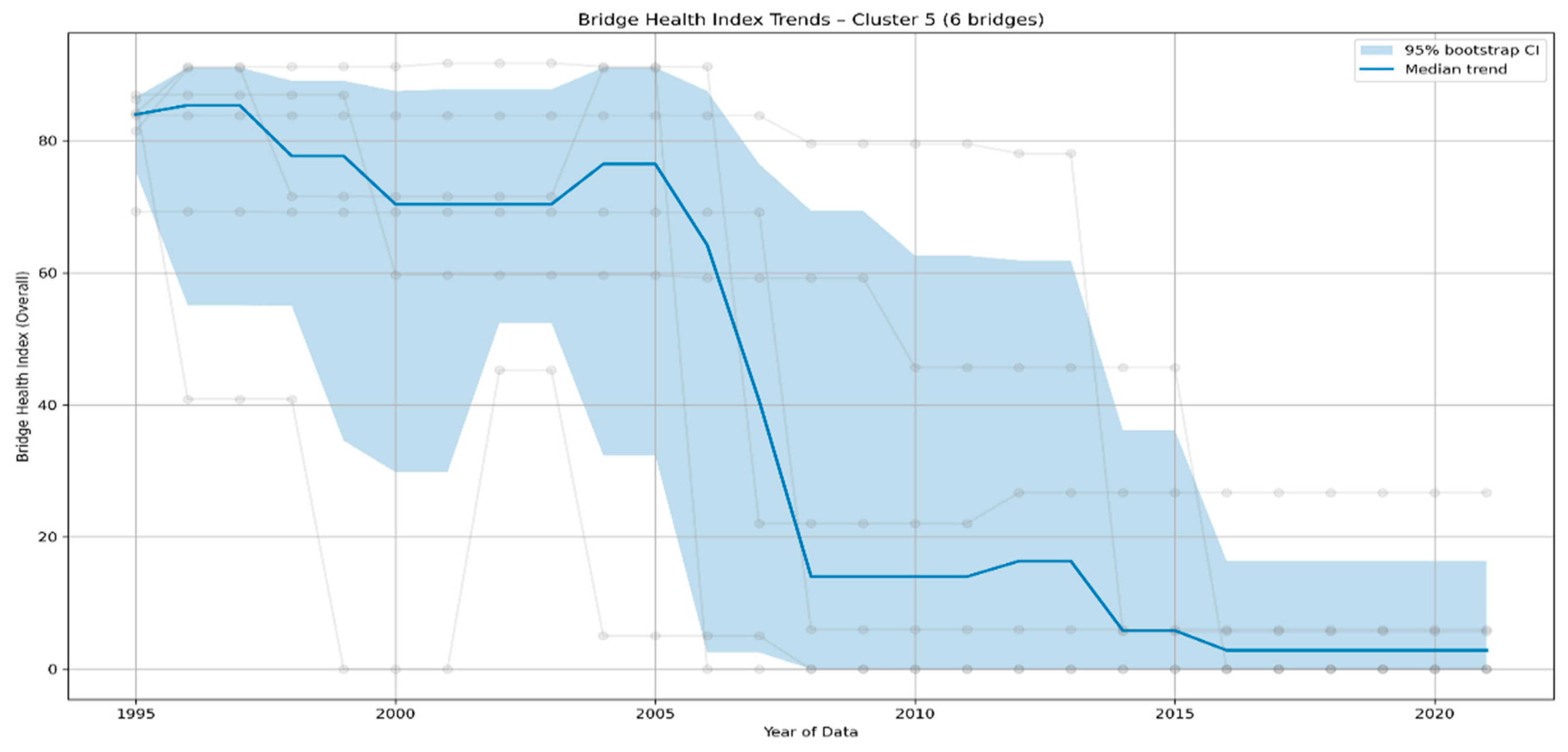
Figure 8, Cluster 5 bridges maintain a stable median BHI above 80 until 2007, after which values drop sharply below 20 by 2009 and remain critically low through 2021. This sustained deterioration signals severe structural decline, likely stemming from aging, inadequate maintenance, or unresolved structural issues, with no evidence of rehabilitation. Experts noted similarities to other declining clusters but also expressed concerns about potential data quality issues, given unusually flat or inflated BHI values in certain periods. The critical condition of Cluster 5 bridges underscores the urgent need for inspection and potential replacement.
The six steel bridge clusters exhibit distinct and contrasting BHI trajectories, reflecting differences in age, maintenance practices, and rehabilitation efforts. Cluster 0 demonstrates long-term stability, maintaining a high BHI of 95–97 for nearly three decades, suggesting effective construction quality and consistent preventive maintenance. In contrast, Cluster 5 represents a critical deterioration profile, with BHI scores dropping below 20 after 2008 and showing no recovery through 2021, highlighting urgent inspection and replacement needs. Between these extremes, Cluster 2 shows a sharp improvement from approximately 50 to over 90 by the early 2000s, likely the result of targeted rehabilitation, while Cluster 3 exhibits a U-shaped trend declining from 85 to 70 by 2006 before rebounding to the mid-90s indicating successful mid-life interventions. Clusters 1 and 4, on the other hand, show more gradual declines: Cluster 1 drops modestly from 90 to 85, reflecting progressive aging with limited maintenance, whereas Cluster 4 declines more sharply from 90 to 70, suggesting prolonged wear with minimal intervention. These patterns illustrate how clusters differ not only in the magnitude of deterioration but also in their response to maintenance and rehabilitation efforts. Stable and rehabilitated clusters (0, 2, 3) contrast sharply with declining or critically failing clusters (1, 4, 5), reinforcing the value of cluster-based analysis for identifying maintenance priorities and improving long-term infrastructure resilience.
The superior performance of Cluster 0 and the recovery observed in Clusters 2 and 3 can be attributed to preventive maintenance and timely rehabilitation interventions, whereas Clusters 4 and 5 illustrate how deferred or insufficient responses accelerate decline. This highlights why certain clusters appear to ‘perform better’ their outcomes are shaped less by inherent material limitations and more by the presence or absence of proactive maintenance strategies. These findings align with Foster [
59], who showed that preventive care significantly prolongs service life, and extend those insights by quantifying recovery dynamics at the cluster level.
It is important to note that Clusters 2–5 contain relatively few bridges compared with Clusters 0 and 1 (
Table 1). This imbalance results in greater variability in their year-to-year trajectories, making their median trends less stable and more sensitive to individual bridge histories. Accordingly, the interpretations for these small clusters particularly Cluster 5 (n = 6) should be viewed with caution
Quantifying Symmetry in Cluster Trends
To quantitatively assess the balance of deterioration and recovery behaviors observed within the six clusters, the Robinson Symmetry Index (SI) was calculated for each cluster using the median BHI values in the first and second half of the observation period. This metric expresses the degree of temporal symmetry as a percentage, where SI ≈ 0 indicates a highly symmetric pattern, negative values indicate greater deterioration in the early portion of the timeline, and positive values indicate stronger late-period deterioration or recovery. For each bridge
, the symmetry index was computed as:
where
is the median BHI in the first half of the timeline and
is the median BHI in the second half. The cluster-level symmetry index is the median of all
values within that cluster:
An SI close to zero indicates near-symmetric deterioration, negative values reflect earlier-period deterioration dominance, and positive values indicate stronger late-period deterioration or recovery.
Table 5 summarizes the SI results for all clusters and highlights clear distinctions between near-symmetric groups (Clusters 0–2) and strongly asymmetric clusters (Clusters 3–5).
As shown in
Table 5, Clusters 0 and 1 exhibit near-symmetric deterioration behavior with only slight early-period decline, reflected in SI values of −1.93% and −2.26%, respectively. Cluster 2 presents a perfectly symmetric pattern (SI = 0.00%), indicating a balanced relationship between early and late deterioration phases. In contrast, Clusters 3 and 4 demonstrate moderate asymmetry, with Cluster 3 showing late-stage acceleration (+18.47%) and Cluster 4 exhibiting accelerated early deterioration (−16.94%). Finally, Cluster 5 shows a severely asymmetric deterioration profile (SI = −171.35%), characterized by extreme deterioration concentrated in the early portion of the observation period. It should be emphasized that the Robinson Symmetry Index measures the proportional difference in deterioration magnitude between the first and second halves of the timeline, rather than the geometric symmetry or slope progression of the trend curve.
Uncertainty Analysis of BHI Trends
This section presents bridge health index (BHI) trajectories for each cluster with 95% bootstrap confidence intervals around the median trend. These intervals quantify the uncertainty in the median estimate due to sampling variability, allowing for more robust interpretation of cluster-level deterioration patterns.
As illustrated in
Figure 9, the Bridge Overall Health Index (BHI) trends for Cluster 0 steel bridges exhibit consistently high performance from 1995 to 2021, with the median BHI remaining in the 95–97 range. The incorporation of 95% bootstrap confidence intervals provides a quantitative measure of uncertainty, showing that the observed stability is not due to random fluctuations but is statistically robust. The narrow intervals indicate minimal variation in median BHI across years, reinforcing the reliability of these estimates and the classification of this cluster as well-maintained. Occasional dips in individual bridge trajectories are visible, but they fall well outside the central trend and do not alter the overall pattern. This uncertainty analysis confirms that the stability in BHI for Cluster 0 is a consistent and dependable finding, supporting long-term maintenance planning with high confidence.
As illustrated in
Figure 10, the Bridge Health Index (BHI) trends for Cluster 1 steel bridges reveal a gradual but steady decline in median values from approximately 90 in the mid-1990s to around 85 by 2021. The inclusion of 95% bootstrap confidence intervals provides a clear measure of uncertainty, with moderate interval widths indicating year-to-year variability in median condition. These intervals suggest that while the overall deterioration trajectory is consistent, there is some heterogeneity among bridges in this group, potentially arising from variations in age, maintenance practices, or environmental exposure. The results emphasize the importance of uncertainty analysis in confirming that the observed decline is not driven by isolated outliers but reflects a robust trend across the dataset.
As illustrated in
Figure 11, the Bridge Health Index (BHI) trends for Cluster 2 steel bridges display a rapid improvement from lower initial values in the early 1990s to consistently high levels (around 95–97) by the early 2000s. The 95% bootstrap confidence intervals are notably wider during the initial years, indicating substantial variability in condition across bridges in this group, likely due to differences in age, prior rehabilitation history, or initial construction quality. Over time, the confidence intervals narrow significantly, suggesting a convergence toward uniformly high conditions, potentially driven by coordinated maintenance or rehabilitation efforts. This pattern highlights how uncertainty analysis can capture the transition from heterogeneous initial states to stable, well-maintained performance across the cluster.
As illustrated in
Figure 12, the Bridge Health Index (BHI) trends for Cluster 3 steel bridges exhibit a pronounced U-shaped trajectory. The median BHI declines steadily from the mid-1990s to around 2005, reaching values near 75, with relatively wide 95% bootstrap confidence intervals during this deterioration phase, reflecting significant variability in bridge conditions. This variability likely stems from differences in deterioration rates, deferred maintenance, or localized environmental stressors. Beginning in the late 2000s, the median BHI shows a marked recovery, reaching and sustaining values above 95 by the early 2010s. The narrowing of confidence intervals in the later years indicates greater uniformity in bridge conditions, consistent with targeted rehabilitation or replacement efforts. This analysis underscores the value of uncertainty quantification in capturing both the extent of deterioration and the consistency of recovery trends within the cluster.
As illustrated in
Figure 13, Cluster 4 steel bridges display a persistent downward trend in median Bridge Health Index (BHI) values from the mid-1990s through 2021, declining from near 90 to around 70. The relatively narrow 95% bootstrap confidence intervals in the early years indicate consistent structural conditions across the bridges in this cluster. However, the intervals widen in the mid-2010s, suggesting increased variability in deterioration rates possibly due to differences in maintenance interventions, environmental exposure, or traffic loads. Unlike clusters showing recovery trends, Cluster 4 exhibits no substantial rebound in median BHI, implying either limited rehabilitation efforts or insufficient impact of those efforts on overall structural health. The uncertainty analysis here highlights not only the steady nature of decline but also the growing disparity in condition across the bridges toward the end of the observation period.
As illustrated in
Figure 14, Cluster 5 exhibits a severe deterioration trajectory, with the median Bridge Health Index declining from the mid-80s in the late 1990s to near zero by the early 2010s. The steep drop between 2005 and 2010 suggests widespread structural degradation or possible reclassification of condition ratings. The wide 95% confidence intervals during this period highlight substantial variability among individual bridges some experienced rapid performance loss, while others showed a more gradual decline before ultimately converging at very low BHI values. This variability may reflect differences in structural design, maintenance interventions, or localized environmental stressors. The persistently low BHI levels after 2015 indicate limited rehabilitation efforts and a high likelihood of bridges being at or near the end of their service life.
To further evaluate the reliability of the median BHI trajectories across clusters, the width of the 95% bootstrap confidence intervals was quantified for each cluster.
Table 6 reports the sample size per cluster together with the median, mean, and maximum annual CI widths. These values reflect the degree of uncertainty associated with each median trajectory and show how uncertainty varies with cluster size and temporal coverage. The 95% bootstrap confidence intervals were computed using percentile CIs, where the resampling unit was individual bridges and missing values were retained for annual medians through interpolation.
As shown in
Table 6, uncertainty is substantially lower in the largest clusters (Clusters 0 and 1), where CI widths are consistently below 1 BHI point across years. In contrast, smaller clusters exhibit markedly wider confidence intervals, most notably Cluster 5 (n = 6), where the median CI width exceeds 36 BHI points and the maximum width surpasses 85 BHI points. This pattern highlights the increased uncertainty associated with sparsely populated clusters and cautions against overinterpreting long-term trends in these groups.
3.1.2. Principal Component Analysis (PCA)
To examine the shared characteristics of bridges within each cluster, the following multi-step analytical methodology was employed. PCA was conducted separately for each K-means cluster rather than on the pooled dataset in order to avoid mixing structurally heterogeneous bridge groups and to improve interpretability of cluster-specific deterioration mechanisms. Cluster-wise PCA ensures that the variance captured by PC1 reflects the dominant internal structure of each group, rather than network-wide trends driven by between-cluster variation. The dataset contained a variety of numerical attributes that described the structural, operational, and contextual characteristics of bridges in Maryland. Before conducting the analysis, a careful feature selection process was carried out to improve interpretability and reduce potential redundancy or bias in the principal component analysis (PCA). This involved removing categorical or low-variance variables, such as STRUCTURE_KIND_043A, which do not contribute meaningfully to variance-based methods like PCA. In addition, several features that directly influenced condition metrics specifically the Bridge Health Index components for Deck, Substructure, and Superstructure were excluded, along with STRUCTURE_TYPE_043B, STRUCTURE_NUMBER_008, and Year of Data. Including these could have led to circular reasoning by allowing dependent variables to drive the results of the dimensionality reduction. Several other variables were also excluded for specific reasons. The temperature variable was removed because it is nearly constant across the state of Maryland and offers no meaningful variation for analysis. The county code was excluded because, while numeric, it serves only as a categorical location identifier; its values do not carry meaningful order or scale and could distort PCA results if treated as continuous. Features such as INVENTORY_RATING_066 and LOWEST_RATING were omitted due to their strong correlation with other condition metrics already removed, which would have introduced redundancy. The YEAR_ADT_030 variable was excluded because it reflects the year of a traffic measurement rather than a structural property of the bridge, making it less relevant for clustering based on inherent bridge characteristics. The variables OPERATING_RATING_064 and OPR_RATING_METH_063 were also removed due to their limited interpretability and strong dependence on condition-related factors already excluded. Lastly, APPR_TYPE_044B was removed as it represents a categorical classification of approach types, which is not appropriate for linear analysis without proper encoding and could introduce noise.
The remaining numerical features were standardized using z-score normalization via StandardScaler from scikit-learn to ensure comparability across variables with different units and scales. Principal Component Analysis (PCA) is a dimensionality reduction technique used to identify the directions (principal components) in which the data varies the most. Each principal component is a linear combination of the original features, where the coefficients called loadings represent the weight or influence of each feature in that direction. Before interpreting feature contributions, we quantified the proportion of variance explained by the first two principal components in each cluster.
Table 7 summarizes the variance explained by PC1 and PC2 across all six clusters, demonstrating that PC1 consistently captures the dominant share of variability, while PC2 accounts for a substantially smaller portion.
The first principal component, PC1, captures the maximum variance in the data. In other words, PC1 explains the largest possible amount of total variance using a single axis and is typically used to interpret the most dominant patterns in the dataset.
To clarify the interpretation of PCA results, it is important to note that the sign of each loading (positive or negative) reflects the direction of correlation between a variable and the principal component, rather than indicating higher or lower structural health. For example, negative loadings for BHI metrics in Clusters 1 and 3 signify that bridges with lower BHI values vary in the same direction as the dominant component within those clusters, which is consistent with their downward or U-shaped median trends. Thus, the sign indicates correlation direction, not performance quality, and should be interpreted as such when examining cluster-specific characteristics.
To identify the structural and contextual characteristics defining each deterioration group, Principal Component Analysis (PCA) was performed on the numerical features of each cluster. Before analysis, features exhibiting high multicollinearity (Pearson’s |r| > 0.85) or very low variance were removed to reduce redundancy and improve interpretability. The remaining variables were standardized using z-score normalization to ensure that differences in units and scales did not bias the PCA results. For each cluster, the first principal component (PC1) capturing the largest share of variance was examined to identify the dominant feature loadings that distinguish that cluster. Comparing these PC1 loadings across clusters revealed both shared and divergent patterns, offering insight into the structural and contextual factors that drive deterioration behavior across Maryland’s bridge network.
Features with the highest positive PC1 loadings were interpreted as the dominant traits of bridges in the corresponding cluster. Features with near-zero or negative loadings were considered negligible or inversely associated with cluster identity. Interpretations were organized around key thematic dimensions, such as structural capacity, traffic load, design age, and functional role within the transportation network.
As shown in
Table 8, Cluster 0 bridges are primarily defined by excellent structural condition rather than heavy use or complex geometry. High positive PC1 loadings for BHI metrics across all components indicate consistently strong performance and maintenance. Minor contributions from vertical clearance and reconstruction year suggest limited recent upgrades. Negative loadings for features like deck width, structure length, and traffic volume confirm that these are smaller, low-demand bridges. Overall, Cluster 0 reflects well-maintained, structurally sound bridges serving lower-stress routes with sustained performance due to effective preventive maintenance. To assess the stability of loadings in Cluster 0, a non-parametric bootstrapping approach was applied, as reported in
Table 9.
As shown in
Table 9, the bootstrap results demonstrate that Bridge Health Index (Overall), Bridge Health Index (Super), Bridge Health Index (Sub), and Bridge Health Index (Deck) exhibit the highest and most stable mean PC1 loadings in Cluster 0, with narrow confidence intervals that overlap minimally with lower-ranked variables. This indicates that PC1 in this cluster is dominated by consistent structural condition signals rather than geometric attributes. Mid-ranked contributors such as MIN_VERT_CLR_010, SERVICE_ON_042A, and YEAR_RECONSTRUCTED_106 show wider and more overlapping confidence intervals, suggesting that the relative ordering of these variables is statistically uncertain. Several lower-ranked geometric features including DECK_AREA and MAIN_UNIT_SPANS_045 display broad overlapping intervals and weak mean contributions, indicating limited statistical separation. Overall, the bootstrap analysis validates the primary interpretation of PC1 in Cluster 0 as a structural-condition axis, while highlighting uncertainty in the role of secondary and low-impact features. Non-overlapping confidence intervals among the top four PC1 loadings indicate that the dominant structural-condition signal in Cluster 0 is statistically robust.
As shown in
Table 10, Cluster 1 bridges are primarily characterized by large geometry and high traffic demand, with top PC1 contributors including span length, structure length, deck width, and future ADT. These features indicate bridges designed for major corridors or crossings with substantial capacity. Moderate contributions from truck percentage and pier protection suggest exposure to heavy commercial use and environmental stress. However, all BHI components have negative loadings, reflecting weaker structural condition. Additional negative contributions from reconstruction year, functional class, and clearance point to aging infrastructure with limited recent upgrades. Overall, Cluster 1 consists of large, high-demand bridges that are functionally important but may require targeted maintenance to address declining conditions. To assess the stability of loadings in Cluster 1, a non-parametric bootstrapping approach was applied, as reported in
Table 11.
As shown in
Table 11, the bootstrap results demonstrate that the strongest and most stable PC1 contributors in Cluster 1 are MAX_SPAN_LEN_MT_048 and STRUCTURE_LEN_MT_049, both of which exhibit high positive mean loadings with relatively narrow confidence intervals. Their intervals also show minimal overlap with mid-ranked variables, indicating that the dominant PC1 signal for this cluster is statistically robust and primarily reflects span length and structure length. Additional geometric variables, including MAIN_UNIT_SPANS_045, DECK_WIDTH_MT_052, and FUTURE_ADT_114, retain consistently positive mean loadings but show broader and more overlapping confidence intervals, suggesting weaker stability in their relative ranking. Conversely, several lower-ranked variables including Bridge Health Index fields and administrative descriptors display wide overlapping intervals that indicate limited statistical separation. Overall, the bootstrap results reinforce the interpretation that PC1 in Cluster 1 is defined by structural scale and longitudinal geometry but also highlight uncertainty in the secondary and tertiary contributors. The high, non-overlapping confidence intervals among the top geometric contributors confirm that span-related loadings are statistically distinguishable from the rest in Cluster 1.
As shown in
Table 12, Cluster 2 bridges are defined by strong structural health rather than size or traffic demand. High positive PC1 loadings for all BHI components indicate excellent condition across the board. Features like vertical clearance, year built, and future traffic planning suggest relatively modern or forward-looking designs. Moderate loadings for functional class and truck percentage point to suitability for moderate commercial use. In contrast, negative loadings for deck width, span length, future ADT, and reconstruction year indicate these bridges are not large-scale or recently upgraded. Overall, Cluster 2 includes moderately sized, structurally reliable bridges with stable performance and low risk. To assess the stability of loadings in Cluster 2, a non-parametric bootstrapping approach was applied, as reported in
Table 13.
As shown in
Table 13, the bootstrap results indicate that Bridge Health Index (Overall), Bridge Health Index (Super), Bridge Health Index (Sub), and Bridge Health Index (Deck) exhibit the highest mean PC1 loadings in Cluster 2, with relatively narrow confidence intervals that overlap minimally with lower-ranked variables. This suggests that PC1 in this cluster is consistently dominated by structural condition metrics rather than geometric characteristics. However, the confidence intervals for mid-ranked contributors such as MIN_VERT_CLR_010 and YEAR_BUILT_027 overlap extensively with those of both higher and lower ranked variables, indicating that small differences in their mean loadings are not statistically meaningful. Overall, the bootstrap analysis confirms the stability of the main structural condition signal in PC1 for Cluster 2, while highlighting uncertainty in the relative influence of secondary features. Cluster 2 exhibits statistically meaningful separation among the top four BHI loadings, with minimal overlap against lower-ranked variables.
As shown in
Table 14, Cluster 3 bridges are characterized by large structural size and geometric complexity, with strong PC1 loadings for structure length, deck area, span length, and number of spans. Additional contributors like service type, deck width, and future traffic suggest these bridges are built for active, high-capacity use. However, BHI scores and reconstruction year have negative loadings, indicating these large bridges are aging and have not seen recent rehabilitation. Overall, Cluster 3 includes functionally important but structurally declining bridges that require inspection and investment to ensure long-term stability. To assess the stability of loadings in Cluster 3, a non-parametric bootstrapping approach was applied, as reported in
Table 15.
As shown in
Table 15, the bootstrap results indicate that while DECK_AREA and STRUCTURE_LEN_MT_049 exhibit the highest mean PC1 loadings in Cluster 3, their confidence intervals overlap substantially with those of several other geometric variables. This suggests that although PC1 is directionally dominated by span-related and deck-related geometry, the precise ordering of these contributors is not statistically stable. In addition, the wide and overlapping intervals across mid-ranked variables indicate that small deterministic differences in their PC1 loadings lack statistical significance. Overall, the bootstrap analysis confirms the general geometric interpretation of PC1 for Cluster 3 but highlights considerable uncertainty in the relative influence of individual features. Due to extensive confidence interval overlap, differences among PC1 loadings in Cluster 3 are not statistically distinguishable and should be interpreted cautiously.
As shown in
Table 16, Cluster 4 bridges are marked by consistently high structural health, with strong PC1 loadings for all BHI components, indicating reliable maintenance and condition. Positive contributions from future ADT, span length, and deck width suggest moderate commercial use, but not extreme traffic or complexity. Negative loadings for functional class, vertical clearance, and future traffic growth indicate these are not major highway structures. Overall, Cluster 4 represents structurally sound, moderately scaled bridges maintained through preventive care, making them dependable assets for long-term infrastructure resilience. To assess the stability of loadings in Cluster 4, a non-parametric bootstrapping approach was applied, as reported in
Table 17.
As shown in
Table 17, the bootstrapped confidence intervals indicate that the highest PC1 contributors in Cluster 4 exhibit positive mean loadings, although the associated confidence intervals show substantial overlap both with each other and with lower-ranked variables. This suggests that the dominant features identified by the deterministic PCA are directionally stable, but their relative magnitudes should be interpreted cautiously. In addition, extensive overlap among mid-ranked variables implies that small differences in their deterministic PC1 loadings are unlikely to be statistically meaningful. Cluster 4 shows pervasive confidence interval overlap across most variables, indicating that small deterministic differences in PC1 loadings are not statistically significant.
As shown in
Table 18, Cluster 5 bridges are defined by high projected traffic demand, long spans, and structural resilience. Key PC1 contributors, future ADT, span length, pier protection, and truck percentage, indicate designs tailored for heavy commercial use and strategic corridors. Moderate contributions from service type, reconstruction year, and deck condition suggest some upgrades, though not uniformly. While BHI components contribute positively, they are not the dominant traits. A notable negative loading for functional class suggests these bridges may not be in top administrative categories. Overall, Cluster 5 includes high-capacity, long-span bridges built for durability and future demand, making them vital infrastructure despite varying conditions. To assess the stability of loadings in Cluster 5, a non-parametric bootstrapping approach was applied, as reported in
Table 19.
As shown in
Table 19, the bootstrapped confidence intervals demonstrate that the highest PC1 contributors consistently retain positive mean loadings with non-overlapping or minimally overlapping intervals relative to lower-ranked variables, confirming the robustness of the dominant PC1 signals in Cluster 5. Conversely, several mid-ranked variables exhibit heavily overlapping intervals, indicating that small deterministic differences in their loadings are not statistically meaningful. While the direction of the dominant PC1 signal is stable in Cluster 5, confidence interval overlap among top and mid-ranked variables limits the statistical confidence of fine-grained ordering.
As shown in
Table 20, Cluster 0 bridges are primarily defined by excellent structural condition, with strong positive PC1 loadings for all BHI components, indicating consistent high performance. Secondary features like vertical clearance and reconstruction year contribute modestly, suggesting limited recent upgrades. Negative loadings for geometry and usage-related variables such as deck width and traffic volume indicate these are smaller, low-demand bridges. Overall, Cluster 0 represents well-maintained, structurally sound assets serving less-complex routes with sustained performance due to effective preventive maintenance. Bridges in Cluster 1 are characterized by large-scale geometry and high traffic demand, with strong PC1 loadings for span length, structure length, and future ADT, indicating design for major corridors. Moderate contributions from truck percentage and pier protection suggest exposure to heavy loads and environmental stress. In contrast, negative loadings for all BHI components highlight weaker structural conditions, while additional negative contributions from reconstruction year and functional class point to aging infrastructure. Overall, these are high-capacity bridges that may require targeted maintenance to maintain long-term reliability.
Cluster 2 bridges are defined by strong structural health, with high PC1 loadings from all BHI components, indicating excellent condition. Moderate positive contributions from vertical clearance, year built, and future traffic suggest modern, well-planned design. While functional class and truck percentage support moderate commercial use, negative loadings for deck width, span length, and pier protection indicate smaller scale and lower traffic demand. Overall, Cluster 2 consists of dependable, well-maintained bridges with modest dimensions and stable performance. Cluster 3 bridges are characterized by large size and geometric complexity, with high PC1 loadings from structure length, deck area, span length, and number of spans. Positive contributions from service type, deck width, and future ADT indicate continued or growing use. However, negative loadings from all BHI components and reconstruction year suggest aging infrastructure with deferred maintenance. These bridges are functionally significant but structurally declining, warranting prioritized inspection and rehabilitation. Cluster 4 bridges exhibit consistently high structural health, with strong PC1 loadings from all BHI components indicating balanced and robust condition. Moderate positive contributions from future ADT, span length, and truck percentage reflect some commercial use, while deck width and pier protection add minor geometric influence. Negative loadings for functional class, vertical clearance, and ADT year suggest these bridges are not major corridors or growth priorities. Overall, they are well maintained, structurally stable assets with moderate usage and low complexity.
Cluster 5 bridges are characterized by high projected traffic demand, large span capacity, and design for resilience. Key PC1 contributors, future ADT, span length, pier protection, and truck percentage reflect their role in supporting commercial traffic and structural endurance. Moderate loadings from service type, reconstruction year, and deck condition point to partial upgrades and strategic importance. While BHI scores are positive, they are not defining features. A strong negative loading from functional class suggests these bridges may serve less prominent roads despite their scale. Overall, Cluster 5 includes durable, long-span structures critical for connectivity but not always administratively prioritized.
3.1.3. Key Observations
The cluster analysis revealed a wide range of long-term deterioration trajectories with meaningful implications for asset management. While all six groups differ in the magnitude and pace of deterioration, they also vary in how they respond to intervention highlighting the strategic role of preventive maintenance and timely rehabilitation. Preventive maintenance is most evident in Cluster 0, where bridges maintained consistently high BHI values (≈95–97) over nearly three decades. Their narrow uncertainty bands and supportive PCA loadings indicate stable performance driven by routine attention. Although these bridges are generally smaller and lower-traffic, their sustained condition illustrates the long-term value of systematic preventive care. Clusters 2 and 3 illustrate the benefits of rehabilitation. Cluster 2 bridges, which began in poor condition (median ≈ 50), experienced rapid improvement following intervention, stabilizing above 90 thereafter. Cluster 3 shows a U-shaped pattern with decline followed by recovery and long-term stabilization. While this trajectory is interpreted as rehabilitation-driven, we note that this is an inference based on trend shape rather than confirmed maintenance records. These clusters highlight how targeted mid-life rehabilitation can reverse deterioration and extend service life. Cluster 1 shows gradual decline among larger, higher-traffic bridges moving from ≈90 to ≈85 with widening uncertainty bands. PCA loadings indicate aging without commensurate maintenance response. Though not yet critical, these bridges require targeted monitoring and scheduled intervention to avoid escalation. Cluster 4 represents moderate, steady decline (≈from 90 to 70) and limited evidence of recent intervention. Its trend suggests missed rehabilitation opportunity, though capacity remains recoverable if action is taken soon. Cluster 5 exhibits severe deterioration, with BHI collapsing from above 80 to below 20 in only a few years, accompanied by wide uncertainty bands during decline. These bridges are large, high-traffic assets whose rapid failure signals urgent need for inspection and remediation. Across clusters, the results reinforce how maintenance strategies, not merely aging, drives long-term outcomes. Preventive care supports stable trajectories, timely rehabilitation drives recovery, and deferred action corresponds to decline. The cluster framework therefore provides a practical tool for benchmarking performance and prioritizing interventions across the network.
This uncertainty analysis not only validates the robustness of observed trends but also helps prioritize interventions where variability signals emerging risks.
Table 21 presents the RMSE results across the steel bridge clusters. Clusters 0 and 1 exhibit low RMSEs (2.69 and 4.03, respectively) with large sample sizes, indicating stable and representative deterioration patterns. In contrast, Clusters 2 through 5 show higher RMSEs (ranging from 10.83 to 22.66) and smaller bridge counts, reflecting more diverse or less stable behavior. Overall, these findings highlight that lower RMSEs and larger cluster sizes correspond to more reliable deterioration patterns, whereas higher RMSEs in sparse clusters require more cautious interpretation.
From an engineering and policy perspective, these RMSE-based stability measures provide a practical way to distinguish reliable cluster patterns from outliers, reducing the risk of basing interventions on spurious trends. This moves beyond regression-based approaches [
17,
60,
61], which struggled with small datasets and could obscure heterogeneous outcomes. For policymakers, this means that funding can be more confidently directed to clusters with proven, stable deterioration patterns, while unstable or sparsely populated groups are flagged for further data collection before investment decisions are made. These findings reinforce the value of clustering-based analysis for infrastructure planning and performance monitoring. By grouping bridges based on shared deterioration trajectories and structural characteristics, transportation agencies can move beyond reactive maintenance and adopt a more proactive, data-driven approach. This method allows for early identification of at-risk structures and prioritization of resource allocation based on empirical patterns rather than isolated assessments. In particular, Clusters 3 and 5 among steel bridges illustrate how early declines, when followed by effective interventions, can stabilize performance or, when neglected, can lead to sustained degradation. These cases highlight the potential benefits of early rehabilitation and targeted inspection policies. When integrated with measures such as RMSE-based stability assessments and material-specific trend patterns, this clustering framework offers a scalable and interpretable strategy for statewide asset management and long-term resilience planning. Compared with previous deterioration studies that reported largely linear or monotonic aging trends across bridge types [
62,
63], our findings show that deterioration is rarely uniform. Instead, bridges often exhibit nonlinear patterns of decline, stabilization, and recovery, shaped by both material properties and intervention history [
17,
64]. This comparative insight underscores the value of clustering for uncovering diverse deterioration archetypes that average-based models cannot capture [
18].