
Article

Urban High-Rise Building Asymmetric Settlement Induced by Subsurface Geological Anomalies: A Case Analysis of Mechanisms and Mitigation Strategies
1
Beijing Hengxiang Hongye Foundation Reinforcement Technology Co., Ltd., Beijing 100097, China
2
School of Mechanics and Civil Engineering, China University of Mining and Technology, Beijing 100083, China
Symmetry 2025, 17(12), 2068; https://doi.org/10.3390/sym17122068
Submission received: 14 September 2025 / Revised: 11 October 2025 / Accepted: 30 October 2025 / Published: 3 December 2025
(This article belongs to the Section Engineering and Materials)

Abstract

Urban geological complexities induce asymmetric differential settlement of high-rise buildings, threatening structural stability and necessitating sustainable remediation. This study combines field monitoring with geotechnical simulations to diagnose karst void-induced foundation failures in the Zhongyi Park Wangfu Community (Guizhou karst urban area), proposing a low-carbon grouting strategy for subsurface spatial reinforcement. Key findings include the following: (1) Field monitoring identified significant asymmetric settlement and lateral displacement of the structure, primarily caused by the presence of voids in the strata and piles not founded on bedrock. (2) Theoretical modeling reveals that geotechnical properties of soil at the pile tip and along the pile shaft are the most critical factors controlling settlement magnitude, with larger cavity heights further intensifying the asymmetric deformation. (3) A novel grouting lifting strategy was implemented, involving layered reinforcement of weak soil above the pile end and grout-based compaction to generate controlled uplift force, targeting the mitigation of asymmetric settlement. (4) Post-intervention monitoring confirmed the strategy’s effectiveness, achieving a final deviation of only 2 cm in compliance with national standards (with asymmetric characteristics effectively controlled), while utilizing environmentally sustainable materials.

1. Introduction

Urban high-rise buildings, due to their considerable height and complex load distributions, place substantial demands on their foundations [1,2,3,4,5]. When located in geologically complex areas (e.g., karst regions), these structures face an additional critical challenge: asymmetric settlement induced by subsurface geological anomalies—such as subsurface voids that interact with pile foundations, or weak soil layers beneath the building base. This geohazard can trigger a spectrum of structural anomalies, ranging from tilting and cracking to, in extreme cases, partial collapse [6,7]. With accelerating urbanization and the growing demand for vertical development, a comprehensive understanding of the causes and consequences of asymmetric settlement in high-rise structures has become essential for safeguarding structural safety and integrity.
Current research on asymmetric settlement of high-rise buildings has accumulated abundant findings focusing on the analysis of settlement behavior, with many studies highlighting the critical role of pile foundations [4,8,9,10,11,12]. For example, Modak and Singh [13] explored the behavior of large piled rafts on stiff clay, examining factors like pile number, spacing, length, and loading intensity, finding that distributing piles over a larger central raft area reduces differential settlement for higher pile numbers. Deb et al. [14] investigated the behavior of combined piled raft foundations (CPRFs) in clayey soil through laboratory experiments and numerical modeling, focusing on aspects like load-settlement behavior and pile arrangements for a 10-storey residential building. Rasouli and Fatahi [15] used ABAQUS-version 2016 finite element software to analyze the impact of normal fault rupture on a 20-story building with different foundation types, proposing a new cushioned piled raft foundation system that enhances geotechnical and structural performance under fault rupture conditions. Hu et al. [16] analyzed the settlement characteristics of rock-socketed pile raft foundations in a high-rise twin-tower building, revealing stable deformation in the core area and sensitivity to construction and environmental changes outside the core. A new settlement estimation method considering sediment accumulation and pile side resistance was proposed and validated against project and literature data. Tang and Zhao [17] reanalyzed the compensated deep-buried pile raft foundations of three major Shanghai skyscrapers, optimizing design to reduce pile numbers while maintaining capacity and deformation standards. Gong [18] compared actual project settlements and found that the large-area raft foundation differs from conventional high-rise building foundations. R. Katzenbach [19] examined the design and analysis of combined piled-raft foundations (CPRFs) for high-rise buildings in Frankfurt using three-dimensional finite element simulations to address complex interactions between piles, raft, and subsoil. Zhang et al. [20] examined the damage to an adjacent building due to foundation pit construction, focusing on settlement caused by excavation and dewatering tasks. These contributions have improved our ability to anticipate settlement issues and develop more effective design solutions. These findings collectively confirm that pile foundation settlement is a primary contributing factor to high-rise asymmetric settlement, especially in geologically complex contexts involving subsurface voids or weak base soils. This is because pile foundations, as the core load-bearing component of high-rises, directly transmit superstructure loads to deep soil strata; once their load-bearing capacity or deformation characteristics are affected by subsurface anomalies, it readily triggers uneven settlement of the entire building.
Research on pile settlement itself is therefore indispensable to understanding high-rise building asymmetric settlement, as uneven pile settlement directly impacts structural safety, serviceability, and durability. Extensive numerical simulations and model tests have explored cavity-pile interaction in complex strata. Liang et al. [21] used ABAQUS and orthogonal tests to study anti-slide pile stability with caves, finding that cave-pile tip distance and span-height ratio significantly correlate with lateral ultimate capacity. Wang et al. [22] analyzed super-long pile bearing capacity with side caves via numerical models (based on a bridge project), noting horizontal load positively correlates with cave length and vertical load negatively correlates with cave roof thickness. Han et al. [23] investigated rock-socketed piles with tip caves in limestone via 3D FEA, showing load-settlement curves are saltation-type, and bearing capacity increases nonlinearly with pile length and linearly with diameter/limestone cohesion/roof thickness. Sheng et al. [24] combined physical model tests and FEA to study karst pile bearing behavior, revealing cave height significantly reduces capacity, and arch-shaped tensile damage forms at cave tops with increasing load. Yang et al. [25] presented a karst deep excavation case, showing adjacent bridge piles suffered significant settlement due to confined-water withdrawal in sand layers (verified by FEA). Wang et al. [26] explored seismic response of rock-socketed piles under vertical loads via FEA, finding cave height/roof thickness weaken bedrock restraint, and beaded caves cause “multi-segment” pile strain. Ou et al. [27] conducted field tests and Midas GTS simulations on Qihe Bridge piles (passing through caves), clarifying axial force increases with cave depth and caves alter pile–soil interaction at rock–soil interfaces. Peng et al. [28] used model tests and numerical simulations to study the response of karst-penetrating piles under active and passive loading, analyzing how cavity number and height affect pile deflection and bending moment profiles in layered rock–soil media. Chen et al. [29] focused on bridge piles above karst caves, conducting static load tests and finite element analysis to explore the relationship between cavity geometric parameters and pile settlement, identifying key cavity characteristics that induce significant pile deformation.
While extensive numerical simulations, model tests, and field investigations have clarified the influence of cavity parameters and layered strata on pile performance, these methods often rely on specific scenarios and lack generalizable predictive models. As high-rise buildings are constructed in increasingly complex geological environments, theoretical research has been carried out to complement numerical simulations and model experiments, aiming to refine prediction models and guide anti-uneven settlement design. Early work laid analytical foundations: Basu et al. [30] derived displacement-governing equations for layered soils via variational principles, providing closed-form solutions for single-pile settlement. Naghibi et al. [31] extended elastic theory to floating piles in layered foundations, developing a finite element-based regression formula for simplified settlement prediction. For complex scenarios, Wang et al. [32] integrated an elasto-viscoplastic model into load transfer theory to predict long-term settlement of jacked piles in layered clay, while Zhen-bao Li et al. [33] proposed a settlement model for solidified soil prefabricated piles (PPSS) in layered strata, accounting for double-interface displacement coordination. Scholars have also advanced pile group theory in layered strata, clarifying how inter-pile stratification affects group settlement and unevenness. Studies on underground cavities in layered geological environments have also made progress in exploring cavity-pile interaction, providing insights relevant to high-rise pile foundation analysis. Wang et al. [34] investigated single-pile vertical bearing and deformation characteristics in complex karst areas, focusing on underlying, eccentric, and beaded cavities. Xue et al. [35] proposed a flexible casing technology for cast-in situ piles in karst areas, and through field tests and numerical simulations, verified that the technology improves pile integrity and bearing capacity in layered strata with cavities, indirectly supporting settlement control.
Despite progress in pile settlement research, critical gaps remain for supporting high-rise building foundations with subsurface geological anomalies: (1) existing theoretical models are overly simplified, either assuming homogeneous strata or neglecting cavity-strata coupling, while disproportionately focusing on ultimate bearing capacity rather than deformation that is core to high-rise safety; (2) most studies target bridge piles—not high-rise piles, which differ in load, configuration, and settlement sensitivity; (3) there is a lack of research on cavity-induced adverse effects for high-rises as well as corresponding repair methods, leaving a disconnect between theoretical research and high-rise engineering practice.
To address these gaps, this study focuses on the asymmetric settlement of high-rise buildings caused by high-rise building pile foundations penetrating stratum defects, and adopts an integrated approach combining field investigation, numerical simulation, and theoretical derivation. Specifically, the research will first establish a refined pile–soil–cavity interaction theoretical model to overcome the simplification of existing theoretical models. Second, it will analyze the adverse effects of pile settlement on high-rise buildings via numerical models. Finally, it will propose a targeted repair and reinforcement technology—the back-grouting lifting method—to fill the gap in practical solutions. The ultimate goal is to develop a reliable settlement prediction method and repair measure framework for high-rise building piles in layered strata with cavities, bridging the disconnect between theoretical research and engineering practice.

2. Engineering Background

2.1. Engineering Overview

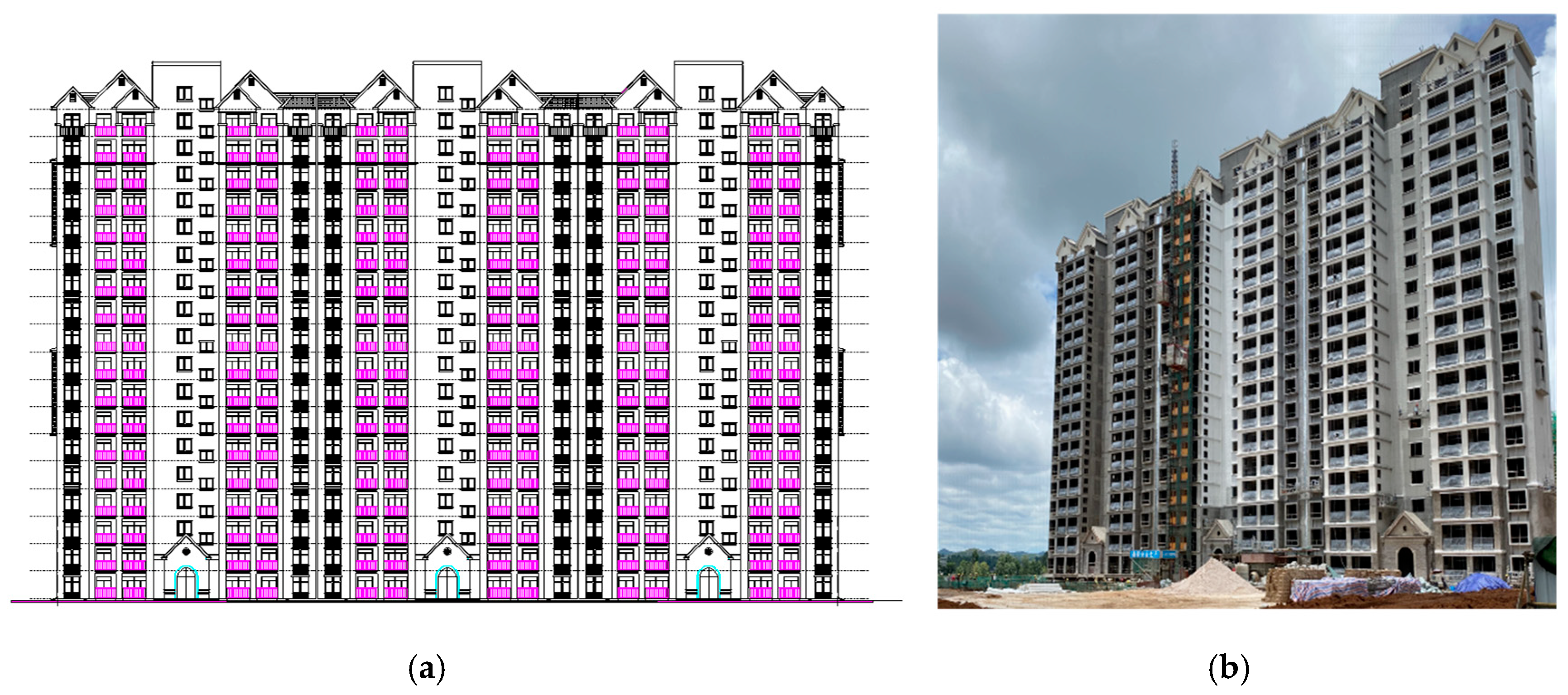
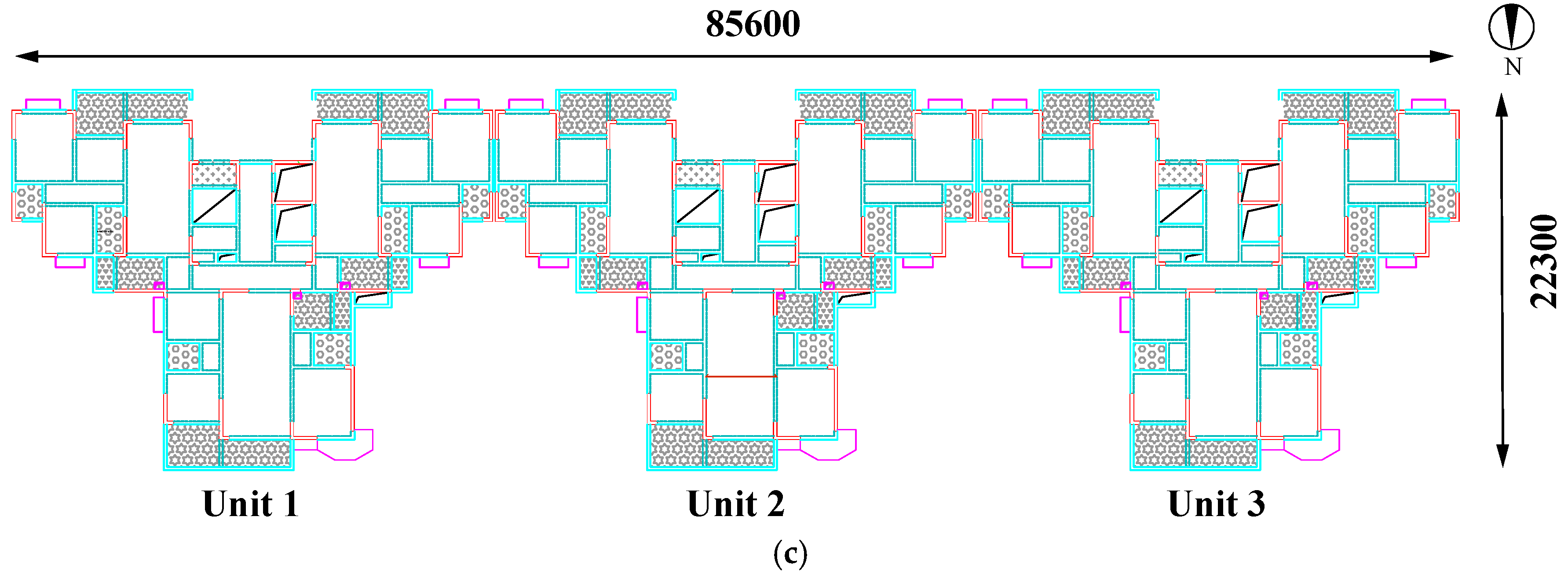
The Zhongyi Park Wangfu Community is situated on the northwest side of Wusa Blvd, Weining County, Guizhou Province. The total land area is 1,680,000 m2, with a total construction area of 690,988.11 m2. Building 14 is rectangular in shape, comprising three subterranean levels and 18 above-ground levels. The edifice’s height is 53.5 m, its elevation is 2206.500 ± 0.00. The structure is a box shear structure and has a floor height of 3 m. The foundation comprises a pile-raft system incorporating 145 vertical piles of different types, each averaging 16 m in length. The precise geographical location is illustrated in Figure 1 below. And the architectural configuration of the edifice is illustrated in Figure 2.

2.2. Engineering Geology

The project is located in the northern part of the Karst Basin in Weining County. The terrain is characterized by gentle hills and a karst hill-depression landscape, sloping from north to south. Field investigations indicate that the underlying bedrock is predominantly Lower Carboniferous Datang Formation (C1d) marl and marly limestone. A notable geological feature is the Weining Fault, a south–north trending thrust fault located 1000 m east of the site, which influences local structural fractures and monocline stratigraphy.
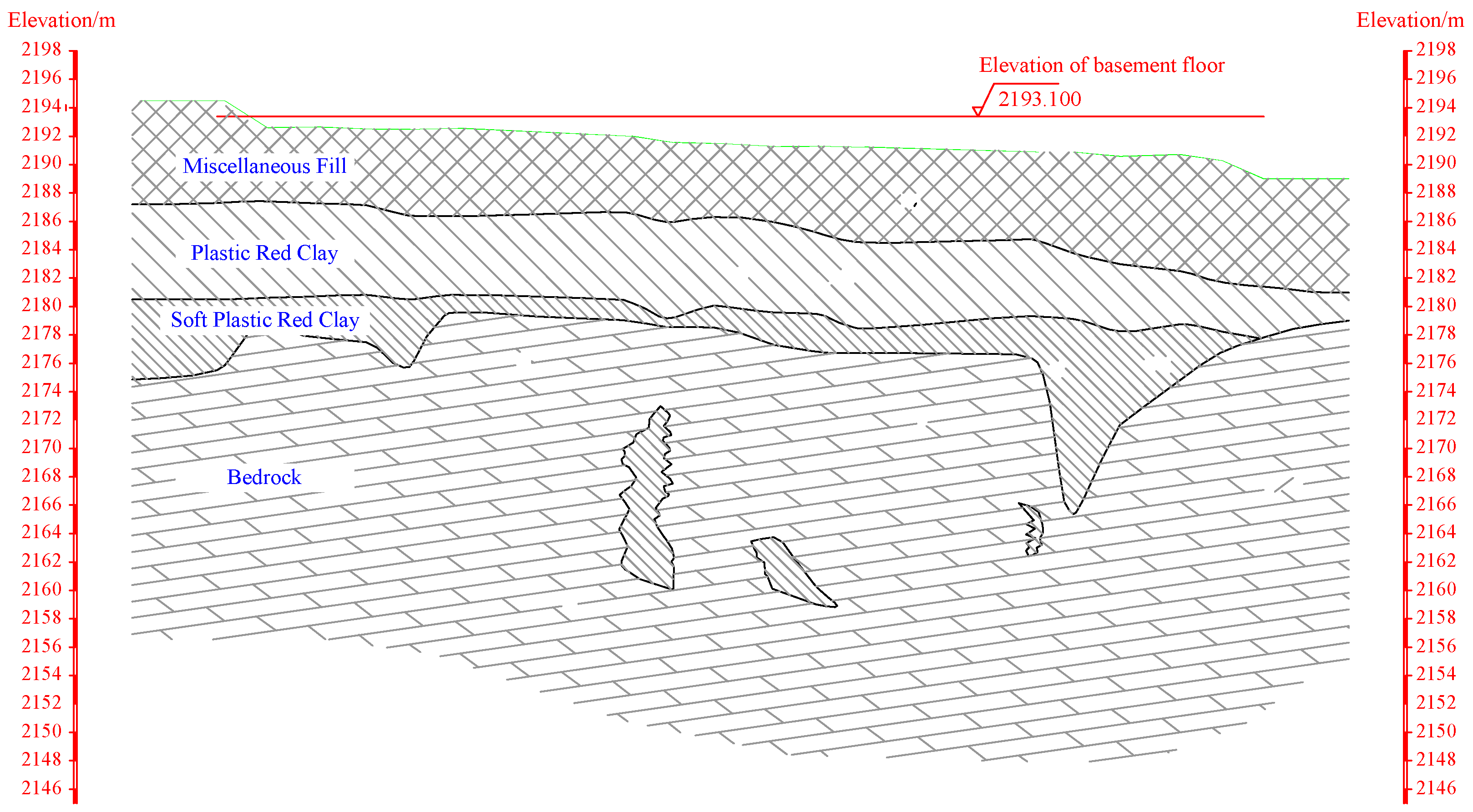
The foundation soil is predominantly composed of miscellaneous fill, plastic red clay, soft plastic red clay, and bedrock. The miscellaneous fill soil is heterogeneous, comprising primarily gravel, block stone, and clay excavated from the site, with an average thickness of 5.63 m. The plastic red clay soil is uniform, cohesive, and well distributed in layers, with an average thickness of 4.58 m. The soft plastic red clay is in a soft-plastic state, exhibiting fissure development, with an average thickness of 3.51 m. The bedrock is a thin to medium-thick layer of marl, with the basic quality grade of the rock mass classified as Class IV (Figure 3).

2.3. Field Investigation of Asymmetrical Settlement in Buildings

2.3.1. Asymmetric Settlement of Buildings

To accurately determine the causes of the incident and assess the extent of structural damage to Building #14, a comprehensive investigation was conducted over a series of eight settlement monitoring sessions. These observations and assessments were carried out from 21 July 2020 to 13 October 2020. The primary findings from this rigorous investigation are as follows.
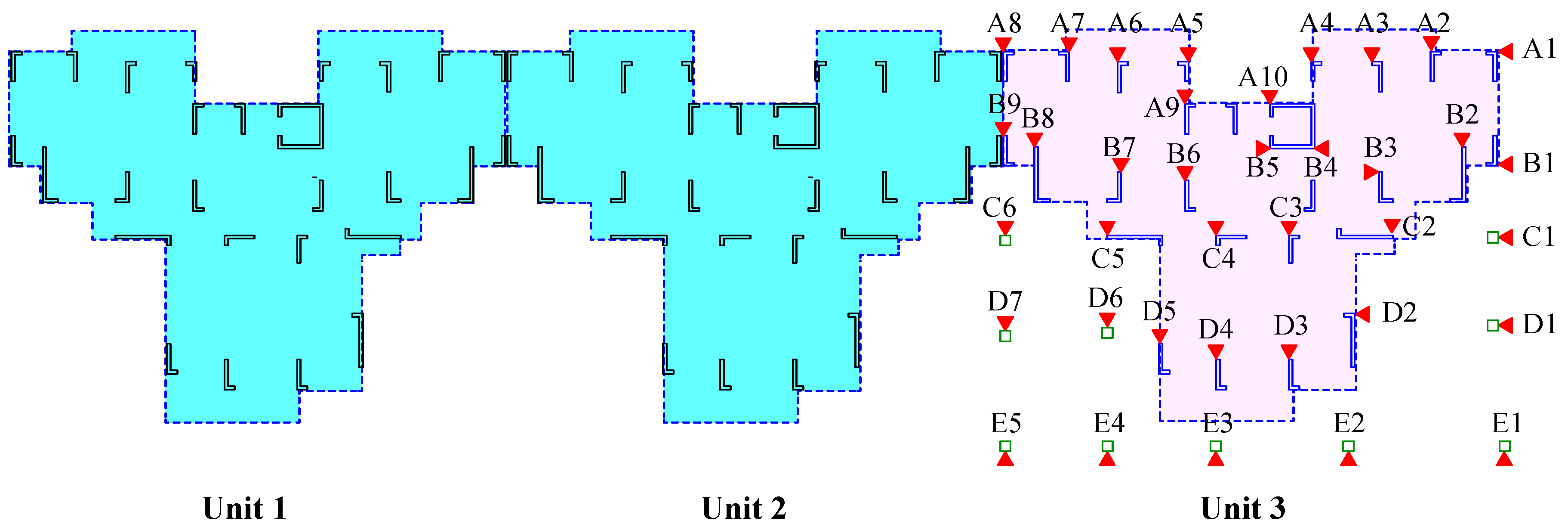
As illustrated in Figure 4, 37 measurement points in Building #14 were strategically positioned. The selection of these measurement points was based on an assessment of the structural importance of critical areas and parts susceptible to settlement, with particular consideration given to corners, edges and stress concentration areas of the building. During the monitoring period, high-precision leveling devices were utilized, with measurements conducted on a biweekly basis to ensure the continuity and reliability of the data. Measurements were taken over the monitoring period from 21 July 2020 to 13 October 2020 to capture any settlement changes that occurred.
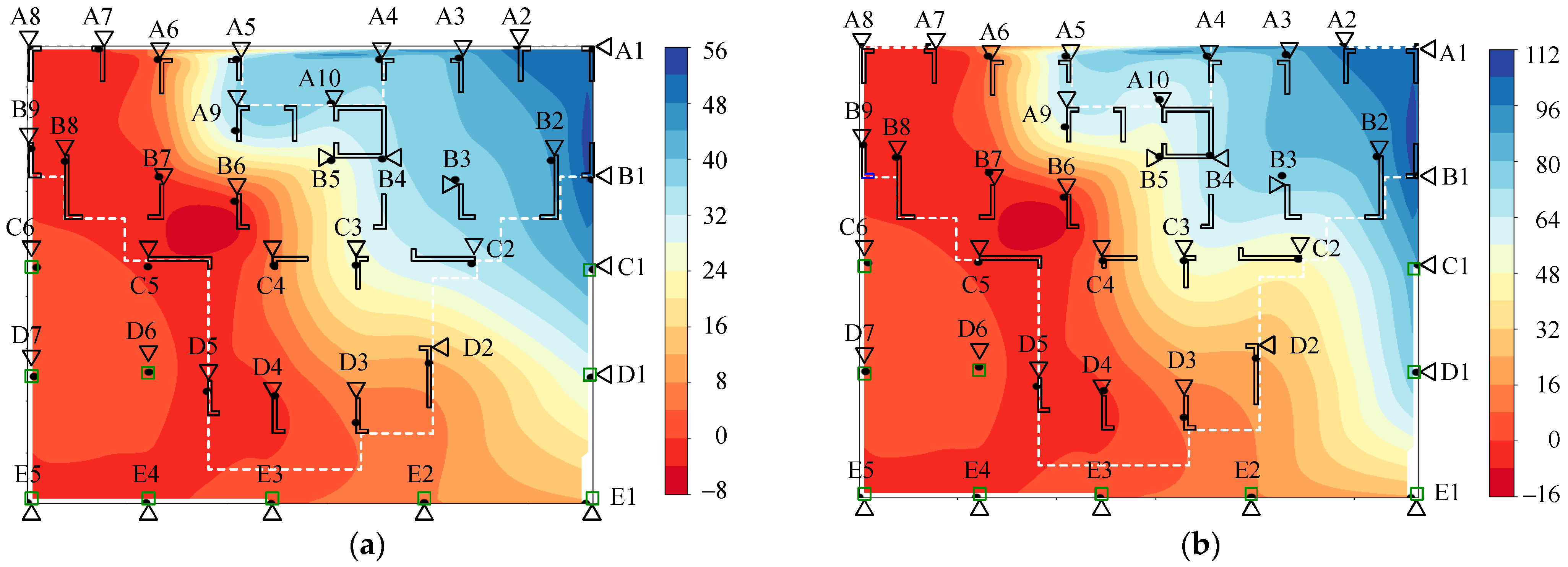
The data collected from these measurement points facilitated the generation of settlement contour maps (see Figure 5). The settlement contour map reveals significant variations in settlement distribution, highlighting the distinct characteristics of the building’s subsidence across different areas. Overall, the western and southern sections exhibit pronounced settlement trends, with the highest settlement values observed in the blue-shaded regions of the map. These areas indicate concentrated settlement, particularly around measurement points A1 and B1, where settlement values reached 102.8 mm and 107.7 mm, respectively, resulting in a westward tilt of approximately 25 cm and a southward tilt of about 23 cm. In contrast, the eastern and northern sections show relatively minor settlement, with some areas even displaying negative values, indicating slight uplift or stability. Given the significant disparities in settlement across different areas, particular attention should be given to reinforcing the western and southern sections of the structure to prevent further settlement from causing structural damage or safety concerns.
According to the Code for Design of Building Foundation (GB-50007-2011) [36], for buildings with a height ranging from 24 m to 60 m, the permissible overall tilt is 0.003, which corresponds to a maximum allowable inclination of 160.5 mm. The current inclination of the building has exceeded this permissible limit, indicating the need for reinforcement and rectification measures. These interventions are necessary to mitigate the adverse effects of uneven settlement in the area and to ensure the structural integrity of the building.

2.3.2. Causes of Building Asymmetric Settlement

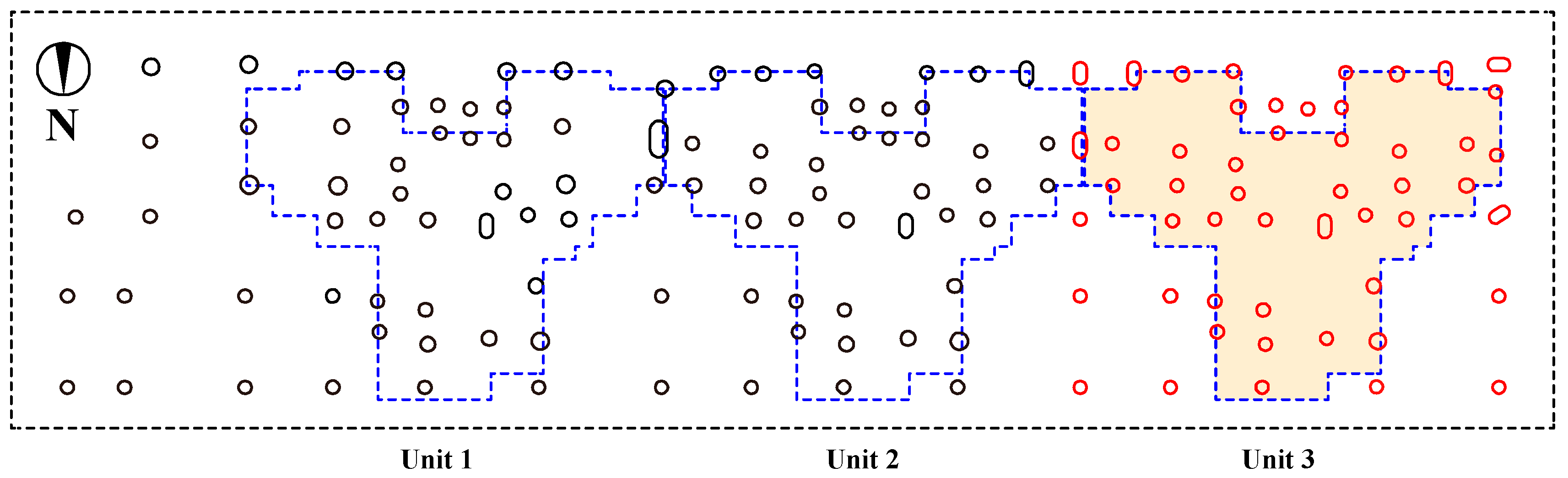
Based on the geotechnical investigation report and the observed site conditions, drilling investigations were carried out on the pile foundations of Unit 3 in Building 14. In the area requiring treatment, a total of 52 piles in Unit 3 were examined (red circle in Figure 6), with each pile having two borehole locations arranged symmetrically and drilled vertically.
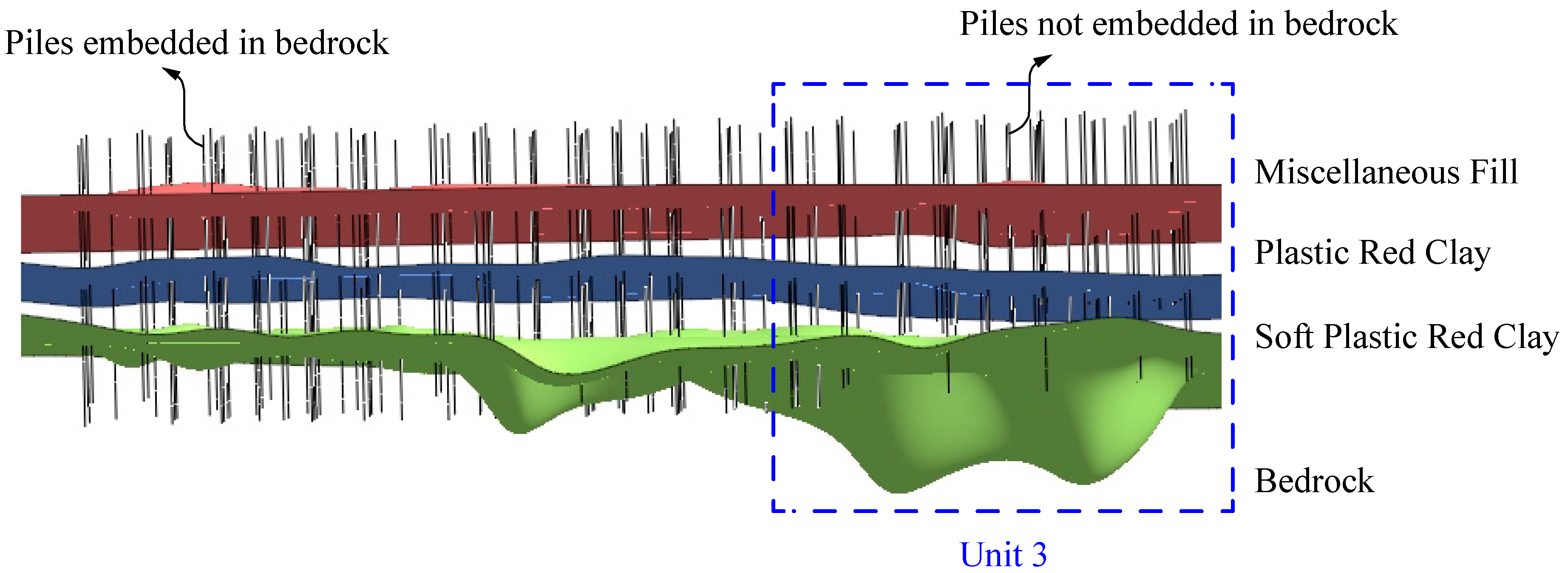
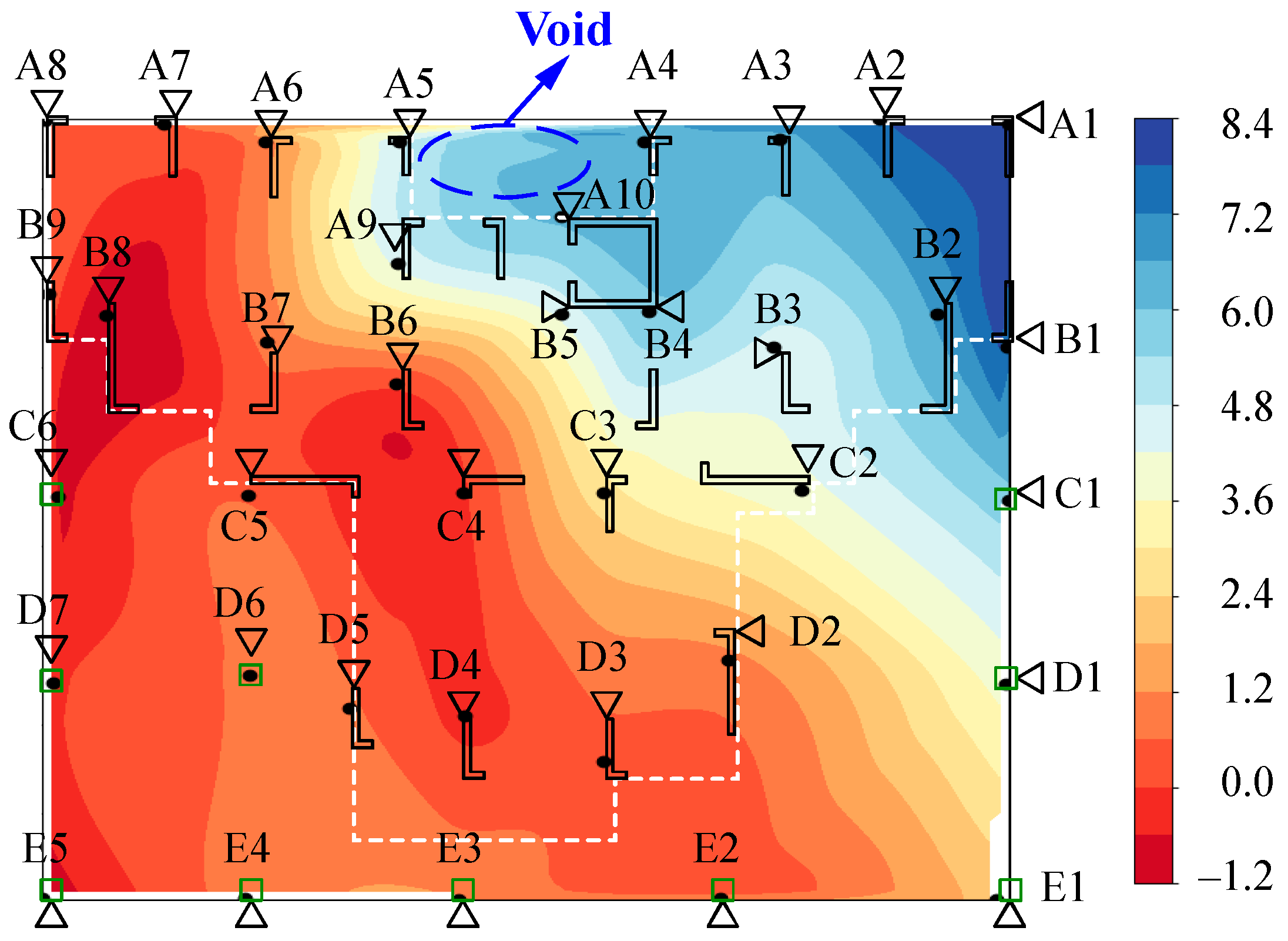
The on-site drilling results (Figure 7) indicate that a number of piles in Unit 3 are not properly embedded in the bedrock, with the issue being most pronounced on the building’s south-west side: here, pile bases are situated up to 8 m above the bedrock (Figure 8, where positive values denote non-embedded pile bases). Critically, the stratum supporting these non-embedded piles is identified as Soft Plastic Red Clay—characterized by high compressibility and low bearing capacity. This soft soil fails to provide sufficient support for the pile ends, leading to localized compression deformation under the building’s load. Moreover, some piles were found to have traversed karst caves (with void height of about 5 m); these caves further disrupt the pile–soil force transmission path—when the soft soil above cave roofs is compressed, it induces additional differential settlement as the cave roof deforms under load.
To further confirm that karst caves and soft basement soil are the primary causes, we cross-checked other potential factors and found their impacts to be negligible. For instance, groundwater across the site is uniformly distributed, with no localized variations that could induce uneven soil deformation—ruling out groundwater as a contributing factor. Review of construction logs and low-strain pile tests also confirmed that the “symmetric jump-drilling” method used caused no pile damage or excessive soil disturbance. Additionally, load calculations and structural strain monitoring revealed uniform load distribution across the building and sufficient stiffness of the upper structure. None of these factors align with the observed uneven settlement pattern, which is instead directly linked to the distribution of soft basement soil and karst caves.

3. Theoretical Analysis of Pile Foundation Settlement Through Local Geological Anomalies

3.1. Model Formulation

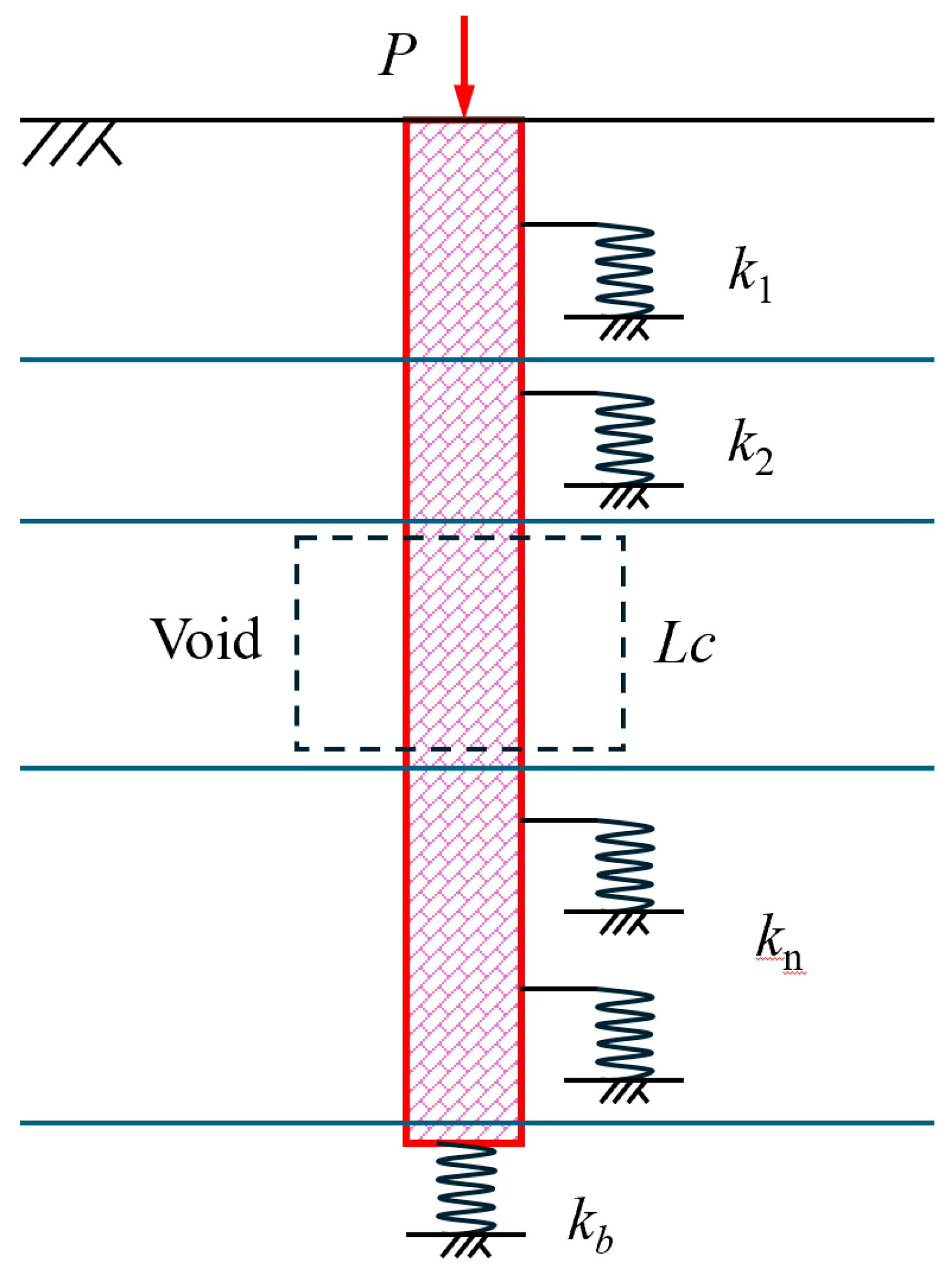
This chapter presents an analytical model for the axial settlement of a vertical pile embedded in a layered soil profile. The pile is characterized by its axial stiffness EA and total length L, and is subjected to a concentrated axial load P at the head. The pile base interacts with the soil through a linear spring of stiffness kb, representing the resistance of the soil at the pile toe. The surrounding soil consists of n layers, each defined by thickness hi, Young’s modulus Ei, and Poisson’s ratio vi. To account for engineering scenarios involving cavities, voids may exist at arbitrary depths, with top and bottom boundaries denoted by z1 and z2. Within a void, lateral soil support is neglected (Figure 9).
The model aims to capture the coupled axial response of the pile and the surrounding soil, considering non-uniform stiffness, pile base support, and the presence of local cavities.

3.2. Assumptions

For analytical tractability, the following assumptions are adopted:
(1)
Pile assumptions: The pile behaves as a one-dimensional elastic rod with uniform cross-section, neglecting self-weight and nonlinear skin friction.
(2)
Soil assumptions: Each soil layer is linear elastic, providing lateral support to the pile through a linear spring with stiffness ki. Poisson’s ratio vi is assumed known for each layer.
(3)
Void assumptions: Within the void, lateral support is absent. The void is bounded by z1 and z2, with height Lc= z2z1.
(4)
Boundary conditions: The pile head is subjected to a concentrated load P, while the base interacts with a spring of stiffness kb.
(5)
Segment continuity: Displacement and axial force are continuous across layer interfaces and at the top and bottom boundaries of voids.
These assumptions preserve essential physical behaviors while enabling derivation of closed-form solutions.

3.3. Governing Equations

Within the i-th soil layer, the axial equilibrium for a soil-supported segment of the pile is governed by
E A d 2 w i z d z 2 k i w i z = 0 , z layer i
where wi (z) denotes axial displacement in the i-th layer. In segments within a void, lateral stiffness is zero, reducing the governing equation to
E A d 2 w z d z 2 = 0 , z 1 z z 2
The general solutions are expressed in exponential form:
Soil-supported segment:
w i z = A i e λ i z + B i e λ i z , λ i = k i E A
where Ai and Bi are constants determined by boundary and interface conditions, ki is the equivalent stiffness of soil adjacent to piles in the i-th layer.
Void segment:
w z = C + D z z 1
where C and D are integration constants.

3.4. Boundary Conditions and Segment Continuity

The pile displacement satisfies the following conditions:
(1)
Pile head load:
E A w 1 0 = P
representing equilibrium under the applied axial load.
(2)
Pile base support:
E A w n L + k b w n L = 0
accounting for interaction with the base spring.
(3)
Segment continuity: At layer interfaces or void boundaries, displacement and axial force are continuous:
w i z i top = w i + 1 0 , E A w i z i top = E A w i + 1 0
and for void boundaries:
w soil z 1 = w void z 1 , E A w soil z 1 = E A w void z 1 w void z 2 = w soil z 2 , E A w void z 2 = E A w soil z 2

3.5. Solution Procedure

By substituting these conditions into the general solutions, a linear system of 2n equations is constructed for the 2n unknown coefficients. Solving this system yields the axial displacement profile of the pile and, in particular, the pile head settlement.
K x = f
where x = A 1 , B 1 , , A n , B n T contains the unknow coefficients. The matrix K is composed of exponentials, liner terms, and their derivatives, while the vector f represents the effects of pile-head load and pile-base support. Cavity segments correspond to zero lateral stiffness in K , naturally degenerating into linear free segments.
The pile-head settlement can be explicitly written as:
w 0 = w 1 0 = c T K 1 f
where c selects the pile-top displacement. Solving this system yields the relationship between pile-head settlements, layer stiffness, and cavity location, providing a theoretical basis for design.

3.6. Single-Layer Homogeneous

Soil and Special Cases. For a single-layer homogeneous soil, the multi-layer system reduces to a simpler form, where ki = k and vi = v are constant. The governing equation for soil-supported segments becomes
E A d 2 w z d z 2 k w z = 0
while the void segment satisfies
E A d 2 w z d z 2 = 0 , z z 1 , z 2
The pile-top settlement can be expressed explicitly as:
w t o p = P E A λ s 1 T + λ c 1 U c 1 T + λ s 1 U
where
T = λ sinh λ ( L z 2 ) + k b E P A cosh λ ( L z 2 ) U = L c T + cosh λ ( L z 2 ) + k b E P A λ sinh λ ( L z 2 ) s 1 = sinh ( λ z 1 ) , c 1 = cosh ( λ z 1 )
Following Crispin et al. [37], the pile-side stiffness is related to the soil shear modulus Gs as k (z) = 2πGs(z)/ln(2rm/D), where D is the pile diameter and rm is an empirical displacement decay radius. For practical applications, an effective average shear modulus Gs, eq for the soil above the pile base can be used to obtain a depth-independent equivalent stiffness keq = 2πGs, eq/ln(2rm/D). The pile-base stiffness can be approximated using a “rigid punch on an elastic half-space” model as kb, =2Gs(L)D/[(1 − μ)η], where Gs(L) is the shear modulus at the pile tip, D is the pile base diameter, μ is the soil Poisson’s ratio, and η is a depth correction factor, typically taken as 1.

3.7. Verification of Theoretical Models Based on Numerical Simulation

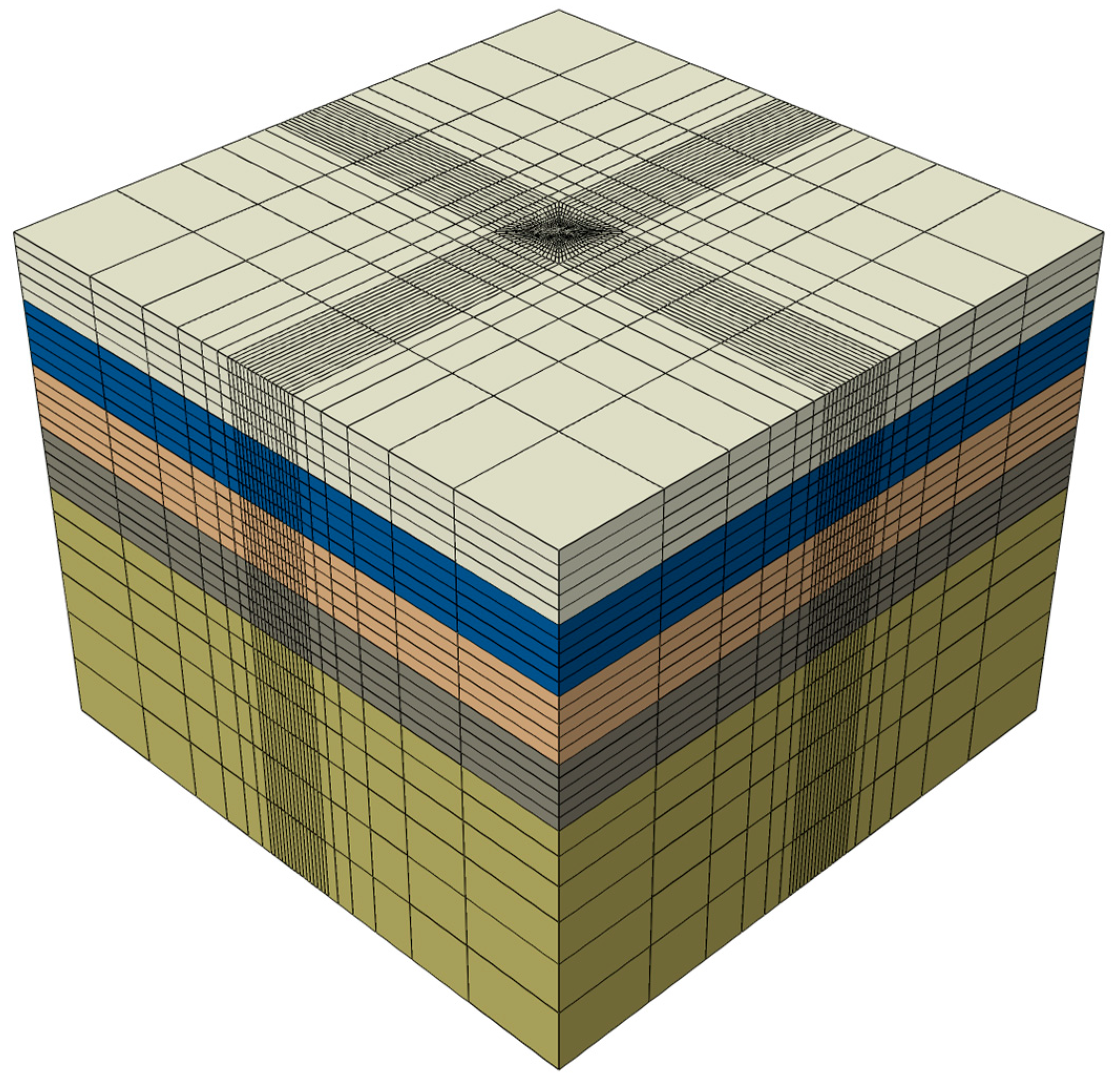
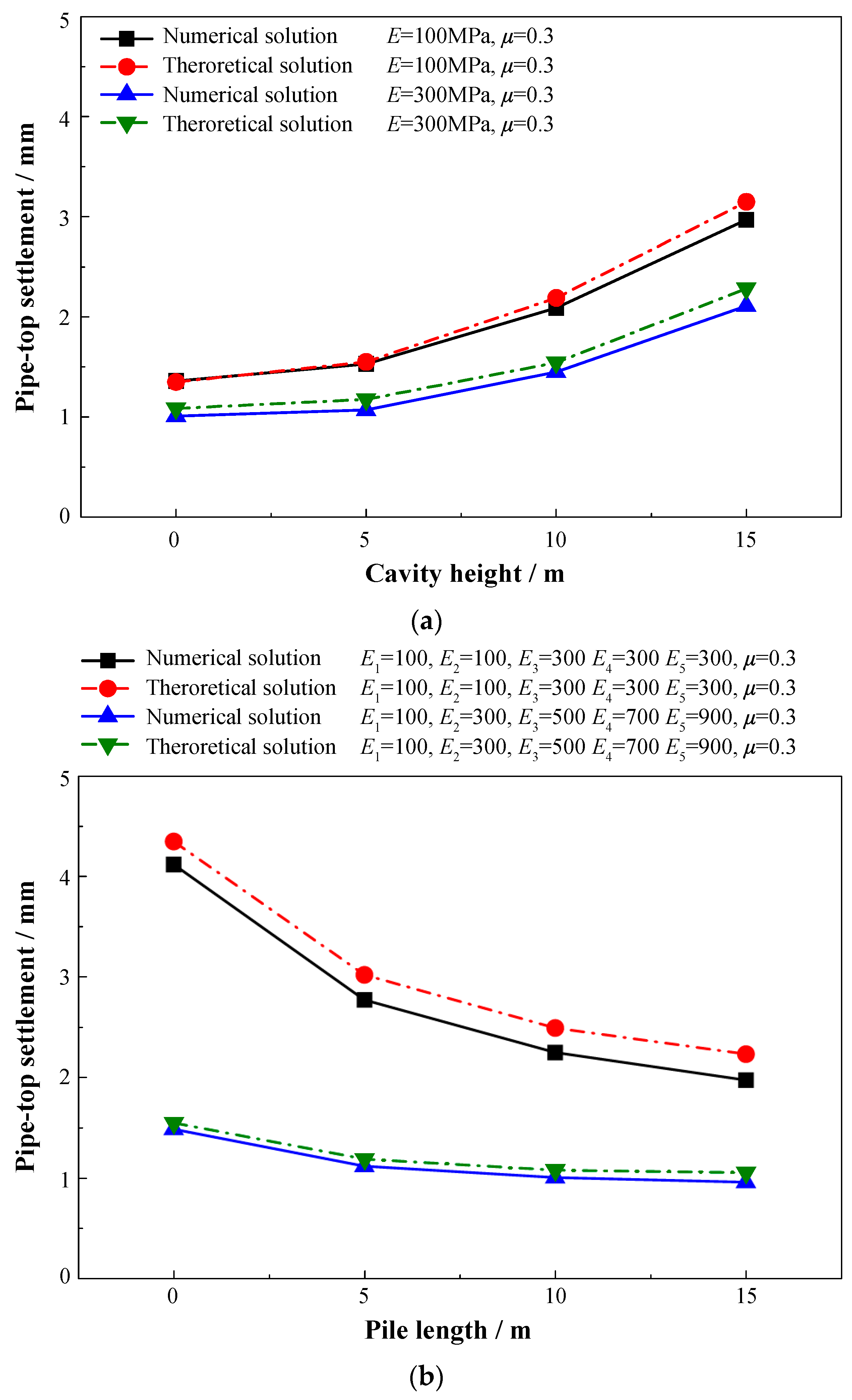
To validate the accuracy of the theoretical model, a numerical model as illustrated in Figure 10 was established, with the following key parameters configured: a pile diameter of 1 m, an external load (P) of 2000 kN, and the soil mass divided into 5 distinct layers.
Figure 11 presents a comparative analysis between the numerical simulation results and the theoretical model predictions. It is evident that the numerical solutions exhibit a high degree of agreement with the analytical solutions, regardless of whether the geological condition is homogeneous stratum or layered stratum—this consistency validates the reliability of the proposed theoretical model in capturing pile settlement behavior under different stratigraphic scenarios.
Further observations from the figure reveal two key trends: First, the pile head settlement increases progressively with the rise in cavity height. This phenomenon can be attributed to the fact that a larger cavity height weakens the lateral confinement and end-bearing capacity of the surrounding soil, thereby reducing the effective support for the pile foundation and leading to greater settlement. Second, the pile settlement decreases as the pile length increases. Longer piles can penetrate deeper into strata with higher bearing capacity (e.g., stable bedrock or dense soil layers), which enhances the load-bearing efficiency of the pile and mitigates excessive settlement induced by subsurface cavities.
The close match between numerical and analytical results not only confirms the accuracy of the theoretical model but also underscores its ability to reliably predict the influence of cavity height and pile length on pile settlement—providing a robust theoretical basis for pile foundation design in stratum with subsurface cavities.

3.8. Parametric Analyses

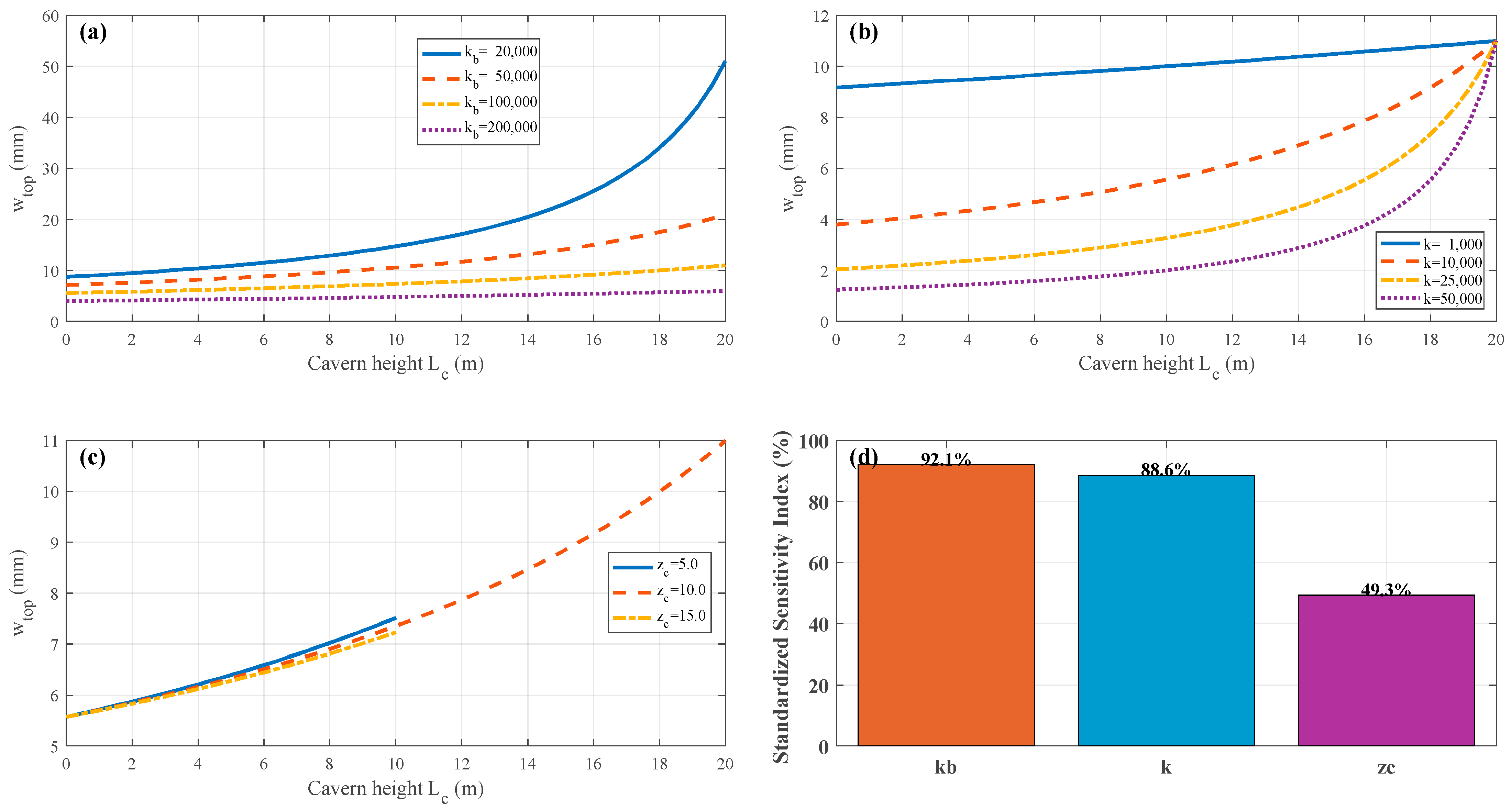
In pile foundation engineering in karst areas, controlling the axial displacement at the pile top (Wtop) is critical to ensure structural safety, as it is significantly affected by the coupled effects of pile bottom spring stiffness (kb), pile-side soil stiffness (k), and karst cave center depth (zc). Based on the analytical model for axial deformation of piles, this section adopts the single-variable analysis method (fixing two parameters while varying one) to systematically explore the influence of each parameter on Wtop. The Sensitivity Index (SI) is used to quantify the influence weight of each parameter, calculated as SI = (WmaxWmin)/Wmax, where Wmax, Wmin are the maximum and minimum pile top displacements across all parameter and cavern height combinations.
Basic parameters are set in accordance with conventional engineering values: pile length L = 20 m (L represents the total length of the pile), pile axial stiffness EPA 2 × 10⁷ kN, and axial load at the pile top P 1000 kN. Variables for sensitivity analysis cover typical working conditions of karst strata: kb (pile bottom spring stiffness): Takes values [2 × 10⁴, 5 × 10⁴, 1 × 10⁵, 2 × 10⁵] kN/m, used to simulate different support strengths of the bearing layer at the pile bottom; k (pile-side soil stiffness): Takes values [1 × 10³, 1 × 10⁴, 2.5 × 10⁴, 5 × 10⁴] kN/m2, reflecting different constraint densities of the soil around the pile shaft; zc (karst cave center depth): Takes values [5, 10, 15] m, representing different vertical positions of the karst cave along the pile length.
From the calculation results (Figure 12), the influence of kb on Wtop shows a “karst cave size dependence” characteristic, and as the karst cave height Lc increases, the influence of kb on Wtop gradually enhances. When kb = 5 × 10³ kN/m (medium-stiffness soil) and zc = 10 m (karst cave at the pile midpoint) are fixed, the difference in Wtop among different ko values is small under the condition of no karst cave (Lc = 0): Wtop is approximately 8.7 mm when kb = 2 × 10⁴ kN/m, and approximately 4.0 mm when kb = 2 × 10⁵ kN/m with a gap of only 4.7 mm. At this time, the influence of kb is negligible. However, as Lc increases from 0 to 20 m (karst cave covering the entire pile), the difference in Wtop among different ko values expands continuously. When Lc = 20 m, Wtop decreases significantly by more than 50% as kb increases from 2 × 10⁴ to 2 × 10⁵ kN/m. This is because as the karst cave expands, the constraint of the pile-side soil gradually weakens, and the proportion of the pile-top load transferred to the pile bottom increases. The larger kb is, the stronger the ability of the pile bottom to resist settlement, and thus the more obvious the inhibitory effect on Wtop.
Pile-side soil stiffness k is also a key factor controlling Wtop, and as the karst cave height Lc changes, the influence of k on Wtop shows a trend of “first enhancing and then stabilizing”, with an overall influence degree higher than that of k. When k = 1 × 10⁵ kN/m (medium-stiffness bearing layer) and 2 = 10 m are fixed, Wtop decreases significantly with the increase in k under the same L: taking Lc = 10 m as an example, Wtop is approximately 9.3 mm when k = 1 × 10³ kN/m2 (soft soil), and decreases to 1.3 mm when k = 5 × 10⁴ kN/m2 (dense soil), with a reduction rate of more than 86%. From the perspective of variation trend, when Lc < 10 m, the spacing between Wtop curves corresponding to different k values increases gradually as Lc expands, indicating that the influence of soil constraint differences on displacement becomes increasingly prominent; when Lc > 15 m, the spacing between curves tends to be stable as Lc continues to increase. At this time, the pile-side soil has basically lost its constraint effect, and the displacement is mainly controlled by the pile bottom stiffness. Essentially, k reflects the radial constraint and axial friction capacity of the pile-side soil on the pile shaft. The larger k is, the more sufficient the side friction resistance is, which can effectively share the pile-top load, reduce the axial compression of the pile shaft, and thus reduce Wtop fundamentally. This effect is most prominent when the karst cave is of medium size (Lc = 10~15 m).
Compared with the above two parameters, the influence of karst cave center depth zc on Wtop is more moderate. When kb =1 × 10⁵ kN/m and k = 5 × 10³ kN/m2 are fixed, Wtop corresponding to different zc values shows an increasing trend as Lc increases within the effective Lc range of each zc, but there are obvious differences in values: the displacement is the largest when z = 5 m (near the pile top). For example, when Lc = 8 m, Wtop is approximately 7.8 mm, which is 4% and 5.4% higher than that when zc = 10 m (approximately 7.5 mm) and zc = 15 m (approximately 7.4 mm), respectively. This is because the pile top is the direct-action end of the load. When zc = 5 m, the karst cave is close to the pile top. After the soil constraint near the pile top is weakened, the load transfer path becomes shorter, and the superposition effect of pile shaft compression and local settlement is more significant, resulting in a larger displacement than that under other zc conditions.
From the results of sensitivity quantification, the influence weight of each parameter is clearly ranked: the SI value of pile bottom spring stiffness kb is 0.921 (its influence is significantly enhanced as Lc increases), the SI value of pile-side soil stiffness k is 0.886 (its effect is most prominent when Lc is of medium size), and the SI value of karst cave center depth z is 0.493 (its overall influence is weaker than that of the previous two parameters). This indicates that the bearing layer strength at the pile bottom (kb) and the constraint capacity of the pile-side soil (k) are the core factors controlling Wtop, while the influence of karst cave position (zc) is relatively secondary.
Combined with the findings above, the following principles can be adopted in the design of pile foundations in karst areas: prioritize optimizing the constraint of the pile-side soil, select dense soil layers as the pile-side bearing layer, and improve the k value through compaction or grouting in soft soil sites. Especially when Lc = 10~15 m, the constraint effect of the pile-side soil should be fully exerted; second, strengthen the stiffness of the pile bottom bearing layer, and improve the ko value by means of replacement filling or high-pressure jet grouting. As Lc approaches 15 m (75% of the pile length), the support capacity of the pile bottom should be further strengthened. It should be noted that this study adopts the assumption of uniform soil stiffness, while the actual karst stratum is mostly layered soil. In the future, a layered soil stiffness model can be introduced to further optimize the analysis accuracy; at the same time, when Lc is close to the pile boundary, the integrity of the pile shaft should be checked emphatically to avoid sudden displacement caused by local constraint failure.

4. Uneven Settlement of High-Rise Buildings Caused by Pile Foundation

To further investigate the internal mechanisms of uneven settlement in high-rise buildings, this study employs Midas GTS NX 2024 software for three-dimensional modeling and simulation based on field survey results. A thorough analysis of the site’s geological conditions, soil properties, and loading scenarios enables effective simulation of the structure’s settlement behavior under various conditions.

4.1. Numerical Model

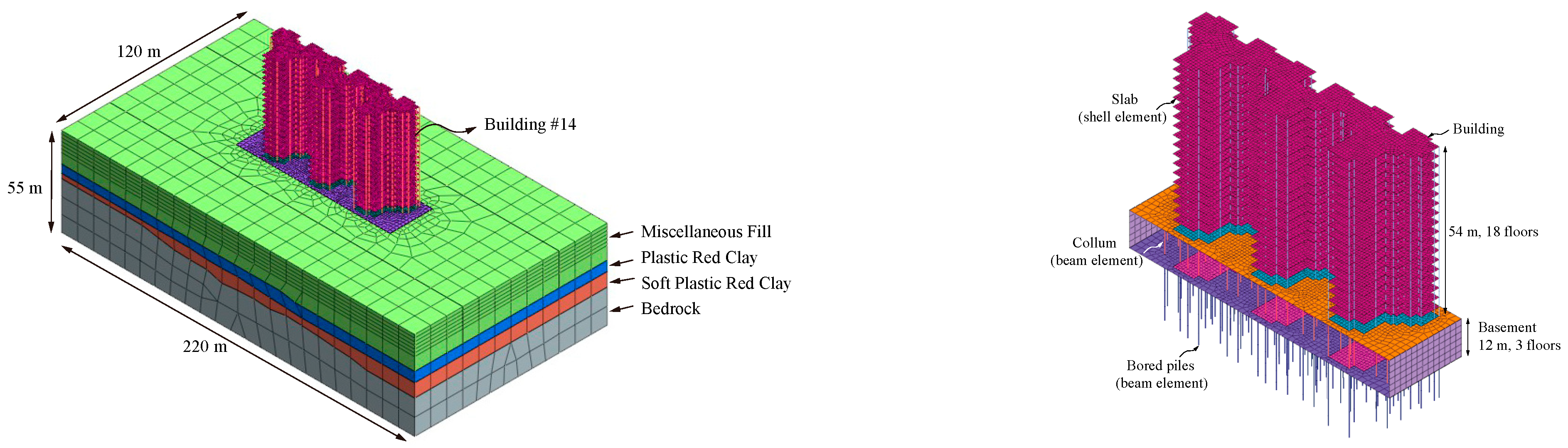
The analysis was carried out on a space frame-piled raft-soil system with 18 stories. A fully modeled superstructure-foundation-soil system was analyzed using the FE program Midas GTS. Figure 13. demonstrates the numerical model, in which the calculation range is 220 m in length, 120 m in width and 55 m in height. In the numerical model, the raft and floor slabs are modeled using plate elements, while the soil is modeled using 3D solid elements. Two node vertical and horizontal beam elements are used for the columns and beams, respectively. For the 145 bored piles in the model, one-dimensional beam elements are used in this paper to simplify the simulation, avoiding the excessive number of meshes. Furthermore, certain assumptions have been made regarding the boundary conditions of the numerical model. These assumptions entail those the horizontal and vertical displacements of the bottom boundary, as well as the horizontal displacements of both lateral boundaries, are constrained. By contrast, the upper boundary is assigned free-field conditions, permitting unrestrained horizontal and vertical displacement.
The numerical model consists of three main simulation steps. Initial soil stresses are first determined from the dead load of the soil material and the specified boundary conditions. Then the basement and pile raft foundations are applied. Finally, the above-ground building is constructed floor by floor.

4.2. Material Parameters

The piles, rafts, columns and slabs were treated as linearly elastic materials at all times, whereas the surrounding soil layers were modeled using the Mohr-Coulomb model. Table 1 summarizes the soil profile and the material properties used in this study.

4.3. Simulation Scheme

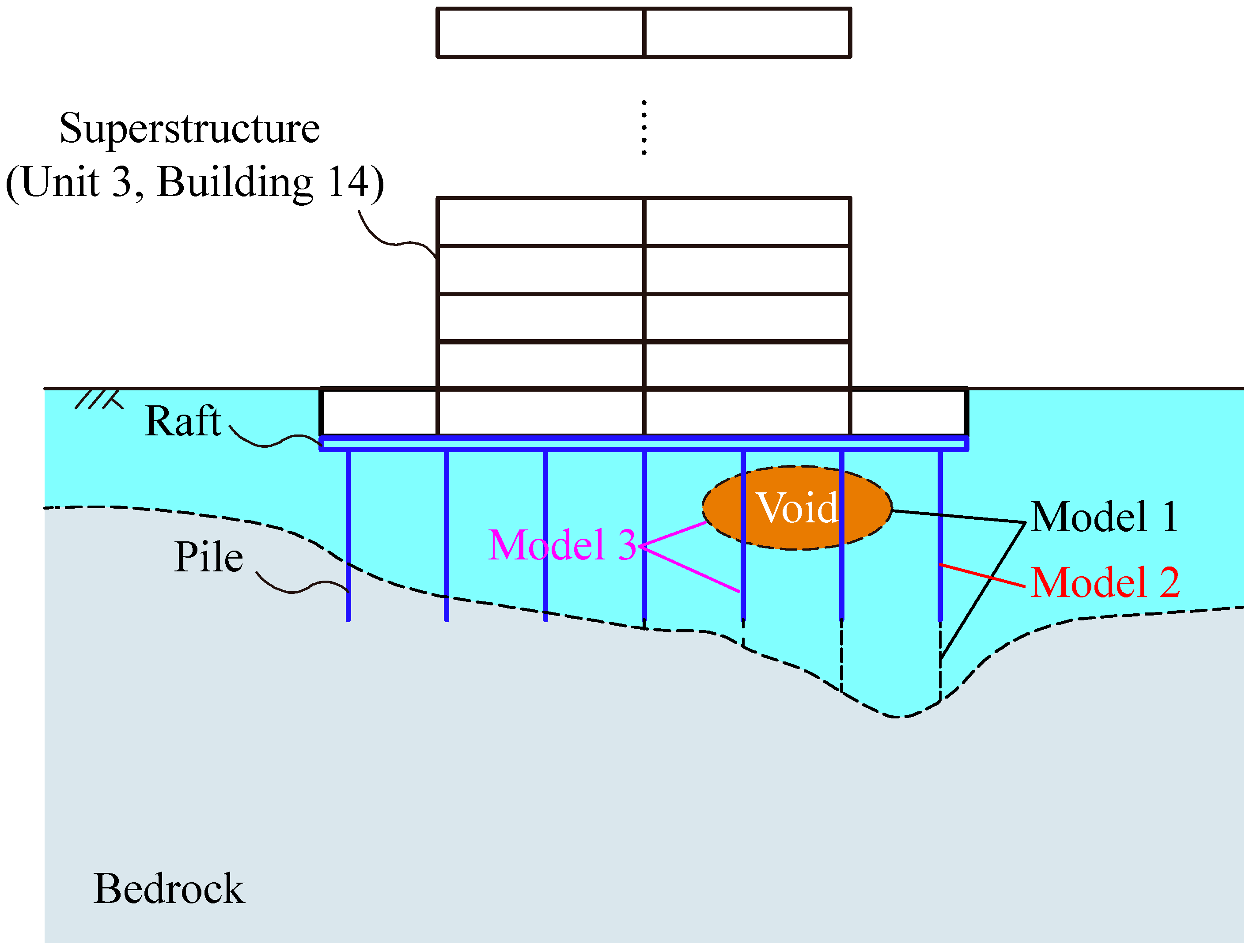
The on-site borehole investigations revealed that the piles were traversing localized voids in the foundations of Building 3, while the pile ends were not embedded in the bedrock. In order to ascertain the causes of the uneven settlement of the high-rise building and to provide a foundation for the reinforcement program, three calculation schemes were designed by controlling the variables (Figure 14).
In Model 1, only the contribution of voids to the uneven settlement of the building is considered. During the calculation of the initial ground stress field in the ground, the ground voids were simulated by de-activating the local elements. Furthermore, the effect of the pile not being embedded in bedrock was apparently neglected by extending the length of the pile to bedrock. In contrast to Model 1, Model 2 focuses exclusively on the impact of piles that are not embedded in bedrock on building settlement. Voids in the strata are ignored in Model 2. In addition, Model 3 takes into account both the impact of voids and unembedded piles on the settlement of the superstructure, which is consistent with the actual situation.

4.4. Analysis of Numerical Results

4.4.1. Comparison of Theoretical, Numerical, and Monitoring Values for Pile Cap Settlement

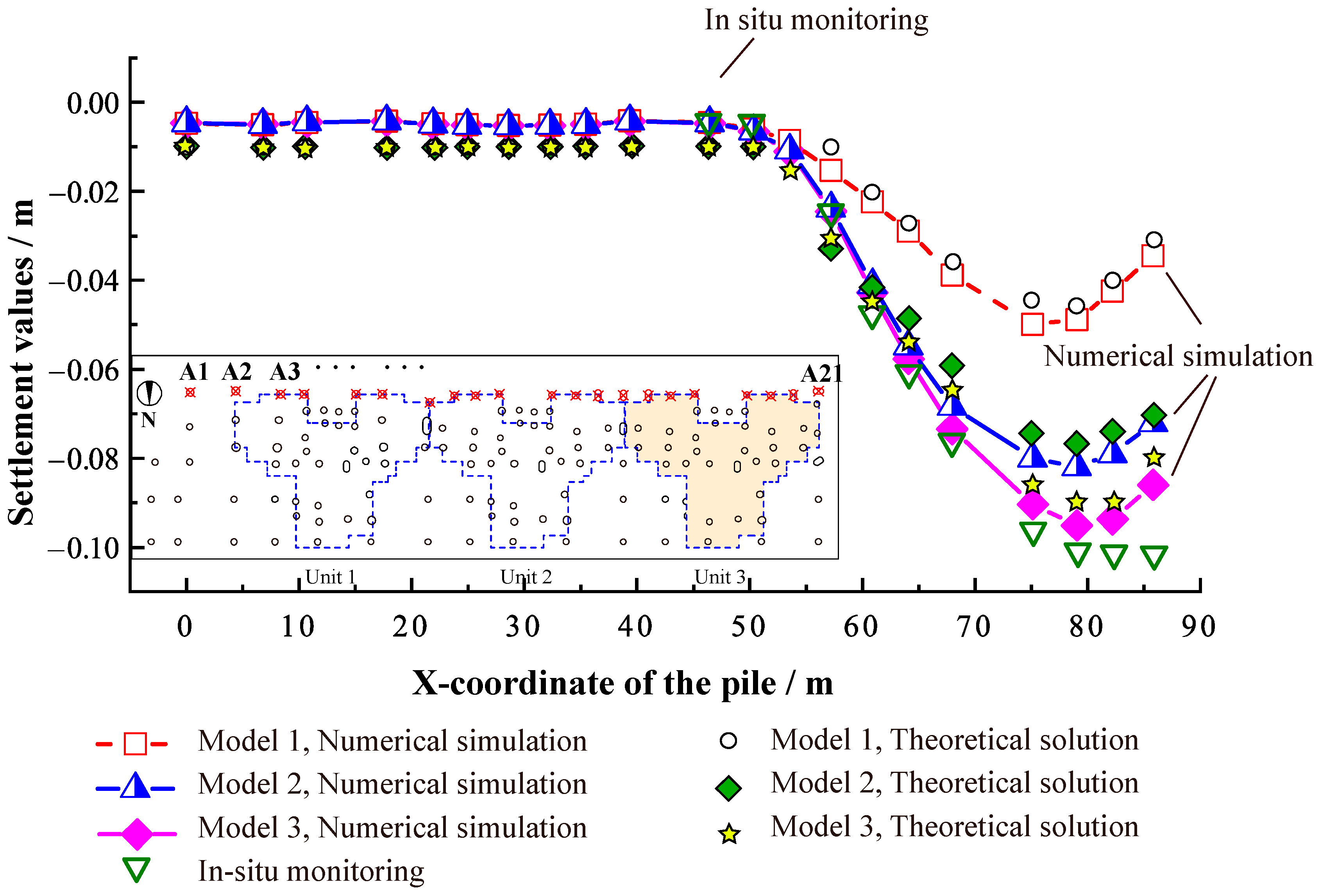
The pile–soil interaction in the Winkler model is represented by the pile-side unit spring stiffness k and the pile-base spring stiffness kb, which can be derived from the soil elastic properties. Following Crispin et al. [37], the pile-side stiffness is related to the soil shear modulus Gs as k (z) = 2πGs(z)/ln(2rm/Ds), where Ds is the pile diameter and rm is an empirical displacement decay radius. For practical applications, an effective average shear modulus Gs, eq for the soil above the pile base can be used to obtain a depth-independent equivalent stiffness keq = 2πGs, eq/ln(2rm/Ds). The pile-base stiffness can be approximated using a “rigid punch on an elastic half-space” model as kb, =2Gs(L)Db/[(1 − μ)η], where Gs(L) is the shear modulus at the pile tip, Db is the pile base diameter, μ is the soil Poisson’s ratio, and η is a depth correction factor, typically taken as 1. In this study, the soil elastic moduli obtained from numerical simulations are used to calculate these input stiffness parameters. Using the derived pile-side and pile-base stiffnesses, theoretical pile-top settlements are computed with the analytical Winkler model and compared with the corresponding numerical simulation results to evaluate the consistency and accuracy of the theoretical approach.
The settlement values for the southernmost row of measurement points on the ground in the three models were extracted and are presented in Figure 15. A comprehensive comparison of pile-top settlements from the analytical Winkler model, numerical simulations, and field-monitored measurements confirms the overall validity of the theoretical approach. In the initial comparison, the trends of settlement in all units show good agreement among the three methods, indicating that the analytical model reliably captures the general behavior of the piles.
A closer examination of the numerical simulation results highlights the relative influence of different factors. When only the cavity is considered (Model 1), the peak settlement reaches 43 mm, suggesting that cavities alone have a limited effect. When only the soft pile base is considered (Model 2), the peak settlement increases significantly to 90 mm, demonstrating that the mechanical properties of the pile-base rock exert a dominant influence on settlement. When both factors occur simultaneously (Model 3), the peak settlement further rises to 95 mm, indicating that cavities amplify settlement in the presence of weak base material. These observations reveal a clear hierarchy: the pile-base rock properties are the primary controlling factor, while cavities play a secondary but noticeable role. Comparing these findings with the theoretical results, the analytical settlements exhibit the same trend across the three scenarios, although they slightly underestimate the magnitude in soft layers due to the linear elastic assumption. This consistency not only validates the general correctness of the Winkler model in predicting settlement trends but also confirms that it can reasonably capture the relative importance of different influencing factors.

4.4.2. Settlement of Superstructure

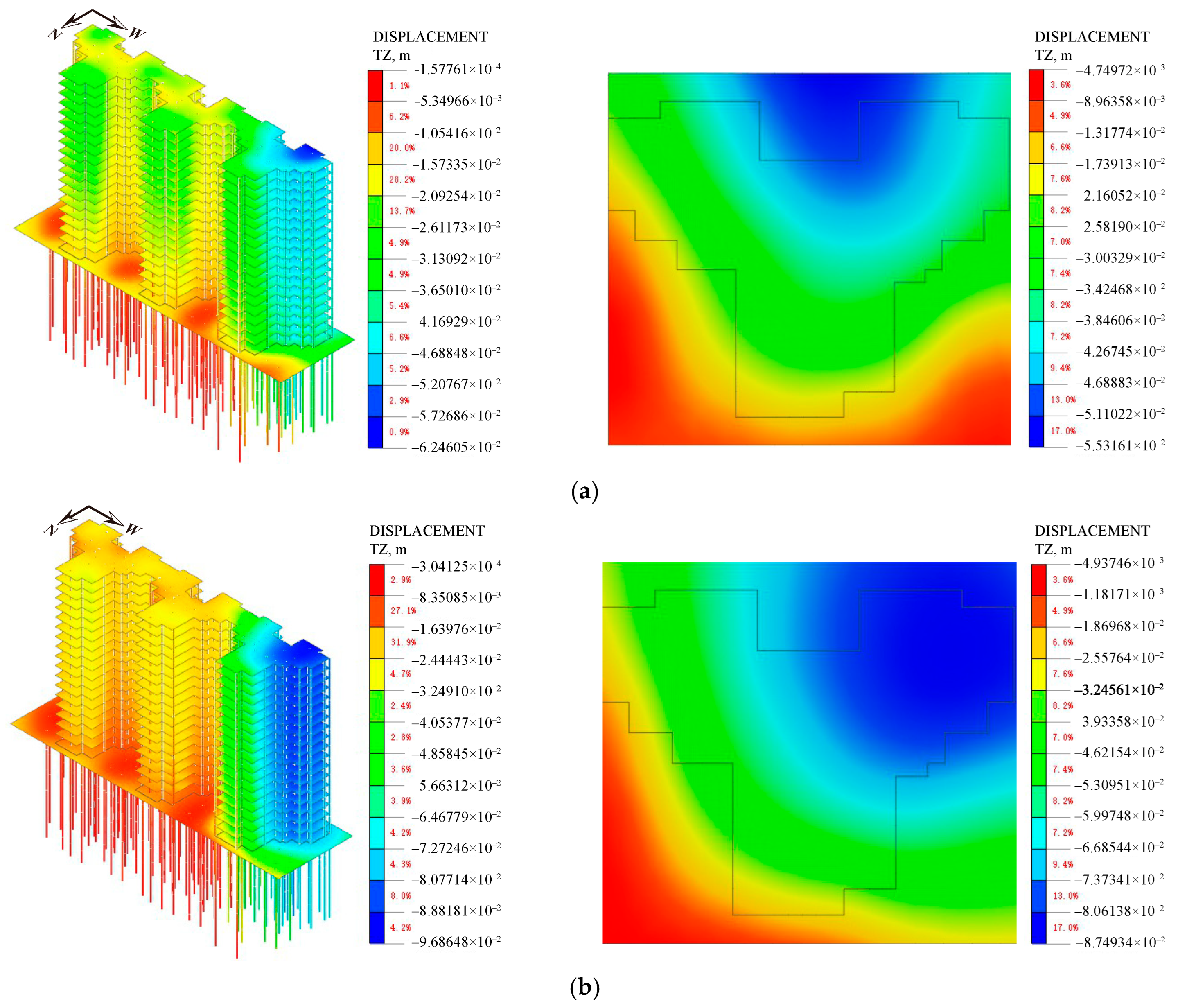
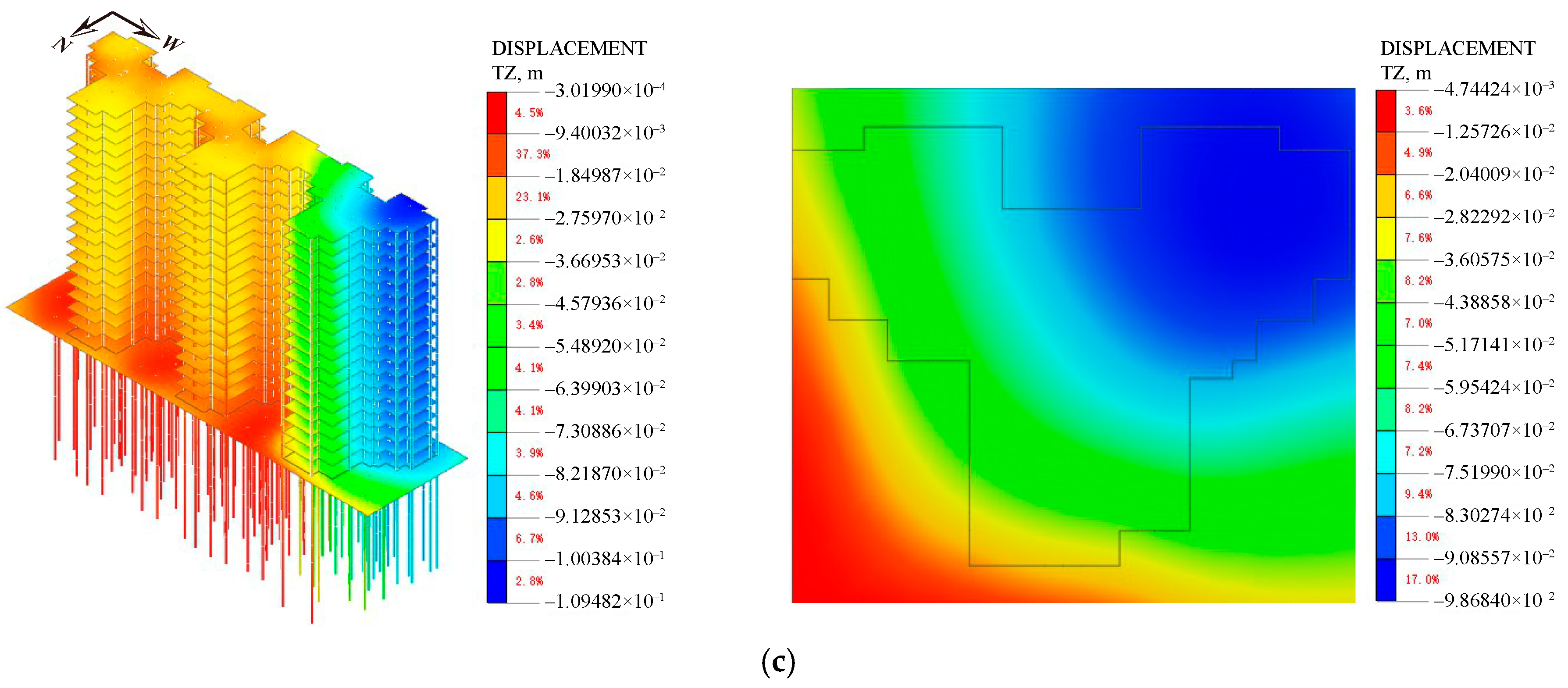
Figure 16 depicts the settlement cloud maps of the superstructure and the basement roof, derived from the three model calculations. It is evident that there is a notable discrepancy between the maps. In Model 1, only the uneven settlement resulting from the presence of voids is considered, with all piles embedded in the bedrock. It can be observed that the settlement caused by the voids is relatively limited in scope, confined primarily to the vicinity of the voids, and the settlement values are relatively modest, as illustrated in Figure 16a. In contrast, Model 2 demonstrates that the piles not embedded in bedrock in Unit 3 result in extensive ground settlement, with the settlement values exhibiting a clear correlation with the distance of the piles from the bedrock. In the south-west corner of the three units, where the bedrock depth is greater, the pile foundation is situated at the greatest distance from the bedrock, resulting in the highest settlement value. Model 3 considers the combined effects of voids and piles on the settlement of the building structure. Compared with the results of Models 1 and 2, Model 3 predicts a wider settlement zone and larger settlements adjacent to the voids.
The aforementioned comparison demonstrates that the uneven settlement of the superstructure can be attributed to a confluence of factors, including the failure of the bored piles to achieve sufficient embedment in the bedrock, as well as the presence of ground voids.

4.4.3. Stress of the Superstructure

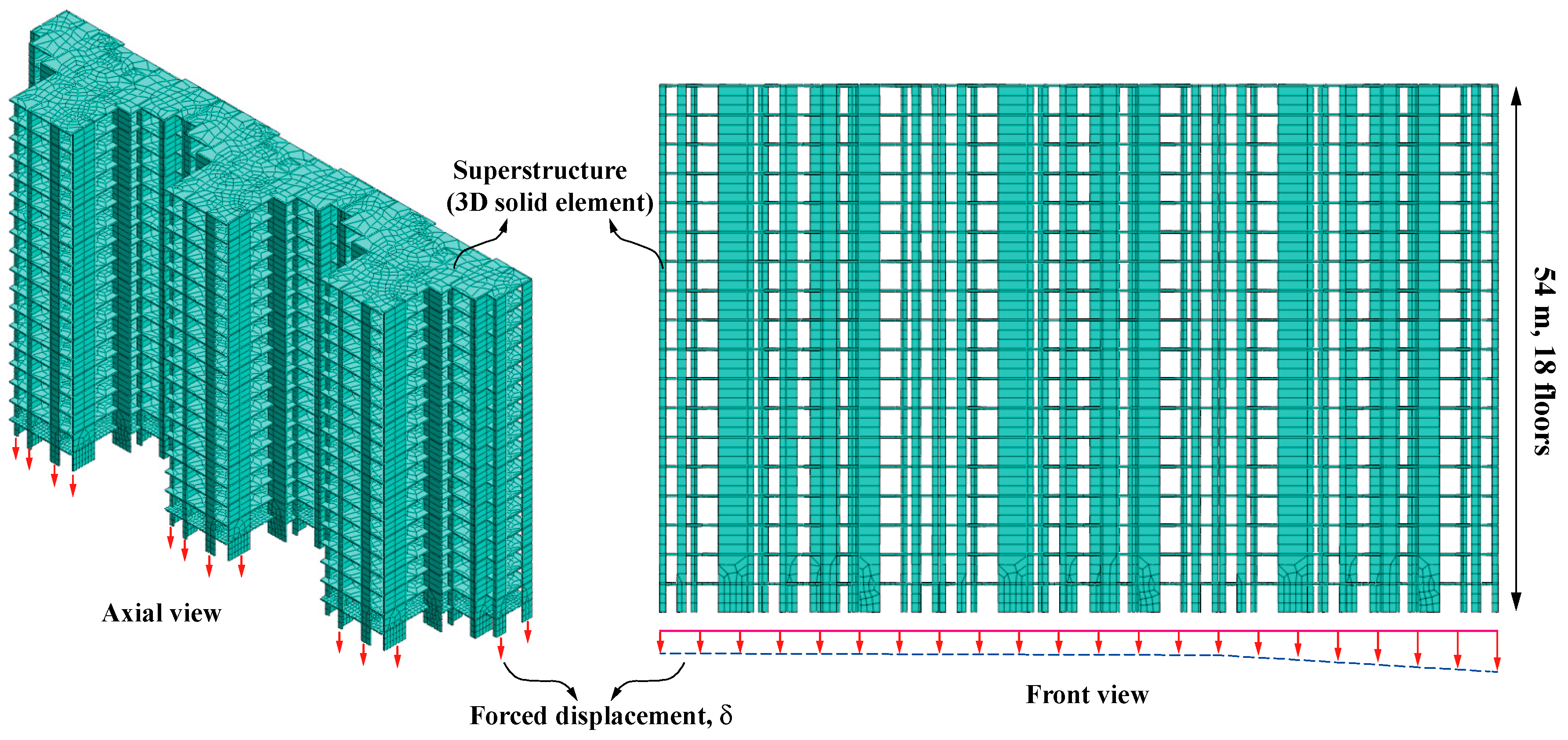
The asymmetric settlement of foundations can ultimately result in structural deterioration, manifesting as severe cracking of the structure. In order to obtain the stress state of the superstructure more realistically, a fine numerical model of the superstructure is established based on 3D solid units, as in Figure 17. And the foundation settlement values in Model 3 above are extracted and applied to the bottom of the fine model.
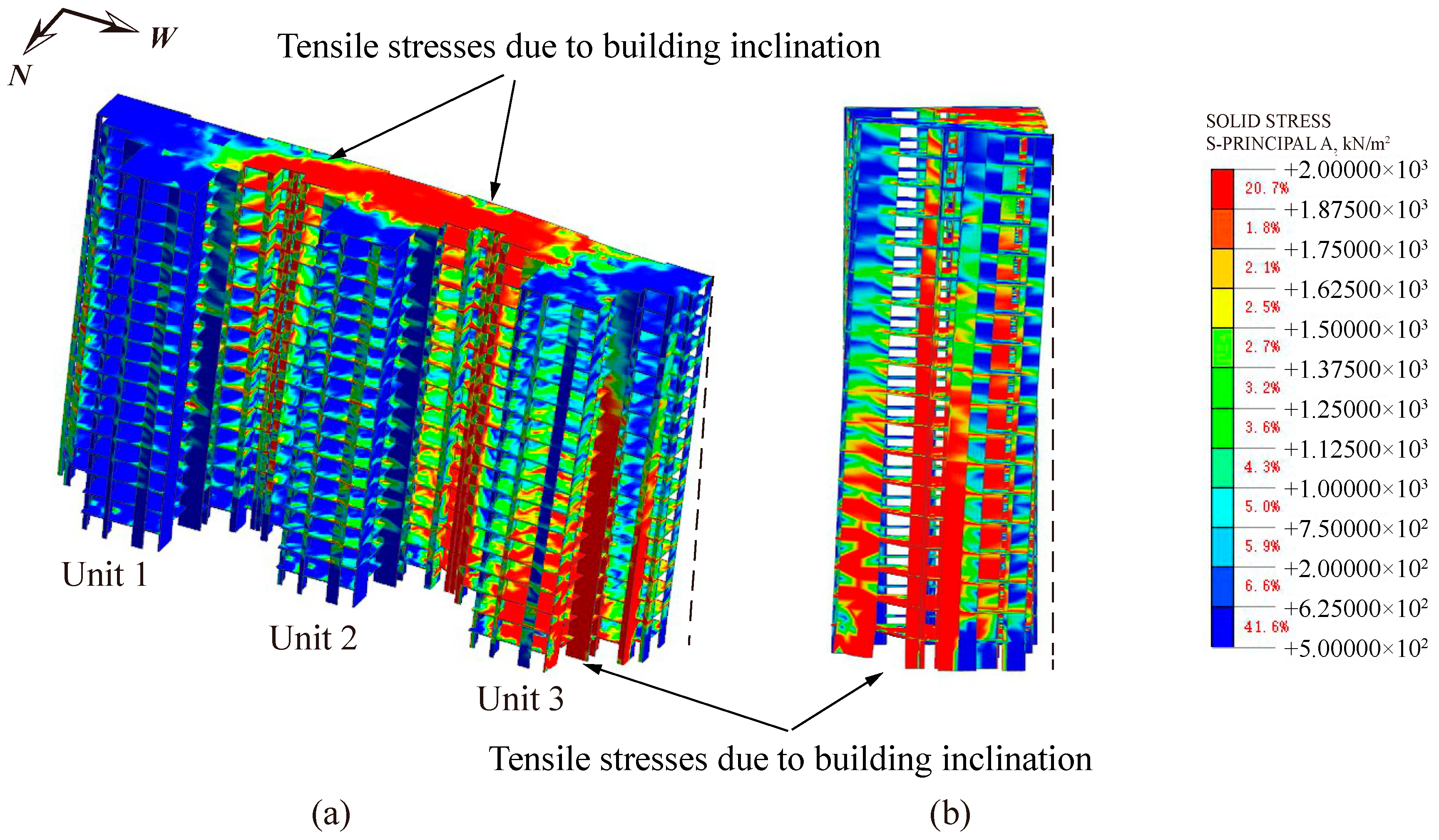
The settlement value is at its maximum at the south-west corner and then decreases gradually towards the north-east. The uneven settlement of Unit 3 has a markedly deleterious effect on the superstructure. The following Figure 18 illustrates the maximum principal stress of the superstructure. Firstly, the tilting of Unit 3 towards the west side resulted in a significant tensile stress on the top of Units 1 and 2. Secondly, the inclination of Unit 3 towards the south side resulted in the generation of significant torsional effects. This resulted in the generation of significant tensile stresses at the juncture of Units 1, 2, and 3. The aforementioned tensile stress concentration areas have the potential to become cracking areas, which is in general accordance with the actual project.
The asymmetric settlement can be attributed to the following factors: the pile ends are not driven into the rock or the depth of the rock is not sufficient; some of the piles are underlain by clay layers; or the piles are underlain by poor-quality piles. These observations are supported by the findings of the numerical simulation. It is therefore necessary to reinforce the soil around the pile bottom and the holding layer at the pile end, and to correct the building so that the building tilt is controlled within the normative limits.

5. Design of Building Uplift and Correction Program

5.1. Principle of Foundation Reinforcement Lifting

5.1.1. Grouting and Backfilling of Geological Voids

The foundation void filling and reinforcement phase is primarily concerned with the filling of voids in the strata through grouting, with the objective of enhancing the strength and stiffness of the area—and to successfully implement this project and achieve the goal of consolidating the foundation and lifting the deviation, a special high-aluminum iron composite slurry is selected. This slurry, a modification of traditional high-alumina iron cement materials, belongs to cement-based materials and is mainly composed of aluminum slag and iron slag: aluminum slag primarily serves to accelerate setting, while iron slag mostly enhances strength and durability, addressing key needs of void filling and reinforcement.
Through a large number of indoor experiments, the optimal proportion of this high-aluminum-iron special composite slurry is determined as aluminum slag: iron slag: cement = 3:2:1 by weight—verified to meet core performance requirements: its unconfined compressive strength at 28 days is no less than 15 MPa, and the structure formed by the slurry after solidification has high strength and strong impermeability, which significantly improves the foundation’s bearing capacity. Beyond basic performance, this slurry also has outstanding technical characteristics that overcome traditional grouting limitations: (1) The curing time can be easily adjusted, controlled within 10 s to 90 s; (2) The spreading range can be controlled within a radius of 2.5 m, breaking the technical limitation of uncontrollable slurry materials in traditional methods; (3) It has good permeability, enabling strong penetration into fine sand strata and forming high-strength structures after hardening and setting; (4) It maintains very strong consolidation performance in water-rich formations and confined aquifer formations; (5) The shrinkage rate after curing is less than 0.1%, and the hardener is non-toxic, avoiding groundwater contamination.
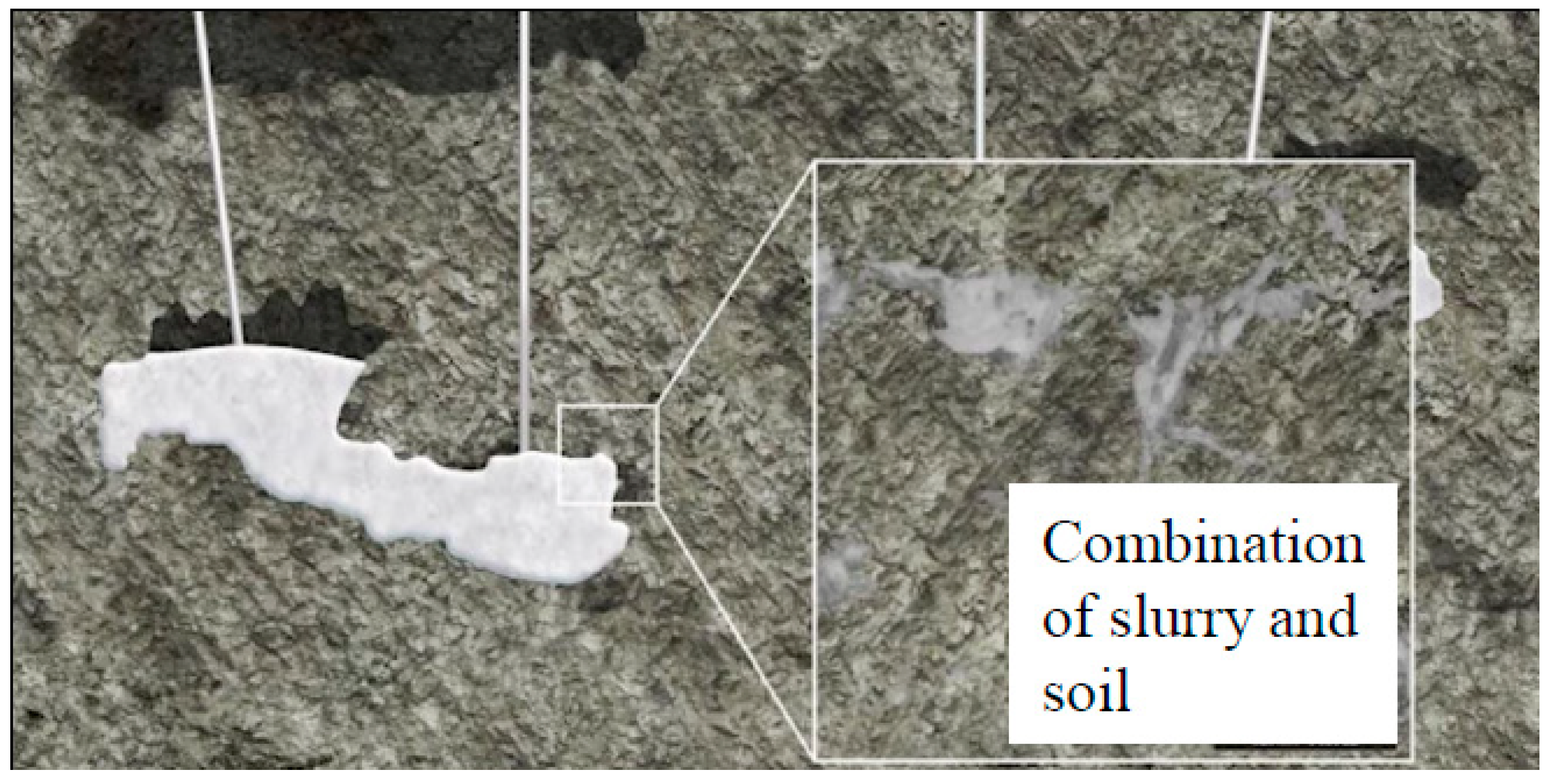
This optimized grouting process—leveraging the high-aluminum-iron composite slurry—effectively mitigates ground settlement caused by voids, ensuring the foundation base is subjected to uniform force. Throughout construction, detailed monitoring records (covering key parameters like grouting process and post-reinforcement effects) are maintained. Additionally, as illustrated in Figure 19, the grouting reinforcement also augments the friction of the pile foundation traversing the voids, further improving the pile’s load-bearing capacity.

5.1.2. Elevation of Piles by Grouting

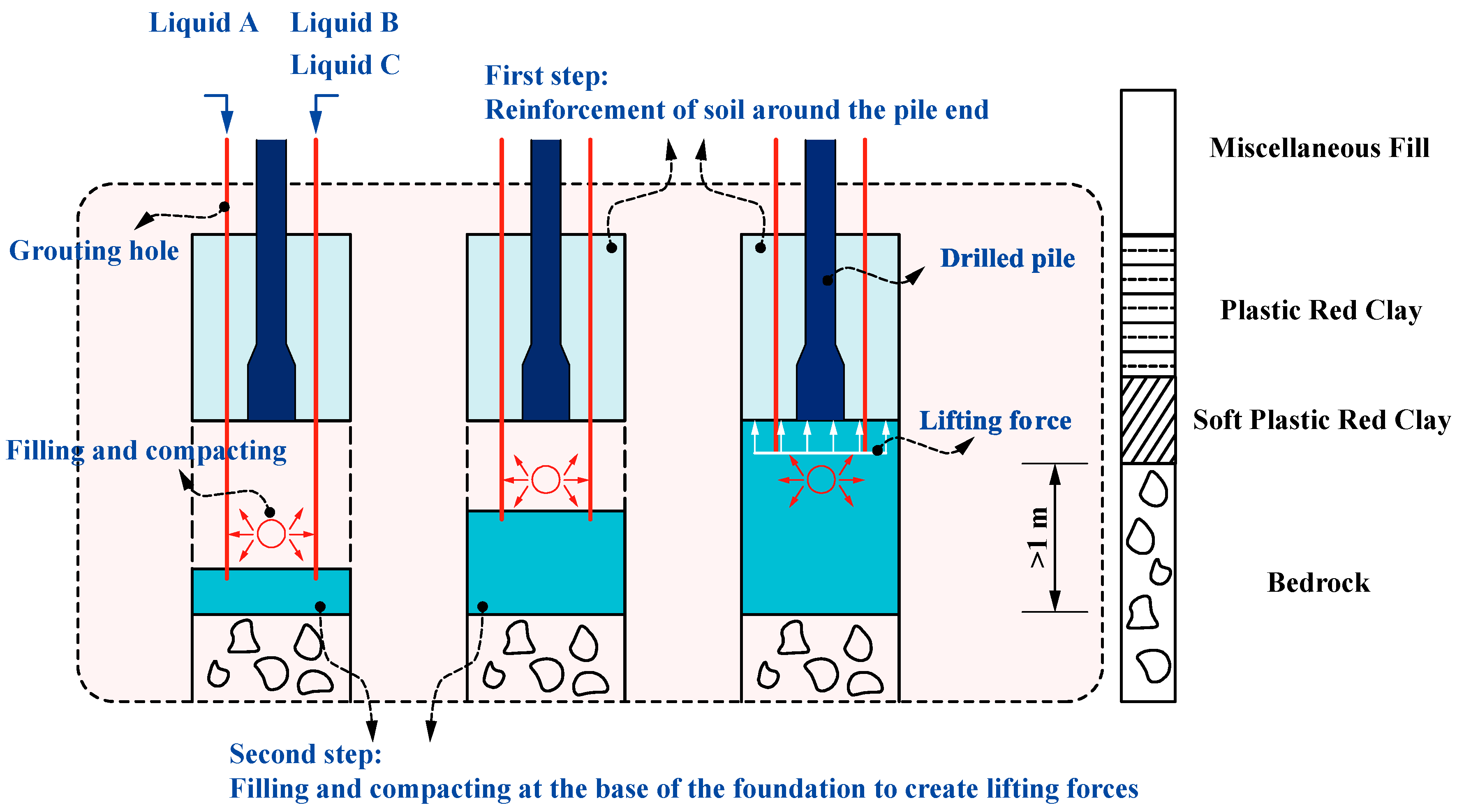
Piles not embedded in bedrock are an important cause of uneven settlement of superstructures. Consequently, a staged pile reinforcement method is proposed: the surrounding soil is first strengthened, after which grouting and controlled uplift are applied at the pile base. The high-alumina iron composite grout enables precise ground stabilization and elevation adjustment through adjustable solidification (1–90 s), deep penetration into fine sands, and robust consolidation in water-saturated or confined aquifer conditions. It forms non-shrinking, impermeable structures with eco-friendly, non-toxic components, ensuring groundwater safety while significantly enhancing foundation bearing capacity for durable, maintenance-free engineering performance. The reinforcement process is executed in two steps, as outlined below.
(1) Reinforcement of soil around the pile end: firstly, the weak soil layer (red clay) around the pile, situated within the range of 4.0 m above the pile end, should be reinforced (Figure 20). The weak soil layer around the pile should be densified, the pile’s lateral frictional resistance increased, and the soil’s holding force around the pile strengthened. The formation of a force layer with sufficient rigidity can enhance the holding force of the soil around the pile, thereby providing effective “top support”. Additionally, the layer can serve as a resistance to sinking and a buffer during lifting operations, resulting in a more uniform lifting force.
(2) Pile end lift: After completing the peripile soil reinforcement at the pile ends, the drilling proceeds down to bedrock. Grouting is then performed in layers from the bottom to the top of the borehole. During the process of layered reinforcement of the slurry on the foundation soil layer, there is a constant filling and extrusion of the foundation soil layer, resulting in increased compactness and pressure, which in turn causes the foundation to lift gradually. The foundation will be lifted at a gradual pace, with the precise rate of lifting determined based on the specific circumstances at the site and the safety of the building structure (Figure 20).
This technique demonstrates notable low-carbon advantages through material and procedural optimization. By utilizing an eco-friendly, non-toxic grout with rapid tunable solidification (1–90 s), it minimizes energy-intensive drilling requirements while ensuring precise, resource-efficient ground stabilization. The grout’s high permeability reduces material waste by eliminating redundant boreholes, and its non-shrinking, durable consolidation cuts long-term maintenance needs, avoiding recurrent carbon emissions. Enhanced foundation bearing capacity (>300 kPa) extends structural lifespan, indirectly lowering lifecycle emissions by postponing reconstruction. Combined with reduced groundwater contamination risks and minimized soil disturbance, the method aligns with sustainable construction principles, offering a carbon-smart solution for foundation rehabilitation in sensitive environments.
The pile reinforcement process starts with the piles in the area of large settlement on the south-west side, and gradually extends to the north and east sides to advance the construction. The height of each lifting of each pile should not be greater than 1.0 cm, and precision level and latitude and longitude instrument are used for double monitoring to reduce the error in the lifting process. The lifting process adopts intermittent cyclic lifting, and stops when the top elevation of the pile is level with Unit 1 and Unit 2.
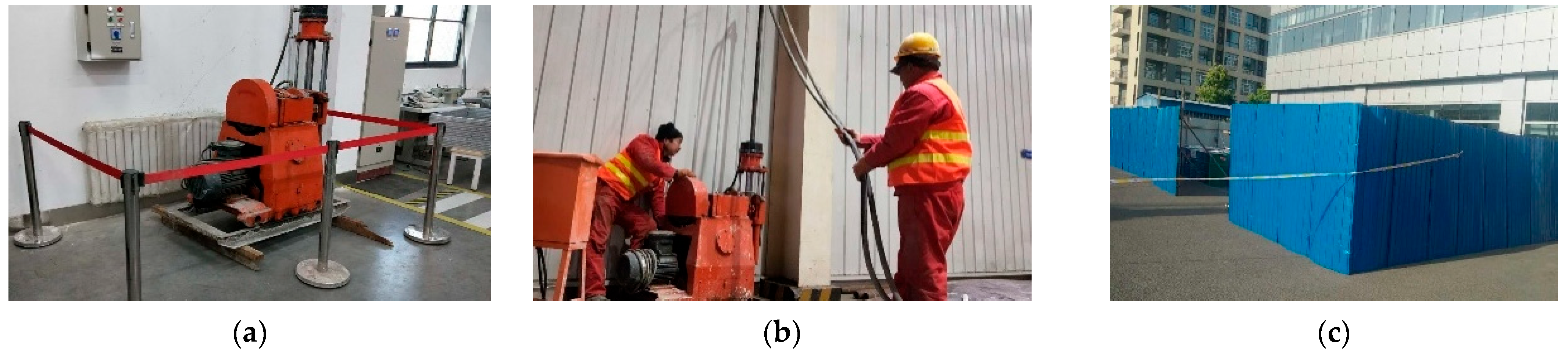
A series of monitoring points are established around the perimeter of the structure during the construction phase, with a level gauge employed for ongoing monitoring purposes. The construction process is continuous and uninterrupted. As the monitoring points begin to rise slightly, this indicates that the foundations have been filled in tightly. Subsequently, the continuous construction operation should be continued, with the appropriate adjustments made to the grouting pressure, slurry ratio and slurry injection rate in response to the anticipated signs of uplift. This will ensure the uniformity and gradual nature of the uplift, with the injection rate being adjusted once again for fine-tuning as the uplift height approaches the target deviation of approximately 1 cm to 2 cm. This process will ultimately result in the achievement of the desired flatness requirements. Figure 21 illustrates the construction process through a series of images.

5.2. Feasibility Analysis Based on Numerical Simulation

5.2.1. Simulation Method

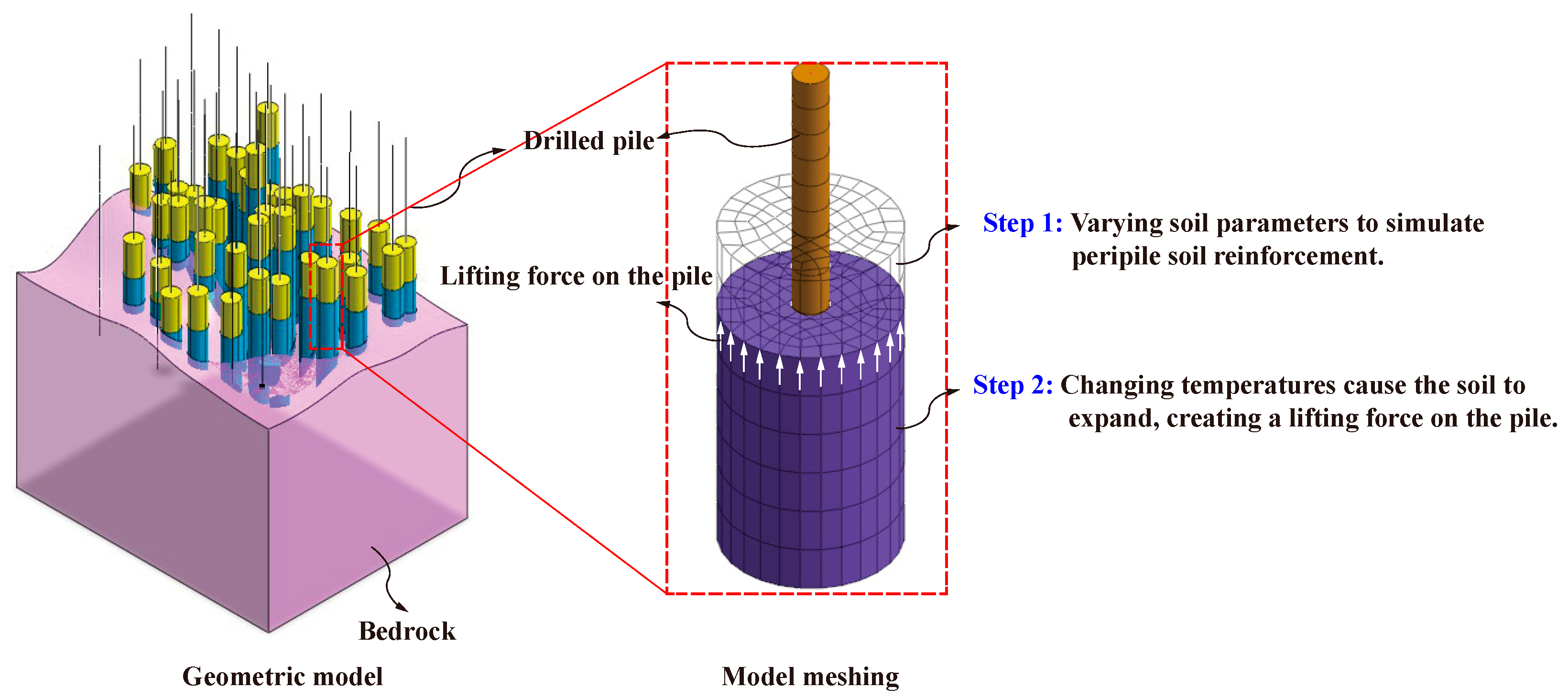
In order to reproduce the pile foundation lifting process, this paper employed a simulation strategy based on the heating and expansion of local soil. As illustrated in Figure 22, the soil surrounding the pile end in Unit 3 was divided into a reinforced section (the yellow section) and an expanded section (the blue section) based on the numerical Model 3. The reinforcement process of the soil at the pile end was first simulated by varying the material property parameters of the reinforced and swollen sections.
The grouting process employed in this study is defined by a “pressurized injection + rapid solidification +retreat grouting” sequence. The pile uplift is primarily driven by the volume of grout injected at each retreat step. To simulate this mechanism numerically, a thermal-expansion analogy was adopted: the soil in the expansion zone was assigned a thermal expansion coefficient, effectively defining it as a material whose volume can be controlled by varying temperature. The injected grout volume per step Vinj was equated to a virtual thermal expansion volume of the grouted zone Vexp, with the equivalence relation expressed as Vinj = Vexp = V0αT⋯ΔT, where V0 is the initial volume of the grout zone, αT is the virtual thermal expansion coefficient, and ΔT is the virtual temperature rise. The thermal expansion coefficient of the soil below the pile was meticulously calibrated, and a temperature load was applied to raise the soil temperature, thereby simulating the expansion effect during grouting. By continuously adjusting the soil expansion coefficient in the simulation, the method effectively reproduced the volume expansion, squeezing of the overlying soil, and the subsequent building uplift, ultimately achieving the desired corrective alignment.
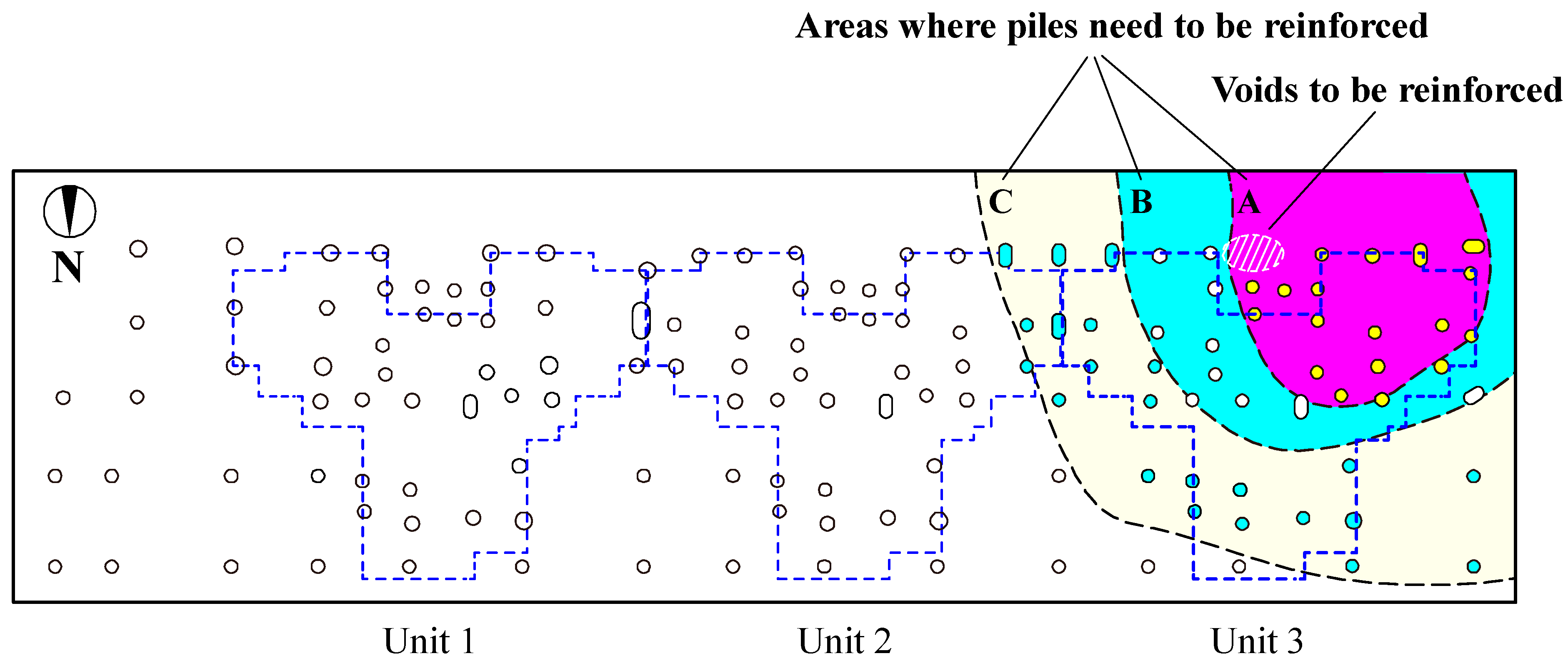
In the actual project, the settlement value of each pile is different, which causes the simulation process of grouting and lifting to be very tedious. In order to simplify the numerical model, the piles to be strengthened were divided into three regions A, B, and C, according to the distribution pattern of settlement values, as shown in Figure 23. The grouting and reinforcement of piles situated in the same subdivision were conducted concurrently. The piles in Zone A with the highest settlement values were initially lifted by 1 cm, after which the piles in Zone B were lifted by the same amount through warming and expansion. Finally, the same operation was carried out for the piles in Zone C. Subsequently, a series of repetitions of the aforementioned lifting process was conducted, and the lifting operation was concluded when the settlement values of the piles were approximately equivalent to those of the piles in Units 1 and 2. The coefficient of expansion of the soil beneath each pile was determined through a process of trial and error. The most appropriate coefficient of expansion was determined by raising the top pile elevation by 1 cm after each heating cycle.

5.2.2. Simulation Results

(1) Uneven settlement of high-rise buildings
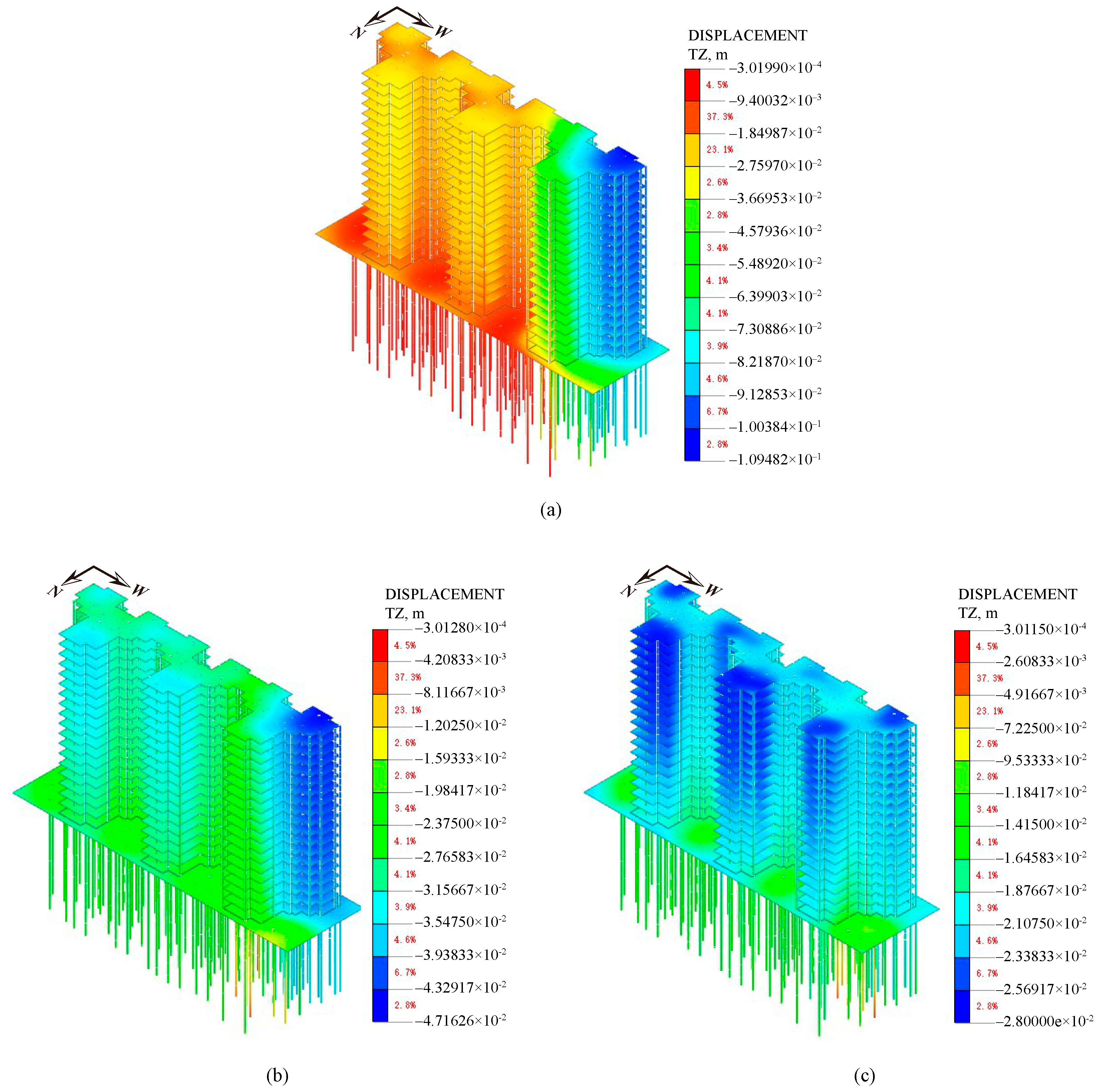
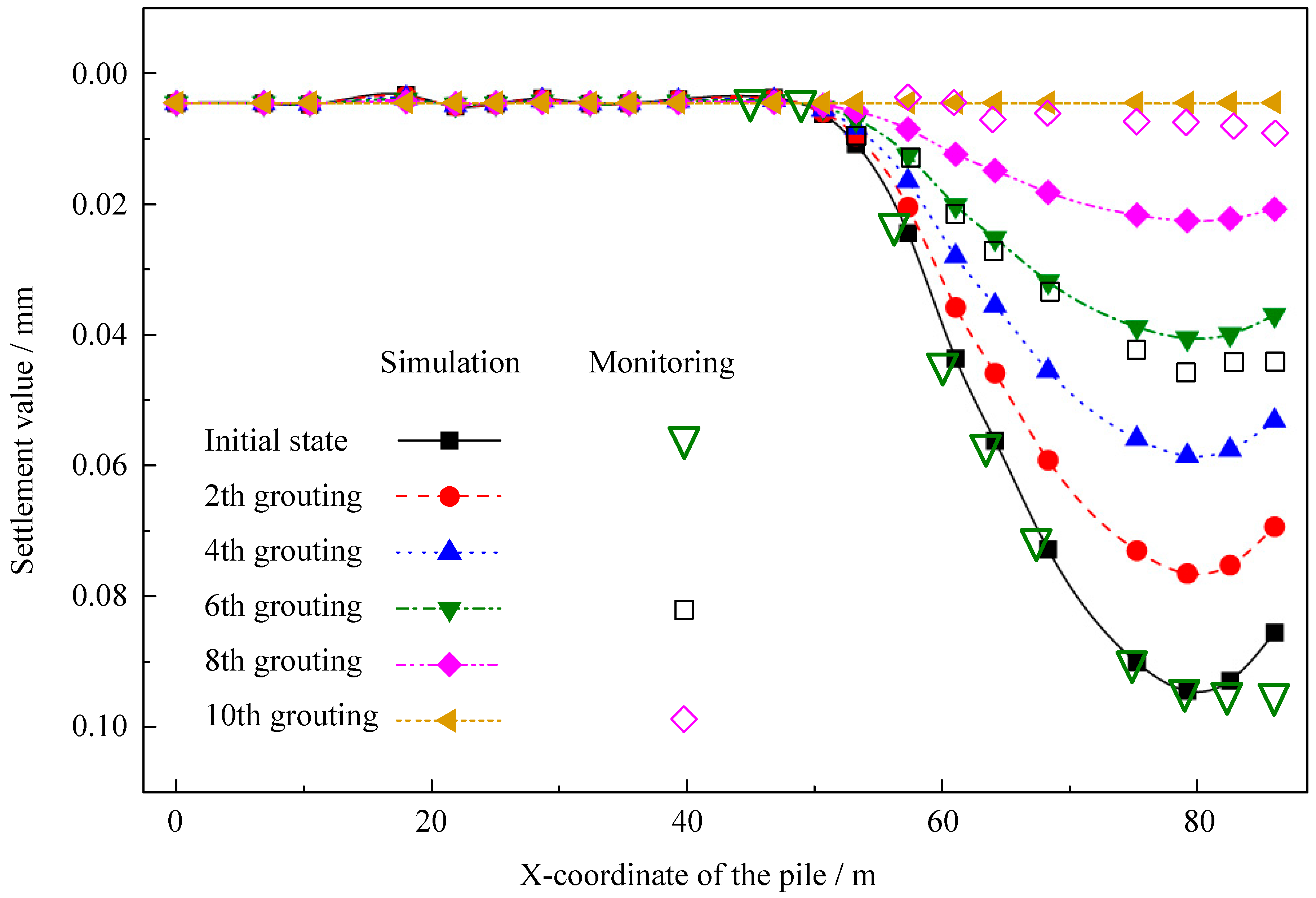
The settlement value of the building structure subsequent to grouting and lifting is illustrated in Figure 24. It can be observed that the settlement value of the south-west side of the upper building Unit 3 diminishes gradually with the repetition of lifting construction for each pile. Following the completion of ten construction cycles, the maximum settlement discrepancy between Unit 3 and Units 1 and 2 of the building has been reduced to a mere 2.5 mm. The maximum offset of the top of the building to the west and to the south is reduced to 11.71 mm and 7.62 mm, respectively, and the maximum tilt angle is also reduced to 0.22‰ and 0.14‰, respectively. These values meet the acceptance standard of the specification.
The grouting and lifting construction process of the building was also carried out concurrently with real-time monitoring. As of 24 August 2020, the third unit of Building #14 is essentially vertical in the east–west direction, with a deviation of approximately 6.5 cm in the north–south direction. From the official commencement of the project to its completion on 13 October 2020, a latitude and longitude instrument was employed to monitor the tilting of the four major corners of the third unit of Building #14. The building has been found to be essentially vertical in the east–west direction, with a deviation of approximately 2 cm in the north–south direction. These observations meet the acceptance standards set forth in the national specification. It can be observed that the numerical simulation results are largely in alignment with the monitoring values (Figure 25), with a notable reduction in the discrepancy between the third unit of the building and the first and second units. The positive lifting effect lends further support to the hypothesis that the failure of the piles to be embedded in the bedrock is the primary cause of the uneven settlement of the building.
(2) Stress state of superstructure
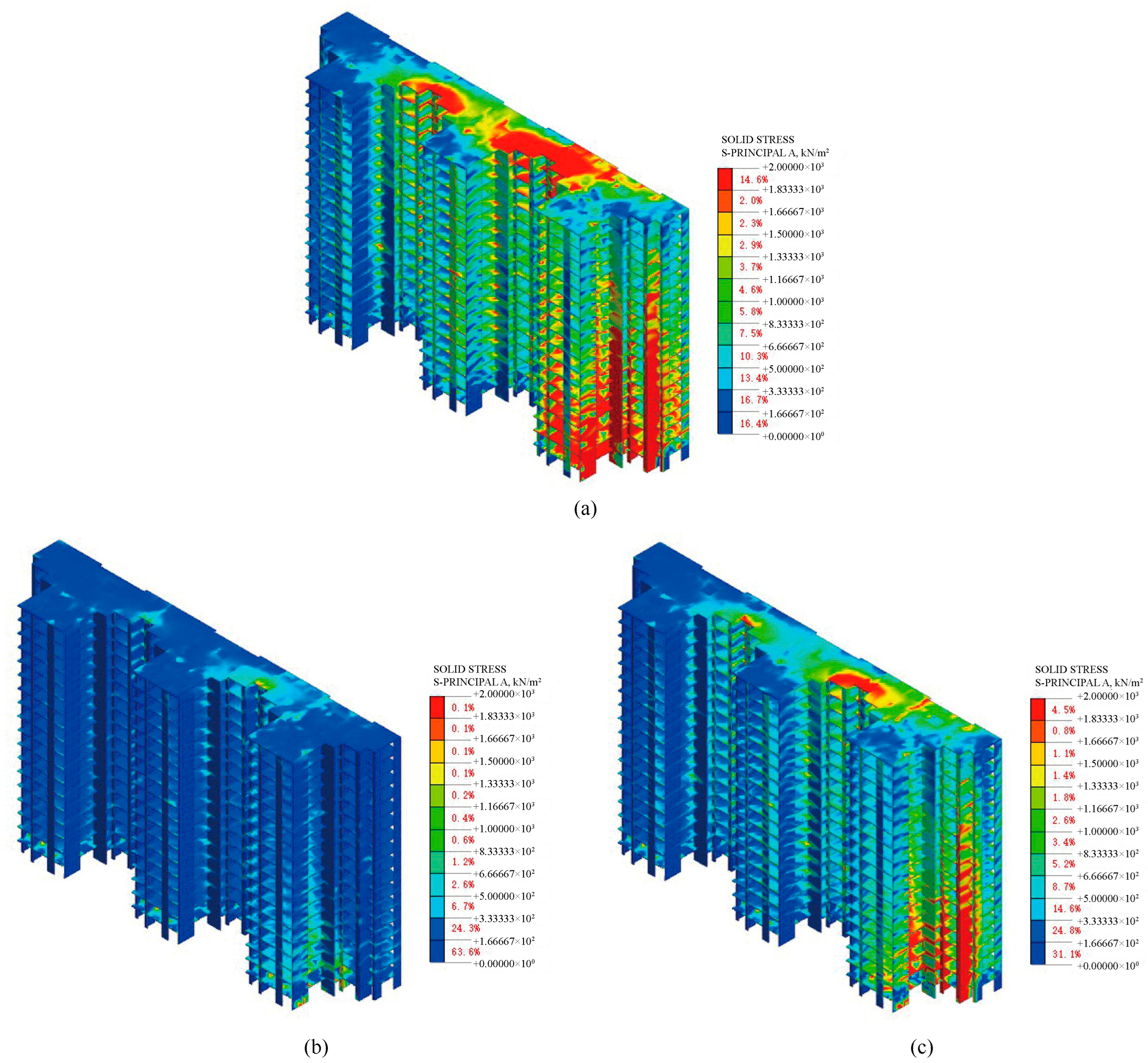
The implementation of pile lifting in Unit 3 has resulted in a notable reduction in the settlement discrepancy between Unit 3 and Unit 2. The foundation settlements at varying lifting stages were imposed upon the fine numerical model of the superstructure, thereby enabling the acquisition of the maximum principal stress cloud of the structure during the reinforcement process (Figure 26). The utilization of grouting and lifting construction techniques has proven to be an efficacious approach in alleviating stress concentrations within the superstructure. As the building inclined towards the west-south side, the tensile stresses within the structural framework exhibited a gradual decline.

6. Conclusions

This comprehensive study on differential settlement in a high-rise building on karst terrain integrates field investigation, theoretical modeling, and numerical simulation to diagnose the failure mechanism and validate an effective remediation. The key findings are summarized as follows:
(1) Integrated field monitoring and drilling investigation revealed the mechanism behind the significant differential settlement (107 mm) in an 18-story building on karst terrain. The primary cause was identified as inadequate pile foundation support, where piles failed to penetrate into stable bedrock and instead transferred structural loads to underlying soft soil—a condition confirmed through drilling. This, combined with the presence of subsurface voids that further compromised foundation stability, collectively led to the observed uneven settlement.
(2) A theoretical model was established to analyze pile foundation settlement traversing cavities in multi-layered strata. The results show that settlement increases with greater cavity height and weaker soil strength at the pile tip and shaft. Critically, the strength of the soil at the pile tip and around the pile shaft were identified as the primary governing factors, with cavity height being a significant but secondary contributor.
(3) Numerical simulations verify that the combination of subsurface cavities and soft basal soil is the root cause of the asymmetric settlement. This settlement manifests as a maximum at the southwest corner, decreasing northeastward. The resulting structural response includes harmful distortions in Unit 3 and induces tensile stresses at the tops of Units 1–2 (due to westward tilt) and at the junctions of Units 1–3 (due to southward tilt-induced torsion). These stress concentrations are identified as the cause of potential cracking, which aligns with observed field conditions.
(4) A novel grouting lifting strategy was implemented to rectify the uneven settlement. The process involved layered reinforcement of the weak soil stratum above the pile ends to form a solid platform. Lifting was then achieved by pressure-grouting an environmentally compliant grout, which features high strength and a quick-setting nature with a readily adjustable curing time of 10–90 s for precise control. This compacted the soil and generated a controlled uplift force. Post-treatment monitoring confirmed success, with the building realigned to within 2 cm, meeting national standards.
It is important to acknowledge that the thermal-expansion analogy employed in this study, while effective for simulating volume-driven uplift, represents a significant simplification of the actual grouting process. A primary limitation is its inability to model the time-dependent evolution of grout permeation, solidification, and the subsequent building uplift. This simplification omits critical transient behaviors, such as the variation in grout viscosity and the progressive development of uplift forces, which are essential for a high-fidelity simulation. To overcome this constraint, our future work will be dedicated to the development of a fully coupled transient hydro-mechanical model. This advanced model will incorporate a time-dependent constitutive law for the grout, enabling a more realistic simulation of the entire process from injection pressure propagation and phase change (liquid to solid) to the final deformation response of the structure.

Funding

This research received no external funding.

Data Availability Statement

The original contributions presented in this study are included in the article. Further inquiries can be directed to the corresponding author.

Conflicts of Interest

Author Xuedong Cui is the CEO of the company Beijing Hengxiang Hongye Foundation Reinforcement Technology Co., Ltd. The author declares that the research was conducted in the absence of any commercial or financial relationships that could be construed as a potential conflict of interest.

References

  1. Zhang, C.; Gao, Y.; Duan, E. The Influence of Environment on the Settlement of Historic Buildings in China. KSCE J. Civ. Eng. 2021, 25, 1951–1963. [Google Scholar] [CrossRef]
  2. Wu, M. Analysis of the Influence of Pile Foundation Settlement of High-Rise Buildings on Surrounding Buildings. Arab. J. Geosci. 2020, 13, 822. [Google Scholar] [CrossRef]
  3. Wang, L.; Zhao, X.; Liu, S. A Study of Differential Foundation Settlement of Piled Raft and Its Effect on the Long-term Vertical Shortening of Super-tall Buildings. Struct. Des. Tall Build. 2021, 30, e1832. [Google Scholar] [CrossRef]
  4. Xu, S.; Xu, J. Prediction of Buildings’ Settlement Induced by Metro Station Deep Foundation Pit Construction. Appl. Sci. 2024, 14, 2143. [Google Scholar] [CrossRef]
  5. Deng, J.; Zeng, T.; Yuan, S.; Fan, H.; Xiang, W. Interval Prediction of Building Foundation Settlement Using Kernel Extreme Learning Machine. Front. Earth Sci. 2022, 10, 939772. [Google Scholar] [CrossRef]
  6. Ibragimov, M.N. Settlement Stabilization of a Reconstructed Building. Soil Mech. Found. Eng. 2011, 47, 236–240. [Google Scholar] [CrossRef]
  7. Zhang, X.; Qu, H.; Xu, Y.; Zhang, L.; Zhang, Z. Investigating the Damage to Masonry Buildings During Shield Tunneling: A Case Study in Hohhot Metro. Eng. Fail. Anal. 2024, 160, 108147. [Google Scholar] [CrossRef]
  8. Zhang, D. Influences of Deep Foundation Pit Excavation on the Stability of Adjacent Ancient Buildings. Buildings 2023, 13, 2004. [Google Scholar] [CrossRef]
  9. Zotsenko, N.L.; Vinnikov, Y.L. Long-Term Settlement of Buildings Erected on Driven Cast-In-Situ Piles in Loess Soil. Soil Mech. Found. Eng. 2016, 53, 189–195. [Google Scholar] [CrossRef]
  10. Sheinin, V.I.; Sarana, E.P.; Soboleva, V.N.; Gurevich, D.V.; Katsnel’son, L.B. Engineering Analysis of Foundation Slab Settlement and Deformation for a High-Rise Building on a Nonuniform Rock Bed. Soil Mech. Found. Eng. 2016, 53, 304–311. [Google Scholar] [CrossRef]
  11. Dai, X.; Huang, F.; Wang, G.; Cui, T.; Cui, X.; Guo, F. Displacement Prediction of Inclined Existing Buildings with a Raft Foundation Restored by Compaction Grouting in Clay. J. Build. Eng. 2024, 91, 109511. [Google Scholar] [CrossRef]
  12. Chen, K. On the Influence of Pile Foundation Settlement of Existing High-Rise Buildings on the Surrounding Buildings. Adv. Civ. Eng. 2021, 2021, 5560112. [Google Scholar] [CrossRef]
  13. Modak, R. A Parametric Study of Large Piled Raft Foundations on Clay Soil. Ocean Eng. 2022, 262, 112251. [Google Scholar] [CrossRef]
  14. Deb, P.; Debnath, B.; Reang, R.B.; Pal, S.K. Structural Analysis of Piled Raft Foundation in Soft Soil: An Experimental Simulation and Parametric Study with Numerical Method. Ocean Eng. 2022, 261, 112139. [Google Scholar] [CrossRef]
  15. Rasouli, H.; Fatahi, B. A Novel Cushioned Piled Raft Foundation to Protect Buildings Subjected to Normal Fault Rupture. Comput. Geotech. 2019, 106, 228–248. [Google Scholar] [CrossRef]
  16. Hu, M.; Lu, Y.; Chen, X.; Zhang, Q.; Xu, X.; Zhang, Y. Settlement of Piled Raft Foundation Embedded in Rock and Its Calculation Method. Chin. J. Geotech. Eng. 2019, 41, 221–225. [Google Scholar]
  17. Tang, Y.; Zhao, X. Re-Analysis of Case Studies of Piled Raft Foundation for Super-Tall Building in Soft Soils. Rock Soil Mech. 2016, 37, 3253–3262+3269. [Google Scholar] [CrossRef]
  18. Gong, J.; Hou, G.; Zhou, S.; Zheng, W. Settlement Characteristics and Calculation of Bending Moment for Large-Area Thick Raft Foundation Under Tall Buildings. Chin. J. Geotech. Eng. 2014, 36, 1631–1639. [Google Scholar]
  19. Katzenbach, R.; Schmitt, A.; Turek, J. Assessing Settlement of High-Rise Structures by 3D Simulations. Comput. Aided Civ. Infrastruct. Eng. 2005, 2005, 221–229. [Google Scholar] [CrossRef]
  20. Zhang, X. Cause Investigation of Damages in Existing Building Adjacent to Foundation Pit in Construction. Eng. Fail. Anal. 2018, 83, 117–124. [Google Scholar] [CrossRef]
  21. Liang, J.; Fan, Q.; Qin, K. Influence of Karst Caves on the Pile’s Bearing Characteristics-A Numerical Study. Front. Earth Sci. 2022, 9, 754330. [Google Scholar] [CrossRef]
  22. Wang, P.; Ding, H.; Zhang, P. Influence of Karst Caves at Pile Side on the Bearing Capacity of Super-Long Pile Foundation. Math. Probl. Eng. 2020, 2020, 4895735. [Google Scholar] [CrossRef]
  23. Han, G.; Zhang, H.; Wang, Z.; Wang, Y.; Geng, N.; Guo, P.; Li, X.; Zhao, Y.; Lin, H.; Wang, Y. Bearing Behavior of Rock Socketed Pile in Limestone Stratum Embedded with a Karst Cavity beneath Pile Tip. Case Stud. Constr. Mater. 2023, 18, e02203. [Google Scholar] [CrossRef]
  24. Sheng, M.; Lu, F.; Jiang, N.; Guo, P.; Li, X.; An, R.; Wang, Y. Bearing Behavior of Pile Foundation in Karst Region: Physical Model Test and Finite Element Analysis. Appl. Rheol. 2024, 34, 20230115. [Google Scholar] [CrossRef]
  25. Yang, Y.; Chen, C.; Liu, C.; Huang, L.; Chen, W.; Lin, N.; Cui, J.; Xie, W. Performance of a Deep Excavation and the Influence on Adjacent Piles: A Case History in Karst Region Covered by Clay and Sand. Undergr. Space 2023, 8, 45–60. [Google Scholar] [CrossRef]
  26. Wang, P.; Zhang, P.; Hu, W.; Qiu, D. Seismic Response Analysis of Rock-Socketed Piles in Karst Areas Under Vertical Loads. Appl. Sci. 2023, 13, 784. [Google Scholar] [CrossRef]
  27. Ou, L.; Huang, Y.; Chen, X.; Xue, Y.; Li, Q.; Guo, B. Research on Bearing Capacity Characteristics of Cave Piles. Buildings 2025, 15, 143. [Google Scholar] [CrossRef]
  28. Peng, W.; Jiang, X.; Zhu, Q.; Zhang, L.; Zhao, M.; Zhou, D. Responses of Karst-Penetrating Piles Under Active and Passive Loading: Experimental and Numerical Investigation. Transp. Geotech. 2025, 54, 101649. [Google Scholar] [CrossRef]
  29. Chen, H.; Feng, Z.; Wu, M.; Zhou, G.; Chen, L.; Zhang, C. Study on the Vertical Bearing Performances of Piles on Karst Cave. Sci. Rep. 2023, 13, 4944. [Google Scholar] [CrossRef] [PubMed]
  30. Basu, D.; Prezzi, M.; Salgado, R.; Chakraborty, T. Settlement Analysis of Piles with Rectangular Cross Sections in Multi-Layered Soils. Comput. Geotech. 2008, 35, 563–575. [Google Scholar] [CrossRef]
  31. Naghibi, F.; Fenton, G.A.; Griffiths, D.V. Prediction of Pile Settlement in an Elastic Soil. Comput. Geotech. 2014, 60, 29–32. [Google Scholar] [CrossRef]
  32. Wang, Z.; Xie, X.; Wang, J. A New Nonlinear Method for Vertical Settlement Prediction of a Single Pile and Pile Groups in Layered Soils. Comput. Geotech. 2012, 45, 118–126. [Google Scholar] [CrossRef]
  33. Li, Z.; Zhang, Q.; Wang, S.; Xiao, K.; Cui, W. Settlement Calculation Method for the Solidified Soil Prefabricated Pile (PPSS) Embedded in Layer Soils. Comput. Geotech. 2025, 179, 107053. [Google Scholar] [CrossRef]
  34. Wang, X.; Liu, C.; Hu, H.; Tian, Y.; Chen, H.; Hong, J. Research on Vertical Bearing Characteristics of Single Pile in Complex Interactive Karst Area. Buildings 2025, 15, 1530. [Google Scholar] [CrossRef]
  35. Xue, T.; Xiao, L.; Zeng, C.; Mei, G. Innovative Flexible Casing for Concrete Loss Mitigation in Cast-in-Situ Piles: Karst Geological Case Study in Guizhou, China. Tunn. Undergr. Space Technol. 2026, 167, 107098. [Google Scholar] [CrossRef]
  36. GB-50007-2011; Code for Design of Building Foundation. Ministry of Housing and Urban-Rural Development: Beijing, China, 2011.
  37. Crispin, J.J.; Leahy, C.P.; Mylonakis, G. Winkler Model for Axially Loaded Piles in Inhomogeneous Soil. Géotechnique Lett. 2018, 8, 290–297. [Google Scholar] [CrossRef]
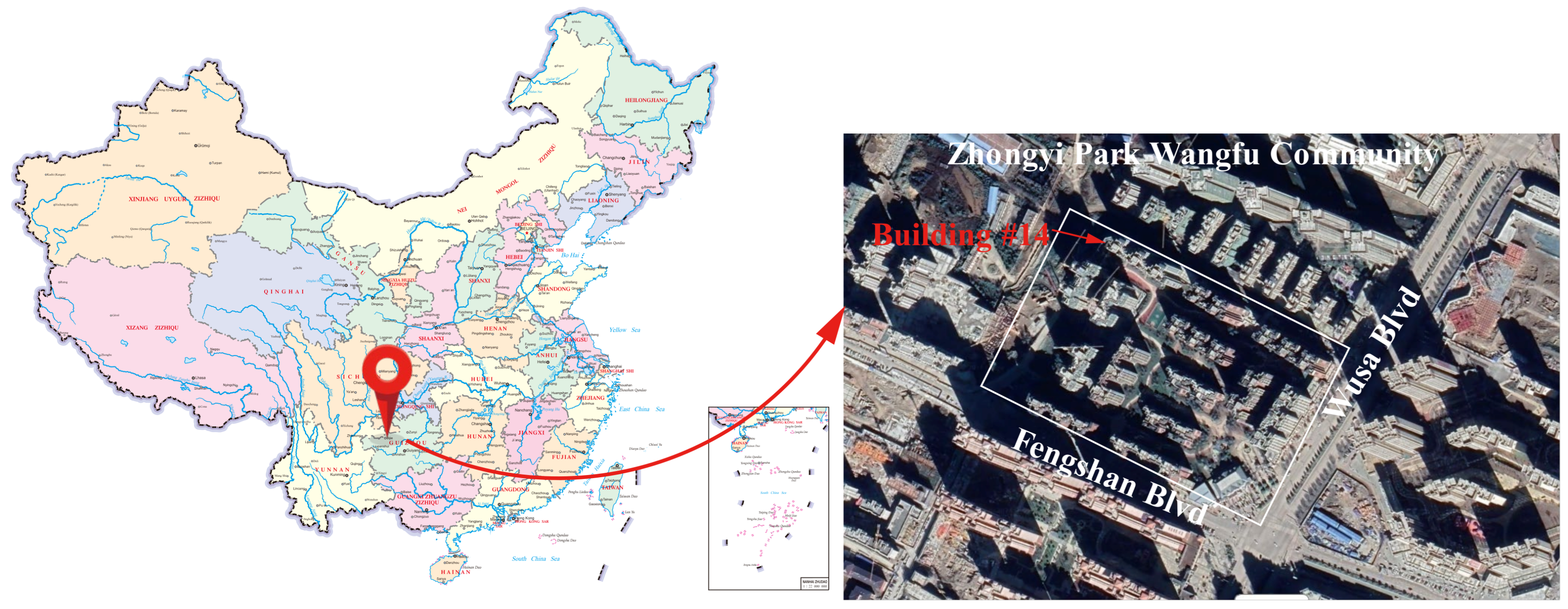
Figure 1. Position of the Weining Zhongyi Park Wangfu.
Symmetry 17 02068 g001
Figure 2. Schematic diagram of a building structure: (a) Front view of the structure. (b)Photo of the structure. (c) Plan view of the structure (Unit: mm).
Symmetry 17 02068 g002aSymmetry 17 02068 g002b
Figure 3. Soil profile.
Symmetry 17 02068 g003
Figure 4. Measurement points employed in the field testing of settlement.
Symmetry 17 02068 g004
Figure 5. Settlement contour map of Unit 3 (Unit: mm): (a) The 4th monitoring results. (b) The 8th monitoring results.
Symmetry 17 02068 g005
Figure 6. Distribution of detected piles.
Symmetry 17 02068 g006
Figure 7. Piles embedded and not embedded in bedrock.
Symmetry 17 02068 g007
Figure 8. Distance of pile end from bedrock in Unit 3 (Unit: m).
Symmetry 17 02068 g008
Figure 9. Spring load transfer model.
Symmetry 17 02068 g009
Figure 10. Single-Pile Numerical Models.
Symmetry 17 02068 g010
Figure 11. Comparison of numerical simulation and theoretical models: (a) Homogeneous soil layer; (b) Stratified soil.
Symmetry 17 02068 g011
Figure 12. Pile cap settlement and parameter influence: (a) Cavity height’s influence on pile top settlement under varying pile tip stiffness kb; (b) Cavity height’s influence on pile top settlement under varying pile-side soil stiffness k; (c) Cavity height’s influence on pile top settlement under varying void position; (d) Factor sensitivity ranking.
Symmetry 17 02068 g012
Figure 13. Numerical model.
Symmetry 17 02068 g013
Figure 14. Schematic diagram of numerical simulations.
Symmetry 17 02068 g014
Figure 15. Settlement values for pile raft foundations.
Symmetry 17 02068 g015
Figure 16. Settlement of superstructures: (a) Model 1; (b) Model 2; (c) Model 3.
Symmetry 17 02068 g016aSymmetry 17 02068 g016b
Figure 17. Refined numerical model of the superstructure.
Symmetry 17 02068 g017
Figure 18. Stress of the superstructure: (a) Axial view; (b) side view.
Symmetry 17 02068 g018
Figure 19. Schematic diagram of grouting reinforcement for formation cavities.
Symmetry 17 02068 g019
Figure 20. Foundation reinforcement lifting process.
Symmetry 17 02068 g020
Figure 21. Construction process on site: (a) Drilling rig in place; (b) Drilling holes; (c) Outdoor reinforcement station.
Symmetry 17 02068 g021
Figure 22. Simulation method for pile foundation lifting.
Symmetry 17 02068 g022
Figure 23. Schematic diagram of the lifting sequence of piles in Unit 3.
Symmetry 17 02068 g023
Figure 24. Building settlement during reinforcement process: (a) Deformation before grouting. (b) Deformation after the 4th grouting construction. (c) Deformation after the 8th grouting.
Symmetry 17 02068 g024
Figure 25. Settlement of pile top during lifting process.
Symmetry 17 02068 g025
Figure 26. Maximum principal stresses of the superstructure:(a) Stresses before grouting. (b) Stresses after the 4th grouting construction. (c) Stresses after the 8th grouting.
Symmetry 17 02068 g026
Table 1. Material properties for unified analysis.
Elastic Modulus
E (MPa)
Density
γ (kN/m3)
Friction Angle
φ (°)
Cohesion c (kPa)Poisson’s Ratio μ
Miscellaneous Fill3150010100.40
Plastic Red Clay5.3180010350.35
Soft Plastic Red Clay0.520003150.33
Bedrock5002300408000.30
Concrete30,000,0002500--0.2
Disclaimer/Publisher’s Note: The statements, opinions and data contained in all publications are solely those of the individual author(s) and contributor(s) and not of MDPI and/or the editor(s). MDPI and/or the editor(s) disclaim responsibility for any injury to people or property resulting from any ideas, methods, instructions or products referred to in the content.