
Article

Delannoy Tau-Based Numerical Procedure for the Time-Fractional Cable Model
by
Ahmed Gamal Atta
1,
Mohamed A. Abdelkawy
2,
Naher Mohammed A. Alsafri
3 and
Waleed Mohamed Abd-Elhameed
4,*
1
Department of Mathematics, Faculty of Education, Ain Shams University, Roxy, Cairo 11341, Egypt
2
Department of Mathematics and Statistics, College of Science, Imam Mohammad Ibn Saud Islamic University (IMSIU), Riyadh 11623, Saudi Arabia
3
Department of Mathematics and Statistics, College of Science, University of Jeddah, Jeddah 23831, Saudi Arabia
4
Department of Mathematics, Faculty of Science, Cairo University, Giza 12613, Egypt
*
Author to whom correspondence should be addressed.
Symmetry 2025, 17(11), 1916; https://doi.org/10.3390/sym17111916
Submission received: 27 September 2025 / Revised: 23 October 2025 / Accepted: 6 November 2025 / Published: 8 November 2025

Abstract

This study uses the spectral tau method to treat the time-fractional cable equation (TFCE). The proposed algorithm uses the shifted Delannoy polynomials, which are non-symmetric orthogonal. The orthogonality property of the non-symmetric shifted Delannoy polynomials and some representations facilitate obtaining accurate spectral approximations for the TFCE. Several numerical examples ensure the efficiency and accuracy of the method. We compare the suggested scheme to other algorithms and benchmark it against existing analytical solutions to demonstrate the high accuracy of our presented algorithm.
MSC:
65N30; 65M15; 33C45; 35R11

1. Introduction

Fractional calculus has recently gained attention due to its ability to describe complex dynamical systems. One can consult, for instance, [1,2], which highlight the current surge in interest in the theory and practical applications of fractional differential equations (FDEs) subjected to various initial and boundary conditions. When compared to models that rely on integer-order derivatives, those that use the concepts of fractional derivatives offer greater predictability when applied to real-world problems. Many practical problems have been more adequately represented mathematically with the development of fractional differentiation and integration. This has led to its incorporation into many branches of technical and physical sciences, such as viscoelasticity, electrodynamics in complex media, biomathematics, electrical circuits, electroanalytical chemistry, aerodynamics, control theory, and ecology, among many others.
The majority of FDEs have no analytical solutions; therefore, numerical analysis is necessary to propose approximate solutions for such equations. Several numerical methods have been utilized to obtain approximate solutions. For example, in [3], a modified fractional homotopy method was used for the treatment of certain optimal control problems. The authors of [4] handled a fractional-order COVID-19 SEIQR model utilizing the homotopy perturbation method. The authors of [5] found solutions for generalized Bratu-type FDEs using the homotopy perturbation transform method. The authors of [6] followed a spatial sixth-order numerical scheme for treating partial FDEs. In [7], a predictor–corrector method was followed to obtain the numerical solution of the generalized Caputo-type FDEs. In [8], the authors followed a quintic B-spline for treating the time-fractional non-linear Kuramoto–Sivashinsky equation. The authors of [9] handled an operational matrix method to treat a fractional-order computer virus model. Other matrix methods were employed in [10,11,12] to treat other FDEs. The authors of [13] designed a Fibonacci wavelet collocation method to handle FDEs. In [14], the Laplace transform method was used to solve certain two-dimensional FDEs. The authors of [15] followed a finite difference scheme to treat the time-fractional diffusion-wave equation. Another finite difference scheme was used in [16] to treat the fractional Black–Scholes equation. The authors of [17] used the Adomian decomposition method to solve FDEs.
Spectral methods are a set of techniques for numerically solving certain DEs in scientific computing and applied mathematics. Solving DEs using these approaches is based on using certain basis functions, often special functions or special polynomials. Unlike other techniques, such as finite difference methods, spectral methods are global. So-called “exponential convergence” is the quickest feasible when the solution is smooth, and this is one reason why spectral approaches have excellent error characteristics. For a study of the theoretical foundation and convergence analysis of spectral methods based on some orthogonal polynomials, one can consult [18]. A discussion of the advantages of the global nature of spectral methods can be found in the book by Boyd [19]. In Shen et al. [20], some modern algorithmic developments and implementation strategies for spectral methods applied to DEs were presented. The three main spectral approaches are the Galerkin, tau, and collocation methods. To solve any DE, but especially non-linear ones, the collocation approach is usually employed; see, for example, [21,22,23]. The tau and Galerkin methods require more computations than the collocation method. In both methods, it is required to choose trial and test functions. These two families coincide in the Galerkin approach, while they do not coincide in the tau method. Here are some applications of the spectral tau method to solve different types of equations. In [24], the tau method was used to treat high-order DEs. In the two papers [25,26], the tau technique was applied to the time-fractional diffusion equation using two different kinds of polynomials as trial functions. Ultraspherical polynomials together with the tau method were employed to treat certain systems of fractional integro-DEs. A unified sequence of Chebyshev polynomials was proposed and used in [27] to treat the time-fractional heat equations. A tau operational matrix method was followed in [28] to solve a system of FDEs using Vieta–Lucas polynomials. Finally, in [29], the tau method was effectively used to handle the fractional-order logistic equation.
To simulate the dynamics of the nervous system, the cable equation is a crucial tool. According to the study in [30], the Nernst–Planck electro-diffusion equation for ion transport in neurons is the same as the cable equation when certain assumptions are simplified. According to Saxton [31], models that assume normal diffusion are more likely to give misleading diffusion coefficient estimates; hence, it is better to use models that consider anomalous diffusion when ions are travelling via anomalous subdiffusion. There are several contributions regarding the different types of fractional cable equations. In [32], the variable-order fractional cable equation was numerically handled. In [33], the homotopy method was employed to treat the two-dimensional fractional cable equation. In [34], another approach was followed to solve other types of two-dimensional fractional cable equations. In [35], the two-dimensional distributed order cable equation was treated using a finite difference method. The authors of [36] handled the time-fractional cable model. The authors of [37] followed a pseudo-spectral approach to handle the fractional cable equation. Some other contributions can be found in [38,39,40].
The primary objectives of this paper are as follows:
  • Developing a spectral tau-based algorithm based on employing certain orthogonal polynomials, namely shifted Delannoy polynomials, to treat the TFCE.
  • Developing closed formulas for some integrals to implement the tau approach.
  • Investigating the error analysis in Delannoy-weighted Sobolev spaces.
  • Presenting some illustrative examples to ensure the accuracy and applicability of the proposed numerical method.
  • Performing some comparisons with some other methods in the literature.
We comment here that the novelty of this research includes the following points:
  • The employment of the shifted Delannoy polynomials as orthogonal basis functions within the spectral tau framework for solving the TFCE is new.
  • Some operational formulas, such as some integrals, are presented and employed.
This paper is structured as follows. Section 2 presents preliminaries and essential formulas of the Delannoy polynomials. Section 3 analyzes the algorithm that is designed to solve the TFCE by applying the tau method. The error analysis is investigated thoroughly in Section 4. Some numerical experiments are presented in Section 5. Conclusions are presented in Section 6.

2. Preliminaries and Essential Relations

This section provides an overview of some fundamental definitions and formulas that will be useful in the sequel.

2.1. The Caputo Fractional Derivative

Definition 1.
In Caputo’s sense, the fractional-order derivative of g C r [ 0 , ξ ] , where r = ν is defined as follows [41]:
D ν g ( ξ ) = 1 Γ ( r ν ) 0 ξ ( ξ t ) r ν 1 g ( r ) ( t ) d t , ν > 0 , ξ > 0 ,
r 1 < ν r , r N .
Furthermore, the following Caputo fractional derivative properties are important:
D ν A = 0 , ( for a constant A ) ,
D ν ξ = 0 , if N 0 a n d < ν , ! Γ ( + 1 ν ) ξ ν , if N 0 a n d ν ,
where N = { 1 , 2 , } and N 0 = { 0 , 1 , 2 , } .

2.2. An Account of Delannoy Polynomials and Their Shifted Versions

The power formula of Delannoy polynomials is [42]
D r ( x ) = i = 0 r i r i + r r x r ,
while its inversion formula is [42]
x r = ( r ! ) 2 m = 0 r ( 1 ) r m ( 2 m + 1 ) ( r m ) ! ( r + m + 1 ) ! D m ( x ) .
The orthogonality relation of D r ( x ) is [42]
1 0 D r ( x ) D s ( x ) d x = 1 2 r + 1 δ r , s ,
where
δ r , s = 1 , if r = s , 0 , if r s .
Now, define the shifted orthogonal Delannoy polynomials, D r * ( x ) = D r ( x 1 ) on [ 0 , 1 ] , with respect to the unity. Their orthogonality relation is given by [42]
0 1 D r * ( x ) D s * ( x ) d x = 1 2 r + 1 δ r , s .
D r * ( x ) may be expressed as [42]
D r * ( x ) = m = 0 r A m , r x m ,
where
A m , r = ( 1 ) r + m ( r + m ) ! ( r m ) ! ( m ) ! 2 .
Moreover, the inversion formula of D r * ( x ) is [42]
x r = m = 0 r ( 2 m + 1 ) ( r ! ) 2 ( r m ) ! ( m + r + 1 ) ! D m * ( x ) , r 0 ,
which can also be written alternatively as
x L = m = 0 L ( 1 2 m + 2 L ) ( L ! ) 2 m ! ( 2 L m + 1 ) ! D L m * ( x ) , L 0 .

2.3. High-Order Derivative Formula for the Shifted Delannoy Polynomials

In this part, we establish a formula that expresses the high-order derivative formula of the shifted Delannoy polynomials. This formula will be helpful in the derivation of the proposed tau algorithm.
Now, based on the analytic form in (9), and its inversion formula in (11), the following general derivative formula can be obtained.
Theorem 1.
Let i , q be two non-negative integers with i q . The following derivative expression holds:
d q D i * ( x ) d x q = 2 2 q 1 ( q 1 ) ! m = 0 i q 2 1 + 2 i 4 m 2 q Γ 1 2 + i m ( m + q 1 ) ! m ! Γ 3 2 + i m q D i q 2 m * ( x ) .
Proof. 
If we write the analytic form (9) in the form
D i * ( x ) = m = 0 i ( 1 ) m ( 2 i m ) ! m ! ( i m ) ! 2 x i m ,
then we obtain the following expression:
d q D i * ( x ) d x q = L = 0 i q ( 1 ) L ( 2 i L ) ! 1 + i L q q ( i L ) ! 2 L ! x i L q .
Inserting the inversion Formula (12) into the last formula leads to
d q D i * ( x ) d x q = L = 0 i q ( 1 ) L ( 2 i L ) ! 1 + i L q q ( i L ) ! 2 L ! × m = 0 i L q 1 + 2 ( i L q ) 2 m ( i L q ) ! 2 m ! 2 ( i L q ) m + 1 ! D i L q m * ( x ) ,
which can be rearranged to give the following formula:
d q D i * ( x ) d x q = m = 0 i q L = 0 m ( 1 ) L 1 + 2 i 2 m 2 q ( 2 i L ) ! ( i L q ) ! L ! ( i L ) ! ( m L ) ! 2 i L m 2 q + 1 ! D i q m * ( x ) .
In hypergeometric form, the following formula can be obtained:
d q D i * ( x ) d x q = 2 2 i Γ i + 1 2 ( i q ) ! π m = 0 i q 1 + 2 i 2 m 2 q m ! 2 i m 2 q + 1 ! × F 2 3 m , i , 1 2 i + m + 2 q 2 i , i + q | 1 D i q m * ( x ) .
By virtue of Watson’s identity [43], the F 2 3 ( 1 ) that appears in (18) can be reduced to give the following form:
F 2 3 i , m , 1 2 i + m + 2 q 2 i , i + q | 1 = 1 2 m 2 ( q ) m 2 i m 2 + 1 2 m 2 i q m 2 + 1 m 2 , if m is even , 0 , if m is odd ,
and therefore, Formula (13) can be obtained. □
Corollary 1.
The following inner product formula holds for any non-negative integers i , q , r with i q :
0 1 d q D i * ( x ) d x q D r * ( x ) d x = 2 2 q 1 i + q r 2 2 ! Γ 1 2 ( 1 + i + q + r ) ( q 1 ) ! i q r 2 ! Γ 1 2 ( 3 + i q + r ) , i f ( i q r ) is even , 0 , if ( i q r ) is odd .
Proof. 
First, we write Formula (13) as
d q D i * ( x ) d x q = m = 0 i q 2 A m , i , q D i q 2 m * ( x ) ,
where the coefficients A m , i , q are given by
A m , i , q = 2 2 q 1 1 + 2 i 4 m 2 q Γ i m + 1 2 ( m + q 1 ) ! m ! ( q 1 ) ! Γ i m q + 3 2 .
Now, we multiply both sides of (20) by D r * ( x ) , r 0 and integrate over [ 0 , 1 ] to obtain
0 1 d q D i * ( x ) d x q D r * ( x ) d x = m = 0 i q 2 A m , i , q 0 1 D i q 2 m * ( x ) D r * ( x ) d x .
Using the orthogonality relation (8), we get
0 1 d q D i * ( x ) d x q D r * ( x ) d x = m = 0 i q 2 A m , i , q δ i q 2 m , r 2 r + 1 ,
where δ k , j is the well-known Kronecker delta function.
Now, Formula (22) can be simplified to give the following formula:
0 1 d q D i * ( x ) d x q D r * ( x ) d x = G i , q , r ,
and the coefficients G i , q , r are given explicitly as
G i , q , r = 2 2 q 1 i + q r 2 2 ! Γ 1 2 ( 1 + i + q + r ) ( q 1 ) ! i q r 2 ! Γ 1 2 ( 3 + i q + r ) , if ( i q r ) is even , 0 , if ( i q r ) is odd .
This ends the proof. □

3. Tau Approach for the TFCE

This section presents a strategy for solving the TFCE that relies on the tau technique. D i * ( ρ ) will be used as basis functions.
Consider the following TFCE [44]:
v t ( ρ , t ) = D t 1 β 1 μ v ρ ρ ( ρ , t ) ν ^ D t 1 β 2 v ( ρ , t ) + f ( ρ , t ) , β 1 , β 2 ( 0 , 1 ) ,
subject to the following constraints:
v ( ρ , 0 ) = g ( ρ ) , 0 < ρ < 1 ,
v ( 0 , t ) = h 1 ( t ) , v ( 1 , t ) = h 2 ( t ) , 0 < t < 1 ,
where μ > 0 and ν ^ are constants, g ( ρ ) , h 1 ( t ) , h 2 ( t ) are known continuous functions, and f ( ρ , t ) is the source term.
If we define
P N ( Ω ) = span { D i * ( ρ ) D j * ( t ) : 0 i , j N } , Ω = ( 0 , 1 ) × ( 0 , 1 ) ,
then any function v N ( ρ , t ) P N ( Ω ) may be expressed as
v N ( ρ , t ) = i = 0 N j = 0 N θ i j D i * ( ρ ) D j * ( t ) = D * ( ρ ) θ D * ( t ) T ,
where
D * ( ρ ) = [ D 0 * ( ρ ) , D 1 * ( ρ ) , , D N * ( ρ ) ] , D * ( t ) T = [ D 0 * ( t ) , D 1 * ( t ) , , D N * ( t ) ] T .
Remark 1.
The matrix θ = ( θ i j ) 0 i , j N is an unknown matrix with order ( N + 1 ) 2 , where θ i j are arranged in a row-major order; i.e., the index i (associated with ρ) varies first. This ordering ensures compatibility with the Kronecker product representation used in the numerical implementation.
According to Equation (25), the residual R e s ( ρ , t ) takes the following form:
R e s ( ρ , t ) = v t N ( ρ , t ) D t 1 β 1 μ v ρ ρ N ( ρ , t ) + ν ^ D t 1 β 2 v N ( ρ , t ) f ( ρ , t ) .
By applying the tau approach, one may get
( R e s ( ρ , t ) , D r * ( ρ ) D s * ( t ) ) = 0 , 0 r N 2 , 0 s N 1 .
Assume that
F = ( f r , s ) ( N 1 ) × N , f r s = ( f ^ ( ρ , t ) D r * ( ρ ) D s * ( t ) ) ,
A = ( a i , r ) ( N + 1 ) × ( N 1 ) , a i , r = ( D i * ( ρ ) , D r * ( ρ ) ) ,
B = ( b j , s ) ( N + 1 ) × N , b j , s = d D j * ( t ) d t , D s * ( t ) ,
H = ( h i r ) ( N + 1 ) × ( N 1 ) , h i r = d 2 D i * ( ρ ) d ρ 2 , D r * ( ρ ) ,
K = ( k j , s ) ( N + 1 ) × N , k j , s = ( D t 1 β 1 D j * ( t ) , D s * ( t ) ) ,
Q = ( q j , s ) ( N + 1 ) × N , q j , s = ( D t 1 β 2 D j * ( t ) , D s * ( t ) ) .
Therefore, Equation (31) leads to the following equation:
i = 0 N j = 0 N θ i j a i , r b j , s μ i = 0 N j = 0 N θ i j h i , r k j , s + ν ^ i = 0 N j = 0 N θ i j a i , r q j , s = f r , s , 0 r N 2 , 0 s N 1 ,
or the following matrix form:
A T θ B μ H T θ K + ν ^ A T θ Q = F .
Remark 2.
The matrices A , H have dimensions ( N + 1 ) × ( N 1 ) . Also B , K , Q have dimensions ( N + 1 ) × N and θ has dimensions ( N + 1 ) × ( N + 1 ) . This ensures all matrix products are dimensionally consistent.
Moreover, the application of the tau method on the constraints in (26) and (27) implies
i = 0 N j = 0 N θ i j D i * ( ρ ) , D r * ( ρ ) D j * ( 0 ) = ( g ( ρ ) , D r * ( ρ ) ) , 0 r N ,
i = 0 N j = 0 N θ i j D j * ( t ) , D s * ( t ) D i * ( 0 ) = ( h 1 ( t ) , D s * ( t ) ) , 0 s N 1 ,
i = 0 N j = 0 N θ i j D j * ( t ) , D s * ( t ) D i * ( 1 ) = ( h 2 ( t ) , D s * ( t ) ) , 0 s N 1 .
Now, if we let a i , r = D i * ( ρ ) , D r * ( ρ ) , then Formulas (40)–(42), can be written, respectively, as
i = 0 N j = 0 N θ i j a i , r D j * ( 0 ) = ( g ( ρ ) , D r * ( ρ ) ) , 0 r N ,
i = 0 N j = 0 N θ i j a j , s D i * ( 0 ) = ( h 1 ( t ) , D s * ( t ) ) , 0 s N 1 ,
i = 0 N j = 0 N θ i j a j , s D i * ( 1 ) = ( h 2 ( t ) , D s * ( t ) ) , 0 s N 1 .
The Gaussian elimination method may now be employed to solve the set of algebraic equations of order ( N + 1 ) 2 , which encompasses Equation (39) together with Equations (43)–(45).
Now, we give explicit expressions for the elements of the matrices A , H , B , K , and Q .
Theorem 2.
The elements a i , r , h i , r , b j , s , k i , r , and q i , r are given by
( 1 ) a i , r = 1 2 i + 1 δ i , r ,
( 2 ) h i , r = 2 ( i r ) ( i + r + 1 ) , i f ( i r ) even and i > r , 0 , otherwise ,
( 3 ) b i , r = 2 , i f ( i r ) even and i > r , 0 , otherwise ,
( 4 ) k i , r = j = 1 i n = 0 r j ! γ j , i γ n , r Γ ( β 1 + j ) ( β 1 + j + n ) ,
( 5 ) q i , r = j = 1 i n = 0 r j ! γ j , i γ n , r Γ ( β 2 + j ) ( β 2 + j + n ) ,
where
γ j , i = k = 0 i ( 1 ) k j i k i + k k k j ,
and β 1 , β 2 ( 0 , 1 ) .
Proof. 
The direct application of the orthogonality relation (8) enables us to get the following relation:
a i , r = 0 1 D i * ( ρ ) D r * ( ρ ) d ρ = 1 2 i + 1 δ i , r .
Based on the definition of b i , r , we can write
b i , r = 0 1 d D i * ( t ) d t D r * ( t ) d t .
To compute b i , r , we use Corollary 1. If we set q = 1 in Formula (24), then we find that
b i , r = G i , 1 , r ,
which gives, after simplification, the following result:
b i , r = 2 , if ( i r ) even , a n d i > r , 0 , otherwise .
To get h i , r , we again make use of Corollary 1. If we set q = 2 in Formula (24), then we get
b i , r = G i , 2 , r ,
which simplifies to the following formula:
h i , r = 2 ( i r ) ( i + r + 1 ) , if ( i r ) even , and i > r , 0 , otherwise .
Now, we seek to obtain elements k i , r :
k i , r = 0 1 D t 1 β 1 D i * ( t ) D r * ( t ) d t = j = 1 i n = 0 r j ! γ j , i γ n , r ( j 1 + β 1 ) ! 0 1 t 1 + β 1 + j + n d t = j = 1 i n = 0 r j ! γ j , i γ n , r Γ ( β 1 + j ) ( β 1 + j + n ) ,
where
γ j , i = k = 0 i ( 1 ) k j i k i + k k k j .
Now, we seek to obtain the elements q i , r . The following inner product expresses them:
q i , r = ( D t 1 β 2 D i * ( t ) , D r * ( t ) ) = 0 1 D t 1 β 1 D i * ( t ) D r * ( t ) d t .
Following similar steps to the computation of k i , r , only replacing β 1 by β 2 yields the following formula:
q i , r = j = 1 i n = 0 r j ! γ j , i γ n , r Γ ( β 2 + j ) ( β 2 + j + n ) .
Now, the proof is complete. □
Remark 3.
The elements k j , s and q j , s can be evaluated after using the assumption of the sufficient regularity of v ( t ) such that v C n [ 0 , 1 ] and its Caputo fractional derivative D t 1 α v ( t ) L 2 ( 0 , 1 ) for 0 < α < 1 .

4. The Error Bound

Our spectral tau approach is tested for convergence in one- and two-dimensional Delannoy-weighted Sobolev spaces in this section. We establish six estimations.
  • An upper bound for | | D ρ k ( v ( ρ ) v N ( ρ ) ) | | L 2 is given in Theorem 3.
  • An upper bound for | | D t k + 1 α ( v ( t ) v N ( t ) ) | | L 2 is given in Theorem 4.
  • An upper bound for p ρ p ( v ( ρ , t ) v N ( ρ , t ) ) L 2 is given in Theorem 5.
  • Upper bounds for q t q ( v ( ρ , t ) v N ( ρ , t ) ) L 2 and 1 α + q t 1 α + q ( v ( ρ , t ) v N ( ρ , t ) ) L 2 are given in Theorem 6.
  • An upper bound for 1 α + p + q t 1 α + q ρ p ( v ( ρ , t ) v N ( ρ , t ) ) L 2 is given in Theorem 7.
  • An upper bound for R e s ( ρ , t ) L 2 is given in Theorem 8.
Consider the following Delannoy-weighted Sobolev space:
H α , m ( I ) = { u : D t α + p u L 2 ( I ) , 0 p m } ,
where I = ( 0 , 1 ) , considering the following inner product, norm, and semi-norm:
( u , v ) H α , m = k = 0 m ( D ρ k + 1 α u , D ρ k + 1 α v ) L 2 , | | u | | H α , m 2 = ( u , u ) H α , m , | u | H α , m = | | D ρ m + 1 α u | | L 2 ,
where m N and α ( 0 , 1 ) Also, consider the following two-dimensional Delannoy-weighted Sobolev space:
H α , r , s ( Ω ) = u : p + q + 1 α u ρ p t q + 1 α L 2 ( Ω ) , r p 0 , s q 0 ,
provided with the norm and semi-norm defined as
| | u | | H α , r , s = p = 0 r q = 0 s p + q + 1 α u ρ p t q + 1 α L 2 2 1 2 , | u | H α , r , s = r + s + 1 α u ρ r t s + 1 α L 2 ,
where Ω = ( 0 , 1 ) 2 and r , s N .
Lemma 1
([45]). Let n 1 , n + r > 1 and n + s > 1 . The following inequality holds:
Γ ( n + r ) Γ ( n + s ) o n r , s n r s ,
where
o n r , s = e x p r s 2 ( n + s 1 ) + 1 12 ( n + r 1 ) + ( r s ) 2 n .
Remark 4.
For fixed r , s , o n r , s can be represented as
o n r , s = 1 + O ( n 1 ) .
Theorem 3.
Suppose v N ( ρ ) = i = 0 N v ^ i D i * ( ρ ) is the approximate solution of v ( ρ ) H 0 , m ( I ) . Then, for 0 k m N + 1 , we have
| | D ρ k ( v ( ρ ) v N ( ρ ) ) | | L 2 N ( m k ) | D ρ m v ( ρ ) | H 0 , m ( I ) ,
where A B means that there exists a constant ν with A ν B .
Proof. 
The expressions of v ( ρ ) and v N ( ρ ) imply that
D ρ k ( v ( ρ ) v N ( ρ ) ) = n = N + 1 v ^ n D ρ k D n * ( ρ ) = n = N + 1 v ^ n r = k n A r , n Γ ( r + 1 ) Γ ( r k + 1 ) ρ r k .
Taking | | . | | L 2 2 for both sides, we get
| | D ρ k ( v ( ρ ) v N ( ρ ) ) | | L 2 2 = n = N + 1 | u n | 2 r = k n A r , n 2 Γ 2 ( r + 1 ) Γ 2 ( r k + 1 ) ( 1 2 k + 2 r ) .
In addition, we have
| | D ρ m v ( ρ ) | | L 2 2 = n = N + 1 | u n | 2 r = m n A r , n 2 Γ 2 ( r + 1 ) Γ 2 ( r m + 1 ) ( 1 2 m + 2 r ) .
We can write Equation (65) in the following form:
| | D ρ k ( v ( ρ ) v N ( ρ ) ) | | L 2 2 = n = N + 1 | u n | 2 r = k n A r , n 2 Γ 2 ( r + 1 ) Γ 2 ( r k + 1 ) ( 1 2 k + 2 r ) r = m n A r , m 2 Γ 2 ( r + 1 ) Γ 2 ( r m + 1 ) ( 1 2 m + 2 r ) × r = m n A r , m 2 Γ 2 ( r + 1 ) Γ 2 ( r m + 1 ) ( 1 2 m + 2 r ) .
The following inequalities may be derived using Lemma 1:
Γ 2 ( r + 1 ) Γ 2 ( r m + 1 ) ( 1 2 m + 2 r ) r 2 m 2 ( r m ) 1 , Γ 2 ( r + 1 ) Γ 2 ( r k + 1 ) ( 1 2 k + 2 r ) r 2 k 2 ( r k ) 1 .
Choosing λ 1 * = max k r n A r , n 2 and λ 2 * = max m r n A r , n 2 , we get
r = k n A r , n 2 Γ 2 ( r + 1 ) Γ 2 ( r k + 1 ) ( 1 2 k + 2 r ) r = m n A r , m 2 Γ 2 ( r + 1 ) Γ 2 ( r m + 1 ) ( 1 2 m + 2 r ) n 2 k 2 ( n k ) 1 λ 1 * r = k n 1 n 2 m 2 ( n m ) 1 λ 2 * r = m n 1 = n 2 k 2 ( n k ) 1 ( n k + 1 ) λ 1 * n 2 m 2 ( n m ) 1 ( n m + 1 ) λ 2 * n 2 k 2 ( n k ) 1 Γ ( n k + 2 ) Γ ( n m + 1 ) n 2 m 2 ( n m ) 1 Γ ( n m + 2 ) Γ ( n k + 1 ) n 2 ( k m ) .
Inserting (69) into (67) yields the following estimation:
| | D ρ k ( v ( ρ ) v N ( ρ ) ) | | L 2 2 ( N + 1 ) 2 ( k m ) n = m | v ^ n | 2 × r = m n A r , n 2 Γ 2 ( r + 1 ) Γ 2 ( r m + 1 ) ( 1 2 m + 2 r ) = ( N + 1 ) 2 ( k m ) | | D ρ m v ( ρ ) | | L 2 2 = Γ ( N + 2 ) Γ ( N + 1 ) 2 ( k m ) | | D ρ m v ( ρ ) | | L 2 2 N 2 ( k m ) | | D ρ m v ( ρ ) | | L 2 2 .
Therefore, the result is achieved. □
Theorem 4.
Suppose v N ( t ) = i = 0 N v ^ i D i * ( t ) is the approximate solution of v ( t ) H α , m ( I ) . Then, for 0 k m N + 1 , we obtain the following estimation:
| | D t k + 1 α ( v ( t ) v N ( t ) ) | | L 2 N ( m k ) | D t m v ( t ) | H α , m ( I ) .
Proof. 
We have
D t k + 1 α ( v ( t ) v N ( t ) ) = n = N + 1 v ^ n D t k D n * ( t ) = n = N + 1 v ^ n r = k + 1 n A r , n Γ ( r + 1 ) Γ ( r k + α ) t r k + α 1 .
Taking | | . | | L 2 2 for both sides, we get
| | D t k + 1 α ( v ( t ) v N ( t ) ) | | L 2 2 = n = N + 1 | u n | 2 r = k + 1 n A r , n 2 Γ 2 ( r + 1 ) Γ 2 ( r k + α ) ( 2 ( r k + α ) 1 ) .
We obtain the required conclusion by repeating the procedures described in Theorem 3. □
Theorem 5.
Let v N ( ρ , t ) be the approximate solution of v ( ρ , t ) H 0 , r , s ( Ω ) . Then for 0 p r N + 1 , the following estimation is valid:
p ρ p ( v ( ρ , t ) v N ( ρ , t ) ) L 2 N ( r p ) | v ( ρ , t ) | H 0 , r , 0 ( Ω ) .
Proof. 
The expressions of v ( ρ , t ) and v N ( ρ , t ) imply that
v ( ρ , t ) v N ( ρ , t ) = i = 0 N j = N + 1 θ i j D i * ( ρ ) D j * ( t ) + i = N + 1 j = 0 θ i j D i * ( ρ ) D j * ( t ) i = 0 N j = 0 θ i j D i * ( ρ ) D j * ( t ) + i = N + 1 j = 0 θ i j D i * ( ρ ) D j * ( t ) .
Now, following similar steps to those in the proof of Theorem 3, we obtain
p ρ p ( v ( ρ , t ) v N ( ρ , t ) ) L 2 N ( r p ) | v ( ρ , t ) | H 0 , r , 0 ( Ω ) .
Theorem 6.
Let v N ( ρ , t ) be the approximate solution of v ( ρ , t ) H 0 , r , s ( Ω ) ; then for 0 q s N + 1 , the following estimation holds:
q t q ( v ( ρ , t ) v N ( ρ , t ) ) L 2 N ( s q ) | v ( ρ , t ) | H 0 , 0 , s ( Ω ) ,
and
1 α + q t 1 α + q ( v ( ρ , t ) v N ( ρ , t ) ) L 2 N ( s q ) | v ( ρ , t ) | H α , 0 , s ( Ω ) .
Proof. 
The proof is analogous to that of Theorem 5. □
Theorem 7.
Let v N ( ρ , t ) be the approximate solution of v ( ρ , t ) H 0 , r , s ( Ω ) ; then for 0 p r N + 1 , 0 q s N + 1 , the following estimation is satisfied:
1 α + p + q t 1 α + q ρ p ( v ( ρ , t ) v N ( ρ , t ) ) L 2 N ( r + s p q ) | v ( ρ , t ) | H α , r , s ( Ω ) .
Proof. 
The proof is analogous to that of Theorem 5. □
Theorem 8.
Consider the residual given in (30). The following estimation is valid:
R e s ( ρ , t ) L 2 N ( s 1 ) | v ( ρ , t ) | H 0 , 0 , s ( Ω ) + N ( r + s 2 ) | v ( ρ , t ) | H β 1 , r , s ( Ω ) + N s | v ( ρ , t ) | H β 2 , 0 , s ( Ω ) ,
where β 1 , β 2 ( 0 , 1 ) .
Proof. 
Based on the residual formula in (30), one can write
Res ( ρ , t ) L 2 = v t N ( ρ , t ) D t 1 β 1 μ v x x N ( ρ , t ) + ν ^ D t 1 β 2 v N ( ρ , t ) f ( ρ , t ) L 2 t ( v ( ρ , t ) v N ( ρ , t ) ) L 2 + 3 β 1 t 1 β 1 ρ 2 ( v ( ρ , t ) v N ( ρ , t ) ) L 2 + 1 β 2 t 1 β 2 ( v ( ρ , t ) v N ( ρ , t ) ) L 2 .
Now, applying Theorems 5–7, we obtain the following estimation:
Res ( ρ , t ) L 2 N ( s 1 ) | v ( ρ , t ) | H 0 , 0 , s ( Ω ) + N ( r + s 2 ) | v ( ρ , t ) | H β 1 , r , s ( Ω ) + N s | v ( ρ , t ) | H β 2 , 0 , s ( Ω ) .
Hence, it is evident that Res ( ρ , t ) L 2 0 as N .

5. Illustrative Examples

This section presents numerical examples to demonstrate the efficiency, accuracy, and robustness of the proposed tau method using orthogonal Delannoy polynomials. The selected examples include three problems with known analytical solutions and one problem without an exact solution. The performance of the proposed algorithm is benchmarked against some other algorithms in the literature, such as the following methods:
  • The tau method that was developed in [46].
  • The sinc–Bernoulli collocation method in [47].
These examples demonstrate that these comparisons highlight the superior spectral accuracy of our Delannoy–tau approach, even with a relatively small number of basis functions. We support our results with some figures and tables.
Example 1
([46,47]). Consider the following equation:
v t ( ρ , t ) = D t 1 β 1 v ρ ρ ( ρ , t ) D t 1 β 2 v ( ρ , t ) + 2 t + 2 π 2 t β 1 + 1 Γ ( 2 + β 1 ) + 2 t β 2 + 1 Γ ( 2 + β 2 ) sin ( π ρ ) ,
governed by
v ( ρ , 0 ) = 0 , 0 < ρ < 1 , v ( 0 , t ) = v ( 1 , t ) = 0 , 0 < t < 1 ,
with the exact solution: v ( ρ , t ) = t 2 sin ( π ρ ) .
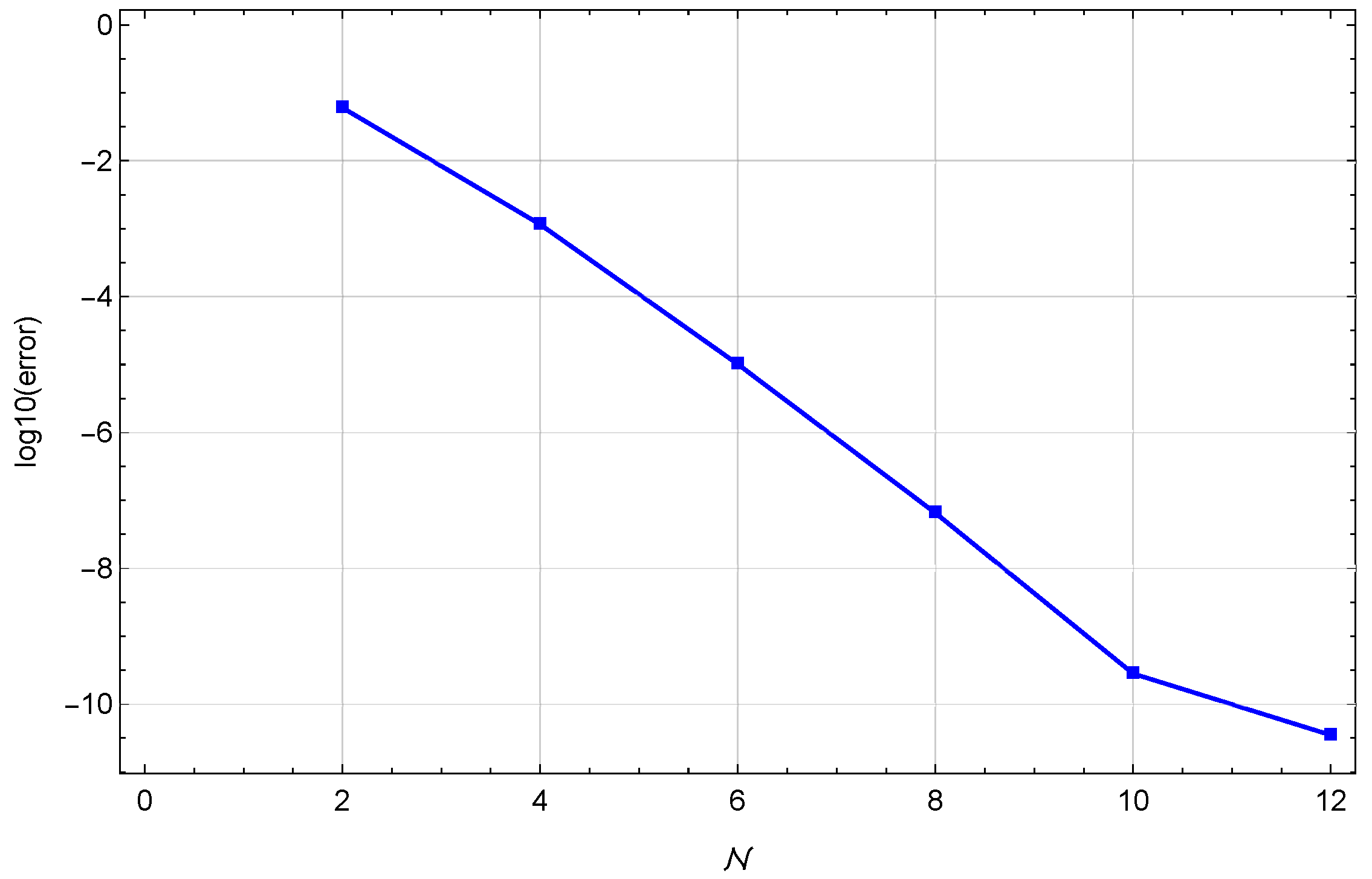
When β 1 = β 2 = 0.5 and N = 12 , Table 1 compares our technique to the methods in [46,47] with respect to the L error. Table 2 also shows the L error for N = 12 , in comparison to the technique in [46] for different β 1 and β 2 values. In addition, Table 3 compares our technique to the algorithm in [47] at different β 1 and β 2 values, specifically looking at the L error at N = 11 . With β 1 = 0.1 , β 2 = 0.9 , and N = 11 , the absolute errors (AEs) and the CPU times (in seconds) for our numerical method are displayed in Table 4. If β 1 = 0.7 and β 2 = 0.6 , the AEs at various N values are displayed in Figure 1. Various values of N and β 1 = β 2 = 0.5 are shown in Figure 2 as Log10( L errors).
Example 2
([47]). Consider the following equation:
v t ( ρ , t ) = D t 1 β 1 v ρ ρ ( ρ , t ) D t 1 β 2 v ( ρ , t ) + 3 t 2 ( ρ 2 ρ ) 12 t 2 + β 1 Γ ( 3 + β 1 ) 2 t β 1 1 Γ ( β 1 ) + 6 t 2 + β 2 Γ ( 3 + β 2 ) + t β 2 1 Γ ( β 2 ) ( ρ 2 ρ ) ,
governed by
v ( ρ , 0 ) = ρ 2 ρ , 0 < ρ < 1 , v ( 0 , t ) = v ( 1 , t ) = 0 , 0 < t < 1 ,
with the exact solution: v ( ρ , t ) = t 3 + 1 ρ 2 ρ .
Applying our proposed algorithm at β 1 = β 2 = 0.5 when N = 3 , we get the following system:
8 θ 0 , 1 3 π + 2 θ 0 , 1 + 2 θ 0 , 3 32 θ 2 , 1 π 8 θ 0 , 2 5 π + 96 θ 2 , 2 5 π + 16 θ 0 , 3 7 π 192 θ 2 , 3 7 π = 1 6 208 105 π , 8 θ 0 , 1 15 π + 2 θ 0 , 2 32 θ 2 , 1 5 π + 8 θ 0 , 2 7 π 96 θ 2 , 2 7 π + 64 θ 2 , 3 15 π 16 θ 0 , 3 45 π = 1 12 208 189 π , 8 θ 0 , 1 105 π + 2 θ 0 , 3 32 θ 2 , 2 5 π + 8 θ 0 , 2 15 π + 32 θ 2 , 1 35 π + 304 θ 0 , 3 385 π 3648 θ 2 , 3 385 π = 1 60 208 693 π , 2 3 θ 1 , 1 + 8 θ 1 , 1 9 π + 2 3 θ 1 , 3 + 32 θ 3 , 2 π 160 θ 3 , 1 3 π 320 θ 3 , 3 7 π 8 θ 1 , 2 15 π + 16 θ 1 , 3 21 π = 0 , 8 θ 1 , 1 45 π + 2 3 θ 1 , 2 32 θ 3 , 1 3 π 160 θ 3 , 2 7 π + 64 θ 3 , 3 9 π + 8 θ 1 , 2 21 π 16 θ 1 , 3 135 π = 0 , 8 θ 1 , 1 315 π + 2 3 θ 1 , 3 32 θ 3 , 2 3 π + 32 θ 3 , 1 21 π + 8 θ 1 , 2 45 π 1216 θ 3 , 3 77 π + 304 θ 1 , 3 1155 π = 0 , θ 0 , 0 θ 0 , 1 + θ 0 , 2 θ 0 , 3 = 1 6 , 1 3 θ 1 , 0 1 3 θ 1 , 1 + 1 3 θ 1 , 2 1 3 θ 1 , 3 = 0 , 1 5 θ 2 , 0 1 5 θ 2 , 1 + 1 5 θ 2 , 2 1 5 θ 2 , 3 = 1 30 , 1 7 θ 3 , 0 1 7 θ 3 , 1 + 1 7 θ 3 , 2 1 7 θ 3 , 3 = 0 , θ 0 , 0 θ 1 , 0 + θ 2 , 0 θ 3 , 0 = 0 , 1 3 θ 0 , 1 1 3 θ 1 , 1 + 1 3 θ 2 , 1 1 3 θ 3 , 1 = 0 , 1 5 θ 0 , 2 1 5 θ 1 , 2 + 1 5 θ 2 , 2 1 5 θ 3 , 2 = 0 , θ 0 , 0 + θ 1 , 0 + θ 2 , 0 + θ 3 , 0 = 0 , 1 3 θ 0 , 1 + 1 3 θ 1 , 1 + 1 3 θ 2 , 1 + 1 3 θ 3 , 1 = 0 , 1 5 θ 0 , 2 + 1 5 θ 1 , 2 + 1 5 θ 2 , 2 + 1 5 θ 3 , 2 = 0 ,
which can be solved using the Gauss elimination method to get
θ 0 , 0 = 5 24 , θ 0 , 1 = 3 40 , θ 0 , 2 = 1 24 , θ 0 , 3 = 1 120 , θ 1 , 0 = 0 , θ 1 , 1 = 0 , θ 1 , 2 = 0 , θ 1 , 3 = 0 , θ 2 , 0 = 5 24 , θ 2 , 1 = 3 40 , θ 2 , 2 = 1 24 , θ 2 , 3 = 1 120 , θ 3 , 0 = 0 , θ 3 , 1 = 0 , θ 3 , 2 = 0 , θ 3 , 3 = 0 .
Therefore, v N ( ρ , t ) = t 3 + 1 ρ 2 ρ , which is the exact solution.
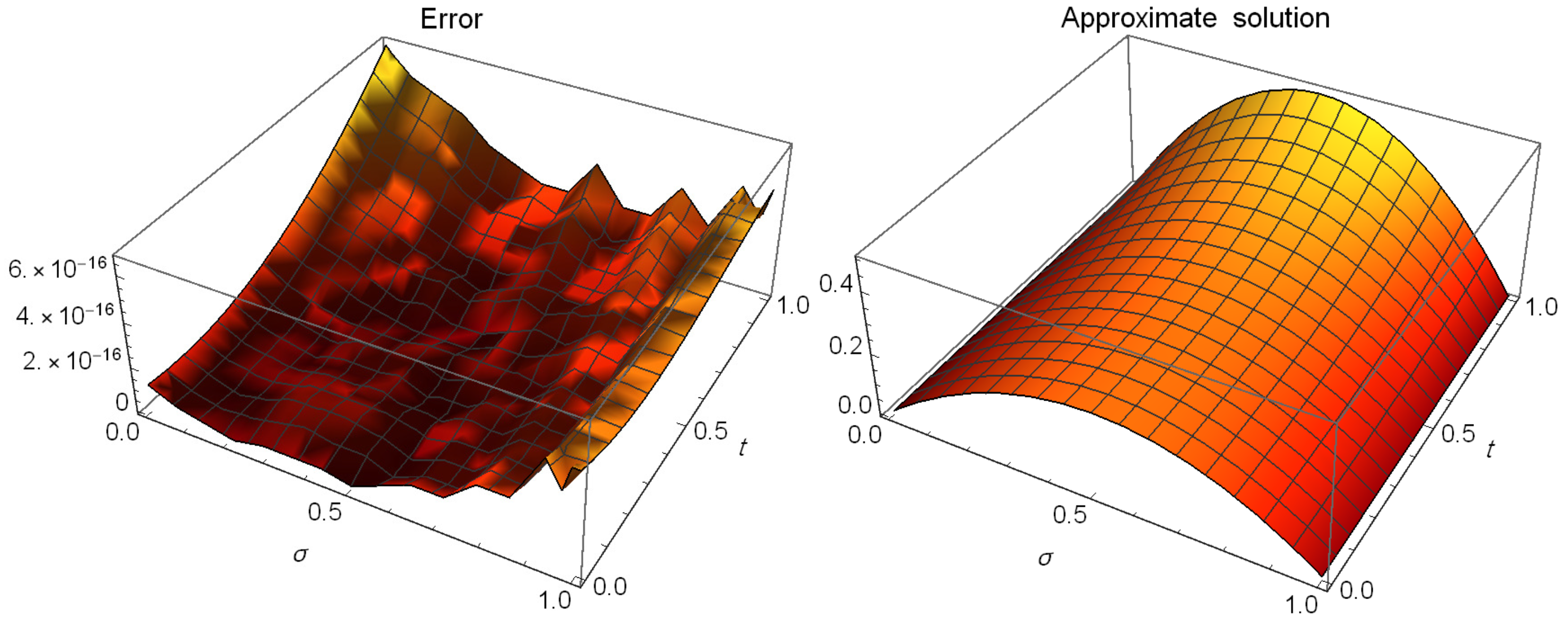
Also, at N = 3 and with different β 1 and β 2 , Table 5 shows the results of comparing our technique to the algorithm in [47] with respect to L 2 and L errors. Figure 3 illustrates the AEs (left) and approximate solution (right) at β 1 = 0.1 , β 2 = 0.9 when N = 3 .
Example 3.
Consider the following equation:
v t ( ρ , t ) = D t 1 β 1 v ρ ρ ( ρ , t ) D t 1 β 2 v ( ρ , t ) + 3 t 2 1 + 2 t β 1 Γ ( 3 + β 1 ) + 2 t β 2 Γ ( 3 + β 2 ) e ρ ,
governed by
v ( ρ , 0 ) = 0 , 0 < ρ < 1 , v ( 0 , t ) = v ( 1 , t ) = 0 , 0 < t < 1 ,
with the exact solution: v ( ρ , t ) = t 3 e ρ .
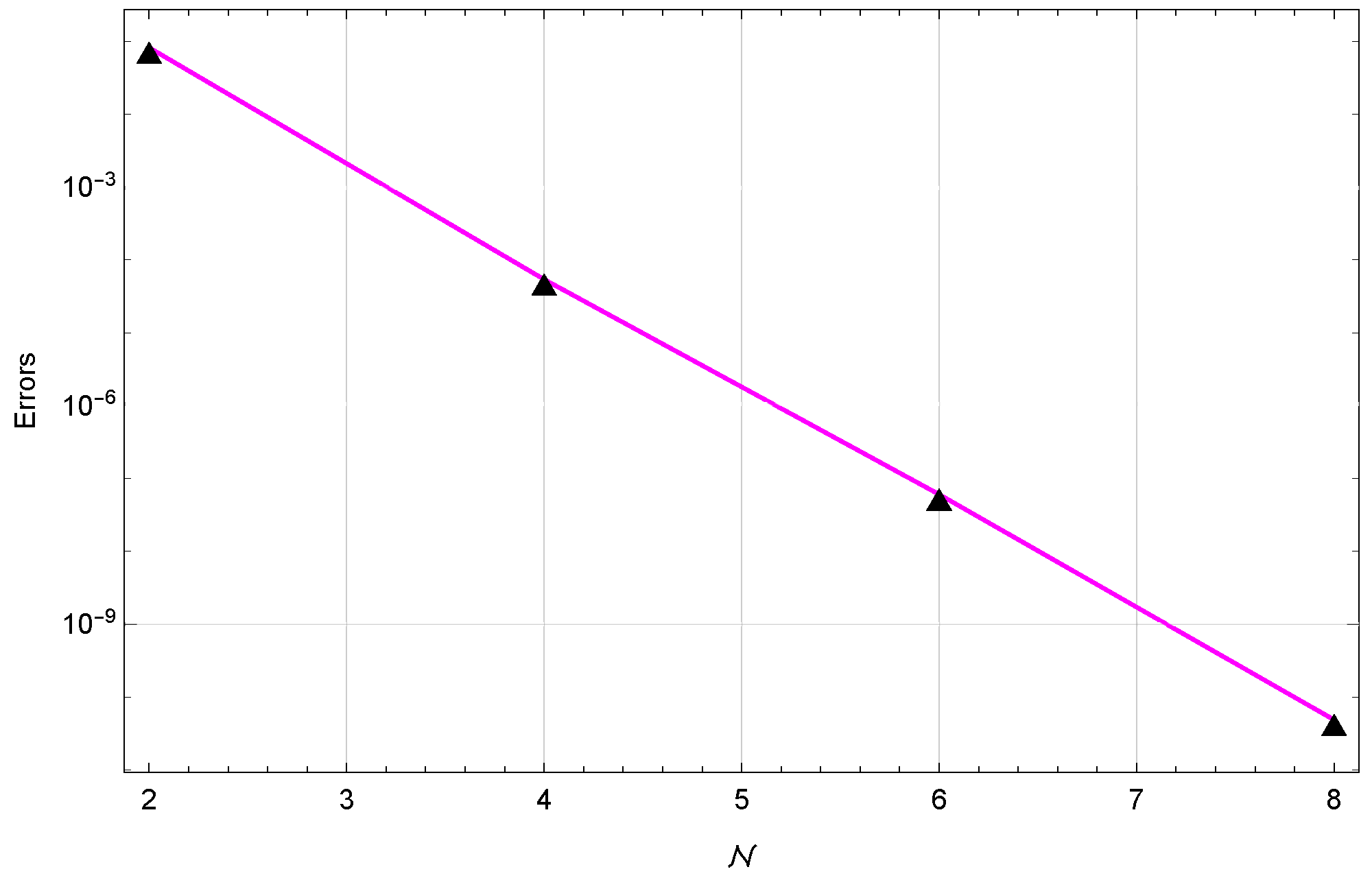
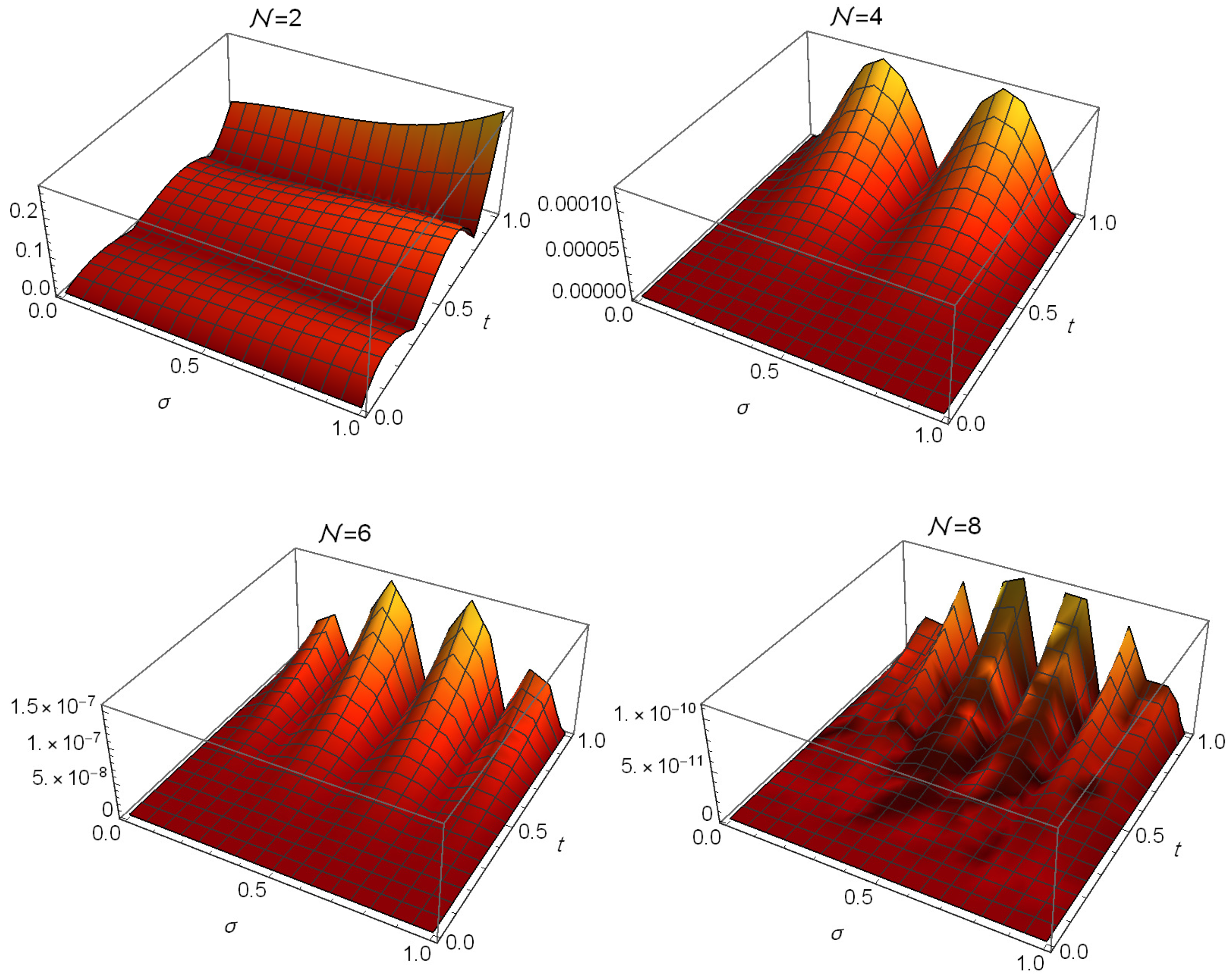
Table 6 reports the L errors at different values of N when β 1 = β 2 . Also, it displays the CPU times (in seconds) for our numerical method in such a case. Figure 4 shows the L errors at different values of N when β 1 = 0.6 and β 2 = 0.9 . Figure 5 illustrates the AEs at different values of N when β 1 = 0.3 and β 1 = 0.8 .
Example 4.
Consider the following equation:
v t ( ρ , t ) = D t 1 β 1 v ρ ρ ( ρ , t ) D t 1 β 2 v ( ρ , t ) ,
governed by
v ( ρ , 0 ) = sin ( π ρ ) , 0 < ρ < 1 , v ( 0 , t ) = v ( 1 , t ) = 0 , 0 < t < 1 .
Defining the following absolute residual error is necessary due to the lack of an exact solution. It is defined as
A R E s = max ( ρ , t ) ( 0 , 1 ) × ( 0 , 1 ) v t N ( ρ , t ) D t 1 β 1 μ v ρ ρ N ( ρ , t ) + D t 1 β 2 v N ( ρ , t ) .
We apply the proposed technique to obtain the approximate solutions and the A R E s .
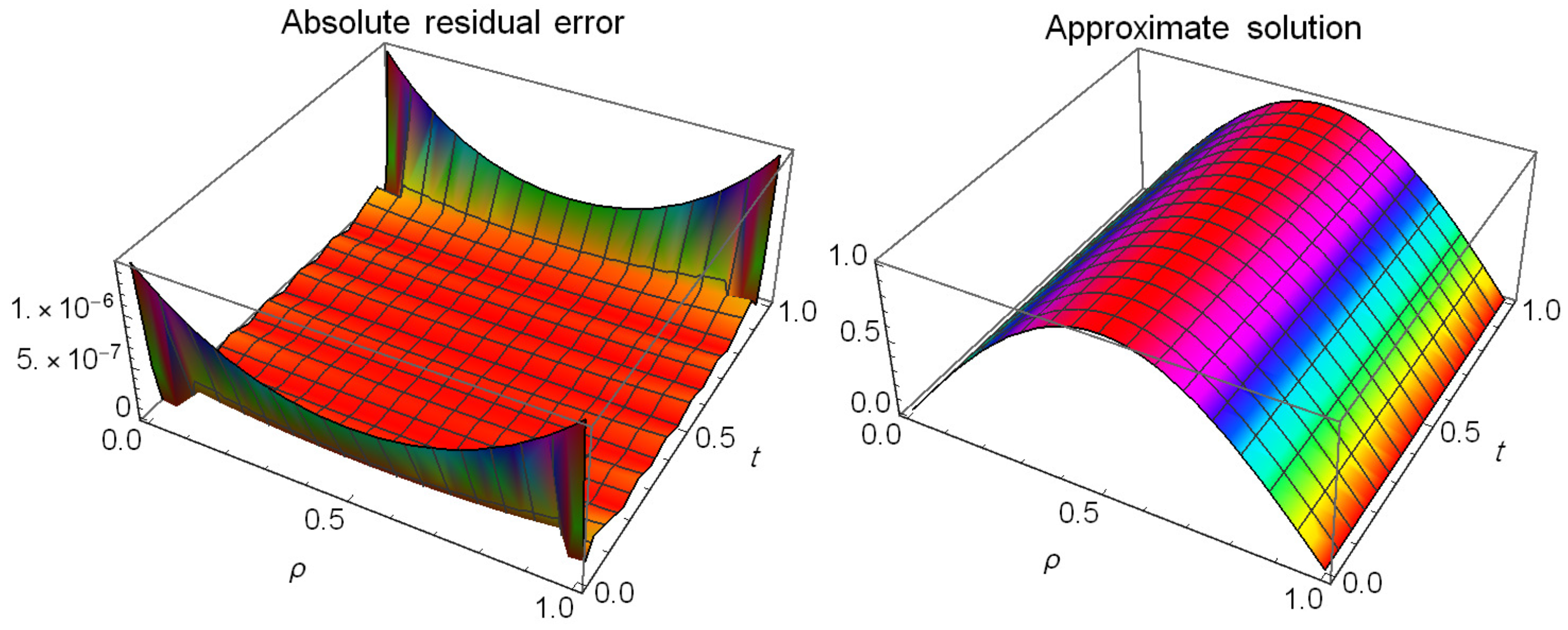
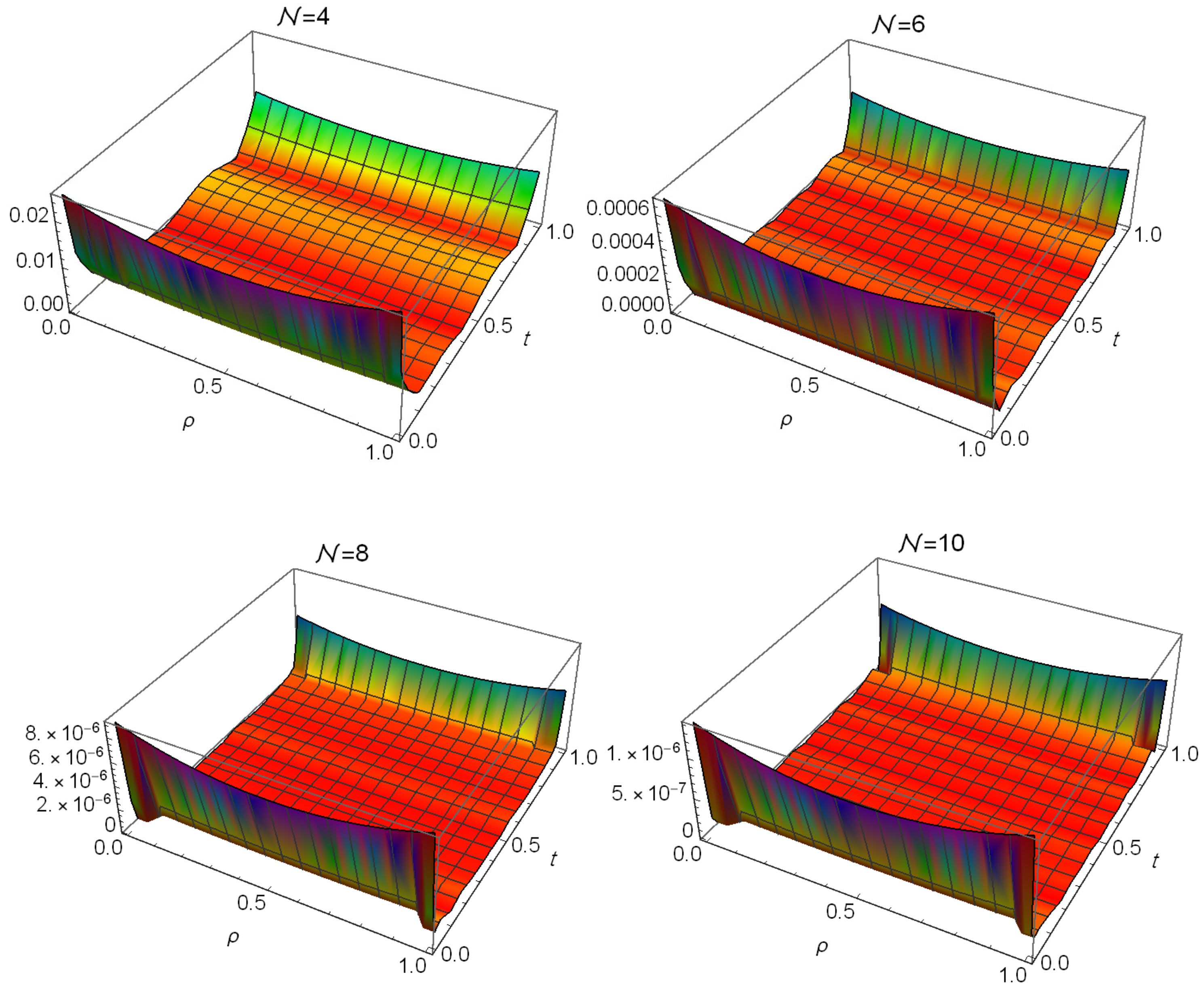
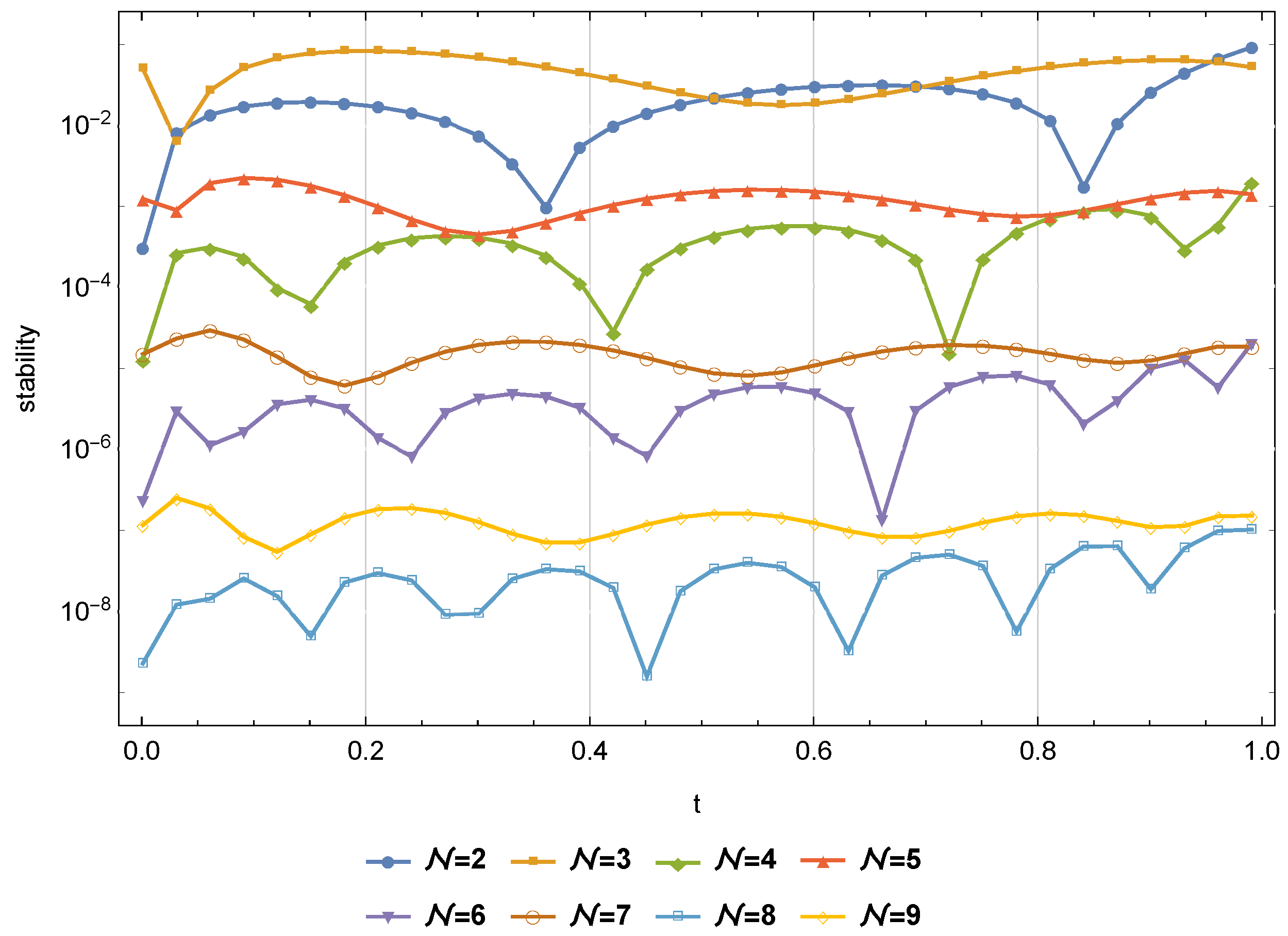
Table 7 presents the AREs at β 1 = β 2 = 0.5 when N = 10 . Also, Figure 6 illustrates the AREs and approximate solution at β 1 = β 2 = 0.5 when N = 10 .  Figure 7 illustrates the AREs at different values of N when β 1 = 0.2 and β 2 = 0.8 . Figure 8 illustrates the stability | v N + 1 v N | at ρ = t when β 1 = 0.2 and β 2 = 0.8 .

6. Concluding Remarks

This work presented a new, highly effective spectral tau method based on the shifted Delannoy polynomials to treat the time-fractional cable equation, a fractional partial differential equation arising in neuronal dynamics and electro-diffusion models. Using some properties of these polynomials, the algorithm was designed. A comprehensive convergence analysis in Delannoy-weighted Sobolev spaces was studied. The numerical experiments confirmed the method’s theoretical properties and demonstrated its remarkable accuracy in approximating exact solutions with minimal basis terms. We think that the algorithm in this paper can be followed to treat some other DEs in the applied sciences. In addition, we intend to employ other sequences of polynomials that are related to the Delannoy polynomials in other practical problems. All codes were written and debugged using Mathematica 11 on an HP Z420 Workstation, Hewlett-Packard, Palo Alto, United States, with an Intel(R) Xeon(R) CPU E5-1620 processor, v2, 3.70 GHz; 16 GB of RAM, DDR3; and 512 GB of storage.

Author Contributions

Conceptualization, A.G.A.; Methodology, A.G.A., N.M.A.A. and W.M.A.-E.; Software, A.G.A.; Validation, M.A.A., N.M.A.A. and W.M.A.-E.; Formal analysis, A.G.A.; Investigation, M.A.A., N.M.A.A. and W.M.A.-E.; Writing—original draft, A.G.A. and W.M.A.-E.; Writing—review & editing, A.G.A. and W.M.A.-E.; Supervision, W.M.A.-E.; Funding acquisition, M.A.A. All authors have read and agreed to the published version of the manuscript.

Funding

This work was supported and funded by the Deanship of Scientific Research at Imam Mohammad Ibn Saud Islamic University (IMSIU) (grant number IMSIU-DDRSP2502).

Data Availability Statement

The original contributions presented in this study are included in the article. Further inquiries can be directed to the corresponding author.

Conflicts of Interest

The authors declare no conflicts of interest.

References

  1. Ortigueira, M.D. Fractional Calculus in Applied Sciences and Engineering; Springer: Cham, Switzerland, 2015. [Google Scholar]
  2. Tarasov, V.E. Fractional Dynamics: Applications of Fractional Calculus to Dynamics of Particles, Fields, and Media; Springer: Berlin, Germany, 2011. [Google Scholar]
  3. Qing, W.; Pan, B. Modified fractional homotopy method for solving nonlinear optimal control problems. Nonlinear Dyn. 2024, 112, 3453–3479. [Google Scholar] [CrossRef]
  4. Islam, M.; Akbar, M.A. A study on the fractional-order COVID-19 SEIQR model and parameter analysis using homotopy perturbation method. Partial Differ. Equ. Appl. Math. 2024, 12, 100960. [Google Scholar] [CrossRef]
  5. Alhamzi, G.; Gouri, A.; Alkahtani, B.S.T.; Dubey, R.S. Analytical solution of generalized Bratu-type fractional differential equations using the homotopy perturbation transform method. Axioms 2024, 13, 133. [Google Scholar] [CrossRef]
  6. Zhang, X.; Feng, Y.; Luo, Z.; Liu, J. A spatial sixth-order numerical scheme for solving fractional partial differential equation. Appl. Math. Lett. 2025, 159, 109265. [Google Scholar] [CrossRef]
  7. Sivalingam, S.M.; Kumar, P.; Trinh, H.; Govindaraj, V. A novel L1-Predictor-Corrector method for the numerical solution of the generalized-Caputo type fractional differential equations. Math. Comput. Simul. 2024, 220, 462–480. [Google Scholar] [CrossRef]
  8. Choudhary, R.; Singh, S.; Das, P.; Kumar, D. A higher order stable numerical approximation for time-fractional non-linear Kuramoto–Sivashinsky equation based on quintic B-spline. Math. Methods Appl. Sci. 2024, 47, 11953–11975. [Google Scholar] [CrossRef]
  9. Singh, J.; Kumar, J.; Kumar, D.; Baleanu, D. A reliable numerical algorithm based on an operational matrix method for treatment of a fractional order computer virus model. AIMS Math. 2024, 9, 3195–3210. [Google Scholar] [CrossRef]
  10. Ahmed, H.M.; Izadi, M. An accurate approximation technique based on Schröder operational matrices for numerical treatments of time-fractional nonlinear generalized Kawahara equation. Bound. Value Probl. 2025, 2025, 90. [Google Scholar] [CrossRef]
  11. Ahmed, H.M. Enhanced shifted Jacobi operational matrices of integrals: Spectral algorithm for solving some types of ordinary and fractional differential equations. Bound. Value Probl. 2024, 2024, 75. [Google Scholar] [CrossRef]
  12. Marasi, H.R.; Derakhshan, M.H.; Ghuraibawi, A.A.; Kumar, P. A novel method based on fractional order Gegenbauer wavelet operational matrix for the solutions of the multi-term time-fractional telegraph equation of distributed order. Math. Comput. Simul. 2024, 217, 405–424. [Google Scholar] [CrossRef]
  13. Manohara, G.; Kumbinarasaiah, S. Fibonacci wavelet collocation method for the numerical approximation of fractional order Brusselator chemical model. J. Math. Chem. 2024, 62, 2651–2681. [Google Scholar] [CrossRef]
  14. Pant, R.; Arora, G.; Singh, B.K.; Emadifar, H. Numerical solution of two-dimensional fractional differential equations using Laplace transform with residual power series method. Nonlinear Eng. 2024, 13, 20220347. [Google Scholar] [CrossRef]
  15. Alikhanov, A.A.; Asl, M.S.; Huang, C. Stability analysis of a second-order difference scheme for the time-fractional mixed sub-diffusion and diffusion-wave equation. Fract. Calc. Appl. Anal. 2024, 27, 102–123. [Google Scholar] [CrossRef]
  16. Feng, Y.; Zhang, X.; Chen, Y.; Wei, L. A compact finite difference scheme for solving fractional Black-Scholes option pricing model. J. Inequal. Appl. 2025, 2025, 36. [Google Scholar] [CrossRef]
  17. Wang, F.; Wen, S.Y.; Fang, Q.; Wang, P. Application of Adomian decomposition method to fractional order partial differential equations. Therm. Sci. 2025, 29, 1375–1381. [Google Scholar] [CrossRef]
  18. Canuto, C.; Hussaini, M.Y.; Quarteroni, A.; Zang, T.A. Spectral Methods: Fundamentals in Single Domains; Springer: Berlin/Heidelberg, Germany, 2006. [Google Scholar]
  19. Boyd, J.P. Chebyshev and Fourier Spectral Methods, 2nd ed.; Dover Publications: Garden City, NY, USA, 2001. [Google Scholar]
  20. Shen, J.; Tang, T.; Wang, L.L. Spectral Methods: Algorithms, Analysis and Applications. In Springer Series in Computational Mathematics; Springer: Berlin/Heidelberg, Germany, 2011; Volume 41. [Google Scholar]
  21. Çevik, M.; Savaşaneril, N.B.; Sezer, M. A review of polynomial matrix collocation methods in engineering and scientific applications. Arch. Comput. Methods Eng. 2025, 32, 3355–3373. [Google Scholar] [CrossRef]
  22. Manohara, G.; Kumbinarasaiah, S. An innovative Fibonacci wavelet collocation method for the numerical approximation of Emden-Fowler equations. Appl. Numer. Math. 2024, 201, 347–369. [Google Scholar] [CrossRef]
  23. Haq, S.; Noreen, A.; Akbar, T.; Arifeen, S.U.; Ghafoor, A.; Khan, Z.A. Numerical solution of seventh order KdV equations via quintic B-splines collocation method. Alex. Eng. J. 2025, 114, 497–506. [Google Scholar] [CrossRef]
  24. Gamal, M.; Zaky, M.A.; El-Kady, M.; Abdelhakem, M. Chebyshev polynomial derivative-based spectral tau approach for solving high-order differential equations. Comput. Appl. Math. 2024, 43, 412. [Google Scholar] [CrossRef]
  25. Abd-Elhameed, W.M.; Abu Sunayh, A.F.; Alharbi, M.H.; Atta, A.G. Spectral tau technique via Lucas polynomials for the time-fractional diffusion equation. AIMS Math. 2024, 9, 34567–34587. [Google Scholar] [CrossRef]
  26. Abd-Elhameed, W.M.; Youssri, Y.H.; Atta, A.G. Adopted spectral tau approach for the time-fractional diffusion equation via seventh-kind Chebyshev polynomials. Bound. Value Probl. 2024, 2024, 102. [Google Scholar] [CrossRef]
  27. Abd-Elhameed, W.M.; Ahmed, H.M. Spectral solutions for the time-fractional heat differential equation through a novel unified sequence of Chebyshev polynomials. AIMS Math. 2024, 9, 2137–2166. [Google Scholar] [CrossRef]
  28. Chaudhary, R.; Aeri, S.; Bala, A.; Kumar, R.; Baleanu, D. Solving system of fractional differential equations via Vieta-Lucas operational matrix method. Int. J. Appl. Comput. Math. 2024, 10, 14. [Google Scholar] [CrossRef]
  29. Abd Elaziz El-Sayed, A.; Boulaaras, S.; Sweilam, N.H. Numerical solution of the fractional-order logistic equation via the first-kind Dickson polynomials and spectral tau method. Math. Methods Appl. Sci. 2023, 46, 8004–8017. [Google Scholar] [CrossRef]
  30. Qian, N.; Sejnowski, T. An electro-diffusion model for computing membrane potentials and ionic concentrations in branching dendrites, spines and axons. Biol. Cybern. 1989, 62, 1–15. [Google Scholar] [CrossRef]
  31. Saxton, M.J. Anomalous subdiffusion in fluorescence photobleaching recovery: A Monte Carlo study. Biophys. J. 2001, 81, 2226–2240. [Google Scholar] [CrossRef]
  32. Salama, F.M. On numerical simulations of variable-order fractional cable equation arising in neuronal dynamics. Fractal Fract. 2024, 8, 282. [Google Scholar] [CrossRef]
  33. Kumar, C.V.D.; Prakasha, D.G.; Veeresha, P.; Kapoor, M. A homotopy-based computational scheme for two-dimensional fractional cable equation. Mod. Phys. Lett. B 2024, 38, 2450292. [Google Scholar] [CrossRef]
  34. Kosari, S.; Xu, P.; Shafi, J.; Derakhshan, M.H. An efficient hybrid numerical approach for solving two-dimensional fractional cable model involving time-fractional operator of distributed order with error analysis. Numer. Algorithms 2024, 99, 1269–1288. [Google Scholar] [CrossRef]
  35. Sweilam, N.H.; Ahmed, S.M.; Al-Mekhlafi, S.M. Two-dimensional distributed order Cable equation with non-singular kernel: A nonstandard implicit compact finite difference approach. J. Appl. Math. Comput. Mech. 2024, 23, 93–104. [Google Scholar] [CrossRef]
  36. Nikan, O.; Golbabai, A.; Machado, J.A.T.; Nikazad, T. Numerical approximation of the time fractional Cable model arising in neuronal dynamics. Eng. Comput. 2022, 38, 155–173. [Google Scholar] [CrossRef]
  37. Mirzaei, S.; Shokri, A. A pseudo-spectral approach to solving the fractional Cable equation using Lagrange polynomials. Anal. Numer. Solut. Nonlinear Equ. 2025, 9, 20–33. [Google Scholar]
  38. Mittal, A.K.; Balyan, L.K.; Panda, M.K.; Shrivastava, P.; Singh, H. Pseudospectral analysis and approximation of two-dimensional fractional Cable equation. Math. Methods Appl. Sci. 2022, 45, 8613–8630. [Google Scholar] [CrossRef]
  39. Rezazadeh, A.; Avazzadeh, Z. Barycentric–Legendre interpolation method for solving two-dimensional fractional Cable equation in neuronal dynamics. Int. J. Appl. Comput. Math. 2022, 8, 80. [Google Scholar] [CrossRef]
  40. Biranvand, N.; Ebrahimijahan, A. Utilizing differential quadrature-based RBF partition of unity collocation method to simulate distributed-order time fractional Cable equation. Comput. Appl. Math. 2024, 43, 52. [Google Scholar] [CrossRef]
  41. Podlubny, I. Fractional Differential Equations: An Introduction to Fractional Derivatives, Fractional Differential Equations, to Methods of Their Solution and Some of Their Applications; Elsevier: Amsterdam, The Netherlands, 1998; Volume 198. [Google Scholar]
  42. Kamel, S.G.; Atta, A.G.; Youssri, Y.H. A spectral Delannoy polynomial-based computational framework for fractional differential problems in complex systems. Int. J. Mod. Phys. C. [CrossRef]
  43. Andrews, G.; Askey, R.; Roy, R. Special Functions; Cambridge University Press: Cambridge, UK, 1999. [Google Scholar]
  44. Yang, Y.; Huang, Y.; Zhou, Y. Numerical simulation of time fractional cable equations and convergence analysis. Numer. Methods Partial Differ. Equ. 2018, 34, 1556–1576. [Google Scholar] [CrossRef]
  45. Zhao, X.; Wang, L.L.; Xie, Z. Sharp error bounds for Jacobi expansions and Gegenbauer–Gauss quadrature of analytic functions. SIAM J. Numer. Anal. 2013, 51, 1443–1469. [Google Scholar] [CrossRef]
  46. Yang, X.; Jiang, X.; Zhang, H. A time–space spectral tau method for the time fractional cable equation and its inverse problem. Appl. Numer. Math. 2018, 130, 95–111. [Google Scholar] [CrossRef]
  47. Moshtaghi, N.; Saadatmandi, A. Numerical solution of time fractional cable equation via the sinc-Bernoulli collocation method. J. Appl. Comput. Mech. 2021, 7, 1916–1924. [Google Scholar]
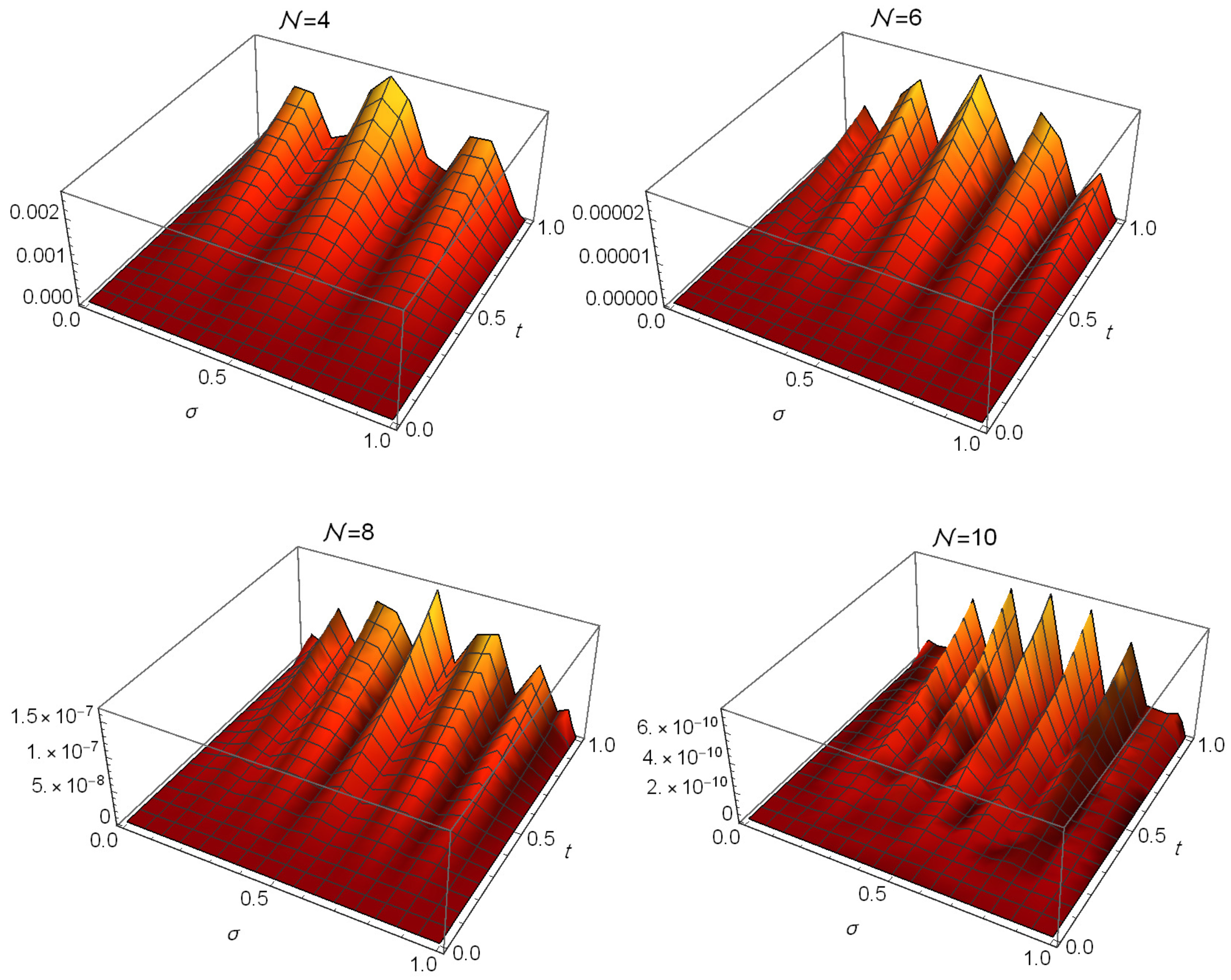
Figure 1. The AEs of Example 1 at β 1 = 0.7 and β 1 = 0.6 .
Symmetry 17 01916 g001
Figure 2. The Log10( L errors) of Example 1 at β 1 = β 2 = 0.5 .
Symmetry 17 01916 g002
Figure 3. The AEs (left) and approximate solution (right) of Example 2 at β 1 = 0.1 , β 2 = 0.9 when N = 3 .
Symmetry 17 01916 g003
Figure 4. The L errors of Example 3 at β 1 = 0.6 and β 2 = 0.9 .
Symmetry 17 01916 g004
Figure 5. The absolute errors of Example 3 at β 1 = 0.3 and β 1 = 0.8 .
Symmetry 17 01916 g005
Figure 6. The AREs and approximate solution of Example 4 at β 1 = β 2 = 0.5 when N = 10 .
Symmetry 17 01916 g006
Figure 7. The AREs of Example 4 at β 1 = 0.2 , β 2 = 0.8 .
Symmetry 17 01916 g007
Figure 8. Stability | v N + 1 v N | at ρ = t for Example 4.
Symmetry 17 01916 g008
Table 1. L errors for Example 1 using some algorithms.
β 1 = β 2 Algorithm in [46] ( M = N = 13 ) Algorithm in [47] ( n = 2 , m = 70 ) Proposed Algorithm ( N = 12 )
0.5 1.7881 × 10 5 4.86 × 10 10 3.49658 × 10 11
Table 2. L error for Example 1 using some algorithms.
β 1 = 0.3 , β 2 = 0.9 β 1 = 0.7 , β 2 = 0.6
Algorithm in [46] at M = N = 13 Proposed algorithm ( N = 12 )Algorithm in [46] at M = N = 13 Proposed algorithm ( N = 12 )
2.1018 × 10 5 5.91469 × 10 11 9.3019 × 10 6 5.76555 × 10 10
Table 3. Comparison of L errors for Example 1.
β 1 = β 2 = 0.8 β 1 = 0.1 , β 2 = 0.9
Algorithm in [47] ( n = 2 , m = 70 ) Proposed algorithm ( N = 11 )Algorithm in [47] ( n = 2 , m = 70 ) Proposed algorithm ( N = 11 )
4.83 × 10 10 2.89733 × 10 10 4.96 × 10 10 2.81851 × 10 10
Table 4. The AEs of Example 1 at β 1 = 0.1 , β 1 = 0.9 and N = 11 .
ρ t = 0.3 CPU Time t = 0.6 CPU Time t = 0.9 CPU Time
0.1 2.94327 × 10 11 1.25623 × 10 10 2.87945 × 10 10
0.2 5.03939 × 10 11 1.86575 × 10 10 4.09773 × 10 10
0.3 1.90502 × 10 11 9.68244 × 10 11 2.31566 × 10 10
0.4 2.50365 × 10 11 1.24427 × 10 10 2.96217 × 10 10
0.5 7.51394 × 10 11 284.53 2.75028 × 10 10 284.53 6.01727 × 10 10 284.53
0.6 2.27626 × 10 11 1.15302 × 10 10 2.75575 × 10 10
0.7 2.03983 × 10 11 1.02235 × 10 10 2.43806 × 10 10
0.8 4.9836 × 10 11 1.84337 × 10 10 4.0471 × 10 10
0.9 2.85416 × 10 11 1.22048 × 10 10 2.79856 × 10 10
Table 5. Comparison of L 2 and L errors for Example 2.
L 2 Error L Error
β 1 β 2 Algorithm in [47]
( n = 3 , m = 70 )
Proposed Algorithm
( N = 3 )
Algorithm in [47]
( n = 3 , m = 70 )
Proposed Algorithm
( N = 3 )
0.50.5 5.33 × 10 11 2.19956 × 10 16 7.54 × 10 12 2.98372 × 10 16
0.80.8 6.21 × 10 11 6.10341 × 10 16 8.33 × 10 12 3.88578 × 10 16
0.10.9 3.07 × 10 11 2.3737 × 10 16 5.00 × 10 12 4.71845 × 10 16
Table 6. The L errors of Example 3.
N 246810
β 1 = β 2 = 0.5 2.71828 × 10 1 5.37769 × 10 5 6.03175 × 10 8 4.72755 × 10 11 1.25091 × 10 11
CPU time3.1578.01623.12461.437161.172
β 1 = β 2 = 0.9 2.71828 × 10 1 5.27944 × 10 5 6.05789 × 10 8 4.53186 × 10 11 2.07565 × 10 11
CPU time2.7977.70420.9754.328142.454
Table 7. The AREs of Example 4 at β 1 = β 2 = 0.5 when N = 10 .
ρ t = 0.3 t = 0.6 t = 0.9
0.1 5.07452 × 10 8 4.42921 × 10 8 2.79878 × 10 8
0.2 3.61544 × 10 8 3.28469 × 10 8 2.0652 × 10 8
0.3 2.67327 × 10 8 2.54561 × 10 8 1.59649 × 10 8
0.4 2.14619 × 10 8 2.13211 × 10 8 1.33616 × 10 8
0.5 1.97669 × 10 8 1.99914 × 10 8 1.25275 × 10 8
0.6 2.14619 × 10 8 2.13211 × 10 8 1.33616 × 10 8
0.7 2.67327 × 10 8 2.54561 × 10 8 1.59649 × 10 8
0.8 3.61544 × 10 8 3.28469 × 10 8 2.0652 × 10 8
0.9 5.07452 × 10 8 4.42921 × 10 8 2.79878 × 10 8
Disclaimer/Publisher’s Note: The statements, opinions and data contained in all publications are solely those of the individual author(s) and contributor(s) and not of MDPI and/or the editor(s). MDPI and/or the editor(s) disclaim responsibility for any injury to people or property resulting from any ideas, methods, instructions or products referred to in the content.