Article

Deformation Control Technology for Surrounding Rock in Soft Rock Roadways of Deep Kilometer-Scale Mining Wells


1
School of Geology and Mining Engineering, Xinjiang University, Urumqi 830047, China
2
State Key Laboratory for Tunnel Engineering, China University of Mining & Technology, Beijing 100083, China
3
Key Laboratory of Xinjiang Coal Resources Green Mining, Xinjiang Key Laboratory of Coal Bearing Resources Exploration and Exploitation, Xinjiang Engineering Research Center of Green Intelligent Coal Mining, Xinjiang Institute of Engineering, Urumqi 830023, China
*
Authors to whom correspondence should be addressed.
Symmetry 2025, 17(11), 1911; https://doi.org/10.3390/sym17111911
Submission received: 30 September 2025 / Revised: 2 November 2025 / Accepted: 6 November 2025 / Published: 7 November 2025

Abstract

Deep soft rock roadways at about 1 km depth experience significant deformation due to concentrated stress ahead of the working face and dynamic loads from the hard roof layer. We propose an integrated control method that couples directional roof cutting, which interrupts stress transfer with constant resistance, and large deformation cable reinforcement to accommodate residual movement. The calibrated FLAC3D model indicates a lower front of face stress and a diminished cyclic build up of elastic strain energy in the roof, which reduces roadway convergence. Field data from Face 13403 corroborate the method’s effectiveness: the average hydraulic support load on the roof cutting side was 20.3 MPa, which is 30.1% lower than on the non-cutting side; deformation stabilized about 320 m behind the face; the final roof to floor and rib to rib closures were 1.10 m and 1.47 m; and the entry remained fit for the next panel. These results indicate that coupling roof cutting with constant resistance cable reinforcement reduces mining-induced loads while increasing deformation tolerance, providing a practical solution for stabilizing kilometer-deep soft rock roadways.

1. Introduction

As shallow mineral reserves are progressively depleted, extraction is moving into deeper crustal formations, and kilometer-deep mining is becoming the prevailing practice, with working depths increasing by about 10 to 25 m per year [1,2]. Deep mining is characterized by “three highs and one disturbance”: high in situ stress, elevated temperature, high pore pressure, and mining-induced disturbance [3,4]. Using the ultra-deep Haba Snow Mountain Tunnel as a reference case, studies show that an advanced center drift (ACD) can relieve ground stress and reduce deformation, with a practical design window of λ ≈ 0.6, crown spacing of H ≈ 2 m, and lead distance of L ≈ 20 m [5]. A unified reliability framework for deep tunnels in brittle rock has also been proposed, integrating interval/p-box analysis and random field modeling (via EOLE) within a MATLAB (2022a)–FLAC2D workflow to propagate mixed epistemic and aleatory uncertainties; applied to a Canadian case, it yields p-boxes for convergence and the excavation-damaged zone (EDZ) that bound deterministic and standard random field results and identifies GSI imprecision as the dominant source of uncertainty [6].
To address the complexities of controlling the surrounding rock in deep soft rock roadways, researchers worldwide have investigated a range of theories and methods. One line of work that has been proposed and field validated is a coupled support scheme that combines negative Poisson’s ratio constant resistance anchor cables with a double layer three-dimensional steel truss; simulations and monitoring showed that deformation was limited to 250 to 300 mm while maintaining about 350 kN constant resistance, outperforming conventional NATM based designs [7]. Another study, using laboratory tests, FLAC3D modeling, and field monitoring in the Minxian tunnel, showed that NPR constant resistance anchor cables provide effective compensatory support, sustaining 300 to 350 kN and keeping deformation below 300 mm [8]. An integrated early warning and reinforcement approach coupled catastrophe theory-based instability prediction with an energy transfer model for time and size anchorage; field application constrained deformation to about 0.35 m, reduced released energy, and accelerated stabilization [9]. A study that integrated in situ microseismic monitoring, numerical simulation, and moment tensor analysis characterized progressive failure in a high-stress soft rock tunnel, revealing asymmetric damage with shallow shear and deep tensile cracking and delineating three high-damage zones with typical depths of 4 to 12 m [10]. Other contributions have proposed composite or combined support systems, for example, shotcrete with grouted rock bolts and anchor cables, as well as bolts, anchor cables, 36U steel arches, mesh, base plates, and backfilling behind the wall, and techniques that prioritize the reinforcement of weak structural zones [11,12,13]. Anchoring and grouting reinforcement mechanisms were examined, and a combined support method was proposed that integrates high-pretension and high-pressure hydraulic splitting with grouted bolts [14]. Subsequent work examined the deformation of the surrounding rock in deep soft rock roadways and proposed a joint support method comprising “bolt mesh cable shotcrete + anchoring and grouting at the floor and floor corners + deep and shallow hole grouting + secondary reinforcement [15]”. Focusing on the safety and stability of soft rock with nonlinear, large deformation behavior, researchers analyzed the deformation mechanism and developed a coupled support configuration based on constant resistance, large deformation bolts [16]. A coupled support scheme for deep composite soft rock roadways was also proposed, consisting of “NPR (constant resistance, large deformation) bolts or cables + metal mesh + shotcrete + steel pipes [17]”. Other studies analyzed the deformation mechanisms of deep soft rock roadways under dynamic loading and proposed a joint support design combining “bolts + anchor cables + shotcrete + deep and shallow hole grouting + an inverted arch [18]”. To address instability-prone zones in the surrounding rock, a comprehensive treatment strategy was introduced that integrates pressure relief drilling, grouting, and systematic support [19]. Researchers examined the distribution of load-bearing structures in deep soft rock roadways affected by dynamic pressure and proposed a zonal reinforcement method combining cable supported steel sets, floor pressure relief, and deep and shallow composite grouting [20]. Additional work integrated energy absorbing tubes, spherical bearing plates, high-strength bolts, and steel straps into the existing support system to develop a flexible, high-performance bolt support system [21].
In deep soft rock roadways, the combined effect of high in situ stress and strong dynamic loading, together with the reduced bearing capacity of degraded deep rock, is particularly pronounced; this is the core challenge in surrounding rock control. Previous studies on surrounding rock control in deep soft rock roadways have focused mainly on support technologies and on combined approaches that apply localized pressure relief with anchoring. Large deformation arises from the interaction between imposed loads and available resistance. Stress concentrates ahead of the working face, and dynamic loads generated by hard roof caving increase external demand, while the weak surrounding rock and the support system provide limited capacity. Repeated dynamic events promote damage, reduce stiffness and strength, and ultimately increase roadway convergence. Therefore, effective control requires mitigating this conflict by lowering in situ stress and dynamic loading and by increasing the bearing capacity of the surrounding rock.
This study characterizes stress and deformation ahead of the working face in deep soft rock entries using theoretical analysis, a calibrated FLAC3D model, and field monitoring; develops and implements a mechanism-based control scheme that couples directional roof cutting for pressure relief with constant resistance, large deformation cable reinforcement to sustain capacity during large movements; and evaluates effectiveness using predefined quantitative metrics, including peak advance stress σ(adv,max), roof elastic strain energy density Uₑ, roadway convergence, stabilization distance, and average hydraulic support load, benchmarked against site measurements from Face 13403. The novelty lies in integrating source control (reducing roof stress and energy transfer) with ductile support (maintaining resistance under displacement) and verifying the performance against field data, yielding a reproducible workflow for stabilizing kilometer-deep soft rock roadways.

2. Numerical Simulation Scheme for Surrounding Rock Deformation in Deep Soft Rock Mining Roadways

2.1. Engineering Background

Within the Huainan coalfield, the primary mining target is the No. 13 coal seam. The 13403 working face is the first panel in the fourth mining district (Figure 1). The working face lies at a depth of 919 to 991 m; the dip length is 114 m, and the mineable strike length is 1350 m. The seam thickness ranges from 3.29 to 5.31 m, with an average of 3.86 m. The dip angle is 0° to 9°, with an average of approximately 5°.
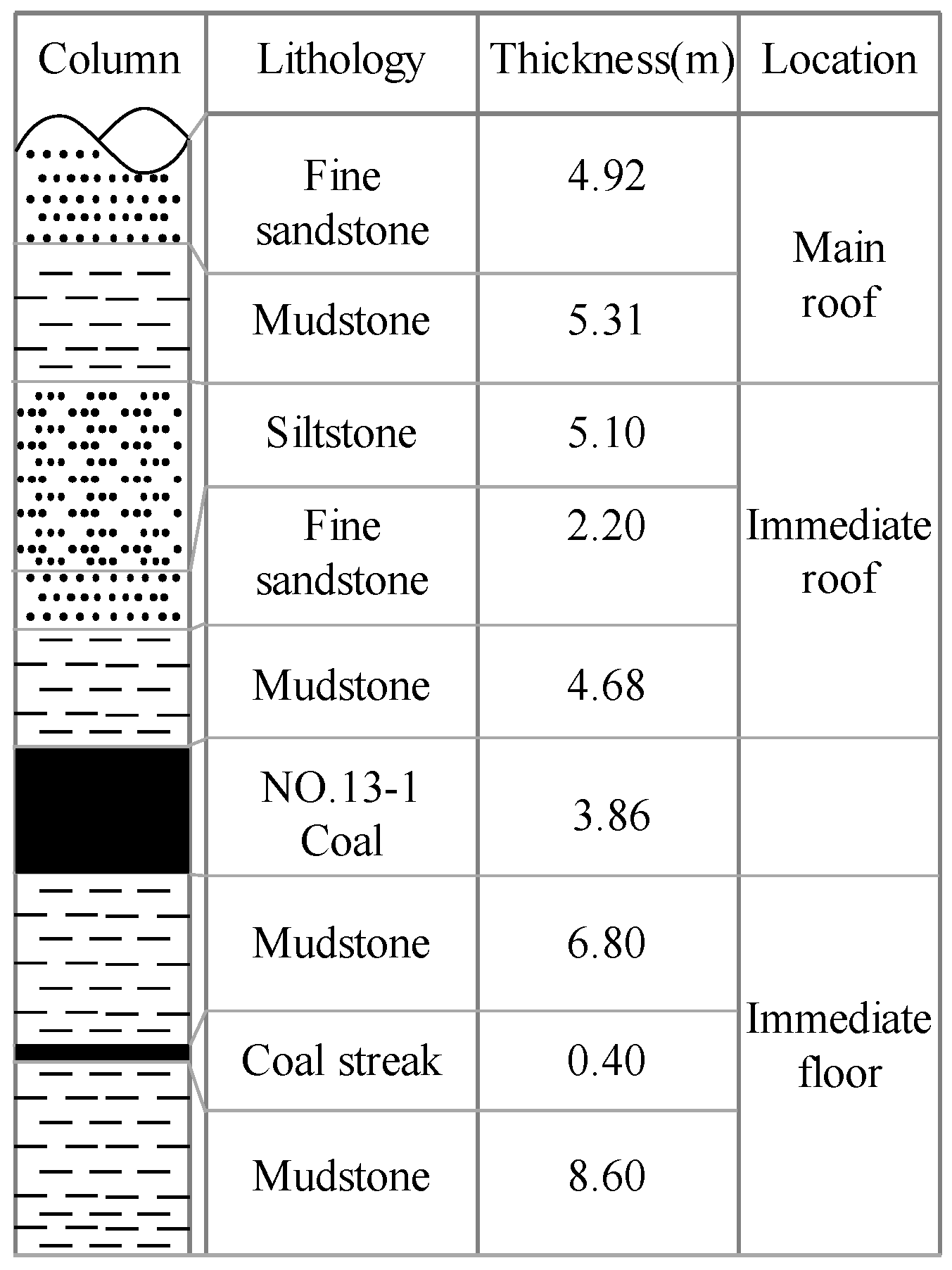
Exposure along the 13403 working face shows that the immediate roof is composed mainly of mudstone, siltstone, and fine sandstone. The average thicknesses are 4.68 m for mudstone, 2.20 m for fine sandstone, and 5.10 m for siltstone. The main roof consists chiefly of mudstone and fine sandstone, with mean thicknesses of 5.31 m and 4.92 m, respectively. The immediate floor is dominated by mudstone; two sublayers are present with typical thicknesses of 6.80 m and 8.60 m. The lithologic column of the roof and floor is shown in Figure 2.
In situ stress testing indicates that, across the fourth mining district, the maximum horizontal principal stress ranges from 23.76 to 26.00 MPa, the minimum horizontal principal stress from 11.60 to 11.90 MPa, and the vertical stress from 23.43 to 24.25 MPa. The stress regime transitions from tectonically dominated at shallow depths to more hydrostatic at greater depth, a characteristic feature of deep rock masses [22].
The roadway is surrounded mainly by weak mudstone beneath a competent main roof. Under a strong roof, the overlying strata can hang across the mined-out area, increasing the cantilever length and creating wider high-stress zones on both ribs ahead of the face [23]. Elastic strain energy stored in the strong roof may be released suddenly during breakage, generating significant dynamic loads [24]. Roadways excavated in soft rock often cannot withstand such dynamic loading, even with high-strength support [25]. In deep soft rock entries, large deformations—roof subsidence, floor heave, and rib (sidewall) bulging—occur frequently. These deformations intensify under the combined effects of high in situ stress and mining-induced disturbance. Observations from initial mining in the No. 13 seam indicate that roof instability is likely after excavation due to the joint influence of high in situ stress, weak surrounding rock, and dynamic loading, making control particularly challenging [26].

2.2. Model Construction

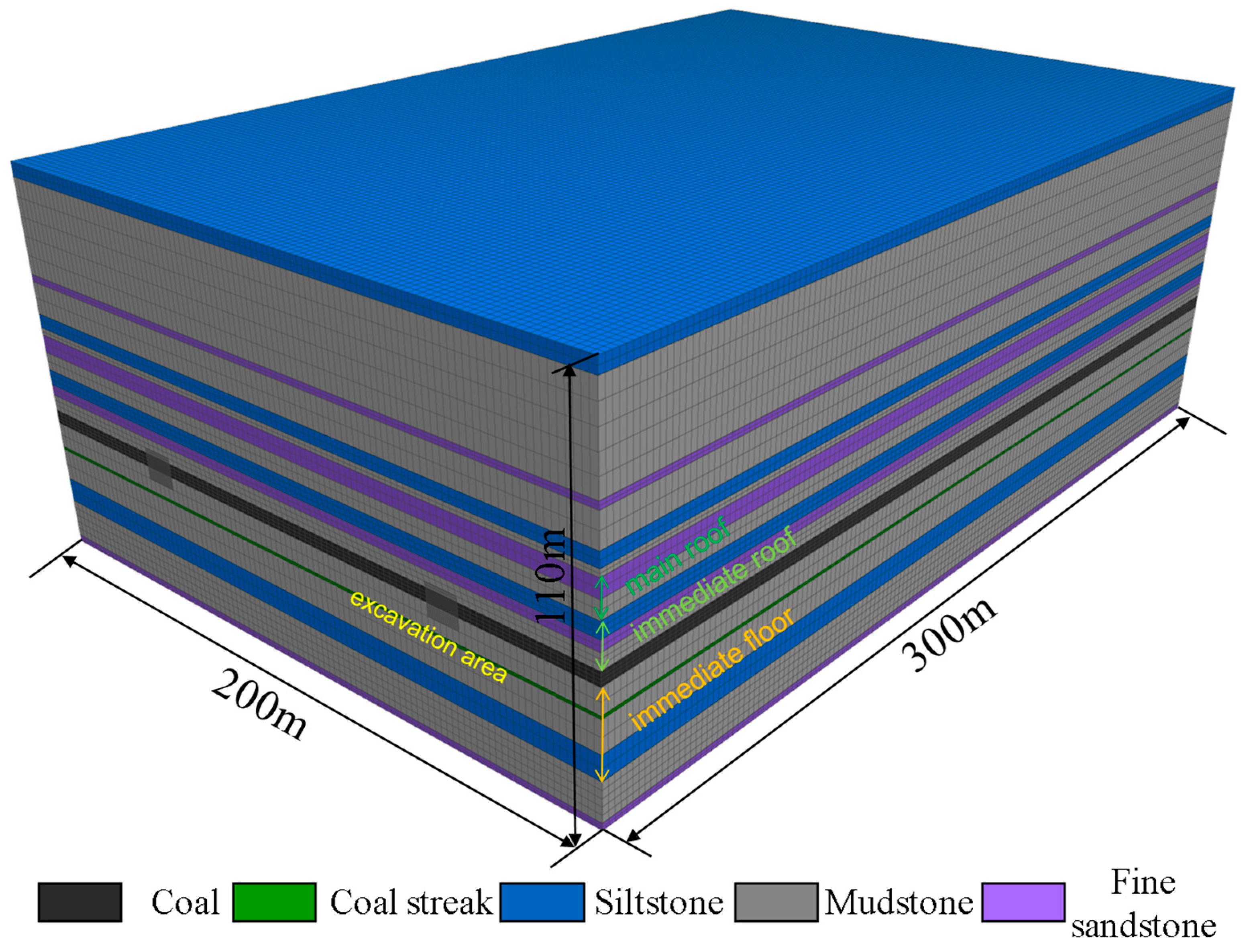
To analyze the surrounding rock deformation and mining-induced stress during the extraction of the deeply buried 13403 working face, we built a FLAC3D model based on the site’s geology and mining conditions. A top boundary pressure of 23 MPa, consistent with the burial depth and in situ stress measurements, was applied to represent the overburden, and normal (roller) constraints were set on the bottom and lateral boundaries. The rock mass follows a Mohr–Coulomb constitutive law; cable elements represent bolts and anchor cables, and weak interlayer planes are modeled with interface elements. Balancing computational efficiency and mesh sensitivity, the domain measures 200 m × 300 m × 110 m and simulates a 200 m strike advance. The mesh contains approximately 1.46 million zones (Figure 3).
Parameter selection for the numerical model is a key determinant of simulation accuracy. Rock is a heterogeneous geomaterial with numerous, randomly distributed discontinuities that govern its mechanical response. Consequently, mechanical properties measured on coal and rock specimens in the laboratory cannot be applied directly to continuum-scale numerical models. In this study, we derived initial parameters from laboratory tests and then calibrated them against field observations of macroscopic failure and deformation until the simulations matched the engineering conditions. The calibrated parameters are listed in Table 1.
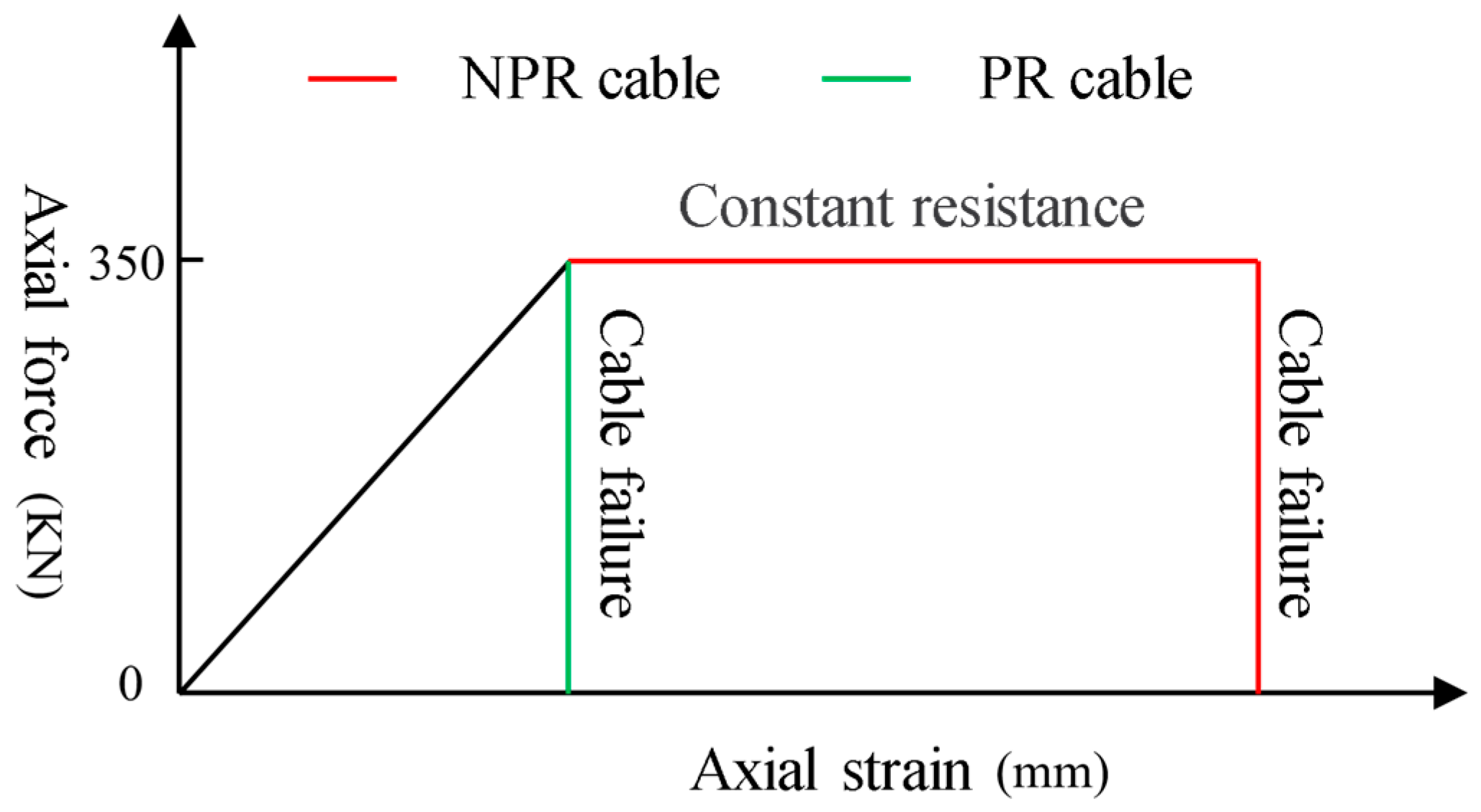
Figure 4 presents the constitutive model for NPR anchor cables. Conventional bolts and cables show an approximately linear force displacement response up to their ultimate capacity, after which they lose strength abruptly and fail. In contrast, NPR (constant resistance, large deformation) cables sustain an almost constant load after peak and permit substantial tensile deformation, enabling progressive, ductile energy dissipation [27,28]. In FLAC3D, the built-in cable element retains residual strength after peak. Therefore, to represent the sudden rupture of conventional supports, we implemented a Fish routine that releases the end anchorage constraints at failure. NPR cables are modeled with cable elements, and the high-strength properties of the anchorage assembly are assigned via Fish at the anchored end. When the axial force in an NPR cable reaches the specified constant resistance level Rc, the element enters a constant resistance phase and continues to elongate at a nearly constant load. When the cumulative axial elongation attains the tensile limit (taken as 30% of the free cable length), anchorage failure is triggered and the end fixity is released.

2.3. Simulation Scheme and Process

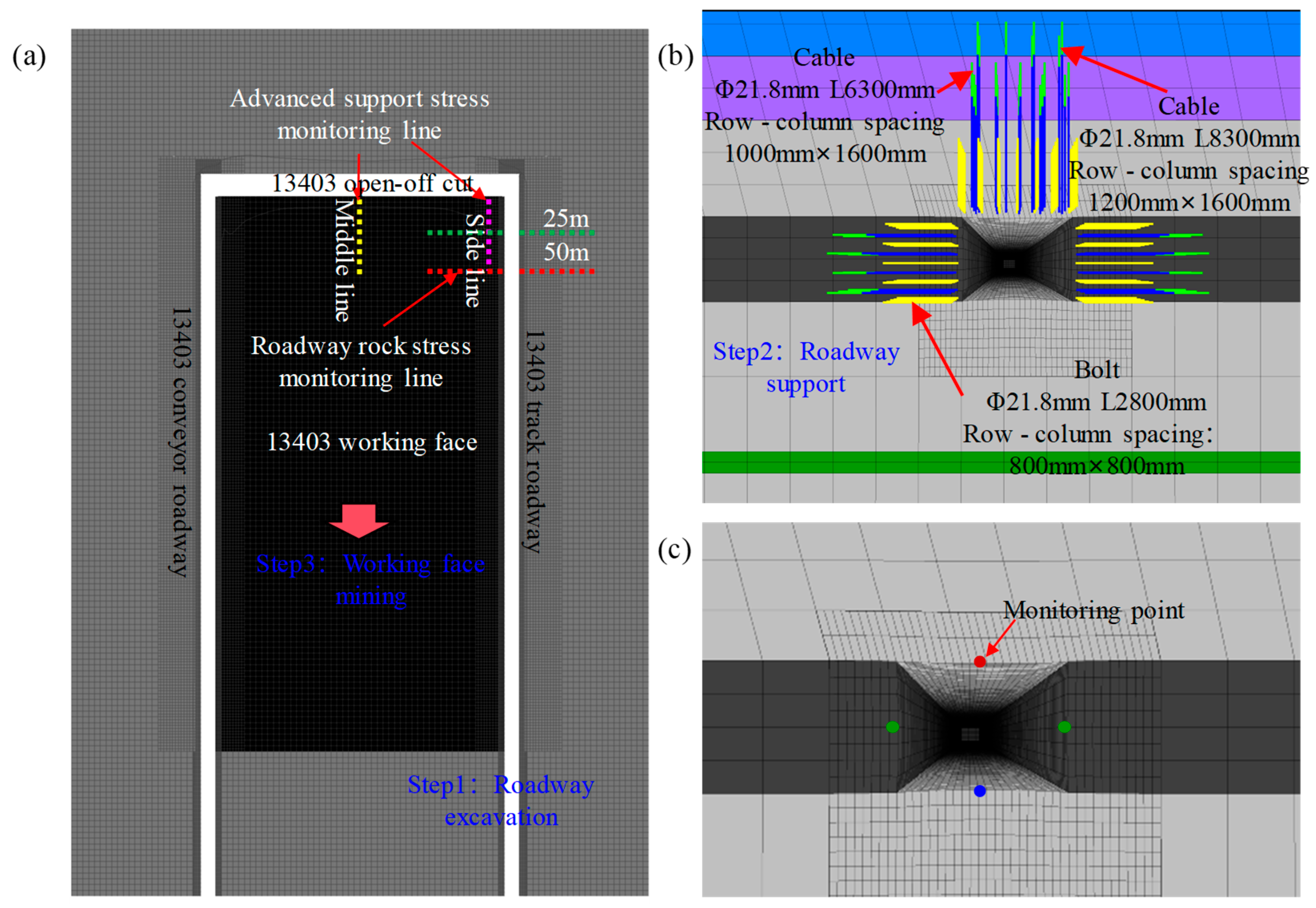
To examine the deformation and stress evolution in the surrounding rock of a soft rock roadway at kilometer depth under high in situ stress and dynamic loading, we built a numerical model that includes two roadway configurations: one crosscut, and one coalface extraction. In line with site practice, cable elements are used to represent reinforcement by bolts and anchor cables. The simulation process proceeds as follows: (1) initialize the in situ stress; (2) excavate the roadways and crosscut, implement support, and calculate until equilibrium is reached; (3) excavate 20 m and compute until equilibrium; (4) repeat step (3) until excavation advances to the designated position. The simulation steps are shown in Figure 5a,b.

2.4. Monitoring Scheme

The deformation of the surrounding rock at kilometer depth is governed mainly by two stress regimes: mining-induced stress and dynamic loading transmitted from the roof. The spatial and temporal distribution of these stresses is the primary driver of roadway deformation. As the mined-out area expands, hard roof strata bend and subside under self-weight and the overburden load. The resulting bending moments and shear store elastic energy within the thick, competent layers [29]. When the hard roof fractures and displaces, this stored energy is released abruptly, producing vibrations and transient dynamic loads. These loads can drive the coal and rock adjacent to the roadway beyond their strength, leading to large deformations and, in severe cases, instability [30].
To investigate the manifestation of mining pressure during coalface extraction, comprehensive monitoring of both the stress and dynamic pressure fields in the mining area is conducted. The redistribution of vertical stress reflects the evolving characteristics of the mining-induced stress field. Dynamic pressure primarily represents the release of accumulated elastic strain energy within the roof, which is discharged as stress waves upon rock fracture. Although the FLAC3D model has limitations in directly simulating stress wave generation after rock fracture, variations in elastic strain energy density in the key roof strata, as the working face advances, can serve as an indirect indicator of dynamic pressure evolution in the overlying strata. Therefore, it is essential to calculate the elastic strain energy density of the key roof layers after each mining advancement. The Fish programming language has been developed to compute the elastic strain energy density of grid elements after each equilibrium calculation. The formula for calculating elastic strain energy density is as follows [31]:
U e = 1 2 E σ 1 2 + σ 2 2 + σ 3 2 2 μ σ 1 σ 2 + σ 2 σ 3 + σ 1 σ 3
where Ue represents the elastic strain energy density (J·m−3); σ1, σ2, σ3 are the maximum, intermediate, and minimum principal stresses (Pa), respectively; and E is the elastic modulus (Pa).
The layout of the monitoring points and lines is shown in Figure 5. Advance abutment stress monitoring: two lines are placed parallel to the direction of face advancement, one located 10 m from the rail roadway and the other at the working face centroid. Support stress monitoring in the surrounding rock of the rail roadway: the monitoring area extends 50 m ahead of the coalface, with monitoring lines placed at 25 m intervals perpendicular to the roadway strike along the coal seam direction. Deformation monitoring of the surrounding rock in the rail roadway: monitoring points are established 50 m ahead of the working face, positioned at 25 m intervals at the center of the coal wall, floor, and roof, to track deformation in the surrounding rock as the mining face advances.

3. Evolution Law of Elastic Strain Energy in the Roof and Deformation Control of Kilometer-Deep Soft Rock Roadway

3.1. Evolution Law of Advance Abutment Stress in the Working Face

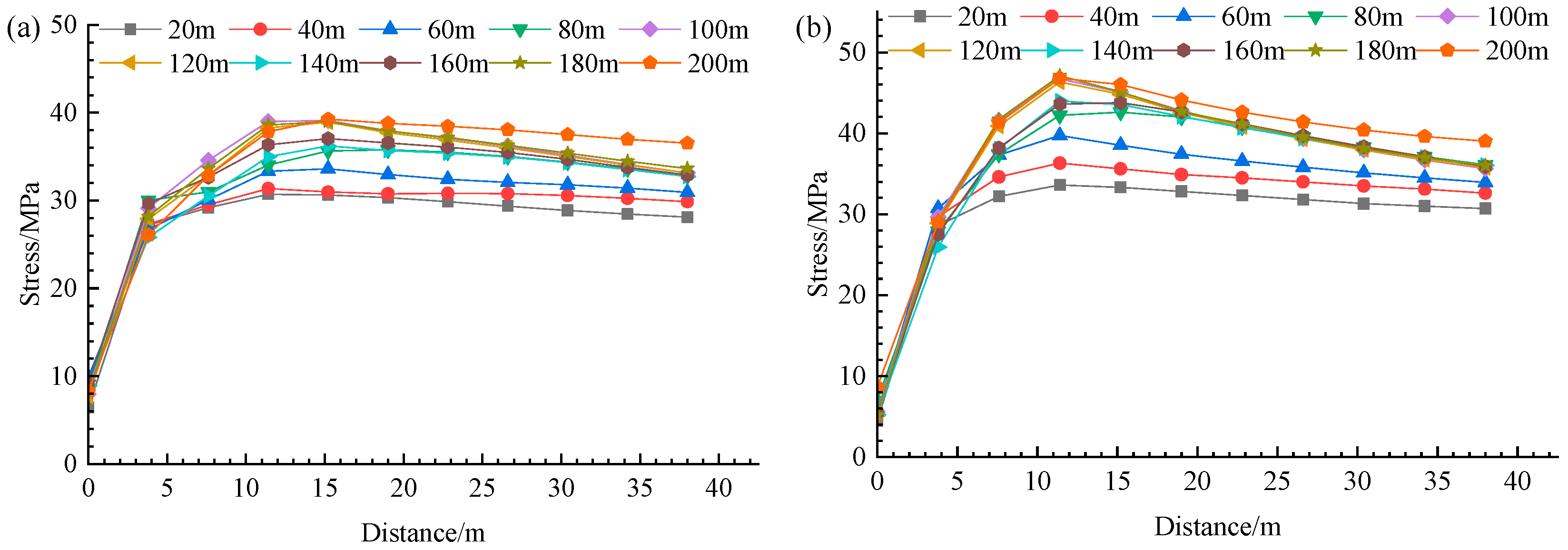
Figure 6 shows the advance abutment stress distributions at the face center and near the rail roadway. Stresses adjacent to the rail roadway are markedly higher than those at the face center. As the face advances, load from the overlying strata in the mined-out area (goaf) transfers to the surrounding coal, producing an overall increase in advance abutment stress. The peak stress evolves differently at the two locations. At the face center, the peak rises from 0 to 120 m of advance, falls from 120 to 140 m, and then rises again from 140 to 200 m. Near the rail roadway, the peak increases from 0 to 100 m, decreases from 100 to 160 m, and continues to decline from 160 to 200 m. These cyclic variations reflect the periodic caving of the roof over the goaf. Throughout the advance, the stress adjacent to the rail roadway remains higher than at the face center.

3.2. Evolution Law of Support Stress and Deformation in Surrounding Rock of Working Face Roadway

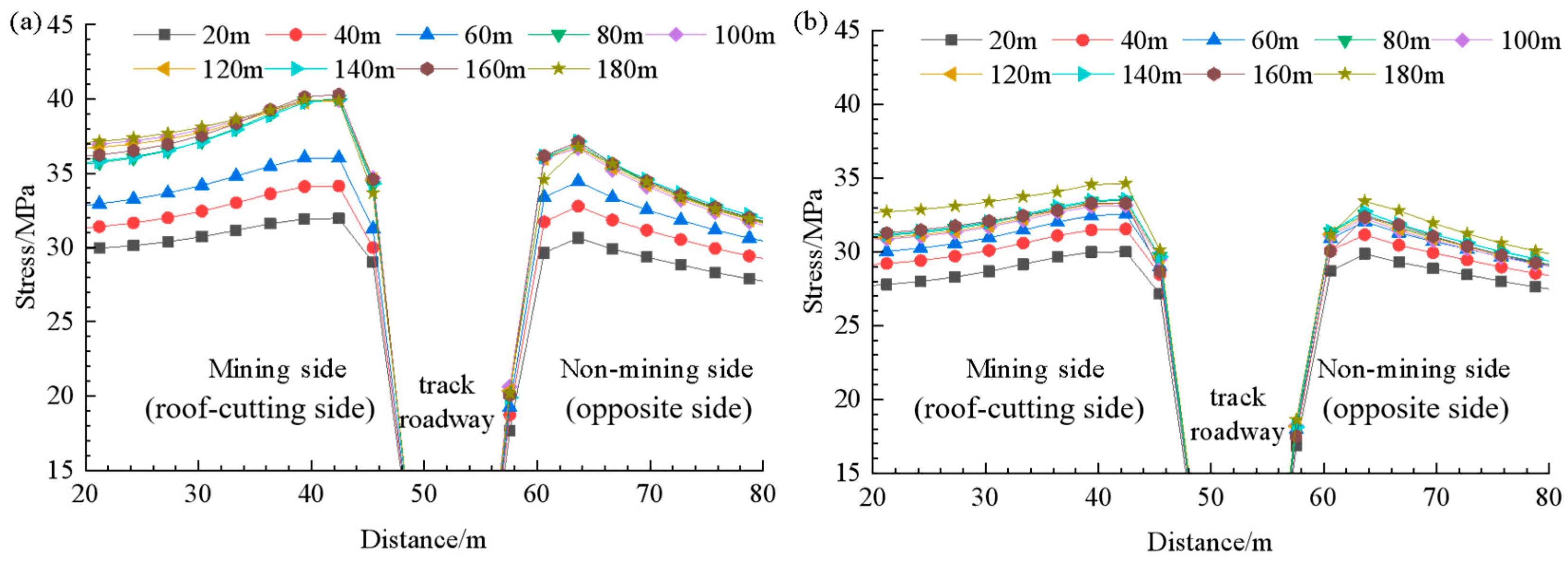
Figure 7 shows the stress distribution curves in the surrounding rock of the rail roadway at sections 25 m and 50 m from the face. The curves exhibit marked lateral asymmetry, with higher stress on the mining side (toward the face). The asymmetry is more pronounced at 25 m than at 50 m. As the face advances, the side-to-side difference increases, indicating intensifying asymmetry. Overall stress levels also rise as the section lies closer to the face, leading to a stronger stress concentration in the surrounding rock.
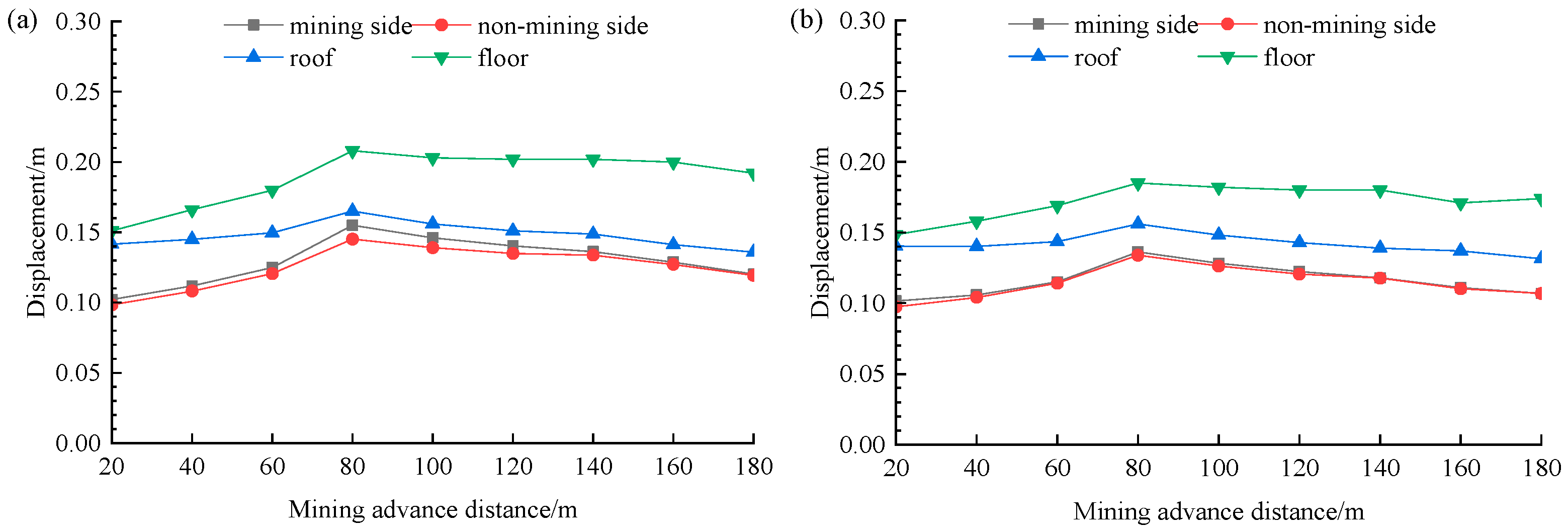
Figure 8 shows that, at both offsets from the stope (25 m and 50 m), displacements increase rapidly as the face advances from 20 m to about 80 to 100 m, after which the rate of increase declines and the curves approach a plateau with a slight decrease toward 180 m. The floor exhibits the largest displacement at all stages (about 0.20 to 0.21 m at 25 m; about 0.18 to 0.19 m at 50 m), the roof is intermediate (about 0.15 to 0.16 m), and the sidewalls are smaller. Displacement on the mining side is consistently greater than on the opposite side by about 0.01 to 0.02 m. Magnitudes at 50 m are lower than at 25 m, indicating attenuation with distance from the stope.
There is a link between stress and deformation asymmetry. Figure 7 shows higher advance stress on the mining side than on the opposite side at all advance stages. Figure 8 shows correspondingly larger displacements on the mining side. The asymmetry indices, Aσ and Au, evaluated on the same sections 25 m and 50 m from the face, remain positive and follow similar trends with advance distance, rising to a maximum at about 80 to 100 m and approaching a plateau by about 180 m. This agreement indicates that the deformation asymmetry is driven by the stress asymmetry, consistent with a wider yielded zone and greater shear demand on the mining side.
A σ = σ m σ o p p o s i t e σ o p p o s i t e ,   A u = u m u o p p o s i t e u o p p o s i t e
where Aσ—stress asymmetry index (dimensionless); Au—displacement asymmetry index (dimensionless); σm—advance stress on the mining-side rib at the specified section and advance step, extracted at mid-height along the monitoring line (MPa); σopposite—advance stress on the opposite-side rib at the same section and step, extracted at mid-height (MPa); um—displacement of the mining-side rib at the specified section and advance step, measured at mid-height toward the roadway (m); and uopposite—displacement of the opposite-side rib at the same section and step, measured at mid-height toward the roadway (m).
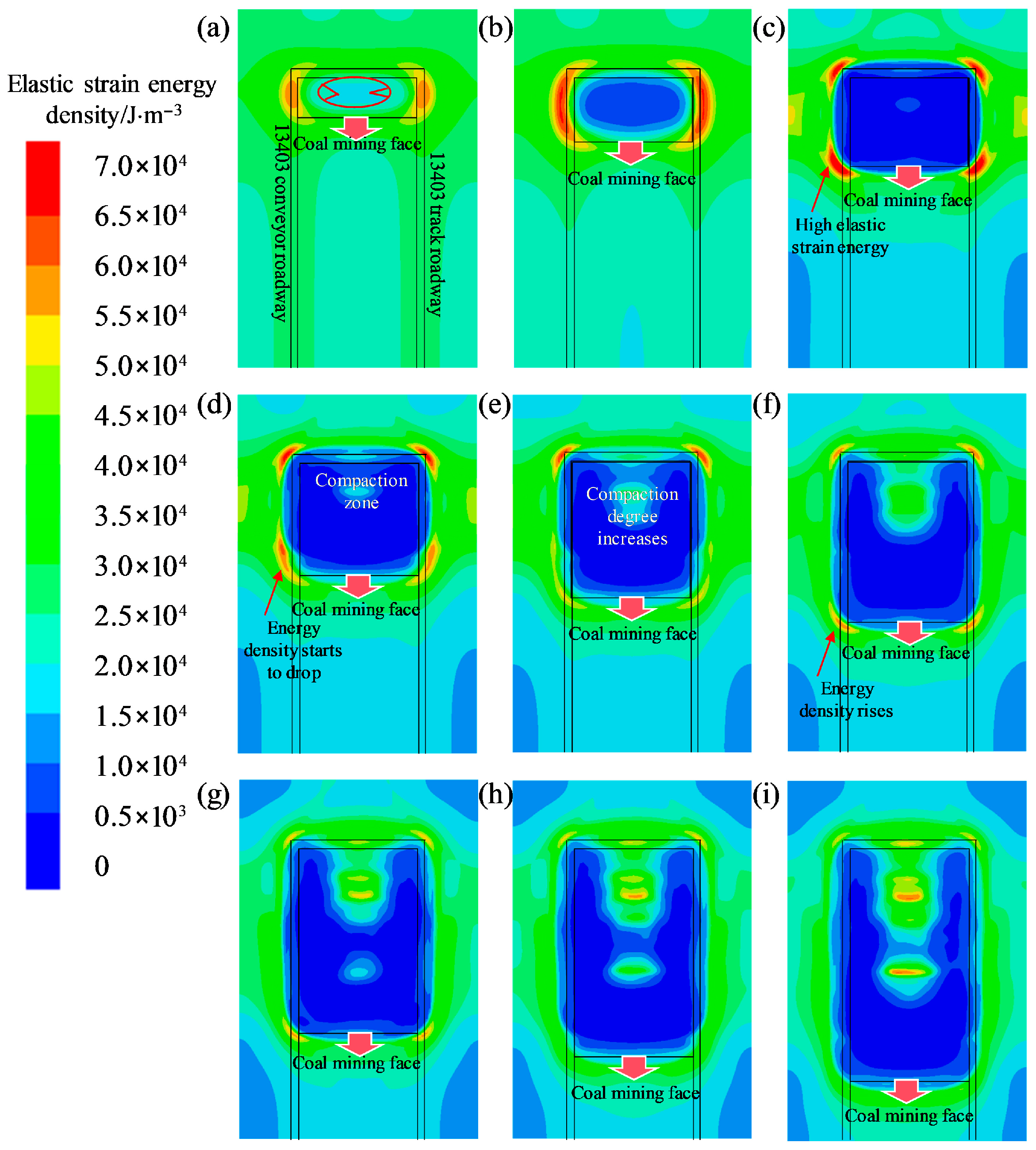
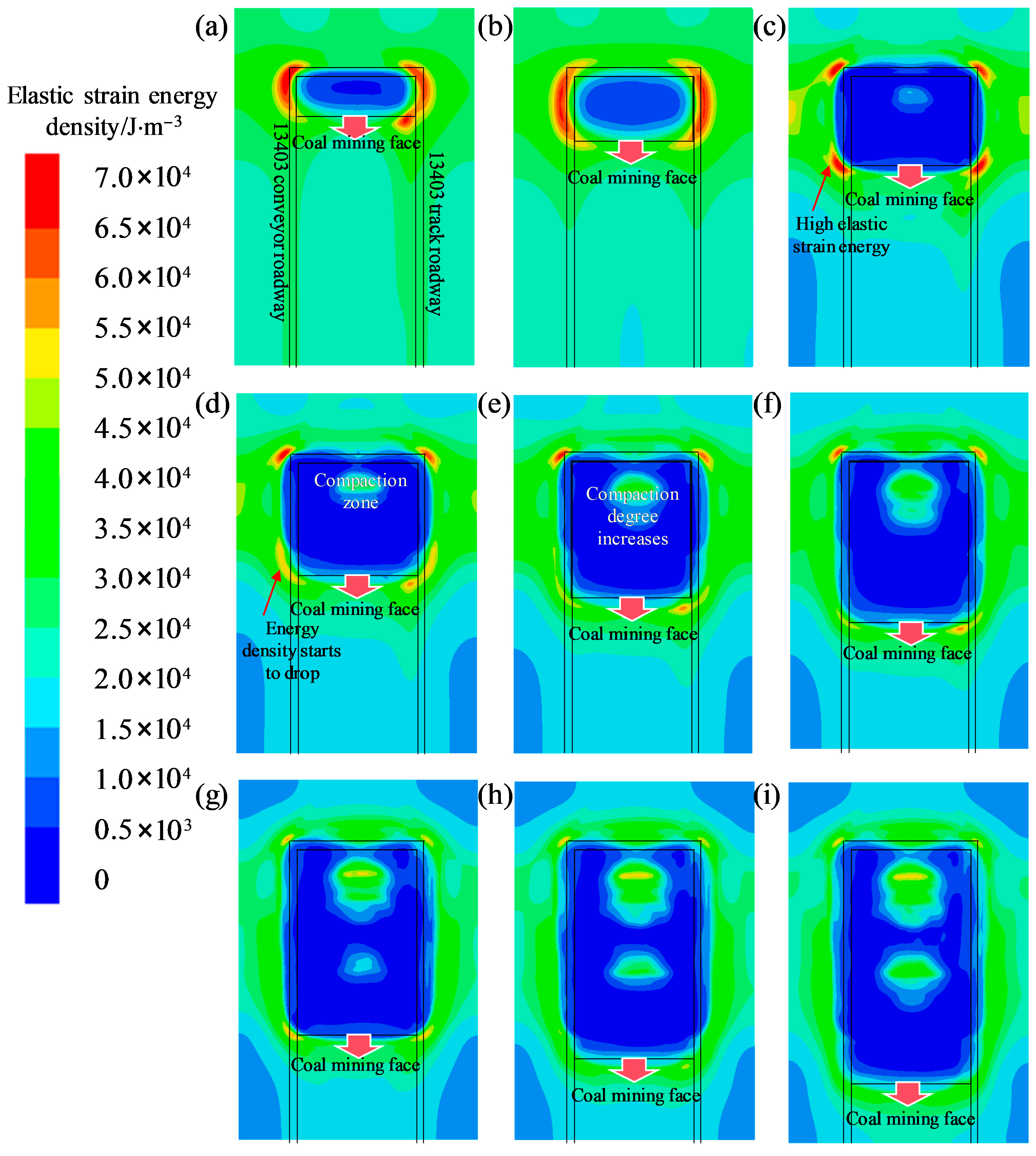
Figure 9 shows the evolution of elastic strain energy density in the main roof as the face advances. At 40 m of advance, the contours exhibit an “O/X” pattern that indicates the onset of roof breakage (Figure 9a). From 0 to 60 m, the highest energy density is concentrated above the roadways on both sides. By 80 m, the hotspots shift to the four corners of the goaf. From 80 to 120 m, the corner energy density decreases from approximately 6.5 × 10⁴ J m−3 to 3.0 × 10⁴ J m−3. As the goaf begins to compact, the energy density in its center increases accordingly. From 120 to 140 m, the energy density on both sides of the coalface rises again, then declines from 140 to 160 m, and increases once more from 160 to 200 m. The roadway regions on both sides display a cyclic pattern, with the maximum energy concentration occurring just before the initial periodic weighting event.
A local, one-factor-at-a-time (±10%) sensitivity analysis was performed about the calibrated baseline: each factor Xᵢ was perturbed by ±10% with all others held constant, and the normalized sensitivity was computed as follows [32]:
S i = ( Δ y / y 0 ) ( Δ X i / μ i )
where Sᵢ—normalized sensitivity coefficient (dimensionless); y—response variable (units depend on response), y0—baseline value of y (same units as y), Δy—change in y (same units as y); Xᵢ—factor i (units depend on factor), ΔXᵢ—perturbation of factor i (same units as Xᵢ); and μᵢ—baseline value of factor i (same units as Xᵢ).
Factors included rock mass properties (Erm, crm, φrm), roof cutting parameters (Hcut, θcut, Scut), and NPR support parameters (Rc, sc, nc); responses were peak advance abutment stress σ(adv,max), peak roof elastic strain energy density Ue,max, roof–floor convergence urf, stabilization distance Dstab.
With θ(cut) within the design window, support layout variables (s(c), n(c)) have a secondary influence on σ(adv,max). The analysis indicates
σ ( a d v , max ) H c u t < 0   and   U ( e , max ) H c u t < 0
u r , f E r m < 0 ,   u r , f c r m < 0   and   D s t a b R c < 0
where Erm—rock mass elastic modulus (GPa); crm—rock mass cohesion (MPa); φrm—rock mass friction angle (°); Hcut—roof cutting depth (m); θcut—roof cutting angle (°); Scut—roof cut hole spacing (m); Rc—NPR constant resistance capacity (force; kN); sc—NPR row/line spacing (m); nc—number of NPR rows (dimensionless); σadv,max—peak advance abutment stress (MPa); Ue,max—peak elastic strain energy density in the roof (kJ·m−3); urf—final roof–floor convergence (m); Dstab—stabilization distance behind the face (m).
These sensitivities are consistent with field measurements at Face 13403: the average support load was 20.3 MPa, which is 30.1% lower on the cutting side; deformation stabilized at approximately 320 m behind the face; and the final closures were 1.10 m roof to floor and 1.47 m rib to rib.

4. Surrounding Rock Deformation Control Technology for Deep Soft Rock Mining Roadways

The analysis indicates that, in soft rock roadways at about 1 km depth, large deformations are driven mainly by mining-induced loading and dynamic actions transmitted from the roof. The limited strength and stiffness of the soft rock further amplify this response. Accordingly, an effective control strategy should pursue two goals. First, reduce the dominant load sources acting on the entry, including advance stress and roof generated dynamic loads. Second, increase the intrinsic deformation resistance of the surrounding rock to maintain roadway stability.
Intense mining-induced stress and roof-generated dynamic loading arise from stress transfer within cantilevered roof blocks and from subsequent roof fracturing [33,34]. Mitigating these loads therefore requires the structural modification of the overlying roof. In recent years, researchers have proposed directional presplitting blasting with energy-concentrating charges to modify the roof [35,36,37]. This method uses focused charge energy to create directional pre-split fractures that link cracks between multiple boreholes, achieving continuous roof severance. By disconnecting the hanging roof, the modified structure reduces both mining-induced stress and roof-borne dynamic pressure.
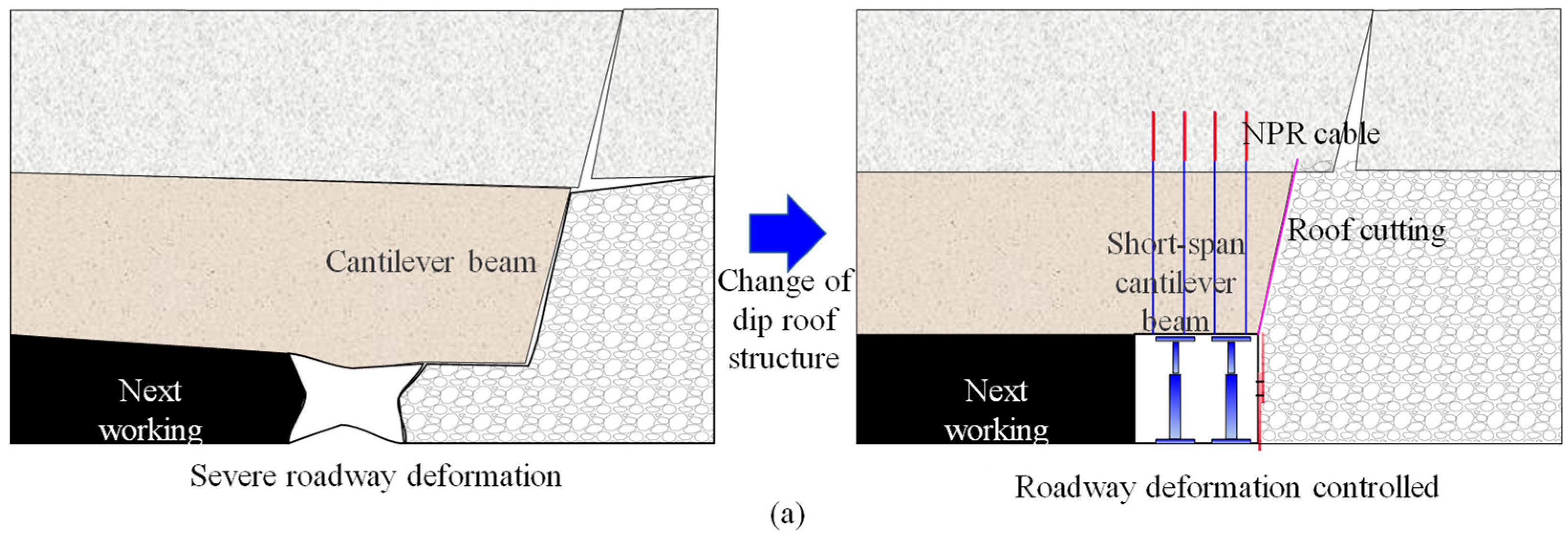
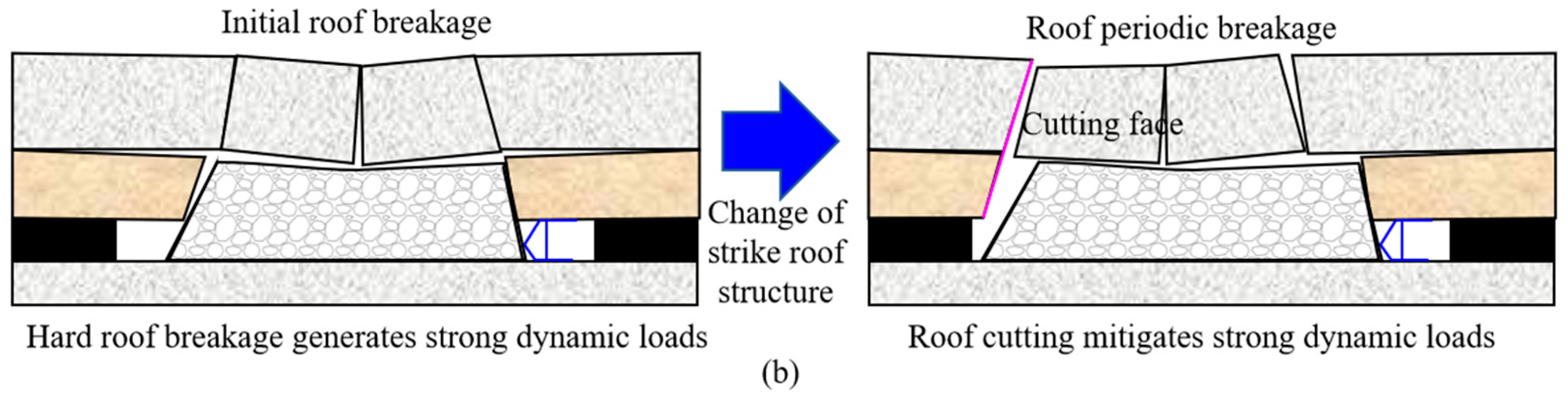
To mitigate strong mining-induced stress and roof-generated dynamic loading, we implemented directional presplitting blasting with energy-concentrating charges in the crosscut and on one side of the roadway at the working face. The objective was to modify the overlying roof structure along both the strike and dip directions of the face [38]. As shown in Figure 10a, along the dip direction the roof is precisely severed, converting the original cantilever beam into a short arm beam [39]. This conversion weakens the mechanical connectivity between the mined-out area (goaf) and the roadway roof along the coal wall and thereby interrupts the stress transfer path. As shown in Figure 10b, along the strike direction the roof is likewise cut to promote the timely caving of the main roof during the initial mining stage and to avoid long hanging. Preventing extensive overhangs reduces the risk of sudden elastic energy release and the associated strong dynamic loads that drive the severe deformation of the surrounding rock. To stabilize the weak immediate roof, constant resistance large deformation anchor cables are installed to suspend and support the layer beneath the competent strata. These cables provide high ductility and sustain a near-constant load over large displacements, thereby enhancing the deformation resistance of the surrounding rock during mining [40]. After roof cutting and reinforcement, temporary unit support frames are placed in the roadway behind the face, and gangue-retaining support is installed along the mined-out wall. This configuration preserves the roadway for reuse as an entrance for subsequent panels and substantially reduces the need for new excavation.
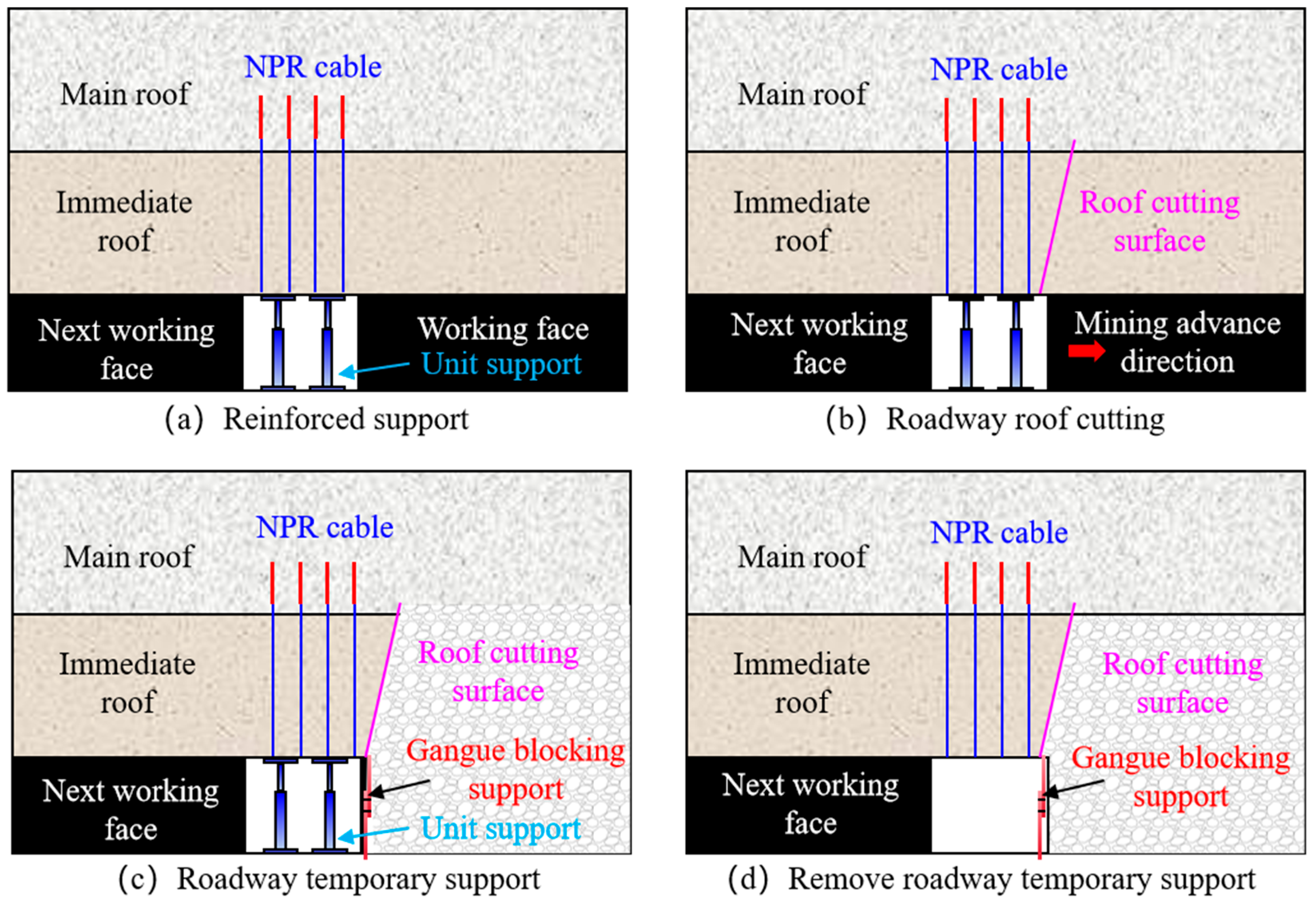
Building on the above interventions, we developed a comprehensive control scheme for deep soft rock roadways that integrates roof cutting for pressure relief with constant resistance large deformation anchor cable reinforcement (Figure 11). Roof cutting reduces high stress concentrations in the surrounding rock caused by abutment loading from the mined-out area (goaf) and related factors. This mitigation lessens the dynamic loads associated with roof breakage during mining and establishes a more stable mechanical environment for the entrance. In parallel, constant resistance large deformation anchor cables provide sustained support throughout the deformation process of the surrounding rock. By accommodating movement while maintaining resistance, the system increases the overall load-bearing capacity of the surrounding rock and improves roadway stability.

5. Engineering Application Analysis

5.1. Surrounding Rock Control Technical Scheme

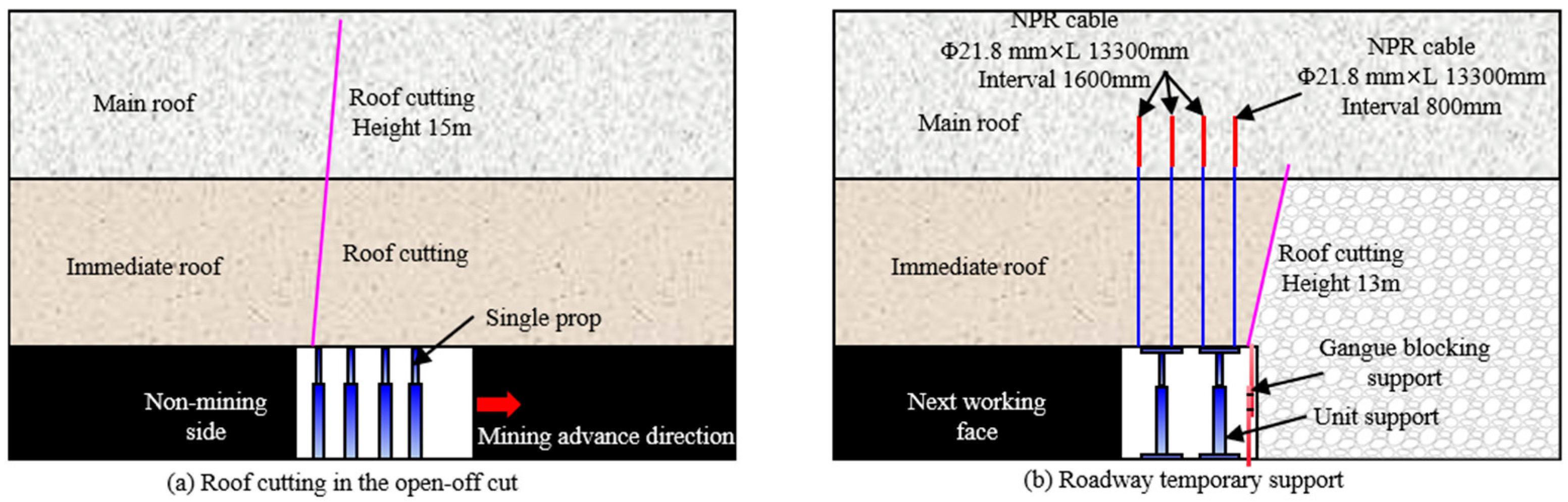
To limit deformation in the track roadway during the extraction of the 13403 working face, a roof cutting retained entry scheme was implemented (Figure 12). Four staggered rows of constant resistance anchor cables were installed. Each cable had a diameter of 21.8 mm and a length of 13.3 m. Row 1 was placed 450 mm from the cutting side with a row spacing of 800 mm and was tied with W-shaped steel straps oriented parallel to the roadway. Rows 2 through 4 were spaced at 1600 mm, and the cables within each row were interconnected using channel sections, also aligned parallel to the roadway. In the track roadway, the roof cutting depth was 13 m with an inclination of 15° to the vertical, and borehole spacing was 500 mm. In the crosscut, the roof cutting depth was 15 m with an inclination of 5° to the vertical, and the borehole spacing was likewise 500 mm. The crosscut roof cutting line was positioned 1000 mm from the non-mining side. From 0 to 400 m behind the hydraulic supports, unit-type supports were installed for lagging protection in two rows with 800 mm spacing. On the gangue-retaining side, telescopic 36# U-shaped steel sets were used, connected in two segments with an overlap and spaced at 500 mm.

5.2. Numerical Simulation Analysis of Surrounding Rock Control Effect

To evaluate the effectiveness of the integrated control scheme—combining roof cutting for pressure relief with constant resistance anchor cable reinforcement in kilometer-deep soft rock roadways—we performed a comparative simulation using the previously established model. Roof cut surfaces in the crosscut and the track roadway were represented with interface elements, and constant resistance anchor cables were assigned to reinforce the roof. The simulation steps were as follows: (1) initialize the in situ stress; (2) excavate the roadways and crosscut, apply support, and calculate until equilibrium is reached; (3) perform roof cutting and calculate until equilibrium; (4) excavate 20 m and compute until equilibrium; (5) repeat step (3) until excavation reaches the designated position.
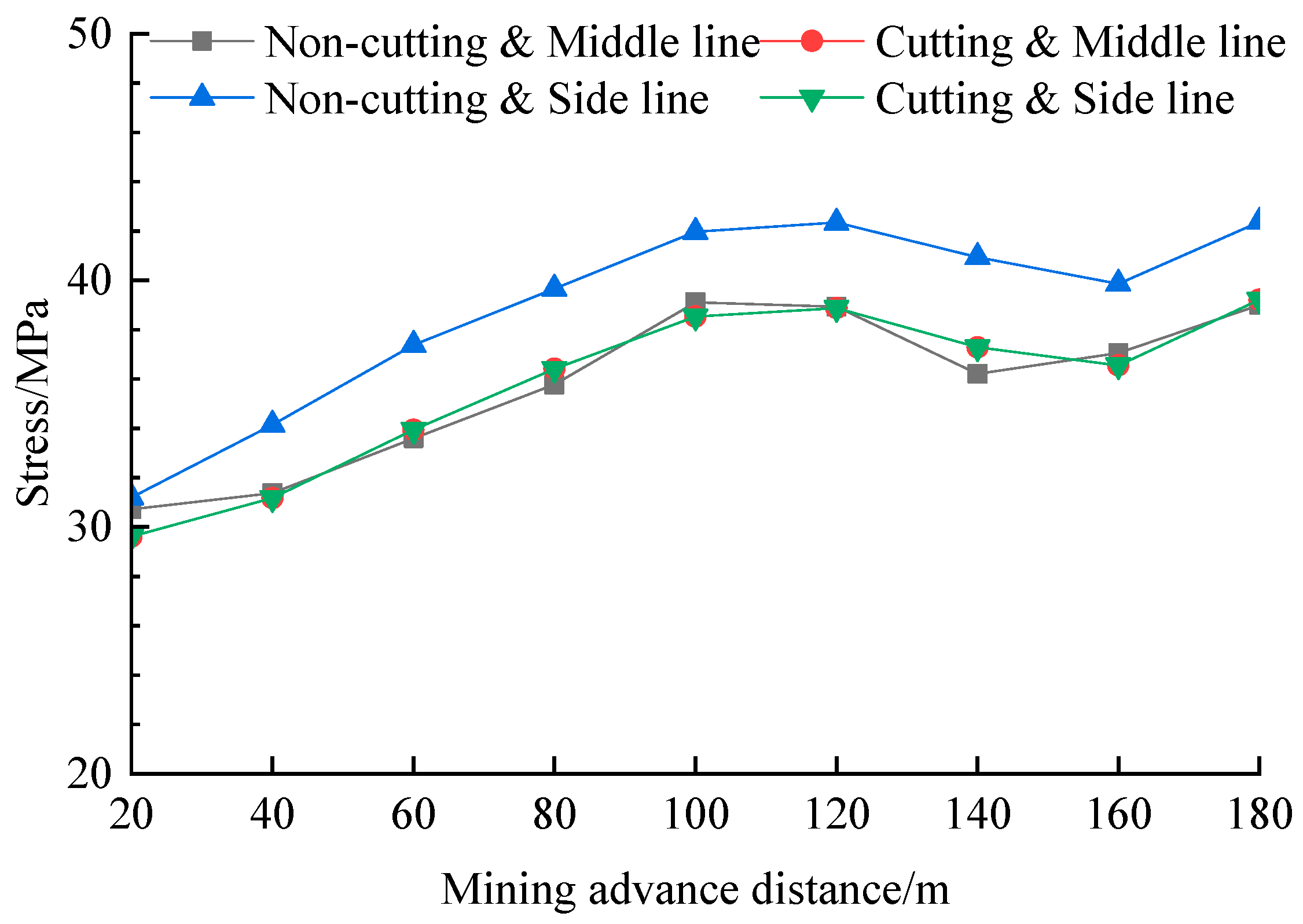
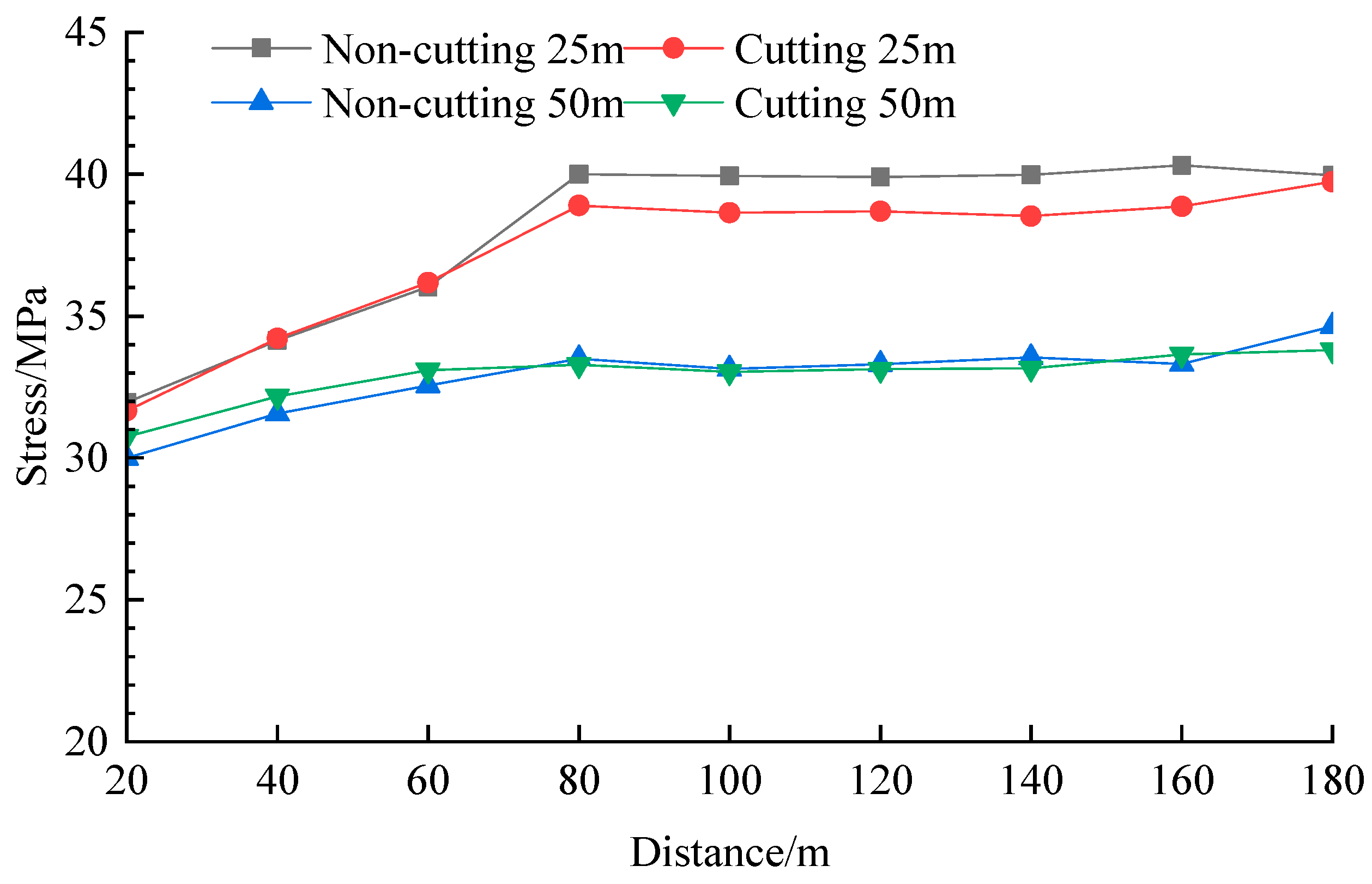
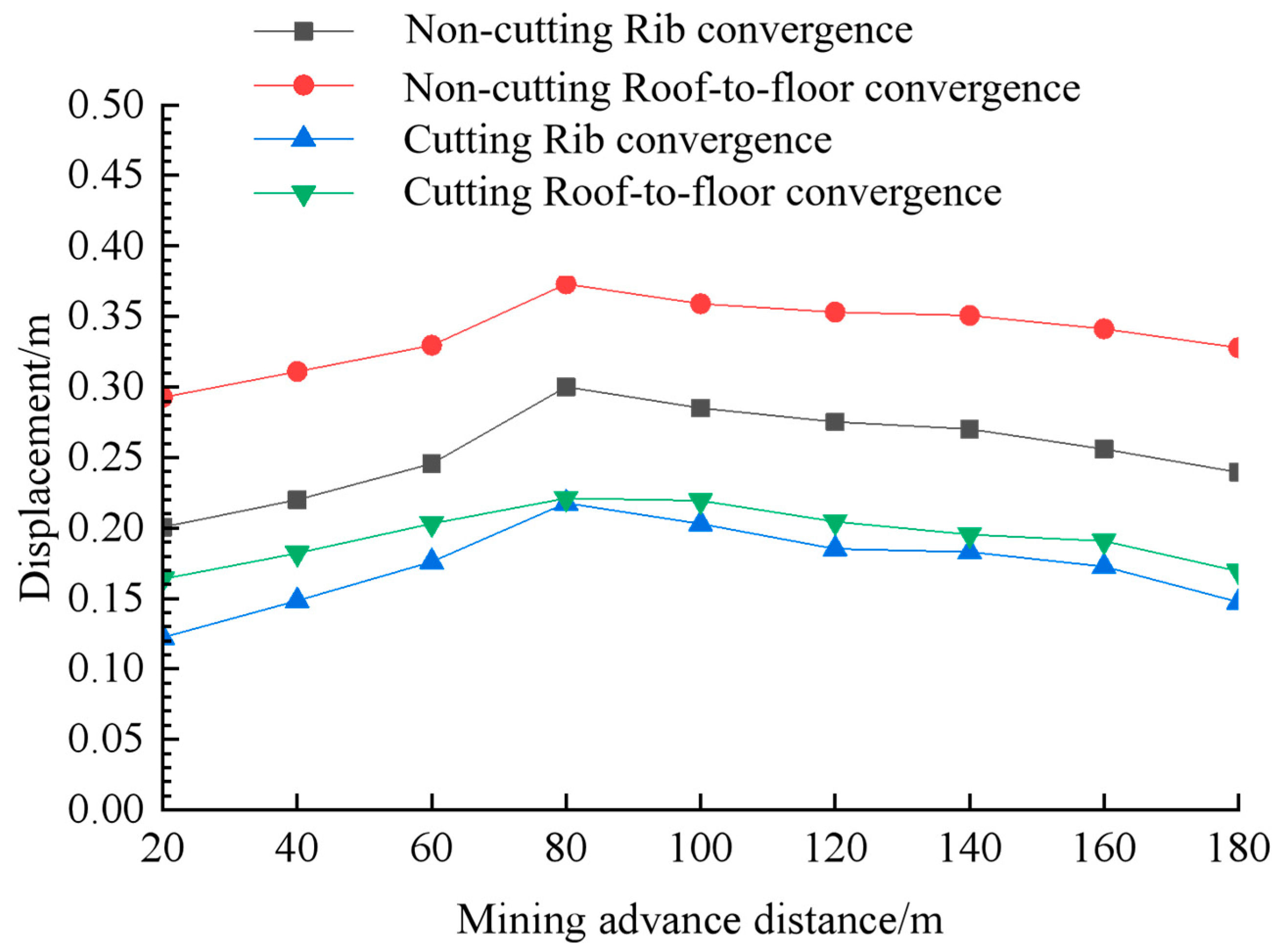
Figure 13 shows the evolution of peak advance abutment stress near the face; under the integrated control scheme, the peak on the track roadway side decreases markedly, while the peak along the face centerline changes little. Figure 14 presents the peak support stress in the surrounding rock of the track roadway; from 0 to 80 m of advance there is no material difference, but beyond 80 m the peak along the section 25 m from the face declines significantly. Figure 15 shows roadway convergence; with the integrated control, convergence is substantially reduced, indicating that deformation has been effectively controlled.
Figure 16 illustrates the evolution of elastic strain energy density in the main roof under the integrated control scheme. At 40 m of advance, the characteristic initial fracture pattern seen in conventional mining is absent, and the energy density in the roof over the mined-out area is markedly lower. In the early stage from 0 to 60 m, high-energy zones appear above the roadways on both sides of the mined-out area. Beginning at 80 m, the concentration shifts to the corners of the mined-out area, but with much lower intensity than in the conventional case. From 80 to 200 m of advance, the energy density within these concentration zones continues to decline and does not show the periodic fluctuations typical of standard mining.
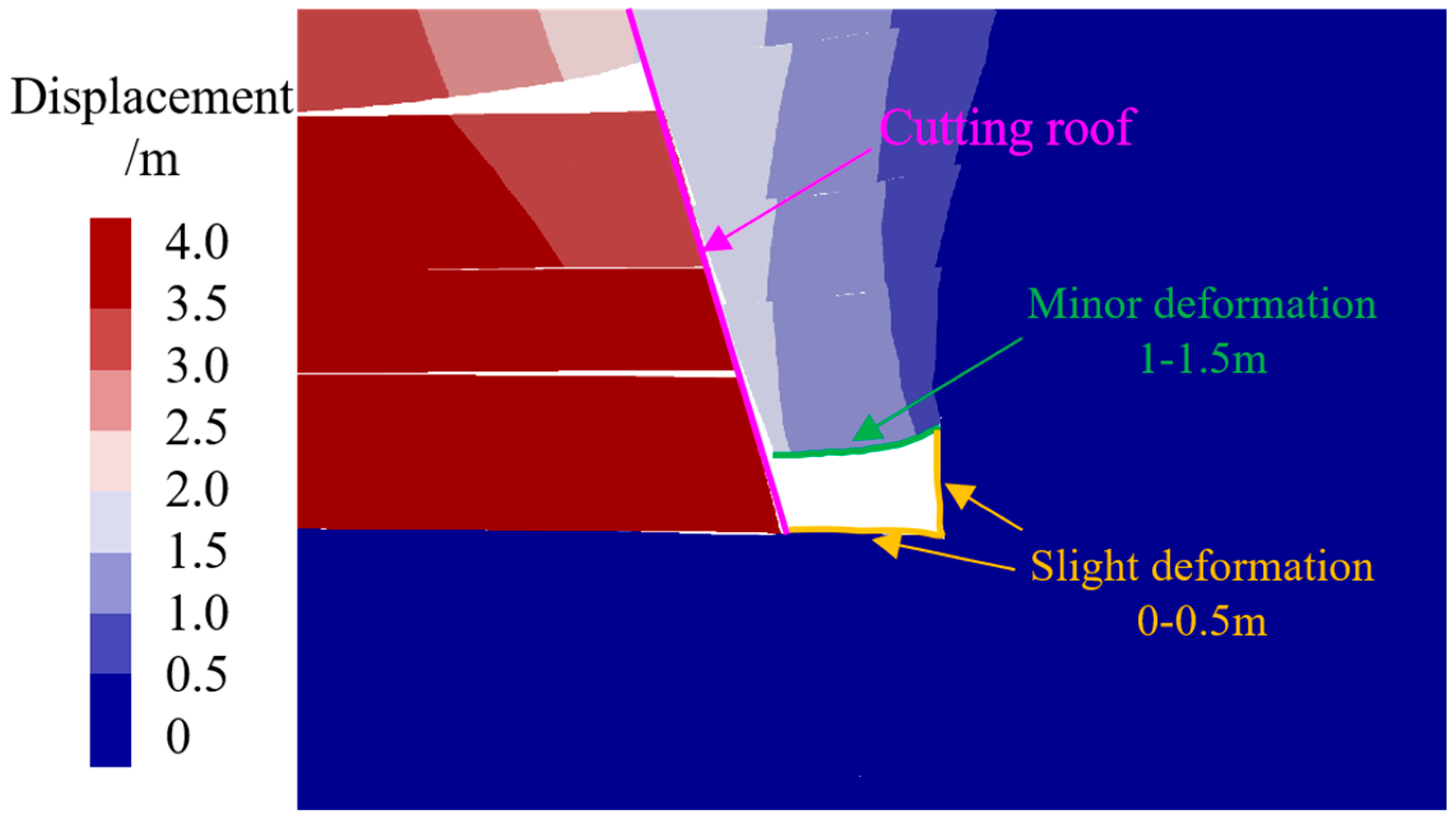
Figure 17 shows the cross section of the track roadway 50 m behind the coalface after mining is completed. Roof subsidence ranges from 0 to 1.5 m, and sidewall deformation ranges from 0 to 0.5 m. At this stage, deformation has stabilized, and with appropriate remediation the roadway can be reused as an entrance for the next panel.
Comparative numerical simulations show that the integrated surrounding rock control technology, combining roof cutting for pressure relief with constant resistance anchor cable reinforcement, markedly reduces stress concentration and roadway deformation. It also diminishes the concentration of elastic strain energy in the roof.

5.3. Field Implementation at Face 13403: Configuration and Observed Outcomes

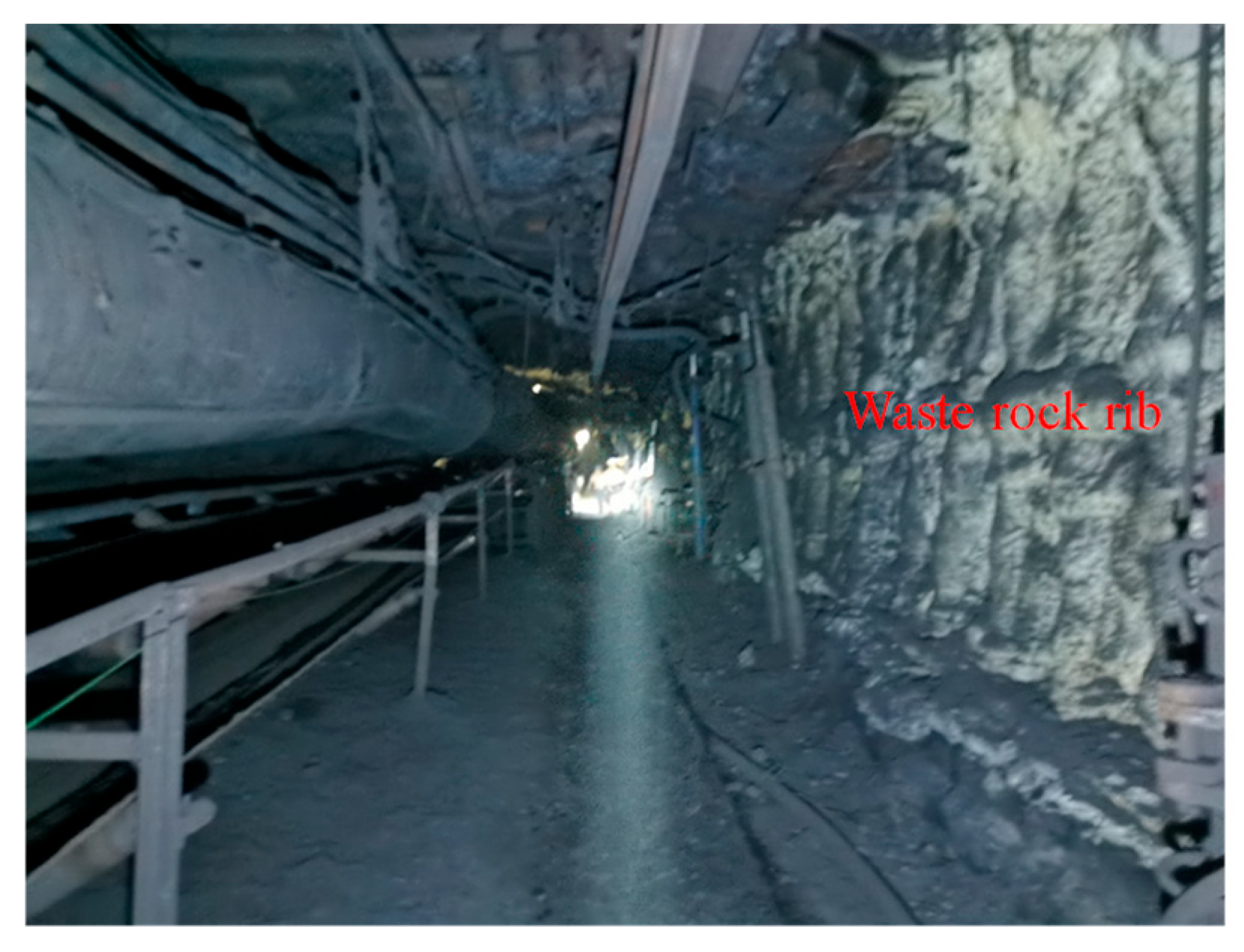
Figure 18 illustrates the deformation of the track roadway after mining of the 13403 working face. Displacement monitoring shows overall roof subsidence of 315 mm and floor heave of 782 mm, yielding a roof to floor convergence of 1096 mm. Sidewall convergence was 780 mm on the gangue-retaining side and 689 mm on the coal side, for a total rib to rib convergence of 1468 mm. Deformation stabilized at a lag distance of about 320 m behind the face. The average pressure on the hydraulic supports adjacent to the roof cutting side was 20.3 MPa, which is 30.1% lower than on the non-cutting side. When the lag distance behind the face was within 80 m, the unit-type support system experienced a sudden rise in pressure to approximately 40 MPa. Once the lag distance exceeded 290 m, the pressure in the unit-type supports gradually approached equilibrium.
Based on a comparison with field measurements: At the roadway centerline station approximately 320 m behind the face, the calibrated model reproduces the observed deformation within engineering tolerance (relative error defined as |Sim−Meas|/Meas). Roof subsidence is 0.31 m versus 0.315 m (1.6% error); floor heave is 0.75 m versus 0.782 m (4.1% error); roof to floor convergence is 1.06 m versus 1.096 m (3.3% error). Over the full lag range, the simulated convergence curve follows the measured trend, with R2 = 0.96, supporting the validity of the calibrated parameters used in subsequent analyses.

6. Conclusions

1. Deep soft rock entries at about 1 km depth are overlain by a hard main roof that can form long hangs, store elastic strain energy, and release this energy during caving. Numerical analysis shows cyclic advance stress and elastic energy accumulation near the intersection of the roadway and the face, with a greater intensity on the track-roadway side. This mechanism explains the large roof-to-floor and rib-to-rib closures observed on site.
2. Under identical boundaries and advance steps, the baseline concentrates advance abutment stress about 25 m ahead of the face, with a sideline peak of roughly 43 MPa at 120 m and a midline peak of about 39 MPa at 100 to 120 m. With directional roof cutting, the sideline peak falls to about 39 MPa and shifts to 180 m, a reduction of about 4 MPa or 9 to 10 percent, while the midline peak remains about 38.5 to 39 MPa at 120 to 180 m. The high-stress zone narrows and the cyclic energy response is damped, shortening the stabilization distance. Lateral asymmetry is evident near peak loading, with the mining side exceeding the opposite side by about 1 to 3 MPa (approximately 6 to 8 percent at 80 to 100 m), tapering toward a plateau by about 180 m.
3. The control strategy integrates directional roof cutting, which interrupts stress transfer and reduces the energy stored in the roof, with constant resistance, large deformation cables that maintain support during substantial movement. Roof cutting targets the source by lowering high stress and stored energy in the hanging roof, while the cables address the soft rock response by sustaining load capacity through large displacements. This dual mechanism links the identified failure drivers to specific design actions and delivers predictable improvements in stability.
4. Field monitoring at Face 13403 confirms the effectiveness: the average hydraulic support load on the roof cutting side was 20.3 MPa, which is 30.1% lower than on the non-cutting side. Deformation stabilized at approximately 320 m behind the face; the final closures were 315 mm roof subsidence, 782 mm floor heave, 1096 mm roof to floor convergence, and 1.47 m rib to rib. These outcomes, consistent with the numerical trends, indicate improved post-mining conditions and enable the reuse of the entry for the next panel, thereby reducing re-excavation and improving operational continuity.

Author Contributions

Conceptualization, L.J. and H.L.; methodology, L.J.; software, H.L. and R.W.; validation, L.J., H.L., and L.M.; formal analysis, H.W.; investigation, W.G.; resources, L.M.; data curation, H.L.; writing—original draft preparation, H.W.; writing—review and editing, H.F. and R.W.; visualization, B.Z.; supervision, L.J. and R.W.; project administration, W.G.; funding acquisition, R.W. All authors have read and agreed to the published version of the manuscript.

Funding

This research was funded by the Science and Technology Plan Project of Kekedala City, the Fourth Division of the Xinjiang Production and Construction Corps, grant number 2025ZR005; Youth Project of the Natural Science Foundation of Xinjiang Uygur Autonomous Region, grant number 2025D01C259; Xinjiang Uygur Autonomous Region “Tianshan Talents” Scientific Research Project—Young Top Talents, grant number 2023TSYCCX0081; Xinjiang Uygur Autonomous Region Science and Technology Plan Project—Major Science and Technology Special Project, grant number 2024A03001-2; Xinjiang Uygur Autonomous Region Science and Technology Plan Project—Major Science and Technology Special Project, grant number 2024A01002-1; Xinjiang Uygur Autonomous Region Hami City Scientific Research and Technology Development Project, grant number hmkj2025004; the Urumqi City Hongshan Sci Tech Innovation Elite Talents Youth Top Talents Program, grant number B241013004; the National Key Research and Development Program Young Scientists Project, grant number 2024YFC2910600; and the Xinjiang Institute of Engineering Doctoral Start up Fund, grant number 2023XGYBQJ14.

Data Availability Statement

Some or all data, models, or code generated or used during the study are available from the corresponding authors upon request.

Acknowledgments

The authors thank the editor for providing helpful suggestions for improving the quality of this manuscript.

Conflicts of Interest

The authors declare no conflicts of interest.

References

  1. Xie, H.-P. Research review of the state key research development program of China: Deep rock mechanics and mining theory. J. China Coal Soc. 2019, 44, 1283–1305. [Google Scholar]
  2. Yuan, L. Strategic thinking of simultaneous exploitation of coal and gas in deep mining. J. China Coal Soc. 2016, 41, 1–6. [Google Scholar]
  3. He, M.-C. Conception system and evaluation indexes for deep engineering. Chin. J. Rock Mech. Eng. 2005, 24, 2854–2858. [Google Scholar]
  4. He, M.-C.; Hu, J.; Cheng, T.; Deng, F.; Tao, Z.-G.; Li, H.-R.; Peng, D. Dynamic properties of micro-NPR material and its controlling effect on surrounding rock mass with impact disturbances. Undergr. Space 2024, 15, 331–352. [Google Scholar] [CrossRef]
  5. Zhao, J.-P.; Tan, Z.-S.; Zhang, B.-J.; Wang, F.-X. Stress-Release Technology and Engineering Application of Advanced Center Drifts in a Super-Deep Soft-Rock Tunnel: A Case Study of the Haba Snow Mountain Tunnel. Rock Mech. Rock Eng. 2024, 57, 7103–7124. [Google Scholar] [CrossRef]
  6. Kumar, A.; Maurya, S.; Tiwari, G. Reliability analysis of deep tunnels in spatially varying brittle rocks using interval and random field modelling. Int. J. Rock Mech. Min. Sci. 2024, 181, 105836. [Google Scholar] [CrossRef]
  7. Li, Y.; Deng, F.; Zheng, J.; Wang, F.-N.; Tao, Z.-G. Study on the Support Strategy of NPR Cable Truss Structure in Large Deformation Soft Rock Tunnel Across Multistage Faults. Rock Mech. Rock Eng. 2024, 57, 11261–11281. [Google Scholar] [CrossRef]
  8. Li, Y.; Huo, S.-S.; He, M.-C.; Tao, Z.-G. Compensation mechanics application of NPR anchor cable to large deformation tunnel in soft rock. Int. J. Coal Sci. Technol. 2024, 11, 69. [Google Scholar] [CrossRef]
  9. Li, G.; Luo, Z.-Y.; Wu, C.-Z.; Lu, H.; Zhu, C. Integrated early warning and reinforcement support system for soft rock tunnels: A novel approach utilizing catastrophe theory and energy transfer laws. Tunn. Undergr. Space Technol. 2024, 150, 105869. [Google Scholar] [CrossRef]
  10. Sun, Y.-P.; Xu, N.-W.; Xiao, P.-W.; Sun, Z.-Q.; Li, H.-L.; Liu, J.; Li, B. Characterizing large deformation of soft rock tunnel using microseismic monitoring and numerical simulation. J. Rock Mech. Geotech. Eng. 2025, 17, 309–322. [Google Scholar] [CrossRef]
  11. Liu, G.; Yang, Y. Deep Soft Rock Tunnel Perimeter Rock Control Technology and Research. Appl. Sci. 2024, 15, 278. [Google Scholar] [CrossRef]
  12. Zhao, C.-X.; Li, Y.-M.; Liu, G.; Meng, X.-R. Mechanism analysis and control technology of surrounding rock failure in deep soft rock roadway. Eng. Fail. Anal. 2020, 115, 104611. [Google Scholar] [CrossRef]
  13. Zhu, L.; Yao, Q.-L.; Xu, Q.; Yu, L.-Q.; Qu, Q.-D. Large deformation characteristics of surrounding rock and support technology of shallow-buried soft rock roadway: A case study. Appl. Sci. 2022, 12, 687. [Google Scholar] [CrossRef]
  14. Kang, H.-P.; Yang, J.-W.; Jiang, P.-F.; Gao, F.-Q.; Li, W.-Z.; Li, J.-F.; Chen, H.-Y. Theory, technology and application of grouted bolting in soft rock roadways of deep coal mines. Int. J. Miner. Metall. Mater. 2024, 31, 1463–1479. [Google Scholar] [CrossRef]
  15. Yan, L.-H.; Chang, J.-C.; Shi, W.-B.; Wang, T.; Qiao, L.-Q.; Guo, Y.-J.; Wang, H.-D. Creep deformation characteristics and control technology in deep mine soft rock roadway. Geomech. Geophys. Geo-Energy Geo-Resour. 2024, 10, 144. [Google Scholar] [CrossRef]
  16. Wang, D.; Jiang, Y.-J.; Sun, X.-M.; Luan, H.-J.; Zhang, H. Nonlinear large deformation mechanism and stability control of deep soft rock roadway: A case study in China. Sustainability 2019, 11, 6243. [Google Scholar] [CrossRef]
  17. Zhao, C.-W.; Zhou, H.; Sun, X.-M.; Zhang, Y.; Miao, C.-Y.; Wang, J. Failure mechanism and safety control technology of a composite strata roadway in deep and soft rock masses: A case study. J. Mt. Sci. 2024, 21, 2427–2444. [Google Scholar] [CrossRef]
  18. Meng, N.-K.; Bai, J.-B.; Yoo, C.-S. Failure mechanism and control technology of deep soft-rock roadways: Numerical simulation and field study. Undergr. Space 2023, 12, 1–17. [Google Scholar] [CrossRef]
  19. Ling, Y.; Ying, X. Pressure relief for drilling (trenching) and support technology in deep soft rock tunnels. Front. Earth Sci. 2024, 12, 1501420. [Google Scholar] [CrossRef]
  20. Qin, D.-D.; Wang, X.-F.; Zhang, D.-S.; Chen, X.-Y. Study on surrounding rock-bearing structure and associated control mechanism of deep soft rock roadway under dynamic pressure. Sustainability 2019, 11, 1892. [Google Scholar] [CrossRef]
  21. Zhan, Q.-J.; Zheng, X.-G.; Du, J.-P.; Xiao, T. Coupling instability mechanism and joint control technology of soft-rock roadway with a buried depth of 1336 m. Rock Mech. Rock Eng. 2020, 53, 2233–2248. [Google Scholar] [CrossRef]
  22. Xie, H.-P.; Gao, F.; Ju, Y. Research and development of rock mechanics in deep ground engineering. Chin. J. Rock Mech. Eng. 2015, 34, 2161–2178. [Google Scholar]
  23. Fu, Q.; Yang, J.; Song, H.-X.; Wu, X.; Liu, Y.-X.; Wei, X.-J. Study on the method of pressure relief and energy absorption for protecting roadway under thick and hard roof. Rock Mech. Rock Eng. 2023, 56, 7177–7196. [Google Scholar] [CrossRef]
  24. Bu, Q.-W.; Tu, M.; Zhang, X.-Y.; Zhang, M.; Zhao, Q.-C. Analysis of energy accumulation and dispersion evolution of a thick hard roof and dynamic load response of the hydraulic support in a large space stope. Front. Earth Sci. 2022, 10, 884361. [Google Scholar] [CrossRef]
  25. Zhu, Q.-W.; Xue, F.; Bai, G.-C.; Li, T.-C.; Wang, B.-X.; Zhao, J.-W. An exploration of improving the stability of mining roadways constructed in soft rock by roof cutting and stress transfer: A case study. Eng. Fail. Anal. 2024, 157, 107898. [Google Scholar] [CrossRef]
  26. Meng, Q.-B.; Kong, L.-H.; Han, L.-U.; Li, Y.; Nie, J.-W.; Li, H.; Gao, J. Stability control technology for deep soft and broken composite roof in coal roadway. J. China Coal Soc. 2017, 42, 2554–2564. [Google Scholar]
  27. He, M.-C.; Guo, A.-P.; Meng, Z.-G.; Pan, Y.-F.; Tao, Z.-G. Impact and explosion resistance of NPR anchor cable: Field test and numerical simulation. Undergr. Space 2023, 10, 76–90. [Google Scholar] [CrossRef]
  28. Wang, J.; Liu, P.; Wu, C.-Z.; He, M.-C.; Gong, W. Mechanical behavior of soft rock roadway reinforced with NPR cables: A physical model test and case study. Tunn. Undergr. Space Technol. 2023, 138, 105203. [Google Scholar] [CrossRef]
  29. Zhang, G.-C.; Yin, M.-S.; Zhou, G.-L.; Tao, G.-Z.; Zhang, Z.-Y.; Yan, X.-Y.; Li, Z.-G.; Lvu, K. Evolution law of stress and energy field accumulation during the fracture of plate structure in Thick and hard rock strata. J. China Univ. Min. Technol. 2024, 53, 647–663. [Google Scholar]
  30. Pan, Y.; Wang, Z.-Q.; Li, A.-W. Analytic solutions of deflection, bending moment and energy change of tight roof of advanced working surface during initial fracturing. Chin. J. Rock Mech. Eng. 2012, 31, 32–41. [Google Scholar]
  31. Wang, H.-W.; Jiang, Y.-D.; Gao, R.-J.; Liu, S. Evolution of energy field instability of island longwall panel during coal bump. Rock Soil Mech. 2013, 34, 479–485. [Google Scholar]
  32. Hu, X.-Y.; He, C.; Walton, G.; Chen, Z.-Q. A combined support system associated with the segmental lining in a jointed rock mass: The case of the inclined shaft tunnel at the Bulianta coal mine. Rock Mech. Rock Eng. 2020, 53, 2653–2669. [Google Scholar] [CrossRef]
  33. Gao, Y.-B.; Wang, Y.-J.; Yang, J.; Zhang, X.-Y.; He, M.-C. Meso-and macroeffects of roof split blasting on the stability of gateroad surroundings in an innovative nonpillar mining method. Tunn. Undergr. Space Technol. 2019, 90, 99–118. [Google Scholar] [CrossRef]
  34. Guo, J.; Ma, L.; Ngo, I. Mechanism and control of deformation in gob-side entry with thick and hard roof strata. J. S. Afr. Inst. Min. Metall. 2023, 123, 423–434. [Google Scholar] [CrossRef]
  35. Wang, H.-S.; He, M.-C.; Wang, J.; Yang, G.; Ma, Z.-M.; Ming, C.; Wang, R.; Feng, Z.-C.; Zhang, W.-J. Study on deformation mechanism and roof pre-splitting control technology of gob-side entry in thick hard main roof full-mechanized longwall caving panel. J. Cent. South Univ. 2024, 31, 3206–3224. [Google Scholar] [CrossRef]
  36. Wang, H.-S.; Wang, J.; He, M.-C.; Ma, Z.-M.; Tian, X.-C.; Liu, P. A novel non-pillar coal mining technology in longwall top coal caving: A case study. Energy Sci. Eng. 2023, 11, 1822–1841. [Google Scholar] [CrossRef]
  37. Wang, Y.-J.; Yang, J.; He, M.-C.; Tian, X.-C.; Liu, J.-N.; Xue, H.-J.; Huang, R.-F. Test of a liquid directional roof-cutting technology for pressure-relief entry retaining mining. J. Geophys. Eng. 2019, 16, 620–638. [Google Scholar] [CrossRef]
  38. Zhu, Z.; Du, M.-Q.; Xi, C.-H.; Yuan, H.-P.; He, W.-S. Mechanics principle and implementation technology of surrounding rock pressure release in gob-side entry retaining by roof cutting. Processes 2022, 10, 2629. [Google Scholar] [CrossRef]
  39. Wang, H.-S.; Jiang, J.; Wang, J.; Liu, P.; Wang, R.; Wang, J.; Hou, S.-L.; He, M.-C.; Ma, L. Experiment research on the control method of automatically retained entry by roof cutting pressure relief within thick hard main roof longwall top coal caving panel. Eng. Fail. Anal. 2025, 168, 109085. [Google Scholar] [CrossRef]
  40. Wang, J.; Liu, P.; He, M.-C.; Tian, H.-Z.; Gong, W.-L. Mechanical behaviour of a deep soft rock large deformation roadway supported by NPR bolts: A case study. Rock Mech. Rock Eng. 2023, 56, 8851–8867. [Google Scholar] [CrossRef]
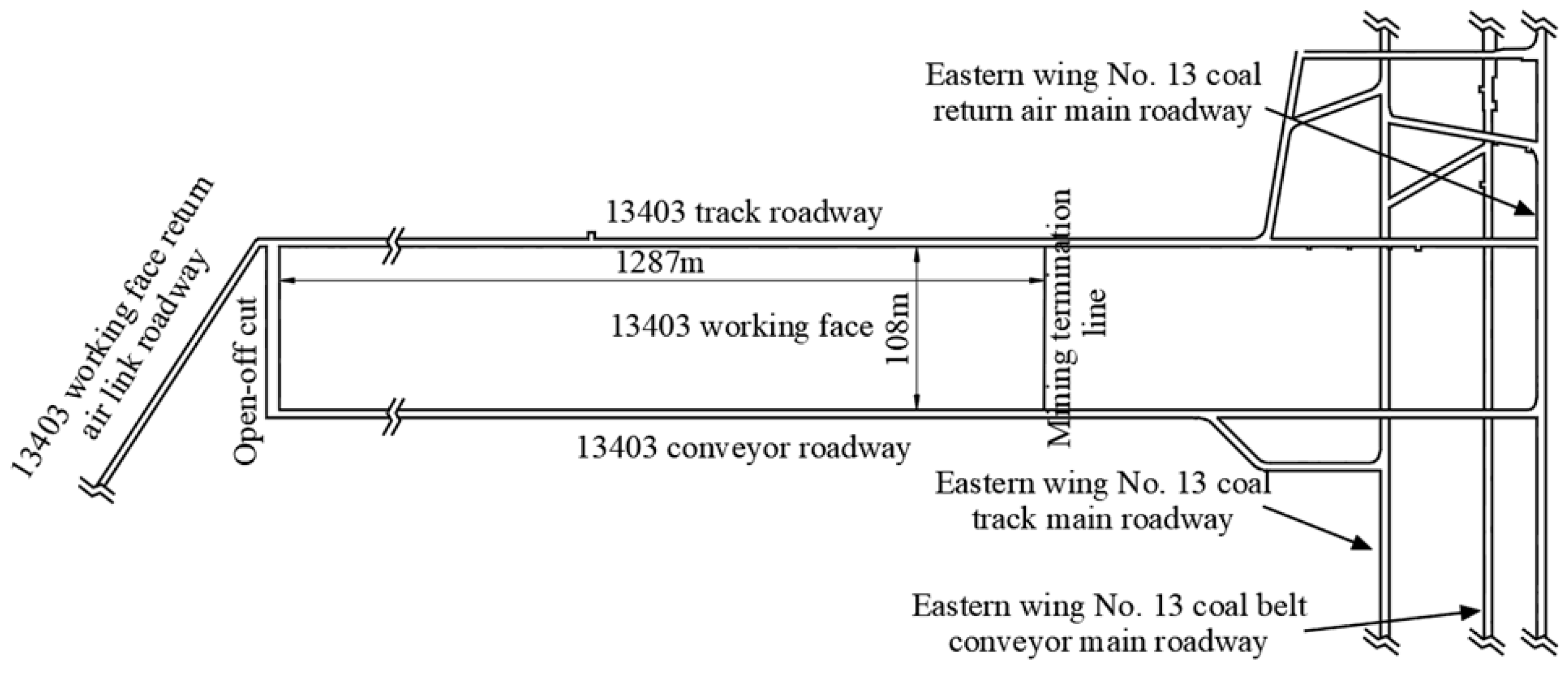
Figure 1. Working face location.
Symmetry 17 01911 g001
Figure 2. Stratigraphic column of working face roof and floor strata.
Symmetry 17 01911 g002
Figure 3. Numerical simulation model.
Symmetry 17 01911 g003
Figure 4. Numerical simulation of anchor cable constitutive relation.
Symmetry 17 01911 g004
Figure 5. Simulation steps for the whole process of working face mining: (a) planar graph of the model; (b) support of the target support entry; (c) layout of monitoring points.
Symmetry 17 01911 g005
Figure 6. Advance abutment stress distribution curve of the working face: (a) middle line; (b) side line.
Symmetry 17 01911 g006
Figure 7. Stress distribution curve of surrounding rock in the mining roadway: (a) 25 m away from the stope; (b) 50 m away from the stope.
Symmetry 17 01911 g007
Figure 8. Displacement evolution law of the mining roadway: (a) 25 m away from the stope; (b) 50 m away from the stope.
Symmetry 17 01911 g008
Figure 9. Evolution process of elastic strain energy density of the main roof: (ai) correspond to the situations when the mining face advances from 40 m to 200 m, with an interval of 20 m each time.
Symmetry 17 01911 g009
Figure 10. Roof energy-gathering blasting for directional presplitting pressure relief: (a) dip structure change; (b) strike structure change.
Symmetry 17 01911 g010aSymmetry 17 01911 g010b
Figure 11. Comprehensive control technology for surrounding rock of deep soft rock roadways: (a) reinforced support; (b) roadway roof cutting; (c) roadway temporary support; (d) remove roadway temporary support.
Symmetry 17 01911 g011
Figure 12. Schematic of the comprehensive control scheme for surrounding rock in deep soft rock roadways: (a) open off cut; (b) track roadway.
Symmetry 17 01911 g012
Figure 13. Peak advance abutment stress variation curve.
Symmetry 17 01911 g013
Figure 14. Peak support stress variation curve in roadway surrounding rock.
Symmetry 17 01911 g014
Figure 15. Convergence variation curve of roadway surrounding rock.
Symmetry 17 01911 g015
Figure 16. Evolution of elastic strain energy density in key roof strata: (ai) correspond to the situations when the mining face advances from 40 m to 200 m, with an interval of 20 m each time.
Symmetry 17 01911 g016
Figure 17. Cross section of the track roadway at 50 m behind the working face.
Symmetry 17 01911 g017
Figure 18. Deformation condition of the track roadway after mining completion.
Symmetry 17 01911 g018
Table 1. Calibrated rock mass mechanical parameters used in the numerical simulations (derived from laboratory tests and field back-analysis).
StratumDensity/(kg m3)Bulk/(GPa)Shear/(GPa)Friction/(°)Cohesion/(MPa)Tension/(MPa)
Mudstone24606.083.47301.21.0
Coal13504.912.01301.250.9
Siltstone246010.838.13382.752.6
Fine sandstone287020.0113.52423.22.9
Disclaimer/Publisher’s Note: The statements, opinions and data contained in all publications are solely those of the individual author(s) and contributor(s) and not of MDPI and/or the editor(s). MDPI and/or the editor(s) disclaim responsibility for any injury to people or property resulting from any ideas, methods, instructions or products referred to in the content.