


Abstract
In this paper, we study the existence of the families of odd symmetric periodic solutions in the generalized elliptic Sitnikov -body problem for all values of the eccentricity using the global continuation method. First, we obtain the properties of the period of the solution of the corresponding autonomous equation (eccentricity ) using elliptic functions. Then, according to these properties and the global continuation method of the zeros of a function depending on one parameter, we derive the existence of odd periodic solutions for all . It is shown that the temporal frequencies of period solutions depend on the total mass (or the number N) of the primaries in a delicate way.
1. Introduction
It is well known that the Sitnikov problem is the simplest model that cannot give an analytic solution in the restricted N-body problem, where two bodies (called primaries) of equal mass are moving in a circular or an elliptic orbit of the two-body problem, and the infinitesimal mass is moving on the straight line orthogonal to the plane of motion of the primaries which passes through their center of mass. The Sitnikov problem became important when Sitnikov, for the first time, showed the existence of oscillatory motions [1]. Since then, many other authors have studied this problem. We refer the reader to [2,3,4,5,6,7,8,9,10,11,12,13] and the references therein for a more detailed introduction.
In particular, there are many interesting results on periodic solutions of the Sitnikov problem [13,14,15,16,17,18,19,20,21]. For example, Abouelmagd et al. found periodic solutions of the circular Sitnikov problem using the multiple scales method [14]. Belbruno et al., obtained the analytical expressions for the solutions of the circular Sitnikov problem and the period function of its family of periodic orbits. In addition, they also numerically studied the linear stability of the family of periodic orbits of the Sitnikov problem [13]. Corbera and Llibre have studied the family of symmetric periodic orbits using the continuity of periodic solutions from the circular Sitnikov problem to the elliptic Sitnikov problem [16,17]. Galán et al. numerically studied the stability and bifurcation of even periodic solutions of the Sitnikov problem [18]. Based on the global continuation method, Libre and Ortega constructed the even symmetric periodic solutions of the Sitnikov problem [19]. Using a shooting method and Sturm oscillation theory, Ortega explored the existence of odd symmetric periodic solutions of the Sitnikov problem [20]. Owing to the theory for Hill’s equations, Zhang and his co-authors studied the stability of nonconstant symmetric periodic solutions of the Sitnikov problem, which emanate from the corresponding solutions of the circular Sitnikov problem [15,21,22].
In recent years, periodic solutions of the generalized Sitnikov -body problem (i.e., there are multiple primaries in the Sitnikov problem) have attracted the attention of some researchers. In 2009, Bountis and Papadakis studied the stability of vertical motion and bifurcation in a three-dimensional periodic orbit family [23]. In 2013, Rivera studied some properties of two groups of families of periodic solutions, where one group is families that are globally continued from the generalized circular Sitnikov -body problem to the generalized elliptic Sitnikov -body problem (), and the other is families that arise as bifurcation from equilibrium solution at certain special values of the eccentricity [24]. In 2018, Misquero pointed out the existence of both types of symmetric periodic solutions and proved the existence of even symmetric periodic solutions using a shooting method and Sturm oscillation theory (see Lemma 6 of [25]).
Periodic solutions of the n-body problem have always been an important research field, whether in celestial mechanics or mathematics. Motivated by work in the literature [19,24], we will study the odd families of periodic solutions of the generalized elliptic Sitnikov -body problem. Firstly, based on elliptic functions, we will deduce the properties of the period of the solution of the generalized circular Sitnikov -body problem. Then, based on these properties, and for all values of the eccentricity , we will study the existence of odd periodic solutions of the generalized elliptic Sitnikov -body problem by the global continuation of the zeros of a function depending on one parameter provided by Leray and Schauder (see [26] or Section 4 of [19]). The challenge we face is to prove the existence of the solutions of the Dirichlet problem. Although the global continuation method we use is the same as that in [19], there is a great difference. Specifically, we note that the study of [19] was conducted in the classical elliptical Sitnikov problem, but our study is conducted in the generalized elliptical Sitnikov -body problem, which is the more general case. It shows that temporal frequencies of periodic solutions depend on the total mass (or the number N) of the primaries in a delicate way. In addition, Refs. [19,24] have proved the existence of even periodic solutions using the global continuation method. To our knowledge, this is the first time that the existence of odd periodic solutions has been analytically studied using the global continuation method.
The rest of the paper is organized as follows: in Section 2, we introduce the generalized elliptic Sitnikov -body problem and deduce the properties of the period of the solution in the generalized circular Sitnikov -body problem; then, we explore the existence of odd periodic solutions of the generalized elliptic Sitnikov -body problem for all in Section 3; we finally conclude the paper in Section 4.
2. The Generalized Elliptic Sitnikov -Body Problem
In this section, we first introduce the generalized elliptic Sitnikov -body problem [24]. Then, we study the properties of the period of the solution in the generalized circular () Sitnikov -body problem using elliptic functions.
Consider N (≥2) point masses , called primaries, which have equal masses
Suppose that moves along an elliptic orbit with eccentricity , whose semimajor axis is equal to and minimal period is . Then, satisfy the N-body problem where each body moves around the center of mass over an elliptic orbit with alike eccentricity, semimajor axis and minimal period. Meanwhile, the N primaries exactly form a stable positive N-sided structure, and its position just satisfies the Lagrange solution of the N-body problem. These orbits are located in the plane of the inertial frame of reference, and the mass center of the primaries is in the origin. The particle P, of infinitesimal mass, moves along the Z-axis in the gravitational field generated by the primaries . Notice that the mass of P is so small that its effects on the primaries can be ignored. Let be the position of P at the time t. Then, the equation of motion for P is given by
where is the distance from each primary to the mass center, and is the solution of the Kepler’s equation . We call Equation (2) the generalized elliptic Sitnikov -body problem (GESP).
In addition, is the total mass of the system, i.e.,
and . Notice that Equation (2) is only the classical Sitnikov problem when (i.e., ). Figure 1 shows the GESP when .
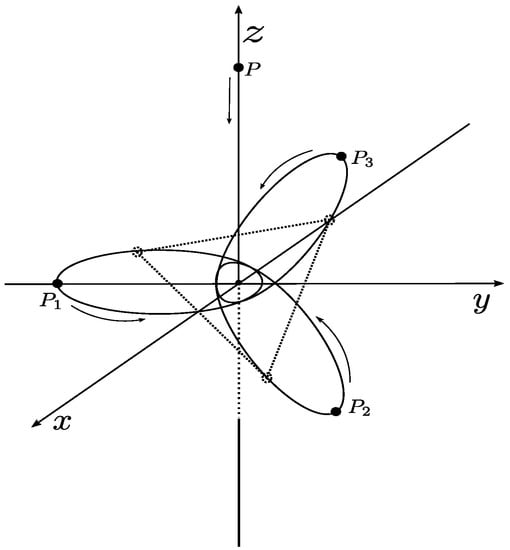
Figure 1.
The generalized elliptic Sitnikov -body problem.
In particular, when , the primaries move along a circular orbit of radius and constant angular velocity. Then, Equation (2) becomes
We call Equation (4) the generalized circular Sitnikov -body problem (GCSP). Moreover, the energy levels of solutions are
where while , is just the equilibrium of Equation (4), and for , corresponds to periodic orbits of (4) whose minimal period is denoted by . Motivated by work in the literature [13], we have the following theorem about the properties of .
Theorem 1.
The period has the following three properties:
- (i)
- ;
- (ii)
- ;
- (iii)
Theorem 1 is an extension of Theorem C in [13], because [13] dealt with the classical Sitnikov problem (). Our proof is entirely analogous to that of [13]. Next, we need to introduce the following proposition.
Proposition 1.
By introducing the following transformation
the generalized circular Sitnikov problem defined by (5) on is reformulated
or equivalently,
Proof.
Letting , the former two expressions of (6) are reformulated as follows:
where . Substituting (9) into (5), the Hamiltonian of the generalized circular Sitnikov -body problem is reformulated as follows:
Here the transformation (9) is canonical because implies . Furthermore, defining
the third transformation of (6) is reformulated as follows:
Again, let . Then, the Hamiltonian (10) is reformulated as follows:
Because the transformation (12) is also canonical, the equation of motion on is given by
Owing to the second equation of (14), we have
Moreover, (15) is transformed into
By taking when , it is just now that the infinitesimal body is at the origin. Noticing that , from (11), we have
which is an elliptic integral of the first kind. Thus, Proposition 1 is proved. □
Proof of Theorem 1.
From Formula (8), we have
Recall Formula 256.00 in [27] as follows:
Here, and
is called the normal elliptic integral of the first kind. Moreover, by introducing the change of variable in (19), is reformulated as follows:
where . The inverse function to (20) is called the sinus amplitude Jacobi elliptic function, and is a doubly periodic function in of period . Here , , and (see [27]).
Let , , , and in Formula (17). Then, we have , and From Formula (17), s can be reformulated as follows:
Clearly, we notice that from (21). Owing to (18), (20), (16) and the inverse function , we have
and further obtain that
Based on (11) and (22), we can obtain the solution of the generalized circular Sitnikov -body problem for , and the period in the variable s is also given by . Hence, based on Formula (12), the period in the variable t is reformulated as follows:
where . Because , we have . It is clear that . So, we apply Formula 412.07 in [27] to (23) and obtain that
Here,
is the complete elliptic integral of the second kind. Moreover, letting , we have
which is the Heuman Lambda Function (see Formula 150.01 in [27]).
From (25) and (26), we see that and (Formula 151.01 in [27]), respectively. Thus, when , we have
In addition, from , one has
Hence, (i) and (ii) in Theorem 1 hold.
Next, we will prove (iii) in Theorem 1. We notice that , and . Thus, it is sufficient to only consider . Then, we first compute , which needs these derivatives: , and . Based on Formula 710.02 in [27], we know
Because , we have
Owing to Formula 730.04 and 710.11 in [27], we further obtain
and
Based on (29) and (31), we have
where . By the fact that , we have from [27]. Clearly, we only need to prove . Let . Because , we have for . It implies that , i.e., . Therefore, for an arbitrary , we have .
Based on all the above analyses, Theorem 1 is proved. □
Remark 1.
(i) From Theorem 1, we see that the former three conclusions, (a), (b) and (c) of Theorem C in the literature [13] can be extended to the GCSP. (ii) Notice that the origin is surrounded by a family of periodic orbits, whose minimal periods take values from .
3. The Existence of Odd Periodic Solutions
In this section, we intend to analyze the existence of odd periodic solutions of the GESP for all by using the global continuation method of the zeros of a function depending on one parameter based in the Brouwer degree. For this, we introduce the following lemma.
Lemma 1
([19], Theorems 4.3 and 4.4). Let F: be real and analytic, and be the set of zeros of F. Assume that
(H1) Σ is bounded;
(H2) The set is finite, and there is a isolated point such that , where ind is the index of Brouwer at .
Then, there is a continuum arc , with such that one of the following alternatives holds:
()
() with .
For and given an integer , we are going to explore the existence of odd -periodic solutions of the system (2). Based on the symmetry of Equation (2), it is equivalent to study the existence of nontrivial solutions of the following Dirichlet problem:
Let be the solution of (2) satisfying
This is a real analytic function in the arguments . Because the nonlinearity in (2) is bounded, these solutions are globally defined in . Define
Then, studying the existence of nontrivial solutions of Equation (32) for all is equivalent to studying the existence of zeros of the equation
3.1. Satisfiability of Hypotheses (H1) and (H2)
In this subsection, we will verify that satisfies the assumptions (H1) and (H2) of Lemma 1. For this, we have the following propositions.
Proposition 2.
Proof.
Observe that
So, is a sign reversal function in (0, ). Again assuming that is a zero of , we have
Given a constant E and , for we have
So, for all , we calculate and obtain
where is a constant associated with E.
Moreover, from the mean value theorem of integration, we have
Consequently, for all , we obtain
Thus, we have for , which shows that is bounded. □
Proposition 3.
Let . Then, is finite and there is satisfying .
Proof.
Considering the zeros of , we only need to study the solutions of the following Dirichlet problem:
From Equation (5), we know that . Let be a periodic solution with the minimal period of Equation (4). Based on (5) and the third item (iii) of Theorem 1, we have
where . So, is an increasing function in v.
By the symmetry, is also a solution of the boundary problem (35) if and only if there is an integer such that . From (ii) of Theorem 1 and Formula (36), we have inf . Therefore, holds. Moreover, we obtain . Let and be the solutions of with . It is clear that M must satisfy .
Based on the symmetry of Equation (2), denote
Because is an increasing function in v, we have
From here, we obtain ind. Furthermore,
Similarly, we can also compute the indices for because of the symmetry.
Next, we compute the index at 0. Let be a solution of the following variational equation:
Noting that , we have
To sum up, when , there exist nontrivial, odd, and 2-periodic solutions of (35) with , where . Then, they can be labeled by the number of zeros of in for . Moreover, the index of each of these solutions, ind, is ± 1. □
Remark 2.
From Propositions 2 and 3, we can see that satisfies the hypotheses (H1) and (H2) of Lemma 1.
3.2. Main Results
In this subsection, we will apply Lemma 1 to prove the existence of odd periodic solutions of the GESP for all . For this, we need to introduce the following definition.
Definition 1
([28], Definition 2). Let be a connected component of (which is actually arcwise connected because is analytic). Then,
is a global family of solutions of (2), and is the connected component associated with .
Proposition 4.
For each fixed and , let be a sequence of solutions of (2) satisfying , , , . Then, for large n, the number of zeros of in is equal to the number of zeros of in the same interval of the nontrivial solutions of
Proof.
By the continuous dependence of the solution on the initial value, one has uniformly in . Then, let and satisfy the following equations:
Moreover, from the continuous dependence of the solution on the parameters, we obtain that converges in to the solution of the following equation
It is clear that . So, it holds that . Because and are analytic, the zeros of and are isolated, and their number of zeros must be finite in any bounded closed interval. Then, there exists a small enough positive such that , , ) and are not equal to zero. Furthermore, the number of zeros of (resp. ) in [, ] is the same as in (0, ). Because , uniformly, and all the zeros of are nondegenerate, we deduce that and have the same number of zeros in for large n. That is, and have the same number of zeros in ). □
Proposition 5.
Proof.
Let be a solution of (38) with , and assume that has zeros in . Then, we introduce polar coordinates in (38) and find that the argument satisfies
Because is always negative, one has .
Again, let be a nontrivial solution of (32) for each fixed e and have zeros in . Obviously, is also a solution of the following linear equation:
Moreover, the corresponding argument with satisfies
From the definition of , we can obtain
and this inequality is strict except for the zero of . Thus, (t) is an upper solution of (39) and
From , we have , which implies that Proposition 5 is proved. □
From Propositions 2 and 3, we see that is bounded and ind. Moreover, there is a unique ) with , where . Thus, the solution of (4) with the initial value and is odd -periodic and has exactly zeros in .
Afterward, we will further infer that there exists a continuous family in such that
and either
or
For , let be the solution of (2) that satisfies and . In addition, for , we see that and . Then, we consider the following two cases.
Case 1. ,
Assuming , we notice that has zeros in . Furthermore, for any sufficiently small positive , and satisfies
- (i)
- , , .
- (ii)
- , is nontrivial, and the zeros of are nondegenerate.
- (iii)
- is continuous.
Thus, from Lemma 7.2 in the literature [19], we obtain that the number of zeros of in is independent of s, implying that the number of zeros of in (0, ) is also independent of s. Then, for arbitrary , has zeros in .
If the first alternative (42) holds, then we have and . In this condition, the second alternative (43) cannot occur. Otherwise, and . Based on , we obtain for some , implying that has zeros in (0, ). So, there is a contradiction.
Let the set , be a connected subset of and be the connected component of containing . Based on the above analysis, we obtain that each solution in is odd -periodic and has zeros in . Letting , we have .
Case 2. vanishes for some .
Let be the first zero of . Then, we have
Now we consider the family with and . For , we have . From Case 1, we further know that has zeros in . The definition of implies that and . Owing to Proposition 4, we conclude that the equation
has a nontrivial odd -periodic solution with zeros in .
Similar to Case 1, let the set be a connected subset of and be the connected component of containing . Hence, all of the solutions in are odd -periodic and have zeros in . Because and , from Proposition 5, we have with .
Above all, we have the following main theorem of our paper.
Theorem 2.
Let be the connected component of . For each fixed , and , there exists a global family of nontrivial solutions of (2), and is the connected component associated with . Moreover,
- (1)
- all solutions of are odd -periodic and have zeros in .
- (2)
- and one of the following alternatives holds:
- (2.a)
- ;
- (2.b)
- with .
Remark 3.
(i) If satisfies (2.a), then the family continues for all values of . (ii) If satisfies (2.b), then it ends in the equilibrium at a value of eccentricity . Additionally, the linear differential equation
has a nontrivial odd -periodic solution with exactly zeros in the interval .
Next, we consider the options of (2.a) and (2.b) of Theorem 2 and have the following theorem.
Theorem 3.
For any and , we assume that k, M and λ satisfy , and . So, one has
- (1)
- if , then statement (2.a) of Theorem 2 holds;
- (2)
- if , then and (2.b) of Theorem 2 holds, , where
In order to prove Theorem 3, we introduce the following lemma.
Lemma 2
([19,29]). Assume that is continuous, -periodic and for some satisfies
where both inequalities are strict somewhere. Then, has no -periodic solution (excepting ).
Proof of Theorem 3.
Notice that is a nontrivial odd-periodic solution of the equation
For , and satisfying , i.e., and , we obtain that has zeros in [0, ]. Moreover, because , we apply the Sturm comparison theory and derive that the nontrivial odd-periodic solutions of (44) have at least zeros in (0, ). However, if , then there is no -periodic solution of (44). Thus, if , we can conclude that statement (2.a) of Theorem 2 holds from Remark 3.
In addition, if and (2.b) of Theorem 2 holds, then we have , where and . Otherwise, . Because , we have
Letting in Lemma 2, we obtain that Equation (44) has no -periodic solution. However, we note that there is a contradiction from the item (ii) of Remark 3. So, if , and (2.b) of Theorem 2 holds, then . □
Remark 4.
When , we have the only choice , i.e, the generalized elliptic Sitnikov -body problem is just the Sitnikov problem. At this time, there exist the odd -periodic solutions with no zeros in for all , which is in accordance with the conclusion in the literature [20].
4. Conclusions
In this paper, we studied the existence of the families of odd symmetric periodic solutions in the generalized elliptic Sitnikov -body problem for all values of the eccentricity using the global continuation method. We first studied the properties of the period of the solution of the generalized circular Sitnikov -body problem using elliptic functions. Then, based on these properties of the period and applying the global continuation method of the zeros of a function depending on one parameter, the existence of odd periodic solutions was obtained for all . Specifically, according to the symmetry of the equation, the existence of an odd family of symmetric periodic solutions was transformed into the existence of solutions of the corresponding Dirichlet problem. Moreover, we defined an analytical function such that the existence of the solutions of the Dirichlet problem is equivalent to the existence of the zero point of . It was finally verified that satisfied the basic assumptions of the global continuation theorem, implying the existence of the odd family of symmetry periodic solutions. Meanwhile, the theoretical result showed that the temporal frequencies of periodic solutions depend on the total mass (or the number N) of the primaries in a delicate way. Moreover, it is believed that these results have important significance and practical value for the design and control of satellite orbital motion in the field of aviation.
One of our plans for future work is to investigate the stability of these symmetric periodic solutions in the generalized elliptic Sitnikov -body problem.
Author Contributions
Conceptualization, X.C. and B.L.; Methodology, X.C. and B.L.; Writing: original draft, B.L.; Writing: review and editing, X.C. All authors have read and agreed to the published version of the manuscript.
Funding
This research was funded by the National Natural Science Foundation of China, Grant number 11601257 and Natural Science Foundation of Hebei Province, Grant number A2019202342.
Institutional Review Board Statement
Not applicable.
Informed Consent Statement
Not applicable.
Data Availability Statement
Not applicable.
Conflicts of Interest
The authors declare no conflict of interest.
References
- Sitnikov, K. Existence of oscillatory motions for the three-body problem. Dokl. Akad. Nauk. 1960, 133, 303–306. [Google Scholar]
- Faruque, S. Solution of the Sitnikov problem. Celest. Mech. Dyn. Astr. 2003, 87, 353–369. [Google Scholar] [CrossRef]
- Jiménez-Lara, L.; Escalona-Buendía, A. Symmetries and bifurcations in the Sitnikov problem. Celest. Mech. Dyn. Astr. 2001, 79, 97–117. [Google Scholar] [CrossRef]
- Kumari, R.; Pal, A.; Abouelmagd, E.; Alhowaity, S. Approximation solution of the nonlinear circular Sitnikov restricted four body problem. Symmetry 2021, 13, 1966. [Google Scholar] [CrossRef]
- Liu, J.; Sun, Y. On the Sitnikov problem. Celest. Mech. Dyn. Astr. 1990, 49, 285–302. [Google Scholar] [CrossRef]
- Markellos, V. Bifurcations of straight line oscillations. Astron. Astrophys. 1978, 67, 229–240. [Google Scholar]
- Moser, J. Stable and Random Motion in Dynamical Systems; Princeton University Press: Princeton, NJ, USA, 1973. [Google Scholar]
- Ortega, R.; Rivera, A. Global bifurcations from the center of mass in the Sitnikov problem. Disc. Contin. Dyn. Syst. Ser. B 2010, 14, 719–732. [Google Scholar] [CrossRef]
- Pavanini, G. Sopra una nuova categoria di soluzioni periodiche nel problema dei tre corpi. Ann. Mat. Pur. Appl. 1907, 13, 179–202. [Google Scholar] [CrossRef]
- Ullah, M.; Idrisi, M.; Sharma, B.; Kaur, C. Sitnikov five-body problem with combined effects of radiation pressure and oblateness. New Astron. 2021, 87, 9. [Google Scholar]
- Szebehely, V. Theory of Orbits the Restricted Problem of Three Bodies; Academic Press: New York, NY, USA, 1967. [Google Scholar]
- Wodnar, K. Analytical approximations for Sitnikov’s problem. In From Newton to Chaos; Springer: Boston, MA, USA, 1995; pp. 513–523. [Google Scholar]
- Belbruno, E.; Llibre, J.; Olle, M. On the families of periodic orbits which bifurcate from the circular Sitnikov motions. Celest. Mech. Dyn. Astr. 1994, 60, 99–129. [Google Scholar] [CrossRef]
- Abouelmagd, E.; Guirao, J.; Pal, A. Periodic solution of the nonlinear Sitnikov restricted three body problem. New Astron. 2020, 75, 10. [Google Scholar] [CrossRef]
- Cen, X.; Cheng, X.; Huang, Z.; Zhang, M. On the stability of symmetric periodic orbits of the elliptic Sitnikov problem. SIAM J. Appl. Dyn. Syst. 2020, 19, 1271–1290. [Google Scholar] [CrossRef]
- Corbera, M.; Llibre, J. Periodic orbits of the Sitnikov problem via a Poincaré map. Celest. Mech. Dyn. Astr. 2000, 77, 273–303. [Google Scholar] [CrossRef]
- Corbera, M.; Llibre, J. On symmetric periodic orbits of the elliptic Sitnikov problem via the analytic continuation method. Contem. Math. 2002, 292, 91–128. [Google Scholar]
- Galán, J.; Núnez, D.; Rivera, A.; Riccio, C. Stability and bifurcations of even periodic orbits in the Sitnikov problem. Celest. Mech. Dyn. Astr. 2018, 130, 20. [Google Scholar]
- Llibre, J.; Ortega, R. On the families of periodic orbits of the Sitnikov problem. SIAM J. Appl. Dyn. Syst. 2008, 7, 561–576. [Google Scholar] [CrossRef]
- Ortega, R. Symmetric periodic solutions in the Sitnikov problem. Arch. Math. 2016, 107, 405–412. [Google Scholar] [CrossRef]
- Zhang, M.; Cen, X.; Cheng, X. Linearized stability and instability of nonconstant periodic solutions of Lagrangian equations. Math. Meth. Appl. Sci. 2018, 41, 4853–4866. [Google Scholar] [CrossRef]
- Cen, X.; Liu, C.; Zhang, M. A proof for a stability conjecture on symmetric periodic orbits of the elliptic Sitnikov problem. SIAM J. Appl. Dyn. Syst. 2021, 20, 941–952. [Google Scholar] [CrossRef]
- Bountis, T.; Papadakis, K.E. The stability of vertical motion in the N-body circular Sitnikov problem. Celest. Mech. Dyn. Astr. 2009, 104, 205–225. [Google Scholar] [CrossRef]
- Rivera, A. Periodic solutions in the generalized Sitnikov(N+1)-body problem. SIAM J. Appl. Dyn. Syst. 2013, 12, 1515–1540. [Google Scholar] [CrossRef]
- Misquero, M. Resonance tongues in the linear Sitnikov equation. Celest. Mech. Dyn. Astr. 2018, 130, 25. [Google Scholar] [CrossRef]
- Leray, J.; Schauder, J. Topologie et équations fonctionnelles. Ann. Sci. Ec. Norm. Supérieure 1934, 51, 45–78. [Google Scholar] [CrossRef]
- Byrd, P.; Friedman, M. Handbook of Elliptic Integrals for Engineers and Physicists; Spring: Berlin/Heidelberg, Germany, 1954. [Google Scholar]
- Gastón, B. On the global families of periodic solution of a generalized Sitnikov Problem. Celest. Mech. Dyn. Astr. 2022, 134, 22. [Google Scholar]
- Coddington, E.A.; Levinson, N. Theory of Ordinary Differential Equations; McGraw-Hill Book Company, Inc.: New York, NY, USA; Toronto, ON, Canada; London, UK, 1955. [Google Scholar]
Disclaimer/Publisher’s Note: The statements, opinions and data contained in all publications are solely those of the individual author(s) and contributor(s) and not of MDPI and/or the editor(s). MDPI and/or the editor(s) disclaim responsibility for any injury to people or property resulting from any ideas, methods, instructions or products referred to in the content. |
© 2023 by the authors. Licensee MDPI, Basel, Switzerland. This article is an open access article distributed under the terms and conditions of the Creative Commons Attribution (CC BY) license (https://creativecommons.org/licenses/by/4.0/).