Abstract
In this paper, a hybrid variable-order mathematical model for multi-vaccination COVID-19 is analyzed. The hybrid variable-order derivative is defined as a linear combination of the variable-order integral of Riemann–Liouville and the variable-order Caputo derivative. A symmetry parameter is presented in order to be consistent with the physical model problem. The existence, uniqueness, boundedness and positivity of the proposed model are given. Moreover, the stability of the proposed model is discussed. The theta finite difference method with the discretization of the hybrid variable-order operator is developed for solving numerically the model problem. This method can be explicit or fully implicit with a large stability region depending on values of the factor . The convergence and stability analysis of the proposed method are proved. Moreover, the fourth order generalized Runge–Kutta method is also used to study the proposed model. Comparative studies and numerical examples are presented. We found that the proposed model is also more general than the model in the previous study; the results obtained by the proposed method are more stable than previous research in this area.
Keywords:
variable-order hybrid operator; Pfizer vaccine; Moderna vaccine; Janssen vaccine; theta finite difference method; generalized fourth order Runge–Kutta method MSC:
65L05; 37N30; 65M06
1. Introduction
Coronaviruses are a large family of viruses known to cause illnesses ranging from the common cold to more serious illnesses such as severe acute respiratory syndrome [1]. The World Health Organization has designated this variant as a variant of serious concern. The United States Centers for Disease Control and Prevention has granted Emergency Use Authorization to the following vaccines: Pfizer-BioNTech with efficacy against symptomatic COVID-19, Moderna vaccine with efficacy and Janssen vaccine manufactured by Johnson & Johnson, which has an efficacy rating of , as well as many others [1,2]. SARS-CoV-2 vaccinations have been shown to be effective against infections, including both silent and symptomatic cases, of severe COVID-19 illness and deaths [2]. Mathematical modeling is a valuable tool to study disease spread and control very effectively. Several mathematical models have been proposed in the literature to study and understand the novel complex transmission pattern of the COVID-19 pandemic; see, for example, [3,4,5,6,7,8].
In the meantime, there are now extensive articles explaining the advantage of fractional order models for studying real mathematical models in various fields [9]. The variable-order fractional derivatives (VOFDs) can describe the effects of the long variable memory of a time-dependent system. In [10], Samko et al. proposed this interesting extension of the classical calculation of fractions. In the concept of fractional derivative with variable order, the order may vary either as a function of the independent differentiation variable or as a function of another (possibly spatial) variable , or both. Therefore, the derivative models described using variable-order fractional derivatives are useful and appropriate for the epidemic models. We can obtain the results of fractional order and integer order as a special case from variable-order mathematical models [11,12,13,14,15,16,17,18].
In this article, we will present the theta finite different method with the discretization of new hybrid fractional operator. This operator is called the constant proportional Caputo variable-order fractional derivative (CPC- FDM) and is used to study the proposed model numerically. In the literature, the theta finite differences method (FDM) method, also called the weighted average finite differences method (WAFDM), is one of the finite difference methods [19,20]. This method could be an explicit method or an implicit method (more stable and efficient), depending on the weight factor . Using Caputo and Riesz–Feller derivatives, this method was developed for a nonstandard finite difference method [21,22].
The goal of this work is to present and analyze a hybrid variable-order fractional model of multi-vaccination for COVID-19. The new variable-order hybrid derivatives are defined as the linear combination of the variable-order Riemann–Liouville integral and the variable-order derivative of Caputo. This is one of the most effective and reliable of these operators; it is more general than the Caputo fractional operator. Positivity, boundedness and stability will be proved in the current model.
Moreover, one of the aims of this article is developing CPC- FDM for solving the variable-order fractional differential equations numerically and we will compare the obtained results with the results obtained with the fourth order generalized Runge–Kutta method (GRK4M) [23] and the method in [24]. Moreover, we extended the method in [24] to variable order. The analysis of stability and convergence of the proposed method will be studied. Numerical simulations will be given to confirm the efficiency and wide applicability of the proposed method.
To our knowledge, no numerical investigations of a hybrid variable-order fractional for multi-vaccination for a COVID-19 mathematical model utilizing CPC- FDM have been conducted.
This paper is organized as follows: Some notations and definitions of variable-order fractional derivatives are introduced in Section 2. In Section 3, the model with a hybrid variable order is presented; moreover, the positivity, boundedness, existence and uniqueness of the solutions and the stability of the present model are discussed. In Section 4, the numerical methods GRK4M and CPC- SFDM are studied; moreover, stability analyses for these methods are proved. In Section 5, numerical simulations are presented. The conclusions are ultimately outlined in Section 6.
2. Notations and Preliminaries
In this section, we review several key definitions of variable-order calculus that will be utilized throughout the remainder of this article.
Definition 1.
Caputo’s derivatives (right–left side variable-order fractional ) are defined, respectively, as follows [25]:
, .
Definition 2.
Let ; the right–left side variable-order fractional Riemann–Liouville’s integral and are given as follows [25]:
.
Definition 3
([26]). The variable-order fractional Caputo proportional operator (CP) is given as follows:
, , .
Alternatively, the constant proportional Caputo (CPC) variable-order fractional hybrid operator can be formulated as follows [26]:
, , where Q is a constant.
Definition 4.
Moreover, its inverse operator is [26]:
3. A Hybrid Variable-Order Mathematical Model
A variable-order multiple vaccination model for COVID-19 is presented below; it is an extension of the model given in [24]. To satisfy the dimensional fit between the two sides of the resulting variable-order fraction equations, the variable-order operator is modified by an auxiliary parameter . As a result, the dimension of the left side is (day) [27]. The following is the updated variable-order nonlinear fractional mathematical model:
with the initial conditions
Figure 1 shows the flowchart of the model (8). Table 1 shows the definitions of variables for system (8). The hypotheses of the model for the rate of each type of vaccination are the same as in [24], as follows:
- 1
- 2
- Vaccination simulations of the proposed model in the strategy implementing only the Pfizer vaccine where these parameters are defined as in Table 2.
- 3
- Vaccination simulations of the proposed model in the strategy implementing only Moderna vaccine
- 4
- Vaccination simulations of the proposed model in the strategy implementing only Janssen vaccine

Therefore, we have at The feasible region
System (8) has a solution in This verifies the boundedness of the solution.
Table 1.
Variables of system (8).
Table 1.
Variables of system (8).
| Variable | Interpretation |
|---|---|
| R | Humans who have recovered |
| S | Unvaccinated susceptible individuals |
| Vaccinated using vaccination number three (Oxford Johnson & Johnson) | |
| Vaccinated using vaccination number two (Moderna) | |
| Vaccinated using vaccination number one (Pfizer) | |
| Individuals with severe sickness and hospitalization who are symptomatic | |
| (vaccinated and unvaccinated) (under complete isolation) | |
| Symptomatic people who have been vaccinated | |
| Symptomatic people who have not been immunized | |
| A | Asymptomatic individuals (vaccinated and unvaccinated) |
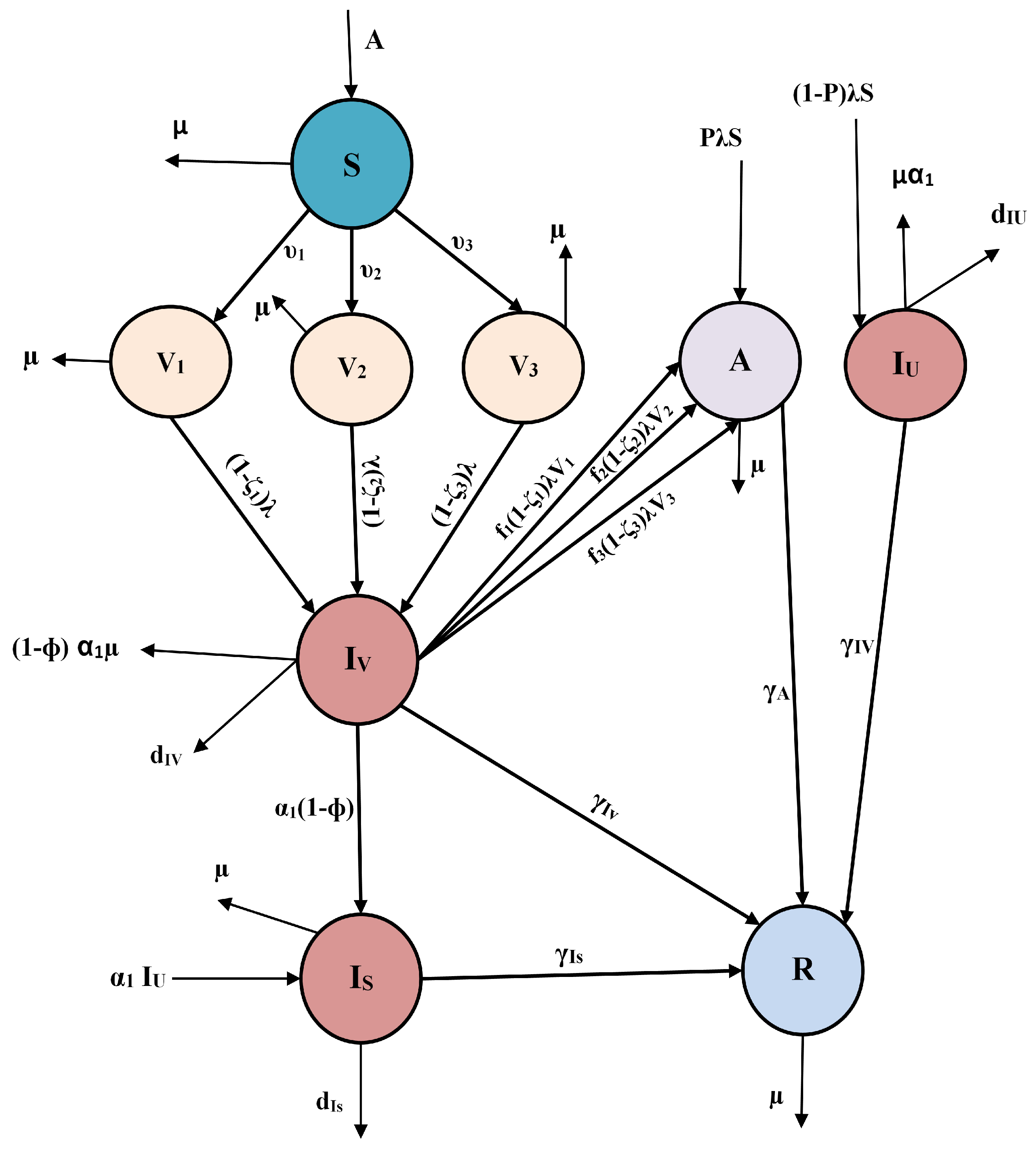
Figure 1.
Flowchart for system (8).
Proof.
□
3.1. Uniqueness and Existence
The existence and uniqueness of the solutions of the proposed model will be established using Banach fixed point theorem. Let system (8) be written as follows [4]:
represents the variables of the proposed system (8) and is a vector that represents the equations in the right of the system (8).
with an initial condition Furthermore, Lipschitz requirements as in [4] are satisfied:
Theorem 2.
If the following conditions are met:
the hybrid variable-order fractional model (8) has a unique solution.
Proof.
Let and ; then:
We have:
The supremum norm on K is represented by . Thus
So, with is a Banach space. Then, the following relation holds:
with ,
then
Relation (16) can be written as:
Table 2.
The definition of all parameters of system (8).
Table 2.
The definition of all parameters of system (8).
| Parameter | Interpretation | Baseline Value (per day−1) | Reference |
|---|---|---|---|
| Recruitment rate | day | [29] | |
| Rate of effective transmission | 0.00016708 | [24] | |
| Natural death rate | day | [29] | |
| Efficacy of the Janssen vaccine | [1] | ||
| Efficacy of the Moderena vaccine | [30] | ||
| Efficacy of the Pfizer vaccine | [31] | ||
| Rate of Janssen vaccination | day | [24] | |
| Rate of Moderena vaccination | day | [24] | |
| Rate of Pfizer vaccination | day | [24] | |
| p | Unvaccinated susceptibles who move to the asymptomatic stage are a small percentage of the total | [24] | |
| A parameter was changed to limit the transmissibility of asymptomatic people | [32] | ||
| Vaccine effectiveness against severe COVID-19 sickness | [2] | ||
| The percentage of susceptibles who received the vaccine and went on to develop subclinical disease | [24] | ||
| Individuals in and classes, respectively; the programme has a high rate of recovery | day | [24] | |
| Death rates from disease for people in the , and groups, respectively | [32] | ||
| The rate at which severe COVID-19 sickness develops | [32] |
3.2. Local Stability
The basic reproduction number is calculated in this section. The next generation operator method is used to investigate the local stability of the disease-free equilibrium (DFE), which is given by solving of model (8) and considering Then, we obtained , where is the DFE and is given by [33]:
As a result, the matrix V of the transfer of individuals between compartments and the matrix F of new infection terms are provided by
with
The model’s basic reproduction number, denoted by is given by [34,35]:
with
Theorem 3.
The disease-free equilibrium point of model (8) is locally asymptotically stable (LAS) if and unstable if .
Proof.
The Jacobian matrix of the system (8) at the DFE is used to investigate the local stability of model (8) [33,36].
where
The characteristic equation:
Then, we have
the arguments are where
We can rewrite the above equation as:
where
We obtain
Hence, the other two roots are given by
These two roots are complex conjugate when , real and distinct when , and real and conincident when .
Considering that occurs we have that if then and two distinct real roots given by
If then and two distinct real roots exist given by
So that and if and then and two complex conjugate roots exist, given by where or , then and two concident real roots exist given by or Then, and two distinct real roots exists given by
Applying the Routh–Hurwitz criterion [37], Equation (27) has roots with negative real parts if and only if Thus, the DFE is locally asymptotically stable. □
4. Numerical Methods for Solving the Proposed Model
4.1. GRK4M
Consider the fractional derivatives with variable order given by the following equation:
.
4.2. Stability of GRK4M
To investigate the stability of GRK4M, we shall utilize the following test problem of variable-order linear differential equation for simplicity:
Then, we have the following equation [38]:
The condition of stability [38]:
4.3. CPC-FDM
Consider:
Relationship (6) can be expressed as follows:
Using FDM and GL-approximation, we can discretize (34) as shown below:
where, N is a natural number, . Moreover, consider that [39]:
Remark 1.
If and in (36), we can obtain the discretization of Caputo operator with theta finite difference technique (C-Θ FDM).
4.4. CPC-FDM Stability Analysis
The stability of method (36) will be considered here. We shall utilize the test problem of variable-order linear differential equation, for simplicity:
By (34) and GL-approximation, we can discretize (37) as shown below:
put Then, from boundness theorem [40], we have:
This means Then, method (36) is stable.
4.5. Convergence of the Method
The proposed method is convergent because it is stable and consistent [41], then (41) is convergent.
5. Numerical Results
In the following, we solved (8) numerically using GRK4M (29) and CPC-FDM (36). Using CPC- FDM for solving (8), we obtained of the nonlinear algebraic system with unknown.
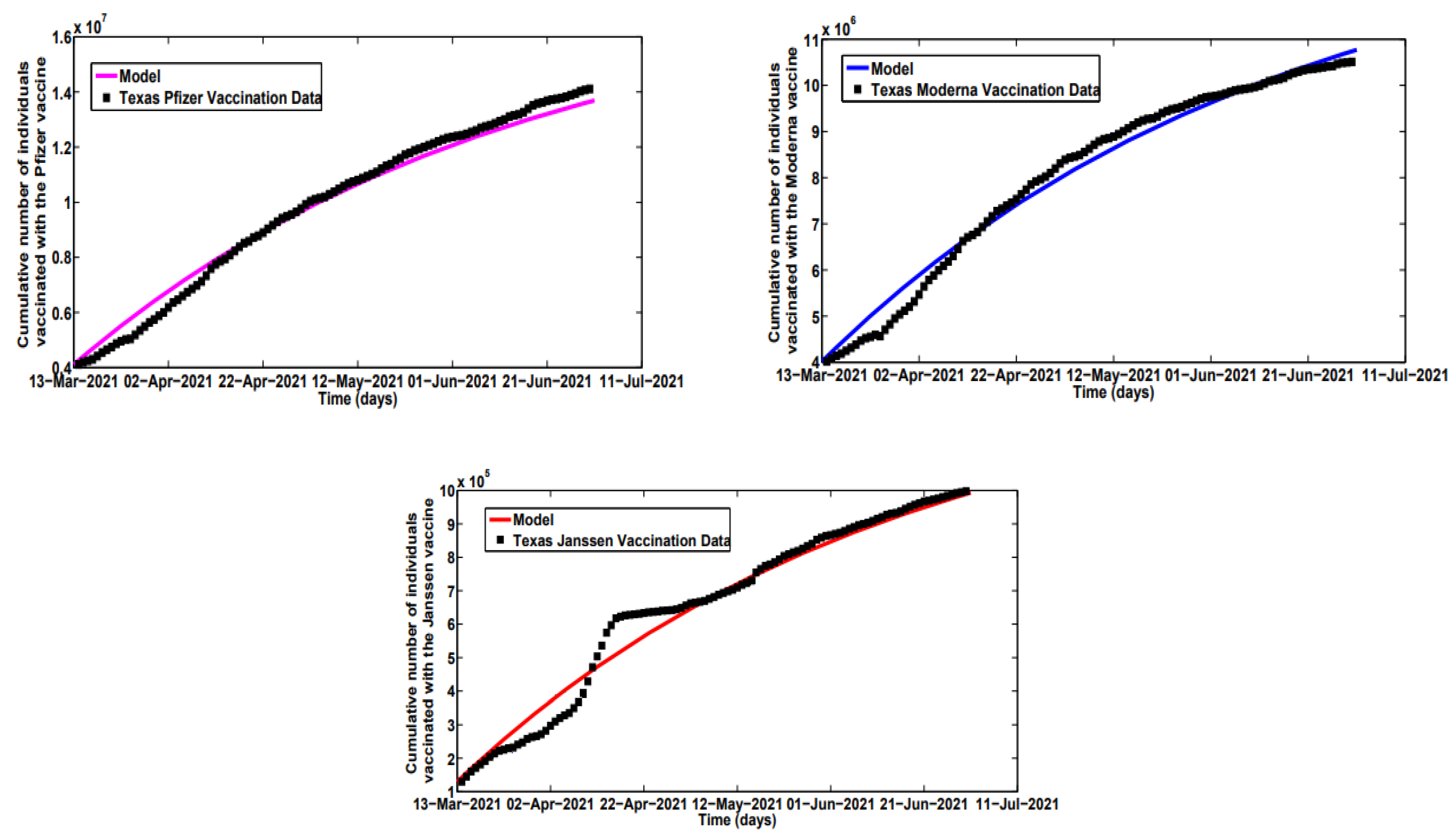
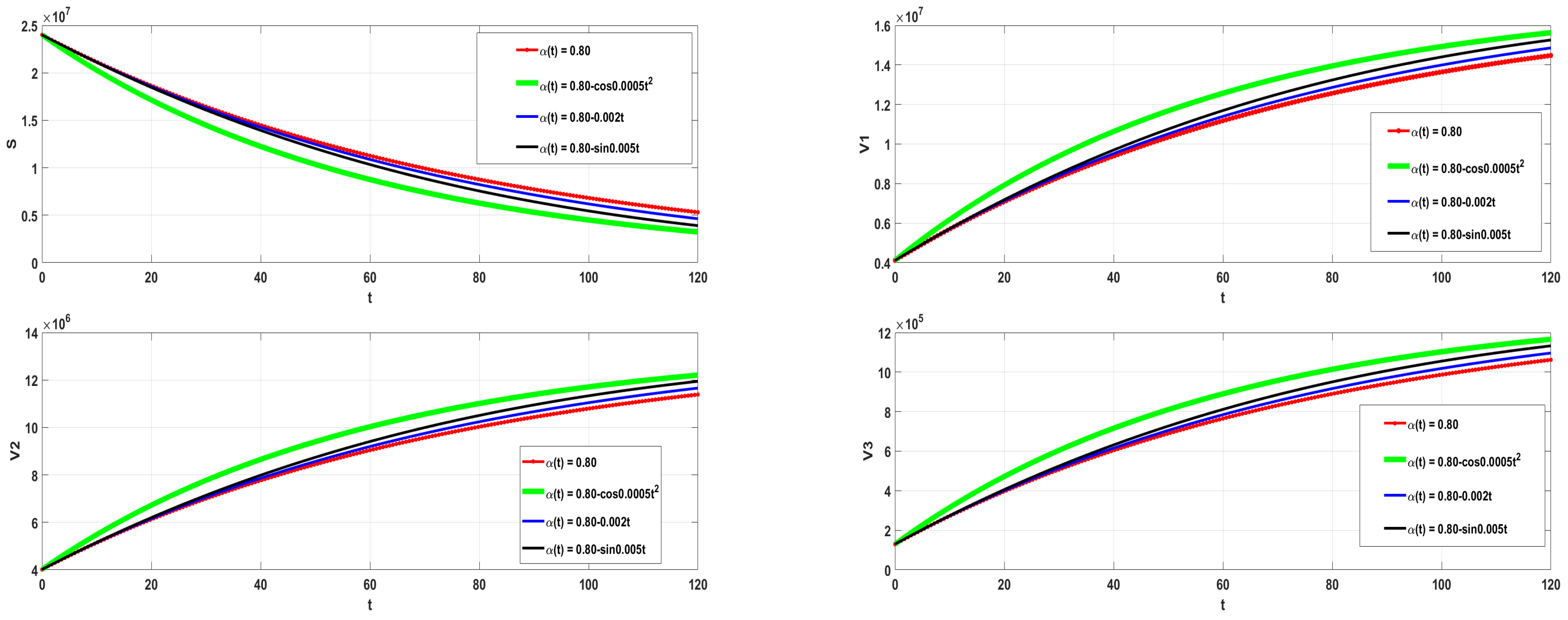
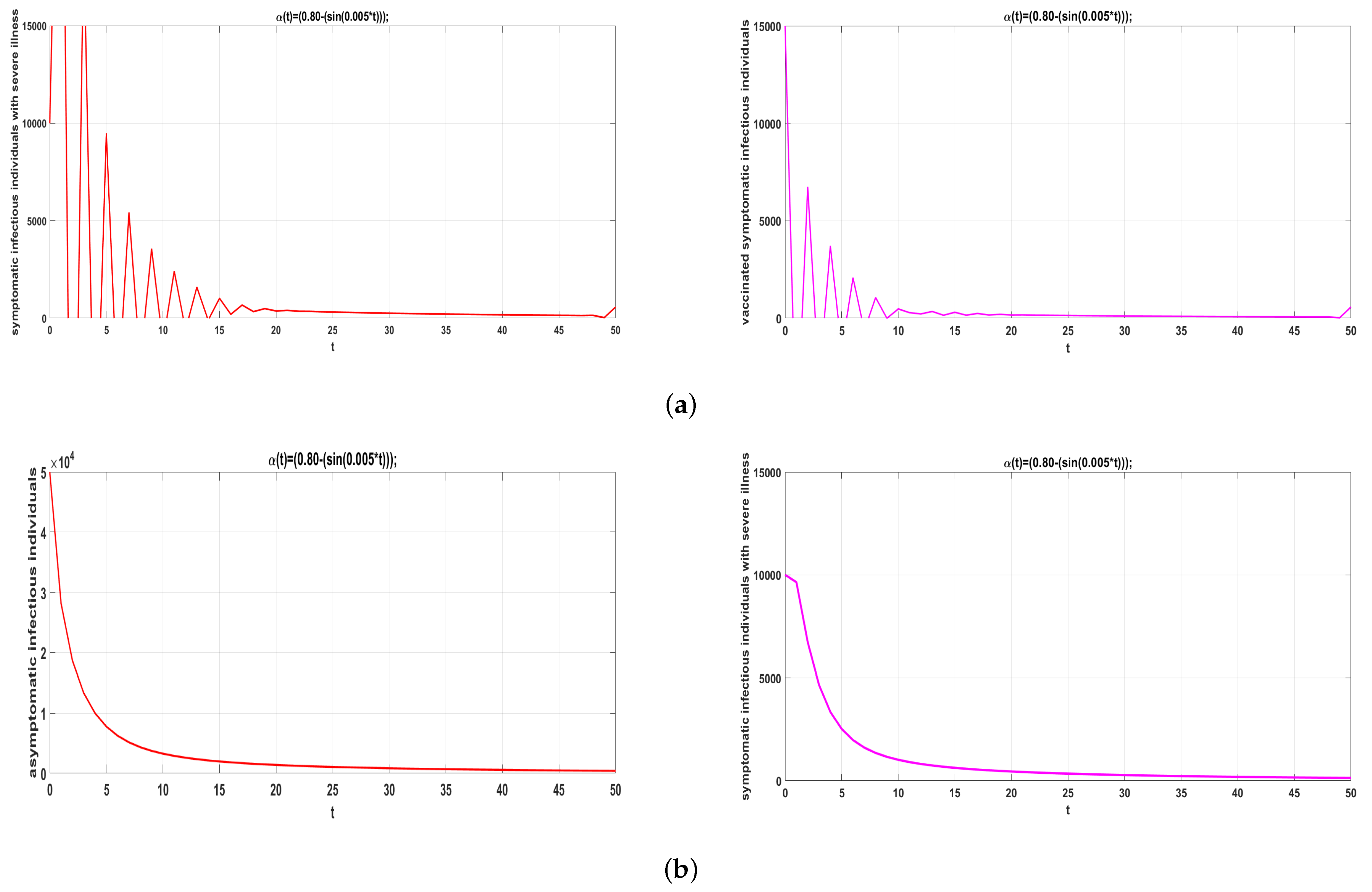
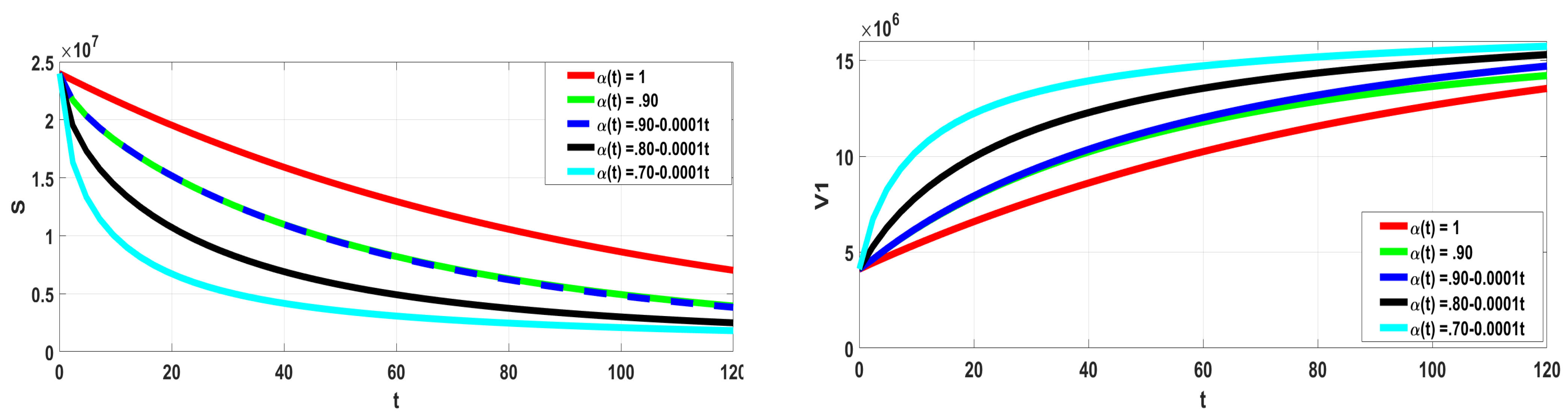
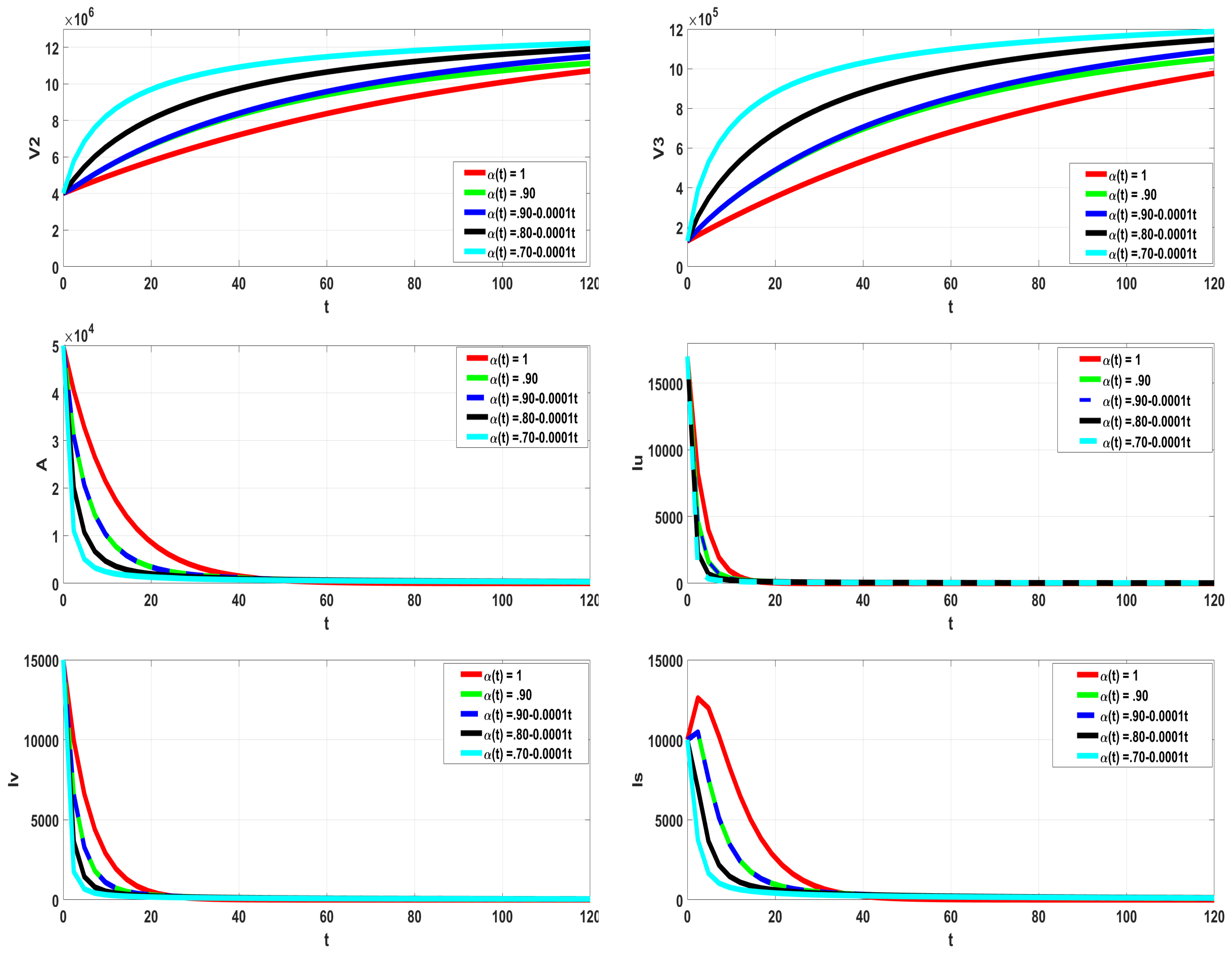
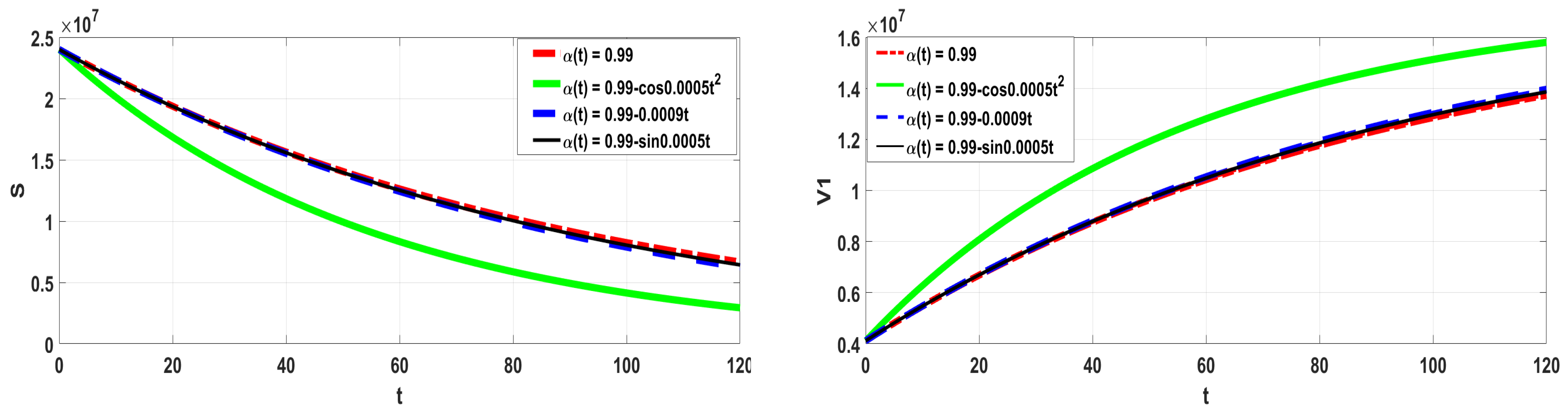
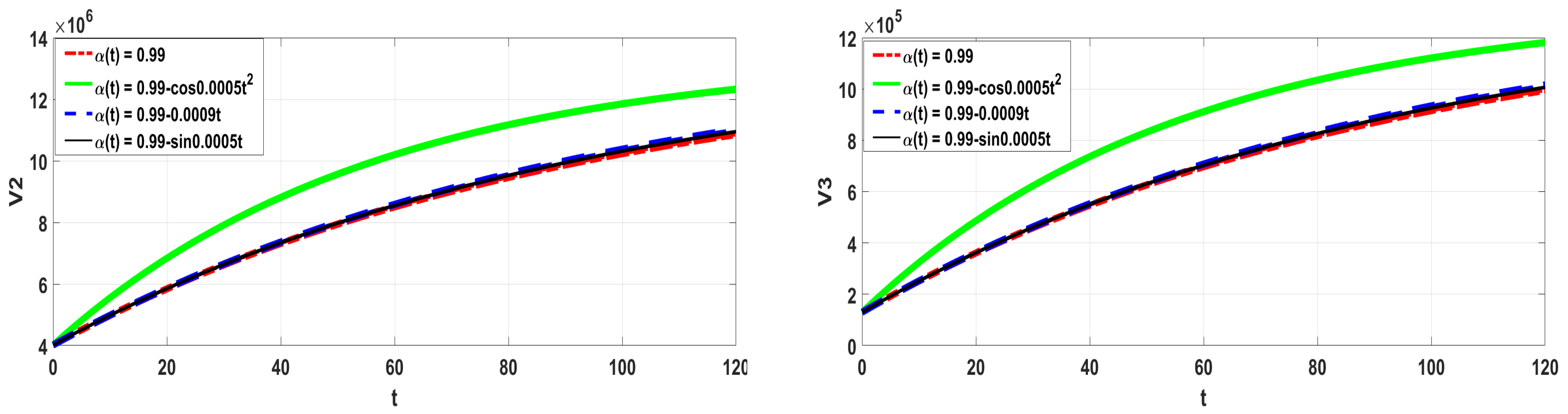
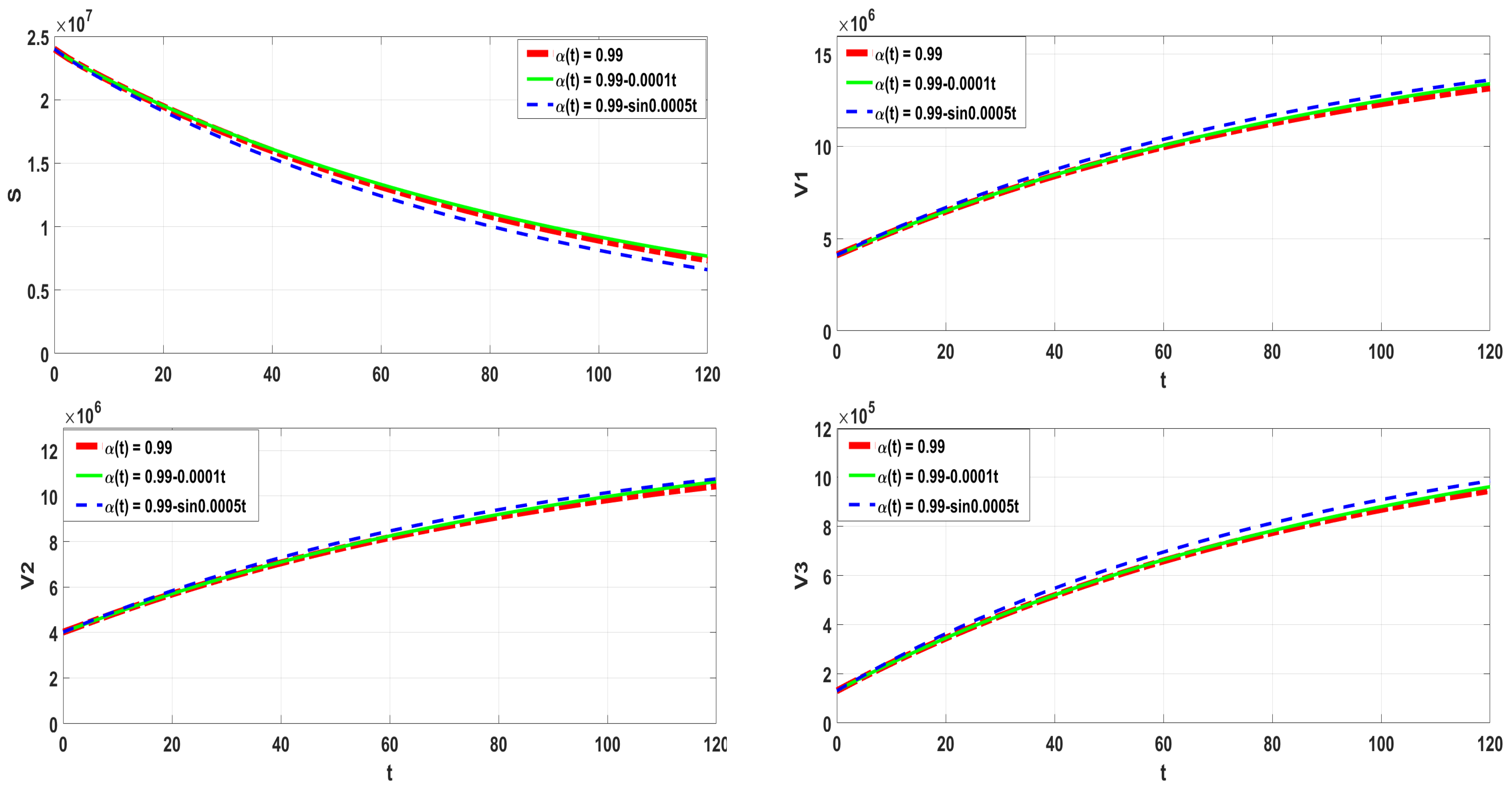
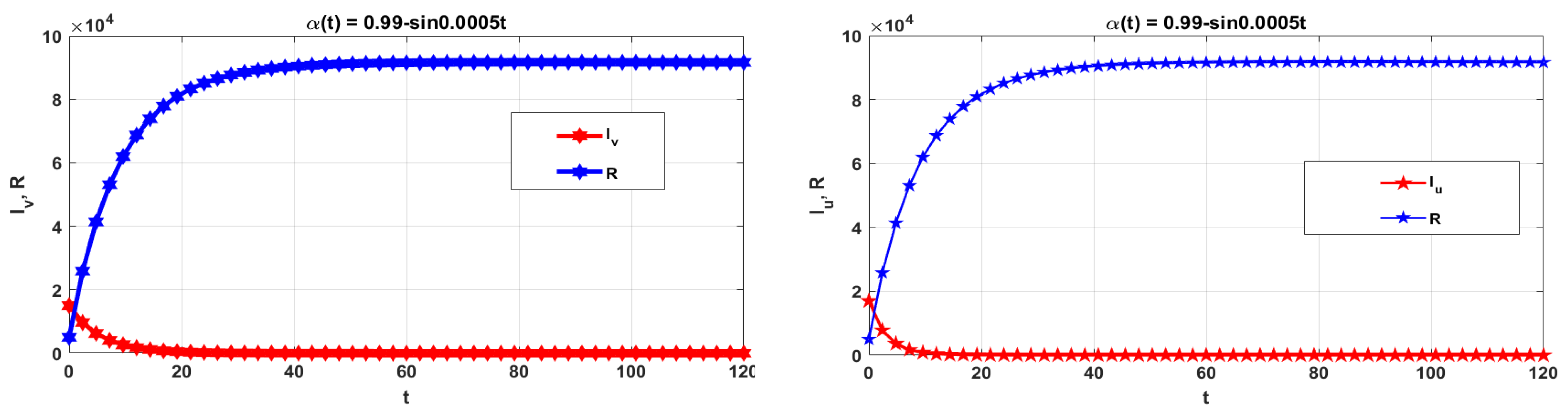
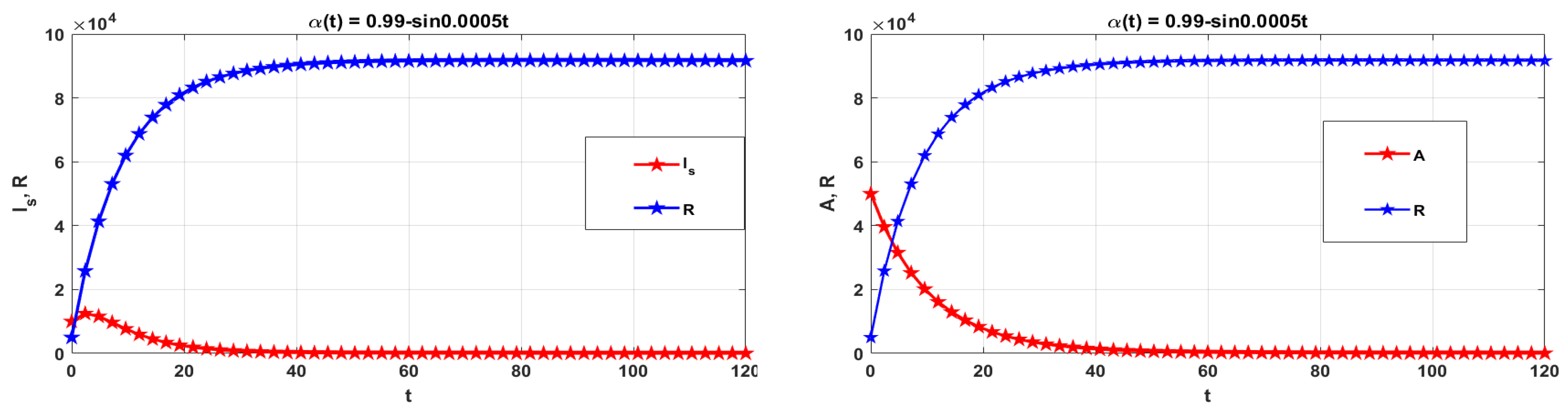
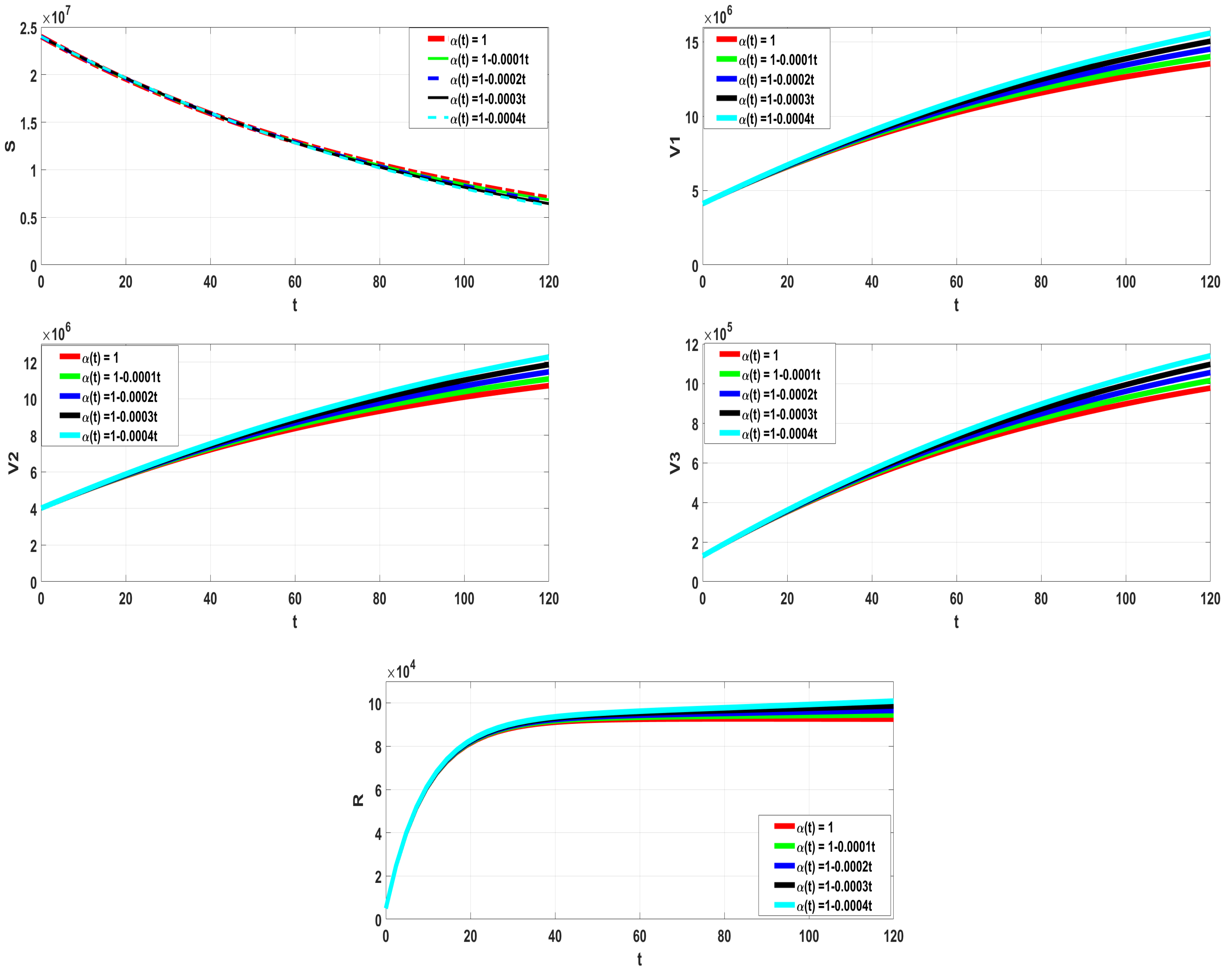
can be solved using an appropriate iterative method based on the assumed beginning conditions. For the real data, we use [24]; the authors in this reference used the literature to obtain some parameter values and the remaining values were fitted to the data for the state of Texas, USA. They fitted the data of (8) solutions with the data for the state of Texas from 13 March to 29 June 2021 [29,42]. The model was fitted with three datasets, Moderna, Janssen, and Pfizer, with immunization data for Texas state. The three vaccination rates and corresponding to each vaccine as well as the effective contact rate for COVID-19 transmission, , are estimated. According to publicly available data, the total population of the state of Texas, USA, for the year 2021 was [1]. Let , , , , , , and The parameter values are given in Table 2. To show that the proposed scheme is efficient, we compare the results that we obtained in this paper with the results that were found in reference [24], which are given in Figure 2 in constant fractional order. Figure 3 shows the behavior of the approximate solution of (8) (using the method in [24]) with different values of As can be seen from this figure, when the value of the fractional derivative changes over time, the results are different and this can dramatically affect the behavior of the model. This confirms the generality of the variable-order derivatives. Unfortunately, this method gives us unstable solutions, as in Figure 4a, when the value of the step size equals one. Moreover, we obtained the stable solutions using the proposed method CPC-FDM and in the fully implicit case given in this paper. This confirms that the method in [24] is stable only when the step size is very small, while our used method is stable regardless of the value of the step size. Figure 5 shows the behavior of the approximate solution of (8) (using CPC-FDM and ) with different values of The approximate solution behavior of (8) is shown in Figure 6 ( and using CPC-FDM) with different values of The approximate solution behavior of (8) (using GRK4M with different values of ) is shown in Figure 7. Figure 8 shows the behavior of the approximate solution of (8) (using CPC- FDM when and ) with different values of . We noted that by comparing our results with different variable orders and constant orders as given in [24] and Figure 5, the result in the case of constant order is agreement. Moreover, by compering the results given in Figure 7 and Figure 8, the result given using CPC-FDM (fully implicit case) is convergent, better than the results given using GRK4 when we use nonlinear . Figure 9 shows the relation between R and using CPC-FDM (fully implicit case) and nonlinear Furthermore, we found that the variable-order derivative order model is a more general model than the fractional order model given in [24] and integer order; a new behavior of the solution appears by using different values of . Moreover, we can obtain the fractional Caputo operator as a special case from the CPC operator when Moreover, we can obtain the fractional Caputo operator as a special case from the CPC operator if The solutions obtained using the new method CPC-FDM can be explicit () or implicit () and fully implicit with accurate solution when ().
Figure 2.
Real data [24] versus fitting model (8).
Figure 3.
The solution behavior using the method in [24] with different values of .
Figure 4.
The solution behavior using the method [24] in (a) and using CPC-FDM and in (b).
Figure 5.
The solution behavior acquired via CPC-FDM and of (8).

Figure 6.
The solution behavior acquired via CPC-FDM and of (8).

Figure 7.
The solution behavior acquired via GRK4M of (8).
Figure 8.
The solution behavior acquired via CPC-FDM and of (8).

Figure 9.
The relation between the variables concerning nonlinear using CPC-FDM and .
6. Conclusions
A novel hybrid variable-order fractional multi-vaccination model for COVID-19 is presented in this paper in order to further explore the spread of COVID-19. The main advantage of the hybrid variable-order fractional operator is that it can be defined as a linear combination of the variable-order integral of Riemann–Liouville and the variable-order Caputo derivative; it is one of the most effective and reliable operators and it is more general than the Caputo fractional operator. The proposed model’s dynamics are improved and its complexity is increased by employing variable-order fractional derivatives. Furthermore, the variable-order fractional Caputo operator can be derived as a special case from the CPC operator. Existence, boundedness, uniqueness, positivity and stability of the proposed model are established for the model. To be compatible with the physical model, a new parameter is added. The proposed model is numerically studied using CPC-FDM and GRK4M. CPC-FDM depends on the values of the factor . It can be explicit ( = 1) or fully implicit ( = 0) with a large stability region. We compared our results with the real data from the state of Texas in the United States. Moreover, the results obtained from the CPC-FDM are more stable than the results obtained from the proposed method in [24]. As a result, some graphs are provided for various linear and non-linear variable-order derivatives. In the future, the presented study can be extended to optimal control and to examine the impact of multiple vaccination strategies on the dynamics of COVID-19 in a population.
Author Contributions
Conceptualization, T.A.A.; Methodology, N.S. and S.M.A.-M.; Software, S.M.A.-M. and R.G.S.; Formal analysis, N.S.; Investigation, R.G.S. and T.A.A.; Resources, S.M.A.-M.; Writing—original draft, T.A.A.; Writing —review and editing, N.S. and R.G.S. All authors have read and agreed to the published version of the manuscript.
Funding
This research received no external funding.
Data Availability Statement
Not applicable.
Conflicts of Interest
The authors declare no conflict of interest.
References
- United States Food and Drug Administration. FDA Takes Key Action in Fight Against COVID-19 By Issuing Emergency Use Authorization for First COVID-19 Vaccine. 2020. Available online: https://www.fda.gov/news-events/press-announcements/fda-takes-key-action-fight-against-COVID-19-issuing-emergency-use-authorization-first-COVID-19 (accessed on 17 June 2021).
- Interim Clinical Considerations for Use of COVID-19 Vaccines Currently Authorized in the United States. Available online: https://www.cdc.gov/vaccines/COVID-19/clinical-considerations/COVID-19-vaccines-us.html (accessed on 14 July 2021).
- Machado, J.A.T.; Lope, A.M. Rare and extreme events: The case of COVID-19 pandemic. Nonlinear Dyn. 2020, 100, 2953–2972. [Google Scholar] [CrossRef] [PubMed]
- Bonyah, E.; Sagoe, A.K.; Kumar, D.; Deniz, S. Fractional optimal control dynamics of Coronavirus model with Mittag-Leffler law. Ecol. Complex. 2020, 45, 100880. [Google Scholar] [CrossRef]
- Ali, A.; Alshammari, F.S.; Islam, S.; Khan, M.A.; Ullah, S. Modeling and analysis of the dynamics of novel coronavirus (COVID-19) with Caputo fractional derivative. Results Phys. 2020, 20, 103669. [Google Scholar] [CrossRef] [PubMed]
- Danane, J.; Hammouch, Z.; Allali, K.; Rashid, S.; Singh, J. A fractional-order model ofcoronavirus disease 2019 (COVID-19) with governmental action and individual reaction. Math. Meth. Appl. Sci. 2021, 1–14. [Google Scholar] [CrossRef]
- Yadav, S.; Kumar, D.; Singh, J.; Baleanu, D. Analysis and dynamics of fractional order COVID-19 model with memory effect. Results Phys. 2021, 24, 104017. [Google Scholar] [CrossRef]
- Sinan, M.; Ali, A.; Shah, K.; Assiri, T.; Nofal, T.A. Stability analysis and optimal control of COVID-19 pandemic SEIQR fractional mathematical model with harmonic mean type incidence rate and treatment. Results Phys. 2021, 22, 103873. [Google Scholar] [CrossRef]
- Conejero, J.A.; Franceschi, J.; Picó-Marco, E. Fractional vs. Ordinary Control Systems: What Does the Fractional Derivative Provide? Mathematics 2022, 10, 2719. [Google Scholar] [CrossRef]
- Samko, S.G.; Ross, B. Integration and differentiation to a variable fractional order. Integral Transform. Spec. Funct. 1993, 1, 277–300. [Google Scholar] [CrossRef]
- Solís-Pérez, J.E.; Gómez-Aguilar, J.F. Novel numerical method for solving variable-order fractional differential equations with power, exponential and Mittag-Leffler laws. Chaos Solitons Fractals 2018, 14, 175–185. [Google Scholar] [CrossRef]
- Sun, H.; Chang, A.; Zhang, Y.; Chen, W. A review on variable-order fractional differential equations: Mathematical foundations, physical models and its applications. Fract. Calc. Appl. Anal. 2019, 22, 27–59. [Google Scholar] [CrossRef]
- Sweilam, N.H.; Al-Mekhlafi, S.M. Numerical study for multi-strain tuberculosis(TB) model of variable-order fractional derivatives. J. Adv. Res. 2016, 7, 271–283. [Google Scholar] [CrossRef]
- Sweilam, N.H.; L-Mekhlafi, S.M.A.; Shatta, S.A.; Baleanu, D. Numerical study for two types variable-order Burgers’ equations with proportional delay. Appl. Numer. Math. 2020, 156, 364–376. [Google Scholar] [CrossRef]
- Sweilam, N.H.; Assiri, T.; Hasan, M.A. Numerical solutions of nonlinear fractional Schrödinger equations using nonstandard discretizations, Numerical Solutions of Nonlinear Fractional Schrödinger Equations. Numer. Methods Partial. Differ. Equ. 2017, 33, 1399–1419. [Google Scholar] [CrossRef]
- Sweilam, N.H.; Assiri, T. Numerical scheme for solving the space-time variable order nonlinear fractional wave equation. Prog. Fract. Differ. Appl. 2015, 1, 269–280. [Google Scholar] [CrossRef]
- Bha, I.A.; Mishra, L.N. Numerical solutions of Volterra integral equations of third kind and its convergence analysis. Symmetry 2022, 14, 2600. [Google Scholar]
- Pathak, V.K.; Mishra, L.N. Application of Fixed point theorem to solvability for non-linear fractional Hadamard functional integral e quations. Mathematics 2022, 10, 2400. [Google Scholar] [CrossRef]
- Smith, G.D. Numerical solution of partial differential equations: Finite difference methods. In Oxford Applied Mathematics and Computing Science Series; Oxford University Press: Oxford, UK, 1985. [Google Scholar]
- Yuste, S.B. Weighted average finite difference methods for fractional diffusion equations. J. Comput. Phys. 2006, 216, 264–274. [Google Scholar] [CrossRef]
- Sweilam, N.H.; Hasan, M.M.A. An Improved method for nonlinear variable-order Lévy-Feller advection-dispersion equation. Bull. Malays. Math. Sci. Soc. 2019, 42, 3021–3046. [Google Scholar] [CrossRef]
- Sweilam, N.H.; Hasan, M.M.A.; Al-Mekhlafi, S.M.; Al khatib, S. Time fractional of nonlinear heat-wave propagation in a rigid thermal conductor: Numerical treatment. AEJ—Alex. Eng. J. 2022, 61, 10153–10159. [Google Scholar] [CrossRef]
- Milici, C.; Machado, J.T.; Draganescu, G. Application of the Euler and Runge–Kutta generalized methods for FDE and symbolic packages in the analysis of some fractional attractors. Int. J. Nonlinear Sci. Numer. Simul. 2020, 21, 159–170. [Google Scholar] [CrossRef]
- Omame, A.; Okuonghae, D.; Nwajeri, U.K.; Onyenegecha, C.P. A fractional-order multi-vaccination model for COVID-19 with non-singular kernel. Alex. Eng. J. 2022, 16, 6089–6104. [Google Scholar] [CrossRef]
- Sun, H.G.; Chen, W.; Wei, H.; Chen, Y.Q. A comparative study of constant-order and variable-order fractional models in characterizing memory property of systems. Eur. Phys. J. Spec. Top. 2011, 193, 185–192. [Google Scholar] [CrossRef]
- Baleanu, D.; Fernandez, A.; Akgül, A. On a fractional operator combining proportional and classical differintegrals. Mathematics 2020, 8, 360. [Google Scholar] [CrossRef]
- Ullah, M.Z.; Baleanu, D. A new fractional SICA model and numerical method for the transmission of HIV/AIDS. Math. Meth. Appl. Sci. 2021, 44, 4648–4659. [Google Scholar] [CrossRef]
- Lin, W. Global existence theory and chaos control of fractional differential equations. J. Math. Anal. Appl. 2007, 332, 709–726. [Google Scholar] [CrossRef]
- Texas Population, Census Reporter. Available online: https://censusreporter.org/profiles/04000US48-texas/ (accessed on 26 June 2021).
- United States Food and Drug Administration. FDA Briefing Document Moderna COVID-19 Vaccine. 2020. Available online: https://www.fda.gov/media/144434/download (accessed on 17 June 2021).
- United States Food and Drug Administration. FDA Briefing Document Pfizer-BioNTech COVID-19 Vaccine. 2020. Available online: https://www.fda.gov/media/144245/download (accessed on 17 June 2021).
- Okuonghae, D.; Omame, A. Analysis of a mathematical model for COVID-19 population dynamics in Lagos, Nigeria. Chaos Solitons Fractals 2020, 139, 110032. [Google Scholar] [CrossRef]
- Chu, Y.-M.; Yassen, M.F.; Ahmad, I.; Sunthrayuth, P.; Khan, M.A. A fractional SARS-COV-2 model with Atangana-Baleanu derivative: Application to fourth wave. Fractals 2022, 30, 2240210. [Google Scholar] [CrossRef]
- Driessche, P.; Watmough, P. Reproduction numbers and sub-threshold endemic equilibria for compartmental models of disease transmission. Math. Biosci. 2002, 180, 29–48. [Google Scholar] [CrossRef]
- Fosu, G.O.; Akweittey, E. Albert-adu-sackey, Next-generation matrices and basic reproductive numbers for all phases of the Coronavirus disease. Open J. Math. Sci. 2020, 4, 261–272. [Google Scholar] [CrossRef]
- Sekerci, Y. Climate change forces plankton species to move to get rid of extinction: Mathematical modeling approach. Eur. Phys. J. Plus 2020, 135, 794. [Google Scholar] [CrossRef]
- Al-Mekhlafi, S.M.; Sweilam, N.H. Numerical Studies for Some Tuberculosis Models; LAP LAMBERT Academic Publishing: London, UK, 2016; 156p. [Google Scholar]
- Sweilam, N.H.; L-Mekhlafi, S.M.A.; Alshomrani, A.S.; Baleanu, D. Comparative study for optimal control nonlinear variable-order fractional tumor model. Chaos Solitons Fractals 2020, 136, 109810. [Google Scholar] [CrossRef]
- Scherer, R.; Kalla, S.; Tang, Y.; Huang, J. The Grünwald-Letnikov method for fractional differential equations. Comput. Math. Appl. 2011, 62, 902–917. [Google Scholar] [CrossRef]
- Arenas, A.J.; Gonzàlez-Parra, G.; Chen-Charpentierc, B.M. Construction of nonstandard finite difference schemes for the SI and SIR epidemic models of fractional order. Math. Comput. Simul. 2016, 121, 48–63. [Google Scholar] [CrossRef]
- Yuste, S.B.; Quintana-Murillo, J. A finite difference method with non-uniform time steps for fractional diffusion equations. Comput. Phys. Commun. 2012, 183, 2594–2600. [Google Scholar] [CrossRef]
- COVID-19 Vaccinations in the US. Available online: https://data.cdc.gov/Vaccinations/COVID-19-Vaccinations-in-the-United-States-Jurisdi/uns (accessed on 13 March 2021).
Disclaimer/Publisher’s Note: The statements, opinions and data contained in all publications are solely those of the individual author(s) and contributor(s) and not of MDPI and/or the editor(s). MDPI and/or the editor(s) disclaim responsibility for any injury to people or property resulting from any ideas, methods, instructions or products referred to in the content. |
© 2023 by the authors. Licensee MDPI, Basel, Switzerland. This article is an open access article distributed under the terms and conditions of the Creative Commons Attribution (CC BY) license (https://creativecommons.org/licenses/by/4.0/).