1. Introduction
In cosmology, discussion of the false vacuum problem and the possibility of its decay began from the papers by Coleman and their colleagues [
1,
2,
3]. Krauss in [
4] analyzed properties of the false vacuum as a quantum unstable (quasi-stationary) state
and drew attention to the problem that there may exist universes in which the lowest energy state is the false vacuum state that can survive much later than times
t when the canonical exponential decay law holds (see also [
5]). The study of cosmological models with unstable vacua has became particularly important in the context of the discovery of the Higgs boson and of finding its mass
[
6,
7] to be
[GeV] and top quark mass to be
[GeV] [
8]. It is because the Standard Model calculations performed for the Higgs particle suggest that the electroweak vacuum is unstable if the mass of the Higgs particle is around 125–126 GeV (see, e.g., [
9,
10,
11,
12,
13,
14,
15,
16,
17,
18,
19,
20]), which means that our Universe may be the universe with an unstable vacuum. For this reason, various mechanisms slowing the vacuum decay down or even stopping it, have been discussed in many papers (see, e.g., [
21,
22] and also [
23,
24,
25] and references therein).
In this paper, we analyze a multiverse constituted of ensembles of stable and unstable universes. The property of the universe “to be unstable” or “to be stable” is determined by the properties of the vacuum state: if it is a false vacuum, then it is unstable and decays into the true vacuum state and, thus, this universe decays too. The decay of the false vacuum is a quantum decay process and, in this paper, we will use this fact as an assumption. Any quantum decay process, whether it is the decay of a particle, an excited level in an atom, or the metastable false vacuum, no matter how, (e.g., via the quantum tunneling through a potential barrier), must exhibit all the general properties resulting from the quantum theory of unstable states. Therefore, in our opinion, the quantum theory of unstable states seems to be an appropriate tool for the general analysis of the decay process of the false vacuum state and can help to understand and explain the various subtleties and properties of this process. The vacuum decay plays an extremely important role in cosmology. It cannot be ruled out that, without the decay of a metastable vacuum, it will be impossible to explain some issues, as stated in [
20] at the end of
Section 6, where one can find the following sentence:
Assuming that the present acceleration of the Universe is due to a small cosmological constant and that the conjecture that quantum gravity is ill-defined in a de Sitter space, we argue that vacuum decay is a necessary way out for the Universe. Now, suppose, following the idea of Krauss and Dent [
4], that certain universes were lucky enough to survive the times of canonical decay and are still alive (the
canonical decay times refer to times when the decay law (the survival probability) has an exponential form to a very good approximation). This idea can be applied to our Universe if we assume that its current age is longer than the canonical decay times of the false vacuum state. It is worth noting here that there are cosmological models under study in which the lifetime of a false vacuum is very short and is even significantly shorter than the duration of the inflationary phase (see, e.g., [
26,
27]). The important question is what conditions should be satisfied in order that in similar cases some universes could survive for longer than the canonical decay times and how long they are able to survive. Here we attempt to clarify this issue considering unstable universes as an ensemble of unstable quantum particles and analyzing their behavior at very late times. The tools we use for this purpose are the general properties of the quantum decay law, the decay rate,
, and the energy of the system in a metastable state in the region of very long times. From the general principles of quantum theory it follows that the decay rate depends on time,
, and
as
, whereas at canonical decay times
to very good approximation. In my opinion, these properties of the decay rate
may cause a universe with a false vacuum to survive longer than the lifetime of its false vacuum.
The paper is organized as follows: In
Section 2, one can find a quantum description of the decay process and parameters characterizing this process. In
Section 3, a simplified toy model of the combined process of the expansion of a universe with an unstable vacuum and of the quantum decay process of the unstable vacuum state is analyzed.
Section 4 contains an analysis of the long time properties of the survival amplitude, connecting these properties with the behavior of the decay rate as a function of time
t. The properties of the energy of the metastable vacuum state as a function of time
t and the related properties of the density of the vacuum energy are considered in
Section 5.
Section 6 contains a discussion and conclusions.
2. Preliminaries: Quantum Description of the Decay Process
From experiments, it is known that, for some unstable systems, decay processes are relatively fast or very fast while for others they are slow or very slow. The rate of this process is characterized by a parameter called the “lifetime” or the “decay rate”. In decay experiments, one has an ensemble of unstable physical systems in a certain area, which is surrounded by counters that detect decay products. The counting rate, i.e., the number of decay per second
is proportional to the number of unstable particles
in a given volume at instant
t. The proportionality coefficient,
is connected with the average lifetime (or simply lifetime) of the unstable objects considered (see, e.g., [
28] for a discussion). Indeed, if
is very large, then the ratio of
by the initial number
of such object at the initial instant
,
, in this area is the probability,
, of finding an unstable object undecayed in this area at a given instant of time
t (i.e., the survival probability
). There is
and
, so
and
. The number of decays
per unit of time
equals:
. There is
in the case of decay processes and, thus,
The solution of Equation (
1) in the case
adopts the following form
So, in this case, there is
and the density of the probability of the decay at time
t during the time interval
,
, equals
. Using, for simplicity,
, it is easy to verify that
as it should be. Using
and keeping, for a moment,
, one can find the average lifetime,
Thus, in general
where
is the decay rate.
Within quantum theory, as in classical physics, the number of unstable particles
, which at time
t can be found in the area considered, is equal to the product of the probability,
, of finding an unstable object undecayed in this area at a given instant of time
t (i.e., of the survival probability
) and the initial number
of such objects:
where the survival probability
(or the decay law) is defined as follows:
and
is the survival amplitude,
is the unstable (metastable) state under considerations,
(where
is the Hilbert space of states of the considered system), and
is the solution of the Schrödinger equation
for the initial condition
. Here,
is the total self–adjoint Hamiltonian for the system under consideration and
is the initial instant. The vector
is the solution of Equation (
9).
So, there are some symmetries of quantities characterizing the decaying state. The first one is provided by Equation (
10). The second one is a direct consequence of Equation (
10). For example, using (
10), one finds that there is the following symmetry:
From (
5) and (
7), we obtain that
Using (
10) and (
12), another symmetry is easy to find. This time, for
, there is
To define the following quantity [
29]:
then the relation (
12) means simply that
where
denotes the imaginary parts of
z (similarly,
is the real part of
z).
Note that one can also find the symmetry for
that results directly from Equation (
10) and from the definition (
14) of
. There is
From basic principles of the quantum theory it follows that the amplitude
, and, thus, the decay law
of the unstable state
, can be completely determined by the density of the energy distribution
for the system in this state [
30,
31]:
where
.
In [
32], assuming that the spectrum of
must be bounded from below,
and
; using the Paley–Wiener Theorem [
33], it was proved that, in the case of unstable states, there must be
where
and
. This means that the decay law
of unstable states decaying in the vacuum cannot be described by an exponential function of time
t if time
t is suitably long,
, and that, for these lengths of time,
tends to zero as
more slowly than any exponential function of
t. The analysis of the models of the decay processes shows that
to a very high accuracy from
t suitably later than the initial instant
up to
, (where
is the life–time of the state
and
is the decay width of the unstable state
calculated within the one pole approximation [
34,
35]), and smaller than
, where
denotes the time
t at which the non-exponential deviations of
begin to dominate.
In general, in the case of quasi-stationary (metastable) states, it is convenient to express
in the following form
where
is the exponential part of
, that is
, (
N is the normalization constant,
is the energy of the system in the unstable state
calculated within the one pole approximation), and
is the late time non-exponential part of
. There is
for times
. Using (
19), one finds that
The solution,
t, of the equation
(let us denote it as
) is usually considered as an approximate, conventional end of the canonical phase of a decay process, where the survival probability has an exponential form: for
there is
to a very good approximation. Solving the following equation,
one finds the time
. The time
is the time from which the late time phase of the decay process begins: for
, the survival probability has a form of powers of
. The transition phase of a decay process is the epoch when time
t is passing the time interval
. At this point, the so-called “cross–over time” used by some author should be mentioned (see, e.g., [
36]). The crossover time, denoted usually as
T, is the time when contributions to the survival probability
of its exponential (canonical) and late time non-exponential parts are the same:
and
T is the solution of this equation. There is
.
At this point, it should be noted that the consideration of asymptotic late time properties of the amplitude
and the quantities defined within the use of
are justified by experimental results. For example, in an experiment described in the Rothe paper [
36], the experimental evidence of the deviations from the exponential decay law at long times, much later than the crossover time
T, was reported.
From relations (
7), (
12) and (
15), it is seen that the amplitude
contains information about the decay law
of the state
and about the decay rate
. It was also shown that, using (
14), the information about the energy
of the system in the unstable state considered can also be extracted from the survival amplitude
: the energy of the system in the unstable state
(the instantaneous energy),
, is equal to the real part of the effective Hamiltonian
(see, e.g., [
29]),
and, in general, we have.
There is the following symmetry for
completing the symmetry relation (
13), which results directly from Equations (
10) and (
14):
Now, let us focus on the survival amplitude
and on the survival probability
provided by (
7) and (
8) and on the description of the decay of a metastable false vacuum.
is the probability to find the system at time
t in the metastable state
prepared in the initial instant
. If there was a suitably large number
of identical unstable objects at the initial instant
, then, according to (
6), one should detect
of them at
. There is no such simple correspondence of
with the results of measurements when one is able to prepare only one particle (or a few particles) at
. On the other hand, if one is able to prepare at
, in a system containing only one unstable object producing a large number
of indistinguishable copies of this system, then the problem reduces to the previous one:
copies of the system that will contain this unstable object undecayed at
. When there are no
copies of the system at
but one has to deal with only one particle system, then one can never be sure whether one will detect this particle undecayed at
or not. This similarly concerns a universe with the metastable (false) vacuum: one can expect that an ensemble of
universes with unstable vacua will behave analogously as a system containing
unstable objects. So, let
be the metastable (false) vacuum state of a universe considered and
, (where
is the true ground state describing the state in which the energy of the system under considerations has the absolute minimum). Let us assume that this universe was created at the instant
and the volume occupied by this universe at
was
. Thus, in fact, one should take into account that there is
, where
is the vacuum state of the universe of the volume
. It is convenient to choose the normalization condition for
in the following form,
In this case, an analysis of the survival probability
cannot provide a conclusive answer whether the universe of the volume
will still exist in the state
at instant
or not. The problem becomes much more complicated if, in addition to the pure quantum tunneling process leading to the decay of the false vacuum state [
1,
2,
3], there exists another completely different process forcing the universe of the volume
to expand. This effect was considered in [
4], where Krauss and Dent analyzing a false vacuum decay pointed out that, in eternal inflation, even though regions of false vacua by assumption should decay exponentially, gravitational effects force the space region of the volume
that has not decayed yet to grow exponentially fast. This effect causes many false vacuum regions or many universes forming a multiverse to survive up to the times much later than the times when the exponential decay law holds. Moreover, particle physics can provide us with hints suggesting what may happen in such or similar cases: a free neutron is unstable and decays, but the neutron inside a nucleus is subjected to other additional interactions and does not decay. These processes can both be described using the survival amplitude (
8) and (
10) with suitable Hamiltonians
. There is
in the case of the free neutron and there is
for the neutron inside a nucleus. Here,
describes weak interactions while
denotes strong and electromagnetic interactions. For the free neutron, we have
as
. This property is not the case of the neutron inside the nucleus. In general, when an unstable particle is subjected to different interactions described by suitable commuting Hamiltonians, then it may happen that the decay process can be slowed or even stopped. Similarly, as it was shown in [
3], the gravitation may stop the decay of the false vacuum. So, when analyzing the stability of the false vacuum state by means of the survival amplitude
, the correct conclusion cannot be drawn if only using the Hamiltonian
describing the “pure” decay through quantum tunneling. One can expect that the correct result can be obtained if this
in (
8) and (
10) is replaced by the sum
, where
describes more or less accurately the expansion process of the volume
.
3. A Simplified toy Model
Astrophysical observations lead to the conclusions that our Universe is expanding in time. The authors of [
4] observed that, in inflationary processes, even if some space regions of false (unstable) vacua decay exponentially, gravitational effects force the space in a region that did not have time to decay to grow exponentially fast (see also [
5]). So, in general, the expansion process affects the process of decay of the universes (domains) with false vacua. The problem is how to describe this expansion so that variations in time of the volume
occupied by the Universe had the form of the Schrödinger Equation (
9) or a similar form with a suitable effective hamiltonian
. The volume
is an increasing function of time
t in the present epoch, so its evolution is non-unitary and
cannot be hermitian. The non-unitary evolution operator solving the Schröodinger-like equation with this
and acting on the initial state
should transform this state into the vector
, where
is a complex or real number. The simplest
, which seems to be sufficient for the simplified qualitative analysis of the problem, may be chosen as follows,
where
is the scale factor,
is the proper distance at epoch
t,
is the distance at the reference time
(it can be also interpreted as the radius of the Universe now), and, here,
denotes the present epoch (see, e.g., [
37]),
is the Hubble parameter,
(in the general case
),
is the unit operator,
is the non-hermitian effective Hamiltonian,
is a real parameter with a dimension of the energy. The scale factor
is a solution of Einstein’s equations, which, with the Robertson–Walker metric in the standard form of Friedmann Equations [
37,
38], look as follows: the first one,
and the second one,
where the parameter
is known as the cosmological constant,
and
p are mass density and pressure, respectively, and
k denotes the curvature signature; the pressure
p and the density
are related to each other through the equation of state,
, where
w is constant [
37]. There is
for a dust (for a matter dominated era),
for a radiation and
for vacuum energy.
The volume
equals:
and, similarly,
. Therefore,
We are looking for the solutions of the Schrödinger equation using the Hamiltonian
and a matrix element of the form
with
. So, we need solutions of the following equation
with the initial condition
. Here,
is a hermitian operator (Hamiltonian) responsible for the decay of the false vacuum state
and
. Now, let
be of the form
and
Inserting (
34) into (
33) one obtains
This means that our problem reduces into finding a solution of the following equation
Putting
where
is a real or complex scalar function and
, we can rewrite Equation (
37) as follows
A solution,
, of this equation is
where
is a normalization factor. Now, inserting this
into (
38) and then using (
34), we obtain the solution,
, of Equation (
33),
Here,
is the survival probability of the system in the initial false vacuum state
assuming that volume
occupied by this system remains unchanged. The function
describes the combined effect of the processes of a decay and an expansion of the initially created universes.
There is
but the use of the normalization factor,
, allows us to write volume
as
. So,
and
where
is the number of universes of volume
created at the initial instant
with the vacua described by
and
is the volume occupied by all these universes at the instant
, which corresponds with
in (
6). In our simplified toy model, the relations (
45) and (
46) describe the combined effect of the processes of a decay and of an expansion of the initially created universes of volumes
. In the case when the decay process is the dominant process, then
appearing in (
46) is a decreasing function of time
t and tends to zero as
. If the expansion process prevails over the decay process or these processes are both in balance then
is a non-decreasing function of
t. In such a case
that is
So, if there exists such time, say
, that for all
the relation,
is satisfied, then the function
is a non-decreasing function of time
t (it increases or is constant in time). This means that, in such a case, the decay process of the volumes
should be stopped. Therefore, if some universes had the luck to survive until time
, such that for all
, the relation (
49) is fulfilled, then later these universes should be found undecayed.
4. Late Time Properties of the Decay Rate and Related Quantities
As mentioned in
Section 2, the experimental evidence of deviations from the exponential decay law at long times, much later than the crossover time
T, was reported in [
36]. This result creates to problem that is important for our considerations: If (and how) deviations from the exponential decay law at long times affect the decay rate of the unstable state and the energy of the system in this state.
From the condition (
18) for the amplitude
and from (
7), the results show that, at the long time region, the lowest bound for the survival probability
has the form
This and the relation (
5) lead to the conclusion that (see [
29])
and, thus,
as
because
. A more accurate estimation of
can be found using the amplitude
instead of the condition (
18) for the modulus
of
.
So, let us assume that we know the amplitude
. Similarly, it is sufficient to know the energy distribution
of the system in the unstable state considered: in such a case,
can be calculated using (
17). Then, starting with the
and using the expression (
14), one can calculate the effective Hamiltonian
in a general case for every
t. Thus, one can find the instantaneous energy,
, and the instantaneous decay rate,
, of the system in the metastable state
for canonical decay times, when
, for transition times
and for asymptotically late times
(for details see: [
39,
40,
41]).
The integral representation (
17) of
means that
is the Fourier transform of the energy distribution function
. Using this fact, we can find the asymptotic form of
for
, that is
(see [
40] for details): as shown in [
40], if to assume that
and
and derivatives
, (
), are continuous in
(that is, if, for
, all
are continuous and all the limits
exist) and also that all these
are absolutely integrable functions, then
where
(see [
40,
41]).
Bearing in mind the purpose of our considerations, which is to look from the point of view of the quantum theory of unstable states at the fate of the universe at times t very distant from the moment of its creation, , we assume that . As a result, we can write that and we will use this conclusion in our late time asymptotic formulae for considered in this paper.
In the case of a universal and more general form of
, when
where
and it is assumed that
,
and derivatives
(
) exist and are continuous in
, and the limits
exist,
for all the above mentioned
k, there is
as it has been shown in [
40]. Here,
is the Euler’s Gamma Function.
Starting from the asymptotic expression (
54) for
and using (
14) after some algebra, one finds that, in general, for times
(see [
40])
where
, (coefficients
are determined by
).
This last relation means that (see [
42])
and, similarly,
These properties occur for all unstable states that survived up to times
. From (
57), it follows that
.
Note that the symmetry relations (
13), (
16) and (
26) also hold for the asymptotic expansions (
55)–(
57).
For the most general form (
53) of the density
(i.e., for
with the asymptotic form provided by (
54)), we have (see [
42] and references herein):
As an example, let us consider a typical form of
. Namely, the properties of metastable systems are described in many papers with sufficient accuracy using
with the form of the Breit–Wigner energy distribution function,
,
There is
for
(see [
43] for details). Here,
. In general, the sign of
depends on the model considered (that is, on the form of
) and, contrary to the case of
, there is
for a wide class of
.
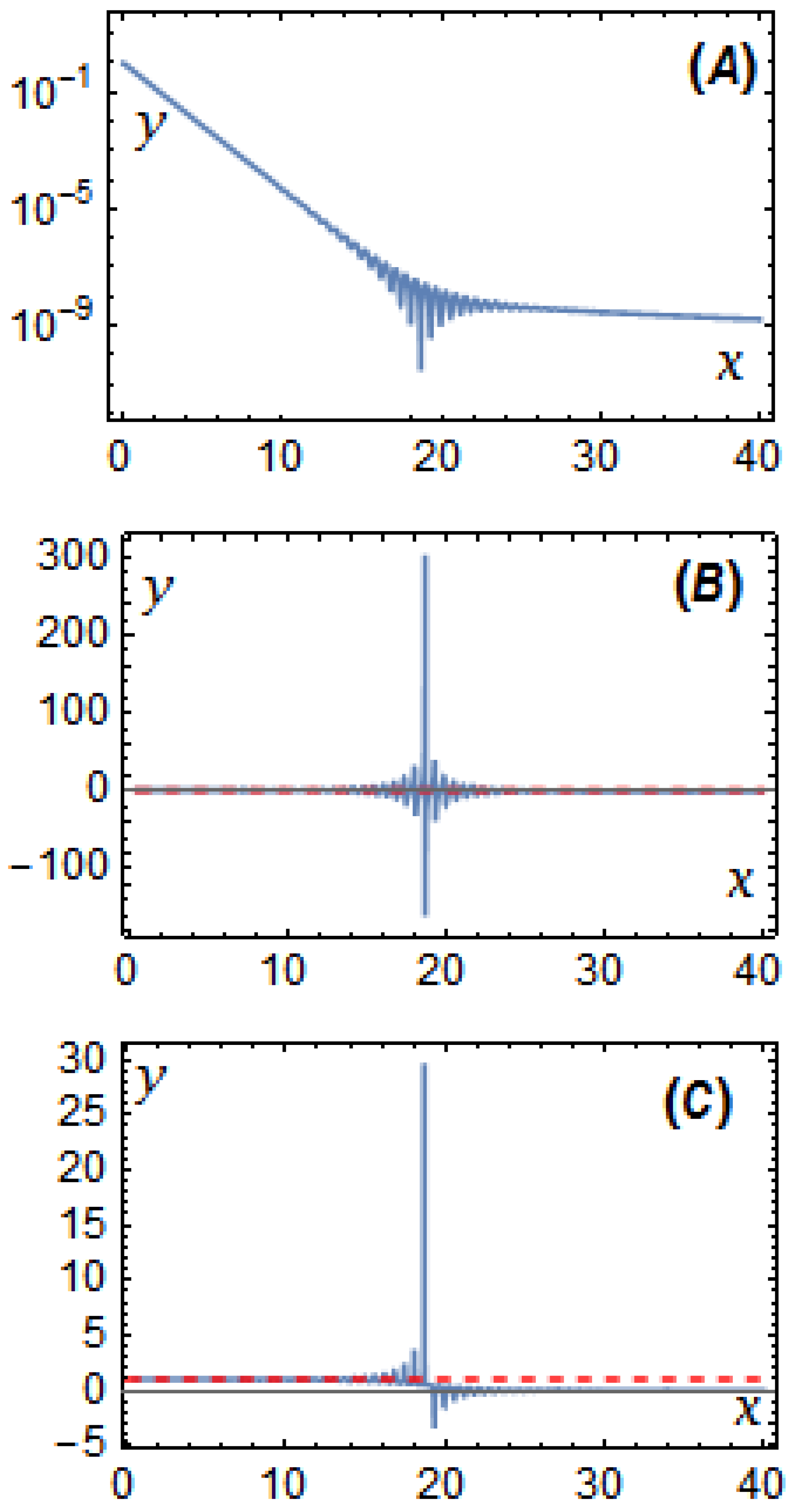
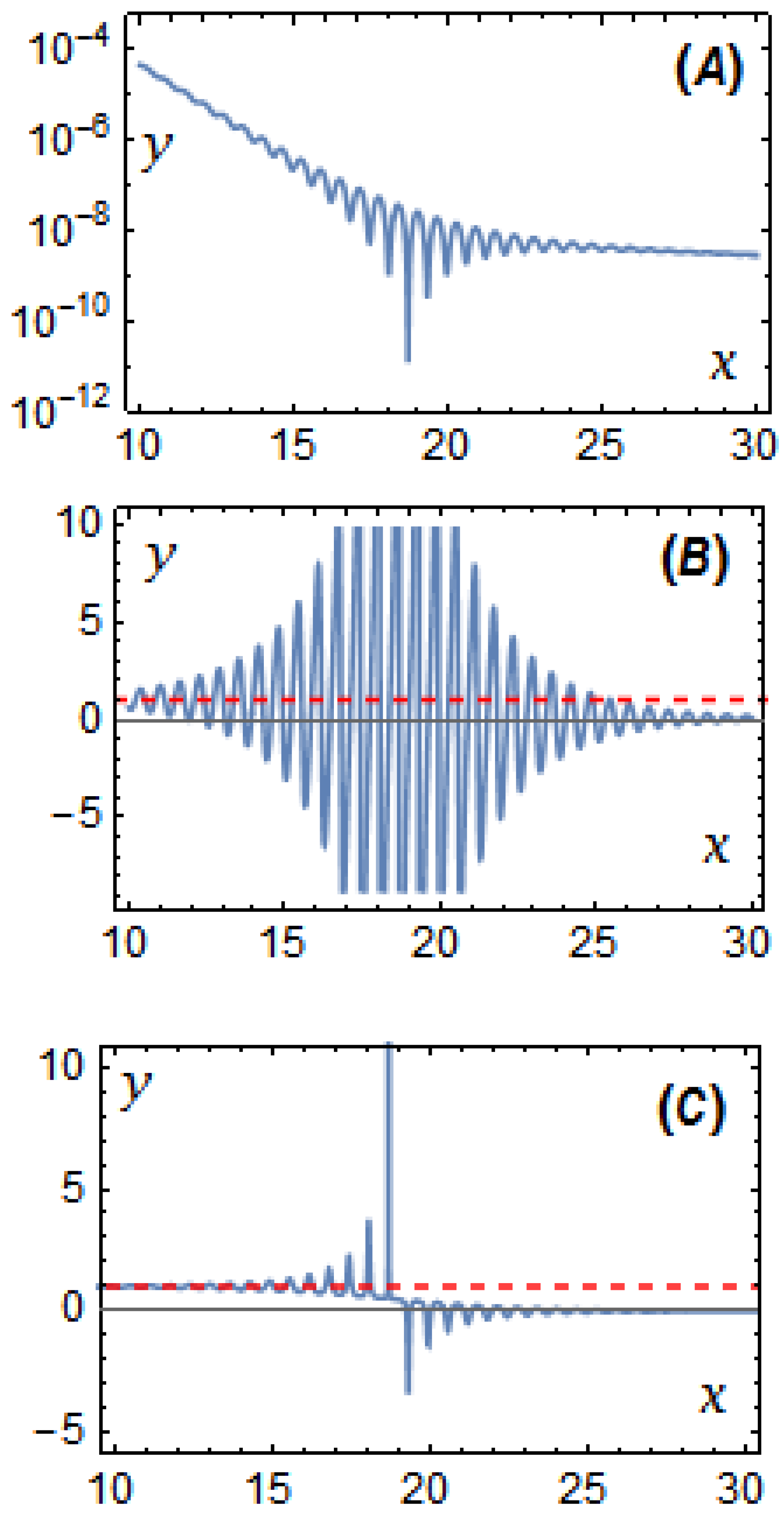
The typical form of the survival probability
at transition times is shown below in panel
A of
Figure 1 and
Figure 2. The behavior of
at canonical decay times
, at transition times
, and asymptotically late times
is shown in panel
B of
Figure 1 and
Figure 2. These results are the direct, mathematical consequence (by (
14) and (
24)) of properties of the amplitude
at these time regions. It is seen from these figures that, at times
,
to a very high accuracy, then rapid and large fluctuations of
occur at the transitions time region
, and, for very late times,
,
as
according to the result (
56).
There is a widespread belief that the quantum theory accurately depicts reality. This belief is based on the facts that predictions of the quantum theory were experimentally confirmed to a very high accuracy. So, it should be expected with the probability close to a certainty that the experimental confirmation of the presence of late time deviations from the exponential decay [
36] means that the late time properties of
and
described in Equations (
56) and (
57) and the effects shown in panel
of
Figure 1 and
Figure 2 should occur and should manifest itself under suitable conditions too. The results presented in
Figure 1 and
Figure 2 were obtained for the Breit–Wigner energy distribution function (
59) assuming for simplicity that
.
5. Instantaneous Energy and the Vacuum Energy Density at Late Times
From the point of view of the purpose of the paper specified in the Introduction and the results presented in
Section 3, the most important is the knowledge of the late time asymptotic properties of the decay rate,
. Nevertheless, for the sake of completeness and for the convenience of readers, this section will briefly discuss the late time asymptotic properties of the energy
of an unstable system, which can be applied to the analysis of the evolution of a universe with a metastable vacuum.
As mentioned in
Section 2, in [
4], the idea was formulated that, in the case of metastable vacuum states, some space regions or universes can survive much longer than the exponential decay law holds for. In the mentioned paper by Krauss and Dent, they focused on the possible behavior of the unstable false vacuum at very late times, where deviations from the exponential decay law become dominant. In [
44], it was concluded that such an effect must change the energy,
, of the system in the false (metastable) vacuum state at these times
t so that, at very long times,
is replaced by
and, at these times, the typical form of
looks as if it results from the Formula (
57).
The typical behavior of the energy
at canonical decay times
, at transition times
(or
), and asymptotically late times
, are shown in panels
of
Figure 1 and
Figure 2 (see also [
42,
45]) where the function
is presented. The red dashed line in these figures denotes the value
that is
. Note that there is
. From these figures, it is seen that for,
, we have
, whereas, for
, there is
When one considers a meta-stable (unstable or decaying) vacuum state,
, the following important property of
is useful:
where
is the density of the vacuum energy in the decaying vacuum state considered,
V is a volume,
is the density of the vacuum energy at times
,
is the energy density in the true (bare) vacuum state, and
, i.e., in the true ground state of the system.
From the last equations, the following relation follows
Thus, because for
there is
, one finds that
whereas for
, we have
Analogous relations (with the same occur for .
The important property of
is a presence of rapid fluctuations of the high amplitude for times
, i.e., for
. This means that, in the case of a decaying (unstable) vacuum, analogous fluctuations of the energy density
and
should occur for
. So, if our Universe is the universe with the unstable vacuum as the mass of Higgs boson suggests, then, in agreement with ideas expressed in [
4], we can conclude that the lifetime of the false vacuum may be shorter by at least a few or even many more orders than the age of our Universe. This means that our Universe may place itself in the times described by the form of
and
for
.
If one prefers to consider
instead of
, then one obtains,
or
where
and
.
One may expect that
equals the cosmological constant calculated within quantum field theory [
46]. From (
69), it is seen that, for
,
because
. Now, assuming that
corresponds to the value of the cosmological constant
calculated within the quantum field theory, then one should expect that [
46]
(see [
46]), which allows one to write down Equation (
69) as follows:
Note that, for
, there should be (see (
67))
that is
where
and the sign of
is determined by the sign of
.
Note that a parametrization following from the quantum theoretical treatment of meta-stable vacuum states can explain why the cosmologies with the time-dependent cosmological constant
are worth considering and may help to explain the cosmological constant problem [
47,
48]. The time dependence of
of the type
was assumed, e.g., in [
49], but there was no any explanation suggesting such a choice of the form of
. An earlier analogous form of
was obtained in [
50], where the invariance under scale transformations of the generalized Einstein equations was studied. Such a time dependence of
was postulated also in [
51] as the result of the analysis of the large numbers hypothesis. The cosmological model with time-dependent
of the above postulated form was also studied in [
52] and in other, more recent papers.
The nice feature and maybe even the advantage of the formalism presented in
Section 4 and in this section is that, in the case of the universe with a metastable (false) vacuum, if one realizes that the decay of this unstable vacuum state is the quantum decay process, then it automatically emerges that there must be a true ground state of the system that is the true (or bare) vacuum with the minimal energy,
, of the system corresponding to this vacuum and, equivalently,
, or
. What is more, in this case, the
with the form described by Equations (
72)–(
74) emerge quite naturally. In such a case, the function
provided by the relation (
61) describes the time dependence for all times
t of the energy density
(or the cosmological “constant”
) and its general form is presented in panels
in
Figure 1 and
Figure 2. Note that the results presented in
Section 4 and
Section 5 are rigorous.
As mentioned in the introduction to this section, this section aims to inform readers about the late time properties of the energy density
in the false vacuum state and how they can affect the behavior of
and
at late times (see Equations (
67), (
72), and (
73)). We do not present a more detailed analysis of the possible cosmological consequences of these properties because a detailed discussion and analysis of the consequences of the late time properties of the density of the vacuum energy
and
briefly described in this section can be found in [
45,
46,
53,
54,
55,
56].
6. Discussion and Conclusions
The problem of how the process of an expansion of a universe and its decay process together affect the universe is analyzed in
Section 3. The possible result of these combined processes is characterized by the condition (
49). The obvious next step in the considerations in
Section 3 and
Section 4 is to apply the results obtained in them to the analysis of the possible future fate of the universe with an unstable vacuum. In the case of very late times, assuming that the lifetime of the metastable false vacuum is shorter by at least a few or even much more orders than the age of our Universe, it can be performed by inserting it into (
49), e.g., the present value of the Hubble expansion rate
and the late time asymptotic form of the decay rate
provided by relations (
56) and (
58),
where the coefficient
in (
56) is neglected and, assuming that
(where
is the age of the our Universe). The only problem is to choose the appropriate value of
in (
58). If choosing
appearing in the case of the decays into two particles, that is,
(see, e.g., [
57]), then inserting the present values of
and
[
8] into (
49), one obtains that
where
is the present-day value of the Hubble parameter [
8], which provides
This result suggests that, in the case
, the Universe may decay at late times, but such a conclusion cannot be considered as decisive and final. First, taking into account the neglected term
in (
75), can result in changing
. Second, there is no certainty that the choice of
is the correct choice. In fact, it is not known what value of
is correct for decays of the unstable vacuum states and this problem requires further studies. So, we need some bounds for the values of
that lead to the non-negative
. The solution of the equation
which follows from (
49) and (
75) is
This solution is obtained for the same values of
and
, which were used to find the result (
77). The result (
79) means that there should be
and
within the considered late time approximation (
75) for
. Thus, if the energy distribution
for the universe in the metastable vacuum state is provided by the relation (
53) with such
that
, then such a universe should not decay. This conclusion shows how important it is to find
and, thus,
for the metastable vacuum state of the universe. To complete this discussion, let us note that the Breit–Wigner energy distribution function (
59) corresponds to the case
. This means that, in the considered case of the late times, when the late time approximations for
and
hold, the use of the Breit–Wigner form of
to characterize the false vacuum state can provide our Universe with stability. Unfortunately, it is not currently certain whether such
correctly characterizes the energy distribution density in the false vacuum state. Among other things, for this reason, it is necessary to study the properties of the metastable false vacuum state and the corresponding
. As it is seen from the results presented in
Section 4, the coefficients
in late time asymptotic expansions of
and
depend on the form of
(see Equation (
60)). Therefore, simply, the knowledge of the correct
is necessary when one wants to find the proper form, values, and sign of the coefficient
appearing in relations (
57) and (
63), then
in (
67), and also
in (
56), but, above all, knowing the correct
, we will be able to answer the question of whether the hypothesis mentioned in
Section 1 and formulated by Krasus and Dent in [
4] is realized in our Universe.
One may ask what do the results presented in this paper really mean? Suppose that our Universe was created in the metastable false vacuum state and that the lifetime of this vacuum is much shorter than the time
defined in
Section 2 by Equation (
22) and that this
is much shorter than the age of the Universe. Then, in our epoch, its survival probability,
, is negligibly small: one can even say that it is zero to very high accuracy. The methods used in this paper and the quantum theory of unstable states do not provide an answer for the question when this Universe should decay, but can they explain why this Universe still exists and whether it will exist for longer? In light of the ideas presented in, e.g., [
20] and in other papers mentioned in
Section 1, such information seems to be very important.
Note that the method and results described in
Section 2,
Section 4 and
Section 5 are rigorous. The approach described in
Section 2 and
Section 5 was applied in [
45,
46,
53,
54,
55,
56], where cosmological models with
were studied (see also analysis and discussion presented in [
58]). From the results presented therein and in this paper, in the light of the LHC result concerning the mass of the Higgs boson [
8] and its cosmological consequences, the conclusion follows that further studies of this approach are necessary.