Program Source-Code Re-Modularization Using a Discretized and Modified Sand Cat Swarm Optimization Algorithm




Abstract
:1. Introduction
- Increasing the modularization quality (MQ);
- Increasing the success rate of generating the optimal clusters;
- Increasing the stability of the SMC method during several executions;
- Increasing the convergence speed to attain the optimal clusters.
2. Related Works
3. Proposed Method
3.1. Inspiration and Mathematical Model
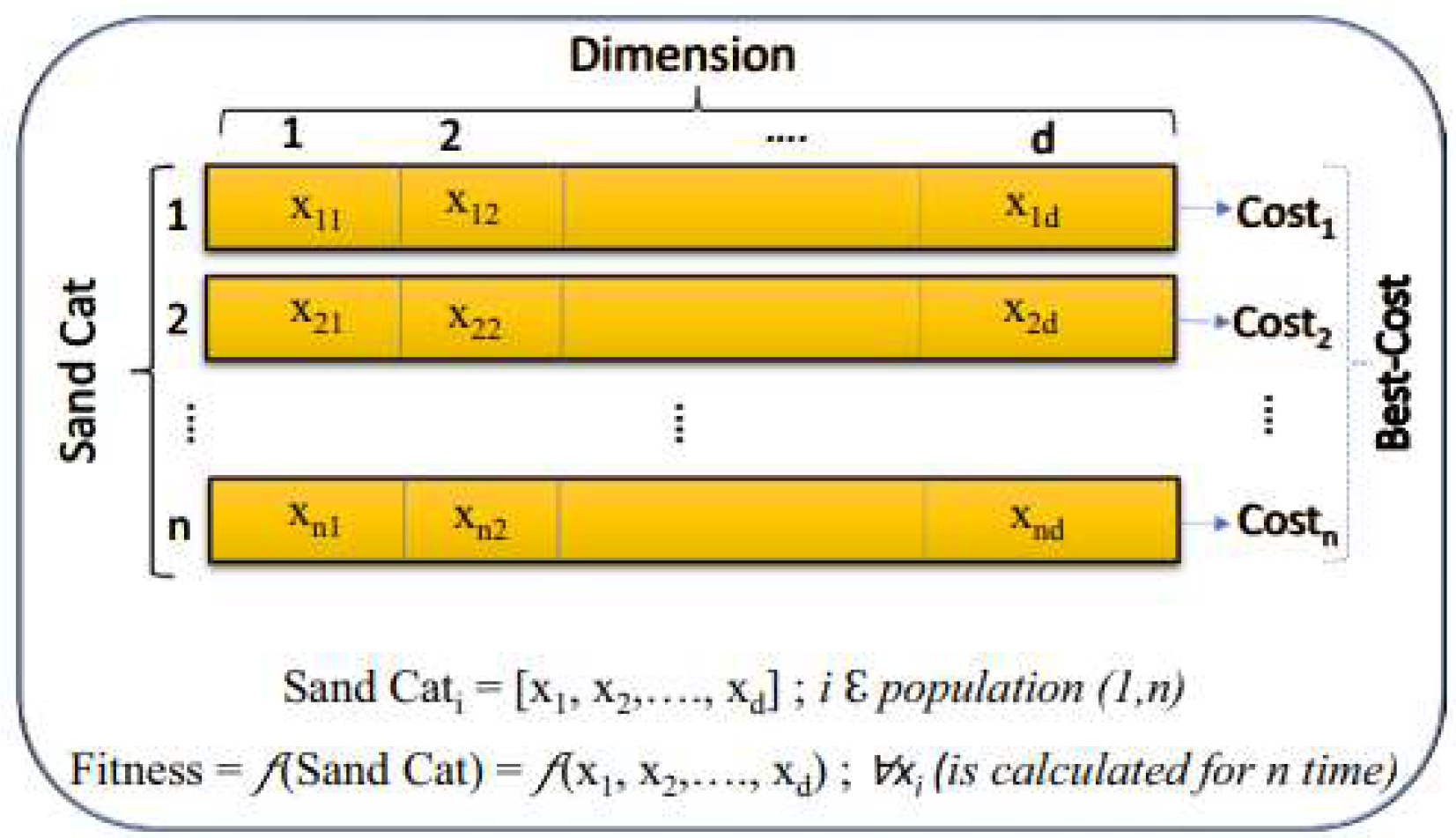
3.2. Initialization
3.3. Exploration and Exploitation
3.4. Modified SCSO
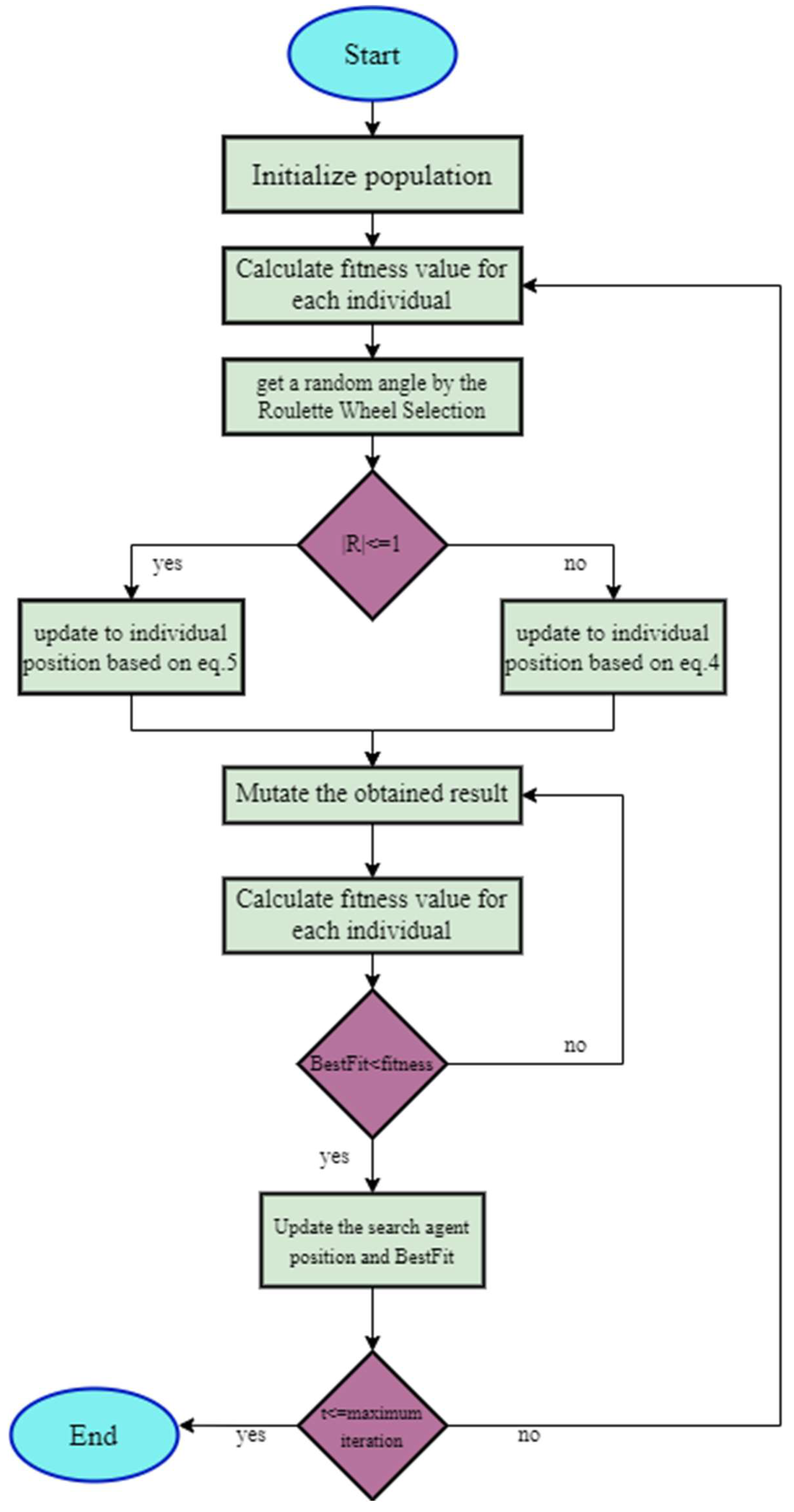
| Algorithm 1 Modified sand cat swarm optimization algorithm pseudocode |
| Population and parameter initialization Based on the objective function, calculate the fitness function While (itert <= maxIter) For each search agent Get a random angle based on the roulette wheel selection If (abs(R) <= 1) Update the search agent position based on Equation (5) Else Update the search agent position based on Equation (4) End Mutation of the obtained results with predefined values If(obtainedFitness < BestFitness) Update the search agent position and BestFitness Else Mutation of the obtained results with predefined values End End t = t++ End |
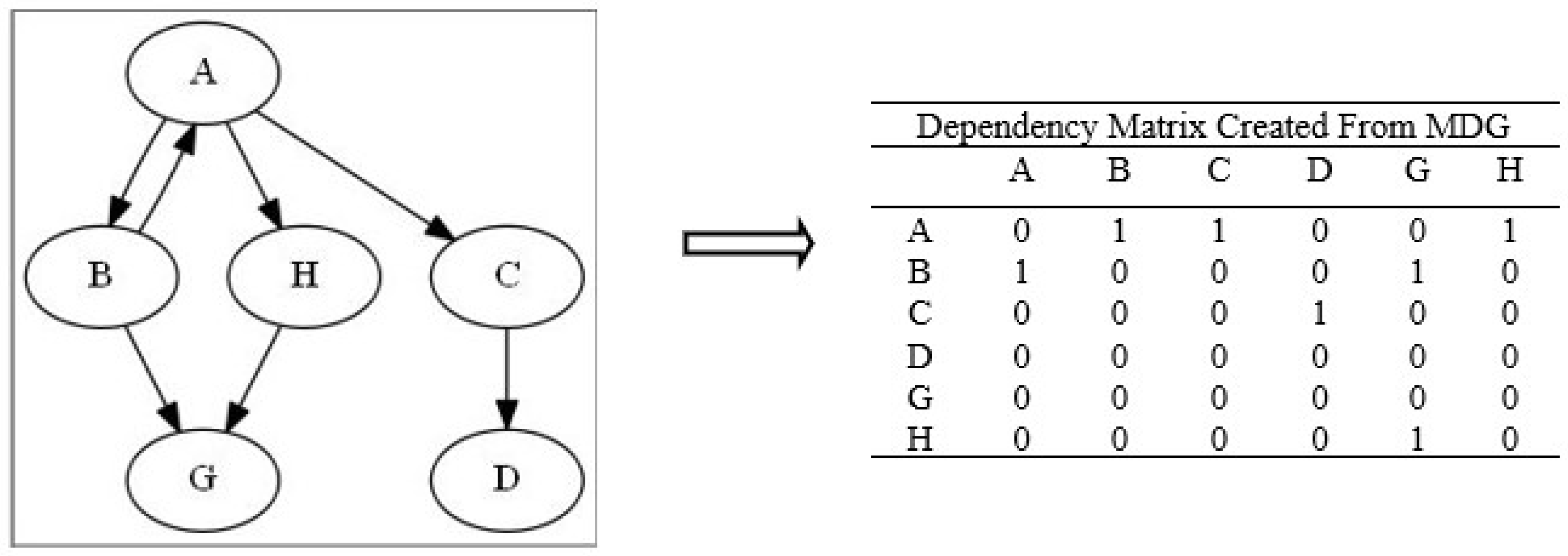
3.5. Fitness Function
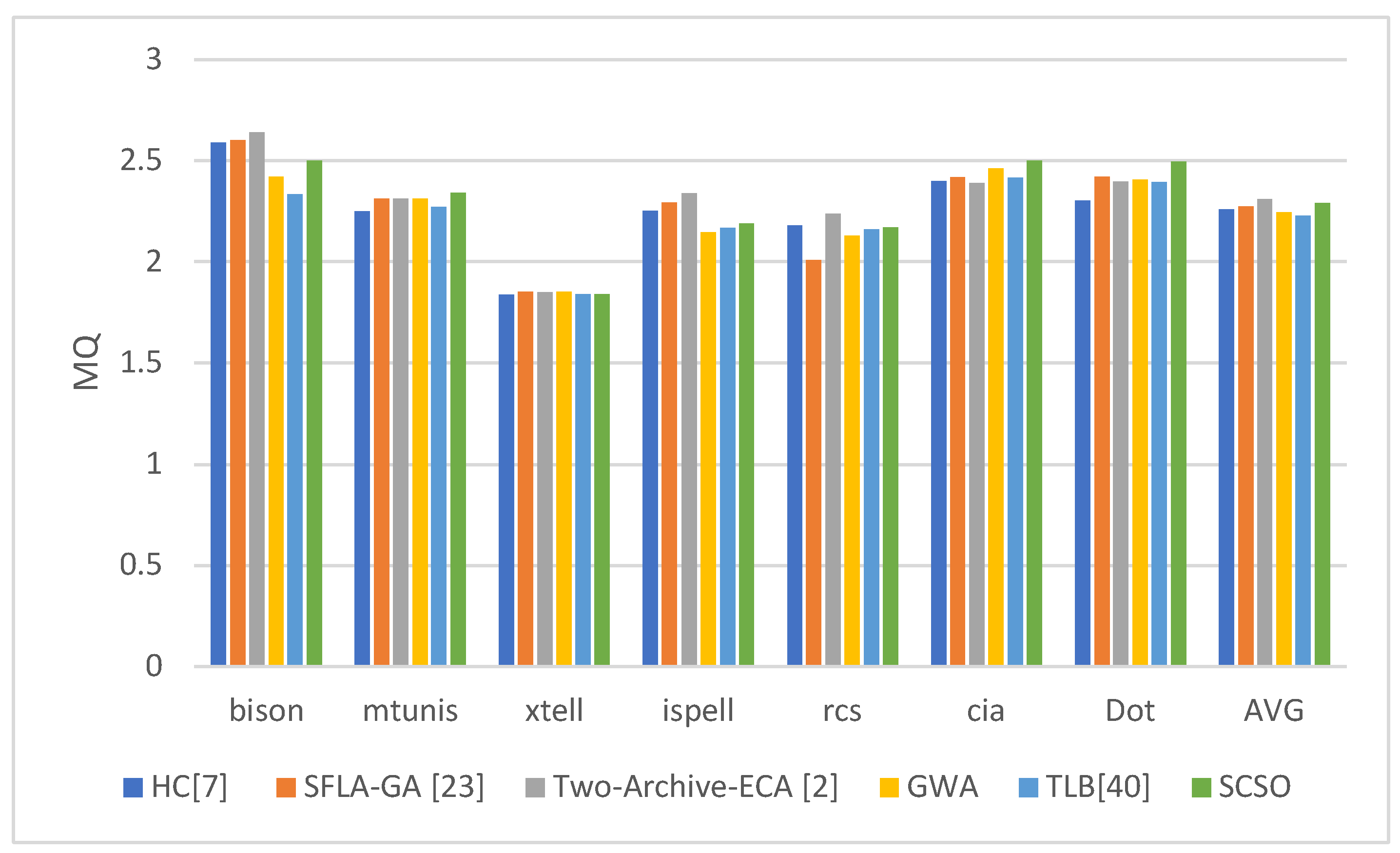
4. Experiments and Results
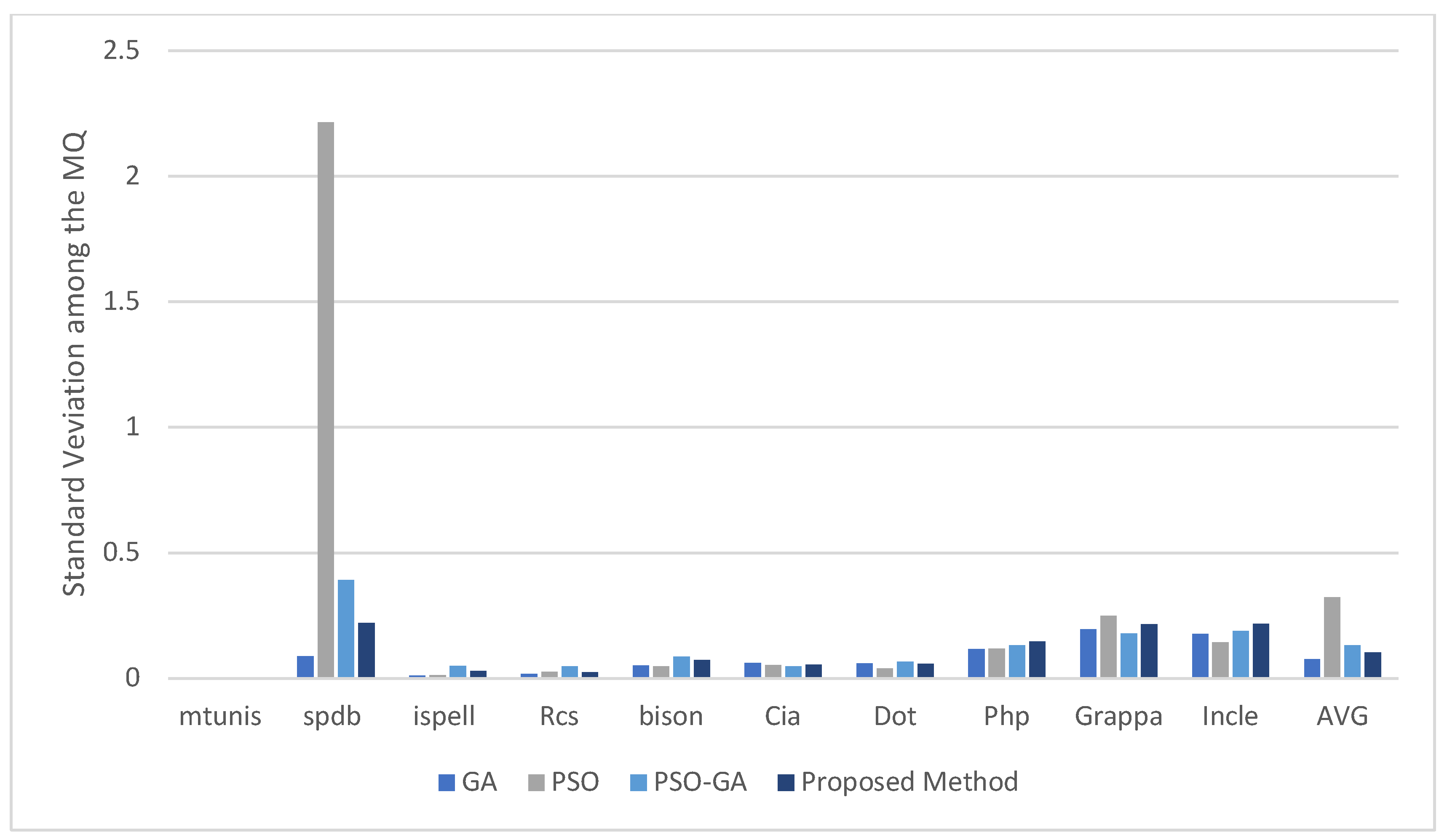
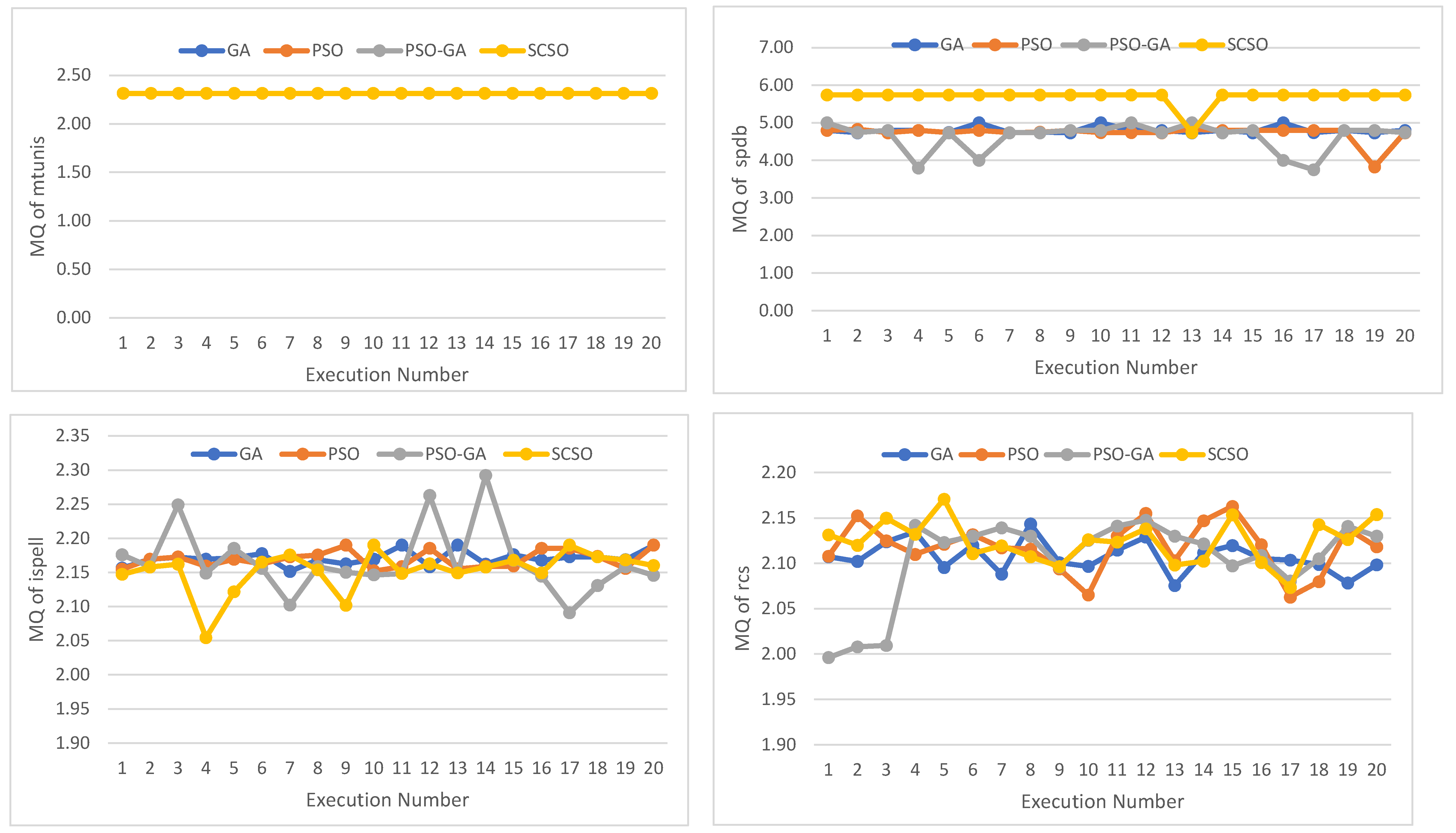
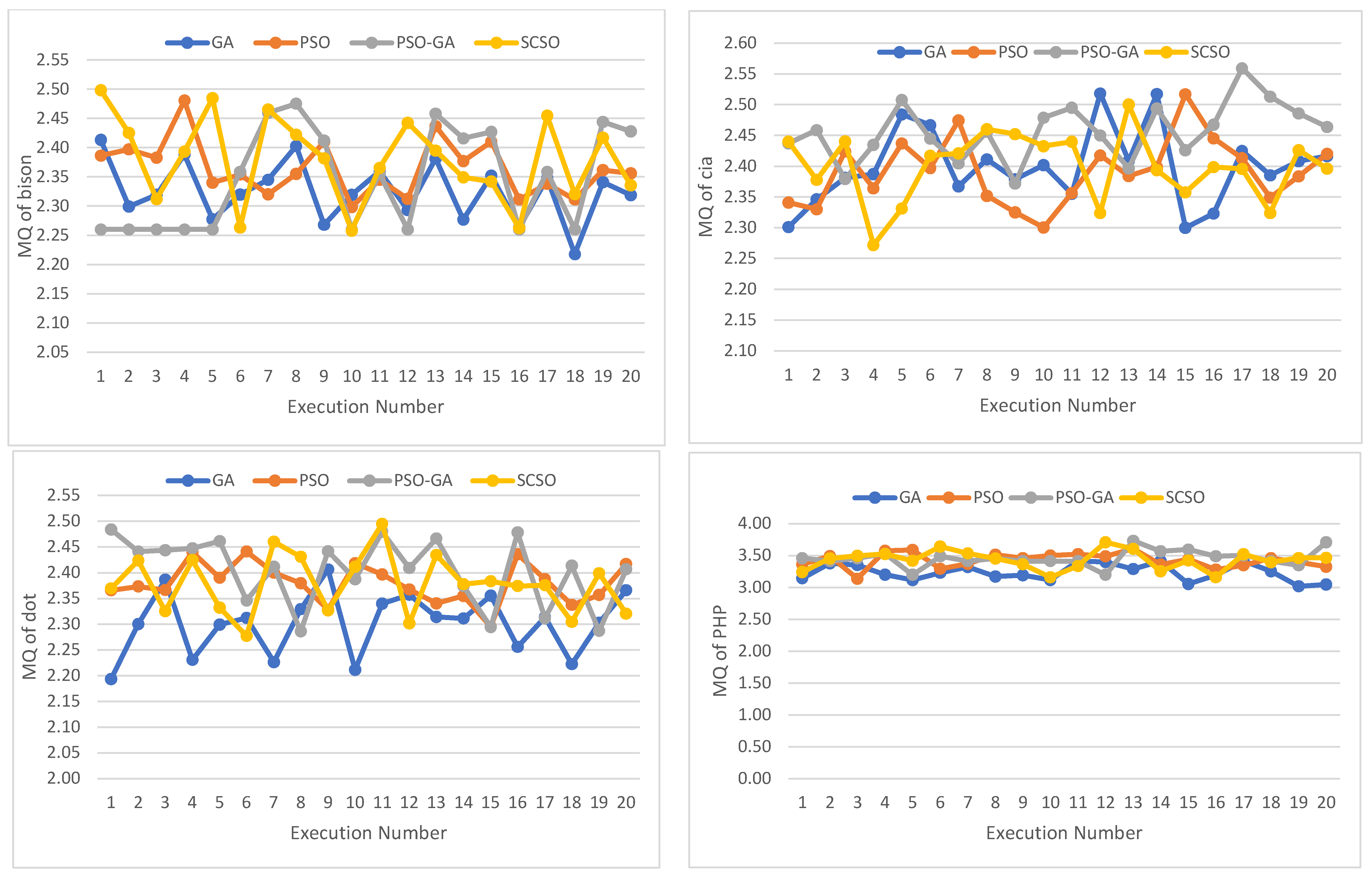
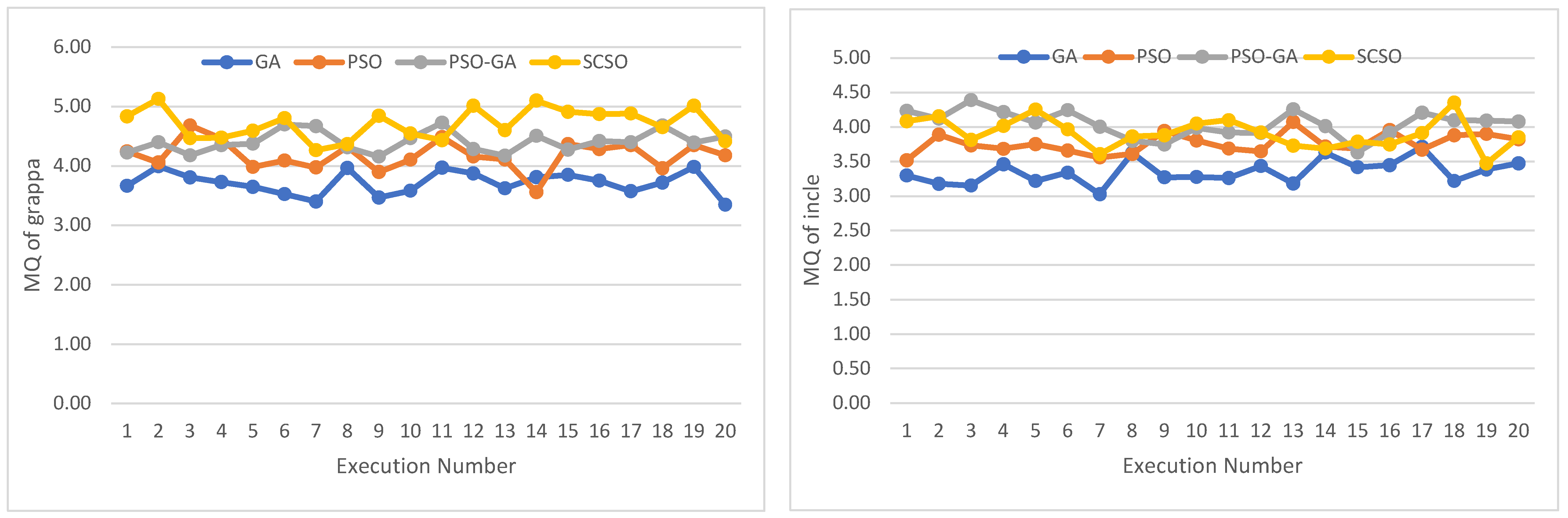
Results
5. Conclusions
Author Contributions
Funding
Data Availability Statement
Conflicts of Interest
References
- Mitchell, B.S. A Heuristic Search Approach to Solving the Software Clustering Problem; Drexel University: Philadelphia, PA, USA, 2002. [Google Scholar]
- Praditwong, K.; Harman, M.; Yao, X. Software Module Clustering as a Multi-Objective Search Problem. IEEE Trans. Softw. Eng. 2011, 37, 264–282. [Google Scholar] [CrossRef]
- Pressman, R. Software Engineering: A Practitioner’s Approach: European Adaptation; McGraw-Hill: New York, NY, USA, 2000. [Google Scholar]
- Paikray, H.K.; Das, P.K.; Panda, S. Optimal Multi-robot Path Planning Using Particle Swarm Optimization Algorithm Improved by Sine and Cosine Algorithms. Arab. J. Sci. Eng. 2021, 46, 3357–3381. [Google Scholar] [CrossRef]
- Amarjeet; Chhabra, J.K. An empirical study of the sensitivity of quality indicator for software module clustering. In Proceedings of the 2014 Seventh International Conference on Contemporary Computing (IC3), Noida, India, 7–9 August 2014; IEEE: Piscatway, NJ, USA, 2014; pp. 206–211. [Google Scholar] [CrossRef]
- Amarjeet; Chhabra, J.K. Improving modular structure of software system using structural and lexical dependency. Inf. Softw. Technol. 2017, 82, 96–120. [Google Scholar] [CrossRef]
- Keshtgar, S.A.; Arasteh, B.B. Enhancing Software Reliability against Soft-Error using Minimum Redundancy on Critical Data. Int. J. Comput. Netw. Inf. Secur. 2017, 9, 21–30. [Google Scholar] [CrossRef]
- Garey, M.R.; Johnson, D.S. Computers and Intractability; A Guide to the Theory of NP-Completeness; W. H. Freeman & Co.: New York, NY, USA, 1979. [Google Scholar]
- ZadahmadJafarlou, M.; Arasteh, B.; YousefzadehFard, P. A Pattern-Oriented and Web-Based Architecture to Support Mobile Learning Software Development. Procedia-Soc. Behav. Sci. 2011, 28, 194–199. [Google Scholar] [CrossRef]
- Bouyer, A.; Arasteh, B.; Movaghar, A. A New Hybrid Model Using Case-Based Reasoning and Decision Tree Methods for Improving Speedup and Accuracy. In Proceedings of the IADIS International Association for Development of the Information Society, Salamanca, Spain, 18–20 February 2007; pp. 787–789. [Google Scholar]
- Arasteh, B.; Karimi, M.B.; Sadegi, R. Düzen: Generating the structural model from the software source code using shuffled frog leaping algorithm. Neural Comput. Appl. 2023, 35, 2487–2502. [Google Scholar] [CrossRef]
- Jalali, M.; Bouyer, A.; Arasteh, B.; Moloudi, M. The Effect of Cloud Computing Technology in Personalization and Education Improvements and its Challenges. Procedia-Soc. Behav. Sci. 2013, 83, 655–658. [Google Scholar] [CrossRef]
- Ghaemi, A.; Arasteh, B. SFLA-based heuristic method to generate software structural test data. J. Softw. Evol. Process 2020, 32, 22–28. [Google Scholar] [CrossRef]
- Arasteh, B.; Abdi, M.; Bouyer, A. Program source code comprehension by module clustering using combination of discretized gray wolf and genetic algorithms. Adv. Eng. Softw. 2022, 173, 103252. [Google Scholar] [CrossRef]
- Kirtil, H.S.; Seyyedabbasi, A. A Hybrid Metaheuristic Algorithm for the Localization Mobile Sensor Nodes. In Forthcoming Networks and Sustainability in the IoT Era. FoNeS-IoT 2021. Lecture Notes on Data Engineering and Communications Technologies; Al-Turjman, F., Rasheed, J., Eds.; Springer: Cham, Switzerland, 2022; Volume 130, pp. 40–52. [Google Scholar] [CrossRef]
- Seyyedabbasi, A.; Kiani, F. Sand Cat swarm optimization: A nature-inspired algorithm to solve global optimization problems. Eng. Comput. 2022, 1–25. [Google Scholar] [CrossRef]
- Mancoridis, S.; Mitchell, B.S.; Chen, Y.; Gansner, E.R. Bunch: A clustering tool for the recovery and maintenance of software system structures. In Proceedings of the IEEE International Conference on Software Maintenance-1999 (ICSM’99). “Software Maintenance for Business Change” (Cat. No.99CB36360), Oxford, UK, 30 August–3 September 1999; IEEE: Piscatway, NJ, USA, 1999; pp. 50–59. [Google Scholar] [CrossRef]
- Harman, M.; Swift, S.; Mahdavi, K. An empirical study of the robustness of two module clustering fitness functions. In Proceedings of the 7th Annual Conference on Genetic and Evolutionary Computation, New York, NY, USA, 25 June 2005; ACM: New York, NY, USA, 2005; pp. 1029–1036. [Google Scholar] [CrossRef]
- Mahdavi, K.; Harman, M.; Hierons, R.M. A multiple hill climbing approach to software module clustering. In Proceedings of the International Conference on Software Maintenance, 2003. ICSM 2003, Amsterdam, The Netherlands, 22–26 September 2003; IEEE: Piscatway, NJ, USA, 2003; pp. 315–324. [Google Scholar] [CrossRef]
- Bavota, G.; Carnevale, F.; De Lucia, A.; Di Penta, M.; Oliveto, R. Putting the Developer in-the-Loop: An Interactive GA for Software Re-modularization. In Search Based Software Engineering. SSBSE 2012; Fraser, G., Teixeira de Souza, J., Eds.; Lecture Notes in Computer Science; Springer: Berlin/Heidelberg, Germany, 2012; Volume 7515, pp. 75–89. [Google Scholar] [CrossRef]
- Amarjeet; Chhabra, J.K. TA-ABC: Two-Archive Artificial Bee Colony for Multi-objective Software Module Clustering Problem. J. Intell. Syst. 2018, 27, 619–641. [Google Scholar] [CrossRef]
- Pourasghar, B.; Izadkhah, H.; Isazadeh, A.; Lotfi, S. A graph-based clustering algorithm for software systems modularization. Inf. Softw. Technol. 2021, 133, 106469. [Google Scholar] [CrossRef]
- Arasteh, B.; Sadegi, R.; Arasteh, K. Bölen: Software module clustering method using the combination of shuffled frog leaping and genetic algorithm. Data Technol. Appl. 2021, 55, 251–279. [Google Scholar] [CrossRef]
- Sun, J.; Ling, B. Software Module Clustering Algorithm Using Probability Selection. Wuhan Univ. J. Nat. Sci. 2018, 23, 93–102. [Google Scholar] [CrossRef]
- Maletic, J.I.; Marcus, A. Supporting program comprehension using semantic and structural information. In Proceedings of the 23rd International Conference on Software Engineering, ICSE 2001, Toronto, ON, Canada, 19 May 2001; IEEE: Piscatway, NJ, USA, 2001; pp. 103–112. [Google Scholar] [CrossRef]
- de Oliveira Barros, M. An analysis of the effects of composite objectives in multiobjective software module clustering. In Proceedings of the 14th Annual Conference on Genetic and Evolutionary Computation, New York, NY, USA, 7–11 July 2012; ACM: New York, NY, USA, 2012; pp. 1205–1212. [Google Scholar] [CrossRef]
- Chen, Y.-F. Reverse Engineering. In Practical Reusable UNIX Software; John Wiley & Sons, Inc.: Hoboken, NJ, USA, 1995; pp. 177–208. [Google Scholar]
- Mamaghani, A.S.; Hajizadeh, M. Software modularization using the modified firefly algorithm. In Proceedings of the 2014 8th Malaysian Software Engineering Conference (MySEC), Langkawi, Malaysia, 23–24 September 2014; IEEE: Piscatway, NJ, USA, 2014; pp. 321–324. [Google Scholar] [CrossRef]
- Arasteh, B.; Sadegi, R.; Arasteh, K. ARAZ: A software modules clustering method using the combination of particle swarm optimization and genetic algorithms. Intell. Decis. Technol. 2021, 14, 449–462. [Google Scholar] [CrossRef]
- Hatami, E.; Arasteh, B. An efficient and stable method to cluster software modules using ant colony optimization algorithm. J. Supercomput. 2020, 76, 6786–6808. [Google Scholar] [CrossRef]
- Seyyedabbasi, A. WOASCALF: A new hybrid whale optimization algorithm based on sine cosine algorithm and levy flight to solve global optimization problems. Adv. Eng. Softw. 2022, 173, 103272. [Google Scholar] [CrossRef]
- Arasteh, B.; Fatolahzadeh, A.; Kiani, F. Savalan: Multi objective and homogeneous method for software modules clustering. J. Softw. Evol. Process 2022, 34, e2408. [Google Scholar] [CrossRef]
- Korn, J.; Chen, Y.-F.; Koutsofios, E. Chava: Reverse engineering and tracking of Java applets. In Proceedings of the Sixth Working Conference on Reverse Engineering (Cat. No.PR00303), Atlanta, GA, USA, 8 October 1999; IEEE: Piscatway, NJ, USA, 1999; pp. 314–325. [Google Scholar] [CrossRef]
- Graphviz. Available online: https://graphviz.org/ (accessed on 10 January 2023).
- Savalan. Available online: http://savalan-smct.com/ (accessed on 30 October 2022).
- Praditwong, K. Solving software module clustering problem by evolutionary algorithms. In Proceedings of the 2011 Eighth International Joint Conference on Computer Science and Software Engineering (JCSSE), Nakhonpathom, Thailand, 11–13 May 2011; IEEE: Piscatway, NJ, USA, 2011; pp. 154–159. [Google Scholar] [CrossRef]
- Kumari, A.C.; Srinivas, K.; Gupta, M.P. Software module clustering using a hyper-heuristic based multi-objective genetic algorithm. In Proceedings of the 2013 3rd IEEE International Advance Computing Conference (IACC), Ghaziabad, India, 23 February 2013; IEEE: Piscatway, NJ, USA, 2013; pp. 813–818. [Google Scholar] [CrossRef]
- Amarjeet; Chhabra, J.K. Improving package structure of object-oriented software using multi-objective optimization and weighted class connections. J. King Saud Univ. Comput. Inf. Sci. 2017, 29, 349–364. [Google Scholar] [CrossRef]
- Amarjeet; Chhabra, J.K. Harmony search based remodularization for object-oriented software systems. Comput. Lang. Syst. Struct. 2017, 47, 153–169. [Google Scholar] [CrossRef]
- Arasteh, B. Clustered design-model generation from a program source code using chaos-based metaheuristic algorithms. Neural Comput. Appl. 2022, 1–23. [Google Scholar] [CrossRef]

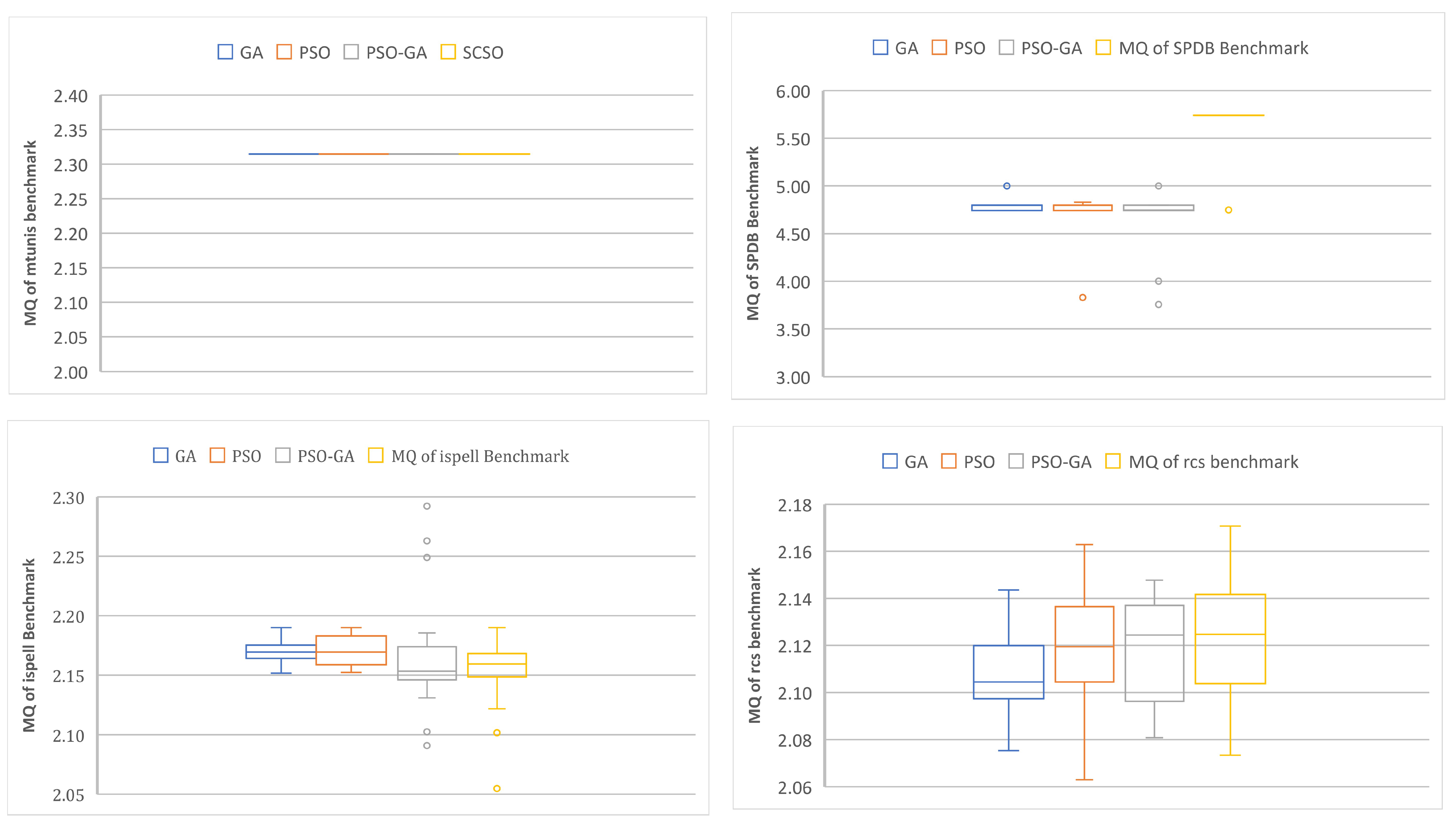
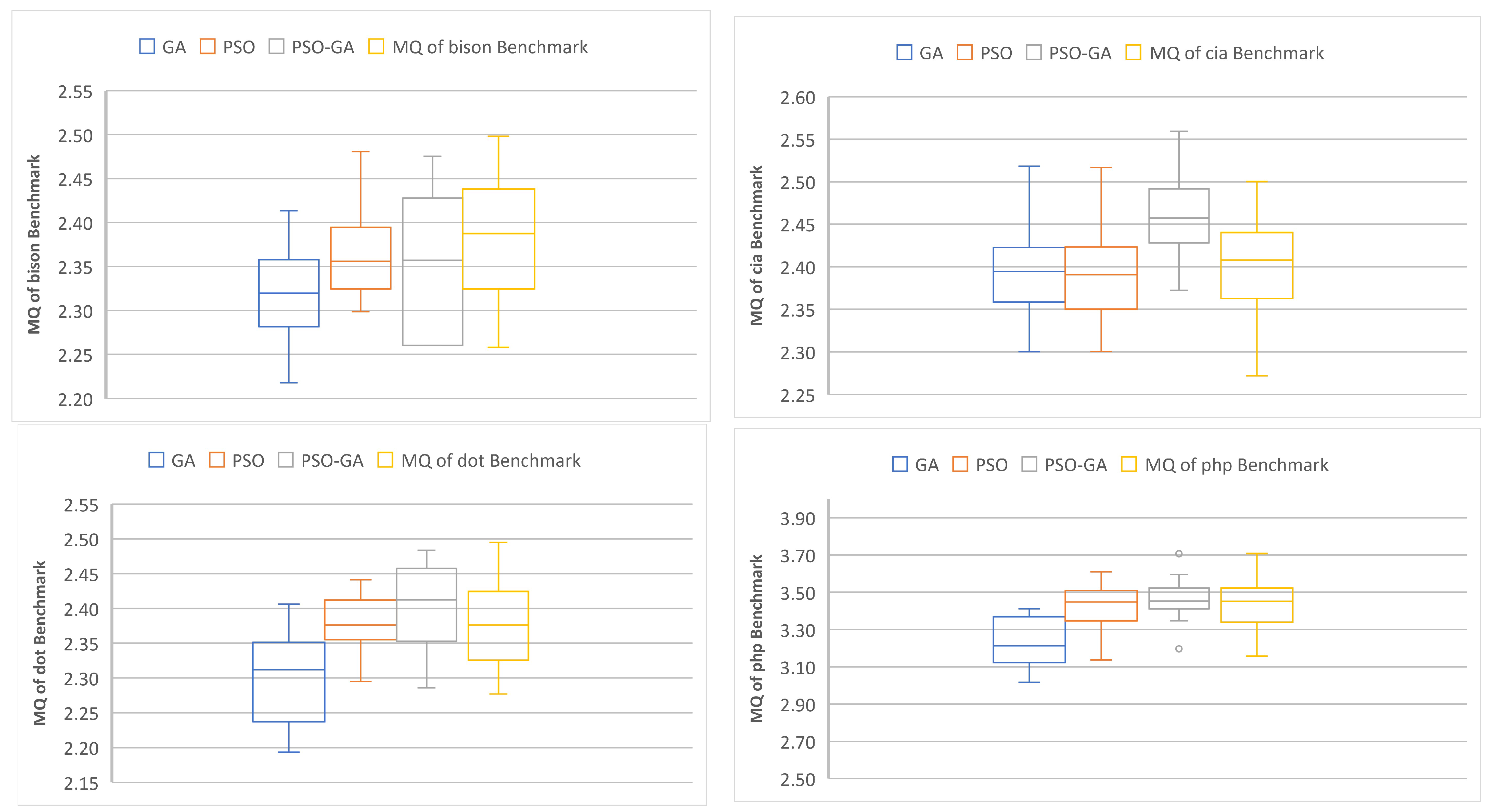
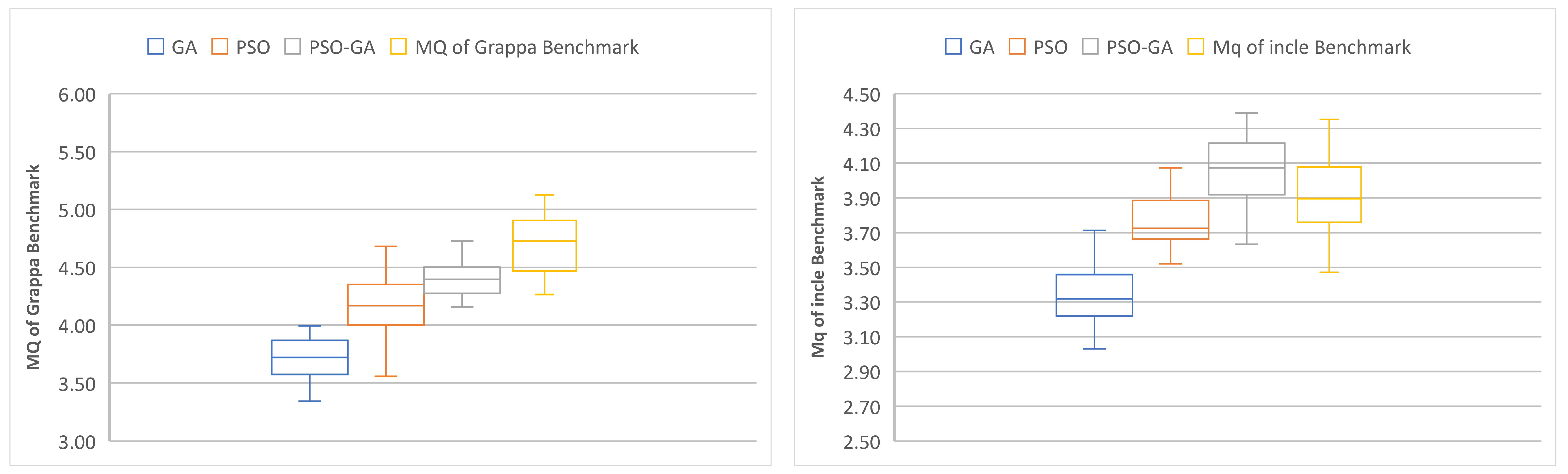
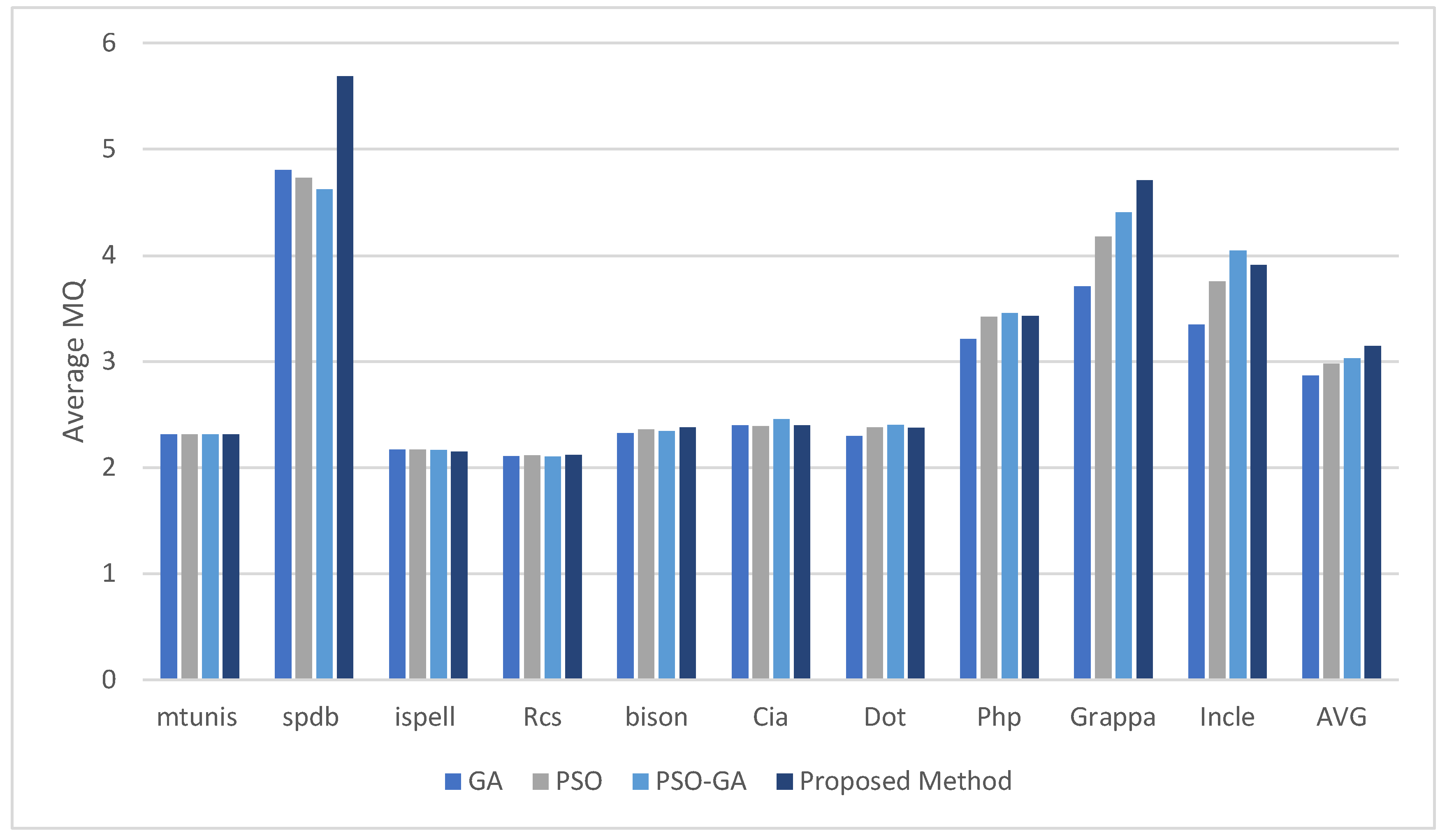


| Type of Objective Function | Characteristics | Algorithm | Year | Researcher |
|---|---|---|---|---|
| Single objective | Software structure recovery method | GA, HC, SA | 1999 | Mancordis [17] |
| Single objective | Software re-modularization methods using heuristic search techniques | GA, HC, SA | 2002 | Mitchell [1] |
| Single objective | Usage of two fitness factors for module clustering | HC | 2005 | Harmen [18] |
| Single objective | Usage of evolutionary algorithm for module clustering | GGA | 2011 | Wang [36] |
| Multi-objective | Multi-objective search algorithm for clustering the modules of software | Two-archive | 2011 | Wang [2] |
| Single objective | Re-modularization of a software source code using an interactive GA | GA | 2012 | Bavota [20] |
| Multi-objective | Re-modularization of a software source code using a hyper-heuristic algorithm | Hyper-heuristic | 2013 | Kumari [37] |
| Multi-objective | Object-oriented software clustering by weighted class connections and multi-objective algorithm | NSGA-II | 2015 | Chhabra [38] |
| Single objective | Harmony-search based remodularization of object-oriented software modules | HS | 2016 | Amerjit [39] |
| Single objective | Combination of SFLA and GA to remodularize the software source code | SFLA-GA | 2019 | Arasteh [23] |
| Single objective | Combination of PSO and GA to remodularize the software source code | PSO-GA | 2020 | Arasteh [29] |
| Single objective | Proposing ACO to generate software design model from the source code | ACO | 2020 | Arasteh [30] |
| Multi-objective | Using the two-archive ABC algorithm for software module clustering problem | TA-ABC | 2021 | Pourasghar [22] |
| Multi-objective | Proposing a multi-objective homogeneous clustering approach (Savalan) to software module clustering problem | PESA-GA | 2022 | Arasteh [32] |
| Hybrid single objective | Combination of discretized GWO algorithm and GA to cluster the modules of large software products | Hybrid Gray Wolf | 2022 | Arasteh [14] |
| Chaos-based single objective | Combination of chaos theory and heuristic algorithms to generate design models from the software source code | Chaos-based metaheuristic algorithms | 2022 | Arasteh [40] |
| Accessibility | Name of Tool and Characteristics | Name of Tool and Characteristics | Name of Tool and Characteristics | Year |
| Free desktop tool [17] | Bunch: Desktop standalone tool, single objective, | Bunch: Desktop standalone tool, single objective | Bunch: Desktop standalone tool, single objective | 1999 |
| Free web-based tool link [35] | Savalan: Web-based, multi-objective, and homogeneous tool, written in JavaScript | Savalan: Web-based, multi-objective, and homogeneous tool, written in JavaScript | Savalan: Web-based, multi-objective, and homogeneous tool, written in JavaScript | 2022 |
| Algorithms | Parameters | Value |
|---|---|---|
| SCSO | Population size | 40 |
| Sensitivity range (rG) | [0, 2] | |
| Phases control range (R) | [−2 rG, 2 rG] | |
| Pc | 0.8 | |
| Pm | 0.04 | |
| Genetic Algorithm (GA) | Number of chromosomes | 40 |
| Cross-mutate rate | 0.8 | |
| Mutation rate | 0.05 | |
| Particle Swarm Optimization (PSO) | Population size | 40 |
| W | [0.7, 0.8] | |
| C1 | [1.5, 1.7] | |
| C2 | [1.5, 1.7] |
| Programs | # Modules | # Edges | Size |
|---|---|---|---|
| mtunis | 20 | 57 | Small |
| spdb | 21 | 16 | Small |
| ispell | 24 | 97 | Small |
| Rcs | 29 | 155 | Mid |
| bison | 37 | 117 | Mid |
| Cia | 38 | 216 | Large |
| Dot | 42 | 248 | Large |
| Php | 62 | 163 | Large |
| Grappa | 86 | 252 | Large |
| Incle | 174 | 360 | Large |
| Benchmark | Mtunis | SPDb | ispell | rcs | Bison | |||||||||||
|---|---|---|---|---|---|---|---|---|---|---|---|---|---|---|---|---|
| Num of Cluster | 2 | 3 | 5 | 2 | 6 | 9 | 3 | 5 | 7 | 4 | 6 | 8 | 4 | 6 | 8 | |
| Runs Number | 1 | 1.5788 | 1.8329 | 2.3145 | 5.7412 | 5.7412 | 5.7412 | 1.9343 | 2.086 | 2.1475 | 1.9326 | 2.069 | 2.1314 | 1.9091 | 2.3096 | 2.4982 |
| 2 | 1.5788 | 1.8588 | 2.3145 | 5.7412 | 5.7412 | 5.7412 | 1.8869 | 2.1368 | 2.1581 | 1.9243 | 2.1035 | 2.12 | 1.9206 | 2.2934 | 2.4254 | |
| 3 | 1.5788 | 1.8588 | 2.3145 | 5.7412 | 4.7474 | 5.7412 | 1.8869 | 2.1158 | 2.1622 | 1.9242 | 2.1004 | 2.1499 | 1.9316 | 2.199 | 2.312 | |
| 4 | 1.5788 | 1.8588 | 2.3145 | 5.7412 | 5.7412 | 5.7412 | 1.9343 | 2.1368 | 2.0548 | 1.9354 | 2.0509 | 2.1321 | 1.9372 | 2.1843 | 2.3933 | |
| 5 | 1.5788 | 1.8329 | 2.3145 | 5.7412 | 5.2235 | 5.7412 | 1.9057 | 2.1292 | 2.1216 | 1.9516 | 2.083 | 2.1708 | 1.9466 | 2.1739 | 2.4846 | |
| 6 | 1.5788 | 1.8586 | 2.3145 | 5.7412 | 5.7412 | 5.7412 | 1.9343 | 2.1292 | 2.1654 | 1.9304 | 2.0884 | 2.1109 | 1.9216 | 2.1435 | 2.2634 | |
| 7 | 1.4913 | 1.8588 | 2.3145 | 5.7412 | 4.7474 | 5.7412 | 1.9343 | 2.1368 | 2.1756 | 1.9195 | 2.1394 | 2.1194 | 1.7801 | 2.2736 | 2.4653 | |
| 8 | 1.5788 | 1.7926 | 2.3145 | 5.7412 | 5.7412 | 5.7412 | 1.9343 | 2.1167 | 2.1538 | 1.8102 | 2.0778 | 2.1074 | 1.933 | 2.2896 | 2.4225 | |
| 9 | 1.5788 | 1.8329 | 2.3145 | 5.7412 | 5.7412 | 5.7412 | 1.8585 | 2.1368 | 2.1018 | 1.9272 | 2.058 | 2.0966 | 1.9285 | 2.2239 | 2.3819 | |
| 10 | 1.5788 | 1.8588 | 2.3145 | 5.7412 | 5.7412 | 5.7412 | 1.9193 | 2.1223 | 2.1899 | 1.9238 | 2.0992 | 2.126 | 1.8055 | 2.2789 | 2.258 | |
| 11 | 1.5788 | 1.8588 | 2.3145 | 5.7412 | 4.7983 | 5.7412 | 1.9193 | 2.0658 | 2.1484 | 1.9283 | 2.1343 | 2.1234 | 1.9461 | 2.1413 | 2.3657 | |
| 12 | 1.4913 | 1.8329 | 2.3145 | 5.7412 | 5.7412 | 5.7412 | 1.9051 | 2.0965 | 2.1625 | 1.9382 | 2.079 | 2.1382 | 1.8016 | 2.2948 | 2.4423 | |
| 13 | 1.5788 | 1.7926 | 2.3145 | 5.7412 | 5.7412 | 4.7474 | 1.9051 | 2.1419 | 2.1492 | 1.9156 | 2.1059 | 2.0983 | 1.8898 | 2.0944 | 2.3949 | |
| 14 | 1.5788 | 1.8329 | 2.3145 | 5.7412 | 5.7412 | 5.7412 | 1.9057 | 2.063 | 2.1579 | 1.9212 | 2.0854 | 2.1025 | 1.9497 | 2.2307 | 2.3493 | |
| 15 | 1.5788 | 1.8588 | 2.3145 | 5.7412 | 5.7412 | 5.7412 | 1.9343 | 2.0715 | 2.168 | 1.9242 | 2.1155 | 2.1537 | 1.9299 | 2.1941 | 2.3421 | |
| 16 | 1.5788 | 1.8329 | 2.3145 | 5.7412 | 5.7412 | 5.7412 | 1.9343 | 2.1522 | 2.1494 | 1.9334 | 2.018 | 2.101 | 1.9212 | 2.2034 | 2.2627 | |
| 17 | 1.5788 | 1.8286 | 2.3145 | 5.7412 | 5.7412 | 5.7412 | 1.8766 | 2.1292 | 2.1899 | 1.8175 | 2.0471 | 2.0734 | 1.9572 | 2.2969 | 2.4546 | |
| 18 | 1.5788 | 1.8588 | 2.3145 | 5.7412 | 5.7412 | 5.7412 | 1.8623 | 2.1201 | 2.173 | 1.9213 | 2.1219 | 2.1428 | 1.8952 | 2.2888 | 2.3208 | |
| 19 | 1.3354 | 1.8588 | 2.3145 | 5.7412 | 5.7412 | 5.7412 | 1.8766 | 2.1522 | 2.1682 | 1.9239 | 2.1215 | 2.1262 | 1.9677 | 2.3114 | 2.4174 | |
| 20 | 1.5788 | 1.8588 | 2.3145 | 5.7412 | 4.7983 | 5.7412 | 1.9343 | 2.1243 | 2.1605 | 1.9298 | 2.118 | 2.1539 | 1.9208 | 2.1866 | 2.3357 | |
| Benchmark | cia | Dot | Php | grappa | Incle | |||||||||||
|---|---|---|---|---|---|---|---|---|---|---|---|---|---|---|---|---|
| Num of Cluster | 4 | 5 | 8 | 5 | 8 | 10 | 5 | 8 | 10 | 6 | 9 | 12 | 6 | 9 | 12 | |
| Runs Number | 1 | 1.9779 | 2.3221 | 2.4402 | 2.0372 | 2.2345 | 2.3691 | 2.4569 | 3.1658 | 3.2426 | 3.1125 | 3.7766 | 4.8342 | 2.8566 | 3.1288 | 4.0849 |
| 2 | 2.0294 | 2.2014 | 2.378 | 1.9539 | 2.2719 | 2.4234 | 2.2761 | 3.1039 | 3.4534 | 3.0087 | 4.0463 | 5.1269 | 3.1009 | 3.2741 | 4.1521 | |
| 3 | 2.0339 | 2.2063 | 2.4405 | 1.9395 | 2.2131 | 2.3251 | 2.4341 | 2.8972 | 3.4954 | 3.2639 | 3.9741 | 4.4655 | 2.9586 | 3.3348 | 3.8131 | |
| 4 | 1.9394 | 2.2739 | 2.2721 | 1.9765 | 2.2533 | 2.4244 | 2.5243 | 3.1991 | 3.5236 | 2.9187 | 3.7832 | 4.4747 | 2.4894 | 3.1647 | 4.0183 | |
| 5 | 2.0095 | 2.3423 | 2.3313 | 1.9654 | 2.413 | 2.3318 | 2.3795 | 3.0004 | 3.4165 | 3.0295 | 3.549 | 4.5945 | 2.7704 | 3.2089 | 4.254 | |
| 6 | 2.0339 | 2.2465 | 2.4171 | 1.9793 | 2.2635 | 2.2771 | 2.5577 | 3.187 | 3.6409 | 3.2625 | 3.8471 | 4.8048 | 2.8157 | 3.3483 | 3.965 | |
| 7 | 1.9357 | 2.2067 | 2.4209 | 1.9891 | 2.2847 | 2.4597 | 2.5374 | 3.0952 | 3.5331 | 2.7447 | 3.4325 | 4.2638 | 2.4817 | 3.4964 | 3.6061 | |
| 8 | 1.9843 | 2.275 | 2.4604 | 2.0238 | 2.2203 | 2.4309 | 2.5403 | 2.9074 | 3.4525 | 2.817 | 3.8644 | 4.3635 | 2.3992 | 3.2879 | 3.8646 | |
| 9 | 2.0121 | 2.3186 | 2.4522 | 1.9687 | 2.2701 | 2.3266 | 2.2593 | 3.2362 | 3.3616 | 2.9667 | 4.0904 | 4.8428 | 2.8425 | 3.4349 | 3.8800 | |
| 10 | 2.0175 | 2.0938 | 2.4329 | 1.9054 | 2.2859 | 2.4113 | 2.4445 | 3.0447 | 3.1577 | 3.1282 | 3.8296 | 4.5456 | 2.7469 | 3.5857 | 4.0520 | |
| 11 | 1.9995 | 2.3227 | 2.4400 | 1.9313 | 2.3345 | 2.495 | 2.2958 | 3.0752 | 3.3336 | 2.9957 | 3.4981 | 4.435 | 2.6722 | 3.3484 | 4.1005 | |
| 12 | 1.9497 | 2.2889 | 2.3240 | 2.0172 | 2.1968 | 2.3014 | 2.2821 | 3.0896 | 3.7083 | 3.3946 | 4.4796 | 5.0126 | 2.7414 | 3.4878 | 3.9198 | |
| 13 | 1.9763 | 2.1975 | 2.5003 | 1.9707 | 2.233 | 2.4340 | 2.462 | 3.0392 | 3.6035 | 3.0771 | 3.9823 | 4.6013 | 2.5326 | 3.3311 | 3.7315 | |
| 14 | 2.0241 | 2.2869 | 2.3938 | 1.6494 | 2.2821 | 2.3773 | 2.4063 | 3.2853 | 3.254 | 3.1588 | 3.7945 | 5.1012 | 2.7827 | 3.4141 | 3.6892 | |
| 15 | 1.9833 | 2.3608 | 2.3578 | 1.9598 | 2.2403 | 2.3834 | 2.326 | 3.0582 | 3.4204 | 3.1035 | 3.4801 | 4.9125 | 2.6992 | 3.4968 | 3.7882 | |
| 16 | 2.0222 | 2.1962 | 2.3988 | 1.9604 | 2.3514 | 2.374 | 2.5321 | 3.17 | 3.1605 | 3.3943 | 4.1102 | 4.8747 | 2.9511 | 3.4265 | 3.7478 | |
| 17 | 2.0023 | 2.2744 | 2.3956 | 1.9632 | 2.1814 | 2.3757 | 2.452 | 3.2065 | 3.5177 | 3.0367 | 3.8518 | 4.8804 | 2.8871 | 3.0117 | 3.9116 | |
| 18 | 2.0097 | 2.3103 | 2.3239 | 1.9646 | 2.1457 | 2.3043 | 2.4934 | 3.2302 | 3.394 | 3.281 | 3.995 | 4.6482 | 2.943 | 3.5177 | 4.3516 | |
| 19 | 1.9656 | 2.2387 | 2.4261 | 2.0496 | 2.2482 | 2.3989 | 2.2812 | 3.2239 | 3.4599 | 2.8828 | 4.2824 | 5.012 | 2.8368 | 3.2773 | 3.4710 | |
| 20 | 2.0500 | 2.2289 | 2.3961 | 2.0216 | 2.3033 | 2.3203 | 2.1992 | 3.1698 | 3.4634 | 3.149 | 3.9254 | 4.4157 | 2.9281 | 3.1679 | 3.8497 | |
| The Statistical Analysis of Obtained Results for SPDB Dataset | ||||
|---|---|---|---|---|
| Source | SS | df | MS | |
| Between methods | 14.4385 | 3 | 4.8128 | F = 75.11321 |
| Within methods | 4.8697 | 76 | 0.0641 | |
| Total | 19.3082 | 79 | ||
| ||||
| The statistical analysis of the obtained results for incle dataset | ||||
| Between treatments | 5.455 | 3 | 1.8183 | F = 53.87688 |
| Within treatments | 2.565 | 76 | 0.0338 | |
| Total | 8.02 | 79 | ||
| ||||
| The Tukey Analysis of Obtained Results for SPDB Dataset | |||
|---|---|---|---|
| Pairwise Comparisons | HSD.05 = 0.2103, HSD.01 = 0.2577 | Q.05 = 3.7149, Q.01 = 4.5530 | |
| T1:T2 | M1 = 4.80 M2 = 4.73 | 0.07 | Q = 1.28 (p = 0.80117) |
| T1:T3 | M1 = 4.80 M3 = 4.63 | 0.18 | Q = 3.11 (p = 0.13252) |
| T1:T4 | M1 = 4.80 M4 = 5.69 | 0.89 | Q = 15.68 (p = 0.00000) |
| T2:T3 | M2 = 4.73 M3 = 4.63 | 0.10 | Q = 1.83 (p = 0.57020) |
| T2:T4 | M2 = 4.73 M4 = 5.69 | 0.96 | Q = 16.96 (p = 0.00000) |
| T3:T4 | M3 = 4.63 M4 = 5.69 | 1.06 | Q = 18.79 (p = 0.00000) |
| The Tukey analysis of obtained results for incle dataset | |||
| Pairwise Comparisons | HSD.05 = 0.1526, HSD.01 = 0.1870 | Q.05 = 3.7149 Q.01 = 4.5530 | |
| T1:T2 | M1 = 3.35 M2 = 3.76 | 0.41 | Q = 9.94 (p = 0.00000) |
| T1:T3 | M1 = 3.35 M3 = 4.05 | 0.70 | Q = 16.95 (p = 0.00000) |
| T1:T4 | M1 = 3.35 M4 = 3.91 | 0.56 | Q = 13.67 (p = 0.00000) |
| T2:T3 | M2 = 3.76 M3 = 4.05 | 0.29 | Q = 7.00 (p = 0.00003) |
| T2:T4 | M2 = 3.76 M4 = 3.91 | 0.15 | Q = 3.73 (p = 0.04853) |
| T3:T4 | M3 = 4.05 M4 = 3.91 | 0.13 | Q = 3.27 (p = 0.10396) |
| |||
Disclaimer/Publisher’s Note: The statements, opinions and data contained in all publications are solely those of the individual author(s) and contributor(s) and not of MDPI and/or the editor(s). MDPI and/or the editor(s) disclaim responsibility for any injury to people or property resulting from any ideas, methods, instructions or products referred to in the content. |
© 2023 by the authors. Licensee MDPI, Basel, Switzerland. This article is an open access article distributed under the terms and conditions of the Creative Commons Attribution (CC BY) license (https://creativecommons.org/licenses/by/4.0/).
Share and Cite
Arasteh, B.; Seyyedabbasi, A.; Rasheed, J.; M. Abu-Mahfouz, A. Program Source-Code Re-Modularization Using a Discretized and Modified Sand Cat Swarm Optimization Algorithm. Symmetry 2023, 15, 401. https://doi.org/10.3390/sym15020401
Arasteh B, Seyyedabbasi A, Rasheed J, M. Abu-Mahfouz A. Program Source-Code Re-Modularization Using a Discretized and Modified Sand Cat Swarm Optimization Algorithm. Symmetry. 2023; 15(2):401. https://doi.org/10.3390/sym15020401
Chicago/Turabian StyleArasteh, Bahman, Amir Seyyedabbasi, Jawad Rasheed, and Adnan M. Abu-Mahfouz. 2023. "Program Source-Code Re-Modularization Using a Discretized and Modified Sand Cat Swarm Optimization Algorithm" Symmetry 15, no. 2: 401. https://doi.org/10.3390/sym15020401
APA StyleArasteh, B., Seyyedabbasi, A., Rasheed, J., & M. Abu-Mahfouz, A. (2023). Program Source-Code Re-Modularization Using a Discretized and Modified Sand Cat Swarm Optimization Algorithm. Symmetry, 15(2), 401. https://doi.org/10.3390/sym15020401