

Observational Constraints on

Abstract
1. Introduction
2. Cosmology with Gravity
3. Isotropization
4. Observational Constraints
4.1. Supernovae Type Ia (SNe-Ia)
4.2. Cosmic Microwave Background
4.3. Baryon Acoustic Oscillation
4.4. Hubble’s Data
4.5. Monte Carlo Markov Chain (MCMC)
5. Results on Observational Tests
6. Physical Parameters
6.1. Deceleration Parameter
6.2. Equation of State Parameter
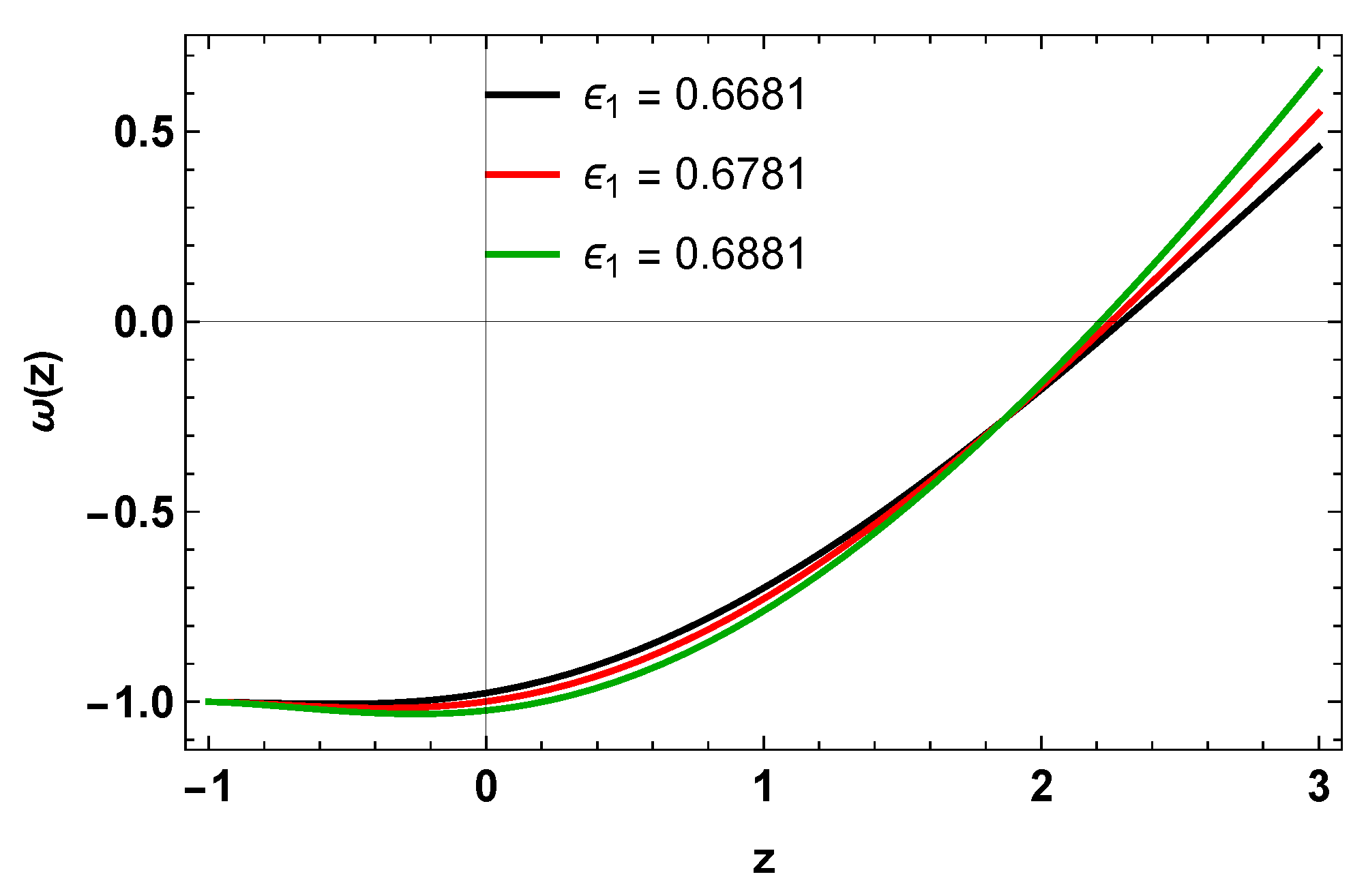
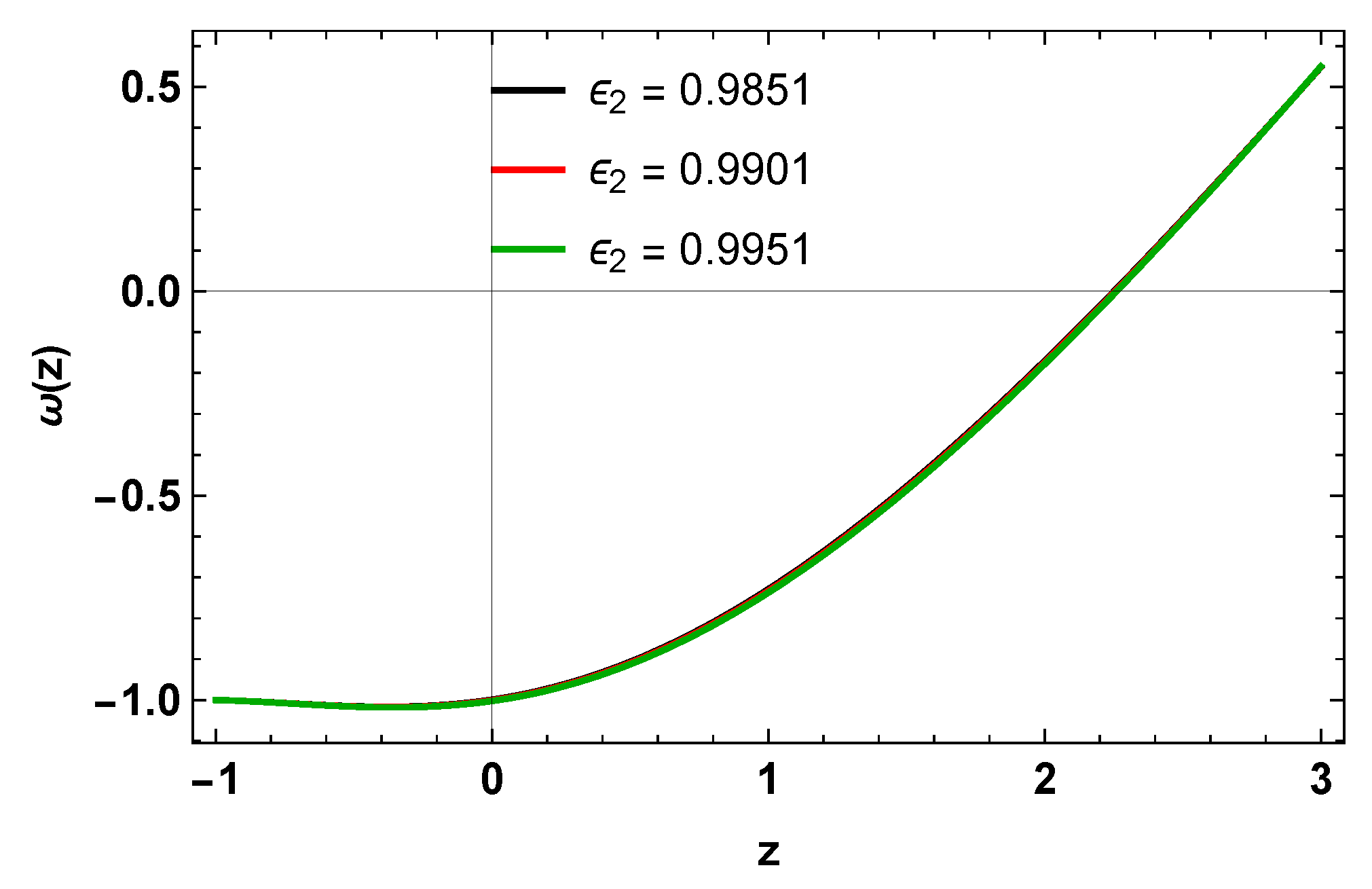
- “For the dust phase the EoS parameter, ,
- in the radiation-dominated phase, ,
- in the vacuum energy or CDM model, the EoS parameter is recovered by .
- in the quintessence phase, EoS parameter lies in range ,
- in the phantom regime ”.
6.3. Energy Density and Pressure
6.4. Energy Conditions
- “Null energy condition (NEC) ⇔,
- Weak energy condition (WEC) ⇔ and ,
- Strong energy condition (SEC) ⇔ and ,
- Dominant energy condition (DEC) ⇔ and ”.
7. Conclusions
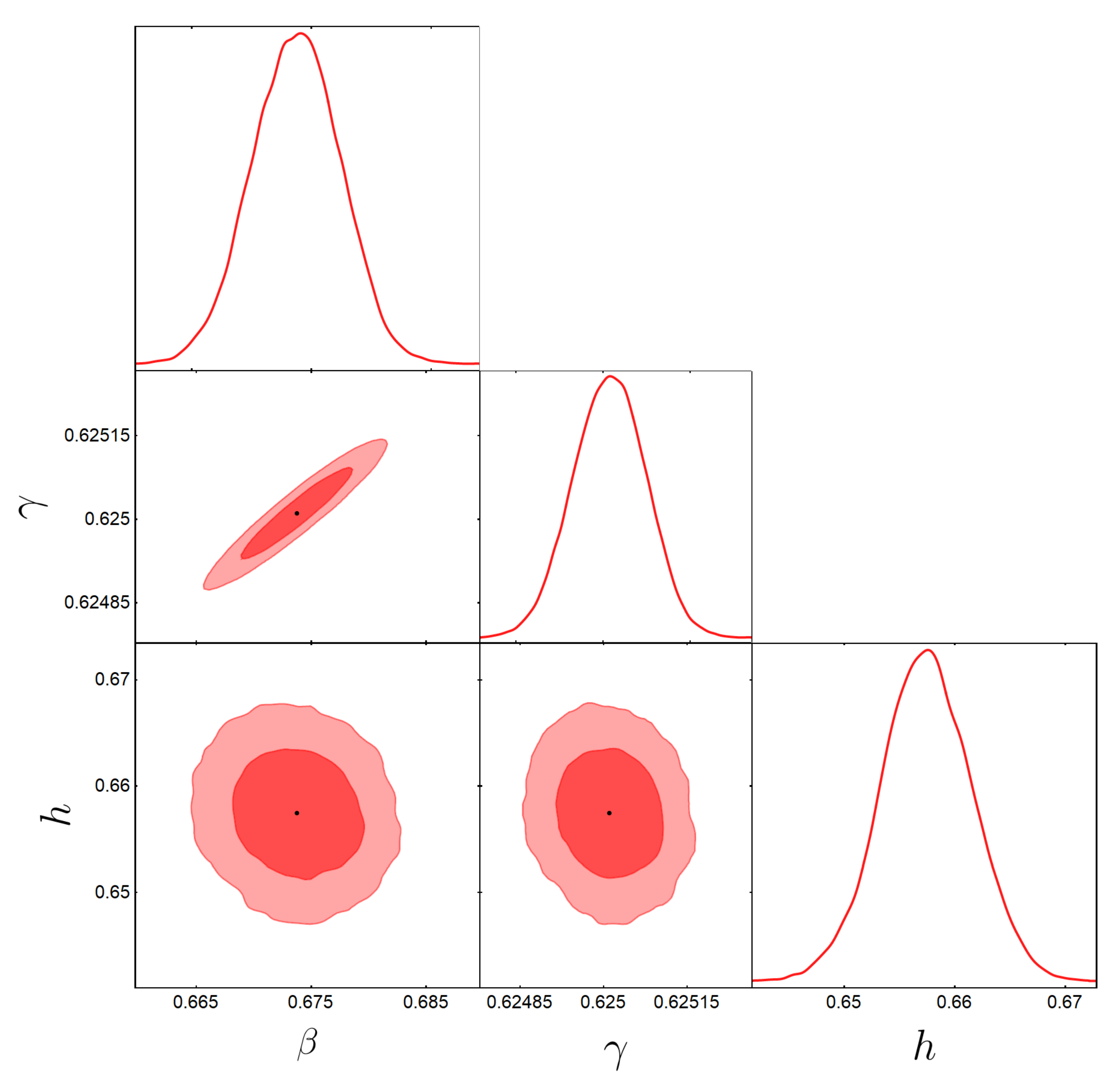
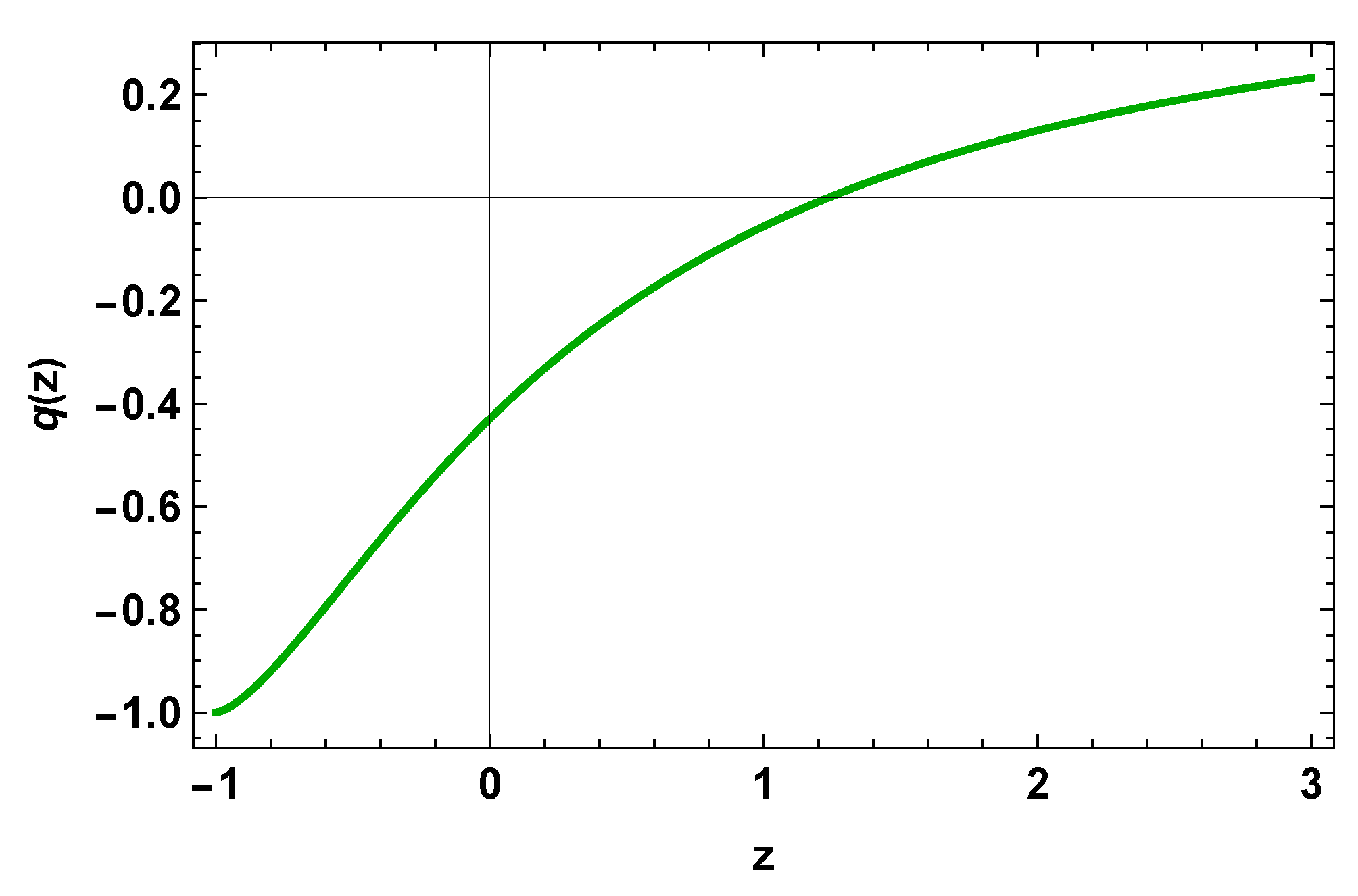
- A geometrical Hubble’s parameter H parametrization has been deliberated using the best fit constraints values of free parameters and obtained from SCBH data. This parametrization generates a time-dependent q and gives details the current accelerated expansion of the Universe, i.e., with a prior deceleration, i.e., . Additionally, it is noted that the model deviates from the typical big bang scenario. The model with q as time-dependent has a signature flipping behavior with evolution. So, the feature of an early deceleration to the late acceleration of the model is appropriate for structure formation in the early stage of evolution and accelerated expansion in the later stage of the evolution.
- Also discovered that the free cosmological parameters that are included in more specifically, could be associated in some way with the background parameters and . To end with, an exciting result here to comment on is that the value achieved for the Hubble parameter , lies close to the Planck estimation.
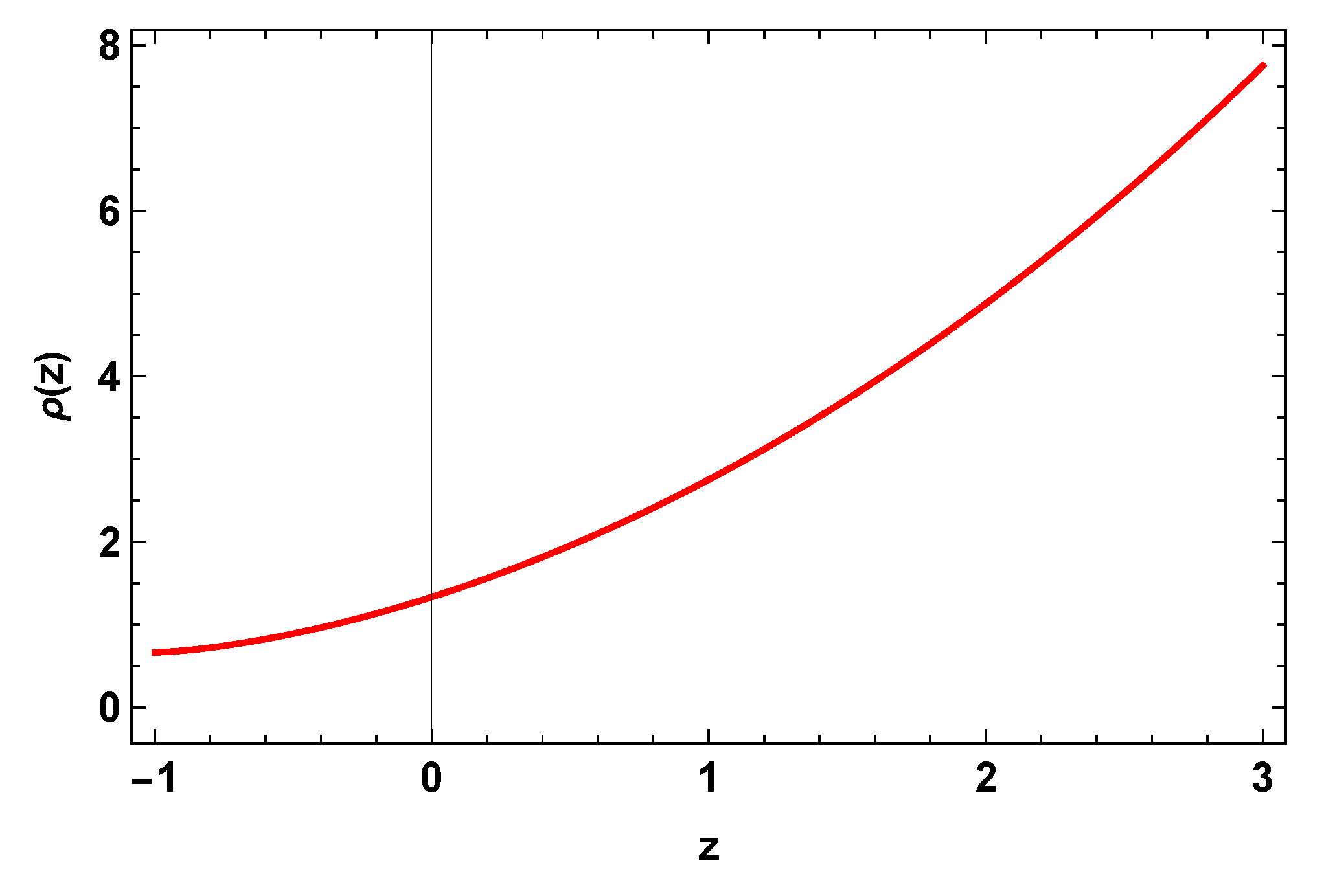
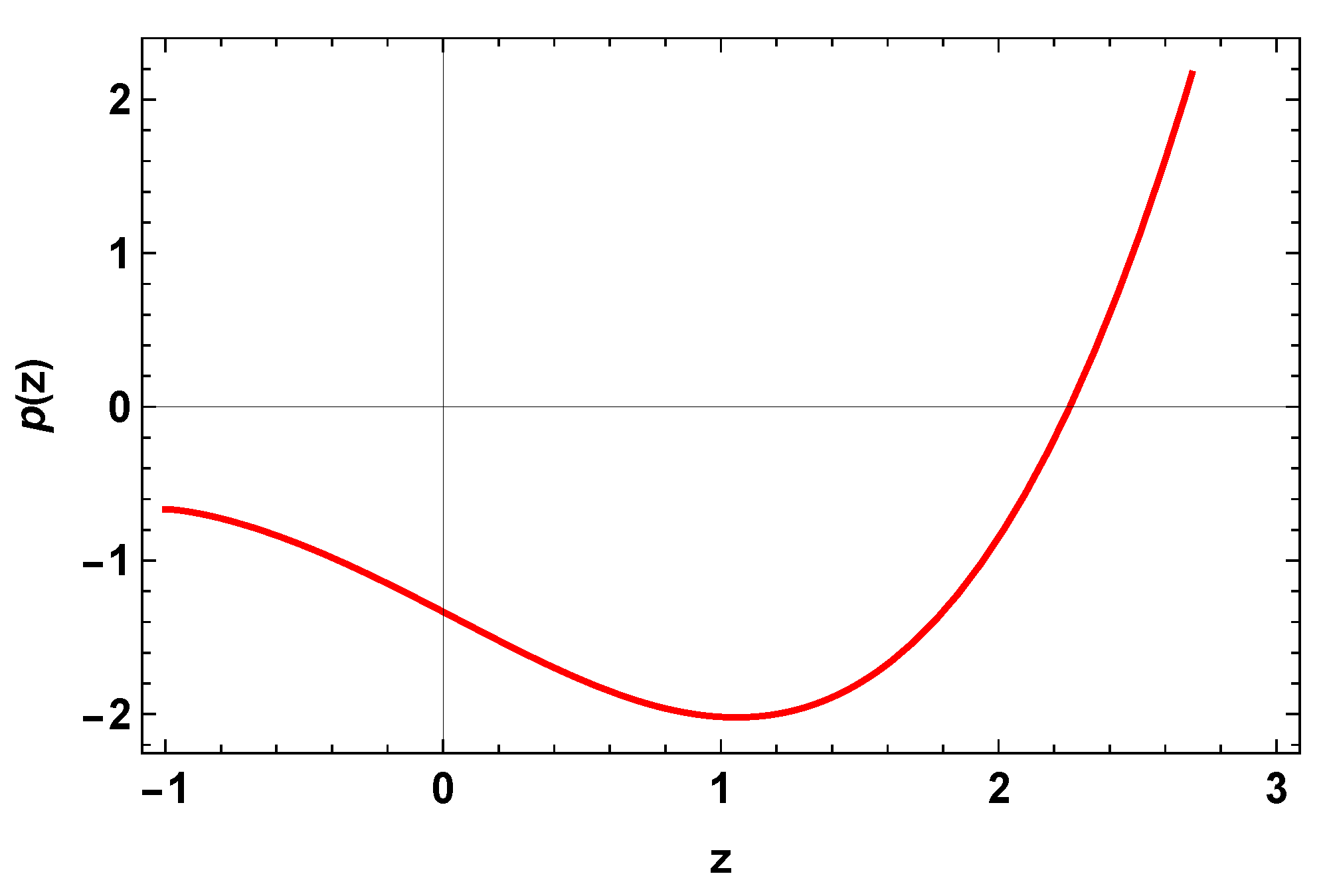
- The behavior of energy density and pressure can be completely predicted using the best fit constraints values of and , which were obtained from SCBH data and taken into consideration fix values of and . The results have been reported in a number of works. In detail, the cosmic energy density is non-negative and increases with the redshift, despite the fact an isotropic pressure is negative at present and in the future. As a result, negative pressure is liable for the accelerating expansion of the Universe at present and in the future.
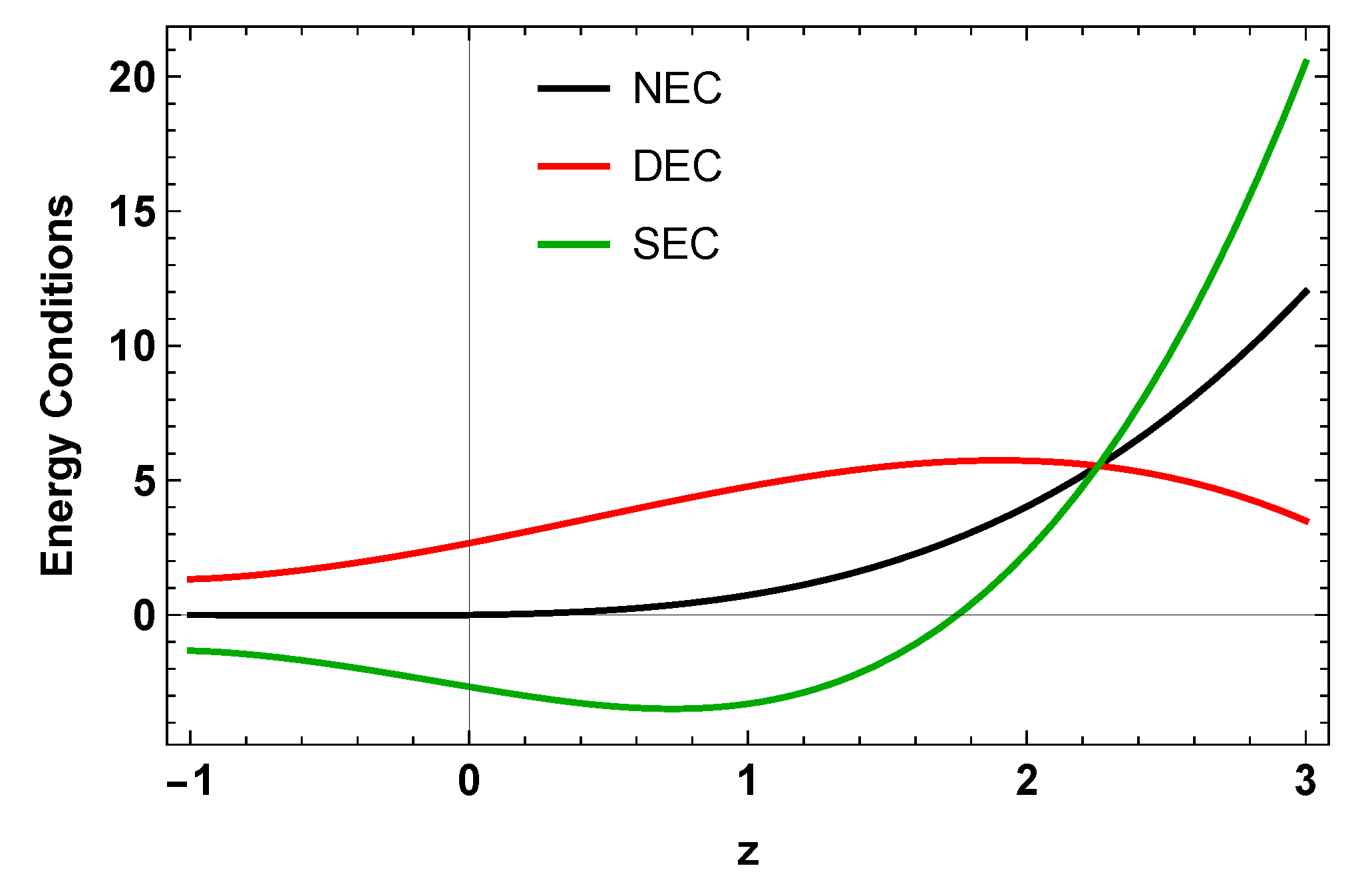
- In the analysis it is detected that the NEC and DEC both energy conditions are held, meanwhile, the SEC violates, the violation of SEC direct leads to the accelerating expansion of the Universe. Also, the WEC is non-negative from the early to late time phase of the Universe. Hence, the model reveals quintessential behavior. Simultaneously, the SEC was violated at a late time and satisfied at the early times (Figure 7).
Author Contributions
Funding
Institutional Review Board Statement
Informed Consent Statement
Data Availability Statement
Acknowledgments
Conflicts of Interest
References
- Perlmutter, S.; Aldering, G.; Goldhaber, G.; Knop, R.A.; Nugent, P.; Castro, P.G.; Deustua, S.; Fabbro, S.; Goobar, A.; Groom, D.E.; et al. Measurements of Ω and Λ from 42 high-redshift supernovae. Astrophys. J. 1999, 517, 565–586. [Google Scholar]
- Perlmutter, S.; Aldering, G.; Valle, M.D.; Deustua, S.; Ellis, R.S.; Fabbro, S.; Fruchter, A.; Goldhaber, G.; Groom, D.E.; Hook, I.M.; et al. Discovery of a supernova explosion at half the age of the Universe. Nature 1998, 91, 51. [Google Scholar]
- Riess, A.G. The case for an accelerating universe from supernovae. Astron. Soci. Pac. 2000, 112, 1284. [Google Scholar]
- Tonry, J.L.; Schmidt, B.P.; Barris, B.; Candia, P.; Challis, P.; Clocchiatti, A.; Coil, A.L.; Filippenko, A.V.; Garnavich, P.; Hogan, C.; et al. Cosmological results from high-z supernovae. Astrophys. J. 2003, 94, 1. [Google Scholar]
- de Bernardis, P.; Ade, P.A.; Bock, J.J.; Bond, J.R.; Borrill, J.; Boscaleri, A.; Coble, K.; Crill, B.P.; De Gasperis, G.; Farese, P.C.; et al. A flat Universe from high-resolution maps of the cosmic microwave background radiation. Nature 2000, 404, 955–959. [Google Scholar] [CrossRef]
- Spergel, D.N.; Verde, L.; Peiris, H.V.; Komatsu, E.; Nolta, M.R.; Bennett, C.L.; Halpern, M.; Hinshaw, G.; Jarosik, N.; Kogut, A.; et al. First-year Wilkinson Microwave Anisotropy Probe (WMAP)* observations: Determination of cosmological parameters. Astrophys. J. Suppl. Ser. 2003, 148, 175–194. [Google Scholar] [CrossRef]
- Tegmark, M.; Strauss, M.A.; Blanton, M.R.; Abazajian, K.; Dodelson, S.; Sandvik, H.; Wang, X.; Weinberg, D.H.; Zehavi, I.; Bahcall, N.A.; et al. Cosmological parameters from SDSS and WMAP. Phys. Rev. D 2004, 69, 103501. [Google Scholar]
- Bassett, B.A.; Tsujikawa, S.; Wands, D. Inflation dynamics and reheating. Rev. Mod. Phys. 2006, 78, 537. [Google Scholar] [CrossRef]
- Copeland, E.J.; Sami, M.; Tsujikawa, S. Dynamics of dark energy. Int. J. Phys. D 2006, 15, 1753–1935. [Google Scholar]
- Cai, Y.F.; Saridakis, E.N.; Setare, M.R.; Xia, J.Q. Quintom cosmology: Theoretical implications and observations. Phys. Rep. 2010, 493, 1–60. [Google Scholar] [CrossRef]
- Chevallier, M.; Polarski, D. Accelerating universes with scaling dark matter. Int. J. Mod. Phys. D 2001, 10, 213–223. [Google Scholar] [CrossRef]
- Linder, E.V. Exploring the expansion history of the universe. Phys. Rev. Lett. 2003, 90, 091301. [Google Scholar] [CrossRef]
- Nojiri, S.I.; Odintsov, S.D. Modified f (R) gravity unifying Rm inflation with the ΛCDM epoch. Phys. Rev. D 2008, 77, 026007. [Google Scholar] [CrossRef]
- Inagaki, T.; Taniguchi, M. Cartan F(R) gravity and equivalent scalar-tensor theory. Symmetry 2022, 14, 1830. [Google Scholar] [CrossRef]
- Ali, S.; Saif, M.; Khan, K.A.; Shah, N.A. A note on varying G and Λ in Chern-Simons modified gravity. Symmetry 2022, 14, 1430. [Google Scholar] [CrossRef]
- Bekov, S.; Myrzakulov, K.; Myrzakulov, R.; Gomez, S.-C. General slow-roll inflation in f(R) gravity under the Palatini approach. Symmetry 2020, 12, 1958. [Google Scholar] [CrossRef]
- Granda, L. Unified inflation and late-time accelerated expansion with exponential and R2 corrections in modified gravity. Symmetry 2020, 12, 749. [Google Scholar] [CrossRef]
- Godani, N. Thin-shell wormhole solution in f(R) gravity. New Astron. 2023, 98, 101941. [Google Scholar]
- Nojiri, S.I.; Odintsov, S.D. Unified cosmic history in modified gravity: From F (R) theory to Lorentz non-invariant models. Phys. Rept. 2011, 505, 59–144. [Google Scholar]
- Capozziello, S.; De Laurentis, M. Extended theories of gravity. Phys. Rep. 2011, 509, 167–332. [Google Scholar]
- Odintsov, S.D.; Oikonomou, V.K. Early-time cosmology with stiff era from modified gravity. Phys. Rev. D 2017, 6, 104059. [Google Scholar]
- Odintsov, S.D.; Oikonomou, V.K. Reconstruction of slow-roll F (R) gravity inflation from the observational indices. Ann. Phys. 2018, 388, 267–275. [Google Scholar] [CrossRef]
- Einstein, A. Riemann-Geometrie mit Aufrechterhaltung des Begriffes des Fernparallelismus, Neue Möglichkeit für eine einheitliche Feldtheorie von Gravitation und Elektrizität. Sitzungsber. Preuss. Akad. Wiss. Berl. Phys. Math. 1928, Kl, 224. [Google Scholar]
- Arcos, H.I.; Pereira, J.G. Torsion gravity: A reappraisal. Int. J. Mod. Phys. D 2004, 13, 2193–2240. [Google Scholar] [CrossRef]
- Maluf, J.W. The teleparallel equivalent of general relativity. Ann. Phys. 2013, 525, 339–357. [Google Scholar]
- Aldrovandi, R.; Pereira, J.G. Teleparallel Gravity: An Introduction; Springer: Dordrecht, The Netherlands, 2013. [Google Scholar]
- Capozziello, S.; Cardone, V.F.; Farajollahi, H.; Ravanpak, A. Cosmography in f (T) gravity. Phys. Rev. D 2011, 84, 043527. [Google Scholar]
- Myrzakulov, R. Accelerating universe from F (T) gravity. Eur. Phys. J. C 2011, 71, 1752. [Google Scholar]
- Jeon, I.; Lee, K.; Park, J.H. Differential geometry with a projection: Application to double field theory. J. High Energy Phys. 2011, 2011, 14. [Google Scholar] [CrossRef]
- Tamanini, N.; Boehmer, C.G. Good and bad tetrads in f (T) gravity. Phys. Rev. D 2012, 86, 044009. [Google Scholar]
- Cai, Y.F.; Capozziello, S.; De Laurentis, M.; Saridakis, E.N. f (T) teleparallel gravity and cosmology. Rep. Prog. Phys. 2016, 9, 106901. [Google Scholar]
- Anagnostopoulos, F.K.; Basilakos, S.; Saridakis, E.N. Bayesian analysis of f (T) gravity using fσ8 data. Phys. Rev. D 2019, 100, 083517. [Google Scholar]
- Nair, K.K.; Arun, M.T. Kalb-Ramond field-induced cosmological bounce in generalized teleparallel gravity. Phys. Rev. D 2022, 105, 103505. [Google Scholar] [CrossRef]
- Shekh, S.H.; Chirde, V.R. Accelerating Bianchi type dark energy cosmological model with cosmic string in f(T) gravity. Astrophys. Space Sci. 2020, 365, 1–10. [Google Scholar] [CrossRef]
- Chirde, V.R.; Shekh, S.H. Analysis of general relativistic hydrodynamic cosmological models with stability factor in theories of gravitation. Gen. Relativ. Gravit. 2019, 51, 87. [Google Scholar]
- Chirde, V.R.; Shekh, S.H. Dynamic minimally interacting holographic dark energy cosmological model in f(T) gravity. Indian J. Phys. 2018, 92, 1485. [Google Scholar]
- Bhoyar, S.R.; Chirde, V.R.; Shekh, S.H. Stability of accelerating universe with a linear equation of state in f(T) gravity using hybrid expansion law. Astrophysics 2017, 60, 259–272. [Google Scholar] [CrossRef]
- Zubair, M.; Zeeshan, M.; Hasan, S.S.; Oikonomou, V.K. Impact of Collisional Matter on the Late-time Dynamics of f(R,T) gravity. Symmetry 2018, 10, 463. [Google Scholar] [CrossRef]
- Hulke, N.; Singh, G.P.; Bishi, B.K.; Singh, A. Variable chaplygin gas cosmologies in f(R,T) gravity with particle creation. New Astron. 2020, 77, 101357. [Google Scholar] [CrossRef]
- Sharma, U.K.; Kumar, M.; Varshney, G. Scalar field for Barrow holographic dark energy in f(R,T) gravity. Universe 2022, 8, 642. [Google Scholar]
- Mishra, A.K.; Sharma, U.K. Wormhole models in R2-fravity for f(R,T) theory with a hybrid shape function. Can. J. Phys. 2021, 99, 481–489. [Google Scholar]
- Pretel, J.M.Z.; Tangphati, T.; Banerjee, A.; Pradhan, A. Charged Quark Stars in f(R,T) Gravity. Chin. Phys. C 2022, 46, 115103. [Google Scholar] [CrossRef]
- Tangphati, T.; Hansraj, S.; Banerjee, A.; Pradhan, A. Quark stars in f(R,T) gravity with an interacting quark equation of state. Phys. Dark Univ. 2022, 35, 100990. [Google Scholar] [CrossRef]
- Harko, T.; Lobo, F.S.N. f(R,Lm) gravity. Eur. Phys. J. C 2010, 70, 373–379. [Google Scholar] [CrossRef]
- Faraoni, V. Cosmology in Scalar-Tensor Gravity; Kluwer Academic: Dordrecht, The Netherlands, 2004. [Google Scholar]
- Bertolami, O.; Piramos, J.; Turyshev, S. General Theory of Relativity: Will It Survive the Next Decade? Springer: Berlin/Heidelberg, Germany, 2008; pp. 27–74. [Google Scholar]
- Wang, J.; Liao, K. Energy conditions in f(R,Lm) gravity. Class. Quantum Gravity 2012, 29, 215016. [Google Scholar]
- Pradhan, A.; Maurya, D.C.; Goswami, G.K.; Beesham, A. Modeling transit dark energy in f(R,Lm) gravity. arXiv 2022, arXiv:2209.14269. [Google Scholar] [CrossRef]
- Lakhan, V.J.; Solanki, R.; Mandal, S.; Sahoo, P.K. Cosmology in f(R,Lm) gravity. Phys. Lett. B 2022, 831, 137148. [Google Scholar]
- Boulware, D.G.; Deser, S. String-generated gravity models. Phys. Rev. Lett. 1985, 55, 2656. [Google Scholar] [CrossRef]
- Nojiri, S.I.; Odintsov, S.D.; Sasaki, M. Gauss-Bonnet dark energy. Phys. Rev. D 2005, 71, 123509. [Google Scholar]
- Rodrigues, M.E.; Houndjo, M.J.S.; Momeni, D.; Myrzakulov, R. A type of Levi–Civita solution in modified Gauss-Bonnet gravity. Can. J. Phys. 2014, 92, 173. [Google Scholar] [CrossRef]
- Tangphati, T.; Pradhan, A.; Errehymy, A.; Banerjee, A. Quark Stars in the Einstein-Gauss-Bonnet theory: A New Branch of Stellar Configurations. Ann. Phys. 2021, 430, 168498. [Google Scholar]
- Tangphati, T.; Pradhan, A.; Frrehymy, A.; Banerjee, A. Anisotropic quark stars in Einstein-Gauss-Bonnet theory. Phys. Lett. B 2021, 819, 136423. [Google Scholar] [CrossRef]
- Tangphati, T.; Pradhan, A.; Banerjee, A.; Panotopoulos, G. Anisotropic Stars in 4D Einstein-Gauss-Bonnet Gravity. Phys. Dark Univ. 2021, 33, 100877. [Google Scholar]
- Panotopoulos, G.; Pradhan, A.; Tangphati, T.; Banerjee, A. Charged Polytropic Compact Stars in 4D Einstein-Gauss-Bonnet Gravity. Chin. J. Phys. 2022, 77, 2106–2114. [Google Scholar]
- Naicker, S.; Maharaj, S.D.; Brasel, B.P. Isotropic perfect fluids in modified gravity. Universe 2023, 9, 47. [Google Scholar] [CrossRef]
- Shekh, S.H.; Katore, S.D.; Chirde, V.R.; Raut, S.V. Signature flipping of isotropic homogeneous space-time with holographic dark energy in f(G) gravity. New Astron. 2020, 84, 101535. [Google Scholar]
- Shekh, S.H. Dynamical analysis with thermodynamic aspects of anisotropic dark energy bounce cosmological model in f(R,G) gravity. New Astron. 2021, 83, 101464. [Google Scholar]
- Kofinas, G.; Saridakis, E.N. Teleparallel equivalent of Gauss-Bonnet gravity and its modifications. Phys. Rev. D 2014, 90, 084044. [Google Scholar] [CrossRef]
- Kofinas, G.; Saridakis, E.N. Cosmological applications of F(T,TG) gravity. Phys. Rev. D 2014, 90, 084045. [Google Scholar] [CrossRef]
- Kofinas, G.; Leon, G.; Saridakis, E.N. Dynamical behavior in f(T,TG) cosmology. Class. Quantum Grav. 2014, 31, 175011. [Google Scholar]
- Chattopadhyay, S.; Jawad, A.; Momeni, D.; Myrzakulov, R. Pilgrim dark energy in f(T,TG) cosmology. Astrophys. Space Sci. 2014, 53, 279–292. [Google Scholar]
- Capozziello, S.; De Laurentis, M.; Dialektopoulos, K.F. Noether symmetries in Gauss-Bonnet-teleparallel cosmology. Eur. Phys. J. C 2016, 76, 1–6. [Google Scholar] [CrossRef] [PubMed]
- Jedamzik, K.; Pogosian, L.; Zhao, G.B. Why reducing the cosmic sound horizon alone can not fully resolve the Hubble tension. Commun. Phys. 2021, 4, 123. [Google Scholar]
- Lohakare, S.V.; Mishra, B.; Maurya, S.K.; Singh, K. Constraining the cosmological parameters of modified Teleparallel-Gauss-Bonnet model. arXiv 2022, arXiv:2209.13197. [Google Scholar]
- Linder, E.V. Mapping the dark energy equation of state. In Symposium-International Astronomical Union; Cambridge University Press: Cambridge, UK, 2005; Volume 216, pp. 59–66. [Google Scholar]
- Cunha, J.V.; Lima, J.A.S. Transition redshift: New kinematic constraints from supernovae. Mon. Not. R. Astron. Soc. 2008, 390, 210–217. [Google Scholar]
- Scolnic, D.M.; Jones, D.O.; Rest, A.; Pan, Y.C.; Chornock, R.; Foley, R.J.; Huber, M.E.; Kessler, R.; Narayan, G.; Riess, A.G.; et al. The Complete Light-curve Sample of Spectroscopically Confirmed SNe Ia from Pan-STARRS1 and Cosmological Constraints from the Combined Pantheon Sample. Astrophys. J. 2018, 859, 101. [Google Scholar]
- Zhai, Z.; Wang, Y. Robust and model-independent cosmological constraints from distance measurements. J. Cosmol. Astropart. Phys. 2019, 1907, 005. [Google Scholar] [CrossRef]
- Anderson, L.; Aubourg, E.; Bailey, S.; Beutler, F.; Bhardwaj, V.; Blanton, M.; Bolton, A.S.; Brinkmann, J.; Brownstein, J.R.; Burden, A.; et al. [BOSS Collaboration], The clustering of galaxies in the SDSS-III Baryon Oscillation Spectroscopic Survey: Baryon acoustic oscillations in the Data Releases 10 and 11 Galaxy samples. Mon. Not. R. Astron. Soc. 2014, 441, 24–62. [Google Scholar] [CrossRef]
- Alam, U.; Bag, S.; Sahni, V. Constraining the Cosmology of the Phantom Brane using Distance Measures. Phys. Rev. D 2017, 95, 023524. [Google Scholar]
- Riess, A.G.; Casertano, S.; Yuan, W.; Macri, L.M.; Scolnic, D. Large Magellanic Cloud Cepheid standards provide a 1% foundation for the determination of the Hubble constant and stronger evidence for physics beyond ΛCDM. Astrophys. J. 2019, 876, 85. [Google Scholar]
- Gruber, C.; Luongo, O. Cosmographic analysis of the equation of state of the universe through Pade approximations. Phys. Rev. D 2014, 89, 103506. [Google Scholar]
- Wood-Vasey, W.M.; Miknaitis, G.; Stubbs, C.W.; Jha, S.; Riess, A.G.; Garnavich, P.M.; Kirshner, R.P.; Aguilera, C.; Becker, A.C.; Blackman, J.W.; et al. Observational constraints on the nature of dark energy: First cosmological results from the essence supernova survey. Astrophys. J. 2007, 666, 694. [Google Scholar]
- Davis, T.M.; Mortsell, E.; Sollerman, J.; Becker, A.C.; Blondin, S.; Challis, P.; Clocchiatti, A.; Filippenko, A.V.; Foley, R.J.; Garnavich, P.M.; et al. Scrutinizing exotic cosmological models using ESSENCE supernova data combined with other cosmological probes. Astrophys. J. 2007, 66, 716. [Google Scholar] [CrossRef]
- Amanullah, R.; Lidman, C.; Rubin, D.; Aldering, G.; Astier, P.; Barbary, K.; Burns, M.S.; Conley, A.; Dawson, K.S.; Deustua, S.E.; et al. Spectra and Hubble Space Telescope light curves of six type Ia supernovae at 0.511 < z < 1.12 and the Union2 compilation. Astrophys. J. Lett. 2010, 716, 712. [Google Scholar]
- Shekh, S.H. Models of holographic dark energy in f (Q) gravity. Phys. Dark Univ. 2013, 33, 100850. [Google Scholar]
- Koussour, M.; Filali, H.; Shekh, S.H.; Bennai, M. Holographic dark energy in Gauss-Bonnet gravity with Granda-Oliveros cut-off. Nucl. Phys. B 2022, 978, 115738. [Google Scholar] [CrossRef]
- Shekh, S.H.; Moraes, P.H.; Sahoo, P.K. Physical acceptability of the renyi, tsallis and sharma-mittal holographic dark energy models in the f (t, b) gravity under hubble’s cutoff. Universe 2021, 7, 67. [Google Scholar]
- Wald, R.M. General Relativity; University of Chicago Press: Chicago, IL, USA, 1984. [Google Scholar]
- Santos, J.; Alcaniz, J.S.; Reboucas, M.J.; Carvalho, F.C. Energy conditions in f (R) gravity. Phys. Rev. D 2007, 76, 083513. [Google Scholar]
- Xu, Y.; Harko, T.; Shahidi, S.; Liang, S.D. Weyl type f (Q, T) gravity, and its cosmological implications. Eur. Phys. J. C 2020, 80, 1–22. [Google Scholar] [CrossRef]
- Bouhmadi-Lopez, M.; Errahmani, A.; Martin-Moruno, P.; Ouali, T.; Tavakoli, Y. The little sibling of the big rip singularity. Int. J. Mod. Phys. D 2015, 24, 1550078. [Google Scholar] [CrossRef]
- Capozziello, S.; Nojiri, S.I.; Odintsov, S.D. The role of energy conditions in f (R) cosmology. Phys. Lett. B 2018, 781, 99–106. [Google Scholar]
- Alvarenga, F.G.; Houndjo, M.J.S.; Monwanou, A.V.; Orou, J.B.C. f (R, T) gravity from null energy condition. Int. J. Mod. Phys. 2013, 4, 130–139. [Google Scholar]
- Liu, D.; Reboucas, M.J. Energy conditions bounds on f (T) gravity. Phys. Rev. D 2012, 86, 083515. [Google Scholar]
- Garcia, N.M.; Harko, T.; Lobo, F.S.; Mimoso, J.P. Energy conditions in modified Gauss-Bonnet gravity. Phys. Rev. D 2011, 83, 104032. [Google Scholar] [CrossRef]
- Bamba, K.; Ilyas, M.; Bhatti, M.Z.; Yousaf, Z. Energy conditions in modified f (G) gravity. Gen. Relativ. Gravit. 2017, 49, 1–17. [Google Scholar]
- Atazadeh, K.; Darabi, F. Energy conditions in f(R,G) gravity. Gen. Relativ. Gravit. 2014, 46, 1–14. [Google Scholar] [CrossRef]
- Mishra, B.; Esmeili, F.M.; Ray, S. Cosmological Models with Variable Anisotropic Parameter in f(R,T) Gravity. Indian J. Phys. 2021, 95, 2245–2254. [Google Scholar] [CrossRef]


| Model | Par | Prior | Best Fit | Mean |
|---|---|---|---|---|
| CDM | [0.001, 1] | |||
| [0.001, 1] | ||||
| h | [0.4, 1] | |||
| Model | [0, 1] | |||
| [0, 1] | ||||
| h | [0.4, 1] |
| Model | |||
|---|---|---|---|
| CDM | 1102.2611 | 1108.28 | 0 |
| Model | 1108.2811 | 1109.4586 | 1.1771 |
Disclaimer/Publisher’s Note: The statements, opinions and data contained in all publications are solely those of the individual author(s) and contributor(s) and not of MDPI and/or the editor(s). MDPI and/or the editor(s) disclaim responsibility for any injury to people or property resulting from any ideas, methods, instructions or products referred to in the content. |
© 2023 by the authors. Licensee MDPI, Basel, Switzerland. This article is an open access article distributed under the terms and conditions of the Creative Commons Attribution (CC BY) license (https://creativecommons.org/licenses/by/4.0/).
Share and Cite
Shekh, S.H.; Myrzakulov, N.; Pradhan, A.; Mussatayeva, A.
Observational Constraints on
Shekh SH, Myrzakulov N, Pradhan A, Mussatayeva A.
Observational Constraints on
Shekh, Salim Harun, Nurgissa Myrzakulov, Anirudh Pradhan, and Assem Mussatayeva.
2023. "Observational Constraints on
Shekh, S. H., Myrzakulov, N., Pradhan, A., & Mussatayeva, A.
(2023). Observational Constraints on