Abstract
The Randić index of a graph G is the sum of over all edges of G, where denotes the degree of vertex u in G. In this paper, we investigate a few graph transformations that decrease the Randić index of a graph. By applying those transformations, we determine the minimum Randić index on tricyclic graphs and characterize the corresponding extremal graphs.
1. Introduction
In this paper, we are concerned with undirected simple connected graphs, unless otherwise specified. Let be such a graph with n vertices and m edges, which is addressed as an -graph in what follows. A graph is cyclic if it contains at least one cycle, otherwise it is acyclic. More specifically, an -graph is a tree, unicyclic, bicyclic, tricyclic, or tetracyclic, if , respectively. Denote as the neighbors of vertex v in G, and the degree of v. As usual, let and . A pendant vertex (or leaf) is a vertex of degree one. The star is a tree with pendant vertices, and the path is a tree with two pendant vertices. For vertex v, we call pendant neighbors of v, and non-pendant neighbors. Furthermore, let and . If is an edge set, then denotes the graph formed from G by deleting edges in , while means the graph from G by adding edges in . If graphs G and H are isomorphic, we can write it as .
The Randić index (or R index for short) of G is defined as
This structural descriptor was proposed as a branching index [1] by Milan Randić in 1975. Since then, the mathematical properties of the R index have been studied extensively. For a comprehensive survey, see [2,3,4,5]. Remarkably, connections between the R index and other graph descriptors have been discovered, such as the graph energy [6], the normalized Laplacian matrix [7], and the information content of the underlying molecular graph [8]. Furthermore, the general Randić index [9,10,11] has attracted much attention in recent years.
From the view of extremal graph theory, Bollobás and Erdös [12] first proved that is the unique graph with the minimum R index for all n-vertex graphs and n-vertex trees. Trees with the second to the fourth minimum R indices have been determined by Zhao and Li in [13]. Caporossi et al. [14] and P. Yu [15] showed that attains the maximum R index in n-vertex trees. In [14], trees and unicyclic graphs with the first and second maximum R indices and bicyclic graphs with the maximum R index are also considered. The unique unicyclic graph with the minimum R index has been determined by Gao and Lu in [16]. Du and Zhou [17] investigated more minimum and maximum R indices of trees, unicyclic, and bicyclic graphs. For instance, the second to the fifth maximum and the second minimum R indices of bicyclic graphs. Furthermore, the tricyclic and tetracyclic graphs with the maximum and the second maximum R indices have been determined in [18,19], while the counterparts with the minimum Randić indices are still unidentified for now.
In this paper, we investigate a few graph transformations that decrease the R index of graphs. With the aid of these transformations, we derive a tricyclic graph with the minimum Randić index as follows.
Theorem 1.
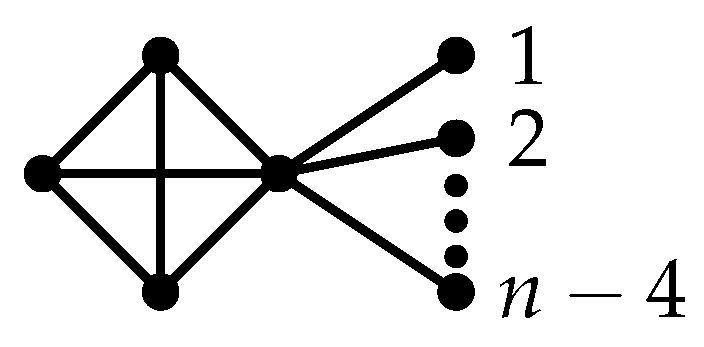
If G is a tricyclic graph of order , then . And, the equality holds if and only if , where is obtained by attaching pendant vertices to one vertex of a complete graph shown as Figure 1.
Figure 1.
The structure of .
2. Preliminaries
The following lemmas are required mainly for characterizing transformations in the next section.
Lemma 1.
Suppose is twice differentiable, and . Let with , and . Then with equality holding if and only if or .
Proof.
If , then from , thereby . Similarly if . Without loss of generality, we may assume that . Thus, we obtain where and . Therefore, the lemma holds clearly. □
Lemma 2.
If , then
Proof.
Let with and . Note that it suffices to show that .
Observe that , so . Hence, since . As a consequence, as . Hence, the lemma holds easily. □
Lemma 3.
If and , and let
Then, and .
Proof.
Since , then we only have to show . Consider the gradient
where , hence .
Let
Since the axis of symmetry of is , hence , implying .
Analogously, it can be shown that holds. Therefore, the lemma follows immediately. □
Lemma 4.
If , then
Proof.
Consider the gradient . Since
where the last inequality holds by , and consequently .
Therefore, it is sufficient to show . Let Since the axis of symmetry of is , then . Note that and have the same sign, so the proof is complete. □
Lemma 5.
Let be integers with , and let then , if either of the following is satisfied: (1) ; (2) .
Proof.
(1) Let with . Note that . Then, we have hence it suffices to prove .
Let , and . First note that , which means . Let . It is easy to see if .
Now, let , and for . With assistance of computer, one can get all values of for as shown in Table 1, and conclude that for each i.
Table 1.
Values of calculated by computer.
We find that . By repeating this process, we arrive at . Therefore, holds.
(2) Since the result in this case can be proved by a similar argument as (1), so we omit the details and only give the values of in Table 2.
Table 2.
Values of calculated by computer.
The lemma therefore follows easily. □
Lemma 6.
If , then
Proof.
Observe that It is obvious that .
Now, we consider the case . Let with . Note that has the same sign with since is increasing for . Let for , and . Hence, we obtain by Lemma 1. Therefore, the lemma holds easily. □
Lemma 7.
Let with , then if it meets one of the following conditions: (1) and ; (2) , .
Proof.
(1) Let with , and note that . Then we have by Lemma 1.
(2) Let with , and note that . By Lemma 6, we have where the last inequality follows from Lemma 1. □
Lemma 8.
If , then .
Proof.
Since
hence . And, moreover,
where . Therefore, . □
3. Transformations Decreasing Randić Index
To find tricyclic graphs with a small Randić index, we provide some transformations that decrease the Randić index of graphs. It is worth noting that all transformations defined here preserve the number of vertices and edges of a graph. For simplicity, we will not repeat this property in the sequel.
Definition 1
(Transformation I). Suppose G is a graph with two adjacent vertices u and v such that . Let graph , and we write the transformation as .
Theorem 2.
Suppose G is a graph with two adjacent vertices u and v such that . Let . Then if G meets one of the following conditions:
- (1)
- v has only one non-pendant neighbor u and ;
- (2)
- v has two non-pendant neighbors u and w with ;
- (3)
- v has three non-pendant neighbors and u has three non-pendant neighbors such that ;
- (4)
- and u has three non-pendant neighbors with .
Proof.
Let be the edge set of G that are not incident with u or v, and . And, let , , . Then,
(1) Note that and v has pendant neighbors. Then,
where the last inequality holds by Lemma 2 and .
(2) Notice that , , , and v has pendant neighbors in this case. Then,
where the last inequality holds by Lemma 2.
(3) Let , , and . Note that and from the condition. Then,
where the last inequality holds by Lemma 3.
(4) Obviously, , and . Then
where the last inequality holds by Lemma 4. □
Definition 2
(Transformation II). Suppose G is a graph with two vertices u and v. Let arise from G by moving k pendant neighbors from u to v, and the transformation can be written as . When all pendant neighbors of u are moved to v, this case will be written as .
Theorem 3.
Suppose G is a graph, and there is a cycle in G with and . Let . Then, if either of the following is satisfied:
- (1)
- ;
- (2)
- and there is a vertex with .
Proof.
Let , and . Let , then . And, note that , and , then we get by Lemma 1. Then,
where the last inequality follows by .
(1) Note that , and . Then,
where the last inequality holds by (1) of Lemma 5.
(2) Obviously, the assertion holds if by (1). Hence, we only need to consider the case . Note that , then,
where the last inequality holds by (2) of Lemma 5. □
Theorem 4.
Suppose G is a graph with two vertices u and v such that and . Let , then if and .
Proof.
Let be the edge set of G that are not incident with u or v, and , . And, observe that , denoted by k.
If u and v are not adjacent, then , so
Therefore, we get by (1) of Lemma 7.
If u and v are adjacent, then , so
hence we have by (2) of Lemma 7. Thus, the proof is complete. □
Lemma 9.
Suppose G is a graph with two vertices u and v such that and . Let , then .
Proof.
Observe that if we exchange pendant neighbors of v and u, does not change. Hence, the assertion holds easily from Theorem 4. □
4. Main Results
4.1. Undeletable Subgraph and Classification of Tricyclic Graphs
We need the following important definition to start our analysis.
Definition 3
Suppose G is a cyclic graph, then the undeletable subgraph of G is defined as a maximum subgraph without a pendant vertex, i.e., the subgraph arising from G by deleting all pendant vertices recursively.
Obviously, is connected and . Moreover, an undeletable subgraph of a graph is unique. And, it is easy to verify that the undeletable subgraph of a unicyclic graph is a cycle.
With the definition and Theorem 2, we are able to prove the following crucial lemma:
Lemma 10.
Suppose G is a cyclic -graph with an undeletable subgraph . Then, there exists a -graph such that if there is a vertex with .
Proof.
Let by deleting all edges of . By the definition of , contains no cycle, i.e., is a forest.
Let T be the tree of containing w. We claim that T contains exactly one vertex of . First, assume that T contains no vertex of , then T is not connected with vertices of in G, thereby G is disconnected, which is a contradiction. Now, assume that T contains at least two vertices of , and denote two of which by x and y, then there is a unique path in T that connects them containing a vertex since . And, there exists a path in that connects u and v since is connected. Therefore, vertex z lies on a cycle of G, implying that it belongs to , which contradicts the fact that . So, T contains exactly one vertex of , say .
Let be the longest path from to all other vertices in T. Note that because a path from to a pendant vertex containing w is of length at least two. Hence, , , and is the only non-pendant neighbor of . Then, by (1) of Theorem 2, there is an -graph such that . □
For a graph G with an undeletable subgraph , if for each , i.e., each only has pendant neighbors in , it is said to be a pendant-maximized graph.
Lemma 11.
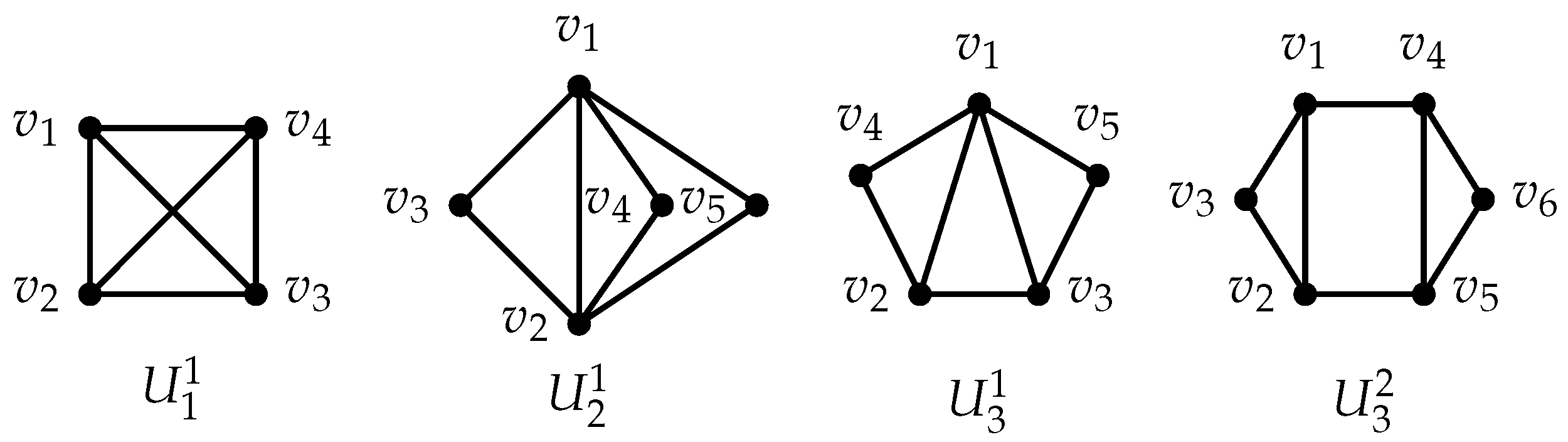
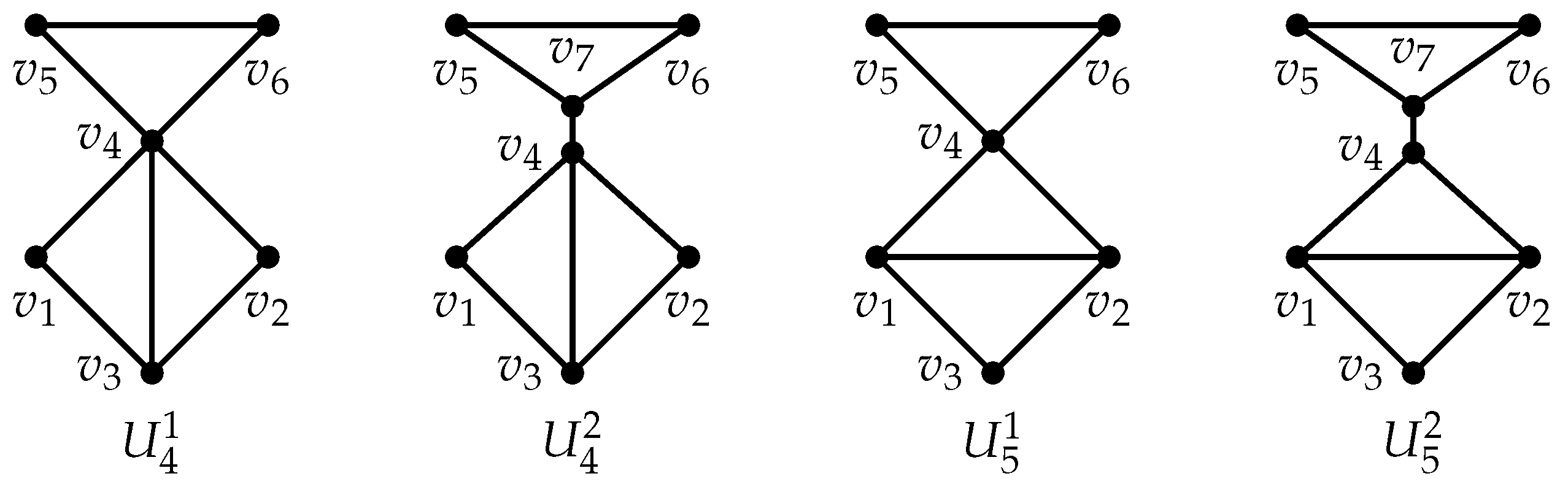
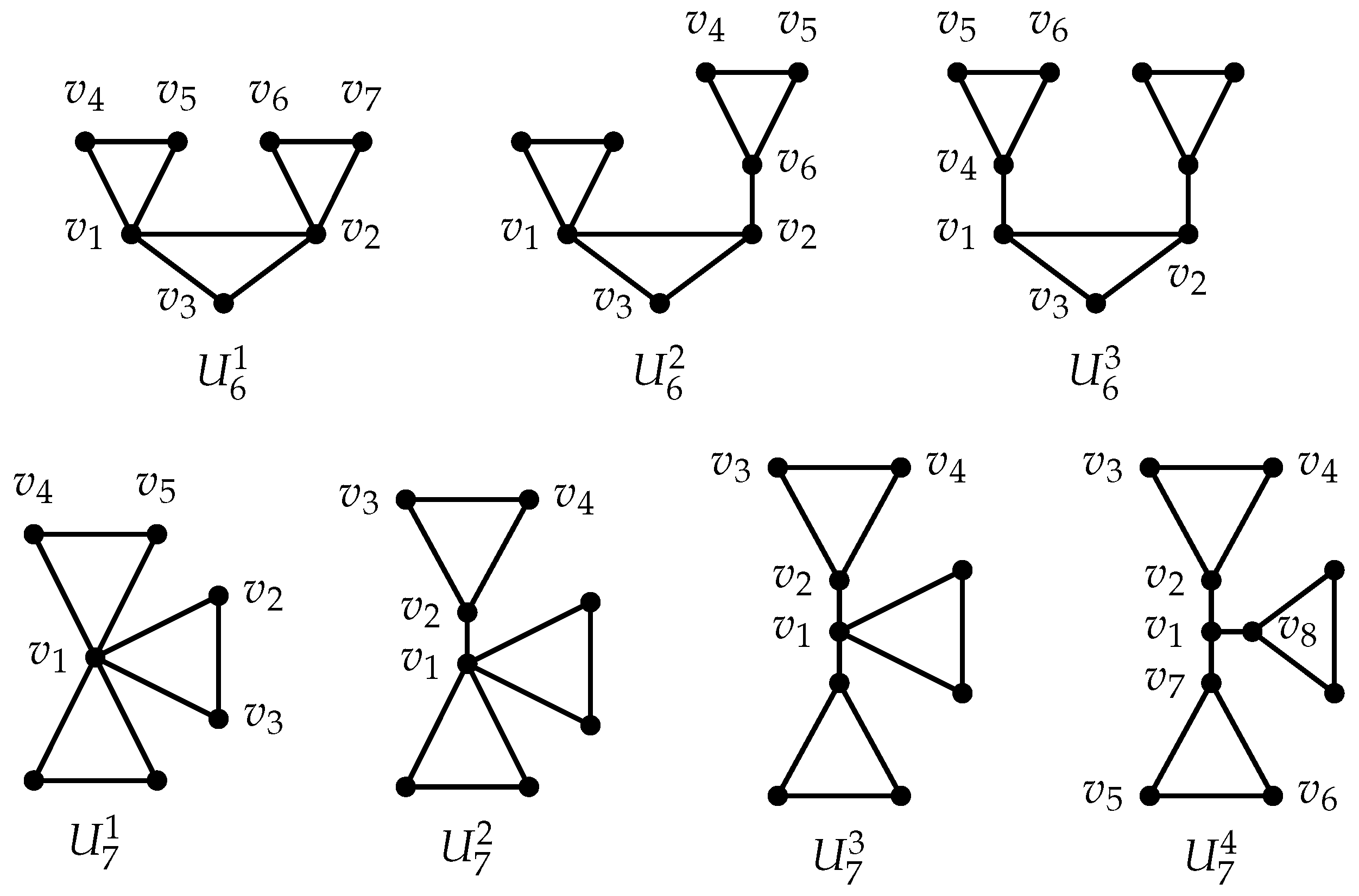
Suppose G is a pendant-maximized tricyclic -graph with undeletable subgraph . If there is a vertex with exactly two non-adjacent neighbors in , then there is an -graph such that ; otherwise, must be one of the 15 graphs as shown in Figure 2, Figure 3 and Figure 4 up to isomorphism.
Figure 2.
Graphs containing no edge-disjoint cycle.
Figure 3.
Graphs containing one edge-disjoint cycle.
Figure 4.
Graphs containing three edge-disjoint cycles.
Proof.
(1) We first prove the “if” part. Without loss of generality, let the neighbors of v in be u and w with . Observe that because G is pendant-maximized and v has two neighbors in . Hence, since u and w are non-adjacent. Therefore, there is an -graph such that by (2) of Theorem 2.
(2) Now, the “otherwise” part. By the definition of undeletable subgraph, is a tricyclic graph, that is, and . In the remaining argument, all degree and neighbors are constrained in .
We claim that , where the lower bound is obvious by checking graphs of order one to four. We first show there are at most six vertices of degree two in . Notice that each vertex v of degree two must lie on a cycle of length three because the neighbors of v must be adjacent. Moreover, each cycle of length three contains at most two vertices of degree two, otherwise the cycle is disconnected with other parts of . Since there are at most three edge-disjoint cycles in a tricyclic graph, thereby at most three edge-disjoint cycles of length three. Hence, by Handshaking Lemma, we have , implying .
Let be the set of n-vertex tricyclic graphs obtained from by attaching pendant vertices to . It is evident that graphs belonging to are pendant-maximized. On the other hand, if a pendant-maximized tricyclic graph G with , then .
4.2. Relations between
Suppose and are two graph sets, and if for any graph , there is a graph such that , then this relation is written as or . Our remaining task is to figure out the above described relations between all .
Lemma 12.
.
Proof.
We prove the results in the order of left to right.
(1) Suppose G is a graph in with undeletable subgraph labelled as in Figure 4. It may be assumed that ; otherwise, by Lemma 9, pendant neighbors of can be moved to without increasing since . Moreover, we may assume by similarly reasoning. Then clearly, .
Consider first when . If , by (1) of Theorem 3, moving pendant neighbors of to reduces . So we may assume . Since , and , therefore graph satisfies appealing to (3) of Theorem 2.
Now we turn to the case of , that is, . Note that , and , thus graph satisfies again by (3) of Theorem 2. It is not difficult to check that and both belong to . Thus we have .
(2) Let be a graph with undeletable subgraph as in Figure 4. As before, we may assume . Let , and obviously . Since , and , then we get by (4) of Theorem 2. Thus holds.
(3) Using similar arguments as (2), there is a graph such that . Hence . □
Lemma 13.
.
Proof.
We prove the relations from left to right.
(1) Let be a graph with as in Figure 4. As before, we assume that .
Let . If , then . And if , we may assume ; otherwise can be reduced by moving pendant neighbors of to according to (1) of Theorem 3. Then, we have . Moreover, , hence there is a graph with from (3) of Theorem 2. And, it is evident that , thus we obtain .
(2) Suppose G is a graph in with an undeletable subgraph as in Figure 4. Using analogous arguments as (1), we can show that . Additionally, note that . By (3) of Theorem 2, there is a graph such that . So, it follows easily. □
Lemma 14.
, , .
Proof.
We prove the three relations in the order of left to right.
(1) Let with the undeletable subgraph as in Figure 3. As before, we assume , i.e., . And, notice that . Then, by (4) of Theorem 2, graph satisfies . Thus, holds clearly.
(2) Let with an undeletable subgraph as in Figure 4. As before, we assume . Note that and . If , then by (2) of Theorem 3, can be reduced by moving pendant neighbors of to . Similarly, it holds for . So we may assume .
Let , and we have and . Let , then . It is easy to check that . Thus, follows.
(3) Let with the undeletable subgraph as in Figure 4. As before, we assume . Moreover, we may assume . Otherwise, note that and with , then appealing to (2) of Theorem 3, moving pendant neighbors of to will decrease .
Now, notice that , and , we can decrease by moving pendant neighbors of to if . Hence, we only have to consider the case .
Let , and notice that . Let , then It is easy to see that , thus holds. □
Lemma 15.
, , .
Proof.
We prove the assertions from left to right.
(1) Let with the undeletable subgraph as in Figure 3. As before, we assume . Observe that . By Lemma 9, we can move pendant neighbors of to and do not increase if . Therefore, we may assume that . Notice that and , hence there is such that from (3) of Theorem 2. Thus, we obtain .
(2) Let with the undeletable subgraph as in Figure 3. By analogous arguments as (1), we may assume that , that is, . And, note that and . Then, according to (2) of Theorem 3, moving pendant neighbors of to reduces if . So, we may assume that .
Let , and let . Note that . Then, . It is easy to verify that . Therefore, holds.
(3) Let with the undeletable subgraph as in Figure 3. Using similar arguments as (2), we may assume that , i.e., .
Let , and let . Note that . Then, It is clear that . Therefore, we obtain as desired.
(4) Let with the undeletable subgraph as in Figure 2. Let . If , i.e., , then clearly . Otherwise, note that , according to (1) of Theorem 3, moving pendant neighbors of to decreases if . So, in this case. As a consequence, we have by the above argument. Similarly, , implying that . And, notice that and . Appealing to (3) of Theorem 2, graph satisfies with . Therefore, we have . □
Before proceeding with more relations, let us define some essential functions and graph classes. Let
For , let be n-vertex graphs in with a vertex of degree . It is worth noting that all pendant vertices of are adjacent to a single vertex. Further, it can be verified easily that .
Lemma 16.
If , then with equality if and only if .
Proof.
If , then clearly . If , at least two vertices of have pendant neighbors. Suppose the undeletable subgraph is labelled as in Figure 2. Without loss of generality, we may assume that . Note that . By Lemma 9, moving pendant neighbors of to will decrease if . Similarly, this holds for and . So, we can conclude that if . So, the proof is complete. □
Lemma 17.
If , then with equality if and only if .
Proof.
Suppose the undeletable subgraph is labelled as in Figure 2. If , i.e., one of is adjacent to all pendant neighbors, then obviously . Then, let us consider the case .
- Case 1.
- , .It is easy to see that . By Lemma 9, can be reduced by moving pendant neighbors of to , implying .
- Case 2.
- one of has pendant neighbors.We may assume that . Notice that , and . By (2) of Theorem 3, we can move pendant neighbors of to to reduce . Thus, we have .
- Case 3.
- at least two of have pendant neighbors.Suppose without loss of generality. Note that . Then, again appealing to Lemma 9, pendant neighbors of can be moved to with decreased. Then, we arrive at Case 2, thus .
Therefore, it completes the proof. □
Lemma 18.
If , then with equality if and only if .
Proof.
Suppose the undeletable subgraph is labelled as in Figure 2. If , i.e., is adjacent to all pendant vertices, then obviously . So, we suppose that .
- Case 1.
- .Consider first . And, observe that and . Then, by (2) of Theorem 3, we can move pendant neighbors of to and get smaller. Likewise, this holds for . Therefore, we obtain .
- Case 2.
- one of holds. Without loss of generality, suppose .Subcase 2.1. . Let be obtained from G by moving pendant neighbors of to . Observe that . Let and let . So, , where the last inequality holds by Lemma 8. Thus, we obtain .Subcase 2.2. . Observe that , moving pendant neighbors of to will reduce from (1) of Theorem 3. Then, we arrive at Subcase 2.1.Subcase 2.3. . By analogous argument as Case 1, we can move pendant neighbors of to , so we get to Subcase 2.1.Subcase 2.4. . Similarly, as Subcase 2.2, pendant neighbors of can be moved to and will decrease. Then, we arrive at Subcase 2.3.According to the four subcases, we obtain in this case.
- Case 3.
- .Subcase 3.1. . Note that and . By Theorem 9, can be reduced by moving pendant neighbors of to . Then, we get the Subcase 2.1.Subcase 3.2. . Notice that . By (1) of Theorem 3, pendant neighbors of can be moved to with decreased if . Analogously, this holds for . Thus, we arrive at Subcase 3.1.
Now, we can conclude that if vertices other than of have pendant neighbors. Thus, the proof is complete. □
Lemma 19.
.
Proof.
Suppose are two graph sets with . Let be a graph satisfying . Then, for any graph , we have , that is, .
So, by Lemmas 16–18, it suffices to show that . Observe that for or . Hence, . And, . Therefore, the assertion holds clearly. □
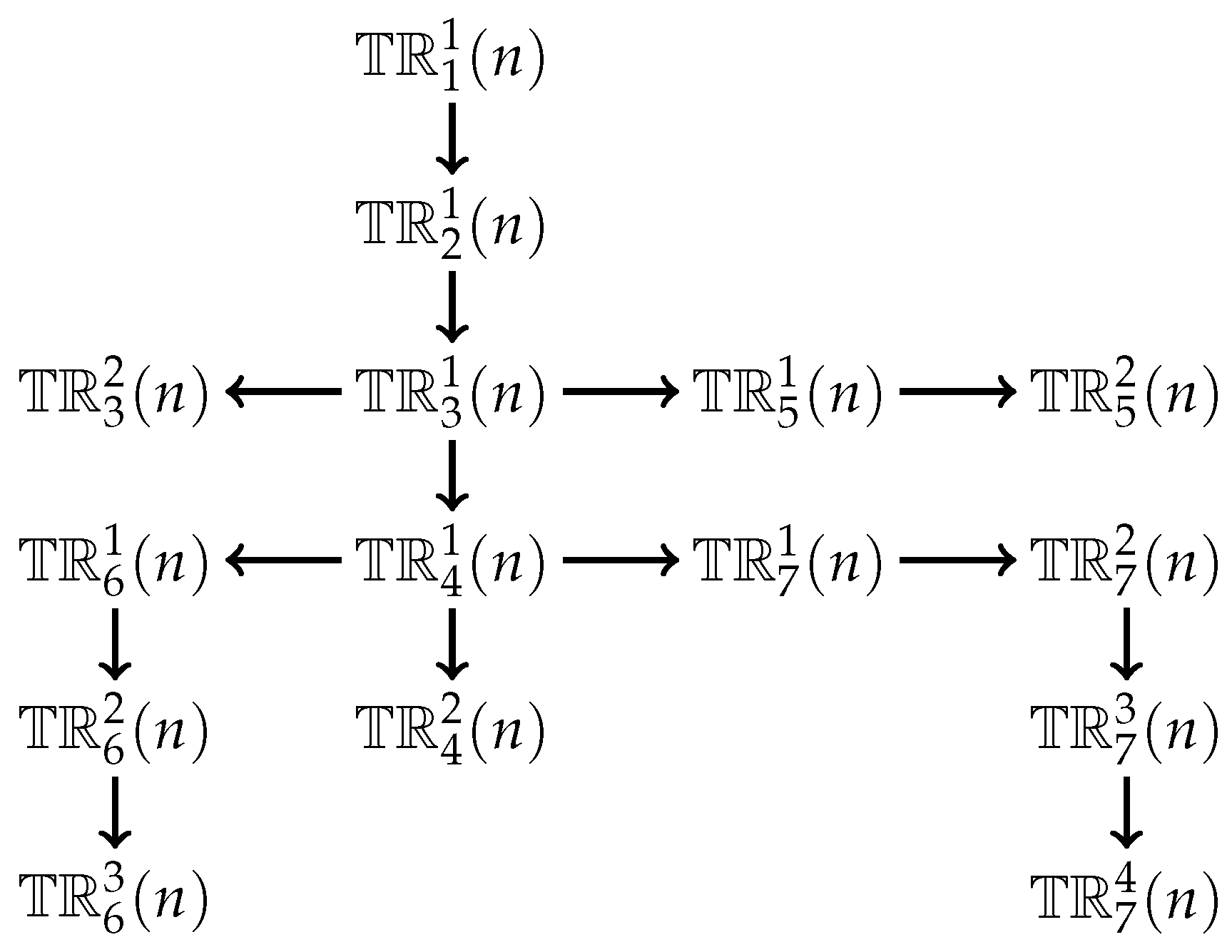
We draw all the relations mentioned here in Figure 5, in which represents .

Figure 5.
Relations between all .
4.3. The Proof of Theorem 1
Now we are ready to prove our main result.
Proof of Theorem 1.
First, note that and , so it is equivalent to show that with equality if and only if . Let be the union of all .
If , it is clear that .
If , we have by Lemma 16.
If , by Lemmas 12–15, 19 together, we obtain .
If and G is pendant-maximized, by Lemma 11, we can find a graph such that .
If and G is not pendant-maximized, by Lemmas 10 and 11, we will again find a graph such that .
Therefore, the theorem holds clearly. □
5. Conclusions
In our current work, we investigate three kinds of graph transformations that decrease the Randić index of graphs, which may be valuable for studying relations between the Randić index and the structure of graphs. For instance, Theorem 4 implies that the pendant neighbors of two vertices of a graph connect to its Randić index predictably. By applying these transformations systematically, the minimum Randić index of tricyclic graphs is determined with the corresponding extremal graphs. In fact, the minimum Randić index of trees, unicyclic, and bicyclic graphs could be obtained by the analogous method without much effort.
Author Contributions
Conceptualization, L.T. and Z.S.; methodology, L.T. and Z.S.; software, L.T.; validation, L.T., Z.S. and M.L.; formal analysis, Z.S.; investigation, M.L.; writing—original draft preparation, L.T.; writing—review and editing, Z.S.; visualization, Z.S.; supervision, M.L.; project administration, L.T.; funding acquisition, L.T. and Z.S. All authors have read and agreed to the published version of the manuscript.
Funding
This research was funded by Hunan Provincial Natural Science Foundation of China (grant number 2019JJ40005), the Science and Technology Plan Project of Hunan Province (grant number 2016TP1020), the 14th Five-Year Plan Key Disciplines and Application-oriented Special Disciplines of Hunan Province (grant number Xiangjiaotong[2022]351), the Open Fund Project of Hunan Provincial Key Laboratory of Intelligent Information Processing and Application for Hengyang Normal University (grant number 2022HSKFJJ012), and the Shenzhen higher education stability support program (grant number 20220820085638002).
Data Availability Statement
Data are contained within the article.
Acknowledgments
The authors are grateful to the anonymous referee for valuable comments which helped us to improve the manuscript.
Conflicts of Interest
The authors declare no conflict of interest.
References
- Randić, M. On characterization of molecular branching. J. Am. Chem. Soc. 1975, 97, 6609–6615. [Google Scholar] [CrossRef]
- Gutman, I.; Furtula, B. Recent Results in the Theory of Randić Index; Univerzitet Kragujevac: Kragujevac, Serbia, 2008. [Google Scholar]
- Li, X.; Gutman, I. Mathematical Aspects of Randić-Type Molecular Structure Descriptors; Univerzitet Kragujevac: Kragujevac, Serbia, 2006. [Google Scholar]
- Li, X.; Shi, Y. A survey on the Randić index. MATCH Commun. Math. Comput. Chem. 2008, 59, 127–156. [Google Scholar]
- Randić, M. The connectivity index 25 years after. J. Mol. Graph. Model. 2001, 20, 19–35. [Google Scholar] [CrossRef] [PubMed]
- Arizmendi, G.; Arizmendi, O. Energy of a graph and Randić index. Lin. Algebra Appl. 2021, 609, 332–338. [Google Scholar] [CrossRef]
- Das, K.C.; Sun, S.; Gutman, I. Normalized Laplacian eigenvalues and Randić energy of graphs. MATCH Commun. Math. Comput. Chem. 2017, 77, 45–59. [Google Scholar]
- Gutman, I.; Furtula, B.; Katanic, V. Randić index and information. AKCE Int. J. Graphs Comb. 2018, 15, 307–312. [Google Scholar] [CrossRef]
- Hu, Y.; Li, X.; Yuan, Y. Trees with minimum general Randić index. MATCH Commun. Math. Comput. Chem. 2004, 52, 119–128. [Google Scholar]
- Palacios, J.L. Applications of Radon’s inequalities to generalized topological descriptors. Contrib. Math. 2023, 8, 30–37. [Google Scholar] [CrossRef]
- Vetrik, T.; Balachandran, S. General Randić index of unicyclic graphs with given number of pendant vertices. Discret. Math. Lett. 2022, 8, 83–88. [Google Scholar]
- Bollobás, B.; Erdös, P. Graphs of extremal weights. Ars Combin. 1998, 50, 225–233. [Google Scholar] [CrossRef]
- Li, X.; Zhao, H. Trees with small Randić connectivity indices. MATCH Commun. Math. Comput. Chem. 2004, 51, 167–178. [Google Scholar]
- Caporossi, G.; Gutman, I.; Hansen, P.; Pavlović, L. Graphs with maximum connectivity index. Comput. Biol. Chem. 2003, 27, 85–90. [Google Scholar] [CrossRef]
- Yu, P. An upper bound on the Randić index of trees. J. Math. Study 1998, 31, 225–230. (In Chinese) [Google Scholar]
- Gao, J.; Lu, M. On the Randić index of unicyclic graphs. MATCH Commun. Math. Comput. Chem. 2005, 53, 377–384. [Google Scholar]
- Du, Z.; Zhou, B. On Randić indices of trees, unicyclic graphs, and bicyclic graphs. Int. J. Quantum Chem. 2011, 111, 2760–2770. [Google Scholar] [CrossRef]
- Dehghan-Zadeh, T.; Ashrafi, A.R.; Habibi, N. Maximum and Second Maximum of Randić Index in the Class of Tricyclic Graphs. MATCH Commun. Math. Comput. Chem. 2015, 74, 137–144. [Google Scholar]
- Dehghan-Zadeh, T.; Ashrafi, A.R.; Habibi, N. Tetracyclic graphs with extremal values of Randić index. Boll. Unione Mat. Ital. 2015, 8, 9–16. [Google Scholar] [CrossRef]
Disclaimer/Publisher’s Note: The statements, opinions and data contained in all publications are solely those of the individual author(s) and contributor(s) and not of MDPI and/or the editor(s). MDPI and/or the editor(s) disclaim responsibility for any injury to people or property resulting from any ideas, methods, instructions or products referred to in the content. |
© 2023 by the authors. Licensee MDPI, Basel, Switzerland. This article is an open access article distributed under the terms and conditions of the Creative Commons Attribution (CC BY) license (https://creativecommons.org/licenses/by/4.0/).