


Abstract
The paper’s main purpose is to find the unknown source function for the conformable heat equation. In the case of , we give a modified Fractional Landweber solution and explore the error between the approximate solution and the desired solution under a priori and a posteriori parameter choice rules. The error between the regularized and exact solution is then calculated in , with under some reasonable Cauchy data assumptions.
1. Introduction
In this paper, we consider the initial value problem for the conformable heat equation (or called parabolic equation with conformable operator):
Here, () is a bounded domain with the smooth boundary , and . It is an obvious fact that a conformable operator has many practical applications, branches of science and engineering; see for example [1,2,3,4,5,6,7,8,9,10]. The applications of conformable derivative models in the harmonic oscillator include the damped oscillator, and the forced oscillator (see [11]), electrical circuits (see [12]), chaotic systems in dynamics (see [13]), and many more applications, (see [14,15,16,17,18,19,20,21]).
Conformable derivative model: Let us take B as a Banach space, and f as a B-valued function on . Let be the conformable derivative of order locally defined by:
for each . For more knowledge about the above definition, we refer the reader to [22,23,24]. There are two interesting points regarding the relationship between conformable and classical derivatives:
- Let us assume that , if f is a real function and , then f has a conformable fractional derivative of order , and
- If B is not , for example B are Sobolev spaces. There are not many conformable related results in Banach spaces, see [25].
The inverse source problem for (1) is described as follows. The final time condition together with the additional condition . The inverse source problem for (1) is understood as finding the function f when the input data is given. As we know, the Problem (1) is ill-posed, and according to our experience and understanding, the frequent infringement is the continuity of the solution according to data. Therefore, to provide a good approximation, we need to regularize these problems. Before going into adjustment, we would like to review a bit of the history of the Problem (1).
- In case , the above equation becomes the classical pseudo-parabolic equation; this type of equation has received much attention from mathematicians, see [26,27,28];
- In case , with Caputo derivative model, we find the following documents, see [4]. Luc and co-authors studied the existence and uniqueness of a class of mild solutions of these equations. In [29], the authors considered the non-local Problem (1) for a pseudo-parabolic equation with fractional time and space. In [30], Tuan and his group considered a class of pseudoparabolic equations with the nonlocal condition in two cases: the nonlinear source function ad linear source function. For the first case, by using the Sobolev embeddings, they established the existence, the uniqueness, and some regularity results for the mild solution of Problem (1). For the second case, using the Banach fixed-point theorem, they proved the existence and the uniqueness of the mild solution for (1). In [31], the authors considered two problems. For the first problem with the source term satisfying the globally Lipschitz condition, we establish the local well-posedness theory, and the further local existence theory related to the finite time blow-up are also obtained for the problem with logarithmic nonlinearity. For the second problem, they proved the global existence theorem.
- We have not seen any findings for this kind in case with the conformable derivative model, and the source function survey problem is much more sparse, thus our study concentrates on this topic.
The regularization problem is a very interesting problem, with common regularization methods such as the Tikhonov method [32], Quasi Boundary Value method [33], Fractional Tikhonov method [34] and mollification method [35]. In [36], T. Wei with the Tikhonov regularization method, in [37], Ting Wei and her group considered a time-dependent source term by using a boundary element method combined with a generalized Tikhonov regularization. However, in this article, we use a modified fractional Landweber method to solve the unknown source Problem (1). Besides, there is a new point in this paper; we evaluate the error of exact and normalized solutions in space, with . In this case, the equality Parseval was not used. One way to overcome this weakness is to use the embedding between and Hilbert scales spaces . The main analytical technique in our paper is to use some embeddings and some analysis estimators related to Hölder inequality. To complete our proofs, we learn many interesting techniques from N.H. Tuan [38]. For the reader’s convenience, we would like to outline the main results of the paper.
- We give the ill-posedness of Problem (1);
- Showing the regularization of Problem (1), with the two subsections;
- Using the modified fractional Landweber method to solve the Problem (1). We obtain the convergence rate as follows:
- -
- In Section 4.1, under a priori parameter choice rule;
- -
- In Section 4.2, under a posteriori parameter choice rule.
- It gives the error estimate in space, with .
This paper is organized as follows. Section 2 introduces some function spaces and embeddings. In Section 4, we deal with the regularized solution for the inverse source problem for (1) by the Modified Fractional Landweber method under a priori and a posteriori parameter choice rules. In Section 5, we solve the Problem (1) in the case of observed data in space. Finally, we present a numerical experiment.
2. Preliminary Results
Let us recall that the spectral problem:
admits the eigenvalues with as . The corresponding eigenfunctions are .
Definition 1.
(Hilbert scale space). We recall the Hilbert scale space, which is given as follows:
for any . It is well-known that is a Hilbert space corresponding to the norm,
Lemma 1.
Let such that where and are positive numbers. Then the following estimates are true:
and
Proof.
First of all, we have the estimate , putting , and through basic calculations, and applying the inequality , for , since , we get:
Since , we have:
Let us consider the following function: The derivative of which is equal to: This implies that G is an increasing function on . Therefore, we get:
It follows from (6) that:
The Lemma is proven. □
Lemma 2.
Let be positive constants such that . By choosing
, and , we obtain
Proof.
See in [39]. □
Lemma 3.
(See [40]) The following statements are true:
3. Regularization of Inverse Source Problem
We consider the mild solution in Fourier series, , with . Taking the inner product of the equations of Problem (1) with gives:
The first equation of (10) is a differential equation with a conformable derivative as follows:
In view of the result in (Theorem 5, “[41], p. 318”) and (Theorem 3.3, “[42], p. 318”), the solution of Problem (1) is:
To find the formula of the mild solution to Problem (1), with and . Letting , we know that:
After a simple transformation, we get:
This leads to:
3.1. Uncertainty of Source Problem
Theorem 1.
The inverse source problem (1) is ill-posed.
Proof of Theorem 1.
We defined a linear operator as follows.
where
Due to , is a self-adjoint operator. We defined the finite rank operators and considered its compactness:
From (16), through some basic calculations and using the Lemma 1, we have:
From (17), we have:
Additionally, is a compact operator. The SVDs for the linear self-adjoint compact operator are:
and corresponding eigenvectors are is an orthonormal basis in . Therefore, the inverse source Problem (1) can be formulated as an operator equation where, by , and by Kirsch, it is ill-posed. Next, we show an example, with final time data and . By (14), the source term corresponding to is:
The input final data then the source term corresponding to g is . We have error in norm between and g,
Then the error in norm between and f
3.2. The Conditional Stability
Theorem 2.
Assume that , , and then we have:
whereby
Proof of Theorem 2.
The proof of this theorem can be conducted similar to the articles [39]. We omit this here. □
4. A Modified Fractional Landweber Method and Convergent Rate
Based on a modified Fractional Landweber method, we show the error estimate under the a priori regularization parameter choice rule and the a-posteriori regularization parameter choice rule, respectively. Now, we use the modified Fractional Landweber iterative method to obtain the regularization solution for Problem (1). We give the following iterative form:
where is the iterative step number and the regularization parameter is . The coefficient is called the relaxation factor and satisfies , by denoting an operator such that
with (19), it gives:
whereby
Lemma 4.
For , if we choose then , inwhich Q depends on . With how to choose ξ in above, by denoting , we have
Proof of Lemma 4.
A complete demonstration of this inequality can be found in [9]. □
4.1. A Priori Parameter Choice Rule
Before we go into proving the main theorem, we need the following lemmas:
Lemma 5.
For , then we get:
Proof of Lemma 5.
In here, we denote , this implies that:
Taking the derivative of the variable z and solving the , we can find that:
maximuizes the function . Hence, we get:
Finally, one has:
□
Theorem 3.
Let , for any such that . The regularization parameter m is chosen
then we get:
whereby denotes the largest integer less than or equal to m.
Proof of Theorem 3.
We have:
Applying the inequality , we estimate at as follows:
We will divide the evaluation (36) into two steps as follows:
Step 1: By means of the Lemma 4, we have estimate of as follows:
whereby .
Step 2: Next, can be bounded as follows:
In here, we have:
whereby
Next, we give the estimate of the approximation error as follows:
From (41), using the Lemma 5, we can know that:
Let by choose m as follows:
This leads to
□
4.2. A Posteriori Parameter Choice Rule
In this section, we look at the following regulatory parameter choices in Morozov’s difference principle. We construct the regular solution sequence equals the Landweber iteration method. Stop algorithm at the first occurrence of .
where be a fixed constant an .
Lemma 6.
Let . Then we declare that:
- a.
- is a continuous function.
- b.
- as .
- c.
- as .
- d.
- is a strictly increasing function, for any .
The proof of the above lemma is simple and completely similar to that in [39].
Lemma 7.
Assume that (47) holds, the regularization parameter m satisfies
Proof of Lemma 7.
It is easy to see that , by using the (46), we get:
On the other hand, from the reviews above, add the Lemma 6, we receive:
whereby
From (53), we conclude that:
□
Theorem 4.
Let the condition and hold, and the parameter regularization m is found in the Formula (46), then it gives:
Proof of Theorem 4.
Using the triangle inequality, we have:
The proof in the Formula (39) has given us:
Applying the Lemma 7, we get:
Now, using the Holder’s inequality and the Formula (46), and results obtained from the Lemma 2, we get the estimate of error as follows:
From (59), we have estimate of and as follows:
Next, can be bounded.
□
In the next section, we provide the error estimation between the exact solution and the regularized solution by the Fourier truncation method.
5. Regularization of Inverse Source in Space
Theorem 5.
Let us take such that for any for any and
Let us assume that for and . Constructing a regularized solution as follows:
Then the error estimate is bounded by:
here satisfies that:
Remark 1.
If then as .
Proof of Theorem 5.
It is clear that:
where we denote some following functions:
and
Now, we need to establish the upper bound of the expressions on the right of (13). For convenience, we consider the following step.
Step 1: Estimate of , let us recall the function f as (14). This expression together with the Formula (71) gives us the claim of the following difference:
Using the Parseval equality, the left hand side of (72) is calculated as follows:
It is obvious to see that if and . Therefore, we have:
which leads to
Step 2: Estimate of , we get
From (76), we know that:
By applying the Holder inequality, we receive:
Next, we have the estimate as follows:
where , this implies that:
and through some basic calculations, we obtain:
whereby we note that and we also have used the fact that . Combining three evaluations (79), (80) and (81), we derive that the following estimate:
Next, applying the Lemma 1 and the Lemma 2, we have estimated
From the two observation above, we assert that:
whereby depends on and
We assume that the finite sum is bounded by
Therefore, we conclude that:
where is defined in (85).
Using the Parseval’s equality, and taking the norm of both sides, we obtain that:
Because of the inequality (83), one has:
Continuing to deal with the finite series on the right above, we have:
Since , we know that . Therefore, we get that:
By using the Lemma 3, since , with Sobolev embedding , we have the results as in (67). □
6. Simulation
In this section, we present one numerical example. By choosing , , , , and , and are shown in this section, respectively. In this section, we consider the problem as follows:
where is the conformable derivative is given by [23]. In this calculation, we chose the operator , we have chosen and = , respectively. We have the function,
In general, the numerical procedure is summarized in the following steps:
Step 1: Finite difference to discretize the time and spatial variable for as follows:
Step 2: The input data g is noised by observation data such that:
From (14), we have the exact solution,
From (26) and (27), by choosing the regularization parameter as in the number Formula (33), in the case of a priori parameter choice rule, and Formula (48), in the case of a posteriori parameter choice rule, where N is a large enough truncation number, we have the regularized solution with Modified Fractional Landweber as follows:
whereby
We choose and , and . Figure 1a shows the 2D graphs of the source function with the exact solution and its approximation for the case for the a priori parameter choice rule. Figure 1b shows the error estimate between the exact solution and regularized solution for the a posteriori parameter choice rule. Figure 2a–c shows the 2D graphs comparing the convergent rate between the exact solution and its approximation under a priori and a posteriori parameter choice rules with noise levels , , and . From the observations above, the comparison with the results developed in theory (see evaluation (34) and (55)) shows that the convergence in these two cases is almost equivalent, illustrating that the proposed method is effective.
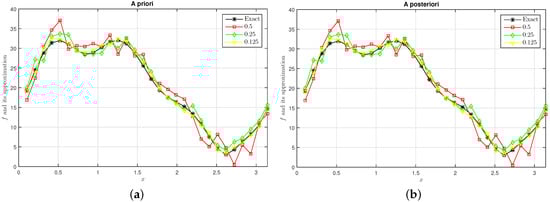
Figure 1.
The exact approximation for a priori (a) and a posteriori (b).
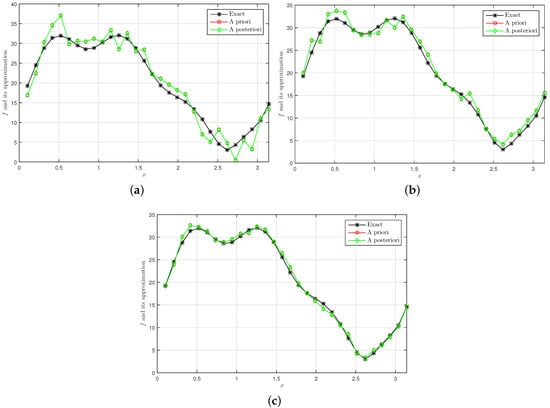
Figure 2.
A priori and a posteriori when (a) , (b) and (c) , respectively.
Author Contributions
Methodology, Z.A.; software, H.D.B.; validation, L.D.L. and Z.A.; formal analysis, Z.A.; resources, H.D.B.; data curation, H.D.B.; writing—original draft preparation, L.D.L.; writing—review and editing, O.N.; project administration, O.N. All authors have read and agreed to the published version of the manuscript.
Funding
The author Le Dinh Long is supported by Van Lang University.
Institutional Review Board Statement
Not applicable.
Informed Consent Statement
Not applicable.
Data Availability Statement
Not applicable.
Conflicts of Interest
The authors declare no conflict of interest.
References
- Alharbia, F.M.; Baleanu, D.; Abdelhalim, E. Physical properties of the projectile motion using the conformable derivative. Chin. J. Phys. 2019, 58, 18–28. [Google Scholar] [CrossRef]
- Kilbas, A.A.; Marichev, O.I.; Samko, S.G. Fractional Integrals and Derivatives (Theory and Applications), 1st ed.; CRC Press: Boca Raton, FL, USA, 1993. [Google Scholar]
- Tuan, N.H.; Aghdam, Y.E.; Jafari, H.; Mesgarani, H. A novel numerical manner for two-dimensional space fractional diffusion equation arising in transport phenomena. Numer. Methods Part. Differ. Equ. 2021, 37, 1397–1406. [Google Scholar] [CrossRef]
- Luc, N.H.; Jafari, H.; Kumam, P.; Tuan, N.H. On an initial value problem for time fractional pseudo-parabolic equation with Caputo derivarive. Math. Methods Appl. Sci. 2022, 1–23. [Google Scholar] [CrossRef]
- Au, V.V.; Jafari, H.; Hammouch, Z.; Tuan, N.H. On a final value problem for a nonlinear fractional pseudo-parabolic equation. Electron. Res. Arch. 2021, 29, 1709–1734. [Google Scholar]
- Can, N.H.; Jafari, H.; Ncube, M.N. Fractional calculus in data fitting. Alex. Eng. J. 2020, 59, 3269–3274. [Google Scholar] [CrossRef]
- Tuan, N.H.; Nemati, S.; Ganji, R.M.; Jafari, H. Numerical solution of multi-variable order fractional integro-differential equations using the Bernstein polynomials. Eng. Comput. 2022, 38, 139–147. [Google Scholar] [CrossRef]
- Han, Y.; Xiong, X.; Xue, X. A fractional Landweber method for solving backward timefractional diffusion problem. Comput. Math. Appl. 2019, 78, 81–91. [Google Scholar] [CrossRef]
- Yang, S.; Xiong, X.; Han, Y. A modified fractional Landweber method for a backward problem for the inhomogeneous time-fractional diffusion equation in a cylinder. Int. J. Comput. Math. 2020, 97, 2375–2393. [Google Scholar] [CrossRef]
- Huynh, L.H.; Zhou, Y.; O’Regan, D.; Tuan, N.H. Fractional Landweber method for an initial inverse problem for time-fractional wave equations. Appl. Anal. 2021, 100, 860–878. [Google Scholar] [CrossRef]
- Chung, W.S. Fractional Newton mechanics with conformable fractional derivative. J. Comput. Appl. Math. 2015, 290, 150–158. [Google Scholar] [CrossRef]
- Morales-Delgado, V.F.; Gómez-Aguilar, J.F.; Escobar-Jiménez, R.F.; Taneco-Hernández, M.A. Fractional conformable derivatives of Liouville-Caputo type with low-fractionality. Phys. A Stat. Mech. Appl. 2018, 503, 424–438. [Google Scholar] [CrossRef]
- He, S.; Sun, K.; Mei, X.; Yan, B.; Xu, S. Numerical analysis of a fractional-order chaotic system based on conformable fractional-order derivative. Eur. Phys. J. Plus 2017, 132, 36. [Google Scholar] [CrossRef]
- Hama, M.F.; Rasul, R.R.Q.; Hammouch, Z.; Rasul, K.A.H.; Danane, J. Analysis of a stochastic SEIS epidemic model with the standard Brownian motion and Lévy jump. Results Phys. 2022, 37, 105477. [Google Scholar] [CrossRef]
- Hammouch, Z.; Rasul, R.Q.R.; Ouakka, A.; Elazzouzi, A. Mathematical analysis and numerical simulation of the Ebola epidemic disease in the sense of conformable derivative. Chaos Solitons Fractals 2022, 158, 112006. [Google Scholar] [CrossRef]
- Karthikeyan, K.; Murugapandian, G.S.; Hammouch, Z. On mild solutions of fractional impulsive differential systems of Sobolev type with fractional nonlocal conditions. Math. Sci. 2022, 36, 37. [Google Scholar] [CrossRef]
- Hamou, A.A.; Azroul, E.H.; Hammouch, Z.; Alaoui, A.L. A monotone iterative technique combined to finite element method for solving reaction-diffusion problems pertaining to non-integer derivative. Eng. Comput. 2022, 36, 105. [Google Scholar] [CrossRef]
- Gürbüz, M.; Akdemir, A.O.; Dokuyucu, M.A. Novel Approaches for Differentiable Convex Functions via the Proportional Caputo-Hybrid Operators. Fractal Fract. 2022, 6, 258. [Google Scholar] [CrossRef]
- Avcı, A.M.; Akdemir, A.O.; Set, E. On New Integral Inequalities via Geometric-Arithmetic Convex Functions with Applications. Sahand Commun. Math. Anal. 2022. [Google Scholar] [CrossRef]
- Butt, S.I.; Akdemir, A.O.; Agarwal, P.; Baleanu, D. Non-conformable integral inequalities of chebyshev-polya-szeg o type. J. Math. Inequalities 2021, 4, 1391–1400. [Google Scholar] [CrossRef]
- Kavurmacı Önalan, H.; Akdemir, A.O.; Avcı Ardıç, M.; Baleanu, D. On new general versions of Hermite–Hadamard type integral inequalities via fractional integral operators with Mittag-Leffler kernel. J. Inequalities Appl. 2021, 1, 186. [Google Scholar] [CrossRef]
- Khalil, R.; Al Horani, M.; Yousef, A.; Sababheh, M. A new definition of fractional derivative. J. Comput. Appl. Math. 2014, 264, 65–70. [Google Scholar] [CrossRef]
- Abdelhakim, A.A.; Machado, J.A.T. A critical analysis of the conformable derivative. Nonlinear Dyn. 2019, 95, 3063–3073. [Google Scholar] [CrossRef]
- Abdeljawad, T. On conformable fractional calculus. J. Comput. Appl. Math. 2015, 279, 57–66. [Google Scholar] [CrossRef]
- Tuan, N.H.; Huynh, L.N.; Ngoc, T.B.; Zhou, Y. On a backward problem for nonlinear fractional diffusion equations. Appl. Math. Lett. 2019, 92, 76–84. [Google Scholar] [CrossRef]
- Ikehata, R.; Suzuki, T. Stable and unstable sets for evolution equations of parabolic and hyperbolic type. Hiroshima Math. J. 1996, 26, 475–491. [Google Scholar] [CrossRef]
- Quittner, P.; Souplet, P. Superlinear Parabolic Problems, Blow-Up, Global Existence and Steady States; Birkhäuser Advanced Texts; Birkhäuser Basel: Basel, Switzerland, 2007. [Google Scholar]
- Liu, Y.; Xu, R.; Yu, T. Global existence, nonexistence and asymptotic behavior of solutions for the Cauchy problem of semilinear heat equations. Nonlinear Anal. 2008, 68, 3332–3348. [Google Scholar] [CrossRef]
- Can, N.H.; Kumar, D.; Vo Viet, T.; Nguyen, A.T. On time fractional pseudo-parabolic equations with non-local in time condition. Math. Methods Appl. Sci. 2021. [Google Scholar] [CrossRef]
- Nguyen, A.T.; Hammouch, Z.; Karapinar, E.; Tuan, N.H. On a nonlocal problem for a Caputo time-fractional pseudoparabolic equation. Math. Methods Appl. Sci. 2021, 44, 14791–14806. [Google Scholar] [CrossRef]
- Nguyen, H.T.; Vo, V.A.; Runzhang, X. Semilinear Caputo time-fractional pseudo-parabolic equations. Commun. Pure Appl. Anal. 2021, 20, 583–621. [Google Scholar] [CrossRef]
- Nguyen, H.T.; Le, D.L.; Nguyen, V.T. Regularized solution of an inverse source problem for a time fractional diffusion equation. Appl. Math. Model. 2016, 40, 8244–8264. [Google Scholar] [CrossRef]
- Tuan, N.H.; Zhou, Y.; Long, L.D.; Can, N.H. Identifying inverse source for fractional diffusion equation with Reimann-Liouville derivetive. Comput. Appl. Math. 2020, 39, 75. [Google Scholar] [CrossRef]
- Long, L.D.; Luc, N.H.; Zhou, Y.; Nguyen, A.C. Identification of Source term for the time-fractional duffusion-wave equation by Fractional Tikhonov method. Mathematics 2019, 7, 934. [Google Scholar] [CrossRef] [Green Version]
- Long, L.D.; Zhou, Y.; Thanh Binh, T.; Can, N. A Mollification Regularization Method for the Inverse Source Problem for a Time Fractional Diffusion Equation. Mathematics 2019, 7, 1048. [Google Scholar] [CrossRef] [Green Version]
- Wei, T.; Li, X.L.; Li, Y.S. An inverse time-dependent source problem for a time-fractional diffusion equation. Inverse Probl. 2016, 32, 8. [Google Scholar] [CrossRef]
- Wang, J.G.; Zhou, Y.B.; Wei, T. Two regularization methods to identify a space-dependent source for the time-fractional diffusion equation. Appl. Numer. Math. 2013, 68, 39–57. [Google Scholar] [CrossRef]
- Tuan, N.H. On some inverse problem for bi-parabolic equation with observed data in Lp spaces. Opuscula Math. 2022, 42, 305–335. [Google Scholar] [CrossRef]
- Can, N.H.; Luc, N.H.; Baleanu, D.; Yong, Z.; Long, L.D. Inverse source problem for time fractional diffusion equation with Mittag-Leffler kernel. Adv. Differ. Equ. 2020, 2020, 210. [Google Scholar] [CrossRef]
- Tuan, N.H.; Caraballo, T. On initial and terminal value problems for fractional nonclassical diffusion equations. Proc. Am. Math. Soc. 2021, 149, 143–161. [Google Scholar] [CrossRef]
- Jaiswal, A.; Bahuguna, D. Semilinear Conformable Fractional Differential Equations in Banach Spaces. Differ. Equ. Dyn. Syst. 2019, 27, 313–325. [Google Scholar] [CrossRef]
- Li, M.; Wang, J.R.; O’Regan, D. Existence and Ulam’s stability for conformable fractional differential equations with constant coefficients. Bull. Malays. Math. Sci. Soc. 2019, 42, 1791–1812. [Google Scholar] [CrossRef]
Publisher’s Note: MDPI stays neutral with regard to jurisdictional claims in published maps and institutional affiliations. |
© 2022 by the authors. Licensee MDPI, Basel, Switzerland. This article is an open access article distributed under the terms and conditions of the Creative Commons Attribution (CC BY) license (https://creativecommons.org/licenses/by/4.0/).