Abstract
The main focus of this paper is to develop certain types of fundamental theorems using q, , and h difference operators. For several higher order difference equations, we get two forms of solutions: one is closed form and another is summation form. However, most authors concentrate only on the summation part. This motivates us to develop closed-form solutions, and we succeed. The key benefit of this research is finding the closed-form solutions for getting better results when compared to the summation form. The symmetric difference operator is the combination of forward and backward difference symmetric operators. Using this concept, we employ the closed and summation form for q, , and h difference symmetric operators on polynomials, polynomial factorials, logarithmic functions, and products of two functions that act as a solution for symmetric difference equations. The higher order fundamental theorems of q and are difficult to find when the order becomes high. Hence, by inducing the h difference symmetric operator in q and symmetric operators, we find the solution easily and quickly. Suitable examples are given to validate our findings. In addition, we plot the figures to examine the value stability of q and difference equations.
1. Introduction
There are a variety of approaches to define a quantum derivative, such as the h-derivative , q-derivative , and p-derivative , but for these derivatives we do not take the limit. In the h-derivative, has a fixed number, and in the q and p derivatives, q and p have fixed numbers that are not equal to 1. In this paper, we mainly concentrate on the q-derivative, and we utilize some concepts in the h-derivative. In [1], the authors implemented the q-derivative as . The q-derivative, or Jackson derivative, is a q-analog of the usual derivative established by F. H. Jackson in the fields of combinatorics and quantum calculus, and Jackson’s q-integration is the inverse of this. Quantum calculus is also known as limitless calculus. It uses a quantum difference operator to replace the classical derivative, allowing it to handle the sets of non-differentiable functions. C. R. Adams [2], R. D. Carmichael [3], Jackson [4], T. E. Mason [5], W. J. Trjitzinsky [6], and other authors such as Picard, Poincare, and Ramanujan published extensive research on equations at the turn of the twentieth century. Unfortunately, from the mid-thirties to the early eighties, there was only a smattering of interest in this area. Since the 1980s [7], there has been a resurgence of interest in this subject, especially in the fields of mathematics and applications, notably new difference calculus and orthogonal polynomials, q-arithmetic, integrable systems, variational q-calculus, and q-combinatorics. More recently, the authors in [8] developed a new concept called the q-symmetric derivative, defined by , where and .
In 1832, Bernhard Riemann and Joseph Liouville [9] were the first to conceive the idea of fractional calculus, and it is named the Riemann–Liouville integral. In 1967, Michele Caputo [10] was the first to propose the Caputo fractional derivative, which is another method for computing fractional derivatives. When solving differential equations using Caputo’s concept, the fractional order initial conditions are not required, as they are with the Riemann–Liouville fractional derivative. Subsequently, in 1993, K. S. Miller and B. Ross Bertram introduced the concept of fractional calculus and fractional differential equations [11]. Recently, the comparison and connectedness of the Riemann–Liouville and Caputo derivatives and their applications are discussed by Y. Luchko [12,13,14,15]. In addition, the authors in [16,17,18,19] are excellent sources for more information on fractional derivatives and fractional calculus.
In [20], B. Ross and K. S. Miller developed a discrete kind of Riemann–Liouville fractional derivative and reported certain properties of the fractional difference operator in 1989. The authors in [21,22,23] provide certain applications for q-fractional calculus. Abdi in [24,25] and Hahn in [26] devised and implemented a q-Laplace transform method for q-difference equations. In addition, there is much work being done right now to re-examine and develop the q-special functions. Jackson’s [27,28,29,30] early work is notable. For contemporary and good ideas for q-special functions, we also recommend papers by De Sole and Kac [31], McAnally [32,33], Ernst [34], and Koornwinder [35,36], as well as books by Andrews, Askey, and Roy [37] and Carlson [38].
This research study focuses on the q-difference operator . The study of the q-difference operator is introduced after the development of the h-difference operator. The h-difference operator is similar to the h-derivative, where the limit does not apply. For any function f defined on and , the difference operator on f is defined as
The operator , defined as is the foundation of difference equation theory, where is a sequence of numbers. The authors in [6,7,39,40] proposed the definition of generalized difference operator , which is defined in Equation (1), and then developed the inverse theory concept (anti-difference operator ) for finding the closed-form solutions. In 1984, Jerzy Popenda and Szmanda [41] suggested a specific type of operator defined as , where . This -delta operator was extended by the authors in [42,43] to a generalized alpha difference operator. The -delta operator with shift value h is defined as , where the function is defined on . In 2014, the authors in [44,45] proposed the q-difference operator, which is defined as , and applied it to polynomials and polynomial factorials. The authors in [46] focus on the operator by defining . Following these q and h difference operator ideas, the authors in [8,47] extended the q and h symmetric derivatives to q and h symmetric difference operators defined by
and
where f is a real valued function, and .
From (2), the q-symmetric difference operator is defined by , where the operator is the sum of q-forward and q-backward difference operators. As a result, the q-symmetric difference operator combines the forward and backward difference symmetric operators, i.e.,
where the operator is as noted, and whereas . The h-symmetric difference operator, described in Equation (3), is defined as
We may easily conclude from Equations (4) and (5) that the forward and backward q and h difference operators offer the particular solutions for the q and h symmetric difference operators. These operators and are symmetric to each other (i.e., symmetry of is , and vice-versa). In addition, the operators and are symmetric to each other. Taking these ideas together, we denote the q-difference operator and the anti-difference operator as to develop and provide the fundamental theorems for symmetric operator . Here, the theorems are mainly based on the q-difference operator and mixed difference operators (i.e., q and h difference operators). For more information, refer to [31,40,48,49]. We construct theorems and corollaries for the operator that give a solution for the q-symmetric difference operator throughout this work. In the same way, the operator can be easily verified. In addition, we extend this work to the q-alpha difference operator, which is an extension of q-difference operator. If we take in the q-alpha difference operator, then it becomes the ordinary q-difference operator. The theorems and corollaries developed in the q-alpha difference operator give the solution for the -symmetric difference operator. We can do the same thing with the operator.
The list of symbols and descriptions used in this manuscript is shown in Table 1.
Table 1.
Symbols.
The paper is arranged as follows. Section 1 is dedicated to the introduction. In Section 2 and Section 3, we present the preliminaries of the q-difference operator and the h-difference operator. In Section 4, we develop several fundamental theorems in quantum calculus. The mixed symmetric operators in quantum calculus are given in Section 5. The conclusions from our research are in Section 6.
2. Preliminaries of the q-Difference Operator
This section focuses on the basic definition of the q-difference operator and its anti- difference operator as well as concentrating on the q-polynomial factorial functions. Here, we introduce the infinite set , which satisfies the condition that for any implies for any fixed number and .
Definition 1
([44]). Let and be fixed. The q-difference symmetric operator or q-difference operator, denoted as on , is defined as
If∋, then its inverse q-difference operator (or inverse q-difference symmetric operator) denoted as is defined as
where is a constant. We can denote .
Definition 2
([42]). Let and . Then, the q-polynomial factorial is defined as
The following Lemma 1 is the power rule for q-difference operator . Here, we take .
Lemma 1.
For any positive integer and , then the difference operator for the polynomial factorial function is given by
Proof.
Taking in Equation (6), we get
Lemma 2.
Let and . Then the anti-difference operator for the polynomial factorial function is
Remark 1.
Throughout this paper, we represent the anti-difference operator as , where is nothing but the reciprocal of the q-difference operator.
Result 1.
Let and . The q-difference operator for the polynomial function is given by
and its anti-difference operator for the polynomial function is given by
Proof.
The proof is complete if in Definition 1. □
Lemma 3
([44]). Let and . The product rule of the q-difference operator is defined by
Proof.
By applying the operator on the function , we get
Taking and completes the proof. □
Corollary 1
([44]). Let and be any real number. Then,
3. Preliminaries of the h-Difference Operator
This section contains some basic concepts of the h-difference operator that are used in the upcoming sections. To get additional information about the h-difference operator, one can refer to [7,42,50]. Consider the infinite set , which has the property that implies , .
Definition 3
([7]). Let , and be defined in Equation (1). If ∃ function ∋, then the anti-difference operator (or inverse h-difference symmetric operator) is defined as
Definition 4
([6]). Let and . The h-polynomial factorial function is defined as
Note that and are not same.
Lemma 4
([7]). Let , be real and , be positive integers. Then,
Relation (19) is verified in the following example.
Corollary 2.
If , , , …, , , and taking in (19), then the sum of order polynomial factorials of the first n natural numbers is
Lemma 5
([6]). Let and . Then the product of two functions is given by
Corollary 3.
For any two real valued functions and defined on a subset of , then
Proof.
The proof is completed by taking in (21). □
Theorem 2
([7]). Let , and . Then the first order anti-difference principle related to is given by
where and .
4. Fundamental Theorems in Quantum Calculus
4.1. Fundamental Theorems Related to the q-Difference Symmetric Operator
This section contains theorems and corollaries for the higher order anti-difference principle for the q-difference operator defined in (6). Additionally, suitable numerical examples are provided to verify and validate the results.
Theorem 3.
Let , and . If ∃∋= , then , and its first order anti-difference principle related to is given by
Proof.
By Definition 1 and , we can easily find
Rearranging Equation (25) gives and then converting by in , we get
Proceeding like this, we get the general term as
As a result, the proof is finished by substituting . □
Remark 2.
Equation (24) can be written as .
The following Theorem 4 is the higher order anti-difference principle for q.
Theorem 4.
For , , assume that ∋ and with . The higher order q anti-difference principle related to is given by
Proof.
Multiplying the operator on both sides of Equation (24), we get
Grouping the right-hand-side terms together, we get
which is same as
Again, applying the operator on both sides of Equation (31) and then continuing with similar steps, we can easily find
Taking in Equation (20) and then applying Equation (20) in the above expression, we get
which is same as
Now, again multiplying the operator on both sides of the above equation and proceeding with similar steps, we obtain
By Definition 4 for and by Equation (20) for , we arrive at
Proceeding like this up to m times, we obtain
which completes the proof. □
Remark 3.
For , the order anti-difference operator of is denoted as .
Example 2.
Taking in (29), then we have
By Equation (11), we can quickly find .
Multiplying the operator on both sides of above equation, we get .
Corollary 4.
Let , and . Then,
Proof.
Taking in Equation (21), we get
Applying the operator on gives . Thus,
which is same as
Multiplying the operator on both sides of the above equation, we get
When simplifying the above equation, we obtain
Proceeding like this, we get Equation (33). □
Corollary 5.
Let , , and . Then,
Proof.
The proof is completed by replacing t by in Equation (33). □
Example 3.
Taking in (33) and then applying Result 1, we get
Taking in (37) and then applying Result 1, we get
Now, inserting the values , , and in the above, we arrive at
and
Corollary 6.
Consider the conditions given in Theorem 4. Then
(i)
(ii)
Proof.
(i) The proof is completed by replacing into in Equation (29).
(ii) The proof is completed by replacing by in case (i). □
4.2. Fundamental Theorems Related to -Difference Symmetric Operators
Definitions, lemmas, corollaries, and theorems for the higher order anti-difference (inverse) symmetric operator are found in this section. Suitable examples are provided for verification.
Definition 5
([46]). Let . For and , the q-alpha difference (or q-alpha difference symmetric) operator is defined as
If ∃ a function ∋, then the inverse q-alpha difference symmetric operator is defined as
where is a constant.
Result 5
([46]). Assume , and . Then,
and
Result 6.
Assume , and . Then,
Proof.
The proof is similar to Result 5 by replacing t by in Equation (47). □
The following Lemma 6 is the power rule for the q-alpha difference operator.
Lemma 6.
Let , and . Then,
and
Proof.
(i) Taking in Equation (44), we get
Lemma 7.
Let , and . The product rule of the q-alpha difference operator is given by
Proof.
By applying the operator on the function , we get
The proof is completed by taking and . □
The following theorem is the first order anti-difference principle.
Theorem 7.
Let , , , and . Then and
Proof.
Using Definition 5 and , we get
Shifting by in (53), we determine
Proceeding like this, we get the general form as
Thus, Equation (52) follows by taking . □
Example 4.
Taking in Equation (52), we get
Corollary 7.
Let , and be any real number. Then
Proof.
Applying the operator on both sides of Equation (47), we get
Proceeding like this up to times, we get (61). □
Theorem 8.
Let , , , , and . Then the higher order q-alpha anti-difference principle related to is given by
Proof.
Applying on both sides of Equation (52) in Theorem 7, we get
If we take the right-hand-side phrase together, we get
which is same as
Corollary 8.
Let , , , and . The higher order q-alpha anti-difference principle related to is given by
Proof.
The proof is completed by converting by in Equation (62). □
The theorems developed in this section offer the solution for the q-symmetric difference operator . We can do the same thing using the operator.
5. Mixed Symmetric Operators in Quantum Calculus
5.1. Symmetric Difference Operators of q and h
Here, we proposed certain theorems and corollaries using the q and h difference operators to find the fundamental theorems. This section also includes appropriate examples. The anti-difference operator on h for the function in relation to the variable and constant s is denoted by the operator throughout this section.
Theorem 9.
If is convergent and , then
Proof.
The proof is completed by taking in Equation (23). □
Corollary 9.
If is convergent and , then
Proof.
From the convergent condition and , the proof is completed by replacing by in Equation (66). □
Corollary 10.
If is convergent and , then
Proof.
The proof is completed by replacing by in (67). □
Corollary 11.
If is convergent and , then
Proof.
The proof is completed by shifting by in (68). □
The below example is the verification of Corollary 11 for polynomial functions.
Example 5.
Taking in Equation (69), we get
In Definition 3, taking and with respect to the variable t, we obtain .
From the above relation, it is easy to find
The below example is a verification of Corollary 11 for the polynomial factorial function.
Example 6.
Taking in Equation (69), we get
Taking and in Definition 3, we arrive at
Applying Equation (8) in the above relation, it becomes
Therefore, we can easily find .
Setting , , , and in Equation (74), it becomes
Remark 4.
In Example 6, and give the same meaning.
Theorem 10.
Let , , , and considering the conditions given in Corollary 11. Then,
Proof.
Corollary 12.
Applying the operator on the function , we get .
Then, its inverse operator will be
Taking in Equation (1), then . We can easily calculate the inverse operator for the function t with this information, i.e.,
Setting in Equation (83), we get
Hence the proof is completed.
The example below is a verification of (81).
Example 7.
Theorem 11.
Let , , , and considerig the conditions given in Corollary 11. Then,
Proof.
Equation (69) of Corollary 11 can expressed as
where and .
The proof is completed by applying (86) to the function . □
Theorem 12.
Consider the conditions given in Theorem 11 and . Then,
Proof.
The proof for is given in Theorem 10. □
Now, multiplying the operator on both sides of Equation (79) and then substituting Equation (78) in each term of (79), we get
Again, multiplying the operator on both sides of Equation (88), and then substituting Equation (78) in each term of (88), we get
If we continue in this manner for times, we will arrive at (87).
5.2. Symmetric Difference Operators of and h
To find these fundamental theorems, we propose certain theorems and corollaries using the and h difference operators. The section also includes appropriate examples.
Theorem 13.
If is convergent and , then
Proof.
Applying the operator on and by Theorem 9, we get (94). □
Corollary 13.
If is convergent and , then
Proof.
The proof is completed by converting by in Equation (94). Here denotes the anti-difference operator on h for the function with respect to the variable and constant . □
Corollary 14.
If is convergent and , then
Proof.
The proof is completed by replacing by in (95). □
Corollary 15.
If is convergent and , then
Proof.
The proof is completed by replacing into in Equation (96). □
Theorem 14.
Let , , q is not a multiple of α and considering the conditions given in Corollary 15. Then
Proof.
Theorem 15.
Let , , and . If q is not a multiple of α, and the series is convergent, then
Theorem 16.
Consider the conditions given in Theorem 12 and , then
Proof.
By Theorem 15 and then applying the operator in Theorem 12, we get (101). □
The following example illustrates Equation (101).
Example 8.
Taking and assuming , then Equation (101) becomes
By Equation (44), we get , and
. Therefore, the inverse operator for the function t is
Using Equation (22), the second term of left-hand side becomes .
Here, =, = and =.
Finally, we get
.
Again applying Equation (22), the above equation becomes
The theorems developed in this section offer the solution to the mixed symmetric difference operator. The same is true of the operator.
5.3. Value Stability Analysis
The and operators’ stability is discussed here to aid in value analysis.
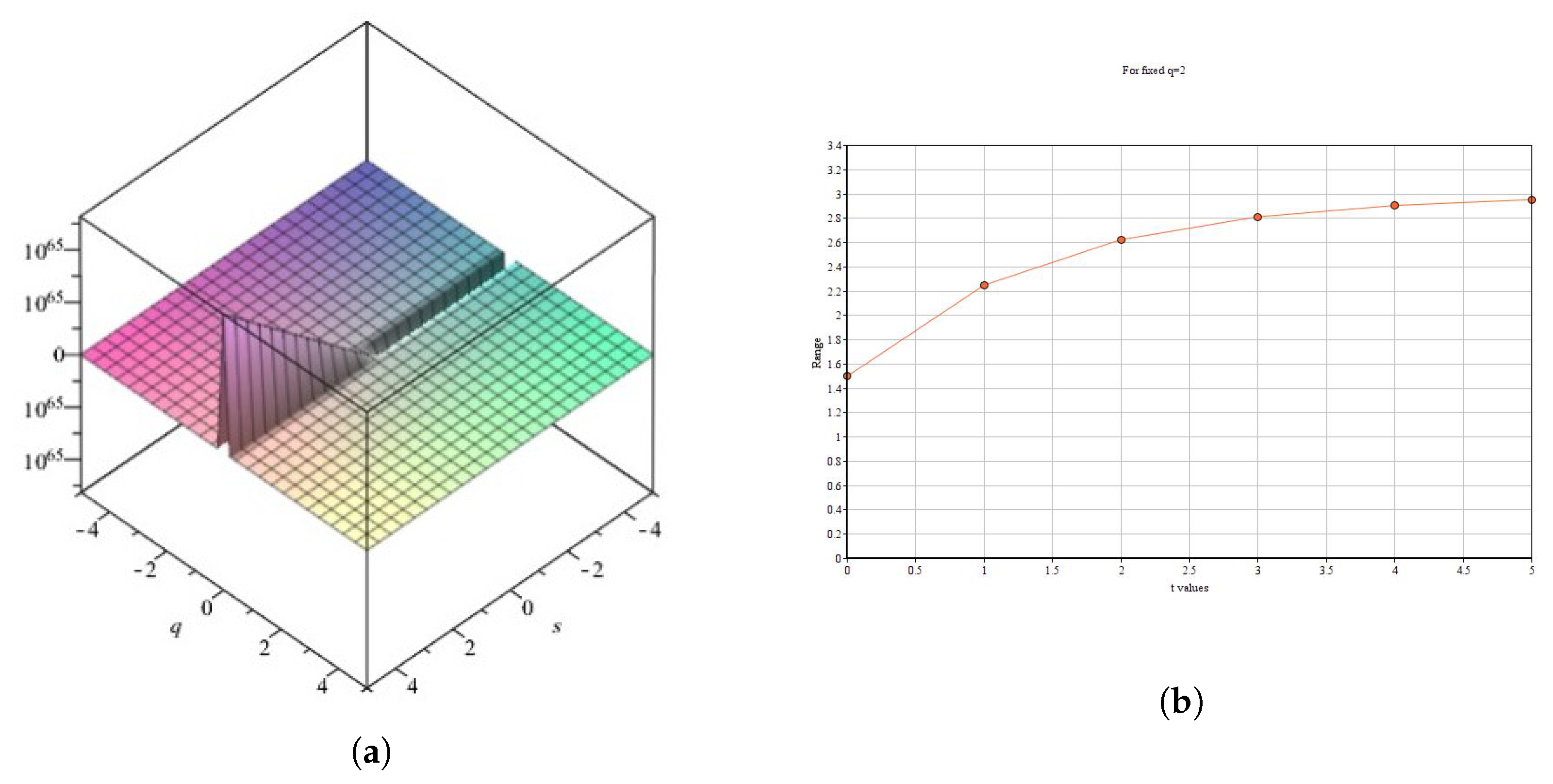
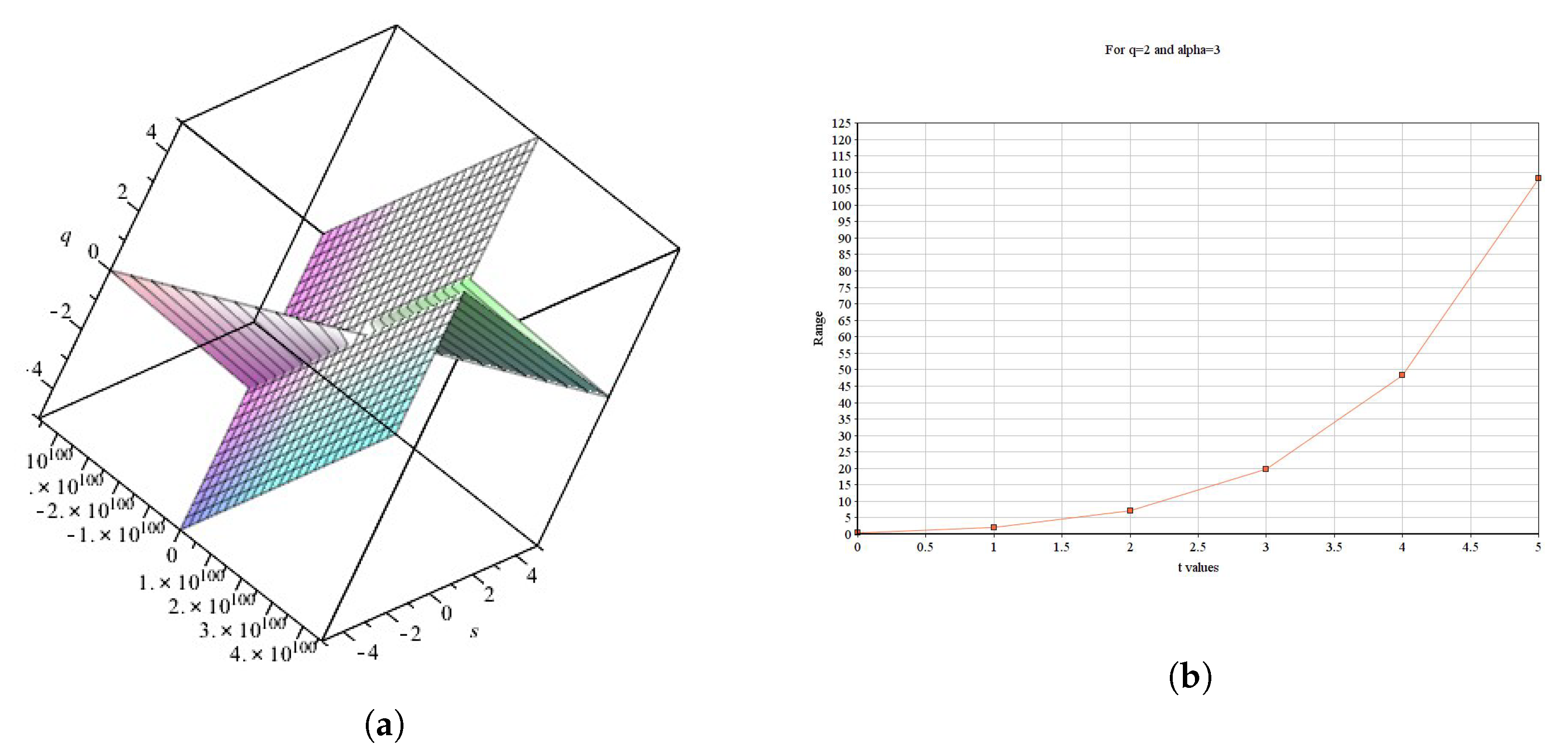
Consider Example 7, where q and are fixed and ; the solution is illustrated in Figure 1. Similarly, consider Example 8, where q, , and are constants and ; the solution is shown in Figure 2. Based on Figure 1 and Figure 2, we can easily predict that the solutions for the and operators will diverge to infinity.
Figure 1.
(a) General solution and (b) existing solution for Example 7.
Figure 2.
(a) General solution and (b) existing solution for Example 8.
Figure 1 and Figure 2 shows that if q, , and s are fixed and t fluctuates, the solution is unbounded.
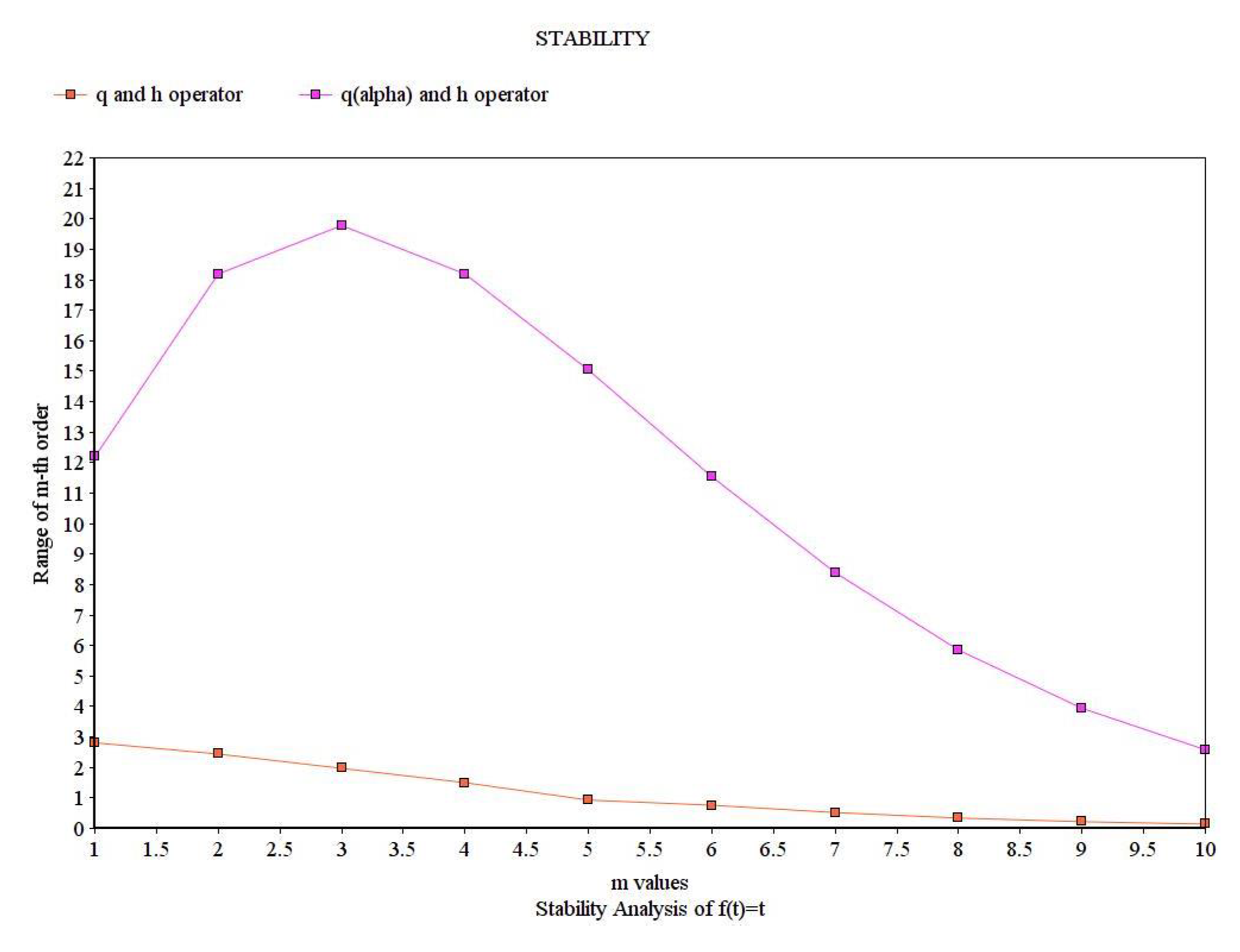
In Table 2, we list the values of Examples 7 and 8 for . For simplicity, we denote the th order of operator by and the th order of operator by . In addition, the stability between and operators is given in Figure 3.
Table 2.
The table contains the value for higher orders.
Figure 3.
Value stability of the q and h operators.
6. Conclusions
In this paper, we derived a number of fundamental theorems for q and h difference operators and we also extended these theorems to and h difference operators that provide solutions to symmetric difference equations. Suitable examples are provided for verification. The findings of this study are applicable to integer order. As a result, future work will focus on developing the non-integer order theorems for q, , and h difference symmetric operators. We also plotted the diagrams to confirm the value stability analysis for the q and operators.
Author Contributions
Funding acquisition, W.Z.; conceptualization, T.G.G. and V.R.S.; software, V.R.S., P.C., and K.J.; formal analysis, G.B.A.X.; methodology, V.R.S.; supervision, T.G.G. and G.B.A.X.; writing—original draft, W.Z. and V.R.S.; validation, G.B.A.X. and W.Z.; writing—review and editing, T.G.G., G.B.A.X., and V.R.S. All authors have read and agreed to the published version of the manuscript.
Funding
This research was funded by “Science & Technology Bureau of ChengDu 2020-YF09-00005-SN supported by Sichuan Science and Technology program 2021YFH0107 Erasmus+ SHYFTE Project 598649-EPP-1-2018-1-FR-EPPKA2-CBHE-JP”.
Institutional Review Board Statement
Not applicable.
Informed Consent Statement
Not applicable.
Data Availability Statement
Not applicable.
Acknowledgments
The authors would like to thank the Editor-in-Chief and the anonymous reviewers for their valuable comments and suggestions.
Conflicts of Interest
The authors declare no conflict of interest.
References
- Akca, H.; Benbourenane, J.; Eleuch, H. The q-derivative and differential equation. J. Phys. Conf. Ser. 2019, 1411, 012002. [Google Scholar] [CrossRef] [Green Version]
- Adams, C.R. On the Linear Ordinary q-Difference Equation. Ann. Math. 1928, 30. [Google Scholar] [CrossRef]
- Carmichael, R.D. The General Theory of Linear q-Difference Equations. Am. J. Math. 1912, 34, 147. [Google Scholar] [CrossRef]
- Jackson, F.H. q-Difference equations. Am. J. Math. 1910, 32, 305–314. [Google Scholar] [CrossRef]
- Mason, T.E. On Properties of the Solutions of Linear q-Difference Equations with Entire Function Coefficients. Am. J. Math. 1915, 37, 439. [Google Scholar] [CrossRef]
- Trjitzinsky, W.J. Analytic Theory of Linear q-Difference Equations. Acta Math. 1933, 61, 1–38. [Google Scholar] [CrossRef]
- Hahn, W. Geometric difference equations. Germanic, 1980; not published. [Google Scholar]
- Artur, M.C.; da Cruz, B. Symmetric Quantum Calculus; Department of Mathematics at the University of Aveiro (Departamento de Matemática da Universidade de Aveiro): Aveiro, Portugal, 2012. [Google Scholar]
- Liouville, J. Mémoire sur quelques questions de géométrie et de mécanique, et sur un nouveau genre de calcul pour résoudre ces questions. J. l’École Polytech. 1832, 13, 1–69. [Google Scholar]
- Michele, C. Linear Models of Dissipation whose Q is almost Frequency Independent—II. Geophys. J. Int. 1967, 13, 529–539. [Google Scholar] [CrossRef]
- Miller, K.S.; Ross, B. An Introduction to the Fractional Calculus and Fractional Differential Equations; John Wiley and Sons, Inc.: New York, NY, USA, 1993. [Google Scholar]
- Atanackovic, T.M.; Dolicanin, C.; Kacapor, E. Internal Variable Theory in Viscoelasticity: Fractional Generalizations and Thermodynamical Restrictions. Mathematics 2022, 10, 1708. [Google Scholar] [CrossRef]
- Luchko, Y. Fractional Derivatives and the Fundamental Theorem of Fractional Calculus. Fract. Calc. Appl. Anal. 2020, 23, 939–966. [Google Scholar] [CrossRef]
- Ortigueira, M.D. A New Look at the Initial Condition Problem. Mathematics 2022, 10, 1771. [Google Scholar] [CrossRef]
- Tarasov, V.E. Fractional Dynamics with Depreciation and Obsolescence: Equations with Prabhakar Fractional Derivatives. Mathematics 2022, 10, 1540. [Google Scholar] [CrossRef]
- Luchko, Y. General Fractional Integrals and Derivatives with the Sonine Kernels. Mathematics 2021, 9, 594. [Google Scholar] [CrossRef]
- Podlubny, I. Fractional Differential Equations; Academic Press: San Diego, CA, USA, 1999. [Google Scholar]
- Hilfer, R.; Luchko, Y. Desiderata for Fractional Derivatives and Integrals. Mathematics 2019, 7, 149. [Google Scholar] [CrossRef] [Green Version]
- Yamamoto, M. Fractional Calculus and Time-Fractional Differential Equations: Revisit and Construction of a Theory. Mathematics 2022, 10, 698. [Google Scholar] [CrossRef]
- Miller, K.S.; Ross, B. Fractional Difference Calculus, in Univalent Functions, Fractional Calculus, and the Applications (Koriyama, 1988); Horwood: Chichester, UK, 1989; pp. 139–152. [Google Scholar]
- Agarwal, R.P. Certain Fractional q-Integrals and q-Derivatives. Math. Proc. Camb. Philos. Soc. 1969, 66, 365–370. [Google Scholar] [CrossRef]
- Al-Salam, W.A. Some Fractional q-Integrals and q-Derivatives. Proc. Edinb. Math. Soc. 1966, 15, 135–140. [Google Scholar] [CrossRef] [Green Version]
- Al-Salam, W.A.; Verma, A. A fractional Leibniz q-formula. Pac. J. Math. 1975, 60, 1–9. [Google Scholar]
- Abdi, W.H. On certain q-difference equations and q-Laplace transform. Proc. Nat. Inst. Sci. India Part A 1962, 28, 1–15. [Google Scholar]
- Abdi, W.H. On q-Laplace transform. Proc. Nat. Acad. Sci. India 1961, 29, 389–408. [Google Scholar]
- Hahn, W. Beitrage Zur Theorie Der Heineschen Reihen. Die 24 Integrale Der Hypergeometri schen q-Differenzengleichung. Das q-Analogon Der Laplace-Transformation. Math. Nachrichten 1949, 2, 340–379. [Google Scholar] [CrossRef]
- Jackson, F.H. A generalization of the functions Γ(n) and xn. Proc. Roy. Soc. Lond. 1904, 74, 64–72. [Google Scholar] [CrossRef] [Green Version]
- Jackson, F.H. A q-form of Taylors theorem. Mess. Math 1909, 38, 62–64. [Google Scholar]
- Jackson, F.H. On q-definite integrals. Quart. J. Pure Appl. Math. 1910, 41, 193–203. [Google Scholar]
- Jackson, F.H. Transformations of q-series. Mess. Math. 1910, 39, 193–203. [Google Scholar]
- De Sole, A.; Kac, V. On integral representations of q-gamma and q-beta functions. Rend. Mat. Acc. Lincei 2005, 16, 11–29. [Google Scholar]
- McAnally, D.S. q-Exponential and q-Gamma Functions. II. q-Gamma Functionsa. J. Math. Phys. 1995, 36, 574–595. [Google Scholar] [CrossRef] [Green Version]
- McAnally, D.S. q-Exponential and q-Gamma Functions. I. q-Exponential Functions. J. Math. Phys. 1995, 36, 546–573. [Google Scholar] [CrossRef]
- Ernst, T. The History of q-Calculus and a New Method. Licentiate Thesis, Uppsala University, Uppsala, Sweden, 2000. [Google Scholar]
- Koornwinder, T.H. Compact quantum groups and q-special functions. In Representation of Lie Groups and Quantum Groups; Baldona, V., Picardello, M.A., Eds.; PitmanResearch Notes in Mathematics Series 311; Longman Scientific and Technical: London, UK, 1994; pp. 46–128. [Google Scholar]
- Koornwinder, T.H. q-special functions, a tutorial. arXiv 2013, arXiv:math/9403216. [Google Scholar]
- Andrews, G.E.; Askey, R. Special Functions; Cambridge University Press: Cambridge, UK, 1999. [Google Scholar]
- Carlson, B.C. Special Functions of Applied Mathematics; Academic Press: New York, NY, USA, 1977. [Google Scholar]
- Agarwal, R.P. Difference Equations and Inequalities; Marcel Dekker: New York, NY, USA, 2000. [Google Scholar]
- Jackson, F.H. XI.—On q-Functions and a Certain Difference Operator. Trans. R. Soc. Edinb. 1909, 46, 253–281. [Google Scholar] [CrossRef]
- Popenda, J.; Szmanda, B. On the Oscillation of Solutions of certain Difference Equation. Demonstr. Math. 1984, 17, 153–164. [Google Scholar] [CrossRef]
- Maria Susai Manuel, M.; Chandrasekar, V. Solutions and Applications of Certain Class of α-Difference Equations. Int. J. Appl. Math. 2011, 24, 943–954. [Google Scholar]
- Rexma Sherine, V.; Gerly, T.G.; Britto Antony Xavier, G. Infinite Series of Fractional order of Fibonacci Delta Operator and its Sum. Adv. Math. Sci. J. 2020, 9, 5891–5900. [Google Scholar] [CrossRef]
- Britto Antony Xavier, G.; Gerly, T.G.; Begum, N.H. Finite series of polynomials and polynomial factorials arising from generalized q-difference operator. Far East J. Math. Sci. (FJMS) 2014, 94, 47–63. [Google Scholar]
- Soundarya; Gerly, T.G.; Rexma Sherine, V. Oscillation Theory of q-Difference Equation. J. Comput. Math. 2021, 5, 83–91. [Google Scholar] [CrossRef]
- Britto Antony Xavier, G.; Gerly, T.G.; Vasanth Kumar, S.U. Multi-series solution of generalized q-alpha difference equation. Int. J. Appl. Eng. Res. 2015, 10, 97–101. [Google Scholar]
- Artur, M.C.; da Cruz, B.; Martins, N. The q-Symmetric Variational Calculus. Comput. Math. Appl. 2012, 64, 2241–2250. [Google Scholar] [CrossRef] [Green Version]
- Goodrich, C.; Peterson, A.C. Discrete Fractional Calculus; Springer International Publishing: Berlin/Heidelberg, Germany, 2015. [Google Scholar]
- Kac, V.; Cheung, P. Quantum Calculus; Springer: New York, NY, USA, 2002. [Google Scholar]
- Maria Susai Manuel, M.; Britto Antony Xavier, G.; Thandapani, E. Theory of Generalized Difference Operator and Its Applications. Far East J. Math. Sci. 2006, 20, 163–171. [Google Scholar]
Publisher’s Note: MDPI stays neutral with regard to jurisdictional claims in published maps and institutional affiliations. |
© 2022 by the authors. Licensee MDPI, Basel, Switzerland. This article is an open access article distributed under the terms and conditions of the Creative Commons Attribution (CC BY) license (https://creativecommons.org/licenses/by/4.0/).