Abstract
In this paper, we consider and extend some fixed point results in -complete -metric spaces by relaxing the symmetry of complete metric spaces. We generalize -admissible mappings in the setting of -metric spaces. The derived results are supplemented with suitable examples, and the obtained results are applied to find the existence of the solution to the integral equation. The analytical results are compared through numerical simulation. We pose certain open problems for extending and applying our results in the future.
MSC:
47H10; 54H25
1. Introduction and Preliminaries
In functional and nonlinear analysis, the standard metric space is an extremely useful tool. Several generalizations of conventional metric spaces have surfaced in recent years. The famous Banach contraction principle [1] of 1922 laid the foundation of modern metric fixed point theory. Many mathematicians generalized the contraction mapping theorem (CMT) in various types of metric spaces using different contractive conditions. In the sequel, in 1989, Bakhtin [2] developed the notion of b-metric spaces and proposed the contraction mapping in b-metric spaces as an extension of the CMT. Matthews [3] proposed the concept of a partial metric space, which is a generalization of the standard metric space. Subsequently, in 2007, Huang and Zhang [4] defined the cone metric space and substituted real numbers by the ordered Banach space. Many fixed point theorems of contractive mapping on cone metric spaces have been proven in the setting of cone metric spaces. We recommend readers see [5,6,7,8,9] and several references therein for quantitative information. Recently, in 2018, Jleli and Samet proposed the notion of the -metric space in [10]. Since then, several fixed point results have been established in the setting of the -metric space. In 2019, Mitrović et al. [11] established fixed point results of Banach, Jungck, Reich, and Berinde, on the -metric space; see also [12,13,14,15,16,17,18]. In the sequel, we recall some of the basic concepts and outcomes that are required in our main results.
Throughout this paper, we indicate as the set of non-negative real numbers , and indicate the real numbers ℜ, respectively.
Definition 1.
Let be the set of functions satisfying the following conditions:
is non-decreasing,
For every sequence , we have
Definition 2
([10]). Let be a non-void set. A function is said to be an -metric () on Γ if there exists such that , the following hypotheses are satisfied:
- if and only if ;
- ;
- For every , and for every with , we have
Then, the pair is said to be the -metric space ().
Example 1
([10]). Let . Define a mapping by
and let for all and Then, is an on Since , then is not a metric on
Example 2
([10]). Let and be defined as follows:
Then, is an on Since then is not a metric on
Definition 3
([10]). Let be an space and be a sequence on :
- (1)
- A sequence is called -convergent to if
- (2)
- A sequence is called -Cauchy if
- (3)
- The space is said to be -complete if every -Cauchy sequence in Γ is -convergent to some element in
Lemma 1
([11]). Let be a sequence in the space such that
where Then, is an -Cauchy sequence in .
Theorem 1
([10]). Let be an -complete , and let be a self-mapping satisfying
where Then, Υ has a unique fixed point.
We denote by the set of all non-decreasing functions such that, for all , we have where is the iterate of These functions are known as comparison functions. Furthermore, for all
Samet et al. [19] first proposed the concept of an --contraction map. They established the existence and uniqueness of fixed points in the metric space for such mappings. Alizadeh et al. [20] proposed the idea of - -contraction and weak - --rational contractive maps through cyclic the -admissible map and established fixed point theorems for this class of maps in the setting of the metric space.
Definition 4
([20]). Let be a self-mapping on and We say that the mapping is a cyclic -admissible mapping if:
- (i)
- for some implies
- (ii)
- for some implies
For a deep insight into the fixed point results on various generalized metric spaces, the reader can see, for example, [3,4,5,6,7,8,9,11,19,20,21,22,23], while more new results on can be found in [24,25,26,27,28,29].
More recently, Hussain and Kanwal [30] introduced the concept of the --contraction in -metric spaces and demonstrated fixed point and linked fixed point results. Inspired by this, in our work, we introduce a new type of contraction map and establish a fixed point result in the setting of generalizing some proven results of the past. The rest of the paper is organized as follows: In Section 2, we present our main results by introducing the -admissible map in the setting of and prove the fixed point results. Our results generalize and corollorizesome proven results in the past. In Section 3, the derived results are applied to find the analytical solution to the integral equation. We validate the analytical solution through numerical simulation. Finally, in Section 4, we propose some open problems for future research in this arena.
2. Main Results
We begin the section by giving the following definition.
Definition 5.
Let be an be a cyclic -admissible map, and We call Υ an --admissible map if
where
Theorem 2.
Let be an -complete and be an --admissible map. Assume that the following conditions hold:
- (i)
- There exists such that and
- (ii)
- Υ is continuous or;
- (iii)
- If is a sequence in Γ such that and for all , then .
Then, Υ has a unique fixed point.
Proof.
Let , and consider the sequence in which for all Since and is a cyclic -admissible mapping, then , which implies = By continuing this process, we have and Since is a cyclic -admissible mapping and , we conclude that and for all Hence, we obtain and for all Since from the inequality (2), we have
where
for all If we have
which is a contradiction. Hence, for all Inductively, we obtain Now, let such that holds, and let be fixed. From , we conclude that there exists such that
Since there exists some such that Hence, from (3) and we obtain
where . From and (4) for we obtain
and using we have Hence, is an -Cauchy sequence in the -complete so there exists such that Since is continuous, then we have
that is is a fixed point of Next, we suppose that (iii) holds,
that is
From (2), we have
Since as from we have
which is a contradiction. Hence, that is To prove the unique fixed point, suppose that and are two fixed points of Since , it follows from (2) that
which is a contradiction, that is and . □
The following are the consequences of Theorem 2.
Corollary 1.
Let be an -complete , and let be a cyclic -admissible mapping be such that
where
and and Suppose that the following conditions are satisfied:
- (i)
- There exists such that and
- (ii)
- is continuous or;
- (iii)
- If is a sequence in such that and for all , then .
Then, has a fixed point. Moreover, if and for all , then has a unique fixed point.
Proof.
Let for Then, from (5), we have
Then, we obtain
This implies that Equation (2) is satisfied. Therefore, the proof follows from Theorem 2. □
Corollary 2.
Let be an -complete , and let be a cyclic -admissible map be such that
where
and Suppose that the following conditions are satisfied:
- (i)
- There exists such that and
- (ii)
- is continuous or;
- (iii)
- If is a sequence in such that and for all , then .
Then, has a fixed point. Moreover, if and for all , then has a unique fixed point.
Proof.
Let for Then, from (6), we have
Then, we obtain
This implies that Equation (2) is satisfied, and so, the proof follows from Theorem 2. □
Corollary 3.
Let be an -complete , and let be a cyclic -admissible map be such that
where
and Suppose that the following conditions are satisfied:
- (i)
- There exists such that and
- (ii)
- is continuous or;
- (iii)
- If is a sequence in such that and for all , then .
Then, has a unique fixed point.
Proof.
Let for Then, from (7), we have
Then, we obtain
This implies that Equation (2) is satisfied, and the proof follows Theorem 2. □
We present two examples that support the derived results.
Example 3.
Consider the given in Example 1. Let
and be given by
Furthermore, define the function by
First, we show that is an (,)-admissible map. Let ; if , then , and so, , that is Furthermore, if , then . Thus, is a cyclic - admissible map. Let such that for all and as Then, , and hence, , that is Let and . Then, and Then, we obtain
Thus, all assumptions of Theorem 2 are satisfied. Hence, has a unique fixed point 0.
Example 4.
Consider the given in Example 2, and let be given by
Put by and
We first show that is an -admissible map. Let ; if , then and , so Furthermore, if , then Therefore, is a cyclic -admissible map. Let such that for all and as Then, , and hence, , that is Let and Then, and Then, we have
Then, all assumptions of Theorem 2 are satisfied. Hence, has a unique fixed point 0.
Now follows our second new result supplemented with an example.
Theorem 3.
Let be an -complete and be self-mappings on Γ that satisfy
where . Suppose that the following conditions hold:
- (i)
- There exists such that and ;
- (ii)
- Υ and S are two (-admissible mappings;
- (iii)
- If is a sequence in Γ such that as and for all , then .
Then, Υ and S have a unique common fixed point.
Proof.
Let , and define the sequence by and for all Since T and S are cyclic -admissible mappings and , then and By continuing this process, we have and . Similarly, since T and S are cyclic -admissible mappings and it can be shown that, and for all . Then, we obtain and for all . Since for all from (8), we have
and
By repeating this procedure, we obtain
Then, by Lemma 1, is an -Cauchy sequence. Since is -complete, there exists such that . Now, we show that is the common fixed point of and S. Suppose that . From (iii), we have for all . Using and (8), we have
Since as and using we have
which is a contradiction. This implies that . Similarly, we can show that For the uniqueness of the common fixed point and S, assume the contrary, that and .
From (8), we have
which is a contradiction, that is and S have a unique common fixed point. □
Corollary 4.
Let be an -complete and be a self-mapping on Γ that satisfy
where Suppose that the following conditions hold:
- (i)
- There exists such that and ;
- (ii)
- Υ is an -admissible mapping;
- (iii)
- If is a sequence in Γ such that as and for all , then .
Then, Υ has a unique fixed point.
Example 5.
Consider the given in Example 1. Let
and be given by
We first show that Υ and S are -admissible mapping. Let , if , then , and so, that is . Furthermore, if , then . Thus, Υ is a cyclic -assertion mapping. Furthermore, similarly, S is an -admissible mapping. Let be a sequence in Γ such that for all and as Then, , and hence, that is Let and Then, and we have
Then, all conditions of Theorem 3 are fulfilled. Hence, Υ and S have a unique common fixed point 0.
3. Application to Integral Equation
Let be the set of all real continuous functions on equipped with the :
where . Obviously, ) is an -complete . First, consider the following integral equation:
where
Let be a mapping defined by:
Theorem 4.
Assume that the following conditions are satisfied:
- (1)
- For all we have ;
- (2)
- There exist such that if and for some then for every we obtain
- (3)
- There exists such that and ;
- (4)
- for some implies and for some implies ;
- (5)
- If is a sequence in Γ such that as and for all then
Then, Equation (10) has a solution in
Proof.
Let be such that and Using Condition (2) and the Cauchy–Schwarz inequality, we have
Therefore, we obtain
then we have
Then, we obtain
Define by
Furthermore, put by Therefore, we obtain
Therefore, all the assumptions of Corollary 3 hold, and then, has a fixed point. □
Example 6.
Consider the following integral equation:
with exact solution , for .
The numerical results are shown in Table 1. These results have good accuracy in comparison with the numerical results obtained.
Table 1.
Comparison of exact solution and approximation solutions.
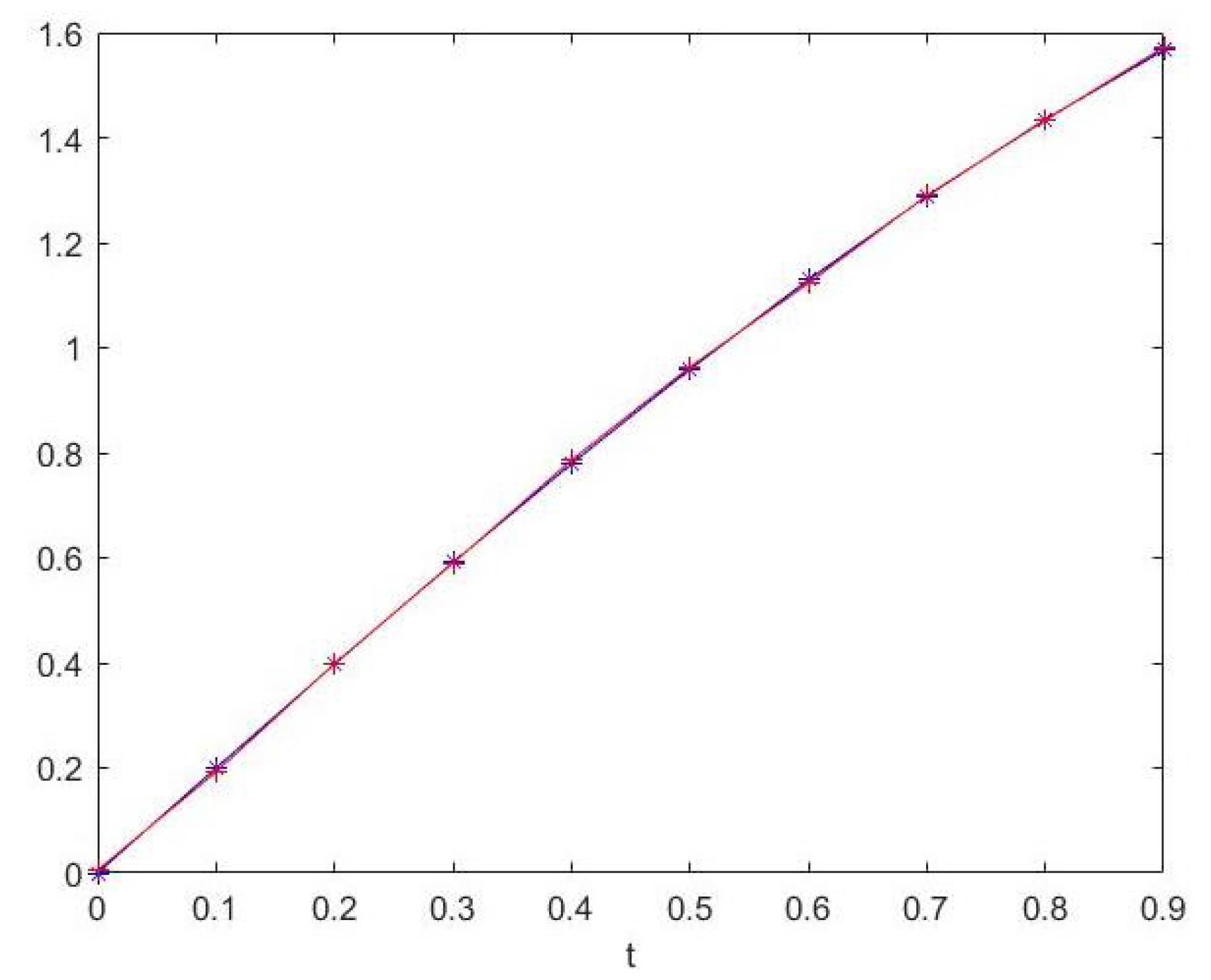
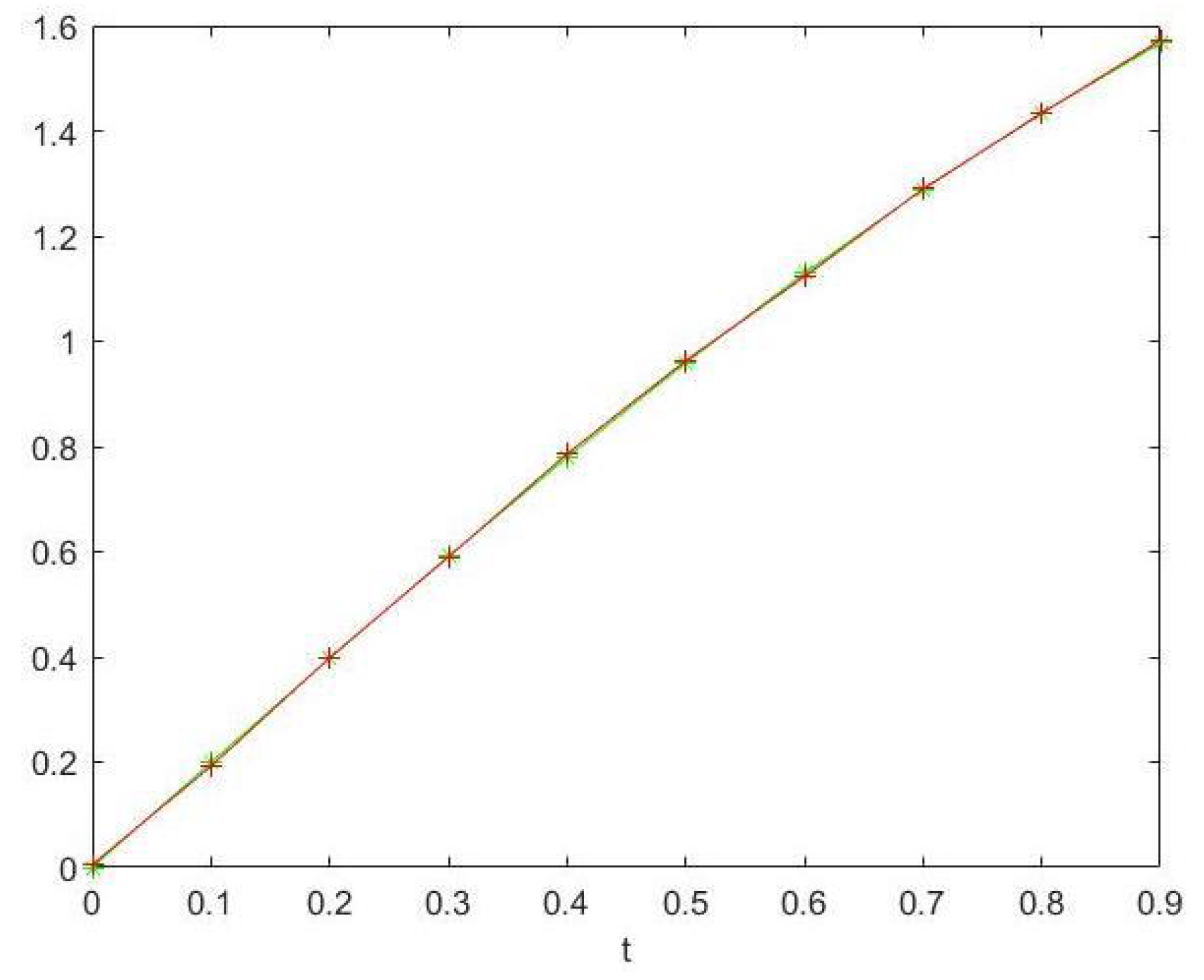
Below is the comparison of the numerical results with the analytic results. Figure 1 and Figure 2 show that the error of the approximation solution compared to the exact solution is also relatively very small.
Figure 1.
Graph of approximation (m = 64) compared to exact solution with h = 0.1.
Figure 2.
Graph of approximation (m = 128) compared to exact solution with h = 0.1.
4. Conclusions
We established fixed point results generalizing -admissible mappings in the setting of -metric spaces. Our results extend and generalize some results proven in the past. The results were supported with non-trivial examples, and the result was applied to find the solution to the integral equations. There is an open problem of applying the derived results and their extension to find the solution to the fractional differential equations, circuit theory, etc. Furthermore, as a future research, the fixed circle problem can be studied using these new contractions on different generalized metric spaces; see [16,17,18].
Author Contributions
Investigation: H.F., R.R. and Z.D.M.; methodology: H.F., N.M., Z.D.M. and R.R.; project administration: R.R. and S.R.; software: R.R. and O.A.A.A.; supervision: Z.D.M., R.R. and S.R.; writing original draft: H.F., N.M., Z.D.M. and R.R.; writing review and editing: H.F., N.M., Z.D.M., R.R., O.A.A.A. and S.R. All authors have read and agreed to the published version of the manuscript.
Funding
This research received no external funding.
Informed Consent Statement
Not applicable.
Data Availability Statement
Not applicable.
Acknowledgments
1. This study is supported via funding from Prince Sattam bin Abdulaziz University project number (PSAU/2023/R/1444). 2. The authors convey their sincere appreciation to the anonymous reviewers for their valuable suggestions for improving the manuscript to the present form.
Conflicts of Interest
The authors declare no conflict of interest.
References
- Banach, S. Sur les operations dans les ensembles abstracts et leur application aux equations integrals. Fundam. Math. 1922, 3, 133–181. [Google Scholar] [CrossRef]
- Bakhtin, I.A. The contraction mapping principle in almost metric space. Funct. Ana. Gos. Ped. Inst. Unianowsk 1989, 30, 26–37. [Google Scholar]
- Matthews, S.G. Partial Metric Topology; Research Report; Department of Computer Science, University of Warwick: Coventry, UK, 1992; Volume 212. [Google Scholar]
- Huang, L.G.; Zhang, X. Cone metric spaces and fixed point theorems of contractive mappings. J. Math. Anal. Appl. 2007, 332, 1468–1476. [Google Scholar] [CrossRef]
- Kirk, W.A.; Shahzad, N. Fixed Point Theory in Distances Spaces; Springer: Berlin, Germany, 2014. [Google Scholar]
- Sintunawarat, W. Nonlinear integral equations with new admissibility types in b-metric spaces. J. Fixed Point Theory Appl. 2016, 18, 397–416. [Google Scholar] [CrossRef]
- George, R.; Nabwey, A.H.; Ramaswamy, R.; Radenović, S.; Reshma, K.P. Rectangular cone b-metric spaces over Banach algebra and contraction principle. Fixed Point Theory Appl. 2017, 2017, 14. [Google Scholar] [CrossRef]
- Faraji, H.; Nourouzi, K.; O’Regan, D. A fixed point theorem in uniform spaces generated by a family of b-pseudometrics. Fixed Point Theory 2019, 20, 177–183. [Google Scholar] [CrossRef]
- Faraji, H.; Savić, D.; Radenović, S. Fixed point theorems for Geraghty contraction type mappings in b-metric spaces and applications. Axioms 2019, 8, 34. [Google Scholar] [CrossRef]
- Jleli, M.; Samet, B. On a new generalization of metric spaces. J. Fixed Point Theory Appl. 2018, 20, 1–20. [Google Scholar] [CrossRef]
- Mitrović, Z.D.; Aydi, H.; Hussain, N.; Mukheimer, A. Reich, Jungck, and Berinde common fixed point results on F-metric spaces and an application. Mathematics 2019, 7, 387. [Google Scholar] [CrossRef]
- Gilić, E.; Dolićanin-Djekić, D.; Mitrović, Z.D.; Pučić, D.; Aydi, H. On Some Recent Results Concerning F-Suzuki-Contractions in b-Metric Spaces. Mathematics 2020, 8, 940. [Google Scholar] [CrossRef]
- Vujaković, J.; Mitrović, S.; Mitrović, Z.D.; Radenović, S. On F-Contractions for Weak α-Admissible Mappings in Metric-Like Spaces. Mathematics 2020, 8, 1629. [Google Scholar] [CrossRef]
- Hussain, N.; Latif, A.; Iqbal, I. Fixed point results for generalized F-contractions in modular metric and fuzzy metric spaces. Fixed Point Theory Appl. 2015, 2015, 158. [Google Scholar] [CrossRef]
- Zoto, K.; Vardhami, I.; Bajović, D.; Mitrović, Z.D.; Radenović, S. On Some Novel Fixed Point Results for Generalized F-Contractions in b-Metric-Like Spaces with Application. CMES Comput. Model. Eng. Sci. 2023, 135, 673–686. [Google Scholar] [CrossRef]
- Saleh, H.N.; Sessa, S.; Alfaqih, W.M.; Imdad, M.; Mlaiki, N. Fixed Circle and Fixed Disc Results for New Types of Θc-Contractive Mappings in Metric Spaces. Symmetry 2020, 12, 1825. [Google Scholar] [CrossRef]
- Mlaiki, N.; Taş, N.; Özgür, N.Y. On the Fixed-Circle Problem and Khan Type Contractions. Axioms 2018, 7, 80. [Google Scholar] [CrossRef]
- Taş, N.; Özgür, N.Y.; Mlaiki, N. New Types of Fc-Contractions and the Fixed-Circle Problem. Mathematics 2018, 6, 188. [Google Scholar] [CrossRef]
- Samet, B.; Vetro, C.; Vetro, P. Fixed point theorems for α-ψ-contractive type mappings. Nonlinear Anal. 2012, 75, 2154–2165. [Google Scholar] [CrossRef]
- Alizadeh, S.; Moradlou, F.; Salimi, P. Some fixed point results for (α, β)-(ψ, ϕ)-contractive mappings. Filomat 2014, 28, 3635–3647. [Google Scholar]
- An, T.V.; Dung, N.V.; Kadelburg, Z.; Radenović, S. Various generalizations of metric spaces and fixed point theorems. Rev. Real Acad. Cienc. Exactas Fis. Nat. Ser. A Mat. 2015, 109, 175–198. [Google Scholar] [CrossRef]
- Radenović, S.; Došenović, T.; Öztürk, V.; Dolićanin, Ć. A note on the paper: “Integral equations with new admissability types in b-metric spaces”. J. Fixed Point Theory Appl. 2017, 19, 2287–2295. [Google Scholar] [CrossRef]
- Agarwal, R.P.; Karapınar, E.; O’Regan, D.; de Hierro, A.F.R.L. Fixed Point Theory in Metric Type Spaces; Springer International Publishing: Cham, Switzerland, 2015. [Google Scholar]
- Asif, A.; Nazam, M.; Arshad, M.; Kim, S.O. F-Metric, F-Contraction and Common Fixed-Point Theorems with Applications. Mathematics 2019, 7, 586. [Google Scholar] [CrossRef]
- Bera, A.; Garai, H.; Damjanović, B.; Chanda, A. Some Interesting Results on F-metric Spaces. Filomat 2019, 33, 3257–3268. [Google Scholar] [CrossRef]
- Jahangir, F.; Haghmaram, P.; Nourouzi, K. A note on F-metric spaces. J. Fixed Point Theory Appl. 2021, 23, 1–14. [Google Scholar] [CrossRef]
- Kanwal, T.; Hussain, A.; Baghani, H.; de la Sen, M. New Fixed Point Theorems in Orthogonal F-Metric Spaces with Application to Fractional Differential Equation. Symmetry 2020, 12, 832. [Google Scholar] [CrossRef]
- Lateefa, D.; Ahmadb, J. Dass and Guptas fixed point theorem in F-metric spaces. J. Nonlinear Sci. Appl. 2019, 12, 405–411. [Google Scholar] [CrossRef]
- Ma, Z.; Asif, A.; Aydi, H.; Khan, S.U.; Arshad, M. Analysis of F-contractions in function weighted metric spaces with an application. Open Math. 2020, 18, 582–594. [Google Scholar] [CrossRef]
- Hussain, A.; Kanwal, T. Existence and uniqueness for a neutral differential problem with unbounded delay via fixed point results. Trans. A Razmadze Math. Inst. 2018, 172, 481–490. [Google Scholar] [CrossRef]
Publisher’s Note: MDPI stays neutral with regard to jurisdictional claims in published maps and institutional affiliations. |
© 2022 by the authors. Licensee MDPI, Basel, Switzerland. This article is an open access article distributed under the terms and conditions of the Creative Commons Attribution (CC BY) license (https://creativecommons.org/licenses/by/4.0/).