1. Introduction
The famous
Benjamin–Bona–Mahony (BBM) equation was derived for the first time D.
Peregrine [
1], reintroduced later in [
2]. In scaled variables, it is given by
where subscripts
and
denote
and
—the partial derivative with respect to the spatial
x and temporal
t variables respectively. One of the main physical drawbacks of the BBM equation is the absence of the
Galilean invariance. This question has already been raised in [
3] and a remedy was proposed. It consisted in adding higher order terms that help recover this symmetry. However, this approach led to the simultaneous loss of another physically important property—the presence of the energy conservation law. Various investigations around these questions [
4] led the authors of this communication to consider the following family of partial differential equations (PDEs):
with
. It is obvious that PDE (
2) reduces to the BBM (
1) when
. It is straightforward to see that the parameter
in Equation (
2) cannot be removed by a rescaling or another simple equivalence transformation (see, e.g., [
5]). Below, we study symmetries, conservation laws, and solitary wave solutions to family (
2). The conservation laws of a variable coefficients BBM equation were studied in [
6].
In particular, we show that additional structures and exceptional elastic collision-type numerical solution behavior arise for the PDE (
2) corresponding to
:
We will refer to this integrable PDE as the eBBM equation.
The present manuscript is organized as follows. In
Section 2 the symmetries,
Hamiltonian structure, and conservation laws to Equation (
2) are studied for generic values of the parameter
. The potential symmetries are studied in
Section 3. The classification of symmetries and conservation laws with respect to parameter
is done in
Section 4. Finally, the solitary wave collisions are briefly discussed in
Section 5. The main conclusions of this study are outlined in
Section 6.
2. Symmetries, Conservation Laws, and Hamiltonian Structure of the -Family
The point symmetries of the family of PDEs (
2) holding for all
are given by the generators
In particular, when
, the generator
yields the scaling symmetry group holding for the BBM Equation (
1), and when
,
yields the
Galilei group. The latter case is the only
Galilei-invariant representative of the PDE family (
2). A direct computation shows that there are no higher-order symmetries for any member of the family (
2) depending on derivatives of
u up to the second-order, i.e., with generators of the form
except the point symmetries (
4) and (
5). Moreover, one can show there are no symmetries holding for an arbitrary
with components depending on
,
,
, and
x-derivatives of
u up to order five. (It will be shown below that the eBBM
Equation (
3) does admit a higher-order symmetry). In the case of an arbitrary
, all PDEs in the
-family (
2) admit local conservation laws with multipliers
corresponding respectively to the conservation of the momentum and the energy:
as well as the
-dependent conserved quantity
The latter, in a linear combination with energy
, yields a conserved quantity
which defines a
Hamiltonian for the whole
-family (
2). Indeed, the PDEs (
2) can be written in the
Hamiltonian form
with the co-symplectic operator
shared with the original BBM Equation (1):
3. The Potential -Family and Its Lagrangian Structure
It is possible to show that similarly to the
Korteweg–de Vries (KdV) and the BBM equations, the PDEs of the
-family (
2), as it stands, does not have a self-adjoint
Fréchet derivative, and hence does not directly arise from a variational principle for any
Lagrangian functional. This can also be seen from the obvious differences between conservation law multipliers (
6) and the evolutionary forms of symmetries (
4) and (
5), which would contradict the first
Noether’s theorem (cf. [
7]).
However, the
-family (
2) has a potential
Lagrangian formulation. In fact, upon the introduction of the potential variable
defined by
the
-family (
2) is written in the potential form
which, for every
, is nonlocally related to the corresponding PDE (
2) (see, e.g., [
8]). One can show that the linearization of Equation (
8) is self-adjoint. The homotopy formula ([
7] Theorem 5.92) can be used to construct the
Lagrangian, which up to equivalence is readily found to be
It is straightforward to check that the
Euler–Lagrange equation
yields the potential Equation (
8) for each value of the parameter
.
It is of interest to briefly consider symmetries and conservation laws of the potential
-family (
8). The first reason for that is that the potential
-family Equation (
8) are nonlocally related to the PDEs (
2), and hence the local symmetries and conservation laws of (
2) vs. (
8) can differ (cf. [
8]). Secondly, since the PDEs (
8) arise from a variational principle, the first
Noether’s theorem will provide an evident relation between their local symmetries and conservation laws. Seeking local symmetries of the potential
-family Equation (
8) in evolutionary form
holding for all
, we find the admitted symmetry generator components:
The generators (
10) with
and
correspond to the time and space translation point symmetries
,
of the
family (
2). The local symmetry with
(
11) corresponds to the point symmetry
of (
2), which includes the
Galilei group only when
. The generator with
(
13) is generally a higher-order symmetry generator, which also degenerates into the
Galilei group
when
. For
, the generator
explicitly involves the potential variable
, and hence is a nonlocal higher-order symmetry generator of the corresponding PDE from the
-family (
2) (cf. [
8]). The local generator
with symmetry component
(
14) is a higher-order symmetry of the potential equation for each
. The local symmetry generator with
(
15) admitted by the potential family (
8) is its point symmetry
, with no projection on the space of variables
of Equation (
2), related to the non-uniqueness of the definition (
7) of the potential up to an arbitrary function of time.
Since the potential family (
8) arises from a
Lagrangian, by
Noether’s theorem, its variational symmetries yield conservation law multipliers. A brief computation yields
which are local conservation law multipliers for all PDEs in the potential
-family (
8), whereas the local symmetries with
and
are not variational, and thus have no corresponding conservation laws. The multiplier
corresponds to a conservation law
holding for an arbitrary function
, which is a nonlocal conservation law of the
-family (
2) when
. Indeed, the spatial flux in (
16) is explicitly dependent on the potential
itself, and hence is not equivalent to any local expression in terms of
u. The conserved density in (
16),
is, however, a local quantity in terms of the dependent variable
u of (
8).
An additional important conservation law arises for the potential
family (
8). In fact, the left-hand side of each Equation (
8) is a total
derivative:
which can be written as
for an arbitrary function
.
In addition to the potential form (
8), other potential systems non-locally related to the
-family (
2) can be constructed, using, for example, the linearly independent conservation law multipliers (
6), to obtain independent singlet, couplet, and triplet potential systems [
8,
9]. Their study may lead to new analytical results of
-family (
2), including the original BBM Equation (
1).
4. Symmetry and Conservation Law Classifications for the -Family
Since the PDE family (
2) and its potential form (
8) involve a parameter
, its properties can be classified according to
(see e.g., [
8] and references therein). In
Section 2, symmetries and conservation laws that arise for an arbitrary
were listed; we now consider symmetry and conservation law classifications. First, classifying local conservation laws of the
-family (
2) with third-order multipliers, the following cases are distinguished:
In the general case with arbitrary
, as reported above, only three common local conservation laws arise, with multipliers (
6);
An additional local conservation law:
with multiplier
arises when
; this is the case of the so-called extended BBM (eBBM) equation (see [
4]);
The case when
, that is, the eBBM
Equation (
3), turns out to be the only other special case when additional conservation laws arise.
In terms of local conservation laws in the specified multiplier ansatz, the eBBM
Equation (
3) can be shown to admit and three additional local conservation law multipliers
The local conservation law with the multipliers (
19)–(
21) have the form:
with the corresponding conserved quantities
The conserved densities for the respective conservation laws are given by
It is also possible to show by a direct verification that the exceptional eBBM
Equation (
3) admits a third-order local evolutionary symmetry generator:
The existence of this higher-order symmetry and the above higher-order conservation laws point at the possibility of integrability of the eBBM
Equation (
3), in particular, in the light of the
Fokas conjecture in [
10], and the similarities between the eBBM
and the integrable short pulse equation [
4].
5. Solitary Waves Collision
Motivated by the exceptional symmetry and conservation law properties of eBBM
Equation (
3), we decided to study the interaction of solitary waves in this equation. For the sake of comparison, we shall also perform the same simulations in the eBBM equation given by (
2) with
. This choice of
is also interesting because it is a
Galilei-invariant model. For extended numerical comparisons, see [
4].
First of all, the solitary waves to Equation (
2) have to be computed. For this purpose we employ the
Petviashvili iterative method [
11,
12,
13]. Then, in order to simulate the
-family dynamics, we employ a
Fourier-type pseudo-spectral discretization with adaptive higher-order embedded
Runge–
Kutta temporal discretization [
14]. We employ
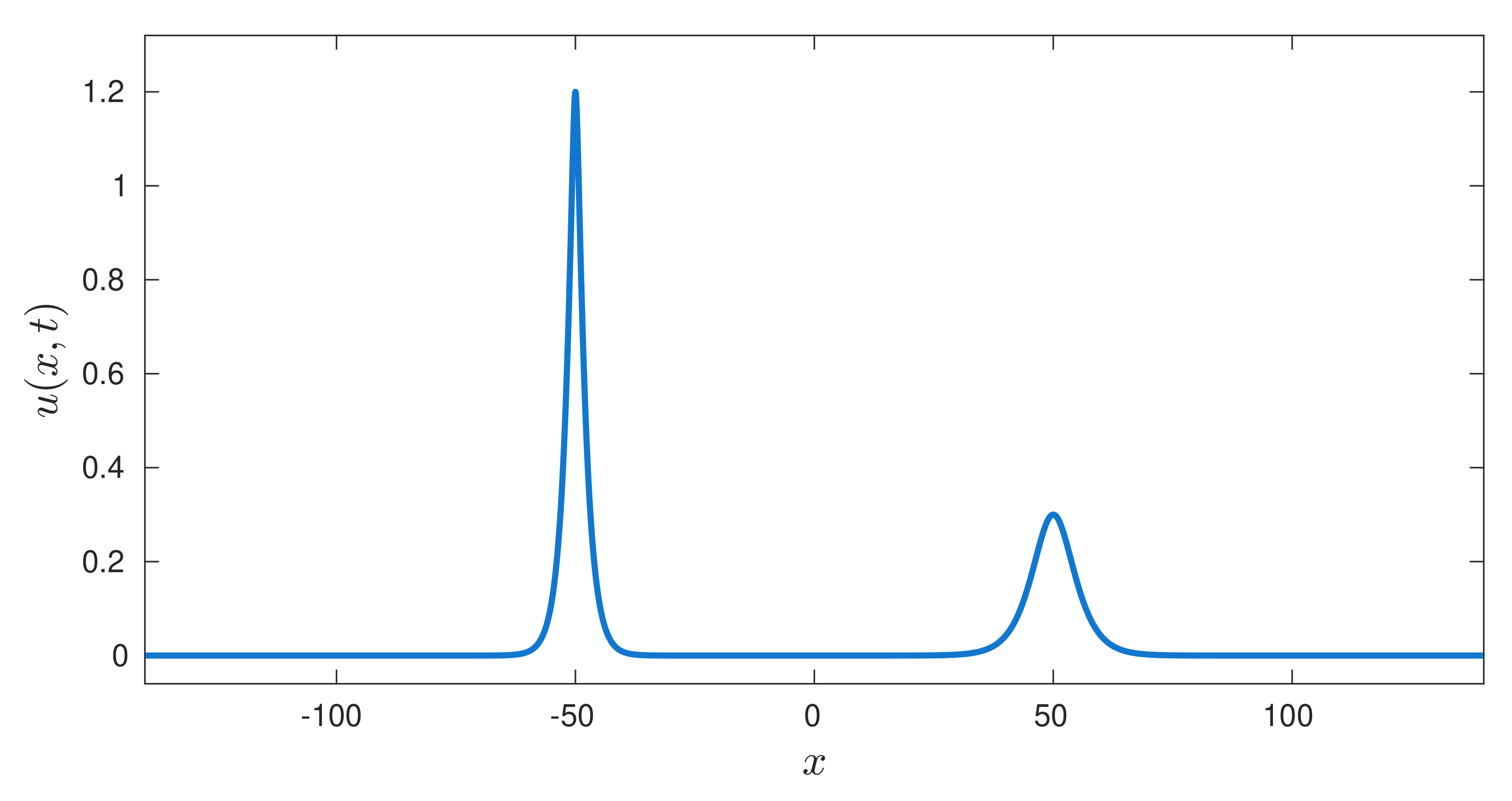
Fourier modes. Since we deal with unidirectional models, we simulate the overtaking collision of two solitary waves. For this purpose we generate two right-going solitary wave profiles, corresponding to propagation velocities
and
. Then, they are placed in a periodic computational domain
. The larger (and faster) solitary wave is initially placed at
and the smaller one at
. The initial condition is depicted in
Figure 1. Then, this initial configuration is propagated by both models from
to
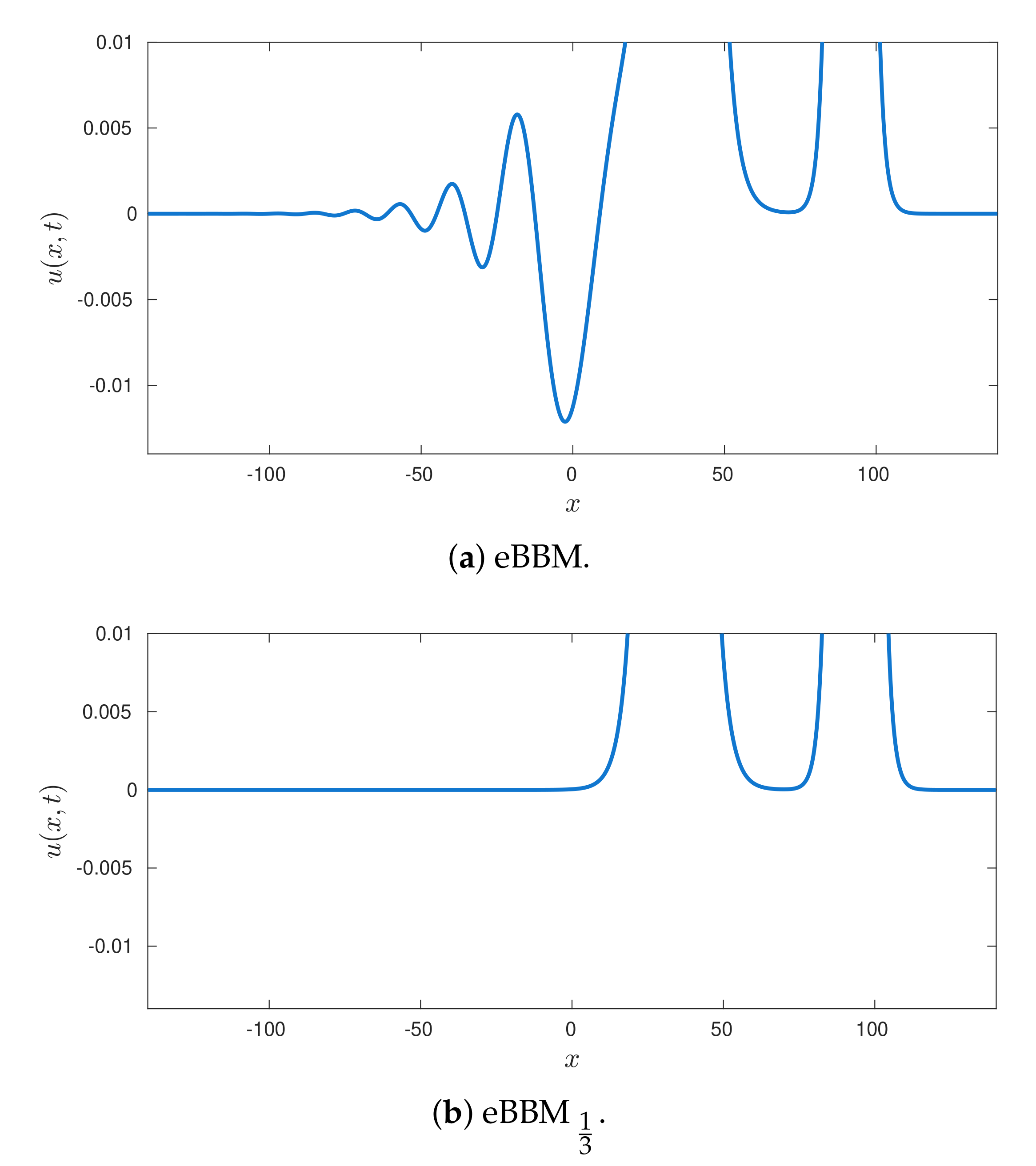
. The final simulation time is chosen so that the first overtaking collision takes place and solitary waves have enough time to separate again. A zoom on the numerical solution at
is shown in
Figure 2. We can see that the interaction in the eBBM
Equation (
3) is elastic, while the choice of
(the energy-preserving
Galilei-invariant eBBM equation) yields an inelastic collision.
6. Discussion and Conclusions
In this communication, a family of PDEs (
2) with one free parameter was considered. This family was inspired by our quest for
Galilei-invariant and energy-preserving higher order analogs of the classical BBM equation [
2]. The detailed symmetry and conservation law analysis allowed us to extract one particular member (
3) of this family, which admited a higher-order local symmetry (
22) and local conservation laws with higher-order multipliers (
19)–(
21). Moreover, our spectrally accurate numerical simulations showed that the solitary wave interaction in Equation (
3) was elastic in contrast to all other values of the free parameter
. This fact allowed us to formulate the conjecture of the integrability of eBBM
Equation (
3). This conjecture turned out to be true because a close inspection of Equation (
3) showed that it was a rescaled version of the celebrated
Camassa–
Holm (CH) equation [
15,
16]. Indeed, the eBBM
equation was related to the CH by a local scaling transformation. For example, a time scaling
and the change of notation
maps the PDE (
3) into the CH equation with parameter
:
As a result, the present study can be considered as a symmetry-based derivation of a famous PDE inspired by physically sound modeling of the unidirectional nonlinear wave propagation.