


Abstract
In this paper we introduce and study -distance Fibonacci polynomials which are natural extensions of -Fibonacci numbers. We give some properties of these polynomials—among others, a graph interpretation and matrix generators. Moreover, we present some connections of -distance Fibonacci polynomials with Pascal’s triangle.
MSC:
11B39; 11B37; 11C20
1. Introduction
Fibonacci numbers are defined by the recurrence for with initial conditions .
In the literature there are many generalisations of Fibonacci numbers. They have been generalised in many ways, some by preserving initial conditions and other by preserving the recurrence relation. For example, in [1] the authors introduced k-Fibonacci numbers defined recurrently for any integer by for with , .
Among one-parameter generalisations of Fibonacci numbers, one can find generalisations in the distance sense, such that for an arbitrary integer k the n-th generalised Fibonacci number is obtained by adding two previous terms: -th and the second chosen in such a way that the obtained recurrence generalises Fibonacci numbers. Such generalisations have many graph interpretations closely related to the concept of k-independent sets. We recall some such generalisations.
- (1)
- Reference [2]. for and with
- (2)
- Reference [3]. for with for
- (3)
- Reference [4]. for with for
- (4)
- Reference [5]. for with
Generalisations of Fibonacci numbers of another type are Fibonacci polynomials. Fibonacci polynomials were studied in 1883 by E. Ch. Catalan and E. Jacobsthal. Catalan studied polynomials defined in the following way. for , where , . Polynomials studied by Jacobsthal were defined by the recurrence for with . In 1970 M. Bicknell studied Lucas polynomials defined in the following way. for , where , .
In the literature we can find interesting results related to Fibonacci polynomials and their generalisations; see, for example, [6,7,8,9,10,11].
In this paper we use a concept of -distance Fibonacci numbers defined by (1) and we introduce -distance Fibonacci polynomials. We show some properties of these polynomials. We present connections of -distance Fibonacci polynomials with Pascal’s 2-triangle. Moreover, we give matrix generators and a graph interpretation of -distance Fibonacci polynomials.
2. -Distance Fibonacci Polynomials and Their Graph Interpretation
In this section we introduce -distance Fibonacci polynomials and we present a graph interpretation of these polynomials.
Let for some integer, -distance Fibonacci polynomials we define recursively by
with for
Note that for we obtain polynomials studied by Catalan and for we obtain -distance Fibonacci polynomials given by the direct formula .
For example, if , initial -distance Fibonacci polynomials are
First we give a graph interpretation of for integer . Let , be a path without loops and multiple edges with the vertex set , and vertices of are numbered in the natural fashion. Let us consider a colouring c of vertices of such that the vertex can be uncoloured. Let be a set of colours and denote that the vertex has a colour i, .
The following recurrent procedure defines the colouring c of . Denote by A a set of uncoloured vertices of a path .
Until , repeat following operations:
Let be a vertex with the smallest index.
If , then ; otherwise , .
If , then .
If and , then for .
We can interpret obtained monochromatic paths of the length k or 2 as monochromatic scraps, so with the above colouring c of we will define a -scrap colouring of . Denote by a scrap of two vertices coloured 0 and by a scrap of k vertices coloured s, where . In other words the -scrap colouring of is a covering of by scraps from the set .
Consider, for example, the path and . Then we have the following possibilities of a -scrap colouring:
(a) , , . Each scrap has x colour variants, so there are such colourings.
(b) . Each scrap has two vertices, so we have exactly one colouring.
(c) Colourings when the last vertex is uncoloured are , , , which gives .
Summing up, we have that there exist -scrap colourings of .
Denote by the total number of -scrap colourings of .
Theorem 1.
Let , be integers. The number of all -scrap colourings of is equal to .
Proof.
Denote by a -scrap colouring starting from and by a -scrap colouring starting from . If , then there is exactly one -scrap colouring only by scraps . Thus .
Assume that and . Then
which ends the proof. □
Using the above graph interpretation we give direct formulas for .
Theorem 2.
Let , be integers. Then
Proof.
If , then and
Assume that . By Theorem 1, the number is equal to the number of -scrap colourings of . Each -scrap colouring consists of i monochromatic paths with x colours and j monochromatic paths , where , . Moreover, for a fixed i we have and the number of -scrap colourings is equal to . Thus . □
Theorem 3.
Let , be integers. Then
Proof.
By Theorem 1, the number is equal to the number of -scrap colourings of . A -scrap colouring of corresponds to a sum of numbers counting vertices with the same colour, so where for and . Instead of such sum we can consider a t-tuple where . There is such t-tuples. Let a tuple have i components equal to k and components equal to 2. If is greater than n or less then , then the t-tuple does not correspond to any -scrap colouring of . Thus we have such t-tuples, with sum n or . By simple calculations we have that there are such tuples. Note that each component equal to k in a t–tuple corresponds to k consecutive vertices coloured with the same colour (a scrap ). They can be coloured on x ways. Thus we have □
In the next theorem we present some identities for -distance Fibonacci polynomials.
Theorem 4.
Let , be integers. Then
Theorem 5.
Let , be integers. Then
Proof.
Using the definition (2) of -distance Fibonacci polynomials we have
□
3. Matrix Generators
Let be a square matrix. For a fixed an element is equal to the coefficient at of the right hand side of the formula (2). For and an arbitrary i we have if , and otherwise.
The above definition gives matrices
Moreover, we define a square matrix of order k as the matrix of initial conditions
Using Laplace’s Theorem and some properties of determinants, we get the following results.
Theorem 6.
Let be an integer. Then
Theorem 7.
Let , be integers. Then
Proof.
If , then by (2) and simple calculations the result immediately follows. Assume the formula (7) holds for n, we will prove it for . Since , by our assumption and by the recurrence (2) we obtain
which ends the proof. □
By Theorem 6 we get the following result.
Corollary 1.
Let , be integers. Then
4. Connections with Pascal’s Triangle
In [12] it was proved that all Fibonacci type sequences have binomial formulas. Moreover, a graphical rule for calculating elements of these sequences from Pascal’s triangle was presented. It is natural to find similar properties of -distance Fibonacci polynomials.
In this section we inspect infinite matrices generated by coefficients of -distance Fibonacci polynomials. Note that similar considerations were done in [13] for sequence with and .
For a convenience we will write Pascal’s triangle in such a form.
Consider -distance Fibonacci polynomials. Initial elements of this sequence are 1, 1, , , , , , , , , , ,
We obtain a double sequence of polynomials. If we write coefficients of consecutive polynomials in rows of a matrix, then an element is the coefficient at . The obtained matrix has the following form.
Coefficients arising in can be written in a triangular position, in such a way that every row of the triangle is double. Such a triangle is called Pascal’s 2-triangle.
For , the initial terms of the sequence of polynomials are as follows: 1, 1, 1, , , , , , , , , , , , By Theorems 2 and 3, for an arbitrary k, the coefficients of polynomials are binomial coefficients. Matrix discloses a recurrence rule of getting coefficients of polynomials from .
Generally, starting from the first column of , to obtain from , we shift all of the following columns rows downward and repeat this operation for all consecutive columns.
See matrices and for and .
.
Analogously to the classical Pascal’s triangle, we can give a general rule of calculating entries of a matrix . For convenience, in the next theorem, rows and columns of a matrix are numbered starting from the number zero.
Theorem 8.
Let , , be integers. Then where
with for and for or .
Proof.
For and the result is obvious.
Let and . Coefficients are elements of Pascal’s 2-triangle. Then
Comparing coefficients at , we have . □
We can observe that sums in rows or in diagonals form known sequences (see [14]) dependences are presented in Table 1. Note that for a given sequence with , a sequence we will call a double sequence.

Table 1.
Sums in rows and sums on diagonals of matrices.
The matrix below of coefficients leads to a method of calculating polynomials from Pascal’s triangle. This method we will call a staircase method.
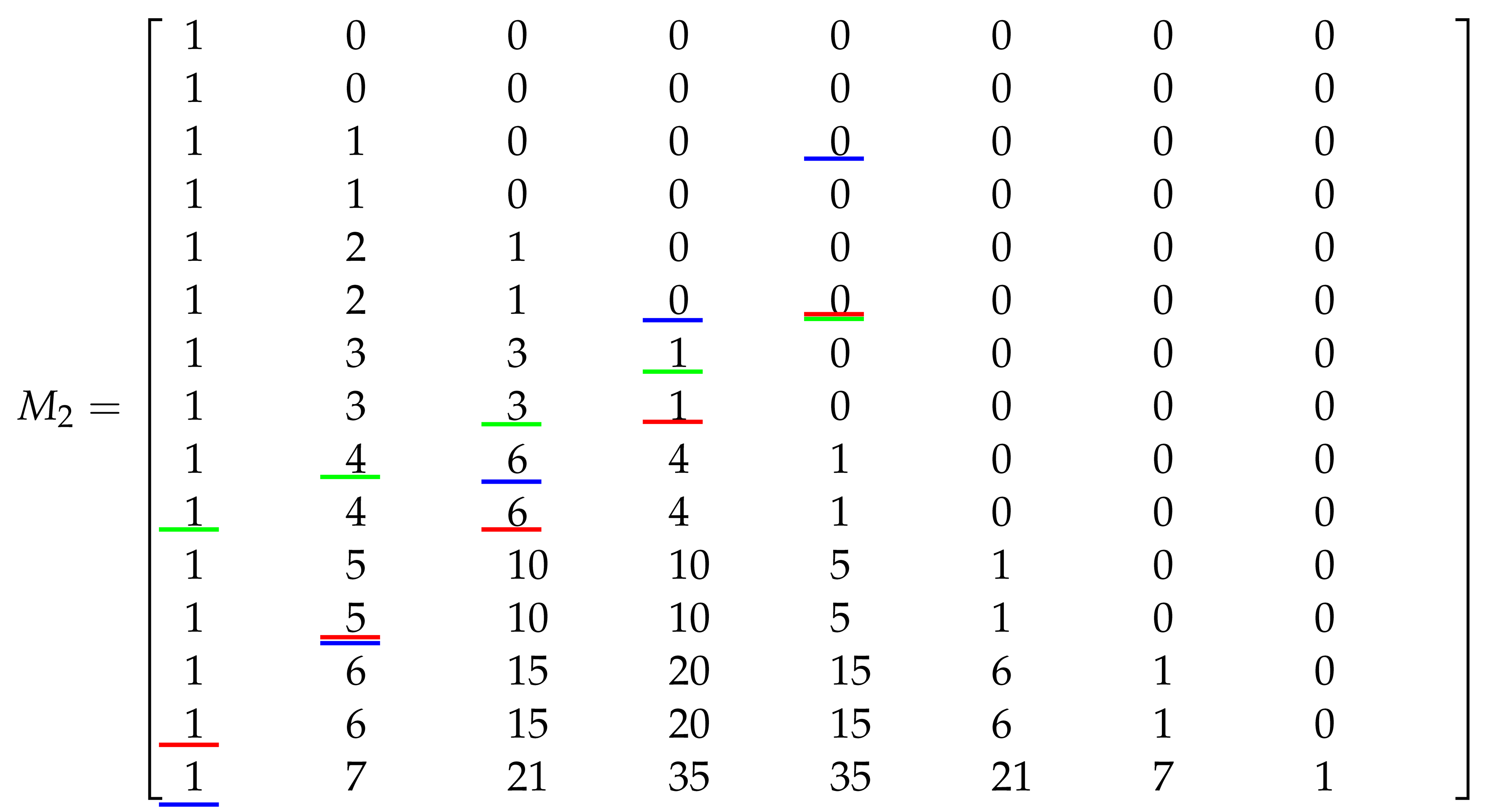
For example, for we obtain stairs with steps of the height equal to 1 and the length equal to 1 (green colour). We extend the stairs presented above up to infinity in both directions. By moving such infinite stairs one row downward, we obtain coefficients of consecutive polynomials. For the sequence of polynomials is double. In this case steps have the height 2 and the length 1 (red colour). For the height is 3 (blue colour). Generally for an arbitrary the length of the step is 1 and the height of the step is .
The above considerations lead to the following theorem.
Theorem 9.
Let , be integers. Then
Proof.
Let denote an element of a matrix . We know that . To prove this Theorem it is enough to perform transformations to and transformations from to Pascal’s triangle P. A reverse operation to shifting columns downwards gives . Next we delete the first row (it has the number 0) in the matrix , so . Finally, we contract double rows and we obtain a corresponding entry in Pascal’s triangle. In the sum we omit zero terms, because all entries above the main diagonal of Pascal’s triangle are zeros. Thus we have
which ends the proof. □
5. Conclusions
In this paper we studied -distance Fibonacci polynomials which generalise -distance Fibonacci numbers. To prove some properties of the sequences of such polynomials, we used a special graph interpretation and matrix generators. The connections of -distance Fibonacci polynomials with Pascal’s 2-triangle seem interesting. They lead to binomial formulas and new triangles corresponding to sequences of these polynomials. All such triangles, generating coefficients of polynomials, are obtained from Pascal’s 2-triangle by shifting. It is natural to consider similar generalisations for other distance Fibonacci numbers.
Author Contributions
Conceptualisation, D.B. and A.W.; methodology, D.B. and A.W.; validation, D.B. and A.W.; formal analysis, D.B. and A.W.; investigation, D.B. and A.W.; writing—original draft preparation, D.B. and A.W.; writing—review and editing, D.B. and A.W.; visualisation, D.B. and A.W. All authors have read and agreed to the published version of the manuscript.
Funding
This research received no external funding.
Institutional Review Board Statement
Not applicable.
Informed Consent Statement
Not applicable.
Data Availability Statement
Not applicable.
Acknowledgments
The authors wish to thank referees for valuable remarks and comments that were found very helpful and improved this paper.
Conflicts of Interest
The authors declare no conflict of interest.
References
- Falcon, S.; Plaza, A. On the Fibonacci k-numbers. Chaos Solitons Fractals 2007, 32, 1615–1624. [Google Scholar] [CrossRef]
- Stakhov, A.P. A generalization of the Fibonacci Q-matrix. Rep. Natl. Acad. Sci. Ukr. 1999, 9, 46–49. [Google Scholar]
- Kwaśnik, M.; Włoch, I. The total number of generalized stable sets and kernels in graphs. Ars Comb. 2000, 55, 139–146. [Google Scholar]
- Bednarz, U.; Włoch, A.; Wołowiec-Musiał, M. Distance Fibonacci numbers, their interpretations and matrix generators. Comment. Math. 2013, 53, 35–46. [Google Scholar] [CrossRef]
- Włoch, I.; Bednarz, U.; Bród, D.; Włoch, A.; Wołowiec-Musiał, M. On a new type of distance Fibonacci numbers. Discret. Math. 2013, 161, 2695–2701. [Google Scholar] [CrossRef]
- Ma, Y.; Zhang, W. Some Identities Involving Fibonacci Polynomials and Fibonacci Numbers. Mathematics 2018, 6, 334. [Google Scholar] [CrossRef]
- Bednarz, U.; Wołowiec-Musiał, M. Distance Fibonacci Polynomials. Symmetry 2020, 12, 1540. [Google Scholar] [CrossRef]
- Chen, L.; Wang, X. The Power Sums Involving Fibonacci Polynomials and Their Applications. Symmetry 2019, 11, 635. [Google Scholar] [CrossRef]
- Kim, T.; Kim, D.S.; Kwon, J.; Dolgy, D.V. Expressing Sums of Finite Products of Chebyshev Polynomials of the Second Kind and of Fibonacci Polynomials by Several Orthogonal Polynomials. Mathematics 2018, 6, 210. [Google Scholar] [CrossRef]
- Qi, F.; Guo, B.N. Expressing the generalized Fibonacci polynomials in terms of a tridiagonal determinant. Le Mat. 2017, 72, 167–175. [Google Scholar]
- Li, Y. Some properties of Fibonacci and Chebyshev polynomials. Adv. Differ. Equations 2015, 118, 1–12. [Google Scholar] [CrossRef]
- Włoch, I.; Włoch, A. On Some Multinomial Sums Related to the Fibonacci Type Numbers. Tatra Mt. Math. Publ. 2020, 77, 99–108. [Google Scholar]
- Falcon, S.; Plaza, A. On k–Fibonacci sequences and polynomials and their derivatives. Chaos Solitons Fractals 2009, 39, 1005–1019. [Google Scholar] [CrossRef]
- The On-Line Encyclopedia of Integer Sequences. Available online: https://oeis.org (accessed on 8 January 2021).
Publisher’s Note: MDPI stays neutral with regard to jurisdictional claims in published maps and institutional affiliations. |
© 2021 by the authors. Licensee MDPI, Basel, Switzerland. This article is an open access article distributed under the terms and conditions of the Creative Commons Attribution (CC BY) license (http://creativecommons.org/licenses/by/4.0/).