
Abstract
This work mainly focuses on the continuity and analyticity for the generalized Benjamin–Ono (g-BO) equation. From the local well-posedness results for g-BO equation, we know that its solutions depend continuously on their initial data. In the present paper, we further show that such dependence is not uniformly continuous in Sobolev spaces with . We also provide more information about the stability of the data-solution map, i.e., the solution map for g-BO equation is Hölder continuous in -topology for all with exponent depending on s and r. Finally, applying the generalized Ovsyannikov type theorem and the basic properties of Sobolev–Gevrey spaces, we prove the Gevrey regularity and analyticity for the g-BO equation. In addition, by the symmetry of the spatial variable, we obtain a lower bound of the lifespan and the continuity of the data-to-solution map.
Keywords:
generalized Benjamin–Ono equation; non-uniform dependence; Hölder continuous; symmetry; analyticity; Gevrey regularity MSC:
35G2; 35L05; 35Q50
1. Introduction
In this paper, we study the Cauchy problem for the generalized Benjamin–Ono equation
where is the spatial symmetrical Hilbert transform
The Benjamin–Ono equation () was derived by Benjamin [1], and later Ono [2]. This equation can be see as a model to describe the wave motion at the interface of a two-layer fluid system of incompressible inviscid fluids, in which a heterogeneous layer is situated above or underneath an infinitely-deep layer of homogeneous fluid. The function denotes the deviation of the interface from its resting position at the point x in the direction of propagation at time t. It is assumed that the deviation of the interface makes no significance in the direction orthogonal to x.
For the variables that are nondimensional, the Benjamin–Ono equation has been normalized to reach the tidy form (1). From the last century in 1960s, the Benjamin equation was of high concern, particularly because it is completely integrable, defines Hamiltonian systems, possesses infinite conserved quantities and has multi-soliton solutions, cf. [1,2,3,4].
The Cauchy problem for the Benjamin–Ono equation was studied extensively. The local well-posedness and global well-posedness for initial data in the classical Sobolev spaces were investigated, cf. [5,6,7,8,9,10,11]. More precisely, the local well-posedness for initial data with was shown in [7], and the globally well-posed in for was also obtained in [10]. By the half Strichartz estimates for linear problems with variable coefficients, Koch and Tzvetkov [9] obtained the local well-posedness when .
Subsequently, Kenig and Koenig [8] extended this result to . Tao [11] obtained global well-posedness in for by a gauge transformation as for the derivative Schrödinger equation. Recently, the Benjamin–Ono equation was proved to be local well-posedness in with in [5] and global well-posedness in with in [6].
More interestingly, based on the well-posedness results, Koch and Tzvetkov [12] showed that the solution mapping was not even locally uniformly continuous in for . Fonseca and Ponce [13] established persistence properties and proved some unique continuation properties of the solution flow in the weighted Sobolev spaces .
For , the g-BO equation presents the interesting fact that the dispersive effect is described by a nonlocal operator and is weaker than that exhibited by the generalized KdV equation. In addition, it possesses three conservation laws,
and
where . The local well-posedness of the g-BO equation was also known in [14,15], and the global result was proven by Molinet and Ribaud [16]. In a sharp contrast with the case , the best known results about the g-BO equation with small initial data were obtained by using contraction methods [14].
More precisely, Kenig et al. [14] proved that the locally and globally well-posed for the solution of g-BO equation in different . Molinet and Ribaud [15] further studied these results for g-BO equation with small initial data. Recently, using the frequency-uniform decomposition method, the global well-posedness of solution for the Cauchy problem of the g-BO with the small rough data in certain modulation spaces was investigated in [17].
Motivated by the results mentioned above, the goals of this paper are to study the continuity and analyticity for the generalized Benjamin–Ono Equation (1). From the local well-posedness results [14,15,16], we know that the solutions of g-BO Equation (1) continuously rely on their initial data in Sobolev spaces—that is, if, for a given with , there exists a such that, for any sequence and , the corresponding solutions of g-BO satisfy for .
In the present paper, we show that such dependence is not uniformly continuous in with . The uniformly continuous of the data-to-solution map means that: be the sequences of initial data for the Equation (1), if , then the correspond sequences of solution , for the initial-value problem (1) satisfy for . By the technique of approximate solutions [12], we find two suitable sequences of solutions and to g-BO Equation (1) in such that
however, the following inequality holds
which implies at any time.
In [12], Koch and Tzvetkov prove that the flow map of the Benjamin–Ono equation cannot be uniformly continuous on bounded sets of for . We compare with the Benjamin–Ono equation, and the g-BO equation has a higher order nonlinear term . If taking the similarly approximate solutions as Koch and Tzvetkov [12], we cannot successively estimate the error in suitable Sobolev norm, instead we must select a more complicated form of the low and high frequency parts for the approximate solutions (see (13) and (15)).
Motivated by the results obtained in [18,19,20,21], we use the interpolation properties of the Sobolev spaces and commutator estimates to present that the data-to-solution map as continuous but not uniformly continuous in Sobolev spaces with . Our results extend the work of Koch and Tzvetkov [12] to more general equations with higher-order nonlinearities. Our main result is stated as follows:
Theorem 1.
If the initial data with , then the data-to-solution map for the g-BO Equation (1) is not uniformly continuous from any bounded subset of into .
Theorem 1 shows that the data-solution map depends on the initial data being continuous but not uniformly continuous. Our next result will provide information about the stability of the data-solution map. Our next result establishes the stability of the data-solution map, i.e., the solution map for g-BO equation is Hölder continuous in -topology.
Theorem 2.
Let and . Then, the data-to-solution map for the g-BO Equation (1) is Hölder continuous in equipped with -norm. In particular, the solutions to the g-BO Equation (1) corresponding to the initial data in the ball of satisfy the following inequality
where the parameter α is given by
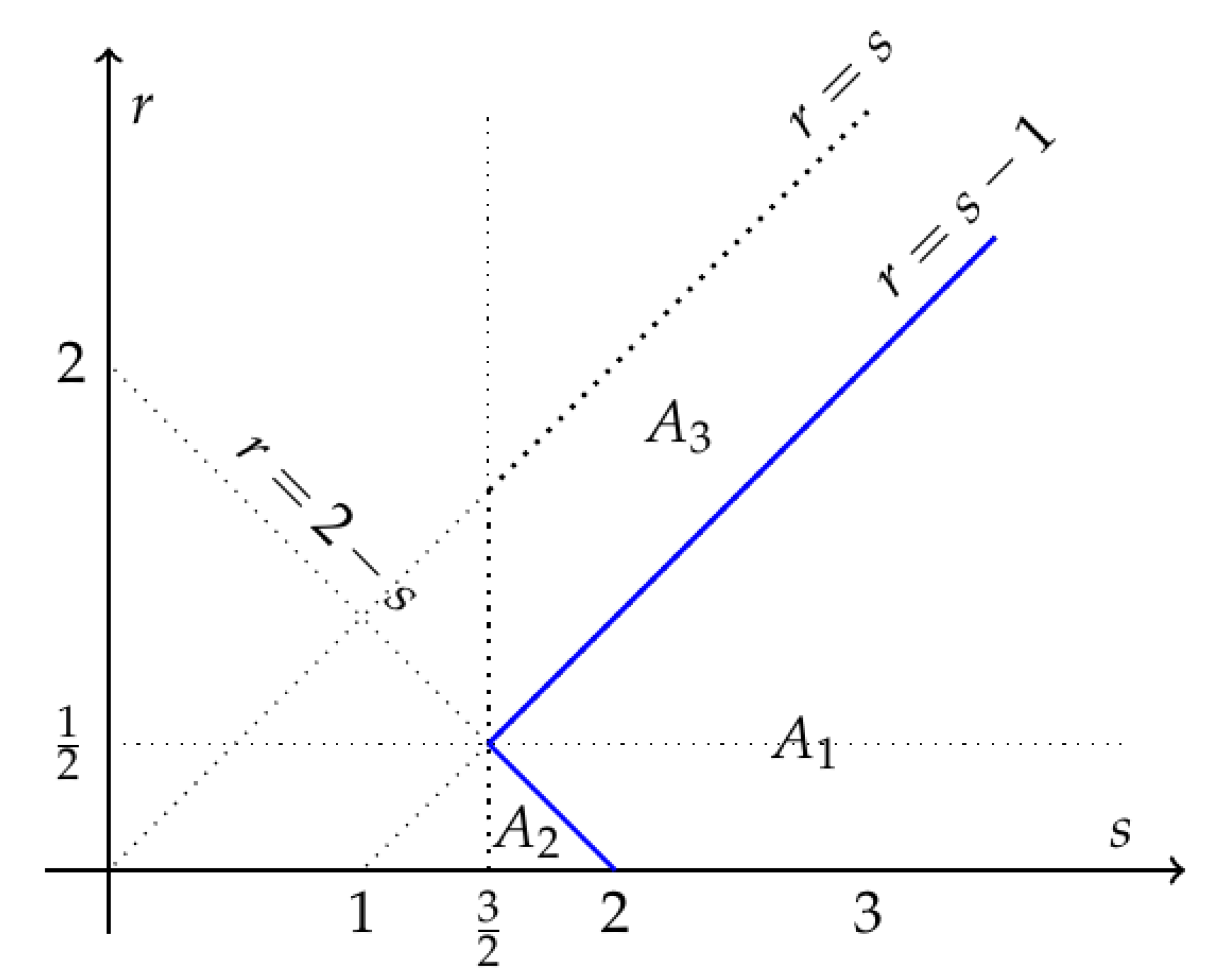
The lifespan T and the constant C only depend on and ρ (see Figure 1).
Figure 1.
The relationship of and .
Many researchers have studied the analyticity of solutions to g-BO, cf. [12]. However, to our best acknowledge, the Gevrey regularity of solutions to the BO equation is still an open problem. The definition of Sobolev–Gevrey spaces is stated as follows.
Definition 1.
Let s be a real number and . A function if and only if and satisfies
Denoting the Fourier multiplier by , we deduce that . For , it is called ultra-analytic function. If , it is a usual analytic (or holomorphic) function, and is called the radius of analyticity. If , it is the Gevrey class function.
By the generalized Ovsyannikov theorem [22] (see Theorem 6 in the Section 5), we can obtain the Gevrey regularity and analyticity of the g-BO equation.
Theorem 3.
Let and . Assume that . Then, for every , there exists a such that the g-BO equation has a unique solution u, which is holomorphic in with values in . Moreover, there is a positive constant C such that .
Theorem 3 tells us that solutions of g-BO equation are analytic in both space and time variables. Moreover, we give a lower bound of the analytic lifespan. Then, we continue to study the continuity of the data-to-solution.
Definition 2.
Let and . We say that the data-to-solution map of the g-BO is continuous, if for a given there exists a such that, for any sequence and for , the corresponding solutions of g-BO satisfy for , where
Theorem 4.
Let and . Assume that . Then, the data-to-solution map of the g-BO equation is continuous from into the solutions space.
This paper is organized as follows. In Section 2, we recall some notation, give a prior well-posedness estimate for g-BO Equation (1), and determine a lower bound on the existence time of the solution in . In Section 3, adopting the method of approximate solutions and the well-posedness estimates, we show that the data-to-solution map fails to be locally uniformly continuous. In Section 4, we prove that the solution map for g-BO Equation (1) is Hölder continuous in -topology for all . Finally, applying generalized Ovsyannikov type theorem and properties of Sobolev–Gevrey spaces, we establish the Gevrey regularity and analyticity of the g-BO equation and obtain the continuity of the data-to-solution map.
2. Priori Estimates and Lifespan of Solution
For any , we take the operator to be defined by
where is the Fourier transform,
Let be the Sobolev space consisting of all tempered distributions f such that
Theorem 5.
Assume with . Let T be the maximal existence time of the solution u to g-BO Equation with the initial data . Then, T satisfies
where is a constant depending only on s. We have
Proof.
Applying the operator to g-BO Equation (1), it can be rewritten as follows
Multiplying the g-BO Equation (5) by and then integrating it with respect to , we obtain
Noting that . To estimate the second integral on the right-hand side of (6), we need the following lemma, which is derived from [23,24].
Lemma 1.
If , then
where is a positive constant depending only on r.
Using the Cauchy–Schwarz inequality and Lemma 1, we can estimate the second integral of (6)
where we have used the equality and the Sobolev embedding theorem for .
Estimating the third integral of the right-hand side of (6), integrating by parts, we deduce
Combining (6)–(8) we can obtain the following inequality
Solving differential inequality (9) yields
Letting , then . From (10), the solution u exists for with the following bound
This completes the proof of Theorem 5. □
3. Nonuniform Dependence for the Solution to g-BO
3.1. Approximate Solutions
In this section, we consider approximate solutions of the Equation (1) of the form
where and . The high frequency part is given by
where , and is cutoff functions such that
Lemma 2
(See [12]). Let , and . Then, for any , we have that
Relation is also true if cos is replaced by sin.
Lemma 3.
Let and . Then, for any , there exists a positive constant such that for every
Since the proofs of Lemma 3 are quite similar to lemma 2.2 in [12], they are omitted to make the paper concise.
Lemma 4.
Let , and . Then, the initial-value problem has a unique solution , . For all , this solutions satisfies the estimate
Proof.
Clearly, for any function , we can easily check that
As per the relation , making the change of variables yields
Now, we estimate the error in -norm of these approximate solutions. Substituting the approximate solution into Equation (1), we find the following error:
Estimating the -norm of . Apparently, applying the Cauchy–Schwarz inequality yields
To estimate the -norm of the difference , we adopt the fundamental theorem of calculus in time variable to obtain
Apply Lemma 4 and (15) to imply that
Substitute (17) and (24) into (23) to yield
Finally, combining (22) and (25) gives
Estimating the -norm of . Applying Lemma 2, we can easily estimate
Estimating the -norm of . Similar to the type, we readily check
Estimating the -norm of . Using Lemma 3, we achieve
Estimating the -norm of . To estimate , we need the following lemma.
Lemma 5
(see [23,24]). If , then is an algebra. Moreover,
(i)
(ii)
Apply the Lemma 5 to obtain
Collecting the estimates above, we can obtain the following proposition.
Proposition 1.
For and , we can find the following estimate
3.2. Error Estimation between Approximate and Actual Solutions
Let be the solution to the Cauchy problem (1)—that is, satisfies
To estimate the error between approximate and actual solutions, let
Clearly, v solves the following equation
where F is defined by (21) and satisfying the -estimate (31).
Proposition 2.
If and , then
Proof.
Applying the operator to both sides of Equation (33), and multiplying the resulting equation by , then integrating it with respect to , we obtain
Noting that
Estimating the -norm of . Referring to from (35) and using the Cauchy–Schwarz inequality gives us
Estimating the -norm of . Clearly, can be rewritten as
Using Lemma 1, we can estimate the first integral of the right-hand side of (37)
Integrating by parts, we can estimate the second integral of the right-hand side of (37)
Now, (37)–(39) imply
Estimating the -norm of . Apply the Cauchy–Schwarz inequality and Lemma 5 (ii) to obtain
Combining the estimates of (35)–(41) yields the ODE
and thus
which gives rise to the following estimate
This proves the Proposition 2. □
3.3. Proof of Theorem 1
In this subsection, with the error estimation between approximate and actual solutions in hand, and using the interpolation properties of the Sobolev spaces, we can prove Theorem 1.
Proof.
Let and define and as the unique solutions to Equation (15) with the initial data and , respectively. From Lemma 2 and (4), we can obtain the following inequality
At time , we deduce
Next, we examine the -norm of the difference when . Using the triangle inequality, we find
With k-even, using the identity , we find that
With k-odd, we deduce
Letting , apply Lemma 2 and (11) to find
Lemma 6.
Suppose and . Then,
Employing the interpolation inequality in Lemma 6 with and and Equations (42) and (46), we obtain
Taking the limit infimum to both sides of (43) gives us
apparently ; thus, we complete the proof of Theorem 1.
□
4. Hölder Continuous in -Topology
In this section, we continue to study the continuity properties for the solution map in Hölder spaces . More precisely, we consider two solutions of Equation (1), u and v, which emanate from the initial data and , respectively. We expect that if the initial data and are assigned in a ball with radius in , i.e.,
and then we obtain
where the Hölder exponent is to be determined.
Proof of Theorem 2.
Lipschitz continuity in region . Let v be another solution to the Cauchy problem for (1) corresponding to the initial data , i.e.
Subtracting (51) from (1) yields the Cauchy problem for w to
where and . For a fixed with , estimating the energy of w leads us to the following equation
Noting that Clearly, the second integral of the right-hand side of (53) can be rewritten as
To estimate the first term on the right-hand sides of (57), we need the following lemma (see [23,24]).
Lemma 7.
If , then
Using Lemma 7 and (50), we find
and we can easily yield the following estimates
Combining (55) and (56) yields the estimates
For the third term on the right-hand sides of (53), we readily check
where, in the second inequality, we used following lemma.
Lemma 8
(see [25,26]). If , then
Similarly, we can estimate the last term of (53)
End of Lipschitz Continuity in . Combining the above estimates generates the following energy inequality
which implies
Clearly, it is equivalent to
which is the desired Lipschitz continuity in .
Hölder Continuity in . As per the Lipschitz continuity in and the assumption , we deduce
Since , by the interpolation between the and the norms described in Lemma 6, we find
which guarantees the Hölder continuity in .
Hölder Continuity in . For , by the interpolation between and norms, we have
By the well-posedness size estimate (50), we find
which, therefore, gives
The Lipschitz continuity in and the condition admit
which is the desired Hölder continuity in . □
5. Gevrey Regularity and Analyticity for g-BO System
5.1. Analytic Solutions for g-BO in
In this section, By applying nonlinear Cauchy-Kowalevski theory, we will establish the Gevrey regularity and analyticity of solutions to g-BO system.
Theorem 6
(see [22]). Let be a scale of decreasing Banach spaces, namely, for any we have and . Consider the Cauchy problem
Let and . For given , assume that F satisfies the following conditions:
(1) If for any , the function is holomorphic on and continuous on with values in and
and then is a holomorphic function on with values in .
(2) For any and —that is, , there exits a positive constant L depending on and R such that
(3) There exists a depending on and R such that, for any ,
Then, there exists a and a unique function to the Cauchy problem (60) that is holomorphic in with values in for every .
Proposition 3
(see [22]). Let and . From Definition 1, one can check that and
Proposition 4.
Let s be a real number and . Assume that . Then, we have
Proof.
The first inequality can be found in [22], so we only prove the second inequality. Since , it follows that
Let and consider the function . By directly calculating, we have and . By solving , we obtain that , which implies that . Then, we deduce from (61) that
□
Proposition 5
(see [22]). Let and . Then, is an algebra. Moreover, there exists a constant such that
Proof of Theorem 3.
We rewrite (g-BO) as follows:
For a fixed and . By virtue of Propositions 3, 4 and 5, we deduce that, for any ,
which implies that F satisfies the condition (1) of Theorem 6. By the same token, we obtain that . Thus, F satisfies the condition (3) of Theorem 6 with . Finally, we will show that F satisfies the condition (2) of Theorem 6. Assume that and . Applying Proposition 4, we find
From the above inequality, we verify that F satisfies the condition (2) of Theorem 6 with . Moreover, , by setting , we see that and . Then, we have . □
5.2. Continuity of the Data-to-Solution Map in
Proof of Theorem 4.
Without loss of generality, we may assume that . Define that
where is given in Proposition 5. Since ; therefore, there exists a constant N such that
Then,
Furthermore, as in the proof of Theorem 3, we see that and are the existence time corresponding to and , respectively, which implies that, for any
where F is given in (62). Therefore, we verify that, for any and
Choosing . we find with and . Using this in (68) yields
where, in the last inequality, we used lemma 3.7 in [22]. Since and , this yields that . Then, we have
This leads to
Note that the right hand side of the above inequality is independent of t and . By the definition of , we have
The above inequality holds true for any , which leads to our desired result. □
6. Conclusions
The local well-posedness results in [14,15,16] imply that the existence, uniqueness and continuously dependence on their initial data of the solutions to the g-BO Equation (1) in in with . We showed that such a data-to-solution map is not uniformly continuous in Theorem 1 but Hölder continuous in -topology. On the other hand, in Sobolev–Gevrey spaces, we proved that the solutions of g-BO equation are analytic in both space and time variables in Theorem 3. In addition, the continuity of the data-to-solution in Sobolev–Gevrey spaces was also obtained.
Author Contributions
All authors made substantial contributions to this manuscript; moreover, they have been involved in drafting the manuscript or revising it critically for important intellectual content. X.P. was primarily involved in writing the paper, B.W. was primarily involved in proving Theorem 1. R.C. was primarily involved in proving Theorems 2 and 3. Finally, all authors have given final approval of the version to be published and agree to be accountable for all aspects of the work in ensuring that questions related to the accuracy or integrity of any part of the work are appropriately investigated and resolved. All authors have read and agreed to the published version of the manuscript.
Funding
This work is supported by Science and Technology Research Program of Chongqing Municipal Educational Commission (Grant No. KJQN202000518 and KJZD-M201900501), Natural Science Foundation of Chongqing (Grant No. csts2020jcyj-jqX0022).
Acknowledgments
The authors are very grateful to the anonymous reviewers for their careful read and useful suggestions, which greatly improved the presentation of the paper.
Conflicts of Interest
The authors declare no conflict of interest. The authors declare that they have no known competing financial interests or personal relationships that could have appeared to influence the work reported in this paper.
References
- Benjamin, T. Internal waves of permanent form in fluids of great depth. J. Fluid Mech. 1967, 29, 559–562. [Google Scholar] [CrossRef]
- Ono, H. Algebraic solitary waves in stratified fluids. J. Phys. Soc. Jpn. 1975, 39, 1082–1091. [Google Scholar] [CrossRef]
- Ablowitz, M.; Fokas, A. The inverse scattering transform for the Benjamin–Ono equation, a pivot for multidimensional problems. Stud. Appl. Math. 1983, 68, 1–10. [Google Scholar]
- Korteweg, D.J.; de Vries, G. On the change of form of long waves advancing in a rectangular canal, and on a new type of long stationary waves. Philos. Mag. 1895, 39, 22–443. [Google Scholar] [CrossRef]
- Burq, N.; Planchon, F. On the well-posedness of the Benjamin–Ono equation. Math. Ann. 2008, 340, 497–542. [Google Scholar] [CrossRef] [Green Version]
- Ionescu, A.D.; Kenig, C.E. Global well-posedness of the Benjamin–Ono equation on low-regularity spaces. J. Amer. Math. Soc. 2007, 20, 753–798. [Google Scholar] [CrossRef] [Green Version]
- Iorio, J.R. On the Cauchy problem for the Benjamin–Ono equation. Comm. Partial Differ. Equ. 1986, 11, 1031–1081. [Google Scholar]
- Kenig, C.E.; Koenig, K.D. On the local well-posedness of the Benjamin–Ono and modified Benjamin–Ono equations. Math. Res. Lett. 2003, 10, 879–895. [Google Scholar] [CrossRef] [Green Version]
- Koch, H.; Tzvetkov, N. On the local well-posedness of the Benjamin–Ono equation in Hs(R). Int. Math. Res. Not. 2003, 26, 1449–1464. [Google Scholar] [CrossRef]
- Ponce, G. On the global well-posedness of the Benjamin–Ono equation. Differ. Integral Equ. 1991, 4, 527–542. [Google Scholar]
- Tao, T. Global well-posedness of the Benjamin–Ono equation on H1. J. Hyperbolic Differ. Equ. 2004, 1, 27–49. [Google Scholar] [CrossRef] [Green Version]
- Koch, H.; Tzvetkov, N. Nonlinear wave interactions for the Benjamin–Ono equation. Int. Math. Res. Not. 2005, 30, 1833–1847. [Google Scholar] [CrossRef]
- Fonseca, G.; Ponce, G. The IVP for the Benjamin–Ono equation in weighted Sobolev spaces. J. Funct. Anal. 2011, 260, 436–459. [Google Scholar] [CrossRef] [Green Version]
- Kenig, C.E.; Ponce, G.; Vega, L. On the generalized Benjamin–Ono equations. Trans. Amer. Math. Soc. 1994, 342, 155–172. [Google Scholar] [CrossRef]
- Molinet, L.; Ribaud, F. Well-posedness results for the generalized Benjamin–Ono equation with small initial data. J. Math. Pures Appl. 2004, 83, 277–311. [Google Scholar] [CrossRef] [Green Version]
- Molinet, L.; Ribaud, F. On the Cauchy problem for the generalized Benjamin–Ono equation with small initial data. C. R. Acad. Sci. Paris Ser. 2003, 337, 523–526. [Google Scholar] [CrossRef]
- Wang, B.; Huang, C. Frequency-uniform decomposition method for the generalized BO, KdV and NLS equations. J. Differ. Equ. 2007, 239, 213–250. [Google Scholar] [CrossRef] [Green Version]
- Zhou, S. Continuity and analyticity for a cross-coupled Camassa-Holm equation with waltzing peakons and compacton pairs. Monatsh. Math. 2017, 182, 195–238. [Google Scholar] [CrossRef]
- Zhou, S.; Qiao, Z.; Mu, C.; Wei, L. Continuity and asymptotic behaviors for a shallow water wave model with moderate amplitude. J. Differ. Equ. 2017, 263, 910–933. [Google Scholar] [CrossRef]
- Zhou, S.; Wang, B.; Chen, R. Non-uniform dependence on initial data for the periodic Constantin-Lannes equation. J. Math. Phys. 2018, 59, 031502. [Google Scholar] [CrossRef]
- Zhou, S.; Pan, S.; Mu, C.; Luo, H. Non-uniform dependence on initial data for the twocomponent fractional shallow water wave system. Nonlinear Anal. 2020, 192, 111714. [Google Scholar] [CrossRef]
- Luo, W.; Yin, Z. Gevrey regularity and analyticity for Camassa-Holm type systems. Ann. Sc. Norm. Super. Pisa Cl. Sci. 2018, 18, 1061–1079. [Google Scholar] [CrossRef]
- Kato, T.; Ponce, G. Commutator estimates and the Euler and Navier-Stokes equations. Comm. Pure Appl. Math. 1988, 41, 891–907. [Google Scholar] [CrossRef]
- Taylor, M. Commutator estimates. Proc. Amer. Math. Soc. 2003, 131, 1501–1507. [Google Scholar] [CrossRef] [Green Version]
- Himonas, A.; Mantzavinos, D. Hölder Continuity for the Fokas-Olver-Rosenau-Qiao Equation. J. Nonlinear Sci. 2014, 24, 1105–1124. [Google Scholar] [CrossRef]
- Kato, T. Quasi-linear equations of evolution, with applications to partial differential equations. In Spectral Theory and Differential Equations; Lecture Notes in Math; Springer: Berlin, Germany, 1975; Volume 448, pp. 25–70. [Google Scholar]
Publisher’s Note: MDPI stays neutral with regard to jurisdictional claims in published maps and institutional affiliations. |
© 2021 by the authors. Licensee MDPI, Basel, Switzerland. This article is an open access article distributed under the terms and conditions of the Creative Commons Attribution (CC BY) license (https://creativecommons.org/licenses/by/4.0/).