1. Introduction
In this paper, we introduce and study a variant of Roman dominating functions, namely, total Roman -dominating functions. First we present some necessary terminology and notation. Let be a graph of order n with vertex set and edge set . The open neighborhood of a vertex is the set . The closed neighborhood of a vertex is . The open neighborhood of a set is the set . The closed neighborhood of a set is the set . We denote the degree of v by . By and , we denote the maximum degree and minimum degree of a graph G, respectively. A vertex of degree one is called a leaf and its neighbor a support vertex. We denote the set of leaves and support vertices of a graph G by and , respectively. We write , and for the complete graph, path and cycle of order n, respectively. A tree T is an acyclic connected graph. The corona of a graph H is the graph constructed from H, where for each vertex , a new vertex and a pendant edge are added. The union of two graphs and () is a graph G such that and .
A set
in a graph
G is called a dominating set if
. The domination number
of
G is the minimum cardinality of a dominating set in
G, and a dominating set of
G of cardinality
is called a
-set of
G, [
1]. A set
in a graph
G is called a total dominating set if
. The total domination number
of
G is the minimum cardinality of a total dominating set in
G, and a total dominating set of
G of cardinality
is called a
-set of
G, [
2].
Given a graph
G and a positive integer
m, assume that
is a function, and suppose that
is the ordered partition of
V induced by
g, where
for
. So we can write
. A Roman dominating function on graph
G is a function
such that if
for some
, then there exists a vertex
such that
. The weight of a Roman dominating function (RDF) is the sum
, and the minimum weight of
for every Roman dominating function
f on
G is called the Roman domination number of
G, denoted by
, see also [
3].
Let G be a graph with no isolated vertices. The total Roman dominating function (TRDF) on G, is an RDF f on G with the additional property that every vertex with has a neighbor w with . The minimum weight of any TRDF on G is called the total Roman domination number of G denoted by . A TRDF on G with weight is called a -function.
The mathematical concept of Roman domination, is originally defined and discussed by Stewart [
4] in 1999, and ReVelle and Rosing [
5] in 2000. Recently, Chellali et al. [
6] have introduced the Roman
-dominating function
f as follows. A Roman
-dominating function is a function
such that for every vertex
, with
where
, that is, either
v has a neighbor
u with
, or has two neighbors
with
[
7].
In terms of the Roman Empire, this defense strategy requires that every location with no legion has a neighboring location with two legions, or at least two neighboring locations with one legion each.
Note that for a Roman
-dominating function (R
-DF)
f, and for some vertex
v with
, it is possible that
. The sum
is denoted the weight of a Roman
-dominating function, and the minimum weight of a Roman
-dominating function
f is the Roman
-domination number, denoted by
. Roman
-domination is a generalization of Roman domination that has also studied by Henning and Klostermeyer [
8] with the name Italian domination.
The total Roman
-domination for graphs are defined as follows [
9]. Let
G be a graph without isolated vertices. Then
is total Roman
-dominating function (TR
-DF) if it is a Roman
-dominating function and the subgraph induced by the positive weight vertices has no isolated vertex. The minimum weight
of a any total Roman
-dominating function of a graph
G is called the total Roman
-domination number of
G and is denoted by
. Beeler et al. [
10] have defined double Roman domination.
A double Roman dominating function (DRDF) on a graph G is a function such that the following conditions are hold:
- (a)
if , then the vertex v must have at least two neighbors in or one neighbor in .
- (b)
if , then the vertex v must have at least one neighbor in .
The weight of a double Roman dominating function is the sum
, and the minimum weight of
for every double Roman dominating function
f on
G is called the double Roman domination number of
G. We denote this number with
and a double Roman dominating function of
G with weight
is called a
-function of
G, see also [
11].
Hao et al. [
12] have recently defined total double Roman domination. The
total double Roman dominating function (TDRDF) on a graph
G with no isolated vertex is a DRDF
f on
G with the additional property that the subgraph of
G induced by the set
has no isolated vertices. The
total double Roman domination number is the minimum weight of a TDRDF on
G. A TDRDF on
G with weight
is called a
-
function. Mojdeh et al. [
13] have recently defined the Roman
-dominating function correspondingly to the Roman
-dominating function of graphs. For a graph
G, a Roman
-dominating function (R
-DF) is a function
having the property that
for every vertex
with
. Formally, a Roman
-dominating function
has the property that for every vertex
, with
, there exist at least either three vertices in
, or one vertex in
and one in
, or two vertices in
, or one vertex in
and for every vertex
, with
, there exist at least either two vertices in
, or one vertex in
. This notion has been defined recently by Mojdeh and Volkmann [
13] as Roman
-domination.
The weight of a Roman -dominating function is the sum , and the minimum weight of a Roman -dominating function f is the Roman -domination number, denoted by .
Now we introduce the total Roman -domination concept to consider such situation.
Definition 1. Let G be a graph G with no isolated vertex. The total Roman -dominating function (TR-DF) on G is an R-DF f on G with the additional property that every vertex with has a neighbor w with , in the other words, the subgraph of G induced by the set has no isolated vertices. The minimum weight of a total Roman -dominating function on G is called the total Roman -domination number of G denoted by . A -function is a total Roman -dominating function on G with weight .
In this paper We study of total Roman -domination versus to other domination parameters. We present an upper bound on the total Roman -domination number of a connected graph G in terms of the order of G and characterize the graphs attaining this bound. Finally, we investigate the complexity of total Roman -domination for bipartite graphs.
2. Total Roman -domination of Some Graphs
First we easily see that , because by the definitions every total Roman -dominating function is a Roman -dominating function and every total double Roman dominating function is a total Roman -dominating function.
Proposition 1. ([
10] Proposition 2)
Let G be a graph and a -function of G. Then . This bound is sharp. As an immediate result we also have:
Corollary 1. Let G be a graph and a total Roman -dominating function or a Roman dominating function for which the induced subgraph by has no isolated vertex. Then . This bound is sharp.
For some special graphs we obtain the total Roman -domination numbers.
Observation 1. Let . Then
Proof. Let . Since by assigning 2 to the vertices and and value 1 to the other vertices, we have . Since and , for , for and for , we observe that and if . If , then by assigning 1 to and , 2 to , 0 to except , we have . If , then by assigning 1 to , 2 to , 0 to , we have . Thus the proof is complete. □
In [
10], it has been shown that
if
and otherwise
and since
, we deduce that
.
Here we show that
for all
. If we assign weight 1 to every vertex of
, then it is a total Roman
-dominating function of
. Hence
. In [
13], we have shown that
. Since
, we obtain the desired result.
Observation 2. .
The next result shows another family of graphs
G with
. Let
be a cycle with vertices
and
be a path with vertices
for which
and for some
,
. Let
H be a graph obtained from a cycle
and
k paths like
(
) such that the first vertex of any path
must be
. Let
G be a graph consisting of
m graphs like
H such that any both of them have at most one common vertex on their cycles.
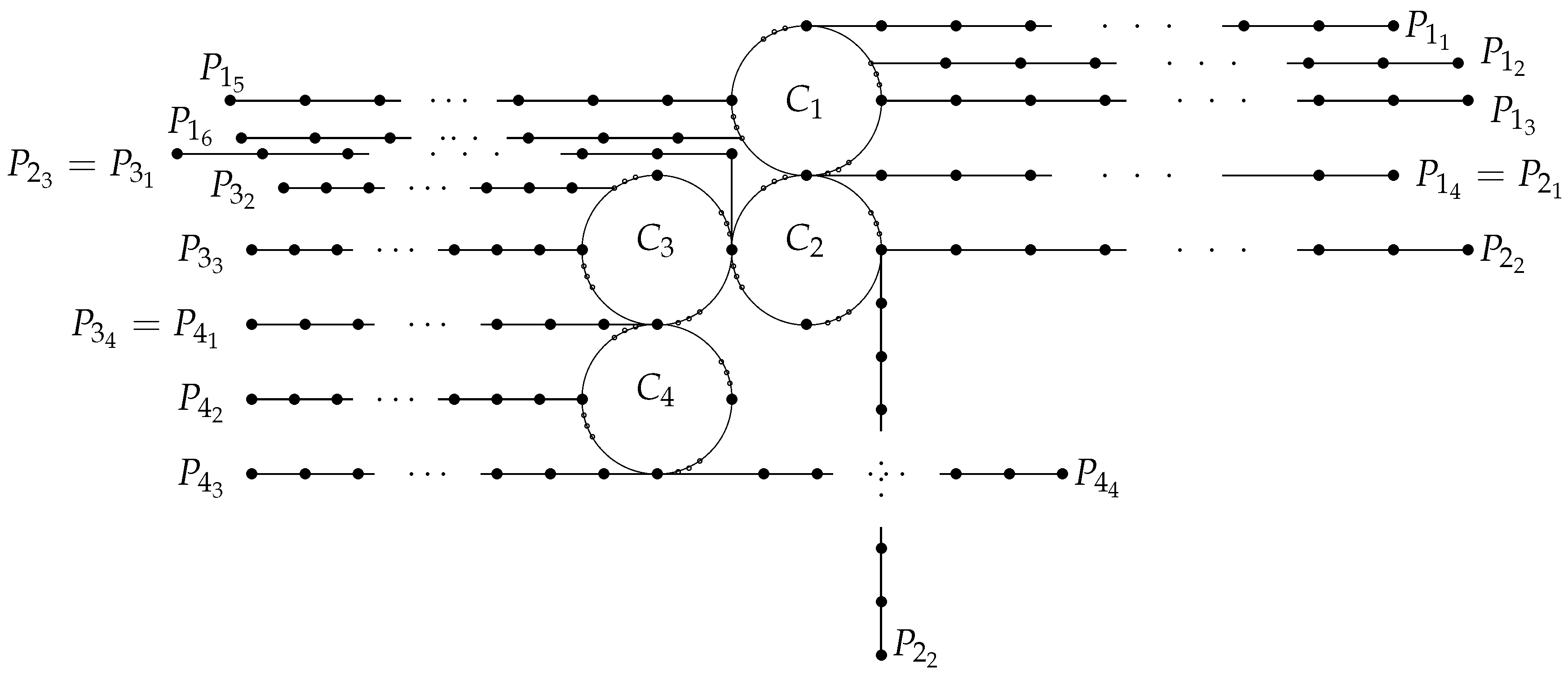
Figure 1 is a sample of graph
G is formed of 4 cycles and 15 paths
, where
.
Observation 3. Let G be the graph constructed as above. If with vertices is a path such that , then .
Proof. Let f be a function that assign value 1 to every vertex of the cycles and if , we assign value 2 to vertices with indices , value 1 to vertices with indices , () and value 0 to the other vertices of the path , except to the common vertex of the cycle. Therefore . □
Let be a cycle and be a path with m vertices and let the first vertex of be the vertex of . If or , then . Therefore we have the following result.
Corollary 2. In the graphs constructed above, if there are l paths such that or for , then .
The Observation 3 and Corollary 2 show that for every nonnegative integer k, there is a graph G such that .
Proposition 2. If G is a connected graph of order , then and if and only if G has at least two vertices of degree .
Proof. If , then the statement is clear. Let now and let be a total Roman -dominating function on G of weight . If , then for a vertex and thus . If , then for each vertex and therefore .
If G has at least two vertices of degree , then we may assume v and u are two adjacent vertices of maximum degree. Define the function f by , and for . Then f is a total Roman -dominating function on G of weight 3 and hence .
Conversely, assume that . Then there are two adjacent vertices with weights 1 and 2 respectively, for which vertices with weight 0 are adjacent to them, or there are three mutuality adjacent vertices with weights 1 for which vertices with weight 0 are adjacent to them. Therefore there are at least two vertices of degree . □
As an immediate result we have:
Corollary 3. If G has only one vertex of degree , then .
In the follow, total Roman -domination and total double Roman domination numbers are compared.
Since any partite set of a bipartite graph is an independent set, the weight of total Roman -domination number of any partite set is positive. Therefore we have the following.
Proposition 3. For any complete bipartite graph we have.
,
for and .
for .
Proof. In any complete bipartite graph, let , where U is the small partite set and W is the big partite set.
1. This follows from Corollary 3.
2. We consider two cases.
- (i)
Let and . Let f be a TRDF of . If , then . If , then . If , since is positive, then . Therefore . Assigning and , shows that .
- (ii)
Let and . Using sketch of the proof of item 2, . If we assign value 1 to the vertices , weight 2 to and 0 to for , then .
3. The function f with and for is a TRDF for . Therefore .
Now let f be a function of for . If , then it is easy to see that f should be assigned 0 to at least one vertex of each partite set. Therefore every partite set must have weight at least 3. If, without loss of generality, , then let . If for , then for and thus . So and therefore , and the proof is complete. □
One can obtain a similar result for complete r-partite graphs for .
Proposition 4. Let be the complete r-partite graph with and . Then:
If , then .
If and , then .
If or and , then .
If and , then .
Proof. Let where is the ith partite set with vertices .
1. This follows from Proposition 2.
2. This follows from Corollary 3.
3. Let . By Proposition 2, we have . If , then define and otherwise. Then f is a TR-DF on G with and thus . Now let and . Then any TR-DF f on G with and for the other vertices, is a function on G. Therefore .
4. Let and , and let f be a TR-DF function on G. Since two partite sets must have positive weight, we can assume . If , then . If , then . If , then . If , then . Thus . Conversely, define and and otherwise. Then f is a TR-DF on G with and so . □
Theorem 4. If G is a graph with , then , and this bound is sharp.
Proof. Let , and let v be a vertex of degree with neighbors . Let . Define the function f by for and for . Then for and for . Therefore f is a total Roman -dominating function on G of weight and thus .
According to Observation 2 and Propositions 3 and 8, we note that , for , , , and for and . All these examples demonstrate that the inequality is sharp. □
Hao et al. defined in [
12] the family of graphs
as follows and have proved Theorem 5 below. Let
be the family of graphs that can be obtained from a star
of order
by adding a pendant edge to each vertex of
and adding any number of edges joining the leaves of
.
Theorem 5. [
12]
For any connected graph G of order , with equality if and only if . This theorem with a little changing may be explored as follows.
Theorem 6. For any connected graph G of order ,with equality if and only if . 3. Total Roman -domination and Total Domination
In this section we study the relationship between total domination and total Roman -domination of a graph.
In [
10] (Proposition 8) the authors proved that, if
G is a graph, then
.
If we use the method of the proof of Proposition 8 of [
10], then it is easy to show that:
If G is a graph with a -function , then .
In [
13] Proposition 17 authors proved that:
If G is a graph, then , and these bounds are sharp. However, we have the following.
Proposition 5. If G is a graph without isolated vertices, then .
Proof. Let S be a -set of G. Then is a -function of G. Therefore .
For the lower bound, let be a -function of G. We distinguish two cases.
Case 1. Let or . Then .
Case 2. Let . By the definition, . Therefore, for each vertex , the subgraph does not contain an isolated vertex. Consequently, is total dominating set of G and hence . □
By Proposition 5 the question may arise as whether for any positive integer r, exists a graph G for which , where . For we have. If G is a connected graph of order with at least two vertices of maximum degree , then Proposition 2 implies that . Since for such graphs, we observe that .
Proposition 6. If G is a graph without isolated vertices, then if and only if G has at least two vertices of degree , in the other words and .
Proof. The part “if“ has been proved. Part “only if“: Let G be a graph with . Let be a function. Therefore is a total dominating set for G, and . Therefore that is and . If or and , then G has at least two vertices of degree . Now we show that there are not any cases for G. On the contrary, we suppose that there are different cases. (1) and . (2) and .
Case 1. Let , . Assume first that there exist two vertices which are adjacent to the vertex v. Then is a -set of size and so , a contradiction. Assume next that there exists only one vertex, say , which is adjacent to v. Then all other vertices of have at least two neighbors in . If with , then we observe that is a -set of size . It follows that , a contradiction.
Case 2. Let and . Then there exist two vertices in which each of them has neighbors in and has no isolated vertex. Therefore is a -set that is also a contradiction. □
Now we show that for any positive integer n and integer , there exists a graph G for which and .
Proposition 7. Let n and r be positive integers with . Then there exists a graph G for which and .
Proof. For graph
G with
and
, we consider the following graph. Let
H be the graph consisting of a cycle
with
and a vertex set
of
further vertices. Let each vertex of
be adjacent to 3 vertices of
such that the neighborhoods of every two distinct vertices of
are different. Let
. Then
and
(
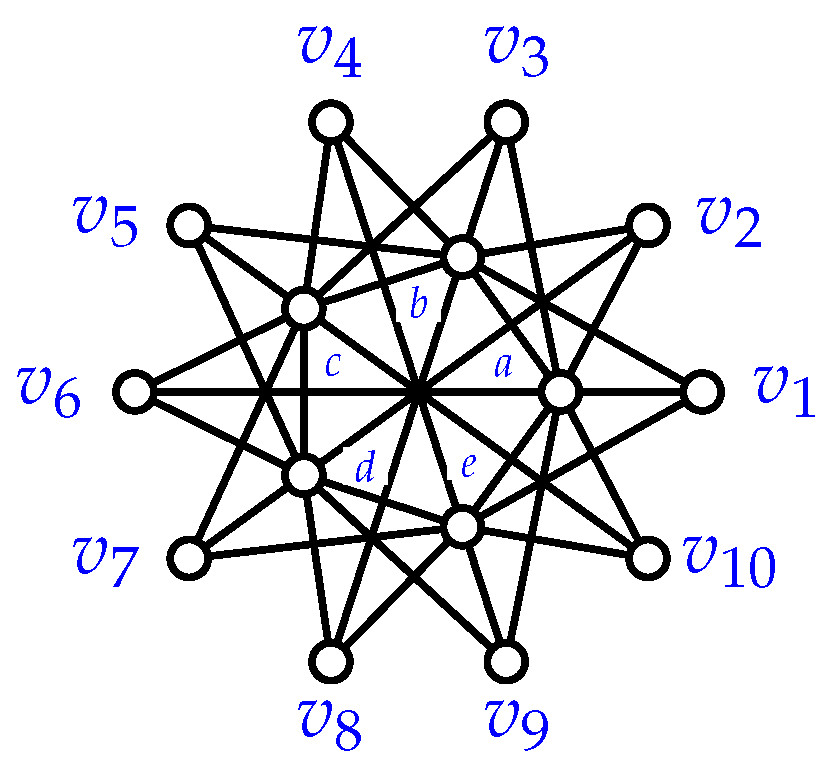
Figure 2).
For and , where . Let . For and , we consider the cycle . For , let H be the above graph where and . Now we consider . Then and .
Let . For and , we consider the cycle . For , consider the graphs with for . Now we let . Then we have .
For we use induction on k. Let for any integer there exist graphs such that for . Let . For and , we consider the cycle . For graphs G with for , using hypothesis of induction, let be the graphs with with . Now we let . It can be seen for .
We now verify the case of for , that is, we wish to show the existence of graphs G, so that and for . Let . For even n, let . Then and .
For odd , if or , then we let , and by Observation 1, it can be seen that and .
If , consider a cycle with an additional vertex a that is adjacent to two vertices and . Then and .
For and positive even integer n, consider , where is the union of of path and is the cycle with a chord, then and . For and positive odd integer n, consider where is the path with an additional vertex adjacent to the second or fourth vertex of , then and .
For , we do as follows. Let and so . Let and . Let be a graph constructed from path with vertices with additional vertices such that the given vertex is adjacent to vertices and of . Then and .
Let and . Then say . Let and so . Then say . For and , where , there consider three cases.
If , then we say .
If , then we say .
If , then we say .
It is easy to verifiable, and .
Let and so . For graph with and , we let . For graph with and , we let . And for graph with and , we let . For and , where , there consider three cases.
If , then we say .
If , then we say .
If , then we say .
Let and . For graph G with and where , there consider two cases.
Case 1. Let r be an even integer. Then there exists a graph for which and . Now let . Then and .
Case 2. Let r be an odd integer. Then there exists a graph for which and . If we consider . Then and .
Finally, we want discuss the case of , that is we want to find graphs G with and . For and , let . For G with and , let be a graph constructed from with vertices with three additional vertices and three pendant edges , , . Then it can be seen that and .
Let . If n is an even, then let and if n is an odd, then let . In both cases and . □
4. Total Roman and Total Roman -domination
In [
13] it has been shown that, for a connected graph
G with a
-function
,
.
In this section we investigate the relation between total Roman and total Roman -domination. First we have the following.
Observation 7. Let G be a graph and be a function of G. Then is a TR-DF function. Conversely, if is a of G, then is a TR-DF of G.
Proof. The proof is straightforward. □
The following results state the relation between and of graphs G when is small.
Proposition 8. Let G be a graph. Then:
if and only if .
If , then .
If , then .
Proof. 1. Let . Then there exist two adjacent vertices with label respectively so that each vertex with label 0 is adjacent to them or there exist three mutually adjacent vertices with label 1 so that each vertex with label 0 is adjacent to them. In the first case, we change the vertex with label 2 to the label 1 and in the second case we change one of the vertices with label 1 to the label 0. These changing labels give us a -function with weight 2. Conversely, let . Then there exist two vertices with label 1 for which every vertex is adjacent to them. We change one of the labels to 2, and therefore the result holds.
2. Let . There are three cases.
- 2.1.
There exist 4 vertices with label 1 for which the induced subgraph by them is the cycle , the graph or the complete graph . In any induced subgraph, there are no two vertices of them for which any vertex with label 0 is adjacent to them. Thus in the case of a TR-DF we change one of the labels 1 to the label 0. Therefore .
- 2.2.
There exist 2 vertices with label 1 and one vertex w with label 2, for which the induced subgraph by them is the cycle , or the path . In any of the two cases each vertex with label 0 is adjacent to or or three of them. Now we change the label of w to 1, and we obtain a -function for G with weight 3.
- 2.3.
There exist 2 vertices with label 3 and label 1, respectively, for which the induced subgraph by is . By this assumption each vertex with label 0 is adjacent to v, but there maybe exist some vertices (none of them) which are adjacent to u. Now we change the label v to 2, and we obtain a -function for G with weight 3.
3. Let . There are two cases.
- 3.1.
There exist 3 vertices with label 1 for which the induced subgraph by is the cycle or a path . If each vertex with label 0 is adjacent to or , then by changing the label w to 2, we obtain a -function for G with weight 4.
If some vertices with label 0 are adjacent to , some of them are adjacent to and the other are adjacent , then by changing two vertices of to label 2, we obtain a -function for G with weight 5.
- 3.2.
There exist 2 vertices with label 2 and label 1, respectively, for which the induced subgraph by is . By this assumption each vertex with label 0 is adjacent to v, but there maybe exist some vertices (none of them) which are adjacent to u. Now we change the label v to 3, and we obtain a -function for G with weight 4. Therefore . □
In the following we want to find the relation between total Roman -domination, total domination and total Roman -domination of graphs.
Observation 8. Let G be a connected graph with a -function . Then .
Proof. Let be a -function of G. Then . If we define , then g is a total Roman -dominating function on G. Therefore . □
In Observation 8 the condition of -function is necessary. Because there are many graphs for which the result of Observation 8 does not hold. For example, for the complete graphs , cycles and paths for , we observe that . However, in the following we establish, for any integer , there is a graph G such that .
Proposition 9. For any positive integer , there is a graph G for which .
Proof. For
let
. Then
,
and
. For
, let
G be a bistar of order 6. Then
. For
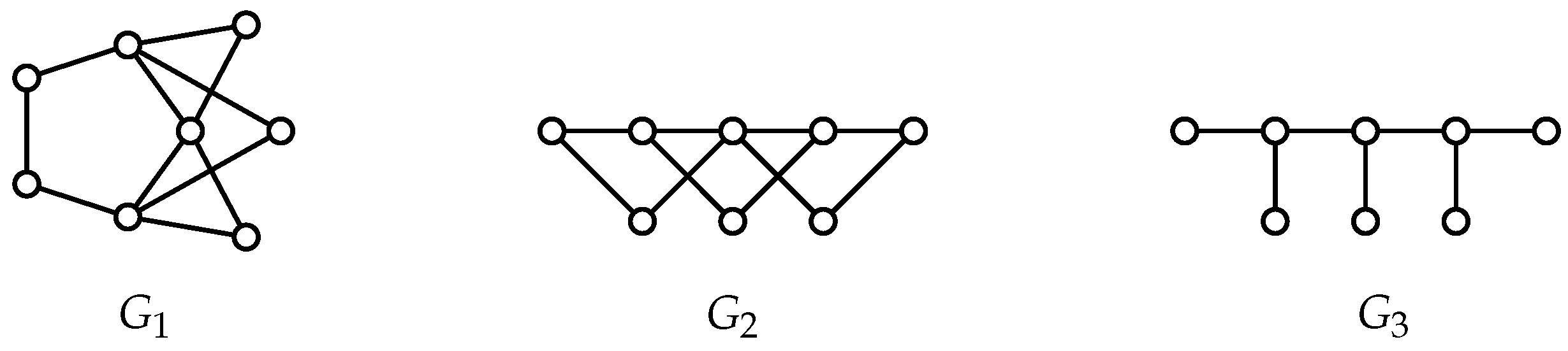
, let
in
Figure 3. For
, let
in
Figure 3. For
, let
in
Figure 3. For
, by induction we consider the graph
where the graph
H (
H may be connected or disconnected) for which
. □
Finally, we show that for any positive integer , there is a graph G such that , and .
For this, let G be the graph constructed in Proposition 3 as graph H for . Then , and .
5. Large Total Roman -domination Number
In this section, we characterize connected graphs G of order n with for . For this we use the following result.
Theorem 9. Let G be a connected graph of order . Then , with equality if and only if G is the corona where H is a connected graph.
Proof. If
, then the statement is valid. Let now
. If
, then define
by
for
and
for
. Then
f is a total Roman
-dominating function on
G of weight
If
, then define
by
for
and
for
. Then
f is a total Roman
-dominating function on
G of weight
If
for a is a connected graph
H, then
.
Conversely, let
. Then the proof above shows that
. Assume that there exists a vertex
which is neither a leaf nor a support vertex. Define
by
for
and
for
. Then
f is a total Roman
-dominating function on
G of weight
a contradiction. Thus every vertex is a leaf or a support vertex. Since
, we deduce that
with a connected graph
H. □
Corollary 4. For any connected graph G of order , if and only if .
Proof. Let . Then Theorem 9 implies and thus . Clearly, the statement is valid for . □
Corollary 5. For any connected graph G of order , if and only if .
Proof. If , then the statement is valid. Conversely, let . Then Theorem 9 implies and thus , with equality if and only if . In the remaining case , we observe that with and , and therefore . □
Next we characterize the graphs G with the property that .
Theorem 10. For any connected graph G of order , if and only if .
Proof. If , then the statement is valid. Conversely, let . If , then and we conclude by Observations 1, 2 that . If , then and so by Theorem 6, . Therefore . Let . Then by Theorem 6, . Thus , and the proof is complete. □
Let be the family of connected graphs order 5 with which have exactly one leaf or the tree consisting of the path such that is adjacent to a further vertex w.
Let be the family of graphs with a connected graph Q of order 4.
Observation 11. If , then .
Proof. Clearly, . Let be of order 5 with exactly one leaf u. If v is the support vertex of u, then with and for is a TR-DF on G and therefore .
If with a connected graph Q of order 4, then we have seen in proof of Theorem 9 that . □
Theorem 12. For any connected graph G of order , we have if and only if where claw is and paw is obtained from by adding one edge between two arbitrary distinct vertices.
Proof. Let . By Observations 1, 2 and 11, we have .
Conversely, let . According to Theorem 9, we have and thus with equality if and only if G is the corona with a connected graph H of order 4. Therefore if . Let now .
If , then and by Observations 1, 2, we have which implies and , or which implies and or which implies . Since and but , we deduce that .
Let now . Next we discuss the cases or .
If , then for only two graphs G, the claw and the paw, we have .
If , it is simply verified that if an only if .
If , then let v be a vertex of degree 3 with the neighbors , and let and be the remaining vertices. Assume, without loss of generality, that is adjacent to .
Case 1: Assume that is adjacent to . Then with and for is a TR-DF on G and therefore .
Case 2: Assume that is adjacent to . Then with , and for is a TR-DF on G and therefore .
Case 3: Assume that is adjacent to or , say . If there are no further edges, then .
Now assume that there are further edges. If is adjacent to , then with and for is a TR-DF on G and therefore . If is adjacent to , then with and for is a TR-DF on G and therefore . If is adjacent to and there are no further edges, then . If finally, is adjacent to or , say , then with , and for is a TR-DF on G and therefore . Thus we see that there is no graph G of order 6 with .
Let now . If , then define by for and for . Then f is a total Roman -dominating function on G of weight . If , then define by for and for . Then f is a total Roman -dominating function on G of weight .
Finally, assume that . If G has exactly 3 support vertices, then define by for , for and for the remaining vertex. Then f is a total Roman -dominating function on G of weight . If G has exactly 2 support vertices, then define by for , for and for the remaining two vertices. Then f is a total Roman -dominating function on G of weight .
Let . By Theorem 6, if and only if .
Let . Then by Theorem 6 . Therefore the proof is complete. □
6. Complexity
In this section, we study the complexity of total Roman -domination of graphs. We show that the total Roman -domination problem is -complete for bipartite graphs. Consider the following decision problem.
Total Roman -domination problem TR3DP.
Instance: Graph , and a positive integer .
Question: Does G have a total Roman -domination of weight at most k?
It is well-known that the Exact-3-Cover (X3C) problem is NP-complete. We show that the NP-completeness of TR3D problem by reducing the Exact-3-Cover (X3C), to TR3D.
EXACT 3-COVER ()
Instance: A finite set X with and a collection C of 3-element subsets of X.
Question: Is there a subcollection of C such that every element of X appears in exactly one element of ?
Theorem 13. TR3D is -Complete for bipartite graphs.
Proof. It is clear that TR3DP belongs to . Now we show that, how to transform any instance of X3C into an instance G of TR3D so that, the solution one of them is equivalent to the solution of the other one. Let and be an arbitrary instance of X3C.
For each , we form a graph obtained from a path ---- by adding the edge . For each , we form a star with center for which one leaf is labeled . Let . Now to obtain a graph G, we add edges if . Set . Let be the subgraph of G induced by the . Observe that for every total Roman -dominating function f on G with , all vertices on each cycle ---- are total Roman -dominated. Moreover, since has a total Roman -domination number equal to 6, we can assume that . More precisely, if , then, without loss of generality, we may assume that and . If also, , then obviously at least one vertex of (including ) is not total Roman -dominated. In this case, we can assume that vertices of are assigned as so that, only is not total Roman -dominated and .
Suppose that the instance X, C of has a solution . We build a total Roman -dominating function f on G of weight k. For every , assign the value 2 to if and 1 to the other if . Assign value 3 to every and value 0 to each leaf adjacent to . Finally, for every i, assign 1 to , and 0 to of . Since exists, , the number of s with weight 2 is r, having disjoint neighborhoods in , where every has one neighbors assigned 1 and one neighbor assigned 2. Also since the number of s with weight 1 is . Hence, it can be easily seen that f is a TR3-D function with weight .
Conversely, let be a total Roman -dominating function of G with weight at most k. Obviously, every star needs a weight of at least 4, and so without loss of generality, we may assume that and all the leaves neighbor of are assigned 0. Since , it implies that each vertex can be assigned by 1. Moreover, for each i, , as mentioned above. We can let the vertices of are assigned the values given in the above paragraph depending on whether or . Let p be the number of s having weight 6. Then . Now, if for some j, then total Roman -dominates some vertex , and, in that case, (since . Let z be the number of s assigned 2 and of others be assigned 1. Then , implies that . On the other hand, since each has exactly three neighbors in , we must have . From these two inequalities, we achieve at and then . Consequently, is an exact cover for C. □
7. Open Problems
In the preceding sections a new model of total Roman domination, total Roman -domination has been introduced. There are the relationships between the total domination, total Roman -domination and total Roman -domination numbers as follows:
If G is a graph without isolated vertices, then , (Proposition 5).
If G is a graph without isolated vertices, then if and only if G has at least two vertices of degree , in the other words and . (Proposition 6).
For any positive integer , there is a graph G of order n in which , (Proposition 9).
For a family of graphs we have shown that , (Observation 3).
We have already characterized graphs G in which , where .
Problems
1. Characterize the graphs G for which .
2. Does there exist any characterization of graphs G for which , where ?
3. For positive integers , characterize the graphs G for which .
4. Does there exist any characterization of graphs G for which ?
5. Can one characterize graphs G in which for ?
6. Is it possible to construct a polynomial algorithm for computing of for any tree T?