


Abstract
There are a few optimal eighth order methods in literature for computing multiple zeros of a nonlinear function. Therefore, in this work our main focus is on developing a new family of optimal eighth order iterative methods for multiple zeros. The applicability of proposed methods is demonstrated on some real life and academic problems that illustrate the efficient convergence behavior. It is shown that the newly developed schemes are able to compete with other methods in terms of numerical error, convergence and computational time. Stability is also demonstrated by means of a pictorial tool, namely, basins of attraction that have the fractal-like shapes along the borders through which basins are symmetric.
MSC:
65H05; 41A25; 49M15
1. Introduction
Finding out the roots of nonlinear equations is an important task in numerical mathematics and has many advantages in engineering and applied sciences [1,2,3,4,5]. In the present work, we consider numerical methods for locating the multiple root of multiplicity m of a nonlinear equation . Mathematically, by multiple root of multiplicity m, we mean that and .
Based on the quadratically convergent modified Newton’s method (see [6])
many higher order methods have been developed in literature. For example, see [7,8,9,10,11,12,13,14,15,16,17,18] and references shown therein. According to Traub’s terminology (see [5]), the Newton’s method (1) is a one-point optimal order method. In recent years, a number of two-point optimal fourth order methods have been proposed for multiple zeros (see [10,11,12,14,15,16,19,20,21,22,23,24,25]). Some non-optimal multipoint methods of sixth order are developed in [17,26]. More recently, multipoint methods with optimal eighth order convergence have also been proposed in the literature which are shown below:
Behl et al. [27] derived a three-point family of optimal method with eighth-order convergence, which is given by
where , and , being and complex non-zero free parameters, and is a holomorphic function in the neighborhood of origin and .
Zafar et al. [28] proposed an optimal iterative scheme with eighth-order convergence, which is given as follows:
where are free parameters and the weight functions , and are analytic functions in the neighborhood of origin with , and .
Geum et al. [29] have derived an optimal iterative scheme with eighth order convergence with weight function approach as follows:
where weight functions and are holomorphic functions in the neighborhood of origin and with and .
Behl et al. [30] also developed another three-point optimal iterative scheme with eighth order convergence involving free parameters for multiple zeros using a weight function approach as follows:
where are free parameters and the weight function is an analytic function in the neighborhood of origin with and .
Behl et al. [31] proposed yet another three-point optimal iterative scheme with eighth-order convergence involving free parameters for multiple zeros which is as follows:
where weight function is a holomorphic function in the neighborhood of origin with , and .
Zafar et al. in [32] also developed a three-point optimal iterative scheme with eighth order convergence involving free parameters as follows:
where weight functions and are holomorphic functions in the neighborhood of origin and with , and .
We are motivated by the research moving in the direction of developing optimal higher order methods. So, we attempt to propose a new class of iterative methods with optimal eighth order for computing multiple zeros. The methodology is based on weight function approach for the construction of a new scheme. Each member of the proposed scheme has optimal order in the sense of the classical Kung–Traub conjecture [5]. The efficiency and robustness of the proposed methods are demonstrated by performing several numerical problems. We observe that our methods have better results than those obtained by the existing methods.
The rest of the paper is summarized as follows. In Section 2, the scheme of eighth order method is developed and its convergence is studied. Some special cases of the family are explored in Section 3. Numerical experiments for several examples are performed in Section 4 to demonstrate the applicability and efficiency of the presented methods. Section 5 contains complex geometry based on the geometrical tool basins of attraction. Concluding remarks are given in Section 6.
2. Construction of the Method
This section contains the construction and convergence analysis of the proposed method with the main theorem. So, we consider the following three-step scheme whose first step is modified Newton iteration (1) for the known multiplicity :
where , , and the functions and are analytic in the neighborhood of ‘0’.
In order to discuss the convergence analysis of iterative scheme, (8) the following theorem is proved:
Theorem 1.
Let be an analytic function in a domain containing a multiple zero (say, α) having multiplicity m. Assume that starter is close enough to α, then the iteration scheme expressed by (8) possesses eighth order of convergence, when the following conditions are satisfied
Proof.
Let be the error at n-th stage. Expanding about by Taylor’s expansion, we have that
and
where for .
By using (9) and (10), we obtain that
where are given in terms of with explicitly written two coefficients , , etc.
Developing about ,
By using (9) and (12), we get expression of u as
where are given in terms of with explicitly written one coefficient etc.
Inserting the expressions (9), (10) and (13) in the second step of scheme (8), we obtain that
where and .
Expansion of about leads us to the expression
and
where are given in terms of .
Expansions of weight functions and in the neighborhood of origin ‘0’ by Taylor series yield
and
Hence by substituting (9), (10), (13), (16), (18) and (19) into the last step of scheme (8), we obtain the error equation
where are given in terms of with .
From Equation (20), it is clear that we will obtain at least fifth order convergence when . Using the value in , we will obtain
By inserting the expression and in , we have
Now, with the help of the above independent expressions , and in , we ascertain that
Substituting , (21), (22) and (23) in Equation (20), the error equation showing eighth order convergence is given by
Thus, proof of theorem is established.□
3. Some Special Cases of Weight Functions of G(u) and H(v)
We explore some special cases of our proposed method (8) by employing different forms of weight functions. In this regard, the following simple members of the proposed family are defined:
Case 1.
Let us describe the following weight functions satisfying the conditions established in Theorem 1:
Then corresponding optimal eighth order iterative scheme is given by
Case 2.
Let us describe the following weight functions that satisfy the conditions of Theorem 2.1:
Then, the eighth order iterative scheme is
Case 3.
Next, the following weight functions from the conditions of Theorem 2.1 are selected:
For these functions, the corresponding eighth order method is
4. Numerical Results
This section is dedicated to test the efficiency and convergence of the proposed class. To do this, we consider the special cases of the proposed class, namely methods (25)–(27), denoted by NM1, NM2, and NM3, respectively. A total number of four test problems are selected for numerical testing. In addition, we want to compare our methods with other existing robust schemes of eighth order for multiple zeros given by Behl et al. [27,31] and Zafar et al. [28]. In this regard, we consider method (2) for = 1, = 1 by Behl et al. [27], two special cases of method (6) by Behl et al. [31] and two special cases method (7) (for = 1, = 1) by Zafar et al. [28], and denote them by BM1, BM2, BM3, FM1 and FM2, respectively.
Various problems considered for numerical testing are shown in Table 1. Calculations are performed in the Mathematica software using multiple-precision arithmetic. The computed numerical values shown in Table 2, Table 3, Table 4 and Table 5 include: (i) number of iterations that are required to find the solution with stopping criterion (ii) values of the last three successive errors , (iii) residual error , (iv) computational order of convergence (COC) and (v) elapsed time (CPU—time in seconds) in execution of a program, which is measured by the command “TimeUsed[ ]”. The computational order of convergence (COC) is calculated by applying the formula (see [33])
Table 1.
Test examples.
Table 2.
Comparison of performance of methods for example 1.
Table 3.
Comparison of performance of methods for example 2.
Table 4.
Comparison of performance of methods for example 3.
Table 5.
Comparison of performance of methods for example 4.
From the above tables, we observe that the accuracy is increasing in the values of successive approximations, which points to the good convergence of the methods. The present methods also show consistent convergence behavior as compared to the existing methods. At the time when stopping criterion is attained, the value ‘0’ for is displayed. Computational order of convergence shown in the penultimate column of each table overwhelmingly supports the theoretical convergence of order eight. The CPU-time values in the last column of each table show that the new methods utilize less execution time than the time used by existing methods, which confirms the effectiveness of the proposed techniques. The main motive to apply these methods on different types of nonlinear equations is to illustrate the exactness of the obtained approximate solution and the convergence to the solution. Similar numerical tests, performed on a variety of numerical problems of different kinds, ensured the above remarks to a large extent.
5. Basins of Attraction
We aim to present the complex dynamical nature of new methods based on the geometrical tool, namely basins of attraction of the multiple zeros of a polynomial . Study of basins of attraction provides an important information about the stability and convergence of numerical methods. Initially, this idea was floated by Vrscay and Gilbert [34]. In recent times, many authors have used this idea in their work, see, for example [35,36] and references given there. The basic definitions related to dynamical concepts of rational function associated with iterative methods can be found in [34].
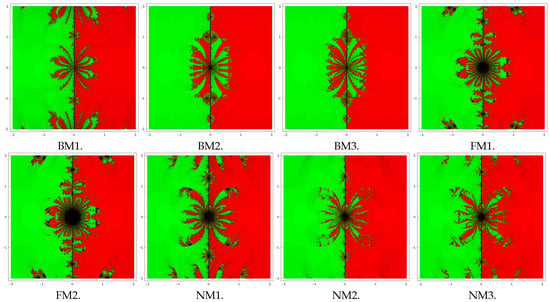
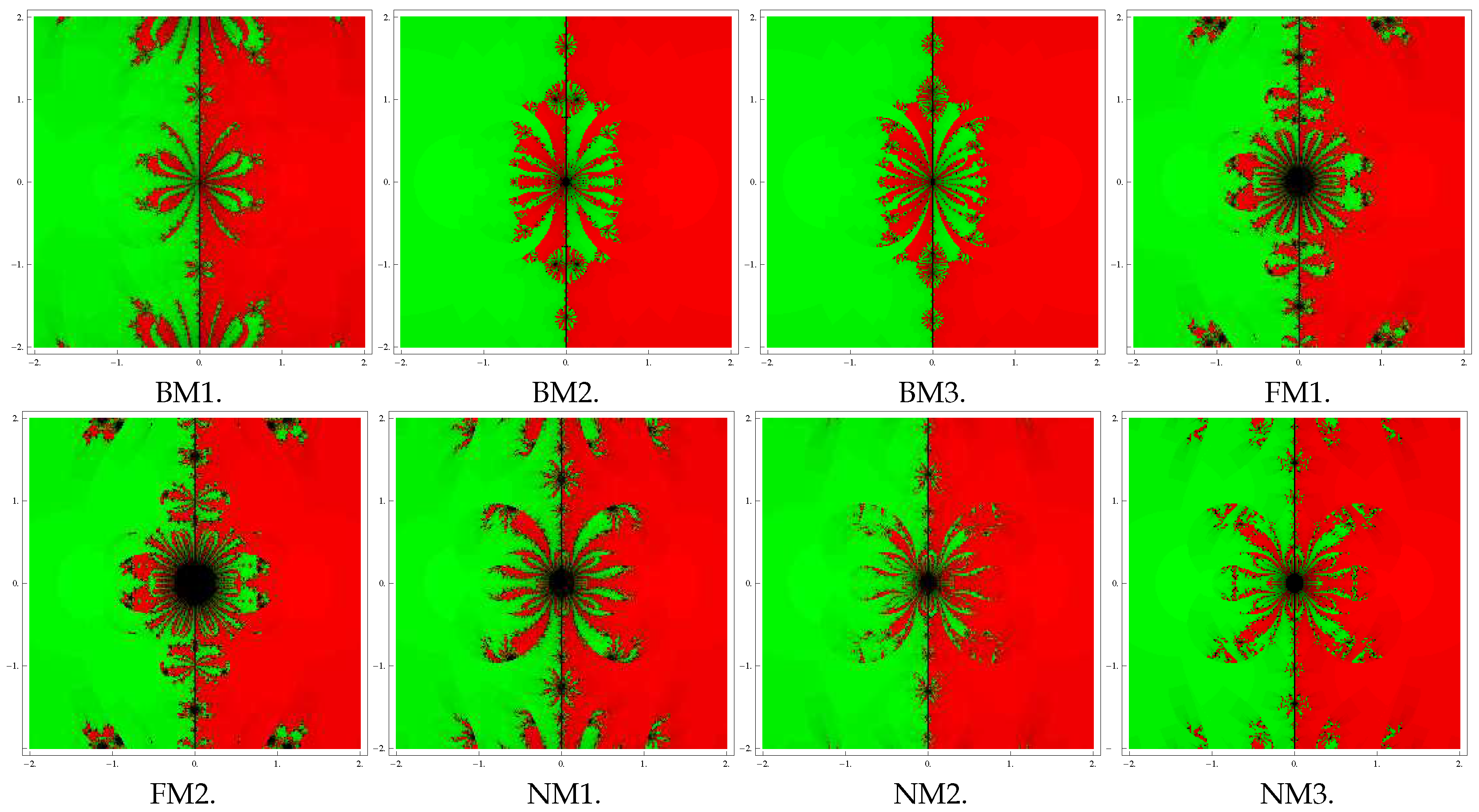
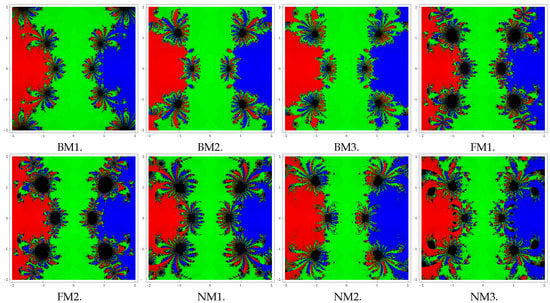
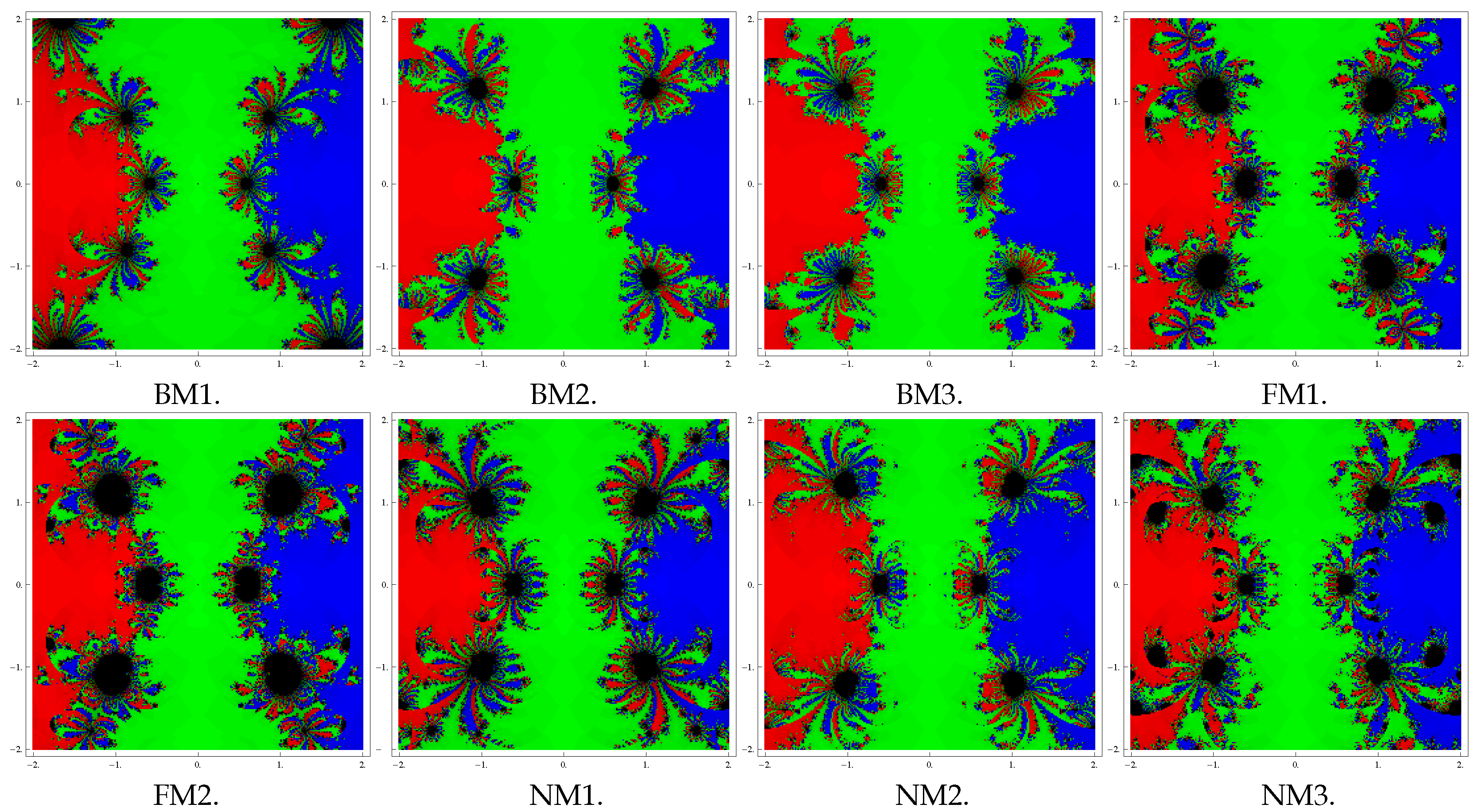
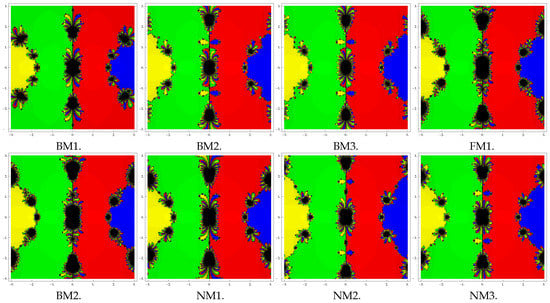
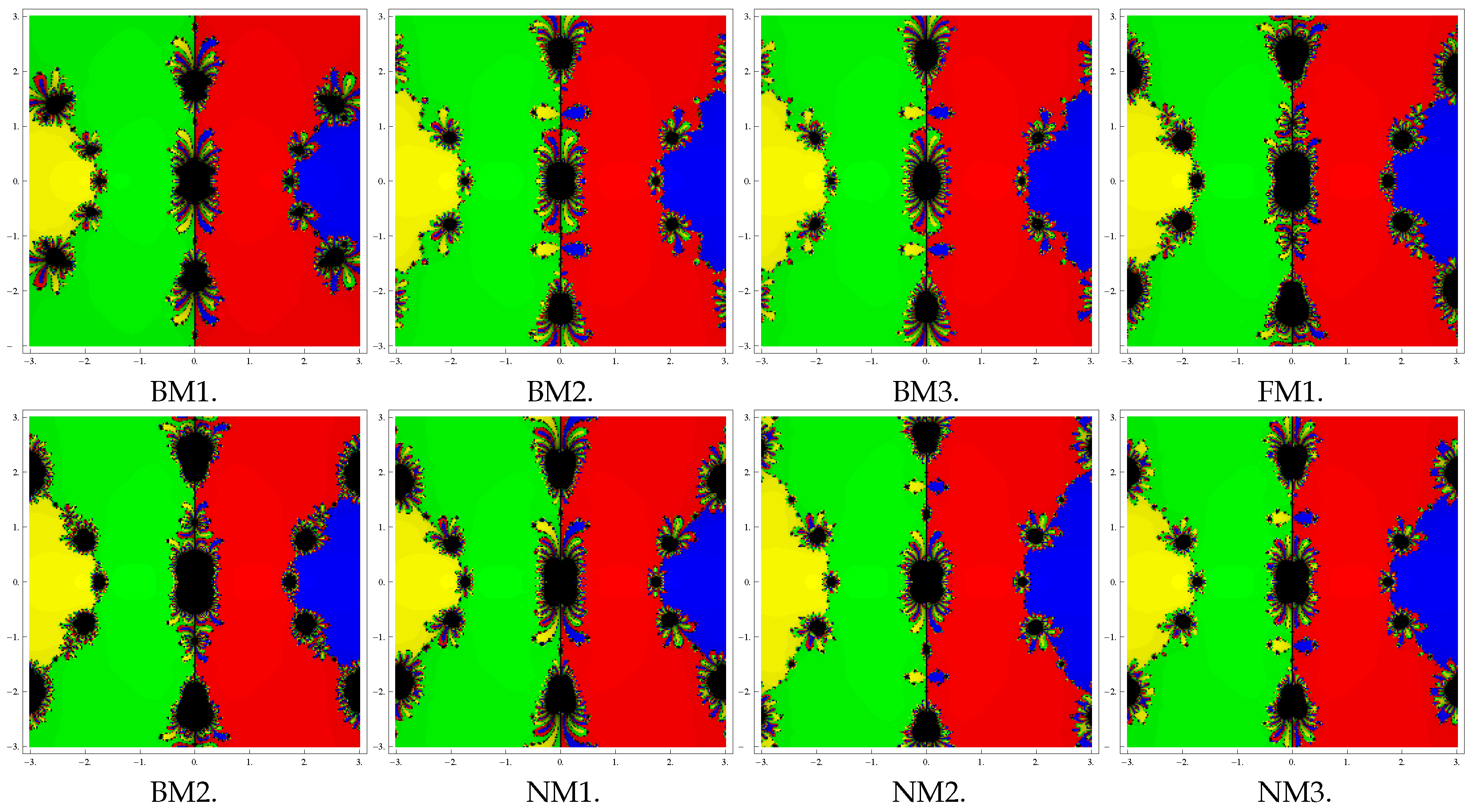
To view the geometry in complex plane, we assess the attraction basins of the roots by applying the methods on some polynomials (see Table 6). The basins of attraction assessed are shown in Figure 1, Figure 2 and Figure 3 for the considered polynomials. To plot basins we use rectangles of size and , and assign different colors to the basins. Black color is assigned to the points for which the method is divergent.
Table 6.
Comparison of performance based on basins of attraction of methods.
Figure 1.
Basins of attraction of , , , , , , , for polynomial .
Figure 2.
Basins of attraction of , , , , , , , for polynomial .
Figure 3.
Basins of attraction of , , , , , , , for polynomial .
From these graphics, one can easily check the behavior and stability of any iterative procedure. If an initial guess is chosen in a region where different basins meet each other, it is difficult to guess which zero is going to be attained by the method that starts in . So, the selection of in such a region is not preferable. Both the black zone (divergent zone) and the zones with different colors are not suitable to consider the initial guess when we want to acquire a unique root. The most adorable pictures can be seen along the boundaries between the basins of attraction. These boundaries have fractal-like pictures and belong to the cases where the method is more demanding with choice of initial point. At such regions, the dynamic behavior of the initial guess is more unpredictable.
6. Conclusions
In this research article, we have developed a class of optimal eighth order methods for locating multiple roots of nonlinear equations with known multiplicity. The analysis of the order of convergence has been discussed, that proves the order eighth under well-known assumptions regarding the nonlinear function whose zeros we are looking for. Some particular cases have been presented and their performance has been compared with well-known methods available in literature. The robustness of new algorithms can be judged by the fact that the accuracy in the successive approximations to the solution is much better compared to the accuracy of existing ones. Moreover, the used CPU time in execution of program is less than that of the CPU time taken by the existing techniques in majority of the cases. These conclusions have also been verified by similar numerical testing on many other different problems.
Author Contributions
Methodology, D.K. and S.K.; Formal analysis, J.R.S.; Investigation, J.R.S.; Data Curation, J.R.S.; Conceptualization, M.d.; Writing—review & editing, D.K. and S.K. All authors have read and agreed to the published version of the manuscript.
Funding
This research received no external funding.
Conflicts of Interest
The authors declare no conflict of interest.
References
- Argyros, I.K. Convergence and Applications of Newton-Type Iterations; Springer: New York, NY, USA, 2008. [Google Scholar]
- Constantinides, A.; Mostoufi, N. Numerical Methods for Chemical Engineers with MATLAB Applications; Prentice Hall PTR: Upper Saddle River, NJ, USA, 1999. [Google Scholar]
- Kung, H.T.; Traub, J.F. Optimal order of one-point and multipoint iteration. J. Assoc. Comput. Mach. 1974, 21, 643–651. [Google Scholar] [CrossRef] [Scilit]
- Ostrowski, A.M. Solution of Equations and Systems of Equations; Academic Press: New York, NY, USA, 1966. [Google Scholar]
- Traub, J.F. Iterative Methods for the Solution of Equations; Chelsea Publishing Company: New York, NY, USA, 1982. [Google Scholar]
- Schröder, E. Über unendlich viele Algorithmen zur Auflösung der Gleichungen. Math. Ann. 1870, 2, 317–365. [Google Scholar] [CrossRef] [Scilit]
- Hansen, E.; Patrick, M. A family of root finding methods. Numer. Math. 1977, 27, 257–269. [Google Scholar] [CrossRef] [Scilit]
- Victory, H.D.; Neta, B. A higher order method for multiple zeros of nonlinear functions. Int. J. Comput. Math. 1983, 12, 329–335. [Google Scholar] [CrossRef] [Scilit]
- Osada, N. An optimal multiple root-finding method of order three. J. Comput. Appl. Math. 1994, 51, 131–133. [Google Scholar] [CrossRef] [Scilit]
- Li, S.; Liao, X.; Cheng, L. A new fourth-order iterative method for finding multiple roots of nonlinear equations. Appl. Math. Comput. 2009, 215, 1288–1292. [Google Scholar]
- Li, S.G.; Cheng, L.Z.; Neta, B. Some fourth-order nonlinear solvers with closed formulae for multiple roots. Comput Math. Appl. 2010, 59, 126–135. [Google Scholar] [CrossRef] [Scilit]
- Sharma, J.R.; Sharma, R. Modified Jarratt method for computing multiple roots. Appl. Math. Comput. 2010, 217, 878–881. [Google Scholar] [CrossRef] [Scilit]
- Neta, B. Extension of Murakamis high-order nonlinear solver to multiple roots. Int. J. Comput. Math. 2010, 87, 1023–1031. [Google Scholar] [CrossRef] [Scilit]
- Zhou, X.; Chen, X.; Song, Y. Constructing higher-order methods for obtaining the multiple roots of nonlinear equations. J. Comput. Math. Appl. 2011, 235, 4199–4206. [Google Scholar] [CrossRef] [Scilit]
- Sharifi, M.; Babajee, D.K.R.; Soleymani, F. Finding the solution of nonlinear equations by a class of optimal methods. Comput. Math. Appl. 2012, 63, 764–774. [Google Scholar] [CrossRef] [Scilit]
- Soleymani, F.; Babajee, D.K.R.; Lotfi, T. On a numerical technique for finding multiple zeros and its dynamics. J. Egypt. Math. Soc. 2013, 21, 346–353. [Google Scholar] [CrossRef] [Scilit]
- Geum, Y.H.; Kim, Y.I.; Neta, B. A class of two-point sixth-order multiple-zero finders of modified double-Newton type and their dynamics. Appl. Math. Comput. 2015, 270, 387–400. [Google Scholar] [CrossRef] [Scilit]
- Kansal, M.; Kanwar, V.; Bhatia, S. On some optimal multiple root-finding methods and their dynamics. Appl. Appl. Math. 2015, 10, 349–367. [Google Scholar]
- Soleymani, F.; Babajee, D.K.R. Computing multiple zeros using a class of quartically convergent methods. Alex. Eng. J. 2013, 52, 531–541. [Google Scholar] [CrossRef] [Scilit]
- Liu, B.; Zhou, X. A new family of fourth-order methods for multiple roots of nonlinear equations. Nonlinear Anal. Model. Cont. 2013, 18, 143–152. [Google Scholar] [CrossRef] [Scilit]
- Zhou, X.; Chen, X.; Song, Y. Families of third and fourth order methods for multiple roots of nonlinear equations. Appl. Math. Comput. 2013, 219, 6030–6038. [Google Scholar] [CrossRef] [Scilit]
- Thukral, R. A new family of fourth-order iterative methods for solving nonlinear equations with multiple roots. J. Numer. Math. Stoch. 2014, 6, 37–44. [Google Scholar]
- Behl, R.; Cordero, A.; Motsa, S.S.; Torregrosa, J.R. On developing fourth-order optimal families of methods for multiple roots and their dynamics. Appl. Math. Comput. 2015, 265, 520–532. [Google Scholar] [CrossRef] [Scilit]
- Hueso, J.L.; Martz, E.; Teruel, C. Determination of multiple roots of nonlinear equations and applications. J. Math. Chem. 2015, 53, 880–892. [Google Scholar] [CrossRef] [Scilit]
- Behl, R.; Cordero, A.; Motsa, S.S.; Torregrosa, J.R.; Kanwar, V. An optimal fourth-order family of methods for multiple roots and its dynamics. Numer. Algorithms 2016, 71, 775–796. [Google Scholar] [CrossRef] [Scilit]
- Geum, Y.H.; Kim, Y.I.; Neta, B. A sixth-order family of three-point modified Newton-like multiple-root finders and the dynamics behind their extraneous fixed points. Appl. Math. Comput. 2016, 283, 120–140. [Google Scholar] [CrossRef] [Scilit]
- Behl, R.; Cordero, A.; Motsa, S.S.; Torregrosa, J.R. An eighth-order family of optimal multiple root finders and its dynamics. Numer. Algorithms 2018, 77, 1249–1272. [Google Scholar] [CrossRef] [Scilit]
- Zafar, F.; Cordero, A.; Rana, Q.; Torregrosa, J.R. Optimal iterative methods for finding multiple roots of nonlinear equations using free parameters. J. Math. Chem. 2018, 56, 1884–1901. [Google Scholar] [CrossRef] [Scilit]
- Geum, Y.H.; Kim, Y.I.; Neta, B. Constructing a family of optimal eighth-order modified Newton-type multiple-zero finders along with the dynamics behind their purely imaginary extraneous fixed points. J. Comput. Appl. Math. 2018, 333, 131–156. [Google Scholar] [CrossRef] [Scilit]
- Behl, R.; Zafar, F.; Alshomrani, A.S.; Junjua, M.; Yasmin, N. An optimal eighth-order scheme for multiple zeros of univariate function. Int. J. Comput. Math. 2018, 15, 14. [Google Scholar] [CrossRef] [Scilit]
- Behl, R.; Alshomrani, A.S.; Motsa, S.S. An optimal scheme for multiple roots of nonlinear equations with eighth-order convergence. J. Math. Chem. 2018, 56, 2069–2084. [Google Scholar] [CrossRef] [Scilit]
- Zafar, F.; Cordero, A.; Torregrosa, J.R. An efficient family of optimal eighth-order multiple root finder. Mathematics 2018, 6, 310. [Google Scholar] [CrossRef] [Scilit]
- Weerakoon, S.; Fernando, T.G.I. A variant of Newton’s method with accelerated third-order convergence. Appl. Math. Lett. 2000, 13, 87–93. [Google Scholar] [CrossRef] [Scilit]
- Vrscay, E.R.; Gilbert, W.J. Extraneous fixed points, basin boundaries and chaotic dynamics for Schröder and König rational iteration functions. Numer. Math. 1988, 52, 1–16. [Google Scholar] [CrossRef] [Scilit]
- Varona, J.L. Graphic and numerical comparison between iterative methods. Math. Intell. 2002, 24, 37–46. [Google Scholar] [CrossRef] [Scilit]
- Scott, M.; Neta, B.; Chun, C. Basin attractors for various methods. Appl. Math. Comput. 2011, 218, 2584–2599. [Google Scholar] [CrossRef] [Scilit]

Publisher’s Note: MDPI stays neutral with regard to jurisdictional claims in published maps and institutional affiliations. |
© 2020 by the authors. Licensee MDPI, Basel, Switzerland. This article is an open access article distributed under the terms and conditions of the Creative Commons Attribution (CC BY) license (http://creativecommons.org/licenses/by/4.0/).