

Cattaneo–Christov Heat Flux Model for Three-Dimensional Rotating Flow of SWCNT and MWCNT Nanofluid with Darcy–Forchheimer Porous Medium Induced by a Linearly Stretchable Surface



Abstract
1. Introduction
2. Effective Thermal Conductivity Models Available in the Literature
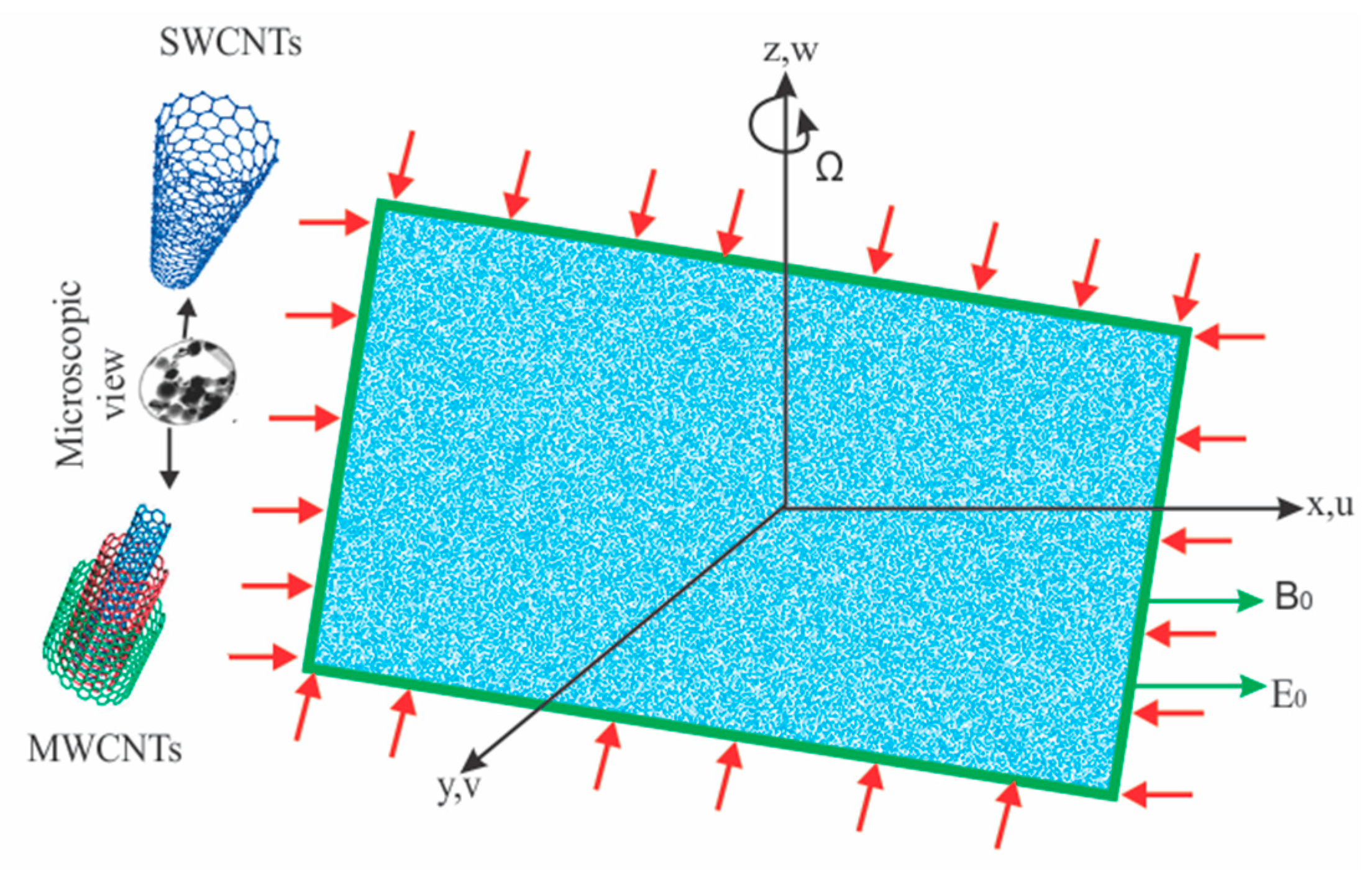
3. Formulation of the Problem
4. Results and Discussion
5. Table Discussion
6. Conclusions
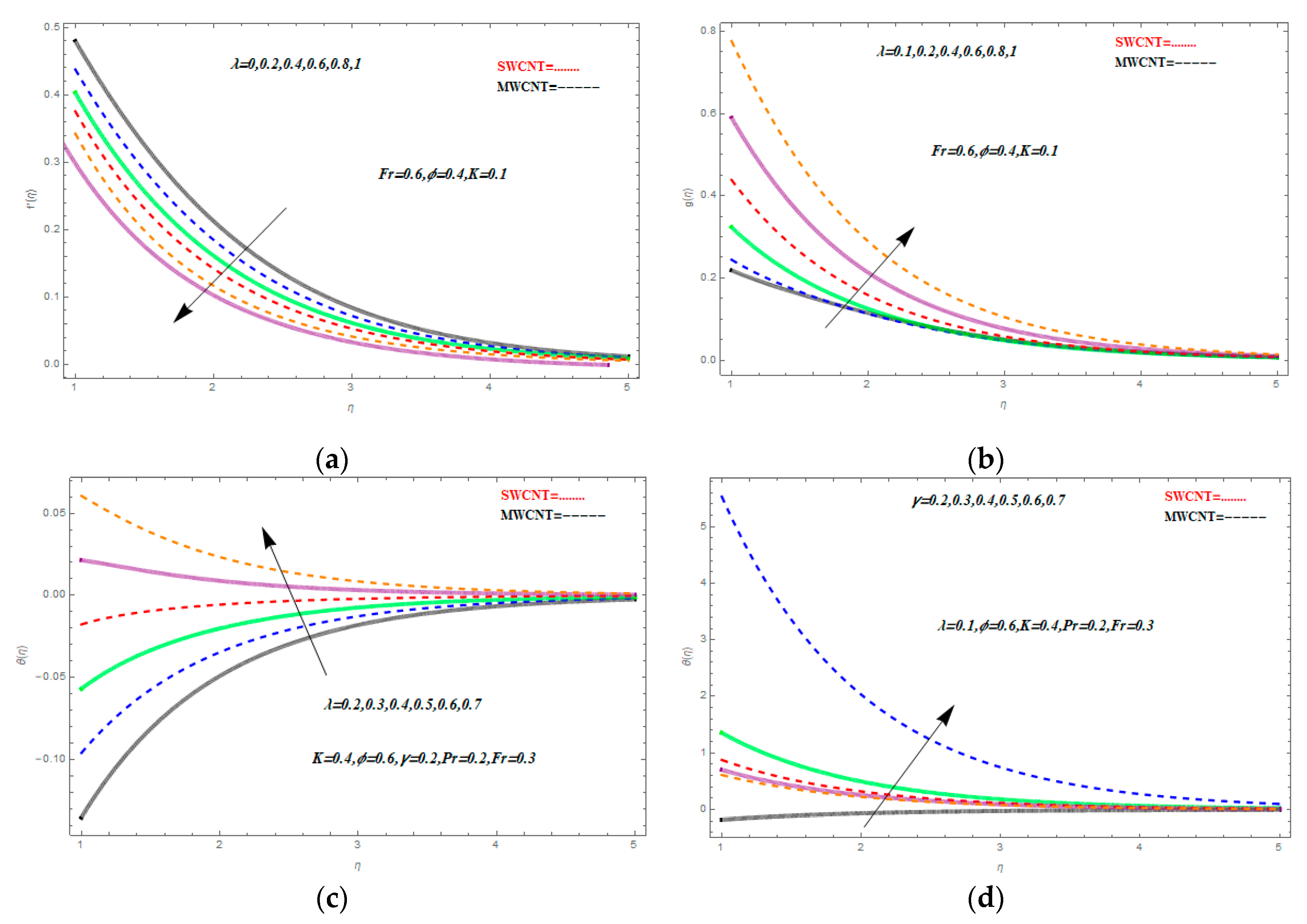
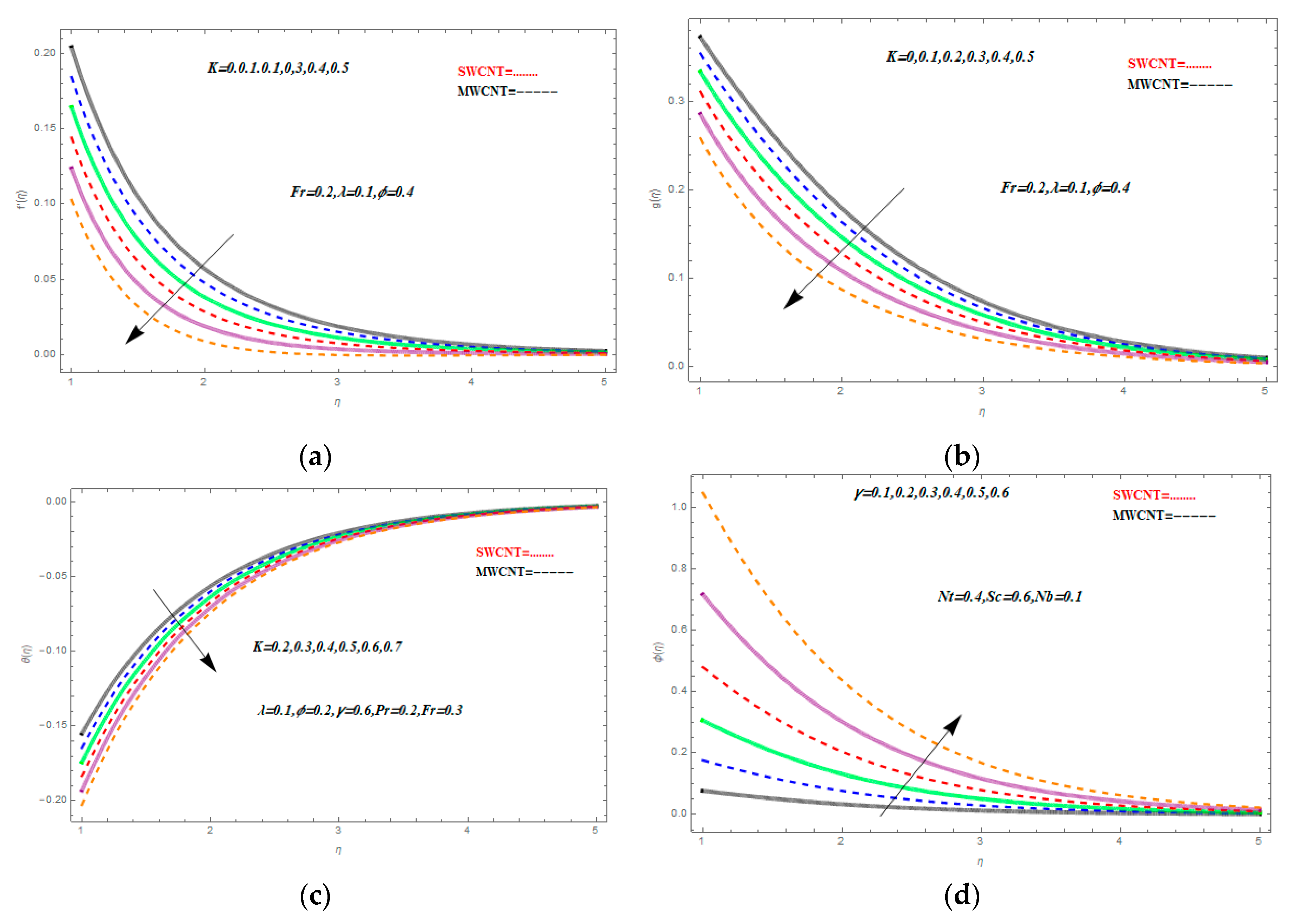
- It was observed that greater porosity parameter values reduced while increasing and also increasing temperature field for SWCNTs and MWCNTs.
- Greater Biot number yields stronger convection, which results in a greater temperature field and hotter sheet wideness.
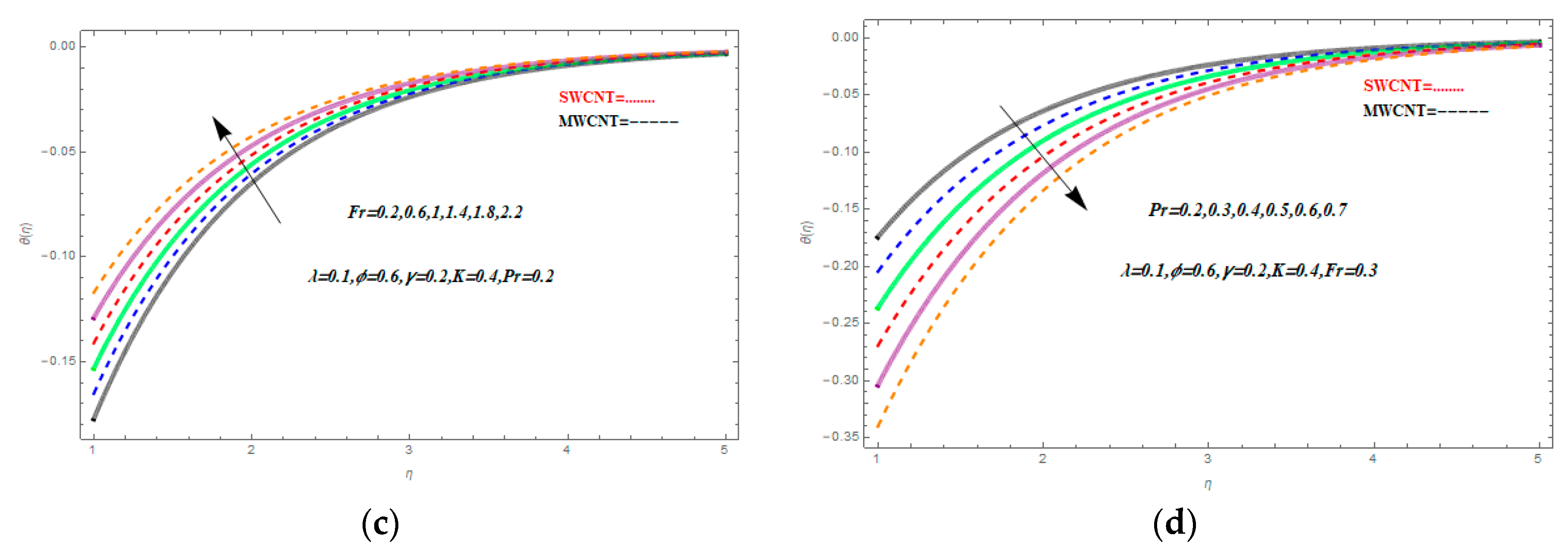
- Greater rotational parameter values resulted in greater rotational rates than tensile rates. The higher value of increased the fluid velocity.
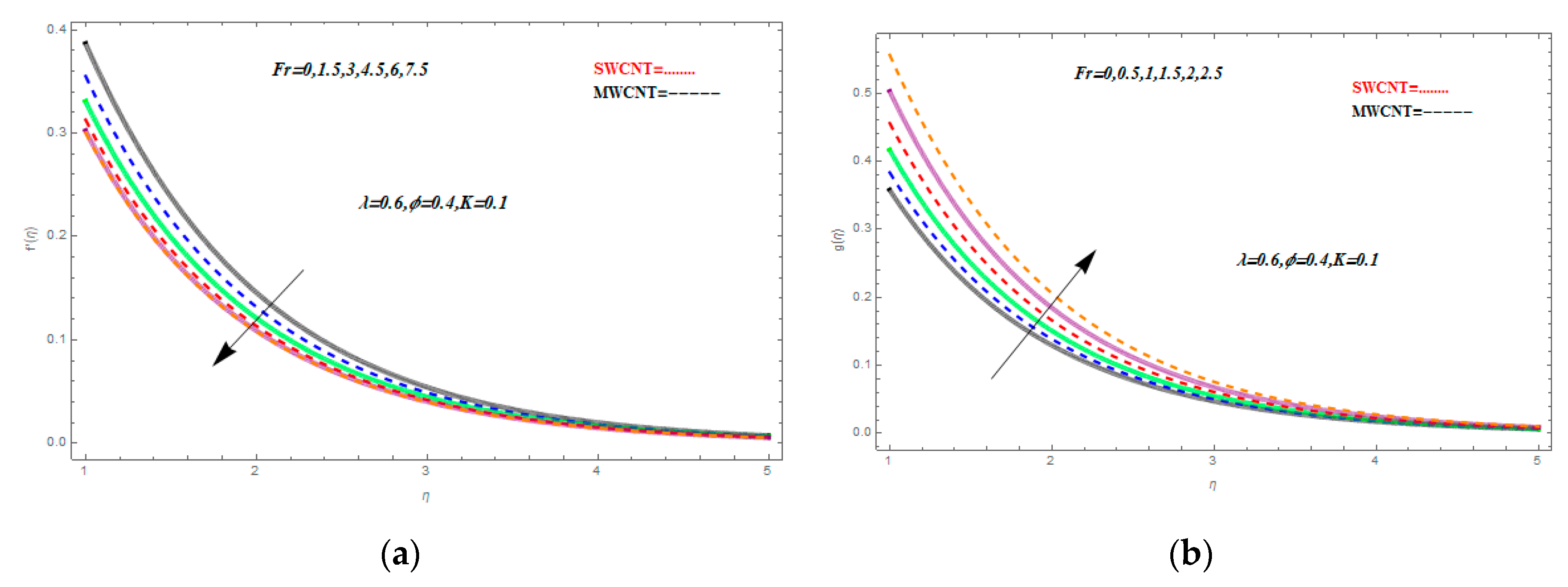
- It was observed that greater values of inertia coefficients resulted in the decline of the velocity field.
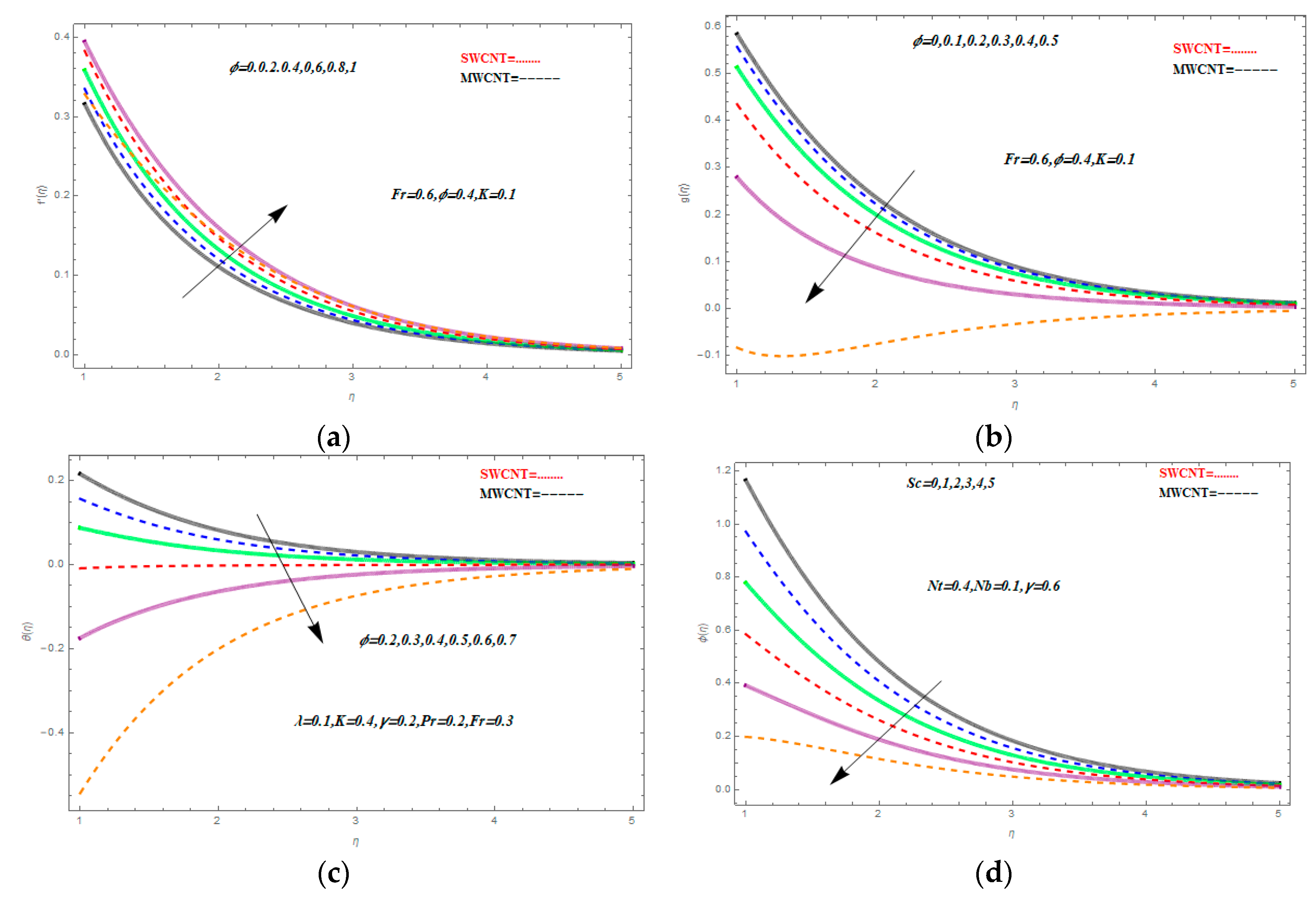
- The higher value of the nanoparticle capacity fraction increased the velocity field and decreased temperature.
- Higher values of indicated enhancement in
- Greater values of showed reduction in .
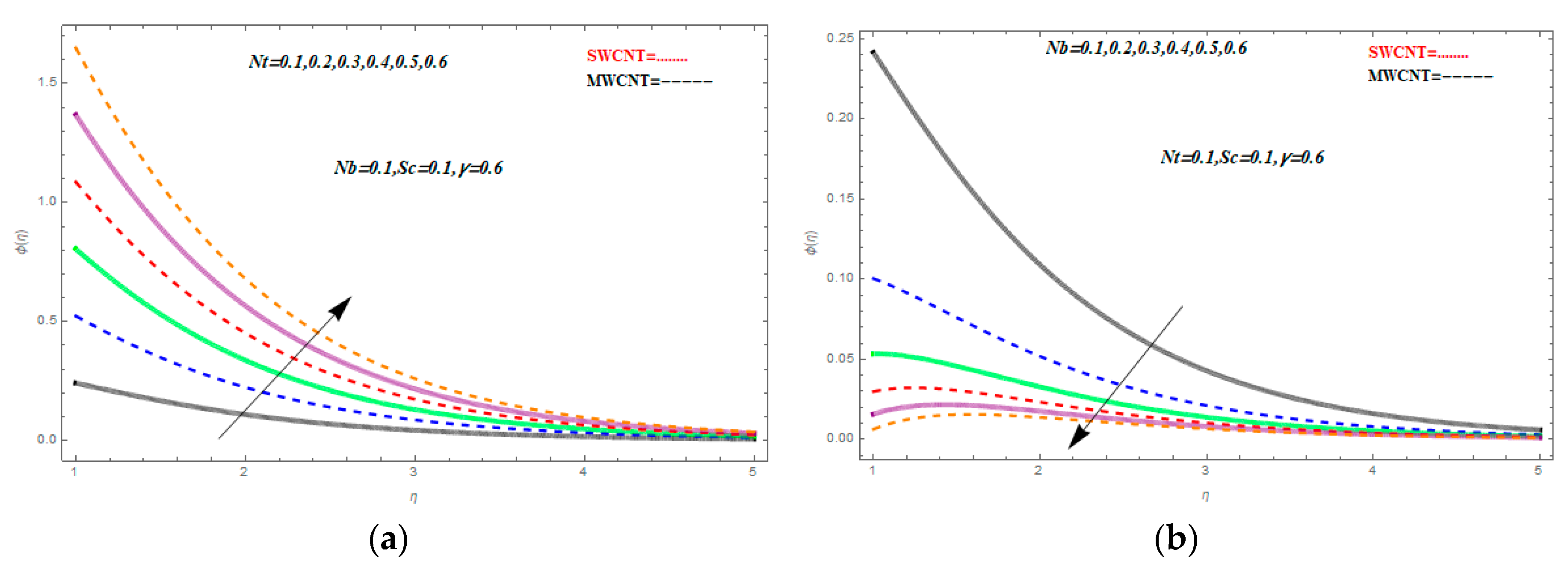
- Larger values of demoted nanoparticle concentration
- It was perceived that increasing values of , , and increased and for SWCNT nanofluid. Similar results were obtained for MWCNTs.
- The higher values of and reduced the heat flux as well as the mass flux, while increasing decreased it for both SWCNTs and MWCNTs.
Author Contributions
Funding
Conflicts of Interest
References
- Choi, S.U.S.; Zhang, Z.G.; Yu, W.; Lockwood, F.E.; Grulke, E.A. Anomalous thermal conductivity enhancement in nanotube suspensions. Appl. Phys. Lett. 2001, 79, 2252–2254. [Google Scholar] [CrossRef] [Scilit]
- Hsiao, K. To promote radiation electrical MHD activation energy thermal extrusion manufacturing system efficiency by using Carreau-Nanofluid with parameters control method. Energy 2017, 130, 486–499. [Google Scholar] [CrossRef] [Scilit]
- Hsiao, K. Combined Electrical MHD Heat Transfer Thermal Extrusion System Using Maxwell Fluid with Radiative and Viscous Dissipation Effects. Appl. Therm. Eng. 2017, 112, 1281–1288. [Google Scholar] [CrossRef] [Scilit]
- Shah, Z.; Dawar, A.; Islam, S.; Khan, I.; Ching, D.L.C. Darcy-Forchheimer Flow of Radiative Carbon Nanotubes with Microstructure and Inertial Characteristics in the Rotating Frame. Case Stud. Therm. Eng. 2018, 12, 823–832. [Google Scholar] [CrossRef] [Scilit]
- Xue, Q.Z. Model for thermal conductivity of carbon nanotube-based composites. Phys. B Condens. Matter 2005, 368, 302–307. [Google Scholar] [CrossRef] [Scilit]
- Nasir, N.; Shah, Z.; Islam, S.; Bonyah, E.; Gul, T. Darcy Forchheimer nanofluid thin film flow of SWCNTs and heat transfer analysis over an unsteady stretching sheet. AIP Adv. 2019, 9, 015223. [Google Scholar] [CrossRef] [Scilit]
- Ellahi, R.; Hassan, M.; Zeeshan, A. Study of natural convection MHD nanofluid by means of single and multi-walled carbon nanotubes suspended in a salt-water solution. IEEE Trans. Nanotechnol. 2015, 14, 726–734. [Google Scholar] [CrossRef] [Scilit]
- Shah, Z.; Islam, S.; Ayaz, H.; Khan, S. The electrical MHD and hall current impact on micropolar nanofluid flow between rotating parallel plates. Results Phys. 2018, 9, 1201–1214. [Google Scholar] [CrossRef] [Scilit]
- Shah, Z.; Islam, S. Radiative heat and mass transfer analysis of micropolar nanofluid flow of Casson fluid between two rotating parallel plates with effects of Hall current. ASME J. Heat Transf. 2019, 141, 022401. [Google Scholar] [CrossRef] [Scilit]
- Hayat, T.; Haider, F.; Muhammad, T.; Alsaedi, A. On Darcy-Forchheimer flow of carbon nanotubes due to a rotating disk. Int. J. Heat Mass Transf. 2017, 112, 248–254. [Google Scholar] [CrossRef] [Scilit]
- Wang, C.Y. Stretching a surface in a rotating fluid. Zeitschrift für angewandte Mathematik und Physik ZAMP 1988, 39, 177–185. [Google Scholar] [CrossRef] [Scilit]
- Takhar, H.S.; Chamkha, A.J.; Nath, G. Flow and heat transfer on a stretching surface in a rotating fluid with a magnetic field. Int. J. Therm. Sci. 2003, 42, 23–31. [Google Scholar] [CrossRef] [Scilit]
- Shah, Z.; Bonyah, E.; Islam, S.; Gul, T. Impact of thermal radiation on electrical mhd rotating flow of carbon nanotubes over a stretching sheet. Aip Adv. 2019, 9, 015115. [Google Scholar] [CrossRef] [Scilit]
- Shah, Z.; Dawar, A.; Islam, S.; Khan, I.; Ching, D.L.C.; Khan, Z.A. Cattaneo-Christov model for Electrical MagnetiteMicropoler Casson Ferrofluid over a stretching/shrinking sheet using effective thermal conductivity model. Case Stud. Therm. Eng. 2018. [Google Scholar] [CrossRef] [Scilit]
- Shah, Z.; Gul, T.; Khan, A.M.; Ali, I.; Islam, S. Effects of hall current on steady three dimensional non-newtonian nanofluid in a rotating frame with brownian motion and thermophoresis effects. J. Eng. Technol. 2017, 6, 280–296. [Google Scholar]
- Rosali, H.; Ishak, A.; Nazar, R.; Pop, I. Rotating flow over an exponentially shrinking sheet with suction. J. Mol. Liquids 2015, 211, 965–969. [Google Scholar] [CrossRef] [Scilit]
- Hayat, T.; Qayyum, S.; Imtiaz, M.; Alsaedi, A. Three-dimensional rotating flow of Jeffrey fluid for Cattaneo-Christov heat flux model. AIP Adv. 2016, 6, 025012. [Google Scholar] [CrossRef] [Scilit]
- Mustafa, M.; Mushtaq, A.; Hayat, T.; Alsaedi, A. Rotating flow of magnetite-water nanofluid over a stretching surface inspired by non-linear thermal radiation. PLoS ONE 2016, 11, e0149304. [Google Scholar] [CrossRef] [Scilit] [PubMed]
- Sheikholeslami, M.; Shah, Z.; Shafi, A.; Khan, I.; Itili, I. Uniform magnetic force impact on water based nanofluid thermal behavior in a porous enclosure with ellipse shaped obstacle. Sci. Rep. 2019, 9, 1196. [Google Scholar] [CrossRef] [Scilit] [PubMed]
- Hsiao, K. Micropolar Nanofluid Flow with MHD and Viscous Dissipation Effects Towards a Stretching Sheet with Multimedia Feature. Int. J. Heat Mass Transf. 2017, 112, 983–990. [Google Scholar] [CrossRef] [Scilit]
- Hsiao, K. Stagnation Electrical MHD Nanofluid Mixed Convection with Slip Boundary on a Stretching Sheet. Appl. Therm. Eng. 2016, 98, 850–861. [Google Scholar] [CrossRef] [Scilit]
- Khan, A.; Shah, Z.; Islam, S.; Khan, S.; Khan, W.; Khan, Z.A. Darcy–Forchheimer flow of micropolar nanofluid between two plates in the rotating frame with non-uniform heat generation/absorption. Adv. Mech. Eng. 2018, 10, 1–16. [Google Scholar] [CrossRef] [Scilit]
- Khan, A.; Shah, Z.; Islam, S.; Dawar, A.; Bonyah, E.; Ullah, H.; Khan, Z.A. Darcy-Forchheimer flow of MHD CNTs nanofluid radiative thermal behaviour andconvective non uniform heat source/sink in the rotating frame with microstructureand inertial characteristics. AIP Adv. 2018, 8, 125024. [Google Scholar] [CrossRef] [Scilit]
- Fourier, J. Theorie Analytique de la Chaleur, par M. Fourier; Chez Firmin Didot, père et Fils. 1822. Available online: https://gallica.bnf.fr/ark:/12148/bpt6k1045508v.texteImage (accessed on 1 January 2019).
- Cattaneo, C. Sulla conduzione del calore. Atti Sem. Mat. Fis. Univ. Modena 1948, 3, 83–101. [Google Scholar]
- Tibullo, V.; Zampoli, V. A uniqueness result for the Cattaneo–Christov heat conduction model applied to incompressible fluids. Mech. Res. Commun. 2011, 38, 77–79. [Google Scholar] [CrossRef] [Scilit]
- Christov, C.I. On frame indifferent formulation of the Maxwell–Cattaneo model of finite-speed heat conduction. Mech. Res. Commun. 2009, 36, 481–486. [Google Scholar] [CrossRef] [Scilit]
- Straughan, B. Thermal convection with the Cattaneo–Christov model. Int. J. Heat Mass Transf. 2010, 53, 95–98. [Google Scholar] [CrossRef] [Scilit]
- Ciarletta, M.; Straughan, B. Uniqueness and structural stability for the Cattaneo–Christov equations. Mech. Res. Commun. 2010, 37, 445–447. [Google Scholar] [CrossRef] [Scilit]
- Han, S.; Zheng, L.; Li, C.; Zhang, X. Coupled flow and heat transfer in viscoelastic fluid with Cattaneo–Christov heat flux model. Appl. Math. Lett. 2014, 38, 87–93. [Google Scholar] [CrossRef] [Scilit]
- Feroz, N.; Shah, Z.; Islam, S.; Alzahrani, E.O.; Khan, W. Entropy Generation of Carbon Nanotubes Flow in a Rotating Channel with Hall and Ion-Slip Effect Using Effective Thermal Conductivity Model. Entropy 2019, 21, 52. [Google Scholar] [CrossRef] [Scilit]
- Alharbi, S.O.; Dawar, A.; Shah, Z.; Khan, W.; Idrees, M.; Islam, S.; Khan, I. Entropy Generation in MHD Eyring–Powell Fluid Flow over an Unsteady Oscillatory Porous Stretching Surface under the Impact of Thermal Radiation and Heat Source/Sink. Appl. Sci. 2018, 8, 2588. [Google Scholar] [CrossRef] [Scilit]
- Khan, N.S.; Shah, Z.; Islam, S.; Khan, I.; Alkanhal, T.A.; Tlili, I. Entropy Generation in MHD Mixed Convection Non-Newtonian Second-Grade Nanoliquid Thin Film Flow through a Porous Medium with Chemical Reaction and Stratification. Entropy 2019, 21, 139. [Google Scholar] [CrossRef] [Scilit]
- Ishaq, M.; Ali, G.; Shah, Z.; Islam, S.; Muhammad, S. Entropy Generation on Nanofluid Thin Film Flow of Eyring–Powell Fluid with Thermal Radiation and MHD Effect on an Unsteady Porous Stretching Sheet. Entropy 2018, 20, 412. [Google Scholar] [CrossRef] [Scilit]
- Dawar, A.; Shah, Z.; Khan, W.; Idrees, M.; Islam, S. Unsteady squeezing flow of MHD CNTS nanofluid in rotating channels with Entropy generation and viscous Dissipation. Adv. Mech. Eng. 2019, 10, 1–18. [Google Scholar] [CrossRef] [Scilit]
- Sheikholeslami, M.; Shah, Z.; Tassaddiq, A.; Shafee, A.; Khan, I. Application of Electric Field for Augmentation of Ferrofluid Heat Transfer in an Enclosure including Double Moving Walls. IEEE Access 2019. [Google Scholar] [CrossRef] [Scilit]
- Liao, S. Notes on the homotopy analysis method: Some definitions and theorems. Commun. Nonlinear Sci. Numer. Simul. 2009, 14, 983–997. [Google Scholar] [CrossRef] [Scilit]
- Shah, Z.; Bonyah, E.; Islam, S.; Khan, W.; Ishaq, M. Radiative MHD thin film flow of Williamson fluid over an unsteady permeable stretching. Heliyon 2018, 4, e00825. [Google Scholar] [CrossRef] [Scilit] [PubMed]
- Jawad, M.; Shah, Z.; Islam, S.; Islam, S.; Bonyah, E.; Khan, Z.A. Darcy-Forchheimer flow of MHD nanofluid thin film flow with Joule dissipation and Navier’s partial slip. J. Phys. Commun. 2018. [Google Scholar] [CrossRef] [Scilit]
- Khan, N.; Zuhra, S.; Shah, Z.; Bonyah, E.; Khan, W.; Islam, S. Slip flow of Eyring-Powell nanoliquid film containing graphene nanoparticles. AIP Adv. 2018, 8, 115302. [Google Scholar] [CrossRef] [Scilit]
- Fiza, M.; Islam1, S.; Ullah, H.; Shah, Z.; Chohan, F. An Asymptotic Method with Applications to Nonlinear Coupled Partial Differential Equations. Punjab Univ. J. Math. 2018, 50, 139–151. [Google Scholar]
- Ali, A.; Sulaiman, M.; Islam, S.; Shah, Z.; Bonyah, E. Three-dimensional magnetohydrodynamic (MHD) flow of Maxwell nanofl uid containing gyrotactic micro-organisms with heat source/sink. AIP Adv. 2018, 8, 085303. [Google Scholar] [CrossRef] [Scilit]
- Dawar, A.; Shah, Z.; Idrees, M.; Khan, W.; Islam, S.; Gul, T. Impact of Thermal Radiation and Heat Source/Sink on Eyring–Powell Fluid Flow over an Unsteady Oscillatory Porous Stretching Surface. Math. Comput. Appl. 2018, 23, 20. [Google Scholar] [CrossRef] [Scilit]
- Hammed, K.; Haneef, M.; Shah, Z.; Islam, I.; Khan, W.; Asif, S.M. The Combined Magneto hydrodynamic and electric field effect on an unsteady Maxwell nanofluid Flow over a Stretching Surface under the Influence of Variable Heat and Thermal Radiation. Appl. Sci. 2018, 8, 160. [Google Scholar] [CrossRef] [Scilit]
- Khan, A.S.; Nie, Y.; Shah, Z.; Dawar, A.; Khan, W.; Islam, S. Three-Dimensional Nanofluid Flow with Heat and Mass Transfer Analysis over a Linear Stretching Surface with Convective Boundary Conditions. Appl. Sci. 2018, 8, 2244. [Google Scholar] [CrossRef] [Scilit]
- Maxwell, J.C. Electricity and Magnetism, 3rd ed.; Clarendon: Oxford, UK, 1904. [Google Scholar]
- Jawad, M.; Shah, Z.; Islam, S.; Majdoubi, J.; Tlili, I.; Khan, W.; Khan, I. Impact of Nonlinear Thermal Radiation and the Viscous Dissipation Effect on the Unsteady Three-Dimensional Rotating Flow of Single-Wall Carbon Nanotubes with Aqueous Suspensions. Symmetry 2019, 11, 207. [Google Scholar] [CrossRef] [Scilit]
- Jeffrey, D.J. Conduction through a random suspension of spheres. Proc. R. Soc. Lond. A 1973, 335, 355–367. [Google Scholar] [CrossRef] [Scilit]
- Davis, R.H. The effective thermal conductivity of a composite material with spherical inclusions. Int. J. Thermophys. 1986, 7, 609–620. [Google Scholar] [CrossRef] [Scilit]
- Hamilton, R.L.; Crosser, O.K. Thermal conductivity of heterogeneous two-component systems. Ind. Eng. Chem. Fundam. 1962, 1, 187–191. [Google Scholar] [CrossRef] [Scilit]

| SWCNT | MWCNT | SWCNT | MWCNT | ||||
|---|---|---|---|---|---|---|---|
| 0.0 | 0.1 | 0.1 | 0.1 | 1.03466 | 1.14536 | ||
| 0.1 | – | – | – | 1.12687 | 1.19880 | ||
| 0.3 | – | – | – | 1.14350 | 1.24368 | ||
| 0.1 | 0.0 | – | – | 1.04576 | 1.13667 | ||
| – | 0.3 | – | 0.23571 | 1.17462 | |||
| – | 0.5 | – | – | 0.02547 | 1.32445 | ||
| – | 0.1 | 0.0 | – | 0.23419 | 1.03462 | ||
| – | – | 0.3 | – | 1.45483 | 1.100344 | ||
| – | – | 0.5 | – | 1.52445 | 1.37352 | ||
| – | – | 0.1 | 0.1 | 1.69222 | 1.57245 | 1.72350 | 1.22359 |
| – | – | – | 0.3 | 1.62355 | 1.31912 | ||
| – | – | – | 0.5 | 1.92365 | 1.81199 | 1.90843 | 1.59331 |
| SWCNT | MWCNT | SWCNT | MWCNT | |||||
|---|---|---|---|---|---|---|---|---|
| 0.0 | 0.1 | 0.1 | 0.1 | 0.1 | 0.231567 | |||
| 0.1 | – | – | – | – | 0.231390 | |||
| 0.3 | – | – | – | – | 0.233321 | |||
| 0.1 | 0.0 | – | – | – | 0.134136 | |||
| – | 0.3 | – | – | – | 0.134342 | |||
| – | 0.5 | – | – | – | 0.134351 | |||
| – | 0.1 | 0.3 | – | – | 0.261532 | |||
| – | – | 0.5 | – | – | 0.261531 | |||
| – | – | 0.8 | – | – | 0.261530 | |||
| – | – | 0.1 | 0.5 | – | 0.156382 | |||
| – | – | – | 1.0 | – | 0.234521 | |||
| – | – | – | 1.5 | – | 0.267373 | |||
| – | – | – | 0.1 | 0.5 | 0.234536 | |||
| – | – | – | – | 1.0 | 0.198342 | |||
| – | – | – | – | 1.5 | 0.162455 | |||
© 2019 by the authors. Licensee MDPI, Basel, Switzerland. This article is an open access article distributed under the terms and conditions of the Creative Commons Attribution (CC BY) license (http://creativecommons.org/licenses/by/4.0/).
Share and Cite
Shah, Z.; Tassaddiq, A.; Islam, S.; Alklaibi, A.M.; Khan, I. Cattaneo–Christov Heat Flux Model for Three-Dimensional Rotating Flow of SWCNT and MWCNT Nanofluid with Darcy–Forchheimer Porous Medium Induced by a Linearly Stretchable Surface. Symmetry 2019, 11, 331. https://doi.org/10.3390/sym11030331
Shah Z, Tassaddiq A, Islam S, Alklaibi AM, Khan I. Cattaneo–Christov Heat Flux Model for Three-Dimensional Rotating Flow of SWCNT and MWCNT Nanofluid with Darcy–Forchheimer Porous Medium Induced by a Linearly Stretchable Surface. Symmetry. 2019; 11(3):331. https://doi.org/10.3390/sym11030331
Chicago/Turabian StyleShah, Zahir, Asifa Tassaddiq, Saeed Islam, A.M. Alklaibi, and Ilyas Khan. 2019. "Cattaneo–Christov Heat Flux Model for Three-Dimensional Rotating Flow of SWCNT and MWCNT Nanofluid with Darcy–Forchheimer Porous Medium Induced by a Linearly Stretchable Surface" Symmetry 11, no. 3: 331. https://doi.org/10.3390/sym11030331
APA StyleShah, Z., Tassaddiq, A., Islam, S., Alklaibi, A. M., & Khan, I. (2019). Cattaneo–Christov Heat Flux Model for Three-Dimensional Rotating Flow of SWCNT and MWCNT Nanofluid with Darcy–Forchheimer Porous Medium Induced by a Linearly Stretchable Surface. Symmetry, 11(3), 331. https://doi.org/10.3390/sym11030331


