You are currently viewing a new version of our website. To view the old version click .
Symmetry
  • Article
  • Open Access

1 February 2019

A New Design for Alignment-Free Chaffed Cancelable Iris Key Binding Scheme


,
,
and
1
Lee Kong Chian Faculty of Engineering Science, Universiti Tunku Abdul Rahman, Bandar Sg. Long, Kajang 43000, Malaysia
2
School of Information Technology, Advanced Engineering Platform, Monash University, Subang Jaya 47500, Malaysia
*
Author to whom correspondence should be addressed.

Abstract

Iris has been found to be unique and consistent over time despite its random nature. Unprotected biometric (iris) template raises concerns in security and privacy, as numerous large-scale iris recognition projects have been deployed worldwide—for instance, susceptibility to attacks, cumbersome renewability, and cross-matching. Template protection schemes from biometric cryptosystems and cancelable biometrics are expected to restore the confidence in biometrics regarding data privacy, given the great advancement in recent years. However, a majority of the biometric template protection schemes have uncertainties in guaranteeing criteria such as unlinkability, irreversibility, and revocability, while maintaining significant performance. Fuzzy commitment, a theoretically secure biometric key binding scheme, is vulnerable due to the inherent dependency of the biometric features and its reliance on error correction code (ECC). In this paper, an alignment-free and cancelable iris key binding scheme without ECC is proposed. The proposed system protects the binary biometric data, i.e., IrisCodes, from security and privacy attacks through a strong and size varying non-invertible cancelable transform. The proposed scheme provides flexibility in system storage and authentication speed via controllable hashed code length. We also proposed a fast key regeneration without either re-enrollment or constant storage of seeds. The experimental results and security analysis show the validity of the proposed scheme.

1. Introduction

Biometric technology, particularly biometric authentication, has been implemented widely in many applications. This refers to individual verification based on their behavioral and physiological characteristics, such iris, fingerprint, facial features, retina, voice, gait, palm-prints, handwritten signatures, and hand geometry. Among other biometrics, iris provides high confidence in the recognition of an individual’s identity. The interest in iris comes mainly from its non-contact feasibility and predominantly phenotypic chaotic texture that is unique and stable over a lifetime [1].
With the successful deployment of larger-scale iris recognition systems at the airports and hospitals [2], many concerns have been raised. Biometric applications are often considered unsecure due to the misuse of biometric data and identity management [3]. This concern is acceptable, as the compromised biometric traits will become useless in all the involved biometric applications.
Meanwhile, the practicality and the risk of key management on storage and release remain challenging in cryptography. A simple password is susceptible to dictionary attacks [4], while lengthy passwords are difficult to remember and maintain. The security of generic cryptographic systems is weak due to practicality and nonrepudiation, as the password is not directly tied to a user, thus it is unable to differentiate a legitimate user from an attacker. The limitations of traditional cryptographic key management incorporating passwords can be meliorated by biometric authentication. However, it is still vulnerable, as biometric data can be intercepted, stolen, altered, and replayed. This causes an invasion of identity privacy when unauthorized parties can get access through various attacks such as spoofing, replay attacks, and masquerade attacks [5]. These attacks affect user confidence and lead to a lack of acceptance in biometric technology.
Apparently, encryption of the biometric templates seems to be the solution to this problem. However, cryptography does not tolerate single bit error, but hashed versions of the same users can be different due to the variability of biometric samples. The idea to bind biometrics with cryptographic keys then paves an alternative in managing cryptographic keys and template protection [6]. Biometric template protection is normally categorized into Biometric Cryptosystem (BCS) and Cancelable Biometric (CB). These schemes are designed to fulfill irreversibility, cancelability, and unlinkability for data privacy’s preservation.
The main concept of BCS is to securely bind a digital key to a biometric (key binding), or extract a key from the biometric (key generation) to ensure that it must be computationally difficult to retrieve either the key or the biometric from the stored template, which is also known as the “helper data” [7]. The key will be retrieved only if the query template contains sufficient similarity during authentication. BCS will store the biometric-dependent helper data instead of the cryptographic key. All of these properties of BCSs offer substantial security benefits to biometrics [8]. For key generation, keys can be generated directly from the helper data and a given query biometric template. These schemes are also known as fuzzy extractors or secure sketch, as defined in [9,10]. The difficulty in realizing key generation schemes is the high intra-user variability in biometrics that causes contradiction in achieving high key entropy and stability in authentication [7]. The fact that the original design is not catered for cancelability and unlinkability also makes this approach less popular compared to the key binding approach.
On the other hand, helper data is generated by binding a cryptographic key to a biometric template. Therefore, helper data is actually the fusion of the cryptographic key and biometric template. Fuzzy commitment [6] and fuzzy vault [11] are two important schemes designed for using the key binding approach. These schemes usually apply Error Correction Code (ECC) to deal with the variance of biometric data in authentication. The independently generated cryptographic key is revocable, but re-enrollment is required whenever an update of the key is necessary. Despite the security properties and stability of this approach, there are several drawbacks and vulnerabilities, which are discussed further in Section 2.
Cancelable biometrics is another method for biometric template protection involving repeated efforts to distort the biometric template through transformation. Authentication can then be conducted in the transformed domain [12]. The transformed templates are irreversible and never decrypted to ensure that the security and privacy of the biometric template are protected. Thus, it is more secure to store the transformed template instead of the original biometric template [13]. New templates can always be regenerated through transformations for compromised cases. There are four important criteria to be fulfilled for the design of the cancelable biometrics scheme:
  • Unlinkability: The protected biometric templates from the same subject should not be differentiable to prevent cross-matching across various applications.
  • Revocability: It should be computationally infeasible to derive its original data from multiple protected templates.
  • Non-invertibility: It should be computationally infeasible to derive its original biometric data from the protected template and/or the helper data.
  • Performance: The accuracy of the cancelable template in recognition performance must be approximately preserved with respect to its original counterparts without the template protection scheme.
While both BCS and CB fulfill the requirement of biometric template protection, there are still remaining issues and drawbacks being raised in terms of security, privacy, and performance. Besides that, BCSs provides an alternative to protecting the secret key in cryptographic applications. In this paper, a new iris key binding scheme is proposed, bridging the gap between biometric cryptosystems and cancelable biometrics. In other words, the proposed scheme aims to leverage these two main approaches while overcoming their respective limitations.
The paper is organized as follows. Previous work related to iris key binding schemes and cancelable iris templates is described in Section 2. Motivation and contribution are also explained under Section 2. The presentation of our proposed iris key binding scheme and its implementation are shown in Section 3. The experimental results, security, and privacy analysis are provided in Section 4 and Section 5. Finally, concluding remarks are given in Section 6.

3. Methodology

Our proposed scheme is based on the Chaffing and Winnowing concept in cryptosystem [58]. The idea is to bind a random binary cryptographic key by using a set of protected iris templates named as “cancelable” iris templates. Particularly, given a random cryptographic key, which is represented in binary form, e.g., [ 1 , 0 , 1 , 1 ] , the proposed method enables the binding of different cancelable iris templates according to a randomly generated sequence of ‘1’ and ‘0’. As a result, a cryptographic key can now be represented by a sequence of cancelable templates, which can be stored into a database for future authentication.
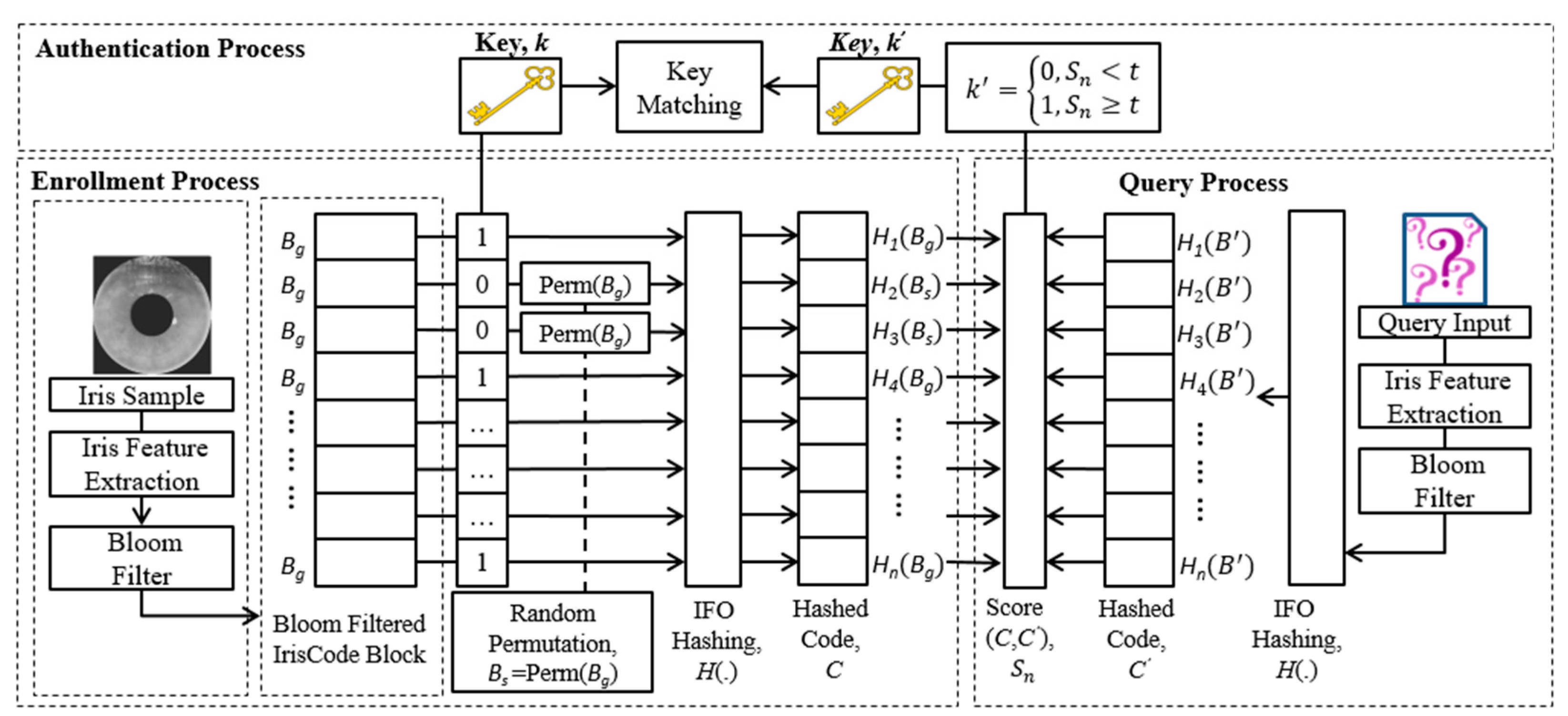
For key regeneration process, the genuine cancelable template is matched and authenticated with the formerly stored cancelable templates. For every matched instance, it enables the regeneration of partial information of the bound cryptographic key. If a binary bit ‘1’ represents an anticipated match, this outcome eventually allows the regeneration of the entire key (retrieval) when all the stored templates are authenticated successfully. The design of the proposed key binding scheme is illustrated in Figure 1 to give a clear overview for all the processes involved. The original iris template is Bloom filtered first, followed by IFO hashing before entering the proposed key binding scheme.
Figure 1. Overview of the design for the proposed key binding scheme.

3.1. Key Binding

To further explain the methodology of our proposed key binding scheme, let the input IrisCode denote I , a random permutation function denotes Perm ( . ) , and B g is the Bloom filtered IrisCode. Our proposed key binding scheme can be divided into several steps:
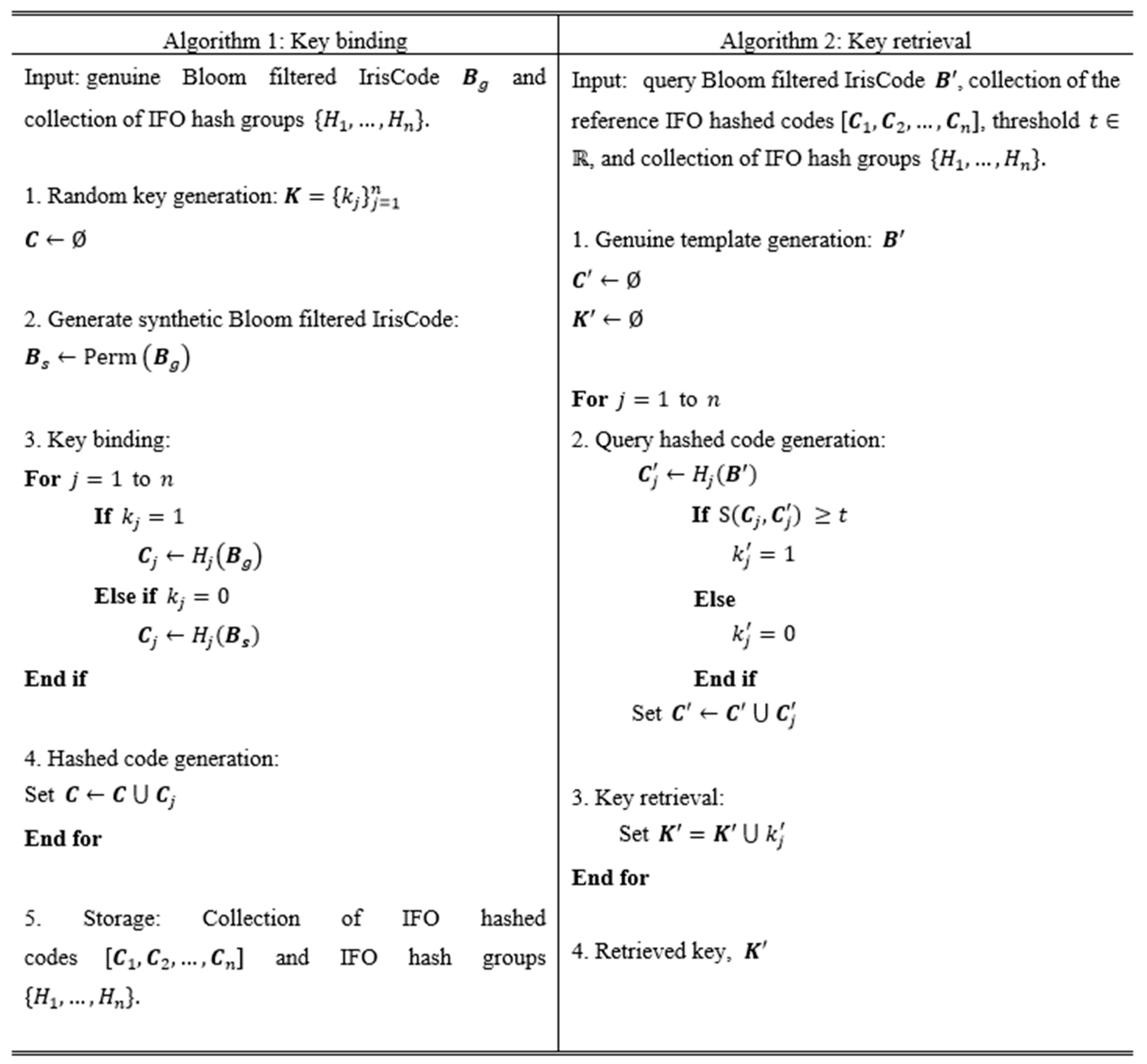
  • Cryptographic key generation: A random binary cryptographic key K = { k j } j = 1 n is generated where k j { 0 , 1 } and n is the input parameter determining the cryptographic key length.
  • Genuine and synthetic template generation: IrisCode I goes through feature transformation to generate a genuine iris template (Bloom filtered IrisCode) B g while a synthetic iris template can be generated through permutation as B s Perm   ( B g ) .
  • Key binding: Given a key, K { 0 , 1 } n , we can define n number of IFO hash groups { H 1 , , H n } . Each hash group H j (for j = 1 : n ) is used to generate the j -th IFO hashed code C j based on the input matrix of either genuine or synthetic Bloom filtered IrisCode. For example, if k j = 1 , the j-th hashed code can be described as C j H j ( B g ) , where H j ( B g ) = { h i ( j ) ( B g ) | i = 1 ,   ,   m   h a s h   f u n c t i o n s } ; otherwise (if k j = 0 ), the j -th hashed code is described as C j H j ( B s ) .
  • Hashed code generation: n number of hashed codes are constructed [ C 1 , C 2 , , C n ] and stored in the database instead of the corresponding cryptographic key K .
  • Storage: The collection of output IFO hashed codes [ C 1 , C 2 , , C n ] are then stored together with the collection of IFO hash groups { H 1 , , H n } used in the process of key binding.
The binary key binding processes of our proposed method are defined in Algorithm 1 as shown in Figure 2.
Figure 2. Algorithm 1: key binding process (left) and Algorithm 2: key retrieval process (right).

3.2. Key Retrieval

Let S ( C , C ) denote a matching score between a reference (stored) IFO hashed code C and a query hashed code C . Given a query IrisCode as the input denoted as I , our proposed key retrieval scheme can be divided into several steps as follows:
  • Genuine template generation: I has to go through a similar transformation to first generate a query Bloom filtered IrisCode matrix, which can then be described as B Bloom _ filter   ( W ,   L ,   I ) .
  • Query hashed code generation: By using the same IFO hash groups [ H 1 ( B ) , , H n ( B ) ] with their respective permutations, n number of query hashed codes [ C 1 , C 2 , , C n ] can be generated.
  • Key retrieval: To prepare for key retrieval, we first generate an empty array denoted as K = { k j } j = 1 n where k j { 0 , 1 } and n is the cryptographic key length generated via the matching between the query and the reference hashed codes. Given any pre-defined threshold t , matching can be carried out by calculating the similarity score S ( C j , C j ) between the reference hashed code C j and the query hashed code C j . If S ( C j , C j )   t , set k j = 1 , otherwise, k j = 0 .
  • Eventually, a final key K = { 0 , 1 } n can be retrieved.
The matching score S ( C j , C j ) can be measured by finding the number of agreed positions between C j and C j , for example, No .   of   agreed   positions m ·   l 1 ·   l 2 . The whole process of key retrieval is outlined in Algorithm 2 as shown in Figure 2.

3.3. The Relation of Key Retrieval Rate to Jaccard Similarity

For an efficient biometric cryptosystem, it ensures the regeneration of an exact key given a similar (genuine) query Bloom filtered IrisCode during key retrieval. In our case, the success rate of the key retrieval attempt under genuine query can be measured through our proposed key retrieval rate (KRR). In this section, we briefly discuss the relation of KRR to the Jaccard similarity between the enrolled and query Bloom filtered IrisCodes, which are denoted as JA ( B g , B ) . For the ease of understanding, given a threshold t , suppose that we are now considering only single binary bit, k j where ( j = 1 ) of a cryptographic key. Let us consider a single bit of the key as k j = 1 { 0 , 1 }   , which is retrieved by matching a query hashed code C j = 1 against a reference hashed code C j = 1 . The correctness of the regenerated key k j = 1 can be described as follows:
k j = 1 = {   1 ,                                     S ( C , C )   t 0 ,                                     S ( C , C )   < t   .
Referring to the procedures under the IFO hashing scheme, hashing of Bloom filtered IrisCode H j = 1 ( B g ) is conducted through independently and randomly generated permutation seeds { N 1 , , N m } j = 1 . Treating each bloom filter b i as independent, the number of agreed positions (collisions) between query and reference hashed codes can be defined as z = i = 1 m · l 1 ·   l 2 χ i , where χ i refers to a Bernoulli variable of X i = 1 (if C j = 1 = C j = 1 ) or χ i = 0 (if C j = 1 C j = 1 ). Thus, each element of C j = 1 / C j = 1 can then be treated as independent to each other. The independency of different bloom filters can be further strengthened by applying different public random permutations on the bloom filters. Therefore, z ~ B ( M , P ) follows a binomial distribution of probability of success P = S ( B g , B ) , where M = m · l 1 ·   l 2 denotes the total number of elements { c i = 1 , , c i = m · l 1 ·   l 2 } j in C j / C j (for j = 1 ,   2 , , n ). This probability provides a similarity measurement between B g and B through S ( B g , B ) .
Since the publicly known random permutations are merely applied to strengthen independency, we therefore highlight only the resultant effect on the independency of the bloom filters here. This helps to simplify the computation of the expected value E ( z ) = M P . Particularly, referring to the convention of IFO as an instance of min hash [55], one has P = [ c i = c i | i = 1 , 2 , , M ] = S ( B g , B ) = JA ( B g , B ) , which corresponds to the Jaccard similarity of B g and B . Thus, we can infer that S ( C j , C j ) = z M , while the probability of success P is M dependent. Therefore, the KRR for a single binary bit cryptographic key can be described as the probability:
K R R = ( k j = k j ) = ( S ( C j , C j ) t ) = ( 1 M   i = 1 M χ i t ) = ( z t M ) .
The definition of the probability in (2) can be further extended for longer key length with n * denoted as the number of binary bit ‘1’ (successful genuine matching) in a cryptography key. Thus, KRR can be redefined again as:
K R R = [ k j = k j = 1 | j = 1 , 2 , , n ] = ( ( z t M ) ) n * .
Theoretically, n * n 2 is the approximation for maximum key entropy [59]. Nevertheless, one can easily notice from the equation that as long as the probability ( z t M ) comes close or equal to 1, n can be further increased. This allows the flexibility to bind even longer cryptographic keys in such a way that K R R = ( 1 ) n * 1 maintains the optimum success rate for key retrieval. This implies that the exact cryptographic key can be retrieved as long as ( z t M ) 1 for a selected threshold t . The selection of t affects the KRR significantly in two ways: (1) Given a fixed value of P , decreasing the value of threshold t increases ( z t M ) as well as K R R and vice versa. In contrary, the failure rate of a genuine query can also be computed using our proposed method through K R R ; (2) Lower K R R is expected from the equation if we increase the value of n * further and vice versa. This is another highlight of KRR through its amplification factor contributed by n * , which always ensures that an imposter query will have way lower K R R compared to a genuine query.

3.4. Example

For better illustration, we hereby give an example to calculate K R R under certain configurations. Suppose we set M = 200 , n = 40 n * 20 , and t = 0.75 , given B g and B such that P = S ( B g , B ) = 0.85 (e.g., 85% similar in terms of the Jaccard similarity between the enrolled and query iris templates), we can then calculate the K R R = ( ( z 150 ) ) 20 = 0.9985 that is close to 1 with ( z 150 ) = 0.9999 . For higher similarity, for instance, S ( B g , B ) = 0.9 , we can obtain optimum K R R = ( ( z 150 ) ) 20 = 1 .

4. Performance Evaluation

A thorough analysis of the performance and security of our proposed key binding scheme was conducted on a public iris database CASIA v3-interval [29]. This dataset contains 2639 iris images from 396 different classes (eyes). In our experiments, left eye images were chosen since the patterns of genetically identical eyes appeared to be uncorrelated, as they were among imposters’ eyes statistically [1]. To standardize the matching from all the left eye images, we selected any subset that contained at least seven iris samples per class. This resulted in a total of 124 classes with 868 iris images. Each iris image went through IrisCode generation [1] to generate IrisCode I { 0 , 1 } n 1 × n 2 of dimension n 1 = 20 , n 2 = 512 with a total of 10,240 bits.
The experiments were designed with the purpose of emphasizing the implementation and security analysis. The proposed key binding scheme here was not addressed or analyzed thoroughly to provide insights regarding its potential, limitation, and tradeoff in iris biometric. Firstly, the performance tradeoff upon introducing an alignment-free cancelable IrisCode was presented. IFO hashing showed its ability in preserving the system’s performance in the following section. Next, an overview of the performance of the proposed key binding scheme was presented through standard metrics evaluation. The inter-relation of the main parameters—similarity threshold ( t ) , cryptographic key length ( n ) , and IFO hashed code length ( m ) —were tested and examined. In addition, we demonstrated the flexibility of our proposed scheme in managing inherent storage problems due to the nature of the cryptographic key binding’s design without sacrificing security strength via reducing key length. All the experiments were conducted under a PC with processor core i7- 2.60 GHz, 8GB RAM and with MATLAB R2013b.

4.1. Performance of Original IrisCode and Bloom Filter IrisCode

We first carried out experimental testing on the original IrisCode I { 0 , 1 } 20 × 512 and Bloom filtered IrisCode, respectively. The parameters used for Bloom filter generation [49] were fixed as W = 7 and L = 20 , yielding l 1 · l 2 = 50 blocks and Bloom filtered IrisCode B g { 0 , 1 } 50 × 128 as the outputs. This testing covered different matching protocols, such as genuine matching and imposter matching. For genuine matching, all iris images were used to generate IrisCodes. The matching was done by calculating the hamming distance between different IrisCodes of the same user, which then yielded 7 × 6 × 124 2 = 2604 genuine matching scores in total. The same genuine matching protocol was implemented in all the respective Bloom filtered IrisCodes. For imposter matching, the matching was done by calculating the hamming distance between IrisCodes of different users—interclass matching, in this case. Each user came with seven IrisCodes, which yielded a total of 7 × 123 × 7 × 124 2 = 373674 imposter matching scores. The same imposter matching protocol was implemented as the Bloom filtered IrisCodes. We also tested the performance of Bloom filtered IrisCodes after applying IFO hashing in [55] ( m = 200 ,   p = 3 ,   κ = 64 ,   τ = 30 ) by using the same genuine and imposter protocols.
In biometric systems, EER has been widely used for performance evaluation by calculating the False Acceptant Rate (FAR) and False Rejection Rate (FRR) between the collected genuine and imposter scores, where lower EER implies higher performance. In our context, EER was approximated as EER ( FAR + FRR ) / 2 . The result is tabulated in Table 1 shown below:
Table 1. System performance for the original alignment-free and hashed IrisCodes.
The result from Table 1 indicates that the system performance did not experience significant deterioration after applying Bloom filter to resolve the alignment issues originated from IrisCode’s generation process (rotational inconsistency due to head tilt during eye image acquisition). Moreover, IFO hashing, which inherited properties such as distance and similarity preservation from the Jaccard similarity and min hashing, showed compatible performance after the application of IFO hashing.

4.2. Performance of the Proposed Key Binding Method

This section provides the evaluation and overview of the performance of our proposed key binding method. For performance evaluation, intensive experiments were carried out under different parameter configurations. The metrics used for performance evaluation were FAR and FRR, as discussed earlier. Lower FAR and FRR values implied a higher system performance.
In order to measure the system’s performance, similar protocols were applied in the following experiments. The first one referred to the genuine matching protocol where the first Bloom filtered IrisCode was used for the key binding (enrollment) purpose and the remaining Bloom filtered IrisCodes from the same class was used for key retrieval (query). Thus, this protocol yielded a total of 2604 testing results. The genuine matching protocol was then used to calculate the system’s FRR = No .   of   wrongly   retrieved   key 2604   × 100 % . The second protocol referred to the imposter matching protocol where the first Bloom filtered IrisCode of each class was used for key binding (enrollment). The key retrieval (query) was then conducted over the second Bloom filtered IrisCodes of all the classes, excluding the samples from the enrolled class, and yielded a total of ( 124 × 123 ) / 2 = 7626 testing results. The imposter matching protocol was then used to calculate the FAR = No .   correctly   retrieved   key 7626   × 100 % .

4.3. Evaluation on Similarity Score Threshold, t

As mentioned in our proposed method, there were three main parameters ( t , n , m ) in our proposed scheme. Several tests were carried out to study the relation of these important parameters to the system performance. By using the same parameter setting for IFO as in the previous section, the evaluation for the similarity score threshold t was carried out by fixing the parameters m = 100 and n = 10 . The genuine matching and imposter matching protocols were performed under a range of values t = [ 0.16 ,   0.17 , , 0.25 ] . The results of FAR and FRR for every t , given the parameter set ( t , 10 , 100 ) ] were recorded. Meanwhile, we also calculated their corresponding EERs, as tabulated in Table 2.
Table 2. System performance for parameter set ( t , 10 , 100 ) .
From the result in Table 2, it was not surprising that the best EER (0.62%) obtained was close to the original Bloom Filtered IrisCode’s performance (0.58%) in Table 1 under a slightly different setting. This was mainly attributed to the Jaccard similarity’s preserving property, which allowed us to measure the similarity between different Bloom filtered IrisCodes under IFO’s hashed domain.
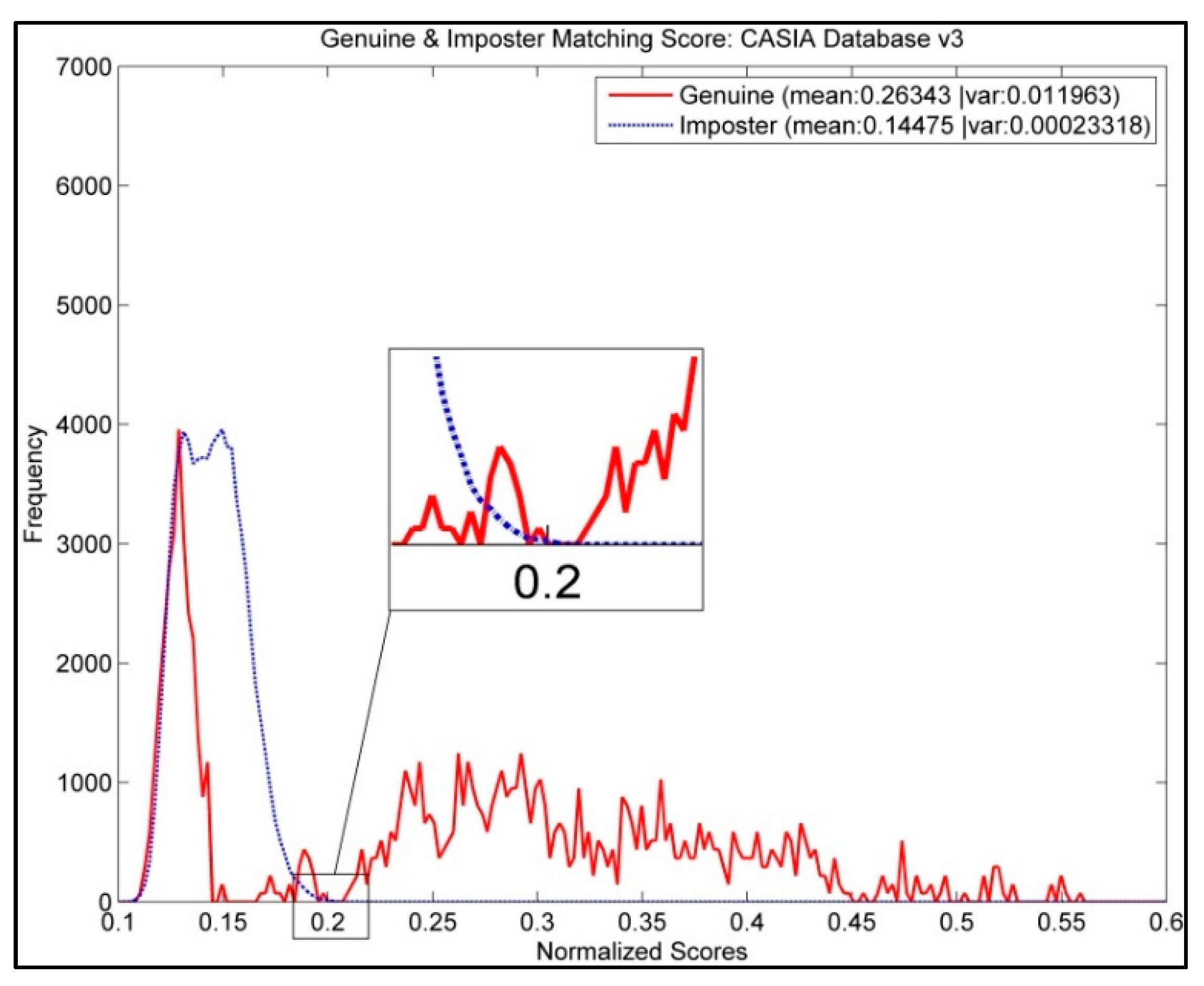
The matching scores between each IFO hashed code j = 1 , 2 , , n under genuine matching and imposter matching were plotted and are depicted in Figure 3. It showed an overlapped region between genuine and imposter matching scores. This scenario was mainly due to the imposed synthetic Bloom filtered IrisCodes. The matching between a hashed synthetic Bloom filtered IrisCode and the query hashed code always resulted in a smaller matching score. This observation further supports our earlier claim that the synthetic template indeed acts like an imposter template to be used for the chaffing and winnowing process in concealing the genuine IFO hashed code in our proposed method.
Figure 3. Graph for the genuine and imposter matching score.
Moreover, with the zoomed region in Figure 3, the best threshold value for t to avoid any imposter in potentially getting access into the system with FAR equals to zero would be around t = 0.2 . In fact, this was justified by our results in Table 2, where the system reported an EER of 1.33% when FAR was 0 at t = 0.2 . From the table, we can easily observe a trend that an increase in t resulted in a higher FRR but a lower FAR and vice versa.
For a cryptosystem to be useful, it is normally suggested that the FAR should be zero, thus any imposter or adversary can certainly be rejected by our proposed system for higher level of system security. Therefore, our analysis suggests that the optimal value of t lies under the range of t 0.2 .

4.4. Evaluation on Cryptographic Key Length, n

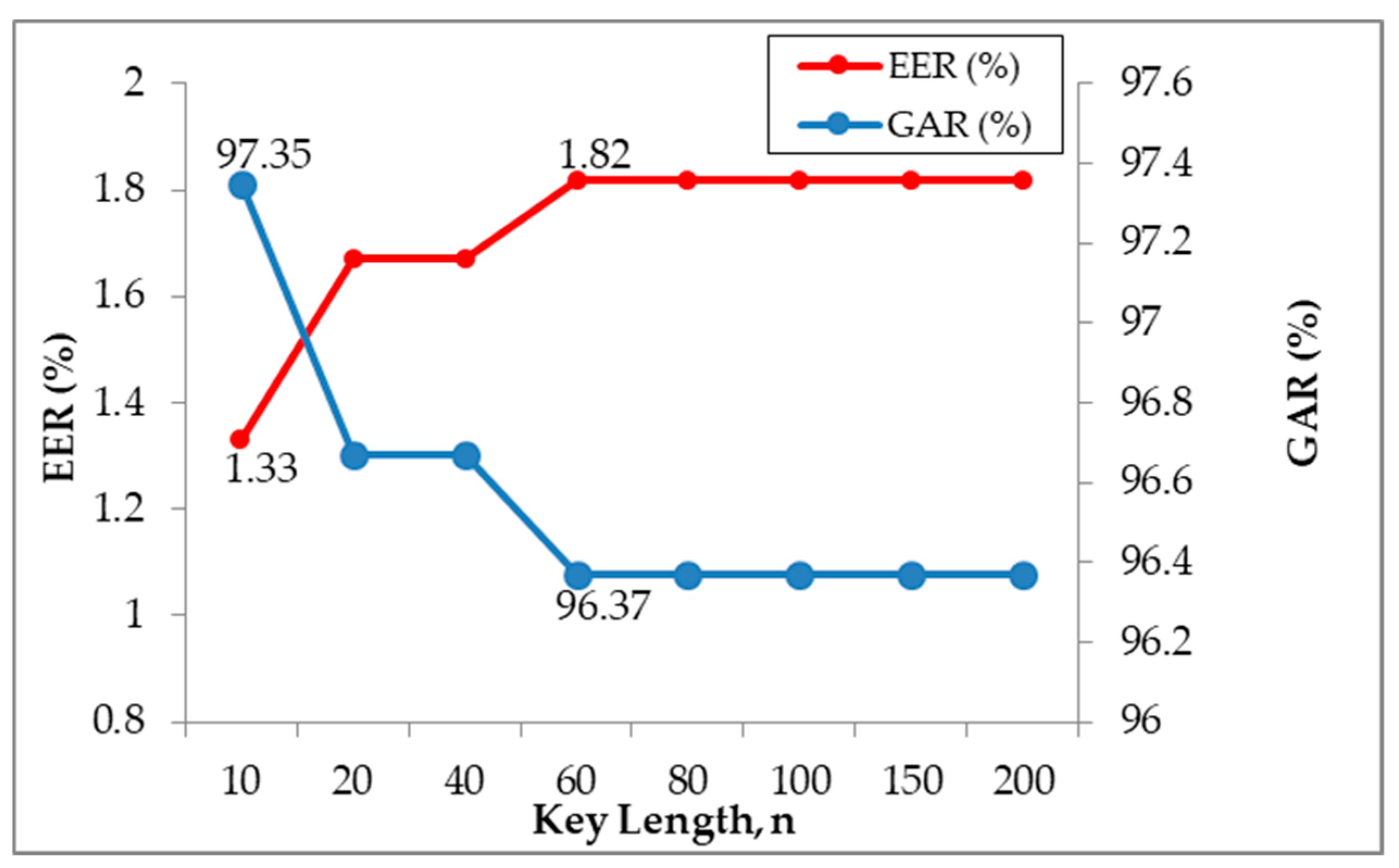
The evaluation of the effect of cryptographic key length n on system performance was carried out by fixing the values for parameters t and m . The genuine and imposter matching protocols were performed by setting different key lengths where n = [ 10 ,   20 ,   40 ,   60 ,   80 , 100 ,   150 ,   200 ] . As a result, FAR and FRR for every n given t = 0.2 and m = 100 were recorded. Meanwhile, their corresponding Genuine Acceptance Rate, G A R = 100 F R R and EER were also calculated and are tabulated in Table 3.
Table 3. System performance for parameter set (0.2, n , 100).
From Figure 4, an EER as low as 1.33% was observed when shorter key length ( n = 10 ) was used. The EER gradually increased when the key length became longer and remained stagnant at 1.82% even though the key length increased further from 60 to 200. In contrast, GAR showed a slight reduction of 0.98% when the key length increased from 10 to 200. Besides that, the result in Table 3 shows that the increase in key length n reduced the FAR, as emphasized earlier in our proposed K R R . Given t = 0.2 , the system performance was preserved even though the key length n increased up to 200. This implies that the binding of a long cryptographic key with a bit length as long as 200 bits is feasible while maintaining the same K R R and system performance captured by GAR.
Figure 4. Graph for the evaluation on cryptographic key length.

4.5. Evaluation on Hashed Code Length, m

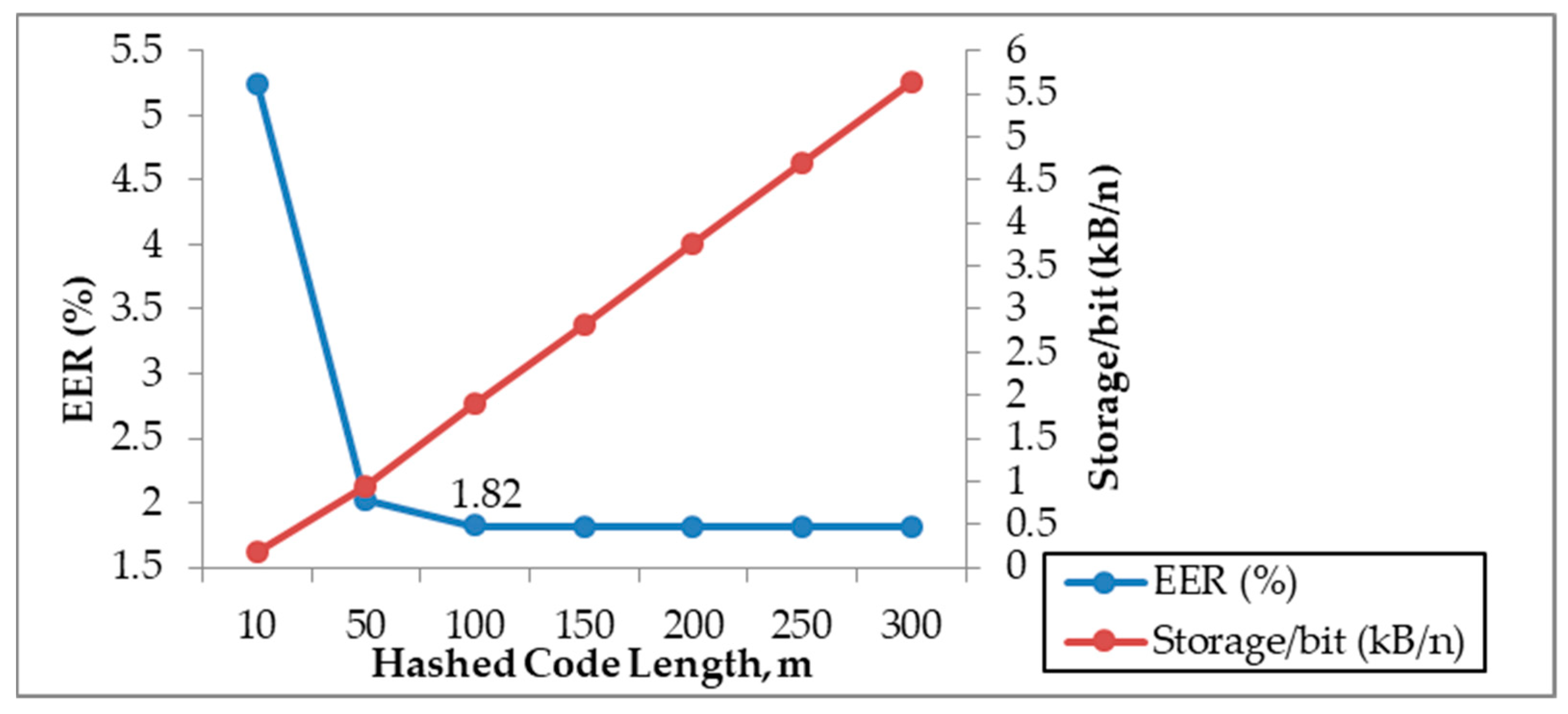
The evaluation of the effect of the IFO hashed code length m on system performance was conducted by fixing the parameters t and n . The genuine and imposter matching protocols were performed through different m = [ 10 ,   50 ,   100 ,   150 ,   200 ,   250 ,   300 ] for this study. The tested results of FAR and FRR for every value of m given t = 0.2 and n = 10 in the parameter set ( 0.2 , 10 , m ) were recorded. Meanwhile, their corresponding GAR, EER, and storage per bit kB / n were computed and are tabulated in Table 4. The unit of storage per bit was measured in kilobytes ( kB ) , indicating the space required (for single bit of key binding, n = 1 ) for different m used in IFO hashed code generation.
Table 4. System performance for parameter set (0.2, 10, m).
The IFO hashed code length played a critical role in terms of system storage, as the proposed method bound the key by using the IFO hashed code. In order to serve as an efficient biometric cryptosystem, the storage requirement for storing the helper data must be kept within an acceptable limit apart from high system security and performance. A system can become infeasible in actual implementation if it requires infinite storage for helper data to facilitate the key retrieval process despite high performance and security.
On the other hand, our proposed method offers flexibility in handling a system’s storage limits. In our scheme, the IFO hashing provided a flexible and controllable code length (regulated by parameter m ). This feature allowed us to keep our storage at a minimum while maintaining high system performance. As shown in Table 4, our proposed method achieved high GAR around 95–96% with storage records equal to 0.94–1.90 kB. The form of storage offered by our proposed scheme is more compact than the records generated by other schemes such as [60]. It was also demonstrated that the system’s storage requirement could be decreased further with a shorter hashed code length (e.g., decreasing from m = 300   to   100 ) while maintaining the same system performance, as shown in Figure 5. Therefore, the system storage requirement for our proposed method is indeed controllable with respect to m . Figure 5 shows that EER reduced sharply from 5.25% ( m = 10 ) to 1.82% ( m = 100 ) and remained stable even with the further increment of hashed code length until m = 300 . Thus, our proposed key binding method achieved its optimum performance (GAR of 96.37%) at m = 100 , which required a storage space of 1.90 kB per bit through the evaluation of the three main parameters in our scheme, a similarity score threshold ( t ) , a key length ( n ) , and a hashed code length ( m ) .
Figure 5. Graph for the evaluation on hashed code length.

5. Security Analysis

As our proposed method utilizes synthetic templates to conceal the genuine templates (with IFO hashing applied), it is important to examine the indistinguishability property in such a way that any attacker cannot gain advantages in distinguishing whether the stored IFO hashed code is generated from genuine or synthetic Bloom filtered IrisCode. We examined the security of our proposed method in the aspect of indistinguishability between genuine and synthetic templates. We also extended our analysis to potential security attacks on the proposed system, such as brute force attacks and false accept attacks.

5.1. Indistinguishability Between Genuine and Synthetic Templates

The indistinguishability property is examined in such a way that an attacker is allowed to accumulate certain information during a matching process and gain advantages that may be useful to retrieve the secret key. In this case, we characterized the indistinguishability between genuine and synthetic templates in an indistinguishability game between a challenger and an adversary to achieve the objective. The proposed indistinguishability game was designed as follows:
  • To start the game, given a group IFO hash function H , the challenger allows the adversary to choose any class/individual from the database.
  • After a class is chosen by the adversary, the challenger selects a random Bloom filtered IrisCode of that individual and generates B g Bloom _ filter ( W = 7 ,   L = 20 ,   I ) .
  • The challenger can then produce the IFO hashed code C g H ( B g ) and give C g to the adversary.
  • After that, the challenger flips a fair coin b { 0 , 1 } . If b = 1 , the challenger selects another Bloom filtered IrisCode of the selected person B g with a threshold t [ 0 , 1 ] , such that JA ( B g , B g ) t and generates C H ( B g ) . In addition, hashed code B g . can also be generated by adding random noise to the filtered IrisCode as long as JA ( B g , B g ) t . If b = 0 , the challenger permutes the Bloom filtered IrisCode B s Perm   ( B g ) and generates C H ( B s ) . Then challenger gives C to the adversary.
  • The adversary outputs a word k ^ { 0 , 1 } and wins if k ^ = k .
Based on the game above, it is valid to say that if k ^ = k , then the adversary successfully retrieved a single bit of the cryptography key. It is important to note that the adversary does not know whether C is generated from genuine B g or synthetic B s Bloom filtered iris templates. Therefore, the adversary is required to find out the answer by matching the hashed codes and getting S ( C , C g ) . We hereby describe the adversary in this game as Adv Gen Syn for advantages gained in retrieving a single bit of the cryptographic key successfully. When Adv Gen Syn = 0 , we say that the scheme is perfectly indistinguishable between genuine and synthetic templates. The advantages gained by Adv Gen Syn can be described as follows:
Adv Gen Syn = | [ k ^ = k ] 1 2 | ,
given that:
[ k ^ = k ] = = 1 2 [ S ( C , C g )   t | k = 0 ] + 1 2 [ S ( C , C g )   t | k = 1 ]
Assuming that for the case where S ( C , C g )   t , the adversary can surely differentiate that C is generated by B g , we can therefore define [ S ( C , C g )   t | k = 1 ] = 1 and yield the final formulation:
Adv Gen Syn = 1 2 | [ S ( C , C g ) t | k = 0 ] | = 1 2 | [ z t M | k = 0 ] | .
As mentioned in Section 4.3, [ z t M | k = 0 ] is highly dependent on P = S ( B g , B ) . From our matching result depicted in Figure 3, we expect to gain zero FAR with a threshold t = 0.2 while S ( C , C g ) < 0.2 indicates an imposter matching score (showed in red-blue overlapped imposter distribution region). Thus, we let t = 0.2 and calculate [ z t M | k = 0 ] to estimate the adversary advantages S ( B g , B ) in this analysis. For further estimation, let Adv Gen Syn n = n Adv Gen Syn , which describes the total adversary advantages gained from n bits in the cryptographic key. The total advantages are estimated by running the indistinguishability game n times independently (repeating Step 4 and 5 of the indistinguishability game). Table 5 shows the results with S ( B g , B )   = [ 0.16 , 0.17 , 0.18 , 0.19 ] for n = [ 1 , 50 , 100 , 200 ] and M = 10000 .
Table 5. Indistinguishability between genuine and synthetic iris templates.
From this table, the adversary’s advantages in distinguishing the genuine and synthetic iris templates can be quantitatively estimated through our proposed indistinguishability game. It is important to take into consideration the level of similarity between synthetic and genuine templates for the chaffed key binding scheme to fairly evaluate the indistinguishability property in terms of security. For instance, the computed adversary’s advantage is Adv Gen Syn = 0.58 with S ( B g , B ) = 0.19 when n = 100 . The total advantages go up to more than 1 when n is increased to 200 . This is because more iris templates are needed in order to bind longer key length, thus there is greater information leakage. Particularly, with Adv Gen Syn n 1 , one can expect weaker security due to excessive information leakage. Nevertheless, our results show that with S ( B g , B ) = 0.16 ,   0.17 and 0.18 , the total adversary advantages to learn a single bit of information at the key length of 200 bits are estimated to be 2 78 ,   2 41 , and 2 15 bits, respectively (lower bounded at 2 11 ). The security of this scheme is based upon the selected threshold value and the similarity score, which determine the amount of information leakage (i.e., mutual information) due to the linkability between B g and B . To the best of our knowledge, there is still no known algorithm to extract this information for the purpose of full IrisCode reconstruction practically in relation to the similarity score.

5.2. Cancelability and Renewal

For the renewal process, a new key needs to be reissued when the current cryptographic key is compromised. Our proposed key binding method requires no re-enrollment in this scenario. Key update can be achieved by interchanging the positions of the genuine and synthetic iris templates randomly together with their corresponding hashing groups. Thus, a new binary key string can be updated automatically. Our proposed design aims to provide a simple and fast key renewal process. The proposed algorithm achieved a GAR of more than 96% at zero FAR with hashed code length m and key length n up to 300 and 200, respectively.
For cancelability, the regeneration of a cancelable template is guaranteed by the revocability and unlinkability of the IFO hashing scheme. It was verified through security analysis [55] that it is computationally infeasible to derive the original biometric information from the IFO hashed code. The revocability was evaluated thoroughly by analyzing the pseudo-imposter score distribution of the randomly generated hashed codes of multiple subjects. The refreshed hashed codes are distinctive and uncorrelated to the old hashed code, albeit they are generated from the same IrisCode. With rigorous analysis backed by empirical data, the IFO hashing scheme satisfied the revocability and unlinkability requirements, while users are not required to keep their permutation token in secret.

5.3. Potential Attacks

Besides the indistinguishability between genuine and synthetic templates, we extended our analysis into potential security attacks. In this section, the proposed method is evaluated against potential security attacks.

5.3.1. Brute Force Attack

For brute force attacks, it relies on randomly guessing the n bit cryptographic key without the need for actual interception between the adversaries and the cancelable templates’ storage. Therefore, the complexity of this attack is merely dependent on the cryptographic key length, which is controlled by the parameter n in our proposed method. Straightforwardly, the brute force attack complexity can be described as follows:
B f n = 2 n .
Higher n indicates higher attack complexity, which also requires more cancelable templates for the key binding process. For instance, with a key length of n = 100 , the brute force attack complexity is measured as Bf n = 2 100 . Our best performance was preserved even up to a cryptographic key length of 200, as shown in Table 3. This is equal to an upper bound brute force attack’s complexity of 2 200 , which is already sufficient in cryptography applications. The proposed method demonstrated the flexibility to allow a potential key length that is longer than 200 while preserving the acceptable performance when there is a need for higher attack complexity.

5.3.2. False Accept Attack

Apart from brute force attacks, another security attack that needs to be taken into consideration is the false accept attack. In conjunction to brute force attacks, this kind of attack requires the interception of the adversary with the cancelable storage. Instead of randomly guessing, the false accept attack relies on the continuous trials of an attacker through conventional matching between the stored cancelable templates and the imposter templates. In our context, an unlimited number of trials are allowed. Therefore, the false accept attack is not constrained to the usage of several imposter templates but uses an infinite number of artificial/synthetic templates instead.
Since the false accept attack relies on the conventional matching mechanism, the false accept attack complexity can be calculated based on our proposed key retrieval rate, K R R . To avoid confusion, we denote the key retrieval rate for false accept attack by arbitrary attacker as K R R imp . Thus, false accept attack’s complexity, f a K R R imp can be described directly as:
f a K R R imp = [ k j = k j | j = 1 , 2 , , n ] = ( ( z t M ) ) n * .
We can estimate the f a K R R imp by assuming that the adversary is able to generate a cancelable template C j with S ( B g , B ) < 0.2 . In this experiment, the f a K R R imp was estimated using synthetic templates, which showed high similarity score when compared with genuine template. Thus, S ( B g , B ) = [ 0.195 , 0.196 , 0.197 , 0.198 , 0.199 , 0.20 ] are tested in Table 6 with the following parameters: n * = n 2 for maximum key entropy, m = 200 , and t = 0.20 .
Table 6. Estimation of complexity for brute force and false accept attacks.
The calculated result shows that the false accept attack’s complexity is lower compared to the brute force attack, given that S ( B g , B ) > 0.198 . This indicates that if any attacker is able to generate hashed code with the similarity S ( B g , B ) > 0.198 , he/she can potentially get access to the system due to the lower attack complexity. Referring to Figure 3, the region where an imposter can launch a false accept attack is typically within the range of 0.1 0.2 with the mean of the imposter matching distribution around 0.14 . It is expected that any false accept attack at a similarity score around S ( B g , B ) = 0.14   or < 0.195 will likely be infeasible ( f a K R R imp 2 162 ) due to a much higher false accept attack’s complexity.
In fact, we also took the worst case scenario into consideration by calculating the f a K R R imp according to a list of high similarity scores S ( B g , B ) ranging from 0.195 to 0.199 according to the threshold set. The proposed method showed a false accept complexity of 2 66 bits. It is important to note that the overlapped region from 0.1 to 0.15 in Figure 3 mainly was contributed to by the synthetic iris templates, which acted like imposter iris templates as an extra layer of protection to chaff the genuine iris templates.

5.4. Comparison

In reviewing the performance of the state-of-the-art method, Rathgeb and Uhl [61] conducted a compact survey compiling the key binding approaches in iris biometric cryptosystems. Representing one of the simplest key binding approaches, the fuzzy commitment scheme was successfully applied to iris. More significant performance evaluation on the iris based fuzzy commitment scheme [61] was applied after analyzing the error distribution of IrisCodes of different iris recognition algorithms. The method reported a GAR of 95.08% with 128-bit cryptography keys at zero FAR. In another extended work [62], the authors applied a context-based reliable component selection in order to extract cryptographic keys from IrisCodes, which were then bound to Hadamard code words, achieving a lower GAR of 93.47%. A most recent work aimed to improve the security and performance of the fuzzy vault scheme using multi-biometrics [63]. The best GAR of approximately 95% was achieved with security levels around 50 bits. As for the fuzzy vault using single iris, a lower GAR around 90% was reported with similar security levels. Summarized results of state-of-the-arts iris key binding methods are shown in Table 7 below.
Table 7. Summarized results of state-of-the-arts.

6. Conclusions

In this paper, we proposed a cancelable iris based key binding scheme that is freed from the limitation of error correcting capacity and tedious alignment process. The main reason for introducing IFO hashing as part of the proposed method is to enable efficient and tunable storage and fulfill the non-invertibility and unlinkability requirements. Storage (kB) per bit was proposed as the metric to vindicate the significant effect of controllable hashed code length in managing the storage space and preserving the accuracy performance. As a result, the highest GAR of 96.37% at zero FAR with storage record equal to 1.90 kB was achieved by our proposed scheme. A precise and useful key retrieval metric—KRR—was proposed and implemented for security analysis, such as false accept attacks and the indistinguishability game. In-depth security analysis emphasizing the adversary’s advantages gained over the proposed key binding design was evaluated through an indistinguishability game. In addition, the complexity and the security level of the proposed method were also justified against potential attacks. For example, our proposed method showed a brute force attack complexity of 2 100 and a sufficient false accept complexity of 2 66 bits under the worst case scenario for a key length of 100 bits. The proposed method embraces the flexibility while maintaining significant accuracy performance and security level. The security-performance tradeoff was attended to through experiments where the optimum GAR ranged from 96.37% to 97.35%, and zero FAR remained stagnant, regardless of the increasing key length from 10 to 200 bits. This implies that the quality preservation of the accuracy performance at higher security levels is achievable through our proposed key binding scheme. Finally, the proposed method requires no re-enrollment and storage for seeds, making it more attractive for actual implementation compared to other methods. We hope that this work can evoke more thoughts and analysis towards higher flexibility and security for the iris key binding scheme in future.

Author Contributions

T.-Y.C. designed the overall system, performed experiments and wrote the paper; B.-M.G., Y.-H.T. and Z.J. supervised and reviewed the draft; Funding support, B.-M.G., T.-Y.C. and Z.J.

Funding

This research was funded by Fundamental Research Grant Schemes (FRGS) with grant numbers, FRGS/1/2016/ICT02/UTAR/03/1, FRGS/1/2016/ICT04/UTAR/01/1 and FRGS/1/2018/ICT02/MUSM/03/3.

Acknowledgments

The authors gratefully acknowledge the support from Ministry of Higher Education Malaysia for this research.

Conflicts of Interest

The authors declare no conflict of interest.

References

  1. Daugman, J. How iris recognition works. IEEE Trans. Circuits Syst. Video Technol. 2004, 14, 21–30. [Google Scholar] [CrossRef]
  2. Sasse, M.A. Red-eye blink, bendy shuffle, and the yuck factor: A user experience of biometric airport systems. IEEE Secur. Priv. 2007, 5. [Google Scholar] [CrossRef]
  3. Cimato, S.; Gamassi, M.; Piuri, V.; Sassi, R.; Scotti, F. Privacy in Biometrics. Available online: https://scholar.google.com/scholar?hl=en&as_sdt=0%2C5&q=cimato+Privacy+in+biometrics&btnG= (accessed on 17 December 2018).
  4. Klein, D.V. Foiling the cracker: A survey of, and improvements to, password security. In Proceedings of the 2nd USENIX Security Workshop, Boston, MA, USA, 6–10 August 1990; pp. 5–14. [Google Scholar]
  5. Jain, A.K.; Ross, A.; Pankanti, S. Biometrics: A tool for information security. IEEE Trans. Inf. Forensics Secur. 2006, 1, 125–143. [Google Scholar] [CrossRef]
  6. Juels, A.; Wattenberg, M. A fuzzy commitment scheme. In Proceedings of the 6th ACM conference on Computer and communications security, Singapore, 1–4 November 1999; pp. 28–36. [Google Scholar] [CrossRef]
  7. Jain, A.K.; Nandakumar, K.; Nagar, A. Biometric template security. Eurasip J. Adv. Signal Process. 2008, 2008, 113. [Google Scholar] [CrossRef]
  8. Jain, A.K.; Ross, A.; Prabhakar, S. An introduction to biometric recognition. IEEE Trans. Circuits Syst. Video Technol. 2004, 14, 4–20. [Google Scholar] [CrossRef]
  9. Dodis, Y.; Reyzin, L.; Smith, A. Fuzzy extractors: How to generate strong keys from biometrics and other noisy data. In International Conference on the Theory and Applications of Cryptographic Techniques; Springer: Berlin/Heidelberg, Germany, 2004; pp. 523–540. [Google Scholar]
  10. Verbitskiy, E.A.; Tuyls, P.; Obi, C.; Schoenmakers, B.; Skoric, B. Key extraction from general nondiscrete signals. IEEE Trans. Inf. Forensics Secur. 2010, 5, 269–279. [Google Scholar] [CrossRef]
  11. Juels, A.; Sudan, M. A fuzzy vault scheme. Des. Codes Cryptogr. 2006, 38, 237–257. [Google Scholar] [CrossRef]
  12. Ratha, N.K.; Chikkerur, S.; Connell, J.H.; Bolle, R.M. Generating cancelable fingerprint templates. IEEE Trans. Pattern Anal. Mach. Intell. 2007, 29, 561–572. [Google Scholar] [CrossRef]
  13. Cavoukian, A.; Stoianov, A. Biometric encryption. In Encyclopedia of Cryptography and Security; Springer: Berlin/Heidelberg, Germany, 2011; pp. 90–98. [Google Scholar]
  14. Hao, F.; Anderson, R.; Daugman, J. Combining crypto with biometrics effectively. IEEE Trans. Comput. 2006, 55, 1081–1088. [Google Scholar]
  15. Bringer, J.; Chabanne, H.; Cohen, G.; Kindarji, B.; Zemor, G. Theoretical and practical boundaries of binary secure sketches. IEEE Trans. Inf. Forensics Secur. 2008, 3, 673–683. [Google Scholar] [CrossRef]
  16. Phillips, P.J.; Bowyer, K.W.; Flynn, P.J.; Liu, X.; Scruggs, W.T. The iris challenge evaluation 2005. In Proceedings of the 2nd IEEE International Conference on Biometrics: Theory, Applications and Systems, BTAS 2008, Arlington, VA, USA, 29 September–1 October 2008; pp. 1–8. [Google Scholar]
  17. Rathgeb, C.; Uhl, A. Context-based biometric key generation for Iris. IET Comput. Vis. 2011, 5, 389–397. [Google Scholar] [CrossRef]
  18. Maiorana, E.; Campisi, P.; Neri, A. IRIS template protection using a digital modulation paradigm. In Proceedings of the 2014 IEEE International Conference on Acoustics, Speech and Signal Processing (ICASSP), Florence, Italy, 4–9 May 2014; pp. 3759–3763. [Google Scholar]
  19. Kelkboom, E.J.; Breebaart, J.; Kevenaar, T.A.; Buhan, I.; Veldhuis, R.N. Preventing the decodability attack based cross-matching in a fuzzy commitment scheme. IEEE Trans. Inf. Forensics Secur. 2011, 6, 107–121. [Google Scholar] [CrossRef]
  20. Teoh, A.B.J.; Kim, J. Secure biometric template protection in fuzzy commitment scheme. IEICE Electron. Express 2007, 4, 724–730. [Google Scholar] [CrossRef]
  21. Zhang, L.; Sun, Z.; Tan, T.; Hu, S. Robust biometric key extraction based on iris cryptosystem. In International Conference on Biometrics; Springer: Berlin/Heidelberg, Germany, 2009; pp. 1060–1069. [Google Scholar]
  22. Zhou, X.; Kuijper, A.; Veldhuis, R.; Busch, C. Quantifying privacy and security of biometric fuzzy commitment. In Proceedings of the 2011 International Joint Conference on Biometrics (IJCB), Washington, DC, USA, 11–13 October 2011; pp. 1–8. [Google Scholar]
  23. Rathgeb, C.; Uhl, A. Statistical attack against iris-biometric fuzzy commitment schemes. In Proceedings of the 2011 IEEE Computer Society Conference on Computer Vision and Pattern Recognition Workshops (CVPRW), Colorado Springs, CO, USA, 20–25 June 2011; pp. 23–30. [Google Scholar]
  24. Scheirer, W.J.; Boult, T.E. Cracking fuzzy vaults and biometric encryption. In Proceedings of the Biometrics Symposium, Baltimore, MD, USA, 11–13 September 2007; pp. 1–6. [Google Scholar]
  25. Carter, F.; Stoianov, A. Implications of biometric encryption on wide spread use of biometrics. In Proceedings of the EBF Biometric Encryption Seminar (June, 2008), Amsterdam, The Netherlands, 24 June 2008. [Google Scholar]
  26. Ignatenko, T.; Willems, F.M. Information leakage in fuzzy commitment schemes. IEEE Trans. Inf. Forensics Secur. 2010, 5, 337–348. [Google Scholar] [CrossRef]
  27. Kelkboom, E.J.; Breebaart, J.; Buhan, I.; Veldhuis, R.N. Maximum key size and classification performance of fuzzy commitment for gaussian modeled biometric sources. IEEE Trans. Inf. Forensics Secur. 2012, 7, 1225–1241. [Google Scholar] [CrossRef]
  28. Lee, Y.J.; Park, K.R.; Lee, S.J.; Bae, K.; Kim, J. A new method for generating an invariant iris private key based on the fuzzy vault system. IEEE Trans. Syst. Man Cybern. Part B 2008, 38, 1302–1313. [Google Scholar] [CrossRef]
  29. Chinese Academy of Sciences’ Institute of Automation: CASIA Iris Image Database V3.0—Interval. 2002. Available online: http://biometrics.idealtest.org (accessed on 8 September 2015).
  30. Reddy, E.S.; Babu, I.R. Performance of iris based hard fuzzy vault. In Proceedings of the IEEE 8th International Conference on Computer and Information Technology Workshops, CIT Workshops 2008, Sydney, QLD, Australia, 8–11 July 2008; pp. 248–253. [Google Scholar] [CrossRef]
  31. Chinese Academy of Sciences’ Institute of Automation: CASIA Iris Image Database V1.0. 2002. Available online: http://biometrics.idealtest.org (accessed on 8 September 2015).
  32. Multimedia University: MMU Iris Image Database. 2004. Available online: http://pesona.mmu.edu.my/ccteo (accessed on 8 September 2015).
  33. Mariño, R.Á.; Alvarez, F.H.; Encinas, L.H. A crypto-biometric scheme based on iris-templates with fuzzy extractors. Inf. Sci. 2012, 195, 91–102. [Google Scholar] [CrossRef]
  34. Fouad, M.; El Saddik, A.; Zhao, J.; Petriu, E. A fuzzy vault implementation for securing revocable iris templates. In Proceedings of the 2011 the IEEE International on Systems Conference (SysCon), Montreal, QC, Canada, 4–7 April 2011; pp. 491–494. [Google Scholar]
  35. Kholmatov, A.; Yanikoglu, B. Realization of correlation attack against the fuzzy vault scheme. In Proceedings of the Security, Forensics, Steganography, and Watermarking of Multimedia Contents X, San Jose, CA, USA, 27–31 January 2008; p. 68190O. [Google Scholar]
  36. Tams, B.; Mihăilescu, P.; Munk, A. Security considerations in minutiae-based fuzzy vaults. IEEE Trans. Inf. Forensics Secur. 2015, 10, 985–998. [Google Scholar] [CrossRef]
  37. Nandakumar, K.; Jain, A.K.; Pankanti, S. Fingerprint-based fuzzy vault: Implementation and performance. IEEE Trans. Inf. Forensics Secur. 2007, 2, 744–757. [Google Scholar] [CrossRef]
  38. Quan, F.; Fei, S.; Anni, C.; Feifei, Z. Cracking cancelable fingerprint template of Ratha. In Proceedings of the International Symposium on Computer Science and Computational Technology, ISCSCT’08, Shanghai, China, 20–22 December 2008; pp. 572–575. [Google Scholar]
  39. Savvides, M.; Kumar, B.V.; Khosla, P.K. Cancelable biometric filters for face recognition. In Proceedings of the 17th International Conference on Pattern Recognition, ICPR 2004, 2004, Cambridge, UK, 26 August 2004; pp. 922–925. [Google Scholar]
  40. Chin, C.S.; Jin, A.T.B.; Ling, D.N.C. High security iris verification system based on random secret integration. Comput. Vis. Image Underst. 2006, 102, 169–177. [Google Scholar] [CrossRef]
  41. Zuo, J.; Ratha, N.K.; Connell, J.H. Cancelable iris biometric. In Proceedings of the 19th International Conference on Pattern Recognition, ICPR 2008, Tampa, FL, USA, 8–11 December 2008; pp. 1–4. [Google Scholar]
  42. Pillai, J.K.; Patel, V.M.; Chellappa, R.; Ratha, N.K. Sectored random projections for cancelable iris biometrics. In Proceedings of the 2010 IEEE International Conference on Acoustics Speech and Signal Processing (ICASSP), Dallas, TX, USA, 14–19 March 2010; pp. 1838–1841. [Google Scholar]
  43. Kong, A.; Cheung, K.-H.; Zhang, D.; Kamel, M.; You, J. An analysis of BioHashing and its variants. Pattern Recognit. 2006, 39, 1359–1368. [Google Scholar] [CrossRef]
  44. Lacharme, P.; Cherrier, E.; Rosenberger, C. Preimage attack on biohashing. In Proceedings of the 2013 International Conference on Security and Cryptography (SECRYPT), Reykjavik, Iceland, 29–31 July 2013; pp. 1–8. [Google Scholar]
  45. Hämmerle-Uhl, J.; Pschernig, E.; Uhl, A. Cancelable Iris Biometrics Using Block Re-mapping and Image Warping. In Proceedings of the ISC, Pisa, Italy, 7–9 September 2009; pp. 135–142. [Google Scholar]
  46. Jenisch, S.; Uhl, A. Security analysis of a cancelable iris recognition system based on block remapping. In Proceedings of the 2011 18th IEEE International Conference on Image Processing (ICIP), Brussels, Belgium, 11–14 September 2011; pp. 3213–3216. [Google Scholar]
  47. Ouda, O.; Tsumura, N.; Nakaguchi, T. On the security of bioencoding based cancelable biometrics. IEICE Trans. Inf. Syst. 2011, 94, 1768–1777. [Google Scholar] [CrossRef]
  48. Lacharme, P. Analysis of the iriscodes bioencoding scheme. Int. J. Comput. Sci. Softw. Eng. 2012, 6, 315–321. [Google Scholar]
  49. Rathgeb, C.; Breitinger, F.; Busch, C. Alignment-free cancelable iris biometric templates based on adaptive bloom filters. In Proceedings of the 2013 International Conference on Biometrics (ICB), Madrid, Spain, 4–7 June 2013; pp. 1–8. [Google Scholar]
  50. Hermans, J.; Mennink, B.; Peeters, R. When a bloom filter is a doom filter: Security assessment of a novel iris biometric template protection system. In Proceedings of the 2014 International Conference of the Biometrics Special Interest Group (BIOSIG), Darmstadt, Germany, 10–12 September 2014; pp. 1–6. [Google Scholar]
  51. Bringer, J.; Morel, C.; Rathgeb, C. Security analysis of bloom filter-based iris biometric template protection. In Proceedings of the 2015 International Conference on Biometrics (ICB), Phuket, Thailand, 19–22 May 2015; pp. 527–534. [Google Scholar]
  52. Gomez-Barrero, M.; Rathgeb, C.; Galbally, J.; Busch, C.; Fierrez, J. Unlinkable and irreversible biometric template protection based on bloom filters. Inf. Sci. 2016, 370, 18–32. [Google Scholar] [CrossRef]
  53. Dwivedi, R.; Dey, S. Cancelable iris template generation using look-up table mapping. In Proceedings of the 2015 2nd International Conference on Signal Processing and Integrated Networks (SPIN), Noida, India, 19–20 February 2015; pp. 785–790. [Google Scholar]
  54. Umer, S.; Dhara, B.C.; Chanda, B. A novel cancelable iris recognition system based on feature learning techniques. Inf. Sci. 2017, 406, 102–118. [Google Scholar] [CrossRef]
  55. Lai, Y.-L.; Jin, Z.; Teoh, A.B.J.; Goi, B.-M.; Yap, W.-S.; Chai, T.-Y.; Rathgeb, C. Cancellable iris template generation based on Indexing-First-One hashing. Pattern Recognit. 2017, 64, 105–117. [Google Scholar] [CrossRef]
  56. Lai, Y.-L.; Goi, B.-M.; Chai, T.-Y. Alignment-free indexing-first-one hashing with bloom filter integration. In Proceedings of the 2017 IEEE International Conference on Intelligence and Security Informatics (ISI), Beijing, China, 22–24 July 2017; pp. 78–82. [Google Scholar]
  57. Jin, Z.; Teoh, A.B.J.; Goi, B.-M.; Tay, Y.-H. Biometric cryptosystems: A new biometric key binding and its implementation for fingerprint minutiae-based representation. Pattern Recognit. 2016, 56, 50–62. [Google Scholar] [CrossRef]
  58. Rivest, R.L. Chaffing and winnowing: Confidentiality without encryption. Cryptobytes 1998, 4, 12–17. [Google Scholar]
  59. Gács, P.; Körner, J. Common information is far less than mutual information. Probl. Control Inf. Theory 1973, 2, 149–162. [Google Scholar]
  60. Li, P.; Yang, X.; Cao, K.; Tao, X.; Wang, R.; Tian, J. An alignment-free fingerprint cryptosystem based on fuzzy vault scheme. J. Netw. Comput. Appl. 2010, 33, 207–220. [Google Scholar] [CrossRef]
  61. Rathgeb, C.; Uhl, A. The State-of-the-Art in Iris Biometric Cryptosystems. Available online: http://cdn.intechopen.com/pdfs/16590/InTech-The_state_of_the_art_in_iris_biometric_cryptosystems.pdf (accessed on 17 December 2018).
  62. Rathgeb, C.; Uhl, A. Context-based texture analysis for secure revocable iris-biometric key generation. In Proceedings of the 3rd International Conference on Imaging for Crime Detection and Prevention (ICDP 2009), London, UK, 3 December 2009. [Google Scholar]
  63. Rathgeb, C.; Tams, B.; Wagner, J.; Busch, C. Unlinkable improved multi-biometric iris fuzzy vault. Eurasip J. Inf. Secur. 2016, 2016, 26. [Google Scholar] [CrossRef]
Article Metrics

Citations

Article Access Statistics

Multiple requests from the same IP address are counted as one view.