Article

From Carbon–Water Diagnosis to Landscape Optimization: A New Framework for Sustainable Restoration in East Asian Karst


1
School of Architecture and Urban Planning, Beijing University of Civil Engineering and Architecture, Beijing 100044, China
2
Ministry of Education Key Laboratory for Biodiversity Science and Ecological Engineering, Institute of Biodiversity Science, Fudan University, Shanghai 200433, China
3
Institute of Subtropical Agriculture, Chinese Academy of Sciences, Changsha 410125, China
*
Author to whom correspondence should be addressed.
Land 2026, 15(1), 66; https://doi.org/10.3390/land15010066 (registering DOI)
Submission received: 17 November 2025 / Revised: 18 December 2025 / Accepted: 26 December 2025 / Published: 29 December 2025

Abstract

As one of the world’s most extensive and fragile ecosystems, East Asian karst regions are pivotal for carbon sustainability, yet they are exhibiting starkly divergent responses to environmental pressures. While Southwest China has undergone extensive, policy-driven ecological restoration, many parts of the Association of Southeast Asian Nations (ASEAN) region face severe degradation from unregulated agricultural expansion. To understand the underlying drivers of this divergence, this study conducts a comprehensive comparative analysis of the carbon–water trade-offs in these contiguous karst areas from 2000 to 2023. We identify two dominant eco-functional profiles: a “stable carbon sink–moderate water consumption” pattern in Southwest China (15.38% of the area) and a “potentially unstable carbon sink–high water consumption” pattern widespread in ASEAN (24.00%). By integrating the carbon–water risk zoning with MSPA and MCR models, we identified key ecological sources and corridors to map the regional ecological security pattern. The results show high-risk zones (e.g., eastern Myanmar) not only align with fragmented ecological corridors but also exacerbate structural connectivity loss. This approach innovatively links metabolic risks to landscape resilience. Importantly, we found threat drivers differ in the two areas: atmospheric drought (VPD) has become the dominant constraint in ASEAN and soil moisture deficit in the Southwest China. These findings offer a spatially explicit framework for targeted governance and caution against transferring restoration strategies between divergent ecohydrological contexts.

1. Introduction

Karst landscapes, covering a significant portion of the Earth’s surface, are among the world’s most fragile ecosystems. Characterized by a unique dual hydrological structure with scarce surface water and abundant subterranean reserves, these regions are highly susceptible to rocky desertification, posing substantial challenges to ecological security and sustainable development. The delicate balance of karst ecosystems is foundational to regional water security, as surface activities can rapidly impact groundwater quality creating public health risks. Amid global climate change, karst regions outperform non-karst counterparts in carbon sequestration capacity, emerging as key frontiers for carbon neutrality targets [1]. However, the success of ecological restoration, often through afforestation, is not guaranteed and can lead to unintended consequences, such as declining ecological potential due to water-carbon trade-offs.
The East Asian monsoon zone encompasses Asia’s most spatially continuous karst terrain, covering a total area of 730,000 km2 [2], spanning Southwest China and several ASEAN countries. Globally, 88 countries feature karst formations of over 50,000 km2 per nation, which together make up more than 20% of the world’s overall karst coverage [3]. Meanwhile countries along the Belt and Road account for two-thirds of this global karst distribution and the research on karst is continuing a period of rapid growth (2017–2023) from small-scale management to large-scale coordinated development [4]. This transboundary system serves as a unique natural laboratory for comparative ecological research. Despite sharing similar geological foundations and climatic conditions, the two regions exhibit increasingly divergent ecological trajectories [5]. Large-scale ecological restoration has spurred significant greening and improved carbon sink capacity in Southwest China [6]. By contrast, agricultural expansion and intensive human activities have caused severe deforestation and ecosystem degradation in most ASEAN karst areas [7,8]. This divergence highlights a critical knowledge gap in understanding the mechanisms governing carbon–water relationships under contrasting restoration pathways.
Globally, the carbon–water nexus plays a pivotal role in assessing ecosystem restoration potential under climate change. Peng et al. [9] demonstrated that near-natural ecological restoration could sequester approximately 396 Pg of carbon globally, yet at the cost of a 26% reduction in per capita available water resources—posing serious threats to water-stressed regions. Studies such as those by Qin et al. [10] further emphasize the importance of carbon–water trade-offs in land-use and energy planning. However, these trade-offs become particularly critical in ecologically vulnerable karst landscapes. Li et al. [11] showed that vegetation recovery in southwestern China significantly reduced soil moisture, and when combined with a weakening summer monsoon, further exacerbated water scarcity. Existing restoration assessments often overlook such hydrological costs, potentially leading to misjudgments regarding sustainability, especially in karst regions where water resources are inherently sensitive. Blindly pursuing carbon sequestration without considering hydrological impacts may induce severe water shortages, turning restoration efforts into environmental stressors. Therefore, our comparative study is designed to systematically quantify these costs and risks. It thereby provides a scientific basis for formulating robust, evidence-based conservation and restoration policies at the transnational scale.
To align with karst regions’ geological uniqueness and rocky desertification vegetation restoration contexts, selecting referenceable water-related factors is critical. The well-established link between karst vegetation recovery and water availability centers on soil moisture (SM)—a key soil water deficit indicator governing plant growth—while shallow SM [12] and evapotranspiration (ET) also act as core karst hydrological metrics, with climate change directly regulating these variables [13], which underpin atmospheric drought-driven carbon–water trade-offs. Moreover, strong correlations exist between forest water use, carbon sequestration, and vapor pressure deficit (VPD); low SM coupled with high VPD triggers leaf abscission and growth inhibition [14], making VPD pivotal for karst vegetation water consumption risk assessment. This metric suite extends prior frameworks, as shown in research by Sun et al. [15] on SM-GPP-NEP balance). Understanding these key drivers of karst carbon–water trade-offs enables the translating of balance assessments into spatial risk characterization. This approach also facilitates the shift from vegetation “greening” to multifunctional forest management [16], and supports optimized karst forest governance in China–ASEAN regions and global ecological restoration paradigms.
This study pioneers such a comparative analysis to dissect the divergent carbon–water pathways in the contiguous karst zones of Southwest China and ASEAN (2000–2023). By leveraging multi-source remote sensing data, we aim to: (1) quantify and contrast the spatiotemporal patterns of vegetation productivity and water consumption, establishing a baseline for the two regions; (2) elucidate the distinct underlying mechanisms of carbon–water trade-offs that dictate their separate ecological futures; (3) develop a spatially explicit framework that provides region-specific, sustainable restoration strategies; (4) innovatively integrate this CWBZ as a core input for MSPA and MCR models. Ultimately, this research seeks to establish a transferable scientific paradigm for assessing and managing other critical transboundary ecosystems facing divergent environmental pressures. Thus, this study endeavors to establish a comprehensive framework spanning from “ecological function diagnosis” to “landscape pattern optimization”, with the core objective of identifying ecological security patterns (ESPs) grounded in carbon–water sustainability, thereby providing evidence-based restoration strategies for karst regions across East Asia.

2. Materials and Methods

2.1. Study Area

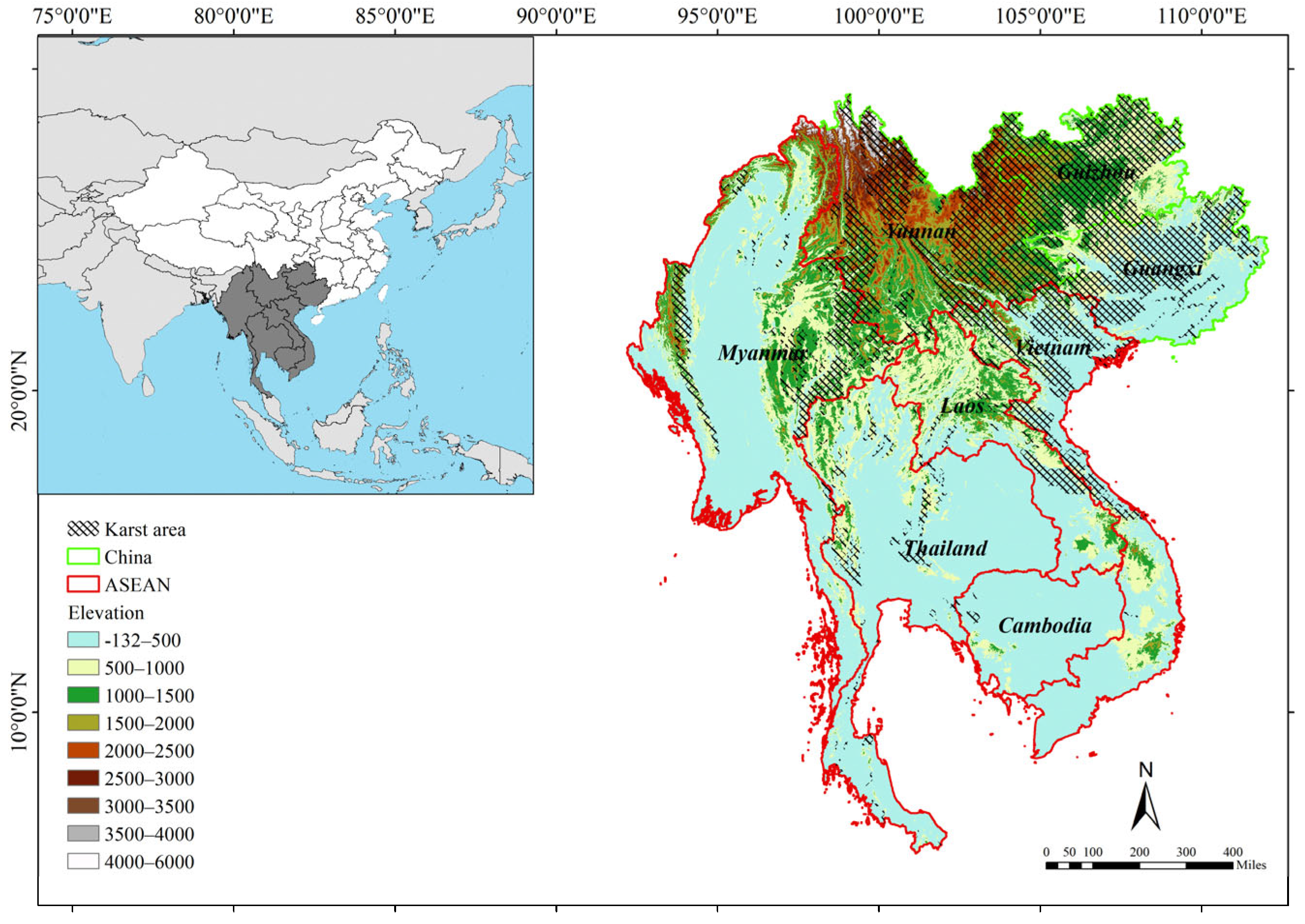
This study focuses on contiguous karst areas in China’s three southwestern provinces (Guizhou, Guangxi, Yunnan) and the five ASEAN countries (Laos, Thailand, Cambodia, Vietnam, Myanmar), as shown in Figure 1. The total area is approximately 2.75 million square kilometers, with karst regions accounting for about 26.54% of the total area. The land use types are diverse, and the vegetation types are mainly dominated by forest land. In the northern part, the dominant vegetation types are plateau coniferous forests, evergreen broad-leaved forests, and deciduous forests, while tropical rainforests are widely distributed in the southern part. The latter’s vegetation area is more than twice that of the former. However, crops occupy a significant proportion of the vegetation in the five ASEAN countries, especially in the karst regions of Cambodia and central Vietnam. Both areas share a monsoon climate with abundant rainfall (over 2000 mm annually in ASEAN) and warm temperatures conducive to vegetation growth. However, significant differences exist: China’s southwestern region has implemented large-scale ecological restoration projects, while ASEAN countries still face severe deforestation issues. In terms of precipitation patterns, the southwest experiences concentrated summer rains and winter droughts, whereas ASEAN maintains evenly distributed rainfall with no distinct dry–wet seasons in tropical areas. These climatic and intervention differences provide an comparative sample for investigating karst vegetation recovery under different hydrological and management conditions. The study will assess the impact of water-driven factors by analyzing regional variations in vegetation growth and carbon sink benefits.

2.2. Data Sources and Preprocessing

This study utilizes long-term temporal data spanning 2000–2023, incorporating vegetation indices, carbon sink indicators, and water consumption metrics to analyze the carbon–water trade-off in vegetation restoration within East Asia’s karst areas. The data selection adhered to two key principles: (1) covering nearly four decades of complete remote sensing datasets; (2) selecting indicators that account for the region’s dual hydrological structure and limited soil water retention capacity.
For carbon sink indicators (Table S1), the GPP was selected as it provides a more accurate reflection of vegetation’s carbon fixation efficiency. Compared to NEP or biomass data, GPP offers long-term temporal series advantages, making it suitable for assessing restoration benefits. To verify the relationship between GPP and water consumption, VOD data (1988–2015) were used to monitor plant water stress and dynamic changes in carbon storage.
Regarding moisture metrics, considering the karst region’s abundant rainfall coupled with high vapor heterogeneity, we selected soil moisture and evapotranspiration (ET) data from GLEAM-4.1a [17]. The research team led by Zuo et al. [18] reported this dataset’s advanced precision in Mediterranean-type climate regions, where its soil moisture estimates at the critical 0–15 cm layer effectively resolve the hydrological constraints imposed by karst’s signature skeletal soils. Additionally, saturated vapor pressure difference (VPD) data were incorporated to quantify the impact of climatic events on water stress. To ensure spatiotemporal consistency across multi-source datasets, three core preprocessing steps were executed: (1) Reprojection: All data were converted to the WGS84 coordinate system, with nearest-neighbor interpolation for categorical data (e.g., land use) to retain class labels and bilinear interpolation for continuous data (e.g., DEM, slope) for smooth spatial transitions. To mitigate systematic noise from spatial resolution unification, we quantified resampling errors via root mean square error (RMSE) for continuous variables and overall accuracy (OA) for categorical data, with all metrics falling within acceptable thresholds for regional ecological research (Table S2); (2) Temporal Aggregation: Annual timescale was standardized, with monthly VPD/ET aggregated to annual values (sum/mean for VPD, accumulation for ET), and all datasets clipped to the 2000–2015 common temporal range; (3) Spatial Resolution Unification: A 0.05° resolution (aligned with VOD data) was unified across all data, via mean aggregation for downscaling coarser datasets (e.g., SM: 0.1°) and targeted interpolation (nearest-neighbor for land use, bilinear for continuous data) for upscaling finer datasets (e.g., GPP: 500 m, NDVI: 1 km/1/12°) to preserve attribute integrity. Through multi-source data fusion (see for Table S1 [17,19,20,21,22,23,24]), this study aims to reveal the long-term dynamic mechanism of carbon–water coupling in vegetation restoration.

2.3. Methods

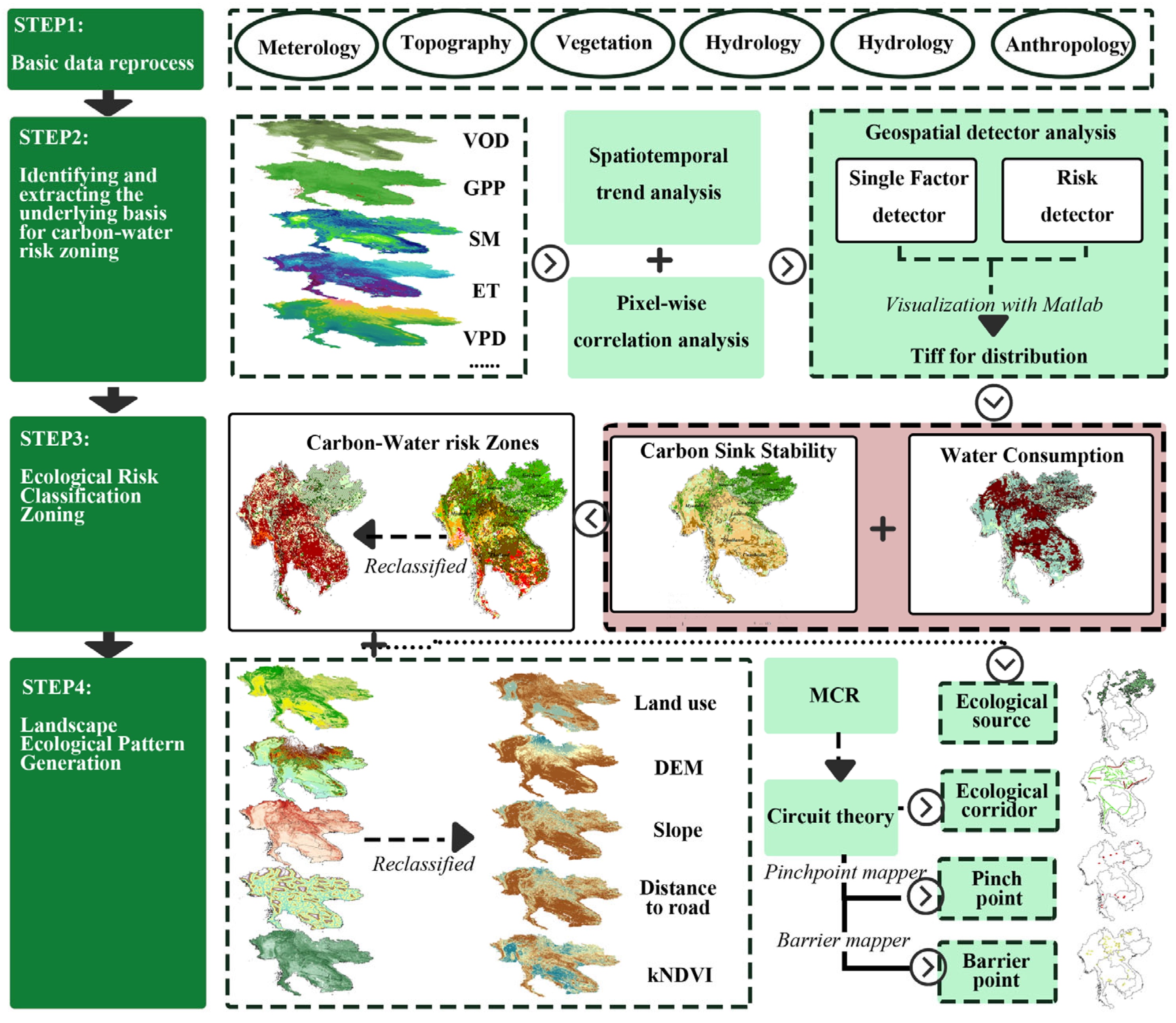
Our analytical framework was designed to systematically dissect the divergent carbon–water pathways through a multi-step approach. This process involved: (1) quantifying the spatiotemporal trends of key variables; (2) assessing the pixel-wise correlations between vegetation productivity and water drivers; (3) determining the relative importance and risks of these drivers using a geospatial detector model; and finally, (4) synthesizing these findings into a comprehensive carbon–water balance zoning framework. There is an outline to explain the whole progress of this study in Figure 2:
Generation of kNDVI dataset: For vegetation index analysis, to address challenges caused by high vegetation coverage and cloud interference in karst regions, we employed kNDVI data processed through the GEE algorithm (1982–2023). Compared to traditional NDVI methods, this approach effectively mitigates the saturation effect of land cover index (LAI) while enhancing data stability. It also resolves the accuracy degradation issue caused by cloud interference in tropical satellite products. The kNDVI data provide a clear visualization of vegetation cover trends. To construct a complete kNDVI time series dataset, this study collected high-resolution PKU GIMMS NDVI data from 1982 to 2022. The calculation employs the formula detailed in Xu et al.’s [25] paper, combined with the GEE algorithm proposed by Camps-Valls et al. [26] in their study. Cross-validation and fusion calculations were performed within the same time period, ultimately yielding a complete kNDVI dataset covering 2000–2023. The calculation principle aligns with the following formula:
kNDVI = tanh ( NDVI 2 )
The kNDVI dataset construction utilizes dual-source fusion technology: first, retaining partial NDVI data from 1982 to 2000 from the Institute of Earth Observation and Information Science (PKU GIMMS) at Peking University, then integrating the residuals by comparing consistency with post-2000 data from the same period. Following Hu et al.’s methodology [27], we first calculated the pixel-scale average values and ratios of kNDVI data calculated from PKU GIMMS and MODIS during 2000–2022 (for the same data observation period) to derive scaling factors. These factors were then used to integrate whole period data during 1982 to 2023. This approach ensured pixel-level consistent processing across datasets, reduced systematic errors, enhanced temporal continuity and reliability of data, and maintained the integrity of the 40-year (1982–2023) kNDVI dataset. The data integration formula is as follows:
SF ( x , y ) = t 1 MODIS kNDVI ( x , y , t 1 ) t 1 PKU   GIMMS kNDVI ( x , y , t 1 )
PKU   GIMMS   kNDVI ( x , y , t 1 ) = SF ( x , y ) · PKU   GIMMS   kNDVI ( x , y , t 1 )
Here, SF(x, y) denotes the scaling factor for pixel (x, y); t represents the overlapping period between MODIS kNDVI and PKU GIMMS kNDVI data, specifically the years 2000–2013 in this study. PKU GIMMS kNDVI(x, y, t1) and MODIS kNDVI(x, y, t1) are the original values of the pixel at time t1. PKU GIMMS kNDVI(x, y, t1) and PKU GIMMS kNDVI’(x, y, t1) correspond to the original and integrated values of the pixel at time t1, respectively.
AD ( t 1 ) = 1 n ( x , y ) PKU   GIMMS   kNDVI ( x , y , t 1 ) MODIS   kNDVI ( x , y , t 1 )
SMAPE ( t 1 ) = 1 n ( x , y ) | 2 · ( PKU   GIMMS   kNDVI ( x , y , t 1 ) MODIS   kNDVI ( x , y , t 1 ) ) ( PKU   GIMMS   kNDVI ( x , y , t 1 ) + MODIS   kNDVI ( x , y , t 1 ) ) |
Here, n denotes the total number of pixels in the Southeast Asian landmass; AD(t1) and SMAPE(t1) represent the AD and SMAPE metrics between the composite data and MODIS data at time t. Table S3 presents the comparative validation results of PKU GIMMS and MODIS data before and after integration.
Our findings demonstrate that integrated data exhibited lower Annual Bias (AD) and Seasonal Moving Average Percentage Error (SMAPE) values across all years compared to pre-integration data. Specifically, the multi-year average AD value (−0.007) decreased by 34.29% from −0.247, while SMAPE plummeted by 0.69 percentage points from 0.422 to 0.127. These results highlight data integration’s critical role in eliminating systematic errors, significantly enhancing the reliability and consistency of kNDVI data generated through the integration of PKUGIMMS NDVI and MODIS NDVI data sources. This advancement establishes a robust foundation for subsequent research.
Spatiotemporal trend analysis: Trends were analyzed using the Mann–Kendall test. To quantify the long-term spatiotemporal trends of GPP, VOD, SM, ET, and VPD from 2000 to 2023, the non-parametric Mann–Kendall (MK) test [28] was applied on a pixel-by-pixel basis (see for Equations (S1)–(S3)).
Pixel-wise correlation analysis: To investigate the nature of the relationship between vegetation productivity and water availability, a pixel-wise Pearson correlation analysis was conducted between GPP and each of the three water drivers (SM, ET, VPD). This method calculates the correlation coefficient [29] for each pixel, revealing the spatial patterns of carbon–water coupling. The results allowed us to distinguish between areas where these relationships were classified into positive (R > 0) and negative (R < 0). Meanwhile it present significance depend on p-value (e.g., significant positive for p > 0.05, R > 0). We adopted a spatial correlation significance threshold of p = 0.05 (instead of 0.01) to capture the pattern of weak overall positive correlations and prominent local negative correlations, highlighting regional differences between ASEAN and Southwest China’s three provinces. A stricter p = 0.01 would mask local strong correlation signals (e.g., a 92.06% reduction in significant positive GPP-VPD correlations) and overlook key localized features in Vietnam and Thailand. Given karst regions’ soil and vegetation constraints that weaken large-scale linear correlations, and this study’s role as preliminary carbon–water trade-off zoning work, p = 0.05 was chosen to retain ecologically meaningful signals.
The Pearson correlation coefficient (R) between GPP and each water driver (e.g., SM) was calculated as follows, when the methods for ET and VPD are identical to SM:
R GPPSM = i = 1 n [ ( GPP i GPP ¯ ) ( SM i SM ¯ ) ] i = 1 n ( GPP i GPP ¯ ) 2 i = 1 n ( SM i SM ¯ ) 2
To better clarify the local variations caused by the coexistence of these factors (for example, when SM shows positive spatial correlation with GPP in a certain area, while VPD and ET exhibit negative correlations), we categorize them into three types based on the combined correlation directions of different moisture factors: (1) Positive synergistic change area: In these regions, all three factors show positive spatial correlation with GPP, indicating a synergistic growth pattern. Therefore, normal regulatory measures can be implemented, as appropriately increasing the values of these factors may enhance GPP. (2) Soil drought stress area: This category includes all scenarios where SM shows negative correlations, comprising four types: VPD and ET showing negative/positive correlations individually or both simultaneously. Due to the fragile geological characteristics of karst regions, SM—especially in shallow layers—plays a crucial role in vegetation recovery. The appearance of negative correlations in these areas may indicate high geological degradation or drought threats, potentially affecting SM itself. (3) Atmospheric drought stress area: In this scenario, SM shows positive correlation with GPP while VPD and ET exhibit at least one negative correlation, totaling three types. This region may experience low water utilization or water deficit despite sufficient SM due to excessive atmospheric vapor pressure differences or increased evapotranspiration.
Geospatial detector analysis: To move beyond simple correlation and quantify the causal influence of the water drivers on the spatial patterns of GPP, we employed the Geospatial Detector model [30]. This powerful statistical tool can determine the relative importance of different factors and their interactions.
Factor detector: This calculates the q-statistic for each water driver (SM, ET, VPD), which measures the degree to which that driver explains the spatial variance of GPP. A higher q-value indicates stronger explanatory power. (Details in the Supplementary Materials for Equations (S4)–(S6)).
Interaction detector: It assesses whether pairs of drivers, when considered together, weaken or enhance their individual explanatory power. This was critical for identifying synergistic effects, such as the combined influence of ET and VPD.
Risk detector: This approach identifies areas where gross primary productivity (GPP) is most sensitive to specific ranges or categories of a given driver, thereby enabling the mapping of spatial distributions of ecohydrological risks associated with each water-related factor. These factors are classified into four types based on their risk occurrence frequencies during the period 2000–2023. Specifically, the frequency intervals are defined as follows: (1) no frequency (no risk events recorded in the pixel throughout the study period); (2) low frequency (1–6 occurrences); (3) medium frequency (7–12 occurrences); and (4) high frequency (13–24 occurrences). For further details, refer to Equation (S7) in the Supplementary Materials.
Framework for Carbon–water Balance Zoning: The final step of our analysis was to synthesize all previous findings into a comprehensive carbon–water Balance zoning map. This was achieved through a rule-based classification framework implemented via raster overlay in ArcGIS 10.8.1. The classification was based on two primary dimensions:
Carbon sink stability: Each pixel was categorized as ‘Stable’, ‘Potentially Stable’, or ‘Unstable’ based on its GPP trend significance (Figure 3a) and its associated risk profile (Figures S11–S13) [31].
Water consumption level: Each pixel was categorized as ‘Low’, ‘Medium’, or ‘High’ based on the intensity of its water drivers and associated risks. The specific zoning procedures are as follows: (1) to assess ET, VPD, SM water factors [32] impact on water consumption risk, a strong positive spatial correlation (Pearson r > 0.6) between gross primary productivity (GPP) and each factor combined with an interannual trade-off (GPP growth rate lagging behind the water factor’s) indicates enhanced carbon sequestration accompanies excessive water consumption, exacerbating risk (negative impact), whereas an interannual synergy (GPP growth rate outpacing the water factor’s) reflects improved water use efficiency (positive impact); (2) using each grid cell’s total 2000–2023 risk occurrence frequency as the core criterion, and integrating water factors’ dominance potential (q-value) and regional water pressure (e.g., drought frequency, total water resources), the Jenks natural breaks method stratified risk frequency into three levels, corresponding to three distinct risk zones with detailed characteristics shown in Table 1.
The overlay of these two dimensions resulted in twelve distinct carbon–water balance zones, providing a nuanced and spatially explicit assessment of the carbon–water balance across the entire study region. The specific criteria for this classification are detailed in the Table 1.
Construction for the landscape Ecosystem Network based on carbon–water balance zoning: The core methodology of this study encompasses landscape pattern index analysis and ecological network construction. The ecological network construction process consists of three stages: ecological source identification, comprehensive ecological resistance surface construction and ecological corridor construction.
Identification of Ecological Sources: The land use raster data (Figure S14) were processed based on the MSPA method, which used most stably in the identification of the landscape ecology patterns [33]. This involved projection, clipping, mask extraction, and re-classification into six land-use categories. Forest land, grassland, and water bodies were designated as foreground elements, while the remaining areas served as the background for generating a binary map. Subsequently, the Guidos Toolbox was utilized to segment the map into seven landscape types with land use grids prepared [34]. In conjunction with landscape connectivity analysis (employing Confor 2.6 software), three metrics were evaluated: the overall connectivity index (IIC), the potential connectivity index (PC), and the dPC (dissimilarity connectivity index). This was achieved through multiple distance—threshold and connectivity—probability tests. The optimal parameters (a distance threshold of 50 km and a connectivity probability of 0.5) were selected, and 24 core patches with dPC > 1.5 were identified as ecological sources.
Construction of a Comprehensive Ecological Resistance Surface: This study adopts the Minimum Cumulative Resistance (MCR) [35] model, incorporating six resistance factors: land use types, elevation, slope, vegetation coverage (kNDVI), proximity to railways, and the landscape ecological risk index (Table S6). By integrating the natural and socio—economic characteristics of research area, these factors were classified and assigned values. The Analytic Hierarchy Process (AHP) method (accompanied by a consistency test) was utilized to determine the weights of each factor in the Table S4. Meanwhile, the consistency test was performed for the AHP judgment matrix (details of relevant formulas in the Table S5). The test followed standard AHP procedures: (1) calculate the product of the judgment matrix and the weight vector (AW); (2) derive the maximum eigenvalue (λmax) using the element-wise ratio of AW to W; (3) compute the consistency index (CI) and consistency ratio (CR) (with RI = 1.26 for n = 6, referring to the standard random consistency index table).
Eventually, the comprehensive ecological resistance surface was generated through spatial overlay analysis.
Construction of Ecological Corridors: Based on circuit theory, the LinkageMapper 3.0.0 tool and Circuitscape 4.0.7 software were employed to identify key and potential corridors through the analysis of ecological source areas and resistance surfaces. Above the result form the framework for carbon–water balance zoning, there is a series of novel type for the landscape risk on carbon–water instead of the. Hence the result of the zoning (see for Table S7) is divided into 5 categories for the Evaluation System. The Pinchpoint Mapper 3.0.0 (operating in the ‘all-to-one’ mode with a corridor width of 2000 m) was utilized to identify ecological pinchpoints (by using the natural breakpoint method to extract regions with the highest current density), while the Barrier Mapper 3.0.0 (with a search radius and step length of 6000 m) was used to detect ecological barriers. A novel attempt is presented herein to substitute traditional landscape ecological risk (quantified via landscape ecological indices) with carbon–water risk. Relevant research [36] has verified that spatial mechanism-based coordination serves as a critical basis for ecological planning and landscape pattern design.

3. Results

3.1. Divergent Trajectories of Carbon Sequestration and Water Use

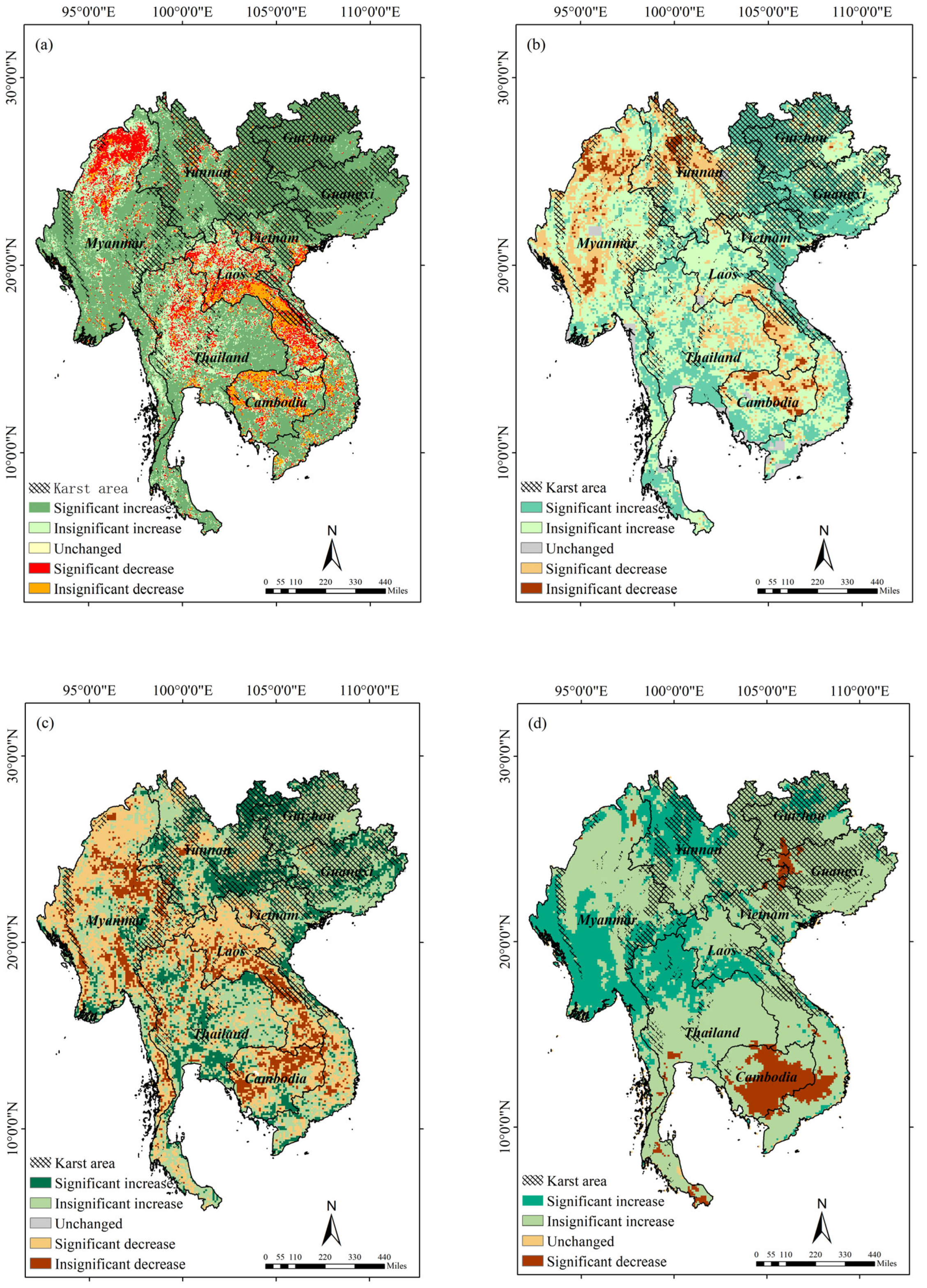
Our analysis reveals two starkly divergent ecological trajectories in the East Asian karst region from 2000 to 2023. Southwest China is characterized by a significant and widespread increase in vegetation productivity (GPP), whereas the ASEAN region exhibits much weaker growth and extensive areas of degradation (Figure 3a).
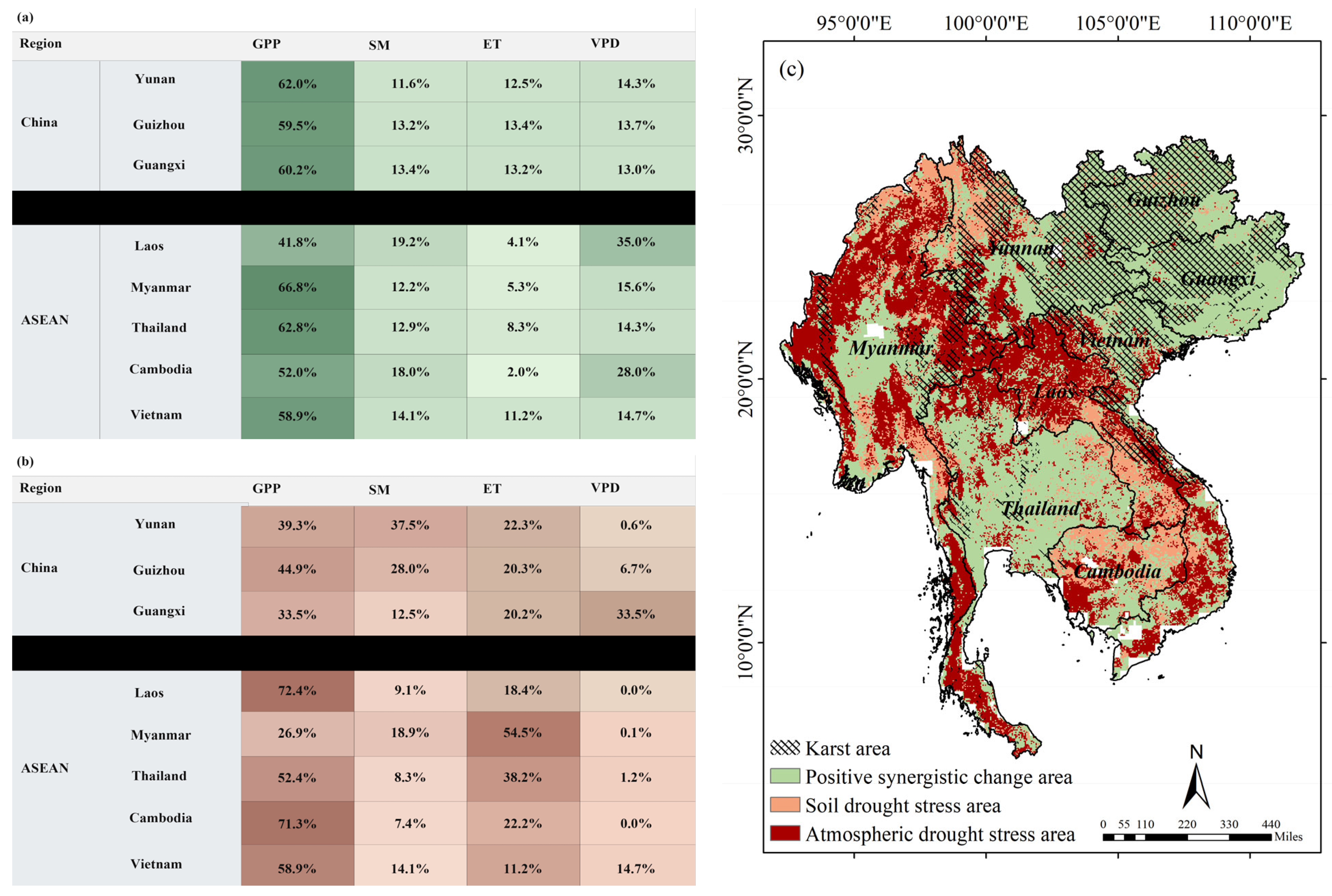
Specifically, the GPP increase in China’s karst provinces was particularly pronounced, with over 60% of their karst territories greening (e.g., 62.0% in Yunnan karst, 60.2% in Guangxi karst as presented in Figure 4a). In sharp contrast, significant GPP decline characterized large parts of ASEAN, affecting 72.4 of Laos and 71.3% of Cambodia (Figure 4b). This contrast was also evident in the earlier period (2000–2015) when comparing GPP with vegetation optical depth (VOD), an indicator of vegetation water content as detailed in Figure S1 for GPP and Figure S2 for VOD. While Southwest China’s karst areas were dominated by GPP growth, ASEAN’s karst regions exhibited more pronounced VOD degradation as detailed in the net change from Figure S3, suggesting a decoupling of biomass gain from vegetation health.
These divergent carbon trends were accompanied by distinct patterns in water consumption drivers. In the ASEAN regions where GPP declined, SM paradoxically increased—for instance, increasing across 19.5% of Thailand and 26.3% of Myanmar—likely due to reduced vegetation water uptake (Figure 3b). In contrast, evapotranspiration (ET) broadly decreased across these same degrading areas (Figure 3c). Vapor pressure deficit (VPD), an indicator of atmospheric aridity, remained largely unchanged across most of the study area, though its influence was demonstrably higher in ASEAN (Figure 3d).

3.2. Contrasting Carbon–Water Coupling Mechanisms

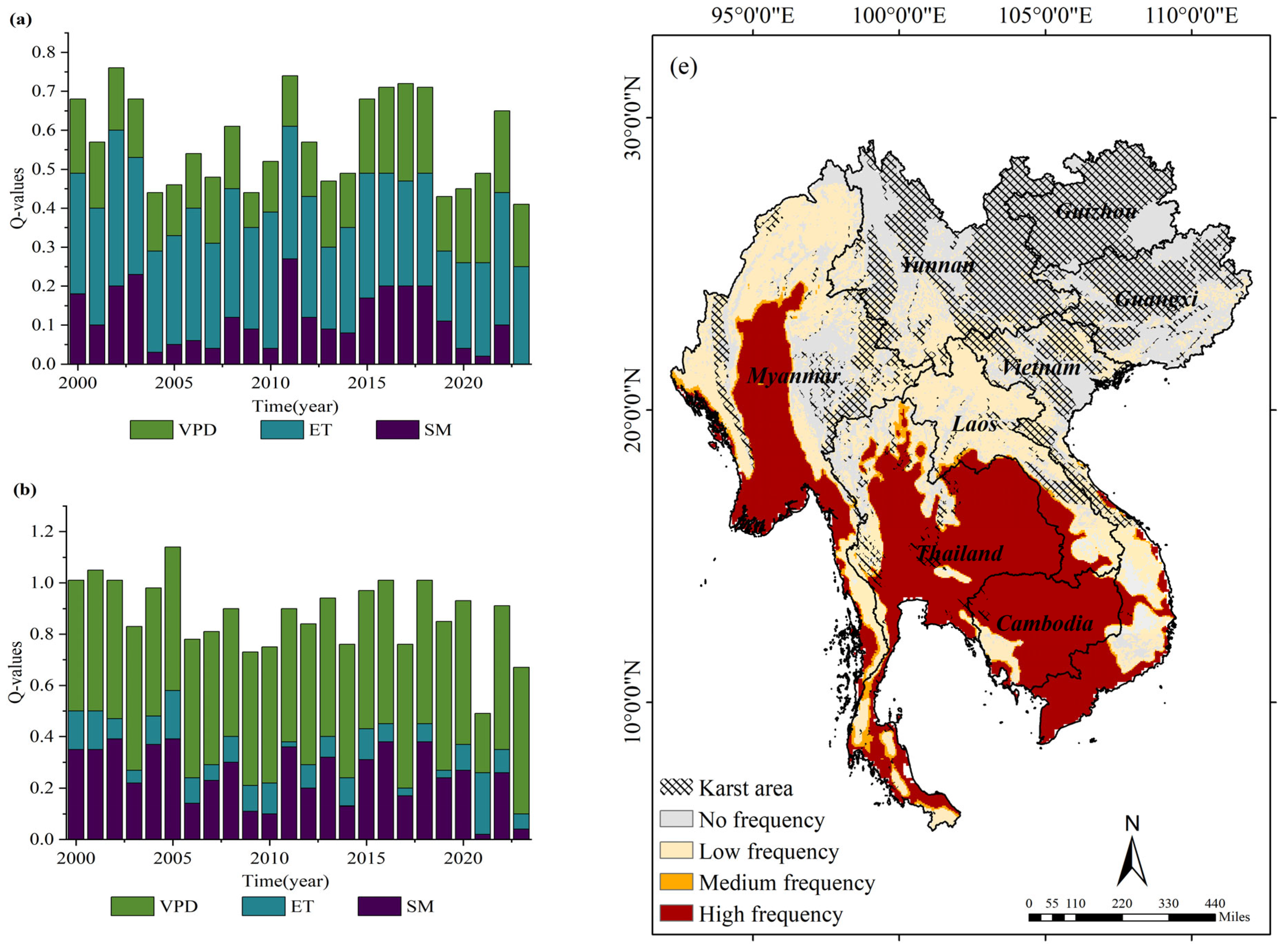
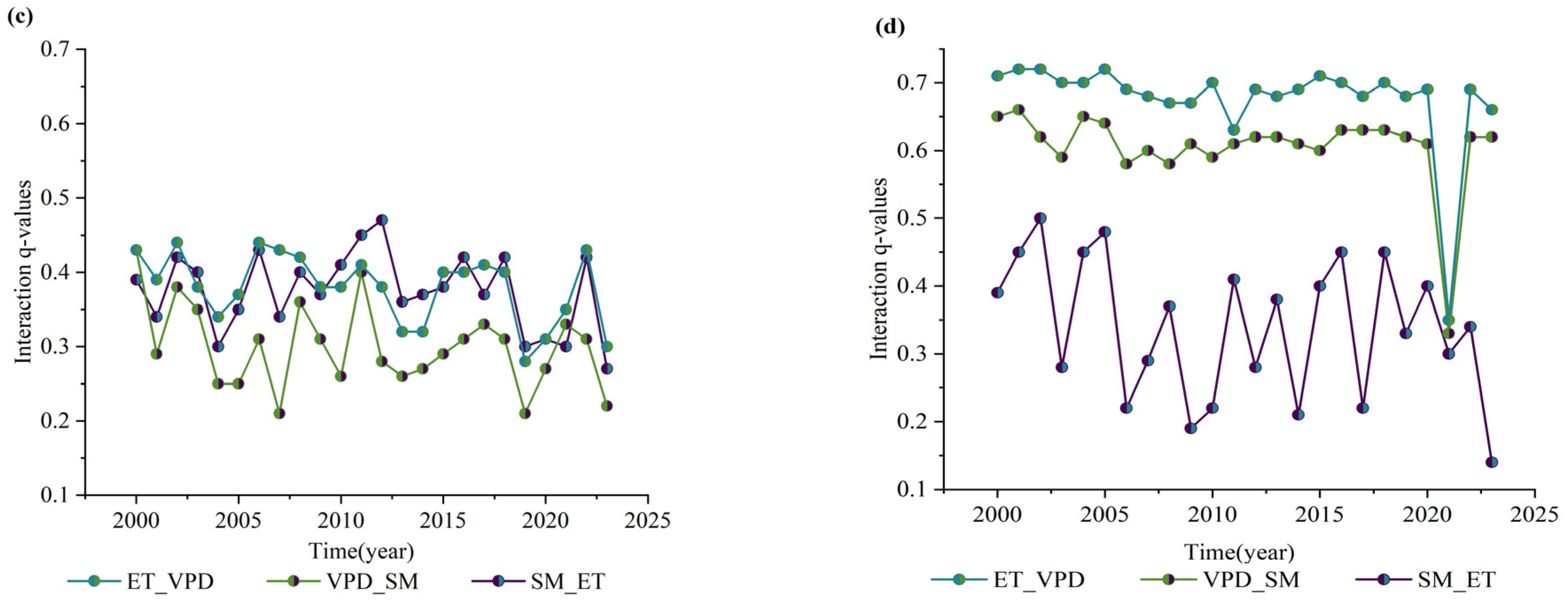
The core of this divergence lies in the fundamentally different carbon–water coupling mechanisms between the two regions. A stark dichotomy was observed in the relationship between GPP and evapotranspiration (ET): in Southwest China, this coupling is positive, reflecting a healthy, productive ecosystem. Conversely, a widespread negative correlation dominates the ASEAN region (covering 34% of the area), indicating that higher atmospheric water demand is linked to lower productivity—a classic sign of water stress and impending degradation as described in Figures S5 and S6. While SM presented positive areas more than the negative in Figure S4 was confirmed as the fundamental driver of GPP spatial patterns across the entire region (described factors induced GPP in Figures S7 and S8), it is contrasting response to atmospheric water dynamics that truly separates the two pathways. Notably, China’s southwest and five ASEAN countries show similarities and differences in single and interactive factor effects across time periods. (1) VPD has the highest explanatory power in both regions, but they present q-value dynamics differences. Southwest China sees large SM q-value fluctuations (e.g., 2004, 2011) across 2000–2023 (Figure 5a), while ASEAN’s VPD explanatory power far outpaces SM and ET with sharp changes around 2005 and 2021 (Figure 5b). (2) ET-VPD interactions rank highest in explanatory power in both areas, yet variability across interaction types is greater in ASEAN than in Southwest China (Figure 5c,d). Specifically, Southwest China’s interaction q-values are relatively consistent (only SM-ET exceeds ET-VPD during 2006–2018), whereas ASEAN’s interaction q-values vary significantly, with ET-VPD showing marked shifts around 2011 and 2021.
Geospatial detector analysis further pinpoints atmospheric drought as the escalating primary cause of ASEAN’s ecological vulnerability. The analysis revealed that while SM’s influence is primary, the explanatory power of vapor pressure deficit (VPD) has been steadily increasing across vast areas of ASEAN with ET increasing in Figure S9, but not in China, as illustrated in Figure S10. This signifies that atmospheric drought is intensifying as the dominant limiting factor for vegetation in ASEAN. This finding is reinforced by the fact that the synergistic interaction between ET and VPD has the strongest overall impact on GPP as indicated in Figures S5 and S6. The ultimate consequence is revealed in our risk assessment: the ASEAN region is almost entirely blanketed by high-frequency VPD risk, a critical threat virtually absent in Southwest China (Figure 5c). As detailed in Figures S11 and S12, the risk of SM and ET present less severe than the VPD and they are mainly low frequency SM risk with 72.9% (see for Table 2) in southwest China meanwhile with SM q-values rise in 70.5% (see for Table 3). All in all, two parts of research areas presented distinguished q-values variation direction and risk reflectance mainly on VPD and SM for Soil drought stress area and atmospheric drought stress area (see for Figure 4c which overlaying three factors distribution, classified in the method part) focused on the middle and southern of the ASEAN especially for Laos, Cambodia.

3.3. Delineating Carbon–Water Balance Zones Based on Carbon–Water Balance

The synthesis of these divergent trends and mechanisms allows for the delineation of distinct carbon–water balance zones that confirm the two regions’ contrasting ecological statuses. As supported by the data in Figure S13, Southwest China is dominated by zones of high carbon sink stability, covering 44% of its territory. These ‘stable’ areas were 8.6 times more extensive than its unstable zones. In sharp contrast, the ASEAN region is overwhelmingly characterized by ‘unstable’ and ‘potentially unstable’ carbon sinks, which covered a combined 54.9% of its territory.
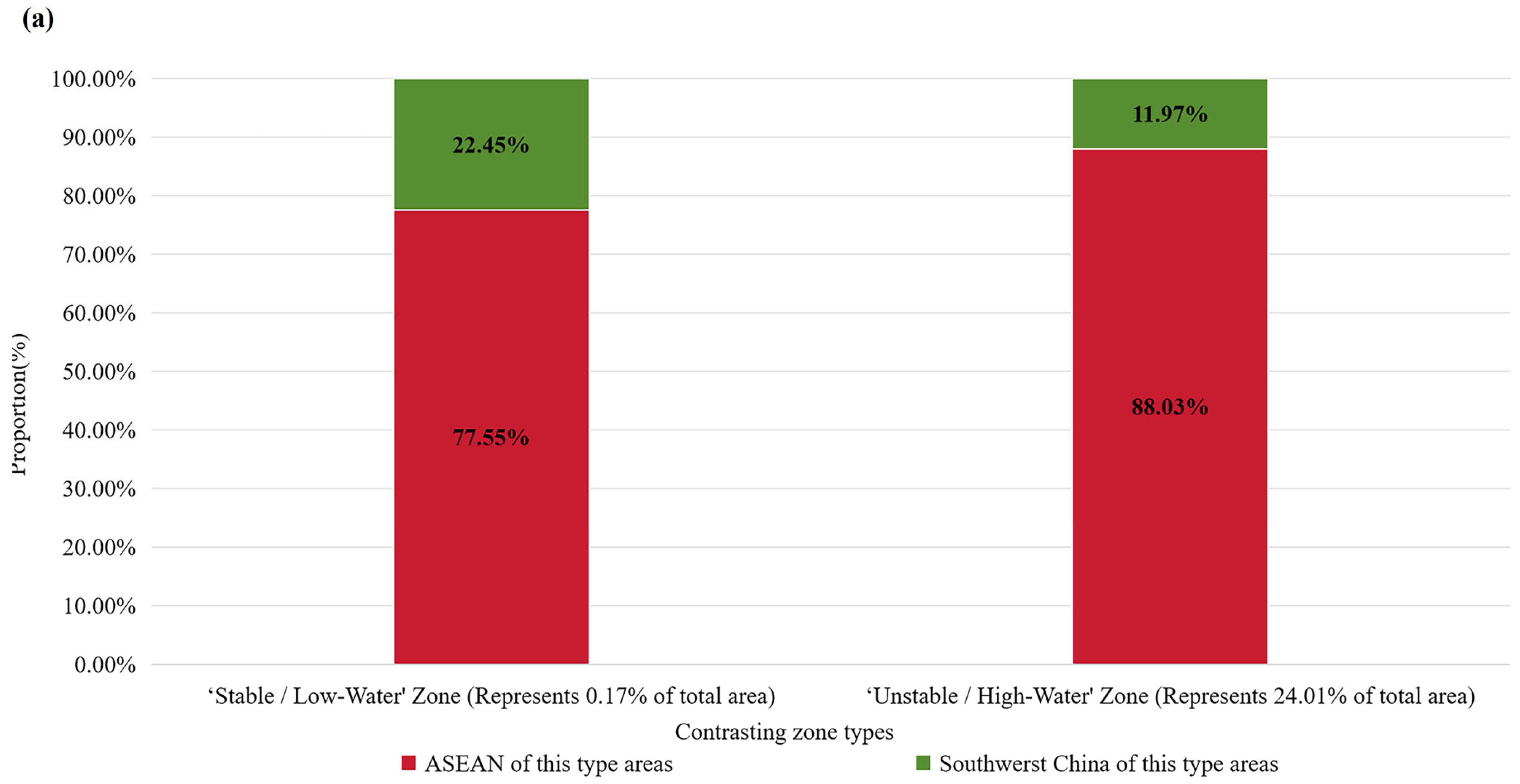
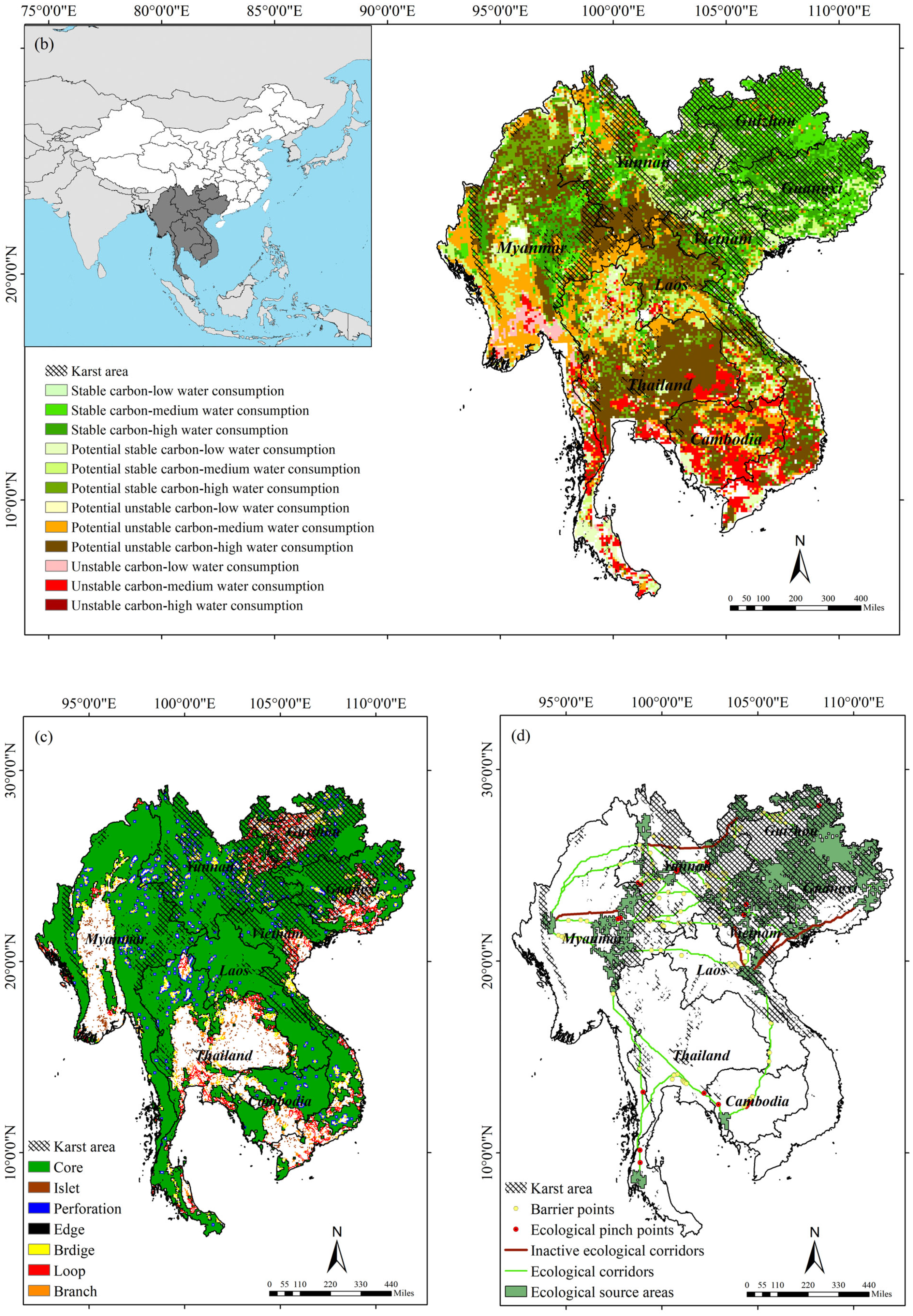
When overlaid with water consumption levels referring to Figures S14 and S15 for details, a powerful explanatory pattern emerges in the final synthesis map (Figure 6a). Southwest China predominantly features a ‘stable carbon sink–medium water consumption’ profile (15.38% of the total area, Table 4), indicating a relatively efficient restoration model. Conversely, the most common profile in ASEAN is ‘potentially unstable carbon sink–high water consumption’ which alone accounts for 24.00% of the total study area (Table 4). This ‘low carbon-high water’ profile signifies a high-risk, unsustainable trajectory where vegetation struggles despite high water use, underscoring the urgent need for targeted management interventions. The clear regional dominance of these opposing profiles is quantitatively confirmed in Figure 6b. A detailed quantitative breakdown of the area occupied by each Carbon–water Balance zone is provided in Table 4.
To characterize spatial heterogeneity in carbon budget and water consumption (CBNZ), five typical regions were identified across southwest China’s three provinces (Guangxi, Yunnan, Guizhou) and five ASEAN countries, focusing on total risk proportions and internal risk disparities: (1) Guangxi is dominated by high-carbon/high-water-consumption risks (89.87% of regional total risk) but also acts as a benchmark for low-water-consumption/stable carbon sinks in southwest China (63.64% of this favorable type). It contributes 25.36% of all high-carbon/high-water-consumption risks (concentrated in central Guangxi), with southern areas showing strong potential carbon sink and stable low-water-consumption performance. (2) Yunnan has significant internal heterogeneity, with low-water-consumption potential carbon sinks 1.6 times that of Guangxi, however, its medium-to-high-risk unstable/potential carbon sink areas account for 95% of such zones in southwest China (only 0.3 times the largest ASEAN counterpart), highlighting prominent water-consumption risks alongside carbon sink potential. (3) Laos faces overlapping high-water-consumption risks of potential unstable (42.25%) and stable (55.26%) carbon sinks, concentrated in southern karst areas, with a marked medium-to-high water-consumption transition at the karst-non-karst boundary. (4) Myanmar features complex multi-risk distribution with northeast-southwest gradients: northeast karst areas have high-water-consumption stable/unstable carbon sink risks, while southwest non-karst areas have intricate water-consumption and carbon sink instability; north-central/southernmost zones have adjacent high-water-consumption potential carbon sinks and unstable carbon sinks, with unstable low-water-consumption areas only in central Myanmar. (5) Vietnam shows clear north–south differentiation: northern karst areas have high-water-consumption potential stable carbon sinks, while southern non-karst areas are dominated by unstable carbon sinks.
In summary, Guangxi bears high-carbon/high-water-consumption risks, but Yunnan has more severe carbon sink instability and water-consumption vulnerabilities. ASEAN regions are dominated by potential carbon sink instability and moderate-to-high water consumption, with pronounced north-south disparities and localized east-west variations (e.g., Laos, Myanmar, Vietnam). Southwest China faces latent water-consumption risks (requiring targeted mitigation in Yunnan to consolidate restoration gains), while ASEAN confronts dual unstable carbon sink/high-water-consumption risks (with Myanmar and northern Yunnan showing localized favorable performance).

3.4. Regional Planning Optimization Strategy

By integrating multi-source data (e.g., land use and slope gradient) and employing tools such as Guidos Toolbox, this study quantitatively analyzed key ecological elements including ecological source areas and corridors, yielding critical insights for differentiated governance: The study area’s ecological landscape is predominantly dominated by the core zone in Figure 6c, which accounts for 77.26% of the total area. This indicates that the region retains a relatively intact ecological foundation, demonstrating strong ecological stability and effective habitat provisioning. The peripheral and transitional zones play crucial roles in maintaining spatial connectivity and ecological fluidity between patches. The overall pattern exhibits a typical “core concentration, ring-shaped and fragmented porosity” configuration. While landscape fragmentation ranks second only to this spatial pattern, it nevertheless reflects significant risks of ecological fragmentation. The spatial pattern of carbon–water consumption risks presents significant regional heterogeneity—ASEAN is dominated by high-risk areas accounting for 45.47% of the study area, while Southwest China is characterized by relatively low-risk areas representing 27.82% in Figure 6d. Among the five delineated risk zones (see for the Table S7), the low-risk areas (core regions such as Guangxi and Guizhou in Southwest China) demonstrate optimal ecological performance but are confronted with potential water resource stress. In sharp contrast, the high-risk areas in ASEAN (e.g., eastern Myanmar) face the most pressing governance challenge, namely the “low-carbon and high-water consumption” pattern induced by intensive human disturbances. The identification of ecological sources indicates that 70.85% of the ecological sources are concentrated in Southwest China, with core areas accounting for 77.26% of the total, forming a stable ecological base. Primary sources (with dpc > 4) and secondary sources collectively constitute a “concentrated-dispersed” spatial distribution pattern. The analysis of ecological corridors and multi-node features identified 63 corridors, which form a hierarchical network characterized by “main trunk support and secondary supplementation”. The central karst area of Southwest China has a dense distribution of corridors, whereas long-distance corridors in ASEAN suffer from insufficient connectivity. A total of 19 ecological pinch points are clustered along key corridors in ASEAN, and 101 ecological barriers primarily impede the connectivity between cross-regional ecological sources. The integrated ecological security pattern exhibits a distinct “north-dense and south-sparse” characteristic: the northern region (predominantly Southwest China) has concentrated ecological sources and corridors but is dotted with dense barriers; the southern region (mainly ASEAN) has scarce ecological sources but distributed critical pinch points; and the central high-resistance area can be designated as an ecological buffer zone. These findings provide precise support for targeted regional planning and management, clarifying three core priorities: Southwest China should prevent water resource risks, ASEAN regions need to focus on governing degraded ecosystems, and cross-regional efforts should prioritize the restoration of ecological barriers.

4. Discussion

4.1. Policy and Land Use: The Anthropogenic Drivers of Divergence

These two contrasting pathways likely stem from decades of divergent anthropogenic pressures and policy interventions. Southwest China’s trajectory toward a ‘stable carbon sink–medium water consumption’ model strongly reflects the efficacy of policy-driven large-scale ecological restoration projects. Major initiatives, such as the Grain for Green Project [37] and the Integrated Mountains-Rivers-Forests Restoration Project [38,39], align spatiotemporally with our findings. For instance, Yunnan’s substantial investment in afforestation [40] corresponds with the maturation of plantations, which likely contributed to the observed water-driven GPP fluctuations (Figure 5a,c). Spatially, these projects appear to override climatic factors in driving vegetation recovery (p < 0.05) [41]. Our results, showing a widespread GPP increase coupled with a declining dominance of SM (Figure S9), suggest that managed restoration has pushed the ecosystem toward a more productive state. While water resources remain crucial, growth is now likely driven by a more complex set of factors. This corroborates studies documenting China’s “greening” but adds a critical efficiency perspective: this greening has seemingly been achieved without tipping the region into high water-stress categories.
In stark contrast, the ASEAN region’s shift toward an ‘unstable carbon sink–high water consumption’ state highlights the pervasive impact of market-driven land-use changes. Widespread deforestation for cash crops (e.g., rubber) in Cambodia, Laos, and Myanmar is well-documented [42], and our results provide a biophysical footprint of these activities. The negative correlation between GPP and ET (Figure S5), combined with the paradoxical increase in soil moisture in degrading areas (Figure 3b), implies a disrupted water cycle where the loss of transpiring (Figure 3c) vegetation reduces local moisture recycling [43]. Consequently, atmospheric drought (high VPD risk) appears to be emerging as a key ecological stressor following landscape fragmentation.

4.2. The Escalating Threat of Atmospheric Drought: A New Paradigm of Karst Vulnerability

A critical finding of this study is the divergence in ecological vulnerability drivers between the two regions. While SM is fundamental in thin-soiled karst landscapes [44], our analysis suggests that its direct control in the ASEAN region might be giving way to atmospheric drought. The increasing explanatory power of VPD (Figure S10) and its association with high-risk zones (Figure 5e) point to a potential transition from “bottom-up” control (soil moisture) to “top-down” control (atmospheric water demand). This extends previous research focused on soil loss [45] by highlighting a feedback loop where land degradation may exacerbate atmospheric aridity.
The dominance of VPD risks in ASEAN, compared to SM risks in Southwest China [46], can be attributed to three potential mechanisms: (1) Threshold dynamics: Temperature-driven VPD changes and asynchronous temperature-humidity shifts (e.g., in Cambodia, see for Figure 5e) may effectuate high-risk clustering. The interaction between SM and VPD, often mediated by ET, partitions regions into water-demand versus supply-limited zones [47]. (2) Vegetation sensitivity: ASEAN’s agricultural expansion [48] and mixed cropping systems enhance VPD sensitivity, whereas Southwest China’s evergreen broad-leaved forests, though sensitive, are better protected. Artificial plantations (e.g., rubber) likely face dual limitations of SM deficit and atmospheric drought (Figure 4c). (3) Anthropogenic amplification: Rubber-related deforestation [49] and greenhouse gas emissions may elevate VPD beyond critical thresholds [50], reducing productivity. Agricultural expansion, which causes significantly more habitat loss than urbanization [51], concentrates these impacts in high-risk zones (Figure 6a).

4.3. Recommendations and Implications for Transboundary Landscape Management

The Carbon–Water Balance Zoning (CWBZ) framework advances transboundary management in two aspects. First, it optimizes source identification. Unlike traditional methods focusing solely on patch size [52], CWBZ integrates water consumption risks. Our analysis reveals that while Southwest China’s sources are stable, ASEAN’s scarce sources face high water consumption (Figure 6a), underscoring the urgency of cross-border cooperation [53]. Second, it guides targeted connectivity. MCR analysis identifies high-consumption corridors in ASEAN that require drought-tolerant vegetation and micro-water facilities (Figure 6c) [54], while barriers linking stable carbon sinks should be prioritized for restoration to enhance network resilience [55,56].
Implementing these strategies faces economic and political heterogeneity. Southwest China has largely achieved a green transformation through eco-tourism and policy-driven control [57,58]. Conversely, ASEAN’s economic growth often relies on resource-intensive sectors, leading to deforestation [59,60,61]. To bridge these gaps, we propose three targeted actions: (1) Data Collaboration: Establish a joint China–ASEAN platform integrating long-time-series satellite data [62,63] and in situ measurements to align sub-national goals. (2) Technical Exchange: China could share agro-forestry models for desertification control [64], while ASEAN contributes insights on cash crop sustainability. Joint pilots for drought-tolerant crops [65] in high-risk corridors (Figure 6a,c) are essential. (3) Institutional Coordination: Form a multi-level mechanism to clarify land rights and align ecological compensation, potentially supported by a cross-border fund for sustainable transitions from commercial forestry to agroforestry [66].
For the Limitations and Future Directions, while this study identifies broad patterns, several limitations remain. First, causal inference is limited by data availability. The suggestion that the region is shifting from groundwater to atmospheric control requires further verification using in situ groundwater data [67], which were unavailable for this regional-scale analysis. Second, socioeconomic drivers were analyzed via correlation, but the causal linkages between specific human activities (e.g., specific crop types) and hydrological changes need refinement. Future research should integrate high-resolution socioeconomic datasets [68] and ground-based hydrological observations to disentangle the complex interactions between anthropogenic pressure, groundwater dynamics, and atmospheric aridity.

5. Conclusions

This study reveals two fundamentally divergent carbon–water pathways in the East Asian karst region. Southwest China exhibits a sustainable ‘stable carbon sink–medium water consumption’ trajectory, consistent with the outcomes of policy-led ecological engineering. In contrast, significant parts of the ASEAN region show an ‘unstable carbon sink–high water consumption’ pattern, which appears to be exacerbated by intensifying atmospheric drought.
Mechanistically, these divergences imply different dominant drivers. While restoration in China aligns with ecosystem recovery, the landscape fragmentation in ASEAN is likely associated with a feedback loop between vegetation loss and atmospheric water stress. By integrating the Carbon–water Balance Zoning (CWBZ) with connectivity models (MSPA-MCR), we identified that high-risk zones in ASEAN directly align with areas of fragmented connectivity, pinpointing critical priorities for transboundary intervention.
Overall, this framework moves beyond simple “greening” metrics to offer a holistic tool for landscape optimization. The delineation of these pathways provides a scientific basis for developing differentiated, region-specific policies to enhance the resilience of these fragile karst ecosystems.

Supplementary Materials

The following supporting information can be downloaded at: https://www.mdpi.com/article/10.3390/land15010066/s1, Figure S1: The spatial distribution of GPP trends (2000–2015); Figure S2: The spatial distribution of VOD trends (2000–2015); Figure S3: Net change proportion on GPP & VOD of the karst areas; Figure S4: Correlation between GPP & SM (2000–2023); Figure S5: Correlation between GPP & ET (2000–2023); Figure S6: Correlation between GPP & VPD (2000–2023); Figure S7: Temporal variation in the explanatory power (q-statistic) of single water drivers for the whole research area; Figure S8: Temporal variation in the explanatory power (q-statistic) of interaction factors induced GPP for the whole research area; Figure S9: The q value of SM impacted GPP (2000–2023); Figure S10: The q value of ET impacted GPP (2000–2023); Figure S11: The q value of VPD impacted GPP (2000–2023); Figure S12: Risk discrepancy frequence of SM (2000–2023); Figure S13: Risk discrepancy frequence of ET (2000–2023); Figure S14: Carbon sink increased stability zoning; Figure S15: Water consumption zoning; Table S1: Summary of datasets used; Table S2: Resampling Error Metrics for Multi-source Datasets; Table S3: Verify the integration of kNDVI data; Table S4: AHP Judgment Matrix for Ecological Resistance Factors; Table S5: Key Formulas and Results of AHP Consistency Test; Table S6: Classification and Weighting of Ecological Resistance Factor; Table S7: Landscape risk classification criteria based on carbon consumption; Equations (S1)–(S3) for Spatiotemporal trend analysis-MK test; Equations (S4)–(S6) for Geospatial detector analysis-Factor detector; Equation (S7) for Geospatial detector analysis-Risk detector.

Author Contributions

Conceptualization: Y.P. and W.F.; methodology: Y.P. and Q.L.; validation: Y.P. and W.F.; formal analysis: Y.P. and W.F.; investigation: Y.P. and W.F.; data curation: Y.P.; writing—original draft: Y.P.; writing—review and editing: Y.P., W.F., Z.F., S.W. and Q.L.; visualization: Y.P., S.W. and Z.F.; supervision: W.F.; project administration: W.F. and Q.L. All authors have read and agreed to the published version of the manuscript.

Funding

This research received no external funding.

Data Availability Statement

Acknowledgments

Thanks to all those who helped with the study but were not listed as co-authors due to insufficient contributions.

Conflicts of Interest

The authors declare no conflicts of interest.

References

  1. Li, C.; Zhang, S. Assessing and explaining rising global carbon sink capacity in karst ecosystems. J. Clean. Prod. 2024, 477, 143862. [Google Scholar] [CrossRef]
  2. Yang, S.; Li, Y.; Zhao, Y.; Lan, A.; Zhou, C.; Lu, H.; Zhou, L. Changes in vegetation ecosystem carbon sinks and their response to drought in the karst concentration distribution area of Asia. Ecol. Inform. 2024, 84, 102907. [Google Scholar] [CrossRef]
  3. Yuan, D.X.; Jiang, Y.J.; Shen, L.C.; Pu, J.B.; Xiao, Q. Xiandai Yanshi Xue [Modern Karstology]; Science Press: Beijing, China, 2024. [Google Scholar]
  4. Lu, X.; Sheng, M.; Luo, M. Knowledge mapping analysis of karst rocky desertification vegetation restoration in Southwest China: A study based on Web of Science literature. Agronomy 2024, 14, 2235. [Google Scholar] [CrossRef]
  5. Yang, S.; Zhao, Y.; Yang, D.; Lan, A. Analysis of Vegetation NDVI Changes and Driving Factors in the Karst Concentration Distribution Area of Asia. Forests 2024, 15, 398. [Google Scholar] [CrossRef]
  6. Wang, Y.; Tong, X.; Li, J.; Yang, M.; Wang, Y. Impacts of Climate Change and Human Activities on Vegetation Productivity in China. Remote Sens. 2025, 17, 1724. [Google Scholar] [CrossRef]
  7. Huang, H.; Liu, J.; Guillaumot, L.; Chen, A.; de Graaf, I.E.M.; Chen, D. Contrasting impacts of irrigation and deforestation on Lancang-Mekong River Basin hydrology. Commun. Earth Environ. 2025, 6, 107. [Google Scholar] [CrossRef]
  8. Zhu, Y.; Wang, H.; Zhang, A. Satellite remote sensing reveals overwhelming recovery of forest from disturbances in Asia. Atmos. Ocean. Sci. Lett. 2025, 18, 100511. [Google Scholar] [CrossRef]
  9. Peng, S.; Terrer, C.; Smith, B.; Ciais, P.; Han, Q.; Nan, J.; Fisher, J.B.; Chen, L.; Deng, L.; Yu, K. Carbon restoration potential on global land under water resource constraints. Nat. Water 2024, 2, 1071–1081. [Google Scholar] [CrossRef]
  10. Qin, Y.; Wang, Y.; Li, S.; Deng, H.; Wanders, N.; Bosmans, J.; Huang, L.; Hong, C.; Byers, E.; Gingerich, D.; et al. Global assessment of the carbon–water tradeoff of dry cooling for thermal power generation. Nat. Water 2023, 1, 682–693. [Google Scholar] [CrossRef]
  11. Li, Y.; Piao, S.; Li, L.Z.X.; Chen, A.; Wang, X.; Ciais, P.; Huang, L.; Lian, X.; Peng, S.; Zeng, Z.; et al. Divergent hydrological response to large-scale afforestation and vegetation greening in China. Sci. Adv. 2018, 4, eaar4182. [Google Scholar] [CrossRef] [PubMed]
  12. He, X.T.; Yuan, S.J.; Pan, T.; Gu, X.P.; Yu, F. Spatial and temporal distribution of soil humidity in karst areas of Guizhou Province. Carsologica Sin. 2018, 37, 562–574. [Google Scholar] [CrossRef]
  13. Liu, Y.; Lian, J.; Nie, Y.; Wang, K.; Chen, H. The role of root-zone soil moisture in delaying vegetation responses to drought: Comparative insights from karst and non-karst areas. J. Hydrol. 2025, 663, 134216. [Google Scholar] [CrossRef]
  14. Yang, X.Q.; Wu, J.P.; Chen, X.Z.; Ciais, P.; Maignan, F.; Yuan, W.P.; Piao, S.L.; Yang, S.; Gong, F.X.; Su, Y.X.; et al. A comprehensive framework for seasonal controls of leaf abscission and productivity in evergreen broadleaved tropical and subtropical forests. Innovation 2021, 2, 100154. [Google Scholar] [CrossRef]
  15. Sun, W.; Zhang, E.; Zhao, Y.; Wu, Z.; Chen, W.; Wang, Y.; Bai, Y. Conservation priority corridors enhance the effectiveness of protected area networks in China. Commun. Earth Environ. 2025, 6, 275. [Google Scholar] [CrossRef]
  16. Yue, Y.; Wang, L.; Brandt, M.; Zhang, X.; Wang, K. A social-ecological framework to enhance sustainable reforestation under geological constraints. Earth’s Future 2024, 12, e2023EF004335. [Google Scholar] [CrossRef]
  17. Miralles, D.G.; Bonte, O.; Koppa, A.; Baez-Villanueva, O.M.; Tronquo, E.; Zhong, F.; Beck, H.E.; Hulsman, P.; Dorigo, W.; Verhoest, N.E.C.; et al. GLEAM4: Global land evaporation and soil moisture dataset at 0.1° resolution from 1980 to near present. Sci. Data 2025, 12, 416. [Google Scholar] [CrossRef]
  18. Zuo, L.; Zou, L.; Xia, J.; Zhang, L.; Cao, H.; She, D. Multi-scale analysis of six evapotranspiration products across China: Accuracy, uncertainty and spatiotemporal pattern. J. Hydrol. 2025, 650, 132516. [Google Scholar] [CrossRef]
  19. Moesinger, L.; Dorigo, W.; de Jeu, R.; Teubner, I.; Forkel, M. The global long-term microwave Vegetation Optical Depth Climate Archive (VODCA). Earth Syst. Sci. Data 2020, 12, 177–196. [Google Scholar] [CrossRef]
  20. Yuan, W.; Liu, S.; Yu, G.; Bonnefond, J.-M.; Chen, J.; Davis, K.; Desai, A.R.; Goldstein, A.H.; Gianelle, D.; Rossi, F.; et al. Global estimates of evapotranspiration and gross primary production based on MODIS and global meteorology data. Remote Sens. Environ. 2010, 114, 1416–1431. [Google Scholar] [CrossRef]
  21. Abatzoglou, J.T.; Dobrowski, S.; Parks, S.A.; Hegewisch, K.C. TerraClimate, a high-resolution global dataset of monthly climate and climatic water balance from 1958–2015. Sci. Data 2018, 5, 170191. [Google Scholar] [CrossRef] [PubMed]
  22. Li, M.; Cao, S.; Zhu, Z.; Wang, Z.; Myneni, R.B.; Piao, S. Spatiotemporally consistent global dataset of the GIMMS Normalized Difference Vegetation Index (PKU GIMMS NDVI) from 1982 to 2022. Earth Syst. Sci. Data 2023, 15, 4181–4203. [Google Scholar] [CrossRef]
  23. Didan, K. MODIS/Terra Vegetation Indices 16-Day L3 Global 1km SIN Grid V061 [Data Set]; NASA Land Processes Distributed Active Archive Center: Sioux Falls, SD, USA, 2021. [Google Scholar] [CrossRef]
  24. GEBCO Compilation Group. G ZEBCO 2024 Grid [Data Set]; NERC EDS British Oceanographic Data Centre NOC: Liverpool, UK, 2024. [Google Scholar] [CrossRef]
  25. Xu, Z.; Liu, W.; Li, H.; Qin, S.; Wen, T. Vegetation variations and driving mechanisms in northern China based on kNDVI. Sci. Rep. 2025, 15, 30094. [Google Scholar] [CrossRef] [PubMed]
  26. Camps-Valls, G.; Campos-Taberner, M.; Moreno-Martínez, Á.; Walther, S.; Duveiller, G.; Cescatti, A.; Mahecha, M.D.; Muñoz-Marí, J.; García-Haro, F.J.; Guanter, L.; et al. A unified vegetation index for quantifying the terrestrial biosphere. Sci. Adv. 2021, 7, eabc7447. [Google Scholar] [CrossRef]
  27. Hu, Y.; Cui, C.; Liu, Z.; Zhang, Y. Vegetation dynamics in Mainland Southeast Asia: Climate and anthropogenic influences. Land Use Policy 2025, 153, 107546. [Google Scholar] [CrossRef]
  28. Karimzadeh, S.; Ahmadi, A.; Baldocchi, D.; Fisher, J.B. Climate change has increased global evaporative demand except in South Asia. Commun. Earth Environ. 2025, 6, 1009. [Google Scholar] [CrossRef]
  29. Zhao, F.; Shi, W.; Xiao, J.; Zhao, M.; Li, X.; Wu, Y. Recent weakening of carbon-water coupling in northern ecosystems. npj Clim. Atmos. Sci. 2025, 8, 161. [Google Scholar] [CrossRef]
  30. Zhao, Y.; Liu, L.; Kang, S.; Ao, Y.; Han, L.; Ma, C. Quantitative Analysis of Factors Influencing Spatial Distribution of Soil Erosion Based on Geo-Detector Model under Diverse Geomorphological Types. Land 2021, 10, 604. [Google Scholar] [CrossRef]
  31. Wei, H.; Wu, L.H.; Chen, D.; Yang, D.N.; Yang, Y.F.; Zhang, Y.; Du, J.J.; Jia, J.L. Assessing climate impacts on karst vegetation carbon sink change worldwide. Ecosyst. Health Sustain. 2025, 11, 0404. [Google Scholar] [CrossRef]
  32. Du, H.; Fu, W.; Song, T.Q.; Zeng, F.P.; Wang, K.L.; Chen, H.S.; Liu, M.X. Water-use efficiency in a humid karstic forest in southwestern China: Interactive responses to the environmental drivers. J. Hydrol. 2023, 617, 128973. [Google Scholar] [CrossRef]
  33. Wang, B.; Fu, S.; Hao, Z.; Zhen, Z. Ecological security pattern based on remote sensing ecological index and circuit theory in the Shanxi section of the Yellow River Basin. Ecol. Indic. 2024, 166, 112382. [Google Scholar] [CrossRef]
  34. Friedl, M.; Sulla-Menashe, D. MODIS/Terra+Aqua Land Cover Type Yearly L3 Global 500m SIN Grid V061 [Data Set]; NASA Land Processes Distributed Active Archive Center: Sioux Falls, SD, USA, 2022. [Google Scholar] [CrossRef]
  35. Huang, L.; Tang, Y.; Song, Y.; Liu, J.; Shen, H.; Du, Y. Identifying and Optimizing the Ecological Security Pattern of the Beijing–Tianjin–Hebei Urban Agglomeration from 2000 to 2030. Land 2024, 13, 1115. [Google Scholar] [CrossRef]
  36. Zhu, Z.B.; Yue, B.R.; Xu, B.J.; Peng, J.X.; Song, Y.F.; Yao, L.J.; Dong, Q.R. Spatial mechanism for opening the “black box”: A translational pathway from landscape ecological research to landscape ecological planning and design practice. Landsc. Archit. Front. 2025, 13, 34–49. [Google Scholar] [CrossRef]
  37. Cheng, Y.; Xu, H.-H.; Chen, S.-M.; Tang, Y.; Lan, Z.-S.; Hou, G.-L.; Jiang, Z.-Y. Ecosystem Services Response to the Grain-for-Green Program and Urban Development in a Typical Karstland of Southwest China over a 20-Year Period. Forests 2023, 14, 1637. [Google Scholar] [CrossRef]
  38. Tong, X.; Wang, K.; Yue, Y.; Brandt, M.; Liu, B.; Zhang, C.; Liao, C.; Fensholt, R. Quantifying the effectiveness of ecological restoration projects on long-term vegetation dynamics in the karst regions of Southwest China. Int. J. Appl. Earth Obs. Geoinf. 2017, 54, 105–113. [Google Scholar] [CrossRef]
  39. Chen, Y.; De Geeter, S.; Poesen, J.; Matthews, F.; Campforts, B.; Borrelli, P.; Panagos, P.; Vanmaercke, M. Global patterns of gully occurrence and their sensitivity to environmental changes. Int. J. Appl. Earth Obs. Geoinf. 2017, 54, 105–113. [Google Scholar] [CrossRef]
  40. Cheng, K.; Yang, H.; Tao, S.; Su, Y.; Guan, H.; Ren, Y.; Hu, T.; Li, W.; Xu, G.; Chen, M.; et al. Carbon storage through China’s planted forest expansion. Nat. Commun. 2024, 15, 4106. [Google Scholar] [CrossRef]
  41. Shao, Q.; Liu, S.; Ning, J.; Liu, G.; Yang, F.; Zhang, X.; Niu, L.; Huang, H.; Fan, J.; Liu, J. Assessment of ecological benefits of key national ecological projects in China in 2000–2019 using remote sensing. Acta Geol. Sin. 2022, 77, 2133–2153. [Google Scholar] [CrossRef]
  42. Cai, L.; Xiong, K.; Li, Y.; Liu, Z.; Zhu, D.; Liang, H.; Mu, Y.; Chen, Y. Coexisting plants restored in karst desertification areas cope with drought by changing water uptake patterns and improving water use efficiency. J. Hydrol. 2025, 654, 132813. [Google Scholar] [CrossRef]
  43. Chen, L.; Zhang, K.; Wang, G. Dynamic response of soil water to rainfall for different runoff plots on a karst hillslope. Geoderma 2025, 460, 117394. [Google Scholar] [CrossRef]
  44. Wang, X.; Liu, Y.; Xiong, K.; Huang, X.; Zhang, Z. Supportive functions of soil organic carbon for ecosystem services in karst desertification areas. Ecol. Indic. 2025, 170, 113050. [Google Scholar] [CrossRef]
  45. Wang, T.; Zhang, J.; Li, Z.; Lin, K.; Zhou, W.; Wu, G.; Pan, M.; Chen, X. Roles of soil and atmospheric dryness on terrestrial vegetation productivity in China—Which dominates at what thresholds. Earth’s Future 2025, 13, e2024EF005469. [Google Scholar] [CrossRef]
  46. Chen, S.; Xiao, J.; Li, X.; Wu, M.; Yang, J. Disentangling the climate–VPD–GPP Nexus: Global patterns and underlying drivers. Glob. Planet. Change 2025, 256, 105141. [Google Scholar] [CrossRef]
  47. Zeng, Z.; Estes, L.; Ziegler, A.D.; Chen, A.; Searchinger, T.; Hua, F.; Guan, K.; Jintrawet, A.; Wood, E.F. Highland cropland expansion and forest loss in Southeast Asia in the twenty-first century. Nat. Geosci. 2018, 11, 556–562. [Google Scholar] [CrossRef]
  48. Yuan, W.; Tian, J.; Wang, M.; Chen, G.; Zhang, Y.; Liu, Y.; Piao, S. Impacts of rising atmospheric dryness on terrestrial ecosystem carbon cycle. Nat. Rev. Earth Environ. 2025, 6, 712–727. [Google Scholar] [CrossRef]
  49. Huang, C.; Huang, J.; Xiao, J.; Li, X.; He, H.S.; Liang, Y.; Chen, F.; Tian, H. Global convergence in terrestrial gross primary production response to atmospheric vapor pressure deficit. Sci. China Life Sci. 2024, 67, 2016–2025. [Google Scholar] [CrossRef] [PubMed]
  50. Zhang, X.; Wan, W.; Estoque, R.C. Impacts of urban and cropland expansions on natural habitats in Southeast Asia. Nat. Commun. 2025, 16, 8479. [Google Scholar] [CrossRef] [PubMed]
  51. Lin, J.; Zeng, Y.; He, Y. Spatial Optimization with Morphological Spatial Pattern Analysis for Green Space Conservation Planning. Forests 2023, 14, 1031. [Google Scholar] [CrossRef]
  52. Bai, Y.; Fang, Z.; Hughes, A.C. Ecological redlines provide a mechanism to maximize conservation gains in Mainland Southeast Asia. One Earth 2021, 4, 1491–1504. [Google Scholar] [CrossRef]
  53. Wei, X.J.; Zhao, L.; Zhang, F.Q.; Xia, Y.P. Multi-scenario simulation prediction of land use in Nanchang based on network robustness analysis. Ecol. Indic. 2024, 167, 112599. [Google Scholar] [CrossRef]
  54. Xu, D.M.; Peng, J.; Jiang, H.; Dong, J.Q.; Liu, M.L.; Chen, Y.Y.; Wu, J.S.; Meersmans, J. Incorporating barriers restoration and stepping stones establishment to enhance the connectivity of watershed ecological security patterns. Appl. Geogr. 2024, 170, 103347. [Google Scholar] [CrossRef]
  55. Sun, W.; Zhou, S.; Yu, B.; Zhang, Y.; Keenan, T.; Fu, B. Soil moisture-atmosphere interactions drive terrestrial carbon-water trade-offs. Commun. Earth Environ. 2025, 6, 169. [Google Scholar] [CrossRef]
  56. Yang, B.; Zhang, Y.; Xiong, K.; Huang, H.; Yang, Y. A Review of Eco-Product Value Realization and Eco-Industry with Enlightenment toward the Forest Ecosystem Services in Karst Ecological Restoration. Forests 2023, 14, 729. [Google Scholar] [CrossRef]
  57. Bao, Y.; Zhang, H.; Wu, C. Uncovering Impacts of Tourism on Social–Ecological Vulnerability Using Geospatial Analysis and Big Earth Data: A Karst Ethnic Village Perspective. Land 2025, 14, 1030. [Google Scholar] [CrossRef]
  58. Reddington, C.L.; Smith, C.; Butt, E.W.; Baker, J.C.A.; Oliveira, B.F.A.; Yamba, E.I.; Spracklen, D.V. Tropical deforestation is associated with considerable heat-related mortality. Nat. Clim. Change 2025, 15, 992–999. [Google Scholar] [CrossRef]
  59. Maskell, G.; Chemura, A.; Nguyen, H.; Gornott, C.; Mondal, P. Integration of Sentinel optical and radar data for mapping smallholder coffee production systems in Vietnam. Remote Sens. Environ. 2021, 266, 112709. [Google Scholar] [CrossRef]
  60. Struebig, M.J.; Lee, J.S.H.; Deere, N.J.; Gevaña, D.T.; Ingram, D.J.; Lwin, N.; Nguyen, T.; Santika, T.; Seaman, D.J.I.; Supriatna, J.; et al. Drivers and solutions to Southeast Asia’s biodiversity crisis. Nat. Rev. Biodivers. 2025, 1, 497–514. [Google Scholar] [CrossRef]
  61. Ren, X.; Li, Y.; Zhang, Y.; Yang, L.; Wu, X.; Luo, G.; Huang, J. From vulnerability to sustainability: The evolution of rural social-ecological system in karst mountainous areas of Southwest China. J. Clean. Prod. 2025, 516, 145712. [Google Scholar] [CrossRef]
  62. Yu, L.M.; Li, Y.B.; Chen, M.; Yang, L.Y.; Tang, F.; Zhang, Y.Y. Agroecosystem transformation and its driving factors in karst mountainous areas of Southwest China: The case of Puding County, Guizhou Province. Ecol. Inform. 2024, 80, 102529. [Google Scholar] [CrossRef]
  63. Ren, X.; Li, Y.; Luo, G.; Huang, J.; Zhang, Y.; Xu, Q.; Yang, L. The rural human-land relationship transition in Southwest karst mountainous areas based on rural population, agricultural production land, and rural settlement coupling. Habitat Int. 2025, 163, 103493. [Google Scholar] [CrossRef]
  64. Padilla, I.Y.; Vesper, D.J. Fate, transport, and exposure of emerging and legacy contaminants in karst systems: State of knowledge and uncertainty. In Karst Groundwater Contamination and Public Health; White, W., Herman, J., Herman, E., Rutigliano, M., Eds.; Springer: Berlin/Heidelberg, Germany, 2018; pp. 33–50. [Google Scholar] [CrossRef]
  65. Fitch, A.; Rowe, R.L.; McNamara, N.P.; Prayogo, C.; Ishaq, R.M.; Prasetyo, R.D.; Mitchell, Z.; Oakley, S.; Jones, L. The Coffee Compromise: Is Agricultural Expansion into Tree Plantations a Sustainable Option? Sustainability 2022, 14, 3019. [Google Scholar] [CrossRef]
  66. Zhu, X.; Liu, L.; Lan, F.; Li, J.; Hou, S. Hydrogeochemistry Characteristics of Groundwater in the Nandong Karst Water System, China. Atmosphere 2022, 13, 604. [Google Scholar] [CrossRef]
  67. Tong, X.W.; Brandt, M.; Yue, Y.M.; Ciais, P.; Jepsen, M.R.; Penuelas, J.; Wigneron, J.P.; Xiao, X.M.; Song, X.P.; Horion, S.; et al. Forest management in southern China generates short term extensive carbon sequestration. Nat. Commun. 2020, 11, 129. [Google Scholar] [CrossRef] [PubMed]
  68. Zhou, Q.W.; Yuan, E.S.; Feng, S.P.; Gong, L.L. Impact of socioeconomic factors on vegetation restoration in humid karst areas of China: Evidence from a survey of 45 villages. J. Rural. Stud. 2025, 114, 103546. [Google Scholar] [CrossRef]
Figure 1. Location map of the study area.
Land 15 00066 g001
Figure 2. Outline map of the study.
Land 15 00066 g002
Figure 3. Spatiotemporal trends of key ecological variables across the study area from 2000 to 2023. Panels show the spatial distribution of significant trends for (a) Gross Primary Productivity (GPP), (b) Soil Moisture (SM), (c) Evapotranspiration (ET), and (d) Vapor Pressure Deficit (VPD).
Land 15 00066 g003
Figure 4. Heatmap of trend proportions for key ecological variables in karst areas (2000–2023). (a) Proportions of areas with increasing trends. (b) Proportions of areas with decreasing trends. The color intensity in each cell corresponds to the percentage of the area, with darker shades indicating a larger proportion. (c) Spatial distribution of dominant carbon–water coupling regimes derived from GPP-water driver correlations (2000–2023).
Land 15 00066 g004
Figure 5. Dominant drivers and primary risks influencing GPP spatial patterns (2000–2023). (a) Temporal variation in the explanatory power (q-statistic) of single water drivers for Southwest China. (b) Temporal variation in the explanatory power of single water drivers for ASEAN area. (c) Temporal variation of interaction effects between driver pairs for Southwest China. (d) Temporal variation of interaction effects between driver pairs for ASEAN area. (e) Spatial distribution of high-frequency ecohydrological risk associated with Vapor Pressure Deficit (VPD).
Land 15 00066 g005aLand 15 00066 g005b
Figure 6. Final Carbon–water Balance Zones and their regional dominance. (a) Spatial distribution of the twelve integrated zoning types. (b) Proportional dominance of ASEAN and Southwest China within the two most prevalent high-risk and low-risk zone types. (c) Landscape ecosystem distribution. (d) Landscape ecological pattern distribution.
Land 15 00066 g006aLand 15 00066 g006b
Table 1. Criteria for the classification of carbon–water balance zones.
Divisional TypeClassCriteria
Carbon Sink StabilityStableGPP increased significantly; explanatory power of water drivers remained unchanged; low ecohydrological risk.
Potentially StableNo change or insignificant growth in GPP; explanatory power of water drivers declined or remained unchanged; low ecohydrological risk.
UnstableGPP decreased; explanatory power of water drivers increased or remained unchanged; medium or high ecohydrological risk.
Water Consumption LevelHighHigh ecohydrological risk combined with high explanatory power from water drivers. (Highest risk frequency (Jenks top level) with core water factor q ≥ 0.4).
MediumHigh ecohydrological risk combined with low explanatory power from water drivers. (Moderate risk frequency or high frequency but core water factor q < 0.4).
LowLow ecohydrological risk combined with high explanatory power from water drivers. Lowest risk frequency with low risk probability regardless of water factor q-value).
Table 2. Proportional area (%) of ecohydrological risk profiles for karst regions in ASEAN and Southwest China.
RegionSM RiskET RiskVPD Risk
HighMediumLowHighMediumLowHighMediumLow
ASEAN7.428.664.027.720.551.811.43.085.6
Southwest China0.819.979.30.00.00.00.00.0100.0
Table 3. Proportional area (%) of trends in the explanatory power (q-value) of water drivers for karst regions.
RegionSM TrendET TrendVPD Trend
IncreaseDecreaseIncreaseDecreaseIncreaseDecrease
ASEAN13.186.99.690.499.20.8
Southwest China3.896.21.198.976.123.9
Table 4. Area proportion of the twelve carbon–water balance zones derived from the overlay of carbon sink stability and water consumption levels.
Carbon Sink StabilityWater Consumption LevelArea Proportion (%)
StableLow0.2
Medium15.4
High11.6
Potential stableLow6.1
Medium10.6
High7.6
Potential unstableLow0.7
Medium14.7
High24.0
UnstableLow1.6
Medium7.0
High0.5
Total-100.0
Disclaimer/Publisher’s Note: The statements, opinions and data contained in all publications are solely those of the individual author(s) and contributor(s) and not of MDPI and/or the editor(s). MDPI and/or the editor(s) disclaim responsibility for any injury to people or property resulting from any ideas, methods, instructions or products referred to in the content.