
Quantitative Political Geography: GIS Baseline Model for the Political-Spatial Structure of the Shang-Zhou Period Shandong Region

Abstract
1. Introduction
2. Materials and Methods
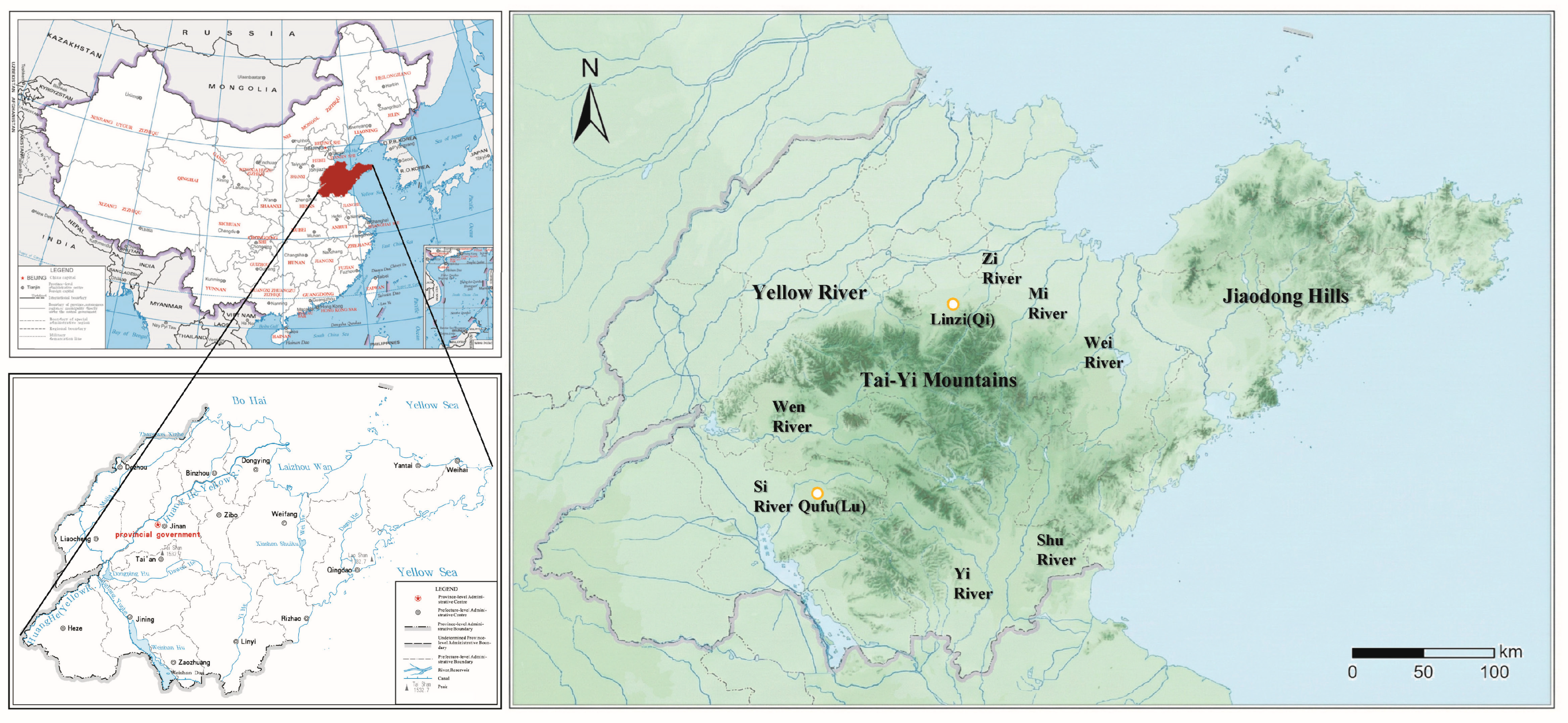
2.1. Study Area and Geographical Context
2.2. Temporal Scope
2.3. Data Sources and Processing
- (1)
- Clear Chronology and Strong Representativeness: The main period or significant phases of a site must fall within the timeframe set by this study. Priority is given to representative sites with clear cultural attribution and those holding a high rank or special function within the regional settlement hierarchy.
- (2)
- Rich and Reliable Archaeological Data: Priority is given to sites that have been thoroughly excavated and studied to ensure that basic information is relatively complete, such as geographical coordinates, area, primary remains (e.g., city walls, moats, architecture, tombs), and cultural attribution. Conversely, sites with scattered or dubious data are treated with caution to avoid compromising the reliability of the conclusions.
- (3)
- Systematic Coverage: The Shandong region is vast, with diverse topography including the southwestern plains, the central mountainous areas, and the hills of the Jiaodong Peninsula. Different geographical environments may foster different settlement models. Therefore, while ensuring a focus on key sites, the sample strives for a geographical distribution that covers the different natural-geographical units (plains, mountains, coastal areas) and political units within the study area. This ensures the samples are continuous and comparable in time and space, thereby constructing a relatively complete regional settlement system.
2.4. GIS Spatial Analysis Methods, Parameters and Theoretical Framework
- (1)
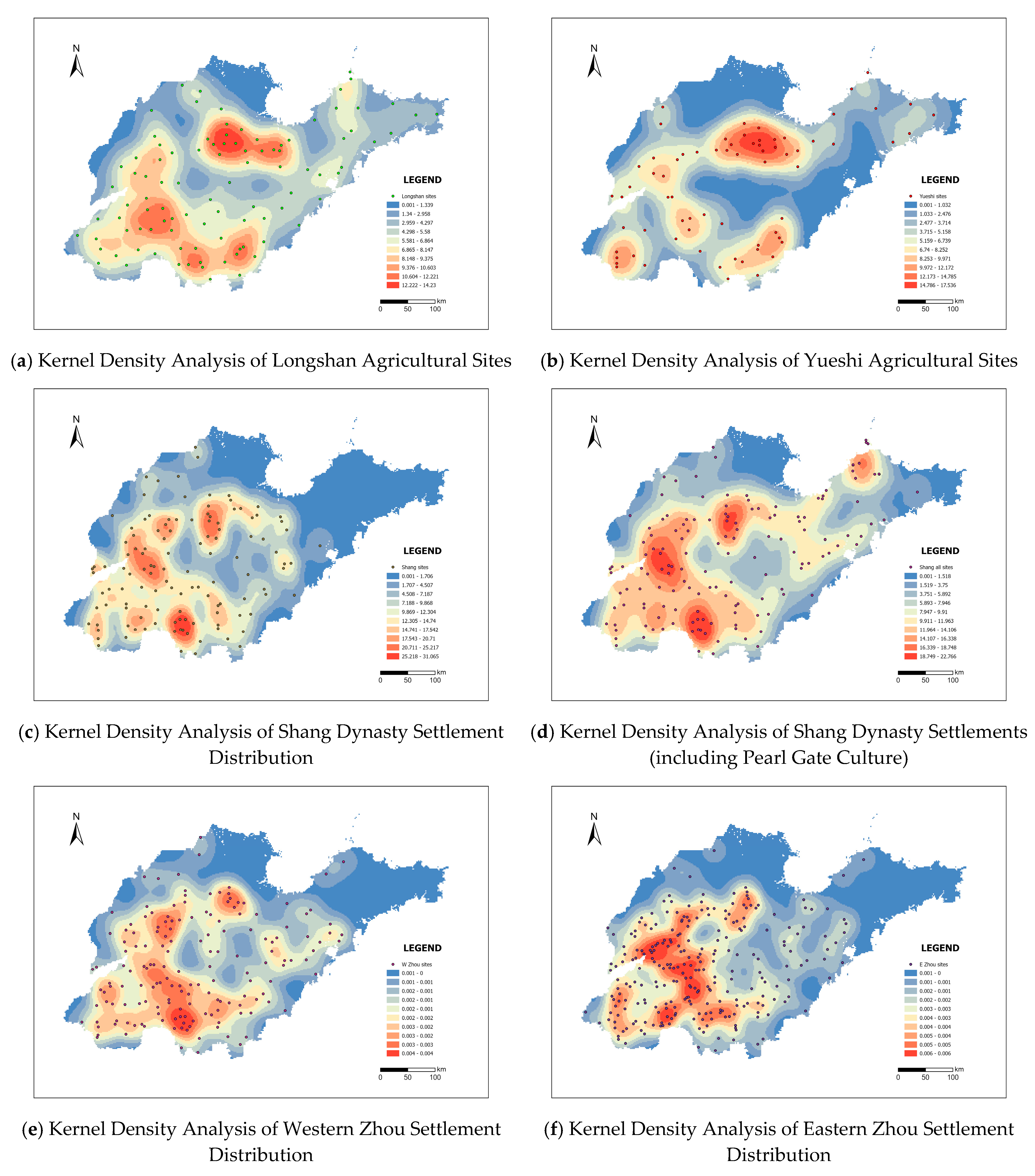
- Kernel Density Analysis (KDA)
- (2)
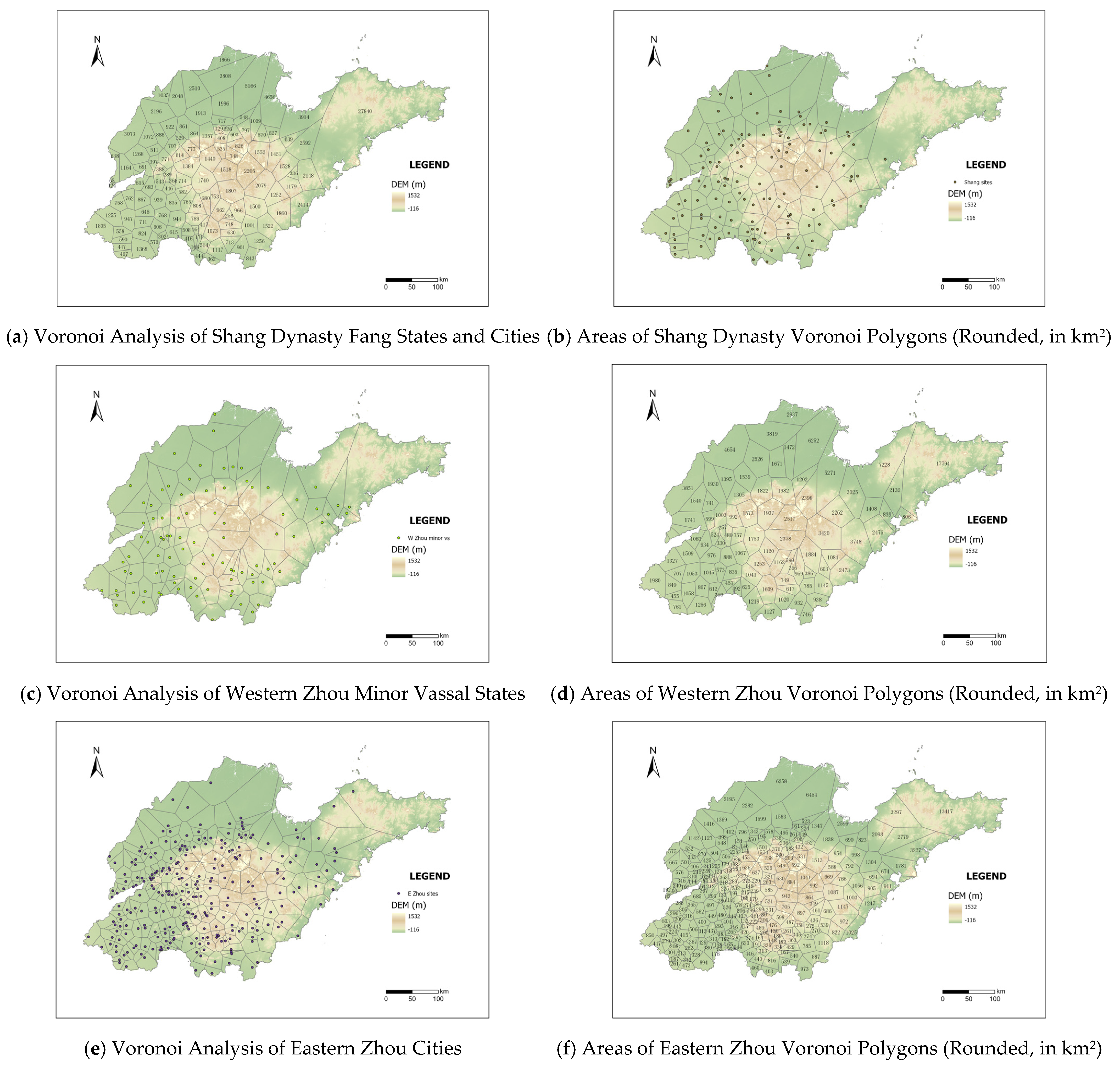
- Voronoi Diagram (Thiessen Polygons) Analysis: Theoretical Framework and Generator Point Selection
- Shang Period: “Fang States” and Cities
- Western Zhou Period: States (Major and Minor)
- Eastern Zhou Period (Spring and Autumn/Warring States): Cities
3. Results
3.1. Diachronic Analysis of Settlement Patterns
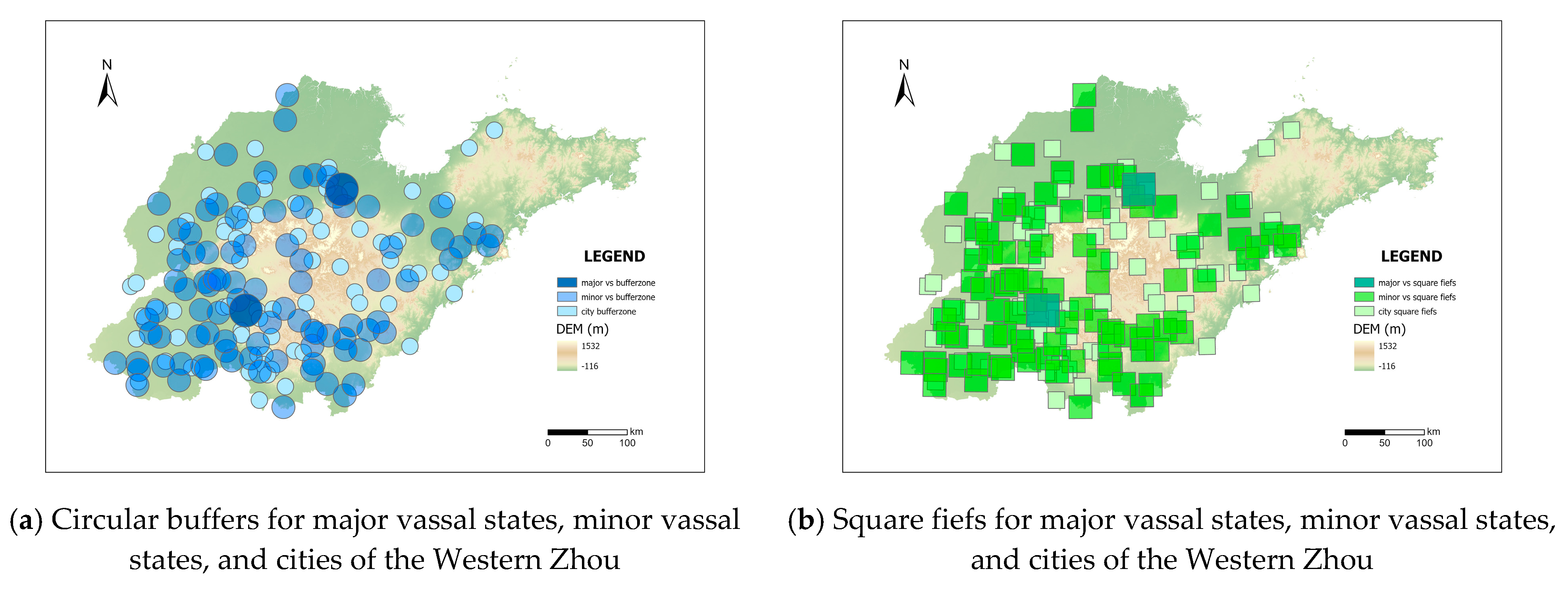
3.2. Simulating the Theoretical Spheres of Control for States
4. Discussion
4.1. The Dynamic Mechanisms of Spatial Integration: Interpreting Model Deviations
- The Geographical Environment (The “Stage” and the “Barrier”)
- Power Dynamics (The “Driver” and the “Unit”)
- Resource Allocation (The “Fuel”)
- Cultural Traditions (The “Network” and the “Fault Line”)
4.2. Limitations and Prospects
5. Conclusions
Author Contributions
Funding
Data Availability Statement
Acknowledgments
Conflicts of Interest
References
- Li, F. Landscape and Power in Early China: The Crisis and Fall of the Western Zhou 1045–771 BC; Cambridge University Press: Cambridge, UK, 2006. [Google Scholar]
- Shaughnessy, E.L. The Xia Shang Zhou Duandai Gongcheng Baogao and Its Chronology of the Western Zhou Dynasty. Early China 2023, 46, 351–371. [Google Scholar] [CrossRef]
- Ouyang, X.; Wu, X.; Wang, J.; Pan, Y.; Lin, Y.; He, J.; Cui, J. A modeling radiocarbon dating for the founding of Yan Vassal State in Western Zhou Dynasty. Radiocarbon 2025, 67, 122–134. [Google Scholar] [CrossRef]
- Tang, C.; Wang, F.; Childs-Johnson, E. The Spread of Erlitou Yazhang to South China and the Origin and Dispersal of Early Political States. In The Oxford Handbook of Early China; Oxford University Press: New York, NY, USA, 2020; pp. 202–226. [Google Scholar]
- Su, B.; Yin, W. On the Question of Regional Systems and Cultural Types in Archaeology. Cult. Relics 1981, 10–17. (In Chinese) [Google Scholar]
- Yan, W. The Unity and Diversity of Prehistoric Chinese Culture. Cult. Relics 1987, 38–50. (In Chinese) [Google Scholar]
- Liu, S.; Zou, C.; Mao, L.; Jia, X.; Mo, D. The spatial and temporal distribution of archaeological settlement sites in Shandong Province from the Paleolithic to Shang and Zhou periods and its relationship with hydrology and geomorphology. Quat. Sci. 2021, 41, 1394–1407. [Google Scholar]
- Wang, L.; Cui, Y. The spatiotemporal pattern of cultural evolution response to agricultural development and climate change from Yangshao culture to Bronze Age in the Yellow River basin and surrounding regions, north China. Front. Earth Sci. 2021, 9, 657179. [Google Scholar] [CrossRef]
- Tian, Y.; Chen, P.; Lu, P.; Yang, H.; Yang, S.; Zhang, L.; Luo, R. Evolution of Influence Ranges of Neolithic-Bronze Age Cities in the Songshan Mountain Region of Central China Based on GIS Spatial Analysis. Remote Sens. 2022, 14, 5631. [Google Scholar] [CrossRef]
- Tong, M.; Li, B.; Li, Z. Research on the Spatial–Temporal Distribution and Morphological Characteristics of Ancient Settlements in the Luzhong Region of China. Land 2022, 11, 1579. [Google Scholar] [CrossRef]
- Li, Y.; Zhang, J.; Zhang, X.; Zhao, H. Agriculture, the environment, and social complexity from the Early to Late Yangshao Periods (5000–3000 BC): Insights from macro-botanical remains in north-central China. Front. Earth Sci. 2021, 9, 662391. [Google Scholar] [CrossRef]
- White, D.A. The basics of least cost analysis for archaeological applications. Adv. Archaeol. Pract. 2015, 3, 407–414. [Google Scholar] [CrossRef]
- Scheidel, W. The shape of the Roman world: Modelling imperial connectivity. J. Rom. Archaeol. 2014, 27, 7–32. [Google Scholar] [CrossRef]
- Romanowska, I.; Wren, C.D.; Crabtree, S.A. Agent-Based Modeling For Archaeology: Simulating the Complexity of Societies; SFI Press: Seattle, WA, USA, 2021. [Google Scholar]
- Chliaoutakis, A.; Chalkiadakis, G. An agent-based model for simulating inter-settlement trade in past societies. J. Artif. Soc. Soc. Simul. 2020, 23, 10. [Google Scholar] [CrossRef]
- Compilation Committee of the Historical Atlas of Shandong Province. Historical Atlas of Shandong Province; Atlas Press of Shandong Province: Jinan, China, 2016. (In Chinese) [Google Scholar]
- National Cultural Heritage Administration. Atlas of Chinese Cultural Relics; Cultural Relics Publishing House: Beijing, China, 2008. (In Chinese) [Google Scholar]
- Qiu, G. A Study of Chinese Weights and Measures Through the Dynasties; Science Press: Beijing, China, 1992. (In Chinese) [Google Scholar]
- Ruan, Y. Collat. The Thirteen Classics with Commentaries and Notes; Zhonghua Book Company: Beijing, China, 1980. (In Chinese) [Google Scholar]
- Liu, X.; Fang, Z.; Guo, J.; Li, M.; Fang, H.; Lang, J. Brief Report on the Excavation of Shang Tombs No.225 and No.256 at the Daxinzhuang Site in Jinan City. Archaeology 2022, 2, 54–69+2. (In Chinese) [Google Scholar]
- Wang, X. The Bronzes with Character of Suo Unearthed at Daxinzhuang Site and The Geographical Location of Suo in Oracle Inscription. Palace Mus. J. 2023, 258, 17–24+132. (In Chinese) [Google Scholar]



| Cultural Period | Time Range | Number of Sites [16] | Proportion of Total Prehistoric Sites |
|---|---|---|---|
| Houli Culture | c. 6500–5800 BCE | 13 | 0.54% |
| Beixin Culture | c. 5300–4100 BCE | 30 | 1.25% |
| Dawenkou Culture | c. 4100–2600 BCE | 554 | 23.0% |
| Longshan Culture | c. 2600–2000 BCE | 1506 | 62.5% |
| Yueshi Culture | c. 1900–1500 BCE | 306 | 12.7% |
| Item (Source Text) [19] | Square Dimension (Li) | Side Length (km) | Area (km2) |
|---|---|---|---|
| Son of Heaven’s Demesne/Royal Domain (1000 Li square) | 1000 | 415.80 | 172,889.64 |
| Dukes (Zhugong) (Fief 500 Li square, Zhou Li [19]) | 500 | 207.90 | 43,222.41 |
| Marquesses (Zhuhou) (Fief 400 Li square, Zhou Li) | 400 | 166.32 | 27,662.34 |
| Earls (Zhubo) (Fief 300 Li square, Zhou Li) | 300 | 124.74 | 15,560.07 |
| Viscounts (Zhuzi) (Fief 200 Li square, Zhou Li) | 200 | 83.16 | 6915.59 |
| Barons (Zhunan) (Fief 100 Li square, Zhou Li) | 100 | 41.58 | 1728.90 |
| Dukes/Marquesses (100 Li square, Li Ji [19], Mencius [19]) | 100 | 41.58 | 1728.90 |
| Earls (70 Li square, Li Ji, Mencius) | 70 | 29.11 | 847.16 |
| Viscounts/Barons (50 Li square, Li Ji, Mencius) | 50 | 20.79 | 432.22 |
Disclaimer/Publisher’s Note: The statements, opinions and data contained in all publications are solely those of the individual author(s) and contributor(s) and not of MDPI and/or the editor(s). MDPI and/or the editor(s) disclaim responsibility for any injury to people or property resulting from any ideas, methods, instructions or products referred to in the content. |
© 2025 by the authors. Licensee MDPI, Basel, Switzerland. This article is an open access article distributed under the terms and conditions of the Creative Commons Attribution (CC BY) license.
Share and Cite
Wang, X.; Zhang, Y. Quantitative Political Geography: GIS Baseline Model for the Political-Spatial Structure of the Shang-Zhou Period Shandong Region. Land 2026, 15, 28. https://doi.org/10.3390/land15010028
Wang X, Zhang Y. Quantitative Political Geography: GIS Baseline Model for the Political-Spatial Structure of the Shang-Zhou Period Shandong Region. Land. 2026; 15(1):28. https://doi.org/10.3390/land15010028
Chicago/Turabian StyleWang, Xiaoan, and Yukun Zhang. 2026. "Quantitative Political Geography: GIS Baseline Model for the Political-Spatial Structure of the Shang-Zhou Period Shandong Region" Land 15, no. 1: 28. https://doi.org/10.3390/land15010028
APA StyleWang, X., & Zhang, Y. (2026). Quantitative Political Geography: GIS Baseline Model for the Political-Spatial Structure of the Shang-Zhou Period Shandong Region. Land, 15(1), 28. https://doi.org/10.3390/land15010028