
Article

Assessing the Functional–Efficiency Mismatch of Territorial Space Using Explainable Machine Learning: A Case Study of Quanzhou, China

1
School of Urban Design, Wuhan University, Wuhan 430072, China
2
China Institute of Development Strategy and Planning, Wuhan University, 129 Luoyu Road, Wuhan 430079, China
3
School of Resource and Environmental Sciences, Wuhan University, Wuhan 430079, China
*
Authors to whom correspondence should be addressed.
Land 2025, 14(12), 2403; https://doi.org/10.3390/land14122403
Submission received: 7 November 2025 / Revised: 5 December 2025 / Accepted: 9 December 2025 / Published: 11 December 2025
(This article belongs to the Special Issue Land Space Optimization and Governance)

Abstract

As the foundational carrier of socio-economic development and ecological security, territorial space reflects the degree of coordination between functional structure and efficiency output. However, most existing evaluation methods overlook the heterogeneous functional endowments of spatial units and therefore cannot reasonably assess the efficiency that each unit should achieve under comparable conditions. To address this limitation, this study proposes a function-oriented and interpretable framework for territorial spatial efficiency evaluation based on the Production–Living–Ecological (PLE) paradigm. An entropy-weighted indicator system is constructed to measure production, living, and ecological efficiency, and an XGBoost–SHAP model is developed to infer the nonlinear mapping between functional attributes and efficiency performance and to estimate the ideal efficiency of each spatial unit under Quanzhou’s prevailing macro-environment. By comparing ideal and observed efficiency, functional–efficiency deviations are identified and spatially diagnosed. The results show that territorial efficiency exhibits strong spatial heterogeneity: production and living efficiency concentrate in the southeastern coastal belt, whereas ecological efficiency dominates in the northwestern mountainous region. The mechanisms differ substantially across dimensions. Production efficiency is primarily driven by neighborhood living and productive conditions; living efficiency is dominated by structural inheritance and strengthened by service-related spillovers; and ecological efficiency depends overwhelmingly on local ecological endowments with additional neighborhood synergy. Approximately 45% of spatial units achieve functional–efficiency alignment, while peri-urban transition zones and hilly areas present significant negative deviations. This study advances territorial efficiency research by linking functional structure to efficiency generation through explainable machine learning, providing an interpretable analytical tool and actionable guidance for place-based spatial optimization and high-quality territorial governance.

1. Introduction

Territorial space constitutes the material basis for social, economic, and ecological systems, and its efficient use is essential for sustaining regional development. However, rapid urbanization has intensified spatial contradictions—such as urban expansion, farmland conversion, and landscape fragmentation—which hinder functional coordination and sustainable spatial development [1,2,3]. Recent planning reforms have increasingly focused on optimizing existing spatial structures through urban renewal, ecological restoration, and territorial consolidation [4,5,6,7]. Against this background, evaluating territorial spatial efficiency has become increasingly important for understanding how spatial structures influence resource use. However, existing evaluation systems primarily measure efficiency levels without accounting for the heterogeneous functional endowments that shape the efficiency-generation capacity of different spatial units. This raises two key scientific questions: how territorial spatial efficiency is shaped by the existing configuration of production, living, and ecological functions, and how the efficiency-generating capacity of these functions can be objectively quantified.
The academic discussion on spatial efficiency can be traced back to early classical theories of spatial location and land rent, including the agricultural rent circle theory, industrial location theory, central place theory, and urban land rent theory. These frameworks were fundamentally grounded in the pursuit of economic efficiency maximization. By focusing on relationships among transportation costs, land rent levels, and land-use functions, they established a systematic foundation for spatial economic analysis [8,9,10], aiming to reveal the optimal spatial allocation of production factors and to provide a theoretical basis for land-use ranking and value assessment. However, these early theories were largely built upon static and homogeneous spatial assumptions and emphasized a single economic objective, making them inadequate to address the contemporary demands of institutional regulation, ecological protection, and social equity in the process of sustainable urban development and high-quality transformation. Moreover, they lacked explanatory power regarding the complexity of spatial outcomes and the multifunctionality of land use [11,12]. With the deepening of territorial spatial governance, the connotation of spatial efficiency has gradually evolved toward a multi-objective, cross-scale, and feedback-oriented paradigm, exhibiting greater comprehensiveness and system integration. Accordingly, the analytical logic of spatial efficiency assessment has shifted from a linear, static input–output framework to an integrated analytical approach centered on system coupling, human–land coordination, and adaptive spatial processes [13], reflecting increasing theoretical and practical attention to spatial multifunctionality, strengthened ecological constraints, and diversified social structures. This transformation has been fundamentally driven by the tightening of ecological constraints, the shift from incremental expansion to stock optimization, and the growing complexity of socio-economic systems, all of which require analytical frameworks capable of capturing multidimensional interactions and contextual heterogeneity.
Existing studies on spatial efficiency evaluation have undergone a gradual shift from a “single economic objective” toward “multi-dimensional system coupling,” and from “linear analytical frameworks” toward “complex nonlinear models”. Early research primarily focused on constructing indicator systems, typically starting from system elements and centering on the social, economic, and ecological dimensions [14]. These studies emphasized resource matching, structural coupling, and operational efficiency within human–land systems, reflecting a strong systems-thinking perspective [15,16,17]. Some scholars further introduced temporal perspectives, using multi-period data to reveal the evolutionary trajectories and stage-based variations in spatial efficiency [18,19]. Meanwhile, increasing attention has been paid to spatial structure, with studies highlighting the roles of land-use patterns, spatial morphology, and service accessibility in shaping efficiency outcomes, underscoring the importance of spatial layout rationality and structural optimization for improving resource allocation efficiency [20,21,22]. Collectively, these efforts indicate a transition in indicator system development from single-dimension measures toward multi-element, coordinated frameworks, laying the groundwork for multi-dimensional efficiency assessment.
In terms of methodological development, spatial efficiency measurement has evolved from linear models to more complex multi-model systems. Traditional efficiency measurement methods are largely rooted in the “input-output” logic and evaluate the relative efficiency of spatial units under multiple resource inputs by constructing production frontiers or efficiency boundaries. Representative approaches include Data Envelopment Analysis (DEA) [23], Stochastic Frontier Analysis (SFA) [24] and extended models such as the Malmquist index and super-efficiency DEA [25], which have been widely applied in assessments of land-use efficiency, development intensity, and public service performance. In comprehensive evaluation pathways, commonly used methods include entropy weighting, TOPSIS, grey relational analysis, and principal component analysis [26,27], which integrate weighted indicators to construct composite-efficiency indices suitable for ranking and clustering multidimensional performance. Together, these methods have facilitated a transition from traditional linear models toward more flexible and integrated evaluation frameworks.
In explaining the formation mechanisms of spatial efficiency, research has increasingly incorporated spatial process perspectives. Spatial statistical methods such as Moran’s I and Local Indicators of Spatial Association (LISA) [28,29] are widely used to identify clustering patterns and spatial significance, while Geographically Weighted Regression (GWR) and the Spatial Durbin Model (SDM) [30,31] further reveal spatial heterogeneity and spillover effects between efficiency and its influencing factors, thereby enhancing the explanatory depth of spatial efficiency studies [32]. In recent years, with the rise in spatial big data and machine learning, models such as decision trees [33], Random Forests [34], and XGBoost [35,36,37] have been increasingly employed to handle multi-source heterogeneous data and demonstrate strong adaptability in relationship mining and predictive modeling of spatial efficiency. Overall, research on spatial efficiency interpretation has expanded from static pattern identification to process-based, multi-factor coupled mechanism analysis.
In summary, although existing studies have established relatively systematic foundations in indicator construction, efficiency measurement, and mechanism analysis, the relationship between spatial functional structures and efficiency outcomes remains underexplored. Most existing evaluations focus on observed efficiency outcomes [38] but insufficiently assess the efficiency-generating capacity of spatial units with heterogeneous functional endowments and baseline conditions. As a result, current frameworks offer limited support for context-sensitive assessment and cannot infer the expected efficiency level implied by the intrinsic functional attributes of each unit under a unified analytical environment. This gap raises an important scientific question: how to characterize the efficiency-generation capacity of territorial space under its existing production–living–ecological (PLE) configuration, and how to reveal the mechanisms through which functional structures are transformed into efficiency outcomes. Functional–efficiency deviation, therefore, provides not only a measure of spatial mismatch but also a diagnostic indicator for understanding structural variations in efficiency formation.
To address these challenges, this study proposes a function-oriented and interpretable framework for territorial spatial efficiency evaluation. We employ an the XGBoost algorithm combined with SHAP-based interpretation to infer the nonlinear mapping between production, living, and ecological functions and their corresponding efficiency performance, enabling not only accurate prediction of expected efficiency but also transparent interpretation of how different functional attributes contribute to efficiency formation. This approach accounts for functional heterogeneity, avoids direct horizontal comparison across divergent contexts, and uncovers the intrinsic and locally universal structure of functional–efficiency relationships. Building on this foundation, we construct a multidimensional efficiency evaluation system integrating production, living, and ecological dimensions, and conduct comprehensive assessment and mechanism identification using multi-source remote sensing and geospatial data combined with interpretable machine-learning techniques. The findings enhance the understanding of functional coordination and spatial heterogeneity in Quanzhou’s territorial development and provide analytical support for structure optimization, resource-use efficiency improvement, and evidence-based territorial spatial planning.

2. Study Area and Data Source

2.1. Study Area

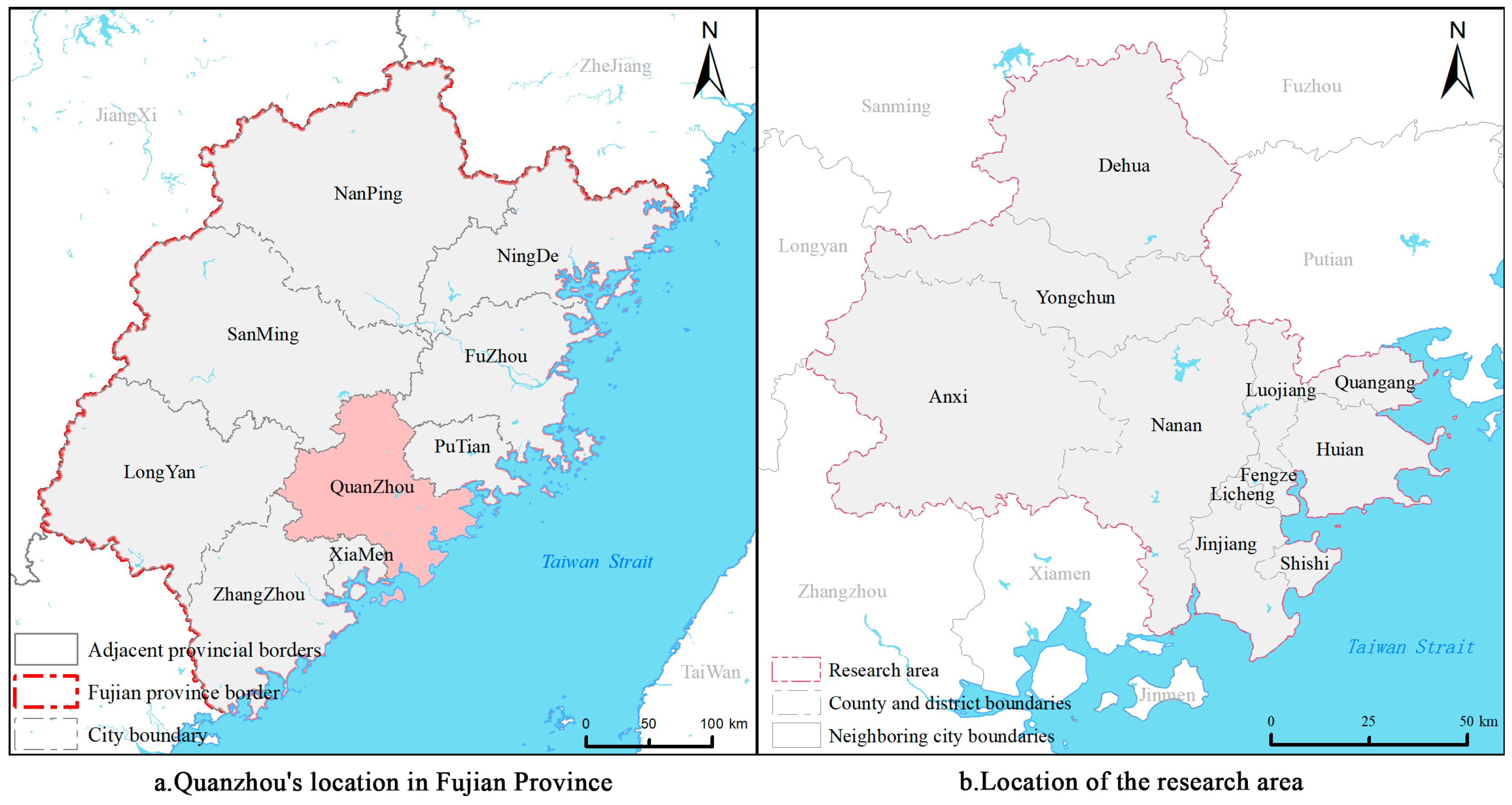
The study area is Quanzhou City, located in southeastern Fujian Province along the western coast of the Taiwan Strait, serving as a key node on China’s coastal development axis and one of the province’s three major central cities. Quanzhou has a long history of urban development dating back to the Zhou and Qin dynasties. It is one of China’s first 24 national historic and cultural cities and a core hub of the ancient Maritime Silk Road. The city has developed a distinctive growth model dominated by private and export-oriented industries, characterized by a well-structured industrial system, high integration between production and living functions, high economic density, and a complex industrial spatial layout—collectively known as the “Quanzhou Model.” However, with the rapid expansion of urban space, Quanzhou faces growing spatial contradictions arising from intense urban–rural integration, including conflicts among urban construction, agricultural land use, and ecological protection, along with increasing pressure on land resources and the ecological environment. To address these issues, the city has implemented diverse pilot programs and practical initiatives aimed at land consolidation and the revitalization of inefficient land. In 2022, Quanzhou was designated as China’s first national pilot city for the revitalization and reuse of inefficient land, demonstrating a leading institutional innovation advantage. Against the backdrop of continuous development toward a modern industrial and trade port city, Quanzhou urgently requires scientific evaluation and optimization of its territorial spatial efficiency. Accordingly, Quanzhou was selected as the case study area not only for its high regional representativeness and practical relevance but also for its potential to provide theoretical insights and empirical references for other coastal cities with similar characteristics, thereby supporting the optimization of spatial governance and planning strategies. Quanzhou administratively consists of four municipal districts, three county-level cities, and five counties. Considering the incomplete statistical data of Kinmen County, it was excluded from the analysis. The final study area therefore covers 11 administrative units with a total area of approximately 11,300 km2, as illustrated in Figure 1.

2.2. Data Source

This study takes the year 2020 as the temporal reference point, and all datasets are summarized in Table 1. Considering that land-use efficiency research integrates multi-source and heterogeneous spatial data, spatial grids were selected as the basic analytical unit to ensure a consistent evaluation scale. Spatial grids offer strong scale adaptability and facilitate the seamless integration of diverse geographic datasets.
Hexagonal grids with an inscribed radius of 1 km were adopted to enhance spatial continuity, adjacency, and geometric uniformity, and all datasets were aggregated within this grid framework. To reduce potential bias introduced by resampling or spatial aggregation—particularly in transitional urban–rural boundary zones—vector datasets were converted into grid units using an area-weighted allocation method, while raster datasets with differing native resolutions were resampled to the grid scale using methods appropriate to their data characteristics. These procedures preserve proportional spatial information and mitigate artificial boundary smoothing. In addition, the processed spatial surfaces were subjected to a continuity check to ensure that grid conversion did not introduce noticeable boundary artifacts, and the subsequent Moran’s I-based spatial autocorrelation results further confirmed the overall continuity of the spatial structure.

3. Research Framework and Methods

3.1. Research Framework

Within the context of China’s territorial spatial regulation and high-quality development strategy, the production–living–ecological (PLE) space framework serves as a core concept for the coordinated management of spatial functions and the optimization of resource allocation. This classification system aims to guide the optimization of territorial spatial patterns through land-use control, thereby achieving a coordinated balance between economic growth and ecological well-being [39,40]. Specifically, production space refers to areas dedicated to material production activities such as agriculture, industry, and energy, emphasizing economic output and resource-use efficiency. Living space accommodates residential, service, and social interaction functions, focusing on environmental livability, accessibility of public facilities, and the completeness of service systems. Ecological space is primarily intended to ensure ecological security, protect natural environments and biodiversity, and maintain the integrity, stability, and sustainability of ecosystems.
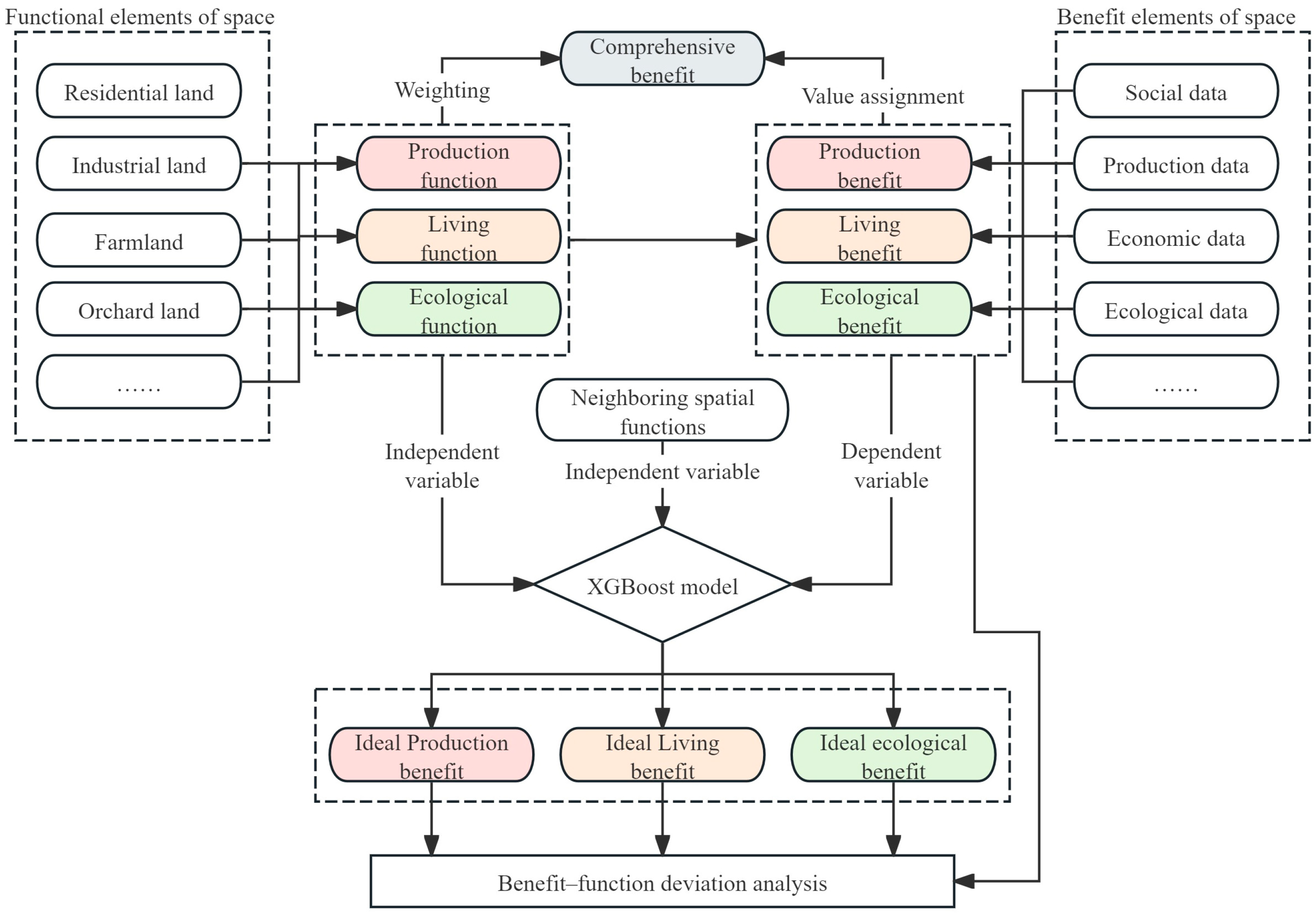
Grounded in the Production–Living–Ecological (PLE) framework, this study develops an integrated methodological system for assessing the functional basis of territorial spatial efficiency and diagnosing functional–efficiency deviation. The analytical logic comprises four interlinked components that together form a coherent technical route for evaluating how spatial functions are transformed into measurable efficiency outcomes (Figure 2). First, spatial functions across production, living, and ecological dimensions are quantified based on the structural composition of land-use types within each grid unit, using a PLES scoring scheme refined through expert consultation to represent the functional endowment of each spatial unit. Second, spatial efficiency is evaluated through an entropy-weighted indicator system in which socioeconomic and ecological variables are standardized, weighted, and aggregated to produce dimension-specific and composite-efficiency indices reflecting the actual performance of each unit. Third, an explainable machine-learning model (XGBoost–SHAP) is employed to infer the nonlinear functional–efficiency relationship under prevailing macro-environmental conditions. By incorporating both local functional attributes and neighborhood spillover effects, the model generates a “functional-expected” efficiency level for each unit, which serves as a structural baseline for subsequent comparison. Finally, deviations between observed and expected efficiency are computed to identify the degree and direction of functional–efficiency mismatch, and global and local Moran’s I statistics are applied to reveal the spatial clustering and heterogeneity of deviation outcomes. This integrated framework—from functional characterization and efficiency evaluation to nonlinear mechanism inference and spatial diagnostic analysis—provides a systematic and interpretable methodological basis for identifying underperforming or overperforming spatial units and for supporting differentiated territorial spatial optimization and policy design.

3.2. Land-Use Function Identification

This study integrates the production, living, and ecological functions of land use to construct the functional basis of spatial units, following established approaches in China’s territorial spatial planning system [41,42,43]. The PLES functional scoring system (Table 2) was developed through a literature-informed and expert-reviewed procedure: initial scores were assigned with reference to existing studies on PLES functional delineation and land-use multifunctionality [44,45,46], and subsequently refined by experts in urban–rural planning, land resource management, and ecological environment to ensure regional validity for Quanzhou. The scoring system reflects the dominant functional roles of land-use categories within the production–living–ecological structure, and is therefore designed as a typological classification rather than a finely graded weighting scheme. Under this framework, certain land-use categories may legitimately share identical scores when they perform comparable functions within the same subsystem.
To evaluate the robustness of the scoring system, a light sensitivity check was conducted by applying ±1 variations to the scores of key land-use categories. These minor perturbations did not substantially affect the spatial functional pattern or the subsequent function–efficiency relationship, indicating that the evaluation results are not overly sensitive to small scoring adjustments. This confirms that the proposed PLES scoring framework is theoretically grounded, expert-validated, and empirically stable.
Based on the land-use function conversion table, the functional values of any spatial evaluation unit were quantified using Equation (1). In the formula, F x represents the evaluation value of the production ( F p ), living ( F i ), or ecological ( F e ) function of a spatial unit; n denotes the number of land-use types; A i is the area of the i-th land-use type within the evaluation unit; and S i x refers to the functional score of the i-th land-use type under the x-dimension.
F x = i n A i x i         ( x p , l , e )

3.3. Spatial Efficiency Evaluation

Guided by the principle of coordinated development among production, living, and ecological functions, this study constructs a spatial efficiency evaluation system tailored to the specific natural and socioeconomic conditions of Quanzhou City, ensuring scientific validity, systematic integrity, and operational feasibility. Drawing on relevant research findings, the evaluation framework integrates indicators reflecting the needs of ecological protection, economic growth, food security, livability, and urban development. In this framework, the production–efficiency dimension reflects the core role of territorial units in economic development. Agricultural production is measured using the cultivation rate and agricultural output value, while non-agricultural production is represented by industrial rent and industrial agglomeration density. The living efficiency dimension focuses on the accessibility and richness of public services and basic living resources, represented by four aspects: public service accessibility, public transport accessibility, residential quality, and spatial vitality. The ecological efficiency dimension captures the intensity of ecological resources and ecosystem services within each spatial unit, evaluated through NDVI, NPP, ecological purification value, and soil conservation value. Table 3 presents the detailed structure and descriptive statistics of the spatial efficiency evaluation indicators.
To eliminate the influence of different units and value ranges across indicators, all efficiency indicators were standardized using the z-score method. Subsequently, the entropy weight method was employed to determine indicator weights objectively, reducing subjective interference and enhancing the reliability of weight assignment. The single-dimensional efficiency scores were then aggregated using a comprehensive evaluation method to obtain the final spatial composite-efficiency index. For any spatial evaluation grid, the efficiency of a given dimension E x (production, living, or ecological) can be calculated as:
E x = i = 1 w i × S i
where E x denotes the efficiency score of dimension x, S i is the standardized value of the i-th indicator, and w i is the entropy-based weight of that indicator. The composite spatial efficiency E c of each grid can then be expressed as:
E c = x = p , l , e F x F P + F l + F e E x
In Equation (3), the weight assigned to each dimension is determined by the proportion of its functional value to the total functional value across the three dimensions. This ensures that the contribution of each individual efficiency component to the composite efficiency is consistent with the actual functional endowment of the spatial unit. Such a function-based, adaptive weighting scheme effectively captures functional differences among spatial units and avoids potential biases introduced by subjective weight assignment.

3.4. Spatial Function–Efficiency Deviation Analysis Based on XGBoost

This study employs the XGBoost nonlinear regression model to construct a predictive framework linking spatial functions to spatial efficiency. As an ensemble of gradient-boosted regression trees, XGBoost effectively captures nonlinear relationships, handles multidimensional interactions, and maintains stable performance when applied to heterogeneous spatial data. Spatial efficiency values were used as the dependent variable, whereas spatial function attributes served as the primary explanatory variables, forming a function–efficiency model from an input–output perspective.
Unlike DEA or SFA, which construct a normative efficiency frontier to evaluate technical inefficiency, and unlike coupling-coordination models that assess subsystem co-development, this study does not aim to identify optimal production conditions or measure inefficiency. Instead, XGBoost is used to learn the empirical relationship between functional structures and efficiency outcomes within the existing territorial system. The predicted efficiency therefore represents a structural baseline—an expected efficiency level that spatial units with similar functional endowments and spatial contexts typically achieve under current macro-environmental conditions, rather than an optimal or average value. Moreover, the mismatch measurement relies on residual-based deviation rather than direct functional–efficiency correlations, which mitigates the influence of land-use-related common variance and ensures that the functional–efficiency relationship does not stem from a common-source dependency. Deviations from this baseline indicate whether a unit’s functional endowment is less effectively or more effectively translated into efficiency relative to the system’s prevailing behavioral pattern, rather than departures from a theoretical frontier.
In terms of model design, the functional value of each unit and that of its neighboring units were both incorporated to capture potential spatial spillover effects influencing efficiency outcomes. To mitigate simultaneity bias and information leakage between the actual efficiency of neighboring units and the dependent variable, a two-stage fitting strategy was adopted to generate lagged predictions of neighborhood efficiency. Specifically, a model excluding neighborhood efficiency variables was first trained, and cross-validation was performed to obtain predicted values for each sample, as expressed in Equation (4):
E i ^ = C V _ P r e d i c t ( F i , W F i )
where E i ^ represents the out-of-sample prediction of unit i, F i denotes the spatial functional values of unit i, and W is the row-standardized spatial weight matrix. This cross-validation framework ensures that the prediction for each validation sample is generated only from training data that exclude its own observed efficiency value. Based on these predicted results, the weighted mean of the neighborhood’s predicted efficiency can be calculated using Equation (5):
E i ¯ = j = 1 n w i j E i ^
where E ¯ denotes the spatially weighted average predicted efficiency of unit i, w i j is the spatial relation weight between units i, j, and n is the number of neighboring spatial units. The final function–efficiency relationship model was then formulated as shown in Equation (6):
E i = f ( F i , E i ¯ )
Model hyperparameters—including tree depth, learning rate, and the number of iterations—were optimized using grid search with three-fold cross-validation to ensure robust predictive performance.
The efficiency values predicted by XGBoost represent the ideal efficiency of each spatial unit, derived under Quanzhou’s objective environmental and socioeconomic conditions while accounting for both internal resource endowments and external neighborhood effects. The deviation between the predicted (ideal) efficiency and the observed efficiency was calculated to identify the degree of functional–efficiency matching, as expressed in Equation (7):
D i = E i a c t u a l E i p r e d i c t e d
where D i is the deviation value for unit i, E i a c t u a l represents the observed efficiency, and E i p r e d i c t e d represents the ideal efficiency estimated by the model. The sign and magnitude of the residuals indicate the direction and degree of deviation between actual and ideal efficiency values, thereby reflecting the spatial correspondence between functional configuration and efficiency outcomes.

3.5. Spatial Feature Analysis

Spatial autocorrelation analysis is widely used to test and quantify the degree of spatial correlation and clustering of geographic phenomena, thereby revealing the underlying spatial structure and processes. In this study, both global and local Moran’s I statistics were applied to analyze the spatial distribution patterns of spatial functions and efficiency in Quanzhou City. The global Moran’s I index was used to assess the overall spatial clustering characteristics, while the local Moran’s I index (LISA) was employed to identify the spatial relationships among individual units and detect local agglomeration patterns. The global Moran’s I is calculated as follows (Equation (8)):
I = n W × i j w i j x i x ¯ x j x ¯ i x i x ¯ 2
where n represents the total number of spatial units, x i and x j denote the observed values of spatial units i and j, respectively, x ¯ is the sum of all spatial weights. A higher Moran’s I value indicates stronger spatial clustering of the studied attribute, while a negative value suggests spatial dispersion.
The local Moran’s I further measures the degree of association between each unit and its neighbors, enabling the identification of “hotspots” (high–high clusters), “cold spots” (low–low clusters), and potential spatial anomalies. The local Moran’s I is expressed as follows (Equation (9)):
I i = ( x i x ¯ ) j w i j ( x j x ¯ )
where I i denotes the local spatial autocorrelation index of unit i, and other symbols retain the same meaning as in Equation (8). The results of both global and local spatial autocorrelation analyses provide an important basis for identifying spatial clustering patterns and assessing the degree of spatial heterogeneity in functional–efficiency relationships across Quanzhou City.

4. Results

4.1. Spatial Characteristics of Territorial Functions in Quanzhou City

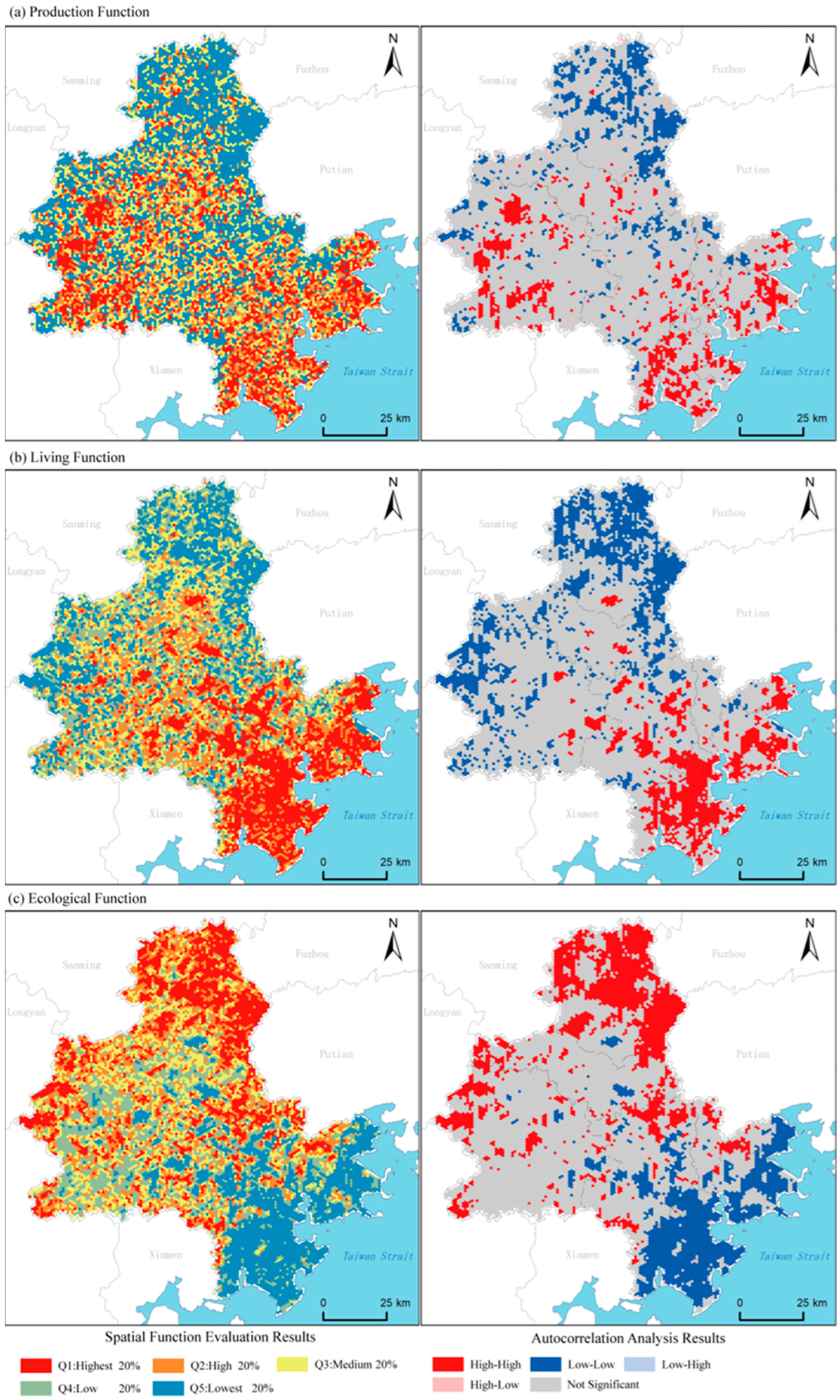
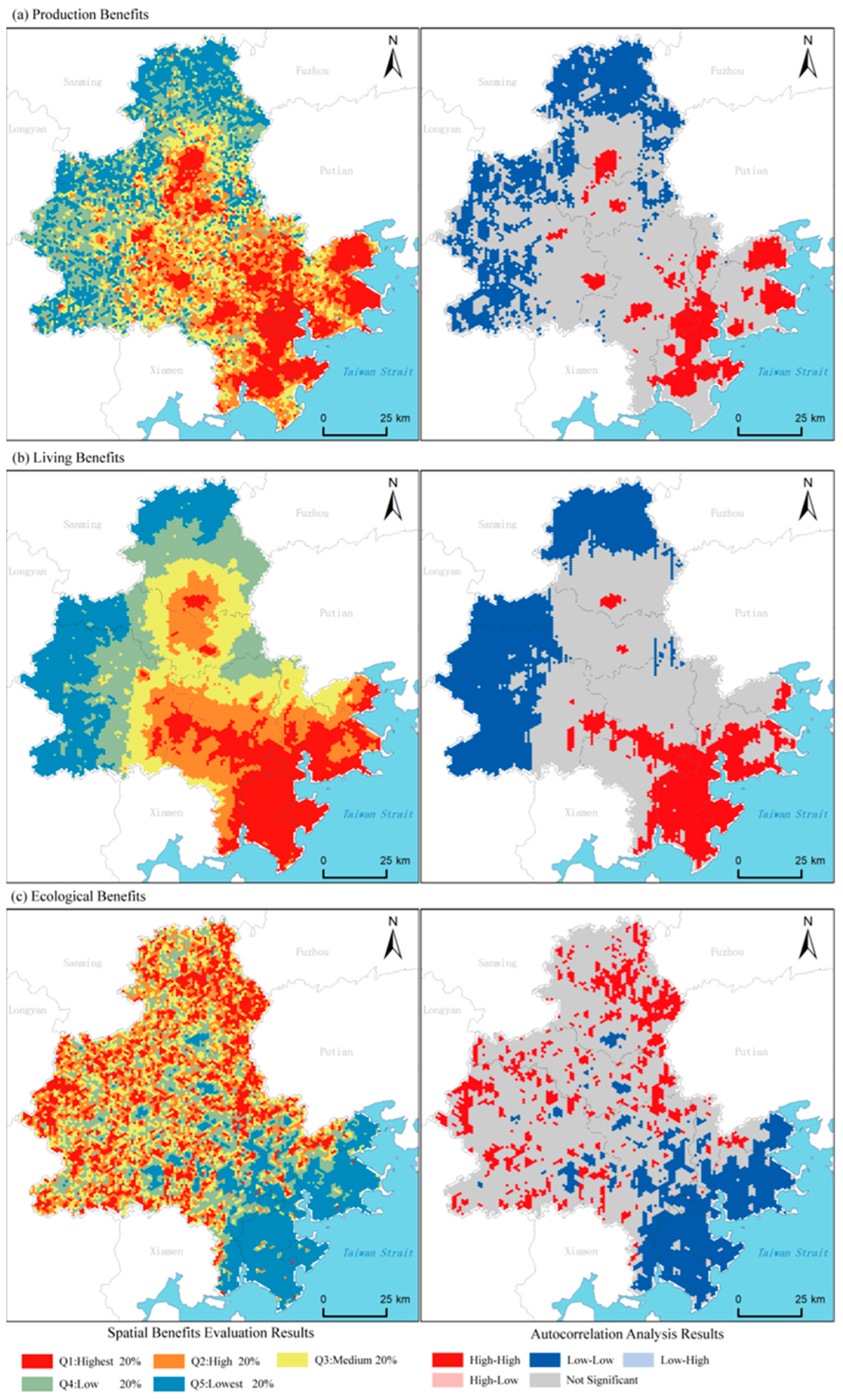
In 2020, the production, living, and ecological functions of Quanzhou City exhibited pronounced spatial differentiation, with Moran’s I indices of 0.412, 0.680, and 0.805, respectively, indicating strong positive spatial autocorrelation across all three functional dimensions (Figure 3). Overall, the three functions displayed a clear north–south contrast. The southern coastal areas showed significant advantages in production and living functions but relatively weak ecological functions, while the northern mountainous regions were characterized by high ecological functionality but lower production and living capacities.
The local spatial autocorrelation results further revealed that the high-value clusters of production functions were relatively fragmented. They were mainly concentrated in the southern parts of Jinjiang City, Shishi City, Quangang District, and the industrial parks of Hui’an County, with additional high-value patches appearing in some western upland areas. In contrast, living functions formed more contiguous and cohesive high-value clusters. A continuous high-living-function belt has developed around Quanzhou Bay in the southern coastal region, while in the northern counties, high-value zones were concentrated in county-level central towns.
The spatial pattern of ecological functions was opposite to that of production and living functions. High-value clusters were concentrated in the outer zones of the three northern counties, forming large-scale aggregations in the Jiulong River Basin, Daiyun Mountain Range, and Taoxi River Basin. These areas are characterized by dense vegetation coverage and rich ecological resources, whereas the southern coastal region generally exhibited lower ecological functionality due to intensive urban and industrial land use.

4.2. Spatial Characteristics of Territorial Efficiency in Quanzhou City

In 2020, the spatial differentiation of territorial efficiency in Quanzhou City was highly pronounced (Figure 4). The Moran’s I indices for production, living, and ecological efficiency were 0.871, 0.964, and 0.701, respectively, all indicating strong positive spatial autocorrelation. Although the overall efficiency gradients resemble the functional patterns, the internal clustering characteristics differ significantly. Production and living efficiency decrease gradually from the southeastern coastal zones toward the northwestern hilly regions, whereas ecological efficiency exhibits an inverse trend.
The results of the local spatial autocorrelation analysis further revealed that production efficiency formed large-scale high-value clusters in the Quanzhou Bay area, with particularly strong concentrations in the petrochemical industrial zones of Quangang and Hui’an Counties. High-value clusters were also observed in the central urban areas of the northern counties, while several smaller high-value patches appeared in scattered inland towns. Compared with the functional pattern, production efficiency exhibited a more evident clustering tendency, forming group-based and large-scale clusters. Some inconsistencies between high-efficiency and high-function areas were also visible.
The living efficiency pattern was generally consistent with that of living functions but showed stronger spatial concentration. High-efficiency clusters were significantly concentrated around Quanzhou Bay and along the Jinjiang River, forming a continuous and large-scale high-living-efficiency belt. In contrast, in Dehua and Yongchun Counties, the high-value clusters were smaller and mainly located in county centers. Low-value clusters were mainly distributed along the outer fringes of the three northern counties, forming three large contiguous low-efficiency zones, typically corresponding to natural mountainous areas or ecological conservation zones.
The spatial pattern of ecological efficiency appeared more complex. The distribution of low-value clusters largely coincided with the areas of low ecological function, mainly concentrated in the highly urbanized and industrialized southern coastal zones. High-value clusters of ecological efficiency were more fragmented than those of ecological function, scattered primarily across the northern and western mountainous areas without forming large, continuous patches.
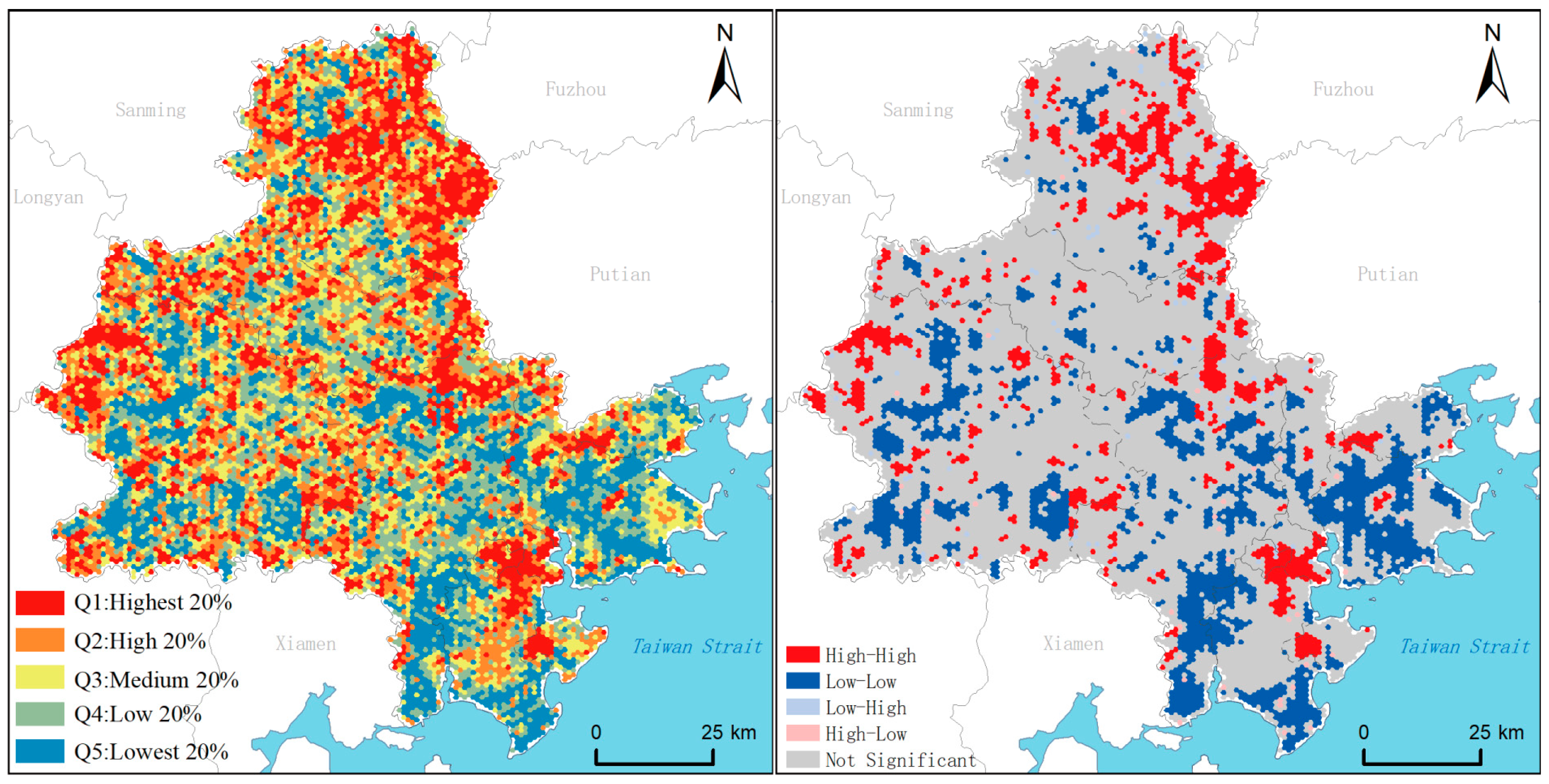
Based on the evaluation results of production, living, and ecological efficiency, the comprehensive spatial efficiency distribution of Quanzhou City in 2020 was further derived (Figure 5). The Moran’s I index for the composite efficiency was 0.553, indicating a moderate level of positive spatial autocorrelation, though the clustering pattern appeared relatively dispersed. The overall spatial pattern of comprehensive efficiency in Quanzhou City can be characterized by “high values in the north and south, and low values in the transitional zone.” High-value clusters were mainly observed in two areas. The first was the southern urban core, centered around the main districts of Quanzhou, which exhibited high comprehensive efficiency supported by a robust industrial base and well-developed living services. The second was the northwestern ecological zone, dominated by the Daiyun Mountain Range and the surrounding ecological areas of Dehua County, which demonstrated strong ecological advantages and high overall efficiency due to its superior environmental foundation. In contrast, low-value clusters were widely distributed across the transitional belt extending from the southeastern coastal zones to the western hilly regions. These low-efficiency areas were mainly located in the Taishang Investment Zone of Hui’an County, the coastal area of Meizhou Bay, and the western region of Anxi County. These areas generally exhibited moderate production and living functions but relatively low efficiency performance.

4.3. Prediction of Ideal Spatial Efficiency and Mechanism Analysis

Building upon the previous evaluation of production, living, and ecological functions and efficiencies, this study further developed an XGBoost-based predictive model to estimate potential (ideal) efficiency values for each spatial unit. The model uses functional indicators and their neighborhood effects as core explanatory variables to simulate efficiency outcomes under the constraints of the city’s macroenvironment. Its purpose is to uncover the latent coupling mechanisms between spatial functions and efficiency, as well as to provide a benchmark for subsequent deviation analysis. The model performance is summarized in Table 4.
The results indicate that the predictive accuracy of all three efficiency dimensions is high, with low RMSE and MAE values, demonstrating that the model successfully fits the observed data. Among them, the living-efficiency dimension exhibited the best performance, followed by production efficiency, while ecological efficiency showed slightly lower accuracy but remained at a satisfactory level. The Moran’s I values of the residuals for all three models were close to zero, and the spatial autocorrelation tests confirmed no significant spatial bias, ensuring the reliability and robustness of the predictions. Overall, the XGBoost model effectively captured the latent relationships between functional characteristics and efficiency outcomes in Quanzhou City. The high R2 values and stable residuals further validate the strong nonlinear correlations between the two.
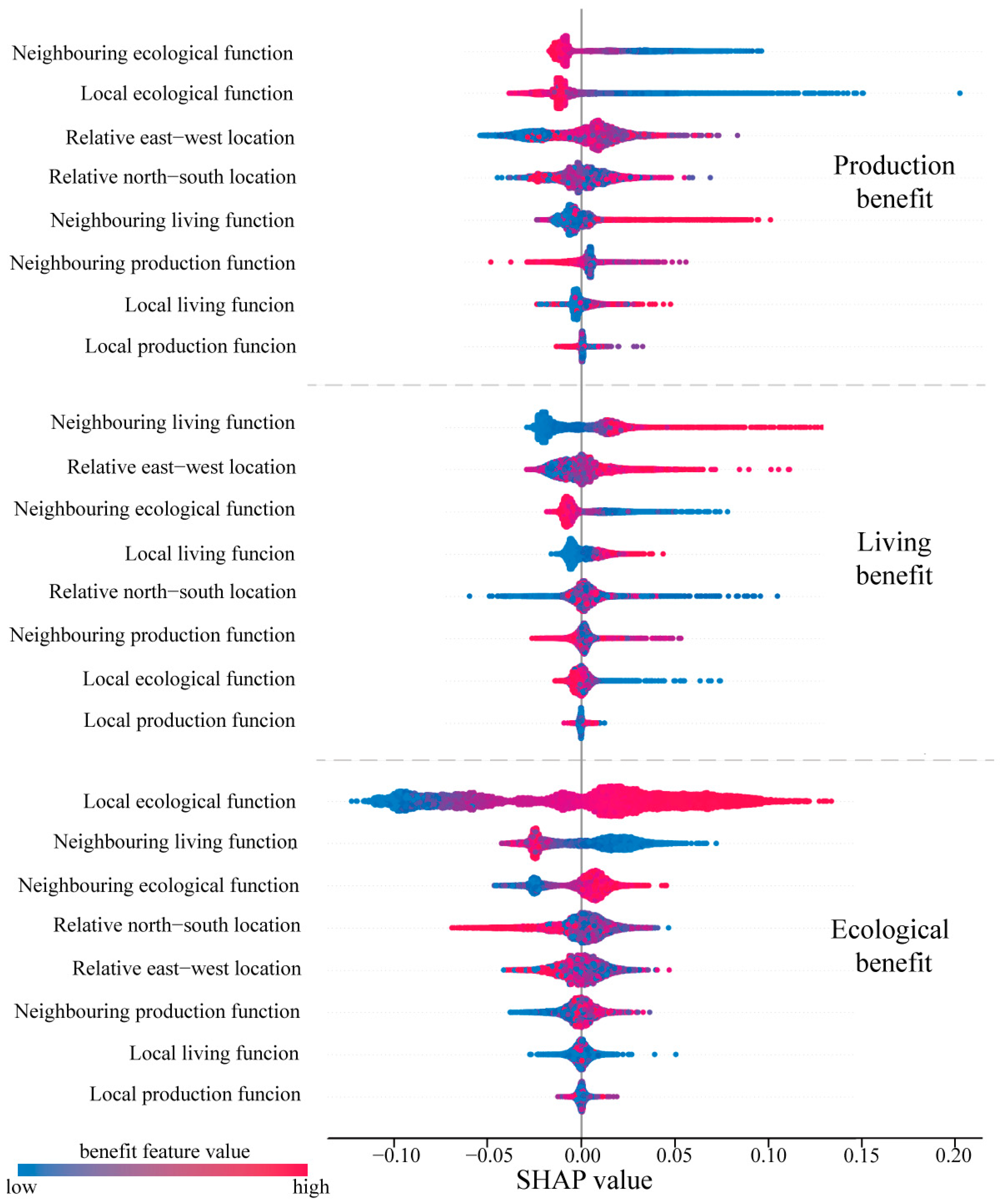
To further reveal the internal mechanisms linking spatial functions and efficiency, the SHAP (SHapley Additive exPlanations) analysis was applied to quantify the contribution and direction of influence of each functional variable (Figure 6). The results show that all three efficiency dimensions share several common patterns. Neighborhood functional variables generally exerted higher importance than local ones, confirming the key role of spatial spillover effects in efficiency formation. Moreover, both living and ecological functions exhibited strong positive cross-dimensional contributions, reflecting an inherent coupling mechanism among production, living, and ecological efficiencies. Meanwhile, spatial location variables provided moderate explanatory power across all models, indicating the background influence of macro-scale locational gradients on potential efficiency distribution.
The SHAP interpretation reveals distinct and quantitatively differentiated mechanisms that underlie the formation of production, living, and ecological efficiency in Quanzhou (Table 5).
Production efficiency is predominantly shaped by neighborhood conditions. The neighborhood living function (Liv_Neigh) exhibits the highest contribution (Gain = 0.025), far exceeding both neighborhood ecological functions (Eco_Neigh = 0.0076) and local production attributes (Prod_Local = 0.0026). This pattern indicates that productive performance relies less on intrinsic industrial attributes than on the external support provided by surrounding residential quality, service accessibility, and spatial agglomeration. Locational gradients also exert a measurable influence, reinforcing the competitive advantage of southeastern coastal industrial belts, while the moderate role of ecological spillovers reflects the structural tension between productive expansion and environmental constraints.
Living efficiency follows a markedly different mechanism. The structural inheritance variable (Struct_Inherit) is overwhelmingly dominant (Gain = 0.057), underscoring the strong path dependence and spatial spillover embedded in Quanzhou’s service-oriented urban structure. Neighborhood production and living functions provide secondary reinforcement, whereas both local and neighborhood ecological attributes contribute negatively, confirming a quantifiable ecological–livability trade-off. Locational gradients further amplify the advantages of coastal and central urban districts in sustaining high levels of service provision.
Ecological efficiency is governed by a fundamentally endowment-driven logic. Local ecological function (Eco_Local) contributes the most by a large margin (Gain = 0.213), more than five times the influence of neighborhood ecological conditions (Eco_Neigh = 0.042) and an order of magnitude greater than any socioeconomic attribute. This near-monotonic positive relationship underscores the decisive role of natural ecological assets in shaping ecological performance. At the same time, neighborhood ecological and living functions jointly enhance ecological efficiency, suggesting that ecological performance benefits from cross-unit ecological continuity, environmental cooperation, and shared ecosystem services. Spatial location exerts a moderate and consistent gradient effect, particularly in the mountainous northwest.
Collectively, these results demonstrate that territorial efficiency is not driven by single functional attributes but emerges from multi-scale interactions involving spillover effects, intrinsic ecological endowments, and spatial gradients. Production efficiency is primarily neighborhood-driven and dependent on supportive living and ecological environments; living efficiency reflects a structural tension between livability enhancement and ecological conservation while exhibiting pronounced spillover dependency; and ecological efficiency is dominated by strong natural endowments with neighborhood synergy providing marginal reinforcement. These quantified mechanisms reveal the complex functional coupling processes that underpin spatial efficiency formation in Quanzhou.

4.4. Spatial Deviation Results of Territorial Efficiency in Quanzhou City

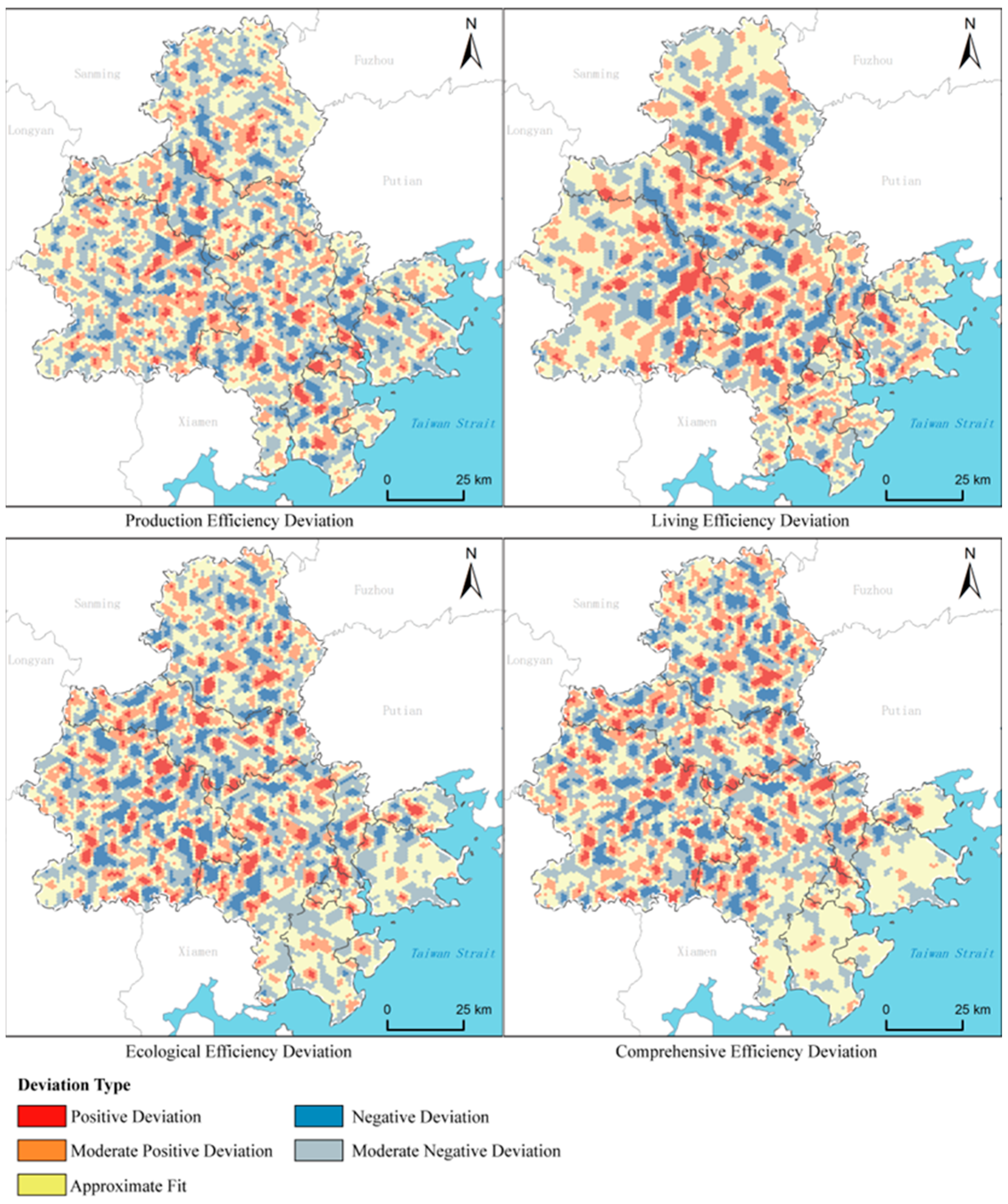
Based on the XGBoost model inversion results, the spatial deviation patterns of territorial efficiency in Quanzhou City were identified at the 1 km grid scale (Figure 7). The deviation landscape reveals a generally balanced transformation between functional endowments and efficiency outcomes across the city, while exhibiting substantial spatial heterogeneity across different functional dimensions. Notable differences emerge among the production, living, and ecological dimensions, reflecting the varying effectiveness with which different types of functional structures are translated into measurable efficiency outputs under Quanzhou’s existing spatial, socioeconomic, and environmental conditions.
In the production dimension, the deviation pattern exhibited no apparent spatial clustering, with a relatively balanced distribution across the city. Nearly half of the spatial units showed consistent alignment between actual efficiency and functional level, suggesting that production functions were effectively realized in most areas. Among the deviated units, positive deviations accounted for 35.09%, slightly lower than negative deviations, implying that a considerable portion of spatial units had not yet transformed their production functional input into proportional efficiency gains.
In the living dimension, 40.70% of spatial units exhibited a close match between living efficiency and living function, indicating a generally high level of transformation effectiveness. Nonetheless, the spatial pattern of deviation displayed clear regional characteristics. Large contiguous zones of functional–efficiency consistency were concentrated in the northwestern hilly regions, where both living functions and efficiency were low, forming a stable low-equilibrium state. In contrast, in the southern urban agglomeration zones, deviation patterns were more complex, showing coexistence of positive and negative deviations and high spatial heterogeneity.
The ecological dimension demonstrated a striking negative deviation pattern. Positive deviations accounted for only 17.46%, whereas negative deviations reached 51.66%, reflecting strong conversion pressure from ecological functions to efficiency outputs. Spatially, urbanized areas mainly showed functional–efficiency consistency or slightly lower-than-expected efficiency, suggesting that although ecological functions are limited in urban areas, they maintain a basic level of transformation efficiency. In contrast, the hilly and rural areas displayed highly variable deviation levels, highlighting the influence of topography and urban–rural disparities on ecological efficiency transformation.
From a composite-efficiency perspective, 44.87% of spatial units achieved good functional–efficiency alignment, suggesting that nearly half of Quanzhou’s spatial units effectively transformed their functional endowments into efficiency outcomes. Negative deviations accounted for 35.09% and positive deviations for 20.05%, indicating that large-scale inefficiency was avoided, but no major efficiency spillovers occurred either. Spatially, areas of functional–efficiency consistency largely overlapped with urban built-up regions, forming stable development cores. Positive deviation units were mainly concentrated in industrial parks and resource-intensive zones, reflecting higher resource utilization efficiency. In contrast, negative deviations were primarily distributed across hilly and rural areas, revealing potential structural imbalances and underutilization of resources outside urban centers.
Overall, Quanzhou’s production and living functions have achieved relatively balanced efficiency conversion, while the ecological dimension still faces greater transformation challenges. From a composite perspective, the city demonstrates generally high efficiency transformation capacity, with stable spatial equilibrium patterns concentrated in urban regions. The overall spatial deviation pattern can thus be characterized as “dominantly aligned with locally significant disparities.”
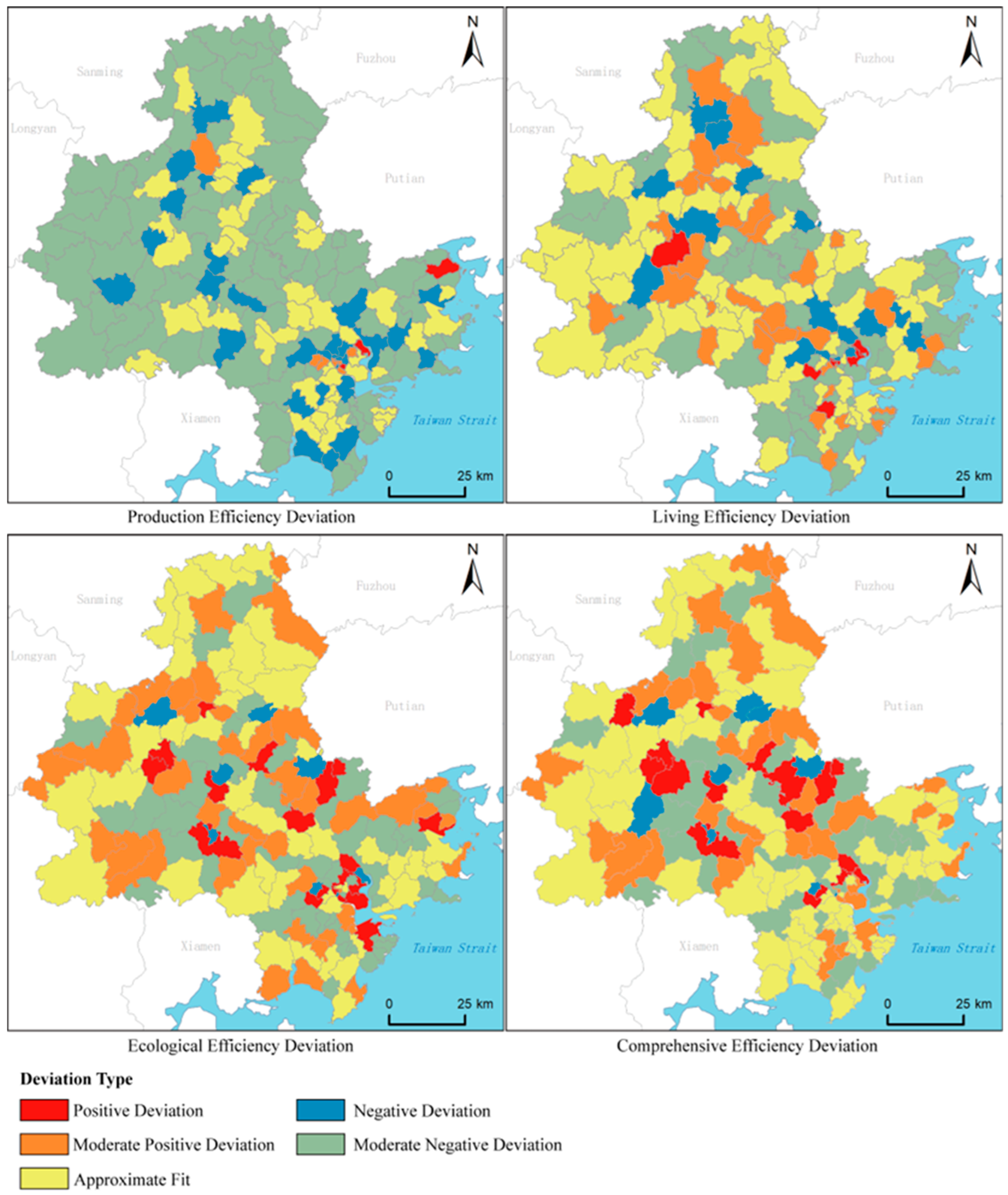
Because grid-scale results are limited in representing broader regional characteristics, the deviation outcomes were further aggregated to the administrative-unit level (Figure 8). This aggregation reveals several statistically significant regional patterns that complement the grid-based findings.
Across the production dimension, 57% of administrative units exhibited negative deviations, indicating that production efficiency is generally under-realized relative to functional inputs. The production-deviation mean remained slightly negative, and variance was moderate, suggesting structurally widespread but spatially differentiated underperformance. Positive deviation units were primarily concentrated in county- and district-level cores such as Fengze Subdistrict, Wan’an Subdistrict, and Nanpu Town—areas with highly concentrated industrial, commercial, and petrochemical facilities. These units formed a distinct cluster whose average positive deviation was nearly three times higher than that of other positive units, reflecting strong transformation capability. However, approximately 70% of units adjacent to these cores showed negative deviations, indicating a potential spatial siphoning effect whereby agglomeration advantages in central nodes suppress surrounding areas’ production–efficiency realization.
In the living dimension, the overall picture was markedly different: 62% of administrative units showed positive deviations, and the mean living deviation shifted slightly into positive territory. The strongest positive deviations were located in the central urban areas of Quanzhou, Jinjiang, and Shishi, as well as in Hutou Town. Along the Jinjiang River, a continuous positive-deviation belt emerged, reflecting the strengthening of the Jinjiang Development Axis. In contrast, peri-urban transition zones exhibited the highest concentration of negative units (accounting for 72% of all negative deviations). These areas typically possess basic living resources, but their weaker public service provision, population vitality, and facility accessibility limit the conversion of functional endowment into actual efficiency outcomes.
The ecological dimension displayed the most polarized pattern. Two-thirds (≈66%) of administrative units showed negative ecological deviations, consistent with the citywide difficulty of converting ecological advantages into ecological efficiency. The average ecological deviation was the lowest among all three dimensions, with the highest variance, indicating substantial spatial disparity. Positive ecological deviation units were primarily distributed across the western hilly counties and, to a lesser extent, the southern Quanzhou Bay area. These units exhibited an average positive deviation nearly five times higher than that of positive production or living units, reflecting the strong ecological foundation of these zones. However, ecological deviations were overwhelmingly negative in peri-urban expansion zones and outer suburban belts, which collectively accounted for over 60% of all negative ecological deviation values, highlighting areas where ecological functions face significant pressure from development.
From a comprehensive-efficiency perspective, the spatial structure of deviation results converged into three typical regional subpatterns.
(1)
The southern Quanzhou Bay zone demonstrated strong functional–efficiency alignment, especially in core urban districts with robust industrial and service bases. However, the outer peri-urban units showed deviations up to 0.03 lower than expected based on functional input levels, indicating uneven benefit realization within this high-growth region.
(2)
The central region, particularly the Shanmei Reservoir hinterland, formed a pronounced high-efficiency cluster. This subregion’s composite deviation averaged 0.19—almost double the citywide mean—highlighting the combined benefits of ecological quality and improving living service conditions.
(3)
The western mountainous zone exhibited stable positive deviations, supported by strong ecological resources and limited disturbance. Here, more than 80% of units recorded positive ecological or composite deviations.
In summary, administrative-unit-scale deviation analysis reveals a quantitatively clear pattern of spatial differentiation. Structurally high-efficiency urban cores, transitional belts with mixed and often underperforming outcomes, and ecologically dominant western regions with strong positive deviations. These findings deepen the understanding of Quanzhou’s functional–efficiency transformation by showing that spatial imbalances are not random but tied to identifiable regional structures, differences in resource endowment, and contrasting development pressures across the city’s urban–rural continuum.

5. Discussion

This study takes Quanzhou City as a case study and develops a function–efficiency deviation evaluation framework aimed at promoting high-quality territorial spatial development. The results systematically reveal the coupling-coordination mechanisms and spatial differentiation patterns between production, living, and ecological functions and their corresponding efficiencies. The findings show that the production, living, and ecological functions in Quanzhou display distinct spatial differentiation: production and living functions are concentrated in the southern coastal urban belt, whereas ecological functions dominate in the northern mountainous areas. Although the overall efficiency distribution generally aligns with the functional pattern, notable spatial mismatches exist in some localities, indicating an imbalance in the transformation from function to efficiency.
The results of the XGBoost model highlight that spatial efficiency is significantly influenced by nonlinear coupling effects among functional dimensions, with neighborhood effects playing a critical role in shaping efficiency outcomes. SHAP analysis further reveals that production efficiency is jointly driven by surrounding living services and ecological support; living efficiency is constrained by ecological factors, demonstrating a structural trade-off between environmental protection and livability; and ecological efficiency is mainly determined by intrinsic ecological endowments and neighborhood synergy effects. These differentiated mechanisms underscore the complex interdependencies between functions and efficiency in Quanzhou’s territorial space.
From a theoretical perspective, this study contributes to spatial efficiency research in three key ways. First, it advances territorial spatial efficiency theory by shifting the analytical focus from absolute efficiency levels to the functional basis of efficiency generation, thereby emphasizing the importance of “place-based” functional heterogeneity. Second, by integrating the PLES framework with machine learning, the study provides a quantitative approach for linking spatial functions to efficiency outputs, enriching the analytical toolkit for PLES-based territorial space evaluation. Third, the introduction of an interpretable machine-learning model (XGBoost–SHAP) offers a transparent mechanism for identifying nonlinear interactions and cross-functional synergies, demonstrating the methodological potential of explainable AI in geographic spatial analysis.
Spatial deviation analysis shows that approximately 45% of spatial units achieve good functional–efficiency alignment, suggesting a generally efficient transformation process. However, significant negative deviations persist in hilly and peri-urban transition zones, reflecting uneven spatial development quality and resource conversion efficiency. To address these disparities, future territorial planning in Quanzhou should prioritize differentiated and zoned management strategies. In industrial parks and periurban townships—where production potential is high but efficiency realization remains low-policies should emphasize infrastructure upgrading, industrial restructuring, and innovation clustering to enhance resource transformation efficiency [47]. The city’s living–ecological interface reveals persistent structural contradictions: living function enhancement remains driven by land expansion and facility density, while ecological integration in urban systems is insufficient. Future urban renewal and ecological restoration should therefore adopt an integrated “green-livable dual-objective” strategy, enhancing green networks and ecological corridors while improving public service accessibility to achieve co-benefits in ecological protection and livability. In mountainous and rural regions, ecological efficiency remains low despite high resource endowments. This calls for strengthened eco-compensation mechanisms and ecological product value realization systems, allowing ecosystem services to be more effectively converted into tangible social and economic benefits.
Overall, the study suggests that Quanzhou should move toward a “multi-center and multi-level” spatial structure to advance coordinated optimization of production, living, and ecological functions. By establishing a territorial governance system centered on urban clusters and urban–rural integration, the city can enhance both the comprehensive efficiency and functional balance of its territorial space.
Despite these contributions, several limitations should be acknowledged. First, the analysis is based on a single-year dataset, which constrains the evaluation to a cross-sectional perspective. This temporal limitation largely results from the difficulty of obtaining consistent multi-period land-use, functional, and efficiency-related datasets for Quanzhou. As such, the study cannot fully capture the temporal dynamics of functional–efficiency transformations or long-term evolutionary trends. Second, while SHAP analysis is used to enhance the interpretability of the model, this study focuses primarily on global SHAP patterns consistent with its system-level analytical objectives. Local SHAP diagnostics at specific hotspot or mismatch zones, although potentially valuable for finer-grained spatial interpretation, extend beyond the scope of the current framework and may be further explored in future research. Future studies could address these limitations by incorporating multi-temporal datasets, analyzing temporal evolution, and extending the framework with localized SHAP assessments and multi-scenario simulations to enhance its applicability and policy relevance.

6. Conclusions

This study proposes a quantitative and interpretable framework for evaluating function–efficiency deviation in territorial space by integrating PLES-based functional characterization, entropy-based efficiency evaluation, and an XGBoost–SHAP relationship modeling approach. The framework enables the identification of how spatial functions are transformed into efficiency outcomes, where structural inconsistencies emerge, and what spatial conditions facilitate or hinder this transformation. Using Quanzhou City as an empirical case, several major conclusions can be drawn.
First, the functional and efficiency structures of Quanzhou exhibit significant spatial heterogeneity, and the alignment between the two is far from uniform. Coastal urban belts possess strong production–living foundations but face localized inefficiencies in peri-urban corridors and dispersed industrial townships. In contrast, the northern mountainous region shows clear ecological advantages yet underperforms in transforming ecological endowments into measurable efficiency outputs. These spatially differentiated pressures indicate that function–efficiency transformation is highly path-dependent and shaped by localized spatial conditions.
Second, nonlinear interactions and neighborhood spillovers are central to the formation of territorial efficiency. The interpretable machine learning model reveals that efficiency outcomes cannot be explained by isolated functional attributes alone; instead, cross-functional synergies, spatial context, and neighborhood structures jointly determine performance. This finding underscores the value of explainable AI as an analytical tool for understanding the multiscale dynamics of territorial systems.
Third, the deviation-based assessment provides a clear spatial diagnosis of where functional potential is insufficiently realized. The framework identifies mismatch-prone areas—including peri-urban transition zones, fragmented ecological–living interfaces, and production-oriented spaces with low conversion performance—which constitute the key leverage points for improving Quanzhou’s territorial efficiency.
From a policy perspective, the results highlight the need for differentiated and place-based territorial governance. Production-oriented spaces should prioritize industrial upgrading and spatial restructuring; living-oriented spaces require improving service accessibility while enhancing ecological integration; and ecological spaces demand strengthened ecosystem service compensation and ecological value realization mechanisms. These targeted strategies will support Quanzhou’s transition toward a more coordinated, multi-level, and resilient territorial spatial structure.
Overall, this study advances territorial spatial efficiency research by providing a generalizable and interpretable model for linking spatial functions to efficiency outcomes, offering both theoretical insights and practical tools for territorial spatial planning. Future work may incorporate multi-temporal datasets and causal inference approaches to explore the dynamic evolution, feedback mechanisms, and policy responsiveness of function–efficiency transformations under changing socio-environmental conditions.

Author Contributions

Conceptualization, Z.K. and W.W.; Methodology, Z.K. and W.W.; Software, Z.K.; Validation, M.H.; Formal analysis, Z.K.; Investigation, Z.K.; Resources, J.X.; Data curation, J.X.; Writing—original draft, Z.K.; Writing—review and editing, W.W., M.H. and L.B.; Visualization, Z.K.; Supervision, W.W.; Project administration, M.H.; Funding acquisition, W.W., J.X. and L.B. All authors have read and agreed to the published version of the manuscript.

Funding

This research was funded by the National Natural Science Foundation of China (42471304) to Wei Wei; The Technology Innovation Center for 3D Real Scene Construction and Urban Refined Governance, Ministry of Natural Resources (2024PF-4) to Junnan Xia; And the National Natural Science Foundation of China: “Evolution mechanism and adaptive simulation of territorial space in the Pan-Hu Huanyong Line climate-sensitive zone” (Grant No. 42571324) to L.B.

Data Availability Statement

The original contributions presented in the study are included in the article, further inquiries can be directed to the corresponding author.

Conflicts of Interest

The authors declare no conflicts of interest.

References

  1. Zhu, J.; Liu, W.; Zheng, S.; Sun, Y. Unraveling drivers of land use efficiency in rapidly urbanizing areas: A hybrid SBM-DDF and explainable machine learning framework. Habitat Int. 2025, 164, 103518. [Google Scholar] [CrossRef]
  2. Liu, Y.; Guo, Z.; Zeng, H. Accurate identification and planning of land use functions in rapidly urbanizing areas based on multi-source data fusion. Cities 2025, 167, 106309. [Google Scholar] [CrossRef]
  3. Lialia, E.; Prentzas, A.; Tafidou, A.; Moulogianni, C.; Kouriati, A.; Dimitriadou, E.; Kleisiari, C.; Bournaris, T. Optimizing Agricultural Sustainability Through Land Use Changes Under the CAP Framework Using Multi-Criteria Decision Analysis in Northern Greece. Land 2025, 14, 1658. [Google Scholar] [CrossRef]
  4. Yu, H.; Chen, Z.; Hu, W.; Zhang, J.; Xu, C.; Hu, B. Urban underground space value assessment and regeneration strategies in symbiosis with the urban block: A case study of large residential areas in Beijing. Tunn. Undergr. Space Technol. 2025, 163, 106728. [Google Scholar] [CrossRef]
  5. Wang, W.; Chen, Y.; Du, Z.; Bi, S.; Zhang, Q.; Ye, T. Ecological restoration zoning and its driving factors in Beijing-Tianjin-Hebei based on landscape ecological risk and ecosystem services. Ecol. Indic. 2025, 178, 114086. [Google Scholar] [CrossRef]
  6. Kong, L.; Wang, Y.; Liu, Y.; Ao, Y.; Chai, B. Identification of key areas for ecological restoration based on ecological carrying capacity and ecological security pattern: A case study of Baoding. Ecol. Indic. 2025, 178, 114032. [Google Scholar] [CrossRef]
  7. Chen, F.; Liu, Y. An integrated analysis framework for territorial space governance: Combining land use classification and functional evaluation toward spatial zoning. Habitat Int. 2025, 166, 103572. [Google Scholar] [CrossRef]
  8. Li, L.; Huang, C.; Liu, Y. Detecting the contribution of transport development to urban construction land expansion in the Beijing-Tianjin-Hebei region of China based on machine learning. Land Use Policy 2025, 157, 107622. [Google Scholar] [CrossRef]
  9. Zhao, P.; Hu, H.; Yu, Z. Investigating the central place theory using trajectory big data. Fundam. Res. 2025, 5, 1084–1096. [Google Scholar] [CrossRef]
  10. Pontes, J.P.; Pires, A.J.G. A geographical theory of (de)industrialization. Struct. Change Econ. Dyn. 2021, 59, 567–574. [Google Scholar] [CrossRef]
  11. Li, T.; Li, R.; Liu, Y.; Wei, G.; Li, S.; He, B.-J. Does enhanced land use efficiency promote ecological resilience in China’s urban agglomerations? Environ. Impact Assess. Rev. 2025, 115, 108047. [Google Scholar] [CrossRef]
  12. Saakjans, D.; Gradinaru, S.R.; Hersperger, A.M. Planning open and green spaces in Europe: The importance of land-use regulations and their efficiency and equity objectives. Landsc. Urban Plan. 2025, 264, 105489. [Google Scholar] [CrossRef]
  13. Tian, Y.; Jiang, G.; Ma, W.; Wu, S.; Tian, Y.; Zhou, T. Understanding the relationship between population-land-industry inputs and function outputs of rural settlements: An efficiency-based perspective. Habitat Int. 2025, 159, 103370. [Google Scholar] [CrossRef]
  14. Dabašinskas, G.; Sujetovienė, G. Spatial and Temporal Changes in Supply and Demand for Ecosystem Services in Response to Urbanization: A Case Study in Vilnius, Lithuania. Land 2024, 13, 454. [Google Scholar] [CrossRef]
  15. Chen, F.; Li, Y.; Liu, Y. Spatial-temporal evolution and coupling coordination of land use functions across China using multiple-source heterogeneous data. Land Use Policy 2025, 155, 107590. [Google Scholar] [CrossRef]
  16. Wang, W.; Guo, Q.; Yang, P.; Xia, C. Dynamic coupling coordination of territorial spatial development intensity and comprehensive disaster-carrying capability: A case study of Beijing-Tianjin-Hebei. Phys. Chem. Earth 2025, 137, 103818. [Google Scholar] [CrossRef]
  17. Chen, F.; Li, Y.; Liu, Y. Bottom-up hierarchical detection of territorial spatial pattern based on multi-source heterogeneous data. Land Use Policy 2025, 158, 107757. [Google Scholar] [CrossRef]
  18. Ariken, M.; Zhang, F.; Chan, N.W.; Kung, H.-T. Coupling coordination and spatio-temporal heterogeneity between urbanization and eco-environment along the Silk Road Economic Belt in China. Ecol. Indic. 2021, 121, 107014. [Google Scholar] [CrossRef]
  19. Chen, Y.; Cai, H.; Chen, Y. Spatial correlation and interaction intensity between territorial ecological quality and new urbanization in the Nanchang metropolitan area, China. Ecol. Indic. 2023, 156, 111163. [Google Scholar] [CrossRef]
  20. Yan, S.; Hu, M.; Ma, X.; Li, X. Exploring the nexus between spatial configuration of urban agglomerations and land use efficiency: A bidimensional analysis considering transport network connectivity. Cities 2025, 167, 106353. [Google Scholar] [CrossRef]
  21. He, Z.; Zhai, W.; Zhao, C. Using social sensing to evaluate the effect of spatial planning: A case study of the Yangtze River Delta urban agglomeration in China. Front. Archit. Res. 2025, 14, 1048–1062. [Google Scholar] [CrossRef]
  22. Kłos, M.J.; Staniek, M.; Sierpiński, G. Beyond the core: Method for assessing 15-minute city adaptation in diverse urban environments. Cities 2026, 168, 106459. [Google Scholar] [CrossRef]
  23. Zheng, Q.; Zhu, H.; Xia, Q.; Guo, Z.; Zhu, L. Spatial coupling coordination between land use efficiency and urbanization in the Chang-Zhu-Tan urban agglomeration, China. Adv. Space Res. 2025, 75, 8642–8656. [Google Scholar] [CrossRef]
  24. Guo, J.; Sun, J.; Wang, L. A new methodology to measure urban construction land-use efficiency based on a two-stage DEA model. Land Use Policy 2022, 112, 105799. [Google Scholar] [CrossRef]
  25. Liu, S.; Xiao, W.; Li, L.; Ye, Y.; Song, X. Urban land use efficiency and improvement potential in China: A stochastic frontier analysis. Land Use Policy 2020, 99, 105046. [Google Scholar] [CrossRef]
  26. Liao, X.; Fang, C.; Shu, T.; Ren, Y. Spatiotemporal impacts of urban structure on urban land-use efficiency: Evidence from 280 Chinese cities. Habitat Int. 2023, 131, 102727. [Google Scholar] [CrossRef]
  27. Cheng, Y.; Zhuang, Z.; Wu, Q. Identification and planning response to inefficient urban and rural construction land use under the concept of relative performance. J. Urban Manag. 2025, 14, 1218–1230. [Google Scholar] [CrossRef]
  28. He, M.; Yan, J.; Du, L. Spatial efficiency evaluation of subway station areas neighboring historic districts: Integrating transportation, culture, and place resources. Front. Archit. Res. 2025; in press. [Google Scholar] [CrossRef]
  29. Li, H.; Wang, Z.; Zhu, M.; Hu, C.; Liu, C. Spatial-temporal evolution and driving mechanism of urban land green use efficiency in the Yellow River Basin. Ecol. Indic. 2023, 154, 110672. [Google Scholar] [CrossRef]
  30. Wang, Y.; Lv, W.; Wang, M.; Chen, X.; Li, Y. Application of improved Moran’s I in the evaluation of urban spatial development. Spat. Stat. 2023, 54, 100736. [Google Scholar] [CrossRef]
  31. Yi, C.; Xu, B.; Shi, X.; Li, R.; Chen, J. Spatial effects of rapid urbanization on land use efficiency in China under low-carbon constraints. Ecol. Indic. 2025, 174, 113442. [Google Scholar] [CrossRef]
  32. Zhang, F.; Xie, A.; Zhang, J.; Chen, J.; Yang, P.; Ma, D.; An, Y.; Peng, G. Dynamic evolution and trend prediction of coupling coordination between urban and rural space utilization efficiency based on local and tele-coupling models. Heliyon 2024, 10, e31578. [Google Scholar] [CrossRef]
  33. Ran, P.; Jin, X.; Frazier, A.E.; Yu, D.; Xia, C.; Hu, Z.; Hu, H. From local to national networks: Evolution and drivers of interprovincial linkages of construction land use efficiency in China. Environ. Impact Assess. Rev. 2026, 117, 108177. [Google Scholar] [CrossRef]
  34. Lyall, J.D.; Darling, L.E.; Locke, D.H.; Hardiman, B.S. Turning a new leaf: Social and land-use drivers of urban tree canopy change in the Chicago Metropolitan Area, 2010–2017. Urban For. Urban Green. 2025, 113, 128999. [Google Scholar] [CrossRef]
  35. Odunsi, O.M.; Rienow, A. Examining urban expansion in Abeokuta through economic development clusters: A geospatial approach using Random Forest and Batty’s entropy. Geomatica 2025, 77, 100050. [Google Scholar] [CrossRef]
  36. Gao, S.; Ge, X.; Li, H.; Zhou, H. Urban vitality and its driving factors in Zhengzhou’s main urban area based on multi-source data and XGBoost. Ecol. Indic. 2025, 179, 114187. [Google Scholar] [CrossRef]
  37. Gianoli, A. Unlocking Patterns in Urban Land Use Efficiency: A Global Analysis Using XGBoost and Bayesian Networks. Land Use Policy 2026, 160, 107838. [Google Scholar] [CrossRef]
  38. Talen, E.; Anselin, L.; Lee, S.; Koschinsky, J. Looking for Logic: The Zoning—Land Use Mismatch. Landsc. Urban Plan. 2016, 152, 27–38. [Google Scholar] [CrossRef]
  39. Xu, X. Spatial Distribution Dataset of Ecosystem Service Value in China; Resource and Environmental Science Data Center (RESDC), Chinese Academy of Sciences: Beijing, China, 2018. (In Chinese) [Google Scholar] [CrossRef]
  40. Li, K.; Zhao, J.; Li, Y.; Lin, Y. Identifying trade-offs and synergies among land use functions using an XGBoost-SHAP model: A case study of Kunming, China. Ecol. Indic. 2025, 172, 113330. [Google Scholar] [CrossRef]
  41. Yu, D.; Mu, H.; Chen, S. Production-living-ecological spaces and human-land relationships in poverty alleviation and relocation areas: Zhaotong City, Yunnan Province. Ecol. Indic. 2025, 178, 114034. [Google Scholar] [CrossRef]
  42. Yu, T.; Jia, S.; Zhang, Y.; Cui, X. Balancing urban expansion and ecological preservation: Simulation of production-living-ecological space dynamics in the Huaihe River Eco-Economic Belt. Ecol. Indic. 2025, 171, 113192. [Google Scholar] [CrossRef]
  43. Huang, A.; Wang, Y.; Xiang, Y.; Xu, Y.; Tian, L.; Zhou, G.; Zhuang, Y.; Zhu, L. A comprehensive framework for assessing spatial conflict risk: A case study of production-living-ecological spaces based on a social-ecological system framework. Habitat Int. 2024, 154, 103218. [Google Scholar] [CrossRef]
  44. Cao, Y.; Zhang, M.; Zhang, Z.; Liu, L.; Gao, Y.; Zhang, X.; Chen, H.; Kang, Z.; Liu, X.; Zhang, Y. Impact of land-use change on ecological environmental quality from the perspective of production-living-ecological space: The northern slope of Tianshan Mountains. Ecol. Inform. 2024, 83, 102795. [Google Scholar] [CrossRef]
  45. Song, W.; Cao, S.; Du, M.; He, Z. Aligning territorial spatial planning with the Sustainable Development Goals: A comprehensive analysis of production, living, and ecological spaces in China. Ecol. Indic. 2024, 160, 111816. [Google Scholar] [CrossRef]
  46. Duan, Y.; Wang, H.; Huang, A.; Xu, Y.; Lu, L.; Ji, Z. Identification and spatio-temporal evolution of rural production-living-ecological space from the perspective of villagers’ behavior: A case study of Ertai Town, Zhangjiakou City. Land Use Policy 2021, 106, 105457. [Google Scholar] [CrossRef]
  47. Fu, Y.; Wang, N. Research on Enhancing Urban Land Use Efficiency Through Digital Technology. Land 2025, 14, 2294. [Google Scholar] [CrossRef]
Figure 1. Study area.
Land 14 02403 g001
Figure 2. Technical framework for spatial efficiency evaluation.
Land 14 02403 g002
Figure 3. Spatial identification and spatial autocorrelation analysis of territorial functions in Quanzhou City. Note: High–High: high values surrounded by high values; Low–Low: low values surrounded by low values; High–Low: high-value outliers adjacent to low values; Low–High: low-value outliers adjacent to high values.
Land 14 02403 g003
Figure 4. Spatial evaluation results and spatial autocorrelation analysis of territorial efficiency in Quanzhou City. Note: High–High: high values surrounded by high values; Low–Low: low values surrounded by low values; High–Low: high-value outliers adjacent to low values; Low–High: low-value outliers adjacent to high values.
Land 14 02403 g004
Figure 5. Comprehensive territorial efficiency (left) and spatial autocorrelation analysis (right) of Quanzhou City. Note: High–High: high values surrounded by high values; Low–Low: low values surrounded by low values; High–Low: high-value outliers adjacent to low values; Low–High: low-value outliers adjacent to high values.
Land 14 02403 g005
Figure 6. SHAP analysis results of the spatial efficiency prediction model in Quanzhou City.
Land 14 02403 g006
Figure 7. Spatial deviation results of territorial efficiency at the grid level in Quanzhou City.
Land 14 02403 g007
Figure 8. Spatial deviation results of territorial efficiency at the administrative-unit level in Quanzhou City.
Land 14 02403 g008
Table 1. Data Description and Sources.
Data TypeData DescriptionData Source
Socio-economic dataTownship-level statistical yearbooks of Quanzhou CityQuanzhou Municipal Bureau of Statistics
Land-use dataShapefileQuanzhou Bureau of Natural Resources
Nighttime light dataRaster, 742 m × 742 mEarth observation group
Road network dataShapefileOpenStreetMap
Commercial and enterprise Points of Interest dataShapefileOpenStreetMap
Population dataRaster, 1 km × 1 kmLandScan Global Population Database
Housing market dataShapefileBeike Real Estate Platform
Normalized Difference Vegetation Index (NDVI)Raster, 1 km × 1 kmGeospatial Data Cloud
Net Primary Productivity (NPP)Raster, 500 m × 500 mNational Aeronautics and Space Administration (https://www.nasa.gov/)
Ecosystem service value dataRaster, 1 km × 1 kmResource and Environmental Science Data Center, Chinese Academy of Sciences [35]
Table 2. Functional scoring system for land-use types in Quanzhou City.
Land-Use TypeProduction Function ScoreLiving Function ScoreEcological Function Score
Cultivated land302
Orchard land302
Forest land003
Grassland003
Wetland003
Agricultural facilities land310
Residential land130
Public administration and service land120
Commercial service land310
Industrial and mining land300
Storage land300
Transportation land310
Utility land310
Green space and open area022
Special-use land030
Inland water area003
Other land003
Table 3. Indicator system for evaluating territorial spatial efficiency in Quanzhou City.
Evaluation DimensionIndicatorDefinition/Description
Production efficiencyCultivation rateRatio of cultivated area to total farmland area
Agricultural output valueAgricultural output per unit of agricultural land
Industrial rentAverage rent of shops and factory buildings
IndustrialDensity of commercial and enterprise points
Living efficiencyPublic service accessibilityMean accessibility to healthcare, elementary schools, and elderly care facilities
Transportation accessibilityAverage distance to bus stops
Residential qualityCombined score of average second-hand housing and rental prices (higher value = better quality)
Spatial vitalityIntensity of nighttime light
Ecological efficiencyNormalized Difference Vegetation IndexVegetation coverage within the spatial unit
Net Primary ProductivityUtilization rate of solar energy by ecosystems
Ecological purification valueEcosystem’s capacity for pollutant purification
Soil conservation valueEcosystem’s capacity to prevent soil erosion and maintain fertility and structure
Table 4. Performance results of the spatial ideal-efficiency prediction model.
Efficiency DimensionRMSEMAER2Residual Moran’s Ip-Value
Production efficiency0.0130.0090.951−0.0020.118
Living efficiency0.0060.0040.9970.0160.001
Ecological efficiency0.0480.0350.804−0.0050.005
Table 5. Summary of Major Influencing Factors and Mechanism Characteristics Derived from SHAP Analysis.
Major Influencing Factors (TOP 3)Dominant Functional DriversMechanism Characteristics
Influencing FactorContribution
Production efficiencyNeighbouring living function0.025Production efficiency is mainly shaped by residential and productive conditions in surrounding areas, whereas local functional endowments exert relatively weak effects.A spillover-dominant mechanism in which production activities tend to concentrate in areas supported by favorable living environments and adjacent productive bases.
Neighbouring production function0.007
Relative east–west location0.007
Living efficiencyRelative east–west location0.091Living efficiency is overwhelmingly influenced by inherited spatial structure, with supplementary contributions from neighboring production and living functions.A strongly path-dependent mechanism characterized by high spatial autocorrelation and strong responsiveness to surrounding socioeconomic conditions
Neighbouring production function0.028
Neighbouring living function0.018
Ecological efficiencyLocal ecological function0.204Ecological efficiency is dominated by intrinsic ecological endowment, strengthened by ecological and residential conditions in adjacent units.An endowment-driven mechanism in which ecological performance primarily reflects natural conditions, with marginal gains from neighborhood ecological synergy.
Neighbouring ecological function0.041
Neighbouring living function0.038
Disclaimer/Publisher’s Note: The statements, opinions and data contained in all publications are solely those of the individual author(s) and contributor(s) and not of MDPI and/or the editor(s). MDPI and/or the editor(s) disclaim responsibility for any injury to people or property resulting from any ideas, methods, instructions or products referred to in the content.