A Spatiotemporal Analysis of the Relationship Between Construction Land Supply and High-Quality Urban Development: Evidence from 285 Chinese Cities



Abstract
1. Introduction
2. Data and Methods
2.1. Classification of Construction Land
2.2. Evaluation Index System for HQUD
2.2.1. Indicator Selection
2.2.2. Indicator Weighting and Comprehensive Evaluation
2.3. Spatial Analysis
2.3.1. Hot Spot Analysis
2.3.2. Spatial Autocorrelation Analysis
2.4. GTWR Model
2.4.1. Dependent Variable
2.4.2. Explanatory and Control Variables
2.5. Data Sources
3. Results
3.1. Construct Land Supply from 2009 to 2020
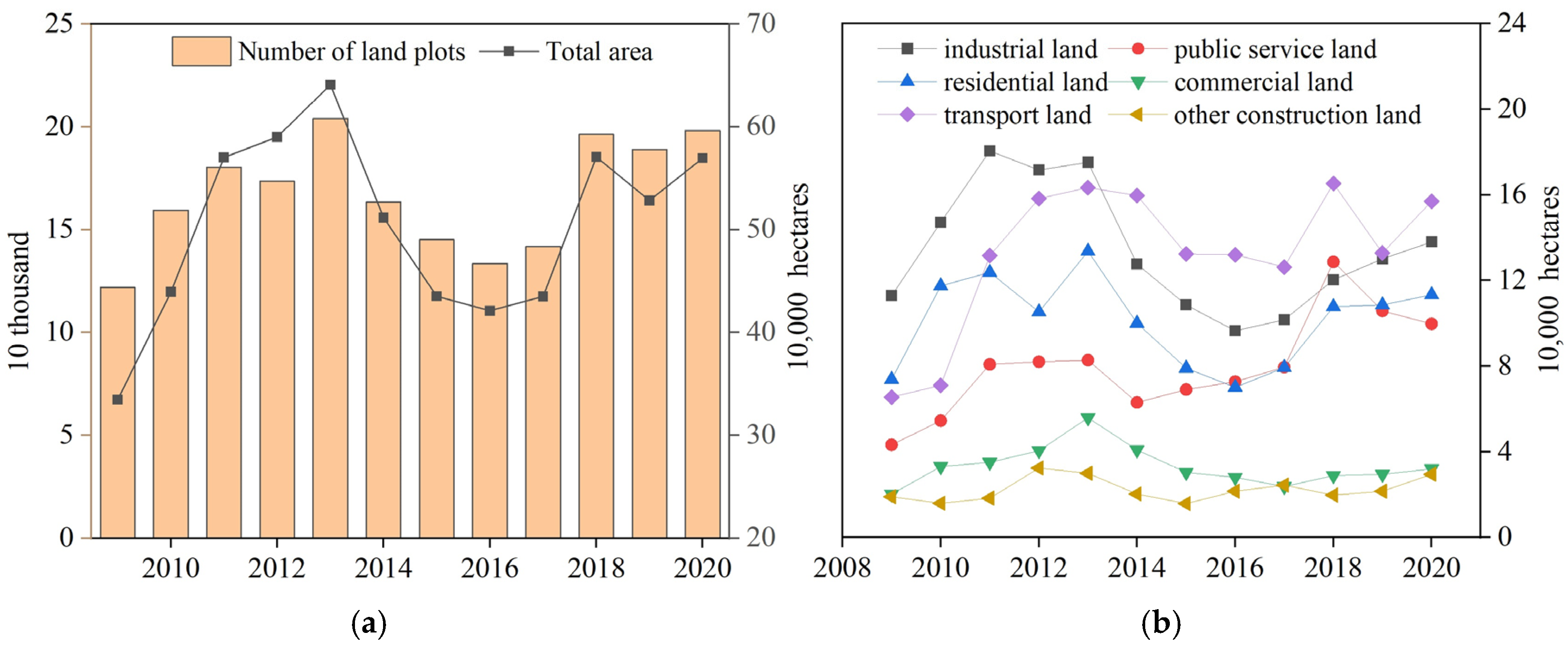
3.1.1. Overall Characteristics
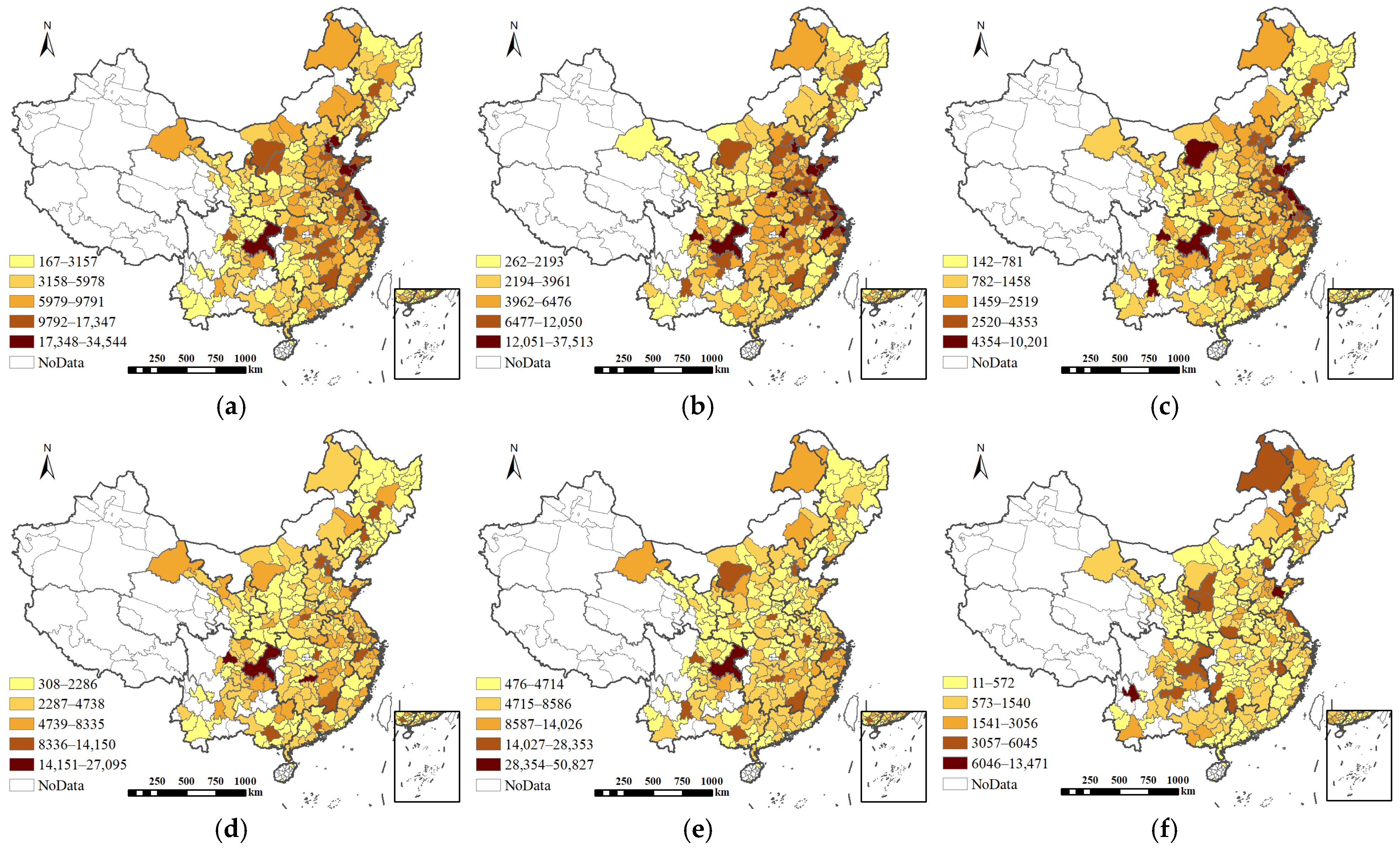
3.1.2. Spatial Distribution Characteristics
3.2. HQUD Level Estimation Results
3.2.1. Overall Characteristics
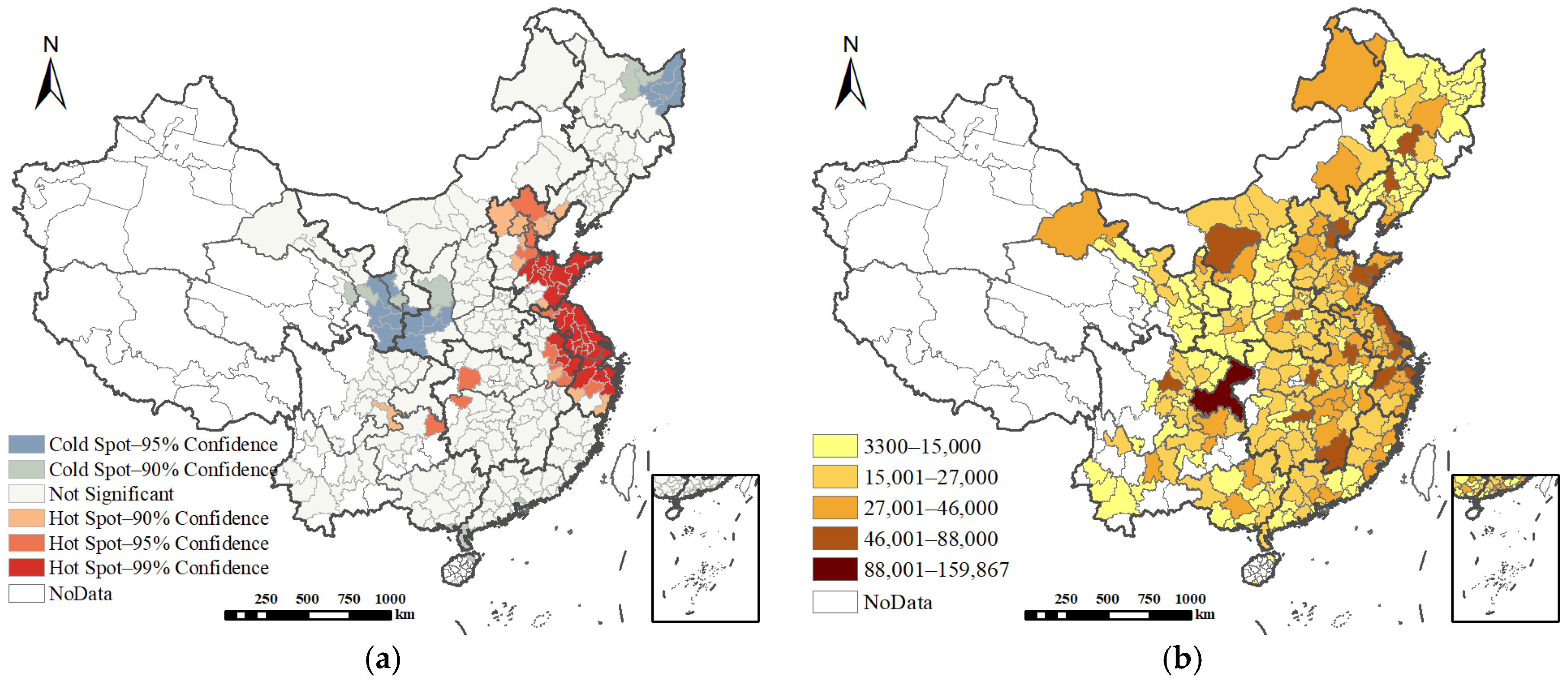
3.2.2. Spatial Distribution Characteristics
3.3. Impact of Construction Land Supply on HQUD
3.3.1. Model Parameters and Precision
3.3.2. Explanatory Variable Coefficients and Temporal Variations
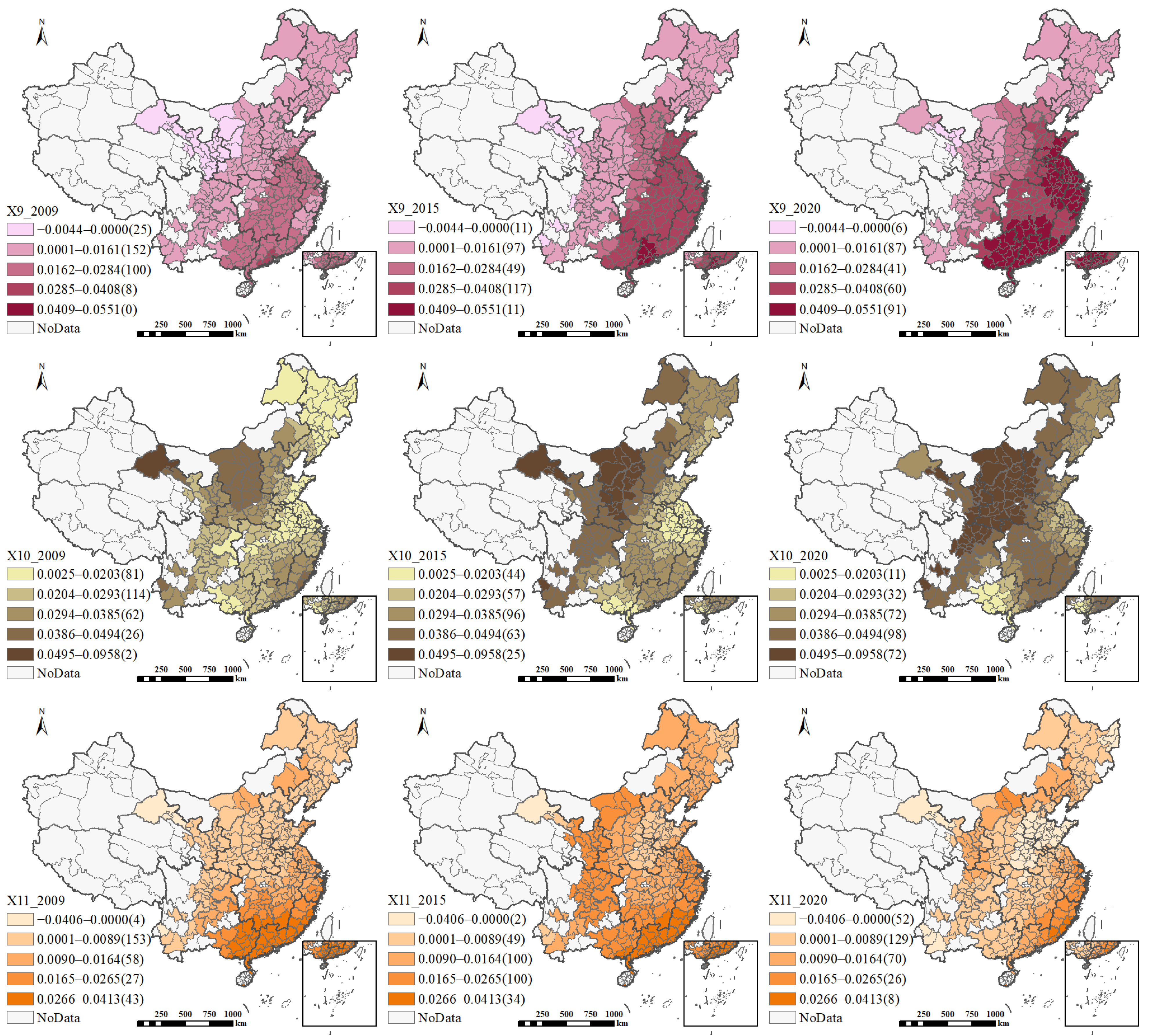
3.3.3. Spatial Heterogeneity of Local Influencing Effects in the GTWR Model
- The Impact of Construction Land Supply Scale
- 2.
- Impact of the Structure of Construction Land Supply
- 3.
- The Impact of the Quality of Land Supply
- 4.
- The Impact of the Control Variables
4. Discussion
4.1. Analysis of Impact Mechanisms
4.2. Implications
4.3. Limitations
5. Conclusions
Author Contributions
Funding
Data Availability Statement
Conflicts of Interest
References
- Farhan, M.; Wu, T.; Amin, M.; Tariq, A.; Guluzade, R.; Alzahrani, H. Monitoring and prediction of the LULC change dynamics using time series remote sensing data with Google Earth Engine. Phys. Chem. Earth 2024, 136, 103689. [Google Scholar] [CrossRef]
- Ottensmann, J.R. Urban sprawl, land values and the density of development. Land Econ. 1977, 53, 389–400. [Google Scholar] [CrossRef]
- Soergel, B.; Kriegler, E.; Weindl, I.; Rauner, S.; Dirnaichner, A.; Ruhe, C.; Hofmann, M.; Bauer, N.; Bertram, C.; Bodirsky, B.L.; et al. A sustainable development pathway for climate action within the UN 2030 Agenda. Nat. Clim. Change 2021, 11, 656–664. [Google Scholar] [CrossRef]
- Giddings, B.; Hopwood, B.; O’BRien, G. Environment, economy and society: Fitting them together into sustainable development. Sustain. Dev. 2002, 10, 187–196. [Google Scholar] [CrossRef]
- Sany´e-Mengual, E.; Secchi, M.; Corrado, S.; Beylot, A.; Sala, S. Assessing the decoupling of economic growth from environmental impacts in the European union: A consumption-based approach. J. Clean. Prod. 2019, 236, 117535. [Google Scholar] [CrossRef] [PubMed]
- Aref, A.; Fallentine, A.; Zahran, S. The State of Urbanization, Demographic Changes, and Family Dynamics in Africa. J. Comp. Fam. Stud. 2023, 54, 283–297. [Google Scholar] [CrossRef]
- Wise, R.D.; Anguiano, F.C.; Olvera, S.G. Migration and peripheral urbanization: The case of the metropolitan zone of the valley of Mexico. Ethn. Racial Stud. 2023, 46, 2416–2438. [Google Scholar] [CrossRef]
- Liu, L.; Xu, X.; Chen, X. Assessing the impact of urban expansion on potential crop yield in China during1990–2010. Food Secur. 2014, 7, 33–43. [Google Scholar] [CrossRef]
- Wei, Y.P.; Zhang, Z.Y. Assessing the fragmentation of construction land in urban areas: An index method and case study in Shunde, China. Land Use Policy 2012, 29, 417–428. [Google Scholar] [CrossRef]
- Georgeson, L.; Maslin, M. Estimating the scale of the US green economy within the global context. Palgrave Commun. 2019, 5, 121. [Google Scholar] [CrossRef]
- He, L. High-quality development as the primary task in building a modern socialist country in all respects. Macroecon. Manag. 2022, 12, 1–4+8. [Google Scholar] [CrossRef]
- Lu, Y.; Zhang, Y.; Cao, X.; Wang, C.; Wang, Y.; Zhang, M.; Ferrier, R.C.; Jenkins, A.; Yuan, J.; Bailey, M.J.; et al. Forty years of reform and opening up: China’s progress toward a sustainable path. Sci. Adv. 2019, 5, eaau9413. [Google Scholar] [CrossRef]
- Zhang, F.; Tan, H.; Zhao, P.; Gao, L.; Ma, D.; Xiao, Y. What Was the Spatiotemporal Evolution Characteristics of High-Quality Development in China? A Case Study of the Yangtze River Economic Belt Based on the ICGOS-SBM Model. Ecol. Indic. 2022, 145, 109593. [Google Scholar] [CrossRef]
- Seto, K.C.; Fragkias, M.; Güneralp, B.; Reilly, M.K. A Meta-Analysis of Global Urban Land Expansion. PLoS ONE 2011, 6, e23777. [Google Scholar] [CrossRef] [PubMed]
- Yan, H.S.; Sun, J.W.; Zhang, Z.B. Analysis of spatial-temporal evolution of urban construction land supply in China. Urban Dev. Stud. 2021, 28, 42–49. [Google Scholar] [CrossRef]
- Guo, Z.; Hu, Y.; Wang, J.; Bai, Y. Has China completed the supply-side structural reform of construction land supply? Evidence from 335 cities. Habitat Int. 2025, 156, 103271. [Google Scholar] [CrossRef]
- Jiang, G.; Ma, W.; Qu, Y.; Zhang, R.; Zhou, D. How does sprawl differ across urban built-up land types in China? A spatial-temporal analysis of the Beijing metropolitan area using granted land parcel data. Cities 2016, 58, 1–9. [Google Scholar] [CrossRef]
- Yan, H.S.; Sun, J.W.; Su, X.J. Land Element: A Policy Tool with Chinese Characteristics. Economist 2019, 5, 104–112. [Google Scholar] [CrossRef]
- Abdrabo, M.A.; Hassaan, M.A.; Abdelwahab, R.G. A spatial hedonic approach for modeling the relationship between quality of urban life and housing prices, case study: Alexandria city, Egypt. Lett. Spat. Resour. Sci. 2022, 15, 59–77. [Google Scholar] [CrossRef]
- Rodrigues, M.; Franco, M. Measuring the urban sustainable development in cities through a Composite Index: The case of Portugal. Sustain. Dev. 2020, 28, 507–520. [Google Scholar] [CrossRef]
- Yang, G.; Xiang, X.; Deng, F.; Wang, F. Towards high-quality development: How does digital economy impact low-carbon inclusive development?: Mechanism and path. Environ. Sci. Pollut. Res. 2023, 30, 41700–41725. [Google Scholar] [CrossRef]
- Yuan, X.L.; Guo, Y.L.; Wang, H.X. The spatial and temporal differentiation of urban development quality in China and its driving factors. Hum. Geogr. 2022, 37, 129–138+170. [Google Scholar] [CrossRef]
- Du, J.; Peiser, R.B. Land supply, pricing and local governments’ land hoarding in China. Reg. Sci. Urban Econ. 2014, 48, 180–189. [Google Scholar] [CrossRef]
- Zheng, S.; Sun, W.; Wang, R. Land supply and capitalization of public goods in housing prices: Evidence from Beijing. J. Reg. Sci. 2014, 54, 550–568. [Google Scholar] [CrossRef]
- Huang, L.; Yang, L.; Tian, L.; Yu, R.; Wang, D.; Hao, J.; Lu, J. Does the location of construction land supply play a very important role on economic growth? The case study of Tianjin Binhai new area. J. Urban Manag. 2020, 9, 104–114. [Google Scholar] [CrossRef]
- Xiang, S.; Huang, L.; Zhou, M.; Shan, L.; Dong, B.; Wang, K. Dynamic analysis of correlation patterns between urban population and construction land at different administrative levels: The case of Hangzhou megacity. Ecol. Indic. 2023, 154, 110407. [Google Scholar] [CrossRef]
- Cheng, J.; Zhao, J.; Dai, Y.; Li, Y. Land supply patterns and the Chinese low consumption puzzle. Struct. Change Econ. Dyn. 2024, 69, 232–245. [Google Scholar] [CrossRef]
- Fan, J.; Zhou, L.; Yu, X.; Zhang, Y. Impact of land quota and land supply structure on China’s housing prices: Quasi-natural experiment based on land quota policy adjustment. Land Use Policy 2021, 106, 105452. [Google Scholar] [CrossRef]
- Huang, J.S.; Chen, L.G.; Zhang, Y.Y.; Zhao, A. The relationship between industrial land price and industrial structure change. Resour. Sci. 2017, 39, 585–596. [Google Scholar] [CrossRef]
- Li, L.; Liu, L.; Gu, Z.; Sun, Z.; Zhang, Q. Examining the relationships between carbon emissions and land supply in China. Ecol. Inform. 2022, 70, 101744. [Google Scholar] [CrossRef]
- Li, J.; Sun, Z. Does the transfer of state-owned land-use rights promote or restrict urban development? Land Use Policy 2021, 100, 104945. [Google Scholar] [CrossRef]
- Liu, T.; Huang, M. Land supply and money growth in China. Int. Rev. Econ. Financ. 2016, 42, 327–338. [Google Scholar] [CrossRef]
- Mozaffari, M.M.; Azarneshan, S.; Sarmadian, F.; Yazdani, A. Land Evaluation and Ranking with Using an Incorporate Vision of Parametric Method and Analytic Hierarchy Process. Life Sci. J.-Acta Zhengzhou Univ. Overseas Ed. 2012, 9, 1157–1164. [Google Scholar] [CrossRef]
- Li, B.; Wang, H. Comprehensive evaluation of urban high-quality development: A case study of Liaoning province. Environ. Dev. Sustain. 2023, 25, 1809–1831. [Google Scholar] [CrossRef]
- Zhao, J.B.; Shi, D.; Deng, Z. A framework of China’s high-quality economic development. Res. Econ. Manag. 2019, 40, 15–31. [Google Scholar] [CrossRef]
- Liu, B.L.; Wang, X.; Bian, Y. Theoretical analysis and path selection of high quality urban development in China under the new development pattern. Reform 2021, 326, 15–23. [Google Scholar]
- Guo, F.; Wang, J.Y.; Wang, F.; Kong, T.; Zhang, X.; Cheng, Z. Measuring the development of digital inclusive finance in China: Index compilation and spatial characteristics. China Econ. Q. 2020, 19, 1401–1418. [Google Scholar] [CrossRef]
- Gan, C.H.; Zheng, R.G.; Yu, D.F. An empirical study on the effects of industrial structure on economic growth and fluctuaions in China. Econ. Res. J. 2011, 46, 4–16, 31. [Google Scholar]
- Wu, W.Z.; Liu, Y.B.; Xu, L. Industrial structure change and income inequality: Micro-evidence from China. Manag. World 2018, 34, 22–33. [Google Scholar] [CrossRef]
- Zhai, Y.; Zhao, B.; Yang, C.Y.; Sun, X.H. “Black Box” Deconstruction from Innovation Behavior to Productivity Effect. Sci. Sci. Manag. S.T. 2024, 45, 68–87. [Google Scholar]
- Qu, X.; Zhang, H.; Bi, G.; Su, K.; Zhang, Z.; Qian, Y.; Yang, Q. Spatial effects of the land supply scale of different industrial sectors on high-quality development in the Yangtze River economic belt. Land 2022, 11, 1898. [Google Scholar] [CrossRef]
- Pan, W.; Wang, J.; Lu, Z.; Liu, Y.; Li, Y. High-quality development in China: Measurement system, spatial pattern, and improvement paths. Habitat Int. 2021, 118, 102458. [Google Scholar] [CrossRef]
- Wang, H.Q.; Gao, S.J. Germination, starting and policy evolution of green development in China: Observation of some stage characteristics. Reform 2016, 3, 6–26. [Google Scholar]
- Zhang, X.H.; Zhang, X. Requirements of the times, practical principles and promotion paths of shared development. Study Explor. 2023, 11, 1–8+175. [Google Scholar]
- Ord, J.K.; Getis, A. Local spatial autocorrelation statistics: Distributional issues and an application. Geogr. Anal. 1995, 27, 286–306. [Google Scholar] [CrossRef]
- Getis, A.; Cliff, A.D.; Ord, J.K. 1973: Spatial autocorrelation. London: Pion. Prog. Hum. Geogr. 1995, 19, 245–249. [Google Scholar] [CrossRef]
- Huang, B.; Wu, B.; Barry, M. Geographically and temporally weighted regression for modeling spatio-temporal variation in house prices. Int. J. Geogr. Inf. Sci. 2010, 24, 383–401. [Google Scholar] [CrossRef]
- Ma, X.; Zhang, J.; Ding, C.; Wang, Y. A geographically and temporally weighted regression model to explore the spatiotemporal influence of built environment on transit ridership. Comput. Environ. Urban Syst. 2018, 70, 113–124. [Google Scholar] [CrossRef]
- Yoo, C.; Xiao, H.; Zhong, Q.-W.; Weng, Q. Unequal impacts of urban industrial land expansion on economic growth and carbon dioxide emissions. Commun. Earth Environ. 2024, 5, 203. [Google Scholar] [CrossRef]
- Zhang, L.; Lu, M.; Liu, Y.L. Tax Incentives and Supply Structure of Commercial and Residential Land. China Econ. Q. 2022, 22, 1425–1446. [Google Scholar] [CrossRef]
- Kong, W.L.; Wang, X.B.; Zhou, J.H.; Zhang, Z. Impact of land supply behavior on the development of new quality productivity: A three-dimensional empirical analysis based on supply structure, price, and mode. China Land Sci. 2024, 38, 51–62. [Google Scholar] [CrossRef]
- Ma, H.T.; Xu, X.F. High-quality development assessment and spatial heterogeneity of urban agglomeration in the Yellow River Basin. Econ. Geogr. 2020, 40, 11–18. [Google Scholar] [CrossRef]
- Zhu, D.L. Exploring the dialectical relationship between land resource allocation and economic growth. China Land 2023, 5, 22–24. [Google Scholar] [CrossRef]
- Peng, S.G.; Li, M.; Guo, Z.N.; Wang, J.; Zhang, M. Nonlinear effects of local government’s “Dual-Track” land supply strategy on the optimization of industrial structure: An empirical analysis based on the dual perspectives of rationalization and supererogation. China Land Sci. 2023, 37, 48–58. [Google Scholar] [CrossRef]
- Zhang, J.B. Study on Spatial Differences and Convergence of Urban Economy High Quality Development. Ph.D. Thesis, Dongbei University of Finance and Economics, Shenyang, China, 2019. [Google Scholar] [CrossRef]
- Huang, B.; Wang, J. GTWR ADDIN (Updated and Valid till 1 January 2025). 2000. Available online: https://www.researchgate.net/publication/329518786_GTWR_ADDIN_Updated_and_Valid_till_Jan_1_2025 (accessed on 26 November 2025).
- Gao, Y.J. Research on the Impact of Construction Land Supply on the Quality of Urban Development in Yunnan Province. Master’s Thesis, Yunnan University of Finance and Economics, Kunming, China, 2023. [Google Scholar] [CrossRef]
- Liu, X.Z.; Zhou, H.M. How does land resource allocation affect urban economic efficiency: An empirical test based on industrial data of 286 cities above prefecture level in China. China Land Sci. 2022, 36, 49–58. [Google Scholar] [CrossRef]
- Hu, S.J.; Xu, X. Investment competition and land supply behavior: Based on the perspective of urban economic development. Reform 2021, 7, 91–106. [Google Scholar]
- Lei, X.B.; Wang, L.J.; Wu, S.S. Study on the influence of construction land supply scale and structure on urban development quality. China Land Sci. 2020, 34, 75–83. [Google Scholar] [CrossRef]
- Gao, X.L. Comprehensive Evaluation for Wuhan Urban Renewal Based on Multi-Source Data. Master’s Thesis, Wuhan University of Technology, Wuhan, China, 2022. [Google Scholar] [CrossRef]
- Liu, S.Y. Land institutional reform and structural transformation in China: An economic interpretation for China’s 40 years development experience. China Land Sci. 2018, 32, 1–10. [Google Scholar] [CrossRef]
- Zhang, J.; Li, L.; Yu, T.; Gu, J.; Wen, H. Land assets, urban investment bonds, and local governments’ debt risk, China. Int. J. Strat. Prop. Manag. 2021, 25, 65–75. [Google Scholar] [CrossRef]



| Dimension | Sub-Dimension | Indicator | Measurement Method | Weight |
|---|---|---|---|---|
| Innovation | Innovation input | Per capita investment in education | Ratio of education investment to total population (CNY/person) | 0.0331 |
| Per capita investment in science and technology | Ratio of science and technology input to total population (CNY/person) | 0.0256 | ||
| Innovative talent input | Number of tertiary teachers per 10,000 people | 0.0568 | ||
| Innovation efficiency | Labor productivity | Ratio of output of secondary and tertiary industries to the number of employees in these industries (CNY/person) | 0.0210 | |
| Capital productivity | Ratio of GDP to fixed assets investment (%) | 0.0174 | ||
| Innovation output | Patent output | Number of patents granted per 10,000 people | 0.1030 | |
| Digital Economy Index | Based on the Peking University Digital Financial Inclusion Index, specific calculation details are provided in Guo Feng et al. [37]. | 0.0151 | ||
| Coordination | Urban–rural coordination | Share of primary industry | Ratio of value added in the primary sector to GDP (%), negative indicator | 0.0032 |
| Income gap between urban and rural residents | Ratio of per capita income of urban residents to that of rural residents | 0.0030 | ||
| Urbanization rate | Ratio of urban population to total population (%) | 0.0097 | ||
| Financial coordination | Share of deposit and loan balances of financial institutions | Ratio of deposit and loan balances of financial institutions to GDP | 0.0219 | |
| Loan balances relative to deposit balances | Ratio of loan balances to deposit balances | 0.0076 | ||
| Pressure on municipal finances | Ratio of local general public budget expenditure to local general public budget revenue, negative indicator | 0.0013 | ||
| Industrial coordination | Industrial structure rationalization index | Measured by modifying the definition of the Thiel index, the formula is [38]: where stands for industry, stands for gross output, and L stands for employment. | 0.0342 | |
| Index of advanced industrial structure | The formula is [39]: where is the index of advanced industrial structure and denotes the output value of industry m in city as a share of GDP at moment. | 0.0838 | ||
| Green | Environmental pressure | CO2 emissions per unit of GDP | Ratio of CO2 emissions to GDP (million tons per million yuan), negative indicator | 0.0141 |
| SO2 pollution emissions per unit of industrial added value | Ratio of SO2 emissions to industrial value added (tons per million yuan), negative indicator | 0.0021 | ||
| Wastewater pollution emissions per unit of industrial value added | Ratio of wastewater discharges to industrial value added (tons per million yuan), negative indicator | 0.0005 | ||
| Smoke and dust emissions per unit of industrial added value | Ratio of soot emissions to industrial value added (tons per million yuan), negative indicator | 0.0005 | ||
| Environmental governance | Green space per capita | Ratio of green space area to total population (km2 per person) | 0.049 | |
| Annual average concentration of PM2.5 | Annual mean concentration of PM2.5 (μg/m3), negative indicator | 0.0232 | ||
| Domestic waste disposal rate | Ratio of treated domestic waste volume to total domestic waste volume (%) | 0.0162 | ||
| Urban wastewater treatment rate | Ratio of municipal wastewater treated by sewage plants through the municipal network to total wastewater discharged (%) | 0.017 | ||
| Openness | Foreign trade | Share of total imports and exports | Ratio of total imports and exports to regional GDP (%) | 0.1063 |
| Utilization of foreign capital | Share of foreign direct investment (FDI) | Ratio of FDI to regional GDP (%) | 0.0436 | |
| Share of foreign-invested enterprises | Ratio of the number of foreign-invested enterprises to the total number of enterprises (%) | 0.0433 | ||
| Open environment | Marketization index | Data derived from the comprehensive provincial-level marketization index published by the Marketization Index Research Group of the National Economic Research Institute, Beijing | 0.0057 | |
| Shared | Public resource | Library holdings per 10,000 population | Total library collections divided by the served population, multiplied by 10,000 | 0.0543 |
| Medical beds per 10,000 population | Number of medical beds divided by the population of the area, multiplied by 10,000 | 0.0126 | ||
| Doctors per 10,000 population | Number of doctors divided by the total population of the area, multiplied by 10,000 | 0.0152 | ||
| Pupil–teacher ratio in primary and secondary schools | Ratio of the number of teachers to the number of students in primary and secondary schools | 0.0079 | ||
| Benefit level | Wage level of employees | Average wage of employees (Million yuan per person) | 0.0125 | |
| Per capita consumption expenditure | Average annual consumption expenditure per capita (yuan per person) | 0.0319 | ||
| Internet coverage | Proportion of the population or geographic area with access to internet services (%) | 0.0316 | ||
| Unemployment insurance participation rate | Ratio of the number of persons enrolled in unemployment insurance to the number eligible under the policy (%) | 0.0320 | ||
| Basic pension insurance participation rate | Ratio of the number of people enrolled in basic pension insurance to the number required under the policy (%) | 0.0220 | ||
| Medical insurance coverage | Ratio of the population covered by health insurance to the total population (%) | 0.0219 |
| Variable Type | Variable | Variable Code | Descriptions |
|---|---|---|---|
| Explained variable | Level of high-quality urban development | Y | Results of the high-quality urban development (HQUD) index evaluation system |
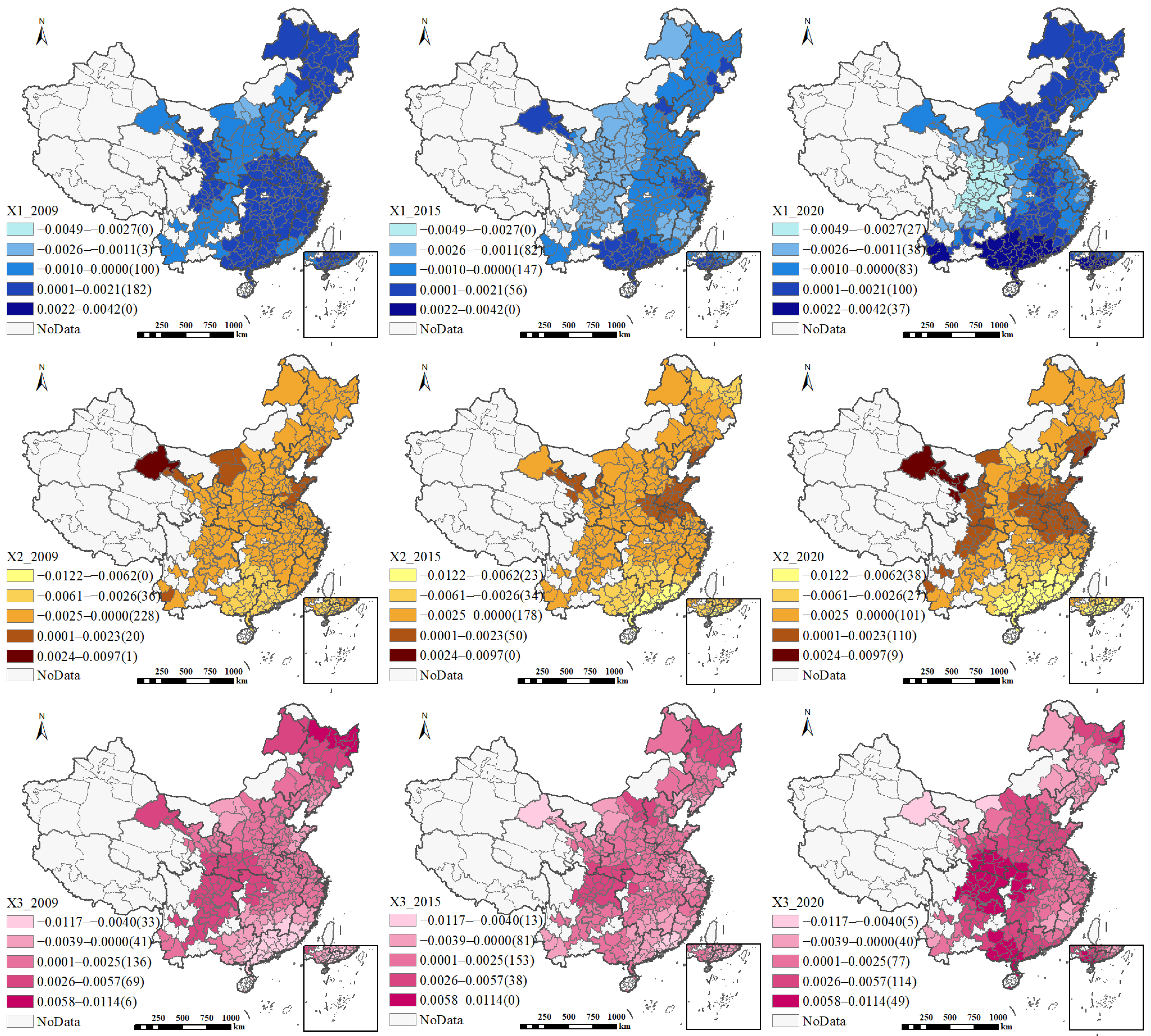
| Explanatory variables | Industrial land supply scale | X1 | It is closely related to the city’s industrial development, business investment, employment and ecological environment [49]. |
| Residential land supply scale | X2 | Scientific residential land planning ensures housing, boosts industries, prevents waste and price swings, fostering balanced economic, social, and environmental growth [50]. | |
| Commercial land supply scale | X3 | It influences the prosperity of business activities, brings abundant employment opportunities to the city, and enhances the city’s economic vitality and competitiveness [50]. | |
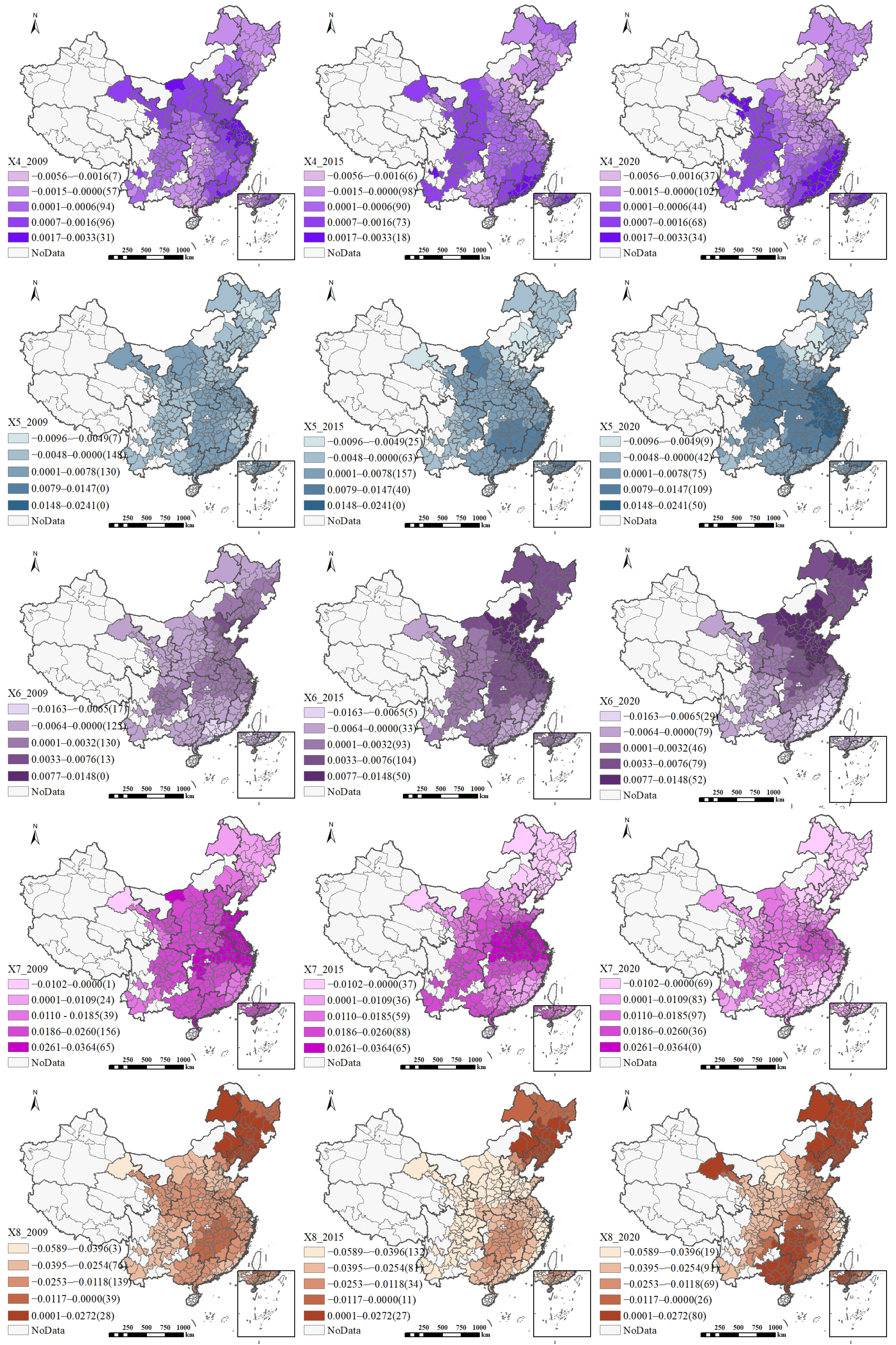
| Public service land supply scale | X4 | Public services like education, healthcare, and culture enhance life quality, meet aspirations for well-being, and advance social equity and balanced growth. | |
| Industrial land allocation ratio | X5 | The ratio of industrial land area to the sum of commercial and residential land area is quantified [51]. A higher ratio indicates that the city is more focused on industrial development in land allocation. | |
| Public service land allocation ratio | X6 | Measured by the ratio of public service land area to the combined area of commercial and residential land. It reflects the convenience of urban residents’ lives and the level of social welfare. | |
| Investment intensity per capita | X7 | It reflects the level of enterprise investment per unit of construction land, serving as an indicator of land use efficiency and capital input intensity, both of which are closely related to HQUD [52]. | |
| Population density of urban–rural construction land | X8 | It captures the degree of population concentration on urban and rural construction land, reflecting land-use efficiency and spatial carrying capacity, which are also closely linked to HQUD. | |
| Average construction land price | X9 | The reasonableness of land prices affects the city’s industrial structure, residents’ quality of life, and social equity [53]. | |
| Control variables | Urban administrative hierarchy | X10 | Urban administrative hierarchy reflects institutional status and resource allocation capacity, while urban population size captures differences in urban scale and agglomeration effects; both are controlled to avoid confounding influences on HQUD. |
| Urban population size | X11 |
| Data Name | Data Sources |
|---|---|
| Construction Land Supply Data | China Land Market Network (https://landchina.com/#/) (accessed on 26 November 2025) |
| Land Use Survey Data | National Land Survey Results Sharing and Application Service Platform, Ministry of Natural Resources (https://gtdc.mnr.gov.cn/Share#/) (accessed on 26 November 2025) |
| Socio-economic data | ’China Urban Statistical Yearbook’, ’China Regional Statistical Yearbook’, ’China Statistical Yearbook’, ‘China Environmental Statistical Yearbook’ |
| Marketization index | The marketization index data released by the Marketization Index Research Team of the Beijing Institute of National Economic Research. (https://cmi.ssap.com.cn/) (accessed on 26 November 2025) |
| Digital Economy Index | Peking University Digital Inclusive Finance Index (https://en.idf.pku.edu.cn/) (accessed on 26 November 2025) |
| Year | Obs. | Mean | Std. Dev. | Min | Max |
|---|---|---|---|---|---|
| 2009 | 285 | 0.1163 | 0.0349 | 0.0707 | 0.2925 |
| 2010 | 285 | 0.1229 | 0.0382 | 0.0724 | 0.3163 |
| 2011 | 285 | 0.1274 | 0.0397 | 0.0739 | 0.3256 |
| 2012 | 285 | 0.1346 | 0.0425 | 0.0776 | 0.3624 |
| 2013 | 285 | 0.1390 | 0.0428 | 0.0737 | 0.3828 |
| 2014 | 285 | 0.1430 | 0.0419 | 0.0784 | 0.3716 |
| 2015 | 285 | 0.1482 | 0.0437 | 0.0901 | 0.3951 |
| 2016 | 285 | 0.1537 | 0.0468 | 0.0905 | 0.4754 |
| 2017 | 285 | 0.1588 | 0.0469 | 0.0957 | 0.4293 |
| 2018 | 285 | 0.1653 | 0.0493 | 0.1047 | 0.4610 |
| 2019 | 285 | 0.1702 | 0.0487 | 0.1205 | 0.4400 |
| 2020 | 285 | 0.1795 | 0.0528 | 0.1241 | 0.5092 |
| Year | 2009 | 2010 | 2011 | 2012 | 2013 | 2014 | 2015 | 2016 | 2017 | 2018 | 2019 | 2020 |
|---|---|---|---|---|---|---|---|---|---|---|---|---|
| Moran’s Index | 0.393 *** | 0.408 *** | 0.408 *** | 0.425 *** | 0.421 *** | 0.392 *** | 0.383 *** | 0.371 *** | 0.392 *** | 0.388 *** | 0.354 *** | 0.332 *** |
| Models | Residual Sum of Squares | R2 | Adjusted R2 | AICc | F-Statistic | p-Value | Sigma | The Spatiotemporal Distance Ratio |
|---|---|---|---|---|---|---|---|---|
| OLS | 3.2513 | 0.5881 | 0.5867 | −14068 | 442.26 | 0 | — | — |
| GTWR | 1.1646 | 0.8525 | 0.8520 | −17138 | — | — | 0.0185 | 0.3731 |
| GTWRt-1 | 1.0968 | 0.8490 | 0.8485 | −15570 | — | — | 0.1870 | 0.3731 |
Disclaimer/Publisher’s Note: The statements, opinions and data contained in all publications are solely those of the individual author(s) and contributor(s) and not of MDPI and/or the editor(s). MDPI and/or the editor(s) disclaim responsibility for any injury to people or property resulting from any ideas, methods, instructions or products referred to in the content. |
© 2025 by the authors. Licensee MDPI, Basel, Switzerland. This article is an open access article distributed under the terms and conditions of the Creative Commons Attribution (CC BY) license (https://creativecommons.org/licenses/by/4.0/).
Share and Cite
Zhang, L.; Zhang, Y.; Li, J.; Yang, C.; Liu, Y. A Spatiotemporal Analysis of the Relationship Between Construction Land Supply and High-Quality Urban Development: Evidence from 285 Chinese Cities. Land 2025, 14, 2359. https://doi.org/10.3390/land14122359
Zhang L, Zhang Y, Li J, Yang C, Liu Y. A Spatiotemporal Analysis of the Relationship Between Construction Land Supply and High-Quality Urban Development: Evidence from 285 Chinese Cities. Land. 2025; 14(12):2359. https://doi.org/10.3390/land14122359
Chicago/Turabian StyleZhang, Lingyu, Yang Zhang, Juan Li, Chengchao Yang, and Yaolin Liu. 2025. "A Spatiotemporal Analysis of the Relationship Between Construction Land Supply and High-Quality Urban Development: Evidence from 285 Chinese Cities" Land 14, no. 12: 2359. https://doi.org/10.3390/land14122359
APA StyleZhang, L., Zhang, Y., Li, J., Yang, C., & Liu, Y. (2025). A Spatiotemporal Analysis of the Relationship Between Construction Land Supply and High-Quality Urban Development: Evidence from 285 Chinese Cities. Land, 14(12), 2359. https://doi.org/10.3390/land14122359