


Investigating the Spatiotemporal Response of Urban Functions to Fine-Grained Resident Activities with a Novel Analytical Framework and Baidu Heatmap


Abstract
1. Introduction
2. Study Area and Datasets
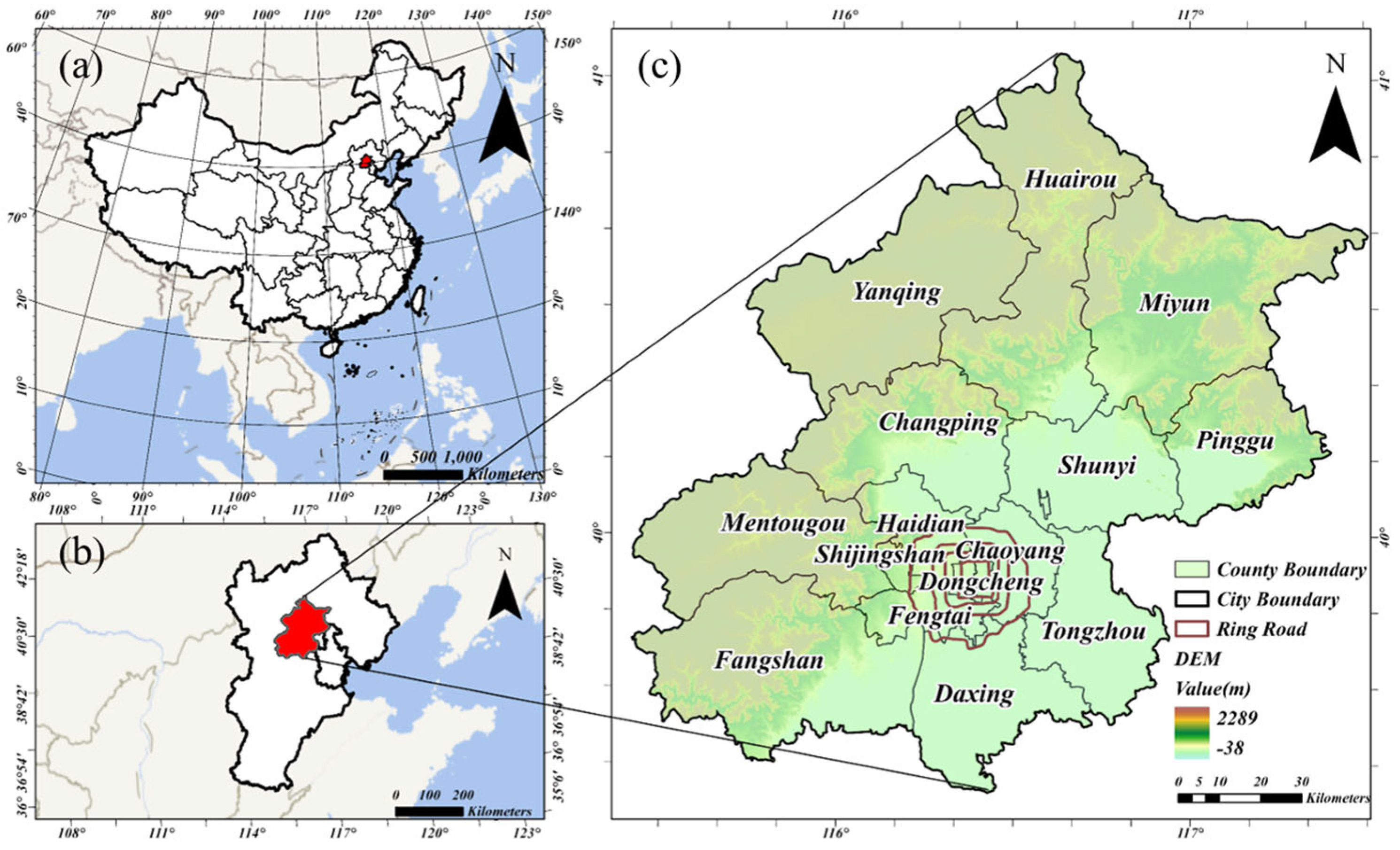
2.1. Study Area
2.2. Datasets
2.2.1. POI Data
2.2.2. Baidu Heat Map
3. Methodology
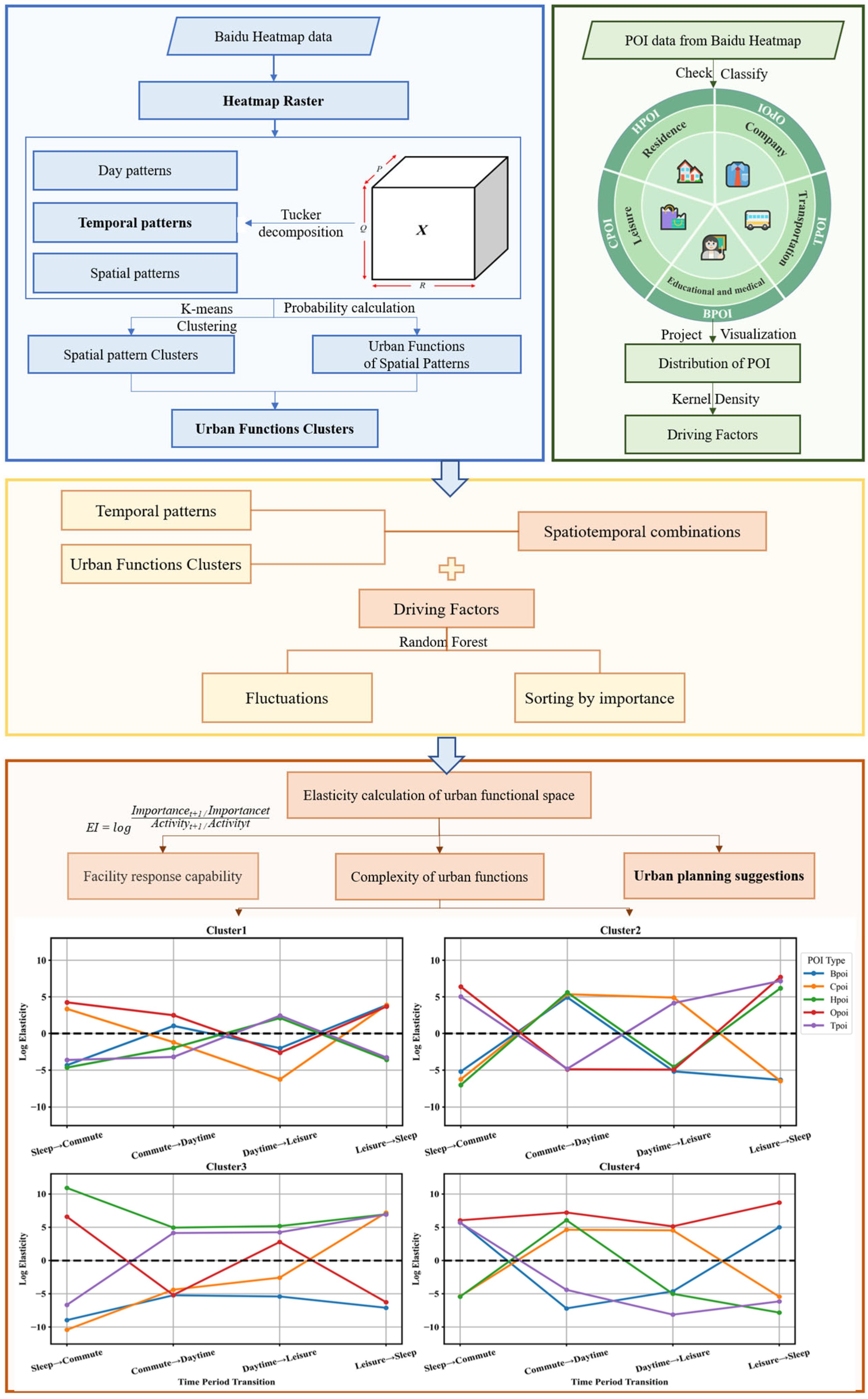
3.1. Tucker Decomposition
3.2. Inferring Functions of Residents’ Activities Clustering Regions
3.3. K-Means Clustering
3.4. The Features’ Importance Calculated by Random Forest
3.5. Elasticity Index
4. Results
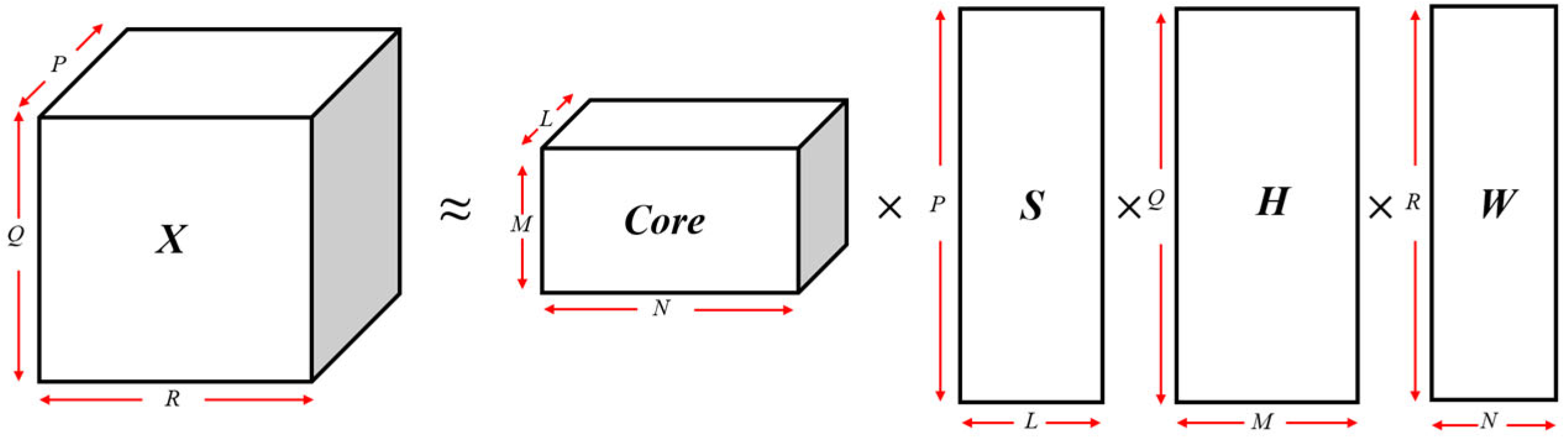
4.1. Spatiotemporal Patterns of Resident Activities and Urban Space Functions
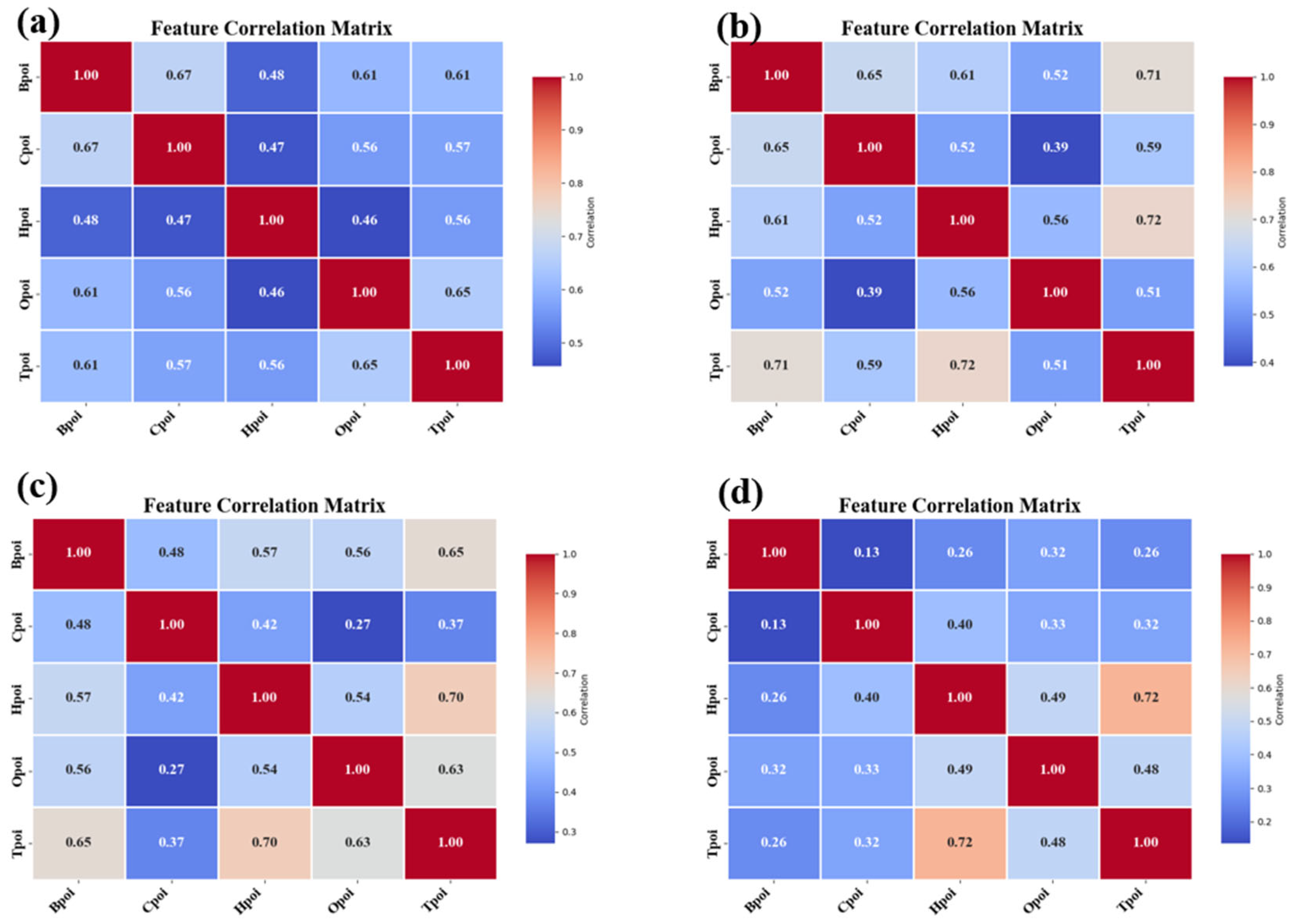
4.2. Spatiotemporal Comprehensive Analysis of the Interaction Between Urban Functions and Resident Activities
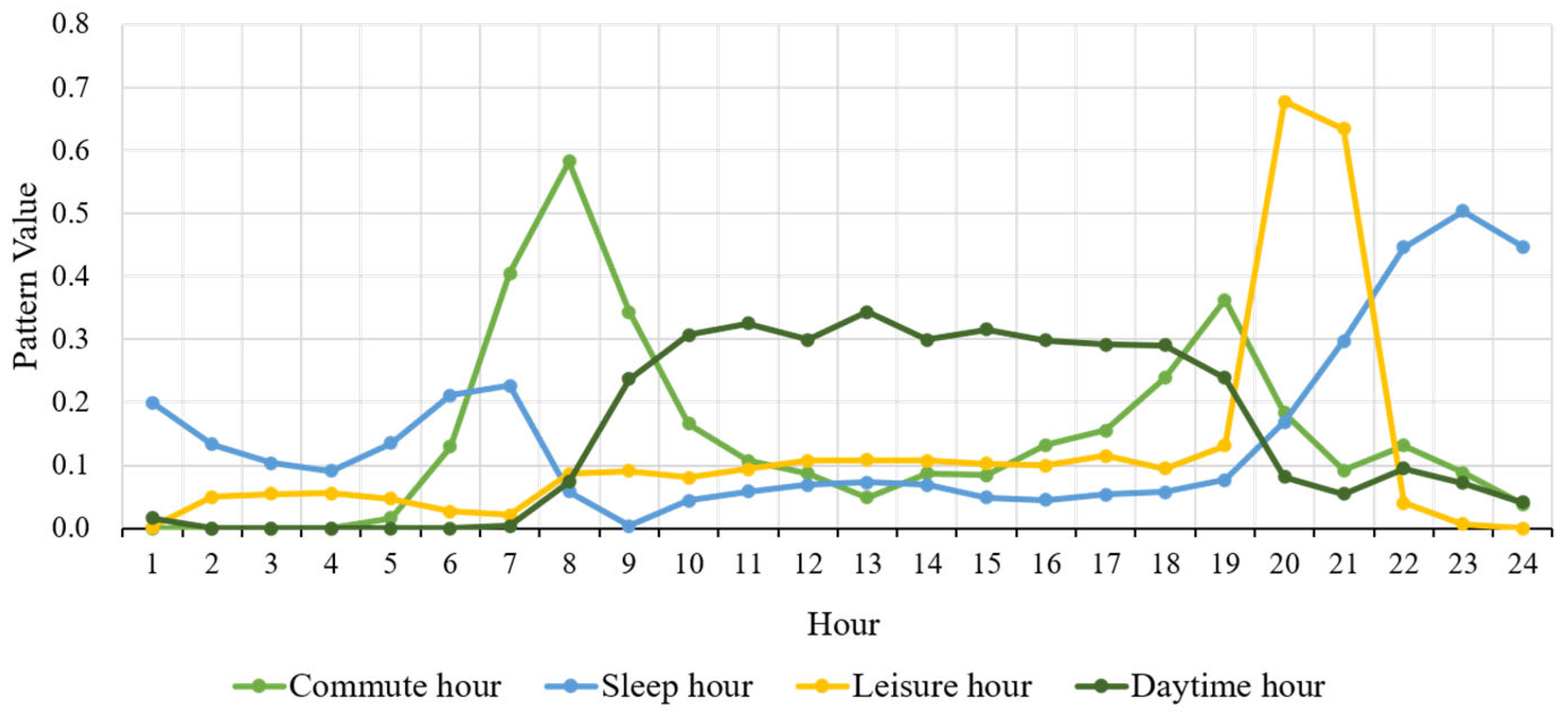
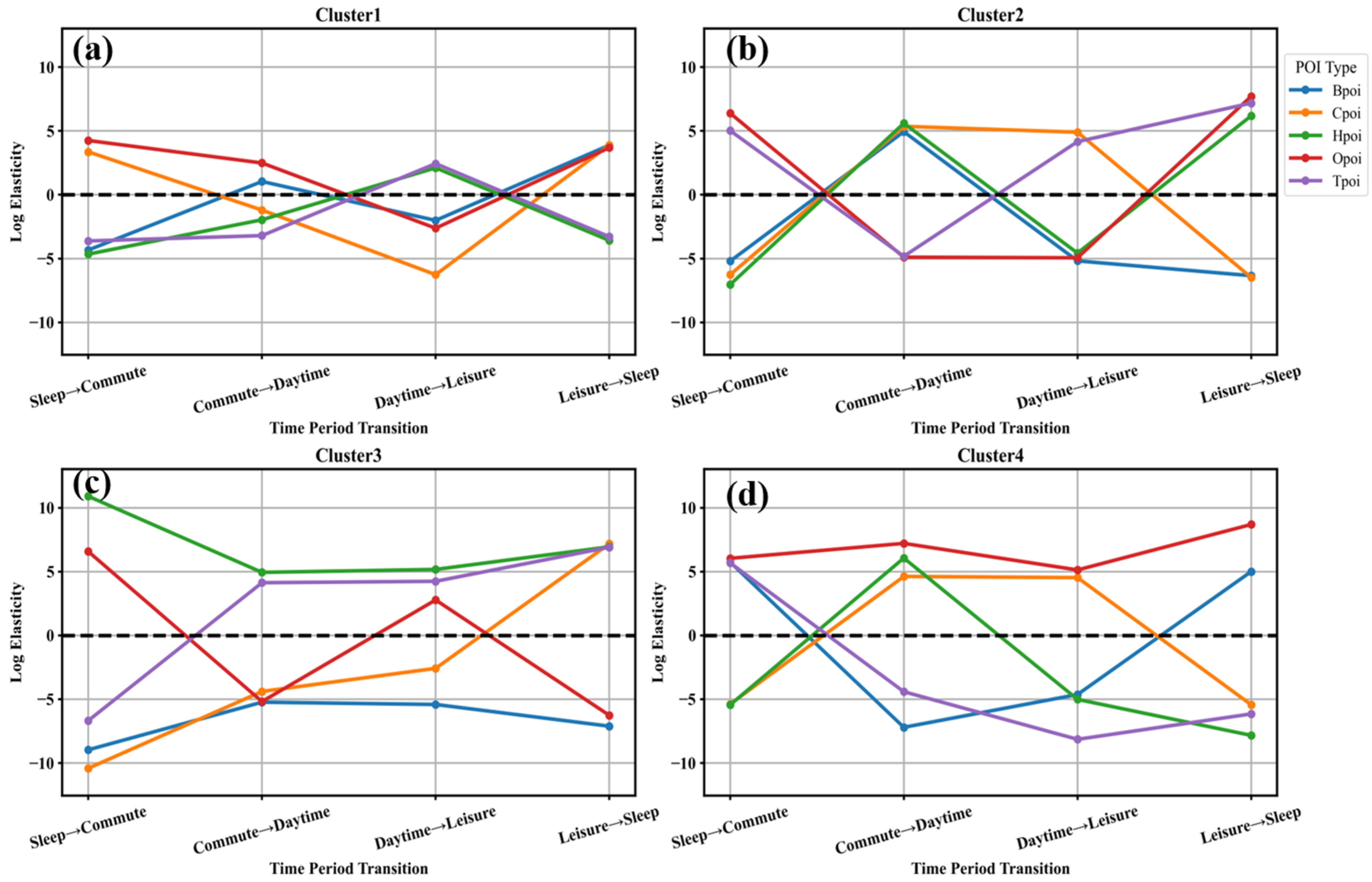
4.3. Assessing the Elasticity of Urban Spatial Functions
5. Discussion
5.1. Innovations of the Proposed Framework
5.2. Nighttime Economy Development Planning Recommendations Based on Results
5.3. Limitations of This Study and Future Work
6. Conclusions
Supplementary Materials
Author Contributions
Funding
Data Availability Statement
Acknowledgments
Conflicts of Interest
References
- Batty, M. Cities as Complex Systems: Scaling, Interaction, Networks, Dynamics and Urban Morphologies. In Encyclopedia of Complexity and Systems Science; Meyers, R.A., Ed.; Springer: New York, NY, USA, 2009; pp. 1041–1071. [Google Scholar]
- Natapov, A.; Czamanski, D.; Fisher-Gewirtzman, D. Can visibility predict location? Visibility graph of food and drink facilities in the city. Surv. Rev. 2013, 45, 462–471. [Google Scholar] [CrossRef]
- Yu, J.; Hu, W.; Hou, L. Towards more resilient cities-analyzing the impact of new-type urbanization on urban resilience: Considering spatial spillover boundaries. Sustain. Cities Soc. 2024, 114, 105735. [Google Scholar] [CrossRef]
- Amirzadeh, M.; Sobhaninia, S.; Sharifi, A. Urban resilience: A vague or an evolutionary concept? Sustain. Cities Soc. 2022, 81, 103853. [Google Scholar] [CrossRef]
- Biswas, S.S.; Ahad, M.A.; Nafis, M.T.; Alam, M.A.; Biswas, R. Introducing “α-Sustainable Development” for transforming our world: A proposal for the 2030 agenda. J. Clean. Prod. 2021, 321, 129030. [Google Scholar] [CrossRef]
- Zhao, D.; Song, Y.; Zhang, M. Research on the resilience enhancement and spatial spillover effect of urban agglomeration construction. Sustain. Cities Soc. 2025, 134, 106964. [Google Scholar] [CrossRef]
- Halás, M.; Klapka, P. The timescape of the city: Example of spatial interactions based on big data. Habitat Int. 2023, 131, 102736. [Google Scholar] [CrossRef]
- Lv, Y.; Yang, J.; Xu, J.; Guan, X.; Zhang, J. High-dimensional urban dynamic patterns perception under the perspective of human activity semantics and spatiotemporal coupling. Sustain. Cities Soc. 2025, 121, 106192. [Google Scholar] [CrossRef]
- Acuto, M.; Parnell, S.; Seto, K.C. Building a global urban science. Nat. Sustain. 2018, 1, 2–4. [Google Scholar] [CrossRef]
- Du, F.; Wang, J.; Mao, L.; Kang, J. Daily rhythm of urban space usage: Insights from the nexus of urban functions and human mobility. Humanit. Soc. Sci. Commun. 2024, 11, 49. [Google Scholar] [CrossRef]
- Lv, S.; Yang, H.; Lu, X.; Zhang, F.; Wang, P. Exploring the Spatiotemporal Patterns of Passenger Flows in Expanding Urban Metros: A Case Study of Shenzhen. ISPRS Int. J. Geo-Inf. 2024, 13, 267. [Google Scholar] [CrossRef]
- Shi, Z.; Pun-Cheng, L.S.C.; Liu, X.; Lai, J.; Tong, C.; Zhang, A.; Zhang, M.; Shi, W. Analysis of the Temporal Characteristics of the Elderly Traveling by Bus Using Smart Card Data. ISPRS Int. J. Geo-Inf. 2020, 9, 751. [Google Scholar] [CrossRef]
- Chen, R.; Liu, L.; Gao, Y. The Association between Rainfall and Taxi Travel Activities: A Case Study from Wuhan, China. J. Adv. Transp. 2024, 2024, 1404168. [Google Scholar] [CrossRef]
- Shen, J.; Xintao, L.; Chen, M. Discovering spatial and temporal patterns from taxi-based Floating Car Data: A case study from Nanjing. GISci. Remote Sens. 2017, 54, 617–638. [Google Scholar] [CrossRef]
- Sun, M.; Xue, C.; Cheng, Y.; Zhao, L.; Long, Z. Analyzing Spatiotemporal Daily Travel Source Carbon Emissions Based on Taxi Trajectory Data. IEEE Access 2021, 9, 107012–107023. [Google Scholar] [CrossRef]
- Jiang, J.; Chen, M.; Zhang, J. How does residential segregation affect the spatiotemporal behavior of residents? Evidence from Shanghai. Sustain. Cities Soc. 2021, 69, 102834. [Google Scholar] [CrossRef]
- Shi, Y.; Yang, J.; Shen, P. Revealing the Correlation between Population Density and the Spatial Distribution of Urban Public Service Facilities with Mobile Phone Data. ISPRS Int. J. Geo-Inf. 2020, 9, 38. [Google Scholar] [CrossRef]
- Sun, H.; Chen, Y.; Lai, J.; Wang, Y.; Liu, X. Identifying Tourists and Locals by K-Means Clustering Method from Mobile Phone Signaling Data. J. Transp. Eng. Part. A 2021, 147, 04021070. [Google Scholar] [CrossRef]
- Xia, X.; Zhang, Y.; Zhang, Y.; Rao, T. The spatial pattern and influence mechanism of urban vitality: A case study of Changsha, China. Front. Environ. Sci. 2022, 10, 942577. [Google Scholar] [CrossRef]
- Huang, B.; Wang, J. Big spatial data for urban and environmental sustainability. Geo-Spat. Inf. Sci. 2020, 23, 125–140. [Google Scholar] [CrossRef]
- Zhang, J.; Zhang, R.; Zhang, X.; Yuan, X. Polycentric Spatial Structure Evolution and Influencing Factors of the Kunming–Yuxi Urban Agglomeration: Based on Multisource Big Data Fusion. Land 2023, 12, 1340. [Google Scholar] [CrossRef]
- Liu, Z.; Xia, H.; Zhang, T. A review of research methods on the coupling relationship between urban rail transit and urban space: Revealing spatiotemporal relationships through big data. Int. J. Digit. Earth 2024, 17, 2339363. [Google Scholar] [CrossRef]
- Yi, C.; Nam, J.; Kim, J.; Lee, J.-S. Comparison of the distributions of centrality indices: Using spatial big data to understand urban spatial structure. Cities 2024, 150, 105046. [Google Scholar] [CrossRef]
- Celan, M.; Lep, M. Bus-arrival time prediction using bus network data model and time periods. Future Gener. Comput. Syst.-Int. J. eSci. 2020, 110, 364–371. [Google Scholar] [CrossRef]
- Liu, S.; Long, Y.; Zhang, L.; Liu, H. Quantifying and Characterizing Urban Leisure Activities by Merging Multiple Sensing Big Data: A Case Study of Nanjing, China. Land 2021, 10, 1214. [Google Scholar] [CrossRef]
- Liu, J.; Meng, B.; Yang, M.; Peng, X.; Zhan, D.; Zhi, G. Quantifying spatial disparities and influencing factors of home, work, and activity space separation in Beijing. Habitat Int. 2022, 126, 102621. [Google Scholar] [CrossRef]
- Bai, X.; Jiao, X.; Zhang, P.; Sakai, T.; Xu, H. Public Perception of City Image Hotspots Based on Social Media: A Case Study of Nanjing, China. IEEE Access 2024, 12, 116678–116692. [Google Scholar] [CrossRef]
- Shi, H.; Huang, H.; Ma, D.; Chen, L.; Zhao, M. Capturing urban recreational hotspots from GPS data: A new framework in the lens of spatial heterogeneity. Comput. Environ. Urban Syst. 2023, 103, 101972. [Google Scholar] [CrossRef]
- Peng, J.; Liu, H.; Tang, J.; Peng, C.; Yang, X.; Deng, M.; Xu, Y. Exploring Crowd Travel Demands Based on the Characteristics of Spatiotemporal Interaction between Urban Functional Zones. ISPRS Int. J. Geo-Inf. 2023, 12, 225. [Google Scholar] [CrossRef]
- Fan, L.; Zhang, D. Study on the hotspots of urban tourism spaces based on Instagram-Worthy locations data: Taking Beijing as an example. Environ. Plan. B-Urban Anal. City Sci. 2023, 50, 1822–1837. [Google Scholar] [CrossRef]
- Bi, S.; Xu, R.; Liu, A.; Wang, L.; Wan, L. Mining Taxi Pick-Up Hotspots Based on Grid Information Entropy Clustering Algorithm. J. Adv. Transp. 2021, 2021, 1–25. [Google Scholar] [CrossRef]
- Li, J.; Li, J.; Yuan, Y.; Li, G. Spatiotemporal distribution characteristics and mechanism analysis of urban population density: A case of Xi’an, Shaanxi, China. Cities 2019, 86, 62–70. [Google Scholar] [CrossRef]
- Wang, X.; Zhang, Y.; Yu, D.; Qi, J.; Li, S. Investigating the spatiotemporal pattern of urban vibrancy and its determinants: Spatial big data analyses in Beijing, China. Land Use Policy 2022, 119, 106162. [Google Scholar] [CrossRef]
- Wu, C.; Ye, X.Y.; Ren, F.; Du, Q.Y. Check-in behaviour and spatio-temporal vibrancy: An exploratory analysis in Shenzhen, China. Cities 2018, 77, 104–116. [Google Scholar] [CrossRef]
- Liang, H.; Yan, Q.; Yan, Y.; Zhang, L.; Zhang, Q. Spatiotemporal Study of Park Sentiments at Metropolitan Scale Using Multiple Social Media Data. Land 2022, 11, 1497. [Google Scholar] [CrossRef]
- Kupfer, J.A.; Li, Z.; Ning, H.; Huang, X. Using Mobile Device Data to Track the Effects of the COVID-19 Pandemic on Spatiotemporal Patterns of National Park Visitation. Sustainability 2021, 13, 9366. [Google Scholar] [CrossRef]
- Chen, D.; Long, X.; Li, Z.; Liao, C.; Xie, C.; Che, S. Exploring the Determinants of Urban Green Space Utilization Based on Microblog Check-In Data in Shanghai, China. Forests 2021, 12, 1783. [Google Scholar] [CrossRef]
- Ullah, H.; Wan, W.; Haidery, S.A.; Khan, N.U.; Ebrahimpour, Z.; Luo, T. Analyzing the Spatiotemporal Patterns in Green Spaces for Urban Studies Using Location-Based Social Media Data. ISPRS Int. J. Geo-Inf. 2019, 8, 506. [Google Scholar] [CrossRef]
- Kovacs-Gyoeri, A.; Ristea, A.; Kolcsar, R.; Resch, B.; Crivellari, A.; Blaschke, T. Beyond Spatial Proximity-Classifying Parks and Their Visitors in London Based on Spatiotemporal and Sentiment Analysis of Twitter Data. ISPRS Int. J. Geo-Inf. 2018, 7, 378. [Google Scholar] [CrossRef]
- Yu, B.; Sun, J.; Wang, Z.; Jin, S. Influencing Factors of Street Vitality in Historic Districts Based on Multisource Data: Evidence from China. ISPRS Int. J. Geo-Inf. 2024, 13, 277. [Google Scholar] [CrossRef]
- Jover, J.; Diaz-Parra, I. Who is the city for? Overtourism, lifestyle migration and social sustainability. Tour. Geogr. 2022, 24, 9–32. [Google Scholar] [CrossRef]
- Zeng, F.; Shen, Z. Study on the Impact of Historic District Built Environment and Its Influence on Residents’ Walking Trips: A Case Study of Zhangzhou Ancient City’s Historic District. Int. J. Environ. Res. Public Health 2020, 17, 4367. [Google Scholar] [CrossRef]
- Tang, S.; Ta, N. How the built environment affects the spatiotemporal pattern of urban vitality: A comparison among different urban functional areas. Comput. Urban Sci. 2022, 2, 39. [Google Scholar] [CrossRef]
- Zhou, H.; Yuan, J.; Yi, D.; Jin, S.; Zhao, Y.; Zhang, Z.; Zhao, Z.; Zhang, J. A novel dynamic quantification model for diurnal urban land use intensity. Cities 2024, 148, 104861. [Google Scholar] [CrossRef]
- Balsas, C.J.L. Walkable Cities: Revitalization, Vibrancy, and Sustainable Consumption; State University of New York Press: Albany, NY, USA, 2019. [Google Scholar]
- Cai, L.; Xu, J.; Liu, J.; Ma, T.; Pei, T.; Zhou, C. Sensing multiple semantics of urban space from crowdsourcing positioning data. Cities 2019, 93, 31–42. [Google Scholar] [CrossRef]
- Güller, C.; Varol, C. Unveiling the daily rhythm of urban space: Exploring the influence of built environment on spatiotemporal mobility patterns. Appl. Geogr. 2024, 170, 103366. [Google Scholar] [CrossRef]
- Yang, M.; Zhou, M.; He, X.; Wang, Y.; Chen, Z.; Xia, J. Incremental spatiotemporal flow colocation quotient: A new spatiotemporal association analysis method for geographical flows. Int. J. Geogr. Inf. Sci. 2025, 39, 1296–1319. [Google Scholar] [CrossRef]
- Zhong, Q.; Li, B.; Dong, T. Building sustainable slow communities: The impact of built environments on leisure-time physical activities in Shanghai. Humanit. Soc. Sci. Commun. 2024, 11, 828. [Google Scholar] [CrossRef]
- Fang, L.; Huang, J.; Zhang, Z.; Nitivattananon, V. Data-driven framework for delineating urban population dynamic patterns: Case study on Xiamen Island, China. Sustain. Cities Soc. 2020, 62, 102365. [Google Scholar] [CrossRef] [PubMed]
- Bao, W.; Gong, A.; Zhang, T.; Zhao, Y.; Li, B.; Chen, S. Mapping Population Distribution with High Spatiotemporal Resolution in Beijing Using Baidu Heat Map Data. Remote Sens. 2023, 15, 458. [Google Scholar] [CrossRef]
- Bhatt, V.; Kumar, S.; Saini, S. Tucker decomposition and applications. Mater. Today 2021, 46, 10787–10792. [Google Scholar] [CrossRef]
- Peng, S.; Yang, Z.; Ling, B.W.-K.; Chen, B.; Lin, Z. Dual semi-supervised convex nonnegative matrix factorization for data representation. Inf. Sci. 2022, 585, 571–593. [Google Scholar] [CrossRef]
- Mørup, M.; Hansen, L.K.; Arnfred, S.M. Algorithms for Sparse Nonnegative Tucker Decompositions. Neural Comput. 2008, 20, 2112–2131. [Google Scholar] [CrossRef] [PubMed]
- Xu, J.; Liu, J.; Xu, Y.; Lv, Y.; Pei, T.; Du, Y.; Zhou, C. Identification of spatial and functional interactions in Beijing based on trajectory data. Appl. Geogr. 2022, 145, 102744. [Google Scholar] [CrossRef]
- Zhang, J.; Zhao, X.; Han, D. Assessing the impact of COVID-19 on residents’ activities using baidu heat map data: From the lockdown era to the post-pandemic era. Int. J. Digit. Earth 2025, 18, 2454381. [Google Scholar] [CrossRef]
- Brown, M.G.L.; Peterson, M.G.; Tezaur, I.K.; Peterson, K.J.; Bull, D.L. Random forest regression feature importance for climate impact pathway detection. J. Comput. Appl. Math. 2025, 464, 116479. [Google Scholar] [CrossRef]
- Genuer, R.; Poggi, J.-M.; Tuleau-Malot, C.; Villa-Vialaneix, N. Random Forests for Big Data. Big Data Res. 2017, 9, 28–46. [Google Scholar] [CrossRef]
- Nohara, Y.; Matsumoto, K.; Soejima, H.; Nakashima, N. Explanation of machine learning models using shapley additive explanation and application for real data in hospital. Comput. Methods Programs Biomed. 2022, 214, 106584. [Google Scholar] [CrossRef]
- Reilly, E.E. The Use of the Elasticity Concept in Economic Theory. Can. J. Econ. Political Sci. 1940, 6, 39–55. [Google Scholar] [CrossRef]
- Nievergelt, Y. The Concept of Elasticity in Economics. SIAM Rev. 1983, 25, 261–265. [Google Scholar] [CrossRef]
- Faqi, S. The Preliminary Analysis of Change of Elasticity Coefficient of Energy Consumption and the Relevant Causes of China. Stat. Res. 2005, 5, 8–11. [Google Scholar] [CrossRef]
- Wang, Y.; Zeng, W.; Wu, S.; Jia, J. Elastic Coefficient-Based Warning System for the Environment-economic System of Daxing District. China Popul. Resour. Environ. 2011, S1, 562–565. [Google Scholar]
- Shamshirband, S.; Keivani, A.; Mohammadi, K.; Lee, M.; Hamid, S.H.A.; Petkovic, D. Assessing the proficiency of adaptive neuro-fuzzy system to estimate wind power density: Case study of Aligoodarz, Iran. Renew. Sustain. Energy Rev. 2016, 59, 429–435. [Google Scholar] [CrossRef]
- Jiang, N.; Jiang, W. How does regional integration policy affect urban resilience? Evidence from urban agglomeration in China. Environ. Impact Assess. Rev. 2024, 104, 107298. [Google Scholar] [CrossRef]
- Yan, G.; Zou, L.; Liu, Y. The Spatial Pattern and Influencing Factors of China’s Nighttime Economy Utilizing POI and Remote Sensing Data. Appl. Sci. 2024, 14, 400. [Google Scholar] [CrossRef]
- Song, Y.; Lyu, Y.; Qian, S.; Zhang, X.; Lin, H.; Wang, S. Identifying urban candidate brownfield sites using multi-source data: The case of Changchun City, China. Land Use Policy 2022, 117, 106084. [Google Scholar] [CrossRef]
- Liu, Y.; Lu, A.; Yang, W.; Tian, Z. Investigating factors influencing park visit flows and duration using mobile phone signaling data. Urban For. Urban Green. 2023, 85, 127952. [Google Scholar] [CrossRef]
- Li, J.; Zhao, P.; Zhang, M.; Deng, Y.; Liu, Q.; Cui, Y.; Gong, Z.; Liu, J.; Tan, W. Exploring collective activity space and its spatial heterogeneity using mobile phone signaling Data: A case of Shenzhen, China. Travel Behav. Soc. 2025, 38, 100920. [Google Scholar] [CrossRef]

| Group of POI Types | POI Types | Counts |
|---|---|---|
| CPOI (Leisure) | Food and Beverages | 95,990 |
| Scenic spot | 9525 | |
| Sports and Fitness services | 26,269 | |
| Shopping Services | 150,940 | |
| HPOI (Habitation) | Serviced apartment | 36,813 |
| Accommodation services | 15,719 | |
| OPOI (Organizations) | Company | 80,743 |
| Social institutions and Organizations | 55,202 | |
| BPOI (Basic Facilities) | Science, Education, and Cultural services | 47,253 |
| Healthcare Services | 23,306 | |
| Life Services | 112,919 | |
| TPOI (Transportation) | Road ancillary facilities | 593 |
| Public facilities | 15,592 | |
| Transportation infrastructure services | 60,018 | |
| Access facilities | 78,606 |
| Cluster 1 | Cluster 2 | Cluster 3 | Cluster 4 | |||||
|---|---|---|---|---|---|---|---|---|
| R2 | RMSE | R2 | RMSE | R2 | RMSE | R2 | RMSE | |
| Commute Hour | 0.8812 | 3.3660 | 0.5915 | 6.4256 | 0.8220 | 2.8575 | 0.7684 | 71.0316 |
| Sleep Hour | 0.8818 | 6.8400 | 0.4159 | 6.5183 | 0.7565 | 3.4636 | 0.9519 | 31.4853 |
| Leisure Hour | 0.6289 | 6.5189 | 0.4839 | 7.8345 | 0.8168 | 3.2431 | 0.8030 | 77.1143 |
| Daytime Hour | 0.7521 | 4.3657 | 0.5701 | 7.0054 | 0.5785 | 4.8517 | 0.9045 | 61.4573 |
| Time Division | Space Division (This Study) | Space Division [34] | Source |
|---|---|---|---|
| Daytime Hour | 0.2397 | 0.2355 | This study |
| Commute Hour | 0.2697 | 0.1870 | This study |
| Leisure Hour | 0.2062 | 0.0958 | This study |
| Sleep Hour | 0.1966 | 0.1469 | This study |
| All day | 0.2717 | 0.1925 | / |
| Morning (7:00–12:00) | 0.2054 | 0.0616 | [32] |
| Equal interval (6:00–8:00) | 0.2026 | 0.1852 | [33] |
| Equal interval (8:00–10:00) | 0.2032 | 0.1454 | [33] |
| Number | Urban Spatial Functions | Count | CPOI | Percent |
|---|---|---|---|---|
| 1 | Basic living area | 958 | 64,360 | 1.48% |
| 2 | Residential areas with commercial functions | 1682 | 66,290 | 2.53% |
| 3 | Bustling business districts | 1310 | 38,183 | 3.43% |
Disclaimer/Publisher’s Note: The statements, opinions and data contained in all publications are solely those of the individual author(s) and contributor(s) and not of MDPI and/or the editor(s). MDPI and/or the editor(s) disclaim responsibility for any injury to people or property resulting from any ideas, methods, instructions or products referred to in the content. |
© 2025 by the authors. Licensee MDPI, Basel, Switzerland. This article is an open access article distributed under the terms and conditions of the Creative Commons Attribution (CC BY) license (https://creativecommons.org/licenses/by/4.0/).
Share and Cite
Han, D.; Fan, D.; Zhang, J.; Zhao, X.; Wang, H. Investigating the Spatiotemporal Response of Urban Functions to Fine-Grained Resident Activities with a Novel Analytical Framework and Baidu Heatmap. Land 2025, 14, 2235. https://doi.org/10.3390/land14112235
Han D, Fan D, Zhang J, Zhao X, Wang H. Investigating the Spatiotemporal Response of Urban Functions to Fine-Grained Resident Activities with a Novel Analytical Framework and Baidu Heatmap. Land. 2025; 14(11):2235. https://doi.org/10.3390/land14112235
Chicago/Turabian StyleHan, Dongxue, Deqin Fan, Jinyu Zhang, Xuesheng Zhao, and Haoyu Wang. 2025. "Investigating the Spatiotemporal Response of Urban Functions to Fine-Grained Resident Activities with a Novel Analytical Framework and Baidu Heatmap" Land 14, no. 11: 2235. https://doi.org/10.3390/land14112235
APA StyleHan, D., Fan, D., Zhang, J., Zhao, X., & Wang, H. (2025). Investigating the Spatiotemporal Response of Urban Functions to Fine-Grained Resident Activities with a Novel Analytical Framework and Baidu Heatmap. Land, 14(11), 2235. https://doi.org/10.3390/land14112235

