1. Introduction
Driven by rapid urbanization and rural population decline, many rural regions worldwide have experienced increasing problems of vacant housing, village shrinkage, and inefficient land use during processes of spatial and socioeconomic transformation. These challenges reflect a broader tension between declining residential demand and the difficulty of reallocating rural land resources under existing institutional arrangements. In China, this issue has particular institutional significance because rural homesteads are embedded within a collective land ownership system, a membership-based governance structure, and a rural housing security framework. Traditionally, homesteads have played an essential role in safeguarding farmers’ residential rights and maintaining rural social stability. However, accelerated urbanization has fundamentally altered the relationship between rural population distribution and homestead utilization. China’s urbanization rate increased from 17.92% in 1978 to 66.16% in 2023 [
1], accompanied by large-scale rural-to-urban migration and the emergence of long-term vacant rural housing and inefficiently used homestead land. These changes have generated increasing pressure to transform homesteads from static housing-security instruments into more flexible resources supporting rural development.
The vacancy of rural homesteads is not merely a consequence of demographic change; it is also shaped by the institutional characteristics of China’s rural land system. Many migrant households retain their homesteads after obtaining urban employment or housing because homesteads provide not only residential security but also social identity and potential future value. Meanwhile, although idle homesteads contain economic and spatial development potential, they cannot enter the urban-style property market because of collective ownership, membership-based qualification rights, and restrictions on external acquisition. Consequently, rural areas face a paradox: substantial residential spaces remain underutilized, while potential economic and social values embedded in these assets cannot be fully realized. This contradiction has become a central challenge for rural land reform and revitalization.
Recent rural revitalization policies and urban–rural integration strategies have created new institutional space for activating idle homesteads. Rather than promoting unrestricted market transactions, current reforms increasingly explore alternative arrangements, including leasing, cooperation, and collective participation, under the principles of legality, voluntariness, and protection of farmers’ interests. These practices indicate a shift from merely preserving homesteads as housing-security resources toward exploring how use rights can be reorganized while maintaining collective ownership. In villages with favorable location conditions, ecological advantages, or tourism and service development potential, long-term use arrangements provide a possible pathway for connecting rural spaces with external capital, consumer demand, and new industries.
However, the revitalization of homesteads does not imply a simple transition toward market-oriented transactions. The fundamental institutional boundary of China’s homestead system lies in the separation between ownership, qualification rights, and use benefits. External actors generally cannot obtain homestead ownership, and the circulation of homestead-related rights remains institutionally restricted [
2,
3]. Therefore, the central question is not whether homesteads should enter the market, but how stable and predictable use-right arrangements can be established without changing collective ownership or weakening farmers’ institutional rights.
Long-term leasing represents one such adaptive arrangement, but its institutional status remains contested. On the one hand, renewable leasing arrangements may enhance investment expectations by providing relatively stable access to rural spaces. On the other hand, excessive extension of lease duration, transfer of effective control rights, or weak collective supervision may make leasing functionally similar to disguised land transfer. Therefore, the key analytical issue is not whether long-term leasing exists, but under what institutional conditions it constitutes innovation rather than circumvention. This requires examining the mechanisms through which use-right stability is created, collective governance is maintained, and risks of unauthorized circulation are controlled.
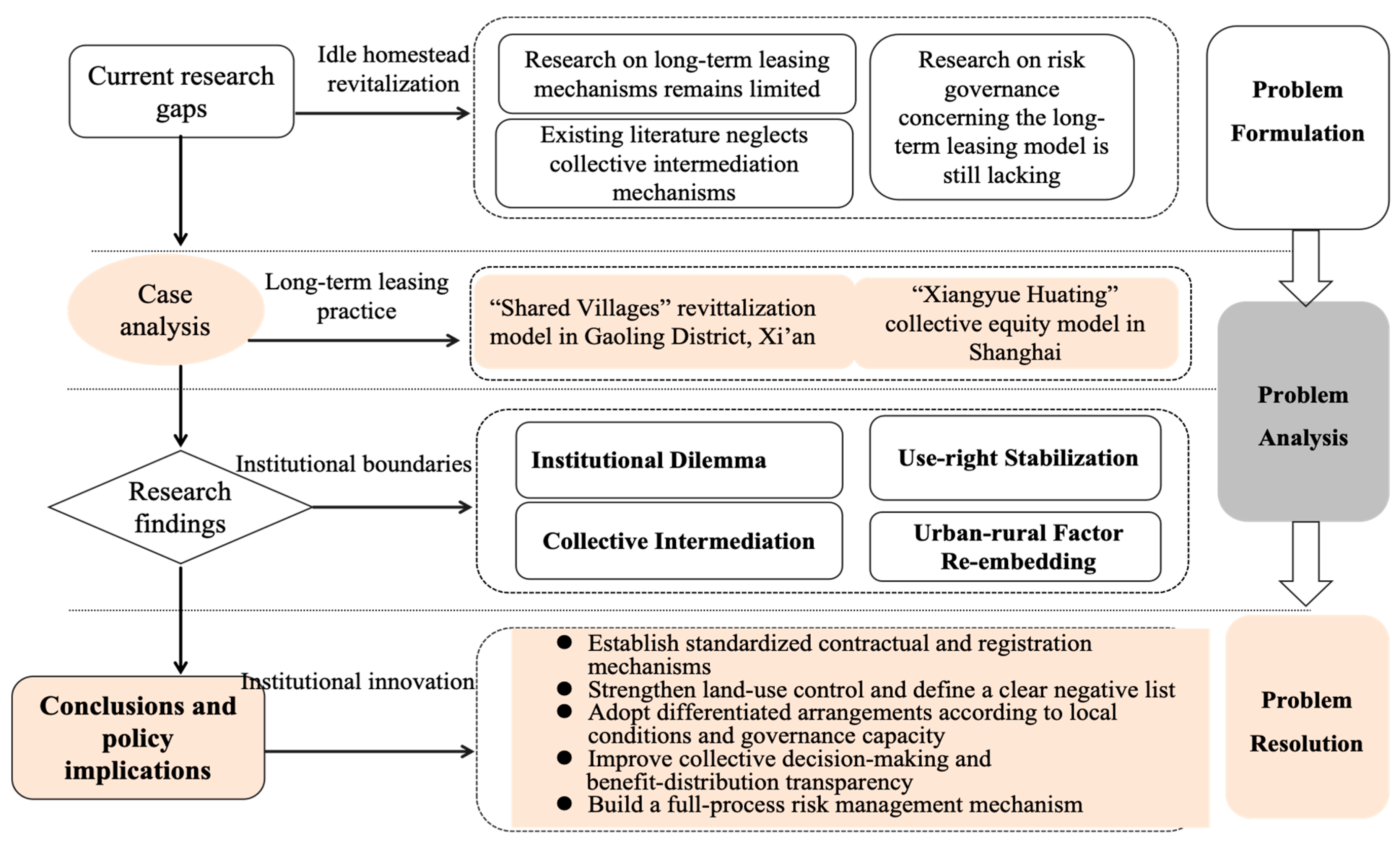
Against this background, this study investigates the institutional conditions under which long-term leasing can contribute to rural homestead revitalization without exceeding existing institutional boundaries. Specifically, it addresses two research questions: (1) How do different long-term use arrangements stabilize expectations of rural land use rights under the constraints of collective ownership and limited transferability? (2) Under what governance conditions does long-term leasing represent institutional innovation rather than disguised circulation of rural land rights? To answer these questions, this study conducts a comparative case analysis of two rural land revitalization practices: the “Shared Village” project in Gaoling District, Xi’an, and the “Xiangyue Huating” project in Shanghai. These cases represent different institutional pathways: the former emphasizes grassroots contract renewal and village-level coordination, whereas the latter involves collective participation and platform-based rural development. Rather than treating them as identical forms of homestead leasing, this study examines how different governance arrangements shape the stability, legitimacy, and risks of long-term rural land use arrangements.
This study makes three contributions. First, it extends research on rural homestead revitalization beyond the question of whether rights can be transferred, focusing instead on how use-right stability can be institutionally constructed under collective ownership. Second, it highlights the governance role of village collectives by examining their functions in coordinating rights, organizing participation, and supervising land use. Third, it contributes to debates on rural land institutional change by showing how long-term leasing may provide an adaptive pathway between rigid protection and full marketization, while also identifying the governance conditions required to prevent institutional circumvention.
2. Literature Review
2.1. Rural Homestead Vacancy and the Incomplete Realization of Property Rights
The increasing vacancy of rural homesteads has become an important issue in studies of rural transformation, land governance, and property-rights reform. Existing research generally attributes homestead vacancy to large-scale rural population mobility associated with urbanization. As rural laborers migrate to cities for work, schooling, and permanent residence, the traditional role of rural housing as a primary dwelling has eroded. Consequently, villages are facing dwindling populations and escalating vacancy rates, leading to a notably inefficient use of rural construction land [
4,
5,
6]. In regions experiencing continuous population outflow, idle homesteads are often associated with village shrinkage, declining public services, and spatial degradation, thereby constraining rural revitalization efforts [
7].
However, the persistence of idle homesteads cannot be explained solely by demographic change. From a property-rights perspective, homestead vacancy is also related to the incomplete realization of land-use value under China’s collective land system. Rural homesteads are embedded in a unique institutional arrangement combining collective ownership, membership-based qualification rights, and residential security functions. Farmers obtain homestead use rights through collective membership, but these rights cannot be freely transferred according to the logic of urban housing markets. Such institutional arrangements effectively protect farmers’ basic housing security, yet they also create a tension between ownership stability and resource circulation. Under conditions of increasing rural–urban mobility, households may retain unused homesteads as a form of security, identity attachment, or potential future asset value, leading to the coexistence of stable possession and inefficient utilization.
Existing studies on homestead revitalization have mainly examined three dimensions: influencing factors, utilization models, and governance mechanisms [
8,
9,
10]. Research on influencing factors emphasizes the importance of location conditions, farmers’ willingness, collective organizational capacity, policy support, and market demand. Studies on utilization models identify diverse approaches, including farmer-led leasing, collective consolidation, cooperative development, and integration with rural tourism or service industries. Governance-oriented research further highlights issues related to planning coordination, benefit distribution, public participation, and farmers’ rights protection.
Nevertheless, existing studies have paid insufficient attention to the institutional mechanism through which idle homesteads can obtain stable and credible use expectations. For rural industries such as homestays, wellness services, and cultural tourism, successful revitalization depends not only on resource availability and market demand but also on whether users can obtain sufficiently stable rights to justify long-term investment. Therefore, the key analytical issue is shifting from how idle resources can be activated to how stable use arrangements can be constructed under incomplete property-right structures.
2.2. Institutional Boundaries of Homestead Revitalization: Between Market Activation and Collective Ownership
The transfer of homestead use rights constitutes a core issue in the study of homestead system reform. A broadly accepted view holds that promoting the moderate transfer of such rights contributes to improving the utilization efficiency of rural construction land, increasing farmers’ property income, alleviating spatial constraints on rural industrial development, and facilitating the two-way flow of urban and rural factors [
11,
12,
13,
14].
In practice, a variety of approaches to the transfer of homestead use rights have emerged. One prominent category is the contract-based (or obligatory-right-based) transfer model, which encompasses leasing, cooperative operations, and share dividends, among other forms [
15,
16]. Such models usually do not change the structure of homestead ownership and farmer’ qualification rights. The other involves exploratory reforms emphasizing property-right attributes. For example, some regions are attempting to establish the registration of homestead management rights or long-term use rights to improve the investment stability and rights protection level of external subjects [
17,
18]. In some areas, scattered idle homesteads are included in the overall planning and industrial development projects of villages through the unified collection, storage, renovation and investment operation of village collectives, forming a multi-governance pattern in which the government, village collectives, farmers and business entities participate together [
19,
20].
However, the transfer of the right to use homestead is always constrained by the institutional boundary [
21,
22]. First of all, the ownership of the homestead belongs to the rural collective, and the right to use the homestead comes from the collective membership, which determines that the homestead cannot be freely traded in accordance with the logic of urban housing or state-owned construction land. Secondly, urban residents and industrial and commercial capital are not allowed to purchase homesteads, and the cross-collective transfer of homesteads is strictly limited. Thirdly, the characteristics of the integration of housing and land complicate the relationship between rural housing rental, homestead use, land reconstruction and income distribution, and the unclear boundary of rights is easy to cause disputes. Finally, problems such as imperfect registration of rights, insufficient overall planning capacity of village collectives, weak supervision and opaque income distribution also constitute practical constraints on the transfer of homesteads.
Therefore, the core contradiction of homestead use-right transfer lies not in whether a market mechanism is needed, but in how to establish a balance between market demand and institutional security. Existing research has tended to emphasize the innovation of transfer models or the refinement of legal institutions, yet it has paid insufficient attention to the critical question of how to enhance the stability of use rights without transferring ownership.
2.3. Long-Term Leasing and the Stabilization of Use Rights
Within the current institutional framework, leasing is the most common, flexible, and practicable means of revitalizing idle homesteads and rural housing. Unlike sale or transfer, leasing preserves collective ownership and farmers’ qualification rights, while temporarily transferring the right to use benefits to the lessee through contractual agreement [
23]. Owing to its strong institutional compatibility, leasing has become a key pathway for the development of rural homestays, wellness facilities, cultural-creative enterprises, and leisure agriculture.
Existing research mainly explores this issue from three dimensions: legal nature, practical models, and institutional design. Regarding the legal nature, the mainstream view is that the lease of homestead is a creditor’s right use arrangement. The lessee obtains the right to use the farmhouse and related space within a certain period of time through the contract, but does not obtain the right to use the homestead itself [
24,
25]. Because the homestead has the attributes of membership and identity, it is usually difficult for non-members of the collective, especially urban residents, to obtain the protection of homestead rights in the sense of property rights. Regarding the practice model, existing studies have summarized various types of direct leasing of farmers, leasing after unified collection and storage by village collectives, platform leasing, and leasing cooperation [
26]. Regarding the system design, the existing research emphasizes the key links such as leasing subject, leasing period, rent standard, registration and filing, use control, input compensation and dispute handling [
27,
28,
29,
30,
31]. Among these factors, the lease term serves as the core institutional variable shaping the long-term revitalization of rural idle resources. According to the Civil Code, the term of a lease contract shall not exceed 20 years. While a 20-year period typically satisfies general residential needs, it is often insufficient for rural industrial utilization, which requires a lengthy investment recovery cycle to cover pre-renovation, infrastructure, and brand cultivation costs. Without stable renewal expectations, long-term investment enthusiasm is significantly inhibited.
It is evident that the core focus of homestead leasing research has shifted from the legitimacy of leasing practice to the institutional approach of stabilizing long-term use expectations. By optimizing institutional arrangements including contract renewal mechanisms, collective endorsement, government filing, lease right registration and investment compensation, homestead leasing can evolve from a general creditor’s right relationship into a long-term use right arrangement with quasi-property right attributes.
2.4. Collective Governance as an Institutional Intermediary
While previous research has examined farmers, enterprises, and government actors in homestead revitalization, the governance role of rural collectives remains insufficiently theorized. From the perspective of transaction-cost theory and collective governance, village collectives may function as institutional intermediaries that coordinate fragmented rights, reduce negotiation costs, organize collective participation, and supervise land use [
32,
33,
34,
35].
In long-term leasing practices, village collectives are not merely passive owners of rural land resources. They may facilitate agreements between farmers and external users, coordinate benefit-sharing arrangements, monitor compliance with land-use regulations, and maintain collective interests [
36,
37]. Such intermediary functions are particularly important because homestead revitalization involves multiple actors with different interests, including farmers seeking income security, external investors seeking stable access, and governments seeking orderly rural development [
38,
39]. However, collective intermediation is not automatically effective. Without transparent decision-making, democratic participation, and accountability mechanisms, collective involvement may become merely an administrative channel for external capital intervention. Therefore, the analytical value of collective governance lies in examining under what conditions collective participation contributes to legitimate and sustainable use-right stabilization.
2.5. Research Gap and Analytical Framework
The existing literature provides important insights into rural population change, homestead revitalization models, and institutional constraints [
40,
41,
42,
43]. However, three gaps remain. First, insufficient attention has been paid to the mechanism of use-right stabilization. Existing studies discuss whether homesteads can be transferred or utilized, but rarely explain how stable expectations can be created when ownership remains unchanged and lease duration is institutionally limited. Second, the role of collective governance as an institutional intermediary requires further theoretical development. Previous studies have recognized collective participation, but have not sufficiently examined how collectives coordinate rights, reduce transaction costs, and regulate benefit distribution. Third, the distinction between institutional innovation and disguised circulation remains unclear. Long-term leasing should not be judged simply by duration or market outcomes. Instead, its institutional nature depends on whether it preserves collective ownership, maintains land-use control, protects farmers’ interests, and establishes accountable governance mechanisms. To address these gaps, this study develops an analytical framework centered on use-right stability, with collective intermediary governance as an institutional condition and institutional boundaries as the criterion for distinguishing innovation from circumvention. Through comparative analysis of two rural land revitalization cases, the study examines how different long-term use arrangements operate under China’s collective land system.
4. Case Analysis and Comparison of Idle Homestead Revitalization
Rural land revitalization practices in China have generated diverse institutional arrangements for activating underutilized rural spaces, including leasing, collective operation, cooperative development, and equity participation. Rather than evaluating these practices solely according to economic outcomes, this study examines how different institutional arrangements construct stable expectations of land use while maintaining collective ownership and regulatory boundaries. Based on the analytical framework developed above, this section analyzes two cases: the “Shared Village” project in Gaoling District, Xi’an, and the “Xiangyue Huating” project in Shanghai. These cases were selected because they represent two different governance pathways for stabilizing long-term rural land use: a grassroots-oriented contractual renewal approach and a platform-supported collective participation approach. The comparison focuses on four dimensions: institutional arrangement, mechanisms of use-right stabilization, collective governance, and potential institutional risks.
4.1. The “Shared Village” Model in Gaoling District, Xi’an: Contractual Flexibility and Renewal-Based Use-Right Stabilization
As a key pilot region for homestead system reform, Gaoling District in Xi’an has pioneered institutional innovations in rural land use rights to revitalize idle homestead resources. It officially launched the “Shared Village” pilot project in 2018. This initiative promotes the leasing-based utilization of vacant rural houses and homesteads on the premise of retaining collective land ownership and protecting farmers’ land qualification rights [
44,
45,
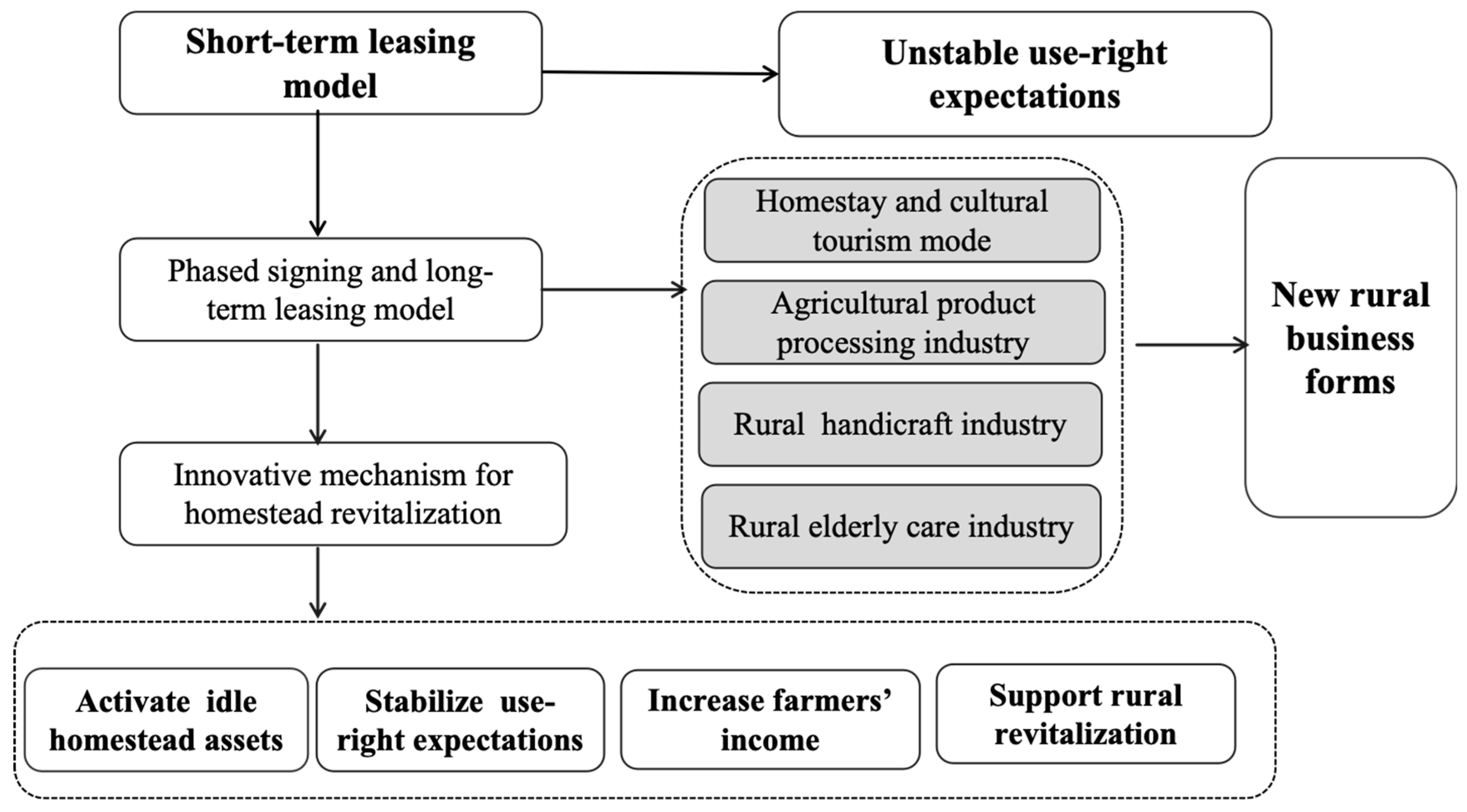
46]. This model follows the reform logic of the “three-rights separation” for rural homesteads. It consolidates collective land ownership, safeguards farmers’ qualification rights and housing property rights, and appropriately liberalizes homestead use rights. Considering the 20-year maximum lease period stipulated by the Civil Code, Gaoling District has adopted an innovative phased contracting mechanism. The district initially signs a 20-year formal lease contract, which can be renewed for an additional 10 years through negotiation upon expiration, enabling a maximum effective land use term of 30 years. Rather than creating a single extended lease contract, this mechanism attempts to improve users’ long-term expectations while remaining within existing legal boundaries.
The core institutional feature of the Gaoling model is the separation between ownership, qualification rights, and use benefits. Farmers retain ownership-related rights associated with collective membership, while idle housing spaces and associated use benefits are introduced into rural development activities through contractual arrangements. The model allows leased spaces to be used for rural tourism, homestays, cultural activities, and leisure services. The “Shili Fenghe” project in Zhoujia Village illustrates how this arrangement operates in practice. Through cooperation between village actors and external operators, idle rural housing was renovated into homestay facilities. According to publicly available government information, the project contributed to increased collective economic income and stimulated related rural industries such as agricultural processing and handicraft activities. From the perspective of collective governance, the Gaoling model relies primarily on village-level coordination. The village collective functions as a coordinator between farmers and external users by integrating scattered resources, facilitating contractual arrangements, and supervising land-use purposes. However, the model also faces institutional limitations. Because renewal expectations depend heavily on contractual arrangements rather than stronger legal property-right protection, uncertainty remains regarding long-term investment security and dispute resolution. Therefore, the Gaoling model demonstrates how grassroots contractual innovation can enhance use-right stability under institutional constraints, while also revealing the limitations of flexible arrangements without stronger legal institutional support. The innovation system framework of idle homestead utilization in Gaoling District of Xi’an is shown in
Figure 2.
4.2. The “Xiangyue Huating” Project in Shanghai: Platform Coordination and Collective Participation
Unlike the Gaoling case, the “Xiangyue Huating” project in Shanghai represents a platform-supported rural development arrangement involving government coordination, enterprise participation, and collective asset integration. Located in the suburban area of Shanghai, this project integrates rural residence, cultural experience, tourism services and leisure industries through the coordinated allocation of rural land resources [
47,
48,
49].
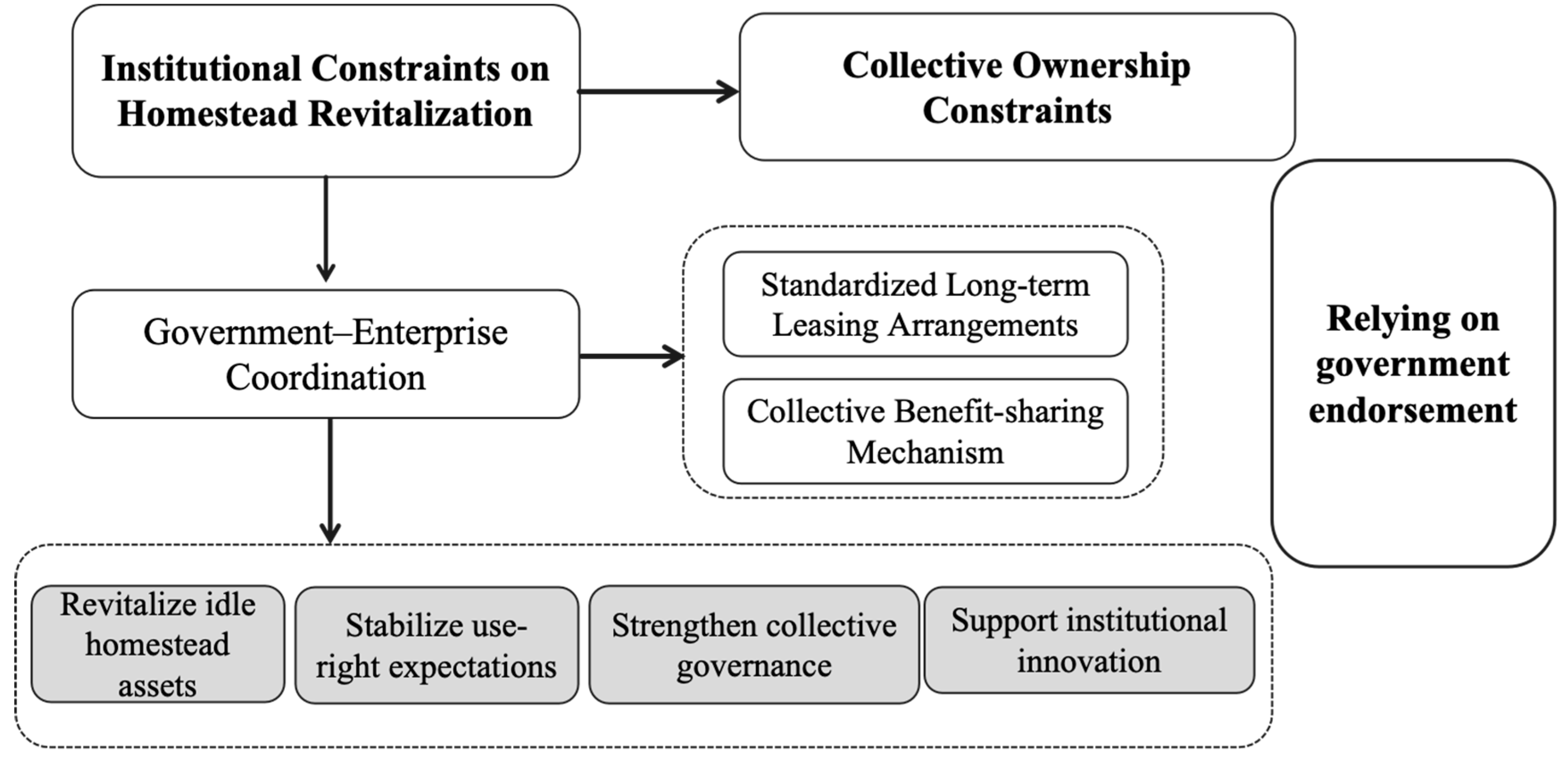
The project adopts a “20 + 20” institutionalized long-term model, consisting of an initial statutory lease term of 20 years followed by a mandatory 20-year renewal upon expiration. This arrangement creates a stable 40-year land-use cycle, with the renewal mechanism clearly defined by both policy provisions and contractual terms. The institutional characteristics of this model differ from the Gaoling approach. Rather than relying primarily on individual household leasing, the Shanghai model emphasizes collective participation and integrated project development. A professional operating entity coordinates rural land resources and participates in project operation, creating a more centralized organizational structure. In terms of use-right stabilization, the Shanghai model provides stronger organizational support through standardized contracts, platform coordination, and government participation. These arrangements may reduce transaction uncertainty and improve the predictability of long-term investment. However, such institutional advantages do not eliminate governance risks. The involvement of powerful external actors may generate concerns regarding capital dominance, transparency of benefit distribution, and the participation rights of villagers. Regarding collective governance, the Shanghai model emphasizes collective participation through asset integration and benefit-sharing arrangements. However, compared with grassroots models, the effectiveness of collective representation depends on whether villagers have meaningful participation in decision-making processes and whether distribution mechanisms are sufficiently transparent. Thus, the Shanghai case illustrates the advantages of stronger organizational coordination in stabilizing long-term rural land use, while also highlighting the importance of institutional safeguards against unequal power relations. The innovation system framework of “Xiangyue Huating” homestead utilization in Shanghai is shown in
Figure 3.
4.3. Comparative Analysis: Different Pathways Toward Use-Right Stabilization
Gaoling represents a contractual flexibility pathway. Its main advantage lies in adapting fragmented rural resources to market demand through relatively flexible agreements and village-level coordination. However, its reliance on renewal arrangements creates uncertainty regarding long-term legal stability.
Shanghai represents a collective coordination pathway. Through platform-based development and collective participation, it provides stronger organizational capacity for integrating resources and attracting investment. Nevertheless, stronger external coordination also requires effective mechanisms to prevent excessive capital influence and ensure equitable benefit distribution (
Table 1). Therefore, the institutional innovation of long-term rural land use arrangements should not be evaluated simply by lease duration or market outcomes. Instead, it depends on whether the arrangement simultaneously achieves three conditions: (1) preservation of collective ownership and institutional boundaries; (2) creation of credible and predictable use-right expectations; (3) establishment of accountable collective governance mechanisms.
The comparison suggests that long-term rural land use arrangements represent neither automatic institutional innovation nor simple legal circumvention. Their institutional nature depends on how rights, responsibilities, and governance mechanisms are configured. The Gaoling case demonstrates that contractual flexibility can improve the utilization of idle rural spaces, but requires stronger mechanisms for legal certainty and risk management. The Shanghai case shows that centralized coordination can enhance resource integration and investment capacity, but requires effective safeguards to maintain collective participation and benefit fairness. Accordingly, long-term leasing should be understood as an adaptive institutional arrangement whose success depends on maintaining the balance between resource activation and institutional protection.
5. Research Findings and Discussion
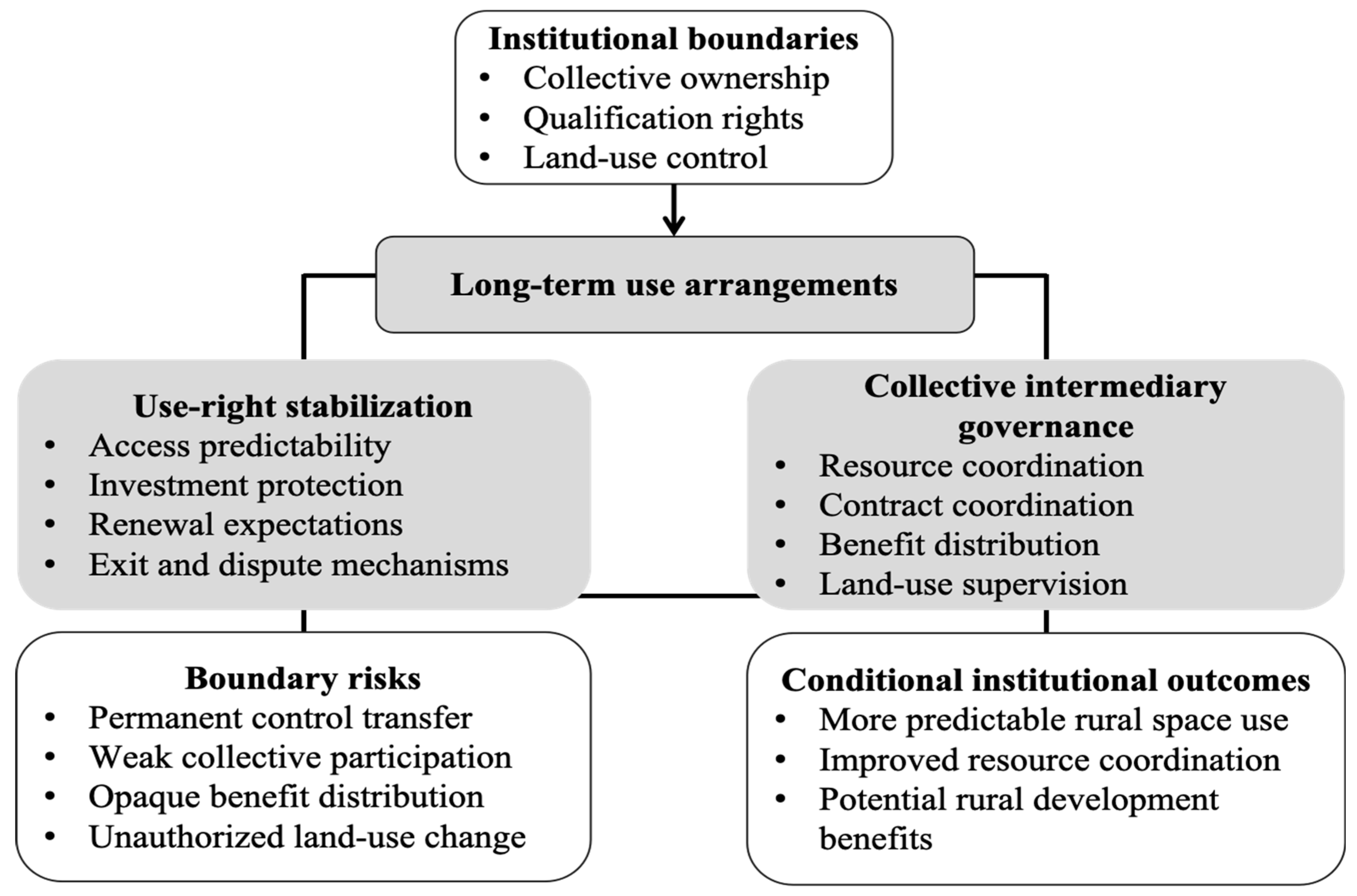
Based on the comparative analysis of the two cases, this study reveals how long-term rural land use arrangements generate institutional adaptation within the constraints of China’s collective land system. Rather than replacing collective ownership with market transactions, long-term leasing operates through the creation of stable use-right expectations supported by contractual arrangements, collective intermediary governance, and institutional supervision.
Figure 4 presents the analytical framework developed from these empirical insights.
5.1. Institutional Dilemma: From Resource Vacancy to Use-Right Uncertainty
On the surface, the problem of idle homesteads manifests as the inefficient use of rural construction land and the vacancy of rural housing. In essence, it is the institutional tension between the urban–rural dual land system, the attribute of homestead membership rights, and the demand of rural space transformation. Homestead is different from general construction land, and its right structure includes multiple attributes such as collective ownership, membership, farmers’ use, housing security and property interests [
50,
51,
52,
53]. This composite right structure determines that can not be simply transferred according to the logic of urban land market.
Under the current land system framework, homesteads are collectively owned by the village. Farmers obtain the right to use the homestead free of charge by virtue of their collective membership, and urban residents do not have the qualification to purchase the homestead. The institutional arrangement effectively maintains the foundation of rural collective ownership and guarantees the basic living rights and interests of farmers, but it also limits the market-oriented circulation and optimal allocation of idle homesteads from the institutional level. With the continuous flow of urban and rural population and the advancement of rural urbanization, the residential security function of a large number of rural homesteads continues to weaken, and the value of assets and property gradually highlights. However, limited by the institutional constraints of the cross-collective transfer of the right to use homesteads, a large number of idle homesteads are difficult to be converted into marketable development assets, and eventually form a structural contradiction between the idle waste of resources and the gap in urban and rural land demand.
More importantly, the core shackles of the current homestead revitalization are not the institutional restrictions of the lease term, but the realistic dilemma of insufficient stability of the right to use the homestead and vague market expectations. From the perspective of multiple subjects, agriculture-related industries such as rural cultural tourism and health care generally have the characteristics of large investment in the early stage, long construction period and slow return on investment. Business entities have extremely high requirements for the long-term stability of land use rights: for farmers, the homestead has the attributes of identity, life security value and emotional attachment, which makes them generally reluctant to completely withdraw from the homestead rights and interests; for village collectives, the interest demands of individual farmers tend to be fragmented and highly heterogeneous, which substantially raises the organizational costs and governance challenges associated with the integrated consolidation and unified revitalization of homesteads. It can be seen that the core breakthrough in efficiently revitalizing idle homesteads lies in institutional innovation that enhances the stability and market predictability of the right to use homesteads, while adhering to collective ownership and safeguarding farmers’ qualification rights. This further consolidates the institutional basis for the two-way flow of urban–rural factors and the value realization of idle rural homestead resources.
5.2. Use-Right Stabilization as the Core Mechanism of Long-Term Leasing
The empirical findings indicate that the primary institutional function of long-term leasing is the stabilization of use-right expectations rather than the transformation of homesteads into tradable private assets. In this study, use-right stabilization refers to the institutional arrangements that enhance predictability regarding access, investment, operation, renewal, and dispute resolution while maintaining collective ownership and land-use control. Such stabilization does not derive from lease duration alone, but from a combination of contractual design, renewal arrangements, collective coordination, and regulatory supervision. The Gaoling case demonstrates that phased contractual arrangements can extend users’ expectations beyond ordinary short-term leasing and provide greater confidence for rural business activities. However, this flexibility remains dependent on renewal arrangements and therefore faces limitations in legal certainty. The Shanghai case illustrates another pathway in which stronger organizational coordination and collective participation enhance the predictability of long-term rural space utilization. Nevertheless, institutional support alone cannot eliminate governance risks; transparent benefit-sharing and effective participation mechanisms remain essential. From a multi-actor perspective, use-right stabilization produces differentiated benefits. For external operators, it reduces uncertainty and improves incentives for renovation and long-term operation. For farmers, it allows them to obtain economic returns while retaining membership-based rights. For village collectives, it provides a basis for integrating fragmented rural resources and coordinating collective development. Therefore, long-term leasing should be understood as an institutional mechanism for managing uncertainty rather than simply an alternative transaction form.
5.3. Collective Intermediation: The Organizational Foundation of Homestead Revitalization
The revitalization of homesteads is not a one-way market-oriented transaction between farmers and leaseholders. In view of the fact that the homestead has both the property right attribute of collective ownership and the public resource attribute of the village, the village collective bears an irreplaceable intermediary governance function in the process of long-term lease-type revitalization [
54]. This paper defines it as a “collective intermediary” mechanism. This mechanism effectively makes up for the shortcomings of single farmers’ market-oriented transactions through the overall intervention and governance of village collectives, and is the core institutional support for the standardization and long-term revitalization of homesteads.
First, village collectives facilitate property rights and spatial integration. Rural idle homesteads are generally characterized by scattered layouts, fragmented ownership, and uneven housing conditions. It is difficult for a single farmer to independently connect with external market players, and it is difficult to revitalize them on a large scale. The village collective effectively solves the problem of fragmented use of through comprehensive investigation, ownership combing and confirmation, comprehensive spatial remediation and overall packaging of the project, greatly reduces the institutional cost and transaction cost of transaction by transaction, and fully releases the scale effect and agglomeration value of land resource revitalization.
Second, multi-contract coordination function. Long-term rental involves multiple stakeholders such as farmers, village collectives, operating enterprises, leaseholders and government regulatory authorities. It is easy to produce interest differences and transaction disputes in the aspects of lease term, land use, pre-investment compensation, income distribution, withdrawal and liquidation. Relying on the identity of grassroots governance, the village collective regulates the transaction behavior of all parties, alleviates the contradiction between the subjects, and significantly improves the stability and standardization of long-term lease relations through unified contract filing, lease renewal coordination, daily dispute mediation, rights and interests publicity supervision and other governance behaviors.
Third, fair income distribution function. If there is no collective co-ordination constraint, the long-term rental of can easily form a unilateral income pattern between a small number of farmers and external capital, which will lead to the imbalance of interests within the village and even the hidden loss of collective assets. In this regard, by constructing an open and transparent income distribution mechanism with clear rights and responsibilities, the village collective balances the individual rent income of farmers, the collective management service income, the village public construction investment and the industrial dividend ratio, and moderately transforms the value-added income of homestead revitalization into the village public interest, taking into account the individual income increase and collective sharing, and realizing the inclusive balance of revitalization benefits.
Fourth, land use supervision function. The revitalization of must strictly abide by the rules of land space planning, village construction planning and land use control, and resolutely put an end to the development of commercial housing in the name of leasing, private sale of land, and illegal non-agricultural construction. As the legal representative of homestead ownership and the core of rural grassroots governance, village collectives bear the important responsibilities of pre-examination of land use, daily dynamic supervision and risk source prevention and control, which can effectively regulate the lease revitalization behavior and abide by the institutional bottom line and compliance boundary of residential base reform.
5.4. Urban–Rural Factor Re-Embedding: From Homestead Revitalization to Rural Developmental Assetization
The core goal of homestead revitalization under the long-term leasing mode is not to simply increase the rental income, but to promote the systematic reconstruction and optimal allocation of urban and rural elements in rural space. In the process of traditional urbanization, population, capital, technology, public services and other factors continue to gather in one direction to the city [
55]. Rural areas are generally faced with development dilemmas such as population outflow, idle homestead, industrial decline and insufficient supply of public services, and the imbalance of urban and rural factor allocation is prominent. The institutionalized revitalization of idle homesteads provides an important space carrier for the two-way flow of urban and rural factors, and provides a reform path for solving the dilemma of rural factor loss.
Then, urban capital and consumption resources to the countryside do not necessarily enable rural revitalization. In the absence of collective governance constraints and standardized income distribution mechanisms, the revitalization of homesteads can easily be alienated into the selective possession of rural space by external capital, causing negative problems such as irrational rise in rents, spatial exclusion of local villagers, and outflow of rural value-added income, which aggravates the imbalance between urban and rural development. Therefore, the integration of urban and rural elements into the countryside must rely on the collective intermediary mechanism to complete the localization embedding and truly integrate into the endogenous development system of the village. The “re-embedding of urban and rural elements” defined in this paper refers to the fact that after urban capital, talents, consumption and public service resources enter the countryside, they do not operate independently from the rural social structure, but rely on the village collective governance, multi-income sharing, public service quality improvement, industrial linkage development and other institutionalized arrangements, and rural local society, industrial system, governance structure to form a deep binding and organic connection.
On this basis, the revitalization of long-term rental has dual institutional value. On the one hand, by constructing a stable expectation of the right to use the homestead, breaking the shackles of the traditional short-term leasing system, transforming idle and inefficient homestead resources into long-term operational and sustainable rural operational space assets; on the other hand, relying on the village collective management and control and balanced income distribution mechanism, it guides the external inflow factors to be deeply embedded in the rural industrial development, public service construction and collective economic cultivation system. Based on this logic, the functional attributes of idle homesteads have been fundamentally upgraded, which are no longer limited to the basic functions of protecting the individual living rights of farmers, and gradually transformed into the core strategic resources to support the transformation and upgrading of rural industries, the improvement of collective economic quality and efficiency, and the deep development of urban–rural integration.