Article

Land Tenure Stability and Farmers’ Adoption of Green Production Technologies: Evidence from Inner Mongolia, China


1
College of Economics and Management, Inner Mongolia Agricultural University, Hohhot 010010, China
2
Inner Mongolia Autonomous Region Rural Revitalization Promotion Center, Hohhot 010013, China
*
Author to whom correspondence should be addressed.
These authors contributed equally to this work.
Land 2026, 15(7), 1182; https://doi.org/10.3390/land15071182
Submission received: 23 May 2026 / Revised: 21 June 2026 / Accepted: 29 June 2026 / Published: 1 July 2026
(This article belongs to the Section Land Socio-Economic and Political Issues)

Abstract

Against the backdrop of the growing alignment between green agricultural transformation and rural land system reform, how stable land tenure promotes farmers’ adoption of green production technologies has become an important issue in achieving high-quality agricultural development. Using 2024 survey data from 1117 farm households in Inner Mongolia under China’s second-round land contract extension policy, this study applies Poisson regression and mediation models to examine how land tenure stability affects farmers’ adoption of green production technologies. The results show that legal, factual, and perceived tenure stability, measured by second-round contract extension signing, no land disputes since the second round, and expectations of no future land adjustment, all significantly promote adoption. Tenure stability promotes adoption through higher income, better credit access, stronger benefit expectations, and greater risk-coping capacity, reflecting both economic and psychological effects. Its positive effect is stronger among small-scale farmers and those with lower-quality cultivated land. Policy efforts should not only prudently advance the second-round land contract extension, but also strengthen tenure security in practice and coordinate support for green production, rural finance, and risk protection. From a multidimensional land tenure stability perspective, this study provides new empirical evidence on how rural land reform translates into green behavioral responses.

1. Introduction

Globally, agricultural development is widely confronted with the challenge of simultaneously advancing two overarching goals: ensuring food security and protecting the ecological environment. For a long time, the excessive use of agricultural inputs such as pesticides and chemical fertilizers has been common in developing countries [1], contributing to greenhouse gas emissions, soil degradation, and other environmental pressures that undermine agricultural sustainability and threaten global food supply security [2]. Against this backdrop, promoting the green transformation of agricultural production has become a global consensus for achieving sustainable agricultural development [3], with countries adopting policy support, technology diffusion, and related measures [4]. The Chinese government has attached great importance to green agricultural development [5]. Policy documents, including the proposals for the 15th Five-Year Plan, emphasize resource conservation and environmental friendliness, and call for stronger protection and improvement of cultivated land quality [6,7]. In recent years, the level of green agricultural development in China has improved to some extent. However, constrained by the large rural population and the high degree of land fragmentation, a number of problems remain prominent amid rapid economic expansion [8], including excessive pesticide use intensity [9,10], fertilizer input levels that remain above the world average [11], residual pollution from agricultural plastic film, and the degradation of cultivated land quality. As the direct operators of cultivated land [12], farmers’ adoption of green production technologies, such as straw returning and the application of organic fertilizers, is widely regarded as critical for enhancing the sustainability of agricultural development [13].
Although there is no universally accepted definition, the Food and Agriculture Organization of the United Nations emphasizes three principles for green land production: minimizing soil disturbance, maintaining organic soil cover, and conserving agricultural biodiversity [14]. Green production usually spans the entire agricultural process, including pre-production, on-farm production, and post-production activities, and encompasses a variety of technologies and practices such as soil testing and formula fertilization, water-saving irrigation, straw returning, and pest control [15]. Compared with conventional production practices, green production technologies are often characterized by sustained input requirements and greater uncertainty in returns [16]. As a result, farmers’ willingness to adopt green technologies depends largely on their expectations of future land tenure stability. Land is not only an important means of production and income source for rural households, but also a safeguard against livelihood risks [17,18]. Although many countries have promoted land tenure reforms, problems such as unclear rights and responsibilities and frequent land readjustments still persist in both legal and practical terms [19,20]. In China, rural land reform has continued since the establishment of the Household Responsibility System in 1978. However, historical changes and ongoing adjustments have made plot boundaries difficult to define in many rural areas, while land rights relations remain complex [21], raising persistent concerns over the effectiveness of rural land institutions in China.
China is currently at a critical stage in which the second round of rural land contracts is expiring and being extended for another 30 years. Exploring how stable land tenure stimulates farmers’ long-term green investment is important for implementing the land contract extension policy and advancing agricultural green transformation. Existing studies have not reached a unified definition of land tenure stability. Most use formal institutional indicators, such as land titling and certificate registration, as proxies [22,23]. Under China’s “separation of three rights” reform, some studies further consider the actual operation of land institutions, such as land readjustments, and farmers’ subjective perceptions of tenure security [24,25]. However, evidence remains mixed on whether and how tenure stability affects farmers’ adoption of green production technologies. The mainstream view holds that stronger tenure stability enhances long-term land-use expectations and promotes practices such as reduced fertilizer and pesticide use, organic fertilizer application, and straw returning [20,26]. However, some studies argue that changes in perceived tenure security induced by practices such as land readjustments do not necessarily have a significant impact on farmers’ production investment behavior [27], implying that the constraining effect of land tenure instability on agricultural investment may be relatively limited [28].
Related studies suggest that land tenure stability may affect farmers’ investment decisions and technology adoption through multiple channels, including economic returns, policy environments, and resource endowments [29]. Stable and well-defined farmland property rights can stimulate rural factor markets, reduce transaction costs and uncertainty in farmland transfer, and improve the efficiency of farmland resource allocation [30]. Scale operation may further reduce the excessive use of conventional agricultural inputs such as pesticides and chemical fertilizers [31,32]. In addition, clear and stable land rights can serve as collateral or a credit signal under information asymmetry [33], helping financial institutions assess farmers’ repayment capacity and default risk and thus improving farmers’ access to formal credit [34]. External institutional support and regulation, together with farmers’ internal cognitive and affective judgments, may further facilitate the internalization of agricultural production externalities and strengthen the role of land tenure stability in promoting cultivated land quality protection and green production technology adoption [25,35].
Overall, existing studies have examined the effects of land tenure on farmers’ investment and technology adoption from the perspectives of land institutions, land rights confirmation policies, and perceived property rights security. These studies provide an important foundation for understanding land tenure security across legal, factual, and perceived dimensions [36]. However, as China’s rural land system has entered the post-confirmation stage and the second-round land contract extension is being advanced, further research remains needed. First, existing studies often measure legal tenure stability by whether land rights have been confirmed and certificates issued. With the near completion of land rights confirmation and certification, however, this indicator has become less differentiated in the current rural Chinese context. It is therefore necessary to re-characterize differences in farmers’ tenure stability in the post-confirmation stage by incorporating the progress of the second-round land contract extension. Second, existing research has paid more attention to the effects of land tenure stability on land investment, land transfer, rural migration, and property rights perceptions. Most studies emphasize long-term investment incentives or financing constraints, while multi-path examinations of economic and psychological effects remain insufficient.
Based on this, this study aims to respond to the practical needs of China’s agricultural green transformation and the further reform of the rural land system. Against the background of extending the second round of rural land contracts for another 30 years after expiration, this study examines how different dimensions of land tenure stability affect farmers’ adoption of green production technologies. It also provides empirical evidence for improving contract-extension policy implementation, optimizing green technology promotion, and strengthening farmers’ incentives for long-term agricultural investment. This study uses survey data from 1117 farm households collected from rural fixed observation points in the Inner Mongolia Autonomous Region in 2024. Inner Mongolia is selected as the study area for two main reasons. First, as an important agricultural production region and ecological security barrier in northern China, Inner Mongolia faces practical pressure to protect cultivated land quality and promote agricultural green transformation. Second, Inner Mongolia has a vast territory, and its eastern, central, and western regions differ greatly in land operation scale, cultivated land quality, and farmers’ production conditions. The ongoing implementation of the second-round contract extension also provides a suitable setting for examining how land tenure stability affects farmers’ production decisions in the post-certification stage.
Building on the existing three-dimensional framework of land tenure security, this study measures land tenure stability from the legal, factual, and perceived dimensions in line with the development of China’s rural land system. It further identifies the pathways through which land tenure stability affects green production technology adoption from four aspects: income level, credit accessibility, benefit expectations, and risk-coping capacity. The contributions of this study are twofold. First, based on the current context of China’s second-round contract extension, this study uses whether farmers have signed second-round land contract extension agreements, whether they have experienced land disputes, and their expectations about contract-extension adjustment as measurement criteria, thereby extending research on the relationship between land system arrangements and green agricultural behavior in the post-certification stage. Second, from the perspectives of economic and psychological effects, this study systematically reveals the mechanisms through which land tenure stability affects farmers’ technology adoption under the second-round contract extension. It also provides empirical evidence from China’s agricultural practice for improving rural land system arrangements and optimizing green technology promotion policies in other countries and regions.

2. Theoretical Analysis and Research Hypothesis

2.1. Land Tenure Stability and Farmers’ Adoption of Green Production Technologies

From the perspective of new institutional economics and farm household behavior theory [37], farmers’ production decisions are not determined solely by profit maximization under full rationality [38]. Rather, they are jointly shaped by institutional constraints, uncertainty, and risk aversion, which may cause farmers to behave conservatively when facing long-term and uncertain investments [39]. Property rights theory [40] suggests that clear and stable property rights form a critical institutional basis for long-term investment and efficient resource allocation [41,42]. In agriculture, land is the most fundamental productive asset, and the stability of contracted land-use rights directly influences the predictability of future returns and the uncertainty surrounding investment recovery [43]. Because green production technologies are often associated with high initial costs, long payback periods, and uncertain returns [44], farmers’ willingness to adopt them is likely to depend heavily on their expectations of land tenure stability.
From the perspective of policy guarantees, land tenure stability is reflected in the formal legal recognition of contracted land-use rights through measures such as land titling, certification, and registration [45]. Drawing on theories of property rights security and transaction costs, legal confirmation of land rights helps reduce the institutional risks of rights infringement or land readjustment, while also lowering dispute and bargaining costs arising from unclear rights and responsibilities, thereby strengthening farmers’ certainty regarding the future allocation of returns [46,47]. Different land tenure arrangements may also generate heterogeneous effects on farmers’ technology adoption [48]. Compared with farmers who cultivate cash-rented land, farmers operating their own contracted land are more likely to regard land as an asset for long-term use and management [21], thereby increasing their willingness to adopt green production technologies that require sustained investment and long-term management [49]. For tenant farmers, the length of the lease contract also shapes investment incentives. Longer lease terms may create more stable expectations and thus encourage investment in green production [50].
From the perspective of actual institutional operation, land tenure stability is further reflected in the continuity and predictability of contracted land relations in practice. Investment decision theory under uncertainty suggests that when contracted land-use rights are subject to frequent disputes, rational farmers are more likely to delay or reduce long-term investment [18,51,52], while shifting their preference toward short-term returns to avoid potential sunk-cost losses. In contrast, relatively stable land tenure relations enable farmers to make more consistent production arrangements and accumulate experience in technology use, thereby lowering the trial-and-error costs of green technology adoption and enhancing their incentives for long-term investment.
From the perspective of subjective expectations, land tenure stability further affects farmers’ risk attitudes by shaping their psychological expectations regarding future land security [53]. Behavioral economics suggests that uncertainty can amplify decision makers’ tendency toward loss aversion [54]. In agricultural production, which is already subject to natural risks and market fluctuations, the addition of institutional uncertainty is likely to further discourage farmers from accepting long-term green investment. For farmers, however, adopting green production technologies can, in the long run, help improve production efficiency and increase output. Stable expectations of land tenure help alleviate farmers’ psychological concerns over land loss, and a stronger sense of security makes them more likely to undertake long-term investment [55].
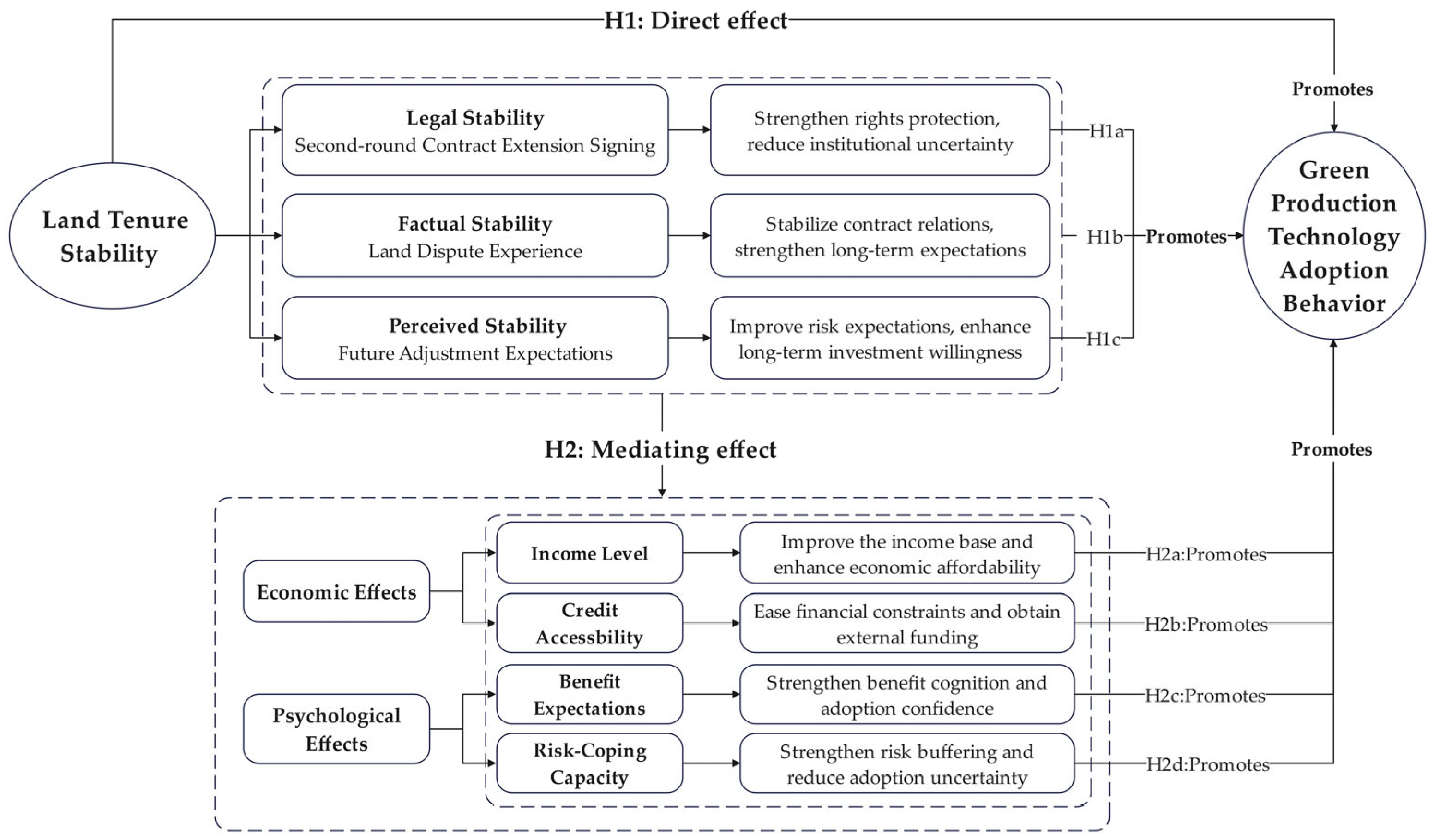
In summary, the legal, factual, and perceived dimensions of land tenure stability may reduce the institutional uncertainty and risk constraints faced by farmers in green production technology adoption. On this basis, this study proposes that land tenure stability may be positively associated with farmers’ adoption of green production technologies, and this relationship is further examined empirically. This study divides land tenure stability into three dimensions: legal stability, factual stability, and perceived stability. These dimensions correspond, respectively, to formal institutional confirmation, measured by the signing of second-round land contract extension agreements; the actual stability of land use, measured by whether land disputes have occurred; and farmers’ subjective expectations about future land conditions, measured by whether they expect land readjustment during the second-round land contract extension. Although these three dimensions may be related in practice, they capture different aspects of land tenure stability. Therefore, treating them as separate dimensions is theoretically necessary for distinguishing different sources of tenure security. Based on this, the following hypotheses are proposed:
H1. 
Land tenure stability has a significant positive effect on farmers’ adoption of green production technologies.
H1a. 
Legal stability has a significant positive effect on farmers’ adoption of green production technologies.
H1b. 
Factual stability has a significant positive effect on farmers’ adoption of green production technologies.
H1c. 
Perceived stability has a significant positive effect on farmers’ adoption of green production technologies.

2.2. Mediating Effects of Land Tenure Stability on Farmers’ Adoption of Green Production Technologies

Technology adoption is a multi-stage process involving awareness, evaluation, and implementation [56]. Green production technologies are often characterized by high upfront investment, delayed returns, and uncertain outcomes. Therefore, farmers’ adoption decisions depend not only on land rights themselves, but also on their economic capacity, financing conditions, expected returns, and risk-coping ability. Accordingly, this study examines whether land tenure stability affects farmers’ adoption of green production technologies through the following four mechanisms.

2.2.1. Income Level

According to farmer behavior theory and the resource constraint perspective, farmers’ technology adoption is not determined solely by the expected benefits of a technology, but is also jointly constrained by household resource endowments and economic capacity. As micro-level decision-makers who act both as producers and risk bearers, farmers usually weigh expected returns, input costs, and uncertainty risks when making technology adoption decisions. When household operating income is low, farmers have limited disposable funds, and their technology investment behavior is more likely to be constrained by liquidity shortages and short-term livelihood pressures [57]. For green production technologies such as subsoiling, organic fertilizer application, straw returning, and green pest control, adoption often requires relatively high upfront investment, continuous management costs, and a certain period of technical adaptation. Therefore, even if low-income farmers are willing to engage in green production, they may find it difficult to bear the costs of technological trial and error, short-term income fluctuations, and production transition risks due to insufficient financial reserves [58].
Land tenure stability may further affect household operating income by shaping farmers’ long-term operational expectations and resource allocation behavior. On the one hand, more stable land tenure arrangements help reduce the institutional transaction costs involved in rights protection, dispute resolution, and operational adjustment, allowing farmers to allocate more resources to agricultural production. On the other hand, stable expectations about land operation help farmers form relatively continuous production plans and reduce short-term production behavior caused by land tenure uncertainty, which may improve the stability and predictability of agricultural operating income. As income increases, farmers’ economic capacity and disposable resources also improve, and the constraints they face in meeting the capital input, management costs, and short-term transition costs required for adopting green production technologies may be eased [59].

2.2.2. Credit Accessibility

Green production typically involves high upfront costs, delayed returns, and considerable uncertainty. For this type of capital-intensive investment, farmers’ access to external financial support can, to a certain extent, affect both their technology adoption decisions and the intensity of their investment. On the one hand, from the perspective of credit rationing theory and financing constraints, financial institutions tend to impose higher risk premiums on agricultural loans under conditions of information asymmetry, meaning that even when farmers are willing to invest in green production, they may still be unable to do so because of insufficient cash flow [60]. By contrast, when credit accessibility improves, farmers are more able to overcome financial barriers and translate intended green investment into actual action, thereby sustaining more stable investment in areas such as fertilizer substitution, green pest control, and soil improvement that require continuous input [61]. On the other hand, from the perspective of farmers’ risk decision making and the theory of irreversible investment, the returns to green technologies are inherently uncertain. The smoother the financing channels are, the more easily farmers can buffer short-term income fluctuations through financial resources [62], thereby enhancing their confidence in adopting green production technologies.
In addition, the de Soto effect suggests that land with clearly defined and secure rights can function as collateral, thereby alleviating financial institutions’ concerns over farmers’ repayment capacity and default risk, enhancing institutional trust, and easing financing constraints [63]. By sending clearer signals of operational stability to external lenders, land tenure stability can reduce the risk assessment costs faced by banks and other financial institutions, thereby improving both lending willingness and credit accessibility. For farmers, greater tenure stability also strengthens expectations of long-term operation, making them more willing to use formal credit to support green investment and reducing delays in adopting green technologies under short-term production incentives.

2.2.3. Benefit Expectations

According to the theory of planned behavior and the technology acceptance model [64], individuals’ adoption of a technology depends not only on objective constraints, but also on their subjective judgments of its usefulness, profitability, and behavioral consequences [65]. Green production practices involve a dynamic learning process. Their benefits are often long-term and lagged, and may not immediately translate into higher yields or increased income in the short run. In the early stage, they may even generate additional learning and management costs. Therefore, when making decisions about adopting green production technologies, farmers may consider not only the current input–output relationship, but also whether future returns can be realized, whether these returns can be captured by themselves, and whether continued technology investment is worthwhile [66].
Land tenure stability may further affect farmers’ green production technology adoption decisions by shaping their judgment about the realization of future returns. When farmers have stronger expectations of continuity and predictability in future land operations, they are more likely to believe that the soil improvement, cost savings, output stability, and ecological benefits brought by green technologies will gradually emerge in future farming operations and be continuously enjoyed by themselves. By contrast, if land tenure stability is insufficient, farmers may have less confidence in the realization of technology-related benefits, even if they recognize the potential value of green technologies, because they may worry about future land readjustment, land disputes, or interruption of farming operations [67].

2.2.4. Risk-Coping Capacity

According to expected utility theory and prospect theory [54,68], farmers tend to exhibit risk-averse behavior when facing uncertain returns and irreversible investment. They are especially likely to delay or reduce technology investments that require substantial upfront costs and have long payback periods [69]. Green production technologies involve a certain degree of input specificity and delayed returns. Once farmers invest in technologies such as subsoiling, organic fertilizer application, straw returning, or green pest control, the related costs are often difficult to recover fully in the short term. Their returns are also vulnerable to external shocks, such as natural disasters, extreme weather, market price fluctuations, and policy changes [70]. Therefore, under high external uncertainty or unstable future land operation rights, farmers may prefer to retain cash flow, reduce long-term investment, or choose traditional production methods with quicker short-term returns [71,72].
Stable land tenure may reduce farmers’ concerns about land readjustment, operational interruption, and the failure to realize returns from prior investments, thereby strengthening their sense of security in future continuous operation. As land tenure stability improves, farmers’ psychological tolerance and operational flexibility in coping with external shocks also increase, making them more capable of bearing the initial cost pressure and income fluctuations associated with green technology adoption. Therefore, land tenure stability may enhance farmers’ risk-coping capacity, weaken the inhibitory effect of uncertainty on green technology adoption, and ultimately increase their adoption of green production technologies.
Based on this, the following hypotheses are proposed:
H2. 
Land tenure stability promotes farmers’ adoption of green production technologies through both economic and psychological effects.
H2a. 
Land tenure stability promotes farmers’ adoption of green production technologies by increasing their income level.
H2b. 
Land tenure stability promotes farmers’ adoption of green production technologies by improving their credit accessibility.
H2c. 
Land tenure stability promotes farmers’ adoption of green production technologies by strengthening their benefit expectations.
H2d. 
Land tenure stability promotes farmers’ adoption of green production technologies by enhancing their risk-coping capacity.
Based on the above analysis, this study integrates the three dimensions of land tenure stability, four mediating variables, and farmers’ adoption of green production technologies into a unified analytical framework, and accordingly constructs the theoretical framework shown in Figure 1. It should be noted that the theoretical framework of this study is developed within the institutional context of China’s second-round land contract extension. The three dimensions of land tenure stability and the four pathways are designed mainly in light of China’s current rural land system practices and the context of farmers’ adoption of green production technologies.

3. Data and Methods

3.1. Data Sources

The data used in this study come from a special survey of rural fixed observation sites conducted in the Inner Mongolia Autonomous Region, China, in 2024. The survey covered 10 leagues and prefecture-level cities across the eastern, central, and western parts of Inner Mongolia, 30 banners, counties, and districts, and a total of 53 villages, with farm households holding contracted cultivated land as the main survey respondents.
The questionnaire was designed to collect information on farmers’ personal characteristics, household features, land rights and land transfers, agricultural production and investment, green production behavior, and subjective perceptions. A total of 1207 questionnaires were collected. After excluding questionnaires with abnormal data or missing basic information, 1117 valid questionnaires were retained, yielding an effective response rate of 92.5%.
Among the surveyed households, 862 households had signed second-round land contract extension agreements, representing 77.2% of the sample. A total of 41 households had not adopted any green production technologies, while 45 households had adopted all five technologies. The largest share of households, 431 in total, had adopted two green production technologies, which is broadly consistent with the characteristics of a probability distribution. The field survey data are therefore considered to be authentic and reliable. Overall, the sample covers different parts of Inner Mongolia and provides a reliable micro-level data basis for the subsequent empirical analysis.

3.2. Method and Model Specification

3.2.1. Poisson Regression Model

In this study, the dependent variable is farmers’ adoption of green production technologies, measured by the number of green production technologies actually adopted by each household. This variable is a non-negative integer count variable ranging from 0 to 5 and therefore does not satisfy the normality assumption required by ordinary least squares regression. For this type of count random variable, Poisson regression or negative binomial regression is commonly used for estimation. The Poisson regression model assumes equidispersion, that is, the conditional variance equals the conditional mean, and is widely used for non-negative integer count outcomes. In this study, the dependent variable measures the number of green production technologies adopted by farm households. The five technologies considered are relatively independent adoption choices and do not necessarily occur jointly. After conducting a Pearson goodness-of-fit test on the sample data, the resulting p-value was close to 1, so the null hypothesis of no overdispersion could not be rejected, indicating that the Poisson distribution assumption is broadly satisfied. Therefore, this study adopts the Poisson regression model as the baseline model to estimate the effects of the three dimensions of land tenure stability on the number of green production technologies adopted by farmers. The probability distribution and conditional expectation are specified as follows:
P ( G i = g | S t a b l e k i , X i ) = e λ k i λ k i g g ! ,     g = 0 , 1 , 2
E ( G i | S t a b l e k i , X i ) = λ k i = e x p ( β 0 + β k S t a b l e k i + γ X i )
In Equations (1) and (2), G i denotes the number of green production technologies adopted by household i ; S t a b l e k i denotes the k-th dimension of land tenure stability for farmer i, where k represents the legal, factual, and perceived dimensions, respectively; and X i is a vector of control variables, including individual characteristics, household characteristics, and production and operational characteristics. λ i > 0 is the Poisson arrival rate, reflecting the expected number of green production technologies adopted by the household conditional on the explanatory variables. β k is the key parameter of interest, capturing the effect of different dimensions of land tenure stability on the number of green production technologies adopted by farmers.

3.2.2. Mediation Model

To further identify the mechanisms through which land tenure stability affects farmers’ adoption of green production technologies, this study follows the mediation effect testing procedure proposed by Wen et al. [73] and constructs stepwise regression models based on the baseline regression. Specifically, this study examines whether the three dimensions of land tenure stability affect farmers’ green technology adoption through economic and psychological effects. Four mediating variables are introduced. The economic effect is captured by income level and credit accessibility, while the psychological effect is captured by benefit expectations and risk-coping capacity. The mediation models are specified as follows:
G i = c k S t a b l e k i + γ X i + ε 1 i
M m i = a k m S t a b l e k i + θ X i + ε 2 i
G i = c k m S t a b l e k i + b k m M m i + δ X i + ε 3 i
Here, M m i denotes the m-th mediating variable, including income level, credit accessibility, benefit expectations, and risk-coping capacity; and ε 1 i , ε 2 i , and ε 3 i are random disturbance terms.
Equation (3) is used to test the total effect of each dimension of land tenure stability on farmers’ adoption of green production technologies, where c k denotes the total effect of the k-th dimension of land tenure stability on green technology adoption. Equation (4) tests the effect of each dimension of land tenure stability on the mediating variables, where a k m denotes the effect of the k-th dimension of land tenure stability on the m-th mediating variable. Equation (5) examines the effect of the mediating variables on green technology adoption after both land tenure stability and the mediating variables are included, where b k m denotes the effect of the mediating variable on green technology adoption, and c k m denotes the direct effect of land tenure stability on green technology adoption after controlling for the mediating variable.
On this basis, this study further calculates the indirect effect of each mediation pathway as follows:
I E k m = a k m × b k m
In Equation (6), I E k m denotes the mediating effect through which the k-th dimension of land tenure stability affects farmers’ adoption of green production technologies via the m-th mediating variable. If the Bootstrap confidence interval of a k m × b k m does not include 0, the corresponding mediation pathway is considered statistically significant.
Furthermore, this study calculates the proportion of the mediating effect as follows:
P M k m = a k m   ×   b k m c k × 100 %
In Equation (7), P M k m denotes the proportion of the mediating effect of the m-th mediating variable in the relationship between the k-th dimension of land tenure stability and farmers’ adoption of green production technologies. If a k m × b k m is significant and c k m remains significant, the variable is considered to play a partial mediating role. If a k m × b k m is significant while c k m becomes insignificant, the variable may play a full mediating role. If the indirect effect and the total effect have opposite signs, the proportion of the mediating effect is not interpreted mechanically; instead, it is treated as indicating a possible suppression effect or competitive mediation.

3.3. Variable Description and Descriptive Statistical Analysis

3.3.1. Dependent Variable

The dependent variable in this study is farmers’ adoption of green production technologies. Such adoption is reflected in farmers’ decisions to adopt one or more green agricultural technologies in combination. Drawing on previous studies [15,74,75] and taking into account the actual agricultural production conditions of the survey area, this study selects five specific technologies to characterize green production technology adoption: deep plowing and subsoiling, soil testing and formula fertilization, organic fertilizer application, straw returning, and green pest and disease control. These technologies have been shown to improve soil properties, enhance soil water retention capacity, and increase soil fertility by optimizing tillage practices, improving nutrient allocation, and reducing dependence on chemical inputs [76,77,78]. Together, these practices constitute a green production system that spans pre-production, on-farm production, and post-production processes. They are consistent with the United Nations’ principles of sustainable agriculture and have also been supported by relevant fiscal policies of the Chinese government.
Each of the five technologies is first coded as a binary variable, with adoption assigned a value of 1 and non-adoption assigned a value of 0. Based on the actual conditions of the surveyed region, the number of green production technologies adopted by each household is then summed to obtain the final measure of the degree of green production technology adoption. A higher value indicates a higher level of farmers’ adoption of green production technologies.

3.3.2. Core Independent Variable

The core independent variable in this study is land tenure stability. Van Gelder (2010) argues that the stability of land tenure is a multidimensional concept that encompasses not only formal institutional arrangements at the legal level, but also the actual operation of contractual relations and farmers’ subjective expectations regarding tenure security [79]. Accordingly, drawing on the relevant literature [36], this study conceptualizes land tenure stability along three dimensions: legal stability, factual stability, and perceived stability.
In the legal dimension, existing studies have commonly measured the formal confirmation of land rights by whether farmers hold land contractual management right certificates [80]. Rural land in China is collectively owned and farm households hold land contractual management rights. Given that China is currently comprehensively advancing the policy of extending the second round of rural land contracts for another 30 years after expiration, whether farm households have signed second-round land contract extension agreements can more directly reflect whether their contractual relationship has received continuous, explicit, and formal institutional confirmation [81]. According to relevant policy requirements, the contract-extension work is carried out on a household basis and organized by the village or group collective economic organization through a unified procedure. If a farm household decides to participate in the contract extension, it submits an application, which is then reviewed by the relevant government authorities. After approval, the renewed contract is signed. Therefore, this study uses whether a household has signed a second-round land contract extension agreement as the measure of legal tenure security, assigning a value of 1 if such a contract has been signed or held, and 0 otherwise.
In the factual dimension, this study measures tenure stability by whether farmers have experienced land disputes with other farmers or village collectives since the second-round land contracting. The occurrence of land disputes usually indicates practical conflicts over land boundaries, contractual relationships, rights attribution, land readjustment, or compensation for land expropriation [67], reflecting disruptions to the actual exercise of farmers’ land rights [24,36]. Specifically, households that have not experienced land disputes with other farmers or the village collective since the second-round land contracting are assigned a value of 1, indicating relatively stable land rights in practice; otherwise, the variable is assigned a value of 0.
In the perceived dimension, this study measures farmers’ subjective expectations of future land tenure stability by asking whether they expect land readjustment to occur during the second-round land contract extension. The variable is assigned using a Likert scale, with higher values indicating stronger perceived tenure stability [82]. As China’s second-round rural land contracts approach expiration and enter the policy implementation stage of extension for another 30 years, farmers’ expectations about whether land will still be readjusted during the extension period can directly reflect their subjective perceptions of the stability of future land contractual relationships.

3.3.3. Mediating Variable

This study classifies the mediating variables into two categories: economic effects and psychological effects. The economic effects include income level and credit accessibility. Income level is measured by annual per capita net household income, which reflects the economic basis for farmers’ ability to bear the costs and sustained investment required for adopting green production technologies [83]. Credit accessibility is measured by whether farmers can obtain loans from formal financial institutions in a timely manner when agricultural production requires borrowing. It reflects the ease with which farmers can access external financial support and alleviate financial constraints [84]. This variable is assigned using a five-point Likert scale, with higher values indicating easier access to credit.
The psychological effects include benefit expectations and risk-coping capacity. Benefit expectations are measured by farmers’ subjective evaluations of the benefits generated by green production technologies. Higher values indicate stronger expected benefits [65]. Risk-coping capacity is measured by whether risks such as natural disasters, extreme weather, market price fluctuations, and policy changes affect farmers’ adoption of green production technologies. It reflects farmers’ ability to maintain green technology adoption under external uncertainty shocks, with higher values indicating that adoption behavior is less vulnerable to external risks [85].

3.3.4. Control Variables

To avoid estimation bias caused by omitted variables, this study controls, as far as possible, for other factors that may affect farmers’ adoption of green production technologies, including individual characteristics, household characteristics, and production-related conditions. Specifically, these variables include farmers’ age, educational attainment, household labor force size, social network, planting area, number of plots, cultivated land quality, irrigation conditions, cooperative participation, agricultural training and economic level.
Table 1 reports the definitions of the variables and the results of the descriptive statistical analysis.

4. Analysis and Discussion of Results

4.1. Baseline Regression Analysis

To ensure the reliability of the model estimation results and avoid potential multicollinearity among variables, this study first conducts a multicollinearity test for all variables included in the model before the baseline regression analysis. The results are reported in Table 2. The maximum VIF value is 1.52, and the mean VIF value is 1.17, with all variables having VIF values below 10. Meanwhile, the tolerance values (1/VIF) of all variables are greater than 0.65. These results indicate that there is no serious multicollinearity among the explanatory variables.
Table 3 reports the Poisson regression estimates of the effect of land tenure stability on farmers’ adoption of green agricultural technologies. Models (1)–(3) separately include legal, factual, and perceived tenure stability, respectively, while Model (4) includes all three dimensions simultaneously to examine their effects after controlling for the other dimensions. Since the sample households are distributed across 53 villages, farmers within the same village may face similar land policy implementation conditions, village governance arrangements, and agricultural production environments. As a result, the error terms may be correlated within villages. Ignoring such intra-village correlation may underestimate the conventional standard errors and thereby overstate statistical significance. To improve the reliability of statistical inference, village-clustered robust standard errors are used in all regressions.
First, as shown in Model (1), legal stability has a positive effect on farmers’ adoption of green production technologies at the 1% significance level. The results indicate that signing or holding a second-round land contract extension agreement significantly encourages farmers to adopt more green production technologies. A possible explanation is that such agreements provide continuous and explicit legal confirmation of land contractual relationships, thereby clarifying the boundaries of land operation and substantially reducing farmers’ uncertainty over whether a given plot can be cultivated on a long-term basis. This extends farmers’ decision-making horizon and makes them more willing to adopt green technologies, such as deep tillage and subsoiling and organic fertilizer application, whose returns may take years to materialize.
As shown in Model (2), factual stability promotes farmers’ adoption of green production technologies at the 1% significance level, indicating that households without land disputes since the second-round land contracting are more willing to adopt such technologies. A possible explanation is that land disputes weaken farmers’ perceptions of the stability of their actual land operation rights and reduce their willingness to make long-term investments. By contrast, when land rights are more stable in practice, farmers are more likely to adopt green production technologies that require continuous investment and generate long-term returns.
As shown in Model (3), perceived stability has a positive effect on farmers’ adoption of green production technologies at the 1% significance level. The perceived dimension focuses on farmers’ subjective judgments about the continuity of future contractual relationships. When farmers believe that future land operation relationships will remain relatively stable, they tend to have stronger expectations of long-term operating returns and are more willing to adopt green production technologies characterized by current investment and future returns. This reduces their excessive reliance on short-term yields and immediate income.
Furthermore, Model (4) includes legal, factual, and perceived tenure stability simultaneously to compare the net effect of each dimension after controlling for the other dimensions. The results show that legal, factual, and perceived tenure stability all continue to promote farmers’ adoption of green production technologies at the 1% significance level. Hypothesis 1 is supported. This indicates that although the three dimensions of tenure stability reflect different aspects of land rights protection, their effects are not mutually substitutive; rather, each dimension retains a relatively independent explanatory role after the other dimensions are controlled for. Since the estimated coefficients in count models cannot be directly interpreted as marginal effects, this study further reports the incidence rate ratios (IRRs). The IRR of legal tenure stability is 1.464, indicating that, holding other variables constant, the expected incidence rate of the number of green production technologies adopted by farmers who have signed or hold a renewed second-round land contract is about 1.464 times that of farmers who have not signed or do not hold such a contract, equivalent to an increase of approximately 46.4%. The IRR of factual tenure stability is 1.416, indicating that the expected incidence rate of the number of green production technologies adopted by farmers who have not experienced land disputes is about 1.416 times that of farmers who have experienced land disputes, equivalent to an increase of approximately 41.6%. The IRR of perceived tenure stability is 1.168, indicating that each one-unit increase in perceived tenure stability is associated with an approximately 16.8% increase in the expected incidence rate of the number of green production technologies adopted by farmers.
In addition, the estimates of the control variables show that household labor, social networks, cultivated area, and land quality have significantly positive effects in all models. The adoption of green production technologies usually requires additional labor input and management effort. Households with more family labor are therefore better able to bear the labor requirements and management costs associated with adopting such technologies. Stronger social networks also promote green technology adoption, as interactions with relatives, friends, neighbors, and other social contacts help farmers obtain agricultural technology information and learn from the adoption experiences of others, thereby improving their awareness and understanding of green production practices. A larger cultivated area makes it easier for farmers to achieve economies of scale and spread costs, allowing the fixed investment in green technologies per unit of land to be distributed over a larger operational scale and thus improving their economic feasibility. Better land quality increases the value of land as a sustainably managed asset, giving farmers stronger incentives to maintain and enhance soil fertility through green technologies such as soil testing and formula fertilization and organic fertilizer application, in order to secure long-term output and land-rent returns. Village economic level is significantly positive in Models (1) and (2), suggesting to some extent that villages with a stronger economic foundation provide more favorable conditions for farmers to adopt green production technologies. Economically better-developed villages usually have better agricultural production conditions, technical service provision, and information dissemination environments, which reduce farmers’ costs of accessing green technologies, policy support, and market information. These conditions also strengthen farmers’ capacity and willingness to make sustained agricultural investments, thereby promoting the adoption of green production technologies.
Some variables do not show statistically significant effects. This may be because the adoption of green production technologies is not directly determined by a single individual characteristic or basic production condition, but is jointly influenced by long-term operational expectations, household labor allocation, social interactions, and the village development environment. After these related factors are controlled for, the independent explanatory power of some variables may be weakened, and therefore they fail to pass the statistical significance test.

4.2. Endogeneity Analysis

On the one hand, the more stable land tenure is, the clearer farmers’ expectations regarding future land use duration and returns become, and the more willing they are to adopt green production technologies that require substantial upfront investment and have long payback periods. On the other hand, the adoption of green production technologies has a typical “choice–return” characteristic. By adopting green production technologies such as deep plowing and subsoiling, soil testing and formula fertilization, and organic fertilizer application, farmers can improve soil fertility and yield stability, thereby enhancing farm performance and strengthening their incentives to maintain or consolidate contracted land relations. In regions with relatively high levels of green production, more stable land tenure arrangements may also be easier to form. Therefore, in the long run, green production technology adoption may itself contribute to a more stable land tenure structure. Accordingly, there may be a bidirectional causal relationship between land tenure stability and the adoption of green production technologies, as well as omitted variable bias arising from unobservable factors such as the village-level institutional environment, which may give rise to endogeneity problems and bias the empirical results.
Considering that the measurements of legal and factual tenure stability are closer to objective institutional status and the actual operation of land rights, their potential endogeneity problems are relatively weak. By contrast, perceived tenure stability mainly reflects farmers’ subjective judgment about the future stability of their land contractual relationship. It may be affected by unobserved factors such as farmers’ long-term farming intentions, risk preferences, and awareness of green production, and may also have a potential reverse relationship with the adoption of green production technologies. Therefore, this study focuses on the endogeneity analysis of perceived tenure stability. Following relevant research [86], this study selects the mean value of perceived tenure stability among other sampled households in the same village, excluding the focal household, as the instrumental variable for individual perceived tenure stability. This instrument is constructed at the village level and can reflect the implementation of land institutions, the land governance environment, and shared expectations about land rights within the same village. It therefore has strong explanatory power for individual farmers’ perceived tenure stability and satisfies the relevance condition of an instrumental variable. Meanwhile, because the focal household’s own value is excluded when constructing the instrument, the potential influence of individual-level reverse causality can be reduced to some extent. In addition, the model controls for factors that may affect technology adoption through information, organizational participation, and village conditions, including farmers’ social networks, agricultural training, cooperative participation, village economic level, and irrigation conditions. Therefore, the selected instrumental variable has a certain degree of theoretical exogeneity.
Table 4 reports the instrumental variable estimation results. Column (1) presents the first-stage regression results. The instrumental variable has a significantly positive effect on perceived tenure stability, indicating that the perceived tenure stability of other farmers in the same village can effectively explain the focal household’s own perceived tenure stability. The first-stage F-statistic is 77.04. The Kleibergen–Paap rk LM statistic is 17.05 and is significant at the 1% level, suggesting that the model does not suffer from underidentification. The Kleibergen–Paap Wald rk F statistic is 111.60, which is higher than the Stock–Yogo 10% critical value, indicating that there is no weak-instrument problem. The IV-2SLS results in Column (2) show that, after addressing the potential endogeneity of perceived tenure stability, perceived tenure stability still has a significantly positive effect on farmers’ adoption of green production technologies.
Considering that the dependent variable is the number of green production technologies adopted and has the characteristics of a non-negative integer count variable, this study further employs an IV-Poisson model for additional testing. The results in Column (3) show that the estimated coefficient of perceived tenure stability remains positive and is significant at the 5% level. These findings indicate that, after accounting for potential endogeneity, the positive effect of perceived tenure stability on farmers’ adoption of green production technologies still holds.

4.3. Robustness Test

To test the robustness of the baseline results, this study conducts a series of robustness checks by replacing the core independent variables, replacing the estimation model and excluding farmers aged over 65. The detailed regression results are reported in Table 5.
(1) Replacing the core independent variables. To test whether the findings depend on the dimensional specification of land tenure stability, this study further integrates legal, factual, and perceived tenure stability into an overall index of land tenure stability and replaces the dimensional explanatory variables in the baseline model with this composite variable for robustness testing. Specifically, considering differences in the value ranges of the three-dimensional indicators, this study first standardizes legal, factual, and perceived tenure stability. After ensuring that the numerical directions are consistent, an equal-weighted summation method is used to construct the overall index of land tenure stability. The advantage of equal-weighted summation is that its calculation process is transparent and easy to interpret. It can also avoid excessive influence from subjective weighting or sample-driven weighting. However, its limitation is that it assumes equal importance across the three dimensions, which may weaken differences in their relative effects. Therefore, this study uses the composite index only as a robustness check rather than as a substitute for the dimensional baseline analysis. The estimation results are reported in Model 1.
The results show that, after replacing the three-dimensional variables with the overall level of land tenure stability, the estimated coefficient remains significantly positive. The calculated IRR is 1.462, indicating that, holding other variables constant, a one-unit increase in the overall level of land tenure stability is associated with an expected incidence rate of green production technology adoption that is 1.462 times as high as before, equivalent to an increase of approximately 46.2%. This suggests that the main conclusion does not depend on a specific dimensional specification of land tenure stability and is therefore robust.
(2) Replacing the estimation model. Considering that the dependent variable is the number of green production technologies adopted by farm households, ranging from 0 to 5, it has the characteristics of a count variable but with a relatively limited range. To examine whether the baseline Poisson regression results are sensitive to model specification, this study further employs a binomial-type model for robustness testing and reports the corresponding marginal effects. The estimation results are shown in Model 2. The results show that the estimated coefficients of legal, factual, and perceived tenure stability are all significantly positive, indicating that the three dimensions of tenure stability continue to significantly promote farmers’ adoption of green production technologies after using an alternative model for a bounded outcome variable. In terms of marginal effects, the marginal effects of legal, factual, and perceived tenure stability are 0.170, 0.149, and 0.071, respectively, indicating that improvements in all three dimensions of tenure stability increase the level of green technology adoption among farmers. These results suggest that the baseline findings do not depend on the Poisson model specification and that the positive effect of tenure stability on green production technology adoption is robust.
(3) Excluding farmers aged over 65. Compared with middle-aged and younger laborers, older farmers may rely more on existing production experience and may have a relatively weaker willingness to adopt new technologies. Their land often also serves pension and livelihood security functions, and their economic objectives and risk preferences may differ substantially from those of other farmers. Therefore, to reduce the potential interference of intergenerational differences and decision-making inertia, this study excludes farmers aged over 65 and focuses on the green technology adoption behavior of farmers within the main working-age group. The estimation results are reported in Model 3. The results show that legal, factual, and perceived tenure stability all continue to significantly promote farmers’ adoption of green production technologies at the 1% level. Further calculation of the IRRs shows that the IRRs of legal and factual tenure stability are both 1.439, while the IRR of perceived tenure stability is 1.164. This indicates that, even after excluding older farmers who may be more conservative in production decisions, the positive effect of land tenure stability on green production technology adoption remains significant and robust.

4.4. Mechanism Analysis of the Effect of Land Tenure Stability on Farmers’ Adoption of Green Production Technologies

To further examine the internal mechanisms through which land tenure stability affects farmers’ adoption of green production technologies, this study employs the stepwise regression method and the Bootstrap test within the mediation effect framework. The dependent variable in this study is the number of green production technologies adopted by farm households, which has the characteristics of a count variable. However, in the mediation analysis, to maintain the decomposability and interpretability of the total effect, direct effect, and indirect effect within a linear framework, this study adopts an OLS-based stepwise regression approach to test the mechanisms. For the mediating variables measured using Likert scales, this study treats them as approximately continuous variables and estimates the mediation equations using OLS.
Based on the theoretical analysis above, the mediating variables are classified into economic and psychological effects. The economic effects include income level and credit accessibility, which reflect farmers’ economic affordability and the alleviation of financing constraints. The psychological effects include benefit expectations and risk-coping capacity, which reflect farmers’ subjective judgments of the benefits of green technologies and their capacity to withstand external risk shocks. In the empirical analysis, legal, factual, and perceived tenure stability are separately used as the core independent variables to examine the pathways through which they affect green production technology adoption via the four mediating variables. Table 6, Table 7 and Table 8 report the mediation effect test results for the three dimensions of tenure stability, respectively, while Table 9 further reports the mediation effect test results based on the village-clustered Bootstrap procedure.

4.4.1. Mediating Role of Income Level in the Effect of Land Tenure Stability on Farmers’ Adoption of Green Production Technologies

Income level plays a significant partial mediating role in the effects of all three types of land tenure stability on farmers’ adoption of green production technologies. Legal, factual, and perceived tenure stability all significantly increase farmers’ income level, which in turn significantly promotes their adoption of green production technologies. The Bootstrap test results in Table 9 show that the mediating effects of legal, factual, and perceived tenure stability through income level are 0.080, 0.074, and 0.034, respectively, with confidence intervals of 0.026~0.140, 0.020~0.130, and 0.011~0.065. Since none of these intervals includes 0, the mediating effect of income level is significant. After income level is included, the direct effects of the three types of tenure stability remain significant, indicating partial mediation. The proportions of the mediating effects through income level are 9.16%, 7.42%, and 8.28% for legal, factual, and perceived tenure stability, respectively.
These results suggest that stable land tenure can strengthen farmers’ confidence in continuous land operation and improve their agricultural operating income or household economic affordability. As income increases, farmers become more capable of bearing the financial inputs, learning costs, and short-term transition costs required for adopting green production technologies, thereby increasing their level of adoption.

4.4.2. Mediating Role of Credit Accessibility in the Effect of Land Tenure Stability on Farmers’ Adoption of Green Production Technologies

Credit accessibility plays a significant partial mediating role in the effects of all three types of land tenure stability on farmers’ adoption of green production technologies. Legal, factual, and perceived tenure stability all significantly improve farmers’ credit accessibility, and credit accessibility has a significant positive effect on green production technology adoption. The Bootstrap test results show that the mediating effects of legal, factual, and perceived tenure stability through credit accessibility are 0.191, 0.288, and 0.044, respectively, with confidence intervals of 0.037~0.331, 0.119~0.436, and 0.008~0.083. Since none of these intervals includes 0, the mediating effects are significant. After controlling for credit accessibility, the direct effects of the three types of tenure stability remain significant, indicating partial mediation. The corresponding proportions of the mediating effects are 22.02%, 28.96%, and 10.71%, respectively. These results suggest that, as land tenure stability improves, farmers’ land operation relationships become clearer and their expectations of future operation become more stable. This may improve their credit evaluation and financing capacity in formal financial institutions. With better credit accessibility, farmers can more effectively alleviate financial constraints during the adoption of green production technologies, thereby increasing their adoption level.

4.4.3. Mediating Role of Benefit Expectations in the Effect of Land Tenure Stability on Farmers’ Adoption of Green Production Technologies

Benefit expectations also play a significant partial mediating role in the effects of all three types of land tenure stability on farmers’ adoption of green production technologies. Legal, factual, and perceived tenure stability all significantly strengthen farmers’ expectations of the benefits of green production technologies, and benefit expectations further have a significant positive effect on technology adoption. The Bootstrap test results show that the mediating effects of legal, factual, and perceived tenure stability through benefit expectations are 0.209, 0.261, and 0.038, respectively, with confidence intervals of 0.061~0.328, 0.080~0.405, and 0.002~0.077. Since none of these intervals includes 0, the mediating effects are significant. After benefit expectations are included, the direct effects of the three types of tenure stability remain significant, indicating partial mediation. The corresponding mediation proportions are 24.10%, 26.30%, and 9.33%, respectively.
These results indicate that land tenure stability affects not only farmers’ objective resource conditions, but also their subjective evaluations of the returns to green production technologies. When land contractual relationships become more stable, farmers are more likely to form long-term operational expectations and to believe that green production technologies can generate long-term returns, such as soil improvement, output stability, cost savings, and ecological benefits. Stronger benefit expectations further increase farmers’ likelihood of adopting green production technologies.

4.4.4. Mediating Role of Risk-Coping Capacity in the Effect of Land Tenure Stability on Farmers’ Adoption of Green Production Technologies

Risk-coping capacity is the most prominent mechanism among the four mediating variables. Legal, factual, and perceived tenure stability all significantly improve farmers’ risk-coping capacity, which in turn significantly promotes their adoption of green production technologies. The Bootstrap test results show that the mediating effects of legal, factual, and perceived tenure stability through risk-coping capacity are 0.246, 0.299, and 0.052, respectively, with confidence intervals of 0.097~0.378, 0.107~0.470, and 0.014~0.091. Since none of these intervals includes 0, the mediating effects are significant. After controlling for risk-coping capacity, the direct effects of the three types of tenure stability remain significant, indicating partial mediation. The corresponding mediation proportions are 28.28%, 30.09%, and 12.62%, respectively, which are higher than those of the other mediation pathways within the same dimension.
This result indicates that land tenure stability enhances farmers’ capacity to withstand uncertainties such as natural disasters, extreme weather, market price fluctuations, and policy changes. The adoption of green production technologies itself involves certain cost inputs and uncertain returns. If farmers lack stable expectations regarding future land operations, they tend to avoid long-term investment and technological transition risks. As land tenure stability improves, farmers’ sense of security in future operations is strengthened, making them more capable of bearing the potential risks associated with green technology adoption and thereby increasing both their willingness to adopt and the intensity of adoption.
Overall, land tenure stability not only directly promotes the adoption of green production technologies, but also indirectly facilitates adoption by improving farmers’ economic conditions, financing capacity, benefit expectations, and risk-coping capacity. Risk-coping capacity accounts for the largest share of the mediating effect, indicating that an important channel through which land tenure stability promotes green technology adoption is by strengthening farmers’ capacity to cope with external uncertainties. Thus, Hypothesis 2 is supported.
In addition, considering that the dependent variable in this study has the characteristics of a count variable, this study further uses Poisson regression to conduct a sensitivity test for the outcome equations in the mediation analysis. Specifically, while retaining the OLS specification for the mediator equations, the Poisson model is used to re-estimate both the total-effect equation of the core explanatory variables on green production technology adoption and the outcome equations after the mediating variables are included. The results show that, after replacing the outcome equations with Poisson regressions, the directions of the estimated coefficients of the main mediating variables are generally consistent with those in the OLS-based mediation analysis, and the core mediation paths remain statistically significant. This indicates that the mechanism analysis does not depend on the linear specification of the outcome equation. After accounting for the count-data characteristics of the dependent variable, the pathways through which land tenure stability affects farmers’ adoption of green production technologies via economic and psychological effects remain robust. For reasons of space, the detailed results of the sensitivity test are not reported.
Due to space limitations in the table and for clearer presentation, farmers’ adoption of green production technologies is denoted as Y, while A1, A2, A3, and A4 denote income level, credit accessibility, benefit expectations, and risk-coping capacity, respectively.

4.5. Heterogeneity Test

4.5.1. Heterogeneity Analysis by Household Planting Scale

Household planting scale is one of the key factors influencing production decisions and technology adoption behavior. Households operating at different scales may differ significantly in factor endowments, risk-coping capacity, expected investment returns, and sensitivity to changes in the institutional environment, which may in turn lead to heterogeneous effects of land tenure stability on the adoption of green production technologies. In this study, the median planting area of the sample households is used as the grouping threshold to divide households into two groups, namely those with relatively small planting scales and those with relatively large planting scales. The effect of land tenure stability on farmers’ adoption of green production technologies is then estimated separately for each group. Table 10 reports the heterogeneous effects of land tenure stability on green production behavior across households with different planting scales.
The results by planting-scale group show that legal, factual, and perceived tenure stability all have positive effects in both the large-scale and small-scale farmer subsamples, indicating that the adoption of green production technologies by farmers with different operational scales is promoted by land tenure stability. Further comparison shows that the coefficients of legal and perceived tenure stability are relatively larger in the small-scale farmer group. Factual tenure stability passes the 5% significance test in the large-scale farmer group, but passes the 1% significance test in the small-scale farmer group, indicating stronger statistical significance. These results suggest that small-scale farmers are generally more sensitive to land tenure stability.
A possible explanation is that small-scale farmers generally have a weaker asset base and rely more heavily on contracted land. When facing land readjustment, land disputes, or changes in contractual relations, they tend to have a lower capacity to bear risks. Therefore, the formal institutional confirmation provided by renewed second-round land contracts, stronger perceptions of tenure stability, and the actual stability of land rights reflected by the absence of land disputes can more clearly reduce their uncertainty about future farming operations and strengthen their willingness to invest in green production. By contrast, large-scale farmers usually have stronger capital, technical, and managerial capacities. Their adoption of green production technologies is more likely to be driven by returns from larger-scale operations, market incentives, and technical conditions, while the marginal incentive effect of land tenure stability is relatively limited.

4.5.2. Heterogeneity Analysis by Cultivated Land Quality

Differences in cultivated land quality objectively shape farmers’ production conditions and constraint environments. Cultivated land of different quality levels varies markedly in terms of output stability, input efficiency, and the capacity to support long-term investment, which may in turn affect farmers’ assessment of future operational risks and lead land tenure stability to exert different strengths of influence on the adoption of green production technologies. Accordingly, this study divides the sample into a lower cultivated land quality group and a higher cultivated land quality group based on the mean value of farmers’ evaluations of land quality, and further examines the heterogeneous effects of land tenure stability on the adoption of green production technologies across these two groups. The specific regression results are reported in Table 10.
The regression results show that legal and perceived tenure stability significantly promote farmers’ adoption of green production technologies in both the high-quality and low-quality cultivated land groups, and their estimated coefficients are relatively larger in the low-quality cultivated land group. Factual tenure stability has a significantly positive effect in the low-quality cultivated land group, but does not pass the significance test in the high-quality cultivated land group. This suggests that, compared with operators of higher-quality land, farmers cultivating lower-quality land rely more heavily on stable tenure expectations to support green investment. When land rights are more secure and future tenure is more predictable, these farmers are more willing to shift from short-term conservative strategies to long-term land improvement, and thus become more active in adopting green production technologies. By contrast, higher-quality land already offers relatively favorable production conditions, and farmers’ green investment is partly driven by their existing factor endowments and managerial capacity. In this case, land tenure stability functions more as a basic safeguard, and its marginal incentive effect is relatively weaker.

5. Discussion

At present, China is steadily advancing the policy of extending the second round of rural land contracts for another 30 years after their expiration. Based on micro-survey data from farm households, this study systematically examines the effects of land tenure stability on farmers’ adoption of green production technologies from three dimensions: legal, factual, and perceived stability. The results show that all three types of tenure stability significantly promote farmers’ adoption of green production technologies.
This finding is broadly consistent with the existing domestic and international literature. Although countries may differ markedly in the ways land rights are established and protected due to differences between private and collective land systems [87,88,89], the constraining effect of land tenure instability on agricultural investment is not unique to China. Rather, it is widely observed across regions such as Africa, Latin America, and Central and Eastern Europe [90]. Since the last century, land certification programs have been widely promoted in many countries around the world [91]. Empirical studies likewise suggest that improvements in land rights stability help promote long-term land-related and agricultural investment. For example, de Janvry et al. (2015) found in Mexico that some rural households faced serious land-use insecurity because they lacked formal land contracts and management certificates [92]. Goldstein and Udry (2008) further showed in Ghana that more stable land-use rights encouraged farmers to invest more in soil fertility [93]. Specifically, this study no longer relies solely on whether land rights have been confirmed and certificates issued to measure legal tenure stability. It uses whether farmers have signed or hold second-round land contract extension agreements to capture whether land contractual relationships have been continuously and clearly confirmed at the institutional level in the post-confirmation stage.
The mechanism analysis shows that land tenure stability does not affect farmers’ adoption of green production technologies solely through direct institutional incentives. Instead, it also operates through multiple channels, including income level, credit accessibility, benefit expectations, and risk-coping capacity. This finding is broadly consistent with existing studies [94]. This study examines these factors within the analytical framework of land tenure stability. In other words, income level, credit accessibility, benefit expectations, and risk-coping capacity are not merely farmers’ pre-existing resource endowments or psychological characteristics; they may also serve as transmission conditions generated by improved land tenure stability. This study further finds that the effect of land tenure stability is more pronounced among small-scale farmers and farmers operating lower-quality cultivated land. This suggests that the incentive effect of land tenure stability is conditional and more likely to influence farmers who face stronger resource constraints, weaker risk-coping capacity, and greater uncertainty in returns to long-term investment. For these two groups, stable contractual relations are not only an institutional arrangement, but also an important safeguard for reducing future uncertainty and strengthening confidence in continuous farming operations. Future policies should provide more targeted financial support, technical services, and risk protection for small-scale farmers and operators of lower-quality cultivated land.
This study is subject to several limitations. Although the sample region is reasonably representative, the broader applicability of the findings should be interpreted with caution. Land tenure systems and reform processes differ across regions within China and across countries, which may affect how tenure stability influences farmers’ green production decisions. Therefore, the mediation results should be understood as statistical evidence from this specific sample and institutional context, rather than as mechanisms that can be directly generalized to all regions. Future research could use samples from different regions and longer-term panel data to further test the generalizability of the conclusions.

6. Conclusions and Recommendations

Based on survey data from 1117 farm households collected in 2024 from rural fixed observation sites in the Inner Mongolia Autonomous Region, this study employs a Poisson regression model to examine the effects of the three dimensions of land tenure stability on farmers’ adoption of green production technologies. It further uses mediation models to test the mediating roles of income level, credit accessibility, benefit expectations, and risk-coping capacity in the relationship between land tenure stability and the adoption of green production technologies. Finally, it analyzes the group heterogeneity in the effects of land tenure stability on farmers’ adoption of green production technologies across households with different planting scales and cultivated land quality. The main findings are as follows:
First, legal, factual, and perceived tenure stability all have significant positive effects on the number of green production technologies adopted by farmers. This suggests that formal rights confirmation through second-round land contract extension agreements, the absence of land disputes since the second-round contracting, and lower expectations of land readjustment can strengthen farmers’ long-term operational expectations, reduce uncertainty in land rights, and promote green technology adoption. Second, land tenure stability affects farmers’ adoption of green production technologies through both economic and psychological channels. Income level and credit accessibility play partial mediating roles by improving farmers’ economic affordability and easing financing constraints, while benefit expectations and risk-coping capacity do so by strengthening farmers’ expected returns and risk-coping capacity. Third, the effect of land tenure stability is stronger among small-scale farmers and those operating lower-quality cultivated land, suggesting that tenure stability provides greater marginal incentives for farmers with weaker resource endowments and higher operational uncertainty.
Based on the conclusions, the following recommendations are provided: first, stable farmland rights institutions should be further improved to strengthen farmers’ expectations of tenure security. During the second-round land contract extension period, it is necessary to consolidate long-term contracted land relations, standardize the use of land titling outcomes, clarify land property rights, reduce arbitrary land readjustments, and improve transparency in land allocation. These measures can enhance farmers’ confidence in long-term land management and provide a stable institutional environment for sustained investment in green production technologies.
Second, green production support policies should be more closely linked to the mechanisms through which tenure stability affects technology adoption. Since income level, credit accessibility, benefit expectations, and risk-coping capacity all play mediating roles, policy support should focus on four aspects. Farmers’ returns from green production should be improved through targeted subsidies, technical services, and stronger production–marketing linkages. Formal financial services for green investment should be strengthened by providing small credit loans, green agricultural loans, interest subsidies, credit guarantees, and repayment periods aligned with the return cycles of green technologies. Farmers’ benefit expectations should be enhanced through demonstration farms, cooperatives, and extension services that clearly show the long-term economic and ecological benefits of green technologies. Risk protection should be improved through agricultural insurance, disaster relief, and market risk response mechanisms, so as to reduce the inhibitory effects of natural disasters, price fluctuations, and policy uncertainty on green technology adoption.
Third, differentiated support should target small-scale farmers and households operating lower-quality cultivated land. For small-scale farmers, priority should be given to small green credit, green input subsidies, machinery services, and cooperative-based technical extension. For lower-quality cultivated land, support should focus on soil improvement subsidies and long-term technical guidance. For farmers with weaker risk-coping capacity, agricultural insurance, disaster relief, price-risk compensation, and credit guarantees should be strengthened. These tools can reduce the cost and uncertainty of green technology adoption and help transform stable land tenure into sustained green production investment.

Author Contributions

Conceptualization, K.G., Z.L. and G.Q.; methodology, K.G., Z.L. and G.Q.; software, K.G. and Z.L.; validation, K.G., Z.L. and Y.M.; formal analysis, K.G., Z.L., S.W. and Y.M.; investigation, Y.M. and S.W.; resources, S.W. and G.Q.; data curation, K.G., Z.L. and Y.M.; writing—original draft preparation, K.G. and Z.L.; writing—review and editing, Y.M., S.W. and G.Q.; visualization, K.G., Z.L. and Y.M.; supervision, S.W. and G.Q.; funding acquisition, G.Q. All authors have read and agreed to the published version of the manuscript.

Funding

This research was funded by the Social Science Planning Project of Inner Mongolia Autonomous Region (2024NDA201).

Data Availability Statement

Data are available by request due to privacy.

Conflicts of Interest

The authors declare no conflicts of interest.

References

  1. Bhattacharyya, R.; Ghosh, B.N.; Mishra, P.K.; Mandal, B.; Rao, C.S.; Sarkar, D.; Das, K.; Anil, K.S.; Lalitha, M.; Hati, K.M.; et al. Soil Degradation in India: Challenges and Potential Solutions. Sustainability 2015, 7, 3528–3570. [Google Scholar] [CrossRef]
  2. Li, M.; Zhao, P.; Sun, Y. Impacts of Green Perception Benefits and Environmental Regulation Intensity on Farmers’ Agricultural Green Production Willingness: A New Perspective of Technology Acquisition. Agriculture 2025, 15, 1414. [Google Scholar] [CrossRef]
  3. Adnan, N.; Md Nordin, S.; Rahman, I.; Noor, A. Adoption of Green Fertilizer Technology among Paddy Farmers: A Possible Solution for Malaysian Food Security. Land Use Policy 2017, 63, 38–52. [Google Scholar] [CrossRef]
  4. Fuhrmann-Aoyagi, M.B.; Miura, K.; Watanabe, K. Sustainability in Japan’s Agriculture: An Analysis of Current Approaches. Sustainability 2024, 16, 596. [Google Scholar] [CrossRef]
  5. Xiang, W.; Gao, J. From Agricultural Green Production to Farmers’ Happiness: A Case Study of Kiwi Growers in China. Int. J. Environ. Res. Public Health 2023, 20, 2856. [Google Scholar] [CrossRef] [PubMed]
  6. Liu, Y.; Sun, D.; Wang, H.; Wang, X.; Yu, G.; Zhao, X. An Evaluation of China’s Agricultural Green Production: 1978–2017. J. Clean. Prod. 2020, 243, 118483. [Google Scholar] [CrossRef]
  7. Zhang, L.; Li, X.; Yu, J.; Yao, X. Toward Cleaner Production: What Drives Farmers to Adopt Eco-Friendly Agricultural Production? J. Clean. Prod. 2018, 184, 551–558. [Google Scholar] [CrossRef]
  8. Gong, X.; Shen, T. The Impact of Agricultural Land Property Rights System Reform on Agricultural Green Total Factor Productivity. Sustainability 2026, 18, 2551. [Google Scholar] [CrossRef]
  9. Wu, Q.; Li, W.; Chen, T.; Bai, Q.; Zang, D. Can Agricultural Credit Promote Farmers’ Green Production Behaviors? Evidence from China. Agriculture 2026, 16, 50. [Google Scholar] [CrossRef]
  10. Huang, Q.; Wang, H.; Chen, C. The Influence of Government Regulation on Farmers’ Green Production Behavior—From the Perspective of the Market Structure. Int. J. Environ. Res. Public Health 2022, 20, 506. [Google Scholar] [CrossRef] [PubMed]
  11. Ming, R.; Li, F.; He, K. Green and Low-Carbon Food Production from the Perspective of Pollution Reduction and Carbon Emission Reduction: Practical Basis, Main Problems, and Optimization Pathways. Sci. Technol. Rev. 2024, 42, 72–81. [Google Scholar] [CrossRef]
  12. Kuang, F.; Li, J.; Jin, J.; Qiu, X. Do Green Production Technologies Improve Household Income? Evidence from Rice Farmers in China. Land 2023, 12, 1848. [Google Scholar] [CrossRef]
  13. Li, R.; Huang, B.; Liu, S.; Xu, D. Land Transfer Contract and Farmers’ Straw-Returning Behavior: Evidence from Rural China. Land 2024, 13, 905. [Google Scholar] [CrossRef]
  14. Guo, H.; Zhao, W.; Pan, C.; Qiu, G.; Xu, S.; Liu, S. Study on the Influencing Factors of Farmers’ Adoption of Conservation Tillage Technology in Black Soil Region in China: A Logistic-ISM Model Approach. Int. J. Environ. Res. Public Health 2022, 19, 7762. [Google Scholar] [CrossRef] [PubMed]
  15. Li, Z.; Gao, K.; Qiao, G. From Online Markets to Green Fields: Unpacking the Impact of Farmers’ E-Commerce Participation on Green Production Technology Adoption. Agriculture 2025, 15, 1483. [Google Scholar] [CrossRef]
  16. Jiang, W.; Wu, Z.; Chen, W. Driving Sustainable Agricultural Transformation: The Role of Digital Technology Application in Promoting Green Production. Sustainability 2026, 18, 1190. [Google Scholar] [CrossRef]
  17. Wang, W.; Wang, Y.; Shen, Y.; Cheng, L.; Qiao, J. The role of multi-category subsidies in cultivated land transfer decision-making of rural households in China: Synergy or trade-off? Appl. Geogr. 2023, 160, 103096. [Google Scholar] [CrossRef]
  18. Wang, H.; Tong, J.; Su, F.; Wei, G.; Tao, R. To Reallocate or Not: Reconsidering the Dilemma in China’s Agricultural Land Tenure Policy. Land Use Policy 2011, 28, 805–814. [Google Scholar] [CrossRef]
  19. Feng, L.; Bao, H.X.H.; Jiang, Y. Land Reallocation Reform in Rural China: A Behavioral Economics Perspective. Land Use Policy 2014, 41, 246–259. [Google Scholar] [CrossRef]
  20. Sun, X.; Wang, J.; Rao, F. Land Tenure Security and Sustainable Land Investment: Evidence from National Plot-Level Data in Rural China. Land 2025, 14, 191. [Google Scholar] [CrossRef]
  21. Liu, Q.; Li, A.; Ji, A.; Kou, M. How Can Land Titling Alleviate Rural Disputes?—Evidence from China. Land 2025, 14, 2148. [Google Scholar] [CrossRef]
  22. Huangfu, B.; Gao, X.; Shi, X.; Jin, S. Move out of the Land: Certification and Migration in China. Eur. Rev. Agric. Econ. 2024, 51, 927–966. [Google Scholar] [CrossRef]
  23. Pan, L.; Wan, H.; Cui, X. Exploring the Impact of Land Certification on Centralized Transfer in Rural China: The Roles of Timing, Inequality, and Governance. Land 2024, 13, 2022. [Google Scholar] [CrossRef]
  24. Ren, G.; Zhu, X.; Heerink, N.; Feng, S.; van Ierland, E. Perceptions of Land Tenure Security in Rural China: The Impact of Land Reallocations and Certification. Soc. Nat. Resour. 2019, 32, 1399–1415. [Google Scholar] [CrossRef]
  25. Qian, C.; Antonides, G.; Heerink, N.; Zhu, X.; Ma, X. An economic-psychological perspective on perceived land tenure security: Evidence from rural eastern China. Land Use Policy 2022, 120, 106294. [Google Scholar] [CrossRef]
  26. Li, B.; Zeng, Q. The Effect of Land Right Stability on the Application of Fertilizer Reduction Technologies—Evidence from Large-Scale Farmers in China. Sustainability 2022, 14, 8059. [Google Scholar] [CrossRef]
  27. Holden, S.; Yohannes, H. Land Redistribution, Tenure Insecurity, and Intensity of Production: A Study of Farm Households in Southern Ethiopia. Land Econ. 2002, 78, 573–590. [Google Scholar] [CrossRef]
  28. Adesina, A.A.; Mbila, D.; Nkamleu, G.B.; Endamana, D. Econometric analysis of the determinants of adoption of alley farming by farmers in the forest zone of southwest cameroon. Agric. Ecosyst. Environ. 2000, 80, 255–265. [Google Scholar] [CrossRef]
  29. Cui, Y.; Li, C.; Jiang, Y. The Role of Procedural Fairness: Land Titling Programs and Agricultural Investment in China. Land 2024, 13, 1459. [Google Scholar] [CrossRef]
  30. Li, X.; Liu, J.; Huo, X. Impacts of Tenure Security and Market-Oriented Allocation of Farmland on Agricultural Productivity: Evidence from China’s Apple Growers. Land Use Policy 2021, 102, 105233. [Google Scholar] [CrossRef]
  31. Ju, X.; Gu, B.; Wu, Y.; Galloway, J.N. Reducing China’s Fertilizer Use by Increasing Farm Size. Glob. Environ. Change 2016, 41, 26–32. [Google Scholar] [CrossRef]
  32. Yuan, Y.; Zhu, X.; Wang, C.; Zai, X.; Song, Y.; Amar, N. Impact of Farm Size on Pesticide Use: Evidence from Chinese Rice Production. Front. Sustain. Food Syst. 2025, 9, 1653777. [Google Scholar] [CrossRef]
  33. Rayhan, S.J.; Rahman, M.S.; Lyu, K. The Role of Rural Credit in Agricultural Technology Adoption: The Case of Boro Rice Farming in Bangladesh. Agriculture 2023, 13, 2179. [Google Scholar] [CrossRef]
  34. Joel, T.K.E.; Bergaly, K.C. Land Tenure Security, Credit Access and Agricultural Productivity in Cameroon; Research Paper/African Economic Research Consortium; African Economic Research Consortium: Nairobi, Kenya, 2020. [Google Scholar]
  35. Guo, Z.; Chen, X.; Zhang, Y. Impact of Environmental Regulation Perception on Farmers’ Agricultural Green Production Technology Adoption: A New Perspective of Social Capital. Technol. Soc. 2022, 71, 102085. [Google Scholar] [CrossRef]
  36. Ma, X.; Heerink, N.; Feng, S.; Shi, X. Farmland tenure in China: Comparing legal, actual and perceived security. Land Use Policy 2015, 42, 293–306. [Google Scholar] [CrossRef]
  37. Schultz, T.W. Transforming Traditional Agriculture; World Food Supply; Arno Press: New York, NY, USA, 1976. [Google Scholar]
  38. Weersink, A.; Fulton, M. Limits to Profit Maximization as a Guide to Behavior Change. Appl. Econ. Perspect. Policy 2020, 42, 67–79. [Google Scholar] [CrossRef]
  39. Barnes, A.P.; Soto, I.; Eory, V.; Beck, B.; Balafoutis, A.; Sánchez, B.; Vangeyte, J.; Fountas, S.; van der Wal, T.; Gómez-Barbero, M. Exploring the Adoption of Precision Agricultural Technologies: A Cross Regional Study of EU Farmers. Land Use Policy 2019, 80, 163–174. [Google Scholar] [CrossRef]
  40. Coase, R.H. The Nature of the Firm. Economica 1937, 4, 386–405. [Google Scholar] [CrossRef]
  41. Zhou, N.; Cheng, W.; Zhang, L. Land Rights and Investment Incentives: Evidence from China’s Latest Rural Land Titling Program. Land Use Policy 2022, 117, 106126. [Google Scholar] [CrossRef]
  42. Li, G.; Rozelle, S.; Brandt, L. Tenure, Land Rights, and Farmer Investment Incentives in China. Agric. Econ. 1998, 19, 63–71. [Google Scholar] [CrossRef]
  43. Hong, M.; Yu, S.; Long, J. Agricultural Land Rights Confirmation, Clan Network, and Farmers’ Investment in Production and Operation. Land 2023, 12, 1951. [Google Scholar] [CrossRef]
  44. Olum, S.; Gellynck, X.; Juvinal, J.; Ongeng, D.; De Steur, H. Farmers’ Adoption of Agricultural Innovations: A Systematic Review on Willingness to Pay Studies. Outlook Agric. 2020, 49, 187–203. [Google Scholar] [CrossRef]
  45. Ruan, R.; Wang, L. Empowerment and Poverty Reduction: Land Certification, Factor Allocation, and Multidimensional Relative Poverty. Sustainability 2026, 18, 1763. [Google Scholar] [CrossRef]
  46. Singirankabo, U.A.; Ertsen, M.W. Relations between Land Tenure Security and Agricultural Productivity: Exploring the Effect of Land Registration. Land 2020, 9, 138. [Google Scholar] [CrossRef]
  47. Schling, M.; Pazos, N. Effective Land Ownership, Female Empowerment, and Food Security: Evidence from Peru. World Dev. 2024, 181, 106680. [Google Scholar] [CrossRef]
  48. Gao, L.; Zhang, W.; Mei, Y.; Sam, A.G.; Song, Y.; Jin, S. Do Farmers Adopt Fewer Conservation Practices on Rented Land? Evidence from Straw Retention in China. Land Use Policy 2018, 79, 609–621. [Google Scholar] [CrossRef]
  49. Soule, M.J.; Tegene, A.; Wiebe, K.D. Land Tenure and the Adoption of Conservation Practices. Am. J. Agric. Econ. 2000, 82, 993–1005. [Google Scholar] [CrossRef]
  50. Bradfield, T.; Butler, R.; Dillon, E.J.; Hennessy, T.; Loughrey, J. The Impact of Long-Term Land Leases on Farm Investment: Evidence from the Irish Dairy Sector. Land Use Policy 2023, 126, 106553. [Google Scholar] [CrossRef]
  51. Prosterman, R.L.; Hanstad, T.; Ping, L. Can China Feed Itself? Sci. Am. 1996, 275, 91–96. [Google Scholar] [CrossRef]
  52. Brandt, L.; Huang, J.; Li, G.; Rozelle, S. Land Rights in Rural China: Facts, Fictions and Issues. China J. 2002, 47, 67–97. [Google Scholar] [CrossRef]
  53. Yang, L.; Ren, Y. Has China’s New Round of Collective Forestland Tenure Reform Caused an Increase in Rural Labor Transfer? Land 2020, 9, 284. [Google Scholar] [CrossRef]
  54. Kahneman, D.; Tversky, A. Prospect Theory: An Analysis of Decision under Risk. In Decision, Probability and Utility; Gärdenfors, P., Sahlin, N.-E., Eds.; Cambridge University Press: Cambridge, UK, 1988; pp. 183–214. [Google Scholar]
  55. van Gelder, J.-L. Feeling and Thinking: Quantifying the Relationship between Perceived Tenure Security and Housing Improvement in an Informal Neighbourhood in Buenos Aires. Habitat Int. 2007, 31, 219–231. [Google Scholar] [CrossRef]
  56. Lambrecht, I.; Vanlauwe, B.; Merckx, R.; Maertens, M. Understanding the Process of Agricultural Technology Adoption: Mineral Fertilizer in Eastern DR Congo. World Dev. 2014, 59, 132–146. [Google Scholar] [CrossRef]
  57. Ruzzante, S.; Bilton, A. Adoption of Agricultural Technologies in the Developing World: A Meta-Analysis Dataset of the Empirical Literature. Data Brief. 2021, 38, 107384. [Google Scholar] [CrossRef] [PubMed]
  58. Han, H.; Zou, K.; Yuan, Z. Capital Endowments and Adoption of Agricultural Green Production Technologies in China: A Meta-Regression Analysis Review. Sci. Total Environ. 2023, 897, 165175. [Google Scholar] [CrossRef] [PubMed]
  59. Xie, H.; Huang, Y. Influencing Factors of Farmers’ Adoption of pro-Environmental Agricultural Technologies in China: Meta-Analysis. Land Use Policy 2021, 109, 105622. [Google Scholar] [CrossRef]
  60. Cafer, A.M.; Rikoon, J.S. Adoption of New Technologies by Smallholder Farmers: The Contributions of Extension, Research Institutes, Cooperatives, and Access to Cash for Improving Tef Production in Ethiopia. Agric. Hum. Values 2018, 35, 685–699. [Google Scholar] [CrossRef]
  61. Ullah, A.; Khan, D.; Zheng, S.; Ali, U. Factors Influencing the Adoption of Improved Cultivars: A Case of Peach Farmers in Pakistan. Ciênc. Rural 2018, 48, 1–11. [Google Scholar] [CrossRef]
  62. Xu, Y.; Peng, Z.; Sun, Z.; Zhan, H.; Li, S. Does Digital Finance Lessen Credit Rationing?—Evidence from Chinese Farmers. Res. Int. Bus. Financ. 2022, 62, 101712. [Google Scholar] [CrossRef]
  63. Soto, H.D. The Mystery of Capital: Why Capitalism Triumphs in the West and Fails Everywhere Else; Basic Books: New York, NY, USA, 2003; ISBN 978-0-465-01615-0. [Google Scholar]
  64. Ajzen, I. The Theory of Planned Behavior. Organ. Behav. Hum. Decis. Process. 1991, 50, 179–211. [Google Scholar] [CrossRef]
  65. Liu, M.; Liu, H. Farmers’ Adoption of Agriculture Green Production Technologies: Perceived Value or Policy-Driven? Heliyon 2024, 10, e23925. [Google Scholar] [CrossRef] [PubMed]
  66. Pannell, D.J.; Marshall, G.R.; Barr, N.; Curtis, A.; Vanclay, F.; Wilkinson, R. Understanding and Promoting Adoption of Conservation Practices by Rural Landholders. Aust. J. Exp. Agric. 2006, 46, 1407–1424. [Google Scholar] [CrossRef]
  67. Jacoby, H.G.; Li, G.; Rozelle, S. Hazards of Expropriation: Tenure Insecurity and Investment in Rural China. Am. Econ. Rev. 2002, 92, 1421–1447. [Google Scholar] [CrossRef]
  68. Dixit, R.K.; Pindyck, R.S. Investment Under Uncertainty; Princeton University Press: Princeton, NJ, USA, 1994. [Google Scholar]
  69. Spiegel, A.; Britz, W.; Finger, R. Risk, Risk Aversion, and Agricultural Technology Adoption—A Novel Valuation Method Based on Real Options and Inverse Stochastic Dominance. Q Open 2021, 1, qoab016. [Google Scholar] [CrossRef]
  70. Eitzinger, A.; Binder, C.R.; Meyer, M.A. Risk Perception and Decision-Making: Do Farmers Consider Risks from Climate Change? Clim. Change 2018, 151, 507–524. [Google Scholar] [CrossRef]
  71. Marra, M.; Pannell, D.J.; Abadi Ghadim, A. The Economics of Risk, Uncertainty and Learning in the Adoption of New Agricultural Technologies: Where Are We on the Learning Curve? Agric. Syst. 2003, 75, 215–234. [Google Scholar] [CrossRef]
  72. Maart, S.; Musshoff, O. Does Timing Matter? A Real Options Experiment to Farmers’ Investment and Disinvestment Behaviours. Aust. J. Agric. Resour. Econ. 2013, 58, 431–452. [Google Scholar] [CrossRef]
  73. Wen, Z.; Ye, B. Analyses of Mediating Effects: The Development of Methods and Models. Adv. Psychol. Sci. 2014, 22, 731–745. [Google Scholar] [CrossRef]
  74. Sun, X.; Lyu, J.; Ge, C. Knowledge and Farmers’ Adoption of Green Production Technologies: An Empirical Study on IPM Adoption Intention in Major Indica-Rice-Producing Areas in the Anhui Province of China. Int. J. Environ. Res. Public Health 2022, 19, 14292. [Google Scholar] [CrossRef] [PubMed]
  75. Chen, F.; Zhang, C.; Wang, W. Study on the Impact of Internet Use on Farmers’ Straw Returning to the Field: A Micro Survey Data from China. Sustainability 2022, 14, 8917. [Google Scholar] [CrossRef]
  76. Zeng, J.; Li, D.; Ma, C.; Wang, B.; Gao, L. The Impact of Different Uses of the Internet on Farmers′ Adoption of Soil Testing and Formulated Fertilization Technology in Rural China. Int. J. Environ. Res. Public Health 2023, 20, 562. [Google Scholar] [CrossRef] [PubMed]
  77. Zhang, L.; Meng, T.; Zhang, Z.; Mu, Y. Effects of Organic Fertilizer Substitution on the Technical Efficiency among Farmers: Evidence from Bohai Rim Region in China. Agronomy 2023, 13, 761. [Google Scholar] [CrossRef]
  78. Ge, Y.; Wu, H. The Impact of Uncertainty on Farmers’ Adoption of Straw Returning Technology in Northwest China. Front. Environ. Sci. 2023, 10, 1078585. [Google Scholar] [CrossRef]
  79. van Gelder, J.-L. What tenure security? The case for a tripartite view. Land Use Policy 2010, 27, 449–456. [Google Scholar] [CrossRef]
  80. Zheng, L. Those with Constant Property Rights Have Perseverance: China’s Land Tenure Reform Promotes Environment-Friendly Farming Practices. Humanit. Soc. Sci. Commun. 2024, 11, 763. [Google Scholar] [CrossRef]
  81. Sun, Y.; Jin, X. How to Extend China’s Rural Land Contracts for Another 30 Years: A Psychological Ownership Perspective. Land 2024, 13, 1167. [Google Scholar] [CrossRef]
  82. Ma, X.; Heerink, N.; Ierland, E.; Shi, X. Land Tenure Insecurity and Rural-Urban Migration in Rural China. Pap. Reg. Sci. 2016, 95, 383–407. [Google Scholar] [CrossRef]
  83. Zhang, J.; Chen, Q. The Impact of Farmland Tenure Security on China’s Agricultural Production Efficiency: A Perspective of Agricultural Production Factors. Sustainability 2022, 14, 16266. [Google Scholar] [CrossRef]
  84. Piza, C.; De Moura, M.J.S.B. The Effect of a Land Titling Programme on Households’ Access to Credit. J. Dev. Eff. 2016, 8, 129–155. [Google Scholar] [CrossRef]
  85. Li, L.; Huang, Y. Sustainable Agriculture in the Face of Climate Change: Exploring Farmers’ Risk Perception, Low-Carbon Technology Adoption, and Productivity in the Guanzhong Plain of China. Water 2023, 15, 2228. [Google Scholar] [CrossRef]
  86. Zhu, W.; Sun, X.; Qi, Z. Do Agricultural Services Contribute to Grain Production? The Heterogeneity Analysis Based on Service Categories and Service Sources. Front. Sustain. Food Syst. 2025, 9, 1633290. [Google Scholar] [CrossRef]
  87. Abdulai, A.; Owusu, V.; Goetz, R. Land Tenure Differences and Investment in Land Improvement Measures: Theoretical and Empirical Analyses. J. Dev. Econ. 2011, 96, 66–78. [Google Scholar] [CrossRef]
  88. Hien, B.T.D.; Hai, N.T.; Thanh, N.N.; Ngu, N.H. The Impact of Land Allocation on Land Tenure Security, Settlement, and Land Use Stability of Households and Individuals in Central Vietnam. Geographies 2026, 6, 27. [Google Scholar] [CrossRef]
  89. Moreda, T. Beyond Land Rights Registration: Understanding the Mundane Elements of Land Conflict in Ethiopia. J. Peasant Stud. 2023, 50, 1791–1819. [Google Scholar] [CrossRef]
  90. De la O Campos, A.P.; Edouard, F.; Salvago, M.R. Effects of Land Titling on Household Tenure Security and Investments: Evidence from Nicaragua. Land Use Policy 2023, 126, 106547. [Google Scholar] [CrossRef]
  91. Tian, C.; Luo, Y.; Teng, Y. Land Certification, Tenure Security and off-Farm Employment: Evidence from China. Land Use Policy 2024, 147, 107328. [Google Scholar] [CrossRef]
  92. de Janvry, A.; Emerick, K.; Gonzalez-Navarro, M.; Sadoulet, E. Delinking Land Rights from Land Use: Certification and Migration in Mexico. Am. Econ. Rev. 2015, 105, 3125–3149. [Google Scholar] [CrossRef]
  93. Goldstein, M.; Udry, C. The Profits of Power: Land Rights and Agricultural Investment in Ghana. J. Polit. Econ. 2008, 116, 981–1022. [Google Scholar] [CrossRef]
  94. Dey, S.; Singh, P.K. Estimating Farmers’ Intention towards Institutional Credit Adoption by Using Extended Theory of Planned Behavior. J. Appl. Soc. Psychol. 2023, 53, 684–703. [Google Scholar] [CrossRef]
Figure 1. Theoretical framework of how land tenure stability promotes farmers’ adoption of green production technologies.
Land 15 01182 g001
Table 1. Variable description and descriptive statistics.
Variable
Classification
VariablesVariable DefinitionMinMaxMeanS.D.
Dependent variableGreen production
Technology
adoption
behavior
Number of green production technologies adopted by the household, including deep plowing and subsoiling, soil testing and formula fertilization, organic fertilizer application, straw returning, and green pest and disease control, ranging from 0 to 5052.2691.113
Core
independent
variable
Land tenure
stability
Legal stabilityWhether the household has signed a second-round land contract extension agreement: Yes = 1, No = 0010.7720.420
Factual stabilityWhether farmers have experienced land disputes with other farmers or village collectives since the second-round land contracting: Yes = 0, No = 1010.9480.222
Perceived stabilityDo you expect land readjustment to occur during the second-round land contract extension? 1 = Strongly agree; 2 = Somewhat agree; 3 = Neutral; 4 = Somewhat disagree; 5 = Strongly disagree153.0630.822
Mediating
variable
Income levelAnnual per capita net household income (10,000 RMB)0.04939.2544.7124.112
Credit
accessibility
When you need to borrow for agricultural production, can you obtain a loan from formal financial institutions in a timely manner? 1 = Very difficult; 2 = Relatively difficult; 3 = Neutral; 4 = Relatively easy; 5 = Very easy153.3720.924
Benefit
expectations
Your evaluation of the expected benefits of green production technologies: 1 = Very insignificant; 2 = Relatively insignificant; 3 = Neutral; 4 = Relatively significant; 5 = Very significant153.4260.826
Risk-coping
capacity
Do risks such as natural disasters, extreme weather, market price fluctuations, and policy changes affect your adoption of green production technologies? 1 = Strongly affect; 2 = Relatively affect; 3 = Neutral; 4 = Slightly affect; 5 = Do not affect at all153.4870.984
Control
variables
AgeActual age (years)288457.2919.972
Education levelYears of schooling0167.5932.418
Number of
family laborers
Number of household members engaged in agricultural labor061.8990.769
Social networkHow frequently do you interact with relatives, friends, neighbors, and others?
1 = Very infrequently; 2 = Relatively infrequently; 3 = Moderately; 4 = Relatively frequently; 5 = Very frequently
153.8760.724
Cultivated areaActual planted area/acre0.827327.63727.412
Number of plotsNumber of cultivated plots operated during the year11765.4587.204
Land qualityHow do you think the quality of land in your home compares to others: 1 = Worst; 2 = Worse; 3 = Average; 4 = Better; 5 = Best153.3960.770
Irrigation
conditions
Irrigation conditions in your village:
1 = Very poor; 2 = Poor; 3 = Fair; 4 = Good; 5 = Very good
153.5110.876
Participation in
cooperatives
Whether the household has joined a farmers’ cooperative:
Yes = 1, No = 0
010.0860.403
Agricultural
training
Whether the household has received agricultural training provided by government departments: Yes = 1, No = 0010.2030.280
Economic levelEconomic level of the respondent’s village within the township:
1 = Very low; 2 = Low; 3 = Moderate; 4 = High; 5 = Very high
153.2130.750
Source: Field survey data.
Table 2. Multicollinearity test results.
VariablesVIF1/VIF
Legal stability1.130.889
Factual stability1.190.843
Perceived stability1.170.852
Education level1.090.916
Age1.180.849
Number of family laborers1.130.884
Social network1.080.927
Cultivated area1.110.901
Number of plots1.090.917
Land quality1.100.912
Irrigation conditions1.440.694
Participation in cooperatives1.050.953
Agricultural training1.070.931
Economic level1.520.656
Mean VIF1.17
Table 3. Poisson estimates of land tenure stability effects.
VariablesFarmers’ Adoption of Green Production Technologies
(1)(2)(3)(4)
CoefficientIRRCoefficientIRRCoefficientIRRCoefficientIRR
Legal
stability
0.441 ***
(0.055)
1.555 ***
(0.086)
0.381 ***
(0.050)
1.464 ***
(0.073)
Factual
stability
0.655 ***
(0.103)
1.924 ***
(0.199)
0.348 ***
(0.109)
1.416 ***
(0.155)
Perceived
stability
0.178 ***
(0.024)
1.195 ***
(0.029)
0.155 ***
(0.020)
1.168 ***
(0.024)
Education level0.004
(0.007)
1.004
(0.007)
0.003
(0.008)
1.003
(0.008)
0.000
(0.007)
1.000
(0.007)
0.003
(0.006)
1.003
(0.006)
Age−0.000
(0.002)
1.000
(0.002)
0.000
(0.002)
1.000
(0.002)
−0.002
(0.002)
0.998
(0.002)
−0.002
(0.002)
0.998
(0.002)
Number of
family laborers
0.068 **
(0.031)
1.070 **
(0.033)
0.078 **
(0.031)
1.081 **
(0.034)
0.078 **
(0.034)
1.082 **
(0.036)
0.055 *
(0.031)
1.057 *
(0.033)
Social
network
0.065 **
(0.027)
1.067 **
(0.029)
0.062 **
(0.030)
1.063 **
(0.032)
0.066 **
(0.028)
1.068 **
(0.030)
0.069 ***
(0.024)
1.071 ***
(0.026)
Cultivated area0.002 **
(0.001)
1.002 **
(0.001)
0.002 **
(0.001)
1.002 **
(0.001)
0.002 **
(0.001)
1.002 **
(0.001)
0.001 *
(0.001)
1.001 *
(0.001)
Number of plots−0.005
(0.003)
0.995
(0.003)
−0.004
(0.003)
0.996
(0.003)
−0.004
(0.003)
0.996
(0.003)
−0.005
(0.003)
0.995
(0.003)
Land quality0.080 **
(0.031)
1.083 **
(0.034)
0.064 *
(0.032)
1.066 *
(0.035)
0.063 *
(0.033)
1.066 *
(0.035)
0.068 **
(0.031)
1.070 **
(0.033)
Irrigation
conditions
0.053
(0.036)
1.055
(0.038)
0.047
(0.038)
1.048
(0.040)
0.045
(0.036)
1.046
(0.038)
0.039
(0.032)
1.040
(0.034)
Participation in
cooperatives
0.031
(0.091)
1.031
(0.093)
0.065
(0.085)
1.067
(0.090)
0.056
(0.071)
1.057
(0.075)
0.075
(0.080)
1.078
(0.086)
Agricultural training0.026
(0.057)
1.026
(0.059)
0.020
(0.059)
1.020
(0.060)
0.041
(0.051)
1.042
(0.053)
0.029
(0.049)
1.030
(0.051)
Economic level0.105 ***
(0.038)
1.111 ***
(0.042)
0.090 **
(0.037)
1.094 **
(0.041)
0.044
(0.037)
1.045
(0.038)
0.051
(0.036)
1.052
(0.038)
Constant−0.777 ***
(0.293)
0.460 ***
(0.135)
−0.950 ***
(0.298)
0.387 ***
(0.115)
−0.630 **
(0.291)
0.533 **
(0.155)
−1.173 ***
(0.275)
0.309 ***
(0.085)
Pseudo R20.0410.0300.0350.054
Observations1117
Note: *, **, and *** indicate significance at the 10%, 5%, and 1% levels, respectively. Village-clustered robust standard errors are reported in parentheses, with 53 village clusters.
Table 4. Endogeneity test results.
VariablesIV-2SLSIV-Poisson
Perceived StabilityGreen Production
Technology Adoption
Behavior
Green Production
Technology Adoption
Behavior
(1) First Stage(2) Second Stage(3)
Perceived stability 0.648 **
(0.256)
0.289 **
(0.113)
Instrumental variable0.668 ***
(0.063)
Control variablesYES
Constant−0.673 ***
(0.223)
−1.885 ***
(0.590)
−1.252 ***
(0.285)
First-stage F-value77.04
R20.242
Kleibergen-Paap rk LM statistic17.05 ***
Kleibergen-Paap Wald rk F statistic111.60
Observations1117
Note: ** and *** indicate significance at the 5% and 1% levels, respectively. Village-clustered robust standard errors are reported in parentheses, with 53 village clusters.
Table 5. Robustness test results.
VariablesModel 1Model 2Model 3
Replacing the Core
Independent Variables
Replacing the Estimation ModelExcluding Farmers Aged over 65
CoefficientIRRCoefficientMarginal EffectCoefficientIRR
Legal stability 0.416 ***
(0.054)
0.170 ***
(0.023)
0.364 ***
(0.048)
1.439 ***
(0.069)
Factual
stability
0.363 ***
(0.115)
0.149 ***
(0.048)
0.364 ***
(0.140)
1.439 ***
(0.201)
Perceived
stability
0.172 ***
(0.022)
0.071 ***
(0.009)
0.152 ***
(0.021)
1.164 ***
(0.025)
Land tenure stability0.380 ***
(0.034)
1.462 ***
(0.050)
Control
variables
YES
Constant−0.050
(0.276)
0.951
(0.263)
−4.483
(0.300)
−1.314 ***
(0.321)
0.269 ***
(0.086)
Observations1117881
Pseudo R20.053 0.054
Note: *** indicates significance at 1% level. Village-clustered robust standard errors are reported in parentheses, with 53 village clusters. For the binomial-type model, average marginal effects are reported, and their standard errors are calculated using the Delta method.
Table 6. Mediation effects of legal tenure stability.
Variable NameYA1YA2YA3YA4Y
Legal stability0.869 ***
(0.101)
2.167 ***
(0.315)
0.789 ***
(0.109)
1.120 ***
(0.151)
0.678 ***
(0.132)
0.937 ***
(0.099)
0.660 ***
(0.123)
1.147 ***
(0.145)
0.623 ***
(0.120)
Income level (A1) 0.037 ***
(0.013)
Credit accessibility (A2) 0.171 **
(0.074)
Benefit
expectations (A3)
0.223 ***
(0.076)
Risk-coping
capacity (A4)
0.214 ***
(0.059)
Control variablesYES
Observations1117
R20.2280.1930.2430.3000.2420.2900.2470.3530.251
Note: ** and *** indicate significance at the 5% and 1% levels, respectively. Village-clustered robust standard errors are reported in parentheses, with 53 village clusters.
Table 7. Mediation effects of factual tenure stability.
Variable NameYA1YA2YA3YA4Y
Factual stability0.993 ***
(0.139)
1.393 ***
(0.416)
0.919 ***
(0.140)
0.991 ***
(0.223)
0.705 ***
(0.167)
0.740 ***
(0.194)
0.732 ***
(0.168)
0.925 ***
(0.219)
0.694 ***
(0.172)
Income level (A1) 0.053 ***
(0.012)
Credit
accessibility (A2)
0.290 ***
(0.060)
Benefit
expectations (A3)
0.353 ***
(0.055)
Risk-coping
capacity(A4)
0.323 ***
(0.053)
Control variablesYES
Observations1117
R20.1600.1500.1930.1040.2130.1030.2210.1610.229
Note: *** indicates significance at 1% level. Village-clustered robust standard errors are reported in parentheses, with 53 village clusters.
Table 8. Mediation effects of perceived tenure stability.
Variable NameYA1YA2YA3YA4Y
Perceived stability0.412 ***
(0.055)
0.752 ***
(0.239)
0.378 ***
(0.051)
0.153 ***
(0.066)
0.368 ***
(0.052)
0.108 *
(0.055)
0.374 ***
(0.051)
0.164 ***
(0.058)
0.360 ***
(0.053)
Income level (A1) 0.045 ***
(0.012)
Credit
accessibility (A2)
0.289 ***
(0.054)
Benefit
expectations (A3)
0.355 ***
(0.052)
Risk-coping
capacity (A4)
0.317 ***
(0.052)
Control variablesYES
Observations1117
R20.2050.1650.2280.0670.2590.0750.2680.1370.273
Note: * and *** indicate significance at the 10% and 1% levels, respectively. Village-clustered robust standard errors are reported in parentheses, with 53 village clusters.
Table 9. Robustness test of the mediation effects.
Pathwayca*bc′ConclusionMediation Proportion
Total
Effect
Mediating Effect Value95% BootCIDirect Effect
Legal stability→Income level→Green production technology adoption behavior0.869 ***0.0800.026~0.1400.789 ***Partial
Mediation
9.16%
Legal stability→Credit accessibility→Green production technology adoption behavior0.869 ***0.1910.037~0.3310.678 ***22.02%
Legal stability→Benefit expectations→Green production technology adoption behavior0.869 ***0.2090.061~0.3280.660 ***24.10%
Legal stability→Risk-coping capacity→Green production technology adoption behavior0.869 ***0.2460.097~0.3780.623 ***28.28%
Factual stability→Income level→Green production technology adoption behavior0.993 ***0.0740.020~0.1300.919 ***7.42%
Factual stability→Credit accessibility→Green production technology adoption behavior0.993 ***0.2880.119~0.4360.705 ***28.96%
Factual stability→Benefit expectations→Green production technology adoption behavior0.993 ***0.2610.080~0.4050.732 ***26.30%
Factual stability→Risk-coping capacity→Green production technology adoption behavior0.993 ***0.2990.107~0.4700.694 ***30.09%
Perceived stability→Income level→Green production technology adoption behavior0.412 ***0.0340.011~0.0650.378 ***8.28%
Perceived stability→Credit accessibility→Green production technology adoption behavior0.412 ***0.0440.008~0.0830.368 ***10.71%
Perceived stability→Benefit expectations→Green production technology adoption behavior0.412 ***0.0380.002~0.0770.374 ***9.33%
Perceived stability→Risk-coping capacity→Green production technology adoption behavior0.412 ***0.0520.014~0.0910.360 ***12.62%
Note: *** indicates significance at 1% level. Confidence intervals are estimated using a village-clustered Bootstrap procedure. The number of village clusters is 53.
Table 10. Heterogeneity analysis results.
VariablesHousehold Planting ScaleCultivated Land Quality
Larger Planting Scale GroupSmaller Planting Scale GroupHigher Cultivated Land Quality GroupLower Cultivated Land Quality Group
Legal stability0.283 ***
(0.050)
0.458 ***
(0.059)
0.321 ***
(0.062)
0.442 ***
(0.071)
Factual stability0.374 **
(0.169)
0.330 ***
(0.096)
0.343
(0.228)
0.316 ***
(0.096)
Perceived stability0.126 ***
(0.028)
0.186 ***
(0.027)
0.146 ***
(0.031)
0.160 ***
(0.026)
Control variablesYES
Constant−1.136 ***
(0.416)
−1.180 ***
(0.246)
−0.752 ***
(0.429)
−1.670 ***
(0.365)
Observations546571466651
Pseudo R20.0420.0650.0380.066
Note: ** and *** indicate significance at the 5% and 1% levels, respectively. Village-clustered robust standard errors are reported in parentheses, with 53 village clusters.
Disclaimer/Publisher’s Note: The statements, opinions and data contained in all publications are solely those of the individual author(s) and contributor(s) and not of MDPI and/or the editor(s). MDPI and/or the editor(s) disclaim responsibility for any injury to people or property resulting from any ideas, methods, instructions or products referred to in the content.