Article

Rural Policy Evolution and SDG Alignment: A Comparative Study of Developed and Developing Countries


1
College of Civil Engineering and Architecture, Zhejiang University, Hangzhou 310025, China
2
Binjiang Branch of Hangzhou Planning and Natural Resources Bureau, Hangzhou 311200, China
*
Author to whom correspondence should be addressed.
Land 2026, 15(7), 1134; https://doi.org/10.3390/land15071134 (registering DOI)
Submission received: 20 May 2026 / Revised: 21 June 2026 / Accepted: 22 June 2026 / Published: 25 June 2026

Abstract

Rural policy is pivotal to achieving the UN 2030 Agenda amid rapid global urbanization. This study integrates bibliometric analysis, stage-based comparative policy analysis, and quantitative SDG alignment modeling across six economies (USA, Germany, Japan, China, India, South Africa) spanning 79 rural policy documents from 1913 to 2025. Each document was scored against all 17 SDGs using a three-point ordinal scale, with AI-assisted coding validated through independent human review (inter-coder reliability: Cohen’s κ = 0.763, indicating substantial agreement prior to reconciliation). Bibliometric results document a post-2015 shift from sectoral silos to integrated sustainability frameworks. Generalized Linear Models (GLMs) identify a pattern of “aggregate convergence with structural divergence”: the year of policy enactment is the sole significant predictor of overall SDG alignment (p < 0.01), while income stage and development status show no independent effect on total scores, indicating that global discourse diffusion drives the universal rise in SDG coverage. However, per-SDG regressions demonstrate that income stage and the developed–developing divide significantly shape which specific SDGs receive attention: “late-emergence” goals scale with income, while “development-imperative” goals are systematically prioritized in developing countries. Three distinct evolutionary trajectories are proposed as interpretive constructs derived from comparative analysis: a U-shaped remedial path in developed economies, a J-shaped leapfrogging path in developing economies, and China’s unique Compressed Checkmark trajectory. A Research–Policy–Development nexus model suggests that economic stages act as a “filter” channeling governance capacity toward goals aligned with prevailing social needs. The findings suggest that developing countries may benefit from a “late-comer discursive advantage” in policy-text alignment; however, policy-text alignment does not imply implementation capacity, and realizing SDGs depends fundamentally on developmental resources to bridge vision and reality.

1. Introduction

Under the impetus of global urbanization, rural areas are undergoing a profound structural transformation, evolving from agricultural production bases into complex arenas where resources, labor, and capital intersect [1]. Rural policy, as an essential instrument of governance, coordinates urban–rural development and guides resource allocation [2,3,4,5,6,7,8,9]. Different stages of development and varying socioeconomic conditions in different countries determine the adjustments and changes in rural policies.
As early as the 18th century, the Industrial Revolution in Europe witnessed the shrinking of villages and overcrowding of towns. In the 20th century, particularly after World War II, this trend expanded to North America [10]. With the rapid development of industrialization and mechanization, agricultural production greatly increased, which also led to accelerated labor surplus. Subsequently, countries such as Japan [11] and Germany [12] began rebuilding rural infrastructure through the promulgation of rural policies, while the United States established a complementary relationship between industry and agriculture [13], forming different models of development. Over time, as agricultural reforms and technological innovations matured, developed countries gradually shifted from production-oriented policies toward sustainable diversification and innovation, encompassing circular economies [14], digital rural development [15], and endogenous vitality assessments [16].
In contrast, developing countries have generally embarked on systematic rural policy-making at a later stage, a pattern closely related to their development conditions and resource constraints. In the late 1970s, China carried out reform and opening up to promote development in rural China [17,18,19]. Notably, China’s vast scale and rapid development have produced significant regional differentiation—positioning it as a potential bridge case between developed and developing country experiences. Concurrently, India launched the Green Revolution [20], African countries shifted from taxing farmers to supporting them [1], and South Africa launched revitalization strategies [6]. Despite these efforts, developing nations face a distinctive challenge of “time compression”: they must simultaneously address pre-industrial poverty, industrial infrastructure deficits, and post-industrial ecological concerns—challenges that developed countries addressed sequentially over the course of a century.
In September 2015, the United Nations adopted the “2030 Agenda for Sustainable Development” with 17 SDGs at its core [21]. These goals have gradually promoted the transformation of rural policies from traditional agriculture to sustainable development models, while the formulation of rural policies has shifted from exogenous to endogenous approaches [22]. Identifying characteristic patterns of rural policy evolution—such as phased progression, policy continuity, and adaptive flexibility—may offer transferable insights for developing countries seeking to navigate their own rural transformations [23].
Despite the growing literature on rural sustainability, several studies have examined SDG alignment in agricultural or rural policy contexts, but each remains confined to a single country or a narrow sectoral perspective. Islam (2024) assessed China’s rural revitalisation policies against only three SDGs (SDG 1, 2, and 12), demonstrating the potential of SDG-based policy coding while remaining limited to a single-country, narrow-SDG scope [24]. Elder and Ellis (2022) mapped SDG-related environmental policies across ASEAN countries using Voluntary National Reviews, offering multi-country coverage but confined to the environmental sector and dependent on self-reported data rather than primary policy texts [25]. Cross-country comparative assessments spanning multiple income stages—and integrating bibliometric, qualitative, and quantitative methods—remain absent from the literature.
Against this background, this study integrates bibliometric analysis, comparative policy analysis, and quantitative SDG alignment modeling using GLMs across six economies (USA, Germany, Japan, China, India, South Africa) spanning 79 rural policy documents from 1913 to 2025. Specifically, it pursues three objectives: (i) mapping the knowledge structure and temporal evolution of rural policy research; (ii) quantitatively assessing SDG alignment in 79 policy documents and identifying factors driving variation; and (iii) revealing the characteristic patterns and divergent trajectories of rural policy evolution between developed and developing contexts.

2. Methods

2.1. Bibliometric Analysis Method

Literature reviews serve as the foundation for knowledge development, guiding policies and practices, and providing evidence of effectiveness [26]. Therefore, they serve the foundation for future research and theory. Bibliometrics can employ statistical and visualization methods to explore the nature and trends of the development of certain disciplines [27]. This study employed CiteSpace 6.4.R1 (64-bit) advanced software for bibliometric analysis, with the search field restricted to Article Title, Abstract, and Keywords, using Web of Science Core Collection and Scopus as databases. The search string—(“rural sustainable development” OR “sustainable development” OR “rural development”) AND (“rural policy”)—was restricted to Articles and Reviews in English (2000–2025). Within the string, OR connects synonymous terms within each group to broaden within-concept retrieval, while AND links the two groups to ensure all retrieved records address rural policy in conjunction with sustainable development concepts. The initial search yielded 7142 records from WoS and 11,157 from Scopus. The top 200 relevance-ranked publications from each database were selected (sorted by each database’s proprietary relevance algorithm, which prioritizes keyword match density and citation recency). After merging the two sets and removing duplicates by DOI and title matching using CiteSpace’s built-in deduplication function, 70 overlapping records were identified, yielding a final corpus of 330 unique publications for analysis.
The 200-record threshold per database ensured coverage of the most relevant literature while maintaining analytical tractability in CiteSpace. Network parameters followed CiteSpace’s recommended default values for corpora of this size: g-index (k = 25), LRF = 2.5, L/N = 10, LBY = 5, e = 1.0; time slice = 1 year. In all networks, nodes represent publications and links represent co-citation relationships; betweenness centrality was the primary structural metric, with citation frequency and sigma as supplementary indicators.

2.2. Comparative Policy Analysis Framework

Six countries—China, the United States, Germany, Japan, India, and South Africa—were selected for comparative analysis, representing diverse development stages, policy trajectories, and regional contexts. The selection follows a maximum variation sampling strategy [28] across three dimensions: (i) development stage—three high-income countries (USA, Germany, Japan), and three countries at different stages of transition (China, India, South Africa); (ii) regional representation—covering East Asia, South Asia, Sub-Saharan Africa, Western Europe, and North America; and (iii) policy tradition diversity—incorporating both liberal market economies and developmental state models. Countries such as Brazil, South Korea, or Indonesia, while representing important cases, were excluded to maintain analytical tractability within the six-country framework while preserving maximum variation on the key dimensions of interest.
The 79 policy documents were selected using explicit criteria. Inclusion: national-level landmark policies (laws, strategies, programmatic documents) that defined a substantive shift at each income stage, with full text independently verifiable. Exclusion: sub-national regulations, implementation progress reports, and documents whose original text could not be retrieved.
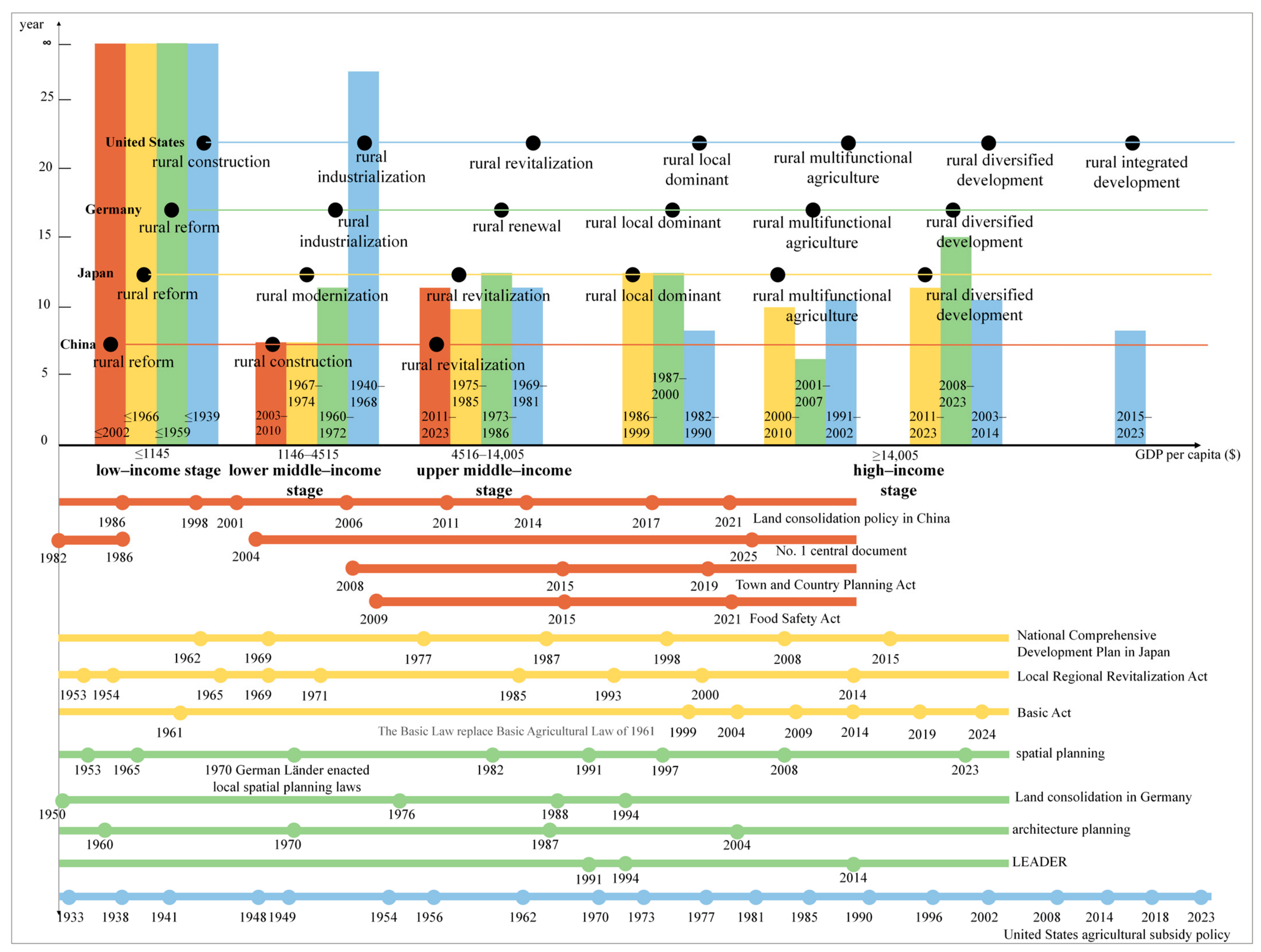
Using the World Bank income thresholds for 2025 (low-income ≤ $1145; lower-middle ≤ $4515; upper-middle ≤ $14,005; high-income > $14,005) [29], the data selection is based on the World Bank’s collection of GDP per capita (current dollar) in 2023 [30], each country’s rural policy evolution was organized into income-based stages aligned with major institutional transitions (Table 1). Stage boundary years indicate the year each country’s GDP per capita first crossed the corresponding World Bank threshold; the earliest document (South Africa’s Natives Land Act, 1913) marks the corpus start, not a quantitative data series.
To strengthen cross-country comparability, this section adopts a structured two-layer comparative framework distinguishing (i) development stage and (ii) policy stage. Within each country, rural policy evolution is organized into comparable policy stages, typically progressing from production- and food security–oriented policies, to territorial governance and multifunctional rural development, and further toward integrated sustainability and SDG-oriented governance (e.g., climate and energy transition, ecosystem protection, inclusive development). SDG alignment is operationalized through a rule-based coding protocol that maps dominant policy themes (and associated keyword clusters) to specific SDGs using a predefined codebook anchored in official SDG descriptions. Coding was conducted through manual classification with independent cross-checking; detailed rules and examples are provided in Appendix B. Finally, this comparative framework contributes a systematic approach for mapping rural policy evolution to SDG dimensions across different development contexts, enabling structured cross-country comparison beyond descriptive country-by-country reviews. See Appendix B for details.
A methodological note is warranted regarding the temporal scope of this coding exercise. Since the SDGs were formally adopted in 2015, whereas the earliest policies in the sample date to 1913, the alignment assessment is necessarily retrospective in nature. The purpose is not to evaluate whether historical policymakers intentionally pursued SDG targets—which would be anachronistic—but rather to identify the extent to which policy content exhibits thematic correspondence with the substantive domains captured by the 17 SDGs. The SDG framework is employed here as an analytical taxonomy—a standardized lens for classifying policy content across countries and time periods—rather than as a normative benchmark against which historical policies are judged. This retrospective mapping approach is consistent with established practice in comparative policy analysis, where contemporary frameworks are routinely applied to classify historical developments in order to identify long-term structural patterns [31]. The validity of this approach rests on the fact that the substantive concerns underlying the SDGs—food security, poverty alleviation, environmental protection, institutional governance—long predate the 2030 Agenda; what the SDG framework provides is a standardized classification system for these perennial policy domains. Adopting the SDGs as a classification taxonomy does not preclude observing temporal trends in alignment scores: the taxonomy defines how content is coded, while the Year trend is an empirical finding about how coded content changes over time-these two claims are analytically compatible.

2.3. Quantitative SDG Alignment Analysis

To move beyond descriptive country-by-country narratives and quantitatively assess the degree of SDG alignment in rural policies, this study develops a scoring-based analytical framework. Building on the qualitative coding protocol described in Section 2.2 and Appendix B, each of the 79 rural policy documents across the six case countries was evaluated against all 17 Sustainable Development Goals using a three-point ordinal scale: 0 (no alignment), 1 (partial alignment), and 2 (strong alignment). Scoring was conducted independently by two coders based on the predefined codebook, with discrepancies resolved through structured discussion. To assess inter-coder reliability prior to reconciliation, two coders independently re-coded a stratified random sample of 20 policy documents (Japan n = 3, Germany n = 3, USA n = 3, China n = 6, India n = 3, South Africa n = 2) without reference to each other or to the AI-generated preliminary scores. Cohen’s kappa was computed on these pre-reconciliation independent scores: κ = 0.763 (range 0.254 to 1.000 across individual SDGs), indicating substantial agreement. The low κ for SDG 14 (0.254) reflects the well-documented kappa paradox rather than genuine disagreement: because 53 of 79 documents score 0 on SDG 14, the high baseline of chance agreement artificially suppresses κ even when coders consistently assign 0. Both coders independently scored SDG 14 as 0 for 87% of documents, indicating high actual concordance. The complete coding protocol, scoring rubric, and six illustrative coding examples with article-level citations are provided in Appendix B.5.
To enhance the efficiency and consistency of the scoring process across 79 policy documents from six national contexts, this study employed a large language model (Claude Opus 4.6, developed by Anthropic) as an analytical assistant. Specifically, each policy document was submitted to the model with a structured prompt containing the SDG codebook (Table A1) and the three-point scoring rubric (0/1/2). These AI-generated scores served as preliminary drafts rather than final assessments. Two human coders independently reviewed, verified, and where necessary corrected the AI-generated scores against the original policy texts, applying the dominant-theme and parsimony principles specified in Appendix B.
The final scores reported in this study reflect human-validated assessments. Systematic record-keeping of individual AI-to-human score modifications was not maintained separately from the final validated dataset; this is acknowledged as a transparency limitation. However, two indirect quality indicators support the integrity of the final scores. First, the mandatory two-stage review protocol—AI preliminary scoring followed by independent human verification and cross-coder reconciliation—ensured that no AI-generated score entered the final dataset without independent scrutiny. Second, the inter-coder κ = 0.763 between the two human reviewers, who independently evaluated each AI-generated draft without reference to each other, provides assurance that human review substantively engaged with and where necessary corrected the AI outputs: had AI scores systematically biased the review process in a single direction, it would have been difficult for two independent reviewers to achieve substantial agreement. Finally, three aggregate indicators were derived: Total SDG Score (sum across 17 SDGs, range 0–34), SDG Coverage (count of SDGs ≥ 1), and Core SDG Count (count of SDGs = 2).
A methodological note on temporal scope is warranted. Several SDG dimensions—notably SDG 7 (renewable energy), SDG 12 (sustainable consumption and production), SDG 13 (climate action), and SDG 5 (gender mainstreaming)—correspond to policy concepts that emerged primarily as institutionalized governance fields after the mid-20th century. Policies enacted before the 1960s are therefore structurally incapable of scoring on these dimensions regardless of their substantive ambition or fiscal commitment to related objectives. The positive temporal trend in Total SDG Score thus reflects a combination of two analytically distinct mechanisms: (1) genuine broadening of rural policy scope over time, as governments progressively addressed a wider range of social, environmental, and institutional challenges; and (2) the expanding set of institutionalized policy domains captured by the SDG classification system itself. These two mechanisms are empirically difficult to disentangle entirely. Accordingly, the pre/post-2000 cohort comparison (Section 3.3) should be interpreted as a descriptive characterization of aggregate differences in policy content, rather than as direct evidence of global sustainability discourse diffusion per se. This limitation is explicitly acknowledged in Section 5.
GLMs with Gaussian family were estimated using three predictors: Year, Stage-Num (ordinal income stage, 1–4), and Dev-Developed (binary). Variance Inflation Factors confirmed acceptable multicollinearity: VIF(Year) = 3.10, VIF(Stage-Num) = 3.50, VIF(Dev-Developed) = 2.59 (threshold: 5.0; see Table 2 note). Poisson regression was estimated for count outcomes (SDG Coverage, Core SDG Count); the Total SDG Score ranges 2–33 with no boundary censoring, so we estimated a Tobit model specifying lower bound = 0 and upper bound = 34; the model returned coefficients identical to OLS because no observation fell at either censoring boundary (observed range: 2–33), confirming the analytical equivalence. Year remains significant (p < 0.01) and Stage/Dev remain non-significant across all specifications (Table A7, Appendix D). Country-clustered standard errors and a China-excluded sensitivity analysis (n = 47) confirmed that results are not driven by China’s larger subsample (Appendix D, Table A5 and Table A6). Per-SDG regressions used Stage-Num and Dev-Developed only; Benjamini–Hochberg FDR correction was applied across all 34 coefficients (Appendix D Table A4). Spearman rank correlations replaced Pearson for the 17 × 17 SDG matrix; differences are negligible (max |ρ − r| < 0.05). SDG 14 exhibits near-zero variance (53/79 documents score 0), reflecting the terrestrial orientation of rural policies. The analytical sample is 79 documents: Japan (n = 10), Germany (n = 8), United States (n = 10), China (n = 32), India (n = 10), South Africa (n = 9). Given the unequal country sample sizes (China n = 32; others n = 8–10), we consider the balanced subsample results (n = 57) as the primary analytical reference for per-SDG regressions; the full sample results are presented in Table 2 for transparency and confirmatory purposes (Appendix D, Table A4).

3. Results

3.1. Bibliometric Analysis

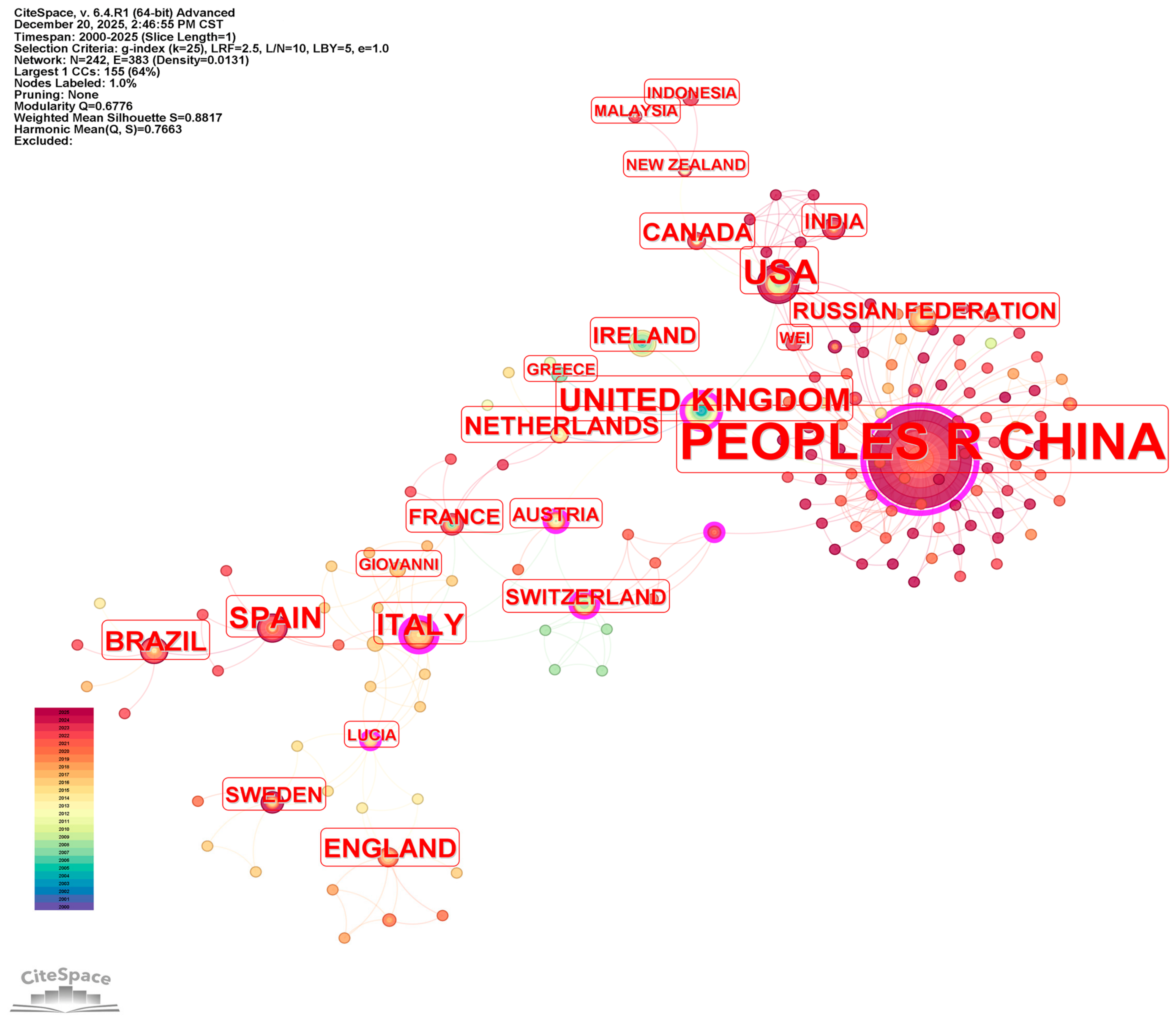
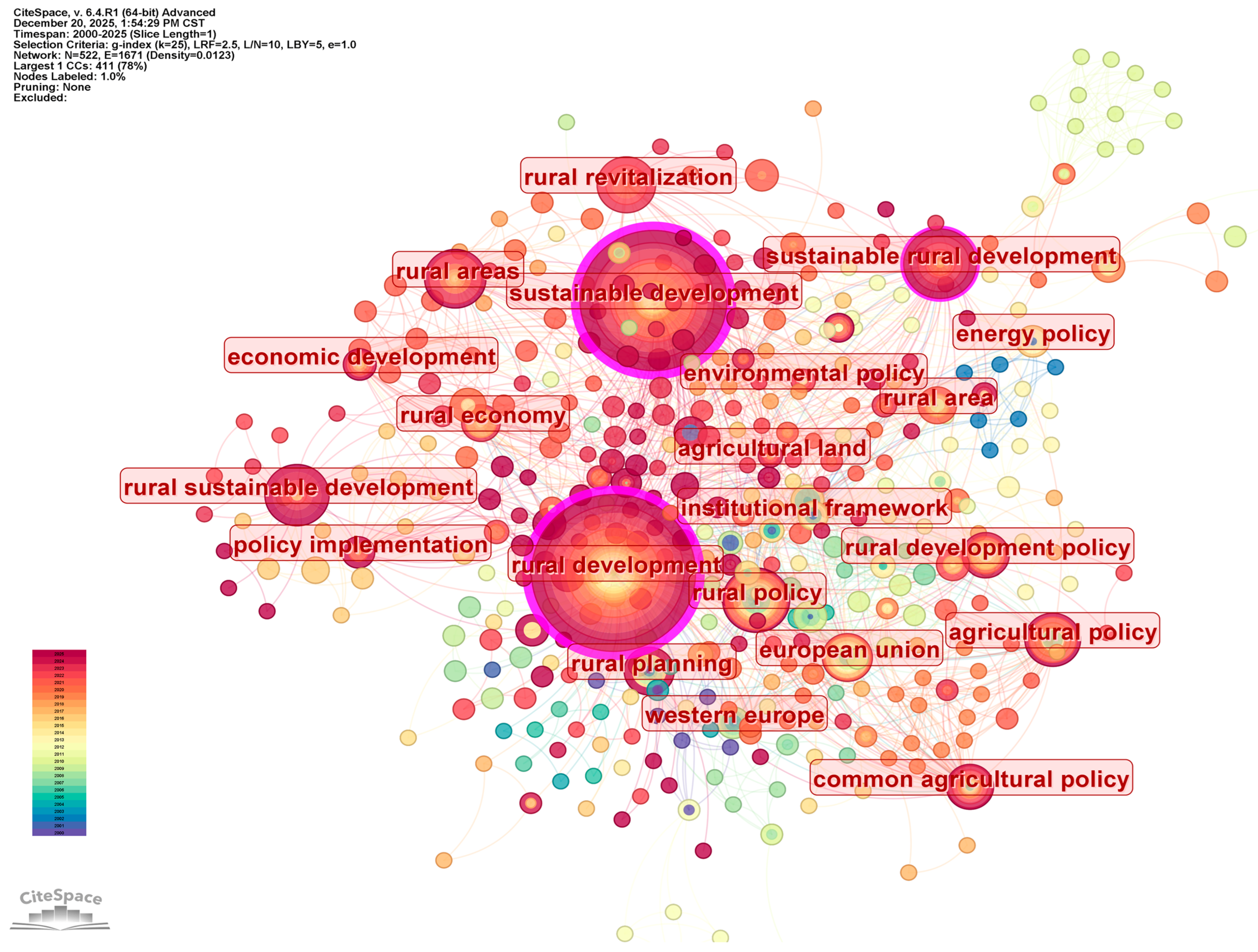
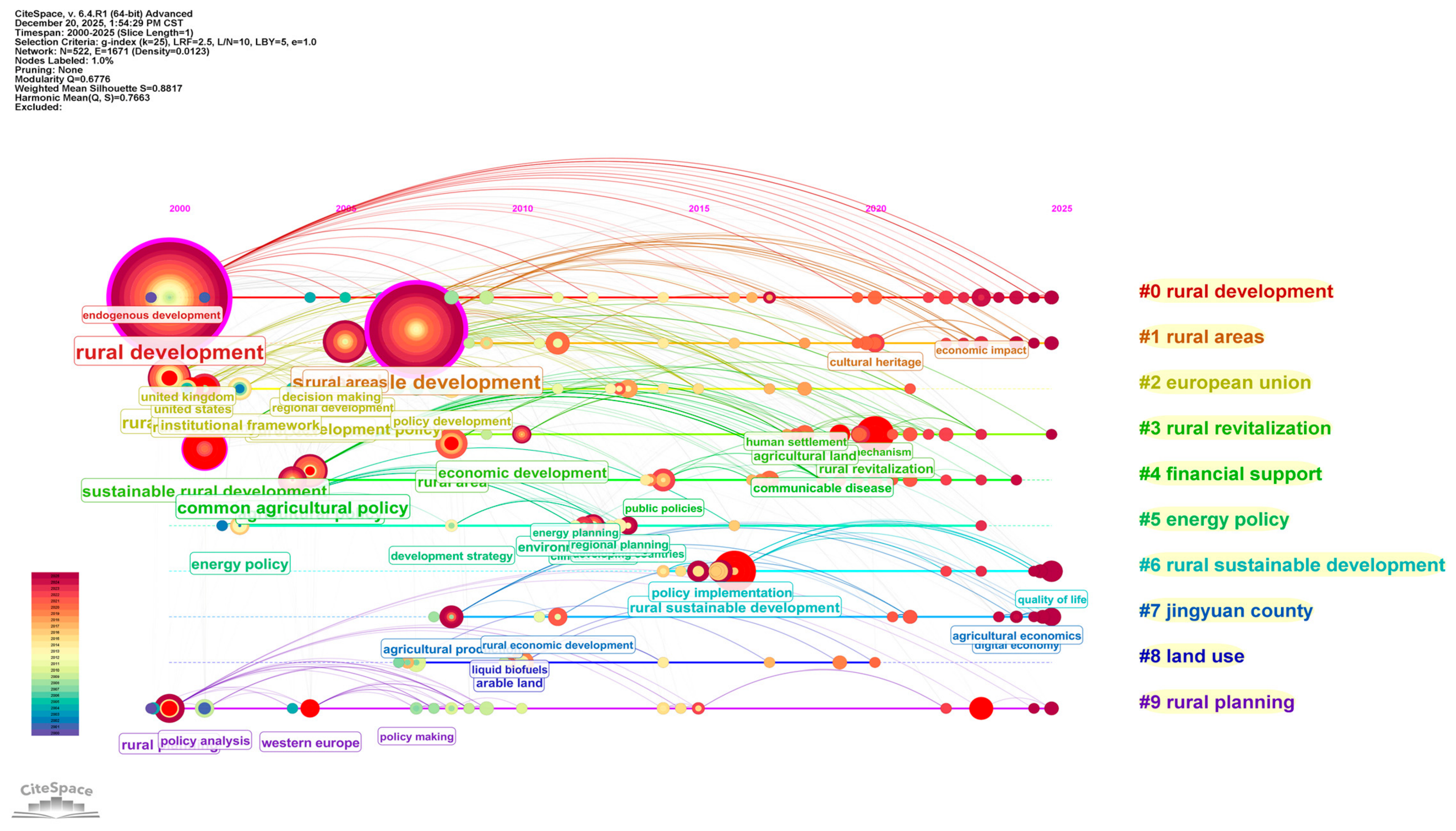
The bibliometric analysis reveals three temporal stages in rural policy research. In the early stage (2000–2008), foundational themes—rural development, policy making, and institutional framework—dominate, reflecting a development-oriented paradigm. During the transitional stage (2009–2015), policy differentiation and institutional deepening become prominent. After 2015, a marked shift toward sustainability-oriented themes is observed, with clusters such as rural revitalization, energy policy, and land use growing rapidly—suggesting that SDG adoption coincided with a thematic reorientation of research priorities. The keyword co-occurrence network (Figure 1), country collaboration network (Figure 2), and timeline visualization (Figure 3) collectively demonstrate that the SDGs reshaped rural policy research from a development-centered agenda toward an integrated framework emphasizing sustainability and governance coordination. Whether this thematic integration is paralleled by a corresponding shift in actual policy texts is examined in Section 3.3.
Figure 1 presents the keyword co-occurrence network generated by CiteSpace. The time slot length is 1; the data selection criteria are g-index (k = 25), LRF = 2.5, L/N = 10, LBY = 5, and e = 1.0, yielding 92 nodes and 398 links with a density of 0.0123. At the center of the network, “sustainable development” and “rural development” emerge as the most prominent nodes, functioning as conceptual hubs connecting multiple thematic clusters and corresponding primarily to SDGs 1, 2, 11, and 17. A dense policy-oriented subnetwork surrounds these core nodes, comprising keywords such as “rural policy,” “agricultural policy,” “environmental policy,” and “institutional framework.” The strong co-occurrence among these terms indicates a shift from descriptive analyses toward governance- and institution-focused research, aligning with SDG 16 and SDG 12. Spatial keywords (“rural areas,” “rural planning”) form stable linkages with both development and policy nodes, reflecting the growing importance of place-based approaches (SDG 10, SDG 11). Notably, European policy context keywords, including “European Union” and “Common Agricultural Policy,” display high intermediary positions despite lower frequencies, suggesting their role as influential reference frameworks in the global research network.
Figure 2 presents the country collaboration network. The time slice is 1 year, with data selection criteria of g-index (k = 25), LRF = 2.5, L/N = 10, LBY = 5, and e = 1.0, producing 242 nodes and 383 links (density = 0.0131). The network exhibits a pronounced core–periphery structure. China stands out as the most active node with the highest betweenness centrality, maintaining extensive collaborative ties across both developed and developing country research networks. The United States, the United Kingdom, Italy, Canada, India, and several European countries form a secondary layer, functioning as regional bridges for the exchange of research perspectives. In contrast, many countries remain at the periphery with sparse collaboration, indicating unequal participation in global knowledge production. This pattern reveals both progress toward cross-development-stage collaboration (SDG 17) and persistent structural inequalities in global knowledge networks that may constrain the inclusive localization of SDG-oriented rural policy frameworks.
Figure 3 presents a timeline visualization of keyword clusters, depicting the temporal evolution of major research themes from 2000 to 2025. The time slot length is 1; data selection criteria are g-index (k = 25), LRF = 2.5, L/N = 10, LBY = 5, and e = 1.0, yielding 522 nodes and 1671 links (density = 0.0123). The network demonstrates moderate-to-high modularity (Q = 0.6776) and a high weighted mean silhouette (S = 0.8817), confirming that the clustering structure is statistically robust and semantically coherent.
Overall, the results demonstrate that the adoption of the SDGs has reshaped rural policy research from a development- and agriculture-centered agenda toward an integrated framework emphasizing sustainability, governance, and policy coordination. Whether this thematic integration in the academic domain is paralleled by a corresponding structural shift in actual policy texts—and whether the shift is uniform across development stages—is examined through the quantitative analysis in Section 3.3. The bibliometric findings thus serve as a discourse-level benchmark against which the policy-text evidence in Section 3.2 and Section 3.3 can be interpreted: convergence between the two domains strengthens the validity of the temporal trend, while divergence flags a potential gap between academic framing and governance practice.

3.2. Comparative Analysis

3.2.1. Japan

Stage 1: Production First and Structural Rigidities (≤1966). The post-WWII food crisis drove a “production-first” paradigm. The Food Control Act (1942) prioritized rice self-sufficiency (SDG 2) [11], while the Agricultural Basic Law (1961) and the first National Comprehensive Development Plan (1962) addressed rural–urban income disparities (SDG 1, SDG 8) [32]. However, structural rigidities such as land fragmentation led to unintended part-time farming rather than large-scale consolidation, reflecting a singular focus on caloric output at the expense of environmental considerations.
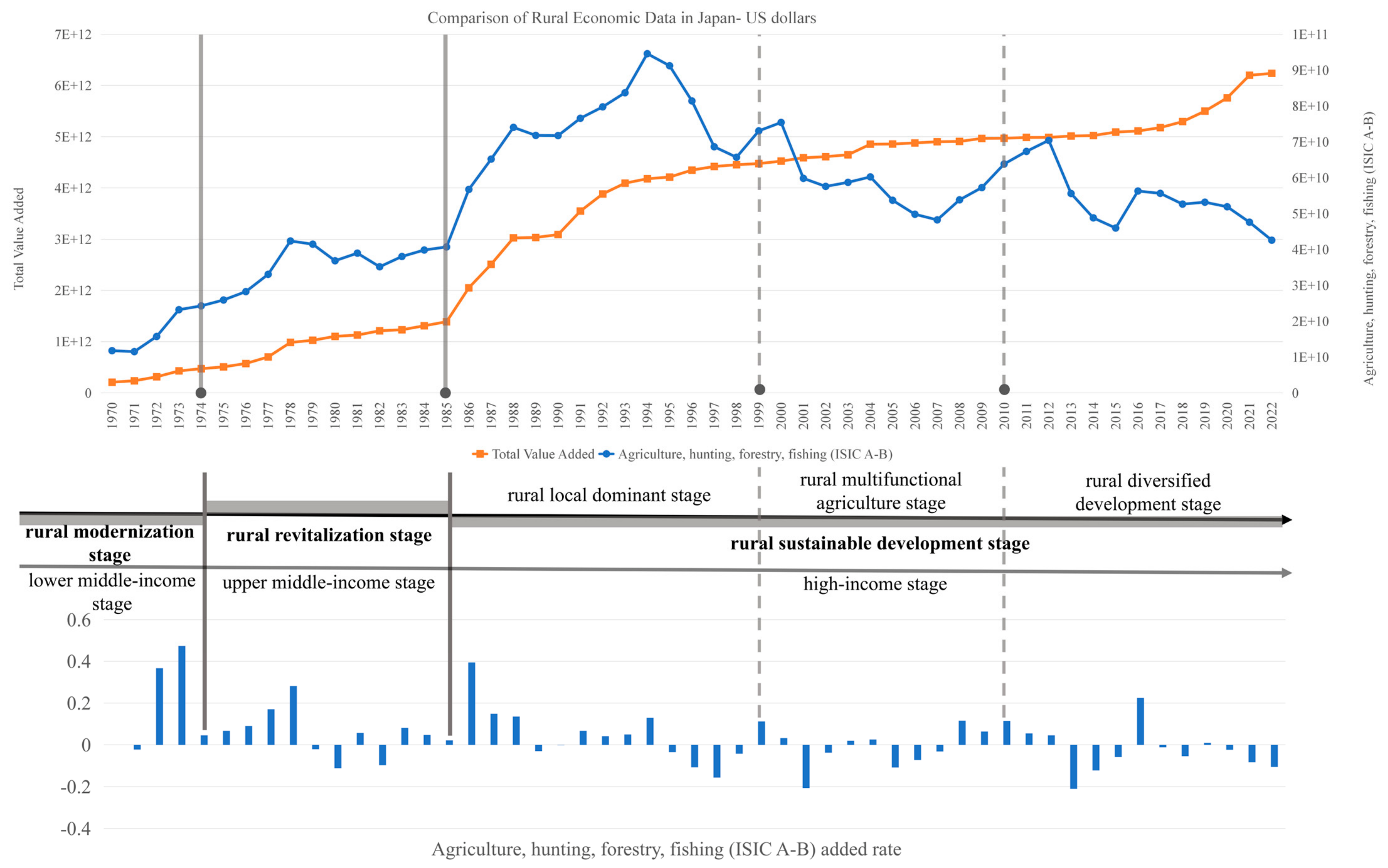
Stage 2 (Figure 4): Externalities & Reactive Regulation (1967–1974). Rapid industrialization triggered pollution and land speculation. The Second NCDP (1969) dispersed industrial complexes into rural areas (SDG 9) [33], while the Agricultural Promotion Area Law (1969) and the establishment of the Environmental Protection Agency (1971) marked reactive environmental governance (SDG 15). This stage reflects a conflict-ridden alignment between infrastructure expansion and ecological protection [11].
Stage 3: Endogenous revitalization (1975–1985). A paradigm shift toward bottom-up development emerged. The “One Village One Product” (OVOP) movement explored locally iconic products and cultural branding (SDG 8), while the Third NCDP’s “Settlement Sphere” concept aimed to correct territorial imbalances (SDG 10, SDG 11) [23]. Policies shifted from physical infrastructure to community building and endogenous economic empowerment.
Stage 4: Green Integration and Smart Governance (1986–present). The Basic Law on Food, Agriculture, and Rural Areas (1999) enshrined “Multifunctionality,” recognizing agriculture’s role beyond food production (SDG 15) [34]. Governance became integrated: the 2007 Revitalization Law introduced cross-sector planning (SDG 16, SDG 17) [35], the “Sixth Industrialization” strategy (2010) captured rural value chains (SDG 8) [36], and the Green Food System Strategy (2022) set targets for zero-emission farming (SDG 13) [37]. Recent Basic Law revisions emphasize food safety, sustainable development, and smart agriculture (SDG 2, SDG 12) [38]. This stage demonstrates comprehensive SDG-oriented governance where productivity and innovation serve ecological sustainability.

3.2.2. Germany

Stage 1: Post-war reconstruction (≤1959). The “Green Plan” (1955) accelerated agricultural mechanization through subsidies, driven by a productivist logic prioritizing caloric self-sufficiency (SDG 2) [39]. Concurrently, “Flurbereinigung” (Land Consolidation) rationalized fragmented parcels, and the Inter-Ministerial Committee on Spatial Planning (1953) laid the institutional foundation for territorial coordination (SDG 8).
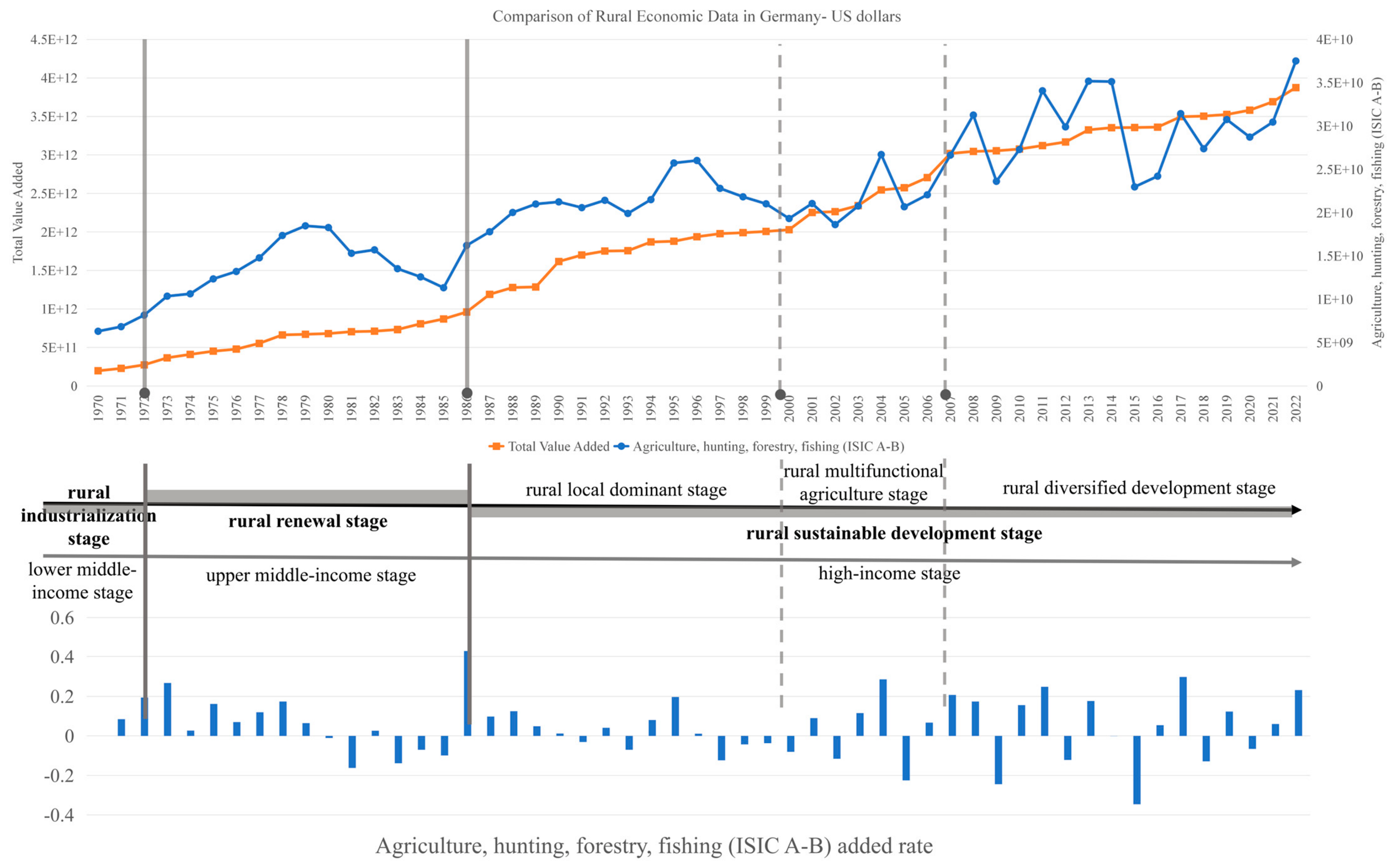
Stage 2 (Figure 5): Spatial legislation and rural industrialization (1960–1972). The Federal Regional Planning Act (1965) mandated “Equivalence of Living Conditions” (SDG 10) [40]. Policy dispersed industry into rural areas, bringing jobs and infrastructure (SDG 9) but transforming many villages into “commuter societies” at the cost of rural identity [39].
Stage 3: Village renewal and multifunctional rural development (1973–1986). The “Dorferneuerung” (Village Renewal) scheme shifted from demolition to preservation, integrating heritage preservation with environmental care (SDG 11) [41]. The 1976 Land Consolidation Act amendment introduced ecological goals (SDG 15), marking the transition to “Multifunctional Rural Development” [39].
Stage 4: CAP-based integrated sustainability and SDG-oriented governance (1987–present). German rural policy became deeply integrated with the EU’s Common Agricultural Policy. Council Regulation 1257/1999 mandated agri-environmental conditionality (SDG 13, SDG 15) [42]; the LEADER program empowered participatory governance (SDG 16, SDG 17) [43]; and the Energiewende transformed rural areas into “Energy Landscapes” (SDG 7) [39]. Successive CAP reforms (2007–2013, 2014–2020, 2023–2027) progressively deepened sustainability integration [44], with Germany targeting 30% organic farming by 2030 [45,46,47]. This stage synthesizes high-quality food systems (SDG 2), technological innovation (SDG 9), and robust climate action (SDG 13, SDG 15) [46].

3.2.3. United States

Stage 1: Settlement-driven policy (≤1939). Rural development was essentially agricultural policy until the Great Depression accelerated out-migration [47]. The Rural Electrification Act (1936) provided federal loans for rural electrical systems [48], functioning as both infrastructure investment (SDG 9) and economic stimulus (SDG 8) [49].
Stage 2: Agricultural modernization and anti-poverty (1940–1968). Post-war policy stabilized agriculture through price supports (Agricultural Act 1949) [50]. By the 1960s, President Johnson’s “War on Poverty” (1964) marked the first systematic federal targeting of rural poverty distinct from farm policy (SDG 1), acknowledging that agricultural modernization alone could not solve rural decline [49].
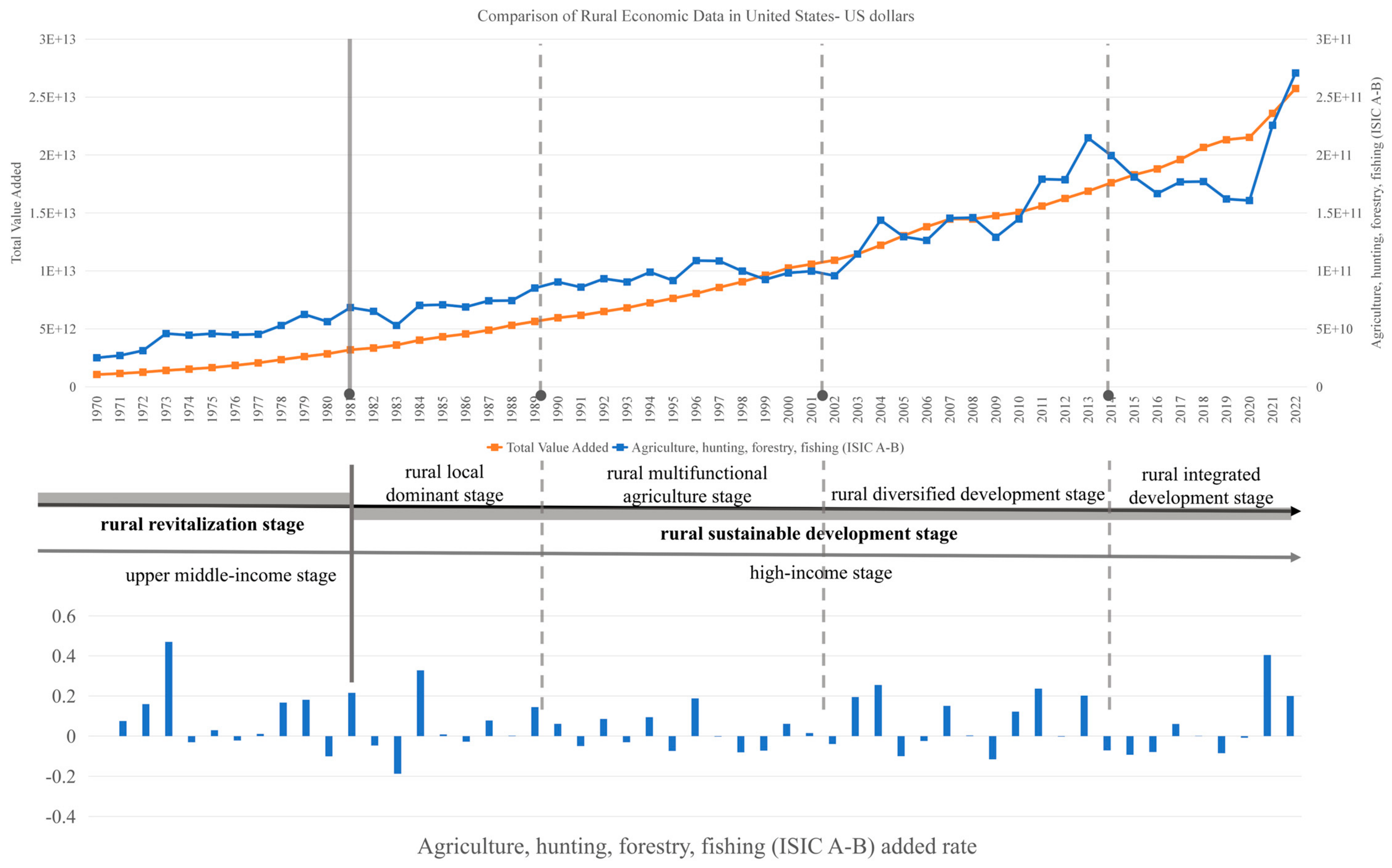
Stage 3 (Figure 6): Environmental regulation and institutionalization (1969–1981). The Consolidated Farm and Rural Development Act (1972) shifted focus toward community facilities (SDG 11). The Rural Development Policy Act (1980) designated USDA to coordinate federal rural policy (SDG 16, SDG 17), while NEPA (1970) forced rural development to consider ecological impacts (SDG 15) [51].
Stage 4: Integrated sustainability (1982–present). The 1990 Food, Agriculture, Conservation, and Trade Act added conservation to farm bills (SDG 15) [52]. The 2008 Energy Act established rural renewable energy programs (SDG 7, SDG 13). The 2014 and 2018 Farm Bills prioritized the bio-economy [53] and digital connectivity [54], while the 2022 Inflation Reduction Act invested in clean energy and rural jobs [55]. Rural areas are increasingly framed as spaces for energy transition and climate mitigation (SDG 7, SDG 9, SDG 13).

3.2.4. China

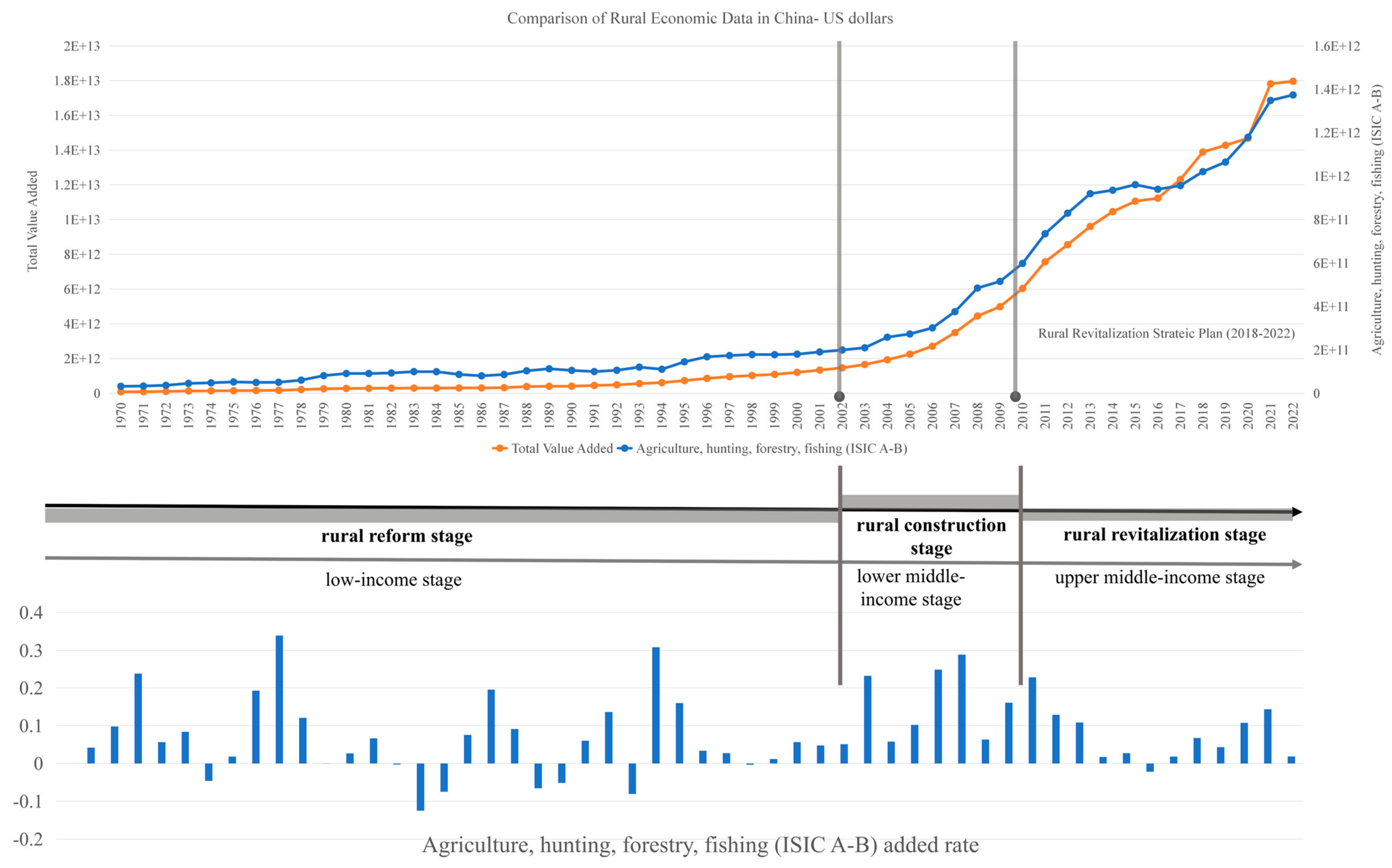
Stage 1 (Figure 7): Rural reform and agricultural productivity liberation (≤2002). The Land Reform Law (1950) liberated rural productive forces [56]. The watershed 1982 No. 1 Central Document legitimized the Household Contract Responsibility System (HRS) [57], separating land ownership from usage rights and unleashing productivity (SDG 2, SDG 8) [58]. In 2002, the Rural Land Contract Law institutionalized farmers’ long-term land rights (SDG 1) [59]. This stage’s policy logic centered on food security and labor mobility.
Stage 2: New countryside construction (2003–2010). The 2004 No. 1 Central Document initiated the “Three Rural Issues” era with direct agricultural subsidies [60]. The 2006 abolition of the agricultural tax ended 2600 years of farm taxation [61]. Heavy state investment in rural infrastructure aimed for “equalization of basic public services” (SDG 9, SDG 10, SDG 11). From 2010 to 2016, rural income growth exceeded urban growth for seven consecutive years [18].
Stage 3: Rural revitalization and integrated sustainability governance (2011–present). The 2017 Rural Revitalization Strategy became a national priority [62], with the 2018 No. 1 Central Document outlining a roadmap to 2050 [63]. The 2019 Digital Village Strategy bridged the digital divide (SDG 9) [64]. In 2020, China achieved comprehensive poverty alleviation (SDG 1) [65]. Recent policies (2024–2025) emphasize ecological livability, bio-technology food security [66], and tertiary industry integration (SDG 2, SDG 12, SDG 15) [67]. This stage represents comprehensive governance combining ecological protection, digital innovation, and industrial integration.

3.2.5. India

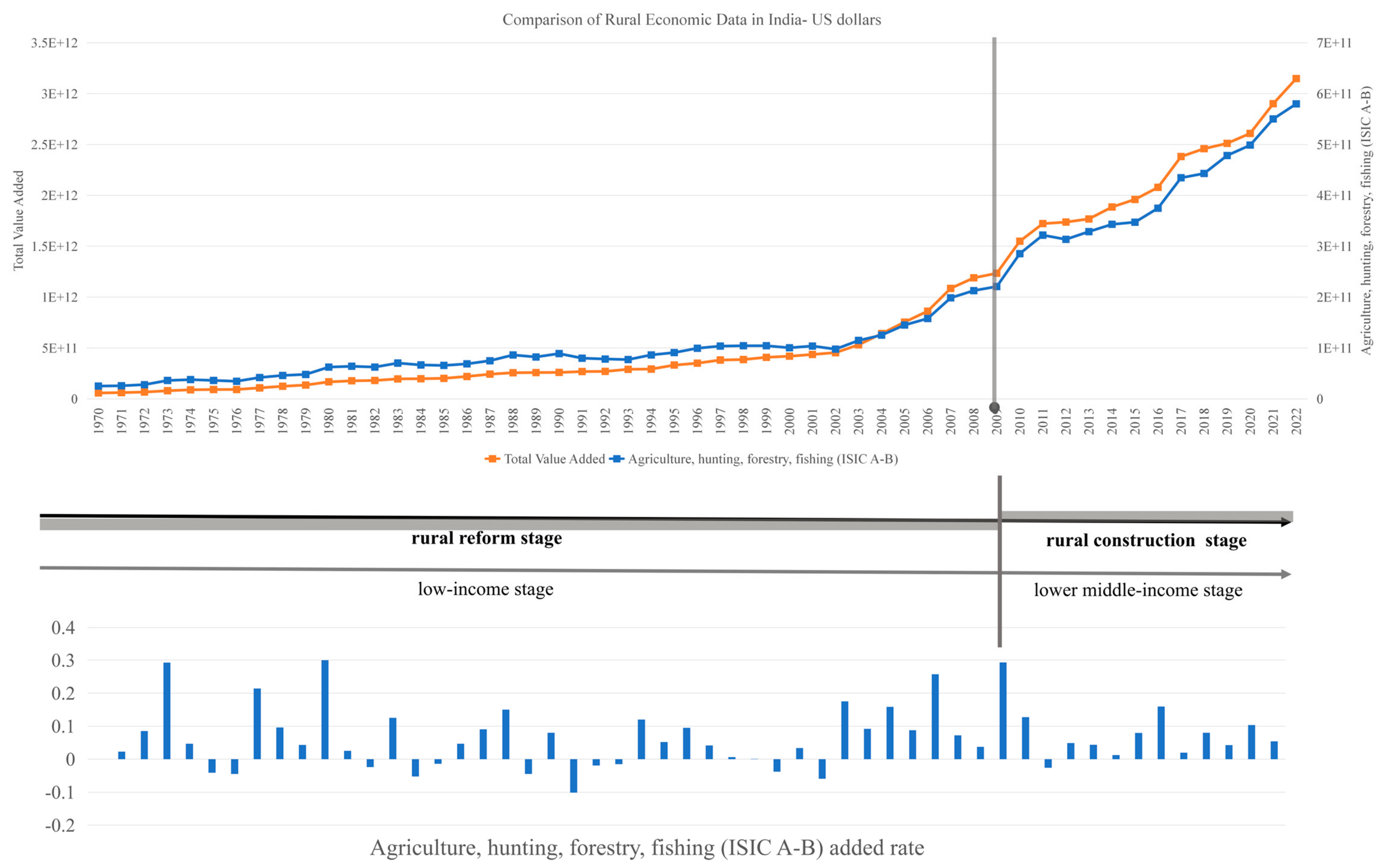
Stage 1 (Figure 8): Poverty alleviation and institutional consolidation (≤2009). Anti-poverty governance began with Nehru-era land reforms. The Green Revolution achieved food self-sufficiency (SDG 2) but created regional inequalities [20]. The IRDP (1978) provided individual assets to the poor, while the SGSY (1999) shifted toward Self-Help Groups. A paradigm shift occurred with the National Commission on Farmers (2004) [68], prioritizing farmers’ net income [69]. The landmark MGNREGA (2005) established a legal “right to work” with mandated women’s participation (SDG 1, SDG 5, SDG 8) [70]. The 2007 National Policy for Farmers decentralized agricultural planning (SDG 10) [71].
Stage 2: Digitalization and sustainability-oriented transformation (2010–present). India leveraged technology to leapfrog development barriers. The Clean India Mission (2014) improved rural sanitation (SDG 6) [72]. The Digital India Programme (2015) enabled Direct Benefit Transfers through the JAM Trinity (SDG 16) [73]. The SVAMITVA scheme (2021) used drone technology for rural land mapping (SDG 11) [74], while the Digital Agriculture Mission (2024) aims to build AgriStack digital public infrastructure (SDG 9) [75]. Rural policy has transitioned from “guaranteeing work” to “digital empowerment.”

3.2.6. South Africa

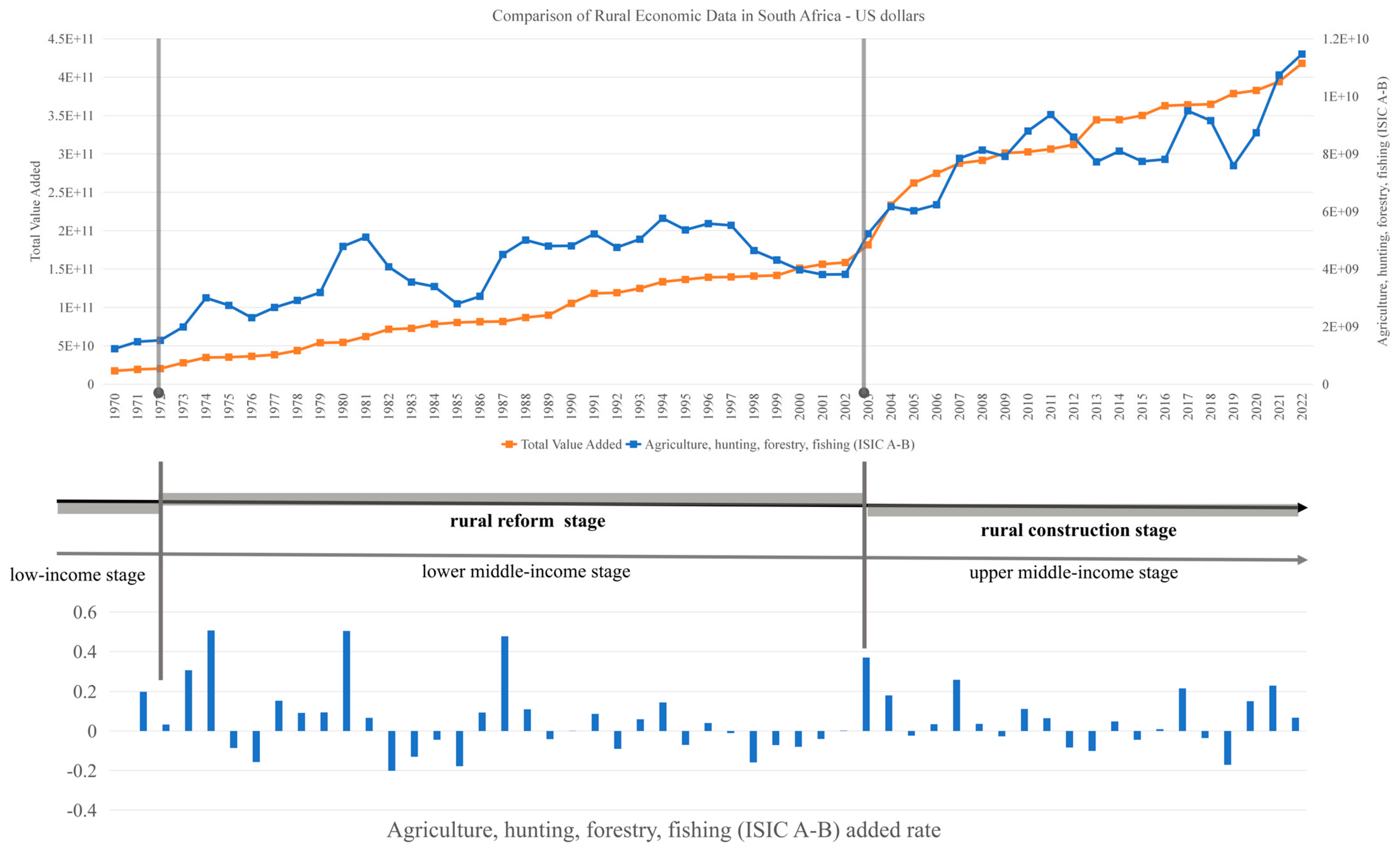
Stage 1 (Figure 9): Apartheid era and early rural marginalization (≤1972). The Natives Land Act (1913) confined the black majority to 13% of the land, creating a stark dualism between prosperous white farming areas and impoverished “communal” areas. This structural exclusion entrenched spatial inequalities that would profoundly constrain subsequent policy (SDG 10, Negative).
Stage 2: Post-apartheid land reform (1973–2003). Following the 1994 democratic transition, the Reconstruction and Development Programme addressed basic needs (SDG 6) [76]. The Restitution of Land Rights Act (1994) established a rights-based approach to historical justice (SDG 10) [77]. The Rural Development Framework (1997) facilitated infrastructure upgrading [78], and the Integrated Food Security Strategy (2002) coordinated household food production (SDG 1, SDG 2) [79].
Stage 3: Agrarian transformation and sustainability integration (2004–present). The Comprehensive Rural Development Programme (2009) pursued “Agrarian Transformation” linked to social cohesion (SDG 16) [80]. The National Development Plan 2030 targeted 1 million agricultural jobs (SDG 8) [74]. Current implementation through the Agriculture and Agro-processing Master Plan and Medium Term Strategic Framework (2019–2024) emphasizes spatial differentiation and youth/women entrepreneurship (SDG 11, SDG 15) [81]. Despite structural interventions, approximately 6.8 million South Africans still experienced hunger as of 2017 [82], highlighting the gap between policy intent and outcomes.

3.3. Quantitative SDG Alignment Patterns

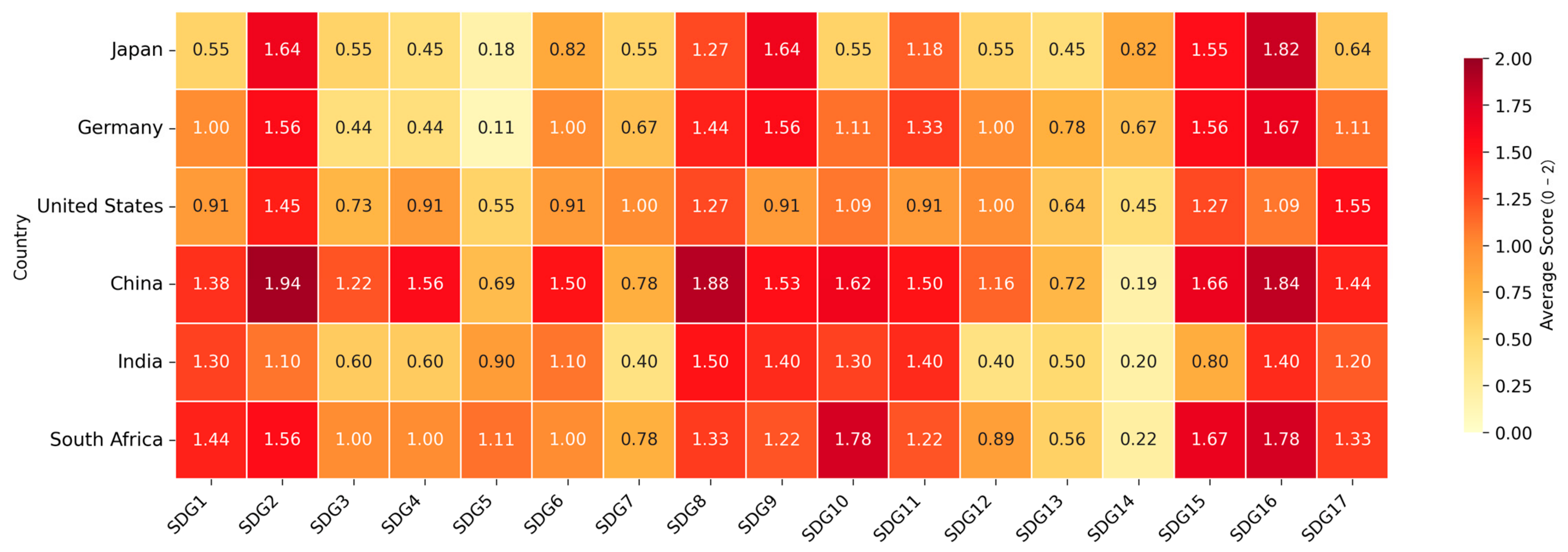
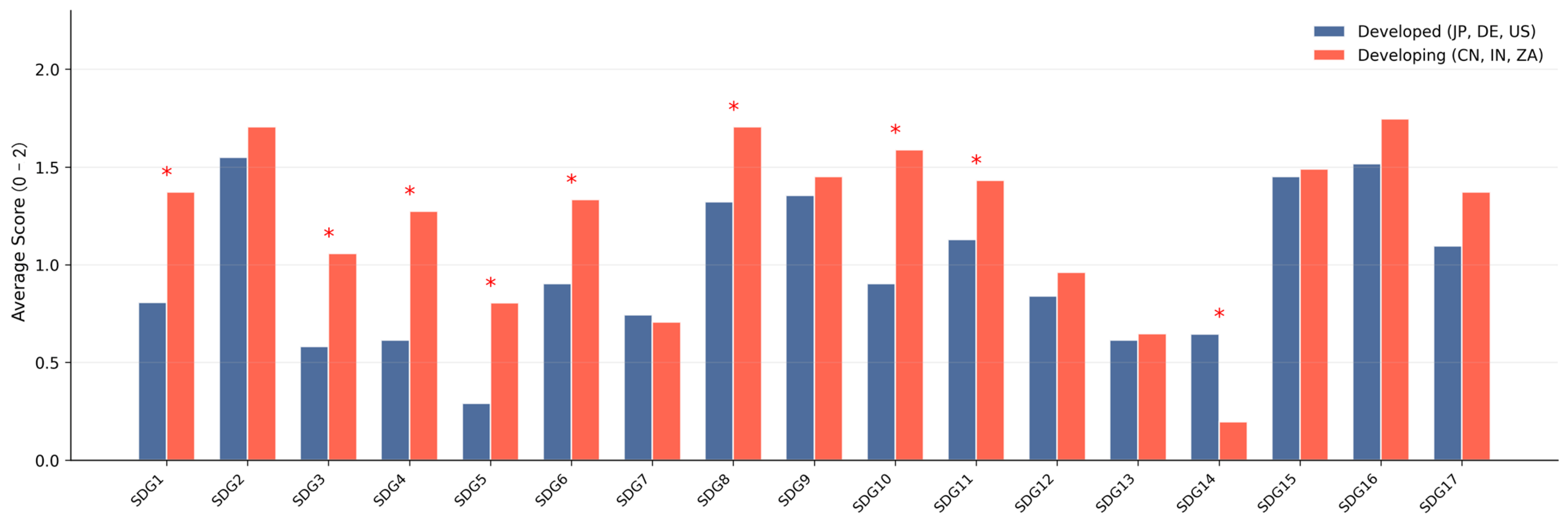
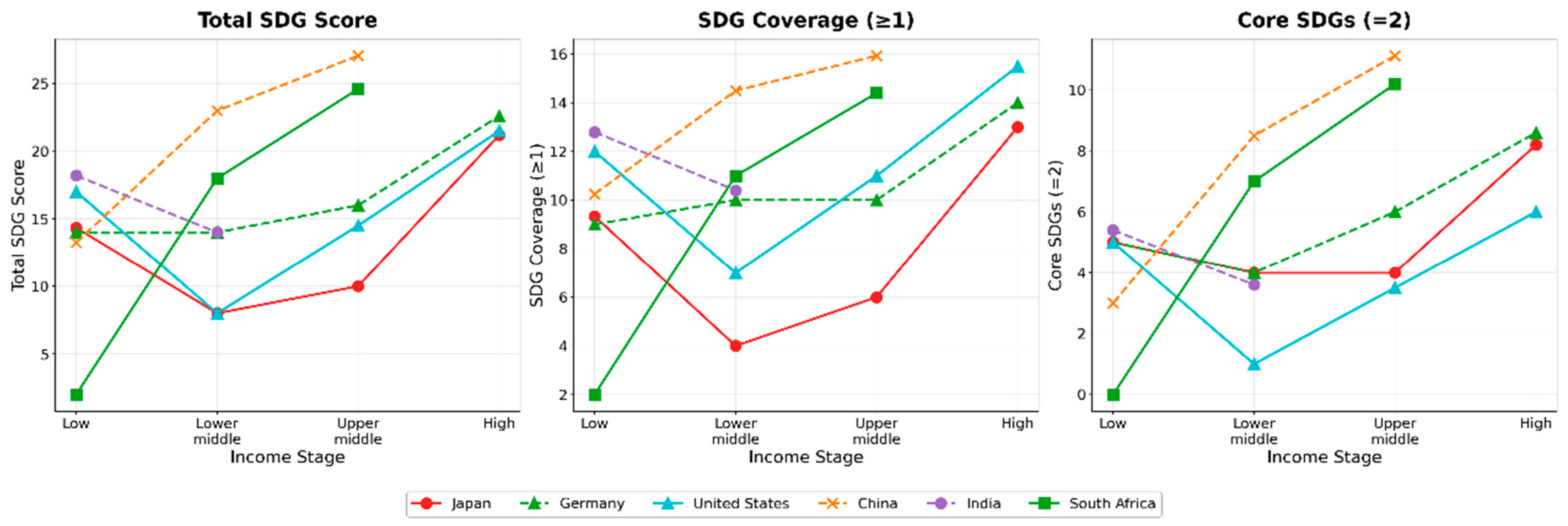
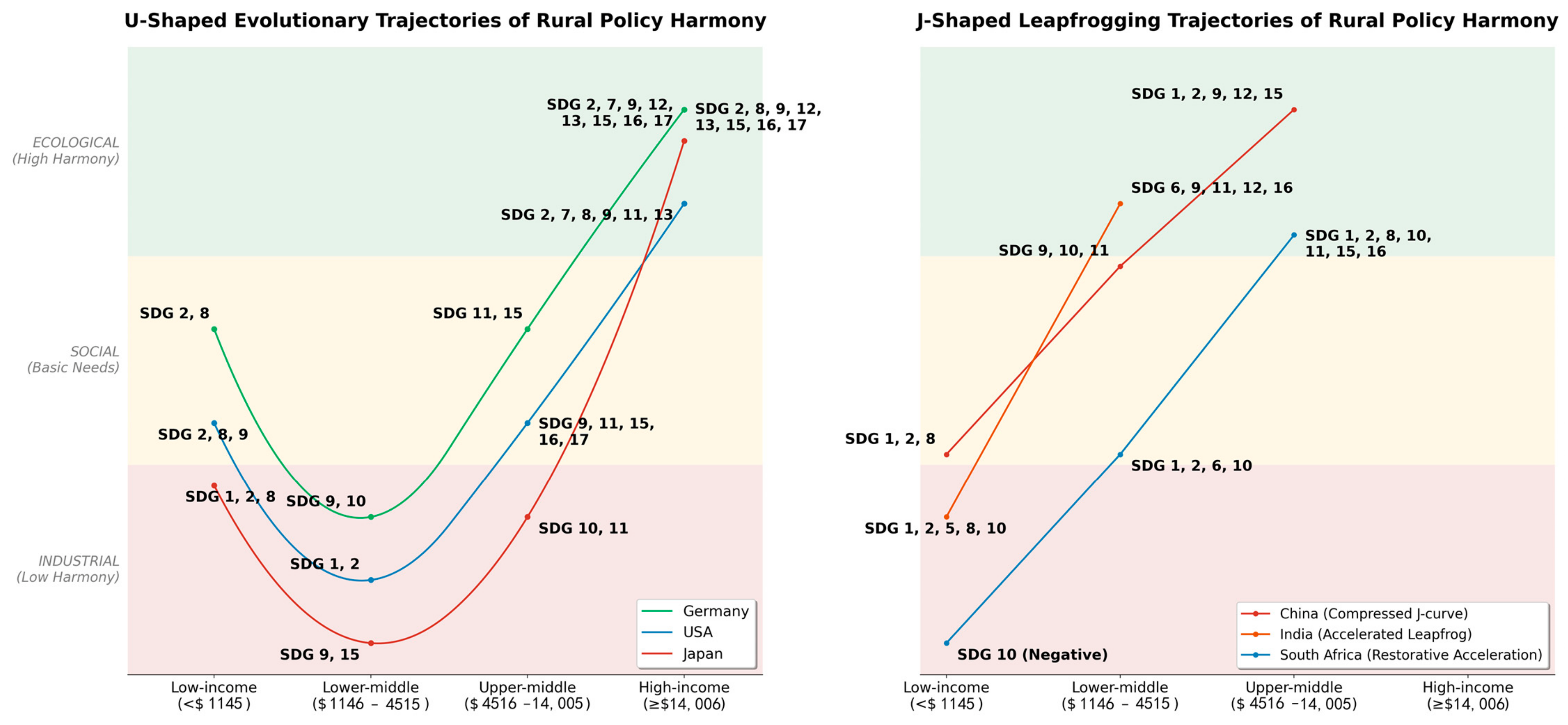
The full analytical sample comprises 79 rural policy documents spanning six countries. Figure 10 presents a heatmap of mean SDG alignment scores. SDG 2 receives universally high scores, consistent with the centrality of food security in rural policy traditions. SDG 14 records the lowest scores, reflecting the terrestrial orientation of rural policies. Substantial cross-national variation is evident: China achieves the highest mean score on SDG 8 (1.88), while Japan records the lowest on SDG 5 (0.18). Developing countries generally exhibit broader SDG coverage and higher mean scores than developed countries (Figure 11), though this disparity is largely attributable to temporal factors (asterisks indicate significant differences between the two groups), as demonstrated below. Figure 12 shows that developed countries display a characteristic dip at the lower-middle-income stage before recovering, while developing countries exhibit continuous upward trajectories.
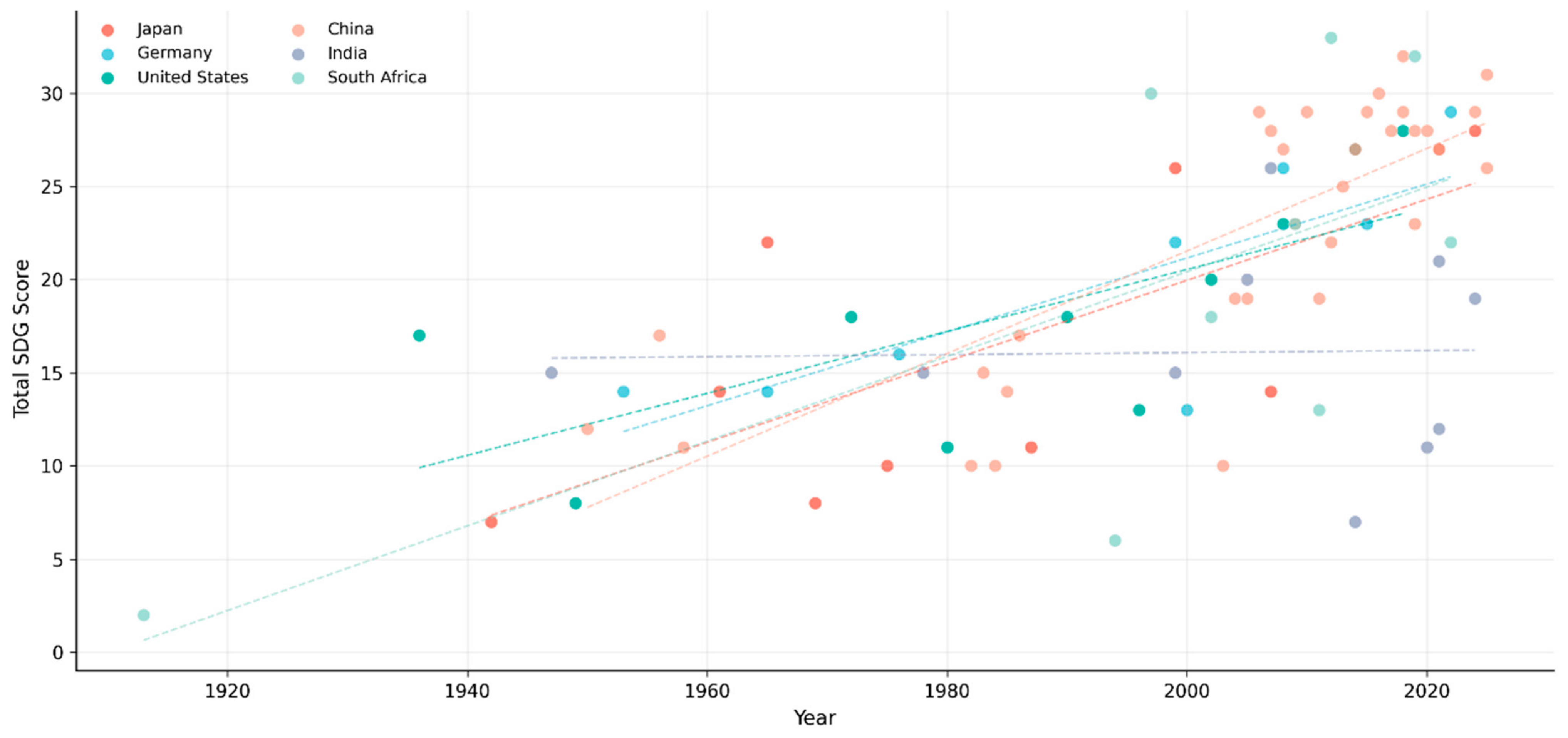
A clear positive temporal trend is observable across all six countries (Figure 13): policies enacted in more recent decades exhibit higher SDG alignment scores regardless of development status. Dashed lines depict country-specific linear trends of Total SDG Scores over policy enactment years. The pre-2000 cohort (n = 31) has a mean Total SDG Score of 14.1, while the post-2000 cohort (n = 48) averages 23.6—a statistically significant difference (t = −6.66, p < 0.001). As discussed in Section 2.3, this difference reflects a combination of genuine policy broadening and the structural expansion of institutionalized governance domains captured by the SDG classification system; it should be read as a descriptive characterization of aggregate content differences rather than direct evidence of discourse diffusion. Crucially, 73% of developing-country policies fall in the post-2000 cohort compared to only 39% of developed-country policies, confirming that the higher aggregate scores among developing countries are substantially attributable to their policy corpora being concentrated in the post-2000 era—a “late-comer discursive advantage.”
Table 2 reports the GLM results (M1–M3). Year is the only predictor achieving statistical significance (p < 0.01) in every specification. The Year coefficient in M1 (0.163) indicates that each additional year is associated with a 0.16-point increase in Total SDG Score—translating to approximately 4.9 points over a 30-year span. Neither Stage-Num nor Dev-Developed reaches significance in any model (p = 0.242–0.759), indicating that the scoring gap between country groups is primarily a cohort effect. The models explain 37–44% of variance (adjusted R2 = 0.343–0.417). Sensitivity analysis on the balanced subsample (n = 57) confirms robustness (Appendix D Table A7).
Notably, the per-SDG regressions intentionally exclude Year. Including Year would absorb much of the Stage-Num variance (since income stages are temporally ordered), masking the structural patterns this analysis aims to reveal. The aggregate GLMs have already established Year as the dominant predictor at the total-score level; the per-SDG regressions ask a complementary question: which specific SDGs are structurally differentiated by income level and development status? The results should be interpreted as descriptive associations rather than causal estimates. For completeness, per-SDG specifications including Year as a control variable are presented in Appendix D.
Per-SDG regressions on the balanced subsample (n = 57), with Benjamini–Hochberg FDR correction applied across all 34 coefficients, reveal distinct patterns (Appendix D Table A4). Income-stage-driven SDGs surviving FDR correction include SDG 17 (Stage β = 0.468, p-FDR < 0.001), SDG 12 (β = 0.490, p-FDR < 0.001), SDG 15 (β = 0.336, p-FDR < 0.001), SDG 13 (β = 0.329, p-FDR = 0.004), SDG 10 (β = 0.299, p-FDR = 0.005), and SDG 5 (β = 0.276, p-FDR = 0.007)—representing “late-emergence” priorities that scale systematically with income stage. Development-group-driven SDGs surviving FDR correction—where developing countries score significantly higher—include SDG 10 (Dev β = −0.803, p-FDR = 0.002), SDG 5 (Dev β = −0.864, p-FDR < 0.001), and SDG 1 (Dev β = −0.524, p-FDR = 0.046). SDG 17 (p-FDR = 0.092) and SDG 14 (p-FDR = 0.097) were significant at the raw p < 0.05 level but did not survive FDR correction.
Universally prioritized SDGs showing neither significant income-stage nor development-group effect include SDG 2, SDG 8, and SDG 16 (R2 = 0.012–0.121), consistent with their role as foundational dimensions addressed regardless of economic context. The apparent tension between the non-significant Dev coefficient in Table 2 and the significant negative Dev coefficients for SDGs 1, 5, and 10 in Table A4 is resolved by recognizing that these two analyses address different questions. Table 2 asks whether, after controlling for the year of enactment, developed and developing countries differ in overall SDG alignment—and the answer is no (p = 0.390–0.759). Table A4, which intentionally omits Year, asks whether structural differences in which goals are prioritized exist between country groups—and the answer is yes for development-imperative SDGs. Because developing countries’ policies are more recent on average, their higher scores on SDGs 1, 5, and 10 reflect a combination of structural priority and temporal positioning; this is precisely what the ‘late-comer discursive advantage’ framing captures.
Figure 13 plots the total SDG score of each policy against its year of enactment, with country-specific trend lines fitted by ordinary least squares. A clear positive temporal trend is observable across all six countries: policies enacted in more recent decades tend to exhibit higher SDG alignment scores than earlier policies, irrespective of the country’s development status. This upward trajectory is consistent with the global diffusion of sustainable development norms, particularly following the adoption of the Millennium Development Goals in 2000 and the 2030 Agenda in 2015.

4. Discussion

4.1. The Evolution of Academic Focus: Theoretical Maturation and Epistemic Asymmetries

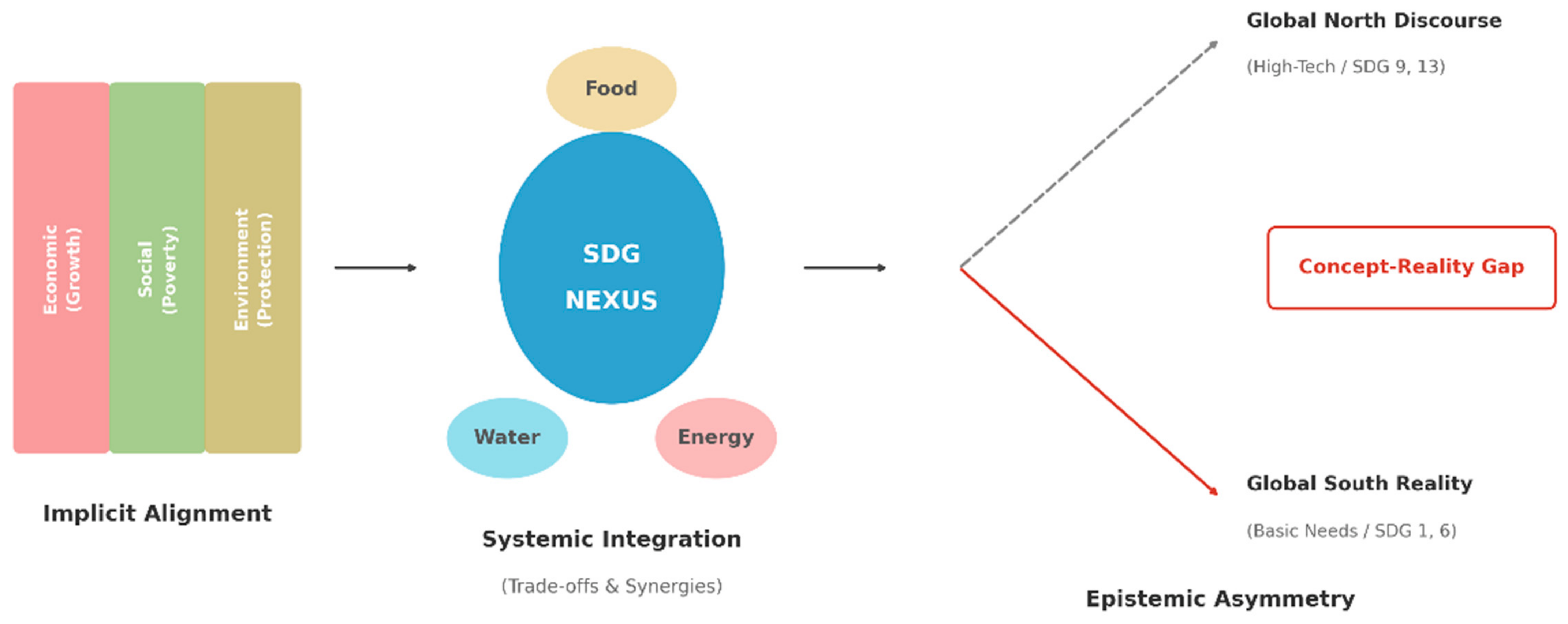
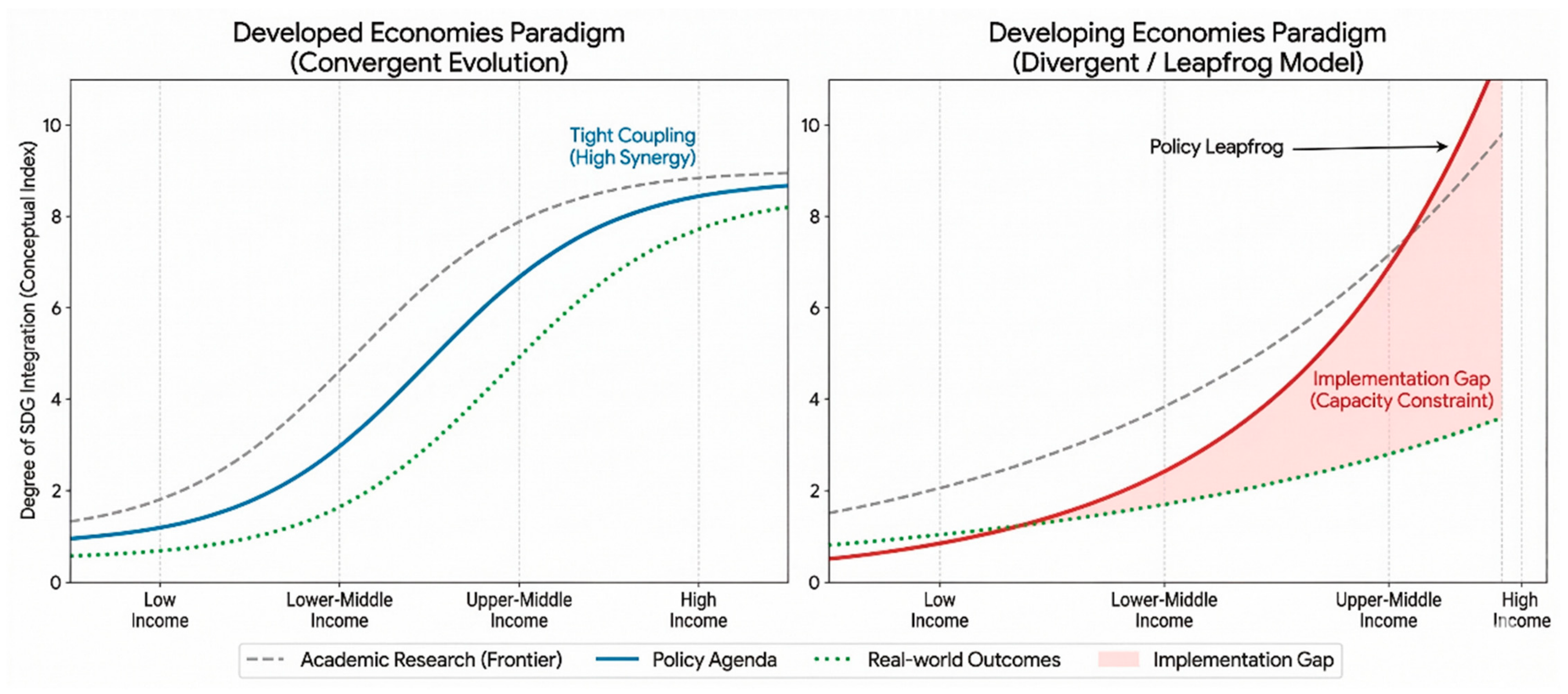
The transformation of rural policy research represents a progressive maturation from “implicit alignment” to “systemic integration.” Before 2015, concepts such as “multifunctionality” and “sustainable livelihoods” served as crucial precursors to the SDGs, though these early frameworks often treated economic growth and environmental protection as competing objectives. The 2030 Agenda catalyzed a shift toward integrated “Nexus” approaches, explicitly navigating synergies and trade-offs between interconnected goals. However, a persistent “Concept-Reality Gap” remains (Figure 14): the academic core, dominated by the Global North, increasingly prioritizes high-tech intensification (SDG 9) and decarbonization (SDG 13), potentially obscuring the pressing realities of the Global South, such as basic tenure security (SDG 1) and infrastructure access (SDG 6).
A further interpretive caution concerns the retrospective nature of SDG alignment assessment. The apparent “implicit alignment” of pre-SDG policies—particularly those enacted before 1960—may partly reflect the retrospective imposition of a contemporary analytical lens rather than genuine anticipatory policy design. The distinction between prescient governance and post hoc classification is difficult to resolve empirically, and readers should interpret early-stage alignment scores as indicative of thematic correspondence rather than deliberate sustainability orientation.

4.2. Cross-Country Synthesis: Stage-Based Comparison and SDGs Alignment

Building on the case studies in Section 3.2 and the quantitative analysis in Section 3.3, this section synthesizes cross-country findings to identify distinct evolutionary characteristics and divergent trajectories (Table 3). The quantitative results established two foundational observations that structure the analysis below. At the aggregate level, SDG alignment is primarily driven by the year of policy enactment rather than by income stage or development status (Table 2). This “temporal convergence” is consistent with the diffusion of global sustainability discourse—while also reflecting the structural expansion of institutionalized governance domains captured by the SDG classification system (Section 2.3)—particularly following the MDGs (2000) and the 2030 Agenda (2015). At the structural level, the per-SDG regression (Appendix D Table A4) reveals that income stage and the developed–developing divide exert significant effects on which specific SDGs receive attention. This “aggregate convergence with structural divergence” provides the quantitative foundation for the trajectory typologies discussed in Section 4.2.2.

4.2.1. Rural Policy Characteristics

Developed Countries’ Characteristics
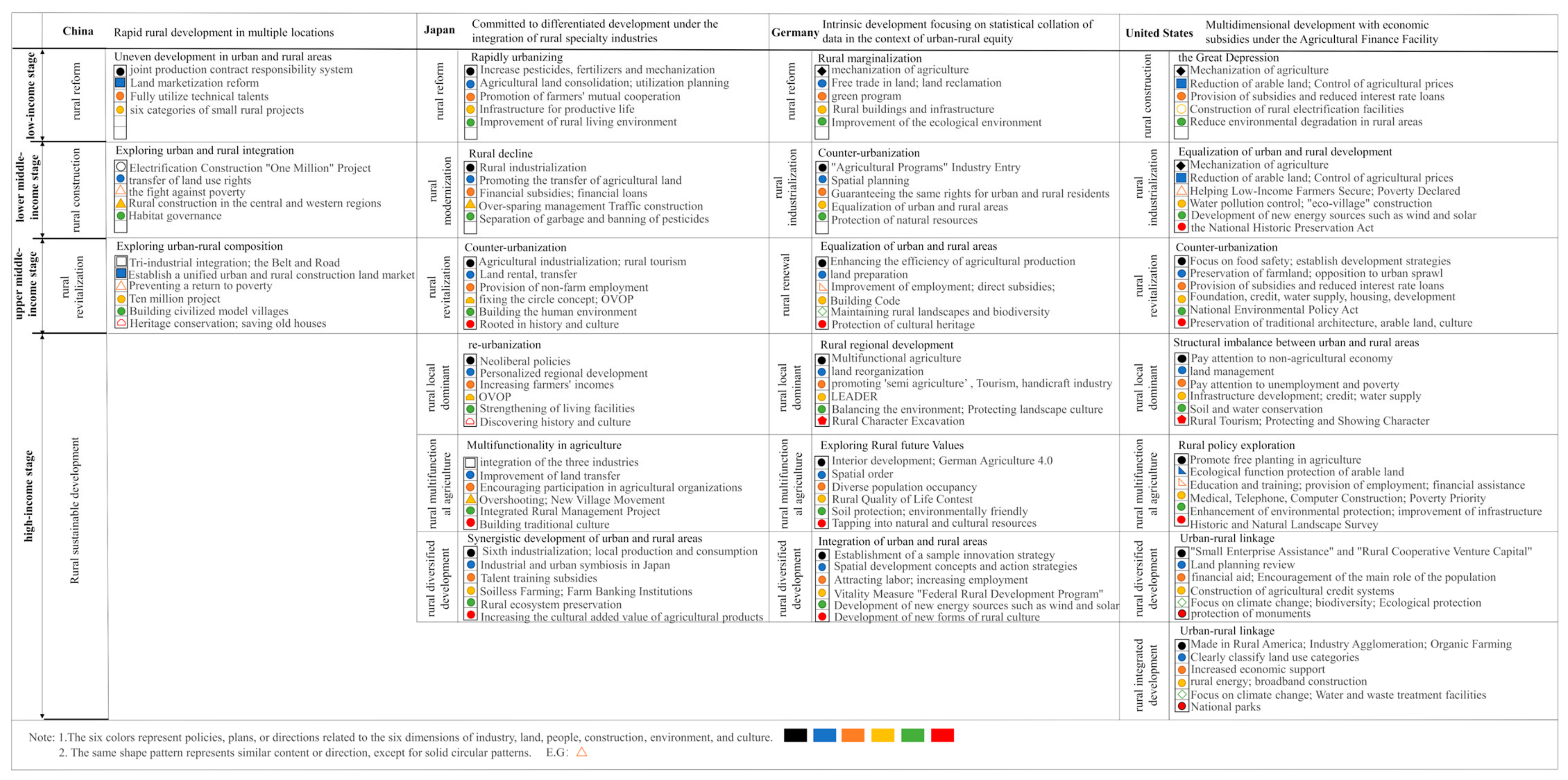
Based on the analytical framework of the United Nations 2030 Agenda for the SDGs, developed and developing countries exhibit significant phased characteristics and pathway differences in rural policy evolution [83]. Similarly, rural policy priorities exhibit distinct stages corresponding to different levels of economic development, aligning closely with the multi-tiered goals of the SDGs [31]. The rural policy evolution in Japan, Germany, the United States, and China reveals three interconnected characteristics. China is included here because, despite its upper-middle-income classification, its vast scale and regional differentiation enable it to demonstrate all three features (phases, continuity, flexibility) observed in developed countries while also providing transferable experience for other developing economies.
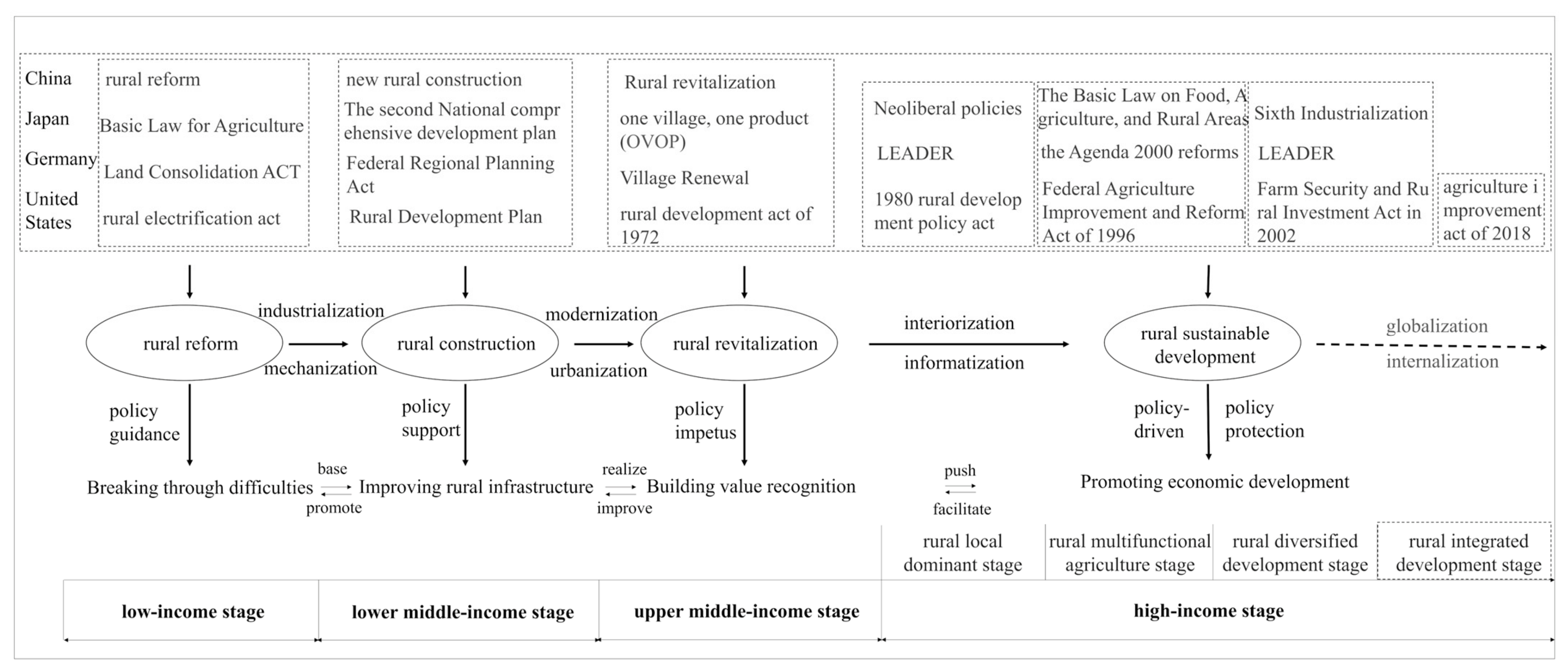
(1) Phases (Figure 15). Rural policy evolution follows a distinct four-stage progression corresponding to economic development levels, revealing a transformation from mono-functional “production spaces” toward “multifunctional territories.” In foundational stages, governments function as “Guides” addressing survival imperatives (SDG 1, 2, 8, 9); in advanced stages, they become “Protectors” of ecological balance. The high-income stage is characterized by “Comprehensive Synergy,” where integrated governance frameworks maximize co-benefits across economic vitality, social equity, and environmental resilience (SDG 12, 13, 15, 17). The per-SDG regression provides direct quantitative support: SDG 12 (Stage β = 0.490, p-FDR < 0.001), SDG 17 (β = 0.468, p-FDR < 0.001), SDG 15 (β = 0.336, p-FDR < 0.001), and SDG 13 (β = 0.329, p-FDR = 0.004) all show significant positive associations with rising income stages after FDR correction, consistent with these “late-emergence” SDGs as development-stage-contingent patterns.
(2) Continuity (Figure 16): A defining characteristic is remarkable temporal continuity through “Adaptive Policy Layering.” Rather than volatile shifts, these nations utilize long-standing legislative frameworks as stable governance platforms—Japan’s Basic Act (1961→1999→2024), Germany’s Land Consolidation Act (since 1953), America’s Farm Bills (since the 1930s), and China’s annual No. 1 Central Document (since 2004). This continuity operates through “inheritance, development, and innovation”: new environmental and social mandates are layered onto established legal vehicles, ensuring that SDG integration is cumulative rather than disruptive—building upon SDG 2 to progressively incorporate SDG 15, SDG 11, and SDG 13.
(3) Flexibility [4,11,17,19,23,32,35,36,37,38,39,40,41,43,46,47,48,49,51,52,53,55,56,59,61,62,63,84,85,89,90,91,92,93,94,95,96]. Complementing institutional stability is “Multidimensional Flexibility” across six core dimensions: industry, land, people, construction, environment, and culture (Appendix A). Vertically, policies progress from “hard” interventions (infrastructure, land consolidation) to “soft” values (ecological protection, cultural heritage). Horizontally, nations at similar income levels show remarkable policy convergence, “Isomorphic Policy Learning”, consistent with the bibliometric finding that the EU’s CAP serves as a central reference framework. Cross-stage flexibility further reveals the iterative nature of policy-making: specific instruments fade at certain stages only to be reabsorbed under new rationales (e.g., production subsidies evolving into green payments).
Developing Countries’ Characteristics
By synthesizing the trajectories of China, India, and South Africa, two distinctive characteristics emerge: Intensification and Leapfrogging. Unlike the sequential Western progression, developing nations face “time compression” that compels high-impact, large-scale interventions simultaneously addressing productivity and social equity [86]—China’s Household Contract Responsibility System [87,95], India’s MGNREGA [70,88], and South Africa’s post-apartheid land redistribution all exemplify this logic [81,88]. The per-SDG regression confirms this pattern: SDG 10 (Dev β = −0.803, p-FDR = 0.002), SDG 5 (Dev β = −0.864, p-FDR < 0.001), and SDG 1 (Dev β = −0.524, p-FDR = 0.046) show significantly higher scores in developing countries after FDR correction, consistent with these “development-imperative” goals as systematic priorities.
Complementing this intensity is “Leapfrogging,” enabled by latecomer advantages in technology diffusion and global policy learning. India’s Digital India Programme, for instance, creates digital public infrastructure that bypasses traditional banking and extension systems. Crucially, the SDG framework itself acts as a roadmap that developed countries lacked during their earlier modernization, and international research cooperation (SDG 17) serves as a channel for knowledge transfer, allowing developing nations to integrate sustainability goals as a starting point rather than a retroactive fix.

4.2.2. Divergent Policy Trajectories Across Development Stages

The aggregate GLM finding—that Year, rather than Stage or Dev, dominates SDG alignment—does not invalidate stage-based trajectory analysis; rather, it reframes it. The Year effect captures the “what” (universal increase in policy content breadth); the trajectory typologies explain the “how” (divergent structural routes)—proposed as interpretive constructs rather than statistically validated models. Different countries navigate toward higher SDG alignment through qualitatively different pathways, prioritizing different goals at different stages.
The Figure 17 shows that the U-shaped Remedial Trajectory (Developed Economies). The rural policy evolution of Japan, Germany, and the USA exhibits a “U-shaped” trajectory—a dialectical process of “Survival–Alienation–Restoration.” Initially driven by survival rationality (SDG 1, 2), the man-land relationship maintained a primitive equilibrium. As industrialization advanced, rural areas were alienated into providers of production factors (SDG 9), causing policy focus to plunge into a trough of “low harmony”—gains in efficiency achieved at the expense of social structures and ecological integrity. The ascent reflects institutional correction of “industrial failures.” As capital accumulated, policy logic shifted from “extraction” to “nurturing,” repairing SDG 10 and SDG 15, ultimately pursuing systemic sustainability (SDG 12, 13). The per-SDG regression is consistent with this restoration interpretation: as reported in Appendix D Table A4, the four SDGs with the strongest positive income-stage coefficients—SDGs 12, 17, 15, and 13—are precisely those characterizing the upward arm of the U-shape, suggesting that ecological restoration, responsible production, and partnership governance tend to emerge at higher income levels. The U-shape thus suggests that current high SDG alignment in developed nations may reflect a “remedial outcome” following a sequential logic of “pollute first, clean up later.”
The J-shaped Leapfrogging Trajectory (Developing Economies). Developing nations exhibit a “J-shaped” trajectory driven by “Time-Space Compression.” Starting from the same focus on basic needs (SDG 1, 2), they leverage digital technology (SDG 9) and global sustainability consensus to achieve “Convex Acceleration,” shortening or skipping the high-pollution phase. The quantitative findings illuminate a critical nuance. The Dev-Developed coefficient is negative across all aggregate models, and developing countries score significantly higher on SDGs 10, 5, and 1 after FDR correction. However, once Year is controlled, this group effect becomes non-significant in the aggregate models (p = 0.390–0.759), indicating that the higher SDG coverage partly reflects a “late-comer discursive advantage”: policies formulated during the post-2000 era naturally embed more sustainability language. This enriches the J-shaped analysis by revealing that leapfrogging operates partly at the discursive level (policy text alignment) and not solely at implementation—connecting directly to the “Implementation Gap” in Section 4.3.
China’s “Compressed Checkmark.” China epitomizes this model’s extreme intensity: a “Sharp Dip” from rapid industrialization followed by a “Vertical Ascent” driven by state mobilization and “Ecological Civilization” strategies. The theoretical core is “Simultaneity”: unlike the Western sequence, developing nations face pre-industrial (poverty), industrial (infrastructure), and post-industrial (ecology) challenges concurrently, signaling a pathway where industrialization and ecological preservation co-evolve.

4.2.3. Synergies and Trade-Offs: Internal Dynamics of Policy Interactions

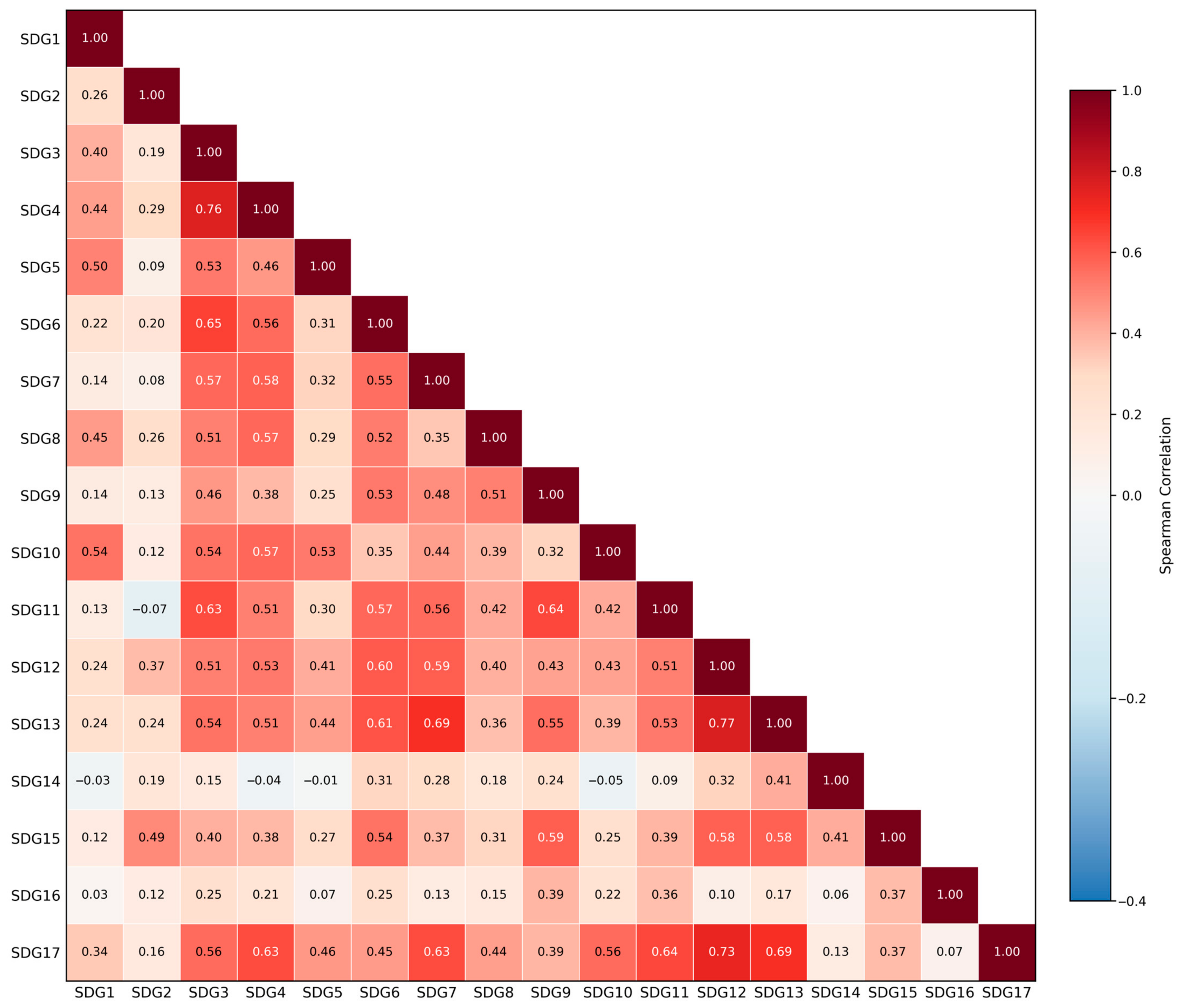
The Spearman rank correlation matrix computed across all 79 policy observations provides empirical evidence for structural patterns in SDG co-alignment, shifting from trade-offs in early stages to synergies in advanced stages.
The Figure 18 shows that synergies are most pronounced among goals clustering within the same governance paradigm. The strongest correlations are between SDG 3 and SDG 4 (ρ = 0.759, health–education nexus), SDG 12 and SDG 13 (ρ = 0.773, responsible production–climate action), and SDG 12 and SDG 17 (ρ = 0.732, sustainable production–partnerships). This cluster of late-emergence SDGs (12, 13, 15, 17) forms a mutually reinforcing governance ecosystem characterizing the advanced policy stage. Furthermore, SDG 9 acts as a critical enabler for SDG 2: investments in digital infrastructure and agricultural technology enhance food security without necessitating land expansion, demonstrating that advanced frameworks can decouple development from degradation.
Trade-offs are predominantly observed in early modernization. The pursuit of SDG 2 frequently comes at the expense of SDG 15 and SDG 6, as agricultural expansion drives land conversion and water over-extraction. The near-zero correlation between SDG 2 and SDG 11 (ρ = −0.071) confirms that food security and sustainable community development are not systematically co-addressed across the policy sample. SDG 14 (Life Below Water) is notably isolated, exhibiting near-zero correlations with all other goals (e.g., SDG 4: ρ = −0.040; SDG 5: ρ ≈ 0.000), indicating that marine resource management operates as a policy silo—structurally predictable given the terrestrial orientation of rural policies, yet representing a missed opportunity for integrated water–land–food governance.
These empirical patterns of SDG synergies and trade-offs resonate with the thematic evolution identified in the bibliometric analysis (Section 3.1). The keyword timeline visualization (Figure 3) showed that before 2015, research themes such as “rural development,” “agriculture policy,” and “environmental policy” operated in relatively separate clusters—mirroring the policy-level trade-offs observed in the correlation matrix, where early-stage SDGs (2, 8, 9) exhibit weak or negative correlations with environmental goals (13, 15). After 2015, the bibliometric analysis revealed a consolidation of these themes into integrative clusters such as “rural sustainable development” and “energy policy,” paralleling the strong positive correlations among late-emergence SDGs (12–13: ρ = 0.773; 12–17: ρ = 0.732) that characterize advanced-stage policy. The patterns suggest a parallelism between academic discourse and policy texts: research themes evolved from sectoral silos toward integrative frameworks, while policy texts show a corresponding shift from trade-offs toward synergies. This parallel between bibliometric and quantitative findings provides additional support for the “implicit-to-systemic” maturation thesis proposed in Section 4.1, though the association is interpretive rather than formally tested.

4.3. The “Research-Policy-Development” Nexus: A Dynamic Feedback Mechanism

The Figure 19 shows that the divergence in trajectories is structurally determined by the dynamic feedback between Research Supply, Policy Demand, and Developmental Constraints. We propose a “Supply-Demand-Match” Model where the Stage of Development acts as a “Filter” regulating the translation of academic knowledge into political action.
In developed economies, research functions as a “Lead” mechanism: scholars conceptualized “landscape ecology” and “rural social decline” decades before these issues entered the political agenda, proactively guiding reforms like the EU’s CAP greening. In developing economies, the relationship is reversed—a “Policy-Led, Research-Lag” dynamic where state initiatives like China’s “Rural Revitalization” are launched first, with research providing ex-post interpretation.
The per-SDG regression results (Appendix D Table A4) provide direct empirical support for this filtering mechanism. When the developmental filter is narrow (“survival rationality”), policy attention concentrates on “development-imperative” goals—SDGs 1, 5, and 10 are systematically prioritized in developing-country policies (Dev coefficients surviving FDR correction: SDG 5 and SDG 10 at p-FDR < 0.01, SDG 1 at p-FDR = 0.046). As the filter widens (“ecological rationality”), “late-emergence” goals—SDGs 12, 13, 15, and 17—achieve prominence (all Stage coefficients significantly positive at p < 0.01). Importantly, the stage-based filter does not suppress SDG awareness in policy texts (the Year effect shows all countries increasingly adopt SDG language); rather, it selectively channels governance capacity toward goals aligned with the prevailing hierarchy of social needs.
The model explains the critical paradox where well-crafted policy does not guarantee SDG outcomes. The GLM’s finding that Year dominates aggregate alignment underscores this: developing countries have been highly effective at absorbing global sustainability discourse into policy texts—a “late-comer discursive advantage.” However, policy-text alignment does not equate to implementation capacity. While the policy vision aligns with advanced SDGs, institutional capacity is frequently insufficient, leading to “policy decoupling.” The realization of SDGs depends not just on knowing (Research) or planning (Policy), but fundamentally on the developmental capacity to bridge the gap between vision and reality.

5. Conclusions

This study integrates bibliometric analysis, comparative policy analysis, and quantitative regression modeling across 79 rural policy documents from six countries, yielding three principal contributions. First, the bibliometric analysis documents a progressive maturation of rural policy research from sectoral silos to systemic integration after 2015, with SDG adoption coinciding with a thematic reorientation of research priorities. Second, the quantitative analysis identifies “aggregate convergence with structural divergence”: the year of policy enactment is the sole significant predictor of overall SDG alignment (p < 0.01), while income stage and the developed–developing divide significantly shape which specific SDGs receive attention—identifying “late-emergence” goals (SDGs 12, 13, 15, 17) that scale with income and “development-imperative” goals (SDGs 1, 5, 10) systematically prioritized in developing countries. Third, three distinct evolutionary trajectories are proposed as interpretive constructs derived from comparative analysis: a U-shaped remedial path in developed economies, a J-shaped leapfrogging path in developing economies, and China’s Compressed Checkmark trajectory. These constructs are intended as conceptual typologies that organize the observed patterns of SDG alignment across stages; they do not constitute statistically validated trajectory models. The study further proposes a “Research–Policy–Development” nexus model, suggesting that economic stages act as a “filter” channeling governance capacity toward goals aligned with prevailing social needs, and that developing countries benefit from a “late-comer discursive advantage” in policy-text alignment that does not necessarily translate into implementation capacity.
For policymakers, particularly in developing and emerging economies, several concrete implications follow. First, the finding that Year dominates aggregate SDG alignment suggests that countries should actively engage with international sustainability frameworks—not merely as aspirational commitments, but as practical design templates for domestic rural policy. Developing countries can leverage the “late-comer discursive advantage” identified in this study by embedding SDG targets directly into legislative language and policy evaluation criteria from the outset, rather than treating sustainability as a retroactive add-on. Specifically, new rural policies should include explicit SDG mapping statements that identify which goals the policy addresses and how progress will be monitored, transforming the discursive alignment documented here into an accountability mechanism.
Second, the “development-stage filter” mechanism has direct operational implications: countries at lower-middle-income stages should resist the temptation to adopt advanced-economy policy templates wholesale. The per-SDG regression shows that “late-emergence” goals (SDGs 12, 13, 15, 17) scale naturally with income growth, while “development-imperative” goals (SDGs 1, 5, 10) require sustained attention regardless of economic progress. This implies a two-track policy architecture: a foundation track that maintains unwavering commitment to poverty reduction, education, gender equity, and spatial inclusion, and an anticipatory track that progressively incorporates environmental sustainability and partnership governance as institutional capacity expands—rather than attempting all 17 goals simultaneously with equal intensity.
Third, the Chinese experience of institutional coherence—manifested through adaptive policy layering and annual policy iteration via the No. 1 Central Document system—offers a transferable governance innovation. Countries such as India and South Africa, where rural policy tends to emerge through episodic flagship programs, could benefit from establishing regularized annual or biennial rural policy review cycles that enable incremental SDG integration without the political costs of wholesale reform.
Fourth, the SDG correlation analysis demonstrates that trade-offs between goals in early stages (e.g., SDG 2 versus SDG 15) can transform into synergies in advanced stages (e.g., SDG 12–13–17 cluster). This finding argues for incorporating SDG interaction assessments—systematic evaluation of goal synergies and trade-offs—into rural policy design from the outset, so that early-stage interventions are calibrated to avoid locking in development pathways that foreclose future sustainability gains. Finally, to bridge the critical gap between policy-text alignment and implementation capacity, developing countries should invest in building the institutional infrastructure for SDG monitoring at subnational levels, ensuring that the discursive sophistication documented in this study translates into measurable progress on the ground.
This study is subject to certain limitations. First, the policy corpus is necessarily selective rather than exhaustive, focusing on landmark policies that defined major shifts in rural development orientation at each income stage. For earlier historical periods, certain policy texts are no longer publicly accessible due to archival limitations or incomplete digitization; where original texts were unavailable, policy content was triangulated through contemporaneous academic literature and official secondary sources. Similarly, while the six selected countries capture major development stages and regional diversity, they do not exhaust the full spectrum of global rural experiences. Second, the AI-assisted scoring methodology, though validated through systematic human review, may introduce model-specific biases in initial score generation; future studies could explore multi-model cross-validation to further strengthen coding robustness. Third, this study identifies thematic alignment patterns at the national level rather than evaluating causal effectiveness; future research could integrate subnational comparisons and micro-level empirical evidence to examine how SDG-oriented rural policies translate into implementation outcomes across diverse institutional settings. Fourth, the temporal scope of the SDG coding warrants caution: several SDG dimensions—notably SDG 5 (gender), SDG 7 (energy), SDG 12 (sustainable production), and SDG 13 (climate action)—correspond to governance fields that emerged primarily after the mid-20th century, rendering earlier policies structurally incapable of scoring on these dimensions. The observed temporal trend in SDG alignment thus reflects a combination of genuine policy broadening and the expanding institutional scope captured by the SDG classification system, rather than discourse diffusion alone. Fifth, the retrospective application of the SDG framework to policies dating back to 1913 carries inherent risks of conceptual anachronism. Certain SDG dimensions—particularly SDG 5 (gender), SDG 7 (energy), and SDG 13 (climate action)—did not exist as institutionalized governance fields until the latter half of the 20th century, meaning that zero scores assigned to early-stage policies reflect structural absence rather than policy failure. Moreover, the substantive meaning of shared policy themes shifts considerably across historical contexts: food security provisions in post-war Japan operated under existential scarcity conditions qualitatively distinct from contemporary sustainable food-systems governance, yet both are coded under SDG 2. Cross-temporal SDG scores should therefore be interpreted as broad indicators of thematic orientation rather than equivalent or directly comparable measurements of policy content.
As the 2030 deadline approaches, the critical determinant of global success will shift from “identifying goals” to “managing interactions.” The evolution of rural policy is ultimately a transition from managing painful trade-offs to fostering systemic synergies. By recognizing the structural constraints of development stages and leveraging both technological and institutional capacity to bridge the gap between ambition and reality, nations can transform rural areas from “sinks” of backwardness into “reservoirs” of sustainable innovation. This study suggests that diverse pathways—whether U-shaped restoration or J-shaped leapfrogging—may ultimately converge toward the shared global imperative of integrated, multifunctional, and resilient rural development.

Supplementary Materials

The following supporting information can be downloaded at: https://www.mdpi.com/article/10.3390/land15071134/s1.

Author Contributions

Conceptualization, Z.L.; Methodology, Z.L.; Software, Z.L. and M.H.; Validation, H.Z., M.H. and X.Y.; Investigation, Z.L. and M.H.; Data curation, X.Y.; Writing—original draft, Z.L.; Writing—review & editing, Z.L.; Visualization, Z.L.; Supervision, H.Z. and X.Y.; Project administration, X.Y.; Funding acquisition, X.Y. All authors have read and agreed to the published version of the manuscript.

Funding

This research received no external funding.

Data Availability Statement

The complete SDG alignment scoring matrices for all 79 policy documents—including full document titles, country of origin, year of enactment, and per-document coding justifications for all 17 SDGs—are available as Supplementary Materials (Six_Country_SDG_Coding_Matrix_Merged.xlsx). The AI-assisted coding protocol, scoring rubric, and illustrative coding examples are detailed in Appendix B.5.

Conflicts of Interest

The authors declare no conflict of interest.

Appendix A

Figure A1. Policy flexibility.
Land 15 01134 g0a1

Appendix B

Appendix B.1. Coding Purpose and Unit of Analysis

The purpose of SDG mapping in this study is to systematically identify conceptual alignment between rural policy themes and the SDGs, rather than to evaluate policy effectiveness or causal impacts.
The unit of analysis for SDG alignment is defined as the dominant policy theme identified for each country × policy stage, supplemented by the corresponding keyword cluster derived from the bibliometric analysis where applicable. Each unit may be aligned with one or multiple SDGs, reflecting the integrated and cross-cutting nature of rural sustainability policies.

Appendix B.2. Coding Approach and Rationale

A rule-based qualitative coding approach was adopted, combining manual classification with a predefined SDG codebook. This approach was chosen for three reasons: 1. SDG concepts are multidimensional and often context-dependent, limiting the validity of fully automated keyword matching; 2. Rural policy themes frequently span multiple SDGs, requiring interpretive judgment guided by explicit rules; 3. Manual coding with transparent criteria allows clearer justification and review of SDG alignment decisions.
The coding process follows three core principles: 1. Conceptual anchoring: All mappings are anchored in the official UN SDG definitions and targets; 2. Dominant-theme rule: SDGs are assigned based on the primary policy objective emphasized in a given stage, rather than incidental or marginal references; 3. Parsimony: To avoid over-attribution, each policy stage is aligned with a limited number of SDGs (typically 1–3).

Appendix B.3. SDG–Theme Mapping Codebook

Table A1 summarizes the operational mapping rules between policy themes/keyword clusters and SDGs.
Table A1. SDG Mapping Rules and Indicators.
SDGCore Conceptual FocusPolicy Themes/Keyword Indicators Used for CodingCoding Criteria (0/1/2)
SDG 1
No Poverty
Income security, poverty reductionrural livelihoods, income support, poverty alleviation, inclusive development0: No mention
1: General reference to income/livelihoods
2: Specific measures targeting rural poverty or income security
SDG 2
Zero Hunger
Food security, agricultural productivityagriculture, food security, farm support, CAP, arable land, agricultural production0: No mention
1: Agriculture referenced but not as food security
2: Explicit food security goals or agricultural production measures
SDG 3
Good Health
Health & well-beingrural health, living environment, public health, communicable disease0: No mention
1: Living conditions mentioned generally
2: Health-specific measures or targets
SDG 4
Quality Education
Education, training & knowledgeeducation, training, vocational, advisory services, knowledge transfer, capacity building, extension services, skills0: No mention
1: Education/training mentioned in passing
2: Specific education, training, or knowledge transfer measures
SDG 5
Gender Equality
Gender equity & empowermentgender equality, women, female empowerment, gender mainstreaming, women in agriculture0: No mention
1: Gender referenced without specific measures
2: Specific gender equity targets or empowerment measures
SDG 6
Clean Water
Water & sanitationwater supply, sanitation, water management, water quality, wastewater, irrigation, water resources, Gewässer0: No mention
1: Water mentioned peripherally
2: Specific water management, quality, or sanitation measures
SDG 7
Clean Energy
Energy access & transitionrenewable energy, energy policy, rural energy systems, bioenergy0: No mention
1: Energy briefly referenced
2: Specific energy transition measures or targets
SDG 8
Decent Work
Employment & growthrural employment, productivity, economic development0: No mention
1: Employment/growth mentioned in passing
2: Specific employment targets or economic development measures
SDG 9
Industry & Infrastructure
Infrastructure & innovationrural infrastructure, innovation systems, energy infrastructure0: No mention
1: Infrastructure mentioned without detail
2: Specific infrastructure investment or innovation measures
SDG 10
Reduced Inequalities
Spatial & social equityregional disparities, rural–urban gap, inclusive governance0: No mention
1: Equity acknowledged in principle
2: Specific measures addressing regional or social disparities
SDG 11
Sustainable Communities
Spatial planning & livabilityrural planning, human settlements, quality of life, livability0: No mention
1: Rural livability mentioned
2: Spatial planning or livability as core policy objective
SDG 12
Responsible Production
Sustainable production systemssustainable agriculture, resource efficiency, policy regulation0: No mention
1: Sustainability referenced broadly
2: Specific sustainable production standards or measures
SDG 13
Climate Action
Climate mitigation/adaptationclimate policy, emissions reduction, adaptation strategies0: No mention
1: Climate acknowledged without specific measures
2: Specific climate targets or adaptation/mitigation measures
SDG 14
Life Below Water
Marine & freshwater resourcesmarine resources, fisheries, aquaculture, coastal management, ocean, freshwater ecosystems0: No mention
1: Fisheries or water bodies mentioned in passing
2: Specific marine/freshwater resource management measures
SDG 15
Life on Land
Ecosystem & land systemsland use, biodiversity, ecosystem protection0: No mention
1: Land/ecosystem mentioned peripherally
2: Land management or biodiversity as policy focus
SDG 16
Strong Institutions
Governance & implementationinstitutional framework, policy implementation, governance capacity0: No mention
1: Governance structures implied
2: Explicit institutional design or implementation mechanisms
SDG 17
Partnerships
Cooperation & policy diffusioninternational collaboration, policy transfer, partnerships0: No mention
1: Cooperation mentioned
2: Specific partnership mechanisms or collaborative governance
Note: Coding follows the principle of dominant-theme parsimony. Only provisions that are substantively addressed in the policy text are scored; incidental mentions or peripheral references receive 0. Cross-goal additivity is not assumed; each SDG is scored independently.

Appendix B.4. Coding Procedure and Reliability Check

The coding was conducted in four steps: (1) AI-assisted initial scoring: Each policy document was processed using Claude Opus 4.6 with the SDG codebook and scoring rubric, generating a preliminary 17-SDG score matrix with justifications. (2) Independent human review: Two coders independently reviewed each AI-generated score against the original policy text, applying the dominant-theme and parsimony principles. (3) Cross-check and reconciliation: Coding results—including corrections to AI outputs and disagreements between coders—were compared and discussed until consensus was reached. (4) Consistency validation: Inter-coder reliability was assessed using Cohen’s kappa on the final human-validated scores. Ambiguous cases and final decisions were documented to ensure transparency and replicability.

Appendix B.5. AI-Assisted Coding Protocol and Transparency Statement

This appendix provides a full account of the AI-assisted SDG coding procedure, the scoring rubric used as the primary instruction set for the large language model, illustrative coding examples with documentary evidence, and a transparent statement of limitations. It is intended to address reproducibility concerns raised in peer review.

Appendix B.5.1. Overview of the AI-Assisted Coding Procedure

SDG alignment scores for 79 policy documents across six countries were generated through a structured three-step procedure combining large language model (LLM) assistance with systematic human review.
  • Step 1: AI-Generated Preliminary Scores
Claude Opus 4.6 (Anthropic) was used to generate initial SDG alignment scores for each policy document. The model was provided with: (1) the full text or a structured summary of each policy document; (2) the 17-SDG scoring rubric detailed in Appendix B.5.2 below; and (3) the instruction to assess alignment on a 0/1/2 scale and provide specific textual evidence (article citations or direct quotations) to justify each non-zero score.
The prompt structure followed a consistent template across all documents and countries. The scoring rubric in Table A2 constitutes the core instruction set provided to the model. The model was explicitly instructed to apply the rubric as a neutral analytical taxonomy of perennial policy domains, independent of whether the policies used contemporary SDG terminology.
  • Step 2: Human Review and Correction
Two trained coders independently reviewed each AI-generated score against the original policy document. Coders verified: (a) whether the textual evidence cited by the AI was accurately located in the original document; (b) whether the score assigned was consistent with the rubric; and (c) whether any relevant provisions had been missed. Discrepancies between the AI score and the human review were resolved through structured discussion guided by the rubric.
The complete set of coding justifications with documentary evidence is archived in the Supplementary coding matrices (Six-Country-SDG-Coding-Matrix-Merged.xlsx), which contain 1119 scored SDG-document pairs with article-level citations.
  • Step 3: Reliability Assessment
To assess inter-coder reliability prior to reconciliation, two coders independently re-coded a stratified random sample of 20 policy documents (Japan n = 3, Germany n = 3, USA n = 3, China n = 6, India n = 3, South Africa n = 2) without reference to the AI-generated scores or each other. Cohen’s kappa was computed on these independent scores before any discussion or reconciliation. The overall kappa was 0.763 (range 0.254 to 1.000 across individual SDGs), indicating substantial agreement. Discrepancies were subsequently resolved through structured discussion.

Appendix B.5.2. Illustrative Coding Examples

The following six examples illustrate how the scoring rubric was applied across different countries, policy types, historical periods, and score levels. Each example reproduces the documentary evidence that justified the assigned score.
Table A2. Illustrative Coding Examples.
CountryPolicy DocumentSDGScoreEvidence and Coding Rationale
Japan1961 Agricultural Basic ActSDG 82Art.1: increase agricultural income; Art.2(5): secure income. Income parity with non-agricultural workers is the explicit central goal. Score = 2 (Specific employment/income development program).
China1950 Land Reform Law SDG 12Art.1: Abolish the feudal exploitation of land ownership by the landlord class and implement the land ownership of farmers; Art.10: Allocated to impoverished farmers with limited land and production resources. Explicit redistribution of land and production resources to the rural poor is the core mechanism. Score = 2 (Specific poverty reduction measure).
South AfricaRestitution of Land Rights Act (1994)SDG 162Core: Land Claims Court established; Commission on Restitution of Land Rights created; comprehensive legal-institutional framework for adjudication. Score = 2 (Specific institutional governance mechanisms).
Germany1953 FlurbereinigungsgesetzSDG 151 landscape restructuring (Landschaftspflege) and nature protection mentioned as considerations; waterway planning includes environmental elements. Present but not a core objective. Score = 1 (Land/forestry mentioned generally).
United StatesRural Electrification Act of 1936SDG 20No food security or agricultural production provisions. The Act focuses exclusively on rural electrification infrastructure financing. Score = 0 (No food/agriculture provisions).
IndiaSwarnjayanti Gram Swarozgar Yojana (SGSY, 1999)SDG 102Mandatory targeting: SC/ST 50%, women 40%, disabled 3% of all beneficiaries. Below Poverty Line (BPL) census used for selection. Income generation for marginalized groups is the explicit goal. Score = 2 (Specific targeted programs for inequality reduction).
The complete set of 1119 coding justifications for all 79 documents is available in the Supplementary File Six-Country-SDG-Coding-Matrix-Merged.xlsx (sheet: “All Justifications”). Each entry includes country, document ID, SDG, score, and the specific article or provision cited as evidence.

Appendix B.5.3. Transparency Statement and Limitations

What is provided?
The complete scoring rubric constituting the AI instruction set (Table A1 in the main text).
Per-document SDG justifications with article-level citations for all 79 documents x 17 SDGs = 1394 coding decisions (Supplementary File).
Inter-coder reliability computed on independent pre-reconciliation coding of 20 documents (κ = 0.763).

Appendix B.6. Interpretation Scope and Limitations

SDG alignment in this study captures thematic and conceptual correspondence between rural policy evolution and the SDGs. It does not measure policy effectiveness, causal impacts, or progress toward SDG targets. Findings should therefore be interpreted as evidence of alignment in policy orientation and research attention, rather than as causal evaluation of SDG outcomes.

Known Limitations

Absence of verbatim prompt log. The verbatim API prompt text used during the initial AI scoring phase was not systematically archived. The scoring rubric in Table A1 constitutes the core instructional content, but the exact preamble and system prompt cannot be reproduced exactly. Future studies should implement prompt logging as standard practice.
Human override rate not recorded. The proportion of AI-generated scores that were modified during human review was not systematically tracked. Both coders reviewed all scores for consistency with the rubric and the primary document; corrections were made where necessary. The absence of a formal override log prevents precise quantification of the AI-to-human correction rate. This is acknowledged as a reproducibility limitation.
Potential temporal bias in AI scoring. Claude Opus 4.6 was trained on contemporary text corpora, which may introduce a systematic tendency to recognize post-2015 sustainability vocabulary in older documents more readily than a domain-naive coder would. Several measures partially mitigate this risk: (a) the scoring rubric operationalizes each SDG as a perennial policy domain (e.g., SDG 1 as income support, not as SDGs per se), avoiding explicit SDG branding in the instruction set; (b) human coders verified all scores against the original policy texts; and (c) the limitation is explicitly flagged in Section 5 of the main manuscript. Nonetheless, complete elimination of this bias cannot be claimed, and results should be interpreted with this constraint in mind.
Multi-model cross-validation. Cross-validation using multiple LLMs was not performed at the time of initial coding and is noted as a direction for future work (Section 5, main manuscript). The substantial inter-coder reliability between two human reviewers (κ = 0.763) provides the primary empirical basis for confidence in the scores.

Appendix C

To verify the robustness of findings against potential distributional effects from unequal sample sizes across countries, all GLM models were re-estimated on a balanced subsample. In this subsample, a maximum of 10 policies per country were retained through stratified random sampling (seed = 42), yielding a reduced dataset of n = 57: Japan (n = 10), Germany (n = 8), United States (n = 10), China (n = 10), India (n = 10), and South Africa (n = 9). Germany and South Africa retain all available policies as their totals are below the cap.
Table A3. GLM regression results for SDG alignment indicators (balanced sample, n = 57).
ModelSampleDep. Var.InterceptpStagepDev.pYearpR2Adj. R2nBIC
M4BalancedTotal−324.840.003 ***0.2820.8370.8120.7610.1720.002 ***0.3680.33257222.1
M5BalancedCoverage−184.72<0.001 ***0.0640.9290.8310.5560.098<0.001 ***0.3890.35557149.3
M6BalancedCore−140.120.021 **0.2180.779−0.0180.9900.0730.018 **0.2670.22557157.4
Note: *** p < 0.01, ** p < 0.05. Stage: 1 = Low income → 4 = High income. Dev: 1 = Developed, 0 = Developing.
The core findings are qualitatively consistent with the full-sample results reported in Table 2. Year remains the only predictor achieving statistical significance in all three models: M4 (β = 0.172, p = 0.002), M5 (β = 0.098, p < 0.001), and M6 (β = 0.073, p = 0.018). Stage-Num and Dev-Developed remain non-significant across all specifications (p = 0.556–0.990). The direction and magnitude of the Year coefficient are closely comparable between the full and balanced samples (full: 0.163; balanced: 0.172 for Total SDG Score), confirming that the temporal trend in SDG alignment is a robust phenomenon not driven by any single country’s policy count. The slightly lower R2 values in the balanced sample (0.225–0.355 vs. 0.343–0.417) are expected given the reduced sample size and the removal of high-information observations from China.
To assess the sensitivity of the balanced-sample results to the specific random draw, the stratified sampling and GLM estimation were repeated across 100 different random seeds. Across all 100 iterations, Year remained statistically significant at p < 0.05 in 100% of Total SDG Score models (M4), 100% of Coverage models (M5), and 100% of Core SDG Count models (M6). Stage-Num failed to reach significance (p < 0.05) in any iteration for any dependent variable (0/100). Dev-Developed similarly failed to reach significance in any iteration for Total SDG Score (0/100). The mean Year coefficient across 100 iterations was 0.167 (SD = 0.007) for Total SDG Score, closely matching the single-draw estimate of 0.172. These results confirm that the substantive conclusions are subsample stability check to the specific random subsample and not artifacts of a particular seed.

Appendix D

Table A4. Per-SDG GLM Results with Benjamini–Hochberg FDR Correction (Balanced Sample, n = 57).
SDGStage βStage pStage p (FDR)Dev βDev pDev p (FDR)R2
SDG10.0750.3720.508−0.5240.012 *0.046 ✓0.221
SDG20.1190.1760.3320.0290.8910.9470.121
SDG30.1450.1260.285−0.2180.3390.5010.105
SDG40.1480.1190.285−0.3240.1570.3210.216
SDG50.2760.002 *0.007 ✓−0.864<0.001 *<0.001 ✓0.290
SDG60.1220.2160.368−0.1380.5600.7060.081
SDG70.1740.0970.2540.1260.6160.7280.062
SDG8−0.0130.8770.947−0.0340.8720.9470.032
SDG90.1120.3040.4690.2730.2980.4690.040
SDG100.2990.001 *0.005 ✓−0.803<0.001 *0.002 ✓0.383
SDG110.2280.023 *0.077−0.2110.3740.5080.125
SDG120.490<0.001 *<0.001 ✓−0.2830.1610.3210.405
SDG130.3290.001 *0.004 ✓−0.1330.5500.7060.215
SDG140.0990.2030.3630.4020.034 *0.0970.109
SDG150.336<0.001 *<0.001 ✓−0.0070.9740.9740.301
SDG160.0040.9510.9740.0860.6210.7280.012
SDG170.468<0.001 *<0.001 ✓−0.4830.030 *0.0920.339
Note: β = unstandardized regression coefficient. “p (FDR)” = Benjamini–Hochberg adjusted p-value across all 34 coefficients. ✓ = significant after FDR correction (adjusted p < 0.05). * = significant at raw p < 0.05. Before correction: 12/34 significant; after FDR correction: 9/34. Stage: 1 = Low income → 4 = High income. Dev: 1 = Developed, 0 = Developing.
Table A5. Comparison of OLS and Country-Clustered Standard Errors (n = 79).
OutcomeSE TypeStage βStage pDev βDev pYear βYear pR2
Total SDG ScoreOLS1.2330.291−1.4770.5080.163<0.001 ***0.440
Total SDG ScoreClustered1.2330.559−1.4770.6250.1630.0920.440
SDG CoverageOLS0.4340.472−0.3540.7590.088<0.001 ***0.419
SDG CoverageClustered0.4340.632−0.3540.8270.0880.0890.419
Core SDG CountOLS0.7990.242−1.1230.3900.0750.007 ***0.368
Core SDG CountClustered0.7990.542−1.1230.5330.0750.1280.368
Note: Clustered SE computed at the country level (6 clusters). With only 6 clusters, clustered SE are conservative and p-values are expected to increase. Year remains the dominant predictor across both specifications. *** indicates statistical significance at the 0.001 level.
Table A6. China-Excluded Sensitivity Analysis (n = 47; Japan, Germany, USA, India, South Africa).
OutcomeStage βStage pDev βDev pYear βYear pR2
Total SDG Score−0.0470.9742.5100.3970.1700.004 ***0.348
SDG Coverage−0.1100.8871.6920.2970.0990.002 ***0.364
Core SDG Count0.0630.9360.8180.6180.0710.025 **0.246
Note: *** p < 0.01, ** p < 0.05. Stage and Dev remain non-significant; Year remains the sole significant predictor, confirming the main finding is not driven by China’s larger subsample (n = 32).
Table A7. Alternative Model Specifications (n = 79).
ModelOutcomeStage βStage pDev βDev pYear βYear p
Gaussian GLMTotal SDG Score1.2330.287−1.4770.5060.163<0.001 ***
Gaussian GLMSDG Coverage0.4340.472−0.3540.7590.088<0.001 ***
Gaussian GLMCore SDG Count0.7990.242−1.1230.3900.0750.007 ***
Poisson GLMSDG Coverage0.0270.649−0.0100.9320.0080.001 ***
Poisson GLMCore SDG Count0.1070.204−0.1320.4210.015<0.001 ***
Tobit (=OLS)Total SDG Score1.2330.287−1.4770.5060.163<0.001 ***
Note: *** p < 0.01. Poisson coefficients are on the log scale. Total SDG Score ranges 2–33 in this sample; with no observations at the censoring boundaries (0 or 34), the Tobit model reduces to OLS. Year is significant across all six specifications; Stage and Dev are non-significant in all specifications.

References

  1. Liu, Y.; Li, Y. Revitalize the World’s Countryside. Nature 2017, 548, 275–277. [Google Scholar] [CrossRef] [PubMed]
  2. Barrera-Perales, O.T.; Burgos, A.L. Conceptual Distinction between Agricultural Innovation and Rural Innovation: Implications for Scientific Research and Public Policy. Innov. Dev. 2023, 13, 471–492. [Google Scholar] [CrossRef]
  3. Farisani, T.R. Assessing the Impact of Policies in Sustaining Rural Small, Medium and Micro Enterprises during COVID-19 Pandemic in South Africa. South. Afr. J. Entrep. Small Bus. Manag. 2022, 14, 505. [Google Scholar] [CrossRef]
  4. Goetz, S.J.; Partridge, M.D.; Stephens, H.M. The Economic Status of Rural America in the President Trump Era and Beyond. Appl. Econ. Perspect. Policy 2018, 40, 97–118. [Google Scholar] [CrossRef]
  5. Lindsay, A.R.; Sanchirico, J.N.; Gilliland, T.E.; Ambo-Rappe, R.; Taylor, J.E.; Krueck, N.C.; Mumby, P.J. Evaluating Sustainable Development Policies in Rural Coastal Economies. Proc. Natl. Acad. Sci. USA 2020, 117, 33170–33176. [Google Scholar] [CrossRef] [PubMed]
  6. Mulibana, L.; Tshikovhi, N. Rural Entrepreneurship and Innovation in BRICS Economies: Secondary Evidence from Rural Areas in South Africa. Sustainability 2024, 16, 2408. [Google Scholar] [CrossRef]
  7. Slight, P.; Adams, M.; Sherren, K. Policy Support for Rural Economic Development Based on Holling’s Ecological Concept of Panarchy. Int. J. Sustain. Dev. World Ecol. 2016, 23, 1–14. [Google Scholar] [CrossRef]
  8. Tambe, S.; Arrawatia, M.L.; Ganeriwala, A.K. Managing Rural Development in the Mountain State of Sikkim, India: Experiences, Innovative Approaches, and Key Issues. Mt. Res. Dev. 2012, 32, 242–252. [Google Scholar] [CrossRef]
  9. 唐超; 罗明忠; 张苇锟. 70年来中国扶贫政策演变及其优化路径. 农林经济管理学报 2019, 18, 283–292. [Google Scholar]
  10. 武小龙. 英国乡村振兴的政策框架与实践逻辑. 华南农业大学学报 (社会科学版) 2020, 19, 23–33. [Google Scholar] [PubMed]
  11. Goto, J. Evolution of Rural and Agricultural Policy in Japan, 1945–2002. In Revitalization: Fate and Choice; Chapter 3; Rural Development Institute: Brandon, MB, Canada, 2008; p. 12. [Google Scholar]
  12. 佘丽敏; 潘铭. 基于政策演进分析的二战以来法、德、日乡村发展模式与经验研究. 小城镇建设 2022, 40, 102–108. [Google Scholar]
  13. Hu, X.; Ma, X.; He, C. Rural Planning in Foreign Countries: Experience and Practice. Int. Urban Plan. 2017, 32, 59–65. (In Chinese) [Google Scholar] [CrossRef]
  14. Corral, F.J.G.; Vázquez, R.M.M.; García, J.M.; De Pablo Valenciano, J. The Circular Economy as an Axis of Agricultural and Rural Development: The Case of the Municipality of Almócita (Almería, Spain). Agronomy 2022, 12, 1553. [Google Scholar] [CrossRef]
  15. Tiwasing, P.; Clark, B.; Gkartzios, M. How Can Rural Businesses Thrive in the Digital Economy? A UK Perspective. Heliyon 2022, 8, e10745. [Google Scholar] [CrossRef] [PubMed]
  16. 干靓; 钱玲燕; 杨秀. 乡村内生型发展活力测评——德国巴伐利亚州的实践与启示. 国际城市规划 2020, 35, 23–34. [Google Scholar]
  17. 刘彦随. 中国新时代城乡融合与乡村振兴. 地理学报 2018, 73, 637–650. [Google Scholar] [PubMed]
  18. 王文强. 21世纪以来中国三农政策走向研究——对14个“中央一号文件”的回顾与展望. 江西社会科学 2017, 37, 51–58. [Google Scholar]
  19. 郭远智; 刘彦随. 中国乡村发展进程与乡村振兴路径. 地理学报 2021, 76, 1408–1421. [Google Scholar]
  20. Dutta, S. Green Revolution Revisited: The Contemporary Agrarian Situation in Punjab, India. Soc. Change 2012, 42, 229–247. [Google Scholar] [CrossRef]
  21. United Nations. The Sustainable Development Agenda; United Nations Sustainable Development: New York, NY, USA, 2015. [Google Scholar]
  22. Tuitjer, G.; Steinführer, A. The Scientific Construction of the Village. Framing and Practicing Rural Research in a Trend Study in Germany, 1952–2015. J. Rural Stud. 2021, 82, 489–499. [Google Scholar] [CrossRef]
  23. Haraguchi, N. The One-Village-One-Product (OVOP) Movement: What It Is, How It Has Been Replicated, and Recommendations for a UNIDO OVOP-Type Project; United Nations Industrial Development Organization: Vienna, Austria, 2008. [Google Scholar]
  24. Islam, M.Z. Can China’s Rural Revitalisation Policies Be an Example for Other Countries Aligning with Sustainable Development Goals (SDGs)-1, 2 and 12? China Agric. Econ. Rev. 2024, 16, 763–786. [Google Scholar] [CrossRef]
  25. Elder, M.; Ellis, G. ASEAN Countries’ Environmental Policies for the Sustainable Development Goals (SDGs). Environ. Dev. Sustain. 2023, 25, 10975–10993. [Google Scholar] [CrossRef] [PubMed]
  26. Snyder, H. Literature Review as a Research Methodology: An Overview and Guidelines. J. Bus. Res. 2019, 104, 333–339. [Google Scholar] [CrossRef]
  27. Thelwall, M. Bibliometrics to Webometrics. J. Inf. Sci. 2008, 34, 605–621. [Google Scholar] [CrossRef]
  28. Seawright, J.; Gerring, J. Case Selection Techniques in Case Study Research: A Menu of Qualitative and Quantitative Options. Polit. Res. Q. 2008, 61, 294–308. [Google Scholar] [CrossRef]
  29. World Bank Country and Lending Groups—World Bank Data Help Desk. Available online: https://datahelpdesk.worldbank.org/knowledgebase/articles/906519-world-bank-country-and-lending-groups (accessed on 27 November 2024).
  30. World Bank Open Data. Available online: https://data.worldbank.org (accessed on 29 November 2024).
  31. Sustainable Development Goals|United Nations Development Programme. Available online: https://www.undp.org/sustainable-development-goals (accessed on 6 June 2025).
  32. Kihl, Y.W. Farm Structure and Rural Policy in Japan. Food Policy 1982, 7, 332–336. [Google Scholar] [CrossRef]
  33. Sargent, J. Remodelling the Japanese Archipelago: The Tanaka Plan. Geogr. J. 1973, 139, 426–435. [Google Scholar] [CrossRef]
  34. Basic Act on Food, Agriculture and Rural Areas—English—Japanese Law Translation. Available online: https://www.japaneselawtranslation.go.jp/en/laws/view/4874/en (accessed on 5 February 2026).
  35. Act on Promotion of Settlement and Interregional Exchange for Activation of Agricultural, Mountain, and Fishing Villages. Ministry of Agriculture, Forestry and Fisheries. Available online: https://www.maff.go.jp/j/kasseika/k_law/index.html (accessed on 30 November 2024). (In Japanese)
  36. Sixth Industrialization of Agriculture, Forestry and Fisheries. Ministry of Agriculture, Forestry and Fisheries. Available online: https://www.maff.go.jp/j/nousin/inobe/6jika/ (accessed on 30 November 2024). (In Japanese)
  37. Green Food System Strategy. Ministry of Agriculture, Forestry and Fisheries. Available online: https://www.maff.go.jp/j/kanbo/kankyo/seisaku/midori/index.html (accessed on 13 December 2024). (In Japanese)
  38. Basic Act on Food, Agriculture and Rural Areas. Ministry of Agriculture, Forestry and Fisheries. Available online: https://www.maff.go.jp/j/basiclaw/index.html (accessed on 30 November 2024). (In Japanese)
  39. Meng, G.; Gebhardt, H. Rural Development and Transformation in Germany since the 1950s and Lessons for China. zfv—Z. Geodäsie Geoinf. Landmanagement 2020, 145, 330–339. [Google Scholar] [CrossRef]
  40. Raumordnungsgesetz *) (ROG). Available online: https://www.gesetze-im-internet.de/rog_2008/BJNR298610008.html (accessed on 30 November 2024).
  41. Wilson, O.J. Village Renewal and Rural Development in the Former German Democratic Republic. GeoJournal 1998, 46, 247–255. [Google Scholar] [CrossRef]
  42. European Commission. Council Regulation (EC) No 1257/1999 of 17 May 1999 on Support for Rural Development from the European Agricultural Guidance and Guarantee Fund (EAGGF) and Amending and Repealing Certain Regulations. Off. J. Eur. Commun. 1999, 160, 80–102. [Google Scholar]
  43. LEADER Gateway—ENRD (European Network for Rural Development)—European Commission. Available online: https://ec.europa.eu/enrd/enrd-static/leader/en/leader-en.html (accessed on 1 December 2024).
  44. Weinspach, U.; Grieve, J. Working Paper on Capturing Impacts of Leader and of Measures to Improve Quality of Life in Rural Areas. Available online: https://ageconsearch.umn.edu/record/99363?v=pdf (accessed on 21 June 2026).
  45. Policy Overview 2014—ENRD (European Network for Rural Development)—European Commission. Available online: https://ec.europa.eu/enrd/enrd-static/policy-in-action/cap-towards-2020/rdp-programming-2014-2020/policy-overview/en/policy-overview-en.html (accessed on 1 December 2024).
  46. CAP Strategic Plans—European Commission. Available online: https://agriculture.ec.europa.eu/cap-my-country/cap-strategic-plans-en (accessed on 1 December 2024).
  47. Freshwater, D. Rural Development and the Declining Coherence of Rural Policy: An American and Canadian Perspective; Staff Papers University of Kentucky, Department of Agricultural Economics: Lexington, KY, USA, 2007. [Google Scholar]
  48. Rural Electrification Act—Ohio History Central. Available online: https://www.govinfo.gov/content/pkg/COMPS-10315/pdf/COMPS-10315.pdf (accessed on 3 December 2024).
  49. History of Rural Development. Available online: https://www.rd.usda.gov (accessed on 3 December 2024).
  50. Douglas Hurt, R. American and Chinese Agricultural Policy since 1949: An Overview. Procedia—Soc. Behav. Sci. 2010, 2, 6692–6701. [Google Scholar] [CrossRef]
  51. Effland, A.B.W. Federal Rural Development Policy since 1972. Rural Am./Rural Dev. Perspect. 1993, 9, 8–14. [Google Scholar] [CrossRef]
  52. Leahy, S.; Patrick, P.J.; D-V. S.2830—101st Congress (1989-1990): Food, Agriculture, Conservation, and Trade Act of 1990. Available online: https://www.congress.gov/bill/101st-congress/senate-bill/2830 (accessed on 13 December 2024).
  53. Farm Bill. Available online: https://www.rd.usda.gov/about-rd/farm-bill (accessed on 3 December 2024).
  54. 2014 Farm Bill—Rural Development|Economic Research Service. Available online: https://www.ers.usda.gov/topics/farm-bill/2014-farm-bill/rural-development (accessed on 6 February 2026).
  55. Rural Development Priorities: FY 2024—FY 2025. Available online: https://www.rd.usda.gov/priority-points/rural-development-priorities-fy-2024 (accessed on 3 December 2024).
  56. Archives of New China: The Land Reform Movement in New China. Available online: https://www.gov.cn/test/2009-08/20/content_1397342.htm (accessed on 6 June 2025). (In Chinese)
  57. No. 1 Central Document of 1982 (Full Text). Available online: https://www.crnews.net/zt/zyyhwj/lnzyyhwjhg/440269_20210209111856.html (accessed on 6 February 2026). (In Chinese)
  58. No. 1 Central Document of 1983 (Full Text). Available online: https://www.crnews.net/zt/jj2022nzyyhwj/lnyhwj/944835_20220221014540.html (accessed on 6 February 2026). (In Chinese)
  59. Order of the President of the People’s Republic of China (No. 73): Rural Land Contracting Law of the People’s Republic of China; Bulletin of the State Council of the People’s Republic of China: Beijing, China, 2002. Available online: https://www.gov.cn/gongbao/content/2002/content_61729.htm (accessed on 21 June 2026). (In Chinese)
  60. No. 1 Central Document of 2004. Available online: https://www.gov.cn/test/2006-02/22/content_207415.htm (accessed on 3 December 2024). (In Chinese)
  61. Several Opinions of the Central Committee of the Communist Party of China and the State Council on Promoting the Construction of a New Socialist Countryside. Available online: https://www.gov.cn/jrzg/2006-02/21/content_205958.htm (accessed on 3 December 2024). (In Chinese)
  62. 刘彦随. 新时代乡村振兴地理学研究. 地理研究 2019, 38, 461–466. [Google Scholar] [CrossRef]
  63. Xinhua News Agency. The Central Committee of the Communist Party of China and the State Council Issued the “Strategic Plan for Rural Revitalization (2018–2022)”. Available online: https://www.gov.cn/zhengce/2018-09/26/content_5325534.htm (accessed on 3 December 2024). (In Chinese)
  64. Xinhua News Agency. The General Office of the Central Committee of the Communist Party of China and the General Office of the State Council Issued the “Outline of the Digital Village Development Strategy”. Available online: https://www.gov.cn/zhengce/2019-05/16/content_5392269.htm (accessed on 5 December 2024). (In Chinese)
  65. No. 1 Central Document of 2020 (Full Text). Available online: https://www.lswz.gov.cn/html/xinwen/2020-02/05/content_248903.shtml (accessed on 6 February 2026). (In Chinese)
  66. Xinhua News Agency. Opinions of the Central Committee of the Communist Party of China and the State Council on Further Deepening Rural Reform and Solidly Promoting Comprehensive Rural Revitalization. Available online: https://www.gov.cn/zhengce/202502/content_7005158.htm (accessed on 6 February 2026). (In Chinese)
  67. Xinhua News Agency. Opinions of the Central Committee of the Communist Party of China and the State Council on Effectively Promoting Comprehensive Rural Revitalization through Learning and Applying the Experience of the “Thousand Villages Demonstration and Ten Thousand Villages Improvement” Project. Available online: https://www.gov.cn/zhengce/202402/content_6929934.htm (accessed on 3 December 2024). (In Chinese)
  68. National Portal of India Pradhan Mantri Gram Sadak Yojana by Ministry of Rural Development. Available online: https://www.dord.gov.in/ (accessed on 5 December 2024).
  69. Committee Reports. Available online: https://prsindia.org/policy/report-summaries/swaminathan-report-national-commission-farmers (accessed on 6 December 2024).
  70. Mahatma Gandhi NREGA. Available online: https://nrega.nic.in/MGNREGA-new/Nrega-home.aspx (accessed on 6 December 2024).
  71. Rashtriya Krishi Vikas Yojana. Available online: https://www.pib.gov.in/newsite/PrintRelease.aspx?relid=114167&reg=3&lang=2 (accessed on 7 February 2026).
  72. PMINDIA. Available online: https://www.pmindia.gov.in/en/major-initiatives/swachh-bharat-abhiyan/ (accessed on 10 December 2024).
  73. India.Gov.In. Available online: https://www.pib.gov.in/PressReleasePage.aspx?PRID=2082399&reg=48&lang=2 (accessed on 10 December 2024).
  74. National Development Plan 2030|South African Government. Available online: https://www.gov.za/NationalDevelopmentPlan2030 (accessed on 11 December 2024).
  75. Indian Ministry of Agriculture. Available online: https://pib.gov.in/pib.gov.in/Pressreleaseshare.aspx?PRID=2051719 (accessed on 6 December 2024).
  76. The Reconstruction and Development Programme (RDP)—The O’malley Archives. Available online: https://omalley.nelsonmandela.org/index.php/site/q/03lv02039/04lv02103/05lv02120/06lv02126.htm (accessed on 7 February 2026).
  77. Restitution of Land Rights Act, 1994. Available online: https://lawlibrary.org.za/akn/za/act/1994/22/eng@2024-04-05 (accessed on 7 February 2026).
  78. Miller, D.L.C.; Pope, A. South African Land Reform. J. Afr. Law 2000, 44, 167–194. [Google Scholar] [CrossRef]
  79. SARPN—South Africa. Available online: https://sarpn.org/documents/d0000497/ (accessed on 7 February 2026).
  80. Comprehensive Rural Development Programme (CRDP) Policy Framework—July 2009. Available online: https://www.studocu.com/en-za/document/north-west-university/development-studies/comprehensive-rural-development-programme-crdp-policy-framework-july-2009/129975001 (accessed on 7 February 2026).
  81. Mtsf 2021. Available online: https://www.dpme.gov.za/keyfocusareas/outcomesSite/Pages/mtsf2021.aspx (accessed on 11 December 2024).
  82. Statistics South Africa. The Extent of Food Security in South Africa; Statistics South Africa: Pretoria, South Africa, 2019. [Google Scholar]
  83. THE 17 GOALS|Sustainable Development. Available online: https://sdgs.un.org/goals (accessed on 6 June 2025).
  84. Dilley, L.; Gkartzios, M.; Odagiri, T. Developing Counterurbanisation: Making Sense of Rural Mobility and Governance in Japan. Habitat Int. 2022, 125, 102595. [Google Scholar] [CrossRef]
  85. Berry, B.J.L. Urbanization and Counterurbanization in the United States. Ann. Am. Acad. Pol. Soc. Sci. 1980, 451, 13–20. [Google Scholar] [CrossRef]
  86. Tamilmani, S. Transforming Rural India: MGNREGA as a Catalyst for Social and Economic Change. Int. J. Innov. Res. Technol. 2024, 11, 3239–3244. [Google Scholar]
  87. Overview. Available online: https://www.worldbank.org/en/country/china/overview (accessed on 6 June 2025).
  88. Larsen, R. Comparative Perspective on Poverty Reduction in Brazil, China and India. The Journalist’s Resource, 29 July 2011.
  89. Tiberghien, Y. Thirty Years of Neo-Liberal Reforms in Japan. In The Great Transformation of Japanese Capitalism; Routledge: London, UK, 2014. [Google Scholar]
  90. Discover the Treasures of Agricultural, Mountain, and Fishing Villages. Ministry of Agriculture, Forestry and Fisheries. Available online: https://www.maff.go.jp/j/nousin/kouryu/discover.html (accessed on 13 December 2024). (In Japanese)
  91. Creighton, M. Consuming Rural Japan: The Marketing of Tradition and Nostalgia in the Japanese Travel Industry. Ethnology 1997, 36, 239–254. [Google Scholar] [CrossRef]
  92. European Union. Council Regulation (EC); European Union: Brussels, Belgium, 1999; Volume 160. Available online: http://data.europa.eu/eli/reg/1999/1257/oj (accessed on 21 June 2026).
  93. Several Opinions of the Central Committee of the Communist Party of China and the State Council on Strengthening the Coordination of Urban and Rural Development and Further Consolidating the Foundation of Agricultural and Rural Development; Bulletin of the State Council of the People’s Republic of China: Beijing, China, 2009. Available online: https://www.gov.cn/gongbao/content/2010/content_1528900.htm (accessed on 21 June 2026). (In Chinese)
  94. Dimitri, C.; Effland, A. From Farming to Food Systems: The Evolution of US Agricultural Production and Policy into the 21st Century. Renew. Agric. Food Syst. 2020, 35, 391–406. [Google Scholar] [CrossRef]
  95. Xue, Y.; Mao, K.; Weeks, N.; Xiao, J. Rural Reform in Contemporary China: Development, Efficiency, and Fairness. J. Contemp. China 2021, 30, 266–282. [Google Scholar] [CrossRef]
  96. Kontuly, T.; Wiard, S.; Vogelsang, R. Counterurbanization in the Federal Republic of Germany. Prof. Geogr. 1986, 38, 170–181. [Google Scholar] [CrossRef]
Figure 1. Keyword co-occurrence networks analysis.
Land 15 01134 g001
Figure 2. Collaboration network among the different countries.
Land 15 01134 g002
Figure 3. Timeline Map of Keywords for Rural Sustainable Development and Rural Policy.
Land 15 01134 g003
Figure 4. Development and Policy Evolution of Rural in Japan.
Land 15 01134 g004
Figure 5. Development and Policy Evolution of Rural in Germany.
Land 15 01134 g005
Figure 6. Development and Policy Evolution of Rural in United States.
Land 15 01134 g006
Figure 7. Development and Policy Evolution of Rural in China.
Land 15 01134 g007
Figure 8. Development and Policy Evolution of Rural in India.
Land 15 01134 g008
Figure 9. Development and Policy Evolution of Rural in South Africa.
Land 15 01134 g009
Figure 10. Average SDG Scores by Country (All Policies).
Land 15 01134 g010
Figure 11. SDG Alignment: Developed vs. Developing Countries.
Land 15 01134 g011
Figure 12. SDG Score Trajectory.
Land 15 01134 g012
Figure 13. Policy SDG Alignment Over Time.
Land 15 01134 g013
Figure 14. Conceptual Framework: The Evolution of Rural Policy Research and the Epistemic Gap.
Land 15 01134 g014
Figure 15. Policy Phases.
Land 15 01134 g015
Figure 16. Policy continuity [11,14,16,26,31,35,36,37,38,39,40,41,42,47,48,51,52,54,56,60,62,65,84,85,86,87,88].
Land 15 01134 g016
Figure 17. J-Shaped and U-Shaped Evolutionary Trajectories.
Land 15 01134 g017
Figure 18. SDG Inter−correlation Matrix.
Land 15 01134 g018
Figure 19. Conceptual Framework: The “Supply-Demand-Match” Model within the Research-Policy-Development Nexus.
Land 15 01134 g019
Table 1. Income stage classification of six case countries based on World Bank thresholds.
Low-Income ≤ $11451146 ≥ Lower Middle-Income Stage ≤ 45154516 ≥ Upper Middle-Income Stage ≤ 14,005High-Income Stage ≥ 14,005
Japan≤19661967–19741975–19851986–2023
Germany≤19591960–19721973–19861987–2023
United states≤19391940–19681969–19811982–2023
China≤20022003–20102011–2023
India≤20092010–2023
South Africa≤19721973–20032004–2023
Table 2. GLM regression results for SDG alignment indicators (full sample, n = 79).
ModelSampleDep. Var.InterceptpStagepDev.pYearpR2Adj. R2nBIC
M1FullTotal−307.41<0.001 ***1.2330.291−1.4770.5080.163<0.001 ***0.4400.41779292.9
M2FullCoverage−163.01<0.001 ***0.4340.472−0.3540.7590.088<0.001 ***0.4190.39579189.0
M3FullCore−144.400.008 ***0.7990.242−1.1230.3900.0750.007 ***0.3680.34379208.4
Note: *** p < 0.01. Stage: 1 = Low income → 4 = High income. Dev: 1 = Developed, 0 = Developing. VIF diagnostics (predictors identical across M1–M3): Year = 3.10, Stage-Num = 3.50, Dev-Developed = 2.59; all below the 5.0 threshold.
Table 3. Cross-country comparison of rural policy stages and SDG alignment.
CountryLow-IncomeLower-Middle-IncomeUpper-Middle-IncomeHigh-Income
JapanSDG 1,2, 89, 1510, 112, 8, 9, 12, 13, 15, 16, 17
GermanySDG 2, 89, 1011, 152, 7, 9, 12, 13, 15, 16, 17
United StatesSDG 2, 8, 91, 29, 11, 15, 16, 172, 7, 8, 9, 11, 13
ChinaSDG 1, 2, 89, 10, 111, 2, 9, 12, 15
IndiaSDG 1, 2, 5, 8, 106, 9, 11, 12, 16
South AfricaSDG 10 (Negative)1, 2, 6, 101, 2, 8, 10, 11, 15, 16
Note: “—” indicates stages not yet reached. SDGs listed represent dominant policy priorities at each stage, not the exclusive scope of rural policy attention.
Disclaimer/Publisher’s Note: The statements, opinions and data contained in all publications are solely those of the individual author(s) and contributor(s) and not of MDPI and/or the editor(s). MDPI and/or the editor(s) disclaim responsibility for any injury to people or property resulting from any ideas, methods, instructions or products referred to in the content.