Development-Stage Differences in Land-Use Carbon Effects of China’s Resource-Based Cities: Spatiotemporal Evolution and Driving Mechanisms


Abstract
1. Introduction
2. Research Framework
2.1. Research Objects and Analytical Approach
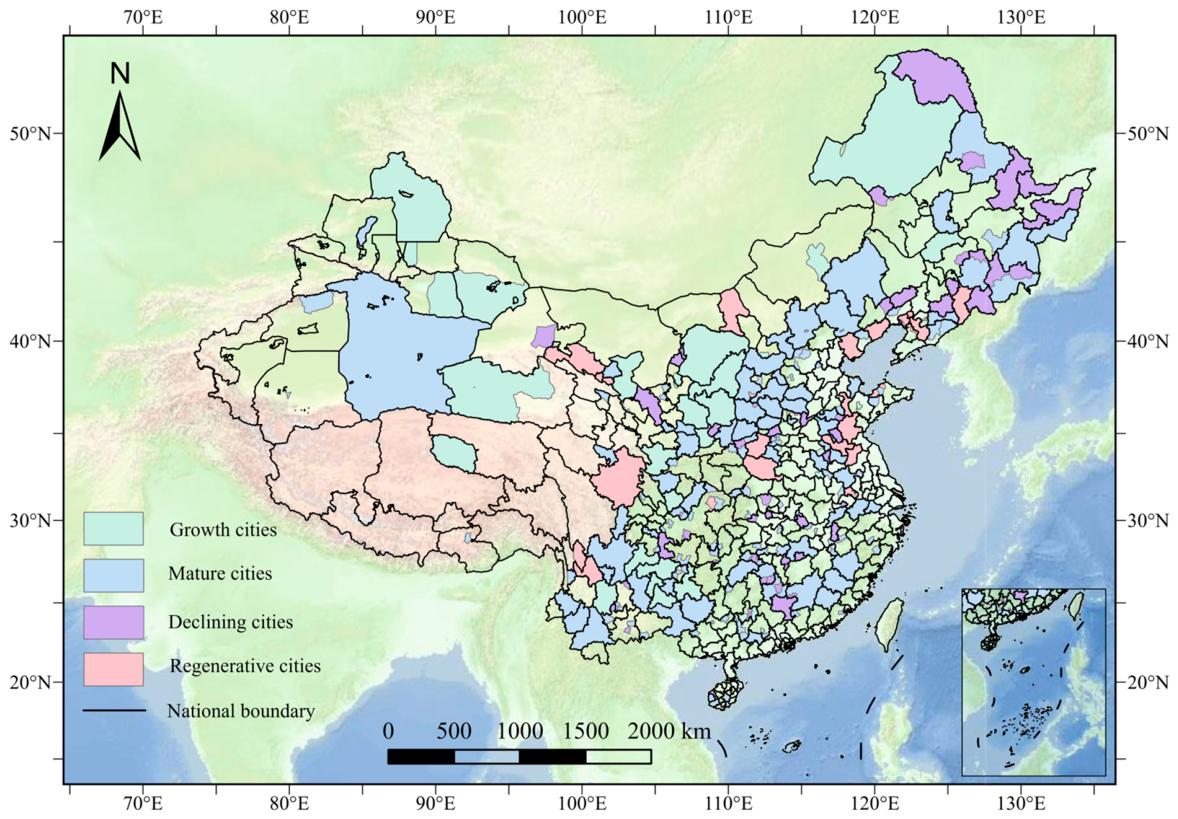
2.2. Study Area and Characteristics of Resource-Based Cities
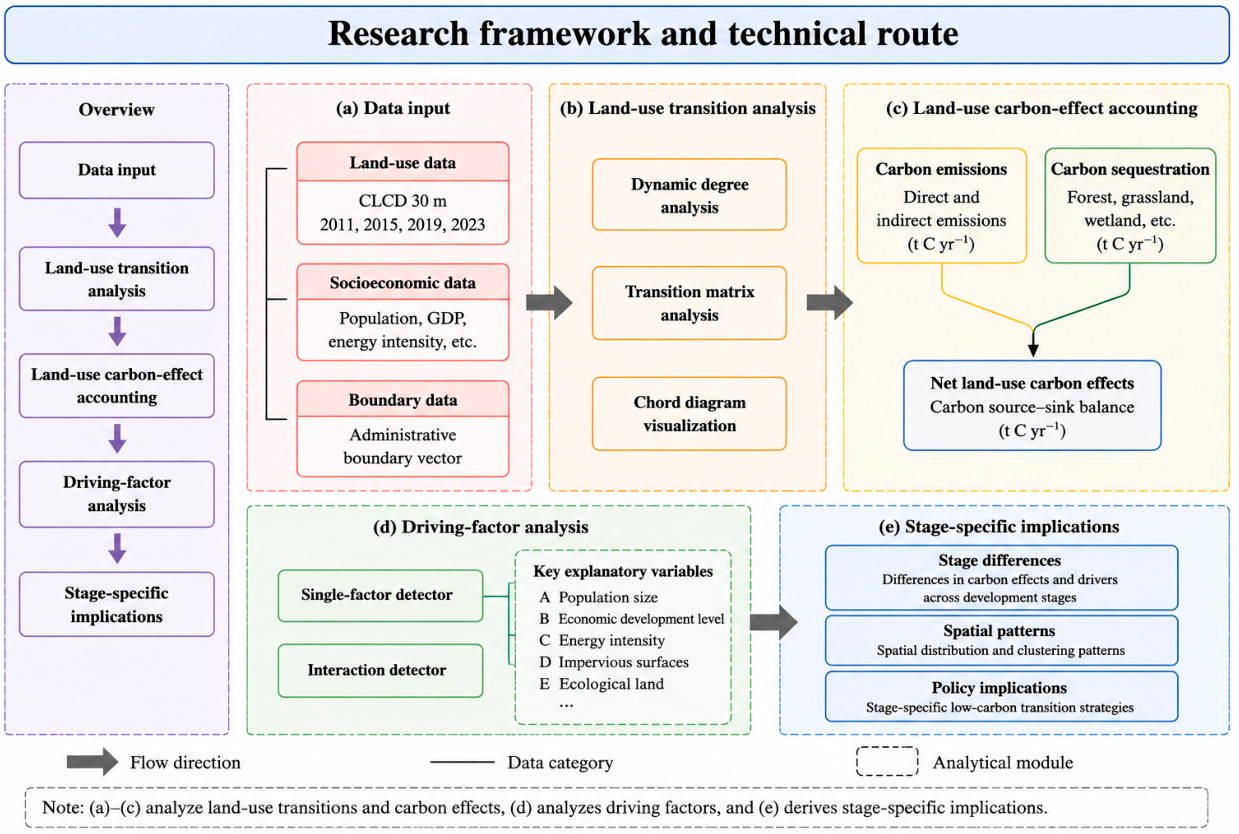
2.3. Research Content and Technical Route
2.4. Data and Methods
2.4.1. Data Sources
2.4.2. Research Methods
- (1)
- Land-Use Transition Analysis
- (2)
- Land-Use Dynamic Degree
- (3)
- Accounting for Land-Use Carbon Effects
- Direct Land-Use Carbon Effects
- 2.
- Indirect Land-Use Carbon Effects
- 3.
- Net Land-Use Carbon Effects
- (4)
- Analysis of Driving Factors
2.4.3. Methodological Scope and Limitations
3. Results and Analysis
3.1. Land-Use Structural Change in Resource-Based Cities
3.1.1. Rate of Land-Use Change
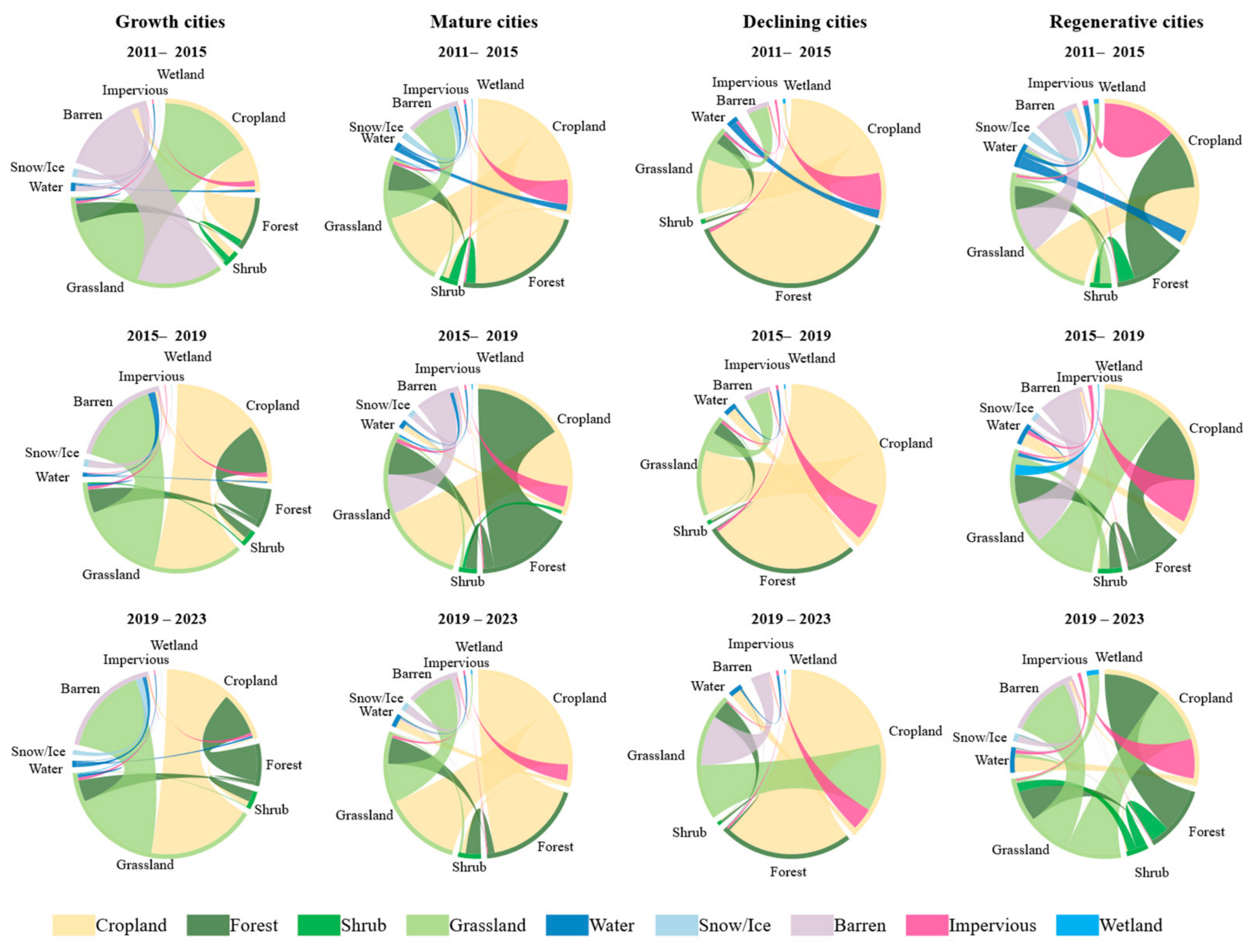
3.1.2. Patterns of Land-Use Transformation
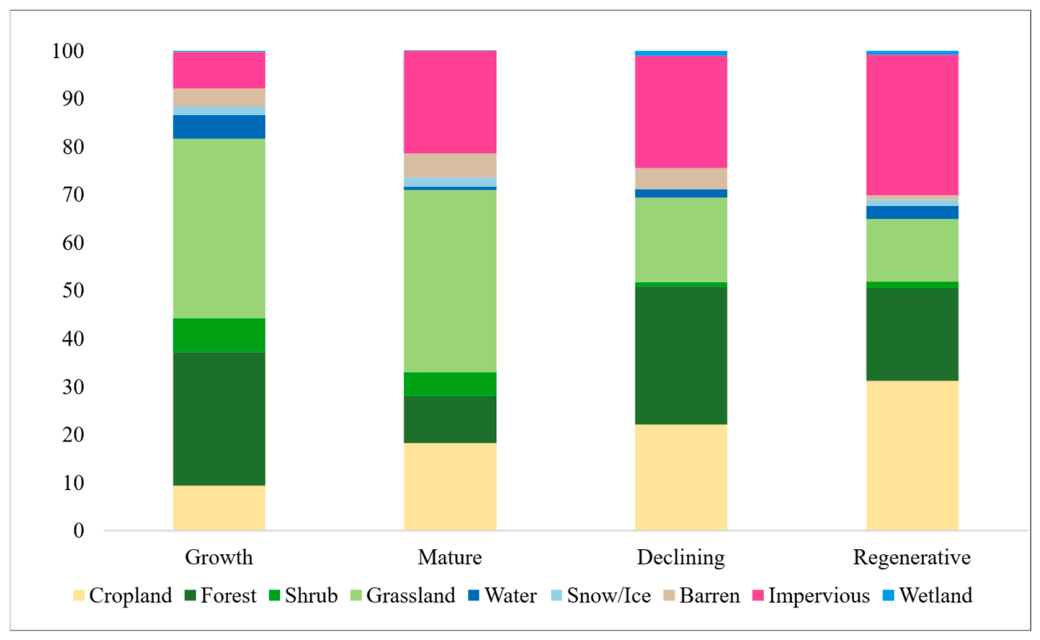
3.1.3. Land-Use Change Structure
3.2. Patterns of Land-Use Carbon Effects in Resource-Based Cities
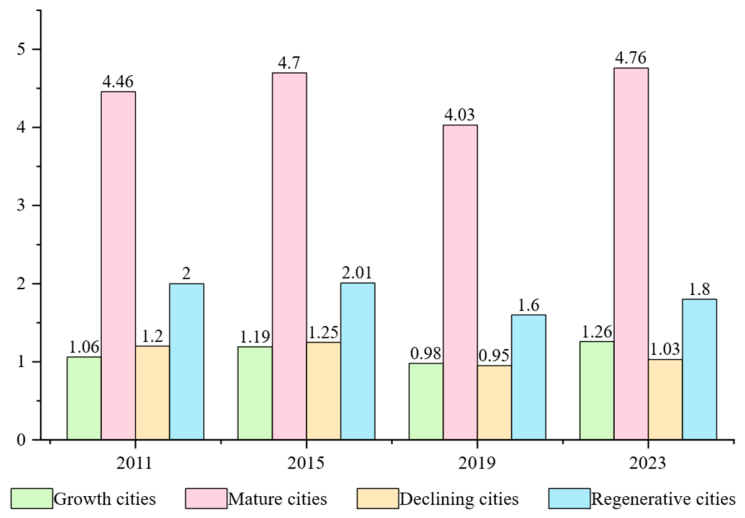
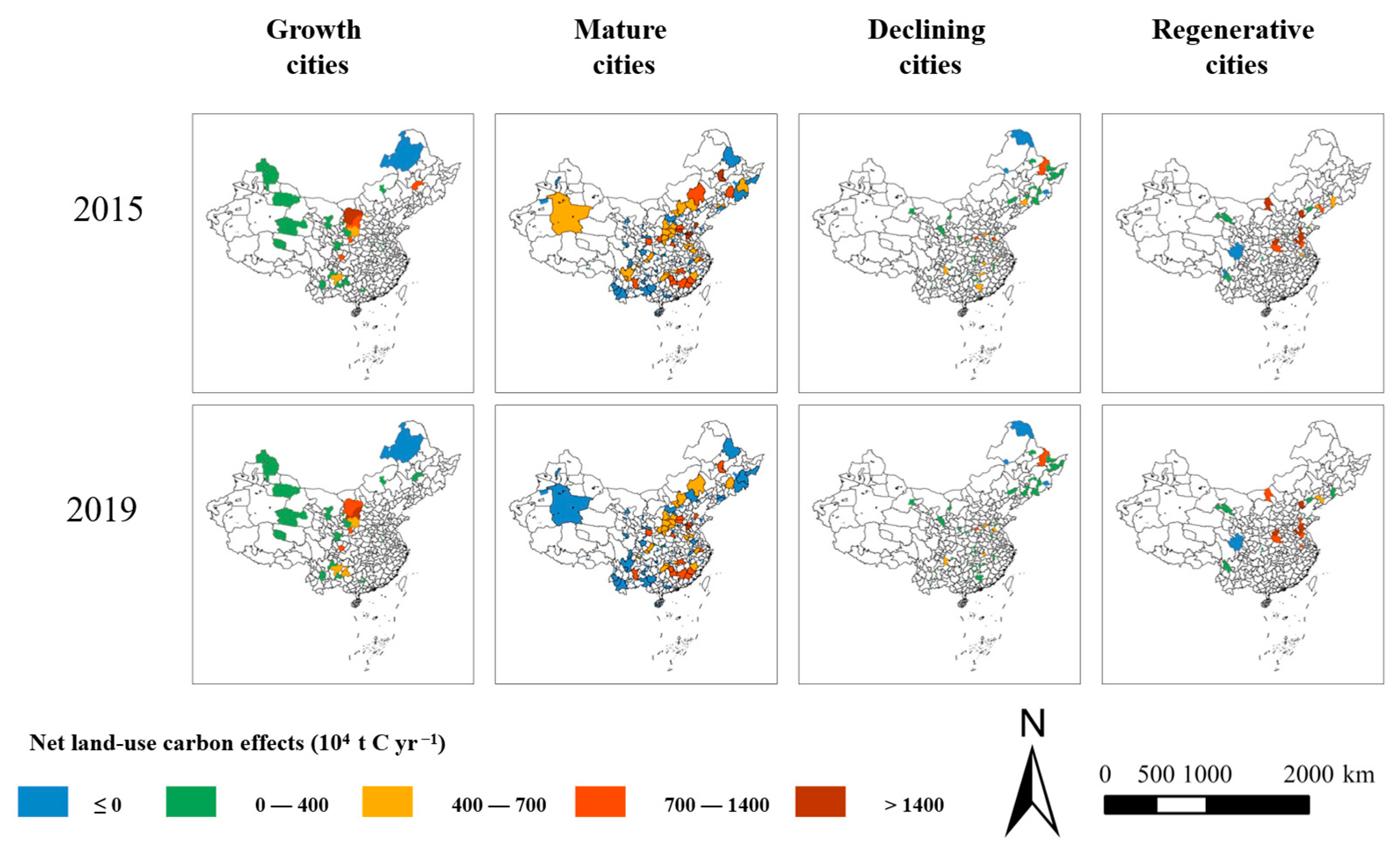
3.2.1. Evolution of Net Land-Use Carbon Effects
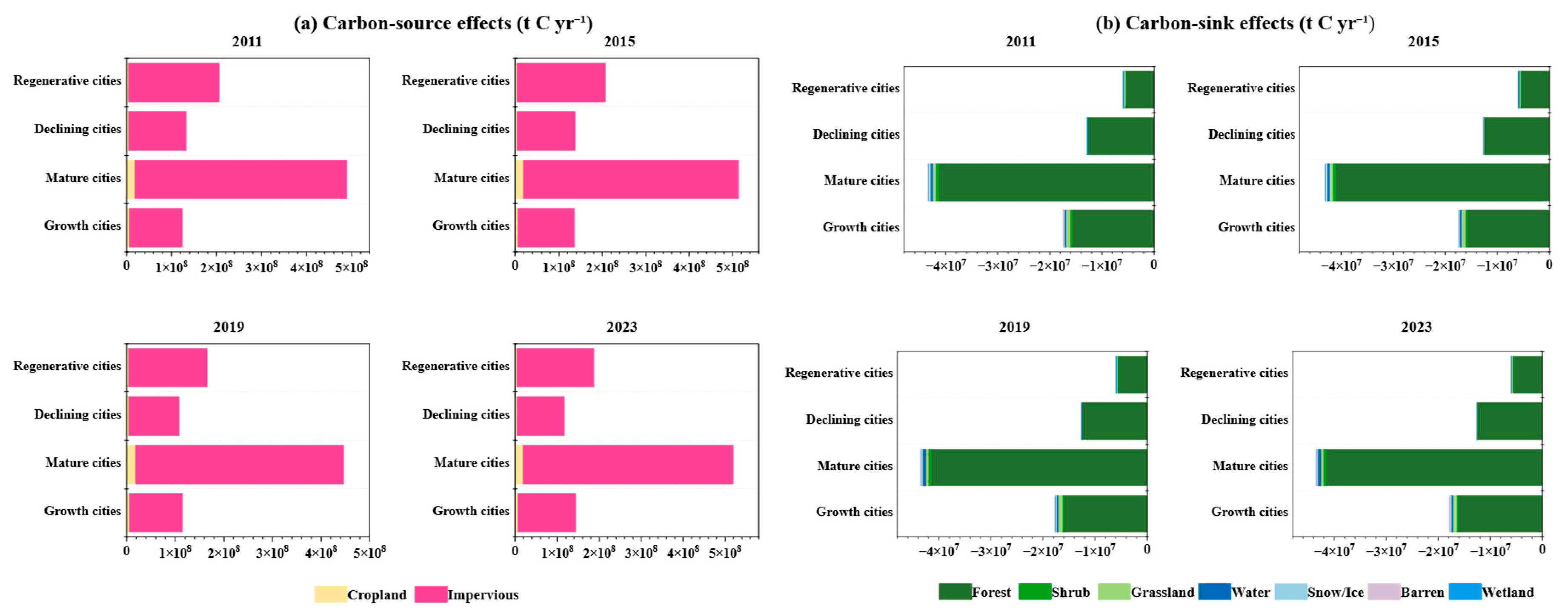
3.2.2. Differences in Carbon Source–Sink Structure
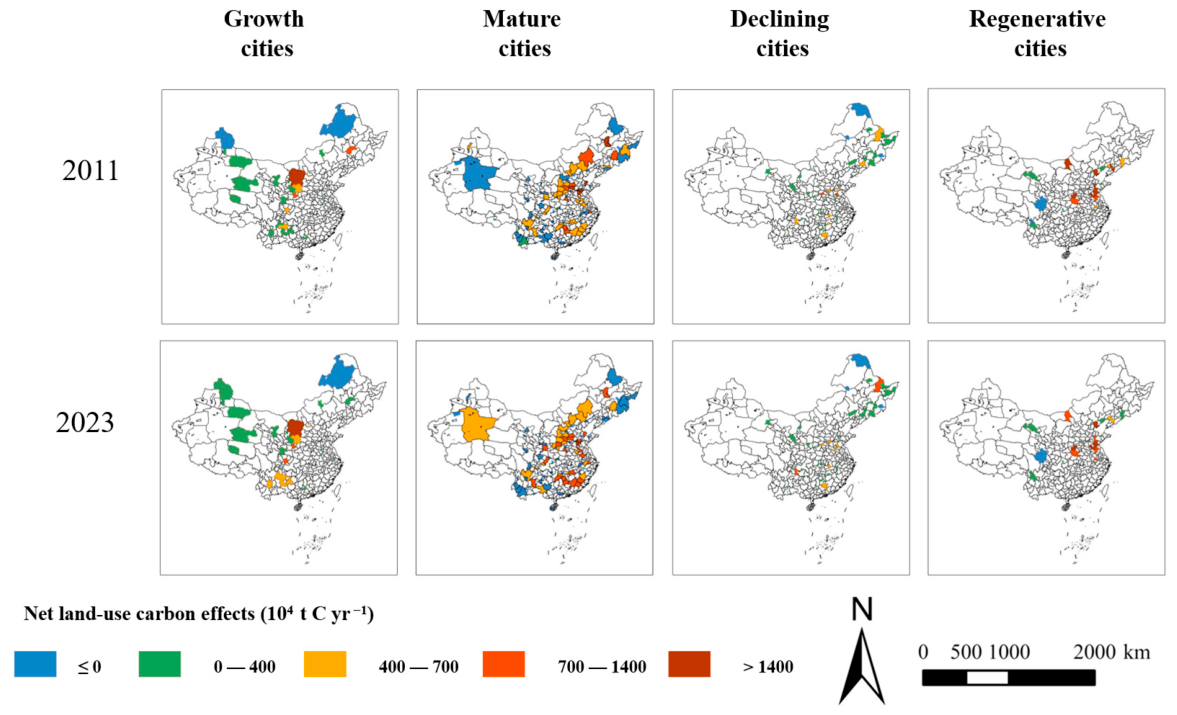
3.2.3. Spatial Patterns of Net Land-Use Carbon Effects
3.3. Driving Factors of Land-Use Carbon Effects in Resource-Based Cities
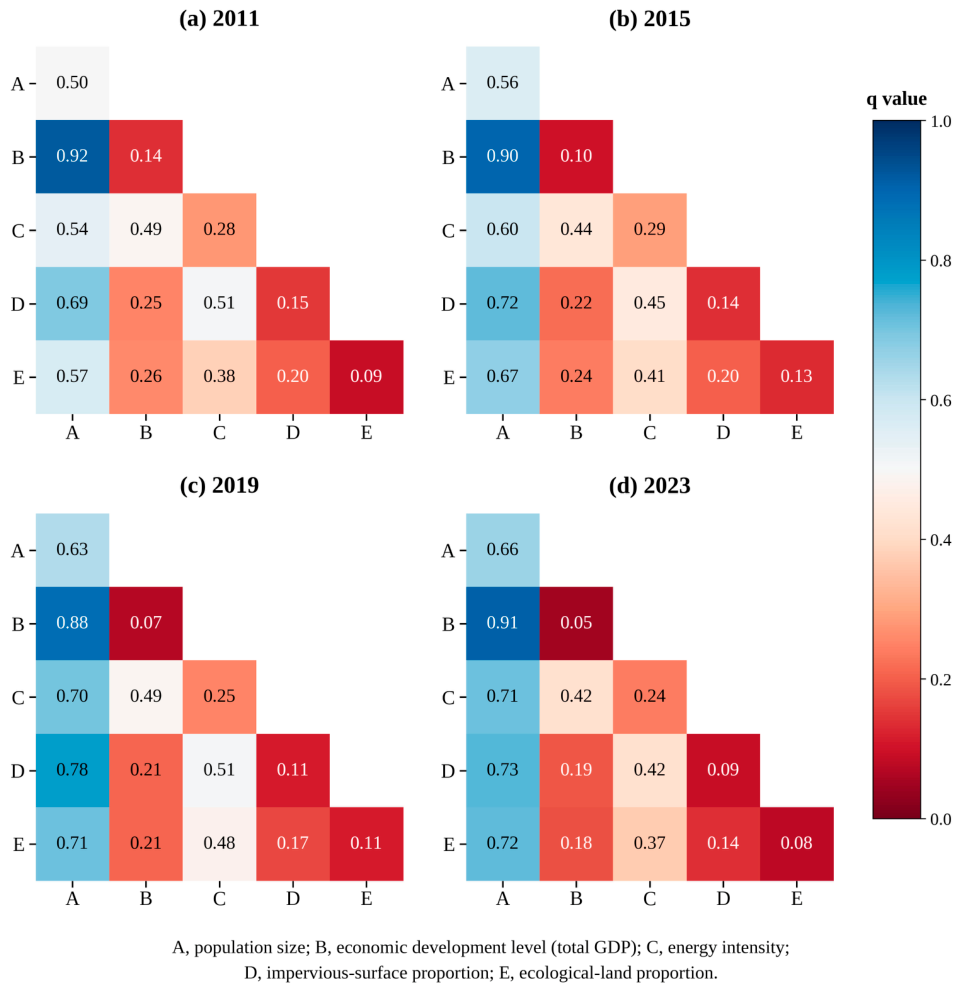
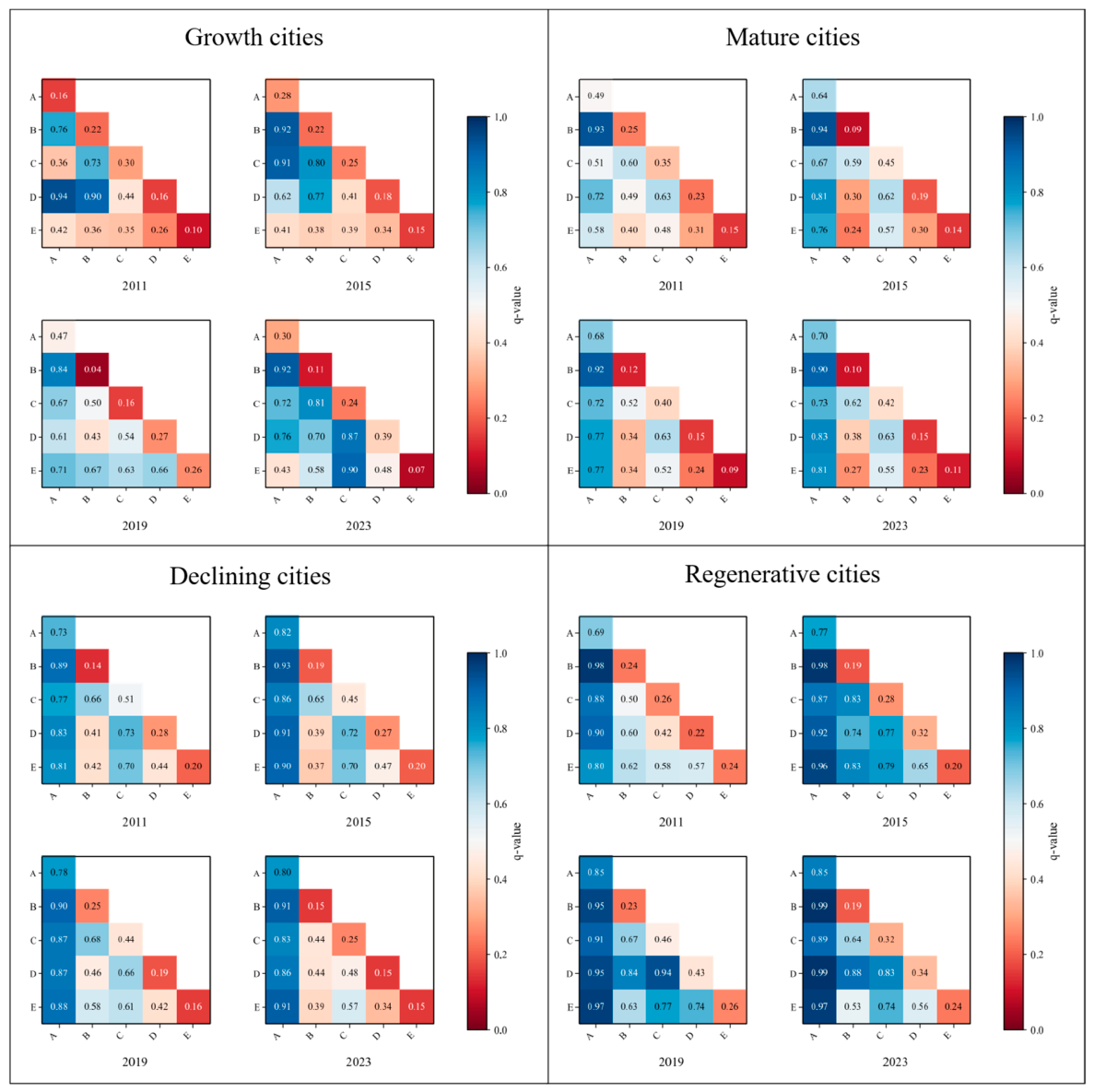
3.3.1. GeoDetector Results
3.3.2. Differences in Driving-Factor Patterns Across City Types
4. Discussion
5. Conclusions and Policy Implications
5.1. Conclusions
5.2. Policy Implications
Author Contributions
Funding
Data Availability Statement
Conflicts of Interest
Abbreviations
| CLCD | China Land Cover Dataset |
| GDP | Gross domestic product |
| IPCC | Intergovernmental Panel on Climate Change |
| STIRPAT | Stochastic Impacts by Regression on Population, Affluence, and Technology |
Appendix A

| City Type | Land-Use Type | Δarea (km2) | Dynamic Degree (%) | Proportion (%) |
|---|---|---|---|---|
| Growth cities | Cropland | 2905.47 | 0.16 | 9.34 |
| Forest | 8664.85 | 0.27 | 27.85 | |
| Shrub | −2193.37 | −2.82 | 7.05 | |
| Grassland | −11,628.72 | −0.26 | 37.38 | |
| Water | 1542.39 | 1.21 | 4.96 | |
| Snow/Ice | −545.62 | −1.08 | 1.75 | |
| Barren | −1188.00 | −0.03 | 3.82 | |
| Impervious surfaces | 2371.72 | 3.27 | 7.62 | |
| Wetland | 71.26 | 2.09 | 0.23 | |
| Mature cities | Cropland | 10,185.39 | 0.19 | 18.19 |
| Forest | 5514.56 | 0.06 | 9.85 | |
| Shrub | −2762.71 | −2.11 | 4.93 | |
| Grassland | −21,255.39 | −0.67 | 37.95 | |
| Water | 378.52 | 0.16 | 0.68 | |
| Snow/Ice | −1138.59 | −1.40 | 2.03 | |
| Barren | −2801.06 | −0.06 | 5.00 | |
| Impervious surfaces | 11,925.02 | 2.41 | 21.29 | |
| Wetland | −45.73 | −0.74 | 0.08 | |
| Declining cities | Cropland | 2531.31 | 0.19 | 22.15 |
| Forest | −3284.88 | −0.12 | 28.75 | |
| Shrub | −93.24 | −2.33 | 0.82 | |
| Grassland | −2019.12 | −0.60 | 17.66 | |
| Water | −191.61 | −0.48 | 1.68 | |
| Snow/Ice | −0.02 | −8.33 | 0.00 | |
| Barren | 508.16 | 0.33 | 4.45 | |
| Impervious surfaces | 2673.52 | 2.05 | 23.40 | |
| Wetland | −124.13 | −3.26 | 1.09 | |
| Regenerative cities | Cropland | −3984.45 | −0.34 | 31.20 |
| Forest | 2465.57 | 0.22 | 19.31 | |
| Shrub | 169.89 | 0.83 | 1.33 | |
| Grassland | −1670.01 | −0.14 | 13.08 | |
| Water | −349.14 | −0.60 | 2.73 | |
| Snow/Ice | −159.57 | −1.84 | 1.25 | |
| Barren | −119.53 | −0.08 | 0.94 | |
| Impervious surfaces | 3749.28 | 1.71 | 29.36 | |
| Wetland | −102.04 | −3.39 | 0.80 |

References
- Li, L.; Zhang, Y.; Zhou, T.; Wang, K.; Wang, C.; Wang, T.; Yuan, L.; An, K.; Zhou, C.; Lü, G. Mitigation of China’s carbon neutrality to global warming. Nat. Commun. 2022, 13, 5315. [Google Scholar] [CrossRef] [PubMed]
- Zhang, S.; Chen, W. Assessing the energy transition in China towards carbon neutrality with a probabilistic framework. Nat. Commun. 2022, 13, 87. [Google Scholar] [CrossRef] [PubMed]
- Zhu, Y.; Xia, X.; Canadell, J.G.; Piao, S.; Lu, X.; Mishra, U.; Wang, X.; Yuan, W.; Qin, Z. China’s carbon sinks from land-use change underestimated. Nat. Clim. Chang. 2025, 15, 428–435. [Google Scholar] [CrossRef]
- Yu, Z.; Ciais, P.; Piao, S.; Houghton, R.A.; Lu, C.; Tian, H.; Agathokleous, E.; Kattel, G.R.; Sitch, S.; Goll, D.; et al. Forest expansion dominates China’s land carbon sink since 1980. Nat. Commun. 2022, 13, 5374. [Google Scholar] [CrossRef] [PubMed]
- Yao, L.; Liu, T.; Qin, J.; Jiang, H.; Yang, L.; Smith, P.; Chen, X.; Zhou, C.; Piao, S. Carbon sequestration potential of tree planting in China. Nat. Commun. 2024, 15, 8398. [Google Scholar] [CrossRef] [PubMed]
- He, Y.; Piao, S.; Ciais, P.; Xu, H.; Gasser, T. Future land carbon removals in China consistent with national inventory. Nat. Commun. 2024, 15, 10426. [Google Scholar] [CrossRef] [PubMed]
- Seto, K.C.; Güneralp, B.; Hutyra, L.R. Global forecasts of urban expansion to 2030 and direct impacts on biodiversity and carbon pools. Proc. Natl. Acad. Sci. USA 2012, 109, 16083–16088. [Google Scholar] [CrossRef] [PubMed]
- Fang, C.; Wang, S.; Li, G. Changing urban forms and carbon dioxide emissions in China: A case study of 30 provincial capital cities. Appl. Energy 2015, 158, 519–531. [Google Scholar] [CrossRef]
- Wang, S.; Fang, C.; Guan, X.; Pang, B.; Ma, H. Urbanisation, energy consumption, and carbon dioxide emissions in China: A panel data analysis of China’s provinces. Appl. Energy 2014, 136, 738–749. [Google Scholar] [CrossRef]
- Zhou, Y.; Chen, M.; Tang, Z.; Mei, Z. Urbanization, land use change, and carbon emissions: Quantitative assessments for city-level carbon emissions in the Beijing–Tianjin–Hebei region. Sustain. Cities Soc. 2021, 66, 102701. [Google Scholar] [CrossRef]
- Yang, J.; Huang, X. The 30 m annual land cover dataset and its dynamics in China from 1990 to 2019. Earth Syst. Sci. Data 2021, 13, 3907–3925. [Google Scholar] [CrossRef]
- Zhang, X.; Liu, L.; Chen, X.; Gao, Y.; Xie, S.; Mi, J. GLC_FCS30: Global land-cover product with fine classification system at 30 m using time-series Landsat imagery. Earth Syst. Sci. Data 2021, 13, 2753–2776. [Google Scholar] [CrossRef]
- Gong, P.; Li, X.; Wang, J.; Bai, Y.; Chen, B.; Hu, T.; Liu, X.; Xu, B.; Yang, J.; Zhang, W.; et al. Annual maps of global artificial impervious area (GAIA) between 1985 and 2018. Remote Sens. Environ. 2020, 236, 111510. [Google Scholar] [CrossRef]
- Zhang, X.; Liu, L.; Zhao, T.; Gao, Y.; Chen, X.; Mi, J. GISD30: Global 30 m impervious-surface dynamic dataset from 1985 to 2020 using time-series Landsat imagery on the Google Earth Engine platform. Earth Syst. Sci. Data 2022, 14, 1831–1856. [Google Scholar] [CrossRef]
- Zhang, Y.; Li, J.; Liu, S.; Zhou, J. Spatiotemporal effects and optimization strategies of land-use carbon emissions at the county scale: A case study of Shaanxi Province, China. Sustainability 2024, 16, 4104. [Google Scholar] [CrossRef]
- Bian, R.; Zhao, A.; Zou, L.; Liu, X.; Xu, R.; Li, Z. Simulation and prediction of land use change and carbon emission under multiple development scenarios at the city level: A case study of Xi’an, China. Land 2024, 13, 1079. [Google Scholar] [CrossRef]
- Tang, W.; Cui, L.; Zheng, S.; Hu, W. Multi-scenario simulation of land use carbon emissions from energy consumption in Shenzhen, China. Land 2022, 11, 1673. [Google Scholar] [CrossRef]
- Huang, Y.; Wang, Z.; Zhao, H.; You, D.; Wang, W.; Peng, Y. Spatial association network of land-use carbon emissions in Hubei Province: Network characteristics, carbon balance zoning, and driving factors. Land 2025, 14, 1329. [Google Scholar] [CrossRef]
- Fan, M.; Li, M.; Liu, J.; Shao, S. Is high natural resource dependence doomed to low carbon emission efficiency? Evidence from 283 cities in China. Energy Econ. 2022, 115, 106328. [Google Scholar] [CrossRef]
- Yu, W.; Peng, Y.; Yao, X. The effects of China’s supporting policy for resource-exhausted cities on local energy efficiency: An empirical study based on 284 cities in China. Energy Econ. 2022, 112, 106165. [Google Scholar] [CrossRef]
- Ai, H.; Tan, X.; Zhou, S.; Liu, W. The impact of supportive policy for resource-exhausted cities on carbon emission: Evidence from China. Resour. Policy 2023, 85, 103951. [Google Scholar] [CrossRef]
- Wu, J.; Nie, X.; Wang, H. Curse to blessing: The carbon emissions trading system and resource-based cities’ carbon mitigation. Energy Policy 2023, 183, 113796. [Google Scholar] [CrossRef]
- Wang, K.; Chen, X.; Wang, C. The impact of sustainable development planning in resource-based cities on corporate ESG: Evidence from China. Energy Econ. 2023, 127, 107087. [Google Scholar] [CrossRef]
- Gao, F.; He, Z. Digital economy, land resource misallocation and urban carbon emissions in Chinese resource-based cities. Resour. Policy 2024, 91, 104914. [Google Scholar] [CrossRef]
- Li, W.; Cai, Z.; Jin, L. Urban green land use efficiency of resource-based cities in China: Multidimensional measurements, spatial-temporal changes, and driving factors. Sustain. Cities Soc. 2024, 104, 105299. [Google Scholar] [CrossRef]
- Wu, Y.; Luo, M. Study on spatial-temporal evolution law of green land use efficiency in resource-based cities. Land 2025, 14, 360. [Google Scholar] [CrossRef]
- Chen, M.; Wang, Q.; Bai, Z.; Shi, Z.; Meng, P.; Hao, M. Green land use efficiency and driving factors of resource-based cities in the Yellow River Basin under carbon emission constraints. Buildings 2022, 12, 551. [Google Scholar] [CrossRef]
- Lu, S.; Li, J.; Zhang, W.; Xiao, F. Towards sustainable development in resource-based cities: Assessing the effects of extraregional technology and investment on the low-carbon transition. J. Environ. Manag. 2024, 364, 121388. [Google Scholar] [CrossRef] [PubMed]
- Feng, S.; Gao, B.; Tan, Y.; Xiao, K.; Zhai, Y. Resource-based transformation and urban resilience promotion: Evidence from firms’ carbon emissions reductions in China. J. Clean. Prod. 2024, 468, 143118. [Google Scholar] [CrossRef]
- Hou, Y.; Yang, M.; Li, Y. Coordinated effect of green expansion and carbon reduction: Evidence from sustainable development of resource-based cities in China. J. Environ. Manag. 2024, 349, 119534. [Google Scholar] [CrossRef] [PubMed]
- Wu, H.; Deng, K.; Dong, Z.; Meng, X.; Zhang, L.; Jiang, S.; Yang, L.; Xu, Y. Comprehensive assessment of land use carbon emissions of a coal resource-based city, China. J. Clean. Prod. 2022, 379, 134706. [Google Scholar] [CrossRef]
- Li, Z.; Cai, Y.; Lin, G. Pathways for sustainable municipal energy systems transition: A case study of Tangshan, a resource-based city in China. J. Clean. Prod. 2022, 330, 129835. [Google Scholar] [CrossRef]
- Yin, Q.; Wang, Y.; Xu, Z.; Wan, K.; Wang, D. Factors influencing green transformation efficiency in China’s mineral resource-based cities: Method analysis based on IPAT-E and PLS-SEM. J. Clean. Prod. 2022, 330, 129783. [Google Scholar] [CrossRef]
- Morán Uriel, J.; Camerin, F.; Córdoba Hernández, R. Urban Horizons in China: Challenges and Opportunities for Community Intervention in a Country Marked by the Heihe–Tengchong Line. In Diversity as Catalyst: Economic Growth and Urban Resilience in Global Cityscapes; Siew, G., Allam, Z., Cheshmehzangi, A., Eds.; Springer: Singapore, 2024; pp. 105–125. [Google Scholar] [CrossRef]
- Kennedy, C.; Pincetl, S.; Bunje, P. The study of urban metabolism and its applications to urban planning and design. Environ. Pollut. 2011, 159, 1965–1973. [Google Scholar] [CrossRef] [PubMed]
- Fischer-Kowalski, M.; Haberl, H. (Eds.) Socioecological Transitions and Global Change: Trajectories of Social Metabolism and Land Use; Edward Elgar Publishing: Cheltenham, UK; Northampton, MA, USA, 2007. [Google Scholar]
- Swyngedouw, E.; Heynen, N.C. Urban political ecology, justice and the politics of scale. Antipode 2003, 35, 898–918. [Google Scholar] [CrossRef]
- State Council of the People’s Republic of China. National Sustainable Development Plan for Resource-Based Cities, 2013–2020; State Council of the People’s Republic of China: Beijing, China, 2013.
- Song, X.P.; Hansen, M.C.; Stehman, S.V.; Potapov, P.V.; Tyukavina, A.; Vermote, E.F.; Townshend, J.R. Global land change from 1982 to 2016. Nature 2018, 560, 639–643. [Google Scholar] [CrossRef] [PubMed]
- Chen, C.; Park, T.; Wang, X.; Piao, S.; Xu, B.; Chaturvedi, R.K.; Fuchs, R.; Brovkin, V.; Ciais, P.; Fensholt, R.; et al. China and India lead in greening of the world through land-use management. Nat. Sustain. 2019, 2, 122–129. [Google Scholar] [CrossRef] [PubMed]
- Yang, J.; Huang, X. The 30 m annual land cover datasets and its dynamics in China from 1985 to 2024; Version 1.0.4; Zenodo: Geneva, Switzerland, 2025. [Google Scholar] [CrossRef]
- Lai, L.; Huang, X.; Yang, H.; Chuai, X.; Zhang, M.; Zhong, T.; Chen, Z.; Chen, Y.; Wang, X.; Thompson, J.R. Carbon emissions from land-use change and management in China between 1990 and 2010. Sci. Adv. 2016, 2, e1601063. [Google Scholar] [CrossRef] [PubMed]
- Friedlingstein, P.; O’Sullivan, M.; Jones, M.W.; Andrew, R.M.; Hauck, J.; Landschützer, P.; Le Quéré, C.; Luijkx, I.T.; Peters, G.P.; Peters, W.; et al. Global Carbon Budget 2024. Earth Syst. Sci. Data 2025, 17, 965–1039. [Google Scholar] [CrossRef]
- Zhang, P.; He, J.; Hong, X.; Zhang, W.; Qin, C.; Pang, B.; Li, Y.; Liu, Y. Carbon sources/sinks analysis of land use changes in China based on data envelopment analysis. J. Clean. Prod. 2018, 204, 702–711. [Google Scholar] [CrossRef]
- Kang, T.; Wang, Y.; Su, B.; Zhang, Y.; Chen, W. The effects of urban land use on energy-related CO2 emissions in China. Sci. Total Environ. 2023, 862, 161873. [Google Scholar] [CrossRef] [PubMed]
- Piao, S.; Fang, J.; Ciais, P.; Peylin, P.; Huang, Y.; Sitch, S.; Wang, T. The carbon balance of terrestrial ecosystems in China. Nature 2009, 458, 1009–1013. [Google Scholar] [CrossRef] [PubMed]
- Shan, Y.; Guan, Y.; Hang, Y.; Zheng, H.; Li, Y.; Guan, D.; Li, J.; Zhou, Y.; Li, L.; Hubacek, K. City-level emission peak and drivers in China. Sci. Bull. 2022, 67, 1910–1920. [Google Scholar] [CrossRef] [PubMed]
- Intergovernmental Panel on Climate Change. 2006 IPCC Guidelines for National Greenhouse Gas Inventories; IPCC: Geneva, Switzerland, 2006. [Google Scholar]
- Wang, J.F.; Zhang, T.L.; Fu, B.J. A measure of spatial stratified heterogeneity. Ecol. Indic. 2016, 67, 250–256. [Google Scholar] [CrossRef]
- Dietz, T.; Rosa, E.A. Effects of population and affluence on CO2 emissions. Proc. Natl. Acad. Sci. USA 1997, 94, 175–179. [Google Scholar] [CrossRef] [PubMed]
- Zhang, C.; Lin, Y. Panel estimation for urbanization, energy consumption and CO2 emissions: A regional analysis in China. Energy Policy 2012, 49, 488–498. [Google Scholar] [CrossRef]
- Ouyang, X.; Fang, X.; Cao, Y.; Sun, C. Factors behind CO2 emission reduction in Chinese heavy industries: Do environmental regulations matter? Energy Policy 2020, 145, 111765. [Google Scholar] [CrossRef]
- Grassi, G.; House, J.; Kurz, W.A.; Cescatti, A.; Houghton, R.A.; Peters, G.P.; Sanz, M.J.; Viñas, R.A.; Alkama, R.; Arneth, A.; et al. Reconciling global-model estimates and country reporting of anthropogenic forest CO2 sinks. Nat. Clim. Chang. 2018, 8, 914–920. [Google Scholar] [CrossRef]


| Concept | Core Definition |
|---|---|
| Resource-based cities | A resource-based city refers to an urban area whose formation and development have been strongly shaped by the extraction and processing of natural resources, including mineral and energy resources, and whose economic and industrial structures have historically shown a relatively high degree of resource dependence. |
| Growth cities | A growth city refers to a resource-based city in which resource development remains in an expanding stage, resource-support potential is relatively strong, and population, industries, and urban construction activities continue to develop. |
| Mature cities | A mature city refers to a resource-based city in which resource development has entered a relatively stable stage, resource-support capacity remains strong, and the resource-based industrial system and urban spatial structure are comparatively well established. |
| Declining cities | A declining city refers to a resource-based city in which recoverable resources are decreasing, traditional resource-based industries are weakening, and the city faces increasing pressure to develop alternative industries and improve its sustainable-development capacity. |
| Regenerative cities | A regenerative city refers to a resource-based city in which dependence on resource extraction has been substantially reduced and substantial progress has been made in economic restructuring, industrial diversification, and urban transformation. |
| Category | Annual Carbon Coefficient |
|---|---|
| Cropland | 0.420 |
| Forest | −0.578 |
| Shrub | −0.578 |
| Grassland | −0.021 |
| Water | −0.252 |
| Snow/Ice | −0.252 |
| Barren | −0.005 |
| Wetland | −0.252 |
| Type of Energy | Standard Coal Coefficient (tce t−1) | Carbon Emission Coefficient (t C tce−1) |
|---|---|---|
| Raw coal | 0.7143 | 0.7559 |
| Coke | 0.9714 | 0.8550 |
| Crude oil | 1.4286 | 0.5758 |
| Gasoline | 1.4714 | 0.5538 |
| Kerosene | 1.4714 | 0.5714 |
| Diesel oil | 1.4571 | 0.5921 |
| Fuel oil | 1.4286 | 0.6185 |
| Code | Factor | Indicator | Interpretation |
|---|---|---|---|
| A | Population size | Resident population | Population agglomeration |
| B | Economic development level | Total gross domestic product (GDP) | Overall scale of regional economic activity |
| C | Energy intensity | Energy consumption per unit of GDP | Energy-use intensity |
| D | Impervious surfaces | Proportion of impervious surface area | Construction intensity |
| E | Ecological land | Proportion of ecological land area | Ecological space configuration |
| City Type | Main Expanding Land Types | Main Shrinking Land Types | Key Feature |
|---|---|---|---|
| Growth cities | Forest, cropland, and impervious surfaces increased, with impervious surfaces showing the fastest expansion rate | Grassland and shrub decreased markedly | Land-use change was relatively dispersed. Impervious surfaces expanded rapidly, but the overall scale of change was smaller than that in mature cities |
| Mature cities | Impervious surfaces, cropland, and forest increased substantially | Grassland showed the largest decrease, followed by barren land and shrub | Mature cities had the largest overall scale of land-use change, characterized by construction land expansion and ecological land contraction |
| Declining cities | Impervious surfaces and cropland increased slightly | Forest and grassland decreased | Land-use change was limited in scale. Impervious surfaces still expanded, but the overall adjustment intensity was weaker |
| Regenerative cities | Impervious surfaces and forest increased | Cropland and grassland decreased | Construction land expansion and ecological recovery coexisted, and land-use adjustment was more balanced than in mature cities |
| Factor | 2011 | 2015 | 2019 | 2023 |
|---|---|---|---|---|
| Population size | 0.50 | 0.56 | 0.63 | 0.66 |
| Economic development level (GDP) | 0.14 | 0.10 | 0.07 | 0.05 |
| Energy intensity | 0.28 | 0.29 | 0.25 | 0.24 |
| Proportion of impervious surfaces | 0.15 | 0.14 | 0.11 | 0.09 |
| Proportion of ecological land | 0.09 | 0.13 | 0.11 | 0.08 |
Disclaimer/Publisher’s Note: The statements, opinions and data contained in all publications are solely those of the individual author(s) and contributor(s) and not of MDPI and/or the editor(s). MDPI and/or the editor(s) disclaim responsibility for any injury to people or property resulting from any ideas, methods, instructions or products referred to in the content. |
© 2026 by the authors. Licensee MDPI, Basel, Switzerland. This article is an open access article distributed under the terms and conditions of the Creative Commons Attribution (CC BY) license.
Share and Cite
Hu, C.; Fu, Y.; Qi, X.; Qi, X.; Wang, Q.; Li, L. Development-Stage Differences in Land-Use Carbon Effects of China’s Resource-Based Cities: Spatiotemporal Evolution and Driving Mechanisms. Land 2026, 15, 1106. https://doi.org/10.3390/land15071106
Hu C, Fu Y, Qi X, Qi X, Wang Q, Li L. Development-Stage Differences in Land-Use Carbon Effects of China’s Resource-Based Cities: Spatiotemporal Evolution and Driving Mechanisms. Land. 2026; 15(7):1106. https://doi.org/10.3390/land15071106
Chicago/Turabian StyleHu, Chengyue, Yonghu Fu, Xiaoman Qi, Xiaotong Qi, Qiyuan Wang, and Li Li. 2026. "Development-Stage Differences in Land-Use Carbon Effects of China’s Resource-Based Cities: Spatiotemporal Evolution and Driving Mechanisms" Land 15, no. 7: 1106. https://doi.org/10.3390/land15071106
APA StyleHu, C., Fu, Y., Qi, X., Qi, X., Wang, Q., & Li, L. (2026). Development-Stage Differences in Land-Use Carbon Effects of China’s Resource-Based Cities: Spatiotemporal Evolution and Driving Mechanisms. Land, 15(7), 1106. https://doi.org/10.3390/land15071106