A Sustainable Spatial Decision Support System (S-SDSS): A Systematic Review and Conceptual Integration of Ecological Network Optimization Frameworks


Abstract
1. Introduction
2. Methodology
2.1. Research Design
2.2. Databases and Search Strategy
2.3. Inclusion and Exclusion Criteria
2.4. PRISMA Protocol and Literature Selection Process
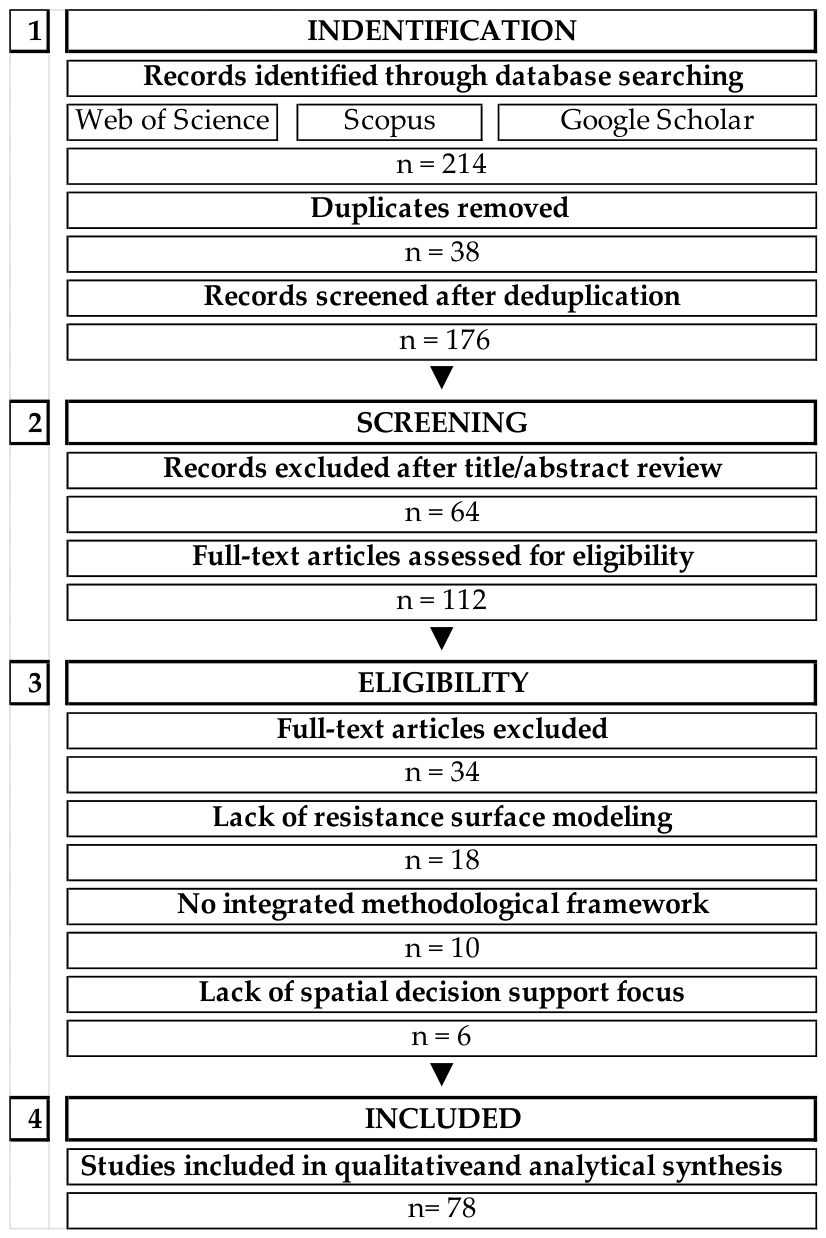
- Identification: A total of 214 records were identified across databases. After removing 38 duplicate records, 176 studies were transitioned to the screening phase.
- Screening: Following an evaluation of titles and abstracts, 64 irrelevant publications were excluded, leaving 112 articles eligible for full-text review.
- Eligibility: During the full-text assessment, 34 studies were excluded for reasons such as failing to generate a resistance surface or lacking methodological integration (e.g., the combination of MSPA-MCR).
- Included: Upon completion of the screening processes, 78 original studies were included in the analytical synthesis and methodological classification (Table 2).
2.5. Analytical Coding Framework
3. Results: Analytical Synthesis and Methodological Rationale of S-SDSS
3.1. Methodological Evolution and the Integration Gap
3.2. Resistance Surface Parameterization and Uncertainty Diagnostics
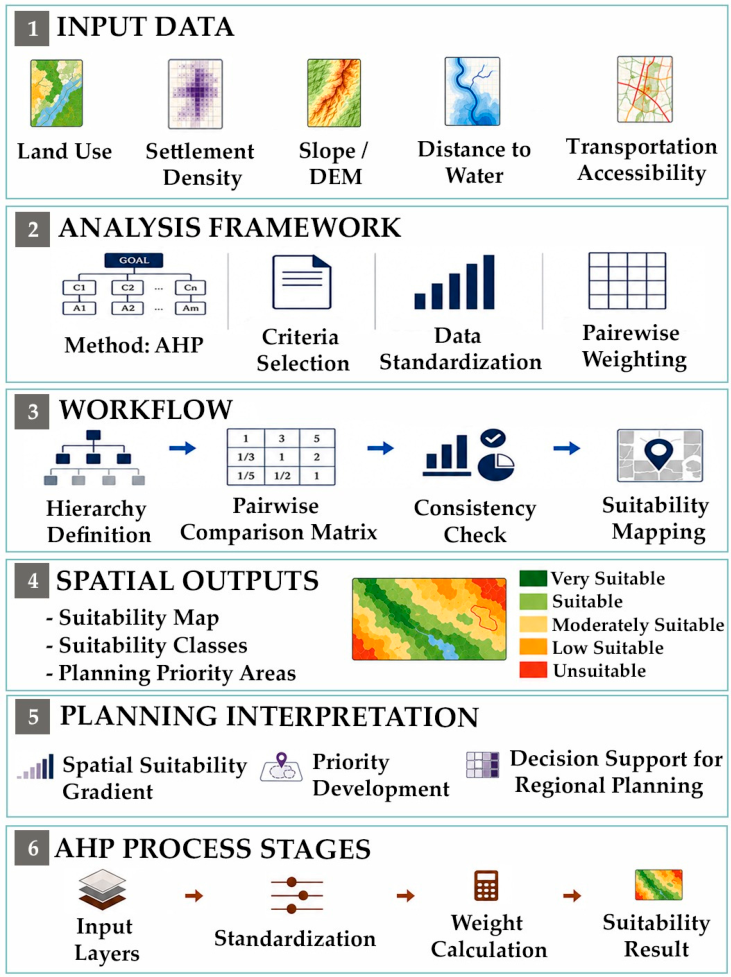
- The Subjectivity and Resolution Gap: The inherent subjectivity in Analytic Hierarchy Process (AHP) weightings often limits the reproducibility of resistance surfaces, making models highly dependent on expert bias [16,45]. Furthermore, at low resolutions, pixel size distorts morphological reality, causing a critical “corridor vanishing” effect where narrow linear elements—often misidentified as “urban voids” or idle lands—are completely excluded from macro-scale models [29,30].
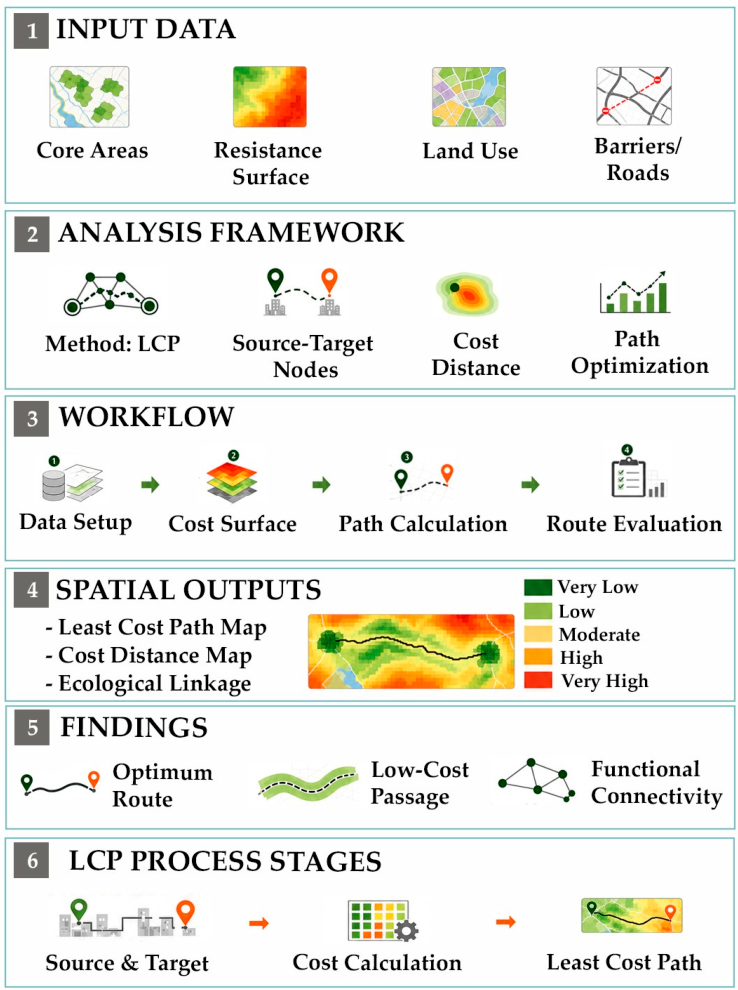
- The Policy-Validation and Safety Gap: In highly urbanized landscapes under intensive development pressure, the “least-cost path” does not always equate to the safest path due to intense anthropogenic noise and barrier effects [36,37]. A significant lack of species-specific field validation or empirical ground-truthing persists, which limits the biological accuracy of modeled corridors [28]. Concurrently, the scarcity of robust sensitivity analyses remains a persistent barrier to model validation, rendering the resulting corridors highly unstable under minor parameter fluctuations [27].
- The S-SDSS Resolution: To eliminate these systematic constraints, the proposed S-SDSS architecture replaces arbitrary, static scoring with a mathematically audited parameter matrix linked to explicit spatial sensitivity analysis [27]. It mandates a high-resolution (10–25 m) baseline at the local planning scale to preserve narrow morphological pathways [29]. Influenced by the statistical breakthroughs in the reviewed literature, the S-SDSS models anthropogenic inputs with a 40% dominant weight and topography with a 25% sensitivity deviation. By embedding species-oriented habitat suitability derived from objective predictive software like MaxEnt (Version 3.4.4) [47] alongside statistical validation metrics—such as ROC/AUC values [48] and Jackknife tests [49]—the S-SDSS isolates the exact thresholds where human encroachment breaks the network, transitioning ecological corridors from theoretical predictions into evidence-based and spatially explicit planning structure.
3.3. From Structural–Functional Dichotomy to Methodological Depth
4. Discussion
4.1. Methodological Gaps Revealed by the Systematic Review
4.2. Conceptual Contribution and Novelty of the S-SDSS Framework
4.3. Limitations and Future Research Directions
5. Proposed Conceptual Framework: Ecological Network-Based Sustainable Spatial Decision Support System (S-SDSS)
5.1. Methodological Framework and Data Input
- Standardization of connectivity metrics: The effectiveness of ecological network analyses depends on aligning connectivity metrics with the relevant planning scale (e.g., basin, regional, or urban) [6,43]. By incorporating a flexible set of indicators associated with ecosystem services [55], the S-SDSS supports a goal-oriented evaluation structure rather than a uniform analytical procedure [16,45,58,59].
- Climate change adaptation compatibility (CMIP6): The proposed framework is designed as a forward-looking decision support system rather than a static landscape analysis. In this context, CMIP6 climate scenarios [3] provide a conceptual data layer to ensure that planning outputs remain robust under future climatic conditions, including temperature shifts and hydrological changes [3,4,57,60].
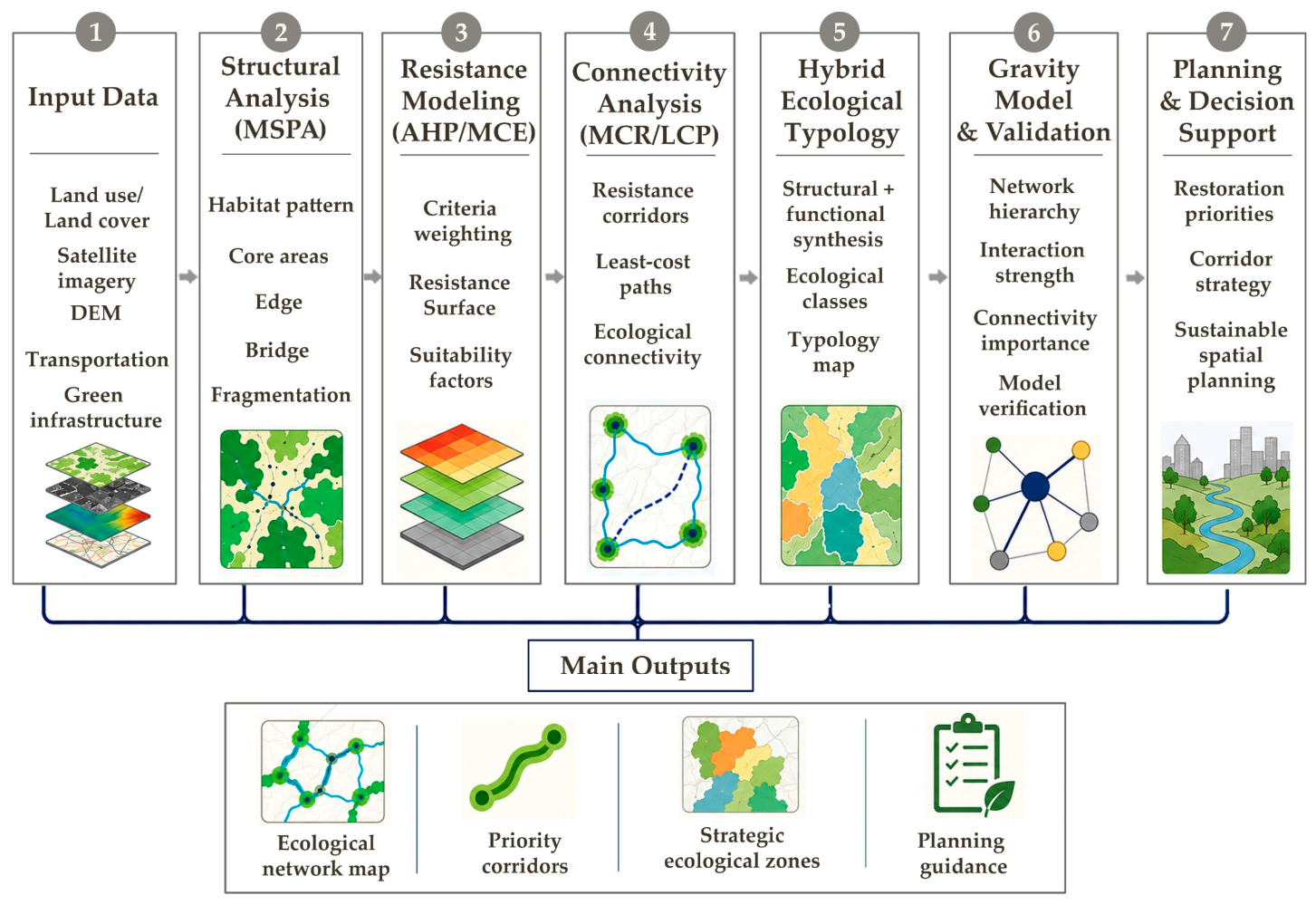
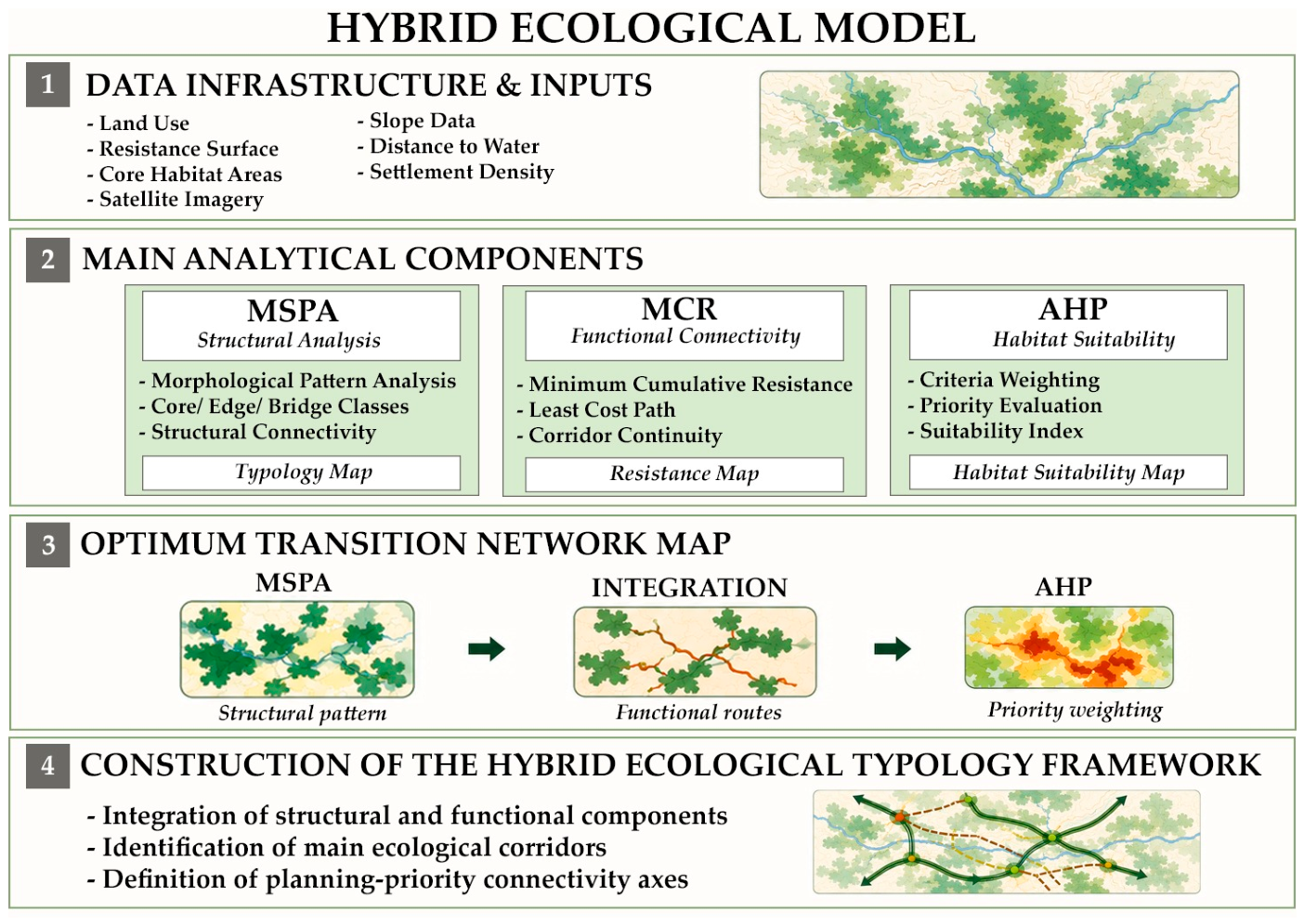
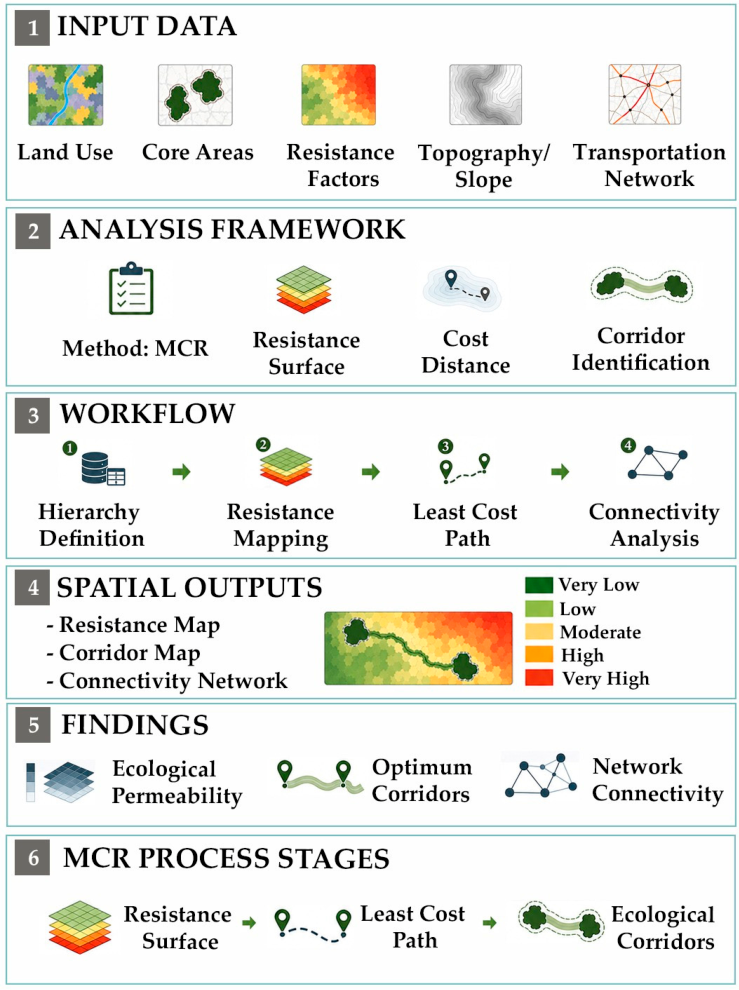
- Structural and functional hybrid approach: To overcome the limitations of purely morphological or solely species-based analyses [14,15,61], the S-SDSS integrates structural and functional connectivity within a unified decision framework [40,41]. This hybrid approach simultaneously evaluates landscape configuration and species movement potential [28].
- UN 2030 agenda and strategic alignment: The framework is designed to translate technical outputs into planning-relevant policy guidance. By aligning with the United Nations Sustainable Development Goals (SDGs 11, 13, and 15) [60], the S-SDSS connects local planning decisions to broader sustainability objectives [1,2,4,11,62,63].
5.2. Operational Workflow of the S-SDSS Framework
- Transfer to planning hierarchy: The model facilitates a multi-scalar integration by defining ecological cores as “Areas to be Protected for Natural Character” at the macro scale (1/100,000). At the micro scale (1/1000), these findings are directly incorporated into zoning plans as parks, greenways, or “Ecological Transition Zones”—strictly prohibited from construction—thereby ensuring the legal preservation of connectivity nodes [11,44].
5.3. Typological Proposals and Strategic Inferences
5.3.1. Technical Synthesis and Framework Requirements
5.3.2. Integration of S-SDSS Outputs into Urban Planning Typologies
5.3.3. Strategic Inferences for Spatial Planning
6. Conclusions and Recommendations
6.1. Methodological Contributions
6.2. Methodological Synthesis and Addressing Literature Gaps
6.3. Integration into the Planning Hierarchy and Policy
6.4. Framework Limitations
6.5. Future Research and Strategic Outlook
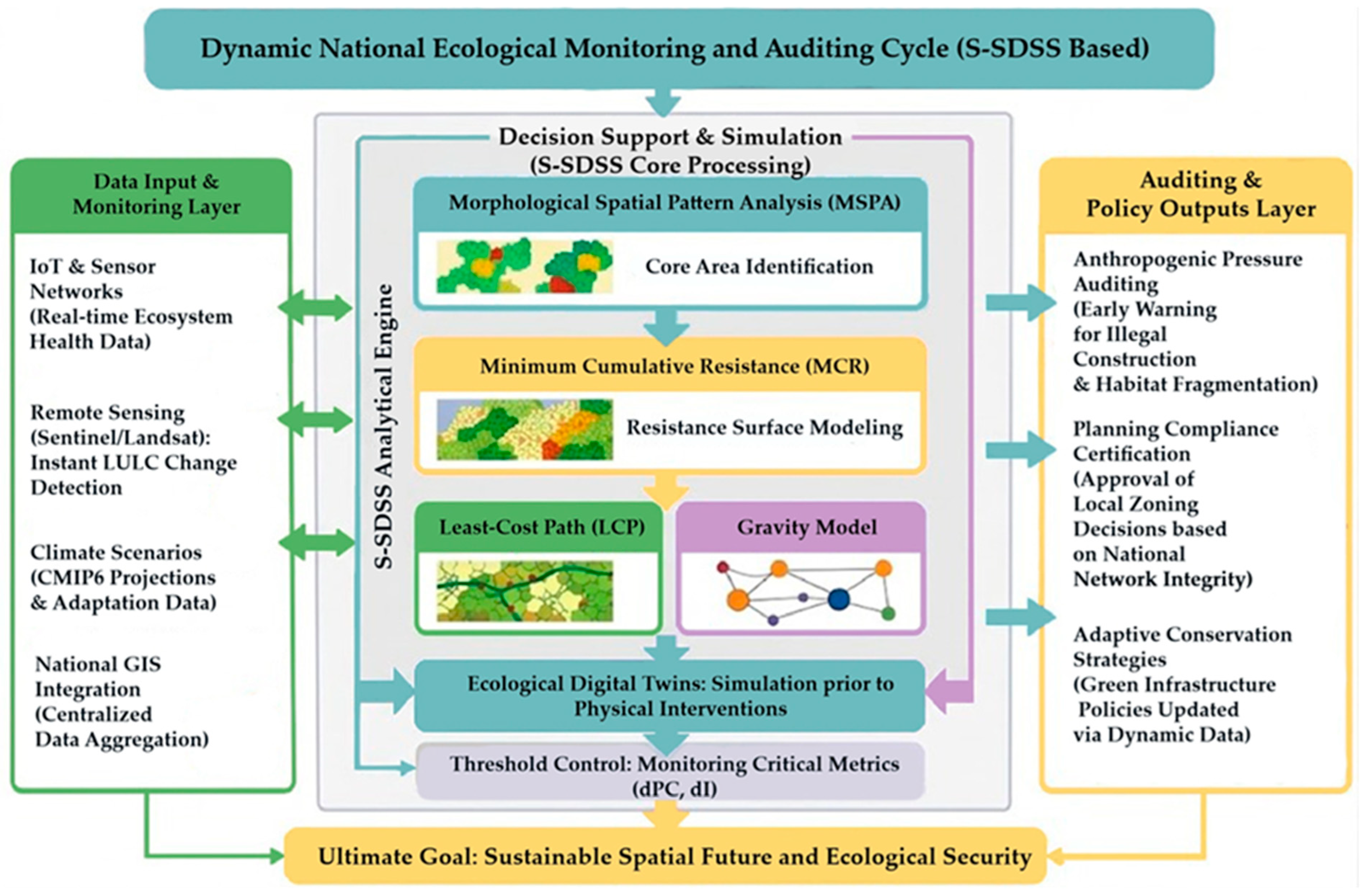
- Ecological digital twins: Establishing “Digital Twin” systems that simulate the impact of urban interventions on connectivity metrics before physical implementation. This allows harmful projects to be blocked before they reach the implementation phase [64].
- Centralized and continuous satellite surveillance (24/7): As seen in the Copernicus (EU) examples, instantaneous monitoring of anthropogenic pressures on the “Ecological Redline” through the integration of satellite data and Artificial Intelligence.
- Climate-sensitive adaptive management: Establishing a flexible management cycle based on the “Plan–Implement–Monitor–Learn” principle, where corridor routes are dynamically updated according to future climate scenarios via CMIP6 projections [3].
- National GIS and legislative integration: Adding a centralized “Ecological Security Approval” mechanism to legal legislation to audit the impact of local zoning decisions on national ecological network continuity.
Funding
Data Availability Statement
Acknowledgments
Conflicts of Interest
References
- Haddad, N.M.; Brudvig, L.A.; Clobert, J.; Davies, K.F.; Gonzalez, A.; Holt, R.D.; Collins, C.D. Habitat fragmentation and its lasting impact on Earth’s ecosystems. Sci. Adv. 2015, 1, e1500052. [Google Scholar] [CrossRef]
- Wu, J. Landscape sustainability science. Landsc. Ecol. 2013, 28, 999–1023. [Google Scholar] [CrossRef]
- Eyring, V.; Bony, S.; Meehl, G.A.; Senior, C.A.; Stevens, B.; Stouffer, R.J.; Taylor, K.E. Overview of the Coupled Model Intercomparison Project Phase 6 (CMIP6) experimental design and organization. Geosci. Model Dev. 2016, 9, 1937–1958. [Google Scholar] [CrossRef]
- Heller, N.E.; Zavaleta, E.S. Biodiversity management in the face of climate change: A review of 22 years of recommendations. Biol. Conserv. 2009, 142, 14–32. [Google Scholar] [CrossRef]
- Benedict, M.A.; McMahon, E.T. Green Infrastructure: Linking Landscapes and Communities; Island Press: Washington, DC, USA, 2006. [Google Scholar]
- Keeley, A.T.H.; Beier, P.; Jenness, J.S. Connectivity metrics for conservation planning and monitoring. Biol. Conserv. 2021, 255, 109008. [Google Scholar] [CrossRef]
- Wei, Q.; Halike, A.; Yao, K.; Chen, L.; Balati, M. Construction and optimization of ecological security pattern in Ebinur Lake Basin based on MSPA-MCR models. Ecol. Indic. 2022, 141, 108857. [Google Scholar] [CrossRef]
- Yang, C.; Guo, H.; Huang, X.; Wang, Y.; Li, X.; Cui, X. Ecological Network Construction of a National Park Based on MSPA and MCR Models: An Example of the Proposed National Parks of “Ailaoshan-Wuliangshan” in China. Land 2022, 11, 1913. [Google Scholar] [CrossRef]
- Taylor, P.D.; Fahrig, L.; Henein, K.; Merriam, G. Connectivity as a vital element of landscape structure. Oikos 1993, 68, 571–573. [Google Scholar] [CrossRef]
- Bennett, G.; Wit, P. The Development and Application of Ecological Networks: A Review of Proposals, Plans and Programmes; AIDEnvironment: Amsterdam, The Netherlands, 2001; 132p. [Google Scholar]
- Opdam, P.; Steingröver, E.; van Rooij, S. Ecological networks: A spatial concept for multi-actor planning of sustainable landscapes. Landsc. Urban Plan. 2006, 75, 322–332. [Google Scholar] [CrossRef]
- Tischendorf, L.; Fahrig, L. On the usage of landscape connectivity. Oikos 2000, 15, 7–19. [Google Scholar] [CrossRef]
- Knaapen, J.P.; Scheffer, M.; Harms, B. Estimating habitat isolation due to landscape barriers. Landsc. Urban Plan. 1992, 23, 1–16. [Google Scholar] [CrossRef]
- Soille, P.; Vogt, P. Morphological segmentation of binary patterns. Pattern Recognit. Lett. 2009, 30, 456–459. [Google Scholar] [CrossRef]
- Zeller, K.A.; McGarigal, K.; Whiteley, A.R. Estimating landscape resistance to movement: A review. Landsc. Ecol. 2012, 27, 777–797. [Google Scholar] [CrossRef]
- Saaty, T.L. The Analytic Hierarchy Process: Planning, Priority Setting, Resource Allocation; McGraw-Hill: New York, NY, USA, 1980. [Google Scholar]
- Adriaensen, F.; Chardon, J.P.; De Blust, G.; Swinnen, E.; Villalba, S.; Gulinck, H.; Matthysen, E. The application of ‘least-cost’ modelling as a functional landscape model. Landsc. Urban Plan. 2003, 64, 233–247. [Google Scholar] [CrossRef]
- Saura, S.; Pascual-Hortal, L. A new habitat availability index to integrate connectivity in landscape conservation planning. Landsc. Urban Plan. 2007, 83, 91–103. [Google Scholar] [CrossRef]
- Sadat, M.A.; Guan, Y.; Zhang, D.; Shao, G.; Cheng, X.; Yang, Y. The associations between river health and water resources management lead to the assessment of river state. Ecol. Indic. 2020, 109, 105814. [Google Scholar] [CrossRef]
- Wang, S.; Wu, M.; Hu, M.; Chen, F.; Wang, T.; Xia, B. Promoting landscape connectivity of highly urbanized area: An ecological network approach. Ecol. Indic. 2021, 125, 107487. [Google Scholar] [CrossRef]
- Mahmoudzadeh, H.; Masoudi, H.; Jafari, F.; Khorshiddoost, A.M.; Abedini, A.; Mosavi, A. Ecological networks and corridors development in urban areas: An example of Tabriz, Iran. Front. Environ. Sci. 2022, 10, 969266. [Google Scholar] [CrossRef]
- Huang, J.; Lin, H.; Xu, Y. Landscape Pattern and Ecological Network Structure in Urban Green Space Planning: A Case Study of Fuzhou City. Land 2021, 10, 769. [Google Scholar] [CrossRef]
- Moher, D.; Liberati, A.; Tetzlaff, J.; Altman, D.G. Preferred reporting items for systematic reviews and meta-analyses: The PRISMA statement. PLoS Med. 2009, 6, e1000097. [Google Scholar] [CrossRef]
- Page, M.J.; McKenzie, J.E.; Bossuyt, P.M.; Boutron, I.; Hoffmann, T.C.; Mulrow, C.D.; Shamseer, L.; Tetzlaff, J.M.; Akl, E.A.; Brennan, S.E.; et al. The PRISMA 2020 statement: An updated guideline for reporting systematic reviews. Syst. Rev. 2021, 10, 89. [Google Scholar] [CrossRef]
- Forman, R.T.T. Land Mosaics: The Ecology of Landscapes and Regions; Cambridge University Press: Cambridge, UK, 1995. [Google Scholar]
- Yu, F.; Zhang, B.; Yao, Y.; Wang, J.; Zhang, X.; Liu, J.; Li, J. Identifying Connectivity Conservation Priorities among Protected Areas in Qinling-Daba Mountains, China. Sustainability 2022, 14, 4377. [Google Scholar] [CrossRef]
- Saltelli, A.; Ratto, M.; Andres, T.; Campolongo, F.; Cariboni, J.; Gatelli, D.; Saisana, M.; Tarantola, S. Global Sensitivity Analysis: The Primer; John Wiley & Son: Hoboken, NJ, USA, 2008. [Google Scholar]
- Cushman, S.A.; McKelvey, K.S.; Schwartz, M.K. Use of empirically derived source–destination models in multivariate resistance surface modeling for landscape genetics. Conserv. Biol. 2009, 23, 368–376. [Google Scholar] [CrossRef]
- Ostapowicz, K.; Coomes, D.; Riitters, K. Impact of scale on morphological spatial pattern of forest. Landsc. Ecol. 2008, 23, 95–107. [Google Scholar] [CrossRef]
- Vogt, P.; Riitters, K.H.; Estreguil, C.; Kozak, J.; Wade, T.G.; Wickham, J.D. Mapping spatial patterns with morphological ımage processing. Landsc. Ecol. 2007, 22, 171–177. [Google Scholar] [CrossRef]
- Saura, S.; Rubio, L. A common currency for the different ways in which patches and links can contribute to habitat availability and connectivity in the landscape. Ecography 2010, 33, 523–537. [Google Scholar] [CrossRef]
- McRae, B.H.; Dickson, B.G.; Keitt, T.H.; Shah, V.B. Using circuit theory to model connectivity in ecology, evolution, and conservation. Ecology 2008, 89, 2712–2724. [Google Scholar] [CrossRef]
- Zhai, T.; Huang, L. Linking MSPA and Circuit Theory to Identify the Spatial Range of Ecological Networks and Its Priority Areas for Conservation and Restoration in Urban Agglomeration. Front. Ecol. Evol. 2022, 10, 828979. [Google Scholar] [CrossRef]
- Li, Y.; Zhang, Y.; Jiang, Z.; Guo, C.; Zhao, M.; Yang, Z.; Guo, M.; Wu, B.; Chen, Q. Integrating morphological spatial pattern analysis and the minimal cumulative resistance model to optimize urban ecological networks: A case study in Shenzhen City, China. Ecol. Process. 2021, 10, 63. [Google Scholar] [CrossRef]
- Beier, P.; Majka, D.R.; Spencer, W.D. Forks in the road: Choices in procedures for designing wildland linkages. Conserv. Biol. 2008, 22, 836–851. [Google Scholar] [CrossRef]
- Balbi, M.; Petit, E.J.; Croci, S.; Nabucet, J.; Georges, R.; Madec, L.; Ernoult, A. Ecological relevance of least-cost path analysis: An easy implementation method for landscape urban planning. J. Environ. Manag. 2019, 244, 61–68. [Google Scholar] [CrossRef]
- Dong, J.; Peng, J.; Xu, Y.; Sun, R.; Qu, J. Ecological network construction based on minimum cumulative resistance for the city of Nanjing, China. J. Resour. Ecol. 2015, 6, 153–161. [Google Scholar] [CrossRef]
- Qin, J.-Z.; Dai, J.-P.; Li, S.-H.; Zhang, J.-Z.; Peng, J.-S. Construction of ecological network in Qujing city based on MSPA and MCR models. Sci. Rep. 2024, 14, 9800. [Google Scholar] [CrossRef]
- Feng, M.; Zhao, W.; Zhang, T. Construction and optimization strategy of county ecological infrastructure network based on MCR and gravity model—A case study of Langzhong County in Sichuan Province. Sustainability 2023, 15, 8478. [Google Scholar] [CrossRef]
- Liu, C.; Zhan, M.; Zhao, X.; Wei, J.; Hu, Y.; Li, C.; Chu, Y.; Sun, F. Quantitative study of urban ventilation corridors’ ımpact on the atmospheric environment based on circuit theory. Buildings 2026, 16, 329. [Google Scholar] [CrossRef]
- An, Y.; Liu, S.; Sun, Y.; Shi, F.; Beazley, R. Construction and optimization of an ecological network based on morphological spatial pattern analysis and circuit theory. Landsc. Ecol. 2021, 36, 2059–2076. [Google Scholar] [CrossRef]
- Jongman, R.H.G. The context and concept of ecological networks. In Ecological Networks and Greenways: Concept, Design, Implementation; Jongman, R.H.G., Pungetti, G., Eds.; Cambridge University Press: Cambridge, UK, 2004; pp. 7–33. [Google Scholar]
- Urban, D.; Keitt, T. Landscape connectivity: A graph-theoretic perspective. Ecology 2001, 82, 1205–1218. [Google Scholar] [CrossRef]
- Lafortezza, R.; Davies, C.; Sanesi, G.; Konijnendijk, C.C. Green Infrastructure as a tool to support spatial planning in European urban regions. iFor. Biogeosci. For. 2013, 6, 102–108. [Google Scholar] [CrossRef]
- Saaty, T.L. How to make a decision: The analytic hierarchy process. Eur. J. Oper. Res. 1990, 48, 9–26. [Google Scholar] [CrossRef]
- Fahrig, L. Effects of habitat fragmentation on biodiversity. Annu. Rev. Ecol. Evol. Syst. 2003, 34, 487–515. [Google Scholar] [CrossRef]
- Phillips, S.J.; Anderson, R.P.; Schapire, R.E. Maximum entropy modeling of species geographic distributions. Ecol. Model. 2006, 190, 231–259. [Google Scholar] [CrossRef]
- Hanley, J.A.; McNeil, B.J. The meaning and use of the area under a receiver operating characteristic (ROC) curve. Radiology 1982, 143, 29–36. [Google Scholar] [CrossRef] [PubMed]
- Allouche, O.; Tsoar, A.; Kadmon, R. Assessing the accuracy of species distribution models: Prevalence, kappa and the true skill statistic (TSS). J. Appl. Ecol. 2006, 43, 1223–1232. [Google Scholar] [CrossRef]
- Rayfield, B.; Fortin, M.J.; Fall, A. Connectivity for conservation: A framework to classify network measures. Ecology 2011, 92, 847–858. [Google Scholar] [CrossRef]
- Pascual-Hortal, L.; Saura, S. Comparison and development of new graph-based landscape connectivity indices: Towards the priorization of habitat patches and corridors. Landsc. Ecol. 2006, 21, 959–967. [Google Scholar] [CrossRef]
- Wang, Y.; Qu, Z.; Zhong, Q.; Zhang, Q.; Zhang, L.; Zhang, R.; Yi, Y.; Zhang, G.; Li, X.; Liu, J. Delimitation of ecological corridors in a highly urbanizing region based on circuit theory and MSPA. Ecol. Indic. 2022, 142, 109258. [Google Scholar] [CrossRef]
- Wickham, J.D.; Riitters, K.H.; Wade, T.G.; Vogt, P. A national assessment of green infrastructure and change for the conterminous United States using morphological spatial pattern analysis. Landsc. Urban Plan. 2010, 94, 186–195. [Google Scholar] [CrossRef]
- Hu, C.; Wang, Z.; Wang, Y.; Sun, D.; Zhang, J. Combining MSPA-MCR Model to Evaluate the Ecological Network in Wuhan, China. Land 2022, 11, 213. [Google Scholar] [CrossRef]
- De Groot, R.S.; Wilson, M.A.; Boumans, R.M.J. A typology for the classification of ecosystem functions. Ecol. Econ. 2002, 41, 393–408. [Google Scholar] [CrossRef]
- Rudnick, D.A.; Ryan, S.J.; Beier, P.; Cushman, S.A.; Dieffenbach, F.; Epps, C.W.; Gerber, L.R.; Hartter, J.; Jenness, J.S.; Kintsch, J.; et al. The role of landscape connectivity in planning and implementing conservation and restoration priorities. Issues Ecol. 2012, 16, 1–23. Available online: http://research.fs.usda.gov/treesearch/42229 (accessed on 1 May 2026).
- Littlefield, C.E.; McRae, B.H.; Michalak, J.L.; Lawler, J.J.; Carroll, C. Connecting landscapes for climate change: A review of structure-and function-based approaches. Conserv. Biol. 2019, 33, 31–41. [Google Scholar] [CrossRef]
- OpenStreetMap Contributors. Planet Dump. 2024. Available online: https://www.openstreetmap.org (accessed on 4 May 2025).
- Daily, G.C. Nature’s Services: Societal Dependence on Natural Ecosystems; Island Press: Washington, DC, USA, 1997. [Google Scholar]
- United Nations. Transforming Our World: The 2030 Agenda for Sustainable Development; UN General Assembly: New York, NY, USA, 2015. [Google Scholar]
- Soille, P.; Vogt, P. Morphological Spatial Pattern Analysis: Open Source Release. Int. Arch. Photogramm. Remote Sens. Spatial Inf. Sci. 2022, XLVIII-4/W1-2022, 427–433. [Google Scholar] [CrossRef]
- Vogt, P. GuidosToolbox: Universal Digital Image Object Analysis; European Commission, Joint Research Centre: Brussels, Belgium, 2018.
- Ersoy, E.; Jorgensen, A.; Warren, P.H. Identifying multispecies connectivity corridors and the spatial pattern of network connectivity. Landsc. Ecol. 2019, 34, 1603–1618. [Google Scholar] [CrossRef]
- Han, L.; Qu, Y.; Liang, S.; Jia, H. Spatiotemporal Differentiation of Land Ecological Security and Optimization Based on GeoSOS-FLUS Model: A Case Study of the Yellow River Delta in China. Land 2024, 13, 1870. [Google Scholar] [CrossRef]
- European Environment Agency (EEA). Copernicus Land Monitoring Service: Habitat Fragmentation and Connectivity Reports; Report No: 01/2023; Publications Office of the European Union: Luxembourg, 2023.
- Riitters, K.; Wickham, J.; O’Neill, R.; Jones, B.; Smith, E. Global-scale patterns of forest fragmentation. Conserv. Ecol. 2000, 4, 3. Available online: http://www.consecol.org/vol4/iss2/art3 (accessed on 1 May 2026). [CrossRef]
- Schneider, A.; Friedl, M.A.; Potere, D. Mapping global urban areas using MODIS 500-m data: New methods and datasets based on urban ecoregions. Remote Sens. Environ. 2010, 114, 1733–1746. [Google Scholar] [CrossRef]
- McHarg, I.L. Design with Nature; John Wiley & Sons: New York, NJ, USA, 1967. [Google Scholar]
- Xu, C.; Cheng, L.; Su, J.; Yin, H.; Guo, Y. Developing regional ecological networks along the Grand Canal based on an integrated analysis framework. J. Resour. Ecol. 2021, 12, 801–813. [Google Scholar] [CrossRef]
- Bastian, O. Landscape ecology—Towards a unified discipline? Landsc. Ecol. 2001, 16, 757–766. [Google Scholar] [CrossRef]
- Saura, S.; Torné, J. Conefor Sensinode 2.2: A software package for quantifying the importance of habitat patches for landscape connectivity. Environ. Model. Softw. 2009, 24, 135–139. [Google Scholar] [CrossRef]
- Cohen, J. A coefficient of agreement for nominal scales. Educ. Psychol. Meas. 1960, 20, 37–46. [Google Scholar] [CrossRef]
- Fielding, A.H.; Bell, J.F. A review of methods for the assessment of prediction errors in conservation presence/absence models. Environ. Conserv. 1997, 24, 38–49. [Google Scholar] [CrossRef]
- Pontius, R.G.; Schneider, L.C. Land-cover change model validation by an ROC method for the Berks County, Pennsylvania, USA. Agric. Ecosyst. Environ. 2001, 85, 239–248. [Google Scholar] [CrossRef]
- Tzoulas, K.; Korpela, K.; Venn, S.; Yli-Pelkonen, V.; Kaźmierczak, A.; Niemela, J.; James, P. Promoting ecosystem and human health in urban areas using Green Infrastructure: A literature review. Landsc. Urban Plan. 2007, 81, 167–178. [Google Scholar] [CrossRef]
- Marulli, J.; Mallarach, J.M. A GIS methodology for assessing ecological connectivity: Application to the Barcelona Metropolitan Region. Landsc. Urban Plan. 2005, 71, 131–162. [Google Scholar] [CrossRef]
- Saura, S.; Bodin, Ö.; Fortin, M.-J. Stepping stones are crucial for species’ long-distance dispersal and range expansion through habitat networks. J. Appl. Ecol. 2014, 51, 171–182. [Google Scholar] [CrossRef]
- Alberti, M. The effects of urban patterns on ecosystem function. Int. Reg. Sci. Rev. 2005, 28, 168–192. [Google Scholar] [CrossRef]
- Grimm, N.B.; Faeth, S.H.; Marty, N.E.; Redman, C.L.; Wu, J.; Bai, X.; Briggs, J.M. Global change and the ecology of cities. Science 2008, 319, 756–760. [Google Scholar] [CrossRef]
- Peng, J.; Zhao, H.; Liu, Y. Urban ecological corridors construction: A review. Acta Ecol. Sin. 2017, 37, 23–30. [Google Scholar] [CrossRef]
- McRae, B.H.; Kavanagh, D.M. Linkage Mapper Connectivity Analysis Software; The Nature Conservancy: Seattle, WA, USA, 2011. [Google Scholar]
- Wang, T.; Chen, X.; Zheng, X.; Yang, Z. Identification of Priority Conservation Areas Integrating Landscape Ecological Risks and Ecosystem Services for Natural Heritage Sites: A Case Study of the Bogda Region, China. Int. J. Environ. Res. Public Health 2022, 19, 2044. [Google Scholar] [CrossRef]
- Xie, J.; Xie, B.; Zhou, K.; Li, J.; Xiao, J.; Liu, C. Impacts of landscape pattern on ecological network evolution in Changsha-Zhuzhou-Xiangtan Urban Agglomeration, China. Ecol. Indic. 2022, 145, 109716. [Google Scholar] [CrossRef]
- Meerow, S.; Newell, J.P.; Stults, M. Designating resilience: The urban resilience fix in planning and design. Plan. Theory Pract. 2016, 17, 38–49. [Google Scholar] [CrossRef]
- Zhou, W.; Pickett, S.T.A.; Cadenasso, M.L. Shifting concepts of urban spatial heterogeneity and their implications for sustainability. Landsc. Ecol. 2017, 32, 1397–1413. [Google Scholar] [CrossRef]
- McRae, B.H.; Hall, S.A.; Beier, P.; Theobald, D.M. Where to restore ecological connectivity? Detecting barriers and quantifying restoration benefits. PLoS ONE 2012, 7, e52604. [Google Scholar] [CrossRef]
- DeFries, R.; Hansen, A.; Turner, B.L.; Reid, R.; Liu, J. Land use change around protected areas: Management to balance human needs and ecological function. Ecol. Appl. 2007, 17, 1031–1038. [Google Scholar] [CrossRef]
- Bolund, P.; Hunhammar, S. Ecosystem services in urban areas. Ecol. Econ. 1999, 29, 293–301. [Google Scholar] [CrossRef]
- Crooks, K.R.; Sanjayan, M. Connectivity Conservation: Maintaining connections for nature. In Connectivity Conservation; Crooks, K.R., Sanjayan, M., Eds.; Cambridge University Press: Cambridge, UK, 2006; pp. 1–20. [Google Scholar]
- Hostetler, M.E.; Allen, W.; Meurk, C.D. Conserving urban biodiversity? Creating green infrastructure is only the first step. Landsc. Urban Plan. 2011, 100, 369–371. [Google Scholar] [CrossRef]
- Van der Ree, R.; Smith, D.J.; Grilo, C. (Eds.) Handbook of Road Ecology; John Wiley & Sons: Hoboken, NJ, USA, 2015. [Google Scholar] [CrossRef]
- Zhang, Y.; Lu, M.; Ma, W.; Meng, Q.; Li, Z.; Wu, Y. Urban multi-scale ecological network sequence and spatial structure optimization: A case study in Nanjing city, China. Ecol. Indic. 2024, 167, 112622. [Google Scholar] [CrossRef]
- Jalkanen, J.; Toivonen, T.; Moilanen, A. Identification of ecological networks for land-use planning with spatial conservation prioritization. Landsc. Ecol. 2020, 35, 353–371. [Google Scholar] [CrossRef]
- Steiner, F. The Living Landscape: An Ecological Approach to Landscape Planning; McGraw-Hill: New York, NY, USA, 2008. [Google Scholar]
- Hosseini, Z.S.; Raofi, R.; Hamidkhaniha, S.; Daneshgar, F.; Wynn, M.G. Green infrastructure for sustainable urban development: A case study from Tehran. Green Low-Carbon Econ. 2025. [Google Scholar] [CrossRef]
- Zou, Z.; Zhao, X.; Liu, S.; Zhou, C. Driving forces and future scenario simulation of urban agglomeration expansion in China: A case study of the Pearl River Delta urban agglomeration. Remote Sens. 2025, 17, 2455. [Google Scholar] [CrossRef]
- Niemelä, J. Is there a need for a theory of urban ecology? Urban Ecosyst. 1999, 3, 57–65. [Google Scholar] [CrossRef]



| Functional Dimension | Ecological Significance | Planning Implications | References |
| Species movement and gene flow | Maintains genetic diversity and reduces local extinction risk by enabling dispersal among habitat patches. | Supports identification of critical habitat corridors and stepping stones. | [1,2] |
| Climate change adaptation | Facilitates species range shifts toward climatically suitable habitats. | Guides long-term ecological adaptation strategies. | [3,4] |
| Ecosystem service resilience | Sustains carbon sequestration, hydrological regulation, and erosion control through connected landscapes. | Strengthens ecosystem-based planning and nature-based solutions. | [4,5] |
| Morphological integrity and edge-effect reduction | Preserves core habitats and reduces fragmentation and edge effects. | Supports delineation of buffer zones and ecological restoration priorities. | [1,14] |
| Green infrastructure integration | Provides the spatial basis for linking natural areas across urban and rural landscapes. | Informs sustainable land-use planning and infrastructure design. | [5] |
| Spatial prioritization | Enables ranking of areas for conservation and restoration under limited resources. | Supports transparent and evidence-based decision making. | [2,8] |
| Stage | Number of Records (n) | Number of Records (n) |
|---|---|---|
| 1. Identification | Total records identified through database searching. | 214 |
| Removal of duplicate records. | 38 | |
| Total records screened after deduplication | 176 | |
| 2. Screening | Records excluded after title and abstract screening. | 64 |
| Articles retained for full-text eligibility assessment. | 112 | |
| 3. Eligibility | Full-text articles excluded based on exclusion criteria. | 34 |
| Lack of resistance surface modeling. | 18 | |
| No integrated methodological framework. | 10 | |
| Lack of spatial decision support focus. | 6 | |
| 4. Included | Final studies included in qualitative and analytical synthesis. | 78 |
| Period | Core Frameworks | Methodological Gaps & Limitations | Identified Evidences | S-SDSS Architectural Response |
|---|---|---|---|---|
| 2005–2009 | Stand-alone LCP/MCR | Subjective resistance values; total disregard of structural morphology. | [13,17,31,32,35] | Replaces expert bias with systematic MCE and probabilistic surfaces. |
| 2010–2014 | MSPA + LCP | Heavy scale sensitivity; loss of narrow corridors in low resolutions. | [29,30] | Implements high-resolution (10 m) morphological filtering. |
| 2015–2018 | MSPA + MCR + LCP | Static connection pipelines; lack of dynamic sensitivity analysis. | [36,37] | Integrates spatial uncertainty analysis within decision thresholds. |
| 2019–2022 | MSPA + MCR + LCP + CT/GM | Computational bottlenecks; results are too abstract for statutory plans. | [7,8,32,33,34] | Translates “pinch-points” into spatially explicit planning categories. |
| 2023–2025 | Integrated MCE Models | Lack of localized validation and species-specific parameter synchronization. | [38,39,40,41] | Embeds automated sensitivity validation (AHP-MCE-Uncertainty loop). |
| Depth Level | Core Modeling Architecture | Validation Mechanisms | Primary Reference Anchors | Planning Integration Level |
|---|---|---|---|---|
| Type A (Isolated) | Single Model (MSPA or LCP) | None | [29,30] | Low: Structural geometry mapped; functional flow ignored. |
| Type B (Spliced) | MSPA + MCR | Limited Expert Review | [7,8,36,37] | Medium: Disconnection points identified without hierarchical order. |
| Type C (Integrated) | MSPA + MCR + LCP | Scenario Analysis Matrices | [40,41] | Medium-High: Least-cost pathways drawn but highly vulnerable to parameter shifts. |
| Type D (S-SDSS Framework) | MSPA + MCR + LCP + GM + MCE/AHP | Sensitivity and Spatial Uncertainty Analysis | [22,33,34,38,52] | High: Establishes highly resilient, spatially explicit planning boundaries based on optimized thresholds. |
| Operational Blocks | Method/Software Utilized | Literature Synthesis and References |
|---|---|---|
| Input Data | Data harvesting and validation: Satellite imagery procurement. | Selection of high-resolution datasets for urban-regional alignment and classification accuracy. Establishing the spatial baseline for national ecological security [4,11,30,53,58,64,65,66,67]. |
| Structural Analysis (MSPA) | MSPA segmentation: Detection of core, edge, and bridge elements via mathematical morphology. | Identification of structural connectivity elements based on pixel-based segmentation and landscape geometry [14,29,30,53,61,62]. |
| Resistance Modeling | AHP and MCE execution: Weighting of resistance factors and anthropogenic pressures. | Resolving multi-criteria decision conflicts through hierarchical consistency and landscape permeability studies [15,16,17,33,39,41,45,68]. |
| Least-Cost Path (LCP) | Cost-surface simulation: Modeling of cumulative resistance and potential movement paths. | Modeling of cost surfaces to determine the ease of ecological movement across modified urban landscapes [17,19,32,43,68,69]. |
| Connectivity Synthesis | Functional simulation (MCR/LCP and CT): Probabilistic current density and dispersal route analysis. | Simulation of functional corridors and “paths of least resistance” for regional biodiversity continuity [1,7,10,12,13,19,20,25,32,40,41,70]. |
| Gravity Model (GM) | Interaction strength ranking: Prioritization of ecological hubs and network backbones. | Quantification of interaction strength between strategic hubs and numerical proof of node importance [8,18,20,31,51,71]. |
| Model Validation | Performance verification: Sensitivity testing and predictive power via AUC-ROC. | Minimizing uncertainty through statistical validation, ROC performance, and parametric stability tests [27,33,34,38,47,48,49,62,72,73,74]. |
| Planning Output | S-SDSS implementation: Translation of analytical maps into actionable urban planning policies; decision support. Hybrid Typology (T1–T5). | Aligning analytical outputs with sustainable spatial future guidelines and UN Sustainable Development Goals [1,2,4,8,20,25,38,60,75,76,77,78,79]. |
| Code | Typology Name | Definition/Sensitive Areas | Planning Priority | Intervention Strategy |
|---|---|---|---|---|
| T1 | Absolute Conservation Area | Core forests, wetlands, endemic habitats. | Biodiversity conservation. | Zero intervention: Construction ban; buffer control [1,20,77,86]. |
| T2 | Restoration Area | Fragmented habitats, degraded riverbeds, urban voids. | Ecosystem services recovery. | Active improvement: Native afforestation; habitat repair [1,77,86]. |
| T3 | Ecological Corridors | River networks, bridge, and stepping stone links. | Connectivity, genetic flow and species mobility. | Connectivity: Ecological bridges; linear green protection [17,40,63,83]. |
| T4 | Sustainable Use Area | Agricultural lands, pastures, rural fringes. | Human–nature balance. | Controlled: Regenerative agriculture; ecotourism [2,87,88]. |
| T5 | Buffer Zone | Urban boundaries, development pressure zones. | Limiting urban sprawl. | Low Impact Development (LID): Green buildings; permeable surfaces [2,26,84,85,88]. |
| Planning Scale | Related Plan Type | Core Contribution of the Model | Strategic Intervention Focal Point |
|---|---|---|---|
| Macro Scale (Regional) | Regional Plan, Environmental Layout Plan | Hierarchical identification of macro-corridors and core areas. | Continuity of the green infrastructure backbone and establishment of ecological security [20,42]. |
| Meso Scale (Master) | 1/5000 Master Development Plan | Analysis of ecological thresholds and optimization of construction boundaries. | Time-dependent landscape changes and environmental risk projections [11,93,94,95,96]. |
| Micro Scale | 1/1000 Implementation Development Plan | Protection of critical connectivity nodes and bottlenecks. | Management of urban development pressure and corridor continuity [26,44,90]. |
| Site/Project Scale | Urban Design and Landscape Projects | Standards for corridor width and buffer zone design. | Mitigation of barrier effects at the micro-scale and biotope improvement [17,81,86,91]. |
| Analysis Criterion | Traditional Approach (Area-Oriented) | Proposed S-SDSS Framework (Connectivity-Oriented) | Ecological Output/ Contribution |
|---|---|---|---|
| Prioritization | Size-dependency; large patches only [1,25,46]. | Parametric Weighting + Expert Opinion (Area + Location + Quality) [15,16,45]. | Strategic discovery of small/key areas [77]. |
| Decision Basis | Static, single-scenario [19,46]. | Multi-Threshold and Boolean Logic [16,45]. | Legally grounded, realistic planning base [15,26]. |
| Connectivity Metric | Static Euclidean distance [12,13]. | Dynamic Resistance (MCR-LCP) [15,17,36,69]. | Identification of functional routes [7,36,83]. |
| Network Hierarchy | Ignored interactions [43]. | Graph Theory (Node interactions) [18,32,43,51]. | Numerical proof of network backbone [8,31,38,39,40,71]. |
| Landscape Pattern | Isolated reserves [68]. | Network Theory (MSPA integration) [14,40]. | Survival in fragmented textures (AUC > 0.90) [38,48,49,53]. |
Disclaimer/Publisher’s Note: The statements, opinions and data contained in all publications are solely those of the individual author(s) and contributor(s) and not of MDPI and/or the editor(s). MDPI and/or the editor(s) disclaim responsibility for any injury to people or property resulting from any ideas, methods, instructions or products referred to in the content. |
© 2026 by the author. Licensee MDPI, Basel, Switzerland. This article is an open access article distributed under the terms and conditions of the Creative Commons Attribution (CC BY) license.
Share and Cite
Erbesler Ayaşlıgil, T. A Sustainable Spatial Decision Support System (S-SDSS): A Systematic Review and Conceptual Integration of Ecological Network Optimization Frameworks. Land 2026, 15, 972. https://doi.org/10.3390/land15060972
Erbesler Ayaşlıgil T. A Sustainable Spatial Decision Support System (S-SDSS): A Systematic Review and Conceptual Integration of Ecological Network Optimization Frameworks. Land. 2026; 15(6):972. https://doi.org/10.3390/land15060972
Chicago/Turabian StyleErbesler Ayaşlıgil, Tülay. 2026. "A Sustainable Spatial Decision Support System (S-SDSS): A Systematic Review and Conceptual Integration of Ecological Network Optimization Frameworks" Land 15, no. 6: 972. https://doi.org/10.3390/land15060972
APA StyleErbesler Ayaşlıgil, T. (2026). A Sustainable Spatial Decision Support System (S-SDSS): A Systematic Review and Conceptual Integration of Ecological Network Optimization Frameworks. Land, 15(6), 972. https://doi.org/10.3390/land15060972