Systematic Review

Coupling Urban Shrinkage and Social–Ecological System Resilience: Feedback Mechanisms and Governance Strategies in China


1
School of Architecture and Design, Harbin Institute of Technology, Harbin 150006, China
2
Key Laboratory of National Territory Spatial Planning and Ecological Restoration in Cold Regions, Ministry of Natural Resources, Harbin 150006, China
*
Author to whom correspondence should be addressed.
Land 2026, 15(6), 930; https://doi.org/10.3390/land15060930 (registering DOI)
Submission received: 21 April 2026 / Revised: 21 May 2026 / Accepted: 26 May 2026 / Published: 28 May 2026

Abstract

Urban shrinkage has evolved from a localized phenomenon into a systemic challenge within China’s rapid urbanization, rendering traditional growth-oriented planning paradigms increasingly obsolete. However, existing research often treats shrinkage as either a passive outcome or an isolated shock, lacking a holistic perspective on how complex urban systems can adapt and reorganize under prolonged decline. This study constructs a coupling framework integrating urban shrinkage with Social–Ecological System (SES) resilience to bridge this theoretical gap. Drawing on a systematic literature review of 76 peer-reviewed articles following the PRISMA guidelines, we identify six core dimensions that drive this coupling. These dimensions consist of distinct physical and social elements. Our analysis reveals that the interactions between rigid physical environments and highly fluid social elements trigger nonlinear cascading feedback loops. While demographic contraction amplifies systemic risks, the subsequent structural release provides crucial spatial and institutional room for right-sizing. To translate these mechanisms into actionable governance strategies within the Chinese context, we propose a dual-track paradigm. Regionally, strategies emphasize collaborative risk monitoring, cross-boundary factor substitution, and industrial functional complementarity to mitigate vulnerability spillover. Locally, planning needs to pivot toward systemic downsizing and social empowerment, integrating proactive spatial reduction with agile service provision and community capacity-building. Ultimately, integrating structural reconfiguration with grassroots social learning enables shrinking cities to establish a new resilient equilibrium. While anchored in the Chinese context, this dual-track governance paradigm offers transferable insights for global shrinking cities seeking to overcome structural lock-in and foster adaptive SES resilience.

1. Introduction

Urban shrinkage has emerged as a pervasive global phenomenon, challenging the traditional growth-oriented paradigm in urban planning. To properly contextualize this study, it is necessary to examine the demographic and spatial manifestations of this process within China. Recent census data indicate that over a quarter of Chinese cities are currently experiencing population contraction [1]. Spatially, these shrinking cities are widely distributed, encompassing the Northeast’s old industrial bases, inland resource-exhausted regions, and peripheral towns within developed coastal agglomerations. This decline is accompanied by distinct demographic shifts, notably a marked reduction in the working-age population and advanced demographic aging [2]. Paradoxically, despite this demographic hollowing-out, empirical studies indicate that numerous shrinking cities still exhibit spatial expansion. This “shrinkage–expansion” mismatch highlights profound underlying institutional tensions. Driven by a reliance on land-based municipal finance within a hierarchical administrative system, local governments often maintain expansionary planning, frequently resulting in spatial degradation and extensive urban vacancy [3]. Consequently, while the symptoms of industrial and demographic decline share comparable trajectories with other global post-industrial regions, the rigid application of growth-oriented institutional frameworks in these declining areas shapes a distinct trajectory of structural lock-in. Deconstructing this specific experience provides transferable theoretical archetypes, assisting global shrinking cities in transitioning from conventional expansionary models to adaptive and sustainable urban paradigms.
Driven by this practical necessity, scholars have extensively explored urban shrinkage [2,4,5,6,7,8,9,10,11,12,13]. Research on phenomenon identification has advanced significantly: shifting from single-dimensional demographic metrics to multidimensional approaches incorporating population, economy, and space [14,15]; temporally, from static endpoints to dynamic, continuous, and cyclical processes [1,16,17]; and spatially, from the municipal scale down to high-precision small geographic units [18,19,20]. Extensive studies have also explored its causal mechanisms and multidimensional impacts on industry, ecology, and social vitality [21,22,23,24]. However, existing studies tend to fragment the dynamic process of urban shrinkage, often splitting it into two disconnected analytical directions. Some studies view shrinkage purely as a final outcome and focus on identifying its triggers. Other studies treat it as a starting point to examine its multidimensional impacts. This fragmented approach lacks a holistic view of the complex social–ecological system’s internal adaptive capacity and dynamic feedback mechanisms. To address this fragmentation, this paper clarifies the operational boundaries of urban shrinkage within the Chinese context. Urban shrinkage is often driven by compound disturbances. These include acute policy shifts, administrative boundary adjustments, chronic industrial obsolescence, and demographic siphoning. However, shrinkage is more than just a passive outcome of these shocks. It simultaneously operates as an active systemic variable that reshapes internal feedback loops. This means that urban shrinkage operates recursively as both a consequence of systemic disturbances and a catalyst for further systemic evolution.
Given the complex dynamics of urban shrinkage and the fragmented existing literature, the concept of Social–Ecological System (SES) resilience provides an ideal theoretical lens. Classically, SES resilience is defined as the capacity of a coupled human–environment system to absorb disturbances and reorganize while undergoing change, so as to still retain essentially the same function, structure, identity, and feedback [25,26,27,28]. This macro-concept provides the necessary tools to analyze nonlinear changes. More importantly, it shifts the governance logic away from blindly resisting decline, pivoting instead toward adapting to the reduction process and promoting systemic transformation. To operationalize this perspective within the urban context, it is crucial to introduce the complementary concept of socio-spatial resilience. While SES focuses on broader human-nature interactions, socio-spatial resilience explicitly highlights the interplay between social processes and the physical built environment, assessing how spatial structures and local networks adaptively reconfigure to mitigate vulnerability [29]. By nesting these perspectives, urban shrinkage can be understood as a co-evolutionary process where a city’s physical and social subsystems interact with multidimensional disturbances, reflecting the dynamic state of systemic vitality.
Despite the theoretical potential for such coupling, existing research attempting to integrate these two fields faces three critical gaps. First, there is an asymmetry in empirical focus and ambiguity in coupling elements. Current SES resilience research predominantly focuses on growth-oriented cities, often overlooking the unique systemic characteristics of shrinking regions [30]. Consequently, the core physical and social elements that constitute the coupling between shrinkage and resilience have not yet been systematically extracted and conceptualized. Second, analytical frameworks and the exploration of coupling mechanisms are still lacking. Existing studies have not yet established an integrated framework to capture the dynamic, cross-dimensional, and cross-scale feedback loops between shrinkage processes and resilience evolution. Third, there is a clear institutional mismatch. A practically actionable governance framework tailored to the realities of shrinking cities remains absent. Under the specific contexts of urban shrinkage and proactive reduction, resilience planning lacks concrete implementation pathways within China’s localized institutional framework, particularly regarding how to operationalize it under severe local fiscal constraints and how to achieve adaptive optimization within the overarching framework of Territorial Spatial Planning (TSP) [31].
To address these theoretical gaps and practical governance challenges, this paper proposes a coupled analytical framework integrating urban shrinkage and SES resilience. This theoretical integration is mutually beneficial: SES resilience provides the dynamic feedback lens lacking in traditional shrinkage research, while the non-growth context of shrinking cities expands the application boundaries of resilience theory. Fundamentally, this coupled framework elucidates the dual nature of urban shrinkage by identifying the spatiotemporal mismatch between highly mobile social elements and rigid physical infrastructure. Urban shrinkage acts as a risk amplifier. It triggers negative feedback loops that degrade socio-spatial systems. At the same time, this structural disruption creates practical opportunities for systemic reorganization. Within the SES adaptive cycle, demographic contraction disrupts the path dependencies of past expansionary phases. This disruption forces the system to transition directly into the release and reorganization stages [32]. This transition unlocks the potential for functional optimization and right-sizing. Guided by this theoretical lens, this study systematically investigates the elements and mechanisms underpinning this coupling. The objective is to theoretically deconstruct the interaction between these two phenomena to inform multi-scalar spatial governance strategies in the Chinese context. Accordingly, following the methodology outlined in Section 2, this paper extracts the core coupling elements (Section 3), analyzes the cross-dimensional and cross-scale feedback mechanisms (Section 4), and proposes corresponding planning and governance strategies (Section 5).

2. Methods: A Systematic Literature Review

This study conducted a systematic literature review based on the PRISMA (Preferred Reporting Items for Systematic Reviews and Meta-Analyses) guidelines [33]. To capture both broader theoretical advancements and localized spatial governance practices in China, literature was sourced from two distinct databases.

2.1. Scope and Search Strategy

This systematic review adopts an analytical strategy combining global retrieval with local contextualization. Global retrieval is utilized to capture universal theoretical advancements and foundational frameworks concerning urban shrinkage and resilience. Incorporating international literature ensures a robust and universally applicable theoretical baseline. Building upon this foundation, the spatial focus of the analysis is anchored in China. As the world’s largest developing country, China is undergoing a profound transition from rapid urbanization to regional population decline. Its unique “shrinkage–expansion” paradox is shaped by land finance dependency and a hierarchical administrative system. This background provides a representative macro-context for observing systemic shrinkage and structural lock-in. Focusing on the Chinese context effectively controls for macro-institutional variables. This approach facilitates the precise extraction of socio-spatial resilience mechanisms and their translation into theoretical archetypes with global reference value.
The literature search timeframe is set from January 2010 to December 2025. This specific period was determined based on the results of a preliminary study conducted prior to the formal retrieval. The preliminary analysis revealed that academic output combining urban shrinkage and resilience entered a continuous growth phase starting in 2010. This field subsequently formed three distinct research peaks in 2012, 2016, and 2021. Based on the evolution of the academic discourse, this timeframe can be divided into three distinct stages. The period before 2012 constitutes the early research stage. Academic focus primarily centered on engineering resilience, examining physical aspects like building damage and public facility services. The period from 2012 to 2016 marks an expansion in research methodologies. Scholars widely addressed landscape ecological security and urbanization issues. This stage emphasized establishing multidimensional urban sensing systems and developing comprehensive models. The period after 2016 represents a peak phase with a massive emergence of research topics. The connotations of shrinkage and resilience continuously expanded. Under the backdrop of climate change, economic fluctuations, and urban transitions, research objects shifted significantly. Topics including economic resilience, environmental justice, land quality, and urban health became mainstream. Searching up to 2025 ensures the inclusion of the most cutting-edge governance strategies.
Based on these defined boundaries, the literature search was conducted using the Web of Science (WoS) Core Collection and the China National Knowledge Infrastructure (CNKI) from January 2010 to December 2025. For WoS, the search string was TS = (“urban shrinkage” OR “shrinking city” OR “population decline” OR “urban decline”) AND TS = (“resilience” OR “social-ecological system” OR “adaptive capacity” OR “vulnerability”). For CNKI, we applied a corresponding search string using equivalent Chinese terms (transcribed here in Pinyin): ([“Chengshi Shousuo” OR “Shousuo Chengshi” OR “Renkou Jianshao” OR “Chengshi Shuaitui”] AND [“Renxing” OR “Shehui-Shengtai Xitong” OR “Shidying Nengli” OR “Cuiruoxing”]). Applying a strict language filter to the CNKI results ensured the inclusion of only Chinese-language literature, thereby excluding translated foreign journals to preserve the localized relevance of the sample. This process resulted in 691 initial records, with 407 originating from WoS and 284 from CNKI.

2.2. PRISMA Protocol and Screening Criteria

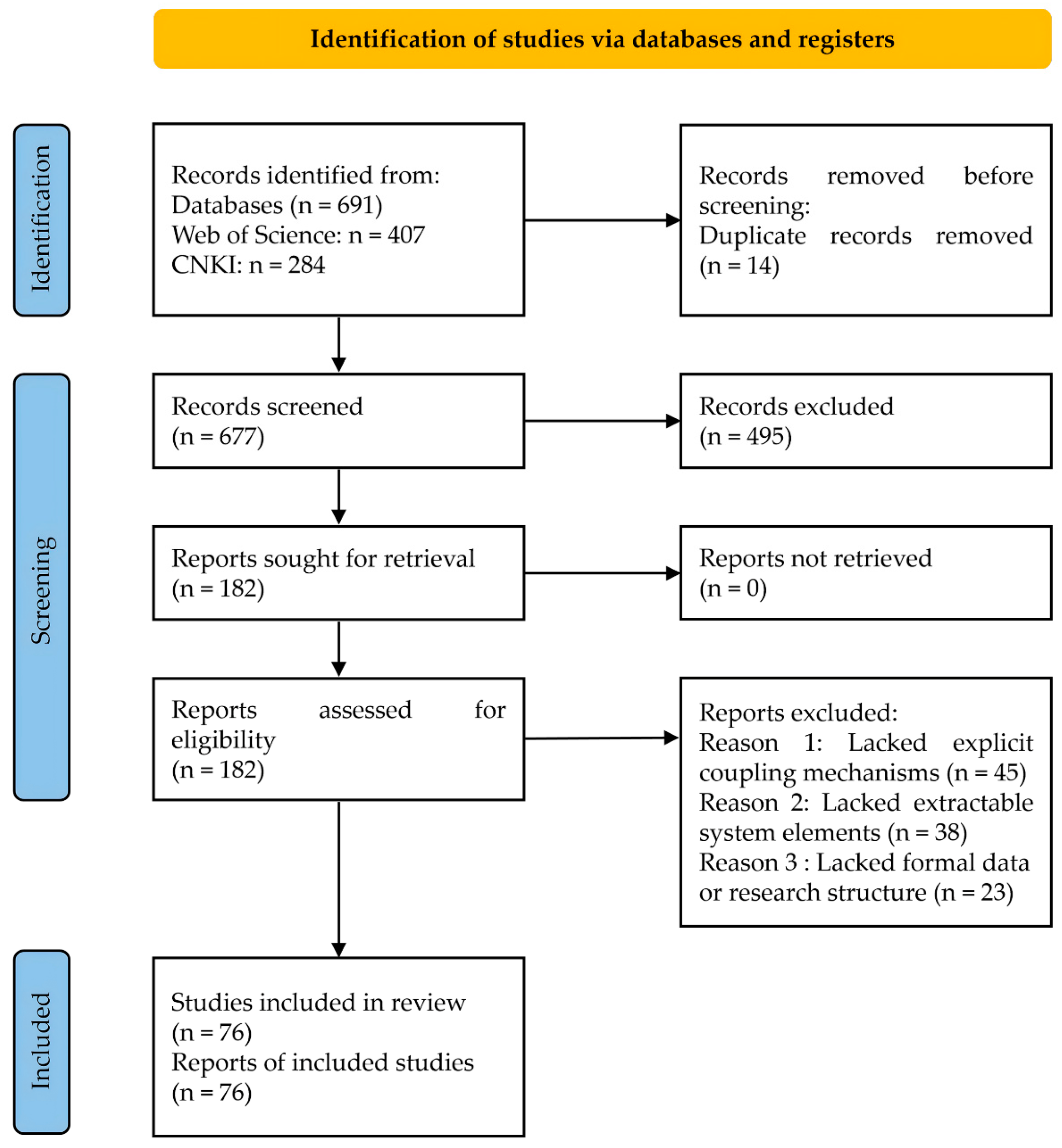
To ensure transparency and methodological reproducibility, this study was conducted in strict accordance with the updated Preferred Reporting Items for Systematic Reviews and Meta-Analyses (PRISMA 2020) statement [33]. Detailed compliance with all core checklist items is provided in the Supplementary File S1. Given that the searches were conducted in two linguistically distinct databases (English in WoS and Chinese in CNKI), no cross-database duplicates were identified (n = 0). After removing 14 intra-database duplicate records (generated primarily from overlapping sub-indexes within the databases), 677 articles remained for the initial title and abstract screening. This step excluded 495 articles that were irrelevant to the research topic. The remaining 182 articles underwent a full-text assessment based on established inclusion and exclusion criteria.
To ensure the substantive relevance of the sample, three exclusionary criteria were applied during the full-text review. First, we excluded papers lacking explicit coupling mechanisms, where urban shrinkage and resilience were treated as isolated phenomena without analyzing their bidirectional causal feedback. Second, research lacking extractable system elements was removed if it merely discussed macroscopic associations without providing specific factors related to urban physical, economic, social, or ecological dimensions. Finally, we excluded brief commentaries and descriptive reports lacking formal data or research structure.
During this systematic evaluation, 106 articles were excluded based on these criteria, ultimately resulting in 76 articles for the final review (Figure 1).

2.3. Data Extraction and Thematic Synthesis

A rigorous, multi-stage thematic analysis was subsequently conducted on the 76 included articles. First, data from both English and Chinese literature were subjected to in-depth reading to extract specific textual segments discussing mechanisms of urban decline and resilience responses. To mitigate subjective interpretation bias during data extraction, an inter-coder validation procedure was implemented [34]. Two researchers independently coded a random subsample (20%, n = 15) of the included articles. Initial discrepancies in code assignments were resolved through iterative joint discussions to refine the coding dictionary. After three rounds of pilot coding and adjustment, a substantial degree of final consensus was achieved (Cohen’s Kappa = 0.85). The finalized, standardized dictionary was then applied to the remaining literature.
To maintain conceptual consistency, data from both the English and Chinese literature were coded under a unified analytical framework. Guided by the validated dictionary, the thematic synthesis process was executed through a hybrid deductive and inductive approach [35]. In the deductive phase, data were initially organized into physical and social systems, consistent with the conceptual framework of SES theory. This was followed by a more granular inductive analysis to extract recurring variables and coupling mechanisms. For instance, the analysis identified specific cascading feedback loops demonstrating how the outmigration of highly mobile human capital undermines local fiscal foundations, thereby accelerating the decay of rigid physical infrastructure. These extracted variables and mechanisms were subsequently clustered into six dimensions: ecological, built environment, infrastructure, governance, economic, and humanistic. These grouped dimensions form the basis of the coupling framework presented in Section 3.
The final reference list contains 128 items divided into two distinct groups. The first group consists of the 76 core articles retrieved through the PRISMA protocol. These are predominantly cited in Section 3 and Section 4 to analyze system elements and mechanisms. The second group includes 52 supplementary sources comprising foundational literature, theoretical works, and gray literature (such as official policy documents and municipal reports). We incorporated these additional sources outside the core PRISMA process to frame the Introduction and empirically substantiate the localized governance strategies in Section 5.
Systematic Review Registration Statement: This systematic review was not registered in any public registry.

3. Elements of the Coupling Between Urban Shrinkage and SES Resilience

Based on the thematic analysis of the 76 included studies, the extracted elements are organized according to the physical and social subsystems of the SES framework. These elements are categorized into six dimensions. Table 1 provides a thematic summary of this extraction, detailing how these elements interact with urban shrinkage to lead to either vulnerability accumulation or systemic reorganization. As illustrated in Table 1, the physical and social subsystems constitute the foundation of the coupling process. The specific characteristics of these elements are detailed in the following subsections, establishing the basis for the subsequent analysis of their evolutionary mechanisms.

3.1. Physical Environment Elements

3.1.1. Ecological Environment Elements

Within the ecological dimension, ecological network structure and ecosystem services represent the primary components linking shrinkage and resilience. Urban shrinkage, through population loss and land vacancy, creates the spatial potential to transition from gray to green infrastructure [36,48]. Connecting vacant land with existing green spaces forms an integrated ecological network that repairs fragmented ecosystems and enhances the city’s capacity to mitigate environmental change [49]. Services such as carbon sequestration further link these concepts through environmental pressure. While population decline alleviates immediate ecological strain, the inertia of the built environment often sustains high carbon emissions and heat island effects in shrinking cities [50,51]. Applying nature-based solutions to underutilized vacant land offers a practical pathway to mitigate these climatic stresses. Local governments can achieve this by establishing urban carbon sinks or community agriculture [37,52]. These localized interventions simultaneously foster social cohesion.

3.1.2. Built Environment Elements

Within the built environment, urban land and public space serve as the primary physical carriers reflecting the human–land relationship in the context of urban shrinkage. The scale and structure of urban land profoundly influence the trajectory of spatial resilience [38]. In China, the spatial paradox of population loss accompanied by continuous land expansion is substantially driven by institutional reliance on land-based finance. This inefficient sprawl directly exacerbates ecological vulnerability [3]. This spatial mismatch is particularly pronounced in traditional heavy industrial hubs and county-level entities, underscoring the importance of localized spatial diagnostic approaches [53]. Fostering a positive coupling between shrinkage and resilience hinges on transitioning to a reduction-oriented planning paradigm that repairs spatial adaptability through land-use optimization and structural adjustments. Similarly, the functional adaptability of public spaces to the evolving social interaction needs of remaining residents constitutes another key coupling variable [39]. As the demographic structure shifts, repairing spatial resilience relies on reorienting public space design to foster social cohesion and enhancing its functional flexibility [54]. By integrating interactive scenarios with age-friendly and walkable infrastructure, these spaces act as physical buffers, sustaining community vitality and resident well-being amidst population decline [55].

3.1.3. Infrastructure Elements

The coupling between urban shrinkage and infrastructure resilience manifests in the dynamic relationship between facility scale and maintenance capacity. In many shrinking cities, population decline reduces the demand for services, yet oversized infrastructure networks from previous growth periods continue to strain local budgets through high maintenance costs [56]. This fiscal strain often leads to delayed upkeep and subsequent physical decay, evident in deteriorating pipelines and compromised municipal services. This visible decline triggers a negative feedback loop. It directly escalates systemic risk and further accelerates population outmigration [40]. This dynamic extends to the regional network level, where large-scale transportation infrastructure, such as high-speed rail, can inadvertently facilitate the siphon effect, accelerating the outflow of resources from shrinking nodes [41]. Whether through localized facility decay or regional network siphoning, these dynamics demonstrate that the decline in infrastructure resilience functions as an active driver that exacerbates the contraction process rather than being merely a passive consequence of shrinkage.

3.2. Social Environment Elements

3.2.1. Governance Environment Elements

Governance models and urban management serve as the core governance elements where urban shrinkage and resilience are coupled. Governance flexibility plays a decisive role in shaping whether a system can adapt to population decline or remain locked in rigid path dependency [42]. Specifically, this coupling manifests in the feedback between demographic contraction and the adjustment of governance focus [57]. When shrinkage occurs, a resilient governance element acts by realigning public service allocation and management costs to match a smaller population base, thereby averting a systemic downward spiral [58]. In the Chinese context, this coupling determines the transition of governance logic from expansionary growth to right-sizing and adaptive management [59]. At the implementation level, grassroots governance and grid-based management function as critical coupling nodes by mobilizing local social capital to maintain service continuity, even when public funding is constrained [43].

3.2.2. Economic Environment Elements

Industry and employment serve as the core economic components connecting urban shrinkage with system resilience. The adaptability of these elements heavily impacts the system’s capacity to sustain its residents’ livelihoods during prolonged population decline [44]. In many Chinese shrinking cities, heavy reliance on a single industry, such as coal or steel, creates structural vulnerability [45]. When these dominant sectors decline, the lack of economic diversity triggers a vicious cycle of labor outflow and further economic recession [60]. Consequently, the coupling is manifested in the level of the industrial structure’s adaptability, which determines whether the system absorbs external shocks or accelerates the shrinking process. Similarly, employment resilience is a critical factor in stabilizing the demographic structure [61]. While large, capital-intensive projects were traditionally prioritized during the expansionary growth period, they can crowd out flexible small businesses, thereby weakening the labor market’s resilience [45]. A diverse economy supported by small-scale enterprises better absorbs labor shocks, helping the city reach a new adaptive equilibrium [62,63].

3.2.3. Humanistic Environment Elements

Cultural vitality and social capital act as the primary socio-cultural elements coupling urban shrinkage with system resilience. As a city shrinks, the outmigration of highly skilled populations directly weakens its endogenous innovation capacity and disrupts traditional community networks. The depletion of human capital triggers a dual-pathway feedback loop; whereas declining cultural vitality erodes urban attractiveness and fuels further outmigration, the remaining population concurrently provides the social agency necessary for the system’s resilient reorganization [46,64]. By accumulating social capital through public participation, social learning, and grassroots initiatives, these residents generate a crucial self-organization capacity [47]. This local cohesion serves as a resilient buffer, filling the everyday governance gaps left by the contraction of formal public services [65]. The strength of these social bonds determines the system’s capacity to mitigate the impacts of decline and transition into a cohesive, right-sized community [66].

4. Mechanisms of the Coupling Between Urban Shrinkage and SES Resilience

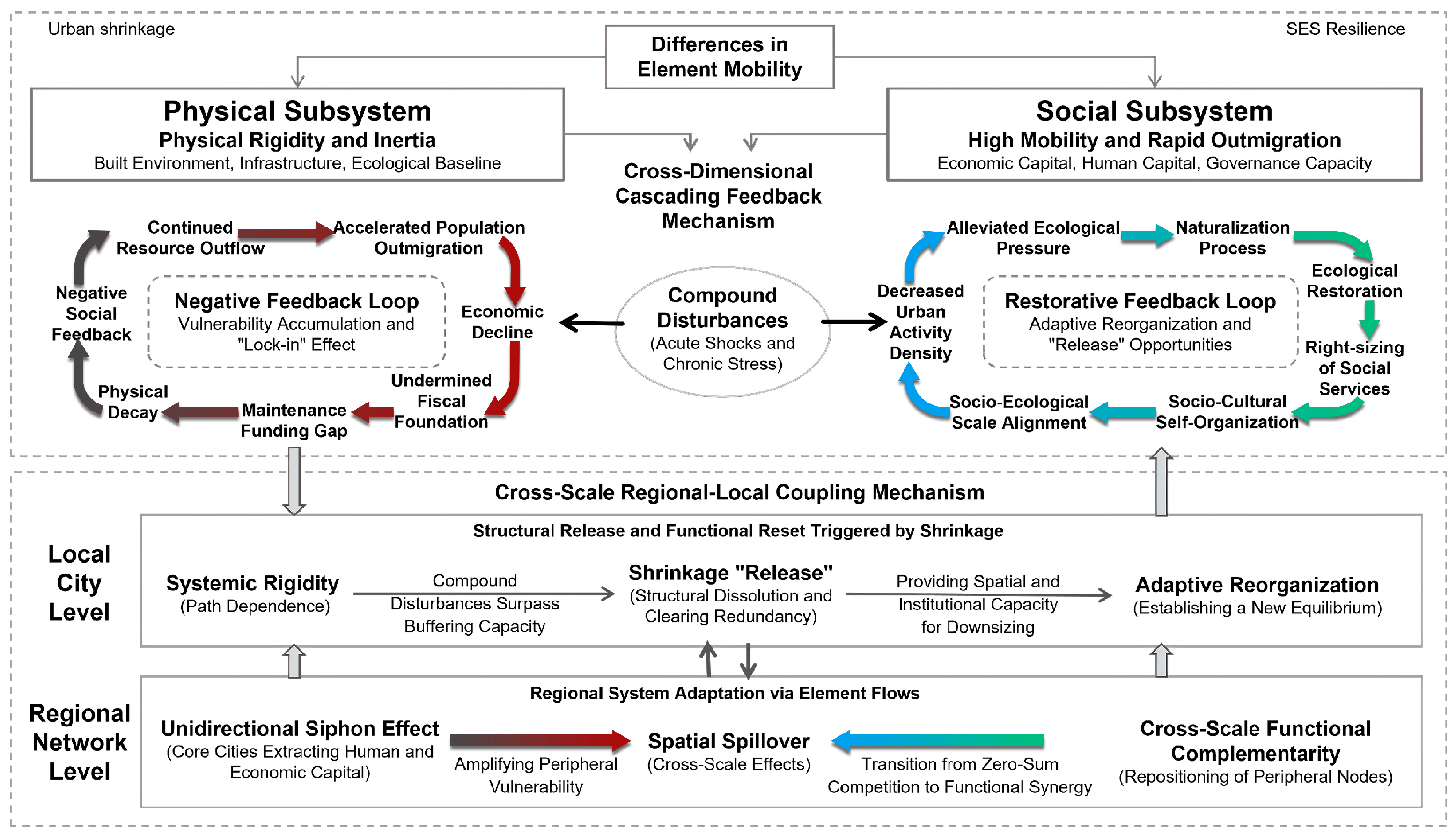
The six core dimensions extracted in Section 3 do not evolve in isolation within real complex systems. The coupling between urban shrinkage and SES resilience represents a dynamic process of continuous interaction among these physical and social elements across multiple dimensions and spatiotemporal scales [67]. This section aims to elucidate how these dimensions form nonlinear cascading feedback loops, how individual urban systems transition through different states over time, and how regional networks generate spatial evolutionary responses through element flows (as conceptualized in Figure 2).

4.1. Cross-Dimensional Cascading Feedback: Differences in Element Mobility

The evolution of the coupling mechanism is fundamentally driven by the nonlinear interaction between the social and physical subsystems in response to compound disturbances. During this interaction, economic capital and socio-cultural elements exhibit high mobility, whereas the built environment and infrastructure display strong physical rigidity and inertia [68]. This divergence in element mobility triggers a spatiotemporal mismatch in response rates, which subsequently forms two distinct feedback trajectories: vulnerability accumulation and adaptive reorganization.
In the vicious cycle of vulnerability accumulation, shrinkage typically manifests initially as economic decline and the rapid outmigration of human capital. The contraction of these highly mobile elements directly undermines the fiscal foundation of local governance [69]. Empirical evidence from old industrial and resource-exhausted cities in Northeast China illustrates this trajectory. The structural decline of heavy and mining industries in these regions has led to significant population outflows. These demographic changes have subsequently resulted in fiscal constraints for municipal governments [45,70]. However, because the extensive built environment and infrastructure cannot shrink synchronously with the population, the system faces an expanding maintenance funding gap, precipitating the decay of physical spaces [71]. This physical deterioration transmits negative environmental feedback to the social subsystem, diminishing the city’s residential and investment attractiveness and accelerating the outmigration of the remaining population [72]. This dynamic shares comparable mechanisms with the infrastructural mismatch and structural decay observed in post-socialist shrinking cities, such as those in East Germany during their early transition periods [36,65]. In these contexts, extensive state-planned physical assets transitioned into municipal burdens following structural demographic shifts. Through this process, the decline in economic, governance, and physical dimensions mutually reinforces one another, locking the system into a continuous downward trajectory.
Conversely, the mismatched interaction among elements can also initiate a restorative feedback loop, prompting the system to seek a new adaptive equilibrium. As the density of urban activities continuously decreases, the carrying pressure on the built environment is correspondingly alleviated [73]. In certain under-maintained marginal areas, the naturalization of vacant land facilitates the passive restoration of the ecological subsystem. This restorative process is evidenced by the reviewed literature, notably in studies concerning ecosystem service dynamics in Leipzig and the emergence of informal urban green spaces [36,73]. As macro-level infrastructure and formal governance services retreat due to fiscal constraints, the remaining residents often establish mutual-aid mechanisms based on community networks, thereby stimulating grassroots socio-cultural self-organization [74].
However, this adaptive reorganization is not an inevitable outcome. In highly path-dependent contexts, such as former heavy industrial bases, vacant land often suffers from severe soil contamination and surface hardening. Without external intervention, these rigid physical brownfield patches fail to undergo spontaneous ecological succession and instead fall into a “social-ecological trap” [75,76], perpetuating environmental vulnerability and hindering systemic resilience. While such traps pose significant challenges, the profound structural disruption induced by shrinkage objectively unlocks previously rigid land resources and disrupts entrenched socioeconomic and institutional inertia. This systemic release provides a necessary prerequisite for subsequent adaptive reorganization.

4.2. Temporal Evolution at the Individual City Level: The Adaptive Cycle of Urban Shrinkage

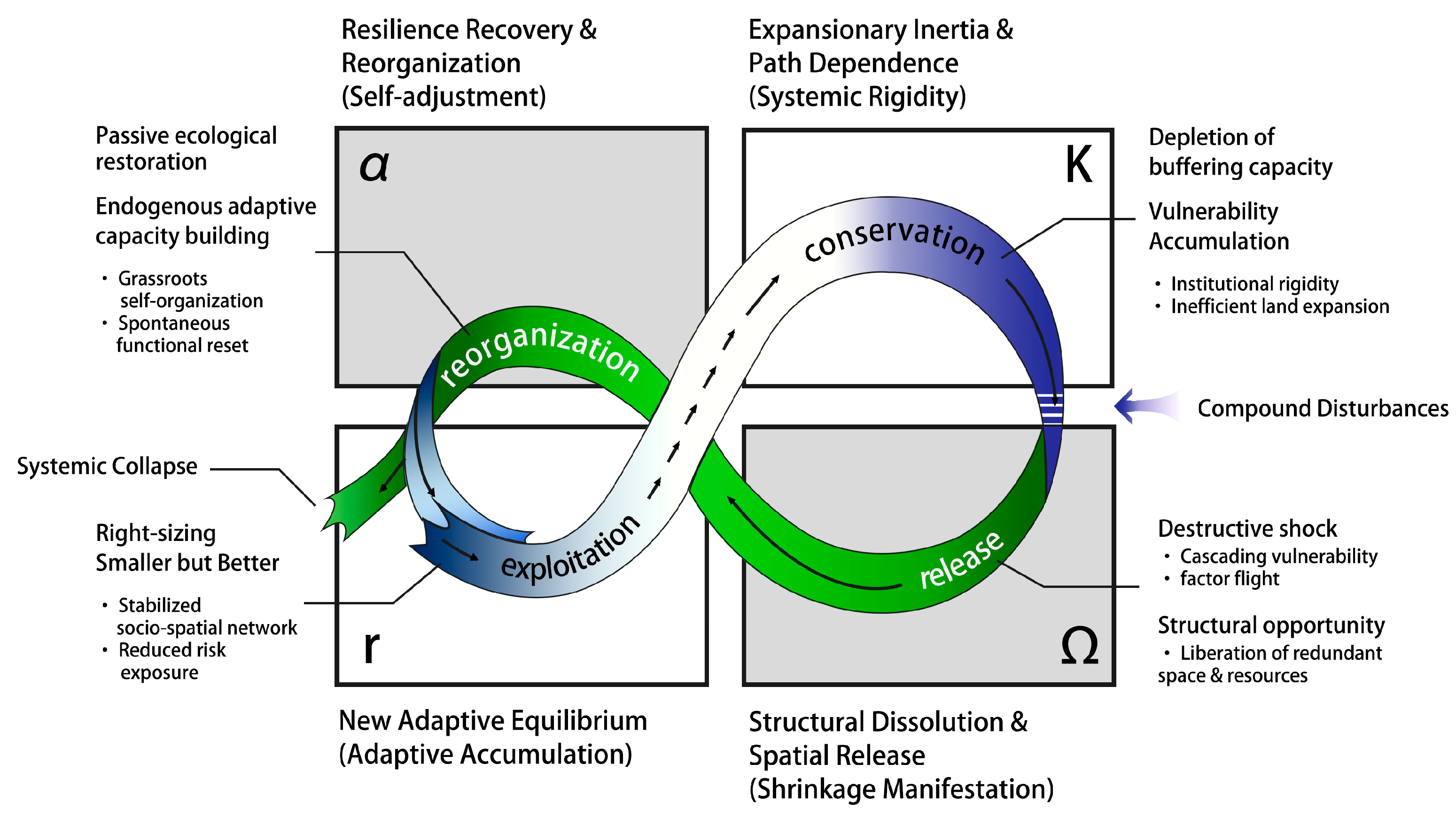
Contextualizing the aforementioned cross-dimensional interactions within a temporal framework, the evolution of an individual shrinking city aligns with the stages of the classic adaptive cycle theory developed by Holling [77]. Based on this foundational framework, Figure 3 illustrates the specific manifestation of this cycle within the context of urban shrinkage. Rather than merely a reduction in demographic size, urban shrinkage represents a process of internal structural evolution from institutional lock-in to systemic dissolution and subsequent reorganization. Preceding explicit demographic contraction, cities typically reside in the conservation phase (K). This stage is characterized by strong path dependence and institutional rigidity, where local governments often sustain oversized physical frameworks despite diminishing returns [3,78]. This persistence is frequently driven by an entrepreneurialism paradigm that prioritizes capital attraction and economic growth, a strategy observed in the historical planning of Manchester, where environmental protection was marginalized [79]. Such rigidity creates a classic rigidity trap as defined in Holling’s framework [77], where inefficient land expansion continues even amidst significant population loss, a phenomenon evidenced in many industrial regions of Northeast China [3,53].
This adherence to expansionary inertia progressively depletes the system’s endogenous adaptability, rendering the coupling of socio-physical elements increasingly rigid. Once compound disturbances surpass the system’s buffering capacity, the city manifests overt shrinkage characteristics, and the systemic structure transitions into the release phase (Ω). This phase manifests as structural dissolution and spatial release, functioning as a disruptive shock. Initially, this shock generates severe negative externalities. The sudden increase in vacancy rates and the fragmentation of residential clusters often trigger the broken windows effect. This physical decay can lead to social isolation and a rapid decline in the accessibility of public services. Furthermore, unmaintained infrastructure poses significant safety risks and environmental hazards, exacerbating the vulnerability of the remaining population. However, amidst these destructive impacts, the shock simultaneously dismantles the redundant elements accumulated during past expansionary periods [13,36]. It objectively unlocks previously rigid resources. This structural liberation is evident in the strategic demolition of vacant properties and brownfield clearances observed in various global post-industrial hubs [54,80]. These interventions provide the necessary spatial capacity for a functional reset as depicted in the lower-right quadrant of Figure 3.
Following this release, the system enters the reorganization phase (α), where self-adjustment mechanisms begin to emerge. This stage involves endogenous adaptive capacity building and institutional innovation [81]. For example, some European shrinking cities have promoted the temporary use of vacant land to activate idle spaces and rebuild social networks through civic participation [82]. Strategic governmental responses also play a crucial role in systemic recovery. Kitakyushu City in Japan successfully implemented green growth strategies to tackle urban revitalization. By adopting the 3Rs policy focusing on reducing, reusing, and recycling, the city facilitated the green transformation of existing enterprises and established a recycling-oriented socioeconomic system. This approach emphasizes environmental justice and enhances urban resilience by turning industrial liabilities into sustainable assets [83]. These mechanisms lay the groundwork for transitioning toward the exploitation phase (r). This transition establishes a new adaptive equilibrium characterized by right-sizing and performance-based planning strategies [84]. Such paradigms prioritize structural quality over spatial scale and ensure long-term systemic sustainability [57,66,67].
The Systemic Collapse trajectory in Figure 3 illustrates that successful reorganization is not an inevitable outcome. Failure often occurs when a system lacks essential adaptive capabilities such as innovation and learning. During this transition, local governments may make incorrect path choices or fall into new path dependencies. For instance, Yubari in Japan fell into municipal bankruptcy after coal depletion due to misdirected investments in tourism infrastructure [85]. Similarly, in shrinking cities of Northeast China, like Yichun, top-down shantytown renovation projects driven by administrative indicators failed to retain the population. Planning driven by growth inertia utilized over-predicted population scales. This resulted in planned land use far exceeding actual demand. These systemic failures transform large-scale housing projects into ghost cities and cause severe resource waste.

4.3. Spatial Evolution at the Regional Network Level: Element Flows and Core–Periphery Dynamics

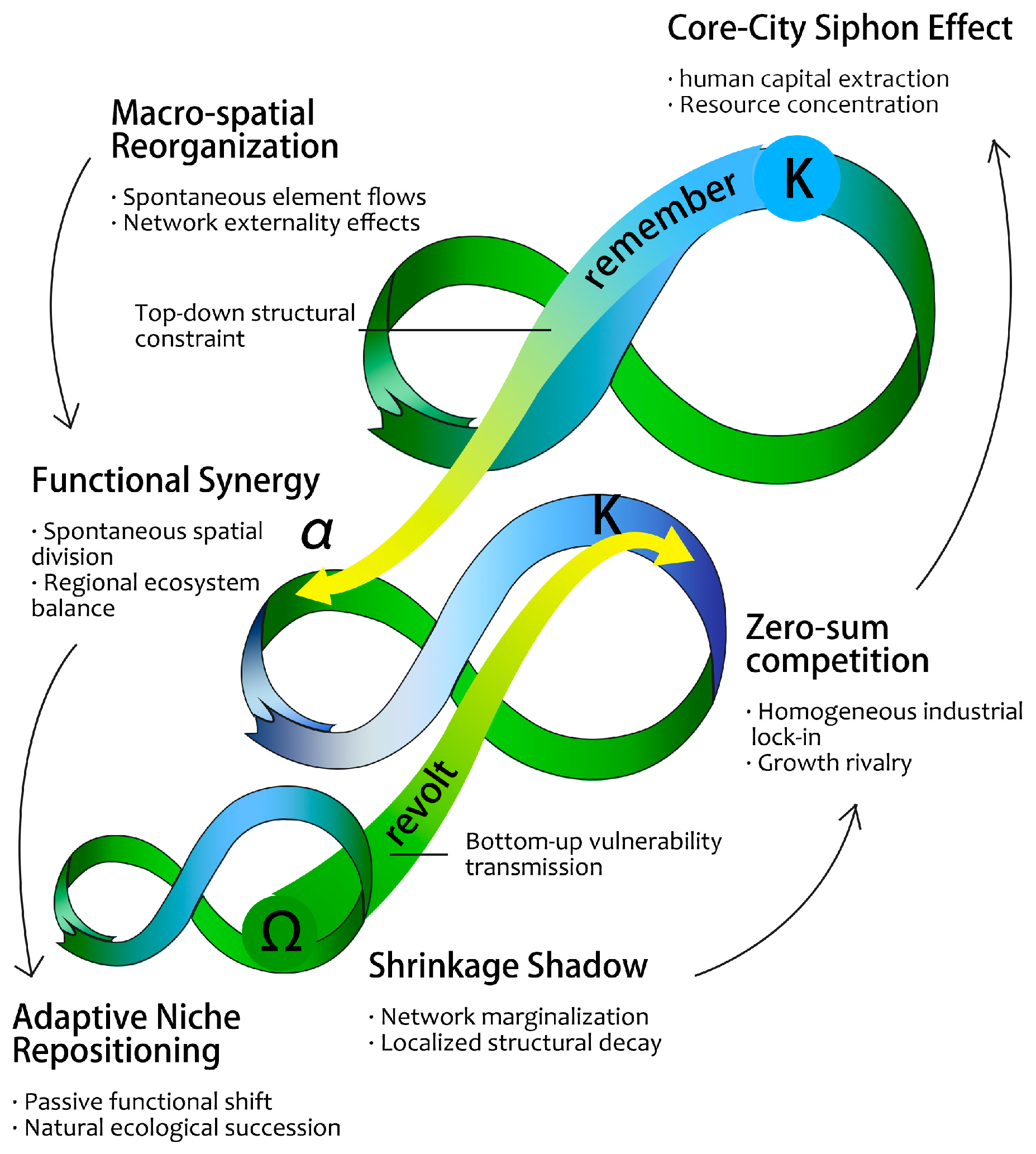
Beyond the individual city scale, the coupling of shrinkage and resilience operates across regional networks via the continuous mobility of socioeconomic elements. Regional integration processes often exacerbate spatial unevenness in adaptive capacity [86]. Building upon the foundational Panarchy theory developed by Gunderson and Holling [32], Figure 4 illustrates how these nested, cross-scale interactions manifest in regional networks. This dynamic is largely driven by element flows between core and peripheral cities. Core cities with robust resilience generate a pronounced siphon effect, extracting human capital and economic resources from surrounding shrinking nodes [70,87]. This process is closely linked to the nonlinear impact of borrowed size across different urban scales. While large cities often leverage borrowed size to promote development, small and medium-sized cities frequently suffer from an agglomeration shadow at the performance level. This negative effect significantly exacerbates urban shrinkage in these peripheral nodes [69]. Such unequal exchange potentially amplifies peripheral vulnerability and locks shrinking cities into the lower tiers of the regional hierarchy, producing a distinct shrinkage shadow [88]. For example, empirical studies on the Beijing–Tianjin–Hebei region suggest that the strong agglomeration effect of central mega-cities can accelerate population outflow from surrounding small and medium-sized industrial cities [89]. These marginalized nodes often fall into a state of zero-sum competition, relying on homogeneous industrial structures and engaging in unproductive growth rivalries. This bottom-up vulnerability transmission acts as a revolt mechanism within the regional ecosystem. As a critical cross-scale interaction defined in the Panarchy framework [32], this dynamic may eventually threaten broader macro-spatial stability.
From a macro-systemic perspective, escaping this zero-sum trap often requires a strategic shift from spontaneous organic evolution to guided transformation. A successful transition to functional synergy is frequently hindered by fragmented administrative governance and localized fiscal pressures [90]. Regional governance can implement top-down structural constraints to mitigate the risk of regional structural decline. These constraints function as the remember mechanism shown in Figure 4. This approach involves optimizing administrative boundaries and establishing cross-jurisdictional ecological and economic compensation mechanisms. For instance, the transition of Germany’s Ruhr region was not a purely market-driven outcome but a result of deliberate institutional design under the IBA Emscher Park initiative [91]. This process allowed peripheral shrinking nodes to pursue active functional repositioning. Instead of serving as passive buffers, these cities can transition into strategic nodes for regional ecological security or specialized hubs for high-quality, low-density production. Such an active institutional evolutionary process provides a viable pathway to shift from isolated competition toward functional synergy, enabling shrinking cities to secure a sustainable and complementary role within the broader regional ecosystem [92,93].

5. Discussion: Planning and Governance Strategies for Coupling Urban Shrinkage and SES Resilience

The coupling of urban shrinkage and SES resilience is a complex dynamic process. As revealed by the evolutionary mechanisms in Section 4, shrinkage accumulates risks while simultaneously offering structural opportunities. The objective of planning and governance is to guide this system toward coordinated and adaptive evolution. To effectively operationalize these mechanisms, the physical and social elements identified in Section 3 serve as the critical leverage points. By directing interventions toward these specific elements, planning frameworks can more effectively avert negative feedback loops and amplify positive reorganization. While these strategies are driven by coupling mechanisms and anchored in core elements, their practical implementation relies on localized institutional tools. Planning interventions in the Chinese context require a spatial logic that integrates top-down institutional design with bottom-up social empowerment [90]. This necessitates a systemic dual-track approach: mitigating risk exposure while capitalizing on spatial opportunities to rebuild adaptability at both the regional and local levels. Through this approach, inevitable physical contraction can be coupled with social reorganization, transitioning shrinkage from a passive threat to an active component of resilience building.

5.1. Regional-Level Strategies: Risk Interception and Network Reorganization

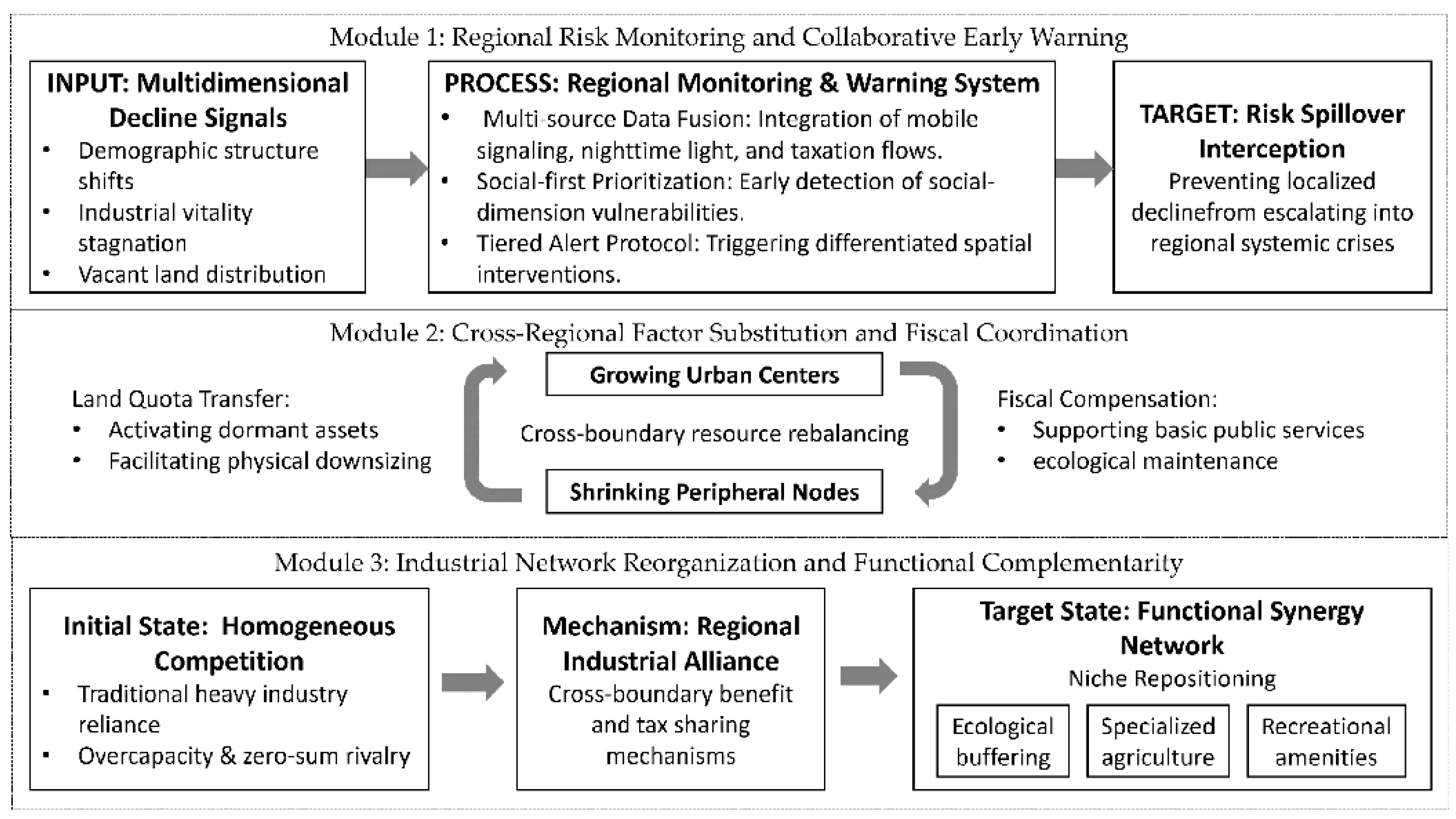
Mitigating the structural imbalances caused by core-city siphon effects requires regional mechanisms that transcend administrative fragmentation. As illustrated in Figure 5, the proposed regional-level governance framework comprises three interconnected modules. The first establishes collaborative risk monitoring to detect decline signals early and intercept the spatial spillover of vulnerability. The second facilitates cross-regional factor substitution, exchanging dormant land quotas for fiscal compensation to rebalance resources. Finally, the third focuses on industrial network reorganization, guiding peripheral nodes from homogeneous zero-sum competition toward specialized functional synergy.

5.1.1. Regional Risk Monitoring and Collaborative Early Warning

The propagation of systemic risk across an urban network is often gradual and localized before escalating into a regional crisis [94,95]. To prevent localized decline from exacerbating regional imbalances and disorderly competition, regional authorities should establish a dynamic monitoring framework utilizing multi-source urban data. This involves integrating mobile phone signaling trajectories, night-time light remote sensing, municipal corporate tax flows, and grid-based consumption records [96]. Given that social elements exhibit higher mobility than physical ones, this early warning system should prioritize monitoring decline signals within the social subsystem, which typically emerge earlier. By tracking parameters such as demographic structural shifts, industrial vitality cycles, and the spatial distribution of land vacancy, policymakers can identify nodes approaching critical vulnerability thresholds. This foresight facilitates preventative interventions, enabling the region to coordinate supportive policies or manage decline before negative spillover effects destabilize neighboring areas. Practical measures involve establishing a tiered spatial alert protocol that triggers differentiated regional collaborative interventions prior to shrinking nodes reaching critical thresholds [97,98].

5.1.2. Cross-Regional Factor Substitution and Fiscal Coordination

Shrinking cities frequently lack the financial resources necessary to repair physical system vulnerabilities and maintain social resilience. Within the framework of China’s Territorial Spatial Planning, this fiscal bottleneck can be addressed through the “Cross-Regional Linkage of Urban and Rural Construction Land Increase and Decrease” policy [99]. Under this mechanism, shrinking cities focus on internal stock activation and physical reduction by demolishing inefficient, vacant construction land and restoring it to ecological use. The construction land quotas saved through this reduction are subsequently traded across administrative boundaries to land-scarce, growing central cities. This cross-regional trade exchanges redundant spatial capacity for fiscal compensation, directly financing the shrinking city’s physical space restoration and public service maintenance, thereby supporting the overall network’s resource balance. To maintain socio-spatial equity during cross-regional factor substitution, the generated fiscal compensations are expected to be directed toward foundational public services and environmental maintenance in shrinking nodes. This allocation allows the monetization of spatial quotas to contribute to regional rebalancing, rather than exacerbating the structural hollowing-out of local welfare. This policy couples the physical de-densification of shrinking areas with the economic stabilization of their social systems [100].

5.1.3. Industrial Network Reorganization and Functional Complementarity

A significant impediment to regional resilience is industrial homogenization among neighboring shrinking cities. When external market shocks impact specific sectors, such as traditional heavy manufacturing, homogeneous supply chains can lead to regional economic stagnation. To rebuild network transformability, regional governance needs to rationalize redundant industrial capacity and foster functional complementarity [101,102]. Practical measures include forming cross-city industrial alliances, as well as establishing cross-administrative mechanisms for benefit and tax sharing, drawing on broader cross-jurisdictional cooperation models [103]. However, establishing clear regulatory boundaries is essential to prevent such cooperation from facilitating the spatial transfer of high-pollution and obsolete capacities from core to peripheral areas. Unregulated industrial displacement compounds the inherent ecological and economic vulnerabilities of shrinking nodes, ultimately locking them into a social–ecological trap [75]. Contingent upon enforcing ecological baselines and safeguarding spatial justice, regional authorities should allocate distinct economic functions to different shrinking cities. By vertically integrating these specialized nodes into the supply chains of growing central cities, the region can transition from uncoordinated competition to a diversified, risk-sharing economic network.

5.2. City-Level Strategies: Systemic Downsizing and Social Empowerment

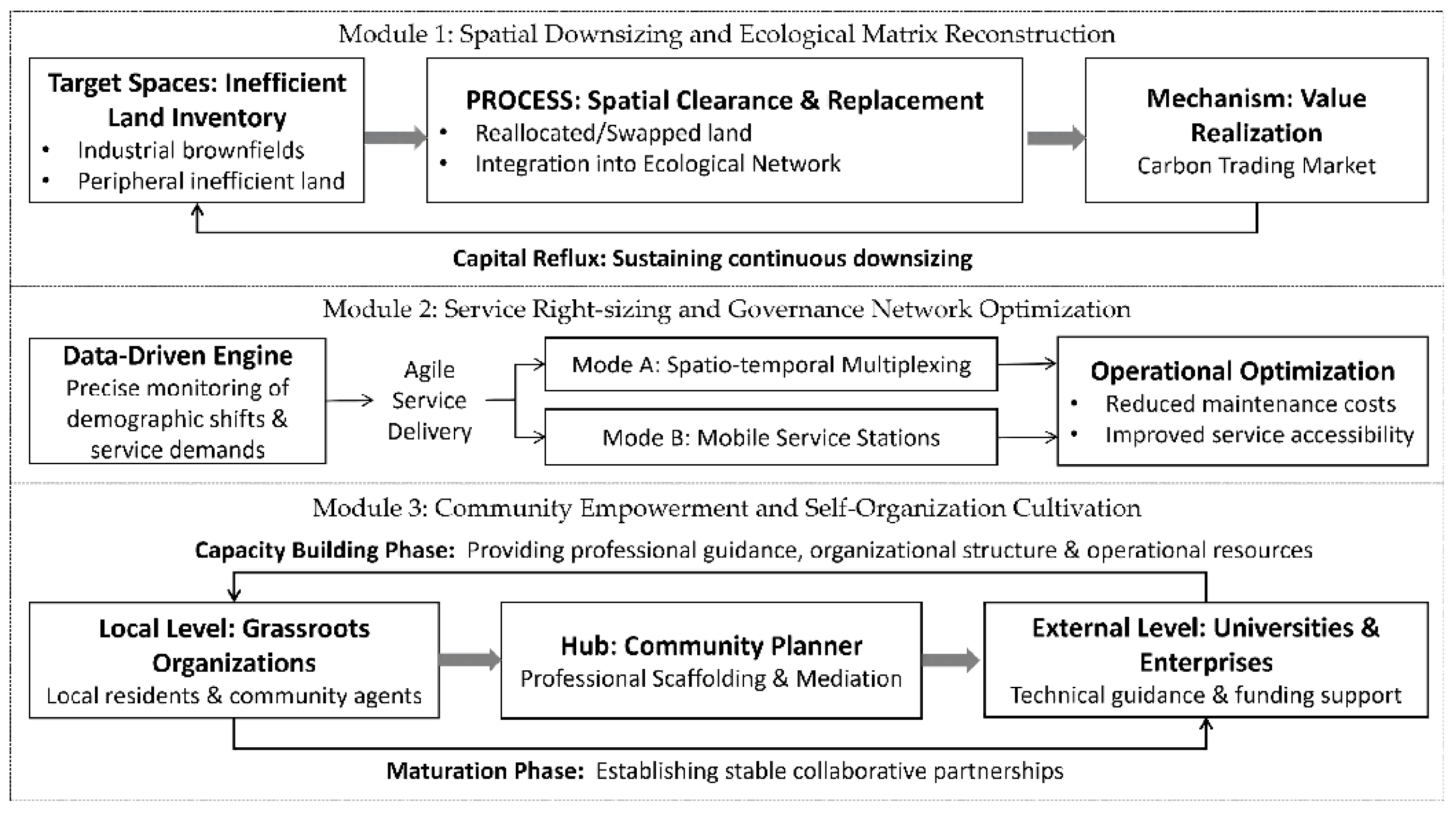
At the individual city level, planning strategies should translate the objective process of demographic contraction into an active reconfiguration of physical assets and social networks. As illustrated in Figure 6, the proposed city-level governance framework comprises three interconnected modules. The first focuses on spatial downsizing and ecological matrix reconstruction, utilizing land clearance and value realization mechanisms to mitigate physical risk exposure. The second emphasizes service right-sizing and governance network optimization, deploying data-driven and agile service delivery to enhance social adaptive capacity. Finally, the third centers on community empowerment and self-organization cultivation, establishing collaborative partnerships between grassroots organizations and external professionals to ignite endogenous transformability.

5.2.1. Spatial Downsizing and Ecological Matrix Reconstruction: Mitigating Physical Risk Exposure

For shrinking cities, spatial downsizing is not a passive abandonment of land, but an active structural reconfiguration of the built environment designed to minimize infrastructural and ecological risk exposure. Spatially, the Urban Development Boundary acts as a rigid constraint against outward sprawl. This statutory limit actively drives the planning paradigm toward proactive downsizing [78]. This is operationalized through land banking mechanisms that reclaim, evaluate, and reserve a diverse range of underutilized spatial assets—including vacant industrial brownfields, dilapidated old neighborhoods, and obsolete commercial facilities [80].
However, considering the severe fiscal constraints and China’s specific land tenure system, this process requires a phased spatial strategy. Short-term interventions should prioritize the consolidation of state-owned idle lands or high-risk patches with relatively clear property boundaries, progressively scaling up to underutilized parcels hindered by highly fragmented land use rights and complex ownership disputes [104]. These reclaimed land parcels require targeted interventions to prevent continuous ecological degradation caused by unregulated abandonment [76]. Specific measures include soil remediation for industrial brownfields and structural clearance for obsolete environments. Through land swapping and strategic demolition, scattered settlements in peripheral areas are consolidated into compact and interconnected urban nodes. This spatial network connectivity optimizes infrastructure maintenance efficiency while simultaneously averting the formation of isolated patches of decline, thereby sustaining functional vitality [105]. The remediated lands are then systematically woven into the city’s broader ecological network structure. To offset the substantial upfront costs of reclamation and remediation, shrinking cities are encouraged to innovate value-realization mechanisms for ecological products [106]. Quantifying enhanced ecosystem services allows cities to transform ecological restoration into a self-sustaining green economy [107]. In practice, cities achieve this by integrating newly generated carbon sequestration capacity into regional carbon trading markets. This systemic downsizing lowers municipal maintenance burdens and structurally aligns physical footprint contraction with long-term ecological and fiscal resilience.

5.2.2. Service Right-Sizing and Governance Network Optimization: Enhancing Social Adaptive Capacity

The demographic shift toward an aging and low-income population renders the expansionary era’s standardized public service allocation structurally obsolete. Under fiscal constraints, transitioning from rigid, centralized facility provision toward a demand-driven, agile service network helps maintain socio-spatial equity [108].
Spatially, underutilized public assets require functional substitution and spatiotemporal multiplexing. Instead of outright abandonment, cities can retrofit oversized facilities, such as depopulated primary schools, into intergenerational community hubs. By implementing time-sharing mechanisms, these hubs can host eldercare and medical services during the day, while transitioning into community education spaces in the evening, thereby maximizing the utility of physical assets [109]. For dispersed peripheral populations, rigid infrastructural investments should be replaced with responsive and mobile service delivery. Specific implementations include embedded health stations and mobile amenities [110]. This agile approach ensures basic service accessibility without incurring long-term maintenance debts.
Institutionally, addressing this fragmented spatial layout requires local governments to shift from centralized facility management toward a data-driven dispatching role. Given the persistent fiscal and staffing constraints typical of shrinking areas, embedding digital resilience tools into existing grassroots networks helps sustain essential service provision. Telemedicine platforms and smart eldercare monitoring, for instance, offer agencies a way to bypass geographic barriers and remotely track the well-being of dispersed households. Municipal bodies can leverage this digital overlay to dynamically allocate resources and direct targeted support to residents’ homes, effectively mitigating the distance decay inherent to low-density neighborhoods [111,112]. Ultimately, integrating spatial multiplexing, mobile supply, and digital tools enables the city to proactively right-size its social infrastructure, reducing the daily living risks of vulnerable demographics amidst physical contraction.

5.2.3. Community Empowerment and Self-Organization Cultivation: Igniting Endogenous Transformability

While the spatial downsizing in Section 5.2.1 and the service reorganization in Section 5.2.2 provide structural solutions for shrinking cities to break free from negative cycles, relying solely on these top-down spatial and service supply adjustments cannot guarantee long-term stability. To ensure the coupled system remains resilient on this adaptive trajectory and strengthens positive feedback loops, structural reconfiguration must be underpinned by continuous social learning and innovation capacity [113]. The planning paradigm thus needs to pivot toward bottom-up civic stewardship, rebuilding the system’s endogenous momentum by fostering local cohesion and civic responsibility [91].
Urban shrinkage is frequently accompanied by the outmigration of human capital and demographic aging. Consequently, local communities may struggle to initiate spontaneous self-governance without initial external support. In this context, social empowerment involves more than simply scaling back government services. It requires a scaffolded capacity-building framework [114]. In practice, local governments can transition into a facilitative role by promoting the Community Planner system. By collaborating with universities and enterprises, this framework provides communities that have relatively weak grassroots organizations with preliminary professional guidance, organizational structures, and operational resources [115].
Relying on this collaborative framework, neighborhood micro-regeneration, such as the collective stewardship of vacant lots, serves as a critical exercise in social learning. Through professional facilitation, residents are guided through participatory budgeting and spatial management, honing their collaborative decision-making skills and actively enhancing their overall civic competence. As residents’ self-governance capacities mature, external institutions do not simply phase out; rather, they deepen their engagement by forming an equal, long-term collaborative governance partnership with the community [116]. This mechanism, seamlessly integrating external professional scaffolding with grassroots social learning, equips shrinking cities with the continuous evolutionary capacity to maintain socio-ecological stability throughout prolonged transitions.

5.3. Institutional Barriers and Pathways to Breakthrough

Section 5.1 and Section 5.2 delineate an adaptive governance framework focused on regional synergy and city-level spatial right-sizing. However, the operationalization of these strategies in actual planning practice is constrained by specific institutional bottlenecks. The following subsections analyze these structural barriers, demonstrating how they directly impede the aforementioned spatial and service interventions. These constraints originate from the hierarchical administrative and fiscal systems, manifesting primarily as rigid performance evaluations, localized administrative fragmentation, factor market mismatches, and micro-level property rights lock-in. The persistence of these structural barriers highlights the necessity for targeted institutional adjustments to facilitate the transition toward an adaptive urban paradigm.

5.3.1. Data Fragmentation and Performance Evaluation Rigidities

Regarding the strategy of collaborative risk monitoring, the primary barrier lies in the fragmentation of data within China’s hierarchical administrative system. In this structure, the central government establishes national policy goals, while provincial governments coordinate implementation and municipal authorities manage local execution [117]. Horizontally, peer municipalities lack a formal mechanism for active information sharing. Local governments often treat indicators like population loss or business closures as sensitive data to protect their administrative image. Vertically, functional departments such as public security, taxation, and natural resources operate through separate internal systems. This fragmentation forces local governance to depend on statistical yearbooks. These records are published with a significant time lag and cannot capture ongoing shifts in the social subsystem, such as declining industrial diversity or lower enterprise renewal rates.
Regarding the strategy of early warning and coordination, a further obstacle involves the performance evaluation system. Local officials are primarily evaluated based on economic growth targets set by higher-level authorities [118]. Under this evaluation pressure, local officials are reluctant to report early signals of shrinkage. Acknowledging systemic decline carries the direct risk of administrative accountability and stalled career progression. Furthermore, exposing these negative trends can stigmatize the city’s developmental image. This spatial stigmatization threatens to deter external capital investment, thereby plunging the local economy into deeper distress. To overcome this administrative barrier, higher-level governments must decouple the performance evaluation of shrinking cities from uniform, GDP-centric metrics. Furthermore, the monitoring system must be redesigned as a supportive tool. Establishing a liability exemption mechanism for local governments that actively report early signs of shrinkage is crucial. The detection of these signals should automatically trigger spatial planning coordination and expert consultation. This institutional shift replaces simplistic accountability with adaptive governance, encouraging local authorities to transition from concealing data to proactive planning [91].

5.3.2. Factor Market Mismatch and Transaction Barriers

Regarding the strategy of cross-regional factor exchange, the primary barrier is the structural mismatch within the land quota market. Under China’s highly centralized land management system, the central government strictly defines spatial boundaries and allocates annual quotas for newly added construction land through provincial governments to municipal authorities [119]. Shrinking cities aim to generate surplus construction land quotas through spatial consolidation and sell them via cross-regional quota trading markets. However, in recent years, core cities such as Shanghai have adopted a zero-growth policy for construction land and transitioned toward a stock-based development model [120]. This policy shift causes a significant contraction in demand, leading to a potential lack of active buyers for the quotas generated in shrinking regions. To address this mismatch, provincial governments should scale up the implementation of existing land quota reserve banks. These state-led platforms function as macro-regulators. They can purchase surplus quotas at a floor price to provide immediate bridge funding for shrinking regions. Simultaneously, the reserve banks can strategically hold these quotas to prevent specific core cities from over-purchasing and subsequently exceeding their ecological carrying capacities.
The stagnation of the land quota market highlights the critical need to leverage ecological assets. Driven by severe industrial decline, shrinking cities experience the decimation of their traditional tax bases, which necessitates a functional transition toward ecological restoration. However, as former industrial centers, these municipalities are heavily burdened with historical pollution. Remediating brownfields requires massive capital investments that depleted local revenues cannot sustain. Meanwhile, expanding core cities generate substantial environmental externalities and functionally depend on the ecological matrices of peripheral shrinking nodes for carbon offsetting and regional water purification.
While mechanisms such as forestry carbon sinks and water quality compensation exist, their practical application faces significant capacity and transaction barriers. Although stringent certification protocols regarding additionality and baseline measurements are fundamental to maintaining carbon market integrity [121], the associated monitoring, reporting, and verification processes entail high upfront transaction costs and prolonged cycles. Financially constrained shrinking municipalities often lack both the technical capacity and the initial capital required to navigate these complexities. Additionally, cross-jurisdictional water compensation frequently relies on temporary administrative negotiations rather than institutionalized market trading [122]. These structural limitations prevent shrinking regions from securing stable, large-scale financial returns to cover their ongoing remediation costs. Overcoming these barriers requires higher-level governments to innovate ecological compensation frameworks by establishing upfront green financing vehicles and institutionalizing horizontal transfer payments. This institutional innovation ensures that core cities systematically compensate shrinking nodes for their ecological provisions without compromising environmental standards.

5.3.3. Fiscal Decentralization and Obstacles to Industrial Synergy

Regarding the strategy of industrial network reorganization, a primary obstacle is the horizontal fiscal fragmentation among municipal jurisdictions. Under the current framework, municipal governments operate with territorialized accounting and are evaluated based on localized economic indicators [123]. This structure complicates cross-boundary cooperation by creating competing local interests. Because fiscal revenues are tied to jurisdictional boundaries, origin core cities generally prefer to retain manufacturing enterprises to maintain their tax bases and economic output. In scenarios where core cities retain corporate headquarters but transfer physical manufacturing facilities, the receiving shrinking nodes bear the spatial and environmental costs. Without a formalized mechanism for proportionate fiscal returns, these municipalities lack sufficient incentives to allocate land or invest in preparatory infrastructure. Consequently, this localized accounting hinders the formation of cohesive regional networks. Addressing this barrier requires institutional adjustments in cross-regional profit-sharing. Existing collaborative models, such as the Jiangyin-Jingjiang Industrial Park model, indicate that institutionalized GDP-splitting and tax-revenue-sharing mechanisms can align competing fiscal interests between jurisdictions [124]. Adapting such frameworks offers a practical pathway to mitigate horizontal fragmentation, establishing the requisite incentives for core cities and shrinking nodes to build synergistic regional networks.
Regarding vertical fiscal coordination, a critical obstacle is the risk of fiscal dependency induced by soft budget constraints [125]. If higher-level governments provide unconditional financial support to stabilize declining regions, local authorities may develop a reliance on these vertical transfers. Under such soft budget constraints, municipal governments lack the internal drive to pursue necessary but politically difficult structural transformations, such as physical spatial reduction. Instead of actively managing shrinkage, local authorities tend to maintain pro-growth strategies and rely on external subsidies to sustain obsolete urban structures and administrative operations. To prevent this institutional inertia, higher-level fiscal support must transition from unconditional assistance to a performance-based model. Financial transfers should be linked to verified adaptation outcomes, ensuring that subsidies function as catalysts for proactive spatial reorganization rather than mechanisms for institutional complacency.

5.3.4. Property Rights Lock-In and Collective Action Dilemmas

Regarding the strategy of physical spatial reduction, a critical bottleneck is the property rights lock-in and the high transaction costs associated with clearing historical liabilities. For inefficient industrial brownfields, the primary barrier is the limitation of the secondary land market in processing complex distressed assets. Historically, local governments frequently granted industrial land use rights at artificially low prices to attract manufacturing investment [126]. Currently, reclaiming these parcels for ecological restoration requires compensation based on market valuations, creating a significant fiscal burden. While the secondary market facilitates standard use-right transfers, it struggles to process parcels whose property rights are legally frozen or entangled in historical disputes. Specifically, many abandoned industrial sites in shrinking cities are sealed by courts due to the unresolved debts of bankrupt enterprises. Furthermore, discrepancies between actual land boundaries and historical registration records, along with unapproved building modifications, paralyze standard market transactions [127]. These complications prevent market-based clearing and force local governments to prioritize short-term land transactions for immediate fiscal recovery over long-term regional ecological planning.
In the context of renewing declining old residential communities, the principal obstacle is the collective action dilemma exacerbated by high vacancy rates and the physical absence of many property owners. Following housing privatization reforms, the property rights of individual housing units within these aging blocks became highly fragmented. In shrinking cities, communities often experience significant population outflow. Remaining residents, typically elderly or low-income households, have a strong demand for infrastructure improvements. Conversely, non-resident owners lack the motivation to contribute to maintenance funds or consent to structural renovations, as the stagnant real estate market offers little financial return on such investments. This divergence of interests leads to severe coordination failures. When the number of contributing households falls below a critical threshold, the financial burden of maintaining communal facilities becomes unsustainable for the remaining population [128].
Overcoming these micro-spatial barriers requires targeted institutional innovations. For industrial brownfields, specialized legal mechanisms must be established to decouple land use rights from corporate debt, enabling the rapid clearing of frozen assets. For residential communities, adaptive governance tools, including vacant property receivership programs and refined statutory consensus requirements, are necessary to lower coordination costs and prioritize the living conditions of remaining residents.

6. Conclusions and Future Directions

6.1. Main Conclusions and Global Contributions

This study conducts a systematic review of 76 peer-reviewed articles to construct a coupling framework between urban shrinkage and social–ecological system (SES) resilience within the Chinese institutional context. As a systematic review, this paper first comprehensively identifies six core dimensional elements underpinning this coupling relationship. The material subsystem, comprising the ecological environment, built environment, and infrastructure, exhibits strong structural rigidity and physical inertia. Conversely, the social subsystem, consisting of governance models, economic industries, and human elements, demonstrates high fluidity. This profound disparity in elemental fluidity between the two subsystems constitutes the underlying structural tension in the complex evolution of shrinking cities.
Based on this element matrix, the review deconstructs three dynamic coupling mechanisms driving urban shrinkage and resilience evolution. Within the cross-dimensional cascading feedback mechanism, the mismatch between material rigidity and social fluidity triggers nonlinear system responses. This dynamic can trap cities in a negative lock-in of accumulating vulnerability or initiate a restorative cycle of adaptive reorganization. Regarding the spatiotemporal evolution mechanism at the individual city scale, the adaptive cycle theory suggests urban shrinkage is not merely the endpoint of resilience decline. Instead, it serves as a structural release phase that breaks expansionary inertia and path dependency, providing spatial opportunities to establish a new balance. Within the spatial evolution mechanism at the regional network scale, the siphon effect of core cities and the zero-sum game among peripheral nodes exacerbate regional systemic vulnerability, requiring the system to shift from spontaneous evolution to guided functional synergy. These findings on elemental characteristics and evolutionary mechanisms are derived from a systematic synthesis of international and domestic literature. Consequently, they possess global applicability and offer a generalized theoretical lens to understand the dynamic evolution of socio-ecological systems under contraction.
To address these systemic challenges, this study adopts a localized analysis approach to propose a multi-scalar adaptive governance framework based on the Chinese policy context and critically evaluate the institutional bottlenecks to its implementation. This approach is necessitated by the fact that the formulation of specific governance strategies and the interpretation of barriers are inherently context-dependent and cannot be separated from their regional backgrounds. At the regional level, strategies emphasize collaborative risk early warning, cross-regional factor exchange, and industrial network reorganization. At the city level, interventions focus on systemic physical downsizing, the precise recalibration of service facilities, and the cultivation of self-organization through community empowerment. However, the implementation of these adaptive strategies is fundamentally constrained by multidimensional institutional barriers. These implementation bottlenecks primarily include administrative data fragmentation, rigid GDP-oriented performance evaluations, factor market mismatches, localized independent fiscal accounting, and micro-spatial property rights lock-in. Identifying these barriers highlights the urgent need to unleash the potential of adaptive spatial policies through targeted institutional innovations. Although the discussions of these spatial strategies and constraints are deeply rooted in the Chinese policy environment, their explorations in multi-scalar institutional coordination, systemic physical downsizing, and precise service recalibration offer vital reference points and transferable lessons for other regions worldwide facing similar demographic and economic fluctuations.
Unlike traditional Western post-industrial regions, where urban decline is primarily driven by market forces and capital flight, China’s urban shrinkage emerges from uneven regional development, demographic shifts, and industrial transitions. Furthermore, the governance challenges and adaptation processes associated with this shrinkage exhibit distinct characteristics, as local responses are intricately constrained by hierarchical administrative and fiscal frameworks. By evaluating how these macro-level institutional barriers interact with micro-level spatial lock-in, the theoretical archetypes identified in this research provide transferable insights for the global discourse on urban decline. These models offer a theoretical reference for developing nations and transitional economies experiencing rapid demographic shifts. Ultimately, the transition from traditional expansionary planning to multi-scalar, adaptive paradigms contributes a systemic framework for sustainable urban transformation.

6.2. Limitations and Future Research Directions

While this study constructs a comprehensive framework by synthesizing the existing literature, several methodological limitations remain. The core elements and coupling mechanisms presented in this review were derived through the thematic coding and qualitative meta-synthesis of 76 peer-reviewed articles. However, the reliance on published literature inherently introduces publication bias. Furthermore, secondary data often involve temporal lags, which can limit the capacity to capture the real-time dynamics of urban transformation. The high heterogeneity across the selected studies regarding indicator systems and temporal spans also restricts the feasibility of conducting a standardized quantitative meta-analysis. More importantly, a significant gap exists regarding scale integration. The coupling between urban shrinkage and social–ecological system resilience is inherently a multi-scalar process that spans micro-level patches, neighborhoods, cities, and macro-level regions. Yet, existing empirical works primarily rely on macro-level statistical data aggregated at a single administrative level. This lack of cross-scale correlation analysis limits the precise quantification of how micro-level system vulnerabilities cascade upward or how macro-level policy pressures feed back downward.
To overcome these methodological constraints, future empirical research could explore the following three research designs:
First, future studies could design cross-scale frameworks that integrate multi-source big data. Researchers might combine macro socioeconomic indicators with high-resolution satellite remote sensing, mobile signaling trajectory data, and localized social media sentiment. Utilizing spatial downscaling and multi-scale calibration techniques, future works can align infrastructure physical degradation with real-time population mobility and psychological distress within a unified spatial grid. This design would help quantify the dynamic misalignment between material rigidity and social fluidity across multiple scales. Consequently, it could offer robust data support to identify the exact cross-scale thresholds where physical vacancies cascade into the collapse of community adaptive capacity.
Second, future investigations could explore coupled simulation designs that combine System Dynamics and Agent-Based Modeling. System Dynamics can capture macro-level feedback loops within the socio-ecological system, while Agent-Based Modeling can simulate the heterogeneous behavior and decision-making of micro-level actors. This integrated approach might be utilized to dynamically project the evolutionary trajectories of property rights lock-in and coordination failure among municipal governments, remaining residents, and absent owners under various institutional constraints. This design could provide a predictive computational tool to evaluate the potential pathways and efficacy of alternative adaptive governance policies.
Third, future empirical designs could consider establishing long-term, cross-scale spatial monitoring networks and panel databases in representative shrinking regions. By employing econometric approaches such as panel data regression and regression discontinuity designs, future studies may capture the critical tipping points where a system transitions from vulnerability accumulation to structural release or from decline to adaptive reorganization. This longitudinal tracking would provide solid empirical evidence to precisely identify governance leverage points across different stages of the urban shrinkage lifecycle.

Supplementary Materials

The following supporting information can be downloaded at: https://www.mdpi.com/article/10.3390/land15060930/s1, File S1: PRISMA 2020 Checklist.

Author Contributions

Conceptualization, H.L. and T.Z.; methodology, T.Z.; formal analysis, T.Z.; data curation, T.Z.; writing—original draft preparation, T.Z.; writing—review and editing, H.L.; visualization, T.Z.; supervision, H.L. All authors have read and agreed to the published version of the manuscript.

Funding

This research was funded by the National Natural Science Foundation of China, grant number 52278056.

Data Availability Statement

No new data were created or analyzed in this study. Data sharing is not applicable to this article.

Acknowledgments

The authors would like to express their sincere gratitude to Qing Yuan for providing vital funding support and academic guidance for this research.

Conflicts of Interest

The authors declare no conflicts of interest. The funders had no role in the design of the study; in the collection, analyses, or interpretation of data; in the writing of the manuscript; or in the decision to publish the results.

Abbreviations

The following abbreviations are used in this manuscript:
SESSocial–Ecological System
PRISMAPreferred Reporting Items for Systematic Reviews and Meta-Analyses
TSPTerritorial Spatial Planning

References

  1. Long, Y.; Wu, K. Shrinking Cities in a Rapidly Urbanizing China. Environ. Plan. Econ. Space 2016, 48, 220–222. [Google Scholar] [CrossRef]
  2. Gong, P.; Zhang, S.; Wang, W. Evolutionary Characteristics and Spatial-Temporal Patterns of Urban Shrinkage in China from a Population Perspective: An Analysis Based on Data from the Seventh National Population Census Bulletin. Popul. Econ. 2022, 3, 1–15. (In Chinese) [Google Scholar]
  3. Yang, D.; Long, Y.; Yang, W.; Sun, H. Losing Population with Expanding Space: Paradox of Urban Shrinkage in China. Mod. Urban Res. 2015, 9, 20–25. (In Chinese) [Google Scholar]
  4. Yi, X.; Zhao, T.; Wu, Y.; Mu, Y. “Crisis” or “Opportunity”?—International Experiences in Dealing with Vacancy in Shrinking Cities. Urban Plan. Forum 2020, 2, 95–101. (In Chinese) [Google Scholar] [CrossRef]
  5. Gao, S. Tracing the Phenomenon, Concept and Research of Shrinking Cities. Urban Plan. Int. 2017, 32, 50–58. (In Chinese) [Google Scholar] [CrossRef]
  6. Xu, B.; Pang, D. Growth and Decline: A Study of International Urban Shrinkage and Implications for China. Economist 2014, 4, 5–13. (In Chinese) [Google Scholar] [CrossRef]
  7. Zhang, J.; Feng, C.; Chen, H. International Research and China’s Exploration of Urban Shrinking. Urban Plan. Int. 2017, 32, 1–9. (In Chinese) [Google Scholar] [CrossRef]
  8. Wu, K.; Sun, D. Progress in Urban Shrinkage Research. Econ. Geogr. 2017, 37, 59–67. (In Chinese) [Google Scholar] [CrossRef]
  9. Long, Y.; Wu, K. Several Emerging Issues of China’s Urbanization: Spatial Expansion, Population Shrinkage, Low-density Human Activities and City Boundary Delimitation. Urban Plan. Forum 2016, 2, 72–77. (In Chinese) [Google Scholar] [CrossRef]
  10. Sun, P.; Wang, K. Identification of Urban Shrinkage and Its Typology in Three Northeastern Provinces of China. Acta Geogr. Sin. 2021, 76, 1366–1379. (In Chinese) [Google Scholar]
  11. Qi, W.; Liu, Z.; Liu, S.; Wu, K.; Wang, X.; Jin, H.; Li, Y.; Wei, H. Identifying China’s Shrinking Cities Based on Urban Resident Population, 2010–2020. Geogr. Res. 2023, 42, 2539–2555. (In Chinese) [Google Scholar]
  12. Du, Z.; Li, X. The New Phenomenon of Growth and Contraction in the Development of the Rapidly Urbanizing Pearl River Delta Region. Acta Geogr. Sin. 2017, 72, 1800–1811. (In Chinese) [Google Scholar]
  13. Haase, A.; Rink, D.; Grossmann, K.; Bernt, M.; Mykhnenko, V. Conceptualizing Urban Shrinkage. Environ. Plan. Econ. Space 2014, 46, 1519–1534. [Google Scholar] [CrossRef]
  14. Wu, K.; Qi, W. Shrinking Cities: Misconceptions, Statistical Screening and Rethinking Measurement. Geogr. Res. 2021, 40, 213–229. (In Chinese) [Google Scholar]
  15. Lu, M.; Liang, F.; Wu, Y. International and China’s Localized Analysis on the Definition and Classification of Shrinking Cities Under the Background of Shrinking Planning. Urban Plan. Int. 2023, 38, 66–73+82. (In Chinese) [Google Scholar] [CrossRef]
  16. Wang, L.; Yang, T. Types and spatiotemporal change characteristics of population shrinking country seats in the Yellow River Basin. Resour. Sci. 2024, 46, 336–351. (In Chinese) [Google Scholar]
  17. Jiang, Z.; Zhai, W.; Meng, X.; Long, Y. Identifying Shrinking Cities with NPP-VIIRS Nightlight Data in China. J. Urban Plan. Dev. 2020, 146, 04020034. [Google Scholar] [CrossRef]
  18. Zhou, K.; Qian, F.; Yan, Y. Population “shrinkage maps” at multiple geographic scales in Hunan province. Geogr. Res. 2017, 36, 267–280. (In Chinese) [Google Scholar]
  19. Luo, F.; Zhou, T.; Liu, G. Comprehensive Measurement and Type ldentification of Urban Shrinkage at County-Level: A Case Study of Shaanxi, A Cluster of Small and Medium-Sized Cities. Mod. Urban Res. 2022, 10, 52–58. (In Chinese) [Google Scholar]
  20. Lu, M.; Xu, Y.; Zhang, Y. Characteristics of the Evolution of Urban Shrinkage Patterns and Influence Mechanisms under the Perspective of Population Change—Taking the Central City of Hegang as an Example. Urban Dev. Stud. 2023, 30, 24–35. (In Chinese) [Google Scholar]
  21. Sun, P.; Peng, Y.; Cao, N.; Quan, J. The characteristics, mechanism and response of shrinking cities and towns in Yanbian Korean Autonomous Prefecture. Sci. Geogr. Sin. 2023, 43, 796–806. (In Chinese) [Google Scholar] [CrossRef]
  22. Ding, X.; Wang, C.; Zhang, Y.; Li, M.; Wang, R.; Jin, Z. Spatio-temporal evolution and influencing factors of urban shrinkage in China’s old industrial bases. World Reg. Stud. 2023, 32, 94–107. (In Chinese) [Google Scholar]
  23. Liu, Y.; Zhang, X. Exploring the Mechanisms of Localized Urban Contraction, Development Differentiation and Spatial Role in the Yangtze River Economic Belt. J. East China Norm. Univ. (Philos. Soc. Sci.) 2023, 55, 129–143+179. (In Chinese) [Google Scholar] [CrossRef]
  24. Gao, Z.; Wang, S.; Gu, J. Identification and Mechanisms of Regional Urban Shrinkage: A Case Study of Wuhan City in the Heart of Rapidly Growing China. J. Urban Plan. Dev. 2021, 147, 05020033. [Google Scholar] [CrossRef]
  25. Liu, F.; Dai, E.; Yin, J. A Review of Social–Ecological System Research and Geographical Applications. Sustainability 2023, 15, 6930. [Google Scholar] [CrossRef]
  26. Folke, C. Resilience: The Emergence of a Perspective for Social–Ecological Systems Analyses. Glob. Environ. Change 2006, 16, 253–267. [Google Scholar] [CrossRef]
  27. Walker, B.; Holling, C.S.; Carpenter, S.; Kinzig, A. Resilience, Adaptability and Transformability in Social–Ecological Systems. Ecol. Soc. 2004, 9, 5. [Google Scholar] [CrossRef]
  28. Wang, Y.; Chen, L.; Li, C.; Li, N.; Yi, S. Progress in social-ecological systems research towards the Sustainable Development Goals—Based on bibliometric analysis. Acta Ecol. Sin. 2023, 43, 9564–9575. (In Chinese) [Google Scholar] [CrossRef]
  29. Cumming, G.S. Spatial Resilience in Social-Ecological Systems; Springer: Dordrecht, The Netherlands, 2011; ISBN 978-94-007-0306-3. [Google Scholar]
  30. Meerow, S.; Newell, J.P.; Stults, M. Defining Urban Resilience: A Review. Landsc. Urban Plan. 2016, 147, 38–49. [Google Scholar] [CrossRef]
  31. Sang, C.; Pan, X.; Zhang, S.; Wang, S.; Sun, L.; Shen, Y. Review and Prospect of Urban Shrinkage in China from the Perspective of Spatial Governance. Urban Plan. Forum 2024, 2, 58–63. (In Chinese) [Google Scholar] [CrossRef]
  32. Gunderson, L.H.; Holling, C.S. Panarchy: Understanding Transformations in Human and Natural Systems; Island Press: Washington, DC, USA, 2002. [Google Scholar]
  33. Page, M.J.; McKenzie, J.E.; Bossuyt, P.M.; Boutron, I.; Hoffmann, T.C.; Mulrow, C.D.; Shamseer, L.; Tetzlaff, J.M.; Akl, E.A.; Brennan, S.E.; et al. The PRISMA 2020 Statement: An Updated Guideline for Reporting Systematic Reviews. Br. Med. J. 2021, 372, n71. [Google Scholar] [CrossRef]
  34. O’Connor, C.; Joffe, H. Intercoder Reliability in Qualitative Research: Debates and Practical Guidelines. Int. J. Qual. Methods 2020, 19, 1609406919899220. [Google Scholar] [CrossRef]
  35. Xu, W.; Zammit, K. Applying Thematic Analysis to Education: A Hybrid Approach to Interpreting Data in Practitioner Research. Int. J. Qual. Methods 2020, 19, 1609406920918810. [Google Scholar] [CrossRef]
  36. Haase, D.; Haase, A.; Rink, D. Conceptualizing the Nexus between Urban Shrinkage and Ecosystem Services. Landsc. Urban Plan. 2014, 132, 159–169. [Google Scholar] [CrossRef]
  37. Herrmann, D.L.; Chuang, W.-C.; Schwarz, K.; Bowles, T.M.; Garmestani, A.S.; Shuster, W.D.; Eason, T.; Hopton, M.E.; Allen, C.R. Agroecology for the Shrinking City. Sustainability 2018, 10, 675. [Google Scholar] [CrossRef]
  38. Salvati, L.; Ferrara, A.; Tombolini, I.; Gemmiti, R.; Colantoni, A.; Perini, L. Desperately Seeking Sustainability: Urban Shrinkage, Land Consumption and Regional Planning in a Mediterranean Metropolitan Area. Sustainability 2015, 7, 11980–11997. [Google Scholar] [CrossRef]
  39. Lima, M.F.; Ward Thompson, C.; Aspinall, P. Friendly Communities and Outdoor Spaces in Contexts of Urban Population Decline. Land 2020, 9, 439. [Google Scholar] [CrossRef]
  40. Gulachenski, A.; Ghersi, B.M.; Lesen, A.E.; Blum, M.J. Abandonment, Ecological Assembly and Public Health Risks in Counter-Urbanizing Cities. Sustainability 2016, 8, 491. [Google Scholar] [CrossRef]
  41. Li, Y.; Chen, Z. Does Transportation Infrastructure Accelerate Factor Outflow from Shrinking Cities? An Evidence from China. Transp. Policy 2023, 134, 180–190. [Google Scholar] [CrossRef]
  42. Tateishi, E.; Takahashi, K.; Nakano, T. Governance Reaction to the Emerging Megacity Shrinkage in Tokyo: The Case of the Tsukuba Express Transit-Suburban Region. Cities 2021, 109, 103033. [Google Scholar] [CrossRef]
  43. Eraydin, A.; Özatağan, G. Pathways to a Resilient Future: A Review of Policy Agendas and Governance Practices in Shrinking Cities. Cities 2021, 115, 103226. [Google Scholar] [CrossRef]
  44. Wu, K.; Yao, C. Exploring the Association between Shrinking Cities and the Loss of External Investment: An Intercity Network Analysis. Cities 2021, 119, 103351. [Google Scholar] [CrossRef]
  45. He, S.Y.; Lee, J.; Zhou, T.; Wu, D. Shrinking Cities and Resource-Based Economy: The Economic Restructuring in China’s Mining Cities. Cities 2017, 60, 75–83. [Google Scholar] [CrossRef]
  46. Yu, S.; Wang, R.; Zhang, X.; Miao, Y.; Wang, C. Spatiotemporal Evolution of Urban Shrinkage and Its Impact on Urban Resilience in Three Provinces of Northeast China. Land 2023, 12, 1412. [Google Scholar] [CrossRef]
  47. Wellmann, T.; Anderssonk, E.; Knapp, S.; Lausch, A.; Peickert, J.; Priess, J.; Scheuer, S.; Haase, D. Reinforcing Nature-Based Solutions through Tools Providing Social-Ecological-Technological Integration. Ambio 2022, 52, 489–507. [Google Scholar] [CrossRef] [PubMed]
  48. Herrmann, D.L.; Shuster, W.D.; Mayer, A.L.; Garmestani, A.S. Sustainability for Shrinking Cities. Sustainability 2016, 8, 911. [Google Scholar] [CrossRef]
  49. Herrmann, D.L.; Schwarz, K.; Shuster, W.D.; Berland, A.; Chaffin, B.C.; Garmestani, A.S.; Hopton, M.E. Ecology for the Shrinking City. BioScience 2016, 66, 965–973. [Google Scholar] [CrossRef] [PubMed]
  50. Guo, Y.; Jia, J.; Li, L.; Hu, M.; Wu, G. Spatio-temporal pattern and influencing factors of carbon emissions in the middle reaches of the Yellow River from the perspective of urban shrinkage. Acta Ecol. Sin. 2024, 44, 903–914. (In Chinese) [Google Scholar] [CrossRef]
  51. Emmanuel, R.; Krüger, E. Urban Heat Island and Its Impact on Climate Change Resilience in a Shrinking City: The Case of Glasgow, UK. Build. Environ. 2012, 53, 137–149. [Google Scholar] [CrossRef]
  52. Riley, C.B.; Perry, K.I.; Ard, K.; Gardiner, M.M. Asset or Liability? Ecological and Sociological Tradeoffs of Urban Spontaneous Vegetation on Vacant Land in Shrinking Cities. Sustainability 2018, 10, 2139. [Google Scholar] [CrossRef]
  53. Song, Y.; Zhu, D.; Yeung, G.; Xu, Y.; Zhang, L. Evolution of spatio-temporal pattern of urban land use structure and its driving mechanism under the contraction scenario—A case study in Northeast China. Geogr. Res. 2021, 40, 1387–1403. (In Chinese) [Google Scholar]
  54. Song, X.; Wen, M.; Shen, Y.; Feng, Q.; Xiang, J.; Zhang, W.; Zhao, G.; Wu, Z. Urban Vacant Land in Growing Urbanization: An International Review. J. Geogr. Sci. 2020, 30, 669–687. [Google Scholar] [CrossRef]
  55. Lauf, S.; Haase, D.; Kleinschmit, B. The Effects of Growth, Shrinkage, Population Aging and Preference Shifts on Urban Development—A Spatial Scenario Analysis of Berlin, Germany. Land Use Policy 2016, 52, 240–254. [Google Scholar] [CrossRef]
  56. Yi, X.; Shi, C.; Li, Z.; Liu, Y. The impact of urban construction land allocation on socioeconomic development under the background of population shrinkage: A case study of the three provinces of Northeast China. Resour. Sci. 2024, 46, 279–293. (In Chinese) [Google Scholar]
  57. Schilling, J.; Logan, J. Greening the Rust Belt: A Green Infrastructure Model for Right Sizing America’s Shrinking Cities. J. Am. Plan. Assoc. 2008, 74, 451–466. [Google Scholar] [CrossRef]
  58. Hajduková, R.; Sopirová, A. Perspectives of Post-Industrial Towns and Landscape in Eastern Slovakia—Case Study Strážske. Land 2022, 11, 1114. [Google Scholar] [CrossRef]
  59. Wang, M.; Yang, S.; Gao, H.; Abudu, K. The Characteristics, Influencing Factors, and Push-Pull Mechanism of Shrinking Counties: A Case Study of Shandong Province, China. Sustainability 2021, 13, 2402. [Google Scholar] [CrossRef]
  60. Wu, K.; Liu, X.; Yao, C. Mechanisms of Industrial Transformation on the Evolutionary Trajectories of Growth and Contraction in Chinese Resource-Based Cities. J. Nat. Resour. 2023, 38, 109–125. (In Chinese) [Google Scholar]
  61. Martinez-Fernandez, C.; Weyman, T.; Fol, S.; Audirac, I.; Cunningham-Sabot, E.; Wiechmann, T.; Yahagi, H. Shrinking Cities in Australia, Japan, Europe and the USA: From a Global Process to Local Policy Responses. Prog. Plan. 2016, 105, 1–48. [Google Scholar] [CrossRef]
  62. Du, Z.; Zhang, H.; Ye, Y.; Jin, L.; Xu, Q. Urban Shrinkage and Growth: Measurement and Determinants of Economic Resilience in the Pearl River Delta. J. Geogr. Sci. 2019, 29, 1331–1345. [Google Scholar] [CrossRef]
  63. Allen, C.R.; Birge, H.E.; Bartelt-Hunt, S.; Bevans, R.A.; Burnett, J.L.; Cosens, B.A.; Cai, X.; Garmestani, A.S.; Linkov, I.; Scott, E.A.; et al. Avoiding Decline: Fostering Resilience and Sustainability in Midsize Cities. Sustainability 2016, 8, 844. [Google Scholar] [CrossRef]
  64. Teng, Z.; Zhu, X.; Hu, C.; Zhang, X. The role of actors in the knowledge networks of city clusters:From the perspective of the linkage between science and technology. Stud. Sci. Sci. 2023, 42, 1288–1299. (In Chinese) [Google Scholar] [CrossRef]
  65. Bontje, M. Facing the Challenge of Shrinking Cities in East Germany: The Case of Leipzig. GeoJournal 2004, 61, 13–21. [Google Scholar] [CrossRef]
  66. Yi, X.; Zhang, H.; Xiao, F. Research on Land Space Optimization for Smart Shrinkage: Development Experience and Inspiration from Hokkaido, Japan. Beijing Plan. Rev. 2022, 3, 31–36. (In Chinese) [Google Scholar]
  67. Jin, Y. Regrowth or Smart Decline? A Policy Response to Shrinking Cities Based on a Resilience Perspective. Sustain. Cities Soc. 2024, 108, 105431. [Google Scholar] [CrossRef]
  68. Sun, P.; Cao, N.; Zhang, K.; Lu, M. Shrinking City Resilience: Diagnosis of Shrinkage Effects and Study of Their Transmission Paths—Empirical Evidence from Northeast China. Geogr. Res. 2024, 43, 1107–1125. (In Chinese) [Google Scholar]
  69. Chen, S.; Fu, W.; Wu, K. The impact of urban shrinkage on land prices and its spatial spillover effects. Resour. Sci. 2024, 46, 308–320. (In Chinese) [Google Scholar]
  70. Meng, X.; Wang, D.; Li, H. Analysis on Driving Forces of Urban Shrinkage in Old Industrial Cities of Northeast China. Mod. Urban Res. 2020, 3, 25–32. (In Chinese) [Google Scholar]
  71. Ma, Y.; Li, Y.; Long, Y. Measuring Temporal Evolution of Nationwide Urban Physical Disorder: An Approach Combining Time-Series Street View Imagery with Deep Learning. Ann. Am. Assoc. Geogr. 2025, 115, 923–948. [Google Scholar] [CrossRef]
  72. Liu, Q.; Wu, X. Measurement and Driving Mechanism of Coordinated Development Between Urban Economy and Basic Public Services in the Three Provinces of Northeast China under the Background of Population Contraction. Econ. Geogr. 2023, 43, 22–32. (In Chinese) [Google Scholar] [CrossRef]
  73. Rupprecht, C.D.D. Informal Urban Green Space: Residents’ Perception, Use, and Management Preferences across Four Major Japanese Shrinking Cities. Land 2017, 6, 59. [Google Scholar] [CrossRef]
  74. Sha, S.; Cheng, Q.; Lu, M. Building a “Reservoir of Social Resilience:” A Strategy for Social Infrastructure Regeneration in Shrinking Cities Based on Social Network Analysis. Habitat Int. 2024, 143, 102991. [Google Scholar] [CrossRef]
  75. Boonstra, W.J.; de Boer, F.W. The Historical Dynamics of Social–Ecological Traps. Ambio 2014, 43, 260–274. [Google Scholar] [CrossRef]
  76. Mathey, J.; Rößler, S.; Banse, J.; Lehmann, I.; Bräuer, A. Brownfields As an Element of Green Infrastructure for Implementing Ecosystem Services into Urban Areas. J. Urban Plan. Dev. 2015, 141, A4015001. [Google Scholar] [CrossRef]
  77. Holling, C.S. Understanding the Complexity of Economic, Ecological, and Social Systems. Ecosystems 2001, 4, 390–405. [Google Scholar] [CrossRef]
  78. Long, Y.; Gao, S. Shrinking Cities in China: The Overall Profile and Paradox in Planning. In Shrinking Cities in China: The Other Facet of Urbanization; Long, Y., Gao, S., Eds.; Springer: Singapore, 2019; pp. 3–21. [Google Scholar]
  79. Yang, D.; Yin, C. How to Save the Shrinking Cities: Old Industrial Cities’ Transition in the UK. Urban Plan. Int. 2013, 28, 50–56. (In Chinese) [Google Scholar]
  80. Kim, G.; Miller, P.A.; Nowak, D.J. Urban Vacant Land Typology: A Tool for Managing Urban Vacant Land. Sustain. Cities Soc. 2018, 36, 144–156. [Google Scholar] [CrossRef]
  81. Zhang, P.; Lin, X.; Zhang, Y.; Sun, Q.; Sun, Y.; Sun, D. Research on sustainable management framework of urban multi-scale social-ecological system in China. J. China Agric. Univ. 2022, 27, 199–209. (In Chinese) [Google Scholar]
  82. Yi, X.; Zhang, H.; Xia, L. Tackling the Vacancy Problem in International Shrinking Cities: Temporary Use Strategy and its Implications. Urban Plan. Forum 2022, 2, 111–118. (In Chinese) [Google Scholar] [CrossRef]
  83. Ortiz-Moya, F. Green Growth Strategies in a Shrinking City: Tackling Urban Revitalization through Environmental Justice in Kitakyushu City, Japan. J. Urban Aff. 2020, 42, 312–332. [Google Scholar] [CrossRef]
  84. Botequilha-Leitão, A.; Díaz-Varela, E.R. Performance Based Planning of Complex Urban Social-Ecological Systems: The Quest for Sustainability through the Promotion of Resilience. Sustain. Cities Soc. 2020, 56, 102089. [Google Scholar] [CrossRef]
  85. Li, K.; Zhong, Z.; Wang, X. The development route of tourism in the resource-exhausted cities. J. Northwest Univ. (Nat. Sci. Ed.) 2011, 41, 901–905. (In Chinese) [Google Scholar] [CrossRef]
  86. Wei, Y.; Xiu, C. Study on the concept and analytical framework of city network resilience. Prog. Geogr. 2020, 39, 488–502. (In Chinese) [Google Scholar] [CrossRef]
  87. Han, B.; Wang, R.; Tao, Y.; Gao, H. Urban Population Agglomeration in View of Complex Ecological Niche: A Case Study on Chinese Prefecture Cities. Ecol. Indic. 2014, 47, 128–136. [Google Scholar] [CrossRef]
  88. Zhou, M. The mystery of the “polarization trap” and its economic explanation. Economist 2009, 3, 81–86. (In Chinese) [Google Scholar]
  89. Wu, K.; Long, Y.; Yang, Y. Urban Shrinkage in the Beijing-Tianjin-Hebei Region and Yangtze River Delta: Pattern, Trajectory and Factors. Mod. Urban Res. 2015, 9, 26–35. (In Chinese) [Google Scholar]
  90. Li, Y.; Wu, F. The Transformation of Regional Governance in China: The Rescaling of Statehood. Prog. Plan. 2012, 78, 55–99. [Google Scholar] [CrossRef]
  91. Hospers, G.-J. Policy Responses to Urban Shrinkage: From Growth Thinking to Civic Engagement. Eur. Plan. Stud. 2014, 22, 1507–1523. [Google Scholar] [CrossRef]
  92. Sun, Y.; Wang, Y.; Zhou, X.; Chen, W. Are Shrinking Populations Stifling Urban Resilience? Evidence from 111 Resource-Based Cities in China. Cities 2023, 141, 104458. [Google Scholar] [CrossRef]
  93. Ma, Z.; Li, C.; Zhang, J. Understanding Urban Shrinkage from a Regional Perspective: Case Study of Northeast China. J. Urban Plan. Dev. 2020, 146, 05020025. [Google Scholar] [CrossRef]
  94. Pendall, R.; Foster, K.A.; Cowell, M. Resilience and Regions: Building Understanding of the Metaphor. Camb. J. Reg. Econ. Soc. 2010, 3, 71–84. [Google Scholar] [CrossRef]
  95. Sharma, M.; Sharma, B.; Kumar, N.; Kumar, A. Establishing Conceptual Components for Urban Resilience: Taking Clues from Urbanization through a Planner’s Lens. Nat. Hazards Rev. 2023, 24, 04022040. [Google Scholar] [CrossRef]
  96. Jin, X.; Long, Y.; Sun, W.; Lu, Y.; Yang, X.; Tang, J. Evaluating Cities’ Vitality and Identifying Ghost Cities in China with Emerging Geographical Data. Cities 2017, 63, 98–109. [Google Scholar] [CrossRef]
  97. Elmqvist, T.; Andersson, E.; Frantzeskaki, N.; McPhearson, T.; Olsson, P.; Gaffney, O.; Takeuchi, K.; Folke, C. Sustainability and Resilience for Transformation in the Urban Century. Nat. Sustain. 2019, 2, 267–273. [Google Scholar] [CrossRef]
  98. Chen, X.; Zhao, Y.; Zhou, C.; Cai, Y. Nonlinear Impact of Population Shrinkage on Urban Ecological Resilience: A Threshold Effect Analysis Based on City-Level Panel Data from the Yangtze River Economic Belt, China. Land 2026, 15, 261. [Google Scholar] [CrossRef]
  99. Cao, Y.; Zhang, X.; Zhang, X.; Li, H. The Incremental Construction Land Differentiated Management Framework: The Perspective of Land Quota Trading in China. Land Use Policy 2020, 96, 104675. [Google Scholar] [CrossRef]
  100. Lu, J.; Wang, K.; Liu, H. Land Development Rights, Spatial Injustice, and the Economic Development in Net-Incremental Reduction Regions of Construction Land: Evidence from Shanghai, China. Int. J. Environ. Res. Public Health 2023, 20, 2560. [Google Scholar] [CrossRef]
  101. Hu, X.; Hassink, R. Exploring Adaptation and Adaptability in Uneven Economic Resilience: A Tale of Two Chinese Mining Regions. Camb. J. Reg. Econ. Soc. 2017, 10, 527–541. [Google Scholar] [CrossRef]
  102. Yu, W.; Zhang, S.; Pang, E.; Wang, H.; Yang, Y.; Zhong, Y.; Jing, T.; Zou, H. Spatiotemporal Evolution Mechanism and Spatial Correlation Network Effect of Resilience in Different Shrinking Cities in China. Land 2025, 14, 348. [Google Scholar] [CrossRef]
  103. Jia, W.; Zhang, X.; Han, H. Spatiotemporal evolution and convergence characteristics of land green use efficiency in shrinking counties of China. Resour. Sci. 2024, 46, 294–307. (In Chinese) [Google Scholar]
  104. Lai, Y.; Tang, B. Institutional Barriers to Redevelopment of Urban Villages in China: A Transaction Cost Perspective. Land Use Policy 2016, 58, 482–490. [Google Scholar] [CrossRef]
  105. Luan, Z. Optimization Methods of Compact City Spatial Planning of Shrinking Cities: Experience and Lessons of Location Optimization Plan in Japan. Urban Plan. Int. 2023, 38, 105–111. (In Chinese) [Google Scholar] [CrossRef]
  106. Seddon, N.; Chausson, A.; Berry, P.; Girardin, C.A.J.; Smith, A.; Turner, B. Understanding the value and limits of nature-based solutions to climate change and other global challenges. Philos. Trans. R. Soc. B Biol. Sci. 2020, 375, 20190120. [Google Scholar] [CrossRef]
  107. Ouyang, Z.; Song, C.; Zheng, H.; Polasky, S.; Xiao, Y.; Bateman, I.J.; Liu, J.; Ruckelshaus, M.; Shi, F.; Xiao, Y.; et al. Using gross ecosystem product (GEP) to value nature in decision making. Proc. Natl. Acad. Sci. USA 2020, 117, 14593–14601. [Google Scholar] [CrossRef]
  108. Liu, Y.; Li, J.; Xiao, S.; Su, T. How does urban shrinkage affect local public service provision? Urban Dev. Stud. 2020, 27, 11–18. (In Chinese) [Google Scholar]
  109. Martinez-Fernandez, C.; Audirac, I.; Fol, S.; Cunningham-Sabot, E. Shrinking Cities: Urban Challenges of Globalization. Int. J. Urban Reg. Res. 2012, 36, 213–225. [Google Scholar] [CrossRef]
  110. Kamau, J.; Reberio-Hargrave, A.; Saito, H.; Abdullah, E.; Okajima, H.; Ahmed, A. Social Services on Wheels: A Sustainable Model to Improve Access in Unreached Communities. In Proceedings of the 2014 IST-Africa Conference Proceedings; IEEE: New York, NY, USA, 2014; pp. 1–8. [Google Scholar]
  111. Han, Z.; Peng, K.; Mi, J.; Li, B. The Smart City: A New Solution to Urban Shrinkage? Evidence from China. J. Asian Public Policy 2024, 17, 160–179. [Google Scholar] [CrossRef]
  112. Kiviaho, A.; Einolander, J. Digital Transformation, Well-Being and Shrinking Communities: Narrowing the Divides between Urban and Rural. Heliyon 2023, 9, e18801. [Google Scholar] [CrossRef]
  113. Wang, Y.; Lin, M.; Gao, J.; Zhou, Z. Fading Attraction of the Shrinking City: An Empirical Study from an Urban Resource Perspective. Sustainability 2021, 13, 11550. [Google Scholar] [CrossRef]
  114. Rocak, M.; Hospers, G.J.; Reverda, N. Searching for Social Sustainability: The Case of the Shrinking City of Heerlen, The Netherlands. Sustainability 2016, 8, 382. [Google Scholar] [CrossRef]
  115. Li, X.; Zhang, F.; Hui, E.C.; Lang, W. Collaborative Workshop and Community Participation: A New Approach to Urban Regeneration in China. Cities 2020, 102, 102743. [Google Scholar] [CrossRef]
  116. Matyushkina, A.; Borgne, S.L.; Matoga, A. Overcoming the Limitations to Co-Production in Shrinking Cities: Insights from Latvia, France, and the Netherlands. Eur. Plan. Stud. 2024, 32, 720–738. [Google Scholar] [CrossRef]
  117. Kostka, G. Command without control: The case of China’s environmental target system. Regul. Gov. 2016, 10, 58–74. [Google Scholar] [CrossRef]
  118. Zhou, L. Governing China’s local officials: An analysis of promotion tournament model. Econ. Res. J. 2007, 7, 36–50. (In Chinese) [Google Scholar]
  119. Liu, Y.; Fang, F.; Li, Y. Key Issues of Land Use in China and Implications for Policy Making. Land Use Policy 2014, 40, 6–12. [Google Scholar] [CrossRef]
  120. Lu, Z.; Xu, M.; Zhang, Z. Analyzing Stakeholder Relationships for Construction Land Reduction Projects in Shanghai, China. Land 2022, 11, 2170. [Google Scholar] [CrossRef]
  121. Jiang, J.; Xie, D.; Ye, B.; Shen, B.; Chen, Z. Research on China’s Cap-and-Trade Carbon Emission Trading Scheme: Overview and Outlook. Appl. Energy 2016, 178, 902–917. [Google Scholar] [CrossRef]
  122. Jiang, X.; Eaton, S.; Kostka, G. Not at the Table but Stuck Paying the Bill: Perceptions of Injustice in China’s Xin’anjiang Eco-Compensation Program. J. Environ. Policy Plan. 2022, 24, 581–597. [Google Scholar] [CrossRef]
  123. Xu, C. The Fundamental Institutions of China’s Reforms and Development. J. Econ. Lit. 2011, 49, 1076–1151. [Google Scholar] [CrossRef]
  124. Luo, X. Growth Politics in Urban China: A Case Study of Jiangsu’s Jiangyin-Jingjiang Industrial Park. China Rev. 2010, 10, 39–62. [Google Scholar]
  125. Qian, Y.; Roland, G. Federalism and the Soft Budget Constraint. Am. Econ. Rev. 1998, 88, 1143–1162. [Google Scholar] [CrossRef]
  126. Tao, R.; Su, F.; Liu, M.; Cao, G. Land Leasing and Local Public Finance in China’s Regional Development: Evidence from Prefecture-Level Cities. Urban Stud. 2010, 47, 2217–2236. [Google Scholar] [CrossRef]
  127. He, D.; Wang, J.; Sun, G. Ambiguity in state-owned land property rights increases transaction costs in China’s transit-oriented development projects. Land Use Policy 2025, 152, 107501. [Google Scholar] [CrossRef]
  128. Chen, Z.; Bian, A.; Wu, Z. Addressing the Collective Action Dilemma in Resident-Led Urban Regeneration: Designing and Verifying a Multi-Dimensional Policy Lever System Through Evolutionary Game Theory. Sustainability 2025, 17, 10065. [Google Scholar] [CrossRef]
Figure 1. Flow diagram of literature search and screening for research on urban shrinkage and SES resilience [33].
Land 15 00930 g001
Figure 2. Cross-dimensional coupling mechanism of urban shrinkage and SES resilience.
Land 15 00930 g002
Figure 3. The adaptive cycle model of urban shrinkage at the individual city scale (adapted from [77]).
Land 15 00930 g003
Figure 4. The Panarchy model of spatial evolution in regional shrinking networks (adapted from [32]).
Land 15 00930 g004
Figure 5. Regional-level governance framework: Risk interception and network reorganization.
Land 15 00930 g005
Figure 6. City-level governance framework: Systemic downsizing and social empowerment.
Land 15 00930 g006
Table 1. Thematic extraction matrix of the coupling elements between urban shrinkage and SES resilience.
Macro-SystemCore DimensionExtracted ElementsDual Coupling EffectsRepresentative References
Physical EnvironmentEcologicalEcological network structure;
Ecosystem services
Land abandonment fragments patches, increasing vulnerability; footprint reduction enables ecological succession.Haase, 2014 [36]; Herrmann, 2018 [37]
Built EnvironmentUrban land scale and structure;
Public space function
Expansionary inertia exacerbates land inefficiency and debt; demand reduction triggers spatial reorganization and adaptive repair.Salvati, 2015 [38]; Lima, 2020 [39]
InfrastructureFacility construction scale;
Maintenance management
Population loss leads to maintenance deficits and decay; load reduction enables facility downscaling and operational balance.Gulachenski, 2016 [40]; Li & Chen, 2023 [41]
Social EnvironmentGovernanceGovernance models; Administrative scaleGrowth-oriented inertia causes path dependence; elastic contraction of administrative scales enables flexible resource reallocation.Tateishi, 2021 [42]; Eraydin & Özatağan, 2021 [43]
EconomicIndustrial structure adaptability; Employment resilienceLeading industry decline triggers economic shocks; dismantling of old structures removes barriers to economic diversification.Wu & Yao, 2021 [44]; He, 2017 [45]
HumanisticCultural vitality;
Social capital and self-organization
Human capital flight weakens innovation; shrinkage pressure fosters grassroots self-organization to fill service gaps.Yu, 2023 [46]; Thilo, 2022 [47]
Disclaimer/Publisher’s Note: The statements, opinions and data contained in all publications are solely those of the individual author(s) and contributor(s) and not of MDPI and/or the editor(s). MDPI and/or the editor(s) disclaim responsibility for any injury to people or property resulting from any ideas, methods, instructions or products referred to in the content.