1. Introduction
Cities are increasingly judged not only by their capacity to generate growth, but also by their ability to absorb shocks while sustaining everyday economic life. In China, this challenge has become especially acute. Slower growth, prolonged adjustment in the property sector, and tighter scrutiny of local debt have narrowed the fiscal room of local governments at the very moment when urban authorities remain responsible for infrastructure provision, employment support, and the continuity of public services. This contradiction is central to contemporary Chinese urbanism. Cities are expected to remain engines of development and buffers against crisis, yet the fiscal foundations on which such expectations rest have become more fragile. Under these conditions, the instruments through which local governments mobilise finance are not merely technical devices. They are constitutive of urban governance and of the uneven capacity of cities to withstand economic shocks.
In this paper, we focus on a specific and bounded dimension of urban economic resilience: consumption-side risk sharing. This refers to the extent to which urban household consumption growth is insulated from city-specific output fluctuations. This narrower concept does not capture all dimensions of regional resilience, such as employment recovery, production recovery, the duration of downturns, or long-term structural transformation after shocks. Nor does stable consumption necessarily mean that underlying economic conditions are healthy, since households may maintain expenditure by using savings, borrowing more, or benefiting from temporary support. Nevertheless, consumption-side risk sharing captures an important welfare-oriented outcome: whether local economic fluctuations are transmitted directly to residents’ everyday consumption. This paper therefore does not treat consumption smoothing as a complete measure of urban resilience, but as one demand-side and household-oriented dimension of absorptive capacity.
Among the instruments through which Chinese local governments manage economic volatility, Local Government Financing Vehicles, or LGFVs, occupy a particularly ambivalent position. Since the post-2008 stimulus period, LGFVs have become a major channel through which local governments finance infrastructure, land development, and urban construction beyond the formal budget. They have enabled local authorities to sustain investment when conventional fiscal resources were insufficient, and they have provided an important mechanism through which local developmental agendas could continue under fiscal decentralisation. However, LGFVs are also widely associated with hidden debt accumulation, land dependence, interjurisdictional competition, and the financialisation of local state activity [
1,
2,
3,
4]. Existing debates therefore tend to oscillate between two stylised positions: LGFVs as developmental instruments and LGFVs as fiscal risks. For urban studies, however, this binary is too crude. The more important question is whether, and under what conditions, LGFVs operate as a form of debt-financed local state capacity that can cushion cities against shocks, or whether they instead deepen the vulnerabilities of debt-led urbanisation.
This question sits at the intersection of two literatures that have rarely been brought into direct conversation. The first is the literature on urban economic resilience. Studies of Chinese cities have shown that resilience varies with industrial structure, innovation, regional integration, digital transformation, financial reform, and new infrastructure, among other factors [
5,
6,
7,
8,
9,
10,
11]. This literature has been valuable in identifying why some cities resist or recover from shocks more effectively than others. However, much of it treats local fiscal and financial capacity as a background condition rather than as an object of analysis in its own right. The second is the literature on local government debt, land finance, and local government financialisation. This scholarship has convincingly shown how off-budget borrowing, land-based accumulation, and quasi-market financing have become integral to local state entrepreneurialism in China [
1,
2,
12,
13]. However, it has focused primarily on financing incentives, debt governance, and development politics, while paying much less attention to whether debt-financed local intervention actually shields urban households from local economic shocks. As a result, we know much more about how LGFVs finance urban growth than about how they shape the welfare consequences of urban volatility.
This article addresses that gap by bringing the risk-sharing literature into dialogue with research on China’s local government financialisation. Rather than treating urban resilience as a single composite score, we focus on one specific and theoretically meaningful dimension of it: the extent to which urban household consumption is insulated from city-specific output shocks. This approach draws on the risk-sharing literature, which interprets a weaker linkage between local output fluctuations and local consumption fluctuations as evidence that shocks are being absorbed through fiscal, financial, or interregional channels [
1,
14,
15,
16,
17]. It also resonates with Hallegatte’s [
18] argument that resilience should ultimately be evaluated in terms of the protection of welfare rather than the preservation of output alone. This is an important move for urban studies. A city may maintain investment and GDP growth while still transmitting volatility to households through employment insecurity, income instability, or the deterioration of public services. Consumption smoothing therefore does not capture the entirety of urban resilience, but it does capture a central welfare dimension of whether urban economies protect residents when shocks occur.
From this perspective, LGFVs may plausibly work in either direction. On the one hand, they may enhance the shock-absorbing capacity of local governments. By relaxing financing constraints, LGFVs can help maintain infrastructure investment, sustain public services, support employment, and prevent abrupt contractions in local demand during downturns. In a fiscally decentralised system, they may also provide local authorities with a degree of temporal and institutional flexibility that formal budgetary channels do not always allow. On the other hand, the stabilising effects of LGFVs are unlikely to be automatic. Borrowing can exacerbate fragility when it fuels hidden liabilities, reinforces inefficient investment, increases dependence on land-related revenues, or raises the probability of future retrenchment. For this reason, the effect of LGFVs on urban economic resilience should be treated as conditional rather than universal. Any consumption-smoothing role is likely to be stronger where market institutions are more developed and fiscal capacity is greater, because those conditions increase the probability that borrowed funds can be translated into effective stabilisation rather than financial overextension.
Empirically, we examine this proposition using a panel of 283 prefecture-level cities from 2003 to 2019. We combine city-level data on LGFV bond issuance with annual information on urban household consumption, output, and public finance. The empirical strategy tests whether larger LGFV issuance weakens the transmission of city-specific output fluctuations to city-specific consumption fluctuations. In other words, the analysis asks whether debt-financed local intervention is associated with greater insulation of household welfare from local economic shocks. To clarify the scope of this relationship, the paper further examines alternative measures of LGFV exposure, possible endogeneity concerns, placebo tests, alternative risk-sharing channels, heterogeneity across institutional and spatial contexts, intermediate mechanisms, and asymmetric shock conditions. Given the observational nature of the data, the empirical analysis is designed to assess a robust conditional association rather than to claim a universal causal effect.
This article makes three contributions. First, it brings the urban resilience literature into direct dialogue with research on local government financialisation, showing that the fiscal-financial instruments of the local state are not peripheral to urban resilience but constitutive of it. Second, it introduces a welfare-oriented measure of urban economic resilience into the study of Chinese cities, thereby moving beyond composite index approaches and clarifying one mechanism through which shocks are transmitted to, or absorbed from, households. At the same time, it explicitly distinguishes this measure from broader concepts of regional resilience, such as employment recovery, production recovery, and structural adaptation. Third, it demonstrates the spatially uneven and institutionally contingent character of debt-led stabilisation. LGFVs are not uniformly effective across China’s urban system. Their apparent stabilising role is stronger in some places and weaker in others, which speaks to wider debates in urban studies about variegated state capacity, uneven development, and the territorial politics of financialisation.
The remainder of the article is organised as follows.
Section 2 reviews the literature on urban resilience, risk-sharing, and local government financialisation in China.
Section 3 describes the data and measurement strategy.
Section 4 sets out the empirical framework.
Section 5 presents the main results.
Section 6 explores alternative channels, heterogeneity, mechanisms, and asymmetric shock conditions.
Section 7 discusses the broader implications for urban governance and debt-led development.
Section 8 concludes.
2. Research Background and Literature Review
2.1. Institutional Foundations and Economic Role of China’s LGFVs
Local Government Financing Vehicles, often referred to in China as chengtou companies or urban investment platforms, should be understood as institutional products of China’s post-1994 fiscal and land-finance regime rather than as ordinary municipal debt instruments. The 1994 tax-sharing reform recentralised a large share of fiscal revenue, while local governments continued to shoulder extensive responsibilities for infrastructure provision, urban construction, public services, and local economic development. This vertical fiscal gap, combined with borrowing restrictions under the formal budget system, encouraged local governments to rely on extra-budgetary and quasi-market financing arrangements. Within this institutional setting, LGFVs emerged as corporate entities through which local authorities could mobilise credit, pledge land-related assets, and finance large-scale urban investment beyond conventional budgetary channels [
7,
19,
20].
The rise of LGFVs is also inseparable from land finance. Local governments have long used land leasing revenues, land reserves, and expected appreciation in urban land values to support infrastructure-led development. LGFVs became a core intermediary linking land, credit, infrastructure, and local state entrepreneurship. They converted land and future fiscal resources into present financing capacity, thereby allowing cities to expand transport networks, utilities, industrial parks, and urban redevelopment projects. At the same time, this financing model created close connections between public investment, real estate cycles, implicit guarantees, and hidden debt accumulation [
1,
2,
21].
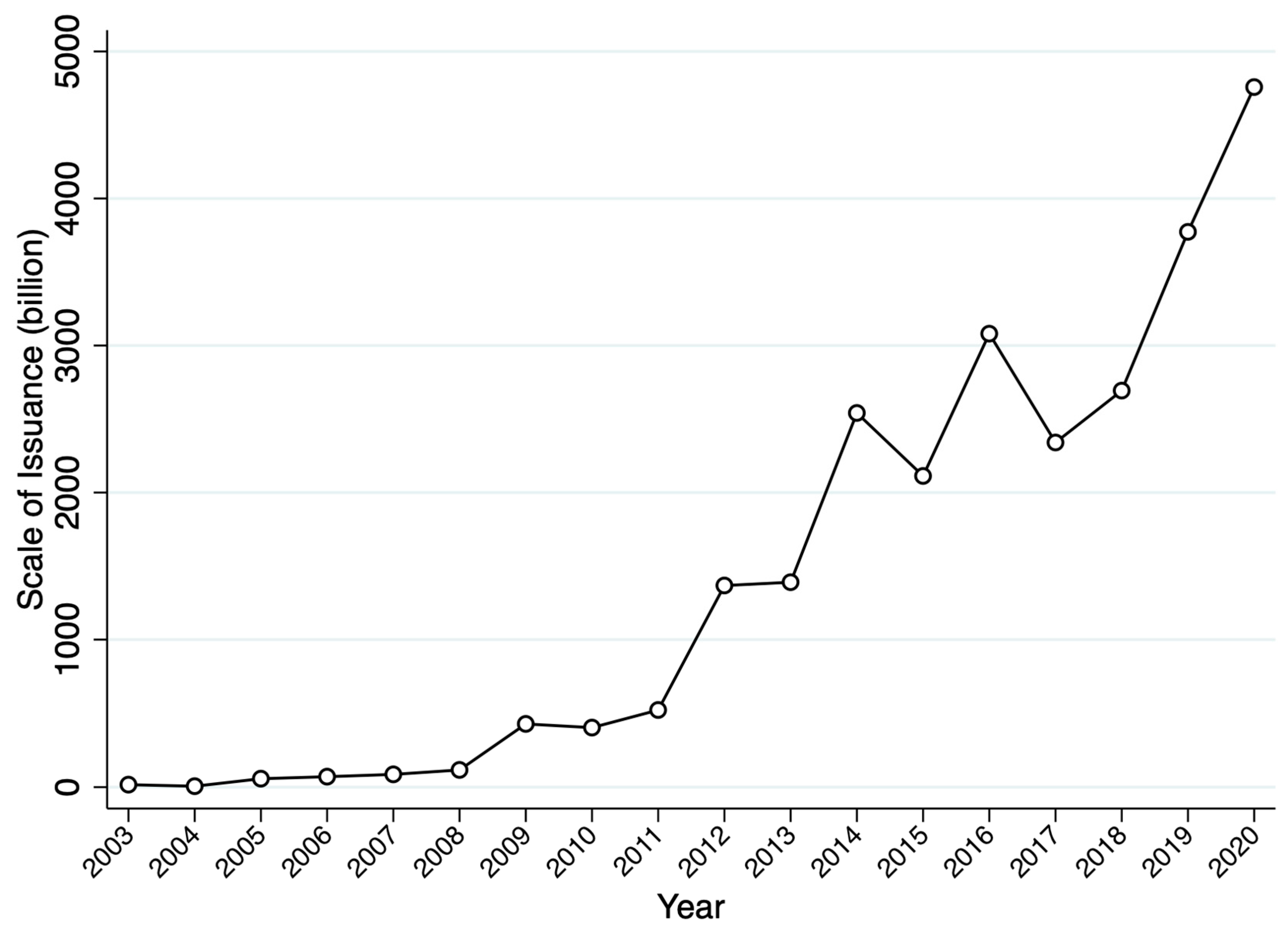
The importance of LGFVs increased sharply after the 2008 global financial crisis, when local governments were encouraged to accelerate infrastructure investment and stabilise growth. As
Figure 1 shows, LGFV issuance expanded rapidly after the crisis and became a major source of local development finance during the following decade. In this context, LGFVs provided a flexible financing vehicle through which local authorities could sustain urban construction and local investment when conventional budgetary channels were constrained.
This institutional design gives LGFVs an ambivalent economic role. On the one hand, they can strengthen local state capacity by enabling cities to maintain investment and public-service projects under fiscal pressure. On the other hand, they may weaken fiscal discipline by generating hidden liabilities, soft budget constraints, land dependence, and governance risks. Since 2015, central authorities have attempted to regularise this system through debt-swap programs, tighter budgetary supervision, and the incorporation of some local liabilities into formal debt-management frameworks [
12]. These reforms underscore the dual status of LGFVs in contemporary urban China: they remain important instruments of local development finance, yet they are also central to debates over debt governance and fiscal sustainability.
2.2. Conceptualising Urban Economic Resilience
Urban economic resilience has become a central concept in urban and regional studies, but the term has multiple theoretical meanings. The resilience literature commonly distinguishes among engineering, ecological, and evolutionary understandings of resilience. Engineering resilience emphasises the speed with which a system returns to a pre-shock equilibrium. In urban and regional research, this perspective is often reflected in indicators such as the speed of output recovery, employment recovery, or the duration of a recession. Ecological resilience emphasises the ability of a system to absorb disturbance while maintaining core functions, even if it does not immediately return to its previous state. Evolutionary resilience goes further by treating regions and cities as adaptive systems that may restructure, renew, or shift to new development paths after shocks [
22,
23,
24,
25,
26,
27].
Recent studies on Chinese urban resilience generally define resilience as the capacity of cities to resist, recover, adapt, and renew after shocks. Empirically, this literature often constructs composite indices that include industrial diversity, infrastructure, human capital, openness, governance, and environmental conditions. Such measures are valuable for comparing cities across multiple dimensions, but they may obscure the specific channel through which local economic shocks affect residents. A city may perform well in terms of infrastructure or industrial upgrading while still transmitting output shocks to household consumption. Conversely, consumption may remain relatively stable even when employment or production has not fully recovered. This distinction makes it necessary to clarify which dimension of resilience is captured by a given empirical measure.
This study focuses on a narrower dimension that we call consumption-side urban resilience. It refers to the extent to which urban household consumption growth is insulated from city-specific output fluctuations. This measure is most closely aligned with the ecological or absorptive interpretation of resilience, because it captures the ability of the urban economy and its institutions to absorb local output shocks on the demand side. It is not intended to measure engineering resilience, such as the speed of employment or output recovery, nor evolutionary resilience, such as long-term structural transformation and path creation.
The risk-sharing literature provides the analytical foundation for this measurement strategy. In a well-functioning risk-sharing system, idiosyncratic output shocks should not be fully transmitted to household consumption, because shocks can be absorbed through fiscal transfers, credit markets, savings, social insurance, interregional flows, or public investment mechanisms [
14,
15,
16]. China-focused studies likewise show that interregional risk sharing remains incomplete, although institutional development and market integration can improve shock absorption and resource allocation [
17,
28]. Following this logic, weaker pass-through from city-specific output growth to urban household consumption growth indicates stronger consumption-side shock absorption. However, this should not be interpreted as a complete measure of household welfare or overall urban economic resilience, because stable consumption may also reflect savings withdrawal, household borrowing, or temporary public support [
13].
2.3. Subnational Debt, State Financialisation, and Local Development Finance
The role of LGFVs can be better understood by linking China’s experience to international debates on subnational debt and state financialisation. Across countries, local governments use municipal bonds, public development corporations, public–private partnerships, and special-purpose vehicles to finance infrastructure and manage intertemporal budget constraints. These instruments can support countercyclical investment and spread the cost of long-lived infrastructure across time. At the same time, they may create fiscal stress, moral hazard, and opacity when debt is backed by implicit guarantees or when repayment depends on volatile asset markets.
The state financialisation literature further shows that governments are not merely passive regulators of financial markets. They increasingly act as financial market participants by using land values, public assets, debt instruments, and balance-sheet techniques to pursue urban redevelopment and local growth. In this sense, local debt is not only a funding device but also a governance arrangement that reshapes relations among the state, financial institutions, real estate markets, and residents [
29,
30,
31,
32]. This literature helps situate LGFVs within a broader comparative framework: they are part of a wider global tendency toward debt-financed urban governance, but their institutional form is distinct because they operate through state-owned or state-linked corporate platforms under China’s fiscal hierarchy.
Within China’s fiscal decentralisation regime, local government financialisation is closely tied to land finance and off-budget development finance. Existing research shows that government debt and land financing are deeply intertwined and produce both developmental and distributive consequences [
1]. Broader reviews of land finance emphasise its centrality to infrastructure provision, local accumulation, and urban expansion [
2]. Recent work also suggests that the incorporation of local government bonds into the budgetary process represents a partial move away from off-budget financialisation, even as chengtou companies continue to sustain local state entrepreneurialism and infrastructure-led development [
12,
33].
LGFVs therefore constitute a core institutional vehicle within China’s fiscal and financial architecture. Their issuance is shaped by political incentives, growth competition, market conditions, and interjurisdictional rivalry. Local officials’ promotion incentives can increase urban investment bond issuance and reduce financing costs, especially in cities facing greater growth pressure and lower levels of marketisation [
34]. At the regional level, local governments that lag behind competitors in GDP performance tend to expand debt more aggressively, suggesting that debt is embedded in tournament-style regional competition [
13]. LGFV debt is also closely related to infrastructure provision, land finance, and private-sector development dynamics, highlighting the embeddedness of LGFVs in a broader coalition linking the local state, land markets, banks, and urban construction [
4].
2.4. Research Gap and Analytical Contribution
The preceding discussion points to a gap at the intersection of three literatures. Urban resilience studies have examined why some cities resist or recover from shocks more effectively than others, but they pay less attention to the fiscal and financial instruments through which local governments absorb shocks. Risk-sharing research offers a clear framework for analysing the transmission of output shocks to household consumption, but it has rarely been connected to China’s local development finance. Studies of LGFVs and local debt have examined financing incentives, land dependence, hidden debt, and regulatory reform, but they have paid less attention to whether LGFV issuance affects the pass-through from local output fluctuations to household consumption.
This study addresses this gap by examining whether LGFV issuance weakens the transmission of city-specific output shocks to urban household consumption. In doing so, it treats consumption-side risk sharing as a specific dimension of urban absorptive capacity and analyses LGFVs as conditional fiscal-financial instruments embedded in China’s local state financialisation.
3. Data and Measurement
3.1. Data Sources and Processing
The primary data for this study were sourced from the Wind database, which provides detailed records on LGFV bonds issued by local government financing platforms across China. This dataset comprises a national panel of prefecture-level cities and includes information on 28,219 bonds issued from 1999 to 2021. To maintain consistency and focus on China’s period of rapid economic growth, we restrict the analysis to the years 2003–2019, thereby avoiding potential distortions arising from the COVID-19 pandemic. This filtered period yields a sample of 4429 bonds from 283 prefecture-level cities, excluding municipalities and county-level cities.
To complement the LGFV data, annual city-level statistics on consumption, income, and population are obtained from the China Urban Statistical Yearbook, while fiscal expenditure and revenue data are extracted from the Fiscal Statistics of Cities and Counties. For reliability, minority autonomous regions and statistical outliers are excluded. LGFV bond issuance data are aggregated by issuing city on an annual basis and then merged with corresponding fiscal data. For cities without LGFV issuances, a bond issuance value of zero is assigned to ensure the completeness of the sample.
In addition, macroeconomic indicators, such as the marketisation index and the policy uncertainty index, are included from publicly available sources. These indicators contextualise the role of LGFV within the broader macroeconomic and policy environment, thereby enhancing the analysis of LGFV’s impact on urban economic resilience.
3.2. Measuring Consumption-Side Urban Resilience
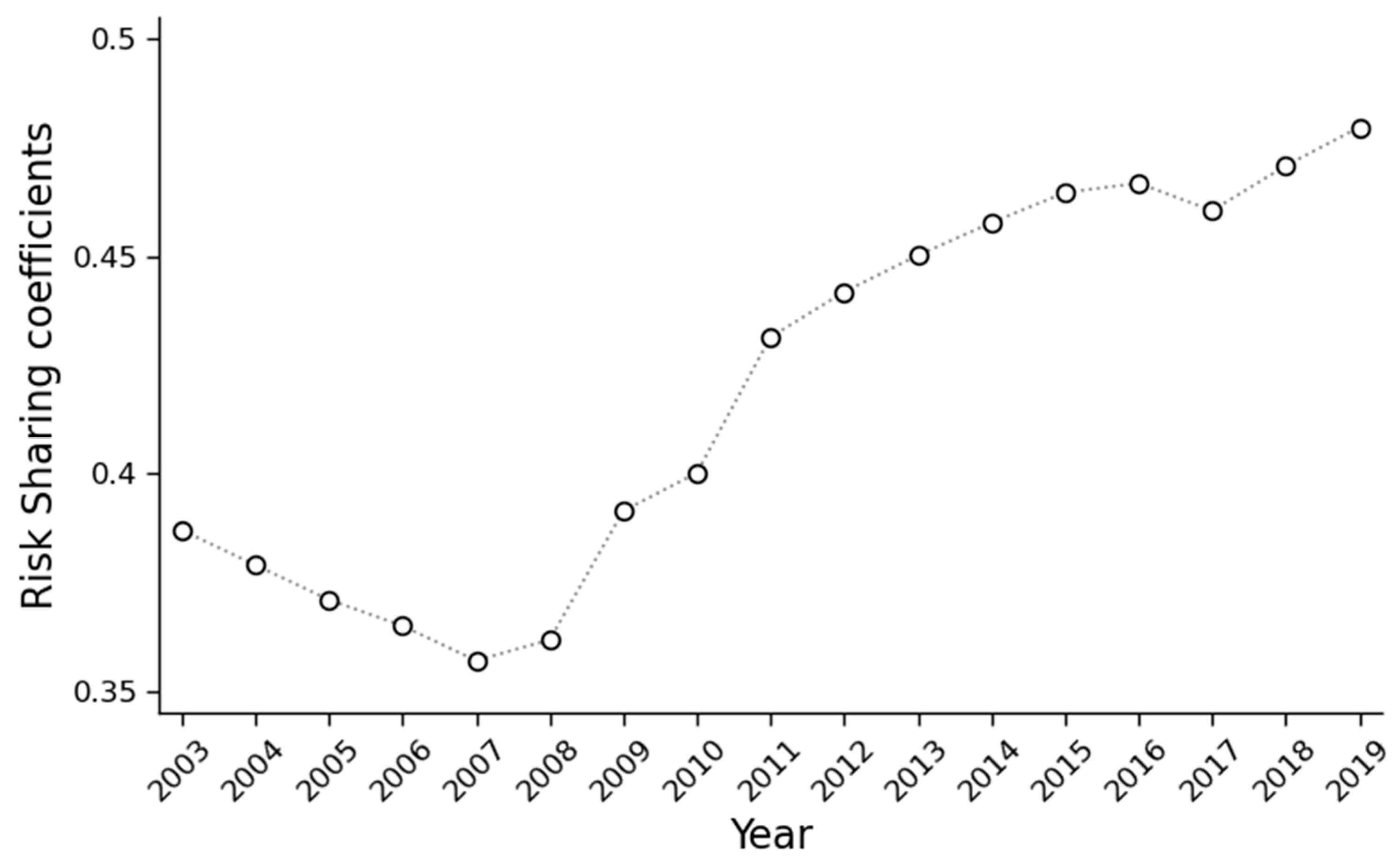
This study measures consumption-side urban resilience through consumption risk sharing, defined as the extent to which urban household consumption growth is insulated from city-specific output growth. Following the risk-sharing literature, a weaker sensitivity of local consumption growth to local output fluctuations indicates stronger demand-side shock absorption. This measure captures only one welfare-oriented dimension of urban resilience and should not be interpreted as a comprehensive indicator of employment recovery, production recovery, or long-term structural adaptation.
3.3. Control Variables
To account for factors that may influence the risk-sharing capacity linked with LGFV, this study includes several control variables that enhance the analysis’s robustness and comprehensiveness. The expenditure ratio, defined as the ratio of local government fiscal expenditure to GDP, captures the potential stabilising role of public spending on local economies. The asset ratio, representing the total assets of listed companies as a percentage of GDP, reflects capital market strength, which can affect consumption risk-sharing. Additionally, the marketisation index measures the degree of market development, providing insight into how market-oriented reforms may bolster economic resilience. Finally, the China Economic Policy Uncertainty (EPU) Index serves as a proxy for policy environment variability, which helps account for how economic policy uncertainty may impact consumption dynamics at the city level. These control variables allow for a nuanced analysis by considering structural and environmental factors that could influence the relationship between LGFV and urban economic resilience, particularly in terms of consumption risk-sharing across different cities.
3.4. Descriptive Statistics and Preliminary Analysis
Table 1 presents summary statistics for the variables used in the empirical analysis. The dependent variable, ∆logC, captures the city-specific component of consumption growth relative to the national benchmark and shows substantial variation across observations. This dispersion is consistent with the idea that Chinese cities differ meaningfully in the extent to which local consumption is buffered from economic fluctuations.
The main explanatory variable, logLGFV, is the transformed measure of LGFV issuance intensity used in the regressions. Its distribution indicates pronounced heterogeneity across cities, with many observations close to zero and a smaller group of cities displaying much larger issuance intensity. This pattern is in line with the highly uneven geography of local borrowing and development finance in China.
Among the control variables, the expenditure ratio has a mean of 0.1653, highlighting differences in fiscal structures that may influence LGFV’s role in local economic risk management. The asset ratio also exhibits considerable variance, suggesting that capital market development varies significantly across cities and may impact their ability to manage economic risks.
Overall, the descriptive statistics indicate considerable cross-city variation in consumption growth, output growth, fiscal conditions, and LGFV issuance. These patterns motivate the empirical analysis, but they should not by themselves be interpreted as evidence that LGFV issuance improves urban resilience.
6. Further Analysis
This section offers two supplementary analyses. The first compares LGFV with other potential channels through which cities may smooth shocks. The second examines whether the LGFV association differs across institutional and fiscal contexts. Both exercises are exploratory and should be read as descriptive extensions of the main results.
6.1. Illustrative Comparison of Alternative Risk-Sharing Channels
In addition to LGFV, other mechanisms, such as fiscal expenditure and capital markets, also contribute to economic risk management in cities. To evaluate the relative effectiveness of these mechanisms, we compare the impact of fiscal expenditure and capital market instruments on economic resilience with that of LGFV.
Table 4 presents the regression results for different risk-sharing mechanisms. In column (1), the interaction term between fiscal expenditure (expenditure ratio) and output growth is negative but statistically insignificant, suggesting that fiscal expenditure alone does not significantly enhance a city’s capacity for economic risk-sharing. One possible explanation is that while fiscal expenditure may alleviate short-term pressures, its long-term effectiveness may be limited by resource allocation efficiency and the debt burden on local governments.
In column (2), the interaction term between capital market assets (asset ratio) and output growth is −0.037, significant at the 5% level, indicating that capital markets play a substantial role in economic risk-sharing. By enabling efficient resource allocation and risk diversification, mature capital markets provide an effective buffer against external economic shocks, enhancing urban stability.
Column (3) combines fiscal expenditure, capital markets, and LGFV, and reveals that the interaction term for LGFV issuance has the largest absolute coefficient (−0.050), statistically significant at the 1% level. This indicates that while fiscal expenditure and capital markets contribute to risk-sharing, LGFV have a more pronounced effect in enhancing urban resilience. This may be due to the strong policy backing and high acceptance of LGFV, enabling them to provide more substantial support in times of economic instability.
These comparisons suggest that LGFV issuance remains negatively associated with the output–consumption pass-through even when fiscal expenditure and capital market assets are considered. The exercise is illustrative rather than definitive, but it indicates that the LGFV channel is not simply absorbed by these alternative risk-sharing mechanisms.
6.2. Heterogeneity Analysis
This section investigates how the impact of LGFV issuance on urban economic resilience varies according to cities’ economic characteristics, focusing on marketisation, policy uncertainty, and per capita fiscal expenditure.
Table 5 shows the results for cities grouped by marketisation level. In highly marketized cities, the interaction term between LGFV issuance and output growth is −0.078, significant at the 1% level, indicating that mature markets enable cities to leverage LGFV more effectively for risk mitigation. In contrast, in low-marketisation cities, the coefficient is positive (0.140) and significant at the 1% level, suggesting that LGFV issuance may actually increase economic risks. This could be due to underdeveloped markets and inefficiencies in LGFV use, potentially leading to fiscal strain and instability.
We next examine the influence of policy uncertainty on LGFV effectiveness. In cities with low policy uncertainty, the interaction term is −0.121 and significant at the 1% level, indicating that stable policy environments enhance the resilience effect of LGFV issuance. Conversely, in cities with high policy uncertainty, the interaction term is close to zero (−0.002) and statistically insignificant, suggesting that in volatile policy environments, the stabilising effect of LGFV is weakened, likely due to the destabilising impact of uncertainty on financial conditions.
Finally, we analyse LGFV effectiveness based on per capita fiscal expenditure. In high-expenditure cities, the interaction term is −0.042 and significant at the 5% level, implying that greater fiscal resources support more effective LGFV utilisation for risk management. In contrast, in cities with low fiscal expenditure, the interaction term is negative but not significant (−0.107), indicating that limited resources restrict the resilience benefits of LGFV issuance, leaving these cities more vulnerable to shocks.
Overall, the heterogeneity analysis reveals that LGFV issuance has the greatest positive impact on economic resilience in cities with high marketisation, low policy uncertainty, and substantial fiscal resources. Conversely, its effectiveness diminishes—and may even be counterproductive—in cities with low marketisation, high policy uncertainty, or limited fiscal resources.
6.3. Regional, Industrial, and Demographic Heterogeneity
To further examine whether the relationship between LGFV issuance and consumption-side risk sharing varies across different urban contexts, we conduct additional subsample regressions by regional location, industrial composition, and demographic structure. The regional split distinguishes eastern, central, and western cities. Industrial composition is examined by comparing cities with low and high shares of the secondary industry, while demographic structure is examined by comparing cities with low and high levels of population ageing. These tests address the possibility that differences in economic structure, development stage, industrial base, and demographic profile condition both LGFV issuance capacity and local consumption stability.
Table 6 reports the results. The regional estimates show a clear spatial asymmetry. The interaction term between city-specific output growth and LGFV issuance is negative but statistically insignificant in eastern cities, and positive but statistically insignificant in central cities. By contrast, the coefficient is positive and statistically significant in western cities. Since a positive interaction indicates a stronger pass-through from city-specific output growth to city-specific consumption growth, this result suggests that LGFV issuance is not associated with consumption smoothing in western cities and may instead coincide with weaker risk-sharing capacity. This finding reinforces the conditional interpretation of the baseline results: the stabilising role of LGFVs should not be assumed to operate uniformly across China’s urban system.
The industrial-composition split provides a more muted pattern. In both the low and high secondary-industry-share groups, the interaction terms are statistically insignificant. This suggests that although industrial structure may shape the generation and transmission of local output shocks, the moderating effect of LGFV issuance is not systematically different across these two groups in the current specification. The positive and significant coefficients on △logY in both groups indicate that local output shocks continue to affect urban household consumption, but the LGFV channel does not display a robust industrial-structure-specific pattern.
The demographic split yields a similar conclusion. The interaction terms are negative in both low-ageing and high-ageing cities, but neither coefficient is statistically significant. The estimates therefore do not support a strong conclusion that population ageing alone changes the capacity of LGFVs to smooth consumption shocks. At the same time, the positive coefficients on △logY confirm that local output fluctuations remain relevant for consumption dynamics across demographic contexts.
These additional tests qualify the baseline finding in two ways. First, they show that the LGFV-consumption-smoothing association is spatially uneven, with western cities displaying a markedly different pattern. Second, they show that some structural differences, particularly industrial composition and population ageing, do not generate statistically robust differences in the LGFV interaction term. Taken together with the preceding heterogeneity results on marketisation, policy uncertainty, and fiscal capacity, the evidence supports the paper’s central argument that LGFVs operate as a conditional form of debt-financed local state capacity rather than as a universally effective stabilising instrument.
6.4. Mechanism Tests
The baseline results suggest that LGFV issuance is associated with a weaker pass-through from city-specific output growth to city-specific household consumption growth. However, LGFVs are not direct income-transfer instruments. Their effect on household consumption, if any, should operate indirectly through the local economic environment. We therefore examine whether lagged LGFV issuance is associated with several intermediate outcomes that may affect household consumption, including wage growth, credit availability, local output, investment, foreign direct investment, wage bills, and pension participation.
Table 7 examines whether lagged LGFV issuance is associated with intermediate outcomes that may affect household consumption. The results suggest that LGFV issuance is positively associated with average wage growth, credit growth, local output growth, and FDI growth. These patterns are consistent with an indirect stabilisation channel in which LGFV-backed financing supports income conditions, local liquidity, production activity, and investment confidence. By contrast, the coefficients for fixed asset investment growth, total wage bill growth, and pension participation growth are not statistically significant. This suggests that LGFVs should not be interpreted as direct welfare-transfer instruments or as a general source of expansion across all local economic indicators.
6.5. Asymmetric Shock Tests
The baseline results show that LGFV issuance is associated with a weaker pass-through from city-specific output growth to city-specific household consumption growth. A further question is whether this smoothing pattern is concentrated in periods when cities face adverse output conditions. To examine this possibility, we estimate an asymmetric specification by interacting the baseline term with a negative-shock dummy. Three definitions of negative shock are used. The first identifies years in which a city’s GDP growth rate is lower than its own previous-year growth rate. The second identifies years in which a city’s GDP growth rate is below the sample median. The third identifies years in which a city’s GDP growth rate is below the contemporaneous provincial average.
Table 8 reports the results. Column (1), which defines negative shocks as growth slowdowns relative to the previous year, provides evidence consistent with the smoothing interpretation. The coefficient on
is −0.0446 and statistically significant at the 5% level. Since a negative interaction between output growth and LGFV issuance indicates a weaker transmission of local output shocks to household consumption, this result suggests that LGFV issuance plays a stronger buffering role when cities experience an actual slowdown in output growth. In this specification, the LGFV interaction is close to zero in non-slowdown years, but becomes more negative during slowdown years, implying that the consumption-smoothing association is more visible under adverse local growth conditions.
Columns (2) and (3) provide a more cautious picture. When negative shocks are defined as growth below the sample median or below the provincial average, the triple-interaction terms are positive and statistically significant. These results do not support the claim that LGFV smoothing is uniformly stronger under all definitions of weak output performance. Instead, they suggest that relative underperformance, compared with the national sample or provincial peers, may capture broader structural weakness or cross-city heterogeneity rather than a temporary shock episode. Under these broader definitions, LGFV issuance may be associated with stronger output–consumption linkage rather than stronger smoothing.
The evidence supports the view that LGFVs can help smooth consumption when cities face genuine growth slowdowns, but this effect is not universal across all forms of adverse output performance. This is consistent with the paper’s broader argument that LGFVs operate as a conditional form of debt-financed local state capacity. Their stabilising role is most plausible when borrowing helps local governments respond to temporary downturns, but it may be weaker or even reversed when low growth reflects persistent structural constraints.
7. Discussion
This paper examines LGFV issuance as part of the fiscal and financial architecture through which Chinese cities manage local economic volatility. The results show that greater LGFV issuance is associated with a weaker transmission of city-specific output fluctuations to urban household consumption. This pattern is consistent with a consumption-smoothing role of debt-financed local intervention. However, the interpretation should remain deliberately bounded. Consumption stability is not equivalent to urban economic resilience in its full sense, since it does not directly measure employment recovery, production recovery, the duration of downturns, or long-term structural adaptation. The contribution of this paper is therefore more specific: it identifies a demand-side and welfare-oriented dimension of absorptive capacity, namely whether local output shocks are transmitted to household consumption.
The mechanism tests help explain why LGFVs may matter for this narrower dimension of resilience. LGFVs do not insure households directly through transfer payments or social protection programmes. Instead, their influence appears to operate through the local economic and financial environment. The evidence suggests that lagged LGFV issuance is associated with average wage growth, credit growth, local output growth, and FDI growth, while the associations with pension participation, total wage bills, and fixed asset investment are weaker. This pattern supports an indirect interpretation. LGFV-backed financing may sustain project continuity, ease local liquidity constraints, support income conditions, and preserve confidence in the urban investment environment. In this sense, LGFVs may reduce the extent to which output shocks become household consumption shocks, not by directly compensating residents, but by stabilising the institutional conditions under which income, credit, and local demand are maintained.
The findings also show that debt-financed smoothing is highly conditional. The stabilising association is stronger in cities with higher marketisation, lower policy uncertainty, and greater fiscal capacity. It is weaker, absent, or even reversed where market institutions are less developed, policy conditions are more uncertain, or fiscal resources are more constrained. The additional heterogeneity tests reinforce this interpretation. Western cities display a distinct pattern, while industrial composition and population ageing do not generate robust differences in the LGFV interaction. These results point to variegated state capacity rather than a uniform effect of borrowing. LGFVs may provide useful fiscal and financial flexibility where local governments can translate borrowing into effective stabilisation, but the same instrument may deepen fragility where debt governance is weak or where repayment depends on unstable fiscal and land-market foundations.
The asymmetric shock tests further clarify the scope of this argument. LGFV issuance appears more plausibly stabilising when cities experience growth slowdowns relative to their own previous performance. By contrast, when weak performance is defined relative to the national median or provincial peers, the evidence does not support a uniform smoothing effect. This distinction matters because temporary slowdowns and persistent relative underperformance are not the same type of shock. Debt-financed intervention may help prevent a temporary downturn from cascading into household welfare by maintaining investment, services, and liquidity. It is less likely to generate resilience when low growth reflects deeper structural constraints. In such cases, borrowing may preserve short-term expenditure while postponing adjustment and increasing future fiscal vulnerability.
The broader implication is that LGFVs should be understood neither as an unqualified instrument of resilience nor as a purely destabilising form of hidden debt. They are better interpreted as an ambivalent form of debt-financed local state capacity. Under favourable institutional and fiscal conditions, they may help cities absorb local shocks at the consumption margin. Under weaker conditions, they may reinforce soft budget constraints, land dependence, opaque liabilities, and later fiscal retrenchment. The policy question is therefore not whether LGFVs should simply be expanded or suppressed, but how local borrowing can be made more transparent, more countercyclical, and more closely tied to projects that sustain employment, public services, and household welfare without undermining long-term fiscal sustainability. For urban resilience research, the findings suggest the need to pay closer attention to the fiscal and financial instruments through which local states absorb shocks. Future studies could extend this analysis by linking LGFV issuance to employment recovery, firm survival, household balance sheets, social insurance, and the maturity structure of local debt, thereby distinguishing more fully between temporary consumption smoothing and durable urban economic resilience.