Article

Structural Canopy Recovery of an Urban Woodlot Following Pulse Disturbance Events

Department of Landscape Architecture, Rutgers The State University, 93 Lipman Dr.—Blake Hall 112, New Brunswick, NJ 08901, USA
*
Author to whom correspondence should be addressed.
Land 2026, 15(6), 1038; https://doi.org/10.3390/land15061038
Submission received: 13 April 2026 / Revised: 1 June 2026 / Accepted: 9 June 2026 / Published: 12 June 2026
(This article belongs to the Section Land–Climate Interactions)

Abstract

We examined the novel vegetative assemblage trajectory of a woodlot within a 235-acre urban brownfield. As our previous work documented the stochastic trajectory of the site’s vegetative guild since 1969 and demonstrated the strong influence of soil metals on forest development, we questioned whether the combined effect of soil stress and the increase in pulse event occurrence and intensity had altered the site’s vegetative assemblage trajectory. Using orthomosaic images, digital elevation mapping, and normalized data vegetation indices, our research assesses shifts in forest productivity and structural changes. These ecological characteristics are then compared to the long-term effects of the site’s total soil metal load and the impact of two pulse events. The decrease in the relationship between soil metal load and canopy productivity was 38% over the course of the study. Canopy surface area and volume increased between 2003 and 2011, then decreased between 2011 and 2014 (volume change above 2 m of 3.14%) due to the pulse events, and then recovered and increased by 2023 (volume change above 2 m of 47.9%). The observed decline in the NDVI–TML association suggests that the apparent influence of the abiotic filter imposed by the soil metals has decreased over time.

1. Introduction

The fact that we are increasingly an urban species has been well documented [1]. As such, achieving sustainability within the urban environment is a topic of considerable scientific inquiry. In addition, the continual expansion of remnant open space in urban land provides valuable ecosystem services that help move us towards the United Nations Sustainable Development Goal to “protect, restore and promote sustainable use of terrestrial ecosystems, sustainably manage forests, combat desertification, halt and reverse land degradation, and halt biodiversity loss” [2].
Urban forests provide the combined or stacked services of heat island mitigation, storm surge protection, nutrient cycling, carbon storage, and aesthetics, while also enhancing the quality of life of residents [1,3,4]. Some of the more interesting forms of urban open space are remnant woodlands or abandoned post-industrial lands that have been naturally colonized by vegetative assemblages. These systems generally consist of a mixture of native and non-native species recognized as novel communities [5]. The traditional perception that these assemblages are biologically depressed due to fragmentation and invasion [6] has guided many “restoration” initiatives toward replacement with native species-dominated assemblages. The argument has been that those systems dominated by native species, including human-made systems, provide greater biologic diversity and are inherently more productive and resilient. Such paradigms have resulted in regulatory guidance and statutes that target legacy species composition for most restoration efforts [7]. These perceptions are now being challenged as novel systems, those that contain a mixture of old and new world species within the urban context, are proving to be ecologically viable [8,9]. While the question of urban diversity has been critically reviewed [10], here, we use a post-industrial rail yard that has been the subject of a long-term ecological study to examine the issue of resilience. In this study, we measure ecological resilience in the engineering sense, quantifying recovery of both canopy coverage and volume after a disturbance [11]. We posit that relatively small-scale novel urban woodlots can demonstrate resilience, structurally in terms of forest canopy, after a pulse event such as Super Storm Sandy and, functionally, as a measure of productivity.
Naturally assembled urban systems tend to develop as a result of abiotic filters imposed by the built environment, the existing regional species pools from which the flora and fauna migrate, and disturbance regimes [12]. Since socio-economic factors can change rapidly, questions have been raised concerning the resilience of urban ecosystems [13]. However, the gradual acceptance of non-equilibrium or stochastic ecosystems within general ecological discourse [12,14] may lead to a greater acceptance of ecological integrity within novel urban systems.
For example, Sanger and Jetschke (2004) [15] demonstrated that Betula, Salix, and Populus stabilized and dominated the early assemblage of a former uranium-mining dump that was colonized naturally. In a similar situation, in a former rail yard [16] within the New York Harbor area, Betula and Populus were early colonizers and remained dominant for over forty years. Both examples demonstrate that the early arrival of metal-tolerant species alters the development sequence and can delay or inhibit colonization by many other species. In fact, in the case of the former rail yard, it was argued that the uptake and translocation of metals by several tolerant plant species may have produced a positive feedback loop in which the leaf litter was continuously utilizing these metals to maintain a metalliferous soil condition [17]. Such examples provide evidence for stochastic trajectories where the assemblage trajectory does not follow classic deterministic theory [18], as a result of abiotic filters [19], and in fact can result in arrested succession.
Arrested succession, a form of an alternate stable state, generally exists when a disturbance pushes a system past a designated threshold, inducing a self-reinforcing process [20,21]. In the example cited above, tree species composition and the trajectory of the early successional forest developing at the abandoned rail yard were greatly influenced by high soil metal concentrations. Another example was given by D’Antonio and Vitousek (1992) [22], in which the increased fire regimes of grasslands advantaged invasive species. While arrested succession has previously been used as a predictor of ecological degradation or collapse [23], the extremes of climate change-induced severe weather events and the expansion of the urban footprint can foster the development of certain specialized systems.
Such feedback loops between soil metals and plant structure or function and trajectory have been the subject of the long-term study site at Liberty State Park. Here, we synthesize the results in terms of forest cover recovery, vertical canopy reconstruction, and the changing strength of the total soil metal load (TML)–productivity relationship. We hypothesize that such atypical systems can exhibit recovery. Using the rail yard as a case study, we asked the following questions: (1) Has the rate of transition towards forest cover continued both before and after a pulse event? (2) Has this urban woodlot’s canopy cover, in both surface area and volume, recovered after the pulse event? (3) Have areas of forest loss and gain been influenced by the soil’s total metal load? (4) Has the correlation between the soil metal load and forest productivity remained consistent over a twenty-year period, which includes the pulse event?

2. Materials and Methods

2.1. Study Area

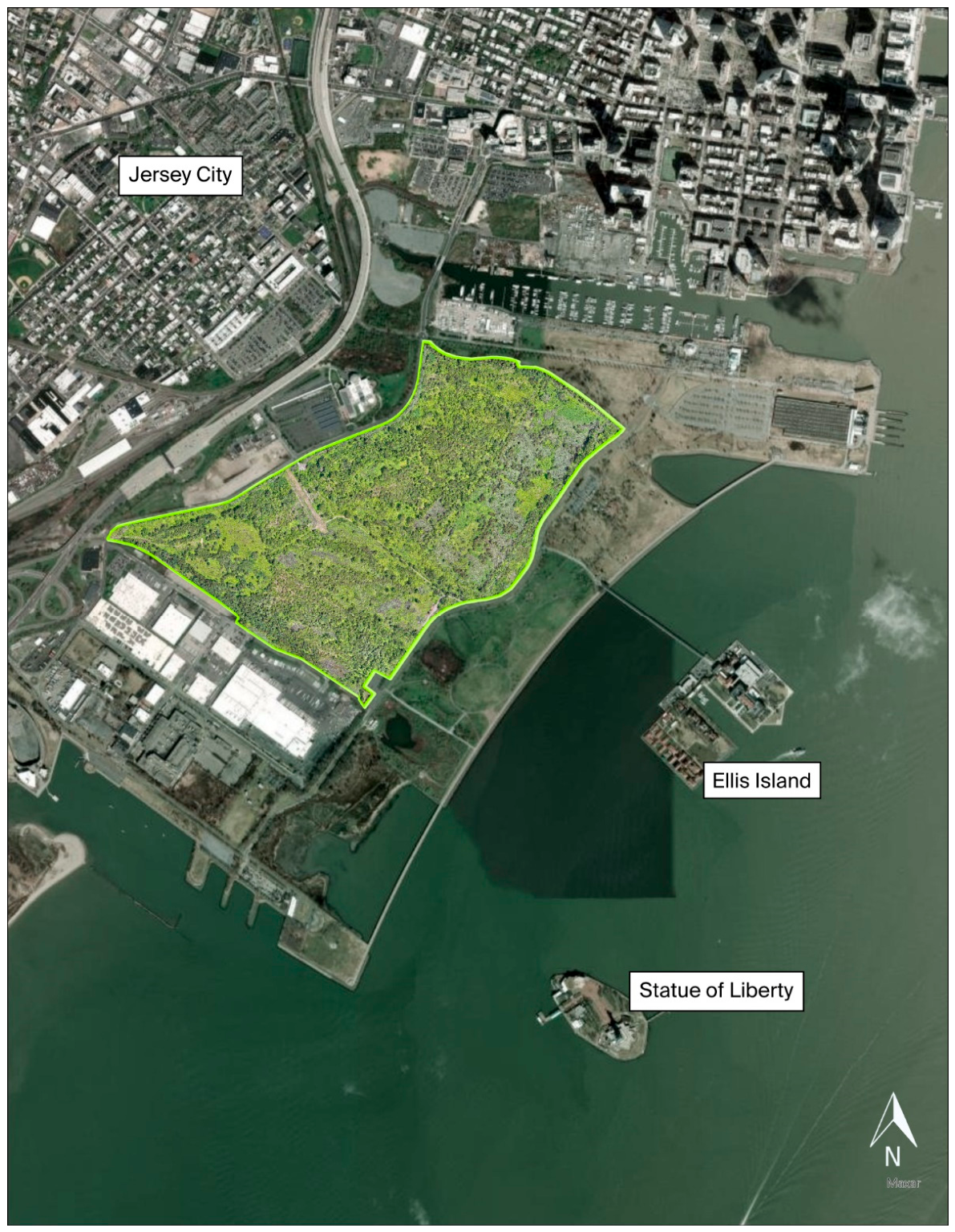
The 235-acre (102 ha) study site is located within Jersey City, New Jersey, at Liberty State Park on the west bank of Upper New York Bay (centered at 40°42′14″ N; 74°03′14″ W) (Figure 1). Originally an intertidal mud flat and salt marsh, the area was occupied by the Central Railroad of New Jersey (CRRNJ) using harbor dredge and waste soils from surrounding construction projects. The surface was stabilized with cinder and ash, typically used by the railroad. The industrial use of the site for commodity transport, primarily coal, and for storage, resulted in relatively high concentrations of soil metals. The Central Railroad of New Jersey discontinued operations after filing for bankruptcy in 1967, leaving the site isolated and secured. At the time of writing, the park consists of approximately 1100 acres, of which 235 remain undeveloped, fenced, and with limited access. This area has been the subject of many studies, including those focusing on soil characterization, contaminate trophic transfer, and assemblage composition and trajectory [24]. The boundary of the study site, as defined in Figure 1, has demonstrated a stochastic succession trajectory over the past 50 years. The four vegetative guilds, which included forest, shrub forbs, and grass, have been monitored since 1994, and photographic evidence dates to 1969. In this study, we focus on changes to the forest guild.

2.2. Pulse Events

Pulse events are low-frequency extreme weather events [25] that can alter vegetative assemblage trajectory, and in some cases return an assemblage to an early stage [26]. Their ecological impact varies greatly depending on species compositional structure, geographic location, event duration, and intensity [27,28]. The site experienced two weather-related extremes that can be considered pulse events. On 29 October 2011, a rare nor’easter snowstorm occurring before leaf drop caused significant canopy damage. While the storm produced up to 12 inches of snow inland, the coastal location mitigated the accumulating snow at Liberty State Park to between four and six inches. However, the two dominant tree species, Betula populifolia and Populus tremuloides, being softer hardwoods, experienced significant branch failure. The following year, the infamous Superstorm Sandy completely inundated the site with water from New York Harbor. The site was covered with between 1 and 2 m of estuarine waters. Wave energy and debris caused significant physical damage. In addition to the visual inspections of the site after each pulse event, a vegetative survey examining plant diversity [29] at the site in 2017 documented many dead or damaged trees within the individual plots.

2.3. Soils

The soils of the site have been characterized by the United States Department of Agriculture’s Natural Resource Conservation Service as the Lady Liberty Series, which was “formed in a thick mantle of human-transported material consisting of coal slag, dredged materials, and/or any geologic deposits ranging from till, outwash, alluvium, or coastal plain sediments usually from a local source” [30].
The soils were examined for contamination by the twenty-six priority pollutants in 1996 [31], and then for metals in 2008 [16] and in 2015 [32]. The concentration of metals (As, Cr, 8Cu, Pb, and Zn) was consistently found to be above both residential and ecological soil screening criteria (Table 1). In addition, soil metal concentrations were found to be relatively constant over time. A comparative study [32] of soil metals between the years 1995, 2005, and 2015 (28-, 38-, and 48-years post abandonment) indicated that there was little change in the concentration of total soil metals in the upper 30 cm. However, from 2005 to 2015 the oxyanions As and Cr did increase in the C1 horizon. These increases could have resulted from downward migration from the upper 5 cm of soil and subsequent immobilization in the C1 horizon.
As the impact of soil metals on plant growth, maintenance, and reproduction tends to be cumulative, a total soil metal load index (TML) was developed for the site [15]. The resulting index provided a relative scale from 0 to 5 in 0.1-unit increments, with 5 indicating the highest combined soil metal concentrations. A strong threshold relationship between the TML and primary productivity (R2 = 0.84, p > 0.001), as measured by the normalized data vegetation index (NDVI), has been described. Both primary productivity and diversity remained high until the TML exceeded a threshold value of approximately 3 on a scale of 0–5 [15].

2.4. Imagery

Orthomosaic, RGB, and digital elevation model (DEM) imagery files were obtained from various sources for the years 2003, 2007, 2010, 2014, and 2023 (Table 2, type and source of images). In 2023, the site was over-flown with a DJI Phantom 4 Pro drone equipped with an RTK unit that enables microtopography boundary identification and that operates in four color bands and produces orthomosaic images. Ground-level topography was determined with the bare earth DEM generated from the most recent return of LiDAR data provided by the NJ Office of Information Technology’s Office of Geographic Information Systems (NJOIT–OGIS). ESRI’s ArcGIS Pro 3.5 (desktop version) was used to map the pixels’ curvature using the Curvature function and to classify vegetation assemblages as expanding or retreating. Orthoimagery of the site was also used to support hyperspectral image classification and percent vegetation cover analysis.
The DEM derived from the drone imagery were used to map existing vegetation boundaries and elevation, which was then compared to existing data and field verification. Spatial data collection, as well as map and layer products, complies with FGDC’s Mapping Standards. The 2007 and 2014 NJ Geographic Information Network Legacy LiDAR Collections with reported RMS:0.00966.
The information presented for years prior to 2003 was taken from our previous work [16]. These studies included the use of historic true color images georeferenced in ArcGIS using a 2002 aerial photo (released by the NJDEP; spatial resolution 0.3 m) as reference. The rectification resulted in an RSM (root square mean) error lower than 0.6 m for each of the photographs. Forest loss and forest gain polygons were manually digitized through heads-up interpretation of the orthomosaic imagery and cross-checked against field observations. Field assessment of the vegetation structure has been standard for each study as of 1994.
Variations in point cloud density between study years can lead to uncertainty when measuring canopy surface and volume due to differences in resolution. However, because the size of the forest area observed in this study far exceeds the calculated error margins associated with sensor resolution and DSM interpolation, we believe the uncertainty associated with combining imagery from different sensors and years is negligible.
Forest area loss and gain were clipped and measured separately for spatial analysis and comparison to TML. We derived training areas for the classification process by digitizing examples to determine the spatial extent of distinct plant assemblages and land cover types, which were field-verified. Orthomosaic images were compared visually, and areas of forest loss and forest gain were delineated for the years 2010, 2014, and 2023. Spatial data collection, as well as map and layer products, comply with the Federal Graphic Committee’s Mapping Standards.
Topographic and canopy elevations were determined to assess the forest canopy density. These data were stratified into two layers, between 2 and 4 m and above 4 m. Three time-stamped images from 2007, 2014, and 2023 were evaluated to determine both leaf surface area (two-dimensional) and canopy volume (three-dimensional). The selected years characterize the periods before, just after, and 10 years after the pulse event of Super Storm Sandy. The multi-return information minus the last return provides a useful depiction of the “canopy” within the project area. The last return is further processed to obtain the “Bare Earth Dataset” as a deliverable. All LiDAR data is processed using the binary LAS 1.1 file format.
To increase the precision of our temporal comparisons and move beyond the limitations of 2D imagery, we use height-based delineation to define the forest guild structure. Rather than relying only on two-dimensional delineation from orthomosaics to categorize vegetation structure, we applied vertical thresholds at the 2 m and 4 m elevations within our Digital Surface Models (DSMs). By requiring a minimum height of 2 m for the lowest forest classification and 4 m for the established canopy level, we ensured that the documented expansion represents the increase in 3D forest structure rather than a 2D expansion of low-lying herbaceous or shrub cover. This integration of elevation data serves as a validation step, confirming that the ‘recovery’ observed in our NDVI and area measurements corresponds to a physical rebuilding of the vertical canopy volume.
Canopy height models (CHMs) were generated by subtracting the bare earth digital terrain model (DTM) from the digital surface model (DSM):
C H M = D S M D T M
Vegetation heights were then classified into two structural categories: 2–4 m above ground and >4 m. Canopy volume was calculated in ArcGIS pro using the surface volume tool. The tool calculates the volume of the area between a surface and the reference threshold height plane.
Although 3D canopy surface area decreased between 2007 and 2014, total canopy volume increased. This pattern likely reflects canopy infilling and increased forest density, where canopy gaps created by the pulse events gradually closed, producing a structurally denser but less topographically irregular canopy surface.
The Normalized Data Vegetation Index was developed for 2003 and 2023 using the function in ESRI’s ArcGIS Pro program. As 2023 had a much higher resolution, it was resampled to a 1 m resolution for consistency when comparing samples. For both sets of data, the TML elevation lines were used as sampling transects. Both were large data sets, N = 12,235 for 2003 and N = 12,276 for 2023 (N = 3,780,342 before resampling). To ensure that resampling did not skew the data, a comparison of the original 2023 data and the resampled data was conducted and yielded no significant difference (two tailed t-test; T = −0.08, p = 0.98).
To mitigate uncertainties, with the NDVI data arising from the use of multiple sensors and varying atmospheric conditions across the study period, we applied a statistical standardization to all NDVI datasets. This process ensures that the vegetation indices are comparable by rescaling them based on their distribution properties rather than relying on absolute reflectance values, which can be skewed by sensor-specific spectral response functions. We transformed the absolute NDVI values (NDVI raw) into a standardized Z-score using the following formula:
Z = N D V I r a w N D V I m e a n N D V I s t d
To explore trends in the relationship between TML and forest NDVI, the 2023 forest cover data were first clipped to the 2003 boundaries for comparison. In addition, as the comparison of time series NDVI imagery is complicated by prevalent noise resulting from varying atmospheric conditions and sun–sensor–surface viewing geometries, both data sets were standardized using Z-score normalization for polynomial equations [33] and only the strength of the polynomial regressions is used for comparison. Polynomial regressions were chosen as they yielded the best fit in both the current and previous studies [15,16]. Polynomial regressions are also representative of threshold relationships such as those described between NDVI and TML. Finally, NDVI values greater than three times the standard deviation were considered outliers.
To further validate whether the relationship between NDVI and TML changed over time, a linear analysis of the covariance model was applied. We used standardized NDVI as the response variable and treated the sampling year as a categorical factor (2003 = 0; 2023 = 1); TML was treated as a continuous covariate. An interaction term between year and TML was included to test whether the slope of the NDVI–TML relationship differed between sampling years.
Y S t a n d a r d i z e d N D V I = β 0 + β 1 Y e a r + β 2 T M L + β 3 ( Y e a r T M L )
where β 0 represents the intercept, β 1 the effect of sampling year, β 2 the effect of TML, and β 3 the interaction between year and TML. A significant interaction term indicates that the strength or direction of the NDVI–TML relationship differed between years (Table 3).
The linear analysis of covariance shows that, in the baseline year (2003), TML was negatively associated with NDVI (β2 = −0.745, p < 0.001), indicating that increasing soil metal load corresponded to lower vegetation productivity. The coefficient for the 2023 indicator variable was also significant (β1 = −1.086, p = 0.027), suggesting an overall shift in NDVI between years independent of TML effects. Most importantly, the interaction term between year and TML was positive (β3 = 0.486, p = 0.007), indicating that the negative relationship between TML and NDVI became weaker in 2023 compared to 2003. Specifically, while the TML slope in 2003 was −0.745, the estimated slope in 2023 was reduced to approximately −0.259 (−0.745 + 0.486), suggesting that the influence of soil metal load as an abiotic filter on forest productivity declined over time.
To assess spatial independence of NDVI–TML linear analysis of covariance residuals at the transect level, Global Moran’s I was calculated for both study years using a fixed distance band of 1000 feet in ArcGIS Pro Spatial Statistics tools. No significant spatial autocorrelation was detected in either year (2003: I = −0.272, z = −1.502, p = 0.133; 2023: I = −0.289, z = −1.525, p = 0.127), confirming that the plot-level aggregation adequately addressed spatial dependence in the ANCOVA (SI).

3. Results

3.1. Forest Cover

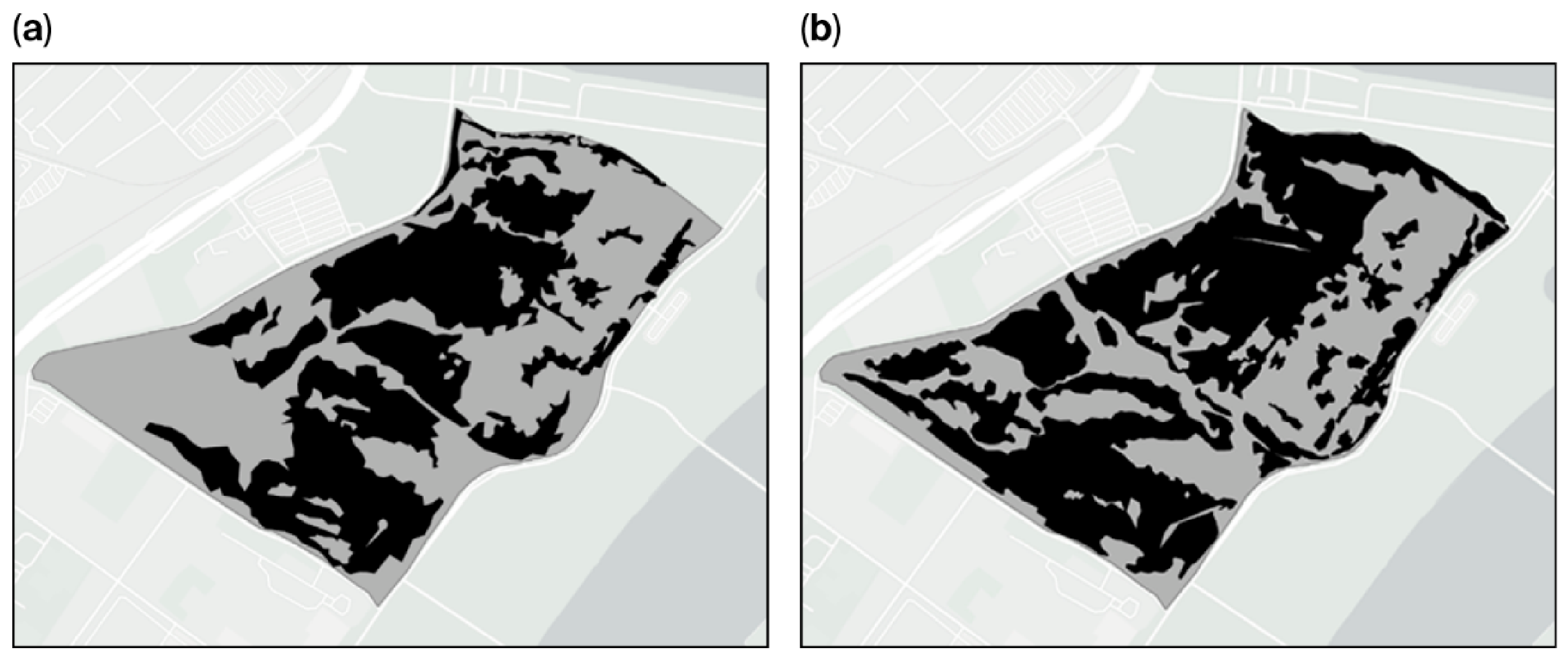
The early successional forest continued to expand during the thirteen years between 2010 and 2023, increasing from 102.37 acres to 127.73 acres (Figure 2). The largest contiguous area in 2010 was 37.4 acres, which grew to 55.1 acres by 2023. These results correspond well with the guild trajectories documented since 1969 [16].
Forest expansion is dynamic. With the increased resolution of aerial photography, we were able to measure forest loss and gains. Between 2010 and 2023, the total forest area loss was 20.39 acres. Within this area loss, the number of individual areas was 19, the largest continuous area was 7.5 acres, and the average area size was 1.07 acres. The total forest area gained was 45.77 acres. Within this area, the number of individual areas was 26, the largest continuous area was 15.77 acres, and the average area size was 1.76 acres.
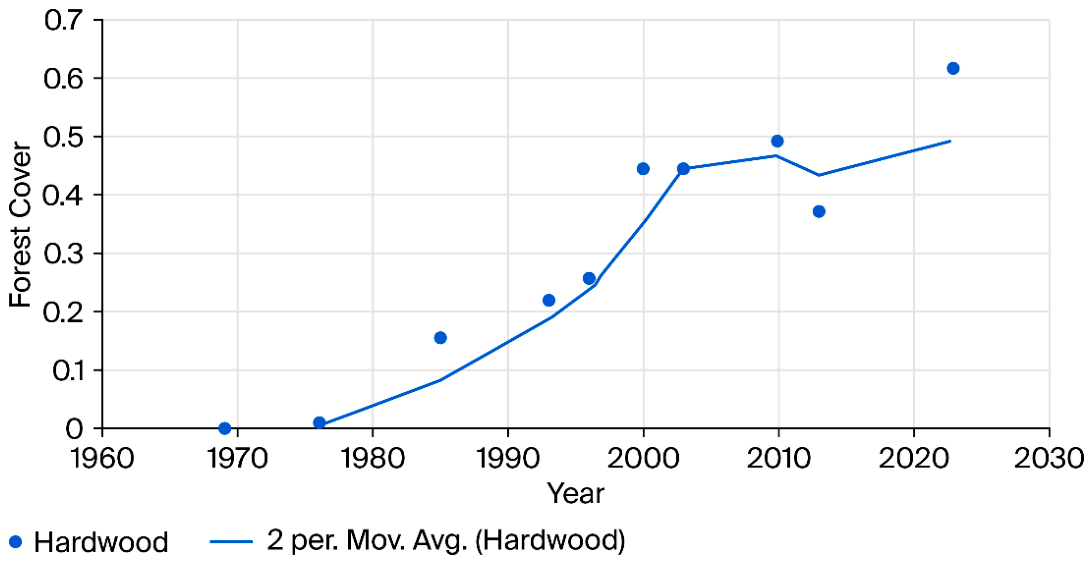
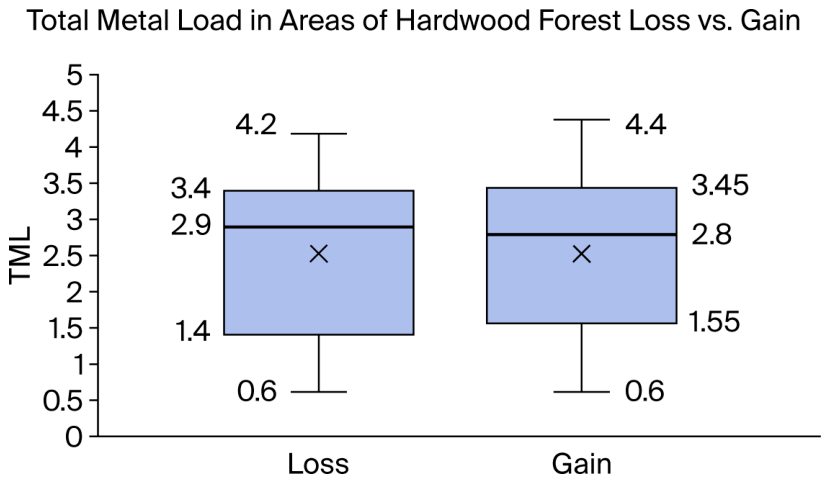
Combining these more recent data with our previous work yields an interesting pattern showing forest area increasing from almost nothing in 1969 to covering 52% of the site by 2010. Between 2010 and 2014, 7% of the forest cover was lost. Between 2014 and 2023, forest cover increased rapidly, covering 61% of the site by 2023. In addition, there was no relationship between the amount of forest lost or gained during the study period and the established soil metal gradient (Figure 3).

3.2. Canopy Volume

Canopy volumetric measurements follow the trends seen in the canopy surface area measurements. However, the separation between data sourced from 2 m to 4 m and above 4 m across the whole site resulted in an increased understanding of structural differences. Loss in the canopy coverage area between 2007 and 2014 was less than expected, with a difference of only about 1%. However, after 2014, the area of the canopy, both between 2 m and 4 m and above 4 m, increased rapidly. By 2023, the canopy above 4 m had increased by 30% (Table 4).
The volumetric canopy changes above 4 m within the 2003 original hardwood forest boundary were also measured and compared. Canopy volume above 4 m slightly decreased between 2007 and 2014, but recovered significantly by 2023. The canopy volume above 4 m recovered within the original hardwood forest boundary delineated in 2003 (Table 5).

3.3. NDVI Distribution vs. TML

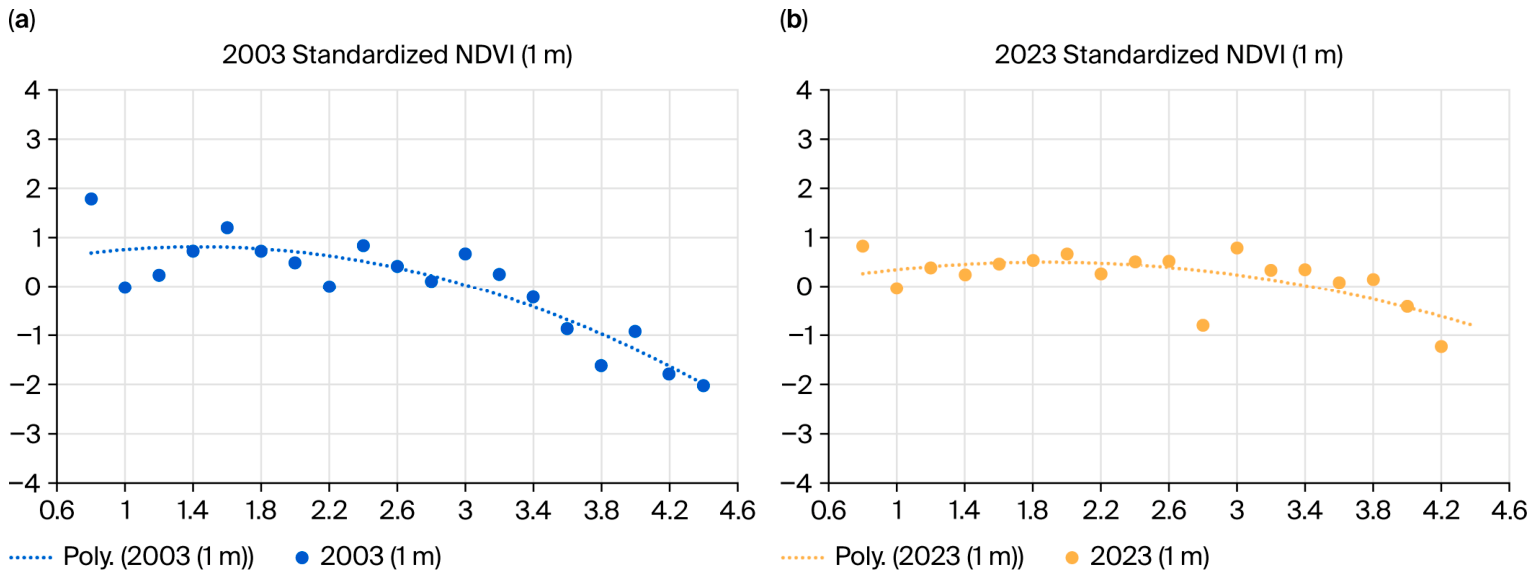
The polynomial regressions between the NDVI and TML for 2003 and 2023, clipped to the 2003 boundary, are represented in Figure 4a,b. The peak value of the curve is higher on the TML scale, and the strength of the regression significantly decreased over the observed twenty years. The 2003 data yielded R2 = 0.78, p ≤ 0.001, which compares well with a published study [16] that reported R2 = 0.81 and p ≤ 0.001 from 2005. The polynomial regression for 2023 resulted in a much less significant regression of R2 = 0.40 p ≤ 0.001.
We also examined the relationship between the NDVI and TML in the areas where the forest expanded between 2003 and 2023. As this expansion was onto soils with relatively lower soil metal concentrations and was seeded or grew directly from stock that had already exhibited metal tolerance, the resulting insignificant polynomial regression (R2 = 0.1232 p ≤ 0.001) was expected.

4. Discussion

4.1. Background

Most recent discussions of urban forest resilience have focused on conceptual and analytical models related to climate change [34]. Many of these draw relationships between a measure of forest health and the socio-ecological context. A review of such literature leads to the conclusion that urban forest resilience is primarily a function of patterns of socio-economic and biophysical processes that operate at varying scales [13]. For example, Konijnendijk, C. et al. (2021) [35] reviewed the impacts of pulse events such as earthquakes and hurricanes on urban forests, concluding that strong urban forestry programs enhance recovery from such events.
The most comprehensive review of long-standing ecological trends comes from the Long-Term Ecological Research (LTER) studies funded by the National Science Foundation. A review of these studies indicates that it takes at least 10 years and, in some cases, twenty to achieve consistent results [36]. The two urban LTER sites in Baltimore, Maryland, and Phoenix, Arizona, have yielded significant results concerning urban tree canopy and social capital [37], crime rates [37], and environmental justice [38]. However, they have not yet addressed resiliency in novel urban vegetative assemblages. Understanding the structure and function of these urban wildlands is critical to the emerging understanding needed to support green infrastructure and open spaces within the urban context [39].

4.2. Canopy Cover and Density

In urban systems, recovery from damage caused by a pulse event is dependent upon the type of system. For example, urban streams, while generally less productive than similar streams in undeveloped areas, show faster recovery in gross primary production and ecological respiration after a pulse event such as Superstorm Sandy [40]. Such streams, which are often subjected to extreme flows, appear to recover faster. Conversely, many fragmented urban systems, with low species diversity and disrupted nutrient and energy flows, generally exhibit reduced resilience [13]. In addition, as many urban forests and woodlots are linked to the surrounding human socio-economic construct, variability rates of recovery are additionally complex [13]. Our study site is unique in that it offers a relatively long-term look at a novel system that has been developing over many decades. In addition, at 235 acres, the scale of the site was large enough to expect that it might exhibit some form of stability.
Forest canopy recovery after a pulse event is a complex phenomenon that depends on the site’s morphology and the event’s impacts. While devastating events such as catastrophic storms or fires destroy the entire canopy and the system takes decades to recover, lesser damage can have various effects. High-intensity pulse events will inhibit canopy growth; however, low-intensity pulse disturbances often increase canopy growth. For example, in a study [39] that used longitudinal data from the National Ecological Observatory Network, canopy damage due to lower-intensity wildfire pulse events resulted in immediate losses between 12% and 65%, depending on the event’s intensity. In less than 10 years, recovery at these sites ranged between 18% and 255%, demonstrating that original density could be surpassed.
A recent investigation of the impact of Superstorm Sandy on the Leaf Area Index, a representation of the canopy area of the study site [41], observed that there were significant canopy reductions following Hurricane Sandy. Our study demonstrates that there was a 12% forest canopy loss between 2010 and 2013 that may have created canopy openings, as indicated by the loss/gain data. The resulting light penetration probably facilitated a rapid recovery. By 2023, the canopy growth had more than compensated for the damage caused by the storms, as 61% of the site was under forest cover, representing a 12% increase over pre-storm conditions.
The volumetric data support the above canopy cover information in that, between 2013 and 2023, the volume of the canopy had increased. These data also indicate that recovery more than compensated for the loss during the pulse events. Between 2 and 4 m above the ground, the canopy increased by 60% from the 2013 measurement. Above 4 m, the canopy volume increased by 30%, demonstrating strong recovery.

4.3. Forest Trajectory

As mentioned earlier, edaphic conditions at the site, specifically the TML, were significant limiting factors that strongly influenced vegetative assemblage development. In areas above the critical TML threshold, early assemblages of herbs/grasses were quickly replaced with metal-tolerant pioneer tree species resulting in an alternate assemblage development pattern [42]. Shrubs were almost completely absent for the first 30 years of the site’s development [17]. The pioneer hardwood forest grew rapidly for the first four decades, and covered approximately 45% of the site by 2000 [25]. The temporary loss associated with the pulse events of the snowstorm of October 2011 and Superstorm Sandy in September 2012, rapidly recovered during the next decade (Figure 5).
Post-disturbance recovery and the natural increase in canopy cover due to the site’s development trajectory were not within the scope of this study. However, there is ancillary evidence that both were involved. The slope of the curve (Figure 5) representing forest expansion had decreased between the years 2000 and 2010, indicating that forest expansion may have been reaching a limiting threshold. The 2014 data exhibit the loss from the two pulse events. The 2023 data indicate a more rapid development, which is consistent with both the expansion and infilling presented in this study. Future work could separate disturbance recovery from background successional change using control sites or counterfactual modeling.

4.4. Relationship to TML

The establishment of assembly rules and the impact of abiotic filters have been the subject of interest for some time [43]. The LSP study site has been used to demonstrate that the presence of high concentrations of soil metals could lead to unique assemblage development and trajectories. We also posited two potential long-term trajectories for the continued development of the early successional hardwood forest [17]. The first is that the presence of relatively high metal concentrations in the plant tissue would create a positive feedback loop, continuously cycling lead, iron, and zinc within the soils, maintaining the abiotic filter, and reinforcing the alternative stable state. However, we also suggested that natural attenuation, primarily due to the addition of organic matter, which would increase adsorption of free metals and the natural mineralization processes, could decrease the labile fraction of soil metals. Theoretically, as the concentration of the labile fraction of soil metals decreases, so would the strength of the TML filter. An approximate 38% decrease in the strength of the regression between the more recent NDVI and TML suggests that the latter appears to be the case.

4.5. Policy Implications

In general, regulatory agencies develop soil screening based on two criteria: first, the background concentration of the contaminant in the native soils, and second, the threshold tolerance of specific target organisms [44]. Once codified, the resulting standards are broadly applied with little consideration to specific site conditions. They do not consider the buffering capacities of the site, changes in contaminant fractions resulting from leaching or organic accumulation, and most significantly the composition of the vegetative assemblage that has developed on the site. The resulting review process leads to a strong preference for the presumptive remedy of capping, i.e., covering the site with at least 0.3 m of clean soil. The cost of capping a site prohibits projects that focus on open or green space development and favors commercial development. A more flexible regulatory framework that considers the ecological legacy of the site could result in an increase in open space within the post-industrial landscape.

5. Conclusions

In an exploration of the connections between urban forest resilience, biodiversity, and climate change, Thompson posited [45] that urban forest resilience would enhance their ecological value. In addition, enhancing structural biodiversity would help mitigate functionality losses [46]. This case study, which covers a fifty-year period, demonstrates that a relatively small urban forest can be resilient as described here by canopy expansion and recovery from pulse events. In addition, forest productivity as measured by NDVI does not exhibit as strong a threshold relationship as in the past.
Over the past fifty years, forest cover has continued to expand and, by 2023, covered approximately 60% of the site. Losses, which occurred between 2010 and 2014, due to the October snowstorm of 2011 and Superstorm Sandy of 2012, recovered rapidly after 2014. The two-dimensional mid-level canopy, between 2 and 4 m2, decreased from approximately 963,001 m2 in 2007 to approximately 123,213 m2 in 2014. By 2023, the mid-level structure had recovered and significantly expanded to approximately 534,895 m2. The upper-level canopy, that above 4 m, also demonstrated a similar pattern suggesting, as would be expected, that light penetration in the forest gaps was sufficient for recovery beginning in the lower layers. The canopy cover recovery suggests a resiliency, as defined above, in the forest guild within this novel assemblage.
In addition, recovery did not correlate with TML, which was one of the original abiotic filters that drove forest development at the site [16]. The area of forest loss during the pulse events and subsequent gains exhibited no correlation to the TML.
More significantly, the reduction in the strength of the threshold relationship between the TML and NDVI in the forested sections of the site indicates that the filter imposed by the metalliferous soils may not be as strong as it was several decades ago. However, the mechanism for this weakening remains unclear. Whether or not the labile fraction of the soil metals has decreased as posited above deserves further study, and a fractional analysis of the soil above the critical threshold should be considered. A second explanation could be that the genetic varieties of the dominant species, well adapted to the metalliferous conditions, now dominate the site and are spreading and recovering at a faster rate than non- or less-tolerant varieties. In either case, the plant productivity in this former railyard is more evenly distributed throughout the site, exhibiting a much weaker threshold effect.
These data are specific to a post-industrial brownfield that has been undisturbed for many decades. While the contaminant loads are specific to the site, the observed general trends add to the argument that vegetative cover of metal-contaminated sites may present a viable mitigation strategy.

Supplementary Materials

The following supporting information can be downloaded at: https://www.mdpi.com/article/10.3390/land15061038/s1.

Author Contributions

H.Y.: methodology, formal analysis, and writing—review and editing; N.M.: data curation and writing—review and editing; F.G.: conceptualization and writing—original draft preparation. All authors have read and agreed to the published version of the manuscript.

Funding

This research was funded by the New Jersey Agriculture Experimentation Station using passthrough funds from the United States Department of Agriculture—USDA NIFA McIntire-Stennis Capacity Funding initiative, grant Reference: NJAES Project #NJ84310 Accession #n7003401.

Data Availability Statement

The data and supporting materials for this paper can be found at Gallagher, Frank—Department of Landscape Architecture.

Acknowledgments

The authors would like to thank the many researchers who have contributed to the long-term characterization of the study site. In addition, we would like to thank the Meadowlands Environmental Research Institute, specifically Ildiko Pechmann, for pre- and post-processing of the drone imagery.

Conflicts of Interest

The authors declare no conflicts of interest.

Abbreviations

The following abbreviations are used in this manuscript:
CRRNJCentral Railroad of New Jersey
TMLTotal Metal Load
DEMDigital Elevation Model
DSMsDigital Surface Models
NDVINormalized Data Vegetation Index
LTERLong-Term Ecological Research

References

  1. UN-Habitat (Ed.) Envisaging the Future of Cities, World Cities Report; UN-Habitat: Nairobi, Kenya, 2022. [Google Scholar]
  2. Biermann, F.; Kanie, N.; Kim, R.E. Global governance by goal-setting: The novel approach of the UN Sustainable Development Goals. Curr. Opin. Environ. Sustain. 2017, 26, 26–31. [Google Scholar] [CrossRef]
  3. Kowarik, I. Working With Wilderness: A Promising Direction for Urban Green Spaces. Landsc. Archit. Front. 2021, 9, 92. [Google Scholar] [CrossRef]
  4. Kowarik, I. Urban wilderness: Supply, demand, and access. Urban For. Urban Green. 2018, 29, 336–347. [Google Scholar] [CrossRef]
  5. Hobbs, R.J.; Arico, S.; Aronson, J.; Baron, J.S.; Bridgewater, P.; Cramer, V.A.; Epstein, P.R.; Ewel, J.J.; Klink, C.A.; Lugo, A.E.; et al. Novel ecosystems: Theoretical and management aspects of the new ecological world order. Glob. Ecol. Biogeogr. 2006, 15, 1–7. [Google Scholar] [CrossRef]
  6. Pautasso, M.; Schlegel, M.; Holdenrieder, O. Forest Health in a Changing World. Microb. Ecol. 2015, 69, 826–842. [Google Scholar] [CrossRef]
  7. McDonald, T.; Gann, G.D.; Jonson, J.; Dixon, K.W. International Standards for the Practice of Ecological Restoration—Including Principles and Key Concepts; Society for Ecological Restoration: Washington, DC, USA, 2016. [Google Scholar]
  8. Hobbs, R.J.; Harris, J.A. Restoration Ecology: Repairing the Earth’s Ecosystems in the New Millennium. Restor. Ecol. 2001, 9, 239–246. [Google Scholar] [CrossRef]
  9. Preston, P.D.; Dunk, R.M.; Smith, G.R.; Cavan, G. Not all brownfields are equal: A typological assessment reveals hidden green space in the city. Landsc. Urban Plan. 2023, 229, 104590. [Google Scholar] [CrossRef]
  10. Spotswood, E.N.; Beller, E.E.; Grossinger, R.; Grenier, J.L.; Heller, N.E.; Aronson, M.F.J. The Biological Deserts Fallacy: Cities in Their Landscapes Contribute More than We Think to Regional Biodiversity. BioScience 2021, 71, 148–160. [Google Scholar] [CrossRef]
  11. Nikinmaa, L.; Lindner, M.; Cantarello, E.; Jump, A.S.; Seidl, R.; Winkel, G.; Muys, B. Reviewing the use of resilience concepts in forest sciences. Curr. For. Rep. 2020, 6, 61–80. [Google Scholar] [CrossRef] [PubMed]
  12. Mori, A.S. Ecosystem management based on natural disturbances: Hierarchical context and non-equilibrium paradigm. J. Appl. Ecol. 2011, 48, 280–292. [Google Scholar] [CrossRef]
  13. Alberti, M.; Marzluff, J.M. Ecological resilience in urban ecosystems: Linking urban patterns to human and ecological functions. Urban Ecosyst. 2004, 7, 241–265. [Google Scholar] [CrossRef]
  14. Hendrick, M.; Rinaldo, A.; Manoli, G. A stochastic theory of urban metabolism. Proc. Natl. Acad. Sci. USA 2025, 122, e2501224122. [Google Scholar] [CrossRef] [PubMed]
  15. Sanger, H.; Jetschke, G. Are assembly rules apparent in the regeneration of a former uranium mining site? In Assembly Rules and Restoration Ecology; Hobbs, R.J., Temperton, V.M., Eds.; Island Press: Washington, DC, USA, 2004; pp. 305–324. [Google Scholar]
  16. Gallagher, F.J.; Pechmann, I.; Bogden, J.D.; Grabosky, J.; Weis, P. Soil metal concentrations and vegetative assemblage structure in an urban brownfield. Environ. Pollut. 2008, 153, 351–361. [Google Scholar] [CrossRef]
  17. Gallagher, F.J.; Pechmann, I.; Holzapfel, C.; Grabosky, J. Altered vegetative assemblage trajectories within an urban brownfield. Environ. Pollut. 2011, 159, 1159–1166. [Google Scholar] [CrossRef]
  18. Clements, F.E. Plant Succession: An Analysis of the Development of Vegetation; Carnegie Institution of Washington: Washington, DC, USA, 1916. [Google Scholar] [CrossRef]
  19. Hobbs, R.J.; Norton, D.A. Ecological filters, thresholds, and gradients in resistance to ecosystem reassembly. In Assembly Rules and Restoration Ecology; Hobbs, R.J., Temperton, V.M., Eds.; Island Press: Washington, DC, USA, 2004; p. 77. [Google Scholar]
  20. Andersen, T.; Carstensen, J.; Hernández-García, E.; Duarte, C.M. Ecological thresholds and regime shifts: Approaches to identification. Trends Ecol. Evol. 2009, 24, 4957. [Google Scholar] [CrossRef]
  21. Scheffer, M.; Carpenter, S.; Foley, J.A.; Folke, C.; Walker, B. Catastrophic shifts in ecosystems. Nature 2001, 413, 591–596. [Google Scholar] [CrossRef] [PubMed]
  22. D’Antonio, C.M.; Peter, M.V. Biological invasions by exotic grasses, the grass/fire cycle, and global change. Annu. Rev. Ecol. Syst. 1992, 23, 63–87. [Google Scholar] [CrossRef]
  23. Suding, K.N.; Gross, K.L.; Houseman, G.R. Alternative states and positive feedbacks in restoration ecology. Trends Ecol. Evol. 2004, 19, 46–53. [Google Scholar] [CrossRef]
  24. Gallagher, F.J. Natural Transformation of Post-industrial Lands: Liberty State Park in Jersey City, NJ (USA). In Urban Wastelands; Di Pietro, F., Robert, A., Eds.; Springer International Publishing: Cham, Switzerland, 2021; pp. 27–46. [Google Scholar] [CrossRef]
  25. Jentsch, A.; White, P. A theory of pulse dynamics and disturbance in ecology. Ecology 2019, 100, e02734. [Google Scholar] [CrossRef]
  26. Sanz-Lazaro, C. Climate extremes can drive biological assemblages to early successional stages compared to several mild disturbances. Sci. Rep. 2016, 6, 30607. [Google Scholar] [CrossRef]
  27. Smith, M.D. An ecological perspective on extreme climatic events: A synthetic definition and framework to guide future research. J. Ecol. 2011, 99, 656–663. [Google Scholar] [CrossRef]
  28. Epiphan, J.N.; Meixler, M.S.; Aronson, M.F.J.; Kaunzinger, C.M.K.; Handel, S.N. Resilience of coastal upland vegetation post-Hurricane Sandy. Coast. Manag. 2025, 53, 110–140. [Google Scholar] [CrossRef]
  29. Salisbury, A.; Gallagher, F.J.; Holzapfel, C. Plant diversity continues to increase after 40 years at an urban brownfield. Urban Ecosyst. 2020, 24, 95–111. [Google Scholar] [CrossRef]
  30. Soil Survey Staff. Web Soil Survey. Available online: https://soilseries.sc.egov.usda.gov/OSD_Docs/L/LADYLIBERTY.html (accessed on 8 June 2026).
  31. New Jersey Department of Environmental Protection. Liberty State Park Remedial Soil Survey; NJDEP: Trenton, NJ, USA, 1995; 650p.
  32. Salisbury, A.B.; Reinfelder, J.R.; Gallagher, F.J.; Grabosky, J.C. Long-term Stability of Trace Element Concentrations in a Spontaneously Vegetated Urban Brownfield with Anthropogenic Soils. Soil Sci. 2017, 182, 69–81. [Google Scholar] [CrossRef]
  33. Patro, S.; Sahu, K.K. Normalization: A preprocessing stage. arXiv 2015, arXiv:1503.06462. [Google Scholar] [CrossRef]
  34. Koren, D.; Rus, K. The Potential of Open Space for Enhancing Urban Seismic Resilience: A literature Review. Sustainability 2019, 11, 5942. [Google Scholar] [CrossRef]
  35. Konijnendijk, C.; Nesbitt, L.; Wirtz, Z. Urban Forest Governance in the Face of Pulse Disturbances Canadian Experiences. Arboric. Urban For. 2021, 47, 267–283. [Google Scholar] [CrossRef]
  36. Cusser, S.; Helms, J.; Bahlai, C.A.; Haddad, N.M. How long do population level field experiments need to be? Utilising data from the 40-year-old LTER network. Ecol. Lett. 2021, 24, 1103–1111. [Google Scholar] [CrossRef] [PubMed]
  37. Troy, A.; Morgan Grove, J.; O’Neil-Dunne, J. The relationship between tree canopy and crime rates across an urban–rural gradient in the greater Baltimore region. Landsc. Urban Plan. 2012, 106, 262–270. [Google Scholar] [CrossRef]
  38. Schwarz, K.; Fragkias, M.; Boone, C.G.; Zhou, W.; McHale, M.; Grove, J.M.; O’neil-Dunne, J.; McFadden, J.P.; Buckley, G.L.; Childers, D.; et al. Trees Grow on Money: Urban Tree Canopy Cover and Environmental Justice. PLoS ONE 2015, 10, e0122051. [Google Scholar] [CrossRef] [PubMed]
  39. Li, L.; Uyttenhove, P.; Van Eetvelde, V. Planning green infrastructure to mitigate urban surface water flooding risk—A methodology to identify priority areas applied in the city of Ghent. Landsc. Urban Plan. 2020, 194, 103703. [Google Scholar] [CrossRef]
  40. Reisinger, A.J.; Rosi, E.J.; Bechtold, H.A.; Doody, T.R.; Kaushal, S.S.; Groffman, P.M. Recovery and resilience of urban stream metabolism following Superstorm Sandy and other floods. Ecosphere 2017, 8, e01776. [Google Scholar] [CrossRef]
  41. Choi, D.H.; LaRue, E.A.; Atkins, J.W.; Foster, J.R.; Matthes, J.H.; Fahey, R.T.; Thapa, B.; Fei, S.; Hardiman, B.S. Short-term effects of moderate severity disturbances on forest canopy structure. J. Ecol. 2023, 111, 1866–1881. [Google Scholar] [CrossRef]
  42. Salisbury, A.B.; Grabosky, J.C.; Gallagher, F.J. Hardwood Leaf Area Spatial and Temporal Patterns in Trace Element Contaminated Soils. Rutgers The State University: New Brunswick, NJ, USA, 2017; manuscript in preparation.
  43. Temperton, V.M.; Hobbs, R.J.; Nuttle, T.; Halle, S. (Eds.) Assembly rules and restoration ecology: Bridging the gap between theory and practice. In Science and Practice of Ecological Restoration; Island Press: Washington, DC, USA, 2004. [Google Scholar]
  44. Liu, Q.; Wu, Y.; Zhao, W.; Ma, J.; Qu, Y.; Chen, H.; Tian, Y.; Wu, F. Soil Environmental Criteria in Six Representative Developed Countries: Soil Management Targets, and Human Health and Ecological Risk Assessment. Crit. Rev. Environ. Sci. Technol. 2023, 53, 577–600. [Google Scholar] [CrossRef]
  45. Thompson, I.D. (Ed.) Forest Resilience, Biodiversity, and Climate Change; A Synthesis of the Biodiversity/Resilience/Stability Relationship in Forest Ecosystems, CBD Technical Series; Secretariat of the Convention on Biological Diversity: Montreal, QC, Canada, 2009. [Google Scholar]
  46. Alvey, A.A. Promoting and preserving biodiversity in the urban forest. Urban For. Urban Green. 2006, 5, 195–201. [Google Scholar] [CrossRef]
Figure 1. The 235-acre study site within the undeveloped section of Liberty State Park, just west of the Statue of Liberty and Ellis Island. Source: prepared by the authors.
Land 15 01038 g001
Figure 2. Expansion of the area covered by hardwood tree species within the novel assemblage at Liberty State Park. (a) Forest cover in 2010; (b) forest cover in 2023. Source: Gray total study area, black is the forested area. Source: prepared by the authors.
Land 15 01038 g002
Figure 3. Box plots from the regression analysis between the amount of forest loss or gain from 2010 to 2023 and the TML. Source: prepared by the authors.
Land 15 01038 g003
Figure 4. The relationship between NDVI and TML using standardized data sets and the 2003 and 2023 clipped boundaries: (a) 2003 standardized NDVI (1 m); (b) 2023 standardized NDVI (1 m). The strength of the polynomial regression has decreased significantly (R2 = 0.40) as compared to the original 2003 value (R2 = 0.78).
Land 15 01038 g004
Figure 5. The trajectory of forest cover expressed as a percentage of the study site over approximately six decades. Source: prepared by the authors.
Land 15 01038 g005
Table 1. Comparison of soil metal concentrations (µg g−1 mean ± S.D) with lowest observed effective concentration (LOEC) from Gallagher et al., 2008 [16].
MDLMin0.25Median0.75Max% Above LOEC
As0.005<MDL16.7 ± 2.533.5 ± 6.8121.9 ± 29.8977.6 ± 44.320
Cr<0.019.7 ± 2.522.5 + 4.838.8 ± 7.960.2 ± 25.7208.8 ± 10.480
Cu3.144.0 ± 2.574.0 ± 11.6153 + 27.7253.0 ± 58.21870.0 ± 315.048
Hg0.002<MDL0.1 ± 0.10.3 ± 0.10.7 ± 0.33.6 ± 6.00
Pb<0.0186.0 ± 11.1185 + 38.8406.0 ± 73.6520 ± 181.14640 + 179916
V<0.01<MDL26.9 ± 15.244.0 ± 20.776.1 ± 33.2193.2 ± 112.650
Zn17.980.0 ± 12.993.1 ± 21.5159.0 + 48.4547.0 + 221.86501.0 ± 149144
Table 2. Source and file type of the imagery used for this study.
Elevation NDVI Forest Delineation
SourceTypeSourceTypeSourceType
2003 INKONOSRaster/1 m
2007NJ Geographic Information Network Legacy LiDAR CollectionsRaster/1 m
2010 Heads up digitizing based on NJ Geographic Information Network Orthomosaic ImageVector/Polygon
2014NJ Geographic Information Network quality level 2 LiDAR Collections Northeast NJ Post-SandyRaster/1 m
2023DJI Phantom 4 Pro drone with RTK unitRaster/2 cmDJI Phantom 4 Pro drone with RTK unitRaster/2 cmHeads up digitizing based on DJI Phantom 4 Pro drone Orthomosic ImageryVector/Polygon
Table 3. Linear regression coefficients for the covariance model of standardized NDVI as a function of year, TML, and their interaction.
CoefficientsStandard Errort Statp-ValueLower 95%Upper 95%Lower 95.0%Upper 95.0%
Intercept ( β 0 ) 1.937390.324705.966770.000001.276792.597991.276792.59799
Year ( β 1 ) −1.085610.46861−2.316680.02687−2.03900−0.13223−2.03900−0.13223
TML ( β 2 )−0.745150.11509−6.474740.00000−0.97929−0.51101−0.97929−0.51101
Interaction ( β 3 ) 0.485570.169782.859910.007290.140140.831000.140140.83100
Table 4. Canopy structural differences delineated at heights of 2 m and 4 m (raster boundary directly delineated).
YearArea_2D (m2)% Cover
4 m height200763,417.79267.39
201457,971.18616.75
2023314,692.04336.67
2 m height200796,300.925211.22
2014123,212.89614.36
2023534,894.94462.33
Table 5. Canopy volumetric changes above 4 m in 2007, 2014, and 2023 within the original 2003 forest boundary.
DatasetArea_2DSurface_3DVolume
2007Canopy4m2007w2003ForestBoundary42,946.25409,478.57160,514.68
2014Canopy4m2014w2003ForestBoundary35,885.551,077,280.84101,509.38
2023Canopy4m2023Mayw2003ForestBoundary128,040.57337,928.18731,236.57
Disclaimer/Publisher’s Note: The statements, opinions and data contained in all publications are solely those of the individual author(s) and contributor(s) and not of MDPI and/or the editor(s). MDPI and/or the editor(s) disclaim responsibility for any injury to people or property resulting from any ideas, methods, instructions or products referred to in the content.