Article

Connectivity and Resilience of Urban Cooling Networks: A Network-Based Assessment Under Heterogeneous Resistance

1
School of Architecture, The University of Hong Kong, Pok Fu Lam Road, Hong Kong SAR, China
2
Faculty of Forestry & Environmental Stewardship, University of British Columbia, Vancouver, BC V6T 1Z4, Canada
3
College of Architecture and Urban Planning, Tongji University, Shanghai 200092, China
*
Author to whom correspondence should be addressed.
Land 2026, 15(6), 1012; https://doi.org/10.3390/land15061012 (registering DOI)
Submission received: 9 May 2026 / Revised: 3 June 2026 / Accepted: 4 June 2026 / Published: 9 June 2026

Abstract

Urban heat mitigation in megacities depends not only on cooling sources, but also on the connectivity through which cooling effects are transmitted across heterogeneous landscapes. However, existing studies have mainly focused on the static patterns of urban cold islands (UCIs), while the connectivity and disturbance response of urban cooling systems remain poorly understood. Taking Landsat-based summer thermal observations in Beijing, this study developed an integrated framework to assess the structure and resilience of the urban cold island network (CIN) by combining thermal source identification, resistance-surface construction, connectivity modeling, and disturbance simulations. Land surface temperature (LST) was extracted from Landsat 8 OLI/TIRS Collection 2 Level-2 surface temperature products acquired in July–August 2022, and cold island core sources (CICS) were subsequently identified by integrating thermal conditions with land-use characteristics. GeoDetector was used to quantify the explanatory power and interaction effects of natural, land-use, and socio-economic factors on LST spatial heterogeneity, serving as an attribution tool for interpreting thermal-environment drivers. These factors were then integrated into a resistance surface for circuit-theory-based connectivity analysis. Under the summer heat-stress scenario, 202 CICS covering 6416.95 km2 were identified, mainly concentrated in peripheral mountainous areas. A total of 401 corridors were identified, including 70 primary corridors forming the structural backbone of the CIN. This spatial distribution reveals a mountain–plain cooling structure in Beijing, in which mountainous CICS constitute the regional cooling-supply base, while potential cooling transmission toward the urban core mainly depends on a limited number of backbone corridors. LULC was the dominant driver of LST, and its interactions with PD, NTL, and vegetation-related factors substantially enhanced explanatory power. Compared with random disturbance, targeted node removal led to an earlier and sharper decline in network resilience, with substantial deterioration already evident after approximately 20–30% of critical nodes were removed. These summer-based findings provide spatially explicit evidence for prioritizing cooling corridors, critical nodes, and restoration areas in connectivity-oriented urban heat mitigation and climate-responsive planning, thereby supporting hierarchical maintenance and restoration strategies based on their relative importance within the cooling network.

1. Introduction

Intensifying global warming and rapid urbanization have substantially altered urban surface properties, energy-exchange processes, and human activity intensity. These shifts persistently disrupt surface energy balance and alter local microclimates, significantly exacerbating the Urban Heat Island (UHI) effect. The UHI effect, commonly defined as higher urban temperatures relative to surrounding rural areas, increases heat exposure, threatens public health, and affects urban ecosystem stability [1,2]. Within the context of global warming, UHI mitigation has become a cornerstone of urban sustainable development and risk governance. Major international frameworks—including UN SDG 11, the IPCC AR6, and the New Urban Agenda—emphasize that enhancing urban resilience is essential for addressing extreme heat [3]. Consequently, strengthening the regulatory and adaptive capacities of urban thermal environments is now a critical long-term strategy [4]. In this context, urban cold island networks (CINs) provide a useful connectivity-based perspective for mitigating heat risk and improving thermal comfort through local microclimate regulation [5].
Research has shown that spatial variation in urban land surface temperature (LST) is closely associated with land cover, landscape configuration, topography, and human activities. These determinants regulate heat absorption, dissipation, and transmission, collectively shaping urban thermal patterns [6,7]. At the patch scale, LST and cooling effects are associated with morphological indicators such as building height, building density, and street-canyon openness. They are also shaped by the surrounding built environment, including road density and the configuration of impervious surfaces. In addition, patch-level landscape metrics, such as area, shape complexity, and edge characteristics, help explain variation in LST and cooling performance [8,9]. Further evidence suggests that these determinants do not operate in a simple additive manner. Instead, they often show nonlinear and interactive effects, and their influences vary across seasons, meteorological conditions, and locations [6]. At the landscape scale, research has shifted from within-patch attributes to spatial relationships among patches. Existing studies suggest that improvements in the urban thermal environment depend not only on the proportion of blue–green spaces, but also on configuration attributes such as land-use structure, connectivity, and fragmentation, which determine whether cooling benefits can extend across patches and form continuous pathways [10,11]. At the regional scale, studies further show that natural and socio-economic factors jointly shape LST patterns. In particular, economic intensity and population agglomeration, represented by GDP, population density (PD), and nighttime light (NTL), are key human dimensions influencing LST [12,13]. Building on this, studies at the urban agglomeration scale further indicate that regional thermal environmental changes exhibit pronounced scale effects as well as spatial autocorrelation and spillover characteristics. Natural and socio-economic drivers often interact in ways that produce nonlinearly enhanced effects, thereby jointly shaping the spatiotemporal evolution patterns of the thermal environment within urban agglomerations [14,15]. GeoDetector can quantify both the explanatory power of natural and anthropogenic factors and their interaction effects, thereby helping identify dominant drivers and potential synergies among factors [16,17]. Existing studies show that the multidimensional spatial patterns of ecological land or blue–green spaces commonly exhibit significant two-factor enhancement and even nonlinear enhancement effects when interacting with background environmental factors. These interaction effects help identify the dominant drivers of thermal-environment spatial heterogeneity and cooling effects, as well as their synergistic interactions [18,19].
In urban thermal-environment governance, UHI networks have been widely used to identify high-temperature source patches and their spatial connectivity, thereby locating priority areas and corridors for targeted heat mitigation [20]. However, with the development of resilient-city research, scholars have increasingly recognized that isolated heat-mitigation or patch-based cooling strategies are insufficient for addressing extreme climatic events, prompting growing interest in CINs. Unlike UHI networks, which are primarily oriented toward heat-source identification and heat-risk mitigation, and UCI studies, which emphasize the cooling effects of individual cold-source patches, CINs focus on the spatial connectivity among cooling sources and the potential pathways through which cooling effects can be transmitted across heterogeneous urban landscapes. Therefore, CINs emphasize optimizing the spatial configuration of cooling sources, corridors, and key nodes to enhance citywide cooling regulation and strengthen urban resilience to climate change [21].
Although substantial progress has been made in understanding urban cold islands and cooling connectivity, three gaps remain. First, most UCI studies still focus on the spatial distribution or local cooling effects of individual blue–green spaces, while the city-scale connectivity among multiple cooling sources remains insufficiently examined. In particular, it remains unclear whether spatially dispersed cooling sources can form continuous potential cooling-flow pathways through low-resistance corridors and support a city-scale potential cooling transmission network [21,22]. Second, the stability and vulnerability of CINs under disturbance have rarely been quantified. Existing CIN and blue–green connectivity studies still mainly emphasize static network identification, limiting our understanding of how the degradation of critical nodes or corridors may affect potential cooling transmission and network resilience [23,24]. Third, existing resistance-surface construction often relies on single-factor assumptions or subjectively assigned weights, providing limited insight into how interacting natural, land-use, and socio-economic factors jointly shape cooling resistance and cooling pathways [25].
To bridge these research gaps, this study develops an integrated “Identification–Construction–Simulation–Attribution” framework centered on Beijing. Beijing is characterized by a pronounced transition from mountainous terrain in the northwest to plains in the southeast, with high-density built-up areas and heat-risk zones mainly concentrated in the central and southeastern plains, while large ecological spaces and low-temperature cold sources are primarily distributed in the northwestern and northern mountainous areas. This spatial contrast suggests that, beyond the amount of cooling sources, a more critical issue for Beijing is whether peripheral cold sources can be effectively connected to heat-risk urban areas through cold island corridors. Therefore, in this mountain–plain context, identifying corridors, pinch points, and barrier areas is essential for revealing how regional cooling supply is connected, compressed, and blocked during its transmission toward densely built-up areas. As such, Beijing is well suited for examining potential cooling connectivity and the structural and functional resilience of the CIN under disturbance scenarios [26,27]. The objectives of this study are threefold: (1) to quantify the individual and interactive effects of natural, land-use, and socio-economic factors on the spatial heterogeneity of land surface temperature, thereby providing an attributional basis for interpreting the spatial patterns of cooling resistance and CIN structure; (2) to identify cold island core sources, construct the urban CIN, and reveal the hierarchical structure of cooling corridors, pinch points, and barrier areas; and (3) to evaluate the structural and functional responses of the urban CIN under random disturbance and critical-node degradation scenarios, with a focus on identifying key nodes and vulnerability thresholds that may trigger a rapid decline in network connectivity. Overall, by integrating multi-factor interaction attribution with network disturbance simulation, this study further explains the formation, compression, and vulnerability of cooling connectivity under heterogeneous resistance conditions, thereby moving beyond traditional static pattern identification. The proposed framework can support the identification of priority corridors, critical nodes, and strategic restoration areas, and can provide a reference for connectivity-oriented urban heat mitigation and climate-responsive planning in megacities.

2. Methodology

2.1. Study Area

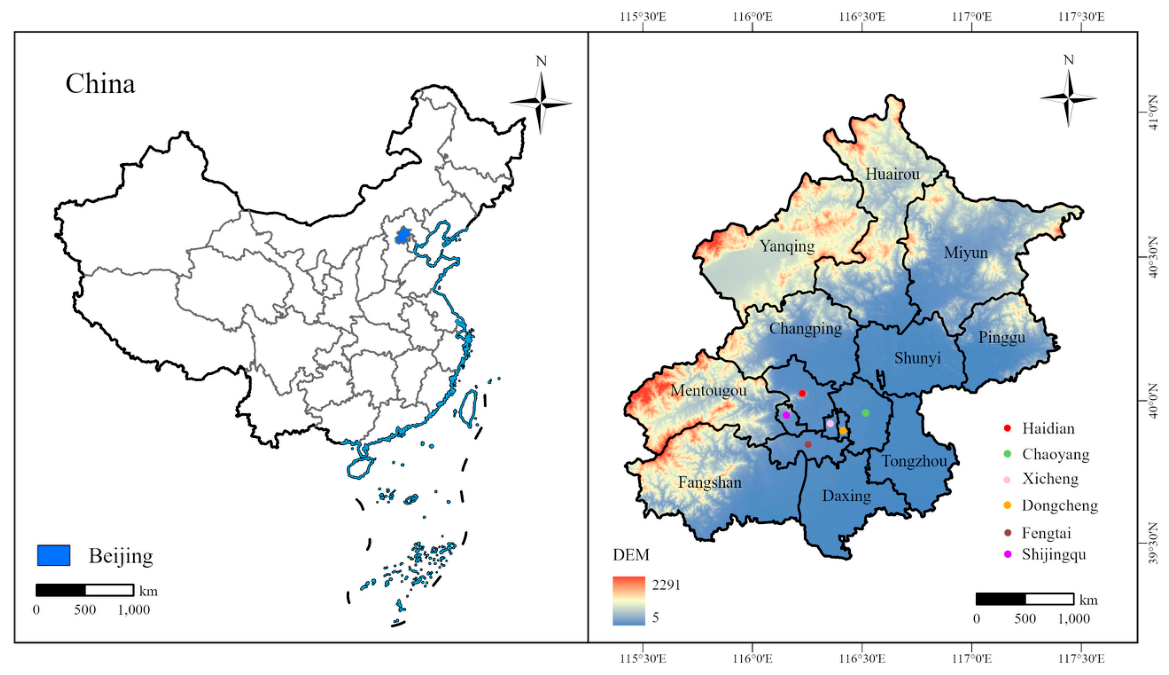
Beijing was selected as the study area (39°54′24″ N, 116°23′51″ E) (Figure 1). As the capital of China, Beijing is a highly urbanized megacity located in the northern part of the North China Plain [28]. The municipality covers approximately 16,400 km2, with high-density built-up areas mainly concentrated in the central and southeastern plains, while large ecological spaces and mountainous landscapes are predominantly distributed in the northwestern and northern regions. This distinct spatial contrast results in a marked mismatch between peripheral cooling-source areas and central heat-risk zones. At the same time, rapid urban development, intensive land use, and concentrated human activities have intensified urban heat problems in Beijing [29]. These characteristics make Beijing a suitable case for examining cooling connectivity and the resilience of urban CINs under heterogeneous resistance conditions.

2.2. Data Source

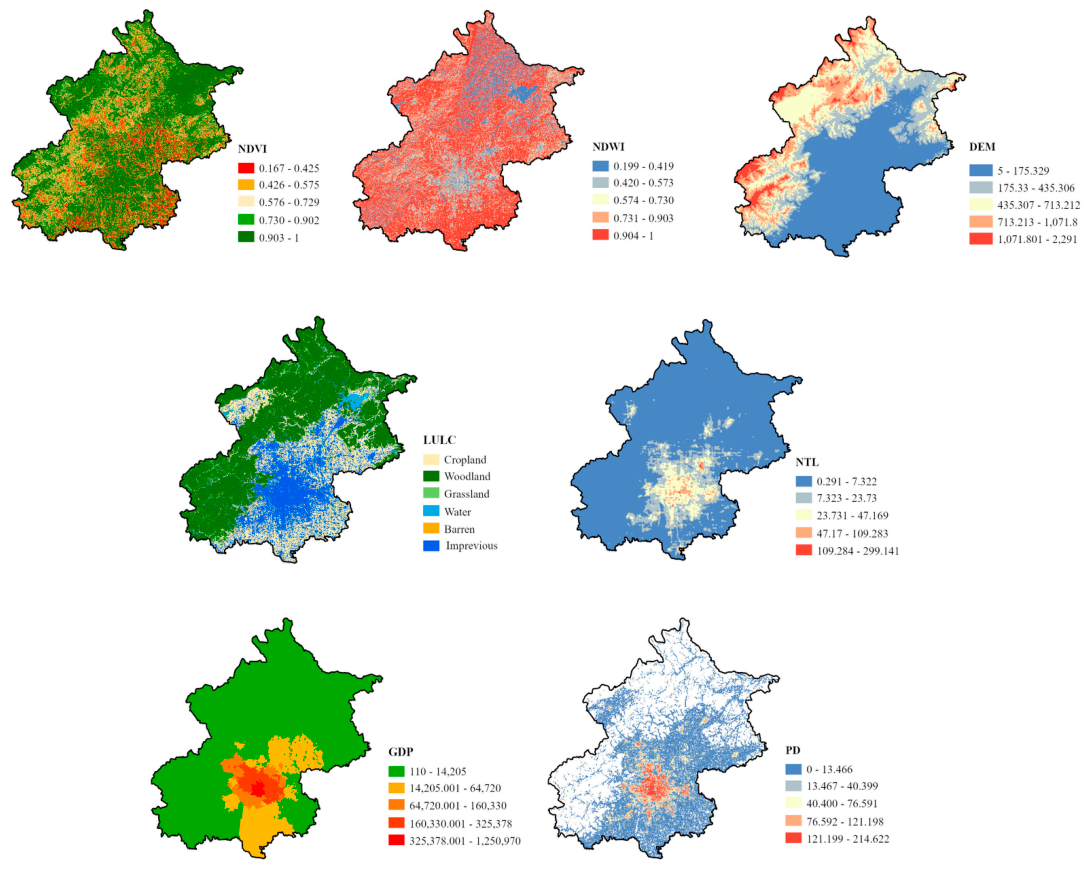
This study employed a multidimensional dataset encompassing surface thermal conditions, vegetation and water indices, topography, land use, and socio-economic activities. To reduce scale inconsistencies among multi-source datasets and facilitate network simulation, all raster layers were projected to WGS_1984_UTM_Zone_50N and resampled to a 100 m resolution in ArcGIS Pro 3.5.2. Bilinear interpolation was used for continuous variables, whereas nearest-neighbor resampling was used for categorical LULC data. Building on established research in landscape ecology and urban thermal environments [30,31], we constructed an indicator system comprising eight indicators across three categories (Table 1, Figure 2): (1) Natural environmental factors: LST, extracted from Landsat 8 OLI/TIRS Collection 2 Level-2 surface temperature products acquired in July–August 2022, served as the core thermal indicator. NDVI and NDWI represented the cooling-supply capacity of potential cold sources, while DEM accounted for topographical influences on near-surface air flow. (2) Land use: LULC data were used to characterize surface physical properties, identify CICS-related landscape attributes, and determine landscape resistance during cooling transmission. (3) Socio-economic factors: GDP, NTL, and PD served as proxies for human activity intensity. These factors reflected the impact of anthropogenic heat accumulation on the cooling capacity of cold island sources.

2.3. LST Extraction and Cold Island Classification

2.3.1. LST and Relative LST (RLST)

Satellite-derived land surface temperature (LST) represents the radiometric temperature of the land surface estimated from thermal infrared observations after atmospheric and emissivity corrections. In this study, Landsat 8 OLI/TIRS Collection 2 Level-2 surface temperature products acquired from July to August 2022 were obtained from USGS EarthExplorer and used as the source data for LST extraction. The selected scenes covered the entire study area and corresponded to WRS-2 path/row combinations 123/031, 123/032, 123/033, 124/031, 124/032, and 124/033. The image acquisition dates included 8 July, 15 July, 24 July, 16 August, and 25 August 2022. The selected images were daytime descending-pass Landsat scenes. Landsat 8 has a nominal equatorial crossing time of approximately 10:12 a.m. ± 5 min local time, while the exact scene center time for each image is recorded in the Landsat metadata. To ensure comparability among scenes, images were screened based on complete spatial coverage of the study area, low cloud cover, exclusion of abnormal weather conditions, and comparable daytime overpass timing. The selected scenes had low cloud cover, generally below 4%.
Because the Landsat Collection 2 Level-2 product already provides atmospherically corrected surface temperature, LST was extracted from the ST_B10 band rather than retrieved through an additional radiative-transfer inversion. Therefore, no additional atmospheric parameters were manually input in this study. The atmospheric correction and surface-temperature generation were based on the standard USGS Landsat Collection 2 Level-2 processing workflow, which uses atmospheric auxiliary data during product generation. The QA_PIXEL band was used to mask clouds and cloud shadows, the QA_RADSAT band was used to remove radiometrically saturated pixels, and the ST_QA band was used to screen pixels with high surface-temperature uncertainty. After quality masking, the surface temperature band was converted to Kelvin using the scale factor and additive offset provided for Landsat Collection 2 Level-2 products:
T s , i = D N i × 0.00341802 + 149.0
where DNi is the digital number of the ST_B10 band for pixel i, and Ts,i represents surface temperature in Kelvin. The temperature was then converted to degrees Celsius:
L S T i = T s , i 273.15
where LSTi is the land surface temperature of pixel i in degrees Celsius.
To reduce the influence of absolute temperature differences and facilitate spatial comparison within the study area, relative LST (RLST) was calculated as the temperature anomaly of each pixel relative to the study-area mean LST:
R L S T i = L S T i m e a n ( L S T )
where RLSTi is the relative land surface temperature of pixel i and mean (LST) is the mean LST of the study area. Negative RLST values indicate pixels cooler than the study-area average, whereas positive values indicate pixels warmer than the study-area average.

2.3.2. Cold Island Classification

To quantify thermal heterogeneity, identify UCI distribution, and provide a data foundation for CIN construction, the processed LST was standardized and classified. Following established methods [33], the mean-standard deviation method was employed. Following the mean-standard deviation method, the processed LST was classified into five grades using μ ± 0.5σ and μ ± 1.5σ as thresholds (Table 2).

2.4. GeoDetector-Based Attribution of LST Drivers

The GeoDetector model is based on the concept of spatial stratified heterogeneity. By testing the consistency between the stratification of explanatory variables and the spatial distribution of LST, this approach quantifies each variable’s explanatory power for LST spatial differentiation and thereby helps identify the dominant drivers of thermal-environment heterogeneity [34]. In this study, LST was used as the dependent variable, while LULC, NDVI, NDWI, DEM, GDP, NTL, and PD were used as explanatory variables. The factor detector was applied to quantify the explanatory power, expressed as the q-value, of each factor for the spatial heterogeneity of LST. For interaction detection, q(X1∩X2) was compared with q(X1), q(X2), and q(X1) + q(X2). When q(X1∩X2) is greater than the maximum q-value of the two individual factors but smaller than their sum, the interaction is interpreted as bivariate-factor enhancement; when q(X1∩X2) exceeds q(X1) + q(X2), it is interpreted as nonlinear enhancement (Table 3). This analysis identified dominant drivers of LST spatial distribution and characterized their interactions. Grounded in Spatial Stratified Heterogeneity theory, this method measures explanatory capacity by assessing spatial consistency between independent variable stratification and dependent variable distribution. The core statistic, the q-value, is calculated as follows [14]:
q = 1 h = 1 L N h σ h 2 N σ 2
where h represents the stratification of the variable; N and σ2 denote the total number of samples and the global variance of the study area, respectively; and Nh and σh2 represent the sample size and variance within stratum h, respectively. The q-value ranges from 0 to 1, with a higher value indicating stronger explanatory power of the factor for the spatial heterogeneity of LST.

2.5. Identification of CICS and Network Nodes

2.5.1. Morphological Spatial Pattern Analysis (MSPA)

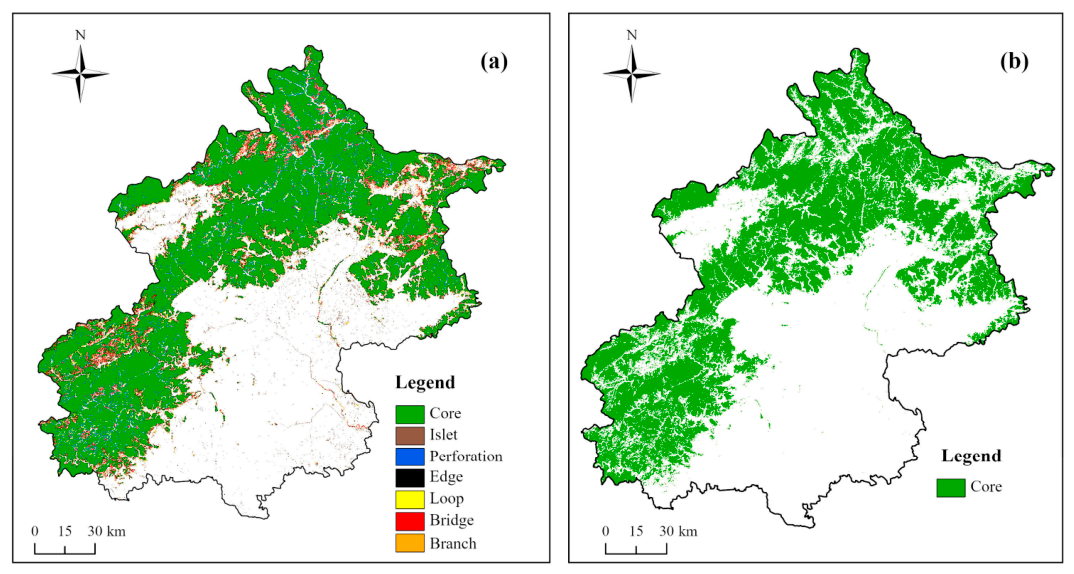
MSPA is an image-processing method based on mathematical morphology that identifies the geometry and spatial topology of patches to quantitatively characterize landscape connectivity (Table 4). Its effectiveness in linking green spaces to LST has been demonstrated in urban thermal studies, and recent research has further integrated MSPA into network construction to identify UCIs and analyze connectivity [35,36]. In this study, CICS were identified by integrating land surface thermal data and land-use features. First, binary classification was applied to RLST and LULC datasets [37]. Low-temperature patches identified from negative RLST anomalies and blue–green spaces in the LULC layer (e.g., forests and water bodies) were designated as foreground elements. These binary datasets were then processed in the Guidos Toolbox for morphological segmentation, using the 8-neighbor rule and a 1-pixel edge width, to identify seven landscape patterns, including Core and Bridge [38]. Finally, considering cooling capacity, landscape attributes, and network validity, Core patches larger than 0.2 km2 were selected as the final CICS [39]. This area threshold was applied to mitigate the impact of small-scale patch fragmentation on subsequent CIN construction and resilience analysis [22,31].

2.5.2. Centroid Extraction for Network Node Definition

The centroid of each cold island core patch was calculated to serve as a network node. Specifically, for each core patch i, the centroid was calculated as follows:
x i = j = 1 n x j A j j = 1 n A j
y i = j = 1 n y j A j j = 1 n A j
These equations reflect the spatial geometric position of the centroid for each core patch, serving as the spatial representative point of the network node. Here, xi, yi denotes the coordinates of the pixel center, Aj represents the pixel area, and (xi, yi) is the geometric centroid of the core area.

2.6. Construction of the Cooling Resistance Surface

To construct a spatially explicit resistance surface for potential cooling transmission, seven factors were selected, including LULC, NDVI, NDWI, DEM, GDP, NTL, and PD (Table 5). These factors were used to characterize land-cover conditions, vegetation–water cooling supply, topographic background, and human activity intensity, following recent studies on CINs, cooling networks, and resistance-surface construction [40,41]. To reduce the subjectivity of factor weighting, SPCA was used to derive the relative contribution weight of each resistance factor. By incorporating spatial information and calculating eigenvalues and cumulative contribution rates, SPCA can reduce dimensional redundancy and multicollinearity among indicators and generate data-driven factor weights through loading-matrix normalization [42,43]. The comprehensive resistance surface was then generated by weighted overlay of the reclassified resistance rasters using the SPCA-derived weights. The final resistance value of each grid cell was calculated as follows:
R = i = 1 n W i C i
where R is the comprehensive resistance value, Ci is the class-level resistance score of factor i, and Wi is the SPCA-derived factor weight. Therefore, the resulting resistance surface represents a relative, model-based estimate of cooling-transmission resistance rather than directly observed cooling-flow intensity.
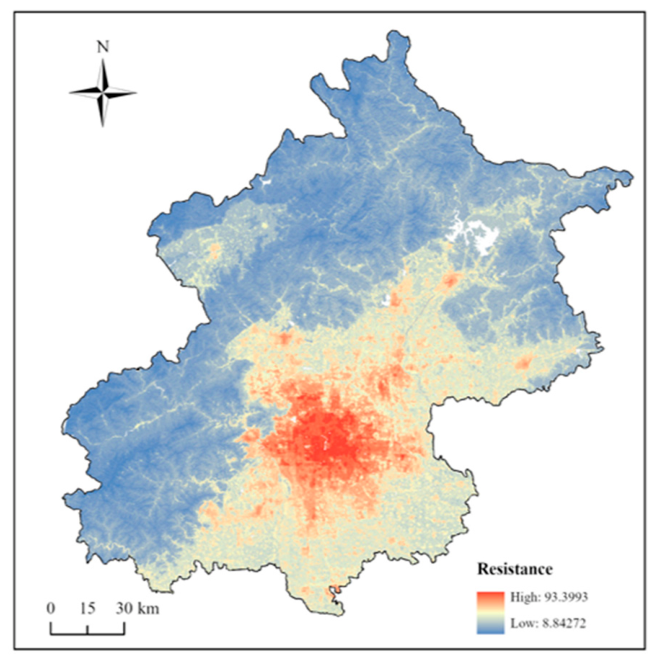
The resulting resistance values ranged from 8.84 to 93.40, showing a clear gradient from the central built-up area to the peripheral mountains (Figure 3). Continuous high-resistance areas expanded from the urban center toward the southeast, while the northwestern and northern mountainous regions formed low-resistance zones. This spatial pattern is consistent with Beijing’s Mountain–plain cooling structure and provides a basis for identifying cold island corridors, pinch points, barrier areas, and key network nodes.

2.7. Circuit-Theory-Based Construction of the CIN

Circuit theory is a well-established approach in ecological studies and landscape connectivity analysis, originally developed to model species movement across heterogeneous landscapes [44,45]. Building on this foundation, recent studies have extended circuit theory to urban CIN analysis by identifying potential cooling corridors, pinch points, and barrier nodes, thereby supporting CIN construction and optimization [46]. This study constructs a CIN with a “Node–Patch–Corridor” structure based on Circuit Theory. By simulating current flow across heterogeneous landscapes, circuit theory can reveal potential cooling pathways and connectivity among cold sources. Using the Linkage Mapper toolkit, the construction process involved four steps [47]: (1) identifying least-cost paths based on the comprehensive resistance surface to construct the corridor network; (2) evaluating corridor importance and connectivity for hierarchical classification; (3) identifying bottleneck areas with high current density as pinch points; and (4) locating potential transmission-blocking areas as barrier points to support connectivity optimization and spatial restoration.

2.8. Resilience Assessment of the CIN

2.8.1. Calculation of Node Importance

Node importance was determined by integrating three classic centrality metrics [48]: (1) Degree centrality: the number of edges directly connected to a node, measuring its local importance [49]; (2) Betweenness centrality: the frequency with which a node appears on the shortest paths between other nodes [50]; and (3) Closeness centrality: the reciprocal of the average distance from the node to all other nodes [51]. These metrics were standardized using a rank-based normalization method and then integrated to obtain a final ranking of composite node importance.

2.8.2. Resilience Indicators

The structural resilience (S), functional resilience (F) and overall resilience (R) are calculated as follows. Structural resilience refers to the ability of the CIN to maintain its topological structure under node perturbation, as represented by normalized aggregation and normalized connectivity. Functional resilience refers to the ability of the CIN to maintain potential functional connectivity and cooling-transmission potential under node perturbation, as represented by normalized transferability and normalized diversity. The formula is:
S i = ( N A i + N K i ) 2
F i = ( N E i + N V i ) 2
R i = ( S i + F i ) 2
where NAi represents the normalized aggregation, NKi represents the normalized connectivity, NEi represents the normalized transferability, NVi represents the normalized diversity.

2.8.3. Node-Removal Simulation and Sensitivity Analysis

Node-removal simulations were conducted to evaluate the resilience response of the CIN under different disturbance scenarios. Two scenarios were established: random removal and targeted removal. In the random-removal scenario, nodes were randomly selected and removed at each removal step to represent stochastic node failures [52]. This process was repeated 100 times, and the mean values were used to characterize the average resilience trajectory under random disturbance. In the targeted-removal scenario, nodes were sequentially removed according to their composite importance ranking, with higher-ranked nodes removed first.
The simulations were implemented using the NetworkX library in Python 3.9.5 [30,48]. At each removal step, 1% of the nodes were removed from the network. After node removal, the network was reconstructed, and structural resilience (Si), functional resilience (Fi), and overall resilience (Ri) were recalculated. The changes in these indicators were recorded to generate resilience degradation curves under random and targeted disturbance scenarios. The simulation continued until the node-removal rate reached 100% or the network fully collapsed. To test the robustness of the removal-step setting, additional sensitivity analyses were conducted using 0.5%, 1.5%, and 2% removal steps.

2.9. Research Framework

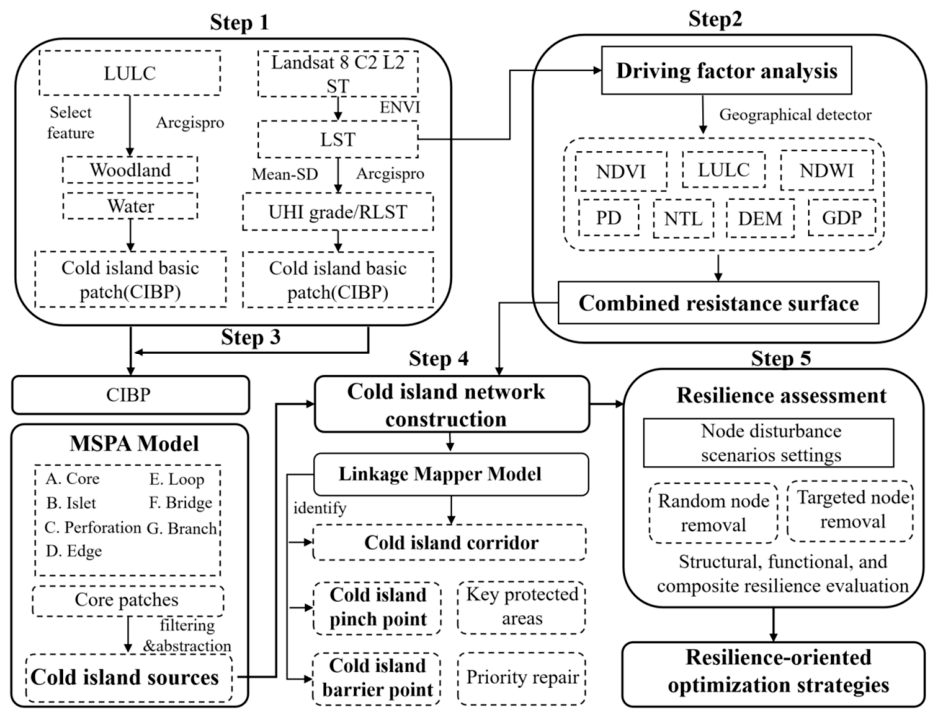
This study developed a holistic “Identification–Construction–Simulation–Attribution” framework (Figure 4). The process followed five stages: Step 1: LST was extracted from Landsat 8 OLI/TIRS Collection 2 Level-2 surface temperature products acquired in July–August 2022, and RLST was calculated to characterize relative thermal anomalies. The centroids of cold island core areas identified via MSPA were then defined as network nodes. Step 2: GeoDetector was used to quantify the explanatory power of driving factors and their interaction effects. Step 3: Based on the selected indicator system, natural and socio-economic factors were integrated through SPCA to construct a comprehensive resistance surface. Step 4: Based on Circuit Theory, cold island corridors, pinch points, and barrier points were identified to construct the CIN. Step 5: Through simulations of random and targeted node removal, network resilience was evaluated from structural, functional, and composite perspectives.

3. Results

3.1. Spatial Distribution of LST

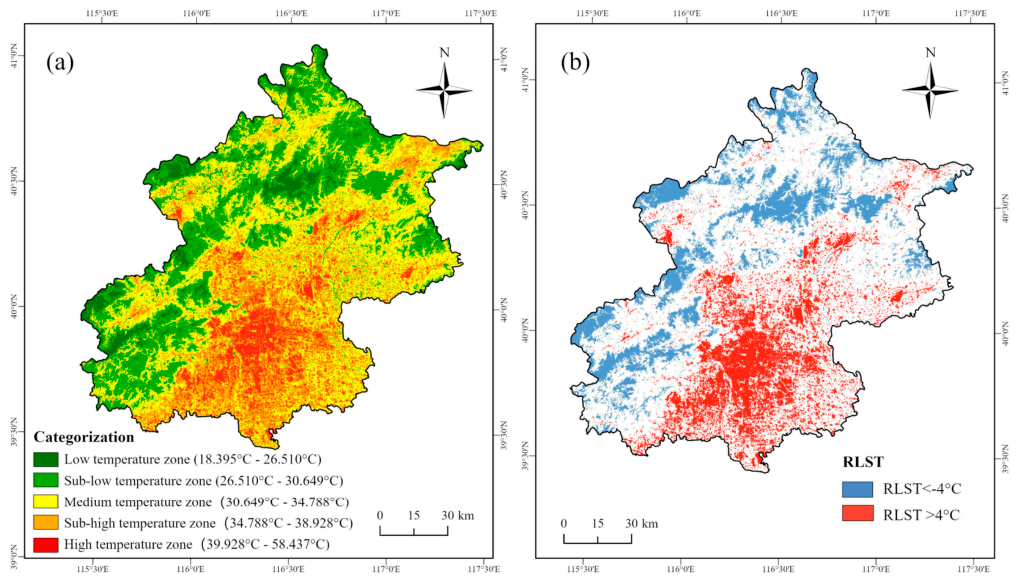
The UHI pattern showed that high-temperature areas were concentrated in the central and southeastern regions, forming a contiguous and aggregated distribution. LST within the study area demonstrated significant spatial heterogeneity, with values ranging from 18.40 °C to 58.44 °C (Figure 5a). A distinct center–periphery gradient was observed: (1) High-temperature zones were predominantly distributed across the central and southeastern plains. The RLST analysis (Figure 5b) further indicated that these areas formed a large-scale, contiguous heat island core characterized by high spatial aggregation. (2) Low-temperature zones were primarily located in the northwestern and northern peripheral areas. In contrast to the high-temperature areas, these zones exhibited a certain degree of spatial fragmentation; however, they maintained relatively stable cold island coverage (RLST < −4) within the northern mountainous regions. (3) Medium-temperature zones were distributed between high- and low-temperature regions, forming a spatial buffer. A marked decreasing gradient in LST occurred from the central urban area toward the peripheral mountains.

3.2. CICS Identification

Based on the MSPA results (Figure 6), Core patches were extracted as cold island core source areas (Figure 6b). A total of 202 CICS were identified. These CICS showed a clear clustered pattern, mainly distributed in the continuous mountainous areas in the northern and southwestern parts of the study area. Their total area was 6416.95 km2, accounting for 39.12% of the administrative area of Beijing, and they served as the main cooling-source base of the regional cold island system.

3.3. Results of GeoDetector

3.3.1. Driving Factors for LST

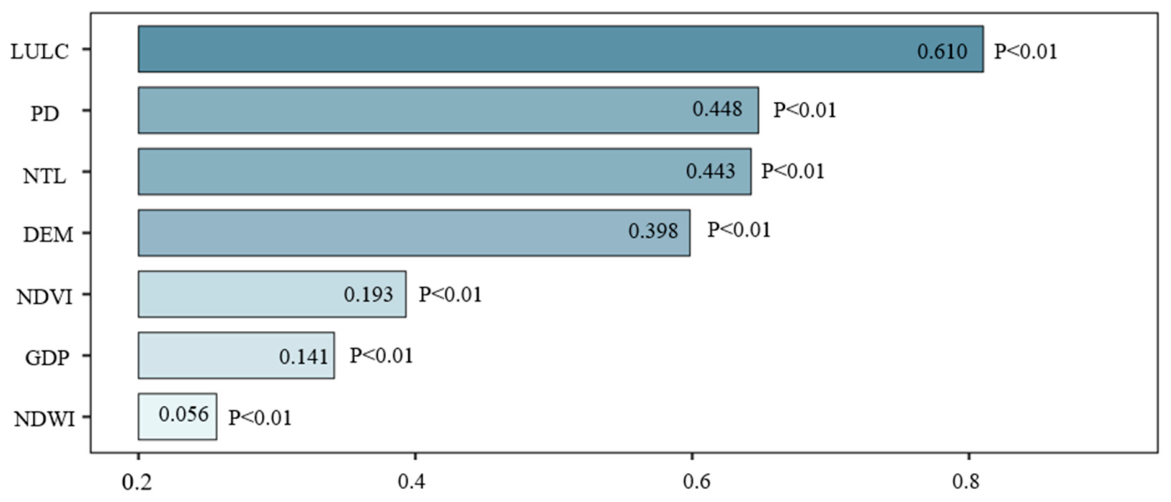
The q-values of all explanatory factors were statistically significant (p < 0.01), indicating that the selected factors significantly explained the spatial heterogeneity of LST (Figure 7). Notably, LULC exhibited the highest explanatory power (q = 0.610), indicating that it was the dominant driver of LST distribution. This was followed by PD (q = 0.448) and NTL (q = 0.443), while DEM (q = 0.398) showed a moderate explanatory power. In contrast, NDVI, GDP, and NDWI showed relatively low explanatory power, with q-values of 0.193, 0.141, and 0.056, respectively.

3.3.2. Results of Interaction and Ecological Detector

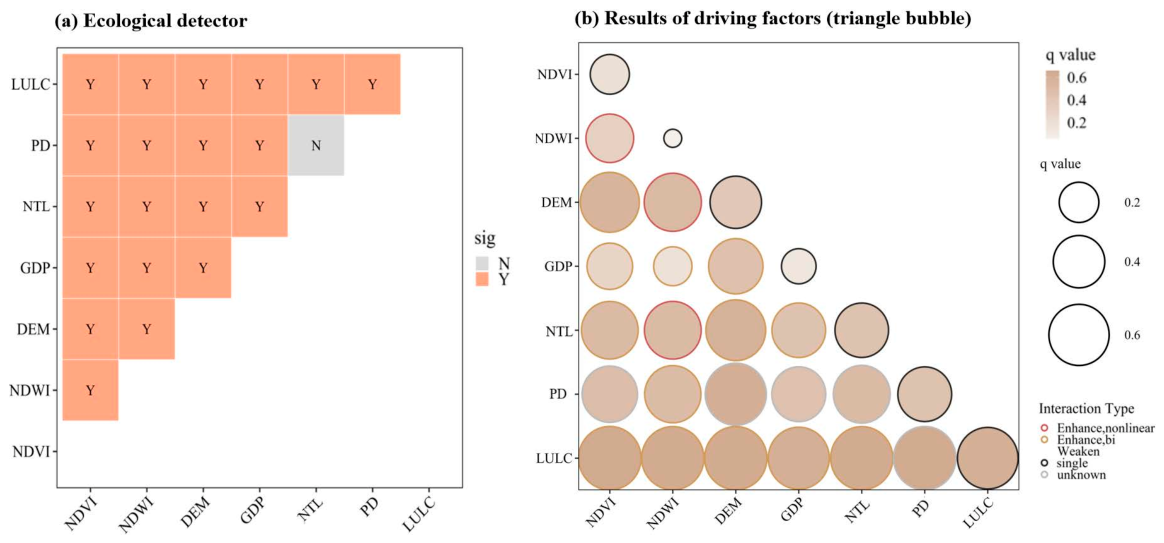
The interactions between LULC and other factors consistently exhibited high explanatory power (Figure 8). Specifically, the interaction q-values for LULC with NDVI, NDWI, DEM, GDP, NTL, and PD were 0.661, 0.654, 0.654, 0.621, 0.651, and 0.658, respectively. All of these interaction q-values exceeded those of both LULC and the corresponding variables when considered individually. In addition to LULC, the interactions of PD with NDVI, DEM and NTL also demonstrated strong explanatory power, with q-values of 0.654, 0.622, and 0.516, respectively. Although NDVI, NDWI, and GDP showed relatively low q-values individually, their explanatory power increased substantially when they interacted with DEM, NTL, or LULC, exceeding their explanatory power as individual factors.

3.4. CIN Construction

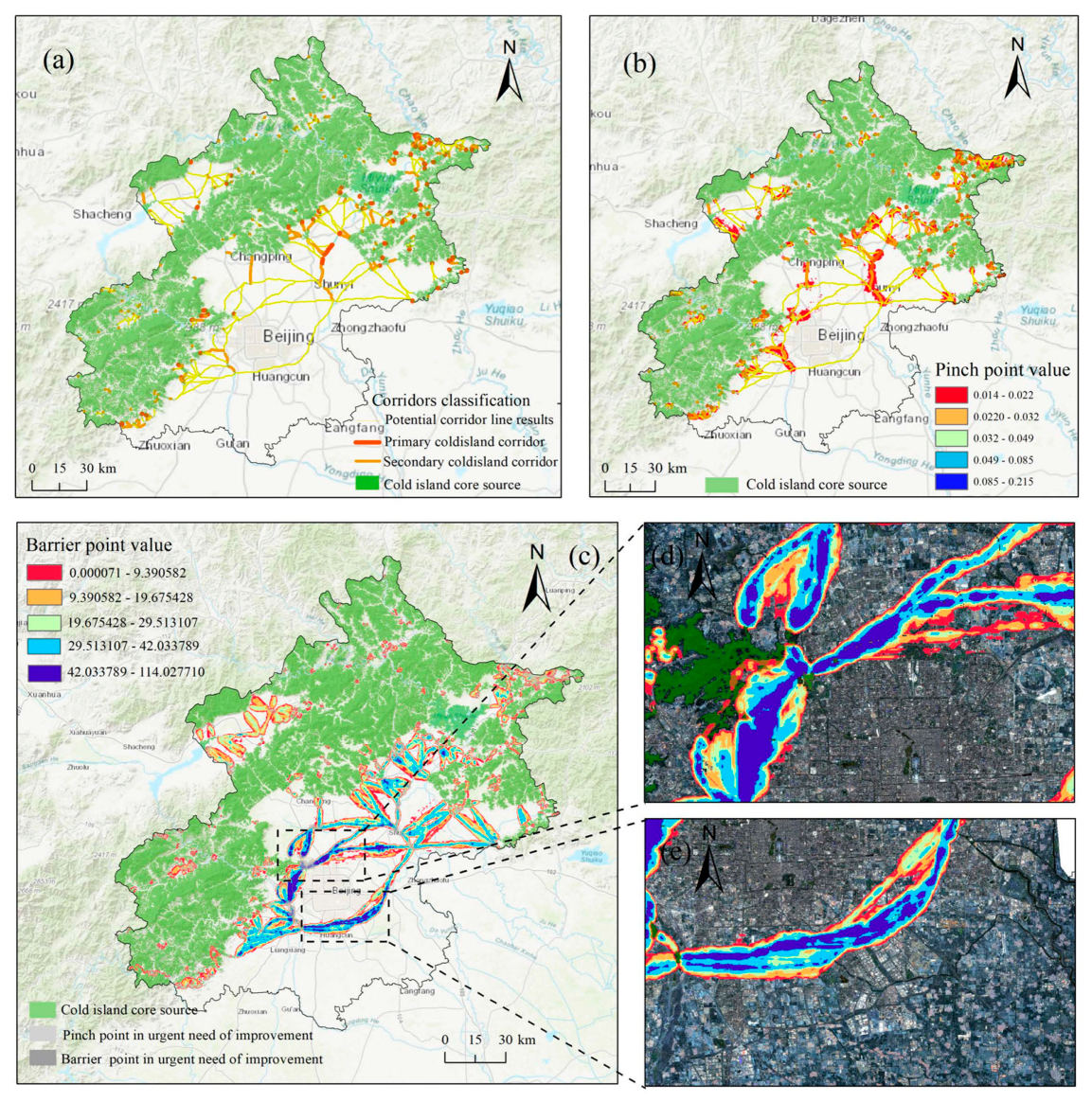
A total of 401 cold island corridors (total length: 1730.43 km) were extracted (Figure 9). The corridors were classified into three types (Figure 9a): (1) Primary corridors (70 links, 17.46%) were predominantly located in the northwestern mountains and the mountain–plain transition zone, extending toward the urban built-up area along least-cost paths. (2) Secondary corridors (196 links, 48.88%) were mainly distributed in the transition zone, forming the network backbone alongside the primary corridors. (3) Potential corridors (135 links, 33.67%) were largely concentrated within the plain built-up areas and the urban periphery. Based on this network, 48 cooling nodes (pinch points) were identified, covering a total area of 2.46 km2 with a maximum single-patch area of 0.68 km2 (Figure 9b). Additionally, 458 barrier points were identified, totaling 274.98 km2. Overlay analysis showed that CICS were concentrated in the northwestern and northern mountainous areas. The potential cooling corridors connected these peripheral sources with inner urban areas, while pinch points were primarily situated at the interfaces of blue–green spaces. In contrast, barrier points were highly clustered near high-density built-up areas and transportation infrastructure, indicating areas where potential cooling connectivity may be restricted (Figure 9c).

3.5. Results of CIN Resilience Simulation

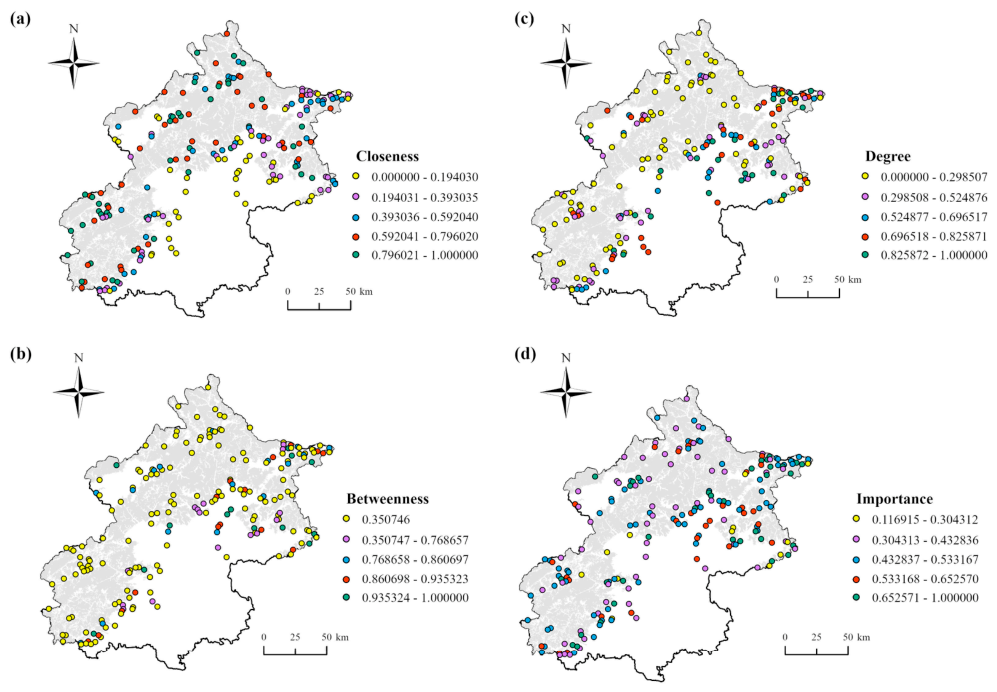
The spatial distributions of node centrality and composite importance indicated clear differences in the structural roles of nodes within the CIN. Degree centrality, betweenness centrality, and closeness centrality all exhibited marked spatial heterogeneity (Figure 10). Nodes with relatively high degree centrality were mainly concentrated in locally dense connection areas; high-betweenness nodes were fewer in number and more discretely distributed; and nodes with high closeness centrality were primarily located in areas with stronger overall accessibility. Nodes with high composite importance were not evenly distributed across the network, but were concentrated in a limited number of keys connecting locations.
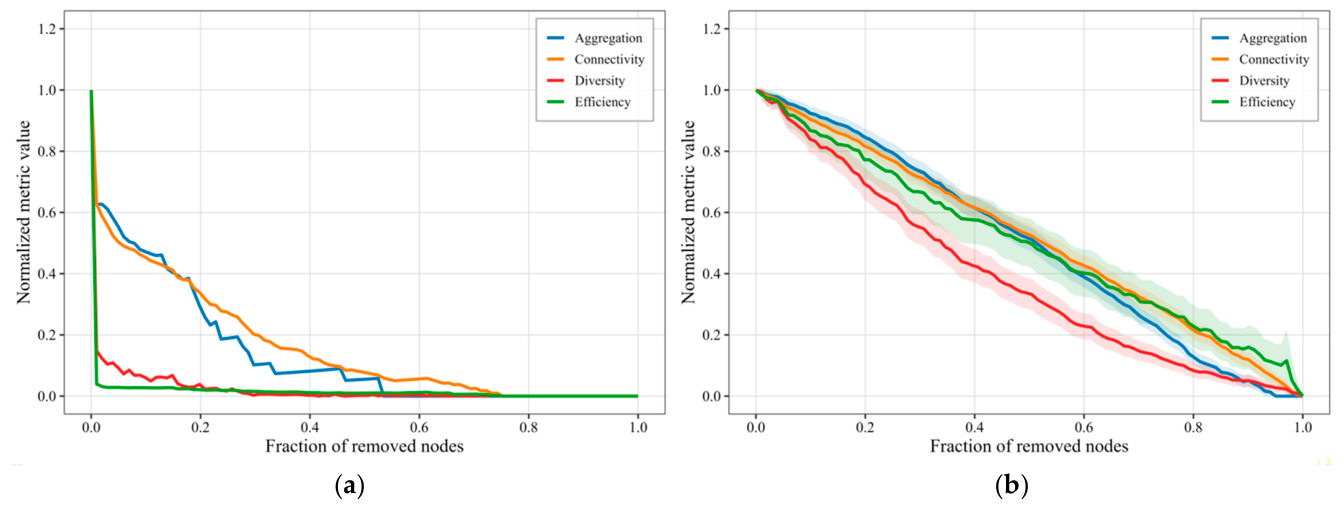
Figure 11 shows the changes in four normalized network metrics under targeted and random node-removal scenarios. Under targeted node removal, efficiency declined sharply during the early stage of node removal and then remained at a relatively low level. Diversity also decreased rapidly at the beginning of the removal process, followed by a slower decline. Aggregation and connectivity both showed continuous decreases with increasing node removal, with aggregation exhibiting a stronger early-stage decline than connectivity. Under random node removal, all four metrics displayed smoother and more gradual declining trends. Diversity showed a relatively faster decrease than the other metrics, whereas aggregation and connectivity changed more slowly throughout the node-removal process.
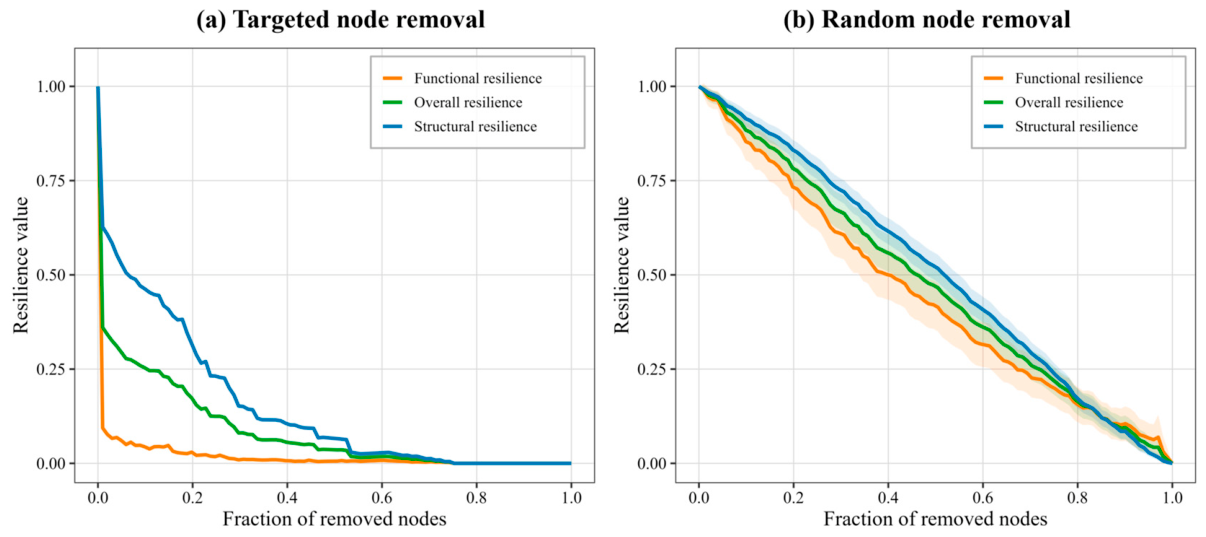
Figure 12 compares the degradation trajectories of overall resilience under random and targeted node-removal scenarios. Under random removal, overall resilience declined gradually with increasing node-removal proportion, showing an approximately linear degradation pattern and approaching zero only after a large proportion of nodes had been removed. The shaded band indicates the variability among repeated random-removal simulations. By contrast, targeted removal produced a pronounced early-stage collapse in overall resilience, with a sharp decline occurring immediately after the removal of the most important nodes. This result suggests that the CIN was highly sensitive to the degradation of critical nodes. Once approximately 20–30% of nodes had been removed, the network had already entered a low-resilience state, after which the remaining resilience declined slowly and approached zero in the later stage of the simulation.
The structural, functional, and overall resilience indicators exhibited different trajectories under targeted and random node-removal scenarios. Under targeted node removal, all three indicators declined sharply during the initial stage of node removal. Functional resilience showed the most rapid decline and remained at a low level after the early removal stage. Structural resilience decreased more gradually than functional resilience, while overall resilience followed an intermediate trajectory between the two components. After approximately 20–30% of critical nodes were removed, all three resilience indicators had declined substantially and continued to approach zero in the later stage of the simulation. Under random node removal, structural, functional, and overall resilience decreased more gradually and continuously as node removal progressed. The three curves remained relatively close to each other, and the overall degradation process was smoother than that observed under targeted node removal. The sensitivity analysis using 0.5%, 1.5%, and 2% removal steps showed similar degradation trajectories and threshold patterns to those obtained under the 1% removal step.

4. Discussion

4.1. Driving Factors of LST

The GeoDetector results indicated that the spatial differentiation of LST in Beijing could not linearly determined by any single factor, but was jointly shaped by the coupled effects of natural environmental factors, land use and landscape configuration, and socio-economic factors. Single-factor detection shows that LULC was the dominant explanatory variable, followed by PD and NTL. This finding is consistent with mechanisms reported in previous studies [12,53,54]. Differences in surface cover reflected by LULC alter local heat dissipation and heat storage capacity, thereby shaping the baseline spatial heterogeneity of LST. Population agglomeration and activity intensity further amplify LST contrasts through anthropogenic heat emissions, transportation, and building energy consumption. Meanwhile, DEM contributes to a terrain-gradient pattern in the thermal environment by influencing local airflow exchange and the background conditions for potential cold-air transport and convergence.
The interaction detector further showed that the explanatory power of LULC × NDVI and LULC × PD was significantly higher than that of the corresponding single factors, indicating that the formation of the urban thermal environment was strongly context-dependent, in line with interaction-enhancement mechanisms reported in previous studies. Specifically, the high explanatory power of LULC × NDVI and LULC × PD suggests that the cooling effect of NDVI and the warming effect associated with population concentration vary with built-environment characteristics and development intensity across different LULC types. This implies that in highly developed areas, the cooling potential of vegetation is more likely to be constrained [55,56]. In densely populated and intensively developed zones, the combined effects of altered surface properties and anthropogenic heat emissions can further increase LST and intensify the UHI effect [14,57]. In addition, the relatively high explanatory power of PD × DEM suggests that topographic context may modulate the warming effect of population agglomeration. By affecting vegetation hydrothermal conditions and local energy-exchange processes, terrain alters the marginal response of LST under different levels of population concentration [58].

4.2. Why Is It Necessary to Construct CIN in Metropolitan Areas?

In the context of metropolitan areas, although peripheral ecological spaces and large urban green areas can provide substantial local cooling effects, these cooling benefits may not spatially correspond to high-density built-up areas where heat risks are most concentrated. This creates a structural mismatch between the spatial distribution of cooling sources and the areas with the greatest cooling demand [59,60]. These conditions indicate that conventional heat-mitigation strategies centered on isolated green spaces or individual cooling sources are insufficient to address the complex thermal challenges of metropolitan regions [30,61]. Against this backdrop, systematically identifying the spatial connectivity among cooling sources and between cooling sources and heat-risk areas at the city scale, as well as characterizing potential cooling-transmission pathways and critical nodes under heterogeneous resistance conditions, is essential for improving the stability and spatial effectiveness of urban cooling services. Accordingly, it is necessary to adopt a network perspective and construct a CIN to explicitly represent the integrated cooling structure formed by cooling sources, corridors, and key nodes.
Our results under the summer-based framework indicated that the CIN in Beijing was characterized by a clear hierarchical structure and pronounced spatial heterogeneity. The overall pattern showed a high concentration of CICS in the northern and southwestern mountainous regions, which served as the primary cooling-supply base. By contrast, urban plains and high-density built-up areas depended primarily on corridor connectivity to maintain the potential transmission of cooling effects toward the urban core. This pattern reveals a mountain–plain cooling structure in which mountainous CICS provide the regional cooling-supply base, while corridors and pinch points shape potential transmission of cooling effects toward densely built-up heat-risk areas. Existing literature also indicates that central high-density areas often suffer from insufficient cooling supply, restricted air transmission, and uneven coverage, whereas peripheral ecological spaces assume the role of primary cold sources at the regional scale [62,63].
A limited number of high-grade corridors in Beijing’s CIN constituted the network backbone, bridging peripheral cold sources with urban built-up areas. Specifically, pinch points were predominantly distributed at the interfaces of blue–green spaces and the mountain–plain transition zones. These areas represent critical nodes where potential cooling-transmission pathways converge along low-resistance routes. In contrast, barrier points were highly concentrated around high-density built-up land and transportation infrastructure. This suggests that continuous impervious surfaces and linear infrastructure may form strong spatial barriers, contributing to the diversion or constriction of potential cooling pathways and thereby producing evident fragmentation and structural compression. This reflects the fragmentation and barrier effects of intensive urban development on the CIN [64]. This pattern further suggests that, in dense urban interiors, the built environment may reinforce the compression and channelization of potential cooling-flow pathways. Under highly heterogeneous resistance conditions, potential cooling paths may become increasingly compressed, resulting in strong path concentration and functional dependence on specific spatial configurations [65,66].
The spatial distribution of corridors, pinch points, and barrier points indicates that high-density built-up land may disrupt the geometric continuity of blue–green spaces and increase resistance within the CIN. Consequently, potential cooling corridors that exhibit broader and more redundant pathway structures in peripheral mountainous areas tend to become compressed into narrower, lower-redundancy channels when extending into the urban interior. While traditional studies have treated urban parks as isolated cold sources—focusing on local cooling intensity and influence range [8,67]—this study suggests that city-scale cooling stability is not determined solely by the size of individual patches. Instead, it depends largely on the structural integrity of the CIN, particularly the preservation of key corridors and pinch points. Interconnected cold islands may provide more efficient and stable cooling services than isolated patches [21,22]; therefore, from a network perspective, the stability of city-scale cooling benefits is closely related to the connectivity and redundancy of the CIN [68].

4.3. Threshold-like Degradation and Mechanisms of CIN Resilience Loss

The CIN in Beijing exhibited a nonlinear degradation pattern under increasing disturbance, with an evident threshold-like degradation interval. Under targeted disturbance, the CIN did not exhibit a prolonged stable phase. Instead, functional resilience declined rapidly during the early stage of node removal, and the system had already entered a substantially deteriorated state when approximately 20–30% of the highest-ranked nodes had been removed. Given the summer-based data framework, this threshold-like interval can be regarded as an early-warning range for identifying rapid degradation of CIN resilience under heat-stress conditions. It indicates a transition from localized functional impairment to broader network degradation, reflecting the stage at which the topological vulnerability of the CIN becomes increasingly apparent. Although this phased response is broadly consistent with findings from previous studies on ecological and complex networks [69,70], the present study further extends static CIN identification by revealing the interval within which structural and functional resilience have already deteriorated substantially under targeted disturbance.
The different responses under random and targeted disturbance further clarified the mechanisms of resilience loss. Under random disturbance, degradation occurred more gradually, suggesting that the network was able to maintain part of its potential functional connectivity through pathway redundancy [71]. By contrast, the targeted-disturbance stress test indicated that the CIN was highly sensitive to degradation concentrated on critical source–corridor units. In practical planning contexts, such sensitivity may correspond to processes such as reduced cooling capacity of cold-source patches, corridor narrowing, fragmentation of blue–green spaces, expansion of transportation infrastructure, and increased local resistance around key connecting areas. Concentrated disturbance affecting a small number of highly important structural units can lead to a rapid decline in network efficiency, accessibility, and overall resilience even under relatively low disturbance intensity. This is mainly attributable to the irreplaceable role of highly connected hub nodes in maintaining overall network performance [72]. These findings indicate that the CIN is strongly dependent on a limited number of core hubs and backbone corridors, and that its resilience is governed more by critical structural units than by the sheer number of nodes [73]. Throughout the node-removal process, structural resilience consistently remained higher than functional resilience, indicating that the network could still maintain geometric connectivity to some extent even when potential functional connectivity and transferability had already declined due to the disruption of critical paths [74]. This pattern is consistent with previous findings showing that disturbances affecting a small number of highly important structural units can result in a rapid loss of network efficiency and accessibility [75,76]. This further suggests that the stability of city-scale cooling functions depends not only on the size of cold island patches, but also on the integrity of the network structure, in which the continuity and redundancy of key corridors, pinch points, and corridor junctions play important roles. Once these structural units degrade, potential functional connectivity and potential cooling-transmission efficiency may decline earlier than purely geometric connectivity. As node removal intensified, aggregation and diversity decreased continuously. Notably, aggregation declined faster than connectivity, reflecting a process of structural degradation in which local clustering was dismantled earlier than overall connectivity. The initial decline was likely driven by the removal of highly connected hub nodes. Once these nodes were degraded, local connections among adjacent cold-source patches were rapidly weakened. This process reflects the degradation of critical source–corridor units, which may restrict potential cooling pathways toward densely built-up heat-risk areas and thereby weaken city-scale potential cooling performance. The remaining network may still retain some fragmented links through secondary pathways, but its connectivity becomes increasingly dependent on a small number of backbone corridors. The continued decline in diversity further indicates a progressive reduction in network redundancy and alternative pathways, thereby weakening overall structural stability. Therefore, the 20–30% threshold-like interval can provide a useful reference for identifying backbone corridors and highly sensitive structural units that require priority maintenance. Improving CIN resilience, however, still depends on enhancing network redundancy and multi-path connectivity.

4.4. Implications for Urban Management

In light of policy frameworks such as the Beijing Climate Change Adaptation Action Plan and the Beijing Municipal Action Plan for Climate Change and Health Adaptation (2025–2030) [77,78], this study supports a spatial governance approach centered on protecting critical cooling corridors and restoring key barrier interfaces. Unlike conventional heat-mitigation strategies that primarily emphasize increasing vegetation coverage, our findings highlight the importance of improving the stability and spatial effectiveness of cooling benefits by preserving the structural integrity of the CIN. This governance model can be advanced through two approaches: (1) Protecting primary corridors as critical urban cooling infrastructure. Primary corridors account for 17.46% of all corridors within the network. These corridors serve as a vital skeletal structure, supporting potential cooling connectivity between northwestern mountainous CICS and the high-density urban core. In future urban renewal and land-use planning, these primary corridors should be treated as priority cooling infrastructure. Specifically, they should be managed in coordination with Beijing’s ecological control lines and incorporated into ventilation-corridor and blue–green infrastructure planning to avoid further increases in landscape resistance, thereby maintaining CIN continuity and supporting the potential long-distance transmission of cooling benefits from mountainous areas. (2) Targeted restoration of key nodes and barrier interfaces. Pinch points at blue–green interfaces and high-resistance barrier areas near transportation infrastructure represent potential blockages within the CIN. Consequently, these areas should be designated as strategic restoration zones within Beijing’s urban renewal projects and blue–green infrastructure systems. Because scattered greening measures may provide limited benefits for network connectivity if they are not aligned with key corridors and nodes, this study recommends targeted restoration through optimizing infrastructure layouts, reducing impervious surfaces, and enhancing the continuity of linear blue–green spaces. Under conditions of limited urban spatial flexibility, prioritizing interventions within these identified conflict zones may provide a more spatially efficient and actionable pathway for improving the connectivity and functional resilience of the CIN.

4.5. Limitations and Prospects

While this study advances the understanding of CIN structure and resilience, several limitations should be acknowledged. First, the analysis was based on Landsat-derived remote-sensing observations from July–August 2022 and therefore represents the CIN under a summer heat-stress scenario rather than year-round thermal conditions. Seasonal and interannual variations in LST, vegetation phenology, water availability, and meteorological conditions may influence the identification of cold island core sources, corridor hierarchy, key nodes, and resilience thresholds. Therefore, the results should be interpreted as scenario-based evidence under summer conditions, and their temporal robustness requires further validation using multi-seasonal and multi-year observations.
Second, the current framework mainly characterizes CIN connectivity using two-dimensional land-surface and land-cover information. Although this approach is suitable for depicting city-scale horizontal cooling connectivity, it does not explicitly incorporate three-dimensional urban morphological factors, such as building height, building volume, street-canyon geometry, and sky view factor. In high-density built-up areas, these factors may alter near-surface ventilation, sky openness, heat storage, and local cooling-pathway continuity, thereby affecting local resistance estimation, corridor identification, and key-node importance [79]. In addition, the corridors identified in this study should be understood as potential cooling pathways rather than directly observed cooling flows, because empirical validation using ground-based air-temperature observations, mobile transect measurements, or measured cooling-flow data was not available. Future studies integrating multi-temporal thermal observations, three-dimensional urban morphology, and field-based microclimatic measurements would further improve the physical realism and robustness of CIN modeling.

5. Conclusions

This study developed an “Identification–Construction–Simulation–Attribution” framework to extend UCI research from individual cold-source patches to network-scale connectivity and resilience, providing a quantitative perspective for managing urban thermal environments in high-density cities. The main conclusions are as follows. First, LULC was the dominant factor explaining LST spatial heterogeneity, and interactions among factors showed clear enhancement effects. Second, the Beijing CIN exhibited a distinct hierarchical structure and strong spatial polarization. The 202 CICS (6416.95 km2) were mainly clustered in the northwestern mountainous areas, whereas the transmission network, comprising 401 corridors (1730.43 km), became increasingly fragmented as it extended into high-intensity built-up areas. Third, disturbance simulations showed that the CIN was highly sensitive to targeted node removal. Resilience declined sharply during the early stage of critical-node removal and had already deteriorated substantially when approximately 20–30% of critical nodes were removed, while functional resilience, representing potential functional connectivity and transferability, deteriorated faster than structural resilience. Based on these findings, urban planning should prioritize the protection of primary corridors (17.46% of all corridors) and the restoration of critical pinch points. Strategies may include delineating strategic conservation zones and implementing targeted restoration measures to enhance the continuity and redundancy of the potential cooling transmission network. The proposed framework and the identified threshold range provide preliminary but useful evidence for climate-responsive planning in high-density cities.

Author Contributions

Conceptualization, T.W., Y.L. and W.X.; methodology, T.W.; software, T.W.; formal analysis, T.W.; investigation, T.W.; data curation, T.W.; writing—original draft preparation, T.W.; writing—review and editing, T.W., Y.L. and W.X.; visualization, T.W.; supervision, W.X. All authors have read and agreed to the published version of the manuscript.

Funding

This research received no external funding.

Data Availability Statement

Data will be made available on request.

Acknowledgments

The authors extend their sincere gratitude to the anonymous reviewers for their professional guidance and to the editorial team for their efficient handling of this submission. Their valuable suggestions have been instrumental in refining the arguments and structure of this study.

Conflicts of Interest

The authors declare no conflict of interest.

Abbreviations

The following abbreviations are used in this manuscript:
CICSCold Island Core Sources
CINCold Island Network
DEMDigital Elevation Model
GDPGross Domestic Product
HINsHeat Island Networks
LSTLand Surface Temperature
LULCLand Use and Land Cover
NDVINormalized Difference Vegetation Index
NDWINormalized Difference Water Index
NTLNighttime Light
PDPopulation Density
LCCLargest Connected Component
RLSTRelative Land Surface Temperature
UCIUrban Cold Island
UHIUrban Heat Island

References

  1. Ghorbany, S.; Hu, M.; Yao, S.; Wang, C. Towards a Sustainable Urban Future: A Comprehensive Review of Urban Heat Island Research Technologies and Machine Learning Approaches. Sustainability 2024, 16, 4609. [Google Scholar] [CrossRef]
  2. Yuan, Y.; Santamouris, M.; Xu, D.; Geng, X.; Li, C.; Cheng, W.; Su, L.; Xiong, P.; Fan, Z.; Wang, X.; et al. Surface urban heat island effects intensify more rapidly in lower income countries. npj Urban Sustain. 2025, 5, 11. [Google Scholar] [CrossRef]
  3. United Nations. Transforming Our World: The 2030 Agenda for Sustainable Development; United Nations: New York, NY, USA, 2015. [Google Scholar]
  4. Simpson, C.H.; Brousse, O.; Taylor, T.; Milojevic, A.; Grellier, J.; Taylor, J.; Fleming, L.E.; Davies, M.; Heaviside, C. The mortality and associated economic burden of London’s summer urban heat island effect: A modelling study. Lancet Planet. Health 2025, 9, e219–e226. [Google Scholar] [CrossRef]
  5. Fu, Q.; Zheng, Z.; Sarker, M.N.I.; Lv, Y. Combating urban heat: Systematic review of urban resilience and adaptation strategies. Heliyon 2024, 10, e37001. [Google Scholar] [CrossRef]
  6. Lin, Z.; Xu, H.; Han, L.; Zhang, H.; Peng, J.; Yao, X. Day and night: Impact of 2D/3D urban features on land surface temperature and their spatiotemporal non-stationary relationships in urban building spaces. Sustain. Cities Soc. 2024, 108, 105507. [Google Scholar]
  7. Mohamed, A.; Lorestani, N.; Shabani, F. Impact of urbanization on land surface temperature: A global perspective. Curr. Res. Environ. Sustain. 2025, 10, 100315. [Google Scholar] [CrossRef]
  8. Liao, W.; Guldmann, J.-M.; Hu, L.; Cao, Q.; Gan, D.; Li, X. Linking urban park cool island effects to the landscape patterns inside and outside the park: A simultaneous equation modeling approach. Landsc. Urban Plan. 2023, 232, 104681. [Google Scholar] [CrossRef]
  9. Zhu, Z.; Wu, M.; Ding, Y.; Liu, N.; Wei, J.; Hu, F.; Yao, X.; Li, J. Influence of multidimensional spatial factors on urban park cooling and carbon-saving effects: Insights under contrasting background meteorological conditions. Sustain. Cities Soc. 2025, 135, 106997. [Google Scholar] [CrossRef]
  10. Jia, X.; Song, P.; Yun, G.; Li, A.; Wang, K.; Zhang, K.; Du, C.; Feng, Y.; Qu, K.; Wu, M.; et al. Effect of Landscape Structure on Land Surface Temperature in Different Essential Urban Land Use Categories: A Case Study in Jiaozuo, China. Land 2022, 11, 1687. [Google Scholar] [CrossRef]
  11. Tanoori, G.; Soltani, A.; Modiri, A. Predicting Urban Land Use and Mitigating Land Surface Temperature: Exploring the Role of Urban Configuration with Convolutional Neural Networks. J. Urban Plan. Dev. 2024, 150, 04024029. [Google Scholar] [CrossRef]
  12. Liu, W.; Meng, Q.; Allam, M.; Zhang, L.; Hu, D.; Menenti, M. Driving Factors of Land Surface Temperature in Urban Agglomerations: A Case Study in the Pearl River Delta, China. Remote Sens. 2021, 13, 2858. [Google Scholar] [CrossRef]
  13. Tang, J.; Di, L.; Xiao, J.; Lu, D.; Zhou, Y. Impacts of land use and socioeconomic patterns on urban heat Island. Int. J. Remote Sens. 2017, 38, 3445–3465. [Google Scholar] [CrossRef]
  14. Feng, R.; Wang, F.; Wang, K.; Wang, H.; Li, L. Urban ecological land and natural-anthropogenic environment interactively drive surface urban heat island: An urban agglomeration-level study in China. Environ. Int. 2021, 157, 106857. [Google Scholar] [PubMed]
  15. Xiao, R.; Cao, W.; Liu, Y.; Lu, B. The impacts of landscape patterns spatio-temporal changes on land surface temperature from a multi-scale perspective: A case study of the Yangtze River Delta. Sci. Total Environ. 2022, 821, 153381. [Google Scholar] [CrossRef]
  16. Wang, W.; Samat, A.; Abuduwaili, J.; Ge, Y. Quantifying the influences of land surface parameters on LST variations based on GeoDetector model in Syr Darya Basin, Central Asia. J. Arid Environ. 2021, 186, 104415. [Google Scholar] [CrossRef]
  17. Zhou, M.; Wang, R.; Guo, Y. How urban spatial characteristics impact surface urban heat island in subtropical high-density cities based on LCZs: A case study of Macau. Sustain. Cities Soc. 2024, 112, 105587. [Google Scholar] [CrossRef]
  18. Wang, X.; Meng, Q.; Zhang, L.; Hu, D. Evaluation of urban green space in terms of thermal environmental benefits using geographical detector analysis. Int. J. Appl. Earth Obs. Geoinf. 2021, 105, 102610. [Google Scholar]
  19. Yao, X.; Ye, B.; Lan, Y.; Lin, Z.; Zhu, Z.; Yang, F.; Zeng, X. Diurnal contrast of urban park cooling effects in a “Furnace city” using multi-source geospatial data and optimal parameters-based geographical detector model. Sustain. Cities Soc. 2024, 114, 105765. [Google Scholar] [CrossRef]
  20. Zhao, Z.; Li, W.; Zhang, J.; Zheng, Y. Constructing an urban heat island network based on connectivity perspective: A case study of Harbin, China. Ecol. Indic. 2024, 159, 111665. [Google Scholar] [CrossRef]
  21. Qian, W.; Li, X. A cold island connectivity and network perspective to mitigate the urban heat island effect. Sustain. Cities Soc. 2023, 94, 104525. [Google Scholar] [CrossRef]
  22. Qiu, J.; Li, X.; Qian, W. Optimizing the spatial pattern of the cold island to mitigate the urban heat island effect. Ecol. Indic. 2023, 154, 110550. [Google Scholar] [CrossRef]
  23. Guo, N.; Liang, X. Robustness assessment of urban cold island network based on green infrastructure–A case study of Bengbu, China. Ecol. Indic. 2024, 169, 112842. [Google Scholar] [CrossRef]
  24. Gao, X.; Yuan, Z.; Liu, X.; Liu, F.; Kou, C. Achieving urban ecosystem resilience: Static and dynamic attack simulation and cascading failure analysis of urban blue-green infrastructure networks. Ecol. Indic. 2025, 179, 114205. [Google Scholar] [CrossRef]
  25. Agathangelidis, I.; Blougouras, G.; Cartalis, C.; Polydoros, A.; Tzanis, C.G.; Philippopoulos, K. Global Climatology of the Daytime Surface Cooling of Urban Parks Using Satellite Observations. Geophys. Res. Lett. 2025, 52, e2024GL112887. [Google Scholar] [CrossRef]
  26. Wu, Z.; Qiu, Y.; Ren, Y. Pervious surface fraction threshold and quantile-based optimization: A novel framework for heat mitigation in high-density urban areas. Build. Environ. 2025, 286, 113745. [Google Scholar] [CrossRef]
  27. Xu, Y.; Wang, W.; Chen, B.; Chang, M.; Wang, X. Identification of ventilation corridors using backward trajectory simulations in Beijing. Sustain. Cities Soc. 2021, 70, 102889. [Google Scholar] [CrossRef]
  28. Cao, J.; Zhou, W.; Yu, W.; Hu, X.; Yu, M.; Wang, J.; Wang, J. Urban expansion weakens the contribution of local land cover to urban warming. Urban Clim. 2022, 45, 101285. [Google Scholar] [CrossRef]
  29. Yao, L.; Sun, S.; Song, C.; Li, J.; Xu, W.; Xu, Y. Understanding the spatiotemporal pattern of the urban heat island footprint in the context of urbanization, a case study in Beijing, China. Appl. Geogr. 2021, 133, 102496. [Google Scholar] [CrossRef]
  30. Huang, Y.; Huang, J.; Huang, Y.; Li, T.; Ran, C.; Jin, J.; Zhao, S.; Liu, Y.; Fu, W. A network approach to promoting cold island connectivity for mitigating the urban heat island effect: Key areas and targeted strategies. J. Environ. Manag. 2025, 395, 127914. [Google Scholar] [CrossRef]
  31. Liu, F.; Liu, J.; Zhang, Y.; Hong, S.; Fu, W.; Wang, M.; Dong, J. Construction of a cold island network for the urban heat island effect mitigation. Sci. Total Environ. 2024, 915, 169950. [Google Scholar]
  32. Yang, J.; Huang, X. The 30 m annual land cover dataset and its dynamics in China from 1990 to 2019. Earth Syst. Sci. Data 2021, 13, 3907–3925. [Google Scholar] [CrossRef]
  33. Renc, A.; Łupikasza, E.; Błaszczyk, M. Spatial structure of the surface heat and cold islands in summer based on Landsat 8 imagery in southern Poland. Ecol. Indic. 2022, 142, 109181. [Google Scholar] [CrossRef]
  34. Deng, X.; Gao, F.; Liao, S.; Liu, Y.; Chen, W. Spatiotemporal evolution patterns of urban heat island and its relationship with urbanization in Guangdong-Hong Kong-Macao greater bay area of China from 2000 to 2020. Ecol. Indic. 2023, 146, 109817. [Google Scholar]
  35. Luo, J.; Fu, H. Constructing an urban cooling network based on PLUS model: Implications for future urban planning. Ecol. Indic. 2023, 154, 110887. [Google Scholar] [CrossRef]
  36. Soille, P.; Vogt, P. Morphological segmentation of binary patterns. Pattern Recognit. Lett. 2009, 30, 456–459. [Google Scholar] [CrossRef]
  37. Yue, X.; Liu, W.; Wang, X.; Yang, J.; Lan, Y.; Zhu, Z.; Yao, X. Constructing an urban heat network to mitigate the urban heat island effect from a connectivity perspective. Sustain. Cities Soc. 2024, 114, 105774. [Google Scholar] [CrossRef]
  38. Chen, M.; Sun, Y.; Yang, B.; Jiang, J. MSPA-based green space morphological pattern and its spatiotemporal influence on land surface temperature. Heliyon 2024, 10, e31363. [Google Scholar] [CrossRef]
  39. Cheng, S.; Li, S.; Qi, F. Research on the Construction Method of Heat Island Network Resistance Surface Based on County Perspective. Atmosphere 2023, 14, 1740. [Google Scholar] [CrossRef]
  40. Lian, D.; Yuan, B.; Li, X.; Shi, Z.; Ma, Q.; Hu, T.; Miao, S.; Huang, J.; Dong, G.; Liu, Y. The contrasting trend of global urbanization-induced impacts on day and night land surface temperature from a time-series perspective. Sustain. Cities Soc. 2024, 109, 105521. [Google Scholar] [CrossRef]
  41. Yang, N.; Lu, C.; Ouyang, L.; Chen, R.; Man, W.; Wang, Z.; Lin, J.; Yu, Q.; Li, Z. Exploring spatial–temporal evolution patterns of urban heat islands in summer and winter: Evidence from a megacity of China. Sci. Rep. 2025, 15, 13592. [Google Scholar] [CrossRef]
  42. Zhang, C.; Jia, C.; Gao, H.; Shen, S. Ecological Security Pattern Construction in Hilly Areas Based on SPCA and MCR: A Case Study of Nanchong City, China. Sustainability 2022, 14, 11368. [Google Scholar] [CrossRef]
  43. Guan, S.; Zhang, X.; Zhang, T.; Hu, H. Considering the supply and demand of urban heat island mitigation: A study on the construction of “Source-flow-sink” cooling corridor network of blue and green landscape. Ecol. Indic. 2025, 174, 113448. [Google Scholar]
  44. Guo, A.; Yue, W.; Yang, J.; Li, M.; Xie, P.; He, T.; Zhang, M.; Yu, H. Quantifying the impact of urban ventilation corridors on thermal environment in Chinese megacities. Ecol. Indic. 2023, 156, 111072. [Google Scholar] [CrossRef]
  45. McRae, B.H.; Beier, P. Circuit Theory Predicts Gene Flow in Plant and Animal Populations. Proc. Natl. Acad. Sci. USA 2007, 104, 19885–19890. [Google Scholar] [CrossRef] [PubMed]
  46. Liu, J.; Tian, Y.; Yang, Y.; Zhang, T.; Deng, Y.; Chen, W.; Yin, L.; Zhang, B. Constructing an urban cooling network based on multidimensional influencing factors of urban heat island and local climate zones. Build. Environ. 2026, 289, 114090. [Google Scholar] [CrossRef]
  47. Xie, P.; Yang, J.; Wang, H.; Liu, Y.; Liu, Y. A New method of simulating urban ventilation corridors using circuit theory. Sustain. Cities Soc. 2020, 59, 102162. [Google Scholar] [CrossRef]
  48. Freeman, L.C. Centrality in Social Networks. A Conceptual Clarification. Soc. Netw. 1978, 1, 215–239. [Google Scholar] [CrossRef]
  49. Zawadzka, J.E.; Garg, P.K.; Corstanje, R.; Verma, R. The relationship between spatial configuration of urban parks and neighbourhood cooling in a humid subtropical city. Landsc. Ecol. 2024, 39, 34. [Google Scholar] [CrossRef]
  50. Zhao, Y.; Fang, Y.; Zou, Y.; Li, G.; Li, B. Research on the resilience of ecological networks from the perspective of ecological security pattern: A case study of Wuhan metropolitan area. Sci. Rep. 2025, 16, 441. [Google Scholar] [CrossRef]
  51. Guo, N.; Liang, X.; Meng, L. Evaluation of thermal effects on urban road spatial structure: A case study of Xuzhou, China. Heliyon 2024, 10, e37244. [Google Scholar] [CrossRef]
  52. Li, J.; Nie, W.; Zhang, M.; Wang, L.; Dong, H.; Xu, B. Assessment and optimization of urban ecological network resilience based on disturbance scenario simulations: A case study of Nanjing city. J. Clean. Prod. 2024, 438, 140812. [Google Scholar] [CrossRef]
  53. Hu, C.; Huang, G.; Wang, Z. Exploring the seasonal relationship between spatial and temporal features of land surface temperature and its potential drivers: The case of Chengdu metropolitan area, China. Front. Earth Sci. 2023, 11, 1226795. [Google Scholar] [CrossRef]
  54. Logan, T.M.; Zaitchik, B.; Guikema, S.; Nisbet, A. Night and day: The influence and relative importance of urban characteristics on remotely sensed land surface temperature. Remote Sens. Environ. 2020, 247, 111861. [Google Scholar]
  55. Li, H.; Zhao, Y.; Wang, C.; Ürge-Vorsatz, D.; Carmeliet, J.; Bardhan, R. Cooling efficacy of trees across cities is determined by background climate, urban morphology, and tree trait. Commun. Earth Environ. 2024, 5, 754. [Google Scholar] [CrossRef]
  56. Yang, X.; Feng, F.; Wang, K.; Zhang, Y.; Ye, Y.; Liu, T.; Zhao, X.; Zhang, L.; Zheng, L. Exploring the formation mechanisms of composite cooling networks in megacities: Insights from optimal interpretable machine learning. Sustain. Cities Soc. 2025, 130, 106642. [Google Scholar] [CrossRef]
  57. Yuan, Y.; Li, C.; Geng, X.; Yu, Z.; Fan, Z.; Wang, X. Natural-anthropogenic environment interactively causes the surface urban heat island intensity variations in global climate zones. Environ. Int. 2022, 170, 107574. [Google Scholar] [CrossRef]
  58. Li, Y.; Schubert, S.; Kropp, J.P.; Rybski, D. On the influence of density and morphology on the Urban Heat Island intensity. Nat. Commun. 2020, 11, 2647. [Google Scholar] [CrossRef]
  59. Gao, Y.; Pan, H.; Tian, L. Analysis of the spillover characteristics of cooling effect in an urban park: A case study in Zhengzhou city. Front. Earth Sci. 2023, 11, 1133901. [Google Scholar] [CrossRef]
  60. Yu, Z.; Yang, G.; Zuo, S.; Jørgensen, G.; Koga, M.; Vejre, H. Critical review on the cooling effect of urban blue-green space: A threshold-size perspective. Urban For. Urban Green. 2020, 49, 126630. [Google Scholar] [CrossRef]
  61. Zhao, X.; Kong, K.; Wang, R.; Liu, J.; Deng, Y.; Yin, L.; Zhang, B. Assessing the Cooling Effects of Urban Parks and Their Potential Influencing Factors: Perspectives on Maximum Impact and Accumulation Effects. Sustainability 2025, 17, 7015. [Google Scholar] [CrossRef]
  62. Fang, Y.; Zhao, L. Exploring the supply-demand match and drivers of blue-green spaces cooling in Wuhan Metropolis. Urban Clim. 2024, 58, 102194. [Google Scholar]
  63. Liu, Z.; Han, Y.; Zheng, H.; Wu, W.; Chen, M.; Peng, D. Equity of cooling services of urban green spaces from the perspective of community life circles: Integrating cooling effects, service quality, and resident preferences. Trees For. People (Online) 2026, 23, 101132. [Google Scholar]
  64. Xu, J.; Wang, J.; Xiong, N.; Chen, Y.; Sun, L.; Wang, Y.; An, L. Analysis of Ecological Blockage Pattern in Beijing Important Ecological Function Area, China. Remote Sens. 2022, 14, 1151. [Google Scholar]
  65. Hall, K.R.; Anantharaman, R.; Landau, V.A.; Clark, M.; Dickson, B.G.; Jones, A.; Platt, J.; Edelman, A.; Shah, V.B. Circuitscape in Julia: Empowering Dynamic Approaches to Connectivity Assessment. Land 2021, 10, 301. [Google Scholar] [CrossRef]
  66. Peng, J.; Yang, Y.; Liu, Y.; Hu, Y.n.; Du, Y.; Meersmans, J.; Qiu, S. Linking ecosystem services and circuit theory to identify ecological security patterns. Sci. Total Environ. 2018, 644, 781–790. [Google Scholar] [PubMed]
  67. Doick, K.J.; Peace, A.; Hutchings, T.R. The role of one large greenspace in mitigating London’s nocturnal urban heat island. Sci. Total Environ. 2014, 493, 662–671. [Google Scholar] [PubMed]
  68. Peng, J.; Cheng, X.; Hu, Y.; Corcoran, J. A landscape connectivity approach to mitigating the urban heat island effect. Landsc. Ecol. 2022, 37, 1707–1719. [Google Scholar] [CrossRef]
  69. Hong, W.; Guo, R.; Li, X.; Liao, C. Measuring urban ecological network resilience: A disturbance scenario simulation method. Cities 2022, 131, 104057. [Google Scholar] [CrossRef]
  70. Wang, T.; Li, H.; Huang, Y. The complex ecological network’s resilience of the Wuhan metropolitan area. Ecol. Indic. 2021, 130, 108101. [Google Scholar] [CrossRef]
  71. Artime, O.; Grassia, M.; De Domenico, M.; Gleeson, J.P.; Makse, H.A.; Mangioni, G.; Perc, M.; Radicchi, F. Robustness and resilience of complex networks. Nat. Rev. Phys. 2024, 6, 114–131. [Google Scholar] [CrossRef]
  72. Albert, R.; Jeong, H.; Barabási, A.-L. Error and attack tolerance of complex networks. Nature 2000, 406, 378–382. [Google Scholar] [CrossRef]
  73. Engsig, M.; Tejedor, A.; Moreno, Y.; Foufoula-Georgiou, E.; Kasmi, C. DomiRank Centrality reveals structural fragility of complex networks via node dominance. Nat. Commun. 2024, 15, 56. [Google Scholar] [CrossRef]
  74. Chen, X.; Ma, S.; Chen, L.; Yang, L. Resilience measurement and analysis of intercity public transportation network. Transp. Res. Part D. Transp. Environ. 2024, 131, 104202. [Google Scholar]
  75. Cassi, D.; Bellingeri, M.; Scotognella, F.; Bevacqua, D.; Alfieri, R. A comparative analysis of link removal strategies in real complex weighted networks. Sci. Rep. 2020, 10, 3911. [Google Scholar] [CrossRef]
  76. Cao, Y.; Bu, X.; Zhang, J. Robustness evaluation of bus-subway composite network considering accessibility. Sci. Rep. 2025, 15, 10770. [Google Scholar] [CrossRef]
  77. Beijing Municipal Ecology and Environment Bureau. Beijing Action Plan for Climate Change Adaptation. 2024. Available online: https://sthjj.beijing.gov.cn/bjhrb/index/xxgk69/zfxxgk43/fdzdgknr2/zcfb/2024bzcwj/543352535/index.html (accessed on 8 January 2026).
  78. Beijing Municipal Health Commission. Beijing Municipal Action Plan for Climate Change and Health Adaptation (2025–2030). 2025. Available online: https://wjw.beijing.gov.cn/zwgk_20040/zcwj2024/202506/t20250623_4119247.html (accessed on 8 January 2026).
  79. Fang, Y.; Zhao, L.; Dou, B.; Li, Y.; Wang, S. Circuit VRC: A circuit theory-based ventilation corridor model for mitigating the urban heat islands. Build. Environ. 2023, 244, 110786. [Google Scholar] [CrossRef]
Figure 1. Study area.
Land 15 01012 g001
Figure 2. Spatial distribution of driving factors used in this study.
Land 15 01012 g002
Figure 3. Comprehensive resistance surface.
Land 15 01012 g003
Figure 4. The framework of this study.
Land 15 01012 g004
Figure 5. UHI class (a) and RLST (b) of study area.
Land 15 01012 g005
Figure 6. MSPA-based identification of cold island core sources: (a) MSPA result; (b) identified CICS.
Land 15 01012 g006
Figure 7. q values of driving factors for LST.
Land 15 01012 g007
Figure 8. Interaction (a) and ecological detector (b) results of driving factors.
Land 15 01012 g008
Figure 9. Spatial configuration of the CIN and key nodes (a) CI corridors; (b) Spatial distribution of CI pinch points; (c) Enlarged views of representative areas showing pinch and barrier points; (d,e) zoomed-in views of the representative areas outlined in (c).
Land 15 01012 g009
Figure 10. Spatial distribution of node centrality and composite importance in the CIN: (a) closeness centrality; (b) betweenness centrality; (c) degree centrality; (d) composite node importance.
Land 15 01012 g010
Figure 11. Normalized network metrics under different node-removal scenarios: (a) targeted node removal; (b) random node removal. The shaded areas in (b) represent the 95% confidence intervals.
Land 15 01012 g011
Figure 12. Degradation curves of structural, functional, and overall resilience under targeted and random node removal. The shaded area in (b) represents the 95% confidence intervals of repeated simulations.
Land 15 01012 g012
Table 1. Datasets source.
DataSpatial ResolutionSource
Landsat 8 OLI/TIRS Collection 2 Level-2 Surface Temperature30 mUSGS EarthExplorer
NDVI30 mResource and Environment Science and Data Center of the Chinese Academy of Sciences (RESDC) https://www.resdc.cn/
NDWI30 mNASA
DEM30 mRESDC
LULC30 mCLCD [32]
GDP1000 mRESDC
NTL0.004°RESDC
PD100 mWorldpop (https://www.worldpop.org/)
Table 2. LST classification.
GradeDivision Standard
HighLST > (μ + 1.5σ)
Sub-high(μ + 0.5σ) < LST ≤ (μ + 1.5σ)
Normal(μ − 0.5σ) ≤ LST ≤ (μ + 0.5σ)
Sub-low(μ − 1.5σ) ≤ LST < (μ − 0.5σ)
LowLST < (μ − 1.5σ) 1
1 μ is mean value and σ is standard deviation of LST.
Table 3. Types of interaction between two covariates.
Interaction TypeDescription
Weaken, nonlinearq(X1∩X2) < min(q(X1), q(X2))
Weaken, uniqueMin(q(X1), q(X2)) < q(X1∩X2) < Max(q(X1), q(X2))
Enhanced, bilinearq(X1∩X2) > Max(q(X1), q(X2))
Independentq(X1∩X2) = q(X1) + q(X2)
Enhanced, nonlinearq(X1∩X2) > q(X1) + q(X2)
Table 4. MSPA classes and their definitions.
Serial NumberBasic UnitMeaning
1CoreMajor cold-source patches with large areas and high ecological quality; they serve as critical regions providing ecological functions and habitat environments.
2IsletSpatially isolated and small-scale cold-source units with limited ecological functions and weak connectivity to the main network.
3PerforationTransition zones located at the internal edges of Core areas, representing spatial units that reflect the functional transition from the interior to the periphery of the Core.
4EdgeTransition belts at the external edges of Core areas; they serve as interfaces between the Core and non-cold-source surfaces and are susceptible to external disturbances.
5LoopCorridors connecting different parts within the same Core area, facilitating internal connectivity and energy circulation.
6BridgePrimary corridors connecting distinct Core areas; they function as critical pathways for cold energy diffusion and ecological flow.
7BranchElongated areas connected to the core at one end, serving as secondary corridors or expansion paths.
Table 5. Classification and weight of resistance values.
Index LayerClassCostWeight
NDVI0.903–1100.052
0.730–0.90230
0.576–0.72950
0.426–0.57580
0.167–0.425100
NDWI0.904–1100.074
0.731–0.90330
0.574–0.73050
0.420–0.57380
0.199–0.419100
DEM1071.801–2291100.138
713.213–1071.830
435.307–713.21250
175.329–435.30680
5–175.329100
LULCWater50.231
Woodland10
Grassland30
Cropland50
Barren80
Impervious100
GDP325,378.001–1,250,9701000.156
160,330.001–325,37880
64,720.001–160,33050
14,205.001–64,72030
110–14,20510
NTL109.284–299.1411000.204
47.170–109.29380
23.731–47.16950
7.323–23.7330
0.291–7.32210
PD121.199–214.6221000.144
76.592–121.19880
40.4–76.59150
13.467–40.39930
0–13.46610
Disclaimer/Publisher’s Note: The statements, opinions and data contained in all publications are solely those of the individual author(s) and contributor(s) and not of MDPI and/or the editor(s). MDPI and/or the editor(s) disclaim responsibility for any injury to people or property resulting from any ideas, methods, instructions or products referred to in the content.