Article

Time-Varying Impact Effects of Housing Financialization on Fiscal Deficits: Mediated by Land Finance and Local Government Debt

1
School of Economics and Management, Inner Mongolia University, Hohhot 010020, China
2
School of Agricultural and Rural Development, Renmin University of China, Beijing 100872, China
*
Author to whom correspondence should be addressed.
Land 2026, 15(6), 1009; https://doi.org/10.3390/land15061009 (registering DOI)
Submission received: 16 April 2026 / Revised: 1 June 2026 / Accepted: 3 June 2026 / Published: 8 June 2026

Abstract

The rapid expansion of housing financialization (REF) has profoundly reshaped China’s subnational fiscal landscape, yet the dynamic nature of this relationship remains under-explored. This study investigates how the impact of REF on fiscal deficits (DB) evolves over time and identifies the specific transmission channels mediating this influence. First, we construct a multidimensional REF index by integrating enterprise, household, market, financial, and industry indicators via the fuzzy-TOPSIS method. A Markov Regime Switching model identifies three distinct volatility regimes, revealing that REF dynamics are highly sensitive to policy shifts and exhibit significant path dependency. Second, using a Time-Varying Parameter Vector Autoregression model, we find that REF initially functioned as a fiscal stabilizer providing short-term revenue relief; however, as financialization deepened, REF transformed into a procyclical driver of deficit expansion. Third, we further decompose this mechanism, demonstrating that land finance (LAND) and local government debt (UID) amplify systemic fiscal fragility as dynamic mediating channels. Finally, due to the unsustainability of the current “real estate-land-debt” model, we propose policy interventions including the institutionalization of fiscal-debt firewalls, the formation of counter-cyclical fiscal risk reserve funds, and an accelerated transition toward a stable, tax-oriented revenue structure to mitigate systemic risks.

1. Introduction

The sustainability of local public finance in China has become a central concern for policymakers and academics. A defining feature of China’s fiscal landscape over the past two decades has been its deep entanglement with the real estate sector, giving rise to a complex nexus often termed the “land-finance-debt” triangle. This system, where local governments rely on land conveyance revenues and off-budget borrowing, primarily through Local Government Financing Vehicles (LGFVs), to fund infrastructure and public services, has been a powerful engine for urbanization and economic growth. However, this growth model is increasingly perceived as unsustainable, contributing to soaring housing prices, the accumulation of substantial implicit local government debt, and growing vulnerabilities in the financial system. At the heart of this nexus lies the process of housing financialization, which amplifies the connections between real estate markets, local government finances, and financial stability. Concurrently, persistent and widening fiscal deficits at the local level underscore the strain on this model. While the relationships between these elements are widely acknowledged, the time-varying nature of their effects, particularly how housing financialization influences fiscal deficits dynamically through the dual mediation of land finance and local government debt, remains insufficiently explored. This gap is critical because static or partial analyses may misrepresent the evolving risks and policy transmission mechanisms within this interdependent system.
Housing financialization and land finance have become defining features of China’s real estate and fiscal systems, with their intertwined dynamics shaping market development, local fiscal stability, and systemic financial risk accumulation. Scholarly definitions of housing financialization centered on the penetration of financial logic into the housing sector, evolving from a focus on financial motives and market actors [1] to asset liquidity transformation [2], financial cycle embedding [3], and the primacy of exchange value over use value [4]. For China’s unique context, Qian et al. [5] tied housing financialization to the land–fiscal nexus, framing it as the evolution of land and housing into core collateral and speculative assets. Corresponding measurement approaches had shifted from single-indicator analysis [6] to multidimensional index systems, with China-specific measurements integrating price, structural, and speed dimensions via hierarchical weighting methods [5].
Furthermore, land finance and land financialization, although closely linked to housing financialization, were analytically distinct constructs. Traditional land finance was uniformly conceptualized as a local fiscal model centered on land conveyance revenue, a core revenue supplement for Chinese local governments [7,8]. In contrast, land financialization denoted the monetization of land through collateral and financing vehicles, a state-led process that leveraged state-owned land monopolies [9,10]. Finally, empirical research had consistently documented the profound and multifaceted impacts of housing financialization and land finance, with two core analytical foci emerging. For example, both constructs exerted significant upward pressure on housing prices through heterogeneous mechanisms [11,12]. In addition, their interplay with local government debt and systemic risk revealed regime-dependent relationships, such as threshold effects [13], an inverted U-shaped relationship [14], and a linear complex relationship [15,16,17].
Despite these contributions, research gaps persist. First, most studies examine these variables in isolation or within simple pairwise frameworks, failing to capture the dynamic, time-varying nature of the relationship between REF and DB. Second, existing measurements of REF often suffer from subjective weighting, which is prone to expert bias and fails to account for the multidimensional, fuzzy attributes of economic indicators. Third, there is a scarcity of empirical research accounting for the non-linearities and regime shifts in transmission mechanisms, as static models or arbitrary sample splitting may miss crucial, policy-driven transitions.
This study has three main contributions. First, we advance the theoretical understanding of the real estate–fiscal nexus by constructing a dynamic impact framework. Unlike existing studies, which treat the fiscal role of real estate as static, our framework captures the structural transition of REF from a short-term fiscal stabilizer to a long-term pro-cyclical driver of deficit expansion. This provides a nuanced perspective on the path dependence of local public finance on real estate-related activities, deepening the discourse on the structural coupling between market-driven financialization and subnational fiscal sustainability.
Second, we enhance empirical rigor by integrating non-linear modeling techniques and move beyond the subjectivity of traditional weighting methods. We do this by employing a comprehensive REF index via fuzzy-TOPSIS, which is integrated with entropy weighting and objectively synthesizes multidimensional attributes. Additionally, the application of Markov Regime Switching (MS-AR) modeling identifies state-dependent volatility regimes, while the Time-Varying Parameter Vector Autoregression (TVP-VAR) model captures dynamic macroeconomic interactions. This multi-method approach overcomes the limitations of static estimation in analyzing the evolving fiscal–financial nexus.
Third, we present empirical evidence on the transmission of systemic risk during specific phases. Through our analysis of monthly data from 2006 to 2026, we show how the fiscal impact of the REF is affected by changing macroeconomic conditions. These findings challenge static views of the fiscal–financial relationship and provide policymakers with evidence-based references. By identifying structural shifts in the fiscal role of the REF, this study provides authorities with actionable guidance for designing targeted macroprudential policies, mitigating systemic fiscal risks, and promoting the long-term health of China’s fiscal and real estate systems.
The rest of the paper proceeds as follows. Section 2 conducts literature review and constructs the research framework. Section 3 clarifies theoretical mechanisms and research hypotheses. Section 4 measures housing financialization and explores its fluctuation characteristics. Section 5 specifies the empirical research design. Section 6 analyzes the time-varying effects, followed by conclusions and discussions.

2. Research Framework and Literature Review

2.1. Research Framework

To achieve the research objectives of exploring the time-varying relationship between housing financialization and fiscal deficits, as well as their underlying transmission mechanisms mediated by land finance and local government debt, this paper implements a systematic five-step research process, with a detailed design shown in Figure 1.
Step 1: Conduct a literature review. This study conducts a comprehensive review of relevant domestic and international literature, focusing on three core research strands: the measurement of housing financialization, the operational logic of land finance and local government debt, and the dynamic correlation between housing financialization and fiscal deficits. By synthesizing prior findings and identifying key theoretical and empirical gaps, this paper plans to conduct dynamic and multi-channel analyses.
Step 2: Mechanism analysis and research hypothesis formulation. Furthermore, this study systematically dissects the core transmission pathways through which housing financialization (REF) influences fiscal deficits (DB). By explicitly integrating land finance (LAND) and local government debt (UID) into the analytical framework, we map the structural propagation of fiscal fragility from the real estate sector to subnational public finance. Finally, we propose targeted research hypotheses that delineate these mechanisms, thereby establishing a robust theoretical foundation for our subsequent empirical analysis and the exploration of dynamic transmission effects.
Step 3: Measurement of housing financialization and analysis of its characteristics. This step operationalizes the key constructs, with a particular focus on the multidimensional measurement of housing financialization. In terms of variable selection, this study focuses on the core variables involved in the five dimensions: development enterprises, households, financial institutions, the housing market, and industry. After selecting a set of sub-indicators for each dimension, the fuzzy-TOPSIS method is employed to synthesize these heterogeneous sub-indicators into a single, comprehensive REF index, which effectively avoids the bias caused by a single indicator and ensures the reliability of subsequent empirical analysis. Finally, we employ the MS (3)-AR (1) model to categorize REF into three regimes (low, moderate, and high) to analyze of the fluctuation characteristics of housing financialization.
Step 4: Empirical analysis based on the TVP-VAR model. The core empirical analysis is conducted in this step. For empirical testing, this study uses monthly data spanning 2006 to 2025 as the research sample, covering the key stages of China’s real estate market regulation, land finance transformation, and fiscal and debt system reform. A Time-Varying Parameter Vector Autoregression (TVP-VAR) model is employed as the core empirical methodology. This model is uniquely suited to the research needs because it allows all parameters, including the coefficients and variance-covariance matrices, to change smoothly over time, which can effectively capture the time-varying characteristics of the transmission effect among the core variables. Through this model, this study traces the dynamic evolution of impulse responses among variables, verifies the existence and time-varying characteristics of the hypothesized channels, and tests the operation law of the impact mechanism.
Step 5: Policy recommendations, discussion, and research prospects. The final step synthesizes the empirical findings and the theoretical framework. Based on the results of theoretical analysis and empirical testing, this study summarizes the core research conclusions, clarifies the key problems existing in the relationship between housing financialization and fiscal deficits, and puts forward targeted policy recommendations from three aspects. In addition, this study conducts an in-depth discussion of the research results, comparing them with existing literature. Finally, the study concludes by acknowledging its limitations and outlining promising avenues for future research, providing a reference for subsequent in-depth research on related topics.

2.2. Literature Review

2.2.1. Research on the Definitions of Housing Financialization and Land Finance

The conceptual landscape of housing financialization (REF) and land finance had evolved from fragmented definitions toward a more integrated understanding of the real estate–fiscal-debt nexus.
REF was widely recognized as a structural transformation characterized by the increasing penetration of financial logic into housing systems [1]. Scholars had refined this definition from various perspectives; for example, Fields & Raymond [2] emphasized the conversion of fixed property into liquid global capital, while Byrne & Norris [3] highlighted the embedding of housing markets into volatile financial cycles [6]. In the post-pandemic era, the prioritization of exchange value over use value had been further amplified by digital platformization [18]. Hick & Stephens [19] proposed a multidimensional definition, regarding it as a comprehensive process involving mortgage liberalization, asset securitization, and institutional investment in rental housing. Within China’s unique institutional context, REF was increasingly defined as a state-led process in which land and housing become primary collateral and speculative assets [5,12,20].
Parallel to this, land finance was consistently conceptualized as a fiscal model in which local governments rely on land conveyance revenue to supplement fiscal funds [8,21]. Gyourko et al. [7] identified this as the extraction of monopoly profits from urban land acquisition. Subsequent studies had confirmed that the core attribute of land finance was that local governments rely on land conveyance revenue to supplement fiscal funds [22,23,24]. Distinctions had also been drawn between traditional land finance and land financialization, the latter being a state-led process of leveraging land as collateral for financing through mortgages and investment vehicles [10,25].

2.2.2. Research on the Measurement of Housing Financialization and Land Finance

Methodological approaches to quantifying these phenomena have transitioned from single-indicator proxies to multidimensional indices. Early studies on REF relied on macroprudential indicators, such as loan-to-value and loan-to-income ratios [6], as well as market-specific metrics, such as rental securitization and institutional landlord activity [2,3]. For China, Qian et al. [5] developed a comprehensive index using the Analytic Hierarchy Process (AHP) to capture dimensions of price, structure, and speed.
In the realm of land finance, the focus of measurement had shifted from absolute indicators, such as per capita land conveyance revenue, to relative fiscal ratios [8,12,26]. More recently, scholarship had further differentiated between transfer- and investment-oriented modes [27], while land financialization was increasingly quantified by collateralization indicators, such as urban land mortgage loans [9].

2.2.3. Research on the Impacts of Housing Financialization and Land Finance

Empirical research has extensively explored the multidimensional effects of REF and land finance on housing prices and fiscal stability. There was a consensus on their price-raising effects [11,12], with Gyourko et al. [7] noting that these mechanisms distort land allocation and amplify fiscal risks.
The impact on local government debt and systemic risk remained a critical area of research. Pan et al. [13] identified non-linear threshold effects, suggesting that the efficacy of land finance varies based on regional fiscal difficulty. Cheng et al. [15] argued that fiscal constraints lead to the replacement of land revenue with debt, thereby transferring risks from land bubbles to the broader financial system. Political cycles also played a regulatory role, as officials adjust land supply to meet fiscal targets [28]. Additionally, recent studies had emphasized the intricacy of debt structures. For instance, Xiao & Zhang [17] noted that tighter land finance regulations can increase debt risk, while Lu et al. [16] had observed that the growth of land-based debt depends on dual channels of mortgages and guarantees. Hu et al. [14] observed distinct relationships between land finance and different debt types, while Huangfu et al. [29] emphasized that the positive linkage between real estate and financial systems is the core of systemic risk resonance.
Despite the progress made in understanding the real estate–fiscal nexus, three gaps persist in the current literature: first, there is a lack of dynamic, regime-aware analytical frameworks. Most existing studies rely on static or linear models that fail to capture the time-varying nature of the impact of REF on DB. Second is methodological subjectivity in measurement. Current measurement systems for REF often rely on subjective weighting methods, which are prone to expert bias, thereby compromising the objectivity of the empirical foundation. Third is the oversimplification of the transmission mechanism. Existing research often treats the impact of REF on fiscal deficits as a monolithic process, focusing primarily on direct land revenue reliance. However, the nuanced transmission channels—specifically, how REF influences fiscal outcomes through varying degrees of market volatility and policy sensitivity—remain inadequately integrated into a unified, time-varying analytical framework. To address these limitations, this study employs a robust multi-method framework to objectively quantify housing financialization and capture its dynamic, non-linear impact on fiscal deficits.

3. Theoretical Mechanism and Research Hypothesis

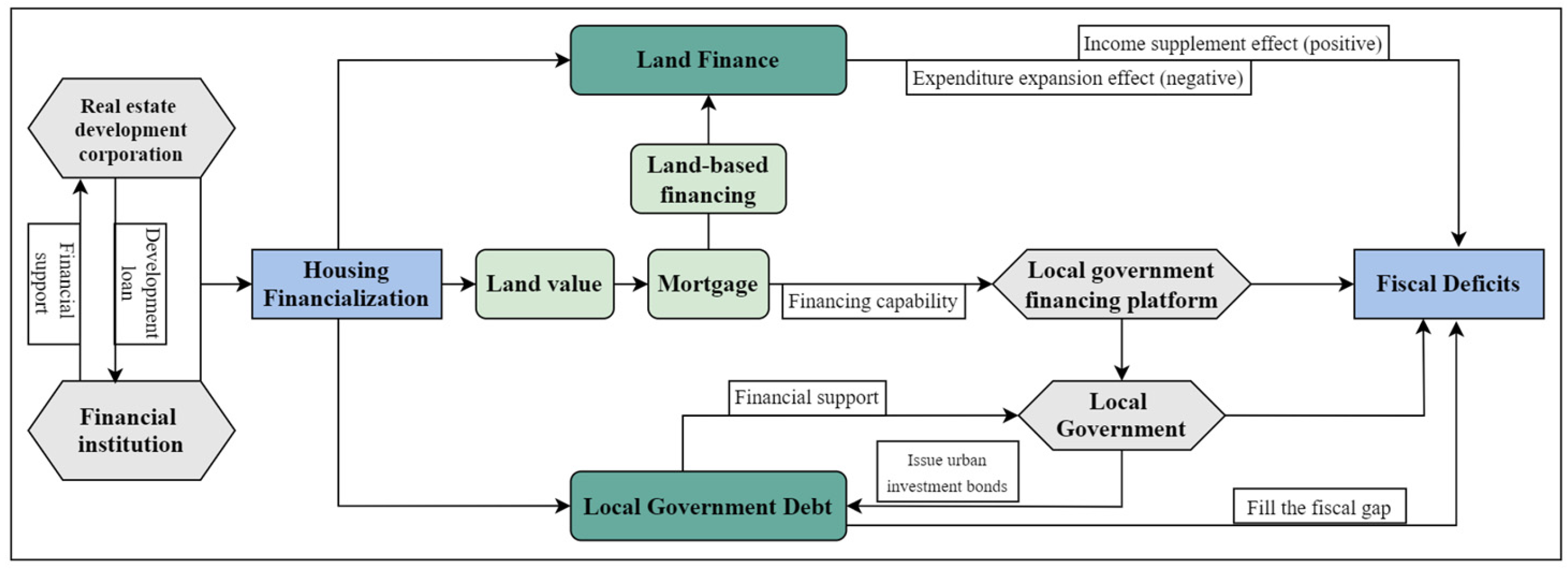
To systematically analyze the logic and specific transmission paths from housing financialization to fiscal deficits, this paper draws a mechanism diagram of the impact effects to clarify the core paths, as shown in Figure 2.

3.1. The REF-LAND-DB Transmission Pathway

Housing financialization affects fiscal deficits through the land market. According to Ricardian land rent theory, land scarcity gives real estate its inherent value-appreciation attributes. When REF transforms real estate into a financial speculative asset, the continuous financialization process promotes the rapid appreciation of land rent and real estate premiums, thereby expanding government fiscal revenue through land transfer income and real estate-related taxes. Land fiscal dependence theory further emphasizes that, during urbanization, local public finance becomes structurally dependent on real estate-related revenues. REF strengthens this dependence by making land and real estate-related revenues a core component of government fiscal revenue. Together, these two theories establish that the land market is the primary channel through which REF transmits to fiscal balance.
Specifically, REF influences land acquisition costs by altering the financing behavior of real estate firms. Under loose credit conditions, an increase in REF eases financing constraints for real estate firms. The subsequent increase in land demand directly drives up land prices. The appreciation of land rent and real estate premiums increases government revenues from land-related fiscal sources, which is consistent with Ricardian land rent theory. Conversely, when financial regulation tightens, falling REF reduces land demand and contracts land revenues. This leads to a shrinkage of fiscal income derived from land assets, breaking the stable land–fiscal dependence structure. Subsequently, LAND affects DB through two opposing fiscal effects: a short-term revenue supplementation effect that alleviates deficit pressure, and an expenditure expansion effect whereby local governments increase infrastructure spending based on land revenues. The net impact on DB is determined by the relative strength of these two effects.

3.2. The REF-UID-DB Transmission Pathway

Housing financialization also influences fiscal deficits through local government debt. According to public debt risk transmission theory, REF encourages governments to rely on land and real estate assets for mortgage financing. This leads to the continuous expansion of real estate-related public debt. High interest payments on debt occupy long-term fiscal budget funds and reduce public fiscal expenditure space. Once a downturn in the housing financial market triggers debt default risks, the government must use fiscal funds to bail out and assume debt risks, thereby directly expanding fiscal deficits. Financial accelerator theory states that, as the most core collateral asset in the credit market, real estate amplifies credit and macroeconomic volatility through collateral value channels. REF significantly strengthens the sensitivity of the credit scale to housing price fluctuations. In an upward cycle, collateral appreciation expands credit and tax revenues. In a downward cycle, collateral depreciation triggers credit contraction and reduces fiscal tax sources. Together, these two theories reveal that fluctuations in real estate collateral value driven by financialization can amplify the scale of local government debt and transmit risk to fiscal balance.
During a real estate market expansion, an increase in the REF raises the value of property as an investment asset and increases land values. This increases the value of land used as collateral, thereby boosting the financing capacity of local government financing vehicles (LGFVs) and promoting the issuance of urban investment bonds [1], leading to UID expansion. Consistent with the financial accelerator theory, the financialization boom elevates collateral values, relaxes debt financing constraints, and accelerates the accumulation of implicit local debt. However, as financial regulations tighten and the real estate market cools, declining property values weaken collateral quality, restricting UID issuance. Furthermore, the fiscal impact of UID depends on how the raised funds are utilized. When directed toward productive infrastructure, they may substitute for direct fiscal spending and temporarily ease deficit pressures. However, if the funds are primarily used for debt rollover or social welfare programs, the associated interest burden increases fiscal expenditures and potentially widens the deficit. According to public debt risk transmission theory, the continuous accumulation of implicit debt generates persistent pressure to make interest payments, squeezes fiscal budget space, and ultimately expands the scale of the fiscal deficit. Based on the above analysis, the following research hypothesis is proposed:
H1: 
The impact of housing financialization on local fiscal deficits is time-varying and non-linear, characterized by significant heterogeneity between the short and long term.
H2: 
Land finance and local government debt serve as dynamic mediating channels that transmit the effects of housing financialization to fiscal deficits.

4. Measurement and Fluctuation Traits of Housing Financialization

4.1. Data Selection

This study constructs a composite measure of housing financialization by integrating sub-indicators across five dimensions: enterprise, household, market, financial institutions, and industry [5]. The fuzzy Technique for Order Preference by Similarity to an Ideal Solution (fuzzy-TOPSIS) method is employed to compute a comprehensive score, which serves as a proxy for the level of housing financialization.
(1) Investment intensity of real estate development enterprises (CDI): Measured as the ratio of completed real estate development investment to total completed fixed-asset investment. This indicator mirrors the concentration level of social fixed-asset resources allocated to the real estate sector, with a higher ratio signifying greater resource absorption by property development activities [30].
(2) Financial leverage level of the household sector (PML): Represented by the outstanding balance of personal mortgage loans. This variable capture household-level housing financialization, reflecting the extent to which households leverage their balance sheets to participate in the real estate market [31].
(3) Average sales price of commercial housing (ASP): Calculated as the ratio of the total commercial housing sales value to the sales area. ASP reflects the price valuation of real estate assets and serves as a direct market manifestation of the financial attributes of real estate [32,33].
(4) Scale of credit support from the financial system to the real estate development sector (REDL): Measured by the outstanding balance of real estate development loans. This indicator gauges the degree of financial resource concentration in the real estate industry and the level of financial support from the banking sector, reflecting banks’ willingness to channel credit into the real estate sector [34].
(5) Contribution of the Real Estate Industry to Economic Growth (OVI): Calculated as the ratio of the real estate industry’s output value to GDP, reflecting the depth of integration between the real estate sector and the broader economy. A rising OVI indicates that the real estate sector plays an increasingly dominant role in national economic output [35]. Notably, the original data for both the output value of the real estate industry and GDP are available quarterly. To ensure temporal consistency with the other monthly indicators, these quarterly series are converted to monthly frequencies using quadratic interpolation before computing the ratio.
The analysis uses monthly data from January 2006 to December 2025. All variables are deflated, logarithmically transformed, and seasonally adjusted. Meanwhile, we apply the Hodrick–Prescott (HP) filter to remove the long-term trend component from the raw macroeconomic series [36]. The rationale for this preprocessing step is twofold. First, TVP-VAR estimation, especially under the Bayesian MCMC framework, requires stationary input series to avoid spurious dynamics and improve parameter convergence. Second, our focus is on short- to medium-term cyclical fluctuations and shock transmission rather than long-run growth trends. Thus, the HP filter helps isolate business-cycle movements from the underlying non-stationary trend and better matches the empirical purpose of this study. Given that our dataset consists of monthly observations, we set the smoothing parameter (λ) to 14,400, the standard value for monthly data [36].
We acknowledge the critique raised by Hamilton [37], who argues that the HP filter may induce spurious dynamic relationships, particularly at the endpoints of the sample. Nevertheless, it remains widely used in macroeconomic research. In our analysis, the filtered series are used only as inputs to the TVP-VAR model, so the TV-IRFs should be interpreted as temporary deviations from long-run potential levels rather than permanent structural shifts. Overall, the HP filter better serves the objective of capturing cyclical dynamics in this paper. All data used in this study are sourced from the Wind database.

4.2. Stationarity Test for REF Measurement

Given that economic policy adjustments and market fluctuations may induce structural breaks in real estate-related variables, this study employs a structural breakpoint stationarity test. Unlike conventional unit root tests, this method identifies sudden structural changes (e.g., policy shifts and economic shocks) that may occur within the sample period, thereby avoiding statistical bias caused by ignoring such breaks.
As shown in Table 1, all variables pass the stationarity test. Specifically, the p-values of the stationarity test results for all variables are less than 0.01, indicating that all variables meet the stationarity requirements for the subsequent empirical analysis.

4.3. Fuzzy-Topsis Method for Housing Financialization Evaluation

Based on the processed sub-indicators, the fuzzy-TOPSIS method [39] is applied to compute the comprehensive REF score. This approach integrates multidimensional information and determines objective indicator weights using the entropy weight method, yielding a reliable composite measure that accurately reflects the actual state of real estate financialization. The implementation steps are as follows.
Step 1: Construct a fuzzy decision matrix. The research period includes n time points (monthly data from 2006 to 2025, n = 240 ) and m = 5 evaluation indicators (CDI, PML, ASP, REDL, OVI). Let x t l denote the processed value of the l -th indicator at the t -th time point ( t = 1 , 2 , , n ; l = 1 , 2 , , m ). The fuzzy decision matrix r t l ~ is constructed as:
r t l ~ = x 11 x 12 x 1 m x 21 x 22 x 2 m x n 1 x n 2 x n m
Step 2: Normalize the matrix. We use the formula for triangular fuzzy numbers to normalize the fuzzy decision matrix, and the normalized fuzzy numbers z t l ~ = r t l ~ / max t r t l ~ for benefit criteria, and z t l ~ = min t r t l ~ / r t l ~ for cost criteria.
Step 3: Determine indicator weights. First, we compute the proportion matrix p t l = z t l ~ / l = 1 n z t l ~ , where n is the total number of time periods. Next, we calculate the entropy value e l = k t = 1 n p i j ln p i j . Then, we obtain the redundancy degree d l = 1 e l and the final weight W l = d l / l = 1 m d l for each sub-indicator, and weights should satisfy l = 1 m W l = 1 .
Step 4: Calculate the weighted normalized fuzzy matrix. Similarly to traditional TOPSIS, weights can be assigned using the Analytic Hierarchy Process (AHP), which has been adapted for use in fuzzy environments. Furthermore, we construct the weighted normalized fuzzy matrix V ~ , and the element v t = z t l ~ × W j l .
Step 5: Determine the ideal solution. We determine the Fuzzy Positive Ideal Solution (FPIS) V + ~ and Fuzzy Negative Ideal Solution (FNIS) V ~ calculated using Formulas (2) and (3), respectively, which represent the best and worst performance values for each criterion.
V + ~ = v 1 + ~ , v 2 + , ~ , v n + ~ , v 1 + = max i v t l
V ~ = v 1 ~ , v 2 , ~ , v n ~ , v 1 = min i v t l
Step 6: Calculate the distances between the points. The following equations are used to calculate the distances from each time point to the fuzzy positive ideal solution ( D t + ~ ) ( D t + ~ ) and fuzzy negative ideal solution ( D t ~ ) ( D t ~ ), where d , is the distance measure between two fuzzy numbers.
D t + ~ = l = 1 m d v t l ~ , v t + ~
D t ~ = l = 1 m d v t l ~ , v t ~
Step 7: Calculate the comprehensive REF score. We calculate the fuzzy-TOPSIS score R E F t ~ for the t -th time point as follows:
R E F t ~ = D t ~ D t + ~ + D t ~
where 0 R E F t ~ 1 ; a larger R E F t ~ indicates a higher housing financialization level. Based on the entropy weight method, the objective weights of PML, CDI, ASP, REDL, and OVI are 0.1327, 0.2010, 0.2031, 0.2026, and 0.2606, respectively.

4.4. Fluctuation Characteristics of Housing Financialization

After obtaining the comprehensive REF score via the fuzzy-TOPSIS method, this paper adopts the Markov Regime Switching Model introduced by Hamilton [40]. We compare MS (2)-AR (1) and MS (3)-AR (1) specifications to determine the optimal regime number. As reported in Table A1, the three-regime model dominates its two-regime counterpart in major evaluation indicators, presenting a higher log-likelihood value and lower AIC, which verifies its reliable fitting performance.
To analyze the volatility characteristics and categorize REF into low, moderate, and high regimes, as the basis for subsequent analysis of regime traits and transition features. The MS (3)-AR (1) model is set as follows:
R E F t ~ = μ s t + ϕ s t R E F t 1 ~ μ s t 1 + ε t
where s t = 1 , 2 , 3 represents the regime at time t , μ s t is the mean value of REF under regime s t , reflecting the average level of housing financialization in different regimes. ϕ s t is the autoregressive coefficient under regime s t , reflecting the persistence of REF fluctuations in the current regime. ε t ~ N 0 , σ s t 2 is the random error term under regime s t , and σ s t 2 is the variance of the error term, reflecting the volatility of REF in different regimes.
The regime switching of the model follows a first-order Markov chain, and the transition probability is p i j = P s t = j | s t 1 = i , which represents the probability of switching from regime i to regime j in the next period. The specific empirical results and transition probability matrix are presented in Table 2.
As shown in Table 2, the REF is classified into three regimes based on the estimated standard errors. Regimes 1, 2, and 3 correspond to low, moderate, and high levels of REF, respectively. The coefficient on the one-period lag of REF (REF_1) is 0.9970 and statistically significant, indicating strong persistence in the REF dynamics. According to the transition probability matrix, the diagonal elements p i i is 0.6671, 0.9771, and 0.9790, indicating high self-sustaining probabilities for all three regimes. The off-diagonal elements p i j indicate that the transition probability from regime 1 to regimes 2 and 3 is 0.0000 and 0.0099, respectively, which shows no direct transition to the moderate-level regime but a slight probability of jumping to the high-level regime. The probabilities of regime 2 transitioning to both regimes 1 and 3 are relatively low, showing that once the REF enters the moderate-level state, it is difficult to transition to other regimes in the short term. The transition probability from regime 3 to regime 1 is high at 0.3329, and the probability of transitioning to regime 2 is 0.0229, which means that it has a certain probability of returning to the low-level regime, but the probability of transitioning to the moderate-level regime is very low.
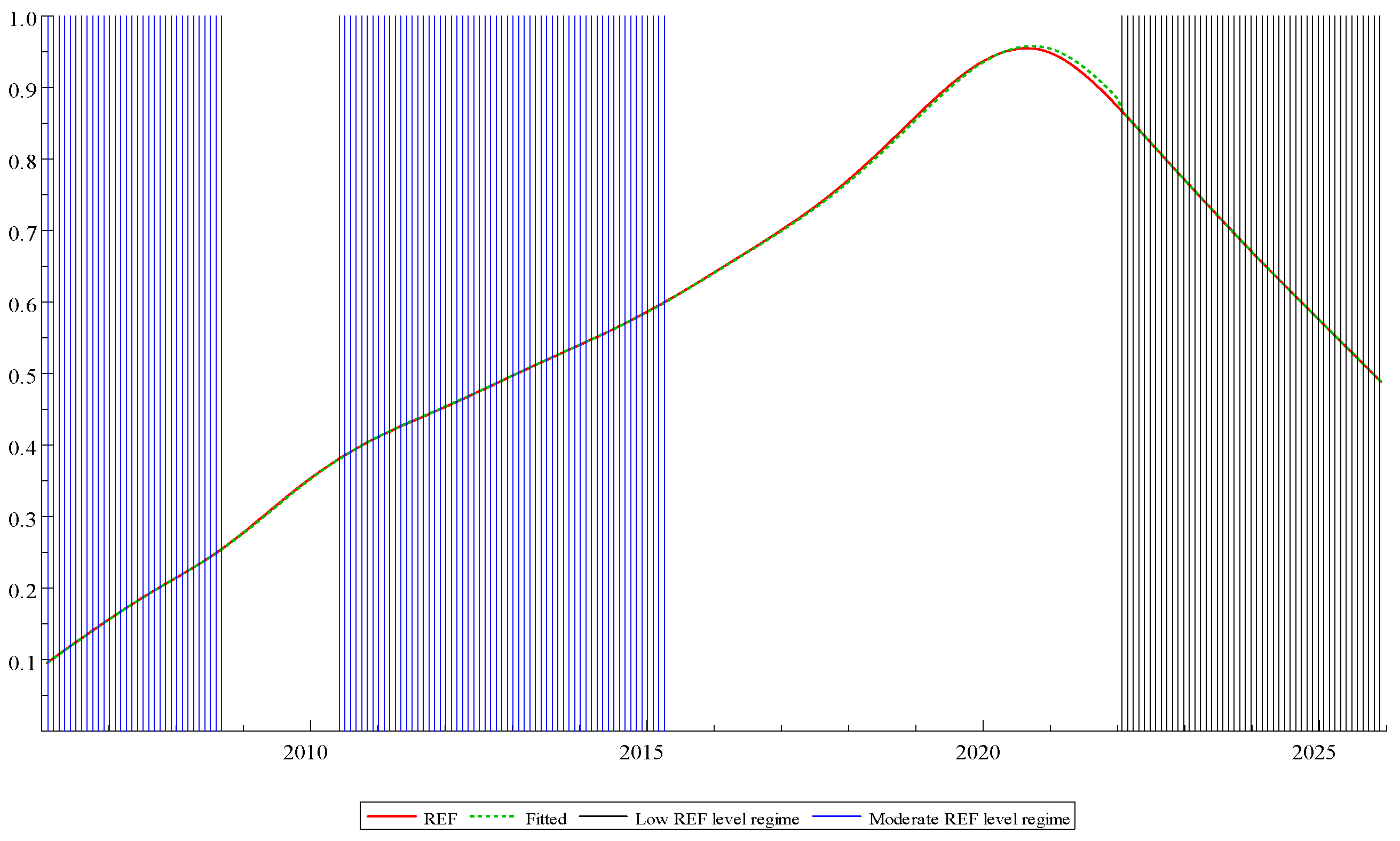
Figure 3 plots the actual REF series against the fitted series from the MS (3)-AR (1) model. The near-perfect overlap of the two lines throughout the sample period visually confirms the model’s high accuracy and explanatory power, validating its effectiveness in capturing the fluctuation characteristics across different regimes.
(1)
Low-level regime (January 2022–December 2025)
This period is characterized by policies aimed at preventing and defusing real estate financial risks. Stricter regulation of developer financing, controlled growth of real estate loans, and restrictions on financial capital inflows curbed excessive financialization. Concurrent policies promoting housing supply optimization and developer deleveraging helped steer the market back toward its residential function. Consequently, investment growth slowed, credit expansion was contained, market overvaluation was reduced, and the real estate–finance nexus weakened, resulting in low and stable levels of financialization.
(2)
Moderate-level regime (January 2006–July 2008; April 2010–March 2015)
From January 2006 to July 2008, the government adopted moderate regulatory measures to guide the steady development of the market. In response to overheated investment, surging housing prices, and a distorted housing supply structure in the real estate market, China implemented a package of restrictive policies to restructure housing supply and stabilize prices. The New Mortgage Policy of 2007 regulated down payment ratios and loan interest rates for personal housing loans, curbing speculative purchases without stifling market vitality. These policies maintained a reasonable link between real estate and finance, keeping REF at a moderate level. From April 2010 to March 2015, the government implemented strict yet differentiated regulations, such as introducing purchase and loan restrictions, raising down payment requirements for second homes. This policy mix, which combines stringent controls and phased easing, cooled the overheating market, maintained reasonable credit support, and sustained a moderate financialization state.
(3)
High-level Regime (August 2008–March 2010; April 2015–December 2021)
From August 2008 to March 2010, in response to the global financial crisis, policies such as eased loan terms for second homes and tax reductions fueled a rapid recovery in real estate investment, prices, and credit, pushing financialization to a high level. From April 2015 to December 2021, growth-stabilizing and inventory-reduction measures, including lower down payments, reduced loan rates, and relaxed purchase restrictions, combined with accommodative credit conditions to sustain high investment, sales, and price growth, maintained elevated financialization.
In summary, these regime shifts underscore the high volatility and policy sensitivity of REF in China. Each regime aligns closely with distinct macroeconomic cycles and regulatory stances, underscoring the stage-dependent nature of housing financialization.

5. Research Design

5.1. Model Specification

It is important to clarify that our treatment of LAND and UID as “mediating variables” refers to the dynamic propagation of shocks within the VAR system, rather than a static regression-based mediation test. According to our theoretical framework, there is a dynamic relationship between REF and DB, which necessitates the adoption of a TVP-VAR framework. Unlike traditional regression approaches that require a clear distinction between dependent and independent variables, the VAR model treats all variables as jointly endogenous. In this system, each variable is regressed on its own lagged values and the lagged values of all other variables. This approach explicitly acknowledges the joint endogeneity of all variables and avoids the identification challenges associated with dynamic mediation analysis, reflecting the phase-dependent nature of the REFDB relationship [41]. Therefore, this study employs the TVP-VAR model, which allows both the coefficient matrix and the variance of the disturbance term to vary over time, making it well-suited for analyzing evolving economic relationships. The TVP-VAR model extends the structural vector autoregression (SVAR) framework, with its basic form expressed as:
A y t = F 1 y t 1 + + F s y t s + μ t ,   t = s + 1 , , n .
where y t is a k × 1 vector of observations, A is a k × k contemporaneous coefficient matrix, F 1 , , F s is a k × k lagged coefficient matrix, the disturbance term μ t is a k × 1 vector of structural shocks, and μ t ~ N ( 0 , ) , with being a diagonal matrix.
Assuming that the coefficient matrix A is a lower triangular matrix, Equation (8) can be expressed in the reduced-form VAR as:
y t = B 1 y t 1 + + B s y t s + A 1 ε t ,   ε t ~ N ( 0 , I k ) .
where B i = A 1 F i , for i = 1 , , s .
By stacking the elements of matrix B row-wise to obtain a k 2 s × 1 vector β , and defining X t = I s ( y t 1 , , y t s ) , where denotes the Kronecker product. The simplified model with non-time-varying coefficients is obtained as follows:
y t = X t β + A 1 ε t ,   t = s + 1 , , n .
Adding time-varying features to the estimated coefficients and stochastic volatility in Equation (10) yields the basic form of the TVP-VAR model:
y t = X t β t + A t 1 t ε t ,   t = s + 1 , , n .
where β t , A t , and t all have time-varying characteristics. The TVP-VAR model is a powerful tool for analyzing dynamic relationships and capturing complex time-varying interactions flexibly and adaptably.

5.2. Data Selection and Processing

To rigorously examine the time-varying impacts of housing financialization on fiscal deficits, we define the core variables, their respective proxies, and measurement methodologies, thereby establishing a robust empirical foundation for our subsequent analysis.
(1) Housing financialization (REF). This paper selects five sub-indicators (PML, CDI, ASP, REDL, and OVI) from different dimensions and uses the fuzzy-TOPSIS method to calculate comprehensive scores, as detailed in Section 4.
(2) Land Finance (LAND). Land acquisition fees, which encompass all payments made by real estate developers to obtain land-use rights, with land transfer fees constituting the core component. This indicator closely tracks the temporal trends and scale fluctuations of local governments’ land transfer revenues and effectively captures the expansion and contraction dynamics of the land finance.
(3) Local Government Debt (UID). Proxied by the net issuance of urban investment bonds. The data are sourced from the Datayes database.
(4) Deficit Budget (DB). Calculated as the ratio of the gap between fiscal expenditure and fiscal revenue to the GDP. As fiscal revenue and expenditure data for January and February are reported as combined values, we use the monthly average for these two months. Data processing for this variable followed the same procedure as for the other indicators.

5.3. Stationarity Test for TVP-VAR Estimation

To ensure the validity of the subsequent model estimation, we conduct stationarity tests for all core variables. AS reported in Table 3, all series are stationary at the 1% significance level (p-values < 0.01), which provide a reliable basis for analyzing time-varying effects.
In addition, we employ five common statistical criteria to screen feasible lag orders. Based on the majority voting principle, the optimal lag order of the TVP-VAR model is set to 5 (detailed results are presented in Table A2).

5.4. TVP-VAR Model Estimation

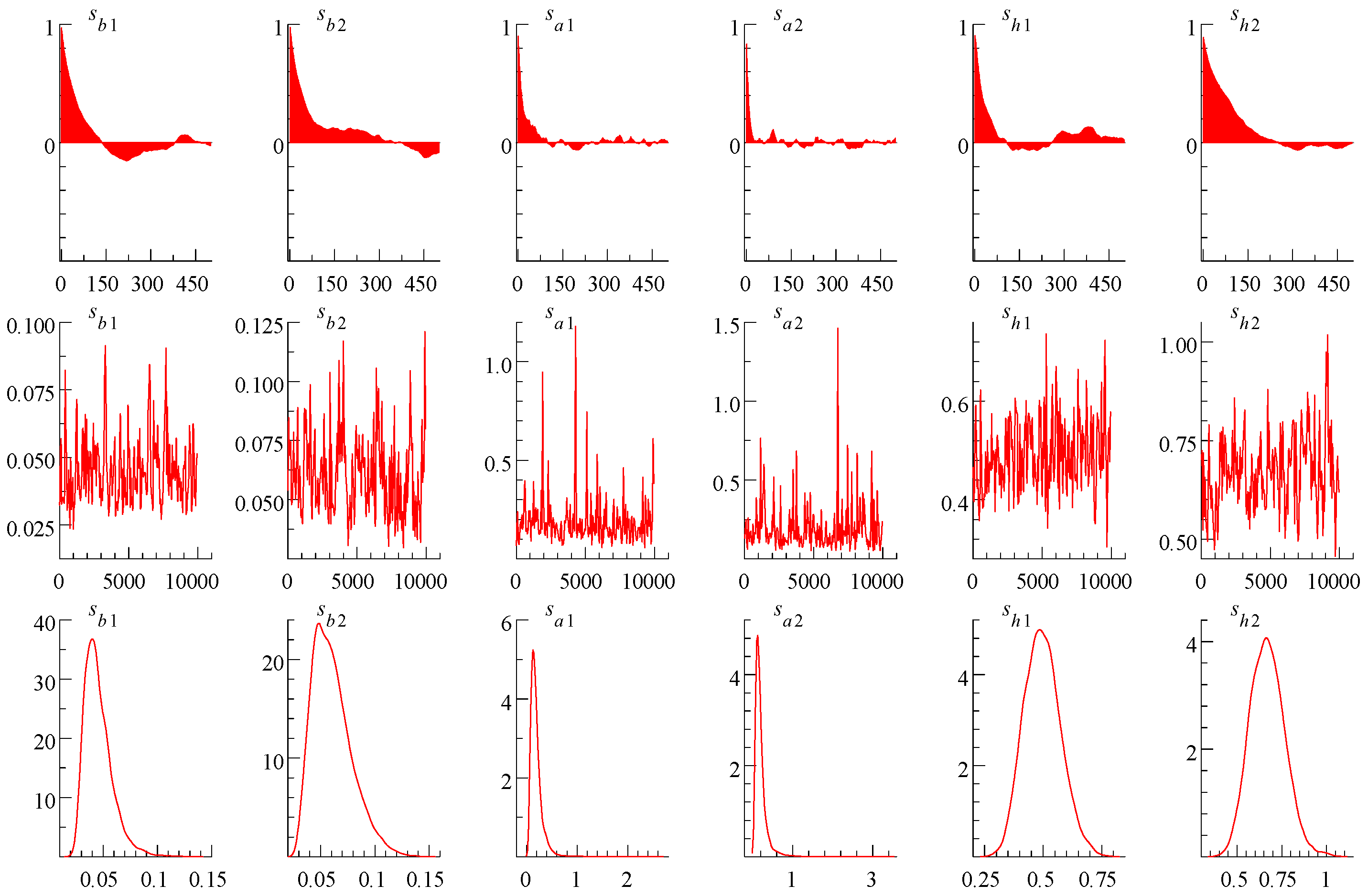
The TVP-VAR model is estimated via Bayesian methods using Markov Chain Monte Carlo (MCMC) simulation in the OxMetrics 6.0 software environment. We adopt the standard conjugate prior setup for TVP-VAR model. A total of 11,000 iterations were run, and the first 1000 iterations were discarded as burn-in to ensure stability. We assess the convergence of the Markov chain is assessed using Geweke’s convergence diagnostic (CD statistic) and the inefficiency factors, as reported in Table 4 and Figure A2.
As shown in Table 4, the posterior means of all parameters lie within their respective 95% confidence intervals, and the standard deviations are small. The convergence diagnostic (CD) statistics do not reject the null hypothesis that the parameters converge to their posterior distributions. The maximum inefficiency factor is 118.87, implying that at least 84 effectively independent samples are obtained from the MCMC simulation (10,000/118.87 ≈ 84.1), sufficient to ensure estimation accuracy.

6. Empirical Analysis of the Time-Varying Effects

This study examines the dynamic transmission channels through which housing financialization influences local fiscal deficits based on the time-varying impulse response results. Decomposing these pathways elucidates the structural evolution of subnational fiscal systems within China’s real estate-driven development paradigm.

6.1. Time-Varying Effects of Housing Financialization on Fiscal Deficits

To clarify the operational logic underlying the interaction between REF and DB, we investigate two primary mediating channels: the REF → LANDDB pathway and the REF → UIDDB pathway. These pathways represent the core mechanisms through which real estate-related activities are translated into fiscal outcomes. By analyzing the time-varying responses within these specific linkages, we aim to determine how the fiscal impact of REF has changed in response to shifting macroeconomic conditions and regulatory environments.

6.1.1. Verification of REF → LAND → DB Channel

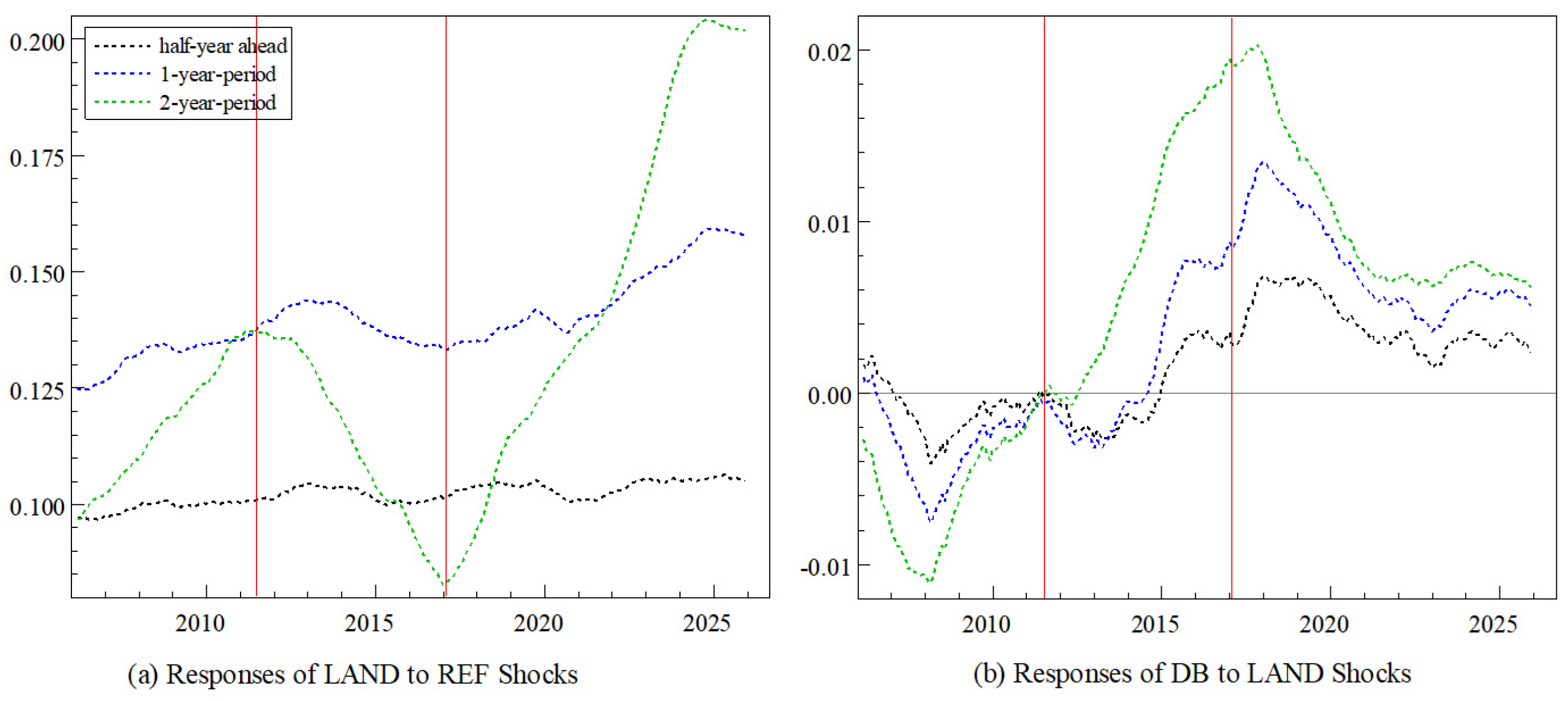
As shown in Figure 4a,b, the effect of housing financialization on fiscal deficits through land finance exhibits a phased regime shift, evolving from a fiscal-buffering mechanism to a deficit-amplifying mechanism.
(1) January 2006 to May 2011. The expansion of REF steadily strengthened the short-run response of LAND to its shocks, suggesting that rising housing prices and increasing financial leverage substantially enhanced land finance. At the same time, LAND shocks exerted a significantly negative effect on REF, with the restraining effect peaking in 2008 and then easing slightly thereafter. Against the backdrop of the 4-trillion-yuan fiscal stimulus package, the rapid increase in land transfer revenue helped local governments bridge revenue–expenditure gaps and significantly reduce fiscal deficit pressure. This pattern aligns with the conventional view that land finance served as an important supplementary financing channel for local governments. In this sense, REF pushed up land prices and expanded land-based fiscal revenue, thereby alleviating fiscal imbalances and containing deficits.
(2) June 2011 to January 2017. The combined effects of housing market regulations and destocking policies temporarily weakened the response of LAND to REF shocks, indicating that policy tightening constrained the transmission from REF to LAND. Meanwhile, the negative effect of LAND shocks on REF gradually diminished and eventually turned positive. As the land market cooled and fiscal imbalances widened, land transfer revenue became less stable, reducing its role in buffering fiscal adjustment. Local governments were therefore exposed to greater volatility in land-related income and stronger pressure to maintain fiscal balance. Although REF continued to support LAND, the magnitude of this effect declined, and the capacity of land finance to ease fiscal deficits weakened accordingly.
(3) February 2017 to December 2025. As financialization deepened, driven primarily by the growth of shadow banking and real estate enterprise financing, the long-term response coefficient of LAND to REF shocks increased sharply. This indicates that land finance became increasingly dependent on REF, while local governments developed a more rigid reliance on revenue from land transfers. At the same time, the positive impact of LAND on DB weakened. As LAND advanced, local governments increasingly converted land-based fiscal resources into implicit debt through land-mortgage financing and urban investment bonds. Under this mechanism, land transfer income was insufficient to offset fiscal gaps; instead, it contributed to the expansion of fiscal deficits. Overall, the positive effect of REF on LAND strengthened markedly, whereas the effect of LAND on DB declined steadily, suggesting that long-run effects dominated short- and medium-run dynamics. These results indicate that real estate financialization ultimately amplifies fiscal deficits through the land finance channel.
In summary, the impact of REF on LAND is characterized by pronounced lagged effects that become more evident as financialization deepens. In the long term, REF consistently increases land prices and motivates local governments to increase the supply of land to boost land transfer revenue. This creates a positive feedback loop involving higher housing, land prices, and greater reliance on land-based fiscal income. However, the role of land finance in fiscal adjustment is unstable. Initially, it functions as a buffer that helps maintain fiscal balance; however, as financialization deepens, it gradually becomes a force that intensifies fiscal deficit pressures.

6.1.2. Verification of REF → UID → DB Channel

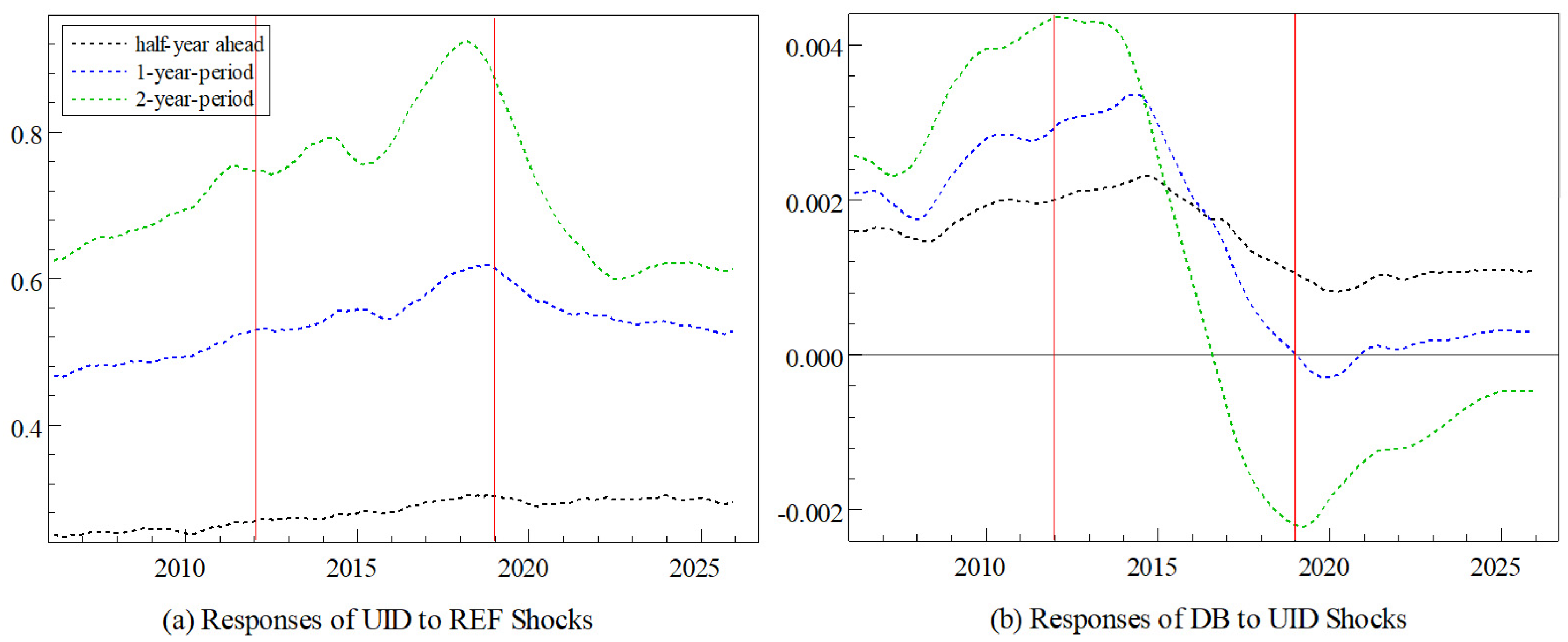
This paper examines the dynamic transmission mechanism through which REF affects DB via UID. Figure 5a,b illustrate the complete transmission chain.
(1) January 2006 to December 2011. During the period of rapid real estate expansion, land transfer revenue became a core source of fiscal income for local governments. Meanwhile, the 2008 fiscal stimulus package prompted urban investment platforms to undertake large-scale borrowing. The expansion of REF increased UID through two channels. First, rising housing prices increased land values, improving the collateral capacity of urban investment platforms. Second, the abundant liquidity generated by real estate financialization reduced issuance costs and supported the continuous growth of the scale of urban investment bonds. Furthermore, these funds were primarily allocated towards infrastructure development and public services, partially offsetting fiscal expenditures and alleviating short-term deficit pressures. Additionally, infrastructure investment contributed to higher tax revenue and land appreciation gains, which further improved local fiscal conditions and reinforced the positive effect of UID on DB.
(2) January 2012 to December 2018. Following the implementation of monetized shantytown renovation policies, housing prices increased and land markets were revitalized, particularly in third- and fourth-tier cities. Local governments also relied heavily on urban investment platforms to finance related projects. Combined with financial institutions’ strong preference for real estate and urban investment business, the effect of REF on UID reached its peak. Urban investment bonds became a major tool for bridging fiscal revenue–expenditure gaps, and the expansion of real estate financialization provided sufficient capital support for issuance. However, the associated interest burden and repayment pressure gradually emerged. Local governments were increasingly required to allocate more fiscal resources to provide implicit guarantees and bailout support for urban investment platforms, thereby increasing fiscal deficits. In addition, some projects financed by these bonds generated relatively low returns and failed to create stable revenue growth, leading instead to the accumulation of debt burdens. As a result, the long-run effect of UID on DB shifted from positive to negative.
(3) January 2019 to December 2025. The introduction of the real estate debt containment policies in 2020 tightened financing conditions for real estate enterprises, slowing the expansion of housing financialization. At the same time, stronger governance over local government implicit debt intensified the financial supervision of urban investment platforms. While the promotional effect of REF on UID decreased somewhat, urban investment bonds remained an important financing instrument due to persistent reliance on land finance, maintaining relatively high response intensity. As related regulatory policies were further implemented, the growth rate of urban investment platform financing slowed. Local governments also eased stock debt pressure through debt replacement and refinancing bonds, which weakened the direct impact of newly issued urban investment bonds on fiscal deficits. Nevertheless, fiscal budgets still had to cover interest expenses on outstanding debt, and the transformation of urban investment platforms remained incomplete. Accordingly, the positive effect of UID on DB recovered mildly, and the long-run restraining response gradually eased after reaching its lowest point in February 2019.
Overall, REF has a sustained driving effect on UID, whereas UID displays a dual effect on fiscal deficits. It offers short-term relief but creates long-term fiscal pressure through implicit debt accumulation. As an intermediary linking REF and local public finance, UID can temporarily ease explicit fiscal deficits. However, the long-term costs of implicit liabilities are eventually transmitted to the fiscal sector, thereby raising persistent deficit risk. This further indicates that a development model combining land finance and urban investment debt is fundamentally unsustainable.
In summary, the TVP-VAR results offer a thorough overview of China’s fiscal sustainability challenges. The validation of H1 and H2 underscores that the current development model, which relies on REF to sustain local public finance—is inherently unsustainable. The transition from short-term fiscal relief to long-term deficit expansion, mediated by LAND and UID, suggests that the real estate–land-debt nexus has become a source of systemic fiscal fragility rather than a solution to fiscal imbalances.

6.2. Robustness Test

6.2.1. Robustness Test Based on Alternative Proxy Variable

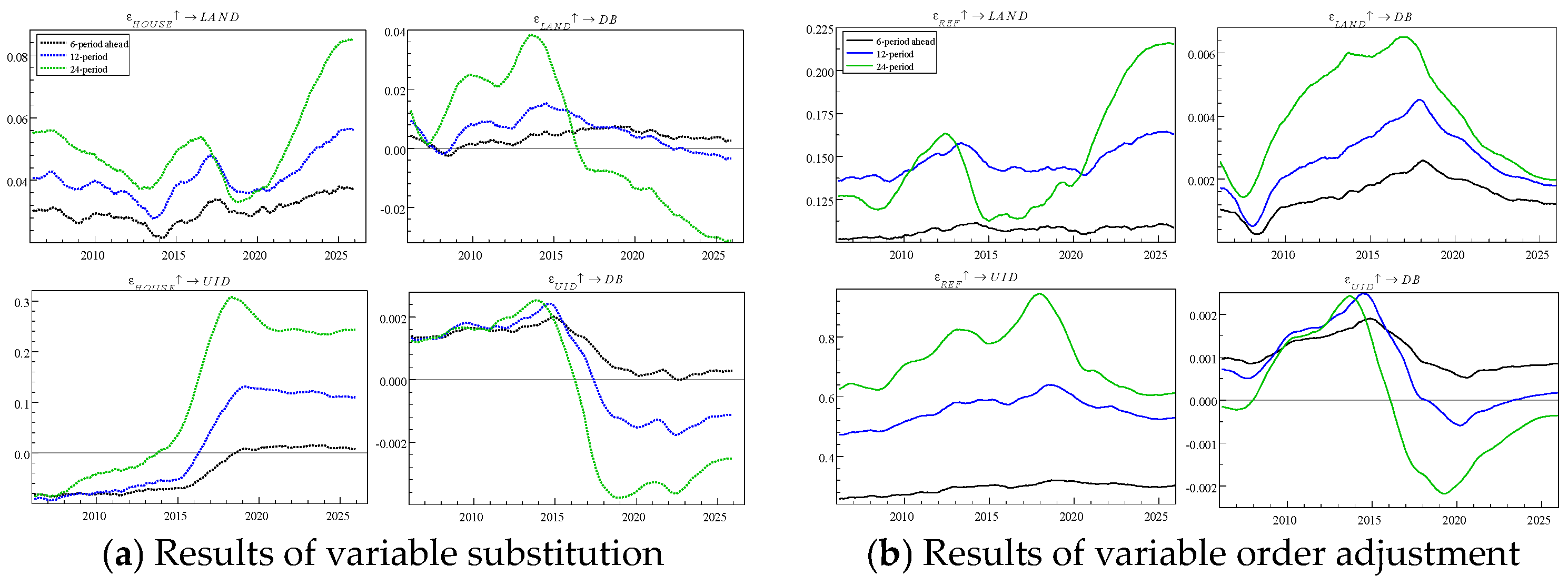
To improve the robustness of the results, we employ the National Real Estate Climate Index (HOUSE) as an alternative proxy for REF. This authoritative composite index, released monthly by China’s National Bureau of Statistics, takes 2012 as the base period and integrates investment scale, capital supply, land and housing market conditions as well as housing prices. HOUSE contains indicators of the real estate financing structure that directly reflect the industry’s capital accessibility and leverage level. Meanwhile, it also effectively captures housing market sentiment and asset price fluctuations, which are typical manifestations of housing financialization. Furthermore, we re-estimate the model, with relevant outcomes documented in Table 5 (consistent with the above explanations). As shown in Figure A1, the time trend and influence magnitude of shock responses are highly consistent with those in the baseline Figure 4 and Figure 5. These results strongly confirm the reliability and stability of our core empirical conclusions.

6.2.2. Robustness Test Based on Adjusting Variable Ordering

We also conduct a robustness analysis by adjusting the variable recursive ordering. The original sequence is set as REF, LAND, DB, and UID, and the revised order is rearranged into REF, DB, LAND, and UID. This adjustment is economically reasonable because fiscal deficits can have an immediate short-term impact on land-related fiscal activities, which conforms to the logic of actual economic operations. The re-estimated results are presented in Table 5, and the corresponding impulse responses are displayed in Figure A1. The dynamic trends and characteristics of the shock responses largely resemble those in baseline Figure 4 and Figure 5. This consistency shows that the core empirical conclusions are unaffected by variable ordering settings and further verifies the robustness of our findings.

7. Conclusions and Discussion

7.1. Conclusions

This study uses a TVP-VAR model and monthly data from 2006 to 2025 to investigate the dynamic transmission mechanisms through which REF influences DB in China. The core conclusions are presented as follows: first, the impact of REF on DB is time-varying and non-linear, characterized by significant short- and long-term heterogeneity. In the early stages of financialization, REF acted as a fiscal stabilizer by providing immediate revenue to bridge fiscal gaps. However, as the financialization deepened, the positive effect was progressively offset by the long-term costs of debt servicing and implicit liabilities, ultimately shifting toward a pro-cyclical driver of fiscal deficit expansion. Second, LAND and UID serve as dynamic mediating channels that transmit the effects of housing financialization to fiscal deficits. The transmission via LAND has evolved from a fiscal buffer to a source of systemic risk, driven by local governments’ rigid path dependence on land-based revenue and the conversion of land assets into implicit debt. Similarly, UID exhibits a dual-effect mechanism: it initially facilitated infrastructure investment and substituted for direct fiscal spending. However, the accumulation of implicit debt and the associated interest burdens have transformed UID into a persistent source of fiscal fragility. Finally, the real estate–land-debt nexus has become inherently unsustainable. The system, where rising housing prices, climbing land values, and growing reliance on land-based fiscal revenue reinforce each other, has constrained fiscal space and exacerbated systemic risks. Despite regulatory efforts and stricter governance over implicit debt, persistent reliance on land-based financing continues to pose significant challenges to fiscal sustainability.

7.2. Discussion

Furthermore, we discuss the empirical findings in the context of the existing literature. First, our findings contribute to the existing literature by expanding the depth of the mechanism analysis. Consistent with Qian et al. [5], we confirm that the penetration of financial logic into the housing sector is intertwined with China’s fiscal system. This is also in line with Gyourko et al. [7] and Cheng et al. [15], who highlighted that land finance not only distorts resource allocation but also drives risk transfer between the real estate market and the local fiscal system. However, unlike existing studies that mostly focus on unidirectional causal links, such as the impact of land finance on housing prices [11] or the effect of fiscal constraints on local debt [15], this study reveals a dynamic transmission mechanism, which complements the one-dimensional analysis in the existing literature. Second, the identification of LAND and UID as critical mediating channels is consistent with Su et al. [9] and Chen et al. [27], who emphasized the role of land as collateral in local government financing and the risk transmission effect of land financialization. However, unlike Wu [10] and Su et al. [9], who mainly distinguish land financialization from traditional land finance in terms of connotation and measurement, this study further quantifies the dynamic evolution of these mediating effects. This time-varying perspective addresses the limitation of static analysis in existing studies [13,17], which is a key extension of the existing research on transmission mechanisms. Finally, the conclusion that the REF-LAND/UID-DB relationship is policy endogenous advances the literature on the role of regulation. Consistent with Gil García & Martínez López [18], who highlighted state-led housing financialization through policy coordination, our findings confirm that regulatory shifts play a decisive role in transforming the “land-finance-debt” model.

7.3. Policy Recommendations

Based on these empirical findings, we have the following policy recommendations. First, local governments must shift from land-dependent revenue models to a more resilient, tax-oriented fiscal framework. Expanding the real estate tax pilot program is essential to securing a stable, recurring revenue base. This transition would replace volatile land-conveyance fees with predictable property taxes, enabling local authorities to reduce their reliance on land-use rights and break the pro-cyclical feedback loop between land market volatility and fiscal instability.
Second, fundamentally transforming urban investment platforms is essential for mitigating long-term fiscal risks. We advocate for a fiscal-debt firewall that explicitly prohibits the use of public funds for implicit bailouts of market-oriented debt. Furthermore, regulatory authorities should mandate that these platforms prioritize projects with robust, self-sustaining cash flows. Anchoring debt servicing in project-level profitability rather than fiscal transfers allows local governments to effectively insulate public budgets from systemic risks and foster a more disciplined, market-oriented financing environment.
Finally, given the dynamic of short-term relief and long-term pressure, policymakers should adopt a regime-aware approach to fiscal risk management. We propose establishing a “Fiscal Risk Reserve Fund” to create institutionalized countercyclical buffers. During periods of high real estate financialization, local governments should allocate a portion of land-related windfalls to this fund. The fund would serve as a strategic buffer to cover interest obligations and debt servicing costs during market downturns, insulating the public budget from debt-related shocks.

7.4. Limitations and Future Research

Despite these contributions, this study has some limitations. First, REF measurement may omit context-specific indicators, such as the impact of digital platformization. Second, converting low-frequency data to monthly frequency via quadratic interpolation may introduce artificial smoothing effects. Third, due to the parameter-intensive nature of the TVP-VAR framework, our model focuses on core transmission variables to ensure empirical tractability. To address these limitations, further research should (i) refine the measurement by integrating digitalization and other emerging factors; (ii) employ mixed-frequency VAR frameworks to handle multi-frequency data directly; and (iii) employ a Factor-Augmented TVP-VAR (FA-TVP-VAR) model to incorporate a broader set of macroeconomic indicators without compromising degrees of freedom.

Author Contributions

Conceptualization, J.W.; Methodology, J.W. and C.M.; Software, J.W.; Validation, J.W. and C.M.; Resources, J.W. and C.M.; Data curation, J.W.; Writing—original draft, J.W., C.M. and X.Z.; Supervision, X.Z. All authors have read and agreed to the published version of the manuscript.

Funding

This research was funded by the Ministry of Education of Humanities and Social Science project of China (23YJC790152), Department of Science and Technology of Inner Mongolia Autonomous Region (2024QN07017), and Natural Science Foundation of China (72364027).

Data Availability Statement

The original contributions presented in this study are included in the article. Further inquiries can be directed to the corresponding author.

Conflicts of Interest

The authors declare no conflict of interest.

Appendix A

Table A1. Selection of MS–AR model.
MS (2)–AR (1)MS (3)–AR (1)
Log-likelihood1103.0235Log-likelihood1311.0417
AIC−9.1801AIC−10.8790
LR Test (p Value)519.52 (0.0000)LR Test (p Value)789.68 (0.0000)
Matrix of transition probabilitiesMatrix of transition probabilities
Regime 1Regime 2 Regime 1Regime 2Regime 3
Regime 11.00000.4968Regime 10.66710.00000.0099
Regime 20.00000.5032Regime 20.00000.97710.0111
Regime 30.33290.02290.9790
Table A2. Selection of lag order.
LagLogLLRFPEAICSCHQ
0−28.60172NA1.56 × 10−50.2834930.3432860.307612
13573.5597047.7054.47 × 10−19−30.90051−30.60155−30.77991
26258.9565160.6333.71 × 10−29−54.11266−53.57453−53.89559
38115.1243502.5094.17 × 10−36−70.11412−69.33682−69.80058
48733.8141145.9212.21 × 10−38−75.35490−74.33843−74.94488
58788.74099.82136 *1.58 × 10−38 *−75.69339 *−74.43774 *−75.18689 *
68798.13316.744661.67 × 10−38−75.63594−74.14112−75.03296
78805.61813.081671.80 × 10−38−75.56189−73.82790−74.86244
88817.45020.269531.88 × 10−38−75.52565−73.55249−74.72972
98825.07612.797672.02 × 10−38−75.45283−73.24050−74.56042
108836.93819.495842.11 × 10−38−75.41685−72.96535−74.42797
Notes: * indicates lag order selected by the criterion. The optimal lag order of the VAR model is determined as 5 following the majority rule. NA indicates missing values.
Figure A1. Robustness test results. Note: The upward arrow indicates a one-standard-deviation positive shock to the variable, and the rightward arrow indicates the direction of the shock effect.
Land 15 01009 g0a1
Figure A2. MCMC diagnostic results of TVP-VAR model. Note: This figure presents the MCMC diagnostic results for the key parameters of the TVP-VAR model. The first row plots the autocorrelation functions, which decay rapidly to zero across all parameters, indicating efficient sampling with negligible serial correlation. The second row shows the sample paths, which fluctuate stably around their respective means without obvious trends, confirming the convergence of the Markov chain. The third row displays the posterior density distributions, all of which are unimodal and well-behaved, verifying the stability and reliability of the parameter estimates.
Land 15 01009 g0a2

Appendix B

Data used in this research are retrieved from Wind Financial Terminal and Datayes database for authorized academic research, available at https://www.wind.com.cn (accessed on 12 February 2026) and https://robo.datayes.com/v2/landing/indicator_library (accessed on 12 February 2026).

References

  1. Aalbers, M.B.; Haila, A. A conversation about land rent, financialisation and housing. Urban Stud. 2018, 55, 1821–1835. [Google Scholar] [CrossRef]
  2. Fields, D.; Raymond, E.L. Racialized geographies of housing financialization. Prog. Hum. Geogr. 2021, 45, 1625–1645. [Google Scholar] [CrossRef]
  3. Byrne, M.; Norris, M. Housing market financialization, neoliberalism and everyday retrenchment of social housing. Environ. Plan. A Econ. Space 2022, 54, 182–198. [Google Scholar] [CrossRef]
  4. Gil García, J.; Martínez López, M.A. State-Led Actions Reigniting the Financialization of Housing in Spain. Hous. Theory Soc. 2023, 40, 1–21. [Google Scholar] [CrossRef]
  5. Qian, H.; Sun, Q.; Li, M.; Liu, Y.; Li, F. An empirical study on the promotion of city economic growth by the healthy development of real estate and land finance. Front. Sustain. Cities 2024, 6, 1481687. [Google Scholar] [CrossRef]
  6. Stellinga, B. Housing financialization as a self-sustaining process. Political obstacles to the de-financialization of the Dutch housing market. Hous. Stud. 2024, 39, 877–900. [Google Scholar] [CrossRef]
  7. Gyourko, J.; Shen, Y.; Wu, J.; Zhang, R. Land finance in China: Analysis and review. China Econ. Rev. 2022, 76, 101868. [Google Scholar] [CrossRef]
  8. Sun, Q.; Feng, Y.; Tang, Y.; Kuang, W.; Javeed, S.A. The relationship amid land finance and economic growth with the mediating role of housing prices in China. Front. Psychol. 2022, 13, 976236. [Google Scholar] [CrossRef]
  9. Su, Y.; Shi, S.; Hu, M.; Wu, Y. Land financialization and gentrification: Evidence from China. Cities 2024, 154, 105330. [Google Scholar] [CrossRef]
  10. Wu, F. Land financialisation and the financing of urban development in China. Land Use Policy 2022, 112, 104412. [Google Scholar] [CrossRef]
  11. Wang, R.; Hou, J. Land finance, land attracting investment and housing price fluctuations in China. Int. Rev. Econ. Financ. 2021, 72, 690–699. [Google Scholar] [CrossRef]
  12. Wang, Y.; Yue, X.; Wang, M.; Huang, G. Identifying the spatial heterogeneity of housing financialization in China: Insights from a multiscale geographically weighted regression. Heliyon 2024, 10, e27542. [Google Scholar] [CrossRef]
  13. Pan, J.-N.; Huang, J.-T.; Chiang, T.-F. Empirical study of the local government deficit, land finance and real estate markets in China. China Econ. Rev. 2015, 32, 57–67. [Google Scholar] [CrossRef]
  14. Hu, X.; Jin, Y.; Wang, Z.; Yang, J. Shadows behind “land finance”: A perspective from Chinese LGFV debt structures. Habitat Int. 2025, 166, 103612. [Google Scholar] [CrossRef]
  15. Cheng, Y.; Jia, S.; Meng, H. Fiscal policy choices of local governments in China: Land finance or local government debt? Int. Rev. Econ. Financ. 2022, 80, 294–308. [Google Scholar] [CrossRef]
  16. Lu, Y.; Zhang, J.; Mao, J.; Gao, S. Land financialization and debt expansion: Evidence from city–county mergers in China. Cities 2024, 146, 104679. [Google Scholar] [CrossRef]
  17. Xiao, Z.; Zhang, H. Real estate market regulation and local government debt risk. Financ. Res. Lett. 2025, 80, 107362. [Google Scholar] [CrossRef]
  18. Gil, J.; Martínez, P.; Sequera, J. The neoliberal tenant dystopia: Digital polyplatform rentierism, the hybridization of platform-based rental markets and financialization of housing. Cities 2023, 137, 104245. [Google Scholar] [CrossRef]
  19. Hick, R.; Stephens, M. Housing, the welfare state and poverty: On the financialization of housing and the dependent variable problem. Hous. Theory Soc. 2023, 40, 78–95. [Google Scholar] [CrossRef]
  20. Dancygier, R.; Wiedemann, A. The financialization of housing and its political consequences. Am. J. Political Sci. 2025, 69, 1354–1373. [Google Scholar] [CrossRef]
  21. Zhou, Y.; Lin, B. Helping hand or grabbing hand: The impact of land finance on the green economic development in China. Financ. Res. Lett. 2025, 71, 106471. [Google Scholar] [CrossRef]
  22. Chen, S.; Tian, C.; Dong, S.; Shu, T.; Huang, Y.; Huang, M. Urbanization and land finance dependence: Insights from China. Econ. Model. 2025, 152, 107253. [Google Scholar] [CrossRef]
  23. Wang, K.; Chang, B.; Chen, Z.; Wang, K. Budget management legalization and its impact on land finance: Evidence from the implementation of the ‘New Budget Law’. Econ. Lett. 2024, 239, 111745. [Google Scholar] [CrossRef]
  24. Zhang, Y.; Liu, Y.; Yang, Q.; Yue, W. Assessing performance and disparities in China’s land finance transition: Insights from neo-liberalism and neo-Marxism. Land Use Policy 2024, 146, 107306. [Google Scholar] [CrossRef]
  25. Chen, J.; Wu, F. Housing and land financialization under the state ownership of land in China. Land Use Policy 2022, 112, 104844. [Google Scholar] [CrossRef]
  26. Wang, G.; Salman, M. Understanding the spatial spillover effect of land finance on China’s green development: Does the moderating role of industrial structure matter? Environ. Sci. Pollut. Res. 2023, 30, 95959–95974. [Google Scholar] [CrossRef] [PubMed]
  27. Chen, D.; Li, Y.; Zhang, C.; Zhang, Y.; Hou, J.; Lin, Y.; Wu, S.; Lang, Y.; Hu, W. Regional coordinated development policy as an instrument for alleviating land finance dependency: Evidence from the urban agglomeration development. Land Use Policy 2024, 143, 107182. [Google Scholar] [CrossRef]
  28. Chiang, T.; Hou, J.; Tsai, P. Fiscal incentives and land finance cycles of prefectures in China. World Econ. 2022, 45, 1262–1293. [Google Scholar] [CrossRef]
  29. Huangfu, Y.; Yu, H.; Dong, Z.; Wang, Y. Research on the Risk Spillover among the Real Economy, Real Estate Market, and Financial System: Evidence from China. Land 2024, 13, 890. [Google Scholar] [CrossRef]
  30. Chen, K.; Wen, Y. The great housing boom of China. Am. Econ. J. Macroecon. 2017, 9, 73–114. [Google Scholar] [CrossRef]
  31. Justiniano, A.; Primiceri, G.E.; Tambalotti, A. Credit supply and the housing boom. J. Political Econ. 2019, 127, 1317–1350. [Google Scholar] [CrossRef]
  32. Fernandez, R.; Aalbers, M.B. Financialization and housing: Between globalization and Varieties of Capitalism. Compet. Change 2016, 20, 71–88. [Google Scholar] [CrossRef]
  33. Glaeser, E.L.; Gyourko, J.; Saiz, A. Housing supply and housing bubbles. J. Urban Econ. 2008, 64, 198–217. [Google Scholar] [CrossRef]
  34. Borio, C.E.V.; Lowe, P.W. Asset Prices, Financial and Monetary Stability: Exploring the Nexus. SSRN Electron. J. 2002. [Google Scholar] [CrossRef]
  35. Iacoviello, M.; Neri, S. Housing market spillovers: Evidence from an estimated DSGE model. Am. Econ. J. Macroecon. 2010, 2, 125–164. [Google Scholar] [CrossRef]
  36. Ravn, M.O.; Uhlig, H. On Adjusting the Hodrick-Prescott Filter for the Frequency of Observations. Rev. Econ. Stat. 2002, 84, 371–376. [Google Scholar] [CrossRef]
  37. Hamilton, J.D. Why you should never use the Hodrick-Prescott filter. Rev. Econ. Stat. 2018, 100, 831–843. [Google Scholar] [CrossRef]
  38. Perron, P.; Vogelsang, T.J. A Note on the Asymptotic Distributions of Unit Root Tests in the Additive Outlier Model with Breaks. Braz. Rev. Econom. 1993, 13, 8. [Google Scholar] [CrossRef]
  39. Alinezhad, A.; Khalili, J. New Methods and Applications in Multiple Attribute Decision Making (MADM); Springer International Publishing: Berlin/Heidelberg, Germany, 2019; Volume 277. [Google Scholar] [CrossRef]
  40. Hamilton, J.D. A New Approach to the Economic Analysis of Nonstationary Time Series and the Business Cycle. Econometrica 1989, 57, 357. [Google Scholar] [CrossRef]
  41. Nakajima, J. Time-Varying Parameter VAR Model with Stochastic Volatility: An Overview of Methodology and Empirical Applications. Monet. Econ. Stud. 2011, 29, 107–142. [Google Scholar]
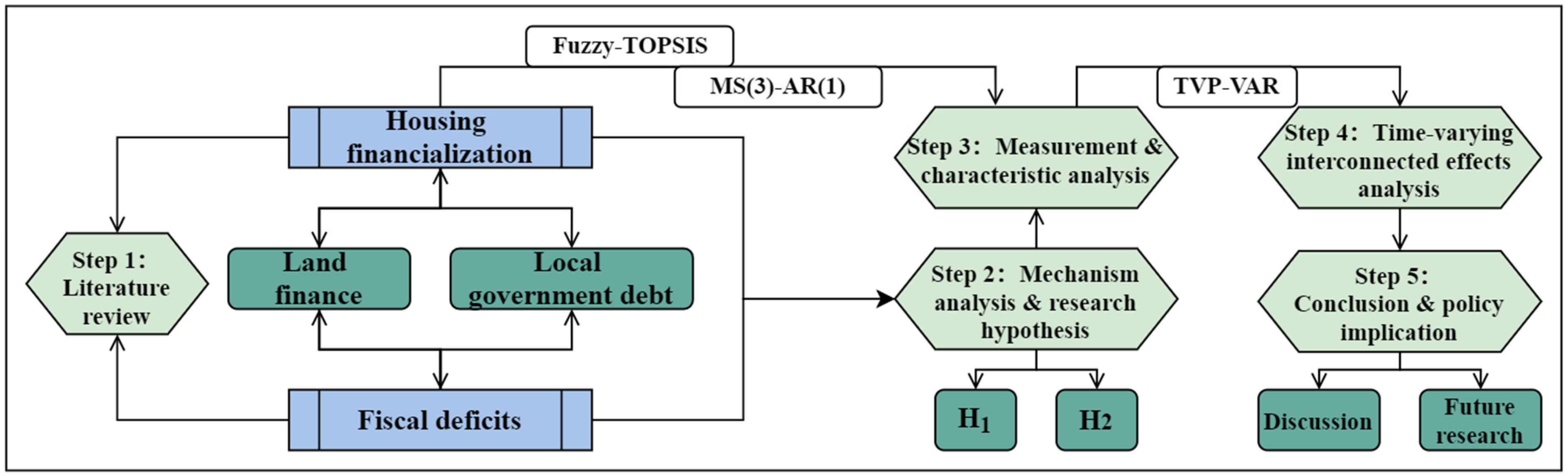
Figure 1. Research flowchart.
Land 15 01009 g001
Figure 2. Influence mechanism of housing financialization on fiscal deficits.
Land 15 01009 g002
Figure 3. Fluctuation characteristics of REF partitioning regimes. Note: We divided the level of REF into three regimes, corresponding to low-level (Regime 1, black in the graph), moderate-level (Regime 2, blue in the graph), and high-level (Regime 3, white in the graph).
Land 15 01009 g003
Figure 4. Impulse responses analysis of REF→LAND→DB channel. Note: The red vertical lines indicate May 2011 and January 2017, respectively, thereby dividing the full sample period into three stages: January 2006–May 2011, June 2011–January 2017, and February 2017–December 2025.
Land 15 01009 g004
Figure 5. Impulse responses analysis of REF→UID→DB channel. Note: The red vertical lines indicate December 2011 and December 2018, respectively, thereby dividing the full sample period into three stages: January 2006–December 2011, January 2012–December 2018, and January 2019–December 2025.
Land 15 01009 g005
Table 1. Results of the structural breakpoint stationary test.
DimensionVariablest-StatisticProb. *Test Critical Values
HouseholdPML−11.1509<0.011% level−4.949133
EnterpriseCDI−18.6707<0.015% level−4.443649
Housing marketASP−8.7490<0.0110% level−4.193627
Financial institutionREDL−6.2667<0.01
Housing industryOVI−10.8210<0.01
Note: * represents Perron & Vogelsang [38] asymptotic one-sided p-values.
Table 2. Estimation results of the MS (3)-AR (1) model.
Estimation ResultsMatrix of Transition Probabilities
RegimeConstantStandard ErrorRegime 1Regime 2Regime 3
LowRegime 1−0.0061 ***
(−65.4)
0.0001 ***
(2.27)
0.66710.00000.0099
ModerateRegime 20.0054 ***
(87.6)
0.0004 ***
(10.6)
0.00000.97710.0111
HighRegime 30.0060 ***
(14.3)
0.0040 ***
(15.2)
0.33290.02290.9790
REF_10.9970 ***
(7350)
log-likelihood1311.0417
Note: t-values in parentheses, while *** indicate 10%, 5%, and 1% levels of significance, respectively.
Table 3. Stationary text.
Variablest-StatisticProb. *Variablest-StatisticProb. *
REF−5.8663<0.01LAND−12.3286<0.01
DB−7.2173<0.01UID−11.3806<0.01
Test critical values1% level−4.949133
5% level−4.443649
10% level−4.193627
Note: * represents Perron & Vogelsang [38] asymptotic one-sided p-values.
Table 4. Estimation results of the TVP-VAR model.
ParameterMeanStandard Deviation95% Confidence IntervalCD StatisticInvalid Factor
( Σ β ) 1 0.04570.0129[0.0280, 0.0776]0.04169.76
( Σ β ) 2 0.06070.0180[0.0340, 0.1031]0.50695.80
( Σ a ) 1 0.19380.1283[0.0677, 0.4925]0.71234.05
( Σ a ) 2 0.19860.1771[0.0555, 0.6344]0.50217.27
( Σ h ) 1 0.49660.0775[0.3565, 0.6575]0.00048.70
( Σ h ) 2 0.66990.0968[0.4928, 0.8689]0.000118.87
Note: The results of Σ β and Σ a are magnified 100 times.
Table 5. Robustness test results of the TVP-VAR model.
Robustness CheckParameterMeanStandard Deviation95% Confidence IntervalCD StatisticInvalid Factor
Alternative
Proxy
Variable
( Σ β ) 1 0.02590.0035[0.0198, 0.0336]0.00018.44
( Σ β ) 2 0.04540.0132[0.0284, 0.0803]0.39884.81
( Σ a ) 1 0.20990.1030[0.0949, 0.4302]0.00829.32
( Σ a ) 2 0.19340.1005[0.0805, 0.4520]0.48020.60
( Σ h ) 1 0.47980.0693[0.3556, 0.6246]0.60873.99
( Σ h ) 2 0.62970.0845[0.4662, 0.8074]0.055105.02
Adjusting
Variable
Ordering
( Σ β ) 1 0.04550.0131[0.0262, 0.0788]0.81288.28
( Σ β ) 2 0.06080.0195[0.0327, 0.1065]0.36393.82
( Σ a ) 1 0.21490.1532[0.0704, 0.5530]0.79924.34
( Σ a ) 2 0.19410.1439[0.0586, 0.5687]0.99314.04
( Σ h ) 1 0.49400.0792[0.3429, 0.6485]0.19183.10
( Σ h ) 2 0.67130.1024[0.4919, 0.8909]0.231135.54
Note: The results of Σ β and Σ a are magnified 100 times.
Disclaimer/Publisher’s Note: The statements, opinions and data contained in all publications are solely those of the individual author(s) and contributor(s) and not of MDPI and/or the editor(s). MDPI and/or the editor(s) disclaim responsibility for any injury to people or property resulting from any ideas, methods, instructions or products referred to in the content.