Article

Optimizing the Ecological Network in the Chagan Lake Region Based on MSPA and MCR Models

1
School of Geographical Sciences, Liaoning Normal University, Dalian 116029, China
2
School of History and Geography, Tonghua Normal University, Tonghua 134001, China
3
School of Tourism Management, Shenyang Normal University, Shenyang 110034, China
*
Authors to whom correspondence should be addressed.
Land 2026, 15(6), 1007; https://doi.org/10.3390/land15061007 (registering DOI)
Submission received: 29 April 2026 / Revised: 5 June 2026 / Accepted: 5 June 2026 / Published: 8 June 2026

Abstract

Developing ecological networks is essential for preserving regional ecosystem stability and for reducing risks associated with degraded landscape security and ecological health. However, regional ecological network studies in lake environments that combine long-term temporal comparison with location-specific optimization remain relatively limited. Taking the Chagan Lake region as the study area, this research examined landscape pattern changes in 2000, 2010, and 2020 by integrating Morphological Spatial Pattern Analysis (MSPA) with connectivity metrics to determine major ecological source areas. General and key ecological corridors were then identified and evaluated through the joint use of the Minimum Cumulative Resistance (MCR) model and the gravity model. Based on these results, the evolution of the regional ecological network during the past two decades was analyzed, and an optimization strategy was proposed. The results show that important ecological source areas became increasingly fragmented over time. Although corridor numbers continued to rise, connectivity between the eastern and western sectors and across parts of the central zone remained weak. In response, three supplementary ecological source areas, together with restoration nodes and stepping-stone patches, are proposed to reinforce structural linkage and improve the overall network configuration. The study offers a practical basis for ecological network refinement in the Chagan Lake region and provides methodological support for enhancing landscape connectivity and ecosystem resilience.

1. Introduction

Accelerated urban growth in lake-basin regions has substantially altered land-use composition and reshaped the spatial arrangement of both natural and human-dominated landscapes. As cities, towns, transport infrastructure, and agricultural activities continue to expand, ecological land is increasingly squeezed, habitat patches become subdivided, and the continuity of ecological space is progressively weakened. These transformations intensify pressures on biodiversity, ecological processes, and landscape stability. In turn, they may undermine ecosystem functions such as habitat support, hydrological regulation, and climate buffering, while also creating long-term risks for local economic sustainability and human well-being [1,2,3,4]. Lake basins are especially sensitive because ecological processes and socioeconomic development are tightly intertwined. As the largest natural lake in Jilin Province, Chagan Lake is critical to regional resource supply and environmental maintenance, and its ecological condition is closely linked to the stable and sustainable development of surrounding areas [5,6]. The lake not only supports wetland habitats, hydrological regulation, and biodiversity conservation, but also underpins agriculture, fisheries, tourism, and other regional industries. Against this background, reconciling ecological protection with urban-rural development has become an important research and governance issue. Accordingly, building and optimizing an ecological pattern for the lake basin has attracted growing attention from both scholars and decision-makers.
Existing studies on ecological security and sustainable regional development mainly concentrate on several themes, including ecological security pattern construction [7,8,9,10], ecosystem service valuation [11,12,13,14], spatial layout optimization [15,16], indicator systems and methods for ecological security [17,18], as well as ecosystem evaluation and regulation [19,20]. Collectively, these strands of work provide an important foundation for identifying ecological problems and supporting environmental management. Within this broader field, ecological network construction has become an increasingly important tool for spatial optimization because it can clearly reveal ecological structure, identify restoration priorities, and present ecological relationships in an intuitive spatial form [21,22,23]. Compared with other approaches, ecological network analysis places stronger emphasis on the structural and functional linkage among ecological elements, thereby offering a clearer basis for determining ecological sources, corridors, and critical nodes.
An ecological network can be understood as a system of habitat patches connected by corridors [24]. These corridors enable organism movement and the transfer of energy and materials across the landscape [25]. By linking otherwise isolated habitats, they help buffer the adverse effects of fragmentation, improve ecological resilience under external disturbance, and sustain key ecological processes. Strong connectivity is therefore indispensable for species dispersal, population persistence, material circulation, energy exchange, and the continued provision of ecosystem services [26,27]. When such linkages are disrupted, dispersal pathways may be blocked, genetic exchange may decline, and regional ecological vulnerability may increase. For that reason, ecological networks are widely used in resource management, landscape planning, and ecological conservation, and they remain a major focus of contemporary ecological research [28]. In addition to identifying conservation priorities, this framework also supports ecological restoration, land-use optimization, and regional ecological governance. Although ecological network studies are increasingly abundant, systematic analyses tailored to distinctive lake-basin environments are still insufficient. Because lake basins usually involve complex wetland, hydrological, and landscape interactions that differ from ordinary terrestrial settings, they require more targeted analytical frameworks and optimization strategies. The lack of such work limits the practical application of ecological network studies in areas where ecological sensitivity and development pressure coexist.
Existing studies on ecological networks in lake-related environments have mainly focused on ecological security pattern construction, source identification, resistance-surface development, and corridor extraction in lake basins, wetland systems, and watershed regions. In many cases, the emphasis has been placed on identifying key structural elements of ecological networks or proposing optimization measures for a single period. By contrast, less attention has been paid to long-term ecological network evolution in environmentally distinctive lake regions, especially in semi-arid and cold-region systems where hydrological conditions, seasonal environmental variation, and landscape heterogeneity jointly influence ecological connectivity [29,30,31].
The Chagan Lake region is representative in this respect [5,6,32]. Located in northeastern China, it is a semi-arid lake–wetland region characterized by strong interactions among lakes, wetlands, grasslands, and cropland, together with multiple human-use pressures such as agriculture, fishery activities, tourism development, and ongoing landscape fragmentation. These characteristics make it a suitable case for examining ecological network change under combined natural and anthropogenic influences.
Using 2000, 2010, and 2020 as representative years, this study identifies ecological source areas and corridors for each period and further proposes a targeted optimization scheme. Compared with many existing MSPA–MCR-based studies that focus mainly on general watershed settings or single-period ecological pattern construction [21,22,26,33], the contribution of this study lies in three aspects. First, it focuses on a semi-arid lake-centered region with strong wetland–grassland–farmland interactions. Second, it examines ecological network evolution across three representative periods, moving beyond static identification toward long-term comparison. Third, it extends the analysis from network construction to targeted spatial optimization through supplementary ecological sources, fracture-point restoration, and stepping-stone planning.

2. Research Models and Methods

2.1. Study Area

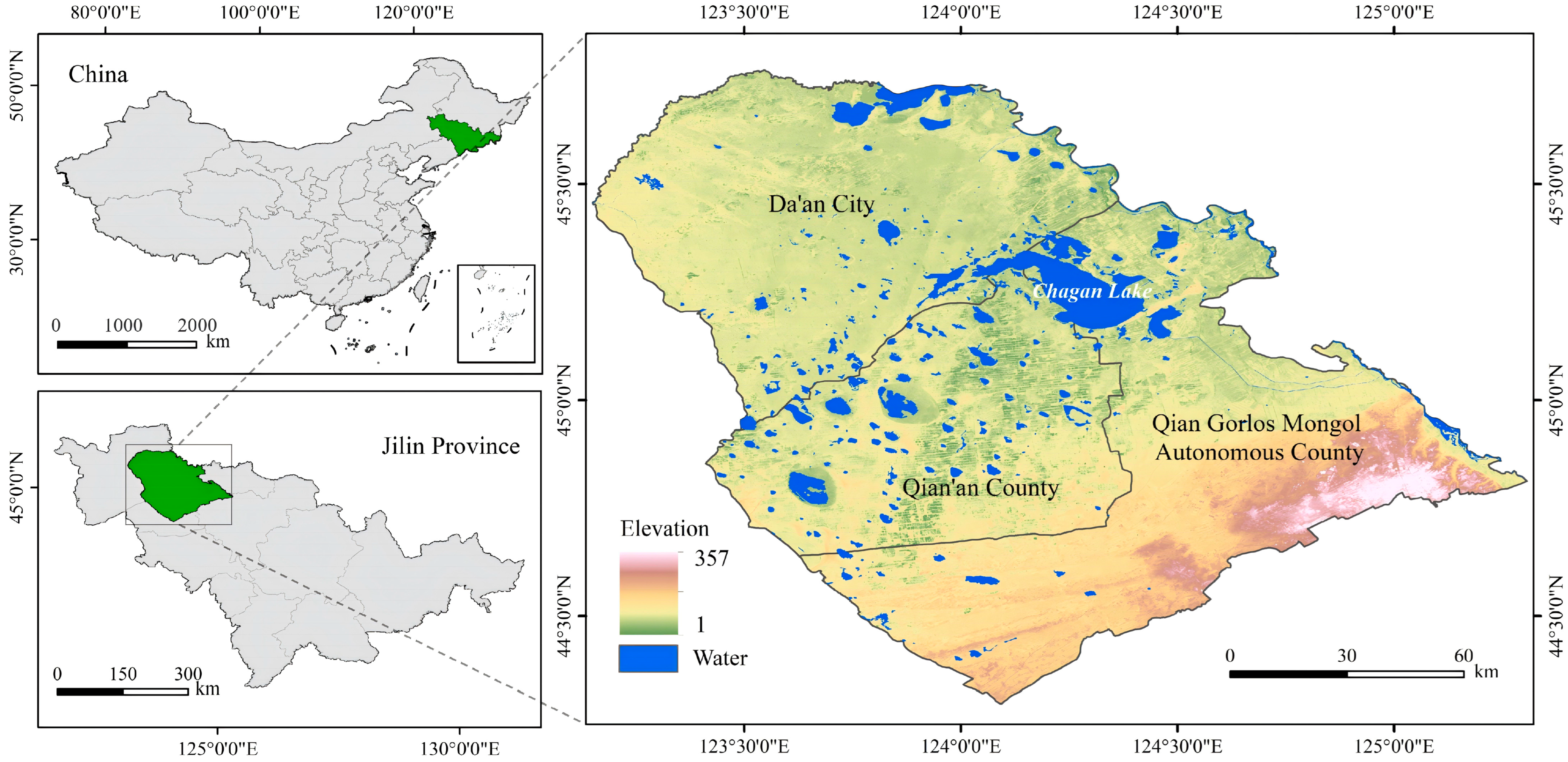
The study area is located in the Chagan Lake region of Jilin Province, China, and includes Qianguo Mongol Autonomous County, Qian’an County, and Da’an City, which are distributed around Chagan Lake. In this study, the research boundary was delineated based on county-level administrative units rather than on a strict hydrological watershed boundary. This delineation was adopted for two main reasons. First, Chagan Lake and its surrounding ecological space span multiple county-level jurisdictions, and the three selected administrative units jointly cover the main lake-centered ecological landscape associated with the study objective. Second, ecological protection, land-use regulation, and spatial planning in the region are implemented primarily at the county level, making administrative boundaries more suitable for evaluating ecological network evolution and proposing practical optimization strategies. Therefore, the selected study area can be regarded as a county-scale ecological management region surrounding Chagan Lake rather than a strictly defined hydrological basin. The region lies in a continental semi-arid monsoon zone, with mean annual precipitation of 400–500 mm and annual evaporation of 1140–1270 mm. The total area is 16,856 km2. Relief is generally gentle, with elevations ranging from 12 m to 229 m. Overall topography descends from the southeast toward the northeast, while the southwestern part is slightly lower. Land use is diverse and includes cropland, woodland, grassland, shallow lakes, marshes, and marshy grassland, which together form the wetland ecological matrix of the Chagan Lake area. The regional economy is dominated by agriculture, and nearby settlements mainly cultivate sorghum and maize. In recent years, abundant forest farms, lake resources, a relatively favorable ecological setting, and distinctive seasonal scenery have also promoted tourism development. The coexistence of lake wetlands, grasslands, cropland, and human development activities makes this region both ecologically sensitive and highly suitable for studying long-term ecological network evolution and optimization in a lake-centered landscape [1,2,5,6]. Figure 1 presents the county-scale study boundary around Chagan Lake together with its broader regional location in China and Jilin Province, thereby providing the spatial context for the subsequent ecological network analysis.

2.2. Data Sources and Data Processing

The analysis focused on three benchmark years (2000, 2010, and 2020), which provide a temporally comparable basis for examining decadal changes in ecological network structure under long-term land-use change. The principal datasets comprised land-use information, Digital Elevation Model (DEM) data, and other foundational spatial data. Land-use data were obtained from the GlobeLand30 30 m land-cover product, which has been widely used in regional land-cover mapping and ecological assessment because of its consistent classification framework and multi-period coverage [34]. DEM data were derived from the 30 m resolution GDEMV2 dataset provided by the Geospatial Data Cloud of China and were used to characterize elevation and slope conditions in the study area [35]. In the GlobeLand30 classification system used in this study, open-water features such as shallow lakes were included in the water-body category, while marshes corresponded mainly to the wetland category. Marshy grassland was not treated as an independent first-level class, but generally occurred as a transitional mosaic between wetland and grassland classes. Additional spatial data, including roads and settlements for the corresponding years, were collected from the National Geomatics Center of China, the Resource and Environmental Science and Data Center, and the Geographic Data Platform of the School of Urban and Environmental Sciences at Peking University. After preprocessing, ArcGIS 10.8 and ENVI 5.6 were used to derive several variables required for resistance-surface construction, including distance to water bodies, distance to roads, and distance to residential areas. For each benchmark year, land-use data were used to extract the spatial distribution of major landscape types and to support MSPA-based source identification. DEM data were used to derive elevation and slope layers. Water-body, road, and settlement data for the corresponding years were converted into distance rasters in ArcGIS 10.8 to represent the spatial influence of hydrological conditions and human disturbance. To ensure comparability among variables, all datasets were unified to the same spatial reference framework and raster resolution before analysis, and the resulting layers were clipped to the study area boundary for subsequent resistance-surface construction and ecological network analysis. The data sources and preprocessing procedures used in this study are summarized in Table 1.
Together, these multi-source datasets provided a temporally comparable basis for ecological source identification, resistance-factor construction, and ecological network analysis across the three benchmark years.

2.3. Research Method

This study combined Morphological Spatial Pattern Analysis (MSPA), landscape connectivity metrics, and the Minimum Cumulative Resistance (MCR) model to identify ecological source areas and ecological corridors for the three study years. The ecological network constructed in this study is a structural ecological network derived from landscape pattern, connectivity metrics, and resistance-surface analysis, and is used to characterize the spatial organization and potential structural linkage of ecological elements at the regional scale. After constructing the ecological networks for each period, the spatiotemporal evolution of the Chagan Lake ecological network over the last 20 years was quantitatively examined and evaluated. Specifically, MSPA was used to extract the core landscape pattern and provide the basic units for source identification; connectivity metrics calculated in Conefor 2.6 were used to evaluate patch importance and determine key ecological source areas; the MCR model was then applied to construct the integrated resistance surface and identify general ecological corridors; and the gravity model was further used to distinguish important corridors. On this basis, the ecological network optimization scheme was developed from the perspectives of supplementary source addition, fracture-point restoration, and stepping-stone arrangement [36]. This methodological chain was designed to match the research objective of identifying long-term changes in ecological sources and corridors and of proposing spatially targeted optimization measures for a lake-centered county-scale management region.
In this framework, MSPA is used to extract the core ecological pattern from multi-temporal land-use data, while connectivity assessment in Conefor 2.6, through indicators such as PC and dPC, is used to evaluate the relative role of patches within the network. The MCR model is then applied to simulate potential corridor pathways under integrated landscape resistance. This sequential structure supports the identification of ecological sources, the evaluation of their structural importance, and the extraction and optimization of ecological corridors at the county scale.

2.3.1. Extraction of Landscape in Core Area

Through MSPA, the landscape of the Chagan Lake study area was processed in Guidos Toolbox 2.8 by separating target land-cover classes from non-target classes and analyzing the resulting binary raster. In this study, foreground classes were selected to represent the dominant, relatively stable, and structurally connected ecological land that could support regional ecological source identification. Accordingly, the foreground scheme was defined to capture the overall ecological structure of the Chagan Lake region at the regional scale and to provide a consistent basis for subsequent source identification, connectivity assessment, and corridor construction. Based on the land-use data, water bodies, forest land, and grassland were designated as foreground classes, whereas all remaining land-use categories were treated as background [8,37]. This classification reflects the ecological characteristics of the study area: large water bodies provide important habitat and hydrological support, while forest land and grassland contribute to biodiversity conservation, wind protection, sand stabilization, soil and water conservation, and regional ecological continuity.
Open-water features such as shallow lakes were already included in the water-body category of the land-use dataset, whereas marshes corresponded mainly to wetlands. Marshy grassland was not an independent first-level class, but generally occurred as a transitional mosaic between wetland and grassland classes. Because wetland-related classes in the Chagan Lake region are highly interlaced, spatially heterogeneous, and often distributed as marginal or fragmented patches around major water bodies, directly incorporating all of them into the MSPA foreground would likely generate a large number of small and discontinuous patches, thereby weakening the ability of MSPA to identify the dominant regional ecological structure and reducing comparability across periods [22,26]. Therefore, this study used water bodies, forest land, and grassland as the foreground classes for MSPA, while wetlands were further incorporated into the resistance-surface analysis in the subsequent corridor identification and optimization process. The data were then converted to binary TIFF format and analyzed with the eight-neighbor rule [38]. MSPA distinguished seven mutually exclusive landscape types [39] (Table 2). Core areas extracted from this process were subsequently used as the basic landscape units for further connectivity and corridor analysis because of their importance for regional structural ecological linkage.

2.3.2. Landscape Connectivity Analysis

In this study, landscape connectivity is interpreted primarily from a structural perspective, that is, as the degree to which landscape configuration supports potential linkage among ecological source areas [40,41]. On this basis, the connectivity indicators were used to evaluate the relative structural importance of patches within the network. Three widely used indicators—the Integral Index of Connectivity (IIC), the Probability of Connectivity (PC), and patch importance (dPC)—were employed to evaluate overall network connectivity, measure the relative contribution of individual patches, and identify key ecological source areas in combination with the MSPA results [42]. Within this framework, Conefor 2.6 provides graph-based and probabilistic connectivity assessment, while the MCR component is used to identify potential spatial linkages under heterogeneous resistance conditions.
The formulas for these three metrics are given below:
I I C = i = 1 n j = 1 n a i × a j 1 + n l i j / A L 2
where i j ; n is the total number of patches in the landscape; a i and a j denote the areas of patches i and j; n l i j represents the number of links between patches i and j; and A L 2 is the square of the total landscape area.
PC = i n j n P ij * a i a j / A L 2
where i j ; P ij * represents the maximum product probability among all possible paths connecting patches i and j. PC ranges from 0 to 1, and lower PC values indicate weaker connectivity among patches.
d P C = P C PC r e m o v e PC × 100 %
where PC r e m o v e denotes the overall connectivity index after removing a given patch. The importance of that patch for maintaining connectivity is expressed by the change in the index before and after removal [43].
In this study, Conefor 2.6 was used for the connectivity assessment with a patch connection threshold of 2500 m and a connection probability of 0.5 [44]. Core patches larger than 5000 hm2 were included in the calculation, and patches with dPC values above 0.5 were finally identified as key ecological source areas. Similar threshold settings have been widely adopted in previous studies to select patches that make substantial contributions to maintaining landscape connectivity [24,45].

2.3.3. Identification of General Ecological Corridors Using the MCR Model

The Minimum Cumulative Resistance (MCR) model was adopted to identify potential corridor pathways between ecological source areas under integrated landscape resistance. In this structural framework, the resistance surface represents the relative difficulty of maintaining ecological linkage across different landscape units, and the resulting least-cost paths are interpreted as potential structural corridors rather than direct evidence of species-specific movement. Drawing on earlier studies [33,46,47,48,49,50,51] and taking into account both the scale of the study area and the highly fragmented distribution of lakes in the Chagan Lake region, this study established a resistance-factor system and grading scheme suited to local ecological conditions. These variables were selected because they jointly capture the main natural constraints and human disturbances affecting ecological flows in the Chagan Lake region, including topographic conditions, proximity to water, land-cover differences, transportation interference, and settlement pressure. Such a variable structure is particularly suitable for the Chagan Lake region, where ecological connectivity is jointly shaped by lake–wetland distribution, gentle topography, agricultural land use, settlement expansion, and road disturbance [52]. Lower resistance values indicate lower barriers to species movement and dispersal.
To build the resistance surface, both natural conditions and human disturbance factors were considered alongside data availability and the ecological characteristics of the region. Ultimately, three primary categories and seven secondary resistance factors were selected (Table 3). Using the entropy method, factor weights were derived from the resistance-factor layers of the Chagan Lake region, and resistance levels were assigned accordingly [53]. All resistance factors were then converted into raster layers, with values from 1 to 4 representing low, moderate, relatively high, and high resistance, respectively. These layers were used to construct both individual resistance surfaces and a comprehensive integrated resistance surface. In this framework, wetlands were assigned lower resistance than cropland and impervious surfaces, reflecting their ecological permeability in subsequent corridor identification, even though they were not treated as independent MSPA foreground classes.
Since its introduction by Knaapen [54] in 1992, the MCR model has been widely applied in studies of ecological processes as well as spatial dynamics shaped by human activity [47,50,51].
The formula is given as follows:
M C R = f m i n j = n i = m D i j × R i
where f denotes a function expressing the positive relationship between MCR and the variables D i j and R i ; D i j is the cumulative distance from source j across landscape unit i to a given location; and R i is the relative resistance of landscape unit i within the integrated resistance surface.
Finally, the GIS least-cost path tool was used to identify the optimal paths between ecological source areas in different years under cumulative resistance. These paths were then used to delineate the initial set of general ecological corridors and to establish the basic ecological network pattern of the study area. Although entropy weighting reduces subjectivity in parameter assignment, the resulting resistance surface remains dependent on the selected factors and grading scheme. Accordingly, the least-cost paths identified in this study should be interpreted as potential structural corridors under the present parameter setting.

2.3.4. Identification of Important Ecological Corridors Using the Gravity Model

The gravity model was employed to quantify interaction intensity among ecological source areas and to provide the final basis for judging corridor importance [55]. According to the ecological source interaction matrices for 2000, 2010, and 2020 presented in the Results section, corridors with interaction values exceeding 1000 were classified as important corridors for subsequent analysis [56].
The formula for the gravity model is as follows:
G a b = L m a x 2 ln S a ln S b L a b 2 P a P b
where G a b is the interaction force between ecological sources a and b; L a b is the cumulative resistance value of the corridor between ecological sources a and b; S a and S b are the areas of ecological sources a and b; L m a x is the maximum cumulative resistance value of all corridors in the study area; and P a and P b are the resistance values of ecological sources a and b. Because the gravity model contains a squared resistance ratio term, interaction values are highly sensitive to very low cumulative resistance between some source pairs. Therefore, raw gravity values may vary by several orders of magnitude across different years or source pairs, and they should be interpreted mainly for identifying corridor importance within each period rather than for direct comparison of absolute magnitudes across years.

3. Results and Analysis

Following the methodological sequence described in Section 2.3, the results are presented in three main steps. First, the MSPA results and connectivity assessment are used to identify the spatiotemporal evolution of ecological source areas. Second, the resistance surface, general corridors, and important corridors are analyzed to reveal changes in ecological linkage structure. Third, based on the identified weaknesses of the existing network, an optimization scheme is proposed through supplementary source addition, fracture-point restoration, and stepping-stone construction. All results presented in this chapter were derived from the multi-source datasets and analytical procedures described in Section 2.2 and Section 2.3, including GlobeLand30-based land-use data for MSPA extraction, DEM-derived topographic variables, distance rasters for water bodies, roads, and settlements, Conefor-based connectivity assessment, and MCR- and gravity-model-based corridor analysis. Similar data–method combinations have been widely adopted in ecological network studies of wetlands, lake basins, and watershed regions [22,26,27,33].

3.1. Identification of Ecological Sources

3.1.1. Analysis of Landscape Patterns in the Core Area

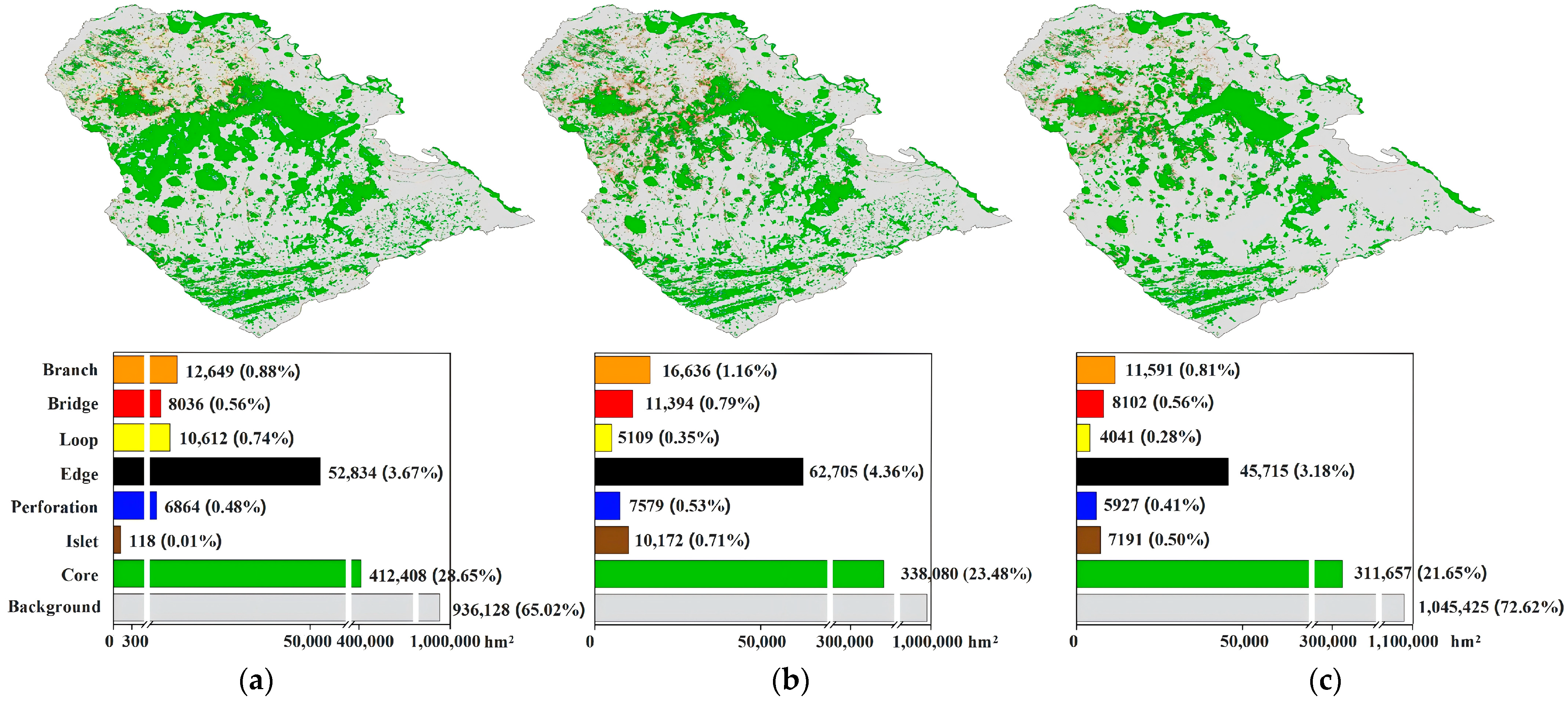
The MSPA results indicate that the core landscape pattern of the Chagan Lake study area changed noticeably between 2000 and 2020. Overall, the area of core landscape decreased continuously, while fragmentation became progressively stronger, implying that the integrity of ecologically significant patches weakened over time. The MSPA results for 2000, 2010, and 2020 are shown in Figure 2.
In 2000, the MSPA-derived initial core area of Chagan Lake measured 412,327.98 hm2, accounting for 28.6% of the study area. These core patches were concentrated mainly in the central part of the region and extended westward from Chagan Lake, forming a relatively continuous and extensive spatial pattern. Core patches were also present in the southern and northern sectors, but they were mainly arranged in elongated strips. In general, the central zone exhibited a relatively clustered pattern, whereas peripheral areas showed a more scattered and discontinuous distribution. The fragmented arrangement of peripheral patches likely increased ecological separation among landscape elements and constrained species movement, material circulation, and energy transfer at the regional scale.
By 2010, the initial core area had fallen to 338,002.29 hm2, or 23.5% of the total study area. Relative to 2000, the extent of ecologically important patches had clearly contracted. Meanwhile, the aggregation of core patches further declined. Residual core areas were concentrated mainly around Chagan Lake and in the southern part of the region, whereas only a small number of patches remained in the northwestern and eastern sectors. The simultaneous reduction in patch area and increase in spatial dispersion indicate that the continuity of the original ecological space was further disrupted and that the landscape moved toward a more fragmented configuration. Such change points to a weakening of ecological support capacity, particularly in areas distant from the lake-centered source region.
In 2020, the initial core area of Chagan Lake was 311,579.37 hm2, representing 21.6% of the study area. Compared with 2010, the overall spatial framework changed only slightly, suggesting that the broad structure of the landscape had become relatively stable. Even so, core-area boundaries were more strongly constrained by water bodies and forest patches, implying that natural ecological elements played an increasingly important role in maintaining the remaining core landscape. At the regional scale, core areas were distributed mainly around central Chagan Lake, northern Xinhuangpao, western Dabusu Lake, and southern Chagan Huapao, producing a more decentralized arrangement dominated by large lake-related ecological patches. This pattern indicates that the core landscape became increasingly dependent on major water bodies and adjacent vegetation patches, whereas ecological support in other parts of the region remained comparatively weak.
Taken together, the MSPA results indicate a two-stage evolution of the core landscape in the Chagan Lake region. From 2000 to 2010, the most evident change was the contraction and breakup of peripheral core patches, suggesting that ecological space in lake-margin transition zones and surrounding grassland matrices was especially vulnerable to cultivation, settlement expansion, and road disturbance [57]. From 2010 to 2020, the total core area continued to decline, but the overall spatial framework changed less markedly, indicating that the remaining ecological structure became increasingly anchored by major lake bodies and a limited number of relatively stable natural patches. This means that regional connectivity did not simply weaken uniformly; rather, the network became progressively more dependent on the main lake-centered ecological backbone, while ecological support in peripheral sectors continued to diminish. This trend is closely associated with the expansion of urban and agricultural land, which has encroached upon ecological space and interrupted the continuity of the original natural landscape [39,58]. This pattern is also closely related to the landscape structure of the Chagan Lake region itself. As a semi-arid lake-centered landscape with strong wetland–grassland–farmland interlacing, ecologically important patches are often distributed around lakes, low-relief transitional zones, and grassland matrices that are also attractive for cultivation, settlement expansion, and road construction [32]. Under these pressures, the continuity of lake-margin and grassland patches is more easily disrupted, causing contraction of core areas and stronger fragmentation, especially in peripheral zones farther from the dominant lake-centered source region. As a consequence, the ecological source foundation of the study area has become progressively less stable, potentially affecting regional landscape connectivity and the long-term maintenance of ecological processes. This fragmentation trend is broadly consistent with findings from other wetland and lake-basin regions experiencing land-use disturbance, where contraction of peripheral ecological patches and increasing dependence on dominant natural patches have also been reported [17,22,26,58].

3.1.2. Landscape Connectivity Assessment

Given that larger core patches usually exhibit stronger connectivity, and considering that the initial core areas in the Chagan Lake region are mainly distributed around the lake in a relatively scattered manner, only core patches larger than 50 km2 were selected for connectivity evaluation. The number of selected patches was 10 in 2000, 10 in 2010, and 8 in 2020. Using Conefor 2.6 with a connection threshold of 2500 m and a connection probability of 0.5, landscape connectivity was assessed for these patches. Patches with importance values greater than 0.5 were then identified as important ecological source areas. Their numbers were 5, 7, and 8 in 2000, 2010, and 2020, respectively. Overall, although the total area of core patches declined through time, the number of important ecological sources increased. This suggests that the ecological network became more differentiated in spatial organization. In other words, even as dominant ecological patches shrank, a larger number of patches gradually assumed essential roles in sustaining regional connectivity, indicating a shift from a structure dependent on a few large sources toward a more distributed source system.
As shown in Table 4, the largest important ecological source in 2000 accounted for 72.49% of the total ecological source area, far exceeding the corresponding proportions recorded in 2010 and 2020. In addition, both patch importance and overall landscape connectivity were above 90, indicating relatively strong structural connectivity and potentially favorable spatial conditions for species movement among patches. Of particular note, the east–west strip source patch (No. 2) associated with Chagan Lake is located in the middle of the study area and has a large, concentrated extent. This suggests that the core patch not only functions as an ecological source by providing habitat, but also contributes corridor-like functions that strengthen landscape connectivity.
The 2000 results therefore depict a connectivity structure dominated by a single large ecological source. Although this pattern contributed to high overall connectivity, it also means that the network at that stage relied heavily on a limited number of dominant source patches. Disturbance to, or reduction of, those major patches could therefore have undermined the stability of the whole network. From this perspective, the high connectivity observed in 2000 represented both an ecological advantage and a potential structural risk.
In the eastern and northern parts of the study area, the number of patches is limited, patch sizes are relatively small, and their spatial arrangement is highly dispersed, all of which contribute to weak landscape connectivity. By 2010, the number of important ecological sources had increased to seven, with new source areas appearing in both the northern and southern sectors. This improved overall connectivity and made the north–south linkage pattern more complete. Compared with 2000, the increase in source number indicates that the ecological support system became more spatially diversified. However, a larger number of sources does not necessarily imply better patch quality or larger patch size; rather, it suggests that under more fragmented landscape conditions, more patches began to play compensatory roles in preserving ecological linkage.
In 2020, one more important ecological source appeared in the central-western part of the study area compared with 2010, further improving ecological connectivity in that zone. This indicates that source support in the central and western parts of the region was somewhat strengthened, thereby helping maintain ecological flow between adjacent areas. Meanwhile, the increase in the important source number from seven to eight shows that the internal ecological structure of the study area continued to adjust, with more patches being incorporated into the regional connectivity system.
Nevertheless, no important ecological source areas were identified in the eastern and western margins of the Chagan Lake study area in either 2010 or 2020. This suggests that, despite some improvement in the internal organization of the ecological network, the distribution of important source areas remained uneven. In particular, the absence of source patches in the eastern and western edge zones limited the formation of continuous cross-regional ecological linkages and constrained the balanced development of overall landscape connectivity. Such spatial gaps may reduce the efficiency of species dispersal and ecological flow, especially in areas remote from the main lake-centered source region.
Overall, the connectivity assessment indicates a shift from a highly concentrated source structure in 2000 to a more compensatory and spatially dispersed configuration in 2010 and 2020. In 2000, high connectivity relied mainly on a few dominant sources, especially the large lake-related patch in the central part of the region. As these dominant patches shrank and fragmented, more medium-sized patches were incorporated into the connectivity system, which increased the source number but did not fundamentally strengthen the ecological base [59]. This explains why local linkage improved in some central and southern sectors while the eastern and western margins remained structurally weak: the network was being reorganized under fragmentation pressure rather than undergoing a uniform improvement. From a comparative perspective, this shift from a few dominant source patches toward a more compensatory but spatially uneven source system resembles connectivity adjustments reported in other wetland and basin-scale ecological network studies, although the Chagan Lake region exhibits a more pronounced lake-centered concentration and weaker east–west support than more homogeneous settings [22,60].

3.2. Construction of Ecological Corridor

After important ecological sources had been identified, the Minimum Cumulative Resistance model was used to build an integrated resistance surface for the study area. This surface provided the basis for evaluating how strongly the surrounding landscape constrained the outward expansion of important ecological sources. On that basis, the minimum-path approach was applied to extract optimal routes between major source areas, thereby establishing the initial ecological network. The numbers of general ecological corridors identified in 2000, 2010, and 2020 were 10, 21, and 28, respectively.
The increase in the number of general ecological corridors indicates that more potential linkages were formed among source patches as the number of important ecological source areas increased, thereby making the ecological network progressively more complex over time.
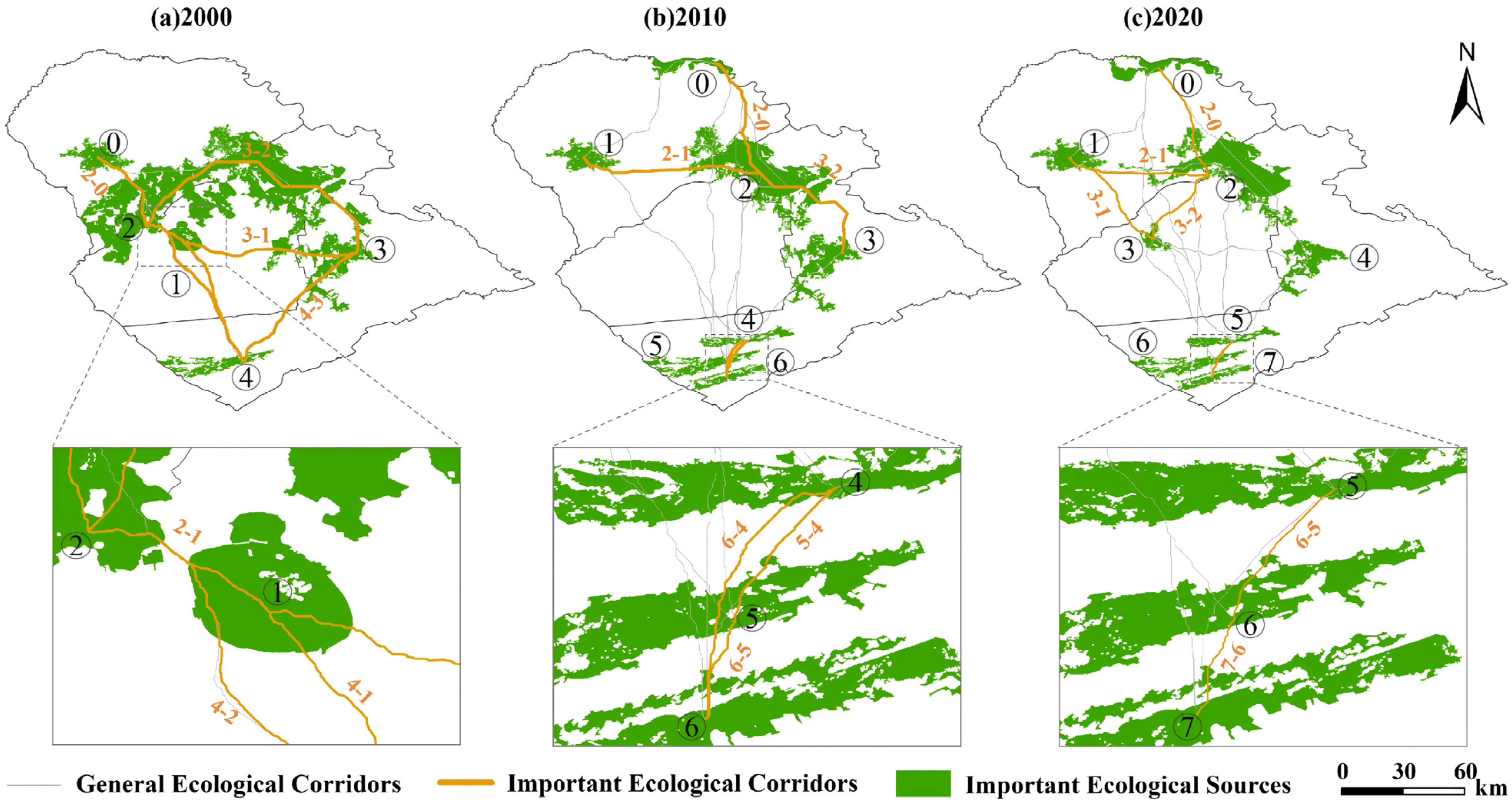
To further distinguish corridor importance, the gravity model was used to construct an interaction matrix that quantitatively describes connectivity intensity between major ecological source areas. As shown in Table 5, corridors with interaction values above 1000 were defined as important corridors for final analysis. The number of important ecological corridors was 7 in 2000, 6 in 2010, and 6 in 2020, and their spatial distributions are presented in Figure 3. The corresponding interaction relationships are reported in Table 5, and the important corridors identified in each year are further summarized in Table 6 according to their source-pair codes and brief structural roles.
According to Table 5, several source pairs in 2000 show exceptionally large interaction values. Examination of the original calculation results indicates that these values were mainly associated with source pairs connected by extremely low cumulative resistance paths in that year. Because the gravity model contains a squared resistance ratio term, very low cumulative resistance values ( L a b ) strongly amplify interaction intensity. This suggests that a few dominant source pairs in 2000 were connected by particularly low-resistance pathways and therefore exerted much stronger interactions than other pairs. Accordingly, the gravity values in Table 5 are more suitable for identifying important corridors within each year than for directly comparing absolute magnitudes among different years. These source areas not only represented important habitat-supporting patches, but also occupied structurally important positions in connecting different landscape components. The important corridors were derived mainly from ecological sources numbered 2, 3, and 4. Spatially, they were concentrated in the central and eastern areas around Chagan Lake and in the southern zone centered on Chagan Huapao. This clustered distribution limited ecological linkage in the northern, central-western, and eastern parts of the study area.
By 2010, the increase in important ecological sources in the northern and southern parts of the Chagan Lake study area enhanced ecological linkage and spatial continuity between these sectors. The interaction intensities of corridors 2–0, 2–1, 3–2, 5–4, 6–4, and 6–5 were much higher than those of other corridors, indicating that these six corridors had the greatest ecological significance. Among them, corridors 5–4, 6–4, and 6–5 were relatively short and clustered in the southern Chagan Lake area, where construction land was limited; as a result, they likely maintained comparatively high stability.
In 2020, the overall pattern of important corridors remained similar to that of 2010. However, the addition of an important ecological source in the central-western part of the region strengthened connectivity between northern and southern source areas and helped reduce fragmentation risks associated with spatial separation.
In summary, the ecological corridor network of the Chagan Lake study area became more complex between 2000 and 2020, but the increase in corridor number mainly reflected the rise in potential least-cost linkages generated by the growing number of source areas rather than a uniform improvement in corridor quality. The exceptionally high interaction values in 2000 were associated with a few dominant source pairs connected by extremely low-resistance paths, whereas in 2010 and 2020 the network contained more corridors but remained strongly concentrated around the main lake-centered source area and the southern lake-patch cluster. As a result, the regional corridor system evolved toward greater structural complexity, while the imbalance between the core lake zone and peripheral sectors persisted. These results provide an important basis for subsequent ecological network optimization. Similar tendencies have been observed in ecological corridor studies based on MCR and gravity-model approaches, in which corridor numbers may increase with source subdivision while effective corridor organization remains spatially uneven [26,27,33,51,56].

3.3. Ecological Network Optimization Approach

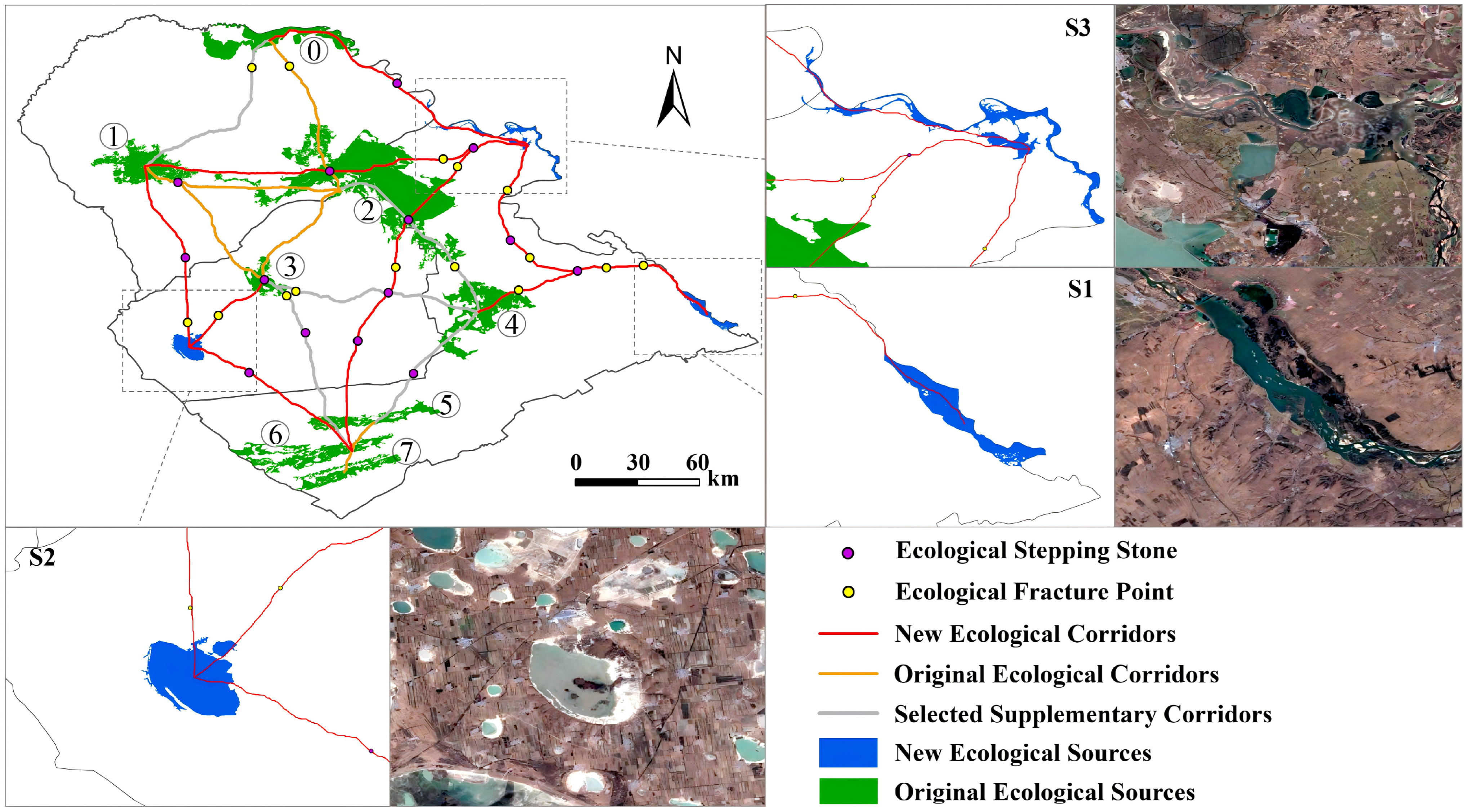
Considering both local conditions and the results of ecological network construction, this study optimized the ecological network from three perspectives: adding new ecological source areas, restoring ecological fracture points, and arranging ecological stepping stones. The optimization pattern is shown in Figure 4. Overall, the proposed scheme was designed to address the weak connectivity and spatial imbalance observed in the existing ecological network, especially in areas where source support and corridor linkage were insufficient.

3.3.1. Reasonable Addition of New Ecological Sources and Corridors

Weak connectivity in the eastern and western parts of the Chagan Lake study area is primarily related to the insufficient distribution of ecological source patches, which are fundamental to maintaining overall network connectivity. Accordingly, an important task in network optimization is to protect the existing key sources while supplementing new source patches in areas with weak ecological support. Candidate supplementary ecological sources were screened from MSPA core patches that were not included in the existing important source system. Selection was guided by four criteria: (1) relatively large patch area and better core-patch integrity; (2) location in sectors with weak source support, especially the eastern and western parts of the study area; (3) relatively low surrounding resistance and proximity to existing or potential corridor routes; (4) clear potential to reduce source isolation and strengthen cross-regional ecological linkage [61]. Based on these criteria, three patches with relatively high restoration and connection value were finally identified as supplementary ecological sources, covering a total of 12,042.63 hm2. The three supplementary ecological sources and their selection basis are summarized in Table 7.
After the three supplementary ecological sources were incorporated into the source system, least-cost paths were re-simulated on the integrated resistance surface established in Section 2.3.3. Additional corridors were retained when they effectively connected supplementary sources with nearby existing important sources or closed evident linkage gaps between weakly connected sectors. In total, eight additional ecological corridors were identified. Their function was to strengthen east–west linkage, improve peripheral connectivity, and reduce excessive dependence of the regional network on the dominant lake-centered source area. Among the additional corridors, C1 represents a continuous least-cost linkage segment passing through existing source 2 and connecting the northeastern supplementary source to the dominant source system. The connection relationships, lengths, retention basis, and optimization functions of the eight additional ecological corridors are summarized in Table 8.
Because the supplementary ecological sources are mainly located in ecologically weak sectors in the eastern and western parts of the study area, optimization should prioritize the restoration of low-relief lake-margin transition zones, degraded grassland patches, and small wetland spaces around these sources. In practical terms, this includes delimiting ecological buffer belts around the supplementary sources and their corridor approaches, restricting new reclamation and scattered construction within key linkage belts, restoring degraded patches with native wetland and grassland vegetation suited to the semi-arid lake environment, and prioritizing the conversion of cultivated land only in locations where corridor continuity is clearly interrupted. These measures are expected to improve source stability and enhance the feasibility of ecological linkage in peripheral sectors.

3.3.2. Restoration of Ecological Fracture Points

Intersections between transportation networks and ecological corridors are common locations where corridor disruption occurs; these locations are referred to as ecological fracture points [46]. Such anthropogenic disturbances can strongly interfere with ecological processes such as species movement and energy transfer, thereby weakening both the structural stability and the functional continuity of the ecological network. Restoring these fracture points is therefore necessary for maintaining regional ecological security and preserving uninterrupted ecological connectivity. Based on the road-network data, 15 ecological fracture points were identified in the Chagan Lake study area, mainly in the central, northern, and western parts of the region.
For fracture points located along existing corridors, the priority should be to reduce the barrier effect of roads at specific crossing locations rather than to rely on broad restoration statements. In practice, small ecological culverts or underpasses can be arranged at intersections between important corridors and major roads, accompanied by vegetation guidance belts, reduced hard-surface disturbance, and ecological fencing where necessary. In the eastern and western sectors where supplementary sources and corridors are proposed, road-crossing locations should be reserved in advance during planning, and construction control belts should be established on both sides of the corridor routes. For road sections near wetlands or lake-margin habitats, seasonal traffic regulation and warning measures may also be used to reduce disturbance during ecologically sensitive periods [62].

3.3.3. Stepping Stone Construction

Within ecological networks, longer corridors are generally more vulnerable to disturbance from external activities because species movement and ecological-flow transmission must occur over greater distances. For this reason, stepping stones—habitat patches with ecological functions similar to those of source areas—can be placed along long corridors as temporary resting and transition sites during migration. Their addition may improve the spatial conditions for species dispersal and movement, strengthen corridor stability, and help maintain a high level of connectivity across the overall ecological network [63,64].
Based on the newly supplemented ecological sources and corridors, this study identified and planned 14 ecological stepping stones by comprehensively considering the spatial arrangement of core-area patches and the locations where major corridors intersect. In the Chagan Lake region, stepping-stone construction should prioritize the use of existing small wetlands, pond margins, grassland patches, shelterbelts, and abandoned or low-efficiency cultivated land located along long corridors and at corridor intersections. Rather than creating entirely new habitat patches in all cases, restoration should focus on upgrading these existing landscape elements into small but functionally connected transition habitats. For the stepping stones planned at corridor intersections, restoration can emphasize native wetland and grassland vegetation, shallow-water retention where appropriate, and small habitat patches that match local hydrological and land-use conditions, so as to improve corridor continuity at relatively low ecological and management cost.
The arrangement of ecological stepping stones is an important component of overall ecological network optimization. By fully considering the ecological requirements and behavioral characteristics of different species, stepping-stone habitats along different corridors can be planned more precisely, thereby supporting a more targeted and scientifically grounded improvement of the ecological network [65].

4. Discussion

4.1. Ecological Network Construction and Its Significance for Ecosystem Stability

Ecological network construction is an effective spatial approach for mitigating fragmentation, maintaining habitat continuity, and supporting biodiversity conservation under rapid land-use change. By strengthening linkage among ecological source areas and corridors, it helps sustain organism movement, energy transmission, and material circulation across the landscape. In regions where ecological space is increasingly constrained by agricultural expansion, settlement growth, and infrastructure development, this framework provides an important basis for reconnecting fragmented landscape elements and improving ecological resilience.
For the Chagan Lake region, the significance of ecological network construction lies not only in identifying key ecological sources, corridors, and weakly connected sectors, but also in supporting ecological planning and management in a more spatially explicit way. Compared with approaches that focus only on isolated patches, the ecological-network perspective is more useful for revealing how regional ecological structure is organized and where restoration should be prioritized. In China, ecological network research has gradually formed a relatively clear analytical framework centered on ecological source identification, resistance-surface construction, and corridor extraction [23,66]. In this sense, ecological network analysis provides both a basis for understanding landscape organization and a practical framework for ecological protection, restoration, and spatial governance in lake-related environments.

4.2. Chagan Lake Ecological Network Analysis and Challenges

From 2000 to 2020, the Chagan Lake source area in the northeastern part of the study area remained the largest and most stable ecological source and continued to occupy the most important position in the regional network. The strongest corridors were also concentrated around this lake-centered source, indicating that the ecological structure of the region is organized around a dominant lake–wetland core. Maintaining and improving connectivity associated with this area is therefore important not only for habitat continuity, but also for supporting ecological exchange between lake margins and surrounding terrestrial patches.
From an ecological-process perspective, improving this structural network may enhance the spatial conditions for several key functions in the Chagan Lake region. Stronger linkage among major lake, wetland, grassland, and woodland patches may facilitate the habitat use and movement of wetland-associated and terrestrial fauna in areas where patch isolation currently limits ecological exchange [67]. In addition, improving corridor continuity and reducing fracture effects may help sustain organism dispersal as well as the transfer of energy and materials between lake-margin habitats and surrounding terrestrial ecological space [68]. The addition of supplementary sources and stepping stones may further reduce the interruption risk of ecological processes in sectors where long-distance linkage is especially vulnerable to human disturbance [64].
At the same time, the dominance of the Chagan Lake source area also reveals an important regional constraint: ecological support and corridor continuity are not evenly distributed across the study area. In several peripheral sectors, especially in the east and west, source patches are sparse, corridor density is low, and long-distance linkage remains vulnerable to road disturbance. In the Chagan Lake region, these structural weaknesses may be further aggravated by basin-specific ecological contradictions. Water-quality degradation processes such as eutrophication and agricultural non-point source pollution may weaken the ecological function of lake-margin habitats and reduce the quality of aquatic–terrestrial transition space that supports source stability and corridor continuity [6,69]. In addition, irrigation, drainage, and other water-conservancy interventions may alter regional hydrological conditions and affect the coordination between agricultural water use and wetland ecological maintenance [70]. Under such conditions, ecological network optimization depends not only on spatial linkage but also on maintaining the ecological function of water bodies, wetland margins, and associated transition habitats.
These findings suggest that the main challenge facing the Chagan Lake ecological network is not merely patch fragmentation, but also the uneven spatial organization of ecological elements across the region. Compared with more homogeneous wetland or watershed settings, the Chagan Lake region shows a more concentrated source–corridor structure shaped by a semi-arid lake–wetland–grassland–farmland mosaic and multiple human-use pressures [22,26,33,51]. The key task is therefore to reinforce peripheral source support, improve east–west linkage, reduce fracture effects in road-affected sectors, and maintain the stability of lake-margin ecological space. In this sense, the contribution of this study lies not in proposing a new algorithm, but in combining long-term comparison with region-specific ecological network optimization in a distinctive lake-centered landscape.

4.3. Management Priorities and Planning Implications for Local Departments

The optimization results provide a practical basis for ecological management in the Chagan Lake region. For natural-resource and spatial-planning departments, the priority is to incorporate supplementary ecological sources, key corridor belts, and stepping-stone areas into territorial spatial control and land-use coordination, especially in the eastern and western sectors where source support remains weak. For ecological-environment departments, management should focus on reducing water-quality pressure in lake-margin and wetland-adjacent areas, particularly where eutrophication risk and agricultural non-point source pollution may weaken the ecological function of source patches and corridor approaches. For water-management departments, greater attention should be paid to the effects of irrigation, drainage, and water-conservancy regulation on wetland continuity and riverside connectivity. For transportation departments, priority should be given to fracture-point restoration through corridor reservation, ecological crossing structures, and vegetation buffer design along key road sections.
Important ecological corridors around the main lake, wetland margins, and riverside habitats can be incorporated into existing wetland conservation, nature reserve management, territorial spatial planning, and ecological control frameworks [71,72,73,74,75]. By contrast, peripheral corridors in agricultural transition zones and road-affected sectors are less likely to be covered by reserve-type protection alone and therefore require cross-departmental coordination, project-level control, and targeted restoration. In practical terms, implementation should follow a differentiated zoning strategy rather than a uniform restoration model: the dominant lake-centered source area should remain under stricter protection, weakly connected peripheral sectors should be treated as restoration priorities, and agricultural transition areas should emphasize buffer belts, reduced scattered encroachment, and selective restoration where corridor continuity is interrupted. In this way, corridor protection and habitat restoration can be linked more directly to existing planning implementation and local ecological governance.

5. Conclusions

Based on the analysis of ecological network patterns in the Chagan Lake study area for 2000, 2010, and 2020, this study provides a long-term and county-scale perspective on ecological network evolution and optimization in a distinctive lake-centered region. It further proposes targeted strategies for optimizing the regional ecological network, mainly by supplementing ecological sources, repairing ecological fracture points, and constructing ecological stepping stones. Through these measures, landscape connectivity is expected to be improved, and regional ecosystem resilience and ecological stability may be further enhanced. More broadly, the findings suggest that ecological network optimization in lake-centered regions should not focus only on increasing corridor numbers. Greater attention should also be paid to maintaining dominant source stability, improving the spatial balance of source distribution, and strengthening weak links in peripheral sectors under region-specific disturbance conditions. This perspective may be useful for ecological planning in other lake regions facing similar tensions between ecological protection and land-use development. The main conclusions are as follows:
(1)
Important ecological source areas in the study area are composed mainly of large lakes together with extensive woodland and grassland core patches, and they are concentrated primarily in the central, central-western, northern, and southern parts of the region. Although the number of important ecological source areas identified under the same criteria increased over the past 20 years, their total area decreased steadily. External disturbances fragmented several areas that originally possessed strong ecological functions, causing continuous shrinkage in patch size and increasing fragmentation of ecological source areas. Under these circumstances, priority should be given to conserving and restoring the central ecological source areas, especially those centered on Chagan Lake.
(2)
The number of ecological corridors in the Chagan Lake study area increased continuously over time, in line with the rise in important ecological source areas. This trend improved overall landscape connectivity, especially in the north–south direction and in the central part of the region. Among the identified corridors, the route connecting Chagan Lake and Xinmiaobao with the large grassland area in Qianguo County showed the strongest connectivity. Its dominant landscape types are water bodies and grassland, which may provide important habitat conditions for many bird species and other wildlife.
(3)
While preserving the original ecological network framework, this study further developed a restoration and optimization scheme for the Chagan Lake ecological network by supplementing ecological sources and corridors, repairing ecological fracture points, and deploying stepping stones. These measures provide scientific support for coordinating ecological protection with urban development in future land-use planning. The newly added ecological source areas are mainly located in the eastern and western parts of the study area, which helps strengthen east–west spatial linkage and improve overall landscape connectivity. Through fracture-point repair and stepping-stone deployment, the ecological network can become more stable, achieve a better balance between development and conservation, and form a more integrated overall structure. In practical terms, these measures can support county-level planning, ecological restoration, road-crossing management, and the control of disturbance in weakly connected sectors. This also indicates that the practical value of ecological network optimization in the Chagan Lake region lies not only in improving structural connectivity but also in providing a spatial basis for corridor protection, conservation prioritization, and differentiated planning management under the existing county-level policy framework.
It should be noted that the ecological network identified in this study is a structural ecological network derived from landscape pattern, connectivity metrics, and resistance-surface analysis. Its main value lies in identifying the spatial organization of ecological sources and corridors and in providing a basis for regional ecological optimization. However, structural connectivity does not necessarily represent functional connectivity for all taxa in a lake–wetland system, and the resistance surface and corridor patterns are also influenced by the selected factors, weighting scheme, and level of local calibration. Future research should therefore integrate species distribution, habitat suitability, movement behavior, and representative wetland-dependent taxa, while also testing the stability of the resistance surface and corridor configuration under alternative weighting schemes and more detailed local calibration, so as to further refine the ecological significance and applicability of the identified network.


Author Contributions

Conceptualization, H.F. and J.Y.; methodology, H.F. and F.L.; software, F.L.; validation, D.G. and J.Y.; formal analysis, D.G. and F.L.; data curation, D.G.; writing—original draft preparation, H.F.; writing—review and editing, H.F.; visualization, J.Y.; funding acquisition, D.G. and J.Y. All authors have read and agreed to the published version of the manuscript.

Funding

This study was supported by the Scientific Research Project of the Education Department of Jilin Province (grant no. JJKH20251417KJ).

Data Availability Statement

Data will be made available on request.

Acknowledgments

The authors would like to thank all colleagues and friends who provided helpful comments on the translation and revision of this manuscript.

Conflicts of Interest

The authors declare no conflicts of interest.

References

  1. Li, T.; Wei, G.; Xu, M.; Li, D.; Deng, W.; Liu, Y.; He, B.-J. Spatio-Temporal Responses of Ecological Resilience to Urbanization in Five Great Lakes Regions (GLRs) in China and Implications for Building Resilient GLRs. Geogr. Sustain. 2026, 7, 100395. [Google Scholar] [CrossRef]
  2. Zhang, C.; Chen, W.; Huang, F. Determining the Suitable Ecological Water Level Based on the Response Relationship between Landscape Connectivity and Water Level: A Case Study of Poyang Lake, China. Ecol. Indic. 2025, 175, 113562. [Google Scholar] [CrossRef]
  3. Rahman, A.; Chen, Y.-X.; Lai, J.; Mohanty, R.K.; Khatoon, B.; Kashima, K.; Wang, L.-C. Shifting Drivers of Lake Ecology in Northern Taiwan over the Last 1800 Years: From Climate Variability to Human Land-Use Change. CATENA 2026, 263, 109738. [Google Scholar] [CrossRef]
  4. He, F.; Yang, J.; Zhang, Y.; Yu, W.; Xiao, X.; Xia, J. Does Partition Matter? A New Approach to Modeling Land Use Change. Comput. Environ. Urban Syst. 2023, 106, 102041. [Google Scholar] [CrossRef]
  5. Lou, Y.; Bian, J.; Sun, X.; Wang, F.; Xu, L.; Sun, G. Optimization of Ammonia Nitrogen Benchmarks and Ecological Risk Assessment in Monsoon Freezing Lakes Based on Species Sensitivity Distribution with Lake Chagan in Northeastern China as an Example. Ecol. Indic. 2024, 166, 112346. [Google Scholar] [CrossRef]
  6. Guo, J.; Xie, Y.; Dou, X.; Qi, W.; Liao, Y.; Cao, X.; Peng, J.; Liu, H. Combining Source Identification and Risk Assessment to Uncover Spatial Risk Patterns in an Agricultural Lake. J. Environ. Manag. 2025, 387, 125966. [Google Scholar] [CrossRef]
  7. Liu, Y.; Jing, Y.; Zhao, S.; Lu, P.; Han, S. Ecological Security Pattern and Simulation Prediction Based on Circuit Theory: A Case Study of the Nansi Lake Basin in China. J. Nat. Conserv. 2026, 89, 127137. [Google Scholar] [CrossRef]
  8. Chen, W.; Liu, H.; Wang, J. Construction and Optimization of Regional Ecological Security Patterns Based on MSPA-MCR-GA Model: A Case Study of Dongting Lake Basin in China. Ecol. Indic. 2024, 165, 112169. [Google Scholar] [CrossRef]
  9. Zhao, Y.; Ma, X. Multi-Objective Optimization of Ecological Security Patterns in the Weihe River Basin Based on Water-Carbon-Food Supply-Demand Balance Framework. Adv. Space Res. 2026, 77, 10240–10259. [Google Scholar] [CrossRef]
  10. Shu, R.; Ma, G.; Zou, Y.; Guo, N.; Su, H.; Zhang, G. Bibliometric Analysis of Ecological Security Pattern Construction: Current Status, Evolution, and Development Trends. Ecol. Indic. 2024, 169, 112754. [Google Scholar] [CrossRef]
  11. Fang, J.; Xu, L.; Lu, Q. Ecological Security Patterns of Chinese Lakes Based on Ecosystem Service Values Assessment and Human Threat Factors Evaluation. Ecol. Inform. 2024, 82, 102754. [Google Scholar] [CrossRef]
  12. Sun, H.; Yan, X.; Zhang, X.; Zhang, J.; Feng, T.; Qiao, R.; Yao, S.; Ren, Y.; Chen, Q. Long-Term Evolution of Land Resource Assets and Liabilities in Poyang Lake Basin Based on Ecological Footprint and Ecosystem Service Value Perspectives. Ecol. Inform. 2026, 95, 103730. [Google Scholar] [CrossRef]
  13. Qu, S.; Han, L.; Kuffer, M.; Li, L. Coupling Ecosystem Services with Machine Learning for Ecological Security Pattern Construction: Insights from Shaanxi Province, China. Ecol. Indic. 2026, 184, 114709. [Google Scholar] [CrossRef]
  14. Xin, J.; Yang, J.; Yu, H.; Ren, J.; Yu, W.; Cong, N.; Xiao, X.; Xia, J.; Li, X.; Qiao, Z. Towards Ecological Civilization: Spatiotemporal Heterogeneity and Drivers of Ecological Quality Transitions in China (2001–2020). Appl. Geogr. 2024, 173, 103439. [Google Scholar] [CrossRef]
  15. Wang, G.; Liu, J.; Wang, Z.; Xiang, Y.; Heng, C.K.; Li, X. Spatiotemporal Evolution and Interaction of Water Constraints and Their Socio-Ecological Drivers in the Taihu Lake Basin. Sci. Total Environ. 2024, 949, 175155. [Google Scholar] [CrossRef]
  16. Sun, C.; Fang, G.; Lu, Y.; Zhu, Z.; Deng, M.; Fang, G. Multiscale Spatiotemporal Evolution and Patterns of Riverine Ecological Security in Nanjing Yangtze River Basin. iScience 2026, 29, 115149. [Google Scholar] [CrossRef]
  17. Yaermaimaiti, A.; Li, X.; Ge, X.; Liu, C. Analysis of Landscape Pattern and Ecological Risk Change Characteristics in Bosten Lake Basin Based on Optimal Scale. Ecol. Indic. 2024, 163, 112120. [Google Scholar] [CrossRef]
  18. Lei, Y.; Liu, L.; Cui, Y.; Jiang, K.; Hao, S. Spatio-Temporal Dynamics and Coupling of Urban Expansion with Ecological Sensitivity in Chaohu Lake Basin. Remote Sens. Appl. Soc. Environ. 2026, 41, 101833. [Google Scholar] [CrossRef]
  19. Fu, S.; Zhang, J.; Li, Y.; Chen, W.; Zhang, Y.; Yi, K.; Dai, Y. Environmental Variables Affect the Effectiveness of Ecosystem Services of Ecological Restoration Project: Evidence from Xiangjiang River Basin-Dongting Lake. J. Clean. Prod. 2025, 527, 146739. [Google Scholar] [CrossRef]
  20. Das, M.; Das, A.; Singha, S. Development of a Comprehensive Framework for Wetland Ecosystem Assessment and Management. Geosci. Front. 2025, 16, 102036. [Google Scholar] [CrossRef]
  21. Guo, Z.; Zhu, C.; Fan, X.; Li, M.; Xu, N.; Yuan, Y.; Guan, Y.; Lyu, C.; Bai, Z. Analysis of Ecological Network Evolution in an Ecological Restoration Area with the MSPA-MCR Model: A Case Study from Ningwu County, China. Ecol. Indic. 2025, 170, 113067. [Google Scholar] [CrossRef]
  22. Luo, J.; Zhu, L.; Fu, H. Construction of Wetland Ecological Network Based on MSPA-Conefor-MCR: A Case Study of Haikou City. Ecol. Indic. 2024, 166, 112329. [Google Scholar] [CrossRef]
  23. Li, J.; Liang, L.; Chao, Y.; Wang, X.; Qiu, M.; Luo, P.; Zhu, Y. Construction of the Ecological Security Pattern of Mu Us Sandy Land on the Basis of the “Source—Resistance—Corridor” Theory. Ecol. Indic. 2025, 171, 113162. [Google Scholar] [CrossRef]
  24. Zhou, Y.; Yao, J.; Li, P.; Li, B.; Luo, Y.; Ning, S. Multilevel Green Space Ecological Network Collaborative Optimization from the Perspective of Scale Effect. Ecol. Indic. 2024, 166, 112562. [Google Scholar] [CrossRef]
  25. Yu, H.; Xiao, H.; Gu, X. Integrating Species Distribution and Piecewise Linear Regression Model to Identify Functional Connectivity Thresholds to Delimit Urban Ecological Corridors. Comput. Environ. Urban Syst. 2024, 113, 102177. [Google Scholar] [CrossRef]
  26. Wei, Q.; Halike, A.; Yao, K.; Chen, L.; Balati, M. Construction and Optimization of Ecological Security Pattern in Ebinur Lake Basin Based on MSPA-MCR Models. Ecol. Indic. 2022, 138, 108857. [Google Scholar] [CrossRef]
  27. Zhang, F.; Jia, Y.; Liu, X.; Li, T.; Gao, Q. Application of MSPA-MCR Models to Construct Ecological Security Pattern in the Basin: A Case Study of Dawen River Basin. Ecol. Indic. 2024, 160, 111887. [Google Scholar] [CrossRef]
  28. Wang, X.; Wen, Y.; Liu, X.; Wen, D.; Long, Y.; Zhao, P.; Liu, P.; Zhong, J. Protection Effect and Vacancy of the Ecological Protection Redline: A Case Study in Guangdong–Hong Kong–Macao Greater Bay Area, China. Remote Sens. 2021, 13, 5171. [Google Scholar] [CrossRef]
  29. Yinglan, A.; Wang, J.; Zeng, Q.; Wu, S.; Yan, L.; Liu, H.; Yang, Z.; Yang, Q.; Wang, L.; Hu, P. Optimization of Wetland Water Replenishment Process Based on the Response of Waterbirds in a Semi-Arid and Cold Region. Ecol. Indic. 2023, 156, 111142. [Google Scholar] [CrossRef]
  30. Wang, Y.; Yu, Q.; Avirmed, B.; Zhao, J.; Sun, W.; Liu, Y.; Cui, H.; Khishigjargal, M.; Oyuntuya, S.; Dambadarjaa, N.; et al. The Response of Ecosystem Services to Ecological Spatial Network Patterns in China’s Arid and Semi-Arid Regions. Ecol. Indic. 2025, 172, 113300. [Google Scholar] [CrossRef]
  31. Wan, Z.; Wu, H. Evolution of Ecological Patterns of Poyang Lake Wetland Landscape over the Last One Hundred Years Based on Historical Topographic Maps and Landsat Images. Sustainability 2022, 14, 7868. [Google Scholar] [CrossRef]
  32. Li, Z.; Jiang, Z.; Qu, Y.; Cao, Y.; Sun, F.; Dai, Y. Analysis of Landscape Change and Its Driving Mechanism in Chagan Lake National Nature Reserve. Sustainability 2022, 14, 5675. [Google Scholar] [CrossRef]
  33. Lu, Y.; Cheng, Q.; Wang, M. Construction and Evaluation of the Panjin Wetland Ecological Network Based on the Minimum Cumulative Resistance Model. Ecol. Model. 2025, 505, 111118. [Google Scholar] [CrossRef]
  34. Chen, J.; Chen, J.; Liao, A.; Cao, X.; Chen, L.; Chen, X.; He, C.; Han, G.; Peng, S.; Lu, M.; et al. Global Land Cover Mapping at 30 m Resolution: A POK-Based Operational Approach. ISPRS J. Photogramm. Remote Sens. 2015, 103, 7–27. [Google Scholar] [CrossRef]
  35. ASTER GDEM Validation Team ASTER Global Digital Elevation Model Version 2—Summary of Validation Results. Available online: https://www.earthdata.nasa.gov/s3fs-public/2026-01/Validation%20Summary%20Report.2011.pdf (accessed on 25 May 2026).
  36. Qin, J.; Dai, J.; Li, S.; Zhang, J.; Peng, J. Construction of Ecological Network in Qujing City Based on MSPA and MCR Models. Sci. Rep. 2024, 14, 9800. [Google Scholar] [CrossRef]
  37. Liu, J.; Chen, J.; Yang, Y.; You, H.; Han, X. Construction and Optimization of an Ecological Network in the Yellow River Source Region Based on MSPA and MCR Modelling. Int. J. Environ. Res. Public Health 2023, 20, 3724. [Google Scholar] [CrossRef] [PubMed]
  38. Gai, H.; Wu, B.; Wu, Y.; Ren, Z. Construction and Optimization of Ecological Network in Karst Regions under Rocky Desertification Disturbance: A Case Study of Qujing City, China. Ecol. Model. 2026, 512, 111389. [Google Scholar] [CrossRef]
  39. Ke, S.; Pan, H.; Jin, B. Identification of Priority Areas for Ecological Restoration Based on Human Disturbance and Ecological Security Patterns: A Case Study of Fuzhou City, China. Sustainability 2023, 15, 2842. [Google Scholar] [CrossRef]
  40. Wang, Z.; Shi, Z.; Zhu, W.; Mao, J.; Liu, S. Policy Orientations Reshape Landscape Connectivity in Mountainous Regions: Simulation and Spatial Optimization in Funiu Mountain Area in Central China. Glob. Ecol. Conserv. 2026, 66, e04105. [Google Scholar] [CrossRef]
  41. Wang, T.; Hu, H. Mapping Urban Heat Island Networks Using a Landscape Connectivity Approach: A Case Study of Nanjing. Sustain. Cities Soc. 2025, 132, 106800. [Google Scholar] [CrossRef]
  42. Zhang, Q.; Tang, F.; Chen, H.; Li, F.; Chen, Z.; Jiao, Y. Assessing Landscape Fragmentation and Ecological Connectivity to Support Regional Spatial Planning: A Case Study of Jiangsu Province, China. Ecol. Indic. 2024, 162, 112063. [Google Scholar] [CrossRef]
  43. Jin, B.; Geng, J.; Ding, Z.; Guo, L.; Rui, Q.; Wu, J.; Peng, S.; Jin, R.; Fu, X.; Pan, H.; et al. Construction and Optimization of Ecological Corridors in Coastal Cities Based on the Perspective of “Structure-Function”. Sci. Rep. 2024, 14, 27945. [Google Scholar] [CrossRef]
  44. Huang, X.; Wang, H.; Shan, L.; Xiao, F. Constructing and Optimizing Urban Ecological Network in the Context of Rapid Urbanization for Improving Landscape Connectivity. Ecol. Indic. 2021, 132, 108319. [Google Scholar] [CrossRef]
  45. Liang, G.; Niu, H.; Li, Y. A Multi-Species Approach for Protected Areas Ecological Network Construction Based on Landscape Connectivity. Glob. Ecol. Conserv. 2023, 46, e02569. [Google Scholar] [CrossRef]
  46. Song, S.; Wang, S.; Du, J.; Zhang, X. Karst Restoration Zoning Based on Fracture-Modified Minimum Cumulative Resistance Model and Ecological Network Resilience Assessment: A Case Study in Guizhou, China. Ecol. Eng. 2026, 223, 107842. [Google Scholar] [CrossRef]
  47. Sun, D.; Wu, X.; Wen, H.; Ma, X.; Zhang, F.; Ji, Q.; Zhang, J. Ecological Security Pattern Based on XGBoost-MCR Model: A Case Study of the Three Gorges Reservoir Region. J. Clean. Prod. 2024, 470, 143252. [Google Scholar] [CrossRef]
  48. He, H.; Yu, X.; Yu, H.; Ma, Z.; Luo, Y.; Liu, T.; Rong, Z.; Xu, J.; Chen, D.; Li, P.; et al. Suitable Habitat Evaluation and Ecological Security Pattern Optimization for the Ecological Restoration of Giant Panda Habitat Based on Nonstationary Factors and MCR Model. Ecol. Model. 2024, 494, 110760. [Google Scholar] [CrossRef]
  49. Mao, G.; Duan, X.; Niu, Z.; Xu, J.; Xiao, X.; Huang, X.; Chen, H.; Mehr, F.; Moti, R.; Qiao, Z. Application of Source-Sink Theory and MCR Model to Assess Hydrochemical Change Risk in Lhasa River Basin, Tibet, China. Environ. Impact Assess. Rev. 2023, 101, 107124. [Google Scholar] [CrossRef]
  50. Zhou, L.; Zhao, Y.; Zhu, C.; Shi, C. Route Selection for Scenic Byways in Karst Areas Based on the Minimum Cumulative Resistance Model: A Case Study of the Nanpan–Beipan River Basin, China. Ecol. Indic. 2024, 163, 112093. [Google Scholar] [CrossRef]
  51. Dai, L.; Liu, Y.; Luo, X. Integrating the MCR and DOI Models to Construct an Ecological Security Network for the Urban Agglomeration around Poyang Lake, China. Sci. Total Environ. 2021, 754, 141868. [Google Scholar] [CrossRef]
  52. Zhou, S.; Song, Y.; Li, Y.; Wang, J.; Zhang, L. Construction of Ecological Security Pattern for Plateau Lake Based on MSPA–MCR Model: A Case Study of Dianchi Lake Area. Sustainability 2022, 14, 14532. [Google Scholar] [CrossRef]
  53. Chen, S.; Ji, Z.; Lu, L. A Method for Identifying Key Areas of Ecological Restoration, Zoning Ecological Conservation, and Restoration. Land 2025, 14, 1439. [Google Scholar] [CrossRef]
  54. Knaapen, J.P.; Scheffer, M.; Harms, B. Estimating Habitat Isolation in Landscape Planning. Landsc. Urban Plan. 1992, 23, 1–16. [Google Scholar] [CrossRef]
  55. Wanghe, K.; Guo, X.; Wang, M.; Zhuang, H.; Ahmad, S.; Khan, T.U.; Xiao, Y.; Luan, X.; Li, K. Gravity Model Toolbox: An Automated and Open-Source ArcGIS Tool to Build and Prioritize Ecological Corridors in Urban Landscapes. Glob. Ecol. Conserv. 2020, 22, e01012. [Google Scholar] [CrossRef]
  56. Xiao, H.; Guo, Y.; Wang, Y.; Xu, Y.; Liu, D. Evaluation and Construction of Regional Ecological Network Based on Multi-Objective Optimization: A Perspective of Mountains–Rivers–Forests–Farmlands–Lakes–Grasslands Life Community Concept in China. Appl. Sci. 2022, 12, 9600. [Google Scholar] [CrossRef]
  57. Sun, Z.; Liu, Y.; Sang, H. Spatial-Temporal Variation and Driving Factors of Ecological Vulnerability in Nansi Lake Basin, China. Int. J. Environ. Res. Public Health 2023, 20, 2653. [Google Scholar] [CrossRef]
  58. Yang, J.; Shan, L.; Xi, J.; Li, X.; Ge, Q. Land Use Pattern Changes and Ecological Effects in Nansihu Wetland. Resour. Sci. 2014, 36, 856–864. [Google Scholar]
  59. Jiang, H.; Peng, J.; Liu, M.; Dong, J.; Ma, C. Integrating Patch Stability and Network Connectivity to Optimize Ecological Security Pattern. Landsc. Ecol. 2024, 39, 54. [Google Scholar] [CrossRef]
  60. Ru, Q.; Yang, X.; Liu, Y.; Wang, X.; Dai, C.; Shang, Y. Quantitative Assessment of Water-Related Ecological Security Patterns Based on Ecosystem Service Flows: A Case Study of Jilin Province, China. iScience 2026, 29, 114830. [Google Scholar] [CrossRef]
  61. Lan, Y.; Wang, J.; Liu, Q.; Liu, F.; Liu, L.; Li, J.; Luo, M. Identification of Critical Ecological Restoration and Early Warning Regions in the Five-Lakes Basin of Central Yunnan. Ecol. Indic. 2024, 158, 111337. [Google Scholar] [CrossRef]
  62. Xu, D.; Peng, J.; Jiang, H.; Dong, J.; Liu, M.; Chen, Y.; Wu, J.; Meersmans, J. Incorporating Barriers Restoration and Stepping Stones Establishment to Enhance the Connectivity of Watershed Ecological Security Patterns. Appl. Geogr. 2024, 170, 103347. [Google Scholar] [CrossRef]
  63. Ye, Y.; Chen, C.; Yu, C.; Sun, C.; Geng, S. Identifying Stepping-Stones within Small Wetlands in Highly Urbanized Areas and under Network Construction: A Case Study of the Guangdong–Hong Kong–Macao Greater Bay Area, China. Ecol. Indic. 2025, 176, 113622. [Google Scholar] [CrossRef]
  64. Luo, Y.; Wu, J.; Wang, X.; Peng, J. Using Stepping-Stone Theory to Evaluate the Maintenance of Landscape Connectivity under China’s Ecological Control Line Policy. J. Clean. Prod. 2021, 296, 126356. [Google Scholar] [CrossRef]
  65. Mu, H.; Guo, S.; Zhang, X.; Yuan, B.; Pan, X.; Xia, Z.; Pan, X.; Zhang, S.; Du, P. An Enhanced Ecological Network for Spatial Planning Considering Spatial Conflicts and Structural Resilience. Geogr. Sustain. 2026, 7, 100420. [Google Scholar] [CrossRef]
  66. Wu, S.; Shi, S.; Zhang, J. Evolution Analysis of Ecological Security Pattern in Forest Areas Coupling Carbon Storage and Landscape Connectivity: A Case Study of the Xiaoxing’an Mountains, China. Forests 2025, 16, 331. [Google Scholar] [CrossRef]
  67. Chen, X.; Zhu, B.; Liu, Y.; Li, T. Ecological and Risk Networks: Modeling Positive versus Negative Ecological Linkages. Ecol. Indic. 2024, 166, 112362. [Google Scholar] [CrossRef]
  68. Keith, K.M.; Potvin, M.K.; Saad, S.R.; Surasinghe, T.D. Temporal Shifts in Biological Community Structure in Response to Wetland Restoration: Implications for Wetland Biodiversity Conservation and Management. Diversity 2025, 17, 198. [Google Scholar] [CrossRef]
  69. Ge, Y.; Liu, X.; Chen, L.; Zhang, G.; Wu, Y.; Yang, X.; Yang, J. Attribution of Lake Eutrophication Risk to Anthropogenic Forcing Adjacent to the Agriculture Areas: A Case Study of Chagan Lake. Environ. Sci. Pollut. Res. 2023, 30, 112159–112172. [Google Scholar] [CrossRef]
  70. Meng, B.; Liu, J.; Bao, K.; Sun, B. Water Fluxes of Nenjiang River Basin with Ecological Network Analysis: Conflict and Coordination between Agricultural Development and Wetland Restoration. J. Clean. Prod. 2019, 213, 933–943. [Google Scholar] [CrossRef]
  71. Ma, Z.; Zhang, M.; Zhang, Z.; Liu, J.; Li, S.; Jiang, M. Interpretation of the Wetland Conservation Law of the People’s Republic of China. Wetlands 2023, 43, 58. [Google Scholar] [CrossRef]
  72. Qianguo Erluosi Mongolian Autonomous County People’s Congress Regulations of the Chagan Lake Nature Reserve of Qianguo Erluosi Mongolian Autonomous County. Available online: https://www.jlrd.gov.cn/jlsjk/202311/t20231102_8830343.html (accessed on 25 May 2026).
  73. Jilin Provincial Forestry and Grassland Administration Master Plan of Jilin Chagan Lake National Nature Reserve (2023–2032). Available online: https://jllc.jl.gov.cn/xxfb/xydt/dfdt/202409/t20240923_3300358.html (accessed on 25 May 2026).
  74. Liang, X.; He, J.; Jin, X.; Zhang, X.; Liu, J.; Zhou, Y. A New Framework for Optimizing Ecological Conservation Redline of China: A Case from an Environment-development Conflict Area. Sustain. Dev. 2024, 32, 1616–1633. [Google Scholar] [CrossRef]
  75. Du, F.; Gao, J.; Zuo, L.; Jiang, Y. Articulation of the Cross-Boundary Effects of China’s Ecological Conservation Redline Program: A Perspective on the Ecological Security Network and Ecological Radiation. Prog. Phys. Geogr. Earth Environ. 2023, 47, 487–505. [Google Scholar] [CrossRef]
Figure 1. Location and natural geography of the study area.
Land 15 01007 g001
Figure 2. MSPA results in the Chagan Lake region: (a) MSPA pattern in 2000 and the corresponding area (hm2) and percentage (%) of each MSPA class; (b) MSPA pattern in 2010 and the corresponding area (hm2) and percentage (%) of each MSPA class; (c) MSPA pattern in 2020 and the corresponding area (hm2) and percentage (%) of each MSPA class. Axis breaks were used in the bar charts to improve the readability of classes with much smaller areas.
Land 15 01007 g002
Figure 3. Distribution of ecological sources and corridors in the Chagan Lake region: (a) ecological sources and corridors in 2000; (b) ecological sources and corridors in 2010; (c) ecological sources and corridors in 2020. Enlarged views are provided to show local corridor configurations that are difficult to distinguish clearly at the full-map scale. The circled numbers (e.g., ①, ②, ③) denote the coded important ecological sources used in the corridor analysis.
Land 15 01007 g003
Figure 4. Ecological Network Optimization in the Chagan Lake Region. S1–S3 denote the three supplementary ecological sources, and the enlarged views are provided to show their local spatial configurations more clearly.
Land 15 01007 g004
Table 1. Data sources and preprocessing procedures used in this study.
Data TypeYear (s)Resolution/ScaleSourcePurposeProcessing
Land-use data2000, 2010, 202030 mGlobeLand30MSPA, land-use resistancereclassification, clipping, raster consistency
DEMstatic30 mGDEMV2elevation, slopeslope derivation, sink filling
Water bodies2000, 2010, 202030 mGlobeLand30distance to waterEuclidean distance raster
Roads2000, 2010, 2020vectorNational Geomatics Center of Chinadistance to roadsEuclidean distance
Settlements2000, 2010, 2020vectorResource and Environmental Science Data Platformdistance to residential areasEuclidean distance
Table 2. MSPA Landscape Types and Their Meanings.
Landscape TypesMeaning
CoreLarge habitat patches can serve as sources for multiple ecological processes and are therefore important for biodiversity conservation. In this study area, they are mainly represented by extensive forest patches.
IsletSuch patches are characterized by isolation and fragmentation, with little or no connection to adjacent patches, thereby exhibiting low connectivity and restricted potential for the exchange of materials and energy.
PerforationThe inner margin of a core area, serving as a transitional zone between the core patch and the surrounding background, and exhibiting obvious edge effects.
EdgeThe outer boundary of a core area, which forms a transitional zone between the core patch and the external background. It can reduce the influence of outside disturbance on the core area and therefore exhibits clear edge effects.
LoopA narrow structural connector that links different parts of the same core area and reflects internal continuity within that core patch.
BridgeA long and narrow structural connector linking two or more core areas and indicating potentially important structural linkage between adjacent core patches.
BranchIt is linked at a single end to an edge, perforation, bridge, or loop, while the other end remains unconnected.
Table 3. Resistance Factors and Weighted Grading Coefficients in the Study Area.
Primary Resistance FactorSecondary Resistance FactorFactor WeightResistance ClassRelative Resistance Value
TopographyA. DEM (m)0.15<1001
100–1502
150–3003
>3004
B. Slope (°)0.14<51
5–102
10–203
>204
C. Distance to Water (m)0.15<2001
200–5002
500–10003
>10004
Human ActivitiesD. Distance to Roads (m)0.14>9001
600–9002
300–6003
0–3004
E. Distance to Residential Areas (m)0.14>30001
2000–30002
1000–20003
<10004
Landscape TypeF. Land Use Type0.15Water, Forest Land; 1
Shrubland, Wetlands; 2
Cropland, Grassland; 3
Impervious Surfaces, Bare Land4
G. Landscape Type0.13Core, Bridge;1
Islet, Loop;2
Perforation, Edge;3
Branch, Background4
Table 4. Situation of Important Ecological Sources.
YearsNumberdIICdPCArea (hm2)Percentage of Total Ecological Source Area (%)
2000295.9196.04178,309.3572.49
316.4918.5832,144.1313.07
06.686.9813,392.095.44
14.835.6612,373.293.96
40.550.579747.455.03
2010278.3378.0771,648.6448.22
311.0010.9626,846.118.07
53.684.0112,373.298.33
12.742.7313,392.099.01
62.122.457118.014.79
01.321.329309.876.27
40.950.957883.735.31
2020278.1077.7862,735.6744.35
46.566.5318,178.3812.85
64.454.8411,944.088.44
14.354.3314,804.9110.47
03.893.8713,995.819.89
72.542.946823.444.82
51.201.207786.535.50
30.530.535183.193.66
Table 5. Gravity Model-Based Interaction Matrix among Important Ecological Sources.
2000
Source No.01234
0 726.15 1746.22 143.62 71.71
1 5.9754 × 10¹³ 1.4083 × 10¹² 1.6819 × 10¹²
2 1.7662 × 10¹² 1.5553 × 10¹²
3 7.9734 × 10¹¹
4
2010
Source No.0123456
0 629.50 1539.21 266.81 111.39 102.80 74.78
1 1231.86 203.61 134.20 134.06 93.76
2 1161.43 265.30 221.63 149.54
3 188.64 135.52 89.22
4 3976.12 1144.26
5 6736.10
6
2020
Source No.01234567
0 765.25 1184.26 555.56 162.96 98.87 96.39 69.12
1 1582.64 1389.24 155.73 124.06 122.50 84.80
2 2648.62 561.14 227.55 210.71 142.77
3 278.06 284.04 270.89 172.73
4 229.50 149.57 94.22
5 3452.09 974.40
6 5345.33
7
Rows and columns indicate important ecological source numbers.
Table 6. Summary of Important Ecological Corridors in 2000, 2010, and 2020.
YearCorridor CodeBrief Structural Role
20002–0maintains linkage between the dominant lake-centered source and an adjacent important source
20002–1represents one of the strongest structural linkages associated with the dominant central source
20003–1supports east–west structural continuity in the central part of the network
20004–1supports structural continuity between the central and southern source areas
20003–2strengthens linkage between the dominant central source and the eastern source system
20004–2strengthens linkage between the dominant central source and the southern source system
20004–3stabilizes structural linkage within the southern source cluster
20102–0maintains the dominant lake-centered corridor structure
20102–1maintains the dominant lake-centered corridor structure
20103–2supports north–south structural continuity in the central part of the network
20105–4stabilizes linkage within the southern source cluster
20106–4stabilizes linkage within the southern source cluster
20106–5stabilizes linkage within the southern source cluster
20202–0maintains the core lake-centered structural linkage
20202–1maintains the core lake-centered structural linkage
20203–1supports north–south structural continuity in the central part of the network
20203–2supports east–west structural continuity in the central part of the network
20206–5stabilizes linkage within the southern source cluster
20207–6stabilizes linkage within the southern source cluster
Table 7. Supplementary ecological sources and their selection basis.
Supplementary SourceLocationAreaCurrent Dominant Landscape TypeMain Selection BasisOptimization Function
S1Eastern sector3053.52 hm2riverine water body and associated riverside ecological patchlow surrounding resistance, located in an eastern weak-source sector, close to a corridor gapstrengthen eastern linkage and reinforce source support in the eastern sector
S2Western sector4533.57 hm2saline-lake ecological patch associated with Nilin National Geopark and Dabusu Salt Lakerelatively large lake-related core patch, high ecological potential, located in a western weak-source sector, close to a corridor gapimprove east–west connectivity and enhance western ecological support
S3Northeastern sector4455.54 hm2riverine water body and associated riverside ecological patchrelatively intact riverine core patch, low resistance, close to existing sources, high ecological potentialsupport source network balance and strengthen linkage in the northeastern sector
Table 8. Additional ecological corridors and their connection relationships.
New CorridorConnected SourcesLengthBasis for RetentionOptimization Function
C1Existing source 1—Existing source 2—New source S397.80 kmre-simulated least-cost linkage connecting the northeastern supplementary source with the existing dominant source systemstrengthen linkage between the northeastern sector and the main lake-centered source network
C2Existing source 0—New source S382.42 kmcloses a weak linkage gap between the northeastern supplementary source and an existing important sourceimprove peripheral connectivity in the northeastern sector
C3Existing source 4—New source S170.82 kmre-simulated least-cost path connecting the eastern supplementary source with an existing important source in a weakly supported sectorstrengthen eastern ecological linkage and reduce source isolation
C4New source S1—New source S395.57 kmestablishes linkage between two supplementary sources and complements the peripheral corridor structureimprove continuity between the eastern and northeastern sectors
C5Existing source 6—New source S3122.89 kmretained as an effective low-cost linkage between the northeastern supplementary source and the existing source systemreinforce long-distance linkage and reduce dependence on a single dominant route
C6Existing source 6—New source S255.37 kmre-simulated corridor connecting the western supplementary source with a nearby existing important sourcestrengthen western linkage and improve access of peripheral patches to the main network
C7Existing source 1—New source S262.08 kmcloses a western corridor gap through a supplementary source with relatively high ecological potentialimprove east–west connectivity and reinforce source support in the western sector
C8Existing source 3—New source S230.19 kmretained as a short and effective supplementary corridor in the western sectorenhance local corridor continuity and stabilize the western part of the network
Disclaimer/Publisher’s Note: The statements, opinions and data contained in all publications are solely those of the individual author(s) and contributor(s) and not of MDPI and/or the editor(s). MDPI and/or the editor(s) disclaim responsibility for any injury to people or property resulting from any ideas, methods, instructions or products referred to in the content.