Article

Spatiotemporal Interaction of Diverse Agricultural Business Entities and Arable Land Transfer: An Empirical Study of 30 Provinces in China During 2012–2020

1
College of Geography and Environment, Shandong Normal University, Jinan 250358, China
2
College of Land Science and Technology, China Agricultural University, Beijing 100193, China
*
Author to whom correspondence should be addressed.
Land 2026, 15(5), 827; https://doi.org/10.3390/land15050827 (registering DOI)
Submission received: 30 March 2026 / Revised: 10 May 2026 / Accepted: 11 May 2026 / Published: 13 May 2026

Abstract

To investigate the heterogeneous interactions between various agricultural business entities (abbreviated as ABEs, including farmers, cooperatives and enterprises) and agricultural land transfer (abbreviated as ALT) in China, this study constructs a spatial simultaneous equation model based on the GS3SLS method and applied to data from 30 provinces in 2012–2020. The results show the following: (1) ABEs and ALT demonstrate significant bidirectional positive correlations at the intra-regional level, especially among farmers, while cooperatives and enterprises exhibit more pronounced spatial spillover effects. (2) Despite overall positive correlations, negative interactions emerge in specific entities of some regions (e.g., central China’s ALT among farmers vs. central China’s ABEs among farmers, and eastern China’s ABEs among enterprises vs. neighboring ABEs among enterprises). Conversely, cooperatives maintain universally positive ABE-ALT interactions, peaking in central/western regions. (3) The co-development of ABEs and ALT exhibits temporal heterogeneity: the growth in the number of farmer ABEs lags behind their agricultural land transfer (ALT), whereas for cooperatives and agricultural enterprises, ALT lags behind their growth in numbers. This indicates that the relationship between agricultural operators (“human”) and land transfer (“land”) needs to be reconfigured. The heterogeneous interactive relationships revealed in this study provide a solid theoretical basis for formulating differentiated and precise policies on the transfer of agricultural land and the coordination of various operating entities, so as to efficiently promote agricultural modernization.

1. Introduction

In the process of global agricultural modernization, developed countries in Europe and North America have been transitioning toward knowledge-intensive and ecologically sustainable advanced agricultural models, whereas developing countries such as China and India remain in the process of shifting from subsistence farming to market-oriented agriculture [1,2]. These divergent development trajectories have led to varying degrees of differentiation among Agricultural Business Entities (ABEs). For instance, France’s agricultural technical coordination associations exhibit a high level of market competitiveness [3], Germany, historically the birthplace of agricultural cooperatives, has gradually evolved toward a predominantly family-based farming structure [4], the United States has long maintained a large-scale farm-dominated production system [5], and Japan’s agricultural cooperatives have sustained a model centered around “core farmers” and production-oriented cooperative organizations [6]. Unlike these countries, China’s agricultural development has been shaped by its unique national conditions. Since the implementation of the Household Responsibility System in 1978, China has developed a production structure characterized by a large number of smallholder farmers with limited per capita farmland, making large-scale agricultural land transfer challenging (land transfer means that the land management rights are transferred from farmers to other land users by leasing or other methods, but farmers retain the land contracting rights, and the village collective retains the land ownership). These fragmented land rights increase the negotiation costs of agricultural land transfer (abbreviated as ALT), and introduce uncertainties in the development of cooperatives, agri-enterprises and other new ABEs. Since 2013, policies such as the annual No. 1 Central Documents have continuously supported new agricultural business entities and strongly promoted the coexistence and development of diverse agricultural business entities (ABEs), thereby laying a solid foundation for agricultural modernization [7].
Agricultural land transfer (ALT) and the development of ABEs are deeply interrelated. Since the reform and opening-up, the Household Responsibility System has advocated for “allocating production to individual households with self-responsibility for profits and losses,” breaking the “tragedy of the commons” that characterized the collective farming period and significantly enhancing farmers’ productivity and farmland efficiency. This, in turn, gave rise to ALT, which has primarily taken two forms. The first involves transfers among farmers. With rapid urbanization, a large influx of farmers moving into cities for non-farm work during the 1990s led to a rural labor shortage, promoting feasible ALT between farmers. However, these transfers were often informal, occurring through oral agreements or at no cost, with limited scale and speed (by 1997, only 3.16 million households, accounting for 1.2% of all farming households, had engaged in land transfers, covering merely 1.02 million hectares, or 1.2% of the total contracted farmland [8]. The second type involves land transfers from farmers to new ABEs. The rapid expansion of new ABEs has generated large-scale demand for farmland, making such transfers more standardized, larger in scale, and faster in pace than transfers among farmers, often taking the form of subcontracting, exchange, or outright transfer (by 2023, the total transferred farmland in China had reached 45.33 million hectares, with 45% of it allocated to new ABEs) [9]. Various forms of land transfer have deepened the complex transformation of China’s farmland management methods.
The bidirectional relationship between ABEs and ALT is evident but complicated. Scholars generally hold a positive view of interactions between ABEs and ALT. Some suggest that the development of ABEs serves as a driving force for ALT: government initiatives, such as farmland ownership confirmation mechanisms, have enhanced the entrepreneurial enthusiasm of new ABEs, thereby stimulating the speed of ALT [10]. Meanwhile, rural labor migration to cities in the urbanization process has reduced the number of smallholders, creating opportunities for the expansion of new ABEs and promoting ALT between farmers and emerging ABEs. Others contend that ALT is a crucial prerequisite for the development of diversified agricultural entities: many land consolidation projects across China aim to create contiguous farmland, establishing the fundamental conditions for large-scale agricultural operations, and thereby facilitating extensive ALTs to support the growth of new ABEs [11]. Furthermore, policy incentives, ALT intermediary services, and social security support for farmers have enhanced the efficiency of ALT, removed barriers for new ABEs, and provided standardized pathways for their development [12,13,14]. Therefore, there might be a complex two-way interactive relationship between ABEs and ALT, rather than a simple situation where one causes the other. Exploring the two-way temporal and spatial interactions between them is of great significance for improving land allocation and cultivating agricultural entities.
The mechanism underlying the bidirectional interaction between ALT and ABEs has not been fully elucidated, possibly due to the following reasons. First, the synergistic evolution of diverse agricultural business entities is a dynamic process. Under multiple constraints—such as land resources, market access, and information asymmetry—ABEs are driven by competitive mechanisms, resulting in a dynamic evolutionary pattern in which dominant entities expand while weaker ones are phased out [15]. Simultaneously, the ALT associated with different ABEs undergoes continuous restructuring. Second, due to differences in lease terms, cropping structures, and use regulations stipulated in farmland transfer contracts, ALT is not in a stable equilibrium but rather exhibits fluctuating characteristics, which in turn induce corresponding structural changes among various ABEs [16]. As a result, the spatiotemporal between multiple ABEs and ALT has high complexity and is still unknown. As a result, this study constructs a spatial simultaneous equation model incorporating different types of ABEs and ALT in China during 2012–2020, and aims to address the following questions:
(i)
How does the bidirectional interaction between agricultural land transfer (ALT) and the evolution of agricultural business entities (ABEs) vary across different entity types and regions?
(ii)
Are the development trajectories of ABEs and ALT synchronized, or do they exhibit temporal asynchrony that depends on entity type?
(iii)
Can the effects of ALT and ABE development extend across regional boundaries, and do such spatial spillovers differ by entity type?
Answering these questions is of critical academic and practical significance. It will provide insights into how to achieve the coordinated development of the rapidly changing agricultural business entity system and arable land transfer, inform targeted policy design, and contribute to the establishment of an agricultural modernization framework suited to similar national conditions.

2. Theoretical Analysis and Research Framework

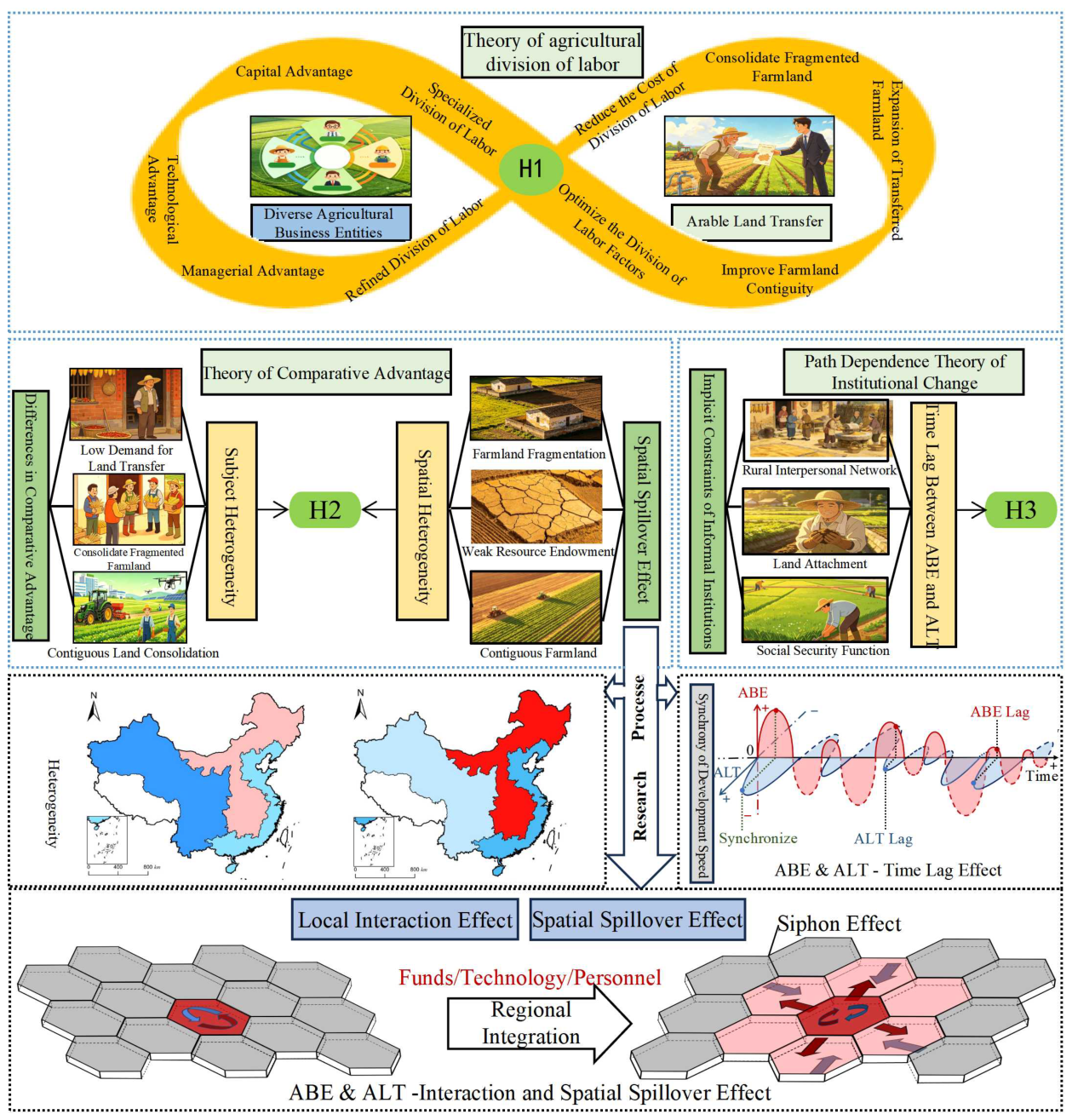
The theoretical framework of this study is built upon the bidirectional relationship between ABEs and ALT, which generates the spatiotemporal interaction between the two (Figure 1). Specifically, this study integrates the theory of the agricultural division of labor, the theory of comparative advantage, and the path-dependence theory of institutional change to elucidate the dynamic evolution and interaction mechanisms between ABEs and ALT.
Based on the theory of agricultural division of labor, the deepening of the division of labor constitutes the core driving force of agricultural economic development. The realization of the agricultural division of labor depends on the optimal allocation of production factors and the cultivation of specialized business entities. The bidirectional relationship between the quantitative growth of diversified agricultural business entities (ABE) and the expansion of arable land transfer (ALT) area is, in essence, an inevitable outcome of factor synergy and division-of-labor complementarity in the process of the deepening agricultural division of labor. The theory of agricultural division of labor posits that, with the development of social productivity, agricultural production gradually evolves from fragmented operations by individual smallholders into a specialized and refined division-of-labor system, in which different business entities undertake different production segments, forming an efficient collaborative network of the division of labor [17]. As the core carriers of the deepening agricultural division of labor, the increasing number of ABEs signifies the continuous enrichment of specialized division-of-labor entities. By leveraging their respective advantages in capital, technology, and management, these entities specialize in different segments such as large-scale planting, agricultural machinery services, and agro-processing. To achieve this, they inevitably need to consolidate fragmented land resources through ALT, thereby matching land factors with operational factors to meet the demands of large-scale and specialized operations, which in turn drives the expansion of the ALT area. Conversely, the expansion of ALT area and the improvement in land contiguity can break down barriers to fragmented operations, reduce the transaction costs of the agricultural division of labor, provide stable and concentrated land factor support for ABEs, promote their further specialization and scale development, attract more entities to enter the market, and thereby facilitate the sustained quantitative growth in ABEs. This factor complementarity and mutual support under the deepening division of labor determines that the quantitative growth of ABEs and the expansion of ALT area do not constitute a unidirectional driving relationship, but rather a mutually reinforcing and mutually empowering bidirectional relationship. Accordingly, Hypothesis 1 is proposed:
H1. 
There exists a bidirectional relationship between the quantitative development of ABEs and the development of ALT.
From the perspective of operational logic, the quantitative expansion of ABEs serves as a precondition; only when business entities reach a certain scale does large-scale and intensive demand for ALT arise. In turn, the maturation of the ALT market and the expansion of the transfer scale provide land factor support for the sustained development of business entities. However, according to the path-dependence theory of institutional change proposed by Douglass North [18], institutional evolution is profoundly shaped by initial historical conditions and prior institutional arrangements. In the context of this study, ALT is subject to the “implicit” constraints of informal institutions long embedded in rural society, such as the rural interpersonal networks of local society, farmers’ land attachment, and the social security function of land for rural households. Even when the number of ABEs begins to grow, farmers’ willingness to transfer out their land is subject to a period of wait-and-see, and the construction and improvement of ALT markets involve long cyclical processes; large-scale contiguous farmland transfer still requires substantial time and negotiation costs. Therefore, the quantitative growth in ABEs may not instantly and synchronously drive a rapid increase in ALT; the response process of ALT lags behind the quantitative development of ABEs, making it difficult to form a synchronized coupling relationship between the two, characterized by temporal mismatch and a lagged feature. Hence, Hypothesis 2 is proposed:
H2. 
There exists a time lag between the development of ABEs and the development of ALT.
Based on Ricardo’s theory of comparative advantage [19], the differences in comparative advantage among different agricultural business entities and different regions determine that the bidirectional relationship between the quantitative growth in ABEs and ALT area exhibits significant heterogeneity. According to the theory of comparative advantage, economic agents and regions choose their optimal development paths based on their own advantages, thereby leading to differentiated interactions between entities and farmland. From the perspective of business entity heterogeneity, smallholders, farmer cooperatives, and agricultural enterprises possess distinct comparative advantages: smallholders specialize in moderate-scale grain cultivation and have relatively low demand for ALT; cooperatives excel at organizing farmers and consolidating fragmented farmland, exerting a more synergistic pull on ALT; agricultural enterprises, leveraging their advantages in capital and technology, favor large-scale contiguous ALT, and their interaction with ALT is more selective and scale-oriented. From the perspective of regional heterogeneity, in eastern plain areas where farmland is contiguous and agricultural marketization is high, the comparative advantages of business entities and ALT are more easily matched, resulting in a more robust bidirectional relationship; in central and western regions where farmland is fragmented or agricultural resource endowments are weak, matching the comparative advantages of entities and farmland is more difficult, and the bidirectional relationship may be weaker. Nevertheless, the factor allocation pattern and transfer model of one region may generate spatial spillover effects on neighboring areas through channels such as cross-regional factor flows. This differentiation of comparative advantage at both the entity and regional levels, compounded by spatial spillover transmission across regions, renders the bidirectional relationship significantly heterogeneous. Accordingly, Hypothesis 3 is proposed:
H3. 
The bidirectional relationship between ABEs and ALT exhibits significant business entity heterogeneity and regional heterogeneity. Simultaneously, there exists a certain spatial spillover effect in this relationship.

3. Research Methods and Data Sources

3.1. Spatial Simultaneous Equation Model

3.1.1. Model Design

A single-equation model would struggle hard to account for the bidirectional interaction between ABEs and ALT, while a conventional simultaneous equation model cannot capture the spatial spillover effects. To address these limitations, this study constructs a spatial simultaneous equation model for ABEs and ALT to examine their bidirectional interaction and spatial spillover effects [20].
A B E i , t = β 0 + β 1 i j W i , j A L T j , t + β 2 i j W i , j A B E j , t + β 3 A L T i , t + β X i , t + ε i , t
A L T i , t = α 0 + α i j W i , j A L T j , t + α 2 i j W i , j A B E j , t + α 3 A B E i , t + α Z i , t + η i , t
Equation (1) represents the ABE equation, and Equation (2) represents the ALT equation. Here, A B E denotes the number of ABEs, and A L T refers to the area of land transferred to each kind of ABE. X and Z are control variables for Equations (1) and (2), respectively; ε and η are random error terms; i and j denote codes of different provinces; and t represents the year. W is the spatial weight matrix, selected to capture spatial spillover effects arising from geographic proximity between provinces. Given the potential for such effects, this study employs a geographical adjacency matrix as the spatial weight matrix to characterize inter-provincial spatial relationships [21].

3.1.2. Data Sources and Variable Description

The data used in this study are primarily obtained from the China Rural Management Statistical Yearbook and the China Statistical Yearbook, covering 30 provinces from 2012 to 2020. All data are publicly available data. Given that the large-scale promotion of new ABE in China began around 2013, the period from 2012 to 2020 was chosen as the study timeframe. The dataset includes the following variables:
  • The Count of Various Agricultural Business Entities (ln_ABE): This indicator includes lnABE_(F), lnABE_(C), and lnABE_(E). ABEs for farmers (lnABE_(F)) are derived from the “Total Number of Farmers” in the China Rural Management Statistical Yearbook. The numbers of cooperatives (lnABE_(C)) and enterprises (lnABE_(E)) are obtained by extracting POI data from the Gaode Map API for 2012–2020 and aggregating them at the provincial level.
  • The Transfer Area of Arable Land (ln_ALT): This indicator includes lnALT_(F), lnALT_(C), and lnALT_(E), which respectively represent the area of arable land transferred to farmers, cooperatives, and enterprises. The data is obtained from the China Rural Management Statistical Yearbook.
  • Control Variables: To mitigate model bias caused by omitted variables, control variables are selected for both the ABE equation (1) and the ALT equation (2). Control variables for the ABE equation mainly consider factors related to farmers and agri-business environment, including the regional level of agricultural development (ln_Dev), the level of institutional guarantee for farmland transfer (ln_Ins), the level of agricultural modernization (ln_Mod), and the radiation intensity of new agricultural business entities (ln_Rad). Control variables for the ALT equation mainly include factors related to agri-economic environment and policies, including the farmland transfer equation, the stability of land rights (ln_Sta), the level of transportation convenience (ln_Tra),and the mobility of population factors (ln_Pop) (Table 1).
To compress the extreme value differences in certain variables and reduce potential dimensional conflicts among them, this study performed a logarithmic transformation on the above variables.

3.2. Spatial Gravity Model

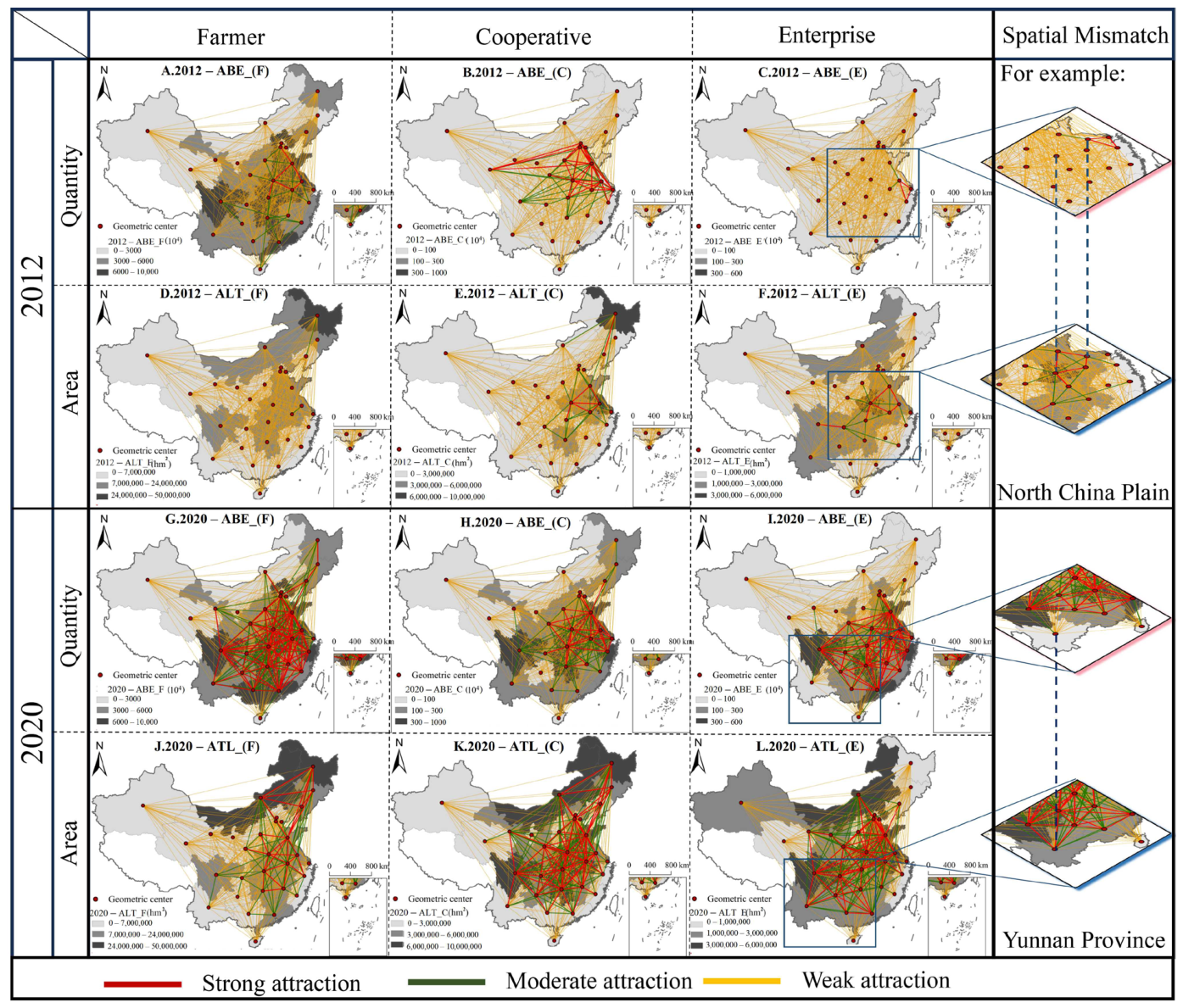
This study employs the gravity model to depict the spatial agglomeration patterns of ABEs and ALT [22]. Originally designed to explain spatial interactions and regional linkages, the gravity model posits that the intensity of the interaction between two regions is proportional to their economic scale and inversely proportional to their spatial distance. This has been widely applied to measure the spatial distribution and mobility potential of agricultural production factors, shedding light on factor agglomeration across different regions. The basic form of the gravity model is as follows:
F i j = G · M i · M j D i j β
F i j represents the intensity of the gravitational attraction between ABEs or ALT in regions i and j ; M i and M j denote the respective ABE or ALT scales in these regions; and D i j represents the spatial distance between regions i and   j , calculated as the straight-line geographic distance between the geometric centers of regions i and   j . β is the distance decay coefficient, reflecting the impact of spatial distance on attraction strength, and G is the gravitational constant, which adjusts for differences in variable magnitudes. To highlight the primary effects of regional scale and distance on gravitational intensity, G and β are set to 1. To address unit differences, M i and M j are normalized using the following formula:
M = M min M max M min M
M represents the normalized value, M is the original value, and min ( M ) and max ( M ) denote the minimum and maximum values within the sample.
Using the computed F values, this study employs ArcGIS 10.8 for network topology visualization, revealing the spatial linkages among ABEs and ALT in China. These findings provide theoretical insights for optimizing the spatial allocation of agricultural resources and improving land use efficiency.

3.3. Tapio Model

An improved Tapio model is applied to examine the time-lag effect in the relationship between ABEs and ALT [23]. Widely used to assess the relationship between economic growth or structural changes and resources or environmental factors, the Tapio model determines whether the two variables exhibit synchronized growth or relative independence.
The decoupling elasticity indicator is constructed as follows:
E = Δ A B E / A B E Δ A L T / A L T
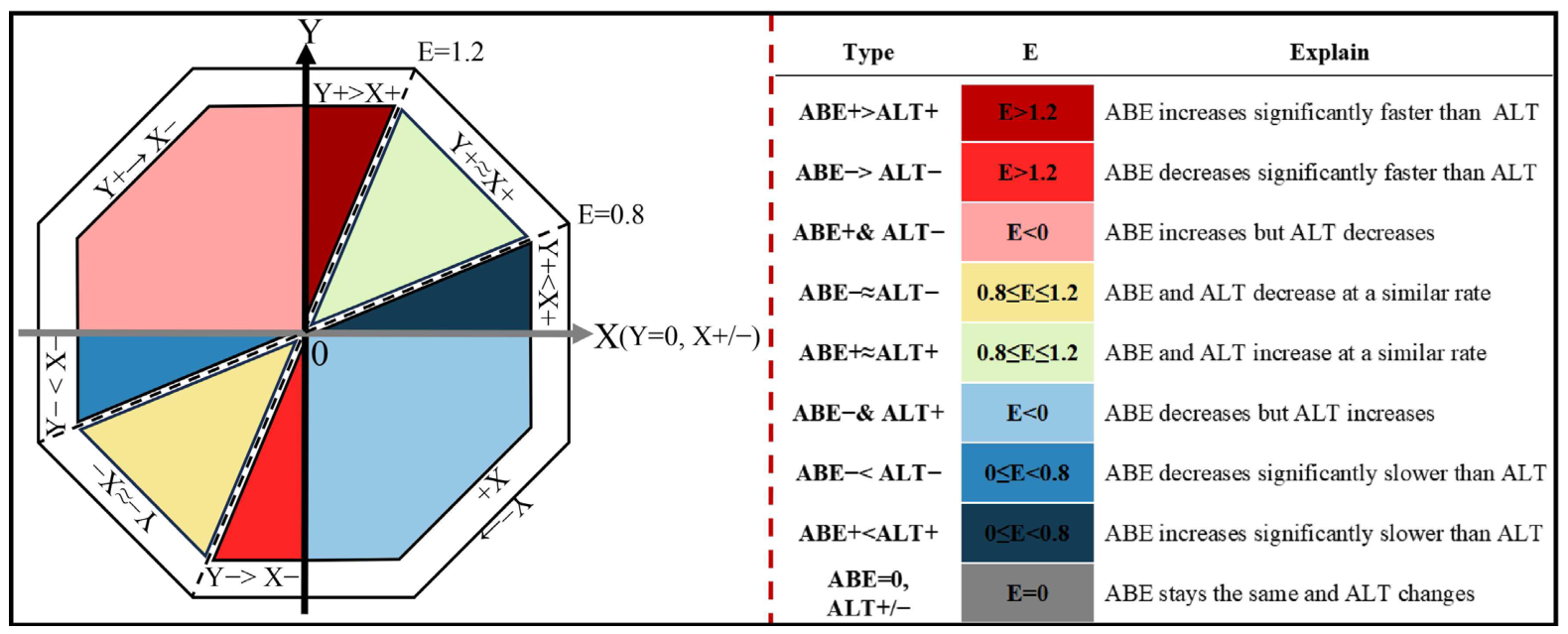
E represents decoupling elasticity; Δ A B E and Δ A L T indicate changes in ABEs and ALT over a given period; A B E and A L T represent their respective baseline values. E is classified into the following categories: “ABE+ > ALT+”, “ABE− > ALT−”, “ABE+ → ALT−”, “ABE− ≈ ALT−”, “ABE+ ≈ ALT+”, “ABE− → ALT+”, “ABE− < ALT−”, “ABE+ < ALT+”, and “ABE = 0, ALT+/−”—each reflecting varying degrees of time-lag effects (Figure 2).

4. Results

4.1. Analysis of Development Trends in ABEs and ALT

From 2012 to 2020, the number of different ABEs grew significantly, with a notable increase in strong interregional gravitational forces (Figure 3A–C,G–I). By 2020, the gravitational distribution among farmers was relatively uniform (Figure 3G), with densely concentrated, strong gravitational forces in the eastern (e.g., Jiangsu, Zhejiang, and Shandong) and central provinces (e.g., Henan and Hunan). The substantial gravitational pull among these provinces suggests a high concentration of farmers and a stronger spatial aggregation. This could be attributed to the dense population and developed economical level in the eastern regions, where the large number of farming households fosters significant spatial clustering. The gravitational pull among cooperatives was strongest in the eastern region (Figure 3H), particularly across the North China Plain and the middle–lower reaches of the Yangtze River Plain. This is likely because cooperatives, as a new type of agricultural business entity, tend to be concentrated in areas with high agricultural intensification on densely distributed arable land resources, forming relatively clustered agricultural cooperative economies. The gravitational pull among enterprises was predominantly concentrated in the economically developed south–central provinces (Figure 3I), as the development of enterprises mainly relies on agricultural industrialization and a well-developed market economy, which are more prevalent in regions with favorable market conditions.
The changes in ALT in 2012 and 2020 are shown in Figure 3D–F,J–L. A higher ALT and the strongest gravitational pull among farmers was observed in the eastern and northeastern regions (Figure 3J). This can be attributed to the flat terrain and high population density in the east, which promote active ALT in eastern provinces, and the benefits of abundant farmland resources and fertile black soil resources led to high-intensity ALT facilitation in the northeastern provinces. The ALT among cooperatives was more widely distributed (Figure 3K), likely due to their larger scale and greater demand for farmland, which reduces interprovincial disparities in ALT, resulting in a broad range of high-value clustering. The ALT of enterprises and their higher gravitational pull was highly concentrated in the central region (Figure 3L), with additional high-value clusters emerging in Inner Mongolia, Shandong, Henan and Sichuan Provinces, etc. This is because enterprises require a rather high threshold of land resources, and these regions provide abundant farmland reserves, creating a conducive environment for their development.
As shown in the example on the right side of Figure 3, a spatial mismatch exists between ABE and ALT. The spatial distribution of the high-value area in terms of the number of farmers is much wider than the cultivated land circulation, while the opposite is true for cooperatives. Only enterprises exhibit a well-aligned distribution between their numbers and transferred farmland.

4.2. Lagged Effects of ABEs and ALT

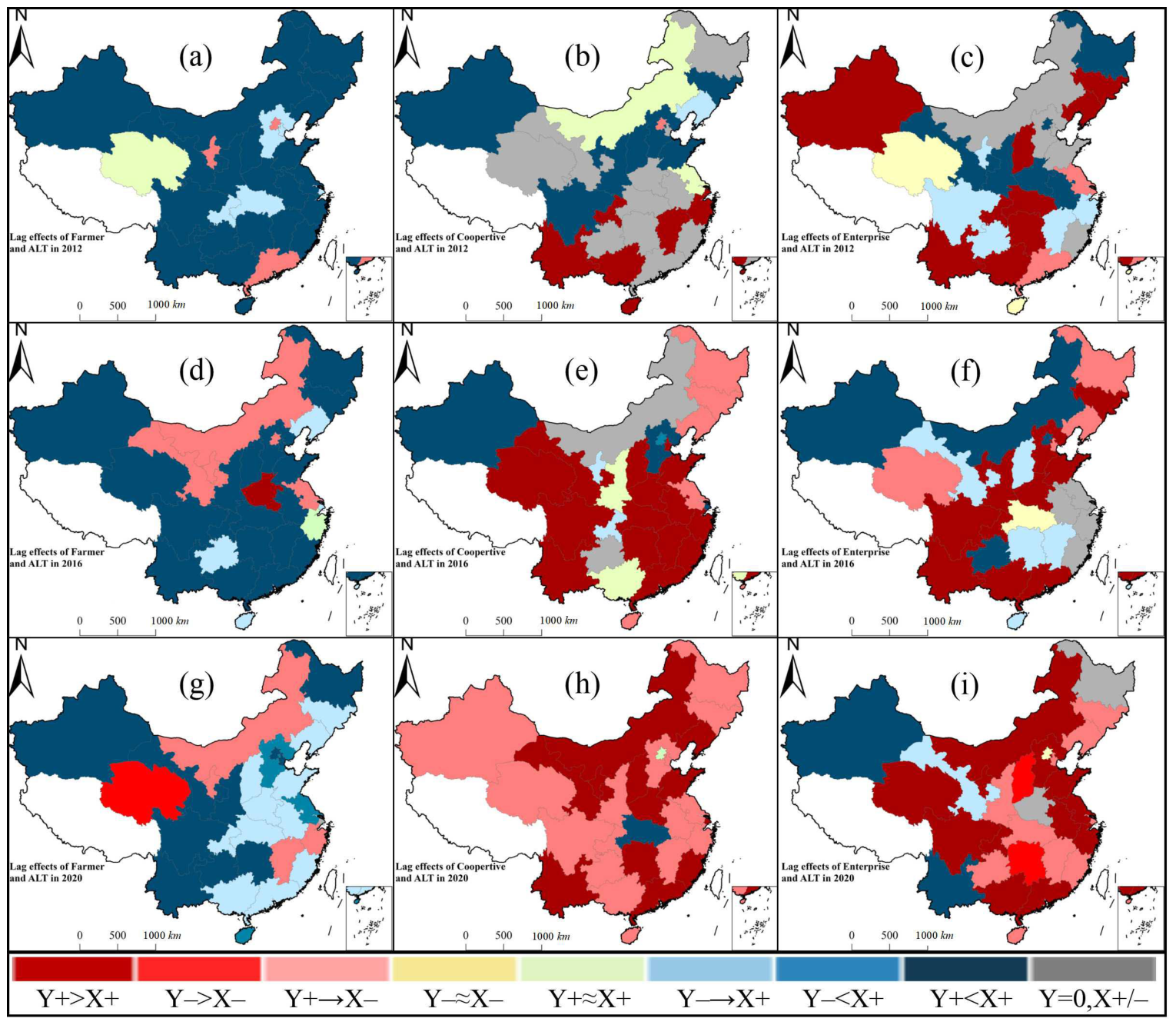
The time-lag effect of ALT among the three types of ABEs is illustrated in Figure 4. For farmers, the ABE+ < ALT+ state is the most widespread nationwide, accounting for more than 50% of the studied provinces, indicating that the growth in the number of farmers lags behind the expansion of land transfer. Regarding cooperatives, the ABE+ > ALT+ state is the most prevalent, accounting for approximately 42.08% of the total distribution, suggesting that the expansion of ALT lags behind the growth in the number of cooperatives. For enterprises, the ABE+ > ALT+ and ABE+ and ALT- states are predominant nationwide, indicating that the expansion of ALT lags behind the growth in enterprises. This pattern closely mirrors that of cooperatives. Overall, as cooperatives and enterprises have greater financial and technological advantages, their demand for land transfer is strong but lagging behind. This is not conducive to the rational allocation of arable land resources among different entities. Therefore, it is an urgent issue to establish a more forward-looking and adaptable land transfer market that meets the needs of multiple parties.

4.3. The Interaction Between ABEs and ALT

The spatial autocorrelation between ABEs and ALT was measured using Moran’s I index, based on a geographical adjacency matrix (Table 2). The results show that the Moran’s I indices for all three types of ABEs and ALT are significantly positive, indicating a strong positive spatial autocorrelation. This supports the suitability of using a spatial simultaneous equations model for data fitting and parameter estimation.
The generalized spatial three-stage least squares (GS3SLS) method was employed to estimate the simultaneous equations model to capture the bidirectional spatial spillover effects between different ABEs and ALT (Table 3).
Without considering spatial spillovers, the results are shown in the first two rows of Table 3 (white color). In the equation for ABE_F, the regression coefficient of ALT_(P) is 0.711 and significantly positive, while in the equation for ALT_(F), the regression coefficient of ABE_(F) is 1.334 and also significantly positive. This suggests a significant bidirectional promotion effect between the number of farming households and the land transferred to farmers within the same local area, with the impact of “quantity” on “area” being stronger. In the equations for ALT_(C) and ALT_(E), the regression coefficients of ABE_(C) and ABE_(E) are significantly positive, at 0.835 and 0.727, respectively. Similarly, in the equations for ABE_(C) and ABE_(E), the regression coefficients of ALT_(C) and ALT_(E) are significantly positive, at 0.631 and 0.216, respectively. This indicates that, within the same area, the interaction effects between cooperatives, enterprises, and their corresponding ALT are weaker than those of farming households. The underlying reason for this is that cooperatives and enterprises face higher entry barriers and have a greater demand for ALT, whereas ALTs among farming households involve lower thresholds, smaller areas, and less complexity, making their interaction effects stronger.
The results considering spillover effects are shown in the third and fourth rows of Table 3 (gray color). In the farming household equation, the regression coefficients of the spatial lag term for ALT (W*ALT) and the spatial lag term for the number of farming households (W*ABE) are both insignificant, indicating no spatial spillover effects between a province’s ALT and the development level of neighboring provinces. This is likely because farming households have limited interprovincial connections, leading to weak spillover effects. In contrast, in the ALT equations for cooperatives and enterprises, the regression coefficients of the spatial lag term for ALT (W*ALT) are significantly positive (0.032 and 0.033, respectively), suggesting that an increase in the land transferred to cooperatives and enterprises in neighboring provinces can promote similar increases within a given province. Additionally, the regression coefficients of the spatial lag term for the number of cooperatives and enterprises (W*ABE) are significantly positive (0.109 and 0.102, respectively), indicating that growth in cooperatives and enterprises in neighboring provinces can spur local land transfer. This suggests that cooperatives and enterprises are more likely to expand across regions, fostering local development through spillover effects. Despite the lower number of enterprises compared to cooperatives, their spatial spillover effects are similar, highlighting their potential to drive regional ALT and agricultural enterprise development.
To ensure the robustness of the estimation results, two robustness checks were conducted. First, the spatial weight matrix was replaced with a geographical inverse-distance spatial weight matrix for re-estimation [24]. Second, the variables were replaced with the total number of ABEs and total ALT scale to reconstruct a new spatial simultaneous equations model. The results confirmed the robustness of the findings (see Supplementary Materials Tables S1 and S2).

4.4. Spatial Heterogeneity in ABE-ALT Interactions

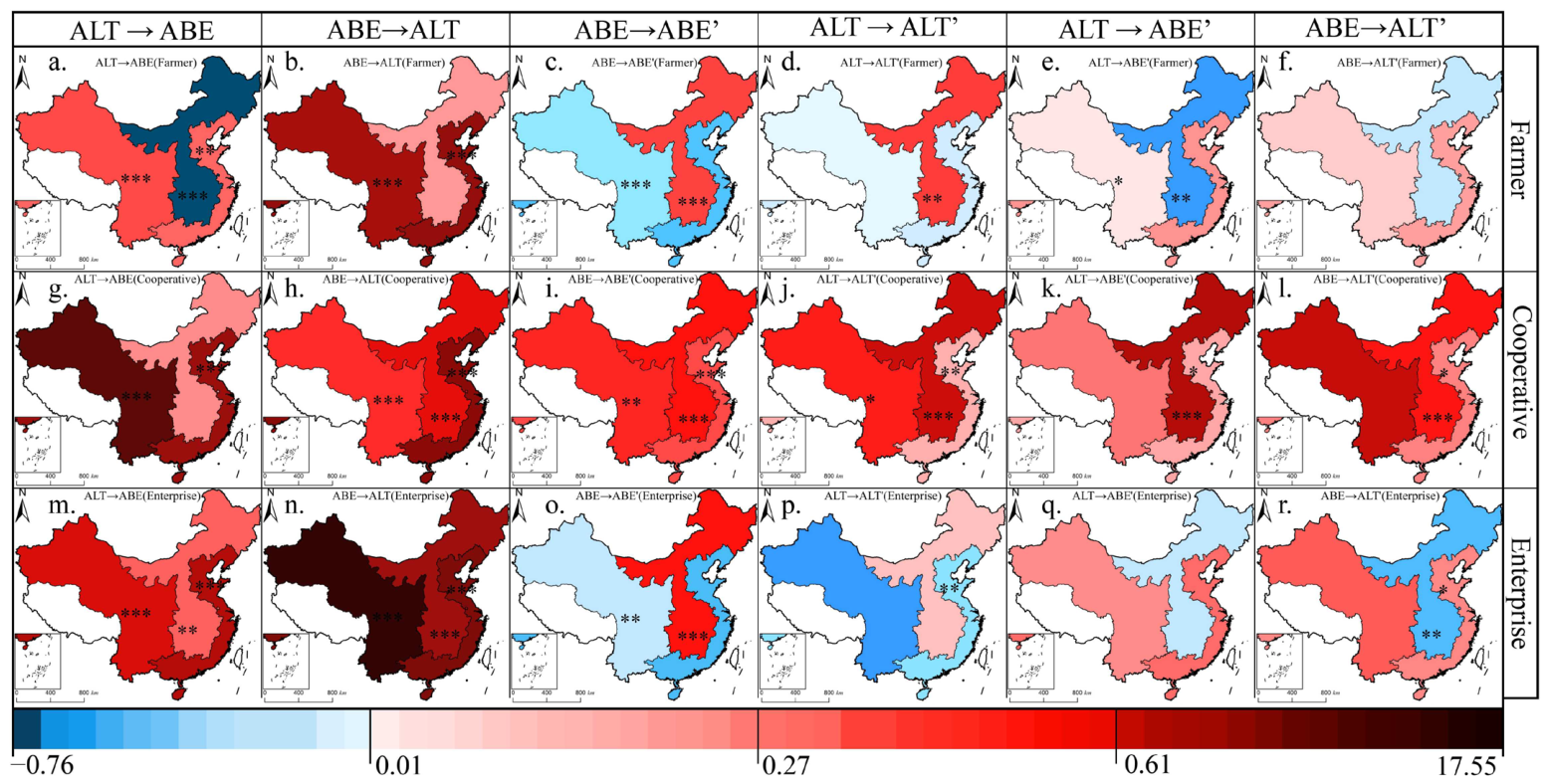
To discuss the spatial heterogeneity of the interaction between ABEs and ALT, the study area was divided into eastern, central, and western regions for re-estimation (Figure 5).
Although the above results exhibit a positive interaction between ABEs and ALT, some negative interactions are found. Firstly, in central China, ALT exerts a suppressive effect on ABE_(F) within the same region. This suggests that increased ALT among farming households reduce the number of farming households, possibly due to accelerated economic development under the “Rise of Central China” policy, which drives rural-to-urban migration and leads to land consolidation with fewer large-scale farming households. Secondly, negative spillover effects were observed among farming households, among enterprises in eastern China, and were also found between ALT_(E) and its neighboring regions in the western region. This may be due to the mature market economy and intense competition among enterprises in the east, leading to negative spatial spillover effects. Conversely, in western China, with its abundant land, low rental costs, and inexpensive labor, enterprises may engage in land monopolization, resulting in negative spillovers in ALT. Thirdly, in the central region, ALT_(F) suppresses neighboring farming households, and enterprises inhibit ALT_(E) in neighboring provinces. This could be due to resource-siphoning effects in the central region’s less-developed market economy, where a small number of entities control a large proportion of land, technology, and policy resources, leading to imperfect competition and restricting the development of surrounding entities.
Notably, cooperatives stand out as having higher coefficients among ALT and ABEs. Unlike farming households and enterprises, cooperatives exhibit consistently positive interactions between ABEs and ALT across western, eastern and central regions, with the highest interaction coefficients observed in the central and western regions. This is likely due to the high concentration of major grain-producing provinces in the central region, as well as frequent exchanges of information, materials, and personnel. The vast land and low production costs in western regions provided advantages for cooperatives; moreover, because of the strong rural social networks of cooperatives, the entry barriers for cooperatives is lower than enterprises, which facilitates robust bidirectional interactions between ABEs and ALT.

4.5. Temporal Heterogeneity in ABE-ALT Interactions

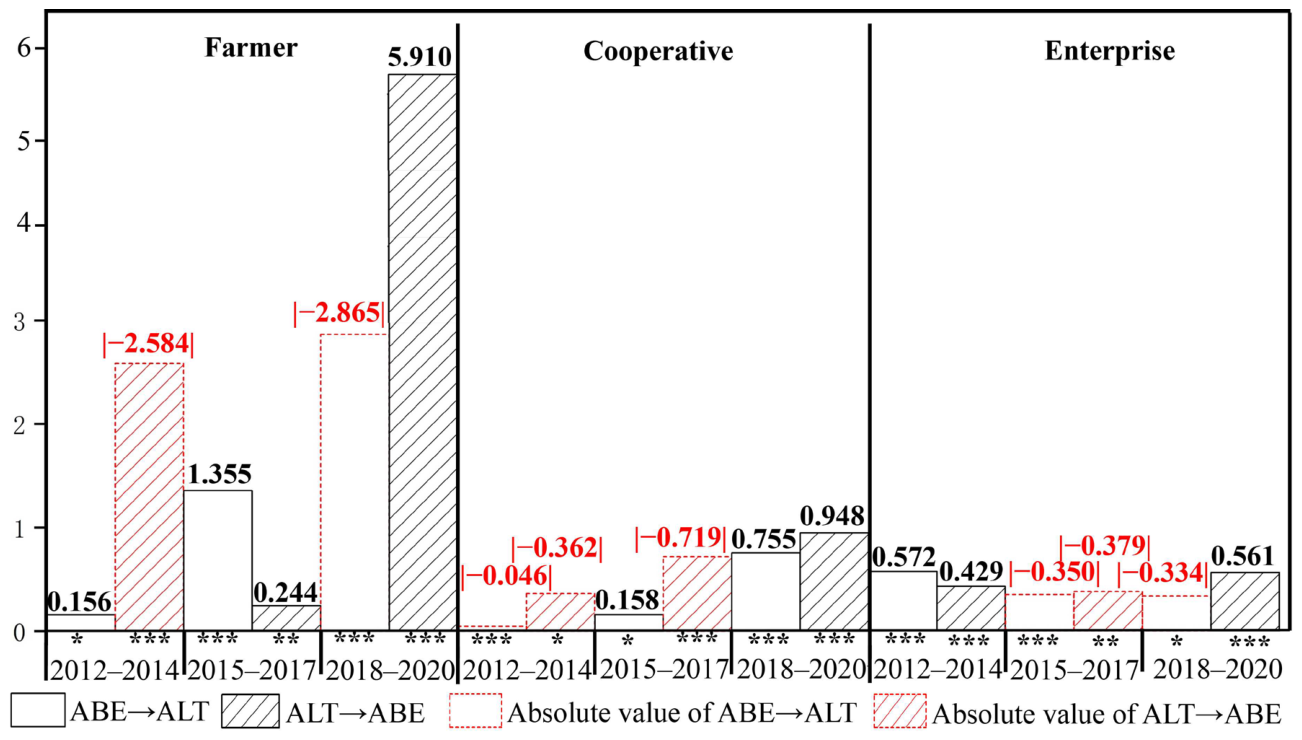
To examine the temporal heterogeneity in the interaction between ABEs and ALT, the study period was divided into three sub-periods, 2012–2014, 2015–2017, and 2018–2020, with results presented in Figure 6.
The overall intensity of the interaction between ABEs and ALT strongly increased over time, suggesting that their interactions are becoming tighter. Farmers exhibit the highest volatility in terms of fluctuations in the interaction coefficients, followed by enterprises, with cooperatives being the most stable. In contrast, the growth rate of interaction coefficients is highest for farmers, followed by cooperatives, while enterprises display the most stable trend, with a subtle downward tendency. These findings indicate that although farmer development and ALT are highly interdependent, their interaction is notably unstable. This instability may stem from farmers being more susceptible to micro-level factors such as individual decision-making preferences, village development dynamics, and annual crop yields, which are highly variable. The cumulative effects of these micro-level fluctuations resemble a “butterfly effect,” amplifying the instability in the farmer group’s interaction coefficient. Conversely, cooperatives and enterprises, with relatively smaller numbers and more structured decision-making processes, are more constrained by market supply, financial resources, and risk levels. As a result, their interaction with ALT exhibits greater stability.

5. Discussion

5.1. Localized Dominance of Farmers in ABE–ALT Interactions

This subsection corresponds to the first core finding of this study, directly addresses research question (i), and verifies the first hypothesis that heterogeneous bidirectional interactions exist between ABEs and ALT. This study found that within a given locality, the interaction between the “number” of farmers and “transferred farmland area” among them is stronger compared to cooperatives and enterprises. This can be attributed to the different internal characteristics of various agricultural business entities in China’s land system. On the one hand, the dominance of China’s traditional family-based farming limits the spatial linkage of farmers, making it easier for a cluster to form in small rural areas rather than over a larger spatial scope. On the other hand, cooperatives exhibit unique organizational characteristics. Most cooperatives are established by core village members or a village collective, which allows them to obtain support effortlessly when establishing the cooperative and transferring farmland because there are plenty of “acquaintances” in their village [25]. This kind of social capital advantage exists not only within the village but also in the neighboring villages. Moreover, as cooperatives expand their transferred farmland area, they can better leverage economies of scale [26], thereby promoting the long-term development of cooperatives. Third, enterprises face higher negotiation costs in the communication of farmland transfer with farmers because they are often regarded as “foreigners” in rural areas. To maximize profits, these enterprises require large-scale ALT that spans multiple villages and plots, often necessitating extensive land consolidation and leading to soaring costs. As a result, the interaction between enterprise development and ALT is weaker than for famers in a small locality [27]. Therefore, compared with cooperatives and enterprises, which have an external embedded structure, farmers who are rooted in the local society have their production and circulation behaviors as the internal driving force and a fundamental impetus for the evolution of local human–land relationships. Future policy design should aim to establish a comprehensive support system centered on activating and enhancing the internal driving force of farmers, especially emphasizing precise empowerment in areas such as property rights protection, market access, and capacity building. This further confirms that the bidirectional interaction between ABEs and ALT is not homogeneous but highly dependent on the internal characteristics of different entities, thereby providing a concrete answer to research question (i).

5.2. Temporal Asynchrony Between ABEs and ALT and the Risk of Short-Term Market Failure

This subsection directly addresses research question (ii) and verifies the second hypothesis that the development of ABEs and ALT exhibits a temporal lag. Furthermore, ALT among farmers precedes their numerical growth, whereas for cooperatives and enterprises, ALT lags behind their numerical growth. This is mainly due to the gradual yet steady increase in the number of farmers, which allows for a flexible increase in land transfer among them [28]. In contrast, the explosive growth of cooperatives and enterprises, largely driven by policy incentives, causes their ALT to lag behind. This may lead to a short-stage market failure. This phenomenon is, in part, a response to policy-induced profit-seeking behaviors, which led to a large number of cooperatives and enterprises being registered, which may hinder the optimal allocation of farmland resources [29]. However, as competition among cooperatives and enterprises intensifies, leading entities that withstand market pressures will eventually stabilize, and their land transfer is expected to synchronize with their development. This trend is likely to become increasingly evident in the future transition toward agricultural modernization.
In summary, ALT and the development of diverse agricultural entities exhibit a bidirectional interaction, with their interaction strength increasing over time. The entangled trajectory of the two will gradually tighten as time progresses. The essence of this pattern lies in the dynamic competition mechanism among agricultural entities, wherein the growth, decline, and exit of different entities drive corresponding changes in ALT [16]. Thus, the strengthening of this bidirectional interaction is a result of the extensive competition among diverse agricultural entities. However, a critical issue to be addressed is the potential “market failure” caused by the monopolistic effects of certain dominant entities [30]. Therefore, fostering a healthy competitive environment for diverse agricultural entities should be a key focus of policy formulation. Therefore, policy should establish a dynamic access and exit supervision mechanism and optimize the incentive structure to guide different ABEs to focus on long-term operating performance, thereby stimulating market vitality while ensuring the fairness and efficiency of land resource allocation. The observed temporal mismatch between different types of ABEs and ALT provides strong empirical evidence for the existence of asynchronous development trajectories, thereby directly answering research question (ii).

5.3. Spatial Spillover Effects of Different ABEs and Their Heterogeneities

This subsection directly addresses research question (iii) and verifies the third hypothesis that the bidirectional relationship between ABE development and ALT exhibits significant entity heterogeneity and regional heterogeneity, and that a certain spatial spillover effect exists in this relationship. This study posits that the dynamic interaction between diverse ABEs and ALT involves the spatial flows of materials, information, capital, and technology, leading to differentiated configurations of production factors across regions [31]. These changes are projected onto the spatial plane, potentially generating varying degrees of spatial spillover effects. This differentiation manifests in two aspects.
First, compared to farmers, cooperatives and enterprises exhibit more pronounced spatial spillover effects in ALT. Similar viewpoints have been proposed by other scholars, suggesting that ALT at the farmer level predominantly occurs within villages, cooperatives increasingly engage in inter-village exchanges, and enterprises act as regional consolidators and beneficiaries of agricultural land [32], possessing greater potential for spatial interaction spillovers. This conclusion aligns closely with the findings of this study. The underlying reason for this lies in the varying degrees of change in the spatial flows of materials, information, capital, and technology among different ABEs, shaped by their land demand, financial resources, technological capabilities, and social capital [33]. As the smallest unit among agricultural entities, farmers are constrained by small-scale land operations, limiting their influence to within-village interactions. Cooperatives, by organizing multiple farmers for joint production, hold an advantage in terms of large-scale ALT and cooperative development; however, financial and management constraints often restrict their spillover effects. In contrast, enterprises, backed by strong capital, possess extensive industrial chain networks, allowing them to exert broader spatial spillover effects [34].
Second, in eastern regions, the interaction between the “number” and “transferred area” of all agricultural entities is stronger within their respective localities, whereas in central and western regions, cooperatives exhibit stronger spatial spillover effects between their “number” and “transferred area.” This divergence can be attributed to the fact that eastern China, as the country’s most economically developed region, has pioneered policies for fostering new ABEs. Consequently, within provincial boundaries, strong spatial agglomeration effects emerge, facilitating robust intra-provincial interactions between ABEs and ALT under competitive market mechanisms. This finding aligns with those of researchers such as Ye, Zhou et al. [35,36]. Conversely, in the central and western regions, where population density is lower and land availability is higher, cooperatives and other new ABEs often manage larger farmland areas. Their operational expansion and cross-regional transactions enable them to develop substantial monopolistic advantages, leading to stronger spatial spillover effects. Therefore, policy should be based on the significant cross-regional spillover characteristics of cooperatives and enterprises, and focus on establishing an incentive system that promotes the cross-regional flow of capital and technology; at the same time, in regions with abundant land supply, such as the central and western regions, the regulation of and support for the large-scale operation of cooperatives should be strengthened in order to systematically release their spatial spillover potential and optimize the overall allocation of resources. These findings collectively confirm the existence of significant spatial spillover effects among different ABEs and ALT, thereby providing a clear answer to research question (iii).
This research is limited in the following ways: (1) provincial panel data may mask micro-level heterogeneity in farmers’ behavior; (2) although the spatial simultaneous equation model addresses endogeneity, the dynamic evolution and underlying mechanisms require deeper examination. Future research could employ county-level or micro-survey data, distinguish more refined entity types and transfer forms, extend the time span, and apply mediation analysis or dynamic spatial panel models to explore the causes of temporal asynchrony and the positive spillover mechanisms of cooperatives.

6. Conclusions

This study, based on macro panel data from 30 provincial-level administrative regions in China between 2012 and 2020, investigates the spatial interaction, spillover effects, and spatiotemporal heterogeneity between diverse agricultural business entities (ABEs) and arable land transfer (ALT). The research utilizes the spatial gravity model, spatial simultaneous equation model, and the Tapio model to explore these dynamics from a bidirectional interaction perspective. The main conclusions are as follows:
(1)
There is a significant bidirectional promotion effect between diverse ABEs and ALT, and this interaction strengthens over time. Among these, the interaction between the number of farmers and the area of land transferred by farmers is the most pronounced at the local level, while the interaction advantage of cooperatives and enterprises is reflected in their spatial spillover effects.
(2)
Negative interactions between the two are observed in some regions and among certain entities. These include the suppression effects of ALT on farmers in central regions, farmers on neighboring farmers in eastern regions, ALT on neighboring farmers in central regions, enterprises on neighboring enterprises in eastern regions, enterprises on ALT in central regions, and ALT on neighboring ALT in western regions.
(3)
Cooperatives perform relatively well. The maximum spillover effect is observed in cooperatives in central and western regions, and no negative interaction between ABEs and ALT was observed in cooperatives in all studied provinces.
(4)
Time-lag effects are found between ABEs and ALT. For farmers, the ABE lags behind ALT, while for cooperatives and enterprises, the ABE precedes the ALT.
This study provides insights into the bidirectional interaction between the development of various ABEs and ALT, offering a pathway for agricultural modernization. Future efforts should focus on fostering cross-regional collaboration among new-type ABEs, enhancing their influence on surrounding areas and traditional farmers. Secondly, policies should support measures addressing the issue of farmland fragmentation and promoting the seamless integration of new and traditional entities through further improvements in property rights protection. Meanwhile, local governments should, when regulating smallholders, improve contract filing and risk-warning mechanisms for land transfer to prevent the suppression effects caused by excessive or disorderly transfers among farmers, particularly in central China. When cultivating new agricultural business entities (ABEs), priority should be given to supporting cooperatives in the central and western regions, leveraging their positive spatial spillovers to drive the development of surrounding areas. Meanwhile, given the temporal asynchrony, in which farmers’ ABEs lags behind ALT, socialized services and capacity-building training should be promptly provided to smallholders who have completed land transfers so as to prevent the misallocation of “land without capable operators.” Under the future scenario of modern agriculture dominated by new agricultural management subjects, similar countries should aim to facilitate the deep integration of agricultural modernization and rural revitalization, achieving the efficient allocation of farmland resources and sustainable development through collaboration between new and old ABEs.


Supplementary Materials

The following supporting information can be downloaded at: https://www.mdpi.com/article/10.3390/land15050827/s1.

Author Contributions

Conceptualization, Z.W.; Methodology, G.Y.; Software, G.L.; Formal analysis, Z.W. and G.Y.; Resources, G.Y. and L.L.; Investigation, G.Y., G.L. and Z.W.; Data curation, G.L. and Z.W.; Writing—original draft preparation, G.L. and Z.W.; Writing—review and editing, G.Y. and L.L.; Visualization, Z.W. and G.L.; Validation, Z.W.; Supervision, G.Y. and L.L.; Project administration, G.Y. and L.L.; Funding acquisition, G.Y. and L.L. All authors have read and agreed to the published version of the manuscript.

Funding

This paper was funded by the National Natural Science Foundation of China (Project No. 42171253); the Key Program of the National Natural Science Foundation of China (Project No. 42530506); the Shandong Social Science Planning Fund Program (Project No. 21CCXJ15).

Data Availability Statement

The data presented in this study are available on request from the corresponding author (accurately indicate status).

Acknowledgments

The authors extend great gratitude to the anonymous reviewers and editors for their helpful review and critical comments. We confirm all individuals’ consent.

Conflicts of Interest

The authors declare no conflicts of interest.

References

  1. Kumar, P. “Modernization” and Agrarian Development in India, 1912–52. J. Asian Stud. 2020, 79, 633–658. [Google Scholar] [CrossRef]
  2. Wang, H.; Li, F.; Zou, Y.; Yang, M.; Chen, Z.; Nie, X. How do smallholder farmers run towards agricultural modernization under multiple stressors in China’s coastal zones: An agent-based modeling approach. Environ. Dev. Sustain. 2024, 28, 11809–11835. [Google Scholar] [CrossRef]
  3. Cleary, M.C. Peasants, Politicians and Producers: The Organisation of Agriculture in France Since 1918; Cambridge University Press: Cambridge, UK, 1989. [Google Scholar]
  4. Baaken, M.C. Sustainability of agricultural practices in Germany: A literature review along multiple environmental domains. Reg. Environ. Change 2022, 22, 39. [Google Scholar] [CrossRef]
  5. Mundlak, Y. Economic growth: Lessons from two centuries of American agriculture. J. Econ. Lit. 2005, 43, 989–1024. [Google Scholar] [CrossRef]
  6. Ohkawa, K.; Rosovsky, H. The role of agriculture in modern Japanese economic development. Econ. Dev. Cult. Change 1960, 9, 43–67. [Google Scholar] [CrossRef]
  7. Zhang, Y.; Long, H.; Chen, S.; Ma, L.; Gan, M. The development of multifunctional agriculture in farming regions of China: Convergence or divergence? Land Use Policy 2023, 127, 106576. [Google Scholar] [CrossRef]
  8. Tian, G.; Duan, J.; Yang, L. Spatio-temporal pattern and driving mechanisms of cropland circulation in China. Land Use Policy 2021, 100, 105118. [Google Scholar] [CrossRef]
  9. Chang, Q. The country’s total arable land continued to grow in net terms. People’s Daily, 26 June 2024, p. 2.
  10. Sun, H. On Dispute Resolution of Land Ownership and Use Rights. Int. J. Soc. Sci. Public Adm. 2024, 3, 135–141. [Google Scholar] [CrossRef]
  11. Jiang, G.; Zhang, R.; Ma, W.; Zhou, D.; Wang, X.; He, X. Cultivated land productivity potential improvement in land consolidation schemes in Shenyang, China: Assessment and policy implications. Land Use Policy 2017, 68, 80–88. [Google Scholar] [CrossRef]
  12. Poulton, C.; Dorward, A.; Kydd, J. The future of small farms: New directions for services, institutions, and intermediation. World Dev. 2010, 38, 1413–1428. [Google Scholar] [CrossRef]
  13. Yu, L.; Qin, H.; Xiang, P. Incentive mechanism of different agricultural models to agricultural technology information management system. Sust. Comput. 2020, 28, 100423. [Google Scholar] [CrossRef]
  14. Liang, Y.; Lu, W.; Wu, W. Are social security policies for Chinese landless farmers really effective on health in the process of Chinese rapid urbanization? A study on the effect of social security policies for Chinese landless farmers on their health-related quality of life. Int. J. Equity Health 2014, 13, 5. [Google Scholar] [CrossRef]
  15. Rasmussen, L.V.; Grass, I.; Mehrabi, Z.; Smith, O.M.; Bezner-Kerr, R.; Blesh, J.; Garibaldi, L.A.; Isaac, M.E.; Kennedy, C.M.; Wittman, H. Joint environmental and social benefits from diversified agriculture. Science 2024, 384, 87–93. [Google Scholar] [CrossRef]
  16. Wang, G.; Liu, Y.; Li, Y.; Chen, Y. Dynamic trends and driving forces of land use intensification of cultivated land in China. J. Geogr. Sci. 2015, 25, 45–57. [Google Scholar] [CrossRef]
  17. Miguel Segal, A. Adam Smith: Teoría de la división del trabajo a escala social y categoría de valor de uso (utilidad). Iber. J. Hist. Econ. Thought 2025, 12, 61–71. [Google Scholar] [CrossRef]
  18. Rixen, T.; Viola, L.A. Putting path dependence in its place: Toward a taxonomy of institutional change. J. Theor. Politics 2015, 27, 301–323. [Google Scholar] [CrossRef]
  19. Watson, M. Historicising Ricardo’s comparative advantage theory, challenging the normative foundations of liberal International Political Economy. New Political Econ. 2017, 22, 257–272. [Google Scholar] [CrossRef]
  20. Liu, Y.; Hao, Y. How does coordinated regional digital economy development improve air quality? New evidence from the spatial simultaneous equation analysis. J. Environ. Manag. 2023, 342, 118235. [Google Scholar] [CrossRef]
  21. Griffith, D.A. Extreme eigenfunctions of adjacency matrices for planar graphs employed in spatial analyses. Linear Alg. Appl. 2004, 388, 201–219. [Google Scholar] [CrossRef]
  22. Han, R.; Cao, H.; Liu, Z. Studying the urban hierarchical pattern and spatial structure of China using a synthesized gravity model. Sci. China Earth Sci. 2018, 61, 1818–1831. [Google Scholar] [CrossRef]
  23. Yasmeen, H.; Tan, Q. Assessing Pakistan’s energy use, environmental degradation, and economic progress based on Tapio decoupling model. Environ. Sci. Pollut. Res. 2021, 28, 68364–68378. [Google Scholar] [CrossRef]
  24. Lu, G.Y.; Wong, D.W. An adaptive inverse-distance weighting spatial interpolation technique. Comput. Geosci. 2008, 34, 1044–1055. [Google Scholar] [CrossRef]
  25. Chen, B. The Acquaintance Society and Reciprocity-Based Behavior Pattern. In The Underworld of Rural China: Research on Rural Gangs on China’s Jianghan Plain and Dongting Lake Plain; Springer: Berlin/Heidelberg, Germany, 2023; pp. 25–49. [Google Scholar]
  26. Zhang, L.; Chen, Z. Do Farmers’ Specialized Cooperatives Increase Farmers’ Social Capital? An Analysis Based on Survey Data from 506 Farmers in Yunnan Province; Chinese Academy of Social Sciences: Beijing, China, 2021.
  27. Duan, J.; Ren, C.; Wang, S.; Zhang, X.; Reis, S.; Xu, J.; Gu, B. Consolidation of agricultural land can contribute to agricultural sustainability in China. Nat. Food 2021, 2, 1014–1022. [Google Scholar] [CrossRef] [PubMed]
  28. Lu, H.; Chen, Y.; Huan, H.; Duan, N. Analyzing cultivated land protection behavior from the perspective of land fragmentation and farmland transfer: Evidence from farmers in rural China. Front. Environ. Sci. 2022, 10, 901097. [Google Scholar] [CrossRef]
  29. Das, B.; Singh, A.; Panda, S.N.; Yasuda, H. Optimal land and water resources allocation policies for sustainable irrigated agriculture. Land Use Policy 2015, 42, 527–537. [Google Scholar] [CrossRef]
  30. Tirole, J. Market failures and public policy. Am. Econ. Rev. 2015, 105, 1665–1682. [Google Scholar] [CrossRef]
  31. Castells, M. Space of flows, space of places: Materials for a theory of urbanism in the information age. In The City Reader; Routledge: Abingdon, UK, 2020; pp. 240–251. [Google Scholar]
  32. Ni, S. Analysis on Implementation of Land Circulation in China’s Rural Area. In Proceedings of the 2020 3rd International Conference on Humanities Education and Social Sciences (ICHESS 2020); Atlantis Press: Dordrecht, The Netherlands, 2020; pp. 246–249. [Google Scholar]
  33. Chen, X.; Wei, L.; Zhang, H. Spatial and temporal pattern of urban smart development in China and its driving mechanism. Chin. Geogr. Sci. 2018, 28, 584–599. [Google Scholar] [CrossRef]
  34. Zhang, Q.; Zhang, F.; Wu, G.; Mai, Q. Spatial spillover effects of grain production efficiency in China: Measurement and scope. J. Clean. Prod. 2021, 278, 121062. [Google Scholar] [CrossRef]
  35. Zhou, Y.; Li, X.; Liu, Y. Cultivated land protection and rational use in China. Land Use Policy 2021, 106, 105454. [Google Scholar] [CrossRef]
  36. Ye, J. Land Transfer and the Pursuit of Agricultural Modernization in China. J. Agrar. Change 2015, 15, 314–337. [Google Scholar] [CrossRef]
Figure 1. Theoretical motivation and research framework (metaphorical presentation).
Land 15 00827 g001
Figure 2. The classification of time lag effects for ABEs and ALT. Note: “+” denotes an increase, “−” denotes a decrease, “>“ denotes change faster, “<“ denotes change slower, and “&” denotes simultaneous occurrence.
Land 15 00827 g002
Figure 3. Spatial gravity structure of different ABEs and ALT.
Land 15 00827 g003
Figure 4. Lag effects of ABEs and ALT in each province. Note: the meaning of ABE+ > ALT+ and other types of lag effects is noted in Figure 2. (a) Lag effects of Farmer and ALT in 2012, (b) Lag effects of Cooperative and ALT in 2012, (c) Lag effects of Enterprise and ALT in 2012, (d) Lag effects of Farmer and ALT in 2016, (e) Lag effects of Cooperative and ALT in 2016, (f) Lag effects of Enterprise and ALT in 2016, (g) Lag effects of Farmer and ALT in 2020, (h) Lag effects of Cooperative and ALT in 2020, (i) Lag effects of Enterprise and ALT in 2020.
Land 15 00827 g004
Figure 5. Spatial Heterogeneity of the spatial simultaneous equations model. Note: The values represent interaction coefficients in the model. ***, **, and * indicate significance at the 1%, 5%, and 10% levels, respectively. ALT → ABE and ABE → ALT represent intra-regional interactions; ABE → ABE′ and ALT → ALT′ represent the spatial spillover effects among ABEs or ALT; and ALT → ABE′ and ABE → ALT′ represent the spatial spillover effects between ABEs and ALT. ′ denotes the neighboring area. For instance, ABE → ABE′ refers to the interaction between local ABEs and neighboring ABEs.
Land 15 00827 g005
Figure 6. Period heterogeneity of the spatial simultaneous equations model. Note: *, **, *** represent statistical significance at the 10%, 5% and 1% levels.
Land 15 00827 g006
Table 1. Descriptive statistics of variables in the spatial simultaneous equation model.
VariablesExplainMeanStdMinMax
ln_ABEln (the count of various agricultural business entities)8.240.806.329.47
ln_ALTln (the transfer area of arable land)16.121.1512.5118.01
lnABE_(F)ln (number of peasant households)9.312.456.3216.55
lnALT_(F)ln (ALT for farmers)15.381.3211.3917.74
lnABE_(C)ln (number of cooperatives)3.691.330.006.96
lnALT_(C)ln (ALT for cooperatives)14.461.3210.1316.87
lnABE_(E)ln (number of enterprises) 3.461.170.006.37
lnALT_(E)ln (ALT for enterprises) 13.811.1410.5615.48
ln_Devln (regional gross agricultural output value)8.370.416.739.12
ln_Insln (the number of policy documents related to ALT)4.651.011.096.35
ln_Modln (the number of policy documents related to agricultural modernization)2.980.332.223.78
ln_Radln (registered capital of new ABEs)8.890.367.758.11
ln_Staln (the area of farmland with signed transfer contracts)3.451.311.536.56
ln_Traln (regional transportation network density)1.980.232.233.98
ln_Popln (the number of people moving out of a region)3.551.730.325.37
Note: All variables contain 270 observations.
Table 2. Counterfactual testing results at different timings.
VariablesABE_(F)ABE_(C)ABE_(E)ALT_(F)ALT_(C)ALT_(E)
I0.024 **0.045 **0.044 **0.019 *0.011 *0.041 **
t(1.673)(2.304)(2.212)(1.533)(1.336)(2.162)
Note: ** and * indicate significance at the 5% and 10% levels, respectively, with t-tests in parentheses.
Table 3. Estimation results of the spatial simultaneous equations model for ALT and ABEs.
VariablesFarmer EquationCooperative EquationEnterprise Equation
LnABE_(F)LnALT_(F)LnABE_(C)LnALT_(C)LnABE_(E)LnALT_(E)
Ln_ABE 1.334 *** 0.835 *** 0.727 ***
(0.071) (0.090) (0.092)
Ln_ALT0.711 *** 0.631 *** 0.216 *
(0.087) (0.173) (0.128)
W*Ln_ABE0.060−0.0480.109 ***0.132 ***0.102 ***0.140 ***
(0.028)(0.045)(0.024)(0.029)(0.022)(0.031)
W*Ln_ALT−0.0270.0220.027 ***0.032 ***0.026 ***0.033 ***
(0.012)(0.019)(0.006)(0.008)(0.005)(0.008)
Control
cons−4.487 ***7.176 ***−6.165 ***11.819 ***0.21911.505 ***
(1.196)(0.493)(2.192)(0.874)(1.339)(0.668)
R20.6030.5550.358 0.911 0.491 0.810
Observed270270270270270270
Note: *** and * indicate significance at the 1% and 10% levels, respectively, with standard errors in parentheses. The columns “Farmer,” “Cooperative,” and “Enterprise” represent the spatial simultaneous equations for the number of farmers and transferred farmland area, the number of cooperatives and transferred farmland area, and the number of enterprises and transferred farmland area, respectively. “√” indicates that the variable is controlled.
Disclaimer/Publisher’s Note: The statements, opinions and data contained in all publications are solely those of the individual author(s) and contributor(s) and not of MDPI and/or the editor(s). MDPI and/or the editor(s) disclaim responsibility for any injury to people or property resulting from any ideas, methods, instructions or products referred to in the content.