
Article

Influence on the Deficit of Terrestrial Water Storage in China from the Perspective of Natural Regionalization


Shaanxi Key Laboratory of Earth Surface System and Environmental Carrying Capacity, College of Urban and Environmental Sciences, Northwest University, Xi’an 710127, China
*
Authors to whom correspondence should be addressed.
Land 2026, 15(5), 807; https://doi.org/10.3390/land15050807
Submission received: 4 February 2026 / Revised: 5 May 2026 / Accepted: 6 May 2026 / Published: 9 May 2026

Abstract

Under the background of global change, the threshold for the propagation of meteorological drought to hydrological drought is crucial for drought early warning and water resource management. However, traditional threshold studies often adopt subjective and fixed conditional probabilities and lack the revelation of the driving mechanisms under macroscopic natural geographical differentiation. This study integrates terrestrial water storage anomaly (TWSA) data derived from the Gravity Recovery and Climate Experiment (GRACE) and its Follow-On (GRACE-FO) mission, the standardized precipitation evapotranspiration index (SPEI), and multi-source environmental data to construct an objective threshold identification method based on Copula joint distribution and “system resilience loss”, and combines explainable machine learning to systematically explore the critical threshold for meteorological drought, triggering a TWSA deficit and its driving mechanisms from the perspectives of three major natural regions, the Eastern Monsoon Region (EMR), the Northwestern Arid Region (NAR), and the Tibetan Plateau Region (TPR). The results show that: (1) from 2005 to 2024, the TWSA significantly decreased in nearly half of China’s regions, with significant regional differentiation; (2) the response of the TWSA to meteorological drought has a significant lag (an average of 9–12 months), and shows a spatial pattern of slower in the east and faster in the northwest; (3) the probability of a TWSA deficit and the triggering threshold both have obvious grade dependence and spatial heterogeneity, with the lowest threshold in the northwest arid region, which is the most sensitive; (4) the threshold is driven by the synergy of multiple factors, with “water dominance and energy modulation”, and the dominant factors show regional differentiation; and (5) irrigation agriculture significantly reduces the drought triggering threshold and exacerbates system vulnerability. This study provides a scientific basis for understanding the geographical differentiation laws of drought propagation and regional early warning management.

1. Introduction

Under the backdrop of global warming and human activities [1], the hydrological cycle intensifies, and extreme drought events occur frequently [2,3]. These changes exert unprecedented pressure on the stability of regional water resource systems [4]. Terrestrial water storage (TWS), a comprehensive indicator encompassing surface water, soil water, groundwater, ice and snow water [5], is crucial for assessing regional water resources and hydrological drought risk [6]. However, the critical point at which meteorological drought, starting from a precipitation deficit, accumulates to a degree that exceeds the buffering capacity of the terrestrial water system and triggers different levels of a TWSA deficit [7]—that is, the threshold from meteorological stress to hydrological response—is complex and concealed in its internal mechanism, and is accompanied by spatiotemporal differences [7]. Therefore, clarifying this threshold is of significant and urgent importance for accurate and timely warnings of droughts, assessing the resilience of ecosystems, and formulating differentiated water resource management strategies.
For a long time, the sparsity of traditional ground observation networks and overly simplified hydrological models have made it difficult to precisely capture the dynamic changes in large-scale, multi-sphere TWS [8]. The implementation of the Gravity Recovery and Climate Experiment (GRACE) and its Follow-On (GRACE-FO) mission has enabled long-term and large-scale observations of TWS [9,10,11]. By monitoring the minute fluctuations in the Earth’s gravity field, they have revealed the macroscopic picture of global TWS changes. Based on this, the academic community has widely utilized GRACE terrestrial water storage anomaly (TWSA) data for research, successfully estimating runoff changes [12,13], groundwater storage changes [14], freshwater fluxes [15], glacier mass loss [16], and regional flood potential [17] from the basin to the global scale, and demonstrated its great potential in regional water resource management and drought monitoring [18]. These studies have achieved fruitful results in TWS trend analysis, drought characteristic identification, and their responses to climate fluctuations [19,20,21]. However, most existing studies remain at the stage of describing correlations or attributing long-term trends [22,23]. There is still a lack of systematic and refined research methods for the critical threshold in the drought propagation chain.
According to existing research, discussions on the critical threshold of drought are relatively limited, and most studies mainly employ the conditional probability method of multivariate dependency relationships [24,25,26,27], constructing multivariate joint distribution functions to calculate conditional probabilities under different drought scenarios. However, the selection of fixed probability thresholds, such as percentile methods (e.g., 95%, 70%, and 50%), introduces significant subjectivity to the process, and there are trade-offs in choosing different guarantee levels. For instance, high guarantee levels (e.g., 95% probability) are prone to underreporting low-level droughts, while low guarantee levels (e.g., 50%) increase the risk of false alarms for non-critical events.
To date, few studies have analyzed TWSAs from the perspective of natural regionalization, and the selection of driving factors in existing research remains insufficient. Yang et al. studied the impacts of precipitation, evapotranspiration, and runoff on the TWSA from the perspective of Chinese river basins [22]; Chen et al. analyzed the influences of precipitation, temperature, and the Southern Oscillation Index on TWS over the Southeastern Tibetan Plateau [28]. Han et al. quantitatively analyzed the threshold of meteorological drought triggering groundwater drought in the Xijiang River Basin based on GRACE data [29]. Meanwhile, Han et al. [29] proposed a drought-triggering threshold framework driven by precipitation, using Zhao et al.’s method [30] and the TWSA to represent hydrological drought, and identified precipitation thresholds that trigger different drought grades [31]. However, in regions with strong hydroclimatic and anthropogenic heterogeneity, research on the key thresholds of the drought-induced TWSA deficit remains limited, and existing work lacks comprehensive identification of multiple driving factors using machine learning.
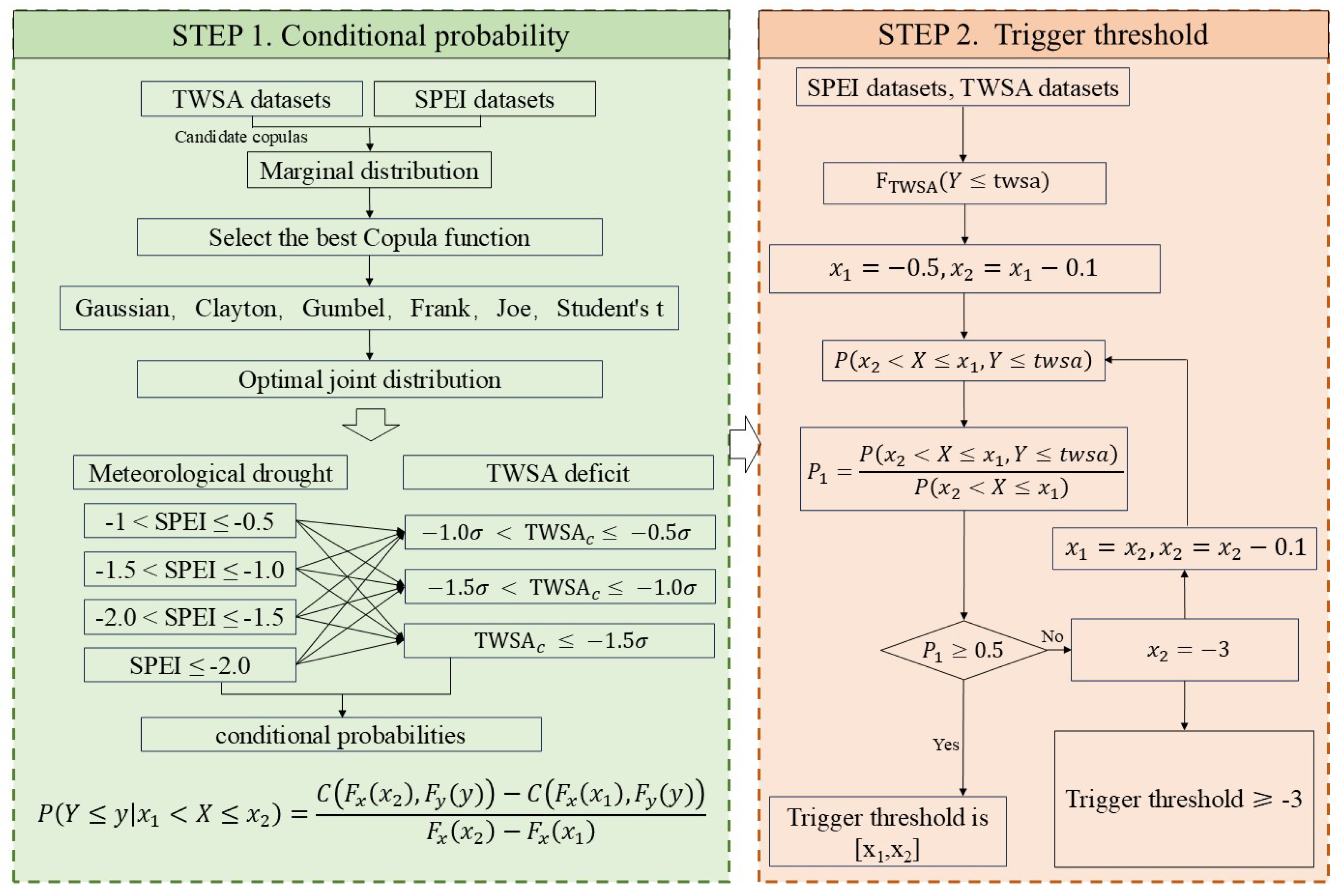
China’s natural geographical pattern is vast and complex. From the Eastern Monsoon Region (EMR), richly nourished by the monsoon, to the Northwestern Arid Region (NAR), deep inland with scarce precipitation, and to the Tibetan Plateau Region (TPR), known as the “Asian Water Tower” and the “Third Pole of the World” [32], different regions have varying sensitivities and resistances to drought stress, and the thresholds for triggering a TWSA deficit are also different across regions. Therefore, transcending the boundaries of individual river basins and approaching from the geographical perspective of China’s classic “three major natural regions”, systematically revealing the spatial patterns, formation mechanisms, and dominant driving factors of the TWSA deficit thresholds in different natural geographical units is the key to deepening the understanding of regional drought propagation characteristics and achieving precise risk management. For this purpose, this study intends to integrate the latest GRACE/GRACE-FO satellite gravity data and multi-source climate and land surface model data, focusing on the three major natural geographical regions of the EMR, the NAR, and the TPR. It aims to address the following scientific questions: (1) What spatiotemporal changes have occurred in China’s TWS over the past two decades? What is the time lag in the transmission of meteorological drought to changes in TWS, and how does this lag effect differ among the three regions? (2) What is the probability of mild, moderate, and severe TWSA deficits under different levels of drought stress in various regions? (3) What are the drought trigger thresholds for TWS to enter different levels of deficits, and how do their spatial distributions couple with natural regional divisions? (4) Which environmental factors dominate the levels of drought thresholds, and do their mechanisms of action vary among different regions? The research framework for this study is illustrated in Figure 1. We will construct a conditional probability model based on the Copula joint distribution function, flexibly set the conditional probability, abandon the subjective setting of fixed conditional probability (such as 95%), and innovatively adopt “systemic resilience loss” (the first time the conditional probability exceeds 0.5) as an objective critical threshold criterion. We will convert continuous TWSA data into discrete conditions with clear drought grade definitions, quantitatively evaluate the critical threshold, and explore key driving factors with the interpretable CatBoost-SHAP model.

2. Materials and Methods

2.1. Study Area

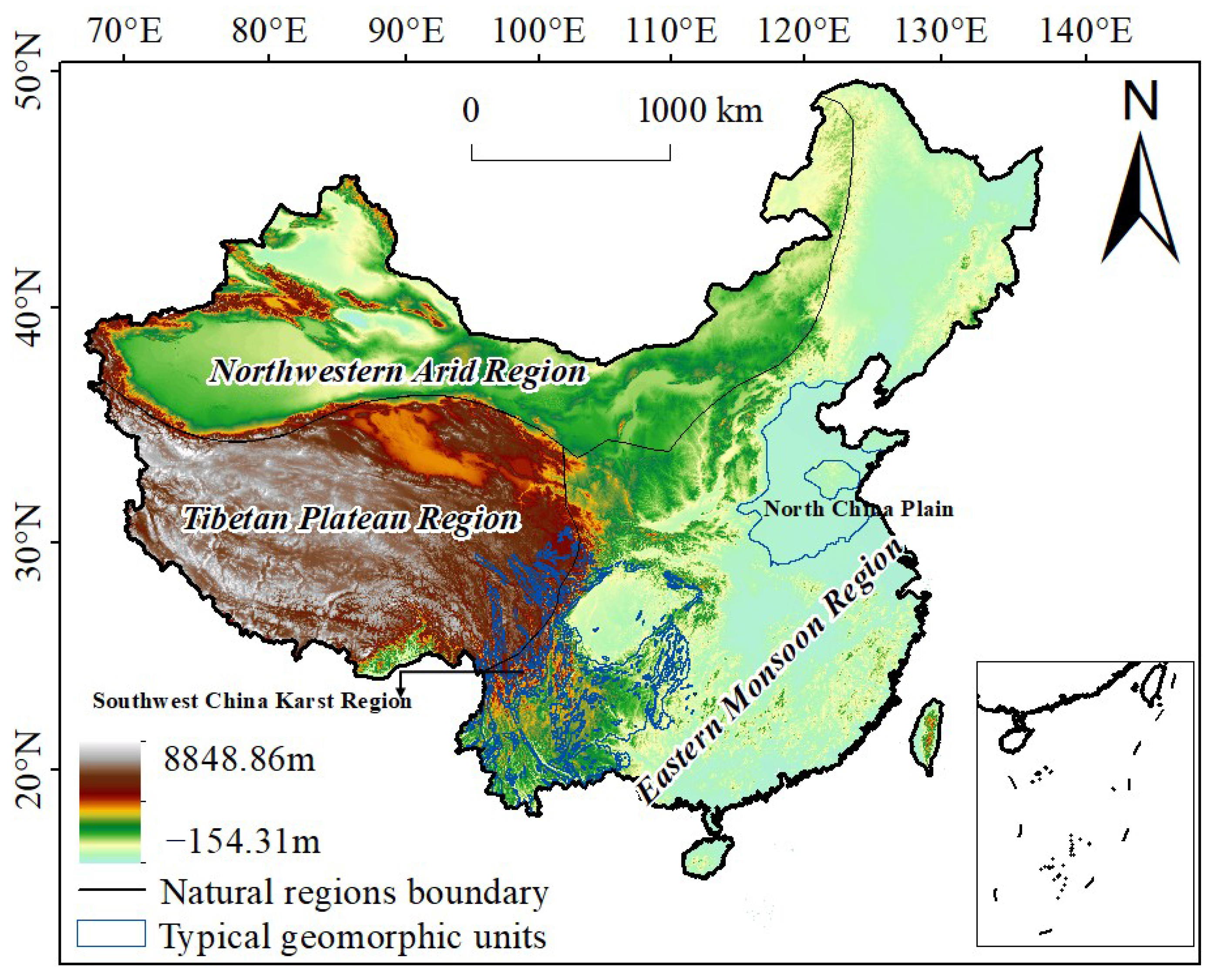
This study covers the entirety of China as its research domain (Figure 2). Based on the principles of comprehensive natural regionalization, the area is divided into three major regions, the EMR, the NAR, and the TPR. The primary division of China’s natural regionalization mainly adopts the top-down deductive method proposed by Huang Bingwei [33]. This method first identifies the dominant factors controlling regional differentiation, such as the aridity index and geomorphological pattern, then determines the classification indicators and thresholds. Through expert judgment and comprehensive overlay, the country is divided into three major natural regions. The natural regional boundaries used in this study follow the above scheme. These boundaries were digitized from multiple historical physical geography atlases and maps (1954–1999) and are provided by the National Earth System Science Data Center (https://www.geodata.cn) [34]. The EMR is bounded on the west by the Greater Khingan Range, Yin Mountains, Helan Mountains, Bayan Har Mountains, and Gangdise Mountains. Dominated by monsoon circulation, this region receives abundant precipitation concentrated in the summer half year, forming China’s primary agricultural production zone and a densely populated area [35]. The NAR is located deep in the hinterland of the Eurasian continent, far from oceanic moisture sources. With an annual precipitation generally below 400 mm and intense evaporation, it presents a typical inland arid landscape [36]. The TPR, with an average elevation exceeding 4000 m, is renowned as the “Roof of the World” and the “Asian Water Tower.” Its unique alpine environment fosters extensive glacier–permafrost systems and plateau lakes, holding special strategic significance for water resource security in China and across Asia [37]. These three natural regions exhibit fundamental differences in hydrothermal combinations, underlying surface properties, and the intensity of human activities. This macro-scale geographical differentiation provides an ideal framework for investigating the regional heterogeneity of drought propagation mechanisms under diverse natural backgrounds.

2.2. Data

2.2.1. Data Sources

TWS data were obtained from the GRACE satellite mission, jointly developed by the National Aeronautics and Space Administration (NASA) of the United States and the German Aerospace Center. Launched in March 2002, GRACE estimates regional TWSAs by detecting temporal variations in Earth’s gravity field. Unlike traditional methods relying on discrete point measurements, the GRACE gravity satellite mission provides a novel approach for monitoring terrestrial water resources at global, regional, and basin scales. The mission delivers monthly TWSA data [38]. The TWSA data used in this study are the GRACE RL06 Mascon products processed by the Center for Space Research (CSR) at the University of Texas at Austin, covering the periods from January 2005 to June 2017 and from June 2018 to December 2024, with a spatial resolution of 0.25° (http://www2.csr.utexas.edu/grace/RL06.html, accessed on 8 November 2025). The CSR RL06 Mascon products have been systematically corrected to ensure consistency between GRACE and GRACE-FO missions [39,40]. However, GRACE data during the early mission period have been shown to have larger uncertainties due to the commissioning phase and satellite orbit resonance problems [41,42]. To ensure data reliability, we selected 2005 as the start year of our analysis period, covering a 20-year time series from 2005 to 2024.
The data gap between the GRACE and GRACE-FO missions, along with other sporadic missing months, has been addressed by numerous reconstruction studies [43,44]. To ensure consistency with the CSR products, we employed the gap-filled TWSA dataset published by Zhang et al. [45] (available from the National Tibetan Plateau Data Center: https://doi.org/10.11888/Terre.tpdc.301509). This dataset is based on the CSR RL06 Mascon product and uses a climate-adjusted Singular Spectrum Analysis (climSSA) method, which incorporates the SPEI-6 drought index as an input to fill the missing months. The dataset has been rigorously validated through cross-validation against GRACE-FO observations, showing a Nash–Sutcliffe Efficiency (NSE) ≥ 0.3 in more than 90% of global land and NSE > 0.8 in more than 50% of global land [46]. The original climSSA data have a spatial resolution of 0.5°. To align it with the CSR reference data (0.25°), we resampled the dataset to 0.25° using bilinear interpolation.
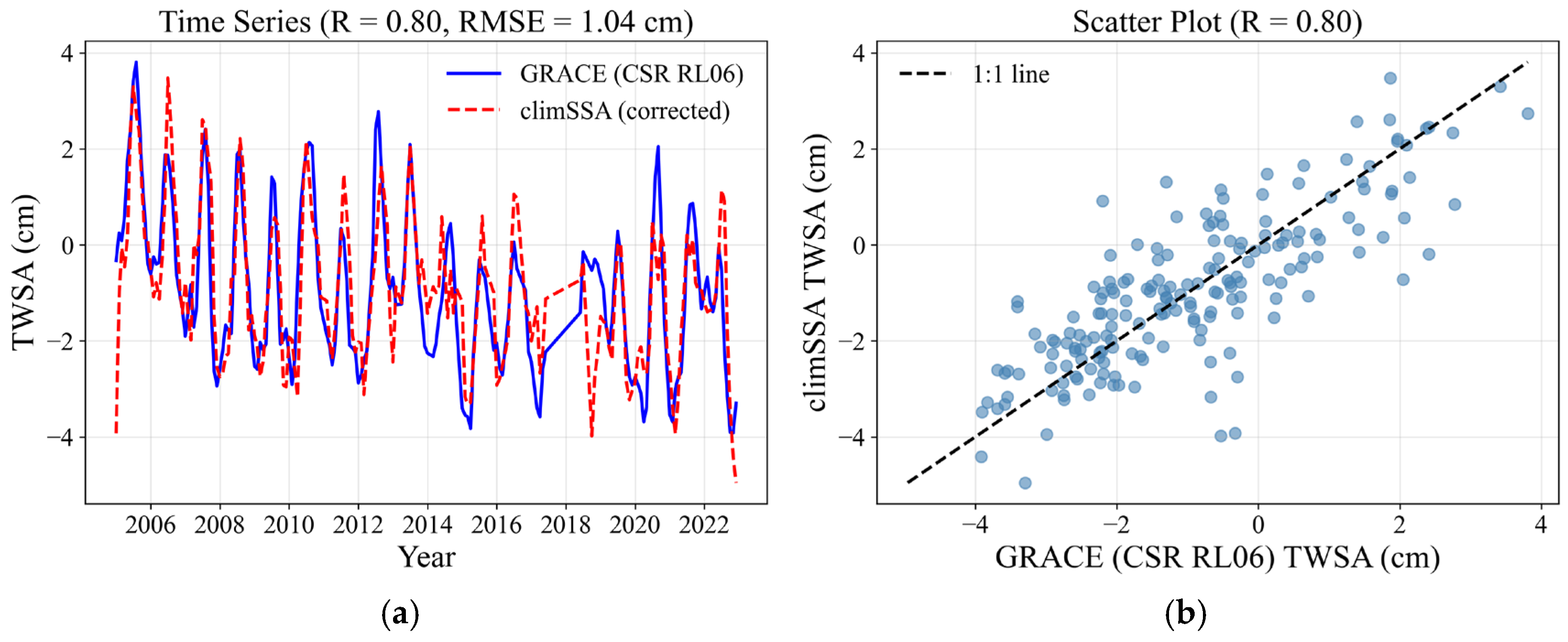
To evaluate the reliability of the resampled climSSA dataset for our study area, we conducted an independent validation using the original GRACE observations (CSR RL06 Mascon) over the period 2005–2022 (Figure 3). After applying a seasonal amplitude correction to the climSSA data, the agreement between the climSSA data and GRACE observations was strong, yielding R = 0.80, RMSE = 1.04 cm, and NSE = 0.61. The validated and corrected climSSA dataset was then used for subsequent analysis. The relevant data are shown in Table 1.

2.2.2. Definition of TWSA Classification

Regarding the determination of grades, some studies have employed the percentile method to explore the classification of standardized anomalies of TWSA and vegetation loss [31,47]. The percentile method is a non-parametric approach suitable for data of various distribution types [47]. However, when the percentile method is used to estimate percentiles in the tails of a distribution, uncertainty increases [48].
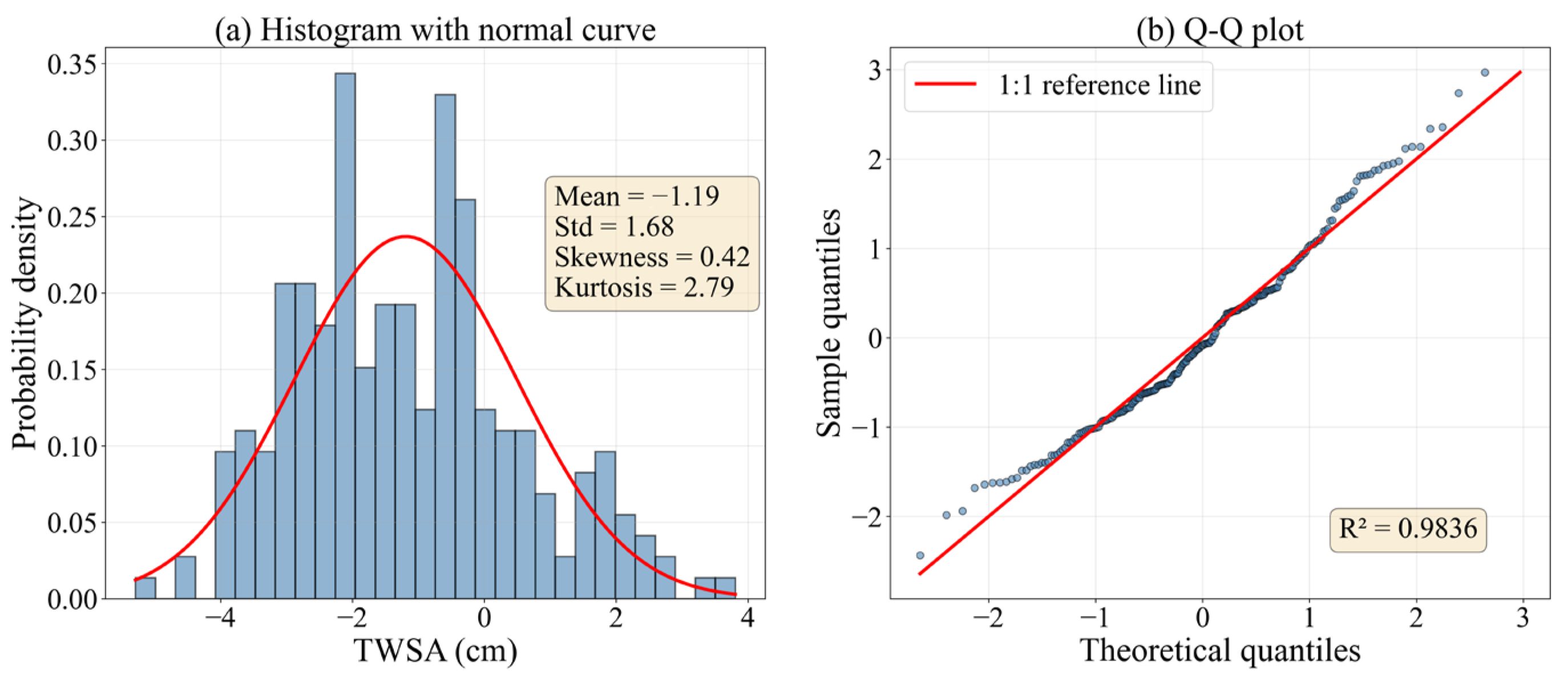
This study employed a classification method based on the standard deviation ( σ ) threshold to grade the degree of a TWSA deficit. Statistically, the application of the standard deviation threshold requires that the data approximately follow a normal distribution. Therefore, the Kolmogorov–Smirnov test (p > 0.05) and Q-Q plot verification (Figure 4) were conducted on the TWSA data to confirm that the TWSA time series approximately followed a normal distribution (skewness = 0.42, kurtosis = 2.79).
First, the TWSA is centralized to have a mean of zero, yielding the centered TWSA, denoted as T W S A c :
T W S A c = T W S A μ
where μ denotes the mean value of the T W S A over the study period. On this basis, the standardized Z -score is computed as follows:
Z = T W S A c σ
where σ represents the standard deviation of the T W S A .
Referring to the classification interval setting of the SPEI, the standard deviation multiple is adopted as the classification threshold [49], with Z = 0.5 , Z = 1.0 , and Z = 1.5 as the classification boundaries. Considering that the TWSA is a comprehensive indicator of terrestrial water storage and its variability is less than that of the SPEI, in this study, the situation where Z < −1.5 is combined into severe deficit, and an extreme deficit is not set. The other thresholds remain consistent with the SPEI standard, and a total of three TWSA deficit grades are set, as shown in Table 2. Under the assumption of normality, 0.5 σ , 1.0 σ , and 1.5 σ correspond to the 30th, 16th, and 7th percentiles of the standard normal distribution, respectively.

2.3. Method

2.3.1. SPEI Calculation

The SPEI is a multi-scalar drought index that incorporates both P and P E T to characterize meteorological drought [49]. The SPEI is calculated based on the monthly climatic water balance, defined as the difference between P and PET:
D i = P i P E T i
where D i is the water balance for month i . The D series is then aggregated at different time scales (e.g., 1, 3, 6, 9, 12, and 24 months) using a moving window approach. A three-parameter log-logistic probability distribution is fitted to the aggregated series, and the SPEI is obtained by standardizing the cumulative probability distribution:
S P E I = Φ 1 F x
where F x is the cumulative distribution function of the D series at a given time scale, and Φ 1 is the inverse of the standard normal distribution function.
The SPEI values can be classified into different drought grades. Following the standard classification scheme [49], Table 3 presents the classification of drought grades based on SPEI values, drought grades, and their corresponding theoretical percentiles under the assumption of normality.
In this study, the SPEI was calculated using the SPEI package in R (version 4.3.0). SPEI values at multiple time scales (1, 3, 6, 9, 12, and 24 months) were computed for each grid cell over the study period.

2.3.2. Maximum Correlation Coefficient Method

To quantitatively assess the response lag of TWS to meteorological drought, this study employed the maximum correlation coefficient (MCC) method [50]. The underlying rationale is that meteorological drought does not immediately and fully manifest in TWS due to hydrological processes such as infiltration, runoff, and groundwater recharge. Consequently, the strongest statistical relationship between a drought index and TWS often occurs after a certain time delay.
Based on the SPEIs calculated at multiple time scales (1, 3, 6, 9, 12, and 24 months), as described in Section 2.3.1, we computed, for each grid cell, the Pearson correlation coefficient between the TWSA time series and the concurrent SPEI time series at each scale [49].
Let S P E I s ( t ) denote the SPEI value at time scale s for month t , and T W S A t denote the TWSA at the same month. The correlation coefficient for scale s is given by the following:
ρ s = ρ T W S A t , S P E I s t = t = 1 n ( T W S A t T W S A ¯ ) ( S P E I s t S P E I s ¯ ) t = 1 n ( T W S A t T W S A ¯ ) 2 t = 1 n ( S P E I s t S P E I s ¯ ) 2
where n is the number of months in the study period, and the overbar denotes the mean value of the respective time series.
The time scale that yields the maximum correlation coefficient is then identified as follows:
s = arg max ρ s s S
where S = 1,3 , 6,9 , 12,24 is the set of candidate SPEI time scales. This optimal scale s is interpreted as the characteristic response lag (in months) of TWS to meteorological drought for that grid cell [49]. For example, if s = 6 , it implies that water storage in that region responds most sensitively to cumulative drought conditions over the preceding half year. In summary, for each grid cell, the SPEI time scale that yields the maximum Pearson correlation with a TWSA is taken as the characteristic response lag of TWS to meteorological drought [51].

2.3.3. Conditional Probability

To quantitatively assess the conditional probability of TWSA deficits triggered by different grades of meteorological drought stress, this study constructed a conditional probability model based on the Copula joint distribution function. Meteorological drought intensity is classified into several grades according to SPEI values (Table 3). For the degree of the TWSA deficit, the standard deviation classification method is employed to categorize it into three grades (Table 2). This classification not only reflects the statistical significance of TWSA deviations from the climatic norm but also aligns with common standards for hydrological anomaly grading.
Let X represent the SPEI time series and Y represent the TWSA time series, with marginal cumulative distribution functions F X x and F y ( y ) , respectively. According to Sklar’s theorem, there exists a Copula function C such that the joint distribution function is as follows:
F X ,       Y x , y = C ( F X x , F Y y )
Given that the SPEI falls within the interval x 1 , x 2 , corresponding to a specific drought grade, the conditional probability that the TWSA does not exceed a threshold y , corresponding to a specific deficit grade, can be expressed as follows:
P Y y x 1 < X x 2 = C F x x 2 , F y ( y ) C F x x 1 , F y ( y ) F x x 2 F x x 1
where C is the constructed Copula joint distribution function. The physical meaning of Equation (8) is as follows: under the condition that meteorological drought falls within a specific grade, this probability indicates the likelihood that the TWSA deficit degree does not exceed a given threshold. A higher probability suggests that TWS is more sensitive to the corresponding grade of meteorological drought, implying a greater hydrological response risk.
In practical computation, for each grid cell, the standard deviation σ T W S A is first calculated from the TWSA time series over the study period to define the deficit thresholds (e.g., mild deficit: y ≤ −0.5 σ TWSA). The number of months in which the SPEI falls within a given drought interval (e.g., extreme drought: X ≤ −2.0) is counted as n d r o u g h t , and the number of months in which both the SPEI falls within that interval and the TWSA does not exceed the deficit threshold is counted as n b o t h . The empirical conditional probability is then estimated as follows:
P = n b o t h / n d r o u g h t
which serves as a reference for validating the theoretical probability obtained from Equation (8). Several candidate Copula functions, including Gaussian, Clayton, Gumbel, Frank, Joe, and Student’s t, were considered. The best-fitting Copula was selected based on goodness-of-fit tests and the Akaike Information Criterion (AIC). The parameters of the selected Copula were then estimated using the maximum likelihood method, followed by the application of Equation (8) to obtain the theoretical conditional probability. By repeating the above procedure for each grid cell, the spatial distribution of conditional probabilities across the study area is obtained. The complete calculation workflow is illustrated in Figure 5.

2.3.4. Trigger Threshold

Based on a Copula–Bayes joint probability framework, the nonlinear dependence structure between meteorological drought and the terrestrial TWSA deficit is analyzed by constructing the joint distribution of the multi-scale SPEI and TWSA. The concept of “system resilience loss” is introduced to define the critical threshold. In this study, “system resilience loss” refers to the critical turning point at which a terrestrial hydrological system, under sustained and intensifying drought stress, transitions from a relatively stable normal state capable of buffering drought impacts to a state where it can no longer buffer and consequently enters a state of severe water deficit. “System resilience loss” occurs in two stages. The first is the Resilience Stage: during the initial phase of drought, the system can effectively buffer through internal TWS, maintaining a TWSA within the normal fluctuation range and exhibiting stability. The second is the Critical Point of Resilience Loss: when drought intensity exceeds a specific threshold, the system’s buffering capacity is exhausted, leading the TWSA into a deficit state.
Specifically, the TWSA time series first undergoes preprocessing, including seasonal adjustment, outlier removal, and linear trend elimination, to highlight the hydrological anomaly signals induced by drought stress. Subsequently, based on the AIC, the optimal Copula function that best characterizes the joint distribution of the SPEI and TWSA is selected to establish their probabilistic association model. Finally, using an inverse progressive search algorithm, the conditional probability of the TWSA falling into different deficit grades under varying drought conditions is systematically calculated across the physically plausible SPEI interval of [−3, −0.5] with a step size of 0.1. The SPEI value corresponding to the first instance where this probability stably exceeds 0.5 is identified as the critical threshold for system resilience loss. In probabilistic terms, 0.5 serves as the symmetric threshold distinguishing between the occurrence and non-occurrence of an event. When the conditional probability exceeds 0.5, the TWSA deficit transitions from a low-probability event to a high-probability one. Accordingly, the SPEI value corresponding to the first sustained exceedance of the conditional probability over 0.5 is defined as the critical threshold at which drought triggers a TWSA deficit and induces the loss of system resilience, a choice consistent with findings in the relevant literature [47]. Subsequent regional analysis will be presented on a 0.25° grid basis or as regional averages, building upon the overall analysis.

2.3.5. Interpretable CatBoost-SHAP Machine Learning Model

To identify key environmental factors influencing the drought trigger threshold of the TWSA, we employed an interpretable machine learning framework based on CatBoost-SHAP. This framework can automatically process multi-source environmental data and capture complex nonlinear relationships among variables. The target variable was the previously derived SPEI critical threshold for each pixel, and the input features comprised the following environmental factors: precipitation (PRE), temperature (TMP), potential evapotranspiration (PET), wind speed (WIND), gross primary productivity (GPP), vapor pressure deficit (VPD), vegetation cover (VEG), snow water equivalent (SWE), elevation (DEM), surface soil moisture (SSM), and land surface temperature (TS). All data were resampled to the same spatial resolution of 0.25° × 0.25°. The model was trained using 70% of the samples, with the remaining 30% reserved for validation. SHAP values were then used to interpret the model, allowing us to quantify the global importance of each environmental factor and reveal their nonlinear relationships with the threshold, including the direction of their effects [52]. This approach enables the identification of dominant factors controlling the drought trigger threshold, thereby offering insights into drought propagation mechanisms in complex hydrological systems.

3. Results

3.1. The Spatio-Temporal Distribution Characteristics of TWSA

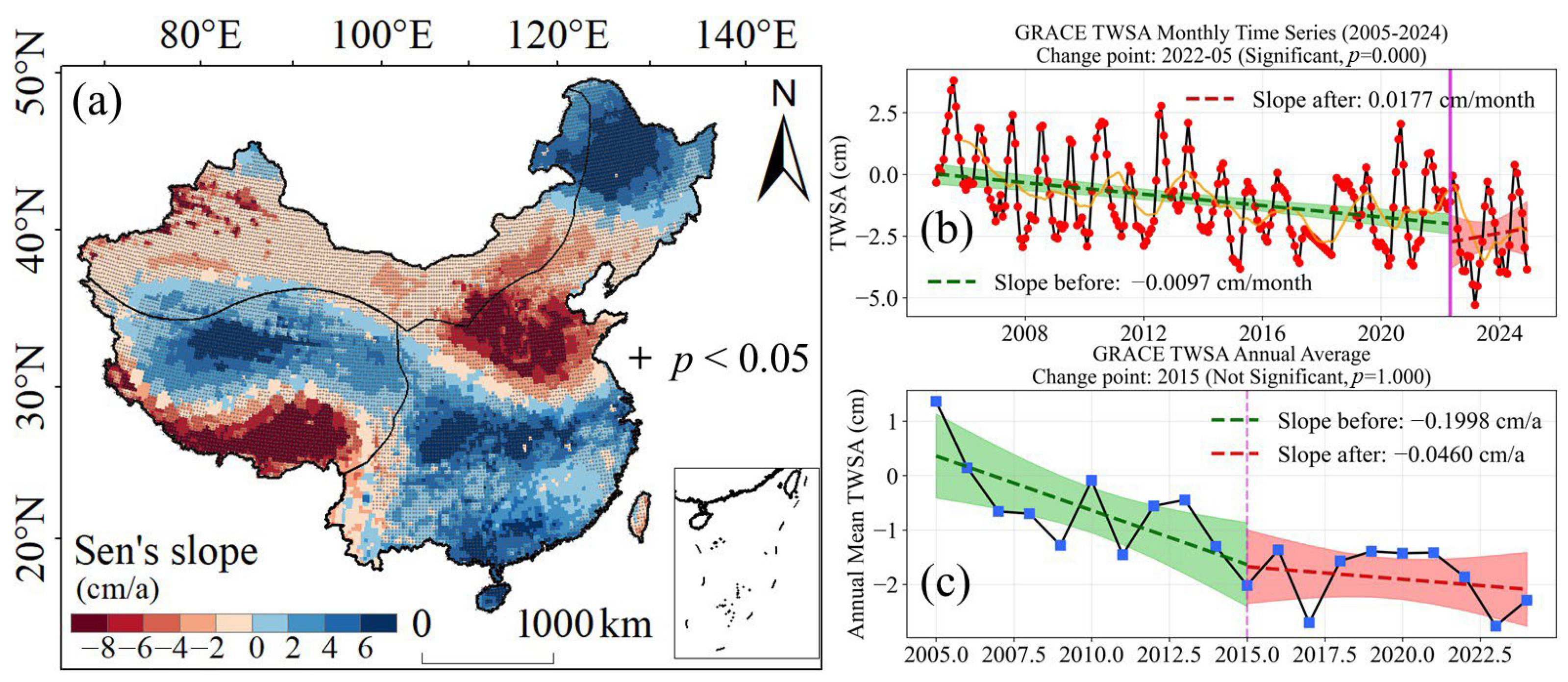
Figure 6 illustrates the spatiotemporal trends and abrupt change points in the TWSA from 2005 to 2024. Spatially, between 2005 and 2024, 48.80% of China’s TWS exhibited a declining trend, with 43.60% of the area showing a statistically significant decrease (p < 0.05; Figure 6a). Significant declines were primarily distributed in the EMR, particularly the North China Plain and the middle–lower Yellow River agricultural irrigation zones; the NAR, particularly the Ili Valley, Tianshan Mountains, Hetao Plain, and Ningxia Plain; and the southern TPR, particularly the Huangshui Valley and surrounding areas. These regions are characterized by intensive agricultural irrigation and high groundwater extraction rates, suggesting that anthropogenic water use may be a major driver of TWS decline. Although 43.20% of the area showed a significant increasing trend (mainly concentrated in the Northeast China Plain and the northern TPR), TWS across China still declined significantly at a rate of −0.13 cm/a during 2005–2024. A significant change point was detected in May 2022 (Figure 6b); prior to that, TWS had decreased slowly at a rate of −0.12 cm/a, but after the change point, the mean TWS dropped sharply to −2.47 cm, representing a decline of approximately 147.75%. The timing of this abrupt change coincides with a persistent heatwave and precipitation deficit event that affected much of China in the summer of 2022, suggesting that extreme climatic anomalies may have triggered a regime shift in terrestrial water storage. Although a slight short-term recovery was observed after the change, the overall level remained notably low. On an interannual scale, TWS showed an overall downward trend, with a pronounced deficit in TWS (Figure 6c).
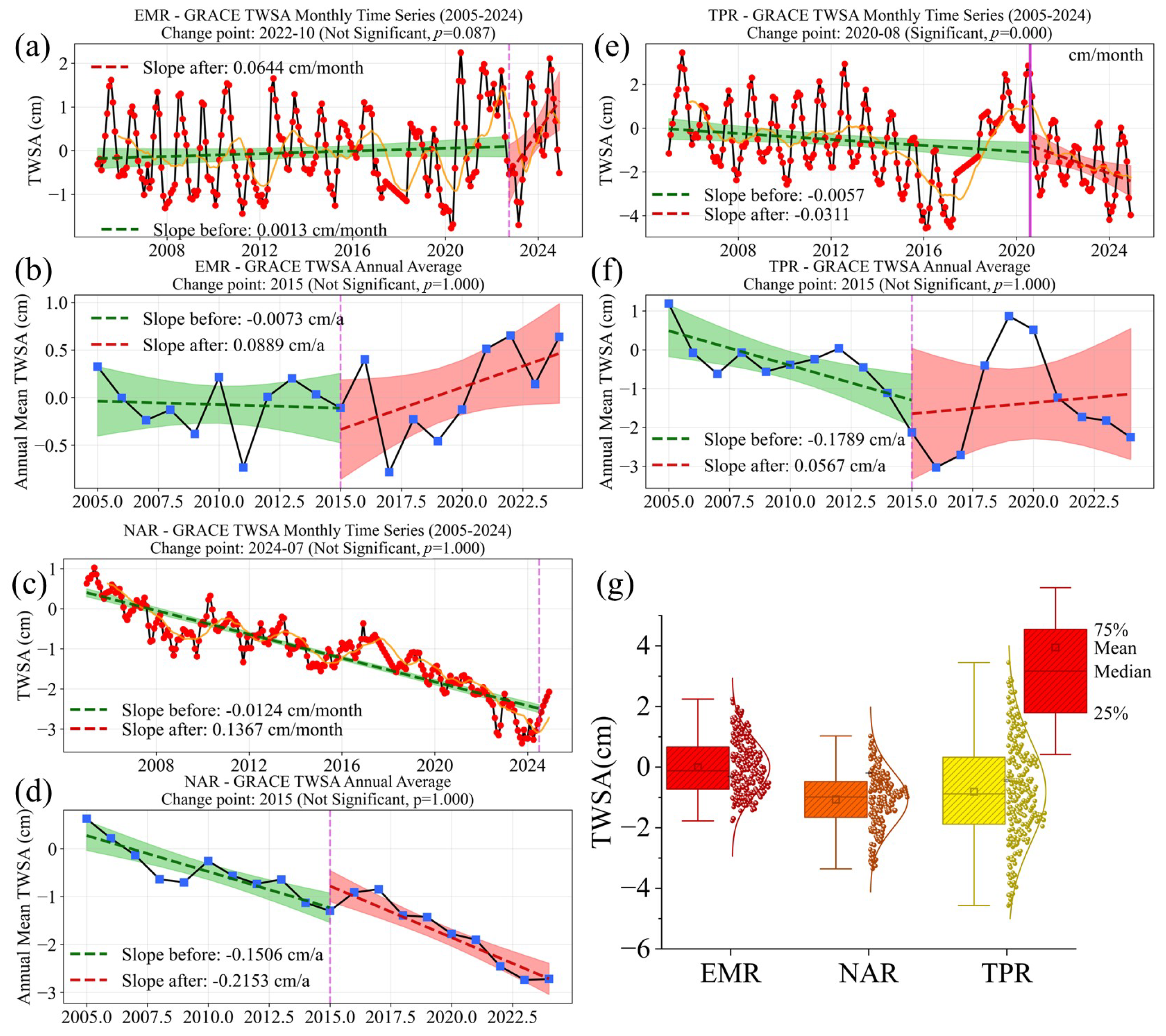
Based on GRACE data, Figure 7 shows the trend analysis and abrupt change detection of TWSAs in the three major natural regions. The results indicate significant regional differentiation in the TWSA. In the EMR, the TWSA is basically stable with a slight upward trend ( 0.02 cm/a), and no significant abrupt change is detected, indicating a relatively stable hydrological state (Figure 7a,b). In the NAR, TWS has been continuously and significantly decreasing ( 0.15 cm/a), with the annual average value dropping from 0.63 cm in 2005 to 2.72 cm in 2024, reflecting the prominent water resource pressure in this region (Figure 7c,d). In the TPR, TWS has the strongest variability (standard deviation of 1.67 cm) and shows a significant downward trend ( 0.09 cm/a). This high variability likely reflects the combined effects of cryospheric meltwater dynamics, permafrost degradation, and complex topographic controls on hydrological processes in the Tibetan Plateau.
Further analysis of the TPR reveals a key hydrological abrupt change. Monthly scale detection indicates (Figure 7e) that the TWSA experienced an extremely significant abrupt change in August 2020 (p < 0.001). Before the abrupt change, the mean TWSA was 0.58 cm, decreasing at a rate of 0.07 cm/a; after the abrupt change, the mean dropped to 1.61 cm, with the rate of decrease accelerating to 0.37 cm/a, approximately 5.3 times that before the abrupt change (Figure 7e,f). This abrupt change led to a mean TWSA decrease of about 1.03 cm, marking the entry of the region into an accelerated loss phase of TWS after 2020. No significant abrupt change was detected at the annual scale (Figure 7d), possibly because in the highly variable TPR, key hydrological abrupt changes are often driven by seasonal or event processes, and their strong signals are only retained in high-resolution data such as monthly scale data.
From the distribution characteristics (Figure 7g), the TWSA in the EMR is concentrated near zero, being the most stable; in the NAR, the TWSA is overall left-skewed, concentrated in the negative range ( 1.66 to 0.48 cm), showing a continuous drying trend; and in the TPR, the TWSA has the widest distribution range (range 8.02 cm) and the strongest variability. This directly reveals the spatial gradient pattern from stability in the east, continuous loss in the northwest, to intense fluctuations in the Tibetan Plateau.

3.2. Lagged Response Characteristics of Meteorological Drought Propagating to TWSA

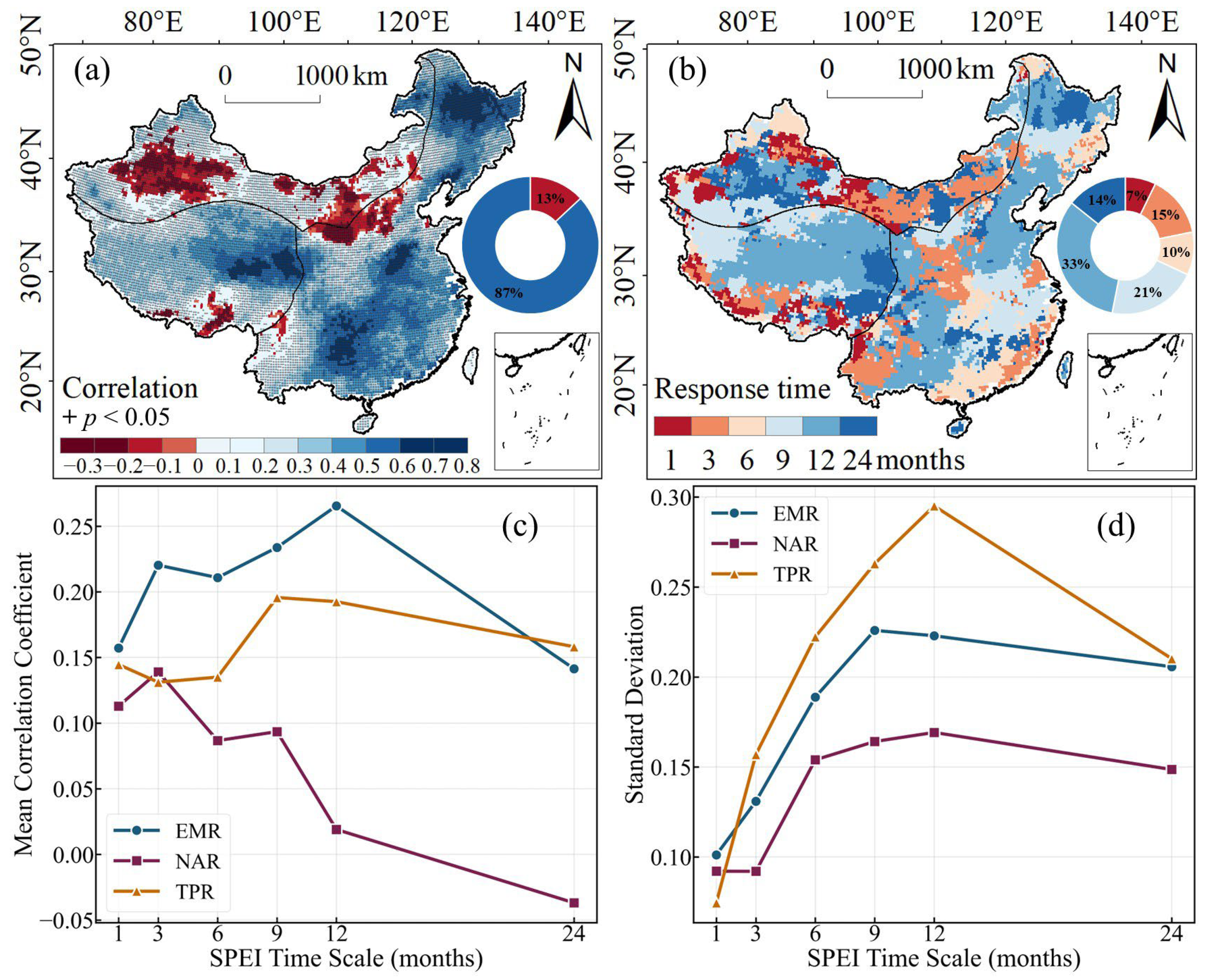
Figure 8 presents the lagged spatiotemporal pattern of the TWSA’s response to the SPEI, identified using the maximum correlation coefficient method. The results showed that in 87% of the area, the TWSA was significantly correlated with the SPEI (p  < 0.05; Figure 8a). The lag time exhibited significant spatial heterogeneity, with a dominant medium- to long-term response of 9–12 months. Among them, the areas with a 12-month and 9-month lag accounted for 33% and 21%, respectively, covering 54% of the study area. The remaining areas showed different lag characteristics at scales of 1 month (7%), 3 months (15%), 6 months (10%), and 24 months (14%) (Figure 8b).
There were significant differences in the lagged response characteristics of the SPEI to the TWSA among the three major natural regions in China (Figure 8a). The EMR had the slowest response, with an average lag time of 12 months, an average correlation coefficient of 0.27, and a positive correlation ratio of 84.4%, indicating a significant delayed response of the TWSA to meteorological drought in this region. This prolonged lag is likely due to the buffering effects of large-scale reservoir regulation, groundwater storage, and humid climate conditions that attenuate the propagation of meteorological drought signals. The NAR had the fastest response, with an average lag time of 3 months, an average correlation coefficient of 0.14, and the highest positive correlation ratio (92.9%), reflecting rapid but significant attenuation of water transmission in arid areas. This short lag reflects the limited water storage capacity and rapid runoff generation in arid environments, where even minor precipitation deficits quickly translate into TWSA anomalies. The TPR had an average lag time of 9 months, and the proportion of significant correlation was only 24.8%, suggesting that the high-altitude terrain significantly interfered with the propagation of drought signals (Figure 8c). The intermediate lag time may be attributed to the delayed release of meltwater from glaciers and snowpack, which temporarily offsets precipitation deficits before cryospheric buffers are exhausted.
From the perspective of spatial heterogeneity (Figure 8d), the standard deviation of the lag time in each region was significantly different. The EMR had a value of 0.22, showing moderate variability, which was related to the influence of human activities on the hydrological process; the NAR had a value of only 0.09, showing high consistency, indicating that its transmission process was less affected by local factors; and the TPR reached 0.29, with the strongest spatial heterogeneity, reflecting the strong regulation of the altitude gradient, glacier distribution, and permafrost changes on the water transmission path.

3.3. Probability Distribution of TWSA Deficit Triggered by Meteorological Drought

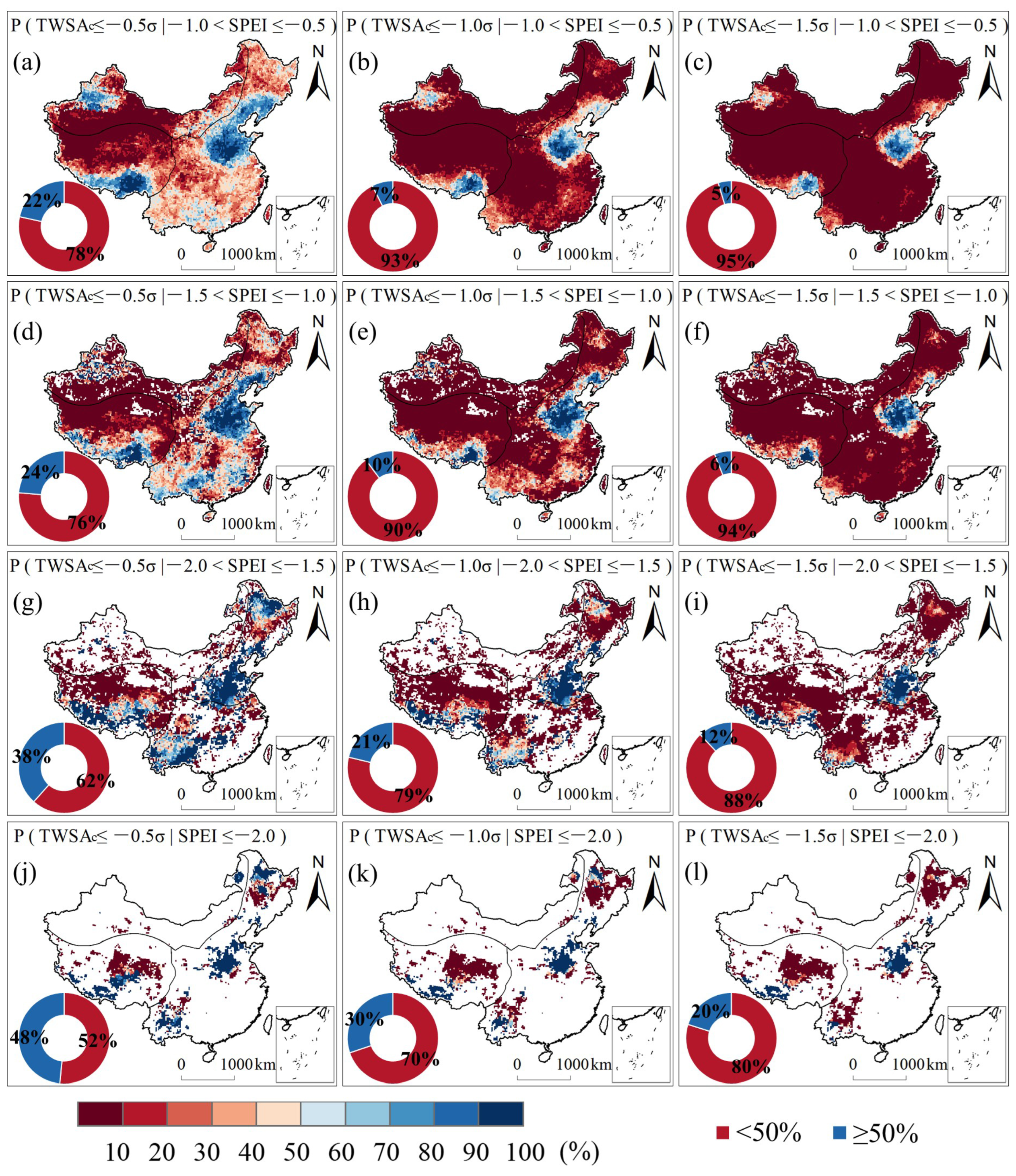
This section analyzes the joint distribution of the SPEI and TWSA based on the Copula function and calculates the conditional probability of a TWSA deficit under different drought grades. Under mild drought conditions, the area proportions of regions where the probability of a TWSA experiencing mild, moderate, and severe deficiencies exceeds 50% are 22%, 7%, and 5%, respectively. As the severity of drought intensifies (from moderate to severe and extreme drought), the area ranges where the probability of TWSA deficiencies at each grade exceeds 50% show a significant expansion trend (Figure 9a,d,g,j), indicating that more severe water stress significantly expands the high-risk areas of a TWSA deficit.
However, within the same drought grade, the probability of TWSAs experiencing higher-level deficiencies generally shows a weakening trend, and the spatial range of high-probability areas significantly shrinks from the original core areas (Figure 9a,c). For example, under moderate drought conditions, the area proportions where the probability of a TWSA mild deficit, moderate deficit, and severe deficit exceeds 50% are 24%, 10%, and 6%, respectively, showing a stepwise decrease.
From a spatial distribution perspective (Figure 9a–c), under mild drought conditions, the North China Plain–Loess Plateau, Ili River Valley–Tianshan Mountains, and the southern part of the Tibetan Plateau are the core areas with high probabilities of TWSA deficit, and their ranges are highly consistent with the areas where the TWSA significantly decreases during the same period. This spatial consistency suggests that meteorological drought acts as a direct trigger for hydrological storage loss in these vulnerable regions, with limited buffering capacity from groundwater or surface water storage. The hydrological systems in these regions show high sensitivity to initial meteorological drought. As drought intensifies, the high-probability areas gradually expand outward. By the time severe drought occurs, the original core areas continue to strengthen, and two new high-probability centers emerge in the Sanjiang Plain in Northeast China and the karst areas in Southwest China, revealing the spatial differentiation and spread of hydrological vulnerability under moderate and more severe drought stress.
It is worth noting that under extreme drought scenarios, the conditional probability of a TWSA deficit only has valid estimates in the Tibetan Plateau, Southwest, North China Plain, and parts of Northeast China, while most of the eastern and southern regions show data gaps (Figure 9j–l). This is due to the requirement of the Copula function for the sample size of statistical data, meaning that only in regions where the frequency of past extreme drought events is relatively high does the probability estimation have statistical robustness. Therefore, this spatial pattern itself marks the high-frequency occurrence areas and core vulnerable areas of extreme meteorological drought in China, such as the North China Plain, Southwest, and Northeast. These regions either have a semi-arid climate and water resource overuse or are affected by special landforms (such as karst), resulting in frequent extreme drought events historically and leading to persistently high risks of TWSA deficit. Conversely, the probability gap areas indicate that extreme drought events are rare during the study period, and their risks are difficult to quantify based on historical data. However, under the background of climate change, this does not mean the risk is zero.

3.4. Thresholds for TWSA Deficit Caused by Meteorological Drought

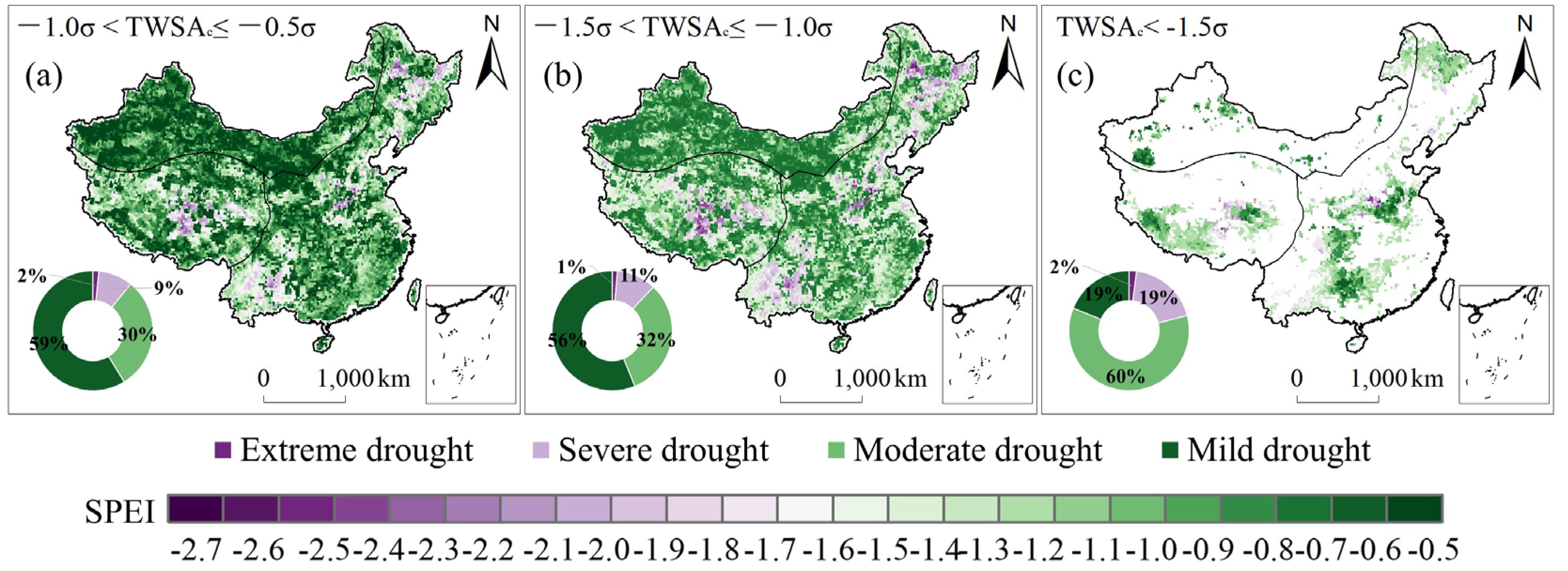
Based on the Copula function, this section calculates the SPEI threshold when the conditional probability of the TWSA deficit exceeds 50%. When the conditional probability surpasses this equilibrium point, it indicates that the probability of a TWSA deficit occurring is higher than that of not occurring, which can be regarded as a critical hydrological risk threshold. Figure 10 shows the spatial distribution of the SPEI thresholds required to trigger different levels of a TWSA deficit. In the color scale, the deeper the purple, the lower the SPEI threshold, meaning that more severe drought is needed to trigger a deficit, reflecting a low-threshold and difficult-to-trigger response characteristic; the green areas indicate higher SPEI thresholds, meaning that mild drought can trigger a deficit, belonging to a high-threshold and easy-to-trigger highly sensitive type. As the TWSA deficit level increases, the drought grade structure triggering deficits undergoes significant changes. The area proportion of mild drought as a triggering factor rapidly drops from 59% to 19%, while the proportions of moderate, severe, and extreme drought triggering deficits increase from 30% to 60%, 9% to 19%, and slightly increase for extreme drought as well.
The threshold in the EMR shows a distinct latitudinal differentiation. The North China Plain and the Loess Plateau present deep purple in the mild deficit grade, with thresholds ranging from 1.8 to 2.0, belonging to the low-threshold response area; the middle and lower reaches of the Yangtze River and South China are mainly light green, with mild deficit thresholds ranging from 0.8 to 1.2, demonstrating high sensitivity and strong system buffering capacity. The SPEI thresholds are concentrated between 1.5 and 1.0 in the NAR, showing extremely high sensitivity. At the same time, the hydrological structure in the arid region is simple, and meteorological drought often directly and rapidly transmits to a TWSA deficit, lacking an effective buffering mechanism. Therefore, the easy-to-trigger feature more likely reflects the sensitivity of statistical detection and does not represent strong system resilience; instead, it may imply that the system is approaching a hydrological critical state. This interpretation aligns with the concept that high sensitivity in water-limited systems often signals proximity to a hydrological tipping point, rather than indicating robust hydrological resilience.
It shows light green in the mild deficit grade, with thresholds ranging from 1.0 to 1.5 in the TPR. As the deficit grade increases, the deep purple area expands, and the threshold drops below 2.0. This change reveals that when positive supplies such as glacial meltwater cannot offset evapotranspiration and runoff losses, the TWSA will experience a sharp decline. At this point, more extreme drought conditions are needed to trigger the same degree of TWSA deficit, reflecting the nonlinear characteristics of the hydrological process in the high-altitude system.
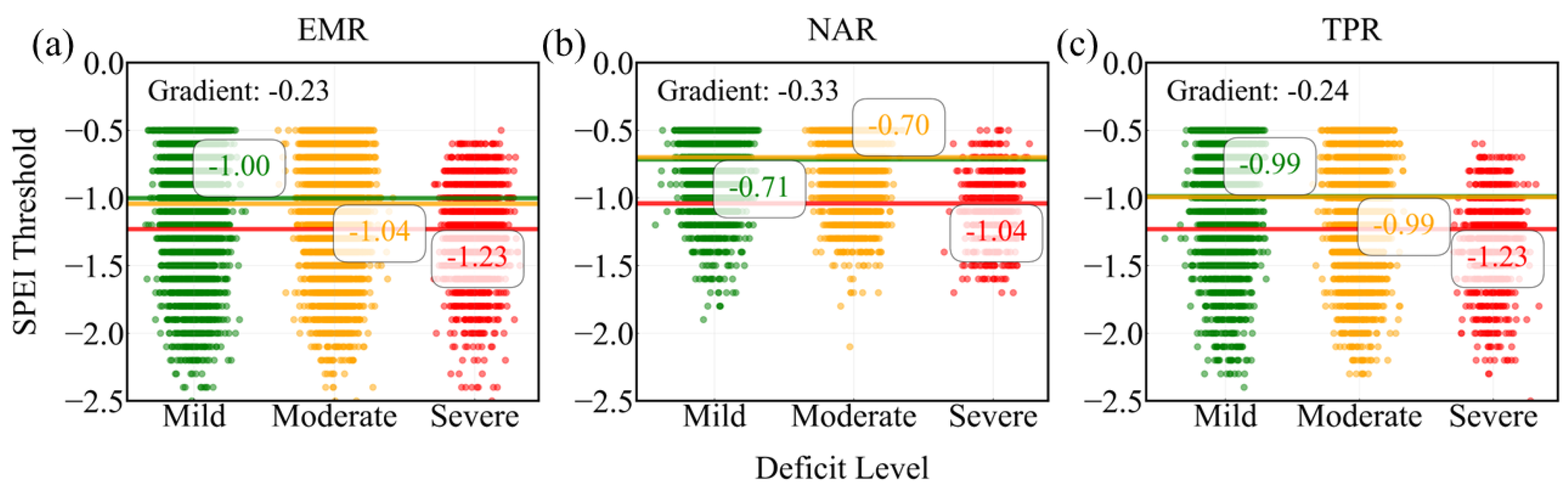
Figure 11 shows that as the TWSA deficit grade increases, the SPEI trigger thresholds in the three natural regions all show a downward trend, indicating that the SPEI conditions required to trigger the same degree of TWSA deficit tend to become more stringent. Among them, the threshold gradient in the NAR is the steepest, at 0.33, indicating that it is most sensitive to enhanced drought; the threshold gradients in the EMR and the TPR are relatively gentle, with gradients of 0.23 and 0.24, respectively. This spatial gradient difference reflects the heterogeneous response mechanisms of the hydrological systems in different natural geographical units to drought stress. Specifically, the low thresholds in the EMR reflect the buffering effects of high water storage capacity and human activities, while the similarly low thresholds in the TPR are attributed to the buffering effect of cryospheric meltwater supply.

3.5. Driving Factors of the Trigger Threshold for TWSA Deficit

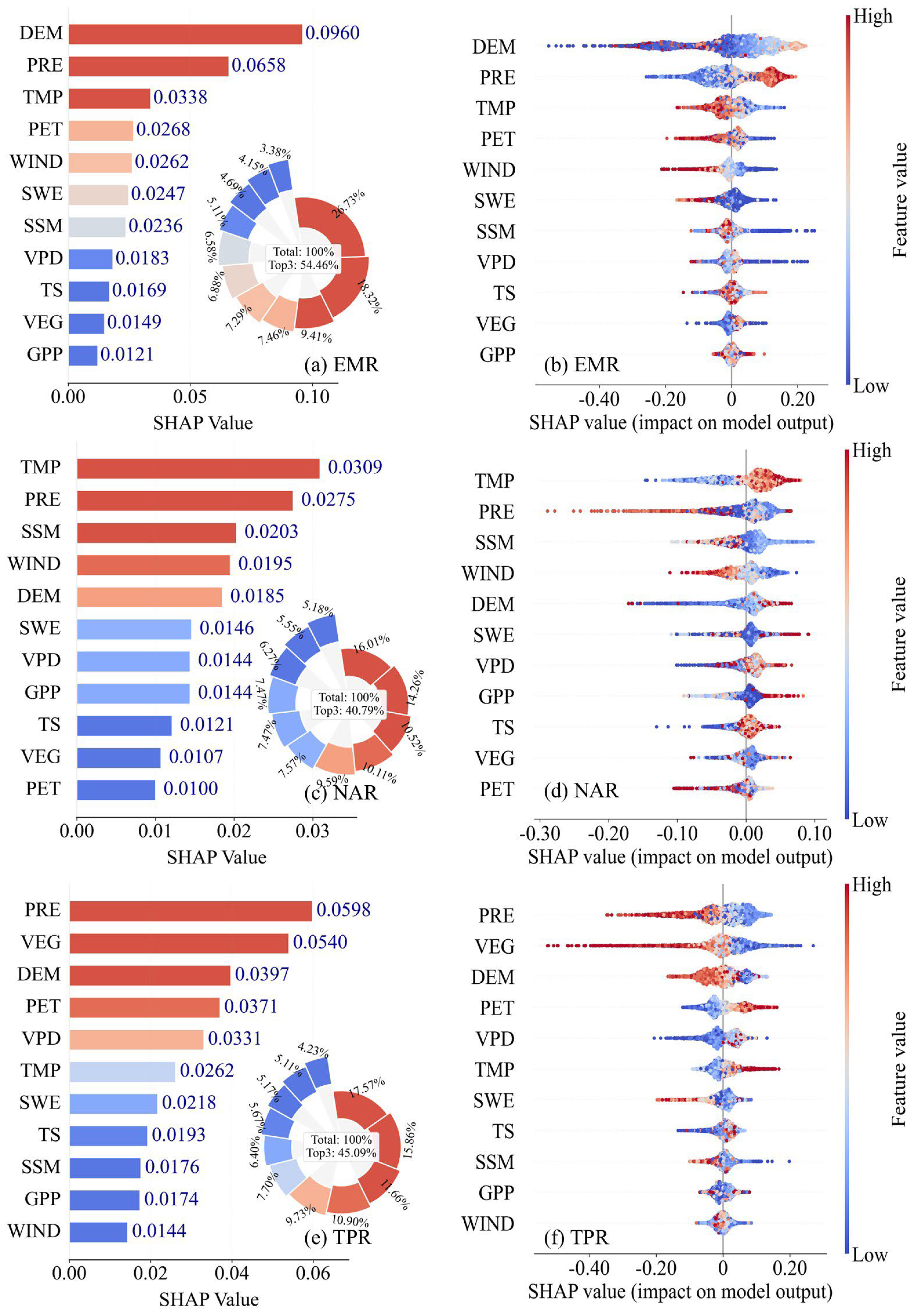
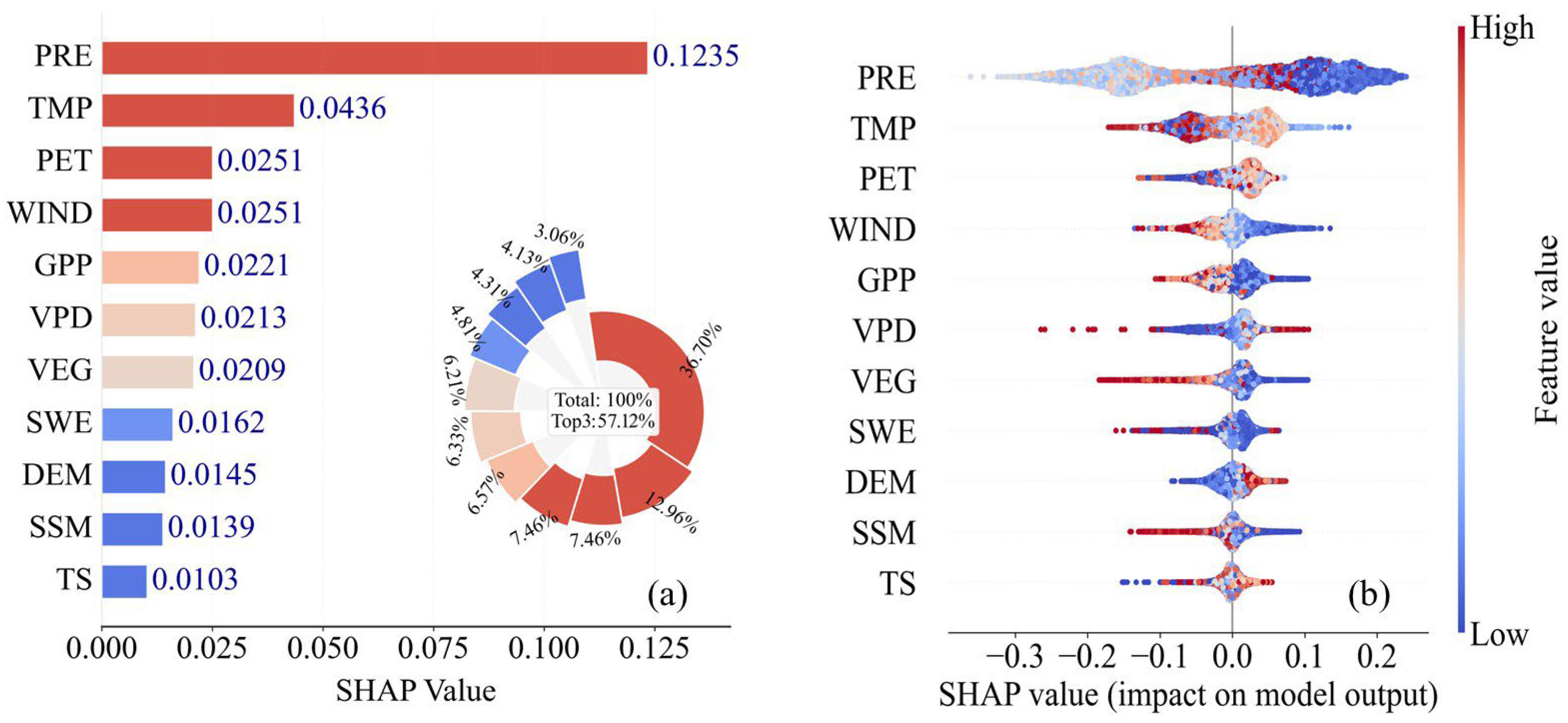
Figure 12 analyzes the driving factors of the TWSA deficit trigger threshold using the CatBoost model and SHAP framework, revealing that PRE is the core driving factor affecting the threshold, with a SHAP contribution rate of 36.73% (Figure 12a), significantly higher than other factors, demonstrating the decisive role of water in the dynamics of TWS. The dominant role of PRE is consistent with water-limited systems where precipitation directly controls water availability. TMP and PET rank second and third with contribution rates of 12.98% and 7.46% respectively, highlighting the important synergistic impact of the energy balance process on the triggering of drought. Notably, PET and WIND have comparable contribution rates (7.46% and 7.45%), indicating that evapotranspiration demand and near-surface atmospheric dynamic processes jointly regulate the system’s sensitivity to water stress. Among the secondary driving factors, the contributions of GPP, VPD, and VEG are 6.56%, 6.33%, and 6.21%, respectively, reflecting the combined effects of ecosystem carbon–water coupling and atmospheric drought stress. The contributions of SWE, DEM, SSM, and TS are relatively low (4.81–3.05%), suggesting that their roles may be context-dependent at local scales or in specific surface processes.
From the perspective of the direction of influence (Figure 12b), the SHAP value of PRE is mainly positive, indicating that an increase in PRE generally raises the trigger threshold and enhances the system’s resistance to water deficit; while TMP and PET mainly show negative impacts, suggesting that higher temperatures and increased evapotranspiration significantly lower the threshold, making the system more prone to entering a state of water stress. This finding has important implications for future climate change scenarios, where rising temperatures may amplify hydrological vulnerability independent of precipitation trends [53].
Overall, the TWSA deficit trigger threshold is under dual control of water dominance and energy modulation. PRE is the primary factor throughout, while TMP, PET, and VPD jointly regulate the sensitivity and timing of drought occurrence by altering the surface water and heat balance and evapotranspiration demand.
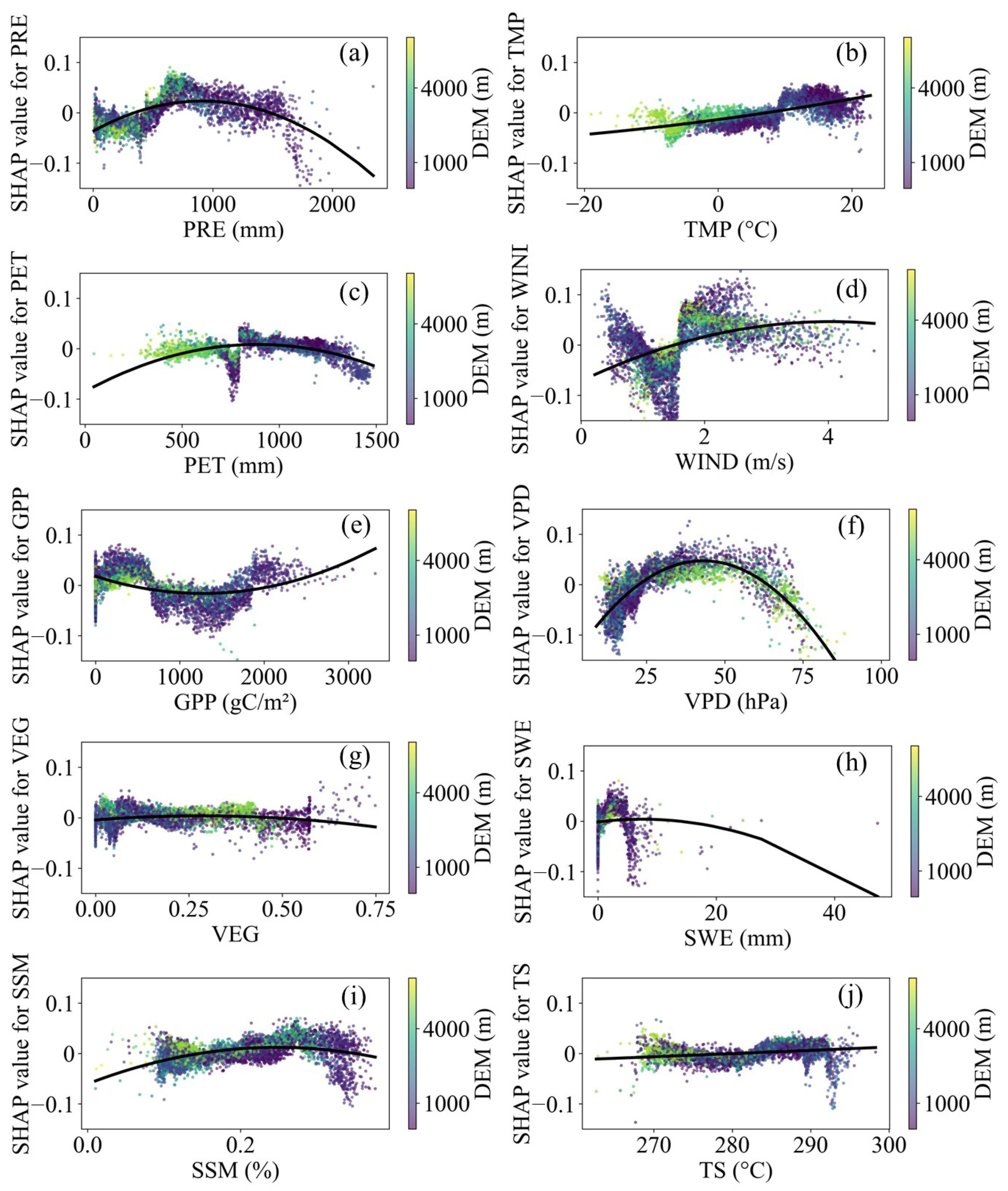
Figure 13 reveals the correlation characteristics between different environmental factors and the triggering threshold, and presents the spatial differentiation patterns of these correlations with changes in DEM through color gradients. The horizontal axis of each sub-figure represents a specific environmental factor, while the vertical axis represents the SHAP value, and the color scale indicates the variation in DEM. Specifically, PRE shows a negative correlation with the threshold, indicating that increased precipitation reduces the tendency of drought occurrence (Figure 13a); TMP has a positive linear correlation with the threshold, suggesting that warming may intensify the risk of drought (Figure 13b); an increase in PET generally corresponds to a decrease in the threshold, reflecting the promoting effect of high evapotranspiration on drought (Figure 13c); the influence of WIND is not significant (Figure 13d); an increase in GPP is accompanied by a decrease in the threshold, which may reflect either the enhanced drought resilience of high-productivity ecosystems or simply that high GPP values tend to occur in regions with less severe drought conditions (Figure 13e); VPD shows a significant negative correlation with the threshold, supporting the driving role of atmospheric drought in water stress (Figure 13f); the influence of VEG is relatively weak (Figure 13g); an increase in SWE is associated with a decrease in the threshold, possibly reflecting the buffering effect of snow and ice water storage on drought (Figure 13h); SSM shows a significant negative correlation with the threshold, highlighting the key regulatory role of soil moisture (Figure 13i); and TS has a positive correlation with the threshold, further confirming the promoting effect of warming on drought occurrence (Figure 13j).
These analysis results further confirm that the triggering threshold of a TWSA deficit is under the dual control of water dominance and energy modulation, where PRE is the primary factor throughout, while TMP, VPD and WIND regulate the sensitivity and timing of drought occurrence by altering the surface water and energy balance and evapotranspiration demand.

4. Discussion

4.1. Differentiated Analysis of Trigger Threshold Driving Mechanism in Three Natural Regions

We observed that as meteorological drought intensifies, the spatial extent of the TWSA deficit gradually expands across the three major natural regions, yet the underlying mechanisms differ fundamentally. To understand the spatial heterogeneity of TWSA deficits, we analyzed three major natural regions separately: the EMR, the NAR, and the TPR. This regionalization is justified by their distinct climatic regimes, topographic characteristics, and human activity intensities, which together determine the dominant drivers of TWSA deficits in each region.
In the EMR, the North China Plain exhibits a high probability of TWSA deficit. Consistent with previous findings [54], our results confirm that PRE and TMP are the primary controlling factors for drought evolution in this area (Figure 14a,b). DEM, PRE, TMP, and PET serve as core drivers of TWSA deficits. Topographic factors can profoundly influence hydrological processes by shaping runoff pathways and affecting groundwater recharge [55], thereby determining the baseline sensitivity of different geomorphic units to drought stress. The role of topography has also been emphasized in related studies [23]. Our analysis shows that the TWSA in the EMR remains relatively stable with a slight upward trend (Figure 7a,b), which may be attributed to increasing PRE trends [56,57]. This finding aligns with the broader view that regions with significant TWS declines will experience increased drought frequency and intensity, a change driven primarily by climate rather than land water resource management [58,59]. Consequently, in monsoon-affected regions like the EMR, where annual runoff is generally abundant, topography plays a secondary redistributive role, while both climatic factors (PRE and TMP) and runoff volume dominate the trigger thresholds of the TWSA deficit.
In the NAR, the Ili-Tianshan area shows a significantly higher probability of TWSA deficit compared to other areas. This region experiences intensive human activities, where agricultural irrigation further increases the risk of a TWSA deficit. Our findings indicate that TMP and PRE are the main climatic drivers of the triggering threshold (Figure 14c,d). The TWSA in this region is significantly negatively correlated with drought conditions (Figure 8a), suggesting that the NAR is more sensitive to drought and more prone to water shortages during dry periods, leading to reductions in surface water and groundwater storage. More intensive human activities further increase the likelihood of TWSA deficit, which is consistent with related studies [60]. Previous research has shown that a drought-induced TWSA deficit is often irreversible, and drought events are the primary cause [22,61]. As drought severity increases, a cascading effect occurs, from meteorological drought to surface water deficit, soil moisture deficit, and groundwater deficit, ultimately resulting in a TWSA deficit. This reduction in water availability can further propagate into agricultural and socio-economic system droughts [62].
In the TPR, the southern part is a high-risk area for a TWSA deficit. The leading factor influencing the triggering threshold in this region is PRE, with a contribution rate of 17.55% (Figure 14e,f), indicating that water input plays a fundamental role in this mountainous area. This agrees with He et al. [63]. VEG ranks second, highlighting its key regulatory role in the hydrological processes of mountain ecosystems. It profoundly affects water distribution and consumption through transpiration, interception, and modifications to underlying surface properties. Although changes in soil moisture account for a large proportion of TWSA variability [64], we found that SSM does not significantly affect the triggering threshold, a result also supported by related studies [58,65].

4.2. The Perturbation Effect of Irrigation Agriculture on the Triggering Threshold

Our research results indicate that nearly half of the regions in China have witnessed a declining trend in TWS. We found that the areas with significant decline are mainly distributed in typical irrigation areas (Ningxia Plain, Hetao Plain, Ili River Valley, and Huangshui Valley) or regions where both irrigation and rain-fed agriculture are important (North China Plain and the agricultural area in the middle and lower reaches of the Yellow River). These findings are consistent with the results of related studies [60]. This alteration of the natural state of the regional water cycle by human irrigation activities is referred to as a “disturbance effect”, which in turn interferes with the response mechanism of TWS to meteorological drought and affects the drought trigger threshold for TWS loss.
In regions where irrigation agriculture is highly developed, human activities have profoundly altered the balance of the natural water cycle. Irrigation has promoted an increase in grain production and agricultural development, but it has also locally led to an increase in the vulnerability of water systems [66]. For instance, in the oasis areas of the NAR [67] and the North China Plain in the EMR [68], the expansion of irrigated farmland has led to a long-term increase in regional evapotranspiration water consumption, creating a positive feedback loop between irrigation demand and water resource depletion, thereby eroding the drought buffering capacity of the water resource system [69]. Our analysis indicates that the sensitivity of TWS to meteorological drought has been greatly enhanced, and the meteorological drought level required to trigger the same degree of TWS loss has been artificially reduced. This means that the system’s safety threshold has shifted towards milder meteorological conditions, and even minor meteorological droughts can cause severe TWS depletion (Figure 7). Theoretically, when water is withdrawn from rivers for irrigation, a substantial portion replenishes the groundwater table and eventually returns to the rivers. This result is also supported by related studies, which have found that during droughts, the rate and extent of groundwater storage decline in irrigated agricultural areas are much greater than in non-irrigated areas [70], confirming that irrigated areas are more sensitive to triggering thresholds.
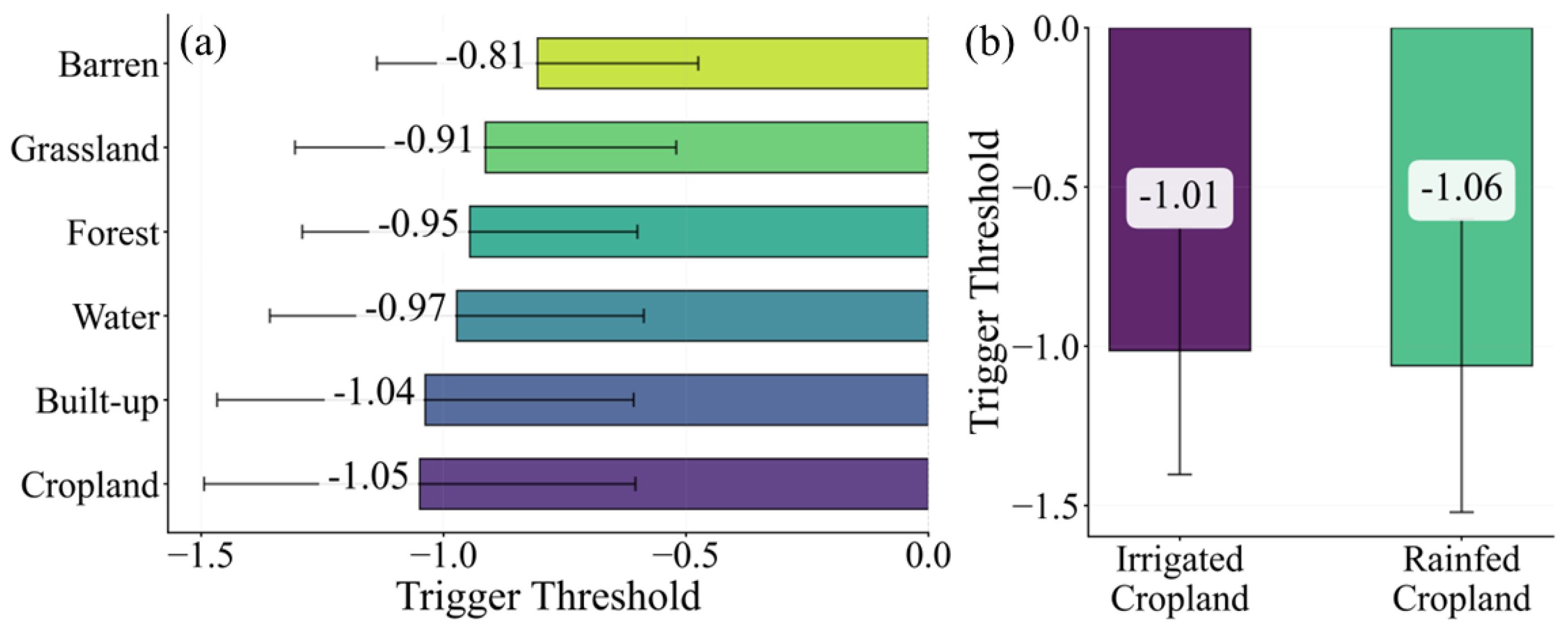
In this study, we focused on the natural drivers of the triggering threshold and did not deeply quantify the impact of human activities. To further clarify the disturbance effect of irrigated agriculture on the triggering threshold of TWSA deficits, land use types were classified into six categories, namely cultivated land, forest, grassland, water area, construction land and bare land. Among them, cultivated land was further divided into irrigated farmland and rain-fed farmland. As shown in Figure 15, the corresponding triggering thresholds of cultivated land, construction land, water area, forest, grassland and bare land increased in sequence (Figure 15a). A higher triggering threshold indicates that the land type is more sensitive and its TWS is more likely to be disturbed by drought. Cultivated land has the lowest triggering threshold due to greater human interference, and the TWS in this area is more stable and less affected by drought, which is consistent with the conclusions of related studies [71]. However, the average triggering threshold of irrigated farmland is 1.01, and that of rain-fed farmland is 1.06 (Figure 15b), indicating that irrigated agriculture is more prone to a TWSA deficit compared to rain-fed agriculture. The possible reason is that irrigation replenishes soil moisture, raises the critical point of the TWSA deficit, reduces the system’s dependence on PRE, and shifts the water critical value upwards [72,73].Based on existing research, the profound impact of irrigated agriculture on regional water systems has been widely confirmed [74,75]. Intensive irrigation not only directly leads to a sharp decline in groundwater reserves, becoming a major contributor to TWSA deficits [76], but, more crucially, in arid and semi-arid regions, human irrigation activities are indicated to account for approximately 39% of TWS changes [60]. In the study of the drought-triggered threshold for TWSA deficits, this research found that PRE is an important factor in triggering the threshold of TWSA deficits (Figure 12). This result reveals that in regions of significant TWS decline in northern China, irrigation activities may constitute the dominant driving force for the trend of TWS decline, while PRE, as a key external disturbance, remains an important cause of interference with the triggering threshold.

4.3. Selection and Sensitivity Analysis of the Probability Threshold

The selection of the 50% probability threshold is conceptually grounded as the natural boundary where an event becomes more likely than not. This choice is consistent with previous drought studies that have employed the 0.5 probability cutoff for threshold identification [77,78]. Moreover, as noted by Pasarić and Cindrić [79], there is no unique optimal threshold. Rather, sensitivity analysis across a range of thresholds provides a more robust assessment of the results. Following this principle, we repeated the threshold identification using alternative probability thresholds of 0.3, 0.4, 0.6, and 0.7.
This monotonic relationship (Table 4) is expected from a statistical perspective. A higher probability threshold, for example, 0.7, defines a rarer event and thus corresponds to a more extreme SPEI value. This inherent property arises from the nested structure of probability-based drought classification systems, where severity categories are defined by ordered percentiles of the probability distribution, as demonstrated in the classic SPI formulation by McKee et al. [80] and more recently in the drought index dataset compiled by Pohl et al. [81].
Importantly, these results confirm that our main conclusions are not highly sensitive to the specific choice of probability cutoff. Although the estimated thresholds vary with the probability level (Table 4), the sequential ordering of drought severity categories remains consistent. This finding has practical implications for drought early warning systems: as long as a consistent probability threshold is applied over time, trend detection and comparative analyses remain valid. The need for such probability-based approaches is particularly relevant under non-stationary climatic conditions. As argued by Milly et al. [82], the traditional assumption of stationarity in hydrometeorological systems is no longer valid under the influence of climate change and human activities. Consequently, fixed SPEI thresholds may not adequately capture changing baseline conditions [83]. In response to this limitation, recent studies have developed non-stationary drought indices that explicitly account for time-varying distribution parameters [84].
Nevertheless, two caveats should be noted. First, the monotonic pattern observed in Table 4 represents spatial averages; regional heterogeneity may exist across different climatic zones or land cover types [85,86]. Second, the sensitivity analysis presented here does not address the joint uncertainty arising from both probability threshold selection and the underlying SPEI estimation method.

4.4. Physical Validation of the Trigger Thresholds

To further confirm that the SPEI thresholds identified by the Copula-based conditional probability method correspond to observable hydrological state transitions, we conducted a physical validation using raw TWSA observations, which have been widely used for hydrological drought characterization [87]. For each pixel, we identified the first month when the SPEI fell below its pixel-specific threshold and extracted TWSA values from 12 months before to 12 months after this event. After removing pixels with insufficient data near temporal boundaries, 73%, 74%, and 87% of the total valid pixels were successfully validated for mild, moderate, and severe deficits, respectively.
As shown in Table 5, a consistent and statistically significant decline in the TWSA was observed following the threshold exceedance across all three deficit levels. For mild deficits, the TWSA decreased from −0.36 cm before the threshold to −1.55 cm after the threshold (∆ = −1.19 cm, p < 0.001). Similar patterns were observed for moderate deficits (∆ = −1.21 cm, p < 0.001) and severe deficits (∆ = −1.12 cm, p < 0.001).
These physical validation results confirm that the SPEI thresholds identified by the Copula-based conditional probability method correspond to meaningful transitions in hydrological storage. This finding aligns with previous studies that have successfully employed probabilistic frameworks to identify drought propagation thresholds [29]. The statistically significant declines in the TWSA following threshold exceedance (p < 0.001 for all three deficit levels) demonstrate that the thresholds effectively capture the onset of hydrological drought. The consistency of TWSA decline magnitudes across the three deficit levels (∆ ≈ −1.2 cm for all) suggests that once the SPEI threshold is crossed, the hydrological response in terms of the TWSA is comparable regardless of the drought severity classification. This finding implies that the trigger threshold, rather than the severity category, may be the more critical factor for detecting the onset of hydrological drought [88], aligning with the broader drought management literature, which distinguishes drought indicators for monitoring from drought triggers for activating responses [24,31]. Unlike severity classifications that describe event intensity, triggers provide actionable thresholds for early warning systems. The comparable hydrological response across severity levels suggests that a well-defined trigger threshold may be sufficient for detecting drought onset, regardless of final severity classification. This has practical implications for drought early warning systems, where reliable triggers are more valuable than precise severity categorization for initiating mitigation measures [89].
The substantially lower validation rate for severe deficits (22.8%) compared to mild (73.5%) and moderate (73.9%) deficits warrants discussion. This discrepancy likely reflects the limited number of severe drought events, as extreme conditions occur less frequently and thus provide fewer validation samples. As noted by Wild et al. [90], the statistical uncertainty resulting from small sample sizes for estimating extreme quantile thresholds is substantial, and datasets of 100 years or less may be insufficient to achieve reliable threshold estimates for extreme events. Additionally, the definition of a severe deficit based on more extreme SPEI thresholds may capture a narrower set of hydrological conditions, making validation more sensitive to local anomalies in TWSAs. Despite this limitation, the statistically significant decline in the TWSA for severe deficits (p < 0.001) confirms that the identified threshold remains physically meaningful.

4.5. Limitations and Future Work

This study still has several limitations in terms of data and methods. Quantitative assessment based on five-fold cross-validation and error propagation analysis (Table 6) shows that the gap-filled TWSA data have an overall RMSE of 1.04 cm and an NSE of 0.61 against GRACE observations, with cross-validation yielding consistent estimates. The gap-filling uncertainty translates to a trend uncertainty of only ±0.017 cm/a. Nevertheless, the spatial resolution of GRACE/GRACE-FO data is relatively coarse, which may not fully reflect the heterogeneity of small-scale hydrological processes. The conditional probability model based on Copula assumes that the statistical relationship between meteorological drought and TWS is stable, but under the influence of climate change and human activities, this relationship itself may be changing. In addition, the direct quantification of human activities in this study is still insufficient, especially the lack of dynamic characterization of the intensity of specific human interventions such as irrigation water use and groundwater extraction. Furthermore, while the CatBoost model employed for driver analysis is robust to multicollinearity, the interpretation of individual feature importance (e.g., TMP and TS) could be further strengthened by systematic multicollinearity diagnostics and variable selection in future work. Finally, there is still a scale gap from macroscopic statistical patterns to specific physical mechanisms, and future research needs to combine process models with site observations for more in-depth mechanism exploration.

5. Conclusions

This study, based on GRACE/GRACE-FO satellite gravity data, the SPEI and multi-source environmental data, combined with the Copula joint distribution model and interpretable machine learning methods, systematically explored the mechanism of meteorological drought propagating to TWSAs from the perspective of China’s three natural regions. The main conclusions are as follows:
(1)
The TWSA shows an overall downward trend with significant regional differences. During 2005–2024, the TWSA significantly decreased in nearly half of the regions, especially in the North China Plain, the Northwest Irrigation District, and the southern part of the TPR. The responses of the three major natural regions were distinct: the EMR was relatively stable, the NAR continuously declined, and the TPR showed strong variability and an accelerated deficit after 2020.
(2)
There is a significant spatiotemporal lag effect in the propagation of meteorological drought to the TWSA. In total, 87% of the regions showed a significant response of TWSA to meteorological drought, with a lag time mainly of 9–12 months. The EMR responded the slowest (average 12 months), and the NAR responded the fastest (3 months).
(3)
The probability of a TWSA deficit triggered by different levels of drought shows obvious grade dependence and spatial heterogeneity. As the drought grade intensifies, the range of high-probability areas for a TWSA deficit expands. The North China Plain–Loess Plateau, Ili-Tianshan, and the southern part of the TPR are the initial high-sensitivity core areas; under extreme drought scenarios, the effective probability estimates only occur in areas with frequent historical extreme events, revealing the objective limitation of data-driven probability assessment due to sample size.
(4)
The threshold for triggering a TWSA deficit shows systematic spatial gradient characteristics. The threshold level reflects regional hydrological sensitivity and resilience. The NAR has the highest trigger threshold (−1.5 to −1.0), being extremely sensitive to drought; the EMR has a north–south differentiation in the trigger threshold; and in the TPR, the trigger threshold decreases significantly with the increase in deficit grade, reflecting the nonlinear response of the high-altitude system.
(5)
The trigger threshold is driven by the synergy of multiple factors dominated by water and modulated by energy, and the dominant factors show regional differences. Nationally, PRE is the strongest driving factor, followed by TMP and PET. Regionally, topography plays a prominent role in the EMR; climate factors are dominant in the NAR; and in the TPR, it is jointly regulated by PRE and vegetation.
(6)
Human activities, especially irrigation agriculture, significantly lower the trigger threshold, increasing system vulnerability. The TWSA deficit threshold in irrigated agricultural areas is significantly lower than that in rain-fed agricultural areas, indicating that human water use activities weaken the buffering capacity of the hydrological system against drought, making even milder meteorological droughts capable of causing a significant TWS deficit.

Author Contributions

Conceptualization, Funding Acquisition, Formal Analysis, Project Administration, Supervision, Writing—Original Draft, and Writing—Review and Editing, W.L.; Data Curation and Resources, X.X.; Methodology and Software, Y.H.; Investigation and Writing—Original Draft, L.G.; Visualization and Writing—Review and Editing, B.L. All authors have read and agreed to the published version of the manuscript.

Funding

This research was funded by the National Natural Science Foundation of China (Grant No. 41901110).

Data Availability Statement

The data acquisition method has been explained in the article.

Conflicts of Interest

The authors declare no conflict of interest.

Abbreviations

The following abbreviations are used in this manuscript:
AICAkaike Information Criterion
BICBayesian Information Criterion
CSRCenter for Space Research
DEMDigital Elevation Model
EMREastern Monsoon Region
GPPGross Primary Productivity
GRACEGravity Recovery and Climate Experiment
GRACE-FOGRACE Follow-On
LUCCLand Use and Land Cover Change
MCCMaximum Correlation Coefficient
NARNorthwestern Arid Region
NDVINormalized Difference Vegetation Index
NSENash–Sutcliffe Efficiency
PETPotential Evapotranspiration
PREPrecipitation
RMSERoot Mean Square Error
SPEIStandardized Precipitation Evapotranspiration Index
SSMSurface Soil Moisture
SWESnow Water Equivalent
TMPTemperature
TPRTibetan Plateau Region
TSLand Surface Temperature
TWSTerrestrial Water Storage
TWSATerrestrial Water Storage Anomaly
VEGVegetation Cover
VPDVapor Pressure Deficit
WINDWind Speed
climSSAclimate-adjusted Singular Spectrum Analysis

References

  1. Wang, H.; Liu, J.G.; Klaar, M.; Chen, A.F.; Gudmundsson, L.; Holden, J. Anthropogenic climate change has influenced global river flow seasonality. Science 2024, 383, 1009–1014. [Google Scholar] [CrossRef]
  2. Guo, Q.; Hibino, K. Physical responses of Baiu extreme precipitation to future warming: Examples of the 2018 and 2020 western Japan events. Weather Clim. Extrem. 2023, 39, 100547. [Google Scholar] [CrossRef]
  3. Zhang, S.; Zhou, L.; Zhang, L.; Yang, Y.; Wei, Z.; Zhou, S.; Yang, D.; Yang, X.; Wu, X.; Zhang, Y.; et al. Reconciling disagreement on global river flood changes in a warming climate. Nat. Clim. Change 2022, 12, 1160–1167. [Google Scholar] [CrossRef]
  4. Dai, A. Increasing drought under global warming in observations and models. Nat. Clim. Change 2012, 3, 52–58. [Google Scholar] [CrossRef]
  5. Tapley, B.D.; Watkins, M.M.; Flechtner, F.; Reigber, C.; Bettadpur, S.; Rodell, M.; Sasgen, I.; Famiglietti, J.S.; Landerer, F.W.; Chambers, D.P.; et al. Contributions of GRACE to understanding climate change. Nat. Clim. Change 2019, 9, 358–369. [Google Scholar] [CrossRef]
  6. Perrone, D.; Jasechko, S. Dry groundwater wells in the western United States. Environ. Res. Lett. 2017, 12, 104002. [Google Scholar] [CrossRef]
  7. Van Loon, A.F. Hydrological drought explained. WIREs Water 2015, 2, 359–392. [Google Scholar] [CrossRef]
  8. Soltani, S.S.; Ataie-Ashtiani, B.; Simmons, C.T. Review of assimilating GRACE terrestrial water storage data into hydrological models: Advances, challenges and opportunities. Earth-Sci. Rev. 2021, 213, 103487. [Google Scholar] [CrossRef]
  9. Foroumandi, E.; Nourani, V.; Jeanne Huang, J.; Moradkhani, H. Drought monitoring by downscaling GRACE-derived terrestrial water storage anomalies: A deep learning approach. J. Hydrol. 2023, 616, 128838. [Google Scholar] [CrossRef]
  10. Sabzehee, F.; Amiri-Simkooei, A.R.; Iran-Pour, S.; Vishwakarma, B.D.; Kerachian, R. Enhancing spatial resolution of GRACE-derived groundwater storage anomalies in Urmia catchment using machine learning downscaling methods. J. Environ. Manag. 2023, 330, 117180. [Google Scholar] [CrossRef]
  11. Fatolazadeh, F.; Eshagh, M.; Goïta, K. New spectro-spatial downscaling approach for terrestrial and groundwater storage variations estimated by GRACE models. J. Hydrol. 2022, 615, 128635. [Google Scholar] [CrossRef]
  12. Zhong, Y.; Tian, B.; Kim, H.; Yuan, X.; Liu, X.; Zhu, E.; Wu, Y.; Wang, L.; Wang, L. Over 60% precipitation transformed into terrestrial water storage in global river basins from 2002 to 2021. Commun. Earth Environ. 2025, 6, 53. [Google Scholar] [CrossRef]
  13. Jiao, J.; Pan, Y.; Cui, X.; Mohasseb, H.A.; Ding, H. Evaluation of runoff variability in transboundary basins over High Mountain Asia: Multi-dataset merging based on satellite gravimetry constraint. Remote Sens. Environ. 2025, 316, 114493. [Google Scholar] [CrossRef]
  14. Li, M.; Xie, Y.; Song, J.; Wu, J.; Zhang, J. Revealing groundwater depletion and seasonal dynamics in Northwest China by integrating GRACE with physically based and data-driven modeling. J. Hydrol. 2026, 666, 134735. [Google Scholar] [CrossRef]
  15. Syed, T.H.; Famiglietti, J.S.; Zlotnicki, V.; Rodell, M. Contemporary estimates of Pan-Arctic freshwater discharge from GRACE and reanalysis. Geophys. Res. Lett. 2007, 34, L19404. [Google Scholar] [CrossRef]
  16. Doumbia, C.; Rousseau, A.N.; Başağaoğlu, H.; Baraer, M.; Chakraborty, D. Interpretation of glacier mass change within the Upper Yukon Watershed from GRACE using Explainable Automated Machine Learning Algorithms. J. Hydrol. 2025, 651, 132519. [Google Scholar] [CrossRef]
  17. Yin, G.; Park, J.; Yoshimura, K. Spatial downscaling of GRACE terrestrial water storage anomalies for drought and flood potential assessment. J. Hydrol. 2025, 658, 133144. [Google Scholar] [CrossRef]
  18. Yang, S.; Zhong, Y.; Wu, Y.; Yang, K.; An, Q.; Bai, H.; Liu, S. Quantifying long-term drought in China’s exorheic basins using a novel daily GRACE reconstructed TWSA index. J. Hydrol. 2025, 655, 132919. [Google Scholar] [CrossRef]
  19. Rodell, M.; Velicogna, I.; Famiglietti, J.S. Satellite-based estimates of groundwater depletion in India. Nature 2009, 460, 999–1002. [Google Scholar] [CrossRef]
  20. Zhao, M.; A, G.; Velicogna, I.; Kimball, J.S. Satellite Observations of Regional Drought Severity in the Continental United States Using GRACE-Based Terrestrial Water Storage Changes. J. Clim. 2017, 30, 6297–6308. [Google Scholar] [CrossRef]
  21. Jiao, J.; Pan, Y.; Zhang, X.; Shum, C.K.; Zhang, Y.; Ding, H. Spatially heterogeneous nonlinear signal in Antarctic ice-sheet mass loss revealed by GRACE and GPS. Geophys. J. Int. 2023, 233, 826–838. [Google Scholar] [CrossRef]
  22. Yang, B.; Li, Y.; Tao, C.; Cui, C.; Hu, F.; Cui, Q.; Meng, L.; Zhang, W. Variations and drivers of terrestrial water storage in ten basins of China. J. Hydrol. Reg. Stud. 2023, 45, 101286. [Google Scholar] [CrossRef]
  23. Ji, R.; Wang, C.; Cui, A.; Jia, M.; Liao, S.; Wang, W.; Chen, N. Assessing terrestrial water storage dynamics and multiple factors driving forces in China from 2005 to 2020. J. Environ. Manag. 2024, 370, 122464. [Google Scholar] [CrossRef]
  24. Qian, T.; Su, X.; Wu, H.; Singh, V.P.; Zhang, T. An agricultural drought early warning threshold model with considering copula combined with diminishing marginal benefit theory: A case study in the Yellow River basin. Agric. Water Manag. 2025, 316, 109582. [Google Scholar] [CrossRef]
  25. Ding, Y.; Li, L.; Du, J.; Zhou, Z.; Liu, S.; Chen, W.; Wang, X.; Zhou, L.; Ao, T. Investigating multitype drought propagation thresholds across the different climate regions of China. Atmos. Res. 2025, 316, 107950. [Google Scholar] [CrossRef]
  26. Wang, T.; Tu, X.; Singh, V.P.; Chen, X.; Lin, K.; Zhou, Z.; Zhu, J. A CMIP6-based framework for propagation from meteorological and hydrological droughts to socioeconomic drought. J. Hydrol. 2023, 623, 129782. [Google Scholar] [CrossRef]
  27. Wang, Y.; Zhou, Y.; Ju, W.; Gao, S.; He, W.; Liu, Y.; Wang, L.; Duan, Z. Higher frequency and duration of droughts demonstrated by the critical threshold of soil moisture in China drylands. J. Hydrol. 2025, 662, 133810. [Google Scholar] [CrossRef]
  28. Chen, T.; Pan, Y.; Ding, H.; Jiao, J.; He, M. Investigating terrestrial water storage variation and its response to climate in southeastern Tibetan Plateau inferred through space geodetic observations. J. Hydrol. 2024, 640, 131742. [Google Scholar] [CrossRef]
  29. Han, Z.; Huang, S.; Huang, Q.; Leng, G.; Liu, Y.; Bai, Q.; He, P.; Liang, H.; Shi, W. GRACE-based high-resolution propagation threshold from meteorological to groundwater drought. Agric. For. Meteorol. 2021, 307, 108476. [Google Scholar] [CrossRef]
  30. Zhao, M.; A, G.; Zhang, J.; Velicogna, I.; Liang, C.; Li, Z. Ecological restoration impact on total terrestrial water storage. Nat. Sustain. 2020, 4, 56–62. [Google Scholar] [CrossRef]
  31. Han, Z.; Huang, S.; Peng, J.; Li, J.; Leng, G.; Huang, Q.; Zhao, J.; Yang, F.; He, P.; Meng, X.; et al. GRACE-based dynamic assessment of hydrological drought trigger thresholds induced by meteorological drought and possible driving mechanisms. Remote Sens. Environ. 2023, 298, 113831. [Google Scholar] [CrossRef]
  32. Zhang, Q.S.; Singh, V.P.; Sun, P.; Chen, X.; Zhang, Z.X.; Li, J.F. Precipitation and streamflow changes in China: Changing patterns and causes. J. Hydrol. 2011, 410, 204–216. [Google Scholar] [CrossRef]
  33. Huang, B.W. Integrated Natural Regionalization of China; Science Press: Beijing, China, 1959. (In Chinese) [Google Scholar]
  34. Editorial Committee of the New Century National Atlas of Regionalization of the People’s Republic of China. Comprehensive Physical Geographical Regionalization Dataset of China (years 1954, 1963, 1965, 1983, 1984, 1988, 1999). Available online: https://www.geodata.cn/main/face_science_detail?typeName=face_science&guid=16981900196753 (accessed on 29 November 2025).
  35. Liu, C.; Dong, M.; Wang, Y.; Wang, X.; Liu, Q.; Chen, Z. Prediction of rainfall erosivity in Eastern Monsoon Region in China based on CMIP6 models. Catena 2025, 260, 109459. [Google Scholar] [CrossRef]
  36. Sun, F.; Hao, X.; Li, Y.; Li, Z.; Fang, G.; Wang, F.; Zhang, X. Warming elevates the risk of rain-on-snow events in the arid region of Northwest China. J. Hydrol. Reg. Stud. 2025, 61, 102758. [Google Scholar] [CrossRef]
  37. Weng, B.; Xia, K.; Gong, X.; Xu, P. Groundwater storage change and its response to climate warming in Qinghai-Tibet Plateau. J. Hydrol. 2025, 662, 134045. [Google Scholar] [CrossRef]
  38. Yang, X.; Tian, S.; You, W.; Jiang, Z. Reconstruction of continuous GRACE/GRACE-FO terrestrial water storage anomalies based on time series decomposition. J. Hydrol. 2021, 603, 127018. [Google Scholar] [CrossRef]
  39. Save, H.; Bettadpur, S.; Tapley, B.D. High-resolution CSR GRACE RL05 mascons. J. Geophys. Res. Solid Earth 2016, 121, 7547–7569. [Google Scholar] [CrossRef]
  40. Save, H. CSR GRACE and GRACE-FO RL06 Mascon Solutions v02; University of Texas at Austin: Austin, TX, USA, 2020. [Google Scholar] [CrossRef]
  41. Chen, J.L.; Wilson, C.R.; Tapley, B.D.; Ries, J.C. Low degree gravitational changes from GRACE: Validation and interpretation. Geophys. Res. Lett. 2004, 31, L22607. [Google Scholar] [CrossRef]
  42. Chambers, D.P. Evaluation of new GRACE time-variable gravity data over the ocean. Geophys. Res. Lett. 2006, 33, L027296. [Google Scholar] [CrossRef]
  43. Sun, A.Y.; Scanlon, B.R.; Zhang, Z.; Walling, D.; Bhanja, S.N.; Mukherjee, A.; Zhong, Z. Combining Physically Based Modeling and Deep Learning for Fusing GRACE Satellite Data: Can We Learn From Mismatch? Water Resour. Res. 2019, 55, 1179–1195. [Google Scholar] [CrossRef]
  44. Sun, Z.; Long, D.; Yang, W.; Li, X.; Pan, Y. Reconstruction of GRACE Data on Changes in Total Water Storage Over the Global Land Surface and 60 Basins. Water Resour. Res. 2020, 56, e2019WR026250. [Google Scholar] [CrossRef]
  45. Zhang, X.; Ren, C.; Zhang, Y. A global dataset of gap-fiiled GRACE and GRACE-FO lwe_thickness with climSSA (2002–2022). 2024. Available online: https://data.tpdc.ac.cn/en/data/48616c04-c6da-4820-a8c6-ff3860f82ccf (accessed on 9 November 2025).
  46. Zhang, X.; Ren, C.; Wang, Z.; Li, X.; Zhang, Y. Gap-filling GRACE and GRACE-FO data with a climate adjustment scheme using Singular Spectrum analysis. J. Hydrol. 2025, 653, 132782. [Google Scholar] [CrossRef]
  47. Guo, W.; Huang, S.; Huang, Q.; Leng, G.; Mu, Z.; Han, Z.; Wei, X.; She, D.; Wang, H.; Wang, Z.; et al. Drought trigger thresholds for different levels of vegetation loss in China and their dynamics. Agric. For. Meteorol. 2023, 331, 109349. [Google Scholar] [CrossRef]
  48. Heo, J.H.; Salas, J.D.; Boes, D.C. Regional flood frequency analysis based on a Weibull model: Part 2. Simulations and applications. J. Hydrol. 2001, 242, 171–182. [Google Scholar] [CrossRef]
  49. Vicente-Serrano, S.M.; Beguería, S.; López-Moreno, J.I. A Multiscalar Drought Index Sensitive to Global Warming: The Standardized Precipitation Evapotranspiration Index. J. Clim. 2010, 23, 1696–1718. [Google Scholar] [CrossRef]
  50. Vicente-Serrano, S.M.; Gouveia, C.; Camarero, J.J.; Beguería, S.; Trigo, R.; López-Moreno, J.I.; Azorín-Molina, C.; Pasho, E.; Lorenzo-Lacruz, J.; Revuelto, J.; et al. Response of vegetation to drought time-scales across global land biomes. Proc. Natl. Acad. Sci. USA 2013, 110, 52–57. [Google Scholar] [CrossRef] [PubMed]
  51. Guo, W.; Huang, S.; Huang, Q.; She, D.; Shi, H.; Leng, G.; Li, J.; Cheng, L.; Gao, Y.; Peng, J. Precipitation and vegetation transpiration variations dominate the dynamics of agricultural drought characteristics in China. Sci. Total Environ. 2023, 898, 165480. [Google Scholar] [CrossRef] [PubMed]
  52. Prokhorenkova, L.; Gusev, G.; Vorobev, A.; Dorogush, A.V.; Gulin, A. CatBoost: Unbiased boosting with categorical features. Adv. Neural Inf. Process. Syst. 2018, 31, 6639–6649. [Google Scholar]
  53. Dong, J.; Akbar, R.; Feldman, A.F.; Gianotti, D.S.; Entekhabi, D. Land Surfaces at the Tipping-Point for Water and Energy Balance Coupling. Water Resour. Res. 2023, 59, e2022WR032472. [Google Scholar] [CrossRef]
  54. Yang, C.; Liu, C.; Wang, Y.; Gu, Y.; Ma, X. Assessment of the spatiotemporal evolution and driving forces of meteorological drought in the North China Plain. Int. J. Climatol. 2023, 43, 7883–7898. [Google Scholar] [CrossRef]
  55. Lu, Y.; Chen, W.; Chen, X.; Li, Z. Effects of microclimate on soil moisture distribution in complex topography at the small watershed scale in the Anning River Region, Southwest China. J. Hydrol. Reg. Stud. 2025, 59, 102381. [Google Scholar] [CrossRef]
  56. Deng, H.; Pepin, N.C.; Chen, Y.; Guo, B.; Zhang, S.; Zhang, Y.; Chen, X.; Gao, L.; Meibing, L.; Ying, C. Dynamics of Diurnal Precipitation Differences and Their Spatial Variations in China. J. Appl. Meteorol. Climatol. 2022, 61, 1015–1027. [Google Scholar] [CrossRef]
  57. He, Q.; Chun, K.P.; Sum Fok, H.; Chen, Q.; Dieppois, B.; Massei, N. Water storage redistribution over East China, between 2003 and 2015, driven by intra- and inter-annual climate variability. J. Hydrol. 2020, 583, 124475. [Google Scholar] [CrossRef]
  58. Pokhrel, Y.; Felfelani, F.; Satoh, Y.; Boulange, J.; Burek, P.; Gädeke, A.; Gerten, D.; Gosling, S.N.; Grillakis, M.; Gudmundsson, L.; et al. Global terrestrial water storage and drought severity under climate change. Nat. Clim. Change 2021, 11, 226–233. [Google Scholar] [CrossRef]
  59. An, L.; Wang, J.; Huang, J.; Pokhrel, Y.; Hugonnet, R.; Wada, Y.; Cáceres, D.; Müller Schmied, H.; Song, C.; Berthier, E.; et al. Divergent Causes of Terrestrial Water Storage Decline Between Drylands and Humid Regions Globally. Geophys. Res. Lett. 2021, 48, L095035. [Google Scholar] [CrossRef]
  60. Liu, K.; Li, X.; Wang, S.; Lu, S.; Bo, Y.; Zhou, G. Quantifying Past and Future Terrestrial Water Storage Scarcity Across China Through Midcentury. Earth’s Future 2025, 13, e2025EF006071. [Google Scholar] [CrossRef]
  61. Wang, Y.; Zhu, G.; Huang, E.; Meng, G.; Liu, J.; Lu, S.; Qiu, D.; Chen, L.; Li, R.; Jiao, Y.; et al. Drought events are the primary cause of the decline in water storage in the Yellow River Basin. J. Hydrol. Reg. Stud. 2025, 62, 102876. [Google Scholar] [CrossRef]
  62. Xu, G.; Wu, Y.; Liu, S.; Cheng, S.; Zhang, Y.; Pan, Y.; Wang, L.; Dokuchits, E.Y.; Nkwazema, O.C. How 2022 extreme drought influences the spatiotemporal variations of terrestrial water storage in the Yangtze River Catchment: Insights from GRACE-based drought severity index and in-situ measurements. J. Hydrol. 2023, 626, 130245. [Google Scholar] [CrossRef]
  63. He, M.; Shen, W.; Jiao, J.; Pan, Y. The Interannual Fluctuations in Mass Changes and Hydrological Elasticity on the Tibetan Plateau from Geodetic Measurements. Remote Sens. 2021, 13, 4277. [Google Scholar] [CrossRef]
  64. Freedman, F.R.; Pitts, K.L.; Bridger, A.F.C. Evaluation of CMIP climate model hydrological output for the Mississippi River Basin using GRACE satellite observations. J. Hydrol. 2014, 519, 3566–3577. [Google Scholar] [CrossRef]
  65. Felfelani, F.; Wada, Y.; Longuevergne, L.; Pokhrel, Y.N. Natural and human-induced terrestrial water storage change: A global analysis using hydrological models and GRACE. J. Hydrol. 2017, 553, 105–118. [Google Scholar] [CrossRef]
  66. Kang, S.; Hao, X.; Du, T.; Tong, L.; Su, X.; Lu, H.; Li, X.; Huo, Z.; Li, S.; Ding, R. Improving agricultural water productivity to ensure food security in China under changing environment: From research to practice. Agric. Water Manag. 2017, 179, 5–17. [Google Scholar] [CrossRef]
  67. Cui, B.; Xue, D.; Gui, D.; Liu, Q.; Abd-Elmabod, S.K.; Chen, X.; Goethals, P.; Maeyer, P.D. Downscaled GRACE data reveals anthropogenic dominance in groundwater storage decline across China’s oases. Ecol. Indic. 2025, 179, 114209. [Google Scholar] [CrossRef]
  68. Feng, W.; Zhong, M.; Lemoine, J.M.; Biancale, R.; Hsu, H.T.; Xia, J. Evaluation of groundwater depletion in North China using the Gravity Recovery and Climate Experiment (GRACE) data and ground-based measurements. Water Resour. Res. 2013, 49, 2110–2118. [Google Scholar] [CrossRef]
  69. Benz, S.A.; Irvine, D.J.; Rau, G.C.; Bayer, P.; Menberg, K.; Blum, P.; Jamieson, R.C.; Griebler, C.; Kurylyk, B.L. Global groundwater warming due to climate change. Nat. Geosci. 2024, 17, 545–551. [Google Scholar] [CrossRef]
  70. Long, D.; Scanlon, B.R.; Longuevergne, L.; Sun, A.Y.; Fernando, D.N.; Save, H. GRACE satellite monitoring of large depletion in water storage in response to the 2011 drought in Texas. Geophys. Res. Lett. 2013, 40, 3395–3401. [Google Scholar] [CrossRef]
  71. Seneviratne, S.I.; Corti, T.; Davin, E.L.; Hirschi, M.; Jaeger, E.B.; Lehner, I.; Orlowsky, B.; Teuling, A.J. Investigating soil moisture–climate interactions in a changing climate: A review. Earth-Sci. Rev. 2010, 99, 125–161. [Google Scholar] [CrossRef]
  72. Wada, Y.; van Beek, L.P.H.; Bierkens, M.F.P. Nonsustainable groundwater sustaining irrigation: A global assessment. Water Resour. Res. 2012, 48, W00L06. [Google Scholar] [CrossRef]
  73. Dusenge, M.E.; Duarte, A.G.; Way, D.A. Plant carbon metabolism and climate change: Elevated CO2 and temperature impacts on photosynthesis, photorespiration and respiration. New Phytol. 2018, 221, 32–49. [Google Scholar] [CrossRef]
  74. Zhang, Y.; Yang, P.; Liu, J.; Zhang, X.; Zhao, Y.; Zhang, Q.; Li, L. Sustainable agricultural water management in the Yellow River Basin, China. Agric. Water Manag. 2023, 288, 108473. [Google Scholar] [CrossRef]
  75. Zhao, M.; A, G.; Liu, Y.; Konings, A.G. Evapotranspiration frequently increases during droughts. Nat. Clim. Change 2022, 12, 1024–1030. [Google Scholar] [CrossRef]
  76. Lu, X.; Zou, M.; Gan, G.; Kang, S. Excessive irrigation-driven greening has triggered water shortages and compromised sustainability. Agric. Water Manag. 2025, 311, 109405. [Google Scholar] [CrossRef]
  77. Guo, Y.; Huang, S.; Huang, Q.; Leng, G.; Fang, W.; Wang, L.; Wang, H. Propagation thresholds of meteorological drought for triggering hydrological drought at various levels. Sci. Total Environ. 2020, 712, 136502. [Google Scholar] [CrossRef]
  78. Madadgar, S.; Moradkhani, H. Spatio-temporal drought forecasting within Bayesian networks. J. Hydrol. 2014, 512, 134–146. [Google Scholar] [CrossRef]
  79. Cindrić, K.; Pasarić, Z. Modelling Dry Spells by Extreme Value Distribution with Bayesian Inference. Pure Appl. Geophys. 2018, 175, 3891–3908. [Google Scholar] [CrossRef]
  80. McKee, T.B.; Doesken, N.J.; Kleist, J. The relationship of drought frequency and duration to time scales. In Proceedings of the 8th Conference on Applied Climatology; American Meteorological Society: Anaheim, CA, USA, 1993; pp. 179–184. [Google Scholar]
  81. Pohl, F.; Rakovec, O.; Rebmann, C.; Hildebrandt, A.; Boeing, F.; Hermanns, F.; Attinger, S.; Samaniego, L.; Kumar, R. Long-term daily hydrometeorological drought indices, soil moisture, and evapotranspiration for ICOS sites. Sci. Data 2023, 10, 281. [Google Scholar] [CrossRef]
  82. Milly, P.C.; Betancourt, J.; Falkenmark, M.; Hirsch, R.M.; Kundzewicz, Z.W.; Lettenmaier, D.P.; Stouffer, R.J. Stationarity is dead: Whither water management? Science 2008, 319, 573–574. [Google Scholar] [CrossRef] [PubMed]
  83. Sun, P.; Ge, C.; Yao, R.; Bian, Y.; Yang, H.; Zhang, Q.; Xu, C.-Y.; Singh, V.P. Development of a nonstationary Standardized Precipitation Evapotranspiration Index (NSPEI) and its application across China. Atmos. Res. 2024, 300, 107256. [Google Scholar] [CrossRef]
  84. Zhang, Q.; Wang, D.; Feng, A.; Wang, G.; Hu, L.; Xu, C.-Y.; Singh, V.P. Improved non-stationary SPEI and its application in drought monitoring in China. J. Hydrol. 2025, 65, 1327062. [Google Scholar] [CrossRef]
  85. Chen, W.; Ju, H.; Zhang, D.; Batchelor, W.D. Identification of thresholds and key drivers on water use efficiency in different maize ecoregions in Yellow River Basin of China. J. Clean. Prod. 2024, 482, 144209. [Google Scholar] [CrossRef]
  86. Fan, P.Y.; Chun, K.P.; Mijic, A.; Tan, M.L.; He, Q.; Yetemen, O. Quantifying land use heterogeneity on drought conditions for mitigation strategies development in the Dongjiang River Basin, China. Ecol. Indic. 2021, 129, 107945. [Google Scholar] [CrossRef]
  87. Saemian, P.; Tourian, M.J.; Elmi, O.; Sneeuw, N.; AghaKouchak, A. A Probabilistic Approach to Characterizing Drought Using Satellite Gravimetry. Water Resour. Res. 2024, 60, e2023WR036873. [Google Scholar] [CrossRef]
  88. Steinemann, A. Drought Indicators and Triggers: A Stochastic Approach to Evaluation1. JAWRA J. Am. Water Resour. Assoc. 2007, 39, 1217–1233. [Google Scholar] [CrossRef]
  89. Yang, C.; Liu, C.; Xing, X.; Ma, X. Predicting the risk and trigger thresholds for propagation of meteorological droughts to agricultural droughts in China based on Copula-Bayesian model. Agric. Water Manag. 2025, 313, 109468. [Google Scholar] [CrossRef]
  90. Link, R.; Wild, T.B.; Snyder, A.C.; Hejazi, M.I.; Vernon, C.R. 100 years of data is not enough to establish reliable drought thresholds. J. Hydrol. X 2020, 7, 100052. [Google Scholar] [CrossRef]
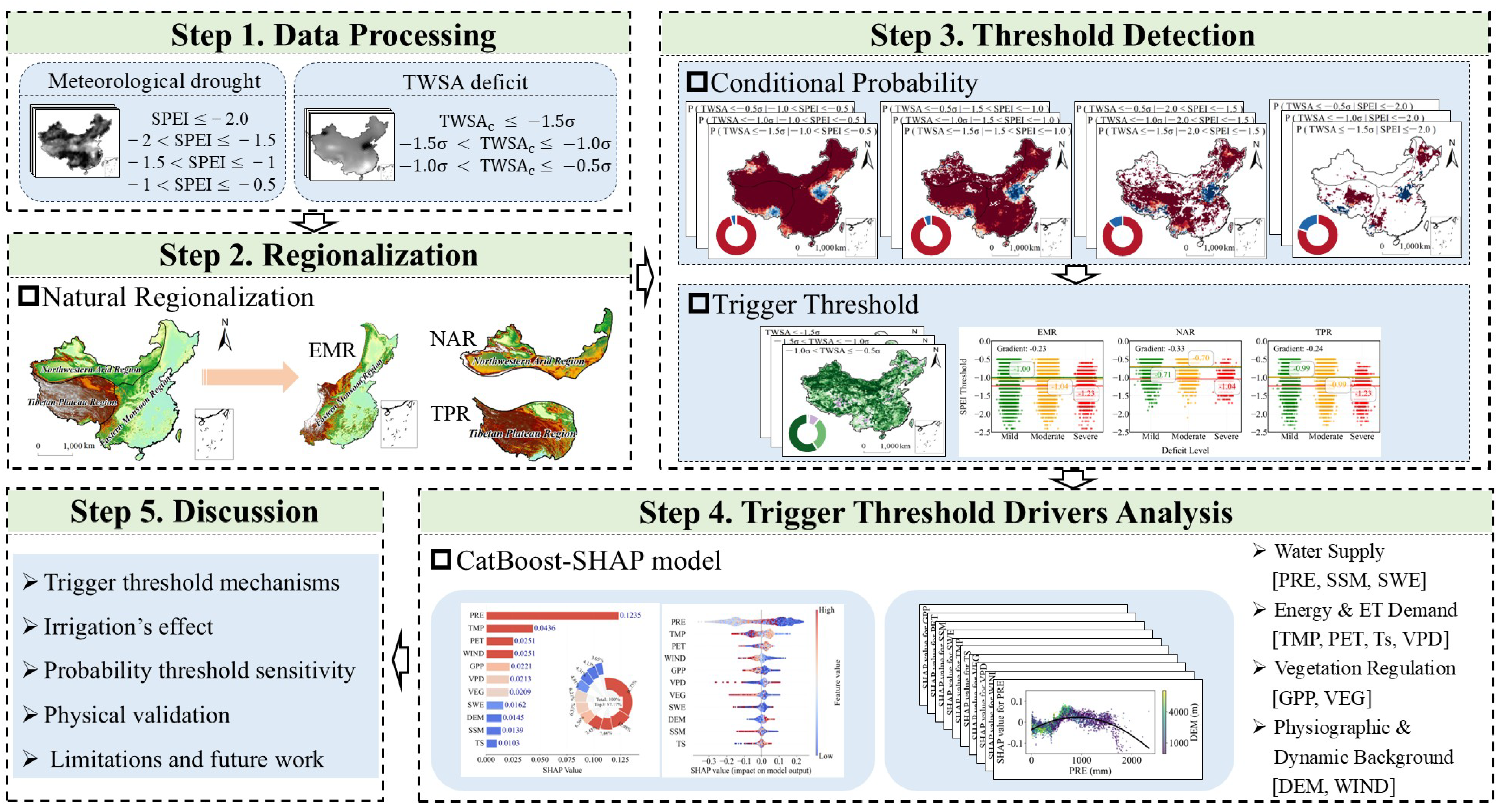
Figure 1. The research framework.
Land 15 00807 g001
Figure 2. Study area.
Land 15 00807 g002
Figure 3. (a) Time series comparison of TWSA between GRACE (CSR RL06) and corrected climSSA over China from 2005 to 2022; (b) scatter plot with 1:1 line.
Land 15 00807 g003
Figure 4. (a) Kolmogorov–Smirnov test; (b) Q-Q plot verification.
Land 15 00807 g004
Figure 5. Computational framework for conditional probability and drought trigger thresholds.
Land 15 00807 g005
Figure 6. (a) Spatial variation in TWSA trend from 2005 to 2024; (b) detection of change trends and abrupt points in monthly sequences; (c) detection of change trends and abrupt points in annual sequences. The purple line indicates the change point.
Land 15 00807 g006
Figure 7. (af) Monthly scale and annual-scale variation trends and abrupt change points in TWSA in the three major natural regions from 2005 to 2024; (g) violin plots showing the probability density and range of TWSA values for the EMR, NAR, and TPR. The purple line indicates the change point.
Land 15 00807 g007
Figure 8. (a) Spatial distribution of maximum correlation coefficient (MCC) and significance test; (b) spatial differentiation of the response time of TWSA to SPEI; (c) temporal variation in the average correlation in different natural regions; (d) temporal variation in the spatial heterogeneity of the correlation in different natural regions.
Land 15 00807 g008
Figure 9. Conditional probability of TWSA deficit under different SPEI scenarios. (a) P (TWSAc ≤ −0.5 σ | −1.0 < SPEI ≤ −0.5); (b) P (TWSAc ≤ −1.0 σ | −1.0 < SPEI ≤ −0.5); (c) P (TWSAc ≤ −1.5 σ | −1.0 < SPEI ≤ −0.5); (d) P (TWSAc ≤ −0.5 σ | −1.5 < SPEI ≤ −1.0); (e) P (TWSAc ≤ −1.0 σ | −1.5 < SPEI ≤ −1.0); (f) P (TWSAc ≤ −1.5 σ | −1.5 < SPEI ≤ −1.0); (g) P (TWSAc ≤ −0.5 σ | −2.0 < SPEI ≤ −1.5); (h) P (TWSAc ≤ −1.0 σ | −2.0 < SPEI ≤ −1.5); (i) P (TWSAc ≤ −1.5 σ | −2.0 < SPEI ≤ −1.5); (j) P (TWSAc ≤ −0.5 σ | SPEI ≤ −2.0); (k) P (TWSAc ≤ −1.0 σ | SPEI ≤ −2.0); (l) P (TWSAc ≤ −1.5 σ | SPEI ≤ −2.0).
Land 15 00807 g009
Figure 10. Drought trigger thresholds for different levels of TWSA deficits. (a) −1.0 σ < TWSAc ≤ −0.5 σ ; (b) −1.5 σ < TWSAc ≤ −1.0 σ ; (c) TWSAc < −1.5 σ .
Land 15 00807 g010
Figure 11. Scatter plots of drought initiation thresholds against TWSA deficit levels. Colored horizontal lines indicate the mean thresholds, with colors corresponding to the scatter points for each deficit level. (a) EMR; (b) NAR; (c) TPR.
Land 15 00807 g011
Figure 12. (a) Importance ranking of driving factors; (b) SHAP analysis.
Land 15 00807 g012
Figure 13. Dependence plots of driving factors. (a) SHAP dependence plot for precipitation (PRE); (b) SHAP dependence plot for temperature (TMP); (c) SHAP dependence plot for potential evapotranspiration (PET); (d) SHAP dependence plot for wind speed (WIND); (e) SHAP dependence plot for gross primary productivity (GPP); (f) SHAP dependence plot for vapor pressure deficit (VPD); (g) SHAP dependence plot for vegetation cover (VEG); (h) SHAP dependence plot for snow water equivalent (SWE); (i) SHAP dependence plot for surface soil moisture (SSM); (j) SHAP dependence plot for land surface temperature (TS). The black line indicates the trend between SHAP value and feature value. An upward slope suggests a positive contribution; a downward slope suggests a negative contribution.
Land 15 00807 g013
Figure 14. (a) Importance ranking of driving factors for EMR; (b) SHAP summary plot showing the impact of each factor on the triggering threshold for EMR; (c) Importance ranking of driving factors for NAR; (d) SHAP summary plot showing the impact of each factor on the triggering threshold for NAR; (e) Importance ranking of driving factors for TPR; (f) SHAP summary plot showing the impact of each factor on the triggering threshold for TPR. (red: high, blue: low).
Land 15 00807 g014
Figure 15. (a) Trigger thresholds of different land use types; (b) trigger threshold differences between irrigated and rain-fed cropland.
Land 15 00807 g015
Table 1. Data sources.
Data Name (Abbreviation)ResolutionSource/URL
CSR GRACE data0.25°http://www2.csr.utexas.edu/grace/RL06.html (accessed on 8 November 2025)
Precipitation (PRE)1 kmhttp://data.cma.cn
Temperature (TMP)1 kmhttp://data.cma.cn
Potential Evapotranspiration (PET)0.25°https://ldas.gsfc.nasa.gov/gldas/ (accessed on 8 November 2025)
Wind Speed (WIND)1 kmhttp://data.cma.cn
Gross Primary Productivity (GPP)1 kmhttp://data.cma.cn
Vapor Pressure Deficit (VPD)1 kmhttps://data.tpdc.ac.cn/home (accessed on 8 November 2025)
Vegetation Cover (Veg)1 kmhttp://www.geodata.cn
Snow Water Equivalent (SWE)0.25°https://ldas.gsfc.nasa.gov/gldas/ (accessed on 8 November 2025)
Elevation (DEM)30 mhttps://search.earthdata.nasa.gov/search (accessed on 8 November 2025)
Surface Soil Moisture (SSM)1 kmhttps://climate.esa.int/en/projects/soil-moisture/ (accessed on 8 November 2025)
Land Surface Temperature (Ts)0.25°https://ldas.gsfc.nasa.gov/gldas/ (accessed on 8 November 2025)
Table 2. TWSA deficit classification.
GradeStandardized ConditionPercentile
Severe Deficit T W S A c 1.5 σ ≤7th
Moderate Deficit 1.5 σ < T W S A c 1.0 σ 7th–16th
Mild Deficit 1.0 σ < T W S A c 0.5 σ 16th–30th
Note: Percentiles are derived assuming a normal distribution.
Table 3. Classification of drought grades based on SPEI values.
Drought GradeSPEI ValuePercentile
Extreme droughtSPEI ≤ −2.0≤2.3rd
Severe drought−2 < SPEI ≤ −1.52.3rd–7th
Moderate drought−1.5 < SPEI ≤ −17th–16th
Mild drought−1 < SPEI ≤ −0.516th–30th
Table 4. Sensitivity of SPEI thresholds to different probability cutoffs.
Probability Threshold
(P1)
Mild Deficit
(SPEI)
Moderate Deficit
(SPEI)
Severe Deficit
(SPEI)
30% 0.80 0.82 0.97
40% 0.87 0.88 1.12
50% 0.92 0.94 1.23
60% 0.93 0.94 1.35
70% 0.94 0.95 1.45
Note: Values are spatial averages over all valid pixels. The number of valid pixels is 14,276.
Table 5. Physical validation of SPEI thresholds for different TWSA deficit levels.
GradeValidation Rate (%)SPEI
Threshold
TWSA Before (cm)TWSA After (cm)Change
(cm)
p-Value
Mild Deficit73.5% 0.99 0.36 1.55 1.19<0.001
Moderate Deficit73.9% 1.02 0.60 1.81 1.21<0.001
Severe Deficit22.8% 1.24 1.95 3.07 1.12<0.001
Table 6. Quantitative uncertainty assessment of the gap-filled TWSA data.
MetricValueDescription
Cross-validation RMSE1.12 ± 0.11 cmMean uncertainty of gap-filled data
Cross-validation R0.76 ± 0.08Correlation coefficient
Cross-validation NSE0.49 ± 0.18Nash–Sutcliffe efficiency
Overall RMSE1.04 cmRMSE using all data
Overall R0.80Correlation using all data
Overall NSE0.61NSE using all data
Trend standard error±0.017 cm/aError propagation to trend
Note: NSE > 0.5 indicates acceptable model performance; NSE > 0.65 indicates good performance.
Disclaimer/Publisher’s Note: The statements, opinions and data contained in all publications are solely those of the individual author(s) and contributor(s) and not of MDPI and/or the editor(s). MDPI and/or the editor(s) disclaim responsibility for any injury to people or property resulting from any ideas, methods, instructions or products referred to in the content.